EP2237228A2 - Combination of videos from multiple cameras - Google Patents
Combination of videos from multiple cameras Download PDFInfo
- Publication number
- EP2237228A2 EP2237228A2 EP20090180664 EP09180664A EP2237228A2 EP 2237228 A2 EP2237228 A2 EP 2237228A2 EP 20090180664 EP20090180664 EP 20090180664 EP 09180664 A EP09180664 A EP 09180664A EP 2237228 A2 EP2237228 A2 EP 2237228A2
- Authority
- EP
- European Patent Office
- Prior art keywords
- video data
- video
- unit
- generated
- use part
- Prior art date
- Legal status (The legal status is an assumption and is not a legal conclusion. Google has not performed a legal analysis and makes no representation as to the accuracy of the status listed.)
- Granted
Links
Images










Classifications
-
- H—ELECTRICITY
- H04—ELECTRIC COMMUNICATION TECHNIQUE
- H04N—PICTORIAL COMMUNICATION, e.g. TELEVISION
- H04N13/00—Stereoscopic video systems; Multi-view video systems; Details thereof
- H04N13/30—Image reproducers
- H04N13/398—Synchronisation thereof; Control thereof
-
- G—PHYSICS
- G06—COMPUTING OR CALCULATING; COUNTING
- G06T—IMAGE DATA PROCESSING OR GENERATION, IN GENERAL
- G06T11/00—Two-dimensional [2D] image generation
-
- G—PHYSICS
- G06—COMPUTING OR CALCULATING; COUNTING
- G06T—IMAGE DATA PROCESSING OR GENERATION, IN GENERAL
- G06T11/00—Two-dimensional [2D] image generation
- G06T11/60—Creating or editing images; Combining images with text
-
- G—PHYSICS
- G06—COMPUTING OR CALCULATING; COUNTING
- G06T—IMAGE DATA PROCESSING OR GENERATION, IN GENERAL
- G06T12/00—Tomographic reconstruction from projections
-
- G—PHYSICS
- G06—COMPUTING OR CALCULATING; COUNTING
- G06T—IMAGE DATA PROCESSING OR GENERATION, IN GENERAL
- G06T3/00—Geometric image transformations in the plane of the image
- G06T3/12—Panospheric to cylindrical image transformations
-
- G—PHYSICS
- G06—COMPUTING OR CALCULATING; COUNTING
- G06T—IMAGE DATA PROCESSING OR GENERATION, IN GENERAL
- G06T3/00—Geometric image transformations in the plane of the image
- G06T3/40—Scaling of whole images or parts thereof, e.g. expanding or contracting
- G06T3/4038—Image mosaicing, e.g. composing plane images from plane sub-images
-
- G—PHYSICS
- G06—COMPUTING OR CALCULATING; COUNTING
- G06T—IMAGE DATA PROCESSING OR GENERATION, IN GENERAL
- G06T3/00—Geometric image transformations in the plane of the image
- G06T3/60—Rotation of whole images or parts thereof
-
- H—ELECTRICITY
- H04—ELECTRIC COMMUNICATION TECHNIQUE
- H04N—PICTORIAL COMMUNICATION, e.g. TELEVISION
- H04N13/00—Stereoscopic video systems; Multi-view video systems; Details thereof
- H04N13/10—Processing, recording or transmission of stereoscopic or multi-view image signals
- H04N13/189—Recording image signals; Reproducing recorded image signals
-
- H—ELECTRICITY
- H04—ELECTRIC COMMUNICATION TECHNIQUE
- H04N—PICTORIAL COMMUNICATION, e.g. TELEVISION
- H04N13/00—Stereoscopic video systems; Multi-view video systems; Details thereof
- H04N13/30—Image reproducers
- H04N13/366—Image reproducers using viewer tracking
- H04N13/373—Image reproducers using viewer tracking for tracking forward-backward translational head movements, i.e. longitudinal movements
-
- H—ELECTRICITY
- H04—ELECTRIC COMMUNICATION TECHNIQUE
- H04N—PICTORIAL COMMUNICATION, e.g. TELEVISION
- H04N7/00—Television systems
- H04N7/18—Closed-circuit television [CCTV] systems, i.e. systems in which the video signal is not broadcast
- H04N7/181—Closed-circuit television [CCTV] systems, i.e. systems in which the video signal is not broadcast for receiving images from a plurality of remote sources
-
- B—PERFORMING OPERATIONS; TRANSPORTING
- B60—VEHICLES IN GENERAL
- B60R—VEHICLES, VEHICLE FITTINGS, OR VEHICLE PARTS, NOT OTHERWISE PROVIDED FOR
- B60R2300/00—Details of viewing arrangements using cameras and displays, specially adapted for use in a vehicle
- B60R2300/10—Details of viewing arrangements using cameras and displays, specially adapted for use in a vehicle characterised by the type of camera system used
- B60R2300/105—Details of viewing arrangements using cameras and displays, specially adapted for use in a vehicle characterised by the type of camera system used using multiple cameras
-
- B—PERFORMING OPERATIONS; TRANSPORTING
- B60—VEHICLES IN GENERAL
- B60R—VEHICLES, VEHICLE FITTINGS, OR VEHICLE PARTS, NOT OTHERWISE PROVIDED FOR
- B60R2300/00—Details of viewing arrangements using cameras and displays, specially adapted for use in a vehicle
- B60R2300/30—Details of viewing arrangements using cameras and displays, specially adapted for use in a vehicle characterised by the type of image processing
- B60R2300/303—Details of viewing arrangements using cameras and displays, specially adapted for use in a vehicle characterised by the type of image processing using joined images, e.g. multiple camera images
-
- B—PERFORMING OPERATIONS; TRANSPORTING
- B60—VEHICLES IN GENERAL
- B60R—VEHICLES, VEHICLE FITTINGS, OR VEHICLE PARTS, NOT OTHERWISE PROVIDED FOR
- B60R2300/00—Details of viewing arrangements using cameras and displays, specially adapted for use in a vehicle
- B60R2300/60—Details of viewing arrangements using cameras and displays, specially adapted for use in a vehicle characterised by monitoring and displaying vehicle exterior scenes from a transformed perspective
- B60R2300/607—Details of viewing arrangements using cameras and displays, specially adapted for use in a vehicle characterised by monitoring and displaying vehicle exterior scenes from a transformed perspective from a bird's eye viewpoint
Definitions
- the invention discussed herein relates generally to video processing.
- An apparatus that supports a driver's safe driving is provided.
- the apparatus captures videos of an area around a vehicle that is out of the driver's line of vision by using a camera mounted on the vehicle and displays captured videos on a monitor mounted in the vehicle interior.
- Japanese Laid-Open Patent Publication No. 2002-27448 discloses an art to generate a synthesized video with captured images captured with multiple cameras.
- a video processing apparatus capable of cooperating with a plurality of capturing units and a display unit, the video processing apparatus including: a pattern information storing unit that stores use part information and location information; a plurality of video inputting units that input each of a plurality of video data captured with the plurality of capturing units; a video data generating unit that generates a plurality of types of generated video data; a generated video pattern selecting unit that selects a pattern of generated video data to be generated in the video data generating unit; a process unit that stores the use part of each video data in a storing unit after reducing the use part of each video data on the basis of the plurality of video data and location information according to a selected pattern of generated video data and generates the combined video data; and a video outputting unit that coordinate-converts the generated combined video data with coordinate conversion data preliminarily calculated with respect to each pattern of the plurality of types of generated video data, generates the generated video
- an apparatus that supports a driver's safe driving.
- the apparatus captures videos of an area around a vehicle that is out of the driver's line of vision by using a camera mounted on the vehicle and displays captured videos on a monitor mounted in the vehicle interior.
- Japanese Laid-Open Patent Publication No. 2002-27448 discloses an art to generate a synthesized video with captured images captured with multiple cameras.
- a video processing apparatus 1 of this embodiment is provided with a capturing unit 100, a video processing unit 200, an operation unit 351, and a display unit 352.
- the capturing unit 100 includes a first capturing unit 110, a second capturing unit 120, a third capturing unit 130 and a fourth capturing unit 140.
- the video processing unit 200 includes a video inputting unit 210, a process processing unit 220, and a video generating unit 270.
- a capture preprocessing unit 250 of the process processing unit 220, and the video generating unit 270 are mounted on a same board.
- the first capturing unit 110 through the fourth capturing unit 140 are provided with a camera mounted on a vehicle, and outputs videos captured with each camera to the video inputting unit 210 respectively.
- the first capturing unit 110 through the fourth capturing unit 140 will be called cameras 110 through 140 respectively.
- the camera 110 is installed in front of the vehicle, and captures the video of the front of the vehicle.
- the camera 120 is installed on the left side of the vehicle, and captures the video of the left side of the vehicle.
- the camera 130 is installed on the right side of the vehicle, and captures the video of the right side of the vehicle.
- the camera 140 is installed in the rear of the vehicle, and captures the video of the rear of the vehicle.
- four cameras are installed in the vehicle, but the number of cameras is not limited to four, and can be three, five, or six. Cameras can be preliminarily mounted on the vehicle, if they can work in concert with each other.
- the operation unit 351 receives operation inputs from an operator.
- a generated video generated from videos captured with cameras 110 to 140 is displayed on the display unit 352.
- the operator performs an operation to switch the pattern of the generated video displayed on the display unit 352.
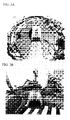
- FIGs. 3A through 5B Display examples (patterns) of generated video displayed on the display unit 352 will be illustrated in FIGs. 3A through 5B .
- FIGs. 6A through 6H illustrate patterns of combined video made with combination of four videos captured with cameras 110 to 140.
- Videos made with combination of two videos as illustrated in FIGs. 6A through 6C ; videos made with three videos as illustrated in FIGs. 6D and 6E ; videos made with four videos as illustrated in FIGs. 6F and 6G ; and a video made with a single video as illustrated in FIG. 6H are video-processed by the video processing unit 200, and displayed on the display unit 352.
- the video displayed on the display unit 352 is a generated video processed to be a stereoscopic display.
- the stereoscopic generated video is generated as multiple videos captured with cameras 110 to 140 are combined and coordinate-transformed (details will be described later).
- 6A through 6C is used to generate the generated video with only two videos of the left and the rear to check for a collision in left turn, for example.
- the video made with combination of three videos as illustrated in FIGs. 6D and 6E is used to generate the generated video from three camera videos except the front camera video to look behind the vehicle in the lane change.
- the video made with combination of four videos as illustrated in FIGs. 6F and 6G is used to generate the video that enables the driver to check all around the vehicle.
- the divisions are changed, as which camera video is used more to generate the generated video depends on the viewpoint location of when the generated video is generated.
- the video inputting unit 210 will now be described.
- the video inputting unit 210 is provided with a first video inputting unit 211, a second video inputting unit 212, a third video inputting unit 213, and a fourth video inputting unit 214.
- the first video inputting unit 211 is a block receiving a video captured with the camera 110.
- the first video inputting unit 211 executes A/D conversion to the received video, and outputs the A/D converted video data to a first video process unit 231 of a video process unit 230.
- the second video inputting unit 212 is a block receiving a video captured with the camera 120.
- the second video inputting unit 212 executes A/D conversion to the received video, and outputs the A/D converted video data to a second video process unit 235 of the video process unit 230.
- the third video inputting unit 213 is a block receiving a video captured with the camera 130.
- the third video inputting unit 213 executes A/D conversion to the received video, and outputs the A/D converted video data to a third video process unit 241 of the video process unit 230.
- the fourth video inputting unit 214 is a block receiving a video captured with the camera 140.
- the fourth video inputting unit 214 executes A/D conversion to the received video, and outputs the A/D converted video data to a fourth video process unit 245 of the video process unit 230.
- the process processing unit 220 is provided with the video process unit 230, and the capture preprocessing unit 250.
- the video process unit 230 is provided with the first video process unit 231, the second video process unit 235, the third video process unit 241, and the fourth video process unit 245.
- the first video process unit 231 is provided with a first video clipping unit 232, and a first zooming unit 233.
- the second video process unit 235 is provided with a second video clipping unit 236, and a second zooming unit 243.
- the third video process unit 241 is provided with a third video clipping unit 242, and a third zooming unit 237.
- the fourth video process unit 245 is provided with a fourth video clipping unit 246, and a fourth zooming unit 247.
- the first video process unit 231 through the fourth video process unit 245 have a same composition. Therefore, hereinafter, the first video process unit 231 will be described as a representative of them.
- the first video clipping unit 232 receives the video data output from the first video inputting unit 211.
- the first video clipping unit 232 receives an indication signal that indicates a clipping position of the video from a capture video partial management unit 253 described later.
- the first video clipping unit 232 clips a given region of the video according to the indication signal, and outputs the clipped video (hereinafter, called partial video data) to the first zooming unit 233.
- the first zooming unit 233 receives the partial video data output from the first video clipping unit 232.
- the first zooming unit 233 receives an indication signal that indicates the enlargement ratio or the reduction ratio of the video from the capture video partial management unit 253.
- the first zooming unit 233 enlarges or reduces the partial video data with the enlargement ratio or the reduction ratio indicated by the capture video partial management unit 253.
- the first zooming unit 233 outputs the enlarged or reduced partial video data to a writing control unit 254.
- the number of the video inputting unit 210 and the video process unit 230 is four in accordance with the number of cameras 110 to 140 mounted on the vehicle. But the number of the video inputting unit 210 and the video process unit 230 is not limited to four, and may be six in the system using six cameras, for example.
- the video data captured with four cameras 110 to 140 may be input to and processed by one video inputting unit 210 and one video process unit 230, one by one.
- the capture preprocessing unit 250 is provided with a host IF unit 251, a setting holding unit 252, the capture video partial management unit 253, the writing control unit 254, a buffer switching management unit 255, a combined video frame buffer 256 (in this embodiment, three combined video frame buffers 256A through 256C), a retrieving control unit 257, and a video outputting IF unit 258.
- a dashed arrow in FIG. 8 illustrates a control signal line, and a solid arrow illustrates a data line.
- the host IF unit 251 acts as an interface with a video generating unit 260.
- the host IF unit 251 receives an instruction to change the generating pattern of the combined video data generated with combination of the partial video data, from the video generating unit 260.
- the host IF unit 251 outputs the received instruction to change the generating pattern, to the capture video partial management unit 253.
- the host IF unit 251 outputs a switching completion notice, which is output from the capture video partial management unit 253 in the case that the change of the generating pattern is completed, to the video generating unit 260 (a control unit 271).
- the setting information including video clipping position information, a reduction ratio, and a write start coordinate of the combined video frame buffer 256 is recorded with respect to each camera of cameras 110 to 140. This setting information is set with respect to each generating pattern of the generated video data.
- the setting information may include a video clipping position and a write start coordinate with respect to each camera of cameras 110 to 140 as illustrated in FIG. 9B .
- the setting information illustrated in FIG 9B is set with respect to each generating pattern of each generated video data.
- the capture video partial management unit 253 acquires indication information of the generating pattern from the host IF unit 251.
- the capture video partial management unit 253 extracts the setting information according to the acquired indication information of the generating pattern from the setting holding unit 252.
- the capture video partial management unit 253 outputs the indication signal indicating the video clipping position to the first video clipping unit 232 through the fourth video clipping unit 246 on the basis of the extracted setting information.
- the capture video partial management unit 253 outputs the indication signal indicating the enlargement ratio or the reduction ratio of the partial video to the first zooming unit 233 through the fourth zooming unit 247 on the basis of the extracted setting information.
- the capture video partial management unit 253 indicates addresses of the combined video frame buffers 256A through 256C to which the partial video is written, to the writing control unit 254.
- the writing control unit 254 writes the partial video input from the first video process unit 231 through the fourth video process unit 245 in the writing address indicated by the capture video partial management unit 253.
- the buffer switching management unit 255 switches the combined video frame buffers 256A through 256C to which the partial video is written according to the control of the writing control unit 254. In addition, the buffer switching management unit 255 switches the combined video frame buffers 256A through 256C from which the combined video data is retrieved according to the control of the retrieving control unit 257.
- the combined video frame buffers 256A through 256C are provided with three buffers.
- the first video inputting unit 211 through the fourth video inputting unit 214, and the first video process unit 231 through the fourth video process unit 245 process each video captured with cameras 110 to 140 respectively asynchronously. Therefore, two combined video frame buffers to which the writing control unit 254 writes the video are provided.
- the retrieving control unit 257 retrieves the latest combined video data, which is already written to the combined video frame buffer, by requesting the buffer switching management unit 255 to retrieve, and outputs it to the video outputting IF unit 258.
- the video outputting IF unit 258 is coupled to the video generating unit 270.
- the video outputting IF unit 258 outputs the partial video data retrieved by the retrieving control unit 257 to a video capture unit 275 of the video generating unit 270.
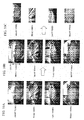
- FIG. 10A Front video data, rear video data, left video data, and right video data captured with cameras 110 to 140 respectively, are illustrated in FIG 10A.
- FIG. 10B illustrates setting the clipping range of the partial video to each video data according to the indication signal from the capture video partial management unit 253.
- FIG. 10C illustrates clipping the partial video data according to the set clipping range.
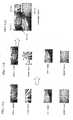
- FIGs. 11A and 11B illustrate reducing the partial video according to the indication signal from the capture video partial management unit 253.
- FIG. 11B illustrates reducing the size of the rear video in the X-axis direction to half.
- FIG. 11C illustrates generating the combined video data by combining four partial video data.
- the combined video data illustrated in FIG. 11C is generated in the combined video frame buffer 256 as the writing control unit 254 writes each partial video data to the address of the combined video frame buffer 256 indicated by the capture video partial management unit 253.
- the video generating unit 270 is provided with the control unit 271, a drawing processing unit 272, a tentative generated video converting pattern data holding unit 273, a generated video converting pattern data holding unit 274, the video capture unit 275, a video capture buffer 276, a buffer management unit 277, a generated video buffer 278, and a video outputting unit 279.
- a dashed arrow illustrates a control signal line
- a solid arrow illustrates a data line.
- the control unit 271 is provided with a CPU (Central Processing Unit) 301, a ROM (Read Only Memory) 302, a RAM (Random Access Memory) 303, and an input and output unit 304 as a hardware, as illustrated in FIG 13 .
- a CPU Central Processing Unit
- ROM Read Only Memory
- RAM Random Access Memory
- Programs that the CPU 301 uses for the control are stored in the ROM 302.
- the CPU 301 reads programs stored in the ROM 302, and executes processes according to the read programs.
- Data that the CPU 301 uses for the calculation, and the calculation result are stored in the RAM 303.
- the input and output unit 304 receives inputs from the operation unit 351, and receives the tentative generated video converting pattern data described later from the external and records it in the tentative generated video converting pattern data holding unit 273 by the control of the CPU 301 as an input and output port, for example.
- the control unit 271 is coupled to the capture preprocessing unit 250, the drawing processing unit 272, the buffer management unit 277, and the video outputting unit 279 with the control signal line.
- control unit 271 When the control unit 271 receives the instruction to change the generating pattern of the generated video through the operation unit 351, the control unit 271 instructs the drawing processing unit 272 and the capture preprocessing unit 250 to change the generating pattern of the generated video.
- the control unit 271 may acquire the vehicle information from the vehicle through the input and output unit 304, and instruct the drawing processing unit 272 and the capture preprocessing unit 250 to change the generating pattern of the generated video on the basis of the acquired vehicle information. For example, when the gear is got into reverse, the control unit 271 enlarges the area of the rear video in the combined video, and ensures the resolution of the rear video displayed wide, as it instructs the drawing processing unit 272 and the capture preprocessing unit 250 to switch the generated video to the generated video which displays the rear video wide.
- control unit 271 manages the generating timing of the generated video data with respect to each frame.
- the control unit 271 receives a frame process completion notice from the drawing processing unit 272.
- the control unit 271 instructs the drawing processing unit 272 to start drawing the generated video data for the next frame (details of this process will be described later with reference to a flowchart).
- control unit 271 outputs the instruction signal to switch the generated video buffer 278 to which the generated video data is written to the buffer management unit 277.
- the generated video buffer 278 is provided with two generated video buffers 278A and 278B.
- the control unit 271 selects the generated video buffer to which the drawing processing unit 272 writes the generated video data.
- the control unit 271 outputs the instruction signal to switch the generated video buffer 278 from which the generated video data is retrieved to the buffer management unit 277.
- the control unit 271 receives a frame output completion notice that indicates that the video outputting unit 279 completes outputting the generated video for a frame.
- the combined video data output from the video outputting IF unit 258 of the capture preprocessing unit 250 is input to the video capture unit 275.
- the video capture unit 275 receives the combined video data output from the video outputting IF unit 258, and outputs it to the video capture buffer 276.
- the video capture buffer 276 captures the video by storing the combined video data output from the video capture unit 275.
- the combined video data stored in the video capture buffer 276 is output from the video capture buffer 276 to the drawing processing unit 272 according to the retrieve instruction of the drawing processing unit 272.
- the tentative generated video converting pattern data (coordinate conversion data) illustrated in FIG. 14A is stored in the tentative generated video converting pattern data holding unit 273.
- the tentative generated video converting pattern is data for the coordinate conversion to convert each camera video to generated video data. This data is generated by an information processing apparatus such as a personal computer, and is recorded in the tentative generated video converting pattern data holding unit 273 by the control of the control unit 271.
- the tentative generated video converting pattern data is data to generate the generated video data from the video before each camera video is clipped, reduced, and combined by the capture preprocessing unit 250.
- the data of which the coordinate value is corrected by the control unit 271 is recorded in the generated video converting pattern data holding unit 274 as generated video converting pattern data.
- the tentative generated video converting pattern data includes, as illustrated in FIG.
- polygons are partitions on the video, and processing units for a coordinate conversion when the combined video data is converted to the generated video data.
- the polygon number is the number to identify the polygon. The polygon number and the vertex number are not always necessary.
- the tentative generated video converting pattern may be the pattern data illustrated in FIG. 14B .
- the tentative generated video converting pattern illustrated in FIG 14B includes the polygon number, the vertex number of the polygon that the polygon number indicates, the coordinate value information on the video data of each vertex before the conversion, the coordinate value on the video projection plane defined in the three-dimensional video processing space, and viewpoint vector data of the three-dimensional video processing space.
- the viewpoint vector data is data to determine where the video projection plane is viewed from to generate the generated video data (see FIG 17 ).
- the drawing processing unit 272 converts the combined video data retrieved from the video capture buffer 276 to the generated video data.
- a method such as a texture mapping method is used as a converting method, for example.
- the drawing processing unit 272 records the generated video data that the drawing processing unit 272 has generated in the generated video buffer 278.
- the generated video data recorded in the generated video buffer 278 is retrieved by the video outputting unit 279, and displayed on the display unit 352.
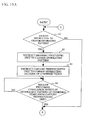
- the control unit 271 determines whether the instruction to change the generating pattern of the generated video data is input from the operation unit 351 (step S1). When the instruction to change the generating pattern is input (step S1: YES), the control unit 271 instructs the drawing processing unit 272 to change the generating pattern (step S2). Then the control unit 271 outputs the instruction to change the generating pattern of the combined video to the capture preprocessing unit 250 (step S3). The control unit 271 determines whether it receives the change completion notice of the generating pattern of the combined video from the capture preprocessing unit 250 (step S4). The control unit 271 holds the next procedure till it receives the change completion notice from the capture preprocessing unit 250 (step S4: NO).
- a capture video partial management unit 253 of the capture preprocessing unit 250 extracts the setting information corresponding to the generating pattern indicated by the control unit 271 from the setting holding unit 252.
- the capture video partial management unit 253 indicates the used range of each video data used for the indicated generating pattern to the first video clipping unit 232 through the fourth video clipping unit 246 respectively.
- the capture video partial management unit 253 indicates the reduction ratio of the indicated generating pattern to the first zooming unit 233 through the fourth zooming unit 247.
- control unit 271 determines whether it receives the process completion notice of the generated video data for a frame from the buffer management unit 267 (step S5). The control unit 271 holds the next procedure till it receives the process completion notice from the buffer management unit 277 (step S5).
- control unit 271 receives the process completion notice from the buffer management unit 277 (step S5: YES)
- it determines whether it receives the output completion notice of the generated video data for a frame from the video outputting unit 279 (step S6).
- control unit 271 When the control unit 271 receives the output completion notice from the video outputting unit 279 (step S6: YES), it outputs the instruction to switch the generated video buffer 278, to the buffer management unit 277 (step S7). When the control unit 271 outputs the instruction to switch the generated video buffer 278, to the buffer management unit 277, the control unit 271 instructs the drawing processing unit 272 to start generating the generated video data for the next frame (step S8).
- the process described hereinafter, is not executed by inputting actual camera video data, but is executed by the calculation of the control unit 271, or with a personal computer on the case that the generated video is designed.
- the generated video is designed by an application software installed in an information processing apparatus such as a personal computer.
- the user inputs data such as shape data of the video projection plane, the viewpoint vector, and a display range of the video to the application software.
- the application software generates the coordinate conversion data (tentative generated video converting pattern data) to convert the camera video to the generated video on the basis of the input data.
- the tentative generated video converting pattern data generated by the application software is loaded into the control unit 271 through the input and output unit 304, and recorded in the tentative generated video converting pattern data holding unit 273 by the control of the control unit 271.
- the shape data of the video projection plane is data to indicate the shape of the projection plane onto which the multiple videos captured with cameras 110 to 140 are projected, and data to convert the camera video to the generated video (see FIG. 17 ).
- the viewpoint vector data is data to indicate where the video projection plane is seen from to generate the generated video.
- the ratio in displaying each part of video captured with each camera of cameras 110 to 140 changes in accordance with these video projection plane and viewpoint vector data.
- the data of the display range of the video is data to indicate the range to display the video as illustrated in FIG. 17 .
- the control unit 271 calculates the coordinate value of the use part of each camera video, referring to the tentative generated video converting pattern data stored in the tentative generated video converting pattern data holding unit 273 (step S11).
- the control unit 271 calculates the used range (the coordinate value) of the camera video from the tentative generated video converting pattern data. More specifically, on the basis of the tentative generated video converting pattern data, the control unit 271 detects the vertex coordinate of each camera video corresponding to the display range of the generated video data, and calculates the maximum and the minimum values of the vertex coordinate (Xmin, Ymin). The control unit 271 outputs the coordinate value of the rectangle of which the diagonal vertex is the calculated maximum and the calculated minimum values of the vertex coordinate (Xmin, Ymin) as the used range. FIGs.
- 18A through 18D illustrate determining each used range of the front video, the rear video, the left video, and the right video. As illustrated with a dashed line, when the used range is extracted free-form, the used range is calculated as a shape made by connecting the most outer sides of the used range.
- the control unit 271 calculates the pixel expansion ratio when each camera video is converted to the generated video (step S12).
- the control unit 271 executes the procedure of the step S12 to each camera video.
- the control unit 271 compares all video processing units (polygons) composing the generated video with the coordinate value of the polygon on the camera video, and calculates the pixel expansion ratio in the coordinate conversion (step S12).
- Polygons are processing units (pixels) in the coordinate conversion, and the control unit 271 calculates the pixel expansion ratio by calculating the coordinate values before and after the coordinate conversion of the polygon.
- the method to calculate the pixel expansion ratio may be a method to calculate the expansion ratio of the camera video in the X-axis direction and the Y-axis direction respectively, and a method to calculate the expansion ratio with the ratio between the area of the polygon of the camera video before the conversion and the area of the polygon of the generated video after the conversion, for example. Examples of the calculation results are illustrated in FIG. 19 .
- the control unit 271 determines the representative value of the pixel expansion ratio of each camera video (step S 13). Using the pixel expansion ratio calculated with respect to each polygon in the step S12 above, the control unit 271 determines the representative value of the pixel expansion ratio of each camera video. The control unit 271 selects the maximum one from the pixel expansion ratios of each polygon, and determines it as the representative value of the pixel expansion ratio of the appropriate camera video. The control unit 271 may select the minimum one from the pixel expansion ratios of each polygon, and determine it as the representative value of the pixel expansion ratio; or the control unit 271 may calculate the average value or the intermediate value of the pixel expansion ratios of each polygon, and determine this average value or intermediate value as the representative value of the pixel expansion ratio.
- Examples of the representative values of the pixel expansion ratio of each camera video are illustrated in FIG 20 .
- the representative value of the pixel expansion ratio in the X-direction and the Y-direction is calculated with respect to each camera video.
- the control unit 271 uses the coordinate value of the use part of each camera video extracted in the step S 11 (called a partial video, and not called the partial video data as it is not an actual video data), the control unit 271 reduces the partial video of the camera video of which the representative value of the pixel expansion ratio is less than one by the representative value of the pixel expansion ratio times, which means that the control unit 271 reduces the partial video so that the representative value of the pixel expansion ratio becomes one (step S 14).
- control unit 271 multiplies the partial video by the representative value of the pixel expansion ratio, reduces the partial video by the representative value of the pixel expansion ratio times, and calculates the number of the pixels of the partial video multiplied by the representative value of the pixel expansion ratio in the X-axis direction and the Y-axis direction ( ⁇ Xtemp, ⁇ Ytemp) respectively.
- the control unit 271 does not execute any process to the camera video of which the representative value of the pixel expansion ratio is more than or equal to one, and calculates the number of pixels in the X-axis direction and the Y-axis direction without process.
- the control unit 271 determines whether all partial videos are within the regulation size of the combined video (step S 15).
- the combined video is a video made with combination of multiple camera videos.
- the size of the combined video is determined as the regulation size (given size).
- the control unit 271 locates all partial videos within the combined video as illustrated in FIG. 21 , and determines whether the partial videos can be located within the combined video.
- control unit 271 records the image size information of the partial video multiplied by the representative value of the pixel expansion ratio, and goes to a step S20.
- the control unit 271 enlarges the partial video of the camera video of which the representative value of the pixel expansion ratio is more than or equal to one the representative value of the pixel expansion ratio times (step S 17). This means that the control unit 271 enlarges the partial video so that the representative value of the pixel expansion ratio of the use part of the video after the enlargement becomes one.
- the control unit 271 calculates the number of pixels of the partial video enlarged the representative value of the pixel expansion ratio times in the X-axis direction and the Y-axis direction respectively (step S 17).
- the control unit 271 calculates the combination of partial videos, of which the pixel aspect ratio is nearest to the aspect ratio of the combined video and the reduction ratio in the reduction to the image size of the combined video is smallest among all combinations of partial videos, and its reduction ratio.
- the control unit 271 sorts the partial videos reduced by the representative value of the pixel expansion ratio calculated in the step S 14 times, and the partial videos enlarged the representative value of the pixel expansion ratio calculated in the step S 17 times (hereinafter, these are called tentative-sized partial videos) within the image size of the combined video as illustrated in FIGs. 22A and 22B .
- the control unit 271 calculates the combination of partial videos, of which the pixel aspect ratio is nearest to the aspect ratio of the combined video and the reduction ratio in the reduction to the image size of the combined video is smallest, and its reduction ratio.
- FIG. 22A illustrates tentative-sized partial videos of the front, rear, left, and right directions.
- FIG 22B illustrates sorting these tentative-sized partial videos.
- the control unit 271 calculates the actual reduction ratio of each partial video on the basis of the reduction ratio calculated in the step S18 and the representative value of the pixel expansion ratio (step S 19). More specifically, the control unit 271 calculates the product of the reduction ratio and the representative value of the pixel expansion ratio with respect to each partial video.
- the control unit 271 determines whether the partial video of which the reduction ratio calculated in the step S19 is less than one (it means the enlargement) exists (step S20). When the partial video of which the reduction ratio is less than one exists, the control unit 271 replaces the reduction ratio of the partial video of which the reduction ratio is less than one with one, and relocates partial videos without changing the combining position on the combined video. When the space is created within the image size of the combined video by relocation, the control unit 271 equally changes the reduction ratio so that the reduction ratio of the partial videos of which the reduction ratio is more than or equal to one (it means the reduction) becomes near to one (step S21). In examples illustrated in FIGs.
- the control unit 271 executes the size conversion to make reduction ratios of these partial videos one, and relocates these partial videos.
- the result of the size conversion and relocation is illustrated in FIGs. 23C and 23D .
- the control unit 271 determines the combined video pattern data after procedures above.
- the control unit 271 outputs the determined combined video pattern data to the capture preprocessing unit 250 as the setting information, and records it in the setting holding unit 252 (step S22).
- the control unit 271 corrects the tentative generated video converting pattern data by using the location information of the camera video in the combined video (setting information) (step S23).
- the control unit 271 stores the corrected tentative generated video converting pattern data in the generated video converting pattern data holding unit 264 as the generated video converting pattern data.
- the control unit 271 may also make a correction to deal with the installation condition of the camera by using the installation condition information of the camera to the vehicle and the camera characteristics data.
- the installation condition information of the camera includes the position coordinate of the camera (X, Y, Z), and mounting angles (a yaw angle, a depression angle, and a roll angle).
- the camera characteristics data includes the number of pixels of the camera video (horizontal and vertical), field angles (horizontal and vertical), and lens distortion data.
- the image size of the partial video of which the representative value of the pixel expansion ratio is less than one, and the size of the partial video of which the representative value of the pixel expansion ratio is more than or equal to one, are changed so that the representative value of the pixel expansion ratio becomes one.
- the representative value of the pixel expansion ratio of the partial video data enlarged according to the coordinate conversion from the combined video data to the generated video data becomes equivalent between each partial video.
- the reduction ratio of the high-priority camera video may be determined first, and then the reduction ratio of other camera videos may be determined. For example, when the front video is designated as a priority video, the partial video data is clipped from the front camera video, and the size of this partial video data is not changed and fixed. Then, the size of the partial video data clipped from other camera videos is reduced so as to be within the size of the combined video data. After the partial video data is clipped from each camera video and the reduction ratios of all partial video data are calculated, the reduction ratio of the high-priority video data is reduced by fifty percent, the reduction ratio of rest of partial video data may be changed so as to be within the size of the combined video data.
- the coordinate conversion data for generating the generated video it is possible to generate generated video data by calculating the clipped range of the camera video and the reduction ratio with the video processing apparatus 1 and generating the combined video data from the actual input camera video. If multiple coordinate conversion data are provided, it is possible to generate generated video data of which the video pattern is changed in response to the running condition of the vehicle.
- each partial video As the size of each partial video is adjusted so that the representative value of the pixel expansion ratio of the partial video are equivalent between each partial video, it is possible to enlarge the partial video almost evenly in executing the coordinate conversion to generate the generated video.
- the size of the partial video is adjusted so that the high-priority video data is not reduced, the high-priority video data is not reduced in generating the generated video.
- the pixel expansion ratios of all polygons are calculated, it is not necessary to calculate the pixel expansion ratios of polygons in the area away from the vehicle. As videos near the vehicle are important for drive assist, it is not necessary to visualize other videos at high resolution, and it is possible to make them out of the processing object.
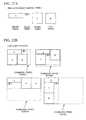
- the partial video When the partial video is clipped from the camera video as illustrated in FIG. 24 , the partial video may be clipped free-form.
- FIG. 24 illustrates an example of the combined video data made with combination of the partial videos clipped free-form.
- the invention also provides a computer program or a computer program product for carrying out any of the methods disclosed or evident from the above, and a computer readable medium having stored thereon a program for carrying out any of the said methods.
- a computer program embodying the invention may be stored on a computer-readable medium, or it could, for example, be in the form of a signal such as a downloadable data signal provided from an Internet website, or it could be in any other form.
Landscapes
- Engineering & Computer Science (AREA)
- Physics & Mathematics (AREA)
- General Physics & Mathematics (AREA)
- Theoretical Computer Science (AREA)
- Multimedia (AREA)
- Signal Processing (AREA)
- Closed-Circuit Television Systems (AREA)
- Image Analysis (AREA)
- Image Processing (AREA)
- Studio Devices (AREA)
- Two-Way Televisions, Distribution Of Moving Picture Or The Like (AREA)
Abstract
Description
- The invention discussed herein relates generally to video processing.
- An apparatus that supports a driver's safe driving is provided. The apparatus captures videos of an area around a vehicle that is out of the driver's line of vision by using a camera mounted on the vehicle and displays captured videos on a monitor mounted in the vehicle interior.
- Japanese Laid-Open Patent Publication No.
2002-27448 - It is considered desirable to provide a video processing apparatus capable of generating multi-pattern generated video data composed of multiple videos.
- According to an aspect of the present invention (or at least an aspect of one embodiment), there is provided a video processing apparatus capable of cooperating with a plurality of capturing units and a display unit, the video processing apparatus including: a pattern information storing unit that stores use part information and location information; a plurality of video inputting units that input each of a plurality of video data captured with the plurality of capturing units; a video data generating unit that generates a plurality of types of generated video data; a generated video pattern selecting unit that selects a pattern of generated video data to be generated in the video data generating unit; a process unit that stores the use part of each video data in a storing unit after reducing the use part of each video data on the basis of the plurality of video data and location information according to a selected pattern of generated video data and generates the combined video data; and a video outputting unit that coordinate-converts the generated combined video data with coordinate conversion data preliminarily calculated with respect to each pattern of the plurality of types of generated video data, generates the generated video data, and outputs the generated video data to the display unit, wherein the use part information indicates a use part of each video data used for the generated video data, and the location information includes reduction ratio information of the use part of the each video data.
- Advantages of the invention will be realized and attained by means of the elements, and combinations thereof, particularly as pointed out in the claims. However, it is to be understood that the elements and features described herein may be combined in any suitable combination, even if such a combination is not explicitly recited/explained or shown.
- It is also to be understood that both the foregoing general description and the following detailed description are exemplary and explanatory and are not restrictive of the invention, as claimed.
-
-
FIG. 1 is a diagram illustrating a composition of a video processing apparatus; -
FIG. 2 is a diagram illustrating locations on which cameras are mounted in a vehicle; -
FIGs. 3A and 3B are diagrams illustrating an example of generated video data displayed on a display unit; -
FIGs. 4A and 4B are diagrams illustrating an example of generated video data displayed on a display unit; -
FIGs. 5A and 5B are diagrams illustrating an example of generated video data displayed on a display unit; -
FIGs. 6A through 6H are diagrams illustrating patterns of combined video data used for generating a generated video; -
FIG 7 is a diagram illustrating compositions of a capturing unit, a video inputting unit, and a process processing unit; -
FIG. 8 is a diagram illustrating a composition of a video combining unit, a video outputting unit, and a control unit of a capture preprocessing unit; -
FIGs. 9A and 9B are diagrams illustrating examples of setting information recorded in a setting holding unit of a capture preprocessing unit; -
FIGs. 10A through 10C are diagrams illustrating a process of a process processing unit; -
FIGs. 11A through 11C are diagrams illustrating a process continued fromFIGs. 10A through 10C of a process processing unit; -
FIG. 12 is a diagram illustrating a composition of a video generating unit; -
FIG 13 is a diagram illustrating a composition of a control unit of a video generating unit; -
FIGs. 14A and 14B are diagrams illustrating examples of tentative generated video converting pattern data and generated video converting pattern data; -
FIGs. 15A and15B are flowcharts illustrating a process of a control unit; -
FIGs. 16A through 16C are flowcharts illustrating a process of a control unit to generate location information and generated video converting pattern data; -
FIG 17 is a diagram to explain a shape of video projection plane, a viewpoint vector, and a display range; -
FIG. 18A is a diagram illustrating a partial video range representing a use part of a front video,FIG 18B is a diagram illustrating a partial video area representing a use part of a rear video,FIG 18C is a diagram illustrating a partial video area representing a use part of a left video, andFIG 18D is a diagram illustrating a partial video area representing a use part of a right video; -
FIG 19 is a diagram illustrating a pixel expansion ratio calculated with respect to each polygon; -
FIG. 20 is a diagram illustrating a representative value of a pixel expansion ratio of each camera video; -
FIG. 21 is a diagram illustrating a determination of whether a partial video data is within the size of combined video data; -
FIG 22A illustrates partial video data of front, back, right, and left video data, andFIG. 22B is a diagram illustrating how to locate partial video data to come to an aspect ratio of the combined video data; -
FIGs. 23A through 23D are diagrams illustrating a process of changing a reduction ratio of partial video data to be enlarged to one and relocating partial video data within combined video data; and -
FIG 24 is a diagram illustrating combined video data in the case that partial video data is clipped free-form. - As previously described, an apparatus that supports a driver's safe driving is provided. The apparatus captures videos of an area around a vehicle that is out of the driver's line of vision by using a camera mounted on the vehicle and displays captured videos on a monitor mounted in the vehicle interior.
- As also previously explained, Japanese Laid-Open Patent Publication No.
2002-27448 - However, a pattern of the synthesized video synthesized with videos captured with multiple cameras is one given pattern. Therefore, it is difficult to switch the synthesized video in response to, for example, driver's driving situation.
- A description will now be given of an embodiment of the present invention with reference to the accompanying drawings.
- A composition of this embodiment will be described with reference to
FIG 1 . As illustrated inFIG 1 , avideo processing apparatus 1 of this embodiment is provided with a capturingunit 100, avideo processing unit 200, anoperation unit 351, and adisplay unit 352. The capturingunit 100 includes afirst capturing unit 110, asecond capturing unit 120, a third capturingunit 130 and afourth capturing unit 140. Thevideo processing unit 200 includes avideo inputting unit 210, aprocess processing unit 220, and avideo generating unit 270. A capture preprocessingunit 250 of theprocess processing unit 220, and thevideo generating unit 270 are mounted on a same board. - A description will now be given of the capturing
unit 100. - The first capturing
unit 110 through the fourth capturingunit 140 are provided with a camera mounted on a vehicle, and outputs videos captured with each camera to thevideo inputting unit 210 respectively. Hereinafter, thefirst capturing unit 110 through thefourth capturing unit 140 will be calledcameras 110 through 140 respectively. In this embodiment, as illustrated in FIC. 2, thecamera 110 is installed in front of the vehicle, and captures the video of the front of the vehicle. Thecamera 120 is installed on the left side of the vehicle, and captures the video of the left side of the vehicle. Thecamera 130 is installed on the right side of the vehicle, and captures the video of the right side of the vehicle. Thecamera 140 is installed in the rear of the vehicle, and captures the video of the rear of the vehicle. In this embodiment, four cameras are installed in the vehicle, but the number of cameras is not limited to four, and can be three, five, or six. Cameras can be preliminarily mounted on the vehicle, if they can work in concert with each other. - The
operation unit 351 receives operation inputs from an operator. A generated video generated from videos captured withcameras 110 to 140 is displayed on thedisplay unit 352. The operator performs an operation to switch the pattern of the generated video displayed on thedisplay unit 352. - Display examples (patterns) of generated video displayed on the
display unit 352 will be illustrated inFIGs. 3A through 5B .FIGs. 6A through 6H illustrate patterns of combined video made with combination of four videos captured withcameras 110 to 140. - Videos made with combination of two videos as illustrated in
FIGs. 6A through 6C ; videos made with three videos as illustrated inFIGs. 6D and 6E ; videos made with four videos as illustrated inFIGs. 6F and 6G ; and a video made with a single video as illustrated inFIG. 6H are video-processed by thevideo processing unit 200, and displayed on thedisplay unit 352. The video displayed on thedisplay unit 352 is a generated video processed to be a stereoscopic display. The stereoscopic generated video is generated as multiple videos captured withcameras 110 to 140 are combined and coordinate-transformed (details will be described later). The combined video illustrated inFIGs. 6A through 6C is used to generate the generated video with only two videos of the left and the rear to check for a collision in left turn, for example. The video made with combination of three videos as illustrated inFIGs. 6D and 6E is used to generate the generated video from three camera videos except the front camera video to look behind the vehicle in the lane change. The video made with combination of four videos as illustrated inFIGs. 6F and 6G is used to generate the video that enables the driver to check all around the vehicle. However, the divisions are changed, as which camera video is used more to generate the generated video depends on the viewpoint location of when the generated video is generated. - The
video inputting unit 210 will now be described. Thevideo inputting unit 210 is provided with a firstvideo inputting unit 211, a secondvideo inputting unit 212, a thirdvideo inputting unit 213, and a fourthvideo inputting unit 214. - The first
video inputting unit 211 is a block receiving a video captured with thecamera 110. The firstvideo inputting unit 211 executes A/D conversion to the received video, and outputs the A/D converted video data to a firstvideo process unit 231 of avideo process unit 230. - The second
video inputting unit 212 is a block receiving a video captured with thecamera 120. The secondvideo inputting unit 212 executes A/D conversion to the received video, and outputs the A/D converted video data to a secondvideo process unit 235 of thevideo process unit 230. - The third
video inputting unit 213 is a block receiving a video captured with thecamera 130. The thirdvideo inputting unit 213 executes A/D conversion to the received video, and outputs the A/D converted video data to a thirdvideo process unit 241 of thevideo process unit 230. - The fourth
video inputting unit 214 is a block receiving a video captured with thecamera 140. The fourthvideo inputting unit 214 executes A/D conversion to the received video, and outputs the A/D converted video data to a fourthvideo process unit 245 of thevideo process unit 230. - Then, a description will be given of the
process processing unit 220 with reference toFIG. 7 . Theprocess processing unit 220 is provided with thevideo process unit 230, and thecapture preprocessing unit 250. - The
video process unit 230 is provided with the firstvideo process unit 231, the secondvideo process unit 235, the thirdvideo process unit 241, and the fourthvideo process unit 245. The firstvideo process unit 231 is provided with a firstvideo clipping unit 232, and afirst zooming unit 233. The secondvideo process unit 235 is provided with a secondvideo clipping unit 236, and asecond zooming unit 243. The thirdvideo process unit 241 is provided with a thirdvideo clipping unit 242, and athird zooming unit 237. The fourthvideo process unit 245 is provided with a fourthvideo clipping unit 246, and afourth zooming unit 247. The firstvideo process unit 231 through the fourthvideo process unit 245 have a same composition. Therefore, hereinafter, the firstvideo process unit 231 will be described as a representative of them. - The first
video clipping unit 232 receives the video data output from the firstvideo inputting unit 211. The firstvideo clipping unit 232 receives an indication signal that indicates a clipping position of the video from a capture videopartial management unit 253 described later. The firstvideo clipping unit 232 clips a given region of the video according to the indication signal, and outputs the clipped video (hereinafter, called partial video data) to thefirst zooming unit 233. - The
first zooming unit 233 receives the partial video data output from the firstvideo clipping unit 232. Thefirst zooming unit 233 receives an indication signal that indicates the enlargement ratio or the reduction ratio of the video from the capture videopartial management unit 253. Thefirst zooming unit 233 enlarges or reduces the partial video data with the enlargement ratio or the reduction ratio indicated by the capture videopartial management unit 253. Thefirst zooming unit 233 outputs the enlarged or reduced partial video data to awriting control unit 254. - In this embodiment, the number of the
video inputting unit 210 and thevideo process unit 230 is four in accordance with the number ofcameras 110 to 140 mounted on the vehicle. But the number of thevideo inputting unit 210 and thevideo process unit 230 is not limited to four, and may be six in the system using six cameras, for example. The video data captured with fourcameras 110 to 140 may be input to and processed by onevideo inputting unit 210 and onevideo process unit 230, one by one. - A description will now be given of the
capture preprocessing unit 250 with reference toFIG. 8 . - The
capture preprocessing unit 250 is provided with a host IFunit 251, asetting holding unit 252, the capture videopartial management unit 253, thewriting control unit 254, a bufferswitching management unit 255, a combined video frame buffer 256 (in this embodiment, three combinedvideo frame buffers 256A through 256C), a retrievingcontrol unit 257, and a video outputting IFunit 258. A dashed arrow inFIG. 8 illustrates a control signal line, and a solid arrow illustrates a data line. - The host IF
unit 251 acts as an interface with a video generating unit 260. The host IFunit 251 receives an instruction to change the generating pattern of the combined video data generated with combination of the partial video data, from the video generating unit 260. The host IFunit 251 outputs the received instruction to change the generating pattern, to the capture videopartial management unit 253. The host IFunit 251 outputs a switching completion notice, which is output from the capture videopartial management unit 253 in the case that the change of the generating pattern is completed, to the video generating unit 260 (a control unit 271). - Multiple setting information for generating combined video data by combining videos captured with
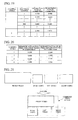
cameras 110 to 140 are recorded in thesetting holding unit 252 with respect to each generating pattern. Examples of the setting information will be illustrated inFIG. 9A . The setting information including video clipping position information, a reduction ratio, and a write start coordinate of the combined video frame buffer 256 is recorded with respect to each camera ofcameras 110 to 140. This setting information is set with respect to each generating pattern of the generated video data. - The setting information may include a video clipping position and a write start coordinate with respect to each camera of
cameras 110 to 140 as illustrated inFIG. 9B . The setting information illustrated inFIG 9B is set with respect to each generating pattern of each generated video data. - The capture video
partial management unit 253 acquires indication information of the generating pattern from the host IFunit 251. The capture videopartial management unit 253 extracts the setting information according to the acquired indication information of the generating pattern from thesetting holding unit 252. The capture videopartial management unit 253 outputs the indication signal indicating the video clipping position to the firstvideo clipping unit 232 through the fourthvideo clipping unit 246 on the basis of the extracted setting information. The capture videopartial management unit 253 outputs the indication signal indicating the enlargement ratio or the reduction ratio of the partial video to thefirst zooming unit 233 through thefourth zooming unit 247 on the basis of the extracted setting information. The capture videopartial management unit 253 indicates addresses of the combinedvideo frame buffers 256A through 256C to which the partial video is written, to thewriting control unit 254. - The
writing control unit 254 writes the partial video input from the firstvideo process unit 231 through the fourthvideo process unit 245 in the writing address indicated by the capture videopartial management unit 253. - The buffer
switching management unit 255 switches the combinedvideo frame buffers 256A through 256C to which the partial video is written according to the control of thewriting control unit 254. In addition, the bufferswitching management unit 255 switches the combinedvideo frame buffers 256A through 256C from which the combined video data is retrieved according to the control of the retrievingcontrol unit 257. - The combined
video frame buffers 256A through 256C are provided with three buffers. The firstvideo inputting unit 211 through the fourthvideo inputting unit 214, and the firstvideo process unit 231 through the fourthvideo process unit 245 process each video captured withcameras 110 to 140 respectively asynchronously. Therefore, two combined video frame buffers to which thewriting control unit 254 writes the video are provided. - The retrieving
control unit 257 retrieves the latest combined video data, which is already written to the combined video frame buffer, by requesting the bufferswitching management unit 255 to retrieve, and outputs it to the video outputting IFunit 258. - The video outputting IF
unit 258 is coupled to thevideo generating unit 270. The video outputting IFunit 258 outputs the partial video data retrieved by the retrievingcontrol unit 257 to avideo capture unit 275 of thevideo generating unit 270. - A description will now be given of a process of the
process processing unit 220 executed according to the instruction from the capture videopartial management unit 253 with reference toFIGs. 10A through 11C . - Front video data, rear video data, left video data, and right video data captured with
cameras 110 to 140 respectively, are illustrated inFIG 10A. FIG. 10B illustrates setting the clipping range of the partial video to each video data according to the indication signal from the capture videopartial management unit 253.FIG. 10C illustrates clipping the partial video data according to the set clipping range.FIGs. 11A and 11B illustrate reducing the partial video according to the indication signal from the capture videopartial management unit 253.FIG. 11B illustrates reducing the size of the rear video in the X-axis direction to half.FIG. 11C illustrates generating the combined video data by combining four partial video data. The combined video data illustrated inFIG. 11C is generated in the combined video frame buffer 256 as thewriting control unit 254 writes each partial video data to the address of the combined video frame buffer 256 indicated by the capture videopartial management unit 253. - A description will now be given of the
video generating unit 270 with reference toFIG. 12 . - The
video generating unit 270 is provided with thecontrol unit 271, adrawing processing unit 272, a tentative generated video converting patterndata holding unit 273, a generated video converting patterndata holding unit 274, thevideo capture unit 275, avideo capture buffer 276, abuffer management unit 277, a generated video buffer 278, and avideo outputting unit 279. InFIG. 12 , a dashed arrow illustrates a control signal line, and a solid arrow illustrates a data line. - The
control unit 271 is provided with a CPU (Central Processing Unit) 301, a ROM (Read Only Memory) 302, a RAM (Random Access Memory) 303, and an input andoutput unit 304 as a hardware, as illustrated inFIG 13 . - Programs that the
CPU 301 uses for the control are stored in theROM 302. TheCPU 301 reads programs stored in theROM 302, and executes processes according to the read programs. Data that theCPU 301 uses for the calculation, and the calculation result are stored in theRAM 303. - The input and
output unit 304 receives inputs from theoperation unit 351, and receives the tentative generated video converting pattern data described later from the external and records it in the tentative generated video converting patterndata holding unit 273 by the control of theCPU 301 as an input and output port, for example. - The
control unit 271 is coupled to thecapture preprocessing unit 250, thedrawing processing unit 272, thebuffer management unit 277, and thevideo outputting unit 279 with the control signal line. - When the
control unit 271 receives the instruction to change the generating pattern of the generated video through theoperation unit 351, thecontrol unit 271 instructs thedrawing processing unit 272 and thecapture preprocessing unit 250 to change the generating pattern of the generated video. Thecontrol unit 271 may acquire the vehicle information from the vehicle through the input andoutput unit 304, and instruct thedrawing processing unit 272 and thecapture preprocessing unit 250 to change the generating pattern of the generated video on the basis of the acquired vehicle information. For example, when the gear is got into reverse, thecontrol unit 271 enlarges the area of the rear video in the combined video, and ensures the resolution of the rear video displayed wide, as it instructs thedrawing processing unit 272 and thecapture preprocessing unit 250 to switch the generated video to the generated video which displays the rear video wide. - In addition, the
control unit 271 manages the generating timing of the generated video data with respect to each frame. When the generated video data for a frame is written to the generated video buffer 278 by thedrawing processing unit 272, thecontrol unit 271 receives a frame process completion notice from thedrawing processing unit 272. When receiving the frame process completion notice from thedrawing processing unit 272, thecontrol unit 271 instructs thedrawing processing unit 272 to start drawing the generated video data for the next frame (details of this process will be described later with reference to a flowchart). - In addition, the
control unit 271 outputs the instruction signal to switch the generated video buffer 278 to which the generated video data is written to thebuffer management unit 277. In this embodiment, the generated video buffer 278 is provided with two generatedvideo buffers control unit 271 selects the generated video buffer to which thedrawing processing unit 272 writes the generated video data. In addition, thecontrol unit 271 outputs the instruction signal to switch the generated video buffer 278 from which the generated video data is retrieved to thebuffer management unit 277. In addition, when thevideo outputting unit 279 outputs the generated video for a frame, thecontrol unit 271 receives a frame output completion notice that indicates that thevideo outputting unit 279 completes outputting the generated video for a frame. - The combined video data output from the video outputting IF
unit 258 of thecapture preprocessing unit 250 is input to thevideo capture unit 275. Thevideo capture unit 275 receives the combined video data output from the video outputting IFunit 258, and outputs it to thevideo capture buffer 276. - The
video capture buffer 276 captures the video by storing the combined video data output from thevideo capture unit 275. The combined video data stored in thevideo capture buffer 276 is output from thevideo capture buffer 276 to thedrawing processing unit 272 according to the retrieve instruction of thedrawing processing unit 272. - The tentative generated video converting pattern data (coordinate conversion data) illustrated in
FIG. 14A is stored in the tentative generated video converting patterndata holding unit 273. The tentative generated video converting pattern is data for the coordinate conversion to convert each camera video to generated video data. This data is generated by an information processing apparatus such as a personal computer, and is recorded in the tentative generated video converting patterndata holding unit 273 by the control of thecontrol unit 271. The tentative generated video converting pattern data is data to generate the generated video data from the video before each camera video is clipped, reduced, and combined by thecapture preprocessing unit 250. The data of which the coordinate value is corrected by thecontrol unit 271 is recorded in the generated video converting patterndata holding unit 274 as generated video converting pattern data. The tentative generated video converting pattern data includes, as illustrated inFIG. 14A , the polygon number, the vertex number of polygons that the polygon number indicates, the coordinate value information of each vertex before the conversion, and coordinate value information of the generated video data of each vertex after the conversion, for example. Polygons are partitions on the video, and processing units for a coordinate conversion when the combined video data is converted to the generated video data. The polygon number is the number to identify the polygon. The polygon number and the vertex number are not always necessary. - In addition, the tentative generated video converting pattern may be the pattern data illustrated in
FIG. 14B . The tentative generated video converting pattern illustrated inFIG 14B includes the polygon number, the vertex number of the polygon that the polygon number indicates, the coordinate value information on the video data of each vertex before the conversion, the coordinate value on the video projection plane defined in the three-dimensional video processing space, and viewpoint vector data of the three-dimensional video processing space. The viewpoint vector data is data to determine where the video projection plane is viewed from to generate the generated video data (seeFIG 17 ). - Referring to the generated video converting pattern stored in the generated video converting pattern
data holding unit 274, thedrawing processing unit 272 converts the combined video data retrieved from thevideo capture buffer 276 to the generated video data. A method such as a texture mapping method is used as a converting method, for example. Thedrawing processing unit 272 records the generated video data that thedrawing processing unit 272 has generated in the generated video buffer 278. - The generated video data recorded in the generated video buffer 278 is retrieved by the
video outputting unit 279, and displayed on thedisplay unit 352. - A description will now be given of the process of the
control unit 271 to generate the generated video data from the combined video data, with reference to flowcharts illustrated inFIGs. 15A and15B . - The
control unit 271 determines whether the instruction to change the generating pattern of the generated video data is input from the operation unit 351 (step S1). When the instruction to change the generating pattern is input (step S1: YES), thecontrol unit 271 instructs thedrawing processing unit 272 to change the generating pattern (step S2). Then thecontrol unit 271 outputs the instruction to change the generating pattern of the combined video to the capture preprocessing unit 250 (step S3). Thecontrol unit 271 determines whether it receives the change completion notice of the generating pattern of the combined video from the capture preprocessing unit 250 (step S4). Thecontrol unit 271 holds the next procedure till it receives the change completion notice from the capture preprocessing unit 250 (step S4: NO). A capture videopartial management unit 253 of thecapture preprocessing unit 250 extracts the setting information corresponding to the generating pattern indicated by thecontrol unit 271 from thesetting holding unit 252. Referring to the setting information, the capture videopartial management unit 253 indicates the used range of each video data used for the indicated generating pattern to the firstvideo clipping unit 232 through the fourthvideo clipping unit 246 respectively. Referring to the setting information, the capture videopartial management unit 253 indicates the reduction ratio of the indicated generating pattern to thefirst zooming unit 233 through thefourth zooming unit 247. - When the
control unit 271 receives the change completion notice from the capture preprocessing unit 250 (step S4: YES), thecontrol unit 271 determines whether it receives the process completion notice of the generated video data for a frame from the buffer management unit 267 (step S5). Thecontrol unit 271 holds the next procedure till it receives the process completion notice from the buffer management unit 277 (step S5). When thecontrol unit 271 receives the process completion notice from the buffer management unit 277 (step S5: YES), it determines whether it receives the output completion notice of the generated video data for a frame from the video outputting unit 279 (step S6). When thecontrol unit 271 receives the output completion notice from the video outputting unit 279 (step S6: YES), it outputs the instruction to switch the generated video buffer 278, to the buffer management unit 277 (step S7). When thecontrol unit 271 outputs the instruction to switch the generated video buffer 278, to thebuffer management unit 277, thecontrol unit 271 instructs thedrawing processing unit 272 to start generating the generated video data for the next frame (step S8). - A description will now be given of a process of the
control unit 271 to generate the generated video converting pattern data and the setting information stored in thesetting holding unit 252 of thecapture preprocessing unit 250 by using the tentative generated video converting pattern data, with reference to flowcharts illustrated inFIGs. 16A through 16C . The process described hereinafter, is not executed by inputting actual camera video data, but is executed by the calculation of thecontrol unit 271, or with a personal computer on the case that the generated video is designed. - For the pre-preparation, the generated video is designed by an application software installed in an information processing apparatus such as a personal computer.
- The user inputs data such as shape data of the video projection plane, the viewpoint vector, and a display range of the video to the application software. The application software generates the coordinate conversion data (tentative generated video converting pattern data) to convert the camera video to the generated video on the basis of the input data. The tentative generated video converting pattern data generated by the application software is loaded into the
control unit 271 through the input andoutput unit 304, and recorded in the tentative generated video converting patterndata holding unit 273 by the control of thecontrol unit 271. - The shape data of the video projection plane is data to indicate the shape of the projection plane onto which the multiple videos captured with
cameras 110 to 140 are projected, and data to convert the camera video to the generated video (seeFIG. 17 ). The viewpoint vector data is data to indicate where the video projection plane is seen from to generate the generated video. The ratio in displaying each part of video captured with each camera ofcameras 110 to 140 changes in accordance with these video projection plane and viewpoint vector data. The data of the display range of the video is data to indicate the range to display the video as illustrated inFIG. 17 . - The
control unit 271 calculates the coordinate value of the use part of each camera video, referring to the tentative generated video converting pattern data stored in the tentative generated video converting pattern data holding unit 273 (step S11). - As the tentative generated video converting pattern data is the conversion data to convert multiple camera videos to the generated video, the
control unit 271 calculates the used range (the coordinate value) of the camera video from the tentative generated video converting pattern data. More specifically, on the basis of the tentative generated video converting pattern data, thecontrol unit 271 detects the vertex coordinate of each camera video corresponding to the display range of the generated video data, and calculates the maximum and the minimum values of the vertex coordinate (Xmin, Ymin). Thecontrol unit 271 outputs the coordinate value of the rectangle of which the diagonal vertex is the calculated maximum and the calculated minimum values of the vertex coordinate (Xmin, Ymin) as the used range.FIGs. 18A through 18D illustrate determining each used range of the front video, the rear video, the left video, and the right video. As illustrated with a dashed line, when the used range is extracted free-form, the used range is calculated as a shape made by connecting the most outer sides of the used range. - The
control unit 271 calculates the pixel expansion ratio when each camera video is converted to the generated video (step S12). - The
control unit 271 executes the procedure of the step S12 to each camera video. Thecontrol unit 271 compares all video processing units (polygons) composing the generated video with the coordinate value of the polygon on the camera video, and calculates the pixel expansion ratio in the coordinate conversion (step S12). Polygons are processing units (pixels) in the coordinate conversion, and thecontrol unit 271 calculates the pixel expansion ratio by calculating the coordinate values before and after the coordinate conversion of the polygon. The method to calculate the pixel expansion ratio may be a method to calculate the expansion ratio of the camera video in the X-axis direction and the Y-axis direction respectively, and a method to calculate the expansion ratio with the ratio between the area of the polygon of the camera video before the conversion and the area of the polygon of the generated video after the conversion, for example. Examples of the calculation results are illustrated inFIG. 19 . - The
control unit 271 determines the representative value of the pixel expansion ratio of each camera video (step S 13). Using the pixel expansion ratio calculated with respect to each polygon in the step S12 above, thecontrol unit 271 determines the representative value of the pixel expansion ratio of each camera video. Thecontrol unit 271 selects the maximum one from the pixel expansion ratios of each polygon, and determines it as the representative value of the pixel expansion ratio of the appropriate camera video. Thecontrol unit 271 may select the minimum one from the pixel expansion ratios of each polygon, and determine it as the representative value of the pixel expansion ratio; or thecontrol unit 271 may calculate the average value or the intermediate value of the pixel expansion ratios of each polygon, and determine this average value or intermediate value as the representative value of the pixel expansion ratio. - Examples of the representative values of the pixel expansion ratio of each camera video are illustrated in
FIG 20 . In examples illustrated inFIG 20 , the representative value of the pixel expansion ratio in the X-direction and the Y-direction is calculated with respect to each camera video. - Using the coordinate value of the use part of each camera video extracted in the step S 11 (called a partial video, and not called the partial video data as it is not an actual video data), the
control unit 271 reduces the partial video of the camera video of which the representative value of the pixel expansion ratio is less than one by the representative value of the pixel expansion ratio times, which means that thecontrol unit 271 reduces the partial video so that the representative value of the pixel expansion ratio becomes one (step S 14). More specifically, thecontrol unit 271 multiplies the partial video by the representative value of the pixel expansion ratio, reduces the partial video by the representative value of the pixel expansion ratio times, and calculates the number of the pixels of the partial video multiplied by the representative value of the pixel expansion ratio in the X-axis direction and the Y-axis direction (ΔXtemp, ΔYtemp) respectively. Thecontrol unit 271 does not execute any process to the camera video of which the representative value of the pixel expansion ratio is more than or equal to one, and calculates the number of pixels in the X-axis direction and the Y-axis direction without process. - The
control unit 271 determines whether all partial videos are within the regulation size of the combined video (step S 15). The combined video is a video made with combination of multiple camera videos. To generate the generated video by executing the conversion process to this combined video in thevideo generating unit 270, the size of the combined video is determined as the regulation size (given size). Thecontrol unit 271 locates all partial videos within the combined video as illustrated inFIG. 21 , and determines whether the partial videos can be located within the combined video. - When the partial videos can be located within the combined video (step S16: YES), the
control unit 271 records the image size information of the partial video multiplied by the representative value of the pixel expansion ratio, and goes to a step S20. - When the partial videos can not be located within the combined video (step S16: NO), the
control unit 271 enlarges the partial video of the camera video of which the representative value of the pixel expansion ratio is more than or equal to one the representative value of the pixel expansion ratio times (step S 17). This means that thecontrol unit 271 enlarges the partial video so that the representative value of the pixel expansion ratio of the use part of the video after the enlargement becomes one. Thecontrol unit 271 calculates the number of pixels of the partial video enlarged the representative value of the pixel expansion ratio times in the X-axis direction and the Y-axis direction respectively (step S 17). - The
control unit 271 calculates the combination of partial videos, of which the pixel aspect ratio is nearest to the aspect ratio of the combined video and the reduction ratio in the reduction to the image size of the combined video is smallest among all combinations of partial videos, and its reduction ratio. - The
control unit 271 sorts the partial videos reduced by the representative value of the pixel expansion ratio calculated in the step S 14 times, and the partial videos enlarged the representative value of the pixel expansion ratio calculated in the step S 17 times (hereinafter, these are called tentative-sized partial videos) within the image size of the combined video as illustrated inFIGs. 22A and 22B . Thecontrol unit 271 calculates the combination of partial videos, of which the pixel aspect ratio is nearest to the aspect ratio of the combined video and the reduction ratio in the reduction to the image size of the combined video is smallest, and its reduction ratio.FIG. 22A illustrates tentative-sized partial videos of the front, rear, left, and right directions.FIG 22B illustrates sorting these tentative-sized partial videos. - The
control unit 271 calculates the actual reduction ratio of each partial video on the basis of the reduction ratio calculated in the step S18 and the representative value of the pixel expansion ratio (step S 19). More specifically, thecontrol unit 271 calculates the product of the reduction ratio and the representative value of the pixel expansion ratio with respect to each partial video. - The
control unit 271 determines whether the partial video of which the reduction ratio calculated in the step S19 is less than one (it means the enlargement) exists (step S20). When the partial video of which the reduction ratio is less than one exists, thecontrol unit 271 replaces the reduction ratio of the partial video of which the reduction ratio is less than one with one, and relocates partial videos without changing the combining position on the combined video. When the space is created within the image size of the combined video by relocation, thecontrol unit 271 equally changes the reduction ratio so that the reduction ratio of the partial videos of which the reduction ratio is more than or equal to one (it means the reduction) becomes near to one (step S21). In examples illustrated inFIGs. 23A through 23D , as the reduction ratios of partial videos A and B are more than or equal to one, thecontrol unit 271 executes the size conversion to make reduction ratios of these partial videos one, and relocates these partial videos. The result of the size conversion and relocation is illustrated inFIGs. 23C and 23D . - The
control unit 271 determines the combined video pattern data after procedures above. Thecontrol unit 271 outputs the determined combined video pattern data to thecapture preprocessing unit 250 as the setting information, and records it in the setting holding unit 252 (step S22). - The
control unit 271 corrects the tentative generated video converting pattern data by using the location information of the camera video in the combined video (setting information) (step S23). Thecontrol unit 271 stores the corrected tentative generated video converting pattern data in the generated video converting pattern data holding unit 264 as the generated video converting pattern data. When correcting the tentative generated video converting pattern data to the generated video converting pattern data, thecontrol unit 271 may also make a correction to deal with the installation condition of the camera by using the installation condition information of the camera to the vehicle and the camera characteristics data. The installation condition information of the camera includes the position coordinate of the camera (X, Y, Z), and mounting angles (a yaw angle, a depression angle, and a roll angle). The camera characteristics data includes the number of pixels of the camera video (horizontal and vertical), field angles (horizontal and vertical), and lens distortion data. - In the steps S 14 and S17, the image size of the partial video of which the representative value of the pixel expansion ratio is less than one, and the size of the partial video of which the representative value of the pixel expansion ratio is more than or equal to one, are changed so that the representative value of the pixel expansion ratio becomes one. Thus, in the actual data processing, the representative value of the pixel expansion ratio of the partial video data enlarged according to the coordinate conversion from the combined video data to the generated video data becomes equivalent between each partial video.
- When priority is set on camera videos, the reduction ratio of the high-priority camera video may be determined first, and then the reduction ratio of other camera videos may be determined. For example, when the front video is designated as a priority video, the partial video data is clipped from the front camera video, and the size of this partial video data is not changed and fixed. Then, the size of the partial video data clipped from other camera videos is reduced so as to be within the size of the combined video data. After the partial video data is clipped from each camera video and the reduction ratios of all partial video data are calculated, the reduction ratio of the high-priority video data is reduced by fifty percent, the reduction ratio of rest of partial video data may be changed so as to be within the size of the combined video data.
- According to this embodiment, if the coordinate conversion data for generating the generated video is provided, it is possible to generate generated video data by calculating the clipped range of the camera video and the reduction ratio with the
video processing apparatus 1 and generating the combined video data from the actual input camera video. If multiple coordinate conversion data are provided, it is possible to generate generated video data of which the video pattern is changed in response to the running condition of the vehicle. - As the size of each partial video is adjusted so that the representative value of the pixel expansion ratio of the partial video are equivalent between each partial video, it is possible to enlarge the partial video almost evenly in executing the coordinate conversion to generate the generated video.
- As the size of the partial video is adjusted so that the high-priority video data is not reduced, the high-priority video data is not reduced in generating the generated video.
- All examples and conditional language recited herein are intended for pedagogical purposes to aid the reader in understanding the invention and the concepts contributed by the inventor to furthering the art, and are to be construed as being without limitation to such specifically recited examples and conditions, nor does the organization of such examples in the specification relate to a showing of the superiority and inferiority of the invention. Although the embodiment of the present invention has been described in detail, it should be understood that the various change, substitutions, and alterations could be made hereto without departing from the spirit and scope of the invention.
- For example, in the above embodiment, although the pixel expansion ratios of all polygons are calculated, it is not necessary to calculate the pixel expansion ratios of polygons in the area away from the vehicle. As videos near the vehicle are important for drive assist, it is not necessary to visualize other videos at high resolution, and it is possible to make them out of the processing object.
- When the partial video is clipped from the camera video as illustrated in
FIG. 24 , the partial video may be clipped free-form.FIG. 24 illustrates an example of the combined video data made with combination of the partial videos clipped free-form. - In any of the aspects or embodiments of the invention described above, the various features may be implemented in hardware, or as software modules running on one or more computers/processors. As mentioned above, features of one aspect may be applied to any of the other aspects, and in any suitable combination.
- The invention also provides a computer program or a computer program product for carrying out any of the methods disclosed or evident from the above, and a computer readable medium having stored thereon a program for carrying out any of the said methods.
- A computer program embodying the invention may be stored on a computer-readable medium, or it could, for example, be in the form of a signal such as a downloadable data signal provided from an Internet website, or it could be in any other form.
Claims (12)
- A video processing apparatus capable of cooperating with a plurality of capturing units and a display unit, the video processing apparatus comprising:a pattern information storing unit that stores use part information and location information;a plurality of video inputting units that input each of a plurality of video data captured with the plurality of capturing units;a video data generating unit that generates a plurality of types of generated video data;a generated video pattern selecting unit that selects a pattern of generated video data to be generated in the video data generating unit;a process unit that stores the use part of each video data in a storing unit after reducing the use part of each video data on the basis of the plurality of video data and location information according to a selected pattern of generated video data and generates the combined video data; anda video outputting unit that coordinate-converts the generated combined video data with coordinate conversion data preliminarily calculated with respect to each pattern of the plurality of types of generated video data, generates the generated video data, and outputs the generated video data to the display unit,wherein the use part information indicates a use part of each video data used for the generated video data, and the location information includes reduction ratio information of the use part of the each video data.
- The video processing apparatus according to claim 1, further comprising:a coordinate value calculating unit that calculates the use part information that indicates a use part of each video data used for the generated video data with reference to the coordinate conversion data; anda location calculating unit that calculates the location information including the reduction ratio information of the use part of the each video data so that a pixel expansion in generating the generated video data by coordinate-converting the combined video data is small and within a given size of the combined video data,wherein the process unit stores the plurality of video data in the storing unit after reducing a use part of each video data on the basis of the use part information and the location information, and generates the combined video data.
- The video processing apparatus according to claim 1 or 2, wherein the location information is calculated by calculating a reduction ratio and a location on the combined video data of a use part of each video data so that one of an average value, an intermediate value, and a maximum value or a minimum value of a pixel expansion ratio of processing units of the coordinate conversion or pixel units is equivalent between the use parts of each video data and within a given size of the combined video data when the combined video data is coordinate-converted to the generated video data.
- The video processing apparatus according to any of claims 1 to 3,
wherein the location information is calculated after a reduction ratio of a use part of a given high-priority video is fixed. - The video processing apparatus according to any of claims 1 to 4, further comprising:a generated video pattern selection inputting unit that determines a pattern of generated video data to be generated in the video data generating unit;a combined video pattern selection notification unit that notifies the video processing apparatus of a pattern of the combined video data corresponding to a determined pattern of the generated video data; anda video processing unit that generates the generated video data by using the combined video data input from the video processing apparatus.
- A video processing method for use with a plurality of capturing units and a display unit, the video processing method comprising:storing use part information and location information in a pattern information storing unit;inputting each of a plurality of video data captured with the plurality of capturing units using a plurality of video inputting units;generating a plurality of types of generated video data using a video data generating unit;selecting a pattern of generated video data to be generated in the video data generating unit using a generated video pattern selecting unit;storing, in a process unit, the use part of each video data in a storing unit after reducing the use part of each video data on the basis of the plurality of video data and location information according to a selected pattern of generated video data and generating the combined video data; andwith a video outputting unit, coordinate-converting the generated combined video data with coordinate conversion data preliminarily calculated with respect to each pattern of the plurality of types of generated video data, generating the generated video data, and outputting the generated video data to the display unit,wherein the use part information indicates a use part of each video data used for the generated video data, and the location information includes reduction ratio information of the use part of the each video data.
- The video processing method according to claim 5, further comprising:with a coordinate value calculating unit, calculating the use part information that indicates a use part of each video data used for the generated video data with reference to the coordinate conversion data; andwith a location calculating unit, calculating the location information including the reduction ratio information of the use part of the each video data so that a pixel expansion in generating the generated video data by coordinate-converting the combined video data is small and within a given size of the combined video data,wherein the process unit stores the plurality of video data in the storing unit after reducing a use part of each video data on the basis of the use part information and the location information, and generates the combined video data.
- The video processing method according to claim 5 or 6, wherein calculating the location information is performed by calculating a reduction ratio and a location on the combined video data of a use part of each video data so that one of an average value, an intermediate value, and a maximum value or a minimum value of a pixel expansion ratio of processing units of the coordinate conversion or pixel units is equivalent between the use parts of each video data and within a given size of the combined video data when the combined video data is coordinate-converted to the generated video data.
- The video processing method according to any of claims 5 to 8,
wherein calculating the location information is performed after a reduction ratio of a use part of a given high-priority video is fixed. - The video processing method according to any of claims 5 to 9, further comprising:determining a pattern of generated video data to be generated in the video data generating unit using a generated video pattern selection inputting unit;notifying of a pattern of the combined video data corresponding to a determined pattern of the generated video data using a combined video pattern selection notification unit; andgenerating the generated video data by using the combined video data input using a video processing unit.
- A program operable, when executed on a processor, to perform a method according to any of claims 5-10.
- A computer-readable storage medium having stored thereon a program according to claim 11.
Applications Claiming Priority (1)
| Application Number | Priority Date | Filing Date | Title |
|---|---|---|---|
| JP2009088370A JP5195592B2 (en) | 2009-03-31 | 2009-03-31 | Video processing device |
Publications (3)
| Publication Number | Publication Date |
|---|---|
| EP2237228A2 true EP2237228A2 (en) | 2010-10-06 |
| EP2237228A3 EP2237228A3 (en) | 2015-01-14 |
| EP2237228B1 EP2237228B1 (en) | 2019-06-05 |
Family
ID=42312826
Family Applications (1)
| Application Number | Title | Priority Date | Filing Date |
|---|---|---|---|
| EP09180664.6A Not-in-force EP2237228B1 (en) | 2009-03-31 | 2009-12-23 | Combination of videos from multiple cameras |
Country Status (3)
| Country | Link |
|---|---|
| US (1) | US8736665B2 (en) |
| EP (1) | EP2237228B1 (en) |
| JP (1) | JP5195592B2 (en) |
Cited By (1)
| Publication number | Priority date | Publication date | Assignee | Title |
|---|---|---|---|---|
| US8803953B2 (en) | 2010-08-05 | 2014-08-12 | Lg Display Co., Ltd. | Stereoscopic image display device and driving method thereof |
Families Citing this family (8)
| Publication number | Priority date | Publication date | Assignee | Title |
|---|---|---|---|---|
| JP2011257940A (en) * | 2010-06-08 | 2011-12-22 | Panasonic Corp | Inverse conversion table generating method, inverse conversion table generating program, image conversion device, image conversion method, and image conversion program |
| DE102011010624B4 (en) * | 2011-02-08 | 2014-10-16 | Mekra Lang Gmbh & Co. Kg | Display device for fields of view of a commercial vehicle |
| JP6011624B2 (en) * | 2012-08-30 | 2016-10-19 | 富士通株式会社 | Image processing apparatus, image processing method, and program |
| JP6079131B2 (en) * | 2012-10-25 | 2017-02-15 | 富士通株式会社 | Image processing apparatus, method, and program |
| JP6477562B2 (en) * | 2016-03-18 | 2019-03-06 | 株式会社デンソー | Information processing device |
| WO2018020751A1 (en) * | 2016-07-26 | 2018-02-01 | 株式会社Jvcケンウッド | Display control device for vehicle, display system for vehicle, display control method for vehicle, and program |
| CN108965919A (en) * | 2018-07-31 | 2018-12-07 | 优视科技新加坡有限公司 | Method for processing video frequency, device, equipment/terminal/server and computer readable storage medium |
| JP7038643B2 (en) * | 2018-11-26 | 2022-03-18 | 本田技研工業株式会社 | Video display device |
Citations (1)
| Publication number | Priority date | Publication date | Assignee | Title |
|---|---|---|---|---|
| JP2002027448A (en) | 2000-04-28 | 2002-01-25 | Matsushita Electric Ind Co Ltd | Image processing device and monitoring system |
Family Cites Families (11)
| Publication number | Priority date | Publication date | Assignee | Title |
|---|---|---|---|---|
| US5670935A (en) * | 1993-02-26 | 1997-09-23 | Donnelly Corporation | Rearview vision system for vehicle including panoramic view |
| JPH10145777A (en) * | 1996-11-05 | 1998-05-29 | Hitachi Denshi Ltd | Camera image display device for mobile object |
| JP3573653B2 (en) | 1998-04-07 | 2004-10-06 | 松下電器産業株式会社 | In-vehicle image display device |
| EP1408693A1 (en) * | 1998-04-07 | 2004-04-14 | Matsushita Electric Industrial Co., Ltd. | On-vehicle image display apparatus, image transmission system, image transmission apparatus, and image capture apparatus |
| EP2267656A3 (en) * | 1998-07-31 | 2012-09-26 | Panasonic Corporation | Image displaying apparatus und image displaying method |
| EP1179958B1 (en) * | 1999-04-16 | 2012-08-08 | Panasonic Corporation | Image processing device and monitoring system |
| JP3753681B2 (en) | 2000-07-19 | 2006-03-08 | 松下電器産業株式会社 | Monitoring system |
| WO2002007443A1 (en) * | 2000-07-19 | 2002-01-24 | Matsushita Electric Industrial Co., Ltd. | Monitoring system |
| JP4762698B2 (en) * | 2005-11-30 | 2011-08-31 | アルパイン株式会社 | Vehicle peripheral image display device |
| JP5013773B2 (en) * | 2006-08-18 | 2012-08-29 | パナソニック株式会社 | In-vehicle image processing apparatus and viewpoint conversion information generation method thereof |
| JP2008289091A (en) * | 2007-05-21 | 2008-11-27 | Canon Inc | Image display device and surveillance camera system |
-
2009
- 2009-03-31 JP JP2009088370A patent/JP5195592B2/en not_active Expired - Fee Related
- 2009-12-18 US US12/654,432 patent/US8736665B2/en active Active
- 2009-12-23 EP EP09180664.6A patent/EP2237228B1/en not_active Not-in-force
Patent Citations (1)
| Publication number | Priority date | Publication date | Assignee | Title |
|---|---|---|---|---|
| JP2002027448A (en) | 2000-04-28 | 2002-01-25 | Matsushita Electric Ind Co Ltd | Image processing device and monitoring system |
Cited By (1)
| Publication number | Priority date | Publication date | Assignee | Title |
|---|---|---|---|---|
| US8803953B2 (en) | 2010-08-05 | 2014-08-12 | Lg Display Co., Ltd. | Stereoscopic image display device and driving method thereof |
Also Published As
| Publication number | Publication date |
|---|---|
| US20100245607A1 (en) | 2010-09-30 |
| US8736665B2 (en) | 2014-05-27 |
| EP2237228B1 (en) | 2019-06-05 |
| JP2010239596A (en) | 2010-10-21 |
| JP5195592B2 (en) | 2013-05-08 |
| EP2237228A3 (en) | 2015-01-14 |
Similar Documents
| Publication | Publication Date | Title |
|---|---|---|
| EP2237228B1 (en) | Combination of videos from multiple cameras | |
| EP3664443A1 (en) | Panoramic image generation method and device | |
| US8896699B2 (en) | Image synthesis device | |
| WO2014076868A1 (en) | Image processing device and image processing method | |
| JP5925579B2 (en) | Semiconductor device, electronic device, and image processing method | |
| CN112911152A (en) | Preview image generation method, device, equipment and storage medium | |
| JP5318225B2 (en) | Image composition apparatus and image composition program | |
| CN118470177A (en) | Image processing method and device and electronic equipment | |
| US20120106868A1 (en) | Apparatus and method for image correction | |
| JP2010176547A (en) | Controller included in image processor, control method and control processing program | |
| WO2017154423A1 (en) | Image processing device, image processing method, and program | |
| JP6417204B2 (en) | Image processing apparatus and image processing method | |
| KR101888837B1 (en) | Preprocessing apparatus in stereo matching system | |
| CN114881840A (en) | Image splicing method, device and system and computer readable storage medium | |
| US9454801B2 (en) | Image processing apparatus, method for processing image, and program | |
| JP6734136B2 (en) | Image processing device | |
| CN113971689B (en) | Image registration method and related device | |
| JP7541862B2 (en) | Image processing device and image processing method | |
| CN110807729B (en) | Image data processing method and device | |
| JPWO2011158344A1 (en) | Image processing method, program, image processing apparatus, and imaging apparatus | |
| CN111028357B (en) | Soft shadow processing method and device of augmented reality equipment | |
| WO2017134786A1 (en) | Installation position determination device, installation position determination method and installation position determination program | |
| US12238266B2 (en) | Generation apparatus, generation method, and storage medium | |
| US20060268014A1 (en) | System and method for efficiently supporting image deformation procedures in an electronic device | |
| WO2016024375A1 (en) | Image processing device and image processing method |
Legal Events
| Date | Code | Title | Description |
|---|---|---|---|
| PUAI | Public reference made under article 153(3) epc to a published international application that has entered the european phase |
Free format text: ORIGINAL CODE: 0009012 |
|
| AK | Designated contracting states |
Kind code of ref document: A2 Designated state(s): AT BE BG CH CY CZ DE DK EE ES FI FR GB GR HR HU IE IS IT LI LT LU LV MC MK MT NL NO PL PT RO SE SI SK SM TR |
|
| AX | Request for extension of the european patent |
Extension state: AL BA RS |
|
| PUAL | Search report despatched |
Free format text: ORIGINAL CODE: 0009013 |
|
| AK | Designated contracting states |
Kind code of ref document: A3 Designated state(s): AT BE BG CH CY CZ DE DK EE ES FI FR GB GR HR HU IE IS IT LI LT LU LV MC MK MT NL NO PL PT RO SE SI SK SM TR |
|
| AX | Request for extension of the european patent |
Extension state: AL BA RS |
|
| RIC1 | Information provided on ipc code assigned before grant |
Ipc: B60R 1/00 20060101ALI20141210BHEP Ipc: G06T 11/00 20060101AFI20141210BHEP Ipc: G06T 11/60 20060101ALI20141210BHEP Ipc: G06T 3/00 20060101ALI20141210BHEP Ipc: H04N 7/00 20110101ALI20141210BHEP |
|
| 17P | Request for examination filed |
Effective date: 20150427 |
|
| RBV | Designated contracting states (corrected) |
Designated state(s): AT BE BG CH CY CZ DE DK EE ES FI FR GB GR HR HU IE IS IT LI LT LU LV MC MK MT NL NO PL PT RO SE SI SK SM TR |
|
| STAA | Information on the status of an ep patent application or granted ep patent |
Free format text: STATUS: EXAMINATION IS IN PROGRESS |
|
| 17Q | First examination report despatched |
Effective date: 20180514 |
|
| GRAP | Despatch of communication of intention to grant a patent |
Free format text: ORIGINAL CODE: EPIDOSNIGR1 |
|
| STAA | Information on the status of an ep patent application or granted ep patent |
Free format text: STATUS: GRANT OF PATENT IS INTENDED |
|
| INTG | Intention to grant announced |
Effective date: 20190104 |
|
| GRAS | Grant fee paid |
Free format text: ORIGINAL CODE: EPIDOSNIGR3 |
|
| GRAA | (expected) grant |
Free format text: ORIGINAL CODE: 0009210 |
|
| STAA | Information on the status of an ep patent application or granted ep patent |
Free format text: STATUS: THE PATENT HAS BEEN GRANTED |
|
| RIN1 | Information on inventor provided before grant (corrected) |
Inventor name: YAMADA, HIROSHI Inventor name: GOMI, TOSHIAKI Inventor name: KAWAI, JUN Inventor name: YANO, KATSUTOSHI |
|
| AK | Designated contracting states |
Kind code of ref document: B1 Designated state(s): AT BE BG CH CY CZ DE DK EE ES FI FR GB GR HR HU IE IS IT LI LT LU LV MC MK MT NL NO PL PT RO SE SI SK SM TR |
|
| REG | Reference to a national code |
Ref country code: GB Ref legal event code: FG4D |
|
| REG | Reference to a national code |
Ref country code: CH Ref legal event code: EP |
|
| REG | Reference to a national code |
Ref country code: AT Ref legal event code: REF Ref document number: 1140768 Country of ref document: AT Kind code of ref document: T Effective date: 20190615 |
|
| REG | Reference to a national code |
Ref country code: IE Ref legal event code: FG4D |
|
| REG | Reference to a national code |
Ref country code: DE Ref legal event code: R096 Ref document number: 602009058606 Country of ref document: DE |
|
| REG | Reference to a national code |
Ref country code: NL Ref legal event code: MP Effective date: 20190605 |
|
| REG | Reference to a national code |
Ref country code: LT Ref legal event code: MG4D |
|
| PG25 | Lapsed in a contracting state [announced via postgrant information from national office to epo] |
Ref country code: LT Free format text: LAPSE BECAUSE OF FAILURE TO SUBMIT A TRANSLATION OF THE DESCRIPTION OR TO PAY THE FEE WITHIN THE PRESCRIBED TIME-LIMIT Effective date: 20190605 Ref country code: SE Free format text: LAPSE BECAUSE OF FAILURE TO SUBMIT A TRANSLATION OF THE DESCRIPTION OR TO PAY THE FEE WITHIN THE PRESCRIBED TIME-LIMIT Effective date: 20190605 Ref country code: FI Free format text: LAPSE BECAUSE OF FAILURE TO SUBMIT A TRANSLATION OF THE DESCRIPTION OR TO PAY THE FEE WITHIN THE PRESCRIBED TIME-LIMIT Effective date: 20190605 Ref country code: NO Free format text: LAPSE BECAUSE OF FAILURE TO SUBMIT A TRANSLATION OF THE DESCRIPTION OR TO PAY THE FEE WITHIN THE PRESCRIBED TIME-LIMIT Effective date: 20190905 Ref country code: ES Free format text: LAPSE BECAUSE OF FAILURE TO SUBMIT A TRANSLATION OF THE DESCRIPTION OR TO PAY THE FEE WITHIN THE PRESCRIBED TIME-LIMIT Effective date: 20190605 Ref country code: HR Free format text: LAPSE BECAUSE OF FAILURE TO SUBMIT A TRANSLATION OF THE DESCRIPTION OR TO PAY THE FEE WITHIN THE PRESCRIBED TIME-LIMIT Effective date: 20190605 |
|
| PG25 | Lapsed in a contracting state [announced via postgrant information from national office to epo] |
Ref country code: BG Free format text: LAPSE BECAUSE OF FAILURE TO SUBMIT A TRANSLATION OF THE DESCRIPTION OR TO PAY THE FEE WITHIN THE PRESCRIBED TIME-LIMIT Effective date: 20190905 Ref country code: GR Free format text: LAPSE BECAUSE OF FAILURE TO SUBMIT A TRANSLATION OF THE DESCRIPTION OR TO PAY THE FEE WITHIN THE PRESCRIBED TIME-LIMIT Effective date: 20190906 Ref country code: LV Free format text: LAPSE BECAUSE OF FAILURE TO SUBMIT A TRANSLATION OF THE DESCRIPTION OR TO PAY THE FEE WITHIN THE PRESCRIBED TIME-LIMIT Effective date: 20190605 |
|
| REG | Reference to a national code |
Ref country code: AT Ref legal event code: MK05 Ref document number: 1140768 Country of ref document: AT Kind code of ref document: T Effective date: 20190605 |
|
| PG25 | Lapsed in a contracting state [announced via postgrant information from national office to epo] |
Ref country code: EE Free format text: LAPSE BECAUSE OF FAILURE TO SUBMIT A TRANSLATION OF THE DESCRIPTION OR TO PAY THE FEE WITHIN THE PRESCRIBED TIME-LIMIT Effective date: 20190605 Ref country code: AT Free format text: LAPSE BECAUSE OF FAILURE TO SUBMIT A TRANSLATION OF THE DESCRIPTION OR TO PAY THE FEE WITHIN THE PRESCRIBED TIME-LIMIT Effective date: 20190605 Ref country code: CZ Free format text: LAPSE BECAUSE OF FAILURE TO SUBMIT A TRANSLATION OF THE DESCRIPTION OR TO PAY THE FEE WITHIN THE PRESCRIBED TIME-LIMIT Effective date: 20190605 Ref country code: NL Free format text: LAPSE BECAUSE OF FAILURE TO SUBMIT A TRANSLATION OF THE DESCRIPTION OR TO PAY THE FEE WITHIN THE PRESCRIBED TIME-LIMIT Effective date: 20190605 Ref country code: RO Free format text: LAPSE BECAUSE OF FAILURE TO SUBMIT A TRANSLATION OF THE DESCRIPTION OR TO PAY THE FEE WITHIN THE PRESCRIBED TIME-LIMIT Effective date: 20190605 Ref country code: PT Free format text: LAPSE BECAUSE OF FAILURE TO SUBMIT A TRANSLATION OF THE DESCRIPTION OR TO PAY THE FEE WITHIN THE PRESCRIBED TIME-LIMIT Effective date: 20191007 Ref country code: SK Free format text: LAPSE BECAUSE OF FAILURE TO SUBMIT A TRANSLATION OF THE DESCRIPTION OR TO PAY THE FEE WITHIN THE PRESCRIBED TIME-LIMIT Effective date: 20190605 |
|
| PG25 | Lapsed in a contracting state [announced via postgrant information from national office to epo] |
Ref country code: IT Free format text: LAPSE BECAUSE OF FAILURE TO SUBMIT A TRANSLATION OF THE DESCRIPTION OR TO PAY THE FEE WITHIN THE PRESCRIBED TIME-LIMIT Effective date: 20190605 Ref country code: SM Free format text: LAPSE BECAUSE OF FAILURE TO SUBMIT A TRANSLATION OF THE DESCRIPTION OR TO PAY THE FEE WITHIN THE PRESCRIBED TIME-LIMIT Effective date: 20190605 Ref country code: IS Free format text: LAPSE BECAUSE OF FAILURE TO SUBMIT A TRANSLATION OF THE DESCRIPTION OR TO PAY THE FEE WITHIN THE PRESCRIBED TIME-LIMIT Effective date: 20191005 |
|
| REG | Reference to a national code |
Ref country code: DE Ref legal event code: R097 Ref document number: 602009058606 Country of ref document: DE |
|
| PG25 | Lapsed in a contracting state [announced via postgrant information from national office to epo] |
Ref country code: TR Free format text: LAPSE BECAUSE OF FAILURE TO SUBMIT A TRANSLATION OF THE DESCRIPTION OR TO PAY THE FEE WITHIN THE PRESCRIBED TIME-LIMIT Effective date: 20190605 |
|
| PLBE | No opposition filed within time limit |
Free format text: ORIGINAL CODE: 0009261 |
|
| STAA | Information on the status of an ep patent application or granted ep patent |
Free format text: STATUS: NO OPPOSITION FILED WITHIN TIME LIMIT |
|
| PG25 | Lapsed in a contracting state [announced via postgrant information from national office to epo] |
Ref country code: DK Free format text: LAPSE BECAUSE OF FAILURE TO SUBMIT A TRANSLATION OF THE DESCRIPTION OR TO PAY THE FEE WITHIN THE PRESCRIBED TIME-LIMIT Effective date: 20190605 Ref country code: PL Free format text: LAPSE BECAUSE OF FAILURE TO SUBMIT A TRANSLATION OF THE DESCRIPTION OR TO PAY THE FEE WITHIN THE PRESCRIBED TIME-LIMIT Effective date: 20190605 |
|
| 26N | No opposition filed |
Effective date: 20200306 |
|
| PG25 | Lapsed in a contracting state [announced via postgrant information from national office to epo] |
Ref country code: SI Free format text: LAPSE BECAUSE OF FAILURE TO SUBMIT A TRANSLATION OF THE DESCRIPTION OR TO PAY THE FEE WITHIN THE PRESCRIBED TIME-LIMIT Effective date: 20190605 |
|
| REG | Reference to a national code |
Ref country code: CH Ref legal event code: PL |
|
| REG | Reference to a national code |
Ref country code: BE Ref legal event code: MM Effective date: 20191231 |
|
| PG25 | Lapsed in a contracting state [announced via postgrant information from national office to epo] |
Ref country code: MC Free format text: LAPSE BECAUSE OF FAILURE TO SUBMIT A TRANSLATION OF THE DESCRIPTION OR TO PAY THE FEE WITHIN THE PRESCRIBED TIME-LIMIT Effective date: 20190605 |
|
| PG25 | Lapsed in a contracting state [announced via postgrant information from national office to epo] |
Ref country code: IE Free format text: LAPSE BECAUSE OF NON-PAYMENT OF DUE FEES Effective date: 20191223 Ref country code: LU Free format text: LAPSE BECAUSE OF NON-PAYMENT OF DUE FEES Effective date: 20191223 |
|
| PG25 | Lapsed in a contracting state [announced via postgrant information from national office to epo] |
Ref country code: CH Free format text: LAPSE BECAUSE OF NON-PAYMENT OF DUE FEES Effective date: 20191231 Ref country code: LI Free format text: LAPSE BECAUSE OF NON-PAYMENT OF DUE FEES Effective date: 20191231 Ref country code: BE Free format text: LAPSE BECAUSE OF NON-PAYMENT OF DUE FEES Effective date: 20191231 |
|
| REG | Reference to a national code |
Ref country code: DE Ref legal event code: R082 Ref document number: 602009058606 Country of ref document: DE Representative=s name: HL KEMPNER PATENTANWAELTE, SOLICITORS (ENGLAND, DE Ref country code: DE Ref legal event code: R082 Ref document number: 602009058606 Country of ref document: DE Representative=s name: HL KEMPNER PATENTANWALT, RECHTSANWALT, SOLICIT, DE |
|
| PG25 | Lapsed in a contracting state [announced via postgrant information from national office to epo] |
Ref country code: CY Free format text: LAPSE BECAUSE OF FAILURE TO SUBMIT A TRANSLATION OF THE DESCRIPTION OR TO PAY THE FEE WITHIN THE PRESCRIBED TIME-LIMIT Effective date: 20190605 |
|
| PG25 | Lapsed in a contracting state [announced via postgrant information from national office to epo] |
Ref country code: MT Free format text: LAPSE BECAUSE OF FAILURE TO SUBMIT A TRANSLATION OF THE DESCRIPTION OR TO PAY THE FEE WITHIN THE PRESCRIBED TIME-LIMIT Effective date: 20190605 Ref country code: HU Free format text: LAPSE BECAUSE OF FAILURE TO SUBMIT A TRANSLATION OF THE DESCRIPTION OR TO PAY THE FEE WITHIN THE PRESCRIBED TIME-LIMIT; INVALID AB INITIO Effective date: 20091223 |
|
| PG25 | Lapsed in a contracting state [announced via postgrant information from national office to epo] |
Ref country code: MK Free format text: LAPSE BECAUSE OF FAILURE TO SUBMIT A TRANSLATION OF THE DESCRIPTION OR TO PAY THE FEE WITHIN THE PRESCRIBED TIME-LIMIT Effective date: 20190605 |
|
| PGFP | Annual fee paid to national office [announced via postgrant information from national office to epo] |
Ref country code: GB Payment date: 20221103 Year of fee payment: 14 Ref country code: FR Payment date: 20221110 Year of fee payment: 14 Ref country code: DE Payment date: 20221102 Year of fee payment: 14 |
|
| REG | Reference to a national code |
Ref country code: DE Ref legal event code: R119 Ref document number: 602009058606 Country of ref document: DE |
|
| GBPC | Gb: european patent ceased through non-payment of renewal fee |
Effective date: 20231223 |
|
| PG25 | Lapsed in a contracting state [announced via postgrant information from national office to epo] |
Ref country code: DE Free format text: LAPSE BECAUSE OF NON-PAYMENT OF DUE FEES Effective date: 20240702 |
|
| PG25 | Lapsed in a contracting state [announced via postgrant information from national office to epo] |
Ref country code: GB Free format text: LAPSE BECAUSE OF NON-PAYMENT OF DUE FEES Effective date: 20231223 |
|
| PG25 | Lapsed in a contracting state [announced via postgrant information from national office to epo] |
Ref country code: FR Free format text: LAPSE BECAUSE OF NON-PAYMENT OF DUE FEES Effective date: 20231231 |
|
| PG25 | Lapsed in a contracting state [announced via postgrant information from national office to epo] |
Ref country code: GB Free format text: LAPSE BECAUSE OF NON-PAYMENT OF DUE FEES Effective date: 20231223 Ref country code: FR Free format text: LAPSE BECAUSE OF NON-PAYMENT OF DUE FEES Effective date: 20231231 Ref country code: DE Free format text: LAPSE BECAUSE OF NON-PAYMENT OF DUE FEES Effective date: 20240702 |