EP2234241A1 - Power supply device - Google Patents
Power supply device Download PDFInfo
- Publication number
- EP2234241A1 EP2234241A1 EP08856473A EP08856473A EP2234241A1 EP 2234241 A1 EP2234241 A1 EP 2234241A1 EP 08856473 A EP08856473 A EP 08856473A EP 08856473 A EP08856473 A EP 08856473A EP 2234241 A1 EP2234241 A1 EP 2234241A1
- Authority
- EP
- European Patent Office
- Prior art keywords
- electric power
- power supply
- capacitance
- supply apparatus
- parallel
- Prior art date
- Legal status (The legal status is an assumption and is not a legal conclusion. Google has not performed a legal analysis and makes no representation as to the accuracy of the status listed.)
- Withdrawn
Links
Images






Classifications
-
- H—ELECTRICITY
- H02—GENERATION; CONVERSION OR DISTRIBUTION OF ELECTRIC POWER
- H02M—APPARATUS FOR CONVERSION BETWEEN AC AND AC, BETWEEN AC AND DC, OR BETWEEN DC AND DC, AND FOR USE WITH MAINS OR SIMILAR POWER SUPPLY SYSTEMS; CONVERSION OF DC OR AC INPUT POWER INTO SURGE OUTPUT POWER; CONTROL OR REGULATION THEREOF
- H02M5/00—Conversion of AC power input into AC power output, e.g. for change of voltage, for change of frequency, for change of number of phases
- H02M5/02—Conversion of AC power input into AC power output, e.g. for change of voltage, for change of frequency, for change of number of phases without intermediate conversion into DC
- H02M5/04—Conversion of AC power input into AC power output, e.g. for change of voltage, for change of frequency, for change of number of phases without intermediate conversion into DC by static converters
- H02M5/06—Conversion of AC power input into AC power output, e.g. for change of voltage, for change of frequency, for change of number of phases without intermediate conversion into DC by static converters using impedances
-
- B—PERFORMING OPERATIONS; TRANSPORTING
- B60—VEHICLES IN GENERAL
- B60M—POWER SUPPLY LINES, AND DEVICES ALONG RAILS, FOR ELECTRICALLY- PROPELLED VEHICLES
- B60M3/00—Feeding power to supply lines in contact with collector on vehicles; Arrangements for consuming regenerative power
-
- H—ELECTRICITY
- H01—ELECTRIC ELEMENTS
- H01F—MAGNETS; INDUCTANCES; TRANSFORMERS; SELECTION OF MATERIALS FOR THEIR MAGNETIC PROPERTIES
- H01F38/00—Adaptations of transformers or inductances for specific applications or functions
- H01F38/14—Inductive couplings
-
- H—ELECTRICITY
- H02—GENERATION; CONVERSION OR DISTRIBUTION OF ELECTRIC POWER
- H02J—ELECTRIC POWER NETWORKS; CIRCUIT ARRANGEMENTS OR SYSTEMS FOR SUPPLYING OR DISTRIBUTING ELECTRIC POWER; SYSTEMS FOR STORING ELECTRIC ENERGY
- H02J50/00—Circuit arrangements or systems for wireless supply or distribution of electric power
- H02J50/001—Energy harvesting or scavenging
-
- H—ELECTRICITY
- H02—GENERATION; CONVERSION OR DISTRIBUTION OF ELECTRIC POWER
- H02J—ELECTRIC POWER NETWORKS; CIRCUIT ARRANGEMENTS OR SYSTEMS FOR SUPPLYING OR DISTRIBUTING ELECTRIC POWER; SYSTEMS FOR STORING ELECTRIC ENERGY
- H02J50/00—Circuit arrangements or systems for wireless supply or distribution of electric power
- H02J50/05—Circuit arrangements or systems for wireless supply or distribution of electric power using capacitive coupling
-
- H—ELECTRICITY
- H02—GENERATION; CONVERSION OR DISTRIBUTION OF ELECTRIC POWER
- H02J—ELECTRIC POWER NETWORKS; CIRCUIT ARRANGEMENTS OR SYSTEMS FOR SUPPLYING OR DISTRIBUTING ELECTRIC POWER; SYSTEMS FOR STORING ELECTRIC ENERGY
- H02J50/00—Circuit arrangements or systems for wireless supply or distribution of electric power
- H02J50/10—Circuit arrangements or systems for wireless supply or distribution of electric power using inductive coupling
- H02J50/12—Circuit arrangements or systems for wireless supply or distribution of electric power using inductive coupling of the resonant type
-
- H—ELECTRICITY
- H02—GENERATION; CONVERSION OR DISTRIBUTION OF ELECTRIC POWER
- H02J—ELECTRIC POWER NETWORKS; CIRCUIT ARRANGEMENTS OR SYSTEMS FOR SUPPLYING OR DISTRIBUTING ELECTRIC POWER; SYSTEMS FOR STORING ELECTRIC ENERGY
- H02J2105/00—Networks for supplying or distributing electric power characterised by their spatial reach or by the load
- H02J2105/30—Networks for supplying or distributing electric power characterised by their spatial reach or by the load the load networks being external to vehicles, i.e. exchanging power with vehicles
Definitions
- the present invention relates to an electric power supply apparatus for supplying electric power to a load such as a piece of electric equipment, which is attached to an overhead linear conductor provided along an overhead power line such as a power transmission line, an overhead power line of an electric distribution line, an overhead ground line, an communication line (e.g., a metal communication cable, an optical cable or the like, held by a messenger wire), a branch line or the like (the overhead power line and the overhead linear conductor are generally referred to as an overhead line, hereinafter), for example, a measurement device for measuring states of the overhead line (a voltage, a current, a temperature, a movement or the like) or environmental conditions of the overhead line (a speed of wind, an amount of insolation, an atmospheric pressure or the like), a communication device for communicating states of the overhead line in a wire manner or a wireless manner, an indicator lamp for indicating an existence of the overhead line, an indicator for indicating that the overhead line is a hot line or the like.
- an overhead linear conductor provided along an overhead power line
- one terminal of a neon discharge tube is adhered to the power transmission line, and the other terminal of the neon discharge tube is coated with an insulating material, and is wound around the power transmission line at suitable intervals. It is disclosed that the neon discharge tube is lighted due to electrostatic induction caused between the coated line and the power transmission line. Also, it is disclosed as conventional arts that an overhead power transmission line is covered with a metal pipe, ends of which are coaxially held with dielectric materials, and that a damper line made of conductor is suspended from an overhead power transmission line through an insulator (for example, see: Patent Document 1).
- an apparatus including an insulator spirally wound around a power line conductor in an electrical substation, an electrode spirally wound over the insulator, and a rectifying circuit in which an input lead drawn from the electrode and an input lead drawn from the power line conductor are used as a primary side input, and in which a secondary side is connected to a sensor (for example, see: Patent Document 2).
- an apparatus including a protecting circuit for converting a voltage obtained from a spatial electrode into a suitable voltage to thereby controlling an excess voltage, a rectifying circuit for converting an voltage from the protecting circuit from an alternating current into a direct current, a storage battery for storing electricity output from the rectifying circuit, a voltage detector for detecting a voltage of the storage battery, and a voltage generator for intermittently outputting a necessary voltage to a load of a measurement device based on a detected voltage (for example, see: Patent Document 3).
- an insulating material is laid over a power transmission line (power line conductor), and then a conductor (electrode) is laid over the insulating material, so that a capacitance (Cx of the insulating material) between the power transmission line and the conductor and a capacitance (space C) between the conductor and the ground are connected in series to each other, with a load being directly connected to both the electrodes of the capacitance between the power transmission line and the conductor, or being connected to both the electrodes of the capacitance between the power transmission line and the conductor through the intermediary of a rectifying circuit. That is, as shown in Fig.
- FIG. 13(a) equivalently, a series circuit of two capacitances is obtained, and the load 200 is connected in parallel to the capacitance (Cx of the insulating material) between the power transmission line 100a and the conductor.
- Figure 13(a) is an equivalent circuit of the conventional night indicator device of an overhead power transmission line and the conventional electrostatic induction type electric power supply apparatus. Note, in Fig. 13(a) , reference 201a indicates the rectifying circuit, and reference 300 indicates the ground.
- a capacitance (C 1 of an insulating material) between the power transmission/distribution line 100b and one of the electrodes, a capacitance (Cx of an insulating material) between the electrodes, and a capacitance (space C) between the other electrode and the ground are connected in series to each other, and a load 200 is connected in parallel to the middle capacitance (Cx of the insulating material).
- Figure 13(b) is an equivalent circuit of the conventional electric power supply apparatus for the measurement device of the power transmission/distribution system.
- reference 201 indicates a power supply circuit section including a protecting circuit, a rectifying circuit and so on, and reference 300 indicates the ground.
- the capacitance of the space C is very small because a space between the electrode and the ground is very large, and because spaces among phases 100a of the power transmission line 100a also are very large, and thus may be on the order of 10 pF per 1 m length of the electrode.
- this capacitance When this capacitance is converted into impedance, it has a large value as generally 300 M ⁇ in the network frequency.
- the space between the power transmission line 100a and the ground 300 becomes larger, and because the spaces among phases 100a of the power transmission line 100a also becomes larger, and thus it is general that the impedance has further large value.
- a value of the synthetic impedance is less than several k ⁇ .
- the impedance between the electrode and the ground is predominately larger than a synthetic impedance of the parallel section of both the load 200 and the capacitance Cx, and since a voltage applied to the load 200 depends on a ratio between the synthetic impedance of both the load 200 and the capacitance Cx and the impedance between the electrode and the ground (in the case of Fig. 13(b) , the voltage is further concerned with a ratio to an impedance of the capacitance C 1 ), it is hardly generated in the load 200.
- a current flowing through the circuit depends on a synthetic impedance which is synthesized from the synthetic impedance of both the load 200 and the capacitance Cx and the impedance between the electrode and the ground (in the case of Fig. 13(b) , the synthetic impedance concerned is further synthesized from the impedance of the capacitance C 1 ), the current has a very small value, with which the space C is charged, due to the large capacitance between the electrode and the ground.
- the current flowing through the circuit separates into two parts which are directed to the load 200 and the capacitance Cx, respectively, and, in the capacitance Cx formed of an insulating material, an electric power is consumed.
- an efficiency of the electric power supply apparatus is very inferior.
- a measure in order to improve the inferior efficiency to thereby supply a necessary electric power to the load 200, a measure must be taken to increase the length and a thickness of the electrode to thereby swell the capacitances among the overhead power lines and the ground, and a measure must be taken to use a secondary battery in which an electric power is gently stored so that a voltage more than a given level is intermittently generated to thereby operate the load. Nevertheless, there is a problem that not only the electric power supply apparatus has a large sizes, but also the circuit is very complicated.
- the present invention has been developed to solve the aforesaid problems, and aims at providing provide an electric power supply apparatus which can be compactly and simply constructed, and in which a power supply efficiency to a load more improved in comparison with conventional electric power supply apparatuses.
- the electric power supply apparatus comprises: a capacitance defined by an overhead line, and an electrode extending along said overhead line in a longitudinal direction thereof, with a dielectric being intervened therebetween; an inductance connected in parallel to said capacitance; and an output section drawn from both ends of a parallel circuit including said capacitance and said inductance, wherein said parallel circuit is formed as a parallel resonance circuit, and wherein an electric power is output from said output section.
- said inductance may be formed as a variable inductance, and a value of said variable inductance is adjusted so that said parallel circuit is operated as the parallel resonance circuit.
- the electric power supply apparatus further may comprise a variable capacitance connected in parallel to said capacitance, and a value of said variable capacitance is adjusted so that said parallel circuit is operated as the parallel resonance circuit.
- the electric power supply apparatus may further comprise a transformer in which a primary voltage is stepped down, and in which a secondary voltage is output, and said inductance corresponds to an excitation susceptance component of said transformer, said output section being at a secondary side of said transformer.
- the electric power supply apparatus may further comprise: a transformer in which a primary voltage is stepped down, and in which a secondary voltage is output; and an inductance connected in parallel at the secondary side of said transformer to a secondary winding thereof, and the inductance connected in parallel to said capacitance corresponds to an excitation susceptance component of said transformer, said output section being at a secondary side of said transformer.
- the inductance connected in parallel at the secondary side of said transformer to the secondary winding thereof may be a variable inductance, and a value of said variable inductance is adjusted so that said parallel circuit is operated as the parallel resonance circuit.
- said electrode may be a tubular conductor by which a given length of said overhead line is enclosed.
- said electrode may comprise a plurality of tubular conductors which have different diameters so that one of said tubular conductors is inserted into and abutted to another tubular conductor, and so that one of said tubular conductors is slidably received in another tubular conductor.
- said electrode may be defined by connecting a plurality of tubular conductors to each other.
- the electric power supply apparatus comprises: a capacitance defined by an overhead line, and an electrode extending along said overhead line in a longitudinal direction thereof, with a dielectric being intervened therebetween; an inductance connected in parallel to said capacitance; and an output section drawn from both ends of a parallel circuit including said capacitance and said inductance, wherein said parallel circuit is formed as a parallel resonance circuit, and wherein an electric power is output from said output section.
- said inductance may be formed as a variable inductance, and a value of said variable inductance is adjusted so that said parallel circuit is operated as the parallel resonance circuit.
- the electric power supply apparatus further may comprise a variable capacitance connected in parallel to said capacitance, and a value of said variable capacitance is adjusted so that said parallel circuit is operated as the parallel resonance circuit.
- the electric power supply apparatus may further comprise a transformer in which a primary voltage is stepped down, and in which a secondary voltage is output, and said inductance corresponds to an excitation susceptance component of said transformer, said output section being at a secondary side of said transformer.
- an impedance of the load it is possible to make an impedance of the load to be larger at the primary side, and the primary voltage of the transformer, generated by a divided voltage to the space capacitance, can be effectively stepped up, to thereby improve the power-supplying efficiency to the load, in comparison with the conventional electric power supply apparatus.
- the electric power supply apparatus may further comprise: a transformer in which a primary voltage is stepped down, and in which a secondary voltage is output; and an inductance connected in parallel at the secondary side of said transformer to a secondary winding thereof, and the inductance connected in parallel to said capacitance corresponds to an excitation susceptance component of said transformer, said output section being at a secondary side of said transformer.
- the inductance is connected to the secondary side of the transformer 1 featuring a low voltage, whereby the parallel resonance state can be maintained on the capacitance, the excitation susceptance and the inductance L without bulking the electric power supply apparatus, and without lowering the electric power obtained from the overhead power line.
- the inductance connected in parallel at the secondary side of said transformer to the secondary winding thereof may be a variable inductance, and a value of said variable inductance is adjusted so that said parallel circuit is operated as the parallel resonance circuit.
- said electrode may be a tubular conductor by which a given length of said overhead line is enclosed.
- said electrode may comprise a plurality of tubular conductors which have different diameters so that one of said tubular conductors is inserted into and abutted to another tubular conductor, and so that one of said tubular conductors is slidably received in another tubular conductor.
- said electrode may be defined by connecting a plurality of tubular conductors to each other.
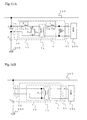
- Figure 1(a) is an explanatory view for explaining operation capacitances on overhead power lines of a three-phase system
- Figure 1(b) is a schematic arrangement view showing a state in which the electric power supply apparatus according to the first embodiment embodying the present invention is attached to an overhead power line
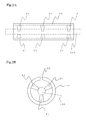
- Figure 2(a) is a side view showing an example of an electrode of the electric power supply apparatus shown in Fig. 1(b)
- Figure 2(b) is a front view of the electrode shown in Fig. 2(a)
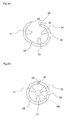
- Figure 3(a) is a front view showing another example of the electrode of the electric power supply apparatus shown in Fig.
- Figure 3(b) is a front view showing the example concerned of the electrode of the electric power supply apparatus shown in Fig. 1(b) after the electrode is attached to the overhead power line
- Figure 4(a) is a front view showing yet another example of the electrode of the electric power supply apparatus shown in Fig. 1(b) before the electrode is attached to the overhead power line
- Figure 4(b) is a front view showing the example concerned of the electrode of the electric power supply apparatus shown in Fig. 1(b) after the electrode is attached to the overhead power line
- Figure 4(c) is a front view showing still yet another example of the electrode of the electric power supply apparatus shown in Fig.
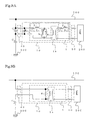
- Figure 5(a) is a circuit diagram showing an example of an equivalent circuit of the electric power supply apparatus shown in Fig. 1(b) ;
- Figure 5(b) is a circuit diagram showing the equivalent circuit shown in Fig. 5(a) , in which a parallel circuit is resonated;
- Figure 6(a) is a circuit diagram showing another example of the equivalent circuit of the electric power supply apparatus shown in Fig. 1(b) ;
- Figure 6(b) is a circuit diagram showing yet another example of the equivalent circuit of the electric power supply apparatus shown in Fig. 1(b) ;
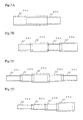
- Figure 7 is a side view showing still yet another example of the electrode of the electric power supply apparatus shown in Fig.
- Figure 8(a) is a perspective view showing still yet another example of the electrode of the electric power supply apparatus shown in Fig. 1(b) ; and Figure 8(b) is a side view of the electrode shown in Fig. 8(a) .
- overhead power lines 100 are respective power lines of a three-phase system in an aerial conductor wire road, there are capacitances between the power lines of the three-phase system and between the power lines and the ground. These capacitances are handled and converted into capacitances operating between the power lines and a neutral point (ground) 300a of the three-phase system, to thereby obtain operation capacitances Cu, Cv and C w .
- the electric supply apparatus includes: the electrode 20 which longitudinally extends along the overhead power line 100 so that a dielectric 30 composed of air and so on is intervened therebetween; a parallel resonance requirement setting circuit section 10 which has an capacitance C derived from the dielectric intervened between the overhead power line 100 and the electrode 20; an input section 40 which includes lead lines or the like connected to the overhead power line 100, using a not shown instrument (for example, a pin type clamp) or the like, by which one terminal of an input side of the parallel resonance requirement setting circuit section 10 is connected to the electrode 20, and by which another terminal thereof is connected to a conductor of the overhead power line 100; and an output section 50 which is an output side of the parallel resonance requirement setting circuit section 10, and which includes cables or the like connected to a load 200 to supply an electric power to the load.
- a not shown instrument for example, a pin type clamp
- the electrode 20 is a tubular conductor surrounding a given length of the overhead power line 100, has protrusions 21 for holding the overhead power line 100 at a general center position in a cross section of the tubular conductor which is cut perpendicular to the longitudinal direction of the tubular conductor, and has a slit 22 extending in the longitudinal direction of the tubular conductor to thereby introduce the overhead power line 100 into the interior of the tubular conductor.
- the tubular conductor is formed as a metal pipe without the slit 22, it is necessary to cut the overhead power line 100 in order to introduce the overhead power line 100 into the metal pipe. Nevertheless, due to the slit, the attachment of the tubular conductor to the overhead power line 100 can be easily carried out without cutting the overhead power line 100.
- the shape and the number of the protrusions 21 of the electrode 20 are not limited as long as the overhead power line 100 can be surely held.
- the tubular conductor maybe formed of two cylindrical members, so that the overhead power line 100 is griped by the opposed cylindrical members.
- the electrode 20 may have engagement portions 23 by which peripherally-opposed ends of the tubular conductor can be snugly engaged with each other, and a thin portion 24 extending in the longitudinal direction of the tubular conductor so that the tubular conductor can be bent so as to open and close the slit 22.
- the overhead power line 100 is abutted against the protrusions 21 (herein, the two protrusions 21) while the slit 22 is opened ( Fig. 3(a) ), and then the bent state of the tubular conductor is restored so as to close the slit 22, to thereby engage the engagement portions 23 with each other ( Fig. 3(b) ).
- the electrode 20 may have a recess portion 25 provided at one of peripheral ends of the tubular conductor to receive the overhead power line 100, a taper portion 26 provided at the other end thereof, a thickness of the taper portion 26 becoming gradually smaller toward a tip thereof.
- the taper portion 26 is bent inside the tubular conductor to the recess portion 25 ( Fig. 4(a) ), and the overhead power line 100 is received in the recess portion 25 ( Fig. 4(b) . Then, the bent state of the tubular conductor is restored so that the taper portion 25 is positioned outside the tubular conductor to the recess portion 25 ( Fig. 4(c) ).
- the electrode 20 is not limited to this shape.
- the electrode may be formed as one suspended from the overhead power line 100 through an insulator, or as a conductor coated with an insulating material, with it being directly and spirally wound around the overhead power line 100.
- a material of the electrode 20 is not limited to a metal such as aluminum and so on, and a conductive synthetic resin or a semi-conductive synthetic resin may be used for the electrode.
- the tubular conductor formed of semi-conductive polyethylene and having a length of 2.5 m is used.
- the parallel resonance requirement setting circuit section 10 comprises an inductance L a which is connected in parallel between a load 200 and a capacitance C a derived from the dielectric between the overhead power line 100 and the electrode 20, and which is resonated in parallel with the capacitance C a .
- the capacitance C a and the inductance L a are resonated in parallel with each other, and thus both the currents thereof are compensated with each other so that a synthetic impedance of both the capacitance C a and the inductance L a is maintained to be infinite ( ⁇ ).
- the capacitance C a and the inductance L a can be omitted from the circuit concerned, and it can be regarded as an equivalent circuit in which the load 200 and the operation capacitance C u are connected in series to each other.
- the current flowing through the circuit separates into two parts which are directed to the load 200 and the capacitance Cx, respectively, and thus a portion of the current flows into the capacitance (Cx of the insulating material) formed of an insulating material.
- the electric power supply apparatus according to the present invention, all the current flows into the load 200, and thus the electric power supply apparatus features a superior current-entering efficiency to the load 200.
- the parallel resonance requirement setting circuit section 10 may comprise a circuit arrangement including a variable inductance L a which is connected in parallel between the capacitance C a and the load 200, and a value of which can be adjusted so that the variable inductance L a is resonated in parallel with the capacitance C a .
- the parallel circuit including the capacitance C a and the variable inductance L a can be changed into a parallel resonance circuit by adjusting a value of the variable inductance L a , it is unnecessary to previously select circuit parts of the inductance L a so that the requirements for the parallel resonance to the capacitance C a are satisfied, and it is possible to accommodate the electric power supply apparatus to a variety of overhead power lines 100, to which the electric power supply apparatus should be attached. Especially, even if a length of the electrode 20 is varied in accordance with a power consumption of the load 200, it is possible to obtain the requirements for the parallel resonance by adjusting a value of the variable inductance L a .
- a voltage of the output section 50 is measured.
- a semi-fixed inductance may be used as a substitute for the variable inductance L a . An adjustment of the semi-fixed inductance is only once carried out when the electric power supply apparatus is attached to the overhead power line 100, with an alteration of the semi-fixed inductance being not carried out thereafter.
- the parallel resonance requirement setting circuit section 10 may comprise a circuit arrangement including a variable capacitance C b and an inductance L a connected in parallel with respect to the capacitance C a .
- the parallel circuit including the capacitance C a , the variable capacitance C b , and the inductance L a can be changed into a parallel resonance circuit by adjusting a value of the variable capacitance C b , it is unnecessary to previously select circuit parts of the inductance L a so that the requirements for the parallel resonance to the capacitance C a are satisfied, and it is possible to accommodate the electric power supply apparatus to a variety of overhead power lines 100, to which the electric power supply apparatus should be attached. Especially, even if a length of the electrode 20 is varied in accordance with a power consumption of the load 200, it is possible to obtain the requirements for the parallel resonance by adjusting a value of the variable capacitance C b .
- a voltage of the output section 50 is measured.
- a semi-fixed capacitor may be used as a substitute for a variable capacitor forming the variable inductance L a . An adjustment of the semi-fixed capacitor is only once carried out when the electric power supply apparatus is attached to the overhead power line 100, with an alteration of the semi-fixed capacitor being not carried out thereafter.
- the electrode 20 comprises one tubular conductor
- the electrode 20 comprises a plurality of tubular conductors which have different diameters so that one of the tubular conductors can be inserted into and abutted to another tubular conductor, and so that one of the tubular conductors can be slidably received in another tubular conductor.
- a plurality of tubular conductors 20a, 20b, 20c and 20d having different diameters are suitably selected and are combined.
- the electrode 20 is formed by connecting tubular conductors 20e, each having a projection 27 formed at one end, and a recess 28 formed at the other end, to each other such that a projection 27 of one tubular conductor is inserted into a recess 28 of another tubular conductor.
- Figure 9(a) is a circuit diagram showing an example of an equivalent circuit of the electric power supply apparatus shown in Fig. 1(b) ; and Figure 9(b) is a circuit diagram showing the equivalent circuit shown in Fig. 9(a) , in which a parallel circuit is resonated.
- Fig. 9 the same references as in Figs. 1 to 8 indicate the same or corresponding elements, and explanations of these elements are omitted.
- This second embodiment is different from the first embodiment only in that a transformer 1 is connected in parallel between a capacitance C a and a load 200, and has the similar functions and effects to those of the first embodiment except for below-mentioned functions and effects obtained from the transformer 1.
- a primary voltage which is input to an input section 40 of a parallel resonance requirement setting circuit section 10, is stepped down, and then the stepped-down voltage is output from an output section to a load side.
- a turn ratio (N 1 /N 2 ) of a winding number N 1 of a primary winding to a winding number N 2 of a secondary winding is 100, the turn ratio is not limited to only 100.
- An electromotive force based on the leakage flux can be handled as a reactance voltage drop caused by an inductance connected in series to the primary winding and the secondary winding of the ideal transformer 1a which is free from the leakage flux. Accordingly, when a primary leakage reactance and a secondary leakage reactance are defined as x 1 and x 2 , respectively, as shown in Fig. 9(a) , these influences may be represented as the leakage reactance x 1 and the leakage reactance x 2 , which are respectively connected in series to the primary winding and the secondary winding of the ideal transformer 1a.
- This shunt includes a parallel circuit of an excitation conductance go forming a path of an iron loss current and an excitation susceptance bo forming a path of a magnetizing current.
- the transformer 1 can be represented by an equivalent circuit including the resistance r 1 of the primary winding, the primary leakage reactance x 1 , the excitation susceptance bo, the excitation conductance go, the ideal transformer 1a, the resistance r 2 of the secondary winding and the leakage reactance x 2 .
- a synthetic impedance Z 1 composed of the resistance r 1 of the primary winding and the primary leakage reactance x 1 , and a synthetic impedance Z 2 composed of the resistance r 2 of the secondary winding and the secondary leakage reactance x 2 cause small voltage drops, but these voltage drops are generally very small, and thus are ignorable because the voltage drops do not exert a large influence on the circuit.
- a variable capacitance C b is adjusted so that a parallel resonance state is created on the capacitance C a and variable capacitance C b and the excitation susceptance bo, and thus both the currents thereof are compensated with each other so that a synthetic impedance of the capacitance C a , the variable capacitance C b and the excitation susceptance bo is maintained to be infinite ( ⁇ ).
- the circuit concerned can be regarded as a simple equivalent circuit.
- the variable capacitance C b and the excitation susceptance bo in order to obtain the parallel resonance state on the capacitance C a , the variable capacitance C b and the excitation susceptance bo, while a value of the variable capacitance C b is varied, a voltage of the primary side or secondary side of the transformer 1, or a voltage of the output section 50 is measured. When a measured voltage indicates the maximum value, the desirable parallel resonance state is obtained. Especially, it is preferable to gradually vary the value of the variable capacitance C b by opening and closing a switch by a not shown central processing unit (CPU), so that the measured voltage is obtained as the maximum value.
- CPU central processing unit
- a turn ratio (N 1 /N 2 ) of a winding number N 1 of a primary winding to a winding number N 2 of a secondary winding is 100, and that the load of 1 k ⁇ is connected to the output section 50 of the electric power supply apparatus.
- the impedance of 1 k ⁇ of the load 200 is converted into the impedance of 10 M ⁇ . Also, there is the excitation conductance go on the primary side of the transformer 1, and this value is very small (it is very large as the resistance).
- a synthetic impedance of the parallel circuit composed of the impedance of the load 200 and the excitation conductance go at the primary side has a large value. Although it is a divided voltage to an operation capacitance Cu, a large voltage is applied to the primary side of the transformer 1.
- the excitation conductance go is relatively small. For this reason, it is necessary to increase the winding number of the primary winding while maintaining the turn ratio of the transformer 1 at a desirable value. As a result, a shape of the transformer 1 becomes too large, which may be a hindrance in attachment of the electric power supply apparatus to the overhead power line 100. In addition, since it is necessary to use a specific material featuring a small iron loss for the core, resulting in an increase in cost of the transformer.
- the transformer 1 is formed of eight transformers connected in series to each other.
- the parallel resonance state is created on the excitation susceptance bo of the transformer 1 and both the capacitance C a and the variable capacitance C b disposed in parallel to the excitation susceptance bo, so that a synthetic impedance thereof is maintained to be infinite ( ⁇ ).
- the parallel resonance requirement setting circuit section 10 comprises a simple circuit arrangement including only the variable capacitance C b and the transformer 1 as circuit elements, the electric power supply apparatus has a practical size and weight as one to be attached to the overhead power line. Further, when the load 200 is a device featuring a small power consumption, such as a measurement device and so on, it is possible to continuously supply the electric power to the load.
- Figure 10(a) is a circuit diagram showing an example of an equivalent circuit of the electric power supply apparatus shown in Fig. 1(b) ; and Figure 10(b) is a circuit diagram showing the equivalent circuit shown in Fig. 10(a) , in which a parallel circuit is resonated.
- Fig. 10 the same references as in Figs. 1 to 9 indicate the same or corresponding elements, and explanations of these elements are omitted.
- This third embodiment is different from the second embodiment only in that a variable inductance L b is connected in parallel between a secondary winding of a transformer 1 and a load 200 as a substitute for connecting a variable capacitance C b to a primary winding of the transformer 1, and has the similar functions and effects to those of the second embodiment except for below-mentioned functions and effects obtained from the variable inductance L b .
- a value of the variable inductance L b is adjusted so that a parallel resonance state is created on a capacitance C a , an excitation susceptance bo and the variable inductance L b , and thus both the currents thereof are compensated with each other so that a synthetic impedance of the capacitance C a , the excitation susceptance bo and the variable inductance L b is maintained to be infinite ( ⁇ ).
- the circuit concerned can be regarded as a simple equivalent circuit.
- the excitation susceptance bo and the variable inductance L b in order to obtain the parallel resonance state on the capacitance C a , the excitation susceptance bo and the variable inductance L b , while a value of the variable inductance L b is varied, a voltage of the primary side or secondary side of the transformer 1, or a voltage of the output section 50 is measured. When a measured voltage indicates the maximum value, the desirable parallel resonance state is obtained. Especially, it is preferable to gradually vary the value of the variable inductance L b by opening and closing a switch by a not shown central processing unit (CPU), so that the measured voltage is obtained as the maximum value.
- CPU central processing unit
- the increase of the winding number of the primary winding result in making an inductance of the excitation susceptance bo to be large, and thus it is necessary to make the capacitance C a to be small in order to maintain the parallel resonance state on the capacitance C a and the excitation susceptance b 0 .
- the capacitance C a before the capacitance C a can be made to be small, it is necessary to make the surface of the electrode 20 to the overhead power line to be small (e.g., to shorten the tubular conductor) or it is necessary to expand a space between the overhead power line 100 and the electrode 22 (e.g., to increase the inner diameter of the tubular conductor).
- an inductance L (a variable inductance L b or a fixed inductance L a ) is connected in parallel between the capacitance C a and the primary winding of the transformer 1 in order to make a synthetic inductance of the inductance L and the excitation susceptance bo to be small
- an addition of the inductance which can resist a high voltage applied to the primary side of the transformer, causes a problem that the electric power supply apparatus bulks.
- the inductance L is connected to the secondary side of the transformer 1 featuring a low voltage, whereby it is possible to obtain a function and effect that the parallel resonance state can be maintained on the capacitance C a , the excitation susceptance bo and the inductance L (the variable inductance L b or the fixed inductance L a ) without bulking the electric power supply apparatus, and without lowering the electric power obtained from the overhead power line 100.
- the parallel resonance state is created on the capacitance C a and both the excitation susceptance bo of the transformer 1 and the variable inductance L b disposed in parallel to the capacitance C a , so that a synthetic impedance thereof is maintained to be infinite ( ⁇ ).
- the parallel resonance requirement setting circuit section 10 comprises a simple circuit arrangement including only the variable inductance L b and the transformer 1 as circuit elements, the electric power supply apparatus has a practical size and weight as one to be attached to the overhead power line. Further, when the load 200 is a device featuring a small power consumption, such as a measurement device and so on, it is possible to continuously supply the electric power to the load.
- Figure 11(a) is an explanatory view for explaining spatial capacitances on overhead power lines of a three-phase system and an overhead linear conductor
- Figure 11(b) is a schematic arrangement view showing a state in which the electric power supply apparatus according to the fourth embodiment embodying the present invention is attached to the overhead linear conductor
- Figure 12(a) is a circuit diagram showing an example of an equivalent circuit of the electric power supply apparatus shown in Fig. 11(b)
- Figure 12(b) is a circuit diagram showing the equivalent circuit shown in Fig. 12(a) , in which a parallel circuit is resonated.
- the same references as in Figs. 1 to 10 indicate the same or corresponding elements, and explanations of these elements are omitted.
- This fourth embodiment is different from the first, second and third embodiments only in that an electric power supply apparatus is attached to an overhead linear conductor, and has the similar functions and effects to those of the first, second and third embodiment except for below-mentioned functions and effects obtained from the fact that the electric power supply apparatus is attached to the overhead linear conductor.
- the overhead linear conductor 110 is an overhead ground line, it is a ground line provided on a top of a supporting structure such as a pylon, a utility pole and so on, in an aerial transmission road, whereby a thunderbolt is guided as a lighting conductor so that the overhead power line 100 is not directly struck by a thunderbolt, or so that a generation of induction lighting based on thundercloud is reduced.
- the operation capacitances Cu, Cv and Cw shown in Fig. 1(a) are obtaining by synthesizing capacitances which are synthesized from capacitances obtained between the overhead power lines 100 and the ground (including the overhead linear conductor 110, a grounded construction such as a supporting structure and so on) and capacitances obtained between the power lines of the three-phase system, and by recasting all the synthesized capacitances with respect to a neutral point (ground) 300a.
- capacitances C U1 , C V1 and C W1 shown in Fig. 11(a) are obtain by the fact that the capacitances C UG , C VG and C WG to the overhead linear conductor 110 are independent from the operation capacitances Cu, Cv and Cw, and thus are reduced by capacitances to the neutral point (ground) 300a, with the capacitances C U1 , C V1 and C W1 being represented as ones being different from operation capacitances Cu, Cv and Cw shown in Fig. 1(a) .
- a capacitance C aG is derived from a dielectric provided between the overhead linear conductor 110 and an electrode 20 attached to the overhead linear conductor 110, and a variable capacitance C bG is connected in parallel thereto.
- the overhead linear conductor 110 it is necessary to provide the overhead linear conductor 110 along the power lines of the three-phase system so that the spaces between the overhead linear conductor 110 and the power lines of the three-phase system are not equal to each other. Also, when the electric power supply apparatus is attached to the overhead linear conductor 110, since voltages are generated in the electric power supply apparatus including the electrode 20 and the load 200, it is preferable to coat the surfaces of these elements with insulating materials.
- the explanation is made on the example of the parallel resonance requirement setting circuit section 10 including a transformer 1.
- the parallel resonance requirement setting circuit section 10 is arranged as disclosed in the first embodiment or the third embodiment, it is possible to obtain the similar functions and effects to those of the fourth embodiment.
Landscapes
- Engineering & Computer Science (AREA)
- Power Engineering (AREA)
- Computer Networks & Wireless Communication (AREA)
- Mechanical Engineering (AREA)
- Control Of Electrical Variables (AREA)
- Inverter Devices (AREA)
- Coils Of Transformers For General Uses (AREA)
- Current-Collector Devices For Electrically Propelled Vehicles (AREA)
- Coils Or Transformers For Communication (AREA)
- Direct Current Feeding And Distribution (AREA)
Abstract

Description
- The present invention relates to an electric power supply apparatus for supplying electric power to a load such as a piece of electric equipment, which is attached to an overhead linear conductor provided along an overhead power line such as a power transmission line, an overhead power line of an electric distribution line, an overhead ground line, an communication line (e.g., a metal communication cable, an optical cable or the like, held by a messenger wire), a branch line or the like (the overhead power line and the overhead linear conductor are generally referred to as an overhead line, hereinafter), for example, a measurement device for measuring states of the overhead line (a voltage, a current, a temperature, a movement or the like) or environmental conditions of the overhead line (a speed of wind, an amount of insolation, an atmospheric pressure or the like), a communication device for communicating states of the overhead line in a wire manner or a wireless manner, an indicator lamp for indicating an existence of the overhead line, an indicator for indicating that the overhead line is a hot line or the like.
- Conventionally, for an electric power source of a piece of electric equipment attached to an overhead power line, a battery is used. Nevertheless, due to a lifetime of the buttery, in a two- or three-year cycle, an exchange of the battery is carried out in a hot line work manner or a power cut manner.
- On the other hand, there is a case where a solar battery is used for an electric power source of a piece of electric equipment attached to an overhead power line. Nevertheless, since the solar battery must be large-scale in order to secure a sufficient generation capacity, it is difficult to attach the large-scale solar battery to an overhead power line. Also, a battery must be used together with the solar battery in order to ensure an operation of a piece of electric equipment for the night. As a result, there is a problem that not only weight of the electric power source is increased, but also an exchange of the battery is needed.
- For this reason, at present, the electric power source system concerned, which involves a frequency of maintenance to an overhead power line causing a high possible electric shock as a high voltage power line, does not widely prevails.
In this circumstance, attempts have been made to develop an apparatus which can obtain an electric power by attaching it to an overhead power line without any battery, and which can secure an electric power even if any current does not flow through the overhead power line. - For example, in a conventional night indicator device of an overhead power transmission line, one terminal of a neon discharge tube is adhered to the power transmission line, and the other terminal of the neon discharge tube is coated with an insulating material, and is wound around the power transmission line at suitable intervals. It is disclosed that the neon discharge tube is lighted due to electrostatic induction caused between the coated line and the power transmission line. Also, it is disclosed as conventional arts that an overhead power transmission line is covered with a metal pipe, ends of which are coaxially held with dielectric materials, and that a damper line made of conductor is suspended from an overhead power transmission line through an insulator (for example, see: Patent Document 1).
- Also, as a conventional electrostatic induction type electric power supply apparatus, is disclosed an apparatus including an insulator spirally wound around a power line conductor in an electrical substation, an electrode spirally wound over the insulator, and a rectifying circuit in which an input lead drawn from the electrode and an input lead drawn from the power line conductor are used as a primary side input, and in which a secondary side is connected to a sensor (for example, see: Patent Document 2).
- Also, as a conventional electric power supply apparatus for a measurement device of a power transmission/distribution system, is disclosed an apparatus including a protecting circuit for converting a voltage obtained from a spatial electrode into a suitable voltage to thereby controlling an excess voltage, a rectifying circuit for converting an voltage from the protecting circuit from an alternating current into a direct current, a storage battery for storing electricity output from the rectifying circuit, a voltage detector for detecting a voltage of the storage battery, and a voltage generator for intermittently outputting a necessary voltage to a load of a measurement device based on a detected voltage (for example, see: Patent Document 3).
- Patent Document 1:
JUM-S39-29852 A - Patent Document 2:
JP-H10-262349 A - Patent Document 3:
JP-2003-284252 A - In the conventional night indicator device of an overhead power transmission line and the conventional electrostatic induction type electric power supply apparatus, an insulating material is laid over a power transmission line (power line conductor), and then a conductor (electrode) is laid over the insulating material, so that a capacitance (Cx of the insulating material) between the power transmission line and the conductor and a capacitance (space C) between the conductor and the ground are connected in series to each other, with a load being directly connected to both the electrodes of the capacitance between the power transmission line and the conductor, or being connected to both the electrodes of the capacitance between the power transmission line and the conductor through the intermediary of a rectifying circuit. That is, as shown in
Fig. 13(a) , equivalently, a series circuit of two capacitances is obtained, and theload 200 is connected in parallel to the capacitance (Cx of the insulating material) between the power transmission line 100a and the conductor.Figure 13(a) is an equivalent circuit of the conventional night indicator device of an overhead power transmission line and the conventional electrostatic induction type electric power supply apparatus. Note, inFig. 13(a) , reference 201a indicates the rectifying circuit, andreference 300 indicates the ground. - Also, in the conventional electric power supply apparatus for the measurement device of the power transmission/distribution system, two electrodes are coaxially disposed with respect to a power transmission/distribution line, and are spaced from each other. Thus, as shown in
Fig. 13(b) , is obtained a series circuit in which a capacitance (C1 of an insulating material) between the power transmission/distribution line 100b and one of the electrodes, a capacitance (Cx of an insulating material) between the electrodes, and a capacitance (space C) between the other electrode and the ground are connected in series to each other, and aload 200 is connected in parallel to the middle capacitance (Cx of the insulating material).Figure 13(b) is an equivalent circuit of the conventional electric power supply apparatus for the measurement device of the power transmission/distribution system. Note, inFig. 13(b) ,reference 201 indicates a power supply circuit section including a protecting circuit, a rectifying circuit and so on, andreference 300 indicates the ground. - In the equivalent circuit of the conventional night indicator device of an overhead power transmission line and the conventional electrostatic induction type electric power supply apparatus (which is referred to as the conventional electric power supply apparatus, hereinafter), the capacitance of the space C is very small because a space between the electrode and the ground is very large, and because spaces among phases 100a of the power transmission line 100a also are very large, and thus may be on the order of 10 pF per 1 m length of the electrode. When this capacitance is converted into impedance, it has a large value as generally 300 MΩ in the network frequency. Especially, in the power transmission line 100a in which a large power is transmitted, the space between the power transmission line 100a and the
ground 300 becomes larger, and because the spaces among phases 100a of the power transmission line 100a also becomes larger, and thus it is general that the impedance has further large value. - On the other hand, in
Figs. 13(a) and 13(b) , since a major part of a synthetic impedance of both the capacitance Cx and theload 200 provided in parallel thereto is derived from theload 200, a value of the synthetic impedance is less than several kΩ. - In the capacitor-serial circuit of the conventional electric power apparatus, since the impedance between the electrode and the ground is predominately larger than a synthetic impedance of the parallel section of both the
load 200 and the capacitance Cx, and since a voltage applied to theload 200 depends on a ratio between the synthetic impedance of both theload 200 and the capacitance Cx and the impedance between the electrode and the ground (in the case ofFig. 13(b) , the voltage is further concerned with a ratio to an impedance of the capacitance C1), it is hardly generated in theload 200. - Also, although a current flowing through the circuit depends on a synthetic impedance which is synthesized from the synthetic impedance of both the
load 200 and the capacitance Cx and the impedance between the electrode and the ground (in the case ofFig. 13(b) , the synthetic impedance concerned is further synthesized from the impedance of the capacitance C1), the current has a very small value, with which the space C is charged, due to the large capacitance between the electrode and the ground. - Further, at the parallel section of both the
load 200 and the capacitance Cx, the current flowing through the circuit separates into two parts which are directed to theload 200 and the capacitance Cx, respectively, and, in the capacitance Cx formed of an insulating material, an electric power is consumed. Thus, there is a problem that an efficiency of the electric power supply apparatus is very inferior. - Especially, in the conventional electric power supply source apparatus, in order to improve the inferior efficiency to thereby supply a necessary electric power to the
load 200, a measure must be taken to increase the length and a thickness of the electrode to thereby swell the capacitances among the overhead power lines and the ground, and a measure must be taken to use a secondary battery in which an electric power is gently stored so that a voltage more than a given level is intermittently generated to thereby operate the load. Nevertheless, there is a problem that not only the electric power supply apparatus has a large sizes, but also the circuit is very complicated. - The present invention has been developed to solve the aforesaid problems, and aims at providing provide an electric power supply apparatus which can be compactly and simply constructed, and in which a power supply efficiency to a load more improved in comparison with conventional electric power supply apparatuses.
- The electric power supply apparatus according to the present invention comprises: a capacitance defined by an overhead line, and an electrode extending along said overhead line in a longitudinal direction thereof, with a dielectric being intervened therebetween; an inductance connected in parallel to said capacitance; and an output section drawn from both ends of a parallel circuit including said capacitance and said inductance, wherein said parallel circuit is formed as a parallel resonance circuit, and wherein an electric power is output from said output section.
- Also, in the electric power supply apparatus according to the present invention, if necessary, said inductance may be formed as a variable inductance, and a value of said variable inductance is adjusted so that said parallel circuit is operated as the parallel resonance circuit.
- Also, the electric power supply apparatus according to the present invention further may comprise a variable capacitance connected in parallel to said capacitance, and a value of said variable capacitance is adjusted so that said parallel circuit is operated as the parallel resonance circuit.
- Further, if necessary, the electric power supply apparatus according to the present invention may further comprise a transformer in which a primary voltage is stepped down, and in which a secondary voltage is output, and said inductance corresponds to an excitation susceptance component of said transformer, said output section being at a secondary side of said transformer.
- Also, if necessary, the electric power supply apparatus according to the present invention may further comprise: a transformer in which a primary voltage is stepped down, and in which a secondary voltage is output; and an inductance connected in parallel at the secondary side of said transformer to a secondary winding thereof, and the inductance connected in parallel to said capacitance corresponds to an excitation susceptance component of said transformer, said output section being at a secondary side of said transformer.
- Also, in the electric power supply apparatus according to the present invention, if necessary, the inductance connected in parallel at the secondary side of said transformer to the secondary winding thereof may be a variable inductance, and a value of said variable inductance is adjusted so that said parallel circuit is operated as the parallel resonance circuit.
Also, in the electric power supply apparatus according to the present invention, if necessary, said electrode may be a tubular conductor by which a given length of said overhead line is enclosed. - Also, in the electric power supply apparatus according to the present invention, if necessary, said electrode may comprise a plurality of tubular conductors which have different diameters so that one of said tubular conductors is inserted into and abutted to another tubular conductor, and so that one of said tubular conductors is slidably received in another tubular conductor.
Further, in the electric power supply apparatus according to the present invention, if necessary, said electrode may be defined by connecting a plurality of tubular conductors to each other. - The electric power supply apparatus according to the present invention comprises: a capacitance defined by an overhead line, and an electrode extending along said overhead line in a longitudinal direction thereof, with a dielectric being intervened therebetween; an inductance connected in parallel to said capacitance; and an output section drawn from both ends of a parallel circuit including said capacitance and said inductance, wherein said parallel circuit is formed as a parallel resonance circuit, and wherein an electric power is output from said output section. With this arrangement, all the current can flow into the load side, and thus the electric power supply apparatus features a superior current-entering efficiency to the load.
- Also, in the electric power supply apparatus according to the present invention, if necessary, said inductance may be formed as a variable inductance, and a value of said variable inductance is adjusted so that said parallel circuit is operated as the parallel resonance circuit. With this arrangement, it is unnecessary to previously select circuit parts of the inductance so that the requirements for the parallel resonance to the capacitance are satisfied, and it is possible to accommodate the electric power supply apparatus to a variety of overhead power lines, to which the electric power supply apparatus should be attached. Especially, even if a length of the electrode is varied in accordance with a power consumption of the load, it is possible to obtain the requirements for the parallel resonance by adjusting a value of the variable inductance.
- Also, the electric power supply apparatus according to the present invention further may comprise a variable capacitance connected in parallel to said capacitance, and a value of said variable capacitance is adjusted so that said parallel circuit is operated as the parallel resonance circuit. With this arrangement, it is unnecessary to previously select circuit parts of the inductance so that the requirements for the parallel resonance to the capacitance are satisfied, and it is possible to accommodate the electric power supply apparatus to a variety of overhead power lines, to which the electric power supply apparatus should be attached. Especially, even if a length of the electrode is varied in accordance with a power consumption of the load, it is possible to obtain the requirements for the parallel resonance by adjusting a value of the variable capacitance.
- Further, if necessary, the electric power supply apparatus according to the present invention may further comprise a transformer in which a primary voltage is stepped down, and in which a secondary voltage is output, and said inductance corresponds to an excitation susceptance component of said transformer, said output section being at a secondary side of said transformer. With this arrangement, the excitation susceptance and the capacitance (or a synthetic value of the capacitance and the variable capacitance) form the parallel resonance circuit, and thus it is possible to improve a current-entering efficiency to the load. Also, it is possible to make an impedance of the load to be larger at the primary side, and the primary voltage of the transformer, generated by a divided voltage to the space capacitance, can be effectively stepped up, to thereby improve the power-supplying efficiency to the load, in comparison with the conventional electric power supply apparatus.
- Also, if necessary, the electric power supply apparatus according to the present invention may further comprise: a transformer in which a primary voltage is stepped down, and in which a secondary voltage is output; and an inductance connected in parallel at the secondary side of said transformer to a secondary winding thereof, and the inductance connected in parallel to said capacitance corresponds to an excitation susceptance component of said transformer, said output section being at a secondary side of said transformer. With this arrangement, both the excitation susceptance and the inductance and the capacitance form the parallel resonance circuit, and thus it is possible to improve a current-entering efficiency to the load. Also, it is possible to make an impedance of the load to be larger at the primary side, and the primary voltage of the transformer, generated by a divided voltage to the space capacitance, can be effectively stepped up, to thereby improve the power-supplying efficiency to the load, in comparison with the conventional electric power supply apparatus. Especially, the inductance is connected to the secondary side of the
transformer 1 featuring a low voltage, whereby the parallel resonance state can be maintained on the capacitance, the excitation susceptance and the inductance L without bulking the electric power supply apparatus, and without lowering the electric power obtained from the overhead power line. - Also, in the electric power supply apparatus according to the present invention, if necessary, the inductance connected in parallel at the secondary side of said transformer to the secondary winding thereof may be a variable inductance, and a value of said variable inductance is adjusted so that said parallel circuit is operated as the parallel resonance circuit. With this arrangement, it is unnecessary to previously select circuit parts of the inductance so that the requirements for the parallel resonance to the capacitance and the excitation susceptance are satisfied, and it is possible to accommodate the electric power supply apparatus to a variety of overhead power lines, to which the electric power supply apparatus should be attached. Especially, even if a length of the electrode is varied in accordance with a power consumption of the load, it is possible to obtain the requirements for the parallel resonance by adjusting a value of the variable inductance.
- Also, in the electric power supply apparatus according to the present invention, if necessary, said electrode may be a tubular conductor by which a given length of said overhead line is enclosed. With this arrangement, it is possible to increase capacitances between the electrode concerned and the overhead power lines and ground, in comparison with a case where an electrode is formed as one suspended from the overhead power line through an insulator, or as a conductor coated with an insulating material, with it being directly and spirally wound around the overhead power line, resulting in increase of an electric power to be obtained at the load side.
- Also, in the electric power supply apparatus according to the present invention, if necessary, said electrode may comprise a plurality of tubular conductors which have different diameters so that one of said tubular conductors is inserted into and abutted to another tubular conductor, and so that one of said tubular conductors is slidably received in another tubular conductor. With this arrangement, it is possible to adjust a length of the electrode in accordance with a power consumption of the load, and thus the compact electrode can be constructed, if necessary.
- Further, in the electric power supply apparatus according to the present invention, if necessary, said electrode may be defined by connecting a plurality of tubular conductors to each other. With this arrangement, it is possible to adjust a length of the electrode in accordance with a power consumption of the load, and thus the compact electrode can be constructed, if necessary.
-
- [
Fig. 1 ] (a) is an explanatory view for explaining operation capacitance on overhead power lines of a three-phase system; and (b) is a schematic arrangement view showing a state in which an overhead power line according to the first embodiment embodying the present invention is attached to an overhead power line. - [
Fig. 2 ] (a) is a side view showing an example of an electrode of the electric power supply apparatus shown inFig. 1(a); and (b) is a front view of the electrode shown inFig. 2(a) . - [
Fig. 3 ] (a) is a front view showing another example of the electrode of the electric power supply apparatus shown inFig. 1(b) before the electrode is attached to the overhead power line; and (b) is a front view showing the example concerned of the electrode of the electric power supply apparatus shown inFig. 1(b) after the electrode is attached to the overhead power line. - [
Fig. 4 ] (a) is a front view showing yet another example of the electrode of the electric power supply apparatus shown inFig. 1(b) before the electrode is attached to the overhead power line; (b) a front view showing the example concerned of the electrode of the electric power supply apparatus shown inFig. 1(b) after the electrode is attached to the overhead power line; and (c) is a front view showing still yet another example of the electrode of the electric power supply apparatus shown inFig. 1(b) before the electrode is attached to the overhead power line. - [
Fig. 5 ] (a) is a circuit diagram showing an example of an equivalent circuit of the electric power supply apparatus shown inFig. 1(b); and (b) is a circuit diagram showing an equivalent circuit shown inFig. 5(a) , in which a parallel circuit is resonated. - [
Fig. 6 ] (a) is a circuit diagram showing another example of the equivalent circuit of the electric power supply apparatus shown inFig. 1(b); and (b) is a circuit diagram showing yet another example of the equivalent circuit of the electric power supply apparatus shown inFig. 1(b) . - [
Fig. 7 ] is a side view showing still yet another example of the electrode of the electric power supply apparatus shown inFig. 1(b) . - [
Fig. 8 ] (a) is a perspective view showing still yet another example of the electrode of the electric power supply apparatus shown inFig. 1(b); and (b) is a side view of the electrode shown inFig. 8(a) . - [
Fig. 9 ] (a) is a circuit diagram showing an example of an equivalent circuit of the electric power supply apparatus shown inFig. 1(b); and (b) is a circuit diagram showing the equivalent circuit shown inFig. 9(a) , in which a parallel circuit is resonated. - [
Fig. 10 ] (a) is a circuit diagram showing an example of an equivalent circuit of the electric power supply apparatus shown inFig. 1(b); and (b) is a circuit diagram showing the equivalent circuit shown inFig. 10(a) , in which a parallel circuit is resonated. - [
Fig. 11 ] (a) is an explanatory view for explaining spatial capacitances on overhead power lines and an overhead linear conductor of a three-phase system; and (b) is a schematic arrangement view showing a state in which the electric power supply apparatus according to the fourth embodiment embodying the present invention is attached to the overhead linear conductor. - [
Fig. 12 ] (a) is a circuit diagram showing an example of an equivalent circuit of the electric power supply apparatus shown inFig. 11(b) ; and(b) is a circuit diagram showing the equivalent circuit shown inFig. 12(a) , in which a parallel circuit is resonated. - [
Fig. 13 ] (a) is an equivalent circuit of a conventional night indicator device of an overhead power transmission line and a conventional electrostatic induction type electric power supply apparatus; and (b) is an equivalent circuit of a conventional electric power supply apparatus for a measurement device of a power transmission / distribution system. -
- 1
- Transformer
- 1a
- Ideal Transformer
- 10
- Parallel Resonance Requirement Setting Circuit Section
- 20
- Electrode
- 20a
- Tubular Conductor
- 20b
- Tubular Conductor
- 20c
- Tubular Conductor
- 21
- Protrusion
- 22
- Slit
- 23
- Engagement Portion
- 24
- Thin Portion
- 25
- Recess Portion
- 26
- Taper Portion
- 27
- Projection
- 28
- Recess
- 30
- Dielectric
- 40
- Input Section
- 50
- Output Section
- 100
- Overhead Power Line
- 100a
- Power Transmission Line
- 100b
- Power Transmission/Distribution Line
- 200
- Load
- 300
- Ground
- 300a
- Neutral Point (Ground)
-
Figure 1(a) is an explanatory view for explaining operation capacitances on overhead power lines of a three-phase system;Figure 1(b) is a schematic arrangement view showing a state in which the electric power supply apparatus according to the first embodiment embodying the present invention is attached to an overhead power line;Figure 2(a) is a side view showing an example of an electrode of the electric power supply apparatus shown inFig. 1(b) ;Figure 2(b) is a front view of the electrode shown inFig. 2(a) ;Figure 3(a) is a front view showing another example of the electrode of the electric power supply apparatus shown inFig. 1(b) before the electrode is attached to the overhead power line;Figure 3(b) is a front view showing the example concerned of the electrode of the electric power supply apparatus shown inFig. 1(b) after the electrode is attached to the overhead power line;Figure 4(a) is a front view showing yet another example of the electrode of the electric power supply apparatus shown inFig. 1(b) before the electrode is attached to the overhead power line;Figure 4(b) is a front view showing the example concerned of the electrode of the electric power supply apparatus shown inFig. 1(b) after the electrode is attached to the overhead power line;Figure 4(c) is a front view showing still yet another example of the electrode of the electric power supply apparatus shown inFig. 1(b) before the electrode is attached to the overhead power line;Figure 5(a) is a circuit diagram showing an example of an equivalent circuit of the electric power supply apparatus shown inFig. 1(b) ;Figure 5(b) is a circuit diagram showing the equivalent circuit shown inFig. 5(a) , in which a parallel circuit is resonated;Figure 6(a) is a circuit diagram showing another example of the equivalent circuit of the electric power supply apparatus shown inFig. 1(b) ;Figure 6(b) is a circuit diagram showing yet another example of the equivalent circuit of the electric power supply apparatus shown inFig. 1(b) ;Figure 7 is a side view showing still yet another example of the electrode of the electric power supply apparatus shown inFig. 1(b) ;Figure 8(a) is a perspective view showing still yet another example of the electrode of the electric power supply apparatus shown inFig. 1(b) ; andFigure 8(b) is a side view of the electrode shown inFig. 8(a) . - In
Fig. 1(a) ,overhead power lines 100 are respective power lines of a three-phase system in an aerial conductor wire road, there are capacitances between the power lines of the three-phase system and between the power lines and the ground. These capacitances are handled and converted into capacitances operating between the power lines and a neutral point (ground) 300a of the three-phase system, to thereby obtain operation capacitances Cu, Cv and Cw. - Next, an explanation is made on a case where an
electrode 20 of the electric power supply apparatus according to the present invention is attached to the U-phaseoverhead power line 100.
InFig. 1(b) , the electric supply apparatus according to the present invention includes: theelectrode 20 which longitudinally extends along theoverhead power line 100 so that a dielectric 30 composed of air and so on is intervened therebetween; a parallel resonance requirement settingcircuit section 10 which has an capacitance C derived from the dielectric intervened between theoverhead power line 100 and theelectrode 20; aninput section 40 which includes lead lines or the like connected to theoverhead power line 100, using a not shown instrument (for example, a pin type clamp) or the like, by which one terminal of an input side of the parallel resonance requirement settingcircuit section 10 is connected to theelectrode 20, and by which another terminal thereof is connected to a conductor of theoverhead power line 100; and anoutput section 50 which is an output side of the parallel resonance requirement settingcircuit section 10, and which includes cables or the like connected to aload 200 to supply an electric power to the load. - As shown in
Fig. 2 , theelectrode 20 is a tubular conductor surrounding a given length of theoverhead power line 100, hasprotrusions 21 for holding theoverhead power line 100 at a general center position in a cross section of the tubular conductor which is cut perpendicular to the longitudinal direction of the tubular conductor, and has aslit 22 extending in the longitudinal direction of the tubular conductor to thereby introduce theoverhead power line 100 into the interior of the tubular conductor. If the tubular conductor is formed as a metal pipe without theslit 22, it is necessary to cut theoverhead power line 100 in order to introduce theoverhead power line 100 into the metal pipe. Nevertheless, due to the slit, the attachment of the tubular conductor to theoverhead power line 100 can be easily carried out without cutting theoverhead power line 100. - Note that the shape and the number of the
protrusions 21 of theelectrode 20 are not limited as long as theoverhead power line 100 can be surely held.
Also, as a substitute for theslit 22 for introducing theoverhead power line 100 into the interior of the tubular conductor, the tubular conductor maybe formed of two cylindrical members, so that theoverhead power line 100 is griped by the opposed cylindrical members. - Further, as shown in
Fig. 3 , theelectrode 20 may haveengagement portions 23 by which peripherally-opposed ends of the tubular conductor can be snugly engaged with each other, and athin portion 24 extending in the longitudinal direction of the tubular conductor so that the tubular conductor can be bent so as to open and close theslit 22. - Note, in the attachment procedure of the
electrode 20 shown inFig. 3 to theoverhead power line 100, theoverhead power line 100 is abutted against the protrusions 21 (herein, the two protrusions 21) while theslit 22 is opened (Fig. 3(a) ), and then the bent state of the tubular conductor is restored so as to close theslit 22, to thereby engage theengagement portions 23 with each other (Fig. 3(b) ). - Further, as shown in
Fig. 4 , theelectrode 20 may have arecess portion 25 provided at one of peripheral ends of the tubular conductor to receive theoverhead power line 100, ataper portion 26 provided at the other end thereof, a thickness of thetaper portion 26 becoming gradually smaller toward a tip thereof. - Note, in the attachment procedure of the
electrode 20 shown inFig. 4 to theoverhead power line 100, thetaper portion 26 is bent inside the tubular conductor to the recess portion 25 (Fig. 4(a) ), and theoverhead power line 100 is received in the recess portion 25 (Fig. 4(b) . Then, the bent state of the tubular conductor is restored so that thetaper portion 25 is positioned outside the tubular conductor to the recess portion 25 (Fig. 4(c) ). - Also, the
electrode 20 is not limited to this shape. The electrode may be formed as one suspended from theoverhead power line 100 through an insulator, or as a conductor coated with an insulating material, with it being directly and spirally wound around theoverhead power line 100. - Further, as long as a charge is stored in an operation capacitance Cu, a material of the
electrode 20 is not limited to a metal such as aluminum and so on, and a conductive synthetic resin or a semi-conductive synthetic resin may be used for the electrode. Note that, in this first embodiment, the tubular conductor formed of semi-conductive polyethylene and having a length of 2.5 m is used. Especially, when theoverhead power line 100 has an insulation coating, and when a voltage resistance performance is asked, it is necessary to give an insulation coating, equivalent to the line, to the surfaces of the electric power supply apparatus including theelectrode 20 and the surfaces of theload 200. - For example, as shown in
Fig. 5(a) , the parallel resonance requirement settingcircuit section 10 comprises an inductance La which is connected in parallel between aload 200 and a capacitance Ca derived from the dielectric between theoverhead power line 100 and theelectrode 20, and which is resonated in parallel with the capacitance Ca. - Note, when a kind of the
overhead power line 100, to which the electric power supply apparatus is attached, and specifications of theelectrode 20 and the dielectric 30 are determined, and when a value of the capacitance Ca is fixed, circuit parts are selected so that requirements for the parallel resonance between the inductance La and the capacitance Ca are satisfied. - With this arrangement, the capacitance Ca and the inductance La are resonated in parallel with each other, and thus both the currents thereof are compensated with each other so that a synthetic impedance of both the capacitance Ca and the inductance La is maintained to be infinite (∞). As a result, as shown in
Fig. 5(b) , the capacitance Ca and the inductance La can be omitted from the circuit concerned, and it can be regarded as an equivalent circuit in which theload 200 and the operation capacitance Cu are connected in series to each other. - Accordingly, in the conventional electric power supply apparatus, at the parallel section of both the
load 200 and the capacitance Cx, the current flowing through the circuit separates into two parts which are directed to theload 200 and the capacitance Cx, respectively, and thus a portion of the current flows into the capacitance (Cx of the insulating material) formed of an insulating material. In contrast, in the electric power supply apparatus according to the present invention, all the current flows into theload 200, and thus the electric power supply apparatus features a superior current-entering efficiency to theload 200. - Also, for example, as shown in
Fig. 6(a) , the parallel resonance requirement settingcircuit section 10 may comprise a circuit arrangement including a variable inductance La which is connected in parallel between the capacitance Ca and theload 200, and a value of which can be adjusted so that the variable inductance La is resonated in parallel with the capacitance Ca. - Namely, since the parallel circuit including the capacitance Ca and the variable inductance La can be changed into a parallel resonance circuit by adjusting a value of the variable inductance La, it is unnecessary to previously select circuit parts of the inductance La so that the requirements for the parallel resonance to the capacitance Ca are satisfied, and it is possible to accommodate the electric power supply apparatus to a variety of
overhead power lines 100, to which the electric power supply apparatus should be attached. Especially, even if a length of theelectrode 20 is varied in accordance with a power consumption of theload 200, it is possible to obtain the requirements for the parallel resonance by adjusting a value of the variable inductance La. - Note, in order to obtain the parallel resonance state on the capacitance Ca and the variable inductance La, while a value of the variable inductance La is varied, a voltage of the
output section 50 is measured. When a measured voltage indicates the maximum value, the desirable parallel resonance state is obtained. Also, as a substitute for the variable inductance La, a semi-fixed inductance may be used. An adjustment of the semi-fixed inductance is only once carried out when the electric power supply apparatus is attached to theoverhead power line 100, with an alteration of the semi-fixed inductance being not carried out thereafter. - Also, for example, as shown in
Fig. 6(b) , the parallel resonance requirement settingcircuit section 10 may comprise a circuit arrangement including a variable capacitance Cb and an inductance La connected in parallel with respect to the capacitance Ca. - Namely, since the parallel circuit including the capacitance Ca, the variable capacitance Cb, and the inductance La can be changed into a parallel resonance circuit by adjusting a value of the variable capacitance Cb, it is unnecessary to previously select circuit parts of the inductance La so that the requirements for the parallel resonance to the capacitance Ca are satisfied, and it is possible to accommodate the electric power supply apparatus to a variety of
overhead power lines 100, to which the electric power supply apparatus should be attached. Especially, even if a length of theelectrode 20 is varied in accordance with a power consumption of theload 200, it is possible to obtain the requirements for the parallel resonance by adjusting a value of the variable capacitance Cb. - Note, in order to obtain the parallel resonance state on the capacitance Ca, the variable capacitance Cb and the inductance La, while a value of the variable capacitance Cb is varied, a voltage of the
output section 50 is measured. When a measured voltage indicates the maximum value, the desirable parallel resonance state is obtained. Also, as a substitute for a variable capacitor forming the variable inductance La, a semi-fixed capacitor may be used. An adjustment of the semi-fixed capacitor is only once carried out when the electric power supply apparatus is attached to theoverhead power line 100, with an alteration of the semi-fixed capacitor being not carried out thereafter. - Also, in this first embodiment, although the explanation is made on the case where the
electrode 20 comprises one tubular conductor, theelectrode 20 comprises a plurality of tubular conductors which have different diameters so that one of the tubular conductors can be inserted into and abutted to another tubular conductor, and so that one of the tubular conductors can be slidably received in another tubular conductor. For example, as shown inFig. 7 , a plurality oftubular conductors 20a, 20b, 20c and 20d having different diameters are suitably selected and are combined.
With this arrangement, it is possible to adjust a length of theelectrode 20 in accordance with a power consumption of theload 200, and thus thecompact electrode 20 can be constructed, if necessary. - Similarly, as shown in
Fig. (8 ), theelectrode 20 is formed by connecting tubular conductors 20e, each having aprojection 27 formed at one end, and arecess 28 formed at the other end, to each other such that aprojection 27 of one tubular conductor is inserted into arecess 28 of another tubular conductor. With this arrangement, it is possible to adjust a length of theelectrode 20 in accordance with a power consumption of theload 200, and thus thecompact electrode 20 can be constructed, if necessary. -
Figure 9(a) is a circuit diagram showing an example of an equivalent circuit of the electric power supply apparatus shown inFig. 1(b) ; andFigure 9(b) is a circuit diagram showing the equivalent circuit shown inFig. 9(a) , in which a parallel circuit is resonated. InFig. 9 , the same references as inFigs. 1 to 8 indicate the same or corresponding elements, and explanations of these elements are omitted. - This second embodiment is different from the first embodiment only in that a
transformer 1 is connected in parallel between a capacitance Ca and aload 200, and has the similar functions and effects to those of the first embodiment except for below-mentioned functions and effects obtained from thetransformer 1. - By the
transformer 1, a primary voltage, which is input to aninput section 40 of a parallel resonance requirement settingcircuit section 10, is stepped down, and then the stepped-down voltage is output from an output section to a load side. Note, in this second embodiment, although, in thetransformer 1, a turn ratio (N1/N2) of a winding number N1 of a primary winding to a winding number N2 of a secondary winding is 100, the turn ratio is not limited to only 100. - In this
transformer 1, when it is presumed 1) that all a magnetic flux passes through an iron core, and intersects with both the windings; 2) that a resistance of the windings is ignorable; 3) that an iron loss is ignorable; 4) that a saturation of the iron core is ignorable; and 5) that a magnetic permeability of the iron core is infinite, a magnetizing current being ignorable, it can be regarded as an ideal transformer 1a. - In the ideal transformer 1a, although it is presumed that all the magnetic flux passes through the iron core, and intersects with both the windings, in the
real transformer 1, in addition to a major magnetic flux intersecting with both the primary winding and the secondary winding, there are a magnetic flux intersecting with only the primary winding, and not intersecting with the secondary winding; and a magnetic flux intersecting with only the secondary winding, and not intersecting with the primary winding, and these magnetic fluxes are referred to as a leakage flux. - An electromotive force based on the leakage flux can be handled as a reactance voltage drop caused by an inductance connected in series to the primary winding and the secondary winding of the ideal transformer 1a which is free from the leakage flux. Accordingly, when a primary leakage reactance and a secondary leakage reactance are defined as x1 and x2, respectively, as shown in
Fig. 9(a) , these influences may be represented as the leakage reactance x1 and the leakage reactance x2, which are respectively connected in series to the primary winding and the secondary winding of the ideal transformer 1a. - Also, in the ideal transformer 1a, although it is presumed that the resistance of the windings is ignored, in the real transformer, the windings have the resistance, and thus a voltage drop and a copper loss are involved. Accordingly, when a resistance of the primary winding and a resistance of the secondary winding are defined as r1 and r2, respectively, as shown in
Fig. 9(a) , these influences may be represented as the resistance r1 and the resistance r2, which are respectively connected in series to the primary winding and the secondary winding of the ideal transformer 1a. - In order that a combined coil of the primary and secondary coils is formed as the ideal transformer 1a, as shown in
Fig. 9(a) , it is necessary to provide a path of the magnetizing current in parallel to the primary coil. This shunt includes a parallel circuit of an excitation conductance go forming a path of an iron loss current and an excitation susceptance bo forming a path of a magnetizing current. - Thus, as shown in
Fig. 9(a) , thetransformer 1 can be represented by an equivalent circuit including the resistance r1 of the primary winding, the primary leakage reactance x1, the excitation susceptance bo, the excitation conductance go, the ideal transformer 1a, the resistance r2 of the secondary winding and the leakage reactance x2. - Also, in the
transformer 1, a synthetic impedance Z1 composed of the resistance r1 of the primary winding and the primary leakage reactance x1, and a synthetic impedance Z2 composed of the resistance r2 of the secondary winding and the secondary leakage reactance x2 cause small voltage drops, but these voltage drops are generally very small, and thus are ignorable because the voltage drops do not exert a large influence on the circuit. - Also, a variable capacitance Cb is adjusted so that a parallel resonance state is created on the capacitance Ca and variable capacitance Cb and the excitation susceptance bo, and thus both the currents thereof are compensated with each other so that a synthetic impedance of the capacitance Ca, the variable capacitance Cb and the excitation susceptance bo is maintained to be infinite (∞). As a result, as shown in
Fig. 9(b) , the circuit concerned can be regarded as a simple equivalent circuit. - Note, in order to obtain the parallel resonance state on the capacitance Ca, the variable capacitance Cb and the excitation susceptance bo, while a value of the variable capacitance Cb is varied, a voltage of the primary side or secondary side of the
transformer 1, or a voltage of theoutput section 50 is measured. When a measured voltage indicates the maximum value, the desirable parallel resonance state is obtained. Especially, it is preferable to gradually vary the value of the variable capacitance Cb by opening and closing a switch by a not shown central processing unit (CPU), so that the measured voltage is obtained as the maximum value. In a case where an change of the capacitance Ca is small due to a kind of theoverhead power line 100 or due to an arrangement of theelectrode 20, by selecting a the excitation susceptance bo, it is possible to substitute a fixed capacitance for the variable capacitance Cb or to omit the variable capacitance Cb. - Herein, it is assumed that, in the
transformer 1, a turn ratio (N1/N2) of a winding number N1 of a primary winding to a winding number N2 of a secondary winding is 100, and that the load of 1 kΩ is connected to theoutput section 50 of the electric power supply apparatus.
In this case, an impedance of theload 200 at the primary side is the square of the turn ratio, i.e.,10 MΩ (= 1 kΩ × 1002), which is very large. - Namely, due to the impedance match based on the
transformer 1, the impedance of 1 kΩ of theload 200 is converted into the impedance of 10 MΩ.
Also, there is the excitation conductance go on the primary side of thetransformer 1, and this value is very small (it is very large as the resistance). - Accordingly, a synthetic impedance of the parallel circuit composed of the impedance of the
load 200 and the excitation conductance go at the primary side has a large value. Although it is a divided voltage to an operation capacitance Cu, a large voltage is applied to the primary side of thetransformer 1. - Note, in a case where the
transformer 1 is formed as a single transformer, the excitation conductance go is relatively small. For this reason, it is necessary to increase the winding number of the primary winding while maintaining the turn ratio of thetransformer 1 at a desirable value. As a result, a shape of thetransformer 1 becomes too large, which may be a hindrance in attachment of the electric power supply apparatus to theoverhead power line 100. In addition, since it is necessary to use a specific material featuring a small iron loss for the core, resulting in an increase in cost of the transformer. - So, by disposing a plurality of small transformers suitable for a mass-production side by side along the
overhead power line 100 in a longitudinal direction thereof, and by connecting them in series to each other, it is possible to compactly form the electric power supply apparatus at low cost, and it is possible to make the excitation conductance go to be small while maintaining the turn ratio constant. Note, in this first embodiment. Note, in this first embodiment, thetransformer 1 is formed of eight transformers connected in series to each other. - As stated above, in the electric power supply apparatus according to the present invention, the parallel resonance state is created on the excitation susceptance bo of the
transformer 1 and both the capacitance Ca and the variable capacitance Cb disposed in parallel to the excitation susceptance bo, so that a synthetic impedance thereof is maintained to be infinite (∞). As a result, not only can high voltages be generated at the excitation conductance go, the ideal transformer 1a and theload 200, but also the current flowing at the side of the capacitance Ca is compensated, so that it is possible to improve an current-entering efficiency to theload 200. Also, due to the impedance match based on thetransformer 1, it is possible to apply a large voltage to theload 200. - Especially, in the electric power supply apparatus according to the present invention, since the parallel resonance requirement setting
circuit section 10 comprises a simple circuit arrangement including only the variable capacitance Cb and thetransformer 1 as circuit elements, the electric power supply apparatus has a practical size and weight as one to be attached to the overhead power line. Further, when theload 200 is a device featuring a small power consumption, such as a measurement device and so on, it is possible to continuously supply the electric power to the load. -
Figure 10(a) is a circuit diagram showing an example of an equivalent circuit of the electric power supply apparatus shown inFig. 1(b) ; andFigure 10(b) is a circuit diagram showing the equivalent circuit shown inFig. 10(a) , in which a parallel circuit is resonated. InFig. 10 , the same references as inFigs. 1 to 9 indicate the same or corresponding elements, and explanations of these elements are omitted. - This third embodiment is different from the second embodiment only in that a variable inductance Lb is connected in parallel between a secondary winding of a
transformer 1 and aload 200 as a substitute for connecting a variable capacitance Cb to a primary winding of thetransformer 1, and has the similar functions and effects to those of the second embodiment except for below-mentioned functions and effects obtained from the variable inductance Lb. - A value of the variable inductance Lb is adjusted so that a parallel resonance state is created on a capacitance Ca, an excitation susceptance bo and the variable inductance Lb, and thus both the currents thereof are compensated with each other so that a synthetic impedance of the capacitance Ca, the excitation susceptance bo and the variable inductance Lb is maintained to be infinite (∞). As a result, as shown in
Fig. 10(b) , the circuit concerned can be regarded as a simple equivalent circuit. - Note, in order to obtain the parallel resonance state on the capacitance Ca, the excitation susceptance bo and the variable inductance Lb, while a value of the variable inductance Lb is varied, a voltage of the primary side or secondary side of the
transformer 1, or a voltage of theoutput section 50 is measured. When a measured voltage indicates the maximum value, the desirable parallel resonance state is obtained. Especially, it is preferable to gradually vary the value of the variable inductance Lb by opening and closing a switch by a not shown central processing unit (CPU), so that the measured voltage is obtained as the maximum value. In a case where an change of the capacitance Ca is small due to a kind of theoverhead power line 100 or due to an arrangement of theelectrode 20, by selecting a the excitation susceptance bo, it is possible to substitute a fixed inductance for the variable inductance Lb or to omit the variable inductance Lb.
Herein, an explanation is made on a function and effect obtained from the fact that the variable inductance Lb or the fixed inductance La is connected to the secondary side of thetransformer 1. - First, in
Fig. 10(a) , in the system of thetransformer 1 in which the variable inductance Lb is not connected, before an iron loss current flowing the excitation susceptance bo can be made to be small, it is necessary to increase the winding number of the primary winding to thereby make a value of the excitation susceptance bo to be small (to make a value of resistance to be large). - In this case, the increase of the winding number of the primary winding result in making an inductance of the excitation susceptance bo to be large, and thus it is necessary to make the capacitance Ca to be small in order to maintain the parallel resonance state on the capacitance Ca and the excitation susceptance b0.
- Namely, before the capacitance Ca can be made to be small, it is necessary to make the surface of the
electrode 20 to the overhead power line to be small (e.g., to shorten the tubular conductor) or it is necessary to expand a space between theoverhead power line 100 and the electrode 22 (e.g., to increase the inner diameter of the tubular conductor). - Nevertheless, to make the surface of the
electrode 20 to the overhead power line to be small (e.g., to shorten the tubular conductor) causes a problem that an electric power obtained from theoverhead power line 100 declines. Also, to expand a space between theoverhead power line 100 and the electrode 22 (e.g., to increase the inner diameter of the tubular conductor) causes a problem that the electric power supply apparatus bulks. - On the other hand, although it is considered that an inductance L (a variable inductance Lb or a fixed inductance La) is connected in parallel between the capacitance Ca and the primary winding of the
transformer 1 in order to make a synthetic inductance of the inductance L and the excitation susceptance bo to be small, an addition of the inductance, which can resist a high voltage applied to the primary side of the transformer, causes a problem that the electric power supply apparatus bulks. - Thus, in the electric power supply apparatus according to the present invention, the inductance L is connected to the secondary side of the
transformer 1 featuring a low voltage, whereby it is possible to obtain a function and effect that the parallel resonance state can be maintained on the capacitance Ca, the excitation susceptance bo and the inductance L (the variable inductance Lb or the fixed inductance La) without bulking the electric power supply apparatus, and without lowering the electric power obtained from theoverhead power line 100. - As stated above, in the electric power supply apparatus according to the present invention, the parallel resonance state is created on the capacitance Ca and both the excitation susceptance bo of the
transformer 1 and the variable inductance Lb disposed in parallel to the capacitance Ca, so that a synthetic impedance thereof is maintained to be infinite (∞). As a result, not only can high voltages be generated at the excitation conductance go, the ideal transformer 1a and theload 200, but also the current flowing at the side of the capacitance Ca is compensated, so that it is possible to improve an current-entering efficiency to theload 200. Also, due to the impedance match based on thetransformer 1, it is possible to apply a large voltage to theload 200. - Especially, in the electric power supply apparatus according to the present invention, since the parallel resonance requirement setting
circuit section 10 comprises a simple circuit arrangement including only the variable inductance Lb and thetransformer 1 as circuit elements, the electric power supply apparatus has a practical size and weight as one to be attached to the overhead power line. Further, when theload 200 is a device featuring a small power consumption, such as a measurement device and so on, it is possible to continuously supply the electric power to the load. -
Figure 11(a) is an explanatory view for explaining spatial capacitances on overhead power lines of a three-phase system and an overhead linear conductor;Figure 11(b) is a schematic arrangement view showing a state in which the electric power supply apparatus according to the fourth embodiment embodying the present invention is attached to the overhead linear conductor;Figure 12(a) is a circuit diagram showing an example of an equivalent circuit of the electric power supply apparatus shown inFig. 11(b) ; andFigure 12(b) is a circuit diagram showing the equivalent circuit shown inFig. 12(a) , in which a parallel circuit is resonated. InFigs. 11 and12 , the same references as inFigs. 1 to 10 indicate the same or corresponding elements, and explanations of these elements are omitted. - This fourth embodiment is different from the first, second and third embodiments only in that an electric power supply apparatus is attached to an overhead linear conductor, and has the similar functions and effects to those of the first, second and third embodiment except for below-mentioned functions and effects obtained from the fact that the electric power supply apparatus is attached to the overhead linear conductor.
- In
Fig. 11(a) , if the overhead linear conductor 110 is an overhead ground line, it is a ground line provided on a top of a supporting structure such as a pylon, a utility pole and so on, in an aerial transmission road, whereby a thunderbolt is guided as a lighting conductor so that theoverhead power line 100 is not directly struck by a thunderbolt, or so that a generation of induction lighting based on thundercloud is reduced. - Generally, since the overhead linear conductor 110 is grounded, similar to the case of the above-mentioned operation capacitances, there are capacitances between the power lines of the three-phase system and between the power lines and the overhead linear conductor 110. These capacitances are handled and converted into capacitances operating between the power lines and the overhead linear conductor 110, to thereby obtain capacitances CUG, CVG and CWG.
- Herein, the operation capacitances Cu, Cv and Cw shown in
Fig. 1(a) are obtaining by synthesizing capacitances which are synthesized from capacitances obtained between theoverhead power lines 100 and the ground (including the overhead linear conductor 110, a grounded construction such as a supporting structure and so on) and capacitances obtained between the power lines of the three-phase system, and by recasting all the synthesized capacitances with respect to a neutral point (ground) 300a. - On the other hand, capacitances CU1, CV1 and CW1 shown in
Fig. 11(a) are obtain by the fact that the capacitances CUG, CVG and CWG to the overhead linear conductor 110 are independent from the operation capacitances Cu, Cv and Cw, and thus are reduced by capacitances to the neutral point (ground) 300a, with the capacitances CU1, CV1 and CW1 being represented as ones being different from operation capacitances Cu, Cv and Cw shown inFig. 1(a) . - Also, in
Fig. 12(b) , a capacitance CaG is derived from a dielectric provided between the overhead linear conductor 110 and anelectrode 20 attached to the overhead linear conductor 110, and a variable capacitance CbG is connected in parallel thereto. - In this fourth embodiment, since the
electrode 20 of the electric power supply apparatus is attached to the overhead linear conductor 110, charge currents, with which the capacitances CUG, CVG and CWG should be be charged, flow from the respective power lines of the three-phase system into the overhead linear conductor 110 through the intermediary of theelectrode 20, and thus it is possible to obtain a function and effect that a parallel resonance requirement settingcircuit section 10 is supplied with the charge currents. - However, when the capacitances CUG, CVG and CWG have the same values, it is impossible to obtain the electric power. This is because the values of the capacitances CUG, CVG and CWG conform with each other when the overhead linear conductor 110 is provided along the power lines of the three-phase system so that the spaces between the overhead linear conductor 110 and the power lines of the three-phase system are equal to each other, and because the currents, with which the capacitances CUG, CVG and CWG should be charged, are compensated with each other due to the fact that the current have the phases shifted from each other by 120 degrees (2π/3 [rad]).
- Thus, in this fourth embodiment, it is necessary to provide the overhead linear conductor 110 along the power lines of the three-phase system so that the spaces between the overhead linear conductor 110 and the power lines of the three-phase system are not equal to each other.
Also, when the electric power supply apparatus is attached to the overhead linear conductor 110, since voltages are generated in the electric power supply apparatus including theelectrode 20 and theload 200, it is preferable to coat the surfaces of these elements with insulating materials. - Note, in the electric power supply apparatus of the fourth embodiment, the explanation is made on the example of the parallel resonance requirement setting
circuit section 10 including atransformer 1. However, although the parallel resonance requirement settingcircuit section 10 is arranged as disclosed in the first embodiment or the third embodiment, it is possible to obtain the similar functions and effects to those of the fourth embodiment.
Claims (9)
- An electric power supply apparatus attached to an overhead line to supply an electric power to a load, comprising:a capacitance defined by said overhead line, and an electrode extending along said overhead line in a longitudinal direction thereof, with a dielectric being intervened therebetween;an inductance connected in parallel to said capacitance; andan output section drawn from both ends of a parallel circuit including said capacitance and said inductance,characterized by the fact that said parallel circuit is formed as a parallel resonance circuit, and that an electric power is output from said output section.
- The electric power supply apparatus as set forth in claim 1, characterized by the fact that said inductance is a variable inductance, and that a value of said variable inductance is adjusted so that said parallel circuit is operated as the parallel resonance circuit.
- The electric power supply apparatus as set forth in claim 1, further comprising a variable capacitance connected in parallel to said capacitance,
characterized by the fact that a value of said variable capacitance is adjusted so that said parallel circuit is operated as the parallel resonance circuit. - The electric power supply apparatus as set forth in claim 1 or 3, further comprising
a transformer in which a primary voltage is stepped down, and in which a secondary voltage is output,
characterized by the fact that said inductance corresponds to an excitation susceptance component of said transformer, said output section being at a secondary side of said transformer. - The electric power supply apparatus as set forth in claim 1, further comprising:a transformer in which a primary voltage is stepped down, and in which a secondary voltage is output; andan inductance connected in parallel at the secondary side of said transformer to a secondary winding thereof,characterized by the fact that the inductance connected in parallel to said capacitance corresponds to an excitation susceptance component of said transformer, said output section being at a secondary side of said transformer.
- The electric power supply apparatus as set forth in claim 1, characterized by the fact that the inductance connected in parallel at the secondary side of said transformer to the secondary winding thereof is a variable inductance, and that a value of said variable inductance is adjusted so that said parallel circuit is operated as the parallel resonance circuit.
- The electric power supply apparatus as set forth in any one of claims 1 to 6, characterized by the fact that said electrode is a tubular conductor by which a given length of said overhead line is enclosed.
- The electric power supply apparatus as set forth in claim 7, characterized by the fact that said electrode comprises a plurality of tubular conductors which have different diameters so that one of said tubular conductors is inserted into and abutted to another tubular conductor, and so that one of said tubular conductors is slidably received in another tubular conductor.
- The electric power supply apparatus as set forth in claim 7, characterized by the fact that said electrode is defined by connecting a plurality of tubular conductors to each other.
Applications Claiming Priority (2)
| Application Number | Priority Date | Filing Date | Title |
|---|---|---|---|
| JP2007313605 | 2007-12-04 | ||
| PCT/JP2008/071691 WO2009072444A1 (en) | 2007-12-04 | 2008-11-28 | Power supply device |
Publications (2)
| Publication Number | Publication Date |
|---|---|
| EP2234241A1 true EP2234241A1 (en) | 2010-09-29 |
| EP2234241A4 EP2234241A4 (en) | 2016-01-27 |
Family
ID=40717626
Family Applications (1)
| Application Number | Title | Priority Date | Filing Date |
|---|---|---|---|
| EP08856473.7A Withdrawn EP2234241A4 (en) | 2007-12-04 | 2008-11-28 | POWER SUPPLY DEVICE |
Country Status (6)
| Country | Link |
|---|---|
| US (1) | US8537571B2 (en) |
| EP (1) | EP2234241A4 (en) |
| JP (1) | JP5235898B2 (en) |
| KR (1) | KR101485046B1 (en) |
| CN (1) | CN101884154B (en) |
| WO (1) | WO2009072444A1 (en) |
Families Citing this family (21)
| Publication number | Priority date | Publication date | Assignee | Title |
|---|---|---|---|---|
| JP5723590B2 (en) * | 2010-12-27 | 2015-05-27 | 大電株式会社 | Power supply |
| WO2013024432A2 (en) | 2011-08-16 | 2013-02-21 | Koninklijke Philips Electronics N.V. | A capacitive contactless powering system |
| CN102427280A (en) * | 2011-10-13 | 2012-04-25 | 华中科技大学 | Power supply suitable for medium-high voltage transmission lines |
| WO2013108893A1 (en) * | 2012-01-18 | 2013-07-25 | 古河電気工業株式会社 | Wireless power transmission system, power transmission device, and power reception device |
| US9214827B2 (en) * | 2012-02-22 | 2015-12-15 | Electric Power Research Institute, Inc. | Apparatus and method for harvesting power from an overhead transmission conductor |
| JP5878395B2 (en) * | 2012-02-22 | 2016-03-08 | 大電株式会社 | Power supply |
| CN103729048A (en) * | 2013-11-21 | 2014-04-16 | 成都市宏山科技有限公司 | Power supply circuit for computer |
| JP6346712B2 (en) * | 2015-08-21 | 2018-06-20 | 大電株式会社 | Power supply |
| JP6861567B2 (en) * | 2017-04-19 | 2021-04-21 | 矢崎総業株式会社 | Vehicle circuit |
| CN107635313B (en) * | 2017-10-19 | 2019-08-27 | 河北科技大学 | A multi-channel LED driver for dimming based on capacitive self-leveling |
| US10391867B1 (en) | 2018-06-09 | 2019-08-27 | Nxp Aeronautics Research, Llc | Apparatus having electric-field actuated generator for powering electrical load within vicinity of powerlines |
| US11011922B2 (en) | 2018-06-09 | 2021-05-18 | Nxp Aeronautics Research, Llc | Monitoring tower with device powered using differentials in electric field strengths within vicinity of powerlines |
| CN109625266B (en) * | 2018-12-21 | 2022-09-02 | 云南电网有限责任公司电力科学研究院 | Unmanned aerial vehicle inspection system and method |
| CN109688662B (en) * | 2019-01-02 | 2020-10-30 | 中冶南方工程技术有限公司 | A kind of landscape lighting intelligent adjustment device and method |
| US10992137B2 (en) * | 2019-04-12 | 2021-04-27 | Dnv Gl Usa, Inc. | Mitigation of alternating current in pipelines |
| CN110061530B (en) * | 2019-04-22 | 2023-03-31 | 重庆邮电大学 | Electric field energy acquisition power supply applied to 220V power line |
| WO2021101608A1 (en) | 2019-08-26 | 2021-05-27 | Nxp Aeronautics Research, Llc | Uav airways systems and apparatus |
| US20210203185A1 (en) * | 2019-12-31 | 2021-07-01 | Emera Technologies LLC | Power distribution systems and methods |
| CN112003036A (en) * | 2020-07-01 | 2020-11-27 | 中国电力科学研究院有限公司 | Resistance type arc extinction grounding device and grounding method |
| JP7822203B2 (en) * | 2022-03-04 | 2026-03-02 | 株式会社日立製作所 | Power supply device and power supply method |
| CN115549501A (en) * | 2022-10-31 | 2022-12-30 | 云南电网有限责任公司电力科学研究院 | Power supply device of power transmission line monitoring equipment |
Family Cites Families (12)
| Publication number | Priority date | Publication date | Assignee | Title |
|---|---|---|---|---|
| JPS5246492A (en) | 1975-10-09 | 1977-04-13 | Sankosha:Kk | Electrostatic induction power source device from transmission line |
| FR2545263B1 (en) * | 1983-04-29 | 1986-06-13 | Alsthom Atlantique | TELESCOPIC DISCONNECTOR |
| CA1277371C (en) * | 1984-07-02 | 1990-12-04 | Graham J. Clarke | High voltage apparatus |
| JPH0538232U (en) * | 1991-10-25 | 1993-05-25 | 株式会社東海理化電機製作所 | Vehicle key device |
| US5343381A (en) * | 1993-02-25 | 1994-08-30 | Hydro-Quebec | Electrical dampening circuit for dampening resonance of a power signal in a power distribution network |
| US5812065A (en) * | 1995-08-14 | 1998-09-22 | International Business Machines Corporation | Modulation of the resonant frequency of a circuit using an energy field |
| JPH10262349A (en) * | 1997-03-18 | 1998-09-29 | Takaoka Electric Mfg Co Ltd | Electrostatic induction type power supply |
| EP1171946B1 (en) * | 1999-03-23 | 2006-08-30 | Advanced Energy Industries, Inc. | High frequency switch-mode dc powered computer system |
| JP2001258183A (en) | 2000-03-08 | 2001-09-21 | Toko Electric Corp | Power supply using electrostatic induction |
| JP3921111B2 (en) * | 2002-03-22 | 2007-05-30 | 株式会社キューキ | Power supply for measuring device of power transmission and distribution system |
| US6985370B2 (en) * | 2002-05-24 | 2006-01-10 | David Kerstetter | AC power line filter |
| CN100452614C (en) * | 2004-12-10 | 2009-01-14 | 武汉大学 | Induction powered apparatus for overhead high tension transmission lines |
-
2008
- 2008-11-28 EP EP08856473.7A patent/EP2234241A4/en not_active Withdrawn
- 2008-11-28 CN CN2008801188025A patent/CN101884154B/en not_active Expired - Fee Related
- 2008-11-28 JP JP2009544652A patent/JP5235898B2/en active Active
- 2008-11-28 WO PCT/JP2008/071691 patent/WO2009072444A1/en not_active Ceased
- 2008-11-28 US US12/734,926 patent/US8537571B2/en not_active Expired - Fee Related
- 2008-11-28 KR KR1020107010115A patent/KR101485046B1/en not_active Expired - Fee Related
Non-Patent Citations (1)
| Title |
|---|
| See references of WO2009072444A1 * |
Also Published As
| Publication number | Publication date |
|---|---|
| KR20100087710A (en) | 2010-08-05 |
| JP5235898B2 (en) | 2013-07-10 |
| EP2234241A4 (en) | 2016-01-27 |
| CN101884154B (en) | 2013-04-24 |
| WO2009072444A1 (en) | 2009-06-11 |
| US8537571B2 (en) | 2013-09-17 |
| KR101485046B1 (en) | 2015-01-21 |
| CN101884154A (en) | 2010-11-10 |
| US20100292859A1 (en) | 2010-11-18 |
| JPWO2009072444A1 (en) | 2011-04-21 |
Similar Documents
| Publication | Publication Date | Title |
|---|---|---|
| US8537571B2 (en) | Electric power supply apparatus attached to overhead line to supply electric power to load | |
| KR102911836B1 (en) | Accelerated aging test facility for HVDC power cable | |
| CN116313269A (en) | Capacitive Power Transmission Cable | |
| JP5878395B2 (en) | Power supply | |
| CA2585730A1 (en) | An organic combined insulated dry electronic transformer for outputting the optical signals | |
| EA036868B1 (en) | Method and device for obtaining power intended to supply a consuming appliance from a conductor traversed by an alternating electrical current | |
| CN110690733A (en) | Capacitive reactance matching shunt control-based high-voltage transmission line power taking method and device | |
| JP5723590B2 (en) | Power supply | |
| Mukoyama et al. | Model cable tests for a 275 kV 3 kA HTS power cable | |
| CN100543892C (en) | An organic composite insulated dry-type electronic transformer with optical signal output | |
| CA2192174A1 (en) | Circuitry for reduction of the magnetic field in the vicinity of multiphase power lines | |
| CN103323722B (en) | Direct current magnetic bias fault simulation structure for transformer | |
| RU2414035C1 (en) | Power takeoff system from currents of three-phase high-voltage overhead transmission line | |
| CN2922084Y (en) | Multi-current ratio, high-accuracy organic compound insulation dry-type high voltage current mutual inductor | |
| CN219676125U (en) | Current-voltage sensor and self-electricity-taking three-in-one product | |
| Yazdani | Modern Distribution Systems with PSCAD Analysis | |
| CN111768945A (en) | Demagnetization system with basic demagnetization unit and wiring process | |
| CN217879401U (en) | Current and voltage sensor and self-power-taking integrated circuit | |
| JP2020197478A (en) | Current transformer and electromagnetic induction type power generator using the same | |
| Ferdous et al. | A Power Scavenging Current Transformer to Remotely Power ‘Bird on Wire’Sensors in Grid Monitoring | |
| CN203366985U (en) | Novel electronic combined transformer | |
| CN213275740U (en) | Flexible current sensor for multi-feature measurement | |
| CN209571322U (en) | Current transformer for power transmission network potential device | |
| CN210778204U (en) | Current transformer and power module | |
| JP2025089954A (en) | power supply |
Legal Events
| Date | Code | Title | Description |
|---|---|---|---|
| PUAI | Public reference made under article 153(3) epc to a published international application that has entered the european phase |
Free format text: ORIGINAL CODE: 0009012 |
|
| 17P | Request for examination filed |
Effective date: 20100701 |
|
| AK | Designated contracting states |
Kind code of ref document: A1 Designated state(s): AT BE BG CH CY CZ DE DK EE ES FI FR GB GR HR HU IE IS IT LI LT LU LV MC MT NL NO PL PT RO SE SI SK TR |
|
| AX | Request for extension of the european patent |
Extension state: AL BA MK RS |
|
| DAX | Request for extension of the european patent (deleted) | ||
| RA4 | Supplementary search report drawn up and despatched (corrected) |
Effective date: 20160107 |
|
| RIC1 | Information provided on ipc code assigned before grant |
Ipc: H02J 17/00 00000000AFI20151222BHEP Ipc: H02J 5/00 20160101ALI20151222BHEP |
|
| STAA | Information on the status of an ep patent application or granted ep patent |
Free format text: STATUS: THE APPLICATION HAS BEEN WITHDRAWN |
|
| 18W | Application withdrawn |
Effective date: 20190725 |