EP2233488A1 - Thiazolothiazole derivatives and organic electronic device using the same - Google Patents
Thiazolothiazole derivatives and organic electronic device using the same Download PDFInfo
- Publication number
- EP2233488A1 EP2233488A1 EP09160507A EP09160507A EP2233488A1 EP 2233488 A1 EP2233488 A1 EP 2233488A1 EP 09160507 A EP09160507 A EP 09160507A EP 09160507 A EP09160507 A EP 09160507A EP 2233488 A1 EP2233488 A1 EP 2233488A1
- Authority
- EP
- European Patent Office
- Prior art keywords
- group
- carbon atoms
- straight chain
- compound
- alkyl group
- Prior art date
- Legal status (The legal status is an assumption and is not a legal conclusion. Google has not performed a legal analysis and makes no representation as to the accuracy of the status listed.)
- Granted
Links
- BDEOXDSSZJCZPE-UHFFFAOYSA-N [1,3]thiazolo[4,5-d][1,3]thiazole Chemical class N1=CSC2=C1N=CS2 BDEOXDSSZJCZPE-UHFFFAOYSA-N 0.000 title claims abstract description 56
- 125000004432 carbon atom Chemical group C* 0.000 claims abstract description 129
- 125000003545 alkoxy group Chemical group 0.000 claims abstract description 62
- 125000000217 alkyl group Chemical group 0.000 claims abstract description 62
- 125000004435 hydrogen atom Chemical group [H]* 0.000 claims abstract description 6
- 125000001424 substituent group Chemical group 0.000 claims description 21
- -1 4-(N,N-diphenyl)aminobenzaldehyde-N,N-diphenylhydrazone compound Chemical class 0.000 description 136
- YXFVVABEGXRONW-UHFFFAOYSA-N Toluene Chemical compound CC1=CC=CC=C1 YXFVVABEGXRONW-UHFFFAOYSA-N 0.000 description 87
- 150000001875 compounds Chemical class 0.000 description 82
- 239000000243 solution Substances 0.000 description 60
- 239000013078 crystal Substances 0.000 description 57
- OKKJLVBELUTLKV-UHFFFAOYSA-N Methanol Chemical compound OC OKKJLVBELUTLKV-UHFFFAOYSA-N 0.000 description 45
- 238000006243 chemical reaction Methods 0.000 description 45
- VLKZOEOYAKHREP-UHFFFAOYSA-N n-Hexane Chemical compound CCCCCC VLKZOEOYAKHREP-UHFFFAOYSA-N 0.000 description 39
- WYURNTSHIVDZCO-UHFFFAOYSA-N Tetrahydrofuran Chemical compound C1CCOC1 WYURNTSHIVDZCO-UHFFFAOYSA-N 0.000 description 36
- XLYOFNOQVPJJNP-UHFFFAOYSA-N water Substances O XLYOFNOQVPJJNP-UHFFFAOYSA-N 0.000 description 35
- 238000005160 1H NMR spectroscopy Methods 0.000 description 25
- ZMXDDKWLCZADIW-UHFFFAOYSA-N N,N-Dimethylformamide Chemical compound CN(C)C=O ZMXDDKWLCZADIW-UHFFFAOYSA-N 0.000 description 25
- SECXISVLQFMRJM-UHFFFAOYSA-N N-Methylpyrrolidone Chemical compound CN1CCCC1=O SECXISVLQFMRJM-UHFFFAOYSA-N 0.000 description 25
- 239000003960 organic solvent Substances 0.000 description 25
- 239000011369 resultant mixture Substances 0.000 description 22
- 238000003756 stirring Methods 0.000 description 22
- CDBYLPFSWZWCQE-UHFFFAOYSA-L Sodium Carbonate Chemical compound [Na+].[Na+].[O-]C([O-])=O CDBYLPFSWZWCQE-UHFFFAOYSA-L 0.000 description 20
- 239000000463 material Substances 0.000 description 20
- 230000015572 biosynthetic process Effects 0.000 description 18
- 238000000034 method Methods 0.000 description 18
- 238000003786 synthesis reaction Methods 0.000 description 18
- 239000012299 nitrogen atmosphere Substances 0.000 description 16
- 238000000425 proton nuclear magnetic resonance spectrum Methods 0.000 description 16
- 239000002904 solvent Substances 0.000 description 16
- PCLIMKBDDGJMGD-UHFFFAOYSA-N N-bromosuccinimide Chemical compound BrN1C(=O)CCC1=O PCLIMKBDDGJMGD-UHFFFAOYSA-N 0.000 description 14
- 125000002496 methyl group Chemical group [H]C([H])([H])* 0.000 description 13
- 238000000967 suction filtration Methods 0.000 description 13
- 0 CC1(*)C=C(c2nc([s]c(-c3*(C)cc(*)[s]3)n3)c3[s]2)SC(*)=C1 Chemical compound CC1(*)C=C(c2nc([s]c(-c3*(C)cc(*)[s]3)n3)c3[s]2)SC(*)=C1 0.000 description 12
- VEXZGXHMUGYJMC-UHFFFAOYSA-N Hydrochloric acid Chemical compound Cl VEXZGXHMUGYJMC-UHFFFAOYSA-N 0.000 description 12
- HEDRZPFGACZZDS-MICDWDOJSA-N Trichloro(2H)methane Chemical compound [2H]C(Cl)(Cl)Cl HEDRZPFGACZZDS-MICDWDOJSA-N 0.000 description 12
- 238000002329 infrared spectrum Methods 0.000 description 11
- YTPLMLYBLZKORZ-UHFFFAOYSA-N Thiophene Chemical group C=1C=CSC=1 YTPLMLYBLZKORZ-UHFFFAOYSA-N 0.000 description 10
- 238000000862 absorption spectrum Methods 0.000 description 10
- NFHFRUOZVGFOOS-UHFFFAOYSA-N palladium;triphenylphosphane Chemical compound [Pd].C1=CC=CC=C1P(C=1C=CC=CC=1)C1=CC=CC=C1.C1=CC=CC=C1P(C=1C=CC=CC=1)C1=CC=CC=C1.C1=CC=CC=C1P(C=1C=CC=CC=1)C1=CC=CC=C1.C1=CC=CC=C1P(C=1C=CC=CC=1)C1=CC=CC=C1 NFHFRUOZVGFOOS-UHFFFAOYSA-N 0.000 description 10
- 239000000047 product Substances 0.000 description 10
- 238000000746 purification Methods 0.000 description 10
- 229910000029 sodium carbonate Inorganic materials 0.000 description 10
- PMZURENOXWZQFD-UHFFFAOYSA-L Sodium Sulfate Chemical compound [Na+].[Na+].[O-]S([O-])(=O)=O PMZURENOXWZQFD-UHFFFAOYSA-L 0.000 description 9
- 239000007788 liquid Substances 0.000 description 9
- 239000007864 aqueous solution Substances 0.000 description 8
- LFQSCWFLJHTTHZ-UHFFFAOYSA-N Ethanol Chemical compound CCO LFQSCWFLJHTTHZ-UHFFFAOYSA-N 0.000 description 7
- VYPSYNLAJGMNEJ-UHFFFAOYSA-N Silicium dioxide Chemical compound O=[Si]=O VYPSYNLAJGMNEJ-UHFFFAOYSA-N 0.000 description 7
- 125000004106 butoxy group Chemical group [*]OC([H])([H])C([H])([H])C(C([H])([H])[H])([H])[H] 0.000 description 7
- 125000000484 butyl group Chemical group [H]C([*])([H])C([H])([H])C([H])([H])C([H])([H])[H] 0.000 description 7
- 238000004821 distillation Methods 0.000 description 7
- 125000004051 hexyl group Chemical group [H]C([H])([H])C([H])([H])C([H])([H])C([H])([H])C([H])([H])C([H])([H])* 0.000 description 7
- 125000003707 hexyloxy group Chemical group [H]C([H])([H])C([H])([H])C([H])([H])C([H])([H])C([H])([H])C([H])([H])O* 0.000 description 7
- 239000000741 silica gel Substances 0.000 description 7
- 229910002027 silica gel Inorganic materials 0.000 description 7
- 125000004213 tert-butoxy group Chemical group [H]C([H])([H])C(O*)(C([H])([H])[H])C([H])([H])[H] 0.000 description 7
- 125000000999 tert-butyl group Chemical group [H]C([H])([H])C(*)(C([H])([H])[H])C([H])([H])[H] 0.000 description 7
- XEKOWRVHYACXOJ-UHFFFAOYSA-N Ethyl acetate Chemical compound CCOC(C)=O XEKOWRVHYACXOJ-UHFFFAOYSA-N 0.000 description 6
- 125000002347 octyl group Chemical group [H]C([*])([H])C([H])([H])C([H])([H])C([H])([H])C([H])([H])C([H])([H])C([H])([H])C([H])([H])[H] 0.000 description 6
- 230000008569 process Effects 0.000 description 6
- 239000011343 solid material Substances 0.000 description 6
- HUKDAABRKOWPNA-UHFFFAOYSA-N (4-octylphenyl)boronic acid Chemical compound CCCCCCCCC1=CC=C(B(O)O)C=C1 HUKDAABRKOWPNA-UHFFFAOYSA-N 0.000 description 5
- 238000009835 boiling Methods 0.000 description 5
- OAEGRYMCJYIXQT-UHFFFAOYSA-N dithiooxamide Chemical compound NC(=S)C(N)=S OAEGRYMCJYIXQT-UHFFFAOYSA-N 0.000 description 5
- 238000010438 heat treatment Methods 0.000 description 5
- 125000003253 isopropoxy group Chemical group [H]C([H])([H])C([H])(O*)C([H])([H])[H] 0.000 description 5
- 239000012046 mixed solvent Substances 0.000 description 5
- 238000000655 nuclear magnetic resonance spectrum Methods 0.000 description 5
- 125000001997 phenyl group Chemical group [H]C1=C([H])C([H])=C(*)C([H])=C1[H] 0.000 description 5
- 125000001436 propyl group Chemical group [H]C([*])([H])C([H])([H])C([H])([H])[H] 0.000 description 5
- 238000000859 sublimation Methods 0.000 description 5
- 230000008022 sublimation Effects 0.000 description 5
- 239000000126 substance Substances 0.000 description 5
- ZCYVEMRRCGMTRW-UHFFFAOYSA-N 7553-56-2 Chemical group [I] ZCYVEMRRCGMTRW-UHFFFAOYSA-N 0.000 description 4
- HEDRZPFGACZZDS-UHFFFAOYSA-N Chloroform Chemical compound ClC(Cl)Cl HEDRZPFGACZZDS-UHFFFAOYSA-N 0.000 description 4
- MZRVEZGGRBJDDB-UHFFFAOYSA-N N-Butyllithium Chemical compound [Li]CCCC MZRVEZGGRBJDDB-UHFFFAOYSA-N 0.000 description 4
- KDLHZDBZIXYQEI-UHFFFAOYSA-N Palladium Chemical compound [Pd] KDLHZDBZIXYQEI-UHFFFAOYSA-N 0.000 description 4
- 238000006069 Suzuki reaction reaction Methods 0.000 description 4
- GDTBXPJZTBHREO-UHFFFAOYSA-N bromine Chemical compound BrBr GDTBXPJZTBHREO-UHFFFAOYSA-N 0.000 description 4
- MVPPADPHJFYWMZ-UHFFFAOYSA-N chlorobenzene Chemical compound ClC1=CC=CC=C1 MVPPADPHJFYWMZ-UHFFFAOYSA-N 0.000 description 4
- 238000001816 cooling Methods 0.000 description 4
- 238000002425 crystallisation Methods 0.000 description 4
- 125000003438 dodecyl group Chemical group [H]C([H])([H])C([H])([H])C([H])([H])C([H])([H])C([H])([H])C([H])([H])C([H])([H])C([H])([H])C([H])([H])C([H])([H])C([H])([H])C([H])([H])* 0.000 description 4
- 125000005843 halogen group Chemical group 0.000 description 4
- 229910052740 iodine Inorganic materials 0.000 description 4
- 125000001449 isopropyl group Chemical group [H]C([H])([H])C([H])(*)C([H])([H])[H] 0.000 description 4
- 239000000203 mixture Substances 0.000 description 4
- 125000005447 octyloxy group Chemical group [H]C([H])([H])C([H])([H])C([H])([H])C([H])([H])C([H])([H])C([H])([H])C([H])([H])C([H])([H])O* 0.000 description 4
- 108091008695 photoreceptors Proteins 0.000 description 4
- IVDFJHOHABJVEH-UHFFFAOYSA-N pinacol Chemical compound CC(C)(O)C(C)(C)O IVDFJHOHABJVEH-UHFFFAOYSA-N 0.000 description 4
- 125000002572 propoxy group Chemical group [*]OC([H])([H])C(C([H])([H])[H])([H])[H] 0.000 description 4
- 238000001953 recrystallisation Methods 0.000 description 4
- UAOUIVVJBYDFKD-XKCDOFEDSA-N (1R,9R,10S,11R,12R,15S,18S,21R)-10,11,21-trihydroxy-8,8-dimethyl-14-methylidene-4-(prop-2-enylamino)-20-oxa-5-thia-3-azahexacyclo[9.7.2.112,15.01,9.02,6.012,18]henicosa-2(6),3-dien-13-one Chemical compound C([C@@H]1[C@@H](O)[C@@]23C(C1=C)=O)C[C@H]2[C@]12C(N=C(NCC=C)S4)=C4CC(C)(C)[C@H]1[C@H](O)[C@]3(O)OC2 UAOUIVVJBYDFKD-XKCDOFEDSA-N 0.000 description 3
- QFLWZFQWSBQYPS-AWRAUJHKSA-N (3S)-3-[[(2S)-2-[[(2S)-2-[5-[(3aS,6aR)-2-oxo-1,3,3a,4,6,6a-hexahydrothieno[3,4-d]imidazol-4-yl]pentanoylamino]-3-methylbutanoyl]amino]-3-(4-hydroxyphenyl)propanoyl]amino]-4-[1-bis(4-chlorophenoxy)phosphorylbutylamino]-4-oxobutanoic acid Chemical compound CCCC(NC(=O)[C@H](CC(O)=O)NC(=O)[C@H](Cc1ccc(O)cc1)NC(=O)[C@@H](NC(=O)CCCCC1SC[C@@H]2NC(=O)N[C@H]12)C(C)C)P(=O)(Oc1ccc(Cl)cc1)Oc1ccc(Cl)cc1 QFLWZFQWSBQYPS-AWRAUJHKSA-N 0.000 description 3
- UGZUUTHZEATQAM-UHFFFAOYSA-N (4-butylphenyl)boronic acid Chemical compound CCCCC1=CC=C(B(O)O)C=C1 UGZUUTHZEATQAM-UHFFFAOYSA-N 0.000 description 3
- ZWEHNKRNPOVVGH-UHFFFAOYSA-N 2-Butanone Chemical compound CCC(C)=O ZWEHNKRNPOVVGH-UHFFFAOYSA-N 0.000 description 3
- TVTJUIAKQFIXCE-HUKYDQBMSA-N 2-amino-9-[(2R,3S,4S,5R)-4-fluoro-3-hydroxy-5-(hydroxymethyl)oxolan-2-yl]-7-prop-2-ynyl-1H-purine-6,8-dione Chemical compound NC=1NC(C=2N(C(N(C=2N=1)[C@@H]1O[C@@H]([C@H]([C@H]1O)F)CO)=O)CC#C)=O TVTJUIAKQFIXCE-HUKYDQBMSA-N 0.000 description 3
- QBWKPGNFQQJGFY-QLFBSQMISA-N 3-[(1r)-1-[(2r,6s)-2,6-dimethylmorpholin-4-yl]ethyl]-n-[6-methyl-3-(1h-pyrazol-4-yl)imidazo[1,2-a]pyrazin-8-yl]-1,2-thiazol-5-amine Chemical compound N1([C@H](C)C2=NSC(NC=3C4=NC=C(N4C=C(C)N=3)C3=CNN=C3)=C2)C[C@H](C)O[C@H](C)C1 QBWKPGNFQQJGFY-QLFBSQMISA-N 0.000 description 3
- CSCPPACGZOOCGX-UHFFFAOYSA-N Acetone Chemical compound CC(C)=O CSCPPACGZOOCGX-UHFFFAOYSA-N 0.000 description 3
- OJRUSAPKCPIVBY-KQYNXXCUSA-N C1=NC2=C(N=C(N=C2N1[C@H]3[C@@H]([C@@H]([C@H](O3)COP(=O)(CP(=O)(O)O)O)O)O)I)N Chemical compound C1=NC2=C(N=C(N=C2N1[C@H]3[C@@H]([C@@H]([C@H](O3)COP(=O)(CP(=O)(O)O)O)O)O)I)N OJRUSAPKCPIVBY-KQYNXXCUSA-N 0.000 description 3
- RTZKZFJDLAIYFH-UHFFFAOYSA-N Diethyl ether Chemical compound CCOCC RTZKZFJDLAIYFH-UHFFFAOYSA-N 0.000 description 3
- KFZMGEQAYNKOFK-UHFFFAOYSA-N Isopropanol Chemical compound CC(C)O KFZMGEQAYNKOFK-UHFFFAOYSA-N 0.000 description 3
- FYYHWMGAXLPEAU-UHFFFAOYSA-N Magnesium Chemical compound [Mg] FYYHWMGAXLPEAU-UHFFFAOYSA-N 0.000 description 3
- 150000004945 aromatic hydrocarbons Chemical class 0.000 description 3
- 229910052799 carbon Inorganic materials 0.000 description 3
- 239000011248 coating agent Substances 0.000 description 3
- 238000000576 coating method Methods 0.000 description 3
- 230000000052 comparative effect Effects 0.000 description 3
- 229940125904 compound 1 Drugs 0.000 description 3
- 229940125758 compound 15 Drugs 0.000 description 3
- 229940125846 compound 25 Drugs 0.000 description 3
- 229940125851 compound 27 Drugs 0.000 description 3
- 125000002704 decyl group Chemical group [H]C([H])([H])C([H])([H])C([H])([H])C([H])([H])C([H])([H])C([H])([H])C([H])([H])C([H])([H])C([H])([H])C([H])([H])* 0.000 description 3
- 125000006612 decyloxy group Chemical group 0.000 description 3
- 238000005401 electroluminescence Methods 0.000 description 3
- 125000004185 ester group Chemical group 0.000 description 3
- 238000010348 incorporation Methods 0.000 description 3
- 239000011777 magnesium Substances 0.000 description 3
- 229910052749 magnesium Inorganic materials 0.000 description 3
- 125000000956 methoxy group Chemical group [H]C([H])([H])O* 0.000 description 3
- 238000002156 mixing Methods 0.000 description 3
- HXITXNWTGFUOAU-UHFFFAOYSA-N phenylboronic acid Chemical class OB(O)C1=CC=CC=C1 HXITXNWTGFUOAU-UHFFFAOYSA-N 0.000 description 3
- 229930192474 thiophene Natural products 0.000 description 3
- 239000008096 xylene Substances 0.000 description 3
- KCHSXQBUASGIPS-UHFFFAOYSA-N (4-dodecylphenyl)boronic acid Chemical compound CCCCCCCCCCCCC1=CC=C(B(O)O)C=C1 KCHSXQBUASGIPS-UHFFFAOYSA-N 0.000 description 2
- OCJBOOLMMGQPQU-UHFFFAOYSA-N 1,4-dichlorobenzene Chemical compound ClC1=CC=C(Cl)C=C1 OCJBOOLMMGQPQU-UHFFFAOYSA-N 0.000 description 2
- 125000006176 2-ethylbutyl group Chemical group [H]C([H])([H])C([H])([H])C([H])(C([H])([H])*)C([H])([H])C([H])([H])[H] 0.000 description 2
- 125000003229 2-methylhexyl group Chemical group [H]C([H])([H])C([H])([H])C([H])([H])C([H])([H])C([H])(C([H])([H])[H])C([H])([H])* 0.000 description 2
- PJRGDKFLFAYRBV-UHFFFAOYSA-N 2-phenylthiophene Chemical class C1=CSC(C=2C=CC=CC=2)=C1 PJRGDKFLFAYRBV-UHFFFAOYSA-N 0.000 description 2
- 125000006607 3,3-dimethylbutyloxy group Chemical group 0.000 description 2
- ZOXJGFHDIHLPTG-UHFFFAOYSA-N Boron Chemical compound [B] ZOXJGFHDIHLPTG-UHFFFAOYSA-N 0.000 description 2
- KZBUYRJDOAKODT-UHFFFAOYSA-N Chlorine Chemical compound ClCl KZBUYRJDOAKODT-UHFFFAOYSA-N 0.000 description 2
- IAZDPXIOMUYVGZ-UHFFFAOYSA-N Dimethylsulphoxide Chemical compound CS(C)=O IAZDPXIOMUYVGZ-UHFFFAOYSA-N 0.000 description 2
- PXGOKWXKJXAPGV-UHFFFAOYSA-N Fluorine Chemical compound FF PXGOKWXKJXAPGV-UHFFFAOYSA-N 0.000 description 2
- LRHPLDYGYMQRHN-UHFFFAOYSA-N N-Butanol Chemical compound CCCCO LRHPLDYGYMQRHN-UHFFFAOYSA-N 0.000 description 2
- CTQNGGLPUBDAKN-UHFFFAOYSA-N O-Xylene Chemical compound CC1=CC=CC=C1C CTQNGGLPUBDAKN-UHFFFAOYSA-N 0.000 description 2
- 125000001204 arachidyl group Chemical group [H]C([*])([H])C([H])([H])C([H])([H])C([H])([H])C([H])([H])C([H])([H])C([H])([H])C([H])([H])C([H])([H])C([H])([H])C([H])([H])C([H])([H])C([H])([H])C([H])([H])C([H])([H])C([H])([H])C([H])([H])C([H])([H])C([H])([H])C([H])([H])[H] 0.000 description 2
- 239000004327 boric acid Substances 0.000 description 2
- 229910052796 boron Inorganic materials 0.000 description 2
- 229910052794 bromium Inorganic materials 0.000 description 2
- DKPFZGUDAPQIHT-UHFFFAOYSA-N butyl acetate Chemical compound CCCCOC(C)=O DKPFZGUDAPQIHT-UHFFFAOYSA-N 0.000 description 2
- 239000007806 chemical reaction intermediate Substances 0.000 description 2
- 229910052801 chlorine Inorganic materials 0.000 description 2
- 239000000460 chlorine Substances 0.000 description 2
- 229940126214 compound 3 Drugs 0.000 description 2
- 229940125898 compound 5 Drugs 0.000 description 2
- JHIVVAPYMSGYDF-UHFFFAOYSA-N cyclohexanone Chemical compound O=C1CCCCC1 JHIVVAPYMSGYDF-UHFFFAOYSA-N 0.000 description 2
- IYYZUPMFVPLQIF-UHFFFAOYSA-N dibenzothiophene Chemical compound C1=CC=C2C3=CC=CC=C3SC2=C1 IYYZUPMFVPLQIF-UHFFFAOYSA-N 0.000 description 2
- 229940117389 dichlorobenzene Drugs 0.000 description 2
- 238000001035 drying Methods 0.000 description 2
- 125000001301 ethoxy group Chemical group [H]C([H])([H])C([H])([H])O* 0.000 description 2
- 125000001495 ethyl group Chemical group [H]C([H])([H])C([H])([H])* 0.000 description 2
- 238000011156 evaluation Methods 0.000 description 2
- 238000000605 extraction Methods 0.000 description 2
- 238000001914 filtration Methods 0.000 description 2
- 229910052731 fluorine Inorganic materials 0.000 description 2
- 239000011737 fluorine Substances 0.000 description 2
- CNUDBTRUORMMPA-UHFFFAOYSA-N formylthiophene Chemical class O=CC1=CC=CS1 CNUDBTRUORMMPA-UHFFFAOYSA-N 0.000 description 2
- 150000002430 hydrocarbons Chemical class 0.000 description 2
- 230000002209 hydrophobic effect Effects 0.000 description 2
- 230000003993 interaction Effects 0.000 description 2
- 125000002510 isobutoxy group Chemical group [H]C([H])([H])C([H])(C([H])([H])[H])C([H])([H])O* 0.000 description 2
- 125000000959 isobutyl group Chemical group [H]C([H])([H])C([H])(C([H])([H])[H])C([H])([H])* 0.000 description 2
- 125000004491 isohexyl group Chemical group C(CCC(C)C)* 0.000 description 2
- 125000001972 isopentyl group Chemical group [H]C([H])([H])C([H])(C([H])([H])[H])C([H])([H])C([H])([H])* 0.000 description 2
- 230000015654 memory Effects 0.000 description 2
- 239000011259 mixed solution Substances 0.000 description 2
- 125000001421 myristyl group Chemical group [H]C([*])([H])C([H])([H])C([H])([H])C([H])([H])C([H])([H])C([H])([H])C([H])([H])C([H])([H])C([H])([H])C([H])([H])C([H])([H])C([H])([H])C([H])([H])C([H])([H])[H] 0.000 description 2
- 230000003287 optical effect Effects 0.000 description 2
- 229910052763 palladium Inorganic materials 0.000 description 2
- 125000000913 palmityl group Chemical group [H]C([*])([H])C([H])([H])C([H])([H])C([H])([H])C([H])([H])C([H])([H])C([H])([H])C([H])([H])C([H])([H])C([H])([H])C([H])([H])C([H])([H])C([H])([H])C([H])([H])C([H])([H])C([H])([H])[H] 0.000 description 2
- 229920003227 poly(N-vinyl carbazole) Polymers 0.000 description 2
- BDERNNFJNOPAEC-UHFFFAOYSA-N propan-1-ol Chemical compound CCCO BDERNNFJNOPAEC-UHFFFAOYSA-N 0.000 description 2
- 239000002994 raw material Substances 0.000 description 2
- 239000011541 reaction mixture Substances 0.000 description 2
- 238000007363 ring formation reaction Methods 0.000 description 2
- 125000005920 sec-butoxy group Chemical group 0.000 description 2
- 125000002914 sec-butyl group Chemical group [H]C([H])([H])C([H])([H])C([H])(*)C([H])([H])[H] 0.000 description 2
- 229910052938 sodium sulfate Inorganic materials 0.000 description 2
- 235000011152 sodium sulphate Nutrition 0.000 description 2
- 125000004079 stearyl group Chemical group [H]C([*])([H])C([H])([H])C([H])([H])C([H])([H])C([H])([H])C([H])([H])C([H])([H])C([H])([H])C([H])([H])C([H])([H])C([H])([H])C([H])([H])C([H])([H])C([H])([H])C([H])([H])C([H])([H])C([H])([H])C([H])([H])[H] 0.000 description 2
- 125000001973 tert-pentyl group Chemical group [H]C([H])([H])C([H])([H])C(*)(C([H])([H])[H])C([H])([H])[H] 0.000 description 2
- VZGDMQKNWNREIO-UHFFFAOYSA-N tetrachloromethane Chemical compound ClC(Cl)(Cl)Cl VZGDMQKNWNREIO-UHFFFAOYSA-N 0.000 description 2
- YLQBMQCUIZJEEH-UHFFFAOYSA-N tetrahydrofuran Natural products C=1C=COC=1 YLQBMQCUIZJEEH-UHFFFAOYSA-N 0.000 description 2
- WRECIMRULFAWHA-UHFFFAOYSA-N trimethyl borate Chemical compound COB(OC)OC WRECIMRULFAWHA-UHFFFAOYSA-N 0.000 description 2
- 238000005292 vacuum distillation Methods 0.000 description 2
- QUPFQMXWFNJUNJ-UHFFFAOYSA-N (4-butoxyphenyl)boronic acid Chemical compound CCCCOC1=CC=C(B(O)O)C=C1 QUPFQMXWFNJUNJ-UHFFFAOYSA-N 0.000 description 1
- XEMRAKSQROQPBR-UHFFFAOYSA-N (trichloromethyl)benzene Chemical compound ClC(Cl)(Cl)C1=CC=CC=C1 XEMRAKSQROQPBR-UHFFFAOYSA-N 0.000 description 1
- RELMFMZEBKVZJC-UHFFFAOYSA-N 1,2,3-trichlorobenzene Chemical compound ClC1=CC=CC(Cl)=C1Cl RELMFMZEBKVZJC-UHFFFAOYSA-N 0.000 description 1
- WSLDOOZREJYCGB-UHFFFAOYSA-N 1,2-Dichloroethane Chemical group ClCCCl WSLDOOZREJYCGB-UHFFFAOYSA-N 0.000 description 1
- RYHBNJHYFVUHQT-UHFFFAOYSA-N 1,4-Dioxane Chemical compound C1COCCO1 RYHBNJHYFVUHQT-UHFFFAOYSA-N 0.000 description 1
- RFFMRBISTZHCNY-UHFFFAOYSA-N 1-bromo-4-dodecylbenzene Chemical compound CCCCCCCCCCCCC1=CC=C(Br)C=C1 RFFMRBISTZHCNY-UHFFFAOYSA-N 0.000 description 1
- OOZQSVXPBCINJF-UHFFFAOYSA-N 1-bromo-4-octylbenzene Chemical compound CCCCCCCCC1=CC=C(Br)C=C1 OOZQSVXPBCINJF-UHFFFAOYSA-N 0.000 description 1
- IBSQPLPBRSHTTG-UHFFFAOYSA-N 1-chloro-2-methylbenzene Chemical compound CC1=CC=CC=C1Cl IBSQPLPBRSHTTG-UHFFFAOYSA-N 0.000 description 1
- XNWFRZJHXBZDAG-UHFFFAOYSA-N 2-METHOXYETHANOL Chemical compound COCCO XNWFRZJHXBZDAG-UHFFFAOYSA-N 0.000 description 1
- RIKNNBBGYSDYAX-UHFFFAOYSA-N 2-[1-[2-(4-methyl-n-(4-methylphenyl)anilino)phenyl]cyclohexyl]-n,n-bis(4-methylphenyl)aniline Chemical compound C1=CC(C)=CC=C1N(C=1C(=CC=CC=1)C1(CCCCC1)C=1C(=CC=CC=1)N(C=1C=CC(C)=CC=1)C=1C=CC(C)=CC=1)C1=CC=C(C)C=C1 RIKNNBBGYSDYAX-UHFFFAOYSA-N 0.000 description 1
- ZNQVEEAIQZEUHB-UHFFFAOYSA-N 2-ethoxyethanol Chemical compound CCOCCO ZNQVEEAIQZEUHB-UHFFFAOYSA-N 0.000 description 1
- BSQKBHXYEKVKMN-UHFFFAOYSA-N 3-methylthiophene-2-carbaldehyde Chemical compound CC=1C=CSC=1C=O BSQKBHXYEKVKMN-UHFFFAOYSA-N 0.000 description 1
- WQYWXQCOYRZFAV-UHFFFAOYSA-N 3-octylthiophene Chemical compound CCCCCCCCC=1C=CSC=1 WQYWXQCOYRZFAV-UHFFFAOYSA-N 0.000 description 1
- FDRNXKXKFNHNCA-UHFFFAOYSA-N 4-(4-anilinophenyl)-n-phenylaniline Chemical compound C=1C=C(C=2C=CC(NC=3C=CC=CC=3)=CC=2)C=CC=1NC1=CC=CC=C1 FDRNXKXKFNHNCA-UHFFFAOYSA-N 0.000 description 1
- CSDQQAQKBAQLLE-UHFFFAOYSA-N 4-(4-chlorophenyl)-4,5,6,7-tetrahydrothieno[3,2-c]pyridine Chemical compound C1=CC(Cl)=CC=C1C1C(C=CS2)=C2CCN1 CSDQQAQKBAQLLE-UHFFFAOYSA-N 0.000 description 1
- WKBOTKDWSSQWDR-UHFFFAOYSA-N Bromine atom Chemical group [Br] WKBOTKDWSSQWDR-UHFFFAOYSA-N 0.000 description 1
- HRESODPOEYLDHQ-UHFFFAOYSA-N Cc1c(-c2nc([s]c(-c([s]3)c(C)cc3Br)n3)c3[s]2)[s]c(Br)c1 Chemical compound Cc1c(-c2nc([s]c(-c([s]3)c(C)cc3Br)n3)c3[s]2)[s]c(Br)c1 HRESODPOEYLDHQ-UHFFFAOYSA-N 0.000 description 1
- NILFMTJUXZVDKZ-UHFFFAOYSA-N ClC1=C(C=CC=C1)Cl.ClC1=CC=CC=C1.C(Cl)(Cl)Cl Chemical compound ClC1=C(C=CC=C1)Cl.ClC1=CC=CC=C1.C(Cl)(Cl)Cl NILFMTJUXZVDKZ-UHFFFAOYSA-N 0.000 description 1
- FXHOOIRPVKKKFG-UHFFFAOYSA-N N,N-Dimethylacetamide Chemical compound CN(C)C(C)=O FXHOOIRPVKKKFG-UHFFFAOYSA-N 0.000 description 1
- XBDQKXXYIPTUBI-UHFFFAOYSA-M Propionate Chemical compound CCC([O-])=O XBDQKXXYIPTUBI-UHFFFAOYSA-M 0.000 description 1
- ZNTOIJBCVHCHKH-UHFFFAOYSA-N [B].C1(=CC=CC=C1)CC(O)(C)C(C)(C)O Chemical class [B].C1(=CC=CC=C1)CC(O)(C)C(C)(C)O ZNTOIJBCVHCHKH-UHFFFAOYSA-N 0.000 description 1
- KXKVLQRXCPHEJC-UHFFFAOYSA-N acetic acid trimethyl ester Natural products COC(C)=O KXKVLQRXCPHEJC-UHFFFAOYSA-N 0.000 description 1
- 230000003213 activating effect Effects 0.000 description 1
- 125000003118 aryl group Chemical group 0.000 description 1
- KCXMKQUNVWSEMD-UHFFFAOYSA-N benzyl chloride Chemical compound ClCC1=CC=CC=C1 KCXMKQUNVWSEMD-UHFFFAOYSA-N 0.000 description 1
- KGBXLFKZBHKPEV-UHFFFAOYSA-N boric acid Chemical compound OB(O)O KGBXLFKZBHKPEV-UHFFFAOYSA-N 0.000 description 1
- 125000005619 boric acid group Chemical group 0.000 description 1
- ODDBHAGNNBEBEY-UHFFFAOYSA-N boric acid;thiophene Chemical compound OB(O)O.C=1C=CSC=1 ODDBHAGNNBEBEY-UHFFFAOYSA-N 0.000 description 1
- ZADPBFCGQRWHPN-UHFFFAOYSA-N boronic acid Chemical compound OBO ZADPBFCGQRWHPN-UHFFFAOYSA-N 0.000 description 1
- 125000004799 bromophenyl group Chemical class 0.000 description 1
- 239000003054 catalyst Substances 0.000 description 1
- 239000007795 chemical reaction product Substances 0.000 description 1
- 239000003153 chemical reaction reagent Substances 0.000 description 1
- 238000004891 communication Methods 0.000 description 1
- 230000021615 conjugation Effects 0.000 description 1
- 230000008025 crystallization Effects 0.000 description 1
- 238000010908 decantation Methods 0.000 description 1
- 230000003247 decreasing effect Effects 0.000 description 1
- 229960004132 diethyl ether Drugs 0.000 description 1
- 238000004090 dissolution Methods 0.000 description 1
- 150000008282 halocarbons Chemical class 0.000 description 1
- 150000002366 halogen compounds Chemical class 0.000 description 1
- 238000002347 injection Methods 0.000 description 1
- 239000007924 injection Substances 0.000 description 1
- 239000011630 iodine Substances 0.000 description 1
- 229960004592 isopropanol Drugs 0.000 description 1
- 230000007246 mechanism Effects 0.000 description 1
- AUHZEENZYGFFBQ-UHFFFAOYSA-N mesitylene Substances CC1=CC(C)=CC(C)=C1 AUHZEENZYGFFBQ-UHFFFAOYSA-N 0.000 description 1
- 125000001827 mesitylenyl group Chemical group [H]C1=C(C(*)=C(C([H])=C1C([H])([H])[H])C([H])([H])[H])C([H])([H])[H] 0.000 description 1
- 229940117969 neopentyl glycol Drugs 0.000 description 1
- GNWXVOQHLPBSSR-UHFFFAOYSA-N oxolane;toluene Chemical compound C1CCOC1.CC1=CC=CC=C1 GNWXVOQHLPBSSR-UHFFFAOYSA-N 0.000 description 1
- 239000002245 particle Substances 0.000 description 1
- WVDDGKGOMKODPV-ZQBYOMGUSA-N phenyl(114C)methanol Chemical compound O[14CH2]C1=CC=CC=C1 WVDDGKGOMKODPV-ZQBYOMGUSA-N 0.000 description 1
- 229920000642 polymer Polymers 0.000 description 1
- 239000002244 precipitate Substances 0.000 description 1
- 238000001556 precipitation Methods 0.000 description 1
- 238000011084 recovery Methods 0.000 description 1
- 230000003252 repetitive effect Effects 0.000 description 1
- 150000003384 small molecules Chemical class 0.000 description 1
- 238000001308 synthesis method Methods 0.000 description 1
- 230000002194 synthesizing effect Effects 0.000 description 1
- 238000012360 testing method Methods 0.000 description 1
- 238000012546 transfer Methods 0.000 description 1
- 230000009466 transformation Effects 0.000 description 1
- 238000002525 ultrasonication Methods 0.000 description 1
- 238000007740 vapor deposition Methods 0.000 description 1
- 238000005406 washing Methods 0.000 description 1
Images


Classifications
-
- C—CHEMISTRY; METALLURGY
- C07—ORGANIC CHEMISTRY
- C07D—HETEROCYCLIC COMPOUNDS
- C07D513/00—Heterocyclic compounds containing in the condensed system at least one hetero ring having nitrogen and sulfur atoms as the only ring hetero atoms, not provided for in groups C07D463/00, C07D477/00 or C07D499/00 - C07D507/00
- C07D513/02—Heterocyclic compounds containing in the condensed system at least one hetero ring having nitrogen and sulfur atoms as the only ring hetero atoms, not provided for in groups C07D463/00, C07D477/00 or C07D499/00 - C07D507/00 in which the condensed system contains two hetero rings
- C07D513/04—Ortho-condensed systems
Definitions
- the present invention relates to a thiazolothiazole derivative.
- Charge transport materials are important materials in organic electronic devices such as organic photoreceptors, organic electroluminescence devices, organic transistors, and organic optical memories, because efficient reception of generated charges and quick transfer of the charges lead to improved performance and life-time of the organic electronic devices. Therefore, the charge transport materials have been developed focusing on the properties such as charge mobility and charge injection property, from the viewpoint of improving the performance thereof.
- the charge transport materials are required to have various properties, such as solubility, film-forming property, and heat resistance.
- organic electrophotographic photoreceptors are desired to have low residual potential as well as high solubility of the charge transport materials in the photoreceptors.
- organic electroluminescence devices light emission with improved luminance and stability over repetitive use is desired (see, for example, Technical Report of The Proceeding of The Institute of Electronics, Information and Communication Engineers, OME95-54 (1995)). It is also important that the charge transport materials can be easily synthesized and the properties thereof can be easily controlled. In order to satisfy such desires, the properties of the charge transport materials have been generally controlled by introduction of substituents.
- charge transport materials for electronic devices include charge-transporting polymers, a representative example of which is polyvinylcarbazole (PVK), and low-molecular-weight compounds, examples of which include diamino compounds such as N,N-di(m-tolyl)N,N'-diphenylbenzidine, 1,1-bis[N,N-di(p-tolyl)aminophenyl]cyclohexane, and 4-(N,N-diphenyl)aminobenzaldehyde-N,N-diphenylhydrazone compound, and dibenzothiophene (see, for example, Japanese Patent Application Laid-Open (JP-A) No. 2007-126403 ).
- PVK polyvinylcarbazole
- An object of the present invention is to provide a novel thiazolothiazole derivative whose solubility in halogenated organic solvents is better than that of the thiazolothiazole derivative represented by Formula 3 shown above.
- each R 1 independently represents a straight chain alkyl group having 3 to 20 carbon atoms, a straight chain alkoxy group having 3 to 20 carbon atoms, a branched alkyl group having 3 to 20 carbon atoms, or a branched alkoxy group having 3 to 20 carbon atoms; and each R 2 independently represents a hydrogen atom, a straight chain alkyl group having 1 to 20 carbon atoms, a straight chain alkoxy group having 1 to 20 carbon atoms, a branched alkyl group having 3 to 20 carbon atoms, or a branched alkoxy group having 3 to 20 carbon atoms.
- each R 1 independently represents a straight chain substituent having 3 to 12 carbon atoms or a branched substituent having a main chain portion including 3 to 12 carbon atoms
- each R 2 independently represents a straight chain substituent having 1 to 12 carbon atoms or a branched substituent having a main chain portion including 2 to 12 carbon atoms.
- each R 1 independently represents a straight chain alkyl group having 3 to 12 carbon atoms, a straight chain alkoxy group having 3 to 12 carbon atoms, a branched alkyl group having 3 to 12 carbon atoms, or a branched alkoxy group having 3 to 12 carbon atoms.
- each R 2 independently represents a hydrogen atom, a straight chain alkyl group having 1 to 8 carbon atoms, a straight chain alkoxy group having 1 to 8 carbon atoms, a branched alkyl group having 3 to 8 carbon atoms, or a branched alkoxy group having 3 to 8 carbon atoms.
- each R 2 independently represents a straight chain alkyl group having 1 to 8 carbon atoms, a straight chain alkoxy group having 1 to 8 carbon atoms, a branched alkyl group having 3 to 8 carbon atoms, or a branched alkoxy group having 3 to 8 carbon atoms.
- each R 2 independently represents a straight chain alkyl group having 3 to 8 carbon atoms, a straight chain alkoxy group having 3 to 8 carbon atoms, a branched alkyl group having 3 to 8 carbon atoms, or a branched alkoxy group having 3 to 8 carbon atoms.
- a thiazolothiazole derivative is obtained that has an improved solubility in halogenated organic solvents as compared with the thiazolothiazole derivative represented by Formula 3 above.
- a thiazolothiazole derivative is obtained that has an improved solubility in halogenated organic solvents as compared with the thiazolothiazole derivative represented by Formula 3 above.
- a thiazolothiazole derivative is obtained that has an improved heat resistance as compared with the thiazolothiazole derivative represented by Formula 3 above.
- a thiazolothiazole derivative is obtained that has an improved solubility in halogenated organic solvents as compared with the thiazolothiazole derivative represented by Formula 3 above.
- a thiazolothiazole derivative is obtained that has an improved solubility in halogenated organic solvents as compared with the thiazolothiazole derivative represented by Formula 3 above.
- a thiazolothiazole derivative is obtained that has an improved solubility in non-halogenated organic solvents as compared with the thiazolothiazole derivative represented by Formula 3 above.
- the thiazolothiazole derivative according to the present exemplary embodiment is represented by the following Formula (I).
- each R 1 independently represents a straight chain alkyl group having 3 to 20 carbon atoms, a straight chain alkoxy group having 3 to 20 carbon atoms, a branched alkyl group having 3 to 20 carbon atoms, or a branched alkoxy group having 3 to 20 carbon atoms; each R 2 independently represents a hydrogen atom, a straight chain alkyl group having 1 to 20 carbon atoms, a straight chain alkoxy group having 1 to 20 carbon atoms, a branched alkyl group having 3 to 20 carbon atoms, or a branched alkoxy group having 3 to 20 carbon atoms.
- each R 1 independently represents a straight chain substituent having 3 to 12 carbon atoms or a branched substituent having a main chain portion composed of 3 to 12 carbon atoms
- each R 2 independently represents a straight chain substituent having 1 to 12 carbon atoms or a branched substituent having a main chain portion composed of 2 to 12 carbon atoms.
- the straight chain substituent having 3 to 12 carbon atoms may be a straight chain alkyl group having 3 to 12 carbon atoms or a straight chain alkoxy group having 3 to 12 carbon atoms.
- the branched substituent having a main chain portion composed of 3 to 12 carbon atoms may be a branched alkyl group having 3 to 20 carbon atoms in which a main chain portion - a straight chain portion excluding the branched chain or branched chains of the branched alkyl group - has 2 to 12 carbon atoms, or a branched alkoxy group having 3 to 20 carbon atoms in which a main chain portion - a straight chain portion excluding the branched chain or branched chains of the branched alkoxy group - has 2 to 12 carbon atoms.
- the thiazolothiazole derivative of the present exemplary embodiment has excellent charge transporting properties due to high planarity of the aromatic ring in the chemical structure and extended conjugation of ⁇ electrons. Since the compound represented by Formula (I) has phenyl groups as substituents adjacent to thiophene rings, the compound has improved solubility. It is presumed that the following mechanisms work:
- the thiazolothiazole compound represented by the following Formula 3, which is outside the scope of the compound of the present exemplary embodiment, can be obtained in the form of a crystal. Since the compound represented by Formula 3 hardly dissolves in organic solvents, coating liquids containing the compound represented by Formula 3 cause precipitation, and the coating liquids are unsuitable for practical use due to their poor stability over time. When a layer is formed using the thiazolothiazole compound represented by Formula 3, the thickness of the layer becomes uneven. In contrast, when a layer is formed using the thiazolothiazole compound represented by Formula (I), unevenness in the layer thickness after coating may be suppressed.
- Formula (I) unevenness in the layer thickness after coating may be suppressed.
- the position in the phenyl group at which R 1 binds to the phenyl group is preferably the 3-position or the 4-position, and is more preferably the 4-position.
- R 1 represents a straight chain alkyl group having 3 to 20 carbon atoms
- specific examples thereof include a propyl group, a butyl group, a hexyl group, an octyl group, a decyl group, a dodecyl group, a tetradecyl group, a hexadecyl group, an octadecyl group, and an icosyl group.
- the straight chain alkyl group having 3 to 20 carbon atoms is preferably a straight chain alkyl group having 3 to 12 carbon atoms, and examples thereof include a propyl group, a butyl group, a hexyl group, an octyl group, a decyl group, and a dodecyl group; the straight chain alkyl group having 3 to 12 carbon atoms is preferably a butyl group, a hexyl group, an n-octyl group, or a dodecyl group.
- R 1 represents a straight chain alkoxy group having 3 to 20 carbon atom
- specific examples thereof include a propoxy group, a butoxy group, a hexyloxy group, an octyloxy group, a decyloxy group, a dodecyloxy group, a tetradecyloxy group, a hexadecyloxy group, an octadecyloxy group, and an icosyloxy group.
- the straight chain alkoxy group having 3 to 20 carbon atom is preferably a straight chain alkoxy group having 3 to 12 carbon atoms, and examples thereof include a propoxy group, a butoxy group, a hexyloxy group, an octoxy group, an octyloxy group, a decyloxy group, and a dodecyloxy group;
- the straight chain alkoxy group having 3 to 12 carbon atoms is preferably a butoxy group, a hexyloxy group, an octoxy group, or dodecyloxy group.
- R 1 represents a branched alkyl group having 3 to 20 carbon atoms
- specific examples thereof include an isopropyl group, an isobutyl group, a sec-butyl group, a tert-butyl group, an isopentyl group, a tert-pentyl group, a 1-methylpentyl group, a 4-methylpentyl group, a 3,3-dimethylbutyl group, a 2-ethylbutyl group, a 1-methylhexyl group, a tert-octyl group, a 1-methylheptyl group, a 2-ethylhexyl group, a 2-propylpentyl group, a 2,2-dimethylhexyl group, a 2-methyloctyl group, a 2,2-dimethylheptyl group, a 2,2-dimethyloctyl group, a 2,3-dimethyloctyl group, a 2,
- the branched alkyl group having 3 to 20 carbon atoms is preferably a branched alkyl group having 3 to 12 carbon atoms, and examples thereof include an isopropyl group, a tert-butyl group, a 2-methylhexyl group, a 2,2-dimethylhexyl group, a 2-methyloctyl group, a 2,2-dimethyloctyl group, a 2,3-dimethyloctyl group, a 2-methyldecyl group, a 2,2-dimethyldecyl group, and a 2,3-dimethyldecyl group.
- the branched alkyl group having 3 to 12 carbon atoms is preferably a tert-butyl group, a 2,2-dimethylhexyl group, a 2-methyloctyl group, a 2,2-dimethyloctyl group, a 2,3-dimethyloctyl group, or a 2,2-dimethyldecyl group.
- R 1 represents a branched alkoxy group having 3 to 20 carbon atoms
- specific examples thereof include an isopropoxy group, an isobutoxy group, a sec-butoxy group, a tert-butoxy group, a 3,3-dimethylbutyloxy group, a 2-ethylbutyloxy group, a 2-methylhexyloxy group, a 2,2-dimethylhexyloxy group, a 2-methyloctyloxy group, a 2,2-dimethyloctyloxy group, a 2,3-dimethyloctyloxy group, a 2-methyldecyloxy group, a 2,2-dimethyldecyloxy group, and a 2,3-dimethyldecyloxy group.
- the branched alkoxy group having 3 to 20 carbon atoms is preferably a branched alkoxy group having 3 to 12 carbon atoms, and examples thereof include an isopropoxy group, a tert-butoxy group, a 2-methylhexyloxy group, a 2,2-dimethylhexyloxy group, a 2-methyloctyloxy group, a 2,2-dimethyloctyloxy group, a 2,3-dimethyloctyloxy group, a 2-methyldecyloxy group, a 2,2-dimethyldecyloxy group, and a 2,3-dimethyldecyloxy group.
- the branched alkoxy group having 3 to 12 carbon atoms is preferably a tert-butoxy group, a 2-methyloctyloxy group, a 2,2-dimethyloctyloxy group, or a 2,3-dimethyldecyloxy group.
- R 2 represents a straight chain alkyl group having 1 to 20 carbon atoms
- specific examples thereof include a methyl group, an ethyl group, a propyl group, a butyl group, a hexyl group, an octyl group, a decyl group, a dodecyl group, a tetradecyl group, a hexadecyl group, an octadecyl group, and an icosyl group.
- the straight chain alkyl group having 1 to 20 carbon atoms is preferably a straight chain alkyl group having 1 to 8 carbon atoms, and examples thereof include a methyl group, an ethyl group, a propyl group, a butyl group, a hexyl group, and an octyl group; more preferable examples thereof include a methyl group, a butyl group, a hexyl group, and an octyl group. Further, still more preferable examples thereof include a straight chain alkyl group having 3 to 8 carbon atoms, and examples thereof include a propyl group, a butyl group, a hexyl group, and an octyl group.
- R 2 represents a straight chain alkoxy group having 1 to 20 carbon atoms
- specific examples thereof include a methoxy group, an ethoxy group, a propoxy group, a butoxy group, a hexyloxy group, an octyloxy group, a decyloxy group, a dodecyloxy group, a tetradecyloxy group, a hexadecyloxy group, an octadecyloxy group, and an icosyloxy group.
- the straight chain alkoxy group having 1 to 20 carbon atom is preferably a straight chain alkoxy group having 1 to 8 carbon atoms, and examples thereof include a methoxy group, an ethoxy group, a propoxy group, a butoxy group, a hexyloxy group, and an octyloxy group; more preferable examples thereof include a methoxy group, a butoxy group, and a hexyloxy group. Further, still more preferable examples thereof include a straight chain alkoxy group having 3 to 8 carbon atoms, and examples thereof include a butoxy group and a hexyloxy group.
- R 2 represents a branched alkyl group having 3 to 20 carbon atoms
- specific examples thereof include an isopropyl group, an isobutyl group, a sec-butyl group, a tert-butyl group, an isopentyl group, a tert-pentyl group, a 1-methylpentyl group, a 4-methylpentyl group, a 3,3-dimethylbutyl group, a 2-ethylbutyl group, a 1-methylhexyl group, a tert-octyl group, a 1-methylheptyl group, a 2-ethylhexyl group, a 2-propylpentyl group, a 2,2-dimethylhexyl group, a 2-methyloctyl group, a 2,2-dimethylheptyl group, a 2,2-dimethyloctyl group, a 2,3-dimethyloctyl group, a 2,
- the branched alkyl group having 3 to 20 carbon atoms is preferably a branched alkyl group having 3 to 12 carbon atoms, and examples thereof include an isopropyl group, a tert-butyl group, a 2-methylhexyl group, a 2,2-dimethylhexyl group, a 2-methyloctyl group, a 2,2-dimethyloctyl group, a 2,3-dimethyloctyl group, a 2-methyldecyl group, a 2,2-dimethyldecyl group, and a 2,3-dimethyldecyl group.
- the branched alkyl group having 3 to 12 carbon atoms is preferably a tert-butyl group, a 2,2-dimethylhexyl group, a 2-methyloctyl group, a 2,2-dimethyloctyl group, a 2,3-dimethyloctyl group, or a 2,2-dimethyldecyl group.
- still more preferable examples thereof include a branched alkyl group having 3 to 8 carbon atoms, and examples thereof include a tert-butyl group and a 2,2-dimethylhexyl group.
- R 2 represents a branched alkoxy group having 3 to 20 carbon atoms
- specific examples thereof include an isopropoxy group, an isobutoxy group, a sec-butoxy group, a tert-butoxy group, a 3,3-dimethylbutyloxy group, a 2-ethylbutyloxy group, a 2-methylhexyloxy group, a 2,2-dimethylhexyloxy group, a 2-methyloctyloxy group, a 2,2-dimethyloctyloxy group, a 2,3-dimethyloctyloxy group, a 2-methyldecyloxy group, a 2,2-dimethyldecyloxy group, or a 2,3-dimethyldecyloxy group.
- the branched alkoxy group having 3 to 20 carbon atoms is preferably a branched alkoxy group having 3 to 12 carbon atoms, and examples thereof include an isopropoxy group, a tert-butoxy group, a 2-methylhexyloxy group, a 2,2-dimethylhexyloxy group, a 2-methyloctyloxy group, a 2,2-dimethyloctyloxy group, a 2,3-dimethyloctyloxy group, a 2-methyldecyloxy group, a 2,2-dimethyldecyloxy group, or a 2,3-dimethyldecyloxy group.
- the branched alkoxy group having 3 to 12 carbon atoms is preferably a tert-butoxy group, a 2-methyloctyloxy group, a 2,2-dimethyloctyloxy group, or a 2,3-dimethyldecyloxy group. Further, still more preferable examples thereof include a branched alkoxy group having 3 to 8 carbon atoms, and examples thereof include a tert-butoxy group and an isopropoxy group.
- each R 1 independently represents a straight chain alkyl group having 3 to 20 carbon atoms, a straight chain alkoxy group having 3 to 20 carbon atoms, a branched alkyl group having 3 to 20 carbon atoms, or a branched alkoxy group having 3 to 20 carbon atoms and each R 2 independently represents a straight chain alkyl group having 3 to 8 carbon atoms, a straight chain alkoxy group having 3 to 8 carbon atoms, a branched alkyl group having 3 to 8 carbon atoms, or a branched alkoxy group having 3 to 8 carbon atoms, since the resultant thiazolothiazole derivative has excellent solubility not only in halogenated organic solvents, but also in non-halogenated organic solvents.
- the thiazolothiazole derivative having such a structure is easy to produce and purify, it is easy to obtain the thiazolothiazole derivative with high purity. Further, for example, a charge transport material using the thiazolothiazole derivative having such a structure can be easily produced.
- the term “dissolve” refers to a state in which, after the thiazolothiazole derivative according to the present exemplary embodiment is added to an organic solvent, no crystal is observed by observation with the naked eye.
- the term “high solubility” or “good solubility” refers to such properties that the thiazolothiazole derivative dissolves at the boiling temperature of the organic solvent.
- the organic solvent used for dissolving the thiazolothiazole derivative of the present exemplary embodiment may be any organic solvent as long as the organic solvent dissolves the thiazolothiazole derivative of the present exemplary embodiment.
- Examples thereof include common organic solvents such as methanol, ethanol, n-propanol, isopropylalcohol, n-butanol, benzylalcohol, methylcellosolve, ethylcellosolve, acetone, methyl ethyl ketone, cyclohexanone, methyl acetate, n-butyl acetate, dioxane, tetrahydrofuran, diethylether, toluene, xylene, mesitylene, dimethylformamide, dimethylacetamide, and dimethylsulfoxide, and the halogenated organic solvents described below.
- the organic solvent may be used singly, or in combination of two or more thereof.
- halogenated organic solvents examples include a hydrocarbon compound having at least one halogen atom such as a fluorine, chlorine, bromine, or iodine atom, and an aromatic hydrocarbon compound having at least one halogen atom such as a fluorine, chlorine, bromine, or iodine atom.
- the halogenated organic solvents preferably have a boiling temperature of from 30°C to 300°C. More preferable examples of the halogenated organic solvents include a hydrocarbon compound having at least one halogen atom and having a boiling temperature of from 50°C to 200 °C, and an aromatic hydrocarbon compound having at least one halogen atom and having a boiling temperature of from 50°C to 200 °C.
- halogenated organic solvents include halogenated hydrocarbons such as chloroform, carbon tetrachloride, and dichloroethylene, and halogenated aromatic hydrocarbons such as chlorobenzene, dichlorobenzene, trichlorobenzene, chloromethylbenzene, o-chlorotoluene, o-,p-dichlorotoluene, and trichlorotoluene.
- the thiazolothiazole derivative represented by Formula (I) may be synthesized, for example, as described below. However, the process for synthesizing the thiazolothiazole derivative is not limited thereto.
- the process of item (2) is the method described in Japanese Patent Application Laid-Open (JP-A) No. 2006-206503 .
- JP-A Japanese Patent Application Laid-Open
- the formylated compound as a reaction intermediate has poor stability, and decomposes during reaction at high temperatures (specifically 200°C or higher); further the solubility of the reaction product is low, so that purification thereof is difficult.
- the formylated compound as a reaction intermediate decomposes during reaction, recovery of the raw materials is difficult and the yield of the reaction is small, thereby increasing the cost.
- a thiophene-containing thiazolothiazole skeleton is prepared first, the 5-position of each thiophene ring is halogenated, and terminal substituents are introduced through a Suzuki reaction with an alkyl- or alkoxy-substituted phenyl boric acid or a pinacol boron.
- purification can be conducted at the respective stages, the compounds involved in the process are stable, and the yield of the reaction is high.
- the thiophene-containing thiazolothiazole is halogenated, for example by a known method using N-bromosuccinimide (hereinafter referred to as NBS), so that a halogen compound represented by the following Formula (IV-1) is synthesized.
- NBS N-bromosuccinimide
- the obtained compound is further subjected to a Suzuki coupling reaction with a substituted phenyl boric acid or substituted phenyl pinacol boron represented by the following Formula (V-1) in the presence of a palladium catalyst, whereby a thiazolothiazole derivative represented by Formula (I) is synthesized.
- R 2 in Formula (II-1) and R 2 in Formula (III-1) each have the same definition as that of R 2 in Formula (I).
- R 2 has the same definition as that of R 2 in Formula (I), and X represents a bromine atom or an iodine atom.
- R 1 has the same definition as that of R 1 in Formula (I-1), and G represents a boric acid group or a boric ester group.
- the boric ester group is preferably, for example, a boric acid pinacolate ester group, a boric acid 1,3-propanediol ester group, or a boric acid neopentylglycol ester group, from the viewpoint of easily obtaining the reagents.
- R 1 Structure Bond Position Structure Bond Position 1 4 -H 3 2 4 -H 3 3 4 -H 3 4 4 -H 3 5 4 -H 3 6 4 -H 3 7 4 -CH 3 3 8 4 -CH 3 3 9 4 -CH 3 3 10 -O-CH 3 4 -O-CH 3 3 11 4 -H 3 12 4 3 13 4 -CH 3 3
- R 1 Structure Bond Position Structure Bond Position 25 4 3 26 4 3 27 4 3 28 4 3 29 4 3 30 4 3 31 4 3 32 4 3 33 2 3 34 2 3 35 2 3
- the obtained crystal is further washed with 100ml of methanol, and vacuum-dried at 60°C for 15 hours. After drying, the crystal is dissolved in 100ml of tetrahydrofuran (hereinafter referred to as THF), and purified by using a silica gel short column, whereby Compound III-a is obtained in an amount of 6.4g.
- THF tetrahydrofuran
- the obtained compound is identified as the desired product by 1 H-NMR and IR.
- NBS N-bromosuccinimide
- the crystal is vacuum-dried at 60°C for 15 hours, and the crystal is subjected to recrystallization from N-methylpyrrolidone (hereinafter referred to as NMP) twice, whereby 3.3g of Compound IV-a in the form of a yellow crystal is obtained.
- NMP N-methylpyrrolidone
- the obtained compound is identified as the desired product by 1 H-NMR and IR.
- the reaction solution After confirming the completion of the reaction by 1 H-NMR, the reaction solution is cooled to 25°C, and the reaction solution is poured into 1L of pure water in a 2L beaker. The resultant mixture in the beaker is stirred at 25°C for 30 minutes using a magnetic stirrer. After the completion of the stirring, the precipitated crystal is collected by suction filtration, and is washed with 1L of pure water. The obtained crystal is further washed with 100ml of methanol, and then with 100ml of toluene, and then vacuum-dried at 60°C for 15 hours. 150ml of NMP is added to the crystal, and recrystallization is performed, followed by purification by sublimation. As the result, Exemplary Compound 1 in the form of an orange crystal is obtained in an amount of 1.0g. The IR spectrum and 1 H-NMR spectrum of the obtained Exemplary Compound 1 are shown in Figs. 1 and 2 , respectively.
- the reaction mixture is cooled to 25°C, and the reaction mixture is poured into 500ml of pure water in a 1L beaker. The resultant mixture is stirred at 25°C for 30 minutes using a magnetic stirrer. After the completion of the stirring, the precipitated crystal is collected by suction filtration, and washed with 500ml of pure water. The obtained crystal is further washed with 100 ml of methanol, and then with 100ml of hexane, and then vacuum-dried at 60°C for 15 hours. 400ml ofmonochlorobenzene is added to the crystal, and recrystallization is performed, followed by purification by sublimation. As the result, Exemplary Compound 15 in the form of an orange crystal is obtained in an amount of 1.0g. The IR spectrum and 1 H-NMR spectrum of the obtained Exemplary Compound 15 are shown in Figs. 5 and 6 .
- the crystal is vacuum-dried at 60°C for 15 hours, and then recrystallized twice using 300ml of NMP, whereby 21 g of Compound IV-b in the form of a yellow crystal is obtained.
- the obtained compound is identified as the desired product by 1 H-NMR and IR.
- the reaction solution is cooled to 25°C, and the reaction solution is poured into 500ml of pure water in a 1L beaker.
- the resultant mixture in the beaker is stirred at 25°C for 30 minutes using a magnetic stirrer.
- the precipitated crystal is collected by suction filtration, and is washed with 300ml of pure water.
- the obtained crystal is further washed with 200ml of methanol, and then with 100ml of hexane, and vacuum-dried at 60°C for 15 hours.
- the crystal is dissolved in 200ml THF/100ml toluene under heating, and purified by using a silica gel short column.
- the resultant mixture is stirred at -40°C for 1 hour, and a solution of 2.3g (22mmol) of trimethyl borate in 10ml of THF is added dropwise to the mixture using a dropping funnel while the temperature of the added solution is maintained at -40°C. Thereafter, the temperature of the mixture is gradually increased to 10°C over 2 hours, and 50ml of a 10% HCl aqueous solution is added thereto at 0°C, and extraction is performed using 100ml of toluene. The extract is washed with 100ml of pure water three times, and is dehydrated using sodium sulfate. Toluene is distilled off by reducing the pressure, whereby remaining matter in an amount of 3.3g is obtained.
- the reaction solution is cooled to 25°C, and the reaction solution is poured into 1L of pure water in a 2L beaker.
- the resultant mixture in the beaker is stirred at 25°C for 20 minutes using a magnetic stirrer.
- the precipitated crystal is collected by suction filtration, and washed with 300ml of pure water.
- the obtained crystal is further washed with 200ml of methanol, and then with 100ml of toluene, and vacuum-dried at 60°C for 15 hours.
- the crystal is recrystallized using 200ml of NMP, followed by purification by sublimation, whereby 0.60g of Exemplary Compound 4 in the form of an orange crystal is obtained.
- the IR spectrum and 1 H-NMR spectrum of the obtained Exemplary Compound 4 are shown in Figs. 9 and 10 , respectively.
- the resultant mixture is stirred at -40°C for 1 hour, and a solution of 4.5g (43mmol) of trimethyl borate in 10ml of THF is added to the mixture using a dropping funnel while the temperature of the added solution is maintained at -40°C. Thereafter, the temperature of the mixture is gradually increased to 10°C over 2 hours, and 50ml of a 10% HCl aqueous solution is added thereto at 0°C, and extraction is performed using 100ml of toluene. The extract is washed with 100ml of pure water three times, and is dehydrated using sodium sulfate. Toluene is distilled off by reducing the pressure, whereby remaining matter is obtained.
- the reaction solution is cooled to 25°C, and the reaction solution is poured into 400ml of pure water in a 1L beaker.
- the resultant mixture in the beaker is stirred at 25°C for 30 minutes using a magnetic stirrer.
- the precipitated crystal is collected by suction filtration, and washed with 300ml of pure water.
- the obtained crystal is further washed with 200ml of methanol, and then with 100ml of toluene, and vacuum-dried at 60°C for 15 hours.
- the crystal is recrystallized twice from 200ml of NMP, followed by purification by sublimation, whereby 0.13g of Exemplary Compound 5 in the form of an orange crystal is obtained.
- the IR spectrum (according to the KBr method) of the obtained Exemplary Compound 5 is shown in Fig. 11 .
- the NMR spectrum ( 1 H-NMR, solvent: CDCl 3 ) thereof is shown in Fig. 12 .
- 300ml of ethyl acetate is added to the solution in the beaker, and the contents of the beaker are stirred at 25°C for 10 minutes using a magnetic stirrer.
- the ethyl acetate layer is taken out, washed with 300ml of pure water three times, and dehydrated using anhydrous sodium sulfate. Then, the resultant liquid is subjected to filtration, and solvent is removed by distillation under reduced pressure, whereby 83g of a yellow oily material is obtained.
- the yellow oily material is subjected to vacuum distillation (at 1 mmHg to 3 mmHg and a temperature of 120 to 130°C), whereby 76g of a pale-yellow oily material is obtained (yield: 93%).
- a 500ml four-necked flask is sufficiently dried, and 9.1g (374mmol) of magnesium and 100ml of THF are added into the flask under nitrogen atmosphere. Three particles of particulate iodine are added into the flask, thereby activating the surface of the magnesium. Thereafter, the contents of the flask are heated to 60°C, and a solution of 100g (363mmol) of Compound VI-a in 50ml of THF is added dropwise into the flask as the reaction in the flask proceeds. After completion of the dropwise addition, the contents of the flask are refluxed and stirred until the magnesium is completely consumed, and are cooled to 40°C.
- the resultant liquid is dehydrated with anhydrous sodium sulfate and then filtrated, and solvent is removed by distillation under reduced pressure, whereby 94g of a red oily material is obtained.
- the red oily material is subjected to vacuum distillation (at 1 mmHg to 3 mmHg and a temperature of 140 to 150°C), whereby 52g of a yellow oily material is obtained (yield: 64%).
- the obtained compound is identified as the desired product by 1 H-NMR and IR.
- the toluene layer is taken out, washed with 300ml of pure water three times, and dehydrated using anhydrous sodium sulfate. Then, the resultant liquid is subjected to filtration, and solvent is removed by distillation under reduced pressure, whereby a brown oily material is obtained. 200ml of methanol is added to the brown oily material, and the raw materials are removed therefrom by decantation. 200ml of hexane is added to the remaining matter, and cooled to 5°C, thereby causing crystallization. The obtained crystal is collected by suction filtration, and the collected material is washed by pouring 100ml of methanol, whereby 12g of an orange crystal is obtained (yield: 38%). The obtained compound is identified as the desired product by 1 H-NMR and IR.
- the crystal is further washed with 100ml of methanol, and is vacuum-dried at 60°C for 15 hours, whereby 12.2g of an orange crystal is obtained (yield: 76%).
- the obtained compound is identified as the desired product by 1 H-NMR and IR.
- the reaction solution is cooled to 25°C, and the reaction solution is poured into a 1L beaker containing 80ml of a 5% aqueous hydrochloric acid solution and 200ml of toluene. Then, the contents of the beaker are stirred at 25°C for 30 minutes using a magnetic stirrer. The toluene layer is taken out, washed with 200ml of pure water three times, and dehydrated using anhydrous sodium sulfate. Then, the liquid is filtrated, and solvent is removed by distillation under reduced pressure, whereby 2.8g of a red oily material is obtained.
- the palladium is removed therefrom by using a silica gel permeation column, and the resulting substance is washed with 50ml of methanol and 20ml of hexane, and recrystallized using 100ml of hexane.
- the obtained crystal is vacuum-dried for 15 hours, whereby 1.8g of Exemplary Compound 25 in the form of an orange crystal is obtained (yield: 78%).
- the IR spectrum (according to the KBr method) of the obtained Exemplary Compound 25 is shown in Fig. 13 .
- the NMR spectrum ( 1 H-NMR, solvent: CDCl 3 ) thereof is shown in Fig. 14 .
- 0.090g (0.080mmol) of tetrakistriphenylphosphine palladium (0) is dissolved in 50ml of THF in a 200ml three-necked flask.
- 1.72g (2.5mmol) of Compound VI-d, 6.0ml of a 2M aqueous sodium carbonate solution, and 1.23g (5.3mmol) of Compound V-a are added, in this order, to the solution in the flask.
- the resultant mixture is refluxed for 11 hours under stirring by a magnetic stirrer.
- the reaction solution is cooled to 25°C, and the reaction solution is poured into a 1L beaker containing 100ml of a 5% aqueous hydrochloric acid solution and 200ml of toluene. Then, the contents of the beaker are stirred at 25°C for 30 minutes using a magnetic stirrer. The toluene layer is taken out, washed with 200ml of pure water three times, and dehydrated using anhydrous sodium sulfate. Then, the liquid is filtrated, and solvent is removed by distillation under reduced pressure, whereby 2.8g of a red solid material is obtained.
- the red solid material is subjected to purification by a silica gel column using a mixed solvent of toluene and hexane (in a mixing ratio by weight of 1:5), and recrystallized using a mixed solvent of ethanol and hexane (in a mixing ratio by weight of 1:1).
- the obtained crystal is vacuum-dried for 15 hours, whereby 0.7g of Exemplary Compound 27 in the form of an orange crystal is obtained (yield: 30%).
- the IR spectrum (according to the KBr method) of the obtained Exemplary Compound 27 is shown in Fig. 15 .
- the NMR spectrum ( 1 H-NMR, solvent: CDCl 3 ) thereof is shown in Fig. 16 .
- 0.090g (0.080mmol) of tetrakistriphenylphosphine palladium (0) is dissolved in 50ml of THF in a 200ml three-necked flask.
- 1.72g (2.5mmol) of Compound VI-d, 6.0ml of a 2M aqueous sodium carbonate solution, and 1.52g (5.3mmol) of Compound V-b are added, in this order, to the solution in the flask.
- the resultant mixture is refluxed for 12 hours under stirring by a magnetic stirrer.
- reaction solution is cooled to 25°C, and the reaction solution is poured into a 1L beaker containing 100ml of a 5% aqueous hydrochloric acid solution and 200ml of toluene. Then, the contents of the beaker are stirred at 25°C for 30 minutes using a magnetic stirrer. The toluene layer is taken out, washed with 200ml of pure water three times, and dehydrated using anhydrous sodium sulfate. Then, the liquid is filtrated, and solvent is removed by distillation under reduced pressure, whereby 3.1g of an orange solid material is obtained.
- the orange solid material is subjected to purification by a silica gel column using a mixed solvent of toluene and hexane, and recrystallized using a mixed solvent of ethanol and hexane.
- the obtained crystal is vacuum-dried for 15 hours, whereby 1.2g of Exemplary Compound 28 in the form of an orange crystal is obtained (yield: 47%).
- the IR spectrum (according to the KBr method) of the obtained Exemplary Compound 28 is shown in Fig. 17 .
- the NMR spectrum ( 1 H-NMR, solvent: CDCl 3 ) thereof is shown in Fig. 18 .
- 0.090g (0.080mmol) of tetrakistriphenylphosphine palladium (0) is dissolved in 50ml of THF in a 200ml three-necked flask.
- 1.23g (2.5mmol) of Compound IV-b, 6.0ml of a 2M aqueous sodium carbonate solution, and 1.24g (5.3mmol) of Compound V-a are added, in this order, to the solution in the flask.
- the resultant mixture is refluxed for 12 hours under stirring by a magnetic stirrer.
- reaction solution is cooled to 25°C, and the reaction solution is poured into a 1L beaker containing 100ml of a 5% aqueous hydrochloric acid solution and 200ml of toluene. Then, the contents of the beaker are stirred at 25°C for 30 minutes using a magnetic stirrer. The toluene layer is taken out, washed with 200ml of pure water three times, and dehydrated using anhydrous sodium sulfate. Then, the liquid is filtrated, and solvent is removed by distillation under reduced pressure, whereby 1.7g of an orange solid material is obtained.
- the orange solid material is subjected to purification by a silica gel column using a mixed solvent of toluene and THF (in a mixing ratio by weight of 1:2), and recrystallized using toluene.
- the obtained crystal is vacuum-dried for 15 hours, whereby 1.2g of Exemplary Compound 8 in the form of an orange crystal is obtained (yield: 70%).
- the IR spectrum (according to the KBr method) of the obtained Exemplary Compound 8 is shown in Fig. 19 .
- the NMR spectrum ( 1 H-NMR, solvent: CDCl 3 ) thereof is shown in Fig. 20 .
- the solubility test is performed as follows:
- an exemplary compound to be tested is dissolved in 1ml of a solvent (such as dichlorobenzene, monochlorobenzene, chloroform, THF, toluene or xylene). If the exemplary compound does not dissolve at 25°C, the temperature is increased to the boiling temperature of the solvent. The degree of dissolution is observed with the naked eye.
- a solvent such as dichlorobenzene, monochlorobenzene, chloroform, THF, toluene or xylene.
- thiazolothiazole derivatives synthesized in Examples 1 to 10 have improved solubility, as compared with Compound 3 synthesized in Comparative Example 1. Since the thiazolothiazole derivatives of Examples 1 to 10 have improved solubilities, it is understood that the thiazolothiazole derivatives represented by Formula (I) are highly useful as materials to be used in organic electronic devices such as organic photoreceptors, organic electroluminescence devices, organic transistors, and organic optical memories.
Landscapes
- Chemical & Material Sciences (AREA)
- Organic Chemistry (AREA)
- Nitrogen And Oxygen Or Sulfur-Condensed Heterocyclic Ring Systems (AREA)
- Electroluminescent Light Sources (AREA)
- Plural Heterocyclic Compounds (AREA)
Abstract
Description
- The present invention relates to a thiazolothiazole derivative.
- Charge transport materials are important materials in organic electronic devices such as organic photoreceptors, organic electroluminescence devices, organic transistors, and organic optical memories, because efficient reception of generated charges and quick transfer of the charges lead to improved performance and life-time of the organic electronic devices.
Therefore, the charge transport materials have been developed focusing on the properties such as charge mobility and charge injection property, from the viewpoint of improving the performance thereof. - The charge transport materials are required to have various properties, such as solubility, film-forming property, and heat resistance. For example, organic electrophotographic photoreceptors are desired to have low residual potential as well as high solubility of the charge transport materials in the photoreceptors. In organic electroluminescence devices, light emission with improved luminance and stability over repetitive use is desired (see, for example, Technical Report of The Proceeding of The Institute of Electronics, Information and Communication Engineers, OME95-54 (1995)). It is also important that the charge transport materials can be easily synthesized and the properties thereof can be easily controlled.
In order to satisfy such desires, the properties of the charge transport materials have been generally controlled by introduction of substituents. - Specifically, known charge transport materials for electronic devices include charge-transporting polymers, a representative example of which is polyvinylcarbazole (PVK), and low-molecular-weight compounds, examples of which include diamino compounds such as N,N-di(m-tolyl)N,N'-diphenylbenzidine, 1,1-bis[N,N-di(p-tolyl)aminophenyl]cyclohexane, and 4-(N,N-diphenyl)aminobenzaldehyde-N,N-diphenylhydrazone compound, and dibenzothiophene (see, for example, Japanese Patent Application Laid-Open (JP-A) No.
2007-126403 - Known examples of thiazolothiazole derivatives represented by
Formulae 2 to 4 shown below, which are described in S. Ando, J. Nishida, et ai., J. Mater. Chem., vol. 14, pp. 1787-1790 (2004) and S Ando, J. Nishida, et al Chemistry Letters, vol. 33, No.9, pp. 1170-1171 (2004); films of the thiazolothiazole derivatives represented byFormula -


- An object of the present invention is to provide a novel thiazolothiazole derivative whose solubility in halogenated organic solvents is better than that of the thiazolothiazole derivative represented by Formula 3 shown above.
- The above object can be achieved by the present invention including the following aspects.
<1> A thiazolothiazole derivative represented by the following Formula (I): -

- In Formula (I), each R1 independently represents a straight chain alkyl group having 3 to 20 carbon atoms, a straight chain alkoxy group having 3 to 20 carbon atoms, a branched alkyl group having 3 to 20 carbon atoms, or a branched alkoxy group having 3 to 20 carbon atoms; and each R2 independently represents a hydrogen atom, a straight chain alkyl group having 1 to 20 carbon atoms, a straight chain alkoxy group having 1 to 20 carbon atoms, a branched alkyl group having 3 to 20 carbon atoms, or a branched alkoxy group having 3 to 20 carbon atoms.
- <2> The thiazolothiazole derivative of <1>, wherein, in formula (I), each R1 independently represents a straight chain substituent having 3 to 12 carbon atoms or a branched substituent having a main chain portion including 3 to 12 carbon atoms, and each R2 independently represents a straight chain substituent having 1 to 12 carbon atoms or a branched substituent having a main chain portion including 2 to 12 carbon atoms.
- <3> The thiazolothiazole derivative of <1> or <2>, wherein, in Formula (I), each R1 independently represents a straight chain alkyl group having 3 to 12 carbon atoms, a straight chain alkoxy group having 3 to 12 carbon atoms, a branched alkyl group having 3 to 12 carbon atoms, or a branched alkoxy group having 3 to 12 carbon atoms.
- <4> The thiazolothiazole derivative of any one of <1> to <3>, wherein, in Formula (I), each R2 independently represents a hydrogen atom, a straight chain alkyl group having 1 to 8 carbon atoms, a straight chain alkoxy group having 1 to 8 carbon atoms, a branched alkyl group having 3 to 8 carbon atoms, or a branched alkoxy group having 3 to 8 carbon atoms.
- <5> The thiazolothiazole derivative of any one of <1> to <4>, wherein, in Formula (I), each R2 independently represents a straight chain alkyl group having 1 to 8 carbon atoms, a straight chain alkoxy group having 1 to 8 carbon atoms, a branched alkyl group having 3 to 8 carbon atoms, or a branched alkoxy group having 3 to 8 carbon atoms.
- <6> The thiazolothiazole derivative of any one of <1> to <5>, wherein, in Formula (I), each R2 independently represents a straight chain alkyl group having 3 to 8 carbon atoms, a straight chain alkoxy group having 3 to 8 carbon atoms, a branched alkyl group having 3 to 8 carbon atoms, or a branched alkoxy group having 3 to 8 carbon atoms.
- According to the aspect of <1>, a thiazolothiazole derivative is obtained that has an improved solubility in halogenated organic solvents as compared with the thiazolothiazole derivative represented by
Formula 3 above.
According to the aspect of <2>, a thiazolothiazole derivative is obtained that has an improved solubility in halogenated organic solvents as compared with the thiazolothiazole derivative represented byFormula 3 above.
According to the aspect of <3>, a thiazolothiazole derivative is obtained that has an improved heat resistance as compared with the thiazolothiazole derivative represented by Formula 3 above.
According to the aspect of <4>, a thiazolothiazole derivative is obtained that has an improved solubility in halogenated organic solvents as compared with the thiazolothiazole derivative represented byFormula 3 above.
According to the aspect of <5>, a thiazolothiazole derivative is obtained that has an improved solubility in halogenated organic solvents as compared with the thiazolothiazole derivative represented byFormula 3 above.
According to the aspect of <6>, a thiazolothiazole derivative is obtained that has an improved solubility in non-halogenated organic solvents as compared with the thiazolothiazole derivative represented byFormula 3 above. - Exemplary embodiments of the present invention will be described in detail based on the following figures, wherein:
-
Fig. 1 shows an infrared absorption spectrum in Example 1; -
Fig. 2 shows a 1H-NMR spectrum in Example 1; -
Fig. 3 shows an infrared absorption spectrum in Example 2; -
Fig. 4 shows a 1H-NMR spectrum in Example 2; -
Fig. 5 shows an infrared absorption spectrum in Example 3; -
Fig. 6 shows a 1H-NMR spectrum in Example 3; -
Fig. 7 shows an infrared absorption spectrum in Example 4; -
Fig. 8 shows a 1H-NMR spectrum in Example 4; -
Fig. 9 shows an infrared absorption spectrum in Example 5; -
Fig. 10 shows a 1H-NMR spectrum in Example 5; -
Fig. 11 shows an infrared absorption spectrum in Example 6; -
Fig. 12 shows a 1H-NMR spectrum in Example 6; -
Fig. 13 shows an infrared absorption spectrum in Example 7; -
Fig. 14 shows a 1H-NMR spectrum in Example 7; -
Fig. 15 shows an infrared absorption spectrum in Example 8; -
Fig. 16 shows a 1H-NMR spectrum in Example 8; -
Fig. 17 shows an infrared absorption spectrum in Example 9; -
Fig. 18 shows a 1H-NMR spectrum in Example 9; -
Fig. 19 shows an infrared absorption spectrum in Example 10; and -
Fig. 20 shows a 1H-NMR spectrum in Example 10. - The thiazolothiazole derivative according to the present exemplary embodiment is represented by the following Formula (I).
-

- In Formula (I), each R1 independently represents a straight chain alkyl group having 3 to 20 carbon atoms, a straight chain alkoxy group having 3 to 20 carbon atoms, a branched alkyl group having 3 to 20 carbon atoms, or a branched alkoxy group having 3 to 20 carbon atoms; each R2 independently represents a hydrogen atom, a straight chain alkyl group having 1 to 20 carbon atoms, a straight chain alkoxy group having 1 to 20 carbon atoms, a branched alkyl group having 3 to 20 carbon atoms, or a branched alkoxy group having 3 to 20 carbon atoms.
- In a preferable example of the compound represented by Formula (I), each R1 independently represents a straight chain substituent having 3 to 12 carbon atoms or a branched substituent having a main chain portion composed of 3 to 12 carbon atoms, and each R2 independently represents a straight chain substituent having 1 to 12 carbon atoms or a branched substituent having a main chain portion composed of 2 to 12 carbon atoms.
The straight chain substituent having 3 to 12 carbon atoms may be a straight chain alkyl group having 3 to 12 carbon atoms or a straight chain alkoxy group having 3 to 12 carbon atoms. The branched substituent having a main chain portion composed of 3 to 12 carbon atoms may be a branched alkyl group having 3 to 20 carbon atoms in which a main chain portion - a straight chain portion excluding the branched chain or branched chains of the branched alkyl group - has 2 to 12 carbon atoms, or a branched alkoxy group having 3 to 20 carbon atoms in which a main chain portion - a straight chain portion excluding the branched chain or branched chains of the branched alkoxy group - has 2 to 12 carbon atoms. - It is considered that the thiazolothiazole derivative of the present exemplary embodiment has excellent charge transporting properties due to high planarity of the aromatic ring in the chemical structure and extended conjugation of π electrons.
Since the compound represented by Formula (I) has phenyl groups as substituents adjacent to thiophene rings, the compound has improved solubility. It is presumed that the following mechanisms work: - the improved solubility is achieved due to free rotation of the bond between each thiophene ring and the terminal phenyl substituent adjacent thereto;
- incorporation of an alkyl group or an alkoxy group as R1 increases hydrophobic interactions between the compound of Formula (I) and an organic solvent, thereby increasing the solubility in the organic solvent;
- incorporation of an alkyl group or an alkoxy group as R2 increases hydrophobic interactions between the compound of Formula (I) and an organic solvent, thereby greatly increasing the solubility in the organic solvent;
- ionic potential is also decreased thereby;
- incorporation of an alkyl group or an alkoxy group as a substituent on a phenyl group increases the molecular weight, thereby providing high thermal stability; and
- in particular, when the lengths of the substituents R1 and R2 in the Formula (I) of the thiazolothiazole derivative are controlled by selecting each of the substituents from an alkyl or alkoxy group having 20 or less carbon atoms, preferably from an alkyl or alkoxy group having 12 or less carbon atoms, and in the case of R2, still more preferably selecting from an alkyl or alkoxy group having 8 or less carbon atoms, the intertwining of the substituents may be prevented, thereby increasing the solubility.
- The thiazolothiazole compound represented by the following
Formula 3, which is outside the scope of the compound of the present exemplary embodiment, can be obtained in the form of a crystal. Since the compound represented byFormula 3 hardly dissolves in organic solvents, coating liquids containing the compound represented byFormula 3 cause precipitation, and the coating liquids are unsuitable for practical use due to their poor stability over time. When a layer is formed using the thiazolothiazole compound represented byFormula 3, the thickness of the layer becomes uneven. In contrast, when a layer is formed using the thiazolothiazole compound represented by Formula (I), unevenness in the layer thickness after coating may be suppressed. -

- Formula (I) according to the present exemplary embodiment is described in detail below. The position in the phenyl group at which R1 binds to the phenyl group is preferably the 3-position or the 4-position, and is more preferably the 4-position.
- When R1 represents a straight chain alkyl group having 3 to 20 carbon atoms, specific examples thereof include a propyl group, a butyl group, a hexyl group, an octyl group, a decyl group, a dodecyl group, a tetradecyl group, a hexadecyl group, an octadecyl group, and an icosyl group. The straight chain alkyl group having 3 to 20 carbon atoms is preferably a straight chain alkyl group having 3 to 12 carbon atoms, and examples thereof include a propyl group, a butyl group, a hexyl group, an octyl group, a decyl group, and a dodecyl group; the straight chain alkyl group having 3 to 12 carbon atoms is preferably a butyl group, a hexyl group, an n-octyl group, or a dodecyl group.
- When R1 represents a straight chain alkoxy group having 3 to 20 carbon atom, specific examples thereof include a propoxy group, a butoxy group, a hexyloxy group, an octyloxy group, a decyloxy group, a dodecyloxy group, a tetradecyloxy group, a hexadecyloxy group, an octadecyloxy group, and an icosyloxy group. The straight chain alkoxy group having 3 to 20 carbon atom is preferably a straight chain alkoxy group having 3 to 12 carbon atoms, and examples thereof include a propoxy group, a butoxy group, a hexyloxy group, an octoxy group, an octyloxy group, a decyloxy group, and a dodecyloxy group; the straight chain alkoxy group having 3 to 12 carbon atoms is preferably a butoxy group, a hexyloxy group, an octoxy group, or dodecyloxy group.
- When R1 represents a branched alkyl group having 3 to 20 carbon atoms, specific examples thereof include an isopropyl group, an isobutyl group, a sec-butyl group, a tert-butyl group, an isopentyl group, a tert-pentyl group, a 1-methylpentyl group, a 4-methylpentyl group, a 3,3-dimethylbutyl group, a 2-ethylbutyl group, a 1-methylhexyl group, a tert-octyl group, a 1-methylheptyl group, a 2-ethylhexyl group, a 2-propylpentyl group, a 2,2-dimethylhexyl group, a 2-methyloctyl group, a 2,2-dimethylheptyl group, a 2,2-dimethyloctyl group, a 2,3-dimethyloctyl group, a 2,6-dimethyl-4-heptyl group, a 3,5,5-trimethylhexyl group, a 1-methyldecyl group, a 2-methyldecyl group, a 2,2-dimethyldecyl group, a 2,3-dimethyldecyl group, a 2,2-diethyldecyl group, a 1-hexylheptyl group, a 1-methylhexadecyl group, a 1,1-dimethylhexadecyl group, a 2-methyldodecyl group, a 2-methyltetradecyl group, a 2-methylhexadecyl group, and a 2-methyloctadecyl group. The branched alkyl group having 3 to 20 carbon atoms is preferably a branched alkyl group having 3 to 12 carbon atoms, and examples thereof include an isopropyl group, a tert-butyl group, a 2-methylhexyl group, a 2,2-dimethylhexyl group, a 2-methyloctyl group, a 2,2-dimethyloctyl group, a 2,3-dimethyloctyl group, a 2-methyldecyl group, a 2,2-dimethyldecyl group, and a 2,3-dimethyldecyl group. The branched alkyl group having 3 to 12 carbon atoms is preferably a tert-butyl group, a 2,2-dimethylhexyl group, a 2-methyloctyl group, a 2,2-dimethyloctyl group, a 2,3-dimethyloctyl group, or a 2,2-dimethyldecyl group.
- When R1 represents a branched alkoxy group having 3 to 20 carbon atoms, specific examples thereof include an isopropoxy group, an isobutoxy group, a sec-butoxy group, a tert-butoxy group, a 3,3-dimethylbutyloxy group, a 2-ethylbutyloxy group, a 2-methylhexyloxy group, a 2,2-dimethylhexyloxy group, a 2-methyloctyloxy group, a 2,2-dimethyloctyloxy group, a 2,3-dimethyloctyloxy group, a 2-methyldecyloxy group, a 2,2-dimethyldecyloxy group, and a 2,3-dimethyldecyloxy group. The branched alkoxy group having 3 to 20 carbon atoms is preferably a branched alkoxy group having 3 to 12 carbon atoms, and examples thereof include an isopropoxy group, a tert-butoxy group, a 2-methylhexyloxy group, a 2,2-dimethylhexyloxy group, a 2-methyloctyloxy group, a 2,2-dimethyloctyloxy group, a 2,3-dimethyloctyloxy group, a 2-methyldecyloxy group, a 2,2-dimethyldecyloxy group, and a 2,3-dimethyldecyloxy group. The branched alkoxy group having 3 to 12 carbon atoms is preferably a tert-butoxy group, a 2-methyloctyloxy group, a 2,2-dimethyloctyloxy group, or a 2,3-dimethyldecyloxy group.
- When R2 represents a straight chain alkyl group having 1 to 20 carbon atoms, specific examples thereof include a methyl group, an ethyl group, a propyl group, a butyl group, a hexyl group, an octyl group, a decyl group, a dodecyl group, a tetradecyl group, a hexadecyl group, an octadecyl group, and an icosyl group. The straight chain alkyl group having 1 to 20 carbon atoms is preferably a straight chain alkyl group having 1 to 8 carbon atoms, and examples thereof include a methyl group, an ethyl group, a propyl group, a butyl group, a hexyl group, and an octyl group; more preferable examples thereof include a methyl group, a butyl group, a hexyl group, and an octyl group. Further, still more preferable examples thereof include a straight chain alkyl group having 3 to 8 carbon atoms, and examples thereof include a propyl group, a butyl group, a hexyl group, and an octyl group.
- When R2 represents a straight chain alkoxy group having 1 to 20 carbon atoms, specific examples thereof include a methoxy group, an ethoxy group, a propoxy group, a butoxy group, a hexyloxy group, an octyloxy group, a decyloxy group, a dodecyloxy group, a tetradecyloxy group, a hexadecyloxy group, an octadecyloxy group, and an icosyloxy group. The straight chain alkoxy group having 1 to 20 carbon atom is preferably a straight chain alkoxy group having 1 to 8 carbon atoms, and examples thereof include a methoxy group, an ethoxy group, a propoxy group, a butoxy group, a hexyloxy group, and an octyloxy group; more preferable examples thereof include a methoxy group, a butoxy group, and a hexyloxy group. Further, still more preferable examples thereof include a straight chain alkoxy group having 3 to 8 carbon atoms, and examples thereof include a butoxy group and a hexyloxy group.
- When R2 represents a branched alkyl group having 3 to 20 carbon atoms, specific examples thereof include an isopropyl group, an isobutyl group, a sec-butyl group, a tert-butyl group, an isopentyl group, a tert-pentyl group, a 1-methylpentyl group, a 4-methylpentyl group, a 3,3-dimethylbutyl group, a 2-ethylbutyl group, a 1-methylhexyl group, a tert-octyl group, a 1-methylheptyl group, a 2-ethylhexyl group, a 2-propylpentyl group, a 2,2-dimethylhexyl group, a 2-methyloctyl group, a 2,2-dimethylheptyl group, a 2,2-dimethyloctyl group, a 2,3-dimethyloctyl group, a 2,6-dimethyl-4-heptyl group, a 3,5,5-trimethylhexyl group, a 1-methyldecyl group, a 2-methyldecyl group, a 2,2-dimethyldecyl group, a 2,3-dimethyldecyl group, a 2,2-diethyldecyl group, a 1-hexylheptyl group, a 1-methylhexadecyl group, a 1,1-dimethylhexadecyl group, a 2-methyldodecyl group, a 2-methyltetradecyl group, a 2-methylhexadecyl group, and a 2-methyloctadecyl group. The branched alkyl group having 3 to 20 carbon atoms is preferably a branched alkyl group having 3 to 12 carbon atoms, and examples thereof include an isopropyl group, a tert-butyl group, a 2-methylhexyl group, a 2,2-dimethylhexyl group, a 2-methyloctyl group, a 2,2-dimethyloctyl group, a 2,3-dimethyloctyl group, a 2-methyldecyl group, a 2,2-dimethyldecyl group, and a 2,3-dimethyldecyl group. The branched alkyl group having 3 to 12 carbon atoms is preferably a tert-butyl group, a 2,2-dimethylhexyl group, a 2-methyloctyl group, a 2,2-dimethyloctyl group, a 2,3-dimethyloctyl group, or a 2,2-dimethyldecyl group. Further, still more preferable examples thereof include a branched alkyl group having 3 to 8 carbon atoms, and examples thereof include a tert-butyl group and a 2,2-dimethylhexyl group.
- When R2 represents a branched alkoxy group having 3 to 20 carbon atoms, specific examples thereof include an isopropoxy group, an isobutoxy group, a sec-butoxy group, a tert-butoxy group, a 3,3-dimethylbutyloxy group, a 2-ethylbutyloxy group, a 2-methylhexyloxy group, a 2,2-dimethylhexyloxy group, a 2-methyloctyloxy group, a 2,2-dimethyloctyloxy group, a 2,3-dimethyloctyloxy group, a 2-methyldecyloxy group, a 2,2-dimethyldecyloxy group, or a 2,3-dimethyldecyloxy group. The branched alkoxy group having 3 to 20 carbon atoms is preferably a branched alkoxy group having 3 to 12 carbon atoms, and examples thereof include an isopropoxy group, a tert-butoxy group, a 2-methylhexyloxy group, a 2,2-dimethylhexyloxy group, a 2-methyloctyloxy group, a 2,2-dimethyloctyloxy group, a 2,3-dimethyloctyloxy group, a 2-methyldecyloxy group, a 2,2-dimethyldecyloxy group, or a 2,3-dimethyldecyloxy group. The branched alkoxy group having 3 to 12 carbon atoms is preferably a tert-butoxy group, a 2-methyloctyloxy group, a 2,2-dimethyloctyloxy group, or a 2,3-dimethyldecyloxy group. Further, still more preferable examples thereof include a branched alkoxy group having 3 to 8 carbon atoms, and examples thereof include a tert-butoxy group and an isopropoxy group.
- It is preferable that, in Formula (I), each R1 independently represents a straight chain alkyl group having 3 to 20 carbon atoms, a straight chain alkoxy group having 3 to 20 carbon atoms, a branched alkyl group having 3 to 20 carbon atoms, or a branched alkoxy group having 3 to 20 carbon atoms and each R2 independently represents a straight chain alkyl group having 3 to 8 carbon atoms, a straight chain alkoxy group having 3 to 8 carbon atoms, a branched alkyl group having 3 to 8 carbon atoms, or a branched alkoxy group having 3 to 8 carbon atoms, since the resultant thiazolothiazole derivative has excellent solubility not only in halogenated organic solvents, but also in non-halogenated organic solvents. Since the thiazolothiazole derivative having such a structure is easy to produce and purify, it is easy to obtain the thiazolothiazole derivative with high purity. Further, for example, a charge transport material using the thiazolothiazole derivative having such a structure can be easily produced.
- In the present exemplary embodiment, the term "dissolve" refers to a state in which, after the thiazolothiazole derivative according to the present exemplary embodiment is added to an organic solvent, no crystal is observed by observation with the naked eye. The term "high solubility" or "good solubility" refers to such properties that the thiazolothiazole derivative dissolves at the boiling temperature of the organic solvent.
- The organic solvent used for dissolving the thiazolothiazole derivative of the present exemplary embodiment may be any organic solvent as long as the organic solvent dissolves the thiazolothiazole derivative of the present exemplary embodiment. Examples thereof include common organic solvents such as methanol, ethanol, n-propanol, isopropylalcohol, n-butanol, benzylalcohol, methylcellosolve, ethylcellosolve, acetone, methyl ethyl ketone, cyclohexanone, methyl acetate, n-butyl acetate, dioxane, tetrahydrofuran, diethylether, toluene, xylene, mesitylene, dimethylformamide, dimethylacetamide, and dimethylsulfoxide, and the halogenated organic solvents described below. The organic solvent may be used singly, or in combination of two or more thereof.
- Examples of the halogenated organic solvents include a hydrocarbon compound having at least one halogen atom such as a fluorine, chlorine, bromine, or iodine atom, and an aromatic hydrocarbon compound having at least one halogen atom such as a fluorine, chlorine, bromine, or iodine atom. The halogenated organic solvents preferably have a boiling temperature of from 30°C to 300°C. More preferable examples of the halogenated organic solvents include a hydrocarbon compound having at least one halogen atom and having a boiling temperature of from 50°C to 200 °C, and an aromatic hydrocarbon compound having at least one halogen atom and having a boiling temperature of from 50°C to 200 °C.
- Specific examples of the halogenated organic solvents include halogenated hydrocarbons such as chloroform, carbon tetrachloride, and dichloroethylene, and halogenated aromatic hydrocarbons such as chlorobenzene, dichlorobenzene, trichlorobenzene, chloromethylbenzene, o-chlorotoluene, o-,p-dichlorotoluene, and trichlorotoluene.
- The thiazolothiazole derivative represented by Formula (I) may be synthesized, for example, as described below. However, the process for synthesizing the thiazolothiazole derivative is not limited thereto.
- (1) A process in which the 5-position of each thiophene ring adjacent to the thiazolothiazole moiety is halogenated, and the obtained halogenated compound is subjected to a Suzuki reaction with an alkyl- or alkoxy-substituted phenyl boric acid or a pinacol boron.
- (2) A process in which thiophene boric acid is subjected to a Suzuki reaction with an alkyl- or alkoxy-substituted bromophenyl so as to synthesize an alkyl- or alkoxy-substituted phenylthiophene, and the 5-position of the alkyl- or alkoxy-substituted phenylthiophene is formylated, which is then reacted with rubeanic acid or the like to cause cyclization.
- The process of item (2) is the method described in Japanese Patent Application Laid-Open (JP-A) No.
2006-206503 - In contrast, in the reaction of item (1), a thiophene-containing thiazolothiazole skeleton is prepared first, the 5-position of each thiophene ring is halogenated, and terminal substituents are introduced through a Suzuki reaction with an alkyl- or alkoxy-substituted phenyl boric acid or a pinacol boron. In this process, purification can be conducted at the respective stages, the compounds involved in the process are stable, and the yield of the reaction is high.
- The method of producing the thiazolothiazole derivative is described specifically below. In the present exemplary embodiment, for example, rubeanic acid and the thiophene aldehyde derivative represented by the following Formula (II-1) are reacted with each other to cause cyclization, whereby a thiophene-containing thiazolothiazole (the following Formula (III-1)) is synthesized. Regarding this reaction, the method described in J. R. Johnson, D. H. Rotenberg, and R. Ketcham, J. Am. Chm. Soc., vol.92, 4096 (1970) may be referenced. Thereafter, the thiophene-containing thiazolothiazole is halogenated, for example by a known method using N-bromosuccinimide (hereinafter referred to as NBS), so that a halogen compound represented by the following Formula (IV-1) is synthesized. The obtained compound is further subjected to a Suzuki coupling reaction with a substituted phenyl boric acid or substituted phenyl pinacol boron represented by the following Formula (V-1) in the presence of a palladium catalyst, whereby a thiazolothiazole derivative represented by Formula (I) is synthesized.
-

- R2 in Formula (II-1) and R2 in Formula (III-1) each have the same definition as that of R2 in Formula (I).
-

- In Formula (IV-1), R2 has the same definition as that of R2 in Formula (I), and X represents a bromine atom or an iodine atom.
-

- In Formula (V-1), R1 has the same definition as that of R1 in Formula (I-1), and G represents a boric acid group or a boric ester group.
- The boric ester group is preferably, for example, a boric acid pinacolate ester group, a
boric acid 1,3-propanediol ester group, or a boric acid neopentylglycol ester group, from the viewpoint of easily obtaining the reagents. -

- In the following, synthesis examples for some specific compounds are shown. The other specific compounds may be synthesized in similar manners. The synthesis methods are not limited thereto.
Identification of the obtained product is performed using 1H-NMR spectrum (1H-NMR, using CDCl3 as the solvent and a UNITY-300 manufactured by VARIAN Inc. at 300MHz) and IR spectrum (KBr tablet method, using a Fourier transformation infrared spectrophotometer FT-730 at a resolution of 4cm-1 manufactured by Horiba Ltd.) - Specific compounds according to the present exemplary embodiment include, but are not limited to, those shown below.
-
No. R1 R2 Structure Bond Position Structure Bond Position 1 
4 - H 3 2 
4 - H 3 3 
4 - H 3 4 
4 - H 3 5 
4 - H 3 6 
4 - H 3 7 
4 - CH 33 8 
4 - CH 33 9 
4 - CH 33 10 -O-CH3 4 -O- CH 33 11 
4 - H 3 12 
4 
3 13 
4 - CH 33 -
No. R1 R2 Structure Bond Position Structure Bond Position 14 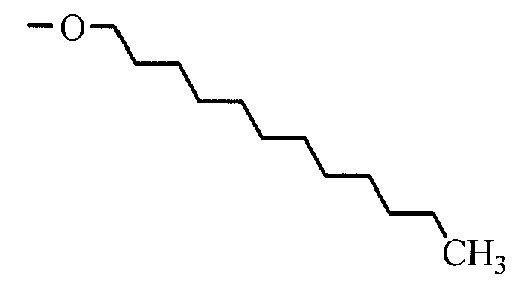
4 
3 15 
4 - H 3 16 
4 
3 17 
4 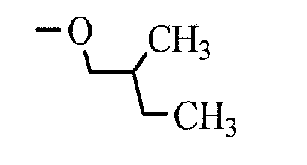
3 18 
4 
3 19 
4 
3 20 
4 - CH 33 21 
4 - H 3 22 
4 
3 23 
4 - CH 33 24 
4 
3 -
No. R1 R2 Structure Bond Position Structure Bond Position 25 
4 
3 26 
4 
3 27 
4 
3 28 
4 
3 29 
4 
3 30 
4 
3 31 
4 
3 32 
4 
3 33 
2 
3 34 
2 
3 35 
2 
3 -
No. R1 R2 Structure Bond Position Structure Bond Position 36 
2 - CH 33 37 
3 
3 38 
3 
3 39 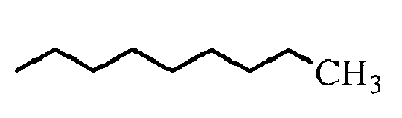
3 
3 40 
3 - CH 33 - The present invention is described below by reference to examples. However, the examples should not be construed as limiting the invention.
- 5.3g (45mmol) of rubeanic acid and 20g (180mmol) of 2-thiophene aldehyde are put into a 200ml three-necked flask, and 100ml of dimethylformamide (hereinafter referred to as DMF) is added thereto, thereby dissolving the substances in the flask. The solution is stirred at 150°C for 5 hours using a magnetic stirrer, and is cooled to 25°C. The reaction solution is poured into 1L of pure water in a 2L beaker, and the resultant mixture is stirred at 25°C for 30 minutes using a magnetic stirrer. After the completion of the stirring, the precipitated crystal is collected by suction filtration, and washed with 1L of pure water. The obtained crystal is further washed with 100ml of methanol, and vacuum-dried at 60°C for 15 hours. After drying, the crystal is dissolved in 100ml of tetrahydrofuran (hereinafter referred to as THF), and purified by using a silica gel short column, whereby Compound III-a is obtained in an amount of 6.4g. The obtained compound is identified as the desired product by 1H-NMR and IR.
-

- Under nitrogen atmosphere, 4.5g (15mmol) of Compound III-a and 8.0g (45mmol) of N-bromosuccinimide (hereinafter referred to as NBS) are dissolved in 200ml of DMF in a 500ml three-necked flask. The solution is stirred at 60°C for 7 hours using a magnetic stirrer, thereby completing the reaction. After cooling to 25°C, the reaction solution is poured into 1L of pure water in a 2L beaker, and the resultant mixture is stirred at 25°C for 30 minutes using a magnetic stirrer. After the completion of the stirring, the precipitated crystal is collected by suction filtration, and is washed with 1 L of pure water. The crystal is vacuum-dried at 60°C for 15 hours, and the crystal is subjected to recrystallization from N-methylpyrrolidone (hereinafter referred to as NMP) twice, whereby 3.3g of Compound IV-a in the form of a yellow crystal is obtained. The obtained compound is identified as the desired product by 1H-NMR and IR.
-

- Under nitrogen atmosphere, 0.23g (0.20mmol) of tetrakistriphenylphosphine palladium(0) is dissolved in 100ml of NMP in a 300ml three-necked flask. 1.84g (4.0mmol) of Compound IV-a, 8.0ml of a 2M sodium carbonate aqueous solution, and 1.56g (8.8mmol) of 4-n-butylphenyl boronic acid are sequentially added, in this order, to the solution obtained above. The resultant mixture is refluxed for 5 hours in an oil bath at 220°C under stirring by a magnetic stirrer. After confirming the completion of the reaction by 1H-NMR, the reaction solution is cooled to 25°C, and the reaction solution is poured into 1L of pure water in a 2L beaker. The resultant mixture in the beaker is stirred at 25°C for 30 minutes using a magnetic stirrer. After the completion of the stirring, the precipitated crystal is collected by suction filtration, and is washed with 1L of pure water. The obtained crystal is further washed with 100ml of methanol, and then with 100ml of toluene, and then vacuum-dried at 60°C for 15 hours. 150ml of NMP is added to the crystal, and recrystallization is performed, followed by purification by sublimation. As the result,
Exemplary Compound 1 in the form of an orange crystal is obtained in an amount of 1.0g. The IR spectrum and 1H-NMR spectrum of the obtainedExemplary Compound 1 are shown inFigs. 1 and2 , respectively. -

- Under nitrogen atmosphere, 0.14g (0.12mmol) of tetrakistriphenylphosphine palladium(0) is dissolved in 100ml of NMP in a 300ml three-necked flask. 1.85g (4.0mmol) of Compound IV-a, 8.0my of a 2M sodium carbonate aqueous solution, and 1.71g (8.8mmol) of 4-n-butoxyphenyl boronic acid are sequentially added, in this order, to the solution in the flask. The resultant mixture is refluxed for 4 hours in an oil bath at 220°C under stirring by a magnetic stirrer. The completion of the reaction is confirmed by 1H-NMR, the reaction solution is cooled to 25°C, and the reaction solution is poured into 1L of pure water in a 2L beaker. The resultant mixture in the beaker is stirred at 25°C for 20 minutes using a magnetic stirrer. After completion of the stirring, the precipitated crystal is collected by suction filtration, and is washed with 1 L of pure water. The obtained crystal is further washed with 200ml of methanol, and then with 250ml of toluene, and then vacuum-dried at 60 °C for 15 hours. 150ml of NMP is added to the crystal, and recrystallization is performed, followed by purification by sublimation. As the result, Exemplary Compound 11 in the form of an orange crystal is obtained in an amount of 1.0g. The IR spectrum and 1H-NMR spectrum of the obtained Exemplary Compound 11 are shown in
Figs. 3 and4 , respectively. -

- Under nitrogen atmosphere, 0.11 g (0.10mmol) of tetrakistriphenylphosphine palladium(0) is dissolved in 80ml of NMP in a 300ml three-necked flask. 1.39g (3.0mmol) of Compound IV-a, 6.0ml of a 2M sodium carbonate aqueous solution, and 1.18g (6.6mmol) of 4-tert-btuylphenyl boronic acid are sequentially added, in this order, to the solution in the flask. The resultant mixture is refluxed for 5 hours in an oil bath at 220°C under stirring by a magnetic stirrer. After the completion of the reaction is confirmed by 1H-NMR, the reaction mixture is cooled to 25°C, and the reaction mixture is poured into 500ml of pure water in a 1L beaker. The resultant mixture is stirred at 25°C for 30 minutes using a magnetic stirrer. After the completion of the stirring, the precipitated crystal is collected by suction filtration, and washed with 500ml of pure water. The obtained crystal is further washed with 100 ml of methanol, and then with 100ml of hexane, and then vacuum-dried at 60°C for 15 hours. 400ml ofmonochlorobenzene is added to the crystal, and recrystallization is performed, followed by purification by sublimation. As the result, Exemplary Compound 15 in the form of an orange crystal is obtained in an amount of 1.0g.
The IR spectrum and 1H-NMR spectrum of the obtained Exemplary Compound 15 are shown inFigs. 5 and6 . -

- 18g (150mmol) of rubeanic acid and 75g (600mmol) of 3-methylthiophene-2-aldehyde are put into a 1L three-necked flask, and 350ml of DMF is added thereto, thereby dissolving the substances in the flask. The solution is stirred for 5 hours in an oil bath at 150°C using a magnetic stirrer, and is cooled to 25°C. The reaction solution is poured into 1L of pure water in a 2L beaker, and the resultant mixture is stirred at 25°C for 30 minutes using a magnetic stirrer. After the completion of the stirring, the precipitated crystal is collected by suction filtration, and is washed with 1 L of pure water. 100ml of toluene and 200ml of methanol are added to the obtained black sticky crystal, and the solution is stirred for 10 minutes using ultrasonication and a magnetic stirrer, thereby washing the crystal. The washed crystal is collected by suction filtration, whereby 34g of a crude crystal is obtained. The crude crystal is further washed with 200ml of methanol, and vacuum-dried at 60°C for 15 hours. After drying, the crystal is dissolved in 500ml of monochlorobenzene, and purified by using a silica gel short column, whereby 19g of Compound III-b is obtained. The obtained compound is identified as the desired product by 1H-NMR and IR.
-

- Under nitrogen atmosphere, 19g (57mmol) of Compound III-b and 23g (129mmol) of NBS are put into a 1L three-necked flask, and 500ml of DMF is added thereto, thereby dissolving the substances in the flask. The solution is stirred at 60°C for 4 hours using a magnetic stirrer, thereby completing the reaction. After cooling to 25°C, the reaction solution is poured into 1L of pure water in a 2L beaker, and is stirred at 10°C for 30 minutes using a magnetic stirrer. After the completion of the stirring, the precipitated crystal is collected by suction filtration and washed with 1 L of pure water and then with 200ml of methanol. The crystal is vacuum-dried at 60°C for 15 hours, and then recrystallized twice using 300ml of NMP, whereby 21 g of Compound IV-b in the form of a yellow crystal is obtained. The obtained compound is identified as the desired product by 1H-NMR and IR.
-

- Under nitrogen atmosphere, 0.16g (0.14mmol) of tetrakistriphenylphosphine palladium(0) is dissolved in 100ml of NMP in a 300ml three-necked flask. 2.2g (4.5mmol) of Compound IV-b, 9.0ml of a 2M sodium carbonate aqueous solution, and 1.78g (10mmol) of 4-n-butylphenyl boronic acid are sequentially added, in this order, to the solution in the flask. The resultant mixture is refluxed for 6 hours in an oil bath at 220°C under stirring by a magnetic stirrer. After the completion of the reaction is confirmed by 1H-NMR, the reaction solution is cooled to 25°C, and the reaction solution is poured into 500ml of pure water in a 1L beaker. The resultant mixture in the beaker is stirred at 25°C for 30 minutes using a magnetic stirrer. After the completion of the stirring, the precipitated crystal is collected by suction filtration, and is washed with 300ml of pure water. The obtained crystal is further washed with 200ml of methanol, and then with 100ml of hexane, and vacuum-dried at 60°C for 15 hours. The crystal is dissolved in 200ml THF/100ml toluene under heating, and purified by using a silica gel short column. Then, the crystal is recrystallized using 300ml of toluene, whereby 0.70g of
Exemplary Compound 7 in the form of an orange crystal is obtained.
The IR spectrum and 1H-NMR spectrum of the obtainedExemplary Compound 7 are shown inFigs. 7 and8 , respectively. -

- Under nitrogen atmosphere, 10ml of a solution of 1.6M n-butyl lithium (16mmol) in hexane is put into a 100ml three-necked flask cooled at -80°C. After cooling to -80°C, 10ml of THF is added dropwise thereto using a dropping funnel while the THF is maintained at -60°C. Thereafter, 3.1g (16mmol) of 1-bromo-4-n-octylbenzene maintained at -60°C is added dropwise thereto using a dropping funnel. The resultant mixture is stirred at -40°C for 1 hour, and a solution of 2.3g (22mmol) of trimethyl borate in 10ml of THF is added dropwise to the mixture using a dropping funnel while the temperature of the added solution is maintained at -40°C. Thereafter, the temperature of the mixture is gradually increased to 10°C over 2 hours, and 50ml of a 10% HCl aqueous solution is added thereto at 0°C, and extraction is performed using 100ml of toluene. The extract is washed with 100ml of pure water three times, and is dehydrated using sodium sulfate. Toluene is distilled off by reducing the pressure, whereby remaining matter in an amount of 3.3g is obtained. The remaining matter is washed with a mixed solution of 100ml pure water/100ml hexane, whereby 2.0g of Compound V-a, which is 4-n-octylphenyl boronic acid, is obtained. The obtained compound is identified as the desired product by 1H-NMR and IR.
-

- Under nitrogen atmosphere, 0.11g (0.10mmol) of tetrakistriphenylphosphine palladium(0) is dissolved in 100ml of NMP in a 300ml three-necked flask. 1.4g (3.0mmol) of Compound IV-a, 9.0ml of a 2M sodium carbonate aqueous solution, and 1.4g (6.0mmol) of 4-n-octylphenyl boronic acid (Compound V-a) are sequentially added, in this order, to the solution in the flask. The resultant mixture is refluxed for 5 hours in an oil bath at 200°C under stirring by a magnetic stirrer. After the completion of the reaction is confirmed by 1H-NMR, the reaction solution is cooled to 25°C, and the reaction solution is poured into 1L of pure water in a 2L beaker. The resultant mixture in the beaker is stirred at 25°C for 20 minutes using a magnetic stirrer. After the completion of the stirring, the precipitated crystal is collected by suction filtration, and washed with 300ml of pure water. The obtained crystal is further washed with 200ml of methanol, and then with 100ml of toluene, and vacuum-dried at 60°C for 15 hours. The crystal is recrystallized using 200ml of NMP, followed by purification by sublimation, whereby 0.60g of
Exemplary Compound 4 in the form of an orange crystal is obtained.
The IR spectrum and 1H-NMR spectrum of the obtainedExemplary Compound 4 are shown inFigs. 9 and10 , respectively. -

- Under nitrogen atmosphere, 20ml of a solution of 1.6M n-butyl lithium (32mmol) in hexane is put into a 200ml three-necked flask cooled at -80°C. After cooling to -80°C, 20ml of THF is added dropwise thereto using a dropping funnel while the THF is maintained at -60°C. Thereafter, 10g (32mmol) of 1-bromo-4-n-dodecylbenzene maintained at -60°C is added dropwise thereto using a dropping funnel. The resultant mixture is stirred at -40°C for 1 hour, and a solution of 4.5g (43mmol) of trimethyl borate in 10ml of THF is added to the mixture using a dropping funnel while the temperature of the added solution is maintained at -40°C. Thereafter, the temperature of the mixture is gradually increased to 10°C over 2 hours, and 50ml of a 10% HCl aqueous solution is added thereto at 0°C, and extraction is performed using 100ml of toluene. The extract is washed with 100ml of pure water three times, and is dehydrated using sodium sulfate. Toluene is distilled off by reducing the pressure, whereby remaining matter is obtained. The remaining matter is washed with a mixed solution of 100ml pure water/100ml hexane, whereby 1.8g of Compound V-b, which is 4-n-dodecylphenyl boronic acid, is obtained. The obtained compound is identified as the desired product by 1H-NMR and IR.
-

- Under nitrogen atmosphere, 0.10g (0.080mmol) of tetrakistriphenylphosphine palladium(0) is dissolved in 100ml of NMP in a 300ml three-necked flask. 1.2g (2.5mmol) of Compound IV-a, 6.0ml of a 2M sodium carbonate aqueous solution, and 1.5g (5.0mmol) of Compound V-b, which is 4-n-dodecylphenyl boronic acid, are sequentially added, in this order, to the solution in the flask. The resultant mixture is refluxed for 5 hours in an oil bath at 220°C under stirring by a magnetic stirrer. After the completion of the reaction is confirmed by 1H-NMR, the reaction solution is cooled to 25°C, and the reaction solution is poured into 400ml of pure water in a 1L beaker. The resultant mixture in the beaker is stirred at 25°C for 30 minutes using a magnetic stirrer. After the completion of the stirring, the precipitated crystal is collected by suction filtration, and washed with 300ml of pure water. The obtained crystal is further washed with 200ml of methanol, and then with 100ml of toluene, and vacuum-dried at 60°C for 15 hours. The crystal is recrystallized twice from 200ml of NMP, followed by purification by sublimation, whereby 0.13g of
Exemplary Compound 5 in the form of an orange crystal is obtained.
The IR spectrum (according to the KBr method) of the obtainedExemplary Compound 5 is shown inFig. 11 . The NMR spectrum (1H-NMR, solvent: CDCl3) thereof is shown inFig. 12 . -

- 60g (305mmol) of 3-n-octylthiophene is dissolved in 100ml of DMF in a 500ml four-necked flask. The resultant solution is cooled to 5°C, and a solution obtained by dissolving 55g (310mmol) of NBS in 50ml of DMF is added dropwise thereto over 5 minutes using a pressure equalizing funnel. Thereafter, the resultant solution is stirred at 25°C for 1 hour using a magnetic stirrer, and then added into 500ml of pure water in a 1L beaker. The resultant mixture in the beaker is stirred at 25°C for 20 minutes using a magnetic stirrer. 300ml of ethyl acetate is added to the solution in the beaker, and the contents of the beaker are stirred at 25°C for 10 minutes using a magnetic stirrer. The ethyl acetate layer is taken out, washed with 300ml of pure water three times, and dehydrated using anhydrous sodium sulfate. Then, the resultant liquid is subjected to filtration, and solvent is removed by distillation under reduced pressure, whereby 83g of a yellow oily material is obtained. The yellow oily material is subjected to vacuum distillation (at 1 mmHg to 3 mmHg and a temperature of 120 to 130°C), whereby 76g of a pale-yellow oily material is obtained (yield: 93%).
-

- A 500ml four-necked flask is sufficiently dried, and 9.1g (374mmol) of magnesium and 100ml of THF are added into the flask under nitrogen atmosphere. Three particles of particulate iodine are added into the flask, thereby activating the surface of the magnesium. Thereafter, the contents of the flask are heated to 60°C, and a solution of 100g (363mmol) of Compound VI-a in 50ml of THF is added dropwise into the flask as the reaction in the flask proceeds. After completion of the dropwise addition, the contents of the flask are refluxed and stirred until the magnesium is completely consumed, and are cooled to 40°C. 30ml of DMF, which has been dehydrated using calcium hydride, is added dropwise into the obtained solution over 10 minutes, and then the contents of the flask are heated at 50°C for 30 minutes while stirring with a magnetic stirrer. After completion of the reaction, the contents in the flask are cooled to 5°C, and are poured into a 1L beaker containing 400ml of 10% hydrochloric acid and 300ml of toluene. The contents of the beaker are stirred at 25°C for 30 minutes using a magnetic stirrer, and the toluene layer is taken out and washed with 300ml of pure water three times. Thereafter, the resultant liquid is dehydrated with anhydrous sodium sulfate and then filtrated, and solvent is removed by distillation under reduced pressure, whereby 94g of a red oily material is obtained. The red oily material is subjected to vacuum distillation (at 1 mmHg to 3 mmHg and a temperature of 140 to 150°C), whereby 52g of a yellow oily material is obtained (yield: 64%). The obtained compound is identified as the desired product by 1H-NMR and IR.
-

- 8.0g (67mmol) of rubeanic acid and 60g (267mmol) of Compound VI-b are added into a 300ml four-necked flask, and dissolved in 60ml of dimethylformamide. The resultant solution is stirred at 150°C for 4 hours using a magnetic stirrer, and is cooled to 25°C. The reaction solution is added into 300ml of pure water in a 1L beaker, and the contents of the beaker are stirred at 25°C for 30 minutes using a magnetic stirrer. 300ml of toluene is added into the beaker, and the contents of the beaker are stirred for 10 minutes using a magnetic stirrer. The toluene layer is taken out, washed with 300ml of pure water three times, and dehydrated using anhydrous sodium sulfate. Then, the resultant liquid is subjected to filtration, and solvent is removed by distillation under reduced pressure, whereby a brown oily material is obtained. 200ml of methanol is added to the brown oily material, and the raw materials are removed therefrom by decantation. 200ml of hexane is added to the remaining matter, and cooled to 5°C, thereby causing crystallization. The obtained crystal is collected by suction filtration, and the collected material is washed by pouring 100ml of methanol, whereby 12g of an orange crystal is obtained (yield: 38%). The obtained compound is identified as the desired product by 1H-NMR and IR.
-

- Under nitrogen atmosphere, 12g (23mmol) of Compound VI-c and 8.9g (50mmol) of NBS are placed in a 500ml three-necked flask, and are dissolved in 200ml of DMF. The contents of the flask are stirred at 40°C for 1 hour using a magnetic stirrer, thereby completing the reaction. The reaction solution is cooled to 25°C, and is added into 500ml of pure water in a 2L beaker. The contents of the beaker are stirred at 5°C for 30 minutes using a magnetic stirrer. After completion of the stirring, the precipitate crystal is collected by suction filtration, and is washed with 1L of pure water. The crystal is further washed with 100ml of methanol, and is vacuum-dried at 60°C for 15 hours, whereby 12.2g of an orange crystal is obtained (yield: 76%). The obtained compound is identified as the desired product by 1H-NMR and IR.
-
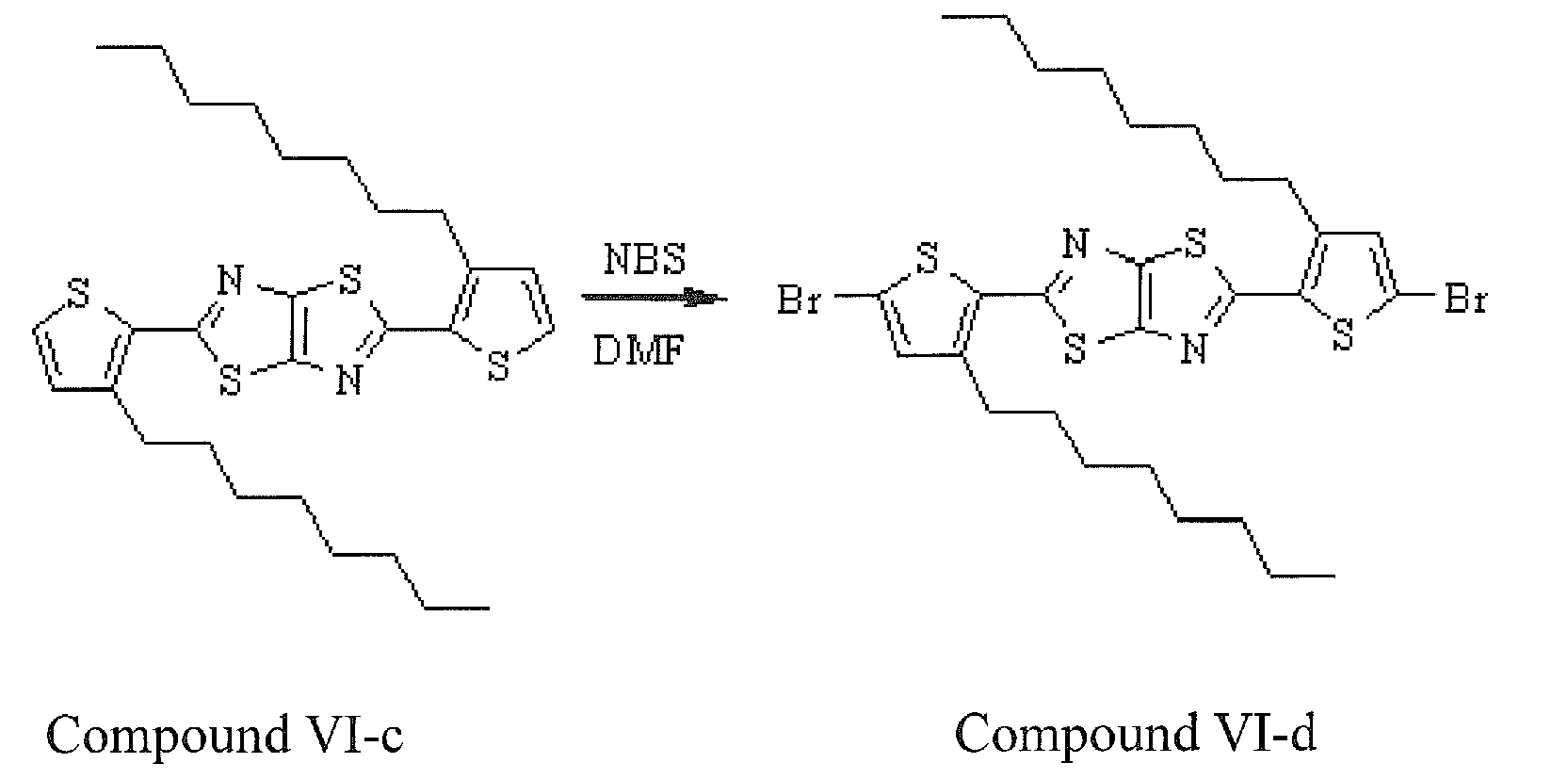
- Under nitrogen atmosphere, 0.10g (0.090mmol) of tetrakistriphenylphosphine palladium (0) is dissolved in 60ml of THF in a 200ml three-necked flask. 2.06g (3.0mmol) of Compound VI-d, 7.0ml of a 2M aqueous sodium carbonate solution, and 1.18g (6.6mmol) of 4-n-butylphenyl boronic acid are added, in this order, to the solution in the flask. The resultant mixture is refluxed for 8 hours under stirring by a magnetic stirrer. After the completion of the reaction is confirmed by 1H-NMR, the reaction solution is cooled to 25°C, and the reaction solution is poured into a 1L beaker containing 80ml of a 5% aqueous hydrochloric acid solution and 200ml of toluene. Then, the contents of the beaker are stirred at 25°C for 30 minutes using a magnetic stirrer. The toluene layer is taken out, washed with 200ml of pure water three times, and dehydrated using anhydrous sodium sulfate. Then, the liquid is filtrated, and solvent is removed by distillation under reduced pressure, whereby 2.8g of a red oily material is obtained. The palladium is removed therefrom by using a silica gel permeation column, and the resulting substance is washed with 50ml of methanol and 20ml of hexane, and recrystallized using 100ml of hexane. The obtained crystal is vacuum-dried for 15 hours, whereby 1.8g of Exemplary Compound 25 in the form of an orange crystal is obtained (yield: 78%).
The IR spectrum (according to the KBr method) of the obtained Exemplary Compound 25 is shown inFig. 13 . The NMR spectrum (1H-NMR, solvent: CDCl3) thereof is shown inFig. 14 . -

- Under nitrogen atmosphere, 0.090g (0.080mmol) of tetrakistriphenylphosphine palladium (0) is dissolved in 50ml of THF in a 200ml three-necked flask. 1.72g (2.5mmol) of Compound VI-d, 6.0ml of a 2M aqueous sodium carbonate solution, and 1.23g (5.3mmol) of Compound V-a are added, in this order, to the solution in the flask. The resultant mixture is refluxed for 11 hours under stirring by a magnetic stirrer. After the completion of the reaction is confirmed by 1H-NMR, the reaction solution is cooled to 25°C, and the reaction solution is poured into a 1L beaker containing 100ml of a 5% aqueous hydrochloric acid solution and 200ml of toluene. Then, the contents of the beaker are stirred at 25°C for 30 minutes using a magnetic stirrer. The toluene layer is taken out, washed with 200ml of pure water three times, and dehydrated using anhydrous sodium sulfate. Then, the liquid is filtrated, and solvent is removed by distillation under reduced pressure, whereby 2.8g of a red solid material is obtained. The red solid material is subjected to purification by a silica gel column using a mixed solvent of toluene and hexane (in a mixing ratio by weight of 1:5), and recrystallized using a mixed solvent of ethanol and hexane (in a mixing ratio by weight of 1:1). The obtained crystal is vacuum-dried for 15 hours, whereby 0.7g of Exemplary Compound 27 in the form of an orange crystal is obtained (yield: 30%).
The IR spectrum (according to the KBr method) of the obtained Exemplary Compound 27 is shown inFig. 15 . The NMR spectrum (1H-NMR, solvent: CDCl3) thereof is shown inFig. 16 . -

- Under nitrogen atmosphere, 0.090g (0.080mmol) of tetrakistriphenylphosphine palladium (0) is dissolved in 50ml of THF in a 200ml three-necked flask. 1.72g (2.5mmol) of Compound VI-d, 6.0ml of a 2M aqueous sodium carbonate solution, and 1.52g (5.3mmol) of Compound V-b are added, in this order, to the solution in the flask. The resultant mixture is refluxed for 12 hours under stirring by a magnetic stirrer. After the completion of the reaction is confirmed by 1H-NMR, the reaction solution is cooled to 25°C, and the reaction solution is poured into a 1L beaker containing 100ml of a 5% aqueous hydrochloric acid solution and 200ml of toluene. Then, the contents of the beaker are stirred at 25°C for 30 minutes using a magnetic stirrer. The toluene layer is taken out, washed with 200ml of pure water three times, and dehydrated using anhydrous sodium sulfate. Then, the liquid is filtrated, and solvent is removed by distillation under reduced pressure, whereby 3.1g of an orange solid material is obtained. The orange solid material is subjected to purification by a silica gel column using a mixed solvent of toluene and hexane, and recrystallized using a mixed solvent of ethanol and hexane. The obtained crystal is vacuum-dried for 15 hours, whereby 1.2g of Exemplary Compound 28 in the form of an orange crystal is obtained (yield: 47%).
The IR spectrum (according to the KBr method) of the obtained Exemplary Compound 28 is shown inFig. 17 . The NMR spectrum (1H-NMR, solvent: CDCl3) thereof is shown inFig. 18 . -

- Under nitrogen atmosphere, 0.090g (0.080mmol) of tetrakistriphenylphosphine palladium (0) is dissolved in 50ml of THF in a 200ml three-necked flask. 1.23g (2.5mmol) of Compound IV-b, 6.0ml of a 2M aqueous sodium carbonate solution, and 1.24g (5.3mmol) of Compound V-a are added, in this order, to the solution in the flask. The resultant mixture is refluxed for 12 hours under stirring by a magnetic stirrer. After the completion of the reaction is confirmed by 1H-NMR, the reaction solution is cooled to 25°C, and the reaction solution is poured into a 1L beaker containing 100ml of a 5% aqueous hydrochloric acid solution and 200ml of toluene. Then, the contents of the beaker are stirred at 25°C for 30 minutes using a magnetic stirrer. The toluene layer is taken out, washed with 200ml of pure water three times, and dehydrated using anhydrous sodium sulfate. Then, the liquid is filtrated, and solvent is removed by distillation under reduced pressure, whereby 1.7g of an orange solid material is obtained. The orange solid material is subjected to purification by a silica gel column using a mixed solvent of toluene and THF (in a mixing ratio by weight of 1:2), and recrystallized using toluene. The obtained crystal is vacuum-dried for 15 hours, whereby 1.2g of
Exemplary Compound 8 in the form of an orange crystal is obtained (yield: 70%).
The IR spectrum (according to the KBr method) of the obtainedExemplary Compound 8 is shown inFig. 19 . The NMR spectrum (1H-NMR, solvent: CDCl3) thereof is shown inFig. 20 . -

- The solubilities of the thiazolothiazole derivatives obtained in Examples 1 to 10 and the compound represented by
Formula 3 as Comparative Example 1 in various solvents are shown in Table 1. - The solubility test is performed as follows:
- 10mg (1.0 weight %) of an exemplary compound to be tested is dissolved in 1ml of a solvent (such as dichlorobenzene, monochlorobenzene, chloroform, THF, toluene or xylene). If the exemplary compound does not dissolve at 25°C, the temperature is increased to the boiling temperature of the solvent. The degree of dissolution is observed with the naked eye.
- Evaluation Criteria
- A: dissolves even when heating is not conducted
- B: completely dissolves when heating is conducted
- C: a large proportion thereof dissolves when heating is conducted
- D: a small proportion thereof dissolves when heating is conducted
-
Table 1 Thiazolothiazole Derivative Solubility Dichlorobenzene Monochlorobenzene Chloroform THF Toluene Xylene Example 1 Exemplary Compound (1) C C C C C C Example 2 Exemplary Compound (11) C C C C C C Example 3 Exemplary Compound (15) C C C C C C Example 4 Exemplary Compound (7) A A B A B B Example 5 Exemplary Compound (4) B B C C C C Example 6 Exemplary Compound (5) B B C C C C Comparative Example 1 Compound 3 D D D D D D Example 7 Exemplary Compound (25) A A A A A A Example 8 Exemplary Compound (27) A A A A A A Example 9 Exemplary Compound (28) A A A A A A Example 10 Exemplary Compound (8) A A B A B B - It is shown that the thiazolothiazole derivatives synthesized in Examples 1 to 10 have improved solubility, as compared with
Compound 3 synthesized in Comparative Example 1. Since the thiazolothiazole derivatives of Examples 1 to 10 have improved solubilities, it is understood that the thiazolothiazole derivatives represented by Formula (I) are highly useful as materials to be used in organic electronic devices such as organic photoreceptors, organic electroluminescence devices, organic transistors, and organic optical memories.
Claims (6)
- A thiazolothiazole derivative represented by the following Formula (I):

- The thiazolothiazole derivative according to claim 1, wherein, in Formula (I), each R1 independently represents a straight chain substituent having 3 to 12 carbon atoms or a branched substituent having a main chain portion including 3 to 12 carbon atoms, and each R2 independently represents a straight chain substituent having 1 to 12 carbon atoms or a branched substituent having a main chain portion including 2 to 12 carbon atoms.
- The thiazolothiazole derivative according to claim 1 or 2, wherein, in Formula (I), each R1 independently represents a straight chain alkyl group having 3 to 12 carbon atoms, a straight chain alkoxy group having 3 to 12 carbon atoms, a branched alkyl group having 3 to 12 carbon atoms, or a branched alkoxy group having 3 to 12 carbon atoms.
- The thiazolothiazole derivative of any one of claims 1 to 3, wherein, in Formula (I), each R2 independently represents a hydrogen atom, a straight chain alkyl group having 1 to 8 carbon atoms, a straight chain alkoxy group having 1 to 8 carbon atoms, a branched alkyl group having 3 to 8 carbon atoms, or a branched alkoxy group having 3 to 8 carbon atoms.
- The thiazolothiazole derivative of any one of claims 1 to 4, wherein, in Formula (I), each R2 independently represents a straight chain alkyl group having 1 to 8 carbon atoms, a straight chain alkoxy group having 1 to 8 carbon atoms, a branched alkyl group having 3 to 8 carbon atoms, or a branched alkoxy group having 3 to 8 carbon atoms.
- The thiazolothiazole derivative of any one of claims 1 to 5, wherein, in Formula (I), each R2 independently represents a straight chain alkyl group having 3 to 8 carbon atoms, a straight chain alkoxy group having 3 to 8 carbon atoms, a branched alkyl group having 3 to 8 carbon atoms, or a branched alkoxy group having 3 to 8 carbon atoms.
Applications Claiming Priority (2)
| Application Number | Priority Date | Filing Date | Title |
|---|---|---|---|
| JP2008307217 | 2008-12-02 | ||
| JP2009067966A JP4798241B2 (en) | 2008-12-02 | 2009-03-19 | Thiazolothiazole derivatives |
Publications (2)
| Publication Number | Publication Date |
|---|---|
| EP2233488A1 true EP2233488A1 (en) | 2010-09-29 |
| EP2233488B1 EP2233488B1 (en) | 2011-01-12 |
Family
ID=40757053
Family Applications (1)
| Application Number | Title | Priority Date | Filing Date |
|---|---|---|---|
| EP09160507A Not-in-force EP2233488B1 (en) | 2008-12-02 | 2009-05-18 | Thiazolothiazole derivatives and organic electronic device using the same |
Country Status (7)
| Country | Link |
|---|---|
| US (1) | US7812172B2 (en) |
| EP (1) | EP2233488B1 (en) |
| JP (1) | JP4798241B2 (en) |
| CN (1) | CN101747350B (en) |
| AT (1) | ATE495180T1 (en) |
| AU (1) | AU2009201953B2 (en) |
| DE (1) | DE602009000575D1 (en) |
Cited By (1)
| Publication number | Priority date | Publication date | Assignee | Title |
|---|---|---|---|---|
| CN108794509A (en) * | 2018-05-28 | 2018-11-13 | 常州大学 | One kind is using thiazole and thiazole is the A of core2-π-A1-π-A2The preparation and application of type small molecule receptor material |
Families Citing this family (12)
| Publication number | Priority date | Publication date | Assignee | Title |
|---|---|---|---|---|
| JP5347690B2 (en) * | 2009-04-30 | 2013-11-20 | 富士ゼロックス株式会社 | Organic electroluminescent device and display medium |
| JP2011084486A (en) * | 2009-10-13 | 2011-04-28 | Fuji Xerox Co Ltd | Thiazolothiazole compound and polymer thereof |
| JP5598013B2 (en) * | 2010-02-19 | 2014-10-01 | 富士ゼロックス株式会社 | Image carrier for image forming apparatus, process cartridge, and image forming apparatus |
| JP5540962B2 (en) * | 2010-07-15 | 2014-07-02 | 富士ゼロックス株式会社 | Image carrier for image forming apparatus, process cartridge, and image forming apparatus |
| DE102011009415A1 (en) * | 2011-01-25 | 2012-07-26 | Heraeus Precious Metals Gmbh & Co. Kg | Star-shaped compounds for organic solar cells |
| JP5788489B2 (en) | 2011-03-03 | 2015-09-30 | Jx日鉱日石エネルギー株式会社 | Polymer and photoelectric conversion element |
| CN103159923A (en) * | 2011-12-09 | 2013-06-19 | 海洋王照明科技股份有限公司 | Isoindigo based co-polymer, and preparation method and application thereof |
| CN104177374A (en) * | 2013-05-27 | 2014-12-03 | 海洋王照明科技股份有限公司 | Organic semiconductor material containing thiazolothiazole unit and preparation method thereof, and solar cell device |
| CN104211914A (en) * | 2013-05-29 | 2014-12-17 | 海洋王照明科技股份有限公司 | Conjugated polymer, preparation method, and applications thereof |
| KR101363241B1 (en) * | 2013-07-09 | 2014-02-13 | 신상규 | Method for refining of high purity organic electroluminescent material |
| CN108473911B (en) * | 2015-11-06 | 2021-10-29 | 国际香料和香精公司 | Formylthiophene and its use in flavor and aroma compositions |
| CN112111050B (en) * | 2020-09-04 | 2021-10-15 | 上海交通大学 | A kind of polymer containing thiazolothiazole unit, preparation method and use thereof |
Citations (3)
| Publication number | Priority date | Publication date | Assignee | Title |
|---|---|---|---|---|
| US3250617A (en) * | 1962-03-29 | 1966-05-10 | Eastman Kodak Co | Photographic elements protected against ultraviolet radiation |
| JP2006206503A (en) | 2005-01-28 | 2006-08-10 | Tokyo Institute Of Technology | PI electron compound and n-type organic field effect transistor using the same |
| JP2007126403A (en) | 2005-11-04 | 2007-05-24 | Sanyo Electric Co Ltd | Dibenzothiophene derivatives and organic electroluminescence devices using them |
Family Cites Families (2)
| Publication number | Priority date | Publication date | Assignee | Title |
|---|---|---|---|---|
| JP2006339474A (en) * | 2005-06-03 | 2006-12-14 | Dainippon Printing Co Ltd | Organic semiconductor material, organic semiconductor structure and organic semiconductor device |
| JP4883032B2 (en) * | 2008-03-18 | 2012-02-22 | 富士ゼロックス株式会社 | Organic electroluminescent device and display medium |
-
2009
- 2009-03-19 JP JP2009067966A patent/JP4798241B2/en not_active Expired - Fee Related
- 2009-04-27 US US12/430,361 patent/US7812172B2/en not_active Expired - Fee Related
- 2009-05-15 CN CN200910140981.9A patent/CN101747350B/en not_active Expired - Fee Related
- 2009-05-18 AT AT09160507T patent/ATE495180T1/en not_active IP Right Cessation
- 2009-05-18 AU AU2009201953A patent/AU2009201953B2/en active Active
- 2009-05-18 DE DE602009000575T patent/DE602009000575D1/en active Active
- 2009-05-18 EP EP09160507A patent/EP2233488B1/en not_active Not-in-force
Patent Citations (3)
| Publication number | Priority date | Publication date | Assignee | Title |
|---|---|---|---|---|
| US3250617A (en) * | 1962-03-29 | 1966-05-10 | Eastman Kodak Co | Photographic elements protected against ultraviolet radiation |
| JP2006206503A (en) | 2005-01-28 | 2006-08-10 | Tokyo Institute Of Technology | PI electron compound and n-type organic field effect transistor using the same |
| JP2007126403A (en) | 2005-11-04 | 2007-05-24 | Sanyo Electric Co Ltd | Dibenzothiophene derivatives and organic electroluminescence devices using them |
Non-Patent Citations (8)
| Title |
|---|
| ANDO, SHINJI ET AL: "High Performance n-Type Organic Field-Effect Transistors Based on .pi.-Electronic Systems with Trifluoromethylphenyl Groups", JOURNAL OF THE AMERICAN CHEMICAL SOCIETY , 127(15), 5336-5337 CODEN: JACSAT; ISSN: 0002-7863, 2005, XP002534244 * |
| DATABASE CA [online] CHEMICAL ABSTRACTS SERVICE, COLUMBUS, OHIO, US; ANDO, SHINJI ET AL: "Synthesis, physical properties and field-effect transistors of novel thiazolothiazole-phenylene co-oligomers", XP002534304, retrieved from STN Database accession no. 2007:106697 * |
| DATABASE CA [online] CHEMICAL ABSTRACTS SERVICE, COLUMBUS, OHIO, US; YAMASHITA, TAKAO ET AL: ".pi.-electron type compounds for n-type organic field-effect transistors", XP002534245, retrieved from STN Database accession no. 2006:788056 * |
| J. R. JOHNSON; D. H. ROTENBERG; R. KETCHAM, J. AM. CHM. SOC., vol. 92, 1970, pages 4096 |
| JOURNAL OF MATERIALS CHEMISTRY , 17(6), 553-558 CODEN: JMACEP; ISSN: 0959-9428, 2007 * |
| S. ANDO; J. NISHIDA ET AL., CHEMISTRY LETTERS, vol. 33, no. 9, 2004, pages 1170 - 1171 |
| S. ANDO; J. NISHIDA ET AL., J MATER CHEM., vol. 14, 2004, pages 1787 - 1790 |
| SHINJI ANDO ET AL: "Characterization and Field-Effect Transistor Performance of Heterocyclic Oligomers Containing a Thiazolithiazole Unit", CHEMISTRY LETTERS, CHEMICAL SOCIETY OF JAPAN, TOKYO, JP, vol. 33, no. 9, 1 September 2004 (2004-09-01), pages 1170 - 1171, XP003018909, ISSN: 0366-7022 * |
Cited By (2)
| Publication number | Priority date | Publication date | Assignee | Title |
|---|---|---|---|---|
| CN108794509A (en) * | 2018-05-28 | 2018-11-13 | 常州大学 | One kind is using thiazole and thiazole is the A of core2-π-A1-π-A2The preparation and application of type small molecule receptor material |
| CN108794509B (en) * | 2018-05-28 | 2020-07-07 | 常州大学 | A taking thiazolothiazole as core2-π-A1-π-A2Preparation and application of small molecule receptor material |
Also Published As
| Publication number | Publication date |
|---|---|
| EP2233488B1 (en) | 2011-01-12 |
| JP2010155818A (en) | 2010-07-15 |
| US7812172B2 (en) | 2010-10-12 |
| CN101747350A (en) | 2010-06-23 |
| JP4798241B2 (en) | 2011-10-19 |
| AU2009201953B2 (en) | 2011-04-21 |
| DE602009000575D1 (en) | 2011-02-24 |
| AU2009201953A1 (en) | 2010-06-17 |
| CN101747350B (en) | 2013-04-03 |
| ATE495180T1 (en) | 2011-01-15 |
| US20100137611A1 (en) | 2010-06-03 |
Similar Documents
| Publication | Publication Date | Title |
|---|---|---|
| EP2233488B1 (en) | Thiazolothiazole derivatives and organic electronic device using the same | |
| Lamba et al. | Imine-bridged planar poly (p-phenylene) derivatives for maximization of extended. pi.-conjugation. The common intermediate approach | |
| CN102131843B (en) | Phenoxazine system macromolecular compound and the luminous element using it | |
| JP2017516878A (en) | ΠConjugate semiconductor organic glass mixture for organic light emitting diode (OLED) and organic electroluminescent device (OEDS) | |
| CN107365306B (en) | Heterocyclic compound and organic light-emitting device using the same | |
| CN116326249A (en) | Method for preparing deuterated aromatic compounds and deuterated reaction compositions | |
| Luo et al. | Synthesis, physical properties and self-assembly of star-shaped oligothiophenes-substituted and fused triphenylenes | |
| Chen et al. | Synthesis, characterization and hydrolysis of aromatic polyazomethines containing non-coplanar biphenyl structures | |
| CN110054635B (en) | Asymmetric sulfur cyclized perylene bisimide derivative and preparation method thereof | |
| Li et al. | Synthesis and photophysical properties of highly emissive compounds containing a dibenzosilole core | |
| Aguiar et al. | Molecular 5, 8-π-extended quinoxaline derivatives as chromophores for photoluminescence applications | |
| US20160087221A1 (en) | Aromatic amine derivatives and preparation method, uses and organic electroluminescent devices thereof | |
| Tang et al. | Efficient Red Electroluminescence From Phenanthro [9, 10‐d] imidazole‐Naphtho [2, 3‐c][1, 2, 5] thiadiazole Donor‐Acceptor Derivatives | |
| US20220389310A1 (en) | Luminescent materials and methods thereof | |
| Yang et al. | Synthesis, X-ray crystal structure and optical properties of novel 2, 5-diaryl-1, 3, 4-oxadiazole derivatives containing substituted pyrazolo [1, 5-a] pyridine units | |
| US9000170B2 (en) | Process for the preparation of tetracarboxynaphthalenediimide compounds disubstituted with heteroaryl groups | |
| CN108997346B (en) | Based on perylene bisimide C3Symmetrical spiroplasmane derivative and synthesis and application thereof | |
| Peciuraite et al. | Indolyl-substituted carbazole derivatives as amorphous electro-active materials for optoelectronics | |
| US20140252278A1 (en) | Bibenzo[b]furan compound, photoelectric conversion material, and photoelectric conversion element | |
| US20130320269A1 (en) | Process for the preparation of semiconductor materials, compounds and their use | |
| JP2017190315A (en) | Boron-containing compound and application therefor | |
| CN117263992B (en) | Organic metal compound and organic electroluminescent device comprising same | |
| WO2018159834A1 (en) | Enamine compound and use thereof | |
| Luo et al. | Synthesis and characterization of a novel bipolar Alq3-based copolymer containing carbazole and phenothiazine groups | |
| JP2017210462A (en) | Boron-containing compounds and uses thereof |
Legal Events
| Date | Code | Title | Description |
|---|---|---|---|
| GRAP | Despatch of communication of intention to grant a patent |
Free format text: ORIGINAL CODE: EPIDOSNIGR1 |
|
| PUAI | Public reference made under article 153(3) epc to a published international application that has entered the european phase |
Free format text: ORIGINAL CODE: 0009012 |
|
| 17P | Request for examination filed |
Effective date: 20091102 |
|
| AK | Designated contracting states |
Kind code of ref document: A1 Designated state(s): AT BE BG CH CY CZ DE DK EE ES FI FR GB GR HR HU IE IS IT LI LT LU LV MC MK MT NL NO PL PT RO SE SI SK TR |
|
| AX | Request for extension of the european patent |
Extension state: AL BA RS |
|
| GRAS | Grant fee paid |
Free format text: ORIGINAL CODE: EPIDOSNIGR3 |
|
| GRAA | (expected) grant |
Free format text: ORIGINAL CODE: 0009210 |
|
| AK | Designated contracting states |
Kind code of ref document: B1 Designated state(s): AT BE BG CH CY CZ DE DK EE ES FI FR GB GR HR HU IE IS IT LI LT LU LV MC MK MT NL NO PL PT RO SE SI SK TR |
|
| REG | Reference to a national code |
Ref country code: GB Ref legal event code: FG4D |
|
| REG | Reference to a national code |
Ref country code: CH Ref legal event code: EP |
|
| REG | Reference to a national code |
Ref country code: IE Ref legal event code: FG4D |
|
| REF | Corresponds to: |
Ref document number: 602009000575 Country of ref document: DE Date of ref document: 20110224 Kind code of ref document: P |
|
| REG | Reference to a national code |
Ref country code: DE Ref legal event code: R096 Ref document number: 602009000575 Country of ref document: DE Effective date: 20110224 |
|
| REG | Reference to a national code |
Ref country code: NL Ref legal event code: VDEP Effective date: 20110112 |
|
| LTIE | Lt: invalidation of european patent or patent extension |
Effective date: 20110112 |
|
| PG25 | Lapsed in a contracting state [announced via postgrant information from national office to epo] |
Ref country code: GR Free format text: LAPSE BECAUSE OF FAILURE TO SUBMIT A TRANSLATION OF THE DESCRIPTION OR TO PAY THE FEE WITHIN THE PRESCRIBED TIME-LIMIT Effective date: 20110413 Ref country code: HR Free format text: LAPSE BECAUSE OF FAILURE TO SUBMIT A TRANSLATION OF THE DESCRIPTION OR TO PAY THE FEE WITHIN THE PRESCRIBED TIME-LIMIT Effective date: 20110112 Ref country code: NO Free format text: LAPSE BECAUSE OF FAILURE TO SUBMIT A TRANSLATION OF THE DESCRIPTION OR TO PAY THE FEE WITHIN THE PRESCRIBED TIME-LIMIT Effective date: 20110412 Ref country code: ES Free format text: LAPSE BECAUSE OF FAILURE TO SUBMIT A TRANSLATION OF THE DESCRIPTION OR TO PAY THE FEE WITHIN THE PRESCRIBED TIME-LIMIT Effective date: 20110423 Ref country code: IS Free format text: LAPSE BECAUSE OF FAILURE TO SUBMIT A TRANSLATION OF THE DESCRIPTION OR TO PAY THE FEE WITHIN THE PRESCRIBED TIME-LIMIT Effective date: 20110512 Ref country code: SE Free format text: LAPSE BECAUSE OF FAILURE TO SUBMIT A TRANSLATION OF THE DESCRIPTION OR TO PAY THE FEE WITHIN THE PRESCRIBED TIME-LIMIT Effective date: 20110112 Ref country code: LV Free format text: LAPSE BECAUSE OF FAILURE TO SUBMIT A TRANSLATION OF THE DESCRIPTION OR TO PAY THE FEE WITHIN THE PRESCRIBED TIME-LIMIT Effective date: 20110112 Ref country code: PT Free format text: LAPSE BECAUSE OF FAILURE TO SUBMIT A TRANSLATION OF THE DESCRIPTION OR TO PAY THE FEE WITHIN THE PRESCRIBED TIME-LIMIT Effective date: 20110512 Ref country code: LT Free format text: LAPSE BECAUSE OF FAILURE TO SUBMIT A TRANSLATION OF THE DESCRIPTION OR TO PAY THE FEE WITHIN THE PRESCRIBED TIME-LIMIT Effective date: 20110112 |
|
| PG25 | Lapsed in a contracting state [announced via postgrant information from national office to epo] |
Ref country code: SI Free format text: LAPSE BECAUSE OF FAILURE TO SUBMIT A TRANSLATION OF THE DESCRIPTION OR TO PAY THE FEE WITHIN THE PRESCRIBED TIME-LIMIT Effective date: 20110112 Ref country code: CY Free format text: LAPSE BECAUSE OF FAILURE TO SUBMIT A TRANSLATION OF THE DESCRIPTION OR TO PAY THE FEE WITHIN THE PRESCRIBED TIME-LIMIT Effective date: 20110112 Ref country code: AT Free format text: LAPSE BECAUSE OF FAILURE TO SUBMIT A TRANSLATION OF THE DESCRIPTION OR TO PAY THE FEE WITHIN THE PRESCRIBED TIME-LIMIT Effective date: 20110112 Ref country code: FI Free format text: LAPSE BECAUSE OF FAILURE TO SUBMIT A TRANSLATION OF THE DESCRIPTION OR TO PAY THE FEE WITHIN THE PRESCRIBED TIME-LIMIT Effective date: 20110112 Ref country code: BG Free format text: LAPSE BECAUSE OF FAILURE TO SUBMIT A TRANSLATION OF THE DESCRIPTION OR TO PAY THE FEE WITHIN THE PRESCRIBED TIME-LIMIT Effective date: 20110412 Ref country code: PL Free format text: LAPSE BECAUSE OF FAILURE TO SUBMIT A TRANSLATION OF THE DESCRIPTION OR TO PAY THE FEE WITHIN THE PRESCRIBED TIME-LIMIT Effective date: 20110112 Ref country code: BE Free format text: LAPSE BECAUSE OF FAILURE TO SUBMIT A TRANSLATION OF THE DESCRIPTION OR TO PAY THE FEE WITHIN THE PRESCRIBED TIME-LIMIT Effective date: 20110112 Ref country code: NL Free format text: LAPSE BECAUSE OF FAILURE TO SUBMIT A TRANSLATION OF THE DESCRIPTION OR TO PAY THE FEE WITHIN THE PRESCRIBED TIME-LIMIT Effective date: 20110112 |
|
| PG25 | Lapsed in a contracting state [announced via postgrant information from national office to epo] |
Ref country code: DK Free format text: LAPSE BECAUSE OF FAILURE TO SUBMIT A TRANSLATION OF THE DESCRIPTION OR TO PAY THE FEE WITHIN THE PRESCRIBED TIME-LIMIT Effective date: 20110112 Ref country code: EE Free format text: LAPSE BECAUSE OF FAILURE TO SUBMIT A TRANSLATION OF THE DESCRIPTION OR TO PAY THE FEE WITHIN THE PRESCRIBED TIME-LIMIT Effective date: 20110112 |
|
| PLBE | No opposition filed within time limit |
Free format text: ORIGINAL CODE: 0009261 |
|
| STAA | Information on the status of an ep patent application or granted ep patent |
Free format text: STATUS: NO OPPOSITION FILED WITHIN TIME LIMIT |
|
| PG25 | Lapsed in a contracting state [announced via postgrant information from national office to epo] |
Ref country code: RO Free format text: LAPSE BECAUSE OF FAILURE TO SUBMIT A TRANSLATION OF THE DESCRIPTION OR TO PAY THE FEE WITHIN THE PRESCRIBED TIME-LIMIT Effective date: 20110112 Ref country code: CZ Free format text: LAPSE BECAUSE OF FAILURE TO SUBMIT A TRANSLATION OF THE DESCRIPTION OR TO PAY THE FEE WITHIN THE PRESCRIBED TIME-LIMIT Effective date: 20110112 Ref country code: SK Free format text: LAPSE BECAUSE OF FAILURE TO SUBMIT A TRANSLATION OF THE DESCRIPTION OR TO PAY THE FEE WITHIN THE PRESCRIBED TIME-LIMIT Effective date: 20110112 |
|
| 26N | No opposition filed |
Effective date: 20111013 |
|
| PG25 | Lapsed in a contracting state [announced via postgrant information from national office to epo] |
Ref country code: MC Free format text: LAPSE BECAUSE OF NON-PAYMENT OF DUE FEES Effective date: 20110531 Ref country code: MT Free format text: LAPSE BECAUSE OF FAILURE TO SUBMIT A TRANSLATION OF THE DESCRIPTION OR TO PAY THE FEE WITHIN THE PRESCRIBED TIME-LIMIT Effective date: 20110112 Ref country code: IT Free format text: LAPSE BECAUSE OF FAILURE TO SUBMIT A TRANSLATION OF THE DESCRIPTION OR TO PAY THE FEE WITHIN THE PRESCRIBED TIME-LIMIT Effective date: 20110112 |
|
| REG | Reference to a national code |
Ref country code: DE Ref legal event code: R097 Ref document number: 602009000575 Country of ref document: DE Effective date: 20111013 |
|
| REG | Reference to a national code |
Ref country code: FR Ref legal event code: ST Effective date: 20120131 |
|
| REG | Reference to a national code |
Ref country code: IE Ref legal event code: MM4A |
|
| PG25 | Lapsed in a contracting state [announced via postgrant information from national office to epo] |
Ref country code: FR Free format text: LAPSE BECAUSE OF NON-PAYMENT OF DUE FEES Effective date: 20110531 Ref country code: IE Free format text: LAPSE BECAUSE OF NON-PAYMENT OF DUE FEES Effective date: 20110518 |
|
| PG25 | Lapsed in a contracting state [announced via postgrant information from national office to epo] |
Ref country code: MK Free format text: LAPSE BECAUSE OF FAILURE TO SUBMIT A TRANSLATION OF THE DESCRIPTION OR TO PAY THE FEE WITHIN THE PRESCRIBED TIME-LIMIT Effective date: 20110112 |
|
| PG25 | Lapsed in a contracting state [announced via postgrant information from national office to epo] |
Ref country code: LU Free format text: LAPSE BECAUSE OF NON-PAYMENT OF DUE FEES Effective date: 20110518 |
|
| PG25 | Lapsed in a contracting state [announced via postgrant information from national office to epo] |
Ref country code: TR Free format text: LAPSE BECAUSE OF FAILURE TO SUBMIT A TRANSLATION OF THE DESCRIPTION OR TO PAY THE FEE WITHIN THE PRESCRIBED TIME-LIMIT Effective date: 20110112 |
|
| PG25 | Lapsed in a contracting state [announced via postgrant information from national office to epo] |
Ref country code: HU Free format text: LAPSE BECAUSE OF FAILURE TO SUBMIT A TRANSLATION OF THE DESCRIPTION OR TO PAY THE FEE WITHIN THE PRESCRIBED TIME-LIMIT Effective date: 20110112 |
|
| REG | Reference to a national code |
Ref country code: CH Ref legal event code: PL |
|
| PG25 | Lapsed in a contracting state [announced via postgrant information from national office to epo] |
Ref country code: LI Free format text: LAPSE BECAUSE OF NON-PAYMENT OF DUE FEES Effective date: 20130531 Ref country code: CH Free format text: LAPSE BECAUSE OF NON-PAYMENT OF DUE FEES Effective date: 20130531 |
|
| REG | Reference to a national code |
Ref country code: DE Ref legal event code: R082 Ref document number: 602009000575 Country of ref document: DE Representative=s name: HASELTINE LAKE LLP, DE |
|
| REG | Reference to a national code |
Ref country code: DE Ref legal event code: R082 Ref document number: 602009000575 Country of ref document: DE Representative=s name: HL KEMPNER PATENTANWALT, RECHTSANWALT, SOLICIT, DE |
|
| PGFP | Annual fee paid to national office [announced via postgrant information from national office to epo] |
Ref country code: DE Payment date: 20210420 Year of fee payment: 13 |
|
| PGFP | Annual fee paid to national office [announced via postgrant information from national office to epo] |
Ref country code: GB Payment date: 20210422 Year of fee payment: 13 |
|
| REG | Reference to a national code |
Ref country code: DE Ref legal event code: R081 Ref document number: 602009000575 Country of ref document: DE Owner name: FUJIFILM BUSINESS INNOVATION CORP., JP Free format text: FORMER OWNER: FUJI XEROX CO., LTD., TOKYO, JP |
|
| REG | Reference to a national code |
Ref country code: DE Ref legal event code: R119 Ref document number: 602009000575 Country of ref document: DE |
|
| GBPC | Gb: european patent ceased through non-payment of renewal fee |
Effective date: 20220518 |
|
| PG25 | Lapsed in a contracting state [announced via postgrant information from national office to epo] |
Ref country code: GB Free format text: LAPSE BECAUSE OF NON-PAYMENT OF DUE FEES Effective date: 20220518 Ref country code: DE Free format text: LAPSE BECAUSE OF NON-PAYMENT OF DUE FEES Effective date: 20221201 |