EP2231743B1 - Curable benzoxazine macromonomers, their preparation and cured products thereof - Google Patents
Curable benzoxazine macromonomers, their preparation and cured products thereof Download PDFInfo
- Publication number
- EP2231743B1 EP2231743B1 EP08859986.5A EP08859986A EP2231743B1 EP 2231743 B1 EP2231743 B1 EP 2231743B1 EP 08859986 A EP08859986 A EP 08859986A EP 2231743 B1 EP2231743 B1 EP 2231743B1
- Authority
- EP
- European Patent Office
- Prior art keywords
- benzoxazine
- curable
- mol
- solution
- atoms
- Prior art date
- Legal status (The legal status is an assumption and is not a legal conclusion. Google has not performed a legal analysis and makes no representation as to the accuracy of the status listed.)
- Not-in-force
Links
- CMLFRMDBDNHMRA-UHFFFAOYSA-N 2h-1,2-benzoxazine Chemical compound C1=CC=C2C=CNOC2=C1 CMLFRMDBDNHMRA-UHFFFAOYSA-N 0.000 title claims description 144
- 238000002360 preparation method Methods 0.000 title description 4
- 239000012634 fragment Substances 0.000 claims description 110
- 239000000203 mixture Substances 0.000 claims description 89
- 125000004429 atom Chemical group 0.000 claims description 86
- 235000013824 polyphenols Nutrition 0.000 claims description 49
- 238000009472 formulation Methods 0.000 claims description 39
- 239000004615 ingredient Substances 0.000 claims description 30
- 150000008442 polyphenolic compounds Chemical class 0.000 claims description 24
- 229920000768 polyamine Polymers 0.000 claims description 20
- 125000003118 aryl group Chemical group 0.000 claims description 19
- -1 allyl Chemical class 0.000 claims description 18
- 125000000217 alkyl group Chemical group 0.000 claims description 17
- 125000001931 aliphatic group Chemical group 0.000 claims description 14
- 229910052739 hydrogen Inorganic materials 0.000 claims description 14
- 125000003342 alkenyl group Chemical group 0.000 claims description 13
- 230000009477 glass transition Effects 0.000 claims description 13
- 239000001257 hydrogen Substances 0.000 claims description 13
- 125000004435 hydrogen atom Chemical group [H]* 0.000 claims description 13
- BCHZICNRHXRCHY-UHFFFAOYSA-N 2h-oxazine Chemical group N1OC=CC=C1 BCHZICNRHXRCHY-UHFFFAOYSA-N 0.000 claims description 11
- RDWCMVVNCHSRBY-UHFFFAOYSA-N [N].O1NC=CC2=C1C=CC=C2 Chemical group [N].O1NC=CC2=C1C=CC=C2 RDWCMVVNCHSRBY-UHFFFAOYSA-N 0.000 claims description 10
- JYWJFFWJALQSKO-UHFFFAOYSA-N [O].C1=CC=C2C=CNOC2=C1 Chemical group [O].C1=CC=C2C=CNOC2=C1 JYWJFFWJALQSKO-UHFFFAOYSA-N 0.000 claims description 10
- 229910052760 oxygen Inorganic materials 0.000 claims description 10
- 125000002496 methyl group Chemical group [H]C([H])([H])* 0.000 claims description 8
- 229910052736 halogen Inorganic materials 0.000 claims description 7
- 150000002367 halogens Chemical group 0.000 claims description 7
- QEQVCPKISCKMOQ-UHFFFAOYSA-N 3h-benzo[f][1,2]benzoxazine Chemical group C1=CC=CC2=C(C=CNO3)C3=CC=C21 QEQVCPKISCKMOQ-UHFFFAOYSA-N 0.000 claims description 6
- 125000001072 heteroaryl group Chemical group 0.000 claims description 5
- 125000000484 butyl group Chemical group [H]C([*])([H])C([H])([H])C([H])([H])C([H])([H])[H] 0.000 claims description 4
- 125000001495 ethyl group Chemical group [H]C([H])([H])C([H])([H])* 0.000 claims description 4
- 125000001436 propyl group Chemical group [H]C([*])([H])C([H])([H])C([H])([H])[H] 0.000 claims description 4
- 239000000565 sealant Substances 0.000 claims description 4
- 229910052717 sulfur Inorganic materials 0.000 claims description 4
- 125000003903 2-propenyl group Chemical group [H]C([*])([H])C([H])=C([H])[H] 0.000 claims description 3
- WSNMPAVSZJSIMT-UHFFFAOYSA-N COc1c(C)c2COC(=O)c2c(O)c1CC(O)C1(C)CCC(=O)O1 Chemical compound COc1c(C)c2COC(=O)c2c(O)c1CC(O)C1(C)CCC(=O)O1 WSNMPAVSZJSIMT-UHFFFAOYSA-N 0.000 claims description 3
- 239000000853 adhesive Substances 0.000 claims description 3
- 230000001070 adhesive effect Effects 0.000 claims description 3
- 239000011248 coating agent Substances 0.000 claims description 3
- 238000000576 coating method Methods 0.000 claims description 3
- 125000002947 alkylene group Chemical group 0.000 claims description 2
- 125000002915 carbonyl group Chemical group [*:2]C([*:1])=O 0.000 claims description 2
- IPZJQDSFZGZEOY-UHFFFAOYSA-N dimethylmethylene Chemical compound C[C]C IPZJQDSFZGZEOY-UHFFFAOYSA-N 0.000 claims description 2
- 238000013007 heat curing Methods 0.000 claims description 2
- 150000003457 sulfones Chemical class 0.000 claims description 2
- 150000003462 sulfoxides Chemical class 0.000 claims description 2
- 150000003568 thioethers Chemical class 0.000 claims description 2
- 150000003573 thiols Chemical class 0.000 claims description 2
- YXFVVABEGXRONW-UHFFFAOYSA-N Toluene Chemical compound CC1=CC=CC=C1 YXFVVABEGXRONW-UHFFFAOYSA-N 0.000 description 297
- 239000000243 solution Substances 0.000 description 158
- XLYOFNOQVPJJNP-UHFFFAOYSA-N water Substances O XLYOFNOQVPJJNP-UHFFFAOYSA-N 0.000 description 141
- LFQSCWFLJHTTHZ-UHFFFAOYSA-N Ethanol Chemical compound CCO LFQSCWFLJHTTHZ-UHFFFAOYSA-N 0.000 description 92
- FAPWRFPIFSIZLT-UHFFFAOYSA-M Sodium chloride Chemical compound [Na+].[Cl-] FAPWRFPIFSIZLT-UHFFFAOYSA-M 0.000 description 86
- IISBACLAFKSPIT-UHFFFAOYSA-N bisphenol A Chemical compound C=1C=C(O)C=CC=1C(C)(C)C1=CC=C(O)C=C1 IISBACLAFKSPIT-UHFFFAOYSA-N 0.000 description 72
- WSFSSNUMVMOOMR-UHFFFAOYSA-N Formaldehyde Chemical compound O=C WSFSSNUMVMOOMR-UHFFFAOYSA-N 0.000 description 71
- XEKOWRVHYACXOJ-UHFFFAOYSA-N Ethyl acetate Chemical compound CCOC(C)=O XEKOWRVHYACXOJ-UHFFFAOYSA-N 0.000 description 69
- 238000006243 chemical reaction Methods 0.000 description 65
- UIIMBOGNXHQVGW-UHFFFAOYSA-M Sodium bicarbonate Chemical compound [Na+].OC([O-])=O UIIMBOGNXHQVGW-UHFFFAOYSA-M 0.000 description 62
- 239000000047 product Substances 0.000 description 58
- 239000002904 solvent Substances 0.000 description 39
- 239000011541 reaction mixture Substances 0.000 description 37
- 230000015572 biosynthetic process Effects 0.000 description 35
- 238000003786 synthesis reaction Methods 0.000 description 35
- 229930040373 Paraformaldehyde Natural products 0.000 description 33
- IJGRMHOSHXDMSA-UHFFFAOYSA-N Atomic nitrogen Chemical compound N#N IJGRMHOSHXDMSA-UHFFFAOYSA-N 0.000 description 31
- 229920002866 paraformaldehyde Polymers 0.000 description 31
- 229910000030 sodium bicarbonate Inorganic materials 0.000 description 31
- 125000002887 hydroxy group Chemical group [H]O* 0.000 description 30
- 238000010992 reflux Methods 0.000 description 30
- 239000011780 sodium chloride Substances 0.000 description 29
- 150000005130 benzoxazines Chemical class 0.000 description 26
- ISWSIDIOOBJBQZ-UHFFFAOYSA-N Phenol Chemical compound OC1=CC=CC=C1 ISWSIDIOOBJBQZ-UHFFFAOYSA-N 0.000 description 25
- 239000012074 organic phase Substances 0.000 description 24
- 229940093499 ethyl acetate Drugs 0.000 description 23
- 235000019439 ethyl acetate Nutrition 0.000 description 23
- 229920005989 resin Polymers 0.000 description 23
- 239000011347 resin Substances 0.000 description 23
- 150000004985 diamines Chemical class 0.000 description 22
- 238000005191 phase separation Methods 0.000 description 21
- 238000001816 cooling Methods 0.000 description 20
- 229920000642 polymer Polymers 0.000 description 20
- 239000012298 atmosphere Substances 0.000 description 19
- 229910001873 dinitrogen Inorganic materials 0.000 description 19
- PMZURENOXWZQFD-UHFFFAOYSA-L Sodium Sulfate Chemical compound [Na+].[Na+].[O-]S([O-])(=O)=O PMZURENOXWZQFD-UHFFFAOYSA-L 0.000 description 16
- 150000001875 compounds Chemical class 0.000 description 16
- 238000001723 curing Methods 0.000 description 16
- 125000002924 primary amino group Chemical group [H]N([H])* 0.000 description 16
- 239000000376 reactant Substances 0.000 description 16
- 229910052938 sodium sulfate Inorganic materials 0.000 description 16
- 235000011152 sodium sulphate Nutrition 0.000 description 16
- 238000001291 vacuum drying Methods 0.000 description 16
- 230000002250 progressing effect Effects 0.000 description 15
- 239000004814 polyurethane Substances 0.000 description 14
- RNLHGQLZWXBQNY-UHFFFAOYSA-N 3-(aminomethyl)-3,5,5-trimethylcyclohexan-1-amine Chemical compound CC1(C)CC(N)CC(C)(CN)C1 RNLHGQLZWXBQNY-UHFFFAOYSA-N 0.000 description 13
- 238000003756 stirring Methods 0.000 description 13
- 239000000463 material Substances 0.000 description 12
- 238000000034 method Methods 0.000 description 12
- 229910052799 carbon Inorganic materials 0.000 description 11
- 239000004205 dimethyl polysiloxane Substances 0.000 description 11
- 235000013870 dimethyl polysiloxane Nutrition 0.000 description 11
- 229920000435 poly(dimethylsiloxane) Polymers 0.000 description 11
- 125000004432 carbon atom Chemical group C* 0.000 description 10
- 239000008098 formaldehyde solution Substances 0.000 description 10
- 239000000178 monomer Substances 0.000 description 9
- CXQXSVUQTKDNFP-UHFFFAOYSA-N octamethyltrisiloxane Chemical compound C[Si](C)(C)O[Si](C)(C)O[Si](C)(C)C CXQXSVUQTKDNFP-UHFFFAOYSA-N 0.000 description 9
- 238000004987 plasma desorption mass spectroscopy Methods 0.000 description 9
- 229930185605 Bisphenol Natural products 0.000 description 8
- UHOVQNZJYSORNB-UHFFFAOYSA-N monobenzene Natural products C1=CC=CC=C1 UHOVQNZJYSORNB-UHFFFAOYSA-N 0.000 description 8
- 229910052757 nitrogen Inorganic materials 0.000 description 8
- 229920002857 polybutadiene Polymers 0.000 description 8
- 239000000654 additive Substances 0.000 description 7
- 150000001721 carbon Chemical group 0.000 description 7
- 150000002009 diols Chemical class 0.000 description 7
- 239000008367 deionised water Substances 0.000 description 6
- 229910021641 deionized water Inorganic materials 0.000 description 6
- 238000010438 heat treatment Methods 0.000 description 6
- 239000007858 starting material Substances 0.000 description 6
- 239000000126 substance Substances 0.000 description 6
- 239000000725 suspension Substances 0.000 description 6
- 229920001169 thermoplastic Polymers 0.000 description 6
- 239000004416 thermosoftening plastic Substances 0.000 description 6
- FRQPHGSNRQEKOX-UHFFFAOYSA-N 6h-benzo[c][1,2]benzoxazine Chemical compound C1=CC=C2NOC3=CC=CC=C3C2=C1 FRQPHGSNRQEKOX-UHFFFAOYSA-N 0.000 description 5
- 239000005062 Polybutadiene Substances 0.000 description 5
- 239000003054 catalyst Substances 0.000 description 5
- 230000001747 exhibiting effect Effects 0.000 description 5
- 125000001997 phenyl group Chemical group [H]C1=C([H])C([H])=C(*)C([H])=C1[H] 0.000 description 5
- 229920000570 polyether Polymers 0.000 description 5
- 229920001187 thermosetting polymer Polymers 0.000 description 5
- XKZQKPRCPNGNFR-UHFFFAOYSA-N 2-(3-hydroxyphenyl)phenol Chemical compound OC1=CC=CC(C=2C(=CC=CC=2)O)=C1 XKZQKPRCPNGNFR-UHFFFAOYSA-N 0.000 description 4
- PAYRUJLWNCNPSJ-UHFFFAOYSA-N Aniline Chemical compound NC1=CC=CC=C1 PAYRUJLWNCNPSJ-UHFFFAOYSA-N 0.000 description 4
- 241001598984 Bromius obscurus Species 0.000 description 4
- 239000004721 Polyphenylene oxide Substances 0.000 description 4
- 230000000996 additive effect Effects 0.000 description 4
- 238000013459 approach Methods 0.000 description 4
- QVGXLLKOCUKJST-UHFFFAOYSA-N atomic oxygen Chemical compound [O] QVGXLLKOCUKJST-UHFFFAOYSA-N 0.000 description 4
- PXKLMJQFEQBVLD-UHFFFAOYSA-N bisphenol F Chemical compound C1=CC(O)=CC=C1CC1=CC=C(O)C=C1 PXKLMJQFEQBVLD-UHFFFAOYSA-N 0.000 description 4
- 238000005266 casting Methods 0.000 description 4
- 230000003247 decreasing effect Effects 0.000 description 4
- 239000003822 epoxy resin Substances 0.000 description 4
- 239000012530 fluid Substances 0.000 description 4
- 238000005227 gel permeation chromatography Methods 0.000 description 4
- WSFSSNUMVMOOMR-NJFSPNSNSA-N methanone Chemical compound O=[14CH2] WSFSSNUMVMOOMR-NJFSPNSNSA-N 0.000 description 4
- 239000001301 oxygen Substances 0.000 description 4
- 229920000647 polyepoxide Polymers 0.000 description 4
- DVKJHBMWWAPEIU-UHFFFAOYSA-N toluene 2,4-diisocyanate Chemical compound CC1=CC=C(N=C=O)C=C1N=C=O DVKJHBMWWAPEIU-UHFFFAOYSA-N 0.000 description 4
- OKTJSMMVPCPJKN-UHFFFAOYSA-N Carbon Chemical compound [C] OKTJSMMVPCPJKN-UHFFFAOYSA-N 0.000 description 3
- 239000004215 Carbon black (E152) Substances 0.000 description 3
- OKKJLVBELUTLKV-UHFFFAOYSA-N Methanol Chemical compound OC OKKJLVBELUTLKV-UHFFFAOYSA-N 0.000 description 3
- UFWIBTONFRDIAS-UHFFFAOYSA-N Naphthalene Chemical group C1=CC=CC2=CC=CC=C21 UFWIBTONFRDIAS-UHFFFAOYSA-N 0.000 description 3
- 229920003171 Poly (ethylene oxide) Polymers 0.000 description 3
- 125000003277 amino group Chemical group 0.000 description 3
- 239000007864 aqueous solution Substances 0.000 description 3
- 150000004984 aromatic diamines Chemical class 0.000 description 3
- 238000009835 boiling Methods 0.000 description 3
- 230000008859 change Effects 0.000 description 3
- ZUOUZKKEUPVFJK-UHFFFAOYSA-N diphenyl Chemical compound C1=CC=CC=C1C1=CC=CC=C1 ZUOUZKKEUPVFJK-UHFFFAOYSA-N 0.000 description 3
- 229930195733 hydrocarbon Natural products 0.000 description 3
- 150000002430 hydrocarbons Chemical group 0.000 description 3
- 239000012948 isocyanate Substances 0.000 description 3
- 239000003921 oil Substances 0.000 description 3
- 229920000728 polyester Polymers 0.000 description 3
- 229920002635 polyurethane Polymers 0.000 description 3
- 238000012360 testing method Methods 0.000 description 3
- 239000012745 toughening agent Substances 0.000 description 3
- 238000005406 washing Methods 0.000 description 3
- 0 **1C=C(Cc(cc2)cc3c2OCN(*)C3)C=C(CN(*)C*2)C2=C1 Chemical compound **1C=C(Cc(cc2)cc3c2OCN(*)C3)C=C(CN(*)C*2)C2=C1 0.000 description 2
- BGJSXRVXTHVRSN-UHFFFAOYSA-N 1,3,5-trioxane Chemical compound C1OCOCO1 BGJSXRVXTHVRSN-UHFFFAOYSA-N 0.000 description 2
- RNAMYOYQYRYFQY-UHFFFAOYSA-N 2-(4,4-difluoropiperidin-1-yl)-6-methoxy-n-(1-propan-2-ylpiperidin-4-yl)-7-(3-pyrrolidin-1-ylpropoxy)quinazolin-4-amine Chemical compound N1=C(N2CCC(F)(F)CC2)N=C2C=C(OCCCN3CCCC3)C(OC)=CC2=C1NC1CCN(C(C)C)CC1 RNAMYOYQYRYFQY-UHFFFAOYSA-N 0.000 description 2
- CDAWCLOXVUBKRW-UHFFFAOYSA-N 2-aminophenol Chemical compound NC1=CC=CC=C1O CDAWCLOXVUBKRW-UHFFFAOYSA-N 0.000 description 2
- RXNYJUSEXLAVNQ-UHFFFAOYSA-N 4,4'-Dihydroxybenzophenone Chemical compound C1=CC(O)=CC=C1C(=O)C1=CC=C(O)C=C1 RXNYJUSEXLAVNQ-UHFFFAOYSA-N 0.000 description 2
- VPWNQTHUCYMVMZ-UHFFFAOYSA-N 4,4'-sulfonyldiphenol Chemical compound C1=CC(O)=CC=C1S(=O)(=O)C1=CC=C(O)C=C1 VPWNQTHUCYMVMZ-UHFFFAOYSA-N 0.000 description 2
- UMPGNGRIGSEMTC-UHFFFAOYSA-N 4-[1-(4-hydroxyphenyl)-3,3,5-trimethylcyclohexyl]phenol Chemical compound C1C(C)CC(C)(C)CC1(C=1C=CC(O)=CC=1)C1=CC=C(O)C=C1 UMPGNGRIGSEMTC-UHFFFAOYSA-N 0.000 description 2
- HESXPOICBNWMPI-UHFFFAOYSA-N 4-[2-[4-[2-(4-aminophenyl)propan-2-yl]phenyl]propan-2-yl]aniline Chemical compound C=1C=C(C(C)(C)C=2C=CC(N)=CC=2)C=CC=1C(C)(C)C1=CC=C(N)C=C1 HESXPOICBNWMPI-UHFFFAOYSA-N 0.000 description 2
- XRYYZSQXOGSWOK-UHFFFAOYSA-N C(c(cc1)ccc1N(C1)COc2c1cccc2)c(cc1)ccc1N(C1)COc2c1cccc2 Chemical compound C(c(cc1)ccc1N(C1)COc2c1cccc2)c(cc1)ccc1N(C1)COc2c1cccc2 XRYYZSQXOGSWOK-UHFFFAOYSA-N 0.000 description 2
- HEDRZPFGACZZDS-UHFFFAOYSA-N Chloroform Chemical compound ClC(Cl)Cl HEDRZPFGACZZDS-UHFFFAOYSA-N 0.000 description 2
- JOYRKODLDBILNP-UHFFFAOYSA-N Ethyl urethane Chemical compound CCOC(N)=O JOYRKODLDBILNP-UHFFFAOYSA-N 0.000 description 2
- QIGBRXMKCJKVMJ-UHFFFAOYSA-N Hydroquinone Chemical compound OC1=CC=C(O)C=C1 QIGBRXMKCJKVMJ-UHFFFAOYSA-N 0.000 description 2
- 229910003849 O-Si Inorganic materials 0.000 description 2
- 229910003872 O—Si Inorganic materials 0.000 description 2
- 239000004793 Polystyrene Substances 0.000 description 2
- GOOHAUXETOMSMM-UHFFFAOYSA-N Propylene oxide Chemical group CC1CO1 GOOHAUXETOMSMM-UHFFFAOYSA-N 0.000 description 2
- XUIMIQQOPSSXEZ-UHFFFAOYSA-N Silicon Chemical compound [Si] XUIMIQQOPSSXEZ-UHFFFAOYSA-N 0.000 description 2
- WYURNTSHIVDZCO-UHFFFAOYSA-N Tetrahydrofuran Chemical compound C1CCOC1 WYURNTSHIVDZCO-UHFFFAOYSA-N 0.000 description 2
- XSQUKJJJFZCRTK-UHFFFAOYSA-N Urea Chemical compound NC(N)=O XSQUKJJJFZCRTK-UHFFFAOYSA-N 0.000 description 2
- 229920004482 WACKER® Polymers 0.000 description 2
- FDLQZKYLHJJBHD-UHFFFAOYSA-N [3-(aminomethyl)phenyl]methanamine Chemical group NCC1=CC=CC(CN)=C1 FDLQZKYLHJJBHD-UHFFFAOYSA-N 0.000 description 2
- MPMBKUONVWADBW-UHFFFAOYSA-N [N].O1NC=CC=C1 Chemical group [N].O1NC=CC=C1 MPMBKUONVWADBW-UHFFFAOYSA-N 0.000 description 2
- UKLDJPRMSDWDSL-UHFFFAOYSA-L [dibutyl(dodecanoyloxy)stannyl] dodecanoate Chemical compound CCCCCCCCCCCC(=O)O[Sn](CCCC)(CCCC)OC(=O)CCCCCCCCCCC UKLDJPRMSDWDSL-UHFFFAOYSA-L 0.000 description 2
- 150000001412 amines Chemical class 0.000 description 2
- 238000010533 azeotropic distillation Methods 0.000 description 2
- 230000008901 benefit Effects 0.000 description 2
- 239000004305 biphenyl Substances 0.000 description 2
- 235000010290 biphenyl Nutrition 0.000 description 2
- IMHDGJOMLMDPJN-UHFFFAOYSA-N biphenyl-2,2'-diol Chemical compound OC1=CC=CC=C1C1=CC=CC=C1O IMHDGJOMLMDPJN-UHFFFAOYSA-N 0.000 description 2
- VCCBEIPGXKNHFW-UHFFFAOYSA-N biphenyl-4,4'-diol Chemical compound C1=CC(O)=CC=C1C1=CC=C(O)C=C1 VCCBEIPGXKNHFW-UHFFFAOYSA-N 0.000 description 2
- 239000004202 carbamide Substances 0.000 description 2
- YCIMNLLNPGFGHC-UHFFFAOYSA-N catechol Chemical compound OC1=CC=CC=C1O YCIMNLLNPGFGHC-UHFFFAOYSA-N 0.000 description 2
- 125000002091 cationic group Chemical group 0.000 description 2
- 238000012512 characterization method Methods 0.000 description 2
- 239000003795 chemical substances by application Substances 0.000 description 2
- 238000007334 copolymerization reaction Methods 0.000 description 2
- 238000004132 cross linking Methods 0.000 description 2
- 230000002542 deteriorative effect Effects 0.000 description 2
- 238000010586 diagram Methods 0.000 description 2
- 239000012975 dibutyltin dilaurate Substances 0.000 description 2
- 125000005442 diisocyanate group Chemical group 0.000 description 2
- KZTYYGOKRVBIMI-UHFFFAOYSA-N diphenyl sulfone Chemical compound C=1C=CC=CC=1S(=O)(=O)C1=CC=CC=C1 KZTYYGOKRVBIMI-UHFFFAOYSA-N 0.000 description 2
- KPUWHANPEXNPJT-UHFFFAOYSA-N disiloxane Chemical class [SiH3]O[SiH3] KPUWHANPEXNPJT-UHFFFAOYSA-N 0.000 description 2
- 238000004821 distillation Methods 0.000 description 2
- 150000002148 esters Chemical class 0.000 description 2
- 125000001033 ether group Chemical group 0.000 description 2
- 238000001125 extrusion Methods 0.000 description 2
- 239000012467 final product Substances 0.000 description 2
- 239000011888 foil Substances 0.000 description 2
- LNEPOXFFQSENCJ-UHFFFAOYSA-N haloperidol Chemical compound C1CC(O)(C=2C=CC(Cl)=CC=2)CCN1CCCC(=O)C1=CC=C(F)C=C1 LNEPOXFFQSENCJ-UHFFFAOYSA-N 0.000 description 2
- 230000006872 improvement Effects 0.000 description 2
- 238000010348 incorporation Methods 0.000 description 2
- 239000011261 inert gas Substances 0.000 description 2
- 239000003999 initiator Substances 0.000 description 2
- 238000001746 injection moulding Methods 0.000 description 2
- IQPQWNKOIGAROB-UHFFFAOYSA-N isocyanate group Chemical group [N-]=C=O IQPQWNKOIGAROB-UHFFFAOYSA-N 0.000 description 2
- 238000004519 manufacturing process Methods 0.000 description 2
- 239000011159 matrix material Substances 0.000 description 2
- 238000000465 moulding Methods 0.000 description 2
- 239000005011 phenolic resin Substances 0.000 description 2
- 229920006324 polyoxymethylene Polymers 0.000 description 2
- 229920001451 polypropylene glycol Polymers 0.000 description 2
- 229920002223 polystyrene Polymers 0.000 description 2
- 230000008569 process Effects 0.000 description 2
- GHMLBKRAJCXXBS-UHFFFAOYSA-N resorcinol Chemical compound OC1=CC=CC(O)=C1 GHMLBKRAJCXXBS-UHFFFAOYSA-N 0.000 description 2
- 238000000926 separation method Methods 0.000 description 2
- 229910052710 silicon Inorganic materials 0.000 description 2
- 239000010703 silicon Substances 0.000 description 2
- XFNJVJPLKCPIBV-UHFFFAOYSA-N trimethylenediamine Chemical compound NCCCN XFNJVJPLKCPIBV-UHFFFAOYSA-N 0.000 description 2
- 239000003021 water soluble solvent Substances 0.000 description 2
- HCNHNBLSNVSJTJ-UHFFFAOYSA-N 1,1-Bis(4-hydroxyphenyl)ethane Chemical compound C=1C=C(O)C=CC=1C(C)C1=CC=C(O)C=C1 HCNHNBLSNVSJTJ-UHFFFAOYSA-N 0.000 description 1
- WZCQRUWWHSTZEM-UHFFFAOYSA-N 1,3-phenylenediamine Chemical compound NC1=CC=CC(N)=C1 WZCQRUWWHSTZEM-UHFFFAOYSA-N 0.000 description 1
- RYHBNJHYFVUHQT-UHFFFAOYSA-N 1,4-Dioxane Chemical compound C1COCCO1 RYHBNJHYFVUHQT-UHFFFAOYSA-N 0.000 description 1
- CBCKQZAAMUWICA-UHFFFAOYSA-N 1,4-phenylenediamine Chemical compound NC1=CC=C(N)C=C1 CBCKQZAAMUWICA-UHFFFAOYSA-N 0.000 description 1
- KJCVRFUGPWSIIH-UHFFFAOYSA-N 1-naphthol Chemical compound C1=CC=C2C(O)=CC=CC2=C1 KJCVRFUGPWSIIH-UHFFFAOYSA-N 0.000 description 1
- DDHUNHGZUHZNKB-UHFFFAOYSA-N 2,2-dimethylpropane-1,3-diamine Chemical compound NCC(C)(C)CN DDHUNHGZUHZNKB-UHFFFAOYSA-N 0.000 description 1
- YTDHEFNWWHSXSU-UHFFFAOYSA-N 2,3,5,6-tetrachloroaniline Chemical compound NC1=C(Cl)C(Cl)=CC(Cl)=C1Cl YTDHEFNWWHSXSU-UHFFFAOYSA-N 0.000 description 1
- BLDLRWQLBOJPEB-UHFFFAOYSA-N 2-(2-hydroxyphenyl)sulfanylphenol Chemical compound OC1=CC=CC=C1SC1=CC=CC=C1O BLDLRWQLBOJPEB-UHFFFAOYSA-N 0.000 description 1
- CQOZJDNCADWEKH-UHFFFAOYSA-N 2-[3,3-bis(2-hydroxyphenyl)propyl]phenol Chemical compound OC1=CC=CC=C1CCC(C=1C(=CC=CC=1)O)C1=CC=CC=C1O CQOZJDNCADWEKH-UHFFFAOYSA-N 0.000 description 1
- JWAZRIHNYRIHIV-UHFFFAOYSA-N 2-naphthol Chemical compound C1=CC=CC2=CC(O)=CC=C21 JWAZRIHNYRIHIV-UHFFFAOYSA-N 0.000 description 1
- PJUZKZSJCVYCQG-UHFFFAOYSA-N 2-phenyl-1,2-benzoxazine Chemical compound C1=CC2=CC=CC=C2ON1C1=CC=CC=C1 PJUZKZSJCVYCQG-UHFFFAOYSA-N 0.000 description 1
- LJGHYPLBDBRCRZ-UHFFFAOYSA-N 3-(3-aminophenyl)sulfonylaniline Chemical compound NC1=CC=CC(S(=O)(=O)C=2C=C(N)C=CC=2)=C1 LJGHYPLBDBRCRZ-UHFFFAOYSA-N 0.000 description 1
- YOOSAIJKYCBPFW-UHFFFAOYSA-N 3-[4-(3-aminopropoxy)butoxy]propan-1-amine Chemical compound NCCCOCCCCOCCCN YOOSAIJKYCBPFW-UHFFFAOYSA-N 0.000 description 1
- ICNFHJVPAJKPHW-UHFFFAOYSA-N 4,4'-Thiodianiline Chemical compound C1=CC(N)=CC=C1SC1=CC=C(N)C=C1 ICNFHJVPAJKPHW-UHFFFAOYSA-N 0.000 description 1
- YBRVSVVVWCFQMG-UHFFFAOYSA-N 4,4'-diaminodiphenylmethane Chemical compound C1=CC(N)=CC=C1CC1=CC=C(N)C=C1 YBRVSVVVWCFQMG-UHFFFAOYSA-N 0.000 description 1
- VWGKEVWFBOUAND-UHFFFAOYSA-N 4,4'-thiodiphenol Chemical compound C1=CC(O)=CC=C1SC1=CC=C(O)C=C1 VWGKEVWFBOUAND-UHFFFAOYSA-N 0.000 description 1
- NZGQHKSLKRFZFL-UHFFFAOYSA-N 4-(4-hydroxyphenoxy)phenol Chemical compound C1=CC(O)=CC=C1OC1=CC=C(O)C=C1 NZGQHKSLKRFZFL-UHFFFAOYSA-N 0.000 description 1
- HLBLWEWZXPIGSM-UHFFFAOYSA-N 4-Aminophenyl ether Chemical compound C1=CC(N)=CC=C1OC1=CC=C(N)C=C1 HLBLWEWZXPIGSM-UHFFFAOYSA-N 0.000 description 1
- NWIVYGKSHSJHEF-UHFFFAOYSA-N 4-[(4-amino-3,5-diethylphenyl)methyl]-2,6-diethylaniline Chemical compound CCC1=C(N)C(CC)=CC(CC=2C=C(CC)C(N)=C(CC)C=2)=C1 NWIVYGKSHSJHEF-UHFFFAOYSA-N 0.000 description 1
- CBEVWPCAHIAUOD-UHFFFAOYSA-N 4-[(4-amino-3-ethylphenyl)methyl]-2-ethylaniline Chemical compound C1=C(N)C(CC)=CC(CC=2C=C(CC)C(N)=CC=2)=C1 CBEVWPCAHIAUOD-UHFFFAOYSA-N 0.000 description 1
- IGSBHTZEJMPDSZ-UHFFFAOYSA-N 4-[(4-amino-3-methylcyclohexyl)methyl]-2-methylcyclohexan-1-amine Chemical compound C1CC(N)C(C)CC1CC1CC(C)C(N)CC1 IGSBHTZEJMPDSZ-UHFFFAOYSA-N 0.000 description 1
- DZIHTWJGPDVSGE-UHFFFAOYSA-N 4-[(4-aminocyclohexyl)methyl]cyclohexan-1-amine Chemical compound C1CC(N)CCC1CC1CCC(N)CC1 DZIHTWJGPDVSGE-UHFFFAOYSA-N 0.000 description 1
- PVFQHGDIOXNKIC-UHFFFAOYSA-N 4-[2-[3-[2-(4-hydroxyphenyl)propan-2-yl]phenyl]propan-2-yl]phenol Chemical compound C=1C=CC(C(C)(C)C=2C=CC(O)=CC=2)=CC=1C(C)(C)C1=CC=C(O)C=C1 PVFQHGDIOXNKIC-UHFFFAOYSA-N 0.000 description 1
- VWEWCZSUWOEEFM-WDSKDSINSA-N Ala-Gly-Ala-Gly Chemical compound C[C@H](N)C(=O)NCC(=O)N[C@@H](C)C(=O)NCC(O)=O VWEWCZSUWOEEFM-WDSKDSINSA-N 0.000 description 1
- VOWWYDCFAISREI-UHFFFAOYSA-N Bisphenol AP Chemical compound C=1C=C(O)C=CC=1C(C=1C=CC(O)=CC=1)(C)C1=CC=CC=C1 VOWWYDCFAISREI-UHFFFAOYSA-N 0.000 description 1
- GIXXQTYGFOHYPT-UHFFFAOYSA-N Bisphenol P Chemical compound C=1C=C(C(C)(C)C=2C=CC(O)=CC=2)C=CC=1C(C)(C)C1=CC=C(O)C=C1 GIXXQTYGFOHYPT-UHFFFAOYSA-N 0.000 description 1
- SDDLEVPIDBLVHC-UHFFFAOYSA-N Bisphenol Z Chemical compound C1=CC(O)=CC=C1C1(C=2C=CC(O)=CC=2)CCCCC1 SDDLEVPIDBLVHC-UHFFFAOYSA-N 0.000 description 1
- RPJRKACEGLCKTA-UHFFFAOYSA-N C=CCN1COc2ccccc2C1 Chemical compound C=CCN1COc2ccccc2C1 RPJRKACEGLCKTA-UHFFFAOYSA-N 0.000 description 1
- XDTMQSROBMDMFD-UHFFFAOYSA-N Cyclohexane Chemical compound C1CCCCC1 XDTMQSROBMDMFD-UHFFFAOYSA-N 0.000 description 1
- 239000009261 D 400 Substances 0.000 description 1
- MQJKPEGWNLWLTK-UHFFFAOYSA-N Dapsone Chemical compound C1=CC(N)=CC=C1S(=O)(=O)C1=CC=C(N)C=C1 MQJKPEGWNLWLTK-UHFFFAOYSA-N 0.000 description 1
- JJHHIJFTHRNPIK-UHFFFAOYSA-N Diphenyl sulfoxide Chemical compound C=1C=CC=CC=1S(=O)C1=CC=CC=C1 JJHHIJFTHRNPIK-UHFFFAOYSA-N 0.000 description 1
- IAYPIBMASNFSPL-UHFFFAOYSA-N Ethylene oxide Chemical compound C1CO1 IAYPIBMASNFSPL-UHFFFAOYSA-N 0.000 description 1
- PIICEJLVQHRZGT-UHFFFAOYSA-N Ethylenediamine Chemical compound NCCN PIICEJLVQHRZGT-UHFFFAOYSA-N 0.000 description 1
- 239000002841 Lewis acid Substances 0.000 description 1
- PEEHTFAAVSWFBL-UHFFFAOYSA-N Maleimide Chemical compound O=C1NC(=O)C=C1 PEEHTFAAVSWFBL-UHFFFAOYSA-N 0.000 description 1
- 229920000305 Nylon 6,10 Polymers 0.000 description 1
- CTQNGGLPUBDAKN-UHFFFAOYSA-N O-Xylene Chemical compound CC1=CC=CC=C1C CTQNGGLPUBDAKN-UHFFFAOYSA-N 0.000 description 1
- 239000004642 Polyimide Substances 0.000 description 1
- 239000004823 Reactive adhesive Substances 0.000 description 1
- 125000005263 alkylenediamine group Chemical group 0.000 description 1
- 238000004458 analytical method Methods 0.000 description 1
- 150000004982 aromatic amines Chemical class 0.000 description 1
- 150000001491 aromatic compounds Chemical class 0.000 description 1
- LFYJSSARVMHQJB-QIXNEVBVSA-N bakuchiol Chemical compound CC(C)=CCC[C@@](C)(C=C)\C=C\C1=CC=C(O)C=C1 LFYJSSARVMHQJB-QIXNEVBVSA-N 0.000 description 1
- 238000005452 bending Methods 0.000 description 1
- RWCCWEUUXYIKHB-UHFFFAOYSA-N benzophenone Chemical compound C=1C=CC=CC=1C(=O)C1=CC=CC=C1 RWCCWEUUXYIKHB-UHFFFAOYSA-N 0.000 description 1
- 125000006267 biphenyl group Chemical group 0.000 description 1
- 239000006227 byproduct Substances 0.000 description 1
- 238000004364 calculation method Methods 0.000 description 1
- 239000007795 chemical reaction product Substances 0.000 description 1
- 230000000052 comparative effect Effects 0.000 description 1
- 239000002131 composite material Substances 0.000 description 1
- 238000005260 corrosion Methods 0.000 description 1
- 230000007797 corrosion Effects 0.000 description 1
- 238000013036 cure process Methods 0.000 description 1
- 239000004643 cyanate ester Substances 0.000 description 1
- 125000004122 cyclic group Chemical group 0.000 description 1
- 230000001419 dependent effect Effects 0.000 description 1
- LTYMSROWYAPPGB-UHFFFAOYSA-N diphenyl sulfide Chemical compound C=1C=CC=CC=1SC1=CC=CC=C1 LTYMSROWYAPPGB-UHFFFAOYSA-N 0.000 description 1
- CZZYITDELCSZES-UHFFFAOYSA-N diphenylmethane Chemical compound C=1C=CC=CC=1CC1=CC=CC=C1 CZZYITDELCSZES-UHFFFAOYSA-N 0.000 description 1
- QFTYSVGGYOXFRQ-UHFFFAOYSA-N dodecane-1,12-diamine Chemical compound NCCCCCCCCCCCCN QFTYSVGGYOXFRQ-UHFFFAOYSA-N 0.000 description 1
- 238000001035 drying Methods 0.000 description 1
- 230000000694 effects Effects 0.000 description 1
- 238000001493 electron microscopy Methods 0.000 description 1
- 238000011156 evaluation Methods 0.000 description 1
- 238000001704 evaporation Methods 0.000 description 1
- 239000000835 fiber Substances 0.000 description 1
- 125000002485 formyl group Chemical class [H]C(*)=O 0.000 description 1
- 125000004836 hexamethylene group Chemical group [H]C([H])([*:2])C([H])([H])C([H])([H])C([H])([H])C([H])([H])C([H])([H])[*:1] 0.000 description 1
- NAQMVNRVTILPCV-UHFFFAOYSA-N hexane-1,6-diamine Chemical compound NCCCCCCN NAQMVNRVTILPCV-UHFFFAOYSA-N 0.000 description 1
- 229920001519 homopolymer Polymers 0.000 description 1
- 239000008384 inner phase Substances 0.000 description 1
- 150000002513 isocyanates Chemical class 0.000 description 1
- 150000007517 lewis acids Chemical class 0.000 description 1
- 238000004949 mass spectrometry Methods 0.000 description 1
- 238000005259 measurement Methods 0.000 description 1
- 230000007246 mechanism Effects 0.000 description 1
- 229910001507 metal halide Inorganic materials 0.000 description 1
- 150000005309 metal halides Chemical class 0.000 description 1
- VUQUOGPMUUJORT-UHFFFAOYSA-N methyl 4-methylbenzenesulfonate Chemical compound COS(=O)(=O)C1=CC=C(C)C=C1 VUQUOGPMUUJORT-UHFFFAOYSA-N 0.000 description 1
- OIRDBPQYVWXNSJ-UHFFFAOYSA-N methyl trifluoromethansulfonate Chemical compound COS(=O)(=O)C(F)(F)F OIRDBPQYVWXNSJ-UHFFFAOYSA-N 0.000 description 1
- 230000004048 modification Effects 0.000 description 1
- 238000012986 modification Methods 0.000 description 1
- 125000000896 monocarboxylic acid group Chemical group 0.000 description 1
- 239000000206 moulding compound Substances 0.000 description 1
- 125000001624 naphthyl group Chemical group 0.000 description 1
- 239000012299 nitrogen atmosphere Substances 0.000 description 1
- 125000004433 nitrogen atom Chemical group N* 0.000 description 1
- 239000003960 organic solvent Substances 0.000 description 1
- 125000002524 organometallic group Chemical group 0.000 description 1
- 229910000489 osmium tetroxide Inorganic materials 0.000 description 1
- 239000012285 osmium tetroxide Substances 0.000 description 1
- 150000002918 oxazolines Chemical class 0.000 description 1
- 229920001568 phenolic resin Polymers 0.000 description 1
- 150000002989 phenols Chemical class 0.000 description 1
- 229920003192 poly(bis maleimide) Polymers 0.000 description 1
- 229920006294 polydialkylsiloxane Polymers 0.000 description 1
- 229920001721 polyimide Polymers 0.000 description 1
- 238000006116 polymerization reaction Methods 0.000 description 1
- 229920000193 polymethacrylate Polymers 0.000 description 1
- 229920005862 polyol Polymers 0.000 description 1
- 150000003077 polyols Chemical class 0.000 description 1
- 229920001296 polysiloxane Polymers 0.000 description 1
- 229920000909 polytetrahydrofuran Polymers 0.000 description 1
- 150000003142 primary aromatic amines Chemical class 0.000 description 1
- BDERNNFJNOPAEC-UHFFFAOYSA-N propan-1-ol Chemical compound CCCO BDERNNFJNOPAEC-UHFFFAOYSA-N 0.000 description 1
- AOHJOMMDDJHIJH-UHFFFAOYSA-N propylenediamine Chemical compound CC(N)CN AOHJOMMDDJHIJH-UHFFFAOYSA-N 0.000 description 1
- 230000035484 reaction time Effects 0.000 description 1
- 230000009257 reactivity Effects 0.000 description 1
- 230000002787 reinforcement Effects 0.000 description 1
- 239000012783 reinforcing fiber Substances 0.000 description 1
- 229910001927 ruthenium tetroxide Inorganic materials 0.000 description 1
- 229920006395 saturated elastomer Polymers 0.000 description 1
- 238000007086 side reaction Methods 0.000 description 1
- 235000017557 sodium bicarbonate Nutrition 0.000 description 1
- 239000007787 solid Substances 0.000 description 1
- 238000001228 spectrum Methods 0.000 description 1
- 238000003860 storage Methods 0.000 description 1
- 238000006467 substitution reaction Methods 0.000 description 1
- 238000004154 testing of material Methods 0.000 description 1
- YLQBMQCUIZJEEH-UHFFFAOYSA-N tetrahydrofuran Natural products C=1C=COC=1 YLQBMQCUIZJEEH-UHFFFAOYSA-N 0.000 description 1
- 238000002076 thermal analysis method Methods 0.000 description 1
- 230000007704 transition Effects 0.000 description 1
- ITMCEJHCFYSIIV-UHFFFAOYSA-N triflic acid Chemical compound OS(=O)(=O)C(F)(F)F ITMCEJHCFYSIIV-UHFFFAOYSA-N 0.000 description 1
- 239000008096 xylene Substances 0.000 description 1
Classifications
-
- C—CHEMISTRY; METALLURGY
- C08—ORGANIC MACROMOLECULAR COMPOUNDS; THEIR PREPARATION OR CHEMICAL WORKING-UP; COMPOSITIONS BASED THEREON
- C08G—MACROMOLECULAR COMPOUNDS OBTAINED OTHERWISE THAN BY REACTIONS ONLY INVOLVING UNSATURATED CARBON-TO-CARBON BONDS
- C08G73/00—Macromolecular compounds obtained by reactions forming a linkage containing nitrogen with or without oxygen or carbon in the main chain of the macromolecule, not provided for in groups C08G12/00 - C08G71/00
- C08G73/02—Polyamines
- C08G73/0233—Polyamines derived from (poly)oxazolines, (poly)oxazines or having pendant acyl groups
-
- C—CHEMISTRY; METALLURGY
- C08—ORGANIC MACROMOLECULAR COMPOUNDS; THEIR PREPARATION OR CHEMICAL WORKING-UP; COMPOSITIONS BASED THEREON
- C08G—MACROMOLECULAR COMPOUNDS OBTAINED OTHERWISE THAN BY REACTIONS ONLY INVOLVING UNSATURATED CARBON-TO-CARBON BONDS
- C08G18/00—Polymeric products of isocyanates or isothiocyanates
- C08G18/06—Polymeric products of isocyanates or isothiocyanates with compounds having active hydrogen
- C08G18/08—Processes
- C08G18/10—Prepolymer processes involving reaction of isocyanates or isothiocyanates with compounds having active hydrogen in a first reaction step
-
- C—CHEMISTRY; METALLURGY
- C08—ORGANIC MACROMOLECULAR COMPOUNDS; THEIR PREPARATION OR CHEMICAL WORKING-UP; COMPOSITIONS BASED THEREON
- C08K—Use of inorganic or non-macromolecular organic substances as compounding ingredients
- C08K5/00—Use of organic ingredients
- C08K5/16—Nitrogen-containing compounds
- C08K5/34—Heterocyclic compounds having nitrogen in the ring
- C08K5/35—Heterocyclic compounds having nitrogen in the ring having also oxygen in the ring
- C08K5/357—Six-membered rings
-
- C—CHEMISTRY; METALLURGY
- C09—DYES; PAINTS; POLISHES; NATURAL RESINS; ADHESIVES; COMPOSITIONS NOT OTHERWISE PROVIDED FOR; APPLICATIONS OF MATERIALS NOT OTHERWISE PROVIDED FOR
- C09J—ADHESIVES; NON-MECHANICAL ASPECTS OF ADHESIVE PROCESSES IN GENERAL; ADHESIVE PROCESSES NOT PROVIDED FOR ELSEWHERE; USE OF MATERIALS AS ADHESIVES
- C09J179/00—Adhesives based on macromolecular compounds obtained by reactions forming in the main chain of the macromolecule a linkage containing nitrogen, with or without oxygen, or carbon only, not provided for in groups C09J161/00 - C09J177/00
- C09J179/02—Polyamines
-
- C—CHEMISTRY; METALLURGY
- C08—ORGANIC MACROMOLECULAR COMPOUNDS; THEIR PREPARATION OR CHEMICAL WORKING-UP; COMPOSITIONS BASED THEREON
- C08G—MACROMOLECULAR COMPOUNDS OBTAINED OTHERWISE THAN BY REACTIONS ONLY INVOLVING UNSATURATED CARBON-TO-CARBON BONDS
- C08G18/00—Polymeric products of isocyanates or isothiocyanates
- C08G18/06—Polymeric products of isocyanates or isothiocyanates with compounds having active hydrogen
- C08G18/28—Polymeric products of isocyanates or isothiocyanates with compounds having active hydrogen characterised by the compounds used containing active hydrogen
- C08G18/67—Unsaturated compounds having active hydrogen
- C08G18/69—Polymers of conjugated dienes
-
- C—CHEMISTRY; METALLURGY
- C08—ORGANIC MACROMOLECULAR COMPOUNDS; THEIR PREPARATION OR CHEMICAL WORKING-UP; COMPOSITIONS BASED THEREON
- C08G—MACROMOLECULAR COMPOUNDS OBTAINED OTHERWISE THAN BY REACTIONS ONLY INVOLVING UNSATURATED CARBON-TO-CARBON BONDS
- C08G18/00—Polymeric products of isocyanates or isothiocyanates
- C08G18/06—Polymeric products of isocyanates or isothiocyanates with compounds having active hydrogen
- C08G18/70—Polymeric products of isocyanates or isothiocyanates with compounds having active hydrogen characterised by the isocyanates or isothiocyanates used
- C08G18/72—Polyisocyanates or polyisothiocyanates
- C08G18/74—Polyisocyanates or polyisothiocyanates cyclic
- C08G18/76—Polyisocyanates or polyisothiocyanates cyclic aromatic
- C08G18/7614—Polyisocyanates or polyisothiocyanates cyclic aromatic containing only one aromatic ring
- C08G18/7621—Polyisocyanates or polyisothiocyanates cyclic aromatic containing only one aromatic ring being toluene diisocyanate including isomer mixtures
-
- C—CHEMISTRY; METALLURGY
- C09—DYES; PAINTS; POLISHES; NATURAL RESINS; ADHESIVES; COMPOSITIONS NOT OTHERWISE PROVIDED FOR; APPLICATIONS OF MATERIALS NOT OTHERWISE PROVIDED FOR
- C09D—COATING COMPOSITIONS, e.g. PAINTS, VARNISHES OR LACQUERS; FILLING PASTES; CHEMICAL PAINT OR INK REMOVERS; INKS; CORRECTING FLUIDS; WOODSTAINS; PASTES OR SOLIDS FOR COLOURING OR PRINTING; USE OF MATERIALS THEREFOR
- C09D179/00—Coating compositions based on macromolecular compounds obtained by reactions forming in the main chain of the macromolecule a linkage containing nitrogen, with or without oxygen, or carbon only, not provided for in groups C09D161/00 - C09D177/00
- C09D179/02—Polyamines
Definitions
- the present invention relates to a curable formulation comprising a curable benzoxazine macromonomer and a curable ingredient other than the curable benzoxazine macromonomer selected from the group of N-aliphatic dibenzoxazines and N-aliphatic monobenzoxazines. More particularly, the present invention relates to improving mechanical and thermal properties of benzoxazine monomers via incorporation of flexible molecule fragments into benzoxaine monomers.
- Benzoxazine polymers lend themselves to making a wide variety of items such as molding compounds, towpregs, and prepregs by being compounded with reinforcing fibers. Benzoxazine polymers are desirable due to their excellent thermal stability and mechanical properties, minimal side reactions, and reasonably fast curing rates. At the same time, benzoxazine polymers have a relatively straightforward chemistry and can be made from reactants that are more economical than other thermoset polymers, such as bismaleimides, polyimides, and cyanate ester resins ranging in the same desired application temperature range as benzoxazine polymers. In comparison, a basic benzoxazine polymer well known in the art and made from two moles of aniline, one mole of bisphenol A, and four moles of formaldehyde has a very reasonable manufacturing cost.
- Kano & Agag published in Polymer 46 (2005) pp. 12172-12180 ) investigated the influence of aliphatic diamines differing in chain length, which were used in the preparation of benzoxazines with bisphenol A and paraformaldehyde, on the elongation of break of the cured benzoxazine film. Compared to aromatic diamines they exhibit lower strength and modulus. However, the biggest of the long-chained aliphatic diamines investigated had a chain length of only six carbon atoms between the two amino groups.
- US 2003/0023007 discloses low molecular weight primary aromatic amine end-capped benzoxazines and their use for producing molding compounds, towpregs and prepregs by being compounded with reinforcement fibers.
- the inventors made use of diamines and diphenols having relatively small molecular dimensions and the target product had a very low molecular weight due to extensive end-capping of the product.
- JP-A 2007-154018 hexamethylene diamines with methyl group substituents on the hexamethylene chain were found to provide thermosetting resins, which excel in dielectric properties and having improved dielectric constant and reduced dielectric loss.
- JP-A 2007-106800 for alternatively employing a diamine containing an aliphatic radical with a benzene ring between the two ammo groups.
- JP-A 2007-146070 wherein as the only diamine in the preparation of the benzoxazines polysiloxane diamines with up to ten Si atoms are disclosed.
- Another goal of the invention is to provide toughening additives suitable to improve other resin matrices as for example epoxy resins, polyurethanes and phenolic resins in fracture toughness or to improve corrosion resistance of a large variety of formulations.
- Yet another aim was to provide benzoxazine-based products which do not only serve the above mentioned needs as an additive, but which are also suitable to be used as a "stand-alone" product exhibiting thermoplastic processability and thermoset properties after curing.
- Such material can e.g. be used in injection moulding and reactive extrusion processes.
- a curable formulation comprising: (i) a curable benzoxazine macromonomer; and (ii) a curable ingredient other than the curable benzoxazine macromonomer selected from the group of N-aliphatic dibenzoxazines and N-aliphatic monobenzoxazines; wherein the curable benzoxazine macromonomer (i) contains at least 3 benzoxazine rings and at least one aliphatic, heteroaliphatic, araliphatic, hetereoaraliphatic, aromatic or heteroaromatic fragment, the fragment comprising a shortest atom chain containing at least 40 consecutive atoms between two benzoxazine nitrogen atoms or between two benzoxazine oxygen atoms, and said atom chain must not include any oxazine ring atoms ("soft fragment").
- Such benzoxazine macromonomers of the present disclosure can be prepared from primary polyamines, preferably diamines and polyphenols, preferably diphenols of different chemical nature in the presence of formaldehyde or a formaldehyde releasing compound, such as paraformaldehyde, trioxane, polyoxymethylene, or formalin.
- the products obtained by curing the benzoxazine macromonomers are thermoset.
- the curing reaction can be carried out by heating with or without additional catalysts or additives, however at lower temperatures the use of a catalyst is necessary in most cases.
- the curable benzoxazine macromonomers of the present disclosure may be linear or branched. Linear products are obtained by the use of diamines and diphenols Incorporation of amines with more than two primary amino groups or polyphenols with more than two phenolic hydroxyl groups leads to branched macromonomers.
- benzoxazine macromonomer refers to an oligomer or polymer, comprising at least one polymerizable benzoxazine unit.
- polymerizable benzoxazine unit refers to a structural element of an oligomer or polymer, comprising at least one benzoxazine ring, wherein the benzoxazine ring exhibits a ring-closed structure.
- Part of the at least 3 benzoxazine rings in the curable benzoxazine macromonomer of the present disclosure can be "ring-opened" and will still be counted as benzoxazine ring in the meaning of the present disclosure, i.e. may have a structure where the covalent bond between atom A and A or atom B and B is opened, rather than Further examples for ring-opened structures are given below.
- the ring-opened structure influences the properties of the curable benzoxazine macromonomer in that it renders it less rigid and exhibiting improved ductility.
- the number of ring-opened structures is usually not more than 60 %, preferably not more than 40 % and most preferably not more than 20 % of the total number of ring-closed and ring-opened benzoxazine structures.
- thermoplastic curable benzoxazine macromonomers can be varied in a wide range. Therefore the benzoxazine macromonomers of the present disclosure can be fluid to solid and the glass transition temperature of the cured materials can be varied from about -100 °C to far more than 200 °C Even cured material having more than one glass transition temperature can be obtained.
- the curable benzoxazine macromonomers of the present disclosure excel by their good resistance to solvents and good storage stability at room temperature and even up to 40 to 60 °C They further show a reduced cold flow.
- the present disclosure further provides resinous compositions comprising the curable benzoxazine macromonomer and at least one further cured or curable resin. It is a further object of the present disclosure to provide the curable benzoxazine macromonomer of the present disclosure for use as toughening agent or toughening additive in resinous compositions. Yet another object of the present invention is to provide the use of the curable formulation of the invention as an adhesive, sealant or coating as well as to provide a cured product obtained by heat-curing the curable formulation.
- the curable benzoxazine macromonomer of the present disclosure contains at least 3, more preferably at least 5 and most preferably at least 7 benzoxazine rings and at least one aliphatic, heteroaliphatic, araliphatic, hetereoaraliphatic, aromatic or heteroaromatic "soft" fragment.
- the "soft" fragment contains as shortest atom chain to connect two benzoxazine nitrogen atoms or two benzoxazine oxygen atoms, an atom chain of at least 40 consecutive atoms, preferably at least 50 consecutive, more preferably at least 70 consecutive atoms and most preferably at least 100 consecutive atoms. However said atom chain must not include any oxazine ring atoms, ring-opened or not.
- the shortest atom chain contains 7 consecutive atoms. Since the shorter atom chain containing 5 consecutive atoms marked with numbers in brackets includes oxazine ring atoms (atom marked (1)) it is not an allowable atom chain in determining the shortest atom chain.
- the shortest atom chain contains 3 consecutive atoms.
- the atom chain containing 5 consecutive atoms marked with numbers in brackets is longer and therefore not the shortest atom chain.
- An atom chain including any oxazine atoms is again not allowable in determining any atom chain length.
- the minimum length of the at least one fragment in the curable benzoxazine macromonomer which comprises a shortest atom chain containing at least 40 consecutive atoms between two benzoxazine nitrogen atoms or between two benzoxazine oxygen atoms, and which must not include any oxazine ring atoms, ensures the fragment being flexible enough to fulfill the requirements required from the curable benzoxazine macromonomers of the present invention.
- the chemical constitution of the soft fragments can vary in very wide ranges and can e.g. be chosen from polyethers, polyesters, polyurethanes, poly(meth)acrylates, polybutadienes and the like, as well as polydialkylsiloxanes or hydrocarbon residues containing siloxanes. Besides polymers, long-chain oligomers and monomers can be used as well In general the soft fragment is freely customizable and can e.g. be built by polyurethane chemistry.
- curable benzoxazine monomer of the present disclosure is to be used as toughener it can be desirable to include a mixture of two or more soft fragments within one curable benzoxazine macromonomer of the present disclosure to adjust the properties to be compatible with the resin matrix in which the curable benzoxazine macromonomer of the present disclosure is to be incorporated.
- the soft fragments are introduced into the curable benzoxazine macromonomer of the present dislcosure by the choice of the primary polyamines and polyphenols.
- primary polyamine describes a compound containing at least two primary amino groups.
- polyphenol describes a special kind of polyol, being an aromatic compound containing at least two phenolic hydroxyl groups in the molecule.
- a "phenolic hydroxyl group” is considered any hydroxyl group bound to a benzene or naphthaline residue.
- the preferred primary polyamines and polyphenols are diamines and diphenols.
- the soft fragment equals the fragment between the two amino groups and the two phenolic hydroxyl groups, respectively, and the shortest atom chain containing 40 consecutive atoms is the shortest atom chain between the two amino groups and the two phenolic hydroxyl groups, respectively.
- Trisphenol PA Trisphenol PA
- Trisphenol PA The meaning of the term "shortest atom chain between two phenolic hydroxyl groups" can easily be demonstrated for the above Trisphenol PA.
- the shortest atom chain between two phenolic hydroxyl groups is the atom chain, wherein the atom chain is marked with numbers "1" to "9", starting with the carbon atom marked "1” and ending with the carbon atom marked "9".
- the carbon atom to which the third hydroxyl group is attached is separated from either carbon atom marked "1" or "9” by 14 carbon atoms. Therefore the atom chain between the third hydroxyl group and any one of the other hydroxyl groups contains 14 carbon atoms and is accordingly not the shortest atom chain between two phenolic hydroxyl groups.
- Trisphenol PA is not suitable as the "at least one polyphenol, wherein the shortest atom chain between two phenolic hydroxyl groups contains at least 40 atoms", since the shortest carbon atom chain contains only 9 carbon atoms.
- a diphenol as target compound it can for example be started with an ⁇ , ⁇ -hydroxyl terminated polyether diol, polyester diol or polybutadiene diol, reacting said polymer with a diisocyanate to obtain an ⁇ , ⁇ -isocyanate terminated polymer and reacting said two isocyanate groups each with one of the above mentioned diphenols or an aminophenol.
- the chain length of the polyether diol, polyester diol or polybutadiene diol should be chosen so, that after the addition of diisocyanate and diphenol or aminophenol at the respective terminal ends, the shortest atom chain between the two phenolic hydroxyl groups contains at least 40 atoms.
- Heteroaliphatic diamines satisfying the requirement that the shortest atom chain between two primary amino groups must contain at least 40 atoms are e.g. NH 2 -[CH(CH 3 )CH 2 -O] 33 -CH 2 -CH(CH 3 )-NH 2 (Jeffamine® D-2000; Huntsman Corp.) or H 2 N-(CH 2 ) 3 - Si(CH 3 ) 2 -[O-Si(CH 3 ) 2 ] 34-41 -(CH 2 ) 3 -NH 2 (reoxides Siliconol, Fluid NH 40 D, Wacker Chemie AG).
- heteroaliphatic triamine satisfying the requirement that the shortest atom chain between two primary amino groups must contain at least 40 atoms is e.g. a glycerol-started poly(oxypropylene) triamine, wherein the sum of the oxypropylene residues of all three chains is approximately 50 (Jeffamine® T-3000, Huntsman).
- the polyphenol or primary polyamine used to introduce the soft fragment into the curable benzoxazine macromonomer of the present disclosure preferably has a weight average molecular weight of at least about 600 to about 20,000 g/mol and more preferably at least about 800 to about 5,000 g/mol and even more preferably at least about 900 to about 4,000 g/mol.
- the weight average molecular weight can be determined by gel permeation chromatography (GPC) using a polystyrene standard.
- the soft fragment has a weight average molecular weight lower than 600 g/mol flexibilisation is decreased and the improvement in solubility and meltability is decreased. In case the soft fragment has a higher molecular weight copolymerization with other matrix resins is made difficult and curing in stand-alone applications may become difficult.
- the glass transition temperatures of the soft fragment or soft fragments of the curable benzoxazine macromonomer of the present disclosure are preferably lower than about 100 °C, more preferably lower than about 60 °C and most preferably lower than about 25 °C.
- the glass transition temperature can be determined by differential scanning calorimeter and the transition peak assignment can be carried out by comparative measurements.
- the weight average molecular weight of the curable benzoxazine macromonomer of the present disclosure preferably ranges from about 2,000 to about 1,000,000 g/mol, more preferably from about 3,000 g/mol to about 500,000 g/mol and most preferably about 5,000 to about 400,000 g/mol.
- the weight average molecular weight can be determined by gel permeation chromatography (GPC) using a polystyrene standard In case the molecular weight is higher than 1,000,000 g/mol viscosity is deteriorating processability. In case the molecular weight is below 2,000 g/mol the use of the compounds as tougheners is decreased.
- One big advantage of the present disclosure over the prior art benzoxazine chemistry is to provide a "tool box" system to customize curable benzoxazine macromonomers for a large variety of purposes in a large variety of technical fields.
- the employment of soft fragments having different solubility parameters increases compatibility with many resinous formulations in which the curable benzoxazine macromonomers of the present disclosure can be used as reactive additives such as tougheners.
- the curable benzoxazine macromonomers of the present disclosure will be more hydrophilic compared to polydimethyl siloxane chains as a soft segment.
- hydrophobicity of polymeric chains is increased in the following order polyethylene oxide, polypropylene oxide, polytetrahydrofuran, polybutadiene to polydimethyl siloxane.
- a homopolymer of ethylene oxide can be hydrophobized by copolymerization with propylene oxide to obtain a polymeric chain with a polarity between polyethylene oxide and polypropylene oxide.
- hydophobicity and hydrophilicity, respectively, and therewith compatibility to other resinous formulations can also be adjusted by not only incorporating one kind of soft fragment into the curable benzoxazine macromonomers of the present disclosure, but by incorporating two or more different soft fragments.
- molecular weight, chain length and structure influence hydrophilicity and hydrophobicity.
- the curable benzoxazine macromonomers of the present disclosure Since varying the weight fractions of soft fragments is very easy and allows to use soft fragments the monomers of which are not copolymerizable, it is preferred to incorporate two or more different soft fragments into the curable benzoxazine macromonomers of the present disclosure.
- the different soft fragments can be incorporated into the curable benzoxazine macromonomers of the present disclosure by using two or more different soft fragment containing polyamines having primary amino groups, by using two or more different soft fragment containing polyphenols or by using a mixture of at least one soft fragment containing polyamine having primary amino groups with at least one polyphenol containing another soft fragment.
- the ratio of the soft fragment containing reactants can also be varied to have a maximum degree of freedom in varying different soft fragments.
- hard fragments of the curable benzoxazine macromonomers of the present disclosure on basis of the atom chain length and molecular weight.
- the hard fragments also called “rigid” fragments
- said atom chain must not include any oxazine ring atoms.
- the hard character of hard fragments is more distinct the shorter the atom chain is.
- the hard fragment contains as shortest atom chain to connect two benzoxazine nitrogen atoms or two benzoxazine oxygen atoms, an atom chain of less than 25, even more preferable less than 20 and most preferable less than 15 consecutive atoms.
- rigid polyphenols are rigid diphenols.
- the most simple of such diphenols are 1,2-dihydroxy benzene, 1,3-dihydroxy benzene and 1,4-dihydroxy benzene.
- a diphenol with two phenolic hydroxyl groups attached to different benzene residues is, e.g. biphenyl-4,4'-diol (also known as "4,4'-Biphenol").
- Other suitable examples for diphenols are, e.g.
- Bisphenol A Bisphenol P, Bisphenol M, Bisphenol F, Bisphenol S, Bisphenol AP, Bisphenol E, 4,4'-oxydiphenol, 4,4'-thiodiphenol, bis(4-hydroxyphenyl)methanone, biphenyl-2,2'-diol, 4,4'-(cyclohexane-1,1-diyl)diphenol or 4,4'-(3,3,5-trimethylcyclohexane-1,1-diyl)diphenol (Bisphenol TMC).
- rigid aliphatic diamines are alkylene diamines like ethane-1,2-diamine, propane-1,3-diamine, propane-1,2-diamine, 2,2-dimethylpropane-1,3-diamine and hexane-1,6-diamine, or aliphatic diamines containing cyclic structures like 4,4'-methylenedicyclohexanamine (DACHM), 4,4'-methylenebis(2-methylcyclohexanamine) (Laromin C260) and 3-(aminomethyl)-3,5,5-trimethylcyclohexanamine (isophorone diamine (IPDA)).
- DACHM 4,4'-methylenedicyclohexanamine
- IPDA isophorone diamine
- Examples for rigid heteroaliphatic diamines are H 2 N-(CH 2 ) 3 -N(CH 3 )-(CH 2 ) 3 -NH 2 , H 2 N-(CH 2 ) 3 -O-(CH 2 ) 4 -O-(CH 2 ) 3 -NH 2 , NH 2 -[CH(CH 3 )CH 2 -O] 2.5 -CH 2 -CH(CH 3 )-NH 2 (Jeffamine® D-230; Huntsman Corp.), NH 2 -[CH(CH 3 )CH 2 -O] 6 -CH Z -CH(CH 3 )-NH 2 (Jeffamine® D-400; Huntsman Corp.) and H 2 N-(CH 2 ) 3 -Si(CH 3 ) 2 -[O-Si(CH 3 ) 2 ] 10-15 -(CH 2 ) 3 -NH 2 (reactive silicon oil, Fluid NH 15 D, Wacker Chemie AG).
- MXDA m-xylylene diamine
- the polyamine or polyphenol used to introduce the hard fragment into the curable benzoxazine macromonomer of the present disclosure preferably has a molecular weight of less than about 600 g/mol. More preferably the molecular weight is about 46 to about 500 g/mol and even more preferably at least about 60 to about 450 g/mol. The molecular weight can be determined by mass spectrometry.
- the content of soft segments in weight-% based on the total weight of the curable benzoxazine macromonomer of the present disclosure is at least about 20 % by weight, more preferably at least about 50 % by weight and most preferably at least about 80 % by weight.
- curable benzoxazine macromonomers of the present disclosure are described by the following formal description.
- the curable benzoxazine macromonomer of the present disclosure contains covalently bound fragments of the following general formula (I) wherein the asterisk symbols (*) at the carbon, oxygen and nitrogen atoms depict attachment sites to fragments A and B of the curable benzoxazine macromonomer, fragments A and B being formally attached to the fragment of general formula (I) via single covalent bonds, in that the following formal attachment procedure is carried out:
- Particularly preferred fragments A are selected from the group consisting of wherein
- Preferred fragments B are selected from the group consisting of monomeric, oligomeric and polymeric, substituted or unsubstituted, straight-chain or branched, aliphatic, heteroaraliphatic, araliphatic, heteroaraliphatic, aromatic or heteroaromatic hydrocarbon residues and siloxane or polysiloxane residues, whereby any of the before-mentioned residues optionally further contains one or more ester, urethane, urea or ether groups.
- Most preferred fragments B can be derived from the above described primary polyamines, if the primary amino groups are replaced by "attachment sites".
- Further object of the present disclosure is to provide a method of preparing a curable benzoxazine macromonomer, preferably a benzoxazine macromonomer according to the present disclosure as disclosed above,, in a solvent, the reactants including at least one polyphenol, at least one primary polyamine and formaldehyde or a reactant releasing formaldehyde, comprising
- reaction is carried out under inert gas atmosphere and/or
- a reaction vessel is kept at a temperature of no warmer than about 250 °C, preferably no warmer than about 150 °C and most preferably no warmer than about 10 °C while the reactants are added, preferably under an inert gas atmosphere, such as nitrogen gas.
- the reaction vessel may be cooled with ice, or any other cooling mechanism.
- the reactants can be dissolved or dispersed in solvents, such as toluene and/or ethyl acetate, preferably before adding to the vessel. Most preferably the reactants are added in small amounts to ensure that the temperature is maintained as desired.
- One preferred solvent is a mixture of toluene and ethyl acetate. It is preferred that the ratio of toluene/ethyl acetate be about 8:1 to about 6:1. However, any combination of the aforementioned solvents from about 10:1 to about 4:1 may be employed. Using a combination of solvents is advantageous in that the collection of water by azeotropic distillation is expedited. The combination of solvents is also advantageous in that it allows the separation of water from solvent in a Barrett or Dean-Stark distillation trap to be sharp and allowing nearly all the solvent to be returned to the reaction vessel. However, depending on the solubility of the benzoxazine macromonomer it can also be preferred to use only toluene as a solvent.
- solvents such as xylene, cyclohexane and chloroform, or water soluble solvents as tetrahydrofuran, dioxane, ethanol or propanol can also be used, however, the water soluble solvents being less preferred, since they are not suitable if the final product is to be separated and purified by washing procedures with aqueous solutions.
- reaction mixture is slowly warmed to a temperature at which an exothermic reaction in form of rapid boiling occurs.
- the vessel is maintained under reflux for about 1 to about 10 hours, preferably 2 to 8 hours and most preferably 4 to 7 hours.
- the water byproduct is collected by any method conventional in the art, such as via a Barrett trap. If appropriate, further solvent forming an azeotropic mixture with water, such as toluene or ethyl acetate, may be added during boiling under reflux. Following the above procedure, the yield of the curable benzoxazine macromonomer ranges generally from 90 to 100 % of the theoretical yield.
- terminal primary amino groups or terminal phenolic hydroxyl groups should be end-capped, the reaction mixture is cooled down and a compound reactive to primary ammo groups or phenolic hydroxyl groups is added, e.g. an isocyanate compound.
- a compound reactive to primary ammo groups or phenolic hydroxyl groups is added, e.g. an isocyanate compound.
- terminal primary amino groups can be reacted with monophenols and terminal phenolic hydroxyl groups with monoamins in the presence of formaldehyde or a formaldehyde releasing compound, analogous to the above describe procedure, to yield benzoxazin end-capped benzoxazine macromonomers.
- the reaction mixture After boiling under reflux the reaction mixture is cooled down and the reaction product is separated from the solvents.
- the separation can be carried out by washing the reaction mixture, preferably repeatedly, with water and/or 1 N aqueous solution of sodium hydrogen carbonate, separating the organic phase, and optionally washing the organic phase, preferably repeatedly, with a 10 % by volume solution of ethanol in water, drying the organic solution and evaporating the organic solvent.
- the stoichiometric ratio of primary amino groups in the polyamine to phenolic hydroxyl groups in the polyphenol is preferably in the range of 0.5 to 2.0, more preferably 0.6 to 1.4, even more preferable 0.8 to 1.2 and most preferable about 1 or about 1.2. Therefore, if only diamines and diphenols are used to prepare the curable benzoxazine macromonomer of the present disclosure it is preferred to use the diamines and diphenols in an about equimolar ratio.
- curable benzoxazine macromonomer of the present disclosure having a molecular weight as high as described above, is to incorporate an amount of polyamine or polyphenol with more than two primary amino groups and/or more than two phenolic hydroxyl groups, respectively.
- This will lead to branched and sometimes even partly crosslinked curable benzoxazine macromonomers having high molecular weight.
- the sum of the amounts of polyamines with more than two primary amino groups and polyphenols with more than two phenolic hydroxyl groups should be kept low.
- the amount of such compounds should not exceed 20 % by weight, more preferably 10 % by weight, based on the total weight of polyamines with primary amino groups and polyphenols.
- one primary amino group, one phenolic hydroxyl group and two formaldehyde molecules are necessary.
- the formaldehyde in excess, the excess preferably being 10 % by mol, if a higher degree of ring-closed structures in the curable benzoxazine macromonomer of the present disclosure is desired.
- formaldehyde may be provided as formalin, this is an undesirable method because formalin is expensive and it introduces an unnecessary amount of water into the system which must be removed later.
- employing formalin in addition to paraformaldehyde in preparing the benzoxazine monomer is advantageous.
- Paraformaldehyde is preferred as it is significantly less expensive than formalin.
- Employing formalin in combination with the paraformaldehyde provides enough water and methanol to dissolve the paraformaldehyde. Alternatively, just water may be used.
- Formalin is also advantageous in that it mitigates the exotherm reaction that occurs at about 80 °C to 85 °C.
- a violent exotherm reaction occurs because as water is generated more paraformaldehyde can dissolve, thus rapidly accelerating the reaction rate.
- a paraformaldehyde/formalin ratio of at least 1:1, based on the dry weight of the formaldehyde, and preferably of about 8:1 and more.
- formaldehyde can be employed in water-free form such as paraformalehyde, trioxane or polyoxymethylene only, paraformaldeyde being most preferred.
- Another embodiment of the present invention relates to cured products and the curable formulations containing the curable benzoxazine macromonomers of the present disclosure to produce the cured products.
- the curable benzoxazine macromonomers of the present disclosure are contained as the only or predominant curable ingredient, products are obtained which are called stand-alone products.
- Such products exhibit excellent elastic properties, are thermally stable up to temperatures preferably as high as 280°C and are suitably employable in injection molding and extrusion processes to obtain adhesives and in particular sealants.
- "Predominant” meaning that at least about 80 % by weight, more preferably at least 90 % by weight based on the total amount of curable ingredients, are curable benzoxazine macromonomers of the present invention.
- the content of soft fragments is preferably in the range of 5 to 50 % by weight, more preferably 10 to 40 % by weight and most preferably 20 to 30 % by weight based on the total weight of the curable benzoxazine macromonomers of the present disclosure in the stand-alone product.
- curable benzoxazine macromonomers of the present disclosure are highly suitable as tougheners in curable compositions comprising other curable ingredients than the curable benzoxazine macromonomers of the present disclosure and as defined in the claims.
- other curable ingredients than the curable benzoxazine macromonomers of the present disclosure means, subject to the appended claims, any kind of self-curable ingredients or curable ingredients, which cure by reaction with the curable benzoxazine macromonomers of the present disclosure.
- yet another preferred embodiment of the present invention relates to curable formulations containing the curable benzoxazine macromonomers and other curable ingredients as defined in the claims, and the cured products thereof.
- the content of the curable benzoxazine macromonomers of the present disclosure is less than 80 % by weight based on the total amount of curable ingredients, to distinguish those formulations from the stand-alone formulations.
- the curable ingredients other than the curable benzoxazine macromonomers of the present disclosure are the main curable ingredients.
- the content of the curable ingredients other than the curable benzoxazine macromonomers of the present disclosure is at least 60 % by weight and even more preferable at least 70 % by weight, such as at least 80 % by weight based on the total amount of curable ingredients.
- Curable ingredients other than the curable benzoxazine macromonomers of the present disclosure can be, subject to the appended claims, any other kind of benzoxazines not falling within the scope of the curable benzoxazine macromonomers of the present disclosure, and selected from the group of N-aliphatic dibenzoxazines and N-aliphatic monobenzoxazines.
- curable ingredients other than the curable benzoxazine macromonomers of the present disclosure are described herein, this is provide for general information purposes, for example benzoxazine macromonomers not containing soft fragments, dibenzoxazines, monobenzoxazines, or mixtures of the before-mentioned benzoxazines.
- the further curable ingredients other than the curable benzoxazine macromonomers of the present invention are selected from the group consisting of dibenzoxazines and mixtures of dibenzoxazines with monobenzoxazines.
- Suitable dibenzoxazines as curable ingredients are selected from the group of aliphatic dibenzoxazines and aromatic dibenzoxazines .
- the term "aliphatic dibenzoxazine” refers to the nature of the residue which is directly bound to the nitrogen of the oxazine ring. An example is:
- methyl residues bound to the oxazine nitrogens are obviously aliphatic.
- aliphatic dibenzoxazine does also include heteroaliphatic residues attached to the oxazine nitrogen.
- aromatic dibenzoxazine also refers to the nature of the residue which is directly bound to the nitrogen of the oxazine ring.
- An example is MDA-phenyl benzoxazine:
- phenyl residues directly bound to the oxazine nitrogens are obviously aromatic.
- aromatic dibenzoxazine does also include heteroaromatic residues attached to the oxazine nitrogen.
- Suitable monobenzoxazines as curable ingredients other than the curable benzoxazine macromonomers of the present invention and disclosure more generally are selected from the group of aliphatic monobenzoxazines and aromatic monobenzoxazines.
- the terms "aliphatic” and “aromatic” are used as for the respective dibenzoxazines.
- the further benzoxazine component can be any curable monomer, oligomer or polymer comprising at least one benzoxazine moiety.
- monomers containing up to four benzoxazine moieties are employed as the benzoxazine component in form of single compounds or mixtures of two or more different benzoxazines.
- benzoxazine may be embraced by the following structure I: where o is 1-4, X is selected from a direct bond (when o is 2), alkyl (when o is 1), alkylene (when o is 2-4), carbonyl (when o is 2), thiol (when o is 1), thioether (when o is 2), sulfoxide (when o is 2), and sulfone (when o is 2), R 1 is selected from hydrogen, alkyl, alkenyl and aryl, and R 4 is selected from hydrogen, halogen, alkyl and alkenyl, or R 4 is a divalent residue creating a naphthoxazine residue out of the benzoxazine structure.
- Representative benzoxazines within structure II further include: where R 1 , R 2 and R 4 are as defined above.
- the benzoxazine may be embraced by the following structure V: where p is 2, Y is selected from biphenyl (when p is 2), diphenyl methane (when p is 2), diphenyl isopropane (when p is 2), diphenyl sulfide (when p is 2), diphenyl sulfoxide (when p is 2), diphenyl sulfone (when p is 2), and diphenyl ketone (when p is 2), and R 4 is selected from hydrogen, halogen, alkyl and alkenyl, or R 4 is a divalent residue creating a naphthoxazine residue out of the benzoxazine structure.
- the further benzoxazine component may include the combination of multifunctional benzoxazines and monofunctional benzoxazines, or may be the combination of one or more multifunctional benzoxazines or one or more monofunctional benzoxazines.
- Examples of monofunctional benzoxazines may be embraced by the following structure XVII: where R is alkyl, such as methyl, ethyl, propyls and butyls, or aryl with or without substitution on one, some or all of the available substitutable sites, and R 4 is selected from hydrogen, halogen, alkyl and alkenyl, or R 4 is a divalent residue creating a naphthoxazine residue out of the benzoxazine structure.
- R is alkyl, such as methyl, ethyl, propyls and butyls, or aryl with or without substitution on one, some or all of the available substitutable sites
- R 4 is selected from hydrogen, halogen, alkyl and alkenyl, or R 4 is a divalent residue creating a naphthoxazine residue out of the benzoxazine structure.
- Benzoxazines are presently available commercially from several sources, including Huntsman Advanced Materials; Georgia-Pacific Resins, Inc.; and Shikoku Chemicals Corporation, Chiba, Japan.
- the benzoxazine may typically be prepared by reacting a phenolic compound, such as a bisphenol A, bisphenol F, bisphenol S or thiodiphenol, with an aldehyde and an alkyl or aryl amine.
- a phenolic compound such as a bisphenol A, bisphenol F, bisphenol S or thiodiphenol
- U.S. Patent No 5,543,516 describes a method of forming benzoxazines, where the reaction time can vary from a few minutes to a few hours, depending on reactant concentration, reactivity and temperature. See e.g. U.S. Patent Nos. 4,607,091 (Schreiber ), 5,021,484 (Schreiber ), 5,200,452 (Schreiber ) and 5,443,911 (Schreiber ).
- curable ingredients other than the curable benzoxazine macromonomers of the present disclosure or other benzoxazine-based ingredients are for example epoxy resins, phenol resins, maleinimide resins, oxazolines, isocyanates and the like.
- Curing of the curable formulations of the present invention to the cured products of the present invention can be self-initiated under elevated temperature conditions and also by inclusion of cationic initiators, such as Lewis acids, and other known cationic initiators, such as metal halides; organometallic derivatives; metallophorphyin compounds such as aluminum phthalocyanine chloride; methyl tosylate, methyl triflate, and triflic acid; and oxyhalides.
- basic materials such as imidizaoles, may be used to initiate polymerization.
- a typical curing temperature without catalyst will be in the range of 150 to 250 °C, more preferably in the range of 160 to 220 °C. In catalyst containing formulations the curing temperatures can be lowered depending on the catalyst chosen.
- the critical fracture toughness parameters to be determined are the critical stress intensity factor (K1c) and the critical energy release rate (G1c).
- the cured products of the present invention obtained from the curable compositions of the present invention preferably exhibit a flexural modulus of about 1000 to about 5000 MPa, a flexural strength of about 50 to about 200 MPa, a glass transition temperature of about 120 to about 300 °C, a critical stress intensity factor (K1c) of about 0.5 to about 4.0 MPa/m 2 , a critical energy release rate (G1c) of about 100 to about 600 J/m 2 and an elongation of about 0.7 to about 10 %.
- K1c critical stress intensity factor
- G1c critical energy release rate
- the cured product according to the present invention exhibits a flexural modulus of at least about 2500 MPa, a flexural strength of at least about 70 MPa, a glass transition temperature of at least about 140 °C, a critical stress intensity factor (K1c) of at least about 0.9 MPa/M 2 , a critical energy release rate (G1c) of at least about 180 J/m 2 and an elongation of at least about 2.5 %.
- K1c critical stress intensity factor
- G1c critical energy release rate
- the volume of water obtained was 7.1 ml after 1 hour, 13 ml after 3 hours, and 13 ml after 6 hours, corresponding to 75% of the theoretically formed volume of 17.2 ml of water.
- the volume of water obtained was 8.5 ml after 1 hour, 10 ml after 2 hours, 10.2 ml after 3 hours, and 10.2 ml after 6 hours, corresponding to 72% of the theoretically formed volume of 14.1 ml of water.
- the reaction was terminated after 6 hours. While cooling down, the product was diluted again with toluene.
- the volume of water obtained was 6.5 ml after 1 hour, 11 ml after 4 hours, and 13 ml after 6 hours, corresponding to 65% of the theoretically formed volume of 20 ml of water.
- the reaction was terminated after 6 hours. While cooling down, the product was diluted again with toluene.
- the clear solution resulting from above reaction was washed three times with a warm solution of NaHCO 3 /NaCl (containing 4 parts 1N NaHCO 3 in water and 1 part saturated NaCl solution in water), and three times with a ethanol/NaCl solution (containing 4 parts aqueous ethanol (10% ethanol) and 1 part saturated NaCl solution in water).
- the phase separations took place slowly.
- the organic phase was then dried over sodium sulfate, and concentrated using a rotary evaporator. Remaining solvents were removed in a vacuum drying cabinet at 50°C.
- the cloggy reaction mixture was further diluted with 300 ml of toluene and then heated. At 88 °C the reaction mixture was becoming viscous and was further diluted with 200 ml of toluene. Afterwards the reaction mixture was heated to reflux conditions for 6 hours.
- the volume of water obtained was 6.5 ml after 1 hour, 7.6 ml after 2 hours, 8.2 ml after 3 hours, 8.5 ml after 4 hours, and 8.6 ml after 6 hours, corresponding to 68% of the theoretically formed volume of 12.7 ml of water.
- the reaction was terminated after 6 hours. While cooling down, the product was diluted again with toluene.
- the clear solution resulting from above reaction was washed three times with a warm solution of NaHCO 3/ NaCl (containing 4 parts 1 N NaHCO 3 in water and 1 part saturated NaCl solution in water), and three times with a ethanol/NaCl solution (containing 4 parts aqueous ethanol (10% ethanol) and 1 part saturated NaCl solution in water).
- the organic phase was then dried over sodium sulfate, and concentrated using a rotary evaporator. Remaining solvents were removed in a vacuum drying cabinet at 50°C.
- the clear solution resulting from above reaction was washed three times with a warm solution of NaHCO 3/ NaCl (containing 4 parts 1N NaHCO 3 in water and 1 part saturated NaCl solution in water), and three times with a ethanol/NaCl solution (containing 4 parts aqueous ethanol (10% ethanol) and 1 part saturated NaCl solution in water).
- the phase separations took place slowly.
- the organic phase was then dried over sodium sulfate, and concentrated using a rotary evaporator. Remaining solvents were removed in a vacuum drying cabinet at 50°C.
- the clear solution resulting from above reaction was washed three times with a warm solution of NaHCO 3/ NaCl (containing 4 parts 1 N NaHCO 3 in water and 1 part saturated NaCl solution in water), and three times with a ethanol/NaCl solution (containing 4 parts aqueous ethanol (10% ethanol) and 1 part saturated NaCl solution in water).
- phase separations took place slowly.
- the organic phase was then dried over sodium sulfate, and concentrated using a rotary evaporator. Remaining solvents were removed in a vacuum drying cabinet at 50°C.
- the clear solution resulting from above reaction was washed three times with a warm solution of NaHCO 3/ NaCl (containing 4 parts 1 N NaHCO 3 in water and 1 part saturated NaCl solution in water), and three times with a ethanol/NaCl solution (containing 4 parts aqueous ethanol (10% ethanol) and 1 part saturated NaCl solution in water).
- the phase separations took place slowly.
- the organic phase was then dried over sodium sulfate, and concentrated using a rotary evaporator. Remaining solvents were removed in a vacuum drying cabinet at 50°C.
- the volume of water obtained was 6.5 ml after 1 hour, 8 ml after 2 hours, 10 ml after 3 hours, and 10 ml after 6 hours, corresponding to 68% of the theoretically formed volume of 14.7 ml of water.
- the reaction was terminated after 6 hours.
- the slightly hazy solution resulting from above reaction was washed three times with a warm solution of NaHCO 3 /NaCl (containing 4 parts 1N NaHCO 3 in water and 1 part saturated NaCl solution in water), and three times with a ethanol/NaCl solution (containing 4 parts aqueous ethanol (10% ethanol) and 1 part saturated NaCl solution in water).
- the phase separations took place slowly.
- the organic phase was then dried over sodium sulfate, and concentrated using a rotary evaporator. While remaining solvents were removed in a vacuum drying cabinet at 45-50°C, the product foamed over.
- the volume of water obtained was 1.7 ml after 1 hour, 3 ml after 2 hours, 5 ml after 3 hours, and 6 ml after 6 hours, corresponding to 41.9% of the theoretically formed volume of 14.3 ml of water.
- the reaction was terminated after 6 hours.
- the slightly hazy solution resulting from above reaction was washed three times with a warm solution of NaHCO 3/ NaCl (containing 4 parts 1N NaHCO 3 in water and 1 part saturated NaCl solution in water), and three times with a ethanol/NaCl solution (containing 4 parts aqueous ethanol (10% ethanol) and 1 part saturated NaCl solution in water).
- the phase separations took place slowly.
- the organic phase was then dried over sodium sulfate, and concentrated using a rotary evaporator. Remaining solvents were removed in a vacuum drying cabinet at 45°C.
- the milky, hazy reaction mixture was then heated and maintained under reflux conditions, while the mixture was slowly becoming a clear solution. After 2 hours, 200 ml of toluene were added. While the reaction was progressing, the accumulating water was removed using a water separator. The volume of water obtained was 3 ml after 1 hour, 5.8 ml after 2 hours, and 9.7 ml after 6 hours, corresponding to 69.8% of the theoretically formed volume of 13.9 ml of water. The reaction was terminated after 6 hours.
- the slightly hazy solution resulting from above reaction was washed three times with a warm solution of NaHCO 3 /NaCl (containing 4 parts 1N NaHCO 3 in water and 1 part saturated NaCl solution in water), and three times with a ethanol/NaCl solution (containing 4 parts aqueous ethanol (10% ethanol) and 1 part saturated NaCl solution in water).
- the phase separations took place slowly.
- the organic phase was then dried over sodium sulfate, and concentrated using a rotary evaporator. Remaining solvents were removed in a vacuum drying cabinet at 45°C.
- Step 1 Synthesis of bisphenol A-functionalized PU prepolymer
- a PU prepolymer was synthesized from polybutadiene (Krasol LBH 2000) and TDI (toluene diisocyanate). The end groups were functionalized with bisphenol A for the subsequent use of the bisphenol A-functionalized PU prepolymer as a soft fragment of TBox #11.
- the product was diluted with toluene to yield a 55% (w/w) solution.
- the solution resulting from above reaction was washed three times with a warm solution of NaHCO 3/ NaCl (containing 4 parts 1N NaHCO 3 in water and 1 part saturated NaCl solution in water), and three times with a ethanol/NaCl solution (containing 4 parts aqueous ethanol (10% ethanol) and 1 part saturated NaCl solution in water).
- the phase separations took place slowly.
- the organic phase was then dried over sodium sulfate, and concentrated using a rotary evaporator. Remaining solvents were removed in a vacuum drying cabinet at 50°C, while the product was placed on a foil.
- the solution resulting from above reaction was washed three times with a warm solution of NaHCO 3 /NaCl (containing 4 parts 1N NaHCO 3 in water and 1 part saturated NaCl solution in water), and three times with a ethanol/NaCl solution (containing 4 parts aqueous ethanol (10% ethanol) and 1 part saturated NaCl solution in water).
- the phase separations took place slowly.
- the organic phase was then dried over sodium sulfate, and concentrated using a rotary evaporator. Remaining solvents were removed in a vacuum drying cabinet at 50°C, while the product was placed on a foil.
- the clear solution resulting from above reaction was washed three times with a warm solution of NaHCO 3 /NaCl (containing 4 parts 1N NaHCO 3 in water and 1 part saturated NaCl solution in water), and three times with a ethanol/NaCl solution (containing 4 parts aqueous ethanol (10% ethanol) and 1 part saturated NaCl solution in water).
- the phase separations took place slowly.
- the organic phase was then dried over sodium sulfate, and concentrated using a rotary evaporator. Remaining solvents were removed in a vacuum drying cabinet at 50°C.
- the volume of water obtained was 7.5 ml after 0.5 hour, 9.5 ml after 1 hour, and 10 ml after 6 hours, corresponding to 74% of the theoretically formed volume of 13.5 ml of water.
- the reaction was terminated after 6 hours. While cooling down, the product was diluted with toluene.
- the clear solution resulting from above reaction was washed three times with a warm solution of NaHCO 3 /NaCl (containing 4 parts 1N NaHCO 3 in water and 1 part saturated NaCl solution in water), and three times with a ethanol/NaCl solution (containing 4 parts aqueous ethanol (10% ethanol) and 1 part saturated NaCl solution in water).
- the phase separations took place slowly.
- the organic phase was then dried over sodium sulfate, and concentrated using a rotary evaporator. Remaining solvents were removed in a vacuum drying cabinet at 50°C.
- the solution resulting from above reaction was washed three times with a warm solution of NaHCO 3 /NaCl (containing 4 parts 1N NaHCO 3 in water and 1 part saturated NaCl solution in water), and three times with a ethanol/NaCl solution (containing 4 parts aqueous ethanol (10% ethanol) and 1 part saturated NaCl solution in water).
- the phase separations took place slowly.
- the organic phase was then dried over sodium sulfate, and concentrated using a rotary evaporator. Remaining solvents were removed in a vacuum drying cabinet at 50°C.
- the volume of water obtained was 13 ml after 1 hour, 20 ml after 2 hours, 25 ml after 3.5 hours, and 25.5 ml after 5 hours.
- the reaction was terminated after 5 hours and the product was diluted with 300 ml of toluene.
- the temperature during the reaction ranged mainly between 73-75°C and increased up to 82°C in the end.
- the clear solution resulting from above reaction was washed once with a saturated aqueous solution of NaCl, three times with a warm solution of NaHCO 3 /NaCl (containing 4 parts 1N NaHCO 3 in water and 1 part saturated NaCl solution in water), and three times with a ethanol/NaCl solution (containing 4 parts aqueous ethanol (10% ethanol) and 1 part saturated NaCl solution in water).
- the phase separations took place slowly.
- the organic phase was then dried over sodium sulfate, and concentrated using a rotary evaporator. Remaining solvents were removed in a vacuum drying cabinet at 45-55°C.
- Table 1 Table 2 and Table 5 (which are all reference examples) relate to the aromatic MDA-phenyl benzoxazine (in the following MDA- PB) and a 6:4 (w/w) mixture of MDA-phenyl benzoxazine and N-phenyl benzoxazine (in the following B-Mix 6/4). Additionally Table 5 relates to a cycloaliphatic diepoxide for example commercially available under the tradename Cyracure UVR 6110 from Dow Chemical Company (in the following CY):
- Table 3 and Table 4 relate to the following aliphatic benzoxazine (in the following A-B):
- DMTA Dynamic-mechanical-thermal analysis
- the glass transition temperatures were obtained from the maximum value of the loss modulus vs. temperature diagrams.
- K1c and G1c values were determined according to ASTM D5045-96 using so-called "single etch notch bending (SENB)" test specimens sized 56 mm x 12.7 mm x 3.2 mm.
- Elongation was determined according to ASTM D638 using castings or plaques of neat resin formulation made by heating the resin formulation to 82 °C and pouring into an open face tool.
- the open face mold is cured in an autoclave using a 90 minute ramp (1.8°C per minute) to 350F (177°C), hold at 177°C for 3 hours and a one hour cool down to ambient temperature.
- the autoclave pressure during the entire cure process is 90 psi (0.62 MPa).
- the casting is removed from the tool, mounted into a surface grinder and the open face surface is removed in thin layers until the casting has a target thickness of 0.130 inches (3.3 mm).
- the casting is removed from the surface grinder and further machined to a "dogbone" shape described in ASTM D638.
- the sample shown above is mounted in a test frame and loaded in tension at 0.05 inches per minute (1.27 mm/mm) at a constant crosshead speed.
- a load cell measures the load stress applied to the sample.
- a laser extensometer measures the change in length in the 2 inch (50.8 mm) gage length part of sample shown in the diagram above - this change in length compared to the original gage length is measured as elongation in % (strain is another term used to describe this dimensional change).
- Table 1 Composition of the benzoxazine formulations in N-aromatic Box resins [% (w/w)] Box resin Thermoplastic benzoxazine (TBox) MDA-PB B-Mix 6/4 #1 #2 #3 #4 #5 #6 #7 #8 #9 #10 sample 1 100 sample 2 80 20 sample 3 80 20 sample 4 80 20 sample 5 80 20 sample 6 80 20 sample 7 80 20 sample 8 80 20 sample 9 80 20 sample 10 80 20 sample 11 80 20 sample 12 100 sample 13 80 20 sample 14 80 20 TBox #1 to #7: Variation soft fragment - ratio of Versalink P-1000 / Jeffamine D2000 TBox #8: TBox containing PDMS NH15 / Versalink P-1000 as soft fragments TBox #9 & #10: TBox containing PDMS NH40 / Versalink P-1000 as soft fragments
- Table 2 Material properties of the cured samples of Table 1 sample 1 2 3 4 5 6 7 8 9 10 11 12 13 14 DMTA-Tg [°C] 201
- n.d. 191 190 192 156 141 149 Flexural strength [MPa] 160 115 126 121 95 110 n.d. n.d. 140 120 107 151 131 125 Flexural Modulus [MPa] 4400 3300 3150 2950 2750 1750 n.d. n.d. 3150 2550 3250 4950 3500 3500 Elongation 1.06 3.17 3.52 3.42 2.99 3.31 n.d. n.d. 3.14 2.92 1.62 n.d. n.d. n.d. K1c [MPa m 0.5 ] 0.78 0.98 1.20 0.96 0.92 0.91 n.d. n.d.
- the table shows that, dependent on the chemical structure of the TBox, homogeneous materials can be obtained that do not show any surface tack and thus possess good comptability. In addition, some of the materials are even transparent and show a nanoscopic domain structure in TEM studies. The results of the material testing prove that the TBox can considerably increase the impact strength of the Box resin. This is particularly evident from the test results of samples 3, 13 and 14. At the same time, the glass transition temperature value is decreased only slightly. A very good result is the partly strong increase in elongation up to values of 3.5%.
- Samples 2, 4 and 6 were exemplarily examined with respect to their morphology using electron microscopy (SEM and TEM; for TEM, samples were contrasted with ruthenium tetroxide or osmium tetroxide). It was observed that during curing, the TBox undergo a phase separation which can be controlled by the molecular structure of the TBox. Discrete domains are formed whose diameter can be adjusted by varying the chemical composition of the TBox. If the domains are very small, the samples appear transparent after curing.
- Table 3 Composition of the benzoxazine formulations [% (w/w)] with the N-aliphatic Box resin A-B Box resin thermoplastic benzoxazine (TBox) A-B #5 #6 #7 #10 #11 #12 #13 sample 15 100 sample 16 80 20 sample 17 80 20 sample 18 80 20 sample 19 80 20 sample 20 80 20 sample 21 80 20 sample 22 80 20 TBox #5 to #7: Variation soft fragment ratio Versalink P-1000 / Jeffamine D2000 TBox #10: TBox with PDMS NH40 and Versalink P-1000 TBox #11 and #12: TBox with PBD soft fragment of PU component and Versalink P-1000 TBox #13: TBox with PBD soft fragment of PU component and Jeffamin D2000 Table 4: Material properties of the cured formulations of Table 3 Sample 15 16 17 18 19 20 21 22 DMTA-Tg [°C] 187 186 186 185 194 190 193 192 Flexural Strength [MPa] 106 125 103 96
- Table 5 Composition of the benzoxazine formulations [% (w/w)] with the N-aliphatic Box resin A-B, the N-aliphatic Box resin A-B and an epoxide resin Box resin Epoxy resin thermoplastic benzoxazine (TBox) MDA-PB B-Mix 6/4 CY #2.1 #2.2 #2.3 #3.1 sample 23 80 20 sample 24 80 20 sample 25 80 20 sample 26 60 20 20 sample 27 60 20 20 sample 28 80 20 sample 29 82.7 17.3 TBox #2.1 and 3.1: TBox with diamine-diphenol Stoichiometry of 1:1.2 TBox #2.2 and 2.3: TBox similar to Tbox#2 having a slightly reduced soft segment content of approx.
Landscapes
- Chemical & Material Sciences (AREA)
- Chemical Kinetics & Catalysis (AREA)
- Organic Chemistry (AREA)
- Health & Medical Sciences (AREA)
- Medicinal Chemistry (AREA)
- Polymers & Plastics (AREA)
- Life Sciences & Earth Sciences (AREA)
- Engineering & Computer Science (AREA)
- Materials Engineering (AREA)
- Wood Science & Technology (AREA)
- Phenolic Resins Or Amino Resins (AREA)
- Compositions Of Macromolecular Compounds (AREA)
- Heterocyclic Carbon Compounds Containing A Hetero Ring Having Nitrogen And Oxygen As The Only Ring Hetero Atoms (AREA)
Description
- The present invention relates to a curable formulation comprising a curable benzoxazine macromonomer and a curable ingredient other than the curable benzoxazine macromonomer selected from the group of N-aliphatic dibenzoxazines and N-aliphatic monobenzoxazines. More particularly, the present invention relates to improving mechanical and thermal properties of benzoxazine monomers via incorporation of flexible molecule fragments into benzoxaine monomers.
- Benzoxazine polymers lend themselves to making a wide variety of items such as molding compounds, towpregs, and prepregs by being compounded with reinforcing fibers. Benzoxazine polymers are desirable due to their excellent thermal stability and mechanical properties, minimal side reactions, and reasonably fast curing rates. At the same time, benzoxazine polymers have a relatively straightforward chemistry and can be made from reactants that are more economical than other thermoset polymers, such as bismaleimides, polyimides, and cyanate ester resins ranging in the same desired application temperature range as benzoxazine polymers. In comparison, a basic benzoxazine polymer well known in the art and made from two moles of aniline, one mole of bisphenol A, and four moles of formaldehyde has a very reasonable manufacturing cost.
- There are several approaches making use of benzoxazine chemistry. In some approaches monobenzoxazines made from monophenols like phenol, monoamines like aniline and formaldehyde are employed to form polymers. However those compounds have low viscosity and undesirably high vapor pressure and the products obtained after curing show low crosslinking density.
- Other approaches make use of so-called difunctional benzoxazines built either by reacting diamines with monophenols or diphenols with monoamines and formaldehyde. The advantage of those compounds over monobenzoxazines is their medium to high viscosity, low vapor pressure and reasonably high crosslinking density after curing.
- In yet another approach, diamines and diphenols together with an appropriate amount of formaldehyde have been used to synthesize benzoxazines with more than two benzoxazine moieties per molecule.
- In one study Takeichi, Kano & Agag (published in Polymer 46 (2005) pp. 12172-12180) investigated the influence of aliphatic diamines differing in chain length, which were used in the preparation of benzoxazines with bisphenol A and paraformaldehyde, on the elongation of break of the cured benzoxazine film. Compared to aromatic diamines they exhibit lower strength and modulus. However, the biggest of the long-chained aliphatic diamines investigated had a chain length of only six carbon atoms between the two amino groups.
-
US 2003/0023007 discloses low molecular weight primary aromatic amine end-capped benzoxazines and their use for producing molding compounds, towpregs and prepregs by being compounded with reinforcement fibers. However, the inventors made use of diamines and diphenols having relatively small molecular dimensions and the target product had a very low molecular weight due to extensive end-capping of the product. - Allen & Ishida (Journal of Applied Polymer Science, 101 (2006) pp. 2798-2809) investigated the effect of aliphatic diamine chain length on physical and mechanical properties of flexible polybenzoxazine resins was investigated. The longest diamine used in the synthesis of monobenzoxazines was 1,12-diamino dodecane.
Ghosh et al. describe a curable polybenzoxazine composition comprising a polybenzoxazine that is obtained by reacting a triamino-functional polyether such as Jeffamine of the T-series with 2-napthol and paraformaldehyde (Progress in Polymer Science, 2007, 32(11) pp. 1344-1391).
Yildirim et al. describe a curable polybenzoxazine macromonomer which is obtained by reacting 1-naphtol, formaldehyde and triamino-functional polyether with the trade name Jeffamine T-403 (European Polymer Journal, 2006, 42(11), pp. 3006-3014). - In three publications of Japanese Patent Applications Nos.
2007-146070 2007-154018 2007-106800 JP-A 2007-154018 JP-A 2007-106800 JP-A 2007-146070 - However, none of the before-mentioned benzoxazines is able to serve the need for a benzoxazine-based toughening additive to be used in a wide range of monobenzoxazine and/or dibenzoxazine based curable formulations as for example moulding compounds, composite materials, reactive adhesives and sealants and coating materials. In particular, thermosetting products exhibiting high tensile strength, high glass transition temperatures and high elastic modulus (modulus E) without simultaneously exhibiting inferior fracture toughness, notch impact resistance and strain at break are demanded. Therefore increasing fracture toughness, notch impact resistance and strain at break without loss of tensile strength, lowered glass transition temperatures and elastic modulus of such cured materials is one goal of the present invention.
- Another goal of the invention is to provide toughening additives suitable to improve other resin matrices as for example epoxy resins, polyurethanes and phenolic resins in fracture toughness or to improve corrosion resistance of a large variety of formulations.
- Yet another aim was to provide benzoxazine-based products which do not only serve the above mentioned needs as an additive, but which are also suitable to be used as a "stand-alone" product exhibiting thermoplastic processability and thermoset properties after curing. Such material can e.g. be used in injection moulding and reactive extrusion processes.
- It was surprisingly found that the above needs can be served by a curable formulation comprising: (i) a curable benzoxazine macromonomer; and (ii) a curable ingredient other than the curable benzoxazine macromonomer selected from the group of N-aliphatic dibenzoxazines and N-aliphatic monobenzoxazines; wherein the curable benzoxazine macromonomer (i) contains at least 3 benzoxazine rings and at least one aliphatic, heteroaliphatic, araliphatic, hetereoaraliphatic, aromatic or heteroaromatic fragment, the fragment comprising a shortest atom chain containing at least 40 consecutive atoms between two benzoxazine nitrogen atoms or between two benzoxazine oxygen atoms, and said atom chain must not include any oxazine ring atoms ("soft fragment").
- Such benzoxazine macromonomers of the present disclosure can be prepared from primary polyamines, preferably diamines and polyphenols, preferably diphenols of different chemical nature in the presence of formaldehyde or a formaldehyde releasing compound, such as paraformaldehyde, trioxane, polyoxymethylene, or formalin.
- Whereas the benzoxazine macromonomers exhibit a thermoplastic behavior, the products obtained by curing the benzoxazine macromonomers are thermoset. The curing reaction can be carried out by heating with or without additional catalysts or additives, however at lower temperatures the use of a catalyst is necessary in most cases.
- The curable benzoxazine macromonomers of the present disclosure may be linear or branched. Linear products are obtained by the use of diamines and diphenols Incorporation of amines with more than two primary amino groups or polyphenols with more than two phenolic hydroxyl groups leads to branched macromonomers.
- The term "benzoxazine macromonomer" as used in the present disclosure refers to an oligomer or polymer, comprising at least one polymerizable benzoxazine unit.
The term "polymerizable benzoxazine unit" refers to a structural element of an oligomer or polymer, comprising at least one benzoxazine ring, wherein the benzoxazine ring exhibits a ring-closed structure. - Part of the at least 3 benzoxazine rings in the curable benzoxazine macromonomer of the present disclosure can be "ring-opened" and will still be counted as benzoxazine ring in the meaning of the present disclosure, i.e. may have a structure


- Since ring-opened structures are counted as benzoxazine ring in the meaning of the present disclosure, it follows that in counting atoms to determine the shortest atom chain, the atom chain must not include any ring-opened oxazine atoms.
- The ring-opened structure influences the properties of the curable benzoxazine macromonomer in that it renders it less rigid and exhibiting improved ductility. The number of ring-opened structures is usually not more than 60 %, preferably not more than 40 % and most preferably not more than 20 % of the total number of ring-closed and ring-opened benzoxazine structures.
- Using different combinations of polyamines and/or polyphenols, the properties, such as glass transition temperature, viscosity and solubility of the thermoplastic curable benzoxazine macromonomers can be varied in a wide range. Therefore the benzoxazine macromonomers of the present disclosure can be fluid to solid and the glass transition temperature of the cured materials can be varied from about -100 °C to far more than 200 °C Even cured material having more than one glass transition temperature can be obtained. Choosing one or more different, long-chained, so-called "soft" fragments having the above-mentioned at least 40-atom-chains allows the adjustment of miscibility and compatibility to various resins as well as the adjustment of inner phase structures of different resins, when the curable benzoxazine macromonomer is used as additive, such as a toughener to improve impact resistance and to give a high glass transition temperature and elastic modulus simultaneously.
- The curable benzoxazine macromonomers of the present disclosure excel by their good resistance to solvents and good storage stability at room temperature and even up to 40 to 60 °C They further show a reduced cold flow.
- It is another object of the present disclosure to provide a method of preparing a curable benzoxazine macromonomer in a solvent, the reactants including at least one polyphenol, at least one primary polyamine and formaldehyde or a reactant releasing formaldehyde, comprising combining said reactants, heating the mixture of said reactants under reflux, removing water from the reaction mixture, and separating the curable benzoxazine macromonomer from the solvent, whereby at least one of the polyphenols is such, that the shortest atom chain between two phenolic hydroxyl groups contains at least 40 atoms, and/or at least one of the primary polyamines is such, that the shortest atom chain between two primary ammo groups contains at least 40 atoms.
- The present disclosure further provides resinous compositions comprising the curable benzoxazine macromonomer and at least one further cured or curable resin. It is a further object of the present disclosure to provide the curable benzoxazine macromonomer of the present disclosure for use as toughening agent or toughening additive in resinous compositions.
Yet another object of the present invention is to provide the use of the curable formulation of the invention as an adhesive, sealant or coating as well as to provide a cured product obtained by heat-curing the curable formulation. - The curable benzoxazine macromonomer of the present disclosure contains at least 3, more preferably at least 5 and most preferably at least 7 benzoxazine rings and at least one aliphatic, heteroaliphatic, araliphatic, hetereoaraliphatic, aromatic or heteroaromatic "soft" fragment. The "soft" fragment contains as shortest atom chain to connect two benzoxazine nitrogen atoms or two benzoxazine oxygen atoms, an atom chain of at least 40 consecutive atoms, preferably at least 50 consecutive, more preferably at least 70 consecutive atoms and most preferably at least 100 consecutive atoms. However said atom chain must not include any oxazine ring atoms, ring-opened or not.
- The counting of the shortest atom chain between two benzoxazine nitrogen atoms can be exemplified on the following structure:

- The shortest atom chain contains 7 consecutive atoms. Since the shorter atom chain containing 5 consecutive atoms marked with numbers in brackets includes oxazine ring atoms (atom marked (1)) it is not an allowable atom chain in determining the shortest atom chain.
- The counting of the shortest atom chain between two benzoxazine oxygen atoms can be exemplified on the following structure:

- The shortest atom chain contains 3 consecutive atoms. The atom chain containing 5 consecutive atoms marked with numbers in brackets is longer and therefore not the shortest atom chain. An atom chain including any oxazine atoms is again not allowable in determining any atom chain length.
- The minimum length of the at least one fragment in the curable benzoxazine macromonomer, which comprises a shortest atom chain containing at least 40 consecutive atoms between two benzoxazine nitrogen atoms or between two benzoxazine oxygen atoms, and which must not include any oxazine ring atoms, ensures the fragment being flexible enough to fulfill the requirements required from the curable benzoxazine macromonomers of the present invention.
- However it was surprising that benzoxazines containing only fragments with shorter atom chains are not sufficient to give such a wide spectrum of products combining the advantageous properties without deteriorating other properties. On the other hand it could not be expected that even a high content of "soft" fragments of e.g. 50% by weight based on the total weight of the curable benzoxazine macromonomer or even higher, such as 70 or 80 % by weight will result in products, that are still sufficiently cross-linkable and can even serve as tougheners for other resinous formulations.
- The chemical constitution of the soft fragments can vary in very wide ranges and can e.g. be chosen from polyethers, polyesters, polyurethanes, poly(meth)acrylates, polybutadienes and the like, as well as polydialkylsiloxanes or hydrocarbon residues containing siloxanes. Besides polymers, long-chain oligomers and monomers can be used as well In general the soft fragment is freely customizable and can e.g. be built by polyurethane chemistry.
- If the curable benzoxazine monomer of the present disclosure is to be used as toughener it can be desirable to include a mixture of two or more soft fragments within one curable benzoxazine macromonomer of the present disclosure to adjust the properties to be compatible with the resin matrix in which the curable benzoxazine macromonomer of the present disclosure is to be incorporated.
- In general the soft fragments are introduced into the curable benzoxazine macromonomer of the present dislcosure by the choice of the primary polyamines and polyphenols.
- The term "primary polyamine" describes a compound containing at least two primary amino groups.
- The term "polyphenol" describes a special kind of polyol, being an aromatic compound containing at least two phenolic hydroxyl groups in the molecule. A "phenolic hydroxyl group" is considered any hydroxyl group bound to a benzene or naphthaline residue. The at least two phenolic hydroxyl groups can be bound to the same or different benzene or naphthaline residues and at least one of the carbon atoms adjacent to the carbon atom to which the phenolic hydroxyl group is bound has to be bound to hydrogen (-CH=).
- The preferred primary polyamines and polyphenols are diamines and diphenols.
- In a diamine or a diphenol the soft fragment equals the fragment between the two amino groups and the two phenolic hydroxyl groups, respectively, and the shortest atom chain containing 40 consecutive atoms is the shortest atom chain between the two amino groups and the two phenolic hydroxyl groups, respectively.
- An example for the calculation in a triphenol (Trisphenol PA) is given below:
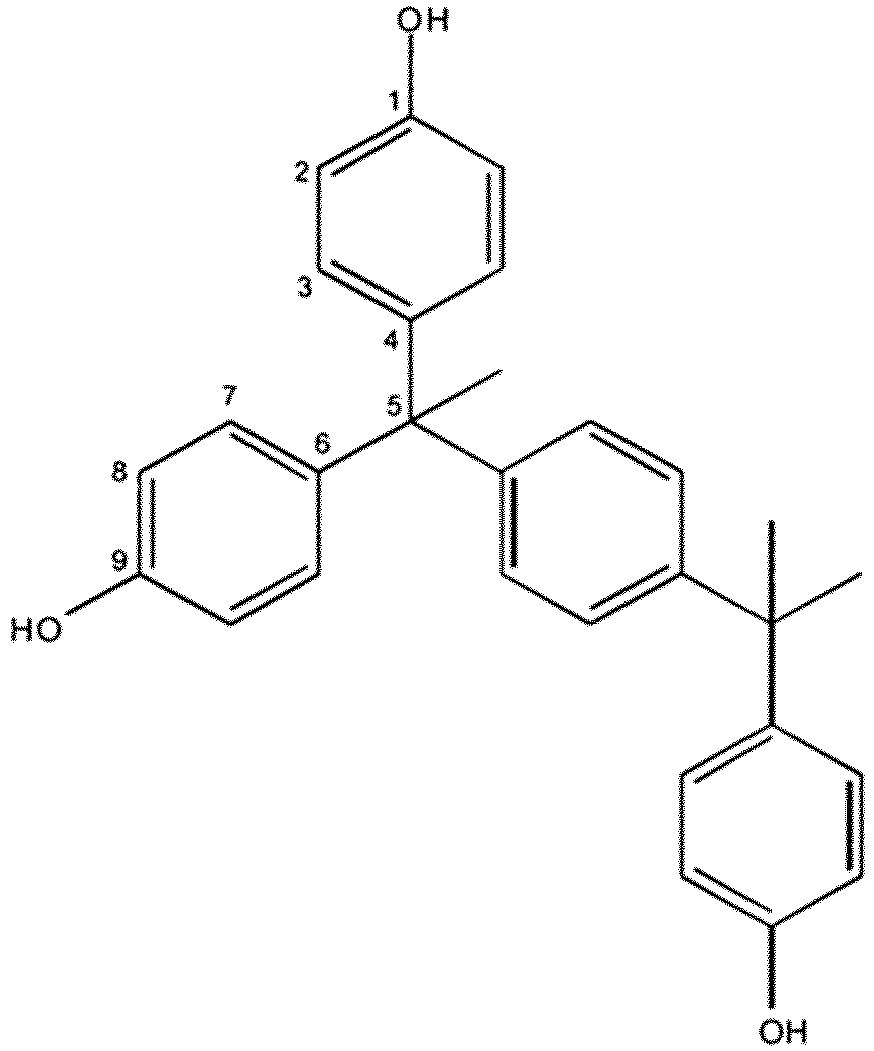
- The meaning of the term "shortest atom chain between two phenolic hydroxyl groups" can easily be demonstrated for the above Trisphenol PA. The shortest atom chain between two phenolic hydroxyl groups is the atom chain, wherein the atom chain is marked with numbers "1" to "9", starting with the carbon atom marked "1" and ending with the carbon atom marked "9". The carbon atom to which the third hydroxyl group is attached is separated from either carbon atom marked "1" or "9" by 14 carbon atoms. Therefore the atom chain between the third hydroxyl group and any one of the other hydroxyl groups contains 14 carbon atoms and is accordingly not the shortest atom chain between two phenolic hydroxyl groups. However Trisphenol PA is not suitable as the "at least one polyphenol, wherein the shortest atom chain between two phenolic hydroxyl groups contains at least 40 atoms", since the shortest carbon atom chain contains only 9 carbon atoms.
- Polyphenols meeting the requirement, that the shortest atom chain between two phenolic hydroxyl groups must contain at least 40 atoms can easily be synthesized from long chain compounds sufficiently long, that the shortest atom chain between terminal groups after terminal group modification with a phenolic hydroxyl group compound meets the above requirement. Exemplified for a diphenol as target compound it can for example be started with an α,ω-hydroxyl terminated polyether diol, polyester diol or polybutadiene diol, reacting said polymer with a diisocyanate to obtain an α,ω-isocyanate terminated polymer and reacting said two isocyanate groups each with one of the above mentioned diphenols or an aminophenol. The chain length of the polyether diol, polyester diol or polybutadiene diol should be chosen so, that after the addition of diisocyanate and diphenol or aminophenol at the respective terminal ends, the shortest atom chain between the two phenolic hydroxyl groups contains at least 40 atoms.
- Heteroaliphatic diamines satisfying the requirement that the shortest atom chain between two primary amino groups must contain at least 40 atoms are e.g. NH2-[CH(CH3)CH2-O]33-CH2-CH(CH3)-NH2 (Jeffamine® D-2000; Huntsman Corp.) or H2N-(CH2)3- Si(CH3)2-[O-Si(CH3)2]34-41-(CH2)3-NH2 (reaktives Siliconol, Fluid NH 40 D, Wacker Chemie AG).
- Aromatic diamines satisfying the requirement that the shortest atom chain between two primary amino groups must contain at least 40 atoms are e.g. NH2-(p-Ph)-CO-[O-(CH2)4]9-10-O-CO-(p-Ph)-NH2 (p-Ph = para-phenylen; Versalink® P 650, Air Products) and NH2-(p-Ph)-CO-[O-(CH2)4]13-14-O-CO-(p-Ph)-NH2 (p-Ph = para-phenylen; Versalink® P 1000, Air Products). An example for an heteroaliphatic triamine satisfying the requirement that the shortest atom chain between two primary amino groups must contain at least 40 atoms is e.g. a glycerol-started poly(oxypropylene) triamine, wherein the sum of the oxypropylene residues of all three chains is approximately 50 (Jeffamine® T-3000, Huntsman).
- The polyphenol or primary polyamine used to introduce the soft fragment into the curable benzoxazine macromonomer of the present disclosure preferably has a weight average molecular weight of at least about 600 to about 20,000 g/mol and more preferably at least about 800 to about 5,000 g/mol and even more preferably at least about 900 to about 4,000 g/mol. The weight average molecular weight can be determined by gel permeation chromatography (GPC) using a polystyrene standard.
- In case the soft fragment has a weight average molecular weight lower than 600 g/mol flexibilisation is decreased and the improvement in solubility and meltability is decreased. In case the soft fragment has a higher molecular weight copolymerization with other matrix resins is made difficult and curing in stand-alone applications may become difficult.
- The glass transition temperatures of the soft fragment or soft fragments of the curable benzoxazine macromonomer of the present disclosure are preferably lower than about 100 °C, more preferably lower than about 60 °C and most preferably lower than about 25 °C. The glass transition temperature can be determined by differential scanning calorimeter and the transition peak assignment can be carried out by comparative measurements.
- The weight average molecular weight of the curable benzoxazine macromonomer of the present disclosure preferably ranges from about 2,000 to about 1,000,000 g/mol, more preferably from about 3,000 g/mol to about 500,000 g/mol and most preferably about 5,000 to about 400,000 g/mol. The weight average molecular weight can be determined by gel permeation chromatography (GPC) using a polystyrene standard In case the molecular weight is higher than 1,000,000 g/mol viscosity is deteriorating processability. In case the molecular weight is below 2,000 g/mol the use of the compounds as tougheners is decreased.
- One big advantage of the present disclosure over the prior art benzoxazine chemistry is to provide a "tool box" system to customize curable benzoxazine macromonomers for a large variety of purposes in a large variety of technical fields. The employment of soft fragments having different solubility parameters increases compatibility with many resinous formulations in which the curable benzoxazine macromonomers of the present disclosure can be used as reactive additives such as tougheners.
- If for example a polyethylene oxide chain is used as a soft fragment, the curable benzoxazine macromonomers of the present disclosure will be more hydrophilic compared to polydimethyl siloxane chains as a soft segment. However there is a wide range of possibilities to choose from in between the two extremes. One skilled in the art knows that hydrophobicity of polymeric chains is increased in the following order polyethylene oxide, polypropylene oxide, polytetrahydrofuran, polybutadiene to polydimethyl siloxane. It is further known that a homopolymer of ethylene oxide can be hydrophobized by copolymerization with propylene oxide to obtain a polymeric chain with a polarity between polyethylene oxide and polypropylene oxide.
- Moreover hydophobicity and hydrophilicity, respectively, and therewith compatibility to other resinous formulations, can also be adjusted by not only incorporating one kind of soft fragment into the curable benzoxazine macromonomers of the present disclosure, but by incorporating two or more different soft fragments. Moreover molecular weight, chain length and structure influence hydrophilicity and hydrophobicity.
- Since varying the weight fractions of soft fragments is very easy and allows to use soft fragments the monomers of which are not copolymerizable, it is preferred to incorporate two or more different soft fragments into the curable benzoxazine macromonomers of the present disclosure. The different soft fragments can be incorporated into the curable benzoxazine macromonomers of the present disclosure by using two or more different soft fragment containing polyamines having primary amino groups, by using two or more different soft fragment containing polyphenols or by using a mixture of at least one soft fragment containing polyamine having primary amino groups with at least one polyphenol containing another soft fragment. Of course the ratio of the soft fragment containing reactants can also be varied to have a maximum degree of freedom in varying different soft fragments.
- In the same way soft fragments are defined, it is possible to define "hard" fragments of the curable benzoxazine macromonomers of the present disclosure on basis of the atom chain length and molecular weight. The hard fragments (also called "rigid" fragments) contain as shortest atom chain to connect two benzoxazine nitrogen atoms or two benzoxazine oxygen atoms, an atom chain of less than 40 consecutive atoms. However said atom chain must not include any oxazine ring atoms. In general it can be stated that the hard character of hard fragments is more distinct the shorter the atom chain is. Preferably the hard fragment contains as shortest atom chain to connect two benzoxazine nitrogen atoms or two benzoxazine oxygen atoms, an atom chain of less than 25, even more preferable less than 20 and most preferable less than 15 consecutive atoms.
- Most preferred rigid polyphenols are rigid diphenols. The most simple of such diphenols are 1,2-dihydroxy benzene, 1,3-dihydroxy benzene and 1,4-dihydroxy benzene. A diphenol with two phenolic hydroxyl groups attached to different benzene residues is, e.g. biphenyl-4,4'-diol (also known as "4,4'-Biphenol"). Other suitable examples for diphenols are, e.g. Bisphenol A, Bisphenol P, Bisphenol M, Bisphenol F, Bisphenol S, Bisphenol AP, Bisphenol E, 4,4'-oxydiphenol, 4,4'-thiodiphenol, bis(4-hydroxyphenyl)methanone, biphenyl-2,2'-diol, 4,4'-(cyclohexane-1,1-diyl)diphenol or 4,4'-(3,3,5-trimethylcyclohexane-1,1-diyl)diphenol (Bisphenol TMC).
- Examples for rigid aliphatic diamines are alkylene diamines like ethane-1,2-diamine, propane-1,3-diamine, propane-1,2-diamine, 2,2-dimethylpropane-1,3-diamine and hexane-1,6-diamine, or aliphatic diamines containing cyclic structures like 4,4'-methylenedicyclohexanamine (DACHM), 4,4'-methylenebis(2-methylcyclohexanamine) (Laromin C260) and 3-(aminomethyl)-3,5,5-trimethylcyclohexanamine (isophorone diamine (IPDA)).
- Examples for rigid heteroaliphatic diamines are H2N-(CH2)3-N(CH3)-(CH2)3-NH2, H2N-(CH2)3-O-(CH2)4-O-(CH2)3-NH2, NH2-[CH(CH3)CH2-O]2.5-CH2-CH(CH3)-NH2 (Jeffamine® D-230; Huntsman Corp.), NH2-[CH(CH3)CH2-O]6-CHZ-CH(CH3)-NH2 (Jeffamine® D-400; Huntsman Corp.) and H2N-(CH2)3-Si(CH3)2-[O-Si(CH3)2]10-15-(CH2)3-NH2 (reactive silicon oil, Fluid NH 15 D, Wacker Chemie AG).
- An example for a rigid araliphatic diamine is m-xylylene diamine (MXDA).
- Examples for rigid aromatic diamines are benzene-1,3-diamine, benzene-1,4-diamine, 4,4'-methylenedianiline, 4,4'-oxydianiline, 4,4'-thiodianiline, 4,4'-sulfonyldianiline, 3,3'-sulfonyldianiline, 4,4'-(2,2'-(1,4-phenylene)bis(propane-2,2-diyl))dianiline (Bisaniline P) and NH2-(p-Ph)-CO-[O-(CH2)4]3-4-O-CO-(p-Ph)-NH2 (p-Ph = para-phenylen; Versalink® P 250, Air Products.)
- The polyamine or polyphenol used to introduce the hard fragment into the curable benzoxazine macromonomer of the present disclosure preferably has a molecular weight of less than about 600 g/mol. More preferably the molecular weight is about 46 to about 500 g/mol and even more preferably at least about 60 to about 450 g/mol. The molecular weight can be determined by mass spectrometry.
- From the above-mentioned examples for rigid diphenols and rigid primary diamines all examples but one fulfill the preferred requirement to have a molecular weight of less than 600 g/mol. The only exception is the reactive silicon oil Fluid NH 15 D having a higher molecular weight Even though its molecular weight is more in the range of soft fragment containing diamines and some of its properties may qualify it to be classified as a soft fragment containing diamine it is herein classified as a "rigid" diamine due to its atom chain of about 27 to 39. Consequently this compound is not employed as single a source of soft fragment in the present disclosure.
- For most purposes it is preferred that the content of soft segments in weight-% based on the total weight of the curable benzoxazine macromonomer of the present disclosure is at least about 20 % by weight, more preferably at least about 50 % by weight and most preferably at least about 80 % by weight.
- Particularly preferred structures of curable benzoxazine macromonomers of the present disclosure are described by the following formal description.
- In a preferred embodiment the curable benzoxazine macromonomer of the present disclosure, contains covalently bound fragments of the following general formula (I)

the asterisk symbols (*) at the carbon, oxygen and nitrogen atoms depict attachment sites to fragments A and B of the curable benzoxazine macromonomer, fragments A and B being formally attached to the fragment of general formula (I) via single covalent bonds, in that the following formal attachment procedure is carried out: - (a) first at least n fragments of general formula (I) are attached each via their carbon and oxygen attachment sites to adjacent carbon atom attachment sites on one or more benzene or naphthalene residues, which constitute fragment A or which are part of a fragment A to obtain benzoxazine moieties containing n nitrogen attachment sites, whereby n is an integer of two or more; and
- (b) secondly attaching each of n fragments B having independently m attachment sites, via one of the m attachment sites to one of the nitrogen attachment sites of the fragment obtained in (a), whereby m is an integer of two or more;
- (c) thirdly attaching to the n (m-1) residual attachment sites of the fragment obtained in (b) n (m-1) fragments independently obtained according to (a) via the nitrogen attachment sites of the fragments obtained according to (a);
- (d) subsequently carrying out (b) and (c) repeatedly until the desired length of the resulting benzoxazine macromonomer is reached, whereby the last repetition ends with (b) or (c), and
- (e) attaching to any remaining attachment site H, OH or NH2.
- Particularly preferred fragments A are selected from the group consisting of


- any two adjacent carbon atoms marked with asterisk symbols (*) may serve as attachment sites to the carbon and oxygen attachment sites of the fragments of general formula (I) and the remaining carbon atoms marked with asterisk symbols (*) are attached to a residue selected from the group consisting of H, a substituted or unsubstituted aliphatic or heteroaraliphatic hydrocarbon with 1 to 8 carbon atoms, a substituted or unsubstituted araliphatic or heteroaraliphatic hydrocarbon with 6 to 12 carbon atoms, a substituted or unsubstituted aromatic or heteroaromatic hydrocarbon with 6 to 12 carbon atoms, OH, NH2 or halogen;
- the sum of p + q being an integer of two or more;
- R being a residue selected from the group consisting of monomeric, oligomeric and polymeric, substituted or unsubstituted, straight-chain or branched, aliphatic, heteroaliphatic, araliphatic, heteroaraliphatic, aromatic or heteroaromatic hydrocarbon residues, siloxane or polysiloxane residues, whereby any of the before-mentioned residues R optionally further contains one or more ester, urethane, urea or ether groups;
- and in case p + q = 2 the residues R are may also be a single covalent bond directly connecting the thereto attached residues.
- Preferred fragments B are selected from the group consisting of monomeric, oligomeric and polymeric, substituted or unsubstituted, straight-chain or branched, aliphatic, heteroaraliphatic, araliphatic, heteroaraliphatic, aromatic or heteroaromatic hydrocarbon residues and siloxane or polysiloxane residues, whereby any of the before-mentioned residues optionally further contains one or more ester, urethane, urea or ether groups. Most preferred fragments B can be derived from the above described primary polyamines, if the primary amino groups are replaced by "attachment sites".
- In one preferred embodiment fragments A are based on one or more benzene fragments only, i.e. they do not contain a naphthaline fragment (q = 0). Most preferred are those fragments A wherein p = 2 to 6, even more preferable 2 or 3 and q = 0. Such structure can be derived from the above described polyphenols, if the phenolic hydroxyl groups are replaced by "attachment sites".
- Further object of the present disclosure is to provide a method of preparing a curable benzoxazine macromonomer, preferably a benzoxazine macromonomer according to the present disclosure as disclosed above,, in a solvent, the reactants including at least one polyphenol, at least one primary polyamine and formaldehyde or a reactant releasing formaldehyde, comprising
- (i) combining said reactants,
- (ii) heating the mixture of said reactants under reflux,
- (iii) removing water from the reaction mixture, and
- (iv) separating the curable benzoxazine macromonomer from the solvent,
- a. at least one of the polyphenols is such, that the shortest atom chain between two phenolic hydroxyl groups contains at least 40 atoms; and/or
- b. at least one of the primary polyamines is such, that the shortest atom chain between two primary amino groups contains at least 40 atoms.
- In a preferred embodiment of the inventive method the reaction is carried out under inert gas atmosphere and/or
- (a) combining the reactants is carried out at a temperature no warmer than about 10°C, and/or
- (b) heating the mixture of said reactants under reflux is carried out for 1 to 10 hours, and/or
- (c) removing water from the reaction mixture is carried out by azeotropic distillation.
- In particular, a reaction vessel is kept at a temperature of no warmer than about 250 °C, preferably no warmer than about 150 °C and most preferably no warmer than about 10 °C while the reactants are added, preferably under an inert gas atmosphere, such as nitrogen gas. The reaction vessel may be cooled with ice, or any other cooling mechanism. The reactants can be dissolved or dispersed in solvents, such as toluene and/or ethyl acetate, preferably before adding to the vessel. Most preferably the reactants are added in small amounts to ensure that the temperature is maintained as desired.
- One preferred solvent is a mixture of toluene and ethyl acetate. It is preferred that the ratio of toluene/ethyl acetate be about 8:1 to about 6:1. However, any combination of the aforementioned solvents from about 10:1 to about 4:1 may be employed. Using a combination of solvents is advantageous in that the collection of water by azeotropic distillation is expedited. The combination of solvents is also advantageous in that it allows the separation of water from solvent in a Barrett or Dean-Stark distillation trap to be sharp and allowing nearly all the solvent to be returned to the reaction vessel. However, depending on the solubility of the benzoxazine macromonomer it can also be preferred to use only toluene as a solvent.
- Other solvents such as xylene, cyclohexane and chloroform, or water soluble solvents as tetrahydrofuran, dioxane, ethanol or propanol can also be used, however, the water soluble solvents being less preferred, since they are not suitable if the final product is to be separated and purified by washing procedures with aqueous solutions.
- In general the reaction mixture is slowly warmed to a temperature at which an exothermic reaction in form of rapid boiling occurs. The vessel is maintained under reflux for about 1 to about 10 hours, preferably 2 to 8 hours and most preferably 4 to 7 hours.
- The water byproduct is collected by any method conventional in the art, such as via a Barrett trap. If appropriate, further solvent forming an azeotropic mixture with water, such as toluene or ethyl acetate, may be added during boiling under reflux. Following the above procedure, the yield of the curable benzoxazine macromonomer ranges generally from 90 to 100 % of the theoretical yield.
- If terminal primary amino groups or terminal phenolic hydroxyl groups should be end-capped, the reaction mixture is cooled down and a compound reactive to primary ammo groups or phenolic hydroxyl groups is added, e.g. an isocyanate compound. However terminal primary amino groups can be reacted with monophenols and terminal phenolic hydroxyl groups with monoamins in the presence of formaldehyde or a formaldehyde releasing compound, analogous to the above describe procedure, to yield benzoxazin end-capped benzoxazine macromonomers.
- After boiling under reflux the reaction mixture is cooled down and the reaction product is separated from the solvents. The separation can be carried out by washing the reaction mixture, preferably repeatedly, with water and/or 1 N aqueous solution of sodium hydrogen carbonate, separating the organic phase, and optionally washing the organic phase, preferably repeatedly, with a 10 % by volume solution of ethanol in water, drying the organic solution and evaporating the organic solvent.
- To obtain curable benzoxazine macromonomer of the present disclosure having a high molecular weight it is necessary that the stoichiometric ratio of primary amino groups in the polyamine to phenolic hydroxyl groups in the polyphenol is preferably in the range of 0.5 to 2.0, more preferably 0.6 to 1.4, even more preferable 0.8 to 1.2 and most preferable about 1 or about 1.2. Therefore, if only diamines and diphenols are used to prepare the curable benzoxazine macromonomer of the present disclosure it is preferred to use the diamines and diphenols in an about equimolar ratio.
- Another possibility to obtain the curable benzoxazine macromonomer of the present disclosure, having a molecular weight as high as described above, is to incorporate an amount of polyamine or polyphenol with more than two primary amino groups and/or more than two phenolic hydroxyl groups, respectively. This will lead to branched and sometimes even partly crosslinked curable benzoxazine macromonomers having high molecular weight. However, if curable benzoxazine macromonomers having good solubility in a wide range of solvents and exhibiting good processability are desired, the sum of the amounts of polyamines with more than two primary amino groups and polyphenols with more than two phenolic hydroxyl groups should be kept low. Preferably the amount of such compounds should not exceed 20 % by weight, more preferably 10 % by weight, based on the total weight of polyamines with primary amino groups and polyphenols.
- To form one benzoxazine ring, one primary amino group, one phenolic hydroxyl group and two formaldehyde molecules are necessary. However it is preferred to use the formaldehyde in excess, the excess preferably being 10 % by mol, if a higher degree of ring-closed structures in the curable benzoxazine macromonomer of the present disclosure is desired.
- Although all the formaldehyde may be provided as formalin, this is an undesirable method because formalin is expensive and it introduces an unnecessary amount of water into the system which must be removed later. However employing formalin in addition to paraformaldehyde in preparing the benzoxazine monomer is advantageous. Paraformaldehyde is preferred as it is significantly less expensive than formalin. Employing formalin in combination with the paraformaldehyde provides enough water and methanol to dissolve the paraformaldehyde. Alternatively, just water may be used. Formalin is also advantageous in that it mitigates the exotherm reaction that occurs at about 80 °C to 85 °C. A violent exotherm reaction occurs because as water is generated more paraformaldehyde can dissolve, thus rapidly accelerating the reaction rate. Thus it is advantageous to employ a paraformaldehyde/formalin ratio of at least 1:1, based on the dry weight of the formaldehyde, and preferably of about 8:1 and more. However taking into account the abovementioned drawback, formaldehyde can be employed in water-free form such as paraformalehyde, trioxane or polyoxymethylene only, paraformaldeyde being most preferred.
- Another embodiment of the present invention relates to cured products and the curable formulations containing the curable benzoxazine macromonomers of the present disclosure to produce the cured products. If the curable benzoxazine macromonomers of the present disclosure are contained as the only or predominant curable ingredient, products are obtained which are called stand-alone products. Such products exhibit excellent elastic properties, are thermally stable up to temperatures preferably as high as 280°C and are suitably employable in injection molding and extrusion processes to obtain adhesives and in particular sealants. "Predominant" meaning that at least about 80 % by weight, more preferably at least 90 % by weight based on the total amount of curable ingredients, are curable benzoxazine macromonomers of the present invention.
- If the cured product of the disclosure is a stand-alone product, the content of soft fragments is preferably in the range of 5 to 50 % by weight, more preferably 10 to 40 % by weight and most preferably 20 to 30 % by weight based on the total weight of the curable benzoxazine macromonomers of the present disclosure in the stand-alone product.
- One of the most surprising results was that the curable benzoxazine macromonomers of the present disclosure are highly suitable as tougheners in curable compositions comprising other curable ingredients than the curable benzoxazine macromonomers of the present disclosure and as defined in the claims. The term "other curable ingredients than the curable benzoxazine macromonomers of the present disclosure " means, subject to the appended claims, any kind of self-curable ingredients or curable ingredients, which cure by reaction with the curable benzoxazine macromonomers of the present disclosure.
- Therefore yet another preferred embodiment of the present invention relates to curable formulations containing the curable benzoxazine macromonomers and other curable ingredients as defined in the claims, and the cured products thereof. The content of the curable benzoxazine macromonomers of the present disclosure is less than 80 % by weight based on the total amount of curable ingredients, to distinguish those formulations from the stand-alone formulations. However, it is preferred that the curable ingredients other than the curable benzoxazine macromonomers of the present disclosure are the main curable ingredients. Most preferably the content of the curable ingredients other than the curable benzoxazine macromonomers of the present disclosure is at least 60 % by weight and even more preferable at least 70 % by weight, such as at least 80 % by weight based on the total amount of curable ingredients.
- Curable ingredients other than the curable benzoxazine macromonomers of the present disclosure can be, subject to the appended claims, any other kind of benzoxazines not falling within the scope of the curable benzoxazine macromonomers of the present disclosure, and selected from the group of N-aliphatic dibenzoxazines and N-aliphatic monobenzoxazines. To the extent that other curable ingredients other than the curable benzoxazine macromonomers of the present disclosure are described herein, this is provide for general information purposes, for example benzoxazine macromonomers not containing soft fragments, dibenzoxazines, monobenzoxazines, or mixtures of the before-mentioned benzoxazines.
- In a particularly preferred embodiment of the present invention and disclosure more generally, the further curable ingredients other than the curable benzoxazine macromonomers of the present invention are selected from the group consisting of dibenzoxazines and mixtures of dibenzoxazines with monobenzoxazines.
- Suitable dibenzoxazines as curable ingredients are selected from the group of aliphatic dibenzoxazines and aromatic dibenzoxazines .The term "aliphatic dibenzoxazine" refers to the nature of the residue which is directly bound to the nitrogen of the oxazine ring. An example is:

- The methyl residues bound to the oxazine nitrogens are obviously aliphatic. However the term "aliphatic dibenzoxazine" does also include heteroaliphatic residues attached to the oxazine nitrogen.
- The term "aromatic dibenzoxazine" also refers to the nature of the residue which is directly bound to the nitrogen of the oxazine ring. An example is MDA-phenyl benzoxazine:

- The phenyl residues directly bound to the oxazine nitrogens are obviously aromatic. However the term "aromatic dibenzoxazine" does also include heteroaromatic residues attached to the oxazine nitrogen.
- Suitable monobenzoxazines as curable ingredients other than the curable benzoxazine macromonomers of the present invention and disclosure more generally are selected from the group of aliphatic monobenzoxazines and aromatic monobenzoxazines. The terms "aliphatic" and "aromatic" are used as for the respective dibenzoxazines.
- The above and even further examples for monobenzoxazines and polybenzoxazines and in particular dibenzoxazines being suitable in the present invention and disclosure more generally as further curable ingredients other than the curable benzoxazine macromonomers of the present disclosure are described in the following.
- Subject to the pending claims, the further benzoxazine component can be any curable monomer, oligomer or polymer comprising at least one benzoxazine moiety. Preferably monomers containing up to four benzoxazine moieties are employed as the benzoxazine component in form of single compounds or mixtures of two or more different benzoxazines.
- In the following a broad spectrum of different suitable benzoxazines containing one to four benzoxazine moieties are presented
- One possible benzoxazine may be embraced by the following structure I:

- More specifically, within structure I the benzoxazine may be embraced by the following structure II:

- Representative benzoxazines within structure II further include:

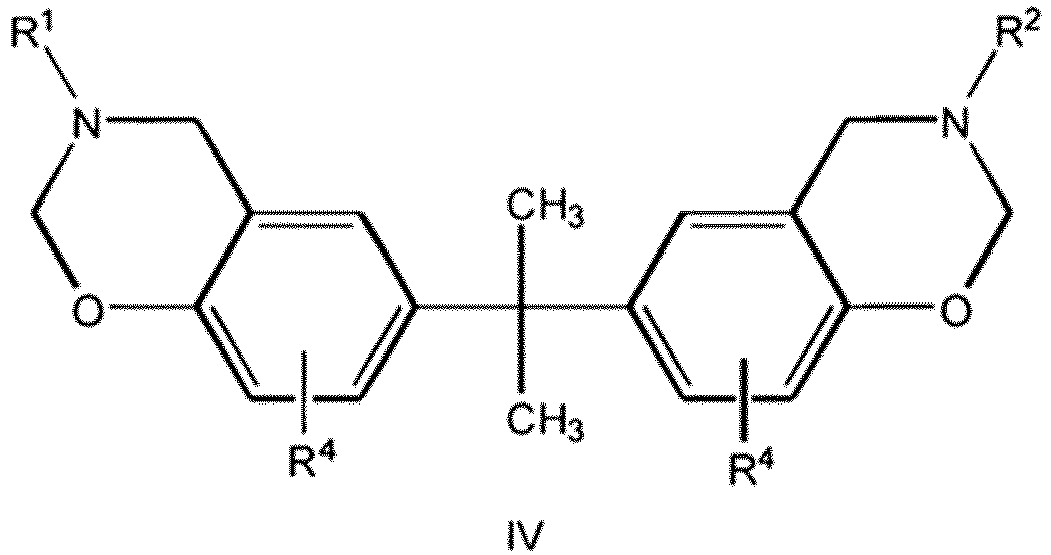
- Alternatively, the benzoxazine may be embraced by the following structure V:

- Though not embraced by structures I or V additional benzoxazines are within the following structures:


- Specific examples of the above generically described benzoxazines include:

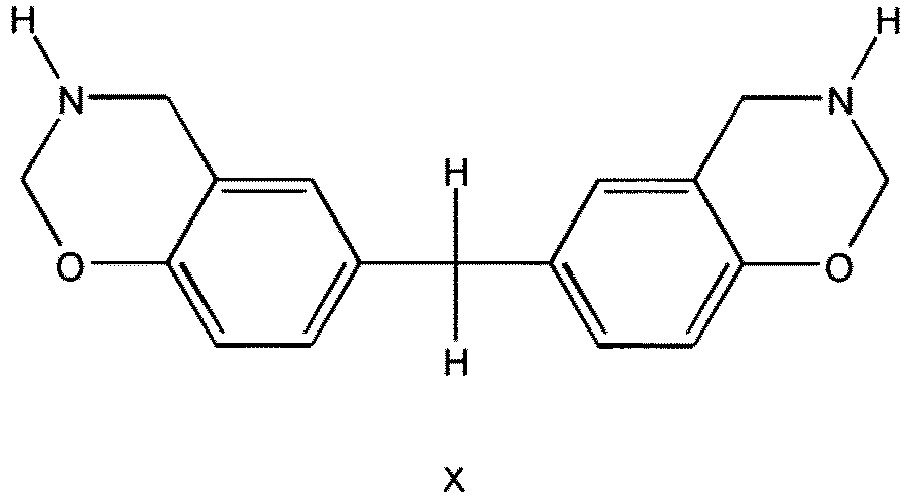


- The further benzoxazine component may include the combination of multifunctional benzoxazines and monofunctional benzoxazines, or may be the combination of one or more multifunctional benzoxazines or one or more monofunctional benzoxazines.
- Examples of monofunctional benzoxazines may be embraced by the following structure XVII:

- For instance, monofunctional benzoxazines may be embraced by general structure XVIII:

- Specific examples of such a monofunctional benzoxazine are:


- Benzoxazines are presently available commercially from several sources, including Huntsman Advanced Materials; Georgia-Pacific Resins, Inc.; and Shikoku Chemicals Corporation, Chiba, Japan.
- If desired, however, instead of using commercially available sources, the benzoxazine may typically be prepared by reacting a phenolic compound, such as a bisphenol A, bisphenol F, bisphenol S or thiodiphenol, with an aldehyde and an alkyl or aryl amine.
U.S. Patent No 5,543,516 , describes a method of forming benzoxazines, where the reaction time can vary from a few minutes to a few hours, depending on reactant concentration, reactivity and temperature. See e.g.U.S. Patent Nos. 4,607,091 (Schreiber ),5,021,484 (Schreiber ),5,200,452 (Schreiber ) and5,443,911 (Schreiber ). - Further curable ingredients other than the curable benzoxazine macromonomers of the present disclosure or other benzoxazine-based ingredients are for example epoxy resins, phenol resins, maleinimide resins, oxazolines, isocyanates and the like.
- Curing of the curable formulations of the present invention to the cured products of the present invention can be self-initiated under elevated temperature conditions and also by inclusion of cationic initiators, such as Lewis acids, and other known cationic initiators, such as metal halides; organometallic derivatives; metallophorphyin compounds such as aluminum phthalocyanine chloride; methyl tosylate, methyl triflate, and triflic acid; and oxyhalides. Likewise, basic materials, such as imidizaoles, may be used to initiate polymerization. A typical curing temperature without catalyst will be in the range of 150 to 250 °C, more preferably in the range of 160 to 220 °C. In catalyst containing formulations the curing temperatures can be lowered depending on the catalyst chosen.
- For the evaluation of toughening properties of the curable benzoxazine macromonomers of the present dislcosure in resinous formulations, the critical fracture toughness parameters to be determined are the critical stress intensity factor (K1c) and the critical energy release rate (G1c).
- The cured products of the present invention obtained from the curable compositions of the present invention preferably exhibit a flexural modulus of about 1000 to about 5000 MPa, a flexural strength of about 50 to about 200 MPa, a glass transition temperature of about 120 to about 300 °C, a critical stress intensity factor (K1c) of about 0.5 to about 4.0 MPa/m2, a critical energy release rate (G1c) of about 100 to about 600 J/m2 and an elongation of about 0.7 to about 10 %.
- Most preferably the cured product according to the present invention exhibits a flexural modulus of at least about 2500 MPa, a flexural strength of at least about 70 MPa, a glass transition temperature of at least about 140 °C, a critical stress intensity factor (K1c) of at least about 0.9 MPa/M2 , a critical energy release rate (G1c) of at least about 180 J/m2 and an elongation of at least about 2.5 %.
- In a 2 L standard apparatus consisting of a three-necked round bottom flask equipped with stirrer, condenser, electric thermometer, dropping funnel and nitrogen gas inlet a cloggy mixture of 20.81 g (0.693 mol; 0.693 eq) paraformaldehyde and 8.03 g (0.099 mol; 0.099 eq) formaldehyde solution (37 % in water) in 100 ml toluene was cooled with ice. Under a nitrogen gas atmosphere 232.56 g (0.180 mol, 0.360 eq) Versalink P-1000 solution in 200 ml toluene was added dropwise within 20 minutes at 3.4 - 7.3°C, resulting in a hazy solution. A solution of 41.09 g (0.180 mol; 0.360 eq) bisphenol A in 100 ml ethyl acetate was added within 5 minutes at 7.0 - 8.4°C. The hazy reaction mixture was subsequently heated and maintained under reflux conditions for 6 hours while stirring. After the initial heating had been completed, 3 x 100 ml of toluene were added to the mixture.
- While the reaction was progressing, the accumulating water was removed by distillation using a water separator. The volume of water obtained was 7.1 ml after 1 hour, 13 ml after 3 hours, and 13 ml after 6 hours, corresponding to 75% of the theoretically formed volume of 17.2 ml of water.
- The clear solution resulting from the above reaction was washed three times with a solution of NaHCO3 (IN) and three times with 10% ethanol in water. All phase separations took place very slowly. The organic phase was then dried over sodium sulfate and concentrated using a rotary evaporator. Remaining solvents were removed in a vacuum drying cabinet.
- 282 g of product were obtained, corresponding to 100% of the theoretical yield (282.3 g)
- In a 2 L standard apparatus a cloggy mixture of 17.95 g (0.5679 mol; 0.5679 eq) paraformaldehyde and 6.58 g (0.0811 mol; 0.0811 eq) formaldehyde solution (37 % in water) in 120 ml toluene was cooled with ice. Under nitrogen gas atmosphere 175.00 g (0.1354 mol; 0.2708 eq) Versalink P-1000 solution in 270 ml toluene was added dropwise within 20 minutes at 3.4 - 6.6°C, resulting in a milky, hazy solution. A solution of 25.00 g (0.0121 mol; 0.0242 eq) Jeffamin D2000 in 70 ml toluene was added dropwise within 7 minutes at 5.3 - 6.0°C. A solution of 33.67 g (0.1475 mol; 0.2950 eq) bisphenol A in 100 ml ethyl acetate was added within 5 minutes at 5.5 - 8.2°C. The milky, hazy reaction mixture was then heated and maintained under reflux conditions. After 1 hour, the mixture was getting viscous, and 200 ml of toluene were added. While the reaction was progressing, the accumulating water was removed using a water separator. The volume of water obtained was 8.5 ml after 1 hour, 10 ml after 2 hours, 10.2 ml after 3 hours, and 10.2 ml after 6 hours, corresponding to 72% of the theoretically formed volume of 14.1 ml of water. The reaction was terminated after 6 hours. While cooling down, the product was diluted again with toluene.
- The solution resulting from above reaction was washed three times with a solution of NaHCO3 (1 N) and three times with 10% ethanol in water. The organic phase was then dried over sodium sulfate, and concentrated using a rotary evaporator. Remaining solvents were removed in a vacuum drying cabinet at 50°C.
- 220 g of product (yellow, viscous) were obtained, corresponding to 91% of the theoretical yield (240.7 g).
- In a 4 L standard apparatus, consisting of a three-necked round bottom flask equipped with stirrer, condenser, electric thermometer and dropping funnel 62.03 g (1.9831 mol) of paraformaldehyde and 123,47 g (0,5408 mol) of Bisphenol A were weighted in as starting materials. After the addition of 200 ml of toluene and 2 min stirring at room temperature a cloggy suspension was observed. A solution of 75 g (0.0367 mol) Jeffamine D-2000 in 100 ml toluene was added without cooling within two minutes. A low temperature rise from 19.9 °C to 21.9 °C was observed. Afterwards a solution of 525 g (0,4240 mol) Versalink P-1000 in 550 ml toluene was added within 12 minutes without cooling. The temperature stayed below 25 °C during the addition. The cloggy reaction mixture was further diluted with 150 ml of toluene and then heated. At 85 °C the reaction mixture was becoming viscous and was further diluted with 500 ml of toluene. Afterwards the reaction mixture was heated to reflux conditions for 6 hours.
- The solution resulting from above reaction was washed three times with deionized water. The organic phase was then concentrated using a rotary evaporator. The majority of the remaining solvents were removed at 85 °C under reduced pressure (ca. 1 mbar) and stirring for 2 hours. 1091.3 g of product (yellow, viscous) were obtained.
- In a 1 L three-necked round bottom flask equipped with stirrer, condenser, electric thermometer and dropping funnel 8.13 g (0.2598 mol) of paraformaldehyde and 12.65 g (0.0590 mol) of 4,4'-dihydroxybenzophenon were weighted in as starting materials. After the addition of 50 ml of toluene and 2 min stirring at room temperature a cloggy suspension was observed. Now a solution of 10 g (0.0049 mol) Jeffamine D-2000 in 40 ml toluene was added without cooling within two minutes. Afterwards a solution of 70 g (0,0542 mol) Versalink P-1000 in 180 ml toluene was added within three minutes without cooling. The temperature stayed below 25 °C during the addition. The cloggy reaction mixture was then heated and became viscous under reflux conditions. Therefore additional 300 ml of toluene were added. The reaction mixture was heated to and maintained at reflux conditions for 6 hours.
- The solution resulting from above reaction was washed three times with deionized water, the phase separation was slow. The organic phase was then concentrated using a rotary evaporator. The remaining solvents were removed at 85 °C under reduced pressure (ca. 1 mbar) and stirring for 2 hours and a yellow, viscous polymer was obtained.
- In a 2 L standard apparatus a cloggy mixture of 25.62 g (0.8104 mol; 0.8104 eq) paraformaldehyde (95 %) and 9.40 g (0.1158 mol; 0.1158 eq) formaldehyde solution (37 % in water) in 100 ml toluene was cooled with ice. Under nitrogen gas atmosphere 75.00 g (0.0364 mol; 0.0728 eq) Jeffamin D2000 solution in 100 ml toluene was added dropwise within 5 minutes at 3.6 - 8.0°C, resulting in a milky, hazy solution. The solution of 225.00 g (0.1741 mol; 0.3482 eq) Versalink P-1000 in 300 ml toluene was added dropwise within 10 minutes at 3.7 - 7.6°C. The solution of 48.07 g (0.2105 mol; 0.4210 eq) bisphenol A in 120 ml ethyl acetate was added within 7 minutes at 6.4 - 8.4°C. The milky, hazy reaction mixture was then heated and maintained under reflux conditions. While the reaction was progressing, the accumulating water was removed using a water separator. The volume of water obtained was 6.5 ml after 1 hour, 11 ml after 4 hours, and 13 ml after 6 hours, corresponding to 65% of the theoretically formed volume of 20 ml of water. The reaction was terminated after 6 hours. While cooling down, the product was diluted again with toluene.
- The clear solution resulting from above reaction was washed three times with a warm solution of NaHCO3/NaCl (containing 4 parts 1N NaHCO3 in water and 1 part saturated NaCl solution in water), and three times with a ethanol/NaCl solution (containing 4 parts aqueous ethanol (10% ethanol) and 1 part saturated NaCl solution in water). The phase separations took place slowly. The organic phase was then dried over sodium sulfate, and concentrated using a rotary evaporator. Remaining solvents were removed in a vacuum drying cabinet at 50°C.
- 345.8 g of product (yellow, viscous) were obtained, corresponding to 96.5% of the theoretical yield (358.2 g).
- In a 4 L standard apparatus 70.14 g (2.2422 mol) of paraformaldehyde and 139.60 g (0,6115 mol) of Bisphenol A were weighted in as starting materials. After the addition of 300 ml of toluene and 2 min stirring at room temperature a cloggy suspension was observed. Now a solution of 175 g (0.0856 mol) Jeffamine D-2000 in 100 ml toluene was added without cooling within three minutes. A low temperature rise from 21.3 °C to 25.2 °C was observed. Afterwards a solution of 525 g (0,4240 mol) Versalink P-1000 in 300 ml toluene was added within 15 minutes without cooling. The temperature stayed below 26 °C during the addition. The cloggy reaction mixture was further diluted with 300 ml of toluene and then heated. At 88 °C the reaction mixture was becoming viscous and was further diluted with 200 ml of toluene. Afterwards the reaction mixture was heated to reflux conditions for 6 hours.
- The solution resulting from above reaction was washed three times with deionized water, the phase separation was slow. The organic phase was then concentrated using a rotary evaporator. The majority of the remaining solvents were removed at 85 °C under reduced pressure (ca. 1 mbar) and stirring for 2 hours. 1187.9 g of product (yellow, viscous) were obtained.
- In a 2 L standard apparatus a cloggy mixture of 16.20 g (0.5124 mol; 0.5124 eq) paraformaldehyde (95 %) and 5.94 g (0.0732 mol; 0.0732 eq) formaldehyde solution (37 % in water) in 100 ml toluene was cooled with ice. Under nitrogen gas atmosphere 125.00 g (0.0967 mol; 0.1934 eq) Versalink P-1000 solution in 250 ml toluene was added dropwise within 20 minutes at 5.7 - 8.2°C, resulting in a milky, hazy solution. A solution of 75.00 g (0.0364 mol; 0.0728 eq) Jeffamin D2000 in 100 ml toluene was added dropwise within 7 minutes at 5.0 - 6.7°C. A solution of 30.38 g (0.1331 mol; 0.2662 eq) bisphenol A in 100 ml ethyl acetate was added within 5 minutes at 6.3 - 6.9°C. The milky, hazy reaction mixture was then heated and maintained under reflux conditions. While the reaction was progressing, the accumulating water was removed using a water separator. The volume of water obtained was 6.5 ml after 1 hour, 7.6 ml after 2 hours, 8.2 ml after 3 hours, 8.5 ml after 4 hours, and 8.6 ml after 6 hours, corresponding to 68% of the theoretically formed volume of 12.7 ml of water. The reaction was terminated after 6 hours. While cooling down, the product was diluted again with toluene. The clear solution resulting from above reaction was washed three times with a warm solution of NaHCO3/NaCl (containing 4 parts 1 N NaHCO3 in water and 1 part saturated NaCl solution in water), and three times with a ethanol/NaCl solution (containing 4 parts aqueous ethanol (10% ethanol) and 1 part saturated NaCl solution in water). The organic phase was then dried over sodium sulfate, and concentrated using a rotary evaporator. Remaining solvents were removed in a vacuum drying cabinet at 50°C.
- In a 2 L standard apparatus a cloggy mixture of 16.87 g (0.5336 mol; 0.5336 eq) paraformaldehyde (95 %) and 6.18 g (0.0762 mol; 0.0762 eq) formaldehyde solution (37 % in water) in 100 ml toluene was cooled with ice. Under nitrogen gas atmosphere a solution of 110.00 g (0.0535 mol; 0.1070 eq) Jeffamin D2000 in 130 ml toluene was added dropwise within 15 minutes at 4.7 - 9.8°C, resulting in a milky, hazy solution. A solution of 110.00 g (0.0851 mol; 0.1702 eq) Versalink P-1000 in 250 ml toluene was added dropwise within 15 minutes at 3.2 - 5.4°C. A solution of 31.64 g (0.1386 mol; 0.2772 eq) bisphenol A in 120 ml ethyl acetate was added within 5 minutes at 4.5 - 6.0°C. The milky, hazy reaction mixture was then heated and maintained under reflux conditions, while the mixture was slowly getting clear. While the reaction was progressing, the accumulating water was removed using a water separator. The volume of water obtained was 5.5 ml after 2 hours, and 6.5 ml after 6 hours, corresponding to 49% of the theoretically formed volume of 13.2 ml of water. The reaction was terminated after 6 hours.
- The clear solution resulting from above reaction was washed three times with a warm solution of NaHCO3/NaCl (containing 4 parts 1N NaHCO3 in water and 1 part saturated NaCl solution in water), and three times with a ethanol/NaCl solution (containing 4 parts aqueous ethanol (10% ethanol) and 1 part saturated NaCl solution in water). The phase separations took place slowly. The organic phase was then dried over sodium sulfate, and concentrated using a rotary evaporator. Remaining solvents were removed in a vacuum drying cabinet at 50°C.
- 242.4 g of product (yellow, viscous) were obtained, corresponding to 93.8% of the theoretical yield (258.3 g).
- In a 2 L standard apparatus a cloggy solution of 31.0 g (0.9806 mol) paraformaldehyde (95 %) in 100 ml toluene was cooled with ice. Under nitrogen gas atmosphere 300.00 g (0.1455 mol; 0.65 eq) Jeffamin D2000 solution in 350 ml toluene was added slowly. Then, a solution of 100.00 g (0.0774 mol, 0.35 eq) Versalink P-1000 in 150 ml toluene and a solution of 50.88 g (0.2229 mol; 1 eq) bisphenol A in 120 ml ethyl acetate were added likewise. The milky, hazy reaction mixture was then heated and maintained under reflux conditions. While the reaction was progressing, the reaction mixture was getting clear slowly, and the accumulating water was removed using a water separator. The reaction was terminated after 6 hours.
- The clear solution resulting from above reaction was washed three times with a warm solution of NaHCO3/NaCl (containing 4 parts 1 N NaHCO3 in water and 1 part saturated NaCl solution in water), and three times with a ethanol/NaCl solution (containing 4 parts aqueous ethanol (10% ethanol) and 1 part saturated NaCl solution in water).
- The phase separations took place slowly. The organic phase was then dried over sodium sulfate, and concentrated using a rotary evaporator. Remaining solvents were removed in a vacuum drying cabinet at 50°C.
- 437.12 g of product (yellow, viscous) were obtained, corresponding to 94.7% of the theoretical yield (461.60 g).
- In a 2 L standard apparatus a cloggy mixture of 22.95 g (0.726 mol) paraformaldehyde (95%) and 100 ml toluene was cooled with ice. Under nitrogen gas atmosphere a solution of 339.24 g (0.165 mol, 1 eq) Jeffamin D2000 in 300 ml toluene was added dropwise and slowly at max 10°C. A solution of 37.66 g (0.165 mol; 1 eq) bisphenol A in 120 ml ethyl acetate was added likewise. The milky, hazy reaction mixture was then heated and maintained under reflux conditions, while the mixture was slowly getting clear. While the reaction was progressing, the accumulating water was removed using a water separator. The reaction was terminated after 6 hours.
- The clear solution resulting from above reaction was washed three times with a warm solution of NaHCO3/NaCl (containing 4 parts 1 N NaHCO3 in water and 1 part saturated NaCl solution in water), and three times with a ethanol/NaCl solution (containing 4 parts aqueous ethanol (10% ethanol) and 1 part saturated NaCl solution in water). The phase separations took place slowly. The organic phase was then dried over sodium sulfate, and concentrated using a rotary evaporator. Remaining solvents were removed in a vacuum drying cabinet at 50°C.
- 381.44 g of product (yellow, viscous) were obtained, corresponding to 96.15% of the theoretical yield (384.84 g).
- In a 2 L standard apparatus a cloggy mixture of 18.87 g (0.5971 mol; 0.5971 eq) paraformaldehyde (95 %) and 6.92 g (0.0853 mol; 0.0853 eq) formaldehyde solution (37 % in water) in 100 ml toluene was cooled with ice. Under nitrogen gas atmosphere a solution of 10.00 g (0.0081 mol; 0.0162 eq) PDMS NH 15 in 40 ml toluene was added within 5 minutes at 3.9 - 5.5°C. A solution of 190.00 g (0.1470 mol; 0.2940 eq) Versalink P-1000 in 270 ml toluene was added dropwise within 20 minutes at 3.5 - 7.4°C. A solution of 35.41 g (0.1551 mol; 0.3102 eq) bisphenol A in 100 ml ethyl acetate was added within 7 minutes at 6.1 - 8.1°C. The milky, hazy reaction mixture was then heated and maintained under reflux conditions. After 30 minutes, 200 ml toluene were added. After 1 hour, 100 ml toluene were added. While the reaction was progressing, the accumulating water was removed using a water separator. The volume of water obtained was 6.5 ml after 1 hour, 8 ml after 2 hours, 10 ml after 3 hours, and 10 ml after 6 hours, corresponding to 68% of the theoretically formed volume of 14.7 ml of water. The reaction was terminated after 6 hours.
- The slightly hazy solution resulting from above reaction was washed three times with a warm solution of NaHCO3/NaCl (containing 4 parts 1N NaHCO3 in water and 1 part saturated NaCl solution in water), and three times with a ethanol/NaCl solution (containing 4 parts aqueous ethanol (10% ethanol) and 1 part saturated NaCl solution in water). The phase separations took place slowly. The organic phase was then dried over sodium sulfate, and concentrated using a rotary evaporator. While remaining solvents were removed in a vacuum drying cabinet at 45-50°C, the product foamed over.
- 231.24 g of product (yellow, viscous) were obtained, corresponding to 95.8% of the theoretical yield (241.5 g).
- In a 2 L standard apparatus a cloggy mixture of 18.28 g (0.5782 mol; 0.5782 eq) paraformaldehyde (95 %) and 6.70 g (0.0826 mol; 0 0826 eq) formaldehyde solution (37 % in water) in 100 ml toluene was cooled with ice. Under nitrogen gas atmosphere, a solution of 10.00 g (0.0032 mol; 0.0064 eq) PDMS NH40D in 40 ml toluene was added within 4 minutes at 4.2 - 6.4°C. A solution of 190.00 g (0.1470 mol; 0.2940 eq) Versalink P-1000 in 250 ml toluene was then added dropwise within 20 minutes at 5.3 - 8.3°C. A solution of 34.29 g (0.1502 mol; 0.6008 eq) bisphenol A in 100 ml ethyl acetate was added within 10 minutes at 5.8 - 6.8°C. The milky, hazy reaction mixture was then heated and maintained under reflux conditions. After 30 minutes, 100 ml toluene were added. While the reaction was progressing, the accumulating water was removed using a water separator. The volume of water obtained was 1.7 ml after 1 hour, 3 ml after 2 hours, 5 ml after 3 hours, and 6 ml after 6 hours, corresponding to 41.9% of the theoretically formed volume of 14.3 ml of water. The reaction was terminated after 6 hours.
- The slightly hazy solution resulting from above reaction was washed three times with a warm solution of NaHCO3/NaCl (containing 4 parts 1N NaHCO3 in water and 1 part saturated NaCl solution in water), and three times with a ethanol/NaCl solution (containing 4 parts aqueous ethanol (10% ethanol) and 1 part saturated NaCl solution in water). The phase separations took place slowly. The organic phase was then dried over sodium sulfate, and concentrated using a rotary evaporator. Remaining solvents were removed in a vacuum drying cabinet at 45°C.
- 235.5 g of product (yellow, viscous) were obtained, corresponding to 97.5% of the theoretical yield (241.5 g).
- In a 2 L standard apparatus a cloggy mixture of 17.74 g (0.5613 mol; 0.5613 eq) paraformaldehyde (95 %) and 6.51 g (0.0802 mol; 0 0802 eq) formaldehyde solution (37% in water) in 100 ml toluene was cooled with ice. Under nitrogen gas atmosphere, a solution of 20.00 g (0.0065 mol; 0.0130 eq) PDMS NH40D in 20 ml toluene was added within 2 minutes at 2.7 - 5.3°C. A solution of 180.0.0 g (0.1393 mol; 0.2786 eq) Versalink P-1000 in 250 ml toluene was then added dropwise at 5.0 - 8.7°C. Due to the relatively high concentration of the Versalink solution, the reaction mixture started to get viscous after some milliliters of the Versalink solution had been added. Therefore, 100 ml of toluene were added to the reaction mixture, and the rest of the Versalink solution was also diluted with toluene. A solution of 33.28 g (0.1458 mol; 0.2916 eq) bisphenol A in 100 ml ethyl acetate was added within 10 minutes at 4.1 - 4.4°C. The milky, hazy reaction mixture was then heated and maintained under reflux conditions, while the mixture was slowly becoming a clear solution. After 2 hours, 200 ml of toluene were added. While the reaction was progressing, the accumulating water was removed using a water separator. The volume of water obtained was 3 ml after 1 hour, 5.8 ml after 2 hours, and 9.7 ml after 6 hours, corresponding to 69.8% of the theoretically formed volume of 13.9 ml of water. The reaction was terminated after 6 hours.
- The slightly hazy solution resulting from above reaction was washed three times with a warm solution of NaHCO3/NaCl (containing 4 parts 1N NaHCO3 in water and 1 part saturated NaCl solution in water), and three times with a ethanol/NaCl solution (containing 4 parts aqueous ethanol (10% ethanol) and 1 part saturated NaCl solution in water). The phase separations took place slowly. The organic phase was then dried over sodium sulfate, and concentrated using a rotary evaporator. Remaining solvents were removed in a vacuum drying cabinet at 45°C.
- 238.7 g of product (yellow, viscous) were obtained, corresponding to 99.7% of the theoretical yield (239.2 g).
- The synthesis was performed in two steps.
- In the first step, a PU prepolymer was synthesized from polybutadiene (Krasol LBH 2000) and TDI (toluene diisocyanate). The end groups were functionalized with bisphenol A for the subsequent use of the bisphenol A-functionalized PU prepolymer as a soft fragment of TBox #11.
- 210 g (0.1 mol) of polybutadiene diol (Krasol LBH 2000; M = 2100 g/mol) was desiccated for 30 minutes at 90°C using a vacuum oil pump. Under a nitrogen gas atmosphere, 34.8 g (0.2 mol) toluene diisocyanate (TDI) was added at 73°C. The mixture was stirred for 30 minutes at 75°C under a nitrogen gas atmosphere. To complete the reaction of the excess isocyanate groups, 45.8 g (0.2 mol) of bisphenol A and about 30 mg dibutyltin dilaurate (DBTL) were added at 75°C, and the mixture was stirred for 1.5 hours at 90°C. Then, 50 g of ethyl acetate were added, and the mixture is again stirred for 1.5 hours at 90°C. The progress of the reaction was monitored by determining the NCO content. The final product does not contain any free OH groups.
- In order to prepare Step 2, the hydroxyl number of the product was determined (OH number = 39) to obtain the molecular weight (2776 g/mol) The product was diluted with toluene to yield a 55% (w/w) solution.
- In a 2 L standard apparatus 33.91 g (1.0727 mol) paraformaldehyde (95 %) in 100 ml toluene was cooled with ice. Under a nitrogen gas atmosphere, a solution of 315.00 g (0.2438 mol; 0.4876 eq) Versalink P-1000 in 250 ml toluene was added dropwise within 15 minutes at 2.1 - 9.8°C. A solution of 63.64 g (0.0126 mol; 0.0252 eq) bisphenol A-functionalized PU prepolymer (55% w/w in toluene) in 50 ml toluene was added dropwise within 5 minutes at 6.0 - 6.5°C. A solution of 52.78 g (0.2312 mol; 0.4624 eq) bisphenol A in 110 ml ethyl acetate was added within 7 minutes at 5.8 - 7.8°C. The milky, hazy reaction mixture was then heated and maintained under reflux conditions. Since the mixture was becoming highly viscous, 600 ml of toluene were added. While the reaction was progressing, the accumulating water was removed using a water separator. The volume of water obtained was 15 ml after 6 hours. The reaction was terminated after 6 hours.
- The solution resulting from above reaction was washed three times with a warm solution of NaHCO3/NaCl (containing 4 parts 1N NaHCO3 in water and 1 part saturated NaCl solution in water), and three times with a ethanol/NaCl solution (containing 4 parts aqueous ethanol (10% ethanol) and 1 part saturated NaCl solution in water). The phase separations took place slowly. The organic phase was then dried over sodium sulfate, and concentrated using a rotary evaporator. Remaining solvents were removed in a vacuum drying cabinet at 50°C, while the product was placed on a foil.
- 396.78 g of product were obtained, corresponding to 95.6% of the theoretical yield (415.05 g).
- The synthesis was performed in two steps.
- Step 1: see A.11 - Synthesis of TBox #11
- Step 2: Synthesis of TBox #12
- In a 2 L standard apparatus 26.37 g (0.8342 mol) paraformaldehyde (95 %) in 100 ml toluene was cooled with ice. Under a nitrogen gas atmosphere, a solution of 245.00 g (0.1896 mol, 0.3792 eq) Versalink P-1000 in 250 ml toluene was added dropwise within 15 minutes at 6.6 - 9.1 °C. 190.90 g (0.0378 mol; 0.0756 eq) of a solution of bisphenol A-functionalized PU prepolymer (55% w/w in toluene) in 100 ml toluene was added dropwise within 7 minutes at 6.8 - 7.9°C. A solution of 34.66 g (0.1518 mol; 0.3036 eq) bisphenol A in 70 ml ethyl acetate was added within 7 minutes at 6.8 - 8.6°C. The milky, hazy reaction mixture was then heated and maintained under reflux conditions. Since the mixture was becoming highly viscous, 500 ml of toluene were added. While the reaction was progressing, the accumulating water was removed using a water separator. The volume of water obtained was 13 ml after 6 hours. The reaction was terminated after 6 hours
- The solution resulting from above reaction was washed three times with a warm solution of NaHCO3/NaCl (containing 4 parts 1N NaHCO3 in water and 1 part saturated NaCl solution in water), and three times with a ethanol/NaCl solution (containing 4 parts aqueous ethanol (10% ethanol) and 1 part saturated NaCl solution in water). The phase separations took place slowly. The organic phase was then dried over sodium sulfate, and concentrated using a rotary evaporator. Remaining solvents were removed in a vacuum drying cabinet at 50°C, while the product was placed on a foil.
- 359.5 g of product were obtained, corresponding to 91.3% of the theoretical yield (393.71 g).
- The synthesis was performed in two steps.
- Step 1: see A.11 - Synthesis of TBox #11
- Step 2: Synthesis of TBox #13
- In a 2 L standard apparatus 16.58 g (0.5245 mol; 0.5245 eq) paraformaldehyde (95 %) in 100 ml toluene was cooled with ice. Under nitrogen gas atmosphere, a solution of 245.00 g (0.1192 mol; 0.2384 eq) Jeffamin D2000 in 150 ml toluene was added dropwise within 7 minutes at 2.8 - 7.1 °C, resulting in a hazy solution. A solution of 190.90 g (0.0378 mol; 0.0756 eq) bisphenol A-functionalized PU prepolymer (55% w/w in toluene) in 50 ml toluene was added dropwise within 10 minutes at 3.6 - 6.3°C A solution of 18.58 g (0.0814 mol; 0.1628 eq) bisphenol A in 100 ml ethyl acetate was added within 3 minutes at 5.8 - 7.9°C. The milky, hazy reaction mixture was then heated and maintained under reflux conditions, while the mixture was slowly getting clear. While the reaction was progressing, the accumulating water was removed using a water separator. The reaction was terminated after 6 hours.
- The clear solution resulting from above reaction was washed three times with a warm solution of NaHCO3/NaCl (containing 4 parts 1N NaHCO3 in water and 1 part saturated NaCl solution in water), and three times with a ethanol/NaCl solution (containing 4 parts aqueous ethanol (10% ethanol) and 1 part saturated NaCl solution in water). The phase separations took place slowly. The organic phase was then dried over sodium sulfate, and concentrated using a rotary evaporator. Remaining solvents were removed in a vacuum drying cabinet at 50°C.
- 358.6 g of product (yellow, viscous) were obtained, corresponding to 95.8% of the theoretical yield (374.3 g).
- Jeffamin D2000, Jeffamin T3000, and Versalink P-1000 (20 : 5 : 75) with bisphenol A, resulting in about 82 % to 86 % soft fragment content
In a 2 L standard apparatus a cloggy mixture of 17.14 g (0.5422 mol; 0.5422 eq) paraformaldehyde (95%) and 6.29 g (0.0775 mol) formaldehyde solution (37% in water) in 100 ml toluene was cooled with ice. Under a nitrogen gas atmosphere, a solution of 10.00 g (0.0035 mol; 0.0106 eq) Jeffamin T3000 in 50 ml toluene was added dropwise within 5 minutes at 2.6 - 4.1 °C A solution of 40.00 g (0.0194 mol; 0.0389 eq) Jeffamin D2000 in 50 ml toluene was added dropwise within 5 minutes at 3.5 - 7.9°C. A solution of 150.00 g (0.1161 mol; 0.2322 eq) Versalink P-1000 in 240 ml toluene was added dropwise within 10 minutes at 6.4 - 9.2°C. A solution of 32.15 g (0.1408 mol; 0.2817 eq) bisphenol A in 120 ml ethyl acetate was added within 10 minutes at 7.6 - 8.8°C. The milky, hazy reaction mixture was then heated and maintained under reflux conditions. The mixture was becoming viscous after 0.5 hour, and 200 ml of toluene were added. The mixture was becoming highly viscous after 1 hour, and 300 ml of toluene were added. While the reaction was progressing, the accumulating water was removed using a water separator. The volume of water obtained was 7.5 ml after 0.5 hour, 9.5 ml after 1 hour, and 10 ml after 6 hours, corresponding to 74% of the theoretically formed volume of 13.5 ml of water. The reaction was terminated after 6 hours. While cooling down, the product was diluted with toluene. - The clear solution resulting from above reaction was washed three times with a warm solution of NaHCO3/NaCl (containing 4 parts 1N NaHCO3 in water and 1 part saturated NaCl solution in water), and three times with a ethanol/NaCl solution (containing 4 parts aqueous ethanol (10% ethanol) and 1 part saturated NaCl solution in water). The phase separations took place slowly. The organic phase was then dried over sodium sulfate, and concentrated using a rotary evaporator. Remaining solvents were removed in a vacuum drying cabinet at 50°C.
- 235 g of product (yellow, viscous) were obtained, corresponding to 98.4% of the theoretical yield (238.9 g) .
- In a 2 L three-necked round bottom flask equipped with stirrer, condenser, electric thermometer and dropping funnel 21,08 g (0,6741 mol) of paraformaldehyde and 34,98 g (0,1532 mol) of Bisphenol A were weighted in as starting materials. After the addition of 50 ml of toluene and 2 min stirring at room temperature a cloggy suspension was observed. Now a solution of 2,0 g (0.0007 mol) Jeffamine T- 3000 in 50 ml toluene was added without cooling within 1 min at room temperature. Afterwards a solution of 23,00 g (0.0112 mol) Jeffamine D-2000 in 100 ml toluene was added without cooling within two minutes. Afterwards a solution of 175,0 g (0,1413 mol) Versalink P-1000 in 220 ml Ethylacetate was added within 5 minutes without cooling. The temperature stayed below 26 °C during the addition of all the different amine solutions. The cloggy reaction mixture was afterwards heated to reflux conditions. At this stage additional 300 ml of toluene were added. Then the reflux was maintained for 6 hours.
- The solution resulting from above reaction was washed three times with deionized water, the phase separation was slow. The organic phase was then concentrated using a rotary evaporator. The remaining solvents were removed at 85 °C under reduced pressure (ca. 1 mbar) and stirring for 2 hours and a yellow, viscous polymer was obtained.
- In a 4 L standard apparatus 95.45 g (3.0514 mol) of paraformaldehyde and 158.32 g (0.6935 mol) of Bisphenol A were weighted in as starting materials. After the addition of 300 ml of toluene and 2 min stirring at room temperature a cloggy suspension was observed. Now a solution of 38.00 g (0.2231 mol) IPDA in 50 ml toluene was added without cooling within 3 min at room temperature. A temperature rise from 20.7 °C to 25.9 °C was observed. Afterwards a solution of 57.75 g (0.0283 mol) Jeffamine D-2000 in 100 ml toluene was added without cooling within five minutes. No further temperature rise was observed. Afterwards a solution of 404.25 g (0,3265 mol) Versalink P-1000 in 200 ml toluene was added within 10 minutes without cooling. The temperature stayed below 26 °C during the addition. The cloggy reaction mixture was then heated to reflux conditions for 6 hours. The solution resulting from above reaction was washed three times with deionized water, the phase separation was slow. The organic phase was then concentrated using a rotary evaporator. The majority of the remaining solvents were removed at 85 °C under reduced pressure (ca. 1 mbar) and stirring for 2 hours. 1057 g of product (yellow, viscous) were obtained.
- In a 2 L standard apparatus 41.83 g (1.3371 mol) of paraformaldehyde and 83.25 g (0.3647 mol) of Bisphenol A were weighted in as starting materials. After the addition of 150 ml of toluene and 2 min stirring at room temperature a cloggy suspension was observed. Now a solution of 30 g (0.0966 mol) Lonzacure M-DEA in 120 ml toluene was added without cooling within 2 min at room temperature. Afterwards a solution of 33.75 g (0.0165 mol) Jeffamine D-2000 in 40 ml toluene was added without cooling within three minutes. Afterwards a solution of 236.25 g (0,1908 mol) Versalink P-1000 in 200 ml toluene was added within 5 minutes without cooling. The temperature stayed below 26 °C during the addition of all the different diamine solutions. The cloggy reaction mixture was afterwards heated to reflux conditions for 6 hours.
- The solution resulting from above reaction was washed three times with deionized water, the phase separation was slow. The organic phase was then concentrated using a rotary evaporator. The majority of the remaining solvents were removed at 85 °C under reduced pressure (ca. 1 mbar) and stirring for 2 hours. 300 g of product (yellow, viscous) were obtained
- In a 2 L standard apparatus 80.08 g paraformaldehyde (95 %) in 100 ml ethyl acetate was cooled with ice. Under a nitrogen gas atmosphere, a solution of 164.50 g Jeffamin D2000 in 100 ml toluene was added dropwise and slowly at max. 10°C. A solution of 85.50 g isophorone diamine (IPDA) in 100 ml toluene and a solution of 132.82 g bisphenol A in 190 ml ethyl acetate were added likewise. The milky, hazy reaction mixture was then heated and maintained under reflux conditions. The reaction was terminated after 4.5 hours.
- The solution resulting from above reaction was washed three times with a warm solution of NaHCO3/NaCl (containing 4 parts 1N NaHCO3 in water and 1 part saturated NaCl solution in water), and three times with a ethanol/NaCl solution (containing 4 parts aqueous ethanol (10% ethanol) and 1 part saturated NaCl solution in water). The phase separations took place slowly. The organic phase was then dried over sodium sulfate, and concentrated using a rotary evaporator. Remaining solvents were removed in a vacuum drying cabinet at 50°C.
- 388.03 g of product were obtained, corresponding to 99% of the theoretical yield (389.81 g).
- In a 2 L standard apparatus a slightly cloggy mixture of 35.79 g (1.1323 mol; 1.1323 eq) paraformaldehyde (95%) and 13.13 g (0.1617 mol; 0.1617 eq) formaldehyde solution (37 % in water) in 100 ml toluene was cooled with ice. Under a N2 atmosphere, a solution of 54.55 g (0.0273 mol; 0.0545 eq) Jeffamin D2000 in 70 ml toluene was added dropwise within 10 minutes at 3.0 - 6.4°C. A solution of 45.45 g (0.2669 mol; 0.5338 eq) isophorone diamine in 70 ml toluene was added dropwise within 10 minutes at 3.6 - 7.2°C. A solution of 67.14 g (0.2941 mol; 0.5882 eq) bisphenol A in 120 ml ethyl acetate was added within 12 minutes at 4.0 . 6.3°C. The very hazy reaction mixture was then heated and maintained under reflux conditions. The mixture was becoming viscous after 0.5 hour, and 200 ml of toluene were added. The mixture was slowly becoming clearer. While the reaction was progressing, the accumulating water was removed using a water separator. The volume of water obtained was 13 ml after 1 hour, 20 ml after 2 hours, 25 ml after 3.5 hours, and 25.5 ml after 5 hours. The reaction was terminated after 5 hours and the product was diluted with 300 ml of toluene. The temperature during the reaction ranged mainly between 73-75°C and increased up to 82°C in the end. The clear solution resulting from above reaction was washed once with a saturated aqueous solution of NaCl, three times with a warm solution of NaHCO3/NaCl (containing 4 parts 1N NaHCO3 in water and 1 part saturated NaCl solution in water), and three times with a ethanol/NaCl solution (containing 4 parts aqueous ethanol (10% ethanol) and 1 part saturated NaCl solution in water). The phase separations took place slowly. The organic phase was then dried over sodium sulfate, and concentrated using a rotary evaporator. Remaining solvents were removed in a vacuum drying cabinet at 45-55°C.
- 174.5 g of product were obtained, corresponding to 96.3% of the theoretical yield (181.2 g).
- Table 1, Table 2 and Table 5 (which are all reference examples) relate to the aromatic MDA-phenyl benzoxazine (in the following MDA- PB) and a 6:4 (w/w) mixture of MDA-phenyl benzoxazine and N-phenyl benzoxazine (in the following B-Mix 6/4). Additionally Table 5 relates to a cycloaliphatic diepoxide for example commercially available under the tradename Cyracure UVR 6110 from Dow Chemical Company (in the following CY):


- Table 3 and Table 4 (examples of the invention, other than sample 15 which is a reference example) relate to the following aliphatic benzoxazine (in the following A-B):

- In a 500 ml three-necked round bottom flask, 160 g of a benzoxazine resin and 40 g of a TBox compound were stirred under vacuum conditions (< 1 mbar) at 100 - 115°C (or at about 80°C in the case of B-Mix 6/4) for about 15-30 minutes, until the TBox was dispensed homogeneously in the benzoxazine resin. The resulting product was stored in a closed container at room temperature. The products were cured in open molds in an autoclave (curing conditions according to
WO 2007/064801 A1 as described on pp. 44-45, para. [0124] and [0125]). Then, the samples were taken out of the autoclave, released from the molds and cooled down at room temperature. The cured samples were characterized using the following analytical methods:
Dynamic-mechanical-thermal analysis (DMTA) of samples cut to a size of 35 mm x 10 mm x 3.2 mm was performed according toWO 2007/064801 A1 . The glass transition temperatures were obtained from the maximum value of the loss modulus vs. temperature diagrams. Flexural strength and flexural modulus were determined according to ASTM D790 using samples of a size of 90 mm x 12.7 mm x 3.2 mm, span = 50.8 mm, speed = 1.27 mm/min. K1c and G1c values were determined according to ASTM D5045-96 using so-called "single etch notch bending (SENB)" test specimens sized 56 mm x 12.7 mm x 3.2 mm. - Elongation was determined according to ASTM D638 using castings or plaques of neat resin formulation made by heating the resin formulation to 82 °C and pouring into an open face tool. The open face mold is cured in an autoclave using a 90 minute ramp (1.8°C per minute) to 350F (177°C), hold at 177°C for 3 hours and a one hour cool down to ambient temperature. The autoclave pressure during the entire cure process is 90 psi (0.62 MPa). The casting is removed from the tool, mounted into a surface grinder and the open face surface is removed in thin layers until the casting has a target thickness of 0.130 inches (3.3 mm). The casting is removed from the surface grinder and further machined to a "dogbone" shape described in ASTM D638. The sample shown above is mounted in a test frame and loaded in tension at 0.05 inches per minute (1.27 mm/mm) at a constant crosshead speed. A load cell measures the load stress applied to the sample. A laser extensometer measures the change in length in the 2 inch (50.8 mm) gage length part of sample shown in the diagram above - this change in length compared to the original gage length is measured as elongation in % (strain is another term used to describe this dimensional change).
Table 1: Composition of the benzoxazine formulations in N-aromatic Box resins [% (w/w)] Box resin Thermoplastic benzoxazine (TBox) MDA-PB B-Mix 6/4 #1 #2 #3 #4 #5 #6 #7 #8 #9 #10 sample 1 100 sample 2 80 20 sample 3 80 20 sample 4 80 20 sample 5 80 20 sample 6 80 20 sample 7 80 20 sample 8 80 20 sample 9 80 20 sample 10 80 20 sample 11 80 20 sample 12 100 sample 13 80 20 sample 14 80 20 TBox #1 to #7: Variation soft fragment - ratio of Versalink P-1000 / Jeffamine D2000
TBox #8: TBox containing PDMS NH15 / Versalink P-1000 as soft fragments
TBox #9 & #10: TBox containing PDMS NH40 / Versalink P-1000 as soft fragmentsTable 2: Material properties of the cured samples of Table 1 sample 1 2 3 4 5 6 7 8 9 10 11 12 13 14 DMTA-Tg [°C] 201 193 193 196 197 197 n.d. n.d. 191 190 192 156 141 149 Flexural strength [MPa] 160 115 126 121 95 110 n.d. n.d. 140 120 107 151 131 125 Flexural Modulus [MPa] 4400 3300 3150 2950 2750 1750 n.d. n.d. 3150 2550 3250 4950 3500 3500 Elongation 1.06 3.17 3.52 3.42 2.99 3.31 n.d. n.d. 3.14 2.92 1.62 n.d. n.d. n.d. K1c [MPa m0.5] 0.78 0.98 1.20 0.96 0.92 0.91 n.d. n.d. 1.04 0.87 0.93 1.05 1.92 1.95 G1c [J/m2] 109 252 396 274 267 264 n.d. n.d. 299 260 236 197 924 954 Compa-tibility n.a. yes yes yes yes yes no* no* yes yes yes n.a. yes yes Transparency yes yes (yes) no no no no no no no no yes (yes) no * surface tack: strong macroscopic phase separation during curing
n.d.: not determined
n.a.: not applicable
(yes): slightly opaque - The table shows that, dependent on the chemical structure of the TBox, homogeneous materials can be obtained that do not show any surface tack and thus possess good comptability. In addition, some of the materials are even transparent and show a nanoscopic domain structure in TEM studies. The results of the material testing prove that the TBox can considerably increase the impact strength of the Box resin. This is particularly evident from the test results of samples 3, 13 and 14. At the same time, the glass transition temperature value is decreased only slightly. A very good result is the partly strong increase in elongation up to values of 3.5%.
- Samples 2, 4 and 6 were exemplarily examined with respect to their morphology using electron microscopy (SEM and TEM; for TEM, samples were contrasted with ruthenium tetroxide or osmium tetroxide). It was observed that during curing, the TBox undergo a phase separation which can be controlled by the molecular structure of the TBox. Discrete domains are formed whose diameter can be adjusted by varying the chemical composition of the TBox. If the domains are very small, the samples appear transparent after curing.
Table 3: Composition of the benzoxazine formulations [% (w/w)] with the N-aliphatic Box resin A-B Box resin thermoplastic benzoxazine (TBox) A-B #5 #6 #7 #10 #11 #12 #13 sample 15 100 sample 16 80 20 sample 17 80 20 sample 18 80 20 sample 19 80 20 sample 20 80 20 sample 21 80 20 sample 22 80 20 TBox #5 to #7: Variation soft fragment ratio Versalink P-1000 / Jeffamine D2000
TBox #10: TBox with PDMS NH40 and Versalink P-1000
TBox #11 and #12: TBox with PBD soft fragment of PU component and Versalink P-1000
TBox #13: TBox with PBD soft fragment of PU component and Jeffamin D2000Table 4: Material properties of the cured formulations of Table 3 Sample 15 16 17 18 19 20 21 22 DMTA-Tg [°C] 187 186 186 185 194 190 193 192 Flexural Strength [MPa] 106 125 103 96 131 105 97 119 Flexural Modulus [MPa] 4400 3000 2950 2900 3200 3000 3100 2800 K1c [MPa m0.5] 0.76 0.74 0.76 0.68 0.96 1.11 1.05 1.20 G1c [J/m2] 114 162 172 138 253 361 317 453 Compatibility n.a. yes yes yes yes yes yes yes Transparency yes yes yes yes (yes) yes yes yes n.a.: not applicable
(yes): slightly opaque - The table shows that, using A-B, a good compatibility can be achieved considerably easier than using N-aromatic benzoxazines. Virtually all samples are not only compatible, but also transparent.
Table 5: Composition of the benzoxazine formulations [% (w/w)] with the N-aliphatic Box resin A-B, the N-aliphatic Box resin A-B and an epoxide resin Box resin Epoxy resin thermoplastic benzoxazine (TBox) MDA-PB B-Mix 6/4 CY #2.1 #2.2 #2.3 #3.1 sample 23 80 20 sample 24 80 20 sample 25 80 20 sample 26 60 20 20 sample 27 60 20 20 sample 28 80 20 sample 29 82.7 17.3 TBox #2.1 and 3.1: TBox with diamine-diphenol Stoichiometry of 1:1.2
TBox #2.2 and 2.3: TBox similar to Tbox#2 having a slightly reduced soft segment content of approx. 70%Table 6: Material properties of the cured formulations of Table 5 Sample 23 24 25 26 27 28 29 22 DMTA-Tg [°C] n.d. 152 157 196 202 202 155 192 Flexural Strength [MPa] n.d. 140 135 120 135 100 160 119 Flexural Modulus [MPa] n.d. 4140 4000 3650 3450 3380 4620 2800 K1c [MPa m0.5] n.d. 1.82 1.71 1.12 1.08 1.30 1.42 1.20 G1c [J/m2) n.d. 713 648 303 303 441 387 453 Compatibility yes yes yes yes yes yes yes yes Transparency yes yes opacue opaque (yes) yes yes yes n.a.: not applicable
(yes): slightly opaque
Claims (15)
- A curable formulation comprising:(i) a curable benzoxazine macromonomer; and(ii) a curable ingredient other than the curable benzoxazine macromonomer selected from the group of N-aliphatic dibenzoxazines and N-aliphatic monobenzoxazines;wherein the curable benzoxazine macromonomer (i) contains at least 3 benzoxazine rings and at least one aliphatic, heteroaliphatic, araliphatic, heteroaraliphatic, aromatic or heteroaromatic fragment, the fragment comprising a shortest atom chain containing at least 40 consecutive atoms between two benzoxazine nitrogen atoms or between two benzoxazine oxygen atoms, and said atom chain must not include any oxazine ring atoms ("soft fragment").
- The curable formulation of claim 1, wherein the fragment comprising the shortest atom chain containing at least 40 consecutive atoms between two benzoxazine nitrogen atoms or between two benzoxazine oxygen atoms has a glass transition temperature of less than 100°C.
- The curable formulation according to any of claims 1 or 2, wherein the fragment comprising the shortest atom chain containing at least 40 consecutive atoms between two benzoxazine nitrogen atoms or between two benzoxazine oxygen atoms is derived from the primary polyamine and/or the polyphenol and said primary polyamine and/or polyphenol having a weight average molecular weight of at least 600 to 20,000 g/mol.
- The curable formulation according to any of claims 1 to 3, wherein the curable benzoxazine macromonomer (i) has a weight average molecular weight from 2,000 g/mol to 1,000,000 g/mol.
- The curable formulation according to any of claims 1 to 4, wherein the curable benzoxazine macromonomer (i) further contains at least one aliphatic, heteroaliphatic, araliphatic, hetereoaraliphatic, aromatic or heteroaromatic fragment, the fragment comprising a shortest atom chain containing less than 40 consecutive atoms between two benzoxazine nitrogen atoms or between two benzoxazine oxygen atoms, and said atom chain must not include any oxazine ring atoms ("rigid fragment").
- The curable formulation according to any of claims 1 to 5, wherein the content of the soft segment in % by weight based on the total weight of the benzoxazine macromonomer (i) is at least 70% by weight.
- The curable formulation according to claims 1 to 6, containing at least 80% by weight of the curable benzoxazine macromonomers (i) based on the total amount of curable ingredients.
- The curable formulation according to claims 1 to 6, containing less than 80% by weight of the curable benzoxazine macromonomers (i) based on the total amount of curable ingredients.
- The curable formulation according to any one of claims 1 to 7, wherein the ingredient (ii) other than the curable benzoxazine macromonomer is represented by Structure I:

- The curable formulation according to claim 9, wherein the ingredient (ii) other than the curable benzoxazine macromonomer is represented by Structure II:

- The curable formulation according to claim 10, wherein X is a direct bond or is C=O, or the ingredient (ii) other than the curable benzoxazine macromonomer is represented by Structure III or Structure IV:


- The curable formulation according to any one of claims 1 to 7, wherein the ingredient (ii) other than the curable benzoxazine macromonomer is represented by Structure VI:

- The curable formulation according to any of claims 1 to 12, wherein the ingredient (ii) other than the curable benzoxazine macromonomer is selected from:


- Use of the curable formulation according to any of claims 1 to 13, as an adhesive, sealant or coating.
- A cured product obtained by heat-curing the curable formulation according to any of claims 1 to 13.
Applications Claiming Priority (2)
| Application Number | Priority Date | Filing Date | Title |
|---|---|---|---|
| US99291107P | 2007-12-06 | 2007-12-06 | |
| PCT/US2008/013293 WO2009075746A2 (en) | 2007-12-06 | 2008-12-02 | Curable benzoxazine macromonomers, their preparation and cured products thereof |
Publications (3)
| Publication Number | Publication Date |
|---|---|
| EP2231743A2 EP2231743A2 (en) | 2010-09-29 |
| EP2231743A4 EP2231743A4 (en) | 2012-12-12 |
| EP2231743B1 true EP2231743B1 (en) | 2019-05-22 |
Family
ID=40756024
Family Applications (1)
| Application Number | Title | Priority Date | Filing Date |
|---|---|---|---|
| EP08859986.5A Not-in-force EP2231743B1 (en) | 2007-12-06 | 2008-12-02 | Curable benzoxazine macromonomers, their preparation and cured products thereof |
Country Status (7)
| Country | Link |
|---|---|
| US (1) | US8168743B2 (en) |
| EP (1) | EP2231743B1 (en) |
| CN (1) | CN101883807B (en) |
| BR (1) | BRPI0820018B1 (en) |
| CA (1) | CA2708140C (en) |
| ES (1) | ES2736175T3 (en) |
| WO (1) | WO2009075746A2 (en) |
Families Citing this family (18)
| Publication number | Priority date | Publication date | Assignee | Title |
|---|---|---|---|---|
| JP4805413B2 (en) * | 2009-09-30 | 2011-11-02 | 積水化学工業株式会社 | Thermosetting resin having benzoxazine ring and method for producing the same |
| WO2011125665A1 (en) * | 2010-03-31 | 2011-10-13 | 積水化学工業株式会社 | Benzoxazine-ring-containing theremosetting resin composition, process for production thereof, and molded products and cured products thereof |
| WO2012015604A1 (en) * | 2010-07-28 | 2012-02-02 | Huntsman Advanced Materials Americas Llc | Solvent-free benzoxazine based thermosetting resin composition |
| TWI425131B (en) * | 2011-08-01 | 2014-02-01 | Taiwan Textile Res Inst | Textile with modified layer |
| CN103387791B (en) * | 2012-05-11 | 2016-08-03 | 华东理工大学 | The purposes of polybenzoxazine class thermosetting resin |
| KR20160003641A (en) * | 2013-04-30 | 2016-01-11 | 쓰리엠 이노베이티브 프로퍼티즈 컴파니 | Process for preparing poly(benzoxazines) |
| CN103497333B (en) * | 2013-09-27 | 2015-11-25 | 四川东材科技集团股份有限公司 | Containing the Preparation method and use of benzoxazine-maleinamide resin compound |
| CN103834168B (en) * | 2014-02-25 | 2016-09-07 | 广东生益科技股份有限公司 | A kind of halogen-free flame resistance resin composite |
| RU2748127C2 (en) | 2015-07-23 | 2021-05-19 | ХАНТСМАН ЭДВАНСТ МАТИРИАЛЗ АМЕРИКАС ЭлЭлСи | Curable benzoxazine compositions |
| EP3328913B1 (en) * | 2015-07-30 | 2021-12-01 | Sika Technology AG | Hydrophobic, highly elastic two-component polyurethane compound with mechanical properties and adhesive properties which are not dependent on the temperature |
| FR3067713A1 (en) * | 2017-06-14 | 2018-12-21 | Compagnie Generale Des Etablissements Michelin | BENZOXAZINE SULFURIZED FOR USE IN THE SYNTHESIS OF A POLYBENZOXAZINE |
| CN107383300B (en) * | 2017-08-22 | 2019-10-11 | 哈尔滨工程大学 | Diamine-triphenol type hyperbranched polybenzoxazine and preparation method thereof |
| JP7240586B2 (en) * | 2018-08-30 | 2023-03-16 | 三菱瓦斯化学株式会社 | Resin composition, resin sheet, multilayer printed wiring board and semiconductor device |
| CN110105517B (en) * | 2019-06-05 | 2020-12-29 | 西南石油大学 | A kind of photoactive benzoxazine elastomer and preparation method thereof |
| CN110804409A (en) * | 2019-12-03 | 2020-02-18 | 山东大学 | A kind of benzoxazine type adhesive for polyimide and its preparation and use method |
| CN113845638B (en) * | 2021-07-29 | 2024-06-28 | 镇江利德尔复合材料有限公司 | Bio-based water-soluble benzoxazine resin and preparation method thereof |
| CN116355180B (en) * | 2023-03-27 | 2024-06-14 | 福建省晋江市大远鞋塑有限公司 | Preparation method of benzoxazine-based polyurethane elastomer sole material |
| CN116987378B (en) * | 2023-09-27 | 2023-12-22 | 常州宏巨电子科技有限公司 | Super-temperature-resistant benzoxazine-polyurethane foam material as well as preparation method and application thereof |
Family Cites Families (5)
| Publication number | Priority date | Publication date | Assignee | Title |
|---|---|---|---|---|
| US4501864A (en) * | 1983-12-22 | 1985-02-26 | Monsanto Company | Polymerizable compositions comprising polyamines and poly(dihydrobenzoxazines) |
| US6316109B1 (en) * | 2000-09-21 | 2001-11-13 | Ppg Industries Ohio, Inc. | Aminoplast-based crosslinkers and powder coating compositions containing such crosslinkers |
| US6620905B1 (en) * | 2002-02-23 | 2003-09-16 | National Starch And Chemical Investment Holding Corporation | Curable compositions containing benzoxazine |
| US20050042961A1 (en) * | 2003-08-18 | 2005-02-24 | Henkel Loctite Corporation | Curable compositions for advanced processes, and products made therefrom |
| BRPI0820012B1 (en) * | 2007-12-06 | 2019-09-03 | Henkel Corp | curable benzoxazine-based compositions, their preparation and products cured therefrom |
-
2008
- 2008-12-02 BR BRPI0820018A patent/BRPI0820018B1/en active IP Right Grant
- 2008-12-02 EP EP08859986.5A patent/EP2231743B1/en not_active Not-in-force
- 2008-12-02 WO PCT/US2008/013293 patent/WO2009075746A2/en not_active Ceased
- 2008-12-02 CN CN2008801187183A patent/CN101883807B/en not_active Expired - Fee Related
- 2008-12-02 ES ES08859986T patent/ES2736175T3/en active Active
- 2008-12-02 CA CA2708140A patent/CA2708140C/en active Active
-
2010
- 2010-04-23 US US12/766,000 patent/US8168743B2/en active Active
Non-Patent Citations (1)
| Title |
|---|
| None * |
Also Published As
| Publication number | Publication date |
|---|---|
| BRPI0820018B1 (en) | 2020-01-14 |
| CN101883807B (en) | 2013-08-14 |
| US8168743B2 (en) | 2012-05-01 |
| ES2736175T3 (en) | 2019-12-26 |
| CN101883807A (en) | 2010-11-10 |
| EP2231743A4 (en) | 2012-12-12 |
| US20100210787A1 (en) | 2010-08-19 |
| BRPI0820018A8 (en) | 2019-01-29 |
| BRPI0820018A2 (en) | 2015-05-19 |
| EP2231743A2 (en) | 2010-09-29 |
| CA2708140A1 (en) | 2009-06-18 |
| WO2009075746A2 (en) | 2009-06-18 |
| CA2708140C (en) | 2016-06-28 |
| WO2009075746A3 (en) | 2009-09-11 |
Similar Documents
| Publication | Publication Date | Title |
|---|---|---|
| US8168743B2 (en) | Curable benzoxazine macromonomers, their preparation and cured products | |
| EP2217650B1 (en) | Curable benzoxazine-based compositions, their preparation and cured products thereof | |
| CA2713331C (en) | Highly functional polyetherols and the production and use thereof | |
| US20110288260A1 (en) | Main-chain benzoxazine oligomer compositions, and method for the preparation thereof | |
| CA2737833C (en) | Benzoxazine-based compositions containing isocyanate-based tougheners | |
| US20200172658A1 (en) | Renewable furan based amine curing agents for epoxy thermoset | |
| US20210102035A1 (en) | Curable compositions containing isocyanate-based tougheners | |
| US12049535B2 (en) | Polyol composition comprising anhydrosugar alcohols and anhydrosugar alcohol polymer | |
| US20110015366A1 (en) | Novel chain extenders for polyurethane elastomer formulations | |
| TW201105691A (en) | Compound suitable as polymeric dispersant | |
| US7709591B2 (en) | Telechelic polymer composition | |
| US20180273676A1 (en) | Polyether-acetal polyol compositions | |
| US4739031A (en) | Novel poly(arylene ether-amide) polyols and their application in polyurethane polymers | |
| US4798881A (en) | Novel poly(arylene ether-amide) polyols and their application in polyurethane polymers | |
| WO2025247694A1 (en) | Q-t-d-siloxane-based polymeric compositions with aminophenyl, isocyanate or epoxide functionality, and method for preparing same | |
| KR20220153270A (en) | Polyol composition containing lactone-based ester group capable of providing adhesive with improved adhesion strength and toughness, chain extender comprising the polyol composition and chain-extended polyurethane using the same, and adhesive comprising the chain-extended polyurethane | |
| KR20220093696A (en) | Chain extender composition comprising anhydrosugar alcohol-alkylene glycol or anhydrosugar alcohol-alkylene glycol composition and chain-extended polyurethane using the same, and adhesive comprising the chain-extended polyurethane | |
| KR20220148620A (en) | Anhydrosugar alcohol composition crosslinked with rubber modified epoxy compound and polyol composition prepared by adding alkylene oxide to the same, chain extender comprising the polyol composition and chain-extended polyurethane using the same, and adhesive comprising the chain-extended polyurethane |
Legal Events
| Date | Code | Title | Description |
|---|---|---|---|
| PUAI | Public reference made under article 153(3) epc to a published international application that has entered the european phase |
Free format text: ORIGINAL CODE: 0009012 |
|
| 17P | Request for examination filed |
Effective date: 20100407 |
|
| AK | Designated contracting states |
Kind code of ref document: A2 Designated state(s): AT BE BG CH CY CZ DE DK EE ES FI FR GB GR HR HU IE IS IT LI LT LU LV MC MT NL NO PL PT RO SE SI SK TR |
|
| AX | Request for extension of the european patent |
Extension state: AL BA MK RS |
|
| DAX | Request for extension of the european patent (deleted) | ||
| A4 | Supplementary search report drawn up and despatched |
Effective date: 20121109 |
|
| RIC1 | Information provided on ipc code assigned before grant |
Ipc: C09J 179/02 20060101ALN20121105BHEP Ipc: C08K 5/07 20060101ALI20121105BHEP Ipc: C08K 5/357 20060101ALN20121105BHEP Ipc: C08G 61/12 20060101AFI20121105BHEP Ipc: C08L 61/06 20060101ALI20121105BHEP Ipc: C08G 18/10 20060101ALN20121105BHEP Ipc: C09D 179/02 20060101ALN20121105BHEP Ipc: C08G 73/02 20060101ALN20121105BHEP Ipc: C08G 18/76 20060101ALN20121105BHEP Ipc: C08L 75/00 20060101ALI20121105BHEP Ipc: C08G 18/69 20060101ALN20121105BHEP Ipc: C08L 77/06 20060101ALI20121105BHEP |
|
| 17Q | First examination report despatched |
Effective date: 20121205 |
|
| RAP1 | Party data changed (applicant data changed or rights of an application transferred) |
Owner name: HENKEL US IP LLC Owner name: HENKEL AG & CO. KGAA |
|
| RAP1 | Party data changed (applicant data changed or rights of an application transferred) |
Owner name: HENKEL AG & CO. KGAA Owner name: HENKEL IP & HOLDING GMBH |
|
| STAA | Information on the status of an ep patent application or granted ep patent |
Free format text: STATUS: EXAMINATION IS IN PROGRESS |
|
| GRAP | Despatch of communication of intention to grant a patent |
Free format text: ORIGINAL CODE: EPIDOSNIGR1 |
|
| STAA | Information on the status of an ep patent application or granted ep patent |
Free format text: STATUS: GRANT OF PATENT IS INTENDED |
|
| RIC1 | Information provided on ipc code assigned before grant |
Ipc: C08G 61/12 20060101AFI20181122BHEP Ipc: C08L 77/06 20060101ALI20181122BHEP Ipc: C09D 179/02 20060101ALN20181122BHEP Ipc: C08K 5/357 20060101ALN20181122BHEP Ipc: C08L 75/00 20060101ALI20181122BHEP Ipc: C08G 18/10 20060101ALN20181122BHEP Ipc: C08K 5/07 20060101ALI20181122BHEP Ipc: C08L 61/06 20060101ALI20181122BHEP Ipc: C08G 73/02 20060101ALN20181122BHEP Ipc: C09J 179/02 20060101ALN20181122BHEP Ipc: C08G 18/69 20060101ALN20181122BHEP Ipc: C08G 18/76 20060101ALN20181122BHEP |
|
| INTG | Intention to grant announced |
Effective date: 20181218 |
|
| RIN1 | Information on inventor provided before grant (corrected) |
Inventor name: TADEN, ANDREAS Inventor name: TENHAEF, URSULA Inventor name: SCHONFELD, RAINER Inventor name: LEHMANN, STANLEY, L. Inventor name: KREILING, STEFAN |
|
| GRAJ | Information related to disapproval of communication of intention to grant by the applicant or resumption of examination proceedings by the epo deleted |
Free format text: ORIGINAL CODE: EPIDOSDIGR1 |
|
| STAA | Information on the status of an ep patent application or granted ep patent |
Free format text: STATUS: EXAMINATION IS IN PROGRESS |
|
| GRAR | Information related to intention to grant a patent recorded |
Free format text: ORIGINAL CODE: EPIDOSNIGR71 |
|
| GRAS | Grant fee paid |
Free format text: ORIGINAL CODE: EPIDOSNIGR3 |
|
| STAA | Information on the status of an ep patent application or granted ep patent |
Free format text: STATUS: GRANT OF PATENT IS INTENDED |
|
| GRAA | (expected) grant |
Free format text: ORIGINAL CODE: 0009210 |
|
| STAA | Information on the status of an ep patent application or granted ep patent |
Free format text: STATUS: THE PATENT HAS BEEN GRANTED |
|
| INTC | Intention to grant announced (deleted) | ||
| RIC1 | Information provided on ipc code assigned before grant |
Ipc: C08L 77/06 20060101ALI20190401BHEP Ipc: C09J 179/02 20060101ALN20190401BHEP Ipc: C08G 61/12 20060101AFI20190401BHEP Ipc: C08G 18/10 20060101ALN20190401BHEP Ipc: C08L 75/00 20060101ALI20190401BHEP Ipc: C08G 73/02 20060101ALN20190401BHEP Ipc: C08L 61/06 20060101ALI20190401BHEP Ipc: C08K 5/07 20060101ALI20190401BHEP Ipc: C08K 5/357 20060101ALN20190401BHEP Ipc: C09D 179/02 20060101ALN20190401BHEP Ipc: C08G 18/69 20060101ALN20190401BHEP Ipc: C08G 18/76 20060101ALN20190401BHEP |
|
| INTG | Intention to grant announced |
Effective date: 20190409 |
|
| AK | Designated contracting states |
Kind code of ref document: B1 Designated state(s): AT BE BG CH CY CZ DE DK EE ES FI FR GB GR HR HU IE IS IT LI LT LU LV MC MT NL NO PL PT RO SE SI SK TR |
|
| REG | Reference to a national code |
Ref country code: GB Ref legal event code: FG4D |
|
| REG | Reference to a national code |
Ref country code: CH Ref legal event code: EP |
|
| REG | Reference to a national code |
Ref country code: IE Ref legal event code: FG4D |
|
| REG | Reference to a national code |
Ref country code: DE Ref legal event code: R096 Ref document number: 602008060199 Country of ref document: DE |
|
| REG | Reference to a national code |
Ref country code: AT Ref legal event code: REF Ref document number: 1136021 Country of ref document: AT Kind code of ref document: T Effective date: 20190615 |
|
| REG | Reference to a national code |
Ref country code: NL Ref legal event code: MP Effective date: 20190522 |
|
| REG | Reference to a national code |
Ref country code: LT Ref legal event code: MG4D |
|
| PG25 | Lapsed in a contracting state [announced via postgrant information from national office to epo] |
Ref country code: PT Free format text: LAPSE BECAUSE OF FAILURE TO SUBMIT A TRANSLATION OF THE DESCRIPTION OR TO PAY THE FEE WITHIN THE PRESCRIBED TIME-LIMIT Effective date: 20190922 Ref country code: FI Free format text: LAPSE BECAUSE OF FAILURE TO SUBMIT A TRANSLATION OF THE DESCRIPTION OR TO PAY THE FEE WITHIN THE PRESCRIBED TIME-LIMIT Effective date: 20190522 Ref country code: NO Free format text: LAPSE BECAUSE OF FAILURE TO SUBMIT A TRANSLATION OF THE DESCRIPTION OR TO PAY THE FEE WITHIN THE PRESCRIBED TIME-LIMIT Effective date: 20190822 Ref country code: SE Free format text: LAPSE BECAUSE OF FAILURE TO SUBMIT A TRANSLATION OF THE DESCRIPTION OR TO PAY THE FEE WITHIN THE PRESCRIBED TIME-LIMIT Effective date: 20190522 Ref country code: HR Free format text: LAPSE BECAUSE OF FAILURE TO SUBMIT A TRANSLATION OF THE DESCRIPTION OR TO PAY THE FEE WITHIN THE PRESCRIBED TIME-LIMIT Effective date: 20190522 Ref country code: LT Free format text: LAPSE BECAUSE OF FAILURE TO SUBMIT A TRANSLATION OF THE DESCRIPTION OR TO PAY THE FEE WITHIN THE PRESCRIBED TIME-LIMIT Effective date: 20190522 Ref country code: NL Free format text: LAPSE BECAUSE OF FAILURE TO SUBMIT A TRANSLATION OF THE DESCRIPTION OR TO PAY THE FEE WITHIN THE PRESCRIBED TIME-LIMIT Effective date: 20190522 |
|
| PG25 | Lapsed in a contracting state [announced via postgrant information from national office to epo] |
Ref country code: BG Free format text: LAPSE BECAUSE OF FAILURE TO SUBMIT A TRANSLATION OF THE DESCRIPTION OR TO PAY THE FEE WITHIN THE PRESCRIBED TIME-LIMIT Effective date: 20190822 Ref country code: GR Free format text: LAPSE BECAUSE OF FAILURE TO SUBMIT A TRANSLATION OF THE DESCRIPTION OR TO PAY THE FEE WITHIN THE PRESCRIBED TIME-LIMIT Effective date: 20190823 Ref country code: LV Free format text: LAPSE BECAUSE OF FAILURE TO SUBMIT A TRANSLATION OF THE DESCRIPTION OR TO PAY THE FEE WITHIN THE PRESCRIBED TIME-LIMIT Effective date: 20190522 |
|
| REG | Reference to a national code |
Ref country code: AT Ref legal event code: MK05 Ref document number: 1136021 Country of ref document: AT Kind code of ref document: T Effective date: 20190522 |
|
| PG25 | Lapsed in a contracting state [announced via postgrant information from national office to epo] |
Ref country code: RO Free format text: LAPSE BECAUSE OF FAILURE TO SUBMIT A TRANSLATION OF THE DESCRIPTION OR TO PAY THE FEE WITHIN THE PRESCRIBED TIME-LIMIT Effective date: 20190522 Ref country code: CZ Free format text: LAPSE BECAUSE OF FAILURE TO SUBMIT A TRANSLATION OF THE DESCRIPTION OR TO PAY THE FEE WITHIN THE PRESCRIBED TIME-LIMIT Effective date: 20190522 Ref country code: SK Free format text: LAPSE BECAUSE OF FAILURE TO SUBMIT A TRANSLATION OF THE DESCRIPTION OR TO PAY THE FEE WITHIN THE PRESCRIBED TIME-LIMIT Effective date: 20190522 Ref country code: DK Free format text: LAPSE BECAUSE OF FAILURE TO SUBMIT A TRANSLATION OF THE DESCRIPTION OR TO PAY THE FEE WITHIN THE PRESCRIBED TIME-LIMIT Effective date: 20190522 Ref country code: AT Free format text: LAPSE BECAUSE OF FAILURE TO SUBMIT A TRANSLATION OF THE DESCRIPTION OR TO PAY THE FEE WITHIN THE PRESCRIBED TIME-LIMIT Effective date: 20190522 Ref country code: EE Free format text: LAPSE BECAUSE OF FAILURE TO SUBMIT A TRANSLATION OF THE DESCRIPTION OR TO PAY THE FEE WITHIN THE PRESCRIBED TIME-LIMIT Effective date: 20190522 |
|
| REG | Reference to a national code |
Ref country code: DE Ref legal event code: R097 Ref document number: 602008060199 Country of ref document: DE |
|
| PLBE | No opposition filed within time limit |
Free format text: ORIGINAL CODE: 0009261 |
|
| STAA | Information on the status of an ep patent application or granted ep patent |
Free format text: STATUS: NO OPPOSITION FILED WITHIN TIME LIMIT |
|
| PG25 | Lapsed in a contracting state [announced via postgrant information from national office to epo] |
Ref country code: TR Free format text: LAPSE BECAUSE OF FAILURE TO SUBMIT A TRANSLATION OF THE DESCRIPTION OR TO PAY THE FEE WITHIN THE PRESCRIBED TIME-LIMIT Effective date: 20190522 |
|
| 26N | No opposition filed |
Effective date: 20200225 |
|
| PG25 | Lapsed in a contracting state [announced via postgrant information from national office to epo] |
Ref country code: PL Free format text: LAPSE BECAUSE OF FAILURE TO SUBMIT A TRANSLATION OF THE DESCRIPTION OR TO PAY THE FEE WITHIN THE PRESCRIBED TIME-LIMIT Effective date: 20190522 |
|
| PG25 | Lapsed in a contracting state [announced via postgrant information from national office to epo] |
Ref country code: SI Free format text: LAPSE BECAUSE OF FAILURE TO SUBMIT A TRANSLATION OF THE DESCRIPTION OR TO PAY THE FEE WITHIN THE PRESCRIBED TIME-LIMIT Effective date: 20190522 |
|
| PGFP | Annual fee paid to national office [announced via postgrant information from national office to epo] |
Ref country code: FR Payment date: 20200630 Year of fee payment: 12 |
|
| REG | Reference to a national code |
Ref country code: CH Ref legal event code: PL |
|
| REG | Reference to a national code |
Ref country code: BE Ref legal event code: MM Effective date: 20191231 |
|
| PG25 | Lapsed in a contracting state [announced via postgrant information from national office to epo] |
Ref country code: MC Free format text: LAPSE BECAUSE OF FAILURE TO SUBMIT A TRANSLATION OF THE DESCRIPTION OR TO PAY THE FEE WITHIN THE PRESCRIBED TIME-LIMIT Effective date: 20190522 |
|
| PGFP | Annual fee paid to national office [announced via postgrant information from national office to epo] |
Ref country code: GB Payment date: 20200630 Year of fee payment: 12 |
|
| PG25 | Lapsed in a contracting state [announced via postgrant information from national office to epo] |
Ref country code: IT Free format text: LAPSE BECAUSE OF NON-PAYMENT OF DUE FEES Effective date: 20191202 Ref country code: IE Free format text: LAPSE BECAUSE OF NON-PAYMENT OF DUE FEES Effective date: 20191202 Ref country code: LU Free format text: LAPSE BECAUSE OF NON-PAYMENT OF DUE FEES Effective date: 20191202 |
|
| PGFP | Annual fee paid to national office [announced via postgrant information from national office to epo] |
Ref country code: DE Payment date: 20200630 Year of fee payment: 12 |
|
| PG25 | Lapsed in a contracting state [announced via postgrant information from national office to epo] |
Ref country code: CH Free format text: LAPSE BECAUSE OF NON-PAYMENT OF DUE FEES Effective date: 20191231 Ref country code: LI Free format text: LAPSE BECAUSE OF NON-PAYMENT OF DUE FEES Effective date: 20191231 Ref country code: BE Free format text: LAPSE BECAUSE OF NON-PAYMENT OF DUE FEES Effective date: 20191231 |
|
| PG25 | Lapsed in a contracting state [announced via postgrant information from national office to epo] |
Ref country code: CY Free format text: LAPSE BECAUSE OF FAILURE TO SUBMIT A TRANSLATION OF THE DESCRIPTION OR TO PAY THE FEE WITHIN THE PRESCRIBED TIME-LIMIT Effective date: 20190522 |
|
| REG | Reference to a national code |
Ref country code: ES Ref legal event code: FD2A Effective date: 20210601 |
|
| PG25 | Lapsed in a contracting state [announced via postgrant information from national office to epo] |
Ref country code: IS Free format text: LAPSE BECAUSE OF FAILURE TO SUBMIT A TRANSLATION OF THE DESCRIPTION OR TO PAY THE FEE WITHIN THE PRESCRIBED TIME-LIMIT Effective date: 20190922 |
|
| REG | Reference to a national code |
Ref country code: DE Ref legal event code: R119 Ref document number: 602008060199 Country of ref document: DE |
|
| PG25 | Lapsed in a contracting state [announced via postgrant information from national office to epo] |
Ref country code: MT Free format text: LAPSE BECAUSE OF FAILURE TO SUBMIT A TRANSLATION OF THE DESCRIPTION OR TO PAY THE FEE WITHIN THE PRESCRIBED TIME-LIMIT Effective date: 20190522 Ref country code: HU Free format text: LAPSE BECAUSE OF FAILURE TO SUBMIT A TRANSLATION OF THE DESCRIPTION OR TO PAY THE FEE WITHIN THE PRESCRIBED TIME-LIMIT; INVALID AB INITIO Effective date: 20081202 |
|
| GBPC | Gb: european patent ceased through non-payment of renewal fee |
Effective date: 20201202 |
|
| PG25 | Lapsed in a contracting state [announced via postgrant information from national office to epo] |
Ref country code: ES Free format text: LAPSE BECAUSE OF NON-PAYMENT OF DUE FEES Effective date: 20191203 |
|
| PG25 | Lapsed in a contracting state [announced via postgrant information from national office to epo] |
Ref country code: FR Free format text: LAPSE BECAUSE OF NON-PAYMENT OF DUE FEES Effective date: 20201231 |
|
| PG25 | Lapsed in a contracting state [announced via postgrant information from national office to epo] |
Ref country code: GB Free format text: LAPSE BECAUSE OF NON-PAYMENT OF DUE FEES Effective date: 20201202 Ref country code: DE Free format text: LAPSE BECAUSE OF NON-PAYMENT OF DUE FEES Effective date: 20210701 |