EP2230321A1 - Process for the preparation of supported metal nanoparticles - Google Patents
Process for the preparation of supported metal nanoparticles Download PDFInfo
- Publication number
- EP2230321A1 EP2230321A1 EP09155756A EP09155756A EP2230321A1 EP 2230321 A1 EP2230321 A1 EP 2230321A1 EP 09155756 A EP09155756 A EP 09155756A EP 09155756 A EP09155756 A EP 09155756A EP 2230321 A1 EP2230321 A1 EP 2230321A1
- Authority
- EP
- European Patent Office
- Prior art keywords
- biopolymer
- process according
- metal
- nanoparticles
- solution
- Prior art date
- Legal status (The legal status is an assumption and is not a legal conclusion. Google has not performed a legal analysis and makes no representation as to the accuracy of the status listed.)
- Withdrawn
Links
- 238000000034 method Methods 0.000 title claims abstract description 49
- 239000002082 metal nanoparticle Substances 0.000 title claims abstract description 47
- 230000008569 process Effects 0.000 title claims abstract description 46
- 238000002360 preparation method Methods 0.000 title claims abstract description 8
- 229920001222 biopolymer Polymers 0.000 claims abstract description 64
- 229910052751 metal Inorganic materials 0.000 claims abstract description 49
- 239000002184 metal Substances 0.000 claims abstract description 49
- 239000003638 chemical reducing agent Substances 0.000 claims abstract description 30
- 239000000758 substrate Substances 0.000 claims abstract description 29
- 239000000243 solution Substances 0.000 claims abstract description 21
- 150000003839 salts Chemical class 0.000 claims abstract description 19
- 239000012266 salt solution Substances 0.000 claims abstract description 11
- 239000007864 aqueous solution Substances 0.000 claims abstract description 10
- 239000003381 stabilizer Substances 0.000 claims abstract description 9
- 230000001678 irradiating effect Effects 0.000 claims abstract description 3
- 229920000168 Microcrystalline cellulose Polymers 0.000 claims description 34
- 235000019813 microcrystalline cellulose Nutrition 0.000 claims description 34
- 239000008108 microcrystalline cellulose Substances 0.000 claims description 34
- 229940016286 microcrystalline cellulose Drugs 0.000 claims description 34
- 239000002105 nanoparticle Substances 0.000 claims description 29
- 229910052709 silver Inorganic materials 0.000 claims description 19
- 239000000463 material Substances 0.000 claims description 17
- 239000004332 silver Substances 0.000 claims description 16
- 239000000203 mixture Substances 0.000 claims description 13
- XLYOFNOQVPJJNP-UHFFFAOYSA-N water Substances O XLYOFNOQVPJJNP-UHFFFAOYSA-N 0.000 claims description 13
- LFQSCWFLJHTTHZ-UHFFFAOYSA-N Ethanol Chemical compound CCO LFQSCWFLJHTTHZ-UHFFFAOYSA-N 0.000 claims description 10
- 229920002101 Chitin Polymers 0.000 claims description 8
- SMEGJBVQLJJKKX-HOTMZDKISA-N [(2R,3S,4S,5R,6R)-5-acetyloxy-3,4,6-trihydroxyoxan-2-yl]methyl acetate Chemical compound CC(=O)OC[C@@H]1[C@H]([C@@H]([C@H]([C@@H](O1)O)OC(=O)C)O)O SMEGJBVQLJJKKX-HOTMZDKISA-N 0.000 claims description 8
- 229940081735 acetylcellulose Drugs 0.000 claims description 8
- 230000003115 biocidal effect Effects 0.000 claims description 8
- 229920002301 cellulose acetate Polymers 0.000 claims description 8
- FOIXSVOLVBLSDH-UHFFFAOYSA-N Silver ion Chemical compound [Ag+] FOIXSVOLVBLSDH-UHFFFAOYSA-N 0.000 claims description 7
- 239000002904 solvent Substances 0.000 claims description 6
- 150000004676 glycans Chemical class 0.000 claims description 4
- 229920001282 polysaccharide Polymers 0.000 claims description 4
- 239000005017 polysaccharide Substances 0.000 claims description 4
- QTBSBXVTEAMEQO-UHFFFAOYSA-M Acetate Chemical compound CC([O-])=O QTBSBXVTEAMEQO-UHFFFAOYSA-M 0.000 claims description 3
- JPVYNHNXODAKFH-UHFFFAOYSA-N Cu2+ Chemical compound [Cu+2] JPVYNHNXODAKFH-UHFFFAOYSA-N 0.000 claims description 3
- PTFCDOFLOPIGGS-UHFFFAOYSA-N Zinc dication Chemical compound [Zn+2] PTFCDOFLOPIGGS-UHFFFAOYSA-N 0.000 claims description 3
- 238000004108 freeze drying Methods 0.000 claims description 3
- 150000002739 metals Chemical class 0.000 claims description 3
- 229920000642 polymer Polymers 0.000 claims description 3
- 238000005119 centrifugation Methods 0.000 claims description 2
- 150000004820 halides Chemical class 0.000 claims description 2
- 229910002651 NO3 Inorganic materials 0.000 claims 1
- NHNBFGGVMKEFGY-UHFFFAOYSA-N Nitrate Chemical compound [O-][N+]([O-])=O NHNBFGGVMKEFGY-UHFFFAOYSA-N 0.000 claims 1
- QAOWNCQODCNURD-UHFFFAOYSA-L Sulfate Chemical compound [O-]S([O-])(=O)=O QAOWNCQODCNURD-UHFFFAOYSA-L 0.000 claims 1
- -1 and its derivatives Chemical compound 0.000 claims 1
- 238000010908 decantation Methods 0.000 claims 1
- 229910021653 sulphate ion Inorganic materials 0.000 claims 1
- 238000005406 washing Methods 0.000 claims 1
- BQCADISMDOOEFD-UHFFFAOYSA-N Silver Chemical compound [Ag] BQCADISMDOOEFD-UHFFFAOYSA-N 0.000 description 18
- 238000010438 heat treatment Methods 0.000 description 18
- 238000002441 X-ray diffraction Methods 0.000 description 14
- BASFCYQUMIYNBI-UHFFFAOYSA-N platinum Substances [Pt] BASFCYQUMIYNBI-UHFFFAOYSA-N 0.000 description 11
- 238000011068 loading method Methods 0.000 description 10
- 239000010931 gold Substances 0.000 description 9
- 239000010949 copper Substances 0.000 description 8
- 238000000151 deposition Methods 0.000 description 8
- 230000008021 deposition Effects 0.000 description 7
- 230000015572 biosynthetic process Effects 0.000 description 6
- 239000002245 particle Substances 0.000 description 6
- BERDEBHAJNAUOM-UHFFFAOYSA-N copper(I) oxide Inorganic materials [Cu]O[Cu] BERDEBHAJNAUOM-UHFFFAOYSA-N 0.000 description 5
- KRFJLUBVMFXRPN-UHFFFAOYSA-N cuprous oxide Chemical compound [O-2].[Cu+].[Cu+] KRFJLUBVMFXRPN-UHFFFAOYSA-N 0.000 description 5
- 229910052737 gold Inorganic materials 0.000 description 5
- 239000000047 product Substances 0.000 description 5
- 239000007787 solid Substances 0.000 description 5
- OAKJQQAXSVQMHS-UHFFFAOYSA-N Hydrazine Chemical compound NN OAKJQQAXSVQMHS-UHFFFAOYSA-N 0.000 description 4
- 235000010980 cellulose Nutrition 0.000 description 4
- 229920002678 cellulose Polymers 0.000 description 4
- 239000001913 cellulose Substances 0.000 description 4
- 239000003795 chemical substances by application Substances 0.000 description 4
- 229910052697 platinum Inorganic materials 0.000 description 4
- 239000012279 sodium borohydride Substances 0.000 description 4
- 229910000033 sodium borohydride Inorganic materials 0.000 description 4
- 239000000725 suspension Substances 0.000 description 4
- 239000011701 zinc Substances 0.000 description 4
- RYGMFSIKBFXOCR-UHFFFAOYSA-N Copper Chemical compound [Cu] RYGMFSIKBFXOCR-UHFFFAOYSA-N 0.000 description 3
- HEMHJVSKTPXQMS-UHFFFAOYSA-M Sodium hydroxide Chemical compound [OH-].[Na+] HEMHJVSKTPXQMS-UHFFFAOYSA-M 0.000 description 3
- DPXJVFZANSGRMM-UHFFFAOYSA-N acetic acid;2,3,4,5,6-pentahydroxyhexanal;sodium Chemical compound [Na].CC(O)=O.OCC(O)C(O)C(O)C(O)C=O DPXJVFZANSGRMM-UHFFFAOYSA-N 0.000 description 3
- 230000000845 anti-microbial effect Effects 0.000 description 3
- 239000001768 carboxy methyl cellulose Substances 0.000 description 3
- 229910052802 copper Inorganic materials 0.000 description 3
- 239000013078 crystal Substances 0.000 description 3
- PCHJSUWPFVWCPO-UHFFFAOYSA-N gold Chemical compound [Au] PCHJSUWPFVWCPO-UHFFFAOYSA-N 0.000 description 3
- 239000001267 polyvinylpyrrolidone Substances 0.000 description 3
- 229920000036 polyvinylpyrrolidone Polymers 0.000 description 3
- 235000013855 polyvinylpyrrolidone Nutrition 0.000 description 3
- CQLFBEKRDQMJLZ-UHFFFAOYSA-M silver acetate Chemical compound [Ag+].CC([O-])=O CQLFBEKRDQMJLZ-UHFFFAOYSA-M 0.000 description 3
- 235000019812 sodium carboxymethyl cellulose Nutrition 0.000 description 3
- 229920001027 sodium carboxymethylcellulose Polymers 0.000 description 3
- 238000003756 stirring Methods 0.000 description 3
- 239000000126 substance Substances 0.000 description 3
- 241000588724 Escherichia coli Species 0.000 description 2
- 229910002621 H2PtCl6 Inorganic materials 0.000 description 2
- 229910004042 HAuCl4 Inorganic materials 0.000 description 2
- HCHKCACWOHOZIP-UHFFFAOYSA-N Zinc Chemical compound [Zn] HCHKCACWOHOZIP-UHFFFAOYSA-N 0.000 description 2
- XLOMVQKBTHCTTD-UHFFFAOYSA-N Zinc monoxide Chemical compound [Zn]=O XLOMVQKBTHCTTD-UHFFFAOYSA-N 0.000 description 2
- 239000002253 acid Substances 0.000 description 2
- 238000005054 agglomeration Methods 0.000 description 2
- 230000002776 aggregation Effects 0.000 description 2
- 239000003125 aqueous solvent Substances 0.000 description 2
- 239000003139 biocide Substances 0.000 description 2
- 238000001246 colloidal dispersion Methods 0.000 description 2
- 230000000052 comparative effect Effects 0.000 description 2
- 150000001879 copper Chemical class 0.000 description 2
- ARUVKPQLZAKDPS-UHFFFAOYSA-L copper(II) sulfate Chemical compound [Cu+2].[O-][S+2]([O-])([O-])[O-] ARUVKPQLZAKDPS-UHFFFAOYSA-L 0.000 description 2
- 229910000366 copper(II) sulfate Inorganic materials 0.000 description 2
- 230000000875 corresponding effect Effects 0.000 description 2
- 239000006184 cosolvent Substances 0.000 description 2
- 239000002270 dispersing agent Substances 0.000 description 2
- 230000007613 environmental effect Effects 0.000 description 2
- 238000002474 experimental method Methods 0.000 description 2
- 150000004687 hexahydrates Chemical class 0.000 description 2
- 239000007788 liquid Substances 0.000 description 2
- 238000004519 manufacturing process Methods 0.000 description 2
- 239000010970 precious metal Substances 0.000 description 2
- 230000003019 stabilising effect Effects 0.000 description 2
- 238000003786 synthesis reaction Methods 0.000 description 2
- 229910052725 zinc Inorganic materials 0.000 description 2
- RXWOHFUULDINMC-UHFFFAOYSA-N 2-(3-nitrothiophen-2-yl)acetic acid Chemical compound OC(=O)CC=1SC=CC=1[N+]([O-])=O RXWOHFUULDINMC-UHFFFAOYSA-N 0.000 description 1
- 241000972773 Aulopiformes Species 0.000 description 1
- QPLDLSVMHZLSFG-UHFFFAOYSA-N CuO Inorganic materials [Cu]=O QPLDLSVMHZLSFG-UHFFFAOYSA-N 0.000 description 1
- 241000192125 Firmicutes Species 0.000 description 1
- WQZGKKKJIJFFOK-GASJEMHNSA-N Glucose Natural products OC[C@H]1OC(O)[C@H](O)[C@@H](O)[C@@H]1O WQZGKKKJIJFFOK-GASJEMHNSA-N 0.000 description 1
- 229920002472 Starch Polymers 0.000 description 1
- 238000003917 TEM image Methods 0.000 description 1
- NLTSCOZQKALPGZ-UHFFFAOYSA-N acetic acid;dihydrate Chemical compound O.O.CC(O)=O NLTSCOZQKALPGZ-UHFFFAOYSA-N 0.000 description 1
- 239000012298 atmosphere Substances 0.000 description 1
- 239000010953 base metal Substances 0.000 description 1
- 239000007795 chemical reaction product Substances 0.000 description 1
- 239000003153 chemical reaction reagent Substances 0.000 description 1
- 239000000084 colloidal system Substances 0.000 description 1
- 238000001816 cooling Methods 0.000 description 1
- JZCCFEFSEZPSOG-UHFFFAOYSA-L copper(II) sulfate pentahydrate Chemical compound O.O.O.O.O.[Cu+2].[O-]S([O-])(=O)=O JZCCFEFSEZPSOG-UHFFFAOYSA-L 0.000 description 1
- 230000002596 correlated effect Effects 0.000 description 1
- 238000005137 deposition process Methods 0.000 description 1
- 239000003599 detergent Substances 0.000 description 1
- 230000000694 effects Effects 0.000 description 1
- IDGUHHHQCWSQLU-UHFFFAOYSA-N ethanol;hydrate Chemical compound O.CCO IDGUHHHQCWSQLU-UHFFFAOYSA-N 0.000 description 1
- 238000009472 formulation Methods 0.000 description 1
- DKAGJZJALZXOOV-UHFFFAOYSA-N hydrate;hydrochloride Chemical compound O.Cl DKAGJZJALZXOOV-UHFFFAOYSA-N 0.000 description 1
- 230000007062 hydrolysis Effects 0.000 description 1
- 238000006460 hydrolysis reaction Methods 0.000 description 1
- 238000002354 inductively-coupled plasma atomic emission spectroscopy Methods 0.000 description 1
- 238000001802 infusion Methods 0.000 description 1
- 239000007791 liquid phase Substances 0.000 description 1
- 230000000813 microbial effect Effects 0.000 description 1
- 230000007935 neutral effect Effects 0.000 description 1
- 150000002823 nitrates Chemical class 0.000 description 1
- 239000003960 organic solvent Substances 0.000 description 1
- 230000033116 oxidation-reduction process Effects 0.000 description 1
- 238000007747 plating Methods 0.000 description 1
- 230000002035 prolonged effect Effects 0.000 description 1
- 230000005855 radiation Effects 0.000 description 1
- 238000010992 reflux Methods 0.000 description 1
- 235000019515 salmon Nutrition 0.000 description 1
- 238000001878 scanning electron micrograph Methods 0.000 description 1
- 238000000926 separation method Methods 0.000 description 1
- 238000005245 sintering Methods 0.000 description 1
- 230000006641 stabilisation Effects 0.000 description 1
- 239000008107 starch Substances 0.000 description 1
- 235000019698 starch Nutrition 0.000 description 1
- 238000001149 thermolysis Methods 0.000 description 1
- 230000008719 thickening Effects 0.000 description 1
- 231100000331 toxic Toxicity 0.000 description 1
- 230000002588 toxic effect Effects 0.000 description 1
- 229910052723 transition metal Inorganic materials 0.000 description 1
- 229910021524 transition metal nanoparticle Inorganic materials 0.000 description 1
- 150000003624 transition metals Chemical class 0.000 description 1
- 239000000080 wetting agent Substances 0.000 description 1
- 150000003751 zinc Chemical class 0.000 description 1
- 239000011787 zinc oxide Substances 0.000 description 1
Images



Classifications
-
- B—PERFORMING OPERATIONS; TRANSPORTING
- B82—NANOTECHNOLOGY
- B82Y—SPECIFIC USES OR APPLICATIONS OF NANOSTRUCTURES; MEASUREMENT OR ANALYSIS OF NANOSTRUCTURES; MANUFACTURE OR TREATMENT OF NANOSTRUCTURES
- B82Y30/00—Nanotechnology for materials or surface science, e.g. nanocomposites
-
- C—CHEMISTRY; METALLURGY
- C22—METALLURGY; FERROUS OR NON-FERROUS ALLOYS; TREATMENT OF ALLOYS OR NON-FERROUS METALS
- C22B—PRODUCTION AND REFINING OF METALS; PRETREATMENT OF RAW MATERIALS
- C22B11/00—Obtaining noble metals
- C22B11/04—Obtaining noble metals by wet processes
-
- C—CHEMISTRY; METALLURGY
- C22—METALLURGY; FERROUS OR NON-FERROUS ALLOYS; TREATMENT OF ALLOYS OR NON-FERROUS METALS
- C22B—PRODUCTION AND REFINING OF METALS; PRETREATMENT OF RAW MATERIALS
- C22B3/00—Extraction of metal compounds from ores or concentrates by wet processes
- C22B3/20—Treatment or purification of solutions, e.g. obtained by leaching
- C22B3/22—Treatment or purification of solutions, e.g. obtained by leaching by physical processes, e.g. by filtration, by magnetic means, or by thermal decomposition
- C22B3/24—Treatment or purification of solutions, e.g. obtained by leaching by physical processes, e.g. by filtration, by magnetic means, or by thermal decomposition by adsorption on solid substances, e.g. by extraction with solid resins
-
- Y—GENERAL TAGGING OF NEW TECHNOLOGICAL DEVELOPMENTS; GENERAL TAGGING OF CROSS-SECTIONAL TECHNOLOGIES SPANNING OVER SEVERAL SECTIONS OF THE IPC; TECHNICAL SUBJECTS COVERED BY FORMER USPC CROSS-REFERENCE ART COLLECTIONS [XRACs] AND DIGESTS
- Y02—TECHNOLOGIES OR APPLICATIONS FOR MITIGATION OR ADAPTATION AGAINST CLIMATE CHANGE
- Y02P—CLIMATE CHANGE MITIGATION TECHNOLOGIES IN THE PRODUCTION OR PROCESSING OF GOODS
- Y02P10/00—Technologies related to metal processing
- Y02P10/20—Recycling
Definitions
- This invention relates to a process for the preparation of metal nanoparticles supported on a biopolymer substrate, which substrate acts in aqueous solution as reducing and stabilising agent for the metal nanoparticles, in particular it relates to the deposition of metal nanoparticles onto a biopolymer dispersed in an aqueous solution of a salt of the metal.
- Biopolymers are very abundant naturally occurring, or easily derived from naturally occurring, chemicals and their use in consumer products, such as liquid detergent formulations, is attractive from both environmental and cost grounds. Accordingly, they have been proposed for several applications in such compositions, including thickening or other rheological duties.
- One problem associated with aqueous compositions containing natural materials, such as biopolymers is their susceptibility to microbial attack. It is thus necessary or desirable to add a biocide to such compositions.
- metal nanoparticles are known to exhibit biocidal properties under certain conditions.
- the synthesis of metal nanoparticles has often used undesirable toxic reducing agents such as hydrazine or sodium borohydride.
- First row transition metal nanoparticles are often prepared by hydrolysis/thermolysis of the corresponding metal salts at high temperatures.
- a stabilising and/or capping agent such as polyvinyl pyrrolidone (PVP) is often used to prevent particle agglomeration and to control growth.
- PVP polyvinyl pyrrolidone
- deposition processes for metal nanoparticles have been done by prolonged thermal infusion, possibly at high pressure.
- Biopolymers have been proposed as support and/or stabilising agents for metal nanoparticles, but reported processes have poor sustainability.
- Sodium Borohydride is used as the reducing agent.
- Microwave heating is well known for formation of colloidal suspensions of metal nanoparticles. Typical of such disclosures is US2008/0072706 that describes a method for manufacturing copper nanoparticles for conductive ink. A solution of copper salt, dispersing agent, reducing agent and an organic solvent is heated to 30 to 50°C and agitated.
- WO2005/087979 describes a microwave process for depositing metal nanoparticles onto a substrate to effect plating of the substrate. A separate reducing system is needed. This process appears to be very aggressive and to fix the nanoparticles to the substrate permanently.
- a process for the preparation of metal nanoparticles supported on a biopolymer substrate, which substrate acts in aqueous solution as reducing and stabilising agent for the metal nanoparticles comprising the steps of:
- the biopolymer preferably a polysaccharide, acts as reducing and stabilising agent for the metal nanoparticles and ultimately works as support/substrate for the nanoparticles. Therefore, there is no need to use the optional co-reducing agents, but their use in addition to the biopolymer is not excluded. However, it is preferred to avoid aggressive co-reducing agents, such as Sodium Borohydride. When a co-reducing agent is used, it should be added as late into the process as possible in order that it reacts as little as possible with the metal salt before it is irradiated with the microwaves.
- the invention also comprises a dried biocidal substrate produced by the process wherein the final dry base metal/biopolymer weight ratio is from 0.7:100 to 23:100. It further comprises a product produced by the process, which is in undried form.
- the invention also includes a use of a product as made by the process for the slow release of silver nanoparticles into an aqueous composition, the biopolymer surface acting as a reservoir for metal nanoparticles.
- Biopolymer is a naturally occurring polymer or a polymer derived from naturally occurring material, for example a functionalised cellulose. Suitable biopolymers include polysaccharides such as microcrystalline cellulose, acetyl cellulose, and chitin.
- a metal nanoparticle is a metal in its elemental or oxidised state and having a particle size less than 100 nm.
- a substrate is a solid biopolymer with a particle size of greater than 1, preferably greater than 2 micrometres. It may be in particulate, fibrous, film or any other solid form of the required size.
- a reducing agent, or reductant is a biopolymer that will oxidise to reduce a metal salt to metal nanoparticles. It may be insoluble or soluble in water.
- Co-reducing agent A soluble reducing agent, preferably other than a biopolymer.
- the substrate is a biopolymer, preferably a polysaccharide. Chitin and cellulose derivatives, such as acetyl cellulose are preferred. Microcrystalline cellulose (MCC) is especially preferred.
- the biopolymer needs to act as a reducing agent and also acts as a substrate (support). As such it may be distinguished from the prior art use of biopolymer for stabilisation. It is suitably dispersed in water in an amount of from 0.1 to 10wt%, for example 0.3 to 4wt%, or even 0.7 to 2 wt%, preferably about 1wt%.
- the preferred biopolymers are essentially insoluble in water and form suspensions.
- the metal comprising the metal nanoparticles is preferably chosen from the group consisting of Ag(I), Zn(II), Cu(II), Au(III) and Pt(IV) and the corresponding metal salts selected from the group: acetate, and its derivatives, nitrates or halides.
- other metals and their salts while less preferred, may be used.
- the process is applicable to the production of supported nanoparticles of more economical transition metals, such ZnO, Cu, CuO and Cu 2 O, as well as to precious metals such as silver, gold and platinum.
- the preferred metal is silver, due to its excellent biocide properties.
- Zinc nanoparticles (ZnO) also have very good biocidal properties.
- the aqueous solvent is preferably 100% water. However, some ethanol can be added as a wetting agent for less hydrophilic biopolymers. Ethanol or a similar environmentally acceptable water miscible co-solvent is typically used as a wetting-out agent and not for solubility reasons.
- Some cellulose derivatives such as acetyl cellulose are less hydrophilic than microcrystalline cellulose and form less homogeneous in colour materials with metal nanoparticles.
- ethanol used as a co-solvent, very homogeneous materials are obtained because acetyl cellulose is also partially soluble in ethanol.
- the desirable biopolymer and solvent pairings are MCC, and chitin as biopolymers with water as solvent and acetyl cellulose as biopolymer with ethanol water mixtures as solvent.
- the co-reducing agent is the co-reducing agent
- a co-reducing agent is not preferred. However, if it is necessary or desirable for kinetic reasons to use one then any of the conventionally employed reducing agents used for formation of colloidal metal nanoparticles is suitable.
- Sodium Borohydride or hydrazine may be tolerated at low levels because they are strong reducing agents and they are soluble in water. By low levels is meant less than 10% based on biopolymer, preferably less than 5%
- the metal to biopolymer weight ratios may vary from 0.7:100 to 23:100. This means that a different ratio is used from that used to obtain colloidal suspensions of metal nanoparticles.
- the reducing agent is normally used in slight excess to the metal and a maximum of about 1:2 molar ratio.
- An essential part of the process is the exposure of the biopolymer and the metal salt to microwave radiation during the time that the metal salt is reduced and the biopolymer correspondingly partially oxidised.
- Microwaves are an energy efficient heating method. The microwave heating is applied for 1 to 15 minutes.
- the aqueous solution can be preheated by conventional heating. We have found that use of microwave heating during the formation and deposition of the metal nanoparticles increases the yield of deposited particles as well as increasing the kinetics of the process.
- the microwave heating is applied to the mixture for 1 to 15 minutes with a power above 150 W in order to obtain temperatures 130 to 150 °C or higher, even up to 200 °C.
- a suitable microwave equipment is 24 position CEM Explorer reactor operating at a frequency of 2.45 GHz with a single mode resonant cavity and an infrared temperature sensor.
- the power of the microwave is typically set to 150W or more and the power per unit volume is then typically at least 21 W /cm 3 .
- the extent of deposition of the metal onto the biopolymer substrate can be controlled by the concentration of the ionic metal solution, which also seems to be an important factor in the release rates of the metal nanoparticles into solution. Microwaving time was found to affect nanoparticle size.
- the supported nanoparticles are obtained by the end of the microwave heating period. They may be separated from the liquid phase using an additional freeze-drying step after the microwave heating. If freeze drying is not used it is possible to separate insoluble biopolymer supported metal nanoparticles by centrifugation or other conventional separation processes. Biopolymer substrate supported nanoparticles are obtained in preference to the prior art colloids by careful selection of the biopolymer to be insoluble. Adjustment of ratio of the metal salt/ reducing agent will affect the extent of deposition.
- the mean nanoparticle size may be controlled by microwaving time and by the metal salt concentration in solution. Generally, the mean crystallite size increases with increasing microwaving time and metal salt concentration.
- the mean crystallite sizes determined by XRD were in the range of 5 to 22 nm, which correlated well with the sizes of released nanoparticles obtained by TEM.
- the mean crystallite sizes obtained by XRD for the other precious metals and ZnO were slightly higher than the ones obtained for silver and in the range of 22 to 40 nm and of 44 to 58 nm for Cu 2 O. Hence, all of the metal nanoparticles obtained by this clean and simple method were of nanometre size.
- the supporting biopolymers are larger than 1 micron, preferably larger than 2 micron and even over 5 micron in size.
- Metal nanoparticles were shown to be slowly released into solution from the biopolymer substrates.
- the biopolymer surface seems to act as a reservoir for the nanoparticles that are slowly released into solution.
- the silver and zinc metal nanoparticle based materials were found to have antimicrobial activity against E. Coli.
- Microcrystalline cellulose (70 mg) was microwaved under stirring at 150 W and 150°C for 1 to 15 minutes in 10 ml sealed tubes with 7 ml of aqueous silver(I) acetate solution of concentrations ranging from 7x10 -4 to 3x10 -2 mol dm -3 .
- the solution was decanted and the solid was freeze dried to give yellow to brown materials.
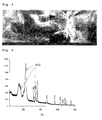
- the obtained silver/biopolymer weight ratios were in the range of 0.7 to 23% and the mean crystallite size obtained by applying the Scherrer equation to the Ag ⁇ 111 ⁇ peak of the XRD pattern ( Fig. 1 ) was in the range of 5 to 22 nm, depending on the microwaving time and silver(I) acetate concentration.
- the XRD patterns in Fig 1 confirm the presence of metallic silver on the MCC biopolymer substrate. Moreover, the peaks due to silver in the XRD pattern are broadened which is typical of the presence of crystallites of nanometre size.
- Comparative Example A did not use any microwave heating. Instead, conventional heating to 100°C was used. Under conventional heating, the reducing process took 3 hours and a considerably smaller quantity of silver nanoparticles was formed on the microcrystalline cellulose. It is noteworthy that in this control experiment using conventional heating (100°C) TGA showed that it contained only 0.4% of silver after 3 hours of reflux and by XRD, no peaks typical of nanoparticles of Ag could be detected.
- microwave heating is a faster and more efficient process than conventional heating for the deposition of metal nanoparticles onto a biopolymer used as reducing and stabilising agent.
- Acetyl cellulose (70 mg) was microwaved under stirring at 150 W and 150°C for 1 minute in a 10 ml sealed tube with 7 ml of a 3x10 -3 mol dm -3 aqueous silver(I) acetate aqueous/ethanolic solution (1/7 volume). The solution was decanted and the solid was freeze dried to give a brown material.
- the silver/biopolymer weight ratio was of 3% and the mean crystallite size obtained by applying the Scherrer equation to the Ag ⁇ 111 ⁇ peak of the XRD pattern was 10 nm.
- Microcrystalline cellulose 70 mg was microwaved under stirring at 150 W and 200°C for 8 minutes in a 10 ml sealed tube with 7 ml of a 2x10 -3 mol dm -3 hexachloroplatinic acid hexahydrate aqueous solution.
- the microwaving temperature had to be increased to 200°C, which may be attributed to the higher oxidation-reduction potential of ionic platinum to metal when compared to ionic gold or silver.
- the solution was decanted and the solid was freeze dried to give a black material.
- the platinum loading on the biopolymer substrate was 12% of the substrate weight and the mean crystallite size obtained by applying the Scherrer equation to the Pt ⁇ 111 ⁇ peak of the XRD pattern ( Fig. 4 ) was 22 nm.
- Silver metal nanoparticle materials as well as Zinc Oxide metal nanoparticle materials showed antimicrobial activity in 18 hours against E. Coli, and will have an even higher antimicrobial activity against Gram positive bacteria.
Landscapes
- Chemical & Material Sciences (AREA)
- Engineering & Computer Science (AREA)
- Nanotechnology (AREA)
- Materials Engineering (AREA)
- Physics & Mathematics (AREA)
- Composite Materials (AREA)
- Condensed Matter Physics & Semiconductors (AREA)
- General Physics & Mathematics (AREA)
- Crystallography & Structural Chemistry (AREA)
- Environmental & Geological Engineering (AREA)
- Life Sciences & Earth Sciences (AREA)
- General Life Sciences & Earth Sciences (AREA)
- Geochemistry & Mineralogy (AREA)
- Geology (AREA)
- Manufacturing & Machinery (AREA)
- Mechanical Engineering (AREA)
- Metallurgy (AREA)
- Organic Chemistry (AREA)
- Manufacture Of Metal Powder And Suspensions Thereof (AREA)
- Powder Metallurgy (AREA)
- Agricultural Chemicals And Associated Chemicals (AREA)
Abstract
a) forming a solution of a salt of the metal
b) dispersing the biopolymer into the metal salt solution
c) optionally, adding a co-reducing agent to the metal salt solution
c) irradiating the metal salt solution with microwaves for 1 to 15 minutes, thereby to deposit metal nanoparticles onto the biopolymer.
Description
- This invention relates to a process for the preparation of metal nanoparticles supported on a biopolymer substrate, which substrate acts in aqueous solution as reducing and stabilising agent for the metal nanoparticles, in particular it relates to the deposition of metal nanoparticles onto a biopolymer dispersed in an aqueous solution of a salt of the metal.
- Various proposals have been made to incorporate biopolymers into liquid compositions. Biopolymers are very abundant naturally occurring, or easily derived from naturally occurring, chemicals and their use in consumer products, such as liquid detergent formulations, is attractive from both environmental and cost grounds. Accordingly, they have been proposed for several applications in such compositions, including thickening or other rheological duties. One problem associated with aqueous compositions containing natural materials, such as biopolymers is their susceptibility to microbial attack. It is thus necessary or desirable to add a biocide to such compositions.
- Certain metal nanoparticles are known to exhibit biocidal properties under certain conditions. However, the synthesis of metal nanoparticles has often used undesirable toxic reducing agents such as hydrazine or sodium borohydride.
- Such chemistry is not consistent with a move to environmentally friendly or natural compositions.
- First row transition metal nanoparticles are often prepared by hydrolysis/thermolysis of the corresponding metal salts at high temperatures. A stabilising and/or capping agent such as polyvinyl pyrrolidone (PVP) is often used to prevent particle agglomeration and to control growth.
- Preparation of metal nanoparticles using "Green Chemistry" principles has been proposed. However, the kinetics of these systems is relatively slow.
- Generally, deposition processes for metal nanoparticles have been done by prolonged thermal infusion, possibly at high pressure.
- Biopolymers, have been proposed as support and/or stabilising agents for metal nanoparticles, but reported processes have poor sustainability. For example, Sodium Borohydride is used as the reducing agent.
- Microwave heating is well known for formation of colloidal suspensions of metal nanoparticles. Typical of such disclosures is
US2008/0072706 that describes a method for manufacturing copper nanoparticles for conductive ink. A solution of copper salt, dispersing agent, reducing agent and an organic solvent is heated to 30 to 50°C and agitated. - Then it is irradiated with microwaves and copper nanoparticles are obtained on cooling. The ratio of dispersing agent/stabilising agent (PVP) to copper salts is controlled to ensure that the metal nanoparticles are created in a free colloidal form.
- J. Chen., J. Wang, X. Zhang and Y. Jin, Mater. Chem. Phys., 2008, 108, 421 discloses the preparation of uniform (15 nm) and stable silver nanoparticles using Sodium Carboxymethyl cellulose (SCMC) as reducing and stabilising agent to prevent agglomeration or sintering of the nanoparticles. Microwave heating was used. The authors claimed that the reducing agent was the hydrolysed SCMC, which was produced by the microwave irradiation. The end product of this process is thus a colloidal dispersion of metal nanoparticles, which cannot be said to be supported on a biopolymer substrate.
- Fast, environmentally friendly, processes using microwave heating and starch as protecting/capping agent for the synthesis of colloidal silver nanoparticles in water using D-glucose are reported by Raveendran, J. Fu and S.L. Wallen, in Green Chem., 2006, 8, 34; and by P. Raveendran, J. Fu and S.L. Wallen, in J. Am. Chem. Soc., 2003, 125, 13940.
- M. Tsuji, M. Hashimoto, Y. Nishizawa, M. Kubokawa and T. Tsuji, Chem. Eur. J., 2005, 11, 440, produced silver nanoparticles by alcohol reduction of fatty acid silver salts using microwaves for 1-5 min at 140-157°C.
- However, the prior art use of microwaves, whilst being effective at producing colloidal dispersions of metal nanoparticles, does not solve the problem of an improved and environmentally benign process for deposition of metal nanoparticles onto a substrate in a way that enables their subsequent slow release.
-
WO2005/087979 describes a microwave process for depositing metal nanoparticles onto a substrate to effect plating of the substrate. A separate reducing system is needed. This process appears to be very aggressive and to fix the nanoparticles to the substrate permanently. - Thus, although the prior art has many examples of formation of colloidal suspensions by microwave heating, it appears that other processes involving heat, pressure and reagents with high environmental impact are favoured when deposition onto a substrate is intended.
- There is an unmet need for a process for the preparation of metal nanoparticles supported on a biopolymer substrate that avoids these disadvantages, and for a product of such a process that releases biocidal nanoparticles to a composition comprising the product.
- According to the present invention there is provided a process for the preparation of metal nanoparticles supported on a biopolymer substrate, which substrate acts in aqueous solution as reducing and stabilising agent for the metal nanoparticles, the process, comprising the steps of:
- a) forming a solution of a salt of the metal; and
- b) dispersing the biopolymer into the metal salt solution formed in step a),
- c) optionally, adding a soluble co-reducing agent to the metal salt solution,
- d) irradiating the metal salt solution with microwaves for 1 to 15 minutes, thereby to deposit metal nanoparticles onto the biopolymer.
- In step b) the biopolymer, preferably a polysaccharide, acts as reducing and stabilising agent for the metal nanoparticles and ultimately works as support/substrate for the nanoparticles. Therefore, there is no need to use the optional co-reducing agents, but their use in addition to the biopolymer is not excluded. However, it is preferred to avoid aggressive co-reducing agents, such as Sodium Borohydride. When a co-reducing agent is used, it should be added as late into the process as possible in order that it reacts as little as possible with the metal salt before it is irradiated with the microwaves.
- The invention also comprises a dried biocidal substrate produced by the process wherein the final dry base metal/biopolymer weight ratio is from 0.7:100 to 23:100. It further comprises a product produced by the process, which is in undried form.
- The invention also includes a use of a product as made by the process for the slow release of silver nanoparticles into an aqueous composition, the biopolymer surface acting as a reservoir for metal nanoparticles.
- Biopolymer: A biopolymer is a naturally occurring polymer or a polymer derived from naturally occurring material, for example a functionalised cellulose. Suitable biopolymers include polysaccharides such as microcrystalline cellulose, acetyl cellulose, and chitin.
- Metal nanoparticles: A metal nanoparticle is a metal in its elemental or oxidised state and having a particle size less than 100 nm.
- Substrate: A substrate is a solid biopolymer with a particle size of greater than 1, preferably greater than 2 micrometres. It may be in particulate, fibrous, film or any other solid form of the required size.
- Reducing agent: A reducing agent, or reductant, is a biopolymer that will oxidise to reduce a metal salt to metal nanoparticles. It may be insoluble or soluble in water.
- Co-reducing agent: A soluble reducing agent, preferably other than a biopolymer.
- The substrate is a biopolymer, preferably a polysaccharide. Chitin and cellulose derivatives, such as acetyl cellulose are preferred. Microcrystalline cellulose (MCC) is especially preferred.
- The biopolymer needs to act as a reducing agent and also acts as a substrate (support). As such it may be distinguished from the prior art use of biopolymer for stabilisation. It is suitably dispersed in water in an amount of from 0.1 to 10wt%, for example 0.3 to 4wt%, or even 0.7 to 2 wt%, preferably about 1wt%.
- The preferred biopolymers are essentially insoluble in water and form suspensions.
- The metal comprising the metal nanoparticles is preferably chosen from the group consisting of Ag(I), Zn(II), Cu(II), Au(III) and Pt(IV) and the corresponding metal salts selected from the group: acetate, and its derivatives, nitrates or halides. However, other metals and their salts, while less preferred, may be used. The process is applicable to the production of supported nanoparticles of more economical transition metals, such ZnO, Cu, CuO and Cu2O, as well as to precious metals such as silver, gold and platinum. The preferred metal is silver, due to its excellent biocide properties. Zinc nanoparticles (ZnO) also have very good biocidal properties.
- The aqueous solvent is preferably 100% water. However, some ethanol can be added as a wetting agent for less hydrophilic biopolymers. Ethanol or a similar environmentally acceptable water miscible co-solvent is typically used as a wetting-out agent and not for solubility reasons.
- Some cellulose derivatives, such as acetyl cellulose are less hydrophilic than microcrystalline cellulose and form less homogeneous in colour materials with metal nanoparticles. When ethanol is used as a co-solvent, very homogeneous materials are obtained because acetyl cellulose is also partially soluble in ethanol. The desirable biopolymer and solvent pairings are MCC, and chitin as biopolymers with water as solvent and acetyl cellulose as biopolymer with ethanol water mixtures as solvent.
- Use of a co-reducing agent is not preferred. However, if it is necessary or desirable for kinetic reasons to use one then any of the conventionally employed reducing agents used for formation of colloidal metal nanoparticles is suitable. In particular, Sodium Borohydride or hydrazine may be tolerated at low levels because they are strong reducing agents and they are soluble in water. By low levels is meant less than 10% based on biopolymer, preferably less than 5%
- The metal to biopolymer weight ratios may vary from 0.7:100 to 23:100. This means that a different ratio is used from that used to obtain colloidal suspensions of metal nanoparticles. For that purpose, the reducing agent is normally used in slight excess to the metal and a maximum of about 1:2 molar ratio.
- An essential part of the process is the exposure of the biopolymer and the metal salt to microwave radiation during the time that the metal salt is reduced and the biopolymer correspondingly partially oxidised. Microwaves are an energy efficient heating method. The microwave heating is applied for 1 to 15 minutes. The aqueous solution can be preheated by conventional heating. We have found that use of microwave heating during the formation and deposition of the metal nanoparticles increases the yield of deposited particles as well as increasing the kinetics of the process.
- The microwave heating is applied to the mixture for 1 to 15 minutes with a power above 150 W in order to obtain temperatures 130 to 150 °C or higher, even up to 200 °C.
- A suitable microwave equipment is 24 position CEM Explorer reactor operating at a frequency of 2.45 GHz with a single mode resonant cavity and an infrared temperature sensor. The power of the microwave is typically set to 150W or more and the power per unit volume is then typically at least 21 W /cm3.
- The extent of deposition of the metal onto the biopolymer substrate can be controlled by the concentration of the ionic metal solution, which also seems to be an important factor in the release rates of the metal nanoparticles into solution. Microwaving time was found to affect nanoparticle size.
- The supported nanoparticles are obtained by the end of the microwave heating period. They may be separated from the liquid phase using an additional freeze-drying step after the microwave heating. If freeze drying is not used it is possible to separate insoluble biopolymer supported metal nanoparticles by centrifugation or other conventional separation processes. Biopolymer substrate supported nanoparticles are obtained in preference to the prior art colloids by careful selection of the biopolymer to be insoluble. Adjustment of ratio of the metal salt/ reducing agent will affect the extent of deposition.
- The mean nanoparticle size may be controlled by microwaving time and by the metal salt concentration in solution. Generally, the mean crystallite size increases with increasing microwaving time and metal salt concentration. In the case of silver, the mean crystallite sizes determined by XRD were in the range of 5 to 22 nm, which correlated well with the sizes of released nanoparticles obtained by TEM. The mean crystallite sizes obtained by XRD for the other precious metals and ZnO were slightly higher than the ones obtained for silver and in the range of 22 to 40 nm and of 44 to 58 nm for Cu2O. Hence, all of the metal nanoparticles obtained by this clean and simple method were of nanometre size. On the other hand, the supporting biopolymers are larger than 1 micron, preferably larger than 2 micron and even over 5 micron in size.
- Metal nanoparticles were shown to be slowly released into solution from the biopolymer substrates. The biopolymer surface seems to act as a reservoir for the nanoparticles that are slowly released into solution. The silver and zinc metal nanoparticle based materials were found to have antimicrobial activity against E. Coli.
- The invention will now be further described with reference to the following non-limiting examples and with reference to the drawings, of which:
-
Fig. 1 is the XRD pattern of silver metal nanoparticles deposited onto MCC by microwaves with 3.2 wt% loading and mean crystallite size of 7 nm. -
Fig. 2 is SEM micrographs of two materials containing almost spherical nanoparticles deposited by microwaves onto the surface of MCC: (left) with 3 wt% silver/MCC loading and 7 nm mean crystallite size obtained by XRD and (right) 9 wt% and 12 nm. -
Fig. 3 is the XRD pattern of ZnO nanoparticles deposited onto the surface of MCC by microwaves and with 3.7 wt% metal loading and mean crystallite size of 33 nm. -
Fig. 4 is the XRD pattern of CuO nanoparticles deposited onto the surface of MCC by microwaves and with 0.7 wt% metal loading and mean crystallite size of 15 nm. -
Fig. 5 is the XRD pattern of Cu2O nanoparticles deposited onto the surface of MCC by microwaves with 1.4 wt% metal loading and mean crystallite size of 44 nm. -
Fig. 6 is the XRD pattern of Au nanoparticles deposited onto the surface of MCC by microwave with 1.5 wt% metal loading and mean crystallite size of 33 nm. -
Fig. 7 is the XRD pattern of Pt nanoparticles deposited onto the surface of MCC by microwaves with 12.3 wt% metal loading and mean crystallite size of 22 nm. -
Fig. 8 shows a representative TEM micrograph (copper grid) showing silver nanoparticles released from MCC when placed in water for 168 hours. - In the examples, the following chemicals were used. All chemicals were purchased from Sigma-Aldrich and used as received. Data relating to the examples is given in table 1.
-
- Agac =
- Ag(I) acetate 99%,
- Zn(ac)2 =
- Zn(II) acetate dihydrate 99.0%,
- Cu(ac)2 =
- Copper(II) acetate monohydrate 99.0%,
- CuSO4 =
- Copper(II) sulphate pentahydrate 99.0%,
- HAuCl4 =
- Au(III) chloride hydrate p.a. (≥49% Au basis)
- H2PtCl6 =
- Hexachloroplatinic acid hexahydrate (≥37.50% Pt basis)
-
- MCC =
- Microcrystalline cellulose
- Acetylcell =
- acetyl cellulose
- Chitin =
- chitin
- Microcrystalline cellulose (70 mg) was microwaved under stirring at 150 W and 150°C for 1 to 15 minutes in 10 ml sealed tubes with 7 ml of aqueous silver(I) acetate solution of concentrations ranging from 7x10⁻⁴ to 3x10⁻² mol dm-3. The solution was decanted and the solid was freeze dried to give yellow to brown materials. The obtained silver/biopolymer weight ratios were in the range of 0.7 to 23% and the mean crystallite size obtained by applying the Scherrer equation to the Ag {111} peak of the XRD pattern (
Fig. 1 ) was in the range of 5 to 22 nm, depending on the microwaving time and silver(I) acetate concentration. - The XRD patterns in
Fig 1 , confirm the presence of metallic silver on the MCC biopolymer substrate. Moreover, the peaks due to silver in the XRD pattern are broadened which is typical of the presence of crystallites of nanometre size. - Comparative Example A did not use any microwave heating. Instead, conventional heating to 100°C was used. Under conventional heating, the reducing process took 3 hours and a considerably smaller quantity of silver nanoparticles was formed on the microcrystalline cellulose. It is noteworthy that in this control experiment using conventional heating (100°C) TGA showed that it contained only 0.4% of silver after 3 hours of reflux and by XRD, no peaks typical of nanoparticles of Ag could be detected. This example shows that microwave heating is a faster and more efficient process than conventional heating for the deposition of metal nanoparticles onto a biopolymer used as reducing and stabilising agent.
- Acetyl cellulose (70 mg) was microwaved under stirring at 150 W and 150°C for 1 minute in a 10 ml sealed tube with 7 ml of a 3x10⁻³ mol dm-3 aqueous silver(I) acetate aqueous/ethanolic solution (1/7 volume). The solution was decanted and the solid was freeze dried to give a brown material. The silver/biopolymer weight ratio was of 3% and the mean crystallite size obtained by applying the Scherrer equation to the Ag {111} peak of the XRD pattern was 10 nm.
- This shows the use of a further alternative biopolymer. The process is similar to that in example 1 adapted as shown in table 1. Chitin, the second most abundant biopolymer after cellulose, also acted as reducing, stabilising and supporting agent for silver nanoparticles (0.9% weight). The loading was 3% and the mean crystallite size of 8 nm is comparable to the ones obtained with MCC.
- Microcrystalline cellulose (70 mg) was microwaved under stirring at 150 W and 200°C for 8 minutes in a 10 ml sealed tube with 7 ml of a 2x10⁻³ mol dm-3 hexachloroplatinic acid hexahydrate aqueous solution. The microwaving temperature had to be increased to 200°C, which may be attributed to the higher oxidation-reduction potential of ionic platinum to metal when compared to ionic gold or silver.
- The solution was decanted and the solid was freeze dried to give a black material. The platinum loading on the biopolymer substrate was 12% of the substrate weight and the mean crystallite size obtained by applying the Scherrer equation to the Pt {111} peak of the XRD pattern (
Fig. 4 ) was 22 nm. - These show the use of the process for other metals and salts. The process is similar to that in example 14 adapted as shown in Table 1.
- Microwaving for 8 minutes under the same experimental conditions an aqueous solution of zinc salt with MCC under alkaline media deposits a white material whose XRD pattern is typical of ZnO nanoparticles, onto the MCC surface, with 5% ash weight (TGA). Microwaving an aqueous solution of copper(II) salt in neutral media yields light brown materials with an XRD pattern typical of CuO and with 0.9% ash weight (TGA), whereas if the media is alkaline dark pink materials are yielded with an XRD pattern typical of Cu or Cu2O the latter one with 2% ash weight (TGA). The peaks from the XRD of these materials also show broadening when compared to the reference indicating that the particles are of nanometre size. Applying the Scherrer equation to the most intense peak in these patterns gives mean crystallite sizes of slightly higher dimensions than the ones obtained with the silver nanoparticles under comparable conditions, but still in the range 15 to 44 nm. Gold was also deposited onto MCC using this process.
Table 1 Ex [M+] (mol dm-3) Metal Salt Biopolymer tMW (min) Colour M/BioTGA (% weight)1 XRD (nM)2 1 2.9x10⁻³ Agac MCC 1 brown 3.2 Ag (7) 2 2.9x10⁻³ Agac MCC 15 brown 3.2 Ag (8) 3 7.2x10⁻⁴ Agac MCC 1 orange 0.7 Ag (5) 4 7.2x10⁻⁴ Agac MCC 15 greenish 0.8 Ag (22) 5 1.8x10⁻³ Agac MCC 8 brown 2.6 Ag (13) A 2.9x10⁻³ Agac MCC 240 salmon 0.4 6 2.8x10⁻² Agac MCC 1 dark brown 22.0 Ag (12) 7 2.8x10⁻² Agac MCC 15 dark brown 22.6 Ag (16) 8 2.9x10⁻³ Agac MCC 1 brown 2.4 Ag (6) 9 2.9x10⁻³ Agac MCC 15 brown dark 2.7 Ag (6) 10 9.4x10⁻³ Agac MCC 8 brown 9.2 Ag (12) 11 2.8x10⁻³ Agac MCC 1 brown 2.5 Ag (5) 12 2.8x10⁻³ Agac Acetylcell 1 brown 2.9 Ag (10) 13 2.8x10⁻³ Agac chitin 1 brown 0.9 Ag (8) 14 1.8x10⁻³ H2PtCl6 MCC 8 black 12.3 Pt (22) 15 1.8x10⁻³ HAuCl4 MCC 8 light pink 1.5 Au (33) 16 1.7x10⁻² Zn(ac)2 MCC 8 white 3.7 ZnO (33) 17 1.8x10⁻³ Cu(ac)2 MCC 8 light brown 0.7 CuO (15) 18 1.8x10⁻³ Cu(ac)2* MCC 8 pink 1.4 CU2O (44) 19 1.8x10⁻³ CuSO4* MCC 8 pink 1.2 CU2O (58) * In alkaline media (NaOH)
1 weight ratio of metal per amount of biopolymer loaded into the solution in the beginning of the experiment; Determined from the ash weight in air atmosphere at 550°C and taking into account only the metal part if the nanoparticle is an oxide as determined by XRD.
2 Crystal salt pattern and respective mean crystallite size, obtained by applying the Scherrer equation to the data from {111} peaks in the case of Ag, Au, CuO and Cu2O crystals and {101} in the case of ZnO crystal. - Some selected materials (2 mg) from examples 1 to 11 were placed in milipore water and aliquots of the solution were periodically taken and analysed by ICP-AES or silver selective electrode and by SEM-TE. The results showed the presence of silver in solution, released at a slow rate, which was found to depend on the silver loading onto MCC. By SEM-TE the presence of nanoparticles was observed in these solutions as can be seen in
Fig 8 . The metal nanoparticle sizes observed agree well with the mean crystallite sizes obtained by XRD. Therefore, the MCC surface seems to act as a reservoir for the nanoparticles that are slowly released into solution. This release starts very quickly (hours) and continues for an extended period of time (days). The reservoir of particles that can be released is enough for several years of steady slow release. - Silver metal nanoparticle materials as well as Zinc Oxide metal nanoparticle materials showed antimicrobial activity in 18 hours against E. Coli, and will have an even higher antimicrobial activity against Gram positive bacteria.
Claims (17)
- A process for the preparation of metal nanoparticles supported on a biopolymer substrate, which substrate acts in aqueous solution as reducing and stabilising agent for the metal nanoparticles, the process, comprising the steps of:a) forming a solution of a salt of the metalb) dispersing the biopolymer into the metal salt solutionc) optionally, adding a co-reducing agent to the metal salt solutionc) irradiating the metal salt solution with microwaves for 1 to 15 minutes, thereby to deposit metal nanoparticles onto the biopolymer.
- A process according to claim 1 in which the biopolymer is a polysaccharide.
- A process according to claim 1 or 2 in which no separate co-reducing agent is added to the metal salt solution.
- A process according to claim 1 in which the biopolymer is selected from the group comprising microcrystalline cellulose, acetyl cellulose, chitin and mixtures thereof.
- A process according to claim 4 in which the biopolymer comprises microcrystalline cellulose.
- A process according to any preceding claim in which the metals are selected from the group comprising Ag(I), Zn(II), Cu(II), Au(III) and Pt(IV) and the corresponding salts from the group acetate, and its derivatives, nitrate, halide or sulphate.
- A process according to claim 6 in which the metal is silver.
- A process according to any preceding claim in which the concentration of metal salt solution is between 7x10⁻⁴ and 3x10⁻² mol dm-3.
- A process according to any preceding claim in which the concentration of the biopolymer is about lwt% in the solvent.
- A process according to claim 7 in which the metal/polymer weight ratio in solution is between 0.8:100 and 30:100.
- A process according to any preceding claim in which the solvent is selected from water, ethanol, and mixtures thereof.
- A process according to claim 11 in which the solvent is water.
- A process according to any preceding claim in which the microwaving temperature is from 130°C to 200°C and the microwave power is about 150W or more.
- A process according to any preceding claim, which further comprises the decantation of the aqueous solution in order to isolate the biopolymer with deposited metal nanoparticles and optional washing/centrifugation with water, and, finally, freeze drying of the material.
- A dried biocidal substrate produced by the process according to any preceding claim wherein the final dry elemental metal/biopolymer weight ratio is from 0.7:100 to 23:100,
- A product produced by the process according to any preceding claim, which is in undried form.
- Use of a product as made by the process according to any of the claims 1 to 14 for the slow release of silver nanoparticles into an aqueous composition, the biopolymer surface acting as a reservoir for nanoparticles.
Priority Applications (1)
| Application Number | Priority Date | Filing Date | Title |
|---|---|---|---|
| EP09155756A EP2230321A1 (en) | 2009-03-20 | 2009-03-20 | Process for the preparation of supported metal nanoparticles |
Applications Claiming Priority (1)
| Application Number | Priority Date | Filing Date | Title |
|---|---|---|---|
| EP09155756A EP2230321A1 (en) | 2009-03-20 | 2009-03-20 | Process for the preparation of supported metal nanoparticles |
Publications (1)
| Publication Number | Publication Date |
|---|---|
| EP2230321A1 true EP2230321A1 (en) | 2010-09-22 |
Family
ID=40792624
Family Applications (1)
| Application Number | Title | Priority Date | Filing Date |
|---|---|---|---|
| EP09155756A Withdrawn EP2230321A1 (en) | 2009-03-20 | 2009-03-20 | Process for the preparation of supported metal nanoparticles |
Country Status (1)
| Country | Link |
|---|---|
| EP (1) | EP2230321A1 (en) |
Cited By (7)
| Publication number | Priority date | Publication date | Assignee | Title |
|---|---|---|---|---|
| RU2451578C1 (en) * | 2010-11-30 | 2012-05-27 | Общество с ограниченной ответственностью Научно Производственный Центр "Квадра" | Method of producing biocide inorganic zinc oxide-based composite nanoparticles |
| WO2017046347A1 (en) | 2015-09-17 | 2017-03-23 | Commissariat A L'energie Atomique Et Aux Energies Alternatives | Method for tagging nanocellulose |
| EP3326466A1 (en) * | 2016-11-25 | 2018-05-30 | Commissariat à l'Energie Atomique et aux Energies Alternatives | Antimicrobial cellulosic material |
| CN112110792A (en) * | 2020-08-31 | 2020-12-22 | 浙江工业大学 | Application of metal mesh supported metal particle catalyst in reaction for synthesizing ethylene glycol and propylene glycol through selective hydrogenolysis of sorbitol |
| CN112530625A (en) * | 2020-11-05 | 2021-03-19 | 青岛大学 | Chitin whisker-based conductive material and preparation method thereof, and aqueous conductive ink and application thereof |
| CN115055678A (en) * | 2022-05-25 | 2022-09-16 | 北京信息科技大学 | A kind of preparation method of gold particle-cuprous oxide nanocup |
| CN115282960A (en) * | 2022-07-22 | 2022-11-04 | 皖西学院 | A method for microwave synthesis of silver-doped nano-ZnO with durable and efficient photocatalytic performance |
Citations (4)
| Publication number | Priority date | Publication date | Assignee | Title |
|---|---|---|---|---|
| WO2005087979A2 (en) | 2004-03-11 | 2005-09-22 | Frontcoat Technologies Aps | A method and a device for deposition of a metal layer on a non-conducting surface of a substrate |
| US20080072706A1 (en) | 2006-09-21 | 2008-03-27 | Samsung Electro-Mechanics Co. Ltd. | Method for manufacturing copper nanoparticles using microwaves |
| WO2008100163A1 (en) * | 2007-02-13 | 2008-08-21 | Instytut Wlókien Naturalnych | Method of manufacturing silver nanoparticles, cellulosic fibers and nanofibers containing silver nanoparticles, fibers and nanofibers containing silver nanoparticles, use of silver nanoparticles to the manufacture of cellulosic fibers and nanofibers, and wound dressing containing silver nanoparticles |
| US20090018188A1 (en) * | 2007-07-09 | 2009-01-15 | John Texter | Bactericidal silver surfactant delivery into coating and polymer compositions |
-
2009
- 2009-03-20 EP EP09155756A patent/EP2230321A1/en not_active Withdrawn
Patent Citations (4)
| Publication number | Priority date | Publication date | Assignee | Title |
|---|---|---|---|---|
| WO2005087979A2 (en) | 2004-03-11 | 2005-09-22 | Frontcoat Technologies Aps | A method and a device for deposition of a metal layer on a non-conducting surface of a substrate |
| US20080072706A1 (en) | 2006-09-21 | 2008-03-27 | Samsung Electro-Mechanics Co. Ltd. | Method for manufacturing copper nanoparticles using microwaves |
| WO2008100163A1 (en) * | 2007-02-13 | 2008-08-21 | Instytut Wlókien Naturalnych | Method of manufacturing silver nanoparticles, cellulosic fibers and nanofibers containing silver nanoparticles, fibers and nanofibers containing silver nanoparticles, use of silver nanoparticles to the manufacture of cellulosic fibers and nanofibers, and wound dressing containing silver nanoparticles |
| US20090018188A1 (en) * | 2007-07-09 | 2009-01-15 | John Texter | Bactericidal silver surfactant delivery into coating and polymer compositions |
Non-Patent Citations (8)
| Title |
|---|
| J. CHEN. ET AL., MATER. CHEM. PHYS., vol. 108, 2008, pages 421 |
| KOTELNIKOVA ET AL: "Silver clusters intercalation into the cellulose matrix. II. REM and TEM evidence of silver clusters presence in the microcrystalline cellulose matrix", CELLULOSE CHEMISTRY AND TECHNOLOGY, BUCHAREST, RU, vol. 37, no. 1-2, 1 January 2003 (2003-01-01), pages 51 - 67, XP009119348 * |
| M. TSUJI ET AL., CHEM. EUR. J., vol. 11, 2005, pages 440 |
| MALLIKARJUNA N. NADAGOUDA AND RAJENDER S. VARMA: "Synthesis of Thermally Stable Carboxymethyl Cellulose/Metal Biodegradable Nanocomposites for Potential Biological Applications", BIOMACROMOLECULES, vol. 8, no. 9, 1 August 2007 (2007-08-01), pages 2762 - 2767, XP002536772 * |
| N. E. KOTELNIKOVA ET AL.: "Silver Intercalation into Cellulose Matrix. An X-Ray Scattering, Solid-State 13C NMR, IR, X-Ray Photoelectron, and Raman Study", RUSSIAN JOURNAL OF GENERAL CHEMISTRY, vol. 73, no. 3, 2003, pages 418 - 426, XP002536773 * |
| P. RAVEENDRAN; J. FU; S.L. WALLEN, J. AM. CHEM. SOC., vol. 125, 2003, pages 13940 |
| RAVEENDRAN, J. FU; S.L. WALLEN, GREEN CHEM., vol. 8, 2006, pages 34 |
| VIVEK POLSHETTIWAR ET AL: "Microwave-Assisted Chemistry: a Rapid and Sustainable Route to Synthesis of Organics and Nanomaterials", AUSTRALIAN JOURNAL OF CHEMISTRY, CSIRO, AU, vol. 62, 1 January 2009 (2009-01-01), pages 16 - 26, XP009119078, ISSN: 0004-9425 * |
Cited By (12)
| Publication number | Priority date | Publication date | Assignee | Title |
|---|---|---|---|---|
| RU2451578C1 (en) * | 2010-11-30 | 2012-05-27 | Общество с ограниченной ответственностью Научно Производственный Центр "Квадра" | Method of producing biocide inorganic zinc oxide-based composite nanoparticles |
| WO2017046347A1 (en) | 2015-09-17 | 2017-03-23 | Commissariat A L'energie Atomique Et Aux Energies Alternatives | Method for tagging nanocellulose |
| FR3041353A1 (en) * | 2015-09-17 | 2017-03-24 | Commissariat Energie Atomique | PROCESS FOR MARKING NANOCELLULOSE |
| EP3326466A1 (en) * | 2016-11-25 | 2018-05-30 | Commissariat à l'Energie Atomique et aux Energies Alternatives | Antimicrobial cellulosic material |
| FR3059207A1 (en) * | 2016-11-25 | 2018-06-01 | Commissariat A L'energie Atomique Et Aux Energies Alternatives | ANTIMICROBIAL CELLULOSIC MATERIAL |
| CN112110792A (en) * | 2020-08-31 | 2020-12-22 | 浙江工业大学 | Application of metal mesh supported metal particle catalyst in reaction for synthesizing ethylene glycol and propylene glycol through selective hydrogenolysis of sorbitol |
| CN112110792B (en) * | 2020-08-31 | 2023-01-31 | 浙江工业大学 | Application of metal wire mesh supported metal particle catalyst in reaction of synthesizing ethylene glycol and propylene glycol by selective hydrogenolysis of sorbitol |
| CN112530625A (en) * | 2020-11-05 | 2021-03-19 | 青岛大学 | Chitin whisker-based conductive material and preparation method thereof, and aqueous conductive ink and application thereof |
| CN112530625B (en) * | 2020-11-05 | 2022-06-10 | 青岛大学 | A kind of chitin whisker-based conductive material and preparation method thereof, water-based conductive ink and application thereof |
| CN115055678A (en) * | 2022-05-25 | 2022-09-16 | 北京信息科技大学 | A kind of preparation method of gold particle-cuprous oxide nanocup |
| CN115055678B (en) * | 2022-05-25 | 2023-06-27 | 北京信息科技大学 | Preparation method of gold particle-cuprous oxide nano cup |
| CN115282960A (en) * | 2022-07-22 | 2022-11-04 | 皖西学院 | A method for microwave synthesis of silver-doped nano-ZnO with durable and efficient photocatalytic performance |
Similar Documents
| Publication | Publication Date | Title |
|---|---|---|
| CN101939091B (en) | Method for preparing dispersions of precious metal nanoparticles and for isolating such nanoparticles from the dispersions | |
| JP5393451B2 (en) | Method for producing highly dispersible spherical silver powder particles and silver particles formed therefrom | |
| Holden et al. | Synthesis and catalytic activity of pluronic stabilized silver–gold bimetallic nanoparticles | |
| KR101522738B1 (en) | Copper powder for conductive paste and method for producing the same | |
| KR100809982B1 (en) | Copper nanoparticles manufacturing method using microwave | |
| US10926335B2 (en) | Nano-metal particles and preparation process thereof | |
| KR101537149B1 (en) | Method of producing metal nano-particles | |
| Hikmah et al. | Synthesis and characterization of silver-copper core-shell nanoparticles using polyol method for antimicrobial agent | |
| CN102728852A (en) | Preparation method of oxide or meta-coated nickel ultrafine powder | |
| Silva et al. | Controlled silver delivery by silver–cellulose nanocomposites prepared by a one-pot green synthesis assisted by microwaves | |
| WO2005038948A2 (en) | Nanosized silver oxide powder | |
| CN102198511A (en) | Preparation method of carboxymethyl curdlan polysaccharide-based colloidal aqueous solution containing nano silver particles | |
| CN111957986A (en) | Spherical nano copper powder and preparation method and application thereof | |
| KR20080035315A (en) | Method for producing silver nanoparticles and silver nanoparticles produced thereby | |
| CN114425055A (en) | Silicon dioxide loaded multi-metal nano-particles, preparation method and antibacterial application thereof | |
| JP4821014B2 (en) | Copper powder manufacturing method | |
| JP5358877B2 (en) | Antibacterial ceramic product, ceramic surface treatment agent, and method for manufacturing antibacterial ceramic product | |
| Larios-Rodríguez et al. | Green-chemical synthesis of monodisperse Au, Pd and bimetallic (core–shell) Au–Pd, Pd–Au nanoparticles | |
| JP5825213B2 (en) | Method for producing metal nanoparticle dispersion and method for producing metal nanoparticle / layered mineral composite | |
| JP5765455B2 (en) | Antibacterial ceramic product, ceramic surface treatment agent, and method for manufacturing antibacterial ceramic product | |
| JP5582164B2 (en) | Antibacterial ceramic product, ceramic surface treatment agent, and method for manufacturing antibacterial ceramic product | |
| CN117206539B (en) | Preparation method of nano silver seed crystal, nano silver seed crystal and application | |
| Ebrahimzadeh et al. | One-pot synthesis of size and shape controlled copper nanostructures in aqueous media and their application for fast catalytic degradation of organic dyes | |
| KR100922224B1 (en) | Manufacturing method of nano metal particles using mixed polymer as dispersant | |
| KR20210074483A (en) | Catalyic loading structure and manufacturing method thereof |
Legal Events
| Date | Code | Title | Description |
|---|---|---|---|
| PUAI | Public reference made under article 153(3) epc to a published international application that has entered the european phase |
Free format text: ORIGINAL CODE: 0009012 |
|
| AK | Designated contracting states |
Kind code of ref document: A1 Designated state(s): AT BE BG CH CY CZ DE DK EE ES FI FR GB GR HR HU IE IS IT LI LT LU LV MC MK MT NL NO PL PT RO SE SI SK TR |
|
| AX | Request for extension of the european patent |
Extension state: AL BA RS |
|
| AKY | No designation fees paid | ||
| REG | Reference to a national code |
Ref country code: DE Ref legal event code: R108 Effective date: 20110426 |
|
| STAA | Information on the status of an ep patent application or granted ep patent |
Free format text: STATUS: THE APPLICATION IS DEEMED TO BE WITHDRAWN |
|
| 18D | Application deemed to be withdrawn |
Effective date: 20110323 |