EP2230282A1 - Oil-based inkjet recording ink - Google Patents
Oil-based inkjet recording ink Download PDFInfo
- Publication number
- EP2230282A1 EP2230282A1 EP20100002778 EP10002778A EP2230282A1 EP 2230282 A1 EP2230282 A1 EP 2230282A1 EP 20100002778 EP20100002778 EP 20100002778 EP 10002778 A EP10002778 A EP 10002778A EP 2230282 A1 EP2230282 A1 EP 2230282A1
- Authority
- EP
- European Patent Office
- Prior art keywords
- group
- formula
- oil
- inkjet recording
- recording ink
- Prior art date
- Legal status (The legal status is an assumption and is not a legal conclusion. Google has not performed a legal analysis and makes no representation as to the accuracy of the status listed.)
- Granted
Links
- 239000000049 pigment Substances 0.000 claims abstract description 137
- 125000000217 alkyl group Chemical group 0.000 claims abstract description 69
- 239000003960 organic solvent Substances 0.000 claims abstract description 54
- 239000011347 resin Substances 0.000 claims abstract description 50
- 229920005989 resin Polymers 0.000 claims abstract description 50
- 125000000623 heterocyclic group Chemical group 0.000 claims abstract description 42
- 125000003277 amino group Chemical group 0.000 claims abstract description 36
- 125000004435 hydrogen atom Chemical group [H]* 0.000 claims abstract description 32
- 125000003118 aryl group Chemical group 0.000 claims abstract description 30
- 239000002270 dispersing agent Substances 0.000 claims abstract description 30
- 125000001424 substituent group Chemical group 0.000 claims abstract description 28
- 125000003545 alkoxy group Chemical group 0.000 claims abstract description 27
- 229920000642 polymer Polymers 0.000 claims abstract description 25
- 229910052757 nitrogen Inorganic materials 0.000 claims abstract description 13
- 125000004433 nitrogen atom Chemical group N* 0.000 claims abstract description 13
- 125000003342 alkenyl group Chemical group 0.000 claims abstract description 12
- 125000000304 alkynyl group Chemical group 0.000 claims abstract description 12
- 125000003710 aryl alkyl group Chemical group 0.000 claims abstract description 12
- -1 nitrogen-containing heterocyclic compound Chemical class 0.000 claims description 136
- 239000002904 solvent Substances 0.000 claims description 109
- 125000004432 carbon atom Chemical group C* 0.000 claims description 66
- LYCAIKOWRPUZTN-UHFFFAOYSA-N ethylene glycol Natural products OCCO LYCAIKOWRPUZTN-UHFFFAOYSA-N 0.000 claims description 34
- WGCNASOHLSPBMP-UHFFFAOYSA-N hydroxyacetaldehyde Natural products OCC=O WGCNASOHLSPBMP-UHFFFAOYSA-N 0.000 claims description 28
- 229930195733 hydrocarbon Natural products 0.000 claims description 24
- 150000002430 hydrocarbons Chemical class 0.000 claims description 24
- 239000004215 Carbon black (E152) Substances 0.000 claims description 22
- 229920003171 Poly (ethylene oxide) Polymers 0.000 claims description 21
- XLYOFNOQVPJJNP-UHFFFAOYSA-N water Substances O XLYOFNOQVPJJNP-UHFFFAOYSA-N 0.000 claims description 19
- 150000002596 lactones Chemical class 0.000 claims description 15
- SOGAXMICEFXMKE-UHFFFAOYSA-N Butylmethacrylate Chemical compound CCCCOC(=O)C(C)=C SOGAXMICEFXMKE-UHFFFAOYSA-N 0.000 claims description 13
- VVQNEPGJFQJSBK-UHFFFAOYSA-N Methyl methacrylate Chemical compound COC(=O)C(C)=C VVQNEPGJFQJSBK-UHFFFAOYSA-N 0.000 claims description 13
- 150000001346 alkyl aryl ethers Chemical class 0.000 claims description 11
- 229920001451 polypropylene glycol Polymers 0.000 claims description 11
- 125000003282 alkyl amino group Chemical group 0.000 claims description 10
- 229920001577 copolymer Polymers 0.000 claims description 10
- 239000004925 Acrylic resin Substances 0.000 claims description 6
- 229920000178 Acrylic resin Polymers 0.000 claims description 6
- DOOTYTYQINUNNV-UHFFFAOYSA-N Triethyl citrate Chemical compound CCOC(=O)CC(O)(C(=O)OCC)CC(=O)OCC DOOTYTYQINUNNV-UHFFFAOYSA-N 0.000 claims description 6
- 125000001165 hydrophobic group Chemical group 0.000 claims description 6
- 239000001069 triethyl citrate Substances 0.000 claims description 6
- VMYFZRTXGLUXMZ-UHFFFAOYSA-N triethyl citrate Natural products CCOC(=O)C(O)(C(=O)OCC)C(=O)OCC VMYFZRTXGLUXMZ-UHFFFAOYSA-N 0.000 claims description 6
- 235000013769 triethyl citrate Nutrition 0.000 claims description 6
- 125000005842 heteroatom Chemical group 0.000 claims description 5
- 229920001519 homopolymer Polymers 0.000 claims description 3
- BZHJMEDXRYGGRV-UHFFFAOYSA-N Vinyl chloride Chemical compound ClC=C BZHJMEDXRYGGRV-UHFFFAOYSA-N 0.000 abstract description 5
- 238000003860 storage Methods 0.000 abstract description 2
- 239000000758 substrate Substances 0.000 abstract 1
- 239000000976 ink Substances 0.000 description 172
- 239000003921 oil Substances 0.000 description 111
- 125000000751 azo group Chemical group [*]N=N[*] 0.000 description 68
- 239000006185 dispersion Substances 0.000 description 44
- 238000011156 evaluation Methods 0.000 description 44
- 150000001875 compounds Chemical class 0.000 description 43
- 238000009835 boiling Methods 0.000 description 38
- 239000001052 yellow pigment Substances 0.000 description 31
- 239000000203 mixture Substances 0.000 description 30
- KWYUFKZDYYNOTN-UHFFFAOYSA-M Potassium hydroxide Chemical compound [OH-].[K+] KWYUFKZDYYNOTN-UHFFFAOYSA-M 0.000 description 27
- 239000013078 crystal Substances 0.000 description 26
- 239000000178 monomer Substances 0.000 description 24
- 239000002245 particle Substances 0.000 description 22
- 238000005259 measurement Methods 0.000 description 21
- 125000002496 methyl group Chemical group [H]C([H])([H])* 0.000 description 20
- 235000002639 sodium chloride Nutrition 0.000 description 17
- 150000003839 salts Chemical class 0.000 description 16
- 125000000129 anionic group Chemical group 0.000 description 13
- 229910052739 hydrogen Inorganic materials 0.000 description 13
- 238000000034 method Methods 0.000 description 13
- OKKJLVBELUTLKV-UHFFFAOYSA-N Methanol Chemical compound OC OKKJLVBELUTLKV-UHFFFAOYSA-N 0.000 description 12
- 239000001257 hydrogen Substances 0.000 description 12
- 230000001976 improved effect Effects 0.000 description 12
- 239000012188 paraffin wax Substances 0.000 description 12
- 125000001997 phenyl group Chemical group [H]C1=C([H])C([H])=C(*)C([H])=C1[H] 0.000 description 12
- 125000000714 pyrimidinyl group Chemical group 0.000 description 12
- RRQYJINTUHWNHW-UHFFFAOYSA-N 1-ethoxy-2-(2-ethoxyethoxy)ethane Chemical compound CCOCCOCCOCC RRQYJINTUHWNHW-UHFFFAOYSA-N 0.000 description 11
- 229940019778 diethylene glycol diethyl ether Drugs 0.000 description 11
- 239000004800 polyvinyl chloride Substances 0.000 description 11
- 229920000915 polyvinyl chloride Polymers 0.000 description 11
- 239000002253 acid Substances 0.000 description 10
- 238000011282 treatment Methods 0.000 description 10
- 239000012295 chemical reaction liquid Substances 0.000 description 9
- 230000000052 comparative effect Effects 0.000 description 9
- 239000000463 material Substances 0.000 description 9
- 239000002609 medium Substances 0.000 description 9
- 238000003786 synthesis reaction Methods 0.000 description 9
- 125000000999 tert-butyl group Chemical group [H]C([H])([H])C(*)(C([H])([H])[H])C([H])([H])[H] 0.000 description 9
- QCAHUFWKIQLBNB-UHFFFAOYSA-N 3-(3-methoxypropoxy)propan-1-ol Chemical compound COCCCOCCCO QCAHUFWKIQLBNB-UHFFFAOYSA-N 0.000 description 8
- YEJRWHAVMIAJKC-UHFFFAOYSA-N 4-Butyrolactone Chemical compound O=C1CCCO1 YEJRWHAVMIAJKC-UHFFFAOYSA-N 0.000 description 8
- QTBSBXVTEAMEQO-UHFFFAOYSA-N Acetic acid Chemical compound CC(O)=O QTBSBXVTEAMEQO-UHFFFAOYSA-N 0.000 description 8
- 230000015572 biosynthetic process Effects 0.000 description 8
- 238000001035 drying Methods 0.000 description 8
- 125000001495 ethyl group Chemical group [H]C([H])([H])C([H])([H])* 0.000 description 8
- 238000002156 mixing Methods 0.000 description 8
- 229920000728 polyester Polymers 0.000 description 8
- 238000004321 preservation Methods 0.000 description 8
- JUJWROOIHBZHMG-UHFFFAOYSA-N Pyridine Chemical group C1=CC=NC=C1 JUJWROOIHBZHMG-UHFFFAOYSA-N 0.000 description 7
- 239000002585 base Substances 0.000 description 7
- 125000000753 cycloalkyl group Chemical group 0.000 description 7
- 239000012046 mixed solvent Substances 0.000 description 7
- 239000007787 solid Substances 0.000 description 7
- NIXOWILDQLNWCW-UHFFFAOYSA-M Acrylate Chemical compound [O-]C(=O)C=C NIXOWILDQLNWCW-UHFFFAOYSA-M 0.000 description 6
- VEXZGXHMUGYJMC-UHFFFAOYSA-N Hydrochloric acid Chemical compound Cl VEXZGXHMUGYJMC-UHFFFAOYSA-N 0.000 description 6
- YXFVVABEGXRONW-UHFFFAOYSA-N Toluene Chemical compound CC1=CC=CC=C1 YXFVVABEGXRONW-UHFFFAOYSA-N 0.000 description 6
- 150000001338 aliphatic hydrocarbons Chemical class 0.000 description 6
- GAEKPEKOJKCEMS-UHFFFAOYSA-N gamma-valerolactone Chemical compound CC1CCC(=O)O1 GAEKPEKOJKCEMS-UHFFFAOYSA-N 0.000 description 6
- 125000001449 isopropyl group Chemical group [H]C([H])([H])C([H])(*)C([H])([H])[H] 0.000 description 6
- 125000000956 methoxy group Chemical group [H]C([H])([H])O* 0.000 description 6
- 238000003801 milling Methods 0.000 description 6
- PXHVJJICTQNCMI-UHFFFAOYSA-N nickel Substances [Ni] PXHVJJICTQNCMI-UHFFFAOYSA-N 0.000 description 6
- 239000000843 powder Substances 0.000 description 6
- 125000003373 pyrazinyl group Chemical group 0.000 description 6
- 239000000126 substance Substances 0.000 description 6
- 229940042596 viscoat Drugs 0.000 description 6
- UFWIBTONFRDIAS-UHFFFAOYSA-N Naphthalene Chemical compound C1=CC=CC2=CC=CC=C21 UFWIBTONFRDIAS-UHFFFAOYSA-N 0.000 description 5
- 239000004721 Polyphenylene oxide Substances 0.000 description 5
- 125000004442 acylamino group Chemical group 0.000 description 5
- 125000004414 alkyl thio group Chemical group 0.000 description 5
- 239000000975 dye Substances 0.000 description 5
- 150000002148 esters Chemical class 0.000 description 5
- 229910017053 inorganic salt Inorganic materials 0.000 description 5
- 238000004898 kneading Methods 0.000 description 5
- 125000002816 methylsulfanyl group Chemical group [H]C([H])([H])S[*] 0.000 description 5
- 239000011259 mixed solution Substances 0.000 description 5
- 125000004123 n-propyl group Chemical group [H]C([H])([H])C([H])([H])C([H])([H])* 0.000 description 5
- QJGQUHMNIGDVPM-UHFFFAOYSA-N nitrogen group Chemical group [N] QJGQUHMNIGDVPM-UHFFFAOYSA-N 0.000 description 5
- 229920000570 polyether Polymers 0.000 description 5
- 125000004076 pyridyl group Chemical group 0.000 description 5
- 238000003756 stirring Methods 0.000 description 5
- JIHQDMXYYFUGFV-UHFFFAOYSA-N 1,3,5-triazine Chemical group C1=NC=NC=N1 JIHQDMXYYFUGFV-UHFFFAOYSA-N 0.000 description 4
- 238000005160 1H NMR spectroscopy Methods 0.000 description 4
- MXVMODFDROLTFD-UHFFFAOYSA-N 2-[2-[2-(2-butoxyethoxy)ethoxy]ethoxy]ethanol Chemical compound CCCCOCCOCCOCCOCCO MXVMODFDROLTFD-UHFFFAOYSA-N 0.000 description 4
- 125000004105 2-pyridyl group Chemical group N1=C([*])C([H])=C([H])C([H])=C1[H] 0.000 description 4
- LFQSCWFLJHTTHZ-UHFFFAOYSA-N Ethanol Chemical compound CCO LFQSCWFLJHTTHZ-UHFFFAOYSA-N 0.000 description 4
- KFZMGEQAYNKOFK-UHFFFAOYSA-N Isopropanol Chemical compound CC(C)O KFZMGEQAYNKOFK-UHFFFAOYSA-N 0.000 description 4
- 238000005481 NMR spectroscopy Methods 0.000 description 4
- HEDRZPFGACZZDS-MICDWDOJSA-N Trichloro(2H)methane Chemical compound [2H]C(Cl)(Cl)Cl HEDRZPFGACZZDS-MICDWDOJSA-N 0.000 description 4
- 125000004390 alkyl sulfonyl group Chemical group 0.000 description 4
- 125000002490 anilino group Chemical group [H]N(*)C1=C([H])C([H])=C([H])C([H])=C1[H] 0.000 description 4
- 239000007864 aqueous solution Substances 0.000 description 4
- 150000001602 bicycloalkyls Chemical group 0.000 description 4
- 238000007334 copolymerization reaction Methods 0.000 description 4
- MTHSVFCYNBDYFN-UHFFFAOYSA-N diethylene glycol Chemical compound OCCOCCO MTHSVFCYNBDYFN-UHFFFAOYSA-N 0.000 description 4
- 230000000694 effects Effects 0.000 description 4
- 238000010438 heat treatment Methods 0.000 description 4
- 230000009878 intermolecular interaction Effects 0.000 description 4
- 238000004519 manufacturing process Methods 0.000 description 4
- 125000001624 naphthyl group Chemical group 0.000 description 4
- 125000001037 p-tolyl group Chemical group [H]C1=C([H])C(=C([H])C([H])=C1*)C([H])([H])[H] 0.000 description 4
- PBMFSQRYOILNGV-UHFFFAOYSA-N pyridazine Chemical group C1=CC=NN=C1 PBMFSQRYOILNGV-UHFFFAOYSA-N 0.000 description 4
- KIAMPLQEZAMORJ-UHFFFAOYSA-N 1-ethoxy-2-[2-(2-ethoxyethoxy)ethoxy]ethane Chemical compound CCOCCOCCOCCOCC KIAMPLQEZAMORJ-UHFFFAOYSA-N 0.000 description 3
- ZWEHNKRNPOVVGH-UHFFFAOYSA-N 2-Butanone Chemical compound CCC(C)=O ZWEHNKRNPOVVGH-UHFFFAOYSA-N 0.000 description 3
- WFDIJRYMOXRFFG-UHFFFAOYSA-N Acetic anhydride Chemical compound CC(=O)OC(C)=O WFDIJRYMOXRFFG-UHFFFAOYSA-N 0.000 description 3
- 0 CCC(C([N+]([O-])SCC)=C1*=*C(C(C)=*2)=C(*)*2N*2C(C)=C(*=*C(*(*)*=C3C(C)C)=C3[N+]([O-])S)C(*)=*2)=**1N Chemical compound CCC(C([N+]([O-])SCC)=C1*=*C(C(C)=*2)=C(*)*2N*2C(C)=C(*=*C(*(*)*=C3C(C)C)=C3[N+]([O-])S)C(*)=*2)=**1N 0.000 description 3
- XEKOWRVHYACXOJ-UHFFFAOYSA-N Ethyl acetate Chemical compound CCOC(C)=O XEKOWRVHYACXOJ-UHFFFAOYSA-N 0.000 description 3
- 101100484378 Fowlpox virus (strain NVSL) FPV055 gene Proteins 0.000 description 3
- PEDCQBHIVMGVHV-UHFFFAOYSA-N Glycerine Chemical compound OCC(O)CO PEDCQBHIVMGVHV-UHFFFAOYSA-N 0.000 description 3
- ZMXDDKWLCZADIW-UHFFFAOYSA-N N,N-Dimethylformamide Chemical compound CN(C)C=O ZMXDDKWLCZADIW-UHFFFAOYSA-N 0.000 description 3
- DNIAPMSPPWPWGF-UHFFFAOYSA-N Propylene glycol Chemical compound CC(O)CO DNIAPMSPPWPWGF-UHFFFAOYSA-N 0.000 description 3
- VYPSYNLAJGMNEJ-UHFFFAOYSA-N Silicium dioxide Chemical compound O=[Si]=O VYPSYNLAJGMNEJ-UHFFFAOYSA-N 0.000 description 3
- HEMHJVSKTPXQMS-UHFFFAOYSA-M Sodium hydroxide Chemical compound [OH-].[Na+] HEMHJVSKTPXQMS-UHFFFAOYSA-M 0.000 description 3
- QAOWNCQODCNURD-UHFFFAOYSA-N Sulfuric acid Chemical compound OS(O)(=O)=O QAOWNCQODCNURD-UHFFFAOYSA-N 0.000 description 3
- 238000005299 abrasion Methods 0.000 description 3
- 229960000583 acetic acid Drugs 0.000 description 3
- 125000003647 acryloyl group Chemical group O=C([*])C([H])=C([H])[H] 0.000 description 3
- 125000002252 acyl group Chemical group 0.000 description 3
- 125000004423 acyloxy group Chemical group 0.000 description 3
- 125000004453 alkoxycarbonyl group Chemical group 0.000 description 3
- 125000004466 alkoxycarbonylamino group Chemical group 0.000 description 3
- 150000003973 alkyl amines Chemical class 0.000 description 3
- 125000004656 alkyl sulfonylamino group Chemical group 0.000 description 3
- 150000001412 amines Chemical class 0.000 description 3
- 125000004397 aminosulfonyl group Chemical group NS(=O)(=O)* 0.000 description 3
- 150000004945 aromatic hydrocarbons Chemical class 0.000 description 3
- 125000005162 aryl oxy carbonyl amino group Chemical group 0.000 description 3
- 125000005161 aryl oxy carbonyl group Chemical group 0.000 description 3
- 125000004657 aryl sulfonyl amino group Chemical group 0.000 description 3
- 125000005110 aryl thio group Chemical group 0.000 description 3
- 125000004104 aryloxy group Chemical group 0.000 description 3
- 239000012298 atmosphere Substances 0.000 description 3
- 239000011324 bead Substances 0.000 description 3
- 125000001797 benzyl group Chemical group [H]C1=C([H])C([H])=C(C([H])=C1[H])C([H])([H])* 0.000 description 3
- 125000003917 carbamoyl group Chemical group [H]N([H])C(*)=O 0.000 description 3
- 125000002091 cationic group Chemical group 0.000 description 3
- 238000006243 chemical reaction Methods 0.000 description 3
- 239000003795 chemical substances by application Substances 0.000 description 3
- 125000004093 cyano group Chemical group *C#N 0.000 description 3
- 125000004122 cyclic group Chemical group 0.000 description 3
- 125000001559 cyclopropyl group Chemical group [H]C1([H])C([H])([H])C1([H])* 0.000 description 3
- 125000001301 ethoxy group Chemical group [H]C([H])([H])C([H])([H])O* 0.000 description 3
- 125000002534 ethynyl group Chemical group [H]C#C* 0.000 description 3
- 239000007789 gas Substances 0.000 description 3
- 125000005843 halogen group Chemical group 0.000 description 3
- 229910001385 heavy metal Inorganic materials 0.000 description 3
- 125000002887 hydroxy group Chemical group [H]O* 0.000 description 3
- 125000002883 imidazolyl group Chemical group 0.000 description 3
- 230000006872 improvement Effects 0.000 description 3
- 230000008863 intramolecular interaction Effects 0.000 description 3
- 150000002576 ketones Chemical class 0.000 description 3
- 239000007788 liquid Substances 0.000 description 3
- 125000000250 methylamino group Chemical group [H]N(*)C([H])([H])[H] 0.000 description 3
- VLKZOEOYAKHREP-UHFFFAOYSA-N n-Hexane Chemical compound CCCCCC VLKZOEOYAKHREP-UHFFFAOYSA-N 0.000 description 3
- 125000000449 nitro group Chemical group [O-][N+](*)=O 0.000 description 3
- 125000001820 oxy group Chemical group [*:1]O[*:2] 0.000 description 3
- 230000000704 physical effect Effects 0.000 description 3
- 230000008569 process Effects 0.000 description 3
- 125000001436 propyl group Chemical group [H]C([*])([H])C([H])([H])C([H])([H])[H] 0.000 description 3
- LLHKCFNBLRBOGN-UHFFFAOYSA-N propylene glycol methyl ether acetate Chemical compound COCC(C)OC(C)=O LLHKCFNBLRBOGN-UHFFFAOYSA-N 0.000 description 3
- 125000003226 pyrazolyl group Chemical group 0.000 description 3
- 230000000452 restraining effect Effects 0.000 description 3
- 125000004469 siloxy group Chemical group [SiH3]O* 0.000 description 3
- 239000000344 soap Substances 0.000 description 3
- 125000004149 thio group Chemical group *S* 0.000 description 3
- 125000001425 triazolyl group Chemical group 0.000 description 3
- JLGLQAWTXXGVEM-UHFFFAOYSA-N triethylene glycol monomethyl ether Chemical compound COCCOCCOCCO JLGLQAWTXXGVEM-UHFFFAOYSA-N 0.000 description 3
- 125000000391 vinyl group Chemical group [H]C([*])=C([H])[H] 0.000 description 3
- QYGBYAQGBVHMDD-XQRVVYSFSA-N (z)-2-cyano-3-thiophen-2-ylprop-2-enoic acid Chemical compound OC(=O)C(\C#N)=C/C1=CC=CS1 QYGBYAQGBVHMDD-XQRVVYSFSA-N 0.000 description 2
- UGUHFDPGDQDVGX-UHFFFAOYSA-N 1,2,3-thiadiazole Chemical group C1=CSN=N1 UGUHFDPGDQDVGX-UHFFFAOYSA-N 0.000 description 2
- JYEUMXHLPRZUAT-UHFFFAOYSA-N 1,2,3-triazine Chemical group C1=CN=NN=C1 JYEUMXHLPRZUAT-UHFFFAOYSA-N 0.000 description 2
- RFFLAFLAYFXFSW-UHFFFAOYSA-N 1,2-dichlorobenzene Chemical compound ClC1=CC=CC=C1Cl RFFLAFLAYFXFSW-UHFFFAOYSA-N 0.000 description 2
- RERATEUBWLKDFE-UHFFFAOYSA-N 1-methoxy-2-[2-(2-methoxypropoxy)propoxy]propane Chemical group COCC(C)OCC(C)OCC(C)OC RERATEUBWLKDFE-UHFFFAOYSA-N 0.000 description 2
- ARXJGSRGQADJSQ-UHFFFAOYSA-N 1-methoxypropan-2-ol Chemical compound COCC(C)O ARXJGSRGQADJSQ-UHFFFAOYSA-N 0.000 description 2
- POAOYUHQDCAZBD-UHFFFAOYSA-N 2-butoxyethanol Chemical compound CCCCOCCO POAOYUHQDCAZBD-UHFFFAOYSA-N 0.000 description 2
- 125000003903 2-propenyl group Chemical group [H]C([*])([H])C([H])=C([H])[H] 0.000 description 2
- 125000001494 2-propynyl group Chemical group [H]C#CC([H])([H])* 0.000 description 2
- RXQNKKRGJJRMKD-UHFFFAOYSA-N 5-bromo-2-methylaniline Chemical compound CC1=CC=C(Br)C=C1N RXQNKKRGJJRMKD-UHFFFAOYSA-N 0.000 description 2
- OALYTRUKMRCXNH-UHFFFAOYSA-N 5-pentyloxolan-2-one Chemical compound CCCCCC1CCC(=O)O1 OALYTRUKMRCXNH-UHFFFAOYSA-N 0.000 description 2
- OZJPLYNZGCXSJM-UHFFFAOYSA-N 5-valerolactone Chemical compound O=C1CCCCO1 OZJPLYNZGCXSJM-UHFFFAOYSA-N 0.000 description 2
- GHBSPIPJMLAMEP-UHFFFAOYSA-N 6-pentyloxan-2-one Chemical compound CCCCCC1CCCC(=O)O1 GHBSPIPJMLAMEP-UHFFFAOYSA-N 0.000 description 2
- VLSVVMPLPMNWBH-UHFFFAOYSA-N Dihydro-5-propyl-2(3H)-furanone Chemical compound CCCC1CCC(=O)O1 VLSVVMPLPMNWBH-UHFFFAOYSA-N 0.000 description 2
- IAZDPXIOMUYVGZ-WFGJKAKNSA-N Dimethyl sulfoxide Chemical compound [2H]C([2H])([2H])S(=O)C([2H])([2H])[2H] IAZDPXIOMUYVGZ-WFGJKAKNSA-N 0.000 description 2
- YLQBMQCUIZJEEH-UHFFFAOYSA-N Furan Chemical group C=1C=COC=1 YLQBMQCUIZJEEH-UHFFFAOYSA-N 0.000 description 2
- AFVFQIVMOAPDHO-UHFFFAOYSA-N Methanesulfonic acid Chemical compound CS(O)(=O)=O AFVFQIVMOAPDHO-UHFFFAOYSA-N 0.000 description 2
- FXHOOIRPVKKKFG-UHFFFAOYSA-N N,N-Dimethylacetamide Chemical compound CN(C)C(C)=O FXHOOIRPVKKKFG-UHFFFAOYSA-N 0.000 description 2
- SECXISVLQFMRJM-UHFFFAOYSA-N N-Methylpyrrolidone Chemical compound CN1CCCC1=O SECXISVLQFMRJM-UHFFFAOYSA-N 0.000 description 2
- CTQNGGLPUBDAKN-UHFFFAOYSA-N O-Xylene Chemical compound CC1=CC=CC=C1C CTQNGGLPUBDAKN-UHFFFAOYSA-N 0.000 description 2
- NBIIXXVUZAFLBC-UHFFFAOYSA-N Phosphoric acid Chemical compound OP(O)(O)=O NBIIXXVUZAFLBC-UHFFFAOYSA-N 0.000 description 2
- WCUXLLCKKVVCTQ-UHFFFAOYSA-M Potassium chloride Chemical compound [Cl-].[K+] WCUXLLCKKVVCTQ-UHFFFAOYSA-M 0.000 description 2
- FAPWRFPIFSIZLT-UHFFFAOYSA-M Sodium chloride Chemical compound [Na+].[Cl-] FAPWRFPIFSIZLT-UHFFFAOYSA-M 0.000 description 2
- FZWLAAWBMGSTSO-UHFFFAOYSA-N Thiazole Chemical group C1=CSC=N1 FZWLAAWBMGSTSO-UHFFFAOYSA-N 0.000 description 2
- YTPLMLYBLZKORZ-UHFFFAOYSA-N Thiophene Chemical group C=1C=CSC=1 YTPLMLYBLZKORZ-UHFFFAOYSA-N 0.000 description 2
- 238000002441 X-ray diffraction Methods 0.000 description 2
- MCMNRKCIXSYSNV-UHFFFAOYSA-N Zirconium dioxide Chemical compound O=[Zr]=O MCMNRKCIXSYSNV-UHFFFAOYSA-N 0.000 description 2
- 230000002378 acidificating effect Effects 0.000 description 2
- 239000000654 additive Substances 0.000 description 2
- 150000001298 alcohols Chemical class 0.000 description 2
- 125000005194 alkoxycarbonyloxy group Chemical group 0.000 description 2
- 125000004448 alkyl carbonyl group Chemical group 0.000 description 2
- 125000004644 alkyl sulfinyl group Chemical group 0.000 description 2
- 125000006598 aminocarbonylamino group Chemical group 0.000 description 2
- 238000004458 analytical method Methods 0.000 description 2
- 238000000149 argon plasma sintering Methods 0.000 description 2
- 150000001491 aromatic compounds Chemical class 0.000 description 2
- 125000001769 aryl amino group Chemical group 0.000 description 2
- 125000005135 aryl sulfinyl group Chemical group 0.000 description 2
- 125000004391 aryl sulfonyl group Chemical group 0.000 description 2
- 125000005200 aryloxy carbonyloxy group Chemical group 0.000 description 2
- 125000000484 butyl group Chemical group [H]C([*])([H])C([H])([H])C([H])([H])C([H])([H])[H] 0.000 description 2
- 125000002915 carbonyl group Chemical group [*:2]C([*:1])=O 0.000 description 2
- 125000003178 carboxy group Chemical group [H]OC(*)=O 0.000 description 2
- MVPPADPHJFYWMZ-UHFFFAOYSA-N chlorobenzene Chemical compound ClC1=CC=CC=C1 MVPPADPHJFYWMZ-UHFFFAOYSA-N 0.000 description 2
- 238000005859 coupling reaction Methods 0.000 description 2
- 125000001511 cyclopentyl group Chemical group [H]C1([H])C([H])([H])C([H])([H])C([H])(*)C1([H])[H] 0.000 description 2
- 125000000664 diazo group Chemical group [N-]=[N+]=[*] 0.000 description 2
- 125000002147 dimethylamino group Chemical group [H]C([H])([H])N(*)C([H])([H])[H] 0.000 description 2
- SZXQTJUDPRGNJN-UHFFFAOYSA-N dipropylene glycol Chemical compound OCCCOCCCO SZXQTJUDPRGNJN-UHFFFAOYSA-N 0.000 description 2
- 239000002612 dispersion medium Substances 0.000 description 2
- 238000009826 distribution Methods 0.000 description 2
- IFYYFLINQYPWGJ-UHFFFAOYSA-N gamma-decalactone Chemical compound CCCCCCC1CCC(=O)O1 IFYYFLINQYPWGJ-UHFFFAOYSA-N 0.000 description 2
- 125000000457 gamma-lactone group Chemical group 0.000 description 2
- IKDUDTNKRLTJSI-UHFFFAOYSA-N hydrazine hydrate Chemical compound O.NN IKDUDTNKRLTJSI-UHFFFAOYSA-N 0.000 description 2
- 125000005597 hydrazone group Chemical group 0.000 description 2
- 150000002500 ions Chemical class 0.000 description 2
- ZLTPDFXIESTBQG-UHFFFAOYSA-N isothiazole Chemical group C=1C=NSC=1 ZLTPDFXIESTBQG-UHFFFAOYSA-N 0.000 description 2
- 238000003475 lamination Methods 0.000 description 2
- 229910052751 metal Inorganic materials 0.000 description 2
- 239000002184 metal Substances 0.000 description 2
- 238000012986 modification Methods 0.000 description 2
- 230000004048 modification Effects 0.000 description 2
- 125000002971 oxazolyl group Chemical group 0.000 description 2
- 125000004430 oxygen atom Chemical group O* 0.000 description 2
- 230000035699 permeability Effects 0.000 description 2
- 239000003208 petroleum Substances 0.000 description 2
- 125000005328 phosphinyl group Chemical group [PH2](=O)* 0.000 description 2
- 238000002360 preparation method Methods 0.000 description 2
- 125000004943 pyrimidin-6-yl group Chemical group N1=CN=CC=C1* 0.000 description 2
- 125000000168 pyrrolyl group Chemical group 0.000 description 2
- 239000000741 silica gel Substances 0.000 description 2
- 229910002027 silica gel Inorganic materials 0.000 description 2
- 125000003808 silyl group Chemical group [H][Si]([H])([H])[*] 0.000 description 2
- LPXPTNMVRIOKMN-UHFFFAOYSA-M sodium nitrite Chemical compound [Na+].[O-]N=O LPXPTNMVRIOKMN-UHFFFAOYSA-M 0.000 description 2
- 239000000243 solution Substances 0.000 description 2
- 238000001179 sorption measurement Methods 0.000 description 2
- 239000004094 surface-active agent Substances 0.000 description 2
- 239000000725 suspension Substances 0.000 description 2
- 238000012360 testing method Methods 0.000 description 2
- 125000003396 thiol group Chemical group [H]S* 0.000 description 2
- JOXIMZWYDAKGHI-UHFFFAOYSA-N toluene-4-sulfonic acid Chemical compound CC1=CC=C(S(O)(=O)=O)C=C1 JOXIMZWYDAKGHI-UHFFFAOYSA-N 0.000 description 2
- ZIBGPFATKBEMQZ-UHFFFAOYSA-N triethylene glycol Chemical compound OCCOCCOCCO ZIBGPFATKBEMQZ-UHFFFAOYSA-N 0.000 description 2
- YFNKIDBQEZZDLK-UHFFFAOYSA-N triglyme Chemical compound COCCOCCOCCOC YFNKIDBQEZZDLK-UHFFFAOYSA-N 0.000 description 2
- PYOKUURKVVELLB-UHFFFAOYSA-N trimethyl orthoformate Chemical compound COC(OC)OC PYOKUURKVVELLB-UHFFFAOYSA-N 0.000 description 2
- PHXATPHONSXBIL-UHFFFAOYSA-N xi-gamma-Undecalactone Chemical compound CCCCCCCC1CCC(=O)O1 PHXATPHONSXBIL-UHFFFAOYSA-N 0.000 description 2
- 239000008096 xylene Substances 0.000 description 2
- PAPBSGBWRJIAAV-UHFFFAOYSA-N ε-Caprolactone Chemical compound O=C1CCCCCO1 PAPBSGBWRJIAAV-UHFFFAOYSA-N 0.000 description 2
- 239000001730 (5R)-5-butyloxolan-2-one Substances 0.000 description 1
- CUVLMZNMSPJDON-UHFFFAOYSA-N 1-(1-butoxypropan-2-yloxy)propan-2-ol Chemical compound CCCCOCC(C)OCC(C)O CUVLMZNMSPJDON-UHFFFAOYSA-N 0.000 description 1
- QWOZZTWBWQMEPD-UHFFFAOYSA-N 1-(2-ethoxypropoxy)propan-2-ol Chemical compound CCOC(C)COCC(C)O QWOZZTWBWQMEPD-UHFFFAOYSA-N 0.000 description 1
- JRRDISHSXWGFRF-UHFFFAOYSA-N 1-[2-(2-ethoxyethoxy)ethoxy]-2-methoxyethane Chemical compound CCOCCOCCOCCOC JRRDISHSXWGFRF-UHFFFAOYSA-N 0.000 description 1
- BOGFHOWTVGAYFK-UHFFFAOYSA-N 1-[2-(2-propoxyethoxy)ethoxy]propane Chemical compound CCCOCCOCCOCCC BOGFHOWTVGAYFK-UHFFFAOYSA-N 0.000 description 1
- YZWVMKLQNYGKLJ-UHFFFAOYSA-N 1-[2-[2-(2-ethoxyethoxy)ethoxy]ethoxy]-2-methoxyethane Chemical compound CCOCCOCCOCCOCCOC YZWVMKLQNYGKLJ-UHFFFAOYSA-N 0.000 description 1
- JOLQKTGDSGKSKJ-UHFFFAOYSA-N 1-ethoxypropan-2-ol Chemical compound CCOCC(C)O JOLQKTGDSGKSKJ-UHFFFAOYSA-N 0.000 description 1
- VXQBJTKSVGFQOL-UHFFFAOYSA-N 2-(2-butoxyethoxy)ethyl acetate Chemical compound CCCCOCCOCCOC(C)=O VXQBJTKSVGFQOL-UHFFFAOYSA-N 0.000 description 1
- ATBZPVUIQSIQEQ-UHFFFAOYSA-N 2-(2-butoxyethoxy)ethyl propanoate Chemical compound CCCCOCCOCCOC(=O)CC ATBZPVUIQSIQEQ-UHFFFAOYSA-N 0.000 description 1
- JONNRYNDZVEZFH-UHFFFAOYSA-N 2-(2-butoxypropoxy)propyl acetate Chemical compound CCCCOC(C)COC(C)COC(C)=O JONNRYNDZVEZFH-UHFFFAOYSA-N 0.000 description 1
- FPZWZCWUIYYYBU-UHFFFAOYSA-N 2-(2-ethoxyethoxy)ethyl acetate Chemical compound CCOCCOCCOC(C)=O FPZWZCWUIYYYBU-UHFFFAOYSA-N 0.000 description 1
- FTALTLPZDVFJSS-UHFFFAOYSA-N 2-(2-ethoxyethoxy)ethyl prop-2-enoate Chemical compound CCOCCOCCOC(=O)C=C FTALTLPZDVFJSS-UHFFFAOYSA-N 0.000 description 1
- CKCGJBFTCUCBAJ-UHFFFAOYSA-N 2-(2-ethoxypropoxy)propyl acetate Chemical compound CCOC(C)COC(C)COC(C)=O CKCGJBFTCUCBAJ-UHFFFAOYSA-N 0.000 description 1
- BGYPIXAHVMKCCG-UHFFFAOYSA-N 2-(2-ethoxypropoxy)propyl pentanoate Chemical compound CCCCC(=O)OCC(C)OCC(C)OCC BGYPIXAHVMKCCG-UHFFFAOYSA-N 0.000 description 1
- VDNWKMGHKBUBAG-UHFFFAOYSA-N 2-(2-ethoxypropoxy)propyl propanoate Chemical compound CCOC(C)COC(C)COC(=O)CC VDNWKMGHKBUBAG-UHFFFAOYSA-N 0.000 description 1
- SBASXUCJHJRPEV-UHFFFAOYSA-N 2-(2-methoxyethoxy)ethanol Chemical compound COCCOCCO SBASXUCJHJRPEV-UHFFFAOYSA-N 0.000 description 1
- DAVVKEZTUOGEAK-UHFFFAOYSA-N 2-(2-methoxyethoxy)ethyl 2-methylprop-2-enoate Chemical compound COCCOCCOC(=O)C(C)=C DAVVKEZTUOGEAK-UHFFFAOYSA-N 0.000 description 1
- BJINVQNEBGOMCR-UHFFFAOYSA-N 2-(2-methoxyethoxy)ethyl acetate Chemical compound COCCOCCOC(C)=O BJINVQNEBGOMCR-UHFFFAOYSA-N 0.000 description 1
- GCCGYBYRMXRVSH-UHFFFAOYSA-N 2-(2-methoxyethoxy)ethyl pentanoate Chemical compound CCCCC(=O)OCCOCCOC GCCGYBYRMXRVSH-UHFFFAOYSA-N 0.000 description 1
- ZQYZWKKVGVACJM-UHFFFAOYSA-N 2-(2-methoxyethoxy)ethyl propanoate Chemical compound CCC(=O)OCCOCCOC ZQYZWKKVGVACJM-UHFFFAOYSA-N 0.000 description 1
- DRLRGHZJOQGQEC-UHFFFAOYSA-N 2-(2-methoxypropoxy)propyl acetate Chemical compound COC(C)COC(C)COC(C)=O DRLRGHZJOQGQEC-UHFFFAOYSA-N 0.000 description 1
- XYVAYAJYLWYJJN-UHFFFAOYSA-N 2-(2-propoxypropoxy)propan-1-ol Chemical compound CCCOC(C)COC(C)CO XYVAYAJYLWYJJN-UHFFFAOYSA-N 0.000 description 1
- SLNYBUIEAMRFSZ-UHFFFAOYSA-N 2-(2-{2-[2-(2-methoxy-ethoxy)-ethoxy]-ethoxy}-ethoxy)-ethanol Chemical compound COCCOCCOCCOCCOCCO SLNYBUIEAMRFSZ-UHFFFAOYSA-N 0.000 description 1
- NCHBYORVPVDWBJ-UHFFFAOYSA-N 2-(3-methylbutoxy)ethanol Chemical compound CC(C)CCOCCO NCHBYORVPVDWBJ-UHFFFAOYSA-N 0.000 description 1
- INFFATMFXZFLAO-UHFFFAOYSA-N 2-(methoxymethoxy)ethanol Chemical compound COCOCCO INFFATMFXZFLAO-UHFFFAOYSA-N 0.000 description 1
- XNWFRZJHXBZDAG-UHFFFAOYSA-N 2-METHOXYETHANOL Chemical compound COCCO XNWFRZJHXBZDAG-UHFFFAOYSA-N 0.000 description 1
- COBPKKZHLDDMTB-UHFFFAOYSA-N 2-[2-(2-butoxyethoxy)ethoxy]ethanol Chemical compound CCCCOCCOCCOCCO COBPKKZHLDDMTB-UHFFFAOYSA-N 0.000 description 1
- SGQLKNKVOZVAAY-UHFFFAOYSA-N 2-[2-(2-butoxyethoxy)ethoxy]ethyl acetate Chemical compound CCCCOCCOCCOCCOC(C)=O SGQLKNKVOZVAAY-UHFFFAOYSA-N 0.000 description 1
- NVSCAPMJFRYMFK-UHFFFAOYSA-N 2-[2-(2-ethoxyethoxy)ethoxy]ethyl acetate Chemical compound CCOCCOCCOCCOC(C)=O NVSCAPMJFRYMFK-UHFFFAOYSA-N 0.000 description 1
- LCZVSXRMYJUNFX-UHFFFAOYSA-N 2-[2-(2-hydroxypropoxy)propoxy]propan-1-ol Chemical compound CC(O)COC(C)COC(C)CO LCZVSXRMYJUNFX-UHFFFAOYSA-N 0.000 description 1
- SDHQGBWMLCBNSM-UHFFFAOYSA-N 2-[2-(2-methoxyethoxy)ethoxy]ethyl acetate Chemical compound COCCOCCOCCOC(C)=O SDHQGBWMLCBNSM-UHFFFAOYSA-N 0.000 description 1
- WAEVWDZKMBQDEJ-UHFFFAOYSA-N 2-[2-(2-methoxypropoxy)propoxy]propan-1-ol Chemical compound COC(C)COC(C)COC(C)CO WAEVWDZKMBQDEJ-UHFFFAOYSA-N 0.000 description 1
- JHOOWURXQGAXHL-UHFFFAOYSA-N 2-[2-(2-propan-2-yloxyethoxy)ethoxy]propane Chemical compound CC(C)OCCOCCOC(C)C JHOOWURXQGAXHL-UHFFFAOYSA-N 0.000 description 1
- XGPAKKIIHOORKP-UHFFFAOYSA-N 2-[2-[2-(2-butoxyethoxy)ethoxy]ethoxy]ethyl acetate Chemical compound CCCCOCCOCCOCCOCCOC(C)=O XGPAKKIIHOORKP-UHFFFAOYSA-N 0.000 description 1
- UQBVDIXWZLYGOR-UHFFFAOYSA-N 2-[2-[2-(2-ethoxyethoxy)ethoxy]ethoxy]ethyl acetate Chemical compound CCOCCOCCOCCOCCOC(C)=O UQBVDIXWZLYGOR-UHFFFAOYSA-N 0.000 description 1
- OVMHYFTZTYLUHL-UHFFFAOYSA-N 2-[2-[2-(2-methoxyethoxy)ethoxy]ethoxy]ethyl acetate Chemical compound COCCOCCOCCOCCOC(C)=O OVMHYFTZTYLUHL-UHFFFAOYSA-N 0.000 description 1
- TXHZNLCKXHJYNX-UHFFFAOYSA-N 2-[2-[2-[2-[2-[2-[2-[2-(2-methoxyethoxy)ethoxy]ethoxy]ethoxy]ethoxy]ethoxy]ethoxy]ethoxy]ethyl 2-methylprop-2-enoate Chemical compound COCCOCCOCCOCCOCCOCCOCCOCCOCCOC(=O)C(C)=C TXHZNLCKXHJYNX-UHFFFAOYSA-N 0.000 description 1
- NQBXSWAWVZHKBZ-UHFFFAOYSA-N 2-butoxyethyl acetate Chemical group CCCCOCCOC(C)=O NQBXSWAWVZHKBZ-UHFFFAOYSA-N 0.000 description 1
- 125000001340 2-chloroethyl group Chemical group [H]C([H])(Cl)C([H])([H])* 0.000 description 1
- 125000001731 2-cyanoethyl group Chemical group [H]C([H])(*)C([H])([H])C#N 0.000 description 1
- 125000002941 2-furyl group Chemical group O1C([*])=C([H])C([H])=C1[H] 0.000 description 1
- UPGSWASWQBLSKZ-UHFFFAOYSA-N 2-hexoxyethanol Chemical compound CCCCCCOCCO UPGSWASWQBLSKZ-UHFFFAOYSA-N 0.000 description 1
- 125000000175 2-thienyl group Chemical group S1C([*])=C([H])C([H])=C1[H] 0.000 description 1
- HYDWALOBQJFOMS-UHFFFAOYSA-N 3,6,9,12,15-pentaoxaheptadecane Chemical compound CCOCCOCCOCCOCCOCC HYDWALOBQJFOMS-UHFFFAOYSA-N 0.000 description 1
- 125000004179 3-chlorophenyl group Chemical group [H]C1=C([H])C(*)=C([H])C(Cl)=C1[H] 0.000 description 1
- MXZMACXOMZKYHJ-UHFFFAOYSA-N 4,4-dimethyl-3-oxopentanenitrile Chemical compound CC(C)(C)C(=O)CC#N MXZMACXOMZKYHJ-UHFFFAOYSA-N 0.000 description 1
- XJPZKYIHCLDXST-UHFFFAOYSA-N 4,6-dichloropyrimidine Chemical compound ClC1=CC(Cl)=NC=N1 XJPZKYIHCLDXST-UHFFFAOYSA-N 0.000 description 1
- PXRBWNLUQYZAAX-UHFFFAOYSA-N 6-Butyltetrahydro-2H-pyran-2-one Chemical compound CCCCC1CCCC(=O)O1 PXRBWNLUQYZAAX-UHFFFAOYSA-N 0.000 description 1
- YZRXRLLRSPQHDK-UHFFFAOYSA-N 6-Hexyltetrahydro-2H-pyran-2-one Chemical compound CCCCCCC1CCCC(=O)O1 YZRXRLLRSPQHDK-UHFFFAOYSA-N 0.000 description 1
- JFVQYQDTHWLYHG-UHFFFAOYSA-N 6-ethyloxan-2-one Chemical compound CCC1CCCC(=O)O1 JFVQYQDTHWLYHG-UHFFFAOYSA-N 0.000 description 1
- QGZKDVFQNNGYKY-UHFFFAOYSA-O Ammonium Chemical compound [NH4+] QGZKDVFQNNGYKY-UHFFFAOYSA-O 0.000 description 1
- WKBOTKDWSSQWDR-UHFFFAOYSA-N Bromine atom Chemical group [Br] WKBOTKDWSSQWDR-UHFFFAOYSA-N 0.000 description 1
- RZTOWFMDBDPERY-UHFFFAOYSA-N Delta-Hexanolactone Chemical compound CC1CCCC(=O)O1 RZTOWFMDBDPERY-UHFFFAOYSA-N 0.000 description 1
- XTHFKEDIFFGKHM-UHFFFAOYSA-N Dimethoxyethane Chemical compound COCCOC XTHFKEDIFFGKHM-UHFFFAOYSA-N 0.000 description 1
- 239000002202 Polyethylene glycol Substances 0.000 description 1
- 239000004793 Polystyrene Substances 0.000 description 1
- PMZURENOXWZQFD-UHFFFAOYSA-L Sodium Sulfate Chemical compound [Na+].[Na+].[O-]S([O-])(=O)=O PMZURENOXWZQFD-UHFFFAOYSA-L 0.000 description 1
- XSQUKJJJFZCRTK-UHFFFAOYSA-N Urea Chemical compound NC(N)=O XSQUKJJJFZCRTK-UHFFFAOYSA-N 0.000 description 1
- 125000000738 acetamido group Chemical group [H]C([H])([H])C(=O)N([H])[*] 0.000 description 1
- 125000002777 acetyl group Chemical group [H]C([H])([H])C(*)=O 0.000 description 1
- 125000003668 acetyloxy group Chemical group [H]C([H])([H])C(=O)O[*] 0.000 description 1
- 229920000122 acrylonitrile butadiene styrene Polymers 0.000 description 1
- 239000005456 alcohol based solvent Substances 0.000 description 1
- 150000001335 aliphatic alkanes Chemical class 0.000 description 1
- 229910052783 alkali metal Inorganic materials 0.000 description 1
- 150000001340 alkali metals Chemical class 0.000 description 1
- 150000001336 alkenes Chemical class 0.000 description 1
- 150000001345 alkine derivatives Chemical class 0.000 description 1
- 229910000147 aluminium phosphate Inorganic materials 0.000 description 1
- 230000002421 anti-septic effect Effects 0.000 description 1
- 239000002518 antifoaming agent Substances 0.000 description 1
- 239000003963 antioxidant agent Substances 0.000 description 1
- 230000003078 antioxidant effect Effects 0.000 description 1
- 239000012736 aqueous medium Substances 0.000 description 1
- 125000001204 arachidyl group Chemical group [H]C([*])([H])C([H])([H])C([H])([H])C([H])([H])C([H])([H])C([H])([H])C([H])([H])C([H])([H])C([H])([H])C([H])([H])C([H])([H])C([H])([H])C([H])([H])C([H])([H])C([H])([H])C([H])([H])C([H])([H])C([H])([H])C([H])([H])C([H])([H])[H] 0.000 description 1
- 125000000043 benzamido group Chemical group [H]N([*])C(=O)C1=C([H])C([H])=C([H])C([H])=C1[H] 0.000 description 1
- 125000003236 benzoyl group Chemical group [H]C1=C([H])C([H])=C(C([H])=C1[H])C(*)=O 0.000 description 1
- 125000006309 butyl amino group Chemical group 0.000 description 1
- 125000004744 butyloxycarbonyl group Chemical group 0.000 description 1
- 239000004202 carbamide Substances 0.000 description 1
- 125000001951 carbamoylamino group Chemical group C(N)(=O)N* 0.000 description 1
- 239000003153 chemical reaction reagent Substances 0.000 description 1
- 229910052801 chlorine Inorganic materials 0.000 description 1
- 125000001309 chloro group Chemical group Cl* 0.000 description 1
- 239000003086 colorant Substances 0.000 description 1
- 238000004040 coloring Methods 0.000 description 1
- 239000006103 coloring component Substances 0.000 description 1
- 230000001276 controlling effect Effects 0.000 description 1
- 230000010485 coping Effects 0.000 description 1
- 150000001924 cycloalkanes Chemical class 0.000 description 1
- 125000000392 cycloalkenyl group Chemical group 0.000 description 1
- 125000000113 cyclohexyl group Chemical group [H]C1([H])C([H])([H])C([H])([H])C([H])(*)C([H])([H])C1([H])[H] 0.000 description 1
- 125000002433 cyclopentenyl group Chemical group C1(=CCCC1)* 0.000 description 1
- 125000000422 delta-lactone group Chemical group 0.000 description 1
- FYTRVXSHONWYNE-UHFFFAOYSA-N delta-octanolide Chemical compound CCCC1CCCC(=O)O1 FYTRVXSHONWYNE-UHFFFAOYSA-N 0.000 description 1
- 239000002781 deodorant agent Substances 0.000 description 1
- 238000013461 design Methods 0.000 description 1
- 238000011161 development Methods 0.000 description 1
- 239000012954 diazonium Substances 0.000 description 1
- 150000001989 diazonium salts Chemical class 0.000 description 1
- 125000001664 diethylamino group Chemical group [H]C([H])([H])C([H])([H])N(*)C([H])([H])C([H])([H])[H] 0.000 description 1
- 229940028356 diethylene glycol monobutyl ether Drugs 0.000 description 1
- XXJWXESWEXIICW-UHFFFAOYSA-N diethylene glycol monoethyl ether Chemical compound CCOCCOCCO XXJWXESWEXIICW-UHFFFAOYSA-N 0.000 description 1
- 229940075557 diethylene glycol monoethyl ether Drugs 0.000 description 1
- SBZXBUIDTXKZTM-UHFFFAOYSA-N diglyme Chemical compound COCCOCCOC SBZXBUIDTXKZTM-UHFFFAOYSA-N 0.000 description 1
- 238000004090 dissolution Methods 0.000 description 1
- 238000009837 dry grinding Methods 0.000 description 1
- 230000005684 electric field Effects 0.000 description 1
- 239000003759 ester based solvent Substances 0.000 description 1
- TUEYHEWXYWCDHA-UHFFFAOYSA-N ethyl 5-methylthiadiazole-4-carboxylate Chemical compound CCOC(=O)C=1N=NSC=1C TUEYHEWXYWCDHA-UHFFFAOYSA-N 0.000 description 1
- 239000004744 fabric Substances 0.000 description 1
- 239000012530 fluid Substances 0.000 description 1
- IFYYFLINQYPWGJ-VIFPVBQESA-N gamma-Decalactone Natural products CCCCCC[C@H]1CCC(=O)O1 IFYYFLINQYPWGJ-VIFPVBQESA-N 0.000 description 1
- OALYTRUKMRCXNH-QMMMGPOBSA-N gamma-Nonalactone Natural products CCCCC[C@H]1CCC(=O)O1 OALYTRUKMRCXNH-QMMMGPOBSA-N 0.000 description 1
- PHXATPHONSXBIL-JTQLQIEISA-N gamma-Undecalactone Natural products CCCCCCC[C@H]1CCC(=O)O1 PHXATPHONSXBIL-JTQLQIEISA-N 0.000 description 1
- JBFHTYHTHYHCDJ-UHFFFAOYSA-N gamma-caprolactone Chemical compound CCC1CCC(=O)O1 JBFHTYHTHYHCDJ-UHFFFAOYSA-N 0.000 description 1
- IPBFYZQJXZJBFQ-UHFFFAOYSA-N gamma-octalactone Chemical compound CCCCC1CCC(=O)O1 IPBFYZQJXZJBFQ-UHFFFAOYSA-N 0.000 description 1
- 229940020436 gamma-undecalactone Drugs 0.000 description 1
- 238000005227 gel permeation chromatography Methods 0.000 description 1
- 239000012362 glacial acetic acid Substances 0.000 description 1
- 125000003827 glycol group Chemical group 0.000 description 1
- 229920000578 graft copolymer Polymers 0.000 description 1
- 238000000227 grinding Methods 0.000 description 1
- 150000008282 halocarbons Chemical class 0.000 description 1
- 150000004677 hydrates Chemical class 0.000 description 1
- 229960000443 hydrochloric acid Drugs 0.000 description 1
- 230000002209 hydrophobic effect Effects 0.000 description 1
- 125000002768 hydroxyalkyl group Chemical group 0.000 description 1
- 238000007654 immersion Methods 0.000 description 1
- 238000010348 incorporation Methods 0.000 description 1
- 238000002347 injection Methods 0.000 description 1
- 239000007924 injection Substances 0.000 description 1
- 229910052500 inorganic mineral Inorganic materials 0.000 description 1
- 238000009434 installation Methods 0.000 description 1
- 230000003993 interaction Effects 0.000 description 1
- OWFXIOWLTKNBAP-UHFFFAOYSA-N isoamyl nitrite Chemical compound CC(C)CCON=O OWFXIOWLTKNBAP-UHFFFAOYSA-N 0.000 description 1
- ZXEKIIBDNHEJCQ-UHFFFAOYSA-N isobutanol Chemical compound CC(C)CO ZXEKIIBDNHEJCQ-UHFFFAOYSA-N 0.000 description 1
- 125000000959 isobutyl group Chemical group [H]C([H])([H])C([H])(C([H])([H])[H])C([H])([H])* 0.000 description 1
- 125000003253 isopropoxy group Chemical group [H]C([H])([H])C([H])(O*)C([H])([H])[H] 0.000 description 1
- 229940053080 isosol Drugs 0.000 description 1
- CTAPFRYPJLPFDF-UHFFFAOYSA-N isoxazole Chemical group C=1C=NOC=1 CTAPFRYPJLPFDF-UHFFFAOYSA-N 0.000 description 1
- 125000000842 isoxazolyl group Chemical group 0.000 description 1
- 239000003350 kerosene Substances 0.000 description 1
- 229940057995 liquid paraffin Drugs 0.000 description 1
- 229910052744 lithium Inorganic materials 0.000 description 1
- 230000007774 longterm Effects 0.000 description 1
- 238000012423 maintenance Methods 0.000 description 1
- 229940098779 methanesulfonic acid Drugs 0.000 description 1
- 125000001160 methoxycarbonyl group Chemical group [H]C([H])([H])OC(*)=O 0.000 description 1
- 125000006626 methoxycarbonylamino group Chemical group 0.000 description 1
- ANGDWNBGPBMQHW-UHFFFAOYSA-N methyl cyanoacetate Chemical compound COC(=O)CC#N ANGDWNBGPBMQHW-UHFFFAOYSA-N 0.000 description 1
- 125000004170 methylsulfonyl group Chemical group [H]C([H])([H])S(*)(=O)=O 0.000 description 1
- 238000001000 micrograph Methods 0.000 description 1
- 235000010755 mineral Nutrition 0.000 description 1
- 239000011707 mineral Substances 0.000 description 1
- 150000007522 mineralic acids Chemical class 0.000 description 1
- HDZGCSFEDULWCS-UHFFFAOYSA-N monomethylhydrazine Chemical compound CNN HDZGCSFEDULWCS-UHFFFAOYSA-N 0.000 description 1
- 125000004108 n-butyl group Chemical group [H]C([H])([H])C([H])([H])C([H])([H])C([H])([H])* 0.000 description 1
- 125000006608 n-octyloxy group Chemical group 0.000 description 1
- 229910052759 nickel Inorganic materials 0.000 description 1
- 150000007524 organic acids Chemical class 0.000 description 1
- 230000001590 oxidative effect Effects 0.000 description 1
- JCGNDDUYTRNOFT-UHFFFAOYSA-N oxolane-2,4-dione Chemical compound O=C1COC(=O)C1 JCGNDDUYTRNOFT-UHFFFAOYSA-N 0.000 description 1
- WXZMFSXDPGVJKK-UHFFFAOYSA-N pentaerythritol Chemical compound OCC(CO)(CO)CO WXZMFSXDPGVJKK-UHFFFAOYSA-N 0.000 description 1
- 239000002304 perfume Substances 0.000 description 1
- UWCVGPLTGZWHGS-ZORIOUSZSA-N pergolide mesylate Chemical compound CS(O)(=O)=O.C1=CC([C@H]2C[C@@H](CSC)CN([C@@H]2C2)CCC)=C3C2=CNC3=C1 UWCVGPLTGZWHGS-ZORIOUSZSA-N 0.000 description 1
- 125000000951 phenoxy group Chemical group [H]C1=C([H])C([H])=C(O*)C([H])=C1[H] 0.000 description 1
- 125000006678 phenoxycarbonyl group Chemical group 0.000 description 1
- 125000003356 phenylsulfanyl group Chemical group [*]SC1=C([H])C([H])=C([H])C([H])=C1[H] 0.000 description 1
- 125000003170 phenylsulfonyl group Chemical group C1(=CC=CC=C1)S(=O)(=O)* 0.000 description 1
- 125000001476 phosphono group Chemical group [H]OP(*)(=O)O[H] 0.000 description 1
- 125000005499 phosphonyl group Chemical group 0.000 description 1
- 229960004838 phosphoric acid Drugs 0.000 description 1
- 229920003023 plastic Polymers 0.000 description 1
- 239000004033 plastic Substances 0.000 description 1
- 229920000083 poly(allylamine) Polymers 0.000 description 1
- 229920001515 polyalkylene glycol Polymers 0.000 description 1
- 229920000768 polyamine Polymers 0.000 description 1
- 125000003367 polycyclic group Chemical group 0.000 description 1
- 229920005906 polyester polyol Polymers 0.000 description 1
- 229920001223 polyethylene glycol Polymers 0.000 description 1
- 102000054765 polymorphisms of proteins Human genes 0.000 description 1
- 229920002223 polystyrene Polymers 0.000 description 1
- 229920005990 polystyrene resin Polymers 0.000 description 1
- 229920002635 polyurethane Polymers 0.000 description 1
- 239000004814 polyurethane Substances 0.000 description 1
- 229910052700 potassium Inorganic materials 0.000 description 1
- 239000001103 potassium chloride Substances 0.000 description 1
- 235000011164 potassium chloride Nutrition 0.000 description 1
- 238000000634 powder X-ray diffraction Methods 0.000 description 1
- 230000002265 prevention Effects 0.000 description 1
- 230000003449 preventive effect Effects 0.000 description 1
- 239000011164 primary particle Substances 0.000 description 1
- 238000012545 processing Methods 0.000 description 1
- RUOJZAUFBMNUDX-UHFFFAOYSA-N propylene carbonate Chemical compound CC1COC(=O)O1 RUOJZAUFBMNUDX-UHFFFAOYSA-N 0.000 description 1
- UMJSCPRVCHMLSP-UHFFFAOYSA-N pyridine Natural products COC1=CC=CN=C1 UMJSCPRVCHMLSP-UHFFFAOYSA-N 0.000 description 1
- 125000000246 pyrimidin-2-yl group Chemical group [H]C1=NC(*)=NC([H])=C1[H] 0.000 description 1
- 125000001453 quaternary ammonium group Chemical group 0.000 description 1
- 238000001454 recorded image Methods 0.000 description 1
- 230000001105 regulatory effect Effects 0.000 description 1
- 238000011160 research Methods 0.000 description 1
- 238000000518 rheometry Methods 0.000 description 1
- 239000004576 sand Substances 0.000 description 1
- 125000002914 sec-butyl group Chemical group [H]C([H])([H])C([H])([H])C([H])(*)C([H])([H])[H] 0.000 description 1
- 229910052708 sodium Inorganic materials 0.000 description 1
- 239000011734 sodium Substances 0.000 description 1
- 239000011780 sodium chloride Substances 0.000 description 1
- 235000010288 sodium nitrite Nutrition 0.000 description 1
- 229910052938 sodium sulfate Inorganic materials 0.000 description 1
- 235000011152 sodium sulphate Nutrition 0.000 description 1
- 238000007711 solidification Methods 0.000 description 1
- 230000008023 solidification Effects 0.000 description 1
- 238000006467 substitution reaction Methods 0.000 description 1
- 125000000475 sulfinyl group Chemical group [*:2]S([*:1])=O 0.000 description 1
- 125000000020 sulfo group Chemical group O=S(=O)([*])O[H] 0.000 description 1
- 125000000472 sulfonyl group Chemical group *S(*)(=O)=O 0.000 description 1
- 229940032330 sulfuric acid Drugs 0.000 description 1
- 230000001629 suppression Effects 0.000 description 1
- 230000008961 swelling Effects 0.000 description 1
- 230000002194 synthesizing effect Effects 0.000 description 1
- 125000002023 trifluoromethyl group Chemical group FC(F)(F)* 0.000 description 1
- 238000005406 washing Methods 0.000 description 1
- 239000000080 wetting agent Substances 0.000 description 1
Classifications
-
- C—CHEMISTRY; METALLURGY
- C09—DYES; PAINTS; POLISHES; NATURAL RESINS; ADHESIVES; COMPOSITIONS NOT OTHERWISE PROVIDED FOR; APPLICATIONS OF MATERIALS NOT OTHERWISE PROVIDED FOR
- C09B—ORGANIC DYES OR CLOSELY-RELATED COMPOUNDS FOR PRODUCING DYES, e.g. PIGMENTS; MORDANTS; LAKES
- C09B33/00—Disazo and polyazo dyes of the types A->K<-B, A->B->K<-C, or the like, prepared by diazotising and coupling
- C09B33/02—Disazo dyes
- C09B33/12—Disazo dyes in which the coupling component is a heterocyclic compound
-
- C—CHEMISTRY; METALLURGY
- C09—DYES; PAINTS; POLISHES; NATURAL RESINS; ADHESIVES; COMPOSITIONS NOT OTHERWISE PROVIDED FOR; APPLICATIONS OF MATERIALS NOT OTHERWISE PROVIDED FOR
- C09D—COATING COMPOSITIONS, e.g. PAINTS, VARNISHES OR LACQUERS; FILLING PASTES; CHEMICAL PAINT OR INK REMOVERS; INKS; CORRECTING FLUIDS; WOODSTAINS; PASTES OR SOLIDS FOR COLOURING OR PRINTING; USE OF MATERIALS THEREFOR
- C09D11/00—Inks
- C09D11/30—Inkjet printing inks
- C09D11/32—Inkjet printing inks characterised by colouring agents
- C09D11/322—Pigment inks
-
- C—CHEMISTRY; METALLURGY
- C09—DYES; PAINTS; POLISHES; NATURAL RESINS; ADHESIVES; COMPOSITIONS NOT OTHERWISE PROVIDED FOR; APPLICATIONS OF MATERIALS NOT OTHERWISE PROVIDED FOR
- C09D—COATING COMPOSITIONS, e.g. PAINTS, VARNISHES OR LACQUERS; FILLING PASTES; CHEMICAL PAINT OR INK REMOVERS; INKS; CORRECTING FLUIDS; WOODSTAINS; PASTES OR SOLIDS FOR COLOURING OR PRINTING; USE OF MATERIALS THEREFOR
- C09D11/00—Inks
- C09D11/30—Inkjet printing inks
- C09D11/36—Inkjet printing inks based on non-aqueous solvents
Definitions
- the present invention relates to oil-based inkjet recording ink containing an azo pigment.
- An inkjet recording system is a system for recording by ejecting liquid ink from a nozzle onto a recording medium with pressure, heat or an electric field as the driving source. Since the system islow in running cost and capable of realization of high image quality, such an inkjet recording system has swiftly prevailed not only in offices but also in homes in recent years.
- aqueous dye inks obtained by dissolving a water-soluble dye in an aqueous medium are widely used for the reason that such inks are high in coloring ability or low in clogging at a head orifice.
- the aqueous dye inks have a problem such that they are not sufficient in waterproofness and weather resistance.
- aqueous pigment inks containing water as a solvent have been widely used in recent years centering on inkjet printer use for consumers from the standpoints of safety and easiness of handling.
- azo-based pigments such as C.I. Pigment Yellow 74 and the like are used as yellow pigment for the reason that they are preferred from the viewpoint of hue (for example, refer to Japanese Patent Application Laid-Open (JP-A) No. 2000-239594 (the term "JP-A" as used herein means an "unexamined published Japanese patent application”)).
- oil-based pigment inks using an organic solvent as the solvent when oil-based pigment inks using an organic solvent as the solvent are used, recording may be carried out without being accompanied by cockling even when plain paper and mat coat paper are used, and recording is possible on wide range of media such as vinyl chloride resin films and the like. Further, oil-based pigment inks using an organic solvent are excellent in waterproofness of recorded matter as compared with aqueous pigment inks. Azo metal complexes of yellow pigments generally used in oil-based pigment inks for inkjet recording (C.I. Pigment Yellow 150 and the like) are excellent in light fastness, and recorded matter that is recorded on media exclusively for outdoor use can be used outdoors without performing lamination processing.
- aromatic hydrocarbons e.g., toluene, xylene, etc.
- aliphatic hydrocarbons e.g., hexane, kerosene, etc.
- ketones e.g., methyl ethyl ketone, etc.
- esters e.g., ethyl acetate, etc.
- propylene glycol monomethyl ether acetate, etc. are generally used as organic solvents.
- oil-based pigment inks those using, as the main solvents of the oil-based pigment inks, hydrocarbons having great molecular weights in aliphatic hydrocarbons or mixed solvents of aliphatic hydrocarbons and long chain alcohols, such as solvent-based pigment inks for inkjet printers using pigments, and oleyl alcohols as the dispersion media (for example, refer to JP-A No. 2000-38533 ), and solvent-based inkjet inks containing pigments, and solvents, e.g., n-paraffins, isoparaffins, or mixtures thereof as the dispersion media (for example, refer to JP-A No. 2001-329193 ) are disclosed.
- the present invention has been done in the light of the above circumstances.
- the object of the invention is to provide an oil-based inkjet recording ink having recording property onto a polyvinyl chloride base material and excellent in stability and ejecting ability of ink (including re-ejecting ability after a halt of ejection). More specifically, an aspect of the present invention provides an oil-based inkjet recording ink including; an azo pigment represented by the following Formula (1), a polymer dispersant, a resin, and an organic solvent.
- Z represents a divalent group derived from a 5- to 8-membered heterocycle containing nitrogen atom(s); Y 1 , Y 2 , R 11 , and R 12 each independently represent a hydrogen atom or a substituent; G 1 and G 2 each independently represent a hydrogen atom, an alkyl group, an aralkyl group, an alkenyl group, an alkynyl group, an aryl group or a heterocyclic group; and W 1 and W 2 each independently represent an alkoxy group, an amino group, a substituted amino group, an alkyl group or an aryl group.
- An oil-based inkjet recording ink including, an azo pigment represented by the following Formula (1), a polymer dispersant, a resin, and an organic solvent.
- Z represents a divalent group derived from a 5- to 8-membered heterocycle containing nitrogen atom(s); Y 1 , Y 2 , R 11 , and R 12 each independently represent a hydrogen atom or a substituent; G 1 and G 2 each independently represent a hydrogen atom, an alkyl group, an aralkyl group, an alkenyl group, an alkynyl group, an aryl group or a heterocyclic group; and W 1 and W 2 each independently represent an alkoxy group, an amino group, a substituted amino group, an alkyl group or an aryl group.
- ⁇ 2> The oil-based inkjet recording ink of the item ⁇ 1>, wherein, in Formula (1), W 1 and W 2 each independently represent an alkoxy group having 3 or less carbon atoms, an amino group, or an alkylamino group having 3 or less carbon atoms.
- W 1 and W 2 each independently represent an alkoxy group having 3 or less carbon atoms, an amino group, or an alkylamino group having 3 or less carbon atoms.
- G 1 and G 2 each independently represent an alkyl group having 3 or less carbon atoms.
- Z represents a divalent group derived from a 6-membered heterocycle containing nitrogen atom(s).
- the azo pigment represented by Formula (1) is an azo pigment represented by the following Formula (2).
- Y 1 , Y 2 , R 11 , and R 12 each independently represent a hydrogen atom or a substituent
- G 1 and G 2 each independently represent a hydrogen atom, an alkyl group, an aralkyl group, an alkenyl group, an alkynyl group, an aryl group or a heterocyclic group
- W 1 and W 2 each independently represent an alkoxy group, an amino group, a substituted amino group, alkyl group or an aryl group
- X 11 and X 12 each independently represent a heteroatom in a divalent group (Het.) derived from a nitrogen-containing heterocyclic compound represented by Z in Formula (1).
- ⁇ 6> The oil-based inkjet recording ink of any one of items ⁇ 1> to ⁇ 5>, wherein the polymer dispersant includes a hydrophobic group in a molecule and is insoluble in water.
- the polymer dispersant is a resin having a weight average molecular weight of 3000 or more.
- ⁇ 12> The oil-based inkjet recording ink of any one of items ⁇ 1> to ⁇ 11>, wherein the resin is a (meth)acrylic resin.
- the (meth)acrylic resin is a homopolymer of methyl methacrylate or a copolymer of methyl methacrylate and butyl methacrylate.
- ⁇ 14> The oil-based inkjet recording ink of any one of items ⁇ 1> to ⁇ 13>, wherein a weight average molecular weight of the resin is in a range of 5,000 to 100,000.
- the oil-based inkjet recording ink according to the present invention will be described in detail below.
- the oil-based inkjet recording ink according to the invention is constituted at least by the use of at least one selected from the azo pigments represented by Formula (1) shown below, at least one of a polymer dispersant, at least one of a resin, and at least one of an organic solvent.
- the oil-based inkjet recording ink according to the invention may further contain, if necessary, other components besides the above components.
- the azo-based yellow pigment having a special structure not containing heavy metals such as Ni and the like as the coloring components excellent dispersibility and subsequent stability are obtained when they are dispersed as compared with conventional pigments containing heavy metals such as Ni and the like.
- the azo-based yellow pigment is made into ink, not only high ink stability is obtained but also ejection can be performed stably at recording time and stable ejecting ability can be maintained in re-ejection after a halt of ejection.
- recording on plain paper is made possible while restraining cockling (undulating deformation of the medium), and recording on resin media such as polyvinyl chloride and the like may also be possible.
- the safety may also be improved by the constitution using the organic solvent having a flash temperature of 70°C or more and a boiling temperature of 150°C or more (preferably the vapor pressure at 20°C is 5 mmHg or lower).
- the oil-based ink in the invention is ink using aliphatic hydrocarbon or a mixed solvent of aliphatic hydrocarbon and long chain alcohol as the main solvent, and preferably the water content is 1% by mass or less from the point of dispersion stability.
- the oil-based inkjet recording ink in the invention contains at least one of the azo pigment represented by Formula (1) shown below as the coloring agent.
- the azo pigment may have the structure represented by Formula (1), or may be a tautomer thereof, or may be a salt or a hydrate thereof.
- the compound represented by Formula (1) is liable to form intermolecular interaction due to its specific structure, low in solubility in water or an organic solvent, and capable of being made to an azo pigment.
- the pigment is used by being finely dispersed in a solvent as solid particles such as molecular aggregate and the like differing from dyes that are used by being dissolved in water or an organic solvent in a molecular dispersion state.
- Z represents a divalent group derived from a 5- to 8-membered heterocycle containing nitrogen atom(s); Y 1 , Y 2 , R 11 , and R 12 each independently represent a hydrogen atom or a substituent; G 1 and G 2 each independently represent a hydrogen atom, an alkyl group, an aralkyl group, an alkenyl group, an alkynyl group, an aryl group or a heterocyclic group; and W 1 and W 2 each independently represent an alkoxy group, an amino group, a substituted amino group, an alkyl group or an aryl group.
- Z represents a divalent group derived from a 5- to 8-membered nitrogen-containing heterocyclic rings. Showing the examples of preferred nitrogen-containing heterocyclic rings without restricting the substitution position, a pyrrole ring, a pyrazole ring, a triazole ring, an imidazole ring, a thiazole ring, an isothiazole ring, an oxazole ring, an isooxazole ring, a thiadiazole ring, a thiophene ring, a furan ring, a pyridine ring, a pyrimidine ring, a triazine ring, and a pyridazine ring are exemplified.
- More preferred rings are 6-membered nitrogen-containing heterocyclic rings, and, e.g., a pyridine ring, a pyrimidine ring, and an S-triazine ring are exemplified.
- Z especially preferably represents a divalent group derived from a pyrimidine ring.
- Z represents a 6-membered nitrogen-containing heterocyclic ring, the intermolecular and intramolecular interactions of the dyestuff molecules are liable to be further improved from the points of hydrogen bonding property and molecular flatness, and so preferred.
- the divalent groups derived from a 5- to 8-membered nitrogen-containing heterocyclic rings represented by Z may further be ring-condensed.
- each of Y 1 and Y 2 represents a substituent
- the examples of the substituents include a halogen atom, an alkyl group (a straight chain, branched, or cyclic, substituted or unsubstituted alkyl group is exemplified, and a cycloalkyl group, a bicycloalkyl group, a tricycloalkyl structure having a polycyclic structure are also included, and the following shown alkyl groups in the substituents (e.g., alkyl groups such as an alkoxy group, an alkylcarbonyl group, and an alkylsulfonyl group) are also included in the alkyl groups having such a concept), an aralkyl group, an alkenyl group, an alkynyl group, an aryl group, a heterocyclic group, a cyano group, a hydroxyl group, a nitro group, an alkoxy group, an aryloxy group, a silyl
- Each of Y 1 and Y 2 especially preferably represents a hydrogen atom, an alkyl group (e.g., a methyl group), an aryl group (e.g., a phenyl group), a heterocyclic group (e.g., a 2-pyridyl group), or an alkylthio group (e.g., a methylthio group), more preferably a hydrogen atom, a methyl group, a phenyl group, or a methylthio group, and most preferably a hydrogen atom.
- Y 1 and Y 2 may be the same with or different from each other.
- each of R 11 and R 12 represents a hydrogen atom or a substituent.
- the examples of the substituents include a straight chain or branched chain alkyl group having 1 to 12 carbon atoms (e.g., a methyl group, an ethyl group, an n-propyl group, an i-propyl group, an n-butyl group, an i-butyl group, a sec-butyl group, a t-butyl group, a 2-ethylhexyl group, a 2-methylsulfonylethyl group, a 3-phenoxypropyl group, and a trifluoromethyl group), a straight chain or branched chain aralkyl group having 7 to 18 carbon atoms (e.g., a benzyl group), a straight chain or branched chain alkenyl group having 2 to 12 carbon atoms (e.g.,
- each of R 11 and R 12 preferably represents a substituted or unsubstituted acylamino group having 1 to 8 carbon atoms, a substituted or unsubstituted alkyl group having 1 to 12 carbon atoms, a substituted or unsubstituted aryl group having 4 to 12 carbon atoms, or a substituted or unsubstituted heterocyclic group having 4 to 12 carbon atoms, more preferably a straight chain or branched alkyl group having 1 to 8 carbon atoms, even more preferably a methyl group or a t-butyl group, and most preferably a t-butyl group.
- R 11 and R 12 may be the same with or different from each other.
- Each of G 1 and G 2 represents a hydrogen atom, an alkyl group, a cycloalkyl group, an aralkyl group, an alkenyl group, an alkynyl group, an aryl group, or a heterocyclic group, preferably a hydrogen atom, a methyl group, an ethyl group, an n-propyl group, an isopropyl group, a t-butyl group, a cyclopropyl group, a benzyl group, a 2-phenethyl group, a vinyl group, an allyl group, an ethynyl group, a propargyl group, a phenyl group, a p-tolyl group, a naphthyl group, a pyridyl group, a pyrimidinyl group, or a pyrazinyl group, more preferably a hydrogen atom, a methyl group, a phenyl group,
- each of G 1 and G 2 represents an alkyl group
- the alkyl group is preferably an alkyl group having 5 or less carbon atoms, more preferably an alkyl group having 3 or less carbon atoms, and most preferably a methyl group.
- G 1 and G 2 may be the same with or different from each other.
- each of W 1 and W 2 represents an alkoxy group, an amino group, a substituted amino group, an alkyl group, or an aryl group.
- a substituted or unsubstituted alkoxy group having 1 to 30 carbon atoms e.g., a methoxy group, an ethoxy group, an isopropoxy group, a t-butoxy group, an n-octyloxy group, and a 2-methoxyethoxy group are preferably exemplified.
- an alkylamino group, an arylamino group, and a heterocyclic amino group are exemplified, and preferably an amino group, a substituted or unsubstituted alkylamino group having 1 to 30 carbon atoms, a substituted or unsubstituted anilino group having 6 to 30 carbon atoms, e.g., a methylamino group, a dimethylamino group, an anilino group, an N-methylanilino group, and a diphenylamino group are exemplified.
- alkyl group represented by W 1 or W 2 a straight chain, branched, or cyclic, substituted or unsubstituted alkyl group is listed. Examples thereof include a cycloalkyl group, a bicycloalkyl group, and a tricyclo structure and the like having many ring structures.
- Alkyl groups in the substituents to be described hereinafter represent the alkyl group of the above-described concept. Examples of the alkyl group preferably include an alkyl group having 1 to 30 carbon atoms, and particularly preferably an alkyl group having 1 to 8 carbon atoms.
- examples of the alkyl group include a methyl group, an ethyl group, an n-propyl group, an i-propyl group, a t-butyl group, an n-octyl group, an eicosyl group, a 2-chloroethyl group, a 2-cyanoethyl group, a 2-ethylhexyl group and the like.
- cycloalkyl group examples include a substituted or unsubstituted cycloalkyl group having 3 to 30 carbon atoms such as a cyclohexyl group, a cyclopentyl group, and a 4-n-dodecylcyclohexyl group.
- bicycloalkyl group examples include a substituted or unsubstituted bicycloalkyl group having 5 to 30 carbon atoms, namely, a monovalent group in which a hydrogen atom is removed from bicycloalkane having 5 to 30 carbon atoms, for example, a bicyclo [1.2.2] heptan-2-yl group and a bicyclo [2.2.2] octan-3-yl group.
- aryl group represented by W 1 or W 2 include a substituted or unsubstituted aryl group having 6 to 30 carbon atoms such as a phenyl group, a p-tolyl group, a naphthyl group, an m-chlorophenyl group, and an o-hexadecanoylaminophenyl group.
- W 1 or W 2 is preferably an alkoxy group, an amino group, a substituted amin group or an alkyl group, more preferably an alkoxy group, a substituted amin group or an amino group, even more preferably an alkoxy group having 5 or less carbon atoms, an amino group (an -NH 2 group), or an alkylamino group having 5 or less carbon atoms, and particularly preferably an alkoxy group having 3 or less carbon atoms, or an alkylamino group having 3 or less carbon atoms.
- a methoxy group is particularly preferable as W 1 or W 2 .
- W 1 and W 2 are an alkoxy group having 5 or less carbon atoms, an amino group, or an alkylamino group having 5 or less carbon atoms, a pigment molecule easily forms a stronger interaction in the molecule and/or between the molecules, and thereby, subject to form a more stable pigment in molecular arrangement which is preferable from the viewpoints of a good hue and high fastness (for example, fastness against light, gas, heat, water, or chemicals).
- Examples of a substituent when Z, Y 1 , Y 2 , R 11 , R 12 , G 1 , G 2 , W 1 , or W 2 further have a substituent in the invention include the following substituents.
- the substituent include a halogen atom, an alkyl group, an aralkyl group, an alkenyl group, an alkynyl group, an aryl group, a heterocyclic group, a cyano group, a hydroxy group, a nitro group, an alkoxy group, an aryloxy group, a silyloxy group, a heterocyclic oxy group, an acyloxy group, a carbamoyloxy group, an alkoxycarbonyloxy group, an aryloxycarbonyloxy group, an amino group, an acylamino group, an aminocarbonylamino group, an alkoxycarbonylamino group, an aryloxycarbonylamino group, a sulfamoy
- a tautomer of the azo pigment represented by Formula (1) is included in the scope thereof.
- Formula (1) is shown as a canonical structure among several tautomers with chemically acceptable structures. Tautomers other than the above-described structure may be used.
- the azo pigment may be used as a mixture containing plural tautomers.
- an azo-hydrazone tautomer represented by Formula (1') described below may be thought for the azo pigment represented by Formula (1).
- the compound represented by Formula (1') which is a tautomer of the azo pigment represented by Formula (1) is included in the scope of the invention.
- R 11 , R 12 , W 1 , W 2 , Y 1 , Y 2 , G 1 , G 2 , and Z in Formula (1') have the same definitions as R 11 , R 12 , W 1 , W 2 , Y 1 , Y 2 , G 1 , G 2 , and Z in Formula (1), respectively.
- the compound in which at least one of various substituents are the above-described preferred groups is more preferred, the compound in which more various substituents are the above-described preferred groups is more preferred, and the compound in which all substituents are the above-described preferred groups is particularly preferred.
- Examples of a particularly preferable combination of the azo pigment represented by Formula (1) of the invention include at least one of the following combinations (a) to (e):
- W 1 and W 2 are each independently an alkoxy group (for example, a methoxy group, an ethoxy group, an i-propoxy group, or a t-butoxy group), an amino group (for example, an -NH 2 group, a methylamino group, a dimethylamino group, or an anilino group), an alkyl group (for example, a methyl group, an ethyl group, an n-propyl group, an i-propyl group, a t-butyl group, or a cyclopropyl group) or an aryl group (for example, a phenyl group, a p-tolyl group, or a naphthyl group).
- an alkoxy group for example, a methoxy group, an ethoxy group, an i-propoxy group, or a t-butoxy group
- an amino group for example, an -NH 2 group, a methylamino group,
- an alkoxy group, an amino group, and an alkyl group are preferable. Further, an alkoxy group and an amino group are preferable. An alkoxy group whose total number of carbon atoms is 5 or less, an amino group (an -NH 2 group), and an alkylamino group whose total number of carbon atoms is 5 or less are further preferable. An alkoxy group whose total number of carbon atoms is 3 or less, an amino group (an -NH 2 group), an alkylamino group whose total number of carbon atoms is 3 or less are particularly preferable. A methoxy group (an -OCH 3 group) is particularly preferable as W 1 or W 2 .
- R 11 and R 12 are each independently a hydrogen atom or a substituent (for example, a substituted or unsubstituted acylamino group having 1 to 8 carbon atoms in total, a substituted or unsubstituted alkyl group having 1 to 12 carbon atoms in total, a substituted or unsubstituted aryl group having 6 to 18 carbon atoms in total, or a substituted or unsubstituted heterocyclic group having 4 to 12 carbon atoms in total).
- a substituent for example, a substituted or unsubstituted acylamino group having 1 to 8 carbon atoms in total, a substituted or unsubstituted alkyl group having 1 to 12 carbon atoms in total, a substituted or unsubstituted aryl group having 6 to 18 carbon atoms in total, or a substituted or unsubstituted heterocyclic group having 4 to 12 carbon atoms in total).
- a straight chain or branched alkyl group having 1 to 8 carbon atoms in total, a substituted or unsubstituted aryl group having 6 to 10 carbon atoms in total, and a substituted or unsubstituted heterocyclic group having 4 to 8 carbon atoms in total are more preferable.
- a methyl group, an i-propyl group, a t-butyl group, a phenyl group or a pyridyl group is preferable, and a tert-butyl group is particularly preferable as each of R 11 and R 12 .
- Z represents a divalent group derived from a 5- to 8-membered nitrogen-containing heterocycle and it may be further condensed.
- the nitrogen-containing heterocycle in Z include a 5- or 6-membered substituted or unsubstituted nitrogen-containing heterocycle such as a pyrrole ring, a pyrazole ring, a triazole ring, an imidazole ring, a thiazole ring, an isothiazole ring, an oxazole ring, an isoxazole ring, a thiadiazole ring, a thiophene ring, a furan ring, a pyridine ring, a pyrimidine ring, a triazine ring, and a pyridazine ring.
- a 5- or 6-membered substituted or unsubstituted nitrogen-containing heterocycle such as a pyrrole ring, a pyrazole ring, a triazole
- a 6-membered nitrogen-containing heterocycle having 3 to 10 carbon atoms is preferable.
- the heterocycle include a pyridine ring, a pyrimidine ring, an s-triazine ring, a pyridazine ring, and a pyrazine ring. More preferable examples thereof include a pyridine ring, a pyrimidine ring, an s-triazine ring, a pyridazine ring, and a pyrazine ring.
- a pyrimidine ring and an s-triazine ring are further preferable.
- a pyrimidine ring is particularly preferable as the heterocycle from which a divalent group is derived for Z.
- G 1 and G 2 each independently represent a hydrogen atom, an alkyl group, a cycloalkyl group, an aralkyl group, an alkenyl group, an alkynyl group, an aryl group, or a heterocyclic group.
- a hydrogen atom, a methyl group, an ethyl group, an n-propyl group, an i-propyl group, a t-butyl group, a cyclopropyl group, a benzyl group, a 2-phenethyl group, a vinyl group, an allyl group, an ethynyl group, a propargyl group, a phenyl group, a p-tolyl group, a naphthyl group, a pyridyl group, a pyrimidinyl group, and a pyrazinyl group are preferable.
- a hydrogen atom, a methyl group, a phenyl group, a pyridyl group, a pyrimidinyl group, a pyrazinyl group are preferable.
- a methyl group, a 2-pyridyl group, a 2,6-pyrimidinyl group, and a 2,5-pyrazinyl group are particularly preferable.
- the alkyl group represented by G 1 or G 2 an alkyl group whose total number of carbon atoms is 5 or less is more preferable, an alkyl group whose total number of carbon atoms is 3 or less is further preferable, and a methyl group is particularly preferable.
- Y 1 and Y 2 each independently represent a hydrogen atom, an alkyl group (for example, a methyl group) an aryl group (for example, a phenyl group), a heterocyclic group (for example, a 2-pyridyl group), or an alkylthio group (for example, a methylthio group), and more preferably, a hydrogen atom, a methyl group, a phenyl group, or a methylthio group.
- a hydrogen atom is particularly preferable as Y 1 or Y 2 .
- an azo pigment represented by the following Formula (2) is preferable in the invention.
- G 1 , G 2 , R 11 , R 12 , W 1 , W 2 , Y 1 , and Y 2 in Formula (2) have the same definitions as G 1 , G 2 , R 11 , R 12 , W 1 , W 2 , Y 1 , and Y 2 in Formula (1), respectively.
- X 11 and X 12 each independently represent a heteroatom in a divalent group (Het.) derived from a nitrogen-containing heterocycle represented by Z in Formula (1).
- the azo pigment represented by Formula (1) has a substituent which forms an intramolecular hydrogen bond or an intramolecular cross hydrogen bond. It is preferable that the azo pigment represented by Formula (1) in the invention has at least one of the substituent which forms an intramolecular cross hydrogen bond. It is more preferable that the azo pigment has at least three of the substituent which forms an intramolecular hydrogen bond. It is particularly preferable that the azo pigment has at least three of the substituent which forms an intramolecular hydrogen bond and at least two of the hydrogen bonds form an intramolecular cross hydrogen bond.
- the azo pigments represented by Formula (1) particularly preferable examples of the azo pigment include the azo pigments represented by Formulae (2).
- the reason why these structures are preferable is that a nitrogen atom which forms a heterocyclic group, a hydrogen atom, and a heteroatom (a nitrogen atom of an azo group or its tautomer, i.e., hydrazone group, an oxygen atom of a carbonyl group or a nitrogen atom of an amino group) contained in an azo pigment structure easily form at least one intramolecular cross hydrogen bond (intramolecular hydrogen bond).
- the reason why these structures are preferable is that a nitrogen atom which forms a heterocyclic group, a hydrogen atom of an amino group, and a heteroatom (for example, a nitrogen atom of an azo group or its tautomer, i.e., hydrazone group, an oxygen atom of a carbonyl group or a nitrogen atom of an amino group) contained in an azo pigment structure easily form at least four intramolecular hydrogen bonds and easily form at least two intramolecular cross hydrogen bonds.
- the planarity of the molecules is improved and intramolecular and intermolecular interactions are improved.
- the crystallinity of the azo pigment represented by Formula (12) becomes high (a higher order structure is easily formed).
- required performances as the pigment for example, lightfastness, thermal stability, wet heat stability, waterproof properties, gas resistance or solvent resistance are significantly improved. Thus, it is the most preferable example.
- an isotope for example, 2 H, 3 H, 13 C, or 15 N
- an isotope for example, 2 H, 3 H, 13 C, or 15 N
- Pig.-1 to Pig.-48 will be exemplified as specific examples of the azo pigments represented by Formulae (1).
- the azo pigment to be used in the invention is not limited thereto.
- the structure of the following specific example is shown as a canonical structure among several tautomers with chemically acceptable structures. Needless to say, the structure may be the structure of tautomers other than the above-described structure.
- the chemical structures of the azo pigment represented by Formulae (1) to (4) in the invention are Formula (1) or tautomers thereof.
- the crystalline form is not particularly limited.
- the pigment may have any crystalline form, for example, a so-called polymorph (crystalline polymorphism).
- crystalline polymorphism means a crystal which has the same chemical composition, but whose arrangement of building block (molecule or ion) in the crystal is different.
- chemical and physical properties are determined by its crystal structure and each crystalline polymorphism may be distinguished based on rheology, hue, and other color characteristics. Further, a different crystalline polymorphism may be confirmed by X-Ray Diffraction (powder X-ray diffraction measurement result) or X-Ray Analysis (X-ray crystal structure analysis result).
- the crystal form may be any polymorphism or may be a mixture of two or more polymorphisms.
- the crystal form includes a single polymorphism as a main component. That is, it is preferable that the level of the incorporation of crystalline polymorphism is small.
- the content of the azo pigment having a single crystal form is from 70% to 100%, preferably from 80% to 100%, more preferably from 90% to 100%, further preferably from 95% to 100%, and particularly preferably 100% based on the whole azo pigment.
- the azo pigment having a single crystal form When the azo pigment having a single crystal form is included as a main component, the regularity for the arrangement of pigment molecules is improved and the intramolecular and intermolecular interactions are enhanced. Thus, a high level three-dimensional network is easily formed. As a result, it is preferable from the viewpoint of performances required for the pigment such as improvement in the hue, lightfastness, heat fastness, humidity fastness, oxidizing gas fastness, and solvent resistance.
- the mixing ratio of the crystalline polymorphism in the azo pigment may be confirmed by the value of the solid which is physicochemically measured by Single crystal X-ray crystal structure analysis, Powder X diffraction (XRD), Micrograph (TEM) of crystal, or IR (KBr method).
- the azo pigment represented by Formula (1) when the azo pigment represented by Formula (1) has an acid group, a part or all of the acid groups may be a salt type; or a salt type pigment and a free acid type pigment may be mixed.
- the salt type include a salt of alkali metals such as Na, Li, and K; a salt of ammonium which may be substituted by an alkyl group or a hydroxyalkyl group; and a salt of organic amine.
- the organic amine include lower alkylamine, hydroxy-substituted lower alkylamine, carboxy-substituted lower alkylamine, and polyamine having 2 to 10 alkyleneimine units having 2 to 4 carbon atoms.
- the type is not limited to one kind and a plurality of kinds may be mixed and used.
- the plurality of acid groups when a plurality of acid groups are included in one molecule, the plurality of acid groups may be respectively the salt type or acid type or they may be different from each other.
- the azo pigment represented by Formula (1) may be a hydrate containing water molecules in the crystal and the number of water molecules in the crystal is not particularly limited.
- azo pigment represented by Formula (1) For example, a heterocyclic amine represented by Formula (A) described below is diazotized under acid condition, which is subjected to coupling reaction with the compound represented by the following Formula (B). The resulting product is subjected to post-treatment in the ordinary manner. Thus, the azo pigment represented by Formula (1) may be produced.
- A a heterocyclic amine represented by Formula (A) described below is diazotized under acid condition, which is subjected to coupling reaction with the compound represented by the following Formula (B).
- the resulting product is subjected to post-treatment in the ordinary manner.
- the azo pigment represented by Formula (1) may be produced.
- W and G have the same definitions as W 1 or W 2 and G 1 or G 2 in Formula (1), respectively.
- R 11 , R 12 , and Z in Formula (B) have the same definitions as R 11 , R 12 , and Z in Formula (1), respectively.
- the heterocyclic amine represented by Formula (A) may be generally produced by a well-known and common used method, for example, the method described in Helv. Chim. Acta, 41, 1958, 1052-1056 , the method described in Helv. Chim. Acta, 42, 1959, 349-352 , and the method in accordance with them.
- the compound represented by Formula (B) may be produced by the methods described in PCT International publication No. 06/082669 and JP-A No. 2006-57076 or the methods based on these methods.
- the diazotizing reaction of the heterocyclic amine represented by Formula (A) may be performed by allowing the heterocyclic amine to react with reagents such as sodium nitrite, nitrosylsulfuric acid, and isoamyl nitrite in an acidic solvent such as sulfuric acid, phosphoric acid, acetic acid, hydrochloric acid, or methanesulfonic acid at a temperature of 15°C or lower for about 10 minutes to about 6 hours.
- the coupling reaction may be carried out by reacting the diazonium salt obtained by the above-described method with the compound represented by Formula (B) at 40°C or lower, preferably 25°C or lower for about 10 minutes to about 12 hours.
- a crystal is precipitated in the reaction liquid.
- a crystal is precipitated by adding water or an alcohol solvent to the reaction liquid and then the crystal may be filtered.
- a crystal is also precipitated by adding the reaction liquid to an alcohol solvent or water and then precipitated crystal may be filtered.
- the azo pigment represented by Formula (1) may be obtained by washing and drying the filtered crystal, if necessary.
- the azo pigment represented by Formula (1) is obtained as a crude azo pigment by the above production method.
- the azo pigment is used as the pigment of the invention, it is preferred to perform a post-treatment.
- the post-treatment include milling treatments such as solvent salt milling, salt milling, dry milling, solvent milling, and acid pasting; a process of controlling the pigment particles by solvent heating treatment; and a process of treating the surface with resins, surfactants, and dispersing agents.
- the azo pigment represented by Formula (1) of the invention is subjected to solvent heating treatment and/or solvent salt milling as post-treatment.
- the solvent to be used for the solvent heating treatment include water; aromatic hydrocarbon solvents such as toluene and xylene; halogenated hydrocarbon solvents such as chlorobenzene and o-dichlorobenzene; alcohol solvents such as i-propanol and i-butanol; polar aprotic organic solvents such as N,N-dimethylformamide, N,N-dimethylacetamide, and N-methyl-2-pyrrolidone; glacial acetic acid, pyridine, and mixtures thereof.
- Organic or inorganic acids or bases may be further added to the above-described solvents.
- the temperature of solvent heating treatment varies depending on the primary particle diameter of the desired pigment and the temperature is preferably from 40°C to 150°C, and further preferably from 60°C to 100°C. Further, the time for the treatment is preferably from 30 minutes to 24 hours.
- An example of the solvent salt milling includes a method including the steps of placing a crude azo pigment, an inorganic salt, and an organic solvent which does not dissolve the organic salt into a kneading machine and kneading and grinding in it.
- a water-soluble inorganic salt may be suitably used.
- Preferable examples thereof include inorganic salts such as sodium chloride, potassium chloride, and sodium sulfate. It is more preferable to use an inorganic salt having an average particle diameter of 0.5 ⁇ m to 50 ⁇ m.
- the amount of the inorganic salt is preferably 3 parts by mass to 20 parts by mass, more preferably 5 parts by mass to 15 parts by mass with respect to the crude azo pigment.
- a water-soluble organic solvent may be suitably used as the organic solvent. However, the solvent evaporates easily due to the temperature rise at the time of kneading and, thus a high-boiling-point solvent is preferable from a viewpoint of safety.
- water soluble organic solvent examples include diethylene glycol, glycerol, ethylene glycol, propylene glycol, liquid polyethylene glycol, liquid polypropylene glycol, 2-(methoxymethoxy) ethanol, 2-butoxyethanol, 2-(isopentyloxy) ethanol, 2-(hexyloxy) ethanol, diethylene glycol monomethyl ether, diethylene glycol monoethyl ether, diethylene glycol monobutyl ether, triethylene glycol, triethylene glycol monomethyl ether, 1-methoxy-2-propanol, 1-ethoxy-2-propanol, dipropylene glycol, dipropylene glycol monomethyl ether, dipropylene glycol monomethyl ether, dipropylene glycol monomethyl ether, dipropylene glycol, and mixtures thereof.
- the amount of the water-soluble organic solvent is preferably from 0.1 parts by mass to 5 parts by mass based on the crude azo pigment.
- the kneading temperature is preferably from 20°C to 130°C, and particularly preferably from 40°C to 110°C. Usable examples of the kneading machine include kneaders and mix maulers.
- the content of the azo pigment represented by Formula (1), tautomers thereof, salts thereof or hydrates thereof in the oil-based ink composition for inkjet recording of the invention may be preferably set in a range of 0.5% by mass to 12% by mass, more preferably set in a range of 1% by mass to 10% by mass, and even more preferably set in a range of 2% by mass to 8% by mass, from the viewpoints of image density and ink stability.
- the oil-based inkjet recording ink according to the invention contains at least one of polymer dispersants.
- a polymer dispersant By the use of a polymer dispersant, dispersion stability of the pigment is further improved.
- dispersants generally used in oil-based inks may be arbitrarily used.
- Polymer in the invention means a resin having a weight average molecular weight of 3,000 or more.
- Polymer dispersants containing a hydrophobic group in the molecule are preferred, and those insoluble in water are more preferred. Polymer dispersants containing a hydrophobic group are capable of improving the waterproofness of a recorded matter furthermore.
- polyester-based dispersants having a polyester chain in the molecule are exemplified. By containing a flexible polyester chain, adsorption onto a pigment increases and dispersibility is improved.
- compounds obtained by the reaction of polyalkyleneimine with a polyester compound as disclosed in JP-A Nos. 54-37082 and 61-174939 compounds obtained by the modification of the amino group on the side chain of polyallylamine with polyester as disclosed in JP-A No.
- graft polymers having a polyester type macromonomer as the copolymerization component as disclosed in JP-A No. 9-171253 and polyester polyol addition polyurethane as disclosed in JP-A No. 60-166318 are preferably exemplified.
- polymer dispersants include, for example, as the above polyester-based dispersants, "SOLSPERSE” (e.g., SOLSPERSE 17000, 24000 GR, 28000, 32000, and 38500; trade name, manufactured by The Lubrizol Corporation), "DISPERBYK” (e.g., DISPERBYK-161, 162, 167, and 168; trade name, manufactured by BYK Japan KK), "EFKA” (e.g., EFKA 4047 and 4050; trade name, manufactured by EFKA Additives Inc.), and "AJISPER” (e.g., AJISPER PB711, PN411, PA111, PB821, and PB822; trade name, manufactured by Ajinomoto Fine Techno Co., Inc.).
- SOLSPERSE SOLSPERSE 17000, 24000 GR, 28000, 32000, and 38500
- DISPERBYK e.g., DISPERBYK-161, 162, 167, and 168; trade
- polymer dispersants As polymer dispersants besides the above commercially available products, polymer dispersants synthesized by copolymerization of a cationic monomer having a basic group, an anionic monomer having an acidic group, a monomer having a hydrophobic group, and, if necessary, other monomers such as a nonionic monomer and a monomer having a hydrophilic group may be used.
- the cationic monomer, anionic monomer, monomer having a hydrophobic group, and other monomers such as a nonionic monomer and a monomer having a hydrophilic group
- the monomers disclosed in JP-A No. 2004-250502 , paragraph Nos. [0034] to [0036] can be exemplified.
- the content of the polymer dispersant in the oil-based inkjet recording ink of the invention is preferably 10% to 100% by mass to the pigment represented by Formula (1), and more preferably 20% to 80% by mass, although the content depends upon the kinds of the pigment and solvent and the dispersion condition.
- the content of the polymer dispersant is in the above range, the particle size of dispersed particles can be made smaller and dispersibility can be stabilized furthermore.
- An oil-based inkjet recording ink of the invention includes at least one organic solvent.
- Example of the organic solvent includes a solvent such as an alcohol-based compound, a ketone-based compound, an ester-based compound, an amine-based compound, a glycol-based compound, a glycol erther-based compound, an aromatic compound; a hydrocarbon-based solvent; and a lactone-based compound.
- polyoxyethylene glycol dialkyl ethers are exemplified for the reasons that they are excellent in volatilization suppression, solidification prevention, and re-solubility when solidified, of the oil-based ink in the apparatus such as a nozzle part and the inside of tube, and capable of restraining cockling of plain paper.
- An example of the organic solvent is preferably a polyoxyethylene glycol dialkyl ether represented by the following Formula ( ⁇ ): Formula ( ⁇ ): R 21 -(OC 2 H 4 ) l -OR 22 .
- R 21 and R 22 each independently represent an alkyl group having 1 to 3 carbon atoms and may be the same or different from each other. 1 denotes an integer of 2 to 4.
- An alkyl group having 1 to 3 carbon atoms, represented by R 21 or R 22 may be straight-chain or branched, and includes, for example, methyl group, ethyl group and propyl group.
- Examples of the polyoxyethylene glycol dialkyl ether represented by Formula ( ⁇ ) include diethylene glycol dimethyl ether, triethylene glycol dimethyl ether, tetraiethylene glycol dimethyl ether, diethylene glycol diethyl ether, triethylene glycol diethyl ether, tetraethylene glycol diethyl ether, diethylene glycol ethyl methyl ether, triethylene glycol ethyl methyl ether, tetraethylene glycol ethyl methyl ether, diethylene glycol di-n-propyl ether and diethylene glycol di-iso-propyl ether.
- diethylene glycol diethyl ether, triethylene glycol dimethyl ether or diethylene glycol ethyl methyl ether is preferable.
- a polyoxyethylene glycol monoalkyl ether or a polyoxypropylene glycol monoalkyl ether is also preferable as the organic solvent, from the viewpoint of excellent re-soluble property of the oil-based ink when the oil-based ink be solidified in a apparatus such as a nozzle, a tube and the like.
- the preferable organic solvent include a polyoxyethylene glycol monoalkyl ether represented by the following Formula ( ⁇ ) and/or a polyoxypropylene glycol monoalkyl ether represented by the following Formula ( ⁇ ).
- R 31 represents an alkyl group having 1 to 6 carbon atoms
- m denotes an integer of 3 to 6.
- an alkyl group having 1 to 4 carbon atoms is preferable and, for example, a methyl group, an ethyl group, a propyl group or a butyl group is more preferable.
- Examples of the polyoxyethylene glycol monoalkyl ether represented by Formula ( ⁇ ) include triethylene glycol monomethyl ether, triethylene glycol monobutyl ether, tetraethylene glycol monomethyl ether, tetraethylene glycol monobutyl ether, pentaethylene glycol monomethyl ether, thexaethylene glycol monomethyl ether and the like.
- R 41 represents an alkyl group having 1 to 4 carbon atoms
- n denotes an integer of 2 to 3.
- a methyl group, an ethyl group, a propyl group or a butyl group is, for example, preferable.
- Examples of the polyoxypropylene glycol monoalkyl ether represented by Formula ( ⁇ ) include polyoxypropylene glycol monoalkyl ether, dipropylene glycol monomethyl ether, dipropylene glycol monoethyl ether, dipropylene glycol monopropyl ether, dipropylene glycol monobutyl ether, tripropylene glycol monomethyl ether and the like.
- the organic solvent includes (poly)alkylene glycol monoalkyl ether monoalkanoate as a preferable solvent other than the preferable organic solvent described above.
- examples of the (poly)alkylene glycol monoalkyl ether monoalkanoate include diethylene glycol monomethyl ether acetate, diethylene glycol monoethyl ether acetate, diethylene glycol monomethyl ether propionate, diethylene glycol monomethyl ether pentanoate, diethylene glycol monobutyl ether acetate, diethylene glycol monobutyl ether propionate, dipropylene glycol monomethyl ether acetate, dipropylene glycol monoethyl ether acetate, dipropylene glycol monobutyl ether acetate, dipropylene glycol monoethyl ether propionate, dipropylene glycol monoethyl ether pentanoate, triethylene glycol monomethyl ether acetate, triethylene glycol monoethyl ether
- a boiling point of the polyoxyethylene glycol dialkyl ether is preferably 150°C or more, and more preferably 180°C or more under the atmosphere. Upper limit of the boiling point is not limited, but around 240°C from a functionality of the solvent of an inkjet ink for inkjet recording.
- a density at 20°C of the polyoxyethylene glycol dialkyl ether is preferably 0.9 g/cm 3 or more.
- a polyoxyethylene glycol dialkyl ether is more preferable than a polyalkylene glycol monoalkyl ether monoalkanoate from the view points of leveling property of an ink and drying property using them as a main solvent of the oil-based ink of the invention.
- a boiling point of the polyoxyethylene glycol monoalkyl ether is preferably 200°C to 305°C, and more preferably 240°C to 305°C under the atmosphere from the view point of imparting to an ink suppressed volatile property.
- a boiling point of the polyoxypropylene glycol monoalkyl ether is preferably 170°C to 245°C, and more preferably 180°C to 240°C under the atmosphere from the view point of imparting to an ink suppressed volatile property.
- triethyl citrate is also preferably used as the organic solvent for the oil-based ink of the invention.
- an organic solvent having a flash temperature of 70°C or higher from the viewpoint that the flash temperature of the oil-based ink is set at 70°C or higher.
- the flash temperature of the oil-based ink is made 70°C or higher, it is classified to a flame resistant dangerous material, flash resistant petroleum, or higher, listed in the classified list of fire protection law, as a result it becomes to be easily handled in manufacture, preservation, and transportation. Further, in troubles such as leakage, dangerousness of flash ignition is also restrained.
- the flash temperature of the organic solvent is lower than 70°C
- the flash temperature of the ink as a whole is difficult to be raised to 70°C or higher even by the addition of other solvents having higher flash temperatures.
- the flash temperature of the main solvent is 70°C or higher
- the flash temperature of the ink as a whole can be easily designed to be 70°C or higher by the adjustment of the addition amount of the organic solvent to be added.
- the main solvent having a flash temperature of 70°C or higher has a boiling temperature of 150°C or higher and vapor pressure at 20°C of 5 mmHg or lower, so that excellent working environment can be obtained.
- a hydrocarbon-based solvent may be used in addition to the above organic solvents, or separately.
- a hydrocarbon-based solvent By the addition of a hydrocarbon-based solvent, the solubility in a solvent of a pigment dispersant and a resin having an affinity to the organic solvent is a little reduced, the adsorption onto the pigment is improved, the flowability of the ink increases, and preservation stability can be heightened.
- the content of the hydrocarbon-based solvent is determined so that the flash temperature of the ink is not lower than 70°C.
- the content is generally preferably 1% to 30% by mass with respect to a total mass of the organic solvents, and more preferably 3% to 20% by mass.
- a hydrocarbon-based solvent is a compound formed of carbon atoms and hydrogen atoms alone.
- a hydrocarbon-based solvent is generally a distillate from a natural or synthetic hydrocarbon mixture consisting of a single component or a mixture, and alkane, alkene, alkyne, cycloalkane and aromatic hydrocarbon are included by each molecular structure.
- hydrocarbon-based solvents for example, paraffin such as normal paraffin and isoparaffin, naphthene, and paraffn/naphthene mixed solvent are exemplified.
- the property of the hydrocarbon-based solvents may be a fluid state or a solid state.
- isoparaffin-based solvents, normal paraffin-based solvents, fluidized paraffin-based solvents, and paraffin/naphthene-based solvents are preferred, and their commercial products are easily available.
- hydrocarbon-based solvents include isoparaffin-based solvents ISOPAR G, H, L and M, NOPAR 12, 13 and 15;trade name, and paraffin/naphthene mixed solvent EXONOL D110 and D130 (trade name, all manufactured by Exxon Chemical), isoparaffin-based solvents IP SOLVENT 16, 20 and 2028 (trade name, all manufactured by Idemitsu Petrochemical Co., Ltd.), normal paraffin-based solvents NORMAL PARAFFIN SL, L, M and H, O-type solvents L, M and H (trade name), isoparaffin-based solvents ISOSOL 300 and 400 (trade name), naphthene-based solvents AF-4, AF-7, AF-5, and AF-6 (trade name), TECLEAN N16, N20, and N22 (trade name), paraffin-based solvents DRY SOLVENT, DRY SOLVENT HIGH SOFT, CLEANSOL, MINERAL SPIRIT A, A SOLVENT, and HIGHALOM 2
- the flash temperature of the hydrocarbon-based solvent is a temperature not too low so as to be capable of maintaining safety, and the molecular weight of the hydrocarbon-based solvents is high to a certain degree not to damage the flowability of the ink from the viewpoints of the ejecting ability of ink while restraining head clogging due to drying property improvement, the solubility of the pigment dispersant and resin, and dispersibility.
- the flash temperature of the hydrocarbon-based solvents is preferably 70°C or higher for safety.
- the organic solvent in the invention may be a mixed solvent consisting of polyoxyethylene glycol dialkyl ether, polyoxyethylene glycol monoalkyl ether, or polyoxypropylene glycol monoalkyl ether to which is added other generally used solvent such as water, an alcohol compound, a ketone compound, an ester compound, an amine compound, a glycol compound, a glycol ether compound, or an aromatic compound.
- other generally used solvent such as water, an alcohol compound, a ketone compound, an ester compound, an amine compound, a glycol compound, a glycol ether compound, or an aromatic compound.
- the amounts of water and the alcohol compounds to be used in combination may be optionally selected in accordance with each solvent by well considering the physical properties and safety.
- a lactone-based solvent may be used in the invention.
- the lactone-based solvent is a compound having a cyclic structure by ester bonding, and ⁇ -lactone of a 5-membered structure, ⁇ -lactone of a 6-membered structure, and ⁇ -lactone of a 7-membered structure are known.
- lactone solvents e.g., ⁇ -butyrolactone, ⁇ -valerolactone, ⁇ -hexalactone, ⁇ -heptalactone, ⁇ -octalactone, ⁇ -nonalactone, ⁇ -decalactone, ⁇ -undecalactone, ⁇ -valerolactone, ⁇ -hexalactone, ⁇ -heptalactone, ⁇ -octalactone, ⁇ -nonalactone, ⁇ -decalactone, ⁇ -undecalactone, and ⁇ -caprolactone are exemplified.
- ⁇ -lactone of a 5-membered structure is preferred in the point of excellent permeability to a polyvinyl chloride base material, and ⁇ -butyrolactone and ⁇ -valerolactone are more preferred.
- the proportion of each solvent in the mixed solvent is 0.02 parts to 4 parts by mass of the lactone-based solvent with respect to 1 part by mass of polyoxyethylene glycol dialkyl ether represented by Formula ( ⁇ ), and preferably 0.05 parts to 2 parts by mass.
- the content of the organic solvents in the oil-based inkjet recording ink of the invention is preferably 50% by mass or more, and more preferably 70% by mass or more.
- the proportion of the organic solvents is in the above range, the dispersion stability of the pigment is bettered, and excellent permeability to a polyvinyl chloride base material, leveling property and drying property of the image part are ensured.
- the oil-based inkjet recording ink in the invention contains at least one of resins.
- the abrasion resistance of the image can be further improved by containing a resin.
- Anionic resins are exemplified as the resins to be contained.
- the anionic resins preferably have an acid value of 5 mg KOH/g to 150 mg KOH/g, more preferably 20 mg KOH/g to 100 mg KOH/g, and even more preferably 30 mg KOH/g to 80 mg KOH/g.
- the acid value is 5 mg KOH/g or more, the affinity of the resin with the pigment and the surface of the medium is bettered, and when it is 150 mg/KOH/g or less, the improving effect of abrasion resistance is effectively obtained while suppressing the viscosity of ink.
- the anionic resins preferably have a weight average molecular weight of 5,000 to 100,000, more preferably 8,000 to 60,000, and still more preferably 10,000 to 30,000.
- 5,000 or more an effect of stereoscopic repulsion is liable to be obtained when anionic resin is adsorbed onto the pigment particles in the ink, further, preservation improving effect increases and the strength of the image part is improved.
- the molecular weight is 100,000 or less, the flowability of ink can be maintained with suppressing the viscosity of ink.
- the weight average molecular weight is measured as polystyrene equivalent molecular weight by gel permeation chromatography.
- the anionic resins are preferably resins having an acryloyl group or a methacryloyl group, and resins having a polyether structure containing at least one of a polyoxyethylene structure and a polyoxypropylene structure.
- the resins having an acryloyl group or a methacryloyl group are (meth)acrylic resins. From the point that excellent adhesion of pigment dispersion to a polyvinyl chloride base material is secured, a homopolymer of methyl methacrylate and a copolymers of methyl methacrylate and butyl methacrylate are preferred.
- the polyether structure has good affinity with the organic solvent and is excellent in dispersion stability of the pigment and capable of heightening the fixing property of a recorded matter.
- anionic resins resins synthesized by copolymerization of a macromonomer having a polyether structure and an anionic monomer, and if necessary, other monomers such as cationic monomer, nonionic monomer, hydrophobic monomer, or hydrophilic monomer can be used.
- the macromonomer having a polyether structure macromonomers having methoxypolyethylene glycol or methoxypolypropylene glycol bonded directly or via an alkyl group to an acryloyl group or a methacryloyl group are preferably used.
- the same monomers exemplified above as the monomers for synthesizing polymer dispersant are preferably used.
- the anionic resins (meth)acrylic resins obtained by copolymerization of these monomers are preferably used.
- various macromonomers are commercially available, for example, PE-200, PE-350, AE-200, AE-350, AP-400, AP-550, AP-800, 70PEP-350B, 10PEP-550B, AEP, 50POEP-800B, 50AOEP-800B, PLE, ALE, PSE, ASE, PNE, ANE, PNP, ANP, PNEP-600, PME-200, PME-400, PME-1000, AME-400, PP-500, PP-800, and PP-1000 (trade name, all manufactured by Nippon Oils and Fats Co., Ltd.), AMP-10G, AMP-20G, AMP-60G, and AM-90G (trade name, all manufactured by Shin-Nakamura Chemical Co., Ltd.), Viscoat #355HP, Viscoat #310, Viscoat #310HP, Viscoat #310HG, Viscoat #312, and Viscoat #700 (trade name, all manufactured
- the content of the resins in the oil-based inkjet recording ink is preferably 10% to 200% by mass with respect to the total amount of pigments including the pigment represented by Formula (1), more preferably 15% to 150% by mass, and even more preferably 20% to 100% by mass.
- the content of the resins is 10% by mass or more, the proportion to the pigments is good and stable fixing property is obtained, while when the content is 200% by mass or less, viscosity of the ink is restrained.
- the solids content of the ink consisting of the resin and pigment in the oil-based inkjet recording ink of the invention is preferably 1% to 20% by mass, and more preferably 2% to 15% by mass.
- any of known additives such as a surfactant, a surface adjustor, a leveling agent, a defoaming agent, an antioxidant, a pH adjustor, a charge applying agent, a sterilizer, an antiseptic, a deodorant, a charge adjustor, a wetting agent, a skimming preventive, a perfume, and a pigment derivative may be added to the oil-based inkjet recording ink of the invention as optional components.
- the oil-based inkjet recording ink may be manufactured by stirring, mixing and dispersing each component with a container-driving medium mill, e.g., a ball mill, a centrifugal mill, or a planetary ball mill, a high speed rotary mill, e.g., a sand mill, a medium stirring mill, e.g., a stirring vessel-type mill, or a simple disperser, e.g., Disper.
- a container-driving medium mill e.g., a ball mill, a centrifugal mill, or a planetary ball mill
- a high speed rotary mill e.g., a sand mill
- a medium stirring mill e.g., a stirring vessel-type mill
- a simple disperser e.g., Disper.
- Disper e.g., Disper.
- the addition order of each component is arbitrary.
- the azo pigment represented by Formula (1), the polymer dispersant and the organic solvent are pre-mixed and dispersed, and the resulting dispersion is mixed with the resin (e.g., the anionic resin) and the organic solvent.
- the dispersion is mixed homogeneously with a simple stirrer, e.g., a three-one motor, a magnetic stirrer, Disper, or a homogenizer at the time of stirring or after stirring.
- a simple stirrer e.g., a three-one motor, a magnetic stirrer, Disper, or a homogenizer at the time of stirring or after stirring.
- mixing may be performed with a line mixer and the like.
- a disperser such as a bead mill and a high pressure injection mill.
- anionic resins may be added at the time of pre-mixing before pigment dispersion.
- the oil-based inkjet recording ink of the invention prefferably has surface tension of 20 mN/m to 40 mN/m at 25°C.
- the surface tension is measured with AUTOMATIC SURFACE TENSIOMETER CBVP-Z (trade name, manufactured by Kyowa Interface Science Co., Ltd.) on the condition of ink at 25°C.
- Viscosity of the ink is preferably 1 mPa ⁇ S to 20 mPa ⁇ S, and more preferably 3 mPa ⁇ S to 15 mPa ⁇ S.
- the viscosity is measured with VISCOMETER TV-22 (trade name, manufactured by TOKI SANGYO CO., LTD.) on the condition of ink at 25°C.
- the dispersion average particle size of pigment particles in the oil-based inkjet recording ink is preferably 50 nm to 150 nm as the volume basis average particle size D 50 , and more preferably 60 nm to 100 nm.
- D 50 is 50 nm or more, a recorded matter having suitable light fastness is obtained, and when it is 150 nm or less, good ejecting ability is secured, and a precious printed matter having higher resolution is obtained.
- These physical properties can be easily adjusted by selecting the organic solvents and arbitrarily regulating the kinds and amount of other components.
- the diazo solution A was slowly added dropwise to the mixed solution (inside temperature: 10°C or lower).
- the reaction liquid was stirred at room temperature for 2 hours.
- a crystal precipitated was filtered, washed with methanol.
- water was added to the crude crystal, which was stirred.
- the pH of the suspension was adjusted to 7 using a sodium hydroxide aqueous solution.
- 20 mL of dimethylacetamide was added thereto and stirred at 80°C for 2 hours.
- a crystal precipitated was filtered and was suspended and washed with methanol.
- the obtained crystal was filtered and dried to give 2.0 g of the exemplified compound (Pig.-1) (yellow powder, yield: 79%).
- Exemplified compounds (Pig.-5), (Pig.-18), and (Pig.-19) were also synthesized as the compounds represented by Formula (1), in a manner substantially similar to the synthetic scheme described above.
- a volume basis average particle size D 50 was measured using a particle size distribution measuring device LA910 (trade name, manufactured by Horiba, Ltd.), which is based on a light scattering diffraction system, and evaluation was performed according to the following evaluation criteria.
- oil-based ink YI-1 was prepared by mixing the components of the following composition by using the obtained yellow pigment dispersion YP-1.
- the obtained oil-based ink YI-1 was put in a PET container and sealed.
- the container was preserved in a thermostatic chamber at 60°C for 14 days, and the viscosity and average particle size after preservation were measured.
- the viscosity and average particle size of oil-based ink YI-1 before preservation were also measured in the same manner.
- the viscosity was measured with R100 viscometer (trade name, manufactured by Toki Sangyo Co., Ltd.) under a condition of a revolution speed of the cone of 20 rpm at a temperature of 25°C.
- volume basis average particle size D 50 was measured by using a particle size distribution measuring device LA910 (trade name, manufactured by Horiba, Ltd.), which is based on a light scattering diffraction system.
- LA910 trade name, manufactured by Horiba, Ltd.
- the stability of ink was evaluated according to the following evaluation criteria with each measured value as the index. The results of evaluation are shown in Table 1 below.
- the obtained oil-based ink YI-1 was put in a PET container and sealed. The container was preserved in a thermostatic chamber at 60°C for 14 days.
- As the recording medium "KASSAI PHOTO-FINISH PRO" (trade name, manufactured by FUJIFILM CORPORATION) was used.
- As the inkjet printer an inkjet printer equipped with a prototype print head of 600 dpi, 256 nozzles was prepared. Oil-based ink YI-1 obtained by preservation in a thermostatic chamber at 60°C for 14 days was loaded into the inkjet printer.
- An oil-based ink was prepared and evaluated in a manner substantially similar to those in Example 1 except that the exemplified compound (Pig.-1) as pigment in Example 1 was replaced with the exemplified compound (Pig.-18, azo pigment represented by Formula (1)).
- the results of measurements and evaluations are shown in Table 1 below.
- An oil-based ink was prepared and evaluated in a manner substantially similar to those in Example 1 except that the exemplified compound (Pig.-1) as pigment in Example I was replaced with the exemplified compound (Pig.-47, azo pigment represented by Formula (1)).
- the results of measurements and evaluations are shown in Table 1 below.
- Yellow pigment dispersion YP-4 was prepared in a manner substantially similar to that in Example 1 except that diethylene glycol diethyl ether (flash temperature: 71 °C, boiling temperature: 189°C) as a dispersing solvent in the yellow pigment dispersion YP-1 in Example 1 was replaced with triethylene glycol diethyl ether (flash temperature: 111°C, boiling temperature: 216°C).
- oil-based ink YI-4 having the following composition was prepared by using the obtained yellow pigment dispersion YP-4, followed by measurements and evaluations of the oil-based ink YI-4 in a manner substantially similar to those in Example 1, except that the oil-based ink YI-1 in Example 1 was replaced with the oil-based ink YI-4.
- Table 1 The results of measurements and evaluations are shown in Table 1 below.
- Yellow pigment dispersion YP-5 was prepared in a manner substantially similar to that in Example 1 except that diethylene glycol diethyl ether (flash temperature: 71 °C, boiling temperature: 189°C) as a dispersing solvent in the yellow pigment dispersion YP-1 in Example 1 was replaced with tripropylene glycol dimethyl ether (flash temperature: 104°C, boiling temperature: 215°C).
- oil-based ink YI-5 having the following composition was prepared by using the obtained yellow pigment dispersion YP-5, followed by measurements and evaluations of the oil-based ink YI-5 in a manner substantially similar to those in Example 1, except that the oil-based ink YI-1 in Example 1 was replaced with the oil-based ink YI-5.
- Table 1 The results of measurements and evaluations are shown in Table 1 below.
- Yellow pigment dispersion YP-6 was prepared in a manner substantially similar to that in Example 1 except that diethylene glycol diethyl ether (flash temperature: 71°C, boiling temperature: 189°C) as a dispersing solvent in the yellow pigment dispersion YP-1 in Example 1 was replaced with ethylene glycol monobutyl ether acetate (flash temperature: 83°C, boiling temperature: 192°C).
- oil-based ink YI-6 having the following composition was prepared by using the obtained yellow pigment dispersion YP-6, followed by measurements and evaluations of the oil-based ink YI-6 in a manner substantially similar to those in Example 1, except that the oil-based ink YI-1 in Example 1 was replaced with the oil-based ink YI-6.
- Table 1 The results of measurements and evaluations are shown in Table 1 below.
- Oil-based ink YI-7 was prepared by mixing components in the following composition, followed by measurements and evaluations of the oil-based ink YI-7 in a manner substantially similar to those in Example 1, except that the oil-based ink YI-1 in Example 1 was replaced with the oil-based ink YI-7.
- Table 1 The results of measurements and evaluations are shown in Table 1 below.
- Yellow pigment dispersion YP-8 was prepared in a manner substantially similar to that in Example 1 except that diethylene glycol diethyl ether (flash temperature: 71°C, boiling temperature: 189°C) as a dispersing solvent in the yellow pigment dispersion YP-1 in Example 1 was replaced with propylene glycol monomethyl ether acetate (flash temperature: 46.5°C, boiling temperature: 146°C).
- oil-based ink YI-8 having the following composition was prepared by using the obtained yellow pigment dispersion YP-8, followed by measurements and evaluations of the oil-based ink YI-8 in a manner substantially similar to those in Example 1, except that the oil-based ink YI-1 in Example 1 was replaced with the oil-based ink YI-8.
- Table 1 The results of measurements and evaluations are shown in Table 1 below.
- Oil-based ink YI-9 was prepared by mixing components in the following composition, followed by measurements and evaluations of the oil-based ink YI-9 in a manner substantially similar to those in Example 1, except that the oil-based ink YI-1 in Example 1 was replaced with the oil-based ink YI-9.
- Table 1 The results of measurements and evaluations are shown in Table 1 below.
- An oil-based ink was prepared and evaluated in a manner substantially similar to those in Example 1 except that the exemplified compound (Pig.-1) as pigment in Example 1 was replaced with the exemplified compound (Pig.-5, azo pigment represented by Formula (1)).
- the results of measurements and evaluations are shown in Table 1 below.
- An oil-based ink was prepared and evaluated in a manner substantially similar to those in Example 1 except that the exemplified compound (Pig.-1) as pigment in Example 1 was replaced with the exemplified compound (Pig.-19, azo pigment represented by Formula (1)).
- the results of measurements and evaluations are shown in Table 1 below.
- An oil-based ink was prepared and evaluated in a manner substantially similar to those in Example 1 except that the exemplified compound (Pig.-1) as pigment in Example 1 was replaced with Yellow Pigment E4GN (trade name, manufactured by Bayer AG, nickel complex-based azo pigment), and Solsperse 32000 (trade name, manufactured by Nippon Lubrisol, Ltd., Japan) in Example 1 was replaced with Solsperse 17000 ⁇ (trade name, manufactured by Nippon Lubrisol, Ltd., Japan). The results of measurements and evaluations are shown in Table 1 below.
- oil-based ink YI-11 was prepared by mixing the components of the following composition.
- Example 1 Evaluations were performed each in a manner substantially similar to that in Example 1 except that oil-based ink YI-1 in Example 1 was replaced with the yellow ink (an aqueous pigment ink) exclusive to inkjet printer PM-4000 (trade name) manufactured by Seiko Epson Corporation. The results of evaluation are shown in Table 1 below.
- the invention can provide the oil-based inkjet recording ink having recording property onto a polyvinyl chloride base material and excellent in ink stability and ejecting ability (including re-ejecting ability after termination of ejection (recoverability of ejection)).
- image recording may be done without being accompanied by cockling by ink ejection on plain paper, and image quality, image stability and drying property may also be improved.
- the solvent having a flash temperature of 70°C or more and a boiling temperature of 150°C or more preferably the vapor pressure at 20°C is 5 mmHg or lower
- the dangerousness of flash ignition that has been considered to be inevitable to inks using organic solvents can also be suppressed.
Landscapes
- Chemical & Material Sciences (AREA)
- Organic Chemistry (AREA)
- Life Sciences & Earth Sciences (AREA)
- Engineering & Computer Science (AREA)
- Materials Engineering (AREA)
- Wood Science & Technology (AREA)
- Ink Jet Recording Methods And Recording Media Thereof (AREA)
- Inks, Pencil-Leads, Or Crayons (AREA)
- Ink Jet (AREA)
Abstract

Description
- The present invention relates to oil-based inkjet recording ink containing an azo pigment.
- An inkjet recording system is a system for recording by ejecting liquid ink from a nozzle onto a recording medium with pressure, heat or an electric field as the driving source. Since the system islow in running cost and capable of realization of high image quality, such an inkjet recording system has swiftly prevailed not only in offices but also in homes in recent years.
- As the inkjet recording ink, aqueous dye inks obtained by dissolving a water-soluble dye in an aqueous medium are widely used for the reason that such inks are high in coloring ability or low in clogging at a head orifice. However, the aqueous dye inks have a problem such that they are not sufficient in waterproofness and weather resistance.
- On the other hand, large-sized inkjet printers capable of coping with even an A-0 size have been developed recently, and a mode of use in outdoor applications such as posters for the outdoors has increased. Further, uses for long term storage have also increased due to the spread of digital cameras. Under these circumstances, development of pigment inks excellent in waterproofness and weather resistance has been extensively carried out.
- Among pigment inks, aqueous pigment inks containing water as a solvent have been widely used in recent years centering on inkjet printer use for consumers from the standpoints of safety and easiness of handling. Above all, in aqueous pigment inks for inkjet recording, azo-based pigments such as C.I. Pigment Yellow 74 and the like are used as yellow pigment for the reason that they are preferred from the viewpoint of hue (for example, refer to Japanese Patent Application Laid-Open (JP-A) No.
2000-239594 - When aqueous pigment inks are used, cockling (a phenomenon of undulation of paper) occurs in recording on plain paper. Further, many recording media sold for use with aqueous inks are insufficient in waterproofness, and ordinarily used pigments such as C.I. Pigment Yellow 74 and the like are conspicuously inferior from the standpoint of light fastness, so that they are not suitable for outdoor use unless special process such as lamination is performed.
- Contrary to this, when oil-based pigment inks using an organic solvent as the solvent are used, recording may be carried out without being accompanied by cockling even when plain paper and mat coat paper are used, and recording is possible on wide range of media such as vinyl chloride resin films and the like. Further, oil-based pigment inks using an organic solvent are excellent in waterproofness of recorded matter as compared with aqueous pigment inks. Azo metal complexes of yellow pigments generally used in oil-based pigment inks for inkjet recording (C.I. Pigment Yellow 150 and the like) are excellent in light fastness, and recorded matter that is recorded on media exclusively for outdoor use can be used outdoors without performing lamination processing.
- In conventional oil-based pigment inks, aromatic hydrocarbons, e.g., toluene, xylene, etc., aliphatic hydrocarbons, e.g., hexane, kerosene, etc., ketones, e.g., methyl ethyl ketone, etc., esters, e.g., ethyl acetate, etc., and propylene glycol monomethyl ether acetate, etc., are generally used as organic solvents.
- As examples of oil-based pigment inks, those using, as the main solvents of the oil-based pigment inks, hydrocarbons having great molecular weights in aliphatic hydrocarbons or mixed solvents of aliphatic hydrocarbons and long chain alcohols, such as solvent-based pigment inks for inkjet printers using pigments, and oleyl alcohols as the dispersion media (for example, refer to
JP-A No. 2000-38533 JP-A No. 2001-329193 - However, when recording is performed with conventional oil-based pigment inks described above using generally used organic solvents such as aliphatic hydrocarbons, ketones, esters, or the like, if a polyvinyl chloride base material is used as a recording medium, satisfactory image quality and drying property of the image part cannot be obtained. In particular, although yellow pigments including azo metal complexes such as azomethine Ni complex pigment containing a heavy metal such as Ni or the like as described above (e.g., C.I. Pigment Yellow 150) are excellent in light fastness, they are inferior in dispersibility and subsequent stability when they are dispersed. Accordingly, it is difficult to obtain stable ink performance, ejecting ability, and re-ejecting ability after termination of ejection (recoverability of ejection), and ink adhesion is not good when recording is performed on a resin medium such as polyvinyl chloride.
- It is thought that in connection with the pigment inks described in
JP-A Nos. 2000-38533 2001-329193 - Further, when the boiling temperature and the flash temperature of an organic solvent are low, nozzles are generally liable to be clogged due to swiftness of drying and the like. In connection with oil-based inks, it is desired that the specifications of printers are not expensive from the points of dissolution and swelling of plastics used in apparatus and parts such as ink storing containers and printers (e.g., polystyrene resin, ABS resin, etc.). From these points, even when organic solvents are used as the solvents, oil-based pigment inks using organic solvents are useful as recording materials by the improvement of attention for handling such as dangerousness of flash ignition or the like and installation of exhauster.
- The present invention has been done in the light of the above circumstances. The object of the invention is to provide an oil-based inkjet recording ink having recording property onto a polyvinyl chloride base material and excellent in stability and ejecting ability of ink (including re-ejecting ability after a halt of ejection). More specifically, an aspect of the present invention provides an oil-based inkjet recording ink including; an azo pigment represented by the following Formula (1), a polymer dispersant, a resin, and an organic solvent.

- The objects to solve the problems may be achieved by items <1> to <14> shown below.
<1> An oil-based inkjet recording ink including, an azo pigment represented by the following Formula (1), a polymer dispersant, a resin, and an organic solvent.
- <2> The oil-based inkjet recording ink of the item <1>, wherein, in Formula (1), W1 and W2 each independently represent an alkoxy group having 3 or less carbon atoms, an amino group, or an alkylamino group having 3 or less carbon atoms. <3> The oil-based inkjet recording ink of the item <1> or the item <2>, wherein, in Formula (1), G1 and G2 each independently represent an alkyl group having 3 or less carbon atoms. <4> The oil-based inkjet recording ink of any one of items <1> to <3>, wherein, in Formula (1), Z represents a divalent group derived from a 6-membered heterocycle containing nitrogen atom(s).
- <5> The oil-based inkjet recording ink of any one of items <1> to <4>, wherein, the azo pigment represented by Formula (1) is an azo pigment represented by the following Formula (2).


- <6> The oil-based inkjet recording ink of any one of items <1> to <5>, wherein the polymer dispersant includes a hydrophobic group in a molecule and is insoluble in water. <7> The oil-based inkjet recording ink of any one of items <1> to <6>, wherein the polymer dispersant is a resin having a weight average molecular weight of 3000 or more.
- <8> The oil-based inkjet recording ink of any one of items <1> to <7>, wherein at least one of the organic solvent is one selected from the group consisting of a polyoxyethylene glycol dialkyl ether represented by the following Formula (α); a polyoxyethylene glycol monoalkyl ether represented by the following Formula (β); a polyoxypropylene glycol monoalkyl ether represented by the following Formula (γ); a triethyl citrate; a hydrocarbon based solvent; and a lactone based solvent,
Formula (α): R21-(OC2H4)l-OR22,
wherein, in Formula (α), R21 and R22 each independently represent an alkyl group having 1 to 3 carbon atoms and may be the same or different from each other; and 1 denotes an integer of 2 to 4,
Formula (β): R31-(OC2H4)m-OH,
wherein, in Formula (β), R31 represents an alkyl group having 1 to 6 carbon atoms, and m denotes an integer of 3 to 6, and
Formula (γ): R41-(OC2H4)n-OH,
wherein, in Formula (γ), R41 represents an alkyl group having 1 to 4 carbon atoms, and n denotes an integer of 2 to 3. - <9> The oil-based inkjet recording ink of the item <8>, wherein at least one of the organic solvent is a polyoxyethylene glycol dialkyl ether represented by the following Formula (α):
Formula (α): R21-(OC2H4)l-OR22,
wherein, in Formula (α), R21 and R22 each independently represent an alkyl group having 1 to 3 carbon atoms and may be the same or different from each other; and 1 denotes an integer of 2 to 4. - <10> The oil-based inkjet recording ink of the item <8>, wherein at least one of the organic solvent is one selected from the group consisting of a polyoxyethylene glycol monoalkyl ether represented by the following Formula (β); a polyoxypropylene glycol monoalkyl ether represented by the following Formula (γ); and a triethyl citrate,
Formula (β): R31-(OC2H4)m-OH,
wherein, in Formula (β), R31 represents an alkyl group having 1 to 6 carbon atoms, and m denotes an integer of 3 to 6, and
Formula (γ): R41-(OC2H4)n-OH,
wherein, in Formula (γ), R41 represents an alkyl group having 1 to 4 carbon atoms, and n denotes an integer of 2 to 3.
<11> The oil-based inkjet recording ink of the item <8>, wherein at least one of the organic solvent is one selected from the group consisting of a hydrocarbon based solvent and a lactone based solvent. - <12> The oil-based inkjet recording ink of any one of items <1> to <11>, wherein the resin is a (meth)acrylic resin. <13> The oil-based inkjet recording ink of the item <12>, wherein the (meth)acrylic resin is a homopolymer of methyl methacrylate or a copolymer of methyl methacrylate and butyl methacrylate. <14> The oil-based inkjet recording ink of any one of items <1> to <13>, wherein a weight average molecular weight of the resin is in a range of 5,000 to 100,000.
- The oil-based inkjet recording ink according to the present invention will be described in detail below.
The oil-based inkjet recording ink according to the invention is constituted at least by the use of at least one selected from the azo pigments represented by Formula (1) shown below, at least one of a polymer dispersant, at least one of a resin, and at least one of an organic solvent. The oil-based inkjet recording ink according to the invention may further contain, if necessary, other components besides the above components. - In the invention, by the use of the azo-based yellow pigment having a special structure not containing heavy metals such as Ni and the like as the coloring components, excellent dispersibility and subsequent stability are obtained when they are dispersed as compared with conventional pigments containing heavy metals such as Ni and the like. By this constitution, when the azo-based yellow pigment is made into ink, not only high ink stability is obtained but also ejection can be performed stably at recording time and stable ejecting ability can be maintained in re-ejection after a halt of ejection. Further, recording on plain paper is made possible while restraining cockling (undulating deformation of the medium), and recording on resin media such as polyvinyl chloride and the like may also be possible.
In particular, the safety may also be improved by the constitution using the organic solvent having a flash temperature of 70°C or more and a boiling temperature of 150°C or more (preferably the vapor pressure at 20°C is 5 mmHg or lower). - The oil-based ink in the invention is ink using aliphatic hydrocarbon or a mixed solvent of aliphatic hydrocarbon and long chain alcohol as the main solvent, and preferably the water content is 1% by mass or less from the point of dispersion stability.
- The oil-based inkjet recording ink in the invention contains at least one of the azo pigment represented by Formula (1) shown below as the coloring agent. The azo pigment may have the structure represented by Formula (1), or may be a tautomer thereof, or may be a salt or a hydrate thereof.
- The compound represented by Formula (1) is liable to form intermolecular interaction due to its specific structure, low in solubility in water or an organic solvent, and capable of being made to an azo pigment. The pigment is used by being finely dispersed in a solvent as solid particles such as molecular aggregate and the like differing from dyes that are used by being dissolved in water or an organic solvent in a molecular dispersion state.
-


- In Formula (1), Z represents a divalent group derived from a 5- to 8-membered heterocycle containing nitrogen atom(s); Y1, Y2, R11, and R12 each independently represent a hydrogen atom or a substituent; G1 and G2 each independently represent a hydrogen atom, an alkyl group, an aralkyl group, an alkenyl group, an alkynyl group, an aryl group or a heterocyclic group; and W1 and W2 each independently represent an alkoxy group, an amino group, a substituted amino group, an alkyl group or an aryl group.
- In Formula (1), Z represents a divalent group derived from a 5- to 8-membered nitrogen-containing heterocyclic rings. Showing the examples of preferred nitrogen-containing heterocyclic rings without restricting the substitution position, a pyrrole ring, a pyrazole ring, a triazole ring, an imidazole ring, a thiazole ring, an isothiazole ring, an oxazole ring, an isooxazole ring, a thiadiazole ring, a thiophene ring, a furan ring, a pyridine ring, a pyrimidine ring, a triazine ring, and a pyridazine ring are exemplified. More preferred rings are 6-membered nitrogen-containing heterocyclic rings, and, e.g., a pyridine ring, a pyrimidine ring, and an S-triazine ring are exemplified. Z especially preferably represents a divalent group derived from a pyrimidine ring.
When Z represents a 6-membered nitrogen-containing heterocyclic ring, the intermolecular and intramolecular interactions of the dyestuff molecules are liable to be further improved from the points of hydrogen bonding property and molecular flatness, and so preferred.
The divalent groups derived from a 5- to 8-membered nitrogen-containing heterocyclic rings represented by Z may further be ring-condensed. - When each of Y1 and Y2 represents a substituent, the examples of the substituents include a halogen atom, an alkyl group (a straight chain, branched, or cyclic, substituted or unsubstituted alkyl group is exemplified, and a cycloalkyl group, a bicycloalkyl group, a tricycloalkyl structure having a polycyclic structure are also included, and the following shown alkyl groups in the substituents (e.g., alkyl groups such as an alkoxy group, an alkylcarbonyl group, and an alkylsulfonyl group) are also included in the alkyl groups having such a concept), an aralkyl group, an alkenyl group, an alkynyl group, an aryl group, a heterocyclic group, a cyano group, a hydroxyl group, a nitro group, an alkoxy group, an aryloxy group, a silyloxy group, a heterocyclic oxy group, an acyloxy group, a carbamoyloxy group, an alkoxycarbonyloxy group, an aryloxycarbonyloxy group, an amino group, an acylamino group, an aminocarbonylamino group, an alkoxycarbonylamino group, an aryloxycarbonylamino group, a sulfamoylamino group, an alkyl- or arylsulfonylamino group, a mercapto group, an alkylthio group, an arylthio group, a heterocyclic thio group, a sulfamoyl group, an alkyl- or arylsulfinyl group, an alkyl- or arylsulfonyl group, an acyl group, an aryloxycarbonyl group, an alkoxycarbonyl group, a carbamoyl group, an aryl- or heterocyclic azo group, an imido group, a phosphino group, a phosphinyl group, a phosphinyloxy group, a phosphinylamino group, and a silyl group. As the specific examples of these groups, the same groups as exemplified below as the examples of the substituents represented by R11 and R12 are exemplified.
Each of Y1 and Y2 especially preferably represents a hydrogen atom, an alkyl group (e.g., a methyl group), an aryl group (e.g., a phenyl group), a heterocyclic group (e.g., a 2-pyridyl group), or an alkylthio group (e.g., a methylthio group), more preferably a hydrogen atom, a methyl group, a phenyl group, or a methylthio group, and most preferably a hydrogen atom. Incidentally, Y1 and Y2 may be the same with or different from each other. - In Formula (1), each of R11 and R12 represents a hydrogen atom or a substituent. When each of R11 and R12 represents a substituent, the examples of the substituents include a straight chain or branched chain alkyl group having 1 to 12 carbon atoms (e.g., a methyl group, an ethyl group, an n-propyl group, an i-propyl group, an n-butyl group, an i-butyl group, a sec-butyl group, a t-butyl group, a 2-ethylhexyl group, a 2-methylsulfonylethyl group, a 3-phenoxypropyl group, and a trifluoromethyl group), a straight chain or branched chain aralkyl group having 7 to 18 carbon atoms (e.g., a benzyl group), a straight chain or branched chain alkenyl group having 2 to 12 carbon atoms (e.g., a vinyl group), a straight chain or branched chain alkynyl group having 2 to 12 carbon atoms (e.g., an ethynyl group), a straight chain or branched chain cycloalkyl group having 3 to 12 carbon atoms (e.g., a cyclopentyl group), a straight chain or branched chain cycloalkenyl group having 3 to 12 carbon atoms (e.g., a cyclopentenyl group), a halogen atom (e.g., a chlorine atom, a bromine atom), an aryl group (e.g., a phenyl group, a 4-t-butylphenyl group, and a 2,4-di-t-amylphenyl group), a heterocyclic group (e.g., an imidazolyl group, a pyrazolyl group, a triazolyl group, a 2-furyl group, a 2-thienyl group, a 2-pyrimidinyl group, and a 2-benzothiazolyl group), a cyano group, a hydroxy group, a nitro group, a carboxy group, an amino group, an alkoxy group (e.g., a methoxy group, an ethoxy group, a 2-methoxyethoxy group, and a 2-methylsulfonylethoxy group), an aryloxy group (e.g., a phenoxy group, a 2-methylphenoxy group, a 4-t-butylphenoxy group, a 3-nitrophenoxy group, a 3-t-butyloxycarbonylphenoxy group, and a 3-methoxycarbonylphenyloxy group), an acylamino group (e.g., an acetamido group, a benzamido group, a 4-(3-t-butyl-4-hydroxyphenoxy)butanamido group), an alkylamino group (e.g., a methylamino group, a butylamino group, a diethylamino group, and a methylbutylamino group), an arylamino group (e.g., a phenylamino group, and a 2-chloroanilino group), a ureido group (e.g., a phenylureido group, a methylureido group, and an N,N-dibutylureido group), a sulfamoylamino group (e.g., an N,N-dipropylsulfamoylamino group), an alkylthio group (e.g., a methylthio group, an octylthio group, and a 2-phenoxyethylthio group), an arylthio group (e.g., a phenylthio group, a 2-butoxy-5-t-octylphenylthio group, and a 2-carboxyphenylthio group), an alkoxycarbonylamino group (e.g., a methoxycarbonylamino group), an alkylsulfonylamino group and an arylsulfonylamino group (e.g., a methylsulfonylamino group, a phenylsulfonylamino group, and a p-toluenesulfonylamino group), a carbamoyl group (e.g., an N-ethylcarbamoyl group, and an N,N-dibutylcarbamoyl group), a sulfamoyl group (e.g., an N-ethylsulfamoyl group, an N,N-dipropylsulfamoyl group, and an N-phenylsulfamoyl group), a sulfonyl group (e.g., a methylsulfonyl group, an octylsulfonyl group, a phenylsulfonyl group, and a p-toluenesulfonyl group), an alkoxycarbonyl group (e.g., a methoxycarbonyl group, and a butyloxycarbonyl group), a heterocyclic oxy group (e.g., a 1-phenyltetrazol-5-oxy group, and a 2-tetrahydropyranyloxy group), an azo group (e.g., a phenylazo group, a 4-methoxyphenylazo group, a 4-pivaloylaminophenylazo group, and a 2-hydroxy-4-propanoylphenylazo group), an acyloxy group (e.g., an acetoxy group), a carbamoyloxy group (e.g., an N-methylcarbamoyloxy group, and an N-phenylcarbamoyloxy group), a silyloxy group (e.g., a trimethylsilyloxy group, and a dibutylmethylsilyloxy group), an aryloxycarbonylamino group (e.g., a phenoxycarbonylamino group), an imido group (e.g., an N-succinimido group, and an N-phthalimido group), a heterocyclic thio group (e.g., a 2-benzothiazolylthio group, a 2,4-diphenoxy-1,3,5-triazol-6-thio group, and a 2-pyridylthio group), a sulfinyl group (e.g., a 3-phenoxypropylsulfinyl group), a phosphonyl group (e.g., a phenoxyphosphonyl group, an octyloxyphosphonyl group, and a phenylphosphonyl group), an aryloxycarbonyl group (e.g., a phenoxycarbonyl group), an acyl group (e.g., an acetyl group, a 3-phenylpropanoyl group, and a benzoyl group), and an ionic hydrophilic group (e.g., a carboxyl group, a sulfo group, a phosphono group, and a quaternary ammonium group).
- In Formula (1), each of R11 and R12 preferably represents a substituted or unsubstituted acylamino group having 1 to 8 carbon atoms, a substituted or unsubstituted alkyl group having 1 to 12 carbon atoms, a substituted or unsubstituted aryl group having 4 to 12 carbon atoms, or a substituted or unsubstituted heterocyclic group having 4 to 12 carbon atoms, more preferably a straight chain or branched alkyl group having 1 to 8 carbon atoms, even more preferably a methyl group or a t-butyl group, and most preferably a t-butyl group. Incidentally, R11 and R12 may be the same with or different from each other.
- Each of G1 and G2 represents a hydrogen atom, an alkyl group, a cycloalkyl group, an aralkyl group, an alkenyl group, an alkynyl group, an aryl group, or a heterocyclic group, preferably a hydrogen atom, a methyl group, an ethyl group, an n-propyl group, an isopropyl group, a t-butyl group, a cyclopropyl group, a benzyl group, a 2-phenethyl group, a vinyl group, an allyl group, an ethynyl group, a propargyl group, a phenyl group, a p-tolyl group, a naphthyl group, a pyridyl group, a pyrimidinyl group, or a pyrazinyl group, more preferably a hydrogen atom, a methyl group, a phenyl group, a pyridyl group, a pyrimidinyl group, or a pyrazinyl group, and especially preferably a methyl group, a 2-pyridyl group, a 2,6-pyrimidinyl group, or a 2,5-pyrazinyl group.
When each of G1 and G2 represents an alkyl group, the alkyl group is preferably an alkyl group having 5 or less carbon atoms, more preferably an alkyl group having 3 or less carbon atoms, and most preferably a methyl group. Incidentally, G1 and G2 may be the same with or different from each other. - In Formula (1), each of W1 and W2 represents an alkoxy group, an amino group, a substituted amino group, an alkyl group, or an aryl group.
As the alkoxy group represented by W1 and W2, a substituted or unsubstituted alkoxy group having 1 to 30 carbon atoms, e.g., a methoxy group, an ethoxy group, an isopropoxy group, a t-butoxy group, an n-octyloxy group, and a 2-methoxyethoxy group are preferably exemplified. - As the substituted amin group represented by W1 and W2, an alkylamino group, an arylamino group, and a heterocyclic amino group are exemplified, and preferably an amino group, a substituted or unsubstituted alkylamino group having 1 to 30 carbon atoms, a substituted or unsubstituted anilino group having 6 to 30 carbon atoms, e.g., a methylamino group, a dimethylamino group, an anilino group, an N-methylanilino group, and a diphenylamino group are exemplified.
- As the alkyl group represented by W1 or W2, a straight chain, branched, or cyclic, substituted or unsubstituted alkyl group is listed. Examples thereof include a cycloalkyl group, a bicycloalkyl group, and a tricyclo structure and the like having many ring structures. Alkyl groups in the substituents to be described hereinafter (for example, alkyl groups of an alkoxy group, an alkylcarbonyl group and an alkylsulfonyl group) represent the alkyl group of the above-described concept.
Examples of the alkyl group preferably include an alkyl group having 1 to 30 carbon atoms, and particularly preferably an alkyl group having 1 to 8 carbon atoms. Specifically, examples of the alkyl group include a methyl group, an ethyl group, an n-propyl group, an i-propyl group, a t-butyl group, an n-octyl group, an eicosyl group, a 2-chloroethyl group, a 2-cyanoethyl group, a 2-ethylhexyl group and the like. Preferable examples of the cycloalkyl group include a substituted or unsubstituted cycloalkyl group having 3 to 30 carbon atoms such as a cyclohexyl group, a cyclopentyl group, and a 4-n-dodecylcyclohexyl group. Preferable examples of the bicycloalkyl group include a substituted or unsubstituted bicycloalkyl group having 5 to 30 carbon atoms, namely, a monovalent group in which a hydrogen atom is removed from bicycloalkane having 5 to 30 carbon atoms, for example, a bicyclo [1.2.2] heptan-2-yl group and a bicyclo [2.2.2] octan-3-yl group. - Preferable examples of the aryl group represented by W1 or W2 include a substituted or unsubstituted aryl group having 6 to 30 carbon atoms such as a phenyl group, a p-tolyl group, a naphthyl group, an m-chlorophenyl group, and an o-hexadecanoylaminophenyl group.
- W1 or W2 is preferably an alkoxy group, an amino group, a substituted amin group or an alkyl group, more preferably an alkoxy group, a substituted amin group or an amino group, even more preferably an alkoxy group having 5 or less carbon atoms, an amino group (an -NH2 group), or an alkylamino group having 5 or less carbon atoms, and particularly preferably an alkoxy group having 3 or less carbon atoms, or an alkylamino group having 3 or less carbon atoms. Among them a methoxy group is particularly preferable as W1 or W2.
When W1 and W2 are an alkoxy group having 5 or less carbon atoms, an amino group, or an alkylamino group having 5 or less carbon atoms, a pigment molecule easily forms a stronger interaction in the molecule and/or between the molecules, and thereby, subject to form a more stable pigment in molecular arrangement which is preferable from the viewpoints of a good hue and high fastness (for example, fastness against light, gas, heat, water, or chemicals). - Examples of a substituent when Z, Y1, Y2, R11, R12, G1, G2, W1, or W2 further have a substituent in the invention include the following substituents.
Examples of the substituent include a halogen atom, an alkyl group, an aralkyl group, an alkenyl group, an alkynyl group, an aryl group, a heterocyclic group, a cyano group, a hydroxy group, a nitro group, an alkoxy group, an aryloxy group, a silyloxy group, a heterocyclic oxy group, an acyloxy group, a carbamoyloxy group, an alkoxycarbonyloxy group, an aryloxycarbonyloxy group, an amino group, an acylamino group, an aminocarbonylamino group, an alkoxycarbonylamino group, an aryloxycarbonylamino group, a sulfamoylamino group, an alkylsulfonylamino group, an arylsulfonylamino group, a mercapto group, an alkylthio group, an arylthio group, a heterocyclic thio group, a sulfamoyl group, an alkylsulfinyl group, an arylsulfinyl group, an alkylsulfonyl group, an arylsulfonyl group, an acyl group, an aryloxycarbonyl group, an alkoxycarbonyl group, a carbamoyl group, an arylazo group, a heterocyclic azo group, an imido group, a phosphino group, a phosphinyl group, a phosphinyloxy group, a phosphinylamino group, and a silyl group. - In the azo pigment in the invention, a tautomer of the azo pigment represented by Formula (1) is included in the scope thereof. Formula (1) is shown as a canonical structure among several tautomers with chemically acceptable structures. Tautomers other than the above-described structure may be used. The azo pigment may be used as a mixture containing plural tautomers.
For example, an azo-hydrazone tautomer represented by Formula (1') described below may be thought for the azo pigment represented by Formula (1).
The compound represented by Formula (1') which is a tautomer of the azo pigment represented by Formula (1) is included in the scope of the invention. -

- R11, R12, W1, W2, Y1, Y2, G1, G2, and Z in Formula (1') have the same definitions as R11, R12, W1, W2, Y1, Y2, G1, G2, and Z in Formula (1), respectively.
- In this regard, with reference to the combination of preferable substituents of the compound represented by Formula (1), the compound in which at least one of various substituents are the above-described preferred groups is more preferred, the compound in which more various substituents are the above-described preferred groups is more preferred, and the compound in which all substituents are the above-described preferred groups is particularly preferred.
- Examples of a particularly preferable combination of the azo pigment represented by Formula (1) of the invention include at least one of the following combinations (a) to (e):
- (a) Preferably, W1 and W2 are each independently an alkoxy group (for example, a methoxy group, an ethoxy group, an i-propoxy group, or a t-butoxy group), an amino group (for example, an -NH2 group, a methylamino group, a dimethylamino group, or an anilino group), an alkyl group (for example, a methyl group, an ethyl group, an n-propyl group, an i-propyl group, a t-butyl group, or a cyclopropyl group) or an aryl group (for example, a phenyl group, a p-tolyl group, or a naphthyl group). Among them, an alkoxy group, an amino group, and an alkyl group are preferable. Further, an alkoxy group and an amino group are preferable. An alkoxy group whose total number of carbon atoms is 5 or less, an amino group (an -NH2 group), and an alkylamino group whose total number of carbon atoms is 5 or less are further preferable. An alkoxy group whose total number of carbon atoms is 3 or less, an amino group (an -NH2 group), an alkylamino group whose total number of carbon atoms is 3 or less are particularly preferable. A methoxy group (an -OCH3 group) is particularly preferable as W1 or W2.
- (b) Preferably, R11 and R12 are each independently a hydrogen atom or a substituent (for example, a substituted or unsubstituted acylamino group having 1 to 8 carbon atoms in total, a substituted or unsubstituted alkyl group having 1 to 12 carbon atoms in total, a substituted or unsubstituted aryl group having 6 to 18 carbon atoms in total, or a substituted or unsubstituted heterocyclic group having 4 to 12 carbon atoms in total). A straight chain or branched alkyl group having 1 to 8 carbon atoms in total, a substituted or unsubstituted aryl group having 6 to 10 carbon atoms in total, and a substituted or unsubstituted heterocyclic group having 4 to 8 carbon atoms in total are more preferable. Specifically, a methyl group, an i-propyl group, a t-butyl group, a phenyl group or a pyridyl group is preferable, and a tert-butyl group is particularly preferable as each of R11 and R12.
- (c) Z represents a divalent group derived from a 5- to 8-membered nitrogen-containing heterocycle and it may be further condensed. Preferable examples of the nitrogen-containing heterocycle in Z include a 5- or 6-membered substituted or unsubstituted nitrogen-containing heterocycle such as a pyrrole ring, a pyrazole ring, a triazole ring, an imidazole ring, a thiazole ring, an isothiazole ring, an oxazole ring, an isoxazole ring, a thiadiazole ring, a thiophene ring, a furan ring, a pyridine ring, a pyrimidine ring, a triazine ring, and a pyridazine ring. Particularly, a 6-membered nitrogen-containing heterocycle having 3 to 10 carbon atoms is preferable. Further, preferable examples of the heterocycle include a pyridine ring, a pyrimidine ring, an s-triazine ring, a pyridazine ring, and a pyrazine ring. More preferable examples thereof include a pyridine ring, a pyrimidine ring, an s-triazine ring, a pyridazine ring, and a pyrazine ring. A pyrimidine ring and an s-triazine ring are further preferable. A pyrimidine ring is particularly preferable as the heterocycle from which a divalent group is derived for Z.
- (d) G1 and G2 each independently represent a hydrogen atom, an alkyl group, a cycloalkyl group, an aralkyl group, an alkenyl group, an alkynyl group, an aryl group, or a heterocyclic group. Particularly, a hydrogen atom, a methyl group, an ethyl group, an n-propyl group, an i-propyl group, a t-butyl group, a cyclopropyl group, a benzyl group, a 2-phenethyl group, a vinyl group, an allyl group, an ethynyl group, a propargyl group, a phenyl group, a p-tolyl group, a naphthyl group, a pyridyl group, a pyrimidinyl group, and a pyrazinyl group are preferable. Further, a hydrogen atom, a methyl group, a phenyl group, a pyridyl group, a pyrimidinyl group, a pyrazinyl group are preferable. Among them, a methyl group, a 2-pyridyl group, a 2,6-pyrimidinyl group, and a 2,5-pyrazinyl group are particularly preferable.
As the alkyl group represented by G1 or G2, an alkyl group whose total number of carbon atoms is 5 or less is more preferable, an alkyl group whose total number of carbon atoms is 3 or less is further preferable, and a methyl group is particularly preferable. - (e) Y1 and Y2 each independently represent a hydrogen atom, an alkyl group (for example, a methyl group) an aryl group (for example, a phenyl group), a heterocyclic group (for example, a 2-pyridyl group), or an alkylthio group (for example, a methylthio group), and more preferably, a hydrogen atom, a methyl group, a phenyl group, or a methylthio group. Among them, a hydrogen atom is particularly preferable as Y1 or Y2.
- Among the azo pigment represented by Formula (1), an azo pigment represented by the following Formula (2) is preferable in the invention.
-


- G1, G2, R11, R12, W1, W2, Y1, and Y2 in Formula (2) have the same definitions as G1, G2, R11, R12, W1, W2, Y1, and Y2 in Formula (1), respectively.
X11 and X12 each independently represent a heteroatom in a divalent group (Het.) derived from a nitrogen-containing heterocycle represented by Z in Formula (1). - In the invention, a large number of tautomers may be thought for the azo pigments represented by Formulae (1).
Further, in the invention, it is preferable that the azo pigment represented by Formula (1) has a substituent which forms an intramolecular hydrogen bond or an intramolecular cross hydrogen bond. It is preferable that the azo pigment represented by Formula (1) in the invention has at least one of the substituent which forms an intramolecular cross hydrogen bond. It is more preferable that the azo pigment has at least three of the substituent which forms an intramolecular hydrogen bond. It is particularly preferable that the azo pigment has at least three of the substituent which forms an intramolecular hydrogen bond and at least two of the hydrogen bonds form an intramolecular cross hydrogen bond. - Among the azo pigments represented by Formula (1), particularly preferable examples of the azo pigment include the azo pigments represented by Formulae (2).
As shown in Formula (2), the reason why these structures are preferable is that a nitrogen atom which forms a heterocyclic group, a hydrogen atom, and a heteroatom (a nitrogen atom of an azo group or its tautomer, i.e., hydrazone group, an oxygen atom of a carbonyl group or a nitrogen atom of an amino group) contained in an azo pigment structure easily form at least one intramolecular cross hydrogen bond (intramolecular hydrogen bond).
Further, as shown in Formula (2), the reason why these structures are preferable is that a nitrogen atom which forms a heterocyclic group, a hydrogen atom of an amino group, and a heteroatom (for example, a nitrogen atom of an azo group or its tautomer, i.e., hydrazone group, an oxygen atom of a carbonyl group or a nitrogen atom of an amino group) contained in an azo pigment structure easily form at least four intramolecular hydrogen bonds and easily form at least two intramolecular cross hydrogen bonds.
As a result, the planarity of the molecules is improved and intramolecular and intermolecular interactions are improved. For example, the crystallinity of the azo pigment represented by Formula (12) becomes high (a higher order structure is easily formed). Further, required performances as the pigment, for example, lightfastness, thermal stability, wet heat stability, waterproof properties, gas resistance or solvent resistance are significantly improved. Thus, it is the most preferable example. - In the azo pigment in the invention, an isotope (for example, 2H, 3H, 13C, or 15N) may be contained in the compounds represented by Formula (1).
- Hereinafter, Pig.-1 to Pig.-48 will be exemplified as specific examples of the azo pigments represented by Formulae (1). However, the azo pigment to be used in the invention is not limited thereto. In addition, the structure of the following specific example is shown as a canonical structure among several tautomers with chemically acceptable structures. Needless to say, the structure may be the structure of tautomers other than the above-described structure.
-

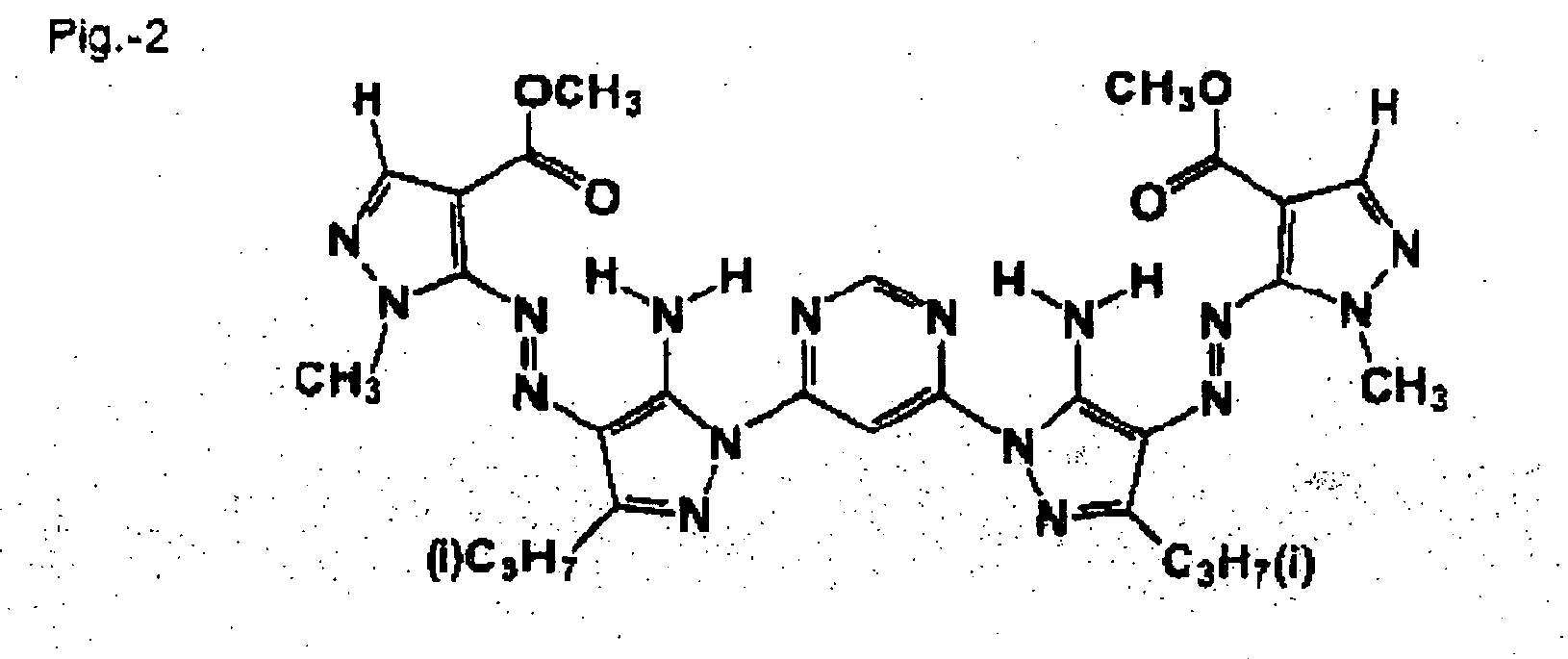


-


-


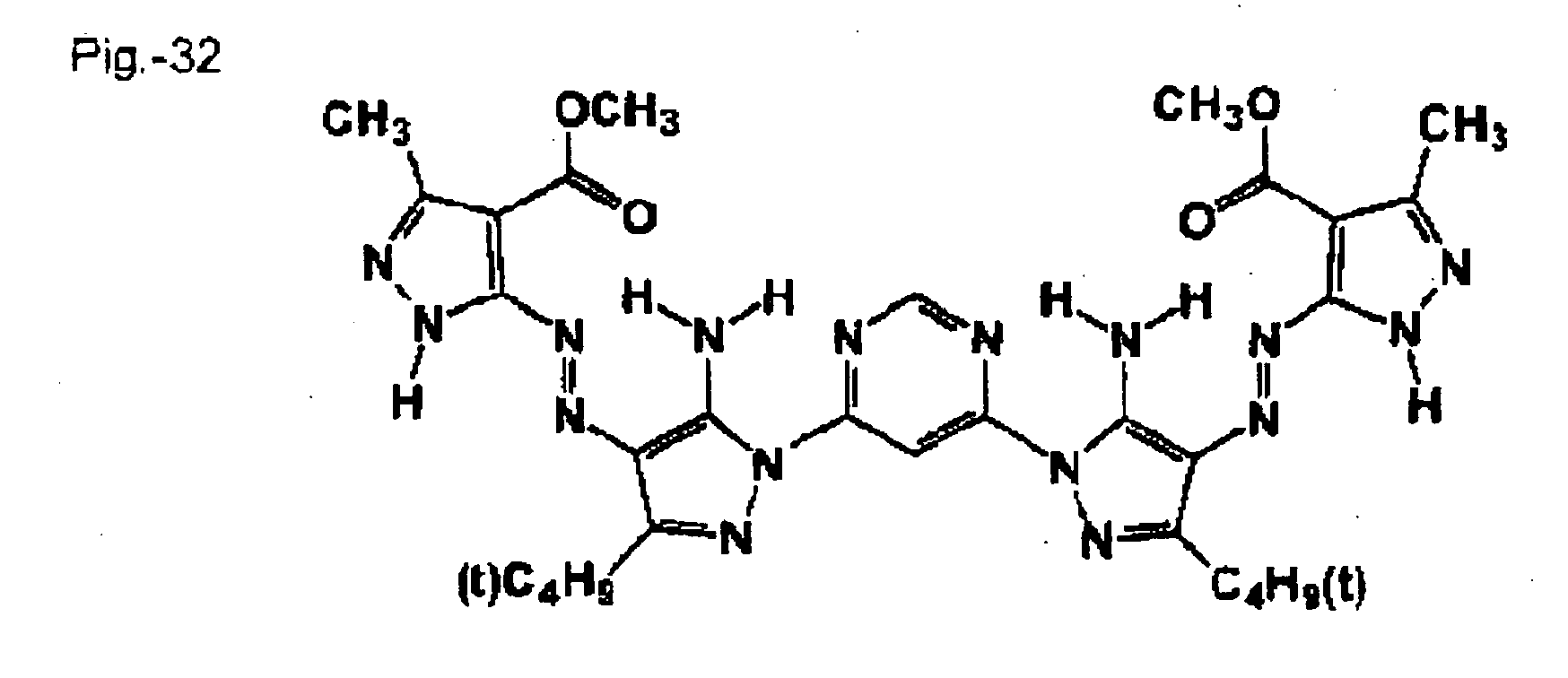
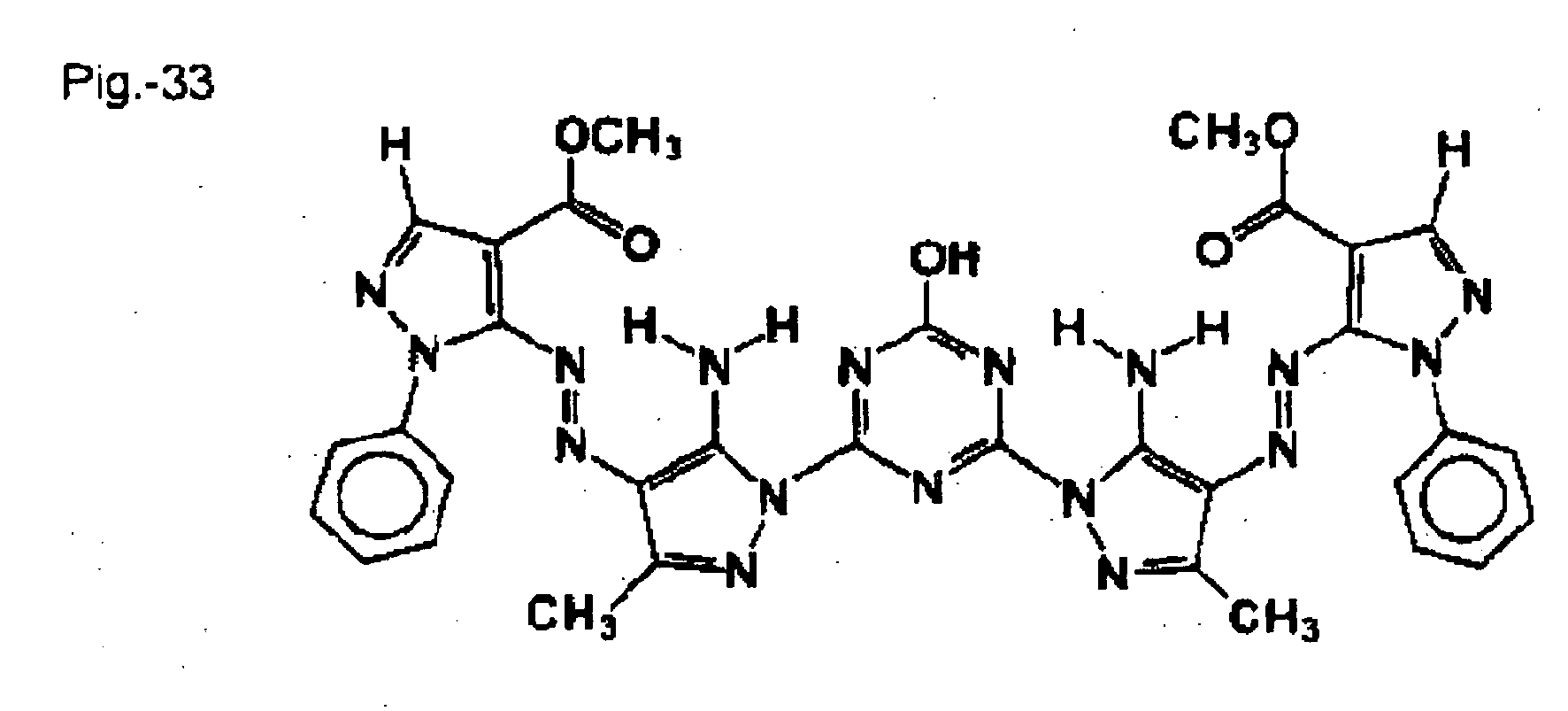


-


-
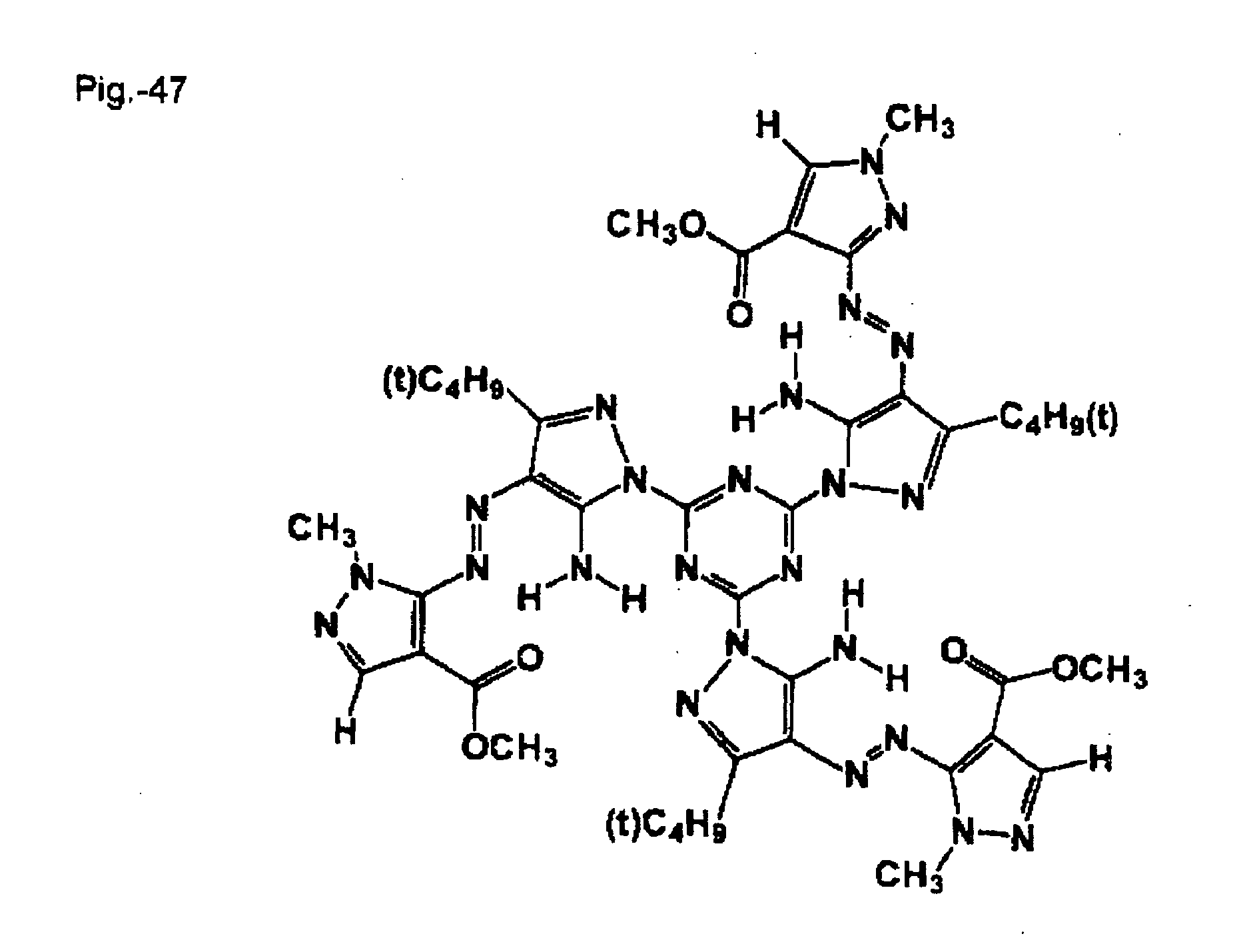

- It is enough that the chemical structures of the azo pigment represented by Formulae (1) to (4) in the invention are Formula (1) or tautomers thereof. The crystalline form is not particularly limited. The pigment may have any crystalline form, for example, a so-called polymorph (crystalline polymorphism).
- The term "crystalline polymorphism" means a crystal which has the same chemical composition, but whose arrangement of building block (molecule or ion) in the crystal is different. In the crystalline polymorphism, chemical and physical properties are determined by its crystal structure and each crystalline polymorphism may be distinguished based on rheology, hue, and other color characteristics. Further, a different crystalline polymorphism may be confirmed by X-Ray Diffraction (powder X-ray diffraction measurement result) or X-Ray Analysis (X-ray crystal structure analysis result).
When the crystalline polymorphism is present in the azo pigment represented by Formula (1) in the invention, the crystal form may be any polymorphism or may be a mixture of two or more polymorphisms. It is preferable that the crystal form includes a single polymorphism as a main component. That is, it is preferable that the level of the incorporation of crystalline polymorphism is small. The content of the azo pigment having a single crystal form is from 70% to 100%, preferably from 80% to 100%, more preferably from 90% to 100%, further preferably from 95% to 100%, and particularly preferably 100% based on the whole azo pigment. - When the azo pigment having a single crystal form is included as a main component, the regularity for the arrangement of pigment molecules is improved and the intramolecular and intermolecular interactions are enhanced. Thus, a high level three-dimensional network is easily formed. As a result, it is preferable from the viewpoint of performances required for the pigment such as improvement in the hue, lightfastness, heat fastness, humidity fastness, oxidizing gas fastness, and solvent resistance.
The mixing ratio of the crystalline polymorphism in the azo pigment may be confirmed by the value of the solid which is physicochemically measured by Single crystal X-ray crystal structure analysis, Powder X diffraction (XRD), Micrograph (TEM) of crystal, or IR (KBr method). - In the invention, when the azo pigment represented by Formula (1) has an acid group, a part or all of the acid groups may be a salt type; or a salt type pigment and a free acid type pigment may be mixed. Examples of the salt type include a salt of alkali metals such as Na, Li, and K; a salt of ammonium which may be substituted by an alkyl group or a hydroxyalkyl group; and a salt of organic amine. Examples of the organic amine include lower alkylamine, hydroxy-substituted lower alkylamine, carboxy-substituted lower alkylamine, and polyamine having 2 to 10 alkyleneimine units having 2 to 4 carbon atoms. In the case of the salt type, the type is not limited to one kind and a plurality of kinds may be mixed and used.
- In the structure of the azo pigment to be used in the invention, when a plurality of acid groups are included in one molecule, the plurality of acid groups may be respectively the salt type or acid type or they may be different from each other.
- In the invention, the azo pigment represented by Formula (1) may be a hydrate containing water molecules in the crystal and the number of water molecules in the crystal is not particularly limited.
- Subsequently, an example of the production method of the azo pigment represented by Formula (1) will be described. For example, a heterocyclic amine represented by Formula (A) described below is diazotized under acid condition, which is subjected to coupling reaction with the compound represented by the following Formula (B). The resulting product is subjected to post-treatment in the ordinary manner. Thus, the azo pigment represented by Formula (1) may be produced.
-

- In Formula (A), W and G have the same definitions as W1 or W2 and G1 or G2 in Formula (1), respectively. R11, R12, and Z in Formula (B) have the same definitions as R11, R12, and Z in Formula (1), respectively.
- The heterocyclic amine represented by Formula (A) may be generally produced by a well-known and common used method, for example, the method described in Helv. Chim. Acta, 41, 1958, 1052-1056, the method described in Helv. Chim. Acta, 42, 1959, 349-352, and the method in accordance with them.
The compound represented by Formula (B) may be produced by the methods described inPCT International publication No. 06/082669 JP-A No. 2006-57076 - The diazotizing reaction of the heterocyclic amine represented by Formula (A) may be performed by allowing the heterocyclic amine to react with reagents such as sodium nitrite, nitrosylsulfuric acid, and isoamyl nitrite in an acidic solvent such as sulfuric acid, phosphoric acid, acetic acid, hydrochloric acid, or methanesulfonic acid at a temperature of 15°C or lower for about 10 minutes to about 6 hours.
The coupling reaction may be carried out by reacting the diazonium salt obtained by the above-described method with the compound represented by Formula (B) at 40°C or lower, preferably 25°C or lower for about 10 minutes to about 12 hours. - In some cases, a crystal is precipitated in the reaction liquid. Generally, a crystal is precipitated by adding water or an alcohol solvent to the reaction liquid and then the crystal may be filtered. A crystal is also precipitated by adding the reaction liquid to an alcohol solvent or water and then precipitated crystal may be filtered. The azo pigment represented by Formula (1) may be obtained by washing and drying the filtered crystal, if necessary.
- The azo pigment represented by Formula (1) is obtained as a crude azo pigment by the above production method. When the azo pigment is used as the pigment of the invention, it is preferred to perform a post-treatment. Examples of the post-treatment include milling treatments such as solvent salt milling, salt milling, dry milling, solvent milling, and acid pasting; a process of controlling the pigment particles by solvent heating treatment; and a process of treating the surface with resins, surfactants, and dispersing agents.
- It is preferable that the azo pigment represented by Formula (1) of the invention is subjected to solvent heating treatment and/or solvent salt milling as post-treatment.
Examples of the solvent to be used for the solvent heating treatment include water; aromatic hydrocarbon solvents such as toluene and xylene; halogenated hydrocarbon solvents such as chlorobenzene and o-dichlorobenzene; alcohol solvents such as i-propanol and i-butanol; polar aprotic organic solvents such as N,N-dimethylformamide, N,N-dimethylacetamide, and N-methyl-2-pyrrolidone; glacial acetic acid, pyridine, and mixtures thereof. Organic or inorganic acids or bases may be further added to the above-described solvents. The temperature of solvent heating treatment varies depending on the primary particle diameter of the desired pigment and the temperature is preferably from 40°C to 150°C, and further preferably from 60°C to 100°C. Further, the time for the treatment is preferably from 30 minutes to 24 hours. - An example of the solvent salt milling includes a method including the steps of placing a crude azo pigment, an inorganic salt, and an organic solvent which does not dissolve the organic salt into a kneading machine and kneading and grinding in it. As the inorganic salt, a water-soluble inorganic salt may be suitably used. Preferable examples thereof include inorganic salts such as sodium chloride, potassium chloride, and sodium sulfate. It is more preferable to use an inorganic salt having an average particle diameter of 0.5 µm to 50 µm. The amount of the inorganic salt is preferably 3 parts by mass to 20 parts by mass, more preferably 5 parts by mass to 15 parts by mass with respect to the crude azo pigment. A water-soluble organic solvent may be suitably used as the organic solvent. However, the solvent evaporates easily due to the temperature rise at the time of kneading and, thus a high-boiling-point solvent is preferable from a viewpoint of safety.
- Examples of the water soluble organic solvent include diethylene glycol, glycerol, ethylene glycol, propylene glycol, liquid polyethylene glycol, liquid polypropylene glycol, 2-(methoxymethoxy) ethanol, 2-butoxyethanol, 2-(isopentyloxy) ethanol, 2-(hexyloxy) ethanol, diethylene glycol monomethyl ether, diethylene glycol monoethyl ether, diethylene glycol monobutyl ether, triethylene glycol, triethylene glycol monomethyl ether, 1-methoxy-2-propanol, 1-ethoxy-2-propanol, dipropylene glycol, dipropylene glycol monomethyl ether, dipropylene glycol monomethyl ether, dipropylene glycol, and mixtures thereof. The amount of the water-soluble organic solvent is preferably from 0.1 parts by mass to 5 parts by mass based on the crude azo pigment. The kneading temperature is preferably from 20°C to 130°C, and particularly preferably from 40°C to 110°C. Usable examples of the kneading machine include kneaders and mix maulers.
- The content of the azo pigment represented by Formula (1), tautomers thereof, salts thereof or hydrates thereof in the oil-based ink composition for inkjet recording of the invention may be preferably set in a range of 0.5% by mass to 12% by mass, more preferably set in a range of 1% by mass to 10% by mass, and even more preferably set in a range of 2% by mass to 8% by mass, from the viewpoints of image density and ink stability.
- The oil-based inkjet recording ink according to the invention contains at least one of polymer dispersants. By the use of a polymer dispersant, dispersion stability of the pigment is further improved. As the polymer dispersant, dispersants generally used in oil-based inks may be arbitrarily used. "Polymer" in the invention means a resin having a weight average molecular weight of 3,000 or more.
- Polymer dispersants containing a hydrophobic group in the molecule are preferred, and those insoluble in water are more preferred. Polymer dispersants containing a hydrophobic group are capable of improving the waterproofness of a recorded matter furthermore.
As the example of polymer dispersants, polyester-based dispersants having a polyester chain in the molecule are exemplified. By containing a flexible polyester chain, adsorption onto a pigment increases and dispersibility is improved. Specifically, for example, compounds obtained by the reaction of polyalkyleneimine with a polyester compound as disclosed inJP-A Nos. 54-37082 61-174939 JP-A No. 9-169821 JP-A No. 9-171253 JP-A No. 60-166318 - Commercially available polymer dispersants include, for example, as the above polyester-based dispersants, "SOLSPERSE" (e.g., SOLSPERSE 17000, 24000 GR, 28000, 32000, and 38500; trade name, manufactured by The Lubrizol Corporation), "DISPERBYK" (e.g., DISPERBYK-161, 162, 167, and 168; trade name, manufactured by BYK Japan KK), "EFKA" (e.g., EFKA 4047 and 4050; trade name, manufactured by EFKA Additives Inc.), and "AJISPER" (e.g., AJISPER PB711, PN411, PA111, PB821, and PB822; trade name, manufactured by Ajinomoto Fine Techno Co., Inc.).
- As polymer dispersants besides the above commercially available products, polymer dispersants synthesized by copolymerization of a cationic monomer having a basic group, an anionic monomer having an acidic group, a monomer having a hydrophobic group, and, if necessary, other monomers such as a nonionic monomer and a monomer having a hydrophilic group may be used. In connection with the details of the cationic monomer, anionic monomer, monomer having a hydrophobic group, and other monomers such as a nonionic monomer and a monomer having a hydrophilic group, the monomers disclosed in
JP-A No. 2004-250502 - The content of the polymer dispersant in the oil-based inkjet recording ink of the invention is preferably 10% to 100% by mass to the pigment represented by Formula (1), and more preferably 20% to 80% by mass, although the content depends upon the kinds of the pigment and solvent and the dispersion condition. When the content of the polymer dispersant is in the above range, the particle size of dispersed particles can be made smaller and dispersibility can be stabilized furthermore.
- An oil-based inkjet recording ink of the invention includes at least one organic solvent. Example of the organic solvent includes a solvent such as an alcohol-based compound, a ketone-based compound, an ester-based compound, an amine-based compound, a glycol-based compound, a glycol erther-based compound, an aromatic compound; a hydrocarbon-based solvent; and a lactone-based compound.
- As preferred organic solvents, polyoxyethylene glycol dialkyl ethers are exemplified for the reasons that they are excellent in volatilization suppression, solidification prevention, and re-solubility when solidified, of the oil-based ink in the apparatus such as a nozzle part and the inside of tube, and capable of restraining cockling of plain paper. An example of the organic solvent is preferably a polyoxyethylene glycol dialkyl ether represented by the following Formula (α):
Formula (α): R21-(OC2H4)l-OR22.
- In Formula (α), R21 and R22 each independently represent an alkyl group having 1 to 3 carbon atoms and may be the same or different from each other. 1 denotes an integer of 2 to 4.
- An alkyl group having 1 to 3 carbon atoms, represented by R21 or R22 may be straight-chain or branched, and includes, for example, methyl group, ethyl group and propyl group.
- Examples of the polyoxyethylene glycol dialkyl ether represented by Formula (α) include diethylene glycol dimethyl ether, triethylene glycol dimethyl ether, tetraiethylene glycol dimethyl ether, diethylene glycol diethyl ether, triethylene glycol diethyl ether, tetraethylene glycol diethyl ether, diethylene glycol ethyl methyl ether, triethylene glycol ethyl methyl ether, tetraethylene glycol ethyl methyl ether, diethylene glycol di-n-propyl ether and diethylene glycol di-iso-propyl ether. Among above, diethylene glycol diethyl ether, triethylene glycol dimethyl ether or diethylene glycol ethyl methyl ether is preferable.
- A polyoxyethylene glycol monoalkyl ether or a polyoxypropylene glycol monoalkyl ether is also preferable as the organic solvent, from the viewpoint of excellent re-soluble property of the oil-based ink when the oil-based ink be solidified in a apparatus such as a nozzle, a tube and the like. Examples of the preferable organic solvent include a polyoxyethylene glycol monoalkyl ether represented by the following Formula (β) and/or a polyoxypropylene glycol monoalkyl ether represented by the following Formula (γ).
Formula (β): R31-(OC2H4)m-OH
Formula (γ): R41-(OC2H4)n-OH.
- In Formula (β), R31 represents an alkyl group having 1 to 6 carbon atoms, and m denotes an integer of 3 to 6. Among the alkyl group having 1 to 6 carbon atoms, represented by R31, an alkyl group having 1 to 4 carbon atoms is preferable and, for example, a methyl group, an ethyl group, a propyl group or a butyl group is more preferable.
Examples of the polyoxyethylene glycol monoalkyl ether represented by Formula (β) include triethylene glycol monomethyl ether, triethylene glycol monobutyl ether, tetraethylene glycol monomethyl ether, tetraethylene glycol monobutyl ether, pentaethylene glycol monomethyl ether, thexaethylene glycol monomethyl ether and the like. - In Formula (γ), R41 represents an alkyl group having 1 to 4 carbon atoms, and n denotes an integer of 2 to 3. Among the alkyl group having 1 to 4 carbon atoms, represented by R41, a methyl group, an ethyl group, a propyl group or a butyl group is, for example, preferable.
Examples of the polyoxypropylene glycol monoalkyl ether represented by Formula (γ) include polyoxypropylene glycol monoalkyl ether, dipropylene glycol monomethyl ether, dipropylene glycol monoethyl ether, dipropylene glycol monopropyl ether, dipropylene glycol monobutyl ether, tripropylene glycol monomethyl ether and the like. - The organic solvent includes (poly)alkylene glycol monoalkyl ether monoalkanoate as a preferable solvent other than the preferable organic solvent described above. Examples of the (poly)alkylene glycol monoalkyl ether monoalkanoate include diethylene glycol monomethyl ether acetate, diethylene glycol monoethyl ether acetate, diethylene glycol monomethyl ether propionate, diethylene glycol monomethyl ether pentanoate, diethylene glycol monobutyl ether acetate, diethylene glycol monobutyl ether propionate, dipropylene glycol monomethyl ether acetate, dipropylene glycol monoethyl ether acetate, dipropylene glycol monobutyl ether acetate, dipropylene glycol monoethyl ether propionate, dipropylene glycol monoethyl ether pentanoate, triethylene glycol monomethyl ether acetate, triethylene glycol monoethyl ether acetate, triethylene glycol monobutyl ether acetate, tetraethylene glycol monomethyl ether acetate, tetraethylene glycol monoethyl ether acetate, tetraethylene glycol monobutyl ether acetate and the like. Among these, di- or tripropylene glycol-based compound is particularly preferable than di- or triethylene glycol-based compound as a solvent for the oil-based ink of the invention, from the viewpoint of a safer solvent
- A boiling point of the polyoxyethylene glycol dialkyl ether is preferably 150°C or more, and more preferably 180°C or more under the atmosphere. Upper limit of the boiling point is not limited, but around 240°C from a functionality of the solvent of an inkjet ink for inkjet recording. A density at 20°C of the polyoxyethylene glycol dialkyl ether is preferably 0.9 g/cm3 or more. A polyoxyethylene glycol dialkyl ether is more preferable than a polyalkylene glycol monoalkyl ether monoalkanoate from the view points of leveling property of an ink and drying property using them as a main solvent of the oil-based ink of the invention.
- A boiling point of the polyoxyethylene glycol monoalkyl ether is preferably 200°C to 305°C, and more preferably 240°C to 305°C under the atmosphere from the view point of imparting to an ink suppressed volatile property.
A boiling point of the polyoxypropylene glycol monoalkyl ether is preferably 170°C to 245°C, and more preferably 180°C to 240°C under the atmosphere from the view point of imparting to an ink suppressed volatile property. - From the view point of imparting to an ink suppressed volatile property, triethyl citrate is also preferably used as the organic solvent for the oil-based ink of the invention.
- It is preferred to use an organic solvent having a flash temperature of 70°C or higher from the viewpoint that the flash temperature of the oil-based ink is set at 70°C or higher.
By the design to raise the level of the oil-based ink to flame resistant dangerous material, flash resistant petroleum, or higher, dangerousness such as flash ignition is reduced, and the oil-based ink can be relatively easily handled. When the flash temperature of the oil-based ink is made 70°C or higher, it is classified to a flame resistant dangerous material, flash resistant petroleum, or higher, listed in the classified list of fire protection law, as a result it becomes to be easily handled in manufacture, preservation, and transportation. Further, in troubles such as leakage, dangerousness of flash ignition is also restrained. When the flash temperature of the organic solvent is lower than 70°C, the flash temperature of the ink as a whole is difficult to be raised to 70°C or higher even by the addition of other solvents having higher flash temperatures. However, if the flash temperature of the main solvent is 70°C or higher, even when another solvent having a flash temperature of lower than 70°C is added, the flash temperature of the ink as a whole can be easily designed to be 70°C or higher by the adjustment of the addition amount of the organic solvent to be added.
Further, the main solvent having a flash temperature of 70°C or higher has a boiling temperature of 150°C or higher and vapor pressure at 20°C of 5 mmHg or lower, so that excellent working environment can be obtained. - In the invention, a hydrocarbon-based solvent may be used in addition to the above organic solvents, or separately. By the addition of a hydrocarbon-based solvent, the solubility in a solvent of a pigment dispersant and a resin having an affinity to the organic solvent is a little reduced, the adsorption onto the pigment is improved, the flowability of the ink increases, and preservation stability can be heightened. When a hydrocarbon-based solvent having such effects is used, the content of the hydrocarbon-based solvent is determined so that the flash temperature of the ink is not lower than 70°C. The content is generally preferably 1% to 30% by mass with respect to a total mass of the organic solvents, and more preferably 3% to 20% by mass.
- A hydrocarbon-based solvent is a compound formed of carbon atoms and hydrogen atoms alone. A hydrocarbon-based solvent is generally a distillate from a natural or synthetic hydrocarbon mixture consisting of a single component or a mixture, and alkane, alkene, alkyne, cycloalkane and aromatic hydrocarbon are included by each molecular structure. As such hydrocarbon-based solvents, for example, paraffin such as normal paraffin and isoparaffin, naphthene, and paraffn/naphthene mixed solvent are exemplified. The property of the hydrocarbon-based solvents may be a fluid state or a solid state. Of the above, isoparaffin-based solvents, normal paraffin-based solvents, fluidized paraffin-based solvents, and paraffin/naphthene-based solvents are preferred, and their commercial products are easily available.
- The specific examples of hydrocarbon-based solvents include isoparaffin-based solvents ISOPAR G, H, L and M, NOPAR 12, 13 and 15;trade name, and paraffin/naphthene mixed solvent EXONOL D110 and D130 (trade name, all manufactured by Exxon Chemical), isoparaffin-based solvents IP SOLVENT 16, 20 and 2028 (trade name, all manufactured by Idemitsu Petrochemical Co., Ltd.), normal paraffin-based solvents NORMAL PARAFFIN SL, L, M and H, O-type solvents L, M and H (trade name), isoparaffin-based solvents ISOSOL 300 and 400 (trade name), naphthene-based solvents AF-4, AF-7, AF-5, and AF-6 (trade name), TECLEAN N16, N20, and N22 (trade name), paraffin-based solvents DRY SOLVENT, DRY SOLVENT HIGH SOFT, CLEANSOL, MINERAL SPIRIT A, A SOLVENT, and HIGHALOM 2S (trade name, all manufactured by Nippon Petrochemicals Co., Ltd.), isoparaffin-based solvent MARKASOL R (trade name, manufactured by Maruzen Petrochemical Co., Ltd.), paraffin-based solvents IDEMITSU SUPER SOL LA25, LA30, LA35, LA41, FP20, FP25, FP30, FP38, and CA25, and DIANA FRESIA P02, P05, and S02 (trade name, all manufactured by Idemitsu Kosan Co., Ltd.), isoparaffin-based solvents SHELL SOL 71 and 72 (trade name), and paraffin-naphthene mixture-based solvent SHELL SOL D100 (trade name, all manufactured by Shell Japan, Ltd.), and liquid paraffin-based solvents MORESCO WHITE P-40, P-55, P-60, P-70, P-80, P-100, P-120, P-150, P-200, P-230, P-260, P-300, and P-305P, and MORESCO BIOLESS (trade name, all manufactured by Matsumura Oil Research Corp.).
Hydrocarbon solvents may be used by one kind alone, or two or more may be used as mixture. - By the addition of these hydrocarbon-based solvents each having a low molecular weight to the ink, flowability can be heightened, and contrary to this, by the addition of those having a high molecular weight to the ink, the flash temperature is made high, so that safety can be increased. It is preferred that the flash temperature of the hydrocarbon-based solvent is a temperature not too low so as to be capable of maintaining safety, and the molecular weight of the hydrocarbon-based solvents is high to a certain degree not to damage the flowability of the ink from the viewpoints of the ejecting ability of ink while restraining head clogging due to drying property improvement, the solubility of the pigment dispersant and resin, and dispersibility. The flash temperature of the hydrocarbon-based solvents is preferably 70°C or higher for safety.
- The organic solvent in the invention may be a mixed solvent consisting of polyoxyethylene glycol dialkyl ether, polyoxyethylene glycol monoalkyl ether, or polyoxypropylene glycol monoalkyl ether to which is added other generally used solvent such as water, an alcohol compound, a ketone compound, an ester compound, an amine compound, a glycol compound, a glycol ether compound, or an aromatic compound. In this case, the amounts of water and the alcohol compounds to be used in combination may be optionally selected in accordance with each solvent by well considering the physical properties and safety.
- Further, a lactone-based solvent may be used in the invention. The lactone-based solvent is a compound having a cyclic structure by ester bonding, and γ-lactone of a 5-membered structure, δ-lactone of a 6-membered structure, and ε-lactone of a 7-membered structure are known. As the lactone solvents, e.g., γ-butyrolactone, γ-valerolactone, γ-hexalactone, γ-heptalactone, γ-octalactone, γ-nonalactone, γ-decalactone, γ-undecalactone, δ-valerolactone, δ-hexalactone, δ-heptalactone, δ-octalactone, δ-nonalactone, δ-decalactone, δ-undecalactone, and ε-caprolactone are exemplified.
- Among the lactone-based solvents, γ-lactone of a 5-membered structure is preferred in the point of excellent permeability to a polyvinyl chloride base material, and γ-butyrolactone and γ-valerolactone are more preferred.
- In a mixed solvent of the organic solvent and the lactone solvent in combination, the proportion of each solvent in the mixed solvent is 0.02 parts to 4 parts by mass of the lactone-based solvent with respect to 1 part by mass of polyoxyethylene glycol dialkyl ether represented by Formula (α), and preferably 0.05 parts to 2 parts by mass.
- The content of the organic solvents in the oil-based inkjet recording ink of the invention is preferably 50% by mass or more, and more preferably 70% by mass or more. When the proportion of the organic solvents is in the above range, the dispersion stability of the pigment is bettered, and excellent permeability to a polyvinyl chloride base material, leveling property and drying property of the image part are ensured.
- The oil-based inkjet recording ink in the invention contains at least one of resins. The abrasion resistance of the image can be further improved by containing a resin.
- Anionic resins are exemplified as the resins to be contained. The anionic resins preferably have an acid value of 5 mg KOH/g to 150 mg KOH/g, more preferably 20 mg KOH/g to 100 mg KOH/g, and even more preferably 30 mg KOH/g to 80 mg KOH/g. When the acid value is 5 mg KOH/g or more, the affinity of the resin with the pigment and the surface of the medium is bettered, and when it is 150 mg/KOH/g or less, the improving effect of abrasion resistance is effectively obtained while suppressing the viscosity of ink.
- The anionic resins preferably have a weight average molecular weight of 5,000 to 100,000, more preferably 8,000 to 60,000, and still more preferably 10,000 to 30,000. When the molecular weight is 5,000 or more, an effect of stereoscopic repulsion is liable to be obtained when anionic resin is adsorbed onto the pigment particles in the ink, further, preservation improving effect increases and the strength of the image part is improved. While when the molecular weight is 100,000 or less, the flowability of ink can be maintained with suppressing the viscosity of ink. Incidentally, the weight average molecular weight is measured as polystyrene equivalent molecular weight by gel permeation chromatography.
- The anionic resins are preferably resins having an acryloyl group or a methacryloyl group, and resins having a polyether structure containing at least one of a polyoxyethylene structure and a polyoxypropylene structure. The resins having an acryloyl group or a methacryloyl group are (meth)acrylic resins. From the point that excellent adhesion of pigment dispersion to a polyvinyl chloride base material is secured, a homopolymer of methyl methacrylate and a copolymers of methyl methacrylate and butyl methacrylate are preferred.
Further, the polyether structure has good affinity with the organic solvent and is excellent in dispersion stability of the pigment and capable of heightening the fixing property of a recorded matter. As such anionic resins, resins synthesized by copolymerization of a macromonomer having a polyether structure and an anionic monomer, and if necessary, other monomers such as cationic monomer, nonionic monomer, hydrophobic monomer, or hydrophilic monomer can be used. As the macromonomer having a polyether structure, macromonomers having methoxypolyethylene glycol or methoxypolypropylene glycol bonded directly or via an alkyl group to an acryloyl group or a methacryloyl group are preferably used. As other monomers such as the anionic monomer, the same monomers exemplified above as the monomers for synthesizing polymer dispersant are preferably used. As the anionic resins, (meth)acrylic resins obtained by copolymerization of these monomers are preferably used. - As the macromonomer having a polyether structure, various macromonomers are commercially available, for example, PE-200, PE-350, AE-200, AE-350, AP-400, AP-550, AP-800, 70PEP-350B, 10PEP-550B, AEP, 50POEP-800B, 50AOEP-800B, PLE, ALE, PSE, ASE, PNE, ANE, PNP, ANP, PNEP-600, PME-200, PME-400, PME-1000, AME-400, PP-500, PP-800, and PP-1000 (trade name, all manufactured by Nippon Oils and Fats Co., Ltd.), AMP-10G, AMP-20G, AMP-60G, and AM-90G (trade name, all manufactured by Shin-Nakamura Chemical Co., Ltd.), Viscoat #355HP, Viscoat #310, Viscoat #310HP, Viscoat #310HG, Viscoat #312, and Viscoat #700 (trade name, all manufactured by Osaka Organic Chemical Industry Co., Ltd.), Light Acrylate EHDG-A, Light Acrylate EC-A, Light Acrylate MTG-A, Light Acrylate 130A, Light Acrylate P-200A, Light Acrylate NP-4EA, Light Acrylate NP-8EA, Light Ester MC, Light Ester 130MA, and Light Ester 041MA (trade name, all manufactured by Kyoeisha Chemical Co., Ltd.), NK Ester M-20G, NK Ester M-40G, and NK Ester M-90G (trade name, all manufactured by Shin-Nakamura Chemical Co., Ltd.), and ADEKALIA SOAP NE-10, ADEKALIA SOAP NE-20, and ADEKALIA SOAP NE-40 (trade name, all manufactured by Adeka Corporation) are exemplified.
- The content of the resins in the oil-based inkjet recording ink is preferably 10% to 200% by mass with respect to the total amount of pigments including the pigment represented by Formula (1), more preferably 15% to 150% by mass, and even more preferably 20% to 100% by mass. When the content of the resins is 10% by mass or more, the proportion to the pigments is good and stable fixing property is obtained, while when the content is 200% by mass or less, viscosity of the ink is restrained.
- The solids content of the ink consisting of the resin and pigment in the oil-based inkjet recording ink of the invention is preferably 1% to 20% by mass, and more preferably 2% to 15% by mass.
- In addition to the above components, if necessary, any of known additives such as a surfactant, a surface adjustor, a leveling agent, a defoaming agent, an antioxidant, a pH adjustor, a charge applying agent, a sterilizer, an antiseptic, a deodorant, a charge adjustor, a wetting agent, a skimming preventive, a perfume, and a pigment derivative may be added to the oil-based inkjet recording ink of the invention as optional components.
- Manufacturing method of the oil-based inkjet recording ink of the invention is not especially restricted. The oil-based inkjet recording ink may be manufactured by stirring, mixing and dispersing each component with a container-driving medium mill, e.g., a ball mill, a centrifugal mill, or a planetary ball mill, a high speed rotary mill, e.g., a sand mill, a medium stirring mill, e.g., a stirring vessel-type mill, or a simple disperser, e.g., Disper. The addition order of each component is arbitrary. Preferably, the azo pigment represented by Formula (1), the polymer dispersant and the organic solvent are pre-mixed and dispersed, and the resulting dispersion is mixed with the resin (e.g., the anionic resin) and the organic solvent. In this case, the dispersion is mixed homogeneously with a simple stirrer, e.g., a three-one motor, a magnetic stirrer, Disper, or a homogenizer at the time of stirring or after stirring. Alternatively, mixing may be performed with a line mixer and the like. Further, for the purpose of making dispersed particles finer, they may be mixed with a disperser such as a bead mill and a high pressure injection mill. According to the kinds of pigments and polymer dispersants, anionic resins may be added at the time of pre-mixing before pigment dispersion.
- It is preferred for the oil-based inkjet recording ink of the invention to have surface tension of 20 mN/m to 40 mN/m at 25°C. The surface tension is measured with AUTOMATIC SURFACE TENSIOMETER CBVP-Z (trade name, manufactured by Kyowa Interface Science Co., Ltd.) on the condition of ink at 25°C. Viscosity of the ink is preferably 1 mPa·S to 20 mPa·S, and more preferably 3 mPa·S to 15 mPa·S. The viscosity is measured with VISCOMETER TV-22 (trade name, manufactured by TOKI SANGYO CO., LTD.) on the condition of ink at 25°C.
The dispersion average particle size of pigment particles in the oil-based inkjet recording ink is preferably 50 nm to 150 nm as the volume basis average particle size D50, and more preferably 60 nm to 100 nm. When D50 is 50 nm or more, a recorded matter having suitable light fastness is obtained, and when it is 150 nm or less, good ejecting ability is secured, and a precious printed matter having higher resolution is obtained.
These physical properties can be easily adjusted by selecting the organic solvents and arbitrarily regulating the kinds and amount of other components.
This application is intended to refer entire disclosure of Japanese Patent Application No.2009-068821 filed on March 19, 2009 - Hereinafter, the invention is described in more detail with reference to examples, but the invention is not limited to the examples as long as no exceeding of the subject matter of the invention. Further, "parts" and "%" are expressed in terms of mass, unless otherwise specified.
- Among the compounds represented by Formula (1), the synthetic scheme of the exemplified compound (Pig.-1) is shown below.
-

- 42.4 g (0.4 mol) of trimethyl orthoformate, 20.4 g (0.2 mol) of acetic anhydride, and 0.5 g of p-toluenesulfonic acid were added to 29.7 g (0.3 mol) of methyl cyanoacetate, which was heated at 110°C (outside temperature) and then stirred for 20 hours while a low-boiling-point component formed from the reaction system was distilled away. The reaction liquid was concentrated under reduced pressure. Thereafter, the resulting product was purified on a silica gel column, and 14.1 g of the intermediate (a) (yellow powder, yield: 30%) was obtained. The results of NMR measurement of the obtained intermediate (a) are shown below.
1H-NMR (300MHz, CDCl3) 7.96(s,1H), 4.15(s,3H), 3.81(s,3H) - 150 mL of i-propanol was added to 7.4 mL (141 mmol) of methylhydrazine, which was cooled to 15°C (inside temperature). 7.0 g (49.6 mmol) of the intermediate (a) was gradually added to the mixed solution, which was then heated at 50°C and stirred for 1 hour and 40 minutes. The reaction liquid was concentrated under reduced pressure. Thereafter, the resulting product was purified on a silica gel column, and 10.5 g of the intermediate (b) (white powder, yield: 50%) was obtained. The results of NMR measurement of the obtained intermediate (b) are shown below.
1H-NMR (300MHz, CDCl3) 7.60(s,1H), 4.95(brs,2H), 3.80(s,3H), 3.60(s,3H) - 100 mL of methanol was added to 130 mL of hydrazine monohydrate, which was cooled to 10°C (inside temperature). 50.0 g (336 mmol) of 4,6-dichloropyrimidine was gradually added to the mixed solution (inside temperature: 20°C or lower), which was then heated at 50°C and stirred for 4 hours and 30 minutes. A crystal precipitated from the reaction liquid was filtered, washed with i-propanol, and dried. Thereby, 43.1 g of the intermediate (c) (white powder, yield: 92%) was obtained. The results of NMR measurement of the obtained intermediate (c) are shown below.
1H-NMR (300MHz, d6-DMSO) 7.82(s,1H), 7.55(s,2H), 5.96(s,1H), 4.12(s,4H) - 900 mL of water was added to 35.0 g (0.25 mol) of the intermediate (c) and 68.8 g (0.55 mol) of pivaloylacetonitrile, which was stirred at room temperature. 1 M hydrochloric acid aqueous solution was added dropwise into the suspension so as to give the pH of 3, which was then heated at 50°C and stirred for 8 hours.
8 M potassium hydroxide aqueous solution was added dropwise into the reaction liquid, so as to adjust the pH to 8. Further, 1 M hydrochloric acid aqueous solution was added dropwise thereto so as to give the pH of 6. The precipitated crystal was filtered, washed with i-propanol, and dried. Thereby, 83.0 g of the intermediate (d) (white powder, yield: 94%) was obtained. The results of NMR measurement of the obtained intermediate (d) are shown below.
1H-NMR (300MHz, d6-DMSO) 8.73(s,1H). 7.97(s,1H), 6.88(s,4H), 5.35(s,2H), 1.22(s,18H) - 18.5 mL of acetic acid was added to 4.1 mL of concentrated sulfuric acid, which was cooled on ice and stirred. 3.85 g (12.1 mmol) of 40% nitrosylsulfuric acid was added dropwise thereto. 1.71 g (11.0 mmol) of the intermediate (b) was gradually added to the mixed solution (inside temperature: 0°C or lower), which was then stirred at 0°C for 2 hours. 150 mg of urea was added to the reaction liquid, which was stirred at 0°C for 15 minutes to prepare a diazo solution A.
50 mL of methanol was added to the intermediate (d), which was heated and dissolved. Then, the resulting mixed solution was cooled on ice and stirred. The diazo solution A was slowly added dropwise to the mixed solution (inside temperature: 10°C or lower). The reaction liquid was stirred at room temperature for 2 hours. A crystal precipitated was filtered, washed with methanol. Thereby, a crude crystal of the exemplified compound (Pig.-1) was obtained. Further, water was added to the crude crystal, which was stirred. The pH of the suspension was adjusted to 7 using a sodium hydroxide aqueous solution. 20 mL of dimethylacetamide was added thereto and stirred at 80°C for 2 hours. A crystal precipitated was filtered and was suspended and washed with methanol. The obtained crystal was filtered and dried to give 2.0 g of the exemplified compound (Pig.-1) (yellow powder, yield: 79%). - Exemplified compounds (Pig.-5), (Pig.-18), and (Pig.-19) were also synthesized as the compounds represented by Formula (1), in a manner substantially similar to the synthetic scheme described above.
- The components of the following composition were mixed and stirred homogeneously by using a dissolver, and the obtained pre-dispersion was further dispersed with 0.1 mmϕ zirconia beads in a vertical beads mill (READY MILL; trade name, manufactured by Aimex Co., Ltd.) for 3 to 6 hours to prepare yellow pigment dispersion YP-1.
<Composition of yellow pigment dispersion YP-1> · Exemplified compound (Pig.-1, azo pigment represented by Formula (1)) 20.0 parts · Solsperse 32000 12.0 parts (trade name, manufactured by Nippon Lubrisol, Ltd., Japan, polyester compound) · Diethylene glycol diethyl ether 68.0 parts - With respect to the obtained yellow pigment dispersion YP-1, a volume basis average particle size D50 was measured using a particle size distribution measuring device LA910 (trade name, manufactured by Horiba, Ltd.), which is based on a light scattering diffraction system, and evaluation was performed according to the following evaluation criteria.
-
- A: D50 is less than 100 nm.
- B: D50 is 100 nm or more and less than 150 nm.
- C: D50 is 150 nm or more.
- In the next place, oil-based ink YI-1 was prepared by mixing the components of the following composition by using the obtained yellow pigment dispersion YP-1.
<Composition of oil-based ink YI-1> · Yellow pigment dispersion YP-1 25.0 parts · Dipropylene glycol monomethyl ether 18.0 parts (flash temperature: 74°C, boiling temperature: 190°C) · Diethylene glycol diethyl ether 30.5 parts (flash temperature: 71°C, boiling temperature: 189°C) · Tetraethylene glycol monobutyl ether 6.5 parts (flash temperature: 143°C, boiling temperature: 278°C) · γ-Butyrolactone (lactone-based solvent) 15.0 parts (flash temperature: 98°C, boiling temperature: 203°C) · Elvacite 2013 (resin) 5.0 parts (trade name, manufactured by Du Pont; methyl methacrylate/butyl methacrylate copolymer) - With respect to the obtained oil-based ink YI-1, the following measurements and evaluations were carried out. The results of measurements and evaluations are shown in Table 1 below.
- The obtained oil-based ink YI-1 was put in a PET container and sealed. The container was preserved in a thermostatic chamber at 60°C for 14 days, and the viscosity and average particle size after preservation were measured. The viscosity and average particle size of oil-based ink YI-1 before preservation were also measured in the same manner. The viscosity was measured with R100 viscometer (trade name, manufactured by Toki Sangyo Co., Ltd.) under a condition of a revolution speed of the cone of 20 rpm at a temperature of 25°C. With respect to the average particle size, volume basis average particle size D50 was measured by using a particle size distribution measuring device LA910 (trade name, manufactured by Horiba, Ltd.), which is based on a light scattering diffraction system. The stability of ink was evaluated according to the following evaluation criteria with each measured value as the index. The results of evaluation are shown in Table 1 below.
-
- A: Both viscosity and average particle size are within ±6% of the value before preservation.
- B: Either viscosity or average particle size exceeds ±6% of the value before preservation.
- The obtained oil-based ink YI-1 was put in a PET container and sealed. The container was preserved in a thermostatic chamber at 60°C for 14 days. As the recording medium, "KASSAI PHOTO-FINISH PRO" (trade name, manufactured by FUJIFILM CORPORATION) was used. As the inkjet printer, an inkjet printer equipped with a prototype print head of 600 dpi, 256 nozzles was prepared. Oil-based ink YI-1 obtained by preservation in a thermostatic chamber at 60°C for 14 days was loaded into the inkjet printer. After ejection from the head for 30 minutes, pressure of 15 KPa was applied to the head for 10 seconds as maintenance work, and then the head was wiped with clean wiper FF-390c (trade name, manufactured by Kuraray Co., Ltd.) and followed by ejection for further 5 minutes. After elapse of 5 minutes, solid recording and fine line recording were performed on the above recording medium (KASSAI PHOTO-FINISH PRO), and the obtained image (5 cm × 5 cm) was observed. The observed image was visually evaluated according to the following criteria of evaluation.
-
- A: Occurrence of the lack of dots due to generation of blank area is not observed and good image is obtained.
- B: Image failure such as the occurrence of lack of dots due to generation of blank area is observed a little but in a practicable degree.
- C: Lots of image failures such as the occurrence of lack of dots due to generation of blank area are observed.
- An inkjet printer equipped with a prototype print head of 600 dpi, 256 nozzles was prepared as inkjet printer similarly to the evaluation of the above item "2. Recoverability of ejection". Oil-based ink YI-1 was loaded into the inkjet printer and printing was performed on a polyvinyl chloride film (VIEWCAL 900; trade name, manufactured by Lintec Corporation). Abrasion test was performed on the recorded surface (recorded image) under the condition of the load of 200 g and 50 times of going and returning with test cloth (unbleached muslin No. 3) and a rubbing tester (model AB301; trade name, manufactured by Tester Sangyo Co., Ltd), and the presence of peeling off of the ink was visually evaluated according to the following criteria of evaluation. The results of evaluation are shown in Table 1 below.
-
- A: Peeling off of the ink is not observed.
- B: Peeling off of the ink is observed a little but in a practicable degree.
- C: Peeling off of the ink is conspicuously observed in an impracticable degree.
- An inkjet printer equipped with a prototype print head of 600 dpi, 256 nozzles was prepared as inkjet printer similarly to the evaluation of the above item "2. Recoverability of ejection". Oil-based ink YI-1 was loaded into the inkjet printer and fine lines were recorded on "KASSAI PHOTO-FINISH PRO" (trade name, manufactured by FUJIFILM CORPORATION), and the recorded matter was immersed into ion exchanged water at 40°C for 24 hours. After immersion, the presence of blurring of fine lines was visually observed and evaluated according to the following criteria of evaluation. The results of evaluation are shown in Table 1 below.
-
- A: Blurring is not observed.
- B: Blurring is observed a little but in a practicable degree.
- C: Blurring is observed.
- An inkjet printer equipped with a prototype print head of 600 dpi, 256 nozzles was prepared as inkjet printer similarly to the evaluation of the above item "2. Recoverability of ejection". Oil-based ink YI-1 was loaded into the inkjet printer and solid recording was performed on "KASSAI PHOTO-FINISH PRO" (trade name, manufactured by FUJIFILM CORPORATION). After drying, the presence of cockling (undulation) of the solid image part was visually observed. The observed image was evaluated according to the following criteria of evaluation. The results of evaluation are shown in Table 1 below.
-
- A: Occurrence of cockling (undulation) is not observed.
- B: Occurrence of cockling (undulation) is observed a little but in a practicable degree.
- C: Occurrence of cockling (undulation) is conspicuous in an impracticable degree.
- An oil-based ink was prepared and evaluated in a manner substantially similar to those in Example 1 except that the exemplified compound (Pig.-1) as pigment in Example 1 was replaced with the exemplified compound (Pig.-18, azo pigment represented by Formula (1)). The results of measurements and evaluations are shown in Table 1 below.
- An oil-based ink was prepared and evaluated in a manner substantially similar to those in Example 1 except that the exemplified compound (Pig.-1) as pigment in Example I was replaced with the exemplified compound (Pig.-47, azo pigment represented by Formula (1)). The results of measurements and evaluations are shown in Table 1 below.
- Yellow pigment dispersion YP-4 was prepared in a manner substantially similar to that in Example 1 except that diethylene glycol diethyl ether (flash temperature: 71 °C, boiling temperature: 189°C) as a dispersing solvent in the yellow pigment dispersion YP-1 in Example 1 was replaced with triethylene glycol diethyl ether (flash temperature: 111°C, boiling temperature: 216°C). Then, oil-based ink YI-4 having the following composition was prepared by using the obtained yellow pigment dispersion YP-4, followed by measurements and evaluations of the oil-based ink YI-4 in a manner substantially similar to those in Example 1, except that the oil-based ink YI-1 in Example 1 was replaced with the oil-based ink YI-4. The results of measurements and evaluations are shown in Table 1 below.
<Composition of oil-based ink YI-4> · Yellow pigment dispersion YP-4 ··· 25.0 parts · Dipropylene glycol monomethyl ether ··· 18.0 parts (flash temperature: 74°C, boiling temperature: 190°C) · Triethylene glycol diethyl ether ··· 30.5 parts (flash temperature: 111°C, boiling temperature: 216°C) · Triethylene glycol monomethyl ether ··· 6.5 parts (flash temperature: 138°C, boiling temperature: 249°C) · γ-Valerolactone (lactone-based solvent) ··· 15.0 parts (flash temperature: 81°C, boiling temperature: 205-208°C) · Elvacite 2013 (resin) ··· 5.0 parts (trade name, manufactured by Du Pont; methyl methacrylate/butyl methacrylate copolymer) - Yellow pigment dispersion YP-5 was prepared in a manner substantially similar to that in Example 1 except that diethylene glycol diethyl ether (flash temperature: 71 °C, boiling temperature: 189°C) as a dispersing solvent in the yellow pigment dispersion YP-1 in Example 1 was replaced with tripropylene glycol dimethyl ether (flash temperature: 104°C, boiling temperature: 215°C). Then, oil-based ink YI-5 having the following composition was prepared by using the obtained yellow pigment dispersion YP-5, followed by measurements and evaluations of the oil-based ink YI-5 in a manner substantially similar to those in Example 1, except that the oil-based ink YI-1 in Example 1 was replaced with the oil-based ink YI-5. The results of measurements and evaluations are shown in Table 1 below.
<Composition of oil-based ink YI-5> · Yellow pigment dispersion YP-5 ··· 25.0 parts · Dipropylene glycol monomethyl ether ··· 18.0 parts (flash temperature: 74°C, boiling temperature: 190°C) · Tripropylene glycol dimethyl ether ··· 30.5 parts (flash temperature: 104°C, boiling temperature: 215°C) · Triethyl citrate ··· 6.5 parts (flash temperature: 151°C, boiling temperature: 294°C) ·ε-caprolactone (lactone-based solvent) ··· 15.0 parts · Elvacite 2013 (resin) ··· 5.0 parts - Yellow pigment dispersion YP-6 was prepared in a manner substantially similar to that in Example 1 except that diethylene glycol diethyl ether (flash temperature: 71°C, boiling temperature: 189°C) as a dispersing solvent in the yellow pigment dispersion YP-1 in Example 1 was replaced with ethylene glycol monobutyl ether acetate (flash temperature: 83°C, boiling temperature: 192°C). Then, oil-based ink YI-6 having the following composition was prepared by using the obtained yellow pigment dispersion YP-6, followed by measurements and evaluations of the oil-based ink YI-6 in a manner substantially similar to those in Example 1, except that the oil-based ink YI-1 in Example 1 was replaced with the oil-based ink YI-6. The results of measurements and evaluations are shown in Table 1 below.
<Composition of oil-based ink YI-6> · Yellow pigment dispersion YP-6 ··· 25.0 parts ·Ethylene glycol monobutyl ether acetate ··· 60.0 parts (flash temperature: 83°C, boiling temperature: 192°C) · SUPER SOL FP30 (hydrocarbon based solvent) ··· 10.0 parts (trade name, manufactured by Idemitsu Kosan Co., Ltd., non-aromatic paraffin-based solvent) · Elvacite 2013 (resin) ··· 5.0 parts (trade name, manufactured by Du Pont; methyl methacrylate/butyl methacrylate copolymer) - Oil-based ink YI-7 was prepared by mixing components in the following composition, followed by measurements and evaluations of the oil-based ink YI-7 in a manner substantially similar to those in Example 1, except that the oil-based ink YI-1 in Example 1 was replaced with the oil-based ink YI-7. The results of measurements and evaluations are shown in Table 1 below.
<Composition of oil-based ink YI-7> · Yellow pigment dispersion YP-1 ··· 25.0 parts · Diethylene glycol diethyl ether ··· 34.0 parts (flash temperature: 71 °C, boiling temperature: 189°C) · Propylene carbonate (ester based solvent) ··· 36.0 parts (flash temperature: 132°C, boiling temperature: 242°C) · Elvacite 2013 (resin) ··· 5.0 parts (trade name, manufactured by Du Pont; methyl methacrylate/butyl methacrylate copolymer) - Yellow pigment dispersion YP-8 was prepared in a manner substantially similar to that in Example 1 except that diethylene glycol diethyl ether (flash temperature: 71°C, boiling temperature: 189°C) as a dispersing solvent in the yellow pigment dispersion YP-1 in Example 1 was replaced with propylene glycol monomethyl ether acetate (flash temperature: 46.5°C, boiling temperature: 146°C). Then, oil-based ink YI-8 having the following composition was prepared by using the obtained yellow pigment dispersion YP-8, followed by measurements and evaluations of the oil-based ink YI-8 in a manner substantially similar to those in Example 1, except that the oil-based ink YI-1 in Example 1 was replaced with the oil-based ink YI-8. The results of measurements and evaluations are shown in Table 1 below.
<Composition of oil-based ink YI-8> · Yellow pigment dispersion YP-8 ··· 25.0 parts · Propylene glycol monomethyl ether acetate ··· 60.0 parts (flash temperature: 46.5°C, boiling temperature: 146°C) · SUPER SOL FP30 (hydrocarbon based solvent) ··· 10.0 parts (trade name, manufactured by Idemitsu Kosan Co., Ltd., non-aromatic paraffin-based solvent) · Elvacite 2013 (resin) ··· 5.0 parts (trade name, manufactured by Du Pont; methyl methacrylate/butyl methacrylate copolymer) - Oil-based ink YI-9 was prepared by mixing components in the following composition, followed by measurements and evaluations of the oil-based ink YI-9 in a manner substantially similar to those in Example 1, except that the oil-based ink YI-1 in Example 1 was replaced with the oil-based ink YI-9. The results of measurements and evaluations are shown in Table 1 below.
<Composition of oil-based ink YI-9> · Yellow pigment dispersion YP-1 ··· 25.0 parts · Dipropylene glycol monomethyl ether ··· 21.8 parts (flash temperature: 74°C, boiling temperature: 190°C) · Diethylene glycol diethyl ether ··· 40.4 parts (flash temperature: 71 °C, boiling temperature: 189°C) · Tetraethylene glycol monobutyl ether ··· 7.8 parts (flash temperature: 143°C, boiling temperature: 278°C) · Elvacite 2013 (resin) ··· 5.0 parts (trade name, manufactured by Du Pont; methyl methacrylate/butyl methacrylate copolymer) - An oil-based ink was prepared and evaluated in a manner substantially similar to those in Example 1 except that the exemplified compound (Pig.-1) as pigment in Example 1 was replaced with the exemplified compound (Pig.-5, azo pigment represented by Formula (1)). The results of measurements and evaluations are shown in Table 1 below.
- An oil-based ink was prepared and evaluated in a manner substantially similar to those in Example 1 except that the exemplified compound (Pig.-1) as pigment in Example 1 was replaced with the exemplified compound (Pig.-19, azo pigment represented by Formula (1)). The results of measurements and evaluations are shown in Table 1 below.
- An oil-based ink was prepared and evaluated in a manner substantially similar to those in Example 1 except that the exemplified compound (Pig.-1) as pigment in Example 1 was replaced with Yellow Pigment E4GN (trade name, manufactured by Bayer AG, nickel complex-based azo pigment), and Solsperse 32000 (trade name, manufactured by Nippon Lubrisol, Ltd., Japan) in Example 1 was replaced with Solsperse 17000·(trade name, manufactured by Nippon Lubrisol, Ltd., Japan). The results of measurements and evaluations are shown in Table 1 below.
- Evaluations were performed each in a manner substantially similar to that in Example 1 except that oil-based ink YI-1 in Example 1 was replaced with the following oil-based ink YI-11. The results of evaluation are shown in Table 1 below. Incidentally, oil-based ink YI-11 was prepared by mixing the components of the following composition.
<Composition of oil-based ink YI-11> · Yellow pigment dispersion YP-1 ··· 25.0 parts · Dipropylene glycol monomethyl ether ··· 19.3 parts (flash temperature: 74°C, boiling temperature: 190°C) · Diethylene glycol diethyl ether ··· 33.8 parts (flash temperature: 71 °C, boiling temperature: 189°C) · Tetraethylene glycol monobutyl ether ··· 6.9 parts (flash temperature: 143°C, boiling temperature: 278°C) · γ-Butyrolactone (lactone-based solvent) ··· 15.0 parts (flash temperature: 98°C, boiling temperature: 203°C) - Evaluations were performed each in a manner substantially similar to that in Example 1 except that oil-based ink YI-1 in Example 1 was replaced with the yellow ink (an aqueous pigment ink) exclusive to inkjet printer PM-4000 (trade name) manufactured by Seiko Epson Corporation. The results of evaluation are shown in Table 1 below.
-
Table 1 Pigment No. Flash Temperature of Solvent Particle Size of Pigment Dispersion Ink Stability of ejection Recoverability Adhesion to vinyl chlorid resin sheet Waterproofness Cockling Example 1 Pig.-1 ≥ 70°C A A A A A A Example 2 Pig.-18 ≥ 70°C A A A A A A Example 3 Pig.-47 ≥ 70°C B A A A A A Example 4 Pig.-1 ≥ 70°C A A A A A A Example 5 Pig.-1 ≥ 70°C A A A A A A Example 6 Pig.-1 ≥ 70°C A A A A A A Example 7 Pig.-1 ≥ 70°C A A A A A A Example 8 Pig.-1 ≥ 70°C A A B A A A Example 9 Pig.-1 ≥ 70°C A A A C A A Example 10 Pig.-5 ≥ 70°C A A A A A A Example 11 Pig.-19 ≥ 70°C A A A A A A Comparative Example 1 Pig.-E4GN ≥ 70°C C B C B A A Comparative Example 2 Pig.-1 ≥ 70°C A A A C B A Comparative Example 3 Yellow Ink exclusive to PM-4000 ≥ 70°C - A A C C C - As shown in Table 1, pigment dispersions having small particle size and high in dispersion stability were obtained in the Examples, and the oil-based inks prepared with these pigment dispersions were excellent in stability and good ejecting ability was maintained. Further, recording onto polyvinyl chloride resin could be done, and the adhesion of the image was good. When plain paper was used, the waterproofness of the images was good, and the occurrence of cockling could be suppressed. Contrary to this, in Comparative Example 1, dispersibility and stability were bad when the pigment was made to pigment dispersion, and ink stability and ejecting ability were inferior when the pigment dispersion was made to the oil-based ink. Further, in Comparative Example 2, recording property of an ink onto vinyl chloride was bad. In Comparative Example 3, where aqueous pigment ink was used, recording on polyvinyl chloride was difficult, and waterproofness of the image and cockling were inferior when plain paper was used.
- The invention can provide the oil-based inkjet recording ink having recording property onto a polyvinyl chloride base material and excellent in ink stability and ejecting ability (including re-ejecting ability after termination of ejection (recoverability of ejection)).
- According to the above constitutions of the invention, image recording may be done without being accompanied by cockling by ink ejection on plain paper, and image quality, image stability and drying property may also be improved. According to the constitution using the solvent having a flash temperature of 70°C or more and a boiling temperature of 150°C or more (preferably the vapor pressure at 20°C is 5 mmHg or lower) as the organic solvent, the dangerousness of flash ignition that has been considered to be inevitable to inks using organic solvents can also be suppressed.
- The foregoing description of the exemplary embodiments of the present invention has been provided for the purposes of illustration and description. It is not intended to be exhaustive or to limit the invention to the precise forms disclosed. The embodiments were chosen and described in order to best explain the principles of the invention and its practical applications, thereby enabling others skilled in the art to understand the invention for various embodiments and with the various modifications as are suited to the particular use contemplated. It will be obvious to those having skill in the art that many changes may be made in the above-described details of the preferred embodiments of the present invention. It is intended that the scope of the invention be defined by the following claims.
Claims (14)
- An oil-based inkjet recording ink comprising:an azo pigment represented by the following Formula (1),a polymer dispersant,a resin, andan organic solvent:

- The oil-based inkjet recording ink of claim 1, wherein, in Formula (1), W1 and W2 each independently represent an alkoxy group having 3 or less carbon atoms, an amino group, or an alkylamino group having 3 or less carbon atoms.
- The oil-based inkjet recording ink of claim 1 or claim 2, wherein, in Formula (1), G1 and G2 each independently represent an alkyl group having 3 or less carbon atoms.
- The oil-based inkjet recording ink of any one of claims 1 to 3, wherein, in Formula (1), Z represents a divalent group derived from a 6-membered heterocycle containing nitrogen atom(s).
- The oil-based inkjet recording ink of any one of claims 1 to 4, wherein, the azo pigment represented by Formula (1) is an azo pigment represented by the following Formula (2):

- The oil-based inkjet recording ink of any one of claims 1 to 5, wherein the polymer dispersant comprises a hydrophobic group in a molecule and is insoluble in water.
- The oil-based inkjet recording ink of any one of claims 1 to 6, wherein the polymer dispersant is a resin having a weight average molecular weight of 3000 or more.
- The oil-based inkjet recording ink of any one of claims I to 7, wherein at least one of the organic solvent is one selected from the group consisting of a polyoxyethylene glycol dialkyl ether represented by the following Formula (α); a polyoxyethylene glycol monoalkyl ether represented by the following Formula (β); a polyoxypropylene glycol monoalkyl ether represented by the following Formula (γ); a triethyl citrate; a hydrocarbon based solvent; and a lactone based solvent,
Formula (α): R21-(OC2H4)1-OR22,
wherein, in Formula (α), R21 and R22 each independently represent an alkyl group having 1 to 3 carbon atoms and may be the same or different from each other; and 1 denotes an integer of 2 to 4,
Formula (β): R31-(OC2H4)m-OH,
wherein, in Formula (β), R31 represents an alkyl group having 1 to 6 carbon atoms, and m denotes an integer of 3 to 6, and
Formula (γ): R41-(OC2H4)n-OH,
wherein, in Formula (γ), R41 represents an alkyl group having 1 to 4 carbon atoms, and n denotes an integer of 2 to 3. - The oil-based inkjet recording ink of claim 8, wherein at least one of the organic solvent is a polyoxyethylene glycol dialkyl ether represented by Formula (α).
- The oil-based inkjet recording ink of claim 8, wherein at least one of the organic solvent is one selected from the group consisting of a polyoxyethylene glycol monoalkyl ether represented by Formula (β); a polyoxypropylene glycol monoalkyl ether represented by Formula (γ); and a triethyl citrate.
- The oil-based inkjet recording ink of claim 8, wherein at least one of the organic solvent-is one selected from the group consisting of a hydrocarbon based solvent and a lactone based solvent.
- The oil-based inkjet recording ink of any one of claims 1 to 11, wherein the resin is a (meth)acrylic resin.
- The oil-based inkjet recording ink of claim 12, wherein the (meth)acrylic resin is a homopolymer of methyl methacrylate or a copolymer of methyl methacrylate and butyl methacrylate.
- The oil-based inkjet recording ink of any one of claims 1 to 13, wherein a weight average molecular weight of the resin is in a range of 5,000 to 100,000.
Applications Claiming Priority (1)
| Application Number | Priority Date | Filing Date | Title |
|---|---|---|---|
| JP2009068821A JP5312125B2 (en) | 2009-03-19 | 2009-03-19 | Oil-based ink for inkjet recording |
Publications (2)
| Publication Number | Publication Date |
|---|---|
| EP2230282A1 true EP2230282A1 (en) | 2010-09-22 |
| EP2230282B1 EP2230282B1 (en) | 2012-05-09 |
Family
ID=42271977
Family Applications (1)
| Application Number | Title | Priority Date | Filing Date |
|---|---|---|---|
| EP20100002778 Not-in-force EP2230282B1 (en) | 2009-03-19 | 2010-03-16 | Oil-based inkjet recording ink |
Country Status (4)
| Country | Link |
|---|---|
| US (1) | US20100240812A1 (en) |
| EP (1) | EP2230282B1 (en) |
| JP (1) | JP5312125B2 (en) |
| AT (1) | ATE557070T1 (en) |
Cited By (2)
| Publication number | Priority date | Publication date | Assignee | Title |
|---|---|---|---|---|
| WO2010133889A3 (en) * | 2009-05-22 | 2011-03-31 | Sericol Limited | A printing ink |
| EP2474574A4 (en) * | 2009-09-04 | 2014-03-19 | Fujifilm Corp | Process for production of azo pigment, azo pigment, and coloring composition |
Families Citing this family (7)
| Publication number | Priority date | Publication date | Assignee | Title |
|---|---|---|---|---|
| JP5436102B2 (en) * | 2009-09-01 | 2014-03-05 | 富士フイルム株式会社 | Pigment dispersion composition, aqueous ink composition for ink jet recording, ink jet image forming method, and recorded matter |
| JP5322862B2 (en) * | 2009-09-01 | 2013-10-23 | 富士フイルム株式会社 | Water-based ink composition for inkjet recording and image forming method |
| JP5301395B2 (en) * | 2009-09-04 | 2013-09-25 | 富士フイルム株式会社 | Inkjet ink composition, inkjet recording method and printed matter |
| US8609747B2 (en) * | 2009-09-04 | 2013-12-17 | Fujifilm Corporation | Aqueous pigment dispersion and aqueous ink for ink jet recording |
| JP6040648B2 (en) * | 2012-09-07 | 2016-12-07 | 東洋インキScホールディングス株式会社 | Inkjet ink composition |
| JP6151662B2 (en) * | 2014-03-31 | 2017-06-21 | 株式会社Dnpファインケミカル | Oil-based ink composition for inkjet recording and inkjet recording method |
| JP2018070734A (en) | 2016-10-27 | 2018-05-10 | キヤノン株式会社 | Dye compound, yellow toner, ink, thermal transfer recording sheet and color filter resist composition |
Citations (4)
| Publication number | Priority date | Publication date | Assignee | Title |
|---|---|---|---|---|
| EP1352932A1 (en) * | 2002-04-10 | 2003-10-15 | Fuji Photo Film Co., Ltd. | Image forming method |
| WO2009005137A2 (en) * | 2007-06-29 | 2009-01-08 | Fujifilm Corporation | Azo pigments, process for producing the azo pigments, and pigment dispersion, coloring composition and ink for inkjet recording containing the pigment |
| WO2009110643A1 (en) * | 2008-03-07 | 2009-09-11 | Fujifilm Corporation | Azo pigments, and pigment dispersion, coloring composition and ink for inkjet recording containing the azo pigment |
| EP2154209A1 (en) * | 2008-08-14 | 2010-02-17 | FUJIFILM Corporation | Water-based ink composition for inkjet recording |
Family Cites Families (7)
| Publication number | Priority date | Publication date | Assignee | Title |
|---|---|---|---|---|
| EP1528086B1 (en) * | 2002-07-17 | 2016-02-24 | DNP Fine Chemicals Co., Ltd. | Oil-based ink composition for ink-jet recording |
| JP4073453B2 (en) * | 2004-10-20 | 2008-04-09 | 富士フイルム株式会社 | Dye, ink, inkjet ink, inkjet recording method, ink sheet, color toner, and color filter |
| JP4951243B2 (en) * | 2006-01-19 | 2012-06-13 | 富士フイルム株式会社 | Ink, inkjet ink, inkjet recording method, ink sheet, color toner, and color filter |
| US20080097013A1 (en) * | 2006-10-19 | 2008-04-24 | Hitachi Maxell, Ltd. | Pigmented ink composition |
| JP5292039B2 (en) * | 2008-03-07 | 2013-09-18 | 富士フイルム株式会社 | Azo pigment composition, method for producing azo pigment composition, dispersion containing azo pigment composition, coloring composition, and ink for ink jet recording |
| JP5225156B2 (en) * | 2009-02-27 | 2013-07-03 | 富士フイルム株式会社 | Actinic radiation curable ink composition for ink jet recording, ink jet recording method and printed matter |
| JP5241564B2 (en) * | 2009-02-27 | 2013-07-17 | 富士フイルム株式会社 | Actinic radiation curable ink composition for ink jet recording, ink jet recording method, and printed matter |
-
2009
- 2009-03-19 JP JP2009068821A patent/JP5312125B2/en not_active Expired - Fee Related
-
2010
- 2010-03-16 AT AT10002778T patent/ATE557070T1/en active
- 2010-03-16 US US12/724,483 patent/US20100240812A1/en not_active Abandoned
- 2010-03-16 EP EP20100002778 patent/EP2230282B1/en not_active Not-in-force
Patent Citations (4)
| Publication number | Priority date | Publication date | Assignee | Title |
|---|---|---|---|---|
| EP1352932A1 (en) * | 2002-04-10 | 2003-10-15 | Fuji Photo Film Co., Ltd. | Image forming method |
| WO2009005137A2 (en) * | 2007-06-29 | 2009-01-08 | Fujifilm Corporation | Azo pigments, process for producing the azo pigments, and pigment dispersion, coloring composition and ink for inkjet recording containing the pigment |
| WO2009110643A1 (en) * | 2008-03-07 | 2009-09-11 | Fujifilm Corporation | Azo pigments, and pigment dispersion, coloring composition and ink for inkjet recording containing the azo pigment |
| EP2154209A1 (en) * | 2008-08-14 | 2010-02-17 | FUJIFILM Corporation | Water-based ink composition for inkjet recording |
Cited By (3)
| Publication number | Priority date | Publication date | Assignee | Title |
|---|---|---|---|---|
| WO2010133889A3 (en) * | 2009-05-22 | 2011-03-31 | Sericol Limited | A printing ink |
| GB2482461A (en) * | 2009-05-22 | 2012-02-01 | Sericol Ltd | A printing ink |
| EP2474574A4 (en) * | 2009-09-04 | 2014-03-19 | Fujifilm Corp | Process for production of azo pigment, azo pigment, and coloring composition |
Also Published As
| Publication number | Publication date |
|---|---|
| JP2010222419A (en) | 2010-10-07 |
| ATE557070T1 (en) | 2012-05-15 |
| US20100240812A1 (en) | 2010-09-23 |
| JP5312125B2 (en) | 2013-10-09 |
| EP2230282B1 (en) | 2012-05-09 |
Similar Documents
| Publication | Publication Date | Title |
|---|---|---|
| EP2230282B1 (en) | Oil-based inkjet recording ink | |
| JP5624835B2 (en) | Ink set, recording method, recorded matter and printed matter | |
| TW583280B (en) | Waterborne colorant preparations for ink jet printing | |
| JP2012077187A (en) | Water-based ink set for inkjet recording, inkjet recording method, and inkjet recording device | |
| US7252707B2 (en) | Inkjet recording ink set | |
| JP5301395B2 (en) | Inkjet ink composition, inkjet recording method and printed matter | |
| CN102482511B (en) | Aqueous pigment dispersion and aqueous ink for inkjet recording | |
| JP2004075818A (en) | Ink composition and inkjet printing method | |
| JP4951245B2 (en) | Ink composition, ink set, recording method and recorded matter thereby | |
| WO2011027841A1 (en) | Aqueous pigment dispersion, and aqueous ink for inkjet recording | |
| JP2012025867A (en) | Ink composition containing azo pigment | |
| JP5277618B2 (en) | Ink, inkjet recording method, and color filter | |
| WO2009110556A1 (en) | Azo compound, azo pigment, and dispersion, colored composition, ink-jet recording ink, ink-get recording ink tank, ink-jet recording method and recorded material each containing the azo compound or the azo pigment | |
| US20050165130A9 (en) | Ink composition and ink-jet recording method | |
| JP2012001627A (en) | Pigment composition, pigment dispersion, colored composition, ink, ink for inkjet recording, inkjet recording cartridge, inkjet recording method, and recorded matter | |
| JP5530834B2 (en) | Water-based ink for inkjet recording | |
| JP5639842B2 (en) | Ink composition, ink jet recording method using the same, and recorded matter | |
| JP5548539B2 (en) | Water-based ink for thermal ink jet recording | |
| JP5667800B2 (en) | Water-based ink for inkjet recording | |
| JP2011057731A (en) | Pigment derivative, pigment dispersion using the same and pigment aqueous ink | |
| JP2019163417A (en) | Ink, ink set, inkjet recording method, and manufacturing method of ink | |
| JP2004051890A (en) | Ink composition and method of inkjet-recording | |
| JP2011213917A (en) | Method for manufacturing water-based pigment dispersion, water-based pigment dispersion, and water-based ink for inkjet recording | |
| JP2012077190A (en) | Inkjet ink and inkjet recording method | |
| JP2012012503A (en) | Water-based ink for inkjet recording |
Legal Events
| Date | Code | Title | Description |
|---|---|---|---|
| PUAI | Public reference made under article 153(3) epc to a published international application that has entered the european phase |
Free format text: ORIGINAL CODE: 0009012 |
|
| AK | Designated contracting states |
Kind code of ref document: A1 Designated state(s): AT BE BG CH CY CZ DE DK EE ES FI FR GB GR HR HU IE IS IT LI LT LU LV MC MK MT NL NO PL PT RO SE SI SK SM TR |
|
| AX | Request for extension of the european patent |
Extension state: AL BA ME RS |
|
| 17P | Request for examination filed |
Effective date: 20110322 |
|
| 17Q | First examination report despatched |
Effective date: 20110419 |
|
| GRAP | Despatch of communication of intention to grant a patent |
Free format text: ORIGINAL CODE: EPIDOSNIGR1 |
|
| GRAS | Grant fee paid |
Free format text: ORIGINAL CODE: EPIDOSNIGR3 |
|
| GRAA | (expected) grant |
Free format text: ORIGINAL CODE: 0009210 |
|
| AK | Designated contracting states |
Kind code of ref document: B1 Designated state(s): AT BE BG CH CY CZ DE DK EE ES FI FR GB GR HR HU IE IS IT LI LT LU LV MC MK MT NL NO PL PT RO SE SI SK SM TR |
|
| REG | Reference to a national code |
Ref country code: GB Ref legal event code: FG4D |
|
| REG | Reference to a national code |
Ref country code: AT Ref legal event code: REF Ref document number: 557070 Country of ref document: AT Kind code of ref document: T Effective date: 20120515 Ref country code: CH Ref legal event code: EP |
|
| REG | Reference to a national code |
Ref country code: IE Ref legal event code: FG4D |
|
| REG | Reference to a national code |
Ref country code: DE Ref legal event code: R096 Ref document number: 602010001285 Country of ref document: DE Effective date: 20120705 |
|
| REG | Reference to a national code |
Ref country code: NL Ref legal event code: VDEP Effective date: 20120509 |
|
| REG | Reference to a national code |
Ref country code: LT Ref legal event code: MG4D Effective date: 20120509 |
|
| PG25 | Lapsed in a contracting state [announced via postgrant information from national office to epo] |
Ref country code: CY Free format text: LAPSE BECAUSE OF FAILURE TO SUBMIT A TRANSLATION OF THE DESCRIPTION OR TO PAY THE FEE WITHIN THE PRESCRIBED TIME-LIMIT Effective date: 20120509 Ref country code: IS Free format text: LAPSE BECAUSE OF FAILURE TO SUBMIT A TRANSLATION OF THE DESCRIPTION OR TO PAY THE FEE WITHIN THE PRESCRIBED TIME-LIMIT Effective date: 20120909 Ref country code: NO Free format text: LAPSE BECAUSE OF FAILURE TO SUBMIT A TRANSLATION OF THE DESCRIPTION OR TO PAY THE FEE WITHIN THE PRESCRIBED TIME-LIMIT Effective date: 20120809 Ref country code: PL Free format text: LAPSE BECAUSE OF FAILURE TO SUBMIT A TRANSLATION OF THE DESCRIPTION OR TO PAY THE FEE WITHIN THE PRESCRIBED TIME-LIMIT Effective date: 20120509 Ref country code: SE Free format text: LAPSE BECAUSE OF FAILURE TO SUBMIT A TRANSLATION OF THE DESCRIPTION OR TO PAY THE FEE WITHIN THE PRESCRIBED TIME-LIMIT Effective date: 20120509 Ref country code: FI Free format text: LAPSE BECAUSE OF FAILURE TO SUBMIT A TRANSLATION OF THE DESCRIPTION OR TO PAY THE FEE WITHIN THE PRESCRIBED TIME-LIMIT Effective date: 20120509 Ref country code: LT Free format text: LAPSE BECAUSE OF FAILURE TO SUBMIT A TRANSLATION OF THE DESCRIPTION OR TO PAY THE FEE WITHIN THE PRESCRIBED TIME-LIMIT Effective date: 20120509 |
|
| REG | Reference to a national code |
Ref country code: AT Ref legal event code: MK05 Ref document number: 557070 Country of ref document: AT Kind code of ref document: T Effective date: 20120509 |
|
| PG25 | Lapsed in a contracting state [announced via postgrant information from national office to epo] |
Ref country code: SI Free format text: LAPSE BECAUSE OF FAILURE TO SUBMIT A TRANSLATION OF THE DESCRIPTION OR TO PAY THE FEE WITHIN THE PRESCRIBED TIME-LIMIT Effective date: 20120509 Ref country code: HR Free format text: LAPSE BECAUSE OF FAILURE TO SUBMIT A TRANSLATION OF THE DESCRIPTION OR TO PAY THE FEE WITHIN THE PRESCRIBED TIME-LIMIT Effective date: 20120509 Ref country code: LV Free format text: LAPSE BECAUSE OF FAILURE TO SUBMIT A TRANSLATION OF THE DESCRIPTION OR TO PAY THE FEE WITHIN THE PRESCRIBED TIME-LIMIT Effective date: 20120509 Ref country code: PT Free format text: LAPSE BECAUSE OF FAILURE TO SUBMIT A TRANSLATION OF THE DESCRIPTION OR TO PAY THE FEE WITHIN THE PRESCRIBED TIME-LIMIT Effective date: 20120910 Ref country code: GR Free format text: LAPSE BECAUSE OF FAILURE TO SUBMIT A TRANSLATION OF THE DESCRIPTION OR TO PAY THE FEE WITHIN THE PRESCRIBED TIME-LIMIT Effective date: 20120810 |
|
| PG25 | Lapsed in a contracting state [announced via postgrant information from national office to epo] |
Ref country code: BE Free format text: LAPSE BECAUSE OF FAILURE TO SUBMIT A TRANSLATION OF THE DESCRIPTION OR TO PAY THE FEE WITHIN THE PRESCRIBED TIME-LIMIT Effective date: 20120509 |
|
| PG25 | Lapsed in a contracting state [announced via postgrant information from national office to epo] |
Ref country code: AT Free format text: LAPSE BECAUSE OF FAILURE TO SUBMIT A TRANSLATION OF THE DESCRIPTION OR TO PAY THE FEE WITHIN THE PRESCRIBED TIME-LIMIT Effective date: 20120509 Ref country code: DK Free format text: LAPSE BECAUSE OF FAILURE TO SUBMIT A TRANSLATION OF THE DESCRIPTION OR TO PAY THE FEE WITHIN THE PRESCRIBED TIME-LIMIT Effective date: 20120509 Ref country code: EE Free format text: LAPSE BECAUSE OF FAILURE TO SUBMIT A TRANSLATION OF THE DESCRIPTION OR TO PAY THE FEE WITHIN THE PRESCRIBED TIME-LIMIT Effective date: 20120509 Ref country code: SK Free format text: LAPSE BECAUSE OF FAILURE TO SUBMIT A TRANSLATION OF THE DESCRIPTION OR TO PAY THE FEE WITHIN THE PRESCRIBED TIME-LIMIT Effective date: 20120509 Ref country code: RO Free format text: LAPSE BECAUSE OF FAILURE TO SUBMIT A TRANSLATION OF THE DESCRIPTION OR TO PAY THE FEE WITHIN THE PRESCRIBED TIME-LIMIT Effective date: 20120509 Ref country code: CZ Free format text: LAPSE BECAUSE OF FAILURE TO SUBMIT A TRANSLATION OF THE DESCRIPTION OR TO PAY THE FEE WITHIN THE PRESCRIBED TIME-LIMIT Effective date: 20120509 Ref country code: NL Free format text: LAPSE BECAUSE OF FAILURE TO SUBMIT A TRANSLATION OF THE DESCRIPTION OR TO PAY THE FEE WITHIN THE PRESCRIBED TIME-LIMIT Effective date: 20120509 |
|
| PG25 | Lapsed in a contracting state [announced via postgrant information from national office to epo] |
Ref country code: IT Free format text: LAPSE BECAUSE OF FAILURE TO SUBMIT A TRANSLATION OF THE DESCRIPTION OR TO PAY THE FEE WITHIN THE PRESCRIBED TIME-LIMIT Effective date: 20120509 |
|
| PLBE | No opposition filed within time limit |
Free format text: ORIGINAL CODE: 0009261 |
|
| STAA | Information on the status of an ep patent application or granted ep patent |
Free format text: STATUS: NO OPPOSITION FILED WITHIN TIME LIMIT |
|
| 26N | No opposition filed |
Effective date: 20130212 |
|
| PG25 | Lapsed in a contracting state [announced via postgrant information from national office to epo] |
Ref country code: ES Free format text: LAPSE BECAUSE OF FAILURE TO SUBMIT A TRANSLATION OF THE DESCRIPTION OR TO PAY THE FEE WITHIN THE PRESCRIBED TIME-LIMIT Effective date: 20120820 |
|
| REG | Reference to a national code |
Ref country code: DE Ref legal event code: R097 Ref document number: 602010001285 Country of ref document: DE Effective date: 20130212 |
|
| PG25 | Lapsed in a contracting state [announced via postgrant information from national office to epo] |
Ref country code: BG Free format text: LAPSE BECAUSE OF FAILURE TO SUBMIT A TRANSLATION OF THE DESCRIPTION OR TO PAY THE FEE WITHIN THE PRESCRIBED TIME-LIMIT Effective date: 20120809 |
|
| PG25 | Lapsed in a contracting state [announced via postgrant information from national office to epo] |
Ref country code: MC Free format text: LAPSE BECAUSE OF NON-PAYMENT OF DUE FEES Effective date: 20130331 |
|
| REG | Reference to a national code |
Ref country code: IE Ref legal event code: MM4A |
|
| PG25 | Lapsed in a contracting state [announced via postgrant information from national office to epo] |
Ref country code: IE Free format text: LAPSE BECAUSE OF NON-PAYMENT OF DUE FEES Effective date: 20130316 |
|
| PG25 | Lapsed in a contracting state [announced via postgrant information from national office to epo] |
Ref country code: MT Free format text: LAPSE BECAUSE OF FAILURE TO SUBMIT A TRANSLATION OF THE DESCRIPTION OR TO PAY THE FEE WITHIN THE PRESCRIBED TIME-LIMIT Effective date: 20120509 |
|
| REG | Reference to a national code |
Ref country code: CH Ref legal event code: PL |
|
| PG25 | Lapsed in a contracting state [announced via postgrant information from national office to epo] |
Ref country code: LI Free format text: LAPSE BECAUSE OF NON-PAYMENT OF DUE FEES Effective date: 20140331 Ref country code: CH Free format text: LAPSE BECAUSE OF NON-PAYMENT OF DUE FEES Effective date: 20140331 |
|
| REG | Reference to a national code |
Ref country code: FR Ref legal event code: PLFP Year of fee payment: 6 |
|
| PGFP | Annual fee paid to national office [announced via postgrant information from national office to epo] |
Ref country code: DE Payment date: 20150310 Year of fee payment: 6 |
|
| PG25 | Lapsed in a contracting state [announced via postgrant information from national office to epo] |
Ref country code: SM Free format text: LAPSE BECAUSE OF FAILURE TO SUBMIT A TRANSLATION OF THE DESCRIPTION OR TO PAY THE FEE WITHIN THE PRESCRIBED TIME-LIMIT Effective date: 20120509 |
|
| PGFP | Annual fee paid to national office [announced via postgrant information from national office to epo] |
Ref country code: FR Payment date: 20150309 Year of fee payment: 6 Ref country code: GB Payment date: 20150311 Year of fee payment: 6 |
|
| PG25 | Lapsed in a contracting state [announced via postgrant information from national office to epo] |
Ref country code: TR Free format text: LAPSE BECAUSE OF FAILURE TO SUBMIT A TRANSLATION OF THE DESCRIPTION OR TO PAY THE FEE WITHIN THE PRESCRIBED TIME-LIMIT Effective date: 20120509 |
|
| PG25 | Lapsed in a contracting state [announced via postgrant information from national office to epo] |
Ref country code: MK Free format text: LAPSE BECAUSE OF FAILURE TO SUBMIT A TRANSLATION OF THE DESCRIPTION OR TO PAY THE FEE WITHIN THE PRESCRIBED TIME-LIMIT Effective date: 20120509 Ref country code: HU Free format text: LAPSE BECAUSE OF FAILURE TO SUBMIT A TRANSLATION OF THE DESCRIPTION OR TO PAY THE FEE WITHIN THE PRESCRIBED TIME-LIMIT; INVALID AB INITIO Effective date: 20100316 Ref country code: LU Free format text: LAPSE BECAUSE OF NON-PAYMENT OF DUE FEES Effective date: 20130316 |
|
| REG | Reference to a national code |
Ref country code: DE Ref legal event code: R119 Ref document number: 602010001285 Country of ref document: DE |
|
| GBPC | Gb: european patent ceased through non-payment of renewal fee |
Effective date: 20160316 |
|
| REG | Reference to a national code |
Ref country code: FR Ref legal event code: ST Effective date: 20161130 |
|
| PG25 | Lapsed in a contracting state [announced via postgrant information from national office to epo] |
Ref country code: DE Free format text: LAPSE BECAUSE OF NON-PAYMENT OF DUE FEES Effective date: 20161001 Ref country code: FR Free format text: LAPSE BECAUSE OF NON-PAYMENT OF DUE FEES Effective date: 20160331 Ref country code: GB Free format text: LAPSE BECAUSE OF NON-PAYMENT OF DUE FEES Effective date: 20160316 |