EP2228707A2 - Information processing apparatus, information processing method and information processing program - Google Patents
Information processing apparatus, information processing method and information processing program Download PDFInfo
- Publication number
- EP2228707A2 EP2228707A2 EP09252835A EP09252835A EP2228707A2 EP 2228707 A2 EP2228707 A2 EP 2228707A2 EP 09252835 A EP09252835 A EP 09252835A EP 09252835 A EP09252835 A EP 09252835A EP 2228707 A2 EP2228707 A2 EP 2228707A2
- Authority
- EP
- European Patent Office
- Prior art keywords
- drag
- touch operation
- section
- touch panel
- touch
- Prior art date
- Legal status (The legal status is an assumption and is not a legal conclusion. Google has not performed a legal analysis and makes no representation as to the accuracy of the status listed.)
- Withdrawn
Links
Images






Classifications
-
- G—PHYSICS
- G06—COMPUTING OR CALCULATING; COUNTING
- G06F—ELECTRIC DIGITAL DATA PROCESSING
- G06F3/00—Input arrangements for transferring data to be processed into a form capable of being handled by the computer; Output arrangements for transferring data from processing unit to output unit, e.g. interface arrangements
- G06F3/01—Input arrangements or combined input and output arrangements for interaction between user and computer
- G06F3/03—Arrangements for converting the position or the displacement of a member into a coded form
- G06F3/041—Digitisers, e.g. for touch screens or touch pads, characterised by the transducing means
- G06F3/0416—Control or interface arrangements specially adapted for digitisers
-
- G—PHYSICS
- G06—COMPUTING OR CALCULATING; COUNTING
- G06F—ELECTRIC DIGITAL DATA PROCESSING
- G06F1/00—Details not covered by groups G06F3/00 - G06F13/00 and G06F21/00
- G06F1/16—Constructional details or arrangements
- G06F1/1613—Constructional details or arrangements for portable computers
- G06F1/1633—Constructional details or arrangements of portable computers not specific to the type of enclosures covered by groups G06F1/1615 - G06F1/1626
- G06F1/1637—Details related to the display arrangement, including those related to the mounting of the display in the housing
- G06F1/1641—Details related to the display arrangement, including those related to the mounting of the display in the housing the display being formed by a plurality of foldable display components
-
- G—PHYSICS
- G06—COMPUTING OR CALCULATING; COUNTING
- G06F—ELECTRIC DIGITAL DATA PROCESSING
- G06F3/00—Input arrangements for transferring data to be processed into a form capable of being handled by the computer; Output arrangements for transferring data from processing unit to output unit, e.g. interface arrangements
- G06F3/01—Input arrangements or combined input and output arrangements for interaction between user and computer
- G06F3/048—Interaction techniques based on graphical user interfaces [GUI]
- G06F3/0487—Interaction techniques based on graphical user interfaces [GUI] using specific features provided by the input device, e.g. functions controlled by the rotation of a mouse with dual sensing arrangements, or of the nature of the input device, e.g. tap gestures based on pressure sensed by a digitiser
- G06F3/0488—Interaction techniques based on graphical user interfaces [GUI] using specific features provided by the input device, e.g. functions controlled by the rotation of a mouse with dual sensing arrangements, or of the nature of the input device, e.g. tap gestures based on pressure sensed by a digitiser using a touch-screen or digitiser, e.g. input of commands through traced gestures
Definitions
- the present invention relates to an information processing apparatus, an information processing method and an information processing program.
- a contrivance which includes two display sections and touch panels respectively provided on the two display sections, and can be folded so that the two display sections face each other when it is carried.
- the two display sections are provided, more display information can be visually recognized by the user, and the apparatus can be easily carried since it can be folded at the time of carrying.
- Embodiments of the invention relate to an information processing apparatus, an information processing method and an information processing program in which touch panels are respectively provided on, for example, two screens provided to be separated from each other, and a drag is performed continuously between the touch panels.
- an information processing apparatus including plural touch operation sections which are provided to be spaced from each other by a specified distance and detect a position touched by an operating part, a drag detection section to detect a drag moved in a state where the operating part touches the plural touch operation sections, a vibration detection section to detect a vibration amount of the plural touch operation sections, a vibration acquisition section to acquire the vibration amount detected by the vibration detection section in a period after the drag detection section detects that an arbitrary touch operation section is dragged among the plural touch operation sections and before the drag detection section detects that another touch operation section adjacent to the arbitrary touch operation section is dragged, and a drag determination section to determine, based on the vibration amount acquired by the vibration acquisition section, whether the drag on the arbitrary touch operation section is continuous with the drag on the another touch operation section.
- an information processing method including the steps of: detecting a drag moved in a state where an operating part touches plural touch operation sections which are provided to be spaced from each other by a specified distance and detect a position touched by the operating part; acquiring a vibration amount of the plural touch operation sections detected by a vibration detection section in a period after it is detected at the step of detecting the drag that an arbitrary touch operation section is dragged among the plural touch operation sections and before it is detected that another touch operation section adjacent to the arbitrary touch operation section is dragged; and determining, based on the vibration amount acquired at the step of acquiring the vibration amount, whether the drag on the another touch operation section is continuous with the drag on the arbitrary touch operation section.
- an information processing program to cause a computer to execute the steps of: detecting a drag moved in a state where an operating part touches plural touch operation sections which are provided to be spaced from each other by a specified distance and detect a position touched by the operating part; acquiring a vibration amount of the plural touch operation sections detected by a vibration detection section in a period after it is detected at the step of detecting the drag that an arbitrary touch operation section is dragged among the plural touch operation sections and before it is detected that another touch operation section adjacent to the arbitrary touch operation section is dragged; and determining, based on the vibration amount acquired at the step of acquiring the vibration amount, whether the drag on the another touch operation section is continuous with the drag on the arbitrary touch operation section.
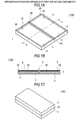
- FIGS. 1A, 1B and 1C show the outer appearance structure of an information processing apparatus 1 of the first embodiment.
- FIG. 1B is an A-A sectional view of FIG. 1A .
- a first housing section 2 and a second housing section 3 are coupled by coupling sections 4A and 4B made of, for example, hinges so as be rotatable in a direction in which they are separated from each other or approach each other, and are electrically connected to each other.
- Each of the first housing section 2 and the second housing section 3 has a flat shape while its front surface 2A or 3A is formed into a substantially rectangular shape.
- the first housing section 2 is provided with a first display section 5 made of, for example, an LCD (Liquid Crystal Display) or an organic EL (Electroluminescence) on the front surface 2A.
- a first touch panel 6 which has almost the same size as a display surface 5A, is transparent and is of, for example, a capacitance type is provided on the first display section 5 so as to cover the whole display surface 5A.
- the second housing section 3 is provided with a second display section 7 made of, for example, an LCD or an organic EL on the front surface 3A.
- a second touch panel 8 which has almost the same size as a display surface 7A, is transparent and is of, for example, a capacitance type is provided on the second display section 7 so as to cover the whole display surface 7A.
- the information processing apparatus is in an open state (hereinafter referred to also as a fully open state) in which the open angle between the front surface 2A and the front surface 3A is 180 degrees ( FIG. 1A ).
- the information processing apparatus 1 is used by the user while, for example, the first display section 5 of the first housing section 2 is made an upper screen, and the second display section 7 of the second housing section 3 is made a lower screen.
- the first touch panel 6 is provided on the display section 5 so that the front surface 2A and a surface (hereinafter referred to also as a touch surface) of the first touch panel 6 touched by the user are disposed on the same plane ( FIG. 1B ).
- the second touch panel 8 is provided on the display section 7 so that the front surface 3A and a touch surface 8A of the second touch panel 8 are disposed on the same plane.
- the first housing section 2 and the second housing section 3 are connected through the coupling sections 4A and 4B, so that the front surface 2A of the first housing section 2 and the front surface 3A of the second housing section 3 are disposed on the same plane in the fully open state.
- the front surface 2A of the first housing section 2, the front surface 3A of the second housing section 3, the touch surface 6A of the first touch panel 6, and the touch surface 8A of the second touch panel 8 are disposed on the same plane in the fully open state.
- the coupling sections 4A and 4B are respectively shorter than widths of both right and left edges of the first housing section 2 and the second housing section 3 where the first touch panel 6 and the second touch panel 8 are not provided.
- an area (hereinafter referred to also as a gap area) 9 between the first touch panel 6 and the second touch panel 8 becomes flat in a longer direction of the first touch panel 6 and the second touch panel 8 in the fully open state ( FIG. 1B ).
- the information processing apparatus 1 is in a state (hereinafter referred to also as a close state) where the open angle between the front surface 2A and the front surface 3A is 0 degree ( FIG. 1C ).
- a CPU (Central Processing Unit) 11 reads a basic program stored in a nonvolatile memory 12 into a RAM 13 and executes it, and collectively controls the whole through a bus 15.
- a CPU Central Processing Unit
- the CPU 11 reads various application programs stored in the nonvolatile memory 12 into the RAM 13 and executes them, and realizes various functions.
- the CPU 11 detects the touch position of the first touch panel 6 and the second touch panel 8 as a coordinate based on the signal.
- a first coordinate system is set in which an upper left corner is made an origin Oa, a longer direction of the first touch panel 6 is an Xa axis, and a shorter direction is a Ya axis.
- a second coordinate system is set in which an upper left corner is made an origin Ob, a longer direction of the second touch panel 8 is an Xb axis, and a shorter direction is a Yb axis.
- the first touch panel 6 and the second touch panel 8 have the detection accuracy coincident with the screen resolution of the first display section 5 and the second display section 7, and detect the coordinate based on the detection accuracy.
- the CPU 11 detects the coordinate of the touch position on the first touch panel 6 in the range of 1 to 640 in the Xa axis direction and 1 to 480 in the Ya axis direction.
- the CPU 11 detects the coordinate of the touch position on the second touch panel 8 in the range of 1 to 640 in the Xb axis direction and 1 to 480 in the Yb axis direction.
- the CPU 11 converts the first coordinate system and the second coordinate system into one absolute coordinate system, and can detect the touch position on the first touch panel 6 and the second touch panel 8 in the one coordinate system.
- the upper left corner of the first touch panel 6 is made the origin O, the longer direction of the first touch panel 6 is set to the X axis, and the shorter direction is set to the Y axis.
- the gap area 9 is provided between the first touch panel 6 and the second touch panel 8.
- a coordinate distance in the Y axis direction in the absolute coordinate system corresponding to the physical distance of the gap area 9 in the Y axis direction is previously stored as gap information in the nonvolatile memory 12.
- the gap information when the physical distance of the gap area 9 in the Y axis direction is 1 cm, and the pixel pitch of the first display section 5 and the second display section 7 is 0.1 mm, "100" as the coordinate distance corresponding to the physical distance of the gap area 9 in the Y axis direction is the gap information.
- the CPU 11 reads the gap information previously stored in the nonvolatile memory 12.
- the CPU 11 calculates the coordinate (1, 581) of the upper left corner of the second touch panel 8 based on "100" as the coordinate distance corresponding to the physical distance of the gap area 9 in the Y axis direction, which is based on the gap information, and "480" as the coordinate range of the first touch panel 6 in the Y axis direction.
- the CPU 11 detects the coordinate of the touch position on the second touch panel 8 with reference to the coordinate (1, 581) of the upper left corner of the second touch panel 8.
- the CPU 11 can detect the coordinate of the touch position on the first touch panel 6 and the second touch panel 8.
- the CPU 11 determines whether an instruction is correlated with the detected coordinate corresponding to the touch position, and when determining that the instruction is correlated, the CPU performs various operations based on the instruction.
- the CPU 11 when executing the program of Web browser in response to the user operation to the first touch panel 6 or the second touch panel 8, the CPU 11 acquires Web page data through a wireless communication unit (not shown).
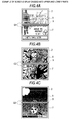
- the CPU 11 divides a Web browser screen G1 based on the acquired Web page data and displays it on the first display section 5 and the second display section 7.
- the CPU 11 when executing a map displays program in response to the user operation to the first touch panel 6 or the second touch panel 8, the CPU 11 reads map image data from the nonvolatile memory 12.
- the CPU 11 divides a map screen G2 based on the read map image data and displays it on the first display section 5 and the second display section 7.
- the CPU 11 zooms in or zooms out the map screen G2 according to the drag in the up and down direction, and displays it.
- the CPU 11 rotates and displays the map screen G2 in response to the drag.
- the CPU 11 when executing a video replay program in response to the user operation to the first touch panel 6 or the second touch panel 8, the CPU 11 reads video data from the nonvolatile memory 12.
- the CPU 11 divides a moving image G3 based on the read video data and displays it on the first display section 5 and the second display section 7.
- the CPU 11 increases or decreases, for example, the volume according to the drag in the up and down direction.
- the CPU 11 when a drag in the right and left direction is performed on the first touch panel 6 or the second touch panel 8, the CPU 11 performs, for example, fast-forward or rewind of the moving image G3 according to the drag in the right and left direction.
- the CPU 11 executes the processes corresponding to the drags assigned to the various programs.
- an acceleration sensor 14 is provided in the second housing section 3.
- the acceleration sensor 14 can measure acceleration in the longer direction of the first touch panel 6 and the second touch panel 8, acceleration in the shorter direction thereof, and acceleration in the direction vertical to the touch surface 6A of the first touch panel 6 and the touch surface 8A of the second touch panel 8.
- the gravitational acceleration is not considered.
- the CPU 11 reads a program of a detection process of drag between touch panels, which is an information processing program of the embodiment according to the invention, from the nonvolatile memory 12 and executes it, and executes the detection process of drag between touch panels.
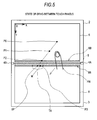
- the CPU 11 detects the coordinate (400, 280) of the touch position P0 and a time t0 at that time.
- the CPU 11 correlates the coordinate (400, 280) of the touch position P0 with the time t0, and stores them as drag information in the nonvolatile memory 12.
- the CPU 11 When the finger FN of the user keeps touching, the CPU 11 continues to detect the coordinate of the touch position at specified time intervals. At this time, when the touching continues and the touch position is changed, the CPU 11 detects the series of touch operations as the drag.
- the CPU 11 detects the coordinate (300, 380) of the touch position P1.
- the CPU 11 correlates the coordinate (300, 380) of the touch position P1 with the time t1 and stores them as drag information.
- the CPU 11 detects a coordinate (200, 480) of a touch position P2 just before the drag of the finger FN on the first touch panel 6 comes not to be detected. At this time, the CPU 11 correlates the coordinate (200, 480) of the touch position P2 with time t2 at that time and stores them as drag information.
- the finger FN performs a continuous drag (hereinafter referred to also as a drag between touch panels) from the first touch panel 6 to the second touch panel 8.
- the CPU 11 calculates, as a tolerable landing area TA, a coordinate range of the second touch panel 8 which would be touched by the finger FN.
- the CPU 11 when reading the drag information from the nonvolatile memory 12, the CPU 11 extracts the coordinate (200, 480) of the touch position P2 just before the drag on the first touch panel 6 comes not to be detected and the time t2 at that time from the drag information.
- the CPU 11 searches the drag information for the coordinate of the touch position, for example, one second before the time t2 when the touch position P2 is touched. At this time, when the time one second before the time t2 is the time t1, the CPU 11 extracts the coordinate (300, 380) of the touch position P1 correlated with the time t1 from the drag information.
- the CPU 11 calculates a straight line connecting the touch positions P1 and P2 from the coordinate (300, 380) of the touch position P1 and the coordinate (200, 480) of the touch position P2.
- the CPU 11 calculates a coordinate (100, 581) of an estimated landing position P which is an intersection point between the calculated straight line and the coordinate range of the Y coordinate of "581" which corresponds to the upper side 8B of the second touch panel 8.
- the CPU 11 calculates a difference value (100 in this case) in the X axis direction between the coordinate (200, 480) of the touch position P2 and the coordinate (100, 581) of the estimated landing position TP.
- the CPU 11 sets a range corresponding to, for example, 20% of the calculated difference value in the positive and negative directions of the X axis with reference to the estimated landing position TP, and calculates the tolerable landing area TA of coordinate (80, 581) to (120, 581).
- the acceleration sensor 14 detects the acceleration at specified intervals from the time point when the drag on the first touch panel 6 comes not to be detected by the CPU 11, and records the detected acceleration as acceleration information in the nonvolatile memory 12.
- the CPU 11 determines whether a specified time passes from the time point when the drag on the first touch panel 6 comes not to be detected.
- the specified time is set to be sufficiently longer than a time in which the user performs the drag between touch panels from the first touch panel 6 to the second touch panel 8, for example, five seconds. Accordingly, when the drag on the first touch panel 6 comes not to be detected, and the specified time passes from the time point when it is detected that the touch position P2 is touched, the CPU 11 determines that the drag between touch panels is not performed from the first touch panel 6 to the second touch panel 8.
- the CPU 11 detects the touch position P3 and acquires time t3 at that time.
- the CPU 11 controls the acceleration sensor 14 to end the detection of acceleration. Accordingly, the acceleration sensor 14 measures the acceleration at the specified time intervals from the time t2 to the time t3, and records the measured acceleration as acceleration information in the nonvolatile memory 12.
- the acceleration sensor 14 detects, as the acceleration, a vibration in the vertical direction to the touch surface 6A or the touch surface 8A when the first touch panel 6 or the second touch panel 8 is depressed by the finger FN.
- the vertical direction to the touch surface 6A and the touch surface 8A is defined as a Z axis
- a direction from the touch surface 6A and the touch surface 8A to the back surface of the first housing section 2 and the back surface (not shown) of the second housing section 3 is defined as a positive direction.
- the acceleration sensor 14 detects, as the acceleration, the vibration in the positive Z axis direction generated by the depressing operation.
- the acceleration sensor 14 detects, as the acceleration, the vibration in the negative Z axis direction generated by the separating operation.
- the acceleration sensor 14 detects only the minute vibration in the Z axis as the acceleration. This is because the force generated when the depressing operation or the separating operation is performed is not applied.
- the CPU 11 determines whether the touch position P3 is within the tolerable landing area TA, and when the touch position P3 is within the tolerable landing area TA, the CPU 11 determines whether the absolute value of the acceleration in the Z axis direction based on the acceleration information read from the nonvolatile memory 12 is within a threshold.
- the threshold is set to a value smaller than the absolute value of the acceleration in the Z axis direction caused by the vibration generated when the depressing operation or the separating operation is performed to the first touch panel 6 or the second touch panel 8 by the finger FN. Besides, the threshold is set to the value larger than the absolute value of the acceleration caused by the vibration generated by the drag on the first touch panel 6 or the second touch panel 8.
- the CPU 11 determines that the depressing operation and the separating operation is not performed by the finger FN.
- the CPU 11 determines that the drag between touch panels is performed by the user from the first touch panel 6 to the second touch panel 8, and detects, as the continuous drag, the drag on the first touch panel 6 and the drag on the second touch panel 8.
- the CPU 11 When determining that the drag between touch panels is not performed by the user, the CPU 11 cancels the drag on the first touch panel 6, and detects the drag on the second touch panel 8 as a new drag.
- the CPU 11 starts with a start step of routine RT1, shifts to step SP1, and detects whether the first touch panel 6 or the second touch panel 8 is dragged.
- step SP1 when a positive result is obtained at step SP1, this means that the first touch panel 6 or the second touch panel 8 is dragged, and a shift is made to next step SP2.
- the CPU 11 detects a coordinate of a touch position at specified time intervals, correlates the coordinate of the touch position with the touch time, records them as drag information in the nonvolatile memory 12, and shifts to next step SP3.
- step SP3 for example, when the first touch panel 6 is dragged at step SP2, the CPU 11 determines whether the drag on the first touch panel 6 is continued.
- step SP3 when a negative result is obtained at step SP3, this means that the drag on the first touch panel 6 comes not to be detected, and a shift is made to next step SP4.
- the CPU 11 calculates the estimated landing position TP based on the drag information, calculates the tolerable landing area TA of the specified range in the positive and negative directions of the X axis with reference to the estimated landing position TP, and shifts to next step SP5.
- the CPU 11 controls the acceleration sensor 14 to measure the acceleration at specified time intervals, stores the measured acceleration as acceleration information in the nonvolatile memory 12, and shifts to next step SP6.
- the CPU 11 determines whether the second touch panel 8 is touched within the specified time from the time point when the drag on the first touch panel 6 comes not to be detected.
- step SP6 when a positive result is obtained at step SP6, this means that the second touch panel 8 is touched within the specified time from the time point when the drag on the first touch panel 6 comes not to be detected, and a shift is made to next step SP7.
- the CPU 11 determines whether the touch position on the second touch panel 8 is within the tolerable landing area TA.
- step SP7 when a positive result is obtained at step SP7, this means that the touch position on the second touch panel 8 is within the tolerable landing area TA, and the CPU 11 shifts to next step SP8.
- the CPU 11 determines whether the absolute value of the acceleration in the Z axis direction based on the acceleration information recorded at step SP5 is within the threshold.
- step SP8 when a positive result is obtained at step SP8, this means that the drag between touch panels is performed by the user from the first touch panel 6 to the second touch panel 8, and the CPU 11 shifts to next step SP9.
- the CPU 11 detects, as the continuous drag, the drag on the first touch panel 6 and the drag on the second touch panel 8, shifts to next step SP1 and ends the process.
- step SP10 the CPU 11 cancels the drag on the first touch panel 6, detects the drag on the second touch panel 8 as a new drag, shifts to next step SP11 and ends the process.
- the CPU 11 again executes the detection process of the drag between touch panels.
- the CPU always executes the detection process of the drag between touch panels when the information processing apparatus 1 is in the on state.
- the touch surface 6A of the first touch panel 6, the touch surface 8A of the second touch panel 8, and the gap area 9 are disposed on the same plane.
- the information processing apparatus 1 comes not to detect the drag on the first touch panel 6, and detects that a position within the coordinate range corresponding to the lower side 6B is touched by a drag.
- the information processing apparatus 1 detects the vibration to the first touch panel 6 and the second touch panel 8 as the acceleration by the acceleration sensor 14. Besides, the information processing apparatus 1 calculates the coordinate range of the second touch panel 8, which would be touched when the user performs the drag between touch panels, as the tolerable landing area TA.
- the information processing apparatus 1 determines whether the second touch panel 8 is touched within the specified time from the time point when the drag on the first touch panel 6 comes not to be detected.
- the information processing apparatus 1 can reduce the processing load that the acceleration is continued to be measured by the acceleration sensor 14 although the drag between touch panels is not performed.
- the information processing apparatus 1 determines whether the touch position on the second touch panel 8 is within the tolerable landing area TA.
- the information processing apparatus 1 when the user does not perform the drag between touch panels but touches an arbitrary position on the second touch panel 8, the information processing apparatus 1 does not determine that the drag between touch panels is performed. Accordingly, the information processing apparatus can detect the drag between touch panels at high precision.
- the information processing apparatus 1 determines whether the absolute value of the acceleration in the Z axis direction measured by the acceleration sensor 14 in the period from the time point when the drag on the first touch panel 6 comes not to be detected to the time point when the second touch panel 8 is touched is within the threshold.
- the information processing apparatus 1 determines that the drag between touch panels, which is the continuous drag, is performed from the first touch panel 6 to the second touch panel 8.
- the information processing apparatus 1 detects, as the continuous drag, the drag on the first touch panel 6 and the drag on the second touch panel 8.
- the information processing apparatus 1 when the depressing operation or the separating operation is performed to the first touch panel 6 or the second touch panel 8, the information processing apparatus 1 does not determine that the drag between touch panels is performed. Accordingly, the information processing apparatus can detect the drag between touch panels at higher precision.
- the information processing apparatus 1 determines that the drag between touch panels is performed.
- the information processing apparatus 1 determines that the drag between touch panels is performed only when all the conditions are satisfied. Accordingly, the information processing apparatus can detect the drag between touch panels at higher precision.
- the information processing apparatus 1 determines whether the drag on the first touch panel and the second touch panel 8 is continued. By this, since the information processing apparatus 1 determines whether the drag is continued in view of the contact state of the finger FN on the first touch panel 6 and the second touch panel 8, the information processing apparatus can detect the continuous drag on the first touch panel 6 and the second touch panel 8 at higher precision.
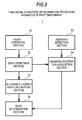
- the information processing apparatus 1 functions as a touch operation section 31, a drag detection section 32, a vibration detection section 33, a vibration information acquisition section 34, an tolerable landing area calculation section 35 and a drag determination section 36.
- the first touch panel 6 and the second touch panel 8 function as the plural touch operation sections 31.
- the CPU 11 functions as the drag detection section 32, the vibration information acquisition section 34, the tolerable landing area calculation section 35, and the drag determination section 36.
- the acceleration sensor 14 functions as the vibration detection section 33.
- the information processing apparatus 1 performs the foregoing detection process of the drag between touch panels by the functional structure as stated above.
- a first acceleration sensor 51 and a second acceleration sensor 52 are provided in the information processing apparatus 50.
- the first acceleration sensor 51 is provided in the inside of a first housing section 2, and can measure acceleration in an Xa axis direction of the first housing section 2, a Ya axis direction, and a direction (hereinafter referred to also as a Za axis direction) vertical to a front surface 2A of the first housing section 2.
- the second acceleration sensor 52 is provided in the inside of a second housing section 3, and can measure acceleration in an Xb axis direction of the second housing section 3, a Yb axis direction, and a direction (hereinafter referred to also as a Zb axis direction) vertical to a front surface 3A of the second housing section 3.
- the information processing apparatus 50 is used in the state where the first housing section 2 and the second housing section 3 are opened at an arbitrary open angle.
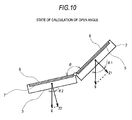
- the CPU 11 uses acceleration Z1 in the Za axis direction, which is measured by the first acceleration sensor 51 and has an acceleration component caused by the gravitational acceleration g, and calculates an inclination angle ⁇ 1 of the first housing section 2 with respect to the gravity direction.
- the CPU 11 uses acceleration Z2 in the Zb axis direction, which is measured by the second acceleration sensor 52 and has an acceleration component caused by the gravitational acceleration g, and calculates an inclination angle ⁇ 2 of the second housing section 3 with respect to the gravity direction.
- the CPU 11 uses the calculated inclination angle ⁇ 1 of the first housing section 2 and the inclination angle ⁇ 2 of the second housing section 3, and can calculate an open angle ⁇ between the first housing section 2 and the second housing section 3 by the following expression.
- ⁇ 180 - ⁇ ⁇ 1 + ⁇ ⁇ 2
- the CPU 11 reads a detection process program of drag between touch panels, which is an information processing program of the embodiment according to the invention, from the nonvolatile memory 12, executes it, and performs the detection process of drag between touch panels.
- the CPU 11 when the first touch panel 6 is continued to be touched by the finger FN of the user, the CPU 11 continues to detect the coordinate of the touch position at specified time intervals. At this time, when the touch position is changed, the CPU 11 detects the touch operation as a drag.
- the CPU 11 correlates the coordinate of the touch position on the first touch panel 6 with the time and stores them as drag information in the nonvolatile memory 12.
- the CPU 11 stores, as drag information, the coordinate of the touch position and the time at that time.
- the CPU 11 calculates the coordinate range of the second touch panel 8, which would be touched by the finger FN, as the tolerable landing area TA.
- the first acceleration sensor 51 and the second acceleration sensor 52 are configured to detect the acceleration at specified intervals from the time point when the drag on the first touch panel 6 comes not to be detected by the CPU 11. Besides, the first acceleration sensor 51 and the second acceleration sensor 52 record the detected acceleration as acceleration information in the nonvolatile memory 12.
- the CPU 11 determines whether a specified time passes from the time point when the touch position just before the drag on the first touch panel 6 comes not to be detected is detected.
- the CPU 11 detects that the second touch panel 8 is touched within the specified time, and when the detected touch position is within the tolerable landing area TA, the CPU reads the acceleration information from the nonvolatile memory 12.
- the CPU 11 uses the acceleration Z1 in the Za axis direction and the acceleration Z2 in the Zb axis direction, which are detected by the first acceleration sensor 51 and the second acceleration sensor 52, and calculates the inclination angles ⁇ 1 and ⁇ 2. Besides, the CPU 11 uses the calculated inclination angles ⁇ 1 and ⁇ 2 and calculates the open angle ⁇ by the expression (1).
- the open angle ⁇ between the first housing section 2 and the second housing section 3 is small, even when the drag between touch panels is performed from the first touch panel 6 to the second touch panel 8, it is conceivable that the second touch panel 8 is depressed by the finger FN.
- the CPU 11 determines whether the calculated open angle ⁇ is within a previously set open angle threshold.
- the open angle threshold is set to the angle at which the acceleration caused by the vibration in the Zb axis direction generated when the second touch panel 8 is depressed is detected by the second acceleration sensor 52.
- the acceleration in the Zb axis direction caused by the vibration generated when the depressing operation is performed is not detected.
- the CPU 11 sets a first threshold for the absolute value of the acceleration Z1 and the acceleration Z2 measured by the first acceleration sensor 51 and the second acceleration sensor 52.
- the first threshold is set to a value smaller than the absolute value of the acceleration Z1 and Z2 of only the acceleration component caused by the vibration generated when the depressing operation or the separating operation is performed by the finger FN to the first touch panel 6 or the second touch panel 8.
- the first threshold is set to the value larger than the absolute value of the acceleration Z1 and Z2 of only the acceleration component caused by the vibration generated when the drag is performed on the first touch panel 6 or the second touch panel 8.
- the CPU 11 reads the acceleration information from the nonvolatile memory 12, and based on the acceleration information, the CPU compares the first threshold with the absolute value of the acceleration Z1 detected by the first acceleration sensor 51 and the absolute value of the acceleration Z2 detected by the second acceleration sensor 52.
- the CPU 11 determines that the user performs the drag between touch panels from the first touch panel 6 to the second touch panel 8.
- the CPU 11 detects, as the continuous drag, the drag on the first touch panel 6 and the drag on the second touch panel 8.
- the CPU 11 previously removes the acceleration component caused by the gravitational acceleration from the acceleration Z1 and the acceleration Z2 detected by the first acceleration sensor 51 and the second acceleration sensor 52, uses only the acceleration component caused by the vibration and compares it with the first threshold.
- the CPU 11 sets a first threshold for the absolute value of the acceleration Z1 measured by the first acceleration sensor 51, and sets a second threshold for the absolute value of the acceleration Z2 measured by the second acceleration sensor 52.
- the second threshold is set to a value larger than the absolute value of the acceleration Z2 of only the acceleration component caused by the vibration generated when the depressing operation or the separating operation is performed to the second touch panel 8 by the finger FN.
- the CPU 11 determines that the drag between touch panels is performed from the first touch panel 6 to the second touch panel 8.
- the CPU 11 detects, as the continuous drag, the drag on the first touch panel 6 and the drag on the second touch panel 8.
- the CPU 11 previously removes the acceleration component caused by the gravitational acceleration from the acceleration Z1 and the acceleration Z2 detected by the first acceleration sensor 51 and the second acceleration sensor 52, uses only the acceleration component caused by the vibration, and compares it with the first threshold or the second threshold.
- the CPU 11 cancels the drag on the first touch panel 6, and detects the drag on the second touch panel 8 as a new drag.
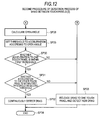
- the CPU 11 starts with a start step of routine RT2, shifts to step SP21, and detects whether the first touch panel 6 or the second touch panel 8 is dragged.
- step SP21 when a positive result is obtained at step SP21, this means that the first touch panel 6 or the second touch panel 8 is dragged, and a shift is made to next step SP22.
- the CPU 11 detects the coordinate of the touch position at specified time intervals, correlates the coordinate of the touch position with the touch time, records them as drag information in the nonvolatile memory 12, and shifts to next step SP23.
- step SP23 for example, when the first touch panel 6 is dragged, the CPU 11 determines whether the drag on the first touch panel 6 is continued.
- step SP23 when a negative result is obtained at step SP23, this means that the drag on the first touch panel 6 comes not to be detected, and a shift is made to next step SP24.
- the CPU 11 calculates the estimated landing position TP based on the drag information, calculates the tolerable landing area TA of the specified range in the positive and negative X axis directions with reference to the estimated landing position TP, and shifts to next step SP25.
- the CPU 11 controls the first acceleration sensor 51 and the second acceleration sensor 52 to measure the acceleration at specified time intervals, records the measured acceleration as acceleration information in the nonvolatile memory 12, and shifts to next step SP26.
- the CPU 11 determines whether the second touch panel 8 is touched within the specified time from the time point when the drag on the first touch panel 6 comes not to be detected.
- step SP26 when a positive result is obtained at step SP26, this means that the second touch panel 8 is touched within the specified time from the time point when the drag on the first touch panel 6 comes not to be detected, and the CPU shifts to next step SP27.
- the CPU 11 determines whether the touch position on the second touch panel 8 is within the tolerable landing area TA.
- step SP27 when a positive result is obtained at step SP27, this means that the touch position on the second touch panel 8 is within the tolerable landing area TA, and the CPU 11 shifts to next step SP28.
- step SP28 based on the acceleration information recorded at step SP25, the CPU 11 uses the acceleration Z1 and Z2 detected by the first acceleration sensor 51 and the second acceleration sensor 52, calculates the open angle ⁇ by the expression (1), and shifts to next step SP29.
- the CPU 11 sets a threshold for the absolute value of the acceleration Z1 and Z2 measured by the first acceleration sensor 51 and the second acceleration sensor 52 according to the open angle ⁇ calculated at step SP28, and shifts to next step SP30.
- the CPU 11 sets the threshold for the absolute value of the acceleration Z1 and Z2 measured by the first acceleration sensor 51 and the second acceleration sensor 52 to a first threshold.
- the CPU 11 sets the threshold for the absolute value of the acceleration Z1 measured by the first acceleration sensor 51 to a first threshold, and sets the threshold for the absolute value of the acceleration Z2 measured by the second acceleration sensor 52 to a second threshold.
- the CPU 11 determines whether the absolute value of the acceleration Z1 measured by the first acceleration sensor 51 is within the first threshold. When a negative result is obtained, this means that the depressing operation or the separating operation is performed to the first touch panel 6, and the CPU 11 shifts to step SP33.
- step SP30 when a positive result is obtained at step SP30, the CPU 11 shifts to next step SP31.
- step SP31 the CPU 11 determines whether the absolute value of the acceleration Z2 measured by the second acceleration sensor 52 is within the first threshold or the second threshold set at step SP29.
- step SP33 When a negative result is obtained, the CPU 11 shifts to step SP33. On the other hand, when a positive result is obtained, this means that the drag between touch panels is performed by the user from the first touch panel 6 to the second touch panel 8, and the CPU 11 shifts to next step SP32.
- the CPU 11 detects, as the continuous drag, the drag on the first touch panel 6 and the drag on the second touch panel 8, shifts to next step SP34 and ends the process.
- step SP33 the CPU 11 cancels the drag on the first touch panel 6, detects the drag on the second touch panel 8 as a new drag, shifts to next step SP34 and ends the process.
- the CPU 11 again executes the detection process of drag between touch panels, and for example, when the information processing apparatus 50 is in the on state, the CPU always executes the detection process of drag between touch panels.
- the information processing apparatus 50 detects that for example, the first touch panel 6 is dragged in the state where the touch surface 6A of the first touch panel 6 and the touch surface 8A of the second touch panel 8 are opened at the open angle ⁇ .
- the information processing apparatus 50 comes not to detect the drag on the first touch panel 6, and detects that a position in the coordinate range corresponding to the lower side 6B is touched by the drag.
- the information processing apparatus 50 measures, as acceleration, the vibration to the first touch panel 6 and the second touch panel 8 by the first acceleration sensor 51 and the second acceleration sensor 52. Besides the information processing apparatus 50 calculates the coordinate range of the second touch panel 8, which would be touched by the user when the user performs the drag between touch panels, as the tolerable landing area TA.
- the information processing apparatus 50 determines whether the second touch panel 8 is touched within the specified time from the time point when the drag on the first touch panel 6 comes not to be detected.
- the information processing apparatus 50 can reduce the process load that the acceleration is continued to be measured by the first acceleration sensor 51 and the second acceleration sensor 52 although the drag between touch panels is not performed.
- the information processing apparatus 50 determines whether the touch position on the second touch panel 8 is within the tolerable landing area TA.
- the information processing apparatus 50 does not determine that the drag between touch panels is performed. Accordingly, the information processing apparatus can detect the drag between touch panels at high precision.
- the information processing apparatus 50 calculates the open angle ⁇ between the first touch panel 6 and the second touch panel 8 based on the acceleration Z1 and Z2 measured by the first acceleration sensor 51 and the second acceleration sensor 52.
- the information processing apparatus 50 sets the first threshold for the absolute value of the acceleration Z1 measured by the first acceleration sensor 51, and sets the first or the second threshold for the absolute value of the acceleration Z2 measured by the second acceleration sensor 52.
- the information processing apparatus 50 determines whether the absolute value of the acceleration Z1 and the absolute value of the acceleration Z2 are within the set first or second threshold. When the absolute value of the acceleration Z1 and the absolute value of the acceleration Z2 are within the set first or second threshold, the information processing apparatus 50 determines that the drag between touch panels is performed from the first touch panel 6 to the second touch panel 8. Then, the information processing apparatus 50 detects, as the continuous drag, the drag on the first touch panel 6 and the drag on the second touch panel 8.
- the information processing apparatus 50 uses the acceleration based on the vibration to the first touch panel 6 and the second touch panel 8 and determines whether the drag between touch panels is performed, the drag between touch panels can be detected at high precision.
- the information processing apparatus 50 determines that the drag between touch panels is performed.
- the information processing apparatus 50 determines that the drag between touch panels is performed, and accordingly, the drag between touch panels can be detected at higher precision.
- the information processing apparatus 50 determines whether the drag on the first touch panel 6 and the drag on the second touch panel 8 are continued.
- the information processing apparatus 50 determines whether the drag is continued in view of the touch state of the finger FN on the first touch panel 6 and the second touch panel 8, the continuous drag on the first touch panel 6 and the second touch panel 8 can be detected at high precision.
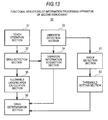
- the information processing apparatus 1 functions as a touch operation section 31, a drag detection section 32, a vibration detection section 33, a vibration information acquisition section 34, a tolerable landing area calculation section 35, a drag determination section 36, an angle detection section 61 and a threshold setting section 62.
- the first touch panel 6 and the second touch panel 8 function as the plural touch operation sections 31.
- the CPU 11 functions as the drag detection section 32, the vibration information acquisition section 34, the tolerable landing area calculation section 35, the drag determination section 36, the angle detection section 61, and the threshold setting section 62.
- the first acceleration sensor 51 and the second acceleration sensor 52 function as the vibration detection section 33.
- the foregoing detection process of drag between touch panels is executed by the functional structure as stated above.
- the invention is not limited to this, and when the acceleration, which is measured after the first touch panel 6 is dragged and before the second touch panel 8 is touched, is within the threshold, the CPU 11 may determine that the drag between touch panels is performed.
- the CPU 11 may determine that the drag between touch panels is performed.
- the CPU 11 may determine that the drag between touch panels is performed.
- the invention is not limited to this, and as long as the coordinate of the touch position of the first touch panel 6 and the second touch panel 8 can be detected, a touch panel of resistive film type, infrared-ray type, electromagnetic induction type, or the like can be applied.
- the invention is not limited to this, and the locus of the drag is approximated as a curved line based on the drag information, and an intersection point between the approximated curved line and the second touch panel may be calculated as the landing estimation position TP.
- the vibration to the first touch panel 6 and the second touch panel 8 is detected as the acceleration by the acceleration sensor 14.
- the invention is not limited to this, and the vibration to the first touch panel 6 and the second touch panel 8 may be detected as an angular speed by, for example, a gyro sensor.
- the vibration to the first touch panel 6 and the second touch panel 8 is detected as the acceleration by the first acceleration sensor 51 and the second acceleration sensor 52.
- the invention is not limited to this, and the vibration to the first touch panel 6 and the second touch panel 8 may be respectively detected as the angular speed by, for example, the gyro sensor provided in the first housing section 2 and the second housing section 3.
- the invention is not limited to this, and plural touch panels may be used.
- a continuous drag across plural panels, for example, three panels can be detected by detecting the continuous drag on the adjacent touch panels.
- the invention is not limited to this, and when the first touch panel 6 and the second touch panel 8 are of, for example, a resistive film type, the touch operation may be performed by a pen or the like.
- the invention is not limited to this, and for example, a specified angle measuring unit is provided between the first housing section 2 and the second housing section 3, and the open angle ⁇ may be calculated based on a value obtained by the angle measuring unit.
- the coupling sections 4A and 4B are respectively shorter than both edges of the first housing section 2 and the second housing section 3 where the first touch panel 6 and the second touch panel 8 in the longer direction are not provided.
- the invention is not limited to this, and the coupling sections 4A and 4B may be respectively longer than both edges of the first housing section 2 and the second housing section 3 where the first touch panel 6 and the second touch panel 8 in the longer direction are not provided.
- portions of the gap area 9 between the first touch panel 6 and the second touch panel 8 where the coupling sections 4A and 4B are provided protrude in the fully open state.
- the finger FN of the user touches the coupling sections 4A and 4B, and the vibration in the Y axis direction is generated. Accordingly, after the first touch panel 6 is dragged, when the acceleration in the Y axis direction measured before the second touch panel 8 is touched is larger than a specified value, the information processing apparatus 1 may determine that the drag between touch panels is performed.
- the invention is not limited to this, and may perform the detection process of drag between touch panels in accordance with a detection processing program of drag between touch panels installed from a storage medium or downloaded from the Internet.
- the detection process of drag between touch panels may be performed in accordance with a detection processing program of drag between touch panels installed in various routes.
- the invention is not limited to this, and the drag between touch panels from the second touch panel 8 to the first touch panel 6 can also be detected.
- first touch panel 6 and the second touch panel 8 are provided as the touch operation sections.
- touch operation sections having other various structures may be provided.
- the drag detection section, the vibration information acquisition section and the drag determination section having other various structures may be provided.
- vibration detection section having other various structures may be provided.
- the invention can be used as an information processing apparatus such as a portable PDA, a note type personal computer or a game machine.
Landscapes
- Engineering & Computer Science (AREA)
- Theoretical Computer Science (AREA)
- General Engineering & Computer Science (AREA)
- Human Computer Interaction (AREA)
- Physics & Mathematics (AREA)
- General Physics & Mathematics (AREA)
- Computer Hardware Design (AREA)
- User Interface Of Digital Computer (AREA)
- Position Input By Displaying (AREA)
Abstract
Description
- The present invention relates to an information processing apparatus, an information processing method and an information processing program.
- Hitherto, in a portable information processing apparatus, there is a contrivance which includes two display sections and touch panels respectively provided on the two display sections, and can be folded so that the two display sections face each other when it is carried.
- In the information processing apparatus as stated above, since the two display sections are provided, more display information can be visually recognized by the user, and the apparatus can be easily carried since it can be folded at the time of carrying.
- However, in the information processing apparatus, since the two touch panels are independently provided, there is a problem that a continuous drag from one touch panel to the other touch panel can not be recognized as a series of drags.
- Then, in the information processing apparatuses, there is one in which after one touch panel is dragged, when the other touch panel is dragged within a specified time, the operation is regarded as a continuous drag, and a process corresponding to the continuous drag is performed (see, for example,
JP-A-9-311757 - In the foregoing information processing apparatus, since a period of time in which an operation is shifted from the one touch panel to the other touch panel varies according to the user or the circumstances, and there is a problem that the continuous drag can not be detected at high precision.
- Thus, it is desirable to provide an information processing apparatus, an information processing method and an information processing program, in which a continuous drag between touch operation sections, which are touch panels, can be detected at high precision.
- Embodiments of the invention relate to an information processing apparatus, an information processing method and an information processing program in which touch panels are respectively provided on, for example, two screens provided to be separated from each other, and a drag is performed continuously between the touch panels.
- Various respective aspects and features of the invention are defined in the appended claims. Combinations of features from the dependent claims may be combined with features of the independent claims as appropriate and not merely as explicitly set out in the claims.
- According to an embodiment of the present invention, there is provided an information processing apparatus including plural touch operation sections which are provided to be spaced from each other by a specified distance and detect a position touched by an operating part, a drag detection section to detect a drag moved in a state where the operating part touches the plural touch operation sections, a vibration detection section to detect a vibration amount of the plural touch operation sections, a vibration acquisition section to acquire the vibration amount detected by the vibration detection section in a period after the drag detection section detects that an arbitrary touch operation section is dragged among the plural touch operation sections and before the drag detection section detects that another touch operation section adjacent to the arbitrary touch operation section is dragged, and a drag determination section to determine, based on the vibration amount acquired by the vibration acquisition section, whether the drag on the arbitrary touch operation section is continuous with the drag on the another touch operation section.
- Besides, according to another embodiment of the present invention, there is provided an information processing method including the steps of: detecting a drag moved in a state where an operating part touches plural touch operation sections which are provided to be spaced from each other by a specified distance and detect a position touched by the operating part; acquiring a vibration amount of the plural touch operation sections detected by a vibration detection section in a period after it is detected at the step of detecting the drag that an arbitrary touch operation section is dragged among the plural touch operation sections and before it is detected that another touch operation section adjacent to the arbitrary touch operation section is dragged; and determining, based on the vibration amount acquired at the step of acquiring the vibration amount, whether the drag on the another touch operation section is continuous with the drag on the arbitrary touch operation section.
- Further, according to still another embodiment of the present invention, there is provided an information processing program to cause a computer to execute the steps of: detecting a drag moved in a state where an operating part touches plural touch operation sections which are provided to be spaced from each other by a specified distance and detect a position touched by the operating part; acquiring a vibration amount of the plural touch operation sections detected by a vibration detection section in a period after it is detected at the step of detecting the drag that an arbitrary touch operation section is dragged among the plural touch operation sections and before it is detected that another touch operation section adjacent to the arbitrary touch operation section is dragged; and determining, based on the vibration amount acquired at the step of acquiring the vibration amount, whether the drag on the another touch operation section is continuous with the drag on the arbitrary touch operation section.
- By this, since it is determined based on the vibration amount of the touch operation section that the drag from the arbitrary touch operation section to the another touch operation section is continued, it is possible to determine whether the drag is continued in view of the touch state of the operating part to the touch operation section.
- As described above, according to the embodiments of the present invention, since it is determined based on the vibration amount of the touch operation section that the drag from the arbitrary touch operation section to the another touch operation section is continued, it is possible to determine whether the drag is continued in view of the touch state of the operating part to the touch operation section, and an information processing apparatus, an information processing method and an information processing program can be realized, in which a continuous operation between touch operation sections can be detected at high precision.
- Embodiments of the invention will now be described with reference to the accompanying drawings, throughout which like parts are referred to by like references, and in which:
-
FIGS. 1A to 1C are schematic line views showing an outer appearance structure of an information processing apparatus of a first and a second embodiment. -
FIG. 2 is a schematic line view showing a circuit structure of the information processing apparatus of the first embodiment. -
FIGS. 3A and 3B are schematic line views showing coordinate systems of touch panels. -
FIGS. 4A to 4C are schematic line views showing examples of a screen display divided into an upper part and a lower part. -
FIG. 5 is a schematic line view showing a state of a drag between touch panels. -
FIGS. 6A to 6F are schematic line views showing vibrations of touch panels. -
FIG. 7 is a flowchart for explaining a detection process procedure of drag between touch panels according to the first embodiment. -
FIG. 8 is a schematic line view showing a functional structure of the information processing apparatus of the first embodiment. -
FIG. 9 is a schematic line view showing a circuit structure of the information processing apparatus of the second embodiment. -
FIG. 10 is a schematic line view showing a state of calculation of an open angle. -
FIG. 11 is a flowchart for explanation of a detection process procedure (1) of drag between touch panels according to the second embodiment. -
FIG. 12 is a flowchart for explanation of a detection process procedure (2) of drag between touch panels according to the second embodiment. -
FIG. 13 is a schematic line view showing a functional structure of the information processing apparatus of the second embodiment. - Hereinafter, the best mode for carrying out the present invention (hereinafter referred to as an embodiment) will be described. The description is made in the following order.
- 1. First embodiment
- 2. Second embodiment
- 3. Other embodiments
-
FIGS. 1A, 1B and 1C show the outer appearance structure of aninformation processing apparatus 1 of the first embodiment.FIG. 1B is an A-A sectional view ofFIG. 1A . - In this
information processing apparatus 1, afirst housing section 2 and asecond housing section 3 are coupled bycoupling sections - Each of the
first housing section 2 and thesecond housing section 3 has a flat shape while itsfront surface - The
first housing section 2 is provided with afirst display section 5 made of, for example, an LCD (Liquid Crystal Display) or an organic EL (Electroluminescence) on thefront surface 2A. Besides, afirst touch panel 6 which has almost the same size as adisplay surface 5A, is transparent and is of, for example, a capacitance type is provided on thefirst display section 5 so as to cover thewhole display surface 5A. - The
second housing section 3 is provided with asecond display section 7 made of, for example, an LCD or an organic EL on thefront surface 3A. Besides, asecond touch panel 8 which has almost the same size as adisplay surface 7A, is transparent and is of, for example, a capacitance type is provided on thesecond display section 7 so as to cover thewhole display surface 7A. - When the
front surface 2A of thefirst housing section 2 and thefront surface 3A of thesecond housing section 3 are made parallel to each other and are directed in the same direction, the information processing apparatus is in an open state (hereinafter referred to also as a fully open state) in which the open angle between thefront surface 2A and thefront surface 3A is 180 degrees (FIG. 1A ). - In the fully open state, the
information processing apparatus 1 is used by the user while, for example, thefirst display section 5 of thefirst housing section 2 is made an upper screen, and thesecond display section 7 of thesecond housing section 3 is made a lower screen. - In the
first housing section 2, thefirst touch panel 6 is provided on thedisplay section 5 so that thefront surface 2A and a surface (hereinafter referred to also as a touch surface) of thefirst touch panel 6 touched by the user are disposed on the same plane (FIG. 1B ). - Besides, in the
second housing section 3, thesecond touch panel 8 is provided on thedisplay section 7 so that thefront surface 3A and atouch surface 8A of thesecond touch panel 8 are disposed on the same plane. - Further, in the
information processing apparatus 1, thefirst housing section 2 and thesecond housing section 3 are connected through thecoupling sections front surface 2A of thefirst housing section 2 and thefront surface 3A of thesecond housing section 3 are disposed on the same plane in the fully open state. - Accordingly, in the
information processing apparatus 1, thefront surface 2A of thefirst housing section 2, thefront surface 3A of thesecond housing section 3, thetouch surface 6A of thefirst touch panel 6, and thetouch surface 8A of thesecond touch panel 8 are disposed on the same plane in the fully open state. - In the
information processing apparatus 1, thecoupling sections first housing section 2 and thesecond housing section 3 where thefirst touch panel 6 and thesecond touch panel 8 are not provided. - Thus, in the
information processing apparatus 1, an area (hereinafter referred to also as a gap area) 9 between thefirst touch panel 6 and thesecond touch panel 8 becomes flat in a longer direction of thefirst touch panel 6 and thesecond touch panel 8 in the fully open state (FIG. 1B ). - On the other hand, when the
front surface 2A of thefirst housing section 2 and thefront surface 3A of thesecond housing section 3 contact with each other, theinformation processing apparatus 1 is in a state (hereinafter referred to also as a close state) where the open angle between thefront surface 2A and thefront surface 3A is 0 degree (FIG. 1C ). - Next, a circuit structure of the
information processing apparatus 1 will be described. As shown inFIG. 2 , in theinformation processing apparatus 1, a CPU (Central Processing Unit) 11 reads a basic program stored in anonvolatile memory 12 into aRAM 13 and executes it, and collectively controls the whole through abus 15. - Besides, the
CPU 11 reads various application programs stored in thenonvolatile memory 12 into theRAM 13 and executes them, and realizes various functions. - When a signal corresponding to a touched position (hereinafter referred to also as a touch position) is given from the
first touch panel 6 and thesecond touch panel 8, theCPU 11 detects the touch position of thefirst touch panel 6 and thesecond touch panel 8 as a coordinate based on the signal. - Here, in the
first touch panel 6, as shown inFIG. 3A , a first coordinate system is set in which an upper left corner is made an origin Oa, a longer direction of thefirst touch panel 6 is an Xa axis, and a shorter direction is a Ya axis. Besides, in thesecond touch panel 8, a second coordinate system is set in which an upper left corner is made an origin Ob, a longer direction of thesecond touch panel 8 is an Xb axis, and a shorter direction is a Yb axis. - The
first touch panel 6 and thesecond touch panel 8 have the detection accuracy coincident with the screen resolution of thefirst display section 5 and thesecond display section 7, and detect the coordinate based on the detection accuracy. - That is, when the screen resolution of the
first display section 5 is, for example, VGA (Video Graphics Array) having 640 x 480 pixels, theCPU 11 detects the coordinate of the touch position on thefirst touch panel 6 in the range of 1 to 640 in the Xa axis direction and 1 to 480 in the Ya axis direction. - Similarly, when the screen resolution of the
second display section 7 is, for example, VGA having 640 x 480 pixels, theCPU 11 detects the coordinate of the touch position on thesecond touch panel 8 in the range of 1 to 640 in the Xb axis direction and 1 to 480 in the Yb axis direction. - As shown in
FIG. 3B , theCPU 11 converts the first coordinate system and the second coordinate system into one absolute coordinate system, and can detect the touch position on thefirst touch panel 6 and thesecond touch panel 8 in the one coordinate system. - In the absolute coordinate system, the upper left corner of the
first touch panel 6 is made the origin O, the longer direction of thefirst touch panel 6 is set to the X axis, and the shorter direction is set to the Y axis. - In the
information processing apparatus 1, thegap area 9 is provided between thefirst touch panel 6 and thesecond touch panel 8. In theinformation processing apparatus 1, a coordinate distance in the Y axis direction in the absolute coordinate system corresponding to the physical distance of thegap area 9 in the Y axis direction is previously stored as gap information in thenonvolatile memory 12. - For example, when the physical distance of the
gap area 9 in the Y axis direction is 1 cm, and the pixel pitch of thefirst display section 5 and thesecond display section 7 is 0.1 mm, "100" as the coordinate distance corresponding to the physical distance of thegap area 9 in the Y axis direction is the gap information. - Accordingly, when the touch position on the
second touch panel 8 is detected, theCPU 11 reads the gap information previously stored in thenonvolatile memory 12. TheCPU 11 calculates the coordinate (1, 581) of the upper left corner of thesecond touch panel 8 based on "100" as the coordinate distance corresponding to the physical distance of thegap area 9 in the Y axis direction, which is based on the gap information, and "480" as the coordinate range of thefirst touch panel 6 in the Y axis direction. - The
CPU 11 detects the coordinate of the touch position on thesecond touch panel 8 with reference to the coordinate (1, 581) of the upper left corner of thesecond touch panel 8. - As stated above, the
CPU 11 can detect the coordinate of the touch position on thefirst touch panel 6 and thesecond touch panel 8. - The
CPU 11 determines whether an instruction is correlated with the detected coordinate corresponding to the touch position, and when determining that the instruction is correlated, the CPU performs various operations based on the instruction. - Specifically, as shown in
FIG. 4A , when executing the program of Web browser in response to the user operation to thefirst touch panel 6 or thesecond touch panel 8, theCPU 11 acquires Web page data through a wireless communication unit (not shown). - The
CPU 11 divides a Web browser screen G1 based on the acquired Web page data and displays it on thefirst display section 5 and thesecond display section 7. - At this time, for example, when an operation (hereinafter referred to also as a drag) in which a user's finger slides on the
first touch panel 6 or thesecond touch panel 8 while the finger is kept touched is performed in, for example, an up and down direction, as an instruction corresponding to the drag, theCPU 11 moves and displays the Web browser screen G1 in the up and down direction. - Besides, as shown in
FIG. 4B , when executing a map displays program in response to the user operation to thefirst touch panel 6 or thesecond touch panel 8, theCPU 11 reads map image data from thenonvolatile memory 12. - Then, the
CPU 11 divides a map screen G2 based on the read map image data and displays it on thefirst display section 5 and thesecond display section 7. - At this time, when the drag is performed on the
first touch panel 6 or thesecond touch panel 8 in the up and down direction, for example, theCPU 11 zooms in or zooms out the map screen G2 according to the drag in the up and down direction, and displays it. - Besides, when a drag to draw a circle is performed on the
first touch panel 6 or thesecond touch panel 8, for example, theCPU 11 rotates and displays the map screen G2 in response to the drag. - Further, as shown in
FIG. 4C , when executing a video replay program in response to the user operation to thefirst touch panel 6 or thesecond touch panel 8, theCPU 11 reads video data from thenonvolatile memory 12. - The
CPU 11 divides a moving image G3 based on the read video data and displays it on thefirst display section 5 and thesecond display section 7. - At this time, when a drag in the up and down direction is performed on the
first touch panel 6 or thesecond touch panel 8, theCPU 11 increases or decreases, for example, the volume according to the drag in the up and down direction. - Besides, when a drag in the right and left direction is performed on the
first touch panel 6 or thesecond touch panel 8, theCPU 11 performs, for example, fast-forward or rewind of the moving image G3 according to the drag in the right and left direction. - As stated above, when various programs are executed, the
CPU 11 executes the processes corresponding to the drags assigned to the various programs. - In addition to the above structure, in the information processing apparatus 1 (
FIG. 2 ), for example, anacceleration sensor 14 is provided in thesecond housing section 3. Theacceleration sensor 14 can measure acceleration in the longer direction of thefirst touch panel 6 and thesecond touch panel 8, acceleration in the shorter direction thereof, and acceleration in the direction vertical to thetouch surface 6A of thefirst touch panel 6 and thetouch surface 8A of thesecond touch panel 8. In the first embodiment, the gravitational acceleration is not considered. - The
CPU 11 reads a program of a detection process of drag between touch panels, which is an information processing program of the embodiment according to the invention, from thenonvolatile memory 12 and executes it, and executes the detection process of drag between touch panels. - Specifically, as shown in
FIG. 5 , when a touch position P0 of thefirst touch panel 6 is touched by the finger FN, theCPU 11 detects the coordinate (400, 280) of the touch position P0 and a time t0 at that time. TheCPU 11 correlates the coordinate (400, 280) of the touch position P0 with the time t0, and stores them as drag information in thenonvolatile memory 12. - When the finger FN of the user keeps touching, the
CPU 11 continues to detect the coordinate of the touch position at specified time intervals. At this time, when the touching continues and the touch position is changed, theCPU 11 detects the series of touch operations as the drag. - When a touch position P1 of the
first touch panel 6 is touched by the finger FN at, for example, time t1 when a specified interval time passes from time t0, theCPU 11 detects the coordinate (300, 380) of the touch position P1. TheCPU 11 correlates the coordinate (300, 380) of the touch position P1 with the time t1 and stores them as drag information. - Further, when the finger FN is moved to the outside of the
first touch panel 6, theCPU 11 detects a coordinate (200, 480) of a touch position P2 just before the drag of the finger FN on thefirst touch panel 6 comes not to be detected. At this time, theCPU 11 correlates the coordinate (200, 480) of the touch position P2 with time t2 at that time and stores them as drag information. - Here, when the Y coordinate of the touch position P2 is "480", that is, when the finger FN is moved to the outside from the
lower side 6B of thefirst touch panel 6, it is conceivable that the finger FN performs a continuous drag (hereinafter referred to also as a drag between touch panels) from thefirst touch panel 6 to thesecond touch panel 8. - Then, based on the drag information stored in the
nonvolatile memory 12, theCPU 11 calculates, as a tolerable landing area TA, a coordinate range of thesecond touch panel 8 which would be touched by the finger FN. - Specifically, when reading the drag information from the
nonvolatile memory 12, theCPU 11 extracts the coordinate (200, 480) of the touch position P2 just before the drag on thefirst touch panel 6 comes not to be detected and the time t2 at that time from the drag information. - Besides, the
CPU 11 searches the drag information for the coordinate of the touch position, for example, one second before the time t2 when the touch position P2 is touched. At this time, when the time one second before the time t2 is the time t1, theCPU 11 extracts the coordinate (300, 380) of the touch position P1 correlated with the time t1 from the drag information. - The
CPU 11 calculates a straight line connecting the touch positions P1 and P2 from the coordinate (300, 380) of the touch position P1 and the coordinate (200, 480) of the touch position P2. TheCPU 11 calculates a coordinate (100, 581) of an estimated landing position P which is an intersection point between the calculated straight line and the coordinate range of the Y coordinate of "581" which corresponds to theupper side 8B of thesecond touch panel 8. - When the user performs the drag between touch panels, it is conceivable that the drag is performed almost linearly. However, a slight shift may occur.
- Then, the
CPU 11 calculates a difference value (100 in this case) in the X axis direction between the coordinate (200, 480) of the touch position P2 and the coordinate (100, 581) of the estimated landing position TP. - The
CPU 11 sets a range corresponding to, for example, 20% of the calculated difference value in the positive and negative directions of the X axis with reference to the estimated landing position TP, and calculates the tolerable landing area TA of coordinate (80, 581) to (120, 581). - On the other hand, the
acceleration sensor 14 detects the acceleration at specified intervals from the time point when the drag on thefirst touch panel 6 comes not to be detected by theCPU 11, and records the detected acceleration as acceleration information in thenonvolatile memory 12. - The
CPU 11 determines whether a specified time passes from the time point when the drag on thefirst touch panel 6 comes not to be detected. - The specified time is set to be sufficiently longer than a time in which the user performs the drag between touch panels from the
first touch panel 6 to thesecond touch panel 8, for example, five seconds. Accordingly, when the drag on thefirst touch panel 6 comes not to be detected, and the specified time passes from the time point when it is detected that the touch position P2 is touched, theCPU 11 determines that the drag between touch panels is not performed from thefirst touch panel 6 to thesecond touch panel 8. - When the drag on the
first touch panel 6 comes not to be detected, and thesecond touch panel 8 is touched in the specified time from the time t2 when it is detected that the touch position P2 is touched, theCPU 11 detects the touch position P3 and acquires time t3 at that time. - At this time, the
CPU 11 controls theacceleration sensor 14 to end the detection of acceleration. Accordingly, theacceleration sensor 14 measures the acceleration at the specified time intervals from the time t2 to the time t3, and records the measured acceleration as acceleration information in thenonvolatile memory 12. - As shown in
FIGS. 6A and 6D , theacceleration sensor 14 detects, as the acceleration, a vibration in the vertical direction to thetouch surface 6A or thetouch surface 8A when thefirst touch panel 6 or thesecond touch panel 8 is depressed by the finger FN. - Here, the vertical direction to the
touch surface 6A and thetouch surface 8A is defined as a Z axis, and a direction from thetouch surface 6A and thetouch surface 8A to the back surface of thefirst housing section 2 and the back surface (not shown) of thesecond housing section 3 is defined as a positive direction. - Accordingly, when the
first touch panel 6 or thesecond touch panel 8 is depressed by the finger FN, theacceleration sensor 14 detects, as the acceleration, the vibration in the positive Z axis direction generated by the depressing operation. - As shown in
FIG. 6B and 6E , when an operation (hereinafter referred to also as a separating operation) in which the finger FN is separated from thefirst touch panel 6 or thesecond touch panel 8 is performed, theacceleration sensor 14 detects, as the acceleration, the vibration in the negative Z axis direction generated by the separating operation. - On the other hand, as shown in
FIG. 6C and 6F , when thefirst touch panel 6 or thesecond touch panel 8 is dragged by the finger FN, theacceleration sensor 14 detects only the minute vibration in the Z axis as the acceleration. This is because the force generated when the depressing operation or the separating operation is performed is not applied. - Accordingly, the
CPU 11 determines whether the touch position P3 is within the tolerable landing area TA, and when the touch position P3 is within the tolerable landing area TA, theCPU 11 determines whether the absolute value of the acceleration in the Z axis direction based on the acceleration information read from thenonvolatile memory 12 is within a threshold. - The threshold is set to a value smaller than the absolute value of the acceleration in the Z axis direction caused by the vibration generated when the depressing operation or the separating operation is performed to the
first touch panel 6 or thesecond touch panel 8 by the finger FN. Besides, the threshold is set to the value larger than the absolute value of the acceleration caused by the vibration generated by the drag on thefirst touch panel 6 or thesecond touch panel 8. - When the absolute value of the acceleration in the Z axis direction based on the acceleration information read from the
nonvolatile memory 12 is within the threshold, theCPU 11 determines that the depressing operation and the separating operation is not performed by the finger FN. - At this time, the
CPU 11 determines that the drag between touch panels is performed by the user from thefirst touch panel 6 to thesecond touch panel 8, and detects, as the continuous drag, the drag on thefirst touch panel 6 and the drag on thesecond touch panel 8. - When determining that the drag between touch panels is not performed by the user, the
CPU 11 cancels the drag on thefirst touch panel 6, and detects the drag on thesecond touch panel 8 as a new drag. - Next, the procedure of detection process of drag between touch panels will be described with reference to a flowchart of
FIG. 7 . Actually, theCPU 11 starts with a start step of routine RT1, shifts to step SP1, and detects whether thefirst touch panel 6 or thesecond touch panel 8 is dragged. - Here, when a negative result is obtained, this means that the
first touch panel 6 and thesecond touch panel 8 are not dragged, and the CPU returns to step SP1 and waits until thefirst touch panel 6 or thesecond touch panel 8 is dragged. - On the other hand, when a positive result is obtained at step SP1, this means that the
first touch panel 6 or thesecond touch panel 8 is dragged, and a shift is made to next step SP2. At step SP2, theCPU 11 detects a coordinate of a touch position at specified time intervals, correlates the coordinate of the touch position with the touch time, records them as drag information in thenonvolatile memory 12, and shifts to next step SP3. - At step SP3, for example, when the
first touch panel 6 is dragged at step SP2, theCPU 11 determines whether the drag on thefirst touch panel 6 is continued. - Here, when a positive result is obtained, this means that the
first touch panel 6 is dragged by the finger FN. At this time, theCPU 11 returns to step SP3, and repeats until the drag on thefirst touch panel 6 comes not to be detected. - On the other hand, when a negative result is obtained at step SP3, this means that the drag on the
first touch panel 6 comes not to be detected, and a shift is made to next step SP4. - At step SP4, the
CPU 11 calculates the estimated landing position TP based on the drag information, calculates the tolerable landing area TA of the specified range in the positive and negative directions of the X axis with reference to the estimated landing position TP, and shifts to next step SP5. - At step SP5, the
CPU 11 controls theacceleration sensor 14 to measure the acceleration at specified time intervals, stores the measured acceleration as acceleration information in thenonvolatile memory 12, and shifts to next step SP6. - At step SP6, the
CPU 11 determines whether thesecond touch panel 8 is touched within the specified time from the time point when the drag on thefirst touch panel 6 comes not to be detected. - Here, when a negative result is obtained, this means that the drag between touch panels is not performed from the
first touch panel 6 to thesecond touch panel 8, and at this time, theCPU 11 shifts to step SP10. - On the other hand, when a positive result is obtained at step SP6, this means that the
second touch panel 8 is touched within the specified time from the time point when the drag on thefirst touch panel 6 comes not to be detected, and a shift is made to next step SP7. - At step SP7, the
CPU 11 determines whether the touch position on thesecond touch panel 8 is within the tolerable landing area TA. Here, when a negative result is obtained, this means that the touch position on thesecond touch panel 8 is outside the tolerable landing area TA, and theCPU 11 shifts to step SP10. - On the other hand, when a positive result is obtained at step SP7, this means that the touch position on the
second touch panel 8 is within the tolerable landing area TA, and theCPU 11 shifts to next step SP8. - At step SP8, the
CPU 11 determines whether the absolute value of the acceleration in the Z axis direction based on the acceleration information recorded at step SP5 is within the threshold. Here, when a negative result is obtained, this means that the depressing operation or the separating operation is performed to thesecond touch panel 8 by the finger FN, and theCPU 11 shifts to step SP10. - On the other hand, when a positive result is obtained at step SP8, this means that the drag between touch panels is performed by the user from the
first touch panel 6 to thesecond touch panel 8, and theCPU 11 shifts to next step SP9. - At step SP9, the
CPU 11 detects, as the continuous drag, the drag on thefirst touch panel 6 and the drag on thesecond touch panel 8, shifts to next step SP1 and ends the process. - On the other hand, at step SP10, the
CPU 11 cancels the drag on thefirst touch panel 6, detects the drag on thesecond touch panel 8 as a new drag, shifts to next step SP11 and ends the process. - When the detection process of the drag between touch panels is ended, the
CPU 11 again executes the detection process of the drag between touch panels. For example, the CPU always executes the detection process of the drag between touch panels when theinformation processing apparatus 1 is in the on state. - In the above structure, when the
information processing apparatus 1 is in the fully open state, thetouch surface 6A of thefirst touch panel 6, thetouch surface 8A of thesecond touch panel 8, and thegap area 9 are disposed on the same plane. - For example, after detecting that the
first touch panel 6 is dragged in the fully open state, theinformation processing apparatus 1 comes not to detect the drag on thefirst touch panel 6, and detects that a position within the coordinate range corresponding to thelower side 6B is touched by a drag. - At this time, the
information processing apparatus 1 detects the vibration to thefirst touch panel 6 and thesecond touch panel 8 as the acceleration by theacceleration sensor 14. Besides, theinformation processing apparatus 1 calculates the coordinate range of thesecond touch panel 8, which would be touched when the user performs the drag between touch panels, as the tolerable landing area TA. - The
information processing apparatus 1 determines whether thesecond touch panel 8 is touched within the specified time from the time point when the drag on thefirst touch panel 6 comes not to be detected. - By this, the
information processing apparatus 1 can reduce the processing load that the acceleration is continued to be measured by theacceleration sensor 14 although the drag between touch panels is not performed. - Besides, when the
second touch panel 8 is touched within the specified time, theinformation processing apparatus 1 determines whether the touch position on thesecond touch panel 8 is within the tolerable landing area TA. - By this, when the user does not perform the drag between touch panels but touches an arbitrary position on the
second touch panel 8, theinformation processing apparatus 1 does not determine that the drag between touch panels is performed. Accordingly, the information processing apparatus can detect the drag between touch panels at high precision. - Further, when the touch position of the
second touch panel 8 is within the tolerable landing area TA, theinformation processing apparatus 1 determines whether the absolute value of the acceleration in the Z axis direction measured by theacceleration sensor 14 in the period from the time point when the drag on thefirst touch panel 6 comes not to be detected to the time point when thesecond touch panel 8 is touched is within the threshold. - When the acceleration measured by the
acceleration sensor 14 is within the threshold, theinformation processing apparatus 1 determines that the drag between touch panels, which is the continuous drag, is performed from thefirst touch panel 6 to thesecond touch panel 8. Theinformation processing apparatus 1 detects, as the continuous drag, the drag on thefirst touch panel 6 and the drag on thesecond touch panel 8. - By this, when the depressing operation or the separating operation is performed to the
first touch panel 6 or thesecond touch panel 8, theinformation processing apparatus 1 does not determine that the drag between touch panels is performed. Accordingly, the information processing apparatus can detect the drag between touch panels at higher precision. - As stated above, after the
first touch panel 6 is dragged, when thesecond touch panel 8 is touched within the specified time, the touch position is within the tolerable landing area TA, and the acceleration measured therebetween is within the threshold, theinformation processing apparatus 1 determines that the drag between touch panels is performed. - By this, the
information processing apparatus 1 determines that the drag between touch panels is performed only when all the conditions are satisfied. Accordingly, the information processing apparatus can detect the drag between touch panels at higher precision. - According to the above structure, based on the acceleration detected by the
acceleration sensor 14 after thefirst touch panel 6 is dragged and before it is detected that thesecond touch panel 8 is dragged, theinformation processing apparatus 1 determines whether the drag on the first touch panel and thesecond touch panel 8 is continued. By this, since theinformation processing apparatus 1 determines whether the drag is continued in view of the contact state of the finger FN on thefirst touch panel 6 and thesecond touch panel 8, the information processing apparatus can detect the continuous drag on thefirst touch panel 6 and thesecond touch panel 8 at higher precision. - Here, the functional structure of the
information processing apparatus 1 of the first embodiment will be described. As shown inFIG. 8 , theinformation processing apparatus 1 functions as atouch operation section 31, adrag detection section 32, avibration detection section 33, a vibrationinformation acquisition section 34, an tolerable landingarea calculation section 35 and adrag determination section 36. - In the
information processing apparatus 1, thefirst touch panel 6 and thesecond touch panel 8 function as the pluraltouch operation sections 31. Besides, in theinformation processing apparatus 1, theCPU 11 functions as thedrag detection section 32, the vibrationinformation acquisition section 34, the tolerable landingarea calculation section 35, and thedrag determination section 36. Further, in theinformation processing apparatus 1, theacceleration sensor 14 functions as thevibration detection section 33. - Accordingly, the
information processing apparatus 1 performs the foregoing detection process of the drag between touch panels by the functional structure as stated above. - In a second embodiment, since the outer appearance structure of an information processing apparatus 50 (
FIGS. 1A to 1C ) is similar to the first embodiment, its description is omitted. - As shown in
FIG. 9 in which a portion corresponding to that ofFIG. 2 is denoted by the same reference numeral, in theinformation processing apparatus 50, instead of theacceleration sensor 14 of theinformation processing apparatus 1 of the first embodiment, afirst acceleration sensor 51 and asecond acceleration sensor 52 are provided. - The
first acceleration sensor 51 is provided in the inside of afirst housing section 2, and can measure acceleration in an Xa axis direction of thefirst housing section 2, a Ya axis direction, and a direction (hereinafter referred to also as a Za axis direction) vertical to afront surface 2A of thefirst housing section 2. - The
second acceleration sensor 52 is provided in the inside of asecond housing section 3, and can measure acceleration in an Xb axis direction of thesecond housing section 3, a Yb axis direction, and a direction (hereinafter referred to also as a Zb axis direction) vertical to afront surface 3A of thesecond housing section 3. - Differently from the
information processing apparatus 1 of the first embodiment in which it is assumed that the apparatus is used in the fully open state, it is assumed that theinformation processing apparatus 50 is used in the state where thefirst housing section 2 and thesecond housing section 3 are opened at an arbitrary open angle. - At this time, as shown in
FIG. 10 , theCPU 11 uses acceleration Z1 in the Za axis direction, which is measured by thefirst acceleration sensor 51 and has an acceleration component caused by the gravitational acceleration g, and calculates an inclination angle θ1 of thefirst housing section 2 with respect to the gravity direction. - Besides, the
CPU 11 uses acceleration Z2 in the Zb axis direction, which is measured by thesecond acceleration sensor 52 and has an acceleration component caused by the gravitational acceleration g, and calculates an inclination angle θ2 of thesecond housing section 3 with respect to the gravity direction. - The
CPU 11 uses the calculated inclination angle θ1 of thefirst housing section 2 and the inclination angle θ2 of thesecond housing section 3, and can calculate an open angle θ between thefirst housing section 2 and thesecond housing section 3 by the following expression.
- The
CPU 11 reads a detection process program of drag between touch panels, which is an information processing program of the embodiment according to the invention, from thenonvolatile memory 12, executes it, and performs the detection process of drag between touch panels. - Similarly to the first embodiment, when the
first touch panel 6 is continued to be touched by the finger FN of the user, theCPU 11 continues to detect the coordinate of the touch position at specified time intervals. At this time, when the touch position is changed, theCPU 11 detects the touch operation as a drag. - Besides, while the drag is detected, the
CPU 11 correlates the coordinate of the touch position on thefirst touch panel 6 with the time and stores them as drag information in thenonvolatile memory 12. - When the finger FN is moved to the outside of the
first touch panel 6, and when detecting the touch position just before the drag by the finger FN on thefirst touch panel 6 comes not to be detected, theCPU 11 stores, as drag information, the coordinate of the touch position and the time at that time. - When the Y coordinate of the touch position just before the drag by the finger FN on the
first touch panel 6 comes not to be detected is "480", theCPU 11 calculates the coordinate range of thesecond touch panel 8, which would be touched by the finger FN, as the tolerable landing area TA. - On the other hand, the
first acceleration sensor 51 and thesecond acceleration sensor 52 are configured to detect the acceleration at specified intervals from the time point when the drag on thefirst touch panel 6 comes not to be detected by theCPU 11. Besides, thefirst acceleration sensor 51 and thesecond acceleration sensor 52 record the detected acceleration as acceleration information in thenonvolatile memory 12. - The
CPU 11 determines whether a specified time passes from the time point when the touch position just before the drag on thefirst touch panel 6 comes not to be detected is detected. - When the
CPU 11 detects that thesecond touch panel 8 is touched within the specified time, and when the detected touch position is within the tolerable landing area TA, the CPU reads the acceleration information from thenonvolatile memory 12. - Then, the
CPU 11 uses the acceleration Z1 in the Za axis direction and the acceleration Z2 in the Zb axis direction, which are detected by thefirst acceleration sensor 51 and thesecond acceleration sensor 52, and calculates the inclination angles θ1 and θ2. Besides, theCPU 11 uses the calculated inclination angles θ1 and θ2 and calculates the open angle θ by the expression (1). - In the
information processing apparatus 50, when the open angle θ between thefirst housing section 2 and thesecond housing section 3 is small, even when the drag between touch panels is performed from thefirst touch panel 6 to thesecond touch panel 8, it is conceivable that thesecond touch panel 8 is depressed by the finger FN. - The
CPU 11 determines whether the calculated open angle θ is within a previously set open angle threshold. The open angle threshold is set to the angle at which the acceleration caused by the vibration in the Zb axis direction generated when thesecond touch panel 8 is depressed is detected by thesecond acceleration sensor 52. - That is, in the
second acceleration sensor 52, when the open angle θ is larger than the open angle threshold, even if the drag between touch panels is performed by the finger FN from thefirst touch panel 6 to thesecond touch panel 8, the acceleration in the Zb axis direction caused by the vibration generated when the depressing operation is performed is not detected. - Accordingly, when the open angle θ is larger than the open angle threshold, the
CPU 11 sets a first threshold for the absolute value of the acceleration Z1 and the acceleration Z2 measured by thefirst acceleration sensor 51 and thesecond acceleration sensor 52. - The first threshold is set to a value smaller than the absolute value of the acceleration Z1 and Z2 of only the acceleration component caused by the vibration generated when the depressing operation or the separating operation is performed by the finger FN to the
first touch panel 6 or thesecond touch panel 8. - Besides, the first threshold is set to the value larger than the absolute value of the acceleration Z1 and Z2 of only the acceleration component caused by the vibration generated when the drag is performed on the
first touch panel 6 or thesecond touch panel 8. - The
CPU 11 reads the acceleration information from thenonvolatile memory 12, and based on the acceleration information, the CPU compares the first threshold with the absolute value of the acceleration Z1 detected by thefirst acceleration sensor 51 and the absolute value of the acceleration Z2 detected by thesecond acceleration sensor 52. - At this time, when determining that the absolute value of the acceleration Z1 is less than the first threshold and the absolute value of the acceleration Z2 is less than the first threshold, the
CPU 11 determines that the user performs the drag between touch panels from thefirst touch panel 6 to thesecond touch panel 8. - The
CPU 11 detects, as the continuous drag, the drag on thefirst touch panel 6 and the drag on thesecond touch panel 8. - Incidentally, the
CPU 11 previously removes the acceleration component caused by the gravitational acceleration from the acceleration Z1 and the acceleration Z2 detected by thefirst acceleration sensor 51 and thesecond acceleration sensor 52, uses only the acceleration component caused by the vibration and compares it with the first threshold. - On the other hand, when the open angle θ is within the open angle threshold, when the drag between touch panels is performed from the
first touch panel 6 to thesecond touch panel 8, it is conceivable that the acceleration in the Zb axis direction caused by the vibration generated when the depressing operation is performed is detected by thesecond acceleration sensor 52. - Accordingly, the
CPU 11 sets a first threshold for the absolute value of the acceleration Z1 measured by thefirst acceleration sensor 51, and sets a second threshold for the absolute value of the acceleration Z2 measured by thesecond acceleration sensor 52. - The second threshold is set to a value larger than the absolute value of the acceleration Z2 of only the acceleration component caused by the vibration generated when the depressing operation or the separating operation is performed to the
second touch panel 8 by the finger FN. - When determining that the absolute value of the acceleration Z1 detected by the
first acceleration sensor 51 is less than the first threshold, and the absolute value of the acceleration Z2 detected by thesecond acceleration sensor 52 is less than the second threshold, theCPU 11 determines that the drag between touch panels is performed from thefirst touch panel 6 to thesecond touch panel 8. - At this time, the
CPU 11 detects, as the continuous drag, the drag on thefirst touch panel 6 and the drag on thesecond touch panel 8. - Incidentally, the
CPU 11 previously removes the acceleration component caused by the gravitational acceleration from the acceleration Z1 and the acceleration Z2 detected by thefirst acceleration sensor 51 and thesecond acceleration sensor 52, uses only the acceleration component caused by the vibration, and compares it with the first threshold or the second threshold. - Besides, when determining that the drag between touch panels is not performed from the
first touch panel 6 to thesecond touch panel 8, theCPU 11 cancels the drag on thefirst touch panel 6, and detects the drag on thesecond touch panel 8 as a new drag. - Next, the procedure of the detection process of drag between touch panels will be described with reference to flowcharts of
FIG. 11 andFIG. 12 . Actually, theCPU 11 starts with a start step of routine RT2, shifts to step SP21, and detects whether thefirst touch panel 6 or thesecond touch panel 8 is dragged. - Here, when a negative result is obtained, this means that the
first touch panel 6 and thesecond touch panel 8 are not dragged, and the CPU returns to step SP21 and waits until thefirst touch panel 6 or thesecond touch panel 8 is dragged. - On the other hand, when a positive result is obtained at step SP21, this means that the
first touch panel 6 or thesecond touch panel 8 is dragged, and a shift is made to next step SP22. At step SP22, theCPU 11 detects the coordinate of the touch position at specified time intervals, correlates the coordinate of the touch position with the touch time, records them as drag information in thenonvolatile memory 12, and shifts to next step SP23. - At step SP23, for example, when the
first touch panel 6 is dragged, theCPU 11 determines whether the drag on thefirst touch panel 6 is continued. - When a positive result is obtained, this means that the
first touch panel 6 is dragged by the finger FN, and at this time, theCPU 11 returns to step SP23, and repeats until the drag on thefirst touch panel 6 comes not to be detected. - On the other hand, when a negative result is obtained at step SP23, this means that the drag on the
first touch panel 6 comes not to be detected, and a shift is made to next step SP24. - At step SP24, the
CPU 11 calculates the estimated landing position TP based on the drag information, calculates the tolerable landing area TA of the specified range in the positive and negative X axis directions with reference to the estimated landing position TP, and shifts to next step SP25. - At step SP25, the
CPU 11 controls thefirst acceleration sensor 51 and thesecond acceleration sensor 52 to measure the acceleration at specified time intervals, records the measured acceleration as acceleration information in thenonvolatile memory 12, and shifts to next step SP26. - At step SP26, the
CPU 11 determines whether thesecond touch panel 8 is touched within the specified time from the time point when the drag on thefirst touch panel 6 comes not to be detected. - Here, when a negative result is obtained, this means that the drag between touch panels is not performed from the
first touch panel 6 to thesecond touch panel 8, and theCPU 11 shifts to step SP33. - On the other hand, when a positive result is obtained at step SP26, this means that the
second touch panel 8 is touched within the specified time from the time point when the drag on thefirst touch panel 6 comes not to be detected, and the CPU shifts to next step SP27. - At step SP27, the
CPU 11 determines whether the touch position on thesecond touch panel 8 is within the tolerable landing area TA. Here, when a negative result is obtained, this means that the touch position on thesecond touch panel 8 is outside the tolerable landing area TA, and theCPU 11 shifts to step SP33. - On the other hand, when a positive result is obtained at step SP27, this means that the touch position on the
second touch panel 8 is within the tolerable landing area TA, and theCPU 11 shifts to next step SP28. - At step SP28, based on the acceleration information recorded at step SP25, the
CPU 11 uses the acceleration Z1 and Z2 detected by thefirst acceleration sensor 51 and thesecond acceleration sensor 52, calculates the open angle θ by the expression (1), and shifts to next step SP29. - At step SP29, the
CPU 11 sets a threshold for the absolute value of the acceleration Z1 and Z2 measured by thefirst acceleration sensor 51 and thesecond acceleration sensor 52 according to the open angle θ calculated at step SP28, and shifts to next step SP30. - Specifically, when the open angle θ is larger than the open angle threshold, the
CPU 11 sets the threshold for the absolute value of the acceleration Z1 and Z2 measured by thefirst acceleration sensor 51 and thesecond acceleration sensor 52 to a first threshold. - When the open angle θ is within the open angle threshold, the
CPU 11 sets the threshold for the absolute value of the acceleration Z1 measured by thefirst acceleration sensor 51 to a first threshold, and sets the threshold for the absolute value of the acceleration Z2 measured by thesecond acceleration sensor 52 to a second threshold. - At step SP30, the
CPU 11 determines whether the absolute value of the acceleration Z1 measured by thefirst acceleration sensor 51 is within the first threshold. When a negative result is obtained, this means that the depressing operation or the separating operation is performed to thefirst touch panel 6, and theCPU 11 shifts to step SP33. - On the other hand, when a positive result is obtained at step SP30, the
CPU 11 shifts to next step SP31. At step SP31, theCPU 11 determines whether the absolute value of the acceleration Z2 measured by thesecond acceleration sensor 52 is within the first threshold or the second threshold set at step SP29. - When a negative result is obtained, the
CPU 11 shifts to step SP33. On the other hand, when a positive result is obtained, this means that the drag between touch panels is performed by the user from thefirst touch panel 6 to thesecond touch panel 8, and theCPU 11 shifts to next step SP32. - At step SP32, the
CPU 11 detects, as the continuous drag, the drag on thefirst touch panel 6 and the drag on thesecond touch panel 8, shifts to next step SP34 and ends the process. - On the other hand, at step SP33, the
CPU 11 cancels the drag on thefirst touch panel 6, detects the drag on thesecond touch panel 8 as a new drag, shifts to next step SP34 and ends the process. - Incidentally, when the detection process of drag between touch panels is ended, the
CPU 11 again executes the detection process of drag between touch panels, and for example, when theinformation processing apparatus 50 is in the on state, the CPU always executes the detection process of drag between touch panels. - In the above structure, the
information processing apparatus 50 detects that for example, thefirst touch panel 6 is dragged in the state where thetouch surface 6A of thefirst touch panel 6 and thetouch surface 8A of thesecond touch panel 8 are opened at the open angle θ. - After detecting that the
first touch panel 6 is dragged, theinformation processing apparatus 50 comes not to detect the drag on thefirst touch panel 6, and detects that a position in the coordinate range corresponding to thelower side 6B is touched by the drag. - At this time, the
information processing apparatus 50 measures, as acceleration, the vibration to thefirst touch panel 6 and thesecond touch panel 8 by thefirst acceleration sensor 51 and thesecond acceleration sensor 52. Besides theinformation processing apparatus 50 calculates the coordinate range of thesecond touch panel 8, which would be touched by the user when the user performs the drag between touch panels, as the tolerable landing area TA. - The
information processing apparatus 50 determines whether thesecond touch panel 8 is touched within the specified time from the time point when the drag on thefirst touch panel 6 comes not to be detected. - By this, the
information processing apparatus 50 can reduce the process load that the acceleration is continued to be measured by thefirst acceleration sensor 51 and thesecond acceleration sensor 52 although the drag between touch panels is not performed. - When the
second touch panel 8 is touched within the specified time, theinformation processing apparatus 50 determines whether the touch position on thesecond touch panel 8 is within the tolerable landing area TA. - By this, when the user does not perform the drag between touch panels but touches an arbitrary position on the
second touch panel 8, theinformation processing apparatus 50 does not determine that the drag between touch panels is performed. Accordingly, the information processing apparatus can detect the drag between touch panels at high precision. - Further, when the touch position of the
second touch panel 8 is within the tolerable landing area TA, theinformation processing apparatus 50 calculates the open angle θ between thefirst touch panel 6 and thesecond touch panel 8 based on the acceleration Z1 and Z2 measured by thefirst acceleration sensor 51 and thesecond acceleration sensor 52. - Then, according to the calculated open angle θ, the
information processing apparatus 50 sets the first threshold for the absolute value of the acceleration Z1 measured by thefirst acceleration sensor 51, and sets the first or the second threshold for the absolute value of the acceleration Z2 measured by thesecond acceleration sensor 52. - Next, the
information processing apparatus 50 determines whether the absolute value of the acceleration Z1 and the absolute value of the acceleration Z2 are within the set first or second threshold. When the absolute value of the acceleration Z1 and the absolute value of the acceleration Z2 are within the set first or second threshold, theinformation processing apparatus 50 determines that the drag between touch panels is performed from thefirst touch panel 6 to thesecond touch panel 8. Then, theinformation processing apparatus 50 detects, as the continuous drag, the drag on thefirst touch panel 6 and the drag on thesecond touch panel 8. - By this, since the
information processing apparatus 50 uses the acceleration based on the vibration to thefirst touch panel 6 and thesecond touch panel 8 and determines whether the drag between touch panels is performed, the drag between touch panels can be detected at high precision. - As stated above, when the
second touch panel 8 is touched within the specified time after thefirst touch panel 6 is dragged, the touch position is within the tolerable landing area TA and the acceleration measured therebetween is within the threshold, theinformation processing apparatus 50 determines that the drag between touch panels is performed. - By this, only when all the conditions are satisfied, the
information processing apparatus 50 determines that the drag between touch panels is performed, and accordingly, the drag between touch panels can be detected at higher precision. - According to the above structure, based on the vibration detected by the
first acceleration sensor 51 and thesecond acceleration sensor 52 after thefirst touch panel 6 is dragged and before it is detected that thesecond touch panel 8 is dragged, theinformation processing apparatus 50 determines whether the drag on thefirst touch panel 6 and the drag on thesecond touch panel 8 are continued. By this, since theinformation processing apparatus 50 determines whether the drag is continued in view of the touch state of the finger FN on thefirst touch panel 6 and thesecond touch panel 8, the continuous drag on thefirst touch panel 6 and thesecond touch panel 8 can be detected at high precision. - Here, the functional structure of the
information processing apparatus 50 of the second embodiment will be described. As shown inFIG. 13 , theinformation processing apparatus 1 functions as atouch operation section 31, adrag detection section 32, avibration detection section 33, a vibrationinformation acquisition section 34, a tolerable landingarea calculation section 35, adrag determination section 36, anangle detection section 61 and athreshold setting section 62. - In the
information processing apparatus 50, thefirst touch panel 6 and thesecond touch panel 8 function as the pluraltouch operation sections 31. Besides, in theinformation processing apparatus 50, theCPU 11 functions as thedrag detection section 32, the vibrationinformation acquisition section 34, the tolerable landingarea calculation section 35, thedrag determination section 36, theangle detection section 61, and thethreshold setting section 62. Further, in theinformation processing apparatus 50, thefirst acceleration sensor 51 and thesecond acceleration sensor 52 function as thevibration detection section 33. - Accordingly, in the
information processing apparatus 50, the foregoing detection process of drag between touch panels is executed by the functional structure as stated above. - In the foregoing first and second embodiments, the description has been made on the case where after the
first touch panel 6 is dragged, when thesecond touch panel 8 is touched within the specified time, the touch position is within the tolerable landing area TA and the acceleration measured therebetween is within the threshold, it is determined that the drag between touch panels is performed. - However, the invention is not limited to this, and when the acceleration, which is measured after the
first touch panel 6 is dragged and before thesecond touch panel 8 is touched, is within the threshold, theCPU 11 may determine that the drag between touch panels is performed. - Besides, when the acceleration, which is measured after the
first touch panel 6 is dragged and before thesecond touch panel 8 is touched, is within the threshold, and the touch position is within the tolerable landing area TA, theCPU 11 may determine that the drag between touch panels is performed. - Further, after the
first touch panel 6 is dragged, when thesecond touch panel 8 is touched within the specified time, and the acceleration measured therebetween is within the threshold, theCPU 11 may determine that the drag between touch panels is performed. - In the foregoing first and second embodiments, the description has been made on the case where the capacitance type
first touch panel 6 and the capacitance typesecond touch panel 8 are provided. However, the invention is not limited to this, and as long as the coordinate of the touch position of thefirst touch panel 6 and thesecond touch panel 8 can be detected, a touch panel of resistive film type, infrared-ray type, electromagnetic induction type, or the like can be applied. - Further, in the first and the second embodiments, the description has been made on the case where when the landing estimation position TP is calculated, the locus of the drag is approximated as a straight line based on the drag information to the first touch panel. However, the invention is not limited to this, and the locus of the drag is approximated as a curved line based on the drag information, and an intersection point between the approximated curved line and the second touch panel may be calculated as the landing estimation position TP.
- In the first embodiment, the description has been made on the case where the vibration to the
first touch panel 6 and thesecond touch panel 8 is detected as the acceleration by theacceleration sensor 14. However, the invention is not limited to this, and the vibration to thefirst touch panel 6 and thesecond touch panel 8 may be detected as an angular speed by, for example, a gyro sensor. - Besides, in the second embodiment, the description has been made on the case where the vibration to the
first touch panel 6 and thesecond touch panel 8 is detected as the acceleration by thefirst acceleration sensor 51 and thesecond acceleration sensor 52. However, the invention is not limited to this, and the vibration to thefirst touch panel 6 and thesecond touch panel 8 may be respectively detected as the angular speed by, for example, the gyro sensor provided in thefirst housing section 2 and thesecond housing section 3. - Further, in the first and the second embodiments, the description has been made on the case where the user performs the drag between touch panels by using the two touch panels, that is, the
first touch panel 6 and thesecond touch panel 8. However, the invention is not limited to this, and plural touch panels may be used. In this case, a continuous drag across plural panels, for example, three panels can be detected by detecting the continuous drag on the adjacent touch panels. - Further, in the first and the second embodiments, the description has been made on the case where the
first touch panel 6 and thesecond touch panel 8 are touched and operated by the finger FN as the operating part. However, the invention is not limited to this, and when thefirst touch panel 6 and thesecond touch panel 8 are of, for example, a resistive film type, the touch operation may be performed by a pen or the like. - Further, in the second embodiment, the description has been made on the case where the acceleration Z1 and the acceleration Z2 detected by the
first acceleration sensor 51 and thesecond acceleration sensor 52 are used and the open angle θ is calculated by the expression (1). However, the invention is not limited to this, and for example, a specified angle measuring unit is provided between thefirst housing section 2 and thesecond housing section 3, and the open angle θ may be calculated based on a value obtained by the angle measuring unit. - Further, in the first and the second embodiments, the description has been made on the case where the
coupling sections first housing section 2 and thesecond housing section 3 where thefirst touch panel 6 and thesecond touch panel 8 in the longer direction are not provided. However, the invention is not limited to this, and thecoupling sections first housing section 2 and thesecond housing section 3 where thefirst touch panel 6 and thesecond touch panel 8 in the longer direction are not provided. - In this case, for example, in the
information processing apparatus 1, portions of thegap area 9 between thefirst touch panel 6 and thesecond touch panel 8 where thecoupling sections information processing apparatus 1, when the user performs the drag between touch panels, the finger FN of the user touches thecoupling sections first touch panel 6 is dragged, when the acceleration in the Y axis direction measured before thesecond touch panel 8 is touched is larger than a specified value, theinformation processing apparatus 1 may determine that the drag between touch panels is performed. - Further, in the first and the second embodiments, the description has been made on the case where the
CPU 11 performs the detection process of drag between touch panels in accordance with the detection processing program of drag between touch panels stored in thenonvolatile memory 12. However, the invention is not limited to this, and may perform the detection process of drag between touch panels in accordance with a detection processing program of drag between touch panels installed from a storage medium or downloaded from the Internet. Besides, the detection process of drag between touch panels may be performed in accordance with a detection processing program of drag between touch panels installed in various routes. - Further, in the first and the second embodiments, the description has been made on the case where the drag between touch panels from the
first touch panel 6 to thesecond touch panel 8 is detected. However, the invention is not limited to this, and the drag between touch panels from thesecond touch panel 8 to thefirst touch panel 6 can also be detected. - Further, in the first and the second embodiments, the description has been made on the case where the
first touch panel 6 and thesecond touch panel 8 are provided as the touch operation sections. However, in the embodiment of the invention, touch operation sections having other various structures may be provided. - Further, in the first and the second embodiments, the description has been made on the case where the
CPU 11 is provided as the drag detection section, the vibration information acquisition section and the drag determination section. However, in the embodiment of the invention, the drag detection section, the vibration information acquisition section and the drag determination section having other various structures may be provided. - Further, in the first and the second embodiments, the description has been made on the case where the
acceleration sensor 14, or thefirst acceleration sensor 51 and the second acceleration sensor 53 are provided as the vibration detection section. However, in the embodiment of the invention, vibration detection sections having other various structures may be provided. - The invention can be used as an information processing apparatus such as a portable PDA, a note type personal computer or a game machine.
- The present application contains subject matter related to that disclosed in Japanese Priority Patent Application
JP 2009-055406 - It should be understood by those skilled in the art that various modifications, combinations, sub-combinations and alterations may occur depending on design requirements and other factors insofar as they are within the scope of the appended claims or the equivalents thereof.
- In so far as the embodiments of the invention described above are implemented, at least in part, using software-controlled data processing apparatus, it will be appreciated that a computer program providing such software control and a transmission, storage or other medium by which such a computer program is provided are envisaged as aspects of the present invention.
Claims (8)
- An information processing apparatus comprising:a plurality of touch operation sections which are provided to be spaced from each other by a specified distance and detect a position touched by an operating part;a drag detection section to detect a drag moved in a state where the operating part touches the plurality of touch operation sections;a vibration detection section to detect a vibration amount of the plurality of touch operation sections;a vibration acquisition section to acquire the vibration amount detected by the vibration detection section in a period after the drag detection section detects that an arbitrary touch operation section is dragged among the plurality of touch operation sections and before the drag detection section detects that another touch operation section adjacent to the arbitrary touch operation section is dragged; anda drag determination section to determine, based on the vibration amount acquired by the vibration acquisition section, whether the drag on the arbitrary touch operation section is continuous with the drag on the another touch operation section.
- The information processing apparatus according to claim 1, wherein
operation surfaces of the plurality of touch operation sections, together with a gap portion between the touch operation sections adjacent to each other, are disposed on a same plane,
the vibration detection section measures a vibration in a direction vertical to the operation surfaces of the plurality of touch operation sections, and
when the vibration amount acquired by the vibration acquisition section is smaller than a threshold which is smaller than a vibration amount generated by a depressing operation and a separating operation to the touch operation section and is larger than a vibration amount generated by a drag on the touch operation section, the drag determination section determines whether the drag on the arbitrary touch operation section is continuous with the drag on the another touch operation section. - The information processing apparatus according to claim 2, wherein the drag determination section determines, based on the vibration amount acquired by the vibration acquisition section and a physical distance between the arbitrary touch operation section and the another touch operation section, whether the drag on the arbitrary touch operation section is continuous with the drag on the another touch operation section.
- The information processing apparatus according to claim 3, further comprising a tolerable landing area calculation section which calculates, based on the drag on the arbitrary operation section detected by the drag detection section and the physical distance between the arbitrary touch operation section and the another touch operation section, a tolerable landing area where the operating part touches the another touch operation section when a continuous drag is performed from the arbitrary touch operation section to the another touch operation section, wherein
when the vibration amount acquired by the vibration acquisition section is within the threshold, and the operating part touches within the tolerable landing area calculated by the tolerable landing area calculation section, the drag determination section determines that the drag on the arbitrary touch operation section is continuous with the drag on the another touch operation section. - The information processing apparatus according to claim 3, wherein when the vibration amount acquired by the vibration acquisition section is within the threshold, the operating part touches within the tolerable landing area calculated by the tolerable landing area calculation section, and a time elapsed before the drag detection section detects that the another touch operation section is dragged after the arbitrary touch operation section is dragged is within a specified time, the drag determination section determines that the drag on the arbitrary touch operation section is continuous with the drag on the another touch operation section.
- The information processing apparatus according to claim 1, further comprising:a plurality of the vibration detection sections to measure a vibration amount of each of the plurality of touch operation sections which are provided to freely change an angle in a gap portion between the touch operation sections adjacent to each other;an angle measurement section to measure an angle formed between a touch surface of the arbitrary touch operation section and a touch surface of the another touch operation section; anda threshold setting section to set a threshold for the vibration amount acquired by the vibration acquisition section according to the angle measured by the angle measurement section, whereinwhen each of the vibration amounts of the arbitrary touch operation section and the another touch operation section is smaller than the threshold set by the threshold setting section, the drag detection section determines that the drag on the arbitrary touch operation section is continuous with the drag on the another contact operation section.
- An information processing method comprising the steps of:detecting a drag moved in a state where an operating part touches a plurality of touch operation sections which are provided to be spaced from each other by a specified distance and detect a position touched by the operating part;acquiring information of a vibration amount of the plurality of touch operation sections detected by a vibration detection section in a period after it is detected at the step of detecting the drag that an arbitrary touch operation section is dragged among the plurality of touch operation sections and before it is detected that another touch operation section adjacent to the arbitrary touch operation section is dragged; anddetermining, based on the vibration amount acquired at the step of acquiring the information of the vibration amount, whether the drag on the another touch operation section is continuous with the drag on the arbitrary touch operation section.
- An information processing program to cause a computer to execute the steps of:detecting a drag moved in a state where an operating part touches a plurality of touch operation sections which are provided to be spaced from each other by a specified distance and detect a position touched by the operating part;acquiring information of a vibration amount of the plurality of touch operation sections detected by a vibration detection section in a period after it is detected at the step of detecting the drag that an arbitrary touch operation section is dragged among the plurality of touch operation sections and before it is detected that another touch operation section adjacent to the arbitrary touch operation section is dragged; anddetermining, based on the vibration amount acquired at the step of acquiring the information of the vibration amount, whether the drag on the another touch operation section is continuous with the drag on the arbitrary touch operation section.
Applications Claiming Priority (1)
| Application Number | Priority Date | Filing Date | Title |
|---|---|---|---|
| JP2009055406A JP4697558B2 (en) | 2009-03-09 | 2009-03-09 | Information processing apparatus, information processing method, and information processing program |
Publications (2)
| Publication Number | Publication Date |
|---|---|
| EP2228707A2 true EP2228707A2 (en) | 2010-09-15 |
| EP2228707A3 EP2228707A3 (en) | 2013-06-19 |
Family
ID=42199887
Family Applications (1)
| Application Number | Title | Priority Date | Filing Date |
|---|---|---|---|
| EP09252835.5A Withdrawn EP2228707A3 (en) | 2009-03-09 | 2009-12-18 | Information processing apparatus, information processing method and information processing program |
Country Status (4)
| Country | Link |
|---|---|
| US (1) | US8866754B2 (en) |
| EP (1) | EP2228707A3 (en) |
| JP (1) | JP4697558B2 (en) |
| CN (1) | CN101833394B (en) |
Cited By (3)
| Publication number | Priority date | Publication date | Assignee | Title |
|---|---|---|---|---|
| WO2012108729A2 (en) | 2011-02-10 | 2012-08-16 | Samsung Electronics Co., Ltd. | Device including plurality of touch screens and screen change method for the device |
| EP2672363A3 (en) * | 2012-04-26 | 2014-06-11 | Samsung Electronics Co., Ltd | Display device and method using a plurality of display panels |
| EP3229115A1 (en) * | 2016-04-08 | 2017-10-11 | Fujitsu Limited | Control device, control method, and control program |
Families Citing this family (53)
| Publication number | Priority date | Publication date | Assignee | Title |
|---|---|---|---|---|
| JP5606686B2 (en) * | 2009-04-14 | 2014-10-15 | ソニー株式会社 | Information processing apparatus, information processing method, and program |
| JP2011018228A (en) * | 2009-07-09 | 2011-01-27 | Casio Computer Co Ltd | Information processing terminal and program |
| JP4959765B2 (en) * | 2009-09-28 | 2012-06-27 | 京セラ株式会社 | Mobile terminal device |
| JP5527811B2 (en) * | 2010-04-20 | 2014-06-25 | Necカシオモバイルコミュニケーションズ株式会社 | Terminal device and program |
| JP5535751B2 (en) * | 2010-04-30 | 2014-07-02 | Necカシオモバイルコミュニケーションズ株式会社 | Input device, input program, and input method |
| JP5551970B2 (en) * | 2010-05-27 | 2014-07-16 | 京セラ株式会社 | Mobile terminal device |
| US8823656B2 (en) * | 2010-08-30 | 2014-09-02 | Atmel Corporation | Touch tracking across multiple touch screens |
| US20120068940A1 (en) * | 2010-09-20 | 2012-03-22 | Pixart Imaging Inc. | Electronic device |
| JP5678543B2 (en) * | 2010-09-24 | 2015-03-04 | 日本電気株式会社 | Mobile terminal and display control method thereof |
| US8842080B2 (en) | 2010-10-01 | 2014-09-23 | Z124 | User interface with screen spanning icon morphing |
| CN108681424B (en) * | 2010-10-01 | 2021-08-31 | Z124 | Drag gestures on the user interface |
| CN101984396A (en) * | 2010-10-19 | 2011-03-09 | 中兴通讯股份有限公司 | Method for automatically identifying rotation gesture and mobile terminal thereof |
| US9213428B2 (en) * | 2010-11-19 | 2015-12-15 | Blackberry Limited | Portable electronic device including flexible display |
| WO2012081699A1 (en) * | 2010-12-17 | 2012-06-21 | Necカシオモバイルコミュニケーションズ株式会社 | Mobile terminal device, display control method and program |
| US20120162091A1 (en) * | 2010-12-23 | 2012-06-28 | Lyons Kenton M | System, method, and computer program product for multidisplay dragging |
| JP2012190318A (en) * | 2011-03-11 | 2012-10-04 | Kyocera Corp | Electronic apparatus |
| CN103608758A (en) * | 2011-06-21 | 2014-02-26 | 日本电气株式会社 | Information processing device, information processing system, server, information processing method and computer program |
| US8319746B1 (en) * | 2011-07-22 | 2012-11-27 | Google Inc. | Systems and methods for removing electrical noise from a touchpad signal |
| CN109582180A (en) | 2011-10-18 | 2019-04-05 | 卡内基梅隆大学 | Method and apparatus for the touch event on touch sensitive surface of classifying |
| US20130222276A1 (en) * | 2012-02-29 | 2013-08-29 | Lg Electronics Inc. | Electronic device and method for controlling electronic device |
| US9529518B2 (en) | 2012-05-25 | 2016-12-27 | Panasonic Intellectual Property Corporation Of America | Information processing device, information processing method, and information processing program |
| KR102083918B1 (en) * | 2012-10-10 | 2020-03-04 | 삼성전자주식회사 | Multi display apparatus and method for contorlling thereof |
| CN104956316A (en) * | 2012-12-17 | 2015-09-30 | 英特尔公司 | Receiving input from multiple touch sensors |
| JP5892920B2 (en) * | 2012-12-21 | 2016-03-23 | 株式会社Nttドコモ | Communication terminal, screen display method, program |
| CN103064557A (en) * | 2013-01-05 | 2013-04-24 | 联信摩贝软件(北京)有限公司 | Method and system for inputting information to electronic equipment on basis of coordinates and acceleration of touch screen |
| US9678613B2 (en) * | 2013-02-25 | 2017-06-13 | Sharp Kabushiki Kaisha | Input device and display |
| KR20140114766A (en) | 2013-03-19 | 2014-09-29 | 퀵소 코 | Method and device for sensing touch inputs |
| US9612689B2 (en) * | 2015-02-02 | 2017-04-04 | Qeexo, Co. | Method and apparatus for classifying a touch event on a touchscreen as related to one of multiple function generating interaction layers and activating a function in the selected interaction layer |
| US9013452B2 (en) | 2013-03-25 | 2015-04-21 | Qeexo, Co. | Method and system for activating different interactive functions using different types of finger contacts |
| JP2015046261A (en) * | 2013-08-27 | 2015-03-12 | 株式会社東芝 | Electronic device, program, and control system |
| JP6265818B2 (en) * | 2014-04-07 | 2018-01-24 | 三菱電機株式会社 | Media playback device |
| US9329715B2 (en) | 2014-09-11 | 2016-05-03 | Qeexo, Co. | Method and apparatus for differentiating touch screen users based on touch event analysis |
| US11619983B2 (en) | 2014-09-15 | 2023-04-04 | Qeexo, Co. | Method and apparatus for resolving touch screen ambiguities |
| US9405387B2 (en) * | 2014-09-17 | 2016-08-02 | Getac Technology Corporation | Cursor control apparatus and cursor control method thereof |
| US10606417B2 (en) | 2014-09-24 | 2020-03-31 | Qeexo, Co. | Method for improving accuracy of touch screen event analysis by use of spatiotemporal touch patterns |
| US10282024B2 (en) | 2014-09-25 | 2019-05-07 | Qeexo, Co. | Classifying contacts or associations with a touch sensitive device |
| JP5965001B2 (en) * | 2015-01-27 | 2016-08-03 | 京セラ株式会社 | Electronics |
| US10642404B2 (en) | 2015-08-24 | 2020-05-05 | Qeexo, Co. | Touch sensitive device with multi-sensor stream synchronized data |
| JP6760008B2 (en) * | 2016-11-21 | 2020-09-23 | 富士通株式会社 | Content control device, content control program and content control method |
| US10788934B2 (en) | 2017-05-14 | 2020-09-29 | Microsoft Technology Licensing, Llc | Input adjustment |
| CN107656683A (en) * | 2017-09-13 | 2018-02-02 | 维沃移动通信有限公司 | One kind operation execution method and mobile terminal |
| US20190258301A1 (en) * | 2018-02-17 | 2019-08-22 | Motorola Mobility Llc | Electronic Device with Linking Housing Pivotally Coupled Between Device Housings |
| US10732919B2 (en) * | 2018-06-19 | 2020-08-04 | Dell Products, L.P. | Method and apparatus for determining treatment of cross-screen content for a dual segmented display |
| US11009989B2 (en) | 2018-08-21 | 2021-05-18 | Qeexo, Co. | Recognizing and rejecting unintentional touch events associated with a touch sensitive device |
| US11157047B2 (en) * | 2018-11-15 | 2021-10-26 | Dell Products, L.P. | Multi-form factor information handling system (IHS) with touch continuity across displays |
| KR102650857B1 (en) * | 2018-12-17 | 2024-03-26 | 삼성전자 주식회사 | Foldable electronic device method for detecting touch input in the foldable electronic device |
| US10942603B2 (en) | 2019-05-06 | 2021-03-09 | Qeexo, Co. | Managing activity states of an application processor in relation to touch or hover interactions with a touch sensitive device |
| US11043183B2 (en) * | 2019-05-23 | 2021-06-22 | Dell Products, L.P. | Mitigation of screen burn-in for a foldable IHS |
| US11231815B2 (en) | 2019-06-28 | 2022-01-25 | Qeexo, Co. | Detecting object proximity using touch sensitive surface sensing and ultrasonic sensing |
| US11138912B2 (en) * | 2019-10-01 | 2021-10-05 | Microsoft Technology Licensing, Llc | Dynamic screen modes on a bendable computing device |
| CN112987957B (en) * | 2019-12-17 | 2025-09-05 | 群创光电股份有限公司 | electronic devices |
| US11592423B2 (en) | 2020-01-29 | 2023-02-28 | Qeexo, Co. | Adaptive ultrasonic sensing techniques and systems to mitigate interference |
| CN114327314B (en) * | 2020-09-29 | 2024-04-12 | 华为技术有限公司 | Display control method, terminal and storage medium |
Citations (2)
| Publication number | Priority date | Publication date | Assignee | Title |
|---|---|---|---|---|
| JPH09311757A (en) | 1996-05-21 | 1997-12-02 | Sony Corp | Coordinate input device |
| JP2009055406A (en) | 2007-08-28 | 2009-03-12 | Ricoh Co Ltd | Multi-function input / output device and control method thereof, multi-function input / output device control program, and recording medium |
Family Cites Families (11)
| Publication number | Priority date | Publication date | Assignee | Title |
|---|---|---|---|---|
| JP3304290B2 (en) * | 1997-06-26 | 2002-07-22 | シャープ株式会社 | Pen input device, pen input method, and computer readable recording medium recording pen input control program |
| JP2000242393A (en) * | 1999-02-23 | 2000-09-08 | Canon Inc | Information processing apparatus and control method thereof |
| US6545669B1 (en) * | 1999-03-26 | 2003-04-08 | Husam Kinawi | Object-drag continuity between discontinuous touch-screens |
| JP3988476B2 (en) * | 2001-03-23 | 2007-10-10 | セイコーエプソン株式会社 | Coordinate input device and display device |
| JP4163456B2 (en) * | 2002-06-26 | 2008-10-08 | 株式会社竹中工務店 | Seamless pointing system |
| CN2641957Y (en) * | 2003-05-16 | 2004-09-15 | 北京赛福同舟科技有限公司 | Keyboard-free double panel cell |
| US7982724B2 (en) * | 2004-05-20 | 2011-07-19 | 3M Innovative Properties Company | Multiple region vibration-sensing touch sensor |
| JP2005346583A (en) * | 2004-06-04 | 2005-12-15 | Canon Inc | Image display device, multi-display system, coordinate information output method and control program therefor |
| US9019209B2 (en) * | 2005-06-08 | 2015-04-28 | 3M Innovative Properties Company | Touch location determination involving multiple touch location processes |
| CN100476709C (en) * | 2006-01-27 | 2009-04-08 | 爱普生映像元器件有限公司 | Touch panel, electrooptical device and electronic apparatus |
| JP5048271B2 (en) * | 2006-05-02 | 2012-10-17 | 任天堂株式会社 | GAME PROGRAM AND GAME DEVICE |
-
2009
- 2009-03-09 JP JP2009055406A patent/JP4697558B2/en not_active Expired - Fee Related
- 2009-12-18 EP EP09252835.5A patent/EP2228707A3/en not_active Withdrawn
-
2010
- 2010-02-04 US US12/699,989 patent/US8866754B2/en not_active Expired - Fee Related
- 2010-03-02 CN CN2010101255194A patent/CN101833394B/en not_active Expired - Fee Related
Patent Citations (2)
| Publication number | Priority date | Publication date | Assignee | Title |
|---|---|---|---|---|
| JPH09311757A (en) | 1996-05-21 | 1997-12-02 | Sony Corp | Coordinate input device |
| JP2009055406A (en) | 2007-08-28 | 2009-03-12 | Ricoh Co Ltd | Multi-function input / output device and control method thereof, multi-function input / output device control program, and recording medium |
Cited By (6)
| Publication number | Priority date | Publication date | Assignee | Title |
|---|---|---|---|---|
| WO2012108729A2 (en) | 2011-02-10 | 2012-08-16 | Samsung Electronics Co., Ltd. | Device including plurality of touch screens and screen change method for the device |
| EP2673702A4 (en) * | 2011-02-10 | 2016-09-07 | Samsung Electronics Co Ltd | DEVICE COMPRISING A PLURALITY OF TOUCH SCREENS AND SCREEN CHANGE METHOD FOR THE DEVICE |
| US10635295B2 (en) | 2011-02-10 | 2020-04-28 | Samsung Electronics Co., Ltd | Device including plurality of touch screens and screen change method for the device |
| EP2672363A3 (en) * | 2012-04-26 | 2014-06-11 | Samsung Electronics Co., Ltd | Display device and method using a plurality of display panels |
| EP3229115A1 (en) * | 2016-04-08 | 2017-10-11 | Fujitsu Limited | Control device, control method, and control program |
| US10429989B2 (en) | 2016-04-08 | 2019-10-01 | Fujitsu Limited | Control device, control method, and computer readable storage medium |
Also Published As
| Publication number | Publication date |
|---|---|
| JP4697558B2 (en) | 2011-06-08 |
| US8866754B2 (en) | 2014-10-21 |
| CN101833394B (en) | 2013-12-04 |
| CN101833394A (en) | 2010-09-15 |
| JP2010211400A (en) | 2010-09-24 |
| US20100225601A1 (en) | 2010-09-09 |
| EP2228707A3 (en) | 2013-06-19 |
Similar Documents
| Publication | Publication Date | Title |
|---|---|---|
| EP2228707A2 (en) | Information processing apparatus, information processing method and information processing program | |
| US9448587B2 (en) | Digital device for recognizing double-sided touch and method for controlling the same | |
| KR101864185B1 (en) | Display apparatus and method for changing a screen mode using the same | |
| US10387030B2 (en) | Bendable display device and displaying method thereof | |
| US8325160B2 (en) | Contact sensitive device for detecting temporally overlapping traces | |
| EP2948829B1 (en) | Portable device and control method thereof | |
| EP2433275B1 (en) | Hand-held device with ancillary touch activated zoom or transformation of active element, method of operation and computer readable medium | |
| CN105980966B (en) | Aerial ultrasound pen pose | |
| EP2235638B1 (en) | Hand-held device with touchscreen and digital tactile pixels and operating method therefor | |
| US20130120239A1 (en) | Information processing device, control method, and program | |
| US9372553B2 (en) | Directional force sensing for styli | |
| CN104081326A (en) | Method and apparatus for displaying page in terminal | |
| JP2015185173A (en) | Temporary operation method of operation object by touch pressure and touch area and terminal | |
| JP2013105312A (en) | Information processing device, control method, and program | |
| US20100117960A1 (en) | Handheld electronic device with motion-controlled cursor | |
| WO2013073279A1 (en) | Information processing device | |
| CN104798021B (en) | Sensor patterns for tactile-sense input device | |
| EP2866124B1 (en) | Contactless gesture recognition with sensor having asymmetric field of view | |
| CN101308439B (en) | Information scrolling method and related electronic device | |
| US20250173006A1 (en) | Force-augmented scrolling input device | |
| KR20190077272A (en) | Display apparatus and display method thereof | |
| TWI454977B (en) | Vibration touch panel and the method using the same | |
| KR20070103663A (en) | Location Recognition Method and Location Recognition System Using Visual Recognition Sensor | |
| TW200939090A (en) | Input device with scrolling function and touchpad using the same and electronic device using the same | |
| KR20110023621A (en) | Laser digital input device |
Legal Events
| Date | Code | Title | Description |
|---|---|---|---|
| PUAI | Public reference made under article 153(3) epc to a published international application that has entered the european phase |
Free format text: ORIGINAL CODE: 0009012 |
|
| 17P | Request for examination filed |
Effective date: 20100107 |
|
| AK | Designated contracting states |
Kind code of ref document: A2 Designated state(s): AT BE BG CH CY CZ DE DK EE ES FI FR GB GR HR HU IE IS IT LI LT LU LV MC MK MT NL NO PL PT RO SE SI SK SM TR |
|
| AX | Request for extension of the european patent |
Extension state: AL BA RS |
|
| PUAL | Search report despatched |
Free format text: ORIGINAL CODE: 0009013 |
|
| AK | Designated contracting states |
Kind code of ref document: A3 Designated state(s): AT BE BG CH CY CZ DE DK EE ES FI FR GB GR HR HU IE IS IT LI LT LU LV MC MK MT NL NO PL PT RO SE SI SK SM TR |
|
| AX | Request for extension of the european patent |
Extension state: AL BA RS |
|
| RIC1 | Information provided on ipc code assigned before grant |
Ipc: G06F 3/041 20060101AFI20130515BHEP Ipc: G06F 1/16 20060101ALI20130515BHEP Ipc: G06F 3/048 20130101ALI20130515BHEP |
|
| 17Q | First examination report despatched |
Effective date: 20130605 |
|
| STAA | Information on the status of an ep patent application or granted ep patent |
Free format text: STATUS: THE APPLICATION IS DEEMED TO BE WITHDRAWN |
|
| 18D | Application deemed to be withdrawn |
Effective date: 20160701 |