EP2228624A2 - Signal conditioning to provide optimum gain and noise reduction for resonator fiber optic gyroscopes - Google Patents
Signal conditioning to provide optimum gain and noise reduction for resonator fiber optic gyroscopes Download PDFInfo
- Publication number
- EP2228624A2 EP2228624A2 EP09180718A EP09180718A EP2228624A2 EP 2228624 A2 EP2228624 A2 EP 2228624A2 EP 09180718 A EP09180718 A EP 09180718A EP 09180718 A EP09180718 A EP 09180718A EP 2228624 A2 EP2228624 A2 EP 2228624A2
- Authority
- EP
- European Patent Office
- Prior art keywords
- signal
- harmonic
- odd
- electrical signal
- component
- Prior art date
- Legal status (The legal status is an assumption and is not a legal conclusion. Google has not performed a legal analysis and makes no representation as to the accuracy of the status listed.)
- Granted
Links
Images


Classifications
-
- G—PHYSICS
- G01—MEASURING; TESTING
- G01C—MEASURING DISTANCES, LEVELS OR BEARINGS; SURVEYING; NAVIGATION; GYROSCOPIC INSTRUMENTS; PHOTOGRAMMETRY OR VIDEOGRAMMETRY
- G01C19/00—Gyroscopes; Turn-sensitive devices using vibrating masses; Turn-sensitive devices without moving masses; Measuring angular rate using gyroscopic effects
- G01C19/58—Turn-sensitive devices without moving masses
- G01C19/64—Gyrometers using the Sagnac effect, i.e. rotation-induced shifts between counter-rotating electromagnetic beams
- G01C19/72—Gyrometers using the Sagnac effect, i.e. rotation-induced shifts between counter-rotating electromagnetic beams with counter-rotating light beams in a passive ring, e.g. fibre laser gyrometers
- G01C19/727—Gyrometers using the Sagnac effect, i.e. rotation-induced shifts between counter-rotating electromagnetic beams with counter-rotating light beams in a passive ring, e.g. fibre laser gyrometers using a passive ring resonator
Definitions
- FIG. 1 illustrates a conventional RFOG 10 consisting of a clockwise (CW) laser 12, a counterclockwise (CCW) laser 14, a fiber optic resonator 16 and electronic circuits ("electronics") providing at least resonator-coupling and resonance-tracking (or resonance-detection) functionality.
- the CW laser 12 inputs light into the resonator 16 and a CW photodetector 18 detects the CW output of the resonator.
- the resonance frequency is detected by modulating the laser frequency at f 1 using the CW modulation generator 20 and then demodulating the output of the CW photodetector 18 at f 1 using the CW demodulator 22.
- the CW photodetector 18 signal at f 1 passes through zero amplitude.
- the CW accumulator 24 controls the laser frequency via the CW laser driver 38 to the resonance frequency by adjusting the laser frequency until the output of the CW demodulator 22 is zero.
- the modulation at f 1 is electronically summed with the CW integrator 24 output by the summing element 26.
- the CCW laser 14 is controlled to the CCW resonance frequency in a similar manner, except it is common that the modulation frequency f 2 is different than f 1 to eliminate errors that arise when light from one direction of propagation in the resonator 16 inadvertently couples into the other direction.
- the RFOG electronics In order to achieve high performance, the RFOG electronics must be capable of digitizing and detecting a very small signal from the resonator 16 and at specific frequency in the presence of a very large unwanted (e . g ., harmonic) signal.
- a very large unwanted e . g ., harmonic
- ADCs analog-to-digital converters
- filter some type of filter, to remove the unwanted signal to allow additional gain of the rotation signal so that conventional ADCs can be used, would be desirable.
- such a filter removes the unwanted signal without removing noise that is required for ADC bit interpolation.
- a resonator fiber optic gyroscope includes a first light source configured to generate a light signal.
- a resonator element is configured to generate an optical signal based on the light signal.
- a photodetector is configured to generate a first electrical signal based on the optical signal.
- the first electrical signal includes an oscillating signal, a direct-current (DC) signal, an even-harmonic signal including components at even harmonics of the oscillating signal, and an odd-harmonic signal including components at odd harmonics of the oscillating signal.
- a filtering element is configured to attenuate the DC signal, at least one even-harmonic component, and an odd-harmonic component to produce a second electrical signal.
- An amplifier is configured to amplify the second electrical signal.
- An analog-to-digital converter (ADC) is configured to digitize the amplified second electrical signal.
- An embodiment provides an optimum accommodation of signal rejection and passing noise for ADC bit interpolation by splitting a gyro signal into two paths, applying a filter in a first path that is optimized for unwanted signal rejection and a filter in a second path that is optimized for passing only noise necessary for good ADC bit interpolation, then recombining the two paths before ADC processing.
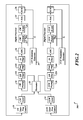
- FIG. 2 illustrates an RFOG 200 according to an embodiment of the invention. Elements of the RFOG 200 illustrated in Figure 2 (as well as Figure 4 ) similar or identical to those elements illustrated in Figure 1 are designated with like reference numerals. For ease of illustration, the following discussion is presented, at least primarily, in the context of the CW path and its constituent elements illustrated in Figure 2 . It is to be understood that the same or similar principles apply equally to the CCW path illustrated in Figure 2 .
- the difference in the CW and CCW resonance frequencies is proportional to rotation rate of the RFOG.
- the resonance frequencies must be determined with high precision.
- the RFOG employs a modulation/demodulation technique, employing, for example, the generator 20 and demodulator 22, to determine the resonance frequencies.
- the frequency of the CW and CCW lasers 12, 14 are modulated.
- the frequency modulation sweeps the laser frequency relative to the resonance frequency.
- the resulting output of the resonator CW and CCW preamps depends on where the average laser frequency lies relative to the resonance frequency. If the average laser frequency deviates from the resonance frequency, then a signal at the modulation frequency is present. The sign or phase of the signal depends on which direction the average laser frequency deviates from the resonance frequency. When the average laser frequency is exactly on resonance, then the amplitude of the signal at the modulation frequency, and odd harmonics thereof, is zero. Therefore the resonance frequency is detected by detecting a null of the signal at the modulation frequency.
- a synchronous demodulator is typically used to detect the resonator output signal at the modulation frequency. Synchronous demodulation provides significant rejection of other signals and noise that does not occur at the modulation frequency. A synchronous demodulator is also sensitive to the phase of the demodulator input signal and thus provides an output that has a sign that indicates the direction that the average laser frequency deviates from the resonance frequency. Synchronous demodulation can be performed by an analog mixer; however this may result in large sensing errors due to imperfections of the analog mixer. For example, even if there is no signal at the modulation frequency going into the analog mixer, the output of the mixer may have some offset due to imperfections. The offset will translate to a gyro rate bias error. Significant performance improvements can be realized by using a digital demodulator, which does not have offset errors like the analog mixer.
- the resonator signal from the preamp must be digitized by an analog-to-digital converter (ADC) 36.
- ADC analog-to-digital converter
- AA anti-aliasing filter 32 is placed in-front of the ADC to reduce the effects of signal and noise aliasing, which is accomplished by providing signal attenuation at and above the ADC sample frequency.
- a servo may be used to maintain the average laser frequency at the resonator resonance frequency.
- the servo controls the laser frequency to the resonance frequency such that the demodulator output is held at zero.
- a servo can consist of an analog integrator, but like the analog demodulator, an analog mixer has imperfections that can lead to rotation sensing errors.
- An example is an effective integrator input voltage offset, which will cause the integrator to move the average laser frequency slightly off resonance to generate a demodulator output that cancels out the integrator input offset.
- a digital approximation of an integrator e . g ., accumulator 24
- an integrator e . g ., accumulator 24
- the output of the accumulator 24 can be converted back to analog by a digital-to-analog converter (DAC) 34 before being sent to the laser frequency control circuit 38.
- DAC digital-to-analog converter
- the DAC 34 output may also be summed with the modulation generator 20 output, which provides modulation of the laser frequency.
- Digitizing the preamp signal may introduce quantization noise associated with the ADC 36.
- the ADC quantization noise will result in higher angle random walk (ARW), which is a key performance parameter of the gyro.
- ARW angle random walk
- the impact that ADC quantization noise has on ARW depends on the signal gain before the ADC 36. A higher signal gain reduces the impact on ARW. With enough signal gain, the quantization noise impact on ARW can be made insignificant.
- the amount of signal gain is limited by the direct-current (DC) preamp 18 output due to the time-average light intensity at the resonator 16 output, and the even harmonic signal that results from modulating over the resonance peak.
- Table 1 shows results from a calculation of the ratio of specific even harmonic amplitude to the second harmonic amplitude of the even harmonic signal.
- Table 1 Harmonic # Ratio with SH (dB) 2 0.0 4 -15.5 6 -31.1 8 -46.6 10 -62.2
- the 2nd harmonic component of the even harmonic signal dominates and is what limits the additional gain.
- the even harmonic signal amplitude should be reduced by approximately 30dB.
- the table shows that if only the 2nd harmonic is eliminated (such as using a notch filter with a notch frequency at the 2nd harmonic frequency, as discussed in greater detail below herein), then the 4th harmonic will limit the additional gain to about 15dB.
- the Table 1 shows that at least the 2nd and 4th harmonics must be removed. Since the 6th harmonic is -31dB down from the second, there is little design margin if 30dB of additional gain is required; therefore, even rejection of the 6th harmonic is desirable.
- noise dithering and over-sampling may be employed. With sufficient noise amplitude, adjacent ADC bits are always toggled even if the signal is in-between bits. The bit toggling provides a signal at the ADC 36 output that has an average duty cycle depending on the amplitude of the signal that lies between bits. The signal can be digitally reconstructed by averaging the ADC 36 output. To accurately reconstruct the signal with averaging, the ADC sample frequency must be greater than the frequency of the averaged samples, which in turn must be greater than the frequency of the signal to be reconstructed. Typically, in fiber optic gyros, the, ADC sampling frequency is at least 100 times greater than the signal frequency.
- the total root mean square (RMS) amplitude of the ADC input noise should be at least 1/3 of the least significant bit (LSB) of the ADC. If the RMS noise amplitude is less than 1/3 LSB, then the noise dithering may not eliminate deadband in the gyro rotation sensing transfer function, or additional rotation sensing noise due to finite ADC resolution.
- LSB least significant bit
- the resonator 16 signal has some wide-band noise due to many noise sources, such as photon shot noise.
- the wide-band noise can be used to provide a dither signal to the ADC 36.
- the noise bandwidth from the preamp 18 to the ADC 36 may be approximately 1MHz.
- a typical modulation frequency for an RFOG ranges from 20kHz to about 200kHz. If the cut-off frequency of the AA filter 32 is set to just above the modulation frequency, then the AA filter will limit the noise bandwidth to much less than required, and therefore there will not be enough noise at the ADC 36 input for bit interpolation. Thus, it is desirable to reject at least the 2nd, 4th and 6th harmonics of the even harmonic signal while providing enough noise amplitude at the ADC input.
- an embodiment includes respective filtering elements 210, 220 and amplifiers 230, 240 employed in the CW and CCW paths of the RFOG 200.
- the filtering elements 210, 220 may include a notch filter, or a series of notch filters, that reject an even-harmonic component of the even-harmonic signal.
- one notch filter may be set to reject the 2nd harmonic, another notch filter for the 4th harmonic, another notch filter for the 6th harmonic, etc.
- This approach can provide the desired attenuation of the even-harmonic signal to allow the desired additional gain provided by amplifiers 230, 240 without saturating the electronics of the RFOG 200.
- the notch filters may pass noise at the odd harmonics of the signal. Noise at these frequencies can increase ARW if a square-wave digital demodulator is employed. A square-wave demodulator is commonly used in FOG signal processing because of its simplicity requiring very few digital gates in the digital processor chip.
- a square-wave demodulator is not only sensitive to a signal at the modulation/demodulation frequency, but also odd harmonics of the modulation frequency.
- the ADC input noise density is S in , which is assumed to be constant over all frequencies, and n is the odd harmonic number, and k is a proportionality constant.
- the minimum (best) ARW is obtained if the noise at the odd harmonics is removed.
- An exemplary approach is to set the AA filter 32 cutoff frequency low enough to remove noise at the 3rd harmonic and above. However, the AA filter 32, with such a low frequency cutoff, may also remove noise required for ADC bit dithering. Equation 2 shows what happens to ARW if only the lower odd harmonics are removed:
- n_min is the lowest odd harmonic that is allowed to pass.
- Table 2 shows the fractional increase in ARW for various n_min.
- n_min Noise Factor 3 1.109 5 1.057 7 1.038 9 1.028 11 1.022 13 1.018 15 1.015 17 1.013 19 1.011 21 1.010 23 1.009
- n_min 3
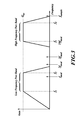
- a transfer function provided by filtering elements 210, 220 according to an embodiment is shown graphically in Figure 3 .
- Figure 4 illustrates a configuration of filtering element 210 (as well as filtering element 220) according to such an embodiment.
- the preamp 18 signal includes an oscillating signal (e . g ., f or f mod ), a direct-current (DC) signal, an even-harmonic signal including a set of components at even harmonics ( e . g ., 2 f , 4 f , 6 f , etc .) of the oscillating signal, and an odd-harmonic signal including a set of components at odd harmonics ( e . g ., 3 f, 5 f, 7 f, etc .) of the oscillating signal.
- the preamp 18 signal is split into two paths.
- a Low-Frequency Bandpass Filter (BPF) 410 passes only a fundamental component (e . g ., 1 f ) of the oscillating signal and rejects the DC signal, the even harmonic signal and noise at odd harmonics.
- a HighFrequency BPF 420 passes enough noise (e.g ., a subset of harmonic components above the 19 th harmonic) for ADC 36 bit dithering, but rejects the DC signal, significant even harmonic signals ( e . g ., a subset of harmonic components below the 8th harmonic) and significant noise at odd harmonics ( e . g ., a subset of harmonic components including the 19 th harmonic and below).
- the outputs of the two BPFs 410, 420 are summed together at a summing element, such as a summing amplifier 430, or a summing node of the amplifier 230. After amplification by the amplifier 230, the filtered signal may then be digitized by ADC 36.
- a summing element such as a summing amplifier 430, or a summing node of the amplifier 230.
- the gain of the filtering element 210 drops with lower frequencies below f 1 and goes to zero at DC to block any DC signal from the preamp 18.
- the gain reaches a maximum between f 1 and f 2 to pass the desired signal at the modulation frequency f mod .
- the gain decreases with increasing frequency to provide the desired attenuation of the even harmonic signal and odd harmonic noise.
- the gain of the filtering element 210 increases again near the frequency f 3 .
- the bandwidth between f 3 and f 4 determines how much noise is presented to the ADC 36 for bit dithering. In an embodiment, this bandwidth may be approximately 1MHz to provide enough noise for bit dithering.
- the gain drops off after f 4 to provide attenuation at the ADC sampling frequency f samp to reduce the effects of aliasing.
Landscapes
- Physics & Mathematics (AREA)
- Engineering & Computer Science (AREA)
- Optics & Photonics (AREA)
- Electromagnetism (AREA)
- Power Engineering (AREA)
- General Physics & Mathematics (AREA)
- Radar, Positioning & Navigation (AREA)
- Remote Sensing (AREA)
- Gyroscopes (AREA)
Abstract
Description
- This invention was made with Government support under Contract No. N00014-06-C-00001 awarded by the Office of Naval Research. The Government has certain rights in the invention.
- This application claims priority to
U.S. Provisional Application No. 61/158,734 filed on March 9, 2009 - The resonator fiber optic gyroscope (RFOG) has the potential of meeting the needs of many navigation and rotation sensing markets and creating new markets because of its capability of high performance in a small size, at low power and low cost.
Figure 1 illustrates aconventional RFOG 10 consisting of a clockwise (CW)laser 12, a counterclockwise (CCW)laser 14, a fiberoptic resonator 16 and electronic circuits ("electronics") providing at least resonator-coupling and resonance-tracking (or resonance-detection) functionality. TheCW laser 12 inputs light into theresonator 16 and aCW photodetector 18 detects the CW output of the resonator. - The electronics downstream of the
CW photodetector 18, which include aCW modulation generator 20, aCW demodulator 22, aCW accumulator 24, and asumming element 26, control the CW laser frequency to a resonance frequency of theresonator 16. The resonance frequency is detected by modulating the laser frequency at f 1 using theCW modulation generator 20 and then demodulating the output of theCW photodetector 18 at f 1 using theCW demodulator 22. At the resonance frequency, theCW photodetector 18 signal at f 1 passes through zero amplitude. TheCW accumulator 24 controls the laser frequency via theCW laser driver 38 to the resonance frequency by adjusting the laser frequency until the output of theCW demodulator 22 is zero. The modulation at f 1 is electronically summed with theCW integrator 24 output by thesumming element 26. With regard to the similarly configured CCW path of theRFOG 10, theCCW laser 14 is controlled to the CCW resonance frequency in a similar manner, except it is common that the modulation frequency f 2 is different than f 1 to eliminate errors that arise when light from one direction of propagation in theresonator 16 inadvertently couples into the other direction. - In order to achieve high performance, the RFOG electronics must be capable of digitizing and detecting a very small signal from the
resonator 16 and at specific frequency in the presence of a very large unwanted (e.g., harmonic) signal. The required resolution cannot be obtained with conventional analog-to-digital converters (ADCs) alone, and therefore some type of filter, to remove the unwanted signal to allow additional gain of the rotation signal so that conventional ADCs can be used, would be desirable. Ideally, such a filter removes the unwanted signal without removing noise that is required for ADC bit interpolation. - In an embodiment, a resonator fiber optic gyroscope includes a first light source configured to generate a light signal. A resonator element is configured to generate an optical signal based on the light signal. A photodetector is configured to generate a first electrical signal based on the optical signal. The first electrical signal includes an oscillating signal, a direct-current (DC) signal, an even-harmonic signal including components at even harmonics of the oscillating signal, and an odd-harmonic signal including components at odd harmonics of the oscillating signal. A filtering element is configured to attenuate the DC signal, at least one even-harmonic component, and an odd-harmonic component to produce a second electrical signal. An amplifier is configured to amplify the second electrical signal. An analog-to-digital converter (ADC) is configured to digitize the amplified second electrical signal.
- Preferred and alternative embodiments of the present invention are described in detail below with reference to the following drawings.
-
Figure 1 illustrates a conventional RFOG; -
Figure 2 illustrates an RFOG according to an embodiment of the invention; -
Figure 3 illustrates a transfer function provided by filtering elements according to an embodiment of the invention; and -
Figure 4 illustrates components of the RFOG ofFigure 2 . - An embodiment provides an optimum accommodation of signal rejection and passing noise for ADC bit interpolation by splitting a gyro signal into two paths, applying a filter in a first path that is optimized for unwanted signal rejection and a filter in a second path that is optimized for passing only noise necessary for good ADC bit interpolation, then recombining the two paths before ADC processing.
-
Figure 2 illustrates anRFOG 200 according to an embodiment of the invention. Elements of theRFOG 200 illustrated inFigure 2 (as well asFigure 4 ) similar or identical to those elements illustrated inFigure 1 are designated with like reference numerals. For ease of illustration, the following discussion is presented, at least primarily, in the context of the CW path and its constituent elements illustrated inFigure 2 . It is to be understood that the same or similar principles apply equally to the CCW path illustrated inFigure 2 . - For an ideal resonator, the difference in the CW and CCW resonance frequencies is proportional to rotation rate of the RFOG. To achieve full performance potential, the resonance frequencies must be determined with high precision. The RFOG employs a modulation/demodulation technique, employing, for example, the
generator 20 anddemodulator 22, to determine the resonance frequencies. - To provide a signal that is indicative of a deviation from the resonance frequency, the frequency of the CW and
CCW lasers photodetectors 18, 28 that convert resonator output light intensity to an electrical signal) depends on where the average laser frequency lies relative to the resonance frequency. If the average laser frequency deviates from the resonance frequency, then a signal at the modulation frequency is present. The sign or phase of the signal depends on which direction the average laser frequency deviates from the resonance frequency. When the average laser frequency is exactly on resonance, then the amplitude of the signal at the modulation frequency, and odd harmonics thereof, is zero. Therefore the resonance frequency is detected by detecting a null of the signal at the modulation frequency. - A synchronous demodulator is typically used to detect the resonator output signal at the modulation frequency. Synchronous demodulation provides significant rejection of other signals and noise that does not occur at the modulation frequency. A synchronous demodulator is also sensitive to the phase of the demodulator input signal and thus provides an output that has a sign that indicates the direction that the average laser frequency deviates from the resonance frequency. Synchronous demodulation can be performed by an analog mixer; however this may result in large sensing errors due to imperfections of the analog mixer. For example, even if there is no signal at the modulation frequency going into the analog mixer, the output of the mixer may have some offset due to imperfections. The offset will translate to a gyro rate bias error. Significant performance improvements can be realized by using a digital demodulator, which does not have offset errors like the analog mixer.
- To employ a digital demodulator the resonator signal from the preamp must be digitized by an analog-to-digital converter (ADC) 36. Typically an anti-aliasing (AA)
filter 32 is placed in-front of the ADC to reduce the effects of signal and noise aliasing, which is accomplished by providing signal attenuation at and above the ADC sample frequency. - A servo may be used to maintain the average laser frequency at the resonator resonance frequency. The servo controls the laser frequency to the resonance frequency such that the demodulator output is held at zero. A servo can consist of an analog integrator, but like the analog demodulator, an analog mixer has imperfections that can lead to rotation sensing errors. An example is an effective integrator input voltage offset, which will cause the integrator to move the average laser frequency slightly off resonance to generate a demodulator output that cancels out the integrator input offset. To improve gyro performance, a digital approximation of an integrator (e.g., accumulator 24) can be employed. The output of the
accumulator 24 can be converted back to analog by a digital-to-analog converter (DAC) 34 before being sent to the laserfrequency control circuit 38. TheDAC 34 output may also be summed with themodulation generator 20 output, which provides modulation of the laser frequency. - Digitizing the preamp signal may introduce quantization noise associated with the
ADC 36. The ADC quantization noise will result in higher angle random walk (ARW), which is a key performance parameter of the gyro. The impact that ADC quantization noise has on ARW depends on the signal gain before theADC 36. A higher signal gain reduces the impact on ARW. With enough signal gain, the quantization noise impact on ARW can be made insignificant. However, without changes to the configuration of the RFOG shown inFigure 1 , the amount of signal gain is limited by the direct-current (DC)preamp 18 output due to the time-average light intensity at theresonator 16 output, and the even harmonic signal that results from modulating over the resonance peak. Typically, to reduce quantization noise impact on ARW to required levels, an additional 20dB to 30dB of signal gain may be required over the limit imposed by DC preamp output due to the average light intensity and the even harmonic signal. Thus, it is desirable to reduce the DC and even-harmonic signals to allow additional gain before signal processing by theADC 36. - Table 1 shows results from a calculation of the ratio of specific even harmonic amplitude to the second harmonic amplitude of the even harmonic signal.
Table 1 Harmonic # Ratio with SH (dB) 2 0.0 4 -15.5 6 -31.1 8 -46.6 10 -62.2 - Without additional filtering of the signal, the 2nd harmonic component of the even harmonic signal dominates and is what limits the additional gain. To obtain an additional gain of 30dB, the even harmonic signal amplitude should be reduced by approximately 30dB. The table shows that if only the 2nd harmonic is eliminated (such as using a notch filter with a notch frequency at the 2nd harmonic frequency, as discussed in greater detail below herein), then the 4th harmonic will limit the additional gain to about 15dB. To obtain an additional gain of 30dB, the Table 1 shows that at least the 2nd and 4th harmonics must be removed. Since the 6th harmonic is -31dB down from the second, there is little design margin if 30dB of additional gain is required; therefore, even rejection of the 6th harmonic is desirable.
- Setting the cutoff frequency of the
AA filter 32 with an appropriate roll-off just above the modulation frequency can achieve the desired rejection of the even harmonic signals. However, by doing so, another important criteria associated with the ADC may not be met; to meet performance requirements the required detection level of the resonator output signal at the modulation frequency is typically much less than the bit resolution of available ADCs. For an ideal case, if the average resonator signal is between two adjacent bits of the ADC, then a non-zero resonator signal will not be detected until its amplitude is large enough to be detected by either bit. This can lead to a deadband in the gyro rotation-sensing transfer function, or additional rotation sensing noise. - To overcome the resolution limitation of ADCs, a method known as noise dithering and over-sampling may be employed. With sufficient noise amplitude, adjacent ADC bits are always toggled even if the signal is in-between bits. The bit toggling provides a signal at the
ADC 36 output that has an average duty cycle depending on the amplitude of the signal that lies between bits. The signal can be digitally reconstructed by averaging theADC 36 output. To accurately reconstruct the signal with averaging, the ADC sample frequency must be greater than the frequency of the averaged samples, which in turn must be greater than the frequency of the signal to be reconstructed. Typically, in fiber optic gyros, the, ADC sampling frequency is at least 100 times greater than the signal frequency. It has been shown in the literature that to obtain accurate reconstruction of the ADC input signal, the total root mean square (RMS) amplitude of the ADC input noise should be at least 1/3 of the least significant bit (LSB) of the ADC. If the RMS noise amplitude is less than 1/3 LSB, then the noise dithering may not eliminate deadband in the gyro rotation sensing transfer function, or additional rotation sensing noise due to finite ADC resolution. - In practice, the
resonator 16 signal has some wide-band noise due to many noise sources, such as photon shot noise. The wide-band noise can be used to provide a dither signal to theADC 36. To provide enough noise at theADC 36 to meet the 1/3 LSB criteria, the noise bandwidth from thepreamp 18 to theADC 36 may be approximately 1MHz. A typical modulation frequency for an RFOG ranges from 20kHz to about 200kHz. If the cut-off frequency of theAA filter 32 is set to just above the modulation frequency, then the AA filter will limit the noise bandwidth to much less than required, and therefore there will not be enough noise at theADC 36 input for bit interpolation. Thus, it is desirable to reject at least the 2nd, 4th and 6th harmonics of the even harmonic signal while providing enough noise amplitude at the ADC input. - Referring to
Figure 2 , an embodiment includesrespective filtering elements amplifiers RFOG 200. In an embodiment, thefiltering elements amplifiers RFOG 200. However, the notch filters may pass noise at the odd harmonics of the signal. Noise at these frequencies can increase ARW if a square-wave digital demodulator is employed. A square-wave demodulator is commonly used in FOG signal processing because of its simplicity requiring very few digital gates in the digital processor chip. - A square-wave demodulator is not only sensitive to a signal at the modulation/demodulation frequency, but also odd harmonics of the modulation frequency. The square-wave demodulator sensitivity to an odd harmonic is inversely proportional to the harmonic number n. Equation 1 shows how noise at the modulation odd harmonics contributes to the total gyro ARW:

- The ADC input noise density is Sin , which is assumed to be constant over all frequencies, and n is the odd harmonic number, and k is a proportionality constant. The minimum (best) ARW is obtained if the noise at the odd harmonics is removed. An exemplary approach is to set the
AA filter 32 cutoff frequency low enough to remove noise at the 3rd harmonic and above. However, theAA filter 32, with such a low frequency cutoff, may also remove noise required for ADC bit dithering.Equation 2 shows what happens to ARW if only the lower odd harmonics are removed: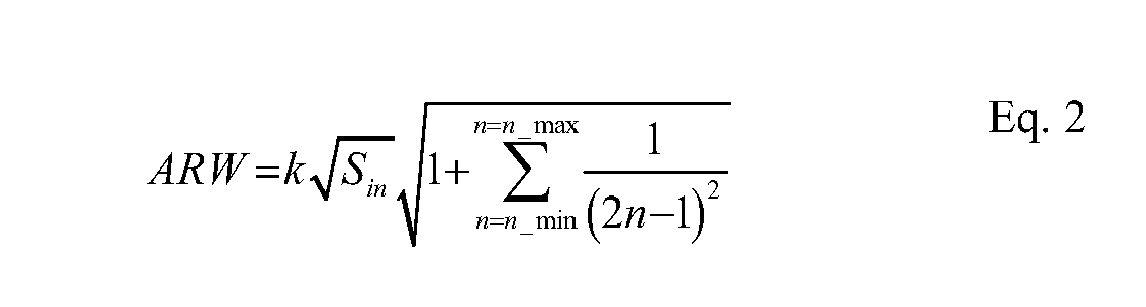
- Where n_min is the lowest odd harmonic that is allowed to pass. Table 2 shows the fractional increase in ARW for various n_min.
Table 2 n_min Noise Factor 3 1.109 5 1.057 7 1.038 9 1.028 11 1.022 13 1.018 15 1.015 17 1.013 19 1.011 21 1.010 23 1.009 - For n_min = 3, noise at all odd harmonics are allowed to pass to the
ADC 36 and the ARW is increased by about 11%. If noise at the 3rd harmonic is removed, (n_min = 5), then the ARW is increased by only about 6%. After removing noise at the 3rd through 19th harmonics, any additional removal of higher harmonics has insignificant (i.e., less than 1%) impact on ARW. Therefore, besides rejecting the 2nd, 4th and 6th harmonics of the even harmonic signal, and passing enough noise for ADC bit dithering, thefiltering elements elements Figure 3 .Figure 4 illustrates a configuration of filtering element 210 (as well as filtering element 220) according to such an embodiment. - In the embodiment illustrated in
Figure 4 , thepreamp 18 signal includes an oscillating signal (e.g., f or fmod ), a direct-current (DC) signal, an even-harmonic signal including a set of components at even harmonics (e.g., 2f, 4f, 6f, etc.) of the oscillating signal, and an odd-harmonic signal including a set of components at odd harmonics (e.g., 3f, 5f, 7f, etc.) of the oscillating signal. At thefiltering element 210, thepreamp 18 signal is split into two paths. In one path, a Low-Frequency Bandpass Filter (BPF) 410 passes only a fundamental component (e.g., 1f) of the oscillating signal and rejects the DC signal, the even harmonic signal and noise at odd harmonics. In the other path, aHighFrequency BPF 420 passes enough noise (e.g., a subset of harmonic components above the 19th harmonic) forADC 36 bit dithering, but rejects the DC signal, significant even harmonic signals (e.g., a subset of harmonic components below the 8th harmonic) and significant noise at odd harmonics (e.g., a subset of harmonic components including the 19th harmonic and below). The outputs of the twoBPFs amplifier 430, or a summing node of theamplifier 230. After amplification by theamplifier 230, the filtered signal may then be digitized byADC 36. - Referring to
Figure 3 , the gain of thefiltering element 210 drops with lower frequencies below f 1 and goes to zero at DC to block any DC signal from thepreamp 18. The gain reaches a maximum between f 1 and f 2 to pass the desired signal at the modulation frequency f mod. Just above the modulation frequency f mod at f 2, the gain decreases with increasing frequency to provide the desired attenuation of the even harmonic signal and odd harmonic noise. To provide noise forADC 36 bit dithering, the gain of thefiltering element 210 increases again near the frequency f 3. The bandwidth between f 3 and f 4 determines how much noise is presented to theADC 36 for bit dithering. In an embodiment, this bandwidth may be approximately 1MHz to provide enough noise for bit dithering. The gain drops off after f 4 to provide attenuation at the ADC sampling frequency fsamp to reduce the effects of aliasing. - While a preferred embodiment of the invention has been illustrated and described, as noted above, many changes can be made without departing from the spirit and scope of the invention. Accordingly, the scope of the invention is not limited by the disclosure of the preferred embodiment. Instead, the invention should be determined entirely by reference to the claims that follow.
Claims (10)
- A resonator fiber optic gyroscope, comprising:a first light source configured to generate a first light signal (12, 14);a resonator element (16) coupled to the first light source and configured to generate a first optical signal based on the first light signal;a first photodetector (18, 28) coupled to the resonator element and configured to generate a first electrical signal based on the first optical signal, the first electrical signal including an oscillating signal and a first even-harmonic signal comprising components at even harmonics of the oscillating signal;a first filtering element (210, 220) coupled to the first photodetector and configured to attenuate at least one even-harmonic component of the first even-harmonic signal to produce a second electrical signal;a first amplifier (230, 240) coupled to the first filtering element and configured to amplify the second electrical signal; anda first analog-to-digital converter (ADC) (36) coupled to the amplifier and configured to digitize the amplified second electrical signal.
- The gyroscope of claim 1 wherein the first filtering element comprises at least one notch filter.
- The gyroscope of claim 8 wherein the first filtering element comprises a plurality of notch filters in series, each notch filter of the plurality configured to attenuate a respective different even-harmonic component of the first even-harmonic signal.
- A signal-conditioning circuit implementable in a resonator fiber optic gyroscope (RFOG), the RFOG including a first light source (12, 14) configured to generate a first light signal, a resonator element (16) configured to generate a first optical signal based on the first light signal, a first photodetector (18, 28) configured to generate a first electrical signal based on the first optical signal, the first electrical signal including an oscillating signal, a first direct-current (DC) signal, a first even-harmonic signal comprising components at even harmonics of the oscillating signal, and a first odd-harmonic signal comprising components at odd harmonics of the oscillating signal, and a first analog-to-digital converter (ADC) (36), the circuit comprising:a first filtering element (210, 220) configured to be coupled to the first photodetector and configured to attenuate the first DC signal, at least one even-harmonic component of the first even-harmonic signal, and a first odd-harmonic component of the first odd-harmonic signal to produce a second electrical signal; anda first amplifier (230, 240) coupled to the filtering element and configured to amplify the second electrical signal, wherein the first ADC is configured to digitize the amplified second electrical signal.
- The circuit of claim 4 wherein the first filtering element comprises a first filtering component configured to produce a third electrical signal by:attenuating the first DC signal, the first even-harmonic signal and the first odd-harmonic signal; andpassing a fundamental component of the oscillating signal, wherein the second electrical signal comprises the third electrical signal.
- The circuit of claim 4 wherein the first filtering element comprises a first filtering component configured to produce a third electrical signal by:attenuating the first DC signal, the at least one even-harmonic component of the first even-harmonic signal, and the first odd-harmonic component of the first odd-harmonic signal; andpassing a second odd-harmonic component of the first odd-harmonic signal, wherein the second electrical signal comprises the third electrical signal.
- The circuit of claim 5 wherein the first filtering component comprises a low-frequency bandpass filter (410).
- The circuit of claim 6 wherein the first filtering component comprises a highfrequency bandpass filter (420).
- The circuit of claim 4 wherein the first filtering element comprises:a first filtering component (410) configured to produce a third electrical signal by:attenuating the first DC signal, the first even-harmonic signal and the first odd-harmonic signal, andpassing a fundamental component of the oscillating signal;a second filtering component (420) configured to produce a fourth electrical signal by:attenuating the first DC signal, the at least one even-harmonic component of the first even-harmonic signal, and the first odd-harmonic component of the first odd-harmonic signal, andpassing a second odd-harmonic component of the first odd-harmonic signal; anda summing element (430) configured to sum the third and fourth electrical signals to produce the second electrical signal.
- The circuit of claim 4 wherein the first filtering element is configured to pass a second odd-harmonic component of the first odd-harmonic signal to enable the ADC to perform a bit-interpolation function.
Applications Claiming Priority (2)
| Application Number | Priority Date | Filing Date | Title |
|---|---|---|---|
| US15873409P | 2009-03-09 | 2009-03-09 | |
| US12/415,836 US8077322B2 (en) | 2009-03-09 | 2009-03-31 | Signal conditioning to provide optimum gain and noise reduction for resonator fiber optic gyroscopes |
Publications (3)
| Publication Number | Publication Date |
|---|---|
| EP2228624A2 true EP2228624A2 (en) | 2010-09-15 |
| EP2228624A3 EP2228624A3 (en) | 2012-08-01 |
| EP2228624B1 EP2228624B1 (en) | 2014-02-12 |
Family
ID=42272621
Family Applications (1)
| Application Number | Title | Priority Date | Filing Date |
|---|---|---|---|
| EP09180718.0A Active EP2228624B1 (en) | 2009-03-09 | 2009-12-23 | Signal conditioning to provide optimum gain and noise reduction for resonator fiber optic gyroscopes |
Country Status (3)
| Country | Link |
|---|---|
| US (1) | US8077322B2 (en) |
| EP (1) | EP2228624B1 (en) |
| JP (1) | JP5356261B2 (en) |
Families Citing this family (10)
| Publication number | Priority date | Publication date | Assignee | Title |
|---|---|---|---|---|
| US8223341B2 (en) * | 2010-05-28 | 2012-07-17 | Honeywell International Inc. | System and method for enhancing signal-to-noise ratio of a resonator fiber optic gyroscope |
| US8213019B2 (en) | 2010-09-07 | 2012-07-03 | Honeywell International Inc. | RFOG with optical heterodyning for optical signal discrimination |
| US8659760B2 (en) * | 2012-04-12 | 2014-02-25 | Honeywell International Inc. | Resonator fiber optic gyroscope utilizing laser frequency combs |
| US8947671B2 (en) * | 2013-02-22 | 2015-02-03 | Honeywell International Inc. | Method and system for detecting optical ring resonator resonance frequencies and free spectral range to reduce the number of lasers in a resonator fiber optic gyroscope |
| US9001336B1 (en) | 2013-10-07 | 2015-04-07 | Honeywell International Inc. | Methods and apparatus of tracking/locking resonator free spectral range and its application in resonator fiber optic gyroscope |
| KR101548853B1 (en) | 2014-01-07 | 2015-08-31 | 삼성전기주식회사 | Apparatus for driving gyro sensor and controlling Method thereof |
| US9356578B1 (en) | 2014-12-10 | 2016-05-31 | Honeywell International Inc. | Spurious frequency attenuation servo without tuning filter |
| CN108444464B (en) * | 2018-02-05 | 2021-06-15 | 北京大学 | A method for suppressing relative intensity noise of light source in fiber optic gyroscope |
| US12405111B2 (en) | 2023-07-06 | 2025-09-02 | Honeywell International Inc. | Resonator optical gyroscopes with dual broadband light sources |
| US12590800B2 (en) | 2023-07-10 | 2026-03-31 | Honeywell International Inc. | Stability enhanced resonator fiber optic gyro (RFOG) |
Family Cites Families (8)
| Publication number | Priority date | Publication date | Assignee | Title |
|---|---|---|---|---|
| US6014217A (en) * | 1991-10-30 | 2000-01-11 | Honeywell, Inc. | Fiber optic gyroscope scattering error reduction |
| JPH06117863A (en) * | 1992-10-02 | 1994-04-28 | Tokimec Inc | Optical fiber gyro |
| US5469257A (en) | 1993-11-24 | 1995-11-21 | Honeywell Inc. | Fiber optic gyroscope output noise reducer |
| US5774216A (en) | 1993-11-30 | 1998-06-30 | Honeywell, Inc. | RLG dither noise injection by means of reference modulation |
| JPH07167663A (en) * | 1993-12-13 | 1995-07-04 | Hitachi Ltd | Fiber optic gyro |
| US6765678B2 (en) | 2002-01-08 | 2004-07-20 | Honeywell International Inc. | Relative intensity noise controller with maximum gain at frequencies at or above the bias modulation frequency or with second order feedback for fiber light sources |
| US7372574B2 (en) * | 2005-12-09 | 2008-05-13 | Honeywell International Inc. | System and method for stabilizing light sources in resonator gyro |
| JP5351451B2 (en) * | 2007-07-06 | 2013-11-27 | ハネウェル・インターナショナル・インコーポレーテッド | RFOG modulation error correction |
-
2009
- 2009-03-31 US US12/415,836 patent/US8077322B2/en active Active
- 2009-12-23 EP EP09180718.0A patent/EP2228624B1/en active Active
-
2010
- 2010-01-08 JP JP2010002965A patent/JP5356261B2/en not_active Expired - Fee Related
Non-Patent Citations (1)
| Title |
|---|
| None |
Also Published As
| Publication number | Publication date |
|---|---|
| EP2228624B1 (en) | 2014-02-12 |
| EP2228624A3 (en) | 2012-08-01 |
| US20110181886A1 (en) | 2011-07-28 |
| JP2010210611A (en) | 2010-09-24 |
| JP5356261B2 (en) | 2013-12-04 |
| US8077322B2 (en) | 2011-12-13 |
Similar Documents
| Publication | Publication Date | Title |
|---|---|---|
| EP2228624B1 (en) | Signal conditioning to provide optimum gain and noise reduction for resonator fiber optic gyroscopes | |
| JP5235015B2 (en) | Method for processing a sensor signal subject to an offset and sensor device designed to perform the method | |
| JP5480950B2 (en) | System and method for resonator fiber optic gyroscope intensity modulation control | |
| US11204246B1 (en) | Systems and methods to reduce differential harmonics of resonance tracking modulation in a resonant fiber optic gyroscope | |
| US11131546B2 (en) | Integrated optical gyroscope with noise cancellation | |
| CN106979776B (en) | Digital closed-loop control method of fiber-optic gyroscope based on sigma-delta modulation | |
| US7630082B2 (en) | Systems and methods for high precision feedback control in closed loop sensors | |
| US6583882B2 (en) | Apparatus and method using digitally controlled integration for signal detection with improved noise characteristics | |
| US8742314B2 (en) | Light amount detecting apparatus, and light amount information processing apparatus | |
| EP3699610B1 (en) | Capacitance-to-voltage interface circuit | |
| US8680911B2 (en) | High-linearity signal-processing amplifier | |
| CN118472792A (en) | A semiconductor laser frequency stabilization controller | |
| CN108398658A (en) | A kind of automatic frequency control apparatus and method | |
| US9702898B1 (en) | Method and system for detecting and correcting quadrature error signals for MEMS device | |
| WO2001065209A2 (en) | Improved fiber optic gyroscope | |
| Ursic et al. | Digital receivers offer new solutions for beam instrumentation | |
| EP0492580B1 (en) | Fiber optic gyro | |
| CN119362131B (en) | Full-digital control programmable titanium precious stone femtosecond oscillator carrier envelope offset frequency locking device | |
| CN113390404B (en) | Closed-loop control method for fiber-optic gyroscope | |
| CN118482706A (en) | Broad spectrum light source resonance type optical fiber gyro based on superheterodyne method and digital system thereof | |
| JP3390943B2 (en) | Optical interference angular velocity meter | |
| JPH06232749A (en) | A/d converter | |
| JP2003169100A (en) | Signal processor | |
| JPH05174996A (en) | Phase difference detector for particle accelerator |
Legal Events
| Date | Code | Title | Description |
|---|---|---|---|
| PUAI | Public reference made under article 153(3) epc to a published international application that has entered the european phase |
Free format text: ORIGINAL CODE: 0009012 |
|
| 17P | Request for examination filed |
Effective date: 20091223 |
|
| AK | Designated contracting states |
Kind code of ref document: A2 Designated state(s): AT BE BG CH CY CZ DE DK EE ES FI FR GB GR HR HU IE IS IT LI LT LU LV MC MK MT NL NO PL PT RO SE SI SK SM TR |
|
| AX | Request for extension of the european patent |
Extension state: AL BA RS |
|
| PUAL | Search report despatched |
Free format text: ORIGINAL CODE: 0009013 |
|
| AK | Designated contracting states |
Kind code of ref document: A3 Designated state(s): AT BE BG CH CY CZ DE DK EE ES FI FR GB GR HR HU IE IS IT LI LT LU LV MC MK MT NL NO PL PT RO SE SI SK SM TR |
|
| AX | Request for extension of the european patent |
Extension state: AL BA RS |
|
| RIC1 | Information provided on ipc code assigned before grant |
Ipc: G01C 19/72 20060101AFI20120628BHEP |
|
| 17Q | First examination report despatched |
Effective date: 20120906 |
|
| GRAP | Despatch of communication of intention to grant a patent |
Free format text: ORIGINAL CODE: EPIDOSNIGR1 |
|
| INTG | Intention to grant announced |
Effective date: 20130920 |
|
| GRAS | Grant fee paid |
Free format text: ORIGINAL CODE: EPIDOSNIGR3 |
|
| GRAA | (expected) grant |
Free format text: ORIGINAL CODE: 0009210 |
|
| AK | Designated contracting states |
Kind code of ref document: B1 Designated state(s): AT BE BG CH CY CZ DE DK EE ES FI FR GB GR HR HU IE IS IT LI LT LU LV MC MK MT NL NO PL PT RO SE SI SK SM TR |
|
| REG | Reference to a national code |
Ref country code: GB Ref legal event code: FG4D |
|
| REG | Reference to a national code |
Ref country code: CH Ref legal event code: EP |
|
| REG | Reference to a national code |
Ref country code: AT Ref legal event code: REF Ref document number: 652335 Country of ref document: AT Kind code of ref document: T Effective date: 20140215 |
|
| REG | Reference to a national code |
Ref country code: IE Ref legal event code: FG4D |
|
| REG | Reference to a national code |
Ref country code: DE Ref legal event code: R096 Ref document number: 602009021777 Country of ref document: DE Effective date: 20140327 |
|
| REG | Reference to a national code |
Ref country code: NL Ref legal event code: VDEP Effective date: 20140212 |
|
| REG | Reference to a national code |
Ref country code: AT Ref legal event code: MK05 Ref document number: 652335 Country of ref document: AT Kind code of ref document: T Effective date: 20140212 |
|
| REG | Reference to a national code |
Ref country code: LT Ref legal event code: MG4D |
|
| PG25 | Lapsed in a contracting state [announced via postgrant information from national office to epo] |
Ref country code: IS Free format text: LAPSE BECAUSE OF FAILURE TO SUBMIT A TRANSLATION OF THE DESCRIPTION OR TO PAY THE FEE WITHIN THE PRESCRIBED TIME-LIMIT Effective date: 20140612 Ref country code: NO Free format text: LAPSE BECAUSE OF FAILURE TO SUBMIT A TRANSLATION OF THE DESCRIPTION OR TO PAY THE FEE WITHIN THE PRESCRIBED TIME-LIMIT Effective date: 20140512 Ref country code: LT Free format text: LAPSE BECAUSE OF FAILURE TO SUBMIT A TRANSLATION OF THE DESCRIPTION OR TO PAY THE FEE WITHIN THE PRESCRIBED TIME-LIMIT Effective date: 20140212 |
|
| PG25 | Lapsed in a contracting state [announced via postgrant information from national office to epo] |
Ref country code: AT Free format text: LAPSE BECAUSE OF FAILURE TO SUBMIT A TRANSLATION OF THE DESCRIPTION OR TO PAY THE FEE WITHIN THE PRESCRIBED TIME-LIMIT Effective date: 20140212 Ref country code: PT Free format text: LAPSE BECAUSE OF FAILURE TO SUBMIT A TRANSLATION OF THE DESCRIPTION OR TO PAY THE FEE WITHIN THE PRESCRIBED TIME-LIMIT Effective date: 20140612 Ref country code: SE Free format text: LAPSE BECAUSE OF FAILURE TO SUBMIT A TRANSLATION OF THE DESCRIPTION OR TO PAY THE FEE WITHIN THE PRESCRIBED TIME-LIMIT Effective date: 20140212 Ref country code: FI Free format text: LAPSE BECAUSE OF FAILURE TO SUBMIT A TRANSLATION OF THE DESCRIPTION OR TO PAY THE FEE WITHIN THE PRESCRIBED TIME-LIMIT Effective date: 20140212 Ref country code: ES Free format text: LAPSE BECAUSE OF FAILURE TO SUBMIT A TRANSLATION OF THE DESCRIPTION OR TO PAY THE FEE WITHIN THE PRESCRIBED TIME-LIMIT Effective date: 20140212 Ref country code: CY Free format text: LAPSE BECAUSE OF FAILURE TO SUBMIT A TRANSLATION OF THE DESCRIPTION OR TO PAY THE FEE WITHIN THE PRESCRIBED TIME-LIMIT Effective date: 20140212 Ref country code: NL Free format text: LAPSE BECAUSE OF FAILURE TO SUBMIT A TRANSLATION OF THE DESCRIPTION OR TO PAY THE FEE WITHIN THE PRESCRIBED TIME-LIMIT Effective date: 20140212 |
|
| PG25 | Lapsed in a contracting state [announced via postgrant information from national office to epo] |
Ref country code: BE Free format text: LAPSE BECAUSE OF FAILURE TO SUBMIT A TRANSLATION OF THE DESCRIPTION OR TO PAY THE FEE WITHIN THE PRESCRIBED TIME-LIMIT Effective date: 20140212 Ref country code: LV Free format text: LAPSE BECAUSE OF FAILURE TO SUBMIT A TRANSLATION OF THE DESCRIPTION OR TO PAY THE FEE WITHIN THE PRESCRIBED TIME-LIMIT Effective date: 20140212 Ref country code: HR Free format text: LAPSE BECAUSE OF FAILURE TO SUBMIT A TRANSLATION OF THE DESCRIPTION OR TO PAY THE FEE WITHIN THE PRESCRIBED TIME-LIMIT Effective date: 20140212 |
|
| PG25 | Lapsed in a contracting state [announced via postgrant information from national office to epo] |
Ref country code: CZ Free format text: LAPSE BECAUSE OF FAILURE TO SUBMIT A TRANSLATION OF THE DESCRIPTION OR TO PAY THE FEE WITHIN THE PRESCRIBED TIME-LIMIT Effective date: 20140212 Ref country code: RO Free format text: LAPSE BECAUSE OF FAILURE TO SUBMIT A TRANSLATION OF THE DESCRIPTION OR TO PAY THE FEE WITHIN THE PRESCRIBED TIME-LIMIT Effective date: 20140212 Ref country code: DK Free format text: LAPSE BECAUSE OF FAILURE TO SUBMIT A TRANSLATION OF THE DESCRIPTION OR TO PAY THE FEE WITHIN THE PRESCRIBED TIME-LIMIT Effective date: 20140212 Ref country code: EE Free format text: LAPSE BECAUSE OF FAILURE TO SUBMIT A TRANSLATION OF THE DESCRIPTION OR TO PAY THE FEE WITHIN THE PRESCRIBED TIME-LIMIT Effective date: 20140212 |
|
| REG | Reference to a national code |
Ref country code: DE Ref legal event code: R097 Ref document number: 602009021777 Country of ref document: DE |
|
| PG25 | Lapsed in a contracting state [announced via postgrant information from national office to epo] |
Ref country code: PL Free format text: LAPSE BECAUSE OF FAILURE TO SUBMIT A TRANSLATION OF THE DESCRIPTION OR TO PAY THE FEE WITHIN THE PRESCRIBED TIME-LIMIT Effective date: 20140212 Ref country code: SK Free format text: LAPSE BECAUSE OF FAILURE TO SUBMIT A TRANSLATION OF THE DESCRIPTION OR TO PAY THE FEE WITHIN THE PRESCRIBED TIME-LIMIT Effective date: 20140212 |
|
| PLBE | No opposition filed within time limit |
Free format text: ORIGINAL CODE: 0009261 |
|
| STAA | Information on the status of an ep patent application or granted ep patent |
Free format text: STATUS: NO OPPOSITION FILED WITHIN TIME LIMIT |
|
| 26N | No opposition filed |
Effective date: 20141113 |
|
| REG | Reference to a national code |
Ref country code: DE Ref legal event code: R097 Ref document number: 602009021777 Country of ref document: DE Effective date: 20141113 |
|
| PG25 | Lapsed in a contracting state [announced via postgrant information from national office to epo] |
Ref country code: IT Free format text: LAPSE BECAUSE OF FAILURE TO SUBMIT A TRANSLATION OF THE DESCRIPTION OR TO PAY THE FEE WITHIN THE PRESCRIBED TIME-LIMIT Effective date: 20140212 |
|
| PG25 | Lapsed in a contracting state [announced via postgrant information from national office to epo] |
Ref country code: SI Free format text: LAPSE BECAUSE OF FAILURE TO SUBMIT A TRANSLATION OF THE DESCRIPTION OR TO PAY THE FEE WITHIN THE PRESCRIBED TIME-LIMIT Effective date: 20140212 |
|
| PG25 | Lapsed in a contracting state [announced via postgrant information from national office to epo] |
Ref country code: LU Free format text: LAPSE BECAUSE OF FAILURE TO SUBMIT A TRANSLATION OF THE DESCRIPTION OR TO PAY THE FEE WITHIN THE PRESCRIBED TIME-LIMIT Effective date: 20141223 |
|
| REG | Reference to a national code |
Ref country code: CH Ref legal event code: PL |
|
| GBPC | Gb: european patent ceased through non-payment of renewal fee |
Effective date: 20141223 |
|
| REG | Reference to a national code |
Ref country code: IE Ref legal event code: MM4A |
|
| PG25 | Lapsed in a contracting state [announced via postgrant information from national office to epo] |
Ref country code: LI Free format text: LAPSE BECAUSE OF NON-PAYMENT OF DUE FEES Effective date: 20141231 Ref country code: IE Free format text: LAPSE BECAUSE OF NON-PAYMENT OF DUE FEES Effective date: 20141223 Ref country code: CH Free format text: LAPSE BECAUSE OF NON-PAYMENT OF DUE FEES Effective date: 20141231 Ref country code: GB Free format text: LAPSE BECAUSE OF NON-PAYMENT OF DUE FEES Effective date: 20141223 |
|
| REG | Reference to a national code |
Ref country code: FR Ref legal event code: PLFP Year of fee payment: 7 |
|
| PG25 | Lapsed in a contracting state [announced via postgrant information from national office to epo] |
Ref country code: SM Free format text: LAPSE BECAUSE OF FAILURE TO SUBMIT A TRANSLATION OF THE DESCRIPTION OR TO PAY THE FEE WITHIN THE PRESCRIBED TIME-LIMIT Effective date: 20140212 |
|
| PG25 | Lapsed in a contracting state [announced via postgrant information from national office to epo] |
Ref country code: MC Free format text: LAPSE BECAUSE OF FAILURE TO SUBMIT A TRANSLATION OF THE DESCRIPTION OR TO PAY THE FEE WITHIN THE PRESCRIBED TIME-LIMIT Effective date: 20140212 |
|
| PG25 | Lapsed in a contracting state [announced via postgrant information from national office to epo] |
Ref country code: BG Free format text: LAPSE BECAUSE OF FAILURE TO SUBMIT A TRANSLATION OF THE DESCRIPTION OR TO PAY THE FEE WITHIN THE PRESCRIBED TIME-LIMIT Effective date: 20140212 Ref country code: GR Free format text: LAPSE BECAUSE OF FAILURE TO SUBMIT A TRANSLATION OF THE DESCRIPTION OR TO PAY THE FEE WITHIN THE PRESCRIBED TIME-LIMIT Effective date: 20140513 |
|
| PG25 | Lapsed in a contracting state [announced via postgrant information from national office to epo] |
Ref country code: HU Free format text: LAPSE BECAUSE OF FAILURE TO SUBMIT A TRANSLATION OF THE DESCRIPTION OR TO PAY THE FEE WITHIN THE PRESCRIBED TIME-LIMIT; INVALID AB INITIO Effective date: 20091223 Ref country code: MT Free format text: LAPSE BECAUSE OF FAILURE TO SUBMIT A TRANSLATION OF THE DESCRIPTION OR TO PAY THE FEE WITHIN THE PRESCRIBED TIME-LIMIT Effective date: 20140212 Ref country code: TR Free format text: LAPSE BECAUSE OF FAILURE TO SUBMIT A TRANSLATION OF THE DESCRIPTION OR TO PAY THE FEE WITHIN THE PRESCRIBED TIME-LIMIT Effective date: 20140212 |
|
| REG | Reference to a national code |
Ref country code: FR Ref legal event code: PLFP Year of fee payment: 8 |
|
| REG | Reference to a national code |
Ref country code: FR Ref legal event code: PLFP Year of fee payment: 9 |
|
| PG25 | Lapsed in a contracting state [announced via postgrant information from national office to epo] |
Ref country code: MK Free format text: LAPSE BECAUSE OF FAILURE TO SUBMIT A TRANSLATION OF THE DESCRIPTION OR TO PAY THE FEE WITHIN THE PRESCRIBED TIME-LIMIT Effective date: 20140212 |
|
| PGFP | Annual fee paid to national office [announced via postgrant information from national office to epo] |
Ref country code: DE Payment date: 20220225 Year of fee payment: 13 |
|
| REG | Reference to a national code |
Ref country code: DE Ref legal event code: R119 Ref document number: 602009021777 Country of ref document: DE |
|
| P01 | Opt-out of the competence of the unified patent court (upc) registered |
Effective date: 20230525 |
|
| PG25 | Lapsed in a contracting state [announced via postgrant information from national office to epo] |
Ref country code: DE Free format text: LAPSE BECAUSE OF NON-PAYMENT OF DUE FEES Effective date: 20230701 |
|
| PGFP | Annual fee paid to national office [announced via postgrant information from national office to epo] |
Ref country code: FR Payment date: 20251223 Year of fee payment: 17 |