EP2228528A2 - Software based bio-diesel sensor - Google Patents
Software based bio-diesel sensor Download PDFInfo
- Publication number
- EP2228528A2 EP2228528A2 EP10154147A EP10154147A EP2228528A2 EP 2228528 A2 EP2228528 A2 EP 2228528A2 EP 10154147 A EP10154147 A EP 10154147A EP 10154147 A EP10154147 A EP 10154147A EP 2228528 A2 EP2228528 A2 EP 2228528A2
- Authority
- EP
- European Patent Office
- Prior art keywords
- engine
- combustion
- fuel
- pressure
- sensing technique
- Prior art date
- Legal status (The legal status is an assumption and is not a legal conclusion. Google has not performed a legal analysis and makes no representation as to the accuracy of the status listed.)
- Withdrawn
Links
- 239000003225 biodiesel Substances 0.000 title claims abstract description 4
- 238000002485 combustion reaction Methods 0.000 claims abstract description 60
- 239000003921 oil Substances 0.000 claims abstract description 30
- 239000000203 mixture Substances 0.000 claims abstract description 22
- 238000007906 compression Methods 0.000 claims abstract description 8
- 230000006835 compression Effects 0.000 claims abstract description 8
- 238000011217 control strategy Methods 0.000 claims abstract description 7
- 239000010779 crude oil Substances 0.000 claims abstract description 6
- 239000000446 fuel Substances 0.000 claims description 36
- CIWBSHSKHKDKBQ-JLAZNSOCSA-N Ascorbic acid Chemical compound OC[C@H](O)[C@H]1OC(=O)C(O)=C1O CIWBSHSKHKDKBQ-JLAZNSOCSA-N 0.000 claims description 21
- 238000010586 diagram Methods 0.000 claims description 17
- 238000000034 method Methods 0.000 claims description 17
- 238000002347 injection Methods 0.000 claims description 14
- 239000007924 injection Substances 0.000 claims description 14
- 230000008859 change Effects 0.000 claims description 10
- 238000013459 approach Methods 0.000 claims description 6
- 238000001514 detection method Methods 0.000 claims description 4
- 230000001133 acceleration Effects 0.000 claims description 3
- 239000002551 biofuel Substances 0.000 claims description 3
- 239000013618 particulate matter Substances 0.000 claims description 3
- 230000008569 process Effects 0.000 claims description 3
- 239000000284 extract Substances 0.000 claims 2
- 235000019387 fatty acid methyl ester Nutrition 0.000 abstract description 13
- 239000002283 diesel fuel Substances 0.000 abstract description 11
- 239000000126 substance Substances 0.000 abstract description 5
- 239000010815 organic waste Substances 0.000 abstract description 3
- 239000002828 fuel tank Substances 0.000 abstract description 2
- 235000019198 oils Nutrition 0.000 description 16
- 239000003981 vehicle Substances 0.000 description 8
- 238000012360 testing method Methods 0.000 description 7
- 208000016444 Benign adult familial myoclonic epilepsy Diseases 0.000 description 6
- 230000009471 action Effects 0.000 description 6
- 208000016427 familial adult myoclonic epilepsy Diseases 0.000 description 6
- 238000011161 development Methods 0.000 description 5
- 238000002360 preparation method Methods 0.000 description 4
- XLYOFNOQVPJJNP-UHFFFAOYSA-N water Substances O XLYOFNOQVPJJNP-UHFFFAOYSA-N 0.000 description 4
- 238000006243 chemical reaction Methods 0.000 description 3
- 239000003344 environmental pollutant Substances 0.000 description 3
- 238000005259 measurement Methods 0.000 description 3
- 231100000719 pollutant Toxicity 0.000 description 3
- QPUYECUOLPXSFR-UHFFFAOYSA-N 1-methylnaphthalene Chemical compound C1=CC=C2C(C)=CC=CC2=C1 QPUYECUOLPXSFR-UHFFFAOYSA-N 0.000 description 2
- LFQSCWFLJHTTHZ-UHFFFAOYSA-N Ethanol Chemical compound CCO LFQSCWFLJHTTHZ-UHFFFAOYSA-N 0.000 description 2
- 230000006978 adaptation Effects 0.000 description 2
- 230000006399 behavior Effects 0.000 description 2
- 230000006870 function Effects 0.000 description 2
- 239000003502 gasoline Substances 0.000 description 2
- 230000006641 stabilisation Effects 0.000 description 2
- 238000011105 stabilization Methods 0.000 description 2
- 238000010200 validation analysis Methods 0.000 description 2
- 101100129500 Caenorhabditis elegans max-2 gene Proteins 0.000 description 1
- 101100083446 Danio rerio plekhh1 gene Proteins 0.000 description 1
- 244000068988 Glycine max Species 0.000 description 1
- 235000010469 Glycine max Nutrition 0.000 description 1
- 235000019482 Palm oil Nutrition 0.000 description 1
- 150000001299 aldehydes Chemical class 0.000 description 1
- 230000008901 benefit Effects 0.000 description 1
- 230000003749 cleanliness Effects 0.000 description 1
- 230000000052 comparative effect Effects 0.000 description 1
- 150000001875 compounds Chemical class 0.000 description 1
- 230000001143 conditioned effect Effects 0.000 description 1
- 125000004122 cyclic group Chemical group 0.000 description 1
- 230000006378 damage Effects 0.000 description 1
- 238000013461 design Methods 0.000 description 1
- 238000005474 detonation Methods 0.000 description 1
- 238000009826 distribution Methods 0.000 description 1
- 230000007613 environmental effect Effects 0.000 description 1
- 238000009472 formulation Methods 0.000 description 1
- 238000011031 large-scale manufacturing process Methods 0.000 description 1
- 239000007788 liquid Substances 0.000 description 1
- 238000004519 manufacturing process Methods 0.000 description 1
- 238000013507 mapping Methods 0.000 description 1
- 239000000463 material Substances 0.000 description 1
- 238000002156 mixing Methods 0.000 description 1
- 238000010606 normalization Methods 0.000 description 1
- TVMXDCGIABBOFY-UHFFFAOYSA-N octane Chemical compound CCCCCCCC TVMXDCGIABBOFY-UHFFFAOYSA-N 0.000 description 1
- 230000010355 oscillation Effects 0.000 description 1
- 239000002540 palm oil Substances 0.000 description 1
- 239000012188 paraffin wax Substances 0.000 description 1
- 235000021251 pulses Nutrition 0.000 description 1
- 239000007921 spray Substances 0.000 description 1
- 238000003860 storage Methods 0.000 description 1
- 230000009897 systematic effect Effects 0.000 description 1
- 230000002123 temporal effect Effects 0.000 description 1
Images



Classifications
-
- F—MECHANICAL ENGINEERING; LIGHTING; HEATING; WEAPONS; BLASTING
- F02—COMBUSTION ENGINES; HOT-GAS OR COMBUSTION-PRODUCT ENGINE PLANTS
- F02D—CONTROLLING COMBUSTION ENGINES
- F02D41/00—Electrical control of supply of combustible mixture or its constituents
- F02D41/0025—Controlling engines characterised by use of non-liquid fuels, pluralities of fuels, or non-fuel substances added to the combustible mixtures
-
- F—MECHANICAL ENGINEERING; LIGHTING; HEATING; WEAPONS; BLASTING
- F02—COMBUSTION ENGINES; HOT-GAS OR COMBUSTION-PRODUCT ENGINE PLANTS
- F02D—CONTROLLING COMBUSTION ENGINES
- F02D19/00—Controlling engines characterised by their use of non-liquid fuels, pluralities of fuels, or non-fuel substances added to the combustible mixtures
- F02D19/06—Controlling engines characterised by their use of non-liquid fuels, pluralities of fuels, or non-fuel substances added to the combustible mixtures peculiar to engines working with pluralities of fuels, e.g. alternatively with light and heavy fuel oil, other than engines indifferent to the fuel consumed
- F02D19/0602—Control of components of the fuel supply system
- F02D19/0607—Control of components of the fuel supply system to adjust the fuel mass or volume flow
- F02D19/061—Control of components of the fuel supply system to adjust the fuel mass or volume flow by controlling fuel injectors
-
- F—MECHANICAL ENGINEERING; LIGHTING; HEATING; WEAPONS; BLASTING
- F02—COMBUSTION ENGINES; HOT-GAS OR COMBUSTION-PRODUCT ENGINE PLANTS
- F02D—CONTROLLING COMBUSTION ENGINES
- F02D19/00—Controlling engines characterised by their use of non-liquid fuels, pluralities of fuels, or non-fuel substances added to the combustible mixtures
- F02D19/06—Controlling engines characterised by their use of non-liquid fuels, pluralities of fuels, or non-fuel substances added to the combustible mixtures peculiar to engines working with pluralities of fuels, e.g. alternatively with light and heavy fuel oil, other than engines indifferent to the fuel consumed
- F02D19/0639—Controlling engines characterised by their use of non-liquid fuels, pluralities of fuels, or non-fuel substances added to the combustible mixtures peculiar to engines working with pluralities of fuels, e.g. alternatively with light and heavy fuel oil, other than engines indifferent to the fuel consumed characterised by the type of fuels
- F02D19/0649—Liquid fuels having different boiling temperatures, volatilities, densities, viscosities, cetane or octane numbers
- F02D19/0652—Biofuels, e.g. plant oils
-
- F—MECHANICAL ENGINEERING; LIGHTING; HEATING; WEAPONS; BLASTING
- F02—COMBUSTION ENGINES; HOT-GAS OR COMBUSTION-PRODUCT ENGINE PLANTS
- F02D—CONTROLLING COMBUSTION ENGINES
- F02D19/00—Controlling engines characterised by their use of non-liquid fuels, pluralities of fuels, or non-fuel substances added to the combustible mixtures
- F02D19/06—Controlling engines characterised by their use of non-liquid fuels, pluralities of fuels, or non-fuel substances added to the combustible mixtures peculiar to engines working with pluralities of fuels, e.g. alternatively with light and heavy fuel oil, other than engines indifferent to the fuel consumed
- F02D19/0663—Details on the fuel supply system, e.g. tanks, valves, pipes, pumps, rails, injectors or mixers
- F02D19/0684—High pressure fuel injection systems; Details on pumps, rails or the arrangement of valves in the fuel supply and return systems
-
- F—MECHANICAL ENGINEERING; LIGHTING; HEATING; WEAPONS; BLASTING
- F02—COMBUSTION ENGINES; HOT-GAS OR COMBUSTION-PRODUCT ENGINE PLANTS
- F02D—CONTROLLING COMBUSTION ENGINES
- F02D19/00—Controlling engines characterised by their use of non-liquid fuels, pluralities of fuels, or non-fuel substances added to the combustible mixtures
- F02D19/06—Controlling engines characterised by their use of non-liquid fuels, pluralities of fuels, or non-fuel substances added to the combustible mixtures peculiar to engines working with pluralities of fuels, e.g. alternatively with light and heavy fuel oil, other than engines indifferent to the fuel consumed
- F02D19/08—Controlling engines characterised by their use of non-liquid fuels, pluralities of fuels, or non-fuel substances added to the combustible mixtures peculiar to engines working with pluralities of fuels, e.g. alternatively with light and heavy fuel oil, other than engines indifferent to the fuel consumed simultaneously using pluralities of fuels
- F02D19/082—Premixed fuels, i.e. emulsions or blends
- F02D19/085—Control based on the fuel type or composition
- F02D19/087—Control based on the fuel type or composition with determination of densities, viscosities, composition, concentration or mixture ratios of fuels
- F02D19/088—Control based on the fuel type or composition with determination of densities, viscosities, composition, concentration or mixture ratios of fuels by estimation, i.e. without using direct measurements of a corresponding sensor
-
- F—MECHANICAL ENGINEERING; LIGHTING; HEATING; WEAPONS; BLASTING
- F02—COMBUSTION ENGINES; HOT-GAS OR COMBUSTION-PRODUCT ENGINE PLANTS
- F02D—CONTROLLING COMBUSTION ENGINES
- F02D35/00—Controlling engines, dependent on conditions exterior or interior to engines, not otherwise provided for
- F02D35/02—Controlling engines, dependent on conditions exterior or interior to engines, not otherwise provided for on interior conditions
- F02D35/023—Controlling engines, dependent on conditions exterior or interior to engines, not otherwise provided for on interior conditions by determining the cylinder pressure
-
- F—MECHANICAL ENGINEERING; LIGHTING; HEATING; WEAPONS; BLASTING
- F02—COMBUSTION ENGINES; HOT-GAS OR COMBUSTION-PRODUCT ENGINE PLANTS
- F02D—CONTROLLING COMBUSTION ENGINES
- F02D41/00—Electrical control of supply of combustible mixture or its constituents
- F02D41/24—Electrical control of supply of combustible mixture or its constituents characterised by the use of digital means
- F02D41/2406—Electrical control of supply of combustible mixture or its constituents characterised by the use of digital means using essentially read only memories
- F02D41/2425—Particular ways of programming the data
- F02D41/2429—Methods of calibrating or learning
- F02D41/2441—Methods of calibrating or learning characterised by the learning conditions
-
- F—MECHANICAL ENGINEERING; LIGHTING; HEATING; WEAPONS; BLASTING
- F02—COMBUSTION ENGINES; HOT-GAS OR COMBUSTION-PRODUCT ENGINE PLANTS
- F02D—CONTROLLING COMBUSTION ENGINES
- F02D41/00—Electrical control of supply of combustible mixture or its constituents
- F02D41/24—Electrical control of supply of combustible mixture or its constituents characterised by the use of digital means
- F02D41/2406—Electrical control of supply of combustible mixture or its constituents characterised by the use of digital means using essentially read only memories
- F02D41/2425—Particular ways of programming the data
- F02D41/2429—Methods of calibrating or learning
- F02D41/2451—Methods of calibrating or learning characterised by what is learned or calibrated
-
- F—MECHANICAL ENGINEERING; LIGHTING; HEATING; WEAPONS; BLASTING
- F02—COMBUSTION ENGINES; HOT-GAS OR COMBUSTION-PRODUCT ENGINE PLANTS
- F02D—CONTROLLING COMBUSTION ENGINES
- F02D2200/00—Input parameters for engine control
- F02D2200/02—Input parameters for engine control the parameters being related to the engine
- F02D2200/06—Fuel or fuel supply system parameters
- F02D2200/0611—Fuel type, fuel composition or fuel quality
- F02D2200/0612—Fuel type, fuel composition or fuel quality determined by estimation
-
- F—MECHANICAL ENGINEERING; LIGHTING; HEATING; WEAPONS; BLASTING
- F02—COMBUSTION ENGINES; HOT-GAS OR COMBUSTION-PRODUCT ENGINE PLANTS
- F02D—CONTROLLING COMBUSTION ENGINES
- F02D35/00—Controlling engines, dependent on conditions exterior or interior to engines, not otherwise provided for
- F02D35/02—Controlling engines, dependent on conditions exterior or interior to engines, not otherwise provided for on interior conditions
- F02D35/028—Controlling engines, dependent on conditions exterior or interior to engines, not otherwise provided for on interior conditions by determining the combustion timing or phasing
-
- F—MECHANICAL ENGINEERING; LIGHTING; HEATING; WEAPONS; BLASTING
- F02—COMBUSTION ENGINES; HOT-GAS OR COMBUSTION-PRODUCT ENGINE PLANTS
- F02D—CONTROLLING COMBUSTION ENGINES
- F02D41/00—Electrical control of supply of combustible mixture or its constituents
- F02D41/02—Circuit arrangements for generating control signals
- F02D41/14—Introducing closed-loop corrections
- F02D41/1497—With detection of the mechanical response of the engine
-
- F—MECHANICAL ENGINEERING; LIGHTING; HEATING; WEAPONS; BLASTING
- F02—COMBUSTION ENGINES; HOT-GAS OR COMBUSTION-PRODUCT ENGINE PLANTS
- F02D—CONTROLLING COMBUSTION ENGINES
- F02D41/00—Electrical control of supply of combustible mixture or its constituents
- F02D41/24—Electrical control of supply of combustible mixture or its constituents characterised by the use of digital means
- F02D41/2406—Electrical control of supply of combustible mixture or its constituents characterised by the use of digital means using essentially read only memories
- F02D41/2425—Particular ways of programming the data
- F02D41/2429—Methods of calibrating or learning
- F02D41/2432—Methods of calibration
-
- Y—GENERAL TAGGING OF NEW TECHNOLOGICAL DEVELOPMENTS; GENERAL TAGGING OF CROSS-SECTIONAL TECHNOLOGIES SPANNING OVER SEVERAL SECTIONS OF THE IPC; TECHNICAL SUBJECTS COVERED BY FORMER USPC CROSS-REFERENCE ART COLLECTIONS [XRACs] AND DIGESTS
- Y02—TECHNOLOGIES OR APPLICATIONS FOR MITIGATION OR ADAPTATION AGAINST CLIMATE CHANGE
- Y02T—CLIMATE CHANGE MITIGATION TECHNOLOGIES RELATED TO TRANSPORTATION
- Y02T10/00—Road transport of goods or passengers
- Y02T10/10—Internal combustion engine [ICE] based vehicles
- Y02T10/30—Use of alternative fuels, e.g. biofuels
Definitions
- the present patent application refers to a logical sensor for Internal Combustion engines (Compression Ignited or Spark Ignited) named SBS (Software Biodiesel Sensor), which identifies a mixture diesel/bio-diesel present in a vehicle fuel tank, using software-based algorithms to identify the fraction of FAME (Fatty Acid Methyl Esters) vegetal-based oil or oil produced from organic waste blended into a crude oil based diesel fuel (average chemical formula C 12 H 23 ) and thereafter adapts the engine control strategy as a function of this fraction.
- SBS Software Biodiesel Sensor
- FIG. 1 shows the main parts by which the combustion process is accomplished in a modern Cl-engine.
- the fuel is transferred from the tank (1) through an appropriate filter (2) to a high-pressure pump (3), which delivers the fuel at a pressure between 130 and 200 MPa to a rail (4) common for all the fuel injectors (6a to d).
- An Electron Control Unit (ECU) (7) which gathers information of engine speed, temperature, fuel pressure (5) and load target, adapts the engine control parameters to optimize the number of injections and their duration to fulfill both load target and exhaust gas pollution requirements.
- the injector atomizers are designed to produce a spray pattern (8), which is adapted individually to the combustion chamber geometry (9).
- the delay period is followed by a pressure rise, which is conditioned by the fuel used, the total quantity of fuel injected with respect to the air trapped in the cylinder (Air-Fuel ratio A/F), the number of injections on which the total amount of fuel is distributed and the Crank Angle (CA) values at which the injections are performed.
- the pressure-rise period characterizes the second phase of combustion.
- phase 3 The third phase of combustion, called phase 3, starts after the maximum combustion pressure is reached.
- This blow-down phase will determine the nature and volume of the different post combustion products in the exhaust gas (NOx, Particulate matter, Aldehydes, etc.) and is equally heavily influenced by an appropriate multiple injection strategy.
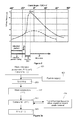
- Figure 2 shows a typical generic pressure-CA diagram for a diesel engine in which only one single injection is performed in the period between 40° and 20° CA before Top Dead Center (TDC) of the compression stroke.
- the dashed line represents compression and expansion of air only, without combustion.
- the continuous line represents compression and expansion with combustion.
- the injection period is followed by the delay period and their sum equals the phase one.
- phase two The main combustion takes place during the pressure rise, called phase two, which terminates at the maximum combustion pressure.
- the injection strategy, the combustion chamber geometry and the fuel composition the CA-lengths of phase one and two as well as the Pmax-value (slope of pressure rise) are parameters that have a cycle-to-cycle variation of less than +/- 3% at a given load point.
- phase three (Blow-down) will by the combustion chamber temperature distribution (absolute level and homogeneity) largely influence the production of eventual unwanted post-combustion products in the exhaust gas.
- the important characteristics of a commercial typical diesel fuel are the ignition quality, the density, the heat of combustion, the volatility (phase one and two as well as Pmax), the cleanliness and the non-corrosiveness. All but the two last properties are completely interrelated. This is why the combustion-quality for a commercial diesel fuel is rated by the Cetane number. As in the case of octane rating of gasoline diesel fuels are rated with respect to combustion quality by a method that uses engine-test comparisons with reference fuels (e. g. American Society for Testing Materials (ASTM) Standard D613).
- ASTM American Society for Testing Materials
- the primary reference fuels are normal cetane (C 16 H 34 ), straight chain paraffin having excellent ignition quality, and alpha-methylnaphthalene (C 10 H 7 CH 3 ), a naphthenic compound having very poor ignition quality.
- a special engine with a compression-ignition cylinder is used as standard equipment for this type of test.
- the percentage of cetane in a blend of the above indicated reference fuels giving the same ignition delay as the fuel under test is taken as the cetane number of the fuel in test.
- the cetane number is a unilateral signature of the fuel combustion-quality.
- the pure commercial diesel fuel has an average cetane number of approximately 42, whereas the cetane number of a 100 % Fame-oil is typically around 60.
- the cetane number of a 20 % FAME-oil fraction will be approximately 48 to 49, which explains why above this percentage the combustion becomes uncontrollable and action is necessary.
- the objective of the present invention is the design of a strategy for recognition of the biodiesel-fraction, Bx, of FAME-oil blended into the crude oil based diesel fuel and the proposal for a software-based sensing technique to create an image of the temporal combustion behavior (pressure-CA), which uses sensors already in service for current CR-mixture preparation systems. Therefore the basic approach proposed by the invention requires no auxiliary sensor to be added and uses only sensors already present by a specific CR-engine application.
- CA-resolved pressure-CA diagram offers a unilateral signature of the complete chemical and thermodynamic combustion processes for a given set of fuel, mixture preparation system and engine load parameters.
- the primary action to be performed according to the invention is to determine the fraction of bio-fuel blended into the normal diesel fuel and the invention proposes for this action a reverse engineering technique to determine the 3 combustion key parameters based on the interpretation of the pressure-CA diagram or a representative image of this diagram.
- the ECU retrieves a reference value for the cetane number, which will correspond to a reference fuel composition.
- a reference fuel composition For the reference fuel is applied a corresponding set of engine control strategies, which are engine/vehicle specific and located in the ECU memory area where they were loaded during the initial development of the engine-specific calibration.
- the ECU will link the reference fuel composition to a specific reference configuration of the 3 combustion key parameters (reference key parameters), which are also engine/vehicle specific and located in the ECU memory area where they were loaded during the initial development of the engine specific calibration.
- the engine combustion behavior will change by burning a fuel with a composition different from that of the reference fuel and hereby introduce a proportional change in the 3 combustion key parameters compared to the reference values.
- Each of the 3 combustion key parameters (201) is listed in a two-dimensional look-up table (202, 203 and 204).
- the break-points are located on an engine-speed axis (x) and an engine load axis (y).
- the upper and lower values (N min , N max , L min and L max ) of engine speed and load defines the spatial window (205) within which an identification can take place.
- Reference key parameters exist in the same format and are as stated above engine/vehicle specific and located in the ECU memory area where they were loaded during the initial development of the engine specific calibration. In general a complete set of reference combustion key parameter maps exist for the hot engine handling (T water > Threshold water °C) and another set for cold engine handling (T water ⁇ Threshold water °C) but this is neither mandatory nor limitative.
- a validation of a measurement of the instantaneous combustion key parameter status is only permitted if the following two conditions are fulfilled.
- the engine functional speed and load conditions must be within the defined spatial window (205) and the gradients of oscillation of the values (dN/dt and dL/dt) must be below predefined engine-specific levels (OSCIL max1 and OSCIL max2 ) (206).
- OSCIL max1 and OSCIL max2 predefined engine-specific levels
- the change in combustion key parameters with respect to the reference values is then translated into the corresponding evolution in the cetane number.
- This evolution is compared to an engine/vehicle specific functional mapping that was located in the ECU memory area during the initial development of the engine specific calibration.
- a further enrichment of the invention is the possibility to detect the specific type of FAME vegetal-based oil or oil produce from organic waste used in the blend (e. g. Soya bean, Palm oil or other).
- This function requires the fulfillment of two specific conditions.
- a vegetal-based oil different from the reference FAME oil is burned one or more of the 3 key combustion parameters will, for a given percentage Bx of vegetal-based oil, change with respect to the reference FAME oil condition. This means a change in the cetane number for Bx with respect to the reference FAME oil condition.
- the first condition is therefore that each vegetal-based oil different from the reference FAME oil must be tested on the engine during the engine/vehicle specific initial calibration and the resulting maps of combustion key parameters and cetane numbers must be located in the ECU memory area during this initial development of the engine specific calibration.
- the second condition is that the used ECU must offer a storage capacity, which is sufficient to allow the permanent presence of not only the maps related to the reference FAME oil, but also the parallel maps or multiplication tables for each supplementary vegetal-based oil formulation susceptible to be used within a specific area/country delimitation.
- a supplementary learning loop can be inserted before the validation of a new cetane number.
- Fig 3a shows at which location this supplementary test is performed (104).
- a secondary action ( Figure 4 ), which is the engine control strategies adaptation.
- the control parameters preferentially expressed in 3-D maps, are adapted according the interpolation between the nearest pre-mapped control strategies "x" and "x+1".
- the stabilized fuel composition B% stabilized is only reached after a certain predefined engine/vehicle-specific delay T stabilization .
- the learning process which starts immediately after re-fuelling will therefore be continued at regular predefined engine-specific intervals until the total time for learning supersedes T stabilization .
- Both action one and two can be performed only when an engine cycle resolved information of the pressure-CA diagram could be detected by the ECU. To perform the detection several approaches are possible.
- SI-mode SI-mode
- CAI Controlled Auto Ignition
- the cylinder-individual pressure sensor is a component submitted to harsh environmental conditions (pressure, vibrations and temperature) and with a precision requirement of less 5 % error of full-scale extension. This means that such a device, even at large-scale production, remains a high cost component.
- the present invention proposes a different sensing technique, which creates an image of the combustion process based on the intelligent sensing of the instantaneous crankshaft acceleration (Patent PI 9204450).
- Figure 5 provides the necessary basic information to understand the functioning principle of this kind of software sensor, which provides information of the wanted combustion parameters.
- the ECU 510 connected to a pulse sensor 522 (e. g. variable reluctance or "Hall"), which is positioned to measure the angular position and acceleration of a tooth-wheel 512 fixed at the engine crankshaft (e. g. on the fly-wheel).
- the angular profile of the tooth-wheel is divided in a number N (e. g. 60) of teeth 516 and holes 514 of equal length.
- N e. g. 60
- the duration d i of time required to measure a passage of a tooth is data-handled by the software algorithms based in the blocks 526 (signal normalization), 530 (time measurement of d i ) 532 (comparative clock) and 534 (buffer memory).
- d i From the buffered values of d i are extracted (block 536) by a real time Fourrier analysis on one combustion cycle (2 cycles per revolution for a 4 cylinder 4-stroke engine) an equivalent number of time fractions T 4 each representative of a small time-window of the combustion. These values are buffered in the block 538.
- a second term D 4 is computed by the block 540 assisted by the block 541 and buffered in the block 542. This term is the projection of the alternating component of the instantaneous angular velocity of the flywheel (crankshaft) on the rotating vector of combustion frequency.
- Tg A x D 4 / T 4 3 + B / T 4 2 .
- the constants A and B must be calibrated for each engine application and the computed values of Tg corrected for high engine speed distortion.
- the tooth wheel is referenced at one pair of cylinders (e. g. four cylinder engine) only, but a cylinder individual resolution can be obtained by a combination with a camshaft based phase sensor.
- This sensor for detection of the combustion parameters is that they are already implemented on the engine for the control of the CR-mixture preparation system. No supplementary sensor such as cylinder-individual combustion pressure sensors must be added.
- the detection procedure suggested by the present invention can be combined with and added exhaust gas temperature sensor (low cost).
- a comparison between the instantaneous Tg values and the evolution over a certain number of cycles makes this possible as both particulate matter and NO x values are dependant on the cylinder gas temperature during the blow down phase.
Landscapes
- Engineering & Computer Science (AREA)
- Chemical & Material Sciences (AREA)
- Combustion & Propulsion (AREA)
- Mechanical Engineering (AREA)
- General Engineering & Computer Science (AREA)
- Oil, Petroleum & Natural Gas (AREA)
- Life Sciences & Earth Sciences (AREA)
- Biodiversity & Conservation Biology (AREA)
- Biotechnology (AREA)
- Botany (AREA)
- Sustainable Development (AREA)
- Sustainable Energy (AREA)
- Combined Controls Of Internal Combustion Engines (AREA)
- Fats And Perfumes (AREA)
- Electrical Control Of Air Or Fuel Supplied To Internal-Combustion Engine (AREA)
Abstract
Description
- The present patent application refers to a logical sensor for Internal Combustion engines (Compression Ignited or Spark Ignited) named SBS (Software Biodiesel Sensor), which identifies a mixture diesel/bio-diesel present in a vehicle fuel tank, using software-based algorithms to identify the fraction of FAME (Fatty Acid Methyl Esters) vegetal-based oil or oil produced from organic waste blended into a crude oil based diesel fuel (average chemical formula C12H23) and thereafter adapts the engine control strategy as a function of this fraction.
- In a diesel or Compression Ignition (CI) engine air, normally diluted by a small controlled fraction of residual gas, is compressed trough a volume ratio from approximately 12 to 20, and liquid fuel is sprayed into the cylinder during the compression stroke near the top dead center position of the piston (TDC).
- Since both the pressure and temperature of the cylinder contents at the time of injection are very high, chemical reactions begin as soon as the first droplets of injected fuel enter the cylinder.
-
Figure 1 shows the main parts by which the combustion process is accomplished in a modern Cl-engine. The fuel is transferred from the tank (1) through an appropriate filter (2) to a high-pressure pump (3), which delivers the fuel at a pressure between 130 and 200 MPa to a rail (4) common for all the fuel injectors (6a to d). An Electron Control Unit (ECU) (7), which gathers information of engine speed, temperature, fuel pressure (5) and load target, adapts the engine control parameters to optimize the number of injections and their duration to fulfill both load target and exhaust gas pollution requirements. The injector atomizers are designed to produce a spray pattern (8), which is adapted individually to the combustion chamber geometry (9). - However, in a Cl-engine the chemical reactions start so slowly that the usual manifestations of combustion such as a measurable pressure rise occur only after the expiration of an appreciable period of time called the delay period. The sum of the injection and the delay periods characterizes the first phase of combustion.
- The delay period is followed by a pressure rise, which is conditioned by the fuel used, the total quantity of fuel injected with respect to the air trapped in the cylinder (Air-Fuel ratio A/F), the number of injections on which the total amount of fuel is distributed and the Crank Angle (CA) values at which the injections are performed. The pressure-rise period characterizes the second phase of combustion.
- The third phase of combustion, called
phase 3, starts after the maximum combustion pressure is reached. This blow-down phase will determine the nature and volume of the different post combustion products in the exhaust gas (NOx, Particulate matter, Aldehydes, etc.) and is equally heavily influenced by an appropriate multiple injection strategy. -
Figure 2 shows a typical generic pressure-CA diagram for a diesel engine in which only one single injection is performed in the period between 40° and 20° CA before Top Dead Center (TDC) of the compression stroke. The dashed line represents compression and expansion of air only, without combustion. The continuous line represents compression and expansion with combustion. The injection period is followed by the delay period and their sum equals the phase one. - The main combustion takes place during the pressure rise, called phase two, which terminates at the maximum combustion pressure. For a given fixed definition of the A/F-ratio, the injection strategy, the combustion chamber geometry and the fuel composition the CA-lengths of phase one and two as well as the Pmax-value (slope of pressure rise) are parameters that have a cycle-to-cycle variation of less than +/- 3% at a given load point.
- The phase three (Blow-down) will by the combustion chamber temperature distribution (absolute level and homogeneity) largely influence the production of eventual unwanted post-combustion products in the exhaust gas.
- It is important to understand that the complete pressure-CA diagram together with the induced exhaust gas temperature represent a unilateral signature of both the complete chemical and thermodynamic combustion process (pressure-CA diagram) and the potential equilibrium of pollutant matter in the exhaust gas (Temperature) for a given set of fixed boundary conditions (engine speed, load, injection strategy, overall engine temperature, well-defined standard fuel composition).
- The important characteristics of a commercial typical diesel fuel (average chemical formula C12H23) are the ignition quality, the density, the heat of combustion, the volatility (phase one and two as well as Pmax), the cleanliness and the non-corrosiveness. All but the two last properties are completely interrelated. This is why the combustion-quality for a commercial diesel fuel is rated by the Cetane number. As in the case of octane rating of gasoline diesel fuels are rated with respect to combustion quality by a method that uses engine-test comparisons with reference fuels (e. g. American Society for Testing Materials (ASTM) Standard D613).
- The primary reference fuels are normal cetane (C16H34), straight chain paraffin having excellent ignition quality, and alpha-methylnaphthalene (C10H7CH3), a naphthenic compound having very poor ignition quality. A special engine with a compression-ignition cylinder is used as standard equipment for this type of test.
- The percentage of cetane in a blend of the above indicated reference fuels giving the same ignition delay as the fuel under test is taken as the cetane number of the fuel in test. As the pressure-CA diagram is a unilateral signature of the combustion process the cetane number is a unilateral signature of the fuel combustion-quality.
- The important consequence is that if all engine parameters are kept constant and a fuel with a different cetane number is used, the pressure-CA diagram signature will change as the phase one, two and the Pmax-value changes.
- In recent years the presence of bio-fuel blends for SI-engines (mixing of pure gasoline and ethanol at various fractions - flex fuel) have become popular as a very efficient and practical means to decrease the amount of permanently stored CO2 in the atmosphere.
- It therefore was suggested to mix current diesel fuel with a fraction of FAME (Fatty Acid Methyl Esters) vegetal-based oil. The higher the percentage of FAME-oil the more important the decrease of the amount of permanently added CO2 in the atmosphere. A mixture containing "x" % of FAME oil and (100-x)% of fossil oil will be referred to as a "Bx" mixture.
- For current commercial diesel engines a FAME-oil fraction of less than 20 % is acceptable without major changes in the CR-rail based injection strategy. Unfortunately at fractions between 20 and 100 % the reaction of the combustion process becomes uncontrollable with combustion patterns, which gradually features extreme detonation conditions. An immediate consequence is an important increase in both specific fuel consumption and in exhaust gas pollutants and it can eventually lead to a total misfiring and in extreme cases to the destruction of the engine.
- As a matter of fact the pure commercial diesel fuel has an average cetane number of approximately 42, whereas the cetane number of a 100 % Fame-oil is typically around 60. The cetane number of a 20 % FAME-oil fraction will be approximately 48 to 49, which explains why above this percentage the combustion becomes uncontrollable and action is necessary.
- The objective of the present invention is the design of a strategy for recognition of the biodiesel-fraction, Bx, of FAME-oil blended into the crude oil based diesel fuel and the proposal for a software-based sensing technique to create an image of the temporal combustion behavior (pressure-CA), which uses sensors already in service for current CR-mixture preparation systems. Therefore the basic approach proposed by the invention requires no auxiliary sensor to be added and uses only sensors already present by a specific CR-engine application.
- The present invention will be better understood by the enhancement provided by the joined figures, which represent not-limitative examples:
-
Figure 1 - An example, which shows the main parts by which the combustion process is accomplished in a modern Cl-engine; -
Figure 2 - An example, which shows a typical generic pressure-CA diagram; -
Figure 3a - An example, which shows a block-diagram of logical data flow as used in the present invention; -
Figure 3b - An example, which shows a block-diagram of logical data flow as used in the present invention; -
Figure 4 - An example, which shows a 3-D representation of the engine control adaptation produced by an intelligent software sensor approach; -
Figure 5 - An example, which shows a block-diagram of data treatment within the perimeter of a logical torque sensor system; - As previously stated the CA-resolved pressure-CA diagram offers a unilateral signature of the complete chemical and thermodynamic combustion processes for a given set of fuel, mixture preparation system and engine load parameters.
- In other words if the engine load and mixture preparation system parameters are kept constant a change as above indicated in the pressure-CA diagram (sum of injection duration and combustion delay, pressure rise/slope and Pmax-value, which hereafter are referred to as the 3 combustion key parameters) will be an expression for the fuel composition (cetane number) and consequently an indicator of the percentage of FAME-oil blended into the crude oil based diesel fuel.
- The primary action to be performed according to the invention is to determine the fraction of bio-fuel blended into the normal diesel fuel and the invention proposes for this action a reverse engineering technique to determine the 3 combustion key parameters based on the interpretation of the pressure-CA diagram or a representative image of this diagram.
- This primary action is the fuel recognition phase (
Figure 3a ). As this is already done by SI-flex fuel vehicles (Magneti Marelli patents PI 020226-5, C1 0202226-5 e PI 0405357-5) the phase one starts with a learning process, which performs a systematic test after re-supply of fuel in the tank. - In this phase the ECU retrieves a reference value for the cetane number, which will correspond to a reference fuel composition. For the reference fuel is applied a corresponding set of engine control strategies, which are engine/vehicle specific and located in the ECU memory area where they were loaded during the initial development of the engine-specific calibration.
- Furthermore the ECU will link the reference fuel composition to a specific reference configuration of the 3 combustion key parameters (reference key parameters), which are also engine/vehicle specific and located in the ECU memory area where they were loaded during the initial development of the engine specific calibration.
- The engine combustion behavior will change by burning a fuel with a composition different from that of the reference fuel and hereby introduce a proportional change in the 3 combustion key parameters compared to the reference values.
- The identification of the change in the 3 combustion key parameters is made according to the following scheme (
Figure 3b ). Each of the 3 combustion key parameters (201) is listed in a two-dimensional look-up table (202, 203 and 204). The break-points are located on an engine-speed axis (x) and an engine load axis (y). The upper and lower values (N min , N max , L min and L max ) of engine speed and load defines the spatial window (205) within which an identification can take place. Reference key parameters exist in the same format and are as stated above engine/vehicle specific and located in the ECU memory area where they were loaded during the initial development of the engine specific calibration. In general a complete set of reference combustion key parameter maps exist for the hot engine handling (T water > Threshold water °C) and another set for cold engine handling (T water < Threshold water °C) but this is neither mandatory nor limitative. - A validation of a measurement of the instantaneous combustion key parameter status is only permitted if the following two conditions are fulfilled. The engine functional speed and load conditions must be within the defined spatial window (205) and the gradients of oscillation of the values (dN/dt and dL/dt) must be below predefined engine-specific levels (OSCIL max1 and OSCIL max2 ) (206). When the measurement is authorized it is extended over a predefined engine-specific number of engine cycles (N cycle ). The recorded values are then filtered (208) and an average value of each combustion key parameter validated (209).
- The change in combustion key parameters with respect to the reference values is then translated into the corresponding evolution in the cetane number. This evolution is compared to an engine/vehicle specific functional mapping that was located in the ECU memory area during the initial development of the engine specific calibration.
- By this means the change in the 3 combustion key parameters with respect to the reference values will be linked to a new (refreshed) cetane number value with respect to the original reference value (103).
- A further enrichment of the invention is the possibility to detect the specific type of FAME vegetal-based oil or oil produce from organic waste used in the blend (e. g. Soya bean, Palm oil or other). This function requires the fulfillment of two specific conditions. When a vegetal-based oil different from the reference FAME oil is burned one or more of the 3 key combustion parameters will, for a given percentage Bx of vegetal-based oil, change with respect to the reference FAME oil condition. This means a change in the cetane number for Bx with respect to the reference FAME oil condition.
- The first condition is therefore that each vegetal-based oil different from the reference FAME oil must be tested on the engine during the engine/vehicle specific initial calibration and the resulting maps of combustion key parameters and cetane numbers must be located in the ECU memory area during this initial development of the engine specific calibration.
- The second condition is that the used ECU must offer a storage capacity, which is sufficient to allow the permanent presence of not only the maps related to the reference FAME oil, but also the parallel maps or multiplication tables for each supplementary vegetal-based oil formulation susceptible to be used within a specific area/country delimitation.
- If the two conditions are satisfied a supplementary learning loop can be inserted before the validation of a new cetane number.
Fig 3a shows at which location this supplementary test is performed (104). - After the new cetane number (103) is known (
Figure 3a ) the new percentage Bx of FAME-oil in the diesel fuel is known (105). - At this point is performed. a secondary action (
Figure 4 ), which is the engine control strategies adaptation. In this phase the control parameters, preferentially expressed in 3-D maps, are adapted according the interpolation between the nearest pre-mapped control strategies "x" and "x+1". - As the propagation of fuel from the tank to the engine is time dependant the stabilized fuel composition B% stabilized is only reached after a certain predefined engine/vehicle-specific delay T stabilization . The learning process, which starts immediately after re-fuelling will therefore be continued at regular predefined engine-specific intervals until the total time for learning supersedes T stabilization .
- Both action one and two can be performed only when an engine cycle resolved information of the pressure-CA diagram could be detected by the ECU. To perform the detection several approaches are possible.
- One approach, which is direct and has been tested on demonstrator vehicles powered by Spark Ignited (SI) engines designed to work both in SI-mode and Controlled Auto Ignition (CAI) mode, is to implement a fast pressure sensor in each cylinder.
- However, the cylinder-individual pressure sensor is a component submitted to harsh environmental conditions (pressure, vibrations and temperature) and with a precision requirement of less 5 % error of full-scale extension. This means that such a device, even at large-scale production, remains a high cost component.
- To overcome this problem the present invention proposes a different sensing technique, which creates an image of the combustion process based on the intelligent sensing of the instantaneous crankshaft acceleration (Patent PI 9204450).
-
Figure 5 provides the necessary basic information to understand the functioning principle of this kind of software sensor, which provides information of the wanted combustion parameters. The ECU 510 connected to a pulse sensor 522 (e. g. variable reluctance or "Hall"), which is positioned to measure the angular position and acceleration of a tooth-wheel 512 fixed at the engine crankshaft (e. g. on the fly-wheel). The angular profile of the tooth-wheel is divided in a number N (e. g. 60) ofteeth 516 andholes 514 of equal length. In one point of the tooth-wheel 2teeth 520 are transformed in holes and this area is positioned on the flywheel to identify the top dead center of a cylinder (e. g. cylinder number 1). - The duration di of time required to measure a passage of a tooth is data-handled by the software algorithms based in the blocks 526 (signal normalization), 530 (time measurement of di ) 532 (comparative clock) and 534 (buffer memory).
- From the buffered values of di are extracted (block 536) by a real time Fourrier analysis on one combustion cycle (2 cycles per revolution for a 4 cylinder 4-stroke engine) an equivalent number of time fractions T4 each representative of a small time-window of the combustion. These values are buffered in the
block 538. In parallel a second term D4 is computed by theblock 540 assisted by theblock 541 and buffered in theblock 542. This term is the projection of the alternating component of the instantaneous angular velocity of the flywheel (crankshaft) on the rotating vector of combustion frequency. - Finally the block 544 combines the terms T4 and D4 with the engine dependant constants A and B. The cyclic torque variation can the generically be expressed by the expression : Tg = A x D4 / T4 3 + B / T4 2.
- The constants A and B must be calibrated for each engine application and the computed values of Tg corrected for high engine speed distortion.
- The tooth wheel is referenced at one pair of cylinders (e. g. four cylinder engine) only, but a cylinder individual resolution can be obtained by a combination with a camshaft based phase sensor. The advantage of the use of this sensor for detection of the combustion parameters is that they are already implemented on the engine for the control of the CR-mixture preparation system. No supplementary sensor such as cylinder-individual combustion pressure sensors must be added.
- In order to make an estimation of pollutants content in the exhaust gas the detection procedure suggested by the present invention can be combined with and added exhaust gas temperature sensor (low cost). A comparison between the instantaneous Tg values and the evolution over a certain number of cycles makes this possible as both particulate matter and NOx values are dependant on the cylinder gas temperature during the blow down phase.
Claims (8)
- A logical sensing technique for internal combustion engines, which use a compression ignited approach to trig the combustion process and are designed to burn blends of crude oil based fuels and vegetal based or organic bio-fuels, said technique characterized by the following logical steps:- Start a learning process (200);- Retrieve a reference value for the cetane number from maps pre-registered in the ECU (100);- Apply the corresponding engine and vehicle specific engine control strategy;- Extract the main combustion parameters from the pressure-CA diagram or from an equivalent image produced by engine sensors (201);- Compare the extracted main combustion parameters to values pre-registered in the ECU (207);- Identify a new corresponding cetane number (105);- Proceed with a change in the engine control strategy.
- Said sensing technique as described by claim 1, characterized by the implementation of software algorithms in the electronic engine control unit, which separates the complete pressure-CA diagram or its equivalent image in parameters (201) that identify the durations of the ignition delay period (phase one) (202), the pressure rise phase (phase two) (203) and the CA-position and value of the combustion peak pressure (Pmax) (204).
- Said sensing technique as described by claims 1and 2, characterized by a comparison of the cylinder individual identified combustion parameters with engine-specific pre-calibrated maps (205), each corresponding to a specific engine speed, load and fuel blend situation, performs an N-order interpolation between maps surrounding the real-time recorded combustion parameters and computes a data-set proportional to the fraction of bio-diesel present in the crude oil based primary fuel defined by the cetane number.
- Said sensing technique as described by claims 1 to 3, characterized by an identification of the specific type of vegetal-based oil or organic oil present in the blend (104).
- Said sensing technique as described by claims 1 to 4, characterized by the accomplishment of the detection of specific types of vegetal-based oils or organic oils by comparison of the cylinder individual identified combustion parameters with engine-specific pre-calibrated maps representative of different types of oils (207) and here after makes a correction of the measured cetane number (105).
- Said sensing technique as described by claims 1 to 5, characterized by the capability to apply, on the basis of the computed combustion parameters data set, a pre-mapped resulting corrective injection strategy to optimize the combustion process.
- Said sensing technique as described by claims 1 to 6, characterized by the use of a sensing approach, which creates a representative image of the combustion processes based on the use of a pulse sensor (522) that is positioned to measure the angular position and acceleration of a tooth-wheel (512) directly connected to the engine crank shaft and from this information via software implemented computations extracts the instantaneous corrected gas Torque Tg for each cylinder.
- Said sensing technique as described by claims 1 to 7, characterized by the capability to compare the signal from an added exhaust gas temperature sensor to the instantaneous pressure_CA diagram or Tg values over a certain number of engine cycles to estimate the trade off between the produced amounts of particulate matter and NOx and uses this information to make a correction of the used injection strategy.
Applications Claiming Priority (1)
| Application Number | Priority Date | Filing Date | Title |
|---|---|---|---|
| BRPI0900653-2A BRPI0900653A2 (en) | 2009-03-13 | 2009-03-13 | biodiesel logic sensor |
Publications (2)
| Publication Number | Publication Date |
|---|---|
| EP2228528A2 true EP2228528A2 (en) | 2010-09-15 |
| EP2228528A3 EP2228528A3 (en) | 2014-08-13 |
Family
ID=42278258
Family Applications (1)
| Application Number | Title | Priority Date | Filing Date |
|---|---|---|---|
| EP10154147.2A Withdrawn EP2228528A3 (en) | 2009-03-13 | 2010-02-19 | Software based bio-diesel sensor |
Country Status (4)
| Country | Link |
|---|---|
| US (1) | US8527184B2 (en) |
| EP (1) | EP2228528A3 (en) |
| CN (1) | CN101832193A (en) |
| BR (1) | BRPI0900653A2 (en) |
Cited By (2)
| Publication number | Priority date | Publication date | Assignee | Title |
|---|---|---|---|---|
| WO2014154227A1 (en) * | 2013-03-27 | 2014-10-02 | Volvo Truck Corporation | Method for determining fuel blend in a dual fuel mixture |
| FR3017904A1 (en) * | 2014-02-25 | 2015-08-28 | IFP Energies Nouvelles | METHOD AND DEVICE FOR PREVENTING ENCRASION OF DIESEL INJECTION SYSTEMS |
Families Citing this family (8)
| Publication number | Priority date | Publication date | Assignee | Title |
|---|---|---|---|---|
| DE10331467A1 (en) | 2003-07-11 | 2005-02-10 | Sick Ag | Device for optically scanning objects, in particular markings |
| WO2010015002A2 (en) * | 2008-08-01 | 2010-02-04 | Purdue Research Foundation | Fuel blend sensing system |
| US9567918B2 (en) | 2010-05-10 | 2017-02-14 | Go Natural Cng, Llc | Bi-fuel control systems for automotive vehicles and related methods |
| BRPI1004128A2 (en) | 2010-08-04 | 2012-04-10 | Magneti Marelli Sist S Automotivos Ind E Com Ltda | Setting Top Level Key Parameters for Biodiesel Logic Sensor |
| US8733298B2 (en) * | 2010-08-04 | 2014-05-27 | GM Global Technology Operations LLC | Method and apparatus for operating a compression ignition engine |
| JP5949075B2 (en) * | 2012-04-06 | 2016-07-06 | トヨタ自動車株式会社 | Control device for internal combustion engine |
| DE102015204042A1 (en) * | 2015-03-06 | 2016-09-08 | Robert Bosch Gmbh | Method for controlling the fuel supply from two separate tank systems |
| GB202213592D0 (en) * | 2022-09-16 | 2022-11-02 | Agco Int Gmbh | Power generation unit control |
Family Cites Families (17)
| Publication number | Priority date | Publication date | Assignee | Title |
|---|---|---|---|---|
| US4402296A (en) * | 1981-05-04 | 1983-09-06 | Schwarz Walter J | Dual fuel supply system and method for an internal combustion engine |
| DE4138216C2 (en) * | 1991-11-21 | 1994-02-03 | Veba Oel Ag | Process for adding fuel or fuels to ferrocene |
| US6003303A (en) * | 1993-01-11 | 1999-12-21 | Clean Diesel Technologies, Inc. | Methods for reducing harmful emissions from a diesel engine |
| US5336396A (en) * | 1993-03-29 | 1994-08-09 | Shetley Michael C | Waste oil management system |
| JP4158577B2 (en) * | 2003-04-02 | 2008-10-01 | 日産自動車株式会社 | Engine combustion control device |
| US7266439B2 (en) * | 2004-10-05 | 2007-09-04 | Southwest Research Institute | Fuel property-adaptive engine control system with on-board fuel classifier |
| WO2007020234A1 (en) * | 2005-08-12 | 2007-02-22 | Shell Internationale Research Maatschappij B.V. | Fuel compositions |
| JP4226580B2 (en) * | 2005-09-02 | 2009-02-18 | 本田技研工業株式会社 | Control device for internal combustion engine |
| FR2891870B1 (en) * | 2005-10-11 | 2012-07-13 | Inst Francais Du Petrole | METHOD FOR CONTROLLING THE AUTO-INFLAMMATION OF A CARBIDE MIXTURE, IN PARTICULAR FOR A DIESEL-TYPE INTERNAL COMBUSTION ENGINE, AND ENGINE USING SUCH A METHOD |
| US7401591B2 (en) * | 2005-12-02 | 2008-07-22 | Honda Motor Co., Ltd. | Control system for internal combustion engine |
| JP2007231898A (en) * | 2006-03-03 | 2007-09-13 | Nissan Motor Co Ltd | Engine fuel cetane number detection device |
| JP4539991B2 (en) * | 2006-06-02 | 2010-09-08 | ヤンマー株式会社 | Cetane number detection means and engine provided with the cetane number detection means |
| DE102006044866B4 (en) * | 2006-09-22 | 2008-11-20 | Continental Automotive Gmbh | Method and device for generating injection signals for an injection system of an internal combustion engine |
| EP1923557B1 (en) * | 2006-11-17 | 2009-02-11 | HONDA MOTOR CO., Ltd. | Control system for internal combustion engine |
| JP2008309080A (en) * | 2007-06-15 | 2008-12-25 | Denso Corp | Exhaust gas purification device for internal combustion engine |
| US8141356B2 (en) * | 2008-01-16 | 2012-03-27 | Ford Global Technologies, Llc | Ethanol separation using air from turbo compressor |
| US20100005706A1 (en) * | 2008-07-11 | 2010-01-14 | Innospec Fuel Specialties, LLC | Fuel composition with enhanced low temperature properties |
-
2009
- 2009-03-13 BR BRPI0900653-2A patent/BRPI0900653A2/en not_active IP Right Cessation
-
2010
- 2010-02-19 EP EP10154147.2A patent/EP2228528A3/en not_active Withdrawn
- 2010-03-11 CN CN201010133827A patent/CN101832193A/en active Pending
- 2010-03-12 US US12/723,195 patent/US8527184B2/en not_active Expired - Fee Related
Non-Patent Citations (1)
| Title |
|---|
| None |
Cited By (3)
| Publication number | Priority date | Publication date | Assignee | Title |
|---|---|---|---|---|
| WO2014154227A1 (en) * | 2013-03-27 | 2014-10-02 | Volvo Truck Corporation | Method for determining fuel blend in a dual fuel mixture |
| US9869254B2 (en) | 2013-03-27 | 2018-01-16 | Volvo Truck Corporation | Method for determining fuel blend in a dual fuel mixture |
| FR3017904A1 (en) * | 2014-02-25 | 2015-08-28 | IFP Energies Nouvelles | METHOD AND DEVICE FOR PREVENTING ENCRASION OF DIESEL INJECTION SYSTEMS |
Also Published As
| Publication number | Publication date |
|---|---|
| CN101832193A (en) | 2010-09-15 |
| US20100235073A1 (en) | 2010-09-16 |
| BRPI0900653A2 (en) | 2010-11-09 |
| US8527184B2 (en) | 2013-09-03 |
| EP2228528A3 (en) | 2014-08-13 |
Similar Documents
| Publication | Publication Date | Title |
|---|---|---|
| US8527184B2 (en) | SBS logical bio-diesel sensor | |
| US20120053815A1 (en) | Upper level key parameter definition for sbs logical biodiesel sensor | |
| CN101501317B (en) | Ion Current and Its Control for In-Cylinder NOx Detection in Diesel Engines | |
| CA2889605C (en) | Detecting and mitigating abnormal combustion characteristics | |
| US8068971B2 (en) | Procedure for determining a fuel composition or a fuel quality | |
| JP5327026B2 (en) | Fuel property determination device for internal combustion engine | |
| CN101655044B (en) | Engine control using cylinder pressure differential | |
| US8789514B2 (en) | Fuel adaptation for IC engine | |
| da Costa et al. | Research on hydrous ethanol stratified lean burn combustion in a DI spark-ignition engine | |
| Liu et al. | Comparative study on thermodynamics, combustion and emissions of turbocharged gasoline direct injection (GDI) engine under NEDC and steady-state conditions | |
| Ravaglioli et al. | Combustion indexes for innovative combustion control | |
| da Rocha et al. | Study of the water injection control parameters on combustion performance of a spark-ignition engine | |
| JP2013036462A5 (en) | ||
| McTaggart-Cowan et al. | Impacts and mitigation of varying fuel composition in a natural gas heavy-duty engine | |
| Ravaglioli et al. | Performance assessment of gasoline PPC in a light-duty CI engine | |
| JP2012132411A (en) | Control device for internal combustion engine | |
| Ravaglioli et al. | Remote sensing methodology for the closed-loop control of RCCI dual fuel combustion | |
| Pontoppidan et al. | Development of a New In-vehicle Sensing Method to Instantaneously Measure the Mixture Fraction of Bio-diesel Present in a Crude Oil based Classic Diesel Fuel | |
| Ravaglioli et al. | Heat Release Experimental Analysis for RCCI Combustion Optimization | |
| Haertl et al. | Experimental Investigation of a Control Strategy Based on Combustion Stability and Combustion Phasing for a Multi-Cylinder Engine with Fueled Pre-Chambers and Cylinder Pressure Transducers | |
| Cains et al. | Improving Speed and Accuracy of Gasoline and Diesel Engine Testing via Closed-Loop Combustion Control | |
| House | Part load characterization of a small-bore diesel piloted dual fuel compression ignition engine with methane | |
| HK1168887A (en) | Upper level key parameter definition for sbs logical biodiesel sensor | |
| MONTANARI et al. | SAE TECHNICAL 2012-36-0210 PAPER SERIES E | |
| Scocozza | Investigation of innovative combustion systems for reduced fuel consumption and increased specific power production |
Legal Events
| Date | Code | Title | Description |
|---|---|---|---|
| PUAI | Public reference made under article 153(3) epc to a published international application that has entered the european phase |
Free format text: ORIGINAL CODE: 0009012 |
|
| AK | Designated contracting states |
Kind code of ref document: A2 Designated state(s): AT BE BG CH CY CZ DE DK EE ES FI FR GB GR HR HU IE IS IT LI LT LU LV MC MK MT NL NO PL PT RO SE SI SK SM TR |
|
| AX | Request for extension of the european patent |
Extension state: AL BA RS |
|
| PUAL | Search report despatched |
Free format text: ORIGINAL CODE: 0009013 |
|
| AK | Designated contracting states |
Kind code of ref document: A3 Designated state(s): AT BE BG CH CY CZ DE DK EE ES FI FR GB GR HR HU IE IS IT LI LT LU LV MC MK MT NL NO PL PT RO SE SI SK SM TR |
|
| AX | Request for extension of the european patent |
Extension state: AL BA RS |
|
| RIC1 | Information provided on ipc code assigned before grant |
Ipc: F02D 41/24 20060101AFI20140704BHEP Ipc: F02D 19/08 20060101ALI20140704BHEP Ipc: F02D 35/02 20060101ALN20140704BHEP Ipc: F02D 19/06 20060101ALI20140704BHEP Ipc: F02D 41/00 20060101ALI20140704BHEP Ipc: F02D 41/14 20060101ALN20140704BHEP |
|
| STAA | Information on the status of an ep patent application or granted ep patent |
Free format text: STATUS: THE APPLICATION IS DEEMED TO BE WITHDRAWN |
|
| 18D | Application deemed to be withdrawn |
Effective date: 20150214 |