EP2228372B1 - Process for Preparing (S)-(+)-N-Methyl-3-(1-Naphthyloxy)-3-(2-Thienyl-Propylamine by using Optically Active Methylhydroxylaminopropanol Compound as an Intermediate - Google Patents
Process for Preparing (S)-(+)-N-Methyl-3-(1-Naphthyloxy)-3-(2-Thienyl-Propylamine by using Optically Active Methylhydroxylaminopropanol Compound as an Intermediate Download PDFInfo
- Publication number
- EP2228372B1 EP2228372B1 EP10156142A EP10156142A EP2228372B1 EP 2228372 B1 EP2228372 B1 EP 2228372B1 EP 10156142 A EP10156142 A EP 10156142A EP 10156142 A EP10156142 A EP 10156142A EP 2228372 B1 EP2228372 B1 EP 2228372B1
- Authority
- EP
- European Patent Office
- Prior art keywords
- formula
- methyl
- thienyl
- compound represented
- naphthyloxy
- Prior art date
- Legal status (The legal status is an assumption and is not a legal conclusion. Google has not performed a legal analysis and makes no representation as to the accuracy of the status listed.)
- Active
Links
- 0 C*(CC[C@@](C1=CC=C*1)O)O* Chemical compound C*(CC[C@@](C1=CC=C*1)O)O* 0.000 description 3
- ZEUITGRIYCTCEM-KRWDZBQOSA-N CNCC[C@@H](c1ccc[s]1)Oc1cccc2c1cccc2 Chemical compound CNCC[C@@H](c1ccc[s]1)Oc1cccc2c1cccc2 ZEUITGRIYCTCEM-KRWDZBQOSA-N 0.000 description 1
Classifications
-
- C—CHEMISTRY; METALLURGY
- C07—ORGANIC CHEMISTRY
- C07D—HETEROCYCLIC COMPOUNDS
- C07D333/00—Heterocyclic compounds containing five-membered rings having one sulfur atom as the only ring hetero atom
- C07D333/02—Heterocyclic compounds containing five-membered rings having one sulfur atom as the only ring hetero atom not condensed with other rings
- C07D333/04—Heterocyclic compounds containing five-membered rings having one sulfur atom as the only ring hetero atom not condensed with other rings not substituted on the ring sulphur atom
- C07D333/06—Heterocyclic compounds containing five-membered rings having one sulfur atom as the only ring hetero atom not condensed with other rings not substituted on the ring sulphur atom with only hydrogen atoms, hydrocarbon or substituted hydrocarbon radicals, directly attached to the ring carbon atoms
- C07D333/14—Radicals substituted by singly bound hetero atoms other than halogen
- C07D333/16—Radicals substituted by singly bound hetero atoms other than halogen by oxygen atoms
Definitions
- the present invention relates to a process for preparing ( S )-(+)- N -methyl-3-(1-naphthyloxy)-3-(2-thienyl)propylamine by using a chiral methylhydroxylaminopropanol compound as an intermediate.
- Duloxetine ® is an antidepressant drug developed by Eli Lilly and Company, Inc.
- Various methods have been reported to prepare Duloxetine ® .
- U.S. Patent No. 5,023,269 discloses a process as shown in the following scheme:
- 2-acetylthiophene is used as the starting material for reacting with formaldehyde and dimethylamine to form a Mannich product, namely 3-dimethylamino-1-(2-thienyl)propan-1-one.
- a hydride reduction is performed on this propanone to form corresponding 3-dimethylamino-1-(2-thienyl)propan-1-ol.
- the resulting propanol is then reacted with fluoronaphthalene to form N , N -dimethyl-3-(1-naphthyloxy)-3-(2-thienyl)propylamine.
- racemic Duloxetine ® is obtained by demethylation of this propylamine. In this process, the yield of demethylation is very low, about 41%.
- Duloxetine ® produced via this route is racemic.
- U.S. Patent No. 7,538,232 discloses a process to preserve the chiral integrity by using a mixture of organic solvents.
- different types of organic solvents used in the process for the preparation of Duloxefine ® increase cost for subsequent treatment.
- the usage of mixed organic solvents also is disadvantageous to meet the developing trends of environmental protection. Therefore, it still remains a need to develop a novel process for preparing chiral Duloxetine ® .
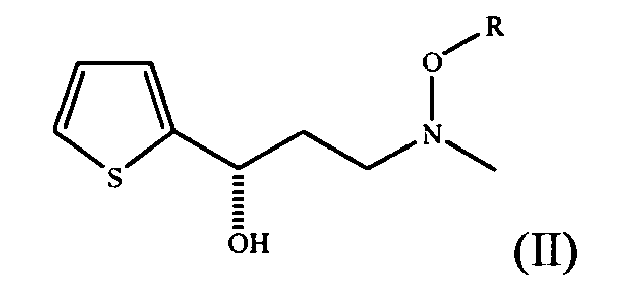
- the present invention provides a novel ( S )-methylhydroxylaminopropanol compound represented by formula (II) wherein R is C 1-8 alkyl. Furthermore, an absolute configuration of a chiral center thereof is S.
- the ( S )-methylhydroxylaminopropanol represented by formula (II) is used as an intermediate forpreparing ( S )-(+)- N -methyl-3-(1-naphthyloxy)-3-(2-thienyl)propylamine (Duloxetine ® ). Accordingly, the present invention also provides use of the ( S )-methylhydroxylaminopropanol compound in an optically active form represented by formula (II) as an intermediate in synthesis of ( S )-(+)- N -methyl-3-(1-naphthyloxy)-3-(2-thienyl)propylamine.
- the present invention provides a process for preparing ( S )-(+)- N -methyl-3-(1-naphthyloxy)-3-(2-thienyl)propylamine (Duloxetine ® ) with with higher yield and low treatment cost by using the ( S )-methylhydroxylaminopropanol compound represented by formula (II) as the intermediate.
- KOR 1 and DMSO are used in the naphthalenation reaction, wherein R 1 is C 1-6 alkyl, preferably butyl, and more preferably tert-butyl.
- the present invention also provides a process for preparing a N -methyl- N -hydroxyl-3-(1-naphthyloxy)-3-(2-thienyl)propylamine compound represented by formula (III), including a reaction of a ( S )-methylhydroxylaminopropanol compound represented by formula (II) with KOR 1 and halonaphthalene in DMSO, wherein R is C 1-8 alky, preferably C 1-4 alkyl, and more preferably methyl; R 1 is C 1-6 alkyl, preferably butyl, and more preferably tert-butyl; and halo is F, Cl, Br or I.
- the process is carried out at a temperature ranged from 10°C to 110°C. Further, an amount of the halonaphthalene used in the process ranges from 1.5 to 7.0 equivalents based on 1.1 equivalent of the KOR 1 .
- the present invention provides a methylhydroxylaminopropanol compound represented by formula (II) in an optically active form: wherein R is C 1-8 alkyl. Furthermore, an absolute configuration of a chiral center thereof is S.
- R in the above formula (II) is preferably C 1-4 alkyl, and is more preferably methyl.
- the present invention provides a process for preparing ( S )-(+)- N -methyl-3-(1-naphthyloxy)-3-(2-thienyl)propylamine (Duloxetine ® ), wherein the ( S )-methylhydroxylaminopropanol compound represented by formula (II) is used as an intermediate.
- the process of the present invention is summarized in Scheme 1.
- R is C 1-8 alkyl.
- the process of the present invention includes steps of:
- the step (i) of the process is carried out at a temperature ranged from 15°C to 90°C, preferably 40°C to 80 °C, and more preferably 50°C to 70°C.
- the substituted amino ketone represented by formula (I) obtained in the step (i) is either as a free form or as an acid addition salt.
- the reduction of the substituted amino ketone represented by formula (I) in the step (ii) is asymmetric reduction, and preferably chiral reduction.
- an optically active form of the ( S )-methylhydroxylaminopropanol compound represented by formula (II) is obtained.
- the optically active form can be obtained via asymmetric hydrogenation using a catalyst with chiral ligands or a hydride with chiral ligands.
- a chiral reducing agent used in the chiral reduction is selected from the group consisting of complex hydride, borane, transition metal catalyst and microbial dehydrogenase.
- reduction of the substituted amino ketone represented by formula (I) in the step (ii) is carried out in a mixture of an alcohol such as methanol and a base such as potassium tert-butoxide, in the presence of a catalyst that includes an enantiomer-enriched bidentate phosphorus-containing ligand, a transition metal and a diamine, preferably a chiral diamine, such as RuCl 2 ((R)-3,5-xylylBINAP) ((2R)-DAIPEN).
- the reaction mixture is hydrogenated at predetermined pressure to yield the ( S )-methylhydroxylaminopropanol compound represented by formula (II) with high ee value.
- reaction of the ( S )-methylhydroxylaminopropanol compound represented by formula (II) with halonaphthalene to form a N -methyl- N -hydroxyl-3-(1-naphthyloxy)-3-(2-thienyl)propylamine compound represented by formula (III) in the step (iii) is carried out by using an appropriate base in a suitable aprotic solvent.
- the ( S )-methylhydroxylaminopropanol compound represented by formula (II) is reacted with fluoronaphthalene in DMF by using sodium hydride as a base.
- the reaction is carried out at a temperature ranged from 10°C to 110°C, preferably 40°C to 70°C, for 1 to 24 hours.
- the ( S )-methylhydroxylaminopropanol compound represented by formula (II) is reacted with fluoronaphthalene in DMSO by using KOR 1 as a base, wherein R 1 is C 1-6 alkyl, preferably butyl, and more preferably tert-butyl.
- an amount of the halonaphthalene ranges from 1.5 to 7.0 equivalents based on 1.1 equivalent of the KOR 1 .
- the N,O-cleavage reaction of the N -methyl- N -hydroxyl-3-(1-naphthyloxy)-3-(2-thienyl)propylamine compound represented by formula (III) in the step (iv) of the process is carried out by hydrogenation in the presence of a catalyst such as Raney-nickel, or by chemical reduction methods such as those using LiAlH 4 or zinc metal as reducing agent.
- a catalyst such as Raney-nickel
- the N -methyl- N -hydroxyl-3-(1-naphthyloxy)-3-(2-thienyl)propylamine compound represented by formula (III) is hydrogenated in methanol in the presence of Raney-nickel at a temperature ranged from 15°C to 80°C, preferably 40°C to 70°C, for 9 to 15 hours.
- Duloxetine can be obtained optically pure with higher yield and lower cost from the process of the present invention. This process should operate particularly well on an industrial scale having regard to economic and ecological aspects.
- the ee value (%) was increased with a higher equivalent of 1-fluoronaphthalene. Further, 1-fluoronaphthalene can be removed by extraction and recovered for reuse. Therefore, using a high equivalent of 1-fluoronaphthalene can alleviate the racemization problem without co-solvent system.
- Example 3-1 or Example 3-2 N -methyl- N -methoxyl-3-(1-naphthyloxy)-3-(2-thienyl)propylamine obtained in Example 3-1 or Example 3-2 was dissolved in 15 mL of methanol with 0.67 g of Raney-nickel charged in a glass autoclave. The resulting solution was hydrogenated at 50°C for 12 hours. Upon completion of hydrogenation, the reaction mixture was filtered, and the solvent is removed under reduced pressure. Then, the desired compound is obtained as an oily compound (12.0 g, 96.4% by HPLC assay).
Landscapes
- Chemical & Material Sciences (AREA)
- Organic Chemistry (AREA)
- Heterocyclic Compounds Containing Sulfur Atoms (AREA)
- Organic Low-Molecular-Weight Compounds And Preparation Thereof (AREA)
- Low-Molecular Organic Synthesis Reactions Using Catalysts (AREA)
Abstract
Description
- The present invention relates to a process for preparing (S)-(+)-N-methyl-3-(1-naphthyloxy)-3-(2-thienyl)propylamine by using a chiral methylhydroxylaminopropanol compound as an intermediate.
- (S)-(+)-N-methyl-3-(1-naphthyloxy)-3-(2-thienyl)propylamine (Duloxetine®) is an antidepressant drug developed by Eli Lilly and Company, Inc. Various methods have been reported to prepare Duloxetine®. For example,
U.S. Patent No. 5,023,269 discloses a process as shown in the following scheme:
- In this example, 2-acetylthiophene is used as the starting material for reacting with formaldehyde and dimethylamine to form a Mannich product, namely 3-dimethylamino-1-(2-thienyl)propan-1-one. A hydride reduction is performed on this propanone to form corresponding 3-dimethylamino-1-(2-thienyl)propan-1-ol. The resulting propanol is then reacted with fluoronaphthalene to form N,N-dimethyl-3-(1-naphthyloxy)-3-(2-thienyl)propylamine. Subsequently, racemic Duloxetine® is obtained by demethylation of this propylamine. In this process, the yield of demethylation is very low, about 41%. In addition, Duloxetine® produced via this route is racemic.
- Accordingly,
U.S. Patent No. 7,538,232 discloses a process to preserve the chiral integrity by using a mixture of organic solvents. However, different types of organic solvents used in the process for the preparation of Duloxefine® increase cost for subsequent treatment. In addition, the usage of mixed organic solvents also is disadvantageous to meet the developing trends of environmental protection. Therefore, it still remains a need to develop a novel process for preparing chiral Duloxetine®. - In light of the above-mentioned drawbacks of the prior art, the present invention provides a novel (S)-methylhydroxylaminopropanol compound represented by formula (II)

- In one aspect of the present invention, the (S)-methylhydroxylaminopropanol represented by formula (II) is used as an intermediate forpreparing (S)-(+)-N-methyl-3-(1-naphthyloxy)-3-(2-thienyl)propylamine (Duloxetine®). Accordingly, the present invention also provides use of the (S)-methylhydroxylaminopropanol compound in an optically active form represented by formula (II) as an intermediate in synthesis of (S)-(+)-N-methyl-3-(1-naphthyloxy)-3-(2-thienyl)propylamine.
- In another aspect of the present invention, the present invention provides a process for preparing (S)-(+)-N-methyl-3-(1-naphthyloxy)-3-(2-thienyl)propylamine (Duloxetine®) with with higher yield and low treatment cost by using the (S)-methylhydroxylaminopropanol compound represented by formula (II) as the intermediate.
- In the present invention, the process for preparing Duloxetine is summarized in the following scheme 1.

- The process shown in the above scheme 1 includes steps of:
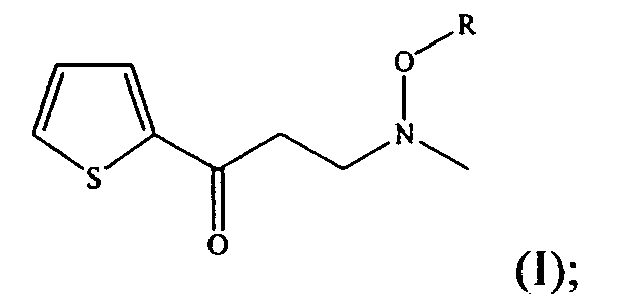
- (i) performing a Mannich reaction of 2-acetylthiophene, formaldehyde and a methylhydroxylamine compound represented by formula, HNCH3(OR), to form a substituted amino ketone represented by formula (I),
- (ii) reducing the substituted amino ketone represented by formula (I) enatioselectively to a (S)-methylhydroxylaminopropanol compound represented by formula (II),

- (iii) reacting the (S)-methylhydroxylaminopropanol compound represented by formula (II) with halonaphthalene to form a N-methyl-N-hydroxyl-3-(1-naphthyloxy)-3-(2-thienyl)propylamine compound represented by formula (III),

- and (iv) performing an N,O-cleavage reaction of the N-methyl-N-hydroxyl-3-(1-naphthyloxy)3-(2-thienyl)propylamine compound represented by formula (III) to form (S)-(+)-N-methyl-3-(1-naphthyloxy)-3-(2-thienyl)propylamine represented by the following formula,

- Further, in the step (iii) of the process of the present invention, KOR1 and DMSO are used in the naphthalenation reaction, wherein R1 is C1-6 alkyl, preferably butyl, and more preferably tert-butyl.
- In one aspect of the present invention, the present invention also provides a process for preparing a N-methyl-N-hydroxyl-3-(1-naphthyloxy)-3-(2-thienyl)propylamine compound represented by formula (III), including a reaction of a (S)-methylhydroxylaminopropanol compound represented by formula (II) with KOR1 and halonaphthalene in DMSO,

- In the process for preparing the compound represented by formula (III) of the present invention, the process is carried out at a temperature ranged from 10°C to 110°C. Further, an amount of the halonaphthalene used in the process ranges from 1.5 to 7.0 equivalents based on 1.1 equivalent of the KOR1.
- The following illustrative embodiments are provided to illustrate the disclosure of the present invention. These and other advantages and effects can be apparently understood by those in the art after reading the disclosure of this specification.
- The present invention provides a methylhydroxylaminopropanol compound represented by formula (II) in an optically active form:

- R in the above formula (II) is preferably C1-4 alkyl, and is more preferably methyl.
- Furthermore, the present invention provides a process for preparing (S)-(+)-N-methyl-3-(1-naphthyloxy)-3-(2-thienyl)propylamine (Duloxetine®), wherein the (S)-methylhydroxylaminopropanol compound represented by formula (II) is used as an intermediate. The process of the present invention is summarized in Scheme 1.

- In more details, the process of the present invention includes steps of:
- (i) performing a Mannich reaction of 2-acetylthiophene, formaldehyde and a methylhydroxylamine compound represented by formula, HNCH3(OR), to form a substituted amino ketone represented by formula (I);
- (ii) reducing the substituted amino ketone represented by formula (I) enatioselectively to a (S)-methylhydroxylaminopropanol compound represented by formula (II);
- (iii) reacting the (S)-methylhydroxylaminopropanol compound represented by formula (II) with halonaphthalene to form a N-methyl-N-hydroxyl-3-(1-naphthyloxy)-3-(2-thienyl)propylamine compound represented by formula (III); and
- (iv) performing an N,O-cleavage reaction of the N-methyl-N-hydroxyl-3-(1-naphthyloxy)-3-(2-thienyl)propylamine compound represented by formula (III) to form Duloxetine.
- The step (i) of the process is carried out at a temperature ranged from 15°C to 90°C, preferably 40°C to 80 °C, and more preferably 50°C to 70°C. The substituted amino ketone represented by formula (I) obtained in the step (i) is either as a free form or as an acid addition salt.
- The reduction of the substituted amino ketone represented by formula (I) in the step (ii) is asymmetric reduction, and preferably chiral reduction. Hence, an optically active form of the (S)-methylhydroxylaminopropanol compound represented by formula (II) is obtained. The optically active form can be obtained via asymmetric hydrogenation using a catalyst with chiral ligands or a hydride with chiral ligands. In the step (ii), a chiral reducing agent used in the chiral reduction is selected from the group consisting of complex hydride, borane, transition metal catalyst and microbial dehydrogenase.
- In one preferred embodiment, reduction of the substituted amino ketone represented by formula (I) in the step (ii) is carried out in a mixture of an alcohol such as methanol and a base such as potassium tert-butoxide, in the presence of a catalyst that includes an enantiomer-enriched bidentate phosphorus-containing ligand, a transition metal and a diamine, preferably a chiral diamine, such as RuCl2((R)-3,5-xylylBINAP) ((2R)-DAIPEN). The reaction mixture is hydrogenated at predetermined pressure to yield the (S)-methylhydroxylaminopropanol compound represented by formula (II) with high ee value.
- The reaction of the (S)-methylhydroxylaminopropanol compound represented by formula (II) with halonaphthalene to form a N-methyl-N-hydroxyl-3-(1-naphthyloxy)-3-(2-thienyl)propylamine compound represented by formula (III) in the step (iii) is carried out by using an appropriate base in a suitable aprotic solvent.
- In one preferred embodiment, the (S)-methylhydroxylaminopropanol compound represented by formula (II) is reacted with fluoronaphthalene in DMF by using sodium hydride as a base. The reaction is carried out at a temperature ranged from 10°C to 110°C, preferably 40°C to 70°C, for 1 to 24 hours.
- In one further preferred embodiment, the (S)-methylhydroxylaminopropanol compound represented by formula (II) is reacted with fluoronaphthalene in DMSO by using KOR1 as a base, wherein R1 is C1-6 alkyl, preferably butyl, and more preferably tert-butyl. In the step (iii) of the present invention, an amount of the halonaphthalene ranges from 1.5 to 7.0 equivalents based on 1.1 equivalent of the KOR1.
- The N,O-cleavage reaction of the N-methyl-N-hydroxyl-3-(1-naphthyloxy)-3-(2-thienyl)propylamine compound represented by formula (III) in the step (iv) of the process is carried out by hydrogenation in the presence of a catalyst such as Raney-nickel, or by chemical reduction methods such as those using LiAlH4 or zinc metal as reducing agent.
- In one preferred embodiment, the N-methyl-N-hydroxyl-3-(1-naphthyloxy)-3-(2-thienyl)propylamine compound represented by formula (III) is hydrogenated in methanol in the presence of Raney-nickel at a temperature ranged from 15°C to 80°C, preferably 40°C to 70°C, for 9 to 15 hours.
- Compared with the conventional process, Duloxetine can be obtained optically pure with higher yield and lower cost from the process of the present invention. This process should operate particularly well on an industrial scale having regard to economic and ecological aspects.
-

- 27.7 g of N,O-dimethylhydroxylamine hydrochloride, 9.3 g of paraformaldehyde, 6.4 g of 32% hydrochloride, 30.0 g of 2-acetylthiophene and 100 g of isopropanol were provided into a flask. After being stirred at 60°C for 13 hours, the reaction mixture was cooled down to room temperature. The crystal thus formed was filtered, washed with 30 g of isopropanol and dried under reduced pressure, and then 42.5 g of 3-methoxymethylamino-1-(2-thienyl)-1-propanone hydrochloride salt (75.9%) is obtained. 1H NMR (400 MHz, CDCl3) δ (ppm) = 3.1 (s, 3H), 3.7 - 3.8 (br, 4H), 4.1 (s, 3H), 7.2 (t, J = 4.5 Hz, 1H), 7.7 (d, J = 4.9 Hz, 1H), 7.9 (d, J = 3.5 Hz, 1H).
-

- 4 mL of degassed methanol solution containing 10 mg of RuCl2((R)-3,5-xylylBINAP) ((2R)-DAIPEN), 160 mg of 3-methoxymethylamino-1-(2-thienyl)-1-propanone, 100 mg of potassium tert-butoxide and 10 mL of methanol were charged in a glass autoclave under an argon gas flow. After deaeration and replacement by argon, hydrogen was introduced to predetermined pressure. The resulting solution was hydrogenated at 20°C for 12 hours. Upon completion of hydrogenation, the reaction mixture was concentrated, and then the desired compound is obtained as an oily product (161 mg, 95.8% by HPLC assay, 95% ee). 1H NMR (400 MHz, CDCl3) δ (ppm) = 3.0 (s, 3H), 3.0 - 3.1 (m, 1H), 4.1 (s, 3H), 4.0 - 4.1 (m, 3H), 6.1 (dt, J = 7.4, 15.4 Hz, 1H), 6.9 (d, J = 15.7 Hz, 1H), 7.0 (dd, J = 3.7, 5.0 Hz, 1H), 7.1 (d, J = 3.4 Hz, 1H).
-

- 10.0 g of (S)-3-methoxymethylamino-1-(2-thienyl)propan-l-ol from Example 2 was dissolved in 30 mL of N,N-dimethylformamide at ambient temperature, to which was added sodium hydride (3.9 g, 60%) with vigorous stirring. Then, 9.4 g of 1-fuloronaphthalene was added, and the mixture was stirred at 70°C for 8 hours. Upon completion of naphthalenation, the reaction mixture was quenched with water (90 mL). After extraction with toluene (30 mL × 3), the organic layer was combined and concentrated. Subsequently, the crude product was purified by silica gel column chromatography to give objective compound as an amber oil (13.5 g, 82.8%). 1H NMR (400 MHz, CDCl3) δ (ppm) = 2.3 (m, 1H), 2.5 (m, 1H), 2.6 (s, 3H), 2.9 (t, 2H), 3.5 (s, 3H), 5.8 (m, 1H), 6.8 (m, 1H), 6.9 (d, 1H), 7.0 (s, 1H), 7.2 (d, 1H), 7.3 (m, 1H), 7.4 (d, 1H), 7.5 (m, 2H), 7.8 (d, 1H), 8.3 (d, 1H).
-

Table 1 Amount (equivalent) 1-fluoronaphthalene 1.5 2.5 3.0 4.0 5.0 6.0 7.0 ee value (%) 91.1 92.5 96.2 96.3 97.1 97.3 97.4 - (S)-3-methoxymethylamino-1-(2-thienyl)propan-1-ol (400 g, 1.987 mole) was dissolved in DMSO (254.3 g) at ambient temperature, to which was added potassium-t-butoxide (245.3 g, 2.186 mole) with vigorous stirring. Then, 1-fluoronaphthalene (1307 g, 7.948 mole) was added, and the mixture was stirred at 50°C for 3-4 hours. Upon completion of naphthalenation, the reaction mixture was cooled to ambient temperature and quenched with water (800 g). After extraction with toluene (1200 mL × 3), the organic layer was combined and concentrated. The yield is 82.0% (533.4 g) by HPLC assay. 96.7% of ee value was analyzed by chiral HPLC (DIACEL AD-H, 250 × 4.6 mm ID, (w/w) hexane : IPA : DEA = 98 : 2 : 0.2, 1 mL/min, UV 248 nm).
- Obviously, the ee value (%) was increased with a higher equivalent of 1-fluoronaphthalene. Further, 1-fluoronaphthalene can be removed by extraction and recovered for reuse. Therefore, using a high equivalent of 1-fluoronaphthalene can alleviate the racemization problem without co-solvent system.
-

- N-methyl-N-methoxyl-3-(1-naphthyloxy)-3-(2-thienyl)propylamine obtained in Example 3-1 or Example 3-2 was dissolved in 15 mL of methanol with 0.67 g of Raney-nickel charged in a glass autoclave. The resulting solution was hydrogenated at 50°C for 12 hours. Upon completion of hydrogenation, the reaction mixture was filtered, and the solvent is removed under reduced pressure. Then, the desired compound is obtained as an oily compound (12.0 g, 96.4% by HPLC assay). 1H NMR (400 MHz, CDCl3) δ (ppm) = 2.2 (m, 1H), 2.4 (m, 1H), 2.4 (s, 3H), 2.8 (m. 2H), 5.8 (m, 1H), 6.8 (d, 1H), 6.9 (m, 1H), 7.1 (d, 1H), 7.2 (d, I H), 7.3 (d, 1H), 7.4 (m, 1H), 7.5 (m, 2H), 7.8 (m, 1H). 8.3(m, 1H).
- The foregoing descriptions of the detailed embodiments are only illustrated to disclose the features and functions of the present invention and not restrictive of the scope of the present invention. Accordingly, the protection sought herein is as set forth in the claims below.
Claims (14)
- A process for preparing (S)-(+)-N-methyl-3-(1-naphthyloxy)-3-(2-thienyl)propylamine, comprising steps of:reacting a (S)-methylhydroxylaminopropanol compound represented by formula (II)
 performing an N,O-cleavage reaction of the N-methyl-N-hydroxyl-3-(1-naphthyloxy)-3-(2-thienyl)propylamine compound represented by formula (III) to form (S)-(+)-N-methyl-3-(1-naphthyloxy)-3-(2-thienyl)propylamine,
 wherein R is C1-8 alkyl; and halo is F, Cl, Br or I.
 - The process according to claim 1, wherein the (S)-methylhydroxylaminopropanol compound represented by formula (II)


- The process according to claim 2, wherein a chiral reducing agent used in the enantioselective reduction is selected from the group consisting of complex hydride, borane, transition metal catalyst and microbial dehydrogenase.
- The process according to claim 2 or claim 3, wherein a reduction catalyst comprising an enantiomer enriched bidentate phosphorus-containing ligand, a transition metal and a diamine is used, and wherein the diamine is a chiral diamine.
- The process according to any of claims 2 to 4, wherein the substituted amino ketone represented by formula (I),

- The process according to any preceding claim, wherein R is C1-4 alkyl.
- The process according to any preceding claim, wherein R is methyl.
- The process according to any preceding claim, wherein KOR1 and DMSO are used in the step of reacting the (S)-methylhydroxylaminopropanol compound represented by formula (II) with halonaphthalene, and wherein R1 is C1-6 alkyl.
- The process according to claim 8, wherein R1 is tert-butyl.
- The process according to claim 8 or 9, wherein an amount of the halonaphthalene ranges from 1.5 to 7.0 equivalents based on 1.1 equivalent of the KOR1.
- The process according to any preceding claim, wherein the N,O-cleavage reaction of the N-methyl-N-hydroxyl-3-(1-naphthyloxy)-3-(2-thienyl)propylamine compound represented by formula (III) is carried out by hydrogenation in an alcohol in the presence of Raney-nickel at a temperature ranged from 15°C to 80°C.
- The process according to any of claim s 1 to 10, wherein the N,O-cleavage reaction of the N-methyl-N-hydroxyl-3-(1-naphthyloxy)-3-(2-thienyl)propylamine compound represented by formula (III) is carried out by a chemical reduction using LiAlH4 or zinc metal as a reducing agent.
- A (S)-methylhydroxylaminopropanol compound represented by the formula (II),

- A compound according to claim 13, wherein R is C1-4 alkyl, preferably methyl.
Applications Claiming Priority (2)
| Application Number | Priority Date | Filing Date | Title |
|---|---|---|---|
| US12/402,740 US8148549B2 (en) | 2009-03-12 | 2009-03-12 | Preparation of (S)-(+)-N-methyl-3-(1-naphthyloxy)-3-(2-thienyl) propylamine using optically active methylhydroxylaminopropanol compound as an intermediate |
| US12/718,289 US8614336B2 (en) | 2009-03-12 | 2010-03-05 | Process for preparing N-methyl-N-hydroxyl-3-(1-naphthyloxy)-3-(2-thienyl)propylamine derivative |
Publications (2)
| Publication Number | Publication Date |
|---|---|
| EP2228372A1 EP2228372A1 (en) | 2010-09-15 |
| EP2228372B1 true EP2228372B1 (en) | 2012-02-29 |
Family
ID=42167649
Family Applications (1)
| Application Number | Title | Priority Date | Filing Date |
|---|---|---|---|
| EP10156142A Active EP2228372B1 (en) | 2009-03-12 | 2010-03-10 | Process for Preparing (S)-(+)-N-Methyl-3-(1-Naphthyloxy)-3-(2-Thienyl-Propylamine by using Optically Active Methylhydroxylaminopropanol Compound as an Intermediate |
Country Status (5)
| Country | Link |
|---|---|
| US (2) | US8148549B2 (en) |
| EP (1) | EP2228372B1 (en) |
| JP (1) | JP5143167B2 (en) |
| AT (1) | ATE547410T1 (en) |
| ES (1) | ES2382604T3 (en) |
Families Citing this family (1)
| Publication number | Priority date | Publication date | Assignee | Title |
|---|---|---|---|---|
| US8148549B2 (en) * | 2009-03-12 | 2012-04-03 | Sci Pharmtech, Inc. | Preparation of (S)-(+)-N-methyl-3-(1-naphthyloxy)-3-(2-thienyl) propylamine using optically active methylhydroxylaminopropanol compound as an intermediate |
Family Cites Families (7)
| Publication number | Priority date | Publication date | Assignee | Title |
|---|---|---|---|---|
| US4956388A (en) * | 1986-12-22 | 1990-09-11 | Eli Lilly And Company | 3-aryloxy-3-substituted propanamines |
| DE10207586A1 (en) * | 2002-02-22 | 2003-09-11 | Degussa | Production of N-methyl-3-hydroxy-3- (2-thienyl) propanamine via new thiophene derivatives containing carbamate groups as intermediates |
| TWI306858B (en) * | 2004-12-23 | 2009-03-01 | Teva Pharma | Process for preparing pharmaceutically acceptable salts of duloxetine and intermediates thereof |
| US7538232B2 (en) * | 2006-01-19 | 2009-05-26 | Eli Lilly And Company | Process for the asymmetric synthesis of duloxetine |
| WO2008077645A1 (en) * | 2006-12-22 | 2008-07-03 | Synthon B.V. | Process for making duloxetine and related compounds |
| US7829731B2 (en) * | 2007-10-29 | 2010-11-09 | Sci Pharmtech, Inc. | Methylhydroxylaminopropanol derivative and its use as intermediate for preparation of 3-methylamino-1-(2-thienyl)propan-1-OL |
| US8148549B2 (en) * | 2009-03-12 | 2012-04-03 | Sci Pharmtech, Inc. | Preparation of (S)-(+)-N-methyl-3-(1-naphthyloxy)-3-(2-thienyl) propylamine using optically active methylhydroxylaminopropanol compound as an intermediate |
-
2009
- 2009-03-12 US US12/402,740 patent/US8148549B2/en active Active
-
2010
- 2010-03-05 US US12/718,289 patent/US8614336B2/en active Active
- 2010-03-10 AT AT10156142T patent/ATE547410T1/en active
- 2010-03-10 EP EP10156142A patent/EP2228372B1/en active Active
- 2010-03-10 ES ES10156142T patent/ES2382604T3/en active Active
- 2010-03-11 JP JP2010054505A patent/JP5143167B2/en active Active
Also Published As
| Publication number | Publication date |
|---|---|
| US8148549B2 (en) | 2012-04-03 |
| JP2010215623A (en) | 2010-09-30 |
| EP2228372A1 (en) | 2010-09-15 |
| ATE547410T1 (en) | 2012-03-15 |
| JP5143167B2 (en) | 2013-02-13 |
| US8614336B2 (en) | 2013-12-24 |
| US20100234619A1 (en) | 2010-09-16 |
| ES2382604T3 (en) | 2012-06-11 |
| US20100234620A1 (en) | 2010-09-16 |
Similar Documents
| Publication | Publication Date | Title |
|---|---|---|
| JP4589724B2 (en) | Enantioselective hydrogenation of aminoalcohols. | |
| US20050197503A1 (en) | Process for the preparation of N-alkyl-N-methyl-3-hydroxy-3-(2-thienyl)-propylamines | |
| US20050171360A1 (en) | Preparation of n-methyl-3-hydroxy- 3-(2-thienyl)propylamine via novel thiophene derivatives containing carbamate groups as intermediates | |
| US8420832B2 (en) | Optically active methylhydroxylaminopropanol derivative and its use as intermediate for preparation of (S)-(-)-3-methylamino-1-(-2-thienyl)propan-1-ol | |
| US8299305B2 (en) | Method for preparing atomoxetine | |
| US8614336B2 (en) | Process for preparing N-methyl-N-hydroxyl-3-(1-naphthyloxy)-3-(2-thienyl)propylamine derivative | |
| US7829731B2 (en) | Methylhydroxylaminopropanol derivative and its use as intermediate for preparation of 3-methylamino-1-(2-thienyl)propan-1-OL | |
| US20050272930A1 (en) | Process for the prepation of 3-hydroxy-(2-thienyl)propanamines | |
| EP2386549B1 (en) | Process for preparing (S)-(+)-N-methyl-3-(1-naphthyloxy)-3-(2-thienyl)propylamine by using an optically active methylhydroxylaminopropanol compound as intermediate | |
| US8530674B2 (en) | Process for preparing (S)-(+)-N-methyl-3-(1-naphthyloxy)-3-(2-thienyl)propylamine by using optically active methylhydroxylaminopropanol compound as intermediate | |
| JPWO2011118625A1 (en) | Process for producing optically active N-monoalkyl-3-hydroxy-3-arylpropylamine compound | |
| US7294744B2 (en) | Process for manufacturing of enantiomerically pure 3-hydroxy-3-phenyl-propylamin | |
| KR101675450B1 (en) | A method for preparing optically active 3-amino-1-propanol derivatives as an intermediate and a method for preparing (S)-duloxetine using the same | |
| KR101644016B1 (en) | A method for preparing optically active 3-amino-1-phenylpropanol derivatives as an intermediate and a method for preparing optically active pharmaceutical products using the same | |
| US8957227B2 (en) | Preparation of Duloxetine® hydrochloride using optically active methylhydroxylaminopropanol compound as an intermediate | |
| EP2125772B1 (en) | A process for the preparation of duloxetin and new key intermediates for use therein | |
| JP2017019727A (en) | Duloxetine base and manufacturing method of duloxetine chlorinate | |
| JPWO2006104249A1 (en) | Process for producing 1- (2-thienyl) -3-alkylaminopropyl alcohol |
Legal Events
| Date | Code | Title | Description |
|---|---|---|---|
| PUAI | Public reference made under article 153(3) epc to a published international application that has entered the european phase |
Free format text: ORIGINAL CODE: 0009012 |
|
| AK | Designated contracting states |
Kind code of ref document: A1 Designated state(s): AT BE BG CH CY CZ DE DK EE ES FI FR GB GR HR HU IE IS IT LI LT LU LV MC MK MT NL NO PL PT RO SE SI SK SM TR |
|
| AX | Request for extension of the european patent |
Extension state: AL BA ME RS |
|
| 17P | Request for examination filed |
Effective date: 20110120 |
|
| 17Q | First examination report despatched |
Effective date: 20110304 |
|
| RIC1 | Information provided on ipc code assigned before grant |
Ipc: C07D 333/16 20060101AFI20110720BHEP |
|
| GRAP | Despatch of communication of intention to grant a patent |
Free format text: ORIGINAL CODE: EPIDOSNIGR1 |
|
| GRAS | Grant fee paid |
Free format text: ORIGINAL CODE: EPIDOSNIGR3 |
|
| GRAA | (expected) grant |
Free format text: ORIGINAL CODE: 0009210 |
|
| AK | Designated contracting states |
Kind code of ref document: B1 Designated state(s): AT BE BG CH CY CZ DE DK EE ES FI FR GB GR HR HU IE IS IT LI LT LU LV MC MK MT NL NO PL PT RO SE SI SK SM TR |
|
| REG | Reference to a national code |
Ref country code: GB Ref legal event code: FG4D Ref country code: CH Ref legal event code: EP |
|
| REG | Reference to a national code |
Ref country code: AT Ref legal event code: REF Ref document number: 547410 Country of ref document: AT Kind code of ref document: T Effective date: 20120315 |
|
| REG | Reference to a national code |
Ref country code: IE Ref legal event code: FG4D |
|
| REG | Reference to a national code |
Ref country code: DE Ref legal event code: R096 Ref document number: 602010000895 Country of ref document: DE Effective date: 20120426 |
|
| REG | Reference to a national code |
Ref country code: ES Ref legal event code: FG2A Ref document number: 2382604 Country of ref document: ES Kind code of ref document: T3 Effective date: 20120611 |
|
| REG | Reference to a national code |
Ref country code: NL Ref legal event code: VDEP Effective date: 20120229 |
|
| LTIE | Lt: invalidation of european patent or patent extension |
Effective date: 20120229 |
|
| PG25 | Lapsed in a contracting state [announced via postgrant information from national office to epo] |
Ref country code: NL Free format text: LAPSE BECAUSE OF FAILURE TO SUBMIT A TRANSLATION OF THE DESCRIPTION OR TO PAY THE FEE WITHIN THE PRESCRIBED TIME-LIMIT Effective date: 20120229 Ref country code: IS Free format text: LAPSE BECAUSE OF FAILURE TO SUBMIT A TRANSLATION OF THE DESCRIPTION OR TO PAY THE FEE WITHIN THE PRESCRIBED TIME-LIMIT Effective date: 20120629 Ref country code: LT Free format text: LAPSE BECAUSE OF FAILURE TO SUBMIT A TRANSLATION OF THE DESCRIPTION OR TO PAY THE FEE WITHIN THE PRESCRIBED TIME-LIMIT Effective date: 20120229 Ref country code: NO Free format text: LAPSE BECAUSE OF FAILURE TO SUBMIT A TRANSLATION OF THE DESCRIPTION OR TO PAY THE FEE WITHIN THE PRESCRIBED TIME-LIMIT Effective date: 20120529 Ref country code: HR Free format text: LAPSE BECAUSE OF FAILURE TO SUBMIT A TRANSLATION OF THE DESCRIPTION OR TO PAY THE FEE WITHIN THE PRESCRIBED TIME-LIMIT Effective date: 20120229 |
|
| PG25 | Lapsed in a contracting state [announced via postgrant information from national office to epo] |
Ref country code: BE Free format text: LAPSE BECAUSE OF FAILURE TO SUBMIT A TRANSLATION OF THE DESCRIPTION OR TO PAY THE FEE WITHIN THE PRESCRIBED TIME-LIMIT Effective date: 20120229 Ref country code: LV Free format text: LAPSE BECAUSE OF FAILURE TO SUBMIT A TRANSLATION OF THE DESCRIPTION OR TO PAY THE FEE WITHIN THE PRESCRIBED TIME-LIMIT Effective date: 20120229 Ref country code: GR Free format text: LAPSE BECAUSE OF FAILURE TO SUBMIT A TRANSLATION OF THE DESCRIPTION OR TO PAY THE FEE WITHIN THE PRESCRIBED TIME-LIMIT Effective date: 20120530 Ref country code: FI Free format text: LAPSE BECAUSE OF FAILURE TO SUBMIT A TRANSLATION OF THE DESCRIPTION OR TO PAY THE FEE WITHIN THE PRESCRIBED TIME-LIMIT Effective date: 20120229 Ref country code: PT Free format text: LAPSE BECAUSE OF FAILURE TO SUBMIT A TRANSLATION OF THE DESCRIPTION OR TO PAY THE FEE WITHIN THE PRESCRIBED TIME-LIMIT Effective date: 20120629 |
|
| REG | Reference to a national code |
Ref country code: AT Ref legal event code: MK05 Ref document number: 547410 Country of ref document: AT Kind code of ref document: T Effective date: 20120229 |
|
| PG25 | Lapsed in a contracting state [announced via postgrant information from national office to epo] |
Ref country code: CY Free format text: LAPSE BECAUSE OF FAILURE TO SUBMIT A TRANSLATION OF THE DESCRIPTION OR TO PAY THE FEE WITHIN THE PRESCRIBED TIME-LIMIT Effective date: 20120229 |
|
| PG25 | Lapsed in a contracting state [announced via postgrant information from national office to epo] |
Ref country code: SI Free format text: LAPSE BECAUSE OF FAILURE TO SUBMIT A TRANSLATION OF THE DESCRIPTION OR TO PAY THE FEE WITHIN THE PRESCRIBED TIME-LIMIT Effective date: 20120229 Ref country code: CZ Free format text: LAPSE BECAUSE OF FAILURE TO SUBMIT A TRANSLATION OF THE DESCRIPTION OR TO PAY THE FEE WITHIN THE PRESCRIBED TIME-LIMIT Effective date: 20120229 Ref country code: MC Free format text: LAPSE BECAUSE OF NON-PAYMENT OF DUE FEES Effective date: 20120331 Ref country code: SE Free format text: LAPSE BECAUSE OF FAILURE TO SUBMIT A TRANSLATION OF THE DESCRIPTION OR TO PAY THE FEE WITHIN THE PRESCRIBED TIME-LIMIT Effective date: 20120229 Ref country code: EE Free format text: LAPSE BECAUSE OF FAILURE TO SUBMIT A TRANSLATION OF THE DESCRIPTION OR TO PAY THE FEE WITHIN THE PRESCRIBED TIME-LIMIT Effective date: 20120229 Ref country code: DK Free format text: LAPSE BECAUSE OF FAILURE TO SUBMIT A TRANSLATION OF THE DESCRIPTION OR TO PAY THE FEE WITHIN THE PRESCRIBED TIME-LIMIT Effective date: 20120229 Ref country code: PL Free format text: LAPSE BECAUSE OF FAILURE TO SUBMIT A TRANSLATION OF THE DESCRIPTION OR TO PAY THE FEE WITHIN THE PRESCRIBED TIME-LIMIT Effective date: 20120229 Ref country code: RO Free format text: LAPSE BECAUSE OF FAILURE TO SUBMIT A TRANSLATION OF THE DESCRIPTION OR TO PAY THE FEE WITHIN THE PRESCRIBED TIME-LIMIT Effective date: 20120229 |
|
| PG25 | Lapsed in a contracting state [announced via postgrant information from national office to epo] |
Ref country code: SK Free format text: LAPSE BECAUSE OF FAILURE TO SUBMIT A TRANSLATION OF THE DESCRIPTION OR TO PAY THE FEE WITHIN THE PRESCRIBED TIME-LIMIT Effective date: 20120229 |
|
| REG | Reference to a national code |
Ref country code: IE Ref legal event code: MM4A |
|
| PLBE | No opposition filed within time limit |
Free format text: ORIGINAL CODE: 0009261 |
|
| STAA | Information on the status of an ep patent application or granted ep patent |
Free format text: STATUS: NO OPPOSITION FILED WITHIN TIME LIMIT |
|
| PG25 | Lapsed in a contracting state [announced via postgrant information from national office to epo] |
Ref country code: IE Free format text: LAPSE BECAUSE OF NON-PAYMENT OF DUE FEES Effective date: 20120310 Ref country code: AT Free format text: LAPSE BECAUSE OF FAILURE TO SUBMIT A TRANSLATION OF THE DESCRIPTION OR TO PAY THE FEE WITHIN THE PRESCRIBED TIME-LIMIT Effective date: 20120229 |
|
| 26N | No opposition filed |
Effective date: 20121130 |
|
| PG25 | Lapsed in a contracting state [announced via postgrant information from national office to epo] |
Ref country code: MK Free format text: LAPSE BECAUSE OF FAILURE TO SUBMIT A TRANSLATION OF THE DESCRIPTION OR TO PAY THE FEE WITHIN THE PRESCRIBED TIME-LIMIT Effective date: 20120229 |
|
| REG | Reference to a national code |
Ref country code: DE Ref legal event code: R097 Ref document number: 602010000895 Country of ref document: DE Effective date: 20121130 |
|
| PG25 | Lapsed in a contracting state [announced via postgrant information from national office to epo] |
Ref country code: MT Free format text: LAPSE BECAUSE OF FAILURE TO SUBMIT A TRANSLATION OF THE DESCRIPTION OR TO PAY THE FEE WITHIN THE PRESCRIBED TIME-LIMIT Effective date: 20120229 Ref country code: BG Free format text: LAPSE BECAUSE OF FAILURE TO SUBMIT A TRANSLATION OF THE DESCRIPTION OR TO PAY THE FEE WITHIN THE PRESCRIBED TIME-LIMIT Effective date: 20120529 |
|
| PG25 | Lapsed in a contracting state [announced via postgrant information from national office to epo] |
Ref country code: TR Free format text: LAPSE BECAUSE OF FAILURE TO SUBMIT A TRANSLATION OF THE DESCRIPTION OR TO PAY THE FEE WITHIN THE PRESCRIBED TIME-LIMIT Effective date: 20120229 |
|
| PG25 | Lapsed in a contracting state [announced via postgrant information from national office to epo] |
Ref country code: LU Free format text: LAPSE BECAUSE OF NON-PAYMENT OF DUE FEES Effective date: 20120310 Ref country code: SM Free format text: LAPSE BECAUSE OF FAILURE TO SUBMIT A TRANSLATION OF THE DESCRIPTION OR TO PAY THE FEE WITHIN THE PRESCRIBED TIME-LIMIT Effective date: 20120229 |
|
| PG25 | Lapsed in a contracting state [announced via postgrant information from national office to epo] |
Ref country code: HU Free format text: LAPSE BECAUSE OF FAILURE TO SUBMIT A TRANSLATION OF THE DESCRIPTION OR TO PAY THE FEE WITHIN THE PRESCRIBED TIME-LIMIT Effective date: 20100310 |
|
| REG | Reference to a national code |
Ref country code: FR Ref legal event code: PLFP Year of fee payment: 7 |
|
| REG | Reference to a national code |
Ref country code: FR Ref legal event code: PLFP Year of fee payment: 8 |
|
| REG | Reference to a national code |
Ref country code: FR Ref legal event code: PLFP Year of fee payment: 9 |
|
| P01 | Opt-out of the competence of the unified patent court (upc) registered |
Effective date: 20230524 |
|
| PGFP | Annual fee paid to national office [announced via postgrant information from national office to epo] |
Ref country code: DE Payment date: 20240206 Year of fee payment: 15 Ref country code: GB Payment date: 20240208 Year of fee payment: 15 |
|
| PGFP | Annual fee paid to national office [announced via postgrant information from national office to epo] |
Ref country code: IT Payment date: 20240212 Year of fee payment: 15 Ref country code: FR Payment date: 20240213 Year of fee payment: 15 |
|
| PGFP | Annual fee paid to national office [announced via postgrant information from national office to epo] |
Ref country code: CH Payment date: 20240401 Year of fee payment: 15 |
|
| PGFP | Annual fee paid to national office [announced via postgrant information from national office to epo] |
Ref country code: ES Payment date: 20240408 Year of fee payment: 15 |
|
| REG | Reference to a national code |
Ref country code: DE Ref legal event code: R119 Ref document number: 602010000895 Country of ref document: DE |
|
| REG | Reference to a national code |
Ref country code: CH Ref legal event code: H13 Free format text: ST27 STATUS EVENT CODE: U-0-0-H10-H13 (AS PROVIDED BY THE NATIONAL OFFICE) Effective date: 20251023 |
|
| GBPC | Gb: european patent ceased through non-payment of renewal fee |
Effective date: 20250310 |
|
| PG25 | Lapsed in a contracting state [announced via postgrant information from national office to epo] |
Ref country code: DE Free format text: LAPSE BECAUSE OF NON-PAYMENT OF DUE FEES Effective date: 20251001 |
|
| PG25 | Lapsed in a contracting state [announced via postgrant information from national office to epo] |
Ref country code: GB Free format text: LAPSE BECAUSE OF NON-PAYMENT OF DUE FEES Effective date: 20250310 |
|
| PG25 | Lapsed in a contracting state [announced via postgrant information from national office to epo] |
Ref country code: IT Free format text: LAPSE BECAUSE OF NON-PAYMENT OF DUE FEES Effective date: 20250310 Ref country code: FR Free format text: LAPSE BECAUSE OF NON-PAYMENT OF DUE FEES Effective date: 20250331 |
|
| PG25 | Lapsed in a contracting state [announced via postgrant information from national office to epo] |
Ref country code: CH Free format text: LAPSE BECAUSE OF NON-PAYMENT OF DUE FEES Effective date: 20250331 |
|
| REG | Reference to a national code |
Ref country code: ES Ref legal event code: FD2A Effective date: 20260428 |