EP2226782A2 - System for mounting a flag - Google Patents
System for mounting a flag Download PDFInfo
- Publication number
- EP2226782A2 EP2226782A2 EP10001945A EP10001945A EP2226782A2 EP 2226782 A2 EP2226782 A2 EP 2226782A2 EP 10001945 A EP10001945 A EP 10001945A EP 10001945 A EP10001945 A EP 10001945A EP 2226782 A2 EP2226782 A2 EP 2226782A2
- Authority
- EP
- European Patent Office
- Prior art keywords
- sheets
- fact
- flag
- eyelet
- mast
- Prior art date
- Legal status (The legal status is an assumption and is not a legal conclusion. Google has not performed a legal analysis and makes no representation as to the accuracy of the status listed.)
- Granted
Links
- 230000004888 barrier function Effects 0.000 claims abstract description 3
- 239000004744 fabric Substances 0.000 claims description 6
- 125000006850 spacer group Chemical group 0.000 claims 1
- 229920002994 synthetic fiber Polymers 0.000 claims 1
- 239000003086 colorant Substances 0.000 description 3
- 238000000034 method Methods 0.000 description 2
- 238000004891 communication Methods 0.000 description 1
- 238000010276 construction Methods 0.000 description 1
- 230000000694 effects Effects 0.000 description 1
- 239000000463 material Substances 0.000 description 1
- 230000000149 penetrating effect Effects 0.000 description 1
- 230000035515 penetration Effects 0.000 description 1
Images

Classifications
-
- G—PHYSICS
- G09—EDUCATION; CRYPTOGRAPHY; DISPLAY; ADVERTISING; SEALS
- G09F—DISPLAYING; ADVERTISING; SIGNS; LABELS OR NAME-PLATES; SEALS
- G09F17/00—Flags; Banners; Mountings therefor
Definitions
- This invention concerns a system for constructing especially flags, banners and the like, having the characteristic features described in claim 1.
- flags flown from a vertical rope mast type
- flags hung from a horizontal arm or rod suspended type
- Mast type flags extend primarily in the horizontal direction, and are unfurled by the wind which opens and moves them; national flags are generally of this type.
- Suspended type flags are hung from a horizontal arm, they extend mainly in a vertical direction, and are supported by the arm itself, attached to the top of the main mast; they are held taut by a weight affixed to the bottom of the flag.
- the first-and also most obvious-solution is to print the flag design on both sides, however this causes overlap of the two images due to fabric transparency or penetration of the colours; the design thus appears unclear, with confused outlines.
- a second solution is to make the flag from two sheets of fabric, each printed separately on its outer face, which are then stitched together one on top of the other. This avoids the problem of the printed colours penetrating through to the other side, but not that of the images overlapping due transparency, which persists because of the open weave of the cloth.
- a third solution is to insert, in between the above two sheets, a third sheet of opaque material to reduce transparency, and then stitch all the sheets together "sandwich style" along their entire perimeter. This however imparts an unnatural stiffness to the flag, due to the greater weight and rigidity of the assembly, reducing the pliancy and flexibility of the flag's movement in the wind, and producing aesthetically unacceptable "bag” type bulges.
- Another known possible solution involves inserting, in between the two printed sheets, a third sheet constructed from horizontal sleeves stitched one on top of the other, in such a way as to keep the two outer sheets separated and free to flutter, whilst eliminating the transparency problem.
- the purpose of the present invention is the construction of flag, preferably of the "suspended" and/or "beach flag” type, which are those most frequently used for advertising communication, that eliminates the drawbacks of the previously described known types, while at the same time being easy to produce, fast to assembly, and therefore economical and easy to use.
- the system of this invention essentially involves constructing a flag body from four stacked sheets, with the two inner, unprinted ones providing a barrier against transparency, while at the same time maintaining a high flexibility of the whole.
- the outer sheet which is printed in the traditional manner, is fitted over the inner sheets by folding it in half along its midline, so as to display the visible design on either side.
- This outer sheet is simultaneously printed with the two texts and/or designs as upside-down mirror images of each other; in this way, once the sheet is folded in half along its midline, the text and/or design will be legible and correctly oriented on both outer faces.
- the outer sheet is additionally stitched along its vertical edge nearest the mast, called the "hoist end", in order to prevent excessive movement of the two faces relative to each other, whereas these are left unattached on the opposite vertical edge, called the "fly", and along the bottom edge.
- the aforesaid stitching however stops short of the top edge, in order to leave an opening of adequate size for inserting the horizontal supporting arm.
- the two outer sheets are stitched only along a small terminal segment, on the fly end, both horizontally in an outward direction and vertically towards the fold, in order to form a small sleeve closed on the outer end.
- the two inner sheets are constructed as follows: the width and height of the sheets are less than the corresponding dimensions of the outer sheets; the sheets are stitched for their full width along the top to form a tube terminating in a small closed sleeve, whose function is described below; on the flag mast end of this tube there is also stitched a projecting horizontal strap, provided with hole with eyelet into which is inserted a spring catch that holds the flag horizontally taut; on the bottom corner on the flag mast side there is an additional hole with eyelet, through which passes a cord supporting a counterweight that holds the flag vertically taut.
- the inner sheets can also be joined together, in a preferred but not exclusive embodiment, by seams running in a vertical direction.
- the two inner sheets could also be supplemented with any number of additional sheets, accordingly with the desired final weight, opacity and costs.
- the inner sheets are connected to the outer ones by means of a cord passing through the eyelets in their bottom corners on the flag mast side, to which is affixed by sliding means a counterweight that holds the flag taut.
- the result is a flag with a very flexible structure, that moves in the wind in a natural manner, and whose text or design is perfectly legible on either side.
- the inner sheet and the upper horizontal supporting arm can be supplied separately as an accessory that can be continually reused, while the sheet forming the two outer faces with the visible flag design can be replaced as many times as desired, as in a traditional flag.
- the flag consists essentially of one rectangular sheet 1 ( Fig. 1 ) having twice the height of the desired final flag height, which is printed with the double images I1-I2 on the same side. In the case of large-sized flags, two sheets 1-1" are used, stitched together along the midline 3.
- Sheet 1 is subsequently folded in half on itself, along its midline 3, in such a way as to obtain the final flag dimensions ( Fig. 4 ).
- first seam extends horizontally on the fly end, parallel to the top edge L2, for a length L4, and the second seam extends vertically, parallel to the outer edge, for a height H5".
- the lowermost hole with eyelet F3 is used for attaching the counterweight G ( Fig. 2 ).
- the first hole with eyelet F2, on the top, is provided with a spring catch 9 used for holding sheet 1 horizontally taut.
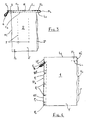
- the inner sheet 2 ( Fig. 3 ) is made from a similar fabric to that of the outer sheet 1, and is formed from two sheets 2'-2" placed one on top of the other, and stitched together horizontally along the short upper edge L1 with a double seam C1-C2, so as to form a tube 11.
- the inner sheets 2'-2" are of smaller size than the outer sheets 1'-1", and more specifically: the length L1 of the inner sheets is less than the length L2 of the outer sheets by an amount L3 (length of sleeve M2) while the height H1 of the inner sheets is less than the height H2 of the outer sheets by a sufficient amount for them not to be visible from the outside.
- the fly end of the tube 11 terminates in a closed sleeve M2 that projects outward by a length L3. Stitched to the hoist end of the inner sheets 2'-2" there is a projecting strap 5, provided with a hole with eyelet F4, into which is inserted a spring catch 6 for holding the flag horizontally taut. An additional hole with eyelet F5, passing through all the inner sheets, is situated on the bottom corner toward the flag mast P1.
- the flag assembly sequence is as follows: the inner sheets 2'-2" are first fitted on the horizontal arm P2, disassembled from the flag mast (or on the curved support in the case of a "beach flag"), by inserting the arm into the upper tube 11 up to the end of sleeve M2; the inner sheets will later be held taut by the spring catch 6, connected to a corresponding attachment 12' on the flag mast P1; the outer sheets 1 are then fitted onto the horizontal arm P2 (already inserted into the inner sheets 2) from their open end H2, starting from the opening H5' on side H3 and inserting the closed sleeve M2, of height H4, into the corresponding sleeve M1 of the outer sheet 1, having a height H5" that is greater than H4.
- the inner sheets are connected to the outer ones by means of a cord 13, inserted into the holes F3-F5 on the bottom corners on the flag mast side, and to which is affixed by sliding means a counterweight G that holds the flag taut.
- a cord 13 inserted into the holes F3-F5 on the bottom corners on the flag mast side, and to which is affixed by sliding means a counterweight G that holds the flag taut.
Landscapes
- Physics & Mathematics (AREA)
- General Physics & Mathematics (AREA)
- Engineering & Computer Science (AREA)
- Theoretical Computer Science (AREA)
- Toys (AREA)
- Nitrogen And Oxygen Or Sulfur-Condensed Heterocyclic Ring Systems (AREA)
- Control Of Indicators Other Than Cathode Ray Tubes (AREA)
Abstract
Description
- This invention concerns a system for constructing especially flags, banners and the like, having the characteristic features described in
claim 1. - There exist various known types of flags, which essentially fall into two basic categories: flags flown from a vertical rope (mast type) and flags hung from a horizontal arm or rod (suspended type).
- Mast type flags extend primarily in the horizontal direction, and are unfurled by the wind which opens and moves them; national flags are generally of this type.
- Suspended type flags are hung from a horizontal arm, they extend mainly in a vertical direction, and are supported by the arm itself, attached to the top of the main mast; they are held taut by a weight affixed to the bottom of the flag.
- The text, colours and designs of flags are printed by a variety of known methods, which however have certain drawbacks. In fact, printing with low colour intensity is less easily legible and tends to fade more quickly. Conversely, printing with high colour intensity can penetrate through the fabric, becoming visible as a mirror image on the opposite side; this results in the design appearing correctly oriented on one side of the flag, but inverted on the other.
- To remedy these problems, a number of solutions have been tested, but all with unsatisfactory results.
- The first-and also most obvious-solution is to print the flag design on both sides, however this causes overlap of the two images due to fabric transparency or penetration of the colours; the design thus appears unclear, with confused outlines.
- A second solution is to make the flag from two sheets of fabric, each printed separately on its outer face, which are then stitched together one on top of the other. This avoids the problem of the printed colours penetrating through to the other side, but not that of the images overlapping due transparency, which persists because of the open weave of the cloth.
- A third solution is to insert, in between the above two sheets, a third sheet of opaque material to reduce transparency, and then stitch all the sheets together "sandwich style" along their entire perimeter. This however imparts an unnatural stiffness to the flag, due to the greater weight and rigidity of the assembly, reducing the pliancy and flexibility of the flag's movement in the wind, and producing aesthetically unacceptable "bag" type bulges.
- Another known possible solution involves inserting, in between the two printed sheets, a third sheet constructed from horizontal sleeves stitched one on top of the other, in such a way as to keep the two outer sheets separated and free to flutter, whilst eliminating the transparency problem.
- The main disadvantages of this solution are the difficulty of forming the sleeves, with consequently high production costs, the fact that horizontal bands are visible by transparency at points coinciding with the sleeves, and the complex method of fixing the flag to the horizontal arm by means of clamps, in the suspended version, or to the curved support in the teardrop shaped "beach flag".
- The purpose of the present invention is the construction of flag, preferably of the "suspended" and/or "beach flag" type, which are those most frequently used for advertising communication, that eliminates the drawbacks of the previously described known types, while at the same time being easy to produce, fast to assembly, and therefore economical and easy to use.
- The system of this invention essentially involves constructing a flag body from four stacked sheets, with the two inner, unprinted ones providing a barrier against transparency, while at the same time maintaining a high flexibility of the whole.
- The outer sheet, which is printed in the traditional manner, is fitted over the inner sheets by folding it in half along its midline, so as to display the visible design on either side.
- For particularly long flags, it is possible to use two separate rectangular sheets which are printed separately and then stitched together.
- This outer sheet is simultaneously printed with the two texts and/or designs as upside-down mirror images of each other; in this way, once the sheet is folded in half along its midline, the text and/or design will be legible and correctly oriented on both outer faces.
- The outer sheet is additionally stitched along its vertical edge nearest the mast, called the "hoist end", in order to prevent excessive movement of the two faces relative to each other, whereas these are left unattached on the opposite vertical edge, called the "fly", and along the bottom edge.
- The aforesaid stitching however stops short of the top edge, in order to leave an opening of adequate size for inserting the horizontal supporting arm.
- On the short horizontal side, coinciding with the fold, the two outer sheets are stitched only along a small terminal segment, on the fly end, both horizontally in an outward direction and vertically towards the fold, in order to form a small sleeve closed on the outer end.
- On the hoist end, at the point where the vertical seam begins, there is a hole with eyelet for inserting a spring catch used to hold the sheet horizontally taut. In addition, a series of holes with eyelets, running along the full height of the flag, along the seam, are used for attaching the flag to the mast, by means of rings passed through the holes.
- The two inner sheets are constructed as follows: the width and height of the sheets are less than the corresponding dimensions of the outer sheets; the sheets are stitched for their full width along the top to form a tube terminating in a small closed sleeve, whose function is described below; on the flag mast end of this tube there is also stitched a projecting horizontal strap, provided with hole with eyelet into which is inserted a spring catch that holds the flag horizontally taut; on the bottom corner on the flag mast side there is an additional hole with eyelet, through which passes a cord supporting a counterweight that holds the flag vertically taut.
- The inner sheets can also be joined together, in a preferred but not exclusive embodiment, by seams running in a vertical direction. The two inner sheets could also be supplemented with any number of additional sheets, accordingly with the desired final weight, opacity and costs.
- To achieve uniform vertical tautness of the inner and outer sheets, the inner sheets are connected to the outer ones by means of a cord passing through the eyelets in their bottom corners on the flag mast side, to which is affixed by sliding means a counterweight that holds the flag taut.
- The result is a flag with a very flexible structure, that moves in the wind in a natural manner, and whose text or design is perfectly legible on either side.
- The inner sheet and the upper horizontal supporting arm can be supplied separately as an accessory that can be continually reused, while the sheet forming the two outer faces with the visible flag design can be replaced as many times as desired, as in a traditional flag.
- The purposes and advantages are further clarified in the description that follows and in the enclosed drawings which schematically illustrate one possible, but not exclusive, practical embodiment of the system of this invention.
- With reference to the drawings:
-
Fig. 1 shows a top view of theouter sheet 1, printed with the double design. - -
Fig. 2 shows a flag of suspended type, and the manner of its assembly and mounting on the mast P1, provided with a horizontal arm P2 for supporting the flag. - -
Fig. 3 shows theinner sheet 2, constructed in one possible embodiment from two sheets 2'-2", - -
Fig. 4 shows theouter sheet 1 in a standard embodiment. - The flag consists essentially of one rectangular sheet 1 (
Fig. 1 ) having twice the height of the desired final flag height, which is printed with the double images I1-I2 on the same side. In the case of large-sized flags, two sheets 1-1" are used, stitched together along the midline 3. -
Sheet 1 is subsequently folded in half on itself, along its midline 3, in such a way as to obtain the final flag dimensions (Fig. 4 ). - After the two halves of
outer sheet 1 are folded onto each other 1'-1", they are joined together by means of two horizontal seams; the first seam extends horizontally on the fly end, parallel to the top edge L2, for a length L4, and the second seam extends vertically, parallel to the outer edge, for a height H5". These seams form a closed sleeve M1. - Two additional parallel vertical seams 10'-10" are stitched, starting at a distance H5' from the top edge L2, and running down the entire remaining length of the side H3; this produces an opening of height H5.
- Running along the entire height H3 of
sheet 1, on the mast side P1, and in between the two vertical seams 10'-10", are a number of holes with eyelets F1, used for fixing the flag to the mast P1 by means ofrings 12. - On the bottom edge of
sheet 1, on the flag mast side, the lowermost hole with eyelet F3 is used for attaching the counterweight G (Fig. 2 ). - The first hole with eyelet F2, on the top, is provided with a spring catch 9 used for
holding sheet 1 horizontally taut. - The inner sheet 2 (
Fig. 3 ) is made from a similar fabric to that of theouter sheet 1, and is formed from two sheets 2'-2" placed one on top of the other, and stitched together horizontally along the short upper edge L1 with a double seam C1-C2, so as to form atube 11. The inner sheets 2'-2" are of smaller size than the outer sheets 1'-1", and more specifically: the length L1 of the inner sheets is less than the length L2 of the outer sheets by an amount L3 (length of sleeve M2) while the height H1 of the inner sheets is less than the height H2 of the outer sheets by a sufficient amount for them not to be visible from the outside. The fly end of thetube 11 terminates in a closed sleeve M2 that projects outward by a length L3. Stitched to the hoist end of the inner sheets 2'-2" there is a projecting strap 5, provided with a hole with eyelet F4, into which is inserted aspring catch 6 for holding the flag horizontally taut. An additional hole with eyelet F5, passing through all the inner sheets, is situated on the bottom corner toward the flag mast P1. - The flag assembly sequence is as follows: the inner sheets 2'-2" are first fitted on the horizontal arm P2, disassembled from the flag mast (or on the curved support in the case of a "beach flag"), by inserting the arm into the
upper tube 11 up to the end of sleeve M2; the inner sheets will later be held taut by thespring catch 6, connected to a corresponding attachment 12' on the flag mast P1; theouter sheets 1 are then fitted onto the horizontal arm P2 (already inserted into the inner sheets 2) from their open end H2, starting from the opening H5' on side H3 and inserting the closed sleeve M2, of height H4, into the corresponding sleeve M1 of theouter sheet 1, having a height H5" that is greater than H4. A second spring catch 9, inserted in the upper hole with eyelet F2, is used to subsequently hold theouter sheet 1 horizontally taut, by connecting it to a second attachment (12") on the flag mast P1. At this point the horizontal arm with the sheets assembled on it is mounted on the flag mast P1. - To achieve uniform vertical tautness of the inner and outer sheets, the inner sheets are connected to the outer ones by means of a
cord 13, inserted into the holes F3-F5 on the bottom corners on the flag mast side, and to which is affixed by sliding means a counterweight G that holds the flag taut. This solution allows the inner sheets 2'-2" and the outer sheets 1'-1" to be held taut without imparting stiffness to the flag assembly, which is able to move freely and without the inner and outer sheets being simultaneously visible in a "book" effect.
Claims (20)
- System for constructing especially flags, banners and the like, consisting of two specially made sheets of polyester-type synthetic material, each printed on its outer face with text and/or designs that are upside-down mirror images of each other, between which are placed two opaque spacer sheets, characterised by the fact that the outer sheets (1'-1") are fitted over the inner sheets (2'-2") by inserting two edge sleeves (M1-M2) one inside the other.
- System according to claim 1, characterised by the fact that the inner sheets (2'-2") have two straight seams (C1-C2) that form a horizontal tube (11) parallel to the top edge (L1), with said tube terminating at one end in a closed sleeve (M2) of predetermined length (L3), that projects outward to form an extension of tube (11).
- System according to the preceding claims, characterised by the fact that on the opposite end to the closed sleeve (M2) there is stitched a projecting horizontal strap (5), provided with a hole with eyelet (F4), into which is inserted a spring catch (6).
- System according to the preceding claims, characterised by the fact that the height (H1) of the inner sheets (2'-2") is less than the corresponding height (H2) of the outer sheets (1'-1").
- System according to the preceding claims, characterised by the fact that the length (L1) of the inner sheets (2'-2") is less than the corresponding length (L2) of the outer sheets (1'-1").
- System according to the preceding claims, characterised by the fact that it has a hole with eyelet (F5) on the bottom corner on the flag mast side.
- System according to the preceding claims, characterised by the fact that the inner sheet (2) is made out of two or more sheets (2'-2") placed one on top of the other, that form an opaque barrier.
- System according to the preceding claims, characterised by the fact that said inner sheets (2'-2") can be joined together by any number of vertical seams (7) of any shape.
- System according to the preceding claims, characterised by the fact that the outer sheet (1) is preferably made from a single double-length piece of cloth, folded over on itself along its midline (3).
- System according to the preceding claims, characterised by the fact that said sheet (1) has a design and/or graphic printed on each half in such a way that one (I1) is an upside-down mirror image of the other (I2).
- System according to the preceding claims, characterised by the fact that the two outer sheets (1'- 1") are joined together by means of a double vertical seam (10'-10") running parallel to the vertical edge (H3), with said double seam (10'-10") stopping short of the edge to leave an opening of height (H5') on top.
- System according to the preceding claims, characterised by the fact that the portion of the outer sheet (1) between the two seams (10'- 10") has multiple holes (F1) with eyelets running vertically from top to bottom, on the flag mast side.
- System according to the preceding claims, characterised by the fact that it has, on the side opposite the mast, a partial seam (L4) running parallel to the top edge and at a distance (H5") from it, in such a way as to form a closed sleeve (M1) of height H5".
- System according to the preceding claims, characterised by the fact that it has a hole with eyelet (F3) at the bottom of the vertical seam (10'-10"), and a counterweight (G) applied to said hole with eyelet (F3).
- System according to the preceding claims, characterised by the fact that it has a spring clamp (9) inserted into the topmost hole with eyelet (F2) on the flag mast side.
- System according to the preceding claims, characterised by the fact that the two outer sheets (1'-1") are fitted over the inner sheets (2'-2") by inserting said inner sheets into the opening (H5') and the sleeve (M2) into the sleeve (M1), the height (H4) being less than the height (H5").
- System according to the preceding claims, characterised by the fact that it has a number of rings (12) inserted into the holes with eyelet (F1) running vertically along the flag mast side, for fixing the flag to the mast (P1).
- System according to the preceding claims, characterised by the fact that the flag is held taut horizontally by means of the two aforesaid spring catches (6-9), each connected to its own attachment (12'-12") on the mast.
- System according to the preceding claims, characterised by the fact that it has a connecting cord (13) inserted into the two holes (F3-F5), situated on the bottom corners of the outer (2'-2") and inner (1'-1") sheets on the flag mast side, and with a counterweight (G) affixed by sliding means to the connecting cord (13), to hold both the sheets (1-2) vertically taut.
- System according to the preceding claims characterised by the fact that the four sheets (1'-1"-2'-2"), joined in the manner described, are able to freely move relative to each other, and the text and/or graphics (I1-I2) printed on the two outer faces are always clearly visible and correctly oriented.
Applications Claiming Priority (1)
| Application Number | Priority Date | Filing Date | Title |
|---|---|---|---|
| ITBO2009A000122A IT1393016B1 (en) | 2009-03-02 | 2009-03-02 | CONSTRUCTIVE SYSTEM FOR FLAGS, STANDARDS AND THE LIKE |
Publications (3)
| Publication Number | Publication Date |
|---|---|
| EP2226782A2 true EP2226782A2 (en) | 2010-09-08 |
| EP2226782A3 EP2226782A3 (en) | 2011-08-24 |
| EP2226782B1 EP2226782B1 (en) | 2012-09-05 |
Family
ID=41199795
Family Applications (1)
| Application Number | Title | Priority Date | Filing Date |
|---|---|---|---|
| EP20100001945 Not-in-force EP2226782B1 (en) | 2009-03-02 | 2010-02-25 | System for mounting a flag |
Country Status (2)
| Country | Link |
|---|---|
| EP (1) | EP2226782B1 (en) |
| IT (1) | IT1393016B1 (en) |
Family Cites Families (3)
| Publication number | Priority date | Publication date | Assignee | Title |
|---|---|---|---|---|
| NL9100657A (en) * | 1991-04-15 | 1992-11-02 | Limeta Bv | Flag staff for illuminated flag carrying readable text - supports two identical back=to=back flags from horizontal boom |
| US20040155170A1 (en) * | 2002-11-13 | 2004-08-12 | Thompson Jeffrey D. | Vehicle display flag with support assembly |
| JP2006251789A (en) * | 2005-02-14 | 2006-09-21 | Kinya Ito | Double banner and tool for expanding air hole thereof |
-
2009
- 2009-03-02 IT ITBO2009A000122A patent/IT1393016B1/en active
-
2010
- 2010-02-25 EP EP20100001945 patent/EP2226782B1/en not_active Not-in-force
Non-Patent Citations (1)
| Title |
|---|
| None |
Also Published As
| Publication number | Publication date |
|---|---|
| ITBO20090122A1 (en) | 2010-09-03 |
| EP2226782B1 (en) | 2012-09-05 |
| EP2226782A3 (en) | 2011-08-24 |
| IT1393016B1 (en) | 2012-04-11 |
Similar Documents
| Publication | Publication Date | Title |
|---|---|---|
| US3777800A (en) | Roman shade and method of fabrication | |
| US20110049071A1 (en) | blinds | |
| US6923236B2 (en) | Sector curtain | |
| EP2226782B1 (en) | System for mounting a flag | |
| US2121246A (en) | Sample book | |
| CN2464129Y (en) | One piece umbrella cloth simplified flat top umbrella | |
| US9950558B1 (en) | Apparatus and method for supporting a decorative panel | |
| JP3158625U (en) | Climbing | |
| JP3120312U (en) | Reversible streamers | |
| JP3156540U (en) | Fabric structure picture frame | |
| JP3141497U (en) | Paper lantern | |
| GB2468649A (en) | Hot air balloon with a supported panel | |
| CN106531023A (en) | Flag hung to helicopter | |
| DE19631398A1 (en) | Garment display pocket | |
| ITBO20080230A1 (en) | IMPROVEMENT IN THE CONSTRUCTION OF FLAGS, STANDARDS AND THE LIKE, MADE WITH MORE 'OVERLAPPED TABLES | |
| JP3164423U (en) | Climbing | |
| CN218278762U (en) | School uniform capable of preventing mosquitoes | |
| CN216301984U (en) | Drawing type red packet with changeable patterns | |
| US20240229551A1 (en) | Roman shade | |
| CN203236878U (en) | Two-sided mounting hanging scroll with novel bidirectional head coating thin silk | |
| JPH0835381A (en) | Double roll screen device | |
| US20120267275A1 (en) | Cases for concealing alternative nutrition and/or intravenous bags hanging from an IV stand pole | |
| JPH0715515Y2 (en) | Curtain with arc-shaped folds | |
| JPH07269248A (en) | Pleated curtain | |
| CN207020947U (en) | Graphic Panel |
Legal Events
| Date | Code | Title | Description |
|---|---|---|---|
| PUAI | Public reference made under article 153(3) epc to a published international application that has entered the european phase |
Free format text: ORIGINAL CODE: 0009012 |
|
| 17P | Request for examination filed |
Effective date: 20100301 |
|
| AK | Designated contracting states |
Kind code of ref document: A2 Designated state(s): AT BE BG CH CY CZ DE DK EE ES FI FR GB GR HR HU IE IS IT LI LT LU LV MC MK MT NL NO PL PT RO SE SI SK SM TR |
|
| AX | Request for extension of the european patent |
Extension state: AL BA RS |
|
| PUAL | Search report despatched |
Free format text: ORIGINAL CODE: 0009013 |
|
| AK | Designated contracting states |
Kind code of ref document: A3 Designated state(s): AT BE BG CH CY CZ DE DK EE ES FI FR GB GR HR HU IE IS IT LI LT LU LV MC MK MT NL NO PL PT RO SE SI SK SM TR |
|
| AX | Request for extension of the european patent |
Extension state: AL BA RS |
|
| RIC1 | Information provided on ipc code assigned before grant |
Ipc: G09F 17/00 20060101AFI20110719BHEP |
|
| GRAP | Despatch of communication of intention to grant a patent |
Free format text: ORIGINAL CODE: EPIDOSNIGR1 |
|
| GRAS | Grant fee paid |
Free format text: ORIGINAL CODE: EPIDOSNIGR3 |
|
| GRAA | (expected) grant |
Free format text: ORIGINAL CODE: 0009210 |
|
| AK | Designated contracting states |
Kind code of ref document: B1 Designated state(s): AT BE BG CH CY CZ DE DK EE ES FI FR GB GR HR HU IE IS IT LI LT LU LV MC MK MT NL NO PL PT RO SE SI SK SM TR |
|
| REG | Reference to a national code |
Ref country code: GB Ref legal event code: FG4D |
|
| REG | Reference to a national code |
Ref country code: CH Ref legal event code: EP |
|
| REG | Reference to a national code |
Ref country code: AT Ref legal event code: REF Ref document number: 574422 Country of ref document: AT Kind code of ref document: T Effective date: 20120915 |
|
| REG | Reference to a national code |
Ref country code: IE Ref legal event code: FG4D |
|
| REG | Reference to a national code |
Ref country code: DE Ref legal event code: R096 Ref document number: 602010002645 Country of ref document: DE Effective date: 20121031 |
|
| REG | Reference to a national code |
Ref country code: NL Ref legal event code: T3 |
|
| REG | Reference to a national code |
Ref country code: AT Ref legal event code: MK05 Ref document number: 574422 Country of ref document: AT Kind code of ref document: T Effective date: 20120905 |
|
| PG25 | Lapsed in a contracting state [announced via postgrant information from national office to epo] |
Ref country code: AT Free format text: LAPSE BECAUSE OF FAILURE TO SUBMIT A TRANSLATION OF THE DESCRIPTION OR TO PAY THE FEE WITHIN THE PRESCRIBED TIME-LIMIT Effective date: 20120905 Ref country code: FI Free format text: LAPSE BECAUSE OF FAILURE TO SUBMIT A TRANSLATION OF THE DESCRIPTION OR TO PAY THE FEE WITHIN THE PRESCRIBED TIME-LIMIT Effective date: 20120905 Ref country code: CY Free format text: LAPSE BECAUSE OF FAILURE TO SUBMIT A TRANSLATION OF THE DESCRIPTION OR TO PAY THE FEE WITHIN THE PRESCRIBED TIME-LIMIT Effective date: 20120905 Ref country code: LT Free format text: LAPSE BECAUSE OF FAILURE TO SUBMIT A TRANSLATION OF THE DESCRIPTION OR TO PAY THE FEE WITHIN THE PRESCRIBED TIME-LIMIT Effective date: 20120905 Ref country code: HR Free format text: LAPSE BECAUSE OF FAILURE TO SUBMIT A TRANSLATION OF THE DESCRIPTION OR TO PAY THE FEE WITHIN THE PRESCRIBED TIME-LIMIT Effective date: 20120905 Ref country code: NO Free format text: LAPSE BECAUSE OF FAILURE TO SUBMIT A TRANSLATION OF THE DESCRIPTION OR TO PAY THE FEE WITHIN THE PRESCRIBED TIME-LIMIT Effective date: 20121205 |
|
| REG | Reference to a national code |
Ref country code: LT Ref legal event code: MG4D Effective date: 20120905 |
|
| PG25 | Lapsed in a contracting state [announced via postgrant information from national office to epo] |
Ref country code: GR Free format text: LAPSE BECAUSE OF FAILURE TO SUBMIT A TRANSLATION OF THE DESCRIPTION OR TO PAY THE FEE WITHIN THE PRESCRIBED TIME-LIMIT Effective date: 20121206 Ref country code: SI Free format text: LAPSE BECAUSE OF FAILURE TO SUBMIT A TRANSLATION OF THE DESCRIPTION OR TO PAY THE FEE WITHIN THE PRESCRIBED TIME-LIMIT Effective date: 20120905 Ref country code: LV Free format text: LAPSE BECAUSE OF FAILURE TO SUBMIT A TRANSLATION OF THE DESCRIPTION OR TO PAY THE FEE WITHIN THE PRESCRIBED TIME-LIMIT Effective date: 20120905 Ref country code: SE Free format text: LAPSE BECAUSE OF FAILURE TO SUBMIT A TRANSLATION OF THE DESCRIPTION OR TO PAY THE FEE WITHIN THE PRESCRIBED TIME-LIMIT Effective date: 20120905 |
|
| PG25 | Lapsed in a contracting state [announced via postgrant information from national office to epo] |
Ref country code: ES Free format text: LAPSE BECAUSE OF FAILURE TO SUBMIT A TRANSLATION OF THE DESCRIPTION OR TO PAY THE FEE WITHIN THE PRESCRIBED TIME-LIMIT Effective date: 20121216 Ref country code: CZ Free format text: LAPSE BECAUSE OF FAILURE TO SUBMIT A TRANSLATION OF THE DESCRIPTION OR TO PAY THE FEE WITHIN THE PRESCRIBED TIME-LIMIT Effective date: 20120905 Ref country code: BE Free format text: LAPSE BECAUSE OF FAILURE TO SUBMIT A TRANSLATION OF THE DESCRIPTION OR TO PAY THE FEE WITHIN THE PRESCRIBED TIME-LIMIT Effective date: 20120905 Ref country code: IS Free format text: LAPSE BECAUSE OF FAILURE TO SUBMIT A TRANSLATION OF THE DESCRIPTION OR TO PAY THE FEE WITHIN THE PRESCRIBED TIME-LIMIT Effective date: 20130105 Ref country code: EE Free format text: LAPSE BECAUSE OF FAILURE TO SUBMIT A TRANSLATION OF THE DESCRIPTION OR TO PAY THE FEE WITHIN THE PRESCRIBED TIME-LIMIT Effective date: 20120905 Ref country code: RO Free format text: LAPSE BECAUSE OF FAILURE TO SUBMIT A TRANSLATION OF THE DESCRIPTION OR TO PAY THE FEE WITHIN THE PRESCRIBED TIME-LIMIT Effective date: 20120905 |
|
| PG25 | Lapsed in a contracting state [announced via postgrant information from national office to epo] |
Ref country code: SK Free format text: LAPSE BECAUSE OF FAILURE TO SUBMIT A TRANSLATION OF THE DESCRIPTION OR TO PAY THE FEE WITHIN THE PRESCRIBED TIME-LIMIT Effective date: 20120905 Ref country code: PL Free format text: LAPSE BECAUSE OF FAILURE TO SUBMIT A TRANSLATION OF THE DESCRIPTION OR TO PAY THE FEE WITHIN THE PRESCRIBED TIME-LIMIT Effective date: 20120905 Ref country code: PT Free format text: LAPSE BECAUSE OF FAILURE TO SUBMIT A TRANSLATION OF THE DESCRIPTION OR TO PAY THE FEE WITHIN THE PRESCRIBED TIME-LIMIT Effective date: 20130107 |
|
| PLBE | No opposition filed within time limit |
Free format text: ORIGINAL CODE: 0009261 |
|
| STAA | Information on the status of an ep patent application or granted ep patent |
Free format text: STATUS: NO OPPOSITION FILED WITHIN TIME LIMIT |
|
| PG25 | Lapsed in a contracting state [announced via postgrant information from national office to epo] |
Ref country code: DK Free format text: LAPSE BECAUSE OF FAILURE TO SUBMIT A TRANSLATION OF THE DESCRIPTION OR TO PAY THE FEE WITHIN THE PRESCRIBED TIME-LIMIT Effective date: 20120905 Ref country code: BG Free format text: LAPSE BECAUSE OF FAILURE TO SUBMIT A TRANSLATION OF THE DESCRIPTION OR TO PAY THE FEE WITHIN THE PRESCRIBED TIME-LIMIT Effective date: 20121205 |
|
| 26N | No opposition filed |
Effective date: 20130606 |
|
| PG25 | Lapsed in a contracting state [announced via postgrant information from national office to epo] |
Ref country code: MC Free format text: LAPSE BECAUSE OF NON-PAYMENT OF DUE FEES Effective date: 20130228 |
|
| REG | Reference to a national code |
Ref country code: DE Ref legal event code: R097 Ref document number: 602010002645 Country of ref document: DE Effective date: 20130606 |
|
| REG | Reference to a national code |
Ref country code: IE Ref legal event code: MM4A |
|
| PG25 | Lapsed in a contracting state [announced via postgrant information from national office to epo] |
Ref country code: IE Free format text: LAPSE BECAUSE OF NON-PAYMENT OF DUE FEES Effective date: 20130225 |
|
| PGFP | Annual fee paid to national office [announced via postgrant information from national office to epo] |
Ref country code: IT Payment date: 20140228 Year of fee payment: 5 |
|
| PG25 | Lapsed in a contracting state [announced via postgrant information from national office to epo] |
Ref country code: MT Free format text: LAPSE BECAUSE OF FAILURE TO SUBMIT A TRANSLATION OF THE DESCRIPTION OR TO PAY THE FEE WITHIN THE PRESCRIBED TIME-LIMIT Effective date: 20120905 |
|
| REG | Reference to a national code |
Ref country code: CH Ref legal event code: PL |
|
| PG25 | Lapsed in a contracting state [announced via postgrant information from national office to epo] |
Ref country code: LI Free format text: LAPSE BECAUSE OF NON-PAYMENT OF DUE FEES Effective date: 20140228 Ref country code: CH Free format text: LAPSE BECAUSE OF NON-PAYMENT OF DUE FEES Effective date: 20140228 |
|
| REG | Reference to a national code |
Ref country code: FR Ref legal event code: PLFP Year of fee payment: 6 |
|
| PGFP | Annual fee paid to national office [announced via postgrant information from national office to epo] |
Ref country code: DE Payment date: 20150324 Year of fee payment: 6 Ref country code: NL Payment date: 20150227 Year of fee payment: 6 |
|
| PG25 | Lapsed in a contracting state [announced via postgrant information from national office to epo] |
Ref country code: SM Free format text: LAPSE BECAUSE OF FAILURE TO SUBMIT A TRANSLATION OF THE DESCRIPTION OR TO PAY THE FEE WITHIN THE PRESCRIBED TIME-LIMIT Effective date: 20120905 |
|
| PGFP | Annual fee paid to national office [announced via postgrant information from national office to epo] |
Ref country code: FR Payment date: 20150216 Year of fee payment: 6 |
|
| PG25 | Lapsed in a contracting state [announced via postgrant information from national office to epo] |
Ref country code: TR Free format text: LAPSE BECAUSE OF FAILURE TO SUBMIT A TRANSLATION OF THE DESCRIPTION OR TO PAY THE FEE WITHIN THE PRESCRIBED TIME-LIMIT Effective date: 20120905 |
|
| PG25 | Lapsed in a contracting state [announced via postgrant information from national office to epo] |
Ref country code: HU Free format text: LAPSE BECAUSE OF FAILURE TO SUBMIT A TRANSLATION OF THE DESCRIPTION OR TO PAY THE FEE WITHIN THE PRESCRIBED TIME-LIMIT; INVALID AB INITIO Effective date: 20100225 Ref country code: MK Free format text: LAPSE BECAUSE OF FAILURE TO SUBMIT A TRANSLATION OF THE DESCRIPTION OR TO PAY THE FEE WITHIN THE PRESCRIBED TIME-LIMIT Effective date: 20120905 Ref country code: LU Free format text: LAPSE BECAUSE OF NON-PAYMENT OF DUE FEES Effective date: 20130225 |
|
| PGFP | Annual fee paid to national office [announced via postgrant information from national office to epo] |
Ref country code: GB Payment date: 20150415 Year of fee payment: 6 |
|
| PG25 | Lapsed in a contracting state [announced via postgrant information from national office to epo] |
Ref country code: IT Free format text: LAPSE BECAUSE OF NON-PAYMENT OF DUE FEES Effective date: 20150225 |
|
| REG | Reference to a national code |
Ref country code: DE Ref legal event code: R119 Ref document number: 602010002645 Country of ref document: DE |
|
| GBPC | Gb: european patent ceased through non-payment of renewal fee |
Effective date: 20160225 |
|
| REG | Reference to a national code |
Ref country code: NL Ref legal event code: MM Effective date: 20160301 |
|
| REG | Reference to a national code |
Ref country code: FR Ref legal event code: ST Effective date: 20161028 |
|
| PG25 | Lapsed in a contracting state [announced via postgrant information from national office to epo] |
Ref country code: GB Free format text: LAPSE BECAUSE OF NON-PAYMENT OF DUE FEES Effective date: 20160225 Ref country code: NL Free format text: LAPSE BECAUSE OF NON-PAYMENT OF DUE FEES Effective date: 20160301 Ref country code: FR Free format text: LAPSE BECAUSE OF NON-PAYMENT OF DUE FEES Effective date: 20160229 Ref country code: DE Free format text: LAPSE BECAUSE OF NON-PAYMENT OF DUE FEES Effective date: 20160901 |