EP2226612A2 - Cavity length modulation in resonator fiber optic gyroscopes - Google Patents
Cavity length modulation in resonator fiber optic gyroscopes Download PDFInfo
- Publication number
- EP2226612A2 EP2226612A2 EP10153389A EP10153389A EP2226612A2 EP 2226612 A2 EP2226612 A2 EP 2226612A2 EP 10153389 A EP10153389 A EP 10153389A EP 10153389 A EP10153389 A EP 10153389A EP 2226612 A2 EP2226612 A2 EP 2226612A2
- Authority
- EP
- European Patent Office
- Prior art keywords
- optical fiber
- resonator
- fiber
- light wave
- wave
- Prior art date
- Legal status (The legal status is an assumption and is not a legal conclusion. Google has not performed a legal analysis and makes no representation as to the accuracy of the status listed.)
- Granted
Links
Images

Classifications
-
- G—PHYSICS
- G01—MEASURING; TESTING
- G01C—MEASURING DISTANCES, LEVELS OR BEARINGS; SURVEYING; NAVIGATION; GYROSCOPIC INSTRUMENTS; PHOTOGRAMMETRY OR VIDEOGRAMMETRY
- G01C19/00—Gyroscopes; Turn-sensitive devices using vibrating masses; Turn-sensitive devices without moving masses; Measuring angular rate using gyroscopic effects
- G01C19/58—Turn-sensitive devices without moving masses
- G01C19/64—Gyrometers using the Sagnac effect, i.e. rotation-induced shifts between counter-rotating electromagnetic beams
- G01C19/72—Gyrometers using the Sagnac effect, i.e. rotation-induced shifts between counter-rotating electromagnetic beams with counter-rotating light beams in a passive ring, e.g. fibre laser gyrometers
Definitions
- the resonator fiber optic gyroscope has tremendous potential of meeting the needs of many navigation and attitude control markets and creating new markets. The reason for this great potential is the RFOG has promise of being the lowest cost and smallest sized gyro for a high performance rotation sensing device.
- One problem of the RFOG achieving the required performance levels is double backscatter or double back-reflections within the resonant ring, which introduces an error in rotation sensing.
- RFOGs work by measuring the resonance frequency shift of a ring resonator between two counterpropagating waves that are directed to propagate within the ring resonator.
- the resonant frequency shift is proportional to the rate of inertial rotation about an axis normal to the effective plane in which the resonator is formed.
- the resonator for an RFOG contains optical fiber for a substantial portion of its round-trip pathlength.
- light waves coupled into the resonator in clockwise (CW) and counter clockwise (CCW) directions are required to propagate substantially independently in the CW and CCW (and substantially in only their intended direction, hence termed "signal waves" inside the ring resonator.
- optical surfaces, or interfaces inside the resonator may direct a fraction of each of the light waves into the opposite propagation direction.
- One class of cases of these unwanted imperfections is when a fraction of light from one wave is reflected into the opposite direction through an odd number of reflections.
- This parasitic was produces optical interference effects between the intended, CCW "signal" wave (that has propagated solely in the CCW direction) and the parasitic wave in the CCW direction.
- the technique used to mitigate the first class of unwanted imperfections will not work because the reflected parasitic light wave will have the same wavelength and/or modulation frequency as the primary "signal' light wave, since it is derived from the primary "signal" light wave and cannot be rejected through the demodulation process.
- a light wave that travels along a path that involves being reflected twice forms a parasitic interferometer with the signal light wave and creates distortions of the resonance line shape. These distortions lead to bias errors in the measured rotation rate. Finding methods to reduce such errors stemming from such spurious double reflection paths is important for improving the RFOG performance.
- the present invention provides systems and methods for reducing rotation sensing errors in a resonator fiber optic gyroscope.
- An example method propagates a primary light wave through a resonator having an optical fiber and a plurality of optical surfaces for directing or enabling the light wave exiting a first end of the optical fiber back into an opposite end of the optical fiber.
- the optical fiber is wound onto a piezo-electric transducer (PZT) tube.
- PZT piezo-electric transducer
- the amplitude of the fiber cavity length modulation is selected to produce a relative phase modulation between the primary (or signal) light wave and a double-back reflected light wave, such that the rotation sensing errors resulting from double backscatter is at a frequency above a frequency band of interest. This allows the associated error to be filtered out.
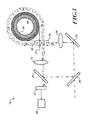
- FIGURE 1 shows a resonator fiber optic gyroscope (RFOG) 10 that uses cavity length modulation to suppress backscatter errors.
- the RFOG 10 includes a light wave source (not shown), a partially transmissive input mirror 26, a photodetector 34 and a resonator coil 20 that includes an optical fiber 28 having ends at points 40 and 42, a partially transmissive counterclockwise (CCW) output mirror 22, a partially transmissive clockwise (CW) output mirror 24, and collimating lenses 30, 32.
- a light wave source not shown
- a partially transmissive input mirror 26 a photodetector 34
- a resonator coil 20 that includes an optical fiber 28 having ends at points 40 and 42, a partially transmissive counterclockwise (CCW) output mirror 22, a partially transmissive clockwise (CW) output mirror 24, and collimating lenses 30, 32.
- CCW counterclockwise
- CW clockwise
- the closed ring resonator path is defined by a light path, say in the CW direction from the reflecting (inside surface) of the partially transmissive input mirror 26 to the partially transmissive counterclockwise (CCW) output mirror 22, through lens 30, to fiber end at point 40, through fiber 28, to fiber end at point 42 through the lens 32 to partially transmissive clockwise (CW) output mirror 24, back to the reflecting (inside surface) of the partially transmissive input mirror 26 and back to the partially transmissive counterclockwise (CCW) output mirror 22; thus, reproducing its path.
- light may travel in the CCW direction within the fiber coil 20 and reproduce its path.
- FIGURE 1 only the CW wave is shown for simplicity.
- the input light wave enters the resonator 20 at the partially transmissive input mirror 26. Most of the wave reflects off the CCW output mirror 22, passes through the lens 30 and enters the fiber at a point 40 to produce a wave propagating in the CW direction of the fiber coil 20.
- the non-reflecting portion of the wave is the primary wave, which passes through the resonator fiber 28 and exits at a point 42.
- the primary wave is then collimated by the lens 32 and travels to the CW output mirror 24 where most of the primary wave is reflected so that it re-circulates through the resonator coil 20 and a small portion exits the resonator at the partially transmissive clockwise (CW) output mirror 24.
- This small portion of the primary wave that exits the resonator at partially transmissive clockwise (CW) output mirror 24 propagates to the photodetector 34 where the intensity of the wave is converted to an electrical signal.
- the resonator fiber end faces cannot be made to have a perfect index match with the free-space medium outside the fiber, there will always be some back-reflection from the fiber end faces.
- a small portion reflects back into the CCW direction of the resonator fiber coil 20 and exits at the point 40, where again a small portion of the back-reflected wave reflects back into the CW direction of the resonator fiber 28.
- the double back-reflected wave travels through the resonator fiber 28, exits the fiber at the point 42, and a small portion exits the resonator at the CW output mirror 24.
- the double back-reflected wave will interfere with the primary wave at the photodetector 34 and will cause rotation sensing errors by distorting the resonance lineshape.
- the double back-reflected wave makes three passes (one pass along with the primary wave and two passes after the first reflection). Therefore the double back-reflected wave travels a different path-length than the primary wave and will have a phase shift relative to the primary wave.
- the relative phase will depend on the path-length difference between the two waves.
- the path-length difference will be a function of fiber length, fiber index of refraction, mirror spacing and many other resonator mechanical parameters that have a dependence on temperature and other environmental parameters. Therefore the relative phase will be a function of temperature and will lead to unstable rotation sensing errors.
- I is the resulting light intensity of the two interfering waves
- E 1 is the electric field amplitude of the first (CW or CCW) primary or signal wave
- E 2 is the electric field amplitude of the second, or parasitic wave (CW or CCW)
- ⁇ ( t ) is the relative phase between the two waves.
- the relative phase is shown to be a function of time, but also could be expressed as a function of temperature or some other environmental parameter that varies in time.
- ⁇ ( t ) will be driven primarily by environmental parameters that change very slowly ( ⁇ 1Hz), like temperature, then the rotation sensing errors it produces will typically be at low frequencies ( ⁇ 1Hz).
- the present invention suppresses these errors by frequency shifting the error to a much higher frequency, out of the frequency band of interest, where the errors can be easily filtered out of the rotation signal.
- the frequency band of interest is related to the application of the sensor.
- the frequency band of interest for navigation applications is typically much less than 1Hz.
- the frequency band of interest is typically less than 100Hz.
- FIGURE 1 shows the resonator fiber coil 20 wound on a piezo-electric transducer (PZT) tube 50.
- PZT piezo-electric transducer
- Equations 5 and 6 one can see all the terms in the two infinite series, except for one, will be varying at ⁇ m or some multiple integer of ⁇ m . Therefore if the cavity modulation frequency ⁇ m is set high enough, all the terms except for one, the term J 0 ( ⁇ a ), will vary at a sufficiently high enough frequency to be out of the band of interest and thus can be filtered out. The remaining term, J 0 ( ⁇ a ), can be reduced by setting the cavity modulation amplitude ⁇ a to an appropriate value.
- FIGURE 2 shows a plot of J 0 ( ⁇ a )as a function of the phase modulation amplitude. Notice that J 0 ( ⁇ a ) passes through zero at about a phase modulation amplitude of 2.4 radians, again at about 5.5 radians and then again at about 8.6 radians. The closer the phase modulation amplitude is made to one of these nulls the smaller the gyro sensing error.
- the cavity modulation does not have to be sinusoidal to suppress errors due to double back-reflection.
- the modulation can also be a triangle wave with a relative phase amplitude of 2 ⁇ or integer multiples of 2 ⁇ .
- Other types of waveforms can frequency shift the rotation sensing errors due to double back-reflection out of the frequency band of interest.
- Multiple frequency modulation, or noise modulation can be used to spread the rotation error over a wide frequency band.
- back-reflections from the fiber end faces are not the only back-reflections that this modulation addresses. Similar combinations of back-reflection or back-scatter from the lenses and mirrors that make extra passes through the resonator fiber 28 will be suppressed with path-length modulation of the fiber 28. However, there are some back-reflections that do not make extra passes beyond that of the primary wave, through the resonator fiber 28.
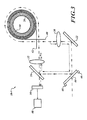
- FIGURE 3 illustrates a case of when there is light back-reflected off of the fiber end faces after the light enters the fiber 28.
- FIGURE 3 illustrates a case of when there is light back-reflected off of the fiber end faces after the light enters the fiber 28.
- the primary wave has just entered the fiber coil 20 and trace its roundtrip around the resonator.
- the primary wave then emerges from the fiber coil 20 at point 42, is directed back toward fiber coil 20 via mirrors 24, 44, and 22 and re-enters the fiber 28 at point 40 to complete a round trip.
- FIGURE 3 shows an RFOG 10-1 having one or more PZT transducers 46 that are placed on a resonator input mirror 44.
- the relative phase between the primary CW wave and the double back-reflected CW wave is modulated by applying a modulated signal to the transducers 46.
- the double back-reflected wave makes three passes by the resonator input mirror 44 (one pass along with the primary wave and two passes after the first reflection).
- the PZT transducers 46 move the resonator input mirror 44 in and out, thus modulating the optical path-length between the points 42 and 40.
- the choice of amplitude and frequency of the mirror modulation is similar to that of the resonator fiber 28 modulation of FIGURE 1 .
Landscapes
- Physics & Mathematics (AREA)
- Engineering & Computer Science (AREA)
- Optics & Photonics (AREA)
- Electromagnetism (AREA)
- Power Engineering (AREA)
- General Physics & Mathematics (AREA)
- Radar, Positioning & Navigation (AREA)
- Remote Sensing (AREA)
- Gyroscopes (AREA)
Abstract
Description
- The present invention claims the benefit of
U.S. Provisional Application Ser. No. 61/158,038 filed March 6, 2009 - The resonator fiber optic gyroscope (RFOG) has tremendous potential of meeting the needs of many navigation and attitude control markets and creating new markets. The reason for this great potential is the RFOG has promise of being the lowest cost and smallest sized gyro for a high performance rotation sensing device. One problem of the RFOG achieving the required performance levels is double backscatter or double back-reflections within the resonant ring, which introduces an error in rotation sensing.
- RFOGs work by measuring the resonance frequency shift of a ring resonator between two counterpropagating waves that are directed to propagate within the ring resonator. The resonant frequency shift is proportional to the rate of inertial rotation about an axis normal to the effective plane in which the resonator is formed. The resonator for an RFOG contains optical fiber for a substantial portion of its round-trip pathlength. For accurate measurement of the resonance frequencies of an RFOG, and hence the rotation rate, light waves coupled into the resonator in clockwise (CW) and counter clockwise (CCW) directions are required to propagate substantially independently in the CW and CCW (and substantially in only their intended direction, hence termed "signal waves") inside the ring resonator.
- In practice, however, optical surfaces, or interfaces inside the resonator may direct a fraction of each of the light waves into the opposite propagation direction. One class of cases of these unwanted imperfections is when a fraction of light from one wave is reflected into the opposite direction through an odd number of reflections. This produces a parasitic wave of light that was, for instance, derived from CW propagating light in the resonator that eventually (undesirably) propagates in the CCW direction. This parasitic was produces optical interference effects between the intended, CCW "signal" wave (that has propagated solely in the CCW direction) and the parasitic wave in the CCW direction. The same phenomena may also occur by light reflected an odd number of times that originated in the CCW direction, producing a parasitic wave in the CW direction that interferes with the "signal" wave in the CW direction. The impact of resulting interference in either the CW or CCW directions on rotation measurement (caused by odd number of reflections in the resonator) may be greatly attenuated if the CW and CCW light waves are separated in wavelength significantly and/or modulated and demodulated at different frequencies. However, a second class of these imperfections also exists, that is, if lightwaves are reflected by an even number of reflections. The technique used to mitigate the first class of unwanted imperfections will not work because the reflected parasitic light wave will have the same wavelength and/or modulation frequency as the primary "signal' light wave, since it is derived from the primary "signal" light wave and cannot be rejected through the demodulation process. A light wave that travels along a path that involves being reflected twice (involving two reflections, which produces the highest intensity of reflected-waves among those through even number of reflections) forms a parasitic interferometer with the signal light wave and creates distortions of the resonance line shape. These distortions lead to bias errors in the measured rotation rate. Finding methods to reduce such errors stemming from such spurious double reflection paths is important for improving the RFOG performance.
- The present invention provides systems and methods for reducing rotation sensing errors in a resonator fiber optic gyroscope. An example method propagates a primary light wave through a resonator having an optical fiber and a plurality of optical surfaces for directing or enabling the light wave exiting a first end of the optical fiber back into an opposite end of the optical fiber. The optical fiber is wound onto a piezo-electric transducer (PZT) tube. A sinusoidal voltage is applied to the PZT tube to modulate a length of a fiber cavity within the optical fiber. The amplitude of the fiber cavity length modulation is selected to produce a relative phase modulation between the primary (or signal) light wave and a double-back reflected light wave, such that the rotation sensing errors resulting from double backscatter is at a frequency above a frequency band of interest. This allows the associated error to be filtered out.
- Preferred and alternative embodiments of the present invention are described in detail below with reference to the following drawings:
-
FIGURES 1 and3 are a schematic diagram of a resonator fiber optic gyroscope formed in accordance to embodiments of the present invention; and -
FIGURE 2 is a graph of a Bessel function. -
FIGURE 1 shows a resonator fiber optic gyroscope (RFOG) 10 that uses cavity length modulation to suppress backscatter errors. TheRFOG 10 includes a light wave source (not shown), a partiallytransmissive input mirror 26, aphotodetector 34 and aresonator coil 20 that includes anoptical fiber 28 having ends atpoints output mirror 22, a partially transmissive clockwise (CW)output mirror 24, andcollimating lenses transmissive input mirror 26 to the partially transmissive counterclockwise (CCW)output mirror 22, throughlens 30, to fiber end atpoint 40, throughfiber 28, to fiber end atpoint 42 through thelens 32 to partially transmissive clockwise (CW)output mirror 24, back to the reflecting (inside surface) of the partiallytransmissive input mirror 26 and back to the partially transmissive counterclockwise (CCW)output mirror 22; thus, reproducing its path. In the same way light may travel in the CCW direction within thefiber coil 20 and reproduce its path. - In
FIGURE 1 , only the CW wave is shown for simplicity. The input light wave enters theresonator 20 at the partiallytransmissive input mirror 26. Most of the wave reflects off theCCW output mirror 22, passes through thelens 30 and enters the fiber at apoint 40 to produce a wave propagating in the CW direction of thefiber coil 20. The non-reflecting portion of the wave is the primary wave, which passes through theresonator fiber 28 and exits at apoint 42. The primary wave is then collimated by thelens 32 and travels to theCW output mirror 24 where most of the primary wave is reflected so that it re-circulates through theresonator coil 20 and a small portion exits the resonator at the partially transmissive clockwise (CW)output mirror 24. This small portion of the primary wave that exits the resonator at partially transmissive clockwise (CW)output mirror 24 propagates to thephotodetector 34 where the intensity of the wave is converted to an electrical signal. - Since the resonator fiber end faces cannot be made to have a perfect index match with the free-space medium outside the fiber, there will always be some back-reflection from the fiber end faces. When the primary wave exits the fiber at the
point 42, a small portion reflects back into the CCW direction of theresonator fiber coil 20 and exits at thepoint 40, where again a small portion of the back-reflected wave reflects back into the CW direction of theresonator fiber 28. The double back-reflected wave travels through theresonator fiber 28, exits the fiber at thepoint 42, and a small portion exits the resonator at theCW output mirror 24. The double back-reflected wave will interfere with the primary wave at thephotodetector 34 and will cause rotation sensing errors by distorting the resonance lineshape. - For every pass the primary wave makes through the
resonator fiber coil 20 the double back-reflected wave makes three passes (one pass along with the primary wave and two passes after the first reflection). Therefore the double back-reflected wave travels a different path-length than the primary wave and will have a phase shift relative to the primary wave. The relative phase will depend on the path-length difference between the two waves. The path-length difference will be a function of fiber length, fiber index of refraction, mirror spacing and many other resonator mechanical parameters that have a dependence on temperature and other environmental parameters. Therefore the relative phase will be a function of temperature and will lead to unstable rotation sensing errors. - The interference of two light waves can be expressed as

where I is the resulting light intensity of the two interfering waves, E1 is the electric field amplitude of the first (CW or CCW) primary or signal wave, E2 is the electric field amplitude of the second, or parasitic wave (CW or CCW), and ϕ(t) is the relative phase between the two waves. The relative phase is shown to be a function of time, but also could be expressed as a function of temperature or some other environmental parameter that varies in time. Since ϕ(t) will be driven primarily by environmental parameters that change very slowly (<1Hz), like temperature, then the rotation sensing errors it produces will typically be at low frequencies (<1Hz). The present invention suppresses these errors by frequency shifting the error to a much higher frequency, out of the frequency band of interest, where the errors can be easily filtered out of the rotation signal. - The frequency band of interest is related to the application of the sensor. For example, the frequency band of interest for navigation applications is typically much less than 1Hz. For pointing applications the frequency band of interest is typically less than 100Hz.
- The
RFOG 10 modulates the cavity length (i.e., length of the fiber 28) in order to frequency shift the errors.FIGURE 1 shows theresonator fiber coil 20 wound on a piezo-electric transducer (PZT)tube 50. When a voltage is applied to thePZT tube 50, the diameter of the tube changes, which either stretches or relaxes the length offiber 28. The change in fiber length is on the order of 200 nanometers. This causes the optical path-length of theresonator coil 20 to change by either changing the length of the fiber and/or the index of refraction of the fiber. For hollow core fiber practically all the optical length change is due to a physical length change, whereas for solid core fiber, roughly 80% of the optical path length change is due to an index change. Since the double back-reflected parasitic wave travels three times through the loop of theresonator fiber 28 for every time the primary wave travels through the loop, the phase of the double back-reflected wave will be modulated with more phase amplitude than the primary signal wave in that direction, and therefore there will be a net relative phase modulation between the two waves. The relative phase modulation θ(t) is sinusoidal and expressed as
where θ a is the cavity modulation amplitude in relative phase between the primary signal wave and the parasitic double back-reflected wave, and ω m is the cavity modulation angular frequency. - Equation 1 can be rewritten as

- Using trigonometric identities Equation 3 can be rewritten as

- The trig functions cos[θ a sin(ω mt)] and sin[0 a sin(ω mt)] can be expressed as an infinite series of Bessel functions,


- In
Equations 5 and 6 one can see all the terms in the two infinite series, except for one, will be varying at ωm or some multiple integer of ωm. Therefore if the cavity modulation frequency ωm is set high enough, all the terms except for one, the term J 0(θ a ), will vary at a sufficiently high enough frequency to be out of the band of interest and thus can be filtered out. The remaining term, J 0(θ a ), can be reduced by setting the cavity modulation amplitude θ a to an appropriate value. -
FIGURE 2 shows a plot of J 0(θ a )as a function of the phase modulation amplitude. Notice that J 0(θ a ) passes through zero at about a phase modulation amplitude of 2.4 radians, again at about 5.5 radians and then again at about 8.6 radians. The closer the phase modulation amplitude is made to one of these nulls the smaller the gyro sensing error. - The cavity modulation does not have to be sinusoidal to suppress errors due to double back-reflection. The modulation can also be a triangle wave with a relative phase amplitude of 2π or integer multiples of 2π. Other types of waveforms can frequency shift the rotation sensing errors due to double back-reflection out of the frequency band of interest. Multiple frequency modulation, or noise modulation, can be used to spread the rotation error over a wide frequency band.
- The back-reflections from the fiber end faces are not the only back-reflections that this modulation addresses. Similar combinations of back-reflection or back-scatter from the lenses and mirrors that make extra passes through the
resonator fiber 28 will be suppressed with path-length modulation of thefiber 28. However, there are some back-reflections that do not make extra passes beyond that of the primary wave, through theresonator fiber 28. -
FIGURE 3 illustrates a case of when there is light back-reflected off of the fiber end faces after the light enters thefiber 28. In this case it is illustrative to start with a primary wave that has just entered thefiber coil 20 and trace its roundtrip around the resonator. Thus, it is assumed that the primary wave has entered theresonator fiber 28 at thepoint 40 and is propagating through the coil in the CW direction. The primary wave then emerges from thefiber coil 20 atpoint 42, is directed back towardfiber coil 20 viamirrors fiber 28 atpoint 40 to complete a round trip. Just as the primary light reachespoint 40 and is ready to re-enter the fiber, there is also a small back-reflected wave atpoint 40 that does not re-enter the fiber, is reflected back viamirrors point 40 to complete a round-trip of the resonator. The doubly-reflected parasitic wave interferes with the primary wave, each of them traversing the coil once. Thus, there is a parasitic light wave generated by two back-reflections that does go through theresonator fiber 28, but it travels through thefiber coil 20 only once of every pass of the primary wave and therefore the relative phase between the two waves cannot be modulated by modulating the path-length of the resonator fiber. To modulate the relative path-length of the two waves another path-length modulator is added to the appropriate place in the resonator. The position of the modulation is chosen such that secondary wave makes more passes through the modulated region then the primary wave. -
FIGURE 3 shows an RFOG 10-1 having one ormore PZT transducers 46 that are placed on aresonator input mirror 44. The relative phase between the primary CW wave and the double back-reflected CW wave is modulated by applying a modulated signal to thetransducers 46. For each pass of the primary wave, the double back-reflected wave makes three passes by the resonator input mirror 44 (one pass along with the primary wave and two passes after the first reflection). The PZT transducers 46 move theresonator input mirror 44 in and out, thus modulating the optical path-length between thepoints resonator fiber 28 modulation ofFIGURE 1 . - While one embodiment of the invention has been illustrated and described, as noted above, many changes can be made without departing from the spirit and scope of the invention. Accordingly, the scope of the invention is not limited by the disclosure of one embodiment. Instead, the invention should be determined entirely by reference to the claims that follow.
The embodiments of the invention in which an exclusive property or privilege is claimed are defined as follows:
Claims (10)
- A method for reducing rotation sensing errors in a resonator fiber optic gyroscope (RFOG), the method comprising:propagating clockwise and counterclockwise primary light waves through a resonator having an optical fiber and a plurality of optical surfaces for directing the light wave exiting a first end of the optical fiber back into an opposite end of the optical fiber;modulating the pathlength of an optical fiber coil within the resonator based on a previously defined modulation scheme;generating signals at detectors based on the waves propagating in the resonator; determining an output for the gyroscope based on the generated signals, wherein rotation sensing errors are reduced.
- The method of Claim 1, wherein modulating comprises applying a sinusoidal voltage to a piezo-electric transducer tube that is attached to the optical fiber.
- The method of Claim 1, wherein amplitude and frequency of the fiber cavity length modulation is selected to produce a relative phase modulation between the primary light wave and a double-back reflected light wave, such that rotation sensing errors resulting from double backscatter is at a frequency above a frequency band of interest.
- The method of Claim 3, wherein determining comprises demodulating the generated signals and filtering out signals outside the frequency band of interest.
- The method of Claim 4, wherein the frequency band of interest is based on application of the RFOG.
- A resonator fiber optic gyroscope (RFOG) device comprising:one or more light wave sources;two photo detectors;a resonator comprising:an optical fiber;
a plurality of optical devices configured to pass light from the one or more light wave sources into opposing directions in the optical fiber, and enable light to be efficiently coupled between ends of the optical fiber, and allow a portion of the light within the resonator to be directed to the photodetectors; and
a transducer attached to the optical fiber, the transducer configured to alter the length of the optical fiber based on a predefined modulation scheme; anda processor in signal communication with the photodetectors, the processor configured to determine an output value based on signals generated by the photodetectors. - The device of Claim 6, wherein the transducer is a piezo-electric transducer tube.
- The device of Claim 7, wherein a sinusoidal voltage is applied to the piezo-electric transducer tube that is attached to the optical fiber.
- The device of Claim 6, wherein amplitude and frequency of the fiber cavity length modulation is selected to produce a relative phase modulation between the primary light wave and a double-back reflected light wave, such that rotation sensing errors resulting from double backscatter is at a frequency above a frequency band of interest.
- The device of Claim 9, wherein the processor demodulates the generated signals then filters out signals outside a frequency band of interest.
Applications Claiming Priority (2)
| Application Number | Priority Date | Filing Date | Title |
|---|---|---|---|
| US15803809P | 2009-03-06 | 2009-03-06 | |
| US12/565,510 US8259301B2 (en) | 2009-03-06 | 2009-09-23 | Cavity length modulation in resonator fiber optic gyroscopes |
Publications (3)
| Publication Number | Publication Date |
|---|---|
| EP2226612A2 true EP2226612A2 (en) | 2010-09-08 |
| EP2226612A3 EP2226612A3 (en) | 2011-05-04 |
| EP2226612B1 EP2226612B1 (en) | 2012-06-27 |
Family
ID=42115119
Family Applications (1)
| Application Number | Title | Priority Date | Filing Date |
|---|---|---|---|
| EP10153389A Active EP2226612B1 (en) | 2009-03-06 | 2010-02-11 | Cavity length modulation in resonator fiber optic gyroscopes |
Country Status (3)
| Country | Link |
|---|---|
| US (1) | US8259301B2 (en) |
| EP (1) | EP2226612B1 (en) |
| JP (1) | JP5185306B2 (en) |
Cited By (2)
| Publication number | Priority date | Publication date | Assignee | Title |
|---|---|---|---|---|
| EP4040110A1 (en) * | 2021-02-09 | 2022-08-10 | Honeywell International Inc. | Optical gyroscope with a resonator having bias error reduction |
| CN119085619A (en) * | 2024-08-30 | 2024-12-06 | 中国船舶集团有限公司第七〇七研究所 | A hollow-core photonic crystal optical fiber loop pigtail winding implementation system and winding method |
Families Citing this family (11)
| Publication number | Priority date | Publication date | Assignee | Title |
|---|---|---|---|---|
| US8223341B2 (en) | 2010-05-28 | 2012-07-17 | Honeywell International Inc. | System and method for enhancing signal-to-noise ratio of a resonator fiber optic gyroscope |
| US8213019B2 (en) | 2010-09-07 | 2012-07-03 | Honeywell International Inc. | RFOG with optical heterodyning for optical signal discrimination |
| US8908187B2 (en) | 2011-11-02 | 2014-12-09 | Honeywell International Inc. | System and method for reducing errors in a resonator fiber optic gyroscope |
| US8947671B2 (en) | 2013-02-22 | 2015-02-03 | Honeywell International Inc. | Method and system for detecting optical ring resonator resonance frequencies and free spectral range to reduce the number of lasers in a resonator fiber optic gyroscope |
| US9001336B1 (en) | 2013-10-07 | 2015-04-07 | Honeywell International Inc. | Methods and apparatus of tracking/locking resonator free spectral range and its application in resonator fiber optic gyroscope |
| US10197397B2 (en) | 2014-06-19 | 2019-02-05 | Honeywell International Inc. | Small low cost resonator fiber optic gyroscope with reduced optical errors |
| US9354064B2 (en) | 2014-07-07 | 2016-05-31 | Honeywell International Inc. | Resonator fiber optic gyroscope employing common cavity length modulation along with high bandwidth laser stabilization |
| US10094664B2 (en) | 2016-11-23 | 2018-10-09 | Honeywell International Inc. | Apparatus and method for diminishing bias error in resonant fiber optic gyroscopes |
| KR101912696B1 (en) | 2017-02-22 | 2018-10-29 | 국방과학연구소 | Method for tuning a proper frequency of fiber optic gyroscope using fiber length adjustment |
| US10365107B2 (en) | 2017-08-03 | 2019-07-30 | Honeywell International Inc. | Systems and methods for reducing polarization-related bias errors in RFOGS |
| DE102021207793A1 (en) | 2021-07-21 | 2023-01-26 | Trumpf Laser Gmbh | Fiber stretcher, phase adjuster and optical assembly |
Citations (1)
| Publication number | Priority date | Publication date | Assignee | Title |
|---|---|---|---|---|
| US5493623A (en) | 1994-06-28 | 1996-02-20 | Honeywell Inc. | PZT fiber optic modulator having a robust mounting and method of making same |
Family Cites Families (8)
| Publication number | Priority date | Publication date | Assignee | Title |
|---|---|---|---|---|
| US4274742A (en) * | 1979-11-29 | 1981-06-23 | Sperry Corporation | Passive ring laser rate of turn devices |
| US4673293A (en) * | 1985-01-31 | 1987-06-16 | Honeywell Inc. | Passive cavity gyro bias eliminator |
| GB8823250D0 (en) * | 1988-10-04 | 1989-04-19 | British Aerospace | Ring resonator gyroscope |
| GB9107125D0 (en) * | 1991-04-05 | 1992-05-27 | British Aerospace | Ring resonator gyroscope |
| US5781300A (en) * | 1996-10-31 | 1998-07-14 | Honeywell Inc. | Backscatter error reducer for interferometric fiber optic gyroscope |
| JP3415461B2 (en) * | 1998-12-11 | 2003-06-09 | 横河電子機器株式会社 | Resonant optical fiber gyro |
| US7463360B2 (en) * | 2006-04-18 | 2008-12-09 | Honeywell International Inc. | Optical resonator gyro with integrated external cavity beam generator |
| JP5351451B2 (en) | 2007-07-06 | 2013-11-27 | ハネウェル・インターナショナル・インコーポレーテッド | RFOG modulation error correction |
-
2009
- 2009-09-23 US US12/565,510 patent/US8259301B2/en active Active
-
2010
- 2010-02-11 EP EP10153389A patent/EP2226612B1/en active Active
- 2010-02-24 JP JP2010038195A patent/JP5185306B2/en not_active Expired - Fee Related
Patent Citations (1)
| Publication number | Priority date | Publication date | Assignee | Title |
|---|---|---|---|---|
| US5493623A (en) | 1994-06-28 | 1996-02-20 | Honeywell Inc. | PZT fiber optic modulator having a robust mounting and method of making same |
Cited By (3)
| Publication number | Priority date | Publication date | Assignee | Title |
|---|---|---|---|---|
| EP4040110A1 (en) * | 2021-02-09 | 2022-08-10 | Honeywell International Inc. | Optical gyroscope with a resonator having bias error reduction |
| US11920933B2 (en) | 2021-02-09 | 2024-03-05 | Honeywell International Inc. | Optical gyroscope with a resonator having bias error reduction |
| CN119085619A (en) * | 2024-08-30 | 2024-12-06 | 中国船舶集团有限公司第七〇七研究所 | A hollow-core photonic crystal optical fiber loop pigtail winding implementation system and winding method |
Also Published As
| Publication number | Publication date |
|---|---|
| JP5185306B2 (en) | 2013-04-17 |
| EP2226612B1 (en) | 2012-06-27 |
| EP2226612A3 (en) | 2011-05-04 |
| US20100225922A1 (en) | 2010-09-09 |
| US8259301B2 (en) | 2012-09-04 |
| JP2010210617A (en) | 2010-09-24 |
Similar Documents
| Publication | Publication Date | Title |
|---|---|---|
| EP2226612B1 (en) | Cavity length modulation in resonator fiber optic gyroscopes | |
| US11415419B2 (en) | Polarizer implemented in a photonic integrated circuit for use in a fiber optic gyroscope | |
| JP5784653B2 (en) | Transmission mode RFOG and method for detecting rotation in RFOG | |
| JP5096858B2 (en) | Optical resonator gyroscope and method for reducing resonance asymmetry error | |
| Feng et al. | Suppression of backreflection noise in a resonator integrated optic gyro by hybrid phase-modulation technology | |
| US8085407B2 (en) | Resonator optical gyroscope having input beam modulation optimized for high sensitivity and low bias | |
| CN101886925B (en) | Multi-wavelength interference type optical fiber gyro based on carrier modulation | |
| JP5474282B2 (en) | Integrated optical rotation sensor and method for detecting rotation rate | |
| US8274659B2 (en) | Resonator fiber optic gyroscopes with reduced rotation rate instability from back reflections | |
| CN102706340B (en) | A kind of interferometric fiber optic gyroscope | |
| WO2006083691A1 (en) | Hollow core fiber optical gyro | |
| Sanders et al. | Development of compact resonator fiber optic gyroscopes | |
| EP1946043B1 (en) | Polarizing cavity for rfog and method for sensing rotation rate of resonator | |
| JP5623141B2 (en) | Method and amplification stage for suppressing modulation distortion rate sensing error in a resonator fiber optic gyroscope | |
| Sanders et al. | Improvements of compact resonator fiber optic gyroscopes | |
| EP0502196A1 (en) | Optical interference angular velocity meter | |
| Strandjord et al. | Resonator fiber optic gyro progress including observation of navigation grade angle random walk | |
| Chamoun | A laser-driven fiber optic gyroscope for inertial navigation of aircraft | |
| JP2006528358A (en) | Reaction wheel assembly with fiber optic gyro | |
| GB2028496A (en) | Interferometer gyro | |
| Vukmirica | Interferometric fiber optic gyroscope: Principle of operation and basic parameters determination | |
| JPS622121A (en) | Optical fiber gyroscope | |
| JPS5960212A (en) | Optical fiber gyro system | |
| Terrel | Rotation sensing with optical ring resonators | |
| Kissa et al. | Fiber-Optic Gyroscopes |
Legal Events
| Date | Code | Title | Description |
|---|---|---|---|
| PUAI | Public reference made under article 153(3) epc to a published international application that has entered the european phase |
Free format text: ORIGINAL CODE: 0009012 |
|
| 17P | Request for examination filed |
Effective date: 20100211 |
|
| AK | Designated contracting states |
Kind code of ref document: A2 Designated state(s): AT BE BG CH CY CZ DE DK EE ES FI FR GB GR HR HU IE IS IT LI LT LU LV MC MK MT NL NO PL PT RO SE SI SK SM TR |
|
| AX | Request for extension of the european patent |
Extension state: AL BA RS |
|
| PUAL | Search report despatched |
Free format text: ORIGINAL CODE: 0009013 |
|
| AK | Designated contracting states |
Kind code of ref document: A3 Designated state(s): AT BE BG CH CY CZ DE DK EE ES FI FR GB GR HR HU IE IS IT LI LT LU LV MC MK MT NL NO PL PT RO SE SI SK SM TR |
|
| AX | Request for extension of the european patent |
Extension state: AL BA RS |
|
| 17Q | First examination report despatched |
Effective date: 20110701 |
|
| GRAP | Despatch of communication of intention to grant a patent |
Free format text: ORIGINAL CODE: EPIDOSNIGR1 |
|
| GRAS | Grant fee paid |
Free format text: ORIGINAL CODE: EPIDOSNIGR3 |
|
| GRAA | (expected) grant |
Free format text: ORIGINAL CODE: 0009210 |
|
| AK | Designated contracting states |
Kind code of ref document: B1 Designated state(s): AT BE BG CH CY CZ DE DK EE ES FI FR GB GR HR HU IE IS IT LI LT LU LV MC MK MT NL NO PL PT RO SE SI SK SM TR |
|
| REG | Reference to a national code |
Ref country code: GB Ref legal event code: FG4D |
|
| REG | Reference to a national code |
Ref country code: CH Ref legal event code: EP |
|
| REG | Reference to a national code |
Ref country code: AT Ref legal event code: REF Ref document number: 564467 Country of ref document: AT Kind code of ref document: T Effective date: 20120715 |
|
| REG | Reference to a national code |
Ref country code: IE Ref legal event code: FG4D |
|
| REG | Reference to a national code |
Ref country code: DE Ref legal event code: R096 Ref document number: 602010001998 Country of ref document: DE Effective date: 20120823 |
|
| PG25 | Lapsed in a contracting state [announced via postgrant information from national office to epo] |
Ref country code: NO Free format text: LAPSE BECAUSE OF FAILURE TO SUBMIT A TRANSLATION OF THE DESCRIPTION OR TO PAY THE FEE WITHIN THE PRESCRIBED TIME-LIMIT Effective date: 20120927 Ref country code: LT Free format text: LAPSE BECAUSE OF FAILURE TO SUBMIT A TRANSLATION OF THE DESCRIPTION OR TO PAY THE FEE WITHIN THE PRESCRIBED TIME-LIMIT Effective date: 20120627 Ref country code: SE Free format text: LAPSE BECAUSE OF FAILURE TO SUBMIT A TRANSLATION OF THE DESCRIPTION OR TO PAY THE FEE WITHIN THE PRESCRIBED TIME-LIMIT Effective date: 20120627 Ref country code: FI Free format text: LAPSE BECAUSE OF FAILURE TO SUBMIT A TRANSLATION OF THE DESCRIPTION OR TO PAY THE FEE WITHIN THE PRESCRIBED TIME-LIMIT Effective date: 20120627 |
|
| REG | Reference to a national code |
Ref country code: NL Ref legal event code: VDEP Effective date: 20120627 |
|
| REG | Reference to a national code |
Ref country code: AT Ref legal event code: MK05 Ref document number: 564467 Country of ref document: AT Kind code of ref document: T Effective date: 20120627 |
|
| REG | Reference to a national code |
Ref country code: LT Ref legal event code: MG4D Effective date: 20120627 |
|
| PG25 | Lapsed in a contracting state [announced via postgrant information from national office to epo] |
Ref country code: GR Free format text: LAPSE BECAUSE OF FAILURE TO SUBMIT A TRANSLATION OF THE DESCRIPTION OR TO PAY THE FEE WITHIN THE PRESCRIBED TIME-LIMIT Effective date: 20120928 Ref country code: LV Free format text: LAPSE BECAUSE OF FAILURE TO SUBMIT A TRANSLATION OF THE DESCRIPTION OR TO PAY THE FEE WITHIN THE PRESCRIBED TIME-LIMIT Effective date: 20120627 Ref country code: SI Free format text: LAPSE BECAUSE OF FAILURE TO SUBMIT A TRANSLATION OF THE DESCRIPTION OR TO PAY THE FEE WITHIN THE PRESCRIBED TIME-LIMIT Effective date: 20120627 Ref country code: HR Free format text: LAPSE BECAUSE OF FAILURE TO SUBMIT A TRANSLATION OF THE DESCRIPTION OR TO PAY THE FEE WITHIN THE PRESCRIBED TIME-LIMIT Effective date: 20120627 |
|
| PG25 | Lapsed in a contracting state [announced via postgrant information from national office to epo] |
Ref country code: SK Free format text: LAPSE BECAUSE OF FAILURE TO SUBMIT A TRANSLATION OF THE DESCRIPTION OR TO PAY THE FEE WITHIN THE PRESCRIBED TIME-LIMIT Effective date: 20120627 Ref country code: BE Free format text: LAPSE BECAUSE OF FAILURE TO SUBMIT A TRANSLATION OF THE DESCRIPTION OR TO PAY THE FEE WITHIN THE PRESCRIBED TIME-LIMIT Effective date: 20120627 Ref country code: CY Free format text: LAPSE BECAUSE OF FAILURE TO SUBMIT A TRANSLATION OF THE DESCRIPTION OR TO PAY THE FEE WITHIN THE PRESCRIBED TIME-LIMIT Effective date: 20120627 Ref country code: RO Free format text: LAPSE BECAUSE OF FAILURE TO SUBMIT A TRANSLATION OF THE DESCRIPTION OR TO PAY THE FEE WITHIN THE PRESCRIBED TIME-LIMIT Effective date: 20120627 Ref country code: CZ Free format text: LAPSE BECAUSE OF FAILURE TO SUBMIT A TRANSLATION OF THE DESCRIPTION OR TO PAY THE FEE WITHIN THE PRESCRIBED TIME-LIMIT Effective date: 20120627 Ref country code: EE Free format text: LAPSE BECAUSE OF FAILURE TO SUBMIT A TRANSLATION OF THE DESCRIPTION OR TO PAY THE FEE WITHIN THE PRESCRIBED TIME-LIMIT Effective date: 20120627 Ref country code: AT Free format text: LAPSE BECAUSE OF FAILURE TO SUBMIT A TRANSLATION OF THE DESCRIPTION OR TO PAY THE FEE WITHIN THE PRESCRIBED TIME-LIMIT Effective date: 20120627 Ref country code: IS Free format text: LAPSE BECAUSE OF FAILURE TO SUBMIT A TRANSLATION OF THE DESCRIPTION OR TO PAY THE FEE WITHIN THE PRESCRIBED TIME-LIMIT Effective date: 20121027 |
|
| PG25 | Lapsed in a contracting state [announced via postgrant information from national office to epo] |
Ref country code: IT Free format text: LAPSE BECAUSE OF FAILURE TO SUBMIT A TRANSLATION OF THE DESCRIPTION OR TO PAY THE FEE WITHIN THE PRESCRIBED TIME-LIMIT Effective date: 20120627 Ref country code: PL Free format text: LAPSE BECAUSE OF FAILURE TO SUBMIT A TRANSLATION OF THE DESCRIPTION OR TO PAY THE FEE WITHIN THE PRESCRIBED TIME-LIMIT Effective date: 20120627 Ref country code: PT Free format text: LAPSE BECAUSE OF FAILURE TO SUBMIT A TRANSLATION OF THE DESCRIPTION OR TO PAY THE FEE WITHIN THE PRESCRIBED TIME-LIMIT Effective date: 20121029 |
|
| PG25 | Lapsed in a contracting state [announced via postgrant information from national office to epo] |
Ref country code: NL Free format text: LAPSE BECAUSE OF FAILURE TO SUBMIT A TRANSLATION OF THE DESCRIPTION OR TO PAY THE FEE WITHIN THE PRESCRIBED TIME-LIMIT Effective date: 20120627 |
|
| PG25 | Lapsed in a contracting state [announced via postgrant information from national office to epo] |
Ref country code: DK Free format text: LAPSE BECAUSE OF FAILURE TO SUBMIT A TRANSLATION OF THE DESCRIPTION OR TO PAY THE FEE WITHIN THE PRESCRIBED TIME-LIMIT Effective date: 20120627 Ref country code: ES Free format text: LAPSE BECAUSE OF FAILURE TO SUBMIT A TRANSLATION OF THE DESCRIPTION OR TO PAY THE FEE WITHIN THE PRESCRIBED TIME-LIMIT Effective date: 20121008 |
|
| PLBE | No opposition filed within time limit |
Free format text: ORIGINAL CODE: 0009261 |
|
| STAA | Information on the status of an ep patent application or granted ep patent |
Free format text: STATUS: NO OPPOSITION FILED WITHIN TIME LIMIT |
|
| 26N | No opposition filed |
Effective date: 20130328 |
|
| REG | Reference to a national code |
Ref country code: DE Ref legal event code: R097 Ref document number: 602010001998 Country of ref document: DE Effective date: 20130328 |
|
| PG25 | Lapsed in a contracting state [announced via postgrant information from national office to epo] |
Ref country code: BG Free format text: LAPSE BECAUSE OF FAILURE TO SUBMIT A TRANSLATION OF THE DESCRIPTION OR TO PAY THE FEE WITHIN THE PRESCRIBED TIME-LIMIT Effective date: 20120927 |
|
| PG25 | Lapsed in a contracting state [announced via postgrant information from national office to epo] |
Ref country code: MC Free format text: LAPSE BECAUSE OF NON-PAYMENT OF DUE FEES Effective date: 20130228 |
|
| REG | Reference to a national code |
Ref country code: IE Ref legal event code: MM4A |
|
| PG25 | Lapsed in a contracting state [announced via postgrant information from national office to epo] |
Ref country code: IE Free format text: LAPSE BECAUSE OF NON-PAYMENT OF DUE FEES Effective date: 20130211 |
|
| PG25 | Lapsed in a contracting state [announced via postgrant information from national office to epo] |
Ref country code: MT Free format text: LAPSE BECAUSE OF FAILURE TO SUBMIT A TRANSLATION OF THE DESCRIPTION OR TO PAY THE FEE WITHIN THE PRESCRIBED TIME-LIMIT Effective date: 20120627 |
|
| REG | Reference to a national code |
Ref country code: CH Ref legal event code: PL |
|
| GBPC | Gb: european patent ceased through non-payment of renewal fee |
Effective date: 20140211 |
|
| PG25 | Lapsed in a contracting state [announced via postgrant information from national office to epo] |
Ref country code: CH Free format text: LAPSE BECAUSE OF NON-PAYMENT OF DUE FEES Effective date: 20140228 Ref country code: LI Free format text: LAPSE BECAUSE OF NON-PAYMENT OF DUE FEES Effective date: 20140228 |
|
| PG25 | Lapsed in a contracting state [announced via postgrant information from national office to epo] |
Ref country code: GB Free format text: LAPSE BECAUSE OF NON-PAYMENT OF DUE FEES Effective date: 20140211 |
|
| PG25 | Lapsed in a contracting state [announced via postgrant information from national office to epo] |
Ref country code: SM Free format text: LAPSE BECAUSE OF FAILURE TO SUBMIT A TRANSLATION OF THE DESCRIPTION OR TO PAY THE FEE WITHIN THE PRESCRIBED TIME-LIMIT Effective date: 20120627 |
|
| PG25 | Lapsed in a contracting state [announced via postgrant information from national office to epo] |
Ref country code: TR Free format text: LAPSE BECAUSE OF FAILURE TO SUBMIT A TRANSLATION OF THE DESCRIPTION OR TO PAY THE FEE WITHIN THE PRESCRIBED TIME-LIMIT Effective date: 20120627 |
|
| PG25 | Lapsed in a contracting state [announced via postgrant information from national office to epo] |
Ref country code: HU Free format text: LAPSE BECAUSE OF FAILURE TO SUBMIT A TRANSLATION OF THE DESCRIPTION OR TO PAY THE FEE WITHIN THE PRESCRIBED TIME-LIMIT; INVALID AB INITIO Effective date: 20100211 Ref country code: MK Free format text: LAPSE BECAUSE OF FAILURE TO SUBMIT A TRANSLATION OF THE DESCRIPTION OR TO PAY THE FEE WITHIN THE PRESCRIBED TIME-LIMIT Effective date: 20120627 Ref country code: LU Free format text: LAPSE BECAUSE OF NON-PAYMENT OF DUE FEES Effective date: 20130211 |
|
| REG | Reference to a national code |
Ref country code: FR Ref legal event code: PLFP Year of fee payment: 7 |
|
| REG | Reference to a national code |
Ref country code: FR Ref legal event code: PLFP Year of fee payment: 8 |
|
| REG | Reference to a national code |
Ref country code: FR Ref legal event code: PLFP Year of fee payment: 9 |
|
| PGFP | Annual fee paid to national office [announced via postgrant information from national office to epo] |
Ref country code: DE Payment date: 20200228 Year of fee payment: 11 |
|
| REG | Reference to a national code |
Ref country code: DE Ref legal event code: R119 Ref document number: 602010001998 Country of ref document: DE |
|
| PG25 | Lapsed in a contracting state [announced via postgrant information from national office to epo] |
Ref country code: DE Free format text: LAPSE BECAUSE OF NON-PAYMENT OF DUE FEES Effective date: 20210901 |
|
| P01 | Opt-out of the competence of the unified patent court (upc) registered |
Effective date: 20230525 |
|
| PGFP | Annual fee paid to national office [announced via postgrant information from national office to epo] |
Ref country code: FR Payment date: 20260224 Year of fee payment: 17 |