EP2224571A1 - Power supply system - Google Patents
Power supply system Download PDFInfo
- Publication number
- EP2224571A1 EP2224571A1 EP08857910A EP08857910A EP2224571A1 EP 2224571 A1 EP2224571 A1 EP 2224571A1 EP 08857910 A EP08857910 A EP 08857910A EP 08857910 A EP08857910 A EP 08857910A EP 2224571 A1 EP2224571 A1 EP 2224571A1
- Authority
- EP
- European Patent Office
- Prior art keywords
- voltage
- power
- converter
- bus line
- inverter
- Prior art date
- Legal status (The legal status is an assumption and is not a legal conclusion. Google has not performed a legal analysis and makes no representation as to the accuracy of the status listed.)
- Granted
Links
Images



Classifications
-
- H—ELECTRICITY
- H02—GENERATION; CONVERSION OR DISTRIBUTION OF ELECTRIC POWER
- H02J—ELECTRIC POWER NETWORKS; CIRCUIT ARRANGEMENTS OR SYSTEMS FOR SUPPLYING OR DISTRIBUTING ELECTRIC POWER; SYSTEMS FOR STORING ELECTRIC ENERGY
- H02J1/00—Circuit arrangements for DC mains or DC distribution networks
- H02J1/10—Parallel operation of DC sources
- H02J1/102—Parallel operation of DC sources being switching converters
-
- H—ELECTRICITY
- H02—GENERATION; CONVERSION OR DISTRIBUTION OF ELECTRIC POWER
- H02J—ELECTRIC POWER NETWORKS; CIRCUIT ARRANGEMENTS OR SYSTEMS FOR SUPPLYING OR DISTRIBUTING ELECTRIC POWER; SYSTEMS FOR STORING ELECTRIC ENERGY
- H02J1/00—Circuit arrangements for DC mains or DC distribution networks
- H02J1/08—Three-wire DC power distribution systems; Systems having more than three wires
Definitions
- the present invention relates to an electric power supply system for feeding electric power to a load using a DC generator and system power, and also to an electric power supply system for feeding electric power to a load using a DC generator, a storage battery and system power.
- Patent Document 1 shows an electric power supply system for feeding electric power to a load through an electronic transformer commonly operated at operation efficiency of almost 100 % by combining natural energy power and nighttime power. More particularly, the rated power voltage of a wind power generator, a photovoltaic generator and a fuel cell is coincident with the rated voltage of a storage battery to construct a DC power source. Until the storage battery is fully charged by the DC power source, AC power is supplied to the load from a commercial AC power source. When the storage battery is fully charged or the commercial AC power source is in a power failure, DC power is supplied from the DC power source and the storage battery.
- Patent Document 2 also shows a construction that an output of a DC generator such as a fuel cell is connected to an DC output of a bidirectional DC-AC power inverter, to which connection a DC outlet is coupled through a DC power conversion device. AC system power and an AC load are coupled to an AC terminal of the bidirectional DC-AC power inverter.
- Patent Document 3 includes a DC power inverter for inverting DC voltage generated by a fuel cell generator, and an AC-DC power converter for converting AC power to DC power. A DC load and a DC output terminal of the AC-DC power converter are connected to an output terminal of the DC power inverter, and AC system power and an AC load are connected to an AC input terminal of the AC-DC power converter.
- an inverter, an AC/DC converter and a DC/DC converter must be controlled even in response to output variations of the DC generator, the load variations and the power failure of commercial AC power source (AC power system).
- a controller is required for this controlling, but the controller necessitates a timepiece and a sensor such as a volt meter in order to control the inverter, the AC/DC converter and the DC/DC converter, and moreover a system must be constructed so as to operate a control in response to the output of the timepiece and the sensor.
- an object of the present invention to provide an electric power supply system for feeding an output of a DC power source to a load at high efficiency and, without complicated controlling, for allowing for interchange of electric power among an AC power system, a DC power source and a load, or among an AC power system, an AC power source, a load and a storage battery.
- an electric power supply system of the present invention includes a DC bus line for connecting a DC generator, a load and system power each other; a DC/DC converter connected between the DC generator and the DC bus line for controlling an output voltage to the DC bus line at a voltage V1; an inverter connected between the system power and the DC bus line for operating a control in response to an input voltage V2 from the DC bus line; and an AC/DC converter connected between the system power and the DC bus line for controlling an output voltage to the DC bus line at a voltage V3, in which the respective voltages are set as V1>V2>V3.
- a storage battery is provided which is connected to the DC bus line.
- the respective voltages are set as V1>V2>V4>V3>V5.
- the voltage value of the DC bus line decides whether or not the DC generator or the system power can supply power to the DC bus line, or power from the DC bus line can be received by the system power. Further, the voltage value of the DC bus line decides whether or not the DC generator, the storage battery or the system power can supply power to the DC bus line, or the power from the DC bus line can be received by the system power.
- the respective voltages are set as V1>V2>V4>V3>V5
- the order in which to be supplied to the DC bus line is automatically decided as follows.
- the above voltage setting enables the power generated by the DC generator to be supplied to the DC bus line with a priority higher than the system power. Further, the above voltage setting enables the power generated by the DC generator to automatically and reversely be flown to the system power when the generated power is larger than the consumption amount by the load.
- the power is not reversely flown from the storage battery to the system power.
- the AC/DC converter outputs, as necessary, so as to charge the storage battery.
- the storage battery can be charged depending upon the charged voltage thereof.
- the electric power supply system of the present invention integrates the inverter and the AC/DC converter to make a bidirectional inverter. Hereby, the number of the components of the electric power supply system can be minimized to construct the system at a lower cost.
- the power generated by the DC generator can be supplied to the DC load at high efficiency. Only when the respective converters and the inverter are independently driven, the interchange of the power among the DC generator, the system power and the load, including the storage battery if it is included, can be properly made, so that no complicated control circuit is required and a highly reliable electric power supply system can be provided at a low cost. Even when the storage battery is equipped, no complicated control circuit is required to prevent the reverse-power flow from the storage battery to the system power.
- Fig. 1 is a block diagram of a system constructed as an embodiment 1 of the present invention.
- System power 1 is coupled to an AC/DC converter 2, an output terminal of which is connected to a DC bus line 10.
- a solar cell 3 having a rated output of e.g., 1 kW is connected to the DC/DC converter 4.
- An output terminal of the DC/DC converter 4 is connected to the DC bus line 10.
- a load 5 and an input terminal of the inverter 6 are coupled.
- An output terminal of an inverter 6 is coupled to the system power 1.
- a relationship V1>V2>V3 is set.
- the load 5 may be one in a house such as an illumination lamp, a television, a personal computer, a record/reproduction device, an audio equipment, an air conditioner, a washing machine, a refrigerator and a cleaner or the like.
- the load may be an office equipment such as a photocopying machine, a personal computer, a computer, an illumination lamp and a telephone or the like.
- the load may be a streetlight, a traffic signal, a sign and a guide map plate or the like.
- the load may be a factory machine such as a motor and a processing machine or the like.
- the DC/DC converter 4 controls to output a voltage of e.g., 210 V to the DC bus line 10. Namely, when the voltage of the DC bus line 10 is lower than 210 V, the DC/DC converter 4 controls to increase the power supply amount from the solar cell 3. To the contrary, when the voltage of the DC bus line 10 is higher than 210 V, the DC/DC converter 4 controls to decrease the power supply amount from the solar cell 3.
- the DC/DC converter 4 controls to keep the output voltage to the DC bus line 10 at 210 V.
- the inverter 6 controls to increase an amount of power to demand from the DC bus line 10 so as to cause a reverse-power flow to the system power, when the voltage of the DC bus line 10 is higher than e.g., 200 V.
- the inverter 6 controls to decrease an amount of power to demand from the DC bus line 10.
- the inverter 6 controls to keep the voltage of the DC bus line 10 at 200 V.
- the AC/DC converter 2 controls to output a voltage of e.g., 190 V to the DC bus line 10.
- the AC/DC inverter 2 controls to increase an amount of power to demand from the system power 1.
- the AC/DC inverter 2 controls to decrease an amount of power to demand from the system power 1. In this operation, the AC/DC converter 2 controls to keep the voltage of the DC bus line 10 at 190 V.
- the electrical power generated by the solar cell 3 is assumed to be e.g., 1000 W for a sunshiny time.
- the electric power amount needed by the load 5 at this time is assumed to be e.g., 700 W. Since the electrical power generated by the solar cell 3 suffices the power needed by the load 5, the DC/DC converter 4 controls to supply the power of 700 W to the load 5, and, simultaneously, proceeds to control the voltage of the DC bus line 10 at 210 V.
- the inverter 6 controls to increase an amount of power to demand from the DC bus line 10 so as to cause the reverse-power flow to the system power 1.
- the voltage of the DC bus line 10 becomes 200 V, in which case they are operated in such a condition that the electrical power generated by the solar cell 3 is 1000 W, the power supply amount to the load 5 is 700 W, and the amount of the reverse-power flow to the system power 1 through the inverter 6 is 300 W.
- the AC/DC converter 2 is prevented from outputting to the DC bus line 10.
- the electrical power generated by the solar cell 3 is assumed to be e.g., 500 W. Since the electric power amount of the load 5 is assumed to remain e.g., 700 W, the electrical power generated by the solar cell 3 cannot suffice the power demanded by the load 5. In such a case, the DC/DC converter 4 cannot keep the voltage of the DC bus line 10 at 200 V to lower the voltage. When the voltage of the DC bus line 10 is lower than 190 V, the power is supplied to the load 5 from the system power 1 through the AC/DC converter 2.
- the voltage of the DC bus line 10 becomes 190 V, in which case they are operated in such a condition that the electrical power generated by the solar cell 3 is 500 W, the power supply amount from the system power 1 to the load 5 through the AC/DC converter is 200 W, and accordingly the load 5 consumes 700 W. Further, since the voltage of the DC bus line 10 is 190 V in this case, the reverse-power flow to the system power 1 through the inverter 6 is not caused.
- the electric power amount of the load 5 is assumed to be e.g., 300 W. Since the electrical power generated by the solar cell 3 is assumed to remain 500 W, the same operation as above is performed so that the voltage of the DC bus line 10 is 200 V, the electrical power generated by the solar cell 3 is 500 W, the power supply amount to the load 5 is 300 W, and the reverse-power flow to the system power 1 through the inverter 6 is 200 W.
- the solar cell is exemplified as the DC generator, but any other type power source such as a wind power generator, a fuel cell, a battery or the like may be used as far as it can supply power.
- the number of the DC generator should not be limited to one, and, for example, both of a photovoltaic generator and a wind power generator can be used.
- the target voltage of the DC/DC converter 4, the inverter 6 and the AC/DC converter 2, respectively, to the DC bus line 10 is differentiated by 10 V, but any voltage value differentiated may be all right or each differentiated voltage value may not be the same.
- the differentiated voltage value is 1 to 20 V.
- the differentiated voltage value is 1 V
- the operation of the system of the present invention can be possible as far as the DC/DC converter 4, the inverter 6 and the AC/DC converter 2 can be operated within their dynamic sensitivity zones.
- the differentiated voltage value is 20 V
- the output voltage of the DC/DC converter 4 from the solar cell 3 is 200 V
- the input voltage of the inverter 6 is 180 V
- the output voltage of the AC/DC converter 2 is 160 V.
- the power supply to the load 5 is 200 V.
- the power supply to the load 5 is 160 V.
- the voltage received by the load 5 is varied depending upon the output variations of the solar cell 3. Therefore, if the power supply to the load 5 is excessively varied, the load 5 may become unoperatable according to the type thereof or it may be necessary that a DC/DC converter is additionally interposed at the front stage of the load 5 to stabilize the voltage thereof.
- the load 5 may become unoperatable in the case of the large differentiated voltage value, it is necessary to set so that the load 5 is placed in an operative zone. Further, when a DC/DC converter is additionally interposed for stabilizing the voltage, efficiency may be reduced owing to the DC/DC converter, disadvantageously.
- a voltage value of differentiating a voltage of 20 V or more say, 50 V or 100 V is not preferable. Nevertheless, depending upon the kind of the load 5, some kind of load can be operated under the large differentiated voltage value in which case the differentiated voltage value of 20 V or more may be possible.
- the differentiated voltage value should be decided to the extent that the load is placed in the operative voltage zone and that the presence of the DC/DC converter does not reduce efficiency.
- the differentiated voltage value may be decided in view of the control capacity and the dynamic sensitivity of the AC / DC converter 2, the DC/DC converter 4 and the inverter 6. Therefore, the differentiated voltage value of 1 V or more and 20 V or less is a preferable one.
- the target voltage of the DC/DC converter 4 to the DC bus line 10 is set to be one voltage like 210 V, but it may be possible to set a predetermined zone such as 210 to 220 V.
- the target voltage of the AC/DC converter 4 and the inverter 6, respectively, to the DC bus line 10 is similar. In this case, it is prevented that each target voltage to the DC bus line 10 overlaps.
- the above explanation is described assuming that a wiring resistance of the DC bus line 10 is zero, but some wiring resistance actually exists so that the differentiated voltage value should be determined in view of the voltage drop due to the wiring resistance.
- the electric power supply system according to this embodiment can be operated when the system power 1 is cut off owing to a power failure.
- a DC/DC converter may be placed, if necessary, at the front stage of the load 5. In such a case, the power generated by the solar cell 3 is consumed by the load 5 at the highest priority.
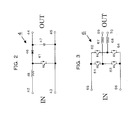
- Fig. 2 shows the DC-DC converter 4, as a voltage conversion circuit, configured by a boost chopper circuit for boosting the output DC current from the solar cell 3 to 210 V.
- the boost chopper circuit is a general circuit that a switching element 41 is activated in PWM (pulse Width Modulation) at about 20 kHz for boosting the DC voltage inputted across input terminals 42 and 43 to provide a high DC voltage across output terminals 44 and 45.
- a condenser 47 is a smooth condenser.
- a reactor 48 is provided. Instead of the circuit elements shown in Fig.
- a current-resonant type isolated converter a bidirectional chopper type DC/DC converter, a bidirectional isolated type CukDC/DC converter can be applied.
- the boost chopper circuit of Fig. 2 is now described.
- the switching element 41 When the switching element 41 is turned in the on state, the energy is stored in the reactor 48.
- the switching element 41 When the switching element 41 is turned in the off state, the energy stored in the reactor 48 is discharged to charge the energy in an electrolytic condenser 47.
- the control of the proportion of time between the on and the off states by the switching element 41 enables the voltage inputted from the input terminals 42 and 43 to be boosted to a predetermined voltage (210 V in this embodiment) to output the boosted voltage from the output terminals 44 and 45.
- the DC/DC converter 4 controls the output voltage thereof so as to make the output voltage of the DC/DC converter coincident with the target voltage V1.
- the switching element 41 may be used by an MOS FET or IGBT (Insulated Gate Bipolar Transistor).
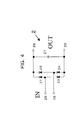
- the inverter 6 can be a full bridge circuit comprising four switching elements 61, 62, 63 and 64. These switching elements may be used by an MOS FET or IGBT, which is activated in PWM at about 20 kHz. DC power inputted across input terminals 65 and 66 is inverted into an AC voltage by the full bridge circuit and smoothed by reactors 67 and 68, to output outputted waves of almost the sine waves across output terminals 69 and 70.
- the output voltage of the inverter 6 is decided as the voltage of the system power, so that the inverter 6 is controlled to be operative when the DC voltage across the input terminals 65 and 66 is identical with the decided voltage. Namely, it is controlled as a current type inverter.
- the inverter 6 is operated for inverting the DC power to the AC power by exchanging the on state and the off state per half cycle by one pair of the switching elements 61 and 64 and another pair of the switching elements 62 and 63.
- the switching elements 61 to 64 control the voltage across the input terminals 65 and 66 by controlling the PWM activation in response to the voltage V2 of the DC voltage applied across the input terminals 65 and 66.
- the AC/DC converter 2 may be a diode bridge circuit comprising diode elements 21, 22, 23 and 24.
- AC power inputted across input terminals 25 and 26 is rectified into DC power by the diode bridge circuit and smoothed by the smooth condenser 27, to output DC power of the voltage V3 across output terminals 28 and 29.
- Fig. 5 is a block diagram of a system constructed as an embodiment 2 of the present invention.
- the embodiment 2 is featured in that the inverter 6 and the AC/DC converter 2 in the embodiment 1 are integrated to make a bidirectional inverter 7 while the remaining points in the embodiment 2 are identical to the embodiment 1.
- the bidirectional inverter 7 in the embodiment 2 is operated according to the functions integrated by the inverter 6 and the AC/DC converter 2 in the embodiment 1 in such a manner that when the voltage of the DC bus line 10 is 200 V, the bidirectional inverter 7 causes the reverse-power flow to the system power 1 and when the voltage of the DC bus line 10 is 190 V, the bidirectional inverter 7 permits power to be supplied from the system power 1 to the load 5.
- the remaining points are identical to the embodiment 1. A further explanation is omitted here.
- Fig. 6 is a circuit diagram of the bidirectional inverter 7.
- the bidirectional inverter 7 is different from the inverter as shown in Fig. 2 in that a condenser 81 is connected across terminals 75 and 76 while the remaining are identical thereto.
- the bidirectional inverter 7 is operated in such a manner that DC power inputted across terminals 75 and 76 is inverted into an AC voltage by the full bridge circuit and smoothed by the reactors 77 and 78 to output outputted waves of almost the sine waves across terminals 79 and 80.
- the bidirectional inverter 7 is operated for inverting the DC power to the commercial AC power by exchanging the on state and the off state per half cycle by one pair of switching elements 71 and 74 and another pair of switching elements 72 and 73.
- the switching elements 71 to 74 invert a voltage of the commercial AC power across the output terminals by controlling pulse widths of the PWM activation in response to the voltage V2 of the DC power applied across the input terminals 75 and 76.
- the switching operations of the switching elements 71 to 74 are not required in which the operation similar to that of the AC/DC converter shown in Fig. 4 is performed to output DC power of a voltage V3 across the terminals 75 and 76.
- Fig. 7 is a block diagram of a system constructed as an embodiment 3 of the present invention.
- the embodiment 3 is differenced in that a storage battery is connected to the embodiment 1.
- a lithium-ion battery 11 of 1 kW is connected to the DC bus line 10 through a diode 12 and a second AC/DC converter 13 is coupled across the system power 1 and the storage battery 11.
- the other circuit elements are the same as those of the embodiment 1 shown in Fig. 1 .
- the full charge voltage of the storage battery 11 is V4 and the empty voltage thereof is V5
- the respective voltages are set as V1>V2>V4>V3>V5.
- the target voltage of the AC/DC converter 2, the DC/DC converter 4 and the inverter 6, respectively, to the DC bus line will be described in detail with reference to a specific voltage value thereof.
- These specific voltage values are exemplified only as an example, but not limited thereto.
- the DC/DC converter 4 is controlled to output a voltage of 115 V to the DC bus line 10. Namely, when the voltage of the DC bus line 10 is lower than 115 V, it controls to increase power supply from the solar cell 3, and when the voltage of the DC bus line 10 is higher than 115 V, it controls to decrease power supply from the solar cell 3. In this operation, the DC/DC converter 4 controls to keep the voltage of the DC bus line 10 at 115 V.
- the inverter 6 controls to increase power supply demanded from the DC bus line 10 to cause the reverse-power flow to the system power 1.
- the inverter 6 controls to decrease power supply demanded from the DC bus line 10. In this operation, the inverter 6 controls to keep the voltage of the DC bus line 10 at 110 V.
- the AC/DC converter 2 is controlled to output a voltage of 80 V to the DC bus line 10. Namely, when the voltage of the DC bus line 10 is lower than 80 V, the AC/DC converter 2 controls to increase power supply from the system power 1. When the voltage of the DC bus line 10 is higher than 80 V, the AC/DC converter 2 controls to decrease power supply from the system power 1. In this operation, the AC/DC converter 2 controls to keep the voltage of the DC bus line 10 at 80 V.
- the full charge voltage V4 and the empty voltage V5 of the lithium-ion rechargeable battery 11 and the possible influence thereof to the DC bus line 10 will be explained.
- 25 lithium-ion rechargeable batteries are connected in series, in which the full charge voltage of a single one is 4.2 V and the empty voltage thereof is 3 V, so that the total of the full charge voltages is 105 V and the total of the empty voltages is 75 V.
- the output voltage of the second AC/DC converter 13 is always governed by the voltage of the lithium-ion rechargeable battery 11.
- the voltage of the lithium-ion rechargeable battery 11 is lower than the voltage of the DC bus line 10 to provide no influence in the case where the power amount generated by the solar cell 3 is large and the voltage of the DC bus line 10 is higher than 110 V.
- the voltage of the lithium-ion rechargeable battery 11 may be possibly equal to the voltage of the DC bus line 10.
- the operation of the second AC/DC converter 13 will be explained. The second AC/DC converter 13 is operated only during the time of the nighttime power of the commercial system power set by the electric power company.
- the second AC/DC converter 13 Upon the time of the nighttime power, the second AC/DC converter 13 starts to charge the lithium-ion rechargeable battery 11. Once the charging is completed, the second AC/DC converter 13 stops operating and does not operate until the next time of the nighttime power. Thus, the operation of the second AC/DC converter 13 is thus timed.
- the voltage of the electrical power generated by the solar cell 3 is assumed to be 1000 W in a morning on a sunshiny day.
- the full charge voltage of the lithium-ion rechargeable battery 11 at this time is assumed to be 105 V and the power needed by the load 5 is assumed to be 700 W. Since the electrical power generated by the solar cell 3 suffices the power needed by the load 5, the DC/DC converter 4 controls to supply the power of 700 W to the load 5, and, simultaneously, proceeds to control the voltage of the DC bus line 10 at 115 V.
- the inverter 6 controls to increase an amount of power to demand from the DC bus line 10 so as to cause reverse-power flow to the system power 1.
- the voltage of the DC bus line 10 becomes 110 V, in which case they are operated in such a condition that the electrical power generated by the solar cell 3 is 1000 W, the supply power amount to the load 5 is 700 W, and the amount of the reverse-power flow to the system power 1 through the inverter 6 is 300 W.
- the voltage of the DC bus line 10 is 110 V in this case, the AC/DC converter 2 is prevented from outputting to the DC bus line 10.
- the voltage of the lithium-ion rechargeable battery 11 is 105 V, so that it is prevented from outputting to the DC bus line.
- the electrical power generated by the solar cell 3 is assumed to be 500 W. Since the electric power amount of the load 5 is assumed to remain 700 W, the electrical power generated by the solar cell 3 cannot suffice the power demanded by the load 5. In such a case, the voltage of the DC bus line 10 cannot be kept at 110 V so as to reduce the voltage. When the voltage of the DC bus line 10 is lower than 105 V, the power is supplied to the load 5 from the lithium-ion rechargeable battery 11.
- the voltage of the DC bus line 10 becomes 105 V, in which case they are operated in such a condition that the electrical power generated by the solar cell 3 is 500 W, the supply power amount from the lithium-ion rechargeable battery 11 to the load 5 is 200 W, and accordingly the load 5 can be operated at 700 W.
- the voltage of the lithium-ion rechargeable battery 11 is lowered so that the voltage of the DC bus line 10 is gradually lowered.
- the reverse-power flow to the system power 1 through the inverter 6 is not caused.
- the system power 1 does not supply power until the voltage of the lithium-ion rechargeable battery 11 is discharged down to 80 V. Thereafter, the above conditions are continued, so that the voltage of the lithium-ion rechargeable battery 11 is lowered less than 80 V. Then, power of 200 W is supplied from the system power 1 to the load 5 through the AC / DC converter 2.
- the electrical power generated by the solar cell 3 is assumed to be 1000 W. Since the electric power amount of the load 5 is assumed to remain 700 W, the electrical power generated by the solar cell 3 suffices the power needed by the load 5, again.
- the voltage of the DC bus line 10 is 110 V so that the reverse-power flow to the system power 1 through the inverter 6 is 300 V. Thereafter, in the night, the electrical power generated by the solar cell 3 becomes 0 W, but the power needed by the load 5 is increased to 1000 W.
- the voltage of the lithium-ion rechargeable battery 11 is 80 V or less so that power of 1000 W is supplied from the system power 1 to the load 5 through the AC/DC inverter 2, whereby the voltage of the DC bus line 10 is 80 V.
- the second AC/DC converter 13 starts to activate. At this time, while the system power 1 charges the lithium-ion rechargeable battery 11 through the second AC/DC converter 13, the system power 1 supplies power to the load 5.
- the power supply from the system power 1 to the load 5 is performed through the AC/DC converter 2 and when the voltage of the lithium-ion rechargeable battery 11 is 80 V or more, the power supply from the system power 1 to the load 5 is performed through the second AC/DC converter 13. While the voltage of the lithium-ion rechargeable battery 11 is less than 80 V, the DC bus line 10 is kept at 80 V and when the voltage of the lithium-ion rechargeable battery 11 is 80 V or more, the voltage of the lithium-ion rechargeable battery 11 equals to the voltage of the DC bus line 10.
- the charge from the system power 1 to the lithium-ion rechargeable battery 11 ends, but for the time of the nighttime power, the power supply is performed from the system power 1 to the load 5, which needs the power of 1000 W, through the second AC/DC converter 13. After the end of the time of the nighttime power, the similar operation is repeated from the morning, again.
- a full charge voltage 105 V
- the solar cell 3 is exemplified as the DC generator, but any other type power source such as a wind power generator, a fuel cell, a battery or the like may be used as far as it can supply power. Further, the number of the DC generator should not be limited to one, but, two or more may be possible. Further, the target voltage of the DC/DC converter 4, the inverter 6, and the AC/DC converter 2, respectively, to the DC bus line 10 and the full charge voltage and the empty voltage of the lithium-ion rechargeable battery 11 may be differentiated 1 to 20 V as explained in the embodiment 1, and, depending upon the kind of the load 5, they may be more than 20 V.
- the target voltage of the DC/DC converter 4, the inverter 6 and the AC/DC converter 2, respectively, to the DC bus line 10 may be within a predetermined voltage zone as explained in the embodiment 1. In this case, it is prevented that each target voltage to the DC bus line 10 overlaps. Further, it may be possible that a DC/DC converter is additionally interposed at the front stage of the load 5 if necessary. In such a case, the power generated by the solar cell 3 is consumed by the load 5 with the highest priority. Further, the second AC/DC converter 13 is not needed to continue to operate during the time of the nighttime power and it may stop after the lithium-ion rechargeable battery 11 is fully charged.
- the second AC/DC converter 13 can operate to charge the lithium-ion rechargeable battery 11 for not only the time of the nighttime power, but also the time when it is advantageous for the user including the time when the power is cheap or so. Further, when the power system is abnormal, the second AC/DC converter 13 may be operated so that the power generated by the solar cell 3 is charged through the inverter.
- the diode 12 is employed as the switching element, but a FET, IGBT or the like can be employed to block a current from the load 5 to the lithium-ion rechargeable battery 11.
- the circuits of the DC/DC converter 4, the inverter 6 and the AC/DC converter 2 used for the embodiment 3 are the same as those shown in Figs. 2 to 4 in the embodiment 1.
- Fig. 8 is a block diagram of a system constructed as an embodiment 4 of the present invention.
- the embodiment 4 is featured in that the inverter 6 and the AC/DC converter 2 are integrated to make a bidirectional inverter 17 while the remaining points in the embodiment 4 are identical to the embodiment 3.
- the embodiment 4 is operated according to the functions integrated by the inverter 6 and the AC/DC converter 2 in the embodiment 3 in such a manner that when the voltage of the DC bus line 10 is 110 V, the bidirectional inverter 17 causes the reverse-power flow to the system power 1 and when the voltage of the DC bus line 10 is 80 V, the bidirectional inverter 17 permits power to be supplied from the system power 1 to the load 5.
- the remaining points are identical to those in the embodiment 3.
- the circuit of the bidirectional inverter 17 is the same as that shown in Fig. 6 in the embodiment 2.
Landscapes
- Engineering & Computer Science (AREA)
- Power Engineering (AREA)
- Charge And Discharge Circuits For Batteries Or The Like (AREA)
- Inverter Devices (AREA)
- Supply And Distribution Of Alternating Current (AREA)
- Direct Current Feeding And Distribution (AREA)
- Stand-By Power Supply Arrangements (AREA)
Abstract
Description
- The present invention relates to an electric power supply system for feeding electric power to a load using a DC generator and system power, and also to an electric power supply system for feeding electric power to a load using a DC generator, a storage battery and system power.
- A plenty of techniques for effectively operating an electric power supply system using a DC generator and system power have been developed.
For example,Patent Document 1 shows an electric power supply system for feeding electric power to a load through an electronic transformer commonly operated at operation efficiency of almost 100 % by combining natural energy power and nighttime power. More particularly, the rated power voltage of a wind power generator, a photovoltaic generator and a fuel cell is coincident with the rated voltage of a storage battery to construct a DC power source. Until the storage battery is fully charged by the DC power source, AC power is supplied to the load from a commercial AC power source. When the storage battery is fully charged or the commercial AC power source is in a power failure, DC power is supplied from the DC power source and the storage battery. While the storage battery is discharging electric power, power energy is complemented from the fuel cell. During the time of the daylight power supply or the nighttime power supply, AC power is supplied to the load from the commercial AC power source.
Patent Document 2 also shows a construction that an output of a DC generator such as a fuel cell is connected to an DC output of a bidirectional DC-AC power inverter, to which connection a DC outlet is coupled through a DC power conversion device. AC system power and an AC load are coupled to an AC terminal of the bidirectional DC-AC power inverter.
Moreover,Patent Document 3 includes a DC power inverter for inverting DC voltage generated by a fuel cell generator, and an AC-DC power converter for converting AC power to DC power. A DC load and a DC output terminal of the AC-DC power converter are connected to an output terminal of the DC power inverter, and AC system power and an AC load are connected to an AC input terminal of the AC-DC power converter. - Patent Document 1: Japanese Unexamined Patent Application Publication No.
2006-254694 - Patent Document 2: Japanese Unexamined Patent Application Publication No.
2003-204682 - Patent Document 3: Japanese Unexamined Patent Application Publication No.
2007-124830 - However, in the conventional art, an inverter, an AC/DC converter and a DC/DC converter must be controlled even in response to output variations of the DC generator, the load variations and the power failure of commercial AC power source (AC power system). A controller is required for this controlling, but the controller necessitates a timepiece and a sensor such as a volt meter in order to control the inverter, the AC/DC converter and the DC/DC converter, and moreover a system must be constructed so as to operate a control in response to the output of the timepiece and the sensor.
In order to solve the above problems, it is an object of the present invention to provide an electric power supply system for feeding an output of a DC power source to a load at high efficiency and, without complicated controlling, for allowing for interchange of electric power among an AC power system, a DC power source and a load, or among an AC power system, an AC power source, a load and a storage battery. - In order to solve the above problems, an electric power supply system of the present invention includes a DC bus line for connecting a DC generator, a load and system power each other; a DC/DC converter connected between the DC generator and the DC bus line for controlling an output voltage to the DC bus line at a voltage V1; an inverter connected between the system power and the DC bus line for operating a control in response to an input voltage V2 from the DC bus line; and an AC/DC converter connected between the system power and the DC bus line for controlling an output voltage to the DC bus line at a voltage V3, in which the respective voltages are set as V1>V2>V3.
Further, a storage battery is provided which is connected to the DC bus line. When the full charge voltage of the storage battery is V4 and the empty voltage thereof is V5, the respective voltages are set as V1>V2>V4>V3>V5.
According to this construction, the voltage value of the DC bus line decides whether or not the DC generator or the system power can supply power to the DC bus line, or power from the DC bus line can be received by the system power. Further, the voltage value of the DC bus line decides whether or not the DC generator, the storage battery or the system power can supply power to the DC bus line, or the power from the DC bus line can be received by the system power.
When the respective voltages are set as V1>V2>V4>V3>V5, the order in which to be supplied to the DC bus line is automatically decided as follows. (1) When the voltage of the storage battery is higher than the output voltage of the AC/DC converter, the first is the DC generator, the second is the storage battery and the third is the system power. (2) When the voltage of the storage battery is lower than the output voltage of the AC/DC converter, the first is the DC generator, the second is the system power, and the third is the storage battery.
Therefore, no control device for controlling the DC/DC converter, the inverter and the AC/DC converter is required.
Hence, the above voltage setting enables the power generated by the DC generator to be supplied to the DC bus line with a priority higher than the system power.
Further, the above voltage setting enables the power generated by the DC generator to automatically and reversely be flown to the system power when the generated power is larger than the consumption amount by the load. Nevertheless, the power is not reversely flown from the storage battery to the system power. Besides, the AC/DC converter outputs, as necessary, so as to charge the storage battery. The storage battery can be charged depending upon the charged voltage thereof.
In an embodiment, the electric power supply system of the present invention integrates the inverter and the AC/DC converter to make a bidirectional inverter. Hereby, the number of the components of the electric power supply system can be minimized to construct the system at a lower cost. - According to the present invention, the power generated by the DC generator can be supplied to the DC load at high efficiency.
Only when the respective converters and the inverter are independently driven, the interchange of the power among the DC generator, the system power and the load, including the storage battery if it is included, can be properly made, so that no complicated control circuit is required and a highly reliable electric power supply system can be provided at a low cost. Even when the storage battery is equipped, no complicated control circuit is required to prevent the reverse-power flow from the storage battery to the system power. -
-
Fig. 1 is a block diagram of a system constructed as anembodiment 1 of the present invention. -
Fig. 2 is a circuit diagram of a DC/DC converter employed in theembodiment 1 of the present invention. -
Fig. 3 is a circuit diagram of an inverter employed in theembodiment 1 of the present invention. -
Fig. 4 is a circuit diagram of an AC/DC converter employed in theembodiment 1 of the present invention. -
Fig. 5 is a block diagram of a system constructed as anembodiment 2 of the present invention. -
Fig. 6 is a circuit diagram of a bidirectional inverter employed in theembodiment 2 of the present invention. -
Fig. 7 is a block diagram of a system constructed as anembodiment 3 of the present invention. -
Fig. 8 is a block diagram of a system constructed as anembodiment 4 of the present invention. -
- 1:
- system power
- 2:
- AC/DC converter
- 3:
- solar cell
- 4:
- DC/DC converter
- 5:
- load
- 6:
- inverter
- 7:
- bidirectional inverter
- 10:
- DC bus line
- 11:
- storage battery
-
Fig. 1 is a block diagram of a system constructed as anembodiment 1 of the present invention.
System power 1 is coupled to an AC/DC converter 2, an output terminal of which is connected to aDC bus line 10. Asolar cell 3 having a rated output of e.g., 1 kW is connected to the DC/DC converter 4. An output terminal of the DC/DC converter 4 is connected to theDC bus line 10. To theDC bus line 10, aload 5 and an input terminal of theinverter 6 are coupled. An output terminal of aninverter 6 is coupled to thesystem power 1. Among an output voltage V1 of the DC/DC converter 4, an input voltage V2 of theinverter 6 and an output voltage V3 of the AC/DC converter 2, a relationship V1>V2>V3 is set.
When the electric power supply system of the present invention is for a household use, theload 5 may be one in a house such as an illumination lamp, a television, a personal computer, a record/reproduction device, an audio equipment, an air conditioner, a washing machine, a refrigerator and a cleaner or the like. When it is for an office, the load may be an office equipment such as a photocopying machine, a personal computer, a computer, an illumination lamp and a telephone or the like. When it is for a public facility, the load may be a streetlight, a traffic signal, a sign and a guide map plate or the like. When it is for a factory, the load may be a factory machine such as a motor and a processing machine or the like. - Now, the target voltage of the AC/
DC converter 2, the DC/DC converter 4 and theinverter 6, respectively, to theDC bus line 10 will be described in detail with reference to a specific voltage value thereof. These specific voltage values are exemplified only as an example, but not limited thereto.
The DC/DC converter 4 controls to output a voltage of e.g., 210 V to theDC bus line 10. Namely, when the voltage of theDC bus line 10 is lower than 210 V, the DC/DC converter 4 controls to increase the power supply amount from thesolar cell 3. To the contrary, when the voltage of theDC bus line 10 is higher than 210 V, the DC/DC converter 4 controls to decrease the power supply amount from thesolar cell 3. In this operation, the DC/DC converter 4 controls to keep the output voltage to theDC bus line 10 at 210 V.
Theinverter 6 controls to increase an amount of power to demand from theDC bus line 10 so as to cause a reverse-power flow to the system power, when the voltage of theDC bus line 10 is higher than e.g., 200 V. When the voltage of theDC bus line 10 is lower than 200 V, theinverter 6 controls to decrease an amount of power to demand from theDC bus line 10. In this operation, theinverter 6 controls to keep the voltage of theDC bus line 10 at 200 V.
The AC/DC converter 2 controls to output a voltage of e.g., 190 V to theDC bus line 10. That is, when the voltage of theDC bus line 10 is lower than 190 V, the AC/DC inverter 2 controls to increase an amount of power to demand from thesystem power 1. When the voltage of theDC bus line 10 is higher than 190 V, the AC/DC inverter 2 controls to decrease an amount of power to demand from thesystem power 1. In this operation, the AC/DC converter 2 controls to keep the voltage of theDC bus line 10 at 190 V. - Next, the operation of the electric power supply system constructed as the
embodiment 1 in the case of setting the respective voltages as above will be explained.
The electrical power generated by thesolar cell 3 is assumed to be e.g., 1000 W for a sunshiny time. The electric power amount needed by theload 5 at this time is assumed to be e.g., 700 W. Since the electrical power generated by thesolar cell 3 suffices the power needed by theload 5, the DC/DC converter 4 controls to supply the power of 700 W to theload 5, and, simultaneously, proceeds to control the voltage of theDC bus line 10 at 210 V. However, when the voltage of theDC bus line 10 is higher than 200 V, theinverter 6 controls to increase an amount of power to demand from theDC bus line 10 so as to cause the reverse-power flow to thesystem power 1.
As a result, the voltage of theDC bus line 10 becomes 200 V, in which case they are operated in such a condition that the electrical power generated by thesolar cell 3 is 1000 W, the power supply amount to theload 5 is 700 W, and the amount of the reverse-power flow to thesystem power 1 through theinverter 6 is 300 W. Further, since the voltage of theDC bus line 10 is 200 V in this case, the AC/DC converter 2 is prevented from outputting to theDC bus line 10. - Successively, the electrical power generated by the
solar cell 3 is assumed to be e.g., 500 W. Since the electric power amount of theload 5 is assumed to remain e.g., 700 W, the electrical power generated by thesolar cell 3 cannot suffice the power demanded by theload 5. In such a case, the DC/DC converter 4 cannot keep the voltage of theDC bus line 10 at 200 V to lower the voltage. When the voltage of theDC bus line 10 is lower than 190 V, the power is supplied to theload 5 from thesystem power 1 through the AC/DC converter 2.
As a result, the voltage of theDC bus line 10 becomes 190 V, in which case they are operated in such a condition that the electrical power generated by thesolar cell 3 is 500 W, the power supply amount from thesystem power 1 to theload 5 through the AC/DC converter is 200 W, and accordingly theload 5 consumes 700 W. Further, since the voltage of theDC bus line 10 is 190 V in this case, the reverse-power flow to thesystem power 1 through theinverter 6 is not caused. - Successively, the electric power amount of the
load 5 is assumed to be e.g., 300 W. Since the electrical power generated by thesolar cell 3 is assumed to remain 500 W, the same operation as above is performed so that the voltage of theDC bus line 10 is 200 V, the electrical power generated by thesolar cell 3 is 500 W, the power supply amount to theload 5 is 300 W, and the reverse-power flow to thesystem power 1 through theinverter 6 is 200 W. - In this embodiment, the solar cell is exemplified as the DC generator, but any other type power source such as a wind power generator, a fuel cell, a battery or the like may be used as far as it can supply power. Further, the number of the DC generator should not be limited to one, and, for example, both of a photovoltaic generator and a wind power generator can be used.
Further, in this embodiment, the target voltage of the DC/DC converter 4, theinverter 6 and the AC/DC converter 2, respectively, to theDC bus line 10 is differentiated by 10 V, but any voltage value differentiated may be all right or each differentiated voltage value may not be the same. For example, preferably, the differentiated voltage value is 1 to 20 V.
Even if the differentiated voltage value is 1 V, the operation of the system of the present invention can be possible as far as the DC/DC converter 4, theinverter 6 and the AC/DC converter 2 can be operated within their dynamic sensitivity zones. When the differentiated voltage value is 20 V, it is set, for example, that the output voltage of the DC/DC converter 4 from thesolar cell 3 is 200 V, the input voltage of theinverter 6 is 180 V, the output voltage of the AC/DC converter 2 is 160 V. Hence, when the output of the DC/DC converter 4 is supplied from thesolar cell 3, the power supply to theload 5 is 200 V. Further, when the power supply is from thesystem power 1 through the AC/DC converter 2, the power supply to theload 5 is 160 V. Thus, the voltage received by theload 5 is varied depending upon the output variations of thesolar cell 3. Therefore, if the power supply to theload 5 is excessively varied, theload 5 may become unoperatable according to the type thereof or it may be necessary that a DC/DC converter is additionally interposed at the front stage of theload 5 to stabilize the voltage thereof. - Since the
load 5 may become unoperatable in the case of the large differentiated voltage value, it is necessary to set so that theload 5 is placed in an operative zone. Further, when a DC/DC converter is additionally interposed for stabilizing the voltage, efficiency may be reduced owing to the DC/DC converter, disadvantageously.
In view of the above, a voltage value of differentiating a voltage of 20 V or more, say, 50 V or 100 V is not preferable. Nevertheless, depending upon the kind of theload 5, some kind of load can be operated under the large differentiated voltage value in which case the differentiated voltage value of 20 V or more may be possible.
As described above, the differentiated voltage value should be decided to the extent that the load is placed in the operative voltage zone and that the presence of the DC/DC converter does not reduce efficiency. Further, the differentiated voltage value may be decided in view of the control capacity and the dynamic sensitivity of the AC /DC converter 2, the DC/DC converter 4 and theinverter 6. Therefore, the differentiated voltage value of 1 V or more and 20 V or less is a preferable one. - In this embodiment, the target voltage of the DC/
DC converter 4 to theDC bus line 10 is set to be one voltage like 210 V, but it may be possible to set a predetermined zone such as 210 to 220 V. The target voltage of the AC/DC converter 4 and theinverter 6, respectively, to theDC bus line 10 is similar. In this case, it is prevented that each target voltage to theDC bus line 10 overlaps.
Besides, the above explanation is described assuming that a wiring resistance of theDC bus line 10 is zero, but some wiring resistance actually exists so that the differentiated voltage value should be determined in view of the voltage drop due to the wiring resistance. Further, the electric power supply system according to this embodiment can be operated when thesystem power 1 is cut off owing to a power failure.
Further, in this embodiment, a DC/DC converter may be placed, if necessary, at the front stage of theload 5. In such a case, the power generated by thesolar cell 3 is consumed by theload 5 at the highest priority. - Next, the DC/
DC converter 4, the AC/DC converter 2 and theinverter 6 will be described in detail.
Fig. 2 shows the DC-DC converter 4, as a voltage conversion circuit, configured by a boost chopper circuit for boosting the output DC current from thesolar cell 3 to 210 V. As shown inFig. 2 , the boost chopper circuit is a general circuit that a switchingelement 41 is activated in PWM (pulse Width Modulation) at about 20 kHz for boosting the DC voltage inputted acrossinput terminals output terminals condenser 47 is a smooth condenser. Areactor 48 is provided. Instead of the circuit elements shown inFig. 2 , a current-resonant type isolated converter, a bidirectional chopper type DC/DC converter, a bidirectional isolated type CukDC/DC converter can be applied.
The boost chopper circuit ofFig. 2 is now described. When the switchingelement 41 is turned in the on state, the energy is stored in thereactor 48. When the switchingelement 41 is turned in the off state, the energy stored in thereactor 48 is discharged to charge the energy in anelectrolytic condenser 47. The control of the proportion of time between the on and the off states by the switchingelement 41 enables the voltage inputted from theinput terminals output terminals DC converter 4 controls the output voltage thereof so as to make the output voltage of the DC/DC converter coincident with the target voltage V1.
The switchingelement 41 may be used by an MOS FET or IGBT (Insulated Gate Bipolar Transistor). - As shown in
Fig. 3 , theinverter 6 can be a full bridge circuit comprising four switchingelements input terminals reactors output terminals
When the system power is coupled to theoutput terminals inverter 6, the output voltage of theinverter 6 is decided as the voltage of the system power, so that theinverter 6 is controlled to be operative when the DC voltage across theinput terminals
Theinverter 6 is operated for inverting the DC power to the AC power by exchanging the on state and the off state per half cycle by one pair of the switchingelements elements elements 61 to 64 control the voltage across theinput terminals input terminals - As shown in
Fig. 4 , the AC/DC converter 2 may be a diode bridge circuit comprisingdiode elements input terminals smooth condenser 27, to output DC power of the voltage V3 acrossoutput terminals -
Fig. 5 is a block diagram of a system constructed as anembodiment 2 of the present invention. Theembodiment 2 is featured in that theinverter 6 and the AC/DC converter 2 in theembodiment 1 are integrated to make a bidirectional inverter 7 while the remaining points in theembodiment 2 are identical to theembodiment 1.
The bidirectional inverter 7 in theembodiment 2 is operated according to the functions integrated by theinverter 6 and the AC/DC converter 2 in theembodiment 1 in such a manner that when the voltage of theDC bus line 10 is 200 V, the bidirectional inverter 7 causes the reverse-power flow to thesystem power 1 and when the voltage of theDC bus line 10 is 190 V, the bidirectional inverter 7 permits power to be supplied from thesystem power 1 to theload 5. The remaining points are identical to theembodiment 1. A further explanation is omitted here. -
Fig. 6 is a circuit diagram of the bidirectional inverter 7. The bidirectional inverter 7 is different from the inverter as shown inFig. 2 in that acondenser 81 is connected acrossterminals
The bidirectional inverter 7 is operated in such a manner that DC power inputted acrossterminals reactors terminals
The bidirectional inverter 7 is operated for inverting the DC power to the commercial AC power by exchanging the on state and the off state per half cycle by one pair of switchingelements elements elements 71 to 74 invert a voltage of the commercial AC power across the output terminals by controlling pulse widths of the PWM activation in response to the voltage V2 of the DC power applied across theinput terminals
When AC power is inputted acrossterminals elements 71 to 74 are not required in which the operation similar to that of the AC/DC converter shown inFig. 4 is performed to output DC power of a voltage V3 across theterminals -
Fig. 7 is a block diagram of a system constructed as anembodiment 3 of the present invention.
Theembodiment 3 is differenced in that a storage battery is connected to theembodiment 1. In other words, a lithium-ion battery 11 of 1 kW is connected to theDC bus line 10 through adiode 12 and a second AC/DC converter 13 is coupled across thesystem power 1 and thestorage battery 11. The other circuit elements are the same as those of theembodiment 1 shown inFig. 1 . In thisembodiment 3, when the full charge voltage of thestorage battery 11 is V4 and the empty voltage thereof is V5, the respective voltages are set as V1>V2>V4>V3>V5. - Now, in the
embodiment 3, the target voltage of the AC/DC converter 2, the DC/DC converter 4 and theinverter 6, respectively, to the DC bus line will be described in detail with reference to a specific voltage value thereof. These specific voltage values are exemplified only as an example, but not limited thereto.
The DC/DC converter 4 is controlled to output a voltage of 115 V to theDC bus line 10. Namely, when the voltage of theDC bus line 10 is lower than 115 V, it controls to increase power supply from thesolar cell 3, and when the voltage of theDC bus line 10 is higher than 115 V, it controls to decrease power supply from thesolar cell 3. In this operation, the DC/DC converter 4 controls to keep the voltage of theDC bus line 10 at 115 V. - When the voltage of the
DC bus line 10 is higher than 110 V, theinverter 6 controls to increase power supply demanded from theDC bus line 10 to cause the reverse-power flow to thesystem power 1. When the voltage of theDC bus line 10 is lower than 110 V, theinverter 6 controls to decrease power supply demanded from theDC bus line 10. In this operation, theinverter 6 controls to keep the voltage of theDC bus line 10 at 110 V.
The AC/DC converter 2 is controlled to output a voltage of 80 V to theDC bus line 10. Namely, when the voltage of theDC bus line 10 is lower than 80 V, the AC/DC converter 2 controls to increase power supply from thesystem power 1. When the voltage of theDC bus line 10 is higher than 80 V, the AC/DC converter 2 controls to decrease power supply from thesystem power 1. In this operation, the AC/DC converter 2 controls to keep the voltage of theDC bus line 10 at 80 V. - Next, the full charge voltage V4 and the empty voltage V5 of the lithium-ion
rechargeable battery 11 and the possible influence thereof to theDC bus line 10 will be explained. In the electric power supply system of theembodiment
Further, the output voltage of the second AC/DC converter 13 is always governed by the voltage of the lithium-ionrechargeable battery 11. Since the lithium-ionrechargeable battery 11 is coupled to theDC bus line 10 through a blockingdiode 12, the voltage of the lithium-ionrechargeable battery 11 is lower than the voltage of theDC bus line 10 to provide no influence in the case where the power amount generated by thesolar cell 3 is large and the voltage of theDC bus line 10 is higher than 110 V. When the power amount generated by thesolar cell 3 is small, the voltage of the lithium-ionrechargeable battery 11 may be possibly equal to the voltage of theDC bus line 10.
The operation of the second AC/DC converter 13 will be explained. The second AC/DC converter 13 is operated only during the time of the nighttime power of the commercial system power set by the electric power company. Upon the time of the nighttime power, the second AC/DC converter 13 starts to charge the lithium-ionrechargeable battery 11. Once the charging is completed, the second AC/DC converter 13 stops operating and does not operate until the next time of the nighttime power. Thus, the operation of the second AC/DC converter 13 is thus timed. - Next, the operation of the
embodiment 3 in case of setting the voltages as above will be explained.
The voltage of the electrical power generated by thesolar cell 3 is assumed to be 1000 W in a morning on a sunshiny day. The full charge voltage of the lithium-ionrechargeable battery 11 at this time is assumed to be 105 V and the power needed by theload 5 is assumed to be 700 W. Since the electrical power generated by thesolar cell 3 suffices the power needed by theload 5, the DC/DC converter 4 controls to supply the power of 700 W to theload 5, and, simultaneously, proceeds to control the voltage of theDC bus line 10 at 115 V. However, when the voltage of theDC bus line 10 is higher than 110 V, theinverter 6 controls to increase an amount of power to demand from theDC bus line 10 so as to cause reverse-power flow to thesystem power 1.
As a result, the voltage of theDC bus line 10 becomes 110 V, in which case they are operated in such a condition that the electrical power generated by thesolar cell 3 is 1000 W, the supply power amount to theload 5 is 700 W, and the amount of the reverse-power flow to thesystem power 1 through theinverter 6 is 300 W. Further, since the voltage of theDC bus line 10 is 110 V in this case, the AC/DC converter 2 is prevented from outputting to theDC bus line 10. Similarly, the voltage of the lithium-ionrechargeable battery 11 is 105 V, so that it is prevented from outputting to the DC bus line. - Successively, when the sun goes down, the electrical power generated by the
solar cell 3 is assumed to be 500 W. Since the electric power amount of theload 5 is assumed to remain 700 W, the electrical power generated by thesolar cell 3 cannot suffice the power demanded by theload 5. In such a case, the voltage of theDC bus line 10 cannot be kept at 110 V so as to reduce the voltage. When the voltage of theDC bus line 10 is lower than 105 V, the power is supplied to theload 5 from the lithium-ionrechargeable battery 11.
As a result, the voltage of theDC bus line 10 becomes 105 V, in which case they are operated in such a condition that the electrical power generated by thesolar cell 3 is 500 W, the supply power amount from the lithium-ionrechargeable battery 11 to theload 5 is 200 W, and accordingly theload 5 can be operated at 700 W. Of course, when supplying power, the voltage of the lithium-ionrechargeable battery 11 is lowered so that the voltage of theDC bus line 10 is gradually lowered. Further, since the voltage of theDC bus line 10 is 105 V or less in this case, the reverse-power flow to thesystem power 1 through theinverter 6 is not caused. Further, since the output voltage of the AC/DC converter 2 is 80 V, thesystem power 1 does not supply power until the voltage of the lithium-ionrechargeable battery 11 is discharged down to 80 V.
Thereafter, the above conditions are continued, so that the voltage of the lithium-ionrechargeable battery 11 is lowered less than 80 V. Then, power of 200 W is supplied from thesystem power 1 to theload 5 through the AC /DC converter 2. - Successively, when it is sunshiny again, the electrical power generated by the
solar cell 3 is assumed to be 1000 W. Since the electric power amount of theload 5 is assumed to remain 700 W, the electrical power generated by thesolar cell 3 suffices the power needed by theload 5, again. Thus, as mentioned above, the voltage of theDC bus line 10 is 110 V so that the reverse-power flow to thesystem power 1 through theinverter 6 is 300 V.
Thereafter, in the night, the electrical power generated by thesolar cell 3 becomes 0 W, but the power needed by theload 5 is increased to 1000 W. In such a case, the voltage of the lithium-ionrechargeable battery 11 is 80 V or less so that power of 1000 W is supplied from thesystem power 1 to theload 5 through the AC/DC inverter 2, whereby the voltage of theDC bus line 10 is 80 V.
Thereafter, upon the time of the nighttime power of the commercial system power set by the electric power company, the second AC/DC converter 13 starts to activate. At this time, while thesystem power 1 charges the lithium-ionrechargeable battery 11 through the second AC/DC converter 13, thesystem power 1 supplies power to theload 5. While the voltage of the lithium-ionrechargeable battery 11 is less than 80 V, the power supply from thesystem power 1 to theload 5 is performed through the AC/DC converter 2 and when the voltage of the lithium-ionrechargeable battery 11 is 80 V or more, the power supply from thesystem power 1 to theload 5 is performed through the second AC/DC converter 13. While the voltage of the lithium-ionrechargeable battery 11 is less than 80 V, theDC bus line 10 is kept at 80 V and when the voltage of the lithium-ionrechargeable battery 11 is 80 V or more, the voltage of the lithium-ionrechargeable battery 11 equals to the voltage of theDC bus line 10. When the voltage of the lithium-ionrechargeable battery 11 reaches a full charge voltage (105 V), the charge from thesystem power 1 to the lithium-ionrechargeable battery 11 ends, but for the time of the nighttime power, the power supply is performed from thesystem power 1 to theload 5, which needs the power of 1000 W, through the second AC/DC converter 13. After the end of the time of the nighttime power, the similar operation is repeated from the morning, again. - Also in the
embodiment 3, thesolar cell 3 is exemplified as the DC generator, but any other type power source such as a wind power generator, a fuel cell, a battery or the like may be used as far as it can supply power. Further, the number of the DC generator should not be limited to one, but, two or more may be possible.
Further, the target voltage of the DC/DC converter 4, theinverter 6, and the AC/DC converter 2, respectively, to theDC bus line 10 and the full charge voltage and the empty voltage of the lithium-ionrechargeable battery 11 may be differentiated 1 to 20 V as explained in theembodiment 1, and, depending upon the kind of theload 5, they may be more than 20 V.
The target voltage of the DC/DC converter 4, theinverter 6 and the AC/DC converter 2, respectively, to theDC bus line 10 may be within a predetermined voltage zone as explained in theembodiment 1. In this case, it is prevented that each target voltage to theDC bus line 10 overlaps.
Further, it may be possible that a DC/DC converter is additionally interposed at the front stage of theload 5 if necessary. In such a case, the power generated by thesolar cell 3 is consumed by theload 5 with the highest priority.
Further, the second AC/DC converter 13 is not needed to continue to operate during the time of the nighttime power and it may stop after the lithium-ionrechargeable battery 11 is fully charged. The second AC/DC converter 13 can operate to charge the lithium-ionrechargeable battery 11 for not only the time of the nighttime power, but also the time when it is advantageous for the user including the time when the power is cheap or so. Further, when the power system is abnormal, the second AC/DC converter 13 may be operated so that the power generated by thesolar cell 3 is charged through the inverter.
In this embodiment, thediode 12 is employed as the switching element, but a FET, IGBT or the like can be employed to block a current from theload 5 to the lithium-ionrechargeable battery 11.
The circuits of the DC/DC converter 4, theinverter 6 and the AC/DC converter 2 used for theembodiment 3 are the same as those shown inFigs. 2 to 4 in theembodiment 1. -
Fig. 8 is a block diagram of a system constructed as anembodiment 4 of the present invention.
Theembodiment 4 is featured in that theinverter 6 and the AC/DC converter 2 are integrated to make abidirectional inverter 17 while the remaining points in theembodiment 4 are identical to theembodiment 3.
Theembodiment 4 is operated according to the functions integrated by theinverter 6 and the AC/DC converter 2 in theembodiment 3 in such a manner that when the voltage of theDC bus line 10 is 110 V, thebidirectional inverter 17 causes the reverse-power flow to thesystem power 1 and when the voltage of theDC bus line 10 is 80 V, thebidirectional inverter 17 permits power to be supplied from thesystem power 1 to theload 5. The remaining points are identical to those in theembodiment 3.
The circuit of thebidirectional inverter 17 is the same as that shown inFig. 6 in theembodiment 2.
Claims (7)
- An electric power supply system comprising:a DC bus line for connecting a DC generator, a load and system power each other;a DC/DC converter connected between the DC generator and the DC bus line for controlling an output voltage to the DC bus line at a voltage V1;an inverter connected between the system power and the DC bus line for operating a control in response to an input voltage V2 from the DC bus line; andan AC/DC converter connected between the system power and the DC bus line for controlling an output voltage to the DC bus line at a voltage V3,wherein the respective voltages are set as V1>V2>V3.
- The electric power supply system according to claim 1, further comprising a storage battery connected to the DC bus line wherein, when the full charge voltage of the storage battery is V4 and the empty voltage thereof is V5, the respective voltages are set as V1>V2>V4>V3>V5.
- The electric power supply system according to claim 1 or 2, wherein when the output voltage of the DC/DC converter is lower than the voltage V1, the DC/DC converter operates to increase an output thereof and when the output voltage of the DC/DC converter is higher than the voltage V1, the DC/DC converter operates to decrease the output thereof.
- The electric power supply system according to any one of claims 1 to 3, wherein when the input voltage of the inverter is higher than the voltage V2, the inverter operates to increase an output thereof and when the input voltage of the inverter is lower than the voltage V2, the inverter operates to decrease the output thereof.
- The electric power supply system according to any one of claims 1 to 4, wherein when the output voltage of the AC/DC converter is lower than the voltage V3, the AC/DC converter operates to increase an output thereof and when the output voltage of the AC/DC converter is higher than the voltage V3, the AC/DC converter operates to decrease the output thereof.
- The electric power supply system according to any one of claims 1 to 5, wherein the inverter and the AC/DC converter comprise a bidirectional inverter.
- The electric power supply system according to claim 1, wherein the load is an illumination lamp, a television, a personal computer, a record/reproduction device, an audio equipment, an air conditioner, a washing machine, a refrigerator, a cleaner, a streetlight, an office equipment, a factory machine or the like.
Applications Claiming Priority (2)
| Application Number | Priority Date | Filing Date | Title |
|---|---|---|---|
| JP2007313816A JP5081596B2 (en) | 2007-12-04 | 2007-12-04 | Power supply system |
| PCT/JP2008/071322 WO2009072415A1 (en) | 2007-12-04 | 2008-11-25 | Power supply system |
Publications (3)
| Publication Number | Publication Date |
|---|---|
| EP2224571A1 true EP2224571A1 (en) | 2010-09-01 |
| EP2224571A4 EP2224571A4 (en) | 2013-11-13 |
| EP2224571B1 EP2224571B1 (en) | 2015-02-25 |
Family
ID=40717597
Family Applications (1)
| Application Number | Title | Priority Date | Filing Date |
|---|---|---|---|
| EP20080857910 Not-in-force EP2224571B1 (en) | 2007-12-04 | 2008-11-25 | Power supply system |
Country Status (5)
| Country | Link |
|---|---|
| US (1) | US8362648B2 (en) |
| EP (1) | EP2224571B1 (en) |
| JP (1) | JP5081596B2 (en) |
| ES (1) | ES2532282T3 (en) |
| WO (1) | WO2009072415A1 (en) |
Cited By (6)
| Publication number | Priority date | Publication date | Assignee | Title |
|---|---|---|---|---|
| WO2012143904A3 (en) * | 2011-04-20 | 2013-06-27 | Koninklijke Philips Electronics N.V. | Controlled converter architecture with prioritized electricity supply |
| CN104734180A (en) * | 2013-12-24 | 2015-06-24 | 珠海格力电器股份有限公司 | Power supply control method and system |
| CN104734181B (en) * | 2013-12-24 | 2018-04-13 | 珠海格力电器股份有限公司 | Photovoltaic grid-connected system |
| EP3364539A4 (en) * | 2015-10-15 | 2018-10-24 | Gree Electric Appliances, Inc. of Zhuhai | Energy gateway, household appliance, direct-current micro-grid system and energy management method therefor |
| EP3630523A1 (en) * | 2017-05-25 | 2020-04-08 | Siemens Aktiengesellschaft | Power supply system and method |
| TWI903941B (en) * | 2024-12-24 | 2025-11-01 | 東元電機股份有限公司 | A power distribution and control system for variable frequency compressor |
Families Citing this family (43)
| Publication number | Priority date | Publication date | Assignee | Title |
|---|---|---|---|---|
| US8248230B2 (en) * | 2009-02-20 | 2012-08-21 | Redwood Systems, Inc. | Smart power device |
| JP2011015501A (en) * | 2009-06-30 | 2011-01-20 | Panasonic Electric Works Co Ltd | Power distribution system |
| KR101698778B1 (en) * | 2009-08-04 | 2017-01-23 | 엘지전자 주식회사 | Apparatus for dirving motor using distributed power and distributed power system |
| KR101691809B1 (en) * | 2009-08-04 | 2017-01-09 | 엘지전자 주식회사 | Apparatus for dirving motor using distributed power and distributed power system |
| JP5546832B2 (en) * | 2009-11-16 | 2014-07-09 | パナソニック株式会社 | Power distribution system |
| JP5799253B2 (en) * | 2009-11-11 | 2015-10-21 | パナソニックIpマネジメント株式会社 | Power distribution system |
| JP5799254B2 (en) * | 2009-11-16 | 2015-10-21 | パナソニックIpマネジメント株式会社 | Power distribution system |
| CN202997003U (en) * | 2009-12-04 | 2013-06-12 | 三洋电机株式会社 | Power storage unit, power generation system and charging and discharging system |
| KR101042746B1 (en) | 2009-12-17 | 2011-06-20 | 삼성에스디아이 주식회사 | Bidirectional Inverters in Renewable Energy Storage Systems |
| EP2564502A4 (en) * | 2010-04-26 | 2018-01-24 | Queen's University At Kingston | Power converter for a power generator |
| US8373949B2 (en) | 2010-06-16 | 2013-02-12 | Transocean Sedco Forex Ventures Limited | Hybrid power plant for improved efficiency and dynamic performance |
| JP2012029421A (en) * | 2010-07-22 | 2012-02-09 | Coexe Co Ltd | Hybrid power source connection interface device |
| TWI431899B (en) * | 2010-11-30 | 2014-03-21 | Inventec Corp | Server computer set |
| JP5526043B2 (en) * | 2011-01-06 | 2014-06-18 | シャープ株式会社 | DC power supply system |
| US20120181865A1 (en) * | 2011-01-14 | 2012-07-19 | Leviton Manufacturing Co., Inc. | Distributed dc power systems |
| JP5931346B2 (en) * | 2011-04-11 | 2016-06-08 | 東芝三菱電機産業システム株式会社 | Uninterruptible power supply system |
| JP5931345B2 (en) * | 2011-04-11 | 2016-06-08 | 東芝三菱電機産業システム株式会社 | Uninterruptible power supply system |
| JP5342598B2 (en) * | 2011-04-18 | 2013-11-13 | シャープ株式会社 | Power converter |
| FR2976745B1 (en) * | 2011-06-15 | 2015-07-17 | Schneider Electric Ind Sas | SECURE CONTROL MECHANISM FOR DISTRIBUTED PHOTOVOLTAIC SYSTEM |
| JP5721558B2 (en) * | 2011-06-20 | 2015-05-20 | 京セラ株式会社 | Inverter |
| CN103828182B (en) * | 2011-09-20 | 2017-07-28 | 三菱重工机电系统株式会社 | Mechanical parking device and power supply method for mechanical parking device |
| JP5818602B2 (en) * | 2011-09-20 | 2015-11-18 | 三菱重工メカトロシステムズ株式会社 | Mechanical parking apparatus and power supply method for mechanical parking apparatus |
| JP2013085324A (en) * | 2011-10-06 | 2013-05-09 | Ntt Facilities Inc | Power conversion system and power conversion circuit |
| US20130187464A1 (en) * | 2012-01-23 | 2013-07-25 | Seldon Energy Partners, LLC | System and Method for Portable Solar Array Deployment |
| US10411477B2 (en) * | 2012-03-26 | 2019-09-10 | Pika Energy, Inc. | Distributed substring architecture for maximum power point tracking of energy sources |
| WO2014056086A1 (en) | 2012-10-09 | 2014-04-17 | Horizon Oilfield Solutions Inc. | Hybrid power source lighting and energy system for operation in harsh and/or remote locations |
| CN105191044B (en) * | 2013-03-22 | 2018-12-25 | 飞利浦灯具控股公司 | Power management between source and load |
| JP5897501B2 (en) * | 2013-06-19 | 2016-03-30 | 三菱電機株式会社 | Power supply system |
| CN103486682B (en) * | 2013-09-25 | 2021-09-28 | 珠海格力电器股份有限公司 | Photovoltaic air conditioning system |
| US9515516B2 (en) | 2013-10-03 | 2016-12-06 | Jeramy Baker | Portable power station system |
| ES2535059B1 (en) * | 2013-10-31 | 2016-02-09 | Control Techniques Iberia S.A. | Method and system to control a power supply to a load |
| JP2015220958A (en) * | 2014-05-21 | 2015-12-07 | シャープ株式会社 | Power conditioner and power storage control method |
| US10298023B2 (en) * | 2015-09-25 | 2019-05-21 | Dell Products, Lp | Universal power converter having variable voltage capability and method therefor |
| WO2017062365A1 (en) | 2015-10-06 | 2017-04-13 | Cummins Power Generation Ip, Inc. | Reconfigurable converter |
| JP6751575B2 (en) * | 2016-03-29 | 2020-09-09 | センクシア株式会社 | Load drive system using solar power generation system |
| CN107306031A (en) * | 2016-04-15 | 2017-10-31 | 中国电力科学研究院 | A kind of direct current sends ring topology and control method outside |
| CN106225123A (en) * | 2016-08-16 | 2016-12-14 | 南宁市泓森机电工程有限公司 | A kind of method utilizing solar energy to run water screen air conditioner machine |
| US10998746B2 (en) * | 2017-04-03 | 2021-05-04 | Smart Charging Technologies Llc | Direct current uninterruptible power supply with AC power supply and related methods |
| BE1028004B1 (en) * | 2019-12-30 | 2021-08-24 | Futech Bvba | DC source in electrical installation |
| KR102223422B1 (en) * | 2020-08-06 | 2021-03-05 | 대농산업전기(주) | Uninterruptible power supply and method for thereof |
| GB2605357B (en) * | 2021-02-24 | 2024-05-01 | Mclaren Automotive Ltd | Battery system |
| WO2023243072A1 (en) * | 2022-06-17 | 2023-12-21 | 三菱電機株式会社 | Dc power distribution system |
| JP7743955B1 (en) * | 2025-04-16 | 2025-09-25 | 拓 岩佐 | Cooperative Power Supply System |
Family Cites Families (12)
| Publication number | Priority date | Publication date | Assignee | Title |
|---|---|---|---|---|
| JPH06165395A (en) * | 1992-11-24 | 1994-06-10 | Sanyo Electric Co Ltd | Power source |
| JP2000197347A (en) * | 1998-12-25 | 2000-07-14 | Hitachi Ltd | Power supply |
| JP2000224769A (en) * | 1999-01-28 | 2000-08-11 | Shikoku Electric Power Co Inc | Distributed power storage system |
| JP2001231176A (en) * | 2000-02-18 | 2001-08-24 | Toshiba Corp | Fuel cell power supply |
| JP2003204682A (en) | 2002-01-08 | 2003-07-18 | Nippon Telegr & Teleph Corp <Ntt> | DC distribution system |
| JP4180086B2 (en) | 2002-08-01 | 2008-11-12 | 株式会社アイ・ヒッツ研究所 | Distributed power supply system |
| JP3825020B2 (en) | 2002-08-01 | 2006-09-20 | 株式会社アイ・ヒッツ研究所 | Distributed power supply system |
| FR2856852B1 (en) * | 2003-06-27 | 2006-09-29 | Asmo Co Ltd | AIR CONDITIONER ENGINE ASSEMBLY FOR VEHICLES |
| US7227278B2 (en) * | 2004-01-21 | 2007-06-05 | Nextek Power Systems Inc. | Multiple bi-directional input/output power control system |
| JP4164050B2 (en) * | 2004-07-29 | 2008-10-08 | 株式会社日立製作所 | Grid interconnection device |
| US7411308B2 (en) * | 2005-02-26 | 2008-08-12 | Parmley Daniel W | Renewable energy power systems |
| JP2007124830A (en) | 2005-10-28 | 2007-05-17 | Mitsubishi Heavy Ind Ltd | Dc distribution system |
-
2007
- 2007-12-04 JP JP2007313816A patent/JP5081596B2/en not_active Expired - Fee Related
-
2008
- 2008-11-25 EP EP20080857910 patent/EP2224571B1/en not_active Not-in-force
- 2008-11-25 ES ES08857910.7T patent/ES2532282T3/en active Active
- 2008-11-25 US US12/745,997 patent/US8362648B2/en not_active Expired - Fee Related
- 2008-11-25 WO PCT/JP2008/071322 patent/WO2009072415A1/en not_active Ceased
Cited By (10)
| Publication number | Priority date | Publication date | Assignee | Title |
|---|---|---|---|---|
| WO2012143904A3 (en) * | 2011-04-20 | 2013-06-27 | Koninklijke Philips Electronics N.V. | Controlled converter architecture with prioritized electricity supply |
| CN103477525A (en) * | 2011-04-20 | 2013-12-25 | 皇家飞利浦有限公司 | Controlled Converter Architecture with Prioritized Power Supply |
| US9048692B2 (en) | 2011-04-20 | 2015-06-02 | Koninklijkle Philips N.V. | Controlled converter architecture with prioritized electricity supply |
| CN104734180A (en) * | 2013-12-24 | 2015-06-24 | 珠海格力电器股份有限公司 | Power supply control method and system |
| CN104734180B (en) * | 2013-12-24 | 2018-02-27 | 珠海格力电器股份有限公司 | Power supply control method and system |
| CN104734181B (en) * | 2013-12-24 | 2018-04-13 | 珠海格力电器股份有限公司 | Photovoltaic grid-connected system |
| EP3364539A4 (en) * | 2015-10-15 | 2018-10-24 | Gree Electric Appliances, Inc. of Zhuhai | Energy gateway, household appliance, direct-current micro-grid system and energy management method therefor |
| EP3630523A1 (en) * | 2017-05-25 | 2020-04-08 | Siemens Aktiengesellschaft | Power supply system and method |
| US11146100B2 (en) | 2017-05-25 | 2021-10-12 | Siemens Energy AS | Power supply system and method |
| TWI903941B (en) * | 2024-12-24 | 2025-11-01 | 東元電機股份有限公司 | A power distribution and control system for variable frequency compressor |
Also Published As
| Publication number | Publication date |
|---|---|
| JP2009142013A (en) | 2009-06-25 |
| EP2224571B1 (en) | 2015-02-25 |
| US8362648B2 (en) | 2013-01-29 |
| JP5081596B2 (en) | 2012-11-28 |
| US20100253148A1 (en) | 2010-10-07 |
| ES2532282T3 (en) | 2015-03-25 |
| EP2224571A4 (en) | 2013-11-13 |
| WO2009072415A1 (en) | 2009-06-11 |
Similar Documents
| Publication | Publication Date | Title |
|---|---|---|
| US8362648B2 (en) | Electric power supply system | |
| US8106535B2 (en) | Power conditioner | |
| US6369461B1 (en) | High efficiency power conditioner employing low voltage DC bus and buck and boost converters | |
| JP5342598B2 (en) | Power converter | |
| JPH1031525A (en) | Solar power system | |
| US9762115B2 (en) | Bidirectional multimode power converter | |
| CN102545367B (en) | Discharge control device and discharge control method | |
| US20050112420A1 (en) | Power supply device | |
| JP2011125124A (en) | Server and uninterruptible power supply housed in the server | |
| US7098558B2 (en) | Starting circuit for power-converting apparatus | |
| CN117277525B (en) | Intelligent power control system for charging pile | |
| KR100702223B1 (en) | PV system and method | |
| KR101587488B1 (en) | High efficiency battery charge/discharge system and method in grid-tied system | |
| US11811329B2 (en) | Remotely programmable multi mode bidirectional power converter | |
| CN112534696A (en) | Photovoltaic inverter and method for operating a photovoltaic inverter | |
| KR101737461B1 (en) | System for obtaining a driving power source to the power generation of the solar cell and method therefor | |
| JPH11136879A (en) | Photovoltaic power generator | |
| WO2021039678A1 (en) | Direct current power supply device | |
| CN216291515U (en) | Street lamp power supply device and street lamp system | |
| JP6923121B2 (en) | Power supply device | |
| CN220209989U (en) | Battery pack and energy storage device | |
| CN216794695U (en) | Charging circuit, charger and charging system | |
| JP2001249727A (en) | Solar power system | |
| KR20250063288A (en) | Energy storage apparatus | |
| CN121529882A (en) | Aerospace power isolation bus system and its control method and aerospace power system |
Legal Events
| Date | Code | Title | Description |
|---|---|---|---|
| PUAI | Public reference made under article 153(3) epc to a published international application that has entered the european phase |
Free format text: ORIGINAL CODE: 0009012 |
|
| 17P | Request for examination filed |
Effective date: 20100617 |
|
| AK | Designated contracting states |
Kind code of ref document: A1 Designated state(s): AT BE BG CH CY CZ DE DK EE ES FI FR GB GR HR HU IE IS IT LI LT LU LV MC MT NL NO PL PT RO SE SI SK TR |
|
| AX | Request for extension of the european patent |
Extension state: AL BA MK RS |
|
| DAX | Request for extension of the european patent (deleted) | ||
| A4 | Supplementary search report drawn up and despatched |
Effective date: 20131016 |
|
| RIC1 | Information provided on ipc code assigned before grant |
Ipc: H02J 3/38 20060101AFI20131010BHEP Ipc: H02J 7/35 20060101ALI20131010BHEP Ipc: H02J 1/10 20060101ALI20131010BHEP |
|
| GRAP | Despatch of communication of intention to grant a patent |
Free format text: ORIGINAL CODE: EPIDOSNIGR1 |
|
| INTG | Intention to grant announced |
Effective date: 20141001 |
|
| GRAS | Grant fee paid |
Free format text: ORIGINAL CODE: EPIDOSNIGR3 |
|
| GRAA | (expected) grant |
Free format text: ORIGINAL CODE: 0009210 |
|
| AK | Designated contracting states |
Kind code of ref document: B1 Designated state(s): AT BE BG CH CY CZ DE DK EE ES FI FR GB GR HR HU IE IS IT LI LT LU LV MC MT NL NO PL PT RO SE SI SK TR |
|
| REG | Reference to a national code |
Ref country code: GB Ref legal event code: FG4D |
|
| REG | Reference to a national code |
Ref country code: CH Ref legal event code: EP |
|
| REG | Reference to a national code |
Ref country code: ES Ref legal event code: FG2A Ref document number: 2532282 Country of ref document: ES Kind code of ref document: T3 Effective date: 20150325 Ref country code: IE Ref legal event code: FG4D |
|
| REG | Reference to a national code |
Ref country code: DE Ref legal event code: R096 Ref document number: 602008036866 Country of ref document: DE Effective date: 20150409 |
|
| REG | Reference to a national code |
Ref country code: AT Ref legal event code: REF Ref document number: 712715 Country of ref document: AT Kind code of ref document: T Effective date: 20150415 |
|
| REG | Reference to a national code |
Ref country code: NL Ref legal event code: VDEP Effective date: 20150225 |
|
| REG | Reference to a national code |
Ref country code: AT Ref legal event code: MK05 Ref document number: 712715 Country of ref document: AT Kind code of ref document: T Effective date: 20150225 |
|
| REG | Reference to a national code |
Ref country code: LT Ref legal event code: MG4D |
|
| PG25 | Lapsed in a contracting state [announced via postgrant information from national office to epo] |
Ref country code: NO Free format text: LAPSE BECAUSE OF FAILURE TO SUBMIT A TRANSLATION OF THE DESCRIPTION OR TO PAY THE FEE WITHIN THE PRESCRIBED TIME-LIMIT Effective date: 20150525 Ref country code: HR Free format text: LAPSE BECAUSE OF FAILURE TO SUBMIT A TRANSLATION OF THE DESCRIPTION OR TO PAY THE FEE WITHIN THE PRESCRIBED TIME-LIMIT Effective date: 20150225 Ref country code: FI Free format text: LAPSE BECAUSE OF FAILURE TO SUBMIT A TRANSLATION OF THE DESCRIPTION OR TO PAY THE FEE WITHIN THE PRESCRIBED TIME-LIMIT Effective date: 20150225 Ref country code: LT Free format text: LAPSE BECAUSE OF FAILURE TO SUBMIT A TRANSLATION OF THE DESCRIPTION OR TO PAY THE FEE WITHIN THE PRESCRIBED TIME-LIMIT Effective date: 20150225 Ref country code: SE Free format text: LAPSE BECAUSE OF FAILURE TO SUBMIT A TRANSLATION OF THE DESCRIPTION OR TO PAY THE FEE WITHIN THE PRESCRIBED TIME-LIMIT Effective date: 20150225 |
|
| PG25 | Lapsed in a contracting state [announced via postgrant information from national office to epo] |
Ref country code: IS Free format text: LAPSE BECAUSE OF FAILURE TO SUBMIT A TRANSLATION OF THE DESCRIPTION OR TO PAY THE FEE WITHIN THE PRESCRIBED TIME-LIMIT Effective date: 20150625 Ref country code: GR Free format text: LAPSE BECAUSE OF FAILURE TO SUBMIT A TRANSLATION OF THE DESCRIPTION OR TO PAY THE FEE WITHIN THE PRESCRIBED TIME-LIMIT Effective date: 20150526 Ref country code: LV Free format text: LAPSE BECAUSE OF FAILURE TO SUBMIT A TRANSLATION OF THE DESCRIPTION OR TO PAY THE FEE WITHIN THE PRESCRIBED TIME-LIMIT Effective date: 20150225 Ref country code: AT Free format text: LAPSE BECAUSE OF FAILURE TO SUBMIT A TRANSLATION OF THE DESCRIPTION OR TO PAY THE FEE WITHIN THE PRESCRIBED TIME-LIMIT Effective date: 20150225 |
|
| PG25 | Lapsed in a contracting state [announced via postgrant information from national office to epo] |
Ref country code: NL Free format text: LAPSE BECAUSE OF FAILURE TO SUBMIT A TRANSLATION OF THE DESCRIPTION OR TO PAY THE FEE WITHIN THE PRESCRIBED TIME-LIMIT Effective date: 20150225 |
|
| PG25 | Lapsed in a contracting state [announced via postgrant information from national office to epo] |
Ref country code: RO Free format text: LAPSE BECAUSE OF FAILURE TO SUBMIT A TRANSLATION OF THE DESCRIPTION OR TO PAY THE FEE WITHIN THE PRESCRIBED TIME-LIMIT Effective date: 20150225 Ref country code: DK Free format text: LAPSE BECAUSE OF FAILURE TO SUBMIT A TRANSLATION OF THE DESCRIPTION OR TO PAY THE FEE WITHIN THE PRESCRIBED TIME-LIMIT Effective date: 20150225 Ref country code: CZ Free format text: LAPSE BECAUSE OF FAILURE TO SUBMIT A TRANSLATION OF THE DESCRIPTION OR TO PAY THE FEE WITHIN THE PRESCRIBED TIME-LIMIT Effective date: 20150225 Ref country code: SK Free format text: LAPSE BECAUSE OF FAILURE TO SUBMIT A TRANSLATION OF THE DESCRIPTION OR TO PAY THE FEE WITHIN THE PRESCRIBED TIME-LIMIT Effective date: 20150225 Ref country code: EE Free format text: LAPSE BECAUSE OF FAILURE TO SUBMIT A TRANSLATION OF THE DESCRIPTION OR TO PAY THE FEE WITHIN THE PRESCRIBED TIME-LIMIT Effective date: 20150225 |
|
| REG | Reference to a national code |
Ref country code: DE Ref legal event code: R097 Ref document number: 602008036866 Country of ref document: DE |
|
| PG25 | Lapsed in a contracting state [announced via postgrant information from national office to epo] |
Ref country code: PL Free format text: LAPSE BECAUSE OF FAILURE TO SUBMIT A TRANSLATION OF THE DESCRIPTION OR TO PAY THE FEE WITHIN THE PRESCRIBED TIME-LIMIT Effective date: 20150225 |
|
| PLBE | No opposition filed within time limit |
Free format text: ORIGINAL CODE: 0009261 |
|
| STAA | Information on the status of an ep patent application or granted ep patent |
Free format text: STATUS: NO OPPOSITION FILED WITHIN TIME LIMIT |
|
| 26N | No opposition filed |
Effective date: 20151126 |
|
| PG25 | Lapsed in a contracting state [announced via postgrant information from national office to epo] |
Ref country code: SI Free format text: LAPSE BECAUSE OF FAILURE TO SUBMIT A TRANSLATION OF THE DESCRIPTION OR TO PAY THE FEE WITHIN THE PRESCRIBED TIME-LIMIT Effective date: 20150225 |
|
| PG25 | Lapsed in a contracting state [announced via postgrant information from national office to epo] |
Ref country code: BE Free format text: LAPSE BECAUSE OF FAILURE TO SUBMIT A TRANSLATION OF THE DESCRIPTION OR TO PAY THE FEE WITHIN THE PRESCRIBED TIME-LIMIT Effective date: 20150225 |
|
| PG25 | Lapsed in a contracting state [announced via postgrant information from national office to epo] |
Ref country code: MC Free format text: LAPSE BECAUSE OF FAILURE TO SUBMIT A TRANSLATION OF THE DESCRIPTION OR TO PAY THE FEE WITHIN THE PRESCRIBED TIME-LIMIT Effective date: 20150225 Ref country code: LU Free format text: LAPSE BECAUSE OF FAILURE TO SUBMIT A TRANSLATION OF THE DESCRIPTION OR TO PAY THE FEE WITHIN THE PRESCRIBED TIME-LIMIT Effective date: 20151125 |
|
| REG | Reference to a national code |
Ref country code: CH Ref legal event code: PL |
|
| GBPC | Gb: european patent ceased through non-payment of renewal fee |
Effective date: 20151125 |
|
| PG25 | Lapsed in a contracting state [announced via postgrant information from national office to epo] |
Ref country code: CH Free format text: LAPSE BECAUSE OF NON-PAYMENT OF DUE FEES Effective date: 20151130 Ref country code: LI Free format text: LAPSE BECAUSE OF NON-PAYMENT OF DUE FEES Effective date: 20151130 |
|
| REG | Reference to a national code |
Ref country code: IE Ref legal event code: MM4A |
|
| REG | Reference to a national code |
Ref country code: FR Ref legal event code: ST Effective date: 20160729 |
|
| PG25 | Lapsed in a contracting state [announced via postgrant information from national office to epo] |
Ref country code: GB Free format text: LAPSE BECAUSE OF NON-PAYMENT OF DUE FEES Effective date: 20151125 Ref country code: IE Free format text: LAPSE BECAUSE OF NON-PAYMENT OF DUE FEES Effective date: 20151125 |
|
| PG25 | Lapsed in a contracting state [announced via postgrant information from national office to epo] |
Ref country code: FR Free format text: LAPSE BECAUSE OF NON-PAYMENT OF DUE FEES Effective date: 20151130 |
|
| PG25 | Lapsed in a contracting state [announced via postgrant information from national office to epo] |
Ref country code: HU Free format text: LAPSE BECAUSE OF FAILURE TO SUBMIT A TRANSLATION OF THE DESCRIPTION OR TO PAY THE FEE WITHIN THE PRESCRIBED TIME-LIMIT; INVALID AB INITIO Effective date: 20081125 Ref country code: BG Free format text: LAPSE BECAUSE OF FAILURE TO SUBMIT A TRANSLATION OF THE DESCRIPTION OR TO PAY THE FEE WITHIN THE PRESCRIBED TIME-LIMIT Effective date: 20150225 |
|
| PG25 | Lapsed in a contracting state [announced via postgrant information from national office to epo] |
Ref country code: CY Free format text: LAPSE BECAUSE OF FAILURE TO SUBMIT A TRANSLATION OF THE DESCRIPTION OR TO PAY THE FEE WITHIN THE PRESCRIBED TIME-LIMIT Effective date: 20150225 |
|
| PG25 | Lapsed in a contracting state [announced via postgrant information from national office to epo] |
Ref country code: TR Free format text: LAPSE BECAUSE OF FAILURE TO SUBMIT A TRANSLATION OF THE DESCRIPTION OR TO PAY THE FEE WITHIN THE PRESCRIBED TIME-LIMIT Effective date: 20150225 Ref country code: MT Free format text: LAPSE BECAUSE OF FAILURE TO SUBMIT A TRANSLATION OF THE DESCRIPTION OR TO PAY THE FEE WITHIN THE PRESCRIBED TIME-LIMIT Effective date: 20150225 |
|
| PG25 | Lapsed in a contracting state [announced via postgrant information from national office to epo] |
Ref country code: PT Free format text: LAPSE BECAUSE OF FAILURE TO SUBMIT A TRANSLATION OF THE DESCRIPTION OR TO PAY THE FEE WITHIN THE PRESCRIBED TIME-LIMIT Effective date: 20150225 |
|
| PGFP | Annual fee paid to national office [announced via postgrant information from national office to epo] |
Ref country code: DE Payment date: 20191121 Year of fee payment: 12 |
|
| PGFP | Annual fee paid to national office [announced via postgrant information from national office to epo] |
Ref country code: ES Payment date: 20191220 Year of fee payment: 12 Ref country code: IT Payment date: 20191128 Year of fee payment: 12 |
|
| REG | Reference to a national code |
Ref country code: DE Ref legal event code: R119 Ref document number: 602008036866 Country of ref document: DE |
|
| PG25 | Lapsed in a contracting state [announced via postgrant information from national office to epo] |
Ref country code: IT Free format text: LAPSE BECAUSE OF NON-PAYMENT OF DUE FEES Effective date: 20201125 |
|
| PG25 | Lapsed in a contracting state [announced via postgrant information from national office to epo] |
Ref country code: DE Free format text: LAPSE BECAUSE OF NON-PAYMENT OF DUE FEES Effective date: 20210601 |
|
| REG | Reference to a national code |
Ref country code: ES Ref legal event code: FD2A Effective date: 20220202 |
|
| PG25 | Lapsed in a contracting state [announced via postgrant information from national office to epo] |
Ref country code: ES Free format text: LAPSE BECAUSE OF NON-PAYMENT OF DUE FEES Effective date: 20201126 |