EP2224113A2 - Isothermic delivery of a cooling fluid through a passageway - Google Patents
Isothermic delivery of a cooling fluid through a passageway Download PDFInfo
- Publication number
- EP2224113A2 EP2224113A2 EP10153143A EP10153143A EP2224113A2 EP 2224113 A2 EP2224113 A2 EP 2224113A2 EP 10153143 A EP10153143 A EP 10153143A EP 10153143 A EP10153143 A EP 10153143A EP 2224113 A2 EP2224113 A2 EP 2224113A2
- Authority
- EP
- European Patent Office
- Prior art keywords
- hollow passageway
- emissivity coefficient
- machine
- polished
- passageway
- Prior art date
- Legal status (The legal status is an assumption and is not a legal conclusion. Google has not performed a legal analysis and makes no representation as to the accuracy of the status listed.)
- Withdrawn
Links
- 239000012809 cooling fluid Substances 0.000 title 1
- 238000000576 coating method Methods 0.000 claims abstract description 45
- 239000011248 coating agent Substances 0.000 claims abstract description 43
- 239000002826 coolant Substances 0.000 claims abstract description 30
- 239000012530 fluid Substances 0.000 claims abstract description 30
- 239000000463 material Substances 0.000 claims abstract description 30
- PXHVJJICTQNCMI-UHFFFAOYSA-N Nickel Chemical compound [Ni] PXHVJJICTQNCMI-UHFFFAOYSA-N 0.000 claims description 24
- 238000010926 purge Methods 0.000 claims description 21
- 229910052759 nickel Inorganic materials 0.000 claims description 12
- BASFCYQUMIYNBI-UHFFFAOYSA-N platinum Chemical compound [Pt] BASFCYQUMIYNBI-UHFFFAOYSA-N 0.000 claims description 12
- 229910052709 silver Inorganic materials 0.000 claims description 11
- 239000004332 silver Substances 0.000 claims description 11
- BQCADISMDOOEFD-UHFFFAOYSA-N Silver Chemical compound [Ag] BQCADISMDOOEFD-UHFFFAOYSA-N 0.000 claims description 9
- VYZAMTAEIAYCRO-UHFFFAOYSA-N Chromium Chemical compound [Cr] VYZAMTAEIAYCRO-UHFFFAOYSA-N 0.000 claims description 6
- RYGMFSIKBFXOCR-UHFFFAOYSA-N Copper Chemical compound [Cu] RYGMFSIKBFXOCR-UHFFFAOYSA-N 0.000 claims description 6
- 229910000570 Cupronickel Inorganic materials 0.000 claims description 6
- ATJFFYVFTNAWJD-UHFFFAOYSA-N Tin Chemical compound [Sn] ATJFFYVFTNAWJD-UHFFFAOYSA-N 0.000 claims description 6
- 229910045601 alloy Inorganic materials 0.000 claims description 6
- 239000000956 alloy Substances 0.000 claims description 6
- 229910052793 cadmium Inorganic materials 0.000 claims description 6
- BDOSMKKIYDKNTQ-UHFFFAOYSA-N cadmium atom Chemical compound [Cd] BDOSMKKIYDKNTQ-UHFFFAOYSA-N 0.000 claims description 6
- 229910052804 chromium Inorganic materials 0.000 claims description 6
- 239000011651 chromium Substances 0.000 claims description 6
- 229910052802 copper Inorganic materials 0.000 claims description 6
- 239000010949 copper Substances 0.000 claims description 6
- YOCUPQPZWBBYIX-UHFFFAOYSA-N copper nickel Chemical compound [Ni].[Cu] YOCUPQPZWBBYIX-UHFFFAOYSA-N 0.000 claims description 6
- PCHJSUWPFVWCPO-UHFFFAOYSA-N gold Chemical compound [Au] PCHJSUWPFVWCPO-UHFFFAOYSA-N 0.000 claims description 6
- 229910052737 gold Inorganic materials 0.000 claims description 6
- 239000010931 gold Substances 0.000 claims description 6
- 229910052697 platinum Inorganic materials 0.000 claims description 6
- WFKWXMTUELFFGS-UHFFFAOYSA-N tungsten Chemical compound [W] WFKWXMTUELFFGS-UHFFFAOYSA-N 0.000 claims description 6
- 229910052721 tungsten Inorganic materials 0.000 claims description 6
- 239000010937 tungsten Substances 0.000 claims description 6
- 239000007789 gas Substances 0.000 description 16
- 230000032258 transport Effects 0.000 description 13
- 238000000034 method Methods 0.000 description 8
- 229910000831 Steel Inorganic materials 0.000 description 6
- 239000010935 stainless steel Substances 0.000 description 6
- 229910001220 stainless steel Inorganic materials 0.000 description 6
- 239000010959 steel Substances 0.000 description 6
- 238000001816 cooling Methods 0.000 description 4
- 238000012986 modification Methods 0.000 description 3
- 230000004048 modification Effects 0.000 description 3
- 239000000446 fuel Substances 0.000 description 2
- 230000005855 radiation Effects 0.000 description 2
- 238000002485 combustion reaction Methods 0.000 description 1
- 230000007423 decrease Effects 0.000 description 1
- 230000003247 decreasing effect Effects 0.000 description 1
- 230000005611 electricity Effects 0.000 description 1
- 230000009467 reduction Effects 0.000 description 1
- 230000001131 transforming effect Effects 0.000 description 1
- XLYOFNOQVPJJNP-UHFFFAOYSA-N water Substances O XLYOFNOQVPJJNP-UHFFFAOYSA-N 0.000 description 1
Images

Classifications
-
- F—MECHANICAL ENGINEERING; LIGHTING; HEATING; WEAPONS; BLASTING
- F01—MACHINES OR ENGINES IN GENERAL; ENGINE PLANTS IN GENERAL; STEAM ENGINES
- F01D—NON-POSITIVE DISPLACEMENT MACHINES OR ENGINES, e.g. STEAM TURBINES
- F01D25/00—Component parts, details, or accessories, not provided for in, or of interest apart from, other groups
- F01D25/08—Cooling; Heating; Heat-insulation
- F01D25/12—Cooling
-
- F—MECHANICAL ENGINEERING; LIGHTING; HEATING; WEAPONS; BLASTING
- F01—MACHINES OR ENGINES IN GENERAL; ENGINE PLANTS IN GENERAL; STEAM ENGINES
- F01D—NON-POSITIVE DISPLACEMENT MACHINES OR ENGINES, e.g. STEAM TURBINES
- F01D25/00—Component parts, details, or accessories, not provided for in, or of interest apart from, other groups
- F01D25/08—Cooling; Heating; Heat-insulation
-
- F—MECHANICAL ENGINEERING; LIGHTING; HEATING; WEAPONS; BLASTING
- F02—COMBUSTION ENGINES; HOT-GAS OR COMBUSTION-PRODUCT ENGINE PLANTS
- F02C—GAS-TURBINE PLANTS; AIR INTAKES FOR JET-PROPULSION PLANTS; CONTROLLING FUEL SUPPLY IN AIR-BREATHING JET-PROPULSION PLANTS
- F02C7/00—Features, components parts, details or accessories, not provided for in, or of interest apart form groups F02C1/00 - F02C6/00; Air intakes for jet-propulsion plants
- F02C7/24—Heat or noise insulation
-
- F—MECHANICAL ENGINEERING; LIGHTING; HEATING; WEAPONS; BLASTING
- F02—COMBUSTION ENGINES; HOT-GAS OR COMBUSTION-PRODUCT ENGINE PLANTS
- F02C—GAS-TURBINE PLANTS; AIR INTAKES FOR JET-PROPULSION PLANTS; CONTROLLING FUEL SUPPLY IN AIR-BREATHING JET-PROPULSION PLANTS
- F02C9/00—Controlling gas-turbine plants; Controlling fuel supply in air- breathing jet-propulsion plants
- F02C9/16—Control of working fluid flow
- F02C9/18—Control of working fluid flow by bleeding, bypassing or acting on variable working fluid interconnections between turbines or compressors or their stages
-
- F—MECHANICAL ENGINEERING; LIGHTING; HEATING; WEAPONS; BLASTING
- F05—INDEXING SCHEMES RELATING TO ENGINES OR PUMPS IN VARIOUS SUBCLASSES OF CLASSES F01-F04
- F05D—INDEXING SCHEME FOR ASPECTS RELATING TO NON-POSITIVE-DISPLACEMENT MACHINES OR ENGINES, GAS-TURBINES OR JET-PROPULSION PLANTS
- F05D2300/00—Materials; Properties thereof
- F05D2300/50—Intrinsic material properties or characteristics
- F05D2300/502—Thermal properties
-
- F—MECHANICAL ENGINEERING; LIGHTING; HEATING; WEAPONS; BLASTING
- F05—INDEXING SCHEMES RELATING TO ENGINES OR PUMPS IN VARIOUS SUBCLASSES OF CLASSES F01-F04
- F05D—INDEXING SCHEME FOR ASPECTS RELATING TO NON-POSITIVE-DISPLACEMENT MACHINES OR ENGINES, GAS-TURBINES OR JET-PROPULSION PLANTS
- F05D2300/00—Materials; Properties thereof
- F05D2300/50—Intrinsic material properties or characteristics
- F05D2300/502—Thermal properties
- F05D2300/5024—Heat conductivity
-
- F—MECHANICAL ENGINEERING; LIGHTING; HEATING; WEAPONS; BLASTING
- F05—INDEXING SCHEMES RELATING TO ENGINES OR PUMPS IN VARIOUS SUBCLASSES OF CLASSES F01-F04
- F05D—INDEXING SCHEME FOR ASPECTS RELATING TO NON-POSITIVE-DISPLACEMENT MACHINES OR ENGINES, GAS-TURBINES OR JET-PROPULSION PLANTS
- F05D2300/00—Materials; Properties thereof
- F05D2300/50—Intrinsic material properties or characteristics
- F05D2300/504—Reflective properties
-
- Y—GENERAL TAGGING OF NEW TECHNOLOGICAL DEVELOPMENTS; GENERAL TAGGING OF CROSS-SECTIONAL TECHNOLOGIES SPANNING OVER SEVERAL SECTIONS OF THE IPC; TECHNICAL SUBJECTS COVERED BY FORMER USPC CROSS-REFERENCE ART COLLECTIONS [XRACs] AND DIGESTS
- Y02—TECHNOLOGIES OR APPLICATIONS FOR MITIGATION OR ADAPTATION AGAINST CLIMATE CHANGE
- Y02T—CLIMATE CHANGE MITIGATION TECHNOLOGIES RELATED TO TRANSPORTATION
- Y02T50/00—Aeronautics or air transport
- Y02T50/60—Efficient propulsion technologies, e.g. for aircraft
Definitions
- This present application relates generally to apparatus, methods and/or systems concerning improved fluid delivery through pipes or passageways in industrial and other applications. More particularly, but not by way of limitation, the present application relates to apparatus, methods and/or systems pertaining to improved delivery of a fluid gas through a passageway with low emissivity characteristics such that the flow is delivered with a lower relative temperature.
- a fluid coolant such as water or air
- a fluid coolant is piped to the part through a hollow passageway and, upon the reaching the part, directed such that it flows over or through the part and, thereby, cools it.
- the coolant is more effective at cooling it.
- the coolant often has to flow through passageways that traverse areas of elevated temperature. Generally, these areas impart a significant amount of heat to the passageway or pipe through which the coolant flows, which, in turn, imparts a significant amount of heat to the coolant.
- the present application thus describes a hollow passageway that is configured to direct the flow of a fluid, the hollow passageway comprising an outer surface that substantially has a low emissivity coefficient.
- the present application further describes, in an industrial machine, a hollow passageway that is configured to transport a fluid coolant through a space that during operation resides at a significantly higher temperature than a desired temperature of the fluid coolant, wherein the hollow passageway comprises an outer surface that substantially has an emissivity coefficient less than about 0.1.
- the present application further describes a method of constructing an industrial machine such that, in operation, a supply of a fluid coolant through a hollow passageway is delivered at a reduced temperature, the method including the steps of:
- Emissivity which is often expressed as an "emissivity coefficient" is a dimensionless quantity (i.e., does not have units). In general, the duller and blacker a material is, the closer its emissivity coefficient is to 1. Whereas, the more reflective a material is, the lower its emissivity coefficient.
- low emissivity coatings may be applied to the surfaces of machine parts that are exposed to high temperatures. In this manner, the amount of heat absorbed by the part may be lessened. Thus, if, for example, an oppositely disposed surface of the part is cooled with a flow of cooling air, the maximum temperature reached by the part will be determined by a balance between the amount of heat that enters the part from the heated surface and the amount of heat removed by the cooling air flow over the cooled surface.
- the combination of cooling the part in this manner and limiting (with a low emissivity coating) the heat absorbed results in a part that operates at a lower temperature, which, in general, allows the part to operate more effectively and/or have a longer life.
- Various aspects of the invention of the present application involve using materials with a relatively low emissivity coefficient to construct or use as an outer coating to passageways or pipes that transport a fluid such that the passageway absorbs less energy and, thereby, the fluid absorbs less energy during transport. That is, the outer surface of the passageway, according to the present invention, is formed with a material that has a low emissivity coefficient such that the fluid flowing through the passageway absorbs less energy from the space that surrounds the passageway than it would if the outer surface of the passageway is formed with a material with higher emissivity coefficient.
- a material having a "low” emissivity coefficient may be defined as any material that has an emissivity coefficient of less than approximately 0.1. In other more preferred embodiments, a “low” emissivity coefficient may be defined as any material that has an emissivity coefficient of less than approximately 0.06. In other more ideal embodiments, a “low” emissivity coefficient may be defined as any material that has an emissivity coefficient of less than approximately 0.03.
- emissivity coefficient of steel and stainless steel generally ranges between 0.1 (if highly polished) and 0.8. While the emissivity coefficient of steel and stainless steel when polished is relatively low, in practice, the use of such steel or stainless steel does not render a low emissivity value for a long period. That is, with use, the steel or stainless steel becomes weathered, which causes its emissivity coefficient to rise steeply toward the higher end of the above-referenced range.
- passageways may be formed that have an outer surface or coating of a material with a low emissivity coefficient.
- Figure 1 illustrates a section view of a passageway 30 consistent with the present application.
- the passageway 30 may have an inner channel 32 through which a coolant may flow.
- the inner channel 32 may be bound by a wall 34, the outer surface of which then may be covered by a material that forms an outer surface coating 36.
- the outer surface coating 36 may be formed with a material that has an emissivity coefficient of less than about 0.1.
- the outer surface coating 36 may be formed with a coating of cadmium (which, generally, has an emissivity coefficient of approximately 0.02).
- the outer surface coating 36 may be formed with a coating of chromium (which, generally, has an emissivity coefficient of approximately 0.07). In another exemplary embodiment of the present invention, the outer surface coating 36 may be formed with a coating of polished copper (which, generally, has an emissivity coefficient of approximately 0.03). In another exemplary embodiment of the present invention, the outer surface coating 36 may be formed with a coating of a copper nickel alloy (which, generally, has an emissivity coefficient of approximately 0.06). In another exemplary embodiment of the present invention, the outer surface coating 36 may be formed with a coating of electroplated nickel (which, generally, has an emissivity coefficient of approximately 0.03).
- the outer surface coating 36 may be formed with a coating of polished nickel (which, generally, has an emissivity coefficient of approximately 0.07). In another exemplary embodiment of the present invention, the outer surface coating 36 may be formed with a coating of platinum (which, generally, has an emissivity coefficient of approximately 0.05). In another exemplary embodiment of the present invention, the outer surface coating 36 may be formed with a coating of silver (which, generally, has an emissivity coefficient of approximately 0.06 and, when polished, has an emissivity coefficient of approximately 0.03). In another exemplary embodiment of the present invention, the outer surface coating 36 may be formed with a coating of unoxidized tin (which, generally, has an emissivity coefficient of approximately 0.04).
- the outer surface coating 36 may be formed with a coating of polished tungsten (which, generally, has an emissivity coefficient of approximately 0.04). In another exemplary embodiment of the present invention, the outer surface coating 36 may be formed with a coating of gold (which, generally, has an emissivity coefficient of approximately 0.03).
- the wall 34 may be formed with any of the previously listed low emissivity materials, in which case there would be no need for an outer surface coating 36. Given the general expense of some of the low emissivity materials and their poor strength characteristics, the minimalistic use of them as outer surface coatings may be more cost-effective.
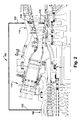
- FIG. 2 a schematic representation of a gas turbine engine 100 is illustrated.
- gas turbine engines operate by extracting energy from a pressurized flow of hot gas that is produced by the combustion of a fuel in a stream of compressed air.
- Gas turbine engine 100 may be configured with an axial compressor 106 that is mechanically coupled by a common shaft or rotor to a downstream turbine section or turbine 110, and a combustor 112 positioned between the compressor 106 and the turbine 110.
- the invention of the present application may be used in all types of industrial applications and other types of uses, including gas turbine engines, aircraft engines and others. Hereinafter, the invention will be described in relation to gas turbine engines. This description is exemplary only and not intended to be limiting.
- the compressor 106 may include a plurality of stages. Each stage may include a row of compressor rotor blades followed by a row of compressor stator blades. Thus, a first stage may include a row of compressor rotor blades, which rotate about a central shaft, followed by a row of compressor stator blades, which remain stationary during operation.
- the compressor stator blades generally are circumferentially spaced one from the other and fixed about the axis of rotation.
- the compressor rotor blades are circumferentially spaced and attached to the shaft such that when the shaft rotates during operation, the compressor rotor blades 120 rotate about it.
- the compressor rotor blades 120 are configured such that, when spun about the shaft, they impart kinetic energy to the air or working fluid flowing through the compressor 106.
- the turbine 110 also may include a plurality of stages.
- a stage may include, as shown, a plurality of turbine buckets or turbine rotor blades, which rotate about the shaft during operation, and a plurality of nozzles or turbine stator blades, which remain stationary during operation.
- the turbine stator blades generally are circumferentially spaced one from the other and fixed about the axis of rotation.
- the turbine rotor blades may be mounted on a turbine wheel for rotation about the shaft. It will be appreciated that the turbine stator blades and turbine rotor blades lie in the hot gas path of the turbine.
- the rotation of compressor rotor blades within the axial compressor 106 may compress a flow of air.
- energy may be released when the compressed air is mixed with a fuel and ignited.
- the resulting flow of hot gases from the combustor 112 then may be directed over the turbine rotor blades in the turbine 110, which may induce the rotation of the turbine rotor blades about the shaft, thus transforming the energy of the hot flow of gases into the mechanical energy of the rotating blades and, because of the connection between the rotor blades in the shaft, the rotating shaft.
- the mechanical energy of the shaft may then be used to drive the rotation of the compressor rotor blades, such that the necessary supply of compressed air is produced, and also, for example, a generator to produce electricity.
- compressed air is often bled from the compressor 106 and channeled to areas within the turbine 110.
- purge air may be bled from the latter stages of the compressor and directed via a passageway or pipe outside of the turbine casing to the stator blades of the third stage of the turbine 110.
- the purge air may be directed back into the turbine casing and piped in a radially inward direction (using, for a portion of the distance, a channel through the turbine stator blades) to a location near the rotor wheels and shaft where the purge are is required.
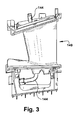
- FIG 3 illustrates an exemplary stator blade 140 and the orientation of a purge air delivery pipe 144 that may be in the system described above to deliver purge air from the compressor 106 to a position that is radially inward of the stator blade 140.
- the purge air delivery pipe 144 may include an initial section that runs from a radially outward position, which may be located near the turbine casing that surrounds the turbine, to the stator blade 140. The purge air then may flow through the stator blade 140, the passageway for which is not shown in Figure 3 , and continue in a radially inward direction through a second section of the purge air delivery pipe 144.
- the second section of the purge air delivery pipe 144 may direct the purge air from the stator blade 140 to a position that is radially inward of the stator blade 140, where the purge air may be released.
- the purge air once delivered, may both cool the rotor wheels and shaft of the turbine 110 and create a positive pressure flow through that space that helps prevent the hot-gas of the working fluid from reaching that inner radial position. The cooler the purge air is at delivery, the more effective it is at performing these functions.
- the purge air delivery pipe 144 once inside the turbine casing, traverses through a space wherein it is surrounded by extreme temperatures.
- the purge air delivery pipe 144 is constructed with steel or stainless steel and, thus, has an emissivity coefficient of approximately 0.5 to 0.8.
- a significant amount of heat is transferred through the purge air delivery pipe 144 between the surrounding areas of extreme heat and the coolant, i.e., the compressed air, flowing therethrough.
- the purge air delivery pipe 144 may be constructed of or have a coating made of a material with a low emissivity coefficient, i.e., a material that has a emissivity coefficient of less than about 0.1 or, more preferably, less than about 0.06 or, ideally, less than about 0.03. Test data confirms that a reduction in the emissivity coefficient of this nature and magnitude for the purge air delivery pipe 144 has a significant impact in decreasing the temperature of the purge air at its release point.
Landscapes
- Engineering & Computer Science (AREA)
- Chemical & Material Sciences (AREA)
- Combustion & Propulsion (AREA)
- Mechanical Engineering (AREA)
- General Engineering & Computer Science (AREA)
- Physics & Mathematics (AREA)
- Fluid Mechanics (AREA)
- Turbine Rotor Nozzle Sealing (AREA)
- Structures Of Non-Positive Displacement Pumps (AREA)
- Thermal Insulation (AREA)
Abstract
Description
- This present application relates generally to apparatus, methods and/or systems concerning improved fluid delivery through pipes or passageways in industrial and other applications. More particularly, but not by way of limitation, the present application relates to apparatus, methods and/or systems pertaining to improved delivery of a fluid gas through a passageway with low emissivity characteristics such that the flow is delivered with a lower relative temperature.
- In many industrial applications, machine parts are exposed to high temperatures. Often, a fluid coolant, such as water or air, is piped to the part through a hollow passageway and, upon the reaching the part, directed such that it flows over or through the part and, thereby, cools it. To the extent that it reaches the part at a lower temperature, the coolant is more effective at cooling it. However, to reach many part locations in industrial applications, such as, for example, hot-gas path parts in gas turbine engines, the coolant often has to flow through passageways that traverse areas of elevated temperature. Generally, these areas impart a significant amount of heat to the passageway or pipe through which the coolant flows, which, in turn, imparts a significant amount of heat to the coolant. This raises the temperature level of the coolant and, thereby, decreases the effectiveness of the coolant when it reaches the particular machine part it was meant to cool. As a result, there is a need for apparatus, methods and/or systems that improve the delivery of a fluid coolant through a passageway such that the coolant flow is delivered without absorbing heat from the passageway's surroundings. Various aspects of the present invention address this need, and further provide related advantages as discussed in detail below.
- The present application thus describes a hollow passageway that is configured to direct the flow of a fluid, the hollow passageway comprising an outer surface that substantially has a low emissivity coefficient.
- The present application further describes, in an industrial machine, a hollow passageway that is configured to transport a fluid coolant through a space that during operation resides at a significantly higher temperature than a desired temperature of the fluid coolant, wherein the hollow passageway comprises an outer surface that substantially has an emissivity coefficient less than about 0.1.
- The present application further describes a method of constructing an industrial machine such that, in operation, a supply of a fluid coolant through a hollow passageway is delivered at a reduced temperature, the method including the steps of:
- a) identifying at least a section of the hollow passageway that transports or is meant to transport the fluid coolant through a space that resides at a temperature that is significantly higher than a desired temperature of the fluid coolant; and b) through at least a majority of the identified section of the hollow passageway that transports the fluid coolant through the space that resides at the temperature that is significantly higher than the desired temperature of the fluid coolant, constructing the hollow passageway such that the outer surface of the hollow passageway has an emissivity coefficient less than about 0.1.
- These and other features of the present application will become apparent upon review of the following detailed description of the preferred embodiments when taken in conjunction with the drawings and the appended claims.
- Various objects and advantages of this invention will be more completely understood and appreciated by careful study of the following more detailed description of exemplary embodiments of the invention taken in conjunction with the accompanying drawings, in which:
-
Figure 1 is a schematic representation of an exemplary passageway or pipe according to an exemplary embodiment of the present application; -
Figure 2 is a section view of a turbine engine in which an application of an embodiment of the present invention may be used; and -
Figure 3 is a view of a turbine stator blade that may be used in the turbine section of the turbine engine shown inFigure 2 . - The emissivity of a material, which is usually written as "ε", is the ratio of energy radiated by a particular material to energy radiated by a black body at the same temperature. It is a measure of a material's ability to radiate absorbed energy. A true black body would have an ε = 1 while any real object would have ε < 1. Emissivity, which is often expressed as an "emissivity coefficient", is a dimensionless quantity (i.e., does not have units). In general, the duller and blacker a material is, the closer its emissivity coefficient is to 1. Whereas, the more reflective a material is, the lower its emissivity coefficient.
- It is known in the art that the use of low emissivity coatings may be applied to the surfaces of machine parts that are exposed to high temperatures. In this manner, the amount of heat absorbed by the part may be lessened. Thus, if, for example, an oppositely disposed surface of the part is cooled with a flow of cooling air, the maximum temperature reached by the part will be determined by a balance between the amount of heat that enters the part from the heated surface and the amount of heat removed by the cooling air flow over the cooled surface. The combination of cooling the part in this manner and limiting (with a low emissivity coating) the heat absorbed results in a part that operates at a lower temperature, which, in general, allows the part to operate more effectively and/or have a longer life.
- Various aspects of the invention of the present application involve using materials with a relatively low emissivity coefficient to construct or use as an outer coating to passageways or pipes that transport a fluid such that the passageway absorbs less energy and, thereby, the fluid absorbs less energy during transport. That is, the outer surface of the passageway, according to the present invention, is formed with a material that has a low emissivity coefficient such that the fluid flowing through the passageway absorbs less energy from the space that surrounds the passageway than it would if the outer surface of the passageway is formed with a material with higher emissivity coefficient.
- In some embodiments of the present application, a material having a "low" emissivity coefficient may be defined as any material that has an emissivity coefficient of less than approximately 0.1. In other more preferred embodiments, a "low" emissivity coefficient may be defined as any material that has an emissivity coefficient of less than approximately 0.06. In other more ideal embodiments, a "low" emissivity coefficient may be defined as any material that has an emissivity coefficient of less than approximately 0.03. Note, as used herein, "emissivity" or "emissivity coefficient" is the radiation of heat from a "grey body" according to the Stefan-Boltzmann Law compared with the radiation of heat from an ideal "black body" with the emissivity coefficient ε = 1. Further, as the emissivity coefficients for some materials vary with temperature, the emissivity coefficients identified herein are based on the emissivity at a temperature of 300 K.
- Typically, as one of ordinary skill in the art will appreciate, industrial applications that transport or direct a fluid through areas of elevated temperature use a passageway formed with an outer layer of steel or stainless steel. The emissivity coefficient of steel and stainless steel generally ranges between 0.1 (if highly polished) and 0.8. While the emissivity coefficient of steel and stainless steel when polished is relatively low, in practice, the use of such steel or stainless steel does not render a low emissivity value for a long period. That is, with use, the steel or stainless steel becomes weathered, which causes its emissivity coefficient to rise steeply toward the higher end of the above-referenced range.
- Consistent with embodiments of the present application, passageways may be formed that have an outer surface or coating of a material with a low emissivity coefficient. For example,
Figure 1 illustrates a section view of apassageway 30 consistent with the present application. Thepassageway 30 may have aninner channel 32 through which a coolant may flow. Theinner channel 32 may be bound by awall 34, the outer surface of which then may be covered by a material that forms anouter surface coating 36. As described, theouter surface coating 36 may be formed with a material that has an emissivity coefficient of less than about 0.1. Accordingly, in an exemplary embodiment of the present invention, theouter surface coating 36 may be formed with a coating of cadmium (which, generally, has an emissivity coefficient of approximately 0.02). In another exemplary embodiment of the present invention, theouter surface coating 36 may be formed with a coating of chromium (which, generally, has an emissivity coefficient of approximately 0.07). In another exemplary embodiment of the present invention, theouter surface coating 36 may be formed with a coating of polished copper (which, generally, has an emissivity coefficient of approximately 0.03). In another exemplary embodiment of the present invention, theouter surface coating 36 may be formed with a coating of a copper nickel alloy (which, generally, has an emissivity coefficient of approximately 0.06). In another exemplary embodiment of the present invention, theouter surface coating 36 may be formed with a coating of electroplated nickel (which, generally, has an emissivity coefficient of approximately 0.03). In another exemplary embodiment of the present invention, theouter surface coating 36 may be formed with a coating of polished nickel (which, generally, has an emissivity coefficient of approximately 0.07). In another exemplary embodiment of the present invention, theouter surface coating 36 may be formed with a coating of platinum (which, generally, has an emissivity coefficient of approximately 0.05). In another exemplary embodiment of the present invention, theouter surface coating 36 may be formed with a coating of silver (which, generally, has an emissivity coefficient of approximately 0.06 and, when polished, has an emissivity coefficient of approximately 0.03). In another exemplary embodiment of the present invention, theouter surface coating 36 may be formed with a coating of unoxidized tin (which, generally, has an emissivity coefficient of approximately 0.04). In another exemplary embodiment of the present invention, theouter surface coating 36 may be formed with a coating of polished tungsten (which, generally, has an emissivity coefficient of approximately 0.04). In another exemplary embodiment of the present invention, theouter surface coating 36 may be formed with a coating of gold (which, generally, has an emissivity coefficient of approximately 0.03). - It will be appreciated that the
wall 34 may be formed with any of the previously listed low emissivity materials, in which case there would be no need for anouter surface coating 36. Given the general expense of some of the low emissivity materials and their poor strength characteristics, the minimalistic use of them as outer surface coatings may be more cost-effective. - As stated, various embodiments of the invention of the present application may be used in many industrial applications. For the sake of illustration, an exemplary application will be described. This application involves transporting a coolant, in this case compressed air, through a gas turbine engine to cool parts, the location of which require the transporting passageway to pass through areas of extreme temperatures. This type of application may be common to many industrial applications. Referring to
Figure 2 , a schematic representation of agas turbine engine 100 is illustrated. In general, as one of ordinary skill in the art will appreciate, gas turbine engines operate by extracting energy from a pressurized flow of hot gas that is produced by the combustion of a fuel in a stream of compressed air.Gas turbine engine 100 may be configured with anaxial compressor 106 that is mechanically coupled by a common shaft or rotor to a downstream turbine section orturbine 110, and acombustor 112 positioned between thecompressor 106 and theturbine 110. Note, as stated, the invention of the present application may be used in all types of industrial applications and other types of uses, including gas turbine engines, aircraft engines and others. Hereinafter, the invention will be described in relation to gas turbine engines. This description is exemplary only and not intended to be limiting. - As shown, the
compressor 106 may include a plurality of stages. Each stage may include a row of compressor rotor blades followed by a row of compressor stator blades. Thus, a first stage may include a row of compressor rotor blades, which rotate about a central shaft, followed by a row of compressor stator blades, which remain stationary during operation. The compressor stator blades generally are circumferentially spaced one from the other and fixed about the axis of rotation. The compressor rotor blades are circumferentially spaced and attached to the shaft such that when the shaft rotates during operation, the compressor rotor blades 120 rotate about it. The compressor rotor blades 120 are configured such that, when spun about the shaft, they impart kinetic energy to the air or working fluid flowing through thecompressor 106. - The
turbine 110 also may include a plurality of stages. A stage may include, as shown, a plurality of turbine buckets or turbine rotor blades, which rotate about the shaft during operation, and a plurality of nozzles or turbine stator blades, which remain stationary during operation. The turbine stator blades generally are circumferentially spaced one from the other and fixed about the axis of rotation. The turbine rotor blades may be mounted on a turbine wheel for rotation about the shaft. It will be appreciated that the turbine stator blades and turbine rotor blades lie in the hot gas path of the turbine. - In use, the rotation of compressor rotor blades within the
axial compressor 106 may compress a flow of air. In thecombustor 112, energy may be released when the compressed air is mixed with a fuel and ignited. The resulting flow of hot gases from thecombustor 112 then may be directed over the turbine rotor blades in theturbine 110, which may induce the rotation of the turbine rotor blades about the shaft, thus transforming the energy of the hot flow of gases into the mechanical energy of the rotating blades and, because of the connection between the rotor blades in the shaft, the rotating shaft. The mechanical energy of the shaft may then be used to drive the rotation of the compressor rotor blades, such that the necessary supply of compressed air is produced, and also, for example, a generator to produce electricity. - Those skilled in the art will appreciate that compressed air is often bled from the
compressor 106 and channeled to areas within theturbine 110. In one such application, as depicted byarrow 132, purge air may be bled from the latter stages of the compressor and directed via a passageway or pipe outside of the turbine casing to the stator blades of the third stage of theturbine 110. At this location, the purge air, as further indicated byarrows 134, may be directed back into the turbine casing and piped in a radially inward direction (using, for a portion of the distance, a channel through the turbine stator blades) to a location near the rotor wheels and shaft where the purge are is required. -
Figure 3 illustrates anexemplary stator blade 140 and the orientation of a purgeair delivery pipe 144 that may be in the system described above to deliver purge air from thecompressor 106 to a position that is radially inward of thestator blade 140. As shown, the purgeair delivery pipe 144 may include an initial section that runs from a radially outward position, which may be located near the turbine casing that surrounds the turbine, to thestator blade 140. The purge air then may flow through thestator blade 140, the passageway for which is not shown inFigure 3 , and continue in a radially inward direction through a second section of the purgeair delivery pipe 144. The second section of the purgeair delivery pipe 144 may direct the purge air from thestator blade 140 to a position that is radially inward of thestator blade 140, where the purge air may be released. As one of ordinary skill in the art will appreciate, the purge air, once delivered, may both cool the rotor wheels and shaft of theturbine 110 and create a positive pressure flow through that space that helps prevent the hot-gas of the working fluid from reaching that inner radial position. The cooler the purge air is at delivery, the more effective it is at performing these functions. - It will be appreciated that the purge
air delivery pipe 144, once inside the turbine casing, traverses through a space wherein it is surrounded by extreme temperatures. In conventional systems, the purgeair delivery pipe 144 is constructed with steel or stainless steel and, thus, has an emissivity coefficient of approximately 0.5 to 0.8. As a result, a significant amount of heat is transferred through the purgeair delivery pipe 144 between the surrounding areas of extreme heat and the coolant, i.e., the compressed air, flowing therethrough. Pursuant to embodiments of the present application, the purgeair delivery pipe 144 may be constructed of or have a coating made of a material with a low emissivity coefficient, i.e., a material that has a emissivity coefficient of less than about 0.1 or, more preferably, less than about 0.06 or, ideally, less than about 0.03. Test data confirms that a reduction in the emissivity coefficient of this nature and magnitude for the purgeair delivery pipe 144 has a significant impact in decreasing the temperature of the purge air at its release point. - From the above description of preferred embodiments of the invention, those skilled in the art will perceive improvements, changes and modifications. Such improvements, changes and modifications within the skill of the art are intended to be covered by the appended claims. Further, it should be apparent that the foregoing relates only to the described embodiments of the present application and that numerous changes and modifications may be made herein without departing from the spirit and scope of the application as defined by the following claims and the equivalents thereof.
- Various aspects and embodiments of the present invention are defined by the following numbered clauses:
- 1. A hollow passageway that is configured to direct the flow of a fluid, the hollow passageway comprising an outer surface that substantially has a low emissivity coefficient.
- 2. The hollow passageway of clause 1, wherein the low emissivity coefficient comprises an emissivity coefficient of less than about 0.1.
- 3. The hollow passageway of any preceding clause, wherein the low emissivity coefficient comprises an emissivity coefficient of less than about 0.06.
- 4. The hollow passageway of any preceding clause, wherein the low emissivity coefficient comprises an emissivity coefficient of less than about 0.03.
- 5. The hollow passageway of any preceding clause, wherein the outer surface comprises one of cadmium, chromium, polished copper, copper nickel alloy, electroplated nickel, polished nickel, platinum, silver, polished silver, unoxidized tin, polished tungsten, and gold.
- 6. The hollow passageway of any preceding clause, wherein the hollow passageway comprises an inner channel bound by a wall and, covering the outer surface of the wall, an outer surface coating that is formed with a material that provides the outer surface that substantially has an emissivity coefficient of less than about 0.1.
- 7. The hollow passageway of any preceding clause, wherein the hollow passageway comprises an inner channel bound by a wall and, covering the outer surface of the wall, an outer surface coating that is formed with a material that provides the outer surface that substantially has an emissivity coefficient of less than about 0.06.
- 8. The hollow passageway of any preceding clause, wherein the hollow passageway comprises an inner channel bound by a wall and, covering the outer surface of the wall, an outer surface coating that is formed with a material that provides the outer surface that substantially has an emissivity coefficient of less than about 0.03.
- 9. The hollow passageway of any preceding clause, wherein the outer surface coating comprises one of cadmium, chromium, polished copper, copper nickel alloy, electroplated nickel, polished nickel, platinum, silver, polished silver, unoxidized tin, polished tungsten, and gold.
- 10. In an industrial machine, a hollow passageway that is configured to transport a fluid coolant through a space that during operation resides at a significantly higher temperature than a desired temperature of the fluid coolant, the hollow passageway comprising an outer surface that substantially has an emissivity coefficient less than about 0.1.
- 11. The hollow passageway of any preceding clause, wherein the outer surface substantially has an emissivity coefficient less than about 0.06.
- 12. The hollow passageway of any preceding clause, wherein the outer surface substantially has an emissivity coefficient less than about 0.03.
- 13. The hollow passageway of any preceding clause, wherein the hollow passageway comprises an inner channel bound by a wall and, covering the outer surface of the wall, an outer surface coating that is formed with a material that provides the outer surface that substantially has an emissivity coefficient of less than about 0.1.
- 14. The hollow passageway of any preceding clause, wherein the hollow passageway comprises an inner channel bound by a wall and, covering the outer surface of the wall, an outer surface coating that is formed with a material that provides the outer surface that substantially has an emissivity coefficient of less than about 0.06.
- 15. The hollow passageway of any preceding clause, wherein the hollow passageway comprises an inner channel bound by a wall and, covering the outer surface of the wall, an outer surface coating that is formed with a material that provides the outer surface that substantially has an emissivity coefficient of less than about 0.03.
- 16. The hollow passageway of any preceding clause, wherein the outer surface coating comprises one of cadmium, chromium, polished copper, copper nickel alloy, electroplated nickel, polished nickel, platinum, silver, polished silver, unoxidized tin, polished tungsten, and gold.
- 17. The hollow passageway of any preceding clause, wherein:
- the industrial machine is a gas turbine engine; and
- the hollow passageway is configured to transport compressed air extracted from the compressor to a location in the turbine.
- 18. The hollow passageway of any preceding clause, wherein the hollow passageway comprises a purge air delivery pipe.
- 19. A method of constructing an industrial machine such that, in operation, a supply of a fluid coolant through a hollow passageway is delivered at a reduced temperature, the method including the steps of:
- a) identifying at least a section of the hollow passageway that transports or is meant to transport the fluid coolant through a space that resides at a temperature that is significantly higher than a desired temperature of the fluid coolant; and
- b) through at least a majority of the identified section of the hollow passageway that transports the fluid coolant through the space that resides at the temperature that is significantly higher than the desired temperature of the fluid coolant, constructing the hollow passageway such that the outer surface of the hollow passageway has an emissivity coefficient less than about 0.1.
- 20. The method of clause 19, wherein the industrial machine comprises a gas turbine engine having a compressor section and a turbine section; and
wherein the identified section of the hollow passageway is configured to transport compressed air extracted from the compressor section to a location in the turbine section.
Claims (10)
- An industrial machine, comprising a hollow passageway (30) that is configured to transport a fluid coolant through a space that during operation resides at a significantly higher temperature than a desired temperature of the fluid coolant, the hollow passageway (30) comprising an outer surface that substantially has an emissivity coefficient less than about 0.1.
- The machine of any preceding claim, wherein the outer surface substantially has an emissivity coefficient less than about 0.06.
- The machine of any preceding claim, wherein the outer surface substantially has an emissivity coefficient less than about 0.03.
- The machine of any preceding claim, wherein the hollow passageway (30) comprises an inner channel (32) bound by a wall (34) and, covering the outer surface of the wall (34), an outer surface coating (36) that is formed with a material that provides the outer surface that substantially has an emissivity coefficient of less than about 0.1.
- The machine of any preceding claim, wherein the hollow passageway (30) comprises an inner channel (32) bound by a wall (34) and, covering the outer surface of the wall (34), an outer surface coating (36) that is formed with a material that provides the outer surface that substantially has an emissivity coefficient of less than about 0.06.
- The machine of any preceding claim, wherein the outer surface coating (36) comprises one of cadmium, chromium, polished copper, copper nickel alloy, electroplated nickel, polished nickel, platinum, silver, polished silver, unoxidized tin, polished tungsten, and gold.
- The machine of any preceding claim, wherein the hollow passageway (30) comprises an inner channel (32) bound by a wall (34) and, covering the outer surface of the wall (34), an outer surface coating (36) that is formed with a material that provides the outer surface that substantially has an emissivity coefficient of less than about 0.03.
- The machine of any preceding claim, wherein the outer surface coating (36) comprises one of cadmium, chromium, polished copper, copper nickel alloy, electroplated nickel, polished nickel, platinum, silver, polished silver, unoxidized tin, polished tungsten, and gold.
- The machine of any preceding claim , wherein:the industrial machine is a gas turbine engine (100); andthe hollow passageway (30) is configured to transport compressed air extracted from the compressor (106) to a location in the turbine (110).
- The machine of any preceding claim, wherein the hollow passageway (30) comprises a purge air delivery pipe (144).
Applications Claiming Priority (1)
| Application Number | Priority Date | Filing Date | Title |
|---|---|---|---|
| US12/394,138 US8162007B2 (en) | 2009-02-27 | 2009-02-27 | Apparatus, methods, and/or systems relating to the delivery of a fluid through a passageway |
Publications (2)
| Publication Number | Publication Date |
|---|---|
| EP2224113A2 true EP2224113A2 (en) | 2010-09-01 |
| EP2224113A3 EP2224113A3 (en) | 2017-12-06 |
Family
ID=41667560
Family Applications (1)
| Application Number | Title | Priority Date | Filing Date |
|---|---|---|---|
| EP10153143.2A Withdrawn EP2224113A3 (en) | 2009-02-27 | 2010-02-10 | Isothermic delivery of a cooling fluid through a passageway |
Country Status (4)
| Country | Link |
|---|---|
| US (1) | US8162007B2 (en) |
| EP (1) | EP2224113A3 (en) |
| JP (1) | JP5675129B2 (en) |
| CN (2) | CN104696670A (en) |
Cited By (2)
| Publication number | Priority date | Publication date | Assignee | Title |
|---|---|---|---|---|
| EP2489834A3 (en) * | 2011-02-18 | 2014-07-23 | General Electric Company | Apparatus, method and system for separating particles from a fluid stream |
| EP3550106A1 (en) * | 2018-04-06 | 2019-10-09 | Frederick M. Schwarz | Cooling air for gas turbine engine with thermally isolated cooling air delivery |
Families Citing this family (2)
| Publication number | Priority date | Publication date | Assignee | Title |
|---|---|---|---|---|
| US9121299B2 (en) | 2013-06-05 | 2015-09-01 | General Electric Company | Axially retractable brush seal system |
| US10731483B2 (en) * | 2015-12-08 | 2020-08-04 | General Electric Company | Thermal management article |
Family Cites Families (17)
| Publication number | Priority date | Publication date | Assignee | Title |
|---|---|---|---|---|
| US3354652A (en) * | 1965-04-23 | 1967-11-28 | Thiokol Chemical Corp | Rocket thrust chamber |
| US4136516A (en) * | 1977-06-03 | 1979-01-30 | General Electric Company | Gas turbine with secondary cooling means |
| US5025862A (en) * | 1989-11-30 | 1991-06-25 | Union Oil Company Of California | Steam injection piping |
| JPH03233140A (en) * | 1990-02-08 | 1991-10-17 | Hitachi Ltd | Air passage for cooling gas turbine rotor blades |
| US5340274A (en) * | 1991-11-19 | 1994-08-23 | General Electric Company | Integrated steam/air cooling system for gas turbines |
| CN1162346A (en) * | 1994-10-26 | 1997-10-15 | 西屋电气公司 | Gas turbine blade with cooled shroud |
| US6210791B1 (en) | 1995-11-30 | 2001-04-03 | General Electric Company | Article with a diffuse reflective barrier coating and a low-emissity coating thereon, and its preparation |
| DE19640298A1 (en) * | 1996-09-30 | 1998-04-09 | Siemens Ag | Steam turbine, method for cooling a steam turbine in ventilation mode and method for reducing condensation in a steam turbine in power mode |
| GB2348466B (en) * | 1999-03-27 | 2003-07-09 | Rolls Royce Plc | A gas turbine engine and a rotor for a gas turbine engine |
| US6884023B2 (en) * | 2002-09-27 | 2005-04-26 | United Technologies Corporation | Integral swirl knife edge injection assembly |
| ATE382585T1 (en) | 2003-06-24 | 2008-01-15 | Cardinal Cg Co | CONCENTRATION MODULATED COATINGS |
| US6854487B2 (en) * | 2003-06-26 | 2005-02-15 | General Electric Company | Fluid conduit wall inhibiting heat transfer and method for making |
| GB2411697B (en) * | 2004-03-06 | 2006-06-21 | Rolls Royce Plc | A turbine having a cooling arrangement |
| US20060222846A1 (en) * | 2005-04-01 | 2006-10-05 | General Electric Company | Reflective and resistant coatings and methods for applying to composite structures |
| US8277169B2 (en) * | 2005-06-16 | 2012-10-02 | Honeywell International Inc. | Turbine rotor cooling flow system |
| JP2008075852A (en) * | 2006-09-25 | 2008-04-03 | Sekisui Chem Co Ltd | Insulation for piping |
| US7836703B2 (en) * | 2007-06-20 | 2010-11-23 | General Electric Company | Reciprocal cooled turbine nozzle |
-
2009
- 2009-02-27 US US12/394,138 patent/US8162007B2/en active Active
-
2010
- 2010-02-10 EP EP10153143.2A patent/EP2224113A3/en not_active Withdrawn
- 2010-02-25 JP JP2010039504A patent/JP5675129B2/en active Active
- 2010-02-26 CN CN201510020354.7A patent/CN104696670A/en active Pending
- 2010-02-26 CN CN2010101323596A patent/CN101893154A/en active Pending
Non-Patent Citations (1)
| Title |
|---|
| None |
Cited By (5)
| Publication number | Priority date | Publication date | Assignee | Title |
|---|---|---|---|---|
| EP2489834A3 (en) * | 2011-02-18 | 2014-07-23 | General Electric Company | Apparatus, method and system for separating particles from a fluid stream |
| US9206693B2 (en) | 2011-02-18 | 2015-12-08 | General Electric Company | Apparatus, method, and system for separating particles from a fluid stream |
| EP3550106A1 (en) * | 2018-04-06 | 2019-10-09 | Frederick M. Schwarz | Cooling air for gas turbine engine with thermally isolated cooling air delivery |
| US11428121B2 (en) | 2018-04-06 | 2022-08-30 | Raytheon Technologies Corporation | Cooling air for gas turbine engine with thermally isolated cooling air delivery |
| US11920485B2 (en) | 2018-04-06 | 2024-03-05 | Rtx Corporation | Cooling air for gas turbine engine with thermally isolated cooling air delivery |
Also Published As
| Publication number | Publication date |
|---|---|
| US20100221099A1 (en) | 2010-09-02 |
| US8162007B2 (en) | 2012-04-24 |
| JP2010203436A (en) | 2010-09-16 |
| CN104696670A (en) | 2015-06-10 |
| EP2224113A3 (en) | 2017-12-06 |
| CN101893154A (en) | 2010-11-24 |
| JP5675129B2 (en) | 2015-02-25 |
Similar Documents
| Publication | Publication Date | Title |
|---|---|---|
| US8789377B1 (en) | Gas turbine engine with liquid metal cooling | |
| JP6746335B2 (en) | Heat pipe temperature management system for turbomachinery | |
| JP6188094B2 (en) | Fan bearing for turbine engine | |
| US20110247344A1 (en) | Rear hub cooling for high pressure compressor | |
| EP3577321B1 (en) | Coated flange bolt hole and methods of forming the same | |
| EP3231993B1 (en) | Method for in situ balancing of a rotating component of a gas turbine engine | |
| US8162007B2 (en) | Apparatus, methods, and/or systems relating to the delivery of a fluid through a passageway | |
| CN105909317A (en) | Engine component | |
| US10738648B2 (en) | Graphene discs and bores and methods of preparing the same | |
| US9963982B2 (en) | Casting optimized to improve suction side cooling shaped hole performance | |
| US9759078B2 (en) | Airfoil module | |
| CA2956352A1 (en) | In situ gas turbine prevention of crack growth progression | |
| US20110132571A1 (en) | Systems relating to geothermal energy and the operation of gas turbine engines | |
| JP6585073B2 (en) | Heat pipe temperature management system for wheels and buckets in turbomachinery | |
| US10502060B2 (en) | Rotor and gas turbine engine including same | |
| US20180087398A1 (en) | Gas turbine engine with graphene heat pipe | |
| CN103470318B (en) | Control method and the compressor of turbogenerator of turbine engine compressor temperature | |
| JP4920590B2 (en) | Protective device for turbine stator | |
| CN111485184A (en) | Shot peening of coated inner surfaces of turbine components | |
| EP3647542B1 (en) | Intercooled tangential air injector for gas turbine engines | |
| JP2022162972A (en) | Turbine load coupling cooling system | |
| Ratkovská et al. | The Analyses for the Casing Improvements of the MPM-20 Engine | |
| Hasegawa et al. | Research on application of ceramic turbine to jet engine |
Legal Events
| Date | Code | Title | Description |
|---|---|---|---|
| PUAI | Public reference made under article 153(3) epc to a published international application that has entered the european phase |
Free format text: ORIGINAL CODE: 0009012 |
|
| AK | Designated contracting states |
Kind code of ref document: A2 Designated state(s): AT BE BG CH CY CZ DE DK EE ES FI FR GB GR HR HU IE IS IT LI LT LU LV MC MK MT NL NO PL PT RO SE SI SK SM TR |
|
| AX | Request for extension of the european patent |
Extension state: AL BA RS |
|
| PUAL | Search report despatched |
Free format text: ORIGINAL CODE: 0009013 |
|
| AK | Designated contracting states |
Kind code of ref document: A3 Designated state(s): AT BE BG CH CY CZ DE DK EE ES FI FR GB GR HR HU IE IS IT LI LT LU LV MC MK MT NL NO PL PT RO SE SI SK SM TR |
|
| AX | Request for extension of the european patent |
Extension state: AL BA RS |
|
| RIC1 | Information provided on ipc code assigned before grant |
Ipc: F02C 7/24 20060101AFI20171101BHEP Ipc: F01D 25/08 20060101ALI20171101BHEP Ipc: F01D 25/12 20060101ALI20171101BHEP |
|
| 17P | Request for examination filed |
Effective date: 20180606 |
|
| GRAP | Despatch of communication of intention to grant a patent |
Free format text: ORIGINAL CODE: EPIDOSNIGR1 |
|
| RBV | Designated contracting states (corrected) |
Designated state(s): AT BE BG CH CY CZ DE DK EE ES FI FR GB GR HR HU IE IS IT LI LT LU LV MC MK MT NL NO PL PT RO SE SI SK SM TR |
|
| RIC1 | Information provided on ipc code assigned before grant |
Ipc: F01D 25/08 20060101ALI20180628BHEP Ipc: F02C 7/24 20060101ALI20180628BHEP Ipc: F02C 9/18 20060101AFI20180628BHEP |
|
| INTG | Intention to grant announced |
Effective date: 20180719 |
|
| STAA | Information on the status of an ep patent application or granted ep patent |
Free format text: STATUS: THE APPLICATION IS DEEMED TO BE WITHDRAWN |
|
| 18D | Application deemed to be withdrawn |
Effective date: 20181130 |