EP2223595A2 - System and Method for Using Electropositive Metals for Protecting Towed Marine Seismic Equipment from Shark Bite - Google Patents
System and Method for Using Electropositive Metals for Protecting Towed Marine Seismic Equipment from Shark Bite Download PDFInfo
- Publication number
- EP2223595A2 EP2223595A2 EP10153375A EP10153375A EP2223595A2 EP 2223595 A2 EP2223595 A2 EP 2223595A2 EP 10153375 A EP10153375 A EP 10153375A EP 10153375 A EP10153375 A EP 10153375A EP 2223595 A2 EP2223595 A2 EP 2223595A2
- Authority
- EP
- European Patent Office
- Prior art keywords
- seismic
- marine seismic
- equipment
- attached
- seismic equipment
- Prior art date
- Legal status (The legal status is an assumption and is not a legal conclusion. Google has not performed a legal analysis and makes no representation as to the accuracy of the status listed.)
- Granted
Links
- 229910052751 metal Inorganic materials 0.000 title claims abstract description 32
- 239000002184 metal Substances 0.000 title claims abstract description 32
- 241000251730 Chondrichthyes Species 0.000 title claims abstract description 29
- 238000000034 method Methods 0.000 title claims abstract description 14
- 150000002739 metals Chemical class 0.000 title description 12
- XLYOFNOQVPJJNP-UHFFFAOYSA-N water Substances O XLYOFNOQVPJJNP-UHFFFAOYSA-N 0.000 claims description 8
- 230000015572 biosynthetic process Effects 0.000 description 5
- 238000005755 formation reaction Methods 0.000 description 5
- 229910052747 lanthanoid Inorganic materials 0.000 description 4
- 230000002940 repellent Effects 0.000 description 4
- 239000005871 repellent Substances 0.000 description 4
- 229910052784 alkaline earth metal Inorganic materials 0.000 description 3
- 150000002602 lanthanoids Chemical class 0.000 description 3
- 239000013535 sea water Substances 0.000 description 3
- 230000001953 sensory effect Effects 0.000 description 3
- 241000251468 Actinopterygii Species 0.000 description 2
- 239000004215 Carbon black (E152) Substances 0.000 description 2
- 229910052684 Cerium Inorganic materials 0.000 description 2
- 229910052779 Neodymium Inorganic materials 0.000 description 2
- 229910052777 Praseodymium Inorganic materials 0.000 description 2
- 230000035508 accumulation Effects 0.000 description 2
- 238000009825 accumulation Methods 0.000 description 2
- 229910052783 alkali metal Inorganic materials 0.000 description 2
- 150000001340 alkali metals Chemical class 0.000 description 2
- 150000001342 alkaline earth metals Chemical class 0.000 description 2
- GWXLDORMOJMVQZ-UHFFFAOYSA-N cerium Chemical compound [Ce] GWXLDORMOJMVQZ-UHFFFAOYSA-N 0.000 description 2
- 238000005260 corrosion Methods 0.000 description 2
- 230000007797 corrosion Effects 0.000 description 2
- 229930195733 hydrocarbon Natural products 0.000 description 2
- 150000002430 hydrocarbons Chemical class 0.000 description 2
- 229910052746 lanthanum Inorganic materials 0.000 description 2
- FZLIPJUXYLNCLC-UHFFFAOYSA-N lanthanum atom Chemical compound [La] FZLIPJUXYLNCLC-UHFFFAOYSA-N 0.000 description 2
- VNWKTOKETHGBQD-UHFFFAOYSA-N methane Chemical compound C VNWKTOKETHGBQD-UHFFFAOYSA-N 0.000 description 2
- 238000012986 modification Methods 0.000 description 2
- 230000004048 modification Effects 0.000 description 2
- QEFYFXOXNSNQGX-UHFFFAOYSA-N neodymium atom Chemical compound [Nd] QEFYFXOXNSNQGX-UHFFFAOYSA-N 0.000 description 2
- 230000000737 periodic effect Effects 0.000 description 2
- 239000003208 petroleum Substances 0.000 description 2
- PUDIUYLPXJFUGB-UHFFFAOYSA-N praseodymium atom Chemical compound [Pr] PUDIUYLPXJFUGB-UHFFFAOYSA-N 0.000 description 2
- OYPRJOBELJOOCE-UHFFFAOYSA-N Calcium Chemical compound [Ca] OYPRJOBELJOOCE-UHFFFAOYSA-N 0.000 description 1
- 241000251477 Chimaera Species 0.000 description 1
- 229910052692 Dysprosium Inorganic materials 0.000 description 1
- 229910052691 Erbium Inorganic materials 0.000 description 1
- 229910052693 Europium Inorganic materials 0.000 description 1
- 229910052688 Gadolinium Inorganic materials 0.000 description 1
- 229910052689 Holmium Inorganic materials 0.000 description 1
- DGAQECJNVWCQMB-PUAWFVPOSA-M Ilexoside XXIX Chemical compound C[C@@H]1CC[C@@]2(CC[C@@]3(C(=CC[C@H]4[C@]3(CC[C@@H]5[C@@]4(CC[C@@H](C5(C)C)OS(=O)(=O)[O-])C)C)[C@@H]2[C@]1(C)O)C)C(=O)O[C@H]6[C@@H]([C@H]([C@@H]([C@H](O6)CO)O)O)O.[Na+] DGAQECJNVWCQMB-PUAWFVPOSA-M 0.000 description 1
- WHXSMMKQMYFTQS-UHFFFAOYSA-N Lithium Chemical compound [Li] WHXSMMKQMYFTQS-UHFFFAOYSA-N 0.000 description 1
- 229910052765 Lutetium Inorganic materials 0.000 description 1
- FYYHWMGAXLPEAU-UHFFFAOYSA-N Magnesium Chemical compound [Mg] FYYHWMGAXLPEAU-UHFFFAOYSA-N 0.000 description 1
- 229910001122 Mischmetal Inorganic materials 0.000 description 1
- ZLMJMSJWJFRBEC-UHFFFAOYSA-N Potassium Chemical compound [K] ZLMJMSJWJFRBEC-UHFFFAOYSA-N 0.000 description 1
- 229910052773 Promethium Inorganic materials 0.000 description 1
- 229910052772 Samarium Inorganic materials 0.000 description 1
- 229910052771 Terbium Inorganic materials 0.000 description 1
- 229910052775 Thulium Inorganic materials 0.000 description 1
- 229910052769 Ytterbium Inorganic materials 0.000 description 1
- RKLPWYXSIBFAJB-UHFFFAOYSA-N [Nd].[Pr] Chemical compound [Nd].[Pr] RKLPWYXSIBFAJB-UHFFFAOYSA-N 0.000 description 1
- 230000001154 acute effect Effects 0.000 description 1
- 239000000853 adhesive Substances 0.000 description 1
- 230000001070 adhesive effect Effects 0.000 description 1
- 238000004458 analytical method Methods 0.000 description 1
- 238000003491 array Methods 0.000 description 1
- 229910052788 barium Inorganic materials 0.000 description 1
- DSAJWYNOEDNPEQ-UHFFFAOYSA-N barium atom Chemical compound [Ba] DSAJWYNOEDNPEQ-UHFFFAOYSA-N 0.000 description 1
- 229910052790 beryllium Inorganic materials 0.000 description 1
- ATBAMAFKBVZNFJ-UHFFFAOYSA-N beryllium atom Chemical compound [Be] ATBAMAFKBVZNFJ-UHFFFAOYSA-N 0.000 description 1
- 210000004556 brain Anatomy 0.000 description 1
- 229910052792 caesium Inorganic materials 0.000 description 1
- TVFDJXOCXUVLDH-UHFFFAOYSA-N caesium atom Chemical compound [Cs] TVFDJXOCXUVLDH-UHFFFAOYSA-N 0.000 description 1
- 229910052791 calcium Inorganic materials 0.000 description 1
- 239000011575 calcium Substances 0.000 description 1
- 239000011248 coating agent Substances 0.000 description 1
- 238000000576 coating method Methods 0.000 description 1
- 230000007423 decrease Effects 0.000 description 1
- KBQHZAAAGSGFKK-UHFFFAOYSA-N dysprosium atom Chemical compound [Dy] KBQHZAAAGSGFKK-UHFFFAOYSA-N 0.000 description 1
- UYAHIZSMUZPPFV-UHFFFAOYSA-N erbium Chemical compound [Er] UYAHIZSMUZPPFV-UHFFFAOYSA-N 0.000 description 1
- OGPBJKLSAFTDLK-UHFFFAOYSA-N europium atom Chemical compound [Eu] OGPBJKLSAFTDLK-UHFFFAOYSA-N 0.000 description 1
- 238000011156 evaluation Methods 0.000 description 1
- 239000002360 explosive Substances 0.000 description 1
- 229910052730 francium Inorganic materials 0.000 description 1
- KLMCZVJOEAUDNE-UHFFFAOYSA-N francium atom Chemical compound [Fr] KLMCZVJOEAUDNE-UHFFFAOYSA-N 0.000 description 1
- UIWYJDYFSGRHKR-UHFFFAOYSA-N gadolinium atom Chemical compound [Gd] UIWYJDYFSGRHKR-UHFFFAOYSA-N 0.000 description 1
- 239000007789 gas Substances 0.000 description 1
- KJZYNXUDTRRSPN-UHFFFAOYSA-N holmium atom Chemical compound [Ho] KJZYNXUDTRRSPN-UHFFFAOYSA-N 0.000 description 1
- 229910052500 inorganic mineral Inorganic materials 0.000 description 1
- 150000002500 ions Chemical class 0.000 description 1
- -1 lanthanide metals Chemical class 0.000 description 1
- 229910052744 lithium Inorganic materials 0.000 description 1
- OHSVLFRHMCKCQY-UHFFFAOYSA-N lutetium atom Chemical compound [Lu] OHSVLFRHMCKCQY-UHFFFAOYSA-N 0.000 description 1
- 229910052749 magnesium Inorganic materials 0.000 description 1
- 239000011777 magnesium Substances 0.000 description 1
- 239000011707 mineral Substances 0.000 description 1
- 239000000203 mixture Substances 0.000 description 1
- 239000003345 natural gas Substances 0.000 description 1
- 235000008935 nutritious Nutrition 0.000 description 1
- 239000002245 particle Substances 0.000 description 1
- 229910052700 potassium Inorganic materials 0.000 description 1
- 239000011591 potassium Substances 0.000 description 1
- 230000008569 process Effects 0.000 description 1
- VQMWBBYLQSCNPO-UHFFFAOYSA-N promethium atom Chemical compound [Pm] VQMWBBYLQSCNPO-UHFFFAOYSA-N 0.000 description 1
- 230000001902 propagating effect Effects 0.000 description 1
- 230000002285 radioactive effect Effects 0.000 description 1
- 229910052705 radium Inorganic materials 0.000 description 1
- HCWPIIXVSYCSAN-UHFFFAOYSA-N radium atom Chemical compound [Ra] HCWPIIXVSYCSAN-UHFFFAOYSA-N 0.000 description 1
- 229910052761 rare earth metal Inorganic materials 0.000 description 1
- 150000002910 rare earth metals Chemical class 0.000 description 1
- 230000009257 reactivity Effects 0.000 description 1
- 102000005962 receptors Human genes 0.000 description 1
- 108020003175 receptors Proteins 0.000 description 1
- 239000011435 rock Substances 0.000 description 1
- 229910052701 rubidium Inorganic materials 0.000 description 1
- IGLNJRXAVVLDKE-UHFFFAOYSA-N rubidium atom Chemical compound [Rb] IGLNJRXAVVLDKE-UHFFFAOYSA-N 0.000 description 1
- KZUNJOHGWZRPMI-UHFFFAOYSA-N samarium atom Chemical compound [Sm] KZUNJOHGWZRPMI-UHFFFAOYSA-N 0.000 description 1
- 229910052706 scandium Inorganic materials 0.000 description 1
- SIXSYDAISGFNSX-UHFFFAOYSA-N scandium atom Chemical compound [Sc] SIXSYDAISGFNSX-UHFFFAOYSA-N 0.000 description 1
- 230000035945 sensitivity Effects 0.000 description 1
- 210000000697 sensory organ Anatomy 0.000 description 1
- 210000002265 sensory receptor cell Anatomy 0.000 description 1
- 102000027509 sensory receptors Human genes 0.000 description 1
- 108091008691 sensory receptors Proteins 0.000 description 1
- 230000035939 shock Effects 0.000 description 1
- 229910052708 sodium Inorganic materials 0.000 description 1
- 239000011734 sodium Substances 0.000 description 1
- 229910052712 strontium Inorganic materials 0.000 description 1
- CIOAGBVUUVVLOB-UHFFFAOYSA-N strontium atom Chemical compound [Sr] CIOAGBVUUVVLOB-UHFFFAOYSA-N 0.000 description 1
- 239000000126 substance Substances 0.000 description 1
- GZCRRIHWUXGPOV-UHFFFAOYSA-N terbium atom Chemical compound [Tb] GZCRRIHWUXGPOV-UHFFFAOYSA-N 0.000 description 1
- 231100000331 toxic Toxicity 0.000 description 1
- 230000002588 toxic effect Effects 0.000 description 1
- 230000007704 transition Effects 0.000 description 1
- 229910052723 transition metal Inorganic materials 0.000 description 1
- 150000003624 transition metals Chemical class 0.000 description 1
- 230000000007 visual effect Effects 0.000 description 1
- NAWDYIZEMPQZHO-UHFFFAOYSA-N ytterbium Chemical compound [Yb] NAWDYIZEMPQZHO-UHFFFAOYSA-N 0.000 description 1
- 229910052727 yttrium Inorganic materials 0.000 description 1
- VWQVUPCCIRVNHF-UHFFFAOYSA-N yttrium atom Chemical compound [Y] VWQVUPCCIRVNHF-UHFFFAOYSA-N 0.000 description 1
Images

Classifications
-
- G—PHYSICS
- G01—MEASURING; TESTING
- G01V—GEOPHYSICS; GRAVITATIONAL MEASUREMENTS; DETECTING MASSES OR OBJECTS; TAGS
- G01V1/00—Seismology; Seismic or acoustic prospecting or detecting
- G01V1/38—Seismology; Seismic or acoustic prospecting or detecting specially adapted for water-covered areas
-
- A—HUMAN NECESSITIES
- A01—AGRICULTURE; FORESTRY; ANIMAL HUSBANDRY; HUNTING; TRAPPING; FISHING
- A01K—ANIMAL HUSBANDRY; AVICULTURE; APICULTURE; PISCICULTURE; FISHING; REARING OR BREEDING ANIMALS, NOT OTHERWISE PROVIDED FOR; NEW BREEDS OF ANIMALS
- A01K79/00—Methods or means of catching fish in bulk not provided for in groups A01K69/00 - A01K77/00, e.g. fish pumps; Detection of fish; Whale fishery
- A01K79/02—Methods or means of catching fish in bulk not provided for in groups A01K69/00 - A01K77/00, e.g. fish pumps; Detection of fish; Whale fishery by electrocution
-
- A—HUMAN NECESSITIES
- A01—AGRICULTURE; FORESTRY; ANIMAL HUSBANDRY; HUNTING; TRAPPING; FISHING
- A01M—CATCHING, TRAPPING OR SCARING OF ANIMALS; APPARATUS FOR THE DESTRUCTION OF NOXIOUS ANIMALS OR NOXIOUS PLANTS
- A01M29/00—Scaring or repelling devices, e.g. bird-scaring apparatus
- A01M29/24—Scaring or repelling devices, e.g. bird-scaring apparatus using electric or magnetic effects, e.g. electric shocks, magnetic fields or microwaves
Definitions
- This invention relates generally to the field of geophysical prospecting. More particularly, the invention relates to the field of marine seismic surveys with towed seismic equipment.
- geophysical prospecting is commonly used to aid in the search for and evaluation of subterranean formations.
- Geophysical prospecting techniques yield knowledge of the subsurface structure of the earth, which is useful for finding and extracting valuable mineral resources, particularly hydrocarbon deposits such as oil and natural gas.
- a well-known technique of geophysical prospecting is a seismic survey.
- the resulting seismic data obtained in performing a seismic survey is processed to yield information relating to the geologic structure and properties of the subterranean formations in the area being surveyed.
- the processed seismic data is processed for display and analysis of potential hydrocarbon content of these subterranean formations.
- the goal of seismic data processing is to extract from the seismic data as much information as possible regarding the subterranean formations in order to adequately image the geologic subsurface.
- large sums of money are expended in gathering, processing, and interpreting seismic data.
- the process of constructing the reflector surfaces defining the subterranean earth layers of interest from the recorded seismic data provides an image of the earth in depth or time.
- the image of the structure of the Earth's subsurface is produced in order to enable an interpreter to select locations with the greatest probability of having petroleum accumulations.
- seismic energy sources are used to generate a seismic signal which, after propagating into the earth, is at least partially reflected by subsurface seismic reflectors.
- seismic reflectors typically are interfaces between subterranean formations having different elastic properties, specifically sound wave velocity and rock density, which lead to differences in acoustic impedance at the interfaces.
- the reflected seismic energy is detected by seismic sensors (also called seismic receivers) and recorded.
- the appropriate seismic sources for generating the seismic signal in marine seismic surveys typically include a submerged seismic source towed by a ship and periodically activated to generate an acoustic wavefield.
- the seismic source generating the wavefield is typically an air gun or a spatially-distributed array of air guns.
- seismic sensors typically include particle velocity sensors (known in the art as geophones) and water pressure sensors (known in the art as hydrophones) mounted within a towed seismic streamer (also know as a seismic cable). Seismic sensors may be deployed by themselves, but are more commonly deployed in sensor arrays within the streamer.
- Seismic sources, seismic streamers, and other attached equipment are towed behind survey vessels, attached by cables.
- the seismic sources and seismic streamers may be positioned in the water by attached equipment, such as deflectors and cable positioning devices (also known as "birds").
- the class Chondrichthyes (fish with cartilaginous skeletons) comprises sharks, rays, skates, and Chimaera (ghost) sharks, with the subclass Elasmobranches comprising sharks, rays, and skates. Some of these sharks occasionally attack and bite the towed marine seismic equipment used in marine seismic surveys employing towed seismic streamers.
- the invention is a system and a method for protecting towed marine seismic equipment from shark bite.
- the invention is a system comprising marine seismic equipment adapted for towing through a body of water and an electropositive metal attached to the marine seismic equipment.
- the invention is a method comprising towing marine seismic equipment having an electropositive metal attached thereto.
- FIG. 1 is a schematic plan view of marine seismic survey equipment used with towed streamers
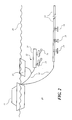
- FIG. 2 is a schematic side view of marine seismic survey equipment used with towed streamers
- FIG. 3 is a schematic plan view of seismic equipment attached to a seismic streamer.
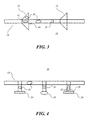
- FIG. 4 is a schematic side view of seismic equipment attached under a seismic streamer.
- the invention is a system and a method for protecting towed marine seismic equipment from shark bite.
- the following discussion of the invention will be illustrated in terms of towed seismic streamers, but this is not a limitation of the invention. Any form of seismic equipment that can and is towed through the water and is vulnerable to shark bite is considered appropriate for application of the present invention.
- Sharks have highly developed sensory systems and a large area of the brain assigned to processing sensory information. It is believed that at longer distances (greater than 15 meters), sharks depend upon their highly sensitive smell receptors. It is further believed that at shorter distances (less than 15 meters), sharks depend upon their sight, which is adapted to use all available light in the dimly lit water. When close enough, sharks may take an exploratory bite to taste whether the potential target is nutritious enough to expend energy on killing. Sharks also have acute hearing, especially sensitive to low frequency vibrations. Sharks, as do all fish, have a lateral line that is sensitive to vibrations and subtle changes in water movement around them. Thus, shark repellents have included such efforts as chemical repellants, visual devices, underwater acoustic playback systems, and electrical shock emitters. However, the effectiveness of these methods has been limited.
- Sharks however, have an additional sensory organ, known as the ampullae of Lorenzini, which is a group of specialized sensory receptors that can pick up weak electric signals given off by all living organisms.
- a shark repellent that operates on the electrical sensitivity of this sensory system can be employed to protect towed marine seismic equipment from shark bite.
- This shark repellent comprises electropositive metals, which appear to over stimulate the ampullae of Lorenzini found in sharks and other elasmobranches, causing the sharks to retreat.
- An electropositive metal is a metal which readily donates electrons to form positive ions.
- the most electropositive metals tend to be found on the left-hand side of the periodic table of the elements, particularly in groups 1 (alkali earth metals), 2 (alkaline earth metals), 3 (transition metals), and the lanthanides (rare earth metals).
- groups 1 alkali earth metals
- 2 alkaline earth metals
- 3 transition metals
- the lanthanides rare earth metals.
- elctropositivity decreases as one transitions from the left-hand to the right-hand side of the periodic table of the elements.
- Elements from groups 4 and greater do not appear to have strong enough electropositivity to repel elasmobranches effectively.
- the most promising electropositive metals for consideration for use in the invention include, but are not limited to, the lanthanide metals lanthanum, cerium, neodymium, praseodymium, and samarium; the alkali metal lithium; the alkaline metal magnesium; and the group 3 metals scandium and yttrium.
- Additional electropositive metals that are appropriate for consideration for use in the invention include, but are not limited to, mischmetals (mixtures) of the lanthanide metals cerium, lanthanum, neodymium, and praseodymium.
- neodymium-praseodymium mischmetal is a preferred electropositive metal for use in the invention because of its relatively low cost and low corrosion reactivity in seawater, compared to many of the other available choices.
- FIGS. 1 and 2 show the typical types of towed marine seismic equipment that can be protected from shark bite by various embodiments of the apparatus and method of the invention.
- FIG. 1 is a schematic plan view (not drawn to scale) of marine seismic survey equipment that could be used with towed streamers.
- the towed marine seismic equipment is generally designated by reference numeral 10.
- a seismic vessel 11 tows seismic sources 12 and seismic streamers 13. Although only two seismic sources 12 and three seismic streamers 13 are shown, this number is just for illustrative purposes only. Typically, there can be more seismic sources 12 and many more seismic streamers 13.
- the seismic sources 12 and the seismic streamers 13 are connected to the seismic vessel 11 by cables 14.
- the cables 14 are typically further connected to devices such as deflectors 15 that spread apart the seismic streamers 13.
- FIG. 1 shows that the seismic streamers 13 may have equipment attached inline or around the streamers 13.
- the attached equipment can be, by way of example, in-line mounted position control devices 16, such as depth control devices or lateral control devices, as well as acoustic units and retriever units (not shown).
- the attached equipment also can be, by way of example, sensors of various types, such as depth sensors.
- FIG. 2 is a schematic side view (not drawn to scale) of marine seismic survey equipment, including towed streamers.
- FIG. 2 is a side view that corresponds to the plan view of the towed marine seismic equipment shown in FIG. 1 .
- the seismic vessel 11 tows seismic sources 12 and seismic streamers 13 under the water surface 20.
- the seismic sources 12 primarily comprise floats 21 and air guns 22, but may also have equipment such as, for example, near-field sensors (hydrophones) 23 attached adjacent the air guns 22.
- FIG. 2 shows that the seismic streamers 13 may have additional equipment attached below the streamers 13.
- the attached equipment can be, by way of example, suspended position control devices 24 and suspended sensors 25, as well as acoustic units and retriever units.
- FIGS. 3 and 4 show close-up views of the seismic equipment attached to the seismic streamer in FIGS. 1 and 2 , respectively.
- FIG. 3 is a schematic plan view (not drawn to scale) of seismic equipment attached to a seismic streamer.
- Electropositive metals are attached to the towed marine seismic equipment 10.
- the electropositive metal is configured as an ingot 30 attached to the inline position control devices 16 or the seismic streamer 13.
- the ingot 30 can be in any shape appropriate for easy attachment.
- the electropositive metal is configured as a band 31 attached around an appropriate portion of the inline position control devices 16 or the seismic streamer 13.
- the electropositive metal is configured as a patch 32 attached to the inline position control devices 16 or the seismic streamer 13.
- the patch 32 could be, for example, an adhesive patch, or attached by other means such as Velcro, but these methods of attachment are not meant as limitations of the invention.
- the electropositive metal is configured as a surface coating 33 covering a portion of the inline position control devices 16 or the seismic streamer 13.
- These configurations of the electropositive metal shown here in FIGS. 3 and 4 are for illustrative purposes only and are not meant to limit the invention.
- the electropositive metal of the invention can be configured in any appropriate manner and attached in any appropriate manner to any appropriate portion of the towed marine seismic equipment 10.
- FIG. 4 is a schematic side view (not drawn to scale) of seismic equipment attached under a seismic streamer.
- the electropositive metal is shown attached to the towed marine seismic equipment 10 in the exemplary configurations of an ingot 30, band 31, patch 32, or surface covering 33, and attached to appropriate portions of the suspended position control devices 24, suspended sensors 25 or seismic streamers 13.
- Other configurations of the electropositive metal are possible and compatible with the invention.
Landscapes
- Life Sciences & Earth Sciences (AREA)
- Environmental Sciences (AREA)
- Engineering & Computer Science (AREA)
- Physics & Mathematics (AREA)
- Acoustics & Sound (AREA)
- Remote Sensing (AREA)
- Zoology (AREA)
- Pest Control & Pesticides (AREA)
- Oceanography (AREA)
- Insects & Arthropods (AREA)
- Birds (AREA)
- Environmental & Geological Engineering (AREA)
- Geology (AREA)
- Wood Science & Technology (AREA)
- General Life Sciences & Earth Sciences (AREA)
- General Physics & Mathematics (AREA)
- Geophysics (AREA)
- Marine Sciences & Fisheries (AREA)
- Animal Husbandry (AREA)
- Biodiversity & Conservation Biology (AREA)
- Geophysics And Detection Of Objects (AREA)
- Conveying And Assembling Of Building Elements In Situ (AREA)
- Revetment (AREA)
Abstract
Description
- This invention relates generally to the field of geophysical prospecting. More particularly, the invention relates to the field of marine seismic surveys with towed seismic equipment.
- In the oil and gas industry, geophysical prospecting is commonly used to aid in the search for and evaluation of subterranean formations. Geophysical prospecting techniques yield knowledge of the subsurface structure of the earth, which is useful for finding and extracting valuable mineral resources, particularly hydrocarbon deposits such as oil and natural gas. A well-known technique of geophysical prospecting is a seismic survey.
- The resulting seismic data obtained in performing a seismic survey is processed to yield information relating to the geologic structure and properties of the subterranean formations in the area being surveyed. The processed seismic data is processed for display and analysis of potential hydrocarbon content of these subterranean formations. The goal of seismic data processing is to extract from the seismic data as much information as possible regarding the subterranean formations in order to adequately image the geologic subsurface. In order to identify locations in the Earth's subsurface where there is a probability for finding petroleum accumulations, large sums of money are expended in gathering, processing, and interpreting seismic data. The process of constructing the reflector surfaces defining the subterranean earth layers of interest from the recorded seismic data provides an image of the earth in depth or time. The image of the structure of the Earth's subsurface is produced in order to enable an interpreter to select locations with the greatest probability of having petroleum accumulations.
- In a marine seismic survey, seismic energy sources are used to generate a seismic signal which, after propagating into the earth, is at least partially reflected by subsurface seismic reflectors. Such seismic reflectors typically are interfaces between subterranean formations having different elastic properties, specifically sound wave velocity and rock density, which lead to differences in acoustic impedance at the interfaces. The reflected seismic energy is detected by seismic sensors (also called seismic receivers) and recorded.
- The appropriate seismic sources for generating the seismic signal in marine seismic surveys typically include a submerged seismic source towed by a ship and periodically activated to generate an acoustic wavefield. The seismic source generating the wavefield is typically an air gun or a spatially-distributed array of air guns.
- The appropriate types of seismic sensors typically include particle velocity sensors (known in the art as geophones) and water pressure sensors (known in the art as hydrophones) mounted within a towed seismic streamer (also know as a seismic cable). Seismic sensors may be deployed by themselves, but are more commonly deployed in sensor arrays within the streamer.
- Seismic sources, seismic streamers, and other attached equipment are towed behind survey vessels, attached by cables. The seismic sources and seismic streamers may be positioned in the water by attached equipment, such as deflectors and cable positioning devices (also known as "birds").
- The class Chondrichthyes (fish with cartilaginous skeletons) comprises sharks, rays, skates, and Chimaera (ghost) sharks, with the subclass Elasmobranches comprising sharks, rays, and skates. Some of these sharks occasionally attack and bite the towed marine seismic equipment used in marine seismic surveys employing towed seismic streamers.
- A need exists for a system and a method for protecting towed seismic equipment in marine seismic surveys, especially towed streamers and equipment attached thereto, from bites by sharks or other elasmobranches.
- The invention is a system and a method for protecting towed marine seismic equipment from shark bite. In one embodiment, the invention is a system comprising marine seismic equipment adapted for towing through a body of water and an electropositive metal attached to the marine seismic equipment. In another embodiment, the invention is a method comprising towing marine seismic equipment having an electropositive metal attached thereto.
- The invention and its advantages may be more easily understood by reference to the following detailed description and the attached drawings, in which:
-
FIG. 1 is a schematic plan view of marine seismic survey equipment used with towed streamers; -
FIG. 2 is a schematic side view of marine seismic survey equipment used with towed streamers; -
FIG. 3 is a schematic plan view of seismic equipment attached to a seismic streamer; and -
FIG. 4 is a schematic side view of seismic equipment attached under a seismic streamer. - While the invention will be described in connection with its preferred embodiments, it will be understood that the invention is not limited to these. On the contrary, the invention is intended to cover all alternatives, modifications, and equivalents that may be included within the scope of the invention, as defined by the appended claims.
- The invention is a system and a method for protecting towed marine seismic equipment from shark bite. The following discussion of the invention will be illustrated in terms of towed seismic streamers, but this is not a limitation of the invention. Any form of seismic equipment that can and is towed through the water and is vulnerable to shark bite is considered appropriate for application of the present invention.
- Sharks have highly developed sensory systems and a large area of the brain assigned to processing sensory information. It is believed that at longer distances (greater than 15 meters), sharks depend upon their highly sensitive smell receptors. It is further believed that at shorter distances (less than 15 meters), sharks depend upon their sight, which is adapted to use all available light in the dimly lit water. When close enough, sharks may take an exploratory bite to taste whether the potential target is nutritious enough to expend energy on killing. Sharks also have acute hearing, especially sensitive to low frequency vibrations. Sharks, as do all fish, have a lateral line that is sensitive to vibrations and subtle changes in water movement around them. Thus, shark repellents have included such efforts as chemical repellants, visual devices, underwater acoustic playback systems, and electrical shock emitters. However, the effectiveness of these methods has been limited.
- Sharks, however, have an additional sensory organ, known as the ampullae of Lorenzini, which is a group of specialized sensory receptors that can pick up weak electric signals given off by all living organisms. A shark repellent that operates on the electrical sensitivity of this sensory system can be employed to protect towed marine seismic equipment from shark bite. This shark repellent comprises electropositive metals, which appear to over stimulate the ampullae of Lorenzini found in sharks and other elasmobranches, causing the sharks to retreat.
- An electropositive metal is a metal which readily donates electrons to form positive ions. The most electropositive metals tend to be found on the left-hand side of the periodic table of the elements, particularly in groups 1 (alkali earth metals), 2 (alkaline earth metals), 3 (transition metals), and the lanthanides (rare earth metals). In general, elctropositivity decreases as one transitions from the left-hand to the right-hand side of the periodic table of the elements. Elements from groups 4 and greater do not appear to have strong enough electropositivity to repel elasmobranches effectively.
- Although all highly electropositive metals might be considered for shark repellent applications, practical considerations preclude some of these metals. These considerations include, but are not limited to, safety, corrosion, and cost. Some pure alkali metals (such as sodium, potassium, rubidium, and cesium) are extremely reactive in seawater, even explosive, and thus present fire hazards in use and storage. Some alkaline earth metals (such as calcium, strontium, and barium) are also quite reactive in seawater and thus might corrode too quickly for practical application, while beryllium is toxic. Many of the late lanthanide metals (particularly europium, gadolinium, terbium, dysprosium, holmium, erbium, thulium, ytterbium, and lutetium) would work, but are quite expensive in pure form. Some of the electropositive metals (such as promethium, radium, and francium) are too radioactive to be usable.
- Thus, the most promising electropositive metals for consideration for use in the invention include, but are not limited to, the lanthanide metals lanthanum, cerium, neodymium, praseodymium, and samarium; the alkali metal lithium; the alkaline metal magnesium; and the group 3 metals scandium and yttrium.
- Additional electropositive metals that are appropriate for consideration for use in the invention include, but are not limited to, mischmetals (mixtures) of the lanthanide metals cerium, lanthanum, neodymium, and praseodymium. In particular, neodymium-praseodymium mischmetal is a preferred electropositive metal for use in the invention because of its relatively low cost and low corrosion reactivity in seawater, compared to many of the other available choices.
-
FIGS. 1 and2 show the typical types of towed marine seismic equipment that can be protected from shark bite by various embodiments of the apparatus and method of the invention.FIG. 1 is a schematic plan view (not drawn to scale) of marine seismic survey equipment that could be used with towed streamers. - The towed marine seismic equipment is generally designated by
reference numeral 10. Aseismic vessel 11 towsseismic sources 12 andseismic streamers 13. Although only twoseismic sources 12 and threeseismic streamers 13 are shown, this number is just for illustrative purposes only. Typically, there can be moreseismic sources 12 and many moreseismic streamers 13. Theseismic sources 12 and theseismic streamers 13 are connected to theseismic vessel 11 bycables 14. Thecables 14 are typically further connected to devices such asdeflectors 15 that spread apart theseismic streamers 13.FIG. 1 shows that theseismic streamers 13 may have equipment attached inline or around thestreamers 13. The attached equipment can be, by way of example, in-line mountedposition control devices 16, such as depth control devices or lateral control devices, as well as acoustic units and retriever units (not shown). The attached equipment also can be, by way of example, sensors of various types, such as depth sensors. -
FIG. 2 is a schematic side view (not drawn to scale) of marine seismic survey equipment, including towed streamers.FIG. 2 is a side view that corresponds to the plan view of the towed marine seismic equipment shown inFIG. 1 . - The
seismic vessel 11 towsseismic sources 12 andseismic streamers 13 under thewater surface 20. Theseismic sources 12 primarily comprise floats 21 andair guns 22, but may also have equipment such as, for example, near-field sensors (hydrophones) 23 attached adjacent theair guns 22.FIG. 2 shows that theseismic streamers 13 may have additional equipment attached below thestreamers 13. The attached equipment can be, by way of example, suspendedposition control devices 24 and suspendedsensors 25, as well as acoustic units and retriever units. -
FIGS. 3 and 4 show close-up views of the seismic equipment attached to the seismic streamer inFIGS. 1 and2 , respectively.FIG. 3 is a schematic plan view (not drawn to scale) of seismic equipment attached to a seismic streamer. - Electropositive metals are attached to the towed marine
seismic equipment 10. In one embodiment, the electropositive metal is configured as aningot 30 attached to the inlineposition control devices 16 or theseismic streamer 13. Theingot 30 can be in any shape appropriate for easy attachment. In another embodiment, the electropositive metal is configured as aband 31 attached around an appropriate portion of the inlineposition control devices 16 or theseismic streamer 13. In another embodiment, the electropositive metal is configured as apatch 32 attached to the inlineposition control devices 16 or theseismic streamer 13. Thepatch 32 could be, for example, an adhesive patch, or attached by other means such as Velcro, but these methods of attachment are not meant as limitations of the invention. In another embodiment, the electropositive metal is configured as asurface coating 33 covering a portion of the inlineposition control devices 16 or theseismic streamer 13. These configurations of the electropositive metal shown here inFIGS. 3 and 4 are for illustrative purposes only and are not meant to limit the invention. The electropositive metal of the invention can be configured in any appropriate manner and attached in any appropriate manner to any appropriate portion of the towed marineseismic equipment 10. -
FIG. 4 is a schematic side view (not drawn to scale) of seismic equipment attached under a seismic streamer. As inFIG. 3 above, the electropositive metal is shown attached to the towed marineseismic equipment 10 in the exemplary configurations of aningot 30,band 31,patch 32, or surface covering 33, and attached to appropriate portions of the suspendedposition control devices 24, suspendedsensors 25 orseismic streamers 13. Other configurations of the electropositive metal are possible and compatible with the invention. - It should be understood that the preceding is merely a detailed description of specific embodiments of this invention and that numerous changes, modifications, and alternatives to the disclosed embodiments can be made in accordance with the disclosure here without departing from the scope of the invention. The preceding description, therefore, is not meant to limit the scope of the invention. Rather, the scope of the invention is to be determined only by the appended claims and their equivalents.
Claims (7)
- A system for protecting towed marine seismic equipment from shark bite, comprising:marine seismic equipment adapted for towing through a body of water; andan electropositive metal attached to the marine seismic equipment.
- The system of claim 1, wherein the marine seismic equipment comprises towed marine seismic streamers.
- The system of claim 2, wherein the marine seismic equipment further comprises additional equipment attached to the marine seismic streamers.
- The system of any of claims 1 to 3, wherein the marine seismic equipment comprises marine seismic sources.
- The system of any of claims 1 to 4, wherein the attached electropositive metal is configured as one of an ingot, band, patch, and surface covering.
- A method for protecting marine seismic equipment from shark bite, comprising:towing marine seismic equipment having an electropositive metal attached thereto.
- The method of claim 6, wherein the marine seismic equipment is constructed according to any of the preceding claims.
Applications Claiming Priority (2)
| Application Number | Priority Date | Filing Date | Title |
|---|---|---|---|
| US20832809P | 2009-02-23 | 2009-02-23 | |
| US12/589,134 US20100212927A1 (en) | 2009-02-23 | 2009-10-19 | System and method for using electropositive metals for protecting towed marine seismic equipment from shark bite |
Publications (3)
| Publication Number | Publication Date |
|---|---|
| EP2223595A2 true EP2223595A2 (en) | 2010-09-01 |
| EP2223595A3 EP2223595A3 (en) | 2010-12-22 |
| EP2223595B1 EP2223595B1 (en) | 2013-08-21 |
Family
ID=42332478
Family Applications (1)
| Application Number | Title | Priority Date | Filing Date |
|---|---|---|---|
| EP10153375.0A Not-in-force EP2223595B1 (en) | 2009-02-23 | 2010-02-11 | System and Method for Using Electropositive Metals for Protecting Towed Marine Seismic Equipment from Shark Bite |
Country Status (3)
| Country | Link |
|---|---|
| US (1) | US20100212927A1 (en) |
| EP (1) | EP2223595B1 (en) |
| AU (1) | AU2010200597B2 (en) |
Cited By (2)
| Publication number | Priority date | Publication date | Assignee | Title |
|---|---|---|---|---|
| WO2016093717A1 (en) * | 2014-12-11 | 2016-06-16 | Skryplonek Łukasz | A protecting device for an elongated flexible member and an elongated flexible member with a protecting device |
| EP3092514A4 (en) * | 2014-01-09 | 2017-11-08 | Schlumberger Technology B.V. | Wide source seismic towing configuration |
Families Citing this family (6)
| Publication number | Priority date | Publication date | Assignee | Title |
|---|---|---|---|---|
| US20100224405A1 (en) * | 2009-03-06 | 2010-09-09 | Pgs Geophysical As | System and method for using magnets for protecting towed marine seismic equipment from shark bite |
| US8353383B2 (en) * | 2011-06-14 | 2013-01-15 | Pgs Geophysical As | Water motion powered seismic energy source and method for seismic surveying therewith |
| US10537095B2 (en) | 2011-10-14 | 2020-01-21 | Pgs Geophysical As | System and method for using an impact-activated device for repelling sharks from marine geophysical survey equipment |
| US9596836B2 (en) * | 2013-07-12 | 2017-03-21 | Smith Root, Inc. | Apparatus and methods for the guidance of fish |
| US10221376B2 (en) * | 2016-04-18 | 2019-03-05 | Ecolab Usa Inc. | Solidification process using low levels of coupler/hydrotrope |
| WO2021007442A1 (en) * | 2019-07-09 | 2021-01-14 | Arizona Board Of Regents On Behalf Of Arizona State University | System including a self-powered, light-based, bycatch reduction device |
Citations (1)
| Publication number | Priority date | Publication date | Assignee | Title |
|---|---|---|---|---|
| EP1027618A1 (en) | 1997-09-19 | 2000-08-16 | Services Petroliers Schlumberger | Towing seismic streamers used in marine seismic surveying |
Family Cites Families (12)
| Publication number | Priority date | Publication date | Assignee | Title |
|---|---|---|---|---|
| US3683280A (en) * | 1971-11-09 | 1972-08-08 | Electromagnetic Ind Inc | Shark repelling device including pulse generator producing electrical field in water between widely spaced electrodes |
| US4211980A (en) * | 1977-06-27 | 1980-07-08 | Stowell William R | Method of creating an electric field for shark repellent |
| US4575680A (en) * | 1983-04-18 | 1986-03-11 | Gold Kenneth S | Battery condition indicator and on-off relay circuit |
| US6350085B1 (en) * | 1998-08-04 | 2002-02-26 | Sonsub International, Inc. | Cable deployment system and method of using same |
| JP2000088893A (en) * | 1998-09-10 | 2000-03-31 | Advantest Corp | Voltage comparator |
| US20090038205A1 (en) * | 2005-03-10 | 2009-02-12 | Eric Matthew Stroud | Elasmobranch-Repelling Magnets and Methods of Use |
| US7142481B1 (en) * | 2005-09-12 | 2006-11-28 | Pgs Geophysical As | Method and system for making marine seismic streamers |
| US20070256623A1 (en) * | 2006-05-08 | 2007-11-08 | Stroud Eric M | Elasmobranch-repelling electropositive metals and methods of use |
| US20080192570A1 (en) * | 2007-02-14 | 2008-08-14 | Stig Rune Lennart Tenghamn | Lateral force and depth control device for marine seismic sensor array |
| US7974151B2 (en) * | 2008-09-17 | 2011-07-05 | Westerngeco L.L.C. | Cetacean protection system |
| US20100224405A1 (en) * | 2009-03-06 | 2010-09-09 | Pgs Geophysical As | System and method for using magnets for protecting towed marine seismic equipment from shark bite |
| US20100278011A1 (en) * | 2009-05-01 | 2010-11-04 | Pgs Geophysical As | System and method for towed marine geophysical equipment |
-
2009
- 2009-10-19 US US12/589,134 patent/US20100212927A1/en not_active Abandoned
-
2010
- 2010-02-05 AU AU2010200597A patent/AU2010200597B2/en not_active Ceased
- 2010-02-11 EP EP10153375.0A patent/EP2223595B1/en not_active Not-in-force
Patent Citations (1)
| Publication number | Priority date | Publication date | Assignee | Title |
|---|---|---|---|---|
| EP1027618A1 (en) | 1997-09-19 | 2000-08-16 | Services Petroliers Schlumberger | Towing seismic streamers used in marine seismic surveying |
Non-Patent Citations (2)
| Title |
|---|
| KAIMER, S.M., STONER, A.W.: "Field investigation of rare earth metal as a deterrent to spiny dogfish in the Pacific halibut fishery", FISHERIES RESEARCH, vol. 94, no. 1, 1 October 2008 (2008-10-01), pages 43 - 47 |
| STONER, A.W., KAIMER, S.M.: "Reducing elasmobranch bycatch: Laboratory investigation of rare earth metal and magnetic deterrents with spiny dogfish and Pacific halibut", FISHERIES RESEARCH, vol. 92, no. 2-3, 1 August 2008 (2008-08-01), pages 162 - 168 |
Cited By (3)
| Publication number | Priority date | Publication date | Assignee | Title |
|---|---|---|---|---|
| EP3092514A4 (en) * | 2014-01-09 | 2017-11-08 | Schlumberger Technology B.V. | Wide source seismic towing configuration |
| US10712464B2 (en) | 2014-01-09 | 2020-07-14 | Reflection Marine Norge As | Wide source seismic towing configuration |
| WO2016093717A1 (en) * | 2014-12-11 | 2016-06-16 | Skryplonek Łukasz | A protecting device for an elongated flexible member and an elongated flexible member with a protecting device |
Also Published As
| Publication number | Publication date |
|---|---|
| AU2010200597A1 (en) | 2010-09-09 |
| EP2223595B1 (en) | 2013-08-21 |
| AU2010200597B2 (en) | 2014-09-11 |
| US20100212927A1 (en) | 2010-08-26 |
| EP2223595A3 (en) | 2010-12-22 |
Similar Documents
| Publication | Publication Date | Title |
|---|---|---|
| AU2010200597B2 (en) | System and method for using electropositive metals for protecting towed marine seismic equipment from shark bite | |
| EP0181859B1 (en) | Marine seismic system | |
| US8514664B2 (en) | System and method for gathering marine geophysical data | |
| AU2016202972B2 (en) | Method of imaging the earth's subsurface during marine seismic data acquisition | |
| McDonald et al. | Blue and fin whales observed on a seafloor array in the Northeast Pacific | |
| Hildebrand | Sources of anthropogenic sound in the marine environment | |
| US9857485B2 (en) | Methods and systems for marine survey acquisition | |
| US9244185B2 (en) | System and method for towed marine geophysical equipment | |
| CN102483464B (en) | For the method for the positioningly front end of seismic exploration arranging system | |
| Ainslie et al. | Assessment of natural and anthropogenic sound sources and acoustic propagation in the North Sea | |
| AU2011200051A1 (en) | System and method for using copper coating to prevent marine growth on towed geophysical equipment | |
| US10234584B2 (en) | Method and system of inducing vibrations onto a sensor streamer | |
| CN105899973A (en) | Wide source seismic towing configuration | |
| JPWO2019112035A1 (en) | Exploration method for submarine strata | |
| Gausland | Seismic surveys impact on fish and fisheries | |
| EP2226649A1 (en) | System and Method for Using Magnets for Protecting Towed Marine Seismic Equipment from Shark Bite | |
| US4725990A (en) | Marine shear cable | |
| EP3009865A1 (en) | Electrically isolated streamer section | |
| US4709356A (en) | Seismic array positioning | |
| McCauley et al. | Transmission of marine seismic survey, air gun array signals in Australian waters | |
| AU2020217456B2 (en) | Surveying with low frequency impulse sources | |
| USH462H (en) | Marine cable geophone assembly | |
| Mattsson et al. | Svein Vaage broadband air gun study | |
| Klingelhoefer et al. | Deciphering the Submarine Soundscape: New Insights, Broader Implications, Future Directions | |
| Linton et al. | The Effects of Seismic Sounds on Marine Organisms: An Annotated Bibliography and Literature Review |
Legal Events
| Date | Code | Title | Description |
|---|---|---|---|
| PUAI | Public reference made under article 153(3) epc to a published international application that has entered the european phase |
Free format text: ORIGINAL CODE: 0009012 |
|
| AK | Designated contracting states |
Kind code of ref document: A2 Designated state(s): AT BE BG CH CY CZ DE DK EE ES FI FR GB GR HR HU IE IS IT LI LT LU LV MC MK MT NL NO PL PT RO SE SI SK SM TR |
|
| AX | Request for extension of the european patent |
Extension state: AL BA RS |
|
| REG | Reference to a national code |
Ref country code: NO Ref legal event code: TC |
|
| PUAL | Search report despatched |
Free format text: ORIGINAL CODE: 0009013 |
|
| AK | Designated contracting states |
Kind code of ref document: A3 Designated state(s): AT BE BG CH CY CZ DE DK EE ES FI FR GB GR HR HU IE IS IT LI LT LU LV MC MK MT NL NO PL PT RO SE SI SK SM TR |
|
| AX | Request for extension of the european patent |
Extension state: AL BA RS |
|
| RIC1 | Information provided on ipc code assigned before grant |
Ipc: A01K 79/02 20060101ALI20101112BHEP Ipc: A01M 29/00 20060101AFI20100722BHEP |
|
| 17P | Request for examination filed |
Effective date: 20110614 |
|
| 17Q | First examination report despatched |
Effective date: 20120525 |
|
| GRAP | Despatch of communication of intention to grant a patent |
Free format text: ORIGINAL CODE: EPIDOSNIGR1 |
|
| INTG | Intention to grant announced |
Effective date: 20130522 |
|
| GRAS | Grant fee paid |
Free format text: ORIGINAL CODE: EPIDOSNIGR3 |
|
| GRAA | (expected) grant |
Free format text: ORIGINAL CODE: 0009210 |
|
| AK | Designated contracting states |
Kind code of ref document: B1 Designated state(s): AT BE BG CH CY CZ DE DK EE ES FI FR GB GR HR HU IE IS IT LI LT LU LV MC MK MT NL NO PL PT RO SE SI SK SM TR |
|
| REG | Reference to a national code |
Ref country code: GB Ref legal event code: FG4D |
|
| REG | Reference to a national code |
Ref country code: CH Ref legal event code: EP |
|
| REG | Reference to a national code |
Ref country code: AT Ref legal event code: REF Ref document number: 627493 Country of ref document: AT Kind code of ref document: T Effective date: 20130915 |
|
| REG | Reference to a national code |
Ref country code: IE Ref legal event code: FG4D |
|
| REG | Reference to a national code |
Ref country code: DE Ref legal event code: R096 Ref document number: 602010009561 Country of ref document: DE Effective date: 20131017 |
|
| REG | Reference to a national code |
Ref country code: NO Ref legal event code: T2 Effective date: 20130821 |
|
| REG | Reference to a national code |
Ref country code: NL Ref legal event code: VDEP Effective date: 20130821 Ref country code: AT Ref legal event code: MK05 Ref document number: 627493 Country of ref document: AT Kind code of ref document: T Effective date: 20130821 |
|
| REG | Reference to a national code |
Ref country code: LT Ref legal event code: MG4D |
|
| PG25 | Lapsed in a contracting state [announced via postgrant information from national office to epo] |
Ref country code: AT Free format text: LAPSE BECAUSE OF FAILURE TO SUBMIT A TRANSLATION OF THE DESCRIPTION OR TO PAY THE FEE WITHIN THE PRESCRIBED TIME-LIMIT Effective date: 20130821 Ref country code: SE Free format text: LAPSE BECAUSE OF FAILURE TO SUBMIT A TRANSLATION OF THE DESCRIPTION OR TO PAY THE FEE WITHIN THE PRESCRIBED TIME-LIMIT Effective date: 20130821 Ref country code: CY Free format text: LAPSE BECAUSE OF FAILURE TO SUBMIT A TRANSLATION OF THE DESCRIPTION OR TO PAY THE FEE WITHIN THE PRESCRIBED TIME-LIMIT Effective date: 20130904 Ref country code: LT Free format text: LAPSE BECAUSE OF FAILURE TO SUBMIT A TRANSLATION OF THE DESCRIPTION OR TO PAY THE FEE WITHIN THE PRESCRIBED TIME-LIMIT Effective date: 20130821 Ref country code: PT Free format text: LAPSE BECAUSE OF FAILURE TO SUBMIT A TRANSLATION OF THE DESCRIPTION OR TO PAY THE FEE WITHIN THE PRESCRIBED TIME-LIMIT Effective date: 20131223 Ref country code: HR Free format text: LAPSE BECAUSE OF FAILURE TO SUBMIT A TRANSLATION OF THE DESCRIPTION OR TO PAY THE FEE WITHIN THE PRESCRIBED TIME-LIMIT Effective date: 20130821 Ref country code: IS Free format text: LAPSE BECAUSE OF FAILURE TO SUBMIT A TRANSLATION OF THE DESCRIPTION OR TO PAY THE FEE WITHIN THE PRESCRIBED TIME-LIMIT Effective date: 20131221 |
|
| PG25 | Lapsed in a contracting state [announced via postgrant information from national office to epo] |
Ref country code: GR Free format text: LAPSE BECAUSE OF FAILURE TO SUBMIT A TRANSLATION OF THE DESCRIPTION OR TO PAY THE FEE WITHIN THE PRESCRIBED TIME-LIMIT Effective date: 20131122 Ref country code: BE Free format text: LAPSE BECAUSE OF FAILURE TO SUBMIT A TRANSLATION OF THE DESCRIPTION OR TO PAY THE FEE WITHIN THE PRESCRIBED TIME-LIMIT Effective date: 20130821 Ref country code: PL Free format text: LAPSE BECAUSE OF FAILURE TO SUBMIT A TRANSLATION OF THE DESCRIPTION OR TO PAY THE FEE WITHIN THE PRESCRIBED TIME-LIMIT Effective date: 20130821 Ref country code: SI Free format text: LAPSE BECAUSE OF FAILURE TO SUBMIT A TRANSLATION OF THE DESCRIPTION OR TO PAY THE FEE WITHIN THE PRESCRIBED TIME-LIMIT Effective date: 20130821 Ref country code: FI Free format text: LAPSE BECAUSE OF FAILURE TO SUBMIT A TRANSLATION OF THE DESCRIPTION OR TO PAY THE FEE WITHIN THE PRESCRIBED TIME-LIMIT Effective date: 20130821 Ref country code: LV Free format text: LAPSE BECAUSE OF FAILURE TO SUBMIT A TRANSLATION OF THE DESCRIPTION OR TO PAY THE FEE WITHIN THE PRESCRIBED TIME-LIMIT Effective date: 20130821 |
|
| PG25 | Lapsed in a contracting state [announced via postgrant information from national office to epo] |
Ref country code: CY Free format text: LAPSE BECAUSE OF FAILURE TO SUBMIT A TRANSLATION OF THE DESCRIPTION OR TO PAY THE FEE WITHIN THE PRESCRIBED TIME-LIMIT Effective date: 20130821 |
|
| PG25 | Lapsed in a contracting state [announced via postgrant information from national office to epo] |
Ref country code: SK Free format text: LAPSE BECAUSE OF FAILURE TO SUBMIT A TRANSLATION OF THE DESCRIPTION OR TO PAY THE FEE WITHIN THE PRESCRIBED TIME-LIMIT Effective date: 20130821 Ref country code: RO Free format text: LAPSE BECAUSE OF FAILURE TO SUBMIT A TRANSLATION OF THE DESCRIPTION OR TO PAY THE FEE WITHIN THE PRESCRIBED TIME-LIMIT Effective date: 20130821 Ref country code: EE Free format text: LAPSE BECAUSE OF FAILURE TO SUBMIT A TRANSLATION OF THE DESCRIPTION OR TO PAY THE FEE WITHIN THE PRESCRIBED TIME-LIMIT Effective date: 20130821 Ref country code: DK Free format text: LAPSE BECAUSE OF FAILURE TO SUBMIT A TRANSLATION OF THE DESCRIPTION OR TO PAY THE FEE WITHIN THE PRESCRIBED TIME-LIMIT Effective date: 20130821 Ref country code: NL Free format text: LAPSE BECAUSE OF FAILURE TO SUBMIT A TRANSLATION OF THE DESCRIPTION OR TO PAY THE FEE WITHIN THE PRESCRIBED TIME-LIMIT Effective date: 20130821 Ref country code: CZ Free format text: LAPSE BECAUSE OF FAILURE TO SUBMIT A TRANSLATION OF THE DESCRIPTION OR TO PAY THE FEE WITHIN THE PRESCRIBED TIME-LIMIT Effective date: 20130821 |
|
| PG25 | Lapsed in a contracting state [announced via postgrant information from national office to epo] |
Ref country code: ES Free format text: LAPSE BECAUSE OF FAILURE TO SUBMIT A TRANSLATION OF THE DESCRIPTION OR TO PAY THE FEE WITHIN THE PRESCRIBED TIME-LIMIT Effective date: 20130821 Ref country code: IT Free format text: LAPSE BECAUSE OF FAILURE TO SUBMIT A TRANSLATION OF THE DESCRIPTION OR TO PAY THE FEE WITHIN THE PRESCRIBED TIME-LIMIT Effective date: 20130821 |
|
| PLBE | No opposition filed within time limit |
Free format text: ORIGINAL CODE: 0009261 |
|
| STAA | Information on the status of an ep patent application or granted ep patent |
Free format text: STATUS: NO OPPOSITION FILED WITHIN TIME LIMIT |
|
| 26N | No opposition filed |
Effective date: 20140522 |
|
| REG | Reference to a national code |
Ref country code: DE Ref legal event code: R119 Ref document number: 602010009561 Country of ref document: DE |
|
| REG | Reference to a national code |
Ref country code: DE Ref legal event code: R097 Ref document number: 602010009561 Country of ref document: DE Effective date: 20140522 |
|
| PG25 | Lapsed in a contracting state [announced via postgrant information from national office to epo] |
Ref country code: LU Free format text: LAPSE BECAUSE OF FAILURE TO SUBMIT A TRANSLATION OF THE DESCRIPTION OR TO PAY THE FEE WITHIN THE PRESCRIBED TIME-LIMIT Effective date: 20140211 Ref country code: MC Free format text: LAPSE BECAUSE OF FAILURE TO SUBMIT A TRANSLATION OF THE DESCRIPTION OR TO PAY THE FEE WITHIN THE PRESCRIBED TIME-LIMIT Effective date: 20130821 |
|
| REG | Reference to a national code |
Ref country code: CH Ref legal event code: PL |
|
| PG25 | Lapsed in a contracting state [announced via postgrant information from national office to epo] |
Ref country code: LI Free format text: LAPSE BECAUSE OF NON-PAYMENT OF DUE FEES Effective date: 20140228 Ref country code: CH Free format text: LAPSE BECAUSE OF NON-PAYMENT OF DUE FEES Effective date: 20140228 |
|
| REG | Reference to a national code |
Ref country code: IE Ref legal event code: MM4A |
|
| REG | Reference to a national code |
Ref country code: DE Ref legal event code: R119 Ref document number: 602010009561 Country of ref document: DE Effective date: 20140902 |
|
| PG25 | Lapsed in a contracting state [announced via postgrant information from national office to epo] |
Ref country code: DE Free format text: LAPSE BECAUSE OF NON-PAYMENT OF DUE FEES Effective date: 20140902 Ref country code: IE Free format text: LAPSE BECAUSE OF NON-PAYMENT OF DUE FEES Effective date: 20140211 |
|
| REG | Reference to a national code |
Ref country code: FR Ref legal event code: PLFP Year of fee payment: 7 |
|
| PG25 | Lapsed in a contracting state [announced via postgrant information from national office to epo] |
Ref country code: MT Free format text: LAPSE BECAUSE OF FAILURE TO SUBMIT A TRANSLATION OF THE DESCRIPTION OR TO PAY THE FEE WITHIN THE PRESCRIBED TIME-LIMIT Effective date: 20130821 |
|
| PG25 | Lapsed in a contracting state [announced via postgrant information from national office to epo] |
Ref country code: SM Free format text: LAPSE BECAUSE OF FAILURE TO SUBMIT A TRANSLATION OF THE DESCRIPTION OR TO PAY THE FEE WITHIN THE PRESCRIBED TIME-LIMIT Effective date: 20130821 |
|
| PG25 | Lapsed in a contracting state [announced via postgrant information from national office to epo] |
Ref country code: BG Free format text: LAPSE BECAUSE OF FAILURE TO SUBMIT A TRANSLATION OF THE DESCRIPTION OR TO PAY THE FEE WITHIN THE PRESCRIBED TIME-LIMIT Effective date: 20130821 |
|
| PG25 | Lapsed in a contracting state [announced via postgrant information from national office to epo] |
Ref country code: HU Free format text: LAPSE BECAUSE OF FAILURE TO SUBMIT A TRANSLATION OF THE DESCRIPTION OR TO PAY THE FEE WITHIN THE PRESCRIBED TIME-LIMIT; INVALID AB INITIO Effective date: 20100211 Ref country code: TR Free format text: LAPSE BECAUSE OF FAILURE TO SUBMIT A TRANSLATION OF THE DESCRIPTION OR TO PAY THE FEE WITHIN THE PRESCRIBED TIME-LIMIT Effective date: 20130821 |
|
| REG | Reference to a national code |
Ref country code: FR Ref legal event code: PLFP Year of fee payment: 8 |
|
| REG | Reference to a national code |
Ref country code: FR Ref legal event code: PLFP Year of fee payment: 9 |
|
| PG25 | Lapsed in a contracting state [announced via postgrant information from national office to epo] |
Ref country code: MK Free format text: LAPSE BECAUSE OF FAILURE TO SUBMIT A TRANSLATION OF THE DESCRIPTION OR TO PAY THE FEE WITHIN THE PRESCRIBED TIME-LIMIT Effective date: 20130821 |
|
| PGFP | Annual fee paid to national office [announced via postgrant information from national office to epo] |
Ref country code: GB Payment date: 20200227 Year of fee payment: 11 Ref country code: NO Payment date: 20200227 Year of fee payment: 11 |
|
| PGFP | Annual fee paid to national office [announced via postgrant information from national office to epo] |
Ref country code: FR Payment date: 20200225 Year of fee payment: 11 |
|
| REG | Reference to a national code |
Ref country code: NO Ref legal event code: MMEP |
|
| GBPC | Gb: european patent ceased through non-payment of renewal fee |
Effective date: 20210211 |
|
| PG25 | Lapsed in a contracting state [announced via postgrant information from national office to epo] |
Ref country code: NO Free format text: LAPSE BECAUSE OF NON-PAYMENT OF DUE FEES Effective date: 20210228 |
|
| PG25 | Lapsed in a contracting state [announced via postgrant information from national office to epo] |
Ref country code: FR Free format text: LAPSE BECAUSE OF NON-PAYMENT OF DUE FEES Effective date: 20210228 Ref country code: GB Free format text: LAPSE BECAUSE OF NON-PAYMENT OF DUE FEES Effective date: 20210211 |