EP2220781B1 - Codebook for multiple user multiple input multiple output system and communication device using the codebook - Google Patents
Codebook for multiple user multiple input multiple output system and communication device using the codebook Download PDFInfo
- Publication number
- EP2220781B1 EP2220781B1 EP08852080.4A EP08852080A EP2220781B1 EP 2220781 B1 EP2220781 B1 EP 2220781B1 EP 08852080 A EP08852080 A EP 08852080A EP 2220781 B1 EP2220781 B1 EP 2220781B1
- Authority
- EP
- European Patent Office
- Prior art keywords
- codebook
- base station
- mimo
- vectors
- vectors included
- Prior art date
- Legal status (The legal status is an assumption and is not a legal conclusion. Google has not performed a legal analysis and makes no representation as to the accuracy of the status listed.)
- Active
Links
Images


Classifications
-
- H—ELECTRICITY
- H04—ELECTRIC COMMUNICATION TECHNIQUE
- H04B—TRANSMISSION
- H04B7/00—Radio transmission systems, i.e. using radiation field
- H04B7/02—Diversity systems; Multi-antenna system, i.e. transmission or reception using multiple antennas
- H04B7/04—Diversity systems; Multi-antenna system, i.e. transmission or reception using multiple antennas using two or more spaced independent antennas
- H04B7/0413—MIMO systems
- H04B7/0456—Selection of precoding matrices or codebooks, e.g. using matrices antenna weighting
-
- H—ELECTRICITY
- H04—ELECTRIC COMMUNICATION TECHNIQUE
- H04B—TRANSMISSION
- H04B7/00—Radio transmission systems, i.e. using radiation field
- H04B7/02—Diversity systems; Multi-antenna system, i.e. transmission or reception using multiple antennas
- H04B7/04—Diversity systems; Multi-antenna system, i.e. transmission or reception using multiple antennas using two or more spaced independent antennas
- H04B7/0413—MIMO systems
- H04B7/0417—Feedback systems
- H04B7/0421—Feedback systems utilizing implicit feedback, e.g. steered pilot signals
-
- H—ELECTRICITY
- H04—ELECTRIC COMMUNICATION TECHNIQUE
- H04B—TRANSMISSION
- H04B7/00—Radio transmission systems, i.e. using radiation field
- H04B7/02—Diversity systems; Multi-antenna system, i.e. transmission or reception using multiple antennas
- H04B7/04—Diversity systems; Multi-antenna system, i.e. transmission or reception using multiple antennas using two or more spaced independent antennas
- H04B7/0413—MIMO systems
- H04B7/0452—Multi-user MIMO systems
Definitions
- the following description relates to a method of designing a codebook and a system using the same, and more particularly, a Multiple-User Multiple-Input Multiple- Output (MU-MIMO) codebook design method and a communication system and device using the same.
- MU-MIMO Multiple-User Multiple-Input Multiple- Output
- MIMO Multiple-Input Multiple-Output
- a MIMO communication system utilizes a base station, and may be classified into a Multiple-User (MU) MIMO system comprising a plurality of users and a single base station, and a Single-User (SU) MIMO system comprising a single user and a single base station.
- MU Multiple-User
- SU Single-User
- a base station and terminals may use a codebook.
- a certain space may be quantized into a plurality of vectors.
- the plurality of vectors generated by quantizing the particular space may be stored in the base station and the terminals as the codebook.
- each of the terminals may select any one matrix or vector from the plurality of matrixes or vectors included in the codebook, based on a channel that is formed between the base station and each of the terminals.
- the base station may also recognize the selected matrix or vector based on the codebook.
- the selected matrix or vector may be used for generating a transmission signal.
- An exemplary embodiment may reduce a number of feedback bits by reducing the size of a codebook.
- the method may further comprise optimizing the MU-MIMO codebook based on interferences existed between the remaining vectors.
- the invention is defined by the appended independent claims 1, 3, 5, 7, 9, 11, 13, 15. Further embodiments are described by the dependent claims 2, 4, 6, 8, 10, 12, 14. Other features will become apparent to those skilled in the art from the following detailed description, which, taken in conjunction with the attached drawings, discloses exemplary embodiments of the invention.
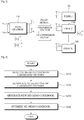
- FIG. 1 illustrates a Multiple-Users Multiple-Input Multiple-Output (MU-MIMO) system according to an exemplary embodiment.
- MU-MIMO Multiple-Input Multiple-Output
- the MU-MIMO system comprises a base station 110, and a plurality of users 120, 130, and 140.
- a plurality of antennas is installed in the base station 110, and a single antenna or a plurality of antennas may be installed in each of the plurality of users 120, 130, and 140.
- a channel is formed between the base station 110 and the plurality of users 120, 130, and 140, and the base station 110 and the plurality of users 120, 130, and 140 transmits/receives signals through the formed channel.
- the base station 110 may transmit at least one data stream to the plurality of users 120, 130, and 140.
- the base station 110 may perform beamforming on the data stream according to, for example, a Spatial Division Multiplexing Access (SDMA) scheme.
- SDMA Spatial Division Multiplexing Access
- the base station 110 transmits pilot signals to the plurality of users 120, 130, and 140 through a downlink channel.
- the pilot signals are signals well-known to the base station 110 and the plurality of users 120, 130, and 140.
- Each of the plurality of users 120, 130, and 140 estimates the channel formed between the base station 110 and the plurality of users 120, 130, and 140 using the pilot signals. Also, the plurality of users 120, 130, and 140 selects, as a preferred vector, any one vector of vectors included in a codebook previously stored based on the estimated channel.
- u i is an i-th vector included in the codebook
- B is a number of feedback bits. Specifically, where the number of feedback bits is B-bits, 2 B vectors generated by quantizing a space are stored in the codebook.
- Each of all users may have an identical number of feedback bits, however, may have the number of feedback bits which is different for each users according to various factors such as different channel environments of the users, Signal to Interference and Noise Ratio (SINR), and the like in a more optimized manner.
- SINR Signal to Interference and Noise Ratio
- each of the plurality of users 120, 130, and 140 may select any one vector of 2 B vectors as a preferred vector with a variety of standards.
- each of the plurality of users 120, 130, and 140 may select any one vector of 2 B vectors as the preferred vector based on an achievable data transmission rate and the SINR.
- each of the plurality of users 120, 130, and 140 may determine a preferred transmission rank.
- the transmission rank denotes a number of data streams. Specifically, vectors corresponding to a number of data streams from among 2 B vectors may be selected as the preferred vectors.
- each of the users 120, 130, and 140 feeds back information associated with the selected preferred vector to the base station 110.
- the information associated with the selected preferred vector may be referred to as a Channel Direction Information (CDI).
- CDI Channel Direction Information
- the base station 110 receives the information associated with the preferred vectors of each of the plurality of users 120, 130, and 140 to determine a pre-coding matrix.
- the base station 110 may select a part or all of the plurality of users 120, 130, and 140 using various user selection algorithms such as Semi-orthogonal User Selection (SUS), Greedy User Selection (GUS), and the like.
- SUS Semi-orthogonal User Selection
- GUS Greedy User Selection
- a codebook identical to the codebook stored in the plurality of users 120, 130, and 140 may be stored in the base station 110 in advance.
- the base station 110 determines a pre-coding matrix from the previously stored codebook using information associated with the preferred vector received from the plurality of users 120, 130, and 140.
- the base station 110 may determine the pre-coding matrix such that a sum rate is maximized.
- the base station 110 performs pre-coding on data streams S 1 and S N using the determined pre-coding matrix to thereby generate the transmission signals.
- a process for generating the transmission signals by the base station 110 may be referred to as 'beamforming'.
- a MU-MIMO codebook for the MU-MIMO system may be designed by redesign a codebook (hereinafter, referred to as RANK 1 SU-MIMO codebook) for the SU-MIMO system used where a rank is '1'.
- RANK 1 SU-MIMO codebook a codebook for the SU-MIMO system used where a rank is '1'.
- the RANK 1 SU-MIMO codebook defined in 3GPP LTE includes 16 numbered vectors where a number of feedback bits is 4.
- 16 numbered vectors may be grouped into four unitary matrixes M 1 , M 2 , M 3 , and M 4
- M 2 u 5 u 6 u 7 u 8
- M 3 u 9 u 10 u 11 u 12
- M 4 u 13 u 14 u 15 u 16 ,
- M 3 and M 4 are matrixes that may be unsuitable for the MU-MIMO system.
- M 1 and M 2 rather than M 3 and M 4 may be suitable for the MU-MIMO system, however, M 1 and M 2 may not be designed considering a case where the base station 110 has a plurality of sectors. Accordingly, where the base station 110 has the plurality of sectors, to apply M 1 and M 2 as they are to the MU-MIMO system may be unsuitable.
- a coverage of each of the plurality of sectors may be reduced in a case where a cell of the base station 110 includes the plurality of sectors.
- coverage of a single sector may be 120 degrees where the cell includes three sectors, and the coverage may be 60 degrees where the cell includes six sectors.
- to apply M 1 and M 2 as they are to the MU-MIMO system may unnecessarily increase a size of the codebook.
- the codebook may be comprised of only vectors required for covering the coverage of the single sector. In this case, by reducing the size of the codebook, a number of feedback bits may be reduced.
- the codebook for the SU-MIMO system may include the DFT codebook.
- the DFT codebook as described above is designed without considering a case where the base station 110 includes the plurality of sectors, like the RANK 1 SU-MIMO codebook defined in 3GPP LTE.
- the DFT codebook may unnecessarily increase the size of the codebook where the cell includes the plurality of sectors, which may result in being unsuitable.
- FIG. 2 illustrates a MU-MIMO codebook design method according to an exemplary embodiment.
- the MU-MIMO codebook design method comprises analyzing beam patterns of candidate vectors included in a candidate codebook previously prepared in operation S210.
- the candidate codebook is a codebook for a SU-MIMO system
- the codebook for the SU-MIMO system may include the DFT codebook or a codebook defined in 3GPP LTE.
- a coverage of a single cell is 120 degrees.
- a coverage of 120 degrees ranging from 60 to -60 degrees may be seen to be well-covered using the remaining seven vectors obtained by eliminating u3 from among eight vectors.
- a coverage of each of three sectors may be seen to be well-covered using the remaining seven vectors in an identical manner.
- a coverage of a single cell is 60 degrees.
- a coverage of 60 degrees ranging from 30 to -30 degrees may be seen to be well-covered using u2, u5, u1, u8 or u5, u1, u8, u4.
- the coverage of the single sector may be well-covered even without using eight vectors included in the codebook defined in 3GPP LTE or sixteen vectors included in the 4-bit DFT codebook.
- a size of the codebook may be reduced, and the number of feedback bits may be reduced along with a reduction in the size of the codebook.
- the MU-MIMO codebook design method further comprises eliminating at least one vector of the candidate vectors based on the beam patterns of the candidate vectors in operation S220.
- the operation S220 for eliminating at least one vector may be an operation for eliminating at least one vector of the candidate vectors based on a coverage of each of the plurality of sectors.
- the operation S230 for generating the MU-MIMO codebook may be an operation for eliminating at least one vector of the candidate vectors according to a coverage corresponding to each of the plurality of sectors to thereby generate the MU-MIMO codebook being comprised of the remaining vectors.
- a coverage of each of the plurality of sectors may be well-covered using the MU-MIMO codebook being identical for each of the plurality of sectors.
- the operation S230 for generating the MU-MIMO codebook may be an operation for generating the MU-MIMO codebook in order to well-cover a single sector by the remaining vectors.
- the operation S230 may generate the MU-MIMO codebook as [u2 u5 u1 u8] or [u5 u1 u8 u4] where the cell is comprised of three sectors and the previously prepared candidate codebook is the codebook for SU-MIMO system defined in 3GPP LTE.
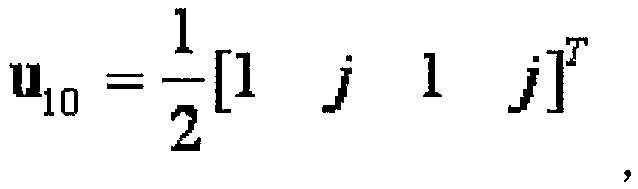
- u 1 1 2 1 1 1 1 T
- u 2 1 2 1 j ⁇ 1 ⁇ j T
- u 4 1 2 1 ⁇ j ⁇ 1 j T
- u 5 1 2 1 e j ⁇ 4 j e j 3 ⁇ 4 T
- u 8 1 2 1 e ⁇ j ⁇ 4 ⁇ j e j 5 ⁇ 4 T .
- the operation S230 for generating the MU-MIMO codebook may generate the MU-MIMO codebook as [u2 u5 u1 u8] or [u5 u1 u8 u4] where the cell is comprised of six sectors and the previously prepared candidate codebook is the codebook for MU-MIMO system defined in 3GPP LTE.
- the operation S230 for generating the MU-MIMO codebook may generate the MU-MIMO codebook as [u14 u10 u6 u2 u13 u9 u5 u1 u16 u12 u8 u4 u15 u11] or [u10 u6 u2 u13 u9 u5 u1 u16 u12 u8 u4 u15 u11 u7] where the cell is comprised of three sectors and the previously prepared candidate codebook is the 4-bit DFT codebook.
- u 1 0.5 0.5 0.5 0.5 T
- u 2 0.5 0.5 j ⁇ 0.5 ⁇ 0.5 j T
- u 4 0.5 ⁇ 0.5 j ⁇ 0.5 0.5 j T
- u 5 0.5 0.4619 + 0.1913 j 0.3536 + 0.3536 j 0.1913 + 0.4619 j T
- u 6 0.5 ⁇ 0.1913 + 0.4619 j ⁇ 0.3536 ⁇ 0.3536 j 0.4619 ⁇ 0.1913 T
- u 7 0.5 ⁇ 0.4619 ⁇ 0.1913 j 0.3536 + 0.3536 j ⁇ 0.1913 ⁇ 0.4619 j T
- u 8 0.5 0.1913 ⁇ 0.4619 j ⁇ 0.3536 ⁇ 0.3536 j ⁇ 0.4619 + 0.1913 j T
- u 9 0.5 0.3536 + 0.3536 j 0.5 j ⁇ 0.3536 + 0.3536 j T
- the operation S230 for generating the MU-MIMO codebook may generate the MU-MIMO codebook as [u2 u13 u9 u5 u1 u16 u12 u8] or [u13 u9 u5 u1 u16 u12 u8 u4] where the cell is comprised of six sectors and the previously prepared candidate codebook is the 4-bit DFT codebook.
- u 1 [0.5 0.5 0.5 0.5] T
- u 2 0.5 0.5 j ⁇ 0.5 ⁇ 0.5 j T
- u 4 0.5 ⁇ 0.5 j ⁇ 0.5 0.5 j T
- u 5 0.5 0.4619 + 0.1913 j 0.3536 + 0.3536 j 0.1913 + 0.4619 j T
- u 8 0.5 0.1913 ⁇ 0.4619 j ⁇ 0.3536 ⁇ 0.3536 j ⁇ 0.4619 + 0.1913 j T
- u 9 0.5 0.3536 + 0.3536 j 0.5 j ⁇ 0.3536 + 0.3536 j T
- u 12 0.5 0.3536 ⁇ 0.3536 j ⁇ 0.5 j ⁇ 0.3536 ⁇ 0.3536 j T
- u 13 0.5 0.1913 + 0.4619 j ⁇ 0.3536 + 0.3536 j ⁇ 0.4619 ⁇ 0.1913 j T
- u 13 0.5 0.1913 + 0.46
- the MU-MIMO codebook design method may appropriately select vectors based on a number of sectors included in the cell and a coverage of each of the sectors, thereby minimizing a size of the codebook while well-covering the coverage of each of the sectors.
- the MU-MIMO codebook design method further comprises optimizing the MU-MIMO codebook based on interferences generated between the remaining vectors in operation S240.
- the operation S240 for optimizing the MU-MIMO codebook may be an operation for selecting a part or all of the remaining vectors depending on a predetermined number of feedback bits based on the interference generated between the remaining vectors.
- the operation S240 for optimizing the MU-MIMO codebook may be an operation for calculating SINR of the remaining vectors based on the interferences generated between the remaining vectors, and selecting a part or all of the remaining vectors based on the SINR of the remaining vectors.
- a size of the MU-MIMO codebook that is, a number of vectors included in the MU-MIMO codebook may be determined depending on a number of feedback bits. For example, where the number of feedback bits is 3, the number of vectors included in the MU-MIMO codebook may be limited to 8 or less, and where the number of feedback bits is 4, the number of vectors included in the MU-MIMO codebook may be limited to 16 or less.
- the MU-MIMO codebook generated through the operation S230 for generating the MU-MIMO codebook may be adjusted or optimized in size depending on the number of feedback bits.
- the MU-MIMO codebook is comprised of the remaining vectors obtained by eliminating at least one vector of the candidate vectors.
- a metric used for optimizing the MU-MIMO codebook may be determined based on a Signal to Interference Ratio (SIR).
- a SIR between the adjacent beams may be regarded as '1'.
- SIR i, j may be calculated with respect to each of the vectors included in the MU-MIMO codebook generated through the operation S230 for generating the MU-MIMO codebook. Also, SIR min of a minimum value from among SIR i, j calculated with respect to each of sub-sets of the MU-MIMO codebook may be ascertained.
- a sub-set corresponding to a maximum value of SIR min calculated with respect to each of the sub-sets of the MU-MIMO codebook and having a size corresponding to the number of feedback bits may be selected as an optimized MU-MIMO codebook.
- a sub-set corresponding to a maximum value of SIR min with respect to each of the sub-sets may be an optimized MU-MIMO codebook.
- FIG. 5 illustrates a method for operating a base station according to an exemplary embodiment
- FIG. 6 illustrates a method for operating a terminal according to an exemplary embodiment.
- the base station stores a MU-MIMO codebook designed according to an exemplary embodiment described above.
- the terminal stores the MU-MIMO codebook like the base station.
- the base station transmits, to a plurality of terminals, pilot signals having been well-known to the plurality of terminals.
- the terminal estimates a channel formed between the base station and the terminal using the pilot signals.
- the terminal may ascertain quality and direction of the channel.
- the terminal transmits feedback data, that is, information associated with the estimated channel to the base station.
- a number of bits of the feedback data may be determined in advance, and the number of feedback bits may be associated with a size of the codebook.
- the feedback data may include index information of a preferred vector from among a plurality of vectors included in the codebook.
- the base station receives the feedback data from the terminal.
- the base station receives the feedback data of each of the plurality of terminals, and selects a part or all of the plurality of terminals (users).
- the base station selects a pre-coding matrix from among sub-sets of the codebook based on the feedback data of each of the plurality of terminals.
- the base station performs pre-coding on at least one data stream for selected users using the selected pre-coding matrix.
- the methods described above may be recorded, stored, or fixed in one or more computer-readable media that includes program instructions to be implemented by a computer to cause a processor to execute or perform the program instructions.
- the media may also include, alone or in combination with the program instructions, data files, data structures, and the like.
- the media and program instructions may be those specially designed and constructed for the purposes of the present invention, or they may be of the kind well-known and available to those having skill in the computer software arts.
Landscapes
- Engineering & Computer Science (AREA)
- Computer Networks & Wireless Communication (AREA)
- Signal Processing (AREA)
- Mobile Radio Communication Systems (AREA)
- Radio Transmission System (AREA)
Description
- The following description relates to a method of designing a codebook and a system using the same, and more particularly, a Multiple-User Multiple-Input Multiple- Output (MU-MIMO) codebook design method and a communication system and device using the same.
- Currently, many researches are being conducted regarding technologies to provide various types of multimedia services including voice services and to support high quality and high speed data transmission in a wireless communication environment. For example, technologies associated with a Multiple-Input Multiple-Output (MIMO) communication system using multiple channels are in rapid development.
- In general, a MIMO communication system utilizes a base station, and may be classified into a Multiple-User (MU) MIMO system comprising a plurality of users and a single base station, and a Single-User (SU) MIMO system comprising a single user and a single base station.
- In a MIMO communication system, a base station and terminals may use a codebook. A certain space may be quantized into a plurality of vectors. The plurality of vectors generated by quantizing the particular space may be stored in the base station and the terminals as the codebook.
- For example, each of the terminals may select any one matrix or vector from the plurality of matrixes or vectors included in the codebook, based on a channel that is formed between the base station and each of the terminals. The base station may also recognize the selected matrix or vector based on the codebook. The selected matrix or vector may be used for generating a transmission signal.
- A number of studies have been made for a codebook used in a SU-MIMO system. However, there is need for a further study of a codebook used in a MU-MIMO system. For example, in a case where a cell of a base station includes a plurality of sectors, there is a need for an optimized codebook for use in a MU-MIMO system.
- An exemplary embodiment may reduce a number of feedback bits by reducing the size of a codebook.
- According to an aspect, a Multiple-User Multiple-Input Multiple-Output (MU-MIMO) codebook design method comprises analyzing beam patterns of candidate vectors included in a predetermined candidate codebook, and eliminating at least one of the candidate vectors based on the beam patterns of the candidate vectors to generate the MU-MIMO codebook for a MU-MIMO system being comprised of the remaining vectors.
- The method may further comprise optimizing the MU-MIMO codebook based on interferences existed between the remaining vectors. The invention is defined by the appended
independent claims 1, 3, 5, 7, 9, 11, 13, 15. Further embodiments are described by the dependent claims 2, 4, 6, 8, 10, 12, 14. Other features will become apparent to those skilled in the art from the following detailed description, which, taken in conjunction with the attached drawings, discloses exemplary embodiments of the invention. -
-
FIG. 1 is a diagram illustrating a Multiple-Users Multiple-Input Multiple-Output (MU-MIMO) system according to an exemplary embodiment. -
FIG. 2 is an operation flowchart illustrating a MU-MIMO codebook design method according to an exemplary embodiment. -
FIG. 3 is a diagram illustrating beam patterns of u1, u2, u3, u4, u5, u6, u7, u8 included in a codebook defined in 3rd Generation Partnership Project Long Term Evolution (3GPP LTE). -
FIG. 4 is a diagram illustrating beam patterns of u1, u2, u3, u4, u5, u6, u7, u8, u9, u10, u11, u12, u13, u14, u15, u16 included in 4-bit Discrete Fourier Transformation (DFT) codebook. -
FIG. 5 is an operation flowchart illustrating a method for operating a base station according to an exemplary embodiment. -
FIG. 6 is an operation flowchart illustrating a method for operating a terminal according to an exemplary embodiment. - Throughout the drawings and the detailed description, unless otherwise described, the same drawing reference numerals will be understood to refer to the same elements, features, and structures.
- The following detailed description is provided to assist the reader in gaining a comprehensive understanding of the methods, apparatuses and/or systems described herein. Accordingly, various changes, modifications, and equivalents of the systems, apparatuses and/or methods described herein will be suggested to those of ordinary skill in the art. Also, descriptions of well-known functions and constructions are omitted to increase clarity and conciseness.
-
FIG. 1 illustrates a Multiple-Users Multiple-Input Multiple-Output (MU-MIMO) system according to an exemplary embodiment. - Referring to
FIG. 1 , the MU-MIMO system comprises abase station 110, and a plurality ofusers base station 110, and a single antenna or a plurality of antennas may be installed in each of the plurality ofusers base station 110 and the plurality ofusers base station 110 and the plurality ofusers - The
base station 110 may transmit at least one data stream to the plurality ofusers base station 110 may perform beamforming on the data stream according to, for example, a Spatial Division Multiplexing Access (SDMA) scheme. Thebase station 110 may generate a pre-coding matrix Wk using a codebook
- The
base station 110 transmits pilot signals to the plurality ofusers base station 110 and the plurality ofusers - Each of the plurality of
users base station 110 and the plurality ofusers users - Also, each of the plurality of
users - For example, each of the plurality of
users users - Also, each of the
users base station 110. Here, the information associated with the selected preferred vector may be referred to as a Channel Direction Information (CDI). - The
base station 110 receives the information associated with the preferred vectors of each of the plurality ofusers base station 110 may select a part or all of the plurality ofusers - In this case, a codebook identical to the codebook stored in the plurality of
users base station 110 in advance. - The
base station 110 determines a pre-coding matrix from the previously stored codebook using information associated with the preferred vector received from the plurality ofusers base station 110 may determine the pre-coding matrix such that a sum rate is maximized. - Also, the
base station 110 performs pre-coding on data streams S1 and SN using the determined pre-coding matrix to thereby generate the transmission signals. Here, a process for generating the transmission signals by thebase station 110 may be referred to as 'beamforming'. - In 3GPP LTE (3rd Generation Partnership Project Long Term Evolution), a MU-MIMO codebook for the MU-MIMO system may be designed by redesign a codebook (hereinafter, referred to as
RANK 1 SU-MIMO codebook) for the SU-MIMO system used where a rank is '1'. - The
RANK 1 SU-MIMO codebook defined in 3GPP LTE includes 16 numbered vectors where a number of feedback bits is 4. Here, 16 numbered vectors may be grouped into four unitary matrixes M1, M2, M3, and M4, and theRANK 1 SU-MIMO codebook may be represented by
- wherein,




-
Equation 1 denotes theRANK 1 SU-MIMO codebook defined in 3GPP LTE, and M1 and M2 are DRT matrixes. The DFT matrixes may be in a good match with a Line Of Site (LOS) channel. - However, M3 and M4 are matrixes that may be unsuitable for the MU-MIMO system. Also, M1 and M2 rather than M3 and M4 may be suitable for the MU-MIMO system, however, M1 and M2 may not be designed considering a case where the
base station 110 has a plurality of sectors. Accordingly, where thebase station 110 has the plurality of sectors, to apply M1 and M2 as they are to the MU-MIMO system may be unsuitable. - This may be because a coverage of each of the plurality of sectors may be reduced in a case where a cell of the
base station 110 includes the plurality of sectors. For example, coverage of a single sector may be 120 degrees where the cell includes three sectors, and the coverage may be 60 degrees where the cell includes six sectors. Specifically, where the cell includes the plurality of sectors, to apply M1 and M2 as they are to the MU-MIMO system may unnecessarily increase a size of the codebook. Thus, the codebook may be comprised of only vectors required for covering the coverage of the single sector. In this case, by reducing the size of the codebook, a number of feedback bits may be reduced. - The codebook for the SU-MIMO system may include the DFT codebook. A 3-bi DFT codebook is comprised of U1=[u1 u2 u3 u4] and U2=[u5 u6 u7 u8], and a 4-bit DFT codebook is comprised of U1 = [u1 u2 u3 u4], U2 = [u5 u6 u7 u8], U3 = [u9 u10 u11 u12], and U4 = [u13 u14 u15 u16].
- Here, a b-th matrix U(b) of the DFT codebook and a (m+1)-th row (b) vector


- Where the number of transmission antennas is 4, 16 numbered vectors included in the 4-bit DFT codebook may be represented by

- The DFT codebook as described above is designed without considering a case where the
base station 110 includes the plurality of sectors, like theRANK 1 SU-MIMO codebook defined in 3GPP LTE. - Like the
RANK 1 SU-MIMO codebook, to use the DFT codebook, as is, may unnecessarily increase the size of the codebook where the cell includes the plurality of sectors, which may result in being unsuitable. - In this case, whether an appropriate codebook is newly designed by selecting vectors from among vectors included in the original DFT codebook or the
RANK 1 SU-MIMO codebook where the cell includes the plurality of sectors will be herein described. -
FIG. 2 illustrates a MU-MIMO codebook design method according to an exemplary embodiment. -
FIG. 3 illustrates beam patterns of u1, u2, u3, u4, u5, u6, u7, u8 included in a codebook defined in 3GPP LTE, andFIG. 4 illustrates beam patterns of u1, u2, u3, u4, u5, u6, u7, u8, u9, u10, u11, u12, u13, u14, u15, u16 included in 4-bit DFT codebook. - Referring to
FIG. 2 , the MU-MIMO codebook design method comprises analyzing beam patterns of candidate vectors included in a candidate codebook previously prepared in operation S210. - In this embodiment, the candidate codebook is a codebook for a SU-MIMO system, and the codebook for the SU-MIMO system may include the DFT codebook or a codebook defined in 3GPP LTE.
- Referring to
FIG. 3 , each of eight vectors included in the codebook defined in 3GPP LTE has unique beam patterns. In particular, u3 from among eight vectors has the widest lobe. - In a case where a cell of the base station is comprised of three sectors, a coverage of a single cell is 120 degrees. In this case, a coverage of 120 degrees ranging from 60 to -60 degrees may be seen to be well-covered using the remaining seven vectors obtained by eliminating u3 from among eight vectors. Also, a coverage of each of three sectors may be seen to be well-covered using the remaining seven vectors in an identical manner.
- Also, in a case where the cell of the base station is comprised of six sectors, a coverage of a single cell is 60 degrees. In this case, a coverage of 60 degrees ranging from 30 to -30 degrees may be seen to be well-covered using u2, u5, u1, u8 or u5, u1, u8, u4.
- Referring to
FIG. 4 , the 4-bit DFT codebook is comprised of sixteen vectors. In a case where the cell of the base station is comprised of three sectors, a coverage of a single cell is 120 degrees, and a coverage of 120 degrees ranging from 60 to -60 degrees may be seen to be well-covered using [u14 u10 u6 u2 u13 u9 u5 u1 u16 u12 u8 u4 u15 u11] or [u10 u6 u2 u13 u9 u5 u1 u16 u12 u8 u4 u15 u11 u7]. - Consequently, where the cell of the base station includes the plurality of sectors, the coverage of the single sector may be well-covered even without using eight vectors included in the codebook defined in 3GPP LTE or sixteen vectors included in the 4-bit DFT codebook. As a result, a size of the codebook may be reduced, and the number of feedback bits may be reduced along with a reduction in the size of the codebook.
- Referring back to
FIG. 2 , the MU-MIMO codebook design method further comprises eliminating at least one vector of the candidate vectors based on the beam patterns of the candidate vectors in operation S220. Here, the operation S220 for eliminating at least one vector may be an operation for eliminating at least one vector of the candidate vectors based on a coverage of each of the plurality of sectors. - The MU-MIMO codebook design method further comprises eliminating at least one vector of the candidate vectors according to the beam patterns of the candidate vectors, and generating a MU-MIMO codebook for the MU-MIMO system being comprised of the remaining vectors obtained by eliminating the at least one vector, in operation S230.
- In a case of the cell comprised of the plurality of sectors, the operation S230 for generating the MU-MIMO codebook may be an operation for eliminating at least one vector of the candidate vectors according to a coverage corresponding to each of the plurality of sectors to thereby generate the MU-MIMO codebook being comprised of the remaining vectors.
- Here, a coverage of each of the plurality of sectors may be well-covered using the MU-MIMO codebook being identical for each of the plurality of sectors.
- In the case of the cell comprised of the plurality of sectors, the operation S230 for generating the MU-MIMO codebook may be an operation for generating the MU-MIMO codebook in order to well-cover a single sector by the remaining vectors.
- Also, the operation S230 for generating the MU-MIMO codebook may be an operation for eliminating at least one vector of the candidate vectors in the order from a largest beam width of the candidate vectors to thereby generate the MU-MIMO codebook being comprised of the remaining vectors.
- As an example, the operation S230 may generate the MU-MIMO codebook as [u2 u5 u1 u8] or [u5 u1 u8 u4] where the cell is comprised of three sectors and the previously prepared candidate codebook is the codebook for SU-MIMO system defined in 3GPP LTE. Here,


- As another example, the operation S230 for generating the MU-MIMO codebook may generate the MU-MIMO codebook as [u2 u5 u1 u8] or [u5 u1 u8 u4] where the cell is comprised of six sectors and the previously prepared candidate codebook is the codebook for MU-MIMO system defined in 3GPP LTE. Here,


- As another example, the operation S230 for generating the MU-MIMO codebook may generate the MU-MIMO codebook as [u14 u10 u6 u2 u13 u9 u5 u1 u16 u12 u8 u4 u15 u11] or [u10 u6 u2 u13 u9 u5 u1 u16 u12 u8 u4 u15 u11 u7] where the cell is comprised of three sectors and the previously prepared candidate codebook is the 4-bit DFT codebook. Here,








- As another example, the operation S230 for generating the MU-MIMO codebook may generate the MU-MIMO codebook as [u2 u13 u9 u5 u1 u16 u12 u8] or [u13 u9 u5 u1 u16 u12 u8 u4] where the cell is comprised of six sectors and the previously prepared candidate codebook is the 4-bit DFT codebook.
- Here, u 1 = [0.5 0.5 0.5 0.5] T ,


- Accordingly, the MU-MIMO codebook design method according to an exemplary embodiment may appropriately select vectors based on a number of sectors included in the cell and a coverage of each of the sectors, thereby minimizing a size of the codebook while well-covering the coverage of each of the sectors.
- Referring back to
FIG. 2 , the MU-MIMO codebook design method further comprises optimizing the MU-MIMO codebook based on interferences generated between the remaining vectors in operation S240. - The operation S240 for optimizing the MU-MIMO codebook may be an operation for selecting a part or all of the remaining vectors depending on a predetermined number of feedback bits based on the interference generated between the remaining vectors. In addition, the operation S240 for optimizing the MU-MIMO codebook may be an operation for calculating SINR of the remaining vectors based on the interferences generated between the remaining vectors, and selecting a part or all of the remaining vectors based on the SINR of the remaining vectors.
- A size of the MU-MIMO codebook, that is, a number of vectors included in the MU-MIMO codebook may be determined depending on a number of feedback bits. For example, where the number of feedback bits is 3, the number of vectors included in the MU-MIMO codebook may be limited to 8 or less, and where the number of feedback bits is 4, the number of vectors included in the MU-MIMO codebook may be limited to 16 or less.
- Accordingly, the MU-MIMO codebook generated through the operation S230 for generating the MU-MIMO codebook may be adjusted or optimized in size depending on the number of feedback bits. In this case, the MU-MIMO codebook is comprised of the remaining vectors obtained by eliminating at least one vector of the candidate vectors.
- A metric used for optimizing the MU-MIMO codebook may be determined based on a Signal to Interference Ratio (SIR). In particular, SIRi, j, that is, an SIR of an i-th beam with respect to a j-th beam may be represented by
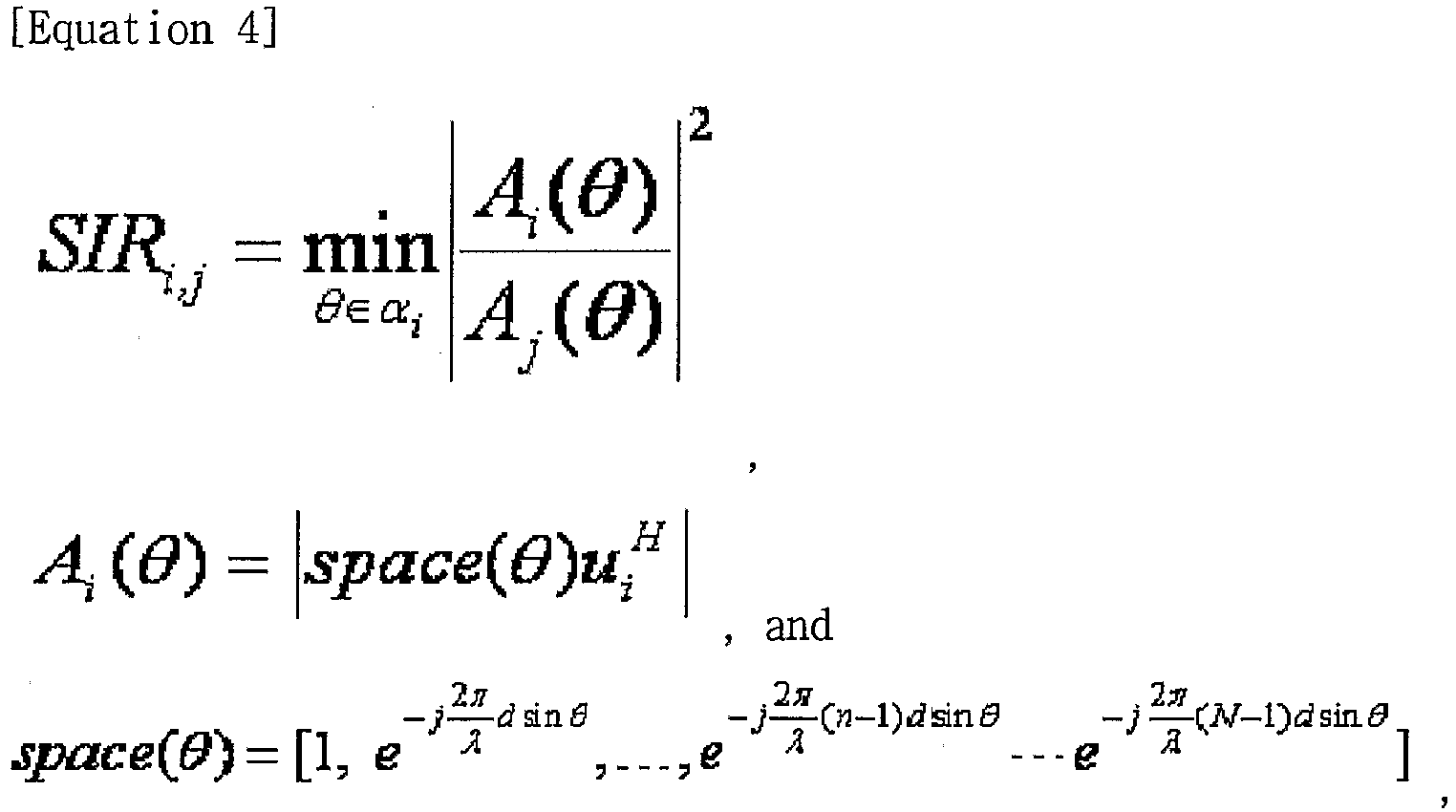
- Since physically adjacent beams are not simultaneously used in a Space Division Multiple Access (SDMA) system or the MU-MIMO system, a SIR between the adjacent beams may be regarded as '1'.
- SIRi, j may be calculated with respect to each of the vectors included in the MU-MIMO codebook generated through the operation S230 for generating the MU-MIMO codebook. Also, SIRmin of a minimum value from among SIRi, j calculated with respect to each of sub-sets of the MU-MIMO codebook may be ascertained.
- A sub-set corresponding to a maximum value of SIRmin calculated with respect to each of the sub-sets of the MU-MIMO codebook and having a size corresponding to the number of feedback bits may be selected as an optimized MU-MIMO codebook.
- For example, in a case of the 4-bit DFT codebook, it is assumed that [u14 u10 u6 u2 u13 u9 u5 u1 u16 u12 u8 u4 u15 u11] or [u10 u6 u2 u13 u9 u5 u1 u16 u12 u8 u4 u15 u11 u7] may be generated as the MU-MIMO codebook through the operation S230 for generating the MU-MIMO codebook. Where the number of feedback bits is limited to 3, the number of vectors included in the MU-MIMO codebook may be limited to 8 or less. Where the number of vectors included in the MU-MIMO codebook is 8, C8 14 numbered sub-sets may exist. In this case, SIRi, j with respect to vectors included in each of the sub-sets may be calculated, and SIRmin with respect to each of the sub-sets may be ascertained. Also, a sub-set corresponding to a maximum value of SIRmin with respect to each of the sub-sets may be an optimized MU-MIMO codebook.
-
FIG. 5 illustrates a method for operating a base station according to an exemplary embodiment, andFIG. 6 illustrates a method for operating a terminal according to an exemplary embodiment. - Referring to
FIG. 5 , in operation S510, the base station stores a MU-MIMO codebook designed according to an exemplary embodiment described above. - Referring to
FIG. 6 , in operation S610, the terminal stores the MU-MIMO codebook like the base station. - In operation S520, the base station transmits, to a plurality of terminals, pilot signals having been well-known to the plurality of terminals.
- In operation S620, the terminal estimates a channel formed between the base station and the terminal using the pilot signals. In this case, the terminal may ascertain quality and direction of the channel.
- In operation S630, the terminal transmits feedback data, that is, information associated with the estimated channel to the base station. A number of bits of the feedback data may be determined in advance, and the number of feedback bits may be associated with a size of the codebook. In particular, the feedback data may include index information of a preferred vector from among a plurality of vectors included in the codebook.
- In operation S530, the base station receives the feedback data from the terminal.
- In operation S540, the base station receives the feedback data of each of the plurality of terminals, and selects a part or all of the plurality of terminals (users).
- In operation S550, the base station selects a pre-coding matrix from among sub-sets of the codebook based on the feedback data of each of the plurality of terminals.
- In operation S560, the base station performs pre-coding on at least one data stream for selected users using the selected pre-coding matrix.
- In operation S640, the terminal performs reception beamforming based on a preferred vector in a case where the terminal has a plurality of reception antennas.
- The methods described above may be recorded, stored, or fixed in one or more computer-readable media that includes program instructions to be implemented by a computer to cause a processor to execute or perform the program instructions. The media may also include, alone or in combination with the program instructions, data files, data structures, and the like. The media and program instructions may be those specially designed and constructed for the purposes of the present invention, or they may be of the kind well-known and available to those having skill in the computer software arts. Examples of computer-readable media include magnetic media such as hard disks, floppy disks, and magnetic tape; optical media such as CD ROM disks and DVD; magneto-optical media such as optical disks; and hardware devices that are specially configured to store and perform program instructions, such as read-only memory (ROM), random access memory (RAM), flash memory, and the like. Examples of program instructions include both machine code, such as produced by a compiler, and files containing higher level code that may be executed by the computer using an interpreter. The described hardware devices may be configured to act as one or more software modules in order to perform the operations and methods described above.
Claims (15)
- A method for operating a base station, the method comprising:storing all of vectors included in [u1 u2 u4 u5 u6 u7 u8] as a MU-MIMO codebook;andpre-coding at least one data stream using the stored MU-MIMO codebook,wherein


- The method of claim 1, wherein a cell of the base station comprises a plurality of sectors, and the storing comprises selecting all of vectors included in the [u1 u2 u4 u5 u6 u7 u8] depending on a predetermined number of feedback bits to store all of vectors included in the [u1 u2 u4 u5 u6 u7 u8].
- A method for operating a base station, the method comprising:storing all of vectors included in [u2 u5 u1 u8] or [u5 u1 u8 u4] as a MU-MIMO codebook,andpre-coding at least one data stream using the stored MU-MIMO codebook, wherein


- The method of claim 3, wherein a cell of the base station comprises a plurality of sectors, and the storing comprises selecting all of vectors included in the [u2 u5 u1 u8] or [u5 u1 u8 u4] depending on a predetermined number of feedback bits to store all of vectors included in the [u2 u5 u1 u8] or [u5 u1 u8 u4].
- A method for operating a base station, the method comprising:storing all of vectors included in [u14 u10 u6 u2 u13 u9 u5 u1 u16 u12 u8 u4 u15 n11] or [u10 u6 u2 u13 u9 u5 u1 u16 u12 u8 u4 u15 u11 u7] as a MU-MIMO codebook; andpre-coding at least one data stream using the stored MU-MIMO codebook, wherein





- The method of claim 5, wherein a cell of the base station comprises a plurality of sectors, and the storing comprises selecting all of the vectors included in [u14 u10 u6 u2 u13 u9 u5 u1 u16 u12 u8 u4 u15 u11] or [u10 u6 u2 u13 u9 u5 u1 u16 u12 u8 u4 u15 u11 u7] depending on a predetermined number of feedback bits to store all of the vectors included in [u14 u10 u6 u2 u13 u9 u5 u1 u16 u12 u8 u4 u15 u11] or [u10 u6 u2 u13 u9 u5 u1 u16 u12 u8 u4 u15 u11 u7].
- A method for operating a base station, the method comprising:storing all of vectors included in [u2 u13 u9 u5 u1 u16 u12 u8] or [u13 u9 u5 u1 u16 u12 u8 u4] as a MU-MIMO codebook; andpre-coding at least one data stream using the stored MU-MIMO codebook, wherein





- The method of claim 7, wherein a cell of the base station comprises a plurality of sectors, and the storing comprises selecting all of vectors included in [u2 u13 u9 u5 u1 u16 u12 u8] or [u13 u9 u5 u1 u16 u12 u8 u4] depending on a predetermined number of feedback bits to store all of the vectors included in the [u2 u13 u9 u5 u1 u16 u12 u8] or [u13 u9 u5 u1 u16 u12 u8 u4].
- A method for operating a terminal, the method comprising:storing all of vectors included in [u1 u2 u4 u5 u6 u7 u8] as a MU-MIMO codebook;andfeeding-back, to a base station, information related with at least one vector from among vectors included in the stored MU-MIMO codebook, wherein


- The method of claim 9, wherein a cell of the base station comprises a plurality of sectors, and the storing comprises selecting all of the vectors included in [u1 u2 u4 u5 u6 u7 u8] depending on a predetermined number of feedback bits to store all of the vectors included in [u1 u2 u4 u5 u6 u7 u8].
- A method for operating a terminal, the method comprising:storing all of vectors included in [u2 u5 u1 u8] or [u5 u1 u8 u4] as a MU-MIMO codebook;andfeeding-back, to a base station, information related with at least one vector from among vectors included in the stored MU-MIMO codebook, wherein


- The method of claim 11, wherein a cell of the base station comprises a plurality of sectors, and the storing comprises selecting all of the vectors included in the [u2 u5 u1 u8] or [u5 u1 u8 u4] depending on a predetermined number of feedback bits to store all of the vectors included in [u2 u5 u1 u8] or [u5 u1 u8 u4].
- A method for operating a terminal, the method comprising:storing all of vectors included in [u14 u10 u6 u2 u13 u9 u5 u1 u16 u12 u8 u4 u15 u11] or [u10 u6 u2 u13 u9 u5 u1 u16 u12 u8 u4 u15 u11 u7] as a MU-MIMO codebook; andfeeding-back, to a base station, information related with at least one vector from among vectors included in the stored MU-MIMO codebook, wherein





- The method of claim 13, wherein a cell of the base station comprises a plurality of sectors, and the storing comprises selecting all of the vectors included in [u14 u10 u6 u2 u13 u9 u5 u1 u16 u12 u8 u4 u15 u11] or [u10 u6 u2 u13 u9 u5 u1 u16 u12 u8 u4 u15 u11 u7] depending on a predetermined number of feedback bits to store all of the vectors included in [u14 u10 u6 u2 u13 u9 u5 u1 u16 u12 u8 u4 u15 u11] or [u10 u6 u2 u13 u9 u5 u1 u16 u12 u8 u4 u15 u11 u7].
- A method for operating a terminal, the method comprising:storing all of vectors included in [u2 u13 u9 u5 u1 u16 u12 u8] or [u13 u9 u5 u1 u16 u12 u8 u4] as a MU-MIMO codebook; andfeeding-back, to a base station, information related with at least one vector from among vectors included in the stored MU-MIMO codebook, wherein


Applications Claiming Priority (3)
| Application Number | Priority Date | Filing Date | Title |
|---|---|---|---|
| CN2007101866497A CN101442349B (en) | 2007-11-21 | 2007-11-21 | Selection method for multi-user MIMO codebook subset |
| KR1020080053697A KR101467839B1 (en) | 2007-11-21 | 2008-06-09 | A codebook for a multi-user multiple input / output system and a communication device using the codebook |
| PCT/KR2008/006832 WO2009066936A1 (en) | 2007-11-21 | 2008-11-20 | Codebook for multiple user multiple input multiple output system and communication device using the codebook |
Publications (3)
| Publication Number | Publication Date |
|---|---|
| EP2220781A1 EP2220781A1 (en) | 2010-08-25 |
| EP2220781A4 EP2220781A4 (en) | 2016-06-15 |
| EP2220781B1 true EP2220781B1 (en) | 2017-09-20 |
Family
ID=40726626
Family Applications (1)
| Application Number | Title | Priority Date | Filing Date |
|---|---|---|---|
| EP08852080.4A Active EP2220781B1 (en) | 2007-11-21 | 2008-11-20 | Codebook for multiple user multiple input multiple output system and communication device using the codebook |
Country Status (6)
| Country | Link |
|---|---|
| US (2) | US8031090B2 (en) |
| EP (1) | EP2220781B1 (en) |
| KR (1) | KR101467839B1 (en) |
| CN (1) | CN101442349B (en) |
| ES (1) | ES2652587T3 (en) |
| WO (1) | WO2009066936A1 (en) |
Families Citing this family (17)
| Publication number | Priority date | Publication date | Assignee | Title |
|---|---|---|---|---|
| KR101537591B1 (en) * | 2008-04-07 | 2015-07-20 | 엘지전자 주식회사 | Method for mode adaptation in MIMO system |
| US8699609B2 (en) * | 2008-11-27 | 2014-04-15 | Optis Cellular Technology, Llc | Methods and arrangements for peak to average power ratio reduction |
| WO2010126317A2 (en) * | 2009-04-30 | 2010-11-04 | Lg Electronics Inc. | Method for setting precoder in open loop mimo system |
| KR20100133883A (en) * | 2009-06-12 | 2010-12-22 | 엘지전자 주식회사 | Codebook design method and data transmission method in multi-antenna system |
| CN103152090B (en) | 2009-08-07 | 2015-12-02 | 华为技术有限公司 | Recoding processing method, codebook set and base station |
| WO2011051914A1 (en) | 2009-10-30 | 2011-05-05 | Nokia Corporation | Channel feedback to support efficient rank override |
| KR101652869B1 (en) * | 2009-11-02 | 2016-09-01 | 삼성전자주식회사 | Method of controlling dynamic channel feedback for coordinated multi point transmission in network mimo system |
| CN101958771B (en) * | 2009-12-29 | 2013-04-03 | 中国科学院计算技术研究所 | Eight antenna codebook design method by reusing LTE codebook |
| CN103209057B (en) * | 2012-01-17 | 2016-08-10 | 华为技术有限公司 | Use the method and apparatus that code book carries out data transmission |
| US9253740B2 (en) | 2012-11-29 | 2016-02-02 | Blinq Wireless Inc. | Method and apparatus for coordinated power-zone-assignment in wireless backhaul networks |
| CN104935365B (en) * | 2014-03-21 | 2019-01-01 | 日本电气株式会社 | Method and apparatus for multi-user transmission |
| EP3540976A1 (en) * | 2014-05-15 | 2019-09-18 | Huawei Technologies Co., Ltd. | Method and apparatus for transmitting and feeding back signal |
| US9647736B1 (en) * | 2015-03-05 | 2017-05-09 | Quantenna Communications, Inc. | Compressed training for massive MU-MIMO in a wireless local area network |
| US10886982B2 (en) | 2016-03-09 | 2021-01-05 | Telefonaktiebolaget Lm Ericsson (Publ) | Method and network node for selecting codebook |
| GB2554631B (en) * | 2016-05-13 | 2019-11-20 | Cambium Networks Ltd | Method and apparatus for beam pattern stabilisation |
| CN108282197B (en) | 2017-01-05 | 2021-08-27 | 华为技术有限公司 | Method for indicating and determining precoding vector and receiving and transmitting terminal equipment |
| TWI645689B (en) | 2017-12-15 | 2018-12-21 | 財團法人工業技術研究院 | Wireless communication device with hybrid beamforming and control method thereof |
Family Cites Families (10)
| Publication number | Priority date | Publication date | Assignee | Title |
|---|---|---|---|---|
| KR20060130806A (en) * | 2005-06-08 | 2006-12-20 | 삼성전자주식회사 | Transmission and reception apparatus and method in codebook based closed loop multiple transmit / receive antenna system |
| US9136974B2 (en) * | 2005-08-30 | 2015-09-15 | Qualcomm Incorporated | Precoding and SDMA support |
| US20070165738A1 (en) * | 2005-10-27 | 2007-07-19 | Barriac Gwendolyn D | Method and apparatus for pre-coding for a mimo system |
| KR100923913B1 (en) | 2005-11-17 | 2009-10-28 | 삼성전자주식회사 | Multiuser Interference Cancellation Device and Method |
| TW201025894A (en) * | 2006-02-10 | 2010-07-01 | Interdigital Tech Corp | Method and apparatus for performing uplink transmission in a multiple-input multiple-output single carrier frequency division multiple access system |
| EP1989790A2 (en) | 2006-02-17 | 2008-11-12 | Nokia Corporation | Apparatus, method and computer program product providing aimo receiver |
| DE602007011900D1 (en) * | 2006-02-21 | 2011-02-24 | Qualcomm Inc | FEEDBACK CHANNEL DESIGN FOR COMMUNICATION SYSTEMS WITH MULTIPLE INPUTS AND OUTPUTS (MIMO) |
| US7593729B2 (en) * | 2006-07-13 | 2009-09-22 | Designart Networks Ltd | Point to point link and communication method |
| US7961807B2 (en) * | 2007-03-16 | 2011-06-14 | Freescale Semiconductor, Inc. | Reference signaling scheme using compressed feedforward codebooks for multi-user, multiple input, multiple output (MU-MIMO) systems |
| US20090046801A1 (en) * | 2007-08-14 | 2009-02-19 | Interdigital Technology Corporation | Method and apparatus for creating a multi-user mimo codebook using a single user mimo codebook |
-
2007
- 2007-11-21 CN CN2007101866497A patent/CN101442349B/en active Active
-
2008
- 2008-06-09 KR KR1020080053697A patent/KR101467839B1/en not_active Expired - Fee Related
- 2008-10-13 US US12/250,078 patent/US8031090B2/en active Active
- 2008-11-20 WO PCT/KR2008/006832 patent/WO2009066936A1/en not_active Ceased
- 2008-11-20 EP EP08852080.4A patent/EP2220781B1/en active Active
- 2008-11-20 ES ES08852080.4T patent/ES2652587T3/en active Active
-
2011
- 2011-09-15 US US13/233,761 patent/US8686883B2/en active Active
Non-Patent Citations (1)
| Title |
|---|
| SAMSUNG: "Way Forward for MU-MIMO Design", 3GPP DRAFT; R1-073100-MU-MIMO, 3RD GENERATION PARTNERSHIP PROJECT (3GPP), MOBILE COMPETENCE CENTRE ; 650, ROUTE DES LUCIOLES ; F-06921 SOPHIA-ANTIPOLIS CEDEX ; FRANCE, vol. RAN WG1, no. Orlando, USA; 20070622, 22 June 2007 (2007-06-22), XP050106752 * |
Also Published As
| Publication number | Publication date |
|---|---|
| US20090128381A1 (en) | 2009-05-21 |
| WO2009066936A1 (en) | 2009-05-28 |
| US8686883B2 (en) | 2014-04-01 |
| KR101467839B1 (en) | 2014-12-22 |
| CN101442349A (en) | 2009-05-27 |
| CN101442349B (en) | 2013-02-20 |
| ES2652587T3 (en) | 2018-02-05 |
| US8031090B2 (en) | 2011-10-04 |
| EP2220781A4 (en) | 2016-06-15 |
| EP2220781A1 (en) | 2010-08-25 |
| US20120001780A1 (en) | 2012-01-05 |
| KR20090052791A (en) | 2009-05-26 |
Similar Documents
| Publication | Publication Date | Title |
|---|---|---|
| US8031090B2 (en) | Codebook for multiple user multiple input multiple output system and communication device using the codebook | |
| US8134503B2 (en) | Open-loop beamforming MIMO communications in frequency division duplex systems | |
| US8837607B2 (en) | Reporting of channel state information | |
| US7884763B2 (en) | Orthogonal/partial orthogonal beamforming weight generation for MIMO wireless communication | |
| EP2057760B1 (en) | Transform-domain feedback signaling for mimo communication | |
| CN101978661B (en) | Multi-resolution beamforming in mimo systems | |
| US8228810B2 (en) | Multiple-input multiple-output (MIMO) communication method and system of enabling the method | |
| US7764746B2 (en) | User terminal and base station using adapted codebook according to polarization | |
| CN102239646B (en) | Communication system including base station and terminal for multi-cell cooperative communication | |
| EP2255459B1 (en) | Systems and methods for distributed beamforming based on carrier-to-caused interference | |
| EP2360853A2 (en) | Codebook adaptation in MIMO communication systems using multilevel codebooks | |
| JP2017038405A (en) | Communication device for multi-polarization multiplex input / output system | |
| EP2911330B1 (en) | Method, system, and device for transmitting coding instruction information and for determining pre-coding matrix | |
| EP2557723B1 (en) | Channel state information feedback method and system thereof | |
| US8649455B2 (en) | Multiple input multiple output communication system and communication method of adaptably transforming codebook | |
| US20100227566A1 (en) | Communication system and method of performing interference control using random beamforming technique | |
| US8553787B2 (en) | Multiple input multiple output (MIMO) communication system for feedforwarding interference vector indicator | |
| Adhikary et al. | Joint spatial division and multiplexing: Opportunistic beamforming and user grouping | |
| US20090238292A1 (en) | Multiple-input multiple-output communication system control method and apparatus | |
| EP3776891B1 (en) | Communication devices, communication coordinating devices, and communication methods | |
| KR20100035086A (en) | Method of designing codebook for network multiple input multiple output communication systme and method of using the codebook | |
| KR101587566B1 (en) | Apparatus and method for unitary precoding in mu-mimo system | |
| CN101515906B (en) | Precoding method for mapping between data flow and wave packet | |
| US11133835B2 (en) | Method for improving signal to noise ratio in an uplink transmission | |
| JP2012015691A (en) | Radio base station and antenna selection method by radio base station |
Legal Events
| Date | Code | Title | Description |
|---|---|---|---|
| PUAI | Public reference made under article 153(3) epc to a published international application that has entered the european phase |
Free format text: ORIGINAL CODE: 0009012 |
|
| 17P | Request for examination filed |
Effective date: 20100429 |
|
| AK | Designated contracting states |
Kind code of ref document: A1 Designated state(s): AT BE BG CH CY CZ DE DK EE ES FI FR GB GR HR HU IE IS IT LI LT LU LV MC MT NL NO PL PT RO SE SI SK TR |
|
| AX | Request for extension of the european patent |
Extension state: AL BA MK RS |
|
| DAX | Request for extension of the european patent (deleted) | ||
| RAP1 | Party data changed (applicant data changed or rights of an application transferred) |
Owner name: SAMSUNG ELECTRONICS CO., LTD. |
|
| RA4 | Supplementary search report drawn up and despatched (corrected) |
Effective date: 20160517 |
|
| RIC1 | Information provided on ipc code assigned before grant |
Ipc: H04B 7/04 20060101AFI20160510BHEP Ipc: H04B 7/06 20060101ALI20160510BHEP Ipc: H04L 1/00 20060101ALI20160510BHEP Ipc: H04L 5/02 20060101ALI20160510BHEP |
|
| REG | Reference to a national code |
Ref country code: DE Ref legal event code: R079 Ref document number: 602008052202 Country of ref document: DE Free format text: PREVIOUS MAIN CLASS: H04B0007040000 Ipc: H04B0007045200 |
|
| GRAP | Despatch of communication of intention to grant a patent |
Free format text: ORIGINAL CODE: EPIDOSNIGR1 |
|
| RIC1 | Information provided on ipc code assigned before grant |
Ipc: H04L 1/06 20060101ALI20170314BHEP Ipc: H04B 7/0456 20170101ALI20170314BHEP Ipc: H04L 1/00 20060101ALI20170314BHEP Ipc: H04B 7/0452 20170101AFI20170314BHEP |
|
| INTG | Intention to grant announced |
Effective date: 20170419 |
|
| GRAS | Grant fee paid |
Free format text: ORIGINAL CODE: EPIDOSNIGR3 |
|
| GRAA | (expected) grant |
Free format text: ORIGINAL CODE: 0009210 |
|
| AK | Designated contracting states |
Kind code of ref document: B1 Designated state(s): AT BE BG CH CY CZ DE DK EE ES FI FR GB GR HR HU IE IS IT LI LT LU LV MC MT NL NO PL PT RO SE SI SK TR |
|
| REG | Reference to a national code |
Ref country code: GB Ref legal event code: FG4D |
|
| REG | Reference to a national code |
Ref country code: NL Ref legal event code: FP |
|
| REG | Reference to a national code |
Ref country code: CH Ref legal event code: EP |
|
| REG | Reference to a national code |
Ref country code: AT Ref legal event code: REF Ref document number: 930870 Country of ref document: AT Kind code of ref document: T Effective date: 20171015 |
|
| REG | Reference to a national code |
Ref country code: IE Ref legal event code: FG4D |
|
| REG | Reference to a national code |
Ref country code: DE Ref legal event code: R096 Ref document number: 602008052202 Country of ref document: DE |
|
| REG | Reference to a national code |
Ref country code: FR Ref legal event code: PLFP Year of fee payment: 10 |
|
| PG25 | Lapsed in a contracting state [announced via postgrant information from national office to epo] |
Ref country code: SE Free format text: LAPSE BECAUSE OF FAILURE TO SUBMIT A TRANSLATION OF THE DESCRIPTION OR TO PAY THE FEE WITHIN THE PRESCRIBED TIME-LIMIT Effective date: 20170920 Ref country code: NO Free format text: LAPSE BECAUSE OF FAILURE TO SUBMIT A TRANSLATION OF THE DESCRIPTION OR TO PAY THE FEE WITHIN THE PRESCRIBED TIME-LIMIT Effective date: 20171220 Ref country code: HR Free format text: LAPSE BECAUSE OF FAILURE TO SUBMIT A TRANSLATION OF THE DESCRIPTION OR TO PAY THE FEE WITHIN THE PRESCRIBED TIME-LIMIT Effective date: 20170920 Ref country code: FI Free format text: LAPSE BECAUSE OF FAILURE TO SUBMIT A TRANSLATION OF THE DESCRIPTION OR TO PAY THE FEE WITHIN THE PRESCRIBED TIME-LIMIT Effective date: 20170920 Ref country code: LT Free format text: LAPSE BECAUSE OF FAILURE TO SUBMIT A TRANSLATION OF THE DESCRIPTION OR TO PAY THE FEE WITHIN THE PRESCRIBED TIME-LIMIT Effective date: 20170920 |
|
| REG | Reference to a national code |
Ref country code: ES Ref legal event code: FG2A Ref document number: 2652587 Country of ref document: ES Kind code of ref document: T3 Effective date: 20180205 |
|
| REG | Reference to a national code |
Ref country code: LT Ref legal event code: MG4D |
|
| REG | Reference to a national code |
Ref country code: AT Ref legal event code: MK05 Ref document number: 930870 Country of ref document: AT Kind code of ref document: T Effective date: 20170920 |
|
| PG25 | Lapsed in a contracting state [announced via postgrant information from national office to epo] |
Ref country code: GR Free format text: LAPSE BECAUSE OF FAILURE TO SUBMIT A TRANSLATION OF THE DESCRIPTION OR TO PAY THE FEE WITHIN THE PRESCRIBED TIME-LIMIT Effective date: 20171221 Ref country code: LV Free format text: LAPSE BECAUSE OF FAILURE TO SUBMIT A TRANSLATION OF THE DESCRIPTION OR TO PAY THE FEE WITHIN THE PRESCRIBED TIME-LIMIT Effective date: 20170920 Ref country code: BG Free format text: LAPSE BECAUSE OF FAILURE TO SUBMIT A TRANSLATION OF THE DESCRIPTION OR TO PAY THE FEE WITHIN THE PRESCRIBED TIME-LIMIT Effective date: 20171220 |
|
| PG25 | Lapsed in a contracting state [announced via postgrant information from national office to epo] |
Ref country code: RO Free format text: LAPSE BECAUSE OF FAILURE TO SUBMIT A TRANSLATION OF THE DESCRIPTION OR TO PAY THE FEE WITHIN THE PRESCRIBED TIME-LIMIT Effective date: 20170920 Ref country code: CZ Free format text: LAPSE BECAUSE OF FAILURE TO SUBMIT A TRANSLATION OF THE DESCRIPTION OR TO PAY THE FEE WITHIN THE PRESCRIBED TIME-LIMIT Effective date: 20170920 Ref country code: PL Free format text: LAPSE BECAUSE OF FAILURE TO SUBMIT A TRANSLATION OF THE DESCRIPTION OR TO PAY THE FEE WITHIN THE PRESCRIBED TIME-LIMIT Effective date: 20170920 |
|
| PG25 | Lapsed in a contracting state [announced via postgrant information from national office to epo] |
Ref country code: EE Free format text: LAPSE BECAUSE OF FAILURE TO SUBMIT A TRANSLATION OF THE DESCRIPTION OR TO PAY THE FEE WITHIN THE PRESCRIBED TIME-LIMIT Effective date: 20170920 Ref country code: AT Free format text: LAPSE BECAUSE OF FAILURE TO SUBMIT A TRANSLATION OF THE DESCRIPTION OR TO PAY THE FEE WITHIN THE PRESCRIBED TIME-LIMIT Effective date: 20170920 Ref country code: SK Free format text: LAPSE BECAUSE OF FAILURE TO SUBMIT A TRANSLATION OF THE DESCRIPTION OR TO PAY THE FEE WITHIN THE PRESCRIBED TIME-LIMIT Effective date: 20170920 Ref country code: IS Free format text: LAPSE BECAUSE OF FAILURE TO SUBMIT A TRANSLATION OF THE DESCRIPTION OR TO PAY THE FEE WITHIN THE PRESCRIBED TIME-LIMIT Effective date: 20180120 Ref country code: IT Free format text: LAPSE BECAUSE OF FAILURE TO SUBMIT A TRANSLATION OF THE DESCRIPTION OR TO PAY THE FEE WITHIN THE PRESCRIBED TIME-LIMIT Effective date: 20170920 |
|
| REG | Reference to a national code |
Ref country code: DE Ref legal event code: R097 Ref document number: 602008052202 Country of ref document: DE |
|
| PG25 | Lapsed in a contracting state [announced via postgrant information from national office to epo] |
Ref country code: MC Free format text: LAPSE BECAUSE OF FAILURE TO SUBMIT A TRANSLATION OF THE DESCRIPTION OR TO PAY THE FEE WITHIN THE PRESCRIBED TIME-LIMIT Effective date: 20170920 |
|
| PLBE | No opposition filed within time limit |
Free format text: ORIGINAL CODE: 0009261 |
|
| STAA | Information on the status of an ep patent application or granted ep patent |
Free format text: STATUS: NO OPPOSITION FILED WITHIN TIME LIMIT |
|
| PG25 | Lapsed in a contracting state [announced via postgrant information from national office to epo] |
Ref country code: DK Free format text: LAPSE BECAUSE OF FAILURE TO SUBMIT A TRANSLATION OF THE DESCRIPTION OR TO PAY THE FEE WITHIN THE PRESCRIBED TIME-LIMIT Effective date: 20170920 Ref country code: CH Free format text: LAPSE BECAUSE OF NON-PAYMENT OF DUE FEES Effective date: 20171130 Ref country code: LI Free format text: LAPSE BECAUSE OF NON-PAYMENT OF DUE FEES Effective date: 20171130 |
|
| 26N | No opposition filed |
Effective date: 20180621 |
|
| PG25 | Lapsed in a contracting state [announced via postgrant information from national office to epo] |
Ref country code: LU Free format text: LAPSE BECAUSE OF NON-PAYMENT OF DUE FEES Effective date: 20171120 |
|
| REG | Reference to a national code |
Ref country code: BE Ref legal event code: MM Effective date: 20171130 |
|
| REG | Reference to a national code |
Ref country code: IE Ref legal event code: MM4A |
|
| PG25 | Lapsed in a contracting state [announced via postgrant information from national office to epo] |
Ref country code: MT Free format text: LAPSE BECAUSE OF NON-PAYMENT OF DUE FEES Effective date: 20171120 |
|
| REG | Reference to a national code |
Ref country code: FR Ref legal event code: PLFP Year of fee payment: 11 |
|
| PG25 | Lapsed in a contracting state [announced via postgrant information from national office to epo] |
Ref country code: IE Free format text: LAPSE BECAUSE OF NON-PAYMENT OF DUE FEES Effective date: 20171120 |
|
| PG25 | Lapsed in a contracting state [announced via postgrant information from national office to epo] |
Ref country code: BE Free format text: LAPSE BECAUSE OF NON-PAYMENT OF DUE FEES Effective date: 20171130 Ref country code: SI Free format text: LAPSE BECAUSE OF FAILURE TO SUBMIT A TRANSLATION OF THE DESCRIPTION OR TO PAY THE FEE WITHIN THE PRESCRIBED TIME-LIMIT Effective date: 20170920 |
|
| PG25 | Lapsed in a contracting state [announced via postgrant information from national office to epo] |
Ref country code: HU Free format text: LAPSE BECAUSE OF FAILURE TO SUBMIT A TRANSLATION OF THE DESCRIPTION OR TO PAY THE FEE WITHIN THE PRESCRIBED TIME-LIMIT; INVALID AB INITIO Effective date: 20081120 |
|
| PG25 | Lapsed in a contracting state [announced via postgrant information from national office to epo] |
Ref country code: CY Free format text: LAPSE BECAUSE OF NON-PAYMENT OF DUE FEES Effective date: 20170920 |
|
| PG25 | Lapsed in a contracting state [announced via postgrant information from national office to epo] |
Ref country code: TR Free format text: LAPSE BECAUSE OF FAILURE TO SUBMIT A TRANSLATION OF THE DESCRIPTION OR TO PAY THE FEE WITHIN THE PRESCRIBED TIME-LIMIT Effective date: 20170920 |
|
| PG25 | Lapsed in a contracting state [announced via postgrant information from national office to epo] |
Ref country code: PT Free format text: LAPSE BECAUSE OF FAILURE TO SUBMIT A TRANSLATION OF THE DESCRIPTION OR TO PAY THE FEE WITHIN THE PRESCRIBED TIME-LIMIT Effective date: 20170920 |
|
| PGFP | Annual fee paid to national office [announced via postgrant information from national office to epo] |
Ref country code: NL Payment date: 20251002 Year of fee payment: 18 |
|
| PGFP | Annual fee paid to national office [announced via postgrant information from national office to epo] |
Ref country code: DE Payment date: 20251002 Year of fee payment: 18 |
|
| PGFP | Annual fee paid to national office [announced via postgrant information from national office to epo] |
Ref country code: GB Payment date: 20251001 Year of fee payment: 18 |
|
| PGFP | Annual fee paid to national office [announced via postgrant information from national office to epo] |
Ref country code: FR Payment date: 20251001 Year of fee payment: 18 |
|
| PGFP | Annual fee paid to national office [announced via postgrant information from national office to epo] |
Ref country code: ES Payment date: 20251215 Year of fee payment: 18 |