EP2218723A2 - Processes for the preparations of cefepime - Google Patents
Processes for the preparations of cefepime Download PDFInfo
- Publication number
- EP2218723A2 EP2218723A2 EP10005006A EP10005006A EP2218723A2 EP 2218723 A2 EP2218723 A2 EP 2218723A2 EP 10005006 A EP10005006 A EP 10005006A EP 10005006 A EP10005006 A EP 10005006A EP 2218723 A2 EP2218723 A2 EP 2218723A2
- Authority
- EP
- European Patent Office
- Prior art keywords
- formula
- compound
- oxo
- methyl
- amino
- Prior art date
- Legal status (The legal status is an assumption and is not a legal conclusion. Google has not performed a legal analysis and makes no representation as to the accuracy of the status listed.)
- Withdrawn
Links
- 238000000034 method Methods 0.000 title claims abstract description 24
- 238000002360 preparation method Methods 0.000 title abstract description 16
- 229960002100 cefepime Drugs 0.000 title description 9
- HVFLCNVBZFFHBT-ZKDACBOMSA-N cefepime Chemical compound S([C@@H]1[C@@H](C(N1C=1C([O-])=O)=O)NC(=O)\C(=N/OC)C=2N=C(N)SC=2)CC=1C[N+]1(C)CCCC1 HVFLCNVBZFFHBT-ZKDACBOMSA-N 0.000 title description 7
- 125000002496 methyl group Chemical group [H]C([H])([H])* 0.000 claims abstract description 21
- 150000001875 compounds Chemical class 0.000 claims description 58
- 150000003839 salts Chemical class 0.000 claims description 18
- -1 7-amino-2-carboxy-8-oxo-5-thia-1-azabicyclo[4.2.0]oct-2-en-yl Chemical group 0.000 claims description 17
- UMGDCJDMYOKAJW-UHFFFAOYSA-N thiourea Chemical compound NC(N)=S UMGDCJDMYOKAJW-UHFFFAOYSA-N 0.000 claims description 16
- 238000006243 chemical reaction Methods 0.000 claims description 13
- 239000002253 acid Substances 0.000 claims description 11
- AVFZOVWCLRSYKC-UHFFFAOYSA-N 1-methylpyrrolidine Chemical compound CN1CCCC1 AVFZOVWCLRSYKC-UHFFFAOYSA-N 0.000 claims description 9
- AHVYPIQETPWLSZ-UHFFFAOYSA-N N-methyl-pyrrolidine Natural products CN1CC=CC1 AHVYPIQETPWLSZ-UHFFFAOYSA-N 0.000 claims description 9
- XMBWDFGMSWQBCA-UHFFFAOYSA-N hydrogen iodide Chemical compound I XMBWDFGMSWQBCA-UHFFFAOYSA-N 0.000 claims description 9
- XSQUKJJJFZCRTK-UHFFFAOYSA-N Urea Natural products NC(N)=O XSQUKJJJFZCRTK-UHFFFAOYSA-N 0.000 claims description 8
- 150000002500 ions Chemical class 0.000 claims description 8
- 125000004665 trialkylsilyl group Chemical group 0.000 claims description 8
- PPIZNAHHLNIUMJ-UHFFFAOYSA-N 4-chloro-2-methoxyimino-3-oxobutanoyl chloride Chemical compound CON=C(C(Cl)=O)C(=O)CCl PPIZNAHHLNIUMJ-UHFFFAOYSA-N 0.000 claims description 6
- CPELXLSAUQHCOX-UHFFFAOYSA-M Bromide Chemical compound [Br-] CPELXLSAUQHCOX-UHFFFAOYSA-M 0.000 claims description 6
- 239000003586 protic polar solvent Substances 0.000 claims description 6
- VEXZGXHMUGYJMC-UHFFFAOYSA-M Chloride anion Chemical compound [Cl-] VEXZGXHMUGYJMC-UHFFFAOYSA-M 0.000 claims description 5
- 238000002425 crystallisation Methods 0.000 claims description 5
- 239000012458 free base Substances 0.000 claims description 5
- KWIUHFFTVRNATP-UHFFFAOYSA-N glycine betaine Chemical compound C[N+](C)(C)CC([O-])=O KWIUHFFTVRNATP-UHFFFAOYSA-N 0.000 claims description 4
- 229910052739 hydrogen Inorganic materials 0.000 claims description 4
- 229910052736 halogen Inorganic materials 0.000 claims description 3
- 150000002367 halogens Chemical class 0.000 claims description 3
- 229960003237 betaine Drugs 0.000 claims description 2
- 239000001257 hydrogen Substances 0.000 claims description 2
- 125000001181 organosilyl group Chemical group [SiH3]* 0.000 claims description 2
- 125000004435 hydrogen atom Chemical group [H]* 0.000 claims 1
- 229910000039 hydrogen halide Inorganic materials 0.000 claims 1
- 239000012433 hydrogen halide Substances 0.000 claims 1
- 238000005342 ion exchange Methods 0.000 claims 1
- 238000000634 powder X-ray diffraction Methods 0.000 claims 1
- 238000001556 precipitation Methods 0.000 claims 1
- 125000002924 primary amino group Chemical group [H]N([H])* 0.000 abstract description 14
- QMEZUZOCLYUADC-UHFFFAOYSA-N hydrate;dihydrochloride Chemical compound O.Cl.Cl QMEZUZOCLYUADC-UHFFFAOYSA-N 0.000 abstract description 9
- LRAJHPGSGBRUJN-OMIVUECESA-N cefepime hydrochloride Chemical compound O.Cl.[Cl-].S([C@@H]1[C@@H](C(N1C=1C(O)=O)=O)NC(=O)\C(=N/OC)C=2N=C(N)SC=2)CC=1C[N+]1(C)CCCC1 LRAJHPGSGBRUJN-OMIVUECESA-N 0.000 abstract description 7
- 125000000218 acetic acid group Chemical group C(C)(=O)* 0.000 abstract 1
- CSCPPACGZOOCGX-UHFFFAOYSA-N Acetone Chemical compound CC(C)=O CSCPPACGZOOCGX-UHFFFAOYSA-N 0.000 description 60
- YMWUJEATGCHHMB-UHFFFAOYSA-N Dichloromethane Chemical compound ClCCl YMWUJEATGCHHMB-UHFFFAOYSA-N 0.000 description 42
- WEVYAHXRMPXWCK-UHFFFAOYSA-N Acetonitrile Chemical compound CC#N WEVYAHXRMPXWCK-UHFFFAOYSA-N 0.000 description 39
- XLYOFNOQVPJJNP-UHFFFAOYSA-N water Substances O XLYOFNOQVPJJNP-UHFFFAOYSA-N 0.000 description 34
- 239000000725 suspension Substances 0.000 description 31
- 238000003756 stirring Methods 0.000 description 30
- VEXZGXHMUGYJMC-UHFFFAOYSA-N Hydrochloric acid Chemical compound Cl VEXZGXHMUGYJMC-UHFFFAOYSA-N 0.000 description 28
- OKTJSMMVPCPJKN-UHFFFAOYSA-N Carbon Chemical compound [C] OKTJSMMVPCPJKN-UHFFFAOYSA-N 0.000 description 21
- 239000000243 solution Substances 0.000 description 21
- OKKJLVBELUTLKV-UHFFFAOYSA-N Methanol Chemical compound OC OKKJLVBELUTLKV-UHFFFAOYSA-N 0.000 description 15
- KFZMGEQAYNKOFK-UHFFFAOYSA-N Isopropanol Chemical compound CC(C)O KFZMGEQAYNKOFK-UHFFFAOYSA-N 0.000 description 12
- 239000000203 mixture Substances 0.000 description 10
- CSRZQMIRAZTJOY-UHFFFAOYSA-N trimethylsilyl iodide Chemical compound C[Si](C)(C)I CSRZQMIRAZTJOY-UHFFFAOYSA-N 0.000 description 10
- ZMANZCXQSJIPKH-UHFFFAOYSA-N Triethylamine Chemical compound CCN(CC)CC ZMANZCXQSJIPKH-UHFFFAOYSA-N 0.000 description 9
- 239000002585 base Substances 0.000 description 9
- 239000013078 crystal Substances 0.000 description 9
- 239000000047 product Substances 0.000 description 9
- 125000002777 acetyl group Chemical group [H]C([H])([H])C(*)=O 0.000 description 8
- 238000001035 drying Methods 0.000 description 8
- 239000012065 filter cake Substances 0.000 description 8
- 239000012071 phase Substances 0.000 description 8
- 239000000843 powder Substances 0.000 description 8
- FFUAGWLWBBFQJT-UHFFFAOYSA-N hexamethyldisilazane Chemical compound C[Si](C)(C)N[Si](C)(C)C FFUAGWLWBBFQJT-UHFFFAOYSA-N 0.000 description 7
- 238000006884 silylation reaction Methods 0.000 description 7
- LFQSCWFLJHTTHZ-UHFFFAOYSA-N Ethanol Chemical compound CCO LFQSCWFLJHTTHZ-UHFFFAOYSA-N 0.000 description 6
- 239000008346 aqueous phase Substances 0.000 description 6
- 229960004261 cefotaxime Drugs 0.000 description 6
- AZZMGZXNTDTSME-JUZDKLSSSA-M cefotaxime sodium Chemical compound [Na+].N([C@@H]1C(N2C(=C(COC(C)=O)CS[C@@H]21)C([O-])=O)=O)C(=O)\C(=N/OC)C1=CSC(N)=N1 AZZMGZXNTDTSME-JUZDKLSSSA-M 0.000 description 6
- 239000000706 filtrate Substances 0.000 description 6
- 239000011541 reaction mixture Substances 0.000 description 6
- 230000015572 biosynthetic process Effects 0.000 description 5
- 229910052799 carbon Inorganic materials 0.000 description 5
- 239000003795 chemical substances by application Substances 0.000 description 5
- 238000004128 high performance liquid chromatography Methods 0.000 description 5
- AZUYLZMQTIKGSC-UHFFFAOYSA-N 1-[6-[4-(5-chloro-6-methyl-1H-indazol-4-yl)-5-methyl-3-(1-methylindazol-5-yl)pyrazol-1-yl]-2-azaspiro[3.3]heptan-2-yl]prop-2-en-1-one Chemical compound ClC=1C(=C2C=NNC2=CC=1C)C=1C(=NN(C=1C)C1CC2(CN(C2)C(C=C)=O)C1)C=1C=C2C=NN(C2=CC=1)C AZUYLZMQTIKGSC-UHFFFAOYSA-N 0.000 description 4
- RTZKZFJDLAIYFH-UHFFFAOYSA-N Diethyl ether Chemical compound CCOCC RTZKZFJDLAIYFH-UHFFFAOYSA-N 0.000 description 4
- XCOBLONWWXQEBS-KPKJPENVSA-N N,O-bis(trimethylsilyl)trifluoroacetamide Chemical compound C[Si](C)(C)O\C(C(F)(F)F)=N\[Si](C)(C)C XCOBLONWWXQEBS-KPKJPENVSA-N 0.000 description 4
- MSPCIZMDDUQPGJ-UHFFFAOYSA-N N-methyl-N-(trimethylsilyl)trifluoroacetamide Chemical compound C[Si](C)(C)N(C)C(=O)C(F)(F)F MSPCIZMDDUQPGJ-UHFFFAOYSA-N 0.000 description 4
- WYURNTSHIVDZCO-UHFFFAOYSA-N Tetrahydrofuran Chemical compound C1CCOC1 WYURNTSHIVDZCO-UHFFFAOYSA-N 0.000 description 4
- 238000002083 X-ray spectrum Methods 0.000 description 4
- 239000002904 solvent Substances 0.000 description 4
- 238000005406 washing Methods 0.000 description 4
- IIVPIDBZUUAWTF-BXKDBHETSA-N (6r,7r)-7-amino-3-[(1-methylpyrrolidin-1-ium-1-yl)methyl]-8-oxo-5-thia-1-azabicyclo[4.2.0]oct-2-ene-2-carboxylate Chemical compound S([C@H]1N(C([C@H]1N)=O)C=1C([O-])=O)CC=1C[N+]1(C)CCCC1 IIVPIDBZUUAWTF-BXKDBHETSA-N 0.000 description 3
- QTBSBXVTEAMEQO-UHFFFAOYSA-N Acetic acid Chemical compound CC(O)=O QTBSBXVTEAMEQO-UHFFFAOYSA-N 0.000 description 3
- XEKOWRVHYACXOJ-UHFFFAOYSA-N Ethyl acetate Chemical compound CCOC(C)=O XEKOWRVHYACXOJ-UHFFFAOYSA-N 0.000 description 3
- SECXISVLQFMRJM-UHFFFAOYSA-N N-Methylpyrrolidone Chemical compound CN1CCCC1=O SECXISVLQFMRJM-UHFFFAOYSA-N 0.000 description 3
- KWYUFKZDYYNOTN-UHFFFAOYSA-M Potassium hydroxide Chemical compound [OH-].[K+] KWYUFKZDYYNOTN-UHFFFAOYSA-M 0.000 description 3
- HEMHJVSKTPXQMS-UHFFFAOYSA-M Sodium hydroxide Chemical compound [OH-].[Na+] HEMHJVSKTPXQMS-UHFFFAOYSA-M 0.000 description 3
- YXFVVABEGXRONW-UHFFFAOYSA-N Toluene Chemical compound CC1=CC=CC=C1 YXFVVABEGXRONW-UHFFFAOYSA-N 0.000 description 3
- 125000000217 alkyl group Chemical group 0.000 description 3
- 239000006227 byproduct Substances 0.000 description 3
- 238000001816 cooling Methods 0.000 description 3
- 239000003960 organic solvent Substances 0.000 description 3
- QGZKDVFQNNGYKY-UHFFFAOYSA-N Ammonia Chemical compound N QGZKDVFQNNGYKY-UHFFFAOYSA-N 0.000 description 2
- IJGRMHOSHXDMSA-UHFFFAOYSA-N Atomic nitrogen Chemical compound N#N IJGRMHOSHXDMSA-UHFFFAOYSA-N 0.000 description 2
- IAZDPXIOMUYVGZ-WFGJKAKNSA-N Dimethyl sulfoxide Chemical compound [2H]C([2H])([2H])S(=O)C([2H])([2H])[2H] IAZDPXIOMUYVGZ-WFGJKAKNSA-N 0.000 description 2
- 239000004480 active ingredient Substances 0.000 description 2
- 238000005917 acylation reaction Methods 0.000 description 2
- 150000001298 alcohols Chemical class 0.000 description 2
- 150000001450 anions Chemical class 0.000 description 2
- 150000001732 carboxylic acid derivatives Chemical class 0.000 description 2
- 150000008280 chlorinated hydrocarbons Chemical class 0.000 description 2
- QQVDYSUDFZZPSU-UHFFFAOYSA-M chloromethylidene(dimethyl)azanium;chloride Chemical compound [Cl-].C[N+](C)=CCl QQVDYSUDFZZPSU-UHFFFAOYSA-M 0.000 description 2
- 238000005828 desilylation reaction Methods 0.000 description 2
- 150000002148 esters Chemical class 0.000 description 2
- 238000001914 filtration Methods 0.000 description 2
- 238000004519 manufacturing process Methods 0.000 description 2
- 150000002825 nitriles Chemical class 0.000 description 2
- 238000010534 nucleophilic substitution reaction Methods 0.000 description 2
- 238000005191 phase separation Methods 0.000 description 2
- 238000010992 reflux Methods 0.000 description 2
- 239000007858 starting material Substances 0.000 description 2
- YLQBMQCUIZJEEH-UHFFFAOYSA-N tetrahydrofuran Natural products C=1C=COC=1 YLQBMQCUIZJEEH-UHFFFAOYSA-N 0.000 description 2
- 125000005270 trialkylamine group Chemical group 0.000 description 2
- GETQZCLCWQTVFV-UHFFFAOYSA-N trimethylamine Chemical compound CN(C)C GETQZCLCWQTVFV-UHFFFAOYSA-N 0.000 description 2
- 125000004769 (C1-C4) alkylsulfonyl group Chemical group 0.000 description 1
- YLBRJSVEBVCFCN-UHFFFAOYSA-N 2-(2-amino-1,3-thiazol-4-yl)-2-methoxyiminoacetyl chloride;hydrochloride Chemical compound Cl.CON=C(C(Cl)=O)C1=CSC(N)=N1 YLBRJSVEBVCFCN-UHFFFAOYSA-N 0.000 description 1
- NGNBDVOYPDDBFK-UHFFFAOYSA-N 2-[2,4-di(pentan-2-yl)phenoxy]acetyl chloride Chemical compound CCCC(C)C1=CC=C(OCC(Cl)=O)C(C(C)CCC)=C1 NGNBDVOYPDDBFK-UHFFFAOYSA-N 0.000 description 1
- BMYNFMYTOJXKLE-UHFFFAOYSA-N 3-azaniumyl-2-hydroxypropanoate Chemical compound NCC(O)C(O)=O BMYNFMYTOJXKLE-UHFFFAOYSA-N 0.000 description 1
- QWNGESOREPKWTG-UHFFFAOYSA-N 4-chloro-2-methoxyimino-3-oxobutanoic acid Chemical compound CON=C(C(O)=O)C(=O)CCl QWNGESOREPKWTG-UHFFFAOYSA-N 0.000 description 1
- KIHSCXYRJLGNKB-UHFFFAOYSA-N 4-chloro-2-methoxyiminobutanoic acid Chemical compound CON=C(C(O)=O)CCCl KIHSCXYRJLGNKB-UHFFFAOYSA-N 0.000 description 1
- BVKZGUZCCUSVTD-UHFFFAOYSA-L Carbonate Chemical compound [O-]C([O-])=O BVKZGUZCCUSVTD-UHFFFAOYSA-L 0.000 description 1
- 229930186147 Cephalosporin Natural products 0.000 description 1
- RYGMFSIKBFXOCR-UHFFFAOYSA-N Copper Chemical compound [Cu] RYGMFSIKBFXOCR-UHFFFAOYSA-N 0.000 description 1
- UFHFLCQGNIYNRP-UHFFFAOYSA-N Hydrogen Chemical compound [H][H] UFHFLCQGNIYNRP-UHFFFAOYSA-N 0.000 description 1
- DGAQECJNVWCQMB-PUAWFVPOSA-M Ilexoside XXIX Chemical compound C[C@@H]1CC[C@@]2(CC[C@@]3(C(=CC[C@H]4[C@]3(CC[C@@H]5[C@@]4(CC[C@@H](C5(C)C)OS(=O)(=O)[O-])C)C)[C@@H]2[C@]1(C)O)C)C(=O)O[C@H]6[C@@H]([C@H]([C@@H]([C@H](O6)CO)O)O)O.[Na+] DGAQECJNVWCQMB-PUAWFVPOSA-M 0.000 description 1
- KWIUHFFTVRNATP-UHFFFAOYSA-O N,N,N-trimethylglycinium Chemical compound C[N+](C)(C)CC(O)=O KWIUHFFTVRNATP-UHFFFAOYSA-O 0.000 description 1
- JGFZNNIVVJXRND-UHFFFAOYSA-N N,N-Diisopropylethylamine (DIPEA) Chemical compound CCN(C(C)C)C(C)C JGFZNNIVVJXRND-UHFFFAOYSA-N 0.000 description 1
- 238000002441 X-ray diffraction Methods 0.000 description 1
- 230000001476 alcoholic effect Effects 0.000 description 1
- 239000003513 alkali Substances 0.000 description 1
- 150000003973 alkyl amines Chemical group 0.000 description 1
- 229910021529 ammonia Inorganic materials 0.000 description 1
- 230000000844 anti-bacterial effect Effects 0.000 description 1
- 239000012736 aqueous medium Substances 0.000 description 1
- 239000007864 aqueous solution Substances 0.000 description 1
- 239000002152 aqueous-organic solution Substances 0.000 description 1
- 150000004945 aromatic hydrocarbons Chemical class 0.000 description 1
- 125000004391 aryl sulfonyl group Chemical group 0.000 description 1
- 238000009835 boiling Methods 0.000 description 1
- 125000000484 butyl group Chemical group [H]C([*])([H])C([H])([H])C([H])([H])C([H])([H])[H] 0.000 description 1
- 229940124587 cephalosporin Drugs 0.000 description 1
- 150000001780 cephalosporins Chemical class 0.000 description 1
- 229920001429 chelating resin Polymers 0.000 description 1
- 239000003153 chemical reaction reagent Substances 0.000 description 1
- 150000001805 chlorine compounds Chemical group 0.000 description 1
- WBLIXGSTEMXDSM-UHFFFAOYSA-N chloromethane Chemical compound Cl[CH2] WBLIXGSTEMXDSM-UHFFFAOYSA-N 0.000 description 1
- 229910052802 copper Inorganic materials 0.000 description 1
- 239000010949 copper Substances 0.000 description 1
- 238000013480 data collection Methods 0.000 description 1
- 125000001495 ethyl group Chemical group [H]C([H])([H])C([H])([H])* 0.000 description 1
- 230000002349 favourable effect Effects 0.000 description 1
- 239000011521 glass Substances 0.000 description 1
- 150000004820 halides Chemical class 0.000 description 1
- 239000012456 homogeneous solution Substances 0.000 description 1
- 229940071870 hydroiodic acid Drugs 0.000 description 1
- QYRFJLLXPINATB-UHFFFAOYSA-N hydron;2,4,5,6-tetrafluorobenzene-1,3-diamine;dichloride Chemical compound Cl.Cl.NC1=C(F)C(N)=C(F)C(F)=C1F QYRFJLLXPINATB-UHFFFAOYSA-N 0.000 description 1
- 238000011065 in-situ storage Methods 0.000 description 1
- 239000003456 ion exchange resin Substances 0.000 description 1
- 229920003303 ion-exchange polymer Polymers 0.000 description 1
- 238000002955 isolation Methods 0.000 description 1
- 150000002576 ketones Chemical class 0.000 description 1
- 125000000956 methoxy group Chemical group [H]C([H])([H])O* 0.000 description 1
- LULXBAGMGMJJRW-UHFFFAOYSA-N n,2-bis(trimethylsilyl)acetamide Chemical compound C[Si](C)(C)CC(=O)N[Si](C)(C)C LULXBAGMGMJJRW-UHFFFAOYSA-N 0.000 description 1
- 229910052757 nitrogen Inorganic materials 0.000 description 1
- 230000000269 nucleophilic effect Effects 0.000 description 1
- 239000012074 organic phase Substances 0.000 description 1
- 235000015497 potassium bicarbonate Nutrition 0.000 description 1
- 239000011736 potassium bicarbonate Substances 0.000 description 1
- 229910000028 potassium bicarbonate Inorganic materials 0.000 description 1
- TYJJADVDDVDEDZ-UHFFFAOYSA-M potassium hydrogencarbonate Chemical compound [K+].OC([O-])=O TYJJADVDDVDEDZ-UHFFFAOYSA-M 0.000 description 1
- 229940086066 potassium hydrogencarbonate Drugs 0.000 description 1
- 235000011118 potassium hydroxide Nutrition 0.000 description 1
- 239000002244 precipitate Substances 0.000 description 1
- 125000001436 propyl group Chemical group [H]C([*])([H])C([H])([H])C([H])([H])[H] 0.000 description 1
- 125000006239 protecting group Chemical group 0.000 description 1
- 238000000425 proton nuclear magnetic resonance spectrum Methods 0.000 description 1
- 238000001953 recrystallisation Methods 0.000 description 1
- 125000003808 silyl group Chemical group [H][Si]([H])([H])[*] 0.000 description 1
- 238000005245 sintering Methods 0.000 description 1
- 235000017557 sodium bicarbonate Nutrition 0.000 description 1
- 229910000030 sodium bicarbonate Inorganic materials 0.000 description 1
- UIIMBOGNXHQVGW-UHFFFAOYSA-M sodium bicarbonate Substances [Na+].OC([O-])=O UIIMBOGNXHQVGW-UHFFFAOYSA-M 0.000 description 1
- 235000011121 sodium hydroxide Nutrition 0.000 description 1
- 159000000000 sodium salts Chemical group 0.000 description 1
- 238000001308 synthesis method Methods 0.000 description 1
- 238000003786 synthesis reaction Methods 0.000 description 1
- LMBFAGIMSUYTBN-MPZNNTNKSA-N teixobactin Chemical compound C([C@H](C(=O)N[C@@H]([C@@H](C)CC)C(=O)N[C@@H](CO)C(=O)N[C@H](CCC(N)=O)C(=O)N[C@H]([C@@H](C)CC)C(=O)N[C@@H]([C@@H](C)CC)C(=O)N[C@@H](CO)C(=O)N[C@H]1C(N[C@@H](C)C(=O)N[C@@H](C[C@@H]2NC(=N)NC2)C(=O)N[C@H](C(=O)O[C@H]1C)[C@@H](C)CC)=O)NC)C1=CC=CC=C1 LMBFAGIMSUYTBN-MPZNNTNKSA-N 0.000 description 1
- IMFACGCPASFAPR-UHFFFAOYSA-N tributylamine Chemical compound CCCCN(CCCC)CCCC IMFACGCPASFAPR-UHFFFAOYSA-N 0.000 description 1
- SIOVKLKJSOKLIF-HJWRWDBZSA-N trimethylsilyl (1z)-n-trimethylsilylethanimidate Chemical compound C[Si](C)(C)OC(/C)=N\[Si](C)(C)C SIOVKLKJSOKLIF-HJWRWDBZSA-N 0.000 description 1
- 125000000026 trimethylsilyl group Chemical group [H]C([H])([H])[Si]([*])(C([H])([H])[H])C([H])([H])[H] 0.000 description 1
- 238000001291 vacuum drying Methods 0.000 description 1
- 150000003952 β-lactams Chemical class 0.000 description 1
Images


Classifications
-
- C—CHEMISTRY; METALLURGY
- C07—ORGANIC CHEMISTRY
- C07D—HETEROCYCLIC COMPOUNDS
- C07D513/00—Heterocyclic compounds containing in the condensed system at least one hetero ring having nitrogen and sulfur atoms as the only ring hetero atoms, not provided for in groups C07D463/00, C07D477/00 or C07D499/00 - C07D507/00
- C07D513/02—Heterocyclic compounds containing in the condensed system at least one hetero ring having nitrogen and sulfur atoms as the only ring hetero atoms, not provided for in groups C07D463/00, C07D477/00 or C07D499/00 - C07D507/00 in which the condensed system contains two hetero rings
- C07D513/04—Ortho-condensed systems
Definitions
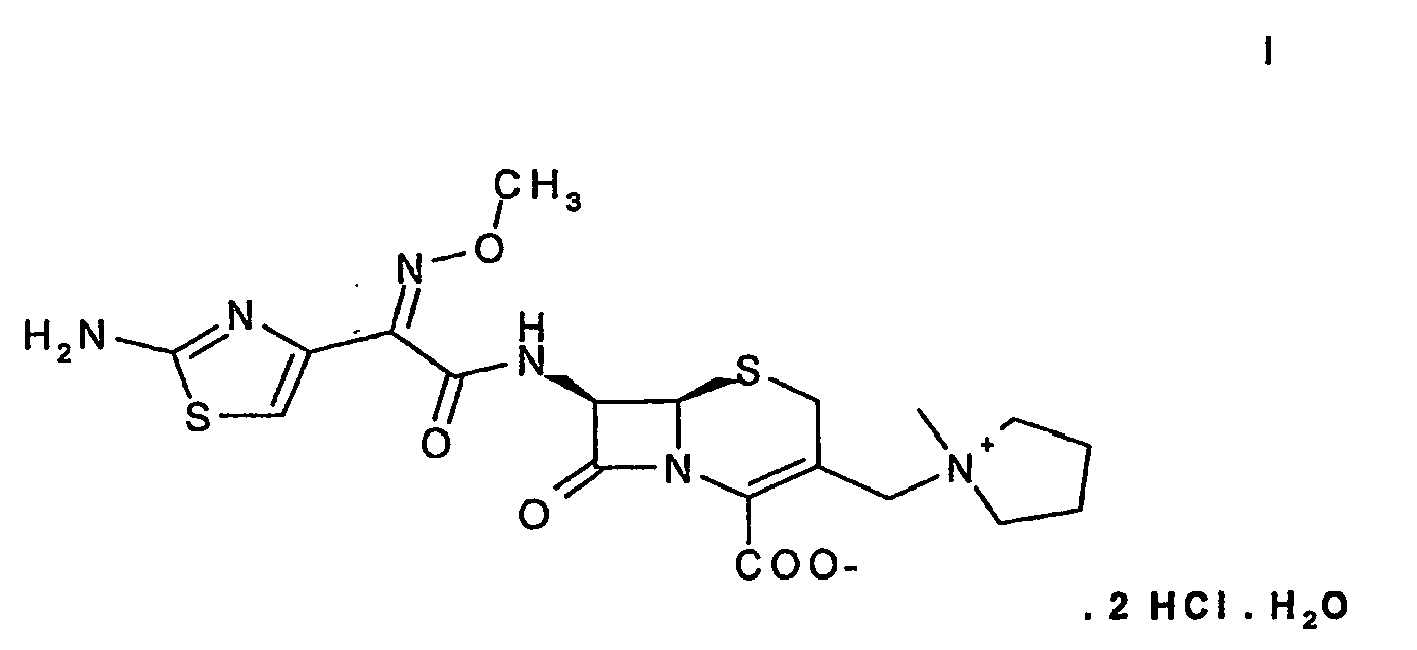
- the present invention relates to the preparation of 1-[[(6R,7R)-7-[[(2Z)-(2-amino-4-thiazolyl)methoxyimino)acetyl]amino]-2-carboxy-8-oxo-5-thia-1-azabicyclo[4.2.0]oct-2-en-3-yl]methyl]-1-methyl-pyrrolidinium dihydrochloride hydrate (cefepime dihydrochloride monohydrate), hereafter "cefepime”. Cefepime is a valuable 4 th generation injectable cephalosporin with antibacterial properties, see e.g. The Merck Index Thirteenth Edition, Item 1935, and is used e.g. in the form of a dihydrochloride hydrate of formula I
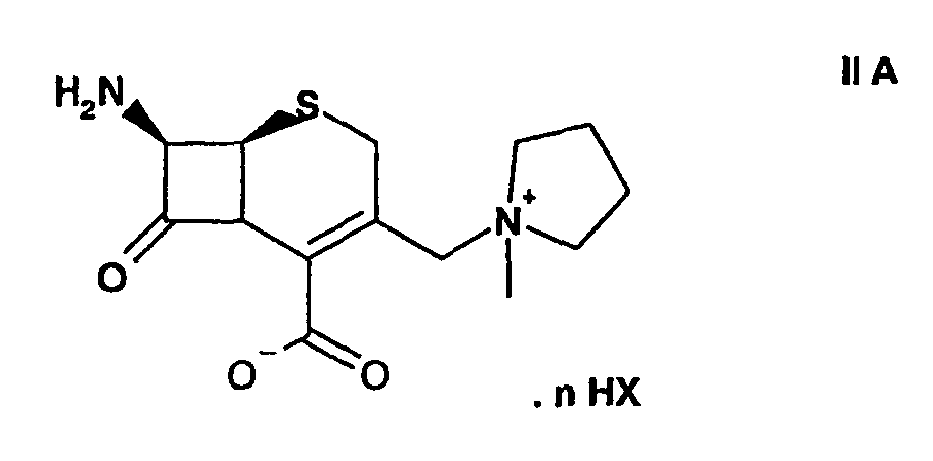
- this invention provides a process comprising reaction of a ⁇ -lactam intermediate of formula IIA or IIB wherein R 1 is trialkylsilyl, R is H or trialkylsilyl n is 0 - 2 and X is chloride, bromide or iodide, with a reactive derivative of the compound of formula III wherein Y is halogen or a leaving group, to form a compound of formula IV or V wherein T is trialkylsilyl, the silyl protecting groups - if present - are removed, if necessary the intermediate step of formula V is isolated wherein m is 0 or 1, the compound of formula IV, or the compound of formula V, is reacted with thiourea and subsequently the compound of formula I is isolated.
- trialkylsilyl protecting groups are trimethylsilyl and triethylsilyl.
- Y When Y represents halogen, Y may denote chloride, bromide or iodide, preferably chloride or bromide. Leaving group is understood in the context of this invention to denote a group which is removed by reaction with e.g. thiourea, e.g. alkyl or aryl sulfonyl, e.g. C 1 - C 4 alkyl sulfonyl.
- alkyl means C 1 - C 8 alkyl, e.g. C 1 - C 4 alkyl, e.g. methyl, ethyl, propyl or butyl and may be straight or branched chain.
- the compounds of formula II or V may exist in mixtures.
- the compound of formula IIA may exist in a mixture having a proportion where n is 1, and a proportion where n is 2.
- the compound of formula IIB may exist in a mixture comprising mono- and di-silylated forms.
- the compounds of formula II may be used in free base form, as a mono-addition salt or as a di-addition salt with a hydrohalic acid such as hydrochloric acid, hydrobromic acid or hydriodic acid.
- a hydrohalic acid such as hydrochloric acid, hydrobromic acid or hydriodic acid.
- the addition salts may additionally be present in solvated form, e.g. as a hydrate.
- the intermediate of formula IIB is obtained by known methods, using a silylation agent such as N,O-bis-(trimethylsilyl)-acetamide (BSA), N,O-bis-(trimethylsilyl)-trifluoroacetamide (BSTFA), N-methyl-N-trimethylsilyl-trifluoroacetamide (MSTFA) or for example hexamethyldisilazane (HMDS), in a solvent that is inert towards silylation agents, for example a nitrile, such as acetonitrile, an ether, for example tetrahydrofuran, or a chlorinated hydrocarbon, for example dichloromethane.
- a silylation agent such as N,O-bis-(trimethylsilyl)-acetamide (BSA), N,O-bis-(trimethylsilyl)-trifluoroacetamide (BSTFA), N-methyl-N-trimethylsilyl-trifluoroacetamide (MST
- the silylated derivative of formula IIB is acylated with a reactive derivative of formula III, the reactive derivative being an acid chloride, acid bromide or active ester, for example a S-mercaptobenzothiazolyl ester, optionally in the presence of an auxiliary base such as a tertiary alkylamine.
- a reactive derivative of formula III the reactive derivative being an acid chloride, acid bromide or active ester, for example a S-mercaptobenzothiazolyl ester, optionally in the presence of an auxiliary base such as a tertiary alkylamine.
- the compound of formula IV is subsequently desilylated with the assistance of a protic reagent, for example water or an alcohol, and then the compound of formula V is reacted with thiourea in an aqueous or organic-aqueous medium.
- Cefepime is subsequently crystallised, if necessary after separating the organic solvent, and where appropriate after removing any salt that is present, for example after treatment using anion exchangers by known methods after adding hydrochloric acid from an aqueous acetonic solution.
- an alternative is to work in an aqueous or aqueous-organic system, for example in a one-phase system consisting of water and a water-miscible solvent, for example a ketone, such as acetone, a nitrile, such as acetonitrile, or an ether, such as tetrahydrofuran, or in a two-phase system, for example in a combination of an ester of acetic acid, for example ethyl acetate, a chlorinated hydrocarbon, for example dichloromethane, or for example an aromatic hydrocarbon, for example toluene, whereby the compound of formula IIA is optionally released from its respective mono- or di-addition salt form with the assistance of a base, for example caustic soda solution or caustic potash solution, a sodium or potassium hydrogen carbonate or alkali carbonate, or by known methods using an ion exchanger, and subsequently the compounds of formula II are acylated with a reactive derivative of formula
- Suitable ion exchangers include ion exchange resins comprising e.g. LA2 which is available commercially from the Rohm and Haas company.
- the reaction sequence preferably starts with an acid addition salt of the compound of formula II, via the silylation route.
- protic solvent for example water or an alcohol
- the silyl groups are removed, and the halide present in the system enables direct crystallisation of the compound of formula V to take place.
- the preferred mono-addition salt is the monohydrochloride in crystalline form.
- the compound of formula IIA is preferably used as the mono- or di-hydrochloride addition salt, and the preferred solvents for crystallisation are acetonitrile in combination with isopropanol.
- the above procedure may be used with addition of a suitable base to the solution or suspension of the acid addition salt of the compound of formula V.
- the acid addition salt of the compound of formula V may be isolated and subsequently converted to the corresponding free base by addition of a suitable base.
- suitable bases include for example trialkylamines, e.g. triethylamine for example in an alcoholic solvent such as methanol.
- this invention provides a synthesis route from cefotaxime (see Merck Index, 12th Edition, item 1983 ) in accordance with the following scheme: cefotaxime in acid or sodium salt form ->
- silylation agent is crucial to the smooth conversion of cefotaxime into a reactive, silylated derivative of formula VII, whereby R signifies hydrogen or a trialkylsilyl group.
- Suitable silylation agents are iodotrimethylsilane in the presence of a non-nucleophilic base, N,O-bis-(trimethylsilyl)-trifluoroacetamide ( BSTFA), (for example US 4,336,253 ); N-methyl-N-trimethyl-silyltrifluoroacetamide ( MSTFA) (for example EP 74 268 ); 1,1,1,3,3,3-hexamethyldisilazane ( HMDS) or a combination of all the said silylation agents.
- BSTFA N,O-bis-(trimethylsilyl)-trifluoroacetamide
- MSTFA N-methyl-N-trimethyl-silyltrifluoroacetamide
- HMDS 1,1,1,3,3,3-hexamethyld
- the silylated compound of formula VIII is treated simultaneously or substantially simultaneously with a protic solvent and N-methylpyrrolidone, whereby in a first step the compound of formula IX is produced and this is then rapidly reacted with N-methylpyrrolidine.
- the reaction accordingly illustrates a desilylation reaction, followed by salt formation on the carboxylic acid and nucleophilic substitution. This principle simultaneously minimises the instability of the highly reactive iodomethyl grouping by an in situ reaction with N-methylpyrrolidine, and through the (desilylation) salt formation on the carboxylic acid, by-product ⁇ 2 formation is drastically reduced.
- Suitable protic solvents are, in particular, alcohols, for example C 1 -C 4 -alcohols, preferred alcohols being ethanol and isopropanol.
- the amount of protic solvent is not critical, however the applicants have obtained favourable results when the reaction proceeds in a homogeneous solution or suspension, and through insolubility, the compound of formula IX is extracted from the possible further reaction in salt form or in free acid form.
- the compound of formula VIII is mixed with a mixture of N-methylpyrrolidine and alcohol, preferably isopropanol. In this way, not only does the above-described reaction sequence take place, but the title compound is obtained as an addition salt with hydroiodic acid. This can be isolated from the reaction mixture directly.
- the iodide is removed from the product simply by treatment in an aqueous or aqueous-organic solution, for example in a mixture of dichloromethane/water, with a commercial anion exchanger, for example with Amberlite LA-2 (from Rohm & Haas), and by adding hydrochloric acid the active ingredient can subsequently be crystallised as the dihydrochloride hydrate according to known methods, for example from an aqueous/acetonic solution.
- the isolated hydroiodide may be converted into the corresponding free amphoteric ion (betaine) of formula XI, for example by treatment with a trialkylamine, e.g. trimethylamine, triethylamine or tributylamine, in an organic solvent such as dichloromethane, and after isolation by known methods, this may can be converted into the title compound cefepime dihydrochloride hydrate.
- a trialkylamine e.g. trimethylamine, triethylamine or tributylamine
- organic solvent such as dichloromethane
- hydrochloric acid is added, preferably aqueous concentrated hydrochloric acid, and a pH value of less than 3, preferably less than 1, is set.
- acetone By adding acetone, the crystallisation of cefepime dihydrochloride is then completed.
- Preferred water/acetone ratios in the crystallisation step are ratios of 1:1 to 1:20, especially ratios of 1:3 to 1:10.
- the processes of this invention may be carried out between -40°C and room temperature, for example between -35°C and 15°C, preferably between -25°C and about 1°C.
- the resulting suspension is heated to 0°C and stirred for 1 hour in an ice bath.
- the suspension is then filtered.
- the filter cake is washed with acetonitrile. After drying in a vacuum at room temperature, 1.42 g of product is obtained as a white crystalline powder.
- the reaction mixture is washed with 10 ml of methylene chloride. After phase separation, the aqueous phase is washed a second time with 10 ml of methylene chloride. The organic phases are combined and then extracted with 3 ml of H 2 O. The aqueous phases are combined and mixed with 0.20 g of activated carbon. After stirring for 10 minutes, the carbon suspension is filtered. The carbon cake is washed with 1.5 ml of H 2 O. The filtrate and washing water are combined, acidified with 6 m HCl to pH 0.6 and mixed with 50 ml of acetone.
- the aqueous phases are combined and mixed with 0.10 g of activated carbon. After stirring for 10 minutes, the activated carbon suspension is filtered. The carbon cake is washed with 1 ml of H 2 O. The filtrate and washing water are combined and diluted with 30 ml of acetone. After adding seed crystals, stirring is effected for 30 minutes at room temperature. Then, 20 ml of acetone are added dropwise to the resulting crystal suspension over the course of 30 minutes. The suspension is cooled to 0°C. After stirring for 1 hour in an ice bath, the product is isolated and the filter cake is washed with acetone. After drying in a vacuum at room temperature, 0.742 g of the title compound are obtained in the form of a white crystalline powder. HPLC purity: 99.5 area %
- pyrrolidinium-1-[(7-amino-2-carboxy-8-oxo-5-thia-1-azabicyclo[4.2.0]oct-2-en-yl)methyl]-dihydrochloride are added to a mixture of 10 ml of H 2 O and 5 ml of methylene chloride, and the pH is adjusted to 6.50 by adding ion exchanger LA-2.
- the 2-phase mixture is cooled in an ice bath to 1°C.
- the aqueous phase is washed with 50 ml of methylene chloride.
- the methylene chloride phases are combined and then extracted with 3 ml of H 2 O.
- the product-containing aqueous phases are combined and mixed with 0.20 g of activated carbon.
- the activated carbon suspension is filtered.
- the carbon cake is washed with 1.5 ml of H 2 O.
- the filtrate and washing water are combined and diluted with 60 ml of acetone.
- stirring is effected for 30 minutes at room temperature.
- 40 ml of acetone are added dropwise to the resulting crystal suspension over the course of 30 minutes.
- the suspension is cooled to 0°C.
Landscapes
- Chemical & Material Sciences (AREA)
- Organic Chemistry (AREA)
- Cephalosporin Compounds (AREA)
- Pharmaceuticals Containing Other Organic And Inorganic Compounds (AREA)
Abstract
Description
- The present invention relates to the preparation of 1-[[(6R,7R)-7-[[(2Z)-(2-amino-4-thiazolyl)methoxyimino)acetyl]amino]-2-carboxy-8-oxo-5-thia-1-azabicyclo[4.2.0]oct-2-en-3-yl]methyl]-1-methyl-pyrrolidinium dihydrochloride hydrate (cefepime dihydrochloride monohydrate), hereafter "cefepime". Cefepime is a valuable 4th generation injectable cephalosporin with antibacterial properties, see e.g. The Merck Index Thirteenth Edition, Item 1935, and is used e.g. in the form of a dihydrochloride hydrate of formula I

- Presently known methods for preparing cefepime are far from straightforward. For example, it is known that the 7-acyl side chain as the difficultly obtainable 2-(2-aminothiazol-4-yl)-2-methoxyimino-acetic acid chloride hydrochloride must be used for the production of cefepime, in order to obtain an active ingredient which is pure in respect of the by-products known as anti-isomer and Δ-2 isomer.
- The present applicants have sought to overcome the problems of hitherto known processes.
- In one aspect, therefore, this invention provides a process comprising reaction of a β-lactam intermediate of formula IIA or IIB


R1 is trialkylsilyl,
R is H or trialkylsilyl
n is 0 - 2 and
X is chloride, bromide or iodide,
with a reactive derivative of the compound of formula III
to form a compound of formula IV or V
if necessary the intermediate step of formula V
the compound of formula IV, or the compound of formula V, is reacted with thiourea and subsequently the compound of formula I is isolated. - Examples of trialkylsilyl protecting groups are trimethylsilyl and triethylsilyl.
- When Y represents halogen, Y may denote chloride, bromide or iodide, preferably chloride or bromide. Leaving group is understood in the context of this invention to denote a group which is removed by reaction with e.g. thiourea, e.g. alkyl or aryl sulfonyl, e.g. C1 - C4 alkyl sulfonyl.
- Unless otherwise stated, alkyl means C1 - C8 alkyl, e.g. C1 - C4 alkyl, e.g. methyl, ethyl, propyl or butyl and may be straight or branched chain.
- Unless otherwise stated, the compounds of formula IIA and IIB are referred to as compounds of formula II.
- It will be appreciated that the compounds of formula II or V may exist in mixtures. Thus the compound of formula IIA may exist in a mixture having a proportion where n is 1, and a proportion where n is 2. The compound of formula IIB may exist in a mixture comprising mono- and di-silylated forms.
- The compounds of formula II may be used in free base form, as a mono-addition salt or as a di-addition salt with a hydrohalic acid such as hydrochloric acid, hydrobromic acid or hydriodic acid. The addition salts may additionally be present in solvated form, e.g. as a hydrate.
- If the silylation variant is chosen, the intermediate of formula IIB is obtained by known methods, using a silylation agent such as N,O-bis-(trimethylsilyl)-acetamide (BSA), N,O-bis-(trimethylsilyl)-trifluoroacetamide (BSTFA), N-methyl-N-trimethylsilyl-trifluoroacetamide (MSTFA) or for example hexamethyldisilazane (HMDS), in a solvent that is inert towards silylation agents, for example a nitrile, such as acetonitrile, an ether, for example tetrahydrofuran, or a chlorinated hydrocarbon, for example dichloromethane.
- Subsequently, the silylated derivative of formula IIB is acylated with a reactive derivative of formula III, the reactive derivative being an acid chloride, acid bromide or active ester, for example a S-mercaptobenzothiazolyl ester, optionally in the presence of an auxiliary base such as a tertiary alkylamine.
- The compound of formula IV is subsequently desilylated with the assistance of a protic reagent, for example water or an alcohol, and then the compound of formula V is reacted with thiourea in an aqueous or organic-aqueous medium. Cefepime is subsequently crystallised, if necessary after separating the organic solvent, and where appropriate after removing any salt that is present, for example after treatment using anion exchangers by known methods after adding hydrochloric acid from an aqueous acetonic solution.
- An alternative is to work in an aqueous or aqueous-organic system, for example in a one-phase system consisting of water and a water-miscible solvent, for example a ketone, such as acetone, a nitrile, such as acetonitrile, or an ether, such as tetrahydrofuran, or in a two-phase system, for example in a combination of an ester of acetic acid, for example ethyl acetate, a chlorinated hydrocarbon, for example dichloromethane, or for example an aromatic hydrocarbon, for example toluene, whereby the compound of formula IIA is optionally released from its respective mono- or di-addition salt form with the assistance of a base, for example caustic soda solution or caustic potash solution, a sodium or potassium hydrogen carbonate or alkali carbonate, or by known methods using an ion exchanger, and subsequently the compounds of formula II are acylated with a reactive derivative of formula III. After the acylation reaction has taken place, thiourea is added, and after optionally separating the organic solvent, the title compound is isolated by known methods by adding acetone from an aqueous/acetonic solution.
- Suitable ion exchangers include ion exchange resins comprising e.g. LA2 which is available commercially from the Rohm and Haas company.
- If desired, it is possible to isolate the compound of formula V, at this stage as an addition salt with a hydrohalic acid, for example as the hydrochloride, or isolate as free base. Here, the reaction sequence preferably starts with an acid addition salt of the compound of formula II, via the silylation route. By adding small amounts of protic solvent, for example water or an alcohol, to the compound of formula IV, the silyl groups are removed, and the halide present in the system enables direct crystallisation of the compound of formula V to take place. The preferred mono-addition salt is the monohydrochloride in crystalline form. In order to produce this, the compound of formula IIA is preferably used as the mono- or di-hydrochloride addition salt, and the preferred solvents for crystallisation are acetonitrile in combination with isopropanol.
- To isolate the compound of formula V as free base in crystalline form, the above procedure may be used with addition of a suitable base to the solution or suspension of the acid addition salt of the compound of formula V. Alternatively, the acid addition salt of the compound of formula V may be isolated and subsequently converted to the corresponding free base by addition of a suitable base. Suitable bases include for example trialkylamines, e.g. triethylamine for example in an alcoholic solvent such as methanol.
- In
US 4,266,049 , a 7-acyl-3-acetoxymethyl-cephalosporinate is converted with the assistance of an iodotrialkylsilane into the corresponding persilylated 3-iodomethyl compound and this then undergoes nucleophilic substitution in the 3'-position. This technology can only be applied to the production of cefepime - starting with cefotaxime - to an uneconomical extent, since N-methylpyrrolidine as a strong base can greatly induce the formation of the by-products Δ-2 und und 7-epi (Walker et al, J.Org Chem. 1988, pages 983-991). - The present applicants found that working with N-methylpyrrolidine - trialkylsilane adducts iodotrimethylsilane and N-methylpyrrolidine as described in the above literature led to unsatisfactory results when using cefotaxime as the starting material.
- In another aspect therefore, this invention provides a synthesis route from cefotaxime (see Merck Index, 12th Edition, item 1983) in accordance with the following scheme:
cefotaxime in acid or sodium salt form ->
- The choice of silylation agent is crucial to the smooth conversion of cefotaxime into a reactive, silylated derivative of formula VII, whereby R signifies hydrogen or a trialkylsilyl group. Suitable silylation agents are iodotrimethylsilane in the presence of a non-nucleophilic base, N,O-bis-(trimethylsilyl)-trifluoroacetamide ( BSTFA), (for example
US 4,336,253 ); N-methyl-N-trimethyl-silyltrifluoroacetamide ( MSTFA) (for exampleEP 74 268 - According to the above synthesis method, the silylated compound of formula VIII is treated simultaneously or substantially simultaneously with a protic solvent and N-methylpyrrolidone, whereby in a first step the compound of formula IX is produced and this is then rapidly reacted with N-methylpyrrolidine. The reaction accordingly illustrates a desilylation reaction, followed by salt formation on the carboxylic acid and nucleophilic substitution. This principle simultaneously minimises the instability of the highly reactive iodomethyl grouping by an in situ reaction with N-methylpyrrolidine, and through the (desilylation) salt formation on the carboxylic acid, by-product Δ2 formation is drastically reduced.
- Suitable protic solvents are, in particular, alcohols, for example C1-C4-alcohols, preferred alcohols being ethanol and isopropanol. The amount of protic solvent is not critical, however the applicants have obtained favourable results when the reaction proceeds in a homogeneous solution or suspension, and through insolubility, the compound of formula IX is extracted from the possible further reaction in salt form or in free acid form.
- In a preferred embodiment, the compound of formula VIII is mixed with a mixture of N-methylpyrrolidine and alcohol, preferably isopropanol. In this way, not only does the above-described reaction sequence take place, but the title compound is obtained as an addition salt with hydroiodic acid. This can be isolated from the reaction mixture directly. The iodide is removed from the product simply by treatment in an aqueous or aqueous-organic solution, for example in a mixture of dichloromethane/water, with a commercial anion exchanger, for example with Amberlite LA-2 (from Rohm & Haas), and by adding hydrochloric acid the active ingredient can subsequently be crystallised as the dihydrochloride hydrate according to known methods, for example from an aqueous/acetonic solution.
- In one embodiment, the isolated hydroiodide may be converted into the corresponding free amphoteric ion (betaine) of formula XI, for example by treatment with a trialkylamine, e.g. trimethylamine, triethylamine or tributylamine, in an organic solvent such as dichloromethane, and after isolation by known methods, this may can be converted into the title compound cefepime dihydrochloride hydrate.

- After the acylation reaction, in order to crystallise cefipime dihydrochloride, hydrochloric acid is added, preferably aqueous concentrated hydrochloric acid, and a pH value of less than 3, preferably less than 1, is set. By adding acetone, the crystallisation of cefepime dihydrochloride is then completed. Preferred water/acetone ratios in the crystallisation step are ratios of 1:1 to 1:20, especially ratios of 1:3 to 1:10.
- The processes of this invention may be carried out between -40°C and room temperature, for example between -35°C and 15°C, preferably between -25°C and about 1°C.
- Following is a description by way of example only of processes of this invention.
-
Figure 1 is an X-ray spectrum of the compound of formula V as hydrochloride; -
Figure 2 is an X-ray spectrum of the compound of formula V as base (betain). - The following abbreviations are used:
- NMP+
- to denote N-methylpyrrolidinium
- NMP-ACA
- to denote an intermediate compound of Formula IIA
- A solution of 0.488 g of 4-chloro-2-methoxyiminobutyric acid in 8.0 ml of acetonitrile is mixed at -20°C with 0.353 g of chloromethylene iminium chloride (Vilsmeier reagent) and stirred for 1 hour at -20°C.
- 1.55 g of N,O-bistrimethylsilyacetamide are added dropwise at room temperature to a suspension of 0.835 g of NMP-ACA.2HCl in 10.5 ml of acetonitrile. After stirring for 25 mins at room temperature, the solution obtained is cooled to -35°C. At this temperature, a solution of 4-chloro-2-methoxyimino-3-oxo-butyryl chloride in acetonitrile (for preparation see example 1a), which has been cooled to -20°C, is added. After stirring for 1 hour in a cooling bath at -35°C, 2 ml of isopropanol are added dropwise. The resulting suspension is heated to 0°C and stirred for 1 hour in an ice bath. The suspension is then filtered. The filter cake is washed with acetonitrile. After drying in a vacuum at room temperature, 1.42 g of product is obtained as a white crystalline powder.
1H-NMR spectrum (DMSO-d6, δ in ppm)
1,957 - 1,690 (m, 2H, pyrrolidinyl-H); 2,943 (s, 3 H, N-CH3); 3,371 - 3,701 (m, 5 H, pyrrolidinyl-H, S-CH2); 3,866 (1 H, J = 10,0 Hz, S-CH2); 4,060 (s, 3 H, OCH3); 4,329 and 4,597(ABq, 2 H, J = 13,7 Hz, .-CH2-N); 4,846 (s, 2 H, CH2Cl); 5,322 (d, 1 H, 5,1 Hz, H6); 5,884 (dd, 1H, J = 8,4 Hz, J = 5,1 Hz, H7); 9,555 (d, 1H, NH) - 1.63 g of trimethylsilychloride are added dropwise at room temperature to a suspension of 5.00 g of NMP-ACA.HCl in 190 ml of acetonitrile. After stirring for 10 mins at room temperature 8.5 ml acetontrile are added and then the suspension is cooled to 0°C. At this temperature 7.74 g N,O-bistrimethylsilyacetamide are added dropwise. After stirring for 20 mins the resulting solution is cooled to - 20°C. At this temperatur a solution of 4-chloro-2-methoxyimino-3-oxo-butyryl chloride in acetonitrile (prepared from 3.03 g 4-chloro-2-methoxyimino-3-oxo-butyryl acid, 2.16 g of chloromethylene iminium chloride (Vilsmeier reagent) and 45 ml acetonitrile; preparation see example 1a), which has been cooled to -20°C, is added. After stirring for 1 hour in a cooling bath at -25°C the cold reaction mixture is added within 20 minutes to a mixture of 148 ml acetontrile and 14 ml methanol and by addition of a solution of ethyldiisopropylamine in acetonitrile (10%) the pH is maintained in the range 2.0 -1.5. The resulting suspension is stirred for 1 hour in an ice bath. The suspension is then filtered. The filter cake is washed with acetonitrile. After drying in a vacuum at room temperature, 7.20 g of product is obtained as a white crystalline powder.
The corresponding X-ray spectrum is shown inFigure 1 . - 10.64 g of (4-chloro-2-methoxyimino-3-oxo-butyryl]amino]-2-carboxy-8-oxo-5-thia-1-azabicyclo[4.2.0]oct-2-en-3-yl]methyl]-1-methyl-pyrrolidinium hydrochloride (for preparation see above) is suspended in 95 ml cold methanol. To the suspension is added dropwise at 0°C a solution of 8.1g triethylamine in 30 ml methanol. The suspension is stirred for 1 hour in an ice bath. The suspension is then filtered. The filter cake is washed with cold methanol. After drying in a vacuum at room temperature, 7.57 g of product is obtained as a white crystalline powder.
The corresponding X-ray spectrum is shown inFigure 2 . - 0.990 g of 1-[[(6R,7R)-7-[[(2Z)-(4-chloro-2-methoxyimino-3-oxo-butyryl]amino]-2-carboxy-8-oxo-5-thia-1-azabicyclo[4.2.0]oct-2-en-3-yl]methyl]-1-methyl-pyrrolidinium hydrochloride are added at 4°C to a solution of 0.152 g of thiourea in 5 ml of H2O. The pH of the suspension is adjusted to pH 6.0 with ion exchanger LA-2 and maintained in the pH range of 5.5 to 6.0 by adding LA-2 dropwise. After stirring for 8.5 hours at 2 to 4°C, the reaction mixture is washed with 10 ml of methylene chloride. After phase separation, the aqueous phase is washed a second time with 10 ml of methylene chloride. The organic phases are combined and then extracted with 3 ml of H2O. The aqueous phases are combined and mixed with 0.20 g of activated carbon. After stirring for 10 minutes, the carbon suspension is filtered. The carbon cake is washed with 1.5 ml of H2O. The filtrate and washing water are combined, acidified with 6 m HCl to pH 0.6 and mixed with 50 ml of acetone. After adding seed crystals, stirring is effected for 15 minutes at room temperature, and then a further 50 ml of acetone is added dropwise over the course of 1 hour. The crystal suspension obtained is cooled to 0°C. After stirring for 1 hour in an ice bath, the suspension is filtered and the filter cake is washed with acetone. After drying in a vacuum at room temperature, 0.561 g of the title compound are obtained in the form of a white crystalline powder.
HPLC purity: 99.6 area % - 1.55 g of N,O-bistrimethylsilylacetamide are added dropwise at 1°C to a suspension of 0.835 g of pyrrolidinium-1-[(7-amino-2-carboxy-8-oxo-5-thia-1-azabicyclo[4.2.0]oct-2-en-yl)methyl]-dihydrochloride in 10.5 ml of acetonitrile. After stirring for 45 mins in an ice bath, the solution obtained is cooled to -35°C. At this temperature, a solution of 4-chloro-2-methoxyimino-3-oxo-butyryl chloride (for preparation see example 1a), which has been cooled to -20°C, is added. After stirring for 1 hour in a cooling bath at -35°C, 2 ml of H2O are added dropwise. After stirring for 10 minutes at -35°C, 0.38 g of thiourea are added. The reaction mixture is subsequently heated to 0°C and the pH is adjusted to 6.0 by adding ion exchanger LA-2, and is maintained at this pH. After stirring for 2 hours in an ice bath, the 2-phase reaction mixture obtained is mixed with 2 ml of H2O. After stirring for a further 16 hours at 0 to 4°C, the pH is acidified to pH 0.6 with 6 m HCl. After adding 50 ml of methylene chloride, the phases are separated. The methylene chloride phase is then extracted with 3 ml of H2O. The aqueous phases are combined and mixed with 0.10 g of activated carbon. After stirring for 10 minutes, the activated carbon suspension is filtered. The carbon cake is washed with 1 ml of H2O. The filtrate and washing water are combined and diluted with 30 ml of acetone. After adding seed crystals, stirring is effected for 30 minutes at room temperature. Then, 20 ml of acetone are added dropwise to the resulting crystal suspension over the course of 30 minutes. The suspension is cooled to 0°C. After stirring for 1 hour in an ice bath, the product is isolated and the filter cake is washed with acetone. After drying in a vacuum at room temperature, 0.742 g of the title compound are obtained in the form of a white crystalline powder.
HPLC purity: 99.5 area % - 1.706 g of pyrrolidinium-1-[(7-amino-2-carboxy-8-oxo-5-thia-1-azabicyclo[4.2.0]oct-2-en-yl)methyl]-dihydrochloride are added to a mixture of 10 ml of H2O and 5 ml of methylene chloride, and the pH is adjusted to 6.50 by adding ion exchanger LA-2. The 2-phase mixture is cooled in an ice bath to 1°C. At this temperature, a solution of 4-chloro-2-methoxyimino-3-oxo-butyryl chloride, produced from 1.464 g of 4-chloro-2-methoxyimino-3-oxo-butyric acid (see example 1a), which has been cooled to -20°C, is added dropwise over the course of 1 hour, whereby the pH is maintained in the range of 6.0 to 6.5 by adding base LA-2. After stirring for 15 minutes in an ice bath, 0.76 g of thiourea are added and stirring is effected for 16 hours at 2-4°C. The pH is maintained in the range of 5.5 to 6.0 with LA-2. The reaction mixture is subsequently diluted with 100 ml of methylene chloride. After phase separation, the aqueous phase is washed with 50 ml of methylene chloride. The methylene chloride phases are combined and then extracted with 3 ml of H2O. The product-containing aqueous phases are combined and mixed with 0.20 g of activated carbon. After stirring for 10 minutes, the activated carbon suspension is filtered. The carbon cake is washed with 1.5 ml of H2O. The filtrate and washing water are combined and diluted with 60 ml of acetone. After adding seed crystals, stirring is effected for 30 minutes at room temperature. Then, 40 ml of acetone are added dropwise to the resulting crystal suspension over the course of 30 minutes. The suspension is cooled to 0°C. After stirring for 1 hour in an ice bath, the product is isolated and the filter cake is washed with acetone. After drying in a vacuum at room temperature, 1.236 g of the title compound are obtained in the form of a white crystalline powder.
HPLC purity: 90.0 area % - 100.0 g of cefotaxime are suspended in 1.2 l of methylene chloride and heated to reflux temperature. Whilst boiling under reflux, 2.5 ml of hexamethyldisilazane (HMDS) and 0.2 ml of trimethyliodosilane are added. Then, 102 ml of HMDS are added dropwise whilst stirring, and stirring is effected at this temperature for 1 hour, whereby the resulting ammonia is removed by passing nitrogen into the reaction suspension. Then, the clear solution obtained is cooled to 10°C. 70 ml of trimethyliodosilane are added dropwise at this temperature. After stirring for 60 minutes, 10 ml of trimethyliodosilane are added dropwise, and after a further 30 minutes, a further 15 ml of trimethyliodosilane are added. After stirring for 165 minutes at 10°C, the reaction solution is stirred over the course of 2 minutes into a solution of 350 ml of N-methylpyrrolidine in 91 of isopropanol, which has a temperature of 18°C. The resulting suspension is stirred for 1 hour at room temperature. Then, it is filtered through a glass sintering filter and the filter cake is washed with 500 ml of isopropanol. After drying in a vacuum at room temperature, 97.7 g of the title compound are obtained in the form of a yellow coloured powder.
- 4.00 g of 1-[[(6R,7R)-7-[[(2Z)-(2-amino-4-thiazolyl)methoxyimino)acetyl]amino]-2-carboxy-8-oxo-5-thia-1-azabicyclo[4.2.0]oct-2-en-3-yl]methyl]-1-methyl-pyrrolidinium hydriodide are dissolved at room temperature in a mixture of 10 ml of H2O and 30 ml of methylene chloride. The pH of the mixture is adjusted to 7.3 through the dropwise addition of ion exchanger LA-2. After stirring for 15 minutes, the phases are separated. The aqueous phase is adjusted to pH 2.5 with conc. hydrochloric acid and stirred for 15 minutes. Then, the precipitate formed is separated by filtration. The clear filtrate is acidified to pH 1.0 with conc. hydrochloric acid and mixed with 1.6 g of activated carbon. After stirring for 10 minutes, the activated carbon is removed by filtration and the carbon cake is washed with 5 ml of H2O. The filtrate and washing water are combined, acidified to pH 0.5 with conc. hydrochloric acid and diluted with 50 ml of acetone. Seed crystals are added, and the resulting crystal suspension is stirred for ca. 20 minutes at room temperature. Subsequently, a further 50 ml of acetone is added dropwise over the course of 30 minutes. When the acetone addition is complete, the crystal suspension is cooled to 0°C. After stirring for 1 hour in an ice bath, the suspension is filtered and the filter cake is washed with acetone. After drying in a vacuum at room temperature, 0.85g of the title compound are obtained in the form of a white crystalline powder. Yield: 36.8%.
HPLC purity: > 99 area % - 50.0 g of cefepime dihydrochloride hydrate are dissolved in 200 ml of H2O. 22 ml of 6 n HCl are added and then the solution is mixed with 5 g of activated carbon. The suspension is stirred for 10 minutes at room temperature and then filtered through a suction filter. The filter layer is then washed with 50 ml of H2O, and the combined filtrates are mixed with 600 ml of acetone until turbidity occurs. The resulting suspension is stirred for 15 minutes and then a further 1400 ml of acetone are added over the course of one hour whilst stirring gently. The suspension is stirred for another one hour at room temperature, and the product is subsequently isolated through a suction filter. The product is washed with a total of 500 ml of acetone and dried for ca. 18 hours at room temperature in a vacuum drying chamber.
Yield 45.01 g
purity HPLC: 99.7 area percent -
- X-Ray Powder Diffractometer D-8 (AXS-BRUKER)
- theta-theta-goniometer, sample changer
- target: Copper, Kα1+Kα2 λ = 1.5406 A
- parallel beam optics (receiving soller-slit: 0.07 mm)
- Scintillation counter, standard sample holders
Claims (13)
- A process for producing a compound of formula I


R1 is a trialkylsilyl group,
R is hydrogen or a trialkylsilyl group,
n is 0 - 2 and
X signifies chloride, bromide or iodide
is reacted with a reactive derivative of formula III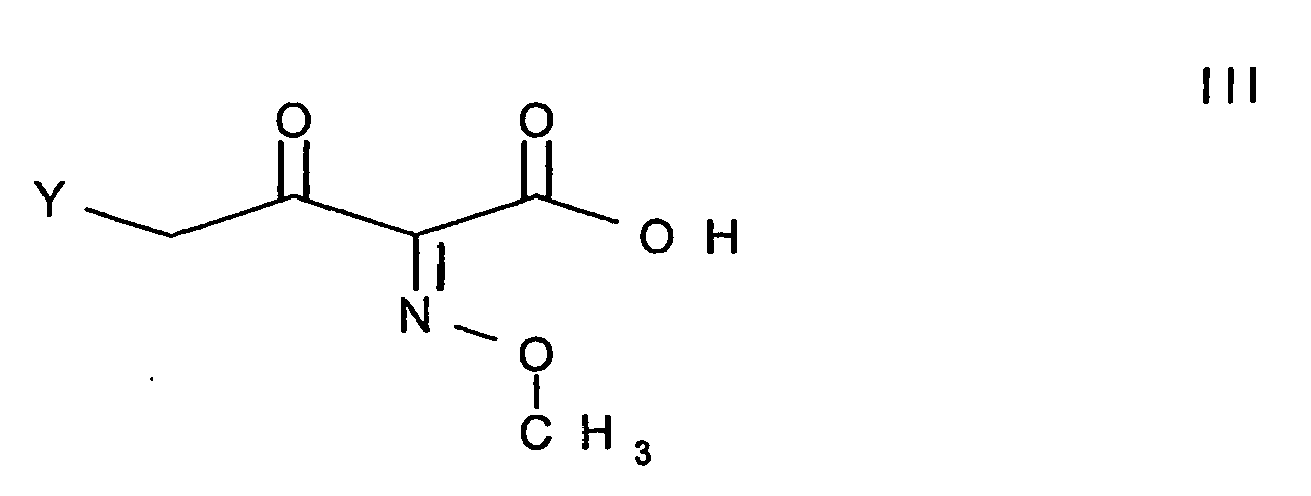


- A process as claimed in claim 1, wherein the compounds of formula II are produced from their respective mono- or di- hydrogen halide adducts.
- A process as claimed in claim 1 or 2, wherein pyrrolidinium-1-[(7-amino-2-carboxy-8-oxo-5-thia-1-azabicyclo[4.2.0]oct-2-en-yl)methyl]-iodide monohydrate is used.
- A process as claimed in claim 1 or 2, wherein pyrrolidinium-1-[(7-amino-2-carboxy-8-oxo-5-thia-1-azabicyclo[4.2.0]oct-2-en-yl)methyl]-chloride or pyrrolidinium-1-[(7-amino-2-carboxy-8-oxo-5-thia-1-azabicyclo[4.2.0]oct-2-en-yl)methyl]-dihydrochloride is used, optionally in solvated form.
- A compound of formula V, wherein Y and X are Cl.
- A compound as claimed in claim 5 in crystalline form wherein the compound of formula V is in free base or acid addition salt form.
- A compound as claimed in claim 6 having an X-ray powder diffraction pattern substantially as that shown in Figure 1 or Figure 2.
- A process according to claim 1, characterised in that 4-chloro-2-methoxyimino-3-oxo-butyryl chloride is used as the reactive derivative of formula III.
- A process as claimed in any of claims 1 to 5 or 8, wherein prior to precipitation or crystallisation of the compound of formula I, any bromide or iodide ions that may be present are removed by ion exchange.
- A process for producing the compound of formula I


- A process as claimed in claim 10, wherein the protic solvent is a C1-C4-alcohol.
- A process according to claim 10 or 11, wherein conversion of the compound of formula VIII is effected using a basic ion exchanger.
- A process as claimed in claim 10, 11 or 12, wherein conversion of the compound of formula X into the compound of formula I is effected through the free betaine of formula XI in isolated form

Applications Claiming Priority (4)
| Application Number | Priority Date | Filing Date | Title |
|---|---|---|---|
| AT5852003 | 2003-04-16 | ||
| AT5842003 | 2003-04-16 | ||
| AT5862003 | 2003-04-16 | ||
| EP04727526A EP1618114B1 (en) | 2003-04-16 | 2004-04-15 | Processes for the preparations of cefepime |
Related Parent Applications (1)
| Application Number | Title | Priority Date | Filing Date |
|---|---|---|---|
| EP04727526.8 Division | 2004-04-15 |
Publications (2)
| Publication Number | Publication Date |
|---|---|
| EP2218723A2 true EP2218723A2 (en) | 2010-08-18 |
| EP2218723A3 EP2218723A3 (en) | 2010-11-17 |
Family
ID=33303376
Family Applications (2)
| Application Number | Title | Priority Date | Filing Date |
|---|---|---|---|
| EP10005006A Withdrawn EP2218723A3 (en) | 2003-04-16 | 2004-04-15 | Processes for the preparations of cefepime |
| EP04727526A Expired - Lifetime EP1618114B1 (en) | 2003-04-16 | 2004-04-15 | Processes for the preparations of cefepime |
Family Applications After (1)
| Application Number | Title | Priority Date | Filing Date |
|---|---|---|---|
| EP04727526A Expired - Lifetime EP1618114B1 (en) | 2003-04-16 | 2004-04-15 | Processes for the preparations of cefepime |
Country Status (6)
| Country | Link |
|---|---|
| EP (2) | EP2218723A3 (en) |
| AT (1) | ATE473986T1 (en) |
| DE (1) | DE602004028111D1 (en) |
| ES (1) | ES2348299T3 (en) |
| PL (1) | PL1618114T3 (en) |
| WO (1) | WO2004092183A2 (en) |
Families Citing this family (10)
| Publication number | Priority date | Publication date | Assignee | Title |
|---|---|---|---|---|
| WO2005019227A1 (en) | 2003-08-22 | 2005-03-03 | Orchid Chemicals & Pharmaceuticals Ltd | Process for the preparation of cephalosporin antibiotic |
| US20070111980A1 (en) | 2004-07-16 | 2007-05-17 | Bandi Parthasaradhi Reddy | Process for preparing pure cephalosporine intermediates |
| ITMI20042139A1 (en) * | 2004-11-08 | 2005-02-08 | Acs Dobfar Spa | PROCEDURE FOR THE PRODUCTION OF CEFEPIME AND CEFAPOSPORINE ANALOGHE |
| WO2006067803A1 (en) * | 2004-12-21 | 2006-06-29 | Lupin Limited | A novel intermediate for the preparation of cefepime |
| CN101935325B (en) * | 2010-09-19 | 2012-02-08 | 海南新中正制药有限公司 | Preparation method of cefepime hydrochloride |
| RU2469040C1 (en) * | 2011-12-07 | 2012-12-10 | Общество с ограниченной ответственностью "КОМПАНИЯ "ДЕКО" | Method of producing 7-[2-(2-aminothiazol-4-yl)-2(z)-methoxyimino acetamido]-3-[(1-methyl-1-pyrrolidino)methyl]-cef-3-em-4-carboxylate dihydrochloride monohydrate (cefepime dihydrochloride monohydrate) |
| CN102408440A (en) * | 2011-12-27 | 2012-04-11 | 山东鑫泉医药有限公司 | Synthesis method of cefepime hydrochloride |
| CN102675345A (en) * | 2012-06-01 | 2012-09-19 | 苏州中联化学制药有限公司 | Method for preparing cefepime hydrochloride |
| LT2968446T (en) * | 2013-03-13 | 2017-07-25 | Theravance Biopharma Antibiotics Ip, Llc | Hydrochloride salts of an antibiotic compound |
| CN105859747B (en) * | 2016-05-13 | 2018-07-24 | 齐鲁安替制药有限公司 | A kind of preparation method of cefepime Hydrochloride suitable for industrialized production |
Citations (3)
| Publication number | Priority date | Publication date | Assignee | Title |
|---|---|---|---|---|
| US4266049A (en) | 1980-02-20 | 1981-05-05 | Eli Lilly And Company | Process for 3-iodomethyl cephalosporins |
| US4336253A (en) | 1981-03-11 | 1982-06-22 | Eli Lilly And Company | Cephalosporin antibiotics |
| EP0074268A2 (en) | 1981-09-08 | 1983-03-16 | Eli Lilly And Company | Improvements in or relating to thieno and furopyridinium-substituted cephalosporin derivatives |
Family Cites Families (18)
| Publication number | Priority date | Publication date | Assignee | Title |
|---|---|---|---|---|
| DK154939C (en) | 1974-12-19 | 1989-06-12 | Takeda Chemical Industries Ltd | METHOD OF ANALOGUE FOR THE PREPARATION OF THIAZOLYLACETAMIDO-CEPHEM COMPOUNDS OR PHARMACEUTICAL ACCEPTABLE SALTS OR ESTERS THEREOF |
| FI67385C (en) | 1979-11-21 | 1985-03-11 | Hoffmann La Roche | PROCEDURE FOR FRAMSTATION OF AV (6R 7R) -7- (2- (2-AMINO-4-THIAZOLYL) -2- (Z-METHOXYIMINO) ACETAMIDO) -3-CEFEM-4-CARBOXYL SYRATER DERIVATIVES |
| EP0037380B1 (en) | 1980-03-28 | 1984-09-12 | BIOCHEMIE Gesellschaft m.b.H. | New process for the production of cephalosporin antibiotics, and novel intermediates used in such process and their production |
| NZ198350A (en) * | 1980-09-25 | 1985-02-28 | Toyama Chemical Co Ltd | Cephalosporins and intermediates;pharmaceutical compositions |
| US4406899A (en) | 1982-03-04 | 1983-09-27 | Bristol-Myers Company | Cephalosporins |
| DE3316797A1 (en) | 1983-05-07 | 1984-11-08 | Hoechst Ag, 6230 Frankfurt | METHOD FOR PRODUCING CEPHEM COMPOUNDS |
| DE3409431A1 (en) * | 1983-10-08 | 1985-04-18 | Hoechst Ag, 6230 Frankfurt | CEPHALOSPORINE DERIVATIVES AND METHOD FOR THEIR PRODUCTION |
| CN86107947A (en) | 1985-11-22 | 1987-05-27 | 藤沢药品工业株式会社 | New cephem compounds and preparation method thereof |
| US4959495A (en) | 1986-07-28 | 1990-09-25 | American Cyanamid Company | Process for the preparation of intermediates used to produce aminothiazoloximino cephalosporins |
| JPH01230547A (en) | 1988-01-14 | 1989-09-14 | Takeda Chem Ind Ltd | Production of tertiary butyl 3-oxobutyrate and use thereof |
| IT1234385B (en) | 1989-05-23 | 1992-05-18 | Sbd Synthetic And Biolog Devel | IMPROVED PROCEDURE FOR THE PRODUCTION OF AN ANTIBIOTIC SUBSTANCE BELONGING TO THE CEPHALOSPORINE GROUP |
| YU81692A (en) * | 1991-09-10 | 1995-03-27 | Bristol-Myers Co. | PROCEDURE FOR THE PRODUCTION OF CEPHALOSPORIN ANTIBIOTICS |
| AT399877B (en) | 1992-02-20 | 1995-08-25 | Biochemie Gmbh | NEW METHOD FOR PRODUCING CEFTRIAXONE |
| US5574154A (en) * | 1994-09-29 | 1996-11-12 | Alnejma Bulk Pharmaceutical Co. A.B.P.C. | Process for the preparation of cephalosporanic compounds |
| IT1286494B1 (en) | 1996-11-19 | 1998-07-15 | Hichem Pharma S P A | PROCEDURE FOR THE PREPARATION OF CEPHALOSPORANIC DERIVATIVES |
| AU3967000A (en) * | 1999-04-15 | 2000-11-02 | Biochemie Gesellschaft Mbh | Beta-lactam production |
| US6458949B1 (en) | 2000-08-14 | 2002-10-01 | Aurobindo Pharma Limited | Ceftiofur, its intermediate and a process for the preparation of the same |
| US6384215B1 (en) * | 2001-06-07 | 2002-05-07 | Orchid Chemicals & Pharmaceuticals Ltd. | Preparation of new intermediates and their use in manufacturing of cephalosporin compounds |
-
2004
- 2004-04-15 AT AT04727526T patent/ATE473986T1/en active
- 2004-04-15 ES ES04727526T patent/ES2348299T3/en not_active Expired - Lifetime
- 2004-04-15 PL PL04727526T patent/PL1618114T3/en unknown
- 2004-04-15 EP EP10005006A patent/EP2218723A3/en not_active Withdrawn
- 2004-04-15 DE DE602004028111T patent/DE602004028111D1/en not_active Expired - Lifetime
- 2004-04-15 EP EP04727526A patent/EP1618114B1/en not_active Expired - Lifetime
- 2004-04-15 WO PCT/EP2004/003988 patent/WO2004092183A2/en not_active Ceased
Patent Citations (3)
| Publication number | Priority date | Publication date | Assignee | Title |
|---|---|---|---|---|
| US4266049A (en) | 1980-02-20 | 1981-05-05 | Eli Lilly And Company | Process for 3-iodomethyl cephalosporins |
| US4336253A (en) | 1981-03-11 | 1982-06-22 | Eli Lilly And Company | Cephalosporin antibiotics |
| EP0074268A2 (en) | 1981-09-08 | 1983-03-16 | Eli Lilly And Company | Improvements in or relating to thieno and furopyridinium-substituted cephalosporin derivatives |
Non-Patent Citations (1)
| Title |
|---|
| WALKER ET AL., J.ORG CHEM., 1988, pages 983 - 991 |
Also Published As
| Publication number | Publication date |
|---|---|
| ES2348299T3 (en) | 2010-12-02 |
| PL1618114T3 (en) | 2010-12-31 |
| DE602004028111D1 (en) | 2010-08-26 |
| EP1618114B1 (en) | 2010-07-14 |
| WO2004092183A2 (en) | 2004-10-28 |
| WO2004092183A3 (en) | 2004-12-09 |
| EP2218723A3 (en) | 2010-11-17 |
| EP1618114A2 (en) | 2006-01-25 |
| ATE473986T1 (en) | 2010-07-15 |
Similar Documents
| Publication | Publication Date | Title |
|---|---|---|
| AU731413B2 (en) | Crystalline amine salt of cefdinir | |
| EP1347970A1 (en) | Novel thioester derivatives of thiazolyl acetic acid and their use in the preparation of cephalosporin compounds | |
| EP2218723A2 (en) | Processes for the preparations of cefepime | |
| EP1016665B1 (en) | Process for the selective preparation of z-isomers of 3-(2-substituted vinyl)cephalosporins | |
| EP1068211B1 (en) | Process for purification of a cephalosporin derivative | |
| JP3434840B2 (en) | Manufacturing method of cephalosporin antibiotic | |
| EP0533047B1 (en) | Preparation of a cephalosporin antibiotic using the synisomer of a thiazolyl intermediate | |
| KR100342600B1 (en) | New Thiazole compounds and their preparations | |
| US7847093B2 (en) | Processes for the preparations of cefepime | |
| US20050043531A1 (en) | Process for preparing cefepime | |
| US5594130A (en) | Preparation of a cephalosporin antibiotic using the syn-isomer of a thiazolyl intermediate | |
| KR100355115B1 (en) | New cephem compouns for preparation of ceftiofur | |
| KR100241089B1 (en) | Novel process for preparation of 2-mercapto-4-methyl-1,3-thiazole-5-acetic acid | |
| EP0236383A1 (en) | Method for preparing 6beta-halopenicillanic acids and salts thereof. | |
| KR930007816B1 (en) | New Preparation Method of Cefem Compound | |
| JPH0662635B2 (en) | New production method of cefalosporins | |
| HK1034078B (en) | Process for purification of a cephalosporin derivative |
Legal Events
| Date | Code | Title | Description |
|---|---|---|---|
| PUAI | Public reference made under article 153(3) epc to a published international application that has entered the european phase |
Free format text: ORIGINAL CODE: 0009012 |
|
| AC | Divisional application: reference to earlier application |
Ref document number: 1618114 Country of ref document: EP Kind code of ref document: P |
|
| AK | Designated contracting states |
Kind code of ref document: A2 Designated state(s): AT BE BG CH CY CZ DE DK EE ES FI FR GB GR HU IE IT LI LU MC NL PL PT RO SE SI SK TR |
|
| PUAL | Search report despatched |
Free format text: ORIGINAL CODE: 0009013 |
|
| AK | Designated contracting states |
Kind code of ref document: A3 Designated state(s): AT BE BG CH CY CZ DE DK EE ES FI FR GB GR HU IE IT LI LU MC NL PL PT RO SE SI SK TR |
|
| RIN1 | Information on inventor provided before grant (corrected) |
Inventor name: STURM, HUBERT Inventor name: WOLF, SIEGFRIED Inventor name: LUDESCHER, JOHANNES |
|
| 17P | Request for examination filed |
Effective date: 20110517 |
|
| STAA | Information on the status of an ep patent application or granted ep patent |
Free format text: STATUS: THE APPLICATION IS DEEMED TO BE WITHDRAWN |
|
| 18D | Application deemed to be withdrawn |
Effective date: 20110518 |