EP2217736B1 - A process for producing body centered cubic (b2) nickel aluminide (nial) coating of controlled thickness on nickel-base alloy surfaces - Google Patents
A process for producing body centered cubic (b2) nickel aluminide (nial) coating of controlled thickness on nickel-base alloy surfaces Download PDFInfo
- Publication number
- EP2217736B1 EP2217736B1 EP07870514.2A EP07870514A EP2217736B1 EP 2217736 B1 EP2217736 B1 EP 2217736B1 EP 07870514 A EP07870514 A EP 07870514A EP 2217736 B1 EP2217736 B1 EP 2217736B1
- Authority
- EP
- European Patent Office
- Prior art keywords
- nickel
- nial
- coating
- aluminide
- centered cubic
- Prior art date
- Legal status (The legal status is an assumption and is not a legal conclusion. Google has not performed a legal analysis and makes no representation as to the accuracy of the status listed.)
- Not-in-force
Links
Images
Classifications
-
- C—CHEMISTRY; METALLURGY
- C23—COATING METALLIC MATERIAL; COATING MATERIAL WITH METALLIC MATERIAL; CHEMICAL SURFACE TREATMENT; DIFFUSION TREATMENT OF METALLIC MATERIAL; COATING BY VACUUM EVAPORATION, BY SPUTTERING, BY ION IMPLANTATION OR BY CHEMICAL VAPOUR DEPOSITION, IN GENERAL; INHIBITING CORROSION OF METALLIC MATERIAL OR INCRUSTATION IN GENERAL
- C23C—COATING METALLIC MATERIAL; COATING MATERIAL WITH METALLIC MATERIAL; SURFACE TREATMENT OF METALLIC MATERIAL BY DIFFUSION INTO THE SURFACE, BY CHEMICAL CONVERSION OR SUBSTITUTION; COATING BY VACUUM EVAPORATION, BY SPUTTERING, BY ION IMPLANTATION OR BY CHEMICAL VAPOUR DEPOSITION, IN GENERAL
- C23C4/00—Coating by spraying the coating material in the molten state, e.g. by flame, plasma or electric discharge
- C23C4/04—Coating by spraying the coating material in the molten state, e.g. by flame, plasma or electric discharge characterised by the coating material
- C23C4/06—Metallic material
- C23C4/08—Metallic material containing only metal elements
-
- C—CHEMISTRY; METALLURGY
- C23—COATING METALLIC MATERIAL; COATING MATERIAL WITH METALLIC MATERIAL; CHEMICAL SURFACE TREATMENT; DIFFUSION TREATMENT OF METALLIC MATERIAL; COATING BY VACUUM EVAPORATION, BY SPUTTERING, BY ION IMPLANTATION OR BY CHEMICAL VAPOUR DEPOSITION, IN GENERAL; INHIBITING CORROSION OF METALLIC MATERIAL OR INCRUSTATION IN GENERAL
- C23C—COATING METALLIC MATERIAL; COATING MATERIAL WITH METALLIC MATERIAL; SURFACE TREATMENT OF METALLIC MATERIAL BY DIFFUSION INTO THE SURFACE, BY CHEMICAL CONVERSION OR SUBSTITUTION; COATING BY VACUUM EVAPORATION, BY SPUTTERING, BY ION IMPLANTATION OR BY CHEMICAL VAPOUR DEPOSITION, IN GENERAL
- C23C4/00—Coating by spraying the coating material in the molten state, e.g. by flame, plasma or electric discharge
- C23C4/02—Pretreatment of the material to be coated, e.g. for coating on selected surface areas
-
- C—CHEMISTRY; METALLURGY
- C23—COATING METALLIC MATERIAL; COATING MATERIAL WITH METALLIC MATERIAL; CHEMICAL SURFACE TREATMENT; DIFFUSION TREATMENT OF METALLIC MATERIAL; COATING BY VACUUM EVAPORATION, BY SPUTTERING, BY ION IMPLANTATION OR BY CHEMICAL VAPOUR DEPOSITION, IN GENERAL; INHIBITING CORROSION OF METALLIC MATERIAL OR INCRUSTATION IN GENERAL
- C23C—COATING METALLIC MATERIAL; COATING MATERIAL WITH METALLIC MATERIAL; SURFACE TREATMENT OF METALLIC MATERIAL BY DIFFUSION INTO THE SURFACE, BY CHEMICAL CONVERSION OR SUBSTITUTION; COATING BY VACUUM EVAPORATION, BY SPUTTERING, BY ION IMPLANTATION OR BY CHEMICAL VAPOUR DEPOSITION, IN GENERAL
- C23C4/00—Coating by spraying the coating material in the molten state, e.g. by flame, plasma or electric discharge
- C23C4/18—After-treatment
Definitions
- the present invention relates to aluminizing of nickel-base alloys and, in particular, to a process for producing body centered cubic (B2) nickel aluminide (NiAl) coating of controlled thickness using thermal spraying of commercially pure aluminium wires followed by diffusion heat treatment in vacuum atmosphere on nickel-base alloys surfaces.
- B2 NiAl phase body centered cubic
- the process of producing the nickel aluminide (B2 NiAl phase) coatings on nickel-base alloys is directed to achieve dimensional tolerance of 80 ⁇ 30 microns coating thickness.
- the process of the invention achieves nickel aluminide coatings only on desired regions of the substrate of the nickel base alloys with minimum environmental emission of toxic chemicals fumes and is thus also environment friendly.
- the nickel aluminide coating of the present invention is possible without the need for masking of the unwanted regions of the components and more importantly can be attended both on flat and curved surfaces thereby favouring wide scale utilities of such aluminizing process.
- the process of the invention would facilitate fabrication industries required to carry out surface modifications and engineering (protective coating) on nickel-base alloys for high temperatures such as nuclear industries, aircraft and gas turbine industries.
- nickel-base alloys are required to be provided surface modified and engineered for protective coatings such as wear resistance, oxidation resistance, corrosion resistance etc., to adopt such nickel-base alloys for high temperature application for variety of industrial and allied uses.
- Aluminizing on nickel-base alloys is usually known to be carried out by processes such as pack cementations, slurry spraying, brushing, dipping and chemical vapour deposition to produce nickel aluminide (NiAl) layer over the substrate adapted for providing a hard surface for fretting wear and galling resistance.
- Pack cementations is a process which has been widely used for such aluminizing since it is inexpensive and ideally suited for batch production of small components.
- the components to be aluminized are usually treated at temperatures between 850°C and 1050°C in a pack consisting of an aluminium source such as Ni-AI, Ti-Al, or Cr-AI, an activator (halide) and some inert filler like alumina.
- an aluminium source such as Ni-AI, Ti-Al, or Cr-AI
- an activator halide
- Vapour phase aluminizing on the other hand largely eliminates the disadvantages of the pack cementation processes, but required specialized vacuum furnaces and fixtures. Moreover, both these processes involve exposure of operator to corrosive halide activators which is unsafe and undesired from the safety of the operator.
- US 3,000,755 is directed to oxidation-resistant turbine buckets and nozzle guide vanes for gas turbine engines. More particularly, the same is concerned with nickel base alloy and cobalt base alloy turbine buckets having surfaces provided with a protective layer of an alloy of the base metal with aluminium wherein a portion of the coating metal is diffused into the base metal to thereby form with the base metal an oxidant-resistant surface layer of an alloy of the coating metal and said base metal having a thickness not in excess of 63.5 ⁇ m (0.0025 inch).
- US 3,129,069 is again directed to oxidation resistant turbine buckets and nozzle guide vanes for gas turbine engines. More particularly, the patent suggests an alloy of aluminium with the base metal of blade having a thickness of approximately 12.7 ⁇ m (0.0005 inch).
- US 3450512 refers to a method for applying aluminum- tungsten coating on nickel base alloys. This patent is primarily directed to prevent the inter-diffusion between the base metal and the coating materials whereby the mixture of aluminum and tungsten are metalized of the alloy surface and the 4 hour long post metallization diffusion heat treatment is carried out to form a nickel-aluminum alloy, nickel-aluminide (NiAl) at the surface of the article and distribute the tungsten in solid solution and metallurgically bond the coating to the substrate.
- NiAl nickel-aluminide
- NiAl aluminide coating in particular the B2 phase (Body centered cubic NiAl) layer/coating of controlled thickness on nickel-base alloys using thermal spraying of commercially pure aluminium wires followed by diffusion heat treatment in vacuum atmosphere as a surface modification and engineering protective coating for application of fretting wear and galling resistance of the nickel-base alloy substrate.
- Another object of the present invention is directed to a process for NiAl aluminide coating in particular the B2 phase (Body centered cubic NiAl) layer/coating of nickel-base alloys which would on one hand be cost effective and at the same time on the other hand would involve safe technology without the problems/disadvantages of handling of large quantity of alumina and metal powder, long furnace time cycle due to large thermal inertia and inherent reduced throughput.
- B2 phase Body centered cubic NiAl
- Further object of the present invention is directed to a simple process for NiAl aluminide coating in particular the B2 phase (Body centered cubic NiAl) layer/coating of nickel-base alloys which would also not require any specialized vacuum furnaces and fixtures and thus can be readily applied and used for producing nickel aluminide coatings.
- B2 phase Body centered cubic NiAl
- a further object of the present invention is directed to an aluminizing process which would favour achieving NiAl aluminide coating in particular the B2 phase (Body centered cubic NiAl) layer/coating on nickel-base alloys to a tolerance of 80 ⁇ 30 ⁇ m with reduced cycle time than the conventional pack cementation and vapour phase diffusion coating.
- Yet another object of the present invention is directed to favour production of body centered cubic (B2) nickel aluminide (NiAl) coated nickel-base alloys of controlled thickness without the complexities of masking of surfaces not to be coated thereby facilitating controlled and simple production of such nickel aluminide coated nickel-base alloys.
- B2 body centered cubic
- NiAl nickel aluminide
- a further object of the present invention is to produce ordered body centered cubic (B2) nickel aluminide (NiAl) coated nickel-base alloys which can be advantageously used to form the coating only on the desired regions without any special steps to masking the areas where aluminizing is not desired.
- Yet another object of the present invention is directed to produce ordered body centered cubic (B2) nickel aluminide (NiAl) coated nickel-base alloys with higher productivity, environmental cleanliness and suitability for mass production of large sized components.
- Yet another object of the present invention is directed to a process which would achieve NiAl aluminide coating in particular the B2 phase (Body centered cubic NiAl) layer/coating on nickel-base alloys involving flat and/or corrugated surfaces to thereby favour production of variety of NiAl aluminide coated nickel-base alloys.
- B2 phase Body centered cubic NiAl
- a further object of the present invention is directed to produce surface protective coating in particular the B2 phase (Body centered cubic NiAl) layer/coating for high temperature application to improve the wear resistance of the substrate on nickel-base alloys with selectively controlled coating thickness which can be consistently reproduced.
- B2 phase Body centered cubic NiAl
- Yet further object of the present invention is to provide for a simple yet effective process for producing surface protective coating in particular the B2 phase (Body centered cubic NiAl) layer/coating for high temperature application on nickel-base alloys which would favour overall reduction of time and cost for aluminizing vis-à-vis the conventional processes of aluminizing of such nickel-base alloys presently in use.
- B2 phase Body centered cubic NiAl
- an aluminizing process for producing surface protective body centered cubic (B2) nickel aluminide (NiAl) coating of controlled thickness of 80 ⁇ m with tolerance of 30 ⁇ m on nickel-base alloy surfaces with minimum 40 weight % nickel content comprising:
- the surface cleaning of the coated surface comprise removing adherent oxide scale using pickling solution following the steps of:
- NiAl nickel aluminide
- the above disclosed aluminizing process for producing surface protective coating of body centered cubic (B2) nickel aluminide (NiAl) of the invention is four times higher than conventional process of aluminizing nickel-base alloy.
- the surface activity, spraying procedures and diffusion parameters are critical in optimization of the coating thickness.
- Surface activity is achieved by selection of suitable grade grit size (30-120 mesh size) during grit blasting.
- Thermal spraying of aluminium is carried out using 3.2 mm diameter aluminium wires and by maintaining a torch-work distance of 200-300 mm and wire feed rate of 2.0-2.5 mm/sec. Thickness of sprayed layer is monitored on 100% of the qualification strips and on a certain percentage of production strips at random to ensure sprayed layer thickness of 100-200 ⁇ m.
- the optimized diffusion treatment is carried out in a vacuum furnace at 950-1100°C for 1.0-1.5h.
- the selective diffusion treatment after thermal spray in vacuum atmosphere is involved whereby the aluminium melts and reacts with the nickel/iron base alloys to thereby form the desired B2 phase.
- the major advantage in the above process of the invention involving the combination of thermal spraying and diffusion treatment is that the same avoids the complexities of masking of uncoated surfaces and yet can favour achieving the coating only on the desired surfaces of the nickel-base alloys.
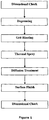
- Figure 1 is a schematic illustration of the stages involved in the aluminizing of Ni-base alloys in accordance with the present invention involving thermal spray and diffusion treatment.
- the basic steps involved in such process of aluminizing comprises of carrying out sequentially (a) dimensional checks, (b) degreasing, (c) grit blasting, (d) thermal spraying, (e) diffusion treatment, (f) surface finish and (g) dimensional check.
- a process of aluminizing involving the thermal spray and diffusion treatment of the invention is illustrated further by way of the following example.
- the present aluminizing process can achieve NiAl aluminide coating on nickel-base alloys with minimum 40 wt% nickel content on both flat and corrugated surfaces.
- the process of the invention involving the selective combination of thermal spray and diffusion heat treatment would favour coating on selected areas of the components both on flat and curved surfaces without the need for masking and its related complexities.
- the process offers overall reduction of time and cost of aluminizing which is found to be four time faster than the conventional processes of aluminizing nickel-base alloys.
- the present process would thus enable producing surface protective coatings for high temperature applications to improve the wear resistance on nickel-base alloys with controlled coating thickness which importantly can be consistently reproduced. Moreover, the process would favour the desired surface areas alone to be aluminized without the need for complex masking of uncoated areas.
- the process offers overall reduction of time and cost for aluminizing. The duration of aluminizing for other conventional processes is four times higher than the present invention and the process would therefore favour much simpler and faster generation of NiAl coated Ni-base alloys both on flat and/or corrugated surfaces apart from being environment friendly and safe to carry out.
Landscapes
- Chemical & Material Sciences (AREA)
- Engineering & Computer Science (AREA)
- Physics & Mathematics (AREA)
- Plasma & Fusion (AREA)
- Chemical Kinetics & Catalysis (AREA)
- Materials Engineering (AREA)
- Mechanical Engineering (AREA)
- Metallurgy (AREA)
- Organic Chemistry (AREA)
- Coating By Spraying Or Casting (AREA)
Description
- The present invention relates to aluminizing of nickel-base alloys and, in particular, to a process for producing body centered cubic (B2) nickel aluminide (NiAl) coating of controlled thickness using thermal spraying of commercially pure aluminium wires followed by diffusion heat treatment in vacuum atmosphere on nickel-base alloys surfaces. Importantly, the process of producing the nickel aluminide (B2 NiAl phase) coatings on nickel-base alloys is directed to achieve dimensional tolerance of 80 ± 30 microns coating thickness.
- Advantageously, the process of the invention achieves nickel aluminide coatings only on desired regions of the substrate of the nickel base alloys with minimum environmental emission of toxic chemicals fumes and is thus also environment friendly. Moreover, the nickel aluminide coating of the present invention is possible without the need for masking of the unwanted regions of the components and more importantly can be attended both on flat and curved surfaces thereby favouring wide scale utilities of such aluminizing process. The process of the invention would facilitate fabrication industries required to carry out surface modifications and engineering (protective coating) on nickel-base alloys for high temperatures such as nuclear industries, aircraft and gas turbine industries.
- It is well known that nickel-base alloys are required to be provided surface modified and engineered for protective coatings such as wear resistance, oxidation resistance, corrosion resistance etc., to adopt such nickel-base alloys for high temperature application for variety of industrial and allied uses.
- Aluminizing on nickel-base alloys is usually known to be carried out by processes such as pack cementations, slurry spraying, brushing, dipping and chemical vapour deposition to produce nickel aluminide (NiAl) layer over the substrate adapted for providing a hard surface for fretting wear and galling resistance.
- It also known to carry out thermal spray processes alone for deposition of metals on worn out surfaces of steel components. Also, it is well known to achieve pack diffusion and vapour phase diffusion coatings for protection against wear and fretting of fast reactor components. Aluminium paint - based processes for producing NiAl coating have also been used previously. While, the above existing state of the art prevails for the nickel aluminide coating on nickel base alloys there has been some inherent limitations/disadvantages of such hitherto known processes and devices.
- Pack cementations is a process which has been widely used for such aluminizing since it is inexpensive and ideally suited for batch production of small components. In such pack cementation process, the components to be aluminized are usually treated at temperatures between 850°C and 1050°C in a pack consisting of an aluminium source such as Ni-AI, Ti-Al, or Cr-AI, an activator (halide) and some inert filler like alumina. It is however, experienced that such pack cementation technology involves handling of large quantities of alumina and metal powders, long furnace time cycles due to a large thermal inertia and inherently reduced throughput.
- Vapour phase aluminizing on the other hand largely eliminates the disadvantages of the pack cementation processes, but required specialized vacuum furnaces and fixtures. Moreover, both these processes involve exposure of operator to corrosive halide activators which is unsafe and undesired from the safety of the operator.
-
US 3,000,755 is directed to oxidation-resistant turbine buckets and nozzle guide vanes for gas turbine engines. More particularly, the same is concerned with nickel base alloy and cobalt base alloy turbine buckets having surfaces provided with a protective layer of an alloy of the base metal with aluminium wherein a portion of the coating metal is diffused into the base metal to thereby form with the base metal an oxidant-resistant surface layer of an alloy of the coating metal and said base metal having a thickness not in excess of 63.5 µm (0.0025 inch). -
US 3,129,069 is again directed to oxidation resistant turbine buckets and nozzle guide vanes for gas turbine engines. More particularly, the patent suggests an alloy of aluminium with the base metal of blade having a thickness of approximately 12.7 µm (0.0005 inch). -
US 3450512 refers to a method for applying aluminum- tungsten coating on nickel base alloys. This patent is primarily directed to prevent the inter-diffusion between the base metal and the coating materials whereby the mixture of aluminum and tungsten are metalized of the alloy surface and the 4 hour long post metallization diffusion heat treatment is carried out to form a nickel-aluminum alloy, nickel-aluminide (NiAl) at the surface of the article and distribute the tungsten in solid solution and metallurgically bond the coating to the substrate. - However while the above prior art proposed possible Nickel aluminide coating none of the above prior arts were either directed to or even hinted at aluminizing methods for producing surface protective coating of B2 phase (Body centered cubic) NiAl layer/coating of desired controlled thickness on nickel-base alloy surfaces through an inter-diffusion between coated aluminum and nickel of the alloy surfaces.
- Apart from the above discussed limitations and complexities of the conventional methods of aluminizing on nickel-base alloys to achieve B2 phase (Body centered cubic NiAl) layer/coating, it is also important that following such processes of aluminizing it has been always essential to mask the surfaces which were not required to be coated requiring special precautions and added complexities of such aluminizing processes.
- It is thus the basic object of the present invention to provide for a process for NiAl aluminide coating in particular the B2 phase (Body centered cubic NiAl) layer/coating of controlled thickness on nickel-base alloys using thermal spraying of commercially pure aluminium wires followed by diffusion heat treatment in vacuum atmosphere as a surface modification and engineering protective coating for application of fretting wear and galling resistance of the nickel-base alloy substrate.
- Another object of the present invention is directed to a process for NiAl aluminide coating in particular the B2 phase (Body centered cubic NiAl) layer/coating of nickel-base alloys which would on one hand be cost effective and at the same time on the other hand would involve safe technology without the problems/disadvantages of handling of large quantity of alumina and metal powder, long furnace time cycle due to large thermal inertia and inherent reduced throughput.
- Further object of the present invention is directed to a simple process for NiAl aluminide coating in particular the B2 phase (Body centered cubic NiAl) layer/coating of nickel-base alloys which would also not require any specialized vacuum furnaces and fixtures and thus can be readily applied and used for producing nickel aluminide coatings.
- A further object of the present invention is directed to an aluminizing process which would favour achieving NiAl aluminide coating in particular the B2 phase (Body centered cubic NiAl) layer/coating on nickel-base alloys to a tolerance of 80 ± 30 µm with reduced cycle time than the conventional pack cementation and vapour phase diffusion coating.
- Yet another object of the present invention is directed to favour production of body centered cubic (B2) nickel aluminide (NiAl) coated nickel-base alloys of controlled thickness without the complexities of masking of surfaces not to be coated thereby facilitating controlled and simple production of such nickel aluminide coated nickel-base alloys.
- A further object of the present invention is to produce ordered body centered cubic (B2) nickel aluminide (NiAl) coated nickel-base alloys which can be advantageously used to form the coating only on the desired regions without any special steps to masking the areas where aluminizing is not desired.
- Yet another object of the present invention is directed to produce ordered body centered cubic (B2) nickel aluminide (NiAl) coated nickel-base alloys with higher productivity, environmental cleanliness and suitability for mass production of large sized components.
- Yet another object of the present invention is directed to a process which would achieve NiAl aluminide coating in particular the B2 phase (Body centered cubic NiAl) layer/coating on nickel-base alloys involving flat and/or corrugated surfaces to thereby favour production of variety of NiAl aluminide coated nickel-base alloys.
- A further object of the present invention is directed to produce surface protective coating in particular the B2 phase (Body centered cubic NiAl) layer/coating for high temperature application to improve the wear resistance of the substrate on nickel-base alloys with selectively controlled coating thickness which can be consistently reproduced.
- Yet further object of the present invention is to provide for a simple yet effective process for producing surface protective coating in particular the B2 phase (Body centered cubic NiAl) layer/coating for high temperature application on nickel-base alloys which would favour overall reduction of time and cost for aluminizing vis-à-vis the conventional processes of aluminizing of such nickel-base alloys presently in use.
- Thus according to the basic aspect of the present invention there is provided an aluminizing process for producing surface protective body centered cubic (B2) nickel aluminide (NiAl) coating of controlled thickness of 80 µm with tolerance of 30 µm on nickel-base alloy surfaces with minimum 40 weight % nickel content comprising:
- activating the surfaces to be coated by grit blasting involving alumina grit with 30-120 mesh size at an air pressure of 5.5+/-0.5 kg/cm2 preferably following dimensional check and degreasing;
- thermal spraying of the required surfaces with commercial pure aluminium to desired specific thickness in the range of 100 to 200 µm wherein thermal spray parameters comprise (i) aluminum wire diameter in the range of 3.0 to 3.2 mm at a wire Feed Rate in the range of 2.0-2.5mm/sec (ii) pneumatic pressure in the range of 5.5+/-0.5 kg/cm2 (iii) oxygen pressure in the range of 2.5+/-0.3 kg/cm2 and acetylene pressure in the range of 1.0+/-0.2 kg/cm2 and (iv) maintaining a torch work distance of 200-300 mm;
- subjecting the aluminium thus sprayed onto the nickel-base alloy substrate to diffusion heat treatment in vacuum atmosphere at a temperature in the range of 950°C-1100°C for a duration of 1.0 to 1.5 hours such that the sprayed aluminium reacts with the nickel-base alloy substrate to form the desired nickel aluminide coating of said controlled thickness on the nickel-base alloy substrate; and
- subjecting the coated surface to surface cleaning.
- Preferably, in the above aluminizing process for producing surface protective coating of body centered cubic (B2) nickel aluminide (NiAl) coating, the surface cleaning of the coated surface comprise removing adherent oxide scale using pickling solution following the steps of:
- (i) providing the pickling solution preferably comprising (a) concentrated nitric acid (specific gravity :1.41 g/cm3) in amounts of 16% (by volume);(b) Hydrofluoric acid (specific gravity 1.61 g/cm3) in amounts of 3.5 % (by volume); and (c) Water in amounts of 80.5% (by volume);
- (ii) soaking the diffusion treated strips in the solution for a period of about 30 minutes; followed by
- (iii) further cleaning the strips involving emery papers.
- Following the above disclosed aluminizing process for producing surface protective coating of body centered cubic (B2) nickel aluminide (NiAl) coating of the invention it is possible to carry out the NiAl aluminide coating on nickel-base alloys involving selectively flat and/or corrugated surfaces.
- The above disclosed aluminizing process for producing surface protective coating of body centered cubic (B2) nickel aluminide (NiAl) of the invention is four times higher than conventional process of aluminizing nickel-base alloy.
- Importantly, in the above process the surface activity, spraying procedures and diffusion parameters are critical in optimization of the coating thickness. Surface activity is achieved by selection of suitable grade grit size (30-120 mesh size) during grit blasting. Thermal spraying of aluminium is carried out using 3.2 mm diameter aluminium wires and by maintaining a torch-work distance of 200-300 mm and wire feed rate of 2.0-2.5 mm/sec. Thickness of sprayed layer is monitored on 100% of the qualification strips and on a certain percentage of production strips at random to ensure sprayed layer thickness of 100-200 µm. The optimized diffusion treatment is carried out in a vacuum furnace at 950-1100°C for 1.0-1.5h.
- It is thus possible by way of the present invention discussed above to produce ordered body centered cubic (B2) nickel aluminide (NiAl) coating of controlled thickness on nickel-base alloys involving a selective thermal spray-diffusion process. Importantly, the process of the invention achieves selective advantages in producing such coated nickel-base alloys by involving the thermal spraying which is a process in which molten or semi-molten particles are applied by impact on to the surface at uniform rate using mechanise or manually operated spray gun.
- The selective diffusion treatment after thermal spray in vacuum atmosphere is involved whereby the aluminium melts and reacts with the nickel/iron base alloys to thereby form the desired B2 phase.
- Importantly, the major advantage in the above process of the invention involving the combination of thermal spraying and diffusion treatment is that the same avoids the complexities of masking of uncoated surfaces and yet can favour achieving the coating only on the desired surfaces of the nickel-base alloys. This is an important advantage in the present process of producing the nickel aluminide coated nickel-base alloys of the invention since the conventional coating process of such alloys such as the conventional pack cementation process, hot-dip process etc., essentially required coating the entire strip unless special steps are taken to mask the area where aluminizing is not desired.
- The process being simple to operate and apply favours for higher productivity and is importantly environment friendly and safe from the operators point of view since the same does not require the operator to be exposed to corrosive environment such as corrosive halide activators involved in the conventional pack cementation and vapour phase aluminizing processes.
- The details of the invention, its object and advantages are explained hereunder in greater detail in relation to non-limiting exemplary illustration of the process of the invention as per the following accompanying figure and examples :-
-
Figure 1 : is a schematic illustration of the stages involved in the aluminizing of Ni-base alloys in accordance with the present invention involving thermal spray and diffusion treatment. - As shown in said figure the basic steps involved in such process of aluminizing comprises of carrying out sequentially (a) dimensional checks, (b) degreasing, (c) grit blasting, (d) thermal spraying, (e) diffusion treatment, (f) surface finish and (g) dimensional check. Such a process of aluminizing involving the thermal spray and diffusion treatment of the invention is illustrated further by way of the following example.
- An Exemplary process of aluminizing of nickel-base alloys following the process of the invention involving the thermal spraying and diffusion treatment was carried out as detailed hereunder:
- i) The nickel-base alloys surface to be coated was first activated ,after dimensional check and degreasing , by grit blasting using alumina grit of specific size and size distribution i.e., in the range of 30-120 mesh size at a air pressure of 5.5 ± 0.5 kg/cm2;
- ii) thereafter thermal spraying of the required surfaces using commercially pure aluminium (dia 3.2 mm) to specific thickness in the range 100 to 200 microns was carried out using the following thermal spray parameters thermal spray parameters:
- a) wire feed rate : 2.0 - 2.5 mm/sec.;
- b) pneumatic pressure: 5.5±0.5 kg/cm2;
- c) oxygen pressure: 2.5 ± 0.3 kg/cm2; and
- d) acetylene pressure : 1.0 ± 0.2 kg/cm2.
- iii) subsequently diffusion heat treatment was carried out in vacuum atmosphere at specified temperature in the range 950 - 1100°C for a duration of 1.0-1.5 h to enable the aluminium sprayed to react with the nickel - iron - chromium alloys substrate and form the aluminide coating;
- iv) subsequently surface cleaning procedure was carried out to remove adherent oxide scale using a pickling solution as per the following details :
- a) concentrated nitric acid (specific gravity : 1.41 g/cm3) : 16% (by volume);
- b) hydrofluoric acid (specific gravity 1.61 g/cm3): 3.5 % (by volume);and
- c) water: 80.5% (by volume).
- By way of the above disclosed process of the invention it was possible to produce the ordered body centered cubic (B2) nickel aluminide (NiAl) coating of controlled thickness on nickel-base alloys involving the simple yet effective thermal spray-diffusion process.
- Advantageously, the present aluminizing process can achieve NiAl aluminide coating on nickel-base alloys with minimum 40 wt% nickel content on both flat and corrugated surfaces. Moreover, the processes found suitable for mass production of large sized components to a tolerance of 80± 30 µm of NiAl aluminide coating with hardness range of 800 - 1100 VHN with reduced cycle time as compared to the conventional processes such as the pack cementation and vapour phase diffusion coating. Moreover, the process of the invention involving the selective combination of thermal spray and diffusion heat treatment would favour coating on selected areas of the components both on flat and curved surfaces without the need for masking and its related complexities. Thus, the process offers overall reduction of time and cost of aluminizing which is found to be four time faster than the conventional processes of aluminizing nickel-base alloys.
- The present process would thus enable producing surface protective coatings for high temperature applications to improve the wear resistance on nickel-base alloys with controlled coating thickness which importantly can be consistently reproduced. Moreover, the process would favour the desired surface areas alone to be aluminized without the need for complex masking of uncoated areas. The process offers overall reduction of time and cost for aluminizing. The duration of aluminizing for other conventional processes is four times higher than the present invention and the process would therefore favour much simpler and faster generation of NiAl coated Ni-base alloys both on flat and/or corrugated surfaces apart from being environment friendly and safe to carry out.
Claims (4)
- An aluminizing process for producing surface protective coating of body centered cubic (B2) nickel aluminide (NiAl) of controlled thickness of 80 µm with tolerance of 30 µm on nickel-base alloy surfaces with minimum 40 weight % nickel content comprising:activating the surfaces to be coated by grit blasting involving alumina grit with 30-120 mesh size at an air pressure of 5.5+/-0.5 kg/cm2 preferably following dimensional check and degreasing;thermal spraying of the required surfaces with commercial pure aluminium to desired specific thickness in the range of 100 to 200 µm wherein thermal spray parameters comprise (i) aluminum wire diameter in the range of 3.0 to 3.2 mm at a wire Feed Rate in the range of 2.0-2.5mm/sec (ii) pneumatic pressure in the range of 5.5+/-0.5 kg/cm2 (iii) oxygen pressure in the range of 2.5+/-0.3 kg/cm2 and acetylene pressure in the range of 1.0+/-0.2 kg/cm2 and (iv) maintaining a torch work distance of 200-300 mm;subjecting the aluminium thus sprayed onto the nickel-base alloy substrate to diffusion heat treatment in vacuum atmosphere at a temperature in the range of 950°C-1100°C for a duration of 1.0 to 1.5 hours such that the aluminium sprayed reacts with the nickel-base alloy substrate to form the desired nickel aluminide coating of said controlled thickness on said nickel-base alloy substrate; andsubjecting the coated surface to surface cleaning.
- An aluminizing process for producing surface protective coating of body centered cubic (B2) nickel aluminide (NiAl) according to claim 1 wherein the said surface cleaning of the coated surface comprise removing adherent oxide scale using pickling solution following the steps of:(i) providing the pickling solution preferably comprising (a) concentrated nitric acid (specific gravity :1.41 g/cm3) in amounts of 16% (by volume);(b) Hydrofluoric acid (specific gravity 1.61 g/cm3) in amounts of 3.5 % (by volume); and (c) Water in amounts of 80.5% (by volume);(ii) soaking the diffusion treated strips in the solution for a period of 30 minutes; followed by(iii) further cleaning the strips involving emery paper.
- An aluminizing process for producing surface protective coating of body centered cubic (B2) nickel aluminide (NiAl) according claim 1 or 2 wherein the NiAl aluminide coating is carried out on nickel-base alloys involving selectively flat and/or corrugated surfaces.
- An aluminizing process for producing surface protective coating of body centered cubic (B2) nickel aluminide (NiAl) according to anyone of claims 1 to 3 wherein the aluminizing process is four times higher than conventional process of aluminizing nickel-base alloy.
Applications Claiming Priority (1)
| Application Number | Priority Date | Filing Date | Title |
|---|---|---|---|
| PCT/IN2007/000514 WO2009053992A1 (en) | 2007-10-26 | 2007-10-26 | A process for producing body centered cubic (b2) nickel aluminide (nial) coating of controlled thickness on nickel-base alloy surfaces |
Publications (2)
| Publication Number | Publication Date |
|---|---|
| EP2217736A1 EP2217736A1 (en) | 2010-08-18 |
| EP2217736B1 true EP2217736B1 (en) | 2019-03-27 |
Family
ID=39598452
Family Applications (1)
| Application Number | Title | Priority Date | Filing Date |
|---|---|---|---|
| EP07870514.2A Not-in-force EP2217736B1 (en) | 2007-10-26 | 2007-10-26 | A process for producing body centered cubic (b2) nickel aluminide (nial) coating of controlled thickness on nickel-base alloy surfaces |
Country Status (3)
| Country | Link |
|---|---|
| US (1) | US20100247793A1 (en) |
| EP (1) | EP2217736B1 (en) |
| WO (1) | WO2009053992A1 (en) |
Families Citing this family (1)
| Publication number | Priority date | Publication date | Assignee | Title |
|---|---|---|---|---|
| CN107164716B (en) * | 2017-06-13 | 2020-03-17 | 中国石油天然气集团公司 | Powder core wire and method for preparing high-speed electric arc spraying coating |
Family Cites Families (11)
| Publication number | Priority date | Publication date | Assignee | Title |
|---|---|---|---|---|
| US2986803A (en) * | 1949-01-06 | 1961-06-06 | Richard H F Stresau | Method and means for producing a low energy detonator |
| US3129069A (en) * | 1956-10-11 | 1964-04-14 | Gen Motors Corp | Oxidation-resistant turbine blades |
| US3000755A (en) * | 1956-10-11 | 1961-09-19 | Gen Motors Corp | Oxidation-resistant turbine blades |
| US3450512A (en) * | 1966-07-05 | 1969-06-17 | United Aircraft Corp | Coated nickel base engine alloys |
| US4501776A (en) * | 1982-11-01 | 1985-02-26 | Turbine Components Corporation | Methods of forming a protective diffusion layer on nickel, cobalt and iron base alloys |
| US6334249B2 (en) * | 1997-04-22 | 2002-01-01 | Texas Instruments Incorporated | Cavity-filling method for reducing surface topography and roughness |
| EP0985745B1 (en) * | 1998-09-08 | 2006-07-12 | General Electric Company | Bond coat for a thermal barrier coating system |
| US6194026B1 (en) * | 1998-10-19 | 2001-02-27 | Howmet Research Corporation | Superalloy component with abrasive grit-free coating |
| US6165286A (en) * | 1999-05-05 | 2000-12-26 | Alon, Inc. | Diffusion heat treated thermally sprayed coatings |
| US6372299B1 (en) * | 1999-09-28 | 2002-04-16 | General Electric Company | Method for improving the oxidation-resistance of metal substrates coated with thermal barrier coatings |
| US6607789B1 (en) * | 2001-04-26 | 2003-08-19 | General Electric Company | Plasma sprayed thermal bond coat system |
-
2007
- 2007-10-26 US US12/738,945 patent/US20100247793A1/en not_active Abandoned
- 2007-10-26 EP EP07870514.2A patent/EP2217736B1/en not_active Not-in-force
- 2007-10-26 WO PCT/IN2007/000514 patent/WO2009053992A1/en not_active Ceased
Non-Patent Citations (1)
| Title |
|---|
| None * |
Also Published As
| Publication number | Publication date |
|---|---|
| EP2217736A1 (en) | 2010-08-18 |
| WO2009053992A1 (en) | 2009-04-30 |
| US20100247793A1 (en) | 2010-09-30 |
Similar Documents
| Publication | Publication Date | Title |
|---|---|---|
| US6036995A (en) | Method for removal of surface layers of metallic coatings | |
| EP0837153B1 (en) | Low activity localized aluminide coating | |
| EP1055742B1 (en) | Process for simultaneously aluminizing nickel-base and cobalt-base superalloys | |
| EP2011964B1 (en) | Method of Repairing a Turbine Component | |
| EP3404127B1 (en) | Functionally graded environmental barrier coating | |
| US3961098A (en) | Coated article and method and material of coating | |
| US5098797A (en) | Steel articles having protective duplex coatings and method of production | |
| EP2371986B1 (en) | Metallic coating for non-line of sight areas | |
| CZ284156B6 (en) | Regeneration process of corroded high alloyed or refractory steel part | |
| EP1980643A1 (en) | Process for forming a chromium diffusion portion and articles made therefrom | |
| EP2022868A2 (en) | Method for forming platinum aluminide diffusion coatings | |
| CN108660412B (en) | Modified β-NiAl coating of a kind of active element and preparation method thereof and workpiece | |
| CN102027153B (en) | Method for forming a protective coating containing aluminium and zirconium on a metal part | |
| US6485792B1 (en) | Endurance of NiA1 coatings by controlling thermal spray processing variables | |
| WO2000009777A1 (en) | Vapor phase co-deposition coating for superalloy applications | |
| US3953193A (en) | Coating powder mixture | |
| US20100247793A1 (en) | Process for producing body centered cubic (b2) nickel aluminide (nial) coating of controlled thickness on nickle-based alloy surfaces | |
| US11692273B2 (en) | Method for applying a titanium aluminide alloy, titanium aluminide alloy and substrate comprising a titanium aluminide alloy | |
| RU2452791C2 (en) | METHOD OF PRODUCING COATING FROM CUBIC BODY-CENTERED NICKEL ALUMINIDE (NiAl) WITH CONTROLLED THICKNESS ON NICKEL-BASED ALLOY SURFACE | |
| US20090035485A1 (en) | Method for forming active-element aluminide diffusion coatings | |
| CN102971445B (en) | Metal part surface is formed the method for protective coating | |
| US6933012B2 (en) | Method for protecting a surface with a silicon-containing diffusion coating | |
| WO2015006330A1 (en) | Methods of making aluminide coatings by co-deposition of aluminum and one or more refractory elements and their use in thermal barrier systems to protect metal-containing substrates in high temperature environments | |
| CN111117312A (en) | Preparation method of metal piece surface coating resistant to 500 ℃ high temperature and seawater corrosion for long time | |
| Kayalı et al. | Electrochemical corrosion behavior of high velocity oxy-fuel (HVOF) superalloy coatings on ductile irons |
Legal Events
| Date | Code | Title | Description |
|---|---|---|---|
| PUAI | Public reference made under article 153(3) epc to a published international application that has entered the european phase |
Free format text: ORIGINAL CODE: 0009012 |
|
| 17P | Request for examination filed |
Effective date: 20100520 |
|
| AK | Designated contracting states |
Kind code of ref document: A1 Designated state(s): AT BE BG CH CY CZ DE DK EE ES FI FR GB GR HU IE IS IT LI LT LU LV MC MT NL PL PT RO SE SI SK TR |
|
| AX | Request for extension of the european patent |
Extension state: AL BA HR MK RS |
|
| DAX | Request for extension of the european patent (deleted) | ||
| STAA | Information on the status of an ep patent application or granted ep patent |
Free format text: STATUS: EXAMINATION IS IN PROGRESS |
|
| 17Q | First examination report despatched |
Effective date: 20170328 |
|
| GRAP | Despatch of communication of intention to grant a patent |
Free format text: ORIGINAL CODE: EPIDOSNIGR1 |
|
| STAA | Information on the status of an ep patent application or granted ep patent |
Free format text: STATUS: GRANT OF PATENT IS INTENDED |
|
| INTG | Intention to grant announced |
Effective date: 20181102 |
|
| RIN1 | Information on inventor provided before grant (corrected) |
Inventor name: RAJ, BALDEV Inventor name: BHADURI, ARUN KUMAR Inventor name: GANESAN, SRINIVASAN Inventor name: VENKATRAMAN, GOPAL |
|
| GRAS | Grant fee paid |
Free format text: ORIGINAL CODE: EPIDOSNIGR3 |
|
| GRAA | (expected) grant |
Free format text: ORIGINAL CODE: 0009210 |
|
| STAA | Information on the status of an ep patent application or granted ep patent |
Free format text: STATUS: THE PATENT HAS BEEN GRANTED |
|
| AK | Designated contracting states |
Kind code of ref document: B1 Designated state(s): AT BE BG CH CY CZ DE DK EE ES FI FR GB GR HU IE IS IT LI LT LU LV MC MT NL PL PT RO SE SI SK TR |
|
| REG | Reference to a national code |
Ref country code: GB Ref legal event code: FG4D |
|
| REG | Reference to a national code |
Ref country code: CH Ref legal event code: EP |
|
| REG | Reference to a national code |
Ref country code: AT Ref legal event code: REF Ref document number: 1113182 Country of ref document: AT Kind code of ref document: T Effective date: 20190415 |
|
| REG | Reference to a national code |
Ref country code: IE Ref legal event code: FG4D |
|
| REG | Reference to a national code |
Ref country code: DE Ref legal event code: R096 Ref document number: 602007057989 Country of ref document: DE |
|
| PG25 | Lapsed in a contracting state [announced via postgrant information from national office to epo] |
Ref country code: FI Free format text: LAPSE BECAUSE OF FAILURE TO SUBMIT A TRANSLATION OF THE DESCRIPTION OR TO PAY THE FEE WITHIN THE PRESCRIBED TIME-LIMIT Effective date: 20190327 Ref country code: SE Free format text: LAPSE BECAUSE OF FAILURE TO SUBMIT A TRANSLATION OF THE DESCRIPTION OR TO PAY THE FEE WITHIN THE PRESCRIBED TIME-LIMIT Effective date: 20190327 Ref country code: LT Free format text: LAPSE BECAUSE OF FAILURE TO SUBMIT A TRANSLATION OF THE DESCRIPTION OR TO PAY THE FEE WITHIN THE PRESCRIBED TIME-LIMIT Effective date: 20190327 |
|
| REG | Reference to a national code |
Ref country code: NL Ref legal event code: MP Effective date: 20190327 |
|
| PG25 | Lapsed in a contracting state [announced via postgrant information from national office to epo] |
Ref country code: NL Free format text: LAPSE BECAUSE OF FAILURE TO SUBMIT A TRANSLATION OF THE DESCRIPTION OR TO PAY THE FEE WITHIN THE PRESCRIBED TIME-LIMIT Effective date: 20190327 Ref country code: BG Free format text: LAPSE BECAUSE OF FAILURE TO SUBMIT A TRANSLATION OF THE DESCRIPTION OR TO PAY THE FEE WITHIN THE PRESCRIBED TIME-LIMIT Effective date: 20190627 Ref country code: GR Free format text: LAPSE BECAUSE OF FAILURE TO SUBMIT A TRANSLATION OF THE DESCRIPTION OR TO PAY THE FEE WITHIN THE PRESCRIBED TIME-LIMIT Effective date: 20190628 Ref country code: LV Free format text: LAPSE BECAUSE OF FAILURE TO SUBMIT A TRANSLATION OF THE DESCRIPTION OR TO PAY THE FEE WITHIN THE PRESCRIBED TIME-LIMIT Effective date: 20190327 |
|
| REG | Reference to a national code |
Ref country code: AT Ref legal event code: MK05 Ref document number: 1113182 Country of ref document: AT Kind code of ref document: T Effective date: 20190327 |
|
| PG25 | Lapsed in a contracting state [announced via postgrant information from national office to epo] |
Ref country code: EE Free format text: LAPSE BECAUSE OF FAILURE TO SUBMIT A TRANSLATION OF THE DESCRIPTION OR TO PAY THE FEE WITHIN THE PRESCRIBED TIME-LIMIT Effective date: 20190327 Ref country code: IT Free format text: LAPSE BECAUSE OF FAILURE TO SUBMIT A TRANSLATION OF THE DESCRIPTION OR TO PAY THE FEE WITHIN THE PRESCRIBED TIME-LIMIT Effective date: 20190327 Ref country code: CZ Free format text: LAPSE BECAUSE OF FAILURE TO SUBMIT A TRANSLATION OF THE DESCRIPTION OR TO PAY THE FEE WITHIN THE PRESCRIBED TIME-LIMIT Effective date: 20190327 Ref country code: RO Free format text: LAPSE BECAUSE OF FAILURE TO SUBMIT A TRANSLATION OF THE DESCRIPTION OR TO PAY THE FEE WITHIN THE PRESCRIBED TIME-LIMIT Effective date: 20190327 Ref country code: PT Free format text: LAPSE BECAUSE OF FAILURE TO SUBMIT A TRANSLATION OF THE DESCRIPTION OR TO PAY THE FEE WITHIN THE PRESCRIBED TIME-LIMIT Effective date: 20190727 Ref country code: SK Free format text: LAPSE BECAUSE OF FAILURE TO SUBMIT A TRANSLATION OF THE DESCRIPTION OR TO PAY THE FEE WITHIN THE PRESCRIBED TIME-LIMIT Effective date: 20190327 Ref country code: ES Free format text: LAPSE BECAUSE OF FAILURE TO SUBMIT A TRANSLATION OF THE DESCRIPTION OR TO PAY THE FEE WITHIN THE PRESCRIBED TIME-LIMIT Effective date: 20190327 |
|
| PG25 | Lapsed in a contracting state [announced via postgrant information from national office to epo] |
Ref country code: PL Free format text: LAPSE BECAUSE OF FAILURE TO SUBMIT A TRANSLATION OF THE DESCRIPTION OR TO PAY THE FEE WITHIN THE PRESCRIBED TIME-LIMIT Effective date: 20190327 |
|
| PG25 | Lapsed in a contracting state [announced via postgrant information from national office to epo] |
Ref country code: AT Free format text: LAPSE BECAUSE OF FAILURE TO SUBMIT A TRANSLATION OF THE DESCRIPTION OR TO PAY THE FEE WITHIN THE PRESCRIBED TIME-LIMIT Effective date: 20190327 Ref country code: IS Free format text: LAPSE BECAUSE OF FAILURE TO SUBMIT A TRANSLATION OF THE DESCRIPTION OR TO PAY THE FEE WITHIN THE PRESCRIBED TIME-LIMIT Effective date: 20190727 |
|
| REG | Reference to a national code |
Ref country code: DE Ref legal event code: R097 Ref document number: 602007057989 Country of ref document: DE |
|
| PG25 | Lapsed in a contracting state [announced via postgrant information from national office to epo] |
Ref country code: DK Free format text: LAPSE BECAUSE OF FAILURE TO SUBMIT A TRANSLATION OF THE DESCRIPTION OR TO PAY THE FEE WITHIN THE PRESCRIBED TIME-LIMIT Effective date: 20190327 |
|
| PLBE | No opposition filed within time limit |
Free format text: ORIGINAL CODE: 0009261 |
|
| STAA | Information on the status of an ep patent application or granted ep patent |
Free format text: STATUS: NO OPPOSITION FILED WITHIN TIME LIMIT |
|
| PG25 | Lapsed in a contracting state [announced via postgrant information from national office to epo] |
Ref country code: SI Free format text: LAPSE BECAUSE OF FAILURE TO SUBMIT A TRANSLATION OF THE DESCRIPTION OR TO PAY THE FEE WITHIN THE PRESCRIBED TIME-LIMIT Effective date: 20190327 |
|
| 26N | No opposition filed |
Effective date: 20200103 |
|
| PG25 | Lapsed in a contracting state [announced via postgrant information from national office to epo] |
Ref country code: TR Free format text: LAPSE BECAUSE OF FAILURE TO SUBMIT A TRANSLATION OF THE DESCRIPTION OR TO PAY THE FEE WITHIN THE PRESCRIBED TIME-LIMIT Effective date: 20190327 |
|
| REG | Reference to a national code |
Ref country code: DE Ref legal event code: R119 Ref document number: 602007057989 Country of ref document: DE |
|
| PG25 | Lapsed in a contracting state [announced via postgrant information from national office to epo] |
Ref country code: MC Free format text: LAPSE BECAUSE OF FAILURE TO SUBMIT A TRANSLATION OF THE DESCRIPTION OR TO PAY THE FEE WITHIN THE PRESCRIBED TIME-LIMIT Effective date: 20190327 |
|
| REG | Reference to a national code |
Ref country code: CH Ref legal event code: PL |
|
| PG25 | Lapsed in a contracting state [announced via postgrant information from national office to epo] |
Ref country code: LU Free format text: LAPSE BECAUSE OF NON-PAYMENT OF DUE FEES Effective date: 20191026 Ref country code: DE Free format text: LAPSE BECAUSE OF NON-PAYMENT OF DUE FEES Effective date: 20200501 Ref country code: LI Free format text: LAPSE BECAUSE OF NON-PAYMENT OF DUE FEES Effective date: 20191031 Ref country code: CH Free format text: LAPSE BECAUSE OF NON-PAYMENT OF DUE FEES Effective date: 20191031 |
|
| REG | Reference to a national code |
Ref country code: BE Ref legal event code: MM Effective date: 20191031 |
|
| PG25 | Lapsed in a contracting state [announced via postgrant information from national office to epo] |
Ref country code: BE Free format text: LAPSE BECAUSE OF NON-PAYMENT OF DUE FEES Effective date: 20191031 |
|
| GBPC | Gb: european patent ceased through non-payment of renewal fee |
Effective date: 20191026 |
|
| PG25 | Lapsed in a contracting state [announced via postgrant information from national office to epo] |
Ref country code: IE Free format text: LAPSE BECAUSE OF NON-PAYMENT OF DUE FEES Effective date: 20191026 Ref country code: GB Free format text: LAPSE BECAUSE OF NON-PAYMENT OF DUE FEES Effective date: 20191026 Ref country code: FR Free format text: LAPSE BECAUSE OF NON-PAYMENT OF DUE FEES Effective date: 20191031 |
|
| PG25 | Lapsed in a contracting state [announced via postgrant information from national office to epo] |
Ref country code: CY Free format text: LAPSE BECAUSE OF FAILURE TO SUBMIT A TRANSLATION OF THE DESCRIPTION OR TO PAY THE FEE WITHIN THE PRESCRIBED TIME-LIMIT Effective date: 20190327 |
|
| PG25 | Lapsed in a contracting state [announced via postgrant information from national office to epo] |
Ref country code: MT Free format text: LAPSE BECAUSE OF FAILURE TO SUBMIT A TRANSLATION OF THE DESCRIPTION OR TO PAY THE FEE WITHIN THE PRESCRIBED TIME-LIMIT Effective date: 20190327 Ref country code: HU Free format text: LAPSE BECAUSE OF FAILURE TO SUBMIT A TRANSLATION OF THE DESCRIPTION OR TO PAY THE FEE WITHIN THE PRESCRIBED TIME-LIMIT; INVALID AB INITIO Effective date: 20071026 |