EP2214106A2 - Video identification - Google Patents
Video identification Download PDFInfo
- Publication number
- EP2214106A2 EP2214106A2 EP10151185A EP10151185A EP2214106A2 EP 2214106 A2 EP2214106 A2 EP 2214106A2 EP 10151185 A EP10151185 A EP 10151185A EP 10151185 A EP10151185 A EP 10151185A EP 2214106 A2 EP2214106 A2 EP 2214106A2
- Authority
- EP
- European Patent Office
- Prior art keywords
- sequence
- image
- descriptor
- images
- word
- Prior art date
- Legal status (The legal status is an assumption and is not a legal conclusion. Google has not performed a legal analysis and makes no representation as to the accuracy of the status listed.)
- Withdrawn
Links
Images



Classifications
-
- G—PHYSICS
- G06—COMPUTING OR CALCULATING; COUNTING
- G06F—ELECTRIC DIGITAL DATA PROCESSING
- G06F16/00—Information retrieval; Database structures therefor; File system structures therefor
- G06F16/70—Information retrieval; Database structures therefor; File system structures therefor of video data
- G06F16/78—Retrieval characterised by using metadata, e.g. metadata not derived from the content or metadata generated manually
- G06F16/783—Retrieval characterised by using metadata, e.g. metadata not derived from the content or metadata generated manually using metadata automatically derived from the content
- G06F16/7847—Retrieval characterised by using metadata, e.g. metadata not derived from the content or metadata generated manually using metadata automatically derived from the content using low-level visual features of the video content
- G06F16/785—Retrieval characterised by using metadata, e.g. metadata not derived from the content or metadata generated manually using metadata automatically derived from the content using low-level visual features of the video content using colour or luminescence
-
- H—ELECTRICITY
- H04—ELECTRIC COMMUNICATION TECHNIQUE
- H04N—PICTORIAL COMMUNICATION, e.g. TELEVISION
- H04N21/00—Selective content distribution, e.g. interactive television or video on demand [VOD]
- H04N21/80—Generation or processing of content or additional data by content creator independently of the distribution process; Content per se
- H04N21/83—Generation or processing of protective or descriptive data associated with content; Content structuring
-
- G—PHYSICS
- G06—COMPUTING OR CALCULATING; COUNTING
- G06T—IMAGE DATA PROCESSING OR GENERATION, IN GENERAL
- G06T7/00—Image analysis
-
- G—PHYSICS
- G06—COMPUTING OR CALCULATING; COUNTING
- G06V—IMAGE OR VIDEO RECOGNITION OR UNDERSTANDING
- G06V20/00—Scenes; Scene-specific elements
- G06V20/40—Scenes; Scene-specific elements in video content
Definitions
- the invention relates to a method, apparatus and computer program product for fast and reliable video identification that is robust to common editing operations such as camera capture, analogue/digital conversion, recompression, etc.
- Near duplicate video detection can be defined as follows: given a query video sequence, find all of the duplicates in a database.
- the notion and interpretation of (near-)duplicates varies.
- a duplicate is regarded as a sequence that has been created by using common video editing/processing operations on an original. Examples of such operations include colour change, compression, transcoding, format change, frame rate change, analogue VCR recapture and camera recapture amongst many more.
- the present invention also addresses the problem that the duplicate part may form only a part of the query sequence.
- a typical state-of-the-art feature-point approach to (near-)duplicate detection in video is given in [ J. Sivic, A. Zisserman, Efficient Visual Search for Objects in Videos, Proceedings of the IEEE, April 2008, 96 (4), pages 548-566 .] and can be outlined as i) detect key frames ii) detect key-points in the frame, iii) extract features from regions around the point, iv) match sequences using features, v) apply test for spatial cohesion of objects in sequences.
- step (iv) a visual vocabulary is used which is learned from clustering data. This can lead to over-fitting to a particular dataset with failure to generalise.
- Related methods such as [Ond ej Chum, James Philbin, Michael Isard and Andrew Zisserman, Scalable near identical image and shot detection , Proceedings of the 6th ACM international conference on Image and video retrieval, pages 549-556, Amsterdam, The Netherlands, 2007] provide fast searching at the cost of high memory requirements for the hash tables used. Whilst this may be suitable for some scenarios it is not suitable in consumer electronics environments where memory resources are typically very limited.
- the present invention aims to address at least one or more of the limitations of such prior art methods.
- the present invention provides apparatus for processing a first sequence of images and a second sequence of images to compare the first and second sequences
- the apparatus comprising: descriptor element generating means arranged to process each of a plurality of the images in the first sequence and each of a plurality of the images in the second sequence by processing the image data for each of a plurality of pixel neighbourhoods in the image to generate at least one respective descriptor element for each of the pixel neighbourhoods, each descriptor element comprising one or more bits; word generating means arranged to form a plurality of words from the descriptor elements of each image such that each word comprises a unique combination of descriptor element bits, wherein the word generating means is arranged to generate the words for the second sequence from the same respective combinations of descriptor element bits as the words for the first sequence; and sequence comparing means arranged to perform processing to compare the first and second sequences by comparing the words generated for the plurality of images in the first sequences with the words generated for the plurality of images in the second sequence.
- the sequence comparing means may be arranged to perform processing to compare the first and second sequences comprising processing to compare the frequency of occurrence of different word values in the first and second sequences.
- the sequence comparing means may be arranged to perform processing to compare the first and second sequences comprising: determining the number of occurrences of each possible word value for each word in the first sequence to generate occurrence data for the first sequence; determining the number of occurrences of each possible word value for each word in the second sequence to generate occurrence data for the second sequence; and comparing the occurrence data for the first sequence with the occurrence data for the second sequence.
- the sequence comparing means may be arranged to compare the occurrence data for the first sequence and the occurrence data for the second sequence to generate a respective comparison result for each word, and to merge the respective comparison results to generate an overall comparison result.
- the apparatus may further comprise: means for determining, for each word, the word values that occur in both sequences; means for determining, for each word, the temporal order of occurrence of the word values in both sequences; and means for comparing the temporal orders of occurrence.
- the apparatus may further comprise: means for identifying matching pairs of images, each pair of images comprising an image from the first sequence and an image from the second sequence; and means for performing a further correspondence test to determine a similarity between at least one identified pair of images.
- the present invention also provides apparatus for processing image data defining an image to generate at least one value representative of the image, the apparatus comprising: descriptor element generating means arranged to process the image data for each of a plurality of pixel neighbourhoods in the image to generate at least one respective descriptor element for each of the pixel neighbourhoods, each descriptor element comprising one or more bits; and word generating means arranged to form at least one word from the descriptor elements such that each word comprises one or more bits from one or more descriptor elements and such that the total number of bits in all of the words is less than the total number of bits in all of the descriptor elements.
- the present invention also provides apparatus for processing image data defining an image to generate a plurality of values representative of the image, the apparatus comprising: descriptor element generating means arranged to process the image data for each of a plurality of pixel neighbourhoods in the image to generate at least one respective descriptor element for each of the pixel neighbourhoods, each descriptor element comprising one or more bits; and word generating means arranged to form a plurality of words from the descriptor elements such that each word comprises a unique combination of descriptor element bits.
- the apparatus may further comprise quantising means for quantising each descriptor element; and the word generating means may be arranged to form each word from the quantised descriptor elements.
- the quantiser may be arranged to quantise each descriptor element to form a respective one bit binary result.
- the descriptor element generating means may be arranged to generate the descriptor elements for the image at a plurality of different pixel resolutions; and the word generating means may be arranged to generate at least one word by combining one or more bits from descriptor elements generated at different pixel resolutions.
- the present invention also provides apparatus for processing image data defining an image to generate at least one value representative of the image, the apparatus comprising: descriptor element generating means arranged to process the image data for each of a plurality of pixel neighbourhoods in the image to generate at least one respective descriptor element for each of the pixel neighbourhoods, each descriptor element comprising one or more bits; quantising means arranged to quantise each descriptor element; and representative value forming means arranged to format least one value representative of the image from the quantised descriptor elements.
- the quantiser may be arranged to quantise each descriptor element to form a respective one bit binary result.
- the present invention also provides apparatus for processing image data defining a sequence of images to generate and store a representation of the sequence, the apparatus comprising: descriptor element generating means arranged to process, for each image in the sequence, the image data for each of a plurality of pixel neighbourhoods in the image to generate at least one respective descriptor element for each of the pixel neighbourhoods, each descriptor element comprising one or more bits; word generating means arranged to form, for each image in the sequence, at least one word from the descriptor elements of the image such that each word comprises one or more bits from one or more descriptor elements and such that the total number of bits in all of the words of the image is less than the total number of bits in all of the descriptor elements of the image; histogram data generating means arranged to generate histogram data defining which words appear in the sequence of images and how many times; and data writing means arranged to write the histogram data, words and descriptor elements for the images in the sequence to storage.
- the apparatus may further comprise descriptor element quantising means arranged to quantise each descriptor element; and the word generating means may be arranged to form each word from the quantised descriptor elements.
- the apparatus may further comprise histogram data quantising means arranged to quantise the histogram data, and the data writing means may be may be arranged to write the quantised histogram data, words and quantised descriptor elements to storage.
- the apparatus may be operable to process a sequence of images comprising a fragment of a video sequence.
- the data writing means may be arranged to store the histogram data, words and descriptor elements in the bitstream.
- the present invention also provides apparatus for processing image data defining a sequence of images to generate and store a representation of the sequence, the apparatus comprising: descriptor element generating means arranged to process, for each image in the sequence, the image data for each of a plurality of pixel neighbourhoods in the image to generate at least one respective descriptor element for each of the pixel neighbourhoods, each descriptor element comprising one or more bits; word generating means arranged to generate, for each image in the sequence, a plurality of words from the descriptor elements of the image such that each word comprises a unique combination of descriptor element bits; histogram data generating means arranged to generate histogram data defining which words appear in the sequence of images and how many times; and data writing means arranged to write the histogram data, words and descriptor elements for the images in the sequence to storage.
- the apparatus may further comprise descriptor element quantising means arranged to quantise each descriptor element; and the word generating means may be arranged to form each word from the quantised descriptor elements.
- the apparatus may further comprise histogram data quantising means arranged to quantise the histogram data, and the data writing means may be may be arranged to write the quantised histogram data, words and quantised descriptor elements to storage.
- the apparatus may be operable to process a sequence of images comprising a fragment of a video sequence.
- the data writing means may be arranged to store the histogram data, words and descriptor elements in the bitstream.
- the present invention also provides apparatus for processing image data defining a sequence of images to generate and store a representation of the sequence, the apparatus comprising: descriptor element generating means arranged to process, for each image in the sequence, the image data for each of a plurality of pixel neighbourhoods in the image to generate at least one respective descriptor element for each of the pixel neighbourhoods, each descriptor element comprising one or more bits; descriptor element quantising means arranged to quantise each descriptor element; representative value forming means arranged to form, for each image in the sequence, at least one value representative of the image from the quantised descriptor elements; histogram data generating means arranged to generate histogram data defining which values representative of the images appear in the sequence of images and how many times; histogram data quantising means arranged to quantise the histogram data; and data writing means arranged to write the quantised histogram data, values representative of the images and quantised descriptor elements to storage.
- the apparatus may be operable to process a sequence of images comprising a fragment of a video sequence.
- the data writing means may be arranged to store the histogram data, values representative of the images and descriptor elements in the bitstream.
- An embodiment of the present invention provides a new method and apparatus for video identification, which
- the method comprises a number of processing operations. As explained at the end of the description, these processing operations can be performed by a processing apparatus using hardware, firmware, a processing unit operating in accordance with computer program instructions, or a combination thereof.
- i the frame index
- T the total number of frames in the sequence
- c an index in l colour channels
- x and y are spatial coordinates, e.g. x ⁇ [0, M -1], y ⁇ [0, N -1]where M and N is the horizontal and vertical frame resolution respectively.
- each frame in terms of its pixel intensities and differences. Such descriptors are described in our co-pending patent applications EP 1 640 913 and EP 1 640 914 , incorporated in their entirety herein by reference.
- EP 1 640 913 and EP 1 640 914 incorporated in their entirety herein by reference.
- the descriptor elements according to eq. (1) are average intensities and, taken for the whole frame, give a resampled version of that frame at ( m /2) ⁇ ( m /2) pixel resolution, which is re-processed according to eq. (1)-(4). This process continues until the average intensity for the whole frame is calculated.
- frames are represented by their luminance channel Y and the descriptor d i is extracted from this luminance information.
- the descriptor elements are quantised to a desired number of bits, which may vary for different elements, colour channels, etc.
- the advantage of (5) and (6) is that they may be implemented so that they become equivalent to retaining the MSB (Most Significant Bit) of the binary representation of the integer part of the elements.
- quantisation/binarisation techniques may also be employed, such as locality sensitive hashing. This method is not examined here but is described in Samet H., ⁇ Foundations of Multidimensional and Metric Data Structures ⁇ , Morgan Kaufmann, 2006.
- the complete descriptor for the frame is then used to form at least one compact word based on one or more bits of one or more of its descriptor elements.
- ⁇ word ⁇ used herein refers to a word that may have any number of bits and is not specifically restricted to a particular number of bits as in some computing literature. More specifically, in a preferred embodiment of the invention, a small ordered set of elements in the binarised d ⁇ i is concatenated to produce a word. There is no restriction on which elements to choose and a word may mix elements from different colour channels, from different levels of coarseness, e.g. extracted at 16 ⁇ 16 or 4 ⁇ 4 resolution, be they averages according to eq.
- elements may be chosen randomly among all the available elements.
- elements may be chosen according to some geometric patterns, for example covering only a certain spatial region of the video frame.
- elements may be ordered according to their entropy, and the highest entropy elements are selected to form a word.
- the process of word formation is a projection from a ⁇ -dimensional space to a ⁇ -dimensional space, with ⁇ ⁇ ⁇ preferably.
- the distance between two corresponding words i.e. the bit pattern of ordered selected corresponding elements, is an approximation of the distance of the full frame descriptors.
- a word is a unique combination of descriptor elements, and the vocabulary for a word is the set of different values the word can take. For example, if a word contains two descriptor elements, and each descriptor element is one bit long with each bit free to take the value 0 or 1, then the vocabulary for the word is 00, 01, 10 and 11.
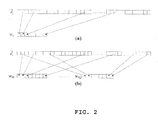
- a plurality of words is extracted from each frame, as illustrated in Fig. 2b , each word given from a small ordered set of elements in the binarised d ⁇ i .
- the elements of each word are selected according to any suitable method, i.e. random projection, geometric constraints, entropy ordering, etc.
- Each word has a vocabulary, and the combination of bits which produces each word is unique, without excluding the possibility of partial overlaps, e.g. some elements appearing in more than one word.
- each word may or may not have the same length as any other word, i.e. we may have dimensionality reductions from ⁇ to ⁇ 1 , ⁇ 2 , etc.
- words may be formed from any version of the descriptor d i , be it at its original resolution and dynamic range, quantised or binarised.
- an element may contribute more than one bit to a word, different numbers of bits to different words, and a word may contain different numbers of bits from different elements.
- a video sequence is described by one or more of its frames, in the aforementioned manner. Then, we calculate the frequency of occurrence of the different words in each one of one or more vocabularies. More specifically, in a preferred embodiment of the invention, a plurality of frames in the sequence is processed, and from each frame f i a ⁇ -dimensional full descriptor and a plurality of words w ik , k ⁇ [0, Q -1], each corresponding to one of Q vocabularies, is extracted. Then, for each vocabulary k , a histogram h k of the words found in the frame sequence is plotted. In simple terms, such a histogram shows which words appear in the frame sequence, and how often.
- a histogram is generated having, on one axis, a respective bin for each value the word may take (that is, each value in the word ⁇ s vocabulary) and recording, on the other axis, the number of occurrences of each value.
- the histograms are binarised. Such binarised histograms then show the words with significant presence.
- the binarisation may be achieved by any one of a number of suitable ways, such as simple thresholding, adaptive thresholding, etc.
- eq. (7) measures the distance of the frame sequences f i 1 and f j 2 in a given vocabulary as a function of the distinct words they have in common and all the distinct words that they contain jointly.
- a decision on the similarity or not of the frame sequences may be reached by the processing of D J , preferably thresholding.
- the sequences would be declared matching if D J is less than some threshold, otherwise they would be declared not matching.
- eq. (8) many alternatives to eq. (8) exist, such as trimmed mean, median, max, etc.
- alternative embodiments may reach a decision on the similarity of the frame sequences not by distance fusion, but by decision fusion, i.e. by thresholding each D k J individually, with the appropriate threshold, and then fusing the individual decisions, e.g. by majority voting. It is also possible, in an alternative embodiment of the invention, to combine distance fusion with decision fusion, i.e. reach a decision by calculating the composite D J and subsequent thresholding, but also require that a matching decision be supported by at least a set number of the individual D k J distances.
- a detected match is verified by considering the temporal ordering of occurrence of the matching words in the video sequences for each vocabulary.
- a set of words is found, for each vocabulary k , that occur in both video sequences f i 1 and f j 2 .
- these are found by identifying elements that are non-zero in both histograms h k 1 and h k 2 , i.e. the intersection of the binary histograms h ⁇ k 1 and h ⁇ k 2 .
- each element of each histogram corresponds to one word from the vocabulary
- the two sets of frame numbers ⁇ k 1 and ⁇ k 2 , for f i 1 and f j 2 respectively, are compared to determine the distance between them.
- ⁇ k 1 and ⁇ k 2 are binarised and the distance between them is given by the normalised Hamming distance.
- a binarised set records whether each word in the ordered set W k 12 makes its first appearance in a video sequence before or after the next word in the ordered set of words W k 12 .
- ⁇ k 1 and ⁇ k 2 may be compared without binarisation using an appropriate distance measure, e.g. the L1, which would give the total number of frames by which the occurances of the words in one sequence differ from the other sequence.
- an appropriate distance measure e.g. the L1
- a decision on the similarity or not of the frame sequences may be reached by the processing of D ⁇ H ⁇ , preferably thresholding.
- the sequences would be declared matching if D ⁇ H ⁇ is less than some threshold, otherwise they would be declared not matching.
- alternative embodiments may reach a decision on the similarity of the frame sequences not by distance fusion, but by decision fusion, i.e. by thresholding each D ⁇ k ⁇ H individually, with the appropriate threshold, and then fusing the individual decisions, e.g. by majority voting. It is also possible, in an alternative embodiment of the invention, to combine distance fusion with decision fusion, i.e. reach a decision by calculating the composite D ⁇ H ⁇ and subsequent thresholding, but also require that a matching decision be supported by at least a set number of the individual D ⁇ k ⁇ H distances.
- a further refinement and localisation stage is applied to decide to a very high level of accuracy whether the video sequences match and to determine corresponding frame locations in the two sequences.
- the set of matching words from both sequences is used to determine potential frame correspondences.
- the temporal variation between the sequences can then be estimated.
- the time-shift and the frame rate difference between the sequences are found as illustrated in Figure 4 . Descriptors from a plurality of potentially corresponding frames can then be used to determine the validity of the correspondence and/or refine the temporal variation parameters.
- ⁇ one or more ⁇ may be a different number for each sequence, e.g. a word may be produced by only one frame in one sequence, and many frames in the second sequence.
- the set for that word will contain only one pair of frame numbers. If another word is generated by multiple pairs of frames in f i 1 and f j 2 , the set for that word will contain the same multiple number of pairs of frame numbers.
- a bin value of 0 denotes that the frame pair in question ie (i, j) did not produce a matching word in any of the Q vocabularies
- a bin value of k ⁇ Q denotes that the frame pair in question produced a matching word only in k of Q vocabularies
- a bin value of Q denotes that the frame pair in question produced a matching word in all Q vocabularies.
- Frames in f i 1 and f j 2 are deemed to be corresponding if they have the same word in one or more vocabularies, and this may be seen as a weak test of correspondence i.e. they are weakly corresponding. For each of the weakly corresponding pairs of frames a stronger test of correspondence is carried out by comparing them according to a more detailed descriptor.
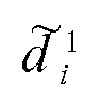
- the binary descriptors d ⁇ i 1 and d ⁇ j 2 are used, extracted from f i 1 and f j 2 as described earlier.
- the distance between such binary descriptors is preferably calculated as the Hamming distance D H d ⁇ .
- any version of the descriptor d as described in eq. (1)-(4) may be used, or appropriate subsets of this descriptor, be it at its original resolution and dynamic range, quantised or binarised, and the Hamming distance D H d ⁇ replaced by the appropriate distance measure, e.g. L1.
- the pairs are examined in order of most common words. That is pairs with Q common words are examined first, then pairs with Q -1 common words and so on. This type of ordering according to the number of common words is readily provided by the 2D histogram G ij 12 .
- a weakly corresponding frame pair is accepted as a strongly corresponding frame pair if the distance between the frame descriptors meets certain criteria, i.e. preferably it is below a predefined threshold. This is repeated until there are no remaining weakly corresponding pairs or a certain number of strongly corresponding pairs has been found.
- the strongly corresponding pairs are then used to estimate the temporal parameter change between the frame sequences.
- the temporal parameters are time-shift and frame-rate change. These are linear properties and can therefore be estimated using two strongly-corresponding pairs.
- a Hough transform is used to estimate the temporal parameters. The peaks in the Hough space correspond to the most likely temporal parameters.
- the Hough transform and the Radon transform are not examined here, but are expertly described in van Ginkel, M., Hendriks, C. L., van Vliet, L. J., ⁇ A short introduction to the Radon and Hough transforms and how they relate to each other ⁇ , Number QI-2004-01 in the Quantitative Imaging Group Technical Report Series, Delft University of Technology.
- the Hough transform is typically used to give a coarse estimate of the parameters.
- frame correspondences are established between two video sequences.
- the frame correspondences can be more accurately determined.
- a single descriptor provides a certain level of accuracy, by combining a plurality of descriptors a higher level of accuracy is achieved.
- the Hamming distance between descriptors is used and the Hamming distances are then added together across the descriptors.
- a plurality of corresponding frames from two sequences are chosen and the distance between the sequences are found by examining the distances between the combination of descriptors from the frames.
- a group of (for example 7) consecutive frames are chosen from the start of a first sequence and are compared with the corresponding frames from the second sequence.
- the frames may be from different parts of the sequence (middle, end, etc) and/or the frames may be nonconsecutive.
- frame correspondences are refined by keeping one frame of the corresponding pair stable, and searching in the locality of its corresponding frame for a better corresponding frame.
- an efficient descriptor storage scheme is used to form a compact representation of a video sequence.
- the sequence is divided into fragments of, say, 1 second.
- Q binary histograms h ⁇ k are stored in a bitstream.
- the descriptors d ⁇ i for each of the frames in the fragment are stored. All fragments in the sequence are stored consecutively in the bitstream in this manner.
- information can be stored at the head of the bitstream such as the frame rate of the sequence, the number of frames, the number of fragments etc.
- the sequence can be represented in the bitstream by a plurality of frame representations. Where each frame is represented by Q words and a binary descriptor d ⁇ i . All of the frames in the sequence can be stored in this manner. In another alternative it may be desirable to store all of the words in from all of the frames first followed by all of the descriptors. Clearly it is possible to store the quantised or original versions of the histograms, words and descriptors.
- the descriptor extracted from the video frames may be changed to a suitable frame descriptor, e.g. a colour histogram or edge strength histogram, which may be stored in its original, quantised or binarised forms, and from which words may be formed.
- a suitable frame descriptor e.g. a colour histogram or edge strength histogram
- different decision stages may be omitted.
- the processing and decision stage based on the temporal ordering of occurrence of the matching words in the video sequences for each vocabulary may be entirely omitted, with processing proceeding directly to the stage of refinement, localisation and determination of corresponding frames.
- the decision stage according to the matching words found in each video sequence may be omitted, and processing may proceed directly to the processing and decision stage based on the temporal ordering of occurrence of the matching words in the video sequences.
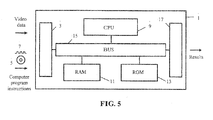
- a data processing apparatus 1 for performing the processing operations described above is shown in Fig. 5 .
- the apparatus 1 can, for example, be a personal desktop computer or a portable computer.
- the apparatus 1 comprises conventional elements of a data processing apparatus, which are well-known to the skilled person, such that a detailed description is not necessary.
- the apparatus 1 of Fig. 5 comprises an input data interface 3 for receiving computer program instructions from a computer program product such as a storage medium 5 or a signal 7, as well as video data to be processed.
- a processing system is provided, for example, by a CPU 9, a random access memory 11, and a read-only memory 13, which are connected by a bus 15.
- the CPU 9 controls the overall operation.
- the RAM 11 is a working memory used by the CPU 9 to execute programs and control the ROM 4, which stores the programs and other data.
- the processing apparatus of apparatus 1 is configured to perform a method of processing image data defining an image as described herein above. The results of this processing are output by output interface 17.
- processing apparatus 1 performs processing in accordance with computer program instructions
- an alternative processing apparatus can be implemented in any suitable or desirable way, as hardware, software or any suitable combination of hardware and software.
- present invention can also be embodied as a computer program that executes one of the above-described methods of processing image data when loaded into and run on a programmable processing apparatus, and as a computer program product, e.g. a data carrier storing such a computer program.
Landscapes
- Engineering & Computer Science (AREA)
- Multimedia (AREA)
- Theoretical Computer Science (AREA)
- Physics & Mathematics (AREA)
- General Physics & Mathematics (AREA)
- Library & Information Science (AREA)
- Databases & Information Systems (AREA)
- Data Mining & Analysis (AREA)
- General Engineering & Computer Science (AREA)
- Computer Vision & Pattern Recognition (AREA)
- Signal Processing (AREA)
- Image Analysis (AREA)
- Studio Circuits (AREA)
- Television Signal Processing For Recording (AREA)
- Two-Way Televisions, Distribution Of Moving Picture Or The Like (AREA)
Abstract
Description
- The invention relates to a method, apparatus and computer program product for fast and reliable video identification that is robust to common editing operations such as camera capture, analogue/digital conversion, recompression, etc.
- A rapidly increasing number of videos are being stored by professionals and consumers. For professionals, the cost and technical difficulties of creating, storing and editing video content have been decreasing. For consumers the increase in choice and decrease in cost of set-top boxes, personal video recorders, video cameras and computers has driven an increase in video content. Over the past couple of years there has been an explosion in both legal and illegal content available on the internet. The ability to index, search and monitor this content has become an increasingly important problem. The MPEG-7 standard was an early work in the area of content based search and retrieval. An area lacking in the original version of the standard is near-duplicate video detection.
- Near duplicate video detection can be defined as follows: given a query video sequence, find all of the duplicates in a database. The notion and interpretation of (near-)duplicates varies. However, for this invention a duplicate is regarded as a sequence that has been created by using common video editing/processing operations on an original. Examples of such operations include colour change, compression, transcoding, format change, frame rate change, analogue VCR recapture and camera recapture amongst many more. The present invention also addresses the problem that the duplicate part may form only a part of the query sequence.
- In previous work in the area [T. Hoad and J. Zobel. Video similarity detection for digital rights management. In Procedings of Australasian Computer Science Conference, pages 237-245, Adelaide, Australia, 2003.] shot cuts and boundaries were used to form a signature of a video sequence. This provides a very compact representation of a video, but it performs very poorly on short sequences and is very sensitive to the shot-detection algorithm used [T. Hoad and J. Zobel., Proceedings of the 5th ACM SIGMM international workshop on Multimedia information retrieval, pages 262-269, Berkeley, US, 2003.]
- A typical state-of-the-art feature-point approach to (near-)duplicate detection in video is given in [J. Sivic, A. Zisserman, Efficient Visual Search for Objects in Videos, Proceedings of the IEEE, April 2008, 96 (4), pages 548-566.] and can be outlined as i) detect key frames ii) detect key-points in the frame, iii) extract features from regions around the point, iv) match sequences using features, v) apply test for spatial cohesion of objects in sequences. There are a number of weaknesses with the approach outlined. Firstly the use of key frames means the method is likely to perform less well on short clips. The extraction of features (iii) is a computationally expensive method and results in large storage requirements. For step (iv) a visual vocabulary is used which is learned from clustering data. This can lead to over-fitting to a particular dataset with failure to generalise. Related methods such as [Ondej Chum, James Philbin, Michael Isard and Andrew Zisserman, Scalable near identical image and shot detection , Proceedings of the 6th ACM international conference on Image and video retrieval, pages 549-556, Amsterdam, The Netherlands, 2007] provide fast searching at the cost of high memory requirements for the hash tables used. Whilst this may be suitable for some scenarios it is not suitable in consumer electronics environments where memory resources are typically very limited.

- The present invention aims to address at least one or more of the limitations of such prior art methods.
- Certain aspects of the present invention are set out in the accompanying claims. Other aspects are described in the embodiments below and will be appreciated by the skilled person from a reading of this description.
- By way of summary, the present invention provides apparatus for processing a first sequence of images and a second sequence of images to compare the first and second sequences, the aparatus comprising: descriptor element generating means arranged to process each of a plurality of the images in the first sequence and each of a plurality of the images in the second sequence by processing the image data for each of a plurality of pixel neighbourhoods in the image to generate at least one respective descriptor element for each of the pixel neighbourhoods, each descriptor element comprising one or more bits; word generating means arranged to form a plurality of words from the descriptor elements of each image such that each word comprises a unique combination of descriptor element bits, wherein the word generating means is arranged to generate the words for the second sequence from the same respective combinations of descriptor element bits as the words for the first sequence; and sequence comparing means arranged to perform processing to compare the first and second sequences by comparing the words generated for the plurality of images in the first sequences with the words generated for the plurality of images in the second sequence.
- The sequence comparing means may be arranged to perform processing to compare the first and second sequences comprising processing to compare the frequency of occurrence of different word values in the first and second sequences.
- The sequence comparing means may be arranged to perform processing to compare the first and second sequences comprising: determining the number of occurrences of each possible word value for each word in the first sequence to generate occurrence data for the first sequence; determining the number of occurrences of each possible word value for each word in the second sequence to generate occurrence data for the second sequence; and comparing the occurrence data for the first sequence with the occurrence data for the second sequence.
- The sequence comparing means may be arranged to compare the occurrence data for the first sequence and the occurrence data for the second sequence to generate a respective comparison result for each word, and to merge the respective comparison results to generate an overall comparison result.
- The apparatus may further comprise: means for determining, for each word, the word values that occur in both sequences; means for determining, for each word, the temporal order of occurrence of the word values in both sequences; and means for comparing the temporal orders of occurrence.
- The apparatus may further comprise: means for identifying matching pairs of images, each pair of images comprising an image from the first sequence and an image from the second sequence; and means for performing a further correspondence test to determine a similarity between at least one identified pair of images.
- The present invention also provides apparatus for processing image data defining an image to generate at least one value representative of the image, the apparatus comprising: descriptor element generating means arranged to process the image data for each of a plurality of pixel neighbourhoods in the image to generate at least one respective descriptor element for each of the pixel neighbourhoods, each descriptor element comprising one or more bits; and word generating means arranged to form at least one word from the descriptor elements such that each word comprises one or more bits from one or more descriptor elements and such that the total number of bits in all of the words is less than the total number of bits in all of the descriptor elements.
- The present invention also provides apparatus for processing image data defining an image to generate a plurality of values representative of the image, the apparatus comprising: descriptor element generating means arranged to process the image data for each of a plurality of pixel neighbourhoods in the image to generate at least one respective descriptor element for each of the pixel neighbourhoods, each descriptor element comprising one or more bits; and word generating means arranged to form a plurality of words from the descriptor elements such that each word comprises a unique combination of descriptor element bits.
- The apparatus may further comprise quantising means for quantising each descriptor element; and the word generating means may be arranged to form each word from the quantised descriptor elements.
- The quantiser may be arranged to quantise each descriptor element to form a respective one bit binary result.
- The descriptor element generating means may be arranged to generate the descriptor elements for the image at a plurality of different pixel resolutions; and the word generating means may be arranged to generate at least one word by combining one or more bits from descriptor elements generated at different pixel resolutions.
- The present invention also provides apparatus for processing image data defining an image to generate at least one value representative of the image, the apparatus comprising: descriptor element generating means arranged to process the image data for each of a plurality of pixel neighbourhoods in the image to generate at least one respective descriptor element for each of the pixel neighbourhoods, each descriptor element comprising one or more bits; quantising means arranged to quantise each descriptor element; and representative value forming means arranged to format least one value representative of the image from the quantised descriptor elements.
- The quantiser may be arranged to quantise each descriptor element to form a respective one bit binary result.
- The present invention also provides apparatus for processing image data defining a sequence of images to generate and store a representation of the sequence, the apparatus comprising: descriptor element generating means arranged to process, for each image in the sequence, the image data for each of a plurality of pixel neighbourhoods in the image to generate at least one respective descriptor element for each of the pixel neighbourhoods, each descriptor element comprising one or more bits; word generating means arranged to form, for each image in the sequence, at least one word from the descriptor elements of the image such that each word comprises one or more bits from one or more descriptor elements and such that the total number of bits in all of the words of the image is less than the total number of bits in all of the descriptor elements of the image; histogram data generating means arranged to generate histogram data defining which words appear in the sequence of images and how many times; and data writing means arranged to write the histogram data, words and descriptor elements for the images in the sequence to storage.
- The apparatus may further comprise descriptor element quantising means arranged to quantise each descriptor element; and the word generating means may be arranged to form each word from the quantised descriptor elements. In addition, the apparatus may further comprise histogram data quantising means arranged to quantise the histogram data, and the data writing means may be may be arranged to write the quantised histogram data, words and quantised descriptor elements to storage.
- The apparatus may be operable to process a sequence of images comprising a fragment of a video sequence.
- The data writing means may be arranged to store the histogram data, words and descriptor elements in the bitstream.
- The present invention also provides apparatus for processing image data defining a sequence of images to generate and store a representation of the sequence, the apparatus comprising: descriptor element generating means arranged to process, for each image in the sequence, the image data for each of a plurality of pixel neighbourhoods in the image to generate at least one respective descriptor element for each of the pixel neighbourhoods, each descriptor element comprising one or more bits; word generating means arranged to generate, for each image in the sequence, a plurality of words from the descriptor elements of the image such that each word comprises a unique combination of descriptor element bits; histogram data generating means arranged to generate histogram data defining which words appear in the sequence of images and how many times; and data writing means arranged to write the histogram data, words and descriptor elements for the images in the sequence to storage.
- The apparatus may further comprise descriptor element quantising means arranged to quantise each descriptor element; and the word generating means may be arranged to form each word from the quantised descriptor elements. In addition, the apparatus may further comprise histogram data quantising means arranged to quantise the histogram data, and the data writing means may be may be arranged to write the quantised histogram data, words and quantised descriptor elements to storage.
- The apparatus may be operable to process a sequence of images comprising a fragment of a video sequence.
- The data writing means may be arranged to store the histogram data, words and descriptor elements in the bitstream.
- The present invention also provides apparatus for processing image data defining a sequence of images to generate and store a representation of the sequence, the apparatus comprising: descriptor element generating means arranged to process, for each image in the sequence, the image data for each of a plurality of pixel neighbourhoods in the image to generate at least one respective descriptor element for each of the pixel neighbourhoods, each descriptor element comprising one or more bits; descriptor element quantising means arranged to quantise each descriptor element; representative value forming means arranged to form, for each image in the sequence, at least one value representative of the image from the quantised descriptor elements; histogram data generating means arranged to generate histogram data defining which values representative of the images appear in the sequence of images and how many times; histogram data quantising means arranged to quantise the histogram data; and data writing means arranged to write the quantised histogram data, values representative of the images and quantised descriptor elements to storage.
- The apparatus may be operable to process a sequence of images comprising a fragment of a video sequence.
- The data writing means may be arranged to store the histogram data, values representative of the images and descriptor elements in the bitstream.
- An embodiment of the present invention provides a new method and apparatus for video identification, which
- provides a very compact representation of video sequences,
- does not depend upon training data,
- provides very fast searching and matching,
- is robust to common editing/processing operations
- and provides accurate localisation of matching frame positions.
- Embodiments of the invention will now be described, by way of example only, with reference to the accompanying drawings, in which:
-
Figure 1 illustrates the processing to generate descriptor elements in an embodiment; -
Figures 2a and 2b illustrate the processing to generate words from the descriptor elements in an embodiment; -
Figure 3 illustrates binarisation in an embodiment; -
Figure 4 illustrates the determination of time-shift and frame rate change in an embodiment; and -
Figure 5 shows an example of a processing apparatus for performing the processing operations of an embodiment. - A method that is performed by a processing apparatus in an embodiment of the invention will now be described. The method comprises a number of processing operations. As explained at the end of the description, these processing operations can be performed by a processing apparatus using hardware, firmware, a processing unit operating in accordance with computer program instructions, or a combination thereof.
- Consider a sequence of video frames fi (c,x,y) where i is the frame index, e.g. i ∈ [0,T-1] where T is the total number of frames in the sequence, c is an index in l colour channels, e.g. c ∈ {Y,U,V} with l = 3, and x and y are spatial coordinates, e.g. x ∈[0,M -1], y ∈[0,N -1]where M and N is the horizontal and vertical frame resolution respectively.
- In a preferred embodiment of the invention, we describe each frame in terms of its pixel intensities and differences. Such descriptors are described in our co-pending
patent applications EP 1 640 913 andEP 1 640 914


- This is illustrated in
Fig. 1 for m = 8 and c = Y and without loss of generality. The descriptor elements according to eq. (1) are average intensities and, taken for the whole frame, give a resampled version of that frame at (m/2)×(m/2) pixel resolution, which is re-processed according to eq. (1)-(4). This process continues until the average intensity for the whole frame is calculated. The complete descriptor for the frame fi therefore contains descriptor elements for the frame at different pixel resolutions (that is, mxm, m/2×m/2, ..., 4×4, 2×2) and is then given by
- Optionally, the descriptor elements are quantised to a desired number of bits, which may vary for different elements, colour channels, etc. In a preferred embodiment of the invention, the descriptor elements are binarised as follows

where r is the dynamic range, e.g. r = 256 for 8-bit pixel values
where

- In alternative embodiments, other quantisation/binarisation techniques may also be employed, such as locality sensitive hashing. This method is not examined here but is described in Samet H., □Foundations of Multidimensional and Metric Data Structures□, Morgan Kaufmann, 2006.
- The complete descriptor for the frame is then used to form at least one compact word based on one or more bits of one or more of its descriptor elements. This is illustrated in
Fig. 2a . It should be noted that the term □word□ used herein refers to a word that may have any number of bits and is not specifically restricted to a particular number of bits as in some computing literature. More specifically, in a preferred embodiment of the invention, a small ordered set of elements in the binarised d̃i is concatenated to produce a word. There is no restriction on which elements to choose and a word may mix elements from different colour channels, from different levels of coarseness, e.g. extracted at 16×16 or 4×4 resolution, be they averages according to eq. (1) or differences according to eq. (2)-(4). For example, in one embodiment of the invention, elements may be chosen randomly among all the available elements. In another embodiment of the invention, elements may be chosen according to some geometric patterns, for example covering only a certain spatial region of the video frame. In yet another embodiment of the invention, elements may be ordered according to their entropy, and the highest entropy elements are selected to form a word. Thus, the process of word formation is a projection from a Φ-dimensional space to a ψ-dimensional space, with ψ << Φ preferably. For two video frames, the distance between two corresponding words, i.e. the bit pattern of ordered selected corresponding elements, is an approximation of the distance of the full frame descriptors. - All possible combinations of every possible value of the ordered elements that make up a word give the vocabulary for that word. Thus, a word is a unique combination of descriptor elements, and the vocabulary for a word is the set of different values the word can take. For example, if a word contains two descriptor elements, and each descriptor element is one bit long with each bit free to take the
value - In a preferred embodiment of the invention, a plurality of words is extracted from each frame, as illustrated in
Fig. 2b , each word given from a small ordered set of elements in the binarised d̃i . Preferably, the elements of each word are selected according to any suitable method, i.e. random projection, geometric constraints, entropy ordering, etc. Each word has a vocabulary, and the combination of bits which produces each word is unique, without excluding the possibility of partial overlaps, e.g. some elements appearing in more than one word. Furthermore, each word may or may not have the same length as any other word, i.e. we may have dimensionality reductions from Φ to ψ1, ψ2, etc. - In alternative embodiments of the invention, words may be formed from any version of the descriptor di , be it at its original resolution and dynamic range, quantised or binarised. In such embodiments, an element may contribute more than one bit to a word, different numbers of bits to different words, and a word may contain different numbers of bits from different elements.
- A video sequence is described by one or more of its frames, in the aforementioned manner. Then, we calculate the frequency of occurrence of the different words in each one of one or more vocabularies. More specifically, in a preferred embodiment of the invention, a plurality of frames in the sequence is processed, and from each frame fi a Φ-dimensional full descriptor and a plurality of words wik , k ∈ [0,Q-1], each corresponding to one of Q vocabularies, is extracted. Then, for each vocabulary k, a histogram hk of the words found in the frame sequence is plotted. In simple terms, such a histogram shows which words appear in the frame sequence, and how often. More particularly, for each word, a histogram is generated having, on one axis, a respective bin for each value the word may take (that is, each value in the word□s vocabulary) and recording, on the other axis, the number of occurrences of each value.
- For two sequences of
frames 

histograms 


- In simple terms, eq. (7) measures the distance of the frame
sequences 

- For Q vocabularies, we have Q Jaccard distances


- In a preferred embodiment of the invention, these distances are fused to give the composite distance


- Then a decision on the similarity or not of the frame sequences may be reached by the processing of


- Clearly, many alternatives to eq. (8) exist, such as trimmed mean, median, max, etc. Furthermore, alternative embodiments may reach a decision on the similarity of the frame sequences not by distance fusion, but by decision fusion, i.e. by thresholding each


- Optionally, a detected match is verified by considering the temporal ordering of occurrence of the matching words in the video sequences for each vocabulary. In a preferred embodiment a set of words is found, for each vocabulary k, that occur in both video
sequences 

histograms 


- The two sets of frame
numbers 


embodiment 

Figure 3 by evaluating differences between neighbouring elements of the set
- The binarised set is denoted Ω̃ k = {ω̃λk ,λ ∈ [0, z-1]}, and the normalised Hamming distance


- In alternative embodiments of the invention,


- For Q vocabularies, we have Q normalised Hamming distances

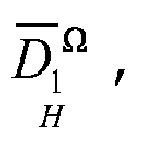


- Then a decision on the similarity or not of the frame sequences may be reached by the processing of


- Clearly, many alternatives to eq. (10) exist, such as trimmed mean, median, max, etc. Furthermore, alternative embodiments may reach a decision on the similarity of the frame sequences not by distance fusion, but by decision fusion, i.e. by thresholding each


- Optionally, a further refinement and localisation stage is applied to decide to a very high level of accuracy whether the video sequences match and to determine corresponding frame locations in the two sequences. The set of matching words from both sequences is used to determine potential frame correspondences. The temporal variation between the sequences can then be estimated. In the preferred embodiment the time-shift and the frame rate difference between the sequences are found as illustrated in
Figure 4 . Descriptors from a plurality of potentially corresponding frames can then be used to determine the validity of the correspondence and/or refine the temporal variation parameters. - More specifically, for each vocabulary k, each of the words in the intersection


sequences 


- Then, for each word in


sequences 


- Frames in


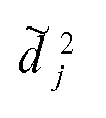


- In alternative embodiments of the invention, any version of the descriptor d as described in eq. (1)-(4) may be used, or appropriate subsets of this descriptor, be it at its original resolution and dynamic range, quantised or binarised, and the Hamming distance

- To beneficially reduce processing time when a large number of weakly corresponding frame pairs exists, only a limited number of them may be confirmed as strongly corresponding frame pairs. Preferably the pairs are examined in order of most common words. That is pairs with Q common words are examined first, then pairs with Q-1 common words and so on. This type of ordering according to the number of common words is readily provided by the 2D histogram

- The strongly corresponding pairs are then used to estimate the temporal parameter change between the frame sequences. In a preferred embodiment the temporal parameters are time-shift and frame-rate change. These are linear properties and can therefore be estimated using two strongly-corresponding pairs. Preferably a Hough transform is used to estimate the temporal parameters. The peaks in the Hough space correspond to the most likely temporal parameters. The Hough transform and the Radon transform are not examined here, but are expertly described in van Ginkel, M., Hendriks, C. L., van Vliet, L. J., □A short introduction to the Radon and Hough transforms and how they relate to each other□, Number QI-2004-01 in the Quantitative Imaging Group Technical Report Series, Delft University of Technology.
- The Hough transform is typically used to give a coarse estimate of the parameters. Using these parameters frame correspondences are established between two video sequences. In a preferred embodiment the frame correspondences can be more accurately determined. A single descriptor provides a certain level of accuracy, by combining a plurality of descriptors a higher level of accuracy is achieved. In a preferred embodiment the Hamming distance between descriptors is used and the Hamming distances are then added together across the descriptors. Preferably a plurality of corresponding frames from two sequences are chosen and the distance between the sequences are found by examining the distances between the combination of descriptors from the frames. In a preferred embodiment a group of (for example 7) consecutive frames are chosen from the start of a first sequence and are compared with the corresponding frames from the second sequence. Alternatively, the frames may be from different parts of the sequence (middle, end, etc) and/or the frames may be nonconsecutive. In a preferred embodiment, frame correspondences are refined by keeping one frame of the corresponding pair stable, and searching in the locality of its corresponding frame for a better corresponding frame.
- In an embodiment, an efficient descriptor storage scheme is used to form a compact representation of a video sequence. In the preferred embodiment the sequence is divided into fragments of, say, 1 second. For each fragment, Q binary histograms h̃k are stored in a bitstream. Following the binary histogram the descriptors d̃i for each of the frames in the fragment are stored. All fragments in the sequence are stored consecutively in the bitstream in this manner. Optionally information can be stored at the head of the bitstream such as the frame rate of the sequence, the number of frames, the number of fragments etc.
- In an alternative embodiment the sequence can be represented in the bitstream by a plurality of frame representations. Where each frame is represented by Q words and a binary descriptor d̃i . All of the frames in the sequence can be stored in this manner. In another alternative it may be desirable to store all of the words in from all of the frames first followed by all of the descriptors. Clearly it is possible to store the quantised or original versions of the histograms, words and descriptors.
- In an alternative embodiment of the invention, the descriptor extracted from the video frames may be changed to a suitable frame descriptor, e.g. a colour histogram or edge strength histogram, which may be stored in its original, quantised or binarised forms, and from which words may be formed. In different embodiments of the invention, different decision stages may be omitted. For example, the processing and decision stage based on the temporal ordering of occurrence of the matching words in the video sequences for each vocabulary may be entirely omitted, with processing proceeding directly to the stage of refinement, localisation and determination of corresponding frames. In alternative embodiments of the invention, the decision stage according to the matching words found in each video sequence may be omitted, and processing may proceed directly to the processing and decision stage based on the temporal ordering of occurrence of the matching words in the video sequences.
- A
data processing apparatus 1 for performing the processing operations described above is shown inFig. 5 . Theapparatus 1 can, for example, be a personal desktop computer or a portable computer. - The
apparatus 1 comprises conventional elements of a data processing apparatus, which are well-known to the skilled person, such that a detailed description is not necessary. In brief, theapparatus 1 ofFig. 5 comprises aninput data interface 3 for receiving computer program instructions from a computer program product such as astorage medium 5 or asignal 7, as well as video data to be processed. A processing system is provided, for example, by aCPU 9, arandom access memory 11, and a read-only memory 13, which are connected by abus 15. TheCPU 9 controls the overall operation. TheRAM 11 is a working memory used by theCPU 9 to execute programs and control the ROM 4, which stores the programs and other data. The processing apparatus ofapparatus 1 is configured to perform a method of processing image data defining an image as described herein above. The results of this processing are output byoutput interface 17. - Although the
processing apparatus 1 described above performs processing in accordance with computer program instructions, an alternative processing apparatus can be implemented in any suitable or desirable way, as hardware, software or any suitable combination of hardware and software. It is furthermore noted that the present invention can also be embodied as a computer program that executes one of the above-described methods of processing image data when loaded into and run on a programmable processing apparatus, and as a computer program product, e.g. a data carrier storing such a computer program. - The foregoing description of embodiments of the invention has been presented for the purpose of illustration and description. It is not intended to be exhaustive or to limit the invention to the precise form disclosed. Alternations, modifications and variations can be made without departing from the scope of the present invention.
Claims (26)
- A method of processing a first sequence of images and a second sequence of images to compare the first and second sequences, the method comprising:(a) processing each of a plurality of the images in the first sequence and each of a plurality of the images in the second sequence by:processing the image data for each of a plurality of pixel neighbourhoods in the image to generate at least one respective descriptor element for each of the pixel neighbourhoods, each descriptor element comprising one or more bits; andforming a plurality of words from the descriptor elements of the image such that each word comprises a unique combination of descriptor element bits;wherein the words for the second sequence are generated from the same respective combinations of descriptor element bits as the words for the first sequence; and(b) performing processing to compare the first and second sequences by comparing the words generated for the plurality of images in the first sequences with the words generated for the plurality of images in the second sequence.
- A method according to Claim 1, wherein the processing to compare the first and second sequences comprises processing to compare the frequency of occurrence of different word values in the first and second sequences.
- A method according to claim 1 or Claim 2, wherein the processing to compare the first and second sequences comprises:determining the number of occurrences of each possible word value for each word in the first sequence to generate occurrence data for the first sequence;determining the number of occurrences of each possible word value for each word in the second sequence to generate occurrence data for the second sequence; andcomparing the occurrence data for the first sequence with the occurrence data for the second sequence.
- A method according to Claim 3, wherein the occurrence data for the first sequence and the occurrence data for the second sequence are compared to generate a respective comparison result for each word, and the respective comparison results are merged to generate an overall comparison result.
- A method according to any preceding claim, further comprising:determining, for each word, the word values that occur in both sequences;determining, for each word, the temporal order of occurrence of the word values in both sequences; andcomparing the temporal orders of occurrence.
- A method according to any preceding claim, further comprising:identifying matching pairs of images, each pair of images comprising an image from the first sequence and an image from the second sequence; andperforming a further correspondence test to determine a similarity between at least one identified pair of images.
- A method of processing image data defining an image to generate at least one value representative of the image, the method comprising:processing the image data for each of a plurality of pixel neighbourhoods in the image to generate at least one respective descriptor element for each of the pixel neighbourhoods, each descriptor element comprising one or more bits; andforming at least one word from the descriptor elements such that each word comprises one or more bits from one or more descriptor elements and such that the total number of bits in all of the words is less than the total number of bits in all of the descriptor elements.
- A method of processing image data defining an image to generate a plurality of values representative of the image, the method comprising:processing the image data for each of a plurality of pixel neighbourhoods in the image to generate at least one respective descriptor element for each of the pixel neighbourhoods, each descriptor element comprising one or more bits; andforming a plurality of words from the descriptor elements such that each word comprises a unique combination of descriptor element bits.
- A method according to Claim 7 or Claim 8, wherein:the method further comprises the step of quantising each descriptor element; andeach word is formed from the quantised descriptor elements.
- A method according to Claim 9, wherein the process of quantising each descriptor element comprises quantising each descriptor element to form a respective one bit binary result.
- A method according to any of Claims 7 to 10, wherein:descriptor elements are generated for the image at a plurality of different pixel resolutions; andat least one word is generated by combining one or more bits from descriptor elements generated at different pixel resolutions.
- A method of processing image data defining an image to generate at least one value representative of the image, the method comprising:processing the image data for each of a plurality of pixel neighbourhoods in the image to generate at least one respective descriptor element for each of the pixel neighbourhoods, each descriptor element comprising one or more bits;quantising each descriptor element; andforming at least one value representative of the image from the quantised descriptor elements.
- A method according to Claim 12, wherein the process of quantising each descriptor element comprises quantising each descriptor element to form a respective one bit binary result.
- A method of storing a representation of a sequence of images, the method comprising:generating a plurality of descriptor elements for, and at least one word representing, each image in the sequence by performing a method as set out in Claim 7 or Claim 8,generating histogram data defining which words appear in the sequence of images and how often; andstoring the histogram data, words and descriptor elements for the images in the sequence.
- A method according to claim 14, wherein:the method further comprises quantising each descriptor element, and each word is found from the quantised descriptor elements;the method further comprises quantising the histogram data; andthe quantised histogram data, words and quantised descriptor elements are stored.
- A method of storing a representation of a sequence of images, the method comprising:generating a plurality of descriptor elements for, and at least one value representing, each image in the sequence by performing a method as set out in Claim 12,generating histogram data defining which values representative of the images appear and how often;quantising the histogram data; andstoring the quantised histogram data, values representative of the images and quantised histogram data, words and quantised descriptor elements for the images in the sequence.
- A method according to any of Claims 14 to 16, wherein the sequence of images comprises a fragment of a video sequence.
- A method according to any of claims 14 to 17, wherein the histogram data, values representative of the images and descriptor elements are stored in the bitstream.
- Apparatus for processing a first sequence of images and a second sequence of images to compare the first and second sequences, the apparatus comprising:descriptor element generating means arranged to process each of a plurality of the images in the first sequence and each of a plurality of the images in the second sequence by processing the image data for each of a plurality of pixel neighbourhoods in the image to generate at least one respective descriptor element for each of the pixel neighbourhoods, each descriptor element comprising one or more bits;word generating means arranged to form a plurality of words from the descriptor elements of each image such that each word comprises a unique combination of descriptor element bits, wherein the word generating means is arranged to generate the words for the second sequence from the same respective combinations of descriptor element bits as the words for the first sequence; andsequence comparing means arranged to perform processing to compare the first and second sequences by comparing the words generated for the plurality of images in the first sequences with the words generated for the plurality of images in the second sequence.
- Apparatus for processing image data defining an image to generate at least one value representative of the image, the apparatus comprising:descriptor element generating means arranged to process the image data for each of a plurality of pixel neighbourhoods in the image to generate at least one respective descriptor element for each of the pixel neighbourhoods, each descriptor element comprising one or more bits; andword generating means arranged to form at least one word from the descriptor elements such that each word comprises one or more bits from one or more descriptor elements and such that the total number of bits in all of the words is less than the total number of bits in all of the descriptor elements.
- Apparatus for processing image data defining an image to generate a plurality of values representative of the image, the apparatus comprising:descriptor element generating means arranged to process the image data for each of a plurality of pixel neighbourhoods in the image to generate at least one respective descriptor element for each of the pixel neighbourhoods, each descriptor element comprising one or more bits; andword generating means arranged to form a plurality of words from the descriptor elements such that each word comprises a unique combination of descriptor element bits.
- Apparatus for processing image data defining an image to generate at least one value representative of the image, the apparatus comprising:descriptor element generating means arranged to process the image data for each of a plurality of pixel neighbourhoods in the image to generate at least one respective descriptor element for each of the pixel neighbourhoods, each descriptor element comprising one or more bits;quantising means arranged to quantise each descriptor element; andrepresentative value forming means arranged to form at least one value representative of the image from the quantised descriptor elements.
- Apparatus for processing image data defining a sequence of images to generate and store a representation of the sequence, the apparatus comprising:descriptor element generating means arranged to process, for each image in the sequence, the image data for each of a plurality of pixel neighbourhoods in the image to generate at least one respective descriptor element for each of the pixel neighbourhoods, each descriptor element comprising one or more bits;word generating means arranged to form, for each image in the sequence, at least one word from the descriptor elements of the image such that each word comprises one or more bits from one or more descriptor elements and such that the total number of bits in all of the words of the image is less than the total number of bits in all of the descriptor elements of the image;histogram data generating means arranged to generate histogram data defining which words appear in the sequence of images and how many times; anddata writing means arranged to write the histogram data, words and descriptor elements for the images in the sequence to storage.
- Apparatus for processing image data defining a sequence of images to generate and store a representation of the sequence, the apparatus comprising:descriptor element generating means arranged to process, for each image in the sequence, the image data for each of a plurality of pixel neighbourhoods in the image to generate at least one respective descriptor element for each of the pixel neighbourhoods, each descriptor element comprising one or more bits;word generating means arranged to form, for each image in the sequence, a plurality of words from the descriptor elements of the image such that each word comprises a unique combination of descriptor element bits;histogram data generating means arranged to generate histogram data defining which words appear in the sequence of images and how many times; anddata writing means arranged to write the histogram data, words and descriptor elements for the images in the sequence to storage.
- Apparatus for processing image data defining a sequence of images to generate and store a representation of the sequence, the apparatus comprising:descriptor element generating means arranged to process, for each image in the sequence, the image data for each of a plurality of pixel neighbourhoods in the image to generate at least one respective descriptor element for each of the pixel neighbourhoods, each descriptor element comprising one or more bits;descriptor element quantising means arranged to quantise each descriptor element;representative value forming means arranged to form, for each image, at least one value representative of the image from the quantised descriptor elements of the image;histogram data generating means arranged to generate histogram data defining which values representative of the images appear in the sequence of images and how many times;histogram data quantising means arranged to quantise the histogram data; anddata writing means arranged to write the quantised histogram data, values representative of the images and quantised descriptor elements to storage.
- A computer program product comprising computer program instructions to program a programmable processing apparatus to become operable to perform a method as set out in at least one of Claims 1 to 18.
Applications Claiming Priority (1)
| Application Number | Priority Date | Filing Date | Title |
|---|---|---|---|
| GBGB0901262.6A GB0901262D0 (en) | 2009-01-26 | 2009-01-26 | Video identification |
Publications (2)
| Publication Number | Publication Date |
|---|---|
| EP2214106A2 true EP2214106A2 (en) | 2010-08-04 |
| EP2214106A3 EP2214106A3 (en) | 2013-04-10 |
Family
ID=40469100
Family Applications (1)
| Application Number | Title | Priority Date | Filing Date |
|---|---|---|---|
| EP10151185.5A Withdrawn EP2214106A3 (en) | 2009-01-26 | 2010-01-20 | Video identification |
Country Status (6)
| Country | Link |
|---|---|
| US (1) | US8699851B2 (en) |
| EP (1) | EP2214106A3 (en) |
| JP (1) | JP5634075B2 (en) |
| KR (1) | KR101634395B1 (en) |
| CN (1) | CN101789082B (en) |
| GB (1) | GB0901262D0 (en) |
Cited By (3)
| Publication number | Priority date | Publication date | Assignee | Title |
|---|---|---|---|---|
| WO2012093339A3 (en) * | 2011-01-07 | 2012-08-30 | Alcatel Lucent | Method and apparatus for comparing videos |
| WO2013041920A1 (en) * | 2011-01-07 | 2013-03-28 | Alcatel Lucent | Method and apparatus for comparing videos |
| US8849044B2 (en) | 2011-01-24 | 2014-09-30 | Alcatel Lucent | Method and apparatus for comparing videos |
Families Citing this family (7)
| Publication number | Priority date | Publication date | Assignee | Title |
|---|---|---|---|---|
| KR102121534B1 (en) * | 2015-03-10 | 2020-06-10 | 삼성전자주식회사 | Method and device for determining similarity of sequences |
| CN109657524B (en) * | 2017-10-11 | 2021-03-05 | 阿里巴巴(中国)有限公司 | Image matching method and device |
| GB2582592A (en) * | 2019-03-26 | 2020-09-30 | Sony Corp | A method, apparatus and computer program product for storing images of a scene |
| FR3104360B1 (en) * | 2019-12-10 | 2021-12-03 | Zodiac Data Systems | Process of compressing a sequence of images showing synthetic graphic elements of non-photographic origin |
| US12299410B2 (en) | 2022-06-30 | 2025-05-13 | International Business Machines Corporation | String similarity based weighted min-hashing |
| US12367658B2 (en) * | 2022-09-15 | 2025-07-22 | Adobe Inc. | Detecting and recovering patterns in digital raster images |
| US12505508B2 (en) | 2023-04-17 | 2025-12-23 | Adobe Inc. | Digital image radial pattern decoding system |
Citations (3)
| Publication number | Priority date | Publication date | Assignee | Title |
|---|---|---|---|---|
| EP1640913A1 (en) | 2004-09-23 | 2006-03-29 | Mitsubishi Electric Information Technology Centre Europe B.V. | Methods of representing and analysing images |
| EP1640914A2 (en) | 2004-09-23 | 2006-03-29 | Mitsubishi Electric Information Technology Centre Europe B.V. | Methods of representing images and assessing the similarity between images |
| WO2009007183A1 (en) * | 2007-07-12 | 2009-01-15 | International Business Machines Corporation | Generating a fingerprint of a bit sequence |
Family Cites Families (8)
| Publication number | Priority date | Publication date | Assignee | Title |
|---|---|---|---|---|
| US6957387B2 (en) * | 2000-09-08 | 2005-10-18 | Koninklijke Philips Electronics N.V. | Apparatus for reproducing an information signal stored on a storage medium |
| KR101204788B1 (en) * | 2004-06-03 | 2012-11-26 | 삼성전자주식회사 | Method of and apparatus for predictive video data encoding and/or decoding |
| DE602004026645D1 (en) * | 2004-07-23 | 2010-05-27 | Telecom Italia Spa | METHOD FOR PRODUCING AND USING A VECTOR CODE BOOK, METHOD AND DEVICE FOR COMPRESSING DATA AND DISTRIBUTING LANGUAGE IDENTIFICATION SYSTEM |
| US7840081B2 (en) | 2004-09-23 | 2010-11-23 | Mitsubishi Denki Kabushiki Kaisha | Methods of representing and analysing images |
| US7650039B2 (en) * | 2005-03-03 | 2010-01-19 | Canon Kabushiki Kaisha | Image encoding apparatus, image decoding apparatus, control method therefor, computer program, and computer-readable storage medium |
| US8009861B2 (en) * | 2006-04-28 | 2011-08-30 | Vobile, Inc. | Method and system for fingerprinting digital video object based on multiresolution, multirate spatial and temporal signatures |
| EP1912160B1 (en) | 2006-10-11 | 2012-05-16 | Mitsubishi Electric R&D Centre Europe B.V. | Image descriptor for image recognition |
| JP4916950B2 (en) | 2007-05-14 | 2012-04-18 | ヤフー株式会社 | Moving image comparison apparatus, moving image comparison method, and moving image comparison program |
-
2009
- 2009-01-26 GB GBGB0901262.6A patent/GB0901262D0/en not_active Ceased
-
2010
- 2010-01-20 EP EP10151185.5A patent/EP2214106A3/en not_active Withdrawn
- 2010-01-25 US US12/693,220 patent/US8699851B2/en active Active
- 2010-01-26 JP JP2010014279A patent/JP5634075B2/en active Active
- 2010-01-26 CN CN2010101053633A patent/CN101789082B/en active Active
- 2010-01-26 KR KR1020100006860A patent/KR101634395B1/en active Active
Patent Citations (3)
| Publication number | Priority date | Publication date | Assignee | Title |
|---|---|---|---|---|
| EP1640913A1 (en) | 2004-09-23 | 2006-03-29 | Mitsubishi Electric Information Technology Centre Europe B.V. | Methods of representing and analysing images |
| EP1640914A2 (en) | 2004-09-23 | 2006-03-29 | Mitsubishi Electric Information Technology Centre Europe B.V. | Methods of representing images and assessing the similarity between images |
| WO2009007183A1 (en) * | 2007-07-12 | 2009-01-15 | International Business Machines Corporation | Generating a fingerprint of a bit sequence |
Non-Patent Citations (6)
| Title |
|---|
| J. SIVIC; A. ZISSERMAN: "Efficient Visual Search for Objects in Videos", PROCEEDINGS OF THE IEEE, vol. 96, no. 4, April 2008 (2008-04-01), pages 548 - 566, XP011205584 |
| ONDREJ CHUM; JAMES PHILBIN; MICHAEL ISARD; ANDREW ZISSERMAN: "Scalable near identical image and shot detection", PROCEEDINGS OF THE 6TH ACM INTERNATIONAL CONFERENCE ON IMAGE AND VIDEO RETRIEVAL, 2007, pages 549 - 556, XP055176972, DOI: doi:10.1145/1282280.1282359 |
| T. HOAD; J. ZOBEL: "Proceedings of the 5th ACM SIGMM international workshop", MULTIMEDIA INFORMATION RETRIEVAL, 2003, pages 262 - 269 |
| T. HOAD; J. ZOBEL: "Video similarity detection for digital rights management", PROCEDINGS OF AUSTRALASIAN COMPUTER SCIENCE CONFERENCE, 2003, pages 237 - 245, XP058121302 |
| X-F YANG ET AL: "Efficient Short Video Repeat Identification With Application to News Video Structure Analysis", IEEE TRANSACTIONS ON MULTIMEDIA, IEEE SERVICE CENTER, PISCATAWAY, NJ, US, vol. 9, no. 3, 1 April 2007 (2007-04-01), pages 600 - 609, XP011346408, ISSN: 1520-9210, DOI: 10.1109/TMM.2006.889352 * |
| YAN KE ET AL: "An efficient parts-based near-duplicate and sub-image retrieval system", ACM MULTIMEDIA, 2004 : PROCEEDINGS OF THE 12TH ACM INTERNATIONAL CONFERENCE ON MULTIMEDIA ; OCTOBER 10 - 16, 2004, NEW YORK, NY, USA, ASSOC. FOR COMPUTING MACHINERY, NEW YORK, NY, USA, 10 October 2004 (2004-10-10), pages 869 - 876, XP058319855, ISBN: 978-1-58113-893-1, DOI: 10.1145/1027527.1027729 * |
Cited By (4)
| Publication number | Priority date | Publication date | Assignee | Title |
|---|---|---|---|---|
| WO2012093339A3 (en) * | 2011-01-07 | 2012-08-30 | Alcatel Lucent | Method and apparatus for comparing videos |
| WO2013041920A1 (en) * | 2011-01-07 | 2013-03-28 | Alcatel Lucent | Method and apparatus for comparing videos |
| US8731292B2 (en) | 2011-01-07 | 2014-05-20 | Alcatel Lucent | Method and apparatus for comparing videos |
| US8849044B2 (en) | 2011-01-24 | 2014-09-30 | Alcatel Lucent | Method and apparatus for comparing videos |
Also Published As
| Publication number | Publication date |
|---|---|
| EP2214106A3 (en) | 2013-04-10 |
| KR20100087268A (en) | 2010-08-04 |
| CN101789082A (en) | 2010-07-28 |
| US20100189409A1 (en) | 2010-07-29 |
| KR101634395B1 (en) | 2016-06-28 |
| JP5634075B2 (en) | 2014-12-03 |
| GB0901262D0 (en) | 2009-03-11 |
| JP2010191954A (en) | 2010-09-02 |
| US8699851B2 (en) | 2014-04-15 |
| CN101789082B (en) | 2013-11-20 |
Similar Documents
| Publication | Publication Date | Title |
|---|---|---|
| US8699851B2 (en) | Video identification | |
| US11004129B2 (en) | Image processing | |
| US11361017B1 (en) | Method to differentiate and classify fingerprints using fingerprint neighborhood analysis | |
| JP5501777B2 (en) | Method and apparatus for processing a sequence of images, storage medium and signal | |
| US8335786B2 (en) | Multi-media content identification using multi-level content signature correlation and fast similarity search | |
| US8358837B2 (en) | Apparatus and methods for detecting adult videos | |
| US8611422B1 (en) | Endpoint based video fingerprinting | |
| EP2742442B1 (en) | A method for detecting a copy of a reference video, corresponding apparatus for extracting a spatio-temporal signature from video data and corresponding computer readable storage medium | |
| EP2657884B1 (en) | Identifying multimedia objects based on multimedia fingerprint | |
| EP1650683B1 (en) | Search of similar features representing objects in a large reference database | |
| EP2304649B1 (en) | Frame based video matching | |
| JP2014029732A (en) | Method for generating representation of image contents using image search and retrieval criteria | |
| CN111368867B (en) | File classifying method and system and computer readable storage medium | |
| CN106231356A (en) | The treating method and apparatus of video | |
| CN106663102B (en) | Method and apparatus for generating a fingerprint of an information signal | |
| JP2006135938A (en) | Method of representing an image and group of images, representation of an image or group of images, method of comparing images and / or groups of images, method of encoding an image or group of images, method of decoding an image or sequence of images, encoded Data use, device for representing an image or group of images, device for comparing images and / or group of images, computer program, system, and computer-readable storage medium | |
| CN109543511B (en) | Video identification method, system and device based on pattern mutation frame and feature calculation | |
| KR20100094803A (en) | Content-based video copy detection method using segment feature extraction | |
| CN110032933B (en) | Image data acquisition method, device, terminal and storage medium | |
| Chenevey et al. | Detecting duplicate videos via perceptual hashing | |
| Aissi et al. | Evaluation of perceptual hashing algorithms for digital image authenticity | |
| KR20200101643A (en) | Artificial intelligence based similar design search apparatus | |
| Chaisorn et al. | A fast and efficient framework for indexing and detection of modified copies in video | |
| Chaisorn et al. | A bitmap indexing approach for video signature and copy detection | |
| Li et al. | Segment Oriented Search (SOS) Method for TV Repeats Detection |
Legal Events
| Date | Code | Title | Description |
|---|---|---|---|
| PUAI | Public reference made under article 153(3) epc to a published international application that has entered the european phase |
Free format text: ORIGINAL CODE: 0009012 |
|
| AK | Designated contracting states |
Kind code of ref document: A2 Designated state(s): AT BE BG CH CY CZ DE DK EE ES FI FR GB GR HR HU IE IS IT LI LT LU LV MC MK MT NL NO PL PT RO SE SI SK SM TR |
|
| PUAL | Search report despatched |
Free format text: ORIGINAL CODE: 0009013 |
|
| AK | Designated contracting states |
Kind code of ref document: A3 Designated state(s): AT BE BG CH CY CZ DE DK EE ES FI FR GB GR HR HU IE IS IT LI LT LU LV MC MK MT NL NO PL PT RO SE SI SK SM TR |
|
| RIC1 | Information provided on ipc code assigned before grant |
Ipc: G06F 17/30 20060101AFI20130305BHEP Ipc: G06K 9/46 20060101ALI20130305BHEP Ipc: G06K 9/00 20060101ALI20130305BHEP |
|
| 17P | Request for examination filed |
Effective date: 20131001 |
|
| RBV | Designated contracting states (corrected) |
Designated state(s): AT BE BG CH CY CZ DE DK EE ES FI FR GB GR HR HU IE IS IT LI LT LU LV MC MK MT NL NO PL PT RO SE SI SK SM TR |
|
| 17Q | First examination report despatched |
Effective date: 20170619 |
|
| STAA | Information on the status of an ep patent application or granted ep patent |
Free format text: STATUS: THE APPLICATION HAS BEEN WITHDRAWN |
|
| 18W | Application withdrawn |
Effective date: 20171006 |