EP2211503A1 - Clustered system for storing media files - Google Patents
Clustered system for storing media files Download PDFInfo
- Publication number
- EP2211503A1 EP2211503A1 EP09161656A EP09161656A EP2211503A1 EP 2211503 A1 EP2211503 A1 EP 2211503A1 EP 09161656 A EP09161656 A EP 09161656A EP 09161656 A EP09161656 A EP 09161656A EP 2211503 A1 EP2211503 A1 EP 2211503A1
- Authority
- EP
- European Patent Office
- Prior art keywords
- clustered
- network
- storage
- nodes
- ethernet
- Prior art date
- Legal status (The legal status is an assumption and is not a legal conclusion. Google has not performed a legal analysis and makes no representation as to the accuracy of the status listed.)
- Withdrawn
Links
- 238000003860 storage Methods 0.000 claims description 78
- 238000005516 engineering process Methods 0.000 description 18
- 239000000872 buffer Substances 0.000 description 10
- 230000007246 mechanism Effects 0.000 description 9
- 239000000835 fiber Substances 0.000 description 6
- 239000000243 solution Substances 0.000 description 6
- 238000004519 manufacturing process Methods 0.000 description 5
- 230000006399 behavior Effects 0.000 description 3
- 238000000034 method Methods 0.000 description 3
- 239000004606 Fillers/Extenders Substances 0.000 description 2
- 230000008901 benefit Effects 0.000 description 2
- 230000006870 function Effects 0.000 description 2
- 238000012986 modification Methods 0.000 description 2
- 230000004048 modification Effects 0.000 description 2
- 230000006855 networking Effects 0.000 description 2
- RYGMFSIKBFXOCR-UHFFFAOYSA-N Copper Chemical compound [Cu] RYGMFSIKBFXOCR-UHFFFAOYSA-N 0.000 description 1
- 241000854350 Enicospilus group Species 0.000 description 1
- 101710119400 Geranylfarnesyl diphosphate synthase Proteins 0.000 description 1
- 230000004931 aggregating effect Effects 0.000 description 1
- 230000003190 augmentative effect Effects 0.000 description 1
- 230000009286 beneficial effect Effects 0.000 description 1
- 230000005540 biological transmission Effects 0.000 description 1
- 230000003139 buffering effect Effects 0.000 description 1
- 238000006243 chemical reaction Methods 0.000 description 1
- 229910052802 copper Inorganic materials 0.000 description 1
- 239000010949 copper Substances 0.000 description 1
- 230000007423 decrease Effects 0.000 description 1
- 238000011161 development Methods 0.000 description 1
- 230000018109 developmental process Effects 0.000 description 1
- 238000009826 distribution Methods 0.000 description 1
- 239000004744 fabric Substances 0.000 description 1
- 239000000796 flavoring agent Substances 0.000 description 1
- 235000019634 flavors Nutrition 0.000 description 1
- 239000000463 material Substances 0.000 description 1
- 230000003287 optical effect Effects 0.000 description 1
- 230000008569 process Effects 0.000 description 1
- 238000011084 recovery Methods 0.000 description 1
- 230000003014 reinforcing effect Effects 0.000 description 1
- 230000004043 responsiveness Effects 0.000 description 1
- 239000007787 solid Substances 0.000 description 1
- 239000012086 standard solution Substances 0.000 description 1
Images



Classifications
-
- H—ELECTRICITY
- H04—ELECTRIC COMMUNICATION TECHNIQUE
- H04L—TRANSMISSION OF DIGITAL INFORMATION, e.g. TELEGRAPHIC COMMUNICATION
- H04L47/00—Traffic control in data switching networks
- H04L47/10—Flow control; Congestion control
-
- H—ELECTRICITY
- H04—ELECTRIC COMMUNICATION TECHNIQUE
- H04L—TRANSMISSION OF DIGITAL INFORMATION, e.g. TELEGRAPHIC COMMUNICATION
- H04L41/00—Arrangements for maintenance, administration or management of data switching networks, e.g. of packet switching networks
- H04L41/50—Network service management, e.g. ensuring proper service fulfilment according to agreements
- H04L41/5003—Managing SLA; Interaction between SLA and QoS
- H04L41/5009—Determining service level performance parameters or violations of service level contracts, e.g. violations of agreed response time or mean time between failures [MTBF]
-
- H—ELECTRICITY
- H04—ELECTRIC COMMUNICATION TECHNIQUE
- H04L—TRANSMISSION OF DIGITAL INFORMATION, e.g. TELEGRAPHIC COMMUNICATION
- H04L41/00—Arrangements for maintenance, administration or management of data switching networks, e.g. of packet switching networks
- H04L41/50—Network service management, e.g. ensuring proper service fulfilment according to agreements
- H04L41/5003—Managing SLA; Interaction between SLA and QoS
- H04L41/5019—Ensuring fulfilment of SLA
- H04L41/5025—Ensuring fulfilment of SLA by proactively reacting to service quality change, e.g. by reconfiguration after service quality degradation or upgrade
-
- H—ELECTRICITY
- H04—ELECTRIC COMMUNICATION TECHNIQUE
- H04L—TRANSMISSION OF DIGITAL INFORMATION, e.g. TELEGRAPHIC COMMUNICATION
- H04L43/00—Arrangements for monitoring or testing data switching networks
- H04L43/08—Monitoring or testing based on specific metrics, e.g. QoS, energy consumption or environmental parameters
- H04L43/0823—Errors, e.g. transmission errors
- H04L43/0829—Packet loss
-
- H—ELECTRICITY
- H04—ELECTRIC COMMUNICATION TECHNIQUE
- H04L—TRANSMISSION OF DIGITAL INFORMATION, e.g. TELEGRAPHIC COMMUNICATION
- H04L43/00—Arrangements for monitoring or testing data switching networks
- H04L43/08—Monitoring or testing based on specific metrics, e.g. QoS, energy consumption or environmental parameters
- H04L43/091—Measuring contribution of individual network components to actual service level
-
- H—ELECTRICITY
- H04—ELECTRIC COMMUNICATION TECHNIQUE
- H04L—TRANSMISSION OF DIGITAL INFORMATION, e.g. TELEGRAPHIC COMMUNICATION
- H04L47/00—Traffic control in data switching networks
- H04L47/10—Flow control; Congestion control
- H04L47/11—Identifying congestion
-
- H—ELECTRICITY
- H04—ELECTRIC COMMUNICATION TECHNIQUE
- H04L—TRANSMISSION OF DIGITAL INFORMATION, e.g. TELEGRAPHIC COMMUNICATION
- H04L47/00—Traffic control in data switching networks
- H04L47/10—Flow control; Congestion control
- H04L47/17—Interaction among intermediate nodes, e.g. hop by hop
-
- H—ELECTRICITY
- H04—ELECTRIC COMMUNICATION TECHNIQUE
- H04L—TRANSMISSION OF DIGITAL INFORMATION, e.g. TELEGRAPHIC COMMUNICATION
- H04L47/00—Traffic control in data switching networks
- H04L47/10—Flow control; Congestion control
- H04L47/24—Traffic characterised by specific attributes, e.g. priority or QoS
- H04L47/2441—Traffic characterised by specific attributes, e.g. priority or QoS relying on flow classification, e.g. using integrated services [IntServ]
-
- H—ELECTRICITY
- H04—ELECTRIC COMMUNICATION TECHNIQUE
- H04L—TRANSMISSION OF DIGITAL INFORMATION, e.g. TELEGRAPHIC COMMUNICATION
- H04L65/00—Network arrangements, protocols or services for supporting real-time applications in data packet communication
- H04L65/60—Network streaming of media packets
- H04L65/75—Media network packet handling
- H04L65/752—Media network packet handling adapting media to network capabilities
-
- H—ELECTRICITY
- H04—ELECTRIC COMMUNICATION TECHNIQUE
- H04L—TRANSMISSION OF DIGITAL INFORMATION, e.g. TELEGRAPHIC COMMUNICATION
- H04L65/00—Network arrangements, protocols or services for supporting real-time applications in data packet communication
- H04L65/80—Responding to QoS
-
- H—ELECTRICITY
- H04—ELECTRIC COMMUNICATION TECHNIQUE
- H04L—TRANSMISSION OF DIGITAL INFORMATION, e.g. TELEGRAPHIC COMMUNICATION
- H04L67/00—Network arrangements or protocols for supporting network services or applications
- H04L67/01—Protocols
- H04L67/10—Protocols in which an application is distributed across nodes in the network
- H04L67/1097—Protocols in which an application is distributed across nodes in the network for distributed storage of data in networks, e.g. transport arrangements for network file system [NFS], storage area networks [SAN] or network attached storage [NAS]
-
- H—ELECTRICITY
- H04—ELECTRIC COMMUNICATION TECHNIQUE
- H04L—TRANSMISSION OF DIGITAL INFORMATION, e.g. TELEGRAPHIC COMMUNICATION
- H04L41/00—Arrangements for maintenance, administration or management of data switching networks, e.g. of packet switching networks
- H04L41/50—Network service management, e.g. ensuring proper service fulfilment according to agreements
- H04L41/508—Network service management, e.g. ensuring proper service fulfilment according to agreements based on type of value added network service under agreement
- H04L41/509—Network service management, e.g. ensuring proper service fulfilment according to agreements based on type of value added network service under agreement wherein the managed service relates to media content delivery, e.g. audio, video or TV
Definitions
- the present invention generally relates to the field of storing files, in particular media files on a clustered system.
- IP Internet Protocol
- IP based architectures are now fully accepted as the standard solution for file based media production and have drastically changed the way broadcasters operate and function internally.
- Applying an ICT based infrastructure and IP networks as means of transport in video/media production in particular introduces a number of substantial possible benefits, facilitating the fundamental shift from traditional tape-based video manipulation to a file-based production paradigm.
- This technology leap enables video to be treated, processed, stored and transported as ordinary files independent of the video format, instead of the continuous streams used by the classical media technology of today.
- This evolution has drastically changed the media infrastructure technology towards central disk-based media storage.
- Many broadcasters have adopted a tape-less TV production vision since. This idea is further supported by the appearance of camera devices with storage facilities other than the traditional videotapes, e.g. optical disks (Sony) or Solid State memory cards (Panasonic).
- IBM's General Parallel File System is one of the most powerful media file systems available on the market today. It is a file management infrastructure providing high performance and reliability with scalable access to critical file data. In addition to providing file storage capabilities, GPFS provides storage management, information life cycle management tools, centralized administration and allows for shared access to file systems from remote GPFS clusters. GPFS provides scalable high-performance data access from a single node cluster, a two node cluster providing a high availability platform supporting a database application, for example, to 2000 nodes or more. GPFS was designed from the beginning to support high performance parallel applications and has since been proven very effective for a variety of applications.
- SAN Fibre Channel Storage Area Network
- a GPFS cluster based on a 'network attached node' (NAN) model perfectly fulfils these requirements (see the example of Fig.2 ).
- a GFPS cluster based on the NAN node model consists of storage cluster nodes (4) and network attached cluster nodes (6).
- the storage servers (4) have local storage or are directly connected to an external storage system (10), either locally attached or via a SAN architecture.
- NAN nodes are via a cluster network connected to all storage nodes, but are not directly attached to the underlying storage system (10).
- Each storage node is a primary server for part of the total storage.
- the NAN node stripes its data requests over all storage nodes, thereby aggregating the available bandwidth of each individual storage node and connected storage subsystems.
- the cluster can be independently scaled for processing power by reinforcing the NAN nodes in terms of CPU or increasing the number of NAN nodes in the cluster. If more throughput is required, the cluster network can be scaled to higher bandwidths, e.g. from single data rate Infiniband (SDR) to double data rate (DDR) and in the future to quadruple data rate (QDR).
- SDR single data rate Infiniband
- DDR double data rate
- QDR quadruple data rate
- the throughput to the clients can be augmented by adding NAN nodes.
- the storage throughput can be optimised by using faster disks or increasing the number of storage nodes.
- the pure storage capacity can be scaled by using larger hard disks, putting more storage under each storage node or increasing the number of storage nodes. Every component in the cluster can be made redundant to avoid any single point of failure.
- GPFS has the concept of failure groups to further protect the storage system.
- the traffic over the cluster network (i.e. the network interconnecting the storage nodes with the NAN nodes) can be considered as a particular case of media traffic.
- the segment size of the disks should be set as large as possible.
- the disks are combined in a Redundant Array of Independent Disks (RAID) protection configuration. This results in very large I/O block sizes, typically 4 MB, transported by the file system over the cluster network. Hence, this is a case of extremely bursty traffic.
- RAID Redundant Array of Independent Disks
- the cluster network displays a many-to-one traffic pattern.
- a NAN node reads from the storage nodes, all the storage nodes respond at the same time back to the NAN node with large bursts of traffic. If, on the other hand, multiple NAN nodes write data to the storage, the receiving storage nodes are simultaneously addressed by the bursts of all the writing NAN nodes. Both cases result in heavy oversubscription of the cluster network. Since high efficiency is of extreme importance in a media storage architecture, packet-loss and the resulting retransmissions by TCP are heavily penalised and should be avoided at all cost. Some media file systems using an IP network as cluster network try to remediate this by using UDP.
- TCP/IP was originally used as protocol stack. This allows for flow control, but at the cost of limiting maximum throughput.
- Ethernet As the most prevailing network technology for TCP/IP is Ethernet based, packet loss in the Ethernet network leads to retransmissions and further limits throughput efficiency. For this particular type of traffic the network technology used by Fibre Channel or Infiniband is very effective.
- Their flow control mechanism is based on Buffer-to-Buffer credits to eliminate packet loss completely in case of oversubscription. Credits of available buffers are continuously exchanged between ports on the same link. When no buffer credits are available, no packets are transmitted, until the network processes its congestion and buffers become available again.
- the above depicted cluster uses Infiniband as cluster network technology. This is a very cheap technology with high bandwidth.
- the net data bandwidth is 8 Gb/s for SDR-IB and 16 Gb/s for DDR-IB.
- the capability of the PCI express bus becomes the next bottleneck.
- the Infiniband stack is extremely efficient for Linux based servers, reaching the full physical limits of the underlying bus-technology.
- the processing of the protocol stack is fully offloaded in the Host Channel Adapter (HCA), the IB network cards. Even remote direct memory access (RDMA) is fully supported and exploited. This leads to a very powerful cluster architecture, extremely well adapted for the file-based media production environment.
- HCA Host Channel Adapter
- RDMA remote direct memory access
- Data Centre Ethernet is a term that refers to enhancements to Ethernet bridges that enable lossless LAN and SAN connectivity over an Ethernet network. With the term 'lossless' is meant that the Ethernet bridges (i.e. switches) do not lose frames under congestion.
- DCE also known as CEE, Converged or Convergence Enhanced Ethernet, describes an enhanced Ethernet that enables convergence of various applications in data centres (LAN, SAN, high-performance computing) onto a single interconnect technology.
- DCE is known in the art, for example from Cisco patent application US2006/251067 , wherein a Data Centre Ethernet network and related methods and device are provided in the context of Fibre Channel over Ethernet.
- a DCE network simplifies the connectivity of data centres and provides a high bandwidth, low latency network for carrying Ethernet, storage and other traffic.
- VLs virtual lanes
- the present invention aims to provide a high performance clustered system for storing files, in particular media files, based on the widely accepted Ethernet based network technology.
- the present invention relates to a clustered system supporting a clustered file system.
- clustered system is meant a set of connected computers that works like a single system.
- a clustered file system is a file system which can be simultaneously mounted via multiple servers.
- the clustered system comprises at least two nodes and is characterised in that the at least two nodes are arranged for exchanging data traffic of the clustered file system between each other via a lossless Ethernet network.
- This lossless Ethernet network is preferably a Data Centre Ethernet based network.
- At least one node of the clustered system is a storage node arranged for storing at least a part of the clustered file system.
- the storage node comprises local storage means.
- the storage node is arranged for being connected to external storage means.
- the clustered system comprises at least one storage node and further at least one node arranged for exchanging the data traffic with an external device, whereby the latter node is further arranged for running on a different operating system than the storage node.
- At least one of the at least two nodes is arranged for exchanging the data traffic with an external device, preferably via a lossless Ethernet connection.
- this lossless Ethernet connection is part of the lossless Ethernet network provided between the at least two nodes.
- the lossless Ethernet connection is part of another lossless Ethernet network.
- the external device is a high resolution editing client.
- At least one of the nodes comprises processing means suitable for media applications.
- processing means suitable for media applications are transcoding, media file format rewrapping and conversion, quality checking, etc....
- the invention also relates to an assembly of at least two clustered systems as previously described, whereby the at least two clustered systems are arranged for exchanging data traffic of at least one of the clustered file systems via a dedicated lossless Ethernet network.
- That dedicated lossless Ethernet network is preferably a DataCentre Ethernet based network.
- the dedicated network is at least part of the lossless Ethernet network of at least one of the at least two clustered systems, and possibly of both systems.
- Fig. 1 illustrates a classical Fibre Channel based GPFS cluster architecture.
- Fig. 2 illustrates an Infiniband (IB) based GPFS NAN node cluster as known in the prior art.
- IB Infiniband
- Fig. 3 compares a GPFS NAN node cluster based on IB (prior art) with one based on DCE (invention).
- Fig. 4 illustrates a GPFS NAN node cluster according to the invention.
- Fig. 5 illustrates a client network for central editing.
- Fig. 6 illustrates a collapsed data centre Ethernet network.
- DCE Data Centre Ethernet
- CNA Converged Network Adapter
- the clustered system can support a clustered file system and comprises at least two nodes.
- the nodes may be storage nodes wherein a part of the clustered file system can be stored or nodes for exchanging data traffic with an external device.
- the clustered file system is typically a GPFS file system comprising a plurality of storage cluster nodes and cluster nodes for data exchange with an attached network, as already mentioned. However, a clustered system containing only storage nodes or only nodes for data exchange can be envisaged as well.
- the at least two nodes of the clustered system are connected via a lossless Ethernet network so that the nodes can exchange data traffic.
- the lossless Ethernet network is preferably a Data Centre Ethernet based network.
- the GPFS NAN cluster for data traffic exchange can be designed with the DCE technology (3) replacing the Infiniband as cluster network (see the example in Fig.3 ). This is especially beneficial in the Microsoft Windows NAN node environment.
- a DCE based GPFS NAN cluster is able to make use of the full bandwidth provided by 10 Gb/s DCE.
- the DCE technology capabilities have to match the Infiniband functionalities and performance on several levels:
- Fig.4 illustrates an embodiment wherein some network attached nodes (6) (NAN) are in connection with a number of storage nodes (4).
- the storage nodes are in turn connected to a storage system (10) comprising a plurality of storage means.
- At least one of the nodes is for exchanging data traffic with an external device via a lossless Ethernet network like a Data Centre Ethernet based network.
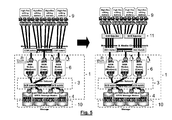
- DCE can for example be used to optimally accommodate the media traffic between a central GPFS clustered storage and high resolution editing client, as illustrated in Fig.5 .
- NFS Network File System
- SMB Server Message Block
- CIFS Common Internet File System
- the media traffic between the editing clients and the central storage corresponds to a traffic class of small block file system traffic. This type of traffic is less bursty than the GPFS kind of storage type traffic, typically requiring bursts of 64 kB.
- the two network architectures, the cluster network and the editing client network can be collapsed into one Data Center Ethernet based network, providing both functionalities (see Fig. 6 ). This may typically be practical and cost-effective in small scale environments.
- top, bottom, over, under, and the like are introduced for descriptive purposes and not necessarily to denote relative positions. It is to be understood that the terms so used are interchangeable under appropriate circumstances and embodiments of the invention are capable of operating according to the present invention in other sequences, or in orientations different from the one(s) described or illustrated above.
Landscapes
- Engineering & Computer Science (AREA)
- Computer Networks & Wireless Communication (AREA)
- Signal Processing (AREA)
- Multimedia (AREA)
- Environmental & Geological Engineering (AREA)
- Quality & Reliability (AREA)
- Data Exchanges In Wide-Area Networks (AREA)
- Information Retrieval, Db Structures And Fs Structures Therefor (AREA)
Abstract
The present invention is related to a clustered system (1) arranged for supporting a clustered file system. The clustered system comprises at least two nodes (4,6) and is characterised in that these at least two nodes are arranged for exchanging data traffic of the clustered file system between each other via a lossless Ethernet network (3).
Description
- The present invention generally relates to the field of storing files, in particular media files on a clustered system.
- The advent and maturing of Internet technology over the last few decades has totally changed the landscape of the information technology (IT) industry. The absolute success and popularity of (mostly Ethernet based) Internet Protocol (IP) networks has promoted this technology as the prime architectural choice in most IT environments. Central mainframe computers have in most cases been replaced by distributed client-server architectures connected by very powerful IP networks.
- This technology has steadily found its way in the media industry as well. IP based architectures are now fully accepted as the standard solution for file based media production and have drastically changed the way broadcasters operate and function internally. Applying an ICT based infrastructure and IP networks as means of transport in video/media production in particular, introduces a number of substantial possible benefits, facilitating the fundamental shift from traditional tape-based video manipulation to a file-based production paradigm. This technology leap enables video to be treated, processed, stored and transported as ordinary files independent of the video format, instead of the continuous streams used by the classical media technology of today. This evolution has drastically changed the media infrastructure technology towards central disk-based media storage. Many broadcasters have adopted a tape-less TV production vision since. This idea is further supported by the appearance of camera devices with storage facilities other than the traditional videotapes, e.g. optical disks (Sony) or Solid State memory cards (Panasonic).
- Typically camera crews now enter the facilities with their video stored as ordinary files on memory cards in stead of on video tape. The memory cards are put into ingest stations, e.g. ordinary PCs, and the files are transferred as fast as possible, preferably faster than real time, into a central disk based storage system. Once stored in the central system, everybody can access the material simultaneously.
- Storage is one of the most important media services in a file-based media environment. As with IP networking in media, media storage requirements largely differ from the classical IT storage solutions. Although architectures based on generic IT storage components are preferred above very expensive proprietary less-reliable media solutions, mainly because of economics of scale, reliability, cost, etc..., media poses very high requirements on the file system. These special file system requirements are needed because of extreme characteristics in terms of (parallel) throughput, storage capacity, scalability, redundancy, availability and reliability, etc...
- IBM's General Parallel File System (GPFS) is one of the most powerful media file systems available on the market today. It is a file management infrastructure providing high performance and reliability with scalable access to critical file data. In addition to providing file storage capabilities, GPFS provides storage management, information life cycle management tools, centralized administration and allows for shared access to file systems from remote GPFS clusters. GPFS provides scalable high-performance data access from a single node cluster, a two node cluster providing a high availability platform supporting a database application, for example, to 2000 nodes or more. GPFS was designed from the beginning to support high performance parallel applications and has since been proven very effective for a variety of applications.
- Traditionally, the storage industry builds very scalable storage clusters (2) (i.e. groups of nodes for storage purposes) based on a classical Fibre Channel Storage Area Network (SAN) network architecture (see
Fig.1 ). This architecture typically scales throughput together with storage capacity, i.e. if one requires more throughput, more disks are required and vice versa for capacity increases. Since it is based on high end storage systems (10), the solution is quite expensive. In the end, the Fibre Channel network typically becomes the scalability bottle neck of this classical IT architecture when heavily loaded with media traffic. - However, many essential media services require a processing power platform close to the storage service, such as transcoding and rewrapping services. This leads to the definition of many distinct storage services each with its particular characteristics. Hence, one can distinguish e.g. primary capacity storage suited for HD (high definition), SD (standard definition), low resolution video and audio, secondary disk-based and tape-based storage with high volume but low cost for backup and recovery, ingest storage, central editing storage, temporary storage, distribution storage, etc. Hence, there is a need for a cost-effective fit-for-purpose storage cluster architecture that can provide independent and tuneable scaling for processing power, throughput, storage capacity and availability, preferable using low-end cheap commodity components.
- A GPFS cluster based on a 'network attached node' (NAN) model perfectly fulfils these requirements (see the example of
Fig.2 ). A GFPS cluster based on the NAN node model consists of storage cluster nodes (4) and network attached cluster nodes (6). The storage servers (4) have local storage or are directly connected to an external storage system (10), either locally attached or via a SAN architecture. NAN nodes are via a cluster network connected to all storage nodes, but are not directly attached to the underlying storage system (10). Each storage node is a primary server for part of the total storage. The NAN node stripes its data requests over all storage nodes, thereby aggregating the available bandwidth of each individual storage node and connected storage subsystems. - Initially, the network protocol and architecture for the cluster network was TCP/IP. It has been demonstrated that the same traffic could be passed unaltered over Infiniband (IB) via IPoIB. In a later version, IB verbs, also sometimes called native IB, became supported. The cluster depicted in
Fig.2 uses IB (5) as cluster network. - The cluster can be independently scaled for processing power by reinforcing the NAN nodes in terms of CPU or increasing the number of NAN nodes in the cluster. If more throughput is required, the cluster network can be scaled to higher bandwidths, e.g. from single data rate Infiniband (SDR) to double data rate (DDR) and in the future to quadruple data rate (QDR). The throughput to the clients can be augmented by adding NAN nodes. The storage throughput can be optimised by using faster disks or increasing the number of storage nodes. The pure storage capacity can be scaled by using larger hard disks, putting more storage under each storage node or increasing the number of storage nodes. Every component in the cluster can be made redundant to avoid any single point of failure. On top of that, GPFS has the concept of failure groups to further protect the storage system.
- The traffic over the cluster network (i.e. the network interconnecting the storage nodes with the NAN nodes) can be considered as a particular case of media traffic. In order to boost up the hard disks for media use, the segment size of the disks should be set as large as possible. The disks are combined in a Redundant Array of Independent Disks (RAID) protection configuration. This results in very large I/O block sizes, typically 4 MB, transported by the file system over the cluster network. Hence, this is a case of extremely bursty traffic.
- Both in reading and writing operations the cluster network displays a many-to-one traffic pattern. When a NAN node reads from the storage nodes, all the storage nodes respond at the same time back to the NAN node with large bursts of traffic. If, on the other hand, multiple NAN nodes write data to the storage, the receiving storage nodes are simultaneously addressed by the bursts of all the writing NAN nodes. Both cases result in heavy oversubscription of the cluster network. Since high efficiency is of extreme importance in a media storage architecture, packet-loss and the resulting retransmissions by TCP are heavily penalised and should be avoided at all cost. Some media file systems using an IP network as cluster network try to remediate this by using UDP. They count on very large switch buffers to overcome the packet loss due to the oversubscription. This is only effective if the number of devices actively participating in such cluster architecture is relatively small, and pre-fetching is not used aggressively. However, this puts heavy restraints on the maximum throughput and fails when too many traffic requests interfere with each other.
- In the case of GPFS, TCP/IP was originally used as protocol stack. This allows for flow control, but at the cost of limiting maximum throughput. As the most prevailing network technology for TCP/IP is Ethernet based, packet loss in the Ethernet network leads to retransmissions and further limits throughput efficiency. For this particular type of traffic the network technology used by Fibre Channel or Infiniband is very effective. Their flow control mechanism is based on Buffer-to-Buffer credits to eliminate packet loss completely in case of oversubscription. Credits of available buffers are continuously exchanged between ports on the same link. When no buffer credits are available, no packets are transmitted, until the network processes its congestion and buffers become available again.
- Hence, the above depicted cluster uses Infiniband as cluster network technology. This is a very cheap technology with high bandwidth. The net data bandwidth is 8 Gb/s for SDR-IB and 16 Gb/s for DDR-IB. The capability of the PCI express bus becomes the next bottleneck.
- The Infiniband stack is extremely efficient for Linux based servers, reaching the full physical limits of the underlying bus-technology. The processing of the protocol stack is fully offloaded in the Host Channel Adapter (HCA), the IB network cards. Even remote direct memory access (RDMA) is fully supported and exploited. This leads to a very powerful cluster architecture, extremely well adapted for the file-based media production environment.
- However, many media client applications require a Microsoft Windows operating system. This is both the case for Windows applications that have to run on the NAN cluster nodes, as for applications that require a mount of the central file system via the CIFS protocol. Recently, IBM added a GPFS on Windows client to its NAN node configuration. This allows for a
Microsoft Windows 2003 Server to participate as a NAN node in the GPFS cluster. The state of the art Infiniband stack for Windows machines is presently however much less performing than the Linux flavour. The cluster protocol stack has to fall back to using IPoIB without any offloading, since not all GPFS commands are yet supported in the native IB stack for Windows. This decreases the performance of the cluster network by a factor of five. - Recently, some new developments supported by some of the leading IP networking companies have led to the definition and implementation of Data Centre Ethernet (DCE). Data Centre Ethernet is a term that refers to enhancements to Ethernet bridges that enable lossless LAN and SAN connectivity over an Ethernet network. With the term 'lossless' is meant that the Ethernet bridges (i.e. switches) do not lose frames under congestion. DCE, also known as CEE, Converged or Convergence Enhanced Ethernet, describes an enhanced Ethernet that enables convergence of various applications in data centres (LAN, SAN, high-performance computing) onto a single interconnect technology.
- DCE is known in the art, for example from Cisco patent application
US2006/251067 , wherein a Data Centre Ethernet network and related methods and device are provided in the context of Fibre Channel over Ethernet. A DCE network simplifies the connectivity of data centres and provides a high bandwidth, low latency network for carrying Ethernet, storage and other traffic. - Cisco application
US2006/087989 provides methods and devices for implementing a Low Latency Ethernet solution, also referred to as a Data Centre Ethernet solution, which simplifies the connectivity of data centres and provides a high bandwidth, low latency network for carrying Ethernet and storage traffic. Some preferred implementations of the invention implement multiple virtual lanes (VLs) in a single physical connection of a data centre or similar network. Some VLs are "drop" VLs, with Ethernet-like behaviour, and others are "no-drop" lanes with FC-like behaviour. Active buffer management allows for both high reliability and low latency while using small frame buffers. - The present invention aims to provide a high performance clustered system for storing files, in particular media files, based on the widely accepted Ethernet based network technology.
- The present invention relates to a clustered system supporting a clustered file system. With clustered system is meant a set of connected computers that works like a single system. A clustered file system is a file system which can be simultaneously mounted via multiple servers. The clustered system comprises at least two nodes and is characterised in that the at least two nodes are arranged for exchanging data traffic of the clustered file system between each other via a lossless Ethernet network. This lossless Ethernet network is preferably a Data Centre Ethernet based network.
- In a preferred embodiment at least one node of the clustered system is a storage node arranged for storing at least a part of the clustered file system. In one embodiment the storage node comprises local storage means. In another embodiment the storage node is arranged for being connected to external storage means. These two options may possibly be combined.
- In a preferred embodiment the clustered system comprises at least one storage node and further at least one node arranged for exchanging the data traffic with an external device, whereby the latter node is further arranged for running on a different operating system than the storage node.
- In a preferred embodiment at least one of the at least two nodes is arranged for exchanging the data traffic with an external device, preferably via a lossless Ethernet connection. In one embodiment this lossless Ethernet connection is part of the lossless Ethernet network provided between the at least two nodes. Alternatively, the lossless Ethernet connection is part of another lossless Ethernet network.
- In an advantageous embodiment the external device is a high resolution editing client.
- Preferably at least one of the nodes comprises processing means suitable for media applications. Some examples are transcoding, media file format rewrapping and conversion, quality checking, etc....
- The invention also relates to an assembly of at least two clustered systems as previously described, whereby the at least two clustered systems are arranged for exchanging data traffic of at least one of the clustered file systems via a dedicated lossless Ethernet network. That dedicated lossless Ethernet network is preferably a DataCentre Ethernet based network.
- In one embodiment the dedicated network is at least part of the lossless Ethernet network of at least one of the at least two clustered systems, and possibly of both systems.
-
Fig. 1 illustrates a classical Fibre Channel based GPFS cluster architecture. -
Fig. 2 illustrates an Infiniband (IB) based GPFS NAN node cluster as known in the prior art. -
Fig. 3 compares a GPFS NAN node cluster based on IB (prior art) with one based on DCE (invention). -
Fig. 4 illustrates a GPFS NAN node cluster according to the invention. -
Fig. 5 illustrates a client network for central editing. -
Fig. 6 illustrates a collapsed data centre Ethernet network. - The present invention exploits the fact that Data Centre Ethernet (DCE) creates a lossless Ethernet fabric by slightly adapting, or expanding on, some known Ethernet standards. To achieve this, DCE uses an equivalent mechanism to buffer-to-buffer credits found in Fibre Channel and Infiniband to perform flow control without packet loss. This equivalent mechanism in Ethernet is based on the PAUSE frame defined in IEEE 802.3. The PAUSE mechanism is used to inhibit packet transmission for a specified period of time when a receiving switch buffer is full. DCE is implemented on a new type of 10 Gb Ethernet network adapter, called Converged Network Adapter (CNA). These adapters should provide full offload, also for the Microsoft Windows operating system. Contrary to classical 10 Gb/s Ethernet, DCE switches and ports are much cheaper by the use of SFP+ with a Copper Twinax Cable.
- The clustered system according to the present invention can support a clustered file system and comprises at least two nodes. The nodes may be storage nodes wherein a part of the clustered file system can be stored or nodes for exchanging data traffic with an external device. The clustered file system is typically a GPFS file system comprising a plurality of storage cluster nodes and cluster nodes for data exchange with an attached network, as already mentioned. However, a clustered system containing only storage nodes or only nodes for data exchange can be envisaged as well. The at least two nodes of the clustered system are connected via a lossless Ethernet network so that the nodes can exchange data traffic. The lossless Ethernet network is preferably a Data Centre Ethernet based network.
- Since GPFS is agnostic to the underlying layer 2 (OSI model) network technology, the GPFS NAN cluster for data traffic exchange can be designed with the DCE technology (3) replacing the Infiniband as cluster network (see the example in
Fig.3 ). This is especially beneficial in the Microsoft Windows NAN node environment. Hence, a DCE based GPFS NAN cluster is able to make use of the full bandwidth provided by 10 Gb/s DCE.
For this to succeed, the DCE technology capabilities have to match the Infiniband functionalities and performance on several levels: - It requires an off load performance of the DCE network adapters (CNA). comparable to that of the Infiniband network adapters (HCA).
- Although the flow control mechanism of DCE is equivalent to the Buffer-to-Buffer credit mechanism of Infiniband, the implementation of the PAUSE mechanism has to demonstrate a sufficient responsiveness to accomplish the lossless behaviour under the high requirements of the storage traffic of GPFS.
- The buffering of the DCE switches has to be sufficient to support this mechanism in a successful way.
- The DCE switches have to support sufficient virtual lanes or equivalent P-values to guarantee adequate cluster scalability.
- The implementation of the DCE technology in the GPFS NAN cluster architecture has to match the performance, scalability and high availability requirements, provided by the Infiniband implementation.
-
Fig.4 illustrates an embodiment wherein some network attached nodes (6) (NAN) are in connection with a number of storage nodes (4). The storage nodes are in turn connected to a storage system (10) comprising a plurality of storage means. - Any media service using a fit-for-purpose storage cluster that requires a Microsoft Windows based server or a mount of the central file system via the CIFS protocol can benefit from this architecture (see
Fig. 4 ). - In a preferred embodiment of the invention at least one of the nodes is for exchanging data traffic with an external device via a lossless Ethernet network like a Data Centre Ethernet based network. DCE can for example be used to optimally accommodate the media traffic between a central GPFS clustered storage and high resolution editing client, as illustrated in
Fig.5 . - Some media client applications prefer to access the central storage over the Network File System (NFS) protocol or the Server Message Block (SMB) protocol, both requiring Linux as operating system on the NAN node. Still other prefer the Common Internet File System (CIFS) protocol, requiring Windows on the NAN node. The media traffic between the editing clients and the central storage corresponds to a traffic class of small block file system traffic. This type of traffic is less bursty than the GPFS kind of storage type traffic, typically requiring bursts of 64 kB.
- However, a new possible oversubscription does exist. In case the cluster NAN nodes are equipped with 10 Gb/s Ethernet at the client side, which is definitely the case when using DCE, and the media clients only have a 1 Gb/s Ethernet interface, a destination oversubscription from bandwidth mismatch between source and destination will occur. The PAUSE frame flow control mechanism of DCE could provide a natural solution for this problem. Since presently no 1 Gb/s DCE CNAs exist, the switch on the client side, the DCE extender (11) has to provide the PAUSE frames towards the 10 Gb/s server side. (The DCE extender provides the possibility to fan out the 10 Gb/s DCE ports of the DCE switch into 1 Gb/s Ethernet ports.)
- The two network architectures, the cluster network and the editing client network, can be collapsed into one Data Center Ethernet based network, providing both functionalities (see
Fig. 6 ). This may typically be practical and cost-effective in small scale environments. - Although the present invention has been illustrated by reference to specific embodiments, it will be apparent to those skilled in the art that the invention is not limited to the details of the foregoing illustrative embodiments, and that the present invention may be embodied with various changes and modifications without departing from the spirit and scope thereof. The present embodiments are therefore to be considered in all respects as illustrative and not restrictive, the scope of the invention being indicated by the appended claims rather than by the foregoing description, and all changes which come within the meaning and range of equivalency of the claims are therefore intended to be embraced therein. In other words, it is contemplated to cover any and all modifications, variations or equivalents that fall within the spirit and scope of the basic underlying principles and whose essential attributes are claimed in this patent application. It will furthermore be understood by the reader of this patent application that the words "comprising" or "comprise" do not exclude other elements or steps, that the words "a" or "an" do not exclude a plurality, and that a single element, such as a computer system, a processor, or another integrated unit may fulfil the functions of several means recited in the claims. Any reference signs in the claims shall not be construed as limiting the respective claims concerned. The terms "first", "second", third", "a", "b", "c", and the like, when used in the description or in the claims are introduced to distinguish between similar elements or steps and are not necessarily describing a sequential or chronological order. Similarly, the terms "top", "bottom", "over", "under", and the like are introduced for descriptive purposes and not necessarily to denote relative positions. It is to be understood that the terms so used are interchangeable under appropriate circumstances and embodiments of the invention are capable of operating according to the present invention in other sequences, or in orientations different from the one(s) described or illustrated above.
Claims (14)
- A clustered system (1) arranged for supporting a clustered file system, said clustered system comprising at least two nodes (4,6), characterised in that said at least two nodes are arranged for exchanging data traffic of said clustered file system between each other via a lossless Ethernet network (3).
- Clustered system as in claim 1, wherein said lossless Ethernet network is a DataCenter Ethernet based network.
- Clustered system as in claim 1 or 2, wherein at least one of said nodes is a storage node arranged for storing at least a part of said clustered file system.
- Clustered system as in claim 3, wherein said storage node comprises local storage means.
- Clustered system as in claim 3 or 4, wherein said storage node is arranged for being connected to external storage means (10).
- Clustered system as in any of the claims 1 to 5, wherein at least one of said nodes is arranged for exchanging said data traffic with an external device (9).
- Clustered system as in any of claims 3 to 5, further comprising a node arranged for exchanging said data traffic with an external device (9), said node further arranged for running on a different operating system than said storage node.
- Clustered system as in claim 6 or 7, wherein said at least one node is arranged for exchanging said data traffic with an external device (9) via a lossless Ethernet connection.
- Clustered system as in claim 8, wherein said lossless Ethernet connection is a part of said lossless Ethernet network.
- Clustered system as in any of claims 6 to 9, wherein said external device is a high resolution editing client.
- Clustered system as in any of the previous claims, wherein at least one of said nodes comprises processing means for media applications.
- Assembly of at least two clustered systems as in any of the previous claims, whereby said at least two clustered systems are arranged for exchanging data traffic of at least one of the clustered file systems via a dedicated lossless Ethernet network.
- Assembly as in claim 12, wherein said dedicated lossless Ethernet network is a DataCenter Ethernet based network.
- Assembly as in claim 12 or 13, wherein said dedicated network is at least part of the lossless Ethernet network of at least one of said at least two clustered systems.
Priority Applications (3)
| Application Number | Priority Date | Filing Date | Title |
|---|---|---|---|
| US13/145,861 US8996717B2 (en) | 2009-01-22 | 2010-01-21 | Clustered system for storing data files |
| PCT/EP2010/050676 WO2010084147A1 (en) | 2009-01-22 | 2010-01-21 | Clustered system for storing data files |
| EP10700579.5A EP2389744B1 (en) | 2009-01-22 | 2010-01-21 | Clustered system for storing data files |
Applications Claiming Priority (1)
| Application Number | Priority Date | Filing Date | Title |
|---|---|---|---|
| US14648009P | 2009-01-22 | 2009-01-22 |
Publications (1)
| Publication Number | Publication Date |
|---|---|
| EP2211503A1 true EP2211503A1 (en) | 2010-07-28 |
Family
ID=41328485
Family Applications (6)
| Application Number | Title | Priority Date | Filing Date |
|---|---|---|---|
| EP09160643A Withdrawn EP2211508A1 (en) | 2009-01-22 | 2009-05-19 | Method and device for characterising a data flow in a network for transferring media data |
| EP09160647A Withdrawn EP2211502A1 (en) | 2009-01-22 | 2009-05-19 | Management system and method for configuring a network for transferring media data |
| EP09161656A Withdrawn EP2211503A1 (en) | 2009-01-22 | 2009-06-02 | Clustered system for storing media files |
| EP10700582.9A Active EP2389746B1 (en) | 2009-01-22 | 2010-01-21 | Method and device for characterising a data flow in a network for transferring data |
| EP10700579.5A Not-in-force EP2389744B1 (en) | 2009-01-22 | 2010-01-21 | Clustered system for storing data files |
| EP10701143.9A Active EP2389745B1 (en) | 2009-01-22 | 2010-01-22 | Management system and method for configuring a network for transferring data |
Family Applications Before (2)
| Application Number | Title | Priority Date | Filing Date |
|---|---|---|---|
| EP09160643A Withdrawn EP2211508A1 (en) | 2009-01-22 | 2009-05-19 | Method and device for characterising a data flow in a network for transferring media data |
| EP09160647A Withdrawn EP2211502A1 (en) | 2009-01-22 | 2009-05-19 | Management system and method for configuring a network for transferring media data |
Family Applications After (3)
| Application Number | Title | Priority Date | Filing Date |
|---|---|---|---|
| EP10700582.9A Active EP2389746B1 (en) | 2009-01-22 | 2010-01-21 | Method and device for characterising a data flow in a network for transferring data |
| EP10700579.5A Not-in-force EP2389744B1 (en) | 2009-01-22 | 2010-01-21 | Clustered system for storing data files |
| EP10701143.9A Active EP2389745B1 (en) | 2009-01-22 | 2010-01-22 | Management system and method for configuring a network for transferring data |
Country Status (3)
| Country | Link |
|---|---|
| US (3) | US8612625B2 (en) |
| EP (6) | EP2211508A1 (en) |
| WO (3) | WO2010084151A1 (en) |
Families Citing this family (78)
| Publication number | Priority date | Publication date | Assignee | Title |
|---|---|---|---|---|
| EP2211508A1 (en) * | 2009-01-22 | 2010-07-28 | IBBT vzw | Method and device for characterising a data flow in a network for transferring media data |
| US8576713B2 (en) * | 2010-04-23 | 2013-11-05 | Ixia | Traffic generator with priority flow control |
| US20110261705A1 (en) * | 2010-04-23 | 2011-10-27 | Kamerkar Sushil S | Mapping Traffic Classes to Flow Control Groups |
| JP5478722B2 (en) * | 2010-06-18 | 2014-04-23 | 三菱電機株式会社 | Data processing apparatus, data processing method, and program |
| US8813190B2 (en) | 2011-05-18 | 2014-08-19 | International Business Machines Corporation | Resource upload |
| US9413676B2 (en) | 2011-05-24 | 2016-08-09 | Tata Consultancy Services Limited | System and method for reducing the data packet loss employing adaptive transmit queue length |
| US9736065B2 (en) | 2011-06-24 | 2017-08-15 | Cisco Technology, Inc. | Level of hierarchy in MST for traffic localization and load balancing |
| US9264328B2 (en) * | 2011-11-07 | 2016-02-16 | Ciena Corporation | Systems and methods for dynamic operations, administration, and management |
| US9285992B2 (en) * | 2011-12-16 | 2016-03-15 | Netapp, Inc. | System and method for optimally creating storage objects in a storage system |
| EP2611127A1 (en) * | 2011-12-29 | 2013-07-03 | Gface GmbH | Cloud-based content mixing into one stream |
| US8908698B2 (en) | 2012-01-13 | 2014-12-09 | Cisco Technology, Inc. | System and method for managing site-to-site VPNs of a cloud managed network |
| US9001651B2 (en) * | 2012-02-06 | 2015-04-07 | Verizon Patent And Licensing Inc. | Method for call admission control in MPLS networks |
| US9929829B1 (en) | 2012-02-15 | 2018-03-27 | Cisco Technology, Inc. | System and method for provisioning resources for lossless operation in a network environment |
| BE1020450A5 (en) * | 2012-03-08 | 2013-10-01 | Candit Media | CLUSTER SYSTEM FOR STORAGE OF DATA FILES. |
| US9229901B1 (en) | 2012-06-08 | 2016-01-05 | Google Inc. | Single-sided distributed storage system |
| DE102012108117A1 (en) | 2012-08-03 | 2014-02-06 | Fujitsu Technology Solutions Intellectual Property Gmbh | Highly available computer system, working method and its use |
| US9058122B1 (en) | 2012-08-30 | 2015-06-16 | Google Inc. | Controlling access in a single-sided distributed storage system |
| US9164702B1 (en) | 2012-09-07 | 2015-10-20 | Google Inc. | Single-sided distributed cache system |
| US9043439B2 (en) | 2013-03-14 | 2015-05-26 | Cisco Technology, Inc. | Method for streaming packet captures from network access devices to a cloud server over HTTP |
| US9160678B2 (en) * | 2013-04-15 | 2015-10-13 | International Business Machines Corporation | Flow control credits for priority in lossless ethernet |
| US9313274B2 (en) | 2013-09-05 | 2016-04-12 | Google Inc. | Isolating clients of distributed storage systems |
| US9634944B2 (en) * | 2013-10-24 | 2017-04-25 | Dell Products, Lp | Multi-level iSCSI QoS for target differentiated data in DCB networks |
| CN103560974B (en) * | 2013-10-25 | 2017-01-25 | 华为技术有限公司 | Method and device for maintaining tokens |
| JP2015171052A (en) * | 2014-03-07 | 2015-09-28 | 富士通株式会社 | Identification device, identification program, and identification method |
| US9723582B1 (en) * | 2014-04-07 | 2017-08-01 | Marvell International Ltd. | Methods and apparatus for synchronizing beacon transmissions in a neighbor awareness network (NAN) |
| CN103957470A (en) * | 2014-05-14 | 2014-07-30 | 浙江水利水电学院 | Video-oriented traffic control and optimization method and system |
| US10122605B2 (en) | 2014-07-09 | 2018-11-06 | Cisco Technology, Inc | Annotation of network activity through different phases of execution |
| US9825878B2 (en) | 2014-09-26 | 2017-11-21 | Cisco Technology, Inc. | Distributed application framework for prioritizing network traffic using application priority awareness |
| CN104539744B (en) * | 2015-01-26 | 2018-08-24 | 中国科学技术大学 | A kind of the media edge cloud dispatching method and device of two benches cooperation |
| US10050862B2 (en) | 2015-02-09 | 2018-08-14 | Cisco Technology, Inc. | Distributed application framework that uses network and application awareness for placing data |
| US10419170B2 (en) * | 2015-02-26 | 2019-09-17 | Qualcomm Incorporated | RRC aware TCP retransmissions |
| US10708342B2 (en) | 2015-02-27 | 2020-07-07 | Cisco Technology, Inc. | Dynamic troubleshooting workspaces for cloud and network management systems |
| US9571408B2 (en) * | 2015-03-04 | 2017-02-14 | Oracle International Corporation | Dynamic flow control using credit sharing |
| US10476982B2 (en) | 2015-05-15 | 2019-11-12 | Cisco Technology, Inc. | Multi-datacenter message queue |
| US10034201B2 (en) | 2015-07-09 | 2018-07-24 | Cisco Technology, Inc. | Stateless load-balancing across multiple tunnels |
| US11005682B2 (en) | 2015-10-06 | 2021-05-11 | Cisco Technology, Inc. | Policy-driven switch overlay bypass in a hybrid cloud network environment |
| US10097471B2 (en) * | 2015-10-06 | 2018-10-09 | Cisco Technology, Inc. | Time-based traffic engineering for seasonal flows in a network |
| US10462136B2 (en) | 2015-10-13 | 2019-10-29 | Cisco Technology, Inc. | Hybrid cloud security groups |
| US10523657B2 (en) | 2015-11-16 | 2019-12-31 | Cisco Technology, Inc. | Endpoint privacy preservation with cloud conferencing |
| US10205677B2 (en) | 2015-11-24 | 2019-02-12 | Cisco Technology, Inc. | Cloud resource placement optimization and migration execution in federated clouds |
| US10084703B2 (en) | 2015-12-04 | 2018-09-25 | Cisco Technology, Inc. | Infrastructure-exclusive service forwarding |
| US10367914B2 (en) | 2016-01-12 | 2019-07-30 | Cisco Technology, Inc. | Attaching service level agreements to application containers and enabling service assurance |
| US10574555B2 (en) * | 2016-01-28 | 2020-02-25 | Arista Networks, Inc. | Network data stream tracer |
| EP3232667A1 (en) * | 2016-04-12 | 2017-10-18 | EVS Broadcast Equipment SA | Modular software based video production server, method for operating the video production server and distributed video production system |
| US10129177B2 (en) | 2016-05-23 | 2018-11-13 | Cisco Technology, Inc. | Inter-cloud broker for hybrid cloud networks |
| US10659283B2 (en) | 2016-07-08 | 2020-05-19 | Cisco Technology, Inc. | Reducing ARP/ND flooding in cloud environment |
| US10432532B2 (en) | 2016-07-12 | 2019-10-01 | Cisco Technology, Inc. | Dynamically pinning micro-service to uplink port |
| US10382597B2 (en) | 2016-07-20 | 2019-08-13 | Cisco Technology, Inc. | System and method for transport-layer level identification and isolation of container traffic |
| US10263898B2 (en) | 2016-07-20 | 2019-04-16 | Cisco Technology, Inc. | System and method for implementing universal cloud classification (UCC) as a service (UCCaaS) |
| US10567344B2 (en) | 2016-08-23 | 2020-02-18 | Cisco Technology, Inc. | Automatic firewall configuration based on aggregated cloud managed information |
| US10523592B2 (en) | 2016-10-10 | 2019-12-31 | Cisco Technology, Inc. | Orchestration system for migrating user data and services based on user information |
| US11044162B2 (en) | 2016-12-06 | 2021-06-22 | Cisco Technology, Inc. | Orchestration of cloud and fog interactions |
| US10326817B2 (en) | 2016-12-20 | 2019-06-18 | Cisco Technology, Inc. | System and method for quality-aware recording in large scale collaborate clouds |
| US10334029B2 (en) | 2017-01-10 | 2019-06-25 | Cisco Technology, Inc. | Forming neighborhood groups from disperse cloud providers |
| US10552191B2 (en) | 2017-01-26 | 2020-02-04 | Cisco Technology, Inc. | Distributed hybrid cloud orchestration model |
| US10320683B2 (en) | 2017-01-30 | 2019-06-11 | Cisco Technology, Inc. | Reliable load-balancer using segment routing and real-time application monitoring |
| US10671571B2 (en) | 2017-01-31 | 2020-06-02 | Cisco Technology, Inc. | Fast network performance in containerized environments for network function virtualization |
| US11005731B2 (en) | 2017-04-05 | 2021-05-11 | Cisco Technology, Inc. | Estimating model parameters for automatic deployment of scalable micro services |
| US10382274B2 (en) | 2017-06-26 | 2019-08-13 | Cisco Technology, Inc. | System and method for wide area zero-configuration network auto configuration |
| US10439877B2 (en) | 2017-06-26 | 2019-10-08 | Cisco Technology, Inc. | Systems and methods for enabling wide area multicast domain name system |
| US10892940B2 (en) | 2017-07-21 | 2021-01-12 | Cisco Technology, Inc. | Scalable statistics and analytics mechanisms in cloud networking |
| US10425288B2 (en) | 2017-07-21 | 2019-09-24 | Cisco Technology, Inc. | Container telemetry in data center environments with blade servers and switches |
| US10601693B2 (en) | 2017-07-24 | 2020-03-24 | Cisco Technology, Inc. | System and method for providing scalable flow monitoring in a data center fabric |
| US10541866B2 (en) | 2017-07-25 | 2020-01-21 | Cisco Technology, Inc. | Detecting and resolving multicast traffic performance issues |
| US11481362B2 (en) | 2017-11-13 | 2022-10-25 | Cisco Technology, Inc. | Using persistent memory to enable restartability of bulk load transactions in cloud databases |
| US10705882B2 (en) | 2017-12-21 | 2020-07-07 | Cisco Technology, Inc. | System and method for resource placement across clouds for data intensive workloads |
| US11595474B2 (en) | 2017-12-28 | 2023-02-28 | Cisco Technology, Inc. | Accelerating data replication using multicast and non-volatile memory enabled nodes |
| US10511534B2 (en) | 2018-04-06 | 2019-12-17 | Cisco Technology, Inc. | Stateless distributed load-balancing |
| US10728361B2 (en) | 2018-05-29 | 2020-07-28 | Cisco Technology, Inc. | System for association of customer information across subscribers |
| US10904322B2 (en) | 2018-06-15 | 2021-01-26 | Cisco Technology, Inc. | Systems and methods for scaling down cloud-based servers handling secure connections |
| US10764266B2 (en) | 2018-06-19 | 2020-09-01 | Cisco Technology, Inc. | Distributed authentication and authorization for rapid scaling of containerized services |
| US11019083B2 (en) | 2018-06-20 | 2021-05-25 | Cisco Technology, Inc. | System for coordinating distributed website analysis |
| US10819571B2 (en) | 2018-06-29 | 2020-10-27 | Cisco Technology, Inc. | Network traffic optimization using in-situ notification system |
| US10904342B2 (en) | 2018-07-30 | 2021-01-26 | Cisco Technology, Inc. | Container networking using communication tunnels |
| US11470041B2 (en) | 2019-06-20 | 2022-10-11 | Disney Enterprises, Inc. | Software defined network orchestration to manage media flows for broadcast with public cloud networks |
| CN114125881B (en) * | 2020-08-28 | 2024-09-03 | 深圳市中兴微电子技术有限公司 | Interface data processing method, transmitting end device and receiving end device |
| CN112887140B (en) * | 2021-01-25 | 2022-02-11 | 中国科学院沈阳自动化研究所 | Multi-cloud collaborative network-cut-off disaster recovery method |
| CN120568351A (en) * | 2025-06-30 | 2025-08-29 | 山推楚天工程机械有限公司 | Communication method of vehicle-mounted TBOX equipment |
Citations (2)
| Publication number | Priority date | Publication date | Assignee | Title |
|---|---|---|---|---|
| US20060087989A1 (en) | 2004-10-22 | 2006-04-27 | Cisco Technology, Inc., A Corporation Of California | Network device architecture for consolidating input/output and reducing latency |
| US20060251067A1 (en) | 2004-10-22 | 2006-11-09 | Cisco Technology, Inc., A Corporation Of California | Fibre channel over ethernet |
Family Cites Families (28)
| Publication number | Priority date | Publication date | Assignee | Title |
|---|---|---|---|---|
| US5257261A (en) * | 1990-07-27 | 1993-10-26 | Transwitch Corporation | Methods and apparatus for concatenating a plurality of lower level SONET signals into higher level sonet signals |
| DE69525556T2 (en) | 1994-03-21 | 2002-09-12 | Avid Technology Inc | Device and method executed on a computer for real-time multimedia data transmission in a distributed computer arrangement |
| US5793976A (en) * | 1996-04-01 | 1998-08-11 | Gte Laboratories Incorporated | Method and apparatus for performance monitoring in electronic communications networks |
| US6937568B1 (en) * | 1999-11-15 | 2005-08-30 | Cisco Technology, Inc. | Adaptive rate shaping to prevent overflow |
| JP3994614B2 (en) * | 2000-03-13 | 2007-10-24 | 株式会社日立製作所 | Packet switch, network monitoring system, and network monitoring method |
| US8195760B2 (en) * | 2001-01-11 | 2012-06-05 | F5 Networks, Inc. | File aggregation in a switched file system |
| US7415038B2 (en) * | 2001-03-29 | 2008-08-19 | International Business Machines Corporation | Method and system for network management providing access to application bandwidth usage calculations |
| US7051115B2 (en) * | 2001-04-19 | 2006-05-23 | Lenovo (Singapore) Pte. Ltd. | Method and apparatus for providing a single system image in a clustered environment |
| US7561517B2 (en) * | 2001-11-02 | 2009-07-14 | Internap Network Services Corporation | Passive route control of data networks |
| US7292537B2 (en) * | 2002-11-29 | 2007-11-06 | Alcatel Lucent | Measurement architecture to obtain per-hop one-way packet loss and delay in multi-class service networks |
| US7366174B2 (en) * | 2002-12-17 | 2008-04-29 | Lucent Technologies Inc. | Adaptive classification of network traffic |
| JP2005217815A (en) * | 2004-01-30 | 2005-08-11 | Hitachi Ltd | Path control method |
| US7599310B2 (en) * | 2004-12-14 | 2009-10-06 | Electronics And Telecommunications Research Institute | Apparatus and method for managing quality of a label switched path in a convergence network |
| US7962915B2 (en) * | 2005-03-18 | 2011-06-14 | International Business Machines Corporation | System and method for preserving state for a cluster of data servers in the presence of load-balancing, failover, and fail-back events |
| US20060236063A1 (en) * | 2005-03-30 | 2006-10-19 | Neteffect, Inc. | RDMA enabled I/O adapter performing efficient memory management |
| US8073899B2 (en) * | 2005-04-29 | 2011-12-06 | Netapp, Inc. | System and method for proxying data access commands in a storage system cluster |
| US7949766B2 (en) * | 2005-06-22 | 2011-05-24 | Cisco Technology, Inc. | Offload stack for network, block and file input and output |
| US7558859B2 (en) * | 2005-10-17 | 2009-07-07 | Microsoft Corporation | Peer-to-peer auction based data distribution |
| US7953002B2 (en) | 2005-11-10 | 2011-05-31 | Broadcom Corporation | Buffer management and flow control mechanism including packet-based dynamic thresholding |
| US7643469B2 (en) * | 2006-01-04 | 2010-01-05 | Alcatel-Lucent Usa Inc. | Method for channel assignment and routing for multi-radio wireless mesh networks |
| US7724754B2 (en) * | 2006-02-24 | 2010-05-25 | Texas Instruments Incorporated | Device, system and/or method for managing packet congestion in a packet switching network |
| US8621573B2 (en) * | 2007-08-28 | 2013-12-31 | Cisco Technology, Inc. | Highly scalable application network appliances with virtualized services |
| US8108454B2 (en) * | 2007-12-17 | 2012-01-31 | Brocade Communications Systems, Inc. | Address assignment in Fibre Channel over Ethernet environments |
| US9137175B2 (en) * | 2007-12-19 | 2015-09-15 | Emulex Corporation | High performance ethernet networking utilizing existing fibre channel fabric HBA technology |
| WO2009136933A1 (en) * | 2008-05-08 | 2009-11-12 | Hewlett-Packard Development Company, L.P. | A method for interfacing a fibre channel network with an ethernet based network |
| US8514884B2 (en) * | 2008-05-14 | 2013-08-20 | Dell Products L.P. | Upper layer protocol selection |
| EP2211508A1 (en) * | 2009-01-22 | 2010-07-28 | IBBT vzw | Method and device for characterising a data flow in a network for transferring media data |
| EP2328322B1 (en) * | 2009-11-27 | 2012-10-31 | Tixel GmbH | Method and apparatus for accessing files stored in a storage access network (SAN) or network attached storange (NAS) |
-
2009
- 2009-05-19 EP EP09160643A patent/EP2211508A1/en not_active Withdrawn
- 2009-05-19 EP EP09160647A patent/EP2211502A1/en not_active Withdrawn
- 2009-06-02 EP EP09161656A patent/EP2211503A1/en not_active Withdrawn
-
2010
- 2010-01-21 EP EP10700582.9A patent/EP2389746B1/en active Active
- 2010-01-21 US US13/145,884 patent/US8612625B2/en active Active
- 2010-01-21 US US13/145,861 patent/US8996717B2/en not_active Expired - Fee Related
- 2010-01-21 WO PCT/EP2010/050683 patent/WO2010084151A1/en not_active Ceased
- 2010-01-21 WO PCT/EP2010/050676 patent/WO2010084147A1/en not_active Ceased
- 2010-01-21 EP EP10700579.5A patent/EP2389744B1/en not_active Not-in-force
- 2010-01-22 US US13/145,878 patent/US8898262B2/en active Active
- 2010-01-22 WO PCT/EP2010/050724 patent/WO2010084172A1/en not_active Ceased
- 2010-01-22 EP EP10701143.9A patent/EP2389745B1/en active Active
Patent Citations (2)
| Publication number | Priority date | Publication date | Assignee | Title |
|---|---|---|---|---|
| US20060087989A1 (en) | 2004-10-22 | 2006-04-27 | Cisco Technology, Inc., A Corporation Of California | Network device architecture for consolidating input/output and reducing latency |
| US20060251067A1 (en) | 2004-10-22 | 2006-11-09 | Cisco Technology, Inc., A Corporation Of California | Fibre channel over ethernet |
Non-Patent Citations (2)
| Title |
|---|
| CISCO: "Data Center ethernet: Die CisCo innovation für Data Center-netzwerke", 2008, XP002559774, Retrieved from the Internet <URL:http://www.cisco.com/web/DE/pdfs/solutions/Cisco_DCE_WP.pdf> [retrieved on 20091210] * |
| CISCO: "Fibre Channel over Ethernet Storage Networking Evolution", 2008, pages 1 - 6, XP002559773, Retrieved from the Internet <URL:http://www.cisco.com/en/US/prod/collateral/switches/ps5718/ps6021/white_paper_c11-472771.pdf> [retrieved on 20091210] * |
Also Published As
| Publication number | Publication date |
|---|---|
| WO2010084147A1 (en) | 2010-07-29 |
| US8898262B2 (en) | 2014-11-25 |
| US20120066407A1 (en) | 2012-03-15 |
| US8612625B2 (en) | 2013-12-17 |
| EP2211508A1 (en) | 2010-07-28 |
| US20120054364A1 (en) | 2012-03-01 |
| US20120030319A1 (en) | 2012-02-02 |
| WO2010084151A1 (en) | 2010-07-29 |
| WO2010084172A1 (en) | 2010-07-29 |
| EP2389745B1 (en) | 2016-01-13 |
| EP2389746B1 (en) | 2016-01-20 |
| US8996717B2 (en) | 2015-03-31 |
| EP2389744A1 (en) | 2011-11-30 |
| EP2389746A1 (en) | 2011-11-30 |
| EP2389745A1 (en) | 2011-11-30 |
| EP2389744B1 (en) | 2016-08-17 |
| EP2211502A1 (en) | 2010-07-28 |
Similar Documents
| Publication | Publication Date | Title |
|---|---|---|
| US8996717B2 (en) | Clustered system for storing data files | |
| US7299290B2 (en) | Method and system for providing multimedia information on demand over wide area networks | |
| US12166666B2 (en) | Resilient network communication using selective multipath packet flow spraying | |
| US8112491B1 (en) | Methods and systems for providing direct DMA | |
| Tate et al. | Introduction to storage area networks | |
| US8010707B2 (en) | System and method for network interfacing | |
| CN100373368C (en) | Multi-port high-speed serial fabric interconnect chip in mesh structure | |
| CN101076021B (en) | Network data storage system | |
| US8411677B1 (en) | Method and system for processing layered networking protocol packets | |
| US7934021B2 (en) | System and method for network interfacing | |
| US9294569B2 (en) | Cell fabric hardware acceleration | |
| US20150149681A1 (en) | Methods for sharing bandwidth across a packetized bus and systems thereof | |
| US7729241B2 (en) | System and method of limiting communication rates within packet-based communication networks | |
| US20080010647A1 (en) | Network storage device | |
| US20080263171A1 (en) | Peripheral device that DMAS the same data to different locations in a computer | |
| Lee et al. | A Server Array Approach for Video-On-Demand Service on Local Area Networks. | |
| US9282046B1 (en) | Smoothing FIFO and methods thereof | |
| Keller et al. | Performance bottlenecks in digital movie systems | |
| US20050083960A1 (en) | Method and apparatus for transporting parcels of data using network elements with network element storage | |
| BE1020450A5 (en) | CLUSTER SYSTEM FOR STORAGE OF DATA FILES. | |
| EP1858230A1 (en) | Network storage device with separated control and storage data interfaces | |
| Haas | High Performance Communication in Large MTU Networks | |
| Foskett | Storage over Ethernet: What's In It for Me? | |
| Owen | A pragmatic approach to data networks in media production |
Legal Events
| Date | Code | Title | Description |
|---|---|---|---|
| PUAI | Public reference made under article 153(3) epc to a published international application that has entered the european phase |
Free format text: ORIGINAL CODE: 0009012 |
|
| AK | Designated contracting states |
Kind code of ref document: A1 Designated state(s): AT BE BG CH CY CZ DE DK EE ES FI FR GB GR HR HU IE IS IT LI LT LU LV MC MK MT NL NO PL PT RO SE SI SK TR |
|
| RAP1 | Party data changed (applicant data changed or rights of an application transferred) |
Owner name: IBBT VZW Owner name: GHENT UNIVERSITY |
|
| STAA | Information on the status of an ep patent application or granted ep patent |
Free format text: STATUS: THE APPLICATION IS DEEMED TO BE WITHDRAWN |
|
| 18D | Application deemed to be withdrawn |
Effective date: 20110129 |