EP2211470A1 - Generating an exponent table for coding and decoding LDPC codewords of different lengths - Google Patents
Generating an exponent table for coding and decoding LDPC codewords of different lengths Download PDFInfo
- Publication number
- EP2211470A1 EP2211470A1 EP09100070A EP09100070A EP2211470A1 EP 2211470 A1 EP2211470 A1 EP 2211470A1 EP 09100070 A EP09100070 A EP 09100070A EP 09100070 A EP09100070 A EP 09100070A EP 2211470 A1 EP2211470 A1 EP 2211470A1
- Authority
- EP
- European Patent Office
- Prior art keywords
- matrix
- sub
- exponent
- tab
- rows
- Prior art date
- Legal status (The legal status is an assumption and is not a legal conclusion. Google has not performed a legal analysis and makes no representation as to the accuracy of the status listed.)
- Granted
Links
Images



Classifications
-
- H—ELECTRICITY
- H03—ELECTRONIC CIRCUITRY
- H03M—CODING; DECODING; CODE CONVERSION IN GENERAL
- H03M13/00—Coding, decoding or code conversion, for error detection or error correction; Coding theory basic assumptions; Coding bounds; Error probability evaluation methods; Channel models; Simulation or testing of codes
- H03M13/03—Error detection or forward error correction by redundancy in data representation, i.e. code words containing more digits than the source words
- H03M13/05—Error detection or forward error correction by redundancy in data representation, i.e. code words containing more digits than the source words using block codes, i.e. a predetermined number of check bits joined to a predetermined number of information bits
- H03M13/11—Error detection or forward error correction by redundancy in data representation, i.e. code words containing more digits than the source words using block codes, i.e. a predetermined number of check bits joined to a predetermined number of information bits using multiple parity bits
- H03M13/1102—Codes on graphs and decoding on graphs, e.g. low-density parity check [LDPC] codes
- H03M13/1148—Structural properties of the code parity-check or generator matrix
- H03M13/116—Quasi-cyclic LDPC [QC-LDPC] codes, i.e. the parity-check matrix being composed of permutation or circulant sub-matrices
-
- H—ELECTRICITY
- H03—ELECTRONIC CIRCUITRY
- H03M—CODING; DECODING; CODE CONVERSION IN GENERAL
- H03M13/00—Coding, decoding or code conversion, for error detection or error correction; Coding theory basic assumptions; Coding bounds; Error probability evaluation methods; Channel models; Simulation or testing of codes
- H03M13/03—Error detection or forward error correction by redundancy in data representation, i.e. code words containing more digits than the source words
- H03M13/033—Theoretical methods to calculate these checking codes
-
- H—ELECTRICITY
- H03—ELECTRONIC CIRCUITRY
- H03M—CODING; DECODING; CODE CONVERSION IN GENERAL
- H03M13/00—Coding, decoding or code conversion, for error detection or error correction; Coding theory basic assumptions; Coding bounds; Error probability evaluation methods; Channel models; Simulation or testing of codes
- H03M13/03—Error detection or forward error correction by redundancy in data representation, i.e. code words containing more digits than the source words
- H03M13/05—Error detection or forward error correction by redundancy in data representation, i.e. code words containing more digits than the source words using block codes, i.e. a predetermined number of check bits joined to a predetermined number of information bits
- H03M13/11—Error detection or forward error correction by redundancy in data representation, i.e. code words containing more digits than the source words using block codes, i.e. a predetermined number of check bits joined to a predetermined number of information bits using multiple parity bits
- H03M13/1102—Codes on graphs and decoding on graphs, e.g. low-density parity check [LDPC] codes
- H03M13/1148—Structural properties of the code parity-check or generator matrix
- H03M13/118—Parity check matrix structured for simplifying encoding, e.g. by having a triangular or an approximate triangular structure
- H03M13/1185—Parity check matrix structured for simplifying encoding, e.g. by having a triangular or an approximate triangular structure wherein the parity-check matrix comprises a part with a double-diagonal
-
- H—ELECTRICITY
- H03—ELECTRONIC CIRCUITRY
- H03M—CODING; DECODING; CODE CONVERSION IN GENERAL
- H03M13/00—Coding, decoding or code conversion, for error detection or error correction; Coding theory basic assumptions; Coding bounds; Error probability evaluation methods; Channel models; Simulation or testing of codes
- H03M13/61—Aspects and characteristics of methods and arrangements for error correction or error detection, not provided for otherwise
- H03M13/615—Use of computational or mathematical techniques
- H03M13/616—Matrix operations, especially for generator matrices or check matrices, e.g. column or row permutations
-
- H—ELECTRICITY
- H03—ELECTRONIC CIRCUITRY
- H03M—CODING; DECODING; CODE CONVERSION IN GENERAL
- H03M13/00—Coding, decoding or code conversion, for error detection or error correction; Coding theory basic assumptions; Coding bounds; Error probability evaluation methods; Channel models; Simulation or testing of codes
- H03M13/61—Aspects and characteristics of methods and arrangements for error correction or error detection, not provided for otherwise
- H03M13/618—Shortening and extension of codes
-
- H—ELECTRICITY
- H03—ELECTRONIC CIRCUITRY
- H03M—CODING; DECODING; CODE CONVERSION IN GENERAL
- H03M13/00—Coding, decoding or code conversion, for error detection or error correction; Coding theory basic assumptions; Coding bounds; Error probability evaluation methods; Channel models; Simulation or testing of codes
- H03M13/63—Joint error correction and other techniques
- H03M13/635—Error control coding in combination with rate matching
- H03M13/6362—Error control coding in combination with rate matching by puncturing
-
- H—ELECTRICITY
- H03—ELECTRONIC CIRCUITRY
- H03M—CODING; DECODING; CODE CONVERSION IN GENERAL
- H03M13/00—Coding, decoding or code conversion, for error detection or error correction; Coding theory basic assumptions; Coding bounds; Error probability evaluation methods; Channel models; Simulation or testing of codes
- H03M13/65—Purpose and implementation aspects
- H03M13/6508—Flexibility, adaptability, parametrability and configurability of the implementation
- H03M13/6516—Support of multiple code parameters, e.g. generalized Reed-Solomon decoder for a variety of generator polynomials or Galois fields
-
- H—ELECTRICITY
- H03—ELECTRONIC CIRCUITRY
- H03M—CODING; DECODING; CODE CONVERSION IN GENERAL
- H03M13/00—Coding, decoding or code conversion, for error detection or error correction; Coding theory basic assumptions; Coding bounds; Error probability evaluation methods; Channel models; Simulation or testing of codes
- H03M13/65—Purpose and implementation aspects
- H03M13/6522—Intended application, e.g. transmission or communication standard
- H03M13/6544—IEEE 802.16 (WIMAX and broadband wireless access)
Definitions
- the present invention relates to fixed and mobile Broadband Wireless Access Networks implementing LDPC (Low Density Parity Check) block coding both at the channel encoder and decoder, in special way those networks compliant with the current IEEE 802.16e standardization [Ref.1], as recited in the preamble of claim 1.
- the invention is directed to generating a multi-length exponent table for coding and decoding LDPC codewords of different lengths.
- the method is devoted to LDPC block codes built up by keeping both spreading factor Z f and code rate R constant.
- a linear block code consists of a set of fixed-length vectors called "codewords".
- the length of a codeword is the number of elements in the vector and is denoted by n.
- the elements of a codeword are selected from an alphabet of q elements.
- the code is a binary code and the elements of any codeword are called bits.
- There are 2 n possible codewords in a binary block code of length n. From these 2 n codewords, we may select M 2 k codewords ( k ⁇ n ) to form a code.
- M 2 k codewords ( k ⁇ n )
- a LDPC code is simply a block code defined by a parity-check matrix that has a low density of ones (i.e. mostly zeros). Decoding is done iteratively using Belief Propagation (BP), to say, passing of extrinsic information between codeword elements and parity check equations.
- BP Belief Propagation
- LDPC codes have the following advantages: 1) designs have approached channel capacity within 0.0045 dB; 2) structured designs offer the great performance with faster convergence and attractive silicon solutions; 3) structured LDPC is a viable and attractive solution with significant gains over the legacy FEC system.
- exponent matrix is an expression widely used in the LDPC block coding/decoding art to conventionally denote a matrix whose elements, also called “exponents”, represent permutation matrix of the Z f ⁇ Z f identity matrix; the null matrix, which is conventionally expressed by the element (-1), has also Z f ⁇ Z f dimensions.
- a permutation matrix is obtained by operating a right circular shift of the identity matrix of as many positions as its exponent. Consequently, sometimes in the art the term "exponent” used for the elements of the exponent matrix may be replaced with the equivalent term "shift-size".
- channel encoder CH_ENC is an information sequence B1 of k bits to which a redundancy sequence of r bits is added thereby producing an encoded sequence B2 of n bits.
- Modulator MOD transforms the encoded vector B2 into a modulated signal vector CH_IN which is in turn transmitted through a channel CH. Since the channel CH is usually subject to noisy disturbance NS, the channel output signal CH_OUT may differ from the channel input signal CH_IN.
- the channel output signal CH_OUT is processed by the demodulator DEM which performs the inverse operation of the modulator MOD and produces some likelihood ratio.
- the channel decoder CH_DEC uses the redundancy in the received sequence B3 to correct the error in the information sequence of the received sequence B3 and produces a decoded signal B4 which is an information signal estimate.
- LDPC codes are linear block codes.
- Linear block codes use a generator matrix G for the encoding operation and a parity-check matrix H for the decoding operation; nevertheless in its turn matrix G is most suitably obtained starting from designing the parity-check matrix H r ⁇ n ; obviously also the vice versa is possible.
- the parity-check matrix H can be used both for LDPC encoding and decoding.
- the generator matrix G has k ⁇ n dimensions
- the encoding operation is performed by means of the multiplication between the information sequence U 1 ⁇ k and the code generator matrix H k ⁇ n .
- H r ⁇ n ⁇ B T n ⁇ 1 0
- B T n ⁇ 1 the decoded received sequence which comprises the information signal estimate B4. If equation (3) is verified the information signal estimate B4 is correct otherwise the errors in the received sequence B3 exceed the correction capacity of the carried-out code.
- the parity-check binary matrix H r ⁇ n is built combining in a certain manner three matrixes: the parity-check exponent matrix H exp for a specific rate R ; the "seed matrix” for that rate R , and the "spreading matrix” for a given spreading factor Z f .
- the exponent matrix is a non-binary matrix representing a block structured matrix.
- the seed matrix is a binary matrix dedicated to each code rate for masking the exponent matrix according to a compromise between performances and hardware complexity.
- the spreading matrix is a square binary matrix of weight one and dimension Z f ⁇ Z f , being Z f the desired spreading factor which in the known art is tied to the codeword length of the LDPC code.
- the non-binary parity-check exponent matrix H exp is element-by-element multiplied by the seed matrix; the result is a an opportunely masked H exp matrix, which in turn is expanded to the parity-check binary matrix H r ⁇ n (hereby also called expanded matrix H r ⁇ n ).
- LDPC code The most used generating technique in LDPC code design is the semi-random technique.
- exponent matrix is typically built with the maximum spreading factor Z 0 which corresponds to the maximum codeword size.
- Z 0 the maximum spreading factor
- the elements of the parity-check exponent matrix H exp comprised between 0 and Z f -1 represent permutation matrixes of the identity matrix (the one with weight equal to "1" for each row and for each column) with dimensions Z f ⁇ Z f .
- the exponent indicates the size of circular shift to the right of the row elements of the identity matrix, as shown in the matrixes I Z f 0 , I Z f 1 , ... , I Z f Z f - 1 reported in figure 2 .
- the exponent matrix element "-1" conventionally represents a null square matrix of size Z f ⁇ Z f , as shown in the matrix I Z f - 1 further reported in figure 2 .
- the parity-check exponent matrix H exp is used in the implementation of both LDPC encoder and LDPC decoder.
- the IEEE 802.16e [Ref.1] shows a method for LDPC encoding (Method 2) which allows to reduce the LDPC encoder hardware complexity, on condition that the parity-check exponent matrix H exp is opportunely built with semi-random techniques.
- matrix H exp is split into a random sub-matrix ( r b ⁇ k b ) , and the semi-deterministic sub-matrix ( r b ⁇ r b ) .
- the semi-deterministic sub-matrix is split into a conventionally called semi-deterministic column vector C ⁇ ( r b ⁇ 1), constructed in an opportune way, and a deterministic part which includes a bi-diagonal matrix as known from the art.
- the cited Method 2 imposes that the column vector C ⁇ has only three elements different from "-1 ", representing the null matrix, that the first and the last element are equal, and that only one randomly chosen element is equal to "0", representing the identity matrix.
- a base model parity-check exponent matrix H exp is defined for the largest code length.
- the set of exponents in the base model are used to determine the shift sizes for all other code lengths of the same channel code rate R .
- the length of the codeword depends on various factors, for example: to the needed robustness of the code for counteracting possible transmission errors due to unforeseeable impairments on the radio channel; or to the degree of importance of some sub-sequences of the information sequence (e.g. the message header), etc.
- the encoding block size k shall depend on the number of subchannels allocated and the modulation specified for the current transmission.
- the invention achieves said object by providing a method of encoding information sequences of k bits using low-density parity check code exponent matrixes, each element of which, namely the exponent, being expanded into a permutation matrix by a cyclic shift of the identity matrix with a shift-size corresponding to the value of said exponent, and every parity-check exponent matrix being composed of two contiguous sub-matrixes with the same number r b of rows, a first one being a random sub-matrix of k b columns that accounts for a block of information bits and a second one being a composite sub-matrix of r b columns that accounts for redundancy bits, the composite sub-matrix including a deterministic part of r b -1 columns and a first column vector whose elements have a value which represents the null matrix with the only exception of the first and the last element that include a same randomly selected exponent, and of a third element in a random position between the twos having
- Another object of the invention is a method of decoding LDPC codewords in which the exponent matrixes associated to codewords of different lengths are built with the same steps of encoding.
- the processing at step c) includes:
- the main table processed as above includes the random part of LDPC codes of the same rate but different lengths, for this reason it is called "multi-length" hereafter.
- the corresponding sub-table is sized as the main table to comply with full-length codewords.
- step d) leaves the multi-length table unchanged.
- the proposed invention allows less expensive channel encoder/decoder equipments, since an unique model table shall be stored for deriving several exponent matrixes H exp for variable length codewords.
- the proposed invention allows dynamic changes of the coding scheme, since the required processing is lapsed in a short time.
- processing steps do not change the characteristics of the expanded parity-check matrix of being a binary matrix with a low density of "1".
- the exponent matrix H exp is built with semi-random technique; the random sub-matrix has size r b ⁇ k b , the semi-deterministic column vector C ⁇ has size r b ⁇ 1 and the deterministic sub-matrix has size r b ⁇ ( r b -1).
- the random sub-matrix has size r b ⁇ k b
- the semi-deterministic column vector C ⁇ has size r b ⁇ 1
- the deterministic sub-matrix has size r b ⁇ ( r b -1).
- Table 2 including elements of different values are known in the art.
- two rows of Table 2 are dedicated for each codeword length and an opportune processing is performed in order to satisfy the conditions on the semi-deterministic column, as exemplified below.
- the matrixes represented by the elements in row r b_ 3 are multiplied by the permutation matrix of the identity matrix of exponent e b _3 calculated by means of expression (5) below.
- the single-length Table 3 of figure 4 is an intermediate step for building a multi-length base model table that will be gradually upgraded in the next figures.
- the bi-length Table 4 of figure 5 is an intermediate step for building a multi-length base model table that will be further upgraded in the next figure.
- the above-mentioned two rows after being modified by the processing described below, belong to the multi-length base model exponent table.
- Table 5 shows a multi-length table comprised of a nested structure of sub-tables, wherein sub-tables generated by larger codewords (lower value of integer x ) include sub-tables generated by shorter codewords (higher value of integer x ).
- LDPC codeword n 3 5184 .
Landscapes
- Physics & Mathematics (AREA)
- Engineering & Computer Science (AREA)
- Mathematical Physics (AREA)
- Probability & Statistics with Applications (AREA)
- Theoretical Computer Science (AREA)
- General Physics & Mathematics (AREA)
- Computational Mathematics (AREA)
- Mathematical Analysis (AREA)
- Mathematical Optimization (AREA)
- Pure & Applied Mathematics (AREA)
- Algebra (AREA)
- Computing Systems (AREA)
- Computer Networks & Wireless Communication (AREA)
- Error Detection And Correction (AREA)
Abstract


Description
- The present invention relates to fixed and mobile Broadband Wireless Access Networks implementing LDPC (Low Density Parity Check) block coding both at the channel encoder and decoder, in special way those networks compliant with the current IEEE 802.16e standardization [Ref.1], as recited in the preamble of
claim 1. The invention is directed to generating a multi-length exponent table for coding and decoding LDPC codewords of different lengths. The method is devoted to LDPC block codes built up by keeping both spreading factor Zf and code rate R constant. - According to [Ref.2], a linear block code consists of a set of fixed-length vectors called "codewords". The length of a codeword is the number of elements in the vector and is denoted by n. The elements of a codeword are selected from an alphabet of q elements. When the alphabet consists of two symbols , 0 and 1, the code is a binary code and the elements of any codeword are called bits. There are 2 n possible codewords in a binary block code of length n. From these 2 n codewords, we may select M = 2 k codewords (k < n) to form a code. Thus a block of k information bits is mapped into a codeword of length n selected from the set of M = 2 k codewords.
- As known in the art, a LDPC code is simply a block code defined by a parity-check matrix that has a low density of ones (i.e. mostly zeros). Decoding is done iteratively using Belief Propagation (BP), to say, passing of extrinsic information between codeword elements and parity check equations. LDPC codes have the following advantages: 1) designs have approached channel capacity within 0.0045 dB; 2) structured designs offer the great performance with faster convergence and attractive silicon solutions; 3) structured LDPC is a viable and attractive solution with significant gains over the legacy FEC system.
- It is noted that the term "exponent matrix" is an expression widely used in the LDPC block coding/decoding art to conventionally denote a matrix whose elements, also called "exponents", represent permutation matrix of the Zf × Zf identity matrix; the null matrix, which is conventionally expressed by the element (-1), has also Zf × Zf dimensions. A permutation matrix is obtained by operating a right circular shift of the identity matrix of as many positions as its exponent. Consequently, sometimes in the art the term "exponent" used for the elements of the exponent matrix may be replaced with the equivalent term "shift-size".
- Let us consider a schematic example of a digital communication system model as the one shown in the block diagram of
Figure 1 . - The input of channel encoder CH_ENC is an information sequence B1 of k bits to which a redundancy sequence of r bits is added thereby producing an encoded sequence B2 of n bits.
- The channel code rate R is defined as the ratio between the information bits number k and the encoded bits number n, thus R = k/n.
- Modulator MOD transforms the encoded vector B2 into a modulated signal vector CH_IN which is in turn transmitted through a channel CH. Since the channel CH is usually subject to noisy disturbance NS, the channel output signal CH_OUT may differ from the channel input signal CH_IN.
- At the receiving end, the channel output signal CH_OUT is processed by the demodulator DEM which performs the inverse operation of the modulator MOD and produces some likelihood ratio.
- The channel decoder CH_DEC uses the redundancy in the received sequence B3 to correct the error in the information sequence of the received sequence B3 and produces a decoded signal B4 which is an information signal estimate.
- State of the art encoder/decoder structures CH_ENC, CH_DEC use LDPC codes as proposed by the IEEE 802.16e Standard for Air Interface For Fixed and Mobile Broadband Wireless Access Systems [Ref.1].
- LDPC codes are linear block codes. Linear block codes use a generator matrix G for the encoding operation and a parity-check matrix H for the decoding operation; nevertheless in its turn matrix G is most suitably obtained starting from designing the parity-check matrix H r×n ; obviously also the vice versa is possible. In conclusion, the parity-check matrix H can be used both for LDPC encoding and decoding.
- For a block code with information sequence of k bits, a codeword of n bits and redundancy (parity) sequence of r=n-k bits, the generator matrix G has k×n dimensions, and the parity-check matrix H has r×n=(n-k)×n dimensions.
- These two matrixes enjoy the orthogonal property, which states that for any (k×n) matrix with k linearly independent rows, there exists a matrix H r×n with r=n-k linearly independent rows such that any row of G k×n is orthogonal to the rows of H r×n such that the following equation is satisfied:

- The encoding operation is performed by means of the multiplication between the information sequence U 1×k and the code generator matrix H k×n . The result, of such multiplication, is the encoded output sequence V 1×n as follows:

- At the receiving side, due to the orthogonal property between matrixes G k×n and H r× n, the following equation should be satisfied:

where B T n×1 is the decoded received sequence which comprises the information signal estimate B4. If equation (3) is verified the information signal estimate B4 is correct otherwise the errors in the received sequence B3 exceed the correction capacity of the carried-out code. - The parity-check binary matrix H r×n is built combining in a certain manner three matrixes: the parity-check exponent matrix H exp for a specific rate R; the "seed matrix" for that rate R, and the "spreading matrix" for a given spreading factor Zf .
- The exponent matrix is a non-binary matrix representing a block structured matrix.
- The seed matrix is a binary matrix dedicated to each code rate for masking the exponent matrix according to a compromise between performances and hardware complexity.
- The spreading matrix is a square binary matrix of weight one and dimension Zf ×Zf , being Zf the desired spreading factor which in the known art is tied to the codeword length of the LDPC code.
- In operation, the non-binary parity-check exponent matrix H exp is element-by-element multiplied by the seed matrix; the result is a an opportunely masked H exp matrix, which in turn is expanded to the parity-check binary matrix H r×n (hereby also called expanded matrix H r×n ).
- There are several design techniques for generating the parity-check matrix H r×n of a
- LDPC code. The most used generating technique in LDPC code design is the semi-random technique.
- When realized with semi-random technique, the expanded matrix H r×n is constituted of two sub-matrixes: the first sub-matrix is a random matrix having (n-k)×k=r×k size and the second one is a sub-matrix of (n-k)×(n-k)=r×r size, conventionally called semi-deterministic sub-matrix.
- It is noted that the exponent matrix is typically built with the maximum spreading factor Z0 which corresponds to the maximum codeword size. However, it is possible to implement codewords of variable sizes.
- When a different codeword size is desired, whose size is smaller than the maximum size, a spreading factor Zf smaller than Z 0 is required. In such cases, it is possible to convert the exponent matrix built with maximum spreading factor Z 0 into an exponent matrix having spreading factor Zf < Z 0 by using some translation formulas as, for example, relation (129a) reported in IEEE 802.16e Standard [Ref.1] at page 627.
- The elements of the parity-check exponent matrix H exp comprised between 0 and Zf -1 represent permutation matrixes of the identity matrix (the one with weight equal to "1" for each row and for each column) with dimensions Zf ×Zf. The exponent indicates the size of circular shift to the right of the row elements of the identity matrix, as shown in the matrixes

figure 2 . The exponent matrix element "-1" conventionally represents a null square matrix of size Zf ×Zf , as shown in the matrix
figure 2 . All non-negative exponents have meaning, for example the "0" exponent corresponds to the identity matrix element. The skilled in the art easily understands that same benefits may be obtained if the cyclic shift is a cyclic shift to the left instead than a one to the right. The parity-check exponent matrix H exp is used in the implementation of both LDPC encoder and LDPC decoder. The IEEE 802.16e [Ref.1] shows a method for LDPC encoding (Method 2) which allows to reduce the LDPC encoder hardware complexity, on condition that the parity-check exponent matrix H exp is opportunely built with semi-random techniques. Accordingly, matrix H exp is split into a random sub-matrix (rb ×kb ), and the semi-deterministic sub-matrix (rb ×rb ). In its turn the semi-deterministic sub-matrix is split into a conventionally called semi-deterministic column vector Cν (rb ×1), constructed in an opportune way, and a deterministic part which includes a bi-diagonal matrix as known from the art. The citedMethod 2 imposes that the column vector Cν has only three elements different from "-1 ", representing the null matrix, that the first and the last element are equal, and that only one randomly chosen element is equal to "0", representing the identity matrix. - According to [Ref.1], a base model parity-check exponent matrix H exp is defined for the largest code length. The set of exponents in the base model are used to determine the shift sizes for all other code lengths of the same channel code rate R . Let us consider an LDPC code with R = 13/16 exemplary rate; the largest information sequence k 0 = 8424 and the highest spreading factor Z 0 =108.
- The largest LDPC codeword length n 0 is computed from the largest information sequence and from the channel code rate R as follows:

- The column number nb of the block structured base model H exp is computed from the largest codeword length n 0 and the highest spreading factor Z 0 as follows:

the block structured information sequence kb is computed from the largest information sequence k 0 and the highest spreading factor Z 0 as follows:
and the row number rb is computed from the column number nb and block info sequence kb as follows:
- According to [Ref.1], the passage from the base model H exp (maximum spreading factor Z 0) to the wished exponent matrix for a shorter codeword of the same code rate, is carried-out using some relations as, for example, that shown in [Ref.1] - page 627 - equation (129a). In such a way it is possible to carry-out shorter LDPC codewords (n<n 0) than base model's codeword (n 0) using a spreading factor Zf < Z 0, as shown in Table 1 below.
Zf_spread n_codeword k_info r_parity 108 10368 8424 1944 90 8640 7020 1620 72 6912 5616 1296 54 5184 4212 972 36 3456 2808 648 - For every spreading factor Zf selected from Table 1, a corresponding model H exp shall be computed using a conversion relation as reported in [Ref.1].
- As known in the art, the length of the codeword depends on various factors, for example: to the needed robustness of the code for counteracting possible transmission errors due to unforeseeable impairments on the radio channel; or to the degree of importance of some sub-sequences of the information sequence (e.g. the message header), etc. In any case, according to [Ref.1], page 630, the encoding block size k shall depend on the number of subchannels allocated and the modulation specified for the current transmission.
- A remarkable characteristic of a modern wireless communication system is that to comply with adaptive Modulation and Coding Scheme (MCS) changing dynamically the length of the codeword (and, if requested, the type of modulation). It can be argued that the actual WiMAX-compliant systems have some difficulties to operate accordingly. In fact, for a selected code rate R , an exponent matrix dedicated to a specific spreading factor Zf has to be stored in correspondence of every length nj of the codeword. Table 333a at pages 629 and 630 of [Ref.1] reports well nineteen spreading factors Zf for every channel code rate R to comply with different lengths of the codeword. This means, in the worst case, providing room up to nineteen different exponent matrixes for each channel code rate R : a very demanding task indeed. Alternatively to the wide storage requirements, the actual parity-check exponent matrix H exp shall be calculated according to said relation 129a at [Ref.1], but a great deal of processing resources must be devoted to this task.
- It is therefore an object of the present invention to overcome the above mentioned drawbacks and minimizing both the storage and processing requirements for achieving exponent matrixes built by the same channel code rate R and the same spreading factor Zf but different lengths of codewords.
- The invention achieves said object by providing a method of encoding information sequences of k bits using low-density parity check code exponent matrixes, each element of which, namely the exponent, being expanded into a permutation matrix by a cyclic shift of the identity matrix with a shift-size corresponding to the value of said exponent, and every parity-check exponent matrix being composed of two contiguous sub-matrixes with the same number rb of rows, a first one being a random sub-matrix of kb columns that accounts for a block of information bits and a second one being a composite sub-matrix of rb columns that accounts for redundancy bits, the composite sub-matrix including a deterministic part of rb -1 columns and a first column vector whose elements have a value which represents the null matrix with the only exception of the first and the last element that include a same randomly selected exponent, and of a third element in a random position between the twos having a value which represents the identity matrix,
the method including the following steps: - a) providing a main table of rb rows and kb +1 columns and filling it with random values included in a range of allowed exponents, starting from: the longest codeword length n 0, the longest information sequence k 0, a fixed code-rate


- b) calculating for any allowed integer x inclusive of zero: a first corresponding integer kb_x = (kb - c 1 x), a second corresponding integer nb-x = (nb - c 2x), and a third corresponding integer rb_x = nb_x - kb_x, being c 1 and c 2 integers such that

- c) for any allowed integer x , delimiting in the main table, starting from its initial element, a corresponding sub-table of rb_x consecutive rows and k b_x +1 consecutive columns, and for every sub-table processing modulo Z 0 two unprocessed rows of the main table to fulfil on the last column of the sub-table the conditions posed on the first column vector of said composite sub-matrix;
- d) for any allowed integer x and a corresponding codeword of length nb_x , providing an exponent matrix including the sub-table for that x plus a deterministic sub-matrix for that x of rb_x rows and of rb_x -1 columns, and replacing the unprocessed elements of the last column of said sub-table with a conventional value which corresponds to the null matrix, as disclosed in
claim 1. - Other object of the invention is a method of decoding LDPC codewords in which the exponent matrixes associated to codewords of different lengths are built with the same steps of encoding.
- Other object of the invention is a system having means operating according to the steps of the method disclosed in the appended claims.
- Additional features of the present invention which are believed to be novel are set forth with particularity in the appended claims.
- According to the invention, the processing at step c) includes:
- c1) choosing a first unprocessed row having index rb_x ;
- c2) choosing a second unprocessed row randomly among those having index rb_x and 1, both excluded, and the remaining unprocessed rows;
- c3) obtaining a first exponent by subtracting modulus Z 0 the element of said first unprocessed row positioned in column k b_x +1 from the element positioned in the first row and in column kb_x +1;
- c4) adding modulus Z 0 said first exponent to every elements of said first unprocessed row;
- c5) obtaining a second exponent by subtracting modulus Z 0 the element of said second unprocessed row positioned in column kb_x +1 from the integer zero;
- c6) adding modulus Z 0 said second exponent to every elements of said second unprocessed row.
- The main table processed as above includes the random part of LDPC codes of the same rate but different lengths, for this reason it is called "multi-length" hereafter.
- According to the invention, for x = 0 the corresponding sub-table is sized as the main table to comply with full-length codewords.
- According to the invention, step d) leaves the multi-length table unchanged.
- The proposed invention allows less expensive channel encoder/decoder equipments, since an unique model table shall be stored for deriving several exponent matrixes H exp for variable length codewords.
- The proposed invention allows dynamic changes of the coding scheme, since the required processing is lapsed in a short time.
- All processing steps of the proposed method do not change the block structured exponent matrix characteristics.
- Moreover, said processing steps do not change the characteristics of the expanded parity-check matrix of being a binary matrix with a low density of "1".
- The above characteristics keep low the storage requirements and the hardware complexity of the LDPC code implementation.
- The features of the present invention which are considered to be novel are set forth with particularity in the appended claims. The invention and its advantages may be understood with reference to the following detailed description of an embodiment thereof taken in conjunction with the accompanying drawings given for purely non-limiting explanatory purposes and wherein:
-
figure 1 shows a block diagram schematically illustrating a suitable digital communication system for implementing the present invention; -
figure 2 shows different permutation matrixes, wherein,

-
figure 3 shows a random Table 2 of known art used as a starting point to implement the method of the present invention; -
figure 4 shows the random table offigure 3 after being processed to delimit a first sub-table usable for obtaining an exponent matrix for codewords of length L1 for a fixed code rate and fixed spreading factor; -
figure 5 shows the processed table offigure 4 after being further processed to delimit a second sub-table usable for obtaining an exponent matrix for codewords of length L2 > L1 for the same code rate and spreading factor; -
figure 6 shows the processed table offigure 5 after being further processed to delimit a third sub-table usable for obtaining an exponent matrix for codewords of length L3 > L2 for the same code rate and spreading factor; -
figure 7 shows an exponent matrix obtained by isolating the innermost sub-table from the nested sub-tables offigure 6 and completing it with a deterministic contiguous matrix. - Let us consider a base model parity-check exponent matrix H exp with the following characteristics of the LDPC code:
- R =13/16 , Z 0 = 108 a fixed spreading factor,
- n 0 =10368, k 0 = 8424, r 0 =1944,
- nb = 96, kb = 78, rb = 18,
- To obtain shorter LDPC codewords than base model codeword, under the constraints of having fixed both the code rate, e.g. R = 13/16 and the spreading factor Zf, corresponding to the spreading factor Z 0 = 108, the following relation has to be applied:

with x = 0, 1, 2, 3, ......, integer values limited by the mean column weight (wc ) of the exponent matrix, which is tied to the LDPC code performances. - Using relation (4) and assigning to the parameter x , in turn, the
values 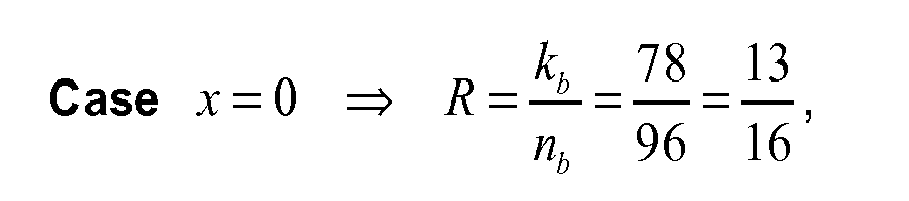
with x = 0 we have the base model LDPC code with the largest codeword length (n 0 =nb ·Z 0 =10368): the block structured exponent matrix H exp_0 is composed of nb = 96 columns and rb = nb - kb =18 rows.
with x = 1 we have kb_1=65, nb _1=80 and LDPC codeword length (n=nb _1·Z 0 =8640); the block structured exponent matrix H exp_1 is composed of nb _1=80 columns and rb _1=nb _1-kb _1=15 rows. - Then to obtain the latter LDPC code (n=8640) it is necessary to eliminate (c 1·x-1)=12 columns with highest indexes (67 to 78) from the base model exponent matrix H exp and further eliminating the semi-deterministic column vector Cν (column index = 79). Moreover because the code rate R remains unchanged, it is necessary to eliminate also (c 2-c 1)·x=3 rows, with highest indexes (16 to 18) from the base model exponent matrix H exp.

with x = 2 we have kb _2=52, nb _2=64 and LDPC codeword length (n=nb _2·Z 0=6912); the block structured exponent matrix H exp_2 is composed of nb _2=64 columns and rb_2=nb _2-kb_2=12 rows. - The LDPC code (n=6912) is obtained eliminating, from the base model exponent matrix H exp, (c 1·x-1)=25 columns of the random sub-matrix, with highest indexes (54 to 78), the semi-deterministic column vector Cν (column index = 79), and (c 2-c 1)·x=6 rows with highest indexes (13 to 18).

with x = 3 we have kb _3=39, nb _3=48 and LDPC codeword length (n=nb _3·Z 0 =5184); the block structured exponent matrix H exp_3 is composed of nb _3=48 columns and rb _3=nb _3-kb _3=9 rows. - The LDPC code (n=5184) is obtained eliminating, from the base model exponent matrix H exp, (c 1·x-1)=38 columns of the random sub-matrix, with highest indexes (41 to 78), the semi-deterministic column vector Cν (column index = 79), and (c 1-c 1)·x=9 rows with highest indexes (10 to 18).

with x = 4 we have kb_4=26, nb_4=32 and LDPC codeword length (n=n b_ 4·Z 0=3456); the block structured exponent matrix H exp_4 is composed ofn b_ 4=32 columns andr b_ 4=n b_4-k b_ 4=6 rows. - The LDPC code (n=3456) is obtained eliminating, from the base model exponent matrix, (c 1·x-1)=51 columns of the random sub-matrix, with highest indexes (28 to 78), the semi-deterministic column vector Cν (column index = 79), and (c 2-c 1)·x=12 rows with highest indexes (7 to 18).
- The exponent matrix H exp is built with semi-random technique; the random sub-matrix has size rb ×kb, the semi-deterministic column vector Cν has size rb ×1 and the deterministic sub-matrix has size rb ×(rb -1). We want to build an LDPC code, for example, for implementing three codeword lengths, and exactly:
- n 0 =10368 ⇒ x = 0
- n 1 = 8640 ⇒ x = 1
- n 3 = 5184 ⇒ x = 3
- Let us assume having built the random Table 2 shown in
figure 3 with spreading factor Z 0 = 108 for a fixed code rate
column 79. - Alternative embodiments of Table 2 including elements of different values are known in the art. In order to generate a multi-length table, as said above, two rows of Table 2 are dedicated for each codeword length and an opportune processing is performed in order to satisfy the conditions on the semi-deterministic column, as exemplified below.
- For codeword length n 3 = 5184 (x=3) and code rate R = 13/16, the dedicated exponent matrix H exp_3 has dimensions r b_3·n b_3, where:


- The semi-deterministic column vector Cν_3 is located at position cl 3, where cl 3 = k b_3+1 = n b_3-(r b_3-1) = 40 , and includes r b_3 elements.
- The conditions on the semi-deterministic column vector Cν_3 impose that the column vector Cν_3 has only three elements having value different from "-1" (the conventional exponent of the null matrix); the first element of the column vector Cν_3, with coordinates (1,c/3)=(1,40), and the last column element, with coordinates (r b_3,cl 3) = (9,40), must be equal, and only one of all the remaining elements, with coordinates (2,cl 3),(3,cl 3),.....,(8,cl 3), must be equal to the exponent "0" which corresponds to the identity matrix.
- Then, for LDPC codeword length n 3 = 5184 (x=3), the following two rows are dedicated:
- the ninth row, in mandatory way; the coordinates of the column element in the ninth row being (rb _3 ,cl 3) = (9,40)
- the fourth row chosen, in random way, between second and eighth row, the coordinates of the column element in the fourth row being (4,cl 3) = (4,40)
- The above-mentioned two rows, after being modified by the processing described below, belong to the multi-length exponent table and they cannot be dedicated to any remaining codeword lengths , e.g. n 0 = 10368 (x = 0) and n 1 = 8640 (x = 1). In order to satisfy the conditions on the column vector Cν_3 for which element (r b_3 ,cl 3)=(9,40) must be equal to element (1,cl 3)=(1,40), the matrixes represented by the elements in row r b_3 are multiplied by the permutation matrix of the identity matrix of exponent e b_3 calculated by means of expression (5) below.

- Expression (5) is a modulus function having the following syntax mod(x,y) = x mod y , wherein x is the square brackets term and y is Z 0. The modulus function if y ≠ 0 returns x - n · y where n = floor(x/y). Specifically for the element (9,40) it results: mod[(82-64),108] = mod(18,108) = 18-0=18.
- Multiplication between unitary weight permutation matrixes can be implemented by calculating (rb_3,j) as shown in expression (6) below which is an easy computation:

with column number j=1,2,3,.....,kb +1=79. - In order to satisfy the conditions on the column vector Cν_3 for which element (4,cl 3) = (4,40) must be equal to zero, representing the identity matrix, the matrixes represented by the elements of the fourth row are multiplied by the identity permutation matrix of exponent e -3 calculated by expression (7) below:

- The multiplication between unitary weight permutation matrixes can be implemented by calculating (4,j) as shown in expression (8) below which is an easy computation:

with column number j=1,2,3,.....,kb +1=79. - The results of these processing steps performed on the random Table 2 of
figure 3 produce a single-length Table 3 to carry-out the LDPC codeword length n 3=5184 (x=3). - Table 3 is shown in
Figure 4 , where the only tworows - The single-length Table 3 of
figure 4 is an intermediate step for building a multi-length base model table that will be gradually upgraded in the next figures. - For codeword length n 1 = 8640 (x = 1) and code rate R =13/16, the exponent matrix H exp_1 has size r b_1·n b_1, where:



- The semi-deterministic column vector Cν_1 is located at position cl 1, where cl 1 = k b_1+1=nb _1-(r b_1-1) = 66 , and includes r b_1 elements.
- The only elements, of the semi-deterministic column Cν_1 having value different from the conventional exponent of null matrix are the following three: the first element of the column vector Cν_1 with coordinates (1,cl 1) = (1,66); the last column element with coordinates (
r b_ 1,cl 1) = (15,66) ; and only one of the remaining elements of column Cν_1 except for elements indexed by (4,cl 1) = (4,66) and (r b_1 ,cl 1) = (9,66), since the fourth and ninth rows have been dedicated to LDPC codeword length n 3 ; e.g. one of the following elements with coordinates;
(2,cl 1), (3,cl 1), (5,cl 1), (6,cl 1), (7,cl 1), (8,cl 1), (10,cl 1), (11,cl 1), (12,cl 1), (13,cl 1), (14,cl 1), must be equal to "0" (the exponent of the identity matrix). - Then, for LDPC codeword length n 1 = 8640 (x = 1), the following two rows are dedicated:
- the fifteenth row, in mandatory way; the coordinates of the column element in the fifteenth row being (r b_1 ,cl 1) = (15,66);
- the eleventh row chosen, in random way, among all the possible (non-dedicated) remaining rows; the coordinates of the column element in the eleventh row being (11, cl 1) = (11,66).
- The above-mentioned two rows, after being modified by the processing described below, belong to the multi-length exponent table and they cannot be dedicated to any of the other remaining codeword lengths , e.g. n 0 = 10368 (x = 0).
- In order to satisfy the conditions on the column vector Cν_1 for which element (r b_1 ,cl 1) = (15,66) must be equal to element (1,cl 1) = (1,66), the matrixes represented by the elements in row r b_1 are multiplied with the permutation matrix of the identity matrix of exponent e b_1 calculated with expression (5), putting the corresponding values of the LDPC codeword n 1, as shown below:

- This multiplication between unitary weight permutation matrixes can be implemented by calculating (r b_1,j) as below shown, using the expression (6) but with LDPC codeword n 1 values:
(rb_ 1 ,j)=mod{[e b_1+(r b_1,j)],Z 0}, with column number j=1,2,3,.....,kb +1=79. - The conditions on the column vector Cν_1 impose that: the element positioned at (11,cl 1) = (11,66) is equal to zero (the exponent of the identity matrix); the matrixes represented by the elements of the eleventh row are multiplied by the permutation matrix of the identity matrix of exponent e _1 calculated, as already done for the previous case, with expression (7):

- The multiplication between unitary weight permutation matrixes can be implemented by calculating (11,j) as shown below, using expression (8), which is an easy computation:

- The results of these processing steps performed on the single-length exponent Table 3 of
figure 4 produce a bi-length Table 4 to carry-out the LDPC codeword lengths n 3 = 5184 and n 1 = 8640. - Table 4 is shown in
figure 5 , where the only tworows rows - The bi-length Table 4 of
figure 5 is an intermediate step for building a multi-length base model table that will be further upgraded in the next figure. - For codeword length n 0 =10368 (x = 0) and code rate R =13/16, the exponent matrix H exp_0 has size r b-0 ·n b-0, where:
- k b-0 = 78, n b-0 = 96, r b-0 = n b-0 - k b-0 = 18.
- The semi-deterministic column vector Cν_0 is located at position cl 0 , where cl 0 = kb-0 +1= nb-0-(rb-0 -1) = 79 , and includes r b-0 elements.
- The only three elements, of column Cν_0, having value different from the element ("-1") of null matrix, are the first one positioned at (1,cl 0) = (1,79) and the last one positioned at (r b-0,cl 0)=(18,79), which must be equal, and only one out of the remaining elements of column Cν_0 which must be equal to the exponent ("0") of the identity matrix. The last element of column Cν_0 must be chosen between the second and the seventeenth row with exception of the fourth, ninth, eleventh and fifteenth rows which have been dedicated to LDPC codeword lengths n 3 and n 1.
- Then, for LDPC codeword length n 0 = 10368 (x = 0), the following two rows are dedicated:
- the eighteenth row, in mandatory way; the coordinates of the column element in the eighteenth row being (rb-0,cl0 )=(18,79);
- the sixteenth row chosen, in random way, among all the possible (not-dedicated) remaining rows; the coordinates of the column element in the sixteenth row being (16,cl 0) = (16,79) :
- The above-mentioned two rows, after being modified by the processing described below, belong to the multi-length base model exponent table. The element (r b-0 ,cl 0)=(18,79) must be equal to the element (1,cl 0)=(1,79), in order to satisfy the conditions on the column vector Cν_0; elements in row r b-0 are multiplied by the permutation matrix of the identity matrix of exponent e b_0 calculated with expression (5), with the corresponding values of the LDPC codeword n 0:

- The multiplication between unitary weight permutation matrixes can be implemented by calculating (r b_0,j), as shown below, using the expression (6), for LDPC codeword n 0:

- The conditions on the column vector Cν_0 impose that the element indexed (16,cl 1)= (16,79) is equal to zero (the exponent of the identity matrix); then the elements of the sixteenth row are multiplied by the permutation matrix of the identity matrix of exponent e _0 computed with expression (7):

- The multiplication between unitary weight permutation matrixes can be implemented by calculating (16,j) using expression (8), as shown below:

- The results of these processing steps, performed on the bi-length exponent Table 4 of
figure 5 , produce a multi-length base model exponent Table 5 to carry-out all LDPC codeword lengths n 3 = 5184, n 1 = 8640 and n 0 = 10368. - Table 5 is shown in
figure 6 , where the only tworows Rows rows - In addition to the sub-tables T exp_3 and T exp_1, Table 5 includes a thick-line framed table T exp_0 overlapped to T exp_3 and T exp_1, and including 1422 elements delimited by the r b_0 = 18 rows and the kb_ 0+1=79 columns of Table 5.
- Table 5 shows a multi-length table comprised of a nested structure of sub-tables, wherein sub-tables generated by larger codewords (lower value of integer x ) include sub-tables generated by shorter codewords (higher value of integer x ).
- All depicted sub-tables begin from the first element of Table 2, but this doesn't constitute a limitation for the invention, since other nested structure are possible.
Figure 7 shows a nested structure of sub-tables in accordance with the method described (for sake of simplicity the numerical values are not indicated). - Now let us consider the multi-length exponent Table 5 of
figure 6 for LDPC codewords n 3 = 5184 , n 1 = 8640 , n 0 =10368 , and let us show as to extract the random sub matrix and semi-deterministic column vector Cν_3 for implementing the exponent matrix H exp_3 for LDPC code with rate R =13/16 and codeword length n 3 = 5184. - As said before, the exponent matrix for LDPC codeword length n 3 =5184 has sizes r b-3 ·n b_3, where r b_3 = 9 and n b_3 = 48 . The corresponding base model exponent table has sizes rb ·(kb +1). Integers kb = 78 and rb = 18 correspond to the block structured information sequence and the block structured parity sequence of the LDPC codeword n 0, respectively.
- The complete exponent matrix H exp_3 for LDPC code with rate R =13/16 and codeword of length n 3 = 5184 is obtained starting from the multi-length exponent Table 5 of
figure 6 in two alternative ways: - a first modality (preservative of the multi-length Table 5 for adaptive MCS) consists of copying all 360 elements of sub-table T exp_3 delimited in Table 5 by the first 9 rows and the first 40 columns, into a processing memory reserved to the exponent matrix H exp_3, and then joining adjacently the deterministic matrix highlighted in bold in the exponent matrix depicted in
figure 7 . - A second modality consist of eliminating from Table 5 rb-rb_ 3 =18-9=9 rows of higher index and (kb +1)-(k b_3+1)=kb -k b_3=78-39=39 columns of higher index, in order tot obtain the sub-table T exp_3, storing it in memory and then joining adjacently the deterministic matrix highlighted in bold in the exponent matrix depicted in
figure 7 . - The wording "joining adjacently" shall be intended as operating onto the processing memory reserved to the exponent matrix, and already containing sub-table T exp_3, as in the following:
- joining to the stored sub-table T exp_3 a contiguous deterministic matrix of size (r b_3×(r b_3-1)) elements, in which all elements along the two left diagonals are filled with an element ("0") indicating the identity matrix, and the remaining elements are filled with an element ("-1") indicating the null matrix;
- replacing with an element ("-1") indicating the null matrix the value of all elements in the last column of stored sub-table T exp_3 different than the previously processed elements located at the positions (1,40), (4,40), (9,40).
- The complete exponent matrixes for other codeword lengths shall be derived from the respective sub-tables accordingly.
- The exponent matrix H exp_3 opportunely multiplied (masked) by the seed matrix, and then expanded with the permutation matrixes of spreading factor Z 0 =108, produces the parity-check binary matrix H r×n = H 972×5184 which is used for implementing the
- LDPC codeword n 3 = 5184 .
- Although the invention has been described with particular reference to a preferred embodiment, it will be evident to those skilled in the art, that the present invention is not limited thereto, but further variations and modifications may be applied without departing from the scope of the invention as defined by the annexed claims.
-
- [Ref.1] IEEE Std 802.16e - Air Interface for Fixed and Mobile Broadband Wireless Access Systems - 28 February 2006.
- [Ref.2] Jon G. Proakis, "DIGITAL COMMUNICATIONS", fourth edition; published by McGraw-Hill, year 2001, ISBN 0-07-232111-3.
-
- BP Belief Propagation
- LDPC Low Density Parity Check Code
- MCS Modulation and Coding Scheme
- WiMAX Worldwide Interoperability for Microwave Access

Claims (7)
- Method of encoding (CH-ENC) information sequences of k bits using low-density parity check code exponent matrixes, each element of which, namely the exponent, being expanded into a permutation matrix

 a) providing a main table (Tab.2) of rb rows and kb +1 columns and filling it with random values included in a range of allowed exponents, starting from: the longest codeword length n 0, the longest information sequence k 0, a fixed code-rate
 b) calculating for any allowed integer x inclusive of zero: a first corresponding integer kb_x=(kb -c 1 x), a second corresponding integer n b-x =(nb-c2x), and a third corresponding integer rb_x = nb_x -kb_x, being c 1 and c 2 integers such that
 c) for any allowed integer x , delimiting in the main table (Tab.2), starting from its initial element, a corresponding sub-table (Tab.3, Tab.4, Tab.5) of r b_x consecutive rows and kb_x +1 consecutive columns, and for every sub-table processing modulo Z 0 two unprocessed rows of the main table to fulfil on the last column of the sub-table the conditions posed on the first column vector of said composite sub-matrix;d) for any allowed integer x and a corresponding codeword of length n b_x , providing an exponent matrix (H exp-3) including the sub-table (Tab.3) for that x plus a deterministic sub-matrix for that x of r b_x rows and of r b_x -1 columns, and replacing the unprocessed elements of the last column of said sub-table (Tab.3) with a conventional value (-1) which corresponds to the null matrix.
 - Method of decoding (CH-DEC) low-density parity check codewords by means of parity-check exponent matrixes, each element of which, namely the exponent, being expanded into a permutation matrix

 a) providing a main table (Tab.2) of rb rows and kb +1 columns and filling it with random values included in a range of allowed exponents, starting from: the longest codeword length n 0, the longest information sequence k 0, a fixed code-rate
 b) calculating for any allowed integer x inclusive of zero: a first corresponding integer kb_x =(kb-c 1 x), a second corresponding integer nb-x =(nb-c 2x), and a third corresponding integer rb_x =nb_x-kb_x, being c 1 and c 2 integers such that
 c) for any allowed integer x , delimiting in the main table (Tab.2), starting from its initial element, a corresponding sub-table (Tab.3, Tab.4, Tab.5) of r b_x consecutive rows and k b_x+1 consecutive columns, and for every sub-table processing modulo Z 0 two unprocessed rows of the main table to fulfil on the last column of the sub-table the conditions posed on the first column vector of said composite sub-matrix;d) for any allowed integer x and a corresponding codeword of length n b_x , providing an exponent matrix (H exp-3) including the sub-table (Tab.3) for that x plus a deterministic sub-matrix for that x of r b_x rows and of r b_x -1 columns, and replacing the unprocessed elements of the last column of said sub-table with a conventional value (-1) which corresponds to the null matrix.
 - The method of claim 1 or 2, characterized in that the processing at step c) includes:c1) choosing a first unprocessed row having index r b_x ;c2) choosing a second unprocessed row randomly among the one having index rb _ x and 1, both excluded, and the remaining unprocessed rows;c3) obtaining a first exponent by subtracting modulus Z 0 the element of said first unprocessed row positioned in column k b_x+1 from the element positioned in the first row and in column k b_x+1;c4) adding modulus Z 0 said first exponent to every elements of said first unprocessed row;c5) obtaining a second exponent by subtracting modulus Z 0 the element of said second unprocessed row positioned in column kb_x +1 from the integer zero;c6) adding modulus Z0 said second exponent to every elements of said second unprocessed row.
- The method of claim 1 or 2, characterized in that said sub-tables (Tab.3, Tab.4, Tab.5) constitute a nested structure within the main table (Tab.2).
- The method of claim 1 or 2, characterized in that for x = 0 the corresponding sub-table (Tab.5) is sized as the main table to comply with full-length codewords.
- The method of claim 1 or 2, characterized in that step d) leaves unchanged the main table (Tab.2).as processed.
- A system (FIG.1) having means (CH-ENC, CH-DEC) for performing the steps of the method according to any claim from 1 to 6.
Priority Applications (2)
| Application Number | Priority Date | Filing Date | Title |
|---|---|---|---|
| AT09100070T ATE523967T1 (en) | 2009-01-26 | 2009-01-26 | GENERATION OF AN EXPONENT TABLE FOR CODING AND DECODING LDPC CODES OF DIFFERENT LENGTH |
| EP09100070A EP2211470B1 (en) | 2009-01-26 | 2009-01-26 | Generating an exponent table for coding and decoding LDPC codewords of different lengths |
Applications Claiming Priority (1)
| Application Number | Priority Date | Filing Date | Title |
|---|---|---|---|
| EP09100070A EP2211470B1 (en) | 2009-01-26 | 2009-01-26 | Generating an exponent table for coding and decoding LDPC codewords of different lengths |
Publications (2)
| Publication Number | Publication Date |
|---|---|
| EP2211470A1 true EP2211470A1 (en) | 2010-07-28 |
| EP2211470B1 EP2211470B1 (en) | 2011-09-07 |
Family
ID=40374921
Family Applications (1)
| Application Number | Title | Priority Date | Filing Date |
|---|---|---|---|
| EP09100070A Active EP2211470B1 (en) | 2009-01-26 | 2009-01-26 | Generating an exponent table for coding and decoding LDPC codewords of different lengths |
Country Status (2)
| Country | Link |
|---|---|
| EP (1) | EP2211470B1 (en) |
| AT (1) | ATE523967T1 (en) |
Cited By (5)
| Publication number | Priority date | Publication date | Assignee | Title |
|---|---|---|---|---|
| WO2016184493A1 (en) * | 2015-05-18 | 2016-11-24 | Huawei Technologies Co., Ltd. | Multi-rate ldpc encoding and decoding with different code lengths using one multi-rate exponent table and one expansion factor |
| EP3107214A4 (en) * | 2014-02-12 | 2017-03-01 | ZTE Corporation | Method and apparatus for processing information |
| US20170149528A1 (en) * | 2015-11-24 | 2017-05-25 | Samsung Electronics Co., Ltd. | Method and apparatus for channel encoding/decoding in a communication or broadcasting system |
| US11233604B2 (en) | 2015-11-24 | 2022-01-25 | Samsung Electronics Co., Ltd. | Method and apparatus for channel encoding/decoding in a communication or broadcasting system |
| WO2024055934A1 (en) * | 2022-09-13 | 2024-03-21 | 华为技术有限公司 | Encoding method, decoding method, communication device, and computer-readable storage medium |
Citations (2)
| Publication number | Priority date | Publication date | Assignee | Title |
|---|---|---|---|---|
| US20060123277A1 (en) * | 2004-11-23 | 2006-06-08 | Texas Instruments Incorporated | Simplified decoding using structured and punctured LDPC codes |
| US20070094580A1 (en) * | 2004-10-12 | 2007-04-26 | Michael Livshitz | Method for selcting low density parity check (LDPC) code used for encoding of variable length data |
-
2009
- 2009-01-26 AT AT09100070T patent/ATE523967T1/en not_active IP Right Cessation
- 2009-01-26 EP EP09100070A patent/EP2211470B1/en active Active
Patent Citations (2)
| Publication number | Priority date | Publication date | Assignee | Title |
|---|---|---|---|---|
| US20070094580A1 (en) * | 2004-10-12 | 2007-04-26 | Michael Livshitz | Method for selcting low density parity check (LDPC) code used for encoding of variable length data |
| US20060123277A1 (en) * | 2004-11-23 | 2006-06-08 | Texas Instruments Incorporated | Simplified decoding using structured and punctured LDPC codes |
Non-Patent Citations (4)
| Title |
|---|
| "Air Interface for Fixed and Mobile Broadband Wireless Access Systems", IEEE STD 802.16E, 28 February 2006 (2006-02-28) |
| ECHARD R ET AL.: "The extended irregular "pi" -rotation LDPC codes", IEEE COMMUNICATIONS LETTERS, IEEE SERVICE CENTER, PISCATAWAY, NJ, US, vol. 7, no. 5, 1 May 2003 (2003-05-01), pages 230 - 232, XP011096589, ISSN: 1089-7798 * |
| IEEE: "IEEEStd 802.16e-2005, Air Interface For Fixed and Mobile Broadband Wireless Access Systems", IEEE 802.16E, 28 February 2006 (2006-02-28), pages 626 - 630, XP002515198 * |
| JON G. PROAKIS: "DIGITAL COMMUNICATIONS", 2001, MCGRAW-HILL |
Cited By (13)
| Publication number | Priority date | Publication date | Assignee | Title |
|---|---|---|---|---|
| EP3107214A4 (en) * | 2014-02-12 | 2017-03-01 | ZTE Corporation | Method and apparatus for processing information |
| CN107592958A (en) * | 2015-05-18 | 2018-01-16 | 华为技术有限公司 | Ratio index table more than one and the LDPC of more ratios of spreading factor coding and decodings are used under different code length |
| WO2016184493A1 (en) * | 2015-05-18 | 2016-11-24 | Huawei Technologies Co., Ltd. | Multi-rate ldpc encoding and decoding with different code lengths using one multi-rate exponent table and one expansion factor |
| US11233604B2 (en) | 2015-11-24 | 2022-01-25 | Samsung Electronics Co., Ltd. | Method and apparatus for channel encoding/decoding in a communication or broadcasting system |
| US10574389B2 (en) * | 2015-11-24 | 2020-02-25 | Samsung Electronics Co., Ltd. | Method and apparatus for channel encoding/decoding in a communication or broadcasting system |
| US10903936B2 (en) | 2015-11-24 | 2021-01-26 | Samsung Electronics Co., Ltd. | Method and apparatus for channel encoding/decoding in a communication or broadcasting system |
| US20170149528A1 (en) * | 2015-11-24 | 2017-05-25 | Samsung Electronics Co., Ltd. | Method and apparatus for channel encoding/decoding in a communication or broadcasting system |
| US20220123858A1 (en) * | 2015-11-24 | 2022-04-21 | Samsung Electronics Co., Ltd. | Method and apparatus for channel encoding/decoding in a communication or broadcasting system |
| US11575465B2 (en) | 2015-11-24 | 2023-02-07 | Samsung Electronics Co., Ltd. | Method and apparatus for channel encoding/decoding in a communication or broadcasting system |
| US11799584B2 (en) | 2015-11-24 | 2023-10-24 | Samsung Electronics Co., Ltd. | Method and apparatus for channel encoding/decoding in a communication or broadcasting system |
| US20240063941A1 (en) * | 2015-11-24 | 2024-02-22 | Samsung Electronics Co., Ltd. | Method and apparatus for channel encoding/decoding in a communication or broadcasting system |
| US12095555B2 (en) * | 2015-11-24 | 2024-09-17 | Samsung Electronics Co., Ltd. | Method and apparatus for channel encoding/decoding in a communication or broadcasting system |
| WO2024055934A1 (en) * | 2022-09-13 | 2024-03-21 | 华为技术有限公司 | Encoding method, decoding method, communication device, and computer-readable storage medium |
Also Published As
| Publication number | Publication date |
|---|---|
| EP2211470B1 (en) | 2011-09-07 |
| ATE523967T1 (en) | 2011-09-15 |
Similar Documents
| Publication | Publication Date | Title |
|---|---|---|
| EP2091156B1 (en) | Apparatus and method for channel encoding and decoding in a communication system using low-density parity-check codes | |
| US11616514B2 (en) | Method and apparatus for channel encoding and decoding in a communication system using a low-density parity check code | |
| US8495459B2 (en) | Channel-encoding/decoding apparatus and method using low-density parity-check codes | |
| AU2008207799B2 (en) | LDPC encoding and decoding of packets of variable sizes | |
| JP3575606B2 (en) | Data low-density parity check encoding method and apparatus | |
| US20090070652A1 (en) | Apparatus and method for channel encoding/decoding in communication system using variable-length ldpc codes | |
| EP2579467A1 (en) | Method and apparatus for channel encoding and decoding in a communication system using low-density parity-check codes | |
| US20060036927A1 (en) | Apparatus and method for encoding and decoding a block low density parity check code | |
| JP2007531455A (en) | Apparatus and method for encoding / decoding block low density parity check code having variable block length | |
| JPWO2008016117A1 (en) | Parity check matrix generation method, encoding method, communication apparatus, communication system, and encoder | |
| US8312344B2 (en) | Communication method and apparatus using LDPC code | |
| KR20170060562A (en) | Apparatus and method for channel encoding/decoding in communication or broadcasting system | |
| JP2012239240A (en) | Method for generating parity-check matrices of low-density parity-check codes | |
| EP2211470B1 (en) | Generating an exponent table for coding and decoding LDPC codewords of different lengths | |
| US8473824B1 (en) | Quasi-cyclic low-density parity-check (QC-LDPC) encoder | |
| EP2226945A1 (en) | Generation of optimized exponent matrices for multi-rate LDPC codes | |
| US11190210B2 (en) | Method for encoding based on parity check matrix of LDPC code in wireless communication system and terminal using this | |
| EP2148445B1 (en) | Generating exponent matrixes for LDPC codes | |
| EP2285004A1 (en) | Method for pseudo-puncturing exponent matrixes of LDPC codes to comply with different code-rates | |
| KR102424942B1 (en) | Method of channel coding for communication systems and apparatus using the same | |
| KR20170060574A (en) | Apparatus and method for channel encoding/decoding in communication or broadcasting system | |
| KR20170060600A (en) | Apparatus and method for channel encoding/decoding in communication or broadcasting system | |
| Chang et al. | Efficiently encodable non-binary generalized LDPC codes |
Legal Events
| Date | Code | Title | Description |
|---|---|---|---|
| PUAI | Public reference made under article 153(3) epc to a published international application that has entered the european phase |
Free format text: ORIGINAL CODE: 0009012 |
|
| AK | Designated contracting states |
Kind code of ref document: A1 Designated state(s): AT BE BG CH CY CZ DE DK EE ES FI FR GB GR HR HU IE IS IT LI LT LU LV MC MK MT NL NO PL PT RO SE SI SK TR |
|
| AX | Request for extension of the european patent |
Extension state: AL BA RS |
|
| 17P | Request for examination filed |
Effective date: 20110128 |
|
| GRAP | Despatch of communication of intention to grant a patent |
Free format text: ORIGINAL CODE: EPIDOSNIGR1 |
|
| AKX | Designation fees paid |
Designated state(s): AT BE BG CH CY CZ DE DK EE ES FI FR GB GR HR HU IE IS IT LI LT LU LV MC MK MT NL NO PL PT RO SE SI SK TR |
|
| GRAS | Grant fee paid |
Free format text: ORIGINAL CODE: EPIDOSNIGR3 |
|
| GRAA | (expected) grant |
Free format text: ORIGINAL CODE: 0009210 |
|
| REG | Reference to a national code |
Ref country code: GB Ref legal event code: FG4D |
|
| REG | Reference to a national code |
Ref country code: CH Ref legal event code: EP |
|
| REG | Reference to a national code |
Ref country code: IE Ref legal event code: FG4D |
|
| REG | Reference to a national code |
Ref country code: DE Ref legal event code: R096 Ref document number: 602009002494 Country of ref document: DE Effective date: 20111117 |
|
| REG | Reference to a national code |
Ref country code: NL Ref legal event code: VDEP Effective date: 20110907 |
|
| PG25 | Lapsed in a contracting state [announced via postgrant information from national office to epo] |
Ref country code: LT Free format text: LAPSE BECAUSE OF FAILURE TO SUBMIT A TRANSLATION OF THE DESCRIPTION OR TO PAY THE FEE WITHIN THE PRESCRIBED TIME-LIMIT Effective date: 20110907 Ref country code: FI Free format text: LAPSE BECAUSE OF FAILURE TO SUBMIT A TRANSLATION OF THE DESCRIPTION OR TO PAY THE FEE WITHIN THE PRESCRIBED TIME-LIMIT Effective date: 20110907 Ref country code: HR Free format text: LAPSE BECAUSE OF FAILURE TO SUBMIT A TRANSLATION OF THE DESCRIPTION OR TO PAY THE FEE WITHIN THE PRESCRIBED TIME-LIMIT Effective date: 20110907 Ref country code: SE Free format text: LAPSE BECAUSE OF FAILURE TO SUBMIT A TRANSLATION OF THE DESCRIPTION OR TO PAY THE FEE WITHIN THE PRESCRIBED TIME-LIMIT Effective date: 20110907 Ref country code: NO Free format text: LAPSE BECAUSE OF FAILURE TO SUBMIT A TRANSLATION OF THE DESCRIPTION OR TO PAY THE FEE WITHIN THE PRESCRIBED TIME-LIMIT Effective date: 20111207 |
|
| LTIE | Lt: invalidation of european patent or patent extension |
Effective date: 20110907 |
|
| PG25 | Lapsed in a contracting state [announced via postgrant information from national office to epo] |
Ref country code: SI Free format text: LAPSE BECAUSE OF FAILURE TO SUBMIT A TRANSLATION OF THE DESCRIPTION OR TO PAY THE FEE WITHIN THE PRESCRIBED TIME-LIMIT Effective date: 20110907 Ref country code: CY Free format text: LAPSE BECAUSE OF FAILURE TO SUBMIT A TRANSLATION OF THE DESCRIPTION OR TO PAY THE FEE WITHIN THE PRESCRIBED TIME-LIMIT Effective date: 20110907 Ref country code: AT Free format text: LAPSE BECAUSE OF FAILURE TO SUBMIT A TRANSLATION OF THE DESCRIPTION OR TO PAY THE FEE WITHIN THE PRESCRIBED TIME-LIMIT Effective date: 20110907 Ref country code: LV Free format text: LAPSE BECAUSE OF FAILURE TO SUBMIT A TRANSLATION OF THE DESCRIPTION OR TO PAY THE FEE WITHIN THE PRESCRIBED TIME-LIMIT Effective date: 20110907 Ref country code: GR Free format text: LAPSE BECAUSE OF FAILURE TO SUBMIT A TRANSLATION OF THE DESCRIPTION OR TO PAY THE FEE WITHIN THE PRESCRIBED TIME-LIMIT Effective date: 20111208 |
|
| REG | Reference to a national code |
Ref country code: AT Ref legal event code: MK05 Ref document number: 523967 Country of ref document: AT Kind code of ref document: T Effective date: 20110907 |
|
| PG25 | Lapsed in a contracting state [announced via postgrant information from national office to epo] |
Ref country code: BE Free format text: LAPSE BECAUSE OF FAILURE TO SUBMIT A TRANSLATION OF THE DESCRIPTION OR TO PAY THE FEE WITHIN THE PRESCRIBED TIME-LIMIT Effective date: 20110907 |
|
| PG25 | Lapsed in a contracting state [announced via postgrant information from national office to epo] |
Ref country code: IS Free format text: LAPSE BECAUSE OF FAILURE TO SUBMIT A TRANSLATION OF THE DESCRIPTION OR TO PAY THE FEE WITHIN THE PRESCRIBED TIME-LIMIT Effective date: 20120107 Ref country code: SK Free format text: LAPSE BECAUSE OF FAILURE TO SUBMIT A TRANSLATION OF THE DESCRIPTION OR TO PAY THE FEE WITHIN THE PRESCRIBED TIME-LIMIT Effective date: 20110907 Ref country code: CZ Free format text: LAPSE BECAUSE OF FAILURE TO SUBMIT A TRANSLATION OF THE DESCRIPTION OR TO PAY THE FEE WITHIN THE PRESCRIBED TIME-LIMIT Effective date: 20110907 |
|
| PG25 | Lapsed in a contracting state [announced via postgrant information from national office to epo] |
Ref country code: RO Free format text: LAPSE BECAUSE OF FAILURE TO SUBMIT A TRANSLATION OF THE DESCRIPTION OR TO PAY THE FEE WITHIN THE PRESCRIBED TIME-LIMIT Effective date: 20110907 Ref country code: PL Free format text: LAPSE BECAUSE OF FAILURE TO SUBMIT A TRANSLATION OF THE DESCRIPTION OR TO PAY THE FEE WITHIN THE PRESCRIBED TIME-LIMIT Effective date: 20110907 Ref country code: EE Free format text: LAPSE BECAUSE OF FAILURE TO SUBMIT A TRANSLATION OF THE DESCRIPTION OR TO PAY THE FEE WITHIN THE PRESCRIBED TIME-LIMIT Effective date: 20110907 Ref country code: PT Free format text: LAPSE BECAUSE OF FAILURE TO SUBMIT A TRANSLATION OF THE DESCRIPTION OR TO PAY THE FEE WITHIN THE PRESCRIBED TIME-LIMIT Effective date: 20120109 Ref country code: NL Free format text: LAPSE BECAUSE OF FAILURE TO SUBMIT A TRANSLATION OF THE DESCRIPTION OR TO PAY THE FEE WITHIN THE PRESCRIBED TIME-LIMIT Effective date: 20110907 |
|
| PLBE | No opposition filed within time limit |
Free format text: ORIGINAL CODE: 0009261 |
|
| STAA | Information on the status of an ep patent application or granted ep patent |
Free format text: STATUS: NO OPPOSITION FILED WITHIN TIME LIMIT |
|
| PG25 | Lapsed in a contracting state [announced via postgrant information from national office to epo] |
Ref country code: DK Free format text: LAPSE BECAUSE OF FAILURE TO SUBMIT A TRANSLATION OF THE DESCRIPTION OR TO PAY THE FEE WITHIN THE PRESCRIBED TIME-LIMIT Effective date: 20110907 |
|
| 26N | No opposition filed |
Effective date: 20120611 |
|
| PG25 | Lapsed in a contracting state [announced via postgrant information from national office to epo] |
Ref country code: MC Free format text: LAPSE BECAUSE OF NON-PAYMENT OF DUE FEES Effective date: 20120131 |
|
| REG | Reference to a national code |
Ref country code: DE Ref legal event code: R097 Ref document number: 602009002494 Country of ref document: DE Effective date: 20120611 |
|
| REG | Reference to a national code |
Ref country code: IE Ref legal event code: MM4A |
|
| PG25 | Lapsed in a contracting state [announced via postgrant information from national office to epo] |
Ref country code: IE Free format text: LAPSE BECAUSE OF NON-PAYMENT OF DUE FEES Effective date: 20120126 |
|
| PG25 | Lapsed in a contracting state [announced via postgrant information from national office to epo] |
Ref country code: MK Free format text: LAPSE BECAUSE OF FAILURE TO SUBMIT A TRANSLATION OF THE DESCRIPTION OR TO PAY THE FEE WITHIN THE PRESCRIBED TIME-LIMIT Effective date: 20110907 |
|
| PG25 | Lapsed in a contracting state [announced via postgrant information from national office to epo] |
Ref country code: ES Free format text: LAPSE BECAUSE OF FAILURE TO SUBMIT A TRANSLATION OF THE DESCRIPTION OR TO PAY THE FEE WITHIN THE PRESCRIBED TIME-LIMIT Effective date: 20111218 |
|
| PG25 | Lapsed in a contracting state [announced via postgrant information from national office to epo] |
Ref country code: BG Free format text: LAPSE BECAUSE OF FAILURE TO SUBMIT A TRANSLATION OF THE DESCRIPTION OR TO PAY THE FEE WITHIN THE PRESCRIBED TIME-LIMIT Effective date: 20111207 |
|
| PG25 | Lapsed in a contracting state [announced via postgrant information from national office to epo] |
Ref country code: MT Free format text: LAPSE BECAUSE OF FAILURE TO SUBMIT A TRANSLATION OF THE DESCRIPTION OR TO PAY THE FEE WITHIN THE PRESCRIBED TIME-LIMIT Effective date: 20110907 |
|
| REG | Reference to a national code |
Ref country code: CH Ref legal event code: PL |
|
| PG25 | Lapsed in a contracting state [announced via postgrant information from national office to epo] |
Ref country code: CH Free format text: LAPSE BECAUSE OF NON-PAYMENT OF DUE FEES Effective date: 20130131 Ref country code: LI Free format text: LAPSE BECAUSE OF NON-PAYMENT OF DUE FEES Effective date: 20130131 |
|
| PG25 | Lapsed in a contracting state [announced via postgrant information from national office to epo] |
Ref country code: TR Free format text: LAPSE BECAUSE OF FAILURE TO SUBMIT A TRANSLATION OF THE DESCRIPTION OR TO PAY THE FEE WITHIN THE PRESCRIBED TIME-LIMIT Effective date: 20110907 |
|
| PG25 | Lapsed in a contracting state [announced via postgrant information from national office to epo] |
Ref country code: LU Free format text: LAPSE BECAUSE OF NON-PAYMENT OF DUE FEES Effective date: 20120126 |
|
| PG25 | Lapsed in a contracting state [announced via postgrant information from national office to epo] |
Ref country code: HU Free format text: LAPSE BECAUSE OF FAILURE TO SUBMIT A TRANSLATION OF THE DESCRIPTION OR TO PAY THE FEE WITHIN THE PRESCRIBED TIME-LIMIT Effective date: 20090126 |
|
| REG | Reference to a national code |
Ref country code: FR Ref legal event code: PLFP Year of fee payment: 8 |
|
| REG | Reference to a national code |
Ref country code: FR Ref legal event code: PLFP Year of fee payment: 9 |
|
| REG | Reference to a national code |
Ref country code: FR Ref legal event code: PLFP Year of fee payment: 10 |
|
| PGFP | Annual fee paid to national office [announced via postgrant information from national office to epo] |
Ref country code: FR Payment date: 20211217 Year of fee payment: 14 |
|
| PGFP | Annual fee paid to national office [announced via postgrant information from national office to epo] |
Ref country code: IT Payment date: 20211213 Year of fee payment: 14 |
|
| PG25 | Lapsed in a contracting state [announced via postgrant information from national office to epo] |
Ref country code: FR Free format text: LAPSE BECAUSE OF NON-PAYMENT OF DUE FEES Effective date: 20230131 |
|
| PG25 | Lapsed in a contracting state [announced via postgrant information from national office to epo] |
Ref country code: IT Free format text: LAPSE BECAUSE OF NON-PAYMENT OF DUE FEES Effective date: 20230126 |
|
| PGFP | Annual fee paid to national office [announced via postgrant information from national office to epo] |
Ref country code: GB Payment date: 20251204 Year of fee payment: 18 |
|
| PGFP | Annual fee paid to national office [announced via postgrant information from national office to epo] |
Ref country code: DE Payment date: 20251203 Year of fee payment: 18 |