EP2210869A1 - New method for the preparation of 6-[3-(1-adamantyl)-4-methoxyphenyl]-2-naphthoic acid - Google Patents
New method for the preparation of 6-[3-(1-adamantyl)-4-methoxyphenyl]-2-naphthoic acid Download PDFInfo
- Publication number
- EP2210869A1 EP2210869A1 EP10155686A EP10155686A EP2210869A1 EP 2210869 A1 EP2210869 A1 EP 2210869A1 EP 10155686 A EP10155686 A EP 10155686A EP 10155686 A EP10155686 A EP 10155686A EP 2210869 A1 EP2210869 A1 EP 2210869A1
- Authority
- EP
- European Patent Office
- Prior art keywords
- adamantyl
- methoxyphenyl
- naphthoic acid
- acid
- preparation
- Prior art date
- Legal status (The legal status is an assumption and is not a legal conclusion. Google has not performed a legal analysis and makes no representation as to the accuracy of the status listed.)
- Withdrawn
Links
- LZCDAPDGXCYOEH-UHFFFAOYSA-N adapalene Chemical compound C1=C(C(O)=O)C=CC2=CC(C3=CC=C(C(=C3)C34CC5CC(CC(C5)C3)C4)OC)=CC=C21 LZCDAPDGXCYOEH-UHFFFAOYSA-N 0.000 title abstract description 22
- 238000000034 method Methods 0.000 title abstract description 21
- 238000002360 preparation method Methods 0.000 title description 11
- 239000012535 impurity Substances 0.000 claims description 12
- FPZOBRFHRPQGAA-UHFFFAOYSA-N [3-(1-adamantyl)-4-methoxyphenyl]boronic acid Chemical compound COC1=CC=C(B(O)O)C=C1C1(C2)CC(C3)CC2CC3C1 FPZOBRFHRPQGAA-UHFFFAOYSA-N 0.000 claims description 11
- 238000006069 Suzuki reaction reaction Methods 0.000 claims description 10
- KDLHZDBZIXYQEI-UHFFFAOYSA-N Palladium Chemical compound [Pd] KDLHZDBZIXYQEI-UHFFFAOYSA-N 0.000 description 17
- WYURNTSHIVDZCO-UHFFFAOYSA-N Tetrahydrofuran Chemical compound C1CCOC1 WYURNTSHIVDZCO-UHFFFAOYSA-N 0.000 description 14
- 150000001875 compounds Chemical class 0.000 description 11
- KWYUFKZDYYNOTN-UHFFFAOYSA-M Potassium hydroxide Chemical compound [OH-].[K+] KWYUFKZDYYNOTN-UHFFFAOYSA-M 0.000 description 10
- VEXZGXHMUGYJMC-UHFFFAOYSA-N Hydrochloric acid Chemical compound Cl VEXZGXHMUGYJMC-UHFFFAOYSA-N 0.000 description 9
- HEMHJVSKTPXQMS-UHFFFAOYSA-M Sodium hydroxide Chemical compound [OH-].[Na+] HEMHJVSKTPXQMS-UHFFFAOYSA-M 0.000 description 9
- 239000003054 catalyst Substances 0.000 description 9
- XLYOFNOQVPJJNP-UHFFFAOYSA-N water Substances O XLYOFNOQVPJJNP-UHFFFAOYSA-N 0.000 description 9
- IMNFDUFMRHMDMM-UHFFFAOYSA-N N-Heptane Chemical compound CCCCCCC IMNFDUFMRHMDMM-UHFFFAOYSA-N 0.000 description 8
- QQAMHHZQONQBFZ-UHFFFAOYSA-N 1-(5-bromo-2-methoxyphenyl)adamantane Chemical compound COC1=CC=C(Br)C=C1C1(C2)CC(C3)CC2CC3C1 QQAMHHZQONQBFZ-UHFFFAOYSA-N 0.000 description 7
- NPMCAVBMOTZUPD-UHFFFAOYSA-N 6-bromonaphthalene-2-carboxylic acid Chemical compound C1=C(Br)C=CC2=CC(C(=O)O)=CC=C21 NPMCAVBMOTZUPD-UHFFFAOYSA-N 0.000 description 7
- 238000006243 chemical reaction Methods 0.000 description 7
- IJGRMHOSHXDMSA-UHFFFAOYSA-N Atomic nitrogen Chemical compound N#N IJGRMHOSHXDMSA-UHFFFAOYSA-N 0.000 description 6
- 239000012429 reaction media Substances 0.000 description 6
- 238000010992 reflux Methods 0.000 description 6
- 239000007787 solid Substances 0.000 description 6
- 229910052763 palladium Inorganic materials 0.000 description 5
- 238000003756 stirring Methods 0.000 description 5
- JGFZNNIVVJXRND-UHFFFAOYSA-N N,N-Diisopropylethylamine (DIPEA) Chemical compound CCN(C(C)C)C(C)C JGFZNNIVVJXRND-UHFFFAOYSA-N 0.000 description 4
- 239000002253 acid Substances 0.000 description 4
- 230000015572 biosynthetic process Effects 0.000 description 4
- 238000004128 high performance liquid chromatography Methods 0.000 description 4
- YJVFFLUZDVXJQI-UHFFFAOYSA-L palladium(ii) acetate Chemical compound [Pd+2].CC([O-])=O.CC([O-])=O YJVFFLUZDVXJQI-UHFFFAOYSA-L 0.000 description 4
- BWHMMNNQKKPAPP-UHFFFAOYSA-L potassium carbonate Chemical compound [K+].[K+].[O-]C([O-])=O BWHMMNNQKKPAPP-UHFFFAOYSA-L 0.000 description 4
- 239000002244 precipitate Substances 0.000 description 4
- 239000000047 product Substances 0.000 description 4
- YLQBMQCUIZJEEH-UHFFFAOYSA-N tetrahydrofuran Natural products C=1C=COC=1 YLQBMQCUIZJEEH-UHFFFAOYSA-N 0.000 description 4
- JIAARYAFYJHUJI-UHFFFAOYSA-L zinc dichloride Chemical compound [Cl-].[Cl-].[Zn+2] JIAARYAFYJHUJI-UHFFFAOYSA-L 0.000 description 4
- WEVYAHXRMPXWCK-UHFFFAOYSA-N Acetonitrile Chemical compound CC#N WEVYAHXRMPXWCK-UHFFFAOYSA-N 0.000 description 3
- OKTJSMMVPCPJKN-UHFFFAOYSA-N Carbon Chemical compound [C] OKTJSMMVPCPJKN-UHFFFAOYSA-N 0.000 description 3
- XEKOWRVHYACXOJ-UHFFFAOYSA-N Ethyl acetate Chemical compound CCOC(C)=O XEKOWRVHYACXOJ-UHFFFAOYSA-N 0.000 description 3
- OKKJLVBELUTLKV-UHFFFAOYSA-N Methanol Chemical compound OC OKKJLVBELUTLKV-UHFFFAOYSA-N 0.000 description 3
- ZMXDDKWLCZADIW-UHFFFAOYSA-N N,N-Dimethylformamide Chemical compound CN(C)C=O ZMXDDKWLCZADIW-UHFFFAOYSA-N 0.000 description 3
- ZMANZCXQSJIPKH-UHFFFAOYSA-N Triethylamine Chemical compound CCN(CC)CC ZMANZCXQSJIPKH-UHFFFAOYSA-N 0.000 description 3
- 125000000524 functional group Chemical group 0.000 description 3
- ZYTSEBOFQXUODK-UHFFFAOYSA-N methyl 6-bromonaphthalene-1-carboxylate Chemical compound BrC1=CC=C2C(C(=O)OC)=CC=CC2=C1 ZYTSEBOFQXUODK-UHFFFAOYSA-N 0.000 description 3
- 229910052757 nitrogen Inorganic materials 0.000 description 3
- LXNAVEXFUKBNMK-UHFFFAOYSA-N palladium(II) acetate Substances [Pd].CC(O)=O.CC(O)=O LXNAVEXFUKBNMK-UHFFFAOYSA-N 0.000 description 3
- 239000002904 solvent Substances 0.000 description 3
- JLXGISLEMCPIIE-UHFFFAOYSA-N 2-(5-bromo-2-methoxyphenyl)adamantane Chemical compound COC1=CC=C(Br)C=C1C1C(C2)CC3CC2CC1C3 JLXGISLEMCPIIE-UHFFFAOYSA-N 0.000 description 2
- PXHVJJICTQNCMI-UHFFFAOYSA-N Nickel Chemical compound [Ni] PXHVJJICTQNCMI-UHFFFAOYSA-N 0.000 description 2
- CDBYLPFSWZWCQE-UHFFFAOYSA-L Sodium Carbonate Chemical compound [Na+].[Na+].[O-]C([O-])=O CDBYLPFSWZWCQE-UHFFFAOYSA-L 0.000 description 2
- PMZURENOXWZQFD-UHFFFAOYSA-L Sodium Sulfate Chemical compound [Na+].[Na+].[O-]S([O-])(=O)=O PMZURENOXWZQFD-UHFFFAOYSA-L 0.000 description 2
- HEDRZPFGACZZDS-MICDWDOJSA-N Trichloro(2H)methane Chemical compound [2H]C(Cl)(Cl)Cl HEDRZPFGACZZDS-MICDWDOJSA-N 0.000 description 2
- FJDQFPXHSGXQBY-UHFFFAOYSA-L caesium carbonate Chemical compound [Cs+].[Cs+].[O-]C([O-])=O FJDQFPXHSGXQBY-UHFFFAOYSA-L 0.000 description 2
- 238000005859 coupling reaction Methods 0.000 description 2
- LCSNDSFWVKMJCT-UHFFFAOYSA-N dicyclohexyl-(2-phenylphenyl)phosphane Chemical group C1CCCCC1P(C=1C(=CC=CC=1)C=1C=CC=CC=1)C1CCCCC1 LCSNDSFWVKMJCT-UHFFFAOYSA-N 0.000 description 2
- 238000001914 filtration Methods 0.000 description 2
- 230000007062 hydrolysis Effects 0.000 description 2
- 238000006460 hydrolysis reaction Methods 0.000 description 2
- 239000003446 ligand Substances 0.000 description 2
- 150000004702 methyl esters Chemical group 0.000 description 2
- 239000000203 mixture Substances 0.000 description 2
- 239000012074 organic phase Substances 0.000 description 2
- NFHFRUOZVGFOOS-UHFFFAOYSA-N palladium;triphenylphosphane Chemical compound [Pd].C1=CC=CC=C1P(C=1C=CC=CC=1)C1=CC=CC=C1.C1=CC=CC=C1P(C=1C=CC=CC=1)C1=CC=CC=C1.C1=CC=CC=C1P(C=1C=CC=CC=1)C1=CC=CC=C1.C1=CC=CC=C1P(C=1C=CC=CC=1)C1=CC=CC=C1 NFHFRUOZVGFOOS-UHFFFAOYSA-N 0.000 description 2
- 239000002798 polar solvent Substances 0.000 description 2
- 229910000027 potassium carbonate Inorganic materials 0.000 description 2
- TYJJADVDDVDEDZ-UHFFFAOYSA-M potassium hydrogencarbonate Chemical compound [K+].OC([O-])=O TYJJADVDDVDEDZ-UHFFFAOYSA-M 0.000 description 2
- BDERNNFJNOPAEC-UHFFFAOYSA-N propan-1-ol Chemical compound CCCO BDERNNFJNOPAEC-UHFFFAOYSA-N 0.000 description 2
- 239000011541 reaction mixture Substances 0.000 description 2
- 238000003786 synthesis reaction Methods 0.000 description 2
- RIOQSEWOXXDEQQ-UHFFFAOYSA-N triphenylphosphine Chemical compound C1=CC=CC=C1P(C=1C=CC=CC=1)C1=CC=CC=C1 RIOQSEWOXXDEQQ-UHFFFAOYSA-N 0.000 description 2
- 239000011592 zinc chloride Substances 0.000 description 2
- 150000003752 zinc compounds Chemical class 0.000 description 2
- -1 (1-adamantyl)phenyl part Chemical group 0.000 description 1
- QFMZQPDHXULLKC-UHFFFAOYSA-N 1,2-bis(diphenylphosphino)ethane Chemical compound C=1C=CC=CC=1P(C=1C=CC=CC=1)CCP(C=1C=CC=CC=1)C1=CC=CC=C1 QFMZQPDHXULLKC-UHFFFAOYSA-N 0.000 description 1
- SDMSVURKQNRAEU-UHFFFAOYSA-N 1-[5-[3-(1-adamantyl)-4-methoxyphenyl]-2-methoxyphenyl]adamantane Chemical group C1C(C2)CC(C3)CC2CC13C1=CC(C2=CC=C(C(=C2)C23CC4CC(CC(C4)C2)C3)OC)=CC=C1OC SDMSVURKQNRAEU-UHFFFAOYSA-N 0.000 description 1
- 238000005160 1H NMR spectroscopy Methods 0.000 description 1
- FGUOFYYCGXFXOY-UHFFFAOYSA-N 6-bromonaphthalene-1-carboxylic acid Chemical compound BrC1=CC=C2C(C(=O)O)=CC=CC2=C1 FGUOFYYCGXFXOY-UHFFFAOYSA-N 0.000 description 1
- 208000002874 Acne Vulgaris Diseases 0.000 description 1
- XKRFYHLGVUSROY-UHFFFAOYSA-N Argon Chemical compound [Ar] XKRFYHLGVUSROY-UHFFFAOYSA-N 0.000 description 1
- XTHFKEDIFFGKHM-UHFFFAOYSA-N Dimethoxyethane Chemical compound COCCOC XTHFKEDIFFGKHM-UHFFFAOYSA-N 0.000 description 1
- LFQSCWFLJHTTHZ-UHFFFAOYSA-N Ethanol Chemical compound CCO LFQSCWFLJHTTHZ-UHFFFAOYSA-N 0.000 description 1
- KFZMGEQAYNKOFK-UHFFFAOYSA-N Isopropanol Chemical compound CC(C)O KFZMGEQAYNKOFK-UHFFFAOYSA-N 0.000 description 1
- MZRVEZGGRBJDDB-UHFFFAOYSA-N N-Butyllithium Chemical compound [Li]CCCC MZRVEZGGRBJDDB-UHFFFAOYSA-N 0.000 description 1
- 229910021586 Nickel(II) chloride Inorganic materials 0.000 description 1
- FAPWRFPIFSIZLT-UHFFFAOYSA-M Sodium chloride Chemical class [Na+].[Cl-] FAPWRFPIFSIZLT-UHFFFAOYSA-M 0.000 description 1
- 238000010306 acid treatment Methods 0.000 description 1
- 230000002378 acidificating effect Effects 0.000 description 1
- 206010000496 acne Diseases 0.000 description 1
- 239000000058 anti acne agent Substances 0.000 description 1
- 229940124340 antiacne agent Drugs 0.000 description 1
- 239000008346 aqueous phase Substances 0.000 description 1
- 229910052786 argon Inorganic materials 0.000 description 1
- 239000012300 argon atmosphere Substances 0.000 description 1
- 239000012298 atmosphere Substances 0.000 description 1
- 229910000024 caesium carbonate Inorganic materials 0.000 description 1
- 230000008878 coupling Effects 0.000 description 1
- 238000010168 coupling process Methods 0.000 description 1
- 239000013058 crude material Substances 0.000 description 1
- NXQGGXCHGDYOHB-UHFFFAOYSA-L cyclopenta-1,4-dien-1-yl(diphenyl)phosphane;dichloropalladium;iron(2+) Chemical compound [Fe+2].Cl[Pd]Cl.[CH-]1C=CC(P(C=2C=CC=CC=2)C=2C=CC=CC=2)=C1.[CH-]1C=CC(P(C=2C=CC=CC=2)C=2C=CC=CC=2)=C1 NXQGGXCHGDYOHB-UHFFFAOYSA-L 0.000 description 1
- 238000010511 deprotection reaction Methods 0.000 description 1
- XXECWTBMGGXMKP-UHFFFAOYSA-L dichloronickel;2-diphenylphosphanylethyl(diphenyl)phosphane Chemical compound Cl[Ni]Cl.C=1C=CC=CC=1P(C=1C=CC=CC=1)CCP(C=1C=CC=CC=1)C1=CC=CC=C1 XXECWTBMGGXMKP-UHFFFAOYSA-L 0.000 description 1
- 238000006471 dimerization reaction Methods 0.000 description 1
- 239000011521 glass Substances 0.000 description 1
- 238000011194 good manufacturing practice Methods 0.000 description 1
- 238000011065 in-situ storage Methods 0.000 description 1
- 238000009776 industrial production Methods 0.000 description 1
- 150000007529 inorganic bases Chemical class 0.000 description 1
- 238000004519 manufacturing process Methods 0.000 description 1
- 238000002844 melting Methods 0.000 description 1
- 230000008018 melting Effects 0.000 description 1
- PGXNMQBGOVUZNC-UHFFFAOYSA-N methyl 6-[3-(1-adamantyl)-4-methoxyphenyl]naphthalene-2-carboxylate Chemical compound C1C(C2)CC(C3)CC2CC13C1=CC(C2=CC3=CC=C(C=C3C=C2)C(=O)OC)=CC=C1OC PGXNMQBGOVUZNC-UHFFFAOYSA-N 0.000 description 1
- 238000012544 monitoring process Methods 0.000 description 1
- 125000001624 naphthyl group Chemical group 0.000 description 1
- 229910052759 nickel Inorganic materials 0.000 description 1
- QMMRZOWCJAIUJA-UHFFFAOYSA-L nickel dichloride Chemical compound Cl[Ni]Cl QMMRZOWCJAIUJA-UHFFFAOYSA-L 0.000 description 1
- 239000012299 nitrogen atmosphere Substances 0.000 description 1
- 150000002901 organomagnesium compounds Chemical class 0.000 description 1
- 230000020477 pH reduction Effects 0.000 description 1
- 239000008194 pharmaceutical composition Substances 0.000 description 1
- 150000003003 phosphines Chemical class 0.000 description 1
- 239000003586 protic polar solvent Substances 0.000 description 1
- 238000001953 recrystallisation Methods 0.000 description 1
- 238000012958 reprocessing Methods 0.000 description 1
- 150000004492 retinoid derivatives Chemical class 0.000 description 1
- 238000007127 saponification reaction Methods 0.000 description 1
- 229910000029 sodium carbonate Inorganic materials 0.000 description 1
- 229910052938 sodium sulfate Inorganic materials 0.000 description 1
- 235000011152 sodium sulphate Nutrition 0.000 description 1
- 150000003512 tertiary amines Chemical class 0.000 description 1
- 229910052723 transition metal Inorganic materials 0.000 description 1
- 150000003624 transition metals Chemical class 0.000 description 1
- NHDIQVFFNDKAQU-UHFFFAOYSA-N tripropan-2-yl borate Chemical compound CC(C)OB(OC(C)C)OC(C)C NHDIQVFFNDKAQU-UHFFFAOYSA-N 0.000 description 1
- COIOYMYWGDAQPM-UHFFFAOYSA-N tris(2-methylphenyl)phosphane Chemical compound CC1=CC=CC=C1P(C=1C(=CC=CC=1)C)C1=CC=CC=C1C COIOYMYWGDAQPM-UHFFFAOYSA-N 0.000 description 1
- LFNXCUNDYSYVJY-UHFFFAOYSA-N tris(3-methylphenyl)phosphane Chemical compound CC1=CC=CC(P(C=2C=C(C)C=CC=2)C=2C=C(C)C=CC=2)=C1 LFNXCUNDYSYVJY-UHFFFAOYSA-N 0.000 description 1
- WXAZIUYTQHYBFW-UHFFFAOYSA-N tris(4-methylphenyl)phosphane Chemical compound C1=CC(C)=CC=C1P(C=1C=CC(C)=CC=1)C1=CC=C(C)C=C1 WXAZIUYTQHYBFW-UHFFFAOYSA-N 0.000 description 1
- 238000005406 washing Methods 0.000 description 1
- 235000005074 zinc chloride Nutrition 0.000 description 1
Classifications
-
- C—CHEMISTRY; METALLURGY
- C07—ORGANIC CHEMISTRY
- C07C—ACYCLIC OR CARBOCYCLIC COMPOUNDS
- C07C65/00—Compounds having carboxyl groups bound to carbon atoms of six—membered aromatic rings and containing any of the groups OH, O—metal, —CHO, keto, ether, groups, groups, or groups
- C07C65/21—Compounds having carboxyl groups bound to carbon atoms of six—membered aromatic rings and containing any of the groups OH, O—metal, —CHO, keto, ether, groups, groups, or groups containing ether groups, groups, groups, or groups
- C07C65/24—Compounds having carboxyl groups bound to carbon atoms of six—membered aromatic rings and containing any of the groups OH, O—metal, —CHO, keto, ether, groups, groups, or groups containing ether groups, groups, groups, or groups polycyclic
-
- C—CHEMISTRY; METALLURGY
- C07—ORGANIC CHEMISTRY
- C07C—ACYCLIC OR CARBOCYCLIC COMPOUNDS
- C07C65/00—Compounds having carboxyl groups bound to carbon atoms of six—membered aromatic rings and containing any of the groups OH, O—metal, —CHO, keto, ether, groups, groups, or groups
- C07C65/21—Compounds having carboxyl groups bound to carbon atoms of six—membered aromatic rings and containing any of the groups OH, O—metal, —CHO, keto, ether, groups, groups, or groups containing ether groups, groups, groups, or groups
- C07C65/24—Compounds having carboxyl groups bound to carbon atoms of six—membered aromatic rings and containing any of the groups OH, O—metal, —CHO, keto, ether, groups, groups, or groups containing ether groups, groups, groups, or groups polycyclic
- C07C65/26—Compounds having carboxyl groups bound to carbon atoms of six—membered aromatic rings and containing any of the groups OH, O—metal, —CHO, keto, ether, groups, groups, or groups containing ether groups, groups, groups, or groups polycyclic containing rings other than six-membered aromatic rings
-
- C—CHEMISTRY; METALLURGY
- C07—ORGANIC CHEMISTRY
- C07C—ACYCLIC OR CARBOCYCLIC COMPOUNDS
- C07C51/00—Preparation of carboxylic acids or their salts, halides or anhydrides
- C07C51/347—Preparation of carboxylic acids or their salts, halides or anhydrides by reactions not involving formation of carboxyl groups
- C07C51/367—Preparation of carboxylic acids or their salts, halides or anhydrides by reactions not involving formation of carboxyl groups by introduction of functional groups containing oxygen only in singly bound form
-
- C—CHEMISTRY; METALLURGY
- C07—ORGANIC CHEMISTRY
- C07C—ACYCLIC OR CARBOCYCLIC COMPOUNDS
- C07C65/00—Compounds having carboxyl groups bound to carbon atoms of six—membered aromatic rings and containing any of the groups OH, O—metal, —CHO, keto, ether, groups, groups, or groups
- C07C65/21—Compounds having carboxyl groups bound to carbon atoms of six—membered aromatic rings and containing any of the groups OH, O—metal, —CHO, keto, ether, groups, groups, or groups containing ether groups, groups, groups, or groups
Definitions
- the present invention relates to a novel method for the manufacture of 6-[3-(1-adamantyl)-4-methoxyphenyl]-2-naphthoic acid of formula (I): a retinoid local anti-acne agent, used in pharmaceutical compositions, in particular for the treatment of certain types of acne.
- Patent EP 0 199 636 describes the preparation of this compound according to the following Scheme 1:
- 2-(1-adamantyl)-4-bromoanisole is converted, in a first step (a), to its organomagnesium compound, and then to its organozinc compound by the action of zinc chloride (ZnCl 2 ), and is then coupled with methyl 6-bromonaphthoate.
- This reaction is catalyzed by a transition metal (palladium or nickel) or one of its complexes with various phosphines.
- One of the disadvantages of this reaction is the formation of impurities.
- One of these impurities results from the reaction of the organozinc compound generated "in situ" with 2-adamantyl-4-bromoanisole to give 3,3'-di(1-adamantyl)-4,4'-dimethoxy-1,1'-biphenyl having the following structure:
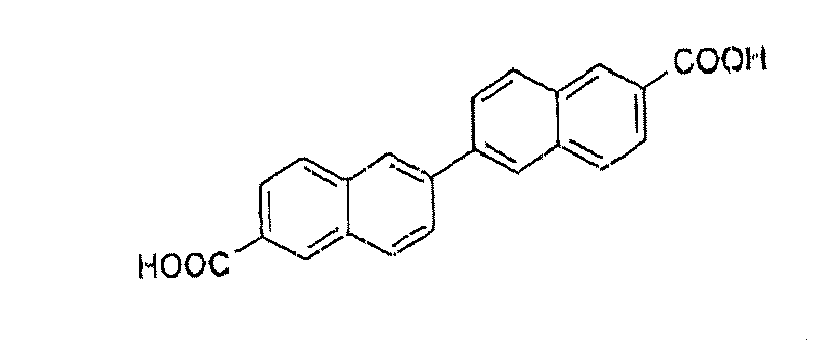
- Another impurity also forms via the transfer of the zinc compound of 2-(1-adamantyl)-4-bromoanisole to methyl 6-bromonaphthoate and the reaction of this novel zinc compound with methyl 6-bromonaphthoate to give the dimerization product having the structure:
- a third impurity forms during the hydrolysis of the reaction medium. Indeed, during this hydrolysis, the unreacted organozinc compound of 2-(1-adamantyl)-4-bromoanisole generates the impurity having the following structure:
- step (b) methyl 6-[3-(1-adamantyl)-4-methoxyphenyl]-2-naphthoate is saponified by treating with a base such as sodium hydroxide (NaOH) or potassium hydroxide (KOH) under reflux in an alcohol such as methanol.
- a base such as sodium hydroxide (NaOH) or potassium hydroxide (KOH) under reflux in an alcohol such as methanol.
- one of the objects of the present invention is to provide a method for preparing 6-[3-(1-adamantyl)-4-methoxyphenyl]-2-naphthoic acid, which is a lot simpler and more economical.
- the method according to the invention should be more suited to an industrial production, more particularly in terms of cost and compliance with Good Manufacturing Practices.
- One of the objectives of the invention is to provide a novel method for preparing compound (I) which does not require in the final stage deprotection of the acid functional group, avoiding the formation of the impurities mentioned above and making it possible to reduce the number of synthesis steps.
- the subject of the present invention is a method for preparing 6-[3-(1-adamantyl)-4-methoxyphenyl]-2-naphthoic acid of formula (I): by a single-step Suzuki reaction between 3-adamantyl-4-methoxyphenylboronic acid of formula (II): and 6-bromo-2-naphthoic acid of formula (III):
- the subject of the invention is also the use of the compound (II), on the one hand, and the use of the compound (III), on the other hand, for the preparation of the compound of formula (I).
- 6-[3-(1-adamantyl)-4-methoxyphenyl]-2-naphthoic acid (I) is carried out by the Suzuki reaction between 3-adamantyl-4-methoxyphenylboronic acid (II) (prepared in particular according to a method similar to that described in patent applications WO 02/072009 A2 and WO 03/011808 A1 ) and the commercially available 6-bromo-2-naphthoic acid (III).
- the Suzuki reaction is carried out by coupling between compounds (II) and (III) in the presence of a palladium catalyst and a base, in a polar solvent, followed by an acid treatment.
- the Suzuki reaction may be carried out in the presence of a palladium catalyst such as palladium(II) acetate, tetrakis(triphenylphosphine)-palladium(0), palladium on activated charcoal or dichloro[1,1'-bis(diphenylphosphino)ferrocene]-palladium(II), in an aprotic polar solvent (for example acetonitrile, N,N-dimethylformamide, dimethoxyethane or tetrahydrofuran) or a protic polar solvent (for example n-propanol, i-propanol) or a mixture of these solvents with water.
- a palladium catalyst such as palladium(II) acetate, tetrakis(triphenylphosphine)-palladium(0), palladium on activated charcoal or dichloro[1,1'-bis(diphenylphosphino)ferrocene]-palla
- the volume of solvent used will be between 7 and 13 times the quantity of 6-bromo-2-naphthoic acid (III) used and the volume of water used will be between 7 and 13 times the quantity of 6-bromo-2-naphthoic acid (III) used.
- the palladium catalyst may contain a ligand chosen from: a triphenylphosphine, a tri-o-tolylphosphine, a tri-m-tolylphosphine or a tri-p-tolylphosphine.
- the catalysts particularly preferred are palladium(II) acetate and palladium on carbon which make it possible to obtain a particularly fast reaction kinetics.
- Palladium(II) acetate may be advantageously used in combination with a 2-(dicyclohexylphosphino)-biphenyl type ligand ( J.P. Wolfe et al., J. Am. Chem. Soc., 1999, 121, 9550-9561 ).
- These catalysts may also be encapsulated, like for example the Pd EnCatTM type catalysts.
- the reaction is generally carried out in the presence of an inorganic base such as potassium carbonate, sodium carbonate, caesium carbonate, sodium hydroxide or potassium hydroxide or in the presence of a tertiary amine such as triethylamine or diisopropylethylamine.
- the particularly preferred bases are potassium carbonate, potassium hydroxide and diisopropylethylamine.
- the Suzuki reaction is preferably carried out under an inert atmosphere, for example under an argon or nitrogen atmosphere.
- the reaction mixture is advantageously heated at a temperature in the range from 60° to 110°C, for 30 minutes to 24 hours.
- a treatment in an acidic medium, for example in the presence of HCl, is carried out.
- the kinetics of the reaction is very rapid and is complete within two hours.
- Persons skilled in the art will be able to modify these conditions, in particular by applying the variants of the Suzuki reaction which are described in the literature ( N. Miyaura & A. Suzuki, Chem. Rev., 1995, 95, 2457-2483 ; A. Suzuki, J. Organomet. Chem., 1999, 576, 147-168 ).
- the method according to the invention is therefore simple and economical and makes it possible to directly obtain compound (I) with a high yield, close to quantitative.
- This new method also makes it possible to obtain 6-[3-(1-adamantyl)-4-methoxyphenyl]-2-naphthoic acid with a high degree of purity in which the impurities obtained in the prior art method are completely absent.
- the following preparations illustrate the method of the invention.
- aqueous phase is extracted with ethyl acetate and the combined organic phases are washed with 1 litre of saturated NaCl, and then with 1 litre of water.
- the organic phases are dried over sodium sulphate and the solvents are evaporated.
- 88.37 g of a white solid are obtained, which solid is reimpasted in 440 mL of heptane.
- the precipitate obtained is rinsed with heptane, and then dried under reduced pressure at 35°C until a constant weight is obtained.
- the catalyst After returning to room temperature, the catalyst is filtered on a cartridge, and then slowly poured over 30 ml of a 1 N aqueous hydrochloric acid solution.
- the solution obtained is poured over the reaction medium.
- the addition is exothermic.
- the reaction medium reaches the reflux temperature.
- the reflux is maintained for about 2 hours.
- reaction medium is filtered at about 35-40°C on a cartridge and rinsed with 400 ml of a THF/water mixture (1/1).
- the medium is cooled to 20°C and 100 ml of HCl at 35% in 600 ml of water are added. 6-[3-(1-adamantyl)-4-methoxyphenyl]-2-naphthoic acid precipitates. It is filtered and washed with 4 litres of water. The pH of the washings is about 6-7. The product is dried under vacuum at 100°C for 24 hours.
- This crude material is dissolved in 15 to 22 volumes of THF under reflux. After filtration in the hot state, 15 to 22 volumes of heptane are added and the medium is cooled to about 5°C for 1 to 2 hours.
- the 6-[3-(1-adamantyl)-4-methoxyphenyl]-2-naphthoic acid is filtered on sintered glass and it is rinsed with 1 to 2 volumes of heptane.
- the medium is heated under reflux for 8 hours.
- the catalyst is filtered on a cartridge, and then slowly poured over 30 ml of a 1 N aqueous hydrochloric acid solution.
Landscapes
- Chemical & Material Sciences (AREA)
- Organic Chemistry (AREA)
- Chemical Kinetics & Catalysis (AREA)
- Engineering & Computer Science (AREA)
- Oil, Petroleum & Natural Gas (AREA)
- Organic Low-Molecular-Weight Compounds And Preparation Thereof (AREA)
- Low-Molecular Organic Synthesis Reactions Using Catalysts (AREA)
Abstract
Description
- The present invention relates to a novel method for the manufacture of 6-[3-(1-adamantyl)-4-methoxyphenyl]-2-naphthoic acid of formula (I):

- The compound of formula (I) is described in particular in patent
EP 0 199 636 . PatentEP 0 199 636 describes the preparation of this compound according to the following Scheme 1:

- In this method, 2-(1-adamantyl)-4-bromoanisole is converted, in a first step (a), to its organomagnesium compound, and then to its organozinc compound by the action of zinc chloride (ZnCl2), and is then coupled with methyl 6-bromonaphthoate. This reaction is catalyzed by a transition metal (palladium or nickel) or one of its complexes with various phosphines. The synthesis of 6-[3-(1-adamantyl)-4-methoxyphenyl]-2-naphthoic acid of formula (I), as described in patent
EP 0 199 636 (Scheme 1), is therefore carried out in three steps with a yield of 63%, from 2-adamantyl-4-bromoanisole. - One of the disadvantages of this reaction is the formation of impurities. One of these impurities results from the reaction of the organozinc compound generated "in situ" with 2-adamantyl-4-bromoanisole to give 3,3'-di(1-adamantyl)-4,4'-dimethoxy-1,1'-biphenyl having the following structure:

- Another impurity also forms via the transfer of the zinc compound of 2-(1-adamantyl)-4-bromoanisole to methyl 6-bromonaphthoate and the reaction of this novel zinc compound with methyl 6-bromonaphthoate to give the dimerization product having the structure:

- This product leads, after saponification (step (b)) and acidification (step (c)), to the following impurity:

- A third impurity forms during the hydrolysis of the reaction medium. Indeed, during this hydrolysis, the unreacted organozinc compound of 2-(1-adamantyl)-4-bromoanisole generates the impurity having the following structure:

- At an industrial stage, these impurities are difficult to remove from the finished product and most often require reprocessing by recrystallization.
- Furthermore, some catalysts such as [1,2-bis(diphenylphosphino)ethane]nickel chloride (NiCl2(dppe)) must be prepared separately, adding a step to this method.
- During the coupling reaction in step (a), the acid functional group is protected in methyl ester form. This acid functional group should be regenerated. Thus, in a second step (b), methyl 6-[3-(1-adamantyl)-4-methoxyphenyl]-2-naphthoate is saponified by treating with a base such as sodium hydroxide (NaOH) or potassium hydroxide (KOH) under reflux in an alcohol such as methanol.
- By acidifying the reaction medium with hydrochloric acid, 6-[3-(1-adamantyl)-4-methoxyphenyl]-2-naphthoic acid is obtained in a third step (c). It should also be noted that in this method, the methyl ester of 6-bromo-naphthoic acid should be prepared in one step from the corresponding acid. It can therefore be seen that the prior art method is complex and is not entirely satisfactory.
- In this context, one of the objects of the present invention is to provide a method for preparing 6-[3-(1-adamantyl)-4-methoxyphenyl]-2-naphthoic acid, which is a lot simpler and more economical. The method according to the invention should be more suited to an industrial production, more particularly in terms of cost and compliance with Good Manufacturing Practices. One of the objectives of the invention is to provide a novel method for preparing compound (I) which does not require in the final stage deprotection of the acid functional group, avoiding the formation of the impurities mentioned above and making it possible to reduce the number of synthesis steps.
- In this context, the subject of the present invention is a method for preparing 6-[3-(1-adamantyl)-4-methoxyphenyl]-2-naphthoic acid of formula (I):


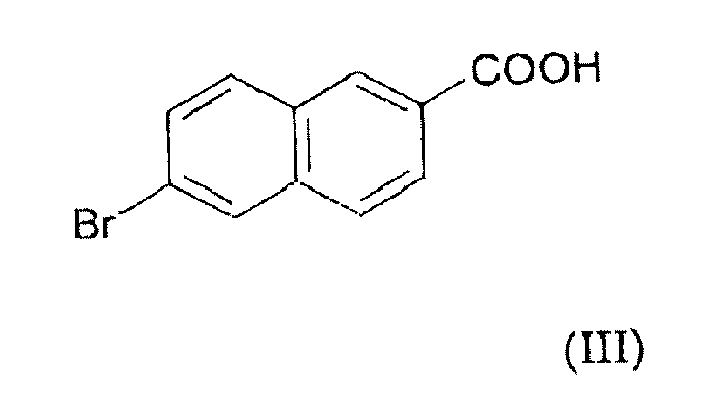
- The subject of the invention is also the use of the compound (II), on the one hand, and the use of the compound (III), on the other hand, for the preparation of the compound of formula (I).
- According to the method of the invention, it is therefore possible to couple in a single step the (1-adamantyl)phenyl part and the naphthyl part of 6-[3-(1-adamantyl)-4-methoxyphenyl]-2-naphthoic acid.
- The preparation of 6-[3-(1-adamantyl)-4-methoxyphenyl]-2-naphthoic acid, according to the method of the invention, is illustrated in Scheme 2 below:

- The preparation of 6-[3-(1-adamantyl)-4-methoxyphenyl]-2-naphthoic acid (I) is carried out by the Suzuki reaction between 3-adamantyl-4-methoxyphenylboronic acid (II) (prepared in particular according to a method similar to that described in patent applications
WO 02/072009 A2 WO 03/011808 A1 EP 0 199 636 ), with a yield which is much higher than that obtained with the prior art method. As shown by the example which follows, the yield of the method according to the invention may be of the order of 95% or higher. - In the context of the invention, the Suzuki reaction is carried out by coupling between compounds (II) and (III) in the presence of a palladium catalyst and a base, in a polar solvent, followed by an acid treatment.
- Typically, the Suzuki reaction may be carried out in the presence of a palladium catalyst such as palladium(II) acetate, tetrakis(triphenylphosphine)-palladium(0), palladium on activated charcoal or dichloro[1,1'-bis(diphenylphosphino)ferrocene]-palladium(II), in an aprotic polar solvent (for example acetonitrile, N,N-dimethylformamide, dimethoxyethane or tetrahydrofuran) or a protic polar solvent (for example n-propanol, i-propanol) or a mixture of these solvents with water. The volume of solvent used will be between 7 and 13 times the quantity of 6-bromo-2-naphthoic acid (III) used and the volume of water used will be between 7 and 13 times the quantity of 6-bromo-2-naphthoic acid (III) used.
- Advantageously, the palladium catalyst may contain a ligand chosen from: a triphenylphosphine, a tri-o-tolylphosphine, a tri-m-tolylphosphine or a tri-p-tolylphosphine. The catalysts particularly preferred are palladium(II) acetate and palladium on carbon which make it possible to obtain a particularly fast reaction kinetics. Palladium(II) acetate may be advantageously used in combination with a 2-(dicyclohexylphosphino)-biphenyl type ligand (J.P. Wolfe et al., J. Am. Chem. Soc., 1999, 121, 9550-9561).
- These catalysts may also be encapsulated, like for example the Pd EnCat™ type catalysts. The reaction is generally carried out in the presence of an inorganic base such as potassium carbonate, sodium carbonate, caesium carbonate, sodium hydroxide or potassium hydroxide or in the presence of a tertiary amine such as triethylamine or diisopropylethylamine. The particularly preferred bases are potassium carbonate, potassium hydroxide and diisopropylethylamine.
- The Suzuki reaction is preferably carried out under an inert atmosphere, for example under an argon or nitrogen atmosphere. The reaction mixture is advantageously heated at a temperature in the range from 60° to 110°C, for 30 minutes to 24 hours. A treatment in an acidic medium, for example in the presence of HCl, is carried out. It will be noted that, according to the conditions used in Examples 1 and 2, the kinetics of the reaction is very rapid and is complete within two hours. Persons skilled in the art will be able to modify these conditions, in particular by applying the variants of the Suzuki reaction which are described in the literature (N. Miyaura & A. Suzuki, Chem. Rev., 1995, 95, 2457-2483; A. Suzuki, J. Organomet. Chem., 1999, 576, 147-168). The method according to the invention is therefore simple and economical and makes it possible to directly obtain compound (I) with a high yield, close to quantitative.
- This new method also makes it possible to obtain 6-[3-(1-adamantyl)-4-methoxyphenyl]-2-naphthoic acid with a high degree of purity in which the impurities obtained in the prior art method are completely absent. The following preparations illustrate the method of the invention.
- 100 g (0.311 mol) of 2-(1-adamantyl)-4-bromoanisole (IV) and 500 ml of THF are introduced, under nitrogen, into a 2 L three-necked reactor. The reaction medium is cooled to -75°C. 137 ml (0.342 mol) of a 2.5 M nBuLi solution are added. After stirring for 1 h at -70°C, 80 ml (0.342 mol) of triisopropyl borate are added. After returning to room temperature, the reaction mixture is hydrolysed with 1 litre of 1.2 N HCl. The aqueous phase is extracted with ethyl acetate and the combined organic phases are washed with 1 litre of saturated NaCl, and then with 1 litre of water. The organic phases are dried over sodium sulphate and the solvents are evaporated. 88.37 g of a white solid are obtained, which solid is reimpasted in 440 mL of heptane. After filtration, the precipitate obtained is rinsed with heptane, and then dried under reduced pressure at 35°C until a constant weight is obtained. 84.4 g of 3-adamantyl-4-methoxyphenylboronic acid are obtained in the form of a white solid - (yield = 94.8%; m.p. = 263°C).
- 1H NMR (CDCl3): δ: 1.77 (s; 6H); 2.10 (m; 3H); 2.20 (s; 6H); 3.91 (s; 3H); 7.00 (d; 1H; J1=8.0 Hz); 8.05 (dxd; 1H; J2=1.5 Hz and J1=8.0 Hz); 8.15 (d; 1H, J2=1.5 Hz)
- 20 mL of tetrahydrofuran (12 vol), 2 g (7 mmol) of 3-adamantyl-4-methoxyphenylboronic acid (II), 1.65 g (6.6 mmol) of 6-bromo-2-naphthoic acid (III) and 20 mL of a 2 M aqueous potassium carbonate solution are introduced into a round-bottomed flask equipped with stirring and under a nitrogen stream. 15 mg (1%) of palladium acetate and 46 mg (2%) of 2-(dicyclohexyl-phosphino)biphenyl are then introduced. The medium is heated under reflux for 2 hours. Kinetic monitoring by HPLC indicates that the % of 6-[3-(1-adamantyl)-4-methoxyphenyl]-2-naphthoic acid formed is 94% after one hour and 98% after 2 h.
- After returning to room temperature, the catalyst is filtered on a cartridge, and then slowly poured over 30 ml of a 1 N aqueous hydrochloric acid solution.
- The medium is kept stirring for one hour. The precipitate is filtered, washed with water and then dried under reduced pressure. 2.68 g of 6-[3-(1-adamantyl)-4-methoxyphenyl]-2-naphthoic acid are obtained in the form of a white solid whose purity, determined by HPLC, is 99.9% (yield = 94.8%; m.p. = 321°C) .
- The following melting points (m.p.) exist in the literature: m.p. = 319°-322°C (B. Charpentier et al., J. Med. Chem., 1995, 38, 4993-5006) and m.p. = 325°-327°C (
EP 0 199 636 ). - 80 g (0.319 mol) of 6-bromo-2-naphthoic acid, 95.7 g (0.335 mol, 1.05 eq) of 3-adamantyl-4-methoxyphenyl-boronic acid, 0.8 g of 5% palladium on carbon (50% wet, Degussa type E105CA/W) and 800 ml of tetrahydrofuran (10 vol) are introduced into a 4 litre reactor. The medium is heated to 55°C. 85 g (1.05 mol, 3.3 eq) of potassium hydroxide at 85% are dissolved in 240 ml of water (3 vol).
- The solution obtained is poured over the reaction medium. The addition is exothermic. The reaction medium reaches the reflux temperature. The reflux is maintained for about 2 hours.
- The reaction medium is filtered at about 35-40°C on a cartridge and rinsed with 400 ml of a THF/water mixture (1/1).
- The medium is cooled to 20°C and 100 ml of HCl at 35% in 600 ml of water are added. 6-[3-(1-adamantyl)-4-methoxyphenyl]-2-naphthoic acid precipitates. It is filtered and washed with 4 litres of water. The pH of the washings is about 6-7. The product is dried under vacuum at 100°C for 24 hours.
- 131 g of 6-[3-(1-adamantyl)-4-methoxyphenyl]-2-naphthoic acid are obtained (crude yield = 99%).
- This crude material is dissolved in 15 to 22 volumes of THF under reflux. After filtration in the hot state, 15 to 22 volumes of heptane are added and the medium is cooled to about 5°C for 1 to 2 hours.
The 6-[3-(1-adamantyl)-4-methoxyphenyl]-2-naphthoic acid is filtered on sintered glass and it is rinsed with 1 to 2 volumes of heptane. - 108 g of 6-[3-(1-adamantyl)-4-methoxyphenyl]-2-naphthoic acid are obtained in the form of a white solid whose purity, determined by HPLC, is 99.9% (yield = 82%; m.p. = 320-322°C).
- 20 ml (12 vol) of tetrahydrofuran, 2 g (7 mmol) of 3-adamantyl-4-methoxyphenylboronic acid (II), 1.65 g (6.6 mmol) of 6-bromo-2-naphthoic acid (III) and 20 mL of a 2 M aqueous potassium carbonate solution are introduced into a round-bottomed flask equipped with stirring and under a nitrogen stream. 0.7 g (5%) of 10% palladium on carbon (50% wet; Heraeus type K-0218) is then introduced.
- The medium is heated under reflux for 8 hours. The catalyst is filtered on a cartridge, and then slowly poured over 30 ml of a 1 N aqueous hydrochloric acid solution.
- The medium is kept stirring for one hour. The precipitate is filtered, washed with water and then dried under reduced pressure. 2.06 g of 6-[3-(1-adamantyl)-4-methoxyphenyl]-2-naphthoic acid are obtained in the form of a white solid whose purity, determined by HPLC, is 99.9% (yield = 79%; m.p. = 321°C).
Claims (4)
- 6-[3-(1-adamantyl)-4-methoxyphenyl]-2-naphtoic acid prepared by a Suzuki reaction between 3-adamantyl -4-methoxyphenyl boronic acid and 6-bromo-2-naphtoic acid essentially free of the impurity of formula
- 6-[3-(1-adamantyl)-4-methoxyphenyl]-2-naphtoic acid prepared by a Suzuki reaction between 3-adamantyl -4-methoxyphenyl boronic acid and 6-bromo-2-naphtoic acid essentially free of the impurity of formula

- 6-[3-(1-adamantyl)-4-methoxyphenyl]-2-naphtoic acid prepared by a Suzuki reaction between 3-adamantyl -4-methoxyphenyl boronic acid and 6-bromo-2-naphtoic acid essentially free of the impurity of formula

- 6-[3-(1-adamantyl)-4-methoxyphenyl]-2-naphtoic acid prepared by a Suzuki reaction between 3-adamantyl -4-methoxyphenyl boronic acid and 6-bromo-2-naphtoic acid characterized in that its purity is at least 99.9%.
Applications Claiming Priority (3)
| Application Number | Priority Date | Filing Date | Title |
|---|---|---|---|
| FR0503522A FR2884248B1 (en) | 2005-04-08 | 2005-04-08 | NOVEL PROCESS FOR THE PREPARATION OF 6- [3- (1-ADAMANTYL) -4-METHOXYPHENYL] -2-NAPHTHOIC ACID |
| US77811206P | 2006-03-01 | 2006-03-01 | |
| EP06742674A EP1868980B1 (en) | 2005-04-08 | 2006-04-06 | New method for the preparation of 6-(3-(1-adamantyl)-4-methoxphenyl)-2-naphthoic acid |
Related Parent Applications (1)
| Application Number | Title | Priority Date | Filing Date |
|---|---|---|---|
| EP06742674.2 Division | 2006-04-06 |
Publications (1)
| Publication Number | Publication Date |
|---|---|
| EP2210869A1 true EP2210869A1 (en) | 2010-07-28 |
Family
ID=36956144
Family Applications (2)
| Application Number | Title | Priority Date | Filing Date |
|---|---|---|---|
| EP10155686A Withdrawn EP2210869A1 (en) | 2005-04-08 | 2006-04-06 | New method for the preparation of 6-[3-(1-adamantyl)-4-methoxyphenyl]-2-naphthoic acid |
| EP06742674A Expired - Lifetime EP1868980B1 (en) | 2005-04-08 | 2006-04-06 | New method for the preparation of 6-(3-(1-adamantyl)-4-methoxphenyl)-2-naphthoic acid |
Family Applications After (1)
| Application Number | Title | Priority Date | Filing Date |
|---|---|---|---|
| EP06742674A Expired - Lifetime EP1868980B1 (en) | 2005-04-08 | 2006-04-06 | New method for the preparation of 6-(3-(1-adamantyl)-4-methoxphenyl)-2-naphthoic acid |
Country Status (12)
| Country | Link |
|---|---|
| EP (2) | EP2210869A1 (en) |
| JP (1) | JP5155148B2 (en) |
| KR (1) | KR101280779B1 (en) |
| AT (1) | ATE475638T1 (en) |
| AU (1) | AU2006233810B2 (en) |
| CA (1) | CA2603690A1 (en) |
| CY (1) | CY1111242T1 (en) |
| DE (1) | DE602006015788D1 (en) |
| MX (1) | MX2007012492A (en) |
| PL (1) | PL1868980T3 (en) |
| RU (1) | RU2414449C2 (en) |
| WO (1) | WO2006108717A2 (en) |
Families Citing this family (5)
| Publication number | Priority date | Publication date | Assignee | Title |
|---|---|---|---|---|
| WO2007072217A2 (en) * | 2005-06-17 | 2007-06-28 | Medichem, S.A. | Process for the preparation of adapalene and related compounds |
| WO2007063522A1 (en) * | 2005-12-02 | 2007-06-07 | Finorga Sas | Process for the preparation of aromatic derivatives of 1-adamantane |
| WO2007063523A1 (en) * | 2005-12-02 | 2007-06-07 | Finorga Sas | Intermediates and process for the preparation of aromatic derivatives of 1-adamantane |
| WO2008126104A2 (en) * | 2007-04-11 | 2008-10-23 | Indoco Remedies Limited | Novel process for preparation of adapalene |
| CN115124490B (en) * | 2022-07-11 | 2023-08-01 | 江西理工大学 | Rigid polydentate tetracarboxylic acid organic ligand with thiadiazole functional group for preparing metal organic framework and preparation method thereof |
Citations (3)
| Publication number | Priority date | Publication date | Assignee | Title |
|---|---|---|---|---|
| EP0199636A1 (en) | 1985-04-11 | 1986-10-29 | CENTRE INTERNATIONAL DE RECHERCHES DERMATOLOGIQUES C.I.R.D. Groupement d'Intérêt Economique dit: | Benzonaphthalenic derivatives, process for their preparation and their use in pharmacy and cosmetics |
| WO2002072009A2 (en) | 2001-03-07 | 2002-09-19 | Maxia Pharmaceuticals, Inc. | Heterocyclic derivatives for the treatment of cancer and other proliferative diseases |
| WO2003011808A1 (en) | 2001-07-31 | 2003-02-13 | Sigma-Tau Industrie Farmaceutiche Riunite S.P.A. | Retinoid derivatives with antiangiogenic, antitumoral and proapoptotic activities |
Family Cites Families (6)
| Publication number | Priority date | Publication date | Assignee | Title |
|---|---|---|---|---|
| FR2753626B1 (en) * | 1996-09-20 | 1998-11-06 | Centre International De Rech Dermatologiques Galderma Cird Galderma | NOVEL TOPICAL COMPOSITIONS IN THE FORM OF A FLUID O / W EMULSION WITH A HIGH PRO-PENETRATING GLYCOL CONTENT |
| JP4028612B2 (en) * | 1997-01-06 | 2007-12-26 | エア・ウォーター・ケミカル株式会社 | Method for producing 6-bromo-2-naphthalenecarboxylic acid methyl ester |
| AU2003202994B2 (en) * | 2002-01-18 | 2007-11-22 | Merck Sharp & Dohme Corp. | N-(benzyl)aminoalkylcarboxylates, phosphinates, phosphonates and tetrazoles as Edg receptor agonists |
| GB0225548D0 (en) * | 2002-11-01 | 2002-12-11 | Glaxo Group Ltd | Compounds |
| WO2005108338A1 (en) * | 2004-05-03 | 2005-11-17 | Auspex Pharmaceuticals | Novel therapeutic agents for the treatment of cancer, metabolic diseases and skin disorders |
| CN1696100B (en) * | 2005-06-01 | 2010-11-24 | 黑龙江福和华星制药集团股份有限公司 | A novel and simple synthesis method of adapalene, an acne treatment drug |
-
2006
- 2006-04-06 KR KR1020077022968A patent/KR101280779B1/en not_active Expired - Fee Related
- 2006-04-06 JP JP2008504711A patent/JP5155148B2/en not_active Expired - Fee Related
- 2006-04-06 AT AT06742674T patent/ATE475638T1/en active
- 2006-04-06 EP EP10155686A patent/EP2210869A1/en not_active Withdrawn
- 2006-04-06 EP EP06742674A patent/EP1868980B1/en not_active Expired - Lifetime
- 2006-04-06 WO PCT/EP2006/003790 patent/WO2006108717A2/en not_active Ceased
- 2006-04-06 RU RU2007141301/04A patent/RU2414449C2/en active
- 2006-04-06 AU AU2006233810A patent/AU2006233810B2/en not_active Ceased
- 2006-04-06 DE DE602006015788T patent/DE602006015788D1/en not_active Expired - Lifetime
- 2006-04-06 PL PL06742674T patent/PL1868980T3/en unknown
- 2006-04-06 MX MX2007012492A patent/MX2007012492A/en active IP Right Grant
- 2006-04-06 CA CA002603690A patent/CA2603690A1/en not_active Abandoned
-
2010
- 2010-09-23 CY CY20101100853T patent/CY1111242T1/en unknown
Patent Citations (3)
| Publication number | Priority date | Publication date | Assignee | Title |
|---|---|---|---|---|
| EP0199636A1 (en) | 1985-04-11 | 1986-10-29 | CENTRE INTERNATIONAL DE RECHERCHES DERMATOLOGIQUES C.I.R.D. Groupement d'Intérêt Economique dit: | Benzonaphthalenic derivatives, process for their preparation and their use in pharmacy and cosmetics |
| WO2002072009A2 (en) | 2001-03-07 | 2002-09-19 | Maxia Pharmaceuticals, Inc. | Heterocyclic derivatives for the treatment of cancer and other proliferative diseases |
| WO2003011808A1 (en) | 2001-07-31 | 2003-02-13 | Sigma-Tau Industrie Farmaceutiche Riunite S.P.A. | Retinoid derivatives with antiangiogenic, antitumoral and proapoptotic activities |
Non-Patent Citations (4)
| Title |
|---|
| A. SUZUKI, J. ORGANOMET. CHEM., vol. 576, 1999, pages 147 - 168 |
| B. CHARPENTIER ET AL., J. MED. CHEM., vol. 38, 1995, pages 4993 - 5006 |
| J.P. WOLFE ET AL., J. AM. CHEM. SOC., vol. 121, 1999, pages 9550 - 9561 |
| N. MIYAURA; A. SUZUKI, CHEM. REV., vol. 95, 1995, pages 2457 - 2483 |
Also Published As
| Publication number | Publication date |
|---|---|
| EP1868980A2 (en) | 2007-12-26 |
| CA2603690A1 (en) | 2006-10-19 |
| JP5155148B2 (en) | 2013-02-27 |
| KR101280779B1 (en) | 2013-07-05 |
| WO2006108717A2 (en) | 2006-10-19 |
| AU2006233810B2 (en) | 2011-02-17 |
| PL1868980T3 (en) | 2011-01-31 |
| EP1868980B1 (en) | 2010-07-28 |
| DE602006015788D1 (en) | 2010-09-09 |
| CY1111242T1 (en) | 2015-06-11 |
| MX2007012492A (en) | 2007-12-06 |
| WO2006108717A3 (en) | 2006-12-21 |
| KR20070118244A (en) | 2007-12-14 |
| ATE475638T1 (en) | 2010-08-15 |
| RU2414449C2 (en) | 2011-03-20 |
| HK1122012A1 (en) | 2009-05-08 |
| RU2007141301A (en) | 2009-05-20 |
| AU2006233810A1 (en) | 2006-10-19 |
| JP2008534643A (en) | 2008-08-28 |
Similar Documents
| Publication | Publication Date | Title |
|---|---|---|
| JPH0251908B2 (en) | ||
| EP1868980B1 (en) | New method for the preparation of 6-(3-(1-adamantyl)-4-methoxphenyl)-2-naphthoic acid | |
| CA2719068C (en) | Catalyzed carbonylation in the synthesis of angiotensin ii antagonists | |
| KR20090055638A (en) | Method for preparing 2,5-bis- (2,2,2-trifluoroethoxy) -N- (2-piperidylmethyl) benzamide and its salts | |
| CA2541370C (en) | A process for the preparation of adapalene | |
| US7498461B2 (en) | Method for the preparation of 6-[3-(1-adamantyl)-4-methoxyphenyl]-2-naphthoic acid | |
| CN1225356A (en) | Synthetic method of 1-[2-amino-1-(P-methoxybenzyl) ethyl] cyclohexanol | |
| HK1122012B (en) | New method for the preparation of 6-(3-(1-adamantyl)-4-methoxphenyl)-2-naphthoic acid | |
| JP3903213B2 (en) | Method for producing 4-biphenylylacetic acid | |
| WO2008126104A2 (en) | Novel process for preparation of adapalene | |
| ZA200210300B (en) | Process for the preparation of trifluoroethoxy-substituted benzoic acids. | |
| JP3792030B2 (en) | Method for producing 4-biphenylylacetic acid | |
| ITMI990749A1 (en) | METHOD FOR THE SYNTHESIS OF DERIVATIVES OF 2-4-METHYLPHENYL BENZOIC ACID | |
| CN101993413B (en) | Method for preparing 4-pyridine propyl alcohol | |
| CN119330876A (en) | A kind of preparation method of Flupyroxystrobin | |
| JPH04208241A (en) | Production of fluorophenols | |
| WO2007063523A1 (en) | Intermediates and process for the preparation of aromatic derivatives of 1-adamantane | |
| JPH0753428A (en) | Method for producing 4,4 ""-dihydroxyquarterphenyl or derivative thereof | |
| JPS60190768A (en) | Production of 5-fluorouracil derivative | |
| JP2002322115A (en) | Method for producing 2-phenylacetophenone derivative |
Legal Events
| Date | Code | Title | Description |
|---|---|---|---|
| PUAI | Public reference made under article 153(3) epc to a published international application that has entered the european phase |
Free format text: ORIGINAL CODE: 0009012 |
|
| AC | Divisional application: reference to earlier application |
Ref document number: 1868980 Country of ref document: EP Kind code of ref document: P |
|
| AK | Designated contracting states |
Kind code of ref document: A1 Designated state(s): AT BE BG CH CY CZ DE DK EE ES FI FR GB GR HU IE IS IT LI LT LU LV MC NL PL PT RO SE SI SK TR |
|
| AX | Request for extension of the european patent |
Extension state: AL BA HR MK YU |
|
| STAA | Information on the status of an ep patent application or granted ep patent |
Free format text: STATUS: THE APPLICATION IS DEEMED TO BE WITHDRAWN |
|
| 18D | Application deemed to be withdrawn |
Effective date: 20110129 |