EP2209616B1 - Multiwall polymer sheet comprising branched polycarbonate - Google Patents
Multiwall polymer sheet comprising branched polycarbonate Download PDFInfo
- Publication number
- EP2209616B1 EP2209616B1 EP08850372.7A EP08850372A EP2209616B1 EP 2209616 B1 EP2209616 B1 EP 2209616B1 EP 08850372 A EP08850372 A EP 08850372A EP 2209616 B1 EP2209616 B1 EP 2209616B1
- Authority
- EP
- European Patent Office
- Prior art keywords
- equal
- multiwall sheet
- sheet
- multiwall
- branched polycarbonate
- Prior art date
- Legal status (The legal status is an assumption and is not a legal conclusion. Google has not performed a legal analysis and makes no representation as to the accuracy of the status listed.)
- Active
Links
Images


Classifications
-
- E—FIXED CONSTRUCTIONS
- E04—BUILDING
- E04C—STRUCTURAL ELEMENTS; BUILDING MATERIALS
- E04C2/00—Building elements of relatively thin form for the construction of parts of buildings, e.g. sheet materials, slabs, or panels
- E04C2/54—Slab-like translucent elements
- E04C2/543—Hollow multi-walled panels with integrated webs
-
- Y—GENERAL TAGGING OF NEW TECHNOLOGICAL DEVELOPMENTS; GENERAL TAGGING OF CROSS-SECTIONAL TECHNOLOGIES SPANNING OVER SEVERAL SECTIONS OF THE IPC; TECHNICAL SUBJECTS COVERED BY FORMER USPC CROSS-REFERENCE ART COLLECTIONS [XRACs] AND DIGESTS
- Y10—TECHNICAL SUBJECTS COVERED BY FORMER USPC
- Y10T—TECHNICAL SUBJECTS COVERED BY FORMER US CLASSIFICATION
- Y10T428/00—Stock material or miscellaneous articles
- Y10T428/24—Structurally defined web or sheet [e.g., overall dimension, etc.]
- Y10T428/24174—Structurally defined web or sheet [e.g., overall dimension, etc.] including sheet or component perpendicular to plane of web or sheet
- Y10T428/24182—Inward from edge of web or sheet
-
- Y—GENERAL TAGGING OF NEW TECHNOLOGICAL DEVELOPMENTS; GENERAL TAGGING OF CROSS-SECTIONAL TECHNOLOGIES SPANNING OVER SEVERAL SECTIONS OF THE IPC; TECHNICAL SUBJECTS COVERED BY FORMER USPC CROSS-REFERENCE ART COLLECTIONS [XRACs] AND DIGESTS
- Y10—TECHNICAL SUBJECTS COVERED BY FORMER USPC
- Y10T—TECHNICAL SUBJECTS COVERED BY FORMER US CLASSIFICATION
- Y10T428/00—Stock material or miscellaneous articles
- Y10T428/24—Structurally defined web or sheet [e.g., overall dimension, etc.]
- Y10T428/24628—Nonplanar uniform thickness material
- Y10T428/24661—Forming, or cooperating to form cells
-
- Y—GENERAL TAGGING OF NEW TECHNOLOGICAL DEVELOPMENTS; GENERAL TAGGING OF CROSS-SECTIONAL TECHNOLOGIES SPANNING OVER SEVERAL SECTIONS OF THE IPC; TECHNICAL SUBJECTS COVERED BY FORMER USPC CROSS-REFERENCE ART COLLECTIONS [XRACs] AND DIGESTS
- Y10—TECHNICAL SUBJECTS COVERED BY FORMER USPC
- Y10T—TECHNICAL SUBJECTS COVERED BY FORMER US CLASSIFICATION
- Y10T428/00—Stock material or miscellaneous articles
- Y10T428/24—Structurally defined web or sheet [e.g., overall dimension, etc.]
- Y10T428/24744—Longitudinal or transverse tubular cavity or cell
-
- Y—GENERAL TAGGING OF NEW TECHNOLOGICAL DEVELOPMENTS; GENERAL TAGGING OF CROSS-SECTIONAL TECHNOLOGIES SPANNING OVER SEVERAL SECTIONS OF THE IPC; TECHNICAL SUBJECTS COVERED BY FORMER USPC CROSS-REFERENCE ART COLLECTIONS [XRACs] AND DIGESTS
- Y10—TECHNICAL SUBJECTS COVERED BY FORMER USPC
- Y10T—TECHNICAL SUBJECTS COVERED BY FORMER US CLASSIFICATION
- Y10T428/00—Stock material or miscellaneous articles
- Y10T428/24—Structurally defined web or sheet [e.g., overall dimension, etc.]
- Y10T428/24942—Structurally defined web or sheet [e.g., overall dimension, etc.] including components having same physical characteristic in differing degree
- Y10T428/2495—Thickness [relative or absolute]
-
- Y—GENERAL TAGGING OF NEW TECHNOLOGICAL DEVELOPMENTS; GENERAL TAGGING OF CROSS-SECTIONAL TECHNOLOGIES SPANNING OVER SEVERAL SECTIONS OF THE IPC; TECHNICAL SUBJECTS COVERED BY FORMER USPC CROSS-REFERENCE ART COLLECTIONS [XRACs] AND DIGESTS
- Y10—TECHNICAL SUBJECTS COVERED BY FORMER USPC
- Y10T—TECHNICAL SUBJECTS COVERED BY FORMER US CLASSIFICATION
- Y10T428/00—Stock material or miscellaneous articles
- Y10T428/24—Structurally defined web or sheet [e.g., overall dimension, etc.]
- Y10T428/24942—Structurally defined web or sheet [e.g., overall dimension, etc.] including components having same physical characteristic in differing degree
- Y10T428/24992—Density or compression of components
Definitions
- polymer sheeting exhibits excellent impact resistance compared to glass. This in turn reduces maintenance costs in applications wherein occasional breakage caused by vandalism, hail, contraction/expansion, and so forth, is encountered.
- Another benefit of polymer sheeting is a significant reduction in weight compared to glass. This makes polymer sheeting easier to install than glass and reduces the load-bearing requirements of the structure on which they are installed.
- polymer sheeting provides improved insulative properties compared to glass. This characteristic significantly affects the overall market acceptance of polymer sheeting as consumers desire a structural element with improved efficiency to reduce heating and/or cooling costs.
- a multiwall sheet comprises: main layers and transverse walls.
- the multiwall sheet having a total thickness of greater than or equal to about 45 mm, a weight of greater than or equal to about 4.5 kg/m 2 , and/or greater than or equal to 8 cells and a U-value of less than or equal to about 1.2 W/m 2 K.
- the multiwall sheet further comprises greater than 75 wt% branched polycarbonate resin, based upon the total weight of the sheet.
- a multiwall sheet comprises: main layers, transverse walls, and dividers.
- the multiwall sheet comprises a total thickness of greater than or equal to about 45 mm, and greater than 75 wt% branched polycarbonate resin, based upon the total weight of the sheet.
- a multiwall sheet comprises: main layers, transverse walls, and dividers.
- the multiwall sheet comprises a weight of greater than or equal to about 4.5 kg/m 2 , and greater than 75 wt% branched polycarbonate resin, based upon the total weight of the sheet.
- a multiwall sheet comprises: main layers, transverse walls, and dividers.
- the multiwall sheet comprises greater than or equal to 8 cells, a U-value of less than or equal to about 1.2 W/m 2 K, and greater than 75 wt% branched polycarbonate resin, based upon the total weight of the sheet.
- the method of making a multiwall sheet comprises extruding a sheet comprising main layers and transverse walls.
- the multiwall sheet has a total thickness of greater than or equal to 45 mm, a weight of greater than or equal to 4.5 kg/m 2 , and/or greater than or equal to 8 cells and a U-value of less than or equal to 1.2 W/m 2 K.
- the multiwall sheet further comprises greater than 75 wt% branched polycarbonate resin, based upon the total weight of the sheet.
- branched polycarbonate a straight sheet having: a total thickness of greater than or equal to about 45 mm, a weight of greater than or equal to about 4.5 kg/m 2 , and/or greater than or equal to 8 cells and a U-value of less than or equal to about 1.2 W/m 2 K, can be produced.
- the multiwall sheet can comprise main layers and transverse walls.
- the multiwall sheet can have a total thickness of greater than or equal to 45 mm, a weight of greater than or equal to 4.5 kg/m 2 , and/or greater than or equal to 8 cells and a U-value of less than or equal to 1.2 W/m 2 K; as well as greater than 75 wt% branched polycarbonate resin, based upon a total weight of the multiwall sheet.
- This multiwall sheet can vary by less than or equal to about 2% from an average total thickness, and wherein the average total thickness is determined over an area of 1,200 mm width by 4,200 mm long using at least 10 data points across the width, and/or adjacent main layers can vary by less than or equal to about 20% from an average adjacent layer average thickness wherein the average adjacent layer thickness is determined over an area of the adjacent layers of 1,200 mm width by 4,200 mm long using at least 10 data points across the width.
- the sheet varies by less than or equal to about 1.25% from the average total thickness, and/or the adjacent main layers vary by less than or equal to about 15% from the average adjacent layer average thickness.
- the total thickness of the sheet can be greater than or equal to 50 mm
- the weight of the sheet can be about 4.5 kg/m 2 to about 6.0 kg/m 2
- the sheet can comprise greater than or equal to 10 cells and the U-value is less than or equal to 1.2 W/m 2 K.
- the branching agent can be chosen from phloroglucin; phloroglucid; 1,1,1 -tri(4-hydroxyphenyl)ethane; trimellitic acid; trimellitic trichloride; pyromellitic acid; benzophenonetetracarboxylic acid and acid chlorides thereof; 2,6-bis(2-hydroxy-5-methylbenzyl)-4-methylphenol and 1,3,5-tri (4-hydroxyphenyl)benzene, and combinations comprising at least one of the foregoing branching agents, e.g., 1,1,1 -tri(4-hydroxyphenyl)ethane and/or trimellitic trichloride.
- the branched polycarbonate can comprise greater than or equal to 0.3 mol% branching, based upon 100 moles of branched polycarbonate, or, specficially, about 0.3 mol% to about 0.5 mol% branching, based upon 100 moles of branched polycarbonate.
- the weight can be greater than or equal to about 5.0 kg/m 2
- the multiwall sheet comprises 98 wt% branched polycarbonate resin.
- a method for producing a multiwall sheet comprises: extruding polycarbonate resin to form the multiwall sheet having main layers and transverse walls.
- the multiwall sheet can have a total thickness of greater than or equal to 45 mm, a weight of greater than or equal to 4.5 kg/m 2 , and/or greater than or equal to 8 cells and a U-value of less than or equal to 1.2 W/m 2 K; and greater than 75 wt% branched polycarbonate resin, based upon a total weight of the multiwall sheet.
- the multiwall sheet comprises greater than 75 wt% branched polycarbonate resin, or specifically, greater than or equal to about 85 wt% branched polycarbonate resin, or more specifically, greater than or equal to about 90 wt% branched polycarbonate resin, and yet more specifically, about 98 wt% branched polycarbonate resin, based upon a total weight of the sheet, with, for example, greater than or equal to about 0.3 mole% branching.
- the sheet has a total thickness of greater than or equal to about 45 millimeters (mm); a weight of greater than or equal to about 4.5 kilograms per square meter (kg/m 2 ); and/or greater than or equal to 8 cells (e.g., greater than or equal to five horizontal layers and greater than or equal to four dividers) and a U-value of less than or equal to about 1.2 watts per square meter Kelvin (W/m 2 K).
- the multiwall sheet can comprise sufficient horizontal walls and transverse walls (e.g., walls that intersect the horizontal walls), and dividers (walls that split the areas formed between adjacent horizontal walls and transverse walls) to produce greater than or equal to 8 cells (e.g., air channels, liquid reservoirs, and so forth), or, specifically, greater than or equal to 10 cells, or, more specifically, greater than or equal to 14 cells, and, yet more specifically, greater than or equal to 18 cells.
- the number of cell is the amount of cells located between the outerwalls and adjacent traverse walls. For example, referring to Figure 1 , there are 8 cells located between outerwalls 2,4, and adjacent transverse walls 9,11.
- the sheet has a sufficient number of transverse layers to attain the desired structural integrity.
- dividers can be employed.
- the dividers can have various geometries such as vertical (e.g., perpendicular), horizontal, a cross (e.g., X) geometry, a sinusoidal geometry, as well as any other geometry and combinations comprising at least one of these geometries.
- the U-value is the amount of thermal energy that passes across 1 square meter of the sheet 2 at a temperature difference between both sheet sides of 1 °K.
- the U-value can be determined according to EN 675 and Deutches Institute fur Normung ("DIN”) European Norm (“EN”) 12667/12664.
- the U-value is calculated according to the following Formula (I): 1
- the multiwall sheet generally has defects. These defects can include unevenly divided air channels, broken rib(s), non-straight rib(s), collapsed rib(s), and so forth.
- these wall(s) comprise greater than or equal to about 90 wt% branched polycarbonate resin, and particularly about 100 wt% branched polycarbonate (based upon the total weight of the multiwall sheet), the defects are reduced and often eliminated. In other words, the multiwall sheet can be produced within specifications.
- the specific polymer chosen will be capable of providing sufficient light transmission for the intended application.
- the polymer can provide a transmission of visible light of greater than or equal to about 40%, or, more specifically, greater than or equal to about 45%, even more specifically, greater than or equal to about 50%, as tested per EN9050 ASTM D1003 00 (Procedure B,
- composition of the multiwall sheet comprises branched polycarbonate.
- Polycarbonates as used herein include homopolycarbonates, copolymers comprising different R 1 moieties in the carbonate (referred to herein as “copolycarbonates”), copolymers comprising carbonate units and other types of polymer units, such as ester units, and combinations comprising at least one of homopolycarbonates and copolycarbonates; wherein the term “polycarbonate” means compositions having repeating structural carbonate units of Formula (1): in which at least about 60 percent of the total number of R 1 groups contain aromatic moities and the balance thereof are aliphatic, alicyclic, or aromatic.
- each R 1 is a C 6-30 aromatic group, that is, contains at least one aromatic moiety.
- R 1 can be derived from a dihydroxy compound of the formula HO-R 1 -OH, in particular of Formula (2): HO-A 1 -Y 1 -A 2 -OH (2) wherein each of A 1 and A 2 is a monocyclic divalent aromatic group and Y 1 is a single bond or a bridging group having one or more atoms that separate A 1 from A 2 . In an exemplary embodiment, one atom separates A 1 from A 2 .
- each R 1 can be derived from a dihydroxy aromatic compound of Formula (3) wherein R a and R b each represent a halogen or C 1-12 alkyl group and can be the same or different; and p and q are each independently integers of 0 to 4. It will be understood that R a is hydrogen when p is 0, and likewise R b is hydrogen when q is 0. Also in formula (3), X a represents a bridging group connecting the two hydroxy-substituted aromatic groups, where the bridging group and the hydroxy substituent of each C 6 arylene group are disposed ortho, meta, or para (specifically para) to each other on the C 6 arylene group.
- the bridging group X a is single bond, -O-, -S-, -S(O)-, -S(O) 2 -, -C(O)-, or a C 1-18 organic group.
- the C 1-18 organic bridging group can be cyclic or acyclic, aromatic or non-aromatic, and can further comprise heteroatoms such as halogens, oxygen, nitrogen, sulfur, silicon, or phosphorous.
- the C 1-18 organic group can be disposed such that the C 6 arylene groups connected thereto are each connected to a common alkylidene carbon or to different carbons of the C 1-18 organic bridging group.
- p and q is each 1, and R a and R b are each a C 1-3 alkyl group, specifically methyl, disposed meta to the hydroxy group on each arylene group.
- Exemplary groups of this type include methylene, cyclohexylmethylene, ethylidene, neopentylidene, and isopropylidene, as well as 2-[2.2.1]-bicycloheptylidene, cyclohexylidene, cyclopentylidene, cyclododecylidene, and adamantylidene.
- X a is a substituted cycloalkylidene is the cyclohexylidene-bridged, alkylsubstituted bisphenol of Formula (4) wherein R a' and R b' are each independently C 1-12 alkyl, R g is C 1-12 alkyl or halogen, r and s are each independently 1 to 4, and t is 0 to 10.
- R a' and R b' are disposed meta to the cyclohexylidene bridging group.
- R a' , R b' , and R g may, when comprising an appropriate number of carbon atoms, be straight chain, cyclic, bicyclic, branched, saturated, or unsaturated.
- R a' and R b' are each independently C 1-4 alkyl
- R g is C 1-4 alkyl
- r and s are each 1, and t is 0 to 5.
- R a' , R b' and R g are each methyl, r and s are each 1, and t is 0 or 3.
- the cyclohexylidene-bridged bisphenol can be the reaction product of two moles of o-cresol with one mole of cyclohexanone.
- the cyclohexylidene-bridged bisphenol is the reaction product of two moles of a cresol with one mole of a hydrogenated isophorone (e.g., 1,1,3-trimethyl-3-cyclohexane-5-one).
- a hydrogenated isophorone e.g., 1,1,3-trimethyl-3-cyclohexane-5-one.
- Such cyclohexane-containing bisphenols for example the reaction product of two moles of a phenol with one mole of a hydrogenated isophorone, are useful for making polycarbonate polymers with high glass transition temperatures and high heat distortion temperatures.
- Cyclohexyl bisphenol-containing polycarbonates, or a combination comprising at least one of the foregoing with other bisphenol polycarbonates, are supplied by Bayer Co. under the APEC ® trade name.
- X a is a C 1-18 alkylene group, a C 3-18 cycloalkylene group, a fused C 6-18 cycloalkylene group, or a group of the formula -B 1 -W-B 2 - wherein B 1 and B 2 are the same or different C 1-6 alkylene group and W is a C 3-12 cycloalkylidene group or a C 6-16 arylene group.
- X a can also be a substituted C 3-18 cycloalkylidene of Formula (5): wherein R r , R p , R q , and R t are independently hydrogen, halogen, oxygen, or C 1-12 organic groups; I is a direct bond, a carbon, or a divalent oxygen, sulfur, or -N(Z)- where Z is hydrogen, halogen, hydroxy, C 1-12 alkyl, C 1-12 alkoxy, or C 1-12 acyl; h is 0 to 2, j is 1 or 2, i is an integer of 0 or 1, and k is an integer of 0 to 3, with the proviso that at least two of R r , R p , R q , and R t taken together are a fused cycloaliphatic, aromatic, or heteroaromatic ring.
- R r , R p , R q , and R t are independently hydrogen, halogen, oxygen, or C 1-12 organic groups
- I
- the ring as shown in Formula (5) will have an unsaturated carbon-carbon linkage where the ring is fused.
- the ring as shown in formula (5) contains 4 carbon atoms
- the ring as shown in formula (5) contains 5 carbon atoms
- the ring contains 6 carbon atoms.
- two adjacent groups e.g., R q and R t taken together
- R q and R t taken together form one aromatic group
- R r and R p taken together form a second aromatic group.
- R p can be a double-bonded oxygen atom, i.e., a ketone.
- R h is independently a halogen atom, a C 1-10 hydrocarbyl such as a C 1-10 alkyl group, a halogen-substituted C 1-10 alkyl group, a C 6-10 aryl group, or a halogen-substituted C 6-10 aryl group, and n is 0 to 4.
- the halogen is usually bromine.
- aromatic dihydroxy compounds include the following: 4,4'-dihydroxybiphenyl, 1,6-dihydroxynaphthalene, 2,6-dihydroxynaphthalene, bis(4-hydroxyphenyl)methane, bis(4-hydroxyphenyl)diphenylmethane, bis(4-hydroxyphenyl)-1-naphthylmethane, 1,2-bis(4-hydroxyphenyl)ethane, 1,1-bis(4-hydroxyphenyl)-1-phenylethane, 2-(4-hydroxyphenyl)-2-(3-hydroxyphenyl)propane, bis(4-hydroxyphenyl)phenylmethane, 2,2-bis(4-hydroxy-3-bromophenyl)propane, 1,1-bis (hydroxyphenyl)cyclopentane, 1,1-bis(4-hydroxyphenyl)cyclohexane, 1,1-bis(4-hydroxyphenyl)isobutene, 1,1
- bisphenol compounds of formula (3) include 1,1-bis(4-hydroxyphenyl) methane, 1,1-bis(4-hydroxyphenyl) ethane, 2,2-bis(4-hydroxyphenyl) propane (hereinafter "bisphenol A” or "BPA”), 2,2-bis(4-hydroxyphenyl) butane, 2,2-bis(4-hydroxyphenyl) octane, 1,1-bis(4-hydroxyphenyl) propane, 1,1-bis(4-hydroxyphenyl) n-butane, 2,2-bis(4-hydroxy-1-methylphenyl) propane, 1,1-bis(4-hydroxy-t-butylphenyl) propane, 3,3-bis(4-hydroxyphenyl) phthalimidine, 2-phenyl-3,3-bis(4-hydroxyphenyl) phthalimidine (PPPBP), and 1,1-bis(4-hydroxy-3-methylphenyl)cyclohexane (DMBPC).
- BPA 2,2-bis(4-hydroxyphenyl)
- the polycarbonate is a linear homopolymer derived from bisphenol A, in which each of A 1 and A 2 is p-phenylene and Y 1 is isopropylidene in Formula (3).
- the polycarbonates can have an intrinsic viscosity, as determined in chloroform at 25°C, of about 0.3 to about 1.5 deciliters per gram (dl/gm), specifically about 0.45 to about 1.0 dl/gm.
- the polycarbonates can have a weight average molecular weight (Mw) of about 10,000 grams per mole (g/mol) to about 200,000 g/mol, specifically about 20,000 g/mol to about 100,000 g/mol. Unless set forth otherwise, all weight average molecular weight is as measured by gel permeation chromatography (GPC), using a crosslinked styrene-divinylbenzene column and calibrated to polycarbonate references.
- GPC gel permeation chromatography
- the branched polycarbonate can have a weight average molecular weight of less than or equal to about 75,000 g/mole, or, specifically, about 24,000 g/mol to about 50,000 g/mol, or, more specifically, about 28,000 g/mol to about 35,000 g/mol, and, yet more specifically, about 32,000 g/mol to about 34,000 g/mol.
- the linear polycarbonate e.g., that can be combined with the branched polycarbonate, can have a weight average molecular weight of less than or equal to about 50,000 g/mole, or, specifically, about 20,000 g/mol to about 50,000 g/mol, or, more specifically, about 26,000 g/mol to about 35,000 g/mol, and, yet more specifically, about 28,000 g/mol to about 32,000 g/mol.
- the branched polycarbonate has flow properties useful for the manufacture of thin articles.
- the branched polycarbonate can have a melt index ratio (MIR) of about 1.5 to about 2, or, specifically, about 1.7 to about 1.9, or, more specifically, about 1.75 to about 1.85, over a period of time of greater than or equal to 10 minutes as is determined in accordance with ASTM D1238-04.
- MIR MVR using a 21.6 kg weight and 300 °C
- MVR using a 2.16 kg weight and 300 °C
- Branched polycarbonate blocks can be prepared by adding a branching agent during polymerization.
- branching agents include polyfunctional organic compounds containing at least three functional groups selected from hydroxyl, carboxyl, carboxylic anhydride, haloformyl, and mixtures of the foregoing functional groups.
- trimellitic acid trimellitic anhydride
- trimellitic trichloride trimellitic trichloride
- tris-p-hydroxy phenyl ethane e.g., 1,1,1 -tri(4-hydroxyphenyl)ethane (THPE)
- isatin-bis-phenol tris-phenol TC (1,3,5-tris((p-hydroxyphenyl)isopropyl)benzene); 1,3,5-tri(4-hydroxyphenyl)benzene
- tris-phenol PA (4(4(1,1-bis(p-hydroxyphenyl)-ethyl) alpha, alpha-dimethyl benzyl)phenol); 4-chloroformyl phthalic anhydride; trimesic acid; benzophenone tetracarboxylic acid and acid chlorides thereof; phloroglucin; phloroglucid; 1,1,1 -tri(4-hydroxyphenyl)ethane (THPE); (TMTC);
- the branching agents can be added at a level of less than or equal to about 3.0 wt%, or, specifically, about 0.05 to about 2.0 wt%, based upon a total weight of the polycarbonate precursors.
- the amount of branching agents employed is based upon the desired degree of branching attained in the final branched polycarbonate.
- the branching can be sufficient to attain the desired multiwall sheet (e.g., such as that described and illustrated in relation to Figure 5), while maintaining impact properties, desired light transmission, and processability.
- the branched polycarbonate has greater than or equal to about 0.3 mole percent (mol%) branching, or, specifically, about 0.3 mol% to about 0.5 mol% branching, or, more specifically, about 0.35 mol% to about 0.45 mol% branching, based upon 100 moles of branched polycarbonate.
- the number of layers of the multiwall sheet is dependent upon customer requirements such as structural integrity, overall thickness, light transmission properties, insulative properties, and overall weight.
- the multiwall sheet can comprise horizontal walls and transverse walls, the overall multiwall sheet thickness is greater than or equal to about 45 mm, or, specifically, greater than or equal to about 50 mm, or, more specifically, greater than or equal to about 55 mm, and, yet more specifically, greater than or equal to about 60 mm.
- the overall multiwall sheet thickness (t) can be about 45 mm to about 65 mm. (See Figure 1 )
- the various walls and dividers can have different thicknesses.
- the outer walls can have a greater thickness than the inner walls (e.g., longitudinal layers), while the transverse layers have a thickness between the outer wall thickness and the inner walls thickness.
- the outer walls can have a thickness of about 0.6 mm to about 2 mm, or, specifically, about 0.75 mm to about 1.2 mm, or, yet more specifically, about 0.8 mm to 1.0 mm;
- the inner wall(s) can have a thickness of about 0.05 mm to about 0.30 mm, or, specifically, about 0.075 mm to about 0.15 mm, or, yet more specifically, about 0.075 mm to 0.125 mm;
- the transverse wall(s) can have a thickness of about 0.2 mm to about 1.0 mm, or, specifically, about 0.25 mm to about 0.75 mm, or, yet more specifically, about 0.4 mm to 0.6 mm.
- the outer walls have a thickness that is greater than or equal to about 125% of the transverse wall thickness, while the inner wall have a thickness that is less than or equal to about 50% of the transverse wall thickness.
- Dividers which can have a thickness that is greater than the inner wall thickness, can have a thickness that is less than or equal to about 50% of the transverse wall thickness.
- the dividers can have a thickness of about 0.05 mm to about 0.30 mm, or, specifically, about 0.075 mm to about 0.175 mm, or, yet more specifically, about 0.10 mm to about 0.15 mm
- the multiwall sheet can comprise a weight of greater than or equal to about 4.5 kg/m 2 , or, specifically, greater than or equal to about 5.0 kg/m 2 , or, more specifically, greater than or equal to about 5.5 kg/m 2 .
- the multiwall sheet can have a weight of about 4.5 kg/m 2 to about 6.0 kg/m 2 .
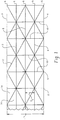
- a portion of a multiwall sheet is illustrated having five main layers 6 comprising outer walls 2,4 and inner walls 8.
- the sheet also has transverse walls 10 and dividers 12.
- the, each wall and divider has a uniform thickness along its length.
- the main layers 6 are disposed parallel to one another while the transverse walls 10 are disposed perpendicular to the main layers 6.
- the dividers 12 bisect the channels 14 formed by the main walls 6 and the transverse walls 10.
- the illustrated multiwall sheet has 5 layers with diagonal dividers 10. This sheet is illustrative of the sheet that is desired in the extrusion process having an overall thickness of 55 mm and a U-value of 1 W/m 2 K.
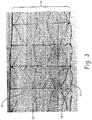
- Figures 2 - 4 illustrate the results of forming the multiwall sheet illustrated in Figure 1 having 9 layers and using different materials (e.g., 100 wt% linear polycarbonate, 75 wt% branched polycarbonate, and 100 wt% branched polycarbonate, respectively, based upon a total weight of the sheet).
- materials e.g., 100 wt% linear polycarbonate, 75 wt% branched polycarbonate, and 100 wt% branched polycarbonate, respectively, based upon a total weight of the sheet).
- a 55 mm, 9 layer multiwall sheet (i.e., 5 main layers and 4 dividers) comprising 100% linear polycarbonate exhibited several of the defects identified above.
- the dividers 12 failed to produce evenly divided channels 14.
- Transverse walls 10 comprised "broken portions" where the wall separated forming a gap, and collapsed portions 18 where the transverse wall 10 was nonlinear, forming a bend, and having a non-uniform thickness along the length of the wall.
- the multiwall sheet of Figure 3 suffers from the same defects as that in Figure 2 .
- the multiwall sheet comprises 75 wt% branched polycarbonate, balance linear polycarbonate.
- this multiwall sheet comprises collapsed portions 18, irregularly shaped bottom wall 20 and inner (e.g., middle) wall 22, and a variation in the thickness 24. As a result of these defects, the quality was unacceptable for commercial use.
- the multiwall sheet of Figure 4 comprising 100 wt% branched polycarbonate (having 0.4 mol% branching), has no collapsed portions (e.g., dividers (ribs), or transverse walls), evenly divided channels, and no breaks in the ribs.
- the vertical ribs can have a constant distance to each other of about 20 mm ⁇ 3 mm and the horizontal ribs can have a constant distance to each other of about 13 mm ⁇ 3 mm.
- the main layers are substantially straight.
- This multiwall sheet had a U-value of 0.95 W/m 2 K; it was acceptable for commercial use.
- “Straightness” as used herein is determined by averaging the thickness (of the whole sheet for the overall straightness, and of adjacent layers to determine the straightness of individual layers). The average is taken over an area of 1,200 mm width by 4,200 mm long. At least 10 data points across the width are used to determine the average. Then, for the overall sheet to be straight, the overall thickness ("t") at any point on the sheet varies by less than or equal to about 2% from the average thickness. For example, if the average thickness is 45 mm, for the sheet to be considered straight, the thickness at any point across the sheet will be 44.1 mm to 45.9 mm.
- the thickness at any point on the sheet varies by less than or equal to about 1.5% from the average thickness, or, specifically, by less than or equal to about 1.25%.
- a straight layer will vary by less than or equal to about 20%.
- adjacent layers vary in thickness ("t 2 ") by less than or equal to about 15%, or, specifically, by less than or equal to about 10%, compared to the average thickness.
- Each channel can contain a fluid (i.e., gas (e.g., air) and/or liquid); e.g., some of the areas of the sheet can be filled with liquid while others can be free of liquid.
- the liquid introduced to the sheet can be any liquid that has the desired transmission properties (e.g., transparent to visible light (for example, has a transmission of greater than or equal to about 95%), and desirably, less transparent (or opaque) to direct solar light), and does not react with the layer material(s).
- Possible liquids include water (e.g., demineralized water, water having a neutral pH (e.g., pH of about 6.5 to about 7.5), as well as combinations comprising at least one of these properties), glycerin, polydimethylsiloxane oil, transparent gels, and so forth, as well as combinations comprising at least one of the foregoing.
- additive(s) can be mixed with the liquid, such as anti-freeze additives (e.g., to prevent freezing in the winter), antimicrobial agents, and so forth, as well as combinations comprising at least one of the foregoing.
- Multiwall sheets having a weight of greater than or equal to 4.5 kg/m 2 a total thickness of greater than or equal to about 45 mm, and/or greater than or equal to 8 cells and a U-value of less than or equal to about 1.2 W/m 2 K will have a variation in thickness of adjacent horizontal layers of greater than 25%, generally greater than 30%, and even up to 45%, compared to the average thickness. With respect to the overall thickness variation, it is greater than 5% compared to the average overall thickness. Such variations are unacceptable for commercial use.
- a multiwall sheet having a weight of greater than or equal to about 4.5 kg/m 2 can be produced with reduced wall warpage, wall breakage, and non-uniform thickness.
Landscapes
- Engineering & Computer Science (AREA)
- Architecture (AREA)
- Civil Engineering (AREA)
- Structural Engineering (AREA)
- Laminated Bodies (AREA)
- Extrusion Moulding Of Plastics Or The Like (AREA)
- Polyesters Or Polycarbonates (AREA)
Description
- In the construction of naturally lit structures (e.g., greenhouses, pool enclosures, conservatories, stadiums, sunrooms, and so forth), glass has been employed in many applications as transparent structural elements, such as, windows, facings, and roofs. However, polymer sheeting is replacing glass in many applications due to several notable benefits.
- One benefit of polymer sheeting is that it exhibits excellent impact resistance compared to glass. This in turn reduces maintenance costs in applications wherein occasional breakage caused by vandalism, hail, contraction/expansion, and so forth, is encountered. Another benefit of polymer sheeting is a significant reduction in weight compared to glass. This makes polymer sheeting easier to install than glass and reduces the load-bearing requirements of the structure on which they are installed.
- In addition to these benefits, one of the most significant advantages of polymer sheeting is that it provides improved insulative properties compared to glass. This characteristic significantly affects the overall market acceptance of polymer sheeting as consumers desire a structural element with improved efficiency to reduce heating and/or cooling costs.
- With current global warming issues, insulation properties of the polymer sheeting are getting more and more important. The trend is to go to higher gauges and multiple layers (e.g., five and more) with air channels in between the layers; all to create a lower U-value (insulation), to save on energy consumption, and thus result in less carbon dioxide (CO2) pollution.
- During the production and scale up of these sheets with higher gauges, a processing problem was observed. The heat in the multiwall sheet cannot be sufficiently reduced and/or removed, in the calibrator zone of the extrusion process, resulting in the production of out of specification material with collapsed ribs and/or other issues.
- Hence, there is a continuing need for multiwall sheets with reduced collapsed ribs and a process to produce the same.
- Disclosed herein are multiwall sheets and methods for making the same. In one embodiment, a multiwall sheet comprises: main layers and transverse walls. The multiwall sheet having a total thickness of greater than or equal to about 45 mm, a weight of greater than or equal to about 4.5 kg/m2, and/or greater than or equal to 8 cells and a U-value of less than or equal to about 1.2 W/m2K. The multiwall sheet further comprises greater than 75 wt% branched polycarbonate resin, based upon the total weight of the sheet.
- In another embodiment, a multiwall sheet comprises: main layers, transverse walls, and dividers. The multiwall sheet comprises a total thickness of greater than or equal to about 45 mm, and greater than 75 wt% branched polycarbonate resin, based upon the total weight of the sheet.
- In yet another embodiment, a multiwall sheet comprises: main layers, transverse walls, and dividers. The multiwall sheet comprises a weight of greater than or equal to about 4.5 kg/m2, and greater than 75 wt% branched polycarbonate resin, based upon the total weight of the sheet.
- In still another embodiment, a multiwall sheet comprises: main layers, transverse walls, and dividers. The multiwall sheet comprises greater than or equal to 8 cells, a U-value of less than or equal to about 1.2 W/m2K, and greater than 75 wt% branched polycarbonate resin, based upon the total weight of the sheet.
- In one embodiment, the method of making a multiwall sheet comprises extruding a sheet comprising main layers and transverse walls. The multiwall sheet has a total thickness of greater than or equal to 45 mm, a weight of greater than or equal to 4.5 kg/m2, and/or greater than or equal to 8 cells and a U-value of less than or equal to 1.2 W/m2K. The multiwall sheet further comprises greater than 75 wt% branched polycarbonate resin, based upon the total weight of the sheet.
- The above described and other features are exemplified by the following figures and detailed description.
- Refer now to the figures, which are exemplary embodiments, and wherein the like elements are numbered alike.
-
Figure 1 is a partial cross-sectional view of an exemplary 9 layer multiwall sheet. -
Figure 2 is a picture of a partial cross-sectional view 55 mm, 9 layer, multiwall sheet comprising 100 wt% linear polycarbonate. -
Figure 3 is a picture of a partial cross-sectional view 55 mm, 9 layer, multiwall sheet comprising 75 wt% branched polycarbonate with 0.3 mol% branching, balance linear polycarbonate. -
Figure 4 is a picture of a partial cross-sectional view 55 mm, 9 layer, multiwall sheet comprising 100 wt% branched polycarbonate with 0.3 mol% branching. - In the attempt to meet desired weight, light transmission, and insulation goals, glass has often been replaced with polymer sheeting, and the polymer sheeting has been increasing in thickness and/or the number of sheets. As thicker/heavier/more layered sheets are sought, problems of warping and uneven layers and overall sheet thickness has been encountered. These uneven sheets are not commercially acceptable. As is disclosed herein, the problem of warpage and uneven layers has been addressed. Unexpectedly, it has been discovered that by employing a sufficient amount of branched polycarbonate a straight sheet having: a total thickness of greater than or equal to about 45 mm, a weight of greater than or equal to about 4.5 kg/m2, and/or greater than or equal to 8 cells and a U-value of less than or equal to about 1.2 W/m2K, can be produced.
- In one embodiment, the multiwall sheet can comprise main layers and transverse walls. The multiwall sheet can have a total thickness of greater than or equal to 45 mm, a weight of greater than or equal to 4.5 kg/m2, and/or greater than or equal to 8 cells and a U-value of less than or equal to 1.2 W/m2K; as well as greater than 75 wt% branched polycarbonate resin, based upon a total weight of the multiwall sheet. This multiwall sheet can vary by less than or equal to about 2% from an average total thickness, and wherein the average total thickness is determined over an area of 1,200 mm width by 4,200 mm long using at least 10 data points across the width, and/or adjacent main layers can vary by less than or equal to about 20% from an average adjacent layer average thickness wherein the average adjacent layer thickness is determined over an area of the adjacent layers of 1,200 mm width by 4,200 mm long using at least 10 data points across the width. In some embodiments, the sheet varies by less than or equal to about 1.25% from the average total thickness, and/or the adjacent main layers vary by less than or equal to about 15% from the average adjacent layer average thickness. Optionally, the total thickness of the sheet can be greater than or equal to 50 mm, the weight of the sheet can be about 4.5 kg/m2 to about 6.0 kg/m2, and/or the sheet can comprise greater than or equal to 10 cells and the U-value is less than or equal to 1.2 W/m2K. In some embodiments, the branching agent can be chosen from phloroglucin; phloroglucid; 1,1,1 -tri(4-hydroxyphenyl)ethane; trimellitic acid; trimellitic trichloride; pyromellitic acid; benzophenonetetracarboxylic acid and acid chlorides thereof; 2,6-bis(2-hydroxy-5-methylbenzyl)-4-methylphenol and 1,3,5-tri (4-hydroxyphenyl)benzene, and combinations comprising at least one of the foregoing branching agents, e.g., 1,1,1 -tri(4-hydroxyphenyl)ethane and/or trimellitic trichloride. Furthermore, the branched polycarbonate can comprise greater than or equal to 0.3 mol% branching, based upon 100 moles of branched polycarbonate, or, specficially, about 0.3 mol% to about 0.5 mol% branching, based upon 100 moles of branched polycarbonate. In some embodiments, the weight can be greater than or equal to about 5.0 kg/m2, and/or the multiwall sheet comprises 98 wt% branched polycarbonate resin.
- In one embodiment, a method for producing a multiwall sheet comprises: extruding polycarbonate resin to form the multiwall sheet having main layers and transverse walls. The multiwall sheet can have a total thickness of greater than or equal to 45 mm, a weight of greater than or equal to 4.5 kg/m2, and/or greater than or equal to 8 cells and a U-value of less than or equal to 1.2 W/m2K; and greater than 75 wt% branched polycarbonate resin, based upon a total weight of the multiwall sheet.
- In one embodiment, the multiwall sheet comprises greater than 75 wt% branched polycarbonate resin, or specifically, greater than or equal to about 85 wt% branched polycarbonate resin, or more specifically, greater than or equal to about 90 wt% branched polycarbonate resin, and yet more specifically, about 98 wt% branched polycarbonate resin, based upon a total weight of the sheet, with, for example, greater than or equal to about 0.3 mole% branching. The sheet has a total thickness of greater than or equal to about 45 millimeters (mm); a weight of greater than or equal to about 4.5 kilograms per square meter (kg/m2); and/or greater than or equal to 8 cells (e.g., greater than or equal to five horizontal layers and greater than or equal to four dividers) and a U-value of less than or equal to about 1.2 watts per square meter Kelvin (W/m2K).
- In one embodiment, the multiwall sheet can comprise sufficient horizontal walls and transverse walls (e.g., walls that intersect the horizontal walls), and dividers (walls that split the areas formed between adjacent horizontal walls and transverse walls) to produce greater than or equal to 8 cells (e.g., air channels, liquid reservoirs, and so forth), or, specifically, greater than or equal to 10 cells, or, more specifically, greater than or equal to 14 cells, and, yet more specifically, greater than or equal to 18 cells. As used therein, the number of cell is the amount of cells located between the outerwalls and adjacent traverse walls. For example, referring to
Figure 1 , there are 8 cells located betweenouterwalls 2,4, and adjacenttransverse walls - Additionally, the sheet has a sufficient number of transverse layers to attain the desired structural integrity. In addition to the main layers and the transverse layers, dividers can be employed. The dividers can have various geometries such as vertical (e.g., perpendicular), horizontal, a cross (e.g., X) geometry, a sinusoidal geometry, as well as any other geometry and combinations comprising at least one of these geometries.
- To be specific, the U-value is the amount of thermal energy that passes across 1 square meter of the
sheet 2 at a temperature difference between both sheet sides of 1 °K. The U-value can be determined according to EN 675 and Deutches Institute fur Normung ("DIN") European Norm ("EN") 12667/12664. The U-value is calculated according to the following Formula (I):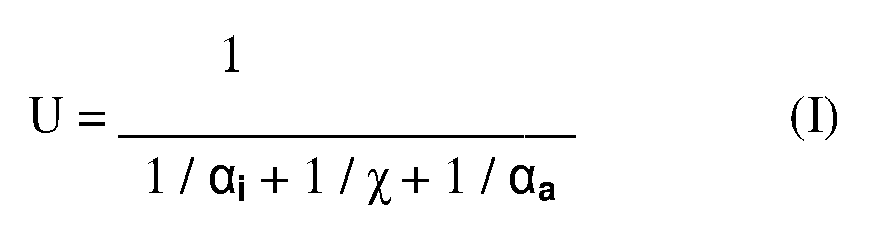
- wherein: χ = λ / s
- λ = thermal conductivity
- s = sheet thickness
- (1 / αi) = thermal transition resistance value inside
- (1 αa) = thermal transition resistance value outside
- It has been discovered that multiwall sheets having a total thickness of greater than or equal to about 45 millimeters (mm); a weight of greater than or equal to about 4.5 kg/m2; and/or greater than or equal to 8 cells with a U value of less than or equal to about 1.2 W/m2K, the multiwall sheet generally has defects. These defects can include unevenly divided air channels, broken rib(s), non-straight rib(s), collapsed rib(s), and so forth. However, when these wall(s) comprise greater than or equal to about 90 wt% branched polycarbonate resin, and particularly about 100 wt% branched polycarbonate (based upon the total weight of the multiwall sheet), the defects are reduced and often eliminated. In other words, the multiwall sheet can be produced within specifications.
- In some embodiments, the specific polymer chosen will be capable of providing sufficient light transmission for the intended application. For example, the polymer can provide a transmission of visible light of greater than or equal to about 40%, or, more specifically, greater than or equal to about 45%, even more specifically, greater than or equal to about 50%, as tested per EN9050 ASTM D1003 00 (Procedure B,
- Spectrophotometer, using illuminant C with diffuse illumination and unidirectional viewing). Transmission is defined as:

- wherein: I = intensity of the light passing through the test sample
- Io= Intensity of incident light
- The composition of the multiwall sheet comprises branched polycarbonate. "Polycarbonates" as used herein include homopolycarbonates, copolymers comprising different R1 moieties in the carbonate (referred to herein as "copolycarbonates"), copolymers comprising carbonate units and other types of polymer units, such as ester units, and combinations comprising at least one of homopolycarbonates and copolycarbonates; wherein the term "polycarbonate" means compositions having repeating structural carbonate units of Formula (1):

HO-A1-Y1-A2-OH (2)
wherein each of A1 and A2 is a monocyclic divalent aromatic group and Y1 is a single bond or a bridging group having one or more atoms that separate A1 from A2. In an exemplary embodiment, one atom separates A1 from A2. Specifically, each R1 can be derived from a dihydroxy aromatic compound of Formula (3)
- In an embodiment, Xa is a substituted or unsubstituted C3-18 cycloalkylidene, a C1-25 alkylidene of formula -C(Rc)(Rd) - wherein Rc and Rd are each independently hydrogen, C1-12 alkyl, C1-12 cycloalkyl, C7-12 arylalkyl, C1-12 heteroalkyl, or cyclic C7-12 heteroarylalkyl, or a group of the formula -C(=Re)- wherein Re is a divalent C1-12 hydrocarbon group. Exemplary groups of this type include methylene, cyclohexylmethylene, ethylidene, neopentylidene, and isopropylidene, as well as 2-[2.2.1]-bicycloheptylidene, cyclohexylidene, cyclopentylidene, cyclododecylidene, and adamantylidene. A specific example wherein Xa is a substituted cycloalkylidene is the cyclohexylidene-bridged, alkylsubstituted bisphenol of Formula (4)

- In another embodiment, Xa is a C1-18 alkylene group, a C3-18 cycloalkylene group, a fused C6-18 cycloalkylene group, or a group of the formula -B1-W-B2- wherein B1 and B2 are the same or different C1-6 alkylene group and W is a C3-12 cycloalkylidene group or a C6-16 arylene group.
- Xa can also be a substituted C3-18 cycloalkylidene of Formula (5):

- Other useful aromatic dihydroxy compounds of the formula HO-R1-OH include compounds of Formula (6)

- Some illustrative examples of specific aromatic dihydroxy compounds include the following: 4,4'-dihydroxybiphenyl, 1,6-dihydroxynaphthalene, 2,6-dihydroxynaphthalene, bis(4-hydroxyphenyl)methane, bis(4-hydroxyphenyl)diphenylmethane, bis(4-hydroxyphenyl)-1-naphthylmethane, 1,2-bis(4-hydroxyphenyl)ethane, 1,1-bis(4-hydroxyphenyl)-1-phenylethane, 2-(4-hydroxyphenyl)-2-(3-hydroxyphenyl)propane, bis(4-hydroxyphenyl)phenylmethane, 2,2-bis(4-hydroxy-3-bromophenyl)propane, 1,1-bis (hydroxyphenyl)cyclopentane, 1,1-bis(4-hydroxyphenyl)cyclohexane, 1,1-bis(4-hydroxyphenyl)isobutene, 1,1-bis(4-hydroxyphenyl)cyclododecane, trans-2,3-bis(4-hydroxyphenyl)-2-butene, 2,2-bis(4-hydroxyphenyl)adamantane, alpha, alpha'-bis(4-hydroxyphenyl)toluene, bis(4-hydroxyphenyl)acetonitrile, 2,2-bis(3-methyl-4-hydroxyphenyl)propane, 2,2-bis(3-ethyl-4-hydroxyphenyl)propane, 2,2-bis(3-n-propyl-4-hydroxyphenyl)propane, 2,2-bis(3-isopropyl-4-hydroxyphenyl)propane, 2,2-bis(3-sec-butyl-4-hydroxyphenyl)propane, 2,2-bis(3-t-butyl-4-hydroxyphenyl)propane, 2,2-bis(3-cyclohexyl-4-hydroxyphenyl)propane, 2,2-bis(3-allyl-4-hydroxyphenyl)propane, 2,2-bis(3-methoxy-4-hydroxyphenyl)propane, 2,2-bis(4-hydroxyphenyl)hexafluoropropane, 1,1-dichloro-2,2-bis(4-hydroxyphenyl)ethylene, 1,1-dibromo-2,2-bis(4-hydroxyphenyl)ethylene, 1,1-dichloro-2,2-bis(5-phenoxy-4-hydroxyphenyl)ethylene, 4,4'-dihydroxybenzophenone, 3,3-bis(4-hydroxyphenyl)-2-butanone, 1,6-bis(4-hydroxyphenyl)-1,6-hexanedione, ethylene glycol bis(4-hydroxyphenyl)ether, bis(4-hydroxyphenyl)ether, bis(4-hydroxyphenyl)sulfide, bis(4-hydroxyphenyl)sulfoxide, bis(4-hydroxyphenyl)sulfone, 9,9-bis(4-hydroxyphenyl)fluorine, 2,7-dihydroxypyrene, 6,6'-dihydroxy-3,3,3',3'- tetramethylspiro(bis)indane ("spirobiindane bisphenol"), 3,3-bis(4-hydroxyphenyl)phthalimide, 2,6-dihydroxydibenzo-p-dioxin, 2,6-dihydroxythianthrene, 2,7-dihydroxyphenoxathin, 2,7-dihydroxy-9,10-dimethylphenazine, 3,6-dihydroxydibenzofuran, 3,6-dihydroxydibenzothiophene, and 2,7-dihydroxycarbazole, resorcinol, substituted resorcinol compounds such as 5-methyl resorcinol, 5-ethyl resorcinol, 5-propyl resorcinol, 5-butyl resorcinol, 5-t-butyl resorcinol, 5-phenyl resorcinol, 5-cumyl resorcinol, 2,4,5,6-tetrafluoro resorcinol, 2,4,5,6-tetrabromo resorcinol, or the like; catechol; hydroquinone; substituted hydroquinones such as 2-methyl hydroquinone, 2-ethyl hydroquinone, 2-propyl hydroquinone, 2-butyl hydroquinone, 2-t-butyl hydroquinone, 2-phenyl hydroquinone, 2-cumyl hydroquinone, 2,3,5,6-tetramethyl hydroquinone, 2,3,5,6-tetra-t-butyl hydroquinone, 2,3,5,6-tetrafluoro hydroquinone, 2,3,5,6-tetrabromo hydroquinone, and the like, as well as combinations comprising at least one of the foregoing dihydroxy compounds.
- Specific examples of bisphenol compounds of formula (3) include 1,1-bis(4-hydroxyphenyl) methane, 1,1-bis(4-hydroxyphenyl) ethane, 2,2-bis(4-hydroxyphenyl) propane (hereinafter "bisphenol A" or "BPA"), 2,2-bis(4-hydroxyphenyl) butane, 2,2-bis(4-hydroxyphenyl) octane, 1,1-bis(4-hydroxyphenyl) propane, 1,1-bis(4-hydroxyphenyl) n-butane, 2,2-bis(4-hydroxy-1-methylphenyl) propane, 1,1-bis(4-hydroxy-t-butylphenyl) propane, 3,3-bis(4-hydroxyphenyl) phthalimidine, 2-phenyl-3,3-bis(4-hydroxyphenyl) phthalimidine (PPPBP), and 1,1-bis(4-hydroxy-3-methylphenyl)cyclohexane (DMBPC). Combinations comprising at least one of the foregoing dihydroxy compounds can also be used. In one specific embodiment, the polycarbonate is a linear homopolymer derived from bisphenol A, in which each of A1 and A2 is p-phenylene and Y1 is isopropylidene in Formula (3).
- The polycarbonates can have an intrinsic viscosity, as determined in chloroform at 25°C, of about 0.3 to about 1.5 deciliters per gram (dl/gm), specifically about 0.45 to about 1.0 dl/gm. The polycarbonates can have a weight average molecular weight (Mw) of about 10,000 grams per mole (g/mol) to about 200,000 g/mol, specifically about 20,000 g/mol to about 100,000 g/mol. Unless set forth otherwise, all weight average molecular weight is as measured by gel permeation chromatography (GPC), using a crosslinked styrene-divinylbenzene column and calibrated to polycarbonate references. GPC samples are prepared at a concentration of about 1 mg/ml, and are eluted at a flow rate of about 1.5 ml/min. In some embodiments of the multiwall sheets herein, the branched polycarbonate can have a weight average molecular weight of less than or equal to about 75,000 g/mole, or, specifically, about 24,000 g/mol to about 50,000 g/mol, or, more specifically, about 28,000 g/mol to about 35,000 g/mol, and, yet more specifically, about 32,000 g/mol to about 34,000 g/mol. The linear polycarbonate, e.g., that can be combined with the branched polycarbonate, can have a weight average molecular weight of less than or equal to about 50,000 g/mole, or, specifically, about 20,000 g/mol to about 50,000 g/mol, or, more specifically, about 26,000 g/mol to about 35,000 g/mol, and, yet more specifically, about 28,000 g/mol to about 32,000 g/mol.
- In one embodiment, the branched polycarbonate has flow properties useful for the manufacture of thin articles. The branched polycarbonate can have a melt index ratio (MIR) of about 1.5 to about 2, or, specifically, about 1.7 to about 1.9, or, more specifically, about 1.75 to about 1.85, over a period of time of greater than or equal to 10 minutes as is determined in accordance with ASTM D1238-04.

- wherein: MVR is the melt volume rate
- kg is kilograms
- Branched polycarbonate blocks can be prepared by adding a branching agent during polymerization. These branching agents include polyfunctional organic compounds containing at least three functional groups selected from hydroxyl, carboxyl, carboxylic anhydride, haloformyl, and mixtures of the foregoing functional groups. Specific examples include trimellitic acid; trimellitic anhydride; trimellitic trichloride (TMTC); tris-p-hydroxy phenyl ethane (e.g., 1,1,1 -tri(4-hydroxyphenyl)ethane (THPE)); isatin-bis-phenol; tris-phenol TC (1,3,5-tris((p-hydroxyphenyl)isopropyl)benzene); 1,3,5-tri(4-hydroxyphenyl)benzene; tris-phenol PA (4(4(1,1-bis(p-hydroxyphenyl)-ethyl) alpha, alpha-dimethyl benzyl)phenol); 4-chloroformyl phthalic anhydride; trimesic acid; benzophenone tetracarboxylic acid and acid chlorides thereof; phloroglucin; phloroglucid; 1,1,1 -tri(4-hydroxyphenyl)ethane (THPE); (TMTC); pyromellitic acid; and 2,6-bis(2-hydroxy-5-methylbenzyl)-4-methylphenol. In order to attain enhanced weathering performance, and especially ultraviolet radiation weathering performance, THPE and/or TMTC are employed.
- The branching agents can be added at a level of less than or equal to about 3.0 wt%, or, specifically, about 0.05 to about 2.0 wt%, based upon a total weight of the polycarbonate precursors. The amount of branching agents employed is based upon the desired degree of branching attained in the final branched polycarbonate. The branching can be sufficient to attain the desired multiwall sheet (e.g., such as that described and illustrated in relation to Figure 5), while maintaining impact properties, desired light transmission, and processability. In some embodiments, the branched polycarbonate has greater than or equal to about 0.3 mole percent (mol%) branching, or, specifically, about 0.3 mol% to about 0.5 mol% branching, or, more specifically, about 0.35 mol% to about 0.45 mol% branching, based upon 100 moles of branched polycarbonate.
- The number of layers of the multiwall sheet is dependent upon customer requirements such as structural integrity, overall thickness, light transmission properties, insulative properties, and overall weight. In one embodiment, the multiwall sheet can comprise horizontal walls and transverse walls, the overall multiwall sheet thickness is greater than or equal to about 45 mm, or, specifically, greater than or equal to about 50 mm, or, more specifically, greater than or equal to about 55 mm, and, yet more specifically, greater than or equal to about 60 mm. For example, the overall multiwall sheet thickness (t) can be about 45 mm to about 65 mm. (See
Figure 1 ) - In some applications, the various walls and dividers can have different thicknesses. For example, the outer walls can have a greater thickness than the inner walls (e.g., longitudinal layers), while the transverse layers have a thickness between the outer wall thickness and the inner walls thickness. For example, the outer walls can have a thickness of about 0.6 mm to about 2 mm, or, specifically, about 0.75 mm to about 1.2 mm, or, yet more specifically, about 0.8 mm to 1.0 mm; the inner wall(s) can have a thickness of about 0.05 mm to about 0.30 mm, or, specifically, about 0.075 mm to about 0.15 mm, or, yet more specifically, about 0.075 mm to 0.125 mm; and the transverse wall(s) can have a thickness of about 0.2 mm to about 1.0 mm, or, specifically, about 0.25 mm to about 0.75 mm, or, yet more specifically, about 0.4 mm to 0.6 mm. In some applications, the outer walls have a thickness that is greater than or equal to about 125% of the transverse wall thickness, while the inner wall have a thickness that is less than or equal to about 50% of the transverse wall thickness. Dividers, which can have a thickness that is greater than the inner wall thickness, can have a thickness that is less than or equal to about 50% of the transverse wall thickness. For example, the dividers can have a thickness of about 0.05 mm to about 0.30 mm, or, specifically, about 0.075 mm to about 0.175 mm, or, yet more specifically, about 0.10 mm to about 0.15 mm
- In one embodiment, the multiwall sheet can comprise a weight of greater than or equal to about 4.5 kg/m2, or, specifically, greater than or equal to about 5.0 kg/m2, or, more specifically, greater than or equal to about 5.5 kg/m2. For example, the multiwall sheet can have a weight of about 4.5 kg/m2 to about 6.0 kg/m2.
- Referring to
Figure 1 , a portion of a multiwall sheet is illustrated having fivemain layers 6 comprisingouter walls 2,4 andinner walls 8. The sheet also has transversewalls 10 anddividers 12. Desirably, the, each wall and divider has a uniform thickness along its length. Themain layers 6 are disposed parallel to one another while thetransverse walls 10 are disposed perpendicular to themain layers 6. In this embodiment, thedividers 12 bisect thechannels 14 formed by themain walls 6 and thetransverse walls 10. The illustrated multiwall sheet has 5 layers withdiagonal dividers 10. This sheet is illustrative of the sheet that is desired in the extrusion process having an overall thickness of 55 mm and a U-value of 1 W/m2K.Figures 2 - 4 illustrate the results of forming the multiwall sheet illustrated inFigure 1 having 9 layers and using different materials (e.g., 100 wt% linear polycarbonate, 75 wt% branched polycarbonate, and 100 wt% branched polycarbonate, respectively, based upon a total weight of the sheet). - As can be see in
Figure 2 , a 55 mm, 9 layer multiwall sheet (i.e., 5 main layers and 4 dividers) comprising 100% linear polycarbonate exhibited several of the defects identified above. As can be seen, thedividers 12 failed to produce evenly dividedchannels 14. Theinner walls 8, instead of being uniform and straight, had a curved geometry and non-uniform thickness.Transverse walls 10 comprised "broken portions" where the wall separated forming a gap, and collapsedportions 18 where thetransverse wall 10 was nonlinear, forming a bend, and having a non-uniform thickness along the length of the wall. As a result of these defects, unacceptable distortion occurred at a load of 1,000 Newtons per square meter (N/m2), while such a sheet should be capable of withstanding a load of 2,000 N/m2. Additionally, buckling of the sheet occurred at a load of 2,000 N/m2, while buckling on such a sheet (i.e., thickness, number of layers, etc.) should only occur at a load of 3,500 N/m2. Additionally, the aesthetic qualities were poor (e.g., the layers are not straight, the dividers are bowed, etc.). Hence, the quality was unacceptable for commercial use. - The multiwall sheet of
Figure 3 suffers from the same defects as that inFigure 2 . InFigure 3 the multiwall sheet comprises 75 wt% branched polycarbonate, balance linear polycarbonate. As withFigure 2 , this multiwall sheet comprises collapsedportions 18, irregularly shapedbottom wall 20 and inner (e.g., middle)wall 22, and a variation in thethickness 24. As a result of these defects, the quality was unacceptable for commercial use. - The multiwall sheet of
Figure 4 comprising 100 wt% branched polycarbonate (having 0.4 mol% branching), has no collapsed portions (e.g., dividers (ribs), or transverse walls), evenly divided channels, and no breaks in the ribs. For example, the vertical ribs can have a constant distance to each other of about 20 mm ± 3 mm and the horizontal ribs can have a constant distance to each other of about 13 mm ±3 mm. Additionally, the main layers are substantially straight. This multiwall sheet had a U-value of 0.95 W/m2K; it was acceptable for commercial use. - "Straightness" as used herein is determined by averaging the thickness (of the whole sheet for the overall straightness, and of adjacent layers to determine the straightness of individual layers). The average is taken over an area of 1,200 mm width by 4,200 mm long. At least 10 data points across the width are used to determine the average. Then, for the overall sheet to be straight, the overall thickness ("t") at any point on the sheet varies by less than or equal to about 2% from the average thickness. For example, if the average thickness is 45 mm, for the sheet to be considered straight, the thickness at any point across the sheet will be 44.1 mm to 45.9 mm. Desirably, the thickness at any point on the sheet varies by less than or equal to about 1.5% from the average thickness, or, specifically, by less than or equal to about 1.25%. For adjacent layers, a straight layer will vary by less than or equal to about 20%. Desirably, adjacent layers vary in thickness ("t2") by less than or equal to about 15%, or, specifically, by less than or equal to about 10%, compared to the average thickness.
- Each channel can contain a fluid (i.e., gas (e.g., air) and/or liquid); e.g., some of the areas of the sheet can be filled with liquid while others can be free of liquid. The liquid introduced to the sheet can be any liquid that has the desired transmission properties (e.g., transparent to visible light (for example, has a transmission of greater than or equal to about 95%), and desirably, less transparent (or opaque) to direct solar light), and does not react with the layer material(s). Possible liquids include water (e.g., demineralized water, water having a neutral pH (e.g., pH of about 6.5 to about 7.5), as well as combinations comprising at least one of these properties), glycerin, polydimethylsiloxane oil, transparent gels, and so forth, as well as combinations comprising at least one of the foregoing. Depending upon the environmental conditions that will affect the sheet (and hence the liquid), additive(s) can be mixed with the liquid, such as anti-freeze additives (e.g., to prevent freezing in the winter), antimicrobial agents, and so forth, as well as combinations comprising at least one of the foregoing.
- Multiwall sheets having a weight of greater than or equal to 4.5 kg/m2 a total thickness of greater than or equal to about 45 mm, and/or greater than or equal to 8 cells and a U-value of less than or equal to about 1.2 W/m2K, will have a variation in thickness of adjacent horizontal layers of greater than 25%, generally greater than 30%, and even up to 45%, compared to the average thickness. With respect to the overall thickness variation, it is greater than 5% compared to the average overall thickness. Such variations are unacceptable for commercial use.
- Employing greater than 75 wt% branched polycarbonate, or, specifically, greater than about 90 wt% branched polycarbonate, and more specifically, greater than or equal to about 98 wt% branched polycarbonate, and yet more specifically, about 100 wt% branched polycarbonate (based upon a total weight of the sheet), a multiwall sheet having a weight of greater than or equal to about 4.5 kg/m2 can be produced with reduced wall warpage, wall breakage, and non-uniform thickness.
Claims (15)
- A multiwall sheet, comprising:main layers(6), transverse walls (10), and dividers(12);wherein the multiwall sheet comprisesa total thickness of greater than or equal to 45 mm;a weight of greater than or equal to 4.5 kg/m2; and/orgreater than or equal to 8 cells (14) and a U-value of less than or equal to about 1.2 W/m2K; andgreater than 75 wt% branched polycarbonate resin, based upon a total weight of the multiwall sheet;wherein the sheet varies by less than or equal to about 2% from an average total thickness.
- A multiwall sheet of Claim 1,
wherein the total thickness is greater than or equal to 45 mm, and wherein the multiwall sheet comprises greater than 75 wt% branched polycarbonate resin, based upon a total weight of the multiwall sheet. - A multiwall sheet of Claim 1,
wherein the weight is greater than or equal to 4.5 kg/m2, and multiwall sheet comprises greater than 75 wt% branched polycarbonate resin, based upon a total weight of the multiwall sheet. - A multiwall sheet of Claim 1,
wherein the multiwall sheet comprises greater than or equal to 8 cells (14) and greater than 75 wt% branched polycarbonate resin, based upon a total weight of the multiwall sheet. - The multiwall sheet of any of the preceding claims, wherein the total thickness of the sheet is greater than or equal to 50 mm.
- The multiwall sheet of any of the preceding claims, wherein the weight is greater than or equal to 5.0 kg/m2.
- The multiwall sheet of any of the preceding claims, wherein the sheet comprises greater than or equal to 10 cells (14).
- The multiwall sheet of any of the preceding claims, wherein the branched polycarbonate was formed using a branching agent selected from the group consisting of phloroglucin; phloroglucid; 1,1,1 -tri(4-hydroxyphenyl)ethane; trimellitic acid; trimellitic trichloride; pyromellitic acid; benzophenonetetracarboxylic acid and acid chlorides thereof; 2,6-bis(2-hydroxy-5-methylbenzyl)-4-methylphenol and 1,3,5-tri (4-hydroxyphenyl)benzene, and combinations comprising at least one of the foregoing branching agents.
- The multiwall sheet of any of the preceding claims, wherein the branching agent selected from the group consisting of 1,1,1 -tri(4-hydroxyphenyl)ethane; trimellitic trichloride, and combinations comprising at least one of the foregoing branching agents
- The multiwall sheet of any of the preceding claims, wherein the multiwall sheet comprises greater than or equal to 90 wt% branched polycarbonate resin.
- The multiwall sheet of any of the preceding claims, wherein the multiwall sheet comprises 98 wt% branched polycarbonate resin.
- The multiwall sheet of any of the preceding claims, wherein the branched polycarbonate comprises greater than or equal to 0.3 mol% branching, based upon 100 moles of branched polycarbonate.
- The multiwall sheet of any of the preceding claims, wherein the sheet varies by less than or equal to 1.5% from an average total thickness, and wherein the average total thickness is determined over an area of 1,200 mm width by 4,200 mm long using at least 10 data points across the width, and/or adjacent main layers (6) will vary by less than or equal to 20% from an average adjacent layer (6) average thickness wherein the average adjacent layer (6) thickness is determined over an area of the adjacent layers (6) of 1,200 mm width by 4,200 mm long using at least 10 data points across the width.
- The multiwall sheet of any of the preceding claims, wherein the sheet varies by less than or equal to 1.25% from the average total thickness, and/or the adjacent main layers (6) vary by less than or equal to 15% from the average adjacent layer (6) average thickness.
- A method for producing a multiwall sheet comprising:extruding polycarbonate resin to form the multiwall sheet of any of the preceding claims.
Applications Claiming Priority (2)
| Application Number | Priority Date | Filing Date | Title |
|---|---|---|---|
| US11/938,504 US8568860B2 (en) | 2007-11-12 | 2007-11-12 | Multiwall polymer sheet comprising branched polycarbonate |
| PCT/IB2008/054724 WO2009063403A1 (en) | 2007-11-12 | 2008-11-11 | Multiwall polymer sheet comprising branched polycarbonate |
Publications (2)
| Publication Number | Publication Date |
|---|---|
| EP2209616A1 EP2209616A1 (en) | 2010-07-28 |
| EP2209616B1 true EP2209616B1 (en) | 2017-01-04 |
Family
ID=40347826
Family Applications (1)
| Application Number | Title | Priority Date | Filing Date |
|---|---|---|---|
| EP08850372.7A Active EP2209616B1 (en) | 2007-11-12 | 2008-11-11 | Multiwall polymer sheet comprising branched polycarbonate |
Country Status (4)
| Country | Link |
|---|---|
| US (1) | US8568860B2 (en) |
| EP (1) | EP2209616B1 (en) |
| CN (1) | CN101842227B (en) |
| WO (1) | WO2009063403A1 (en) |
Families Citing this family (6)
| Publication number | Priority date | Publication date | Assignee | Title |
|---|---|---|---|---|
| GB2464331A (en) * | 2008-07-03 | 2010-04-21 | David John Anderson | Glazing |
| JP5934228B2 (en) * | 2010-10-26 | 2016-06-15 | トリンゼオ ヨーロッパ ゲゼルシャフト ミット ベシュレンクテル ハフツング | Multi-layer carbonate sheet |
| US20170204739A1 (en) | 2016-01-20 | 2017-07-20 | General Electric Company | System and Method for Cleaning a Gas Turbine Engine and Related Wash Stand |
| US20210206915A1 (en) | 2018-06-04 | 2021-07-08 | Sabic Global Technologies B.V. | Transparent branched polycarbonate |
| WO2023166427A1 (en) * | 2022-03-01 | 2023-09-07 | Shpp Global Technologies B.V. | Transparent polycarbonate compositions |
| IT202200005567A1 (en) * | 2022-03-22 | 2023-09-22 | Exolon Group S P A | EXTRUDED HONEYCOMB PANEL WITH OPTIMIZED GEOMETRY |
Citations (1)
| Publication number | Priority date | Publication date | Assignee | Title |
|---|---|---|---|---|
| EP1458787B1 (en) | 2001-12-21 | 2009-05-13 | Sabic Innovative Plastics IP B.V. | Process for the production of branched melt polycarbonate by late addition of fries-inducing catalyst |
Family Cites Families (28)
| Publication number | Priority date | Publication date | Assignee | Title |
|---|---|---|---|---|
| US3544514A (en) | 1965-01-15 | 1970-12-01 | Bayer Ag | Process for the production of thermoplastic polycarbonates |
| US3541049A (en) | 1969-08-21 | 1970-11-17 | Mobay Chemical Corp | Cyanuric chloride branched polycarbonates |
| US3799953A (en) | 1972-09-01 | 1974-03-26 | Bayer Ag | 1,4-bis(4,'4''-dihydroxy-triphenylmethyl)benzene |
| US4185009A (en) | 1975-01-03 | 1980-01-22 | Bayer Aktiengesellschaft | Branched, high-molecular weight thermoplastic polycarbonates |
| US4114597A (en) * | 1975-12-31 | 1978-09-19 | The Franklin Institute | Unitary solar collector |
| DE2730469A1 (en) | 1977-07-06 | 1979-01-18 | Dynamit Nobel Ag | Swimming pool floatable cover - prepd. from closed cell foamed plastics material with additional structure providing large number of air pockets |
| US4443987A (en) * | 1979-03-28 | 1984-04-24 | The Franklin Institute | Unitary solar window panel |
| US4431793A (en) | 1982-06-09 | 1984-02-14 | General Electric Company | Aromatic polycarbonate end capped with branched chain alkyl acyl halide or acid |
| US4469861A (en) | 1982-12-27 | 1984-09-04 | General Electric Company | Polycarbonate composition from branched chain dihydric phenol |
| DE9110957U1 (en) | 1991-09-04 | 1991-11-07 | Degussa Ag, 6000 Frankfurt | Inclined multi-wall sheets made of aromatic polycarbonates |
| CH687214A5 (en) | 1994-02-28 | 1996-10-15 | Dietrich Schwarz | Translucent wall sheet. |
| US5580620A (en) * | 1994-09-02 | 1996-12-03 | 21St Century Ltd. | Multiple void layer synthetic resin panels |
| DE9415952U1 (en) | 1994-10-04 | 1994-12-01 | Röhm GmbH, 64293 Darmstadt | Multi-wall sheet made of polycarbonate, suitable for hard roofing, as well as large-area or small-area roofing containing multi-sheet |
| FR2732386B1 (en) | 1995-03-29 | 1997-06-13 | Kaysersberg Packaging Sa | POLYCARBONATE PLATES, ESPECIALLY PLATES FOR COVERING |
| FR2744159B1 (en) | 1996-01-31 | 1998-03-06 | Tisserand Jean Paul | PROCESS FOR PRODUCING A RIGID POLYCARBONATE OR ALVEOLAR PVC STRUCTURE AND USE OF THE PROCESS IN THE MANUFACTURE OF A SHELTER |
| JP2001503190A (en) * | 1996-10-21 | 2001-03-06 | レーム ゲゼルシヤフト ミツト ベシユレンクテル ハフツング | Light guide plate |
| US5972475A (en) * | 1997-10-24 | 1999-10-26 | The Dow Chemical Company | Structural sheet design for reduced weight and increased rigidity |
| CH692362A5 (en) | 1998-01-30 | 2002-05-15 | Politec Polimeri Tecnici Sa | extruded honeycombed panel with parallel plates and ribs formed with materials having different optical and mechanical characteristics. |
| US6339138B1 (en) | 1998-11-04 | 2002-01-15 | General Electric Company | Method of manufacturing polycarbonates |
| GB9911903D0 (en) | 1999-05-22 | 1999-07-21 | Twinwall Fixings Uk Ltd | A glazing panel |
| US6365703B1 (en) | 2001-05-31 | 2002-04-02 | General Electric Company | Branched polycarbonate and method |
| US6518340B1 (en) | 2001-08-07 | 2003-02-11 | General Electric Company | Polycarbonate resin compositions and articles therefrom |
| DE10141314A1 (en) * | 2001-08-09 | 2003-02-27 | Roehm Gmbh | Plastic body with low thermal conductivity, high light transmission and absorption in the near infrared range |
| US6437083B1 (en) | 2001-12-06 | 2002-08-20 | General Electric Company | Process for preparing branched aromatic polycarbonates |
| DE10322003A1 (en) | 2003-05-16 | 2004-12-02 | Makroform Gmbh | Coextrusion coated web plate without triangle effect |
| CA2430256A1 (en) | 2003-06-04 | 2004-12-04 | Yaron Mayer | System and method for producing semi-transparent corrugated structures which automatically change their transparency to the sun's rays during the hours of the day, and the resulting structures |
| GB0320572D0 (en) | 2003-09-03 | 2003-10-01 | Ultraframe Uk Ltd | Glazing panels |
| US20080038519A1 (en) | 2006-08-11 | 2008-02-14 | Hoolhorst Frederik W B | Polymer Sheeting |
-
2007
- 2007-11-12 US US11/938,504 patent/US8568860B2/en not_active Expired - Fee Related
-
2008
- 2008-11-11 CN CN2008801142214A patent/CN101842227B/en active Active
- 2008-11-11 WO PCT/IB2008/054724 patent/WO2009063403A1/en not_active Ceased
- 2008-11-11 EP EP08850372.7A patent/EP2209616B1/en active Active
Patent Citations (1)
| Publication number | Priority date | Publication date | Assignee | Title |
|---|---|---|---|---|
| EP1458787B1 (en) | 2001-12-21 | 2009-05-13 | Sabic Innovative Plastics IP B.V. | Process for the production of branched melt polycarbonate by late addition of fries-inducing catalyst |
Non-Patent Citations (4)
| Title |
|---|
| "LEXAN RESIN 103 R", DATENBLATT SABIC, 2014, pages 1 - 5, XP055428835 |
| "LEXAN RESIN EX 1332 T", DATENBLATT SABIC, 2015, pages 1 - 3, XP055428837 |
| "PC-coex-Hohlkammerscheiben (HKS", DATENTBLATT RODECA, January 2007 (2007-01-01), pages 1, XP055428831 |
| "Weltneuhelt ISO-CLEAR - Zehnschallge Paneele undHohlkammerschelben mlt elnem U-Wert 0,83 W/m2K", RODECA.DE, 30 October 2007 (2007-10-30), XP055428838 |
Also Published As
| Publication number | Publication date |
|---|---|
| US8568860B2 (en) | 2013-10-29 |
| EP2209616A1 (en) | 2010-07-28 |
| US20090123719A1 (en) | 2009-05-14 |
| WO2009063403A1 (en) | 2009-05-22 |
| CN101842227B (en) | 2013-07-03 |
| CN101842227A (en) | 2010-09-22 |
Similar Documents
| Publication | Publication Date | Title |
|---|---|---|
| US8568860B2 (en) | Multiwall polymer sheet comprising branched polycarbonate | |
| JP7094245B2 (en) | Lightweight, high-rigidity glass laminated structure | |
| RU2664927C2 (en) | Polymeric sheets, methods for making and using same, and articles comprising polymeric sheets | |
| EP1937749B1 (en) | Windows and other articles made from dmbpc polycarbonate homopolymer and copolymer | |
| US4600632A (en) | UV-stabilized polycarbonate mouldings | |
| CN102439242B (en) | Multiwall sheet, article, method of making multiwall sheet | |
| EP3137299B1 (en) | Multilayered articles with low optical retardation | |
| US20120287556A1 (en) | Amorphous polycarbonate films for capacitors, methods of manufacture, and articles manufactured therefrom | |
| EP2777076B1 (en) | A composition, multilayer sheets made therefrom, and methods for making and using the same | |
| US10655001B2 (en) | High ductility blends of PMMA and polycarbonate-siloxane copolymer | |
| EP2855575A2 (en) | Flame retardant polycarbonate compositions, methods of manufacture thereof and articles comprising the same | |
| US20170144368A1 (en) | Process for additive manufacturing using thermoplastic materials having selected melt indexes | |
| CN104159658A (en) | Reinforced thermoplastic article, composition for making same, method of making and article formed therefrom | |
| CN103189199A (en) | Multilayered carbonate sheets | |
| JPWO2011096089A1 (en) | Polycarbonate resin and method for producing the same | |
| EP3420030B1 (en) | Impact performance modified melt polycarbonate | |
| KR20170057320A (en) | Optically diffusive plastic having high stiffness | |
| EP3864091B1 (en) | Anti-drip compositions including transparent blends of pmma and pc-siloxane copolymer | |
| US7279594B2 (en) | Thermoplastic composition, articles thereof, and method of making the articles | |
| US20100280160A1 (en) | Flame retardant thermoplastic composition and articles formed therefrom | |
| KR102488157B1 (en) | Polycarbonate-based resin composition and molded article thereof | |
| US11760878B2 (en) | Transparent and flexible blends of PMMA and polycarbonate-siloxane copolymer | |
| US20180355124A1 (en) | Flame retardant melt polycarbonate grades on line compounding | |
| Kahlena et al. | PAPER 5 Aging Behavior of Polymeric Solar Absorber Materials: Aging on the Component Level | |
| JP2012236394A (en) | Resin laminate |
Legal Events
| Date | Code | Title | Description |
|---|---|---|---|
| PUAI | Public reference made under article 153(3) epc to a published international application that has entered the european phase |
Free format text: ORIGINAL CODE: 0009012 |
|
| 17P | Request for examination filed |
Effective date: 20100526 |
|
| AK | Designated contracting states |
Kind code of ref document: A1 Designated state(s): AT BE BG CH CY CZ DE DK EE ES FI FR GB GR HR HU IE IS IT LI LT LU LV MC MT NL NO PL PT RO SE SI SK TR |
|
| AX | Request for extension of the european patent |
Extension state: AL BA MK RS |
|
| DAX | Request for extension of the european patent (deleted) | ||
| 17Q | First examination report despatched |
Effective date: 20130806 |
|
| RAP1 | Party data changed (applicant data changed or rights of an application transferred) |
Owner name: SABIC GLOBAL TECHNOLOGIES B.V. |
|
| GRAP | Despatch of communication of intention to grant a patent |
Free format text: ORIGINAL CODE: EPIDOSNIGR1 |
|
| INTG | Intention to grant announced |
Effective date: 20160803 |
|
| STAA | Information on the status of an ep patent application or granted ep patent |
Free format text: STATUS: GRANT OF PATENT IS INTENDED |
|
| GRAS | Grant fee paid |
Free format text: ORIGINAL CODE: EPIDOSNIGR3 |
|
| GRAA | (expected) grant |
Free format text: ORIGINAL CODE: 0009210 |
|
| STAA | Information on the status of an ep patent application or granted ep patent |
Free format text: STATUS: THE PATENT HAS BEEN GRANTED |
|
| AK | Designated contracting states |
Kind code of ref document: B1 Designated state(s): AT BE BG CH CY CZ DE DK EE ES FI FR GB GR HR HU IE IS IT LI LT LU LV MC MT NL NO PL PT RO SE SI SK TR |
|
| REG | Reference to a national code |
Ref country code: GB Ref legal event code: FG4D |
|
| REG | Reference to a national code |
Ref country code: CH Ref legal event code: EP |
|
| REG | Reference to a national code |
Ref country code: AT Ref legal event code: REF Ref document number: 858822 Country of ref document: AT Kind code of ref document: T Effective date: 20170115 |
|
| REG | Reference to a national code |
Ref country code: IE Ref legal event code: FG4D |
|
| REG | Reference to a national code |
Ref country code: DE Ref legal event code: R096 Ref document number: 602008048280 Country of ref document: DE |
|
| REG | Reference to a national code |
Ref country code: LT Ref legal event code: MG4D Ref country code: NL Ref legal event code: MP Effective date: 20170104 |
|
| REG | Reference to a national code |
Ref country code: AT Ref legal event code: MK05 Ref document number: 858822 Country of ref document: AT Kind code of ref document: T Effective date: 20170104 |
|
| PG25 | Lapsed in a contracting state [announced via postgrant information from national office to epo] |
Ref country code: NL Free format text: LAPSE BECAUSE OF FAILURE TO SUBMIT A TRANSLATION OF THE DESCRIPTION OR TO PAY THE FEE WITHIN THE PRESCRIBED TIME-LIMIT Effective date: 20170104 |
|
| PG25 | Lapsed in a contracting state [announced via postgrant information from national office to epo] |
Ref country code: FI Free format text: LAPSE BECAUSE OF FAILURE TO SUBMIT A TRANSLATION OF THE DESCRIPTION OR TO PAY THE FEE WITHIN THE PRESCRIBED TIME-LIMIT Effective date: 20170104 Ref country code: GR Free format text: LAPSE BECAUSE OF FAILURE TO SUBMIT A TRANSLATION OF THE DESCRIPTION OR TO PAY THE FEE WITHIN THE PRESCRIBED TIME-LIMIT Effective date: 20170405 Ref country code: HR Free format text: LAPSE BECAUSE OF FAILURE TO SUBMIT A TRANSLATION OF THE DESCRIPTION OR TO PAY THE FEE WITHIN THE PRESCRIBED TIME-LIMIT Effective date: 20170104 Ref country code: IS Free format text: LAPSE BECAUSE OF FAILURE TO SUBMIT A TRANSLATION OF THE DESCRIPTION OR TO PAY THE FEE WITHIN THE PRESCRIBED TIME-LIMIT Effective date: 20170504 Ref country code: NO Free format text: LAPSE BECAUSE OF FAILURE TO SUBMIT A TRANSLATION OF THE DESCRIPTION OR TO PAY THE FEE WITHIN THE PRESCRIBED TIME-LIMIT Effective date: 20170404 Ref country code: LT Free format text: LAPSE BECAUSE OF FAILURE TO SUBMIT A TRANSLATION OF THE DESCRIPTION OR TO PAY THE FEE WITHIN THE PRESCRIBED TIME-LIMIT Effective date: 20170104 |
|
| PG25 | Lapsed in a contracting state [announced via postgrant information from national office to epo] |
Ref country code: PL Free format text: LAPSE BECAUSE OF FAILURE TO SUBMIT A TRANSLATION OF THE DESCRIPTION OR TO PAY THE FEE WITHIN THE PRESCRIBED TIME-LIMIT Effective date: 20170104 Ref country code: ES Free format text: LAPSE BECAUSE OF FAILURE TO SUBMIT A TRANSLATION OF THE DESCRIPTION OR TO PAY THE FEE WITHIN THE PRESCRIBED TIME-LIMIT Effective date: 20170104 Ref country code: BG Free format text: LAPSE BECAUSE OF FAILURE TO SUBMIT A TRANSLATION OF THE DESCRIPTION OR TO PAY THE FEE WITHIN THE PRESCRIBED TIME-LIMIT Effective date: 20170404 Ref country code: PT Free format text: LAPSE BECAUSE OF FAILURE TO SUBMIT A TRANSLATION OF THE DESCRIPTION OR TO PAY THE FEE WITHIN THE PRESCRIBED TIME-LIMIT Effective date: 20170504 Ref country code: LV Free format text: LAPSE BECAUSE OF FAILURE TO SUBMIT A TRANSLATION OF THE DESCRIPTION OR TO PAY THE FEE WITHIN THE PRESCRIBED TIME-LIMIT Effective date: 20170104 Ref country code: SE Free format text: LAPSE BECAUSE OF FAILURE TO SUBMIT A TRANSLATION OF THE DESCRIPTION OR TO PAY THE FEE WITHIN THE PRESCRIBED TIME-LIMIT Effective date: 20170104 Ref country code: AT Free format text: LAPSE BECAUSE OF FAILURE TO SUBMIT A TRANSLATION OF THE DESCRIPTION OR TO PAY THE FEE WITHIN THE PRESCRIBED TIME-LIMIT Effective date: 20170104 |
|
| REG | Reference to a national code |
Ref country code: DE Ref legal event code: R026 Ref document number: 602008048280 Country of ref document: DE |
|
| REG | Reference to a national code |
Ref country code: FR Ref legal event code: PLFP Year of fee payment: 10 |
|
| PLBI | Opposition filed |
Free format text: ORIGINAL CODE: 0009260 |
|
| PG25 | Lapsed in a contracting state [announced via postgrant information from national office to epo] |
Ref country code: SK Free format text: LAPSE BECAUSE OF FAILURE TO SUBMIT A TRANSLATION OF THE DESCRIPTION OR TO PAY THE FEE WITHIN THE PRESCRIBED TIME-LIMIT Effective date: 20170104 Ref country code: CZ Free format text: LAPSE BECAUSE OF FAILURE TO SUBMIT A TRANSLATION OF THE DESCRIPTION OR TO PAY THE FEE WITHIN THE PRESCRIBED TIME-LIMIT Effective date: 20170104 Ref country code: EE Free format text: LAPSE BECAUSE OF FAILURE TO SUBMIT A TRANSLATION OF THE DESCRIPTION OR TO PAY THE FEE WITHIN THE PRESCRIBED TIME-LIMIT Effective date: 20170104 Ref country code: IT Free format text: LAPSE BECAUSE OF FAILURE TO SUBMIT A TRANSLATION OF THE DESCRIPTION OR TO PAY THE FEE WITHIN THE PRESCRIBED TIME-LIMIT Effective date: 20170104 Ref country code: RO Free format text: LAPSE BECAUSE OF FAILURE TO SUBMIT A TRANSLATION OF THE DESCRIPTION OR TO PAY THE FEE WITHIN THE PRESCRIBED TIME-LIMIT Effective date: 20170104 |
|
| PLAX | Notice of opposition and request to file observation + time limit sent |
Free format text: ORIGINAL CODE: EPIDOSNOBS2 |
|
| 26 | Opposition filed |
Opponent name: RODECA GMBH Effective date: 20171004 |
|
| PG25 | Lapsed in a contracting state [announced via postgrant information from national office to epo] |
Ref country code: DK Free format text: LAPSE BECAUSE OF FAILURE TO SUBMIT A TRANSLATION OF THE DESCRIPTION OR TO PAY THE FEE WITHIN THE PRESCRIBED TIME-LIMIT Effective date: 20170104 |
|
| PLBB | Reply of patent proprietor to notice(s) of opposition received |
Free format text: ORIGINAL CODE: EPIDOSNOBS3 |
|
| PG25 | Lapsed in a contracting state [announced via postgrant information from national office to epo] |
Ref country code: SI Free format text: LAPSE BECAUSE OF FAILURE TO SUBMIT A TRANSLATION OF THE DESCRIPTION OR TO PAY THE FEE WITHIN THE PRESCRIBED TIME-LIMIT Effective date: 20170104 |
|
| RAP4 | Party data changed (patent owner data changed or rights of a patent transferred) |
Owner name: SABIC GLOBAL TECHNOLOGIES B.V. |
|
| PG25 | Lapsed in a contracting state [announced via postgrant information from national office to epo] |
Ref country code: MC Free format text: LAPSE BECAUSE OF FAILURE TO SUBMIT A TRANSLATION OF THE DESCRIPTION OR TO PAY THE FEE WITHIN THE PRESCRIBED TIME-LIMIT Effective date: 20170104 |
|
| GBPC | Gb: european patent ceased through non-payment of renewal fee |
Effective date: 20171111 |
|
| PG25 | Lapsed in a contracting state [announced via postgrant information from national office to epo] |
Ref country code: LI Free format text: LAPSE BECAUSE OF NON-PAYMENT OF DUE FEES Effective date: 20171130 Ref country code: CH Free format text: LAPSE BECAUSE OF NON-PAYMENT OF DUE FEES Effective date: 20171130 |
|
| PG25 | Lapsed in a contracting state [announced via postgrant information from national office to epo] |
Ref country code: LU Free format text: LAPSE BECAUSE OF NON-PAYMENT OF DUE FEES Effective date: 20171111 |
|
| REG | Reference to a national code |
Ref country code: BE Ref legal event code: MM Effective date: 20171130 |
|
| REG | Reference to a national code |
Ref country code: IE Ref legal event code: MM4A |
|
| PG25 | Lapsed in a contracting state [announced via postgrant information from national office to epo] |
Ref country code: MT Free format text: LAPSE BECAUSE OF NON-PAYMENT OF DUE FEES Effective date: 20171111 |
|
| REG | Reference to a national code |
Ref country code: FR Ref legal event code: PLFP Year of fee payment: 11 |
|
| PG25 | Lapsed in a contracting state [announced via postgrant information from national office to epo] |
Ref country code: IE Free format text: LAPSE BECAUSE OF NON-PAYMENT OF DUE FEES Effective date: 20171111 |
|
| PG25 | Lapsed in a contracting state [announced via postgrant information from national office to epo] |
Ref country code: BE Free format text: LAPSE BECAUSE OF NON-PAYMENT OF DUE FEES Effective date: 20171130 Ref country code: GB Free format text: LAPSE BECAUSE OF NON-PAYMENT OF DUE FEES Effective date: 20171111 |
|
| REG | Reference to a national code |
Ref country code: DE Ref legal event code: R100 Ref document number: 602008048280 Country of ref document: DE |
|
| PLCK | Communication despatched that opposition was rejected |
Free format text: ORIGINAL CODE: EPIDOSNREJ1 |
|
| PG25 | Lapsed in a contracting state [announced via postgrant information from national office to epo] |
Ref country code: HU Free format text: LAPSE BECAUSE OF FAILURE TO SUBMIT A TRANSLATION OF THE DESCRIPTION OR TO PAY THE FEE WITHIN THE PRESCRIBED TIME-LIMIT; INVALID AB INITIO Effective date: 20081111 |
|
| PLBN | Opposition rejected |
Free format text: ORIGINAL CODE: 0009273 |
|
| STAA | Information on the status of an ep patent application or granted ep patent |
Free format text: STATUS: OPPOSITION REJECTED |
|
| 27O | Opposition rejected |
Effective date: 20190307 |
|
| PG25 | Lapsed in a contracting state [announced via postgrant information from national office to epo] |
Ref country code: CY Free format text: LAPSE BECAUSE OF NON-PAYMENT OF DUE FEES Effective date: 20170104 |
|
| PG25 | Lapsed in a contracting state [announced via postgrant information from national office to epo] |
Ref country code: TR Free format text: LAPSE BECAUSE OF FAILURE TO SUBMIT A TRANSLATION OF THE DESCRIPTION OR TO PAY THE FEE WITHIN THE PRESCRIBED TIME-LIMIT Effective date: 20170104 |
|
| P01 | Opt-out of the competence of the unified patent court (upc) registered |
Effective date: 20230529 |
|
| PGFP | Annual fee paid to national office [announced via postgrant information from national office to epo] |
Ref country code: DE Payment date: 20251128 Year of fee payment: 18 |
|
| PGFP | Annual fee paid to national office [announced via postgrant information from national office to epo] |
Ref country code: FR Payment date: 20251125 Year of fee payment: 18 |