EP2207786B1 - 2'-fluoro-2'-deoxytetrahydrouridines as cytidine deaminase inhibitors - Google Patents
2'-fluoro-2'-deoxytetrahydrouridines as cytidine deaminase inhibitors Download PDFInfo
- Publication number
- EP2207786B1 EP2207786B1 EP08840633A EP08840633A EP2207786B1 EP 2207786 B1 EP2207786 B1 EP 2207786B1 EP 08840633 A EP08840633 A EP 08840633A EP 08840633 A EP08840633 A EP 08840633A EP 2207786 B1 EP2207786 B1 EP 2207786B1
- Authority
- EP
- European Patent Office
- Prior art keywords
- compound
- cancer
- substrate drug
- pharmaceutically acceptable
- cda substrate
- Prior art date
- Legal status (The legal status is an assumption and is not a legal conclusion. Google has not performed a legal analysis and makes no representation as to the accuracy of the status listed.)
- Active
Links
- 0 *[C@](C(N(CCC(N1)O)C1=O)O[C@]1C[O+])[C@]1O Chemical compound *[C@](C(N(CCC(N1)O)C1=O)O[C@]1C[O+])[C@]1O 0.000 description 4
- VUDZSIYXZUYWSC-RKXXOXFUSA-N OCC([C@H](C1(F)F)O)OC1N(CC[C@H](N1)O)C1=O Chemical compound OCC([C@H](C1(F)F)O)OC1N(CC[C@H](N1)O)C1=O VUDZSIYXZUYWSC-RKXXOXFUSA-N 0.000 description 1
- UCKYOOZPSJFJIZ-DJAUARBVSA-N OC[C@H]([C@H]([C@H]1O)O)OC1N(CCC(N1)O)C1=O Chemical compound OC[C@H]([C@H]([C@H]1O)O)OC1N(CCC(N1)O)C1=O UCKYOOZPSJFJIZ-DJAUARBVSA-N 0.000 description 1
Images



Classifications
-
- C—CHEMISTRY; METALLURGY
- C07—ORGANIC CHEMISTRY
- C07D—HETEROCYCLIC COMPOUNDS
- C07D405/00—Heterocyclic compounds containing both one or more hetero rings having oxygen atoms as the only ring hetero atoms, and one or more rings having nitrogen as the only ring hetero atom
- C07D405/02—Heterocyclic compounds containing both one or more hetero rings having oxygen atoms as the only ring hetero atoms, and one or more rings having nitrogen as the only ring hetero atom containing two hetero rings
- C07D405/04—Heterocyclic compounds containing both one or more hetero rings having oxygen atoms as the only ring hetero atoms, and one or more rings having nitrogen as the only ring hetero atom containing two hetero rings directly linked by a ring-member-to-ring-member bond
-
- C—CHEMISTRY; METALLURGY
- C07—ORGANIC CHEMISTRY
- C07H—SUGARS; DERIVATIVES THEREOF; NUCLEOSIDES; NUCLEOTIDES; NUCLEIC ACIDS
- C07H19/00—Compounds containing a hetero ring sharing one ring hetero atom with a saccharide radical; Nucleosides; Mononucleotides; Anhydro-derivatives thereof
- C07H19/02—Compounds containing a hetero ring sharing one ring hetero atom with a saccharide radical; Nucleosides; Mononucleotides; Anhydro-derivatives thereof sharing nitrogen
- C07H19/04—Heterocyclic radicals containing only nitrogen atoms as ring hetero atom
- C07H19/06—Pyrimidine radicals
-
- A—HUMAN NECESSITIES
- A61—MEDICAL OR VETERINARY SCIENCE; HYGIENE
- A61K—PREPARATIONS FOR MEDICAL, DENTAL OR TOILETRY PURPOSES
- A61K31/00—Medicinal preparations containing organic active ingredients
- A61K31/70—Carbohydrates; Sugars; Derivatives thereof
- A61K31/7042—Compounds having saccharide radicals and heterocyclic rings
- A61K31/7052—Compounds having saccharide radicals and heterocyclic rings having nitrogen as a ring hetero atom, e.g. nucleosides, nucleotides
- A61K31/706—Compounds having saccharide radicals and heterocyclic rings having nitrogen as a ring hetero atom, e.g. nucleosides, nucleotides containing six-membered rings with nitrogen as a ring hetero atom
- A61K31/7064—Compounds having saccharide radicals and heterocyclic rings having nitrogen as a ring hetero atom, e.g. nucleosides, nucleotides containing six-membered rings with nitrogen as a ring hetero atom containing condensed or non-condensed pyrimidines
- A61K31/7068—Compounds having saccharide radicals and heterocyclic rings having nitrogen as a ring hetero atom, e.g. nucleosides, nucleotides containing six-membered rings with nitrogen as a ring hetero atom containing condensed or non-condensed pyrimidines having oxo groups directly attached to the pyrimidine ring, e.g. cytidine, cytidylic acid
-
- A—HUMAN NECESSITIES
- A61—MEDICAL OR VETERINARY SCIENCE; HYGIENE
- A61K—PREPARATIONS FOR MEDICAL, DENTAL OR TOILETRY PURPOSES
- A61K45/00—Medicinal preparations containing active ingredients not provided for in groups A61K31/00 - A61K41/00
- A61K45/06—Mixtures of active ingredients without chemical characterisation, e.g. antiphlogistics and cardiaca
-
- A—HUMAN NECESSITIES
- A61—MEDICAL OR VETERINARY SCIENCE; HYGIENE
- A61P—SPECIFIC THERAPEUTIC ACTIVITY OF CHEMICAL COMPOUNDS OR MEDICINAL PREPARATIONS
- A61P35/00—Antineoplastic agents
-
- A—HUMAN NECESSITIES
- A61—MEDICAL OR VETERINARY SCIENCE; HYGIENE
- A61P—SPECIFIC THERAPEUTIC ACTIVITY OF CHEMICAL COMPOUNDS OR MEDICINAL PREPARATIONS
- A61P35/00—Antineoplastic agents
- A61P35/02—Antineoplastic agents specific for leukemia
-
- A—HUMAN NECESSITIES
- A61—MEDICAL OR VETERINARY SCIENCE; HYGIENE
- A61P—SPECIFIC THERAPEUTIC ACTIVITY OF CHEMICAL COMPOUNDS OR MEDICINAL PREPARATIONS
- A61P35/00—Antineoplastic agents
- A61P35/04—Antineoplastic agents specific for metastasis
-
- A—HUMAN NECESSITIES
- A61—MEDICAL OR VETERINARY SCIENCE; HYGIENE
- A61P—SPECIFIC THERAPEUTIC ACTIVITY OF CHEMICAL COMPOUNDS OR MEDICINAL PREPARATIONS
- A61P43/00—Drugs for specific purposes, not provided for in groups A61P1/00-A61P41/00
-
- C—CHEMISTRY; METALLURGY
- C07—ORGANIC CHEMISTRY
- C07H—SUGARS; DERIVATIVES THEREOF; NUCLEOSIDES; NUCLEOTIDES; NUCLEIC ACIDS
- C07H1/00—Processes for the preparation of sugar derivatives
-
- C—CHEMISTRY; METALLURGY
- C07—ORGANIC CHEMISTRY
- C07H—SUGARS; DERIVATIVES THEREOF; NUCLEOSIDES; NUCLEOTIDES; NUCLEIC ACIDS
- C07H19/00—Compounds containing a hetero ring sharing one ring hetero atom with a saccharide radical; Nucleosides; Mononucleotides; Anhydro-derivatives thereof
- C07H19/02—Compounds containing a hetero ring sharing one ring hetero atom with a saccharide radical; Nucleosides; Mononucleotides; Anhydro-derivatives thereof sharing nitrogen
- C07H19/04—Heterocyclic radicals containing only nitrogen atoms as ring hetero atom
-
- C—CHEMISTRY; METALLURGY
- C07—ORGANIC CHEMISTRY
- C07H—SUGARS; DERIVATIVES THEREOF; NUCLEOSIDES; NUCLEOTIDES; NUCLEIC ACIDS
- C07H19/00—Compounds containing a hetero ring sharing one ring hetero atom with a saccharide radical; Nucleosides; Mononucleotides; Anhydro-derivatives thereof
- C07H19/02—Compounds containing a hetero ring sharing one ring hetero atom with a saccharide radical; Nucleosides; Mononucleotides; Anhydro-derivatives thereof sharing nitrogen
- C07H19/04—Heterocyclic radicals containing only nitrogen atoms as ring hetero atom
- C07H19/06—Pyrimidine radicals
- C07H19/073—Pyrimidine radicals with 2-deoxyribosyl as the saccharide radical
-
- C—CHEMISTRY; METALLURGY
- C07—ORGANIC CHEMISTRY
- C07B—GENERAL METHODS OF ORGANIC CHEMISTRY; APPARATUS THEREFOR
- C07B2200/00—Indexing scheme relating to specific properties of organic compounds
- C07B2200/13—Crystalline forms, e.g. polymorphs
Definitions
- the present invention provides certain tetrahydrouridine derivative compounds which are inhibitors of the enzyme cytidine deaminase, pharmaceutical compositions comprising such compounds, and methods of making and using such compounds.
- adenosine deaminase ADA, EC 3.5.4.4
- CDA cytidine deaminase
- ADA adenosine deaminase
- CDA cytidine deaminase
- ADA adenosine deaminase
- CDA cytidine deaminase
- CDA is a component of the pyrimidine salvage pathway. It converts cytidine and deoxycytidine to uridine and deoxyuridine, respectively, by hydrolytic deamination ( Arch. Biochem. Biophys. 1991, 290, 285-292 ; Methods Enzymol. 1978, 51, 401-407 ; Biochem. J. 1967, 104, 7P ). It also deaminates a number of synthetic cytosine analogs which are clinically useful drugs, such as ara-C mentioned above ( Cancer Chemother. Pharmacol. 1998, 42, 373-378 ; Cancer Res. 1989, 49, 3015-3019 ; Antiviral Chem. Chemother. 1990, 1, 255-262 ).
- cytosine compounds Conversion of the cytosine compounds to the uridine derivatives usually confers loss of therapeutic activity or addition of side-effects. It has also been shown that cancers that acquire resistance to cytosine analog drugs often overexpress CDA ( Leuk Res. 1990, 14, 751-754 ). Leukemic cells expressing a high level of CDA can manifest resistance to cytosine antimetabolites and thereby limit the antineoplastic activity of such therapeutics ( Biochem. Pharmacol. 1993, 45, 1857-1861 ). Inhibitors of CDA could therefore be useful adjuvants in combination chemotherapy.
- Tetrahydrouridine has been known as an inhibitor of cytidine deaminase for a number of years.
- THU has been shown to enhance the oral activity of anti-leukemic agent 5-azacytidine in L1210 leukemic mice ( Cancer Chemotherapy Reports 1975, 59, 459-465 ).
- the combination of THU plus 5-azacytidine has also been studied in a baboon sickle cell anemia model ( Am. J. Hematol. 1985, 18, 283-288 ), and in human patients with sickle cell anemia in combination with orally administered 5-azacytidine ( Blood 1985, 66, 527-532 ).
- THU has also been shown to enhance the oral efficacy of ara-C in L1210 leukemic mice ( Cancer Research 1970, 30, 2166 ; Cancer Invest 1987, 5, (4), 293-9 ), and in tumor-bearing mice ( Cancer Treat. Rep. 1977, 61, 1355-1364 ).
- the combination of intravenously-administered ara-C with intravenously-administered THU has been investigated in several clinical studies in humans ( Cancer Treat. Rep. 1977, 61, 1347-1353 ; Cancer Treat. Rep. 1979, 63, 1245-1249 ; Cancer Res. 1988, 48, 1337-1342 ).
- Gemcitabine another cytidine-based antineoplastic drug, has also been studied in conjunction with CDA inhibitors ( Biochem. Pharmacol. 1993, 45, 1857-1861 ). Co-administration with THU has been shown to alter the pharmacokinetics and bioavailability of gemcitabine in mice ( Abstr. 1556, 2007 AACR Annual Meeting, April 14-18, 2007, Los Angeles, CA; Clin. Cancer Res. 2008, 14, 3529-3535 ).
- 5-Fluoro-2'-deoxycytidine fluorocytidine, FdCyd
- FdCyd is another cytidine-based anticancer drug which is an inhibitor of DNA methyltransferase. The modulation of its metabolism and pharmacokinetics by THU in mice has been studied ( Clin Cancer Res., 2006, 12, 7483-7491 ; Cancer Chemother. Pharm. 2008, 62, 363-368 ).
- the present invention provides certain tetrahydrouridine derivative compound, pharmaceutical compositions comprising such compounds, and methods of making and using such compounds.
- the compounds, compositions and methods of the invention may provide certain benefits.
- the compounds and compositions of the invention may inhibit CDA enzyme activity and/or enhance the half-life, bioavailability and/or efficacy of drugs that are substrates for CDA.
- the compounds, compositions and methods of the invention may exhibit improved aqueous solubility, chemical stability, drug absorption levels, toxicity levels, shelf-life, reproducibility in manufacturing and formulation, and therapeutic efficacy.
- the invention provides a compound of Formula I: or a pharmaceutically acceptable salt thereof, wherein the carbon marked by an asterisk may have an (R) or an (S) configuration and wherein R 1 and R 2 are fluoro.
- a disclosed pharmaceutical composition or method of use may comprise a compound with an (R) configuration an (S) configuration, or a mixture of (R) and (S) configurations.
- the compound of Formula I has the stereochemistry of either Ia or Ib:
- the compound of Formula I is Compound 1 or a pharmaceutically acceptable salt thereof:
- the compound of Formula I is selected from the group consisting of Compounds 1a, 1b and pharmaceutically acceptable salts thereof.
- the compounds of the invention may possess at least one chiral center, they may exist in the form of enantiomers, diastereomers, racemic mixtures, non-racemic mixtures or other stereoisomers.
- the present invention encompasses all such possible isomers, as well as geometric isomers and tautomers.
- Another aspect of the present invention relates to a pharmaceutical composition
- a pharmaceutical composition comprising:
- the pharmaceutical composition further comprises an effective amount of at least one additional therapeutic agent, such as a CDA substrate drug or chemotherapeutic agent.
- the "effective amount" of the compound of the invention may vary from 0.1 wt. % to about 100 wt. %. In some embodiments, the effective amount of the compound is 0.1 to 20% w/w. In other embodiments, the effective amount is 1-10% w/w. In yet other embodiments, the effective amount is 2-5% w/w.
- compositions of the invention may be formulated for administration in solid or liquid form, including those adapted for the following: (1) oral administration, for example, drenches (for example, aqueous or non-aqueous solutions or suspensions), tablets (for example, those targeted for buccal, sublingual and systemic absorption), caplets, boluses, powders, granules, pastes for application to the tongue, hard gelatin capsules, soft gelatin capsules, mouth sprays, troches, lozenges, pellets, syrups, suspensions, elixirs, liquids, emulsions and microemulsions; (2) parenteral administration, for example, by subcutaneous, intramuscular, intravenous or epidural injection as, for example, a sterile solution or suspension; (3) topical application, for example, as a cream, ointment, patch, pad or spray applied to the skin; (4) intravaginally or intrarectally, for example, as a pessary, cream or foam; (5) sublingually;
- the pharmaceutical compositions are formulated for oral administration. In further embodiments, the pharmaceutical compositions are formulated for oral administration in solid form.
- Another embodiment of the present invention relates to a method for inhibiting cytidine deaminase, comprising administering to a subject in need thereof an effective amount of a compound or pharmaceutical composition of the invention as described herein, including but not limited to each express embodiment.
- the subject is a mammal. In further embodiments, the subject is a human.
- Another embodimentof the present invention relates to the use of the compounds of the present invention in a method for treating cancer, comprising administering to a subject in need thereof:
- the subject is a mammal. In further embodiments, the subject is a human.
- the cancer is selected from hematological cancers and solid cancers.
- the hematological cancer selected from MDS and leukemia.
- the solid cancer is selected from pancreatic cancer, ovarian cancer, peritoneal cancer, non small cell lung cancer, and breast cancer.
- the leukemia is acute myeloid leukemia (AML) or chronic myeloid leukemia (CML).
- Another embodiment of the present invention relates to a method for inhibiting degradation of a CDA substrate drug by cytidine deaminase, comprising administering an effective amount of a compound or pharmaceutical composition of the invention as described herein, including but not limited to each express embodiment, to a subject that is undergoing treatment with the CDA substrate drug.
- the CDA substrate drug including but not limited to each express embodiment described herein.
- the subject is a mammal. In further embodiments, the subject is a human.
- the present invention provides certain tetrahydrouridine derivative compounds, pharmaceutical compositions comprising such compounds, and methods of making and using such compounds.
- the compounds, compositions and methods of the invention may provide certain benefits.
- the compounds and compositions of the invention may inhibit CDA enzyme activity and/or enhance the half-life, bioavailability and/or efficacy of drugs that are substrates for CDA.
- the compounds, compositions and methods of the invention may exhibit improved aqueous solubility, chemical stability, drug absorption levels, toxicity levels, shelf-life, reproducibility in manufacturing and formulation, and therapeutic efficacy.
- CDA substrate drug refers to a drug that can be deaminated by CDA.
- CDA substrate include cytidine analogs, such as decitabine, 5-azacytidine, gemcitabine, ara-C, troxacitabine, tezacitabine, 5'-fluoro-2'-deoxycytidine, and cytochlor.
- Effective amount refers to the amount required to produce a desired effect (e.g., enhancing the half-life, bioavailability or efficacy of a CDA substrate drug, treating cancer in a subject, inhibiting cytidine deaminase in a subject, or inhibiting degradation of a CDA substrate drug by cytidine deaminase).
- Half-life refers to the period of time required for the concentration or amount of a compound in a subject to be reduced to exactly one-half of a given concentration or amount.
- “Pharmaceutically acceptable” refers to those properties and/or substances that are acceptable to the patient from a pharmacological and/or toxicological point of view, and/or to the manufacturing pharmaceutical chemist from a physical and/or chemical point of view regarding composition, formulation, stability, patient acceptance, bioavailability and compatibility with other ingredients.
- “Pharmaceutically acceptable excipient” can mean any substance, not itself a therapeutic agent, used as a carrier, diluent, adjuvant, binder, and/or vehicle for delivery of a therapeutic agent to a subject, or added to a pharmaceutical composition to improve its handling or storage properties or to permit or facilitate formation of a compound or composition into a unit dosage form for administration.
- excipients are well known in the pharmaceutical arts and are described, for example, in Remington's Pharmaceutical Sciences, Mack Publishing Co., Easton, Pa (e.g., 20th Ed., 2000 ), and Handbook of Pharmaceutical Excipients, American Pharmaceutical Association, Washington, D.C., (e.g., 1st, 2nd and 3rd Eds., 1986, 1994 and 2000 , respectively).
- excipients may provide a variety of functions and may be described as wetting agents, buffering agents, suspending agents, lubricating agents, emulsifiers, disintegrants, absorbents, preservatives, surfactants, colorants, flavorants, and sweeteners.
- Examples of pharmaceutically acceptable excipients include without limitation: (1) sugars, such as lactose, glucose and sucrose; (2) starches, such as corn starch and potato starch; (3) cellulose and its derivatives, such as sodium carboxymethyl cellulose, ethyl cellulose, cellulose acetate, hydroxypropylmethylcellulose, and hydroxypropylcellulose; (4) powdered tragacanth; (5) malt; (6) gelatin; (7) talc; (8) excipients, such as cocoa butter and suppository waxes; (9) oils, such as peanut oil, cottonseed oil, safflower oil, sesame oil, olive oil, corn oil and soybean oil; (10) glycols, such as propylene glycol; (11) polyols, such as glycerin, sorbitol, mannitol and polyethylene glycol; (12) esters, such as ethyl oleate and ethyl laurate; (13) agar; (14) buffer
- “Pharmaceutically acceptable salt” refers to an acid or base salt of a compound of the invention, which salt possesses the desired pharmacological activity and is neither biologically nor otherwise undesirable.
- the salt can be formed with acids that include without limitation acetate, adipate, alginate, aspartate, benzoate, benzenesulfonate, bisulfate butyrate, citrate, camphorate, camphorsulfonate, cyclopentanepropionate, digluconate, dodecylsulfate, ethanesulfonate, fumarate, glucoheptanoate, glycerophosphate, hemisulfate, heptanoate, hexanoate, hydrochloride hydrobromide, hydroiodide, 2-hydroxyethane-sulfonate, lactate, maleate, methanesulfonate, 2-naphthalenesulfonate, nicotinate, oxalate
- Examples of a base salt include without limitation ammonium salts, alkali metal salts such as sodium and potassium salts, alkaline earth metal salts such as calcium and magnesium salts, salts with organic bases such as dicyclohexylamine salts, N-methyl-D-glucamine, and salts with amino acids such as arginine and lysine.
- the basic nitrogen-containing groups can be quarternized with agents including lower alkyl halides such as methyl, ethyl, propyl and butyl chlorides, bromides and iodides; dialkyl sulfates such as dimethyl, diethyl, dibutyl and diamyl sulfates; long chain halides such as decyl, lauryl, myristyl and stearyl chlorides, bromides and iodides; and aralkyl halides such as phenethyl bromides.
- lower alkyl halides such as methyl, ethyl, propyl and butyl chlorides, bromides and iodides
- dialkyl sulfates such as dimethyl, diethyl, dibutyl and diamyl sulfates
- long chain halides such as decyl, lauryl, myristyl and stearyl chlorides, bromides and
- Unit dosage form refers to a physically discrete unit suitable as a unitary dosage for human or other animal subjects.
- Each unit dosage form may contain a predetermined amount of an active substance (e.g., compound or composition of the invention, CDA substrate drug and/or other therapeutic agent) calculated to produce a desired effect.
- an active substance e.g., compound or composition of the invention, CDA substrate drug and/or other therapeutic agent
- isomers refer to compounds having the same number and kind of atoms and hence the same molecular weight, but differing with respect to the arrangement or configuration of the atoms.
- Stepoisomers refer to isomers that differ only in the arrangement of the atoms in space.
- Stereoisomers refer to stereoisomers that are not mirror images of each other.
- Enantiomers refers to stereoisomers that are non-superimposable mirror images of one another. Enantiomers include “enantiomerically pure” isomers that comprise substantially a single enantiomer, for example, greater than or equal to 90%, 92%, 95%, 98%, or 99%, or equal to 100% of a single enantiomer.
- “Epimers” refer to stereoisomers of a compound that have different configurations at only one of several stereogenic centers.
- Racemic refers to a mixture containing equal parts of individual enantiomers.
- Non-racemic refers to a mixture containing unequal parts of individual enantiomers.
- a non-racemic mixture may be enriched in the R- or S-configuration, including, without limitation, about 50/50, about 60/40, and about 70/30 R- to S-enantiomer, or S- to R-enantiomer, mixtures.
- an alkyl that is “optionally substituted” encompasses both an alkyl that is unsubstituted and an alkyl that is substituted.
- Subject refers to a cell or tissue, in vitro or in vivo, an animal or a human.
- An animal or human subject may also be referred to as a "patient.”
- “Mammal” refers to a warm-blooded vertebrate animal with hair or fur. Examples include without limitation members of the human, equine, porcine, bovine, murine, canine or feline species.
- Treating in reference to a disease, disorder or condition refers to: (i) inhibiting a disease, disorder or condition, e.g., arresting its development; and/or (ii) relieving a disease, disorder or condition, e.g., causing regression of the clinical symptoms.
- Preventing in reference to a disease, disorder or condition refers to preventing a disease, disorder or condition, e.g., causing the clinical symptoms of the disease, disorder or condition not to develop.
- Cancer refers to an abnormal growth of cells which tend to proliferate in an uncontrolled way and, in some cases, to metastasize (spread).
- Specific cancers types include without limitation the cancers identified in Publication No. US 2006/0014949 and the following:
- One aspect of the present invention relates to a compound of Formula I: or a pharmaceutically acceptable salt thereof, wherein the carbon marked by an asterisk may have an (R) or an (S) configuration and wherein R 1 and R 2 are fluoro.
- a disclosed pharmaceutical composition or method of use may comprise a compound with an (R) configuration an (S) configuration, or a mixture of (R) and (S) configurations.
- the compound of Formula I has the stereochemistry of either Ia or Ib:
- the compound of Formula I is Compound 1 or a pharmaceutically acceptable salt thereof:
- the compound of Formula I is selected from the group consisting of Compounds 1a, 1b and pharmaceutically acceptable salts thereof.
- the compounds of the invention may possess at least one chiral center, they may exist in the form of enantiomers, diastereomers, racemic mixtures, non-racemic mixtures or other stereoisomers.
- the present invention encompasses all such possible isomers, as well as geometric isomers and tautomers.
- Stereoisomers may be prepared or isolated by known methods. For example, diastereoisomers may be separated by physical separation methods such as fractional crystallization and chromatographic techniques, and enantiomers may be separated from each other by the selective crystallization of the diastereomeric salts with optically active acids or bases or by chiral chromatography. Pure stereoisomers may also be prepared synthetically from appropriate stereochemically pure starting materials, or by using stereoselective reactions.
- Another aspect of the present invention relates to a pharmaceutical composition
- a pharmaceutical composition comprising:
- the pharmaceutical composition further comprises an effective amount of at least one additional therapeutic agent, such as a CDA substrate drug or chemotherapeutic agent.
- the CDA substrate drug may be any drug that can be deaminated by CDA.
- a CDA substrate include cytosine and cytidine analogs, such as decitabine, 5-azacytidine, gemcitabine, ara-C, troxacitabine, tezacitabine, 5'-fluoro-2'-deoxycytidine, cytochlor, and the compounds disclosed in US Publication No. 2006/0014949 .
- the CDA substrate drug is decitabine.
- the CDA substrate drug is 5-azacytidine.
- the CDA substrate drug is gemcitabine.
- the CDA substrate drug is ara-C.
- chemotherapeutic agent examples include without limitation:
- the "effective amount" of the compound of the invention may vary from 0.1 wt. % to about 100 wt. %. In some embodiments, the effective amount of the compound is 0.1 to 20% w/w. In other embodiments, the effective amount is 1-10% w/w. In yet other embodiments, the effective amount is 2-5% w/w.
- compositions of the invention may be formulated for administration in solid or liquid form, including those adapted for the following: (1) oral administration, for example, drenches (for example, aqueous or non-aqueous solutions or suspensions), tablets (for example, those targeted for buccal, sublingual and systemic absorption), caplets, boluses, powders, granules, pastes for application to the tongue, hard gelatin capsules, soft gelatin capsules, mouth sprays, troches, lozenges, pellets, syrups, suspensions, elixirs, liquids, emulsions and microemulsions; (2) parenteral administration, for example, by subcutaneous, intramuscular, intravenous or epidural injection as, for example, a sterile solution or suspension; (3) topical application, for example, as a cream, ointment, patch, pad or spray applied to the skin; (4) intravaginally or intrarectally, for example, as a pessary, cream or foam; (5) sublingually;
- the pharmaceutical compositions are formulated for oral administration. In further embodiments, the pharmaceutical compositions are formulated for oral administration in solid form.
- compositions of the invention can be prepared using known materials and techniques, which may include but are not limited to mixing and/or blending the compound of the invention with the pharmaceutically acceptable excipient and optional therapeutic agent(s).
- Another aspect of the present invention relates to a method for inhibiting cytidine deaminase, comprising administering to a subject in need thereof an effective amount of a compound or pharmaceutical composition of the invention as described herein, including but not limited to each express embodiment.
- the subject is a mammal. In further embodiments, the subject is a human.
- Another aspect of the present invention relates to the use of the compounds of the present invention in a method for treating cancer, comprising administering to a subject in need thereof:
- the subject is a mammal. In further embodiments, the subject is a human.
- the cancer is selected from hematological cancers and solid cancers.
- the hematological cancer selected from MDS and leukemia.
- the solid cancer is selected from pancreatic cancer, ovarian cancer, peritoneal cancer, non small cell lung cancer, and breast cancer.
- the leukemia is acute myeloid leukemia (AML) or chronic myeloid leukemia (CML).
- Another aspect of the present invention relates to a method for inhibiting degradation of a CDA substrate drug by cytidine deaminase, comprising administering an effective amount of a compound or pharmaceutical composition of the invention as described herein, including but not limited to each express embodiment, to a subject that is undergoing treatment with the CDA substrate drug.
- the CDA substrate drug including but not limited to each express embodiment described herein.
- the subject is a mammal. In further embodiments, the subject is a human.
- Administration of the compound or composition of the invention may be via any accepted mode known to one skilled in the art, for example, orally, parenterally, by inhalation spray, topically, rectally, nasally, buccally, vaginally, intraoccularly, intrapulmonarily, or via an implanted reservoir.
- parenterally includes without limitation subcutaneously, intravenously, intramuscularly, intraperitoneally, intrathecally, intraventricularly, intrasternally, intracranially, by intraosseous injection and by infusion techniques.
- any administration regimen well known to those skilled in the art for regulating the timing and sequence of drug delivery can be used and repeated as necessary to effect treatment in the methods of the invention.
- the compound or composition of the invention may be administered 1, 2, 3 or 4 times daily, by a single dose, multiple discrete doses or continuous infusion.
- the compound or composition of the invention may be administered prior to, at substantially the same time with, or after administration of the CDA substrate drug.
- the administration regimen may include pretreatment and/or co-administration with at least one additional therapeutic agent.
- the compound or composition of the invention, CDA substrate drug and at least one additional therapeutic agent may be administered simultaneously, separately, or sequentially.
- administration regimens include without limitation:
- the "effective amount” or “dose level” will depend on various factors such as the particular administration mode, administration regimen, compound, and composition selected, and the particular disease and patient being treated.
- the appropriate dose level may vary depending upon the activity, rate of excretion and possible toxicity of the specific compound or composition employed; the age, body weight, general health, gender and diet of the patient being treated; the frequency of administration; the other therapeutic agent(s) being co-administered; and the type and severity of the disease.
- the present invention contemplates dose levels on the order of about 0.001 to about 10,000 mg/kg/d.
- the dose level is about 0.1 to about 1,000 mg/kg/d.
- the dose level is about 1 to about 100 mg/kg/d.
- the dose level is about 1 to about 50 mg/kg/d.
- the dose level is about 1 to about 25 mg/kg/d.
- Appropriate dose levels, mode of administration, and administration regimen may be ascertained by those skilled in the art using known techniques.
- the rhodium is filtered off and the resulting filtrate is concentrated to afford a crude mixture of difluorodihydrouridine (5, DFDHU) and -10% of difluorotetrahydrouridine 1a and 1b (DFTHU).
- the crude mixture is purified on reverse phase HPLC (reverse phase C 18 @ 5% CH 3 CN/H 2 O) to afford 1.84 g (61%, 14.5 minutes) of DFDHU 25 and 175 mg (17%, 1a , 9.5 minutes and 1b , 13.9 minutes) of the epimers of DFTHU.
- the DFDHU 25 (1.2 g, 4.9 mmol) is dissolved in 30 mL of MeOH and cooled to 0°C.
- Sodium borohydride (540 mg, 14.6 mmol) is added portion-wise to the solution and the reaction is slowly warmed to room temperature. After 4 hours of stirring at room temperature (r.t.), the MeOH is removed in vacuo and the residue is dissolved in 15 mL of H 2 O.
- the solution is neutralized with 2.0 N HCl to pH 7.
- the solution is then purified via prep HPLC (reverse phase C 18 @ 5% CH 3 CN/H 2 O). The salts come out at 5.2 minutes. One peak is apparent at 7.5 minutes (12%).
- the ability of the compounds of the invention to inhibit the enzymatic activity of CDA may be demonstrated using the following assay method.
- the procedure to determine CDA enzymatic activity is based on published methodologies (for example, Cacciamani, T. et al., Arch. Biochem. Biophys. 1991, 290, 285-92 ; Cohen R. et al., J. Biol. Chem., 1971, 246, 7566-8 ; Vincenzetti S. et al., Protein Expr. Purif. 1996, 8, 247-53 ).
- the assay follows the change in absorbance at 286 nm of the CDA-catalyzed deamination of cytidine to form uridine.
- the reaction is carried out in potassium phosphate buffer (pH 7.4, 20 mM, containing 1 mM DTT) in a total volume of 200 ⁇ l in a 96-well plate format.
- the final reaction mixture contains cytidine (50 ⁇ M) and purified human recombinant CDA. Purified enzyme is diluted so as to produce an absorbance change of approximately 2 milli-absorbance units / minute. Base line measurements of absorbance change over time are made before CDA addition to insure no change of absorbance in the absence of CDA. After CDA addition, absorbance change is monitored for 20 - 30 minutes. When potential inhibitors are present, eight concentrations of each in the 0.1 nM - 1 mM range are tested in order to obtain IC 50 values.
- the ability of the compounds of the invention to enhance the efficacy of CDA substrate drugs may be demonstrated in the L1210 mouse lymphoma, model.
- mice 30 CD2F1 6-7 weeks old female mice are randomly separated into 6 groups: Group # 1 L1210 i.v and Vehicle + Vehicle p.o. x 2 for 4 days 2 L1210 i.v. and Vehicle + Compound 1 10 mg/kg p.o. x 2 for 4 days 3 L1210 i.v. and Vehicle + 0,1 mg/kg decitabine p.o. x 2 for 4 days 4 L1210 i.v. and Compound 1 1 mg/kg + 0.1 mg/kg decitabine p.o. x 2 for 4 days 5 L1210 i.v. and Compound 1 10mg/kg + 0.1 mg/kg decitabine p.o. x 2 for 4 days 6 L1210 i.v.
- L1210 Intravenous (i.v.) Injection Prior to experiment, L1210 cells are passed at least 3 times in CD2F1 female mice. The mice are injected intraperitoneally (i.p.) with L1210 ascites one prior week to sacrifice using CO 2 . Each mouse is placed on its back, its belly surface is cleaned with alcohol wipes and a small incision is made into its peritoneal cavity. 2 ml of ice cold 2.1% bovine serum albumin (BSA) in saline is injected into the cavity.
- BSA bovine serum albumin
- Fluid is withdrawn from the cavity, transferred with an 18G 3 cc syringe into a clean sterile tube, and kept on ice.
- the fluid is diluted 1:10 in 2.1% BSA in saline and one drop of zap-o-globin is added to 2 ml of diluted ascites. Diluted ascites (dilute 1:10 again) are counted on a hematocytomer and the number of cells/ml is calculated.
- a stock of ascites in BSA solution is diluted to 1x10 4 cells/0.1 ml.
- Mice are injected with 0.1 ml of cell solution with a 27G needle.
- Dose Solution Preparation When appropriate, mice are dosed with a vehicle or Compound 1 p.o 30 minutes prior to decitabine.
- Compound 1 is prepared at 1 mg/ml in phosphate buffer saline (PBS) and then diluted to 0.1 mg/ml in PBS for the lower dose.
- PBS phosphate buffer saline
- Decitabine is prepared at a 1 mg/ml stock in PBS and diluted appropriately to achieve a 0.01 and 0.02 mg/ml dosing solution.
- Dosing Scheme Decitabine is prepared fresh twice a day. All dose solutions are stored on ice while dosing. Mice are dosed i.p. or orally (p.o.) twice a day (8 hours apart) for 4 consecutive days. Final dosing scheme and total decitabine and Compound 1 doses are outlined in Table 2. Table 2. Dosing Scheme Group # Drug Decitabine Dose (route administered) Cumulative Decitabine Dose Compound 1 Dose Cumulative Compound 1 Dose 1 Vehicle Vehicle 0 mg/kg Vehicle 0 mg/kg 2 Compound 1 Vehicle 0 mg/kg 10 mg/kg 80 mg/kg 3 Decitabine 0.1 mg/kg p.o.
- mice are observed for survival and weighed daily (Monday to Friday) for the duration of the study (30 days). Dead mice are autopsied and observed for the presence of tumors in organs. Tumor deaths are determined by liver weights greater than 1.6 g and spleen weights greater than 150 mg as per Covey et al., Eur. J. Cancer Oncol. 1985 .
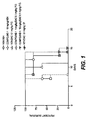
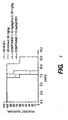
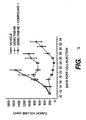
- mice dosed with decitabine or decitabine plus Compound 1 live longer than mice dosed with vehicle control or Compound 1 alone ( FIG. 1 and Table 3; p ⁇ 0.05). A trend for a dose response is observed with Compound 1 in combination with decitabine.
- Table 3 lists the mean survival of each treatment group and the percent ILS (increased life span) compared to the vehicle group. All treated groups live significantly longer than vehicle controls and CDA inhibitor alone groups (p ⁇ 0.05).
- Table 3 lists the weights of the livers and spleens of mice on autopsy. All mice except for the one 0.1 mg/kg decitabine i.p. mouse died a 'tumor burden' related death as indicated by the liver weights greater than 1 g and the spleen weights greater than 80 mg (Covey et al., supra ) . The weights of liver and spleen from 3 control mice are 0.97 ⁇ 0.08g and 0.08 ⁇ 0.02g. Gross observations are noted concerning the overall appearance of the peritoneal and thoracic cavities. Table 3.
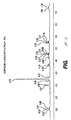
- FIG. 1 is a graph that shows the effect of Compound 1 on decitabine (DAC) induced survival in the L 1210 mouse lymphoma model.
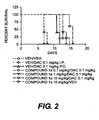
- Compound 1a is evaluated in the L1210 model following the protocol of Example 3. Mice dosed with decitabine ("DAC”), and DAC plus Compound 1a, live longer than those receiving vehicle control and CDA inhibitor alone ( FIG. 2 ; p ⁇ 0.05). In combination with DAC, 10 mg/kg Compound 1a is more effective at extending survival than the lower doses.
- DAC decitabine
- mice The effect of CDA inhibitor, Compound I on cytarabine (ara-C) induced survival in the L1210 survival model 50 CD2F1 6-7 weeks old female mice are randomly separated into 10 groups.
- N 5 mice/group: Group # 1 L1210 i.v. and Veh + Veh (PBS) p.o. x 2 for 4 days 2 L1210 i.v. and Veh + Ara-C 200 mg/kg p.o. x 2 for 4 days 3 L1210 i.v. and Veh + Ara-C 100 mg/kg p.o. x 2 for 4 days 4 L1210 i.v. and Veh + Ara-C 50 mg/kg p.o.
- L1210 IV injection CD2F1 female mice are injected i.p. with L1210 ascites one prior week to sacrifice (CO 2 ). L1210 cells are passed at least 3 times in vivo prior to experiment. The mouse is placed on its back, belly surface cleaned with alcohol wipes and a small incision made into peritoneal cavity. 2 ml of ice cold 2.1% BSA in saline is injected into cavity and then fluid withdrawn and transferred with an 18G 3cc syringe into a clean sterile tube and kept on ice.
- the fluid is diluted 1:10 in 2.1% BSA in saline and one drop of zap-o-globin is added to 2 ml of diluted ascites. Diluted ascites (dilute 1:10 again) are counted on a hematocytomer and the number of cells/ml is calculated. Stock of ascites in BSA solution is diluted to 1x10 4 cells/0.1 ml. Mice are injected with 0.1 ml of cell solution with 27G needle. Total i.v. injections take about 50 minutes. Dose Solution Preparation : When appropriate mice are dosed with vehicle or Compound 1 p.o. 30 minutes prior to Ara-C.
- Compound 1 is prepared at 1 mg/ml in PBS and Ara-C is prepared at a 20 mg/ml stock in PBS and then diluted appropriately for lower doses.
- Dosing Scheme Compound 1 is prepared at the beginning of the study and stored at 4°C. Ara-C is prepared fresh twice a day. All solutions are stored on ice while dosing. Mice are dosed orally twice a day (8 hours apart) for 4 consecutive days. Final dosing scheme and total Ara-C and Compound 1 dose is outlined in Table 4. Table 4.
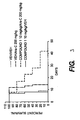
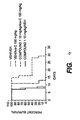
- Compound 1 alone has no effect on survival compared to vehicle controls ( FIG. 4 ).
- 25 mg/kg Ara-C alone has no effect at extending survival compared to mice treated with vehicle and 10 mg/kg Compound 1 .
- 50, 100 and 200 mg/kg Ara-C significantly enhance survival (days) in a dose dependent manner compared to mice in the control group.
- Co-administration of 10 mg/kg Compound 1 with Ara-C p.o. significantly enhances survival compared to the survival time of mice treated with the same dose of Ara-C alone (FIG.'s 4-7).
- the primary endpoints used to evaluate efficacy in the A2780 model are complete and partial tumor regressions, tumor growth delay and the number of tumor free survivors at the end of the study.
- a complete response (CR) is defined as a decrease in tumor size to an undetectable size ( ⁇ 50mm 3 ).
- a partial response (PR) is defined as >50% decrease in tumor mass form starting tumor size.
- a tumor that achieves a CR or PR during the study but starts to grow again is still considered a CR or PR.
- Tumor free survival (TFS) at the end of the study would be no detectable tumor ( ⁇ 50 mm 3 ) at study termination (day 74).
- Tumor growth delay (TGD) is defined in this experiment as the median number of days for the treatment group compared to the control group to reach 750 mm 3 .
- Oral administration of 10 mg/kg PO q3dx4 gemcitabine is not very effective in this model with a tumor growth delay of 6.1 days (not statistically significant), with no CRs, PRs or tumor free survivors at termination of the experiment at day 74.
- 10 mg/kg Gemcitabine is dosed in combination with Compound 1, significant delay of tumor growth is observed compared to this dose of gemcitabine alone (19.2 days; p ⁇ 0.05 compared to Gem alone) with 75% of tumors displaying CR, but there are no TFS at the end of the experiment.
- FIG. 8 Tuor Volume vs Time (days) post treatment start, it is apparent that Compound 1 alone has no effect on tumor growth, while combination treatment with Compound 1 and gemcitabine is more effective than gemcitabine alone.
- Oral administration of 30 mg/kg PO q3dx4 (MTD) gemcitabine is effective in producing a statistically significant tumor growth delay of 22 days with 63% CRs but no TFS.
- Combination chemotherapy with gemcitabine (30 mg/kg PO) plus Compound 1 produced a statistically significant tumor growth delay of > 57 days and 100% CR and a 50% incidence of TFS at day 74, termination of the experiment.
- Table 6 Table 6.
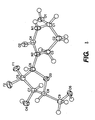
- a colorless prism crystal of Compound 1a (F 2 O 5 N 2 C 9 H 14 ) having approximate dimensions of 0.48 x 0.43 x 0.32 mm is mounted in a loop. All measurements are made on a Rigaku RAXIS SPIDER imaging plate area detector with graphite monochromated Cu-K ⁇ radiation.
- the crystal-to-detector distance is 127.40 mm.
- Cell constants and an orientation matrix for data collection correspond to a primitive trigonal cell (laue class: -3ml) with dimensions:
- the data is collected at a temperature of -123 ⁇ 1°C to a maximum 2 ⁇ value of 136.4°.
- a total of 111 oscillation images are collected.
- the exposure rate is 12.0 [sec./°].
- the crystal-to-detector distance is 127.40 mm. Readout is performed in the 0.100 mm pixel mode.
- the linear absorption coefficient, ⁇ , for Cu-K ⁇ radiation is 13.035 cm -1 .
- An empirical absorption correction is applied which results in transmission factors ranging from 0.540 to 0.659.
- the data is corrected for Lorentz and polarization effects.
- the structure is solved by direct methods (SIR92: Larson, A.C., J. Appl. Cryst., 1994, 27, 435 ) and expanded using Fourier techniques( DIRDIF99 : Beurskens, P.T. et al., The DIRD-99 Program System. Technical Report of the Crystallography Laboratory, 1999, University of Nijinegen, The Netherlands ).
- DIRDIF99 Beurskens, P.T. et al., The DIRD-99 Program System. Technical Report of the Crystallography Laboratory, 1999, University of Nijinegen, The Netherlands ).
- the non-hydrogen atoms are refined anisotropically. Some hydrogen atoms are refined isotropically and the rest are refined using the riding model.
- the absolute structure is deduced based on Flack parameter, 0.0(1), refined using 839 Friedel pairs ( Flack, H. D., Acta Cryst. 1983, A39, 876-881 .
- Neutral atom scattering factors are taken from Cromer, D. T. et al., International Tables for X-ray Crystallography 1974, IV , Table 2.2 A. Anomalous dispersion effects are included in Fcalc ( Ibers, J. A. et al., Acta Crystallogr. 1964, 17, 781 ); the values for ⁇ f' and ⁇ f" are those of Creagh, D. C. et al.., International Tables for Crystallography 1992 , C , Table 4.2.6.8, 219-222. The values for the mass attenuation coefficients are those of Creagh, D. C. et al.. International Tables for Crystallography 1992 , C , Table 4.2.4.3, 200-206. All calculations are performed using the CrystalStructure 3.8 crystallographic software package except for refinement, which is performed using SHELXL-97.
- Variables 181 Reflection/Parameter Ratio 11.34 Residuals: R1 (I>2.00 ⁇ (I)) 0.0303 Residuals: R (All Reflections) 0.0329 Residuals: wR2 (All Reflections) 0.0733 Goodness of Fit Indicator 1.099 Flack Parameter (Friedel pairs 839) 0.0(1) Max Shift/Error in Final Cycle ⁇ 0.001 Maximum peak in Final Diff. Map 0.22 e - / ⁇ 3 Minimum peak in Final Diff. Map -0.22 e - / ⁇ 3
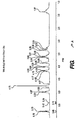
- Tetrahydrouridine ( THU , 5 mg) is dissolved in D 2 O (0.75 mL).
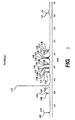
- the 1 HNMR (D 2 O, 300 MHz, 27° C) spectrum is shown in FIG. 10 .
- To this same sample is added one drop of deuterated TFA followed by an immediate 1 HNMR spectrum ( FIG. 10 ).
- the peak at 5.4 ppm ( ⁇ 10% conversion by integration) is indicative of the ring expansion to the TH-pyranose.
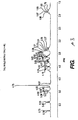
- spectra (D 2 O, 300 MHz, 27° C) are taken as shown in FIG. 11 .
- the TH-pyranose is more prevalent indicating about 60% conversion.
- the conversion is almost entirely complete (>80%).
- Notable changes in the region from 4.0-4.5 are also indicative of THU decomposition and the TH-pyranose formation.
Landscapes
- Chemical & Material Sciences (AREA)
- Health & Medical Sciences (AREA)
- Organic Chemistry (AREA)
- Life Sciences & Earth Sciences (AREA)
- General Health & Medical Sciences (AREA)
- Molecular Biology (AREA)
- Engineering & Computer Science (AREA)
- Biotechnology (AREA)
- Genetics & Genomics (AREA)
- Biochemistry (AREA)
- Medicinal Chemistry (AREA)
- Animal Behavior & Ethology (AREA)
- Pharmacology & Pharmacy (AREA)
- Public Health (AREA)
- Veterinary Medicine (AREA)
- Chemical Kinetics & Catalysis (AREA)
- General Chemical & Material Sciences (AREA)
- Nuclear Medicine, Radiotherapy & Molecular Imaging (AREA)
- Epidemiology (AREA)
- Oncology (AREA)
- Bioinformatics & Cheminformatics (AREA)
- Hematology (AREA)
- Pharmaceuticals Containing Other Organic And Inorganic Compounds (AREA)
- Saccharide Compounds (AREA)
- Medicines That Contain Protein Lipid Enzymes And Other Medicines (AREA)
- Nitrogen Condensed Heterocyclic Rings (AREA)
Abstract
Description
- This application claims the benefit of
U.S. Provisional Application No. 60/980,397, filed October 16, 2007 - The present invention provides certain tetrahydrouridine derivative compounds which are inhibitors of the enzyme cytidine deaminase, pharmaceutical compositions comprising such compounds, and methods of making and using such compounds.
- The enzymes adenosine deaminase (ADA, EC 3.5.4.4) and cytidine deaminase (CDA, EC 3.5.4.5) function to deaminate natural aminopurine and aminopyrimidine nucleosides, respectively, in human and other organisms. They may also convert active nucleoside-based drugs into inactive metabolites. For example, the purine nucleoside drug arabinosyladenine (fludarabine, ara-A) is deaminated by ADA; the resulting compound, with the parent amino group replaced with hydroxyl, is inactive as an antitumor agent compared to the parent compound. Similarly, the antileukemia drug arabinosylcytosine (cytarabine, ara-C) is metabolically degraded by CDA into inactive arabinosyluracil.
- CDA is a component of the pyrimidine salvage pathway. It converts cytidine and deoxycytidine to uridine and deoxyuridine, respectively, by hydrolytic deamination ( Arch. Biochem. Biophys. 1991, 290, 285-292; Methods Enzymol. 1978, 51, 401-407; Biochem. J. 1967, 104, 7P). It also deaminates a number of synthetic cytosine analogs which are clinically useful drugs, such as ara-C mentioned above (Cancer Chemother. Pharmacol. 1998, 42, 373-378; Cancer Res. 1989, 49, 3015-3019; Antiviral Chem. Chemother. 1990, 1, 255-262). Conversion of the cytosine compounds to the uridine derivatives usually confers loss of therapeutic activity or addition of side-effects. It has also been shown that cancers that acquire resistance to cytosine analog drugs often overexpress CDA (Leuk Res. 1990, 14, 751-754). Leukemic cells expressing a high level of CDA can manifest resistance to cytosine antimetabolites and thereby limit the antineoplastic activity of such therapeutics (Biochem. Pharmacol. 1993, 45, 1857-1861). Inhibitors of CDA could therefore be useful adjuvants in combination chemotherapy.
- Tetrahydrouridine (THU) has been known as an inhibitor of cytidine deaminase for a number of years.

- Various reports have suggested that co-administration with THU increases the efficacy and oral activity of cytidine-based drugs. For example, THU has been shown to enhance the oral activity of anti-leukemic agent 5-azacytidine in L1210 leukemic mice ( Cancer Chemotherapy Reports 1975, 59, 459-465). The combination of THU plus 5-azacytidine has also been studied in a baboon sickle cell anemia model (Am. J. Hematol. 1985, 18, 283-288), and in human patients with sickle cell anemia in combination with orally administered 5-azacytidine (Blood 1985, 66, 527-532).

- THU has also been shown to enhance the oral efficacy of ara-C in L1210 leukemic mice (Cancer Research 1970, 30, 2166; Cancer Invest 1987, 5, (4), 293-9), and in tumor-bearing mice (Cancer Treat. Rep. 1977, 61, 1355-1364). The combination of intravenously-administered ara-C with intravenously-administered THU has been investigated in several clinical studies in humans ( Cancer Treat. Rep. 1977, 61, 1347-1353; Cancer Treat. Rep. 1979, 63, 1245-1249; Cancer Res. 1988, 48, 1337-1342). In particular, combination studies in patients with acute myeloid leukemia (AML) and chronic myeloid leukemia (CML) have been performed (Leukemia 1991, 5, 991-998; Cancer Chemother. Pharmacol. 1993, 31, 481-484).
5-Aza-2'-deoxycytidine (decitabine) is an antineoplastic agent for the treatment of myelodysplastic syndrome (MDS), with potential utility for the treatment of AML and CML as well. Like the other cytidine-based drugs, its oral bioavailability and efficacy are limited by deactivation by CDA. THU has been shown to improve the potency of decitabine in a sickle cell disease model in baboons (Am. J. Hematol. 1985, 18, 283-288). In addition, another known CDA inhibitor, zebularine, has been shown to enhance the efficacy of decitabine in mice with L1210 leukemia (Anticancer Drugs 2005, 16, 301-308). - Gemcitabine, another cytidine-based antineoplastic drug, has also been studied in conjunction with CDA inhibitors (Biochem. Pharmacol. 1993, 45, 1857-1861). Co-administration with THU has been shown to alter the pharmacokinetics and bioavailability of gemcitabine in mice (Abstr. 1556, 2007 AACR Annual Meeting, April 14-18, 2007, Los Angeles, CA; Clin. Cancer Res. 2008, 14, 3529-3535).
5-Fluoro-2'-deoxycytidine (fluorocytidine, FdCyd) is another cytidine-based anticancer drug which is an inhibitor of DNA methyltransferase. The modulation of its metabolism and pharmacokinetics by THU in mice has been studied (Clin Cancer Res., 2006, 12, 7483-7491; Cancer Chemother. Pharm. 2008, 62, 363-368). - The results of the aforementioned studies suggest that there is therapeutic utility in the administration of CDA inhibitors together with cytidine-based drugs such as ara-C, decitabine, 5-azacytidine and others. However, early CDA inhibitors such as THU suffer from drawbacks that include acid instability ( J. Med. Chem. 1986, 29, 2351) and poor bioavailability (J. Clin. Pharmacol. 1978, 18, 259).
- There is therefore an ongoing need for new, potent and therapeutically useful inhibitors of CDA.
- The present invention provides certain tetrahydrouridine derivative compound, pharmaceutical compositions comprising such compounds, and methods of making and using such compounds. The compounds, compositions and methods of the invention may provide certain benefits. For example, the compounds and compositions of the invention may inhibit CDA enzyme activity and/or enhance the half-life, bioavailability and/or efficacy of drugs that are substrates for CDA. Additionally, the compounds, compositions and methods of the invention may exhibit improved aqueous solubility, chemical stability, drug absorption levels, toxicity levels, shelf-life, reproducibility in manufacturing and formulation, and therapeutic efficacy.
- In one embodiment, the invention provides a compound of Formula I:

- In further embodiments, the compound of Formula I has the stereochemistry of either Ia or Ib:

- In further embodiments, the compound of Formula I is Compound 1 or a pharmaceutically acceptable salt thereof:

- In further embodiments, the compound of Formula I is selected from the group consisting of
Compounds 1a, 1b and pharmaceutically acceptable salts thereof.
- Since the compounds of the invention may possess at least one chiral center, they may exist in the form of enantiomers, diastereomers, racemic mixtures, non-racemic mixtures or other stereoisomers. The present invention encompasses all such possible isomers, as well as geometric isomers and tautomers.
- Another aspect of the present invention relates to a pharmaceutical composition comprising:
- (i) an effective amount of a compound of the invention as described herein, including but not limited to each express embodiment; and
- (ii) a pharmaceutically acceptable excipient.
- In further embodiments, the pharmaceutical composition further comprises an effective amount of at least one additional therapeutic agent, such as a CDA substrate drug or chemotherapeutic agent.
- The "effective amount" of the compound of the invention may vary from 0.1 wt. % to about 100 wt. %. In some embodiments, the effective amount of the compound is 0.1 to 20% w/w. In other embodiments, the effective amount is 1-10% w/w. In yet other embodiments, the effective amount is 2-5% w/w.
- The pharmaceutical compositions of the invention may be formulated for administration in solid or liquid form, including those adapted for the following: (1) oral administration, for example, drenches (for example, aqueous or non-aqueous solutions or suspensions), tablets (for example, those targeted for buccal, sublingual and systemic absorption), caplets, boluses, powders, granules, pastes for application to the tongue, hard gelatin capsules, soft gelatin capsules, mouth sprays, troches, lozenges, pellets, syrups, suspensions, elixirs, liquids, emulsions and microemulsions; (2) parenteral administration, for example, by subcutaneous, intramuscular, intravenous or epidural injection as, for example, a sterile solution or suspension; (3) topical application, for example, as a cream, ointment, patch, pad or spray applied to the skin; (4) intravaginally or intrarectally, for example, as a pessary, cream or foam; (5) sublingually; (6) ocularly; (7) transdermally; or (8) nasally. The pharmaceutical compositions may be formulated for immediate, sustained or controlled release.
- In some embodiments, the pharmaceutical compositions are formulated for oral administration. In further embodiments, the pharmaceutical compositions are formulated for oral administration in solid form.
- Another embodiment of the present invention relates to a method for inhibiting cytidine deaminase, comprising administering to a subject in need thereof an effective amount of a compound or pharmaceutical composition of the invention as described herein, including but not limited to each express embodiment.
- In some embodiments, the subject is a mammal. In further embodiments, the subject is a human.
- Another embodimentof the present invention relates to the use of the compounds of the present invention in a method for treating cancer, comprising administering to a subject in need thereof:
- (i) an effective amount of a compound or pharmaceutical composition of the invention as described herein, including but not limited to each express embodiment; and
- (ii) a CDA substrate drug, including but not limited to each express embodiment described herein.
- In some embodiments, the subject is a mammal. In further embodiments, the subject is a human.
- In some embodiments, the cancer is selected from hematological cancers and solid cancers. In further embodiments, the hematological cancer selected from MDS and leukemia. In further embodiments, the solid cancer is selected from pancreatic cancer, ovarian cancer, peritoneal cancer, non small cell lung cancer, and breast cancer. In yet further embodiments, the leukemia is acute myeloid leukemia (AML) or chronic myeloid leukemia (CML).
- Another embodiment of the present invention relates to a method for inhibiting degradation of a CDA substrate drug by cytidine deaminase, comprising administering an effective amount of a compound or pharmaceutical composition of the invention as described herein, including but not limited to each express embodiment, to a subject that is undergoing treatment with the CDA substrate drug. The CDA substrate drug, including but not limited to each express embodiment described herein.
- In some embodiments, the subject is a mammal. In further embodiments, the subject is a human.
-
-
FIG. 1 is a graph that shows the effect ofCompound 1 on decitabine induced survival in the L 1210 mouse lymphoma model. -
FIG. 2 is a graph that shows the effect ofCompound 1a on decitabine induced survival in the L1210 mouse lymphoma model. -
FIG. 3 is a graph that shows the effect ofCompound 1 on Ara-C (200 mg/kg) induced survival in the L 1210 model. -
FIG. 4 is a graph that shows the effect ofCompound 1 on Ara-C (100 mg/kg) induced survival in the L 1210 model. -
FIG. 5 is a graph that shows the effect ofCompound 1 on Ara-C (50 mg/kg) induced survival in the L1210 model. -
FIG. 6 is a graph that shows the effect ofCompound 1 on Ara-C (25 mg/kg) induced survival in the L1210 model. -
FIG. 7 is a graph that shows the effect ofCompound 1 on gemcitabine-induced reduction of tumor volume in the mouse A2780 human ovarian cancer xenograft model. -
FIG. 8 is an ORTEP plot of the crystal structure ofCompound 1a. -
FIG. 9 is the 1H NMR structure of THU inD 20. -
FIG. 10 is the 1H NMR structure of THU inD 20, in the presence of trifluoroacetic acid, at different times. -
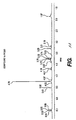
FIG. 11 is the 1H NMR structure ofCompound 1a inD 20. -
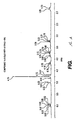
FIG. 12 is the 1H NMR structure ofCompound 1a inD 20, in the presence of trifluoroacetic acid, at different times. - The present invention provides certain tetrahydrouridine derivative compounds, pharmaceutical compositions comprising such compounds, and methods of making and using such compounds. The compounds, compositions and methods of the invention may provide certain benefits. For example, the compounds and compositions of the invention may inhibit CDA enzyme activity and/or enhance the half-life, bioavailability and/or efficacy of drugs that are substrates for CDA. Additionally, the compounds, compositions and methods of the invention may exhibit improved aqueous solubility, chemical stability, drug absorption levels, toxicity levels, shelf-life, reproducibility in manufacturing and formulation, and therapeutic efficacy.
- Throughout the specification and claims, the following definitions apply.
- As used in the specification and claims, the singular forms "a," "an," and "the" include plural referents unless the content clearly dictates otherwise. Thus, for example, reference to a pharmaceutical composition comprising "a compound" may encompass two or more compounds.
- "CDA substrate drug" refers to a drug that can be deaminated by CDA. Nonlimiting examples of a CDA substrate include cytidine analogs, such as decitabine, 5-azacytidine, gemcitabine, ara-C, troxacitabine, tezacitabine, 5'-fluoro-2'-deoxycytidine, and cytochlor.
- "Effective amount" refers to the amount required to produce a desired effect (e.g., enhancing the half-life, bioavailability or efficacy of a CDA substrate drug, treating cancer in a subject, inhibiting cytidine deaminase in a subject, or inhibiting degradation of a CDA substrate drug by cytidine deaminase).
- "Half-life" refers to the period of time required for the concentration or amount of a compound in a subject to be reduced to exactly one-half of a given concentration or amount.
- "Pharmaceutically acceptable" refers to those properties and/or substances that are acceptable to the patient from a pharmacological and/or toxicological point of view, and/or to the manufacturing pharmaceutical chemist from a physical and/or chemical point of view regarding composition, formulation, stability, patient acceptance, bioavailability and compatibility with other ingredients.
- "Pharmaceutically acceptable excipient" can mean any substance, not itself a therapeutic agent, used as a carrier, diluent, adjuvant, binder, and/or vehicle for delivery of a therapeutic agent to a subject, or added to a pharmaceutical composition to improve its handling or storage properties or to permit or facilitate formation of a compound or composition into a unit dosage form for administration. Pharmaceutically acceptable excipients are well known in the pharmaceutical arts and are described, for example, in Remington's Pharmaceutical Sciences, Mack Publishing Co., Easton, Pa (e.g., 20th Ed., 2000), and Handbook of Pharmaceutical Excipients, American Pharmaceutical Association, Washington, D.C., (e.g., 1st, 2nd and 3rd Eds., 1986, 1994 and 2000, respectively). As will be known to those skilled in the art, excipients may provide a variety of functions and may be described as wetting agents, buffering agents, suspending agents, lubricating agents, emulsifiers, disintegrants, absorbents, preservatives, surfactants, colorants, flavorants, and sweeteners. Examples of pharmaceutically acceptable excipients include without limitation: (1) sugars, such as lactose, glucose and sucrose; (2) starches, such as corn starch and potato starch; (3) cellulose and its derivatives, such as sodium carboxymethyl cellulose, ethyl cellulose, cellulose acetate, hydroxypropylmethylcellulose, and hydroxypropylcellulose; (4) powdered tragacanth; (5) malt; (6) gelatin; (7) talc; (8) excipients, such as cocoa butter and suppository waxes; (9) oils, such as peanut oil, cottonseed oil, safflower oil, sesame oil, olive oil, corn oil and soybean oil; (10) glycols, such as propylene glycol; (11) polyols, such as glycerin, sorbitol, mannitol and polyethylene glycol; (12) esters, such as ethyl oleate and ethyl laurate; (13) agar; (14) buffering agents, such as magnesium hydroxide and aluminum hydroxide; (15) alginic acid; (16) pyrogen-free water; (17) isotonic saline; (18) Ringer's solution; (19) ethyl alcohol; (20) pH buffered solutions; (21) polyesters, polycarbonates and/or polyanhydrides; and (22) other non-toxic compatible substances employed in pharmaceutical formulations.
- "Pharmaceutically acceptable salt" refers to an acid or base salt of a compound of the invention, which salt possesses the desired pharmacological activity and is neither biologically nor otherwise undesirable. The salt can be formed with acids that include without limitation acetate, adipate, alginate, aspartate, benzoate, benzenesulfonate, bisulfate butyrate, citrate, camphorate, camphorsulfonate, cyclopentanepropionate, digluconate, dodecylsulfate, ethanesulfonate, fumarate, glucoheptanoate, glycerophosphate, hemisulfate, heptanoate, hexanoate, hydrochloride hydrobromide, hydroiodide, 2-hydroxyethane-sulfonate, lactate, maleate, methanesulfonate, 2-naphthalenesulfonate, nicotinate, oxalate, thiocyanate, tosylate and undecanoate. Examples of a base salt include without limitation ammonium salts, alkali metal salts such as sodium and potassium salts, alkaline earth metal salts such as calcium and magnesium salts, salts with organic bases such as dicyclohexylamine salts, N-methyl-D-glucamine, and salts with amino acids such as arginine and lysine. In some embodiments, the basic nitrogen-containing groups can be quarternized with agents including lower alkyl halides such as methyl, ethyl, propyl and butyl chlorides, bromides and iodides; dialkyl sulfates such as dimethyl, diethyl, dibutyl and diamyl sulfates; long chain halides such as decyl, lauryl, myristyl and stearyl chlorides, bromides and iodides; and aralkyl halides such as phenethyl bromides.
- "Unit dosage form" refers to a physically discrete unit suitable as a unitary dosage for human or other animal subjects. Each unit dosage form may contain a predetermined amount of an active substance (e.g., compound or composition of the invention, CDA substrate drug and/or other therapeutic agent) calculated to produce a desired effect.
- "isomers" refer to compounds having the same number and kind of atoms and hence the same molecular weight, but differing with respect to the arrangement or configuration of the atoms.
- "Stereoisomers" refer to isomers that differ only in the arrangement of the atoms in space.
- "Diastereoisomers" refer to stereoisomers that are not mirror images of each other.
- "Enantiomers" refers to stereoisomers that are non-superimposable mirror images of one another. Enantiomers include "enantiomerically pure" isomers that comprise substantially a single enantiomer, for example, greater than or equal to 90%, 92%, 95%, 98%, or 99%, or equal to 100% of a single enantiomer.
- "Epimers" refer to stereoisomers of a compound that have different configurations at only one of several stereogenic centers.
- "Racemic" refers to a mixture containing equal parts of individual enantiomers.
- "Non-racemic" refers to a mixture containing unequal parts of individual enantiomers. A non-racemic mixture may be enriched in the R- or S-configuration, including, without limitation, about 50/50, about 60/40, and about 70/30 R- to S-enantiomer, or S- to R-enantiomer, mixtures.
- "Optional" or "optionally" means that the subsequently described event or circumstance may or may not occur, and that the description includes instances where the event or circumstance occurs and instances in which it does not. For example, an alkyl that is "optionally substituted" encompasses both an alkyl that is unsubstituted and an alkyl that is substituted.
- "Subject" refers to a cell or tissue, in vitro or in vivo, an animal or a human. An animal or human subject may also be referred to as a "patient."
- "Animal" refers to a living organism having sensation and the power of voluntary movement, and which requires for its existence oxygen and organic food.
- "Mammal" refers to a warm-blooded vertebrate animal with hair or fur. Examples include without limitation members of the human, equine, porcine, bovine, murine, canine or feline species.
- "Treating" in reference to a disease, disorder or condition refers to: (i) inhibiting a disease, disorder or condition, e.g., arresting its development; and/or (ii) relieving a disease, disorder or condition, e.g., causing regression of the clinical symptoms.
- "Preventing" in reference to a disease, disorder or condition refers to preventing a disease, disorder or condition, e.g., causing the clinical symptoms of the disease, disorder or condition not to develop.
- "Cancer" refers to an abnormal growth of cells which tend to proliferate in an uncontrolled way and, in some cases, to metastasize (spread). Specific cancers types include without limitation the cancers identified in Publication No.
US 2006/0014949 and the following: - cardiac: sarcoma (e.g., such as angiosarcoma, fibrosarcoma, rhabdomyosarcoma, liposarcoma and the like), myxoma, rhabdomyoma, fibroma, lipoma and teratoma;
- lung: bronchogenic carcinoma (e.g., such as squamous cell, undifferentiated small cell, undifferentiated large cell, adenocarcinoma and the like), alveolar (e.g., such as bronchiolar) carcinoma, bronchial adenoma, sarcoma, lymphoma, chondromatous hamartoma, mesothelioma;
- gastrointestinal: esophagus (e.g., such as squamous cell carcinoma, adenocarcinoma, leiomyosarcoma, lymphoma and the like), stomach (e.g., such as carcinoma, lymphoma, leiomyosarcoma and the like), pancreas (e.g., such as ductal adenocarcinoma, insulinoma, glucagonoma, gastrinoma, carcinoid tumors, vipoma and the like), small bowel (e.g., such as adenocarcinoma, lymphoma, carcinoid tumors, Karposi's sarcoma, leiomyoma, hemangioma, lipoma, neurofibroma, fibroma, and the like), large bowel (e.g., such as adenocarcinoma, tubular adenoma, villous adenoma, hamartoma, leiomyoma and the like);
- genitourinary tract: kidney (e.g., such as adenocarcinoma, Wilm's tumor nephroblastoma, lymphoma, leukemia, and the like), bladder and urethra (e.g., such as squamous cell carcinoma, transitional cell carcinoma, adenocarcinoma and the like), prostate (e.g., such as adenocarcinoma, sarcoma), testis (e.g., such as seminoma, teratoma, embryonal carcinoma, teratocarcinoma, choriocarcinoma, sarcoma, interstitial cell carcinoma, fibroma, fibroadenoma, adenomatoid tumors, lipoma and the like);
- liver: hepatoma (e.g., hepatocellular carcinoma and the like), cholangiocarcinoma, hepatoblastoma, angiosarcoma, hepatocellular adenoma, hemangioma;
- bone: osteogenic sarcoma (e.g., such as osteosarcoma and the like), fibrosarcoma, malignant fibrous histiocytoma, chondrosarcoma, Ewing's sarcoma, malignant lymphoma (e.g., such as reticulum cell sarcoma), multiple myeloma, malignant giant cell tumor chordoma, osteochronfroma (e.g., such as osteocartilaginous exostoses), benign chondroma, chondroblastoma, chondromyxofibroma, osteoid osteoma and giant cell tumors;
- nervous system: skull (e.g., such as osteoma, hemangioma, granuloma, xanthoma, osteitis deformans and the like), meninges (e.g., such as meningioma, meningiosarcoma, gliomatosis and the like), brain (e.g., such as astrocytoma, medulloblastoma, glioma, ependymoma, germinoma [pinealoma], glioblastoma multiform, oligodendroglioma, schwannoma, retinoblastoma, congenital tumors and the like), spinal cord (e.g., such as neurofibroma, meningioma, glioma, sarcoma and the like);
- gynecological: uterus (e.g., such as endometrial carcinoma and the like), cervix (e.g., such as cervical carcinoma, pre-tumor cervical dysplasia and the like), ovaries (e.g., such as ovarian carcinoma [serous cystadenocarcinoma, mucinous cystadenocarcinoma, unclassified carcinoma], granulosa-thecal cell tumors, Sertoli-Leydig cell tumors, dysgerminoma, malignant teratoma, and the like), vulva (e.g., such as squamous cell carcinoma, intraepithelial carcinoma, adenocarcinoma, fibrosarcoma, melanoma and the like), vagina (e.g., such as clear cell carcinoma, squamous cell carcinoma, botryoid sarcoma (embryonal rhabdomyosarcoma], fallopian tubes (carcinoma) and the like);
- hematologic: blood (e.g., such as myeloid leukemia [acute and chronic], acute lymphoblastic leukemia, chronic lymphocytic leukemia, myeloproliferative diseases, multiple myeloma, myelodysplastic syndrome and the like), Hodgkin's disease, non-Hodgkin's lymphoma;
- skin: malignant melanoma, basal cell carcinoma, squamous cell carcinoma, Karposi's sarcoma, moles dysplastic nevi, lipoma, angioma, dermatofibroma, keloids, psoriasis and the like; and
- adrenal glands: neuroblastoma.
- One aspect of the present invention relates to a compound of Formula I:

- In further embodiments, the compound of Formula I has the stereochemistry of either Ia or Ib:

- In further embodiments, the compound of Formula I is Compound 1 or a pharmaceutically acceptable salt thereof:

- In further embodiments, the compound of Formula I is selected from the group consisting of
Compounds 1a, 1b and pharmaceutically acceptable salts thereof.
- Since the compounds of the invention may possess at least one chiral center, they may exist in the form of enantiomers, diastereomers, racemic mixtures, non-racemic mixtures or other stereoisomers. The present invention encompasses all such possible isomers, as well as geometric isomers and tautomers.
- Stereoisomers may be prepared or isolated by known methods. For example, diastereoisomers may be separated by physical separation methods such as fractional crystallization and chromatographic techniques, and enantiomers may be separated from each other by the selective crystallization of the diastereomeric salts with optically active acids or bases or by chiral chromatography. Pure stereoisomers may also be prepared synthetically from appropriate stereochemically pure starting materials, or by using stereoselective reactions.
- Another aspect of the present invention relates to a pharmaceutical composition comprising:
- (i) an effective amount of a compound of the invention as described herein, including but not limited to each express embodiment; and
- (ii) a pharmaceutically acceptable excipient.
- In further embodiments, the pharmaceutical composition further comprises an effective amount of at least one additional therapeutic agent, such as a CDA substrate drug or chemotherapeutic agent.
- The CDA substrate drug may be any drug that can be deaminated by CDA. Nonlimiting examples of a CDA substrate include cytosine and cytidine analogs, such as decitabine, 5-azacytidine, gemcitabine, ara-C, troxacitabine, tezacitabine, 5'-fluoro-2'-deoxycytidine, cytochlor, and the compounds disclosed in
US Publication No. 2006/0014949 . In some embodiments, the CDA substrate drug is decitabine. In other embodiments, the CDA substrate drug is 5-azacytidine. In yet other embodiments, the CDA substrate drug is gemcitabine. In yet other embodiments, the CDA substrate drug is ara-C. - Examples of a chemotherapeutic agent include without limitation:
- alkylating agents (e.g., which may include doxorubicin, cyclophosphamide, estramustine, carmustine, mitomycin, bleomycin and the like);
- antimetabolites (e.g., which may include 5-Fluoro-Uracil, capecitabine, gemcitabine, nelarabine, fludarabine, methotrexate and the like);
- platinating agents (e.g., which may include cisplatin, oxaliplatin, carboplatin and the like);
- topoisomerase inhibitors (e.g., which may include topotecan, irinotecan, etoposide and the like);
- tubulin agents (e.g., which may include paclitaxel, docetaxel, vinorelbine, vinblastine, vincristine, other taxanes, epothilones, and the like);
- signalling inhibitors (e.g., kinase inhibitors, antibodies, farnesyltransferase inhibitors, and the like); and
- other chemotherapeutic agents (e.g, tamoxifen, anti-mitotic agents such as polo-like kinase inhibitors or aurora kinase inhibitors, and the like).
- The "effective amount" of the compound of the invention may vary from 0.1 wt. % to about 100 wt. %. In some embodiments, the effective amount of the compound is 0.1 to 20% w/w. In other embodiments, the effective amount is 1-10% w/w. In yet other embodiments, the effective amount is 2-5% w/w.
- The pharmaceutical compositions of the invention may be formulated for administration in solid or liquid form, including those adapted for the following: (1) oral administration, for example, drenches (for example, aqueous or non-aqueous solutions or suspensions), tablets (for example, those targeted for buccal, sublingual and systemic absorption), caplets, boluses, powders, granules, pastes for application to the tongue, hard gelatin capsules, soft gelatin capsules, mouth sprays, troches, lozenges, pellets, syrups, suspensions, elixirs, liquids, emulsions and microemulsions; (2) parenteral administration, for example, by subcutaneous, intramuscular, intravenous or epidural injection as, for example, a sterile solution or suspension; (3) topical application, for example, as a cream, ointment, patch, pad or spray applied to the skin; (4) intravaginally or intrarectally, for example, as a pessary, cream or foam; (5) sublingually; (6) ocularly; (7) transdermally; or (8) nasally. The pharmaceutical compositions may be formulated for immediate, sustained or controlled release.
- In some embodiments, the pharmaceutical compositions are formulated for oral administration. In further embodiments, the pharmaceutical compositions are formulated for oral administration in solid form.
- Pharmaceutical compositions of the invention can be prepared using known materials and techniques, which may include but are not limited to mixing and/or blending the compound of the invention with the pharmaceutically acceptable excipient and optional therapeutic agent(s).
- Another aspect of the present invention relates to a method for inhibiting cytidine deaminase, comprising administering to a subject in need thereof an effective amount of a compound or pharmaceutical composition of the invention as described herein, including but not limited to each express embodiment.
- In some embodiments, the subject is a mammal. In further embodiments, the subject is a human.
- Another aspect of the present invention relates to the use of the compounds of the present invention in a method for treating cancer, comprising administering to a subject in need thereof:
- (i) an effective amount of a compound or pharmaceutical composition of the invention as described herein, including but not limited to each express embodiment; and
- (ii) a CDA substrate drug, including but not limited to each express embodiment described herein.
- In some embodiments, the subject is a mammal. In further embodiments, the subject is a human.
- In some embodiments, the cancer is selected from hematological cancers and solid cancers. In further embodiments, the hematological cancer selected from MDS and leukemia. In further embodiments, the solid cancer is selected from pancreatic cancer, ovarian cancer, peritoneal cancer, non small cell lung cancer, and breast cancer. In yet further embodiments, the leukemia is acute myeloid leukemia (AML) or chronic myeloid leukemia (CML).
- Another aspect of the present invention relates to a method for inhibiting degradation of a CDA substrate drug by cytidine deaminase, comprising administering an effective amount of a compound or pharmaceutical composition of the invention as described herein, including but not limited to each express embodiment, to a subject that is undergoing treatment with the CDA substrate drug. The CDA substrate drug, including but not limited to each express embodiment described herein.
- In some embodiments, the subject is a mammal. In further embodiments, the subject is a human.
- Administration of the compound or composition of the invention may be via any accepted mode known to one skilled in the art, for example, orally, parenterally, by inhalation spray, topically, rectally, nasally, buccally, vaginally, intraoccularly, intrapulmonarily, or via an implanted reservoir. The term "parenterally" includes without limitation subcutaneously, intravenously, intramuscularly, intraperitoneally, intrathecally, intraventricularly, intrasternally, intracranially, by intraosseous injection and by infusion techniques.
- Any administration regimen well known to those skilled in the art for regulating the timing and sequence of drug delivery can be used and repeated as necessary to effect treatment in the methods of the invention. For example, the compound or composition of the invention may be administered 1, 2, 3 or 4 times daily, by a single dose, multiple discrete doses or continuous infusion.
- The compound or composition of the invention may be administered prior to, at substantially the same time with, or after administration of the CDA substrate drug. The administration regimen may include pretreatment and/or co-administration with at least one additional therapeutic agent. In such case, the compound or composition of the invention, CDA substrate drug and at least one additional therapeutic agent may be administered simultaneously, separately, or sequentially.
- Examples of administration regimens include without limitation:
- administration of each compound, composition, CDA substrate drug, and/or therapeutic agent in a sequential manner; and
- co-administration of each compound, composition, CDA substrate drug, and/or therapeutic agent in a substantially simultaneous manner (e.g., as in a single unit dosage form) or in multiple, separate unit dosage forms for each compound, composition, CDA substrate drug, and/or therapeutic agent.
- It will be appreciated by those skilled in the art that the "effective amount" or "dose level" will depend on various factors such as the particular administration mode, administration regimen, compound, and composition selected, and the particular disease and patient being treated. For example, the appropriate dose level may vary depending upon the activity, rate of excretion and possible toxicity of the specific compound or composition employed; the age, body weight, general health, gender and diet of the patient being treated; the frequency of administration; the other therapeutic agent(s) being co-administered; and the type and severity of the disease.
- The present invention contemplates dose levels on the order of about 0.001 to about 10,000 mg/kg/d. In some embodiments, the dose level is about 0.1 to about 1,000 mg/kg/d. In other embodiments, the dose level is about 1 to about 100 mg/kg/d. In yet other embodiments, the dose level is about 1 to about 50 mg/kg/d. In yet other embodiments, the dose level is about 1 to about 25 mg/kg/d. Appropriate dose levels, mode of administration, and administration regimen may be ascertained by those skilled in the art using known techniques.
- It will be apparent to those skilled in the art that specific embodiments of the present invention may be directed to one, some or all of the above-indicated aspects as well as other aspects, and may encompass one, some or all of the above- and below- indicated embodiments, as well as other embodiments.
- Other than in the working examples, or where otherwise indicated, all numbers expressing quantities of ingredients, reaction conditions, and so forth used in the specification and claims are to be understood as being modified by the term "about". Accordingly, unless indicated to the contrary, such numbers are approximations that may vary depending upon the-desired properties sought to be obtained by the present invention. At the very least, and not as an attempt to limit the application of the doctrine of equivalents to the scope of the claims, each numerical parameter should be construed in light of the number of significant digits and ordinary rounding techniques.
- While the numerical ranges and parameters setting forth the broad scope of the invention are approximations, the numerical values set forth in the working examples are reported as precisely as possible. Any numerical value, however, inherently contains certain errors necessarily resulting from the standard deviation found in their respective testing measurements.
- The following examples are illustrative of the present invention and are not intended to be limitations thereon.
- Compound of the invention can be prepared as described herein and/or by the application or adaptation of known methods. It will be appreciated by those skilled in the art that one or more of the reactants, steps and/or conditions described in the reaction schemes may require adjustment to accommodate other substituents at R1 and R2.
-
Scheme 1. Synthesis of difluorotetrahydrouridine derivatives (Compounds 1a and 1b)

difluorotetrahydrouridine 1a and 1b (DFTHU). The crude mixture is purified on reverse phase HPLC (reverse phase C18 @ 5% CH3CN/H2O) to afford 1.84 g (61%, 14.5 minutes) ofDFDHU 25 and 175 mg (17%, 1a, 9.5 minutes and 1b, 13.9 minutes) of the epimers of DFTHU. The absolute configuration of C-4 forcompound 1a is determined by single crystal X-ray diffraction, and is consistent with literature precedents on the crystal structure of cytidine deaminase in complex with a single epimer of tetrahydrouridine. 1HNMR of 5: 6.00 (dd, 1H), 4.20 (q, 1H), 3.92-3.72 (m, 3H), 3.64 (m, 1H), 3.43 (m, 1H), 2.68 (t, 2H).
2'2'-DiFluoro-TetraHydroUridine (DFTHU, 1a and 1b). The DFDHU 25 (1.2 g, 4.9 mmol) is dissolved in 30 mL of MeOH and cooled to 0°C. Sodium borohydride (540 mg, 14.6 mmol) is added portion-wise to the solution and the reaction is slowly warmed to room temperature. After 4 hours of stirring at room temperature (r.t.), the MeOH is removed in vacuo and the residue is dissolved in 15 mL of H2O. The solution is neutralized with 2.0 N HCl topH 7. The solution is then purified via prep HPLC (reverse phase C18 @ 5% CH3CN/H2O). The salts come out at 5.2 minutes. One peak is apparent at 7.5 minutes (12%). One epimer of theDFTHU 1a comes out at 9.5 minutes (350, 29%). The other epimer 1b comes out at 14.3 minutes (370 mg, 31%). The deoxygenatedproduct 26 elutes at 17 minutes (200 mg, 17%).
1a 1HNMR (D2O, 9.5 minutes): 6.03 (dd, 1H), 5.04 (bs, 1H), 4.20 (q, 1H), 3.90-3.71 (m, 3H), 3.53 (dt, 1H), 3.30 (dt, 1H), 1.92-1.75 (m, 2H). Anal. Calcd. for C9H14N2O5F2 (0.15 H2O): C, 39.90; H, 5.32; N, 10.34. Found: C, 39.87; H, 5.41; N, 10.26.
1b 1HNMR (D2O, 14.3 minutes): 5.97 (dd, 1H), 5.03 (bt, 1H), 4.16 (q, 1H), 3.91-3.68 (m, 3H), 3.41 (dt, 1H), 3.20 (dt, 1H), 1.95-1.80 (m, 2H). Anal Calcd. for C9H14N2O5F2 (0.60 H2O): C, 38.74; H, 5.49; N, 10.04. Found: C, 38.55; H, 5.36; N, 9.87. 26 1H NMR (D2O) δ 5.99 (dd, J = 15 Hz, 6 Hz, 1H), 4.17 ( m, 1H), 3.89 (m, 1H), 3.75 (m, 2H), 3.42 (m, 1H), 3.21 (t, J = 6 Hz, 2H), 3.18 (m, 1H), 1.86 (m, 2H). - The ability of the compounds of the invention to inhibit the enzymatic activity of CDA may be demonstrated using the following assay method.
- The procedure to determine CDA enzymatic activity is based on published methodologies (for example, Cacciamani, T. et al., Arch. Biochem. Biophys. 1991, 290, 285-92; Cohen R. et al., J. Biol. Chem., 1971, 246, 7566-8; Vincenzetti S. et al., Protein Expr. Purif. 1996, 8, 247-53). The assay follows the change in absorbance at 286 nm of the CDA-catalyzed deamination of cytidine to form uridine. The reaction is carried out in potassium phosphate buffer (pH 7.4, 20 mM, containing 1 mM DTT) in a total volume of 200 µl in a 96-well plate format. The final reaction mixture contains cytidine (50 µM) and purified human recombinant CDA. Purified enzyme is diluted so as to produce an absorbance change of approximately 2 milli-absorbance units / minute. Base line measurements of absorbance change over time are made before CDA addition to insure no change of absorbance in the absence of CDA. After CDA addition, absorbance change is monitored for 20 - 30 minutes. When potential inhibitors are present, eight concentrations of each in the 0.1 nM - 1 mM range are tested in order to obtain IC50 values. The slope of the change of absorbance over time for samples containing both cytidine and CDA but no inhibitor (totals) is normalized to 100%. CDA enzymatic activity left in the presence of a compound expressed as percent of total activity is subtracted from 100% in order to obtain percent inhibition at varying compound concentrations.
- Using the above described assay, the inhibitory potency of
Compounds 1 are evaluated. The IC50 values of the compounds are set forth in Table 1. "1a" and "1b" denote single stereoisomers; "1" denotes an epimeric mixture.Table 1. Inhibitory Potency of Test Compounds Compound IC50 (nM) 1a 400 ± 60 1b 5000 ± 1000 1 400 ± 60 - The ability of the compounds of the invention to enhance the efficacy of CDA substrate drugs may be demonstrated in the L1210 mouse lymphoma, model.
- 30 CD2F1 6-7 weeks old female mice are randomly separated into 6 groups:
Group # 1 L1210 i.v and Vehicle + Vehicle p.o. x 2 for 4 days 2 L1210 i.v. and Vehicle + Compound 1 10 mg/kg p.o. x 2 for 4days 3 L1210 i.v. and Vehicle + 0,1 mg/kg decitabine p.o. x 2 for 4 days 4 L1210 i.v. and Compound 1 1 mg/kg + 0.1 mg/kg decitabine p.o. x 2 for 4days 5 L1210 i.v. and Compound 1 10mg/kg + 0.1 mg/kg decitabine p.o. x 2 for 4 days6 L1210 i.v. and Vehicle + 0.1 mg/kg decitabine i.p. x 2 for 4 days 18G 3 cc syringe into a clean sterile tube, and kept on ice. The fluid is diluted 1:10 in 2.1% BSA in saline and one drop of zap-o-globin is added to 2 ml of diluted ascites. Diluted ascites (dilute 1:10 again) are counted on a hematocytomer and the number of cells/ml is calculated. A stock of ascites in BSA solution is diluted to 1x10⁴ cells/0.1 ml. Mice are injected with 0.1 ml of cell solution with a 27G needle. Dose Solution Preparation: When appropriate, mice are dosed with a vehicle orCompound 1 p.o 30 minutes prior to decitabine. -
Compound 1 is prepared at 1 mg/ml in phosphate buffer saline (PBS) and then diluted to 0.1 mg/ml in PBS for the lower dose. - Decitabine is prepared at a 1 mg/ml stock in PBS and diluted appropriately to achieve a 0.01 and 0.02 mg/ml dosing solution.
- Dosing Scheme: Decitabine is prepared fresh twice a day. All dose solutions are stored on ice while dosing. Mice are dosed i.p. or orally (p.o.) twice a day (8 hours apart) for 4 consecutive days. Final dosing scheme and total decitabine and
Compound 1 doses are outlined in Table 2.Table 2. Dosing Scheme Group # Drug Decitabine Dose (route administered) Cumulative Decitabine Dose Compound 1 Dose Cumulative Compound 1Dose 1 Vehicle Vehicle 0 mg/ kg Vehicle 0 mg/ kg 2 Compound 1Vehicle 0 mg/ kg 10 mg/ kg 80 mg/ kg 3 Decitabine 0.1 mg/kg p.o. 0.8 mg/ kg Vehicle 0 mg/ kg 4 Decitabine / Compound 10.1 mg/kg p.o. 0.8 mg/ kg 1 mg/ kg 40 mg/ kg 5 Decitabine / Compound 10.1 mg/kg p.o. 0.8 mg/ kg 10 mg/ kg 80 mg/kg 6 Decitabine 0.1 mg/kg i.p. 0.8 mg/ kg Vehicle 0 mg/kg - Survival and Autopsy: Mice are observed for survival and weighed daily (Monday to Friday) for the duration of the study (30 days). Dead mice are autopsied and observed for the presence of tumors in organs. Tumor deaths are determined by liver weights greater than 1.6 g and spleen weights greater than 150 mg as per Covey et al., Eur. J. Cancer Oncol. 1985 .
- Mice dosed with decitabine or decitabine plus
Compound 1 live longer than mice dosed with vehicle control orCompound 1 alone (FIG. 1 and Table 3; p<0.05). A trend for a dose response is observed withCompound 1 in combination with decitabine. - Decitabine (0.1 mg/kg) p.o. is less effective than 0.1 mg/kg decitabine i.p., but not significantly different (Table 3;
FIG. 1 , p=0.052). - Co-administration of 10 mg/
kg Compound 1 with 0.1 mg/kg decitabine p.o. significantly enhances survival compared to 0.1 mg/kg decitabine p.o. alone (p=0.0031) and 0.1 mg/kg decitabine i.p. (p=0.016; Table 3,FIG. 1 ). Co-administration of 1 mg/kg Compound 1 with 0.1 mg/kg decitabine p.o. significantly enhances survival compared to 0.1 mg/kg decitabine p.o. alone (p=0.0031), but not compared to 0.1 mg/kg decitabine i.p. (p=0.13; Table 3,FIG. 1 ). - Table 3 lists the mean survival of each treatment group and the percent ILS (increased life span) compared to the vehicle group. All treated groups live significantly longer than vehicle controls and CDA inhibitor alone groups (p<0.05).
- Table 3 lists the weights of the livers and spleens of mice on autopsy. All mice except for the one 0.1 mg/kg decitabine i.p. mouse died a 'tumor burden' related death as indicated by the liver weights greater than 1 g and the spleen weights greater than 80 mg (Covey et al., supra). The weights of liver and spleen from 3 control mice are 0.97±0.08g and 0.08±0.02g. Gross observations are noted concerning the overall appearance of the peritoneal and thoracic cavities.
Table 3. Effect of Decitabine and Compound 1 on Survival and Liver and Spleen Weights in L1210 IV Survival ModelGroup # L1210 cells Mean Survival (days) ± SD * % ILS (Increased Life Span) Mean Liver wts. (g) ± SD Mean Spleen wts. (g) ± SD 1 1x10⁴ 7.40±0.55 n/a 1.81±0.13 0.31±0.05 2 1x10⁴ 7.40±0.55 0.00 1.99±0.22 0.39±0.07 3 1x10⁴ 10.6±0.56 43.24 2.05±0.17 0.33±0.06 4 1x10⁴ 12.8±0.45 72.97 2.03±0.08 0.29±0.03 5 1x10⁴ 14.2±0.45 91.89 2.02±0.27 0.29±0.07 
FIG. 1 is a graph that shows the effect ofCompound 1 on decitabine (DAC) induced survival in the L 1210 mouse lymphoma model. -
Compound 1a is evaluated in the L1210 model following the protocol of Example 3. Mice dosed with decitabine ("DAC"), andDAC plus Compound 1a, live longer than those receiving vehicle control and CDA inhibitor alone (FIG. 2 ; p < 0.05). In combination with DAC, 10 mg/kg Compound 1a is more effective at extending survival than the lower doses. - The effect of CDA inhibitor, Compound I on cytarabine (ara-C) induced survival in the L1210 survival model
50 CD2F1 6-7 weeks old female mice are randomly separated into 10 groups. (N = 5 mice/group):Group # 1 L1210 i.v. and Veh + Veh (PBS) p.o. x 2 for 4 days 2 L1210 i.v. and Veh + Ara- C 200 mg/kg p.o. x 2 for 4days 3 L1210 i.v. and Veh + Ara- C 100 mg/kg p.o. x 2 for 4days 4 L1210 i.v. and Veh + Ara- C 50 mg/kg p.o. x 2 for 4days 5 L1210 i.v. and Veh + Ara- C 25 mg/kg p.o x 2 for 4 days6 L1210 i.v. and Compound 1 10 mg/kg + Ara-C 200mg/kg x 2 for 4days 7 L1210 i.v. and Compound 1 10 mg/kg + Ara-C 100mg/kg x 2 for 4days 8 L1210 i.v. and Compound 1 10 mg/kg + Ara-C 50 mg/kg x 2 for 4 days9 L1210 i.v. and Compound 1 10 mg/kg + Ara-C 25mg/kg x 2 for 4days 10 L1210 i.v. and Compound 1 10 mg/kg + Veh p.o. x 2 for 4 days
Dose Solution Preparation: When appropriate mice are dosed with vehicle orCompound 1 p.o. 30 minutes prior to Ara-C. Compound 1 is prepared at 1 mg/ml in PBS and Ara-C is prepared at a 20 mg/ml stock in PBS and then diluted appropriately for lower doses.
Dosing Scheme:Compound 1 is prepared at the beginning of the study and stored at 4°C. Ara-C is prepared fresh twice a day. All solutions are stored on ice while dosing. Mice are dosed orally twice a day (8 hours apart) for 4 consecutive days. Final dosing scheme and total Ara-C andCompound 1 dose is outlined in Table 4.Table 4. Dosing Scheme Group # Drug Ara-C Dose Cumulative Compound 1 Cumulative (route adm.) Ara-C Dose Dose Compound 1 Dose 1 Veh Veh 0 mg/ kg Veh 0 mg/ kg 2 Compound 1Veh 0 mg/ kg 10 mg/ kg 40 mg/ kg 3 Ara- C 200 mg/kg p.o. 800 mg/ kg Veh 0 mg/ kg 4 Ara- C 100 mg/kg p.o. 400 mg/ kg Veh 0 mg/ kg 5 Ara- C 50 mg/kg p.o. 200 mg/ kg Veh 0 mg/kg 6 Ara- C 25 mg/kg p.o. 100 mg/ kg Veh 0 mg/ kg 7 Ara- C 200 mg/kg p.o. 800 mg/ kg 10 mg/ kg 40 mg/ kg 8 Ara-C 100mg/kg p.o. 400 mg/ kg 10 mg/ kg 40 mg/kg 9 Ara- C 50 mg/kg p.o. 200 mg/ kg 10 mg/ kg 40 mg/ kg 10 Ara- C 25 mg/kg p.o. 100 mg/ kg 10 mg/ kg 40 mg/kg - Mice dosed with Ara-C alone (50 mg/kg, 100 mg/kg and 200 mg/kg) and Ara-
C plus Compound 1 live longer than mice treated with vehicle control and CDA inhibitor alone (FIG.'s 4-7; p<0.05).Compound 1 alone has no effect on survival compared to vehicle controls (FIG. 4 ).
25 mg/kg Ara-C alone has no effect at extending survival compared to mice treated with vehicle and 10 mg/kg Compound 1 . 50, 100 and 200 mg/kg Ara-C significantly enhance survival (days) in a dose dependent manner compared to mice in the control group. Co-administration of 10 mg/kg Compound 1 with Ara-C p.o. significantly enhances survival compared to the survival time of mice treated with the same dose of Ara-C alone (FIG.'s 4-7). - The oral efficacy of gemcitabine is tested in combination with
Compound 1 in the human ovarian cancer xenograft A2780. Female NCr nu/nu 5-6 week old mice are implanted subcutaneously with 30 to 60 mg tumor fragments. Onday 11 when the tumors are approximately 200 mm3, treatment starts as described in Table 5.Table 5. Dosing Scheme Groups Treatment Gemcitabine Schedule Compound 1 Schedule 1 Vehicle (saline) PO; q3dx4 2 Compound 1PO 10 mg/kg q3dx4 3 Gemcitabine PO 10 mg/kg; q3dx4 4 Gemcitabine/ Compound 1*PO 10 mg/kg;q3dx4 PO 10 mg/ kg q3dx4 5 Gemcitabine PO 30 mg/kg; q3dx4 6 Gemcitabine/ Compound 1*PO 30 mg/kg;q3dx4 PO 10 mg/kg q3dx4 • Compound 1 is dosed approximately 30 min prior to Gemcitabine - Tumor volume is followed throughout the experiment. Tumor volume is measured three times weekly. Tumor burden (mg = mm3) is calculated from caliper measurements by the formula for the volume of a prolate ellipsoid (LxW2)/2 where L and W are the respective orthogonal length and width measurements (mm).
- The primary endpoints used to evaluate efficacy in the A2780 model are complete and partial tumor regressions, tumor growth delay and the number of tumor free survivors at the end of the study. A complete response (CR) is defined as a decrease in tumor size to an undetectable size (< 50mm3). A partial response (PR) is defined as >50% decrease in tumor mass form starting tumor size. A tumor that achieves a CR or PR during the study but starts to grow again is still considered a CR or PR. Tumor free survival (TFS) at the end of the study would be no detectable tumor (<50 mm3) at study termination (day 74). Tumor growth delay (TGD) is defined in this experiment as the median number of days for the treatment group compared to the control group to reach 750 mm3.
- Oral administration of 10 mg/kg PO q3dx4 gemcitabine is not very effective in this model with a tumor growth delay of 6.1 days (not statistically significant), with no CRs, PRs or tumor free survivors at termination of the experiment at day 74. When 10 mg/kg Gemcitabine is dosed in combination with
Compound 1, significant delay of tumor growth is observed compared to this dose of gemcitabine alone (19.2 days; p<0.05 compared to Gem alone) with 75% of tumors displaying CR, but there are no TFS at the end of the experiment. InFIG. 8 (Tumor Volume vs Time (days) post treatment start, it is apparent thatCompound 1 alone has no effect on tumor growth, while combination treatment withCompound 1 and gemcitabine is more effective than gemcitabine alone. - Oral administration of 30 mg/kg PO q3dx4 (MTD) gemcitabine is effective in producing a statistically significant tumor growth delay of 22 days with 63% CRs but no TFS. Combination chemotherapy with gemcitabine (30 mg/kg PO) plus
Compound 1 produced a statistically significant tumor growth delay of > 57 days and 100% CR and a 50% incidence of TFS at day 74, termination of the experiment.Table 6. Effect of Combination treatment Gemcitabine and Compound 1 on Tumor Growth delay in the A2780 Ovarian cancer modelTreatment TGD P value Untreated Control NA 10 mg/ kg Compound 10.4 days 10 mg/kg Gemcitabine 6.1 days 10 mg/kg Gemcitabine 19.2 days <0.05 compared to 10 mg/kg Gem alone + Compound 130 mg/ kg Gemcitabine 22 days <0.05 compared to Untreated control 30 mg/kg Gemcitabine + Compound 1> 57 days <0.05 compared to 30 mg/kg Gem alone - A colorless prism crystal of
Compound 1a (F2O5N2C9H14) having approximate dimensions of 0.48 x 0.43 x 0.32 mm is mounted in a loop. All measurements are made on a Rigaku RAXIS SPIDER imaging plate area detector with graphite monochromated Cu-Kα radiation. - Indexing is performed from 5 oscillations that are exposed for 60 seconds. The crystal-to-detector distance is 127.40 mm.
- Cell constants and an orientation matrix for data collection correspond to a primitive trigonal cell (laue class: -3ml) with dimensions:
- a = 9.78961(18) A
- c = 20.4588(7) A
- V = 1698.02(7) A3
- The data is collected at a temperature of -123 ± 1°C to a maximum 2θ value of 136.4°. A total of 111 oscillation images are collected. A sweep of data is done using ω scans from 20.0 to 200.0° in 5.0° steps, at χ=0.0° and φ = 180.0°. A second sweep is performed from 20.0 to 200.0° in 5.0° steps, at χ=54.0° and φ = 180.0°. A third sweep is performed from 20.0 to 185.0° in 5.0° steps, at χ=54.0° and φ = 90.0°, and a final sweep is performed using ω scans from 20.0 to 50.0° in 5.0° steps, at χ=0.0° and φ = 0.0°. The exposure rate is 12.0 [sec./°]. The crystal-to-detector distance is 127.40 mm. Readout is performed in the 0.100 mm pixel mode.
- Of the 11772 reflections that are collected, 2052 are unique (Rint = 0.038); equivalent reflections are merged.
- The linear absorption coefficient, µ, for Cu-Kα radiation is 13.035 cm-1. An empirical absorption correction is applied which results in transmission factors ranging from 0.540 to 0.659. The data is corrected for Lorentz and polarization effects. A correction for secondary extinction (Larson, A.C., Crystallographic Computing 1970, 291-294;
equation 22, with V replaced by the cell volume) is applied (coefficient = 0.005900). - The structure is solved by direct methods (SIR92: Larson, A.C., J. Appl. Cryst., 1994, 27, 435) and expanded using Fourier techniques(DIRDIF99: Beurskens, P.T. et al., The DIRD-99 Program System. Technical Report of the Crystallography Laboratory, 1999, University of Nijinegen, The Netherlands). The non-hydrogen atoms are refined anisotropically. Some hydrogen atoms are refined isotropically and the rest are refined using the riding model. The final cycle of full-matrix least-squares refinement (least squares weights = Σw(Fo 2-Fc 2)2) on F2 is based on 2052 observed reflections and 181 variable parameters and converges (largest parameter shift is <0.01 times its esd) with unweighted and weighted agreement factors of:


- The standard deviation of an observation of unit weight (standard deviation = [Σw(Fo 2-Fc 2)2/(No-Nv)]1/2, No = number of observations, Nv = number of variables) is 1.10. Unit weights are used. The maximum and minimum peaks on the final difference Fourier map correspond to 0.22 and -0.22 e-/Å3, respectively. The absolute structure is deduced based on Flack parameter, 0.0(1), refined using 839 Friedel pairs (Flack, H. D., Acta Cryst. 1983, A39, 876-881.
- Neutral atom scattering factors are taken from Cromer, D. T. et al., International Tables for X-ray Crystallography 1974, IV, Table 2.2 A. Anomalous dispersion effects are included in Fcalc (Ibers, J. A. et al., Acta Crystallogr. 1964, 17, 781); the values for Δf' and Δf" are those of Creagh, D. C. et al.., International Tables for Crystallography 1992 , C, Table 4.2.6.8, 219-222. The values for the mass attenuation coefficients are those of Creagh, D. C. et al.. International Tables for Crystallography 1992 , C, Table 4.2.4.3, 200-206. All calculations are performed using the CrystalStructure 3.8 crystallographic software package except for refinement, which is performed using SHELXL-97.
-
Empirical Formula F2O5N2C9H14 Formula Weight 268.22 Crystal Color, Habit colorless, prism Crystal Dimensions 0.48 X 0.43 X 0.32 mm Crystal System trigonal Lattice Type Primitive Indexing Images 5 oscillations @ 60.0 seconds Detector Position 127.40 mm Pixel Size 0.100 mm Lattice Parameters a = 9.78961(18) Å c = 20.4588(7) Å V = 1698.02(7) Å3 Space Group P3121 (#152) Z value 6 Dcalc 1.574 g/cm3 F000 840.00 µ(CuKα) 13.035 cm-1 -
Diffractometer Rigaku RAXIS-SPIDER Radiation Cubα (λ = 1.54187 Å) graphite monochromated Detector Aperture 460 mm x 256 mm Data Images 111 exposures ω Oscillation Range (χ=0.0, φ=180.0) 20.0 - 200.0° ω Oscillation Range (χ=54.0, φ=180.0) 20.0 - 200.0° ω Oscillation Range (χ=54.0, φ=90.0) 20.0 - 185.0° ω Oscillation Range (χ=0.0, φ=0.0) 20.0 - 50.0° Exposure Rate 12.0 sec./° Detector Position 127.40 mm Pixel Size 0.100 mm 2θMax 136.4° No. of Reflections Measured Total: 11772 Unique: 2052 (Rint = 0.038) Friedel pairs: 839 Corrections Lorentz-polarization Absorption (trans. factors: 0.540 - 0.659) Secondary Extinction (coefficient: 5.90000e-003) -
Structure Solution Direct Methods (SIR92) Refinement Full-matrix least-squares on F2 Function Minimized Σ w (Fo2 - Fc2)2 Least Squares Weights w = 1/ [σ2(Fo2) + (0.0317 · P)2 + 0.6904 · P] where P = (Max(Fo2,0) + 2Fc2)/3 2θMax cutoff 136.40 Anomalous Dispersion All non-hydrogen atoms No. Observations (All Reflections) 2052 No. Variables 181 Reflection/Parameter Ratio 11.34 Residuals: R1 (I>2.00σ(I)) 0.0303 Residuals: R (All Reflections) 0.0329 Residuals: wR2 (All Reflections) 0.0733 Goodness of Fit Indicator 1.099 Flack Parameter (Friedel pairs = 839) 0.0(1) Max Shift/Error in Final Cycle <0.001 Maximum peak in Final Diff. Map 0.22 e-/Å3 Minimum peak in Final Diff. Map -0.22 e-/Å3 - An ORTEP plot (Michael N. Burnett and Carroll K. Johnson, ORTEP-III: Oak Ridge Thermal Ellipsoid Plot Program for Crystal Structure Illustrations, Oak Ridge National Laboratory Report ORNL-6895, 1996) of the determined structure of
Compound 1a is shown inFIG. 9 . - The stability of
Compound 1a and tetrahydrouridine (THU) in acid solution are evaluated by 1H NMR spectroscopy.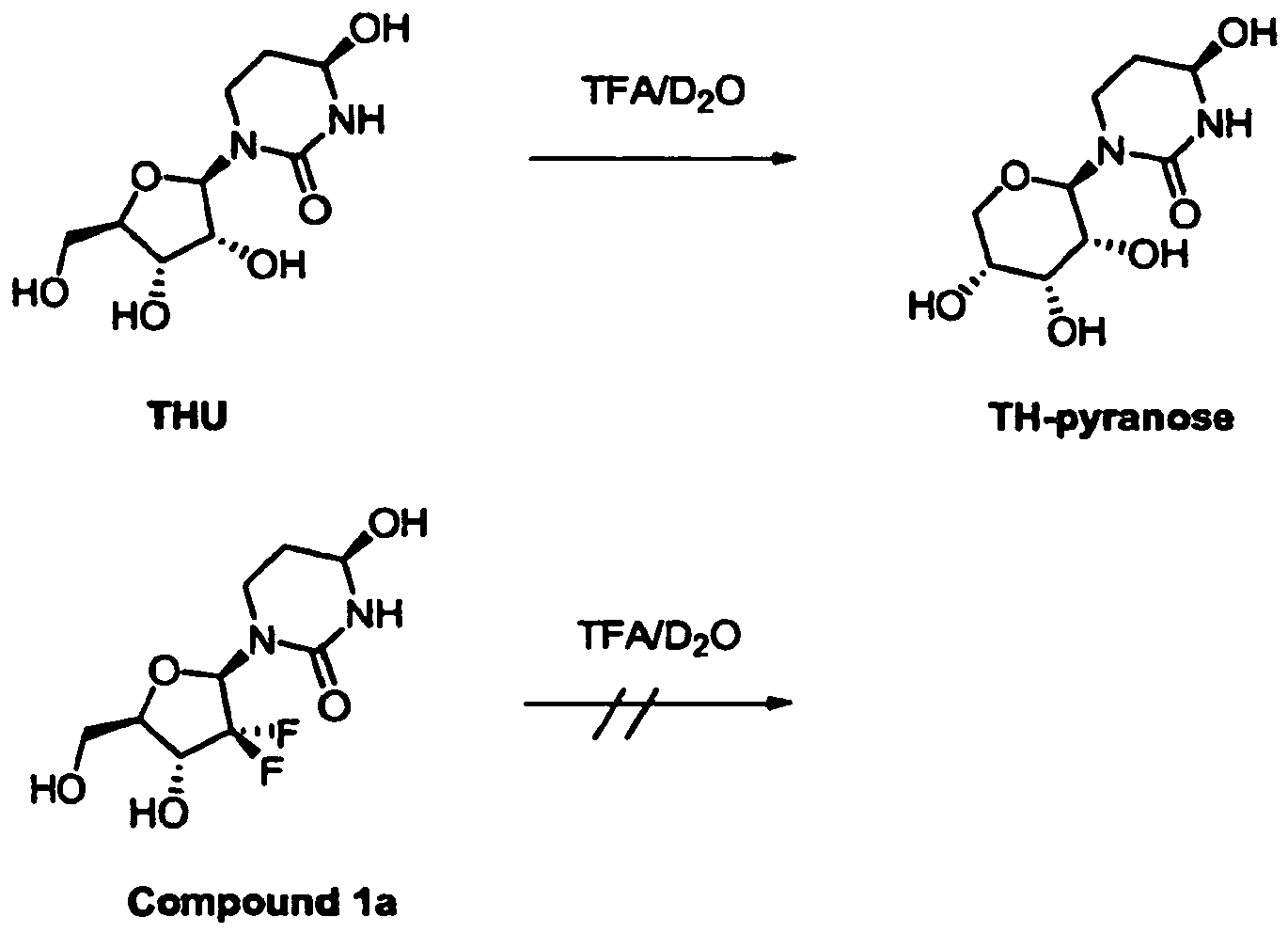
- Tetrahydrouridine (THU, 5 mg) is dissolved in D2O (0.75 mL). The 1HNMR (D2O, 300 MHz, 27° C) spectrum is shown in
FIG. 10 . To this same sample is added one drop of deuterated TFA followed by an immediate 1HNMR spectrum (FIG. 10 ). Even at this earliest time point, the peak at 5.4 ppm (∼10% conversion by integration) is indicative of the ring expansion to the TH-pyranose. Over the next several hours, spectra (D2O, 300 MHz, 27° C) are taken as shown inFIG. 11 . After 4 hours, the TH-pyranose is more prevalent indicating about 60% conversion. At 72 hours, the conversion is almost entirely complete (>80%). Notable changes in the region from 4.0-4.5 are also indicative of THU decomposition and the TH-pyranose formation. -
Compound 1a (5 mg) is dissolved in D2O (0.75 mL). The 1HNMR spectrum (D2O, 300 MHz, 27° C) is shown inFIG. 12 . To this same sample is added one drop of deuterated TFA followed by an immediate 1HNMR spectrum (FIG. 12 ). After the first time point, the only notable change is the epimerization of the aminal which is noted by the extra peaks at 5.92 and 5.93. After 4 hours and 72 hours (FIG. 13), there are no other notable changes in the spectra (D2O, 300 MHz, 27° C). These results indicate that no pyranose formation occurs withCompound 1a under these conditions. - While the present invention has been described with reference to the specific embodiments thereof, it should be understood by those skilled in the art that various changes may be made and equivalents may be substituted without departing from the scope of the invention. In addition, many modifications may be made to adapt a particular situation, material, composition of matter, process, process step or steps, to the scope of the present invention. All such modifications are intended to be within the scope of the claims appended hereto.
0001: 1 ± 3n and the successful solution and refinement of the structure, the space group is determined to be:
P3121 (#152)
Claims (27)
- A compound of Formula I, or a pharmaceutically acceptable salt thereof:

- The compound of claim 1, wherein the compound is represented by Compound 1a or a pharmaceutically acceptable salt thereof:

- The compound of claim 1, wherein the compound is represented by Compound 1a:

- A pharmaceutical composition for inhibiting CDA enzyme activity consisting essentially of a compound of Formula I, or a pharmaceutically acceptable salt thereof:

and a pharmaceutically acceptable excipient. - The pharmaceutical composition of claim 4, wherein the compound is represented by Compound 1a or a pharmaceutically acceptable salt thereof:

- The pharmaceutical composition of claim 4, wherein the compound is represented by Compound 1a:

- A composition comprising:(i) a compound of Formula I or a pharmaceutically acceptable salt thereof:
 (ii) a CDA substrate drug selected from the group consisting of 5-azacytidine, gemcitabine, ara-C, tezacitabine, 5-fluoro-2' -deoxycytidine, and cytochlor.
 - A composition comprising:(i) a compound of Formula I or a pharmaceutically acceptable salt thereof:
 (ii) a CDA substrate drug;
wherein the CDA substrate drug is not decitabine. - A composition comprising:(i) a compound of Formula I or a pharmaceutically acceptable salt thereof:
 (ii) a CDA substrate drug;
wherein the CDA substrate drug is decitabine. - The composition of any one of claims 7 or 8, wherein the CDA substrate drug is gemcitabine, ara-C or 5-azacytidine.
- The composition of any one of claims 7-10, wherein the compound is represented by Compound 1a or a pharmaceutically acceptable salt thereof:

- The composition of any one of claims 7-10, wherein the compound is represented by Compound 1a:

- A pharmaceutical composition comprising the compound of any one of claims 1-3 or the composition of any one of claims 7-12; and a pharmaceutically acceptable excipient.
- Compound of Formula I or a pharmaceutically acceptable salt thereof:
 (i) administering to a mammal in need thereof a compound of Formula I, and(ii) administering to a mammal in need thereof a CDA substrate drug selected from the group consisting of 5-azacytidine, gemcitabine, ara-C, tezacitabine, 5-fluoro-2' -deoxycytidine, and cytochlor.
 - Compound of Formula I or a pharmaceutically acceptable salt thereof:
 (i) administering to a mammal in need thereof a compound of Formula I, and(ii) administering to a mammal in need thereof a CDA substrate drug;wherein the CDA substrate drug is not decitabine.
 - Compound of Formula I or a pharmaceutically acceptable salt thereof:
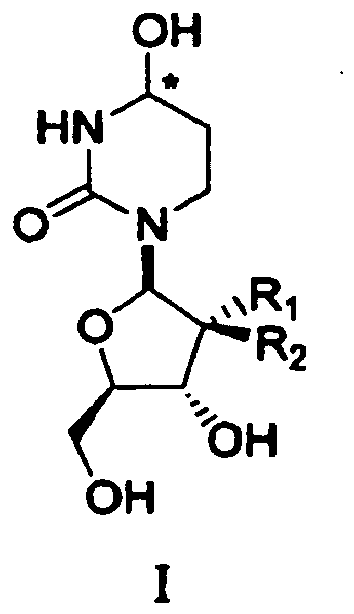 (i) administering to a mammal in need thereof a compound of Formula I, and(ii) administering to a mammal in need thereof a CDA substrate drug;wherein the CDA substrate drug is decitabine.
 - The compound of any one of claims 14-16, wherein the CDA substrate drug is gemcitabine, ara-C or 5-azacytidine.
- Compound of any one of claims 14-17 for use in a method for treating cancer, wherein the cancer is selected from the group consisting of hematological cancers and solid cancers.
- Compound of claim 18 for use in a method for treating cancer, wherein the cancer is a hematological cancer selected from the group consisting of myelodysplastic syndrome and leukemia.
- Compound of claim 19 for use in a method for treating cancer, wherein the hematological cancer is acute myeloid leukemia or chronic myeloid leukemia.
- Compound of claim 18 for use in a method for treating cancer, wherein the cancer is a solid cancer selected from the group consisting of pancreatic cancer, ovarian cancer, peritoneal cancer, non small cell lung cancer, metastatic breast cancer, bladder cancer, squamous cell carcinoma, transitional cell carcinoma, adenocarcinoma, gynecological cancer, fallopian tube carcinoma, liver cancer, hepatocellular carcinoma, lung cancer, cervical carcinoma, genitourinary tract cancer, and gastrointestinal cancer.
- Compound according to any one of claims 14-21 for use in a method for treating cancer, wherein the compound is represented by Compound 1a or a pharmaceutically acceptable salt thereof:

- Compound according to any one of claims 14-21 for use in a method for treating cancer, wherein the compound is represented by Compound 1a:

- Compound of any one of claims 14-23 for use in a method for treating cancer, wherein the compound is administered at substantially the same time with the CDA substrate drug, prior to the CDA substrate drug or after the CDA substrate drug.
- Compound of any one of claims 14-24 for use in a method for treating cancer, wherein the compound and the CDA substrate drug are administered in a single unit dosage form.
- Compound of any one of claims 14-24 for use in a method for treating cancer, wherein the compound and the CDA substrate drug are administered in multiple, separate unit dosage forms.
- The compound according to any one of claims 1-3, or the pharmaceutical composition according to any one of claims 4-6 or 13, or the composition according to any one of claims 7-12, for use as a medicament.
Priority Applications (6)
| Application Number | Priority Date | Filing Date | Title |
|---|---|---|---|
| PL08840633T PL2207786T3 (en) | 2007-10-16 | 2008-10-16 | TETRAHYDROURIN 2'-FLUORO-2'-DEOXES AS CYTIDIN DEZAMINASE INHIBITORS |
| SI200830624T SI2207786T1 (en) | 2007-10-16 | 2008-10-16 | 2'-fluoro-2'-deoxytetrahydrouridines as cytidine deaminase inhibitors |
| EP12151552.2A EP2447272B1 (en) | 2007-10-16 | 2008-10-16 | 2'-fluoro-2'-deoxytetrahydrouridines as cytidine deaminase inhibitors |
| CY20121100467T CY1112781T1 (en) | 2007-10-16 | 2012-05-24 | 2'-FLUORO-2'-DEOXYTETRAHYROIDURIDES AS CYTIDINE DISEASE INHIBITORS |
| HUS2300045C HUS2300045I1 (en) | 2007-10-16 | 2023-12-21 | 2'-fluoro-2'-deoxytetrahydrouridines as cytidine deaminase inhibitors |
| HUS2300044C HUS2300044I1 (en) | 2007-10-16 | 2023-12-21 | 2'-fluoro-2'-deoxytetrahydrouridines as cytidine deaminase inhibitors |
Applications Claiming Priority (2)
| Application Number | Priority Date | Filing Date | Title |
|---|---|---|---|
| US98039707P | 2007-10-16 | 2007-10-16 | |
| PCT/US2008/080163 WO2009052287A1 (en) | 2007-10-16 | 2008-10-16 | 2 ' -flu0r0-2 ' -deoxytetrahydrouridines as cytidine deaminase inhibitors |
Related Child Applications (2)
| Application Number | Title | Priority Date | Filing Date |
|---|---|---|---|
| EP12151552.2A Division EP2447272B1 (en) | 2007-10-16 | 2008-10-16 | 2'-fluoro-2'-deoxytetrahydrouridines as cytidine deaminase inhibitors |
| EP12151552.2 Division-Into | 2012-01-18 |
Publications (2)
| Publication Number | Publication Date |
|---|---|
| EP2207786A1 EP2207786A1 (en) | 2010-07-21 |
| EP2207786B1 true EP2207786B1 (en) | 2012-03-07 |
Family
ID=40251685
Family Applications (2)
| Application Number | Title | Priority Date | Filing Date |
|---|---|---|---|
| EP08840633A Active EP2207786B1 (en) | 2007-10-16 | 2008-10-16 | 2'-fluoro-2'-deoxytetrahydrouridines as cytidine deaminase inhibitors |
| EP12151552.2A Active EP2447272B1 (en) | 2007-10-16 | 2008-10-16 | 2'-fluoro-2'-deoxytetrahydrouridines as cytidine deaminase inhibitors |
Family Applications After (1)
| Application Number | Title | Priority Date | Filing Date |
|---|---|---|---|
| EP12151552.2A Active EP2447272B1 (en) | 2007-10-16 | 2008-10-16 | 2'-fluoro-2'-deoxytetrahydrouridines as cytidine deaminase inhibitors |
Country Status (40)
| Country | Link |
|---|---|
| US (4) | US8268800B2 (en) |
| EP (2) | EP2207786B1 (en) |
| JP (2) | JP5496899B2 (en) |
| KR (1) | KR101543049B1 (en) |
| CN (1) | CN101827856B (en) |
| AT (1) | ATE548374T1 (en) |
| BR (1) | BRPI0818672B8 (en) |
| CA (1) | CA2702274C (en) |
| CO (1) | CO6270330A2 (en) |
| CR (1) | CR11427A (en) |
| CY (3) | CY1112781T1 (en) |
| DK (1) | DK2207786T3 (en) |
| EA (1) | EA018757B1 (en) |
| EC (1) | ECSP10010095A (en) |
| ES (2) | ES2384011T3 (en) |
| FI (2) | FIC20230039I1 (en) |
| FR (2) | FR23C1051I2 (en) |
| GT (1) | GT201000088A (en) |
| HR (1) | HRP20120419T1 (en) |
| HU (2) | HUS2300044I1 (en) |
| IL (1) | IL204732A (en) |
| JO (1) | JO2778B1 (en) |
| LT (2) | LTC2207786I2 (en) |
| LU (2) | LUC00327I2 (en) |
| ME (1) | ME00997B (en) |
| MX (1) | MX2010004109A (en) |
| MY (1) | MY147970A (en) |
| NI (1) | NI201000055A (en) |
| NL (2) | NL301256I2 (en) |
| NO (2) | NO2023048I1 (en) |
| NZ (1) | NZ584229A (en) |
| PL (1) | PL2207786T3 (en) |
| PT (1) | PT2207786E (en) |
| RS (1) | RS52323B (en) |
| SA (1) | SA08290661B1 (en) |
| SI (1) | SI2207786T1 (en) |
| TW (1) | TWI445539B (en) |
| UA (1) | UA99476C2 (en) |
| WO (1) | WO2009052287A1 (en) |
| ZA (1) | ZA201002178B (en) |
Cited By (9)
| Publication number | Priority date | Publication date | Assignee | Title |
|---|---|---|---|---|
| US8173621B2 (en) | 2008-06-11 | 2012-05-08 | Gilead Pharmasset Llc | Nucleoside cyclicphosphates |
| US8563530B2 (en) | 2010-03-31 | 2013-10-22 | Gilead Pharmassel LLC | Purine nucleoside phosphoramidate |
| US8580765B2 (en) | 2007-03-30 | 2013-11-12 | Gilead Pharmasset Llc | Nucleoside phosphoramidate prodrugs |
| US8618076B2 (en) | 2009-05-20 | 2013-12-31 | Gilead Pharmasset Llc | Nucleoside phosphoramidates |
| US8629263B2 (en) | 2009-05-20 | 2014-01-14 | Gilead Pharmasset Llc | Nucleoside phosphoramidates |
| US8716263B2 (en) | 2008-12-23 | 2014-05-06 | Gilead Pharmasset Llc | Synthesis of purine nucleosides |
| US8841275B2 (en) | 2010-11-30 | 2014-09-23 | Gilead Pharmasset Llc | 2′-spiro-nucleosides and derivatives thereof useful for treating hepatitis C virus and dengue virus infections |
| US8859756B2 (en) | 2010-03-31 | 2014-10-14 | Gilead Pharmasset Llc | Stereoselective synthesis of phosphorus containing actives |
| US8889159B2 (en) | 2011-11-29 | 2014-11-18 | Gilead Pharmasset Llc | Compositions and methods for treating hepatitis C virus |
Families Citing this family (33)
| Publication number | Priority date | Publication date | Assignee | Title |
|---|---|---|---|---|
| US11116782B2 (en) | 2002-10-15 | 2021-09-14 | Celgene Corporation | Methods of treating myelodysplastic syndromes with a combination therapy using lenalidomide and azacitidine |
| US8404716B2 (en) | 2002-10-15 | 2013-03-26 | Celgene Corporation | Methods of treating myelodysplastic syndromes with a combination therapy using lenalidomide and azacitidine |
| JO2778B1 (en) * | 2007-10-16 | 2014-03-15 | ايساي انك | Certain vehicles, installations and methods |
| DK3782612T3 (en) | 2008-05-15 | 2024-01-15 | Celgene Corp | ORAL FORMULATIONS OF CYTIDINE ANALOGUES AND METHODS OF USING THEREOF |
| US20100055047A1 (en) * | 2008-08-26 | 2010-03-04 | Yiyu Zou | Methods for treating bronchial premalignancy and lung cancer |
| TWI477508B (en) * | 2009-04-06 | 2015-03-21 | Otsuka Pharma Co Ltd | Compositions and methods for treating cancer |
| US8609631B2 (en) | 2009-04-06 | 2013-12-17 | Eisai Inc. | Compositions and methods for treating cancer |
| EP2416781B1 (en) * | 2009-04-06 | 2017-03-08 | Otsuka Pharmaceutical Co., Ltd. | Combination of cytidine-based antineoplastic drugs with cytidine deaminase inhibitor and use thereof in the treatment of cancer |
| UY32546A (en) * | 2009-04-06 | 2010-10-29 | Eisai Inc | COMPOSITIONS AND METHODS TO TREAT CANCER |
| GB0907551D0 (en) | 2009-05-01 | 2009-06-10 | Univ Dundee | Treatment or prophylaxis of proliferative conditions |
| HRP20180237T4 (en) | 2011-09-16 | 2020-12-11 | Gilead Pharmasset Llc | METHODS FOR THE TREATMENT OF HCV |
| EP2950786B1 (en) | 2013-01-31 | 2019-11-27 | Gilead Pharmasset LLC | Combination formulation of two antiviral compounds |
| EA201690473A1 (en) | 2013-08-27 | 2017-03-31 | ГАЙЛИД ФАРМАССЕТ ЭлЭлСи | COMBINED COMPOSITION OF TWO ANTI-VIRUS COMPOUNDS |
| US9834576B2 (en) * | 2013-10-29 | 2017-12-05 | Otsuka Pharmaceutical Co., Ltd. | Synthetic route to 2′-deoxy-2′,2′-difluorotetrahydrouridines |
| KR102359214B1 (en) | 2014-04-04 | 2022-02-07 | 델 마 파마슈티컬스 | Use of dianhydrogalactitol and analogs or derivatives thereof to treat non-small-cell carcinoma of the lung and ovarian cancer |
| AU2015305449B2 (en) | 2014-08-22 | 2021-05-06 | Celgene Corporation | Methods of treating multiple myeloma with immunomodulatory compounds in combination with antibodies |
| CN109789155B (en) | 2015-12-03 | 2025-02-07 | 免疫规划公司 | Composition containing decitabine, 5-azacytidine and tetrahydrouridine and use thereof |
| WO2017158396A1 (en) * | 2016-03-16 | 2017-09-21 | INSERM (Institut National de la Santé et de la Recherche Médicale) | Cytidine deaminase inhibitors for the treatment of pancreatic cancer |
| KR20200118827A (en) | 2018-02-02 | 2020-10-16 | 마베릭스 온콜로지, 잉크. | Small molecule drug conjugate of gemcitabine monophosphate |
| CN113227755B (en) * | 2018-08-28 | 2025-06-27 | 上海宜晟生物科技有限公司 | Improved measurement accuracy |
| US11224610B2 (en) * | 2018-09-19 | 2022-01-18 | Otsuka Pharmaceutical Co., Ltd. | Low dose combination CDA substrate drug/cedazuridine with extended administration |
| KR102280330B1 (en) * | 2018-10-19 | 2021-07-21 | 인터올리고 주식회사 | Nucleic acid variant with improved therapeutic efficacy and anticancer pharmaceutical composition comprising the same |
| US12448624B2 (en) | 2018-10-19 | 2025-10-21 | Interoligo Corporation | Modified nucleic acid having improved treatment efficacy, and anticancer pharmaceutical composition containing same |
| AU2020363412B2 (en) | 2019-10-08 | 2026-03-12 | Taiho Pharmaceutical Co., Ltd. | 2'-deoxy-2',2'-difluorotetrahydrouridines with high purity and methods of making the same |
| LT4069254T (en) | 2020-02-25 | 2024-10-10 | Otsuka Pharmaceutical Co., Ltd. | Solid oral dosage forms comprising decitabine and cedazuridine |
| AU2022244240A1 (en) * | 2021-03-26 | 2023-10-05 | The Cleveland Clinic Foundation | Treatment of rna virus infection with a cytidine deaminase inhibitor |
| AU2022274071A1 (en) * | 2021-05-11 | 2024-01-04 | Janssen Pharmaceutica Nv | Combination therapies |
| KR20240006638A (en) * | 2021-05-11 | 2024-01-15 | 얀센 파마슈티카 엔브이 | combination therapy |
| US20240279266A1 (en) * | 2021-05-29 | 2024-08-22 | Msn Laboratories Private Limited, R&D Center | An improved process for the preparation of (4r)-1-[(2r,4r,5r)-3,3-difluoro-4-hydroxy-5-(hydroxymethyl) oxolan-2-yl]-4-hydroxy-1,3-diazinan-2one and its intermediate compounds |
| MX2024004801A (en) | 2021-10-19 | 2024-06-28 | Akirabio Inc | Compositions comprising 2'-deoxycytidine analogs and use thereof for the treatment of sickle cell disease, thalassemia, and cancers. |
| WO2023076332A1 (en) * | 2021-11-01 | 2023-05-04 | St. John's University | Injectable liquid pharmaceutical compostion containing gemcitabine and a cytidine deaminase inhibitor |
| US20230271996A1 (en) * | 2021-12-25 | 2023-08-31 | Scinopharm Taiwan, Ltd. | Process for preparing cedazuridine |
| JP2025529240A (en) | 2022-08-31 | 2025-09-04 | 大鵬薬品工業株式会社 | Combination therapy with trinapant, cedazuridine and decitabine for the treatment of T-cell lymphoma - Patent Application 20070122997 |
Family Cites Families (49)
| Publication number | Priority date | Publication date | Assignee | Title |
|---|---|---|---|---|
| US4017606A (en) * | 1973-10-04 | 1977-04-12 | The Upjohn Company | Organic compounds and process |
| US4210638A (en) * | 1978-03-17 | 1980-07-01 | Pcr, Inc. | Antiviral composition and method of treating virus diseases |
| US4275057A (en) * | 1980-01-28 | 1981-06-23 | The United States Of America As Represented By The Department Of Health, Education And Welfare | Seven-membered ring compounds as inhibitors of cytidine deaminase |
| US4526988A (en) | 1983-03-10 | 1985-07-02 | Eli Lilly And Company | Difluoro antivirals and intermediate therefor |
| EP0160079B1 (en) | 1983-10-26 | 1990-01-31 | GREER, Sheldon B. | Method and materials for sensitizing neoplastic tissue to radiation |
| DE3587500T2 (en) * | 1984-12-04 | 1993-12-16 | Lilly Co Eli | Tumor treatment in mammals. |
| US4965374A (en) * | 1987-08-28 | 1990-10-23 | Eli Lilly And Company | Process for and intermediates of 2',2'-difluoronucleosides |
| US5223608A (en) * | 1987-08-28 | 1993-06-29 | Eli Lilly And Company | Process for and intermediates of 2',2'-difluoronucleosides |
| US5968914A (en) * | 1987-10-28 | 1999-10-19 | Pro-Neuron, Inc. | Treatment of chemotherapeutic agent and antiviral agent toxicity with acylated pyrimidine nucleosides |
| WO1992018517A1 (en) | 1991-04-17 | 1992-10-29 | Yale University | Method of treating or preventing hepatitis b virus |
| EP0543976A4 (en) | 1991-04-23 | 1993-11-10 | Oglevee, Ltd. | In vitro leaf petiole multiplication of pelargoniums |
| FR2682112B1 (en) * | 1991-10-08 | 1993-12-10 | Commissariat A Energie Atomique | PROCESS FOR THE SYNTHESIS OF RIBONUCLEIC ACID (RNA) USING A NOVEL DEPROTECTION REAGENT. |
| US5426183A (en) * | 1992-06-22 | 1995-06-20 | Eli Lilly And Company | Catalytic stereoselective glycosylation process for preparing 2'-deoxy-2',2'-difluoronucleosides and 2'-deoxy-2'-fluoronucleosides |
| US5606048A (en) * | 1992-06-22 | 1997-02-25 | Eli Lilly And Company | Stereoselective glycosylation process for preparing 2'-Deoxy-2', 2'-difluoronucleosides and 2'-deoxy-2'-fluoronucleosides |
| US5821357A (en) * | 1992-06-22 | 1998-10-13 | Eli Lilly And Company | Stereoselective glycosylation process for preparing 2'-deoxy-2',2'-difluoropurine and triazole nucleosides |
| US5371210A (en) * | 1992-06-22 | 1994-12-06 | Eli Lilly And Company | Stereoselective fusion glycosylation process for preparing 2'-deoxy-2',2'-difluoronucleosides and 2'-deoxy-2'-fluoronucleosides |
| US5594124A (en) * | 1992-06-22 | 1997-01-14 | Eli Lilly And Company | Stereoselective glycosylation process for preparing 2'-Deoxy-2',2'-difluoropyrimidine nucleosides and 2'-deoxy-2'-fluoropyrimidine nucleosides and intermediates thereof |
| EP0641352B1 (en) * | 1993-02-23 | 1997-06-04 | City Of Hope | 4-ethoxy 5-fluoro 2'deoxyuridine |
| AU6081294A (en) * | 1993-05-14 | 1994-12-12 | Pro-Neuron, Inc. | Treatment of chemotherapeutic agent and antiviral agent toxicity with acylated pyrimidine nucleosides |
| GB9311252D0 (en) | 1993-06-01 | 1993-07-21 | Hafslund Nycomed As | Cell growth regualtors |
| US5637688A (en) * | 1994-12-13 | 1997-06-10 | Eli Lilly And Company | Process for preparing 1-(2'-deoxy-2'-difluoro-d-ribofuranosyl)-4-aminopyrimidin-2-one hydrochloride |
| US5521294A (en) * | 1995-01-18 | 1996-05-28 | Eli Lilly And Company | 2,2-difluoro-3-carbamoyl ribose sulfonate compounds and process for the preparation of beta nucleosides |
| WO1996026743A1 (en) * | 1995-03-01 | 1996-09-06 | Human Gene Therapy Research Institute | Radiation enhanced gene therapy for treatment of tumors |
| US6001994A (en) * | 1995-12-13 | 1999-12-14 | Eli Lilly And Company | Process for making gemcitabine hydrochloride |
| US5760208A (en) * | 1996-08-14 | 1998-06-02 | The Board Of Governors For Higher Education, State Of Rhode Island And Providence Plantations | Process to prepare pyrimidine nucleosides |
| ES2273672T3 (en) * | 1999-03-01 | 2007-05-16 | Halogenetics, Inc. | USE OF COMPOSITIONS THAT INCLUDE CLDC AS RADIOSENSIBILIZERS IN THE TREATMENT OF NEOPLASTIC DISEASES. |
| US6933287B1 (en) * | 1999-03-01 | 2005-08-23 | Sheldon B. Greer | Dramatic simplification of a method to treat neoplastic disease by radiation |
| WO2001013789A1 (en) | 1999-08-26 | 2001-03-01 | Aortech International Plc | Improvements relating to catheter positioning |
| US6462191B1 (en) | 2000-07-13 | 2002-10-08 | Air Products And Chemicals, Inc. | Synthesis of 2-deoxy-2-fluoro-arabinose derivatives |
| CN102241720B (en) * | 2000-11-29 | 2014-01-29 | 三井化学株式会社 | L-nucleic acid derivative and processes for the synthesis thereof |
| US7141576B2 (en) * | 2001-01-16 | 2006-11-28 | Smithkline Beecham (Cork) Limited | Cancer treatment method |
| EP2322534A1 (en) | 2001-05-18 | 2011-05-18 | Rakesh Kumar | Antiviral nucleosides |
| US8207142B2 (en) * | 2001-07-31 | 2012-06-26 | The United States Of America As Represented By The Secretary Of The Department Of Health And Human Services | Inhibitor of DNA methylation |
| EP1480982A4 (en) | 2002-02-14 | 2007-08-01 | Pharmasset Inc | Modified fluorinated nucleoside analogues |
| US6982253B2 (en) | 2002-06-05 | 2006-01-03 | Supergen, Inc. | Liquid formulation of decitabine and use of the same |
| AU2003278904A1 (en) | 2002-09-24 | 2004-04-19 | Kornis Pharmaceuticals, Incorporated | 1, 3, 5-triazines for treatment of viral diseases |
| WO2004041203A2 (en) | 2002-11-04 | 2004-05-21 | Xenoport, Inc. | Gemcitabine prodrugs, pharmaceutical compositions and uses thereof |
| WO2005115410A2 (en) * | 2004-05-06 | 2005-12-08 | University Of Rochester | Context dependent inhibitors of cytidine deaminases and uses thereof |
| US20060014949A1 (en) | 2004-07-13 | 2006-01-19 | Supergen Inc. | Compositions and formulations of decitabine polymorphs and methods of use thereof |
| CN101076536A (en) | 2004-07-30 | 2007-11-21 | 药华医药股份有限公司 | Stereoselective synthesis of beta-nucleosides |
| US20060173174A1 (en) | 2004-12-08 | 2006-08-03 | Anne-Ruth Born | Difluoronucleosides and process for preparation thereof |
| WO2008085611A2 (en) | 2006-11-27 | 2008-07-17 | University Of Miami | Designer theraphy of pancreatic tumors |
| WO2009021551A1 (en) | 2007-08-13 | 2009-02-19 | Universite De La Mediterranee | A method for assessing the risk of toxicity in a chemotherapy |
| JO2778B1 (en) | 2007-10-16 | 2014-03-15 | ايساي انك | Certain vehicles, installations and methods |
| WO2010047698A1 (en) | 2008-10-22 | 2010-04-29 | University Of Alabama At Birmingham | Activation-induced cytidine deaminase inhibitor suppression of autoimmune diseases |
| TWI477508B (en) * | 2009-04-06 | 2015-03-21 | Otsuka Pharma Co Ltd | Compositions and methods for treating cancer |
| EP2416781B1 (en) * | 2009-04-06 | 2017-03-08 | Otsuka Pharmaceutical Co., Ltd. | Combination of cytidine-based antineoplastic drugs with cytidine deaminase inhibitor and use thereof in the treatment of cancer |
| UY32546A (en) * | 2009-04-06 | 2010-10-29 | Eisai Inc | COMPOSITIONS AND METHODS TO TREAT CANCER |
| US8609631B2 (en) | 2009-04-06 | 2013-12-17 | Eisai Inc. | Compositions and methods for treating cancer |
-
2008
- 2008-10-14 JO JO2008459A patent/JO2778B1/en active
- 2008-10-15 TW TW097139594A patent/TWI445539B/en active
- 2008-10-16 PT PT08840633T patent/PT2207786E/en unknown
- 2008-10-16 MX MX2010004109A patent/MX2010004109A/en active IP Right Grant
- 2008-10-16 US US12/252,961 patent/US8268800B2/en active Active
- 2008-10-16 DK DK08840633.5T patent/DK2207786T3/en active
- 2008-10-16 UA UAA201003977A patent/UA99476C2/en unknown
- 2008-10-16 PL PL08840633T patent/PL2207786T3/en unknown
- 2008-10-16 BR BRPI0818672A patent/BRPI0818672B8/en active IP Right Grant
- 2008-10-16 RS RS20120232A patent/RS52323B/en unknown
- 2008-10-16 EA EA201000642A patent/EA018757B1/en unknown
- 2008-10-16 SI SI200830624T patent/SI2207786T1/en unknown
- 2008-10-16 CA CA2702274A patent/CA2702274C/en active Active
- 2008-10-16 CN CN2008801117195A patent/CN101827856B/en active Active
- 2008-10-16 WO PCT/US2008/080163 patent/WO2009052287A1/en not_active Ceased
- 2008-10-16 JP JP2010530110A patent/JP5496899B2/en active Active
- 2008-10-16 EP EP08840633A patent/EP2207786B1/en active Active
- 2008-10-16 ME MEP-2010-68A patent/ME00997B/en unknown
- 2008-10-16 EP EP12151552.2A patent/EP2447272B1/en active Active
- 2008-10-16 NZ NZ584229A patent/NZ584229A/en unknown
- 2008-10-16 ES ES08840633T patent/ES2384011T3/en active Active
- 2008-10-16 ES ES12151552.2T patent/ES2616566T3/en active Active
- 2008-10-16 HR HRP20120419AT patent/HRP20120419T1/en unknown
- 2008-10-16 AT AT08840633T patent/ATE548374T1/en active
- 2008-10-16 KR KR1020107010621A patent/KR101543049B1/en active Active
- 2008-10-16 MY MYPI2010001528A patent/MY147970A/en unknown
- 2008-10-18 SA SA08290661A patent/SA08290661B1/en unknown
-
2010
- 2010-01-26 ZA ZA2010/02178A patent/ZA201002178B/en unknown
- 2010-03-25 IL IL204732A patent/IL204732A/en active IP Right Grant
- 2010-04-09 EC EC2010010095A patent/ECSP10010095A/en unknown
- 2010-04-12 GT GT201000088A patent/GT201000088A/en unknown
- 2010-04-14 NI NI201000055A patent/NI201000055A/en unknown
- 2010-05-12 CR CR11427A patent/CR11427A/en unknown
- 2010-05-13 CO CO10057462A patent/CO6270330A2/en active IP Right Grant
-
2012
- 2012-05-24 CY CY20121100467T patent/CY1112781T1/en unknown
- 2012-07-24 US US13/556,404 patent/US8618075B2/en active Active
-
2013
- 2013-11-25 US US14/088,465 patent/US8951987B2/en active Active
-
2014
- 2014-03-05 JP JP2014043175A patent/JP5859588B2/en active Active
- 2014-12-29 US US14/584,437 patent/US9567363B2/en active Active
-
2023
- 2023-12-21 HU HUS2300044C patent/HUS2300044I1/en unknown
- 2023-12-21 NO NO2023048C patent/NO2023048I1/en unknown
- 2023-12-21 HU HUS2300045C patent/HUS2300045I1/en unknown
- 2023-12-21 NO NO2023047C patent/NO2023047I1/en unknown
- 2023-12-22 FI FIC20230039C patent/FIC20230039I1/en unknown
- 2023-12-22 CY CY2023028C patent/CY2023028I1/en unknown
- 2023-12-22 CY CY2023029C patent/CY2023029I1/en unknown
- 2023-12-22 FI FIC20230040C patent/FIC20230040I1/en unknown
- 2023-12-26 FR FR23C1051C patent/FR23C1051I2/en active Active
- 2023-12-26 FR FR23C1052C patent/FR23C1052I2/en active Active
- 2023-12-27 LU LU00327C patent/LUC00327I2/fr unknown
- 2023-12-27 LU LU00326C patent/LUC00326I9/fr unknown
- 2023-12-27 NL NL301256C patent/NL301256I2/en unknown
- 2023-12-27 NL NL301257C patent/NL301257I2/en unknown
- 2023-12-29 LT LTPA2023538C patent/LTC2207786I2/lt unknown
- 2023-12-29 LT LTPA2023539C patent/LTPA2023539I1/lt unknown
Cited By (24)
| Publication number | Priority date | Publication date | Assignee | Title |
|---|---|---|---|---|
| US10183037B2 (en) | 2007-03-30 | 2019-01-22 | Gilead Pharmasset Llc | Nucleoside phosphoramidate prodrugs |
| US8580765B2 (en) | 2007-03-30 | 2013-11-12 | Gilead Pharmasset Llc | Nucleoside phosphoramidate prodrugs |
| US9085573B2 (en) | 2007-03-30 | 2015-07-21 | Gilead Pharmasset Llc | Nucleoside phosphoramidate prodrugs |
| US8957046B2 (en) | 2007-03-30 | 2015-02-17 | Gilead Pharmasset Llc | Nucleoside phosphoramidate prodrugs |
| US8906880B2 (en) | 2007-03-30 | 2014-12-09 | Gilead Pharmasset Llc | Nucleoside phosphoramidate prodrugs |
| US8735372B2 (en) | 2007-03-30 | 2014-05-27 | Gilead Pharmasset Llc | Nucleoside phosphoramidate prodrugs |
| US8759510B2 (en) | 2008-06-11 | 2014-06-24 | Gilead Pharmasset Llc | Nucleoside cyclicphosphates |
| US8173621B2 (en) | 2008-06-11 | 2012-05-08 | Gilead Pharmasset Llc | Nucleoside cyclicphosphates |
| US9045520B2 (en) | 2008-12-23 | 2015-06-02 | Gilead Pharmasset Llc | Synthesis of purine nucleosides |
| US8716263B2 (en) | 2008-12-23 | 2014-05-06 | Gilead Pharmasset Llc | Synthesis of purine nucleosides |
| US9206217B2 (en) | 2009-05-20 | 2015-12-08 | Gilead Pharmasset Llc | Nucleoside phosphoramidates |
| US8629263B2 (en) | 2009-05-20 | 2014-01-14 | Gilead Pharmasset Llc | Nucleoside phosphoramidates |
| US9637512B2 (en) | 2009-05-20 | 2017-05-02 | Gilead Pharmasset Llc | Nucleoside phosphoramidates |
| US9284342B2 (en) | 2009-05-20 | 2016-03-15 | Gilead Pharmasset Llc | Nucleoside phosphoramidates |
| US8735569B2 (en) | 2009-05-20 | 2014-05-27 | Gilead Pharmasset Llc | Nucleoside phosphoramidates |
| US8642756B2 (en) | 2009-05-20 | 2014-02-04 | Gilead Pharmasset Llc | Nucleoside phosphoramidates |
| US8633309B2 (en) | 2009-05-20 | 2014-01-21 | Gilead Pharmasset Llc | Nucleoside phosphoramidates |
| US8618076B2 (en) | 2009-05-20 | 2013-12-31 | Gilead Pharmasset Llc | Nucleoside phosphoramidates |
| US8859756B2 (en) | 2010-03-31 | 2014-10-14 | Gilead Pharmasset Llc | Stereoselective synthesis of phosphorus containing actives |
| US8563530B2 (en) | 2010-03-31 | 2013-10-22 | Gilead Pharmassel LLC | Purine nucleoside phosphoramidate |
| US8841275B2 (en) | 2010-11-30 | 2014-09-23 | Gilead Pharmasset Llc | 2′-spiro-nucleosides and derivatives thereof useful for treating hepatitis C virus and dengue virus infections |
| US9394331B2 (en) | 2010-11-30 | 2016-07-19 | Gilead Pharmasset Llc | 2′-spiro-nucleosides and derivatives thereof useful for treating hepatitis C virus and dengue virus infections |
| US8889159B2 (en) | 2011-11-29 | 2014-11-18 | Gilead Pharmasset Llc | Compositions and methods for treating hepatitis C virus |
| US9549941B2 (en) | 2011-11-29 | 2017-01-24 | Gilead Pharmasset Llc | Compositions and methods for treating hepatitis C virus |
Also Published As
Similar Documents
| Publication | Publication Date | Title |
|---|---|---|
| EP2447272B1 (en) | 2'-fluoro-2'-deoxytetrahydrouridines as cytidine deaminase inhibitors | |
| EP2416780B1 (en) | Combination of decitabine with cytidine deaminase inhibitor and use thereof in the treatment of cancer | |
| JP5684787B2 (en) | A combination of a cytidine-based antineoplastic agent with a cytidine deaminase inhibitor and its use in the treatment of cancer | |
| AU2016213881A1 (en) | (2’-deoxy-ribofuranosyl)-1,3,4,7-tetrahydro-(1,3)diazepin-2-one derivatives for treating cancer | |
| AU2008312435B8 (en) | 2 ' -fluoro-2 ' -deoxytetrahydrouridines as cytidine deaminase inhibitors | |
| HK1146410B (en) | 2'-fluoro-2'-deoxytetrahydrouridines as cytidine deaminase inhibitors |
Legal Events
| Date | Code | Title | Description |
|---|---|---|---|
| PUAI | Public reference made under article 153(3) epc to a published international application that has entered the european phase |
Free format text: ORIGINAL CODE: 0009012 |
|
| 17P | Request for examination filed |
Effective date: 20100512 |
|
| AK | Designated contracting states |
Kind code of ref document: A1 Designated state(s): AT BE BG CH CY CZ DE DK EE ES FI FR GB GR HR HU IE IS IT LI LT LU LV MC MT NL NO PL PT RO SE SI SK TR |
|
| AX | Request for extension of the european patent |
Extension state: AL BA MK RS |
|
| GRAP | Despatch of communication of intention to grant a patent |
Free format text: ORIGINAL CODE: EPIDOSNIGR1 |
|
| RTI1 | Title (correction) |
Free format text: 2'-FLUORO-2'-DEOXYTETRAHYDROURIDINES AS CYTIDINE DEAMINASE INHIBITORS |
|
| GRAS | Grant fee paid |
Free format text: ORIGINAL CODE: EPIDOSNIGR3 |
|
| REG | Reference to a national code |
Ref country code: HK Ref legal event code: DE Ref document number: 1146410 Country of ref document: HK |
|
| GRAA | (expected) grant |
Free format text: ORIGINAL CODE: 0009210 |
|
| AK | Designated contracting states |
Kind code of ref document: B1 Designated state(s): AT BE BG CH CY CZ DE DK EE ES FI FR GB GR HR HU IE IS IT LI LT LU LV MC MT NL NO PL PT RO SE SI SK TR |
|
| AX | Request for extension of the european patent |
Extension state: AL BA MK RS |
|
| REG | Reference to a national code |
Ref country code: GB Ref legal event code: FG4D |
|
| REG | Reference to a national code |
Ref country code: CH Ref legal event code: EP Ref country code: AT Ref legal event code: REF Ref document number: 548374 Country of ref document: AT Kind code of ref document: T Effective date: 20120315 |
|
| REG | Reference to a national code |
Ref country code: IE Ref legal event code: FG4D |
|
| REG | Reference to a national code |
Ref country code: DE Ref legal event code: R096 Ref document number: 602008014011 Country of ref document: DE Effective date: 20120516 Ref country code: HR Ref legal event code: TUEP Ref document number: P20120419 Country of ref document: HR |
|
| REG | Reference to a national code |
Ref country code: RO Ref legal event code: EPE Ref country code: PT Ref legal event code: SC4A Free format text: AVAILABILITY OF NATIONAL TRANSLATION Effective date: 20120518 |
|
| REG | Reference to a national code |
Ref country code: SE Ref legal event code: TRGR |
|
| REG | Reference to a national code |
Ref country code: NL Ref legal event code: T3 |
|
| REG | Reference to a national code |
Ref country code: CH Ref legal event code: NV Representative=s name: REUTELER & CIE S.A. |
|
| REG | Reference to a national code |
Ref country code: DK Ref legal event code: T3 |
|
| REG | Reference to a national code |
Ref country code: ES Ref legal event code: FG2A Ref document number: 2384011 Country of ref document: ES Kind code of ref document: T3 Effective date: 20120628 |
|
| REG | Reference to a national code |
Ref country code: NO Ref legal event code: T2 Effective date: 20120307 |
|
| REG | Reference to a national code |
Ref country code: HK Ref legal event code: GR Ref document number: 1146410 Country of ref document: HK |
|
| REG | Reference to a national code |
Ref country code: HR Ref legal event code: T1PR Ref document number: P20120419 Country of ref document: HR |
|
| REG | Reference to a national code |
Ref country code: SK Ref legal event code: T3 Ref document number: E 11842 Country of ref document: SK |
|
| REG | Reference to a national code |
Ref country code: EE Ref legal event code: FG4A Ref document number: E006757 Country of ref document: EE Effective date: 20120605 |
|
| REG | Reference to a national code |
Ref country code: GR Ref legal event code: EP Ref document number: 20120401301 Country of ref document: GR Effective date: 20120713 |
|
| REG | Reference to a national code |
Ref country code: PL Ref legal event code: T3 |
|
| REG | Reference to a national code |
Ref country code: HU Ref legal event code: AG4A Ref document number: E014230 Country of ref document: HU |
|
| PLBE | No opposition filed within time limit |
Free format text: ORIGINAL CODE: 0009261 |
|
| STAA | Information on the status of an ep patent application or granted ep patent |
Free format text: STATUS: NO OPPOSITION FILED WITHIN TIME LIMIT |
|
| 26N | No opposition filed |
Effective date: 20121210 |
|
| REG | Reference to a national code |
Ref country code: DE Ref legal event code: R097 Ref document number: 602008014011 Country of ref document: DE Effective date: 20121210 |
|
| REG | Reference to a national code |
Ref country code: PT Ref legal event code: PC4A Owner name: OTSUKA PHARMACEUTICAL CO, LTD., JP Effective date: 20140514 |
|
| REG | Reference to a national code |
Ref country code: GB Ref legal event code: 732E Free format text: REGISTERED BETWEEN 20140529 AND 20140604 |
|
| REG | Reference to a national code |
Ref country code: DE Ref legal event code: R082 Ref document number: 602008014011 Country of ref document: DE Representative=s name: OFFICE FREYLINGER S.A., LU |
|
| REG | Reference to a national code |
Ref country code: HR Ref legal event code: PPPP Ref document number: P20120419 Country of ref document: HR Owner name: OTSUKA PHARMACEUTICAL CO., LTD., JP |
|
| REG | Reference to a national code |
Ref country code: CH Ref legal event code: PUE Owner name: OTSUKA PHARMACEUTICAL CO., LTD., JP Free format text: FORMER OWNER: EISAI INC., US |
|
| REG | Reference to a national code |
Ref country code: DE Ref legal event code: R082 Ref document number: 602008014011 Country of ref document: DE Representative=s name: OFFICE FREYLINGER S.A., LU Effective date: 20141010 Ref country code: DE Ref legal event code: R081 Ref document number: 602008014011 Country of ref document: DE Owner name: OTSUKA PHARMACEUTICAL CO., LTD., JP Free format text: FORMER OWNER: EISAI INC., WOODCLIFF LAKE, N.J., US Effective date: 20141010 |
|
| REG | Reference to a national code |
Ref country code: SI Ref legal event code: SP73 Owner name: OTSUKA PHARMACEUTICAL CO., LTD.; JP Effective date: 20141030 Ref country code: HU Ref legal event code: FH1C Free format text: FORMER REPRESENTATIVE(S): DR. MOLNAR ISTVAN, DANUBIA SZABADALMI ES JOGI IRODA KFT., HU Representative=s name: DANUBIA SZABADALMI ES JOGI IRODA KFT., HU Ref country code: HU Ref legal event code: GB9C Owner name: OTSUKA PHARMACEUTICAL CO., LTD., JP Free format text: FORMER OWNER(S): EISAI INC., US |
|
| REG | Reference to a national code |
Ref country code: EE Ref legal event code: GB1A Ref document number: E006757 Country of ref document: EE Ref country code: AT Ref legal event code: PC Ref document number: 548374 Country of ref document: AT Kind code of ref document: T Owner name: OTSUKA PHARMACEUTICAL CO., LTD., JP Effective date: 20141114 |
|
| REG | Reference to a national code |
Ref country code: ES Ref legal event code: PC2A Owner name: OTSUKA PHARMACEUTICAL CO., LTD. Effective date: 20141216 |
|
| REG | Reference to a national code |
Ref country code: FR Ref legal event code: TP Owner name: OTSUKA PHARMACEUTICAL CO., LTD., JP Effective date: 20141205 |
|
| REG | Reference to a national code |
Ref country code: NL Ref legal event code: SD Effective date: 20150209 |
|
| REG | Reference to a national code |
Ref country code: SK Ref legal event code: PC4A Ref document number: E 11842 Country of ref document: SK Owner name: OTSUKA PHARMACEUTICAL CO., LTD., TOKYO, JP Free format text: FORMER OWNER: EISAI INC., WOODCLIFF LAKE, NJ, US Effective date: 20150209 |
|
| REG | Reference to a national code |
Ref country code: NO Ref legal event code: CHAD Owner name: OTSUKA PHARMACEUTICAL CO., JP |
|
| REG | Reference to a national code |
Ref country code: EE Ref legal event code: HD1A Ref document number: E006757 Country of ref document: EE |
|
| REG | Reference to a national code |
Ref country code: FR Ref legal event code: PLFP Year of fee payment: 8 |
|
| REG | Reference to a national code |
Ref country code: HR Ref legal event code: PNAN Ref document number: P20120419 Country of ref document: HR Owner name: OTSUKA PHARMACEUTICAL CO., LTD., JP |
|
| REG | Reference to a national code |
Ref country code: CH Ref legal event code: PCOW Free format text: NEW ADDRESS: 2-9, KANDA-TSUKASA-MACHI, CHIYODA-KU, TOKYO 101-8535 (JP) |
|
| REG | Reference to a national code |
Ref country code: FR Ref legal event code: CA Effective date: 20151123 |
|
| REG | Reference to a national code |
Ref country code: SI Ref legal event code: SP73 Owner name: OTSUKA PHARMACEUTICAL CO., LTD.; JP Effective date: 20151112 |
|
| REG | Reference to a national code |
Ref country code: FR Ref legal event code: PLFP Year of fee payment: 9 |
|
| REG | Reference to a national code |
Ref country code: FR Ref legal event code: PLFP Year of fee payment: 10 |
|
| REG | Reference to a national code |
Ref country code: FR Ref legal event code: PLFP Year of fee payment: 11 |
|
| REG | Reference to a national code |
Ref country code: HR Ref legal event code: ODRP Ref document number: P20120419 Country of ref document: HR Payment date: 20191002 Year of fee payment: 12 |
|
| REG | Reference to a national code |
Ref country code: HR Ref legal event code: ODRP Ref document number: P20120419 Country of ref document: HR Payment date: 20201005 Year of fee payment: 13 |
|
| REG | Reference to a national code |
Ref country code: HR Ref legal event code: ODRP Ref document number: P20120419 Country of ref document: HR Payment date: 20211014 Year of fee payment: 14 |
|
| REG | Reference to a national code |
Ref country code: HR Ref legal event code: ODRP Ref document number: P20120419 Country of ref document: HR Payment date: 20221012 Year of fee payment: 15 |
|
| P01 | Opt-out of the competence of the unified patent court (upc) registered |
Effective date: 20230515 |
|
| REG | Reference to a national code |
Ref country code: HR Ref legal event code: ODRP Ref document number: P20120419 Country of ref document: HR Payment date: 20230904 Year of fee payment: 16 |
|
| REG | Reference to a national code |
Ref country code: FI Ref legal event code: SPCF Ref document number: C20230040 Country of ref document: FI Spc suppl protection certif: C20230040 Filing date: 20231222 Expiry date: 20281016 Ref country code: FI Ref legal event code: SPCF Ref document number: C20230039 Country of ref document: FI Spc suppl protection certif: C20230039 Filing date: 20231222 Expiry date: 20281016 |
|
| REG | Reference to a national code |
Ref country code: FR Ref legal event code: CP Free format text: PRODUCT NAME: UNE COMPOSITION COMPRENANT: LA CEDAZURIDINE OU UN DE SES SELS PHARMACEUTIQUEMENT ACCEPTABLES, ET LA DECITABINE; REGISTRATION NO/DATE: EU/1/23/1756 20230918 Spc suppl protection certif: 23C1052 Filing date: 20231226 Ref country code: FR Ref legal event code: CP Free format text: PRODUCT NAME: CEDAZURIDINE OU UN DE SES SELS PHARMACEUTIQUEMENT ACCEPTABLES; REGISTRATION NO/DATE: EU/1/23/1756 20230918 Spc suppl protection certif: 23C1051 Filing date: 20231226 |
|
| REG | Reference to a national code |
Ref country code: NO Ref legal event code: SPCF Free format text: PRODUCT NAME: A COMPOSITION COMPRISING: CEDAZURIDINE OR A PHARMACEUTICALLY ACCEPTABLE SALT THEREOF, AND DECITABINE; REG. NO/DATE: EU/1/23/1756 20230928 Spc suppl protection certif: 2023048 Filing date: 20231221 Ref country code: NO Ref legal event code: SPCF Free format text: PRODUCT NAME: CEDAZURIDINE, OR A PHARMACEUTICALLY ACCEPTABLE SALT THEREOF; REG. NO/DATE: EU/1/23/1756 20230928 Spc suppl protection certif: 2023047 Filing date: 20231221 |
|
| REG | Reference to a national code |
Ref country code: NL Ref legal event code: SPCF Free format text: PRODUCT NAME: SAMENSTELLING WELKE OMVAT: CEDAZURIDINE OF EEN FARMACEUTISCH AANVAARDBAAR ZOUT DAARVAN; EN DECITABINE; REGISTRATION NO/DATE: EU/1/23/1756 20230918 Spc suppl protection certif: 301257 Filing date: 20231227 Expiry date: 20281015 Extension date: 20331015 Ref country code: NL Ref legal event code: SPCF Free format text: PRODUCT NAME: CEDAZURIDINE, OF EEN FARMACEUTISCH AANVAARDBAAR ZOUT DAARVAN; REGISTRATION NO/DATE: EU/1/23/1756 20230918 Spc suppl protection certif: 301256 Filing date: 20231227 Expiry date: 20281015 Extension date: 20331015 |
|
| REG | Reference to a national code |
Ref country code: LU Ref legal event code: SPCF Free format text: PRODUCT NAME: CEDAZURIDINE OU UN DE SES SELS PHARMACEUTIQUEMENT ACCEPTABLES; AUTHORISATION NUMBER AND DATE: EU/1/23/1756 20230918 Spc suppl protection certif: LUC00327 Filing date: 20231227 Expiry date: 20281016 Extension date: 20331016 Ref country code: LU Ref legal event code: SPCF Free format text: PRODUCT NAME: COMPOSITION COMPRENANT: DE LA CEDAZURIDINE OU UN DE SES SELS PHARMACEUTIQUEMENT ACCEPTABLES; ET DE LA DECITABINE; AUTHORISATION NUMBER AND DATE: EU/1/23/1756 20230913 Spc suppl protection certif: LUC00326 Filing date: 20231227 Expiry date: 20281016 Extension date: 20331016 |
|
| REG | Reference to a national code |
Ref country code: DK Ref legal event code: CTFF Free format text: PRODUCT NAME: SAMMENSAETNING OMFATTENDE CEDAZURIDIN ELLER ET FARMACEUTISK ACCEPTABELT SALT DERAF; OG DECITABIN; REG. NO/DATE: EU/1/23/1756 20230918 Spc suppl protection certif: CA 2023 00038 Filing date: 20231222 Expiry date: 20281016 Extension date: 20331016 Ref country code: DK Ref legal event code: CTFF Free format text: PRODUCT NAME: CEDAZURIDIN ELLER ET FARMACEUTISK ACCEPTABELT SALT DERAF; REG. NO/DATE: EU/1/23/1756 20230918 Spc suppl protection certif: CA 2023 00037 Filing date: 20231222 Expiry date: 20281016 Extension date: 20331016 |
|
| REG | Reference to a national code |
Ref country code: SE Ref legal event code: SPCF Free format text: PRODUCT NAME: A COMPOSITION COMPRISING: CEDAZURIDINE OR A PHARMACEUTICALLY ACCEPTABLE SALT THEREOF; AND DECITABINE; REG. NO/DATE: EU/1/23/1756 20230918 Spc suppl protection certif: 2390033-5 Ref country code: SE Ref legal event code: SPCF Free format text: PRODUCT NAME: CEDAZURIDINE, OR A PHARMACEUTICALLY ACCEPTABLE SALT THEREOF; REG. NO/DATE: EU/1/23/1756 20230918 Spc suppl protection certif: 2390032-7 |
|
| REG | Reference to a national code |
Ref country code: NL Ref legal event code: SPCG Free format text: PRODUCT NAME: CEDAZURIDINE, OF EEN FARMACEUTISCH AANVAARDBAAR ZOUT DAARVAN; REGISTRATION NO/DATE: EU/1/23/1756 20230918 Spc suppl protection certif: 301256 Filing date: 20231227 Expiry date: 20281015 Extension date: 20331015 Effective date: 20240111 Ref country code: IE Ref legal event code: SPCF Free format text: PRODUCT NAME: A COMPOSITION COMPRISING: CEDAZURIDINE OR A PHARMACEUTICALLY ACCEPTABLE SALT THEREOF; AND DECITABINE; REGISTRATION NO/DATE: EU/1/23/1756 20230918 Spc suppl protection certif: 2023/043 Filing date: 20231220 Ref country code: IE Ref legal event code: SPCF Free format text: PRODUCT NAME: CEDAZURIDINE, OR A PHARMACEUTICALLY ACCEPTABLE SALT THEREOF; REGISTRATION NO/DATE: EU/1/23/1756 20230918 Spc suppl protection certif: 2023/042 Filing date: 20231220 Ref country code: GB Ref legal event code: CTFF Free format text: PRODUCT NAME: A COMPOSITION COMPRISING: CEDAZURIDINE OR A PHARMACEUTICALLY ACCEPTABLE SALT THEREOF; AND DECITABINE; REGISTERED: UK EU/1/23/1756(FOR NI) 20230918 Spc suppl protection certif: SPC/GB23/046 Filing date: 20231221 Ref country code: GB Ref legal event code: CTFF Free format text: PRODUCT NAME: CEDAZURIDINE, OR A PHARMACEUTICALLY ACCEPTABLE SALT THEREOF; REGISTERED: UK EU/1/23/1756(NI) 20230918; UK FURTHER MA ON IPSUM 20230918 Spc suppl protection certif: SPC/GB23/045 Filing date: 20231221 |
|
| REG | Reference to a national code |
Ref country code: HU Ref legal event code: AA1S Ref document number: E014230 Country of ref document: HU Spc suppl protection certif: S2300045 Filing date: 20231221 Ref country code: HU Ref legal event code: AA1S Ref document number: E014230 Country of ref document: HU Spc suppl protection certif: S2300044 Filing date: 20231221 |
|
| REG | Reference to a national code |
Ref country code: DK Ref legal event code: CTFG Free format text: PRODUCT NAME: SAMMENSAETNING OMFATTENDE CEDAZURIDIN ELLER ET FARMACEUTISK ACCEPTABELT SALT DERAF; OG DECITABIN; REG. NO/DATE: EU/1/23/1756 20230918 Spc suppl protection certif: CR 2023 00038 Filing date: 20231222 Expiry date: 20281016 Extension date: 20331016 Ref country code: DK Ref legal event code: CTFG Free format text: PRODUCT NAME: CEDAZURIDIN ELLER ET FARMACEUTISK ACCEPTABELT SALT DERAF; REG. NO/DATE: EU/1/23/1756 20230918 Spc suppl protection certif: CR 2023 00037 Filing date: 20231222 Expiry date: 20281016 Extension date: 20331016 |
|
| REG | Reference to a national code |
Ref country code: BE Ref legal event code: SPCF Free format text: PRODUCT NAME: UNE COMPOSITION COMPRENANT : DE LA CEDAZURIDINE OU UN SEL PHARMACEUTIQUEMENT ACCEPTABLE DE CELLE-CI ; ET LA DECITABINE; AUTHORISATION NUMBER AND DATE: EU/1/23/1756 20230918 Spc suppl protection certif: 2023C/551 Filing date: 20231226 Expiry date: 20281016 Extension date: 20331016 Ref country code: BE Ref legal event code: SPCF Free format text: PRODUCT NAME: CEDAZURIDINE, OU UN SEL PHARMACEUTIQUEMENT ACCEPTABLE DE CELLE-CI; AUTHORISATION NUMBER AND DATE: EU/1/23/1756 20230918 Spc suppl protection certif: 2023C/550 Filing date: 20231226 Expiry date: 20281016 Extension date: 20331016 |
|
| REG | Reference to a national code |
Ref country code: SI Ref legal event code: SPCF Ref document number: 2207786 Country of ref document: SI Kind code of ref document: T1 Free format text: PRODUCT NAME: CEDAZURIDINE OR A PHARMACEUTICALLY ACCEPTABLE SALT THEREOF; NATIONAL AUTHORISATION NUMBER: EU/1/23/1756; DATE OF NATIONAL AUTHORISATION: 20230915; AUTHORITY FOR NATIONAL AUTHORISATION: EU Spc suppl protection certif: 202340030 Filing date: 20231221 Ref country code: SI Ref legal event code: SPCF Ref document number: 2207786 Country of ref document: SI Kind code of ref document: T1 Free format text: PRODUCT NAME: CEDAZURIDINE OR ITS PHARMACEUTICALLY ACCEPTEBLE SALT AND DECITABINE; NATIONAL AUTHORISATION NUMBER: EU/1/23/1756; DATE OF NATIONAL AUTHORISATION: 20230915; AUTHORITY FOR NATIONAL AUTHORISATION: EU Spc suppl protection certif: 202340031 Filing date: 20231221 |
|
| REG | Reference to a national code |
Ref country code: DE Ref legal event code: R065 Ref document number: 602008014011 Country of ref document: DE Free format text: PRODUCT NAME: ZUSAMMENSETZUNG UMFASSEND: CEDAZURIDIN ODER EIN PHARMAZEUTISCH AKZEPTABLES SALZ DAVON; UND DECITABIN; REGISTRATION NO/DATE: EU/1/23/1756 20230915 Spc suppl protection certif: 122023000069 Filing date: 20231229 Expiry date: 20281017 Ref country code: DE Ref legal event code: R065 Ref document number: 602008014011 Country of ref document: DE Free format text: PRODUCT NAME: ZUSAMMENSETZUNG UMFASSEND: CEDAZURIDIN ODER EIN PHARMAZEUTISCH AKZEPTABLES SALZ DAVON; UND DECITABIN; AUTHORISATION NO/DATE: EU/1/23/1756 20230915 Spc suppl protection certif: 122023000069 |
|
| REG | Reference to a national code |
Ref country code: AT Ref legal event code: SPCF Ref document number: 548374 Country of ref document: AT Kind code of ref document: T Free format text: PRODUCT NAME: EINE ZUSAMMENSETZUNG UMFASSEND DIE KOMBINATION AUS CEDAZURIDIN ODER EIN PHARMAZEUTISCH AKZEPTABLES SALZ DAVON UND DECITABIN; REGISTRATION NO/DATE: EU/1/23/1756 (MITTEILUNG) 20230918 Spc suppl protection certif: 44/2023 Filing date: 20231222 Effective date: 20240215 Ref country code: AT Ref legal event code: SPCF Ref document number: 548374 Country of ref document: AT Kind code of ref document: T Free format text: PRODUCT NAME: CEDAZURIDIN ODER EIN PHARMAZEUTISCH AKZEPTABLES SALZ DAVON; REGISTRATION NO/DATE: EU/1/23/1756 (MITTEILUNG) 20230918 Spc suppl protection certif: 43/2023 Filing date: 20231222 Effective date: 20240215 Ref country code: EE Ref legal event code: AA1Y Ref document number: E006757 Country of ref document: EE Free format text: PRODUCT NAME: TSEDASURIDIIN/DETSITABIIN;REG NO/DATE: EU/1/23/1756 18.09.2023 Spc suppl protection certif: C20230031 Filing date: 20231229 Ref country code: EE Ref legal event code: AA1Y Ref document number: E006757 Country of ref document: EE Free format text: PRODUCT NAME: TSEDASURIDIIN;REG NO/DATE: EU/1/23/1756 18.09.2023 Spc suppl protection certif: C20230030 Filing date: 20231229 |
|
| REG | Reference to a national code |
Ref country code: LT Ref legal event code: SPCF Free format text: PRODUCT NAME: KOMPOZICIJA, APIMANTI: CEDAZURIDINA ARBA FARMACINIU POZIURIU PRIIMTINA JO DRUSKA; IR DECITABINAS; REGISTRATION NO/DATE: EU/1/23/1756 20230915 Spc suppl protection certif: PA2023539 Filing date: 20231229 Expiry date: 20281016 Ref country code: LT Ref legal event code: SPCF Free format text: PRODUCT NAME: CEDAZURIDINAS ARBA FARMACINIU POZIURIU PRIIMTINA JO DRUSKA; REGISTRATION NO/DATE: EU/1/23/1756 20230915 Spc suppl protection certif: PA2023538 Filing date: 20231229 Expiry date: 20281016 |
|
| REG | Reference to a national code |
Ref country code: ES Ref legal event code: SPCF Free format text: PRODUCT NAME: UNA COMPOSICION QUE COMPRENDE CEDAZURIDINA O UNA SAL FARMACEUTICAMENTE ACEPTABLE DE LA MISMA, Y DECITABIA; NATIONAL AUTHORISATION NUMBER: EU/1/23/1756; DATE OF AUTHORISATION: 20230915; NUMBER OF FIRST AUTHORISATION IN EUROPEAN ECONOMIC AREA (EEA): EU/1/23/1756; DATE OF FIRST AUTHORISATION IN EEA: 20230915 Spc suppl protection certif: C202330049 Effective date: 20231226 Ref country code: ES Ref legal event code: SPCF Free format text: PRODUCT NAME: CEDAZURIDINA, O UNA SAL FARMACEUTICAMENTE ACEPTABLE DE LA MISMA; NATIONAL AUTHORISATION NUMBER: EU/1/23/1756; DATE OF AUTHORISATION: 20230915; NUMBER OF FIRST AUTHORISATION IN EUROPEAN ECONOMIC AREA (EEA): EU/1/23/1756; DATE OF FIRST AUTHORISATION IN EEA: 20230915 Spc suppl protection certif: C202330048 Effective date: 20231226 |
|
| REG | Reference to a national code |
Ref country code: HU Ref legal event code: FG4S Ref document number: E014230 Country of ref document: HU Spc suppl protection certif: S2300045 Filing date: 20231221 |
|
| REG | Reference to a national code |
Ref country code: SI Ref legal event code: SPCG Ref document number: 2207786 Country of ref document: SI Kind code of ref document: T1 Free format text: PRODUCT NAME: CEDAZURIDINE OR A PHARMACEUTICALLY ACCEPTABLE SALT THEREOF; NATIONAL AUTHORISATION NUMBER: EU/1/23/1756; DATE OF NATIONAL AUTHORISATION: 20230915; AUTHORITY FOR NATIONAL AUTHORISATION: EU Spc suppl protection certif: 202340030 Filing date: 20231221 Expiry date: 20281016 Extension date: 20331016 |
|
| REG | Reference to a national code |
Ref country code: DE Ref legal event code: R065 Ref document number: 602008014011 Country of ref document: DE Free format text: PRODUCT NAME: CEDAZURIDIN ODER EIN PHARMAZEUTISCH AKZEPTABLES SALZ DAVON; REGISTRATION NO/DATE: EU/1/23/1756 20230915 Spc suppl protection certif: 122023000071 Filing date: 20231229 Expiry date: 20281017 Ref country code: DE Ref legal event code: R065 Ref document number: 602008014011 Country of ref document: DE Free format text: PRODUCT NAME: CEDAZURIDIN ODER EIN PHARMAZEUTISCH AKZEPTABLES SALZ DAVON; AUTHORISATION NO/DATE: EU/1/23/1756 20230915 Spc suppl protection certif: 122023000071 |
|
| REG | Reference to a national code |
Ref country code: HR Ref legal event code: ODRP Ref document number: P20120419 Country of ref document: HR Payment date: 20240906 Year of fee payment: 17 |
|
| REG | Reference to a national code |
Ref country code: SI Ref legal event code: SPCG Ref document number: 2207786 Country of ref document: SI Kind code of ref document: T1 Free format text: PRODUCT NAME: COMBINATION OF CEDAZURIDINE OR ITS PHARMACEUTICALLY ACCEPTEBLE SALT AND DECITABINE; NATIONAL AUTHORISATION NUMBER: EU/1/23/1756; DATE OF NATIONAL AUTHORISATION: 20230915; AUTHORITY FOR NATIONAL AUTHORISATION: EU Spc suppl protection certif: 202340031 Filing date: 20231221 Expiry date: 20281016 Extension date: 20331016 |
|
| REG | Reference to a national code |
Ref country code: ES Ref legal event code: SPCG Free format text: PRODUCT NAME: UNA COMPOSICION QUE COMPRENDE CEDAZURIDINA O UNA SAL FARMACEUTICAMENTE ACEPTABLE DE LA MISMA, Y DECITABINA; NATIONAL AUTHORISATION NUMBER: EU/1/23/1756; DATE OF AUTHORISATION: 20230915; NUMBER OF FIRST AUTHORISATION IN EUROPEAN ECONOMIC AREA (EEA): EU/1/23/1756; DATE OF FIRST AUTHORISATION IN EEA: 20230915 Spc suppl protection certif: C202330049 Extension date: 20331016 Effective date: 20241213 Ref country code: ES Ref legal event code: SPCG Free format text: PRODUCT NAME: CEDAZURIDINA, O UNA SAL FARMACEUTICAMENTE ACEPTABLE DE LA MISMA; NATIONAL AUTHORISATION NUMBER: EU/1/23/1756; DATE OF AUTHORISATION: 20230915; NUMBER OF FIRST AUTHORISATION IN EUROPEAN ECONOMIC AREA (EEA): EU/1/23/1756; DATE OF FIRST AUTHORISATION IN EEA: 20230915 Spc suppl protection certif: C202330048 Extension date: 20331016 Effective date: 20241213 |
|
| REG | Reference to a national code |
Ref country code: FR Ref legal event code: CT Free format text: PRODUCT NAME: UNE COMPOSITION COMPRENANT: LA CEDAZURIDINE OU UN DE SES SELS PHARMACEUTIQUEMENT ACCEPTABLES, ET LA DECITABINE; REGISTRATION NO/DATE: EU/1/23/1756 20230918 Spc suppl protection certif: 23C1052 Filing date: 20231226 Extension date: 20331015 Ref country code: FR Ref legal event code: CT Free format text: PRODUCT NAME: CEDAZURIDINE OU UN DE SES SELS PHARMACEUTIQUEMENT ACCEPTABLES; REGISTRATION NO/DATE: EU/1/23/1756 20230918 Spc suppl protection certif: 23C1051 Filing date: 20231226 Extension date: 20331015 |
|
| REG | Reference to a national code |
Ref country code: SE Ref legal event code: SPCG Free format text: PRODUCT NAME: A COMBINATION OF: CEDAZURIDINE OR A PHARMACEUTICALLY ACCEPTABLE SALT THEREOF; AND DECITABINE; REG. NO/DATE: EU/1/23/1756 20230918 Spc suppl protection certif: 2390033-5 Expiry date: 20281017 Extension date: 20331016 |
|
| REG | Reference to a national code |
Ref country code: AT Ref legal event code: SPCG Ref document number: 548374 Country of ref document: AT Kind code of ref document: T Free format text: PRODUCT NAME: CEDAZURIDIN ODER EIN PHARMAZEUTISCH AKZEPTABLES SALZ DAVON; REGISTRATION NO/DATE: EU/1/23/1756 (MITTEILUNG) 20230918 Spc suppl protection certif: 43/2023 Filing date: 20231222 Expiry date: 20281016 Extension date: 20331016 Effective date: 20250615 |
|
| REG | Reference to a national code |
Ref country code: LT Ref legal event code: SPCG Free format text: PRODUCT NAME: CEDAZURIDINAS ARBA FARMACINIU POZIURIU PRIIMTINA JO DRUSKA; REGISTRATION NO/DATE: EU/1/23/1756 20230915 Spc suppl protection certif: PA2023538,C2207786 Filing date: 20231229 Expiry date: 20281016 Extension date: 20331016 |
|
| PGFP | Annual fee paid to national office [announced via postgrant information from national office to epo] |
Ref country code: LT Payment date: 20250902 Year of fee payment: 18 |
|
| PGFP | Annual fee paid to national office [announced via postgrant information from national office to epo] |
Ref country code: GR Payment date: 20250911 Year of fee payment: 18 |
|
| PGFP | Annual fee paid to national office [announced via postgrant information from national office to epo] |
Ref country code: PL Payment date: 20250915 Year of fee payment: 18 Ref country code: NL Payment date: 20250912 Year of fee payment: 18 Ref country code: IT Payment date: 20250922 Year of fee payment: 18 |
|
| PGFP | Annual fee paid to national office [announced via postgrant information from national office to epo] |
Ref country code: BG Payment date: 20250916 Year of fee payment: 18 Ref country code: GB Payment date: 20250828 Year of fee payment: 18 Ref country code: BE Payment date: 20250917 Year of fee payment: 18 |
|
| PGFP | Annual fee paid to national office [announced via postgrant information from national office to epo] |
Ref country code: HR Payment date: 20250909 Year of fee payment: 18 |
|
| PGFP | Annual fee paid to national office [announced via postgrant information from national office to epo] |
Ref country code: FR Payment date: 20250908 Year of fee payment: 18 |
|
| PGFP | Annual fee paid to national office [announced via postgrant information from national office to epo] |
Ref country code: SE Payment date: 20250910 Year of fee payment: 18 |
|
| PGFP | Annual fee paid to national office [announced via postgrant information from national office to epo] |
Ref country code: EE Payment date: 20250909 Year of fee payment: 18 Ref country code: IE Payment date: 20250909 Year of fee payment: 18 |
|
| PGFP | Annual fee paid to national office [announced via postgrant information from national office to epo] |
Ref country code: RO Payment date: 20250916 Year of fee payment: 18 |
|
| REG | Reference to a national code |
Ref country code: HR Ref legal event code: ODRP Ref document number: P20120419 Country of ref document: HR Payment date: 20250909 Year of fee payment: 18 |
|
| PGFP | Annual fee paid to national office [announced via postgrant information from national office to epo] |
Ref country code: SK Payment date: 20250912 Year of fee payment: 18 |
|
| PGFP | Annual fee paid to national office [announced via postgrant information from national office to epo] |
Ref country code: LV Payment date: 20250903 Year of fee payment: 18 |
|
| PGFP | Annual fee paid to national office [announced via postgrant information from national office to epo] |
Ref country code: SI Payment date: 20250915 Year of fee payment: 18 |
|
| REG | Reference to a national code |
Ref country code: CH Ref legal event code: U11 Free format text: ST27 STATUS EVENT CODE: U-0-0-U10-U11 (AS PROVIDED BY THE NATIONAL OFFICE) Effective date: 20251101 |
|
| REG | Reference to a national code |
Ref country code: LT Ref legal event code: SPCG Free format text: PRODUCT NAME: KOMPOZICIJA, APIMANTI: CEDAZURIDINA ARBA FARMACINIU POZIURIU PRIIMTINA JO DRUSKA; IR DECITABINAS; REGISTRATION NO/DATE: EU/1/23/1756 20230915 Spc suppl protection certif: PA2023539,C2207786-2 Filing date: 20231229 Expiry date: 20281016 Extension date: 20331016 |
|
| REG | Reference to a national code |
Ref country code: NL Ref legal event code: SPCG Free format text: PRODUCT NAME: CEDAZURIDINE OF EEN FARMACEUTISCH AANVAARDBAAR ZOUT DAARVAN EN DECITABINE; REGISTRATION NO/DATE: EU/1/23/1756 20230918 Spc suppl protection certif: 301257 Filing date: 20231227 Expiry date: 20281015 Extension date: 20331015 Effective date: 20251106 |
|
| PGFP | Annual fee paid to national office [announced via postgrant information from national office to epo] |
Ref country code: HU Payment date: 20250929 Year of fee payment: 18 |
|
| REG | Reference to a national code |
Ref country code: AT Ref legal event code: SPCG Ref document number: 548374 Country of ref document: AT Kind code of ref document: T Free format text: PRODUCT NAME: EINE ZUSAMMENSETZUNG UMFASSEND DIE KOMBINATION AUS CEDAZURIDIN ODER EIN PHARMAZEUTISCH AKZEPTABLES SALZ DAVON UND DECITABIN; REGISTRATION NO/DATE: EU/1/23/1756 (MITTEILUNG) 20230918 Spc suppl protection certif: 44/2023 Filing date: 20231222 Expiry date: 20281016 Extension date: 20331016 Effective date: 20251115 |
|
| PGFP | Annual fee paid to national office [announced via postgrant information from national office to epo] |
Ref country code: LU Payment date: 20251016 Year of fee payment: 18 |
|
| PGFP | Annual fee paid to national office [announced via postgrant information from national office to epo] |
Ref country code: PT Payment date: 20251016 Year of fee payment: 18 |
|
| REG | Reference to a national code |
Ref country code: HU Ref legal event code: FG4S Ref document number: E014230 Country of ref document: HU Spc suppl protection certif: S2300044 Filing date: 20231221 |
|
| PGFP | Annual fee paid to national office [announced via postgrant information from national office to epo] |
Ref country code: IS Payment date: 20251008 Year of fee payment: 18 Ref country code: DE Payment date: 20250902 Year of fee payment: 18 |
|
| PGFP | Annual fee paid to national office [announced via postgrant information from national office to epo] |
Ref country code: NO Payment date: 20251009 Year of fee payment: 18 Ref country code: MC Payment date: 20251002 Year of fee payment: 18 |
|
| PGFP | Annual fee paid to national office [announced via postgrant information from national office to epo] |
Ref country code: AT Payment date: 20250925 Year of fee payment: 18 |
|
| PGFP | Annual fee paid to national office [announced via postgrant information from national office to epo] |
Ref country code: FI Payment date: 20251014 Year of fee payment: 18 Ref country code: DK Payment date: 20251014 Year of fee payment: 18 |
|
| PGFP | Annual fee paid to national office [announced via postgrant information from national office to epo] |
Ref country code: TR Payment date: 20251009 Year of fee payment: 18 |
|
| PGFP | Annual fee paid to national office [announced via postgrant information from national office to epo] |
Ref country code: CH Payment date: 20251101 Year of fee payment: 18 |
|
| PGFP | Annual fee paid to national office [announced via postgrant information from national office to epo] |
Ref country code: CY Payment date: 20250908 Year of fee payment: 18 Ref country code: CZ Payment date: 20251002 Year of fee payment: 18 |
|
| PGFP | Annual fee paid to national office [announced via postgrant information from national office to epo] |
Ref country code: MT Payment date: 20251017 Year of fee payment: 18 |
|
| PGFP | Annual fee paid to national office [announced via postgrant information from national office to epo] |
Ref country code: ES Payment date: 20251103 Year of fee payment: 18 |
|
| REG | Reference to a national code |
Ref country code: LU Ref legal event code: SPCG Free format text: PRODUCT NAME: COMPOSITION COMPRENANT: DE LA CEDAZURIDINE OU UN DE SES SELS PHARMACEUTIQUEMENT ACCEPTABLES; ET DE LA DECITABINE; AUTHORISATION NUMBER AND DATE: EU/1/23/1756 20230913 Spc suppl protection certif: LUC00326 Filing date: 20231227 Expiry date: 20281016 Extension date: 20331016 Effective date: 20260202 Ref country code: LU Ref legal event code: SPCG Free format text: PRODUCT NAME: CEDAZURIDINE OU UN DE SES SELS PHARMACEUTIQUEMENT ACCEPTABLES; AUTHORISATION NUMBER AND DATE: EU/1/23/1756 20230918 Spc suppl protection certif: LUC00327 Filing date: 20231227 Expiry date: 20281016 Extension date: 20331016 Effective date: 20260202 |