EP2205771B1 - Method, nickel base alloy and component - Google Patents
Method, nickel base alloy and component Download PDFInfo
- Publication number
- EP2205771B1 EP2205771B1 EP07835145.9A EP07835145A EP2205771B1 EP 2205771 B1 EP2205771 B1 EP 2205771B1 EP 07835145 A EP07835145 A EP 07835145A EP 2205771 B1 EP2205771 B1 EP 2205771B1
- Authority
- EP
- European Patent Office
- Prior art keywords
- nickel base
- base alloy
- temperature
- alloy
- gamma
- Prior art date
- Legal status (The legal status is an assumption and is not a legal conclusion. Google has not performed a legal analysis and makes no representation as to the accuracy of the status listed.)
- Active
Links
- PXHVJJICTQNCMI-UHFFFAOYSA-N Nickel Chemical compound [Ni] PXHVJJICTQNCMI-UHFFFAOYSA-N 0.000 title claims description 183
- 229910045601 alloy Inorganic materials 0.000 title claims description 125
- 239000000956 alloy Substances 0.000 title claims description 125
- 229910052759 nickel Inorganic materials 0.000 title claims description 90
- 238000000034 method Methods 0.000 title claims description 55
- 239000002244 precipitate Substances 0.000 claims description 20
- 230000032683 aging Effects 0.000 claims description 19
- 238000010438 heat treatment Methods 0.000 claims description 19
- UFGZSIPAQKLCGR-UHFFFAOYSA-N chromium carbide Chemical compound [Cr]#C[Cr]C#[Cr] UFGZSIPAQKLCGR-UHFFFAOYSA-N 0.000 claims description 7
- 229910003470 tongbaite Inorganic materials 0.000 claims description 7
- 238000001816 cooling Methods 0.000 claims description 6
- 238000001556 precipitation Methods 0.000 claims description 6
- 239000000203 mixture Substances 0.000 claims description 5
- 239000011651 chromium Substances 0.000 claims description 3
- 239000012535 impurity Substances 0.000 claims description 3
- 238000002844 melting Methods 0.000 claims description 3
- 230000008018 melting Effects 0.000 claims description 3
- 238000012360 testing method Methods 0.000 description 15
- 230000035945 sensitivity Effects 0.000 description 9
- 239000010955 niobium Substances 0.000 description 6
- 230000035882 stress Effects 0.000 description 6
- 238000001000 micrograph Methods 0.000 description 5
- 239000010936 titanium Substances 0.000 description 5
- 229910052782 aluminium Inorganic materials 0.000 description 4
- 238000005728 strengthening Methods 0.000 description 4
- 229910052719 titanium Inorganic materials 0.000 description 4
- XEEYBQQBJWHFJM-UHFFFAOYSA-N Iron Chemical compound [Fe] XEEYBQQBJWHFJM-UHFFFAOYSA-N 0.000 description 3
- RTAQQCXQSZGOHL-UHFFFAOYSA-N Titanium Chemical compound [Ti] RTAQQCXQSZGOHL-UHFFFAOYSA-N 0.000 description 3
- XAGFODPZIPBFFR-UHFFFAOYSA-N aluminium Chemical compound [Al] XAGFODPZIPBFFR-UHFFFAOYSA-N 0.000 description 3
- 230000006698 induction Effects 0.000 description 3
- 229910052758 niobium Inorganic materials 0.000 description 3
- GUCVJGMIXFAOAE-UHFFFAOYSA-N niobium atom Chemical compound [Nb] GUCVJGMIXFAOAE-UHFFFAOYSA-N 0.000 description 3
- 238000010583 slow cooling Methods 0.000 description 3
- 239000004411 aluminium Substances 0.000 description 2
- 238000004519 manufacturing process Methods 0.000 description 2
- 150000002815 nickel Chemical class 0.000 description 2
- 238000004881 precipitation hardening Methods 0.000 description 2
- 238000012545 processing Methods 0.000 description 2
- 229910000601 superalloy Inorganic materials 0.000 description 2
- VYZAMTAEIAYCRO-UHFFFAOYSA-N Chromium Chemical compound [Cr] VYZAMTAEIAYCRO-UHFFFAOYSA-N 0.000 description 1
- 238000005275 alloying Methods 0.000 description 1
- 230000015572 biosynthetic process Effects 0.000 description 1
- 239000000969 carrier Substances 0.000 description 1
- 230000008859 change Effects 0.000 description 1
- 238000012993 chemical processing Methods 0.000 description 1
- 229910052804 chromium Inorganic materials 0.000 description 1
- 239000000470 constituent Substances 0.000 description 1
- 230000007797 corrosion Effects 0.000 description 1
- 238000005260 corrosion Methods 0.000 description 1
- 239000013078 crystal Substances 0.000 description 1
- 230000007547 defect Effects 0.000 description 1
- 238000010586 diagram Methods 0.000 description 1
- 238000009826 distribution Methods 0.000 description 1
- 230000000694 effects Effects 0.000 description 1
- 238000005516 engineering process Methods 0.000 description 1
- 238000002474 experimental method Methods 0.000 description 1
- 239000010419 fine particle Substances 0.000 description 1
- 238000002309 gasification Methods 0.000 description 1
- -1 i.e. Substances 0.000 description 1
- 230000006872 improvement Effects 0.000 description 1
- 230000000977 initiatory effect Effects 0.000 description 1
- 229910000765 intermetallic Inorganic materials 0.000 description 1
- 229910052742 iron Inorganic materials 0.000 description 1
- 238000003754 machining Methods 0.000 description 1
- 239000000463 material Substances 0.000 description 1
- 229910052751 metal Inorganic materials 0.000 description 1
- 239000002184 metal Substances 0.000 description 1
- 238000012986 modification Methods 0.000 description 1
- 230000004048 modification Effects 0.000 description 1
- 239000002245 particle Substances 0.000 description 1
- 230000008569 process Effects 0.000 description 1
- 230000009467 reduction Effects 0.000 description 1
- 239000007787 solid Substances 0.000 description 1
- 125000006850 spacer group Chemical group 0.000 description 1
- 230000003019 stabilising effect Effects 0.000 description 1
- 238000005496 tempering Methods 0.000 description 1
- 230000000930 thermomechanical effect Effects 0.000 description 1
- 229910001247 waspaloy Inorganic materials 0.000 description 1
- XLYOFNOQVPJJNP-UHFFFAOYSA-N water Substances O XLYOFNOQVPJJNP-UHFFFAOYSA-N 0.000 description 1
Images


Classifications
-
- C—CHEMISTRY; METALLURGY
- C22—METALLURGY; FERROUS OR NON-FERROUS ALLOYS; TREATMENT OF ALLOYS OR NON-FERROUS METALS
- C22C—ALLOYS
- C22C19/00—Alloys based on nickel or cobalt
- C22C19/03—Alloys based on nickel or cobalt based on nickel
- C22C19/05—Alloys based on nickel or cobalt based on nickel with chromium
- C22C19/051—Alloys based on nickel or cobalt based on nickel with chromium and Mo or W
- C22C19/056—Alloys based on nickel or cobalt based on nickel with chromium and Mo or W with the maximum Cr content being at least 10% but less than 20%
-
- C—CHEMISTRY; METALLURGY
- C22—METALLURGY; FERROUS OR NON-FERROUS ALLOYS; TREATMENT OF ALLOYS OR NON-FERROUS METALS
- C22C—ALLOYS
- C22C19/00—Alloys based on nickel or cobalt
- C22C19/03—Alloys based on nickel or cobalt based on nickel
- C22C19/05—Alloys based on nickel or cobalt based on nickel with chromium
- C22C19/051—Alloys based on nickel or cobalt based on nickel with chromium and Mo or W
- C22C19/055—Alloys based on nickel or cobalt based on nickel with chromium and Mo or W with the maximum Cr content being at least 20% but less than 30%
-
- C—CHEMISTRY; METALLURGY
- C22—METALLURGY; FERROUS OR NON-FERROUS ALLOYS; TREATMENT OF ALLOYS OR NON-FERROUS METALS
- C22F—CHANGING THE PHYSICAL STRUCTURE OF NON-FERROUS METALS AND NON-FERROUS ALLOYS
- C22F1/00—Changing the physical structure of non-ferrous metals or alloys by heat treatment or by hot or cold working
- C22F1/10—Changing the physical structure of non-ferrous metals or alloys by heat treatment or by hot or cold working of nickel or cobalt or alloys based thereon
-
- F—MECHANICAL ENGINEERING; LIGHTING; HEATING; WEAPONS; BLASTING
- F05—INDEXING SCHEMES RELATING TO ENGINES OR PUMPS IN VARIOUS SUBCLASSES OF CLASSES F01-F04
- F05D—INDEXING SCHEME FOR ASPECTS RELATING TO NON-POSITIVE-DISPLACEMENT MACHINES OR ENGINES, GAS-TURBINES OR JET-PROPULSION PLANTS
- F05D2230/00—Manufacture
- F05D2230/40—Heat treatment
- F05D2230/41—Hardening; Annealing
- F05D2230/411—Precipitation hardening
Definitions
- Nickel base alloys are used in industry because of their ability to withstand a variety of severe operating conditions involving corrosive environments, high temperatures, high stresses, and combinations thereof.
- the mechanical properties of a nickel base alloy are closely related to the microstructure of the alloy, which is, in turn, controlled by the processing and heat treatment to which the alloy is subjected.
- US 5061324 relates to a thermomechanical processing for fatigue-resistant nickel based superalloys.
- Figure 2 shows test sample 10 geometry that was used to conduct Time-for-Rupture Notch Tension Tests to compare the notch sensitivity of nickel base alloys that had been subjected to the method according to the present invention with the notch sensitivity of commercially available nickel base alloys that had been heat treated in accordance with manufacturer's recommendations.
Landscapes
- Chemical & Material Sciences (AREA)
- Engineering & Computer Science (AREA)
- Materials Engineering (AREA)
- Mechanical Engineering (AREA)
- Metallurgy (AREA)
- Organic Chemistry (AREA)
- Physics & Mathematics (AREA)
- Thermal Sciences (AREA)
- Crystallography & Structural Chemistry (AREA)
- Turbine Rotor Nozzle Sealing (AREA)
Description
- The present invention concerns a method for heat treating a nickel base alloy. The present invention also concerns a nickel base alloy and a component comprising the nickel base alloy.
- It should be noted that the expression "nickel base alloy", as used throughout this document, is intended to mean any alloy whose main constituent is nickel and the expression includes nickel base superalloys or high performance alloys.
- Nickel base alloys are used in industry because of their ability to withstand a variety of severe operating conditions involving corrosive environments, high temperatures, high stresses, and combinations thereof. The mechanical properties of a nickel base alloy are closely related to the microstructure of the alloy, which is, in turn, controlled by the processing and heat treatment to which the alloy is subjected.
- Precipitation hardening is a heat treatment that relies on changes in an alloy's solid solubility with temperature to produce fine particles of an impurity phase, which impede the movement of dislocations or defects in the alloy's crystal lattice. Since dislocations are often the dominant carriers of plasticity (deformations of an alloy under stress), this serves to harden the alloy. In precipitation-hardened nickel base alloys, there are two principal strengthening phases: namely gamma prime (γ') phase precipitates and gamma double prime (γ") phase precipitates. Both the gamma prime and gamma double prime phase are stoichiometric, nickel-rich intermetallic compounds. However, the gamma prime phase typically comprises aluminum and titanium as the major alloying elements, i.e., Ni3(Al, Ti); while the gamma double prime phase contains primarily niobium, i.e., Ni3Nb.
- The precipitation hardening process for a nickel base alloy generally involves solution treating the alloy by heating it at a temperature sufficient to dissolve substantially all of the gamma prime phase and gamma double prime phase precipitates that exist in the alloy (i.e. at a temperature near, at, or above the solvus temperature of the precipitates), cooling the alloy from the solution treating temperature, and subsequently aging the alloy in one or more aging steps. Aging is conducted at temperatures below the solvus temperature of the gamma precipitates in order to permit the desired precipitates to develop in a controlled manner.
- For example, the recommended heat treatment for alloy Alvac 718Plus™, (a nickel base alloy developed at ATI Allvac an Allegheny Technologies Company, Monroe, US) involves solution treating the alloy at a temperature of 954°C for one hour, water cooling the alloy and aging the alloy in a two-step aging process. The first aging step involves heating the alloy at a first aging temperature of 788°C for 8 hours. The alloy is then air cooled to a second aging temperature of 704°C and aged at a second aging temperature for 8 hours. The alloy is then air cooled to room/ambient temperature.
- Alvac 718Plus™ has mechanical properties that are better than the mechanical properties of alloy 718 (a nickel base alloy comprising chromium and iron, which is strengthened by niobium and/or aluminium and/or titanium) and that are comparable to the mechanical properties of Waspaloy® at temperatures up to 704°C. The improved high temperature mechanical properties of Alvac 718Plus™ are due to the high fraction and high stability of the main strengthening gamma prime phase in comparison to the gamma double prime phase in alloy 718. The high amount of aluminium and titanium in Alvac 718Plus™ namely increases the thermal stability of the alloy and the high amount of niobium increases the strengthening effect of the gamma prime phase significantly and makes its precipitation much more sluggish which will consequently enhance the hot workability and weldability of the alloy.
-
US patent application publication no. 2005/0072500 concerns methods of heat treating nickel base alloys, and in particular 718-type nickel base alloys, to develop a desired microstructure that can impart thermally stable mechanical properties. This document discloses that the precipitation of a controlled amount of delta phase precipitates can strengthen a nickel base alloy's grain boundaries. Delta phase precipitates have the same composition as gamma double prime phase precipitates (i.e., Ni3Nb) and are formed at temperatures higher than 649°C in 718-type alloys, at which temperature the gamma double prime phase becomes unstable and transforms into the more stable δ phase (or "delta phase"). The document also discloses that the precipitation of a controlled amount of delta phase precipitates contributes to reduced notch sensitivity (whereby notch sensitivity is a measure of the reduction in strength of a metal caused by the presence of a stress concentrator, for example a surface inhomogeneity such as a notch, thread, hole, sudden change in section, crack, or scratch) and improved stress rupture life and ductility in the alloy at elevated temperatures. For these reasons,US patent application publication no. 2005/0072500 states that it is advantageous to retain delta phase precipitates in a nickel base alloy. -
FR 276 8156 -
US 5227403 relates to a method for producing crack-resistant high strength supperalloy articles. -
US 5061324 relates to a thermomechanical processing for fatigue-resistant nickel based superalloys. - An object of the present invention is to provide a method for heat treating a nickel base alloy.
- This object is achieved by a method comprising the steps of; a) heating a nickel base alloy to at least its delta (δ) phase solvus temperature, and lower than its incipient melting temperature for a predetermined time sufficient to dissolve substantially all of the nickel base alloy's delta (δ) phase, and b) slow cooling the nickel base alloy to a temperature below the gamma prime (γ') precipitation temperature at a rate sufficient to precipitate the alloy's chromium carbide and gamma prime (γ') in a serrated grain boundary. Such a method has been found to improve the creep resistance and/or the crack propagation resistance of a nickel base alloy.
- The expression "substantially all" means that the microstructure of the nickel base alloy will exhibit at least one serrated grain boundary, or a plurality or majority of serrated grain boundaries, after it has been subjected to a method according to the present invention.
- As regards the expression "for a predetermined time," it will be appreciated by those skilled in the art that the exact treatment time required to dissolve substantially all of the delta phase will depend on several factors, including, but not limited to the size of the work piece comprising nickel base alloy that is being treated. The bigger the work piece, the longer the holding time required to achieve the desired result will be.
- Conventional high temperature heat treatment methods, such as the heat treatment recommended for Allvac 718Plus™, in which an alloy is heated above the gamma prime solvus temperature, result in the formation of planer grain boundaries. Serrated boundaries can be formed by slow cooling a nickel base alloy through its gamma prime precipitation range at the rate specified in step b) of the method according to the present invention. Serrations develop when the gamma prime phase precipitates heterogeneously in the form of rod-shaped particles on migrating grain boundaries and allows unpinned grain boundary segments to fill the space between them. Without wishing to be bound by any particular theory, these serrations are believed to impede grain-boundary sliding and to force deformation to occur more uniformly through grain interiors and grain-boundary regions. The initiation of cracks due to localized grain-boundary deformation is therefore inhibited. These serrations are also believed to impede crack propagation along the grain boundaries.
- In other words, the method according to the present invention strengthens a nickel base alloy's grain boundaries by "locking" or "pinning" the grain boundaries in place, which results in the creation of a nickel base alloy that exhibits significantly improved creep properties such as improved creep resistance and/or crack propagation.
- Experiments were performed to compare the notch sensitivity of nickel base alloys that had been subjected to the method according to the present invention with the notch sensitivity of commercially available nickel base alloys that had been heat treated in accordance with manufacturers' recommendations by conducting Time-for-Rupture Notch Tension Tests (in accordance with the American Society for Testing and Materials' ASTM Standard E292). These tests involved the determination of the time for rupture of notched nickel base alloy specimens under conditions of constant load and temperature.
- The notch sensitivity of nickel base alloys that had been subjected to the method according to the present invention was found to be much lower than the notch sensitivity of commercially available nickel base alloys, meaning that the method according to the present invention results in the production of more ductile nickel base alloys.
- According to an embodiment of the invention, in step b) the nickel base alloy is cooled at a rate of 1.0°C per minute or less, 0.7°C per minute or less, or 0.5°C per minute or less, and at a rate 0.05°C per minute or higher, or 0.1°C per minute or higher.
- According to an embodiment of the invention the method comprises the step of c) heating the nickel based alloy at a first aging temperature below the solvus temperatures for the gamma prime phase and the gamma double prime phase to form primary precipitates of the gamma prime and gamma double prime phase and, optionally, the method comprises the step of d) heating the alloy at a second aging temperature below the solvus temperatures for the gamma prime phase and the gamma double prime phase to form finer secondary precipitates of the gamma prime and gamma double prime phase (since the presence of gamma prime and gamma double prime phase precipitates having a distribution of sizes, as opposed to a uniform precipitate size is believed to improve the mechanical properties of the nickel base alloy).
- According to the invention the method according to the present invention carried out on a nickel base alloy that has the following composition in weight-%: Cr 17-21, C 0.01-0.05, Mn max 0.35, Si max 0.35, P 0.004-0.020, S max 0.0025, Mo 2.5-3.1, Nb 5.2-5.8, Ti 0.5-1, Al 1.2-1.7, Co 8-10, W 0.8-1.4, B 0.003-0.008, Cu max 0.3, Fe 8-10, and balance Ni and normally occurring impurities.
- When the nickel base alloy has the composition specified above, the nickel base alloy is heated to a temperature that is sufficient to dissolve substantially all of the nickel base alloy's delta (δ) phase but that does not exceed a temperature that will promote grain growth, namely to a temperature of 1040°C ±14°C. According to an embodiment of the invention the nickel base alloy is held at that temperature until substantially all of the nickel base alloy's delta (δ) phase has been dissolved, preferably for 0.5 hour in step a). According to another embodiment of the invention the alloy is then slow cooled from 1040°C to a temperature of 650°C ±14°C or lower in step b) since all of the alloy's chromium carbide and gamma prime (γ') should theoretically have precipitated in a serrated grain boundary once the alloy has been cooled to 650°C. According to a further embodiment of the invention the nickel base alloy may subsequently be aged by heating the nickel base alloy to a first aging temperature of 788°C ±14°Cin step c). According to an embodiment of the invention the nickel base alloy is held at that temperature for about 8 hours in step c) i.e. for 8 hours or more. According to another embodiment of the invention the nickel base alloy is then cooled from 788°C ±14°C to a second aging temperature of 704°C ±14°C in step d). According to a further embodiment of the invention the nickel base alloy is held at that temperature for about 8 hours in step d) i.e. for 8 hours or more.
- It should be noted that the first and second aging temperatures and holding times cited above in steps c) and d) are specific to Allvac 718Plus™ or a nickel base alloy that has the composition specified above. When heat treating a different nickel base alloy, the aging temperatures and holding times recommended by manufacturers should be used in steps c) and d).
- The present invention also concerns a nickel base alloy at least part, or the whole, of which has been subjected to a method according to any of the embodiments of the invention. The nickel base alloy may be a cast or wrought nickel base alloy in the form a billet, coil, sheet, bar, ingot, rod, tube or any other desired form.
- According to an embodiment of the invention the microstructure of the nickel base alloy exhibits chromium carbide and gamma prime (γ') precipitated in a serrated grain boundary.
- The present invention also concerns a component comprising a nickel base alloy according to any of the embodiments of the invention. The component may for example be a turbine or compressor disc, blade, rotor, case, shaft, spacer, seal or fastener or any other component used in any application in which it may be subjected to operating conditions involving corrosive environments, high temperatures and/or high stresses.
- The inventive nickel base alloy and component are intended for use particularly, but not exclusively in aircraft and industrial gas turbines, steam turbine power plants, submarines, rocket engines, turbochargers and valves in reciprocating engines, heat treating equipment, chemical processing equipment, gasification and liquefaction systems, in marine applications and components in pulp and paper mills.
- The present invention further concerns an aircraft engine comprising a component according to any of the embodiments of the invention.
- The present invention will hereinafter be further explained by means of non-limiting examples with reference to the appended figures where;
- Figure 1
- schematically shows a temperature/time diagram depicting a method according to an embodiment of the invention,
- Figure 2
- shows the test sample geometry used for testing the notch sensitivity of a nickel base alloy,
- Figure 3
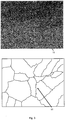
- shows a micrograph of the microstructure of a nickel base alloy after it has been subjected to a method according to an embodiment of the invention, and a schematic representation of the grain boundaries shown in the micrograph, and
- Figure 4
- schematically shows an aero-engine comprising components according to an embodiment of the invention.
-
Figure 1 schematically shows a method for heat treating at least part of commercially available Allvac 718Plus™ (that has an incipient melting temperature of 1260°C). The method comprises the steps of; - a) heating at least one part of the alloy to its delta (δ) phase solvus temperature, 1040°C, and holding it at that held at that temperature for 0.5 hour to dissolve substantially all of the delta (δ) phase present in the alloy's as-received microstructure,
- b) slow cooling the at least one part of the alloy from the solution temperature of step a) to 650°C at a rate of 0.5°C per minute or less, without interruption, to precipitate the alloy's chromium carbide and gamma prime (γ') in a serrated grain boundary (step b), the alloy may then be cooled to room temperature,
- c) heating the at least one part of the alloy to a temperature of 788°C and holding it at that temperature for about 8 hours, and
- d) cooling the at least one part of the nickel base alloy from 788°C to 704°C and holding it at that temperature for about 8 hours.
- The at one least part of the nickel base alloy that has been subjected to such a method will have a microstructure that is entirely free, or at least substantially free of delta phase, wherein gamma prime phase precipitates are the predominant strengthening precipitates. More particularly, such a method will produce a nickel base alloy that has improved creep resistance and/or crack propagation resistance.
-
Figure 2 showstest sample 10 geometry that was used to conduct Time-for-Rupture Notch Tension Tests to compare the notch sensitivity of nickel base alloys that had been subjected to the method according to the present invention with the notch sensitivity of commercially available nickel base alloys that had been heat treated in accordance with manufacturer's recommendations. -
Test samples 10 were manufactured from a 3 mm thick sheet of Allvac 718Plus™ using electric discharge wire (EDW) machining and tested in accordance with the ASTM 292 Standard.Test samples 10 were tested in a thermally insulated induction furnace in an air environment at a temperature of 704°C using a load of 690 MPa. To avoid temperature fluctuations while the tests were taking place, all the tests began by stabilising the temperature. Six thermocouples were used for controlling the temperature of the induction furnace in which thetest samples 10 were placed for testing. Three thermocouples were attached to thetest sample 10, one at the centre of the test sample and one at each end thereof, and three thermocouples were evenly spaced and embedded in the door of the induction furnace. The thermocouples were connected to a temperature regulator and to a computer which logged the temperature and time. - It was found that Allvac 718Plus™ that had been subjected to the method shown schematically in
figure 1 ruptured after 25 minutes whereas commercially available Allvac 718Plus™ that had been subjected to the recommended heat treatment (as outlined in the Background of the Invention above) ruptured after 13 minutes. - This significant improvement in creep properties is believed to be due to the serrated grain boundary that is formed in Allvac 718Plus™ when it has been subjected to the above described method.
Figure 3 shows a micrograph showing the microstructure of a nickel base alloy after it has been subjected to a method according to an embodiment of the invention and a schematic representation of the grain boundaries shown in the micrograph. The microstructure shown infigure 3 exhibits chromium carbide and gamma prime (γ') precipitated in serrated grain boundaries that resemble the toothed edge of a saw, the presence of serrated grain boundaries indicating that the Allvac 718Plus™ has been subjected to a method according to the present invention. The arrow infigure 3 indicates one of the most clearly visibleserrated grain boundaries 11 in the micrograph. -
Figure 4 schematically shows a cross section through an aero-engine 12 which comprises a plurality of components, namely adiffuser case 13, a low pressure turbine (LPT)case 14,vanes 15 and aturbine exhaust case 16, comprising a nickel base alloy according to an embodiment of the invention. It should be noted that an entire component made of a nickel base alloy need not necessarily be subjected to a method according to an embodiment of the invention, it may be sufficient to heat treat one or more parts of the component that is/are subjected to the highest temperatures and/or highest stresses when the aero engine is in use. - Further modifications of the invention within the scope of the claims will be apparent to a skilled person.
Claims (20)
- A method for heat treating a nickel base alloy, comprising the steps of:a) heating a nickel base alloy to at least its delta (δ) phase solvus temperature, and lower than its incipient melting temperature for a predetermined time sufficient to dissolve substantially all of the nickel base alloy's delta (δ) phase, andb) cooling the nickel base alloy to a temperature below the gamma prime (γ') precipitation temperature at a rate sufficient to precipitate the alloy's chromium carbide and gamma prime (γ') in a serrated grain boundary (11)
wherein the nickel base alloy has the following composition in weight-%:• Cr 17-21 • C 0.01 - 0.05 • Mn max 0.35 • Si max 0.35 • P 0.004 - 0.020 • S max 0.0025 • Mo 2.5 - 3.1 • Nb 5.2 - 5.8 • Ti 0.5 - 1 • Al 1.2 - 1.7 • Co 8 - 10 • W 0.8 - 1.4 • B 0.003 - 0.008 • Cu max 0.3 • Fe 8 - 10 • balance Ni and normally occurring impurities. - A method according to claim 1, wherein the nickel base alloy is cooled at a rate of 1.0°C per minute or less in step b).
- A method according to claim 1, wherein the nickel base alloy is cooled at a rate of 0.7°C per minute or less in step b).
- A method according to claim 1, wherein the nickel base alloy is cooled at a rate of 0.5°C per minute or less in step b).
- A method according to claim 1, wherein the nickel base alloy is cooled at a rate of 0.05°C per minute or higher in step b).
- A method according to claim 1, wherein the nickel base alloy is cooled at a rate of 0.1 °C per minute or higher in step b).
- A method according to any of the preceding claims, wherein the method further comprises the step of:
c) heating the nickel based alloy at a first aging temperature below the solvus temperatures for the gamma prime phase and the gamma double prime phase to form primary precipitates of the gamma prime and gamma double prime phase. - A method according to any of the preceding claims, wherein the method further comprises the step of:
d) heating the alloy at a second aging temperature below the solvus temperatures for the gamma prime phase and the gamma double prime phase to form secondary precipitates of the gamma prime and gamma double prime phase. - A method according to any preceding claim, wherein the method comprises the step of heating the nickel base alloy to a temperature of 1040°C ±14°C in step a).
- A method according to any of claims 1-9, wherein the method comprises the step of holding the nickel base alloy at the heated temperature for 0.4 to 0.8 hour in step a).
- A method according to any of claims 1-10, wherein the method comprises the step of cooling the nickel base alloy to a temperature of 650°C ± 14°C in step b).
- A method according to claim 7, wherein the method comprises the step of heating the nickel base alloy to a temperature of 788°C ± 14°C in step c).
- A method according to claim 7 or 12, wherein the method comprises the step of holding the nickel base alloy at the first aging temperature for about 8 hours in step c).
- A method according to claim 8, wherein the method comprises the step of cooling the nickel base alloy to a temperature of 704°C ± 14°C in step d).
- A method according to claim 8 or 14, wherein the method comprises the step of holding the nickel base alloy at the second aging temperature for about 8 hours in step d).
- A nickel base alloy, wherein at least part of the nickel base alloy has been subjected to a method according to any of the preceding claims.
- A nickel base alloy according to claim 16, wherein its microstructure exhibits chromium carbide and gamma prime (γ') precipitated in a serrated grain boundary (11).
- A component (13, 14, 15, 16), comprising a nickel base alloy according to claim 16 or 17.
- The component according to claim 18, wherein the component is a turbine or compressor disc, blade, case, shaft or fastener.
- An aircraft engine (12) comprising a component according to claim 18 or 19.
Applications Claiming Priority (1)
| Application Number | Priority Date | Filing Date | Title |
|---|---|---|---|
| PCT/SE2007/000945 WO2009054756A1 (en) | 2007-10-25 | 2007-10-25 | Method, alloy and component |
Publications (3)
| Publication Number | Publication Date |
|---|---|
| EP2205771A1 EP2205771A1 (en) | 2010-07-14 |
| EP2205771A4 EP2205771A4 (en) | 2017-07-19 |
| EP2205771B1 true EP2205771B1 (en) | 2019-04-03 |
Family
ID=40579746
Family Applications (1)
| Application Number | Title | Priority Date | Filing Date |
|---|---|---|---|
| EP07835145.9A Active EP2205771B1 (en) | 2007-10-25 | 2007-10-25 | Method, nickel base alloy and component |
Country Status (3)
| Country | Link |
|---|---|
| US (1) | US8551266B2 (en) |
| EP (1) | EP2205771B1 (en) |
| WO (1) | WO2009054756A1 (en) |
Cited By (1)
| Publication number | Priority date | Publication date | Assignee | Title |
|---|---|---|---|---|
| WO2025061470A1 (en) * | 2023-09-22 | 2025-03-27 | Gkn Aerospace Sweden Ab | Turbine engine casing fabrication and heat treatment |
Families Citing this family (8)
| Publication number | Priority date | Publication date | Assignee | Title |
|---|---|---|---|---|
| US8721812B2 (en) * | 2009-04-07 | 2014-05-13 | Rolls-Royce Corporation | Techniques for controlling precipitate phase domain size in an alloy |
| US20130133793A1 (en) * | 2011-11-30 | 2013-05-30 | Ati Properties, Inc. | Nickel-base alloy heat treatments, nickel-base alloys, and articles including nickel-base alloys |
| JP6249102B2 (en) | 2014-07-23 | 2017-12-20 | 株式会社Ihi | Manufacturing method of Ni alloy parts |
| US9528171B2 (en) | 2014-09-16 | 2016-12-27 | Caterpillar Inc. | Alloy for seal ring, seal ring, and method of making seal ring for seal assembly of machine |
| RU2610379C1 (en) * | 2015-07-30 | 2017-02-09 | Акционерное общество "Научно-производственный центр газотурбостроения "Салют" (АО "НПЦ газотурбостроения "Салют") | Method of reduction treatment of parts made of heat-resistant nickel alloys |
| US10563293B2 (en) | 2015-12-07 | 2020-02-18 | Ati Properties Llc | Methods for processing nickel-base alloys |
| DE102020116865A1 (en) * | 2019-07-05 | 2021-01-07 | Vdm Metals International Gmbh | Nickel-based alloy for powders and a process for producing a powder |
| WO2025178553A1 (en) * | 2024-02-22 | 2025-08-28 | Alleima Emea Ab | Nickel-based alloy of high mechanical strength |
Family Cites Families (10)
| Publication number | Priority date | Publication date | Assignee | Title |
|---|---|---|---|---|
| US5227403A (en) | 1986-10-01 | 1993-07-13 | The Nisshin Oil Mills, Ltd. | Fats and oils having superior digestibility and absorptivity |
| CH671583A5 (en) * | 1986-12-19 | 1989-09-15 | Bbc Brown Boveri & Cie | |
| US5047093A (en) | 1989-06-09 | 1991-09-10 | The Babcock & Wilcox Company | Heat treatment of Alloy 718 for improved stress corrosion cracking resistance |
| US5061324A (en) | 1990-04-02 | 1991-10-29 | General Electric Company | Thermomechanical processing for fatigue-resistant nickel based superalloys |
| FR2712307B1 (en) * | 1993-11-10 | 1996-09-27 | United Technologies Corp | Articles made of super-alloy with high mechanical and cracking resistance and their manufacturing process. |
| GB2307483B (en) * | 1993-11-10 | 1998-07-08 | United Technologies Corp | Crack-resistant high strength super alloy articles |
| US5759305A (en) * | 1996-02-07 | 1998-06-02 | General Electric Company | Grain size control in nickel base superalloys |
| KR100250810B1 (en) | 1997-09-05 | 2000-04-01 | 이종훈 | Annealing process of ni-base alloy for corrosion resistance improvement |
| US6755924B2 (en) * | 2001-12-20 | 2004-06-29 | General Electric Company | Method of restoration of mechanical properties of a cast nickel-based super alloy for serviced aircraft components |
| US7156932B2 (en) | 2003-10-06 | 2007-01-02 | Ati Properties, Inc. | Nickel-base alloys and methods of heat treating nickel-base alloys |
-
2007
- 2007-10-25 EP EP07835145.9A patent/EP2205771B1/en active Active
- 2007-10-25 WO PCT/SE2007/000945 patent/WO2009054756A1/en not_active Ceased
- 2007-10-25 US US12/738,004 patent/US8551266B2/en active Active
Non-Patent Citations (1)
| Title |
|---|
| None * |
Cited By (1)
| Publication number | Priority date | Publication date | Assignee | Title |
|---|---|---|---|---|
| WO2025061470A1 (en) * | 2023-09-22 | 2025-03-27 | Gkn Aerospace Sweden Ab | Turbine engine casing fabrication and heat treatment |
Also Published As
| Publication number | Publication date |
|---|---|
| WO2009054756A1 (en) | 2009-04-30 |
| US20110308674A1 (en) | 2011-12-22 |
| EP2205771A4 (en) | 2017-07-19 |
| US8551266B2 (en) | 2013-10-08 |
| EP2205771A1 (en) | 2010-07-14 |
Similar Documents
| Publication | Publication Date | Title |
|---|---|---|
| US8551266B2 (en) | Method, alloy and component | |
| CN102021508B (en) | Method of heat treating a ni-based superalloy article and article made thereby | |
| CN110050080B (en) | Ni-based forged alloy materials and turbine high-temperature components using the same | |
| EP1813690B1 (en) | Local heat treatment for improved fatigue resistance in turbine components | |
| CN101600814B (en) | Method for desensitizing nickel-based alloys to environmentally assisted cracking and components fabricated therefrom | |
| US20040011443A1 (en) | Nickel base superalloys and turbine components fabricated therefrom | |
| US9828657B2 (en) | Ni-base super alloy | |
| WO2016129485A1 (en) | METHOD FOR MANUFACTURING Ni-BASED SUPER-HEAT-RESISTANT ALLOY | |
| CA2901259A1 (en) | Nickel-cobalt alloy | |
| JIANG et al. | High temperature tensile properties and fracture behavior of cast nickel-base K445 superalloy | |
| KR102325136B1 (en) | Grain refinement in in706 using laves phase precipitation | |
| EP2065479A2 (en) | A ternary nickel eutectic alloy | |
| Chen et al. | On the conjoint influence of broaching and heat treatment on bending fatigue behavior of Inconel 718 | |
| US20140154093A1 (en) | Method of heat treating a superalloy article and article made thereby | |
| US8663404B2 (en) | Heat treatment method and components treated according to the method | |
| Men et al. | Coupled effect of prestrain and intermediate annealing on mechanical properties and microstructural evolution of GH5188 superalloy | |
| Kuipers et al. | Rejuvenation heat treatment of single crystal gas turbine blades | |
| Mannan et al. | Thermal stability of inconel alloy 783 at 593C and 704C | |
| Cai et al. | Research on Optimization of Stress Relief Annealing Process and Micro-mechanism Analysis for High-Temperature Titanium Alloy Welded Components | |
| Seo et al. | Microstructure and Thermomechanical Fatigue Behavior of Directionally Solidified Ni-Based Superalloys in OP Condition | |
| KR20250103089A (en) | METHOD OF HEAT TREATMENT OF Ni-Cr-Co SUPERALLOY FOR EXCELLENT RESISTANCE OF GRAIN BOUNDARIES TO HIGH-TEMPERATURE CRACKING AND SUPERALLOY HEAT-TREATED THEREBY | |
| Sahoo et al. | Effect of Heat-Treatment on Creep Life of a Nickel Base Alloy Used for Low Pressure Turbine Blade in a Military Aircraft Engine | |
| Detrois et al. | Properties of INCONEL® Alloy 725 | |
| Pender | Inconel alloy 706 | |
| Zhang et al. | Dynamic Recrystallization of the Constituent y Phase and Mechanical Properties of Ti-43Al-9V-0.2 Y Alloy Sheet. |
Legal Events
| Date | Code | Title | Description |
|---|---|---|---|
| PUAI | Public reference made under article 153(3) epc to a published international application that has entered the european phase |
Free format text: ORIGINAL CODE: 0009012 |
|
| 17P | Request for examination filed |
Effective date: 20100525 |
|
| AK | Designated contracting states |
Kind code of ref document: A1 Designated state(s): AT BE BG CH CY CZ DE DK EE ES FI FR GB GR HU IE IS IT LI LT LU LV MC MT NL PL PT RO SE SI SK TR |
|
| AX | Request for extension of the european patent |
Extension state: AL BA HR MK RS |
|
| DAX | Request for extension of the european patent (deleted) | ||
| RAP1 | Party data changed (applicant data changed or rights of an application transferred) |
Owner name: GKN AEROSPACE SWEDEN AB |
|
| RA4 | Supplementary search report drawn up and despatched (corrected) |
Effective date: 20170621 |
|
| RIC1 | Information provided on ipc code assigned before grant |
Ipc: C22F 1/10 20060101AFI20170615BHEP Ipc: C22C 19/05 20060101ALI20170615BHEP |
|
| GRAP | Despatch of communication of intention to grant a patent |
Free format text: ORIGINAL CODE: EPIDOSNIGR1 |
|
| STAA | Information on the status of an ep patent application or granted ep patent |
Free format text: STATUS: GRANT OF PATENT IS INTENDED |
|
| INTG | Intention to grant announced |
Effective date: 20180926 |
|
| GRAS | Grant fee paid |
Free format text: ORIGINAL CODE: EPIDOSNIGR3 |
|
| GRAJ | Information related to disapproval of communication of intention to grant by the applicant or resumption of examination proceedings by the epo deleted |
Free format text: ORIGINAL CODE: EPIDOSDIGR1 |
|
| GRAL | Information related to payment of fee for publishing/printing deleted |
Free format text: ORIGINAL CODE: EPIDOSDIGR3 |
|
| STAA | Information on the status of an ep patent application or granted ep patent |
Free format text: STATUS: REQUEST FOR EXAMINATION WAS MADE |
|
| GRAR | Information related to intention to grant a patent recorded |
Free format text: ORIGINAL CODE: EPIDOSNIGR71 |
|
| STAA | Information on the status of an ep patent application or granted ep patent |
Free format text: STATUS: GRANT OF PATENT IS INTENDED |
|
| GRAA | (expected) grant |
Free format text: ORIGINAL CODE: 0009210 |
|
| STAA | Information on the status of an ep patent application or granted ep patent |
Free format text: STATUS: THE PATENT HAS BEEN GRANTED |
|
| INTC | Intention to grant announced (deleted) | ||
| INTG | Intention to grant announced |
Effective date: 20190218 |
|
| AK | Designated contracting states |
Kind code of ref document: B1 Designated state(s): AT BE BG CH CY CZ DE DK EE ES FI FR GB GR HU IE IS IT LI LT LU LV MC MT NL PL PT RO SE SI SK TR |
|
| REG | Reference to a national code |
Ref country code: GB Ref legal event code: FG4D |
|
| REG | Reference to a national code |
Ref country code: CH Ref legal event code: EP Ref country code: AT Ref legal event code: REF Ref document number: 1115825 Country of ref document: AT Kind code of ref document: T Effective date: 20190415 |
|
| REG | Reference to a national code |
Ref country code: DE Ref legal event code: R096 Ref document number: 602007058030 Country of ref document: DE |
|
| REG | Reference to a national code |
Ref country code: IE Ref legal event code: FG4D |
|
| REG | Reference to a national code |
Ref country code: NL Ref legal event code: MP Effective date: 20190403 |
|
| REG | Reference to a national code |
Ref country code: LT Ref legal event code: MG4D |
|
| REG | Reference to a national code |
Ref country code: AT Ref legal event code: MK05 Ref document number: 1115825 Country of ref document: AT Kind code of ref document: T Effective date: 20190403 |
|
| PG25 | Lapsed in a contracting state [announced via postgrant information from national office to epo] |
Ref country code: NL Free format text: LAPSE BECAUSE OF FAILURE TO SUBMIT A TRANSLATION OF THE DESCRIPTION OR TO PAY THE FEE WITHIN THE PRESCRIBED TIME-LIMIT Effective date: 20190403 |
|
| PG25 | Lapsed in a contracting state [announced via postgrant information from national office to epo] |
Ref country code: PT Free format text: LAPSE BECAUSE OF FAILURE TO SUBMIT A TRANSLATION OF THE DESCRIPTION OR TO PAY THE FEE WITHIN THE PRESCRIBED TIME-LIMIT Effective date: 20190803 Ref country code: ES Free format text: LAPSE BECAUSE OF FAILURE TO SUBMIT A TRANSLATION OF THE DESCRIPTION OR TO PAY THE FEE WITHIN THE PRESCRIBED TIME-LIMIT Effective date: 20190403 Ref country code: CZ Free format text: LAPSE BECAUSE OF FAILURE TO SUBMIT A TRANSLATION OF THE DESCRIPTION OR TO PAY THE FEE WITHIN THE PRESCRIBED TIME-LIMIT Effective date: 20190403 Ref country code: FI Free format text: LAPSE BECAUSE OF FAILURE TO SUBMIT A TRANSLATION OF THE DESCRIPTION OR TO PAY THE FEE WITHIN THE PRESCRIBED TIME-LIMIT Effective date: 20190403 Ref country code: LT Free format text: LAPSE BECAUSE OF FAILURE TO SUBMIT A TRANSLATION OF THE DESCRIPTION OR TO PAY THE FEE WITHIN THE PRESCRIBED TIME-LIMIT Effective date: 20190403 Ref country code: SE Free format text: LAPSE BECAUSE OF FAILURE TO SUBMIT A TRANSLATION OF THE DESCRIPTION OR TO PAY THE FEE WITHIN THE PRESCRIBED TIME-LIMIT Effective date: 20190403 |
|
| PG25 | Lapsed in a contracting state [announced via postgrant information from national office to epo] |
Ref country code: PL Free format text: LAPSE BECAUSE OF FAILURE TO SUBMIT A TRANSLATION OF THE DESCRIPTION OR TO PAY THE FEE WITHIN THE PRESCRIBED TIME-LIMIT Effective date: 20190403 Ref country code: LV Free format text: LAPSE BECAUSE OF FAILURE TO SUBMIT A TRANSLATION OF THE DESCRIPTION OR TO PAY THE FEE WITHIN THE PRESCRIBED TIME-LIMIT Effective date: 20190403 Ref country code: GR Free format text: LAPSE BECAUSE OF FAILURE TO SUBMIT A TRANSLATION OF THE DESCRIPTION OR TO PAY THE FEE WITHIN THE PRESCRIBED TIME-LIMIT Effective date: 20190704 Ref country code: BG Free format text: LAPSE BECAUSE OF FAILURE TO SUBMIT A TRANSLATION OF THE DESCRIPTION OR TO PAY THE FEE WITHIN THE PRESCRIBED TIME-LIMIT Effective date: 20190703 |
|
| PG25 | Lapsed in a contracting state [announced via postgrant information from national office to epo] |
Ref country code: IS Free format text: LAPSE BECAUSE OF FAILURE TO SUBMIT A TRANSLATION OF THE DESCRIPTION OR TO PAY THE FEE WITHIN THE PRESCRIBED TIME-LIMIT Effective date: 20190803 Ref country code: AT Free format text: LAPSE BECAUSE OF FAILURE TO SUBMIT A TRANSLATION OF THE DESCRIPTION OR TO PAY THE FEE WITHIN THE PRESCRIBED TIME-LIMIT Effective date: 20190403 |
|
| REG | Reference to a national code |
Ref country code: DE Ref legal event code: R097 Ref document number: 602007058030 Country of ref document: DE |
|
| PG25 | Lapsed in a contracting state [announced via postgrant information from national office to epo] |
Ref country code: RO Free format text: LAPSE BECAUSE OF FAILURE TO SUBMIT A TRANSLATION OF THE DESCRIPTION OR TO PAY THE FEE WITHIN THE PRESCRIBED TIME-LIMIT Effective date: 20190403 Ref country code: SK Free format text: LAPSE BECAUSE OF FAILURE TO SUBMIT A TRANSLATION OF THE DESCRIPTION OR TO PAY THE FEE WITHIN THE PRESCRIBED TIME-LIMIT Effective date: 20190403 Ref country code: EE Free format text: LAPSE BECAUSE OF FAILURE TO SUBMIT A TRANSLATION OF THE DESCRIPTION OR TO PAY THE FEE WITHIN THE PRESCRIBED TIME-LIMIT Effective date: 20190403 Ref country code: DK Free format text: LAPSE BECAUSE OF FAILURE TO SUBMIT A TRANSLATION OF THE DESCRIPTION OR TO PAY THE FEE WITHIN THE PRESCRIBED TIME-LIMIT Effective date: 20190403 |
|
| PLBE | No opposition filed within time limit |
Free format text: ORIGINAL CODE: 0009261 |
|
| STAA | Information on the status of an ep patent application or granted ep patent |
Free format text: STATUS: NO OPPOSITION FILED WITHIN TIME LIMIT |
|
| PG25 | Lapsed in a contracting state [announced via postgrant information from national office to epo] |
Ref country code: IT Free format text: LAPSE BECAUSE OF FAILURE TO SUBMIT A TRANSLATION OF THE DESCRIPTION OR TO PAY THE FEE WITHIN THE PRESCRIBED TIME-LIMIT Effective date: 20190403 |
|
| 26N | No opposition filed |
Effective date: 20200106 |
|
| PG25 | Lapsed in a contracting state [announced via postgrant information from national office to epo] |
Ref country code: TR Free format text: LAPSE BECAUSE OF FAILURE TO SUBMIT A TRANSLATION OF THE DESCRIPTION OR TO PAY THE FEE WITHIN THE PRESCRIBED TIME-LIMIT Effective date: 20190403 |
|
| PG25 | Lapsed in a contracting state [announced via postgrant information from national office to epo] |
Ref country code: MC Free format text: LAPSE BECAUSE OF FAILURE TO SUBMIT A TRANSLATION OF THE DESCRIPTION OR TO PAY THE FEE WITHIN THE PRESCRIBED TIME-LIMIT Effective date: 20190403 Ref country code: SI Free format text: LAPSE BECAUSE OF FAILURE TO SUBMIT A TRANSLATION OF THE DESCRIPTION OR TO PAY THE FEE WITHIN THE PRESCRIBED TIME-LIMIT Effective date: 20190403 |
|
| REG | Reference to a national code |
Ref country code: CH Ref legal event code: PL |
|
| PG25 | Lapsed in a contracting state [announced via postgrant information from national office to epo] |
Ref country code: LU Free format text: LAPSE BECAUSE OF NON-PAYMENT OF DUE FEES Effective date: 20191025 Ref country code: CH Free format text: LAPSE BECAUSE OF NON-PAYMENT OF DUE FEES Effective date: 20191031 Ref country code: LI Free format text: LAPSE BECAUSE OF NON-PAYMENT OF DUE FEES Effective date: 20191031 |
|
| REG | Reference to a national code |
Ref country code: BE Ref legal event code: MM Effective date: 20191031 |
|
| PG25 | Lapsed in a contracting state [announced via postgrant information from national office to epo] |
Ref country code: BE Free format text: LAPSE BECAUSE OF NON-PAYMENT OF DUE FEES Effective date: 20191031 |
|
| PG25 | Lapsed in a contracting state [announced via postgrant information from national office to epo] |
Ref country code: IE Free format text: LAPSE BECAUSE OF NON-PAYMENT OF DUE FEES Effective date: 20191025 |
|
| PG25 | Lapsed in a contracting state [announced via postgrant information from national office to epo] |
Ref country code: CY Free format text: LAPSE BECAUSE OF FAILURE TO SUBMIT A TRANSLATION OF THE DESCRIPTION OR TO PAY THE FEE WITHIN THE PRESCRIBED TIME-LIMIT Effective date: 20190403 |
|
| PG25 | Lapsed in a contracting state [announced via postgrant information from national office to epo] |
Ref country code: HU Free format text: LAPSE BECAUSE OF FAILURE TO SUBMIT A TRANSLATION OF THE DESCRIPTION OR TO PAY THE FEE WITHIN THE PRESCRIBED TIME-LIMIT; INVALID AB INITIO Effective date: 20071025 Ref country code: MT Free format text: LAPSE BECAUSE OF FAILURE TO SUBMIT A TRANSLATION OF THE DESCRIPTION OR TO PAY THE FEE WITHIN THE PRESCRIBED TIME-LIMIT Effective date: 20190403 |
|
| P01 | Opt-out of the competence of the unified patent court (upc) registered |
Effective date: 20230526 |
|
| PGFP | Annual fee paid to national office [announced via postgrant information from national office to epo] |
Ref country code: GB Payment date: 20240906 Year of fee payment: 18 |
|
| PGFP | Annual fee paid to national office [announced via postgrant information from national office to epo] |
Ref country code: FR Payment date: 20240909 Year of fee payment: 18 |
|
| PGFP | Annual fee paid to national office [announced via postgrant information from national office to epo] |
Ref country code: DE Payment date: 20240904 Year of fee payment: 18 |