EP2205103B1 - Method and apparatus for making food chips - Google Patents
Method and apparatus for making food chips Download PDFInfo
- Publication number
- EP2205103B1 EP2205103B1 EP08830114A EP08830114A EP2205103B1 EP 2205103 B1 EP2205103 B1 EP 2205103B1 EP 08830114 A EP08830114 A EP 08830114A EP 08830114 A EP08830114 A EP 08830114A EP 2205103 B1 EP2205103 B1 EP 2205103B1
- Authority
- EP
- European Patent Office
- Prior art keywords
- belt
- food
- heat source
- chips
- belts
- Prior art date
- Legal status (The legal status is an assumption and is not a legal conclusion. Google has not performed a legal analysis and makes no representation as to the accuracy of the status listed.)
- Not-in-force
Links
Images

Classifications
-
- H—ELECTRICITY
- H05—ELECTRIC TECHNIQUES NOT OTHERWISE PROVIDED FOR
- H05B—ELECTRIC HEATING; ELECTRIC LIGHT SOURCES NOT OTHERWISE PROVIDED FOR; CIRCUIT ARRANGEMENTS FOR ELECTRIC LIGHT SOURCES, IN GENERAL
- H05B6/00—Heating by electric, magnetic or electromagnetic fields
- H05B6/64—Heating using microwaves
- H05B6/78—Arrangements for continuous movement of material
- H05B6/782—Arrangements for continuous movement of material wherein the material moved is food
-
- A—HUMAN NECESSITIES
- A23—FOODS OR FOODSTUFFS; TREATMENT THEREOF, NOT COVERED BY OTHER CLASSES
- A23L—FOODS, FOODSTUFFS OR NON-ALCOHOLIC BEVERAGES, NOT OTHERWISE PROVIDED FOR; PREPARATION OR TREATMENT THEREOF
- A23L19/00—Products from fruits or vegetables; Preparation or treatment thereof
- A23L19/10—Products from fruits or vegetables; Preparation or treatment thereof of tuberous or like starch containing root crops
-
- A—HUMAN NECESSITIES
- A23—FOODS OR FOODSTUFFS; TREATMENT THEREOF, NOT COVERED BY OTHER CLASSES
- A23L—FOODS, FOODSTUFFS OR NON-ALCOHOLIC BEVERAGES, NOT OTHERWISE PROVIDED FOR; PREPARATION OR TREATMENT THEREOF
- A23L19/00—Products from fruits or vegetables; Preparation or treatment thereof
- A23L19/10—Products from fruits or vegetables; Preparation or treatment thereof of tuberous or like starch containing root crops
- A23L19/12—Products from fruits or vegetables; Preparation or treatment thereof of tuberous or like starch containing root crops of potatoes
- A23L19/18—Roasted or fried products, e.g. snacks or chips
-
- A—HUMAN NECESSITIES
- A23—FOODS OR FOODSTUFFS; TREATMENT THEREOF, NOT COVERED BY OTHER CLASSES
- A23L—FOODS, FOODSTUFFS OR NON-ALCOHOLIC BEVERAGES, NOT OTHERWISE PROVIDED FOR; PREPARATION OR TREATMENT THEREOF
- A23L19/00—Products from fruits or vegetables; Preparation or treatment thereof
- A23L19/10—Products from fruits or vegetables; Preparation or treatment thereof of tuberous or like starch containing root crops
- A23L19/12—Products from fruits or vegetables; Preparation or treatment thereof of tuberous or like starch containing root crops of potatoes
- A23L19/18—Roasted or fried products, e.g. snacks or chips
- A23L19/19—Roasted or fried products, e.g. snacks or chips from powdered or mashed potato products
-
- A—HUMAN NECESSITIES
- A23—FOODS OR FOODSTUFFS; TREATMENT THEREOF, NOT COVERED BY OTHER CLASSES
- A23L—FOODS, FOODSTUFFS OR NON-ALCOHOLIC BEVERAGES, NOT OTHERWISE PROVIDED FOR; PREPARATION OR TREATMENT THEREOF
- A23L5/00—Preparation or treatment of foods or foodstuffs, in general; Food or foodstuffs obtained thereby; Materials therefor
- A23L5/10—General methods of cooking foods, e.g. by roasting or frying
- A23L5/13—General methods of cooking foods, e.g. by roasting or frying using water or steam
-
- A—HUMAN NECESSITIES
- A23—FOODS OR FOODSTUFFS; TREATMENT THEREOF, NOT COVERED BY OTHER CLASSES
- A23L—FOODS, FOODSTUFFS OR NON-ALCOHOLIC BEVERAGES, NOT OTHERWISE PROVIDED FOR; PREPARATION OR TREATMENT THEREOF
- A23L7/00—Cereal-derived products; Malt products; Preparation or treatment thereof
- A23L7/10—Cereal-derived products
- A23L7/117—Flakes or other shapes of ready-to-eat type; Semi-finished or partly-finished products therefor
- A23L7/13—Snacks or the like obtained by oil frying of a formed cereal dough
-
- F—MECHANICAL ENGINEERING; LIGHTING; HEATING; WEAPONS; BLASTING
- F26—DRYING
- F26B—DRYING SOLID MATERIALS OR OBJECTS BY REMOVING LIQUID THEREFROM
- F26B17/00—Machines or apparatus for drying materials in loose, plastic, or fluidised form, e.g. granules, staple fibres, with progressive movement
- F26B17/02—Machines or apparatus for drying materials in loose, plastic, or fluidised form, e.g. granules, staple fibres, with progressive movement with movement performed by belts carrying the materials; with movement performed by belts propelling the materials over stationary surfaces
- F26B17/026—Machines or apparatus for drying materials in loose, plastic, or fluidised form, e.g. granules, staple fibres, with progressive movement with movement performed by belts carrying the materials; with movement performed by belts propelling the materials over stationary surfaces the material being moved in-between belts which may be perforated
-
- F—MECHANICAL ENGINEERING; LIGHTING; HEATING; WEAPONS; BLASTING
- F26—DRYING
- F26B—DRYING SOLID MATERIALS OR OBJECTS BY REMOVING LIQUID THEREFROM
- F26B3/00—Drying solid materials or objects by processes involving the application of heat
- F26B3/18—Drying solid materials or objects by processes involving the application of heat by conduction, i.e. the heat is conveyed from the heat source, e.g. gas flame, to the materials or objects to be dried by direct contact
- F26B3/20—Drying solid materials or objects by processes involving the application of heat by conduction, i.e. the heat is conveyed from the heat source, e.g. gas flame, to the materials or objects to be dried by direct contact the heat source being a heated surface, e.g. a moving belt or conveyor
-
- F—MECHANICAL ENGINEERING; LIGHTING; HEATING; WEAPONS; BLASTING
- F26—DRYING
- F26B—DRYING SOLID MATERIALS OR OBJECTS BY REMOVING LIQUID THEREFROM
- F26B3/00—Drying solid materials or objects by processes involving the application of heat
- F26B3/18—Drying solid materials or objects by processes involving the application of heat by conduction, i.e. the heat is conveyed from the heat source, e.g. gas flame, to the materials or objects to be dried by direct contact
- F26B3/22—Drying solid materials or objects by processes involving the application of heat by conduction, i.e. the heat is conveyed from the heat source, e.g. gas flame, to the materials or objects to be dried by direct contact the heat source and the materials or objects to be dried being in relative motion, e.g. of vibration
- F26B3/24—Drying solid materials or objects by processes involving the application of heat by conduction, i.e. the heat is conveyed from the heat source, e.g. gas flame, to the materials or objects to be dried by direct contact the heat source and the materials or objects to be dried being in relative motion, e.g. of vibration the movement being rotation
Definitions
- the invention relates to a method and apparatus comprising a heat source for making food chips.
- Potato food chips and other snack foods are very popular. There are many methods in preparing snack foods such as potato food chips and other forms of vegetable and grain food chips such as corn (maize) or tortilla food chips. Most of these methods rely on cooking the snacks in oil, known as deep frying. The deep frying creates a very crisp structure and lower the moisture content but will allow some uptake of oil. The frying process typical results in a fat content of 20-45 % of fat. Fat is very high in calories and heavy intake of calories might lead to overweight. Apart from overweight, high intake of fat may also lead to other health problems such as heart diseases and joint problems, such as knee damages. Most major health organizations thus recommend that no more than thirty percent (30%) of the total calorie intake shall be fat related.
- potato chips are prepared in a heating zone with a combination of overhead infrared radiation and underneath open flame burners, followed by a dryer zone with hot air.
- sliced potatoes were first subjected to an infrared (high intensity 46 micron wavelength) heating step to heat their exterior, then to a microwave energy (91 5-2450 mhz) heating step to heat their interior, and finally to another infrared (4-6 micron wavelength) heating step to brown them into a crisp, fat-free, potato food chip snack food product that was low in calories and had a long shelf life.
- infrared high intensity 46 micron wavelength
- microwave energy 91 5-2450 mhz
- US 4,906,483 discloses a process in which the microwave cooking step was employed early in the process to activate the release of starch while the potato slices were still immersed in water followed by a cold water rinse and final cooking in radiant heat until brown and crisp to produce a fat-free potato food chip.
- US 5,298,707 and WO 94/15481 show another process for preparing fat free chips using microwave heating of potato chips in two steps. First the potato chips are exposed to high intensity microwave energy, vaporizing the water in the potatoes, second the potatoes are dried using low intensity microwave energy. The potatoes are conveyed along and through a microwave waveguide.
- US 5,470,600 discloses a process in which the slices are initially cooked in a three zone primary oven by first radiant heating the slices and then subjecting the slices to two successive stages of forced air heating and a final cooking in a dielectric heater by subjecting the slices to radio frequency electromagnetic waves having a long wavelength.
- a still further fat-free process is disclosed in US 4,919,965 , in which the potato slices are simultaneously finally cooked by compressing them between dual opposed heating surfaces which were 50% relieved driving the moisture into the voids in the cooking surfaces to produce a fat-free potato food chip.
- the invention relates to an apparatus for making food chips, comprising a source of heat, characterized in that it further comprises a conveyer belt arranged in such a way that, when in use, food chips are held between the belt and the heat source at least a part of the path of the belt, and wherein the belt is steam permeable.
- At least the food chip contact surface of the belt comprises a non-sticky material.
- it comprises a second belt arranged in such a way that, when in use, food chips are held between the two belts, the second belt being arranged between the first belt and the heat source, wherein at least a part of the path of the two belts are arranged adjacent said heat source and wherein the belts are arranged for synchronous movement at said part of the path for heating the food chips.
- said belts are glass fiber belts.
- said heat source is a drum dryer.
- the apparatus further comprises a heating jacket arranged at least partly circumferential of the drum dryer and the at least one belt.
- a further aspect of the invention relates to a method for making food chips, comprising:
- the method further comprises holding the sliced food using an open mesh conveyer belts and moving the belts to pass through forced hot air.
- the method further comprises applying a pressure 25 on the food and the heat source with the belt conveyer.
- an apparatus for making food chips comprises a source of heat and a conveyer belt arranged such that, when in use, food chips are held between the belt and the heat source at least along a part of the path of the belt, and wherein the belt is steam permeable.
- the steam permeable belt allows for steam to leave the food chip while being heated and hence dried.
- the apparatus and method of the present invention is suitable for the preparation of fat free food chips made from a variety of vegetables, grains, fruit and the like, which can be cut or otherwise formed into flat, generally thin slice shaped portions.
- Any potato traditionally used for conventional deep frying food chip processes may be used. Some varieties of potato that have normally been undesirable for deep frying may be used.
- the present invention may be used to prepare food chips from raw vegetables, potatoes and the like that have been cut into slices.
- the method of the present invention is also suitable for preparation of a variety of products that are flat slice shaped and traditionally baked, such as crackers, some sort of biscuits and the like.
- the present invention is especially adapted for the preparation of potato food chips.
- Initial preparation of raw potato includes washing, scrubbing, cutting them into pieces and then washing the slices from excess starch and moisture.
- the slices are preferably 0.4-3 mm thick but more preferable 0.7-1.2 mm thick.
- the potato may have its outer shell removed by any method for peeling.
- At least the food chip contact surface of the belt comprises a non-stick material, such as e.g. of Teflon®.
- the belt could for instance be glass fiber belts coated partially or completely with a non-stick material such as Teflon®.
- the food contact surface of the heat source could also be coated with a non-stick material or for instance be made of stainless steel.
- the heat source is a drum dryer, i.e. the belt is arranged at least partially circumferentially of the drum dryer.
- the drum dryer also rotates with the same speed as the belts such that friction and hence wear is avoided.
- a heating jacket is preferably arranged circumferentially radially outside of the drum dryer and the belt.
- the slices should be fed in a mono layer and fed between the belt and the heat source. If a conveyer belt accompanying the drum is used it should be very thin, preferable a Teflon® coated glass fiber belt having a thickness of 0.075 to 1 mm, more preferable 0.075-0.15 mm.
- the food contact surface of the drum dryer could be coated with a non-stick material or comprising other food grade material, e.g. stainless steel, and the food chips are scraped off from the drum dryer.
- the choice of heat source is of less importance.
- the temperature of the drum dryer could be 110-250°C on the surface but more preferable 130 - 220°C.
- the belt should be porous or perforated, i.e. steam permeable, and covered with a heat restrained and food grade material such as Teflon® or silicon polymer, preferably a porous Teflon® coated glass fiber belt having a thickness of 0.075 to 1 mm. The belt should press against the food slices.
- the food slices and the belt preferably accompanies the rotation of the drum.
- the process time is preferably between 10 and 300 seconds but more preferably between 90 and 200 seconds. If desired the slices could be fully cooked in this stage so they reach a final moisture level of about 2-6 % but they could also be partially cooked and fully dried out by other commercial available drying machines such as hot air blowers, by IR (infrared radiation) or microwaves. For economical reasons the final drying is preferably carried out by using for instance a jet blower.
- An alternative embodiment of the apparatus according the invention comprises a second belt arranged such that, when in use, food chips are held between the two belts, the second belt being arranged between the first belt and the heat source, wherein at least a part of the path of the two belts are arranged adjacent said heat source and wherein the belts are arranged for synchronous movement at said part of the path for heating the food chips.
- At least the food chips contact surfaces of the belts comprise a non-stick material such as Teflon®.
- Teflon® a non-stick material
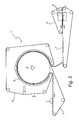
- Figures 1 and 2 disclose an outline of an embodiment of the apparatus I according to the present invention.
- 0.8 mm slices of potato 2 are placed in a mono layer on a 0.075 mm conveyer belt 3 of glass fibre covered with Teflon®.
- the conveyer belt 3 and the slices of potato travels around a 2 meter wide and 2.5 meter diameter drum dryer 4 of an initial surface temperature of 175°C.
- Heating elements 5 of black painted steel are arranged 2.5 mm above the drum dryer 4 and set to 175°C.
- the slices 2 are pressed down to the drum with a 0.22 mm thick porous conveyer belt 6 of glass fibre covered with Teflon and the speed is set such that the potato slices 2 are dried for 2 minutes and 15 seconds until the slices of potato reaches a moisture level of about 30 %.
- the slices then falls down on an open mesh conveyer belt 7 traveling with the same speed as the drying drum.
- a further open mesh conveyer belt 8 holds the potato slices together with the first open mesh conveyer belt 7 while the potato slices 2 are exposed to forced hot air from below and above.
- the blowers 9 have each an opening with a diameter of 12 mm and are set to provide air having a temperature of 200°C and speed of 20 m/s.
- the potato slices 2 reaches a final moisture level of about 7%.
- the potato slices 2 could then optionally be fed into a seasoning unit (not shown) before the packaging.
- the drum dryer 4 surface contacting the potato slices 2 are coated/covered with a food grade material.
- a first drum dryer at a temperature about 200-220°C could be used as a first step.
- the second drum dryer could be set at a slightly lower temperature of about 180-200°C and then a third drum dryer at a temperature of about 160-170°C could be used for the final stage.
- External heating elements could also be used. The above described method/apparatus could be used in order to speed up the process and at the same time minimize the risk of burning the food.
- dough is prepared, such as dough of corn (maize), which dough is rolled out to a thickness of about 1 mm, and raw dough chips are punched out of the dough sheet.
- the raw dough chips being punched out of the dough sheet are subsequently fed onto the conveyor belt of the apparatus described above for further heat treatment and finalizing seasoning and packaging.
- a dough of maize flour comprising 30% water, 20% cold swelling maize flour, and 50% maize flour was rolled out to a thickness of about 1 mm, and raw dough chips was punched out of the dough sheet.
- the raw dough chips being punched out of the dough sheet was subsequently fed onto the conveyor belt of the apparatus described above and were preheated at 210°C for 20 sec., heated in the drum drier at 240°C for 20 sec., and finally treated using hot at a temperature of 200°C for 30 sec.
- the final maize chips were crunchy.
- a normal recipe to prepare baked chips comprises potatoflakes 20 % by weight, potato granules 20 % by weight, potato starch 50 % by weight and pregelatinized starch 10 % by weight. Water is added to a dough which is rolled out to a thickness of 0.5 mm from which chips ovals are punched and treated in the apparatus and in accordance with above.
- Another recipe comprises potato starch 85 % dry matter, pregeletanised starch 15 % dry matter and heat stable aromas of potato chips or nachos.
- the dough is rolled out to a thickness of 0.5 mm to an infinite web from which chips formed or nachos formed pieces are punched out on a sheet of Teflon®.
- the sheet of Teflon® will transferred through preheating zone for 10 sec at 200°C before the drum containing heating elements placed 2 to 4 mm over and underneath the sheet.
- the sheet is heat treated at the drum for 15 sec whereupon the chips 200°C for 40 sec.
- the finalized chips may become sprayed with a solution of 6 % maltodextrin and water (50:50 by weight), and is powdered with 6% seasoning, such as a tzatziki seasoning.
- the chips obtained will be fat free and have a high content of resistant starches.
Landscapes
- Engineering & Computer Science (AREA)
- Life Sciences & Earth Sciences (AREA)
- Polymers & Plastics (AREA)
- Chemical & Material Sciences (AREA)
- Nutrition Science (AREA)
- Food Science & Technology (AREA)
- Health & Medical Sciences (AREA)
- Mechanical Engineering (AREA)
- General Engineering & Computer Science (AREA)
- Microbiology (AREA)
- Physics & Mathematics (AREA)
- Electromagnetism (AREA)
- Preparation Of Fruits And Vegetables (AREA)
- General Preparation And Processing Of Foods (AREA)
- Formation And Processing Of Food Products (AREA)
Abstract
Description
- The invention relates to a method and apparatus comprising a heat source for making food chips.
- Potato food chips and other snack foods are very popular. There are many methods in preparing snack foods such as potato food chips and other forms of vegetable and grain food chips such as corn (maize) or tortilla food chips. Most of these methods rely on cooking the snacks in oil, known as deep frying. The deep frying creates a very crisp structure and lower the moisture content but will allow some uptake of oil. The frying process typical results in a fat content of 20-45 % of fat. Fat is very high in calories and heavy intake of calories might lead to overweight. Apart from overweight, high intake of fat may also lead to other health problems such as heart diseases and joint problems, such as knee damages. Most major health organizations thus recommend that no more than thirty percent (30%) of the total calorie intake shall be fat related.
- Generally, there are two very important factors when it comes to food; price and taste. It has therefore been an object over a long period of time to cost effectively produce a fat-free snack food product, for instance potato food chips that looks, feels and taste similar to deep fried food chips. Having recognized the long felt need, other inventors have attempted to produce commercially acceptable fat-free potato food chips. Earlier attempts have required considerable economic investments in microwave or radio wave techniques or have not got the desirable taste and structure similar to deep fried food chips.
- In a process disclosed in
US 4,283,425 , a single step of heating by microwaves (910-915 mhz or 2400-2500 mhz) was used. The slices were also dipped in or sprayed with an edible oil prior to final microwave cooking, which led to a fat content of 3-5% by weight, which as such is too high to be classified as fat-free. Thus, this product was basically a "low-fat" potato food chip. - In
US 5,802,959 , potato chips are prepared in a heating zone with a combination of overhead infrared radiation and underneath open flame burners, followed by a dryer zone with hot air. - In a further process disclosed in
US 4,800,090 , sliced potatoes were first subjected to an infrared (high intensity 46 micron wavelength) heating step to heat their exterior, then to a microwave energy (91 5-2450 mhz) heating step to heat their interior, and finally to another infrared (4-6 micron wavelength) heating step to brown them into a crisp, fat-free, potato food chip snack food product that was low in calories and had a long shelf life. -
US 4,906,483 discloses a process in which the microwave cooking step was employed early in the process to activate the release of starch while the potato slices were still immersed in water followed by a cold water rinse and final cooking in radiant heat until brown and crisp to produce a fat-free potato food chip. -
US 5,298,707 andWO 94/15481 -
US 5,470,600 discloses a process in which the slices are initially cooked in a three zone primary oven by first radiant heating the slices and then subjecting the slices to two successive stages of forced air heating and a final cooking in a dielectric heater by subjecting the slices to radio frequency electromagnetic waves having a long wavelength. - A still further fat-free process is disclosed in
US 4,919,965 , in which the potato slices are simultaneously finally cooked by compressing them between dual opposed heating surfaces which were 50% relieved driving the moisture into the voids in the cooking surfaces to produce a fat-free potato food chip. - It is an object of the present invention to fill a long felt need by providing an apparatus and a method for making a fully cooked fat-free food chip product with a long shelf life, which product looks, feels and tastes like a conventional deep fried food chip in an economical continuous process without using any cooking oil whatsoever.
- In particular the invention relates to an apparatus for making food chips, comprising a source of heat, characterized in that it further comprises a conveyer belt arranged in such a way that, when in use, food chips are held between the belt and the heat source at least a part of the path of the belt, and wherein the belt is steam permeable.
- In a preferred embodiment of the invention at least the food chip contact surface of the belt comprises a non-sticky material.
- In a preferred embodiment of the invention it comprises a second belt arranged in such a way that, when in use, food chips are held between the two belts, the second belt being arranged between the first belt and the heat source, wherein at least a part of the path of the two belts are arranged adjacent said heat source and wherein the belts are arranged for synchronous movement at said part of the path for heating the food chips. In a preferred embodiment of the invention said belts are glass fiber belts. In a preferred embodiment of the invention said heat source is a drum dryer.
- In a preferred embodiment of the invention the apparatus further comprises a heating jacket arranged at least partly circumferential of the drum dryer and the at least one belt.
- A further aspect of the invention relates to a method for making food chips, comprising:
- feeding sliced food in a mono layer between a steam permeable conveyer belt and a heat source,
- guiding steam or vaporized water from the food through the steam permeable belt, and recovering the thus prepared food chips from the conveyor belt.
- In a preferred embodiment of the invention the method further comprises holding the sliced food using an open mesh conveyer belts and moving the belts to pass through forced hot air.
- In a preferred embodiment of the invention the method further comprises applying a pressure 25 on the food and the heat source with the belt conveyer.
- According to the present invention, an apparatus for making food chips, comprises a source of heat and a conveyer belt arranged such that, when in use, food chips are held between the belt and the heat source at least along a part of the path of the belt, and wherein the belt is steam permeable. The steam permeable belt allows for steam to leave the food chip while being heated and hence dried.
- Therefore the apparatus and method of the present invention is suitable for the preparation of fat free food chips made from a variety of vegetables, grains, fruit and the like, which can be cut or otherwise formed into flat, generally thin slice shaped portions. Any potato traditionally used for conventional deep frying food chip processes may be used. Some varieties of potato that have normally been undesirable for deep frying may be used. The present invention may be used to prepare food chips from raw vegetables, potatoes and the like that have been cut into slices. The method of the present invention is also suitable for preparation of a variety of products that are flat slice shaped and traditionally baked, such as crackers, some sort of biscuits and the like. The present invention is especially adapted for the preparation of potato food chips.
- Initial preparation of raw potato includes washing, scrubbing, cutting them into pieces and then washing the slices from excess starch and moisture. The slices are preferably 0.4-3 mm thick but more preferable 0.7-1.2 mm thick. The potato may have its outer shell removed by any method for peeling.
- Preferably, at least the food chip contact surface of the belt comprises a non-stick material, such as e.g. of Teflon®. The belt could for instance be glass fiber belts coated partially or completely with a non-stick material such as Teflon®. The food contact surface of the heat source could also be coated with a non-stick material or for instance be made of stainless steel.
- In a preferred embodiment of the present invention the heat source is a drum dryer, i.e. the belt is arranged at least partially circumferentially of the drum dryer. Preferably the drum dryer also rotates with the same speed as the belts such that friction and hence wear is avoided. For more efficient heating and drying, a heating jacket is preferably arranged circumferentially radially outside of the drum dryer and the belt.
- The slices should be fed in a mono layer and fed between the belt and the heat source. If a conveyer belt accompanying the drum is used it should be very thin, preferable a Teflon® coated glass fiber belt having a thickness of 0.075 to 1 mm, more preferable 0.075-0.15 mm.
- Any commercial drum dryer of smaller size or up to 6 meters width and 6 meter in diameter can be used. The food contact surface of the drum dryer could be coated with a non-stick material or comprising other food grade material, e.g. stainless steel, and the food chips are scraped off from the drum dryer. The choice of heat source is of less importance. The temperature of the drum dryer could be 110-250°C on the surface but more preferable 130 - 220°C. The belt should be porous or perforated, i.e. steam permeable, and covered with a heat restrained and food grade material such as Teflon® or silicon polymer, preferably a porous Teflon® coated glass fiber belt having a thickness of 0.075 to 1 mm. The belt should press against the food slices. The food slices and the belt preferably accompanies the rotation of the drum. The process time is preferably between 10 and 300 seconds but more preferably between 90 and 200 seconds. If desired the slices could be fully cooked in this stage so they reach a final moisture level of about 2-6 % but they could also be partially cooked and fully dried out by other commercial available drying machines such as hot air blowers, by IR (infrared radiation) or microwaves. For economical reasons the final drying is preferably carried out by using for instance a jet blower.
- An alternative embodiment of the apparatus according the invention comprises a second belt arranged such that, when in use, food chips are held between the two belts, the second belt being arranged between the first belt and the heat source, wherein at least a part of the path of the two belts are arranged adjacent said heat source and wherein the belts are arranged for synchronous movement at said part of the path for heating the food chips. P
- Preferably, in this embodiment, at least the food chips contact surfaces of the belts comprise a non-stick material such as Teflon®. In This embodiment it is also advantageous to use a drum dryer, wherein the two belts move with the same speed and also with the same speed as the drum dryer in order to avoid friction and hence wear.
- The invention will be described in the following more in detail with reference to the drawing, wherein:
-
Figure 1 is a perspective view of an embodiment of the apparatus according to the present invention. -
Figure 2 is a side view of the embodiment shown infigure 1 . -
Figures 1 and2 disclose an outline of an embodiment of the apparatus I according to the present invention. 0.8 mm slices ofpotato 2 are placed in a mono layer on a 0.075mm conveyer belt 3 of glass fibre covered with Teflon®. Theconveyer belt 3 and the slices of potato travels around a 2 meter wide and 2.5 meterdiameter drum dryer 4 of an initial surface temperature of 175°C. Heating elements 5 of black painted steel are arranged 2.5 mm above thedrum dryer 4 and set to 175°C. Theslices 2 are pressed down to the drum with a 0.22 mm thickporous conveyer belt 6 of glass fibre covered with Teflon and the speed is set such that the potato slices 2 are dried for 2 minutes and 15 seconds until the slices of potato reaches a moisture level of about 30 %. The slices then falls down on an open mesh conveyer belt 7 traveling with the same speed as the drying drum. A further openmesh conveyer belt 8 holds the potato slices together with the first open mesh conveyer belt 7 while the potato slices 2 are exposed to forced hot air from below and above. Theblowers 9 have each an opening with a diameter of 12 mm and are set to provide air having a temperature of 200°C and speed of 20 m/s. The potato slices 2 reaches a final moisture level of about 7%. The potato slices 2 could then optionally be fed into a seasoning unit (not shown) before the packaging. - As an alternative it is possible to feed potato slices 2 between the steam
permeable conveyer belt 6 and thedrum dryer 4, i.e. omitting thefirst conveyer belt 3. Advantageously, thedrum dryer 4 surface contacting the potato slices 2 are coated/covered with a food grade material. Also, whether one or two conveyer belts are used, it is possible to two ormore drum dryers 4 after one another, for instance, if there is a limitation to the height of the apparatus or for reasons of quality of the produced food. Also, a first drum dryer at a temperature about 200-220°C could be used as a first step. The second drum dryer could be set at a slightly lower temperature of about 180-200°C and then a third drum dryer at a temperature of about 160-170°C could be used for the final stage. External heating elements could also be used. The above described method/apparatus could be used in order to speed up the process and at the same time minimize the risk of burning the food. - In a further embodiment dough is prepared, such as dough of corn (maize), which dough is rolled out to a thickness of about 1 mm, and raw dough chips are punched out of the dough sheet. The raw dough chips being punched out of the dough sheet are subsequently fed onto the conveyor belt of the apparatus described above for further heat treatment and finalizing seasoning and packaging.
- A dough of maize flour comprising 30% water, 20% cold swelling maize flour, and 50% maize flour was rolled out to a thickness of about 1 mm, and raw dough chips was punched out of the dough sheet. The raw dough chips being punched out of the dough sheet was subsequently fed onto the conveyor belt of the apparatus described above and were preheated at 210°C for 20 sec., heated in the drum drier at 240°C for 20 sec., and finally treated using hot at a temperature of 200°C for 30 sec. The final maize chips were crunchy.
- A normal recipe to prepare baked chips comprises potatoflakes 20 % by weight, potato granules 20 % by weight, potato starch 50 % by weight and pregelatinized starch 10 % by weight. Water is added to a dough which is rolled out to a thickness of 0.5 mm from which chips ovals are punched and treated in the apparatus and in accordance with above.
- Another recipe comprises potato starch 85 % dry matter, pregeletanised starch 15 % dry matter and heat stable aromas of potato chips or nachos. The dough is rolled out to a thickness of 0.5 mm to an infinite web from which chips formed or nachos formed pieces are punched out on a sheet of Teflon®. The sheet of Teflon® will transferred through preheating zone for 10 sec at 200°C before the drum containing heating elements placed 2 to 4 mm over and underneath the sheet. The sheet is heat treated at the drum for 15 sec whereupon the chips 200°C for 40 sec. The finalized chips may become sprayed with a solution of 6 % maltodextrin and water (50:50 by weight), and is powdered with 6% seasoning, such as a tzatziki seasoning. The chips obtained will be fat free and have a high content of resistant starches.
- The foregoing is a disclosure of preferred embodiments for practicing the present invention. However, it is apparent that device incorporating modifications and variations within the scope of the claims will be obvious to one skilled in the art. For instance, the optimum time for the process in the apparatus according to the invention will be different if the food is preheated or pre-treated in some way.
Claims (9)
- An apparatus (1) for making food chips (2), comprising a source (4) of heat, characterized in that it further comprises a conveyer belt (6) arranged in such a way that, when in use, food chips are held between the belt (6) and the heat source (4) at least a part of the path of the belt (6), the heat source (4) being in contact with the food chips (2), directly or via a second belt, and wherein the belt (6) is steam permeable.
- An apparatus (1) according to claim 1, wherein at least the food chip contact surface of the belt (6) comprises a non-stick material.
- An apparatus (1) according to claim 1, comprising a second belt (3) arranged in such a way that, when in use, food chips (2) are held between the two belts (3, 6), the second belt (3) being arranged between the first belt (6) and the heat source (4), wherein at least a part of the path of the two belts (3, 6) are arranged adjacent said heat source (4), the second belt (3) being in contact with the heat source (4), and wherein the belts (3, 6) are arranged for synchronous movement at said part of the path for heating the food chips (2).
- An apparatus (1) according to any of claims 1 to 3, wherein said belts (3, 6) are glass fiber belts.
- An apparatus (1) according to any of the claims 1 to 4, wherein said heat source (4) is a drum dryer.
- An apparatus (1) according to claim 5, wherein the apparatus (1) further comprises a heating jacket (5) arranged at least partly circumferential of the drum dryer (4) and the at least one belt (3, 6).
- A method for making food chips (2), comprising;- feeding slice shaped food in a mono layer between a steam permeable conveyer belt (6) and a heat source (4), the heat source (4) contacting the food chips (2), directly or via a second belt,- guiding steam or vaporized water from the food through the steam permeable belt (6) and- recovering the thus prepared food chips from the conveyor belt.
- A method according to claim 7, further comprising holding the sliced food using an open mesh conveyer belts (7, 8) and moving the belts to pass through forced hot air.
- A method according to any of claims 7 and 8, further comprising applying a pressure on the food and the heat source (4) with the belt conveyer (6).
Priority Applications (1)
| Application Number | Priority Date | Filing Date | Title |
|---|---|---|---|
| PL08830114T PL2205103T3 (en) | 2007-09-13 | 2008-09-11 | Method and apparatus for making food chips |
Applications Claiming Priority (2)
| Application Number | Priority Date | Filing Date | Title |
|---|---|---|---|
| SE0702037A SE531629C2 (en) | 2007-09-13 | 2007-09-13 | Process and apparatus for producing match tips |
| PCT/SE2008/051020 WO2009035406A1 (en) | 2007-09-13 | 2008-09-11 | Method and apparatus for making food chips |
Publications (3)
| Publication Number | Publication Date |
|---|---|
| EP2205103A1 EP2205103A1 (en) | 2010-07-14 |
| EP2205103A4 EP2205103A4 (en) | 2011-01-12 |
| EP2205103B1 true EP2205103B1 (en) | 2012-06-20 |
Family
ID=40452257
Family Applications (1)
| Application Number | Title | Priority Date | Filing Date |
|---|---|---|---|
| EP08830114A Not-in-force EP2205103B1 (en) | 2007-09-13 | 2008-09-11 | Method and apparatus for making food chips |
Country Status (7)
| Country | Link |
|---|---|
| US (1) | US8685480B2 (en) |
| EP (1) | EP2205103B1 (en) |
| DK (1) | DK2205103T3 (en) |
| ES (1) | ES2389750T3 (en) |
| PL (1) | PL2205103T3 (en) |
| SE (1) | SE531629C2 (en) |
| WO (2) | WO2009034132A2 (en) |
Families Citing this family (8)
| Publication number | Priority date | Publication date | Assignee | Title |
|---|---|---|---|---|
| SE535566C2 (en) | 2010-07-29 | 2012-09-25 | Anders Fredlund Med Transinvent Fa | Method and apparatus for manufacturing a shaped matchip product |
| NL2007199C2 (en) * | 2011-07-29 | 2013-01-30 | Top B V | Treatment apparatus and process for heating or cooling a product. |
| ITMI20130114A1 (en) * | 2013-01-25 | 2014-07-26 | Stefano Cassani | TREATMENT PLANT FOR PARTICULAR MATERIAL |
| US9516883B1 (en) | 2013-07-18 | 2016-12-13 | Star Manufacturing International Inc. | Heating assembly and method for tortilla like food |
| WO2020091840A1 (en) * | 2018-10-31 | 2020-05-07 | Star Manufacturing International, Inc. | Belted food warming assembly |
| BE1026854B1 (en) * | 2018-12-11 | 2020-07-07 | Fruit Layer Bvba | SYSTEM AND METHOD FOR DRYING A PRODUCT OF VEGETABLE ORIGIN |
| EP4064858A4 (en) * | 2019-11-28 | 2023-12-27 | Opticept Technologies AB | Pef system for the treatment of biological material |
| US12569087B2 (en) * | 2021-08-27 | 2026-03-10 | Marmon Foodservice Technologies, Inc. | Broiler discharge ramp |
Family Cites Families (11)
| Publication number | Priority date | Publication date | Assignee | Title |
|---|---|---|---|---|
| US3870141A (en) * | 1970-08-13 | 1975-03-11 | Laitram Corp | Modular belt |
| US4283425A (en) | 1980-05-19 | 1981-08-11 | General Foods Corporation | Process for preparing low fat content potato chips and product thereof |
| JPS59197399A (en) * | 1983-04-22 | 1984-11-08 | Toshio Sasaoka | Transfer type filtering dehydrating and drying machine |
| US4800090A (en) * | 1987-03-11 | 1989-01-24 | Musser's Potato Chips, Inc. | Infrared and microwave energy treatment of food |
| US4906483A (en) | 1988-09-29 | 1990-03-06 | Kloos Sharon C | No-fat, no-cholesterol, salt-free, potato cooking process |
| US4919965A (en) | 1988-11-21 | 1990-04-24 | Childers Jr Melvin D | Method of toasting slices of potato and other produce |
| US5298707A (en) * | 1991-06-07 | 1994-03-29 | Tgtbt, Ltd. | Apparatus for preparing fat free snack chips |
| US5470600A (en) | 1993-12-16 | 1995-11-28 | Auburn Farms, Inc. | Method of making fat free potato chips |
| US5802959A (en) * | 1995-06-07 | 1998-09-08 | Heat And Control, Inc. | Baked, non-oil containing snack product food |
| DE69710923D1 (en) * | 1996-10-24 | 2002-04-11 | D S P N V | METHOD AND DEVICE FOR THERMALLY DRYING A SOLID PRODUCT CONSISTING OF SMALL PARTICLES |
| US7332189B2 (en) * | 2003-12-01 | 2008-02-19 | Kraft Foods Holdings, Inc. | Process and apparatus for forming a wave chip product |
-
2007
- 2007-09-13 SE SE0702037A patent/SE531629C2/en not_active IP Right Cessation
-
2008
- 2008-09-11 DK DK08830114.8T patent/DK2205103T3/en active
- 2008-09-11 EP EP08830114A patent/EP2205103B1/en not_active Not-in-force
- 2008-09-11 WO PCT/EP2008/062063 patent/WO2009034132A2/en not_active Ceased
- 2008-09-11 PL PL08830114T patent/PL2205103T3/en unknown
- 2008-09-11 WO PCT/SE2008/051020 patent/WO2009035406A1/en not_active Ceased
- 2008-09-11 ES ES08830114T patent/ES2389750T3/en active Active
-
2010
- 2010-03-09 US US12/719,940 patent/US8685480B2/en not_active Expired - Fee Related
Also Published As
| Publication number | Publication date |
|---|---|
| ES2389750T3 (en) | 2012-10-31 |
| WO2009034132A3 (en) | 2009-09-11 |
| US8685480B2 (en) | 2014-04-01 |
| PL2205103T3 (en) | 2012-12-31 |
| US20100209578A1 (en) | 2010-08-19 |
| WO2009034132A2 (en) | 2009-03-19 |
| SE0702037L (en) | 2009-03-14 |
| EP2205103A4 (en) | 2011-01-12 |
| DK2205103T3 (en) | 2012-08-27 |
| SE531629C2 (en) | 2009-06-09 |
| WO2009035406A1 (en) | 2009-03-19 |
| EP2205103A1 (en) | 2010-07-14 |
Similar Documents
| Publication | Publication Date | Title |
|---|---|---|
| US8685480B2 (en) | Method and apparatus for making food chips | |
| US5858431A (en) | Method and apparatus for preparing fat free snack chips using hot air impingement, microwaving, and hot air drying | |
| US5470600A (en) | Method of making fat free potato chips | |
| CA2712246C (en) | Process for making a healthy snack food | |
| CA2756713C (en) | Process for making a healthy snack food | |
| US5802959A (en) | Baked, non-oil containing snack product food | |
| US5298707A (en) | Apparatus for preparing fat free snack chips | |
| US5370898A (en) | Method of making food chip products | |
| US5520944A (en) | Process for preparing a bacon product | |
| CN102083326B (en) | Method for reducing acrylamide formation in thermally processed foods | |
| US5393543A (en) | Process for preparing low fat potato chips and shoestring potatoes | |
| US5718935A (en) | Process for preparing low fat potato chips and shoestring potatoes | |
| US8808780B2 (en) | Method and apparatus for making a food chip product | |
| RU2440732C2 (en) | Method for production of food products, oven for drying and/or heating flat dough pieces, twisted food product and device for twisting flat dough pieces | |
| AU2013200974B2 (en) | Process for making a healthy snack food | |
| KR102105249B1 (en) | Apparatus for producing potato snack and method thereof | |
| EP1597977B1 (en) | Baked potato chips and their method and system of manufacture | |
| HK1083728B (en) | Baked potato chips and their method and system of manufacture |
Legal Events
| Date | Code | Title | Description |
|---|---|---|---|
| PUAI | Public reference made under article 153(3) epc to a published international application that has entered the european phase |
Free format text: ORIGINAL CODE: 0009012 |
|
| 17P | Request for examination filed |
Effective date: 20100409 |
|
| AK | Designated contracting states |
Kind code of ref document: A1 Designated state(s): AT BE BG CH CY CZ DE DK EE ES FI FR GB GR HR HU IE IS IT LI LT LU LV MC MT NL NO PL PT RO SE SI SK TR |
|
| AX | Request for extension of the european patent |
Extension state: AL BA MK RS |
|
| DAX | Request for extension of the european patent (deleted) | ||
| A4 | Supplementary search report drawn up and despatched |
Effective date: 20101213 |
|
| RIC1 | Information provided on ipc code assigned before grant |
Ipc: A47J 37/04 20060101ALI20101207BHEP Ipc: A21B 1/48 20060101ALI20101207BHEP Ipc: F26B 3/24 20060101ALI20101207BHEP Ipc: H05B 6/80 20060101ALI20101207BHEP Ipc: A23L 1/214 20060101AFI20090402BHEP |
|
| GRAP | Despatch of communication of intention to grant a patent |
Free format text: ORIGINAL CODE: EPIDOSNIGR1 |
|
| RIC1 | Information provided on ipc code assigned before grant |
Ipc: A47J 37/04 20060101ALI20111124BHEP Ipc: F26B 3/24 20060101ALI20111124BHEP Ipc: H05B 6/80 20060101ALI20111124BHEP Ipc: A21B 1/48 20060101ALI20111124BHEP Ipc: A23L 1/214 20060101AFI20111124BHEP |
|
| GRAS | Grant fee paid |
Free format text: ORIGINAL CODE: EPIDOSNIGR3 |
|
| GRAA | (expected) grant |
Free format text: ORIGINAL CODE: 0009210 |
|
| AK | Designated contracting states |
Kind code of ref document: B1 Designated state(s): AT BE BG CH CY CZ DE DK EE ES FI FR GB GR HR HU IE IS IT LI LT LU LV MC MT NL NO PL PT RO SE SI SK TR |
|
| REG | Reference to a national code |
Ref country code: GB Ref legal event code: FG4D |
|
| REG | Reference to a national code |
Ref country code: CH Ref legal event code: EP |
|
| REG | Reference to a national code |
Ref country code: AT Ref legal event code: REF Ref document number: 562505 Country of ref document: AT Kind code of ref document: T Effective date: 20120715 |
|
| REG | Reference to a national code |
Ref country code: IE Ref legal event code: FG4D |
|
| REG | Reference to a national code |
Ref country code: DE Ref legal event code: R096 Ref document number: 602008016564 Country of ref document: DE Effective date: 20120823 |
|
| REG | Reference to a national code |
Ref country code: DK Ref legal event code: T3 |
|
| REG | Reference to a national code |
Ref country code: NO Ref legal event code: T2 Effective date: 20120620 |
|
| PG25 | Lapsed in a contracting state [announced via postgrant information from national office to epo] |
Ref country code: LT Free format text: LAPSE BECAUSE OF FAILURE TO SUBMIT A TRANSLATION OF THE DESCRIPTION OR TO PAY THE FEE WITHIN THE PRESCRIBED TIME-LIMIT Effective date: 20120620 Ref country code: SE Free format text: LAPSE BECAUSE OF FAILURE TO SUBMIT A TRANSLATION OF THE DESCRIPTION OR TO PAY THE FEE WITHIN THE PRESCRIBED TIME-LIMIT Effective date: 20120620 |
|
| REG | Reference to a national code |
Ref country code: ES Ref legal event code: FG2A Ref document number: 2389750 Country of ref document: ES Kind code of ref document: T3 Effective date: 20121031 |
|
| REG | Reference to a national code |
Ref country code: NL Ref legal event code: VDEP Effective date: 20120620 |
|
| REG | Reference to a national code |
Ref country code: AT Ref legal event code: MK05 Ref document number: 562505 Country of ref document: AT Kind code of ref document: T Effective date: 20120620 |
|
| REG | Reference to a national code |
Ref country code: LT Ref legal event code: MG4D Effective date: 20120620 |
|
| PG25 | Lapsed in a contracting state [announced via postgrant information from national office to epo] |
Ref country code: LV Free format text: LAPSE BECAUSE OF FAILURE TO SUBMIT A TRANSLATION OF THE DESCRIPTION OR TO PAY THE FEE WITHIN THE PRESCRIBED TIME-LIMIT Effective date: 20120620 Ref country code: HR Free format text: LAPSE BECAUSE OF FAILURE TO SUBMIT A TRANSLATION OF THE DESCRIPTION OR TO PAY THE FEE WITHIN THE PRESCRIBED TIME-LIMIT Effective date: 20120620 Ref country code: SI Free format text: LAPSE BECAUSE OF FAILURE TO SUBMIT A TRANSLATION OF THE DESCRIPTION OR TO PAY THE FEE WITHIN THE PRESCRIBED TIME-LIMIT Effective date: 20120620 Ref country code: GR Free format text: LAPSE BECAUSE OF FAILURE TO SUBMIT A TRANSLATION OF THE DESCRIPTION OR TO PAY THE FEE WITHIN THE PRESCRIBED TIME-LIMIT Effective date: 20120921 |
|
| REG | Reference to a national code |
Ref country code: PL Ref legal event code: T3 |
|
| PG25 | Lapsed in a contracting state [announced via postgrant information from national office to epo] |
Ref country code: BE Free format text: LAPSE BECAUSE OF FAILURE TO SUBMIT A TRANSLATION OF THE DESCRIPTION OR TO PAY THE FEE WITHIN THE PRESCRIBED TIME-LIMIT Effective date: 20120620 Ref country code: CY Free format text: LAPSE BECAUSE OF FAILURE TO SUBMIT A TRANSLATION OF THE DESCRIPTION OR TO PAY THE FEE WITHIN THE PRESCRIBED TIME-LIMIT Effective date: 20120620 Ref country code: CZ Free format text: LAPSE BECAUSE OF FAILURE TO SUBMIT A TRANSLATION OF THE DESCRIPTION OR TO PAY THE FEE WITHIN THE PRESCRIBED TIME-LIMIT Effective date: 20120620 Ref country code: RO Free format text: LAPSE BECAUSE OF FAILURE TO SUBMIT A TRANSLATION OF THE DESCRIPTION OR TO PAY THE FEE WITHIN THE PRESCRIBED TIME-LIMIT Effective date: 20120620 Ref country code: SK Free format text: LAPSE BECAUSE OF FAILURE TO SUBMIT A TRANSLATION OF THE DESCRIPTION OR TO PAY THE FEE WITHIN THE PRESCRIBED TIME-LIMIT Effective date: 20120620 Ref country code: AT Free format text: LAPSE BECAUSE OF FAILURE TO SUBMIT A TRANSLATION OF THE DESCRIPTION OR TO PAY THE FEE WITHIN THE PRESCRIBED TIME-LIMIT Effective date: 20120620 Ref country code: IS Free format text: LAPSE BECAUSE OF FAILURE TO SUBMIT A TRANSLATION OF THE DESCRIPTION OR TO PAY THE FEE WITHIN THE PRESCRIBED TIME-LIMIT Effective date: 20121020 Ref country code: EE Free format text: LAPSE BECAUSE OF FAILURE TO SUBMIT A TRANSLATION OF THE DESCRIPTION OR TO PAY THE FEE WITHIN THE PRESCRIBED TIME-LIMIT Effective date: 20120620 |
|
| PG25 | Lapsed in a contracting state [announced via postgrant information from national office to epo] |
Ref country code: PT Free format text: LAPSE BECAUSE OF FAILURE TO SUBMIT A TRANSLATION OF THE DESCRIPTION OR TO PAY THE FEE WITHIN THE PRESCRIBED TIME-LIMIT Effective date: 20121022 |
|
| PG25 | Lapsed in a contracting state [announced via postgrant information from national office to epo] |
Ref country code: NL Free format text: LAPSE BECAUSE OF FAILURE TO SUBMIT A TRANSLATION OF THE DESCRIPTION OR TO PAY THE FEE WITHIN THE PRESCRIBED TIME-LIMIT Effective date: 20120620 |
|
| PLBE | No opposition filed within time limit |
Free format text: ORIGINAL CODE: 0009261 |
|
| STAA | Information on the status of an ep patent application or granted ep patent |
Free format text: STATUS: NO OPPOSITION FILED WITHIN TIME LIMIT |
|
| PG25 | Lapsed in a contracting state [announced via postgrant information from national office to epo] |
Ref country code: MC Free format text: LAPSE BECAUSE OF NON-PAYMENT OF DUE FEES Effective date: 20120930 |
|
| REG | Reference to a national code |
Ref country code: CH Ref legal event code: PL |
|
| 26N | No opposition filed |
Effective date: 20130321 |
|
| REG | Reference to a national code |
Ref country code: IE Ref legal event code: MM4A |
|
| REG | Reference to a national code |
Ref country code: DE Ref legal event code: R097 Ref document number: 602008016564 Country of ref document: DE Effective date: 20130321 |
|
| PG25 | Lapsed in a contracting state [announced via postgrant information from national office to epo] |
Ref country code: LI Free format text: LAPSE BECAUSE OF NON-PAYMENT OF DUE FEES Effective date: 20120930 Ref country code: IE Free format text: LAPSE BECAUSE OF NON-PAYMENT OF DUE FEES Effective date: 20120911 Ref country code: CH Free format text: LAPSE BECAUSE OF NON-PAYMENT OF DUE FEES Effective date: 20120930 Ref country code: BG Free format text: LAPSE BECAUSE OF FAILURE TO SUBMIT A TRANSLATION OF THE DESCRIPTION OR TO PAY THE FEE WITHIN THE PRESCRIBED TIME-LIMIT Effective date: 20120920 |
|
| PG25 | Lapsed in a contracting state [announced via postgrant information from national office to epo] |
Ref country code: MT Free format text: LAPSE BECAUSE OF FAILURE TO SUBMIT A TRANSLATION OF THE DESCRIPTION OR TO PAY THE FEE WITHIN THE PRESCRIBED TIME-LIMIT Effective date: 20120620 |
|
| PG25 | Lapsed in a contracting state [announced via postgrant information from national office to epo] |
Ref country code: TR Free format text: LAPSE BECAUSE OF FAILURE TO SUBMIT A TRANSLATION OF THE DESCRIPTION OR TO PAY THE FEE WITHIN THE PRESCRIBED TIME-LIMIT Effective date: 20120620 |
|
| PG25 | Lapsed in a contracting state [announced via postgrant information from national office to epo] |
Ref country code: LU Free format text: LAPSE BECAUSE OF NON-PAYMENT OF DUE FEES Effective date: 20120911 |
|
| PG25 | Lapsed in a contracting state [announced via postgrant information from national office to epo] |
Ref country code: HU Free format text: LAPSE BECAUSE OF FAILURE TO SUBMIT A TRANSLATION OF THE DESCRIPTION OR TO PAY THE FEE WITHIN THE PRESCRIBED TIME-LIMIT Effective date: 20080911 |
|
| REG | Reference to a national code |
Ref country code: DE Ref legal event code: R079 Ref document number: 602008016564 Country of ref document: DE Free format text: PREVIOUS MAIN CLASS: A23L0001214000 Ipc: A23L0019100000 |
|
| REG | Reference to a national code |
Ref country code: FR Ref legal event code: PLFP Year of fee payment: 8 |
|
| PGFP | Annual fee paid to national office [announced via postgrant information from national office to epo] |
Ref country code: NO Payment date: 20160303 Year of fee payment: 8 Ref country code: DE Payment date: 20160314 Year of fee payment: 8 Ref country code: DK Payment date: 20160303 Year of fee payment: 8 Ref country code: IT Payment date: 20160225 Year of fee payment: 8 Ref country code: ES Payment date: 20160224 Year of fee payment: 8 |
|
| PGFP | Annual fee paid to national office [announced via postgrant information from national office to epo] |
Ref country code: FI Payment date: 20160302 Year of fee payment: 8 Ref country code: PL Payment date: 20160224 Year of fee payment: 8 Ref country code: GB Payment date: 20160224 Year of fee payment: 8 Ref country code: FR Payment date: 20160225 Year of fee payment: 8 |
|
| REG | Reference to a national code |
Ref country code: DE Ref legal event code: R119 Ref document number: 602008016564 Country of ref document: DE |
|
| REG | Reference to a national code |
Ref country code: DK Ref legal event code: EBP Effective date: 20160930 Ref country code: NO Ref legal event code: MMEP |
|
| PG25 | Lapsed in a contracting state [announced via postgrant information from national office to epo] |
Ref country code: FI Free format text: LAPSE BECAUSE OF NON-PAYMENT OF DUE FEES Effective date: 20160911 |
|
| GBPC | Gb: european patent ceased through non-payment of renewal fee |
Effective date: 20160911 |
|
| REG | Reference to a national code |
Ref country code: FR Ref legal event code: ST Effective date: 20170531 |
|
| PG25 | Lapsed in a contracting state [announced via postgrant information from national office to epo] |
Ref country code: NO Free format text: LAPSE BECAUSE OF NON-PAYMENT OF DUE FEES Effective date: 20160930 Ref country code: DE Free format text: LAPSE BECAUSE OF NON-PAYMENT OF DUE FEES Effective date: 20170401 Ref country code: FR Free format text: LAPSE BECAUSE OF NON-PAYMENT OF DUE FEES Effective date: 20160930 Ref country code: GB Free format text: LAPSE BECAUSE OF NON-PAYMENT OF DUE FEES Effective date: 20160911 |
|
| PG25 | Lapsed in a contracting state [announced via postgrant information from national office to epo] |
Ref country code: IT Free format text: LAPSE BECAUSE OF NON-PAYMENT OF DUE FEES Effective date: 20160911 |
|
| PG25 | Lapsed in a contracting state [announced via postgrant information from national office to epo] |
Ref country code: DK Free format text: LAPSE BECAUSE OF NON-PAYMENT OF DUE FEES Effective date: 20160930 |
|
| PG25 | Lapsed in a contracting state [announced via postgrant information from national office to epo] |
Ref country code: PL Free format text: LAPSE BECAUSE OF NON-PAYMENT OF DUE FEES Effective date: 20160911 |
|
| PG25 | Lapsed in a contracting state [announced via postgrant information from national office to epo] |
Ref country code: ES Free format text: LAPSE BECAUSE OF NON-PAYMENT OF DUE FEES Effective date: 20160912 |
|
| REG | Reference to a national code |
Ref country code: ES Ref legal event code: FD2A Effective date: 20180621 |