EP2205030A2 - Apparatus and method for generating synchronization channel in a wireless communication system - Google Patents
Apparatus and method for generating synchronization channel in a wireless communication system Download PDFInfo
- Publication number
- EP2205030A2 EP2205030A2 EP10150178A EP10150178A EP2205030A2 EP 2205030 A2 EP2205030 A2 EP 2205030A2 EP 10150178 A EP10150178 A EP 10150178A EP 10150178 A EP10150178 A EP 10150178A EP 2205030 A2 EP2205030 A2 EP 2205030A2
- Authority
- EP
- European Patent Office
- Prior art keywords
- sch
- sequence
- information
- subcarriers
- subcarrier
- Prior art date
- Legal status (The legal status is an assumption and is not a legal conclusion. Google has not performed a legal analysis and makes no representation as to the accuracy of the status listed.)
- Granted
Links
Images






Classifications
-
- H—ELECTRICITY
- H04—ELECTRIC COMMUNICATION TECHNIQUE
- H04W—WIRELESS COMMUNICATION NETWORKS
- H04W56/00—Synchronisation arrangements
- H04W56/001—Synchronization between nodes
- H04W56/0015—Synchronization between nodes one node acting as a reference for the others
-
- H—ELECTRICITY
- H04—ELECTRIC COMMUNICATION TECHNIQUE
- H04L—TRANSMISSION OF DIGITAL INFORMATION, e.g. TELEGRAPHIC COMMUNICATION
- H04L27/00—Modulated-carrier systems
- H04L27/26—Systems using multi-frequency codes
- H04L27/2601—Multicarrier modulation systems
- H04L27/2602—Signal structure
- H04L27/261—Details of reference signals
- H04L27/2613—Structure of the reference signals
-
- H—ELECTRICITY
- H04—ELECTRIC COMMUNICATION TECHNIQUE
- H04L—TRANSMISSION OF DIGITAL INFORMATION, e.g. TELEGRAPHIC COMMUNICATION
- H04L27/00—Modulated-carrier systems
- H04L27/26—Systems using multi-frequency codes
- H04L27/2601—Multicarrier modulation systems
- H04L27/2602—Signal structure
- H04L27/261—Details of reference signals
- H04L27/2613—Structure of the reference signals
- H04L27/26132—Structure of the reference signals using repetition
-
- H—ELECTRICITY
- H04—ELECTRIC COMMUNICATION TECHNIQUE
- H04L—TRANSMISSION OF DIGITAL INFORMATION, e.g. TELEGRAPHIC COMMUNICATION
- H04L27/00—Modulated-carrier systems
- H04L27/26—Systems using multi-frequency codes
- H04L27/2601—Multicarrier modulation systems
- H04L27/2602—Signal structure
- H04L27/261—Details of reference signals
- H04L27/2613—Structure of the reference signals
- H04L27/26136—Pilot sequence conveying additional information
-
- H—ELECTRICITY
- H04—ELECTRIC COMMUNICATION TECHNIQUE
- H04L—TRANSMISSION OF DIGITAL INFORMATION, e.g. TELEGRAPHIC COMMUNICATION
- H04L27/00—Modulated-carrier systems
- H04L27/26—Systems using multi-frequency codes
- H04L27/2601—Multicarrier modulation systems
- H04L27/2626—Arrangements specific to the transmitter only
-
- H—ELECTRICITY
- H04—ELECTRIC COMMUNICATION TECHNIQUE
- H04L—TRANSMISSION OF DIGITAL INFORMATION, e.g. TELEGRAPHIC COMMUNICATION
- H04L27/00—Modulated-carrier systems
- H04L27/26—Systems using multi-frequency codes
- H04L27/2601—Multicarrier modulation systems
- H04L27/2647—Arrangements specific to the receiver only
- H04L27/2655—Synchronisation arrangements
-
- H—ELECTRICITY
- H04—ELECTRIC COMMUNICATION TECHNIQUE
- H04L—TRANSMISSION OF DIGITAL INFORMATION, e.g. TELEGRAPHIC COMMUNICATION
- H04L5/00—Arrangements affording multiple use of the transmission path
- H04L5/0001—Arrangements for dividing the transmission path
- H04L5/0003—Two-dimensional division
- H04L5/0005—Time-frequency
- H04L5/0007—Time-frequency the frequencies being orthogonal, e.g. OFDM(A) or DMT
-
- H—ELECTRICITY
- H04—ELECTRIC COMMUNICATION TECHNIQUE
- H04L—TRANSMISSION OF DIGITAL INFORMATION, e.g. TELEGRAPHIC COMMUNICATION
- H04L5/00—Arrangements affording multiple use of the transmission path
- H04L5/003—Arrangements for allocating sub-channels of the transmission path
- H04L5/0053—Allocation of signalling, i.e. of overhead other than pilot signals
-
- H—ELECTRICITY
- H04—ELECTRIC COMMUNICATION TECHNIQUE
- H04L—TRANSMISSION OF DIGITAL INFORMATION, e.g. TELEGRAPHIC COMMUNICATION
- H04L27/00—Modulated-carrier systems
- H04L27/26—Systems using multi-frequency codes
- H04L27/2601—Multicarrier modulation systems
- H04L27/2614—Peak power aspects
Definitions
- OFDM Orthogonal Frequency Division Multiplexing
- the OFDM scheme is a scheme of transmitting data using a multi-carrier.
- the OFDM scheme is a type of Multi Carrier Modulation (MCM) scheme of parallel converting symbol streams input in series and modulating each of the symbol streams into a plurality of sub-carriers having cross orthogonality, i.e., a plurality of sub-channels for transmission.
- MCM Multi Carrier Modulation
- a Base Station transmits a Synchronization CHannel (SCH) to a Mobile Station (MS) for the sake of timing synchronization and BS distinguishment.
- the MS can distinguish its own belonging BS using the SCH.
- a position where the SCH is transmitted is predefined between a transmit end and a receive end.
- the SCH operates as a kind of reference signal.
- the SCH can be designed in various methods. Among them, the most noticed method is currently a method of loading and transmitting a Pseudo-Random (PR) sequence native to a BS on subcarriers at predetermined intervals at a frequency domain.
- PR Pseudo-Random
- IFFT Inverse Fast Fourier Transform
- FIGURE 1 is a diagram illustrating an SCH of a conventional system at a frequency domain. As illustrated in FIGURE 1 , in the conventional SCH, a sequence value is allocated every three-subcarrier interval at the frequency domain.
- FIGURE 2 A time domain signal of an SCH corresponding to that of FIGURE 1 is illustrated in FIGURE 2 .
- the conventional SCH has a format in which the same signal is repeated 3 times at a time domain.
- An MS acquires timing synchronization using a repetition pattern of the SCH.
- a size of IFFT is equal to the power of ⁇ 2' but ⁇ 3' (repetition count) is not equal to a divisor of the IFFT size and therefore, the three-time repetition pattern is not a complete repetition pattern but an incomplete repetition pattern.
- the MS in case that the MS is positioned at a cell boundary or cell edge of a BS, there may occur a problem that, because an SCH of an adjacent cell acts as interference, the three-time repetition pattern is broken. In this case, the MS has a difficulty in acquiring timing synchronization.
- the conventional SCH uses a sequence of the same length as that of the number of subcarriers allocated to one SCH.
- a conventional IEEE 802.16e system uses 114 sequences to distinguish the total 114 BSs. For example when a length of IFFT is equal to '1024', a length of each sequence is equal to '284' that is the number of subcarriers allocated to an SCH.
- an MS determines correlation values between a received SCH signal and the 114 sequences previously possessed, and acquires a cell IDentification (ID).
- An IEEE 802.16m system a system evolving from the conventional IEEE 802.16e system, requires more cell IDs than the IEEE 802.16e system. Also, even the number of sequences of an SCH symbol (i.e., an OFDM symbol) is increased in proportion to the number of cell IDs. The increase of the number of sequences may result in a deterioration of a correlation characteristic between sequences and a degradation of cell ID detection performance and also, an increase of a Peak to Average Power Ratio (PAPR) of the sequence and a decrease of a margin capable of boosting a transmit power of an SCH.
- PAPR Peak to Average Power Ratio
- the IEEE 802.16m system can require that an SCH include supplementary information (i.e., a system parameter) other than cell ID information.
- an SCH of a future system e.g., IEEE 802.16m
- SCH Synchronization CHannel
- Certain embodiments of the present invention aim to provide an apparatus and method for generating an SCH in which a time domain signal has a two-time repetition pattern in a broadband wireless communication system.
- Certain embodiments of the present invention aim to provide an apparatus and method for generating an SCH using a sequence according to supplementary information in a broadband wireless communication system.
- Certain embodiments of the present invention aim to provide an apparatus and method for generating an SCH for transmitting supplementary information in a broadband wireless communication system.
- Certain embodiments of the present invention aim to provide an apparatus and method for generating an SCH of a low Peak to Average Power Ratio (PAPR) in a broadband wireless communication system.
- PAPR Peak to Average Power Ratio
- the above aims are achieved by certain embodiments by providing an apparatus and method for generating an SCH in a wireless communication system.
- an apparatus for transmitting a Primary Synchronization CHannel (P-SCH) in a wireless communication system providing at least two different SCHs includes a sequence generator, a modulator, a subcarrier mapper, an Orthogonal Frequency Division Multiplexing (OFDM) modulator, and a transmitter.
- the sequence generator generates a P-SCH sequence according to supplementary information.
- the supplementary information includes at least one of Base Station (BS) type information, Fast Fourier Transform (FFT) size information, BandWidth (BW) information, group information, sector information, and carrier type information.
- the modulator modulates the P-SCH sequence.
- the subcarrier mapper maps the modulated P-SCH sequence to subcarriers within a predefined subcarrier set.
- the subcarriers included in the subcarrier set are spaced one subcarrier interval apart.
- the OFDM modulator generates a P-SCH symbol by OFDM-modulating the P-SCH sequence mapped to the subcarriers.
- the transmitter transmits the P-SCH symbol.
- an apparatus for receiving a P-SCH in a wireless communication system providing at least two different SCHs includes a receiver, a timing synchronization acquisition unit, an OFDM demodulator, a subcarrier extractor, a demodulator, and a sequence demodulator.
- the receiver converts a reception signal into baseband sample data.
- the timing synchronization acquisition unit acquires timing synchronization from the sample data using a time-domain repetition pattern of the P-SCH.
- the OFDM demodulator OFDM-demodulates reception sample data on the basis of the timing synchronization and generates frequency domain data.
- the subcarrier extractor extracts signals from subcarriers within a predefined subcarrier set among the frequency domain data.
- the subcarriers included in the subcarrier set are spaced one subcarrier interval apart.
- the demodulator demodulates the extracted signal of the subcarrier set and detects a P-SCH sequence.
- the sequence demodulator correlation-operates with candidate sequences that are included in Table storing candidates for the P-SCH sequence, detects the P-SCH sequence by determining a candidate sequence having the maximum correlation value, and acquires supplementary information corresponding to the P-SCH sequence.
- the supplementary information includes at least one of BS type information, FFT size information, BW information, group information, sector information, and carrier type information.
- a method for transmitting a P-SCH in a wireless communication system providing at least two different SCHs includes generating a P-SCH sequence according to supplementary information, the supplementary information including at least one of BS type information, FFT size information, BW information, group information, sector information, and carrier type information, modulating the P-SCH sequence, mapping the modulated P-SCH sequence to subcarriers within a predefined subcarrier set, the subcarriers included in the subcarrier set being spaced one subcarrier interval apart, generating a P-SCH symbol by OFDM-modulating the P-SCH sequence mapped to the subcarriers, and transmitting the P-SCH symbol.
- the supplementary information including at least one of BS type information, FFT size information, BW information, group information, sector information, and carrier type information
- modulating the P-SCH sequence mapping the modulated P-SCH sequence to subcarriers within a predefined subcarrier set, the subcarriers included in the subcarrier set being spaced one subcarrier interval apart,
- a method for receiving a P-SCH in a wireless communication system providing at least two different SCHs includes converting a reception signal into baseband sample data, acquiring timing synchronization from the sample data using a time-domain repetition pattern of the P-SCH, OFDM-demodulating reception sample data on the basis of the timing synchronization and generating frequency domain data, extracting signals from subcarriers within a predefined subcarrier set among the frequency domain data, the subcarriers included in the subcarrier set being spaced one subcarrier interval apart, demodulating the extracted signal of the subcarrier set and detecting a P-SCH sequence, correlation-operating with candidate sequences that are included in Table storing candidates for the P-SCH sequence, detecting the P-SCH sequence by determining a candidate sequence having the maximum correlation value, and acquiring supplementary information corresponding to the P-SCH sequence.
- the supplementary information includes at least one of BS type information, FFT size information, BW information, group information, sector
- Another aspect of the invention provides a computer program comprising instructions arranged, when executed, to implement a method and/or apparatus in accordance with any one of the above-described aspects.
- a further aspect provides machine-readable storage storing such a program.
- FIGURES 2 through 11 discussed below, and the various embodiments used to describe the principles of the present disclosure in this patent document are by way of illustration only and should not be construed in any way to limit the scope of the disclosure. Those skilled in the art will understand that the principles of the present disclosure may be implemented in any suitably arranged wireless communications system.
- a technology for communicating a Synchronization CHannel (SCH) for timing synchronization and supplementary information transmission in a broadband wireless communication system based on Orthogonal Frequency Division Multiplexing (OFDM) / Orthogonal Frequency Division Multiple Access (OFDMA) according to an exemplary embodiment of the present invention is described below.
- OFDM Orthogonal Frequency Division Multiplexing
- OFDMA Orthogonal Frequency Division Multiple Access
- An Institute of Electrical and Electronics Engineers (IEEE) 802.16m system is, for example, described below, but an exemplary embodiment of the present invention is easily applicable even to wireless communication systems of other standards making use of an SCH.
- a future system e.g., IEEE 802.16m
- IDs cell IDentifications
- supplementary information transmission etc.
- the future system can include a plurality of SCHs to meet a diversity of requirements.
- the future system can include two different SCHs: a Primary SCH (P-SCH) and a Secondary SCH (S-SCH).
- a Primary Advanced (PA) preamble can denote a synchronization signal transmitted through the P-SCH
- a Secondary Advanced (SA) preamble can denote a synchronization signal transmitted through the S-SCH.
- the P-SCH and the S-SCH can divide and support functions required. Namely, functions that the P-SCH and the S-SCH have to conduct should be newly defined. Also, sequences of each of the P-SCH and the S-SCH, a subcarrier mapping method, etc. should be defined.
- FIGURE 3 is a schematic diagram illustrating an IEEE 802.16m system according to an exemplary embodiment of the present invention.
- the IEEE 802.16m MS in order for an IEEE 802.16m Mobile Station (MS) and an IEEE 802.16m Base Station (BS) to perform communication, the IEEE 802.16m MS has to acquire synchronization using a signal received from the IEEE 802.16m BS through a P-SCH.
- the P-SCH provides functions of timing synchronization, frequency synchronization, and supplementary information transmission.
- the timing synchronization can include frame synchronization, super-frame synchronization, etc.
- FIGURE 4 is a diagram illustrating positions of a P-SCH and an S-SCH in an IEEE 802.16m frame structure according to an exemplary embodiment of the present invention.
- subcarriers are spaced one subcarrier interval apart, i.e., a sequence is mapped only to odd-numbered or even-numbered subcarriers at a frequency domain such that a time domain signal has a complete two-time repetition pattern.
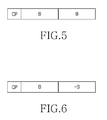
- FIGURE 5 is a diagram illustrating a time domain signal when a sequence value is allocated every even-numbered subcarrier at a frequency domain according to an exemplary embodiment of the present invention. As illustrated in FIGURE 5 , if the sequence value is mapped only to the even-numbered subcarriers at the frequency domain, it is of a form in which the same signal is repeated two times at the time of converting into a time domain signal.
- FIGURE 6 is a diagram illustrating a time domain signal when a sequence value is allocated every odd-numbered subcarrier at a frequency domain according to an exemplary embodiment of the present invention.
- the sequence value is mapped only to the odd-numbered subcarriers at the frequency domain, it is of a form in which the same signal is repeated two times at the time of converting into a time domain signal.
- one of the repeated signals has a form in which a sign of the other signal is inverted.
- a repetition count '2' is equal to a divisor of the power of '2' that is a size of Inverse Fast Fourier Transform (IFFT)
- IFFT Inverse Fast Fourier Transform
- a length of a sequence for a P-SCH proposed in the present invention is identical irrespective of a size of Fast Fourier Transform (FFT).
- FFT Fast Fourier Transform
- Table 1 below is a hexadecimal expression of an example of a sequence for distinguishing a BS type when a P-SCH provides BS type information (indicative of a macro BS, a Femto BS, a relay BS, a hot zone BS, etc.) as supplementary information.
- BS type information indicator of a macro BS, a Femto BS, a relay BS, a hot zone BS, etc.
- a length of each sequence is equal to '216'.
- a Peak to Average Power Ratio (PAPR) of each sequence is described in the most right column of Table 1 below. Because PAPRs of sequences of Table 1 below are very low, a BS can efficiently boost a transmit power of a P-SCH symbol.
- Table 1 below shows sequences proposed when the number of P-SCH sequences is equal to '4'.
- Table 3 below is a hexadecimal expression of an example of a sequence for distinguishing BS type information and system BandWidth (BW) size information when a P-SCH provides the BS type information (e.g., a macro BS, a Femto BS, a relay BS, a hot zone BS, etc.) and the system BW size information as supplementary information.
- BS type information e.g., a macro BS, a Femto BS, a relay BS, a hot zone BS, etc.
- the system BW size information as supplementary information.
- a length of each sequence is equal to '216'.
- a PAPR of each sequence is discribed in the most right column of Table 3 below. Because PAPRs of sequences of Table 3 below are very low, a BS can efficiently boost a transmit power when transmitting a P-SCH symbol.
- Table 3 Index SYS a hexadecimal expression of an example of a sequence for distinguishing
- Table 4 below is a hexadecimal expression of an example of a sequence for distinguishing BS type information and group information when a P-SCH provides the BS type information (e.g., a macro BS, a Femto BS, a relay BS, a hot zone BS, etc.) and the group information as supplementary information.
- a length of each sequence is equal to '216'.
- a PAPR of each sequence is discribed in the most right column of Table 4 below. Because PAPRs of sequences of Table 4 are very low, a BS can efficiently boost a transmit power when transmitting a P-SCH symbol.
- the group information can include sector information, segment information, area information, etc. Table 4 Index Group info.
- Table 5 below is a hexadecimal expression of an example of a sequence used to distinguish a combination of respective information when a P-SCH provides, as supplementary information, BS type information (e.g., a macro BS, an Open Subscriber Group (OSG) Femto BS, a Closed Subscriber Group (CSG) Femto BS, a relay BS, a hot zone BS, etc.), system BW size information or FFT size information, sector information (or segment information), carrier type information (e.g., a full configured carrier, a partially configured carrier, etc.), etc.
- BS type information e.g., a macro BS, an Open Subscriber Group (OSG) Femto BS, a Closed Subscriber Group (CSG) Femto BS, a relay BS, a hot zone BS, etc.
- OSG Open Subscriber Group
- CSG Closed Subscriber Group
- FFT size information e.g., a full configured carrier, a partially configured
- the BS type can be a BS (e.g., a macro BS) included in a neighbor BS list (NBR_ADV), a BS (e.g., a Femto BS) not included in the neighbor BS list (NBR_ADV), etc.
- a PAPR of each sequence is discribed in the most right column of Table 5 below. Because PAPRs of sequences of Table 5 are very low, a BS can efficiently boost a transmit power when transmitting a P-SCH symbol.
- Table 7 below is one exemplary implementation of representing supplementary information corresponding to the partial sequences of Table 5.
- Table 8 below is one exemplary implementation of representing supplementary information corresponding to the sequences of Table 5.
- Table 8 Index Carrier Sector ID (or segment ID) SYS. BW (MHz) 0 Fully configured 0 5 1 10 2 20 3 reserved 4 reserved 5 1 5 6 10 7 20 8 reserved 9 reserved 10 2 5 11 10 12 20 13 reserved 14 reserved 15 Partially configured
- the 'Fully configured' and the 'Partially configured' are of carrier types, and represent configurations of control channels in the case of performing multi-carrier transmission.
- the 'Fully configured' denotes a carrier for which all control channels including synchronization, broadcast, multicast and unicast control signaling are configured. Further, information and parameters regarding multi-carrier operation and the other carriers can also be included in the control channels.
- the 'Partially configured' denotes A carrier with only downlink transmission in Time Division Duplex (TDD) or a downlink carrier without paired uplink carrier in a Frequency Division Duplex (FDD) mode and configured with all control channels to support downlink transmission.
- TDD Time Division Duplex
- FDD Frequency Division Duplex
- Tables 6, 7, and 8 are exemplary implementations of transmitting supplementary information using the sequences of Table 5, and do not limit the scope of the present invention. Besides Tables 6, 7, and 8, a variety of supplementary information transmission methods using the sequences of Table 5 are possible. For example, in Tables 6, 7, and 8, the system BW size information can be substituted with FFT size information. Also, a corresponding relationship between an index number and a sequence can be varied, or only a sub-set of the sequences of Table 5 can be used.
- FIGURE 7 illustrates a subcarrier set in which a P-SCH is mapped according to an exemplary embodiment of the present invention.
- the subcarrier set (PSCHCarrierSet) in which the P-SCH is mapped is constituted of subcarriers of indexes '41', '43', '45', ..., '469', and '471' according to Equation 1. That is, the P-SCH sequence is mapped to subcarriers of odd-numbered indexes among the subcarriers of the indexes '41' to '471', and no sequence is mapped to subcarriers out of a range of the indexes '41' to '471'. In other words, irrespective of the number of subcarriers, the P-SCH sequence is mapped only to 216 subcarriers centering on a DC subcarrier.
- Sequences generated using Tables 1 to 4 are modulated into a power-boosted Binary Phase Shift Keying (BPSK) signal, and are sequentially mapped to the subcarriers of FIGURE 7 .
- BPSK Binary Phase Shift Keying
- FIGURE 8 illustrates a construction of an SCH transmit end in a broadband wireless communication system according to an exemplary embodiment of the present invention.
- the sequence generator 800 generates a sequence according to supplementary information from an upper controller (not shown).
- the sequence generator 800 can store Table such as Table 1, 2, 3, or 4, acquire a sequence according to input supplementary information from stored Table, and output the sequence.
- the sequence generator 800 can store only a sequence according to supplementary information corresponding to the transmit end, and output the stored sequence under control of the upper controller.
- the modulator 802 modulates the sequence provided from the sequence generator 800 according to a determined modulation scheme. For example, the modulator 802 modulates the sequence into a power-boosted BPSK signal.
- the subcarrier mapper 804 maps the sequence modulated by the modulator 802 to subcarriers included in a subcarrier set (PSCHCarrierSet). At this time, the sequence can be mapped to odd-numbered or even-numbered subcarriers for the sake of a two-time repetition pattern at a time domain.
- the subcarrier set (PSCHCarrierSet) can be configured as in FIGURE 7 .
- FIGURE 9 illustrates a construction of an SCH receive end in a broadband wireless communication system according to an exemplary embodiment of the present invention.
- the SCH receive end includes an RF receiver 900, an Analog to Digital Converter (ADC) 902, a guard interval eliminator 904, a timing synchronization acquisition unit 906, an FFT operator 908, a subcarrier extractor 910, a demodulator 912, and a sequence demodulator 914.
- ADC Analog to Digital Converter
- the RF receiver 900 down-converts an RF band signal received through an antenna into a baseband analog signal.
- the ADC 902 samples the baseband analog signal and converts the sampled analog signal into a digital signal.
- the guard interval eliminator 904 acquires OFDMA symbol synchronization from the sample data from the ADC 902, and eliminates a guard interval (e.g., a CP) on the basis of the OFDMA symbol synchronization.
- a guard interval e.g., a CP
- the demodulator 912 demodulates the extracted signals in a demodulation scheme corresponding to a modulation scheme (e.g., BPSK) used in the modulator 902 of the transmit end.
- the sequence demodulator 914 stores the same Table as Table stored in the sequence generator 800 of the transmit end, determines correlation values between a received sequence and all sequences of Table, and outputs supplementary information corresponding to a sequence having the maximum correlation value.
- the supplementary information can include at least one of BS type information, an FFT size, a BW size, a carrier type, and other system parameters.
- a transmit end i.e., a BS
- the supplementary information is a broadcasted system parameter, and can include, for example, at least one of BS type information (e.g., a macro BS, a Femto BS, a relay BS, a hot zone BS, etc.), an FFT size, a BW size, a carrier type, and other system parameters.
- BS type information e.g., a macro BS, a Femto BS, a relay BS, a hot zone BS, etc.
- FFT size e.g., a BW size
- carrier type e.g., a carrier type, etc.
- the transmit end modulates the sequence according to a determined modulation scheme.
- the transmit end can modulate the sequence into a power-boosted BPSK signal.
- the transmit end maps the modulated sequence to subcarriers of a subcarrier set (PSCHCarrierSet) of a P-SCH.
- the sequence can be mapped to odd-numbered or even-numbered subcarriers for the sake of a two-time repetition pattern at a time domain.
- the subcarrier set (PSCHCarrierSet) can be configured as in FIGURE 7 .
- step 1007 the transmit end OFDM-modulates the subcarrier-mapped sequence and generates a P-SCH signal (i.e., a P-SCH symbol). And, in step 1009, the transmit end RF-processes the generated P-SCH signal and transmits the P-SCH signal to an MS.
- a P-SCH signal i.e., a P-SCH symbol
- FIGURE 11 illustrates a procedure for receiving a P-SCH in a broadband wireless communication system according to an exemplary embodiment of the present invention.
- step 1107 the receive end extracts signals of a subcarrier set of a P-SCH among the frequency domain data.
- the receive end demodulates the extracted subcarrier signals in a demodulation scheme corresponding to a modulation scheme (e.g., BPSK) of a transmit end and acquires a P-SCH sequence.
- a modulation scheme e.g., BPSK
- the receive end determines correlation values between the acquired P-SCH sequence and all sequences within stored Table, and determines supplementary information corresponding to a sequence having the maximum correlation value.
- the supplementary information can include at least one of BS type information, an FFT size, a BW size, a carrier type, and other system parameters.
- an exemplary embodiment of the present invention proposes a P-SCH making timing synchronization and supplementary information transmission possible in a wireless communication system. Because subcarriers constituting a P-SCH according to the present invention are spaced one subcarrier interval apart, thereby maintaining a two-time repetition pattern at a time domain, there is an advantage of improving timing synchronization performance at a cell boundary. Also, there is an advantage of being capable of greatly reducing a complexity (e.g., a signaling complexity, etc.) necessary for network entry, handover, etc. by transmitting supplementary information such as a BS type, etc. through an SCH.
- a complexity e.g., a signaling complexity, etc.
- embodiments of the present invention can be realized in the form of hardware, software or a combination of hardware and software. Any such software may be stored in the form of volatile or non-volatile storage such as, for example, a storage device like a ROM, whether erasable or rewritable or not, or in the form of memory such as, for example, RAM, memory chips, device or integrated circuits or on an optically or magnetically readable medium such as, for example, a CD, DVD, magnetic disk or magnetic tape or the like. It will be appreciated that the storage devices and storage media are embodiments of machine-readable storage that are suitable for storing a program or programs comprising instructions that, when executed, implement embodiments of the present invention.
Landscapes
- Engineering & Computer Science (AREA)
- Signal Processing (AREA)
- Computer Networks & Wireless Communication (AREA)
- Mobile Radio Communication Systems (AREA)
Abstract
Description
- The present invention relates to an apparatus and method for communicating a Synchronization CHannel (SCH) in a wireless communication system. More particularly, although not exclusively, the present invention relates to an apparatus and method for generating a Primary SCH (P-SCH) for timing synchronization in a wireless communication system.
- Today, for the sake of high speed mobile communication, many wireless communication technologies have been proposed as candidates. Among these, an Orthogonal Frequency Division Multiplexing (OFDM) technique is now recognized as the most leading next-generation wireless communication technology. In the future, it is expected that the OFDM technology will be used in most of the wireless communication technologies. At present, even Institute of Electrical and Electronics Engineers (IEEE) 802.16 Wireless Metropolitan Area Network (WMAN) that is called 3.5-Generation (3.SG) technology adopts the OFDM technology as standards.
- The OFDM scheme is a scheme of transmitting data using a multi-carrier. Namely, the OFDM scheme is a type of Multi Carrier Modulation (MCM) scheme of parallel converting symbol streams input in series and modulating each of the symbol streams into a plurality of sub-carriers having cross orthogonality, i.e., a plurality of sub-channels for transmission.
- In a broadband wireless communication system using the OFDM scheme, a Base Station (BS) transmits a Synchronization CHannel (SCH) to a Mobile Station (MS) for the sake of timing synchronization and BS distinguishment. Namely, the MS can distinguish its own belonging BS using the SCH. A position where the SCH is transmitted is predefined between a transmit end and a receive end. As a result, the SCH operates as a kind of reference signal.
- The SCH can be designed in various methods. Among them, the most noticed method is currently a method of loading and transmitting a Pseudo-Random (PR) sequence native to a BS on subcarriers at predetermined intervals at a frequency domain. In the case of mapping a sequence at predetermined intervals without loading and transmitting a sequence on all subcarriers, regarding a time domain signal after an Inverse Fast Fourier Transform (IFFT) operation, it can be identified that a repetition of a constant pattern takes place within an OFDM symbol. Here, the repetition count is varied depending on the sequence mapping interval of the frequency domain.
- An SCH used in a conventional IEEE 802.16e system is described below.
-
FIGURE 1 is a diagram illustrating an SCH of a conventional system at a frequency domain. As illustrated inFIGURE 1 , in the conventional SCH, a sequence value is allocated every three-subcarrier interval at the frequency domain. - A time domain signal of an SCH corresponding to that of
FIGURE 1 is illustrated inFIGURE 2 . Referring toFIGURE 2 , the conventional SCH has a format in which the same signal is repeated 3 times at a time domain. An MS acquires timing synchronization using a repetition pattern of the SCH. At this time, a size of IFFT is equal to the power of `2' but `3' (repetition count) is not equal to a divisor of the IFFT size and therefore, the three-time repetition pattern is not a complete repetition pattern but an incomplete repetition pattern. Accordingly, in case that the MS is positioned at a cell boundary or cell edge of a BS, there may occur a problem that, because an SCH of an adjacent cell acts as interference, the three-time repetition pattern is broken. In this case, the MS has a difficulty in acquiring timing synchronization. - Also, the conventional SCH uses a sequence of the same length as that of the number of subcarriers allocated to one SCH. A conventional IEEE 802.16e system uses 114 sequences to distinguish the total 114 BSs. For example when a length of IFFT is equal to '1024', a length of each sequence is equal to '284' that is the number of subcarriers allocated to an SCH. At this time, an MS determines correlation values between a received SCH signal and the 114 sequences previously possessed, and acquires a cell IDentification (ID).
- An IEEE 802.16m system, a system evolving from the conventional IEEE 802.16e system, requires more cell IDs than the IEEE 802.16e system. Also, even the number of sequences of an SCH symbol (i.e., an OFDM symbol) is increased in proportion to the number of cell IDs. The increase of the number of sequences may result in a deterioration of a correlation characteristic between sequences and a degradation of cell ID detection performance and also, an increase of a Peak to Average Power Ratio (PAPR) of the sequence and a decrease of a margin capable of boosting a transmit power of an SCH.
- Also, the IEEE 802.16m system can require that an SCH include supplementary information (i.e., a system parameter) other than cell ID information. As such, an SCH of a future system (e.g., IEEE 802.16m) should be newly designed to meet additional requirements of many cell IDs and supplementary information transmission, etc. At this time, it is required to optimally design sequences of the SCH in consideration of cross correlation characteristics and PAPRs.
- It is an aim of certain embodiments of the invention to solve, mitigate or obviate, at least partly, at least one of the problems and/or disadvantages associated with the prior art. Certain embodiments aim to provide at least one of the advantages described below.
- To address the above-discussed deficiencies of the prior art, it is a primary aim of certain embodiments of the present invention to provide an apparatus and method for generating a Synchronization CHannel (SCH) of improved timing synchronization performance in a broadband wireless communication system.
- Certain embodiments of the present invention aim to provide an apparatus and method for generating an SCH in which a time domain signal has a two-time repetition pattern in a broadband wireless communication system.
- Certain embodiments of the present invention aim to provide an apparatus and method for generating an SCH using a sequence according to supplementary information in a broadband wireless communication system.
- Certain embodiments of the present invention aim to provide an apparatus and method for generating an SCH for transmitting supplementary information in a broadband wireless communication system.
- Certain embodiments of the present invention aim to provide an apparatus and method for generating an SCH of a low Peak to Average Power Ratio (PAPR) in a broadband wireless communication system.
- The above aims are achieved by certain embodiments by providing an apparatus and method for generating an SCH in a wireless communication system.
- According to one aspect of the present invention, an apparatus for transmitting a Primary Synchronization CHannel (P-SCH) in a wireless communication system providing at least two different SCHs is provided. The apparatus includes a sequence generator, a modulator, a subcarrier mapper, an Orthogonal Frequency Division Multiplexing (OFDM) modulator, and a transmitter. The sequence generator generates a P-SCH sequence according to supplementary information. The supplementary information includes at least one of Base Station (BS) type information, Fast Fourier Transform (FFT) size information, BandWidth (BW) information, group information, sector information, and carrier type information. The modulator modulates the P-SCH sequence. The subcarrier mapper maps the modulated P-SCH sequence to subcarriers within a predefined subcarrier set. The subcarriers included in the subcarrier set are spaced one subcarrier interval apart. The OFDM modulator generates a P-SCH symbol by OFDM-modulating the P-SCH sequence mapped to the subcarriers. The transmitter transmits the P-SCH symbol.
- According to another aspect of the present invention, an apparatus for receiving a P-SCH in a wireless communication system providing at least two different SCHs is provided. The apparatus includes a receiver, a timing synchronization acquisition unit, an OFDM demodulator, a subcarrier extractor, a demodulator, and a sequence demodulator. The receiver converts a reception signal into baseband sample data. The timing synchronization acquisition unit acquires timing synchronization from the sample data using a time-domain repetition pattern of the P-SCH. The OFDM demodulator OFDM-demodulates reception sample data on the basis of the timing synchronization and generates frequency domain data. The subcarrier extractor extracts signals from subcarriers within a predefined subcarrier set among the frequency domain data. The subcarriers included in the subcarrier set are spaced one subcarrier interval apart. The demodulator demodulates the extracted signal of the subcarrier set and detects a P-SCH sequence. The sequence demodulator correlation-operates with candidate sequences that are included in Table storing candidates for the P-SCH sequence, detects the P-SCH sequence by determining a candidate sequence having the maximum correlation value, and acquires supplementary information corresponding to the P-SCH sequence. The supplementary information includes at least one of BS type information, FFT size information, BW information, group information, sector information, and carrier type information.
- According to a further aspect of the present invention, a method for transmitting a P-SCH in a wireless communication system providing at least two different SCHs is provided. The method includes generating a P-SCH sequence according to supplementary information, the supplementary information including at least one of BS type information, FFT size information, BW information, group information, sector information, and carrier type information, modulating the P-SCH sequence, mapping the modulated P-SCH sequence to subcarriers within a predefined subcarrier set, the subcarriers included in the subcarrier set being spaced one subcarrier interval apart, generating a P-SCH symbol by OFDM-modulating the P-SCH sequence mapped to the subcarriers, and transmitting the P-SCH symbol.
- According to a yet another aspect of the present invention, a method for receiving a P-SCH in a wireless communication system providing at least two different SCHs is provided. The method includes converting a reception signal into baseband sample data, acquiring timing synchronization from the sample data using a time-domain repetition pattern of the P-SCH, OFDM-demodulating reception sample data on the basis of the timing synchronization and generating frequency domain data, extracting signals from subcarriers within a predefined subcarrier set among the frequency domain data, the subcarriers included in the subcarrier set being spaced one subcarrier interval apart, demodulating the extracted signal of the subcarrier set and detecting a P-SCH sequence, correlation-operating with candidate sequences that are included in Table storing candidates for the P-SCH sequence, detecting the P-SCH sequence by determining a candidate sequence having the maximum correlation value, and acquiring supplementary information corresponding to the P-SCH sequence. The supplementary information includes at least one of BS type information, FFT size information, BW information, group information, sector information, and carrier type information.
- Another aspect of the invention provides a computer program comprising instructions arranged, when executed, to implement a method and/or apparatus in accordance with any one of the above-described aspects. A further aspect provides machine-readable storage storing such a program.
- Before undertaking the DETAILED DESCRIPTION OF THE INVENTION below, it may be advantageous to set forth definitions of certain words and phrases used throughout this patent document: the terms "include" and "comprise," as well as derivatives thereof, mean inclusion without limitation; the term "or," is inclusive, meaning and/or; the phrases "associated with" and "associated therewith," as well as derivatives thereof, may mean to include, be included within, interconnect with, contain, be contained within, connect to or with, couple to or with, be communicable with, cooperate with, interleave, juxtapose, be proximate to, be bound to or with, have, have a property of, or the like; and the term "controller" means any device, system or part thereof that controls at least one operation, such a device may be implemented in hardware, firmware or software, or some combination of at least two of the same. It should be noted that the functionality associated with any particular controller may be centralized or distributed, whether locally or remotely. Definitions for certain words and phrases are provided throughout this patent document, those of ordinary skill in the art should understand that in many, if not most instances, such definitions apply to prior, as well as future uses of such defined words and phrases.
- For a more complete understanding of the present disclosure and its advantages, reference is now made to the following description taken in conjunction with the accompanying drawings, in which like reference numerals represent like parts:
-
FIGURE 1 is a diagram illustrating a frequency domain signal of a Synchronization CHannel (SCH) according to the conventional art; -
FIGURE 2 is a diagram illustrating a time domain signal of an SCH according to the conventional art; -
FIGURE 3 is a schematic diagram illustrating an Institute of Electrical and Electronics Engineers (IEEE) 802.16m system according to an exemplary embodiment of the present invention; -
FIGURE 4 is a diagram illustrating positions of a Primary SCH (P-SCH) and a Secondary SCH (S-SCH) in a frame structure according to an exemplary embodiment of the present invention; -
FIGURE 5 is a diagram illustrating a time domain signal of a P-SCH according to an exemplary embodiment of the present invention; -
FIGURE 6 is a diagram illustrating a time domain signal of a P-SCH according to an exemplary embodiment of the present invention; -
FIGURE 7 is a diagram illustrating a subcarrier set of a P-SCH according to an exemplary embodiment of the present invention; -
FIGURE 8 is a block diagram illustrating a construction of an SCH transmit end in a broadband wireless communication system according to an exemplary embodiment of the present invention; -
FIGURE 9 is a block diagram illustrating a construction of an SCH receive end in a broadband wireless communication system according to an exemplary embodiment of the present invention; -
FIGURE 10 is a flow diagram illustrating a procedure for transmitting an SCH in a broadband wireless communication system according to an exemplary embodiment of the present invention; and -
FIGURE 11 is a flow diagram illustrating a procedure for receiving an SCH in a broadband wireless communication system according to an exemplary embodiment of the present invention. -
FIGURES 2 through 11 , discussed below, and the various embodiments used to describe the principles of the present disclosure in this patent document are by way of illustration only and should not be construed in any way to limit the scope of the disclosure. Those skilled in the art will understand that the principles of the present disclosure may be implemented in any suitably arranged wireless communications system. - A technology for communicating a Synchronization CHannel (SCH) for timing synchronization and supplementary information transmission in a broadband wireless communication system based on Orthogonal Frequency Division Multiplexing (OFDM) / Orthogonal Frequency Division Multiple Access (OFDMA) according to an exemplary embodiment of the present invention is described below.
- An Institute of Electrical and Electronics Engineers (IEEE) 802.16m system is, for example, described below, but an exemplary embodiment of the present invention is easily applicable even to wireless communication systems of other standards making use of an SCH.
- As described earlier, a future system (e.g., IEEE 802.16m) has to design a new SCH to meet additional requirements of many cell IDentifications (IDs), supplementary information transmission, etc.
- The future system can include a plurality of SCHs to meet a diversity of requirements. For example, the future system can include two different SCHs: a Primary SCH (P-SCH) and a Secondary SCH (S-SCH). A Primary Advanced (PA) preamble can denote a synchronization signal transmitted through the P-SCH, and a Secondary Advanced (SA) preamble can denote a synchronization signal transmitted through the S-SCH. The P-SCH and the S-SCH can divide and support functions required. Namely, functions that the P-SCH and the S-SCH have to conduct should be newly defined. Also, sequences of each of the P-SCH and the S-SCH, a subcarrier mapping method, etc. should be defined.
- A structure of the IEEE 802.16m system and a function of the P-SCH are described below.
-
FIGURE 3 is a schematic diagram illustrating an IEEE 802.16m system according to an exemplary embodiment of the present invention. - As illustrated in
FIGURE 3 , in order for an IEEE 802.16m Mobile Station (MS) and an IEEE 802.16m Base Station (BS) to perform communication, the IEEE 802.16m MS has to acquire synchronization using a signal received from the IEEE 802.16m BS through a P-SCH. At this time, the P-SCH provides functions of timing synchronization, frequency synchronization, and supplementary information transmission. Here, the timing synchronization can include frame synchronization, super-frame synchronization, etc. -
FIGURE 4 is a diagram illustrating positions of a P-SCH and an S-SCH in an IEEE 802.16m frame structure according to an exemplary embodiment of the present invention. - In the IEEE 802.16m frame structure of
FIGURE 4 , a super-frame can have a time interval of 20msec, and include four frames each having a time interval of 5 msec.FIGURE 4 illustrates an example in which one P-SCH symbol and three S-SCH symbols are positioned at intervals of 5 msec within one super-frame. The P-SCH symbol can be positioned within a Super-Frame Header (SFH). The P-SCH symbol and the S-SCH symbols can change in number and position depending on a system standard and a designer's intention. Although the SCH symbol changes in number and position, an exemplary embodiment of the present invention is identically applicable. For example, the P-SCH symbol can be transmitted through a frame (F1) next to a frame including the SFH, and the S-SCH symbols can be transmitted through frames (F0), (F2), and (F3). - A way to improve timing synchronization of a P-SCH is proposed below. In order to improve the timing synchronization, in an exemplary embodiment of the present invention, subcarriers are spaced one subcarrier interval apart, i.e., a sequence is mapped only to odd-numbered or even-numbered subcarriers at a frequency domain such that a time domain signal has a complete two-time repetition pattern.
-
FIGURE 5 is a diagram illustrating a time domain signal when a sequence value is allocated every even-numbered subcarrier at a frequency domain according to an exemplary embodiment of the present invention. As illustrated inFIGURE 5 , if the sequence value is mapped only to the even-numbered subcarriers at the frequency domain, it is of a form in which the same signal is repeated two times at the time of converting into a time domain signal. -
FIGURE 6 is a diagram illustrating a time domain signal when a sequence value is allocated every odd-numbered subcarrier at a frequency domain according to an exemplary embodiment of the present invention. As illustrated inFIGURE 6 , if the sequence value is mapped only to the odd-numbered subcarriers at the frequency domain, it is of a form in which the same signal is repeated two times at the time of converting into a time domain signal. However, unlike a case ofFIGURE 5 using the even-numbered subcarriers, one of the repeated signals has a form in which a sign of the other signal is inverted. - Here, because a repetition count '2' is equal to a divisor of the power of '2' that is a size of Inverse Fast Fourier Transform (IFFT), a two-time repetition pattern of a time domain is shown to be a complete repetition pattern. Thus, if synchronization between BSs is established, a P-SCH of an adjacent cell does not act as interference even at a cell boundary and, instead, a repetition pattern of the P-SCH of the adjacent cell is added, thus providing a macro diversity effect in which a signal magnitude of an SCH increases more than that of other data duration. A case of mapping a sequence only to odd-numbered subcarriers according to an exemplary embodiment of the present invention is described below, for example.
- Proposed below is a method for generating a sequence of an SCH according to an exemplary embodiment of the present invention. A length of a sequence for a P-SCH proposed in the present invention is identical irrespective of a size of Fast Fourier Transform (FFT).
- Table 1 below is a hexadecimal expression of an example of a sequence for distinguishing a BS type when a P-SCH provides BS type information (indicative of a macro BS, a Femto BS, a relay BS, a hot zone BS, etc.) as supplementary information. For example, a length of each sequence is equal to '216'. A Peak to Average Power Ratio (PAPR) of each sequence is described in the most right column of Table 1 below. Because PAPRs of sequences of Table 1 below are very low, a BS can efficiently boost a transmit power of a P-SCH symbol. Table 1 below shows sequences proposed when the number of P-SCH sequences is equal to '4'. The proposed sequences below were designed considering cross correlation characteristics and PAPRs. Undoubtedly, a corresponding relationship between a BS type and a sequence can change depending on a system standard and a designer's intention.
Table 1 Index BS type Sequence PAPR (dB) 0 Macro B2143168C07B2B21431573F84D4DEBCE973F84DB21431573F84DF3 3.82947 1 Femto FC3F30033C30003C0CF333C30056959AA9969AA56959A666965517 3.81600 2 Relay 00070B377985B55525E622CD0E03F8F4C8867A4A9525E622CD0EA3 3.58150 3 Hot zone FD952E7E74164026AD1818BE9BFD952E718BE9BFD952E718BE9BDC 3.57615 - Table 2 below is a hexadecimal expression of an example of a sequence for distinguishing BS type information and FFT size information when a P-SCH provides the BS type information (e.g., a macro BS, a Femto BS, a relay BS, a hot zone BS, etc.) and the FFT size information as supplementary information. For example, a length of each sequence is equal to '216'. A PAPR of each sequence is described in the most right column of Table 2 below. Because PAPRs of sequences of Table 2 below are very low, a BS can efficiently boost a transmit power when transmitting a P-SCH symbol.
Table 2 Index FFT size BS type Sequence PAPR (dB) 0 512 Macro B2143168C07B2B21431573F84D4DEBCE973F84DB21431573F84DF3 3.82947 1 Femto FC3F30033C30003C0CF333C30056959AA9969AA56959A666965517 3.81600 2 Relay 00070B377985B55525E622CDOE03F8F4C8867A4A9525E622CDOEA3 3.58150 3 Hot zone FD952E7E74164026AD1818BE9BFD952E718BE9BFD952E718BE9BDC 3.57615 4 1024 Macro 4B9FC26A6F5E74B9FC26A6F5E74B9FC26D90A18B4603D926F5E75D 3.82612 5 Femto E8E8E8971768E8E897689717109710EF10EF6F1090EF10909090A3 3.66932 6 Relay E317D37FB2A5CFCE82C87B2A5CFCE82C804D5A31CE82C87B2A5CF6 3.82587 7 Hot zone 642862A6F5E749BD79D26F5E754603D95180F64B9FC26D180F65F2 3.77385 8 2048 Macro lEDEDEDEE11EDEE1211EE11EE2DEE2E2DD22DD1D1D22E2DD1D1D4C 3.71487 9 Femto ECA973FB2A5CFECA97384D5A31CE82C80C5F4DFCE82C873AOB21B7 3.83271 10 Relay BBB44BBB4B44444B4BB44B4444EEE11EEE1E11E1E1E11EE1EEEEDE 3.71952 11 Hot zone 24DEBCEAC87F3AA301EC973D7B2B2143153780C5A301EC973D7B2F 3.71242 - Table 3 below is a hexadecimal expression of an example of a sequence for distinguishing BS type information and system BandWidth (BW) size information when a P-SCH provides the BS type information (e.g., a macro BS, a Femto BS, a relay BS, a hot zone BS, etc.) and the system BW size information as supplementary information. For example, a length of each sequence is equal to '216'. A PAPR of each sequence is discribed in the most right column of Table 3 below. Because PAPRs of sequences of Table 3 below are very low, a BS can efficiently boost a transmit power when transmitting a P-SCH symbol.
Table 3 Index SYS. BW (MHz) BS type Sequence PAPR (dB) 0 5 Macro 32D354CD52D4CB2D354AAAD2B31879FE67F87E667860 1FFF87E641 3.69878 1 Femto 25CF5ECA8C07B2A30A1368C07B2A30A13573F84DA30 A1368C07B23 3.72603 2 Relay 1978FF1156D0C9978FF76A92F3668700EEA92F31978FF7 6A92F323 3.60357 3 Hot zone 33F0FFFC030F333F0FF33FCF0C995A5556A9A5966A5AA 66A9A59A8 3.74849 4 7 Macro 316AC87B2FA30316AC87B2FA30316AC804D05CFCE953 7FB2FA30A7 3.64123 5 Femto 5461426D18509B461426AE7AF65643F9D26F018B643F9D 590FE743 3.73158 6 Relay 4444B44BB4B44444B4BBB44BBB77778778878787887877 78877770 3.61817 7 Hot zone 01C2CDDE616D5AB686774CBC7F01C2CDDE616D55497 988834380EF 3.71602 8 8.75 Macro C94F5117E9F18C94F5088160E6C94F5117E9F1936B0AF7 7E9F1832 3.72732 9 Femto 31F2FD115E52631F2FDDEAlAD931F2FD115E526CE0D0 2215E526DC 3.69522 10 Relay 78778878888777777788777878D2DD22D2222D2D2222DD 222D2D48 3.68382 11 Hot zone AA6966AA65695AA6966659A96AFC3F30CCC3CFFFC3F 30033C3005D 3.73025 12 10 Macro B8889708EF0F17176968916F1112223DA245A5BDBDC3C 23BC5BBBD 3.71487 13 Femto CE82C80C5AB20317D37F3A54DE317D378C5AB20317D3 78C5AB2123 3.68974 14 Relay E7416439D2A6FE74164062D590E7416439D2A6F18BE9B F9D2A6F5E 3.52423 15 Hot zone 2B4ACD3334B2AAB4ACD54CB4D501E067999E1807E1F 98019E180FF 3.65289 16 20 Macro 616D511FE3D32616D52201C2CE616D511FE3D319E92A DDFE3D32DC 3.73097 17 Femto AACB4CAACD4B52ACB4CCD32B4A8061E60067E1FFF9 E199867E1F83 3.65640 18 Relay A301EC973D7B2A301ECA8C284DA301EC973D7B25CFE 13573D7B21A 3.73754 19 hot zone 590A18AB9FC26A6F5E74B9FC26D90A18AB9FC26D90A 1884603D967 3.71994 - Table 4 below is a hexadecimal expression of an example of a sequence for distinguishing BS type information and group information when a P-SCH provides the BS type information (e.g., a macro BS, a Femto BS, a relay BS, a hot zone BS, etc.) and the group information as supplementary information. For example, a length of each sequence is equal to '216'. A PAPR of each sequence is discribed in the most right column of Table 4 below. Because PAPRs of sequences of Table 4 are very low, a BS can efficiently boost a transmit power when transmitting a P-SCH symbol. For example, the group information can include sector information, segment information, area information, etc.
Table 4 Index Group info. BS type Sequence PAPR (dB) 0 Group 0Macro B2143168C07B2B21431573F84D4DEBCE973F84DB21431573F84DF3 3.82947 1 Femto FC3F30033C30003C0CF333C30056959AA9969AA56959A666965517 3.81600 2 Relay 00070B377985B55525E622CD0E03F8F4C8867A4A9525E622CD0EA3 3.58150 3 Hot zone FD952E7E74164026AD1818BE9BFD952E718BE9BFD952E718BE9BDC 3.57615 4 Group 1 Macro 4B9FC26A6F5E74B9FC26A6F5E74B9FC26D90A18B4603D926F5E75D 3.82612 5 Femto E8E8E8971768E8E897689717109710EF10EF6F1090EF10909090A3 3.66932 6 Relay E317D37FB2ASCFCE82C87B2ASCFCE82C804DSA31CE82C87B2ASCF6 3.82587 7 Hot zone 642862A6F5E7498D79D26F5E754603D95180F6489FC26D180F65F2 3.77385 8 Group 2Macro 1EDEDEDEE11EDEE1211EE11EE2DEE2E2DD22DD1D1D22E2DD1D1D4C 3.71487 9 Femto ECA973FB2A5CFECA97384D5A31CE82C80C5F4DFCE82C873A0B21B7 3.83271 10 Relay BBB44BBB4B44444B4BB44B4444EEE11EEE1E11E1E1E11EE1EEEEDE 3.71952 11 Hot zone 24DEBCEAC87F3AA301EC973D7B2B2143153780C5A301EC973D7B2F 3.71242 - Table 5 below is a hexadecimal expression of an example of a sequence used to distinguish a combination of respective information when a P-SCH provides, as supplementary information, BS type information (e.g., a macro BS, an Open Subscriber Group (OSG) Femto BS, a Closed Subscriber Group (CSG) Femto BS, a relay BS, a hot zone BS, etc.), system BW size information or FFT size information, sector information (or segment information), carrier type information (e.g., a full configured carrier, a partially configured carrier, etc.), etc. For example, a length of each sequence is equal to '216'. The BS type can be a BS (e.g., a macro BS) included in a neighbor BS list (NBR_ADV), a BS (e.g., a Femto BS) not included in the neighbor BS list (NBR_ADV), etc. A PAPR of each sequence is discribed in the most right column of Table 5 below. Because PAPRs of sequences of Table 5 are very low, a BS can efficiently boost a transmit power when transmitting a P-SCH symbol.
Table 5 Index Sequence PAPR (dB) 0 6DB4F3B16BCE59166C9CEF7C3C8CA5EDFC16A9D1DC01F2AE6AA08F 4.09203 1 1799628F3B9F8F3B22C1BA19EAF94FEC4D37DEE97E027750D298AC 4.03218 2 F72E132A8A9F4235B2D7F88F0F3652F264493E5F6D8B9E318C1791 4.12560 3 92161C7C19BB2FCOADE5CEF3543AC1B6CE6BE1C8DCABDDD319EAF7 3.93829 4 4E3B0356A0D5DB7C1E779A3F18FB9B2D7E3632C5FE4AAFB3C91484 4.13627 5 6DE116E665C395ADC70A89716908620868A60340BF35ED547F8281 3.91492 6 BCFDF60DFAD6B027E4C39DB20D783C9F467155179CBA31115E2D04 4.02384 7 7EF1379553F9641EE6ECDBF5F144287E329606C616292A3C77F928 4.11870 8 8E2D572ED808868511DB911D1F22E08FFCFAB18DEF892ECCE7AAD2 4.14038 9 8A9CA262B8B3D37E3158A3B17BFA4C9FCFF4D396D2A93DE65A0E7C 4.06707 10 89759434E57B6C8B05573B1567F356F3EE0EF8FB40E6C845A1F37F 4.13956 11 DA8CE648727E4282780384AB53CEEBD1CBF79E0C5DA7BA85DD3749 4.05928 12 3A65D1E6042E8B8AADC70lE210B5B4B650B6AB31F7A918893FB04A 3.99307 13 9F2CB771C62E459FF0F1CAD0F657C51104850A53F02777AA810697 4.13124 14 D46CF86FE51B56B2CAA84F26F6F204428C1BD23F3D888737A0851C 4.08846 15 640267A0C0DF11E475066F1610954B5AE55E189EA7E72EFD57240F 4.02380 - Table 6 below is one exemplary implementation of representing supplementary information corresponding to the sequences of Table 5.
Table 6 Index Carrier BS type SYS. BW (MHz) 0 Fully configured Macro 5 1 10 2 20 3 reserved 4 reserved 5 OSG Femto/ Hot zone 5 6 10 7 20 8 reserved 9 reserved 10 CSG Femto 5 11 10 12 20 13 reserved 14 reserved 15 Partially configured - Table 7 below is one exemplary implementation of representing supplementary information corresponding to the partial sequences of Table 5.
Table 7 Index Carrier BS type SYS. BW (MHz) 0 Fully configured BS included in NBR_ADV 5 1 10 2 20 3 reserved 4 reserved 5 BS not included in NBR_ADV 5 6 10 7 20 8 reserved 9 reserved 10 Partially configured - Table 8 below is one exemplary implementation of representing supplementary information corresponding to the sequences of Table 5.
Table 8 Index Carrier Sector ID (or segment ID) SYS. BW (MHz) 0 Fully configured 0 5 1 10 2 20 3 reserved 4 reserved 5 1 5 6 10 7 20 8 reserved 9 reserved 10 2 5 11 10 12 20 13 reserved 14 reserved 15 Partially configured - In Tables 6, 7, and 8, the 'Fully configured' and the 'Partially configured' are of carrier types, and represent configurations of control channels in the case of performing multi-carrier transmission. The 'Fully configured' denotes a carrier for which all control channels including synchronization, broadcast, multicast and unicast control signaling are configured. Further, information and parameters regarding multi-carrier operation and the other carriers can also be included in the control channels. The 'Partially configured' denotes A carrier with only downlink transmission in Time Division Duplex (TDD) or a downlink carrier without paired uplink carrier in a Frequency Division Duplex (FDD) mode and configured with all control channels to support downlink transmission.
- Tables 6, 7, and 8 are exemplary implementations of transmitting supplementary information using the sequences of Table 5, and do not limit the scope of the present invention. Besides Tables 6, 7, and 8, a variety of supplementary information transmission methods using the sequences of Table 5 are possible. For example, in Tables 6, 7, and 8, the system BW size information can be substituted with FFT size information. Also, a corresponding relationship between an index number and a sequence can be varied, or only a sub-set of the sequences of Table 5 can be used.
- An exemplary embodiment of the present invention proposes a method for mapping the P-SCH sequence to subcarriers. When a subcarrier index '256' is allocated to a Direct Current (DC) subcarrier, a subcarrier set for the P-SCH is expressed as in Equation 1 below.

- In Equation 1, the 'PSCHCarrierSet' represents indexes of subcarriers allocated for a P-SCH, and the 'k' is an integer of '0' to '215'.
-
FIGURE 7 illustrates a subcarrier set in which a P-SCH is mapped according to an exemplary embodiment of the present invention. As illustrated inFIGURE 7 , the subcarrier set (PSCHCarrierSet) in which the P-SCH is mapped is constituted of subcarriers of indexes '41', '43', '45', ..., '469', and '471' according to Equation 1. That is, the P-SCH sequence is mapped to subcarriers of odd-numbered indexes among the subcarriers of the indexes '41' to '471', and no sequence is mapped to subcarriers out of a range of the indexes '41' to '471'. In other words, irrespective of the number of subcarriers, the P-SCH sequence is mapped only to 216 subcarriers centering on a DC subcarrier. - Sequences generated using Tables 1 to 4 are modulated into a power-boosted Binary Phase Shift Keying (BPSK) signal, and are sequentially mapped to the subcarriers of
FIGURE 7 . - Operations and constructions of a transmit end for transmitting a synchronization signal and a receive end as described above according to an exemplary embodiment of the present invention are described with reference to the accompanying drawings.
-
FIGURE 8 illustrates a construction of an SCH transmit end in a broadband wireless communication system according to an exemplary embodiment of the present invention. - As illustrated in
FIGURE 8 , the SCH transmit end includes asequence generator 800, amodulator 802, asubcarrier mapper 804, anIFFT operator 806, aguard interval adder 808, a Digital to Analog Converter (DAC) 810, and a Radio Frequency (RF)transmitter 812. - The
sequence generator 800 generates a sequence according to supplementary information from an upper controller (not shown). For example, thesequence generator 800 can store Table such as Table 1, 2, 3, or 4, acquire a sequence according to input supplementary information from stored Table, and output the sequence. For another example, thesequence generator 800 can store only a sequence according to supplementary information corresponding to the transmit end, and output the stored sequence under control of the upper controller. - The
modulator 802 modulates the sequence provided from thesequence generator 800 according to a determined modulation scheme. For example, themodulator 802 modulates the sequence into a power-boosted BPSK signal. - The
subcarrier mapper 804 maps the sequence modulated by themodulator 802 to subcarriers included in a subcarrier set (PSCHCarrierSet). At this time, the sequence can be mapped to odd-numbered or even-numbered subcarriers for the sake of a two-time repetition pattern at a time domain. For example, the subcarrier set (PSCHCarrierSet) can be configured as inFIGURE 7 . - The
IFFT operator 806 generates time domain sample data by IFFT-operating a signal mapped to subcarriers by thesubcarrier mapper 804. Theguard interval adder 808 adds a guard interval (e.g., a Cyclic Prefix (CP)) to the sample data from theIFFT operator 806 and generates a P-SCH signal (or a P-SCH symbol). - The
DAC 810 converts the P-SCH symbol (i.e., OFDMA symbol) from theguard interval adder 810 into an analog signal. TheRF transmitter 812 up-converts the baseband analog signal from theDAC 810 into an RF signal and then, transmits the RF signal through an antenna. - Assuming that the transmit end is equal to a BS and a receive end receiving an SCH is equal to an MS, the MS acquires timing synchronization using a P-SCH signal received from the BS, and extracts supplementary information. At this time, the MS acquires timing synchronization using a two-time repetition pattern at a time domain of a P-SCH, and acquires supplementary information through sequence detection at a frequency domain. The supplementary information can include at least one of BS type information, an FFT size, a system BW size, a carrier type, and other system parameters.
-
FIGURE 9 illustrates a construction of an SCH receive end in a broadband wireless communication system according to an exemplary embodiment of the present invention. - As illustrated in
FIGURE 9 , the SCH receive end includes anRF receiver 900, an Analog to Digital Converter (ADC) 902, aguard interval eliminator 904, a timingsynchronization acquisition unit 906, anFFT operator 908, asubcarrier extractor 910, ademodulator 912, and asequence demodulator 914. - The
RF receiver 900 down-converts an RF band signal received through an antenna into a baseband analog signal. TheADC 902 samples the baseband analog signal and converts the sampled analog signal into a digital signal. Theguard interval eliminator 904 acquires OFDMA symbol synchronization from the sample data from theADC 902, and eliminates a guard interval (e.g., a CP) on the basis of the OFDMA symbol synchronization. - The timing
synchronization acquisition unit 906 acquires timing synchronization (i.e., frame synchronization, super-frame synchronization, etc.) by repeatedly performing a correlation operation for the sample data from theguard interval eliminator 904 in a sliding window manner, and provides the acquired timing synchronization to an upper controller. Namely, because a P-SCH signal for timing synchronization is repeated two times at a time domain, the timingsynchronization acquisition unit 906 determines a position of the two-time repeated signal through the correlation operation. And, the timingsynchronization acquisition unit 906 outputs the sample data on a per-OFDMA-symbol basis. Here, it is described that the timing synchronization (i.e., the frame synchronization, the super-frame synchronization, etc.) is acquired at the time domain, but the timing synchronization acquisition can be also achieved even at a frequency domain. - The
FFT operator 908 generates frequency domain data by FFT-operating sample data provided from the timingsynchronization acquisition unit 906. Thesubcarrier extractor 910 extracts signals (i.e., subcarrier values) of a subcarrier set of a P-SCH among the frequency domain data from theFFT operator 908. - The
demodulator 912 demodulates the extracted signals in a demodulation scheme corresponding to a modulation scheme (e.g., BPSK) used in themodulator 902 of the transmit end. Thesequence demodulator 914 stores the same Table as Table stored in thesequence generator 800 of the transmit end, determines correlation values between a received sequence and all sequences of Table, and outputs supplementary information corresponding to a sequence having the maximum correlation value. For example, the supplementary information can include at least one of BS type information, an FFT size, a BW size, a carrier type, and other system parameters. -
FIGURE 10 illustrates a procedure for transmitting a P-SCH in a broadband wireless communication system according to an exemplary embodiment of the present invention. - Referring to
FIGURE 10 , instep 1001, a transmit end (i.e., a BS) generates a sequence accoding to supplementary information. Here, the supplementary information is a broadcasted system parameter, and can include, for example, at least one of BS type information (e.g., a macro BS, a Femto BS, a relay BS, a hot zone BS, etc.), an FFT size, a BW size, a carrier type, and other system parameters. In an exemplary embodiment of the present invention, it is assumed to generate a sequence based on Tables 1 to 4. - Then, in
step 1003, the transmit end modulates the sequence according to a determined modulation scheme. For example, the transmit end can modulate the sequence into a power-boosted BPSK signal. - Then, in
step 1005, the transmit end maps the modulated sequence to subcarriers of a subcarrier set (PSCHCarrierSet) of a P-SCH. At this time, the sequence can be mapped to odd-numbered or even-numbered subcarriers for the sake of a two-time repetition pattern at a time domain. For example, the subcarrier set (PSCHCarrierSet) can be configured as inFIGURE 7 . - Then, in
step 1007, the transmit end OFDM-modulates the subcarrier-mapped sequence and generates a P-SCH signal (i.e., a P-SCH symbol). And, instep 1009, the transmit end RF-processes the generated P-SCH signal and transmits the P-SCH signal to an MS. -
FIGURE 11 illustrates a procedure for receiving a P-SCH in a broadband wireless communication system according to an exemplary embodiment of the present invention. - Referring to
FIGURE 11 , instep 1101, a receive end (i.e., an MS) converts an RF band signal received from a BS into baseband sample data. After that, instep 1103, the receive end determines timing synchronization (i.e., frame synchronization, super-frame synchronization, etc.) by performing a correlation operation for the sample data in a sliding window manner. And, instep 1105, the receive end OFDM-demodulates the received sample data on the basis of the acquired timing synchronization and generates frequency domain data. - Then, in
step 1107, the receive end extracts signals of a subcarrier set of a P-SCH among the frequency domain data. And, instep 1109, the receive end demodulates the extracted subcarrier signals in a demodulation scheme corresponding to a modulation scheme (e.g., BPSK) of a transmit end and acquires a P-SCH sequence. - And, in
step 1111, the receive end determines correlation values between the acquired P-SCH sequence and all sequences within stored Table, and determines supplementary information corresponding to a sequence having the maximum correlation value. For example, the supplementary information can include at least one of BS type information, an FFT size, a BW size, a carrier type, and other system parameters. - As described above, an exemplary embodiment of the present invention proposes a P-SCH making timing synchronization and supplementary information transmission possible in a wireless communication system. Because subcarriers constituting a P-SCH according to the present invention are spaced one subcarrier interval apart, thereby maintaining a two-time repetition pattern at a time domain, there is an advantage of improving timing synchronization performance at a cell boundary. Also, there is an advantage of being capable of greatly reducing a complexity (e.g., a signaling complexity, etc.) necessary for network entry, handover, etc. by transmitting supplementary information such as a BS type, etc. through an SCH.
- It will be appreciated that embodiments of the present invention can be realized in the form of hardware, software or a combination of hardware and software. Any such software may be stored in the form of volatile or non-volatile storage such as, for example, a storage device like a ROM, whether erasable or rewritable or not, or in the form of memory such as, for example, RAM, memory chips, device or integrated circuits or on an optically or magnetically readable medium such as, for example, a CD, DVD, magnetic disk or magnetic tape or the like. It will be appreciated that the storage devices and storage media are embodiments of machine-readable storage that are suitable for storing a program or programs comprising instructions that, when executed, implement embodiments of the present invention. Accordingly, embodiments provide a program comprising code for implementing apparatus or a method as claimed in any one of the claims of this specification and a machine-readable storage storing such a program. Still further, such programs may be conveyed electronically via any medium such as a communication signal carried over a wired or wireless connection and embodiments suitably encompass the same.
- Throughout the description and claims of this specification, the words "comprise" and "contain" and variations of the words, for example "comprising" and "comprises", means "including but not limited to", and is not intended to (and does not) exclude other moieties, additives, components, integers or steps.
- Throughout the description and claims of this specification, the singular encompasses the plural unless the context otherwise requires. In particular, where the indefinite article is used, the specification is to be understood as contemplating plurality as well as singularity, unless the context requires otherwise.
- Features, integers, characteristics, compounds, chemical moieties or groups described in conjunction with a particular aspect, embodiment or example of the invention are to be understood to be applicable to any other aspect, embodiment or example described herein unless incompatible therewith.
- It will be also be appreciated that, throughout the description and claims of this specification, language in the general form of "X for Y" (where Y is some action, activity or step and X is some means for carrying out that action, activity or step) encompasses means X adapted or arranged specifically, but not exclusively, to do Y
- While the invention has been shown and described with reference to certain preferred embodiments thereof, it will be understood by those skilled in the art that various changes in form and details may be made therein without departing from the spirit and scope of the invention as defined by the appended claims.
Claims (15)
- Apparatus for transmitting a Primary Synchronization CHannel (P-SCH) in a wireless communication system providing at least two different SCHs, the apparatus comprising:a sequence generator for generating a P-SCH sequence according to supplementary information, the supplementary information comprising at least one of Base Station (BS) type information, Fast Fourier Transform (FFT) size information, BandWidth (BW) information, group information, sector information, and carrier type information;a modulator for modulating the P-SCH sequence;a subcarrier mapper for mapping the modulated P-SCH sequence to subcarriers within a predefined subcarrier set, the subcarriers comprised in the subcarrier set being spaced one subcarrier interval apart;an Orthogonal Frequency Division Multiplexing (OFDM) modulator for generating a P-SCH symbol by OFDM-modulating the P-SCH sequence mapped to the subcarriers; anda transmitter for transmitting the P-SCH symbol.
- Apparatus for receiving a Primary Synchronization CHannel (P-SCH) in a wireless communication system providing at least two different SCHs, the apparatus comprising:a receiver for converting a reception signal into baseband sample data;a timing synchronization acquisition unit for acquiring timing synchronization from the sample data using a time-domain repetition pattern of the P-SCH;an Orthogonal Frequency Division Multiplexing (OFDM) demodulator for OFDM-demodulating reception sample data on the basis of the timing synchronization and generating frequency domain data;a subcarrier extractor for extracting signals from subcarriers within a predefined subcarrier set among the frequency domain data, the subcarriers comprised in the subcarrier set being spaced one subcarrier interval apart,a demodulator for demodulating the extracted signal of the subcarrier set and detecting a P-SCH sequence; anda sequence demodulator for correlation-operating with candidate sequences that are comprised in a table storing candidates for the P-SCH sequence, detecting the P-SCH sequence by determining a candidate sequence having the maximum correlation value, and acquiring supplementary information corresponding to the P-SCH sequence,wherein the supplementary information comprises at least one of Base Station (BS) type information, Fast Fourier Transform (FFT) size information, BandWidth (BW) information, group information, sector information, and carrier type information.
- A method for transmitting a Primary Synchronization CHannel (P-SCH) in a wireless communication system providing at least two different SCHs, the method comprising:generating a P-SCH sequence according to supplementary information, the supplementary information comprising at least one of Base Station (BS) type information, Fast Fourier Transform (FFT) size information, BandWidth (BW) information, group information, sector information, and carrier type information;modulating the P-SCH sequence;mapping the modulated P-SCH sequence to subcarriers within a predefined subcarrier set, the subcarriers comprised in the subcarrier set being spaced one subcarrier interval apart;generating a P-SCH symbol by Orthogonal Frequency Division Multiplexing (OFDM)-modulating the P-SCH sequence mapped to the subcarriers; andtransmitting the P-SCH symbol.
- A method for receiving a Primary Synchronization CHannel (P-SCH) in a wireless communication system providing at least two different SCHs, the method comprising:converting a reception signal into baseband sample data;acquiring timing synchronization from the sample data using a time-domain repetition pattern of the P-SCH;Orthogonal Frequency Division Multiplexing (OFDM)-demodulating reception sample data on the basis of the timing synchronization and generating frequency domain data;extracting signals from subcarriers within a predefined subcarrier set among the frequency domain data, the subcarriers comprised in the subcarrier set being spaced one subcarrier interval apart,demodulating the extracted signal of the subcarrier set and detecting a P-SCH sequence;correlation-operating with candidate sequences that are comprised in a table storing candidates for the P-SCH sequence;detecting the P-SCH sequence by determining a candidate sequence having the maximum correlation value; andacquiring supplementary information corresponding to the P-SCH sequence,wherein the supplementary information comprises at least one of Base Station (BS) type information, Fast Fourier Transform (FFT) size information, BandWidth (BW) information, group information, sector information, and carrier type information.
- Apparatus in accordance with claim 1 or claim 2, or a method in accordance with claim 3 or claim 4, wherein a length of the P-SCH sequence is equal to '216'.
- Apparatus in accordance with claim 1 or claim 5, wherein the sequence generator stores the following table as candidates for the P-SCH sequence:
Index Sequence (hexadecimal) 0 6DB4F3B16BCE59166C9CEF7C3C8CASEDFC16A9D1DC01F2AE6AA08F 1 1799628F3B9F8F3B22C1BA19EAF94FEC4D37DEE97E027750D298AC 2 92161C7C19BB2FCOADE5CEF3543AC1B6CE6BE1C8DCABDDD319EAF7 3 6DE116E665C395ADC70A89716908620868A60340BF35ED547F8281 4 BCFDF60DFAD6B027E4C39DB20D783C9F467155179CBA31115E2D04 5 7EF1379553F9641EE6ECDBF5F144287E329606C616292A3C77F928 6 8A9CA262B8B3D37E3158A3B17BFA4C9FCFF4D396D2A93DE65AOE7C 7 DA8CE648727E4282780384AB53CEEBD1CBF79E0C5DA7BA85DD3749 8 3A65D1E6042E8B8AADC701E210B5B4B650B6AB31F7A918893FB04A 9 D46CF86FE51B56B2CAA84F26F6F204428C1BD23F3D888737A0851C 10 640267A0C0DF11E475066F1610954B5AE55E189EA7E72EFD57240F - Apparatusin accordance with claim 2 or claim 5, wherein the sequence demodulator stores the following table as candidates for the P-SCH sequence:
Index Sequence (hexadecimal) 0 6DB4F3B16BCE59166C9CEF7C3C8CA5EDFC16A9D1DC01F2AE6AA08F 1 1799628F3B9F8F3B22C1BA19EAF94FEC4D37DEE97E027750D298AC 2 92161C7C19BB2FCOADE5CEF3543AC1B6CE6BE1C8DCABDDD319EAF7 3 6DE116E665C395ADC70A89716908620868A60340BF35ED547F8281 4 BCFDF60DFAD6B027E4C39DB20D783C9F467155179CBA31115E2D04 5 7EF1379553F9641EE6ECDBF5F144287E329606C616292A3C77F928 6 8A9CA262B8B3D37E3158A3B17BFA4C9FCFF4D396D2A93DE65AOE7C 7 DA8CE648727E4282780384AB53CEEBD1CBF79E0C5DA7BA85DD3749 8 3A65D1E6042E8B8AADC701E210B5B4B650B6AB31F7A918893FB04A 9 D46CF86FE51B56B2CAA84F26F6F204428C1BD23F3D888737A0851C 10 640267A0C0DF11E475066F1610954B5AE55E189EA7E72EFD57240F - A method in accordance with claim 3 or claim 5, wherein the generating of the P-SCH sequence comprises generating one sequence among candidates for the P-SCH sequence comprised in the following table :
Index Sequence (hexadecimal) 0 6DB4F3B16BCE59166C9CEF7C3C8CA5EDFC16A9D1DCO1F2AE6AA08F 1 1799628F3B9F8F3B22C1BA19EAF94FEC4D37DEE97E027750D298AC 2 92161C7C19BB2FCOADE5CEF3543AC1B6CE6BE1C8DCABDDD319EAF7 3 6DE116E665C395ADC70A89716908620868A60340BF35ED547F8281 4 BCFDF60DFAD6B027E4C39DB20D783C9F467155179CBA31115E2D04 5 7EF1379553F9641EE6ECDBF5F144287E329606C616292A3C77F928 6 8A9CA262B8B3D37E3158A3B17BFA4C9FCFF4D396D2A93DE65A0E7C 7 DA8CE648727E4282780384AB53CEEBD1CBF79E0C5DA7BA85DD3749 8 3A65D1E6042E8B8AADC701E210B5B4B650B6AB31F7A918893FB04A 9 D46CF86FE51B56B2CAA84F26F6F204428C1BD23F3D888737A0851C 10 640267A0C0DF11E475066F1610954B5AE55E189EA7E72EFD57240F - A method in accordance with claim 4 or claim 5, wherein the candidates for the P-SCH sequence are as in the following table:
Index Sequence (hexadecimal) 0 6DB4F3B16BCE59166C9CEF7C3C8CA5EDFC16A9D1DC01F2AE6AA08F 1 1799628F3B9F8F3B22C1BA19EAF94FEC4D37DEE97E027750D298AC 2 92161C7C19BB2FCOADE5CEF3543AC1B6CE6BE1C8DCABDDD319EAF7 3 6DE116E665C395ADC70A89716908620868A60340BF35ED547F8281 4 BCFDF60DFAD6B027E4C39DB20D783C9F467155179CBA31115E2D04 5 7EF1379553F9641EE6ECDBF5F144287E329606C616292A3C77F928 6 8A9CA262B8B3D37E3158A3B17BFA4C9FCFF4D396D2A93DE65AOE7C 7 DA8CE648727E4282780384AB53CEEBD1CBF79E0C5DA7BA85DD3749 8 3A65D1E6042E8B8AADC701E210B5B4B650B6AB31F7A918893FB04A 9 D46CF86FE51B56B2CAA84F26F6F204428C1BD23F3D888737A0851C 10 640267A0C0DF11E475066F1610954B5AE55E189EA7E72EFD57240F - Apparatus or a method in accordance with any preceding claim
wherein the P-SCH sequence indicates a combination of a BandWidth (BW) and a carrier type as the supplementary information. - Apparatus or a method in accordance with claim 10, wherein a corresponding relationship between the combination of the BW and the carrier type and the P-SCH sequence is as in the following table:
Index Carrier BW Sequence 0 Fully configured 5MHz 6DB4F3B16BCE59166C9CEF7C3C8CA5EDFC16A9D1DC01F2AE6AA08F 1 7,8.75 & 10MHz 1799628F3B9F8F3B22C1BA19EAF94FEC4D37DEE97E027750D298AC 2 20MHz 92161C7C19BB2FCOADE5CEF3543AC1B6CE6BE1C8DCABDDD319EAF7 3 - 6DE116E665C395ADC70A89716908620868A60340BF35ED547F8281 4 - BCFDF60DFAD6B027E4C39DB20D783C9F467155179CBA31115E2D04 5 - 7EF1379553F9641EE6ECDBF5F144287E329606C616292A3C77F928 6 - 8A9CA262B8B3D37E3158A3B17BFA4C9FCFF4D396D2A93DE65A0E7C 7 - DA8CE648727E4282780384AB53CEEBD1CBF79E0C5DA7BA85DD3749 8 - 3A65D1E6042E8B8AADC701E210B5B4B650B6AB31F7A918893FB04A 9 - D46CF86FE51B56B2CAA84F26F6F204428C1BD23F3D888737A0851C 10 Partially configured N/A 640267A0C0DF11E475066F1610954B5AE55E189EA7E72EFD57240F - Apparatus or a method in accordance with any preceding claim,
wherein the subcarrier set (PSCHCarrierSet) is configured as in the following equation:
where,
PSCHCarrierSet: indexes of subcarriers allocated for P-SCH;
k: integer of '0' to '215'; and
index '256': Direct Current (DC) subcarrier. - Apparatus or a method in accordance with any preceding claim,
wherein the P-SCH sequence is determined as one of the candidates in the following table:Index Sequence (hexadecimal) 0 6DB4F3B16BCE59166C9CEF7C3C8CA5EDFC16A9D1DC01F2AE6AA08F 1 1799628F3B9F8F3B22C1BA19EAF94FEC4D37DEE97E027750D298AC 2 F72E132A8A9F4235B2D7F88F0F3652F264493E5F6D8B9E318C1791 3 92161C7C19BB2FC0ADE5CEF3543AC1B6CE6BE1C8DCABDDD319EAF7 4 4E3B0356A0D5DB7C1E779A3F18FB9B2D7E3632C5FE4AAFB3C91484 5 6DE116E665C395ADC70A89716908620868A60340BF35ED547F8281 6 BCFDF60DFAD6B027E4C39DB20D783C9F467155179CBA31115E2D04 7 7EF1379553F9641EE6ECDBF5F144287E329606C616292A3C77F928 8 8E2D572ED808868511DB911D1F22E08FFCFAB18DEF892ECCE7AAD2 9 8A9CA262B8B3D37E3158A3B17BFA4C9FCFF4D396D2A93DE65A0E7C 10 89759434E57B6C8B05573B1567F356F3EE0EF8FB40E6C845A1F37F 11 DA8CE648727E4282780384AB53CEEBD1CBF79E0C5DA7BA85DD3749 12 3A65D1E6042E8B8AADC701E210B5B4B650B6AB31F7A918893FB04A 13 9F2CB771C62E459FF0F1CAD0F657C51104850A53F02777AA810697 14 D46CF86FE51B56B2CAA84F26F6F204428C1BD23F3D888737A0851C 15 640267A0C0DF11E475066F1610954B5AE55E189EA7E72EFD57240F - A computer program comprising instructions arranged, when executed, to implement a method as claimed in any preceding claim and/or apparatus as claimed in any preceding claim.
- Machine-readable storage storing a program as claimed in claim 14.
Applications Claiming Priority (2)
| Application Number | Priority Date | Filing Date | Title |
|---|---|---|---|
| KR20090000927 | 2009-01-06 | ||
| KR1020090027432A KR101607846B1 (en) | 2009-01-06 | 2009-03-31 | Apparatus and method for generating synchronization channel in wireless communication system |
Publications (3)
| Publication Number | Publication Date |
|---|---|
| EP2205030A2 true EP2205030A2 (en) | 2010-07-07 |
| EP2205030A3 EP2205030A3 (en) | 2014-03-12 |
| EP2205030B1 EP2205030B1 (en) | 2020-09-30 |
Family
ID=41508010
Family Applications (1)
| Application Number | Title | Priority Date | Filing Date |
|---|---|---|---|
| EP10150178.1A Active EP2205030B1 (en) | 2009-01-06 | 2010-01-06 | Apparatus and method for generating synchronization channel in a wireless communication system |
Country Status (3)
| Country | Link |
|---|---|
| US (2) | US8548074B2 (en) |
| EP (1) | EP2205030B1 (en) |
| WO (1) | WO2010079953A2 (en) |
Cited By (1)
| Publication number | Priority date | Publication date | Assignee | Title |
|---|---|---|---|---|
| CN117560029A (en) * | 2024-01-11 | 2024-02-13 | 航天科工空间工程网络技术发展(杭州)有限公司 | A channelized receiver and receiving method |
Families Citing this family (11)
| Publication number | Priority date | Publication date | Assignee | Title |
|---|---|---|---|---|
| KR101559794B1 (en) * | 2009-02-17 | 2015-10-13 | 엘지전자 주식회사 | Method for sequence generaton and apparatus therefor |
| US8265625B2 (en) * | 2009-08-20 | 2012-09-11 | Acer Incorporated | Systems and methods for network entry management |
| US8923197B2 (en) * | 2011-06-01 | 2014-12-30 | Samsung Electronics Co., Ltd. | Methods and apparatus to transmit and receive synchronization signal and system information in a wireless communication system |
| EP4007415A1 (en) | 2016-02-03 | 2022-06-01 | Kyocera Corporation | Base station and radio terminal in dual connectivity or carrier aggregation with multiple numerology |
| CN107404452B (en) * | 2016-05-18 | 2020-09-22 | 上海复旦微电子集团股份有限公司 | BPSK demodulation method and device, receiver |
| MX389056B (en) * | 2016-07-08 | 2025-03-20 | Sony Semiconductor Solutions Corp | TRANSMISSION DEVICE, TRANSMISSION METHOD, RECEIVING DEVICE, AND RECEIVING METHOD. |
| US10687252B2 (en) * | 2016-09-28 | 2020-06-16 | Qualcomm Incorporated | Bandwidth group (BWG) for enhanced channel and interference mitigation in 5G new radio |
| DE102016220883A1 (en) * | 2016-10-24 | 2018-04-26 | Fraunhofer-Gesellschaft zur Förderung der angewandten Forschung e.V. | Optimized combination of preamble and data fields for sensor networks with low power consumption based on the telegram splitting method |
| DE102016220882A1 (en) | 2016-10-24 | 2018-04-26 | Fraunhofer-Gesellschaft zur Förderung der angewandten Forschung e.V. | Optimized hopping patterns for different sensor nodes and variable data lengths based on the telegram splitting transmission method |
| JP6888505B2 (en) * | 2017-09-27 | 2021-06-16 | 株式会社Jvcケンウッド | Synchronizing device, synchronization method |
| US11706779B2 (en) * | 2021-06-01 | 2023-07-18 | Qualcomm Incorporated | Modulated preamble for low power operations |
Family Cites Families (28)
| Publication number | Priority date | Publication date | Assignee | Title |
|---|---|---|---|---|
| PL339309A1 (en) * | 1998-04-29 | 2000-12-04 | Koninkl Philips Electronics Nv | Method of as well as apparatus and carrier for encoding a multiple-word information |
| CN1132391C (en) * | 1999-08-09 | 2003-12-24 | 华为技术有限公司 | Pilot-type synchronous channel structure for mobile communication system |
| KR100689382B1 (en) | 2003-06-20 | 2007-03-02 | 삼성전자주식회사 | Transmission apparatus and method in mobile communication system based on orthogonal multiplexing |
| KR100594597B1 (en) | 2003-10-24 | 2006-06-30 | 한국전자통신연구원 | Method and apparatus for configuring downlink signal in mobile communication system, method and apparatus for synchronization and cell search using same |
| KR100520158B1 (en) | 2003-10-27 | 2005-10-10 | 삼성전자주식회사 | Preamble sequence group generation method |
| KR100946913B1 (en) * | 2003-11-21 | 2010-03-09 | 삼성전자주식회사 | Apparatus and method for generating preamble signal for cell identification in orthogonal frequency division multiplexing system |
| KR100946923B1 (en) | 2004-03-12 | 2010-03-09 | 삼성전자주식회사 | Device and method for transmitting / receiving channel quality information in communication system using orthogonal frequency division multiplexing system and system according thereto |
| JP4510077B2 (en) | 2004-04-28 | 2010-07-21 | サムスン エレクトロニクス カンパニー リミテッド | Apparatus and method for generating preamble sequence for adaptive antenna system in orthogonal frequency division multiple access communication system |
| JP2006014321A (en) | 2004-06-21 | 2006-01-12 | Samsung Electronics Co Ltd | Method for transmitting / receiving operation mode information in a broadband wireless access communication system |
| KR100856249B1 (en) | 2004-08-26 | 2008-09-03 | 삼성전자주식회사 | Initial Operation Mode Detection Method in Wireless Communication System |
| CN100483977C (en) | 2004-10-29 | 2009-04-29 | 清华大学 | Time-frequency matrix two-dimensional channel dynamic allocation method in multimedia information transmission |
| AU2005319950B2 (en) * | 2004-12-23 | 2010-07-01 | Electronics And Telecommunications Research Institute | Apparatus for transmitting and receiving data to provide high-speed data comunication and method thereof |
| TW201238276A (en) * | 2005-12-21 | 2012-09-16 | Interdigital Tech Corp | Synchronization channel for OFDMA based evolved UTRA downlink |
| JP4809373B2 (en) | 2006-01-31 | 2011-11-09 | 三菱電機株式会社 | Communication control method, receiving station apparatus, transmitting station apparatus, and communication system |
| WO2007138666A1 (en) * | 2006-05-29 | 2007-12-06 | Panasonic Corporation | Radio base station apparatus |
| EP1895703A1 (en) * | 2006-07-05 | 2008-03-05 | Koninklijke Philips Electronics N.V. | Bandwidth asymmetric communication system based on OFDM and TDMA |
| US7920508B2 (en) * | 2006-08-11 | 2011-04-05 | Samsung Electronics Co., Ltd. | Apparatus and method for generating synchronization channel for relay station in wireless communication system |
| US8457039B2 (en) * | 2006-10-24 | 2013-06-04 | Texas Instruments Incorporated | Random access channel design with hybrid CDM and FDM multiplexing of access |
| US8169925B2 (en) | 2006-10-25 | 2012-05-01 | Intel Corporation | Mapping of preamble sequence sets with frame control header (FCH) location for multi-hop wireless broadband access communications |
| GB2458418B (en) * | 2006-12-19 | 2011-08-03 | Lg Electronics Inc | Sequence generating method for efficient detection and method for transmitting and receiving signals using the same |
| CN101286787A (en) | 2007-04-11 | 2008-10-15 | 北京三星通信技术研究有限公司 | Device and method for transmitting synchronization channel |
| US8223908B2 (en) * | 2007-05-02 | 2012-07-17 | Qualcomm Incorporated | Selection of acquisition sequences for optimal frequency offset estimation |
| US9357564B2 (en) * | 2007-06-19 | 2016-05-31 | Texas Instruments Incorporated | Signaling of random access preamble parameters in wireless networks |
| CN101796867B (en) | 2007-06-22 | 2014-11-12 | 三菱电机株式会社 | Communication method, base station and mobile terminal |
| EA016365B1 (en) * | 2007-08-08 | 2012-04-30 | Шарп Кабусики Кайся | RADIO COMMUNICATION SYSTEM AND MOBILE STATION DEVICE |
| US8218496B2 (en) * | 2007-10-26 | 2012-07-10 | Texas Instruments Incorporated | Random access cyclic prefix dimensioning in wireless networks |
| US8532201B2 (en) | 2007-12-12 | 2013-09-10 | Qualcomm Incorporated | Methods and apparatus for identifying a preamble sequence and for estimating an integer carrier frequency offset |
| EP2327182B1 (en) * | 2008-08-25 | 2014-01-15 | Aware, Inc. | Identification of packet traffic transmitted by various devices operated in multiple overlapped frequency bands in packet-based ofdm systems |
-
2010
- 2010-01-06 US US12/655,705 patent/US8548074B2/en active Active
- 2010-01-06 WO PCT/KR2010/000071 patent/WO2010079953A2/en not_active Ceased
- 2010-01-06 EP EP10150178.1A patent/EP2205030B1/en active Active
-
2013
- 2013-09-30 US US14/042,460 patent/US9277516B2/en active Active
Cited By (2)
| Publication number | Priority date | Publication date | Assignee | Title |
|---|---|---|---|---|
| CN117560029A (en) * | 2024-01-11 | 2024-02-13 | 航天科工空间工程网络技术发展(杭州)有限公司 | A channelized receiver and receiving method |
| CN117560029B (en) * | 2024-01-11 | 2024-04-02 | 航天科工空间工程网络技术发展(杭州)有限公司 | A channelized receiver and receiving method |
Also Published As
| Publication number | Publication date |
|---|---|
| US20140029590A1 (en) | 2014-01-30 |
| EP2205030A3 (en) | 2014-03-12 |
| WO2010079953A3 (en) | 2010-10-28 |
| US20100172341A1 (en) | 2010-07-08 |
| EP2205030B1 (en) | 2020-09-30 |
| US9277516B2 (en) | 2016-03-01 |
| WO2010079953A2 (en) | 2010-07-15 |
| US8548074B2 (en) | 2013-10-01 |
Similar Documents
| Publication | Publication Date | Title |
|---|---|---|
| EP2205030B1 (en) | Apparatus and method for generating synchronization channel in a wireless communication system | |
| US8400975B2 (en) | User apparatus and cell search method | |
| KR100866210B1 (en) | System and method for providing a service using the same frequency in a wireless communication system | |
| US20050002369A1 (en) | Apparatus and method for cell search in mobile communication system using a multiple access scheme | |
| US8149686B2 (en) | Base station apparatus, mobile station apparatus and synchronization channel transmission method | |
| US20100298031A1 (en) | Method for transmitting and receiving signals using multi-band radio frequencies | |
| CN102273160B (en) | Apparatus and method for generating synchronization channel in a wireless communication system | |
| US20120008590A1 (en) | Ranging channel structures and methods | |
| JP5048613B2 (en) | User device and cell search method | |
| EP2267964B1 (en) | Apparatus and method for transmitting preamble in a wireless communication system | |
| US20090135802A1 (en) | Scalable bandwidth system, radio base station apparatus, synchronous channel transmitting method and transmission method | |
| EP2638741A1 (en) | Determining a mobile communications network cell frequency | |
| US8649365B2 (en) | Dedicated synchronization signal for OFDMA system | |
| US8229052B2 (en) | Apparatus and method for transmitting/receiving secondary synchronization channel in a broadband wireless communication system | |
| KR20100003771A (en) | Apparatus and method for mapping cell id for mixed mode in a broadband communication system |
Legal Events
| Date | Code | Title | Description |
|---|---|---|---|
| PUAI | Public reference made under article 153(3) epc to a published international application that has entered the european phase |
Free format text: ORIGINAL CODE: 0009012 |
|
| AK | Designated contracting states |
Kind code of ref document: A2 Designated state(s): AT BE BG CH CY CZ DE DK EE ES FI FR GB GR HR HU IE IS IT LI LT LU LV MC MK MT NL NO PL PT RO SE SI SK SM TR |
|
| AX | Request for extension of the european patent |
Extension state: AL BA RS |
|
| RAP1 | Party data changed (applicant data changed or rights of an application transferred) |
Owner name: SAMSUNG ELECTRONICS CO., LTD. |
|
| PUAL | Search report despatched |
Free format text: ORIGINAL CODE: 0009013 |
|
| AK | Designated contracting states |
Kind code of ref document: A3 Designated state(s): AT BE BG CH CY CZ DE DK EE ES FI FR GB GR HR HU IE IS IT LI LT LU LV MC MK MT NL NO PL PT RO SE SI SK SM TR |
|
| AX | Request for extension of the european patent |
Extension state: AL BA RS |
|
| RIC1 | Information provided on ipc code assigned before grant |
Ipc: H04L 27/00 20060101ALI20140204BHEP Ipc: H04W 56/00 20090101AFI20140204BHEP |
|
| 17P | Request for examination filed |
Effective date: 20140912 |
|
| STAA | Information on the status of an ep patent application or granted ep patent |
Free format text: STATUS: EXAMINATION IS IN PROGRESS |
|
| 17Q | First examination report despatched |
Effective date: 20170303 |
|
| RAP1 | Party data changed (applicant data changed or rights of an application transferred) |
Owner name: NOKIA TECHNOLOGIES OY |
|
| RAP1 | Party data changed (applicant data changed or rights of an application transferred) |
Owner name: NOKIA TECHNOLOGIES OY |
|
| GRAP | Despatch of communication of intention to grant a patent |
Free format text: ORIGINAL CODE: EPIDOSNIGR1 |
|
| STAA | Information on the status of an ep patent application or granted ep patent |
Free format text: STATUS: GRANT OF PATENT IS INTENDED |
|
| RIC1 | Information provided on ipc code assigned before grant |
Ipc: H04L 27/26 20060101ALI20200305BHEP Ipc: H04L 5/00 20060101ALI20200305BHEP Ipc: H04W 56/00 20090101AFI20200305BHEP |
|
| INTG | Intention to grant announced |
Effective date: 20200323 |
|
| GRAJ | Information related to disapproval of communication of intention to grant by the applicant or resumption of examination proceedings by the epo deleted |
Free format text: ORIGINAL CODE: EPIDOSDIGR1 |
|
| STAA | Information on the status of an ep patent application or granted ep patent |
Free format text: STATUS: EXAMINATION IS IN PROGRESS |
|
| GRAR | Information related to intention to grant a patent recorded |
Free format text: ORIGINAL CODE: EPIDOSNIGR71 |
|
| GRAS | Grant fee paid |
Free format text: ORIGINAL CODE: EPIDOSNIGR3 |
|
| STAA | Information on the status of an ep patent application or granted ep patent |
Free format text: STATUS: GRANT OF PATENT IS INTENDED |
|
| GRAA | (expected) grant |
Free format text: ORIGINAL CODE: 0009210 |
|
| STAA | Information on the status of an ep patent application or granted ep patent |
Free format text: STATUS: THE PATENT HAS BEEN GRANTED |
|
| INTC | Intention to grant announced (deleted) | ||
| AK | Designated contracting states |
Kind code of ref document: B1 Designated state(s): AT BE BG CH CY CZ DE DK EE ES FI FR GB GR HR HU IE IS IT LI LT LU LV MC MK MT NL NO PL PT RO SE SI SK SM TR |
|
| INTG | Intention to grant announced |
Effective date: 20200825 |
|
| REG | Reference to a national code |
Ref country code: GB Ref legal event code: FG4D Ref country code: CH Ref legal event code: EP |
|
| REG | Reference to a national code |
Ref country code: AT Ref legal event code: REF Ref document number: 1320112 Country of ref document: AT Kind code of ref document: T Effective date: 20201015 Ref country code: DE Ref legal event code: R096 Ref document number: 602010065542 Country of ref document: DE |
|
| REG | Reference to a national code |
Ref country code: IE Ref legal event code: FG4D |
|
| PG25 | Lapsed in a contracting state [announced via postgrant information from national office to epo] |
Ref country code: FI Free format text: LAPSE BECAUSE OF FAILURE TO SUBMIT A TRANSLATION OF THE DESCRIPTION OR TO PAY THE FEE WITHIN THE PRESCRIBED TIME-LIMIT Effective date: 20200930 Ref country code: GR Free format text: LAPSE BECAUSE OF FAILURE TO SUBMIT A TRANSLATION OF THE DESCRIPTION OR TO PAY THE FEE WITHIN THE PRESCRIBED TIME-LIMIT Effective date: 20201231 Ref country code: SE Free format text: LAPSE BECAUSE OF FAILURE TO SUBMIT A TRANSLATION OF THE DESCRIPTION OR TO PAY THE FEE WITHIN THE PRESCRIBED TIME-LIMIT Effective date: 20200930 Ref country code: NO Free format text: LAPSE BECAUSE OF FAILURE TO SUBMIT A TRANSLATION OF THE DESCRIPTION OR TO PAY THE FEE WITHIN THE PRESCRIBED TIME-LIMIT Effective date: 20201230 Ref country code: BG Free format text: LAPSE BECAUSE OF FAILURE TO SUBMIT A TRANSLATION OF THE DESCRIPTION OR TO PAY THE FEE WITHIN THE PRESCRIBED TIME-LIMIT Effective date: 20201230 Ref country code: HR Free format text: LAPSE BECAUSE OF FAILURE TO SUBMIT A TRANSLATION OF THE DESCRIPTION OR TO PAY THE FEE WITHIN THE PRESCRIBED TIME-LIMIT Effective date: 20200930 |
|
| REG | Reference to a national code |
Ref country code: AT Ref legal event code: MK05 Ref document number: 1320112 Country of ref document: AT Kind code of ref document: T Effective date: 20200930 |
|
| PG25 | Lapsed in a contracting state [announced via postgrant information from national office to epo] |
Ref country code: LV Free format text: LAPSE BECAUSE OF FAILURE TO SUBMIT A TRANSLATION OF THE DESCRIPTION OR TO PAY THE FEE WITHIN THE PRESCRIBED TIME-LIMIT Effective date: 20200930 |
|
| REG | Reference to a national code |
Ref country code: NL Ref legal event code: MP Effective date: 20200930 |
|
| REG | Reference to a national code |
Ref country code: LT Ref legal event code: MG4D |
|
| PG25 | Lapsed in a contracting state [announced via postgrant information from national office to epo] |
Ref country code: CZ Free format text: LAPSE BECAUSE OF FAILURE TO SUBMIT A TRANSLATION OF THE DESCRIPTION OR TO PAY THE FEE WITHIN THE PRESCRIBED TIME-LIMIT Effective date: 20200930 Ref country code: EE Free format text: LAPSE BECAUSE OF FAILURE TO SUBMIT A TRANSLATION OF THE DESCRIPTION OR TO PAY THE FEE WITHIN THE PRESCRIBED TIME-LIMIT Effective date: 20200930 Ref country code: RO Free format text: LAPSE BECAUSE OF FAILURE TO SUBMIT A TRANSLATION OF THE DESCRIPTION OR TO PAY THE FEE WITHIN THE PRESCRIBED TIME-LIMIT Effective date: 20200930 Ref country code: SM Free format text: LAPSE BECAUSE OF FAILURE TO SUBMIT A TRANSLATION OF THE DESCRIPTION OR TO PAY THE FEE WITHIN THE PRESCRIBED TIME-LIMIT Effective date: 20200930 Ref country code: NL Free format text: LAPSE BECAUSE OF FAILURE TO SUBMIT A TRANSLATION OF THE DESCRIPTION OR TO PAY THE FEE WITHIN THE PRESCRIBED TIME-LIMIT Effective date: 20200930 Ref country code: PT Free format text: LAPSE BECAUSE OF FAILURE TO SUBMIT A TRANSLATION OF THE DESCRIPTION OR TO PAY THE FEE WITHIN THE PRESCRIBED TIME-LIMIT Effective date: 20210201 Ref country code: LT Free format text: LAPSE BECAUSE OF FAILURE TO SUBMIT A TRANSLATION OF THE DESCRIPTION OR TO PAY THE FEE WITHIN THE PRESCRIBED TIME-LIMIT Effective date: 20200930 |
|
| PG25 | Lapsed in a contracting state [announced via postgrant information from national office to epo] |
Ref country code: PL Free format text: LAPSE BECAUSE OF FAILURE TO SUBMIT A TRANSLATION OF THE DESCRIPTION OR TO PAY THE FEE WITHIN THE PRESCRIBED TIME-LIMIT Effective date: 20200930 Ref country code: IS Free format text: LAPSE BECAUSE OF FAILURE TO SUBMIT A TRANSLATION OF THE DESCRIPTION OR TO PAY THE FEE WITHIN THE PRESCRIBED TIME-LIMIT Effective date: 20210130 Ref country code: ES Free format text: LAPSE BECAUSE OF FAILURE TO SUBMIT A TRANSLATION OF THE DESCRIPTION OR TO PAY THE FEE WITHIN THE PRESCRIBED TIME-LIMIT Effective date: 20200930 Ref country code: AT Free format text: LAPSE BECAUSE OF FAILURE TO SUBMIT A TRANSLATION OF THE DESCRIPTION OR TO PAY THE FEE WITHIN THE PRESCRIBED TIME-LIMIT Effective date: 20200930 |
|
| PG25 | Lapsed in a contracting state [announced via postgrant information from national office to epo] |
Ref country code: SK Free format text: LAPSE BECAUSE OF FAILURE TO SUBMIT A TRANSLATION OF THE DESCRIPTION OR TO PAY THE FEE WITHIN THE PRESCRIBED TIME-LIMIT Effective date: 20200930 |
|
| REG | Reference to a national code |
Ref country code: DE Ref legal event code: R097 Ref document number: 602010065542 Country of ref document: DE |
|
| PLBE | No opposition filed within time limit |
Free format text: ORIGINAL CODE: 0009261 |
|
| STAA | Information on the status of an ep patent application or granted ep patent |
Free format text: STATUS: NO OPPOSITION FILED WITHIN TIME LIMIT |
|
| PG25 | Lapsed in a contracting state [announced via postgrant information from national office to epo] |
Ref country code: MC Free format text: LAPSE BECAUSE OF FAILURE TO SUBMIT A TRANSLATION OF THE DESCRIPTION OR TO PAY THE FEE WITHIN THE PRESCRIBED TIME-LIMIT Effective date: 20200930 Ref country code: DK Free format text: LAPSE BECAUSE OF FAILURE TO SUBMIT A TRANSLATION OF THE DESCRIPTION OR TO PAY THE FEE WITHIN THE PRESCRIBED TIME-LIMIT Effective date: 20200930 |
|
| REG | Reference to a national code |
Ref country code: CH Ref legal event code: PL |
|
| 26N | No opposition filed |
Effective date: 20210701 |
|
| PG25 | Lapsed in a contracting state [announced via postgrant information from national office to epo] |
Ref country code: LU Free format text: LAPSE BECAUSE OF NON-PAYMENT OF DUE FEES Effective date: 20210106 |
|
| REG | Reference to a national code |
Ref country code: BE Ref legal event code: MM Effective date: 20210131 |
|
| PG25 | Lapsed in a contracting state [announced via postgrant information from national office to epo] |
Ref country code: IT Free format text: LAPSE BECAUSE OF FAILURE TO SUBMIT A TRANSLATION OF THE DESCRIPTION OR TO PAY THE FEE WITHIN THE PRESCRIBED TIME-LIMIT Effective date: 20200930 |
|
| PG25 | Lapsed in a contracting state [announced via postgrant information from national office to epo] |
Ref country code: SI Free format text: LAPSE BECAUSE OF FAILURE TO SUBMIT A TRANSLATION OF THE DESCRIPTION OR TO PAY THE FEE WITHIN THE PRESCRIBED TIME-LIMIT Effective date: 20200930 Ref country code: LI Free format text: LAPSE BECAUSE OF NON-PAYMENT OF DUE FEES Effective date: 20210131 Ref country code: CH Free format text: LAPSE BECAUSE OF NON-PAYMENT OF DUE FEES Effective date: 20210131 |
|
| PG25 | Lapsed in a contracting state [announced via postgrant information from national office to epo] |
Ref country code: IE Free format text: LAPSE BECAUSE OF NON-PAYMENT OF DUE FEES Effective date: 20210106 |
|
| PG25 | Lapsed in a contracting state [announced via postgrant information from national office to epo] |
Ref country code: IS Free format text: LAPSE BECAUSE OF FAILURE TO SUBMIT A TRANSLATION OF THE DESCRIPTION OR TO PAY THE FEE WITHIN THE PRESCRIBED TIME-LIMIT Effective date: 20210130 |
|
| PG25 | Lapsed in a contracting state [announced via postgrant information from national office to epo] |
Ref country code: BE Free format text: LAPSE BECAUSE OF NON-PAYMENT OF DUE FEES Effective date: 20210131 |
|
| PG25 | Lapsed in a contracting state [announced via postgrant information from national office to epo] |
Ref country code: HU Free format text: LAPSE BECAUSE OF FAILURE TO SUBMIT A TRANSLATION OF THE DESCRIPTION OR TO PAY THE FEE WITHIN THE PRESCRIBED TIME-LIMIT; INVALID AB INITIO Effective date: 20100106 Ref country code: CY Free format text: LAPSE BECAUSE OF FAILURE TO SUBMIT A TRANSLATION OF THE DESCRIPTION OR TO PAY THE FEE WITHIN THE PRESCRIBED TIME-LIMIT Effective date: 20200930 |
|
| P01 | Opt-out of the competence of the unified patent court (upc) registered |
Effective date: 20230527 |
|
| PG25 | Lapsed in a contracting state [announced via postgrant information from national office to epo] |
Ref country code: MK Free format text: LAPSE BECAUSE OF FAILURE TO SUBMIT A TRANSLATION OF THE DESCRIPTION OR TO PAY THE FEE WITHIN THE PRESCRIBED TIME-LIMIT Effective date: 20200930 |
|
| PG25 | Lapsed in a contracting state [announced via postgrant information from national office to epo] |
Ref country code: MT Free format text: LAPSE BECAUSE OF FAILURE TO SUBMIT A TRANSLATION OF THE DESCRIPTION OR TO PAY THE FEE WITHIN THE PRESCRIBED TIME-LIMIT Effective date: 20200930 |
|
| PGFP | Annual fee paid to national office [announced via postgrant information from national office to epo] |
Ref country code: GB Payment date: 20241205 Year of fee payment: 16 |
|
| PGFP | Annual fee paid to national office [announced via postgrant information from national office to epo] |
Ref country code: FR Payment date: 20241209 Year of fee payment: 16 |
|
| PGFP | Annual fee paid to national office [announced via postgrant information from national office to epo] |
Ref country code: DE Payment date: 20241203 Year of fee payment: 16 |
|
| PG25 | Lapsed in a contracting state [announced via postgrant information from national office to epo] |
Ref country code: TR Free format text: LAPSE BECAUSE OF FAILURE TO SUBMIT A TRANSLATION OF THE DESCRIPTION OR TO PAY THE FEE WITHIN THE PRESCRIBED TIME-LIMIT Effective date: 20200930 |