EP2204954A1 - Optimised bandwidth utilisation in networks - Google Patents
Optimised bandwidth utilisation in networks Download PDFInfo
- Publication number
- EP2204954A1 EP2204954A1 EP09290002A EP09290002A EP2204954A1 EP 2204954 A1 EP2204954 A1 EP 2204954A1 EP 09290002 A EP09290002 A EP 09290002A EP 09290002 A EP09290002 A EP 09290002A EP 2204954 A1 EP2204954 A1 EP 2204954A1
- Authority
- EP
- European Patent Office
- Prior art keywords
- network
- delivery
- bandwidth
- session
- delivery server
- Prior art date
- Legal status (The legal status is an assumption and is not a legal conclusion. Google has not performed a legal analysis and makes no representation as to the accuracy of the status listed.)
- Granted
Links
- 238000013468 resource allocation Methods 0.000 claims abstract description 4
- 238000000034 method Methods 0.000 claims description 6
- 230000007423 decrease Effects 0.000 claims description 5
- 238000002716 delivery method Methods 0.000 claims description 5
- 230000008713 feedback mechanism Effects 0.000 claims description 5
- 238000013500 data storage Methods 0.000 claims description 2
- 230000007246 mechanism Effects 0.000 description 5
- 230000005540 biological transmission Effects 0.000 description 4
- 230000001419 dependent effect Effects 0.000 description 2
- 230000006870 function Effects 0.000 description 2
- 230000009172 bursting Effects 0.000 description 1
- 230000002860 competitive effect Effects 0.000 description 1
- 125000004122 cyclic group Chemical group 0.000 description 1
- 230000003247 decreasing effect Effects 0.000 description 1
- 230000000593 degrading effect Effects 0.000 description 1
- 238000010586 diagram Methods 0.000 description 1
- 238000009738 saturating Methods 0.000 description 1
- 239000007787 solid Substances 0.000 description 1
Images


Classifications
-
- H—ELECTRICITY
- H04—ELECTRIC COMMUNICATION TECHNIQUE
- H04L—TRANSMISSION OF DIGITAL INFORMATION, e.g. TELEGRAPHIC COMMUNICATION
- H04L47/00—Traffic control in data switching networks
- H04L47/10—Flow control; Congestion control
-
- H—ELECTRICITY
- H04—ELECTRIC COMMUNICATION TECHNIQUE
- H04L—TRANSMISSION OF DIGITAL INFORMATION, e.g. TELEGRAPHIC COMMUNICATION
- H04L47/00—Traffic control in data switching networks
- H04L47/70—Admission control; Resource allocation
- H04L47/72—Admission control; Resource allocation using reservation actions during connection setup
- H04L47/724—Admission control; Resource allocation using reservation actions during connection setup at intermediate nodes, e.g. resource reservation protocol [RSVP]
-
- H—ELECTRICITY
- H04—ELECTRIC COMMUNICATION TECHNIQUE
- H04L—TRANSMISSION OF DIGITAL INFORMATION, e.g. TELEGRAPHIC COMMUNICATION
- H04L47/00—Traffic control in data switching networks
- H04L47/10—Flow control; Congestion control
- H04L47/18—End to end
-
- H—ELECTRICITY
- H04—ELECTRIC COMMUNICATION TECHNIQUE
- H04L—TRANSMISSION OF DIGITAL INFORMATION, e.g. TELEGRAPHIC COMMUNICATION
- H04L47/00—Traffic control in data switching networks
- H04L47/10—Flow control; Congestion control
- H04L47/25—Flow control; Congestion control with rate being modified by the source upon detecting a change of network conditions
-
- H—ELECTRICITY
- H04—ELECTRIC COMMUNICATION TECHNIQUE
- H04L—TRANSMISSION OF DIGITAL INFORMATION, e.g. TELEGRAPHIC COMMUNICATION
- H04L47/00—Traffic control in data switching networks
- H04L47/10—Flow control; Congestion control
- H04L47/26—Flow control; Congestion control using explicit feedback to the source, e.g. choke packets
- H04L47/263—Rate modification at the source after receiving feedback
-
- H—ELECTRICITY
- H04—ELECTRIC COMMUNICATION TECHNIQUE
- H04L—TRANSMISSION OF DIGITAL INFORMATION, e.g. TELEGRAPHIC COMMUNICATION
- H04L47/00—Traffic control in data switching networks
- H04L47/10—Flow control; Congestion control
- H04L47/38—Flow control; Congestion control by adapting coding or compression rate
-
- H—ELECTRICITY
- H04—ELECTRIC COMMUNICATION TECHNIQUE
- H04L—TRANSMISSION OF DIGITAL INFORMATION, e.g. TELEGRAPHIC COMMUNICATION
- H04L47/00—Traffic control in data switching networks
- H04L47/70—Admission control; Resource allocation
-
- H—ELECTRICITY
- H04—ELECTRIC COMMUNICATION TECHNIQUE
- H04L—TRANSMISSION OF DIGITAL INFORMATION, e.g. TELEGRAPHIC COMMUNICATION
- H04L47/00—Traffic control in data switching networks
- H04L47/70—Admission control; Resource allocation
- H04L47/72—Admission control; Resource allocation using reservation actions during connection setup
-
- H—ELECTRICITY
- H04—ELECTRIC COMMUNICATION TECHNIQUE
- H04L—TRANSMISSION OF DIGITAL INFORMATION, e.g. TELEGRAPHIC COMMUNICATION
- H04L47/00—Traffic control in data switching networks
- H04L47/70—Admission control; Resource allocation
- H04L47/76—Admission control; Resource allocation using dynamic resource allocation, e.g. in-call renegotiation requested by the user or requested by the network in response to changing network conditions
- H04L47/765—Admission control; Resource allocation using dynamic resource allocation, e.g. in-call renegotiation requested by the user or requested by the network in response to changing network conditions triggered by the end-points
-
- H—ELECTRICITY
- H04—ELECTRIC COMMUNICATION TECHNIQUE
- H04L—TRANSMISSION OF DIGITAL INFORMATION, e.g. TELEGRAPHIC COMMUNICATION
- H04L47/00—Traffic control in data switching networks
- H04L47/70—Admission control; Resource allocation
- H04L47/82—Miscellaneous aspects
- H04L47/822—Collecting or measuring resource availability data
-
- H—ELECTRICITY
- H04—ELECTRIC COMMUNICATION TECHNIQUE
- H04L—TRANSMISSION OF DIGITAL INFORMATION, e.g. TELEGRAPHIC COMMUNICATION
- H04L65/00—Network arrangements, protocols or services for supporting real-time applications in data packet communication
- H04L65/60—Network streaming of media packets
- H04L65/61—Network streaming of media packets for supporting one-way streaming services, e.g. Internet radio
- H04L65/613—Network streaming of media packets for supporting one-way streaming services, e.g. Internet radio for the control of the source by the destination
-
- H—ELECTRICITY
- H04—ELECTRIC COMMUNICATION TECHNIQUE
- H04L—TRANSMISSION OF DIGITAL INFORMATION, e.g. TELEGRAPHIC COMMUNICATION
- H04L65/00—Network arrangements, protocols or services for supporting real-time applications in data packet communication
- H04L65/60—Network streaming of media packets
- H04L65/65—Network streaming protocols, e.g. real-time transport protocol [RTP] or real-time control protocol [RTCP]
-
- H—ELECTRICITY
- H04—ELECTRIC COMMUNICATION TECHNIQUE
- H04L—TRANSMISSION OF DIGITAL INFORMATION, e.g. TELEGRAPHIC COMMUNICATION
- H04L65/00—Network arrangements, protocols or services for supporting real-time applications in data packet communication
- H04L65/60—Network streaming of media packets
- H04L65/75—Media network packet handling
- H04L65/752—Media network packet handling adapting media to network capabilities
-
- H—ELECTRICITY
- H04—ELECTRIC COMMUNICATION TECHNIQUE
- H04L—TRANSMISSION OF DIGITAL INFORMATION, e.g. TELEGRAPHIC COMMUNICATION
- H04L65/00—Network arrangements, protocols or services for supporting real-time applications in data packet communication
- H04L65/80—Responding to QoS
-
- Y—GENERAL TAGGING OF NEW TECHNOLOGICAL DEVELOPMENTS; GENERAL TAGGING OF CROSS-SECTIONAL TECHNOLOGIES SPANNING OVER SEVERAL SECTIONS OF THE IPC; TECHNICAL SUBJECTS COVERED BY FORMER USPC CROSS-REFERENCE ART COLLECTIONS [XRACs] AND DIGESTS
- Y02—TECHNOLOGIES OR APPLICATIONS FOR MITIGATION OR ADAPTATION AGAINST CLIMATE CHANGE
- Y02D—CLIMATE CHANGE MITIGATION TECHNOLOGIES IN INFORMATION AND COMMUNICATION TECHNOLOGIES [ICT], I.E. INFORMATION AND COMMUNICATION TECHNOLOGIES AIMING AT THE REDUCTION OF THEIR OWN ENERGY USE
- Y02D30/00—Reducing energy consumption in communication networks
- Y02D30/50—Reducing energy consumption in communication networks in wire-line communication networks, e.g. low power modes or reduced link rate
Definitions
- This invention relates to the optimisation of bandwidth utilisation in delivery networks.
- it relates to a multimedia delivery network in which the network resources reserved for a network session may be varied in accordance with available network resources.
- the invention may be applicable to on-demand multimedia delivery, gaming, content sharing or other services requiring Quality of Service (QoS).
- QoS Quality of Service
- IPTV Internet Protocol TV
- OTT over the top
- QoS quality of service
- IP Internet Protocol
- QoS quality of service
- IP Internet Protocol
- QoS quality of service
- network elements can reserve necessary resources (e.g. network bandwidth), dedicating the reserved resources to delivering the multimedia content.
- IPTV solutions these generally guarantee QoS by integrating multimedia delivery with network resource control sub-systems and deliver multimedia at a steady encoded bit-rate.
- FIG. 6 A resource release flow using this approach is illustrated schematically in Figure 6 .
- This shows three components, a Resource and Administration Control Server (RACS) 20, User Equipment (UE) 10 (eg customer's set-top box) and a Content on Demand (CoD) Server 30.
- a TCP connection is made for a Real Time Streaming Protocol (RTSP) session.
- the content is then streamed from the CoD MF (Media Function) 30 to the UE, at fixed rate.
- an RTSP TEARDOWN message (as defined in RFC 2326) is sent, the content stream is terminated and the CoD MF 30 sends a request to the RACS 20 to release the allocated network resources.
- a message is then sent to the UE that the session is completed.
- this flow requires network resources to be reserved at a nominal service bit-rate (eg a multimedia encoded bit-rate of the multimedia content) for the whole duration of the service session, which means that service sessions and network QoS sessions are effectively coupled and have the same duration.
- a nominal service bit-rate eg a multimedia encoded bit-rate of the multimedia content
- This reserved network bandwidth is often unused for periods during the service session (for example during pause - the user may wish to pause for his convenience at any time). Accordingly, in known delivery networks, resource reservations are held longer then required and the effective network capacity is reduced. Moreover, networks may have additional resources which are unreserved for short periods of time, eg during periods of low network demand. These resources are effectively unused if the content of network sessions is delivered only at the encoded bit-rate.
- the present invention arose in an attempt to provide an improved delivery network.
- a multimedia delivery network comprising network resource allocation means for allocating bandwidth to a network session between a UE (user equipment) device on the network and a delivery server, wherein the allocation means is adapted to reserve a nominal bandwidth for the network session when the session is opened, which permits delivery of data from the delivery server to the UE at a nominal service rate, and wherein the delivery server is adapted to increase the bandwidth of the session to a higher bandwidth once the session has been opened, so as to permit delivery of data from the delivery server to the UE at a burst delivery rate higher than the nominal rate.
- the maximum bandwidth at which data is delivered may be dependent upon available network bandwidth.
- the UE is provided with local data storage means for storing data received from the delivery server.
- the UE may be IPTV, Internet TV, cable or other equipment.
- the delivery server is preferably adapted to dynamically vary the bandwidth allocated to the network session above the nominal bandwidth, depending on the available network bandwidth, so as to provide a burst delivery rate that varies depending upon the available network bandwidth at any time during the network session.
- the delivery server may be adapted to increase the bandwidth to the maximum bandwidth available, so as to provide a burst delivery rate which is as high as the network will permit.
- the UE may be adapted to provide feedback to the delivery server.
- the UE may be adapted to detect missing data and to request missing packets from the delivery server or network using a retransmission approach and an RTP/RTCP (real time protocol/real time control protocol) feedback mechanism.
- the retransmission may use a Retransmission (Retr) server which caches content so that upon request one or more packets or portions of content (eg video frames) may be retransmitted if the UE finds that the ones originally transmitted are corrupted or incomplete.
- Retr Retransmission
- the delivery server may be adapted to increase the bandwidth gradually.
- the delivery server may be adapted to increase the bandwidth gradually, waiting for the results of feedback received by the delivery service, so as to limit the burst delivery rate to a speed appropriate to the connection between the delivery server and the UE.
- the delivery server may be adapted to increase the bandwidth gradually until a retransmission request is received, and, once the retransmission request has been received, to reduce the bandwidth gradually until retransmission requests are no longer received.
- the delivery server may be adapted to cyclically increase and decrease the bandwidth, in accordance with the retransmission requests.
- a content delivery method over a network comprising modifying the network bandwidth allocated to a network session between a UE (user equipment) device on the network and a delivery server, wherein a nominal bandwidth for the network session is reserved when the session is opened, which permits delivery of data from the delivery server to the UE at a nominal service rate, and the bandwidth of the session is increased to a higher bandwidth once the session has been opened, so as to permit delivery of data from the delivery server to the UE at a burst delivery rate higher than the nominal rate.
- the content will generally be multimedia content, but may be other types of content.
- the delivery server may dynamically vary the bandwidth allocated to the network session above the nominal bandwidth, depending on the available network bandwidth, so as to provide a burst delivery rate that varies depending upon the available network bandwidth at any time during the network session.
- the delivery server may increase the bandwidth to the maximum bandwidth available, so as to provide a burst delivery rate which is as high as the network will permit. Alternatively, the delivery server may increase the bandwidth gradually.
- the UE may provide feedback to the delivery server.
- the delivery server may increase the bandwidth gradually, waiting for the results of the feedback received by the delivery server, so as to limit the burst delivery rate to a speed appropriate to the connection between the delivery server and the UE.
- the UE may request, from the delivery server or network, any missing packets using a retransmission approach and a RTP/RTCP feedback mechanism.
- the delivery server may increase the bandwidth gradually until a retransmission request is received, and, once the retransmission request has been received, reduce the bandwidth gradually until retransmission requests are no longer received.
- the speed of the burst delivery is found to be too fast for reliable delivery, it can be throttled back or reduced to the fastest speed which still provides reliable delivery.
- the delivery server may cyclically increase and decrease the bandwidth, in accordance with the retransmission requests.
- the invention also provides a network or method including any one or more of the novel features, combinations of features, steps or combination of steps disclosed herein.
- a UE 1 in this case an IPTV UE (set-top box plus display for example) is connected to the network to receive data from the network.
- the UE 1 is provided with associated storage, such as solid state memory, a hard disk drive or similar, so that data received from the network may be stored locally on the UE 1. This may be integral, or connected locally, by a hard link, wirelessly or otherwise associated with the UE. Whilst only a single UE 1 is shown it should be appreciated that there will generally be a large number of UEs 1 connected to the network, with network resources shared between the UEs 1.
- the network is a NGN (next generation network), ie a network designed using IP and QoS (Quality of Service) technology to support all types of customer traffic including but not limited to voice, data and video, which enables a variety of IP-based customer devices and next generation and advanced applications to communicate over a single common network.
- NGN next generation network
- IP and QoS Quality of Service
- the network comprises a network resource allocation means 2, in this case IPTV middleware 29 and RACS (resource and administration control server) 26, a delivery server 3, in this case a CoD server, and BGF (border gateway control function) devices 4. These are shown schematically in Figure 1 .
- FIG. 2 there is shown a resource flow on the network of Figure 1 during a multimedia on demand network session.
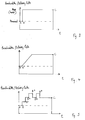
- Figure 3 shows how the delivery rate may vary with the variation of resources allocated to the network session against time in the present example.
- a control connection (network session) is opened between the UE 1 and the CoD server. This is illustrated as point A on the graph of Figure 3 .
- the delivery mechanism between the UE 1 and the CoD server is TCP (transmission control protocol).
- TCP transmission control protocol
- UDP User Datagram Protocol
- the control connection is opened by the user requesting a multimedia on demand service at the UE 1.
- the request is sent to the IPTV middleware, which, in connection with the RACS, reserves network resources (network bandwidth).
- the network resources are reserved for the duration of the control connection at the nominal service rate (e.g. multimedia encoded bitrate) for the multimedia on demand service requested, for example at 2Mb/s.
- the nominal service rate is indicated by a broken line in Figure 3 . With the necessary network resources reserved, and the nominal service rate thereby assured, for the duration of the network session, QoS is assured.
- the CoD server increases the network resources allocated to the network session above the nominal network resources depending upon the network resources available (point B of Figure 3 ). This permits streaming of the content to the UE 1 at a burst delivery rate, which is higher than the nominal rate.
- the CoD server uses a 'best effort' approach ('best effort' overlay) to make use of any available (unused) network resources.
- the CoD server allocates additional resources to the network session independently of the RACS.
- the RACS is responsible for reserving and allocating resources at the nominal rate (assuring QoS)
- the use of these resources permits delivery at the burst delivery rate.
- the RACS is unaware of the allocation by the CoD server of the unallocated/unreserved bandwidth, and takes precedence over the CoD server, which means that use of the unallocated/unreserved bandwidth for burst delivery by the CoD server will not have any impact on the QoS of any other network sessions. Should the RACS allocate/reserve the bandwidth being used by the CoD server to provide burst delivery (which it is not aware the CoD server is using) then the additional bandwidth will simply no longer be available to the CoD server. The bandwidth of the network session will not, however, drop below the nominal reserved level.
- the burst delivery rate is preferably increased to the maximum speed that the network will allow.
- the burst delivery rate may be increased gradually.
- Excess content, delivered above the nominal rate, or even the entire content, is stored locally on the UE 1.
- the CoD server delivers content to the UE 1 continuously until all of the content is received by the UE 1.
- the content is delivered even whilst the streaming content is paused by a user at the UE 1, or similar, and it is cached at the UE (or at a memory means associated therewith) even while playback is being paused for example.
- trick play fast forward, rewind, pause etc
- Point C in Figure 3 represents resource release.
- a notification is sent from the CoD server to the UE 1 to notify the user that all content has been delivered.
- the resources are also released if the user manually terminates the network session at the UE 1.
- the network resources can be re-allocated, as appropriate, as soon as they are released.
- the delivery does not pause, even when the end user pauses viewing, the content is continually delivered and cached at the higher than nominal service rate (eg content encoded bit-rate) and the release and re-use of network bandwidth occurs much quicker than with previously proposed schemes.
- nominal service rate eg content encoded bit-rate
- the CoD server dynamically varies the resources allocated to the network session above the nominal bandwidth, depending on the available network resources at any time, so that the burst delivery rate is maintained at the maximum that the network will permit at any point in time and the content is delivered to the UE 1 as fast as possible.
- the burst delivery rate between points B and C will vary dynamically in accordance with available network resources.
- the network session uses the QoS session, which lasts for the duration of the content delivery. Since, with burst delivery, the content may be delivered in a period that is shorter than the duration of the content, the multimedia delivery session and the QoS session may effectively be de-coupled. As a result network resources may be released earlier, without affecting the QoS.
- a UDP delivery method may be used instead of a TCP delivery method.
- a feedback mechanism is provided and rather than increasing the delivery rate to the maximum permitted by the network, as described above, the delivery rate can be increased gradually over the nominal asset encoded bit-rate, waiting for feedback.
- Figure 4 shows how the delivery rate may vary with the variation of resources allocated to the network session against time in such an arrangement, with the delivery rate continually gradually increasing from point B to the maximum permitted by the network. Whilst the gradual increase is shown as a straight line in Figure 4 it should be appreciated that the increase may be in gradual steps (as may be seen in Figure 5 ), which can be equal or varied.
- the delivery rate can also be increased gradually, with the IPTV middleware awaiting feedback periodically or after each increase.
- Multimedia data received by the UE 1 at a bandwidth above the encoded/presentation rate can be stored on the UE 1, as discussed above.
- the network may be provided with a retransmission mechanism wherein, upon the UE detecting missing data at any point, the UE can request missing packets using a retransmission approach and RTP/RTCP (real time protocol/real time control protocol) feedback mechanism, or similar, and either the network or the CoD server will resend missing packets, with feedback available to the CoD server.
- RTP/RTCP real time protocol/real time control protocol
- the transmission rate from the CoD server may be decreased until retransmission requests stop. Once the retransmission requests have stopped, the transmission rate may be increased again.
- the increase and decrease may be cyclic, in dependence on the retransmission requests. Thus, the rate of delivery can be increased up to the limit at which reliable delivery occurs.
- Figure 5 shows how the delivery rate may vary against time in an arrangement in which retransmission requests are received.
- the delivery rate is directly dependent upon the network resources allocated to the network session.
- the network session is opened at point A and the network resources allocated to the network session are increased above the nominal network resources to a first increased level at point B.
- the network resources are further increased.
- a further increase occurs at point B 2 , since, again, no retransmission request is received.
- the network resources are reduced so that the burst delivery rate is reduced to the previous level at which no retransmission request was received.
- the network resources and burst delivery rate are again increased.
- the delivery rate and burst delivery rate are reduced to the previous level at which no retransmission request was received. In the depicted arrangement this resource level is then maintained, which maintains the burst delivery rate at the maximum reliable rate permitted by the connection until all of the content is delivered and the resources are released at point C.
- more or less attempts to increase the bandwidth following retransmission requests may be made.
- the first increase may be to the maximum rate permitted by the network, with subsequent decreases until an appropriate maximum delivery rate, in accordance with the connection, is determined.
- Preferred embodiments of the present invention allow for the release of a network QoS session earlier during the service, without degrading user experience because playback pausing or other factors do not cause pausing of delivery, wherein the released network resources can be used for other services.
- the invention may also optimise network usage, which leads to an increase in network capacity, particularly to the capacity of the core networks where bottlenecks often occur; and decouples the duration of service session from the underlined QoS network session. It is applicable to IPTV and OTTP services; and allows QoS for OTTP services while preserving the bursting nature of download traffic, saturating available bandwidth.
Landscapes
- Engineering & Computer Science (AREA)
- Computer Networks & Wireless Communication (AREA)
- Signal Processing (AREA)
- Multimedia (AREA)
- Data Exchanges In Wide-Area Networks (AREA)
- Two-Way Televisions, Distribution Of Moving Picture Or The Like (AREA)
Abstract
Description
- This invention relates to the optimisation of bandwidth utilisation in delivery networks. In particular, it relates to a multimedia delivery network in which the network resources reserved for a network session may be varied in accordance with available network resources. The invention may be applicable to on-demand multimedia delivery, gaming, content sharing or other services requiring Quality of Service (QoS).
- In order to provide competitive service quality, to retain existing customers and to appeal to new customers, IPTV (Internet Protocol TV) and increasingly OTT (over the top) service providers rely on the QoS (quality of service), provided by delivery networks, to deliver multimedia content and services. Examples of such services include IPTV video on demand, video from Internet video-sharing sites, and broadcast TV, all of which may be delivered over Internet Protocol (IP) networks. The quality of service (QoS) is required to ensure that the multimedia content is delivered with good timing and is not corrupted whilst the user is watching it. In order to achieve QoS, network elements can reserve necessary resources (e.g. network bandwidth), dedicating the reserved resources to delivering the multimedia content.
- Considering, for example, IPTV solutions, these generally guarantee QoS by integrating multimedia delivery with network resource control sub-systems and deliver multimedia at a steady encoded bit-rate.
- A resource release flow using this approach is illustrated schematically in
Figure 6 .
This shows three components, a Resource and Administration Control Server (RACS) 20, User Equipment (UE) 10 (eg customer's set-top box) and a Content on Demand (CoD)Server 30. A TCP connection is made for a Real Time Streaming Protocol (RTSP) session. The content is then streamed from the CoD MF (Media Function) 30 to the UE, at fixed rate. Upon completion of streaming, an RTSP TEARDOWN message (as defined in RFC 2326) is sent, the content stream is terminated and the CoD MF 30 sends a request to the RACS 20 to release the allocated network resources. A message is then sent to the UE that the session is completed. - However, this flow requires network resources to be reserved at a nominal service bit-rate (eg a multimedia encoded bit-rate of the multimedia content) for the whole duration of the service session, which means that service sessions and network QoS sessions are effectively coupled and have the same duration.
- For example, in the case of an IPTV CoD (content on demand) service network bandwidth (BW) is reserved at the multimedia encoded bit-rate for the whole duration of the service session, as illustrated in
Figure 6 . - This reserved network bandwidth (BW) is often unused for periods during the service session (for example during pause - the user may wish to pause for his convenience at any time). Accordingly, in known delivery networks, resource reservations are held longer then required and the effective network capacity is reduced. Moreover, networks may have additional resources which are unreserved for short periods of time, eg during periods of low network demand. These resources are effectively unused if the content of network sessions is delivered only at the encoded bit-rate.
- The present invention arose in an attempt to provide an improved delivery network.
- According to the present invention in a first aspect there is provided a multimedia delivery network, comprising network resource allocation means for allocating bandwidth to a network session between a UE (user equipment) device on the network and a delivery server, wherein the allocation means is adapted to reserve a nominal bandwidth for the network session when the session is opened, which permits delivery of data from the delivery server to the UE at a nominal service rate, and wherein the delivery server is adapted to increase the bandwidth of the session to a higher bandwidth once the session has been opened, so as to permit delivery of data from the delivery server to the UE at a burst delivery rate higher than the nominal rate.
- This enables network capacity to be increased and more effectively used. Since content can be delivered faster than with previously proposed schemes, it also enables resources to be released earlier.
- The maximum bandwidth at which data is delivered may be dependent upon available network bandwidth.
- Preferably, the UE is provided with local data storage means for storing data received from the delivery server. The UE may be IPTV, Internet TV, cable or other equipment.
- Thus, even if playback of content is paused by the user, content delivery continues and is locally cached until required.
- The delivery server is preferably adapted to dynamically vary the bandwidth allocated to the network session above the nominal bandwidth, depending on the available network bandwidth, so as to provide a burst delivery rate that varies depending upon the available network bandwidth at any time during the network session.
- The delivery server may be adapted to increase the bandwidth to the maximum bandwidth available, so as to provide a burst delivery rate which is as high as the network will permit.
- The UE may be adapted to provide feedback to the delivery server. The UE may be adapted to detect missing data and to request missing packets from the delivery server or network using a retransmission approach and an RTP/RTCP (real time protocol/real time control protocol) feedback mechanism. The retransmission may use a Retransmission (Retr) server which caches content so that upon request one or more packets or portions of content (eg video frames) may be retransmitted if the UE finds that the ones originally transmitted are corrupted or incomplete.
- The delivery server may be adapted to increase the bandwidth gradually.
- The delivery server may be adapted to increase the bandwidth gradually, waiting for the results of feedback received by the delivery service, so as to limit the burst delivery rate to a speed appropriate to the connection between the delivery server and the UE.
- The delivery server may be adapted to increase the bandwidth gradually until a retransmission request is received, and, once the retransmission request has been received, to reduce the bandwidth gradually until retransmission requests are no longer received. The delivery server may be adapted to cyclically increase and decrease the bandwidth, in accordance with the retransmission requests.
- According to the present invention in a further aspect, there is provided a content delivery method over a network, comprising modifying the network bandwidth allocated to a network session between a UE (user equipment) device on the network and a delivery server, wherein a nominal bandwidth for the network session is reserved when the session is opened, which permits delivery of data from the delivery server to the UE at a nominal service rate, and the bandwidth of the session is increased to a higher bandwidth once the session has been opened, so as to permit delivery of data from the delivery server to the UE at a burst delivery rate higher than the nominal rate.
- The content will generally be multimedia content, but may be other types of content.
- The delivery server may dynamically vary the bandwidth allocated to the network session above the nominal bandwidth, depending on the available network bandwidth, so as to provide a burst delivery rate that varies depending upon the available network bandwidth at any time during the network session.
- The delivery server may increase the bandwidth to the maximum bandwidth available, so as to provide a burst delivery rate which is as high as the network will permit. Alternatively, the delivery server may increase the bandwidth gradually.
- The UE may provide feedback to the delivery server. The delivery server may increase the bandwidth gradually, waiting for the results of the feedback received by the delivery server, so as to limit the burst delivery rate to a speed appropriate to the connection between the delivery server and the UE.
- The UE may request, from the delivery server or network, any missing packets using a retransmission approach and a RTP/RTCP feedback mechanism.
- The delivery server may increase the bandwidth gradually until a retransmission request is received, and, once the retransmission request has been received, reduce the bandwidth gradually until retransmission requests are no longer received.
- Thus, if the speed of the burst delivery is found to be too fast for reliable delivery, it can be throttled back or reduced to the fastest speed which still provides reliable delivery.
- The delivery server may cyclically increase and decrease the bandwidth, in accordance with the retransmission requests.
- The invention also provides a network or method including any one or more of the novel features, combinations of features, steps or combination of steps disclosed herein.
- Embodiments of the invention will now be described, by way of example only, with reference to the accompanying schematic drawings in which:
-
Figure 1 shows schematically a network according to the present invention; -
Figure 2 shows an explanatory diagram of an example resource flow in the network ofFigure 1 ; -
Figure 3 shows schematically how the delivery rate may vary against time during a network session; -
Figure 4 shows schematically an alternative example of how the delivery rate may vary against time during a network session; -
Figure 5 shows schematically a yet further example of how the delivery rate may vary against time during a network session; and -
Figure 6 shows a resource flow in a prior art network. - Referring to
Figure 1 , there is shown a network arrangement operating in accordance with the present invention. A UE 1, in this case an IPTV UE (set-top box plus display for example) is connected to the network to receive data from the network. The UE 1 is provided with associated storage, such as solid state memory, a hard disk drive or similar, so that data received from the network may be stored locally on the UE 1. This may be integral, or connected locally, by a hard link, wirelessly or otherwise associated with the UE. Whilst only asingle UE 1 is shown it should be appreciated that there will generally be a large number ofUEs 1 connected to the network, with network resources shared between theUEs 1. - The network is a NGN (next generation network), ie a network designed using IP and QoS (Quality of Service) technology to support all types of customer traffic including but not limited to voice, data and video, which enables a variety of IP-based customer devices and next generation and advanced applications to communicate over a single common network.
- The network comprises a network resource allocation means 2, in this case IPTV middleware 29 and RACS (resource and administration control server) 26, a
delivery server 3, in this case a CoD server, and BGF (border gateway control function)devices 4. These are shown schematically inFigure 1 . - It will be readily appreciated by the skilled person that alternative network arrangements are possible within the scope of the present invention.
- Referring to
Figure 2 , there is shown a resource flow on the network ofFigure 1 during a multimedia on demand network session.Figure 3 shows how the delivery rate may vary with the variation of resources allocated to the network session against time in the present example. - A control connection (network session) is opened between the
UE 1 and the CoD server. This is illustrated as point A on the graph ofFigure 3 . In this case the delivery mechanism between theUE 1 and the CoD server is TCP (transmission control protocol). However, as discussed later with reference to the examples, the present invention is equally applicable to alternative delivery mechanisms, including, but not limited to UDP (User Datagram Protocol). The control connection is opened by the user requesting a multimedia on demand service at theUE 1. The request is sent to the IPTV middleware, which, in connection with the RACS, reserves network resources (network bandwidth). The network resources are reserved for the duration of the control connection at the nominal service rate (e.g. multimedia encoded bitrate) for the multimedia on demand service requested, for example at 2Mb/s. The nominal service rate is indicated by a broken line inFigure 3 . With the necessary network resources reserved, and the nominal service rate thereby assured, for the duration of the network session, QoS is assured. - Once the control connection has been opened, the CoD server increases the network resources allocated to the network session above the nominal network resources depending upon the network resources available (point B of
Figure 3 ). This permits streaming of the content to theUE 1 at a burst delivery rate, which is higher than the nominal rate. - The CoD server uses a 'best effort' approach ('best effort' overlay) to make use of any available (unused) network resources. The CoD server allocates additional resources to the network session independently of the RACS. Thus, whilst the RACS is responsible for reserving and allocating resources at the nominal rate (assuring QoS), it is the CoD server which is responsible for allocating additional network resources, which have not been allocated to, or reserved for, any network session(s) by the RACS. The use of these resources permits delivery at the burst delivery rate. The RACS is unaware of the allocation by the CoD server of the unallocated/unreserved bandwidth, and takes precedence over the CoD server, which means that use of the unallocated/unreserved bandwidth for burst delivery by the CoD server will not have any impact on the QoS of any other network sessions. Should the RACS allocate/reserve the bandwidth being used by the CoD server to provide burst delivery (which it is not aware the CoD server is using) then the additional bandwidth will simply no longer be available to the CoD server. The bandwidth of the network session will not, however, drop below the nominal reserved level.
- In the present case, where the delivery method is TCP the burst delivery rate is preferably increased to the maximum speed that the network will allow. However, in alternative arrangements, as discussed below, with reference to the examples that follow and to
Figures 4 and 5 , the burst delivery rate may be increased gradually. - Excess content, delivered above the nominal rate, or even the entire content, is stored locally on the
UE 1. - The CoD server delivers content to the
UE 1 continuously until all of the content is received by theUE 1. In particular, the content is delivered even whilst the streaming content is paused by a user at theUE 1, or similar, and it is cached at the UE (or at a memory means associated therewith) even while playback is being paused for example. - Since, the content is stored locally on the
UE 1, so-called trick play (fast forward, rewind, pause etc) is accommodated by the invention. - Once all of the content has been delivered to the
UE 1, the CoD server releases all resources allocated to the network session or instructs the IPTV middleware to release the resources. Point C inFigure 3 represents resource release. A notification is sent from the CoD server to theUE 1 to notify the user that all content has been delivered. The resources are also released if the user manually terminates the network session at theUE 1. The network resources can be re-allocated, as appropriate, as soon as they are released. - Because the delivery does not pause, even when the end user pauses viewing, the content is continually delivered and cached at the higher than nominal service rate (eg content encoded bit-rate) and the release and re-use of network bandwidth occurs much quicker than with previously proposed schemes.
- In an alternative arrangement, the CoD server dynamically varies the resources allocated to the network session above the nominal bandwidth, depending on the available network resources at any time, so that the burst delivery rate is maintained at the maximum that the network will permit at any point in time and the content is delivered to the
UE 1 as fast as possible. Such a variation is not shown inFigure 3 , however, it will be readily appreciated that in this alternative the burst delivery rate between points B and C will vary dynamically in accordance with available network resources. - There may be retransmission feedback between the
UE 1 and the CoD server, during the burst transmission. This is of particular use when the delivery mechanism is unreliable, for example UDP, and is discussed below with reference to the further examples. In the case of a TCP delivery mechanism there is no need for retransmission feedback, although it may be provided, in which case the burst delivery rate will be reduced if TCP acknowledgement messages are not received within acceptable time limits. Such a feedback may be used with the 'best effort' methodology described above. - The network session uses the QoS session, which lasts for the duration of the content delivery. Since, with burst delivery, the content may be delivered in a period that is shorter than the duration of the content, the multimedia delivery session and the QoS session may effectively be de-coupled. As a result network resources may be released earlier, without affecting the QoS.
- Various examples falling within the scope of the invention will now be described.
- Instead of a TCP delivery method, as discussed above, a UDP delivery method may be used. In this case a feedback mechanism is provided and rather than increasing the delivery rate to the maximum permitted by the network, as described above, the delivery rate can be increased gradually over the nominal asset encoded bit-rate, waiting for feedback.
- In the absence of feedback the delivery rate may be continually gradually increased.
Figure 4 shows how the delivery rate may vary with the variation of resources allocated to the network session against time in such an arrangement, with the delivery rate continually gradually increasing from point B to the maximum permitted by the network. Whilst the gradual increase is shown as a straight line inFigure 4 it should be appreciated that the increase may be in gradual steps (as may be seen inFigure 5 ), which can be equal or varied. - The delivery rate can also be increased gradually, with the IPTV middleware awaiting feedback periodically or after each increase.
- Multimedia data received by the
UE 1 at a bandwidth above the encoded/presentation rate, in any arrangement, can be stored on theUE 1, as discussed above. - The network, as defined in any of the arrangements discussed herein, may be provided with a retransmission mechanism wherein, upon the UE detecting missing data at any point, the UE can request missing packets using a retransmission approach and RTP/RTCP (real time protocol/real time control protocol) feedback mechanism, or similar, and either the network or the CoD server will resend missing packets, with feedback available to the CoD server.
- Upon receipt of a retransmission request the transmission rate from the CoD server may be decreased until retransmission requests stop. Once the retransmission requests have stopped, the transmission rate may be increased again. The increase and decrease may be cyclic, in dependence on the retransmission requests. Thus, the rate of delivery can be increased up to the limit at which reliable delivery occurs.
-
Figure 5 shows how the delivery rate may vary against time in an arrangement in which retransmission requests are received. The delivery rate is directly dependent upon the network resources allocated to the network session. The network session is opened at point A and the network resources allocated to the network session are increased above the nominal network resources to a first increased level at point B. At point B1, since no retransmission request is received, the network resources are further increased. A further increase occurs at point B2, since, again, no retransmission request is received. At point B3, following receipt of a retransmission request, the network resources are reduced so that the burst delivery rate is reduced to the previous level at which no retransmission request was received. At point B4, following no retransmission request, the network resources and burst delivery rate are again increased. At point B5, following receipt of a retransmission request, the delivery rate and burst delivery rate are reduced to the previous level at which no retransmission request was received. In the depicted arrangement this resource level is then maintained, which maintains the burst delivery rate at the maximum reliable rate permitted by the connection until all of the content is delivered and the resources are released at point C. In alternative arrangements more or less attempts to increase the bandwidth following retransmission requests may be made. Furthermore, although the steps are depicted as being equal it should be appreciated that this need not be the case, since the increase of bandwidth at each step may vary and/or the time between an increase and a subsequent retransmission request may vary. The first increase may be to the maximum rate permitted by the network, with subsequent decreases until an appropriate maximum delivery rate, in accordance with the connection, is determined. - Preferred embodiments of the present invention allow for the release of a network QoS session earlier during the service, without degrading user experience because playback pausing or other factors do not cause pausing of delivery, wherein the released network resources can be used for other services. The invention may also optimise network usage, which leads to an increase in network capacity, particularly to the capacity of the core networks where bottlenecks often occur; and decouples the duration of service session from the underlined QoS network session. It is applicable to IPTV and OTTP services; and allows QoS for OTTP services while preserving the bursting nature of download traffic, saturating available bandwidth.
- Whilst preferred embodiments of the present invention have been described in terms of on-demand multimedia delivery, namely on-demand IPTV, it should be noted that the present invention is applicable to any services requiring QoS, including but not limited to gaming and content sharing.
Claims (16)
- A multimedia delivery network, comprising network resource allocation means for allocating bandwidth to a network session between a UE (user equipment) device on the network and a delivery server, wherein the allocation means is adapted to reserve a nominal bandwidth for the network session when the session is opened, which permits delivery of data from the delivery server to the UE at a nominal service rate, and wherein the delivery server is adapted to increase the bandwidth of the session, to a higher bandwidth once the session has been opened, so as to permit delivery of data from the delivery server to the UE at a burst delivery rate higher than the nominal rate.
- A network as claimed in Claim 1, wherein the UE is provided with data storage means for storing data received from the delivery server, such that data delivery can continue while it is being stored.
- A network as claimed in Claim 1 or 2, wherein the UE is IPTV equipment.
- A network as claimed in any preceding claim, wherein the delivery server is adapted to dynamically vary the bandwidth allocated to the network session above the nominal bandwidth, depending on the available network bandwidth, so as to provide a burst delivery rate that varies depending upon the available network bandwidth at any time during the network session.
- A network as claimed in any preceding claim, wherein the delivery server is adapted to increase the bandwidth to the maximum bandwidth available, so as to provide a burst delivery rate which is as high as the network will permit.
- A network as claimed in any of Claims 1 to 4, wherein the delivery server is adapted to increase the bandwidth gradually.
- A network as claimed in Claim 6, wherein the UE is adapted to provide feedback to the delivery server.
- A network as claimed in Claim 7, wherein the delivery server is adapted to increase the bandwidth gradually, and includes means for receiving feedback indicating the state of the content received by the UE, so as to limit the burst delivery rate to a speed appropriate to the connection between the delivery server and the UE.
- A network as claimed in any preceding claim, wherein the UE is adapted to detect missing data and to request missing packets from the delivery server or network using a retransmission feedback mechanism.
- A network as claimed in Claim 9, wherein the delivery server is adapted to increase the bandwidth gradually until a retransmission request is received, and, once the retransmission request has been received, to reduce the bandwidth until retransmission requests are no longer received.
- A network as claimed in Claim 10, wherein the delivery server is adapted to periodically increase and decrease the bandwidth, in accordance with the retransmission requests.
- A content delivery method over a network, comprising modifying network bandwidth allocated to a network session between a UE (user equipment) device on a network and a delivery server, wherein a nominal bandwidth for the network session is reserved when the session is opened, which permits delivery of data from the delivery server to the UE at a nominal service rate, and the bandwidth of the session is increased, to a higher bandwidth once the session has been opened, so as to permit delivery of data from the delivery server to the UE at a burst delivery rate higher than the nominal rate.
- A method as claimed in Claim 12, wherein the delivery server dynamically varies the bandwidth allocated to the network session above the nominal bandwidth, depending on the available network bandwidth, so as to provide a burst delivery rate that varies depending upon the available network bandwidth at any time during the network session.
- A method as claimed in Claim 12 or 13, wherein the delivery server increases the bandwidth to the maximum bandwidth available, so as to provide a burst delivery rate which is as high as the network will permit.
- A method as claimed in Claim 12, wherein the delivery server increases the bandwidth gradually, wherein feedback is received by the delivery server from the UE indicating the state of the content when delivered, so as to limit the burst delivery rate to a speed appropriate to the connection between the delivery server and the UE.
- A method as claimed in any of Claims 12 to 15, wherein the delivery is maintained even while playback or receiving of content is paused or interrupted.
Priority Applications (6)
| Application Number | Priority Date | Filing Date | Title |
|---|---|---|---|
| EP09290002.6A EP2204954B1 (en) | 2009-01-06 | 2009-01-06 | Optimised bandwidth utilisation in networks |
| JP2011544001A JP5302415B2 (en) | 2009-01-06 | 2009-12-31 | Optimal bandwidth utilization in the network |
| KR1020117018261A KR101284516B1 (en) | 2009-01-06 | 2009-12-31 | Optimised bandwidth utilisation in networks |
| US13/143,265 US9325527B2 (en) | 2009-01-06 | 2009-12-31 | Optimised bandwidth utilisation in networks |
| PCT/EP2009/009354 WO2010078958A1 (en) | 2009-01-06 | 2009-12-31 | Optimised bandwidth utilisation in networks |
| CN200980156191.8A CN102308530B (en) | 2009-01-06 | 2009-12-31 | The bandwidth optimizing in network uses |
Applications Claiming Priority (1)
| Application Number | Priority Date | Filing Date | Title |
|---|---|---|---|
| EP09290002.6A EP2204954B1 (en) | 2009-01-06 | 2009-01-06 | Optimised bandwidth utilisation in networks |
Publications (2)
| Publication Number | Publication Date |
|---|---|
| EP2204954A1 true EP2204954A1 (en) | 2010-07-07 |
| EP2204954B1 EP2204954B1 (en) | 2017-12-27 |
Family
ID=40473688
Family Applications (1)
| Application Number | Title | Priority Date | Filing Date |
|---|---|---|---|
| EP09290002.6A Not-in-force EP2204954B1 (en) | 2009-01-06 | 2009-01-06 | Optimised bandwidth utilisation in networks |
Country Status (6)
| Country | Link |
|---|---|
| US (1) | US9325527B2 (en) |
| EP (1) | EP2204954B1 (en) |
| JP (1) | JP5302415B2 (en) |
| KR (1) | KR101284516B1 (en) |
| CN (1) | CN102308530B (en) |
| WO (1) | WO2010078958A1 (en) |
Cited By (2)
| Publication number | Priority date | Publication date | Assignee | Title |
|---|---|---|---|---|
| EP3014827A4 (en) * | 2013-06-29 | 2017-01-11 | Intel Corporation | Service rate redistribution for credit-based arbitration |
| US11627201B2 (en) | 2018-04-30 | 2023-04-11 | Google Llc | Optimizing network utilization |
Families Citing this family (14)
| Publication number | Priority date | Publication date | Assignee | Title |
|---|---|---|---|---|
| US8001260B2 (en) | 2008-07-28 | 2011-08-16 | Vantrix Corporation | Flow-rate adaptation for a connection of time-varying capacity |
| US7975063B2 (en) * | 2009-05-10 | 2011-07-05 | Vantrix Corporation | Informative data streaming server |
| US9137551B2 (en) | 2011-08-16 | 2015-09-15 | Vantrix Corporation | Dynamic bit rate adaptation over bandwidth varying connection |
| JP2014003407A (en) * | 2012-06-16 | 2014-01-09 | Sony Corp | Communication device, communication system and communication control method, and program |
| CN102904930B (en) * | 2012-09-17 | 2016-01-20 | 中兴通讯股份有限公司 | The dual accelerated method of content and network-linked and system |
| US9591514B2 (en) * | 2013-04-19 | 2017-03-07 | Microsoft Technology Licensing, Llc | Optimization of over-the-top (OTT) services on carrier networks |
| FI127364B (en) | 2013-05-10 | 2018-04-30 | Cloudstreet Oy | Management of wireless data transmission capacity |
| US10321383B2 (en) | 2013-05-10 | 2019-06-11 | Cloudstreet Oy | Managing wireless transmission capacity |
| US10313472B2 (en) * | 2014-03-19 | 2019-06-04 | Telefonaktiebolaget Lm Ericsson (Publ) | Enabling efficient pre-loading of data for a network client |
| KR102147676B1 (en) * | 2014-03-28 | 2020-08-26 | 삼성전자주식회사 | Method and apparatus for allocating resource in multimedia system |
| KR102219015B1 (en) * | 2015-12-04 | 2021-02-23 | 소니 주식회사 | Use of network support protocols to improve network usage |
| JP7048729B2 (en) * | 2018-04-30 | 2022-04-05 | グーグル エルエルシー | Optimizing network usage |
| US12028548B2 (en) * | 2021-04-19 | 2024-07-02 | Synamedia Limited | Rendering video frames for a user interface operation performed at a client device |
| US12192073B2 (en) * | 2022-05-17 | 2025-01-07 | Movius Interactive Corporation | Artificial intelligence based service quality response system |
Citations (2)
| Publication number | Priority date | Publication date | Assignee | Title |
|---|---|---|---|---|
| US20040156315A1 (en) * | 2003-02-08 | 2004-08-12 | Walls Jeffrey Joel | Apparatus and method for transmitting data to a network based on retransmission requests |
| GB2417390A (en) * | 2004-08-18 | 2006-02-22 | Wecomm Ltd | Adjusting packet transmission rate in response to retransmit information |
Family Cites Families (18)
| Publication number | Priority date | Publication date | Assignee | Title |
|---|---|---|---|---|
| US5918002A (en) * | 1997-03-14 | 1999-06-29 | Microsoft Corporation | Selective retransmission for efficient and reliable streaming of multimedia packets in a computer network |
| US6526022B1 (en) * | 1998-06-30 | 2003-02-25 | Sun Microsystems | Detecting congestion by comparing successive loss of packets in windows to provide congestion control in reliable multicast protocol |
| US6683853B1 (en) * | 1999-12-01 | 2004-01-27 | Telefonaktiebolaget Lm Ericsson (Publ) | Dynamic upgrade of quality of service in a packet switched network |
| US7499453B2 (en) * | 2000-05-19 | 2009-03-03 | Cisco Technology, Inc. | Apparatus and methods for incorporating bandwidth forecasting and dynamic bandwidth allocation into a broadband communication system |
| US20020194361A1 (en) * | 2000-09-22 | 2002-12-19 | Tomoaki Itoh | Data transmitting/receiving method, transmitting device, receiving device, transmiting/receiving system, and program |
| JP3857057B2 (en) * | 2001-02-05 | 2006-12-13 | 株式会社日立製作所 | Method and apparatus for recording / reproducing moving image data |
| JP3737977B2 (en) * | 2002-03-08 | 2006-01-25 | 日本電信電話株式会社 | Bandwidth allocation apparatus and bandwidth allocation method |
| CN1826775A (en) * | 2003-07-24 | 2006-08-30 | 皇家飞利浦电子股份有限公司 | Admission control to wireless network based on guaranteed transmission rate |
| DE602004016827D1 (en) * | 2004-05-19 | 2008-11-13 | Mitsubishi Electric Corp | Method and device for radio resource allocation |
| KR100595708B1 (en) * | 2004-12-30 | 2006-07-20 | 엘지전자 주식회사 | Apparatus and method for pausing broadcasting broadcasting of mobile communication terminal |
| JP3961000B2 (en) * | 2005-05-26 | 2007-08-15 | 株式会社日立コミュニケーションテクノロジー | Packet transfer apparatus and network system |
| WO2008043092A1 (en) * | 2006-10-05 | 2008-04-10 | Bittorrent, Inc. | Peer-to-peer streaming of non-live content |
| US7995469B2 (en) * | 2006-11-21 | 2011-08-09 | Wayport, Inc. | System and method for providing intelligent quality of service management in a system with a plurality of telecommunication connections |
| CN100583901C (en) * | 2007-01-08 | 2010-01-20 | 清华大学 | Quality of Service Guarantee Method for Media Access Control Layer of Broadband Wireless Access Network |
| US8369339B2 (en) * | 2007-01-18 | 2013-02-05 | Alcatel Lucent | System and method of subscriber to content provider network access service management |
| JP4382830B2 (en) * | 2007-03-16 | 2009-12-16 | 富士通株式会社 | Packet transfer device |
| US20090178058A1 (en) * | 2008-01-09 | 2009-07-09 | Microsoft Corporation | Application Aware Networking |
| US8612609B2 (en) * | 2009-08-31 | 2013-12-17 | At&T Intellectual Property I, L.P. | Methods and apparatus to reassign quality of service priorities in a communication network |
-
2009
- 2009-01-06 EP EP09290002.6A patent/EP2204954B1/en not_active Not-in-force
- 2009-12-31 KR KR1020117018261A patent/KR101284516B1/en not_active Expired - Fee Related
- 2009-12-31 JP JP2011544001A patent/JP5302415B2/en not_active Expired - Fee Related
- 2009-12-31 WO PCT/EP2009/009354 patent/WO2010078958A1/en not_active Ceased
- 2009-12-31 US US13/143,265 patent/US9325527B2/en not_active Expired - Fee Related
- 2009-12-31 CN CN200980156191.8A patent/CN102308530B/en not_active Expired - Fee Related
Patent Citations (2)
| Publication number | Priority date | Publication date | Assignee | Title |
|---|---|---|---|---|
| US20040156315A1 (en) * | 2003-02-08 | 2004-08-12 | Walls Jeffrey Joel | Apparatus and method for transmitting data to a network based on retransmission requests |
| GB2417390A (en) * | 2004-08-18 | 2006-02-22 | Wecomm Ltd | Adjusting packet transmission rate in response to retransmit information |
Non-Patent Citations (4)
| Title |
|---|
| HONGLI LUO ET AL: "Video streaming over the internet with optimal bandwidth resource allocation", MULTIMEDIA TOOLS AND APPLICATIONS, KLUWER ACADEMIC PUBLISHERS, BO, vol. 40, no. 1, 25 January 2008 (2008-01-25), pages 111 - 134, XP019612000, ISSN: 1573-7721 * |
| TONG SHAN ET AL: "Bandwidth Management for Supporting Differentiated Service Aware Traffic Engineering", IEEE TRANSACTIONS ON PARALLEL AND DISTRIBUTED SYSTEMS, IEEE SERVICE CENTER, LOS ALAMITOS, CA, US, vol. 18, no. 9, 1 September 2007 (2007-09-01), pages 1320 - 1331, XP011190143, ISSN: 1045-9219 * |
| XIAORONG LI ET AL: "An optimal smooth QoS adaptation strategy for QoS differentiated scalable media streaming", MULTIMEDIA AND EXPO, 2008 IEEE INTERNATIONAL CONFERENCE ON, IEEE, PISCATAWAY, NJ, USA, 23 June 2008 (2008-06-23), pages 429 - 432, XP031312750, ISBN: 978-1-4244-2570-9 * |
| YUEN J ET AL: "A fair and adaptive scheduling protocol for video stream transmission in mobile environment", MULTIMEDIA AND EXPO, 2002. ICME '02. PROCEEDINGS. 2002 IEEE INTERNATIO NAL CONFERENCE ON LAUSANNE, SWITZERLAND 26-29 AUG. 2002, PISCATAWAY, NJ, USA,IEEE, US, vol. 1, 26 August 2002 (2002-08-26), pages 409 - 412, XP010604392, ISBN: 978-0-7803-7304-4 * |
Cited By (2)
| Publication number | Priority date | Publication date | Assignee | Title |
|---|---|---|---|---|
| EP3014827A4 (en) * | 2013-06-29 | 2017-01-11 | Intel Corporation | Service rate redistribution for credit-based arbitration |
| US11627201B2 (en) | 2018-04-30 | 2023-04-11 | Google Llc | Optimizing network utilization |
Also Published As
| Publication number | Publication date |
|---|---|
| KR20110104545A (en) | 2011-09-22 |
| CN102308530A (en) | 2012-01-04 |
| US9325527B2 (en) | 2016-04-26 |
| JP2012514880A (en) | 2012-06-28 |
| EP2204954B1 (en) | 2017-12-27 |
| KR101284516B1 (en) | 2013-08-23 |
| US20120016993A1 (en) | 2012-01-19 |
| JP5302415B2 (en) | 2013-10-02 |
| CN102308530B (en) | 2017-03-08 |
| WO2010078958A1 (en) | 2010-07-15 |
Similar Documents
| Publication | Publication Date | Title |
|---|---|---|
| US9325527B2 (en) | Optimised bandwidth utilisation in networks | |
| KR102085539B1 (en) | Managing adaptive streaming of data via a communication connection | |
| US8973057B2 (en) | Method and equipment for providing unicast preparation for IPTV | |
| CN104040992B (en) | There is the Media Stream of improved efficiency in mobile network | |
| US7779142B1 (en) | Bandwidth allocation to support fast buffering | |
| CN102652421B (en) | Policies for content downloading and content uploading | |
| US10003830B1 (en) | Controller to manage streaming video of playback devices | |
| US8228945B2 (en) | Streaming communication system | |
| CN106537856A (en) | Data flow control method and system | |
| JP5807710B2 (en) | Content distribution system, content distribution method and program | |
| CN105684390A (en) | Method and apparatus for reserving bandwidth for adaptive streaming clients | |
| US20090077256A1 (en) | Dynamic change of quality of service for enhanced multi-media streaming | |
| CN101207619A (en) | Method and related system for distributing non-real-time media in non-real-time media distribution system | |
| WO2019120532A1 (en) | Method and apparatus for adaptive bit rate control in a communication network | |
| KR100677125B1 (en) | Streaming method using negotiation of transmission delay time | |
| HK1170863B (en) | Policies for content downloading and content uploading |
Legal Events
| Date | Code | Title | Description |
|---|---|---|---|
| PUAI | Public reference made under article 153(3) epc to a published international application that has entered the european phase |
Free format text: ORIGINAL CODE: 0009012 |
|
| AK | Designated contracting states |
Kind code of ref document: A1 Designated state(s): AT BE BG CH CY CZ DE DK EE ES FI FR GB GR HR HU IE IS IT LI LT LU LV MC MK MT NL NO PL PT RO SE SI SK TR |
|
| AX | Request for extension of the european patent |
Extension state: AL BA RS |
|
| 17P | Request for examination filed |
Effective date: 20110107 |
|
| AKX | Designation fees paid |
Designated state(s): AT BE BG CH CY CZ DE DK EE ES FI FR GB GR HR HU IE IS IT LI LT LU LV MC MK MT NL NO PL PT RO SE SI SK TR |
|
| 17Q | First examination report despatched |
Effective date: 20110729 |
|
| RAP1 | Party data changed (applicant data changed or rights of an application transferred) |
Owner name: ALCATEL LUCENT |
|
| RIC1 | Information provided on ipc code assigned before grant |
Ipc: H04L 29/06 20060101AFI20130129BHEP |
|
| R17C | First examination report despatched (corrected) |
Effective date: 20110729 |
|
| 111Z | Information provided on other rights and legal means of execution |
Free format text: AT BE BG CH CY CZ DE DK EE ES FI FR GB GR HR HU IE IS IT LI LT LU LV MC MK MT NL NO PL PT RO SE SI SK TR Effective date: 20130410 |
|
| RAP1 | Party data changed (applicant data changed or rights of an application transferred) |
Owner name: ALCATEL LUCENT |
|
| D11X | Information provided on other rights and legal means of execution (deleted) | ||
| REG | Reference to a national code |
Ref country code: DE Ref legal event code: R079 Ref document number: 602009050071 Country of ref document: DE Free format text: PREVIOUS MAIN CLASS: H04L0012560000 Ipc: H04L0029060000 |
|
| RIC1 | Information provided on ipc code assigned before grant |
Ipc: H04L 12/911 20130101ALI20170509BHEP Ipc: H04L 29/06 20060101AFI20170509BHEP Ipc: H04L 12/801 20130101ALI20170509BHEP Ipc: H04L 12/825 20130101ALI20170509BHEP Ipc: H04L 12/919 20130101ALI20170509BHEP |
|
| GRAP | Despatch of communication of intention to grant a patent |
Free format text: ORIGINAL CODE: EPIDOSNIGR1 |
|
| INTG | Intention to grant announced |
Effective date: 20170704 |
|
| GRAS | Grant fee paid |
Free format text: ORIGINAL CODE: EPIDOSNIGR3 |
|
| GRAA | (expected) grant |
Free format text: ORIGINAL CODE: 0009210 |
|
| AK | Designated contracting states |
Kind code of ref document: B1 Designated state(s): AT BE BG CH CY CZ DE DK EE ES FI FR GB GR HR HU IE IS IT LI LT LU LV MC MK MT NL NO PL PT RO SE SI SK TR |
|
| REG | Reference to a national code |
Ref country code: GB Ref legal event code: FG4D |
|
| REG | Reference to a national code |
Ref country code: CH Ref legal event code: EP |
|
| REG | Reference to a national code |
Ref country code: AT Ref legal event code: REF Ref document number: 959192 Country of ref document: AT Kind code of ref document: T Effective date: 20180115 |
|
| REG | Reference to a national code |
Ref country code: IE Ref legal event code: FG4D |
|
| REG | Reference to a national code |
Ref country code: DE Ref legal event code: R096 Ref document number: 602009050071 Country of ref document: DE |
|
| REG | Reference to a national code |
Ref country code: CH Ref legal event code: PCOW Free format text: NEW ADDRESS: SITE NOKIA PARIS SACLAY ROUTE DE VILLEJUST, 91620 NOZAY (FR) |
|
| RAP2 | Party data changed (patent owner data changed or rights of a patent transferred) |
Owner name: ALCATEL LUCENT |
|
| REG | Reference to a national code |
Ref country code: DE Ref legal event code: R081 Ref document number: 602009050071 Country of ref document: DE Owner name: PROVENANCE ASSET GROUP LLC (N.D.GES.D. STAATES, US Free format text: FORMER OWNER: ALCATEL LUCENT, BOULOGNE BILLANCOURT, FR |
|
| PG25 | Lapsed in a contracting state [announced via postgrant information from national office to epo] |
Ref country code: LT Free format text: LAPSE BECAUSE OF FAILURE TO SUBMIT A TRANSLATION OF THE DESCRIPTION OR TO PAY THE FEE WITHIN THE PRESCRIBED TIME-LIMIT Effective date: 20171227 Ref country code: FI Free format text: LAPSE BECAUSE OF FAILURE TO SUBMIT A TRANSLATION OF THE DESCRIPTION OR TO PAY THE FEE WITHIN THE PRESCRIBED TIME-LIMIT Effective date: 20171227 Ref country code: NO Free format text: LAPSE BECAUSE OF FAILURE TO SUBMIT A TRANSLATION OF THE DESCRIPTION OR TO PAY THE FEE WITHIN THE PRESCRIBED TIME-LIMIT Effective date: 20180327 |
|
| REG | Reference to a national code |
Ref country code: GB Ref legal event code: 732E Free format text: REGISTERED BETWEEN 20180405 AND 20180411 Ref country code: NL Ref legal event code: MP Effective date: 20171227 |
|
| REG | Reference to a national code |
Ref country code: LT Ref legal event code: MG4D |
|
| REG | Reference to a national code |
Ref country code: AT Ref legal event code: MK05 Ref document number: 959192 Country of ref document: AT Kind code of ref document: T Effective date: 20171227 |
|
| PG25 | Lapsed in a contracting state [announced via postgrant information from national office to epo] |
Ref country code: HR Free format text: LAPSE BECAUSE OF FAILURE TO SUBMIT A TRANSLATION OF THE DESCRIPTION OR TO PAY THE FEE WITHIN THE PRESCRIBED TIME-LIMIT Effective date: 20171227 Ref country code: LV Free format text: LAPSE BECAUSE OF FAILURE TO SUBMIT A TRANSLATION OF THE DESCRIPTION OR TO PAY THE FEE WITHIN THE PRESCRIBED TIME-LIMIT Effective date: 20171227 Ref country code: GR Free format text: LAPSE BECAUSE OF FAILURE TO SUBMIT A TRANSLATION OF THE DESCRIPTION OR TO PAY THE FEE WITHIN THE PRESCRIBED TIME-LIMIT Effective date: 20180328 Ref country code: BG Free format text: LAPSE BECAUSE OF FAILURE TO SUBMIT A TRANSLATION OF THE DESCRIPTION OR TO PAY THE FEE WITHIN THE PRESCRIBED TIME-LIMIT Effective date: 20180327 |
|
| PG25 | Lapsed in a contracting state [announced via postgrant information from national office to epo] |
Ref country code: NL Free format text: LAPSE BECAUSE OF FAILURE TO SUBMIT A TRANSLATION OF THE DESCRIPTION OR TO PAY THE FEE WITHIN THE PRESCRIBED TIME-LIMIT Effective date: 20171227 |
|
| PG25 | Lapsed in a contracting state [announced via postgrant information from national office to epo] |
Ref country code: SK Free format text: LAPSE BECAUSE OF FAILURE TO SUBMIT A TRANSLATION OF THE DESCRIPTION OR TO PAY THE FEE WITHIN THE PRESCRIBED TIME-LIMIT Effective date: 20171227 Ref country code: EE Free format text: LAPSE BECAUSE OF FAILURE TO SUBMIT A TRANSLATION OF THE DESCRIPTION OR TO PAY THE FEE WITHIN THE PRESCRIBED TIME-LIMIT Effective date: 20171227 Ref country code: CY Free format text: LAPSE BECAUSE OF FAILURE TO SUBMIT A TRANSLATION OF THE DESCRIPTION OR TO PAY THE FEE WITHIN THE PRESCRIBED TIME-LIMIT Effective date: 20171227 Ref country code: CZ Free format text: LAPSE BECAUSE OF FAILURE TO SUBMIT A TRANSLATION OF THE DESCRIPTION OR TO PAY THE FEE WITHIN THE PRESCRIBED TIME-LIMIT Effective date: 20171227 Ref country code: ES Free format text: LAPSE BECAUSE OF FAILURE TO SUBMIT A TRANSLATION OF THE DESCRIPTION OR TO PAY THE FEE WITHIN THE PRESCRIBED TIME-LIMIT Effective date: 20171227 |
|
| PG25 | Lapsed in a contracting state [announced via postgrant information from national office to epo] |
Ref country code: AT Free format text: LAPSE BECAUSE OF FAILURE TO SUBMIT A TRANSLATION OF THE DESCRIPTION OR TO PAY THE FEE WITHIN THE PRESCRIBED TIME-LIMIT Effective date: 20171227 Ref country code: IT Free format text: LAPSE BECAUSE OF FAILURE TO SUBMIT A TRANSLATION OF THE DESCRIPTION OR TO PAY THE FEE WITHIN THE PRESCRIBED TIME-LIMIT Effective date: 20171227 Ref country code: IS Free format text: LAPSE BECAUSE OF FAILURE TO SUBMIT A TRANSLATION OF THE DESCRIPTION OR TO PAY THE FEE WITHIN THE PRESCRIBED TIME-LIMIT Effective date: 20180427 Ref country code: PL Free format text: LAPSE BECAUSE OF FAILURE TO SUBMIT A TRANSLATION OF THE DESCRIPTION OR TO PAY THE FEE WITHIN THE PRESCRIBED TIME-LIMIT Effective date: 20171227 Ref country code: RO Free format text: LAPSE BECAUSE OF FAILURE TO SUBMIT A TRANSLATION OF THE DESCRIPTION OR TO PAY THE FEE WITHIN THE PRESCRIBED TIME-LIMIT Effective date: 20171227 |
|
| REG | Reference to a national code |
Ref country code: CH Ref legal event code: PL |
|
| PG25 | Lapsed in a contracting state [announced via postgrant information from national office to epo] |
Ref country code: MC Free format text: LAPSE BECAUSE OF FAILURE TO SUBMIT A TRANSLATION OF THE DESCRIPTION OR TO PAY THE FEE WITHIN THE PRESCRIBED TIME-LIMIT Effective date: 20171227 |
|
| REG | Reference to a national code |
Ref country code: DE Ref legal event code: R097 Ref document number: 602009050071 Country of ref document: DE |
|
| PG25 | Lapsed in a contracting state [announced via postgrant information from national office to epo] |
Ref country code: FR Free format text: LAPSE BECAUSE OF NON-PAYMENT OF DUE FEES Effective date: 20180227 Ref country code: LU Free format text: LAPSE BECAUSE OF NON-PAYMENT OF DUE FEES Effective date: 20180106 |
|
| REG | Reference to a national code |
Ref country code: IE Ref legal event code: MM4A |
|
| PLBE | No opposition filed within time limit |
Free format text: ORIGINAL CODE: 0009261 |
|
| REG | Reference to a national code |
Ref country code: FR Ref legal event code: ST Effective date: 20180928 |
|
| STAA | Information on the status of an ep patent application or granted ep patent |
Free format text: STATUS: NO OPPOSITION FILED WITHIN TIME LIMIT |
|
| REG | Reference to a national code |
Ref country code: BE Ref legal event code: MM Effective date: 20180131 |
|
| PG25 | Lapsed in a contracting state [announced via postgrant information from national office to epo] |
Ref country code: LI Free format text: LAPSE BECAUSE OF NON-PAYMENT OF DUE FEES Effective date: 20180131 Ref country code: DK Free format text: LAPSE BECAUSE OF FAILURE TO SUBMIT A TRANSLATION OF THE DESCRIPTION OR TO PAY THE FEE WITHIN THE PRESCRIBED TIME-LIMIT Effective date: 20171227 Ref country code: BE Free format text: LAPSE BECAUSE OF NON-PAYMENT OF DUE FEES Effective date: 20180131 Ref country code: CH Free format text: LAPSE BECAUSE OF NON-PAYMENT OF DUE FEES Effective date: 20180131 |
|
| 26N | No opposition filed |
Effective date: 20180928 |
|
| PG25 | Lapsed in a contracting state [announced via postgrant information from national office to epo] |
Ref country code: IE Free format text: LAPSE BECAUSE OF NON-PAYMENT OF DUE FEES Effective date: 20180106 |
|
| PG25 | Lapsed in a contracting state [announced via postgrant information from national office to epo] |
Ref country code: SI Free format text: LAPSE BECAUSE OF FAILURE TO SUBMIT A TRANSLATION OF THE DESCRIPTION OR TO PAY THE FEE WITHIN THE PRESCRIBED TIME-LIMIT Effective date: 20171227 |
|
| PG25 | Lapsed in a contracting state [announced via postgrant information from national office to epo] |
Ref country code: MT Free format text: LAPSE BECAUSE OF NON-PAYMENT OF DUE FEES Effective date: 20180106 |
|
| PG25 | Lapsed in a contracting state [announced via postgrant information from national office to epo] |
Ref country code: TR Free format text: LAPSE BECAUSE OF FAILURE TO SUBMIT A TRANSLATION OF THE DESCRIPTION OR TO PAY THE FEE WITHIN THE PRESCRIBED TIME-LIMIT Effective date: 20171227 |
|
| PG25 | Lapsed in a contracting state [announced via postgrant information from national office to epo] |
Ref country code: HU Free format text: LAPSE BECAUSE OF FAILURE TO SUBMIT A TRANSLATION OF THE DESCRIPTION OR TO PAY THE FEE WITHIN THE PRESCRIBED TIME-LIMIT; INVALID AB INITIO Effective date: 20090106 Ref country code: PT Free format text: LAPSE BECAUSE OF FAILURE TO SUBMIT A TRANSLATION OF THE DESCRIPTION OR TO PAY THE FEE WITHIN THE PRESCRIBED TIME-LIMIT Effective date: 20171227 |
|
| PG25 | Lapsed in a contracting state [announced via postgrant information from national office to epo] |
Ref country code: SE Free format text: LAPSE BECAUSE OF FAILURE TO SUBMIT A TRANSLATION OF THE DESCRIPTION OR TO PAY THE FEE WITHIN THE PRESCRIBED TIME-LIMIT Effective date: 20171227 Ref country code: MK Free format text: LAPSE BECAUSE OF NON-PAYMENT OF DUE FEES Effective date: 20171227 |
|
| REG | Reference to a national code |
Ref country code: DE Ref legal event code: R082 Ref document number: 602009050071 Country of ref document: DE Representative=s name: VENNER SHIPLEY LLP, DE |
|
| PGFP | Annual fee paid to national office [announced via postgrant information from national office to epo] |
Ref country code: GB Payment date: 20210201 Year of fee payment: 13 Ref country code: DE Payment date: 20210324 Year of fee payment: 13 |
|
| REG | Reference to a national code |
Ref country code: DE Ref legal event code: R079 Ref document number: 602009050071 Country of ref document: DE Free format text: PREVIOUS MAIN CLASS: H04L0029060000 Ipc: H04L0065000000 |
|
| REG | Reference to a national code |
Ref country code: DE Ref legal event code: R119 Ref document number: 602009050071 Country of ref document: DE |
|
| GBPC | Gb: european patent ceased through non-payment of renewal fee |
Effective date: 20220106 |
|
| PG25 | Lapsed in a contracting state [announced via postgrant information from national office to epo] |
Ref country code: GB Free format text: LAPSE BECAUSE OF NON-PAYMENT OF DUE FEES Effective date: 20220106 Ref country code: DE Free format text: LAPSE BECAUSE OF NON-PAYMENT OF DUE FEES Effective date: 20220802 |