EP2204937A1 - Method and apparatus for improving ACK/NACK bundling - Google Patents
Method and apparatus for improving ACK/NACK bundling Download PDFInfo
- Publication number
- EP2204937A1 EP2204937A1 EP09015743A EP09015743A EP2204937A1 EP 2204937 A1 EP2204937 A1 EP 2204937A1 EP 09015743 A EP09015743 A EP 09015743A EP 09015743 A EP09015743 A EP 09015743A EP 2204937 A1 EP2204937 A1 EP 2204937A1
- Authority
- EP
- European Patent Office
- Prior art keywords
- sub
- downlink
- frames
- uplink
- dai
- Prior art date
- Legal status (The legal status is an assumption and is not a legal conclusion. Google has not performed a legal analysis and makes no representation as to the accuracy of the status listed.)
- Granted
Links
Images




Classifications
-
- H—ELECTRICITY
- H04—ELECTRIC COMMUNICATION TECHNIQUE
- H04L—TRANSMISSION OF DIGITAL INFORMATION, e.g. TELEGRAPHIC COMMUNICATION
- H04L1/00—Arrangements for detecting or preventing errors in the information received
- H04L1/12—Arrangements for detecting or preventing errors in the information received by using return channel
- H04L1/16—Arrangements for detecting or preventing errors in the information received by using return channel in which the return channel carries supervisory signals, e.g. repetition request signals
- H04L1/18—Automatic repetition systems, e.g. Van Duuren systems
-
- H—ELECTRICITY
- H04—ELECTRIC COMMUNICATION TECHNIQUE
- H04L—TRANSMISSION OF DIGITAL INFORMATION, e.g. TELEGRAPHIC COMMUNICATION
- H04L5/00—Arrangements affording multiple use of the transmission path
- H04L5/003—Arrangements for allocating sub-channels of the transmission path
- H04L5/0053—Allocation of signalling, i.e. of overhead other than pilot signals
-
- H—ELECTRICITY
- H04—ELECTRIC COMMUNICATION TECHNIQUE
- H04L—TRANSMISSION OF DIGITAL INFORMATION, e.g. TELEGRAPHIC COMMUNICATION
- H04L1/00—Arrangements for detecting or preventing errors in the information received
- H04L1/12—Arrangements for detecting or preventing errors in the information received by using return channel
- H04L1/16—Arrangements for detecting or preventing errors in the information received by using return channel in which the return channel carries supervisory signals, e.g. repetition request signals
- H04L1/18—Automatic repetition systems, e.g. Van Duuren systems
- H04L1/1829—Arrangements specially adapted for the receiver end
- H04L1/1854—Scheduling and prioritising arrangements
-
- H—ELECTRICITY
- H04—ELECTRIC COMMUNICATION TECHNIQUE
- H04W—WIRELESS COMMUNICATION NETWORKS
- H04W28/00—Network traffic management; Network resource management
- H04W28/02—Traffic management, e.g. flow control or congestion control
- H04W28/04—Error control
Definitions
- the present invention relates to a method and apparatus for improving acknowledgement/negative-acknowledgement (ACK/NACK) bundling, and more particularly, to a method and apparatus for improving ACK/NACK bundling in a user equipment (UE) of a wireless communication system to correctly determine whether any PDCCH downlink assignment is missing, such that ACK or NACK can be transmitted.
- ACK/NACK acknowledgement/negative-acknowledgement
- LTE system Long Term Evolution wireless communications system
- MAC Medium Access Control
- RLC Radio Link Control
- the LTE system supports Frequency Division Duplex (FDD) mode and Time Division Duplex (TDD) mode.
- FDD Frequency Division Duplex
- TDD Time Division Duplex
- the frame structure in the FDD mode is different from that in the TDD mode.
- FDD mode a 10 ms long radio frame is divided into 10 sub-frames. Each sub-frame includes two slots, and each slot is 0.5 ms long.
- the 10 ms radio frame has two half-frames, each 5 ms long. Each half-frame includes four normal sub-frames and one special sub-frame, each 1 ms long.
- the special sub-frame includes three special slots: Downlink Pilot Time Slot (DwPTS), Guard Period (GP) and Uplink Pilot Time Slot (UpPTS).
- DwPTS Downlink Pilot Time Slot
- GP Guard Period
- UpPTS Uplink Pilot Time Slot
- the DwPTS is used for transmitting downlink control signals
- the UpPTS is used for transmitting uplink control signals
- the GP is a guard period between the DwPTS and the UpPTS.
- a total length of the three special slots is 1 ms long, and each length can be configured according to practical requirement of the network.
- the TDD mode supports different time allocation for uplink and downlink. That is, a ratio of uplink transmission time and downlink transmission time may not be 1:1.
- the allocation for uplink and downlink sub-frames can be adjusted according to transmission service types, so as to meet asymmetric uplink/downlink transmission requirement. For example, according to current specifications, six allocation ratios for uplink and downlink sub-frames are defined in the TDD mode, and are controlled by TDD UL/DL configurations 0-6 indicated by a higher layer.
- related definition of the TDD UL/DL configurations and the corresponding allocation ratios for uplink and downlink sub-frames please refer to related specifications, which are not narrated herein.
- the number of sub-frames for uplink transmission and downlink transmission are different. If the downlink sub-frames are more than the uplink sub-frames, feedbacks of multiple downlink transmissions can only be performed in one uplink sub-frame. In other words, a UE needs to transmit multiple ACK/NACKs corresponding to downlink packets being received in one uplink sub-frame, so as to support Hybrid Automatic Repeat reQuest (HARQ) operation.
- HARQ Hybrid Automatic Repeat reQuest
- a technique of ACK/NACK bundling is introduced in the prior art, which utilizes one ACK/NACK signal to complete HARQ feedbacks of multiple downlink packets being received, so as to solve the problem resulted from asymmetric uplink/downlink transmission.
- the uplink sub-frame for ACK/NACK transmission is called a common sub-frame, while a set of downlink sub-frames corresponding to the common sub-frame are called bundled sub-frames.
- ACK/NACK bundling generates the HARQ feedback in the common uplink sub-frame by performing a logical AND operation for the ACK/NACK bits of the downlink packets received within the bundled sub-frames. For example, if all the HARQ feedbacks of the downlink packets received within the bundled sub-frames are ACKs, the UE would transmit an ACK in the common uplink sub-frame, so as to acknowledge reception of all the received packets. On the contrary, if any HARQ feedback of the downlink packets received within the bundled sub-frames is a NACK, the UE would generate a NACK in the common uplink sub-frame to request retransmission of all the received packets.
- the UE shall monitor a Physical Downlink Control Channel (PDCCH) to detect whether there is any uplink grant or downlink assignment dynamically scheduled by the network, so as to perform a Physical Uplink Shared Channel (PUSCH) transmission in a corresponding uplink sub-frame or receive a Physical Downlink Shared Channel (PDSCH) transmission in a corresponding downlink sub-frame accordingly. Therefore, if a downlink assignment dynamically scheduled by the network is missed, since the UE does not know there is a downlink packet needed to be received in a corresponding downlink sub-frame, the UE would not generate a corresponding HARQ feedback as well.
- PDCCH Physical Downlink Control Channel
- the network cannot know the UE fails to receive the downlink packet due to missing the downlink assignment. Therefore, the network would not perform any packet retransmission, causing the downlink packet is lost by the physical layer.
- DAI Downlink Assignment Index
- the DAI field has different meanings.
- a PDCCH with Downlink Control Information (DCI) format e.g. a PDCCH carrying an uplink grant allocated to the common sub-frame
- the DAI field denotes a total number of downlink sub-frames with PDSCH transmissions within the bundled sub-frames, and is denoted by a parameter V_UL_DAI in the UE.
- the value of the parameter V_UL_DAI includes dynamic scheduled PDSCH transmissions (i.e. PDSCH transmission with corresponding PDCCH) and pre-defined PDSCH transmissions (i.e. PDSCH transmission without corresponding PDCCH), such as Semi-Persistent Scheduling (SPS) transmission.
- SPS Semi-Persistent Scheduling
- the DAI field denotes an accumulative number of PDSCH transmissions with corresponding PDCCH up to a current downlink sub-frame within the bundled sub-frames, and is denoted by a parameter V_DL_DAI in the UE.
- the UE maintains a parameter U_DAI and a parameter N_SPS.
- the parameter U_DAI records a number of dynamic scheduled PDSCH transmissions up to the current downlink sub-frame within the bundled sub-frames.
- the parameter N_SPS records a number of pre-defined PDSCH transmissions up to the current downlink sub-frame within the bundled sub-frames.
- the UE can determine whether any downlink assignment is missing by comparing the DAI carried by the PDCCH signaling with the parameters U_DAI and N_SPS maintained by the UE itself. Besides, when the UE performs uplink transmission in the common sub-frame, the UE can further determine a number of downlink sub-frames that generate HARQ feedbacks within the bundled downlink sub-frames, which is denoted by a parameter N_bundled.
- the DAI field carried by PDCCH only has two bits. Therefore, in the current specifications, the parameter V_UL_DAI and V_DL_DAI are represented by values of 1-4. However, since the number of downlink sub-frames within the bundled sub-frames may be 0-9, a modulo operation is performed to correlate the parameter V_UL_DA I and V_DL_DAI with the number of downlink sub-frames. For example, the value "1" represents 1, 5 or 9 downlink sub-frames, the value "2" represents 2 or 6 downlink sub-frames, the value "3" represents 3 or 7 downlink sub-frames, and the value "4" represents 0, 4 or 8 downlink sub-frames.
- the UE can only rely on the DAI carried in the received PDCCH signaling for downlink assignment (i.e. V_DL_DAI) to determine whether any downlink assignment is missing. If the parameter V_DL_DAI does not conform to the parameter U_DAI, i.e. V DAI DL ⁇ U DAI - 1 ⁇ mod ⁇ 4 + 1 , the UE determines that at least one downlink assignment is missing.
- the UE can determine whether any downlink assignment is missing according to the DAI carried in the received PDCCH signaling for uplink grant (i.e. V_UL_DAI). If the parameter V_UL_DAI does not conform to a sum of the parameter U_DAI and the parameter N_SPS, i.e.
- the UE determines that at least one downlink assignment is missing and generates a NACK in the common sub-frame. Besides, the UE sets the number of downlink sub-frames that generate the HARQ feedbacks within the bundled sub-frames (i. e. the parameter N_bundled) as the value of the parameter V_UL_DAI. If the sum of the parameter U_DAI and the parameter N_SPS is 0 and the parameter V_UL_DAI is 4, i.e. there is no PDSCH transmission within the bundled sub-frames, then the UE shall not transmit any ACK or NACK.
- the UE can only determine whether any downlink assignment is missing according to the DAI carried in the received PDCCH signaling for downlink assignment (i.e. V_DL_DAI) . If the parameter V_DL_DAI does not conform to the parameter U_DAI, i.e. V DAI DL ⁇ U DAI - 1 ⁇ mod ⁇ 4 + 1 , the UE determines at least one downlink assignment is missing, and the UE shall generate a NACK in the common sub-frame.
- V_DL_DAI the DAI carried in the received PDCCH signaling for downlink assignment
- the UE sets the number of downlink sub-frames that generate the HARQ feedbacks within the bundled sub-frames (i.e. N_bundled) as the sum of the parameter U_DAI and the parameter N_SPS. If the sum of the parameter U_DAI and the parameter N_SPS is 0, i.e. there is no PDSCH transmission within the bundled sub-frames, then the UE shall not transmit any ACK or NACK.
- the PDCCH with DCI format 0 (i.e. the PDCCH carrying an uplink grant) does not have a DAI field. Therefore, for a scenario that TDD UL/DL configuration is 0 and the PDCCH with DCI format 0 is received, the UE can neither determine whether any downlink assignment is missing nor determine whether to transmit ACK/NACK in the common sub-frame. In addition, the UE cannot correctly set the number of downlink sub-frames that generate the HARQ feedbacks within the bundled sub-frames (i.e. N_bundled) as well.
- the present invention discloses a method for improving ACK/NACK bundling in a user equipment (UE) of a wireless communication system.
- the method includes receiving an uplink (UL) grant allocated to an uplink sub-frame, the uplink sub-frame being utilized for transmitting a hybrid automatic repeat request (HARQ) feedback corresponding to a plurality of downlink (DL) sub-frames, a time division duplex (TDD ) UL/DL configuration of the UE being set to 0; and determining whether the UE misses any downlink assignment according to a downlink assignment index (DAI) carried in a latest received Physical Downlink Control Channel (PDCCH) signaling for downlink assignment.
- DAI downlink assignment index
- the present invention further discloses a communication device for improving acknowledgement/negative-acknowledgement (ACK/NACK) bundling in a user equipment (UE) of a wireless communication system.
- the communication device includes a processor, which is utilized for executing a program; and a storage device, which is coupled to the processor, and is utilized for storing the program.
- the program includes receiving an uplink (UL) grant allocated to an uplink sub-frame, the uplink sub-frame being utilized for transmitting a hybrid automatic repeat request (HARQ) feedback corresponding to a plurality of downlink (DL) sub-frames, a time division duplex (TDD ) UL/DL configuration of the UE being set to 0; and determining whether the UE misses any downlink assignment according to a downlink assignment index (DAI) carried in a latest received PDCCH signaling for downlink assignment.
- HARQ hybrid automatic repeat request
- DL downlink
- TDD time division duplex
- the present invention discloses a method for improving acknowledgement/negative-acknowledgement (ACK/NACK) bundling in a user equipment (UE) of a wireless communication system.
- the method includes receiving an uplink (UL) grant allocated to an uplink sub-frame, the uplink sub-frame being utilized for transmitting a hybrid automatic repeat request (HARQ) feedback corresponding to a plurality of downlink (DL) sub-frames, a time division duplex (TDD ) UL/DL configuration of the UE being set to 0; and determining a number of downlink sub-frames generating the HARQ feedback within the plurality of downlink sub-frames according to a number of PDSCH transmissions detected by the UE within the plurality of downlink sub-frames.
- HARQ hybrid automatic repeat request
- TDD time division duplex
- the present invention further discloses a communication device for improving acknowledgement/negative-acknowledgement (ACK/NACK) bundling in a user equipment (UE) of a wireless communication system.
- the communication device includes a processor, which is utilized for executing a program; and a storage device, which is coupled to the processor, and is utilized for storing the program.
- the program includes receiving an uplink (UL) grant allocated to an uplink sub-frame, the uplink sub-frame being utilized for transmitting a hybrid automatic repeat request (HARQ) feedback corresponding to a plurality of downlink (DL) sub-frames, a time division duplex (TDD ) UL/DL configuration of the UE being set to 0; and determining a number of downlink sub-frames generating the HARQ feedback within the plurality of downlink sub-frames according to a number of PDSCH transmissions detected by the UE within the plurality of downlink sub-frames.
- HARQ hybrid automatic repeat request
- DL downlink
- TDD time division duplex
- the present invention discloses a method for improving acknowledgement/negative-acknowledgement (ACK/NACK) bundling in a user equipment (UE) of a wireless communication system.
- the method includes receiving an uplink (UL) grant allocated to an uplink sub-frame, the uplink sub-frame being utilized for transmitting a hybrid automatic repeat request (HARQ) feedback corresponding to a plurality of downlink (DL) sub-frames; determining whether a PDCCH carrying the uplink grant has a downlink assignment index (DAI) ; and determining whether the UE misses any downlink assignment and a number of downlink sub-frames generating the HARQ feedback within the plurality of downlink sub-frames according to the DAI.
- HARQ hybrid automatic repeat request
- DAI downlink assignment index
- the present invention further discloses a communication device for improving acknowledgement/negative-acknowledgement (ACK/NACK) bundling in a user equipment (UE) of a wireless communication system.
- the communication device includes a processor, which is utilized for executing a program; and a storage device, which is coupled to the processor, and is utilized for storing the program.
- the program includes receiving an uplink (UL) grant allocated to an uplink sub-frame, the uplink sub-frame being utilized for transmitting a hybrid automatic repeat request (HARQ) feedback corresponding to a plurality of downlink (DL) sub-frames; determining whether a PDCCH carrying the uplink grant has a downlink assignment index (DAI); and determining whether the UE misses any downlink assignment and a number of downlink sub-frames generating the HARQ feedback within the plurality of downlink sub-frames according to the DAI.
- DAI downlink assignment index
- FIG. 1 is a schematic diagram of a wireless communication system 10.
- the wireless communications system 10 is preferred to be a Long Term Evolution (LTE) communications system, and is briefly formed with a network terminal and a plurality of user equipments (UEs).
- LTE Long Term Evolution
- UEs user equipments
- the network terminal and the UEs are simply utilized for illustrating the structure of the wireless communications system 10.
- the network terminal may include a plurality of evolved base stations (eNBs), an evolved UMTS radio access network (EUTRAN) and so on according to actual demands, and the UEs can be apparatuses such as mobile phones, computer systems, etc.
- eNBs evolved base stations
- EUTRAN evolved UMTS radio access network
- the UEs can be apparatuses such as mobile phones, computer systems, etc.
- FIG.2 is a functional block diagram of a wireless communications device 100.
- the communications device 100 can be utilized for realizing the UEs in FIG.1 .
- FIG.2 only shows an input device 102, an output device 104, a control circuit 106, a central processing unit (CPU) 108, a memory 110, a program 112, and a transceiver 114 of the wireless communications device 100.
- the control circuit 106 executes the program 112 in the memory 110 through the CPU 108, thereby controlling an operation of the communications device 100.
- the communications device 100 can receive signals input by a user through the input device 102, such as a keyboard, and can output images and sounds through the output device 104, such as a monitor or speakers.
- the transceiver 114 is used to receive and transmit wireless signals, delivering received signals to the control circuit 106, and outputting signals generated by the control circuit 106 wirelessly. From a perspective of a communications protocol framework, the transceiver 114 can be seen as a portion of Layer 1, and the control circuit 106 can be utilized to realize functions of Layer 2 and Layer 3.
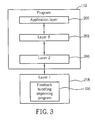
- FIG.3 is a schematic diagram of the program 112 shown in FIG.2 .
- the program 112 includes an application layer 200, a Layer 3 202, and a Layer 2 206, and is coupled to a Layer 1 218.
- the Layer 3 202 includes a Radio Resource Control (RRC) entity, and is utilized for realizing resource control.
- the Layer 2 206 includes a Radio Link Control (RLC) entity and a Medium Access Control (MAC) entity, and is utilized for realizing link control.
- the Layer 1 218 is utilized for realizing physical link.
- ACK/NACK bundling utilizes one ACK/NACK to complete HARQ feedbacks of multiple downlink packets, so as to solve problems resulted from asymmetric uplink/downlink transmission.
- DAI Downlink Assignment Index
- a PDCCH with Downlink Control Information (DCI) format 0 i.e. the PDCCH carrying an uplink grant
- DCI Downlink Control Information
- the embodiment of the present invention provides an feedback bundling improving program 220 in the program 112, for improving operation of ACK/NACK bundling when TDD UL/DL configuration is set to 0.
- FIG.4 is a schematic diagram of a process 40 according to an embodiment of the present invention.
- the process 40 is utilized for improving ACK/NACK bundling in a UE of the wireless communication system 10, and can be compiled into the feedback bundling improving program 220.
- the process 40 includes the following steps: Step 400: Start.
- Step 402 Receive an uplink grant allocated to an uplink sub-frame, the uplink sub-frame being utilized for transmitting an HARQ feedback corresponding to a plurality of downlink sub-frames, a TDD UL/DL configuration of the UE being set to 0.
- Step 404 Determine whether the UE misses any downlink assignment according to a DAI carried in a latest received PDCCH signaling for downlink assignment.
- Step 406 End.
- the UE receives an uplink grant allocated to an uplink sub-frame when TDD UL/DL configuration is 0.
- the uplink sub-frame is utilized for transmitting an HARQ feedback corresponding to a plurality of downlink sub-frames.
- the uplink sub-frame is a common sub-frame of ACK/NACK bundling
- the plurality of downlink sub-frames are a set of bundled sub-frames.
- the UE since the PDCCH for uplink grant received by the UE does not have a DAI (i.e. V_UL_DAI), the UE shall determine whether any downlink assignment is missing according to the DAI carried in the latest received PDCCH signaling for downlink assignment (i.e. V_DL_DAI). For example, if the parameter V_DL_DAI does not conform to the parameter U_DAI (i.e. V DAI DL ⁇ U DAI - 1 ⁇ mod ⁇ 4 + 1 ) , the UE determines at least one downlink assignment is missing, and shall transmit a NACK in the common sub-frame.
- the UE cannot determine a number of PDSCH transmissions within the bundled sub-frames according to the parameter V_UL_DAI.
- the embodiment of the present invention can only rely on a sum of the parameter U_DAI and the parameter N_SPS to determine whether the UE shall transmit ACK/NACK in the common sub-frame. If the sum of the parameter U_DAI and the parameter N_SPS is 0 (i.e. there is no PDSCH transmission within the bundled sub-frames), then the UE does not need to transmit ACK/NACK in the common sub-frame.
- definitions of the parameter V_UL_DAI, V_DL_DAI and the parameter U_DAI please refer to the prior art section, which is not narrated herein.
- the UE according to the embodiment of the present invention can correctly determine whether any downlink assignment is missing, so as to transmit ACK or NACK in the common sub-frame.
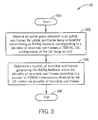
- FIG.5 is a schematic diagram of a process 50 according to an embodiment of the present invention.
- the process 50 is utilized for improving ACK/NACK bundling in a UE of the wireless communication system 10, and can be compiled into the feedback bundling improving program 220 as well.
- the process 50 includes the following steps: Step 500: Start.
- Step 504 Determine a number of downlink sub-frames generating the HARQ feedback within the plurality of downlink sub-frames according to a number of PDSCH transmissions detected by the UE within the plurality of downlink sub-frames.
- Step 506 End.
- the UE receives an uplink grant allocated to an uplink sub-frame when TDD UL/DL configuration is 0.
- the uplink sub-frame is utilized for transmitting an HARQ feedback corresponding to a plurality of downlink sub-frames.
- the uplink sub-frame is a common sub-frame of ACK/NACK bundling, and the plurality of downlink sub-frames are a set of corresponding bundled sub-frames.
- the UE determines a number of downlink sub-frames generating the HARQ feedback within the bundled sub-frames according to a number of PDSCH transmissions detected by the UE within the bundled sub-frames.
- the number of the PDSCH transmissions detected by the UE within the bundled sub-frames includes dynamic scheduled PDSCH transmissions (i.e. PDSCH transmissions with a corresponding PDCCH) and pre-defined PDSCH transmissions (i.e. PDSCH transmissions without a corresponding PDCCH), which are denoted by the parameter U_DAI and the parameter N_SPS, respectively.
- the embodiment of the present invention can only rely on the number of PDSCH transmissions detected by the UE within the bundled sub-frames (i.e. U_DAI and N_SPS) to determine the number of downlink sub-frames that generate the HARQ feedback within the bundled sub-frames (i.e. N_bundled). For example, in the embodiment of the present invention, the UE can set the number of downlink sub-frames generating the HARQ feedback within the bundled sub-frames as a sum of the parameter U_DAI and the parameter N_SPS.
- the UE according to the embodiment of the present invention can correctly determine the number of downlink sub-frames generating the HARQ feedback within the bundled sub-frames, so as to improve the operation of ACK/NACK bundling.
- FIG. 6 is a schematic diagram of a process 60 according to another embodiment of the present invention.
- the process 60 is utilized for improving ACK/NACK bundling in a UE of the wireless communication system 10, and can be compiled into the feedback bundling improving program 220.
- the process 60 includes the following steps: Step 600: Start.
- Step 602 Receive an uplink grant allocated to an uplink sub-frame, the uplink sub-frame being utilized for transmitting an HARQ feedback corresponding to a plurality of downlink sub-frames.
- Step 604 Determine whether a PDCCH carrying the uplink grant has a DAI.
- Step 606 Determine whether the UE misses any downlink assignment and a number of downlink sub-frames generating the HARQ feedback within the plurality of downlink sub-frames according to the DAI.
- Step 608 End.
- the UE first receives an uplink grant allocated to an uplink sub-frame.
- the uplink sub-frame is utilized for transmitting an HARQ feedback corresponding to a plurality of downlink sub-frames.
- the uplink sub-frame is a common sub-frame of ACK/NACK bundling, and the plurality of downlink sub-frames are a set of corresponding bundled sub-frames.
- the embodiment of the present invention determines whether a PDCCH carrying the uplink grant includes a DAI.
- the embodiment of the present invention determines whether any downlink assignment is missing and a number of downlink sub-frames generating the HARQ feedback within the bundled sub-frames according to the DAI indicated by the uplink grant.
- the uplink grant is determined to have the DAI if the TDD UL/DL configuration of the UE is set to 1-6. Therefore, when the TDD UL/DL configuration of the UE is set to 1-6, the UE can determine whether any downlink assignment is missing and the number of downlink sub-frames generating the HARQ feedback within the bundled sub-frames according to the DAI indicated by the uplink grant (i.e. V_UL_DAI).
- the UE utilizes the value of the parameter V_UL_DAI to determine whether any downlink assignment is missing and the number of downlink sub-frames generating the HARQ feedback within the bundled sub-frames (i.e. N_bundled) only when the TDD UL/DL configuration of the UE is set to 1-6.
- the embodiment of the present invention can prevent the UE from having false determination when the TDD UL/DL configuration of the UE is set to 0.
- the embodiment of the present invention provides a method for improving ACK/NACK bundling in a UE of a wireless communication system, for allowing the UE to correctly determine whether any downlink assignment is missing, so as to transmit ACK or NACK in the common sub-frame.
Landscapes
- Engineering & Computer Science (AREA)
- Signal Processing (AREA)
- Computer Networks & Wireless Communication (AREA)
- Mobile Radio Communication Systems (AREA)
- Time-Division Multiplex Systems (AREA)
- Detection And Prevention Of Errors In Transmission (AREA)
Abstract
Description
- This application claims the benefit of
U.S. Provisional Application No. 61/141,248, filed on December 30, 2008 - The present invention relates to a method and apparatus for improving acknowledgement/negative-acknowledgement (ACK/NACK) bundling, and more particularly, to a method and apparatus for improving ACK/NACK bundling in a user equipment (UE) of a wireless communication system to correctly determine whether any PDCCH downlink assignment is missing, such that ACK or NACK can be transmitted.
- Long Term Evolution wireless communications system (LTE system), an advanced high-speed wireless communications system established upon the 3G mobile telecommunications system, supports only packet-switched transmission, and tends to implement both Medium Access Control (MAC) layer and Radio Link Control (RLC) layer in one single communication site, such as in Node B alone rather than in Node B and RNC (Radio Network Controller) respectively, so that the system structure becomes simple.
- The LTE system supports Frequency Division Duplex (FDD) mode and Time Division Duplex (TDD) mode. The frame structure in the FDD mode is different from that in the TDD mode. In the FDD mode, a 10 ms long radio frame is divided into 10 sub-frames. Each sub-frame includes two slots, and each slot is 0.5 ms long. In the TDD mode, the 10 ms radio frame has two half-frames, each 5 ms long. Each half-frame includes four normal sub-frames and one special sub-frame, each 1 ms long. The special sub-frame includes three special slots: Downlink Pilot Time Slot (DwPTS), Guard Period (GP) and Uplink Pilot Time Slot (UpPTS). The DwPTS is used for transmitting downlink control signals, the UpPTS is used for transmitting uplink control signals, and the GP is a guard period between the DwPTS and the UpPTS. A total length of the three special slots is 1 ms long, and each length can be configured according to practical requirement of the network.
- Compared to the FDD mode, the TDD mode supports different time allocation for uplink and downlink. That is, a ratio of uplink transmission time and downlink transmission time may not be 1:1. The allocation for uplink and downlink sub-frames can be adjusted according to transmission service types, so as to meet asymmetric uplink/downlink transmission requirement. For example, according to current specifications, six allocation ratios for uplink and downlink sub-frames are defined in the TDD mode, and are controlled by TDD UL/DL configurations 0-6 indicated by a higher layer. As for related definition of the TDD UL/DL configurations and the corresponding allocation ratios for uplink and downlink sub-frames, please refer to related specifications, which are not narrated herein.
- For different TDD UL/DL configurations, the number of sub-frames for uplink transmission and downlink transmission are different. If the downlink sub-frames are more than the uplink sub-frames, feedbacks of multiple downlink transmissions can only be performed in one uplink sub-frame. In other words, a UE needs to transmit multiple ACK/NACKs corresponding to downlink packets being received in one uplink sub-frame, so as to support Hybrid Automatic Repeat reQuest (HARQ) operation. In this case, in order to reduce an amount of bits transmitted by the uplink sub-frame, a technique of ACK/NACK bundling is introduced in the prior art, which utilizes one ACK/NACK signal to complete HARQ feedbacks of multiple downlink packets being received, so as to solve the problem resulted from asymmetric uplink/downlink transmission. Please note that, in the following description, the uplink sub-frame for ACK/NACK transmission is called a common sub-frame, while a set of downlink sub-frames corresponding to the common sub-frame are called bundled sub-frames.
- Generally, ACK/NACK bundling generates the HARQ feedback in the common uplink sub-frame by performing a logical AND operation for the ACK/NACK bits of the downlink packets received within the bundled sub-frames. For example, if all the HARQ feedbacks of the downlink packets received within the bundled sub-frames are ACKs, the UE would transmit an ACK in the common uplink sub-frame, so as to acknowledge reception of all the received packets. On the contrary, if any HARQ feedback of the downlink packets received within the bundled sub-frames is a NACK, the UE would generate a NACK in the common uplink sub-frame to request retransmission of all the received packets.
- Besides, for each uplink sub-frame or downlink sub-frame, the UE shall monitor a Physical Downlink Control Channel (PDCCH) to detect whether there is any uplink grant or downlink assignment dynamically scheduled by the network, so as to perform a Physical Uplink Shared Channel (PUSCH) transmission in a corresponding uplink sub-frame or receive a Physical Downlink Shared Channel (PDSCH) transmission in a corresponding downlink sub-frame accordingly. Therefore, if a downlink assignment dynamically scheduled by the network is missed, since the UE does not know there is a downlink packet needed to be received in a corresponding downlink sub-frame, the UE would not generate a corresponding HARQ feedback as well. In this case, since the HARQ feedback transmitted in the common sub-frame are generated according to the HARQ feedbacks of the received packets, the network cannot know the UE fails to receive the downlink packet due to missing the downlink assignment. Therefore, the network would not perform any packet retransmission, causing the downlink packet is lost by the physical layer.
- In order to avoid packet loss due to a downlink assignment miss, the prior art adds a 2 bit Downlink Assignment Index (DAI) field in a PDCCH signaling. The DAI denotes a number of downlink assignments the UE shall receive, such that the UE can correctly transmit ACK or NACK by the ACK/NACK bundling.
- For different PDCCH formats, the DAI field has different meanings. For a PDCCH with Downlink Control Information (DCI) format 0, e.g. a PDCCH carrying an uplink grant allocated to the common sub-frame, the DAI field denotes a total number of downlink sub-frames with PDSCH transmissions within the bundled sub-frames, and is denoted by a parameter V_UL_DAI in the UE. In other words, the value of the parameter V_UL_DAI includes dynamic scheduled PDSCH transmissions (i.e. PDSCH transmission with corresponding PDCCH) and pre-defined PDSCH transmissions (i.e. PDSCH transmission without corresponding PDCCH), such as Semi-Persistent Scheduling (SPS) transmission.
- For a PDCCH with
DCI format - In addition, the UE maintains a parameter U_DAI and a parameter N_SPS. The parameter U_DAI records a number of dynamic scheduled PDSCH transmissions up to the current downlink sub-frame within the bundled sub-frames. The parameter N_SPS records a number of pre-defined PDSCH transmissions up to the current downlink sub-frame within the bundled sub-frames.
- Therefore, whenever the UE detects a PDCCH signaling, the UE can determine whether any downlink assignment is missing by comparing the DAI carried by the PDCCH signaling with the parameters U_DAI and N_SPS maintained by the UE itself. Besides, when the UE performs uplink transmission in the common sub-frame, the UE can further determine a number of downlink sub-frames that generate HARQ feedbacks within the bundled downlink sub-frames, which is denoted by a parameter N_bundled.
- Please note that the DAI field carried by PDCCH only has two bits. Therefore, in the current specifications, the parameter V_UL_DAI and V_DL_DAI are represented by values of 1-4. However, since the number of downlink sub-frames within the bundled sub-frames may be 0-9, a modulo operation is performed to correlate the parameter V_UL_DA I and V_DL_DAI with the number of downlink sub-frames. For example, the value "1" represents 1, 5 or 9 downlink sub-frames, the value "2" represents 2 or 6 downlink sub-frames, the value "3" represents 3 or 7 downlink sub-frames, and the value "4" represents 0, 4 or 8 downlink sub-frames.
- According to the current specifications, for the case that the UE does not perform uplink transmission in the common sub-frame, since the UE does not receive any uplink grant allocated to the common sub-frame, the UE can only rely on the DAI carried in the received PDCCH signaling for downlink assignment (i.e. V_DL_DAI) to determine whether any downlink assignment is missing. If the parameter V_DL_DAI does not conform to the parameter U_DAI, i.e.

- For the case that the UE performs uplink transmission in the common sub-frame and the uplink transmission is adjusted according to a PDCCH with DCI format 0 (i.e. the UE has received an uplink grant allocated to the common sub-frame by the network), the UE can determine whether any downlink assignment is missing according to the DAI carried in the received PDCCH signaling for uplink grant (i.e. V_UL_DAI). If the parameter V_UL_DAI does not conform to a sum of the parameter U_DAI and the parameter N_SPS, i.e.

- For the case that the UE performs uplink transmission in the common sub-frame and the uplink transmission is not adjusted according to a PDCCH with DCI format 0, i.e. the UE performs the PUSCH transmission according to a pre-defined uplink grant, the UE can only determine whether any downlink assignment is missing according to the DAI carried in the received PDCCH signaling for downlink assignment (i.e. V_DL_DAI) . If the parameter V_DL_DAI does not conform to the parameter U_DAI, i.e.

- However, according to the current specifications, for TDD UL/DL configuration 0, the PDCCH with DCI format 0 (i.e. the PDCCH carrying an uplink grant) does not have a DAI field. Therefore, for a scenario that TDD UL/DL configuration is 0 and the PDCCH with DCI format 0 is received, the UE can neither determine whether any downlink assignment is missing nor determine whether to transmit ACK/NACK in the common sub-frame. In addition, the UE cannot correctly set the number of downlink sub-frames that generate the HARQ feedbacks within the bundled sub-frames (i.e. N_bundled) as well.
- It is therefore an objective of the present invention to provide a method and apparatus for improving ACK/NACK bundling.
- The present invention discloses a method for improving ACK/NACK bundling in a user equipment (UE) of a wireless communication system. The method includes receiving an uplink (UL) grant allocated to an uplink sub-frame, the uplink sub-frame being utilized for transmitting a hybrid automatic repeat request (HARQ) feedback corresponding to a plurality of downlink (DL) sub-frames, a time division duplex (TDD ) UL/DL configuration of the UE being set to 0; and determining whether the UE misses any downlink assignment according to a downlink assignment index (DAI) carried in a latest received Physical Downlink Control Channel (PDCCH) signaling for downlink assignment.
- The present invention further discloses a communication device for improving acknowledgement/negative-acknowledgement (ACK/NACK) bundling in a user equipment (UE) of a wireless communication system. The communication device includes a processor, which is utilized for executing a program; and a storage device, which is coupled to the processor, and is utilized for storing the program. The program includes receiving an uplink (UL) grant allocated to an uplink sub-frame, the uplink sub-frame being utilized for transmitting a hybrid automatic repeat request (HARQ) feedback corresponding to a plurality of downlink (DL) sub-frames, a time division duplex (TDD ) UL/DL configuration of the UE being set to 0; and determining whether the UE misses any downlink assignment according to a downlink assignment index (DAI) carried in a latest received PDCCH signaling for downlink assignment.
- The present invention discloses a method for improving acknowledgement/negative-acknowledgement (ACK/NACK) bundling in a user equipment (UE) of a wireless communication system. The method includes receiving an uplink (UL) grant allocated to an uplink sub-frame, the uplink sub-frame being utilized for transmitting a hybrid automatic repeat request (HARQ) feedback corresponding to a plurality of downlink (DL) sub-frames, a time division duplex (TDD ) UL/DL configuration of the UE being set to 0; and determining a number of downlink sub-frames generating the HARQ feedback within the plurality of downlink sub-frames according to a number of PDSCH transmissions detected by the UE within the plurality of downlink sub-frames.
- The present invention further discloses a communication device for improving acknowledgement/negative-acknowledgement (ACK/NACK) bundling in a user equipment (UE) of a wireless communication system. The communication device includes a processor, which is utilized for executing a program; and a storage device, which is coupled to the processor, and is utilized for storing the program. The program includes receiving an uplink (UL) grant allocated to an uplink sub-frame, the uplink sub-frame being utilized for transmitting a hybrid automatic repeat request (HARQ) feedback corresponding to a plurality of downlink (DL) sub-frames, a time division duplex (TDD ) UL/DL configuration of the UE being set to 0; and determining a number of downlink sub-frames generating the HARQ feedback within the plurality of downlink sub-frames according to a number of PDSCH transmissions detected by the UE within the plurality of downlink sub-frames.
- The present invention discloses a method for improving acknowledgement/negative-acknowledgement (ACK/NACK) bundling in a user equipment (UE) of a wireless communication system. The method includes receiving an uplink (UL) grant allocated to an uplink sub-frame, the uplink sub-frame being utilized for transmitting a hybrid automatic repeat request (HARQ) feedback corresponding to a plurality of downlink (DL) sub-frames; determining whether a PDCCH carrying the uplink grant has a downlink assignment index (DAI) ; and determining whether the UE misses any downlink assignment and a number of downlink sub-frames generating the HARQ feedback within the plurality of downlink sub-frames according to the DAI.
- The present invention further discloses a communication device for improving acknowledgement/negative-acknowledgement (ACK/NACK) bundling in a user equipment (UE) of a wireless communication system. The communication device includes a processor, which is utilized for executing a program; and a storage device, which is coupled to the processor, and is utilized for storing the program. The program includes receiving an uplink (UL) grant allocated to an uplink sub-frame, the uplink sub-frame being utilized for transmitting a hybrid automatic repeat request (HARQ) feedback corresponding to a plurality of downlink (DL) sub-frames; determining whether a PDCCH carrying the uplink grant has a downlink assignment index (DAI); and determining whether the UE misses any downlink assignment and a number of downlink sub-frames generating the HARQ feedback within the plurality of downlink sub-frames according to the DAI.
These and other objectives of the present invention will no doubt become obvious to those of ordinary skill in the art after reading the following detailed description of the preferred embodiment that is illustrated in the various figures and drawings. -
-
FIG.1 is a schematic diagram of a wireless communications system. -
FIG.2 is a functional block diagram of a wireless communications device. -
FIG.3 is a schematic diagram of a program shown inFIG.2 . -
FIG.4 to FIG.6 is a schematic diagram of a process according to an embodiment of the present invention, respectively. - Please refer to
FIG. 1 , which is a schematic diagram of awireless communication system 10. Thewireless communications system 10 is preferred to be a Long Term Evolution (LTE) communications system, and is briefly formed with a network terminal and a plurality of user equipments (UEs). InFIG.1 , the network terminal and the UEs are simply utilized for illustrating the structure of thewireless communications system 10. Practically, the network terminal may include a plurality of evolved base stations (eNBs), an evolved UMTS radio access network (EUTRAN) and so on according to actual demands, and the UEs can be apparatuses such as mobile phones, computer systems, etc. - Please refer to
FIG.2 , which is a functional block diagram of awireless communications device 100. Thecommunications device 100 can be utilized for realizing the UEs inFIG.1 . For the sake of brevity,FIG.2 only shows aninput device 102, anoutput device 104, acontrol circuit 106, a central processing unit (CPU) 108, amemory 110, aprogram 112, and atransceiver 114 of thewireless communications device 100. In thecommunications device 100, thecontrol circuit 106 executes theprogram 112 in thememory 110 through theCPU 108, thereby controlling an operation of thecommunications device 100. Thecommunications device 100 can receive signals input by a user through theinput device 102, such as a keyboard, and can output images and sounds through theoutput device 104, such as a monitor or speakers. Thetransceiver 114 is used to receive and transmit wireless signals, delivering received signals to thecontrol circuit 106, and outputting signals generated by thecontrol circuit 106 wirelessly. From a perspective of a communications protocol framework, thetransceiver 114 can be seen as a portion ofLayer 1, and thecontrol circuit 106 can be utilized to realize functions ofLayer 2 andLayer 3. - Please continue to refer to
FIG.3 , which is a schematic diagram of theprogram 112 shown inFIG.2 . Theprogram 112 includes anapplication layer 200, aLayer 3 202, and aLayer 2 206, and is coupled to aLayer 1 218. TheLayer 3 202 includes a Radio Resource Control (RRC) entity, and is utilized for realizing resource control. TheLayer 2 206 includes a Radio Link Control (RLC) entity and a Medium Access Control (MAC) entity, and is utilized for realizing link control. TheLayer 1 218 is utilized for realizing physical link. - In LTE system, a technique of ACK/NACK bundling is introduced in a TDD mode. ACK/NACK bundling utilizes one ACK/NACK to complete HARQ feedbacks of multiple downlink packets, so as to solve problems resulted from asymmetric uplink/downlink transmission. Besides, in order to avoid packet loss due to missing a downlink assignment, a 2 bit Downlink Assignment Index (DAI) field is added into PDCCH signaling, for indicating a number of downlink assignments the UE shall receive, such that the UE can correctly transmit ACK or NACK by the ACK/NACK bundling.
- However, for TDD UL/DL configuration 0, a PDCCH with Downlink Control Information (DCI) format 0 (i.e. the PDCCH carrying an uplink grant) does not have a DAI field. Therefore, for a scenario that TDD UL/DL configuration is 0 and the PDCCH with DCI format 0 is received, the UE can neither determine whether any downlink assignment is missing nor determine whether to transmit ACK or NACK in a common sub-frame.
- In this case, the embodiment of the present invention provides an feedback
bundling improving program 220 in theprogram 112, for improving operation of ACK/NACK bundling when TDD UL/DL configuration is set to 0. Please refer toFIG.4 , which is a schematic diagram of aprocess 40 according to an embodiment of the present invention. Theprocess 40 is utilized for improving ACK/NACK bundling in a UE of thewireless communication system 10, and can be compiled into the feedbackbundling improving program 220. Theprocess 40 includes the following steps:Step 400: Start. Step 402: Receive an uplink grant allocated to an uplink sub-frame, the uplink sub-frame being utilized for transmitting an HARQ feedback corresponding to a plurality of downlink sub-frames, a TDD UL/DL configuration of the UE being set to 0. Step 404: Determine whether the UE misses any downlink assignment according to a DAI carried in a latest received PDCCH signaling for downlink assignment. Step 406: End. - According to the
process 40, the UE receives an uplink grant allocated to an uplink sub-frame when TDD UL/DL configuration is 0. The uplink sub-frame is utilized for transmitting an HARQ feedback corresponding to a plurality of downlink sub-frames. In other words, the uplink sub-frame is a common sub-frame of ACK/NACK bundling, and the plurality of downlink sub-frames are a set of bundled sub-frames. For TDD UL/DL configuration 0, since there is no DAI field in a PDCCH with DCI format 0, the UE according to the embodiment of the present invention determines whether any downlink assignment is missing according to the DAI carried in a latest received PDCCH signaling for downlink assignment. - In other words, for TDD UL/DL configuration 0, since the PDCCH for uplink grant received by the UE does not have a DAI (i.e. V_UL_DAI), the UE shall determine whether any downlink assignment is missing according to the DAI carried in the latest received PDCCH signaling for downlink assignment (i.e. V_DL_DAI). For example, if the parameter V_DL_DAI does not conform to the parameter U_DAI (i.e.

- Similarly, the UE cannot determine a number of PDSCH transmissions within the bundled sub-frames according to the parameter V_UL_DAI. In this case, the embodiment of the present invention can only rely on a sum of the parameter U_DAI and the parameter N_SPS to determine whether the UE shall transmit ACK/NACK in the common sub-frame. If the sum of the parameter U_DAI and the parameter N_SPS is 0 (i.e. there is no PDSCH transmission within the bundled sub-frames), then the UE does not need to transmit ACK/NACK in the common sub-frame. As for definitions of the parameter V_UL_DAI, V_DL_DAI and the parameter U_DAI, please refer to the prior art section, which is not narrated herein.
- As a result, the UE according to the embodiment of the present invention can correctly determine whether any downlink assignment is missing, so as to transmit ACK or NACK in the common sub-frame.
- Please refer
FIG.5 , which is a schematic diagram of aprocess 50 according to an embodiment of the present invention. Theprocess 50 is utilized for improving ACK/NACK bundling in a UE of thewireless communication system 10, and can be compiled into the feedbackbundling improving program 220 as well. Theprocess 50 includes the following steps:Step 500: Start. Step 502: Receive an uplink grant allocated to an uplink sub-frame, the uplink sub-frame being utilized for transmitting an HARQ feedback corresponding to a plurality of downlink sub-frames, a TDD UL/DL configuration of the UE being set to 0. Step 504: Determine a number of downlink sub-frames generating the HARQ feedback within the plurality of downlink sub-frames according to a number of PDSCH transmissions detected by the UE within the plurality of downlink sub-frames. Step 506: End. - According to the
process 50, the UE receives an uplink grant allocated to an uplink sub-frame when TDD UL/DL configuration is 0. The uplink sub-frame is utilized for transmitting an HARQ feedback corresponding to a plurality of downlink sub-frames. In other words, the uplink sub-frame is a common sub-frame of ACK/NACK bundling, and the plurality of downlink sub-frames are a set of corresponding bundled sub-frames. For TDD UL/DL configuration 0, since the PDCCH with DCI format 0 does not have a DAI field, the UE determines a number of downlink sub-frames generating the HARQ feedback within the bundled sub-frames according to a number of PDSCH transmissions detected by the UE within the bundled sub-frames. - The number of the PDSCH transmissions detected by the UE within the bundled sub-frames includes dynamic scheduled PDSCH transmissions (i.e. PDSCH transmissions with a corresponding PDCCH) and pre-defined PDSCH transmissions (i.e. PDSCH transmissions without a corresponding PDCCH), which are denoted by the parameter U_DAI and the parameter N_SPS, respectively.
- In a word, for TDD UL/DL configuration 0, since the PDCCH for uplink grant received by the UE does not have a DAI (i.e. V_UL_DAI), the embodiment of the present invention can only rely on the number of PDSCH transmissions detected by the UE within the bundled sub-frames (i.e. U_DAI and N_SPS) to determine the number of downlink sub-frames that generate the HARQ feedback within the bundled sub-frames (i.e. N_bundled). For example, in the embodiment of the present invention, the UE can set the number of downlink sub-frames generating the HARQ feedback within the bundled sub-frames as a sum of the parameter U_DAI and the parameter N_SPS.
- As a result, the UE according to the embodiment of the present invention can correctly determine the number of downlink sub-frames generating the HARQ feedback within the bundled sub-frames, so as to improve the operation of ACK/NACK bundling.
- Please refer to
FIG. 6 , which is a schematic diagram of aprocess 60 according to another embodiment of the present invention. Theprocess 60 is utilized for improving ACK/NACK bundling in a UE of thewireless communication system 10, and can be compiled into the feedbackbundling improving program 220. Theprocess 60 includes the following steps:Step 600: Start. Step 602: Receive an uplink grant allocated to an uplink sub-frame, the uplink sub-frame being utilized for transmitting an HARQ feedback corresponding to a plurality of downlink sub-frames. Step 604: Determine whether a PDCCH carrying the uplink grant has a DAI. Step 606: Determine whether the UE misses any downlink assignment and a number of downlink sub-frames generating the HARQ feedback within the plurality of downlink sub-frames according to the DAI. Step 608: End. - According to the
process 60, the UE first receives an uplink grant allocated to an uplink sub-frame. The uplink sub-frame is utilized for transmitting an HARQ feedback corresponding to a plurality of downlink sub-frames. In other words, the uplink sub-frame is a common sub-frame of ACK/NACK bundling, and the plurality of downlink sub-frames are a set of corresponding bundled sub-frames. Then, the embodiment of the present invention determines whether a PDCCH carrying the uplink grant includes a DAI. Finally, the embodiment of the present invention determines whether any downlink assignment is missing and a number of downlink sub-frames generating the HARQ feedback within the bundled sub-frames according to the DAI indicated by the uplink grant. - Preferably, in the embodiment of the present invention, the uplink grant is determined to have the DAI if the TDD UL/DL configuration of the UE is set to 1-6. Therefore, when the TDD UL/DL configuration of the UE is set to 1-6, the UE can determine whether any downlink assignment is missing and the number of downlink sub-frames generating the HARQ feedback within the bundled sub-frames according to the DAI indicated by the uplink grant (i.e. V_UL_DAI).
- In other words, the UE utilizes the value of the parameter V_UL_DAI to determine whether any downlink assignment is missing and the number of downlink sub-frames generating the HARQ feedback within the bundled sub-frames (i.e. N_bundled) only when the TDD UL/DL configuration of the UE is set to 1-6. As a result, the embodiment of the present invention can prevent the UE from having false determination when the TDD UL/DL configuration of the UE is set to 0.
- In summary, the embodiment of the present invention provides a method for improving ACK/NACK bundling in a UE of a wireless communication system, for allowing the UE to correctly determine whether any downlink assignment is missing, so as to transmit ACK or NACK in the common sub-frame.
- Those skilled in the art will readily observe that numerous modifications and alterations of the device and method may be made while retaining the teachings of the invention. Accordingly, the above disclosure should be construed as limited only by the metes and bounds of the appended claims.
Claims (15)
- A method for improving acknowledgement/negative-acknowledgement (ACK/NACK) bundling in a user equipment (UE) of a wireless communication system, the method comprising:receiving an uplink (UL) grant allocated to an uplink sub-frame, the uplink sub-frame being utilized for transmitting a hybrid automatic repeat request (HARQ) feedback corresponding to a plurality of downlink (DL) sub-frames, a time division duplex (TDD) UL/DL configuration of the UE being set to 0 (402); andcharacterized by determining whether the UE misses any downlink assignment according to a downlink assignment index (DAI) carried in a latest received Physical Downlink Control Channel (PDCCH) signaling for downlink assignment (404).
- The method of claim 1 further characterized by comprising:not transmitting the HARQ feedback in the uplink sub-frame if no Physical Downlink Shared Channel (PDSCH) transmission is performed within the plurality of downlink sub-frames.
- The method of claim 1 or 2, characterized in that the uplink grant is carried in a PDCCH signaling with Downlink Control Information (DCI) format 0.
- A communication device for improving acknowledgement/negative-acknowledgement (ACK/NACK) in a user equipment (UE) of a wireless communication system, the communication device comprising:a processor (108), for executing a program (112); anda storage device (110), coupled to the processor (108), for storing the program (112), wherein the program (112) is comprising:characterized by determining whether the UE misses any downlink assignment according to a downlink assignment index (DAI) carried in a latest received PDCCH signaling for downlink assignment.receiving an uplink (UL) grant allocated to an uplink sub-frame, the uplink sub-frame being utilized for transmitting a hybrid automatic repeat request (HARQ) feedback corresponding to a plurality of downlink (DL) sub-frames, a time division duplex (TDD) UL/DL configuration of the UE being set to 0; and
- The communication device of claim 4 further characterized by comprising:not transmitting the HARQ feedback in the uplink sub-frame if no Physical Downlink Shared Channel (PDSCH) transmission is performed within the plurality of downlink sub-frames.
- A method for improving acknowledgement/negative-acknowledgement (ACK/NACK) bundling in a user equipment (UE) of a wireless communication system, the method comprising:receiving an uplink (UL) grant allocated to an uplink sub-frame, the uplink sub-frame being utilized for transmitting a hybrid automatic repeat request (HARQ) feedback corresponding to a plurality of downlink (DL) sub-frames, a time division duplex (TDD) UL/DL configuration of the UE being set to 0 (502); andcharacterized by determining a number of downlink sub-frames generating the HARQ feedback within the plurality of downlink sub-frames according to a number of PDSCH transmissions detected by the UE within the plurality of downlink sub-frames (504).
- The method of claim 6, characterized in that the UE maintains a parameter U_DAI and a parameter N_SPS, the parameter U_DAI denoting number of PDSCH transmissions with a corresponding PDCCH within the plurality of downlink sub-frames, the parameter N_SPS denoting number of PDSCH transmissions without a corresponding PDCCH within the plurality of downlink sub-frames.
- The method of claim 7, characterized in that determining the number of the downlink sub-frames generating the HARQ feedback within the plurality of downlink sub-frames comprises:setting the number of downlink sub-frames generating the HARQ feedback within the plurality of downlink sub-frames as a sum of the parameter U_DAI and the parameter N_SPS.
- A communication device for improving acknowledgement/negative-acknowledgement (ACK/NACK) in a user equipment (UE) of a wireless communication system, the communication device comprising:a processor (108), for executing a program (112); anda storage device (110), coupled to the processor (108), for storing the program (112), wherein the program (112) is comprising:characterized by determining a number of downlink sub-frames generating the HARQ feedback within the plurality of downlink sub-frames according to a number of PDSCH transmissions detected by the UE within the plurality of downlink sub-frames.receiving an uplink (UL) grant allocated to an uplink sub-frame, the uplink sub-frame being utilized for transmitting a hybrid automatic repeat request (HARQ) feedback corresponding to a plurality of downlink (DL) sub-frames, a time division duplex (TDD) UL/DL configuration of the UE being set to 0; and
- The communication device of claim 9, characterized in that the UE maintains a parameter U_DAI and a parameter N_SPS, the parameter U_DAI denoting number of PDSCH transmissions with a corresponding PDCCH within the plurality of downlink sub-frames, the parameter N_SPS denoting number of PDSCH transmissions without a corresponding PDCCH within the plurality of downlink sub-frames.
- The communication device of claim 10, characterized in that the step of determining the number of the downlink sub-frames generating the HARQ feedback of the plurality of downlink sub-frames in the program comprises:setting the number of downlink sub-frames generating the HARQ feedback within the plurality of downlink sub-frames as a sum of the parameter U_DAI and the parameter N_SPS.
- A method for improving acknowledgement/negative-acknowledgement (ACK/NACK) bundling in a user equipment (UE) of a wireless communication system, the method comprising:receiving an uplink (UL) grant allocated to an uplink sub-frame, the uplink sub-frame being utilized for transmitting a hybrid automatic repeat request (HARQ) feedback corresponding to a plurality of downlink (DL) sub-frames (602);determining whether a PDCCH carrying the uplink grant has a downlink assignment index (DAI) (604); andcharacterized by determining whether the UE misses any downlink assignment and a number of downlink sub-frames generating the HARQ feedback within the plurality of downlink sub-frames according to the DAI (606).
- The method of claim 12, characterized in that the step of determining whether the PDCCH carrying the uplink grant has the DAI comprises:determining the PDCCH has the DAI only if a time division duplex (TDD) UL/DL configuration of the UE is set to 1-6.
- A communication device for improving acknowledgement/negative-acknowledgement (ACK/NACK) in a user equipment (UE) of a wireless communication system, the communication device comprising:a processor (108), for executing a program (112); anda storage device (110), coupled to the processor (108), for storing the program (112), wherein the program (112) is comprising:characterized by determining whether the UE misses any downlink assignment and a number of downlink sub-frames generating the HARQ feedback within the plurality of downlink sub-frames according to the DAI.receiving an uplink (UL) grant allocated to an uplink sub-frame, the uplink sub-frame being utilized for transmitting a hybrid automatic repeat request (HARQ) feedback corresponding to a plurality of downlink (DL) sub-frames;determining whether a PDCCH carrying the uplink grant has a downlink assignment index (DAI); and
- The communication device of claim 14, characterized in that the step of determining whether the PDCCH carrying the uplink grant has the DAI in the program comprises:determining the PDCCH has the DAI only if a time division duplex (TDD) UL/DL configuration of the UE is set to 1-6.
Priority Applications (1)
| Application Number | Priority Date | Filing Date | Title |
|---|---|---|---|
| EP17186893.8A EP3264661B1 (en) | 2008-12-30 | 2009-12-18 | Method and apparatus for improving ack/nack bundling |
Applications Claiming Priority (1)
| Application Number | Priority Date | Filing Date | Title |
|---|---|---|---|
| US14124808P | 2008-12-30 | 2008-12-30 |
Related Child Applications (2)
| Application Number | Title | Priority Date | Filing Date |
|---|---|---|---|
| EP17186893.8A Division EP3264661B1 (en) | 2008-12-30 | 2009-12-18 | Method and apparatus for improving ack/nack bundling |
| EP17186893.8A Division-Into EP3264661B1 (en) | 2008-12-30 | 2009-12-18 | Method and apparatus for improving ack/nack bundling |
Publications (2)
| Publication Number | Publication Date |
|---|---|
| EP2204937A1 true EP2204937A1 (en) | 2010-07-07 |
| EP2204937B1 EP2204937B1 (en) | 2018-03-28 |
Family
ID=42104728
Family Applications (2)
| Application Number | Title | Priority Date | Filing Date |
|---|---|---|---|
| EP17186893.8A Active EP3264661B1 (en) | 2008-12-30 | 2009-12-18 | Method and apparatus for improving ack/nack bundling |
| EP09015743.9A Active EP2204937B1 (en) | 2008-12-30 | 2009-12-18 | Method and apparatus for improving ACK/NACK bundling |
Family Applications Before (1)
| Application Number | Title | Priority Date | Filing Date |
|---|---|---|---|
| EP17186893.8A Active EP3264661B1 (en) | 2008-12-30 | 2009-12-18 | Method and apparatus for improving ack/nack bundling |
Country Status (7)
| Country | Link |
|---|---|
| US (1) | US8942142B2 (en) |
| EP (2) | EP3264661B1 (en) |
| JP (1) | JP5199223B2 (en) |
| KR (1) | KR101107287B1 (en) |
| CN (2) | CN101771513B (en) |
| ES (2) | ES2746935T3 (en) |
| TW (1) | TWI410075B (en) |
Cited By (12)
| Publication number | Priority date | Publication date | Assignee | Title |
|---|---|---|---|---|
| WO2010129810A3 (en) * | 2009-05-07 | 2011-02-03 | Qualcomm Incorporated | Multicarrier retransmission feedback |
| US20110243039A1 (en) * | 2010-03-31 | 2011-10-06 | Samsung Electronics Co., Ltd. | Indexing resources for transmission of acknowledgement signals in multi-cell tdd communication systems |
| WO2013005991A3 (en) * | 2011-07-05 | 2013-03-14 | 주식회사 팬택 | Method and apparatus for transmitting uplink control information in a time division duplex system |
| EP2606596A2 (en) * | 2010-08-16 | 2013-06-26 | Qualcomm Incorporated | Ack/nack transmission for multi-carrier operation with downlink assignment index |
| WO2013151263A1 (en) * | 2012-04-02 | 2013-10-10 | 엘지전자 주식회사 | Ack/nack transmission method in wireless access system and apparatus therefor |
| EP2704345A4 (en) * | 2011-04-29 | 2014-05-21 | China Academy Of Telecomm Tech | METHOD AND DEVICE FOR TRANSMITTING ACK / NACK RETURN INFORMATION |
| CN104868975A (en) * | 2011-03-31 | 2015-08-26 | 华为技术有限公司 | Subframe configuration method in time division duplex system, base station and user equipment |
| WO2016148835A1 (en) * | 2015-03-17 | 2016-09-22 | Motorola Mobility Llc | Method and apparatus for scheduling user equipment uplink transmissions on an unlicensed carrier |
| US9930654B2 (en) | 2015-03-17 | 2018-03-27 | Motorola Mobility Llc | Method and apparatus for scheduling user equipment uplink transmissions on an unlicensed carrier |
| US10051617B2 (en) | 2015-03-17 | 2018-08-14 | Motorola Mobility Llc | Method and apparatus for scheduling user equipment uplink transmissions on an unlicensed carrier |
| WO2019103905A1 (en) * | 2017-11-22 | 2019-05-31 | Qualcomm Incorporated | Techniques and apparatuses for using a downlink assignment index in new radio |
| EP3506542A1 (en) * | 2013-09-26 | 2019-07-03 | Qualcomm Incorporated | Method and apparatus for efficient usage of dai bits for eimta in lte |
Families Citing this family (59)
| Publication number | Priority date | Publication date | Assignee | Title |
|---|---|---|---|---|
| US8250425B2 (en) | 2008-08-15 | 2012-08-21 | Apple Inc. | Management of ARQ detection threshold in communication networks |
| JP5199223B2 (en) * | 2008-12-30 | 2013-05-15 | 創新音▲速▼股▲ふん▼有限公司 | Method and communication apparatus for improving ACK / NACK bundling |
| US8767632B2 (en) * | 2009-02-05 | 2014-07-01 | Motorola Mobility Llc | Method for uplink acknowledgement/non-acknowledgement messages in a wireless communication system |
| WO2010110513A1 (en) * | 2009-03-26 | 2010-09-30 | 엘지전자 주식회사 | Method for transmitting and receiving data in wireless communication system |
| US9350581B2 (en) * | 2009-06-02 | 2016-05-24 | Qualcomm Incorporated | Downlink assignment indicator design for multi-carrier wireless communication |
| JP5023123B2 (en) * | 2009-09-08 | 2012-09-12 | 株式会社エヌ・ティ・ティ・ドコモ | Radio base station and mobile communication method |
| US9184899B2 (en) * | 2009-10-14 | 2015-11-10 | Qualcomm Incorporated | Downlink association set for uplink ACK/NACK in time division duplex system |
| WO2011095061A1 (en) * | 2010-02-02 | 2011-08-11 | 中国移动通信集团公司 | Method and device for scheduling downlink subframes |
| WO2011105769A2 (en) * | 2010-02-23 | 2011-09-01 | 엘지전자 주식회사 | Method and device for transmitting uplink acknowledgement information in a wireless communication system supporting multiple carriers |
| KR101691480B1 (en) * | 2010-04-06 | 2017-01-09 | 삼성전자주식회사 | Method and apparatus for retransmitting packet in mobile communication system |
| WO2012005522A2 (en) * | 2010-07-07 | 2012-01-12 | 엘지전자 주식회사 | Method and apparatus for transmitting control information in a wireless communication system |
| CN102347823B (en) * | 2010-07-30 | 2014-06-04 | 电信科学技术研究院 | Merging feedback and instruction method, device and system for answer information |
| US9363804B2 (en) | 2010-10-21 | 2016-06-07 | Lg Electronics Inc. | Method for transmitting uplink signal and apparatus therefor |
| CN102468942A (en) * | 2010-11-01 | 2012-05-23 | 大唐移动通信设备有限公司 | Method and equipment for transmitting ACK/NACK feedback information |
| KR101875611B1 (en) * | 2010-11-22 | 2018-07-06 | 엘지전자 주식회사 | Method and apparatus for transmitting ack/nack for downlink transmission in a wireless communication system |
| ES2739053T3 (en) * | 2010-12-13 | 2020-01-28 | Lg Electronics Inc | ACK / NACK transmission procedure and apparatus in a TDD-based wireless communication system |
| KR101497851B1 (en) * | 2011-01-02 | 2015-03-02 | 엘지전자 주식회사 | Method and device for ack/nack transmission in tdd-based wireless communication system |
| CN102685872B (en) * | 2011-03-11 | 2015-01-21 | 华为技术有限公司 | Communication method and device for time division duplex system |
| KR101548067B1 (en) | 2011-03-21 | 2015-08-27 | 엘지전자 주식회사 | Method and device for executing harq in tdd-based wireless communication system |
| EP2690806B1 (en) * | 2011-03-24 | 2018-02-21 | LG Electronics Inc. | Method for transmitting/receiving signal and device therefor |
| KR20120123848A (en) * | 2011-05-02 | 2012-11-12 | 주식회사 팬택 | Apparatus and Method for Transmitting/Receiving ACK/NACK Information in Wireless Communication System |
| CN103493419B (en) * | 2011-05-17 | 2016-08-17 | Lg电子株式会社 | Method for sending control information and device used for the method |
| KR101975851B1 (en) * | 2011-05-31 | 2019-05-08 | 삼성전자주식회사 | Method and apparatus for transmitting ack/nack information |
| US8867501B2 (en) * | 2011-06-23 | 2014-10-21 | Qualcomm Incorporated | Multi-radio coexistence |
| WO2013002591A2 (en) | 2011-06-28 | 2013-01-03 | 엘지전자 주식회사 | Method for user equipment transreceiving signal in wireless communication system |
| WO2013022267A2 (en) * | 2011-08-10 | 2013-02-14 | 주식회사 팬택 | Apparatus and method for transmitting a control channel corresponding to multiple data channels |
| US8705556B2 (en) * | 2011-08-15 | 2014-04-22 | Blackberry Limited | Notifying a UL/DL configuration in LTE TDD systems |
| US8923274B2 (en) * | 2011-08-15 | 2014-12-30 | Blackberry Limited | Notifying a UL/DL configuration in LTE TDD systems |
| JP5747990B2 (en) | 2011-09-14 | 2015-07-15 | 富士通株式会社 | Wireless terminals and base stations |
| CN103036657B (en) * | 2011-09-30 | 2015-06-17 | 华为技术有限公司 | Method and device for data transmission |
| US9232517B2 (en) | 2011-10-04 | 2016-01-05 | Lg Electronics Inc. | Method for scheduling bundling in wireless access system and apparatus for same |
| KR20130073666A (en) * | 2011-12-23 | 2013-07-03 | 주식회사 팬택 | Pdsch a/n transmitting method of user equipment, user equipment, pdsch a/n receiving method of base station, and base station |
| US9137781B2 (en) * | 2012-01-06 | 2015-09-15 | Industrial Technology Research Institute | Method of handling hybrid automatic repeat request resources in wireless communication system |
| WO2013105837A1 (en) * | 2012-01-15 | 2013-07-18 | 엘지전자 주식회사 | Method and apparatus for transmitting control information in wireless communication system |
| KR102091598B1 (en) | 2012-01-15 | 2020-03-20 | 엘지전자 주식회사 | Method of transmitting control information and apparatus therefore |
| CN103313415B (en) * | 2012-03-16 | 2015-12-09 | 华为技术有限公司 | Schedule information acquisition methods, sending method and device |
| US9526091B2 (en) * | 2012-03-16 | 2016-12-20 | Intel Corporation | Method and apparatus for coordination of self-optimization functions in a wireless network |
| CN103368707B (en) * | 2012-03-26 | 2016-07-20 | 电信科学技术研究院 | A kind of method that realizes of HARQ feedback, uplink subframe allocation method and device |
| US9749094B2 (en) * | 2012-06-14 | 2017-08-29 | Sharp Kabushiki Kaisha | Devices for sending and receiving feedback information |
| US8958331B2 (en) | 2012-07-02 | 2015-02-17 | Intel Corporation | HARQ-ACK handling for unintended downlink sub-frames |
| CN104104468B (en) * | 2013-04-03 | 2018-09-11 | 电信科学技术研究院 | A kind of uplink-downlink configuration information transferring method and equipment |
| JP6369458B2 (en) | 2013-06-04 | 2018-08-08 | 日本電気株式会社 | DL scheduling and HARQ-ACK feedback for DL transmission in flexible-TDD system with and without cross-subframe scheduling |
| US20150333890A1 (en) * | 2014-05-16 | 2015-11-19 | Qualcomm Incorporated | Processing data grants and high speed data with a measurement gap |
| US10903943B2 (en) * | 2014-06-13 | 2021-01-26 | Apple Inc. | Enhanced LTE UL HARQ feedback indication for power saving and range improvement |
| CN105471553B (en) * | 2014-09-12 | 2020-05-05 | 中兴通讯股份有限公司 | A method and master node for realizing parallel multi-user data transmission |
| EP3627750B1 (en) | 2015-01-20 | 2022-04-13 | LG Electronics Inc. | Method for transmitting uplink control information and apparatus therefor |
| US10333656B2 (en) * | 2015-05-14 | 2019-06-25 | Cable Television Laboratories, Inc. | Uplink channel reservation with conflicting wireless communications |
| EP3346773B1 (en) * | 2015-09-01 | 2025-07-02 | NTT DoCoMo, Inc. | User terminal, wireless base station, and wireless communication method |
| EP3361804B1 (en) * | 2016-02-04 | 2021-05-19 | Guangdong Oppo Mobile Telecommunications Corp., Ltd. | Method and device for transmitting uplink information on unlicensed carrier |
| DE112016007007T5 (en) | 2016-06-22 | 2019-03-07 | Intel Corporation | COMMUNICATION DEVICE AND METHOD FOR FULL DUPLEX DISPOSITION |
| CN108282881B (en) * | 2017-01-06 | 2020-12-15 | 华为技术有限公司 | A resource allocation method and device |
| US10985877B2 (en) | 2017-11-16 | 2021-04-20 | Sharp Kabushiki Kaisha | Codebook determination of HARQ-ACK multiplexing with fallback downlink control information (DCI) and code block group (CBG) configurations |
| WO2019099569A1 (en) * | 2017-11-16 | 2019-05-23 | Sharp Laboratories Of America, Inc. | Codebook determination of harq-ack multiplexing with fallback downlink control information (dci) and code block group (cbg) configurations |
| US11032051B2 (en) * | 2018-01-12 | 2021-06-08 | Mediatek Singapore Pte. Ltd. | Method and apparatus for reducing uplink overhead in mobile communications |
| WO2020060372A1 (en) * | 2018-09-21 | 2020-03-26 | 엘지전자 주식회사 | Method and apparatus for transmitting and receiving wireless signals in wireless communication system |
| CN110943805B (en) * | 2018-09-21 | 2021-06-04 | 电信科学技术研究院有限公司 | HARQ-ACK transmission method, terminal equipment and network equipment |
| EP4510481A3 (en) | 2019-05-02 | 2025-05-07 | Wilus Institute of Standards and Technology Inc. | Method, device, and system for downlink data reception and harq-ack transmission in wireless communication system |
| US12349127B2 (en) | 2019-08-17 | 2025-07-01 | Wilus Institute Of Standards And Technology Inc. | Method, device, and system for transmitting or receiving physical uplink shared channel (PUSCH) in wireless communication system |
| CN119728033A (en) * | 2020-04-10 | 2025-03-28 | 中兴通讯股份有限公司 | HARQ-ACK codebook generation method |
Family Cites Families (29)
| Publication number | Priority date | Publication date | Assignee | Title |
|---|---|---|---|---|
| KR100818243B1 (en) * | 2004-02-07 | 2008-04-02 | 포스데이타 주식회사 | Methods for multi-carrier communication systems with automatic repeat request |
| US8014264B2 (en) * | 2004-05-01 | 2011-09-06 | Neocific, Inc. | Methods and apparatus for communication with time-division duplexing |
| WO2007109256A2 (en) * | 2006-03-21 | 2007-09-27 | Interdigital Technology Corporation | Method and system for implementing hybrid automatic repeat request |
| JP5207416B2 (en) * | 2007-06-22 | 2013-06-12 | アルカテル−ルーセント | Method and system for data retransmission in MBMS |
| WO2009044367A2 (en) * | 2007-10-02 | 2009-04-09 | Nokia Siemens Networks Oy | Improved ack/nack dtx detection |
| TW200931869A (en) * | 2007-12-31 | 2009-07-16 | Interdigital Patent Holdings | Method and apparatus for handling interactions between measurement gap, automated repeat request, discontinuous reception and discontinuous transmission in wireless communications |
| CN101227739B (en) * | 2008-02-02 | 2011-12-07 | 中兴通讯股份有限公司 | Distribution method of physics commingle retransmission indicating channel resource |
| KR20090093800A (en) * | 2008-02-29 | 2009-09-02 | 엘지전자 주식회사 | Method of transmitting ACK/NACK signal in wireless communication system |
| KR100905385B1 (en) * | 2008-03-16 | 2009-06-30 | 엘지전자 주식회사 | Efficient Transmission Method of Control Signal in Wireless Communication System |
| JP5721443B2 (en) * | 2008-03-16 | 2015-05-20 | エルジー エレクトロニクス インコーポレイティド | HARQ execution method in wireless communication system |
| WO2009120701A2 (en) * | 2008-03-24 | 2009-10-01 | Zte U.S.A., Inc. | Dynamic adjustment and signaling of downlink/uplink allocation ratio in lte/tdd systems |
| US8942080B2 (en) * | 2008-04-17 | 2015-01-27 | Texas Instruments Incorporated | Transmission of bundled ACK/NAK bits |
| EP2294744B1 (en) * | 2008-04-28 | 2018-01-10 | Optis Wireless Technology, LLC | Method and arrangement in a telecommunication system with signalling of assigned data packets in a bundling window |
| HUE042915T2 (en) * | 2008-06-23 | 2019-07-29 | Beijing Xiaomi Mobile Software Co Ltd | Method and apparatus for providing acknowledgment bundling |
| WO2009156441A2 (en) * | 2008-06-24 | 2009-12-30 | Nokia Siemens Networks Oy | Control channel signaling for multiple ack/nack indications |
| WO2009156838A1 (en) * | 2008-06-25 | 2009-12-30 | Nokia Corporation | Physical uplink control channel ack/nack indexing |
| CN104158637B (en) * | 2008-06-30 | 2017-10-27 | 爱立信电话股份有限公司 | Method and arrangement in telecommunication system |
| US20100150081A1 (en) * | 2008-06-30 | 2010-06-17 | Nokia Corporation | Physical upling control channel compression supporting ack/nack bundling |
| US8331215B2 (en) * | 2008-07-14 | 2012-12-11 | Texas Instruements Incorporated | Concurrent transmission of multiple acknowledge/not acknowledge and scheduling request indicator in time division duplex uplink signaling |
| US20110141952A1 (en) * | 2008-08-11 | 2011-06-16 | Nokia Corporation | Method and apparatus for providing bundled transmissions |
| US8873522B2 (en) * | 2008-08-11 | 2014-10-28 | Qualcomm Incorporated | Processing measurement gaps in a wireless communication system |
| PL2314008T3 (en) * | 2008-08-12 | 2014-05-30 | Ericsson Telefon Ab L M | Method and arrangement in a communication system |
| TWI405445B (en) * | 2008-08-15 | 2013-08-11 | Innovative Sonic Ltd | Method and apparatus of handling tti bundling |
| EP2352266A4 (en) * | 2008-10-29 | 2016-03-23 | Lg Electronics Inc | METHOD FOR EFFICIENTLY TRANSMITTING A PHYSICAL CHANNEL IN A MULTI-CARRIER AGGREGATION STATE TO A WIDE SUPPORT STRIP |
| US8687619B2 (en) * | 2008-11-04 | 2014-04-01 | Telefonaktiebolaget Lm Ericsson (Publ) | System and method of downlinking data to an unsynchronized user equipment in a telecommunications network |
| EP2363971A3 (en) * | 2008-11-06 | 2011-09-28 | HTC Corporation | Method and apparatus for improving uplink transmission of transmission time interval bundling in a wireless communication system |
| US8929282B2 (en) * | 2008-11-06 | 2015-01-06 | Htc Corporation | Method and apparatus for TTI bundling transmission in a wireless communications system |
| US8824423B2 (en) * | 2008-12-10 | 2014-09-02 | Htc Corporation | Method and apparatus for improving a hybrid automatic repeat request procedure in the transition of transmission time interval bundling in a wireless communication system |
| JP5199223B2 (en) * | 2008-12-30 | 2013-05-15 | 創新音▲速▼股▲ふん▼有限公司 | Method and communication apparatus for improving ACK / NACK bundling |
-
2009
- 2009-12-04 JP JP2009277029A patent/JP5199223B2/en active Active
- 2009-12-18 EP EP17186893.8A patent/EP3264661B1/en active Active
- 2009-12-18 ES ES17186893T patent/ES2746935T3/en active Active
- 2009-12-18 ES ES09015743.9T patent/ES2674712T3/en active Active
- 2009-12-18 EP EP09015743.9A patent/EP2204937B1/en active Active
- 2009-12-24 US US12/646,988 patent/US8942142B2/en active Active
- 2009-12-30 CN CN200910266215.7A patent/CN101771513B/en active Active
- 2009-12-30 CN CN201410421923.4A patent/CN104219033A/en active Pending
- 2009-12-30 KR KR1020090134635A patent/KR101107287B1/en active Active
- 2009-12-30 TW TW098145954A patent/TWI410075B/en active
Non-Patent Citations (3)
| Title |
|---|
| "3GPP TS 36.213 v8.5.0 (2008-12) 3rd Generation Partnership Project; Technical Specification Group Radio Access Network; Evolved Universal Terrestrial Radio Access (E-UTRA); Physical layer procedures (Release 8)", 3RD GENERATION PARTNERSHIP PROJECT (3GPP); TECHNICALSPECIFICATION (TS), XX, XX, vol. 36.213, no. TS 36.213 V8.5.0, 1 December 2008 (2008-12-01), pages 1 - 16, XP002572343, Retrieved from the Internet <URL:http://www.3gpp.org/ftp/Specs/archive/36_series/36.213/> [retrieved on 20100225] * |
| HUAWEI: "Consideration on ACK/NACK bundling and Multi-ACK/NACK multiplexing in TDD", 3RD GENERATION PARTNERSHIP PROJECT (3GPP); TECHNICALSPECIFICATION GROUP (TSG) RADIO ACCESS NETWORK (RAN); WORKINGGROUP 1 (WG1), XX, XX, vol. RAN WG1, no. Kansas City, USA; 20080514, 28 April 2008 (2008-04-28), pages 1 - 5, XP002549272, Retrieved from the Internet <URL:http://list.etsi.org/scripts/wa.exe?A2=ind0804&L=3gpp_tsg_ran_wg1&T=0 &o=A&P=72724> [retrieved on 20091008] * |
| TEXAS INSTRUMENTS: "ACK/NAK DTX Detection with ACK/NAK Bundling in TDD", 3RD GENERATION PARTNERSHIP PROJECT (3GPP); TECHNICALSPECIFICATION GROUP (TSG) RADIO ACCESS NETWORK (RAN); WORKINGGROUP 1 (WG1), XX, XX, vol. RAN WG1, no. Kansas City, USA; 20080514, 29 April 2008 (2008-04-29), pages 1 - 7, XP002549274, Retrieved from the Internet <URL:http://list.etsi.org/scripts/wa.exe?A2=ind0804&L=3gpp_tsg_ran_wg1&T=0 &O=D&p=76969> [retrieved on 20091008] * |
Cited By (29)
| Publication number | Priority date | Publication date | Assignee | Title |
|---|---|---|---|---|
| US8885479B2 (en) | 2009-05-07 | 2014-11-11 | Qualcomm Incorporated | Multicarrier retransmission feedback |
| WO2010129810A3 (en) * | 2009-05-07 | 2011-02-03 | Qualcomm Incorporated | Multicarrier retransmission feedback |
| US20110243039A1 (en) * | 2010-03-31 | 2011-10-06 | Samsung Electronics Co., Ltd. | Indexing resources for transmission of acknowledgement signals in multi-cell tdd communication systems |
| US9510366B2 (en) | 2010-03-31 | 2016-11-29 | Samsung Electronics Co., Ltd | Indexing resources for transmission of acknowledgement signals in multi-cell TDD communication systems |
| US11129166B2 (en) | 2010-03-31 | 2021-09-21 | Samsung Electronics Co., Ltd | Indexing resources for transmission of acknowledgement signals in multi-cell TDD communication systems |
| US8644199B2 (en) * | 2010-03-31 | 2014-02-04 | Samsung Electronics Co., Ltd | Indexing resources for transmission of acknowledgement signals in multi-cell TDD communication systems |
| US10194444B2 (en) | 2010-03-31 | 2019-01-29 | Samsung Electronics Co., Ltd | Indexing resources for transmission of acknowledgement signals in multi-cell TDD communication systems |
| US20140153492A1 (en) * | 2010-03-31 | 2014-06-05 | Samsung Electronics Co., Ltd. | Indexing resources for transmission of acknowledgement signals in multi-cell tdd communication systems |
| EP2606596A2 (en) * | 2010-08-16 | 2013-06-26 | Qualcomm Incorporated | Ack/nack transmission for multi-carrier operation with downlink assignment index |
| CN104868975A (en) * | 2011-03-31 | 2015-08-26 | 华为技术有限公司 | Subframe configuration method in time division duplex system, base station and user equipment |
| CN104868975B (en) * | 2011-03-31 | 2019-07-19 | 华为技术有限公司 | Method, base station and the user equipment of subframe in time-division duplex system configuration |
| US10251168B2 (en) | 2011-03-31 | 2019-04-02 | Huawei Technologies Co., Ltd. | Method, base station and user equipment for subframe configuration in time division duplex system |
| US10681689B2 (en) | 2011-03-31 | 2020-06-09 | Huawei Technologies Co., Ltd. | Method, base station and user equipment for subframe configuration in time division duplex system |
| US9241342B2 (en) | 2011-04-29 | 2016-01-19 | China Academy Of Telecommunications Technology | Method and apparatus for ACK/NACK transmission |
| EP2704345A4 (en) * | 2011-04-29 | 2014-05-21 | China Academy Of Telecomm Tech | METHOD AND DEVICE FOR TRANSMITTING ACK / NACK RETURN INFORMATION |
| WO2013005991A3 (en) * | 2011-07-05 | 2013-03-14 | 주식회사 팬택 | Method and apparatus for transmitting uplink control information in a time division duplex system |
| US9602263B2 (en) | 2012-04-02 | 2017-03-21 | Lg Electronics Inc. | ACK/NACK transmission method in wireless access system and apparatus therefor |
| WO2013151263A1 (en) * | 2012-04-02 | 2013-10-10 | 엘지전자 주식회사 | Ack/nack transmission method in wireless access system and apparatus therefor |
| US10999822B2 (en) | 2013-09-26 | 2021-05-04 | Qualcomm Incorporated | Method and apparatus for efficient usage of DAI bits for eIMTA in LTE |
| KR20200019785A (en) * | 2013-09-26 | 2020-02-24 | 퀄컴 인코포레이티드 | METHOD AND APPARATUS FOR EFFICIENT USAGE OF DAI BITS FOR eIMTA IN LTE |
| EP3506542A1 (en) * | 2013-09-26 | 2019-07-03 | Qualcomm Incorporated | Method and apparatus for efficient usage of dai bits for eimta in lte |
| US9930654B2 (en) | 2015-03-17 | 2018-03-27 | Motorola Mobility Llc | Method and apparatus for scheduling user equipment uplink transmissions on an unlicensed carrier |
| US10349397B2 (en) | 2015-03-17 | 2019-07-09 | Motorola Mobility Llc | Method and apparatus for scheduling user equipment uplink transmissions on an unlicensed carrier |
| US10299262B2 (en) | 2015-03-17 | 2019-05-21 | Motorola Mobility Llc | Method and apparatus for scheduling user equipment uplink transmissions on an unlicensed carrier |
| US10051617B2 (en) | 2015-03-17 | 2018-08-14 | Motorola Mobility Llc | Method and apparatus for scheduling user equipment uplink transmissions on an unlicensed carrier |
| WO2016148835A1 (en) * | 2015-03-17 | 2016-09-22 | Motorola Mobility Llc | Method and apparatus for scheduling user equipment uplink transmissions on an unlicensed carrier |
| USRE49791E1 (en) | 2015-03-17 | 2024-01-02 | Motorola Mobility Llc | Method and apparatus for scheduling user equipment uplink transmissions on an unlicensed carrier |
| WO2019103905A1 (en) * | 2017-11-22 | 2019-05-31 | Qualcomm Incorporated | Techniques and apparatuses for using a downlink assignment index in new radio |
| US10757706B2 (en) | 2017-11-22 | 2020-08-25 | Qualcomm Incorporated | Techniques and apparatuses for using a downlink assignment index in new radio |
Also Published As
| Publication number | Publication date |
|---|---|
| JP2010158000A (en) | 2010-07-15 |
| KR20100080483A (en) | 2010-07-08 |
| EP3264661A1 (en) | 2018-01-03 |
| ES2674712T3 (en) | 2018-07-03 |
| ES2746935T3 (en) | 2020-03-09 |
| TW201025914A (en) | 2010-07-01 |
| TWI410075B (en) | 2013-09-21 |
| CN101771513A (en) | 2010-07-07 |
| US8942142B2 (en) | 2015-01-27 |
| US20100165939A1 (en) | 2010-07-01 |
| EP2204937B1 (en) | 2018-03-28 |
| JP5199223B2 (en) | 2013-05-15 |
| KR101107287B1 (en) | 2012-01-20 |
| EP3264661B1 (en) | 2019-06-26 |
| CN101771513B (en) | 2014-09-24 |
| CN104219033A (en) | 2014-12-17 |
Similar Documents
| Publication | Publication Date | Title |
|---|---|---|
| EP3264661B1 (en) | Method and apparatus for improving ack/nack bundling | |
| US10630451B2 (en) | Sending and receiving acknowledgement information of semi-persistent scheduling data packets | |
| US12003336B2 (en) | HARQ-ACK information feedback method and apparatus | |
| US9461780B2 (en) | Method and apparatus for transmitting hybrid automatic repeat request acknowledgement information | |
| US10721759B2 (en) | Method for transmitting uplink data, user equipment, and base station | |
| JP6194422B2 (en) | Method for transmitting uplink control information, user apparatus and base station | |
| US20160337110A1 (en) | Resource management method and device and computer storage medium | |
| US10757701B2 (en) | Physical uplink shared channel data transmission method and device | |
| US10027444B2 (en) | Method and device for response information transmission, terminal, base station and storage medium | |
| EP3331305B1 (en) | Uplink data transmission method and device | |
| US20190260520A1 (en) | Message transmission method, user device, base station, and computer storage medium | |
| KR20130143531A (en) | A method and an apparatus for uplink scheduling in wireless communication system | |
| US10827517B2 (en) | Transmission method, mobile communication terminal, and network side device | |
| CN104468065A (en) | User equipment, node equipment and method for determining uplink timing relationship |
Legal Events
| Date | Code | Title | Description |
|---|---|---|---|
| PUAI | Public reference made under article 153(3) epc to a published international application that has entered the european phase |
Free format text: ORIGINAL CODE: 0009012 |
|
| 17P | Request for examination filed |
Effective date: 20091218 |
|
| AK | Designated contracting states |
Kind code of ref document: A1 Designated state(s): AT BE BG CH CY CZ DE DK EE ES FI FR GB GR HR HU IE IS IT LI LT LU LV MC MK MT NL NO PL PT RO SE SI SK SM TR |
|
| AX | Request for extension of the european patent |
Extension state: AL BA RS |
|
| 17Q | First examination report despatched |
Effective date: 20111215 |
|
| RAP1 | Party data changed (applicant data changed or rights of an application transferred) |
Owner name: INNOVATIVE SONIC LIMITED |
|
| GRAP | Despatch of communication of intention to grant a patent |
Free format text: ORIGINAL CODE: EPIDOSNIGR1 |
|
| INTG | Intention to grant announced |
Effective date: 20171018 |
|
| GRAS | Grant fee paid |
Free format text: ORIGINAL CODE: EPIDOSNIGR3 |
|
| GRAA | (expected) grant |
Free format text: ORIGINAL CODE: 0009210 |
|
| AK | Designated contracting states |
Kind code of ref document: B1 Designated state(s): AT BE BG CH CY CZ DE DK EE ES FI FR GB GR HR HU IE IS IT LI LT LU LV MC MK MT NL NO PL PT RO SE SI SK SM TR |
|
| REG | Reference to a national code |
Ref country code: GB Ref legal event code: FG4D |
|
| REG | Reference to a national code |
Ref country code: CH Ref legal event code: EP |
|
| REG | Reference to a national code |
Ref country code: AT Ref legal event code: REF Ref document number: 984334 Country of ref document: AT Kind code of ref document: T Effective date: 20180415 |
|
| REG | Reference to a national code |
Ref country code: IE Ref legal event code: FG4D |
|
| REG | Reference to a national code |
Ref country code: DE Ref legal event code: R096 Ref document number: 602009051451 Country of ref document: DE |
|
| REG | Reference to a national code |
Ref country code: ES Ref legal event code: FG2A Ref document number: 2674712 Country of ref document: ES Kind code of ref document: T3 Effective date: 20180703 |
|
| REG | Reference to a national code |
Ref country code: NL Ref legal event code: FP |
|
| PG25 | Lapsed in a contracting state [announced via postgrant information from national office to epo] |
Ref country code: LT Free format text: LAPSE BECAUSE OF FAILURE TO SUBMIT A TRANSLATION OF THE DESCRIPTION OR TO PAY THE FEE WITHIN THE PRESCRIBED TIME-LIMIT Effective date: 20180328 Ref country code: HR Free format text: LAPSE BECAUSE OF FAILURE TO SUBMIT A TRANSLATION OF THE DESCRIPTION OR TO PAY THE FEE WITHIN THE PRESCRIBED TIME-LIMIT Effective date: 20180328 Ref country code: FI Free format text: LAPSE BECAUSE OF FAILURE TO SUBMIT A TRANSLATION OF THE DESCRIPTION OR TO PAY THE FEE WITHIN THE PRESCRIBED TIME-LIMIT Effective date: 20180328 Ref country code: NO Free format text: LAPSE BECAUSE OF FAILURE TO SUBMIT A TRANSLATION OF THE DESCRIPTION OR TO PAY THE FEE WITHIN THE PRESCRIBED TIME-LIMIT Effective date: 20180628 |
|
| REG | Reference to a national code |
Ref country code: LT Ref legal event code: MG4D |
|
| PG25 | Lapsed in a contracting state [announced via postgrant information from national office to epo] |
Ref country code: BG Free format text: LAPSE BECAUSE OF FAILURE TO SUBMIT A TRANSLATION OF THE DESCRIPTION OR TO PAY THE FEE WITHIN THE PRESCRIBED TIME-LIMIT Effective date: 20180628 Ref country code: GR Free format text: LAPSE BECAUSE OF FAILURE TO SUBMIT A TRANSLATION OF THE DESCRIPTION OR TO PAY THE FEE WITHIN THE PRESCRIBED TIME-LIMIT Effective date: 20180629 Ref country code: LV Free format text: LAPSE BECAUSE OF FAILURE TO SUBMIT A TRANSLATION OF THE DESCRIPTION OR TO PAY THE FEE WITHIN THE PRESCRIBED TIME-LIMIT Effective date: 20180328 Ref country code: SE Free format text: LAPSE BECAUSE OF FAILURE TO SUBMIT A TRANSLATION OF THE DESCRIPTION OR TO PAY THE FEE WITHIN THE PRESCRIBED TIME-LIMIT Effective date: 20180328 |
|
| PG25 | Lapsed in a contracting state [announced via postgrant information from national office to epo] |
Ref country code: RO Free format text: LAPSE BECAUSE OF FAILURE TO SUBMIT A TRANSLATION OF THE DESCRIPTION OR TO PAY THE FEE WITHIN THE PRESCRIBED TIME-LIMIT Effective date: 20180328 Ref country code: PL Free format text: LAPSE BECAUSE OF FAILURE TO SUBMIT A TRANSLATION OF THE DESCRIPTION OR TO PAY THE FEE WITHIN THE PRESCRIBED TIME-LIMIT Effective date: 20180328 Ref country code: EE Free format text: LAPSE BECAUSE OF FAILURE TO SUBMIT A TRANSLATION OF THE DESCRIPTION OR TO PAY THE FEE WITHIN THE PRESCRIBED TIME-LIMIT Effective date: 20180328 |
|
| PG25 | Lapsed in a contracting state [announced via postgrant information from national office to epo] |
Ref country code: SM Free format text: LAPSE BECAUSE OF FAILURE TO SUBMIT A TRANSLATION OF THE DESCRIPTION OR TO PAY THE FEE WITHIN THE PRESCRIBED TIME-LIMIT Effective date: 20180328 Ref country code: SK Free format text: LAPSE BECAUSE OF FAILURE TO SUBMIT A TRANSLATION OF THE DESCRIPTION OR TO PAY THE FEE WITHIN THE PRESCRIBED TIME-LIMIT Effective date: 20180328 Ref country code: CZ Free format text: LAPSE BECAUSE OF FAILURE TO SUBMIT A TRANSLATION OF THE DESCRIPTION OR TO PAY THE FEE WITHIN THE PRESCRIBED TIME-LIMIT Effective date: 20180328 |
|
| REG | Reference to a national code |
Ref country code: AT Ref legal event code: MK05 Ref document number: 984334 Country of ref document: AT Kind code of ref document: T Effective date: 20180328 |
|
| PG25 | Lapsed in a contracting state [announced via postgrant information from national office to epo] |
Ref country code: PT Free format text: LAPSE BECAUSE OF FAILURE TO SUBMIT A TRANSLATION OF THE DESCRIPTION OR TO PAY THE FEE WITHIN THE PRESCRIBED TIME-LIMIT Effective date: 20180730 |
|
| REG | Reference to a national code |
Ref country code: DE Ref legal event code: R097 Ref document number: 602009051451 Country of ref document: DE |
|
| PG25 | Lapsed in a contracting state [announced via postgrant information from national office to epo] |
Ref country code: DK Free format text: LAPSE BECAUSE OF FAILURE TO SUBMIT A TRANSLATION OF THE DESCRIPTION OR TO PAY THE FEE WITHIN THE PRESCRIBED TIME-LIMIT Effective date: 20180328 Ref country code: AT Free format text: LAPSE BECAUSE OF FAILURE TO SUBMIT A TRANSLATION OF THE DESCRIPTION OR TO PAY THE FEE WITHIN THE PRESCRIBED TIME-LIMIT Effective date: 20180328 |
|
| PLBE | No opposition filed within time limit |
Free format text: ORIGINAL CODE: 0009261 |
|
| STAA | Information on the status of an ep patent application or granted ep patent |
Free format text: STATUS: NO OPPOSITION FILED WITHIN TIME LIMIT |
|
| 26N | No opposition filed |
Effective date: 20190103 |
|
| PG25 | Lapsed in a contracting state [announced via postgrant information from national office to epo] |
Ref country code: SI Free format text: LAPSE BECAUSE OF FAILURE TO SUBMIT A TRANSLATION OF THE DESCRIPTION OR TO PAY THE FEE WITHIN THE PRESCRIBED TIME-LIMIT Effective date: 20180328 |
|
| REG | Reference to a national code |
Ref country code: CH Ref legal event code: PL |
|
| PG25 | Lapsed in a contracting state [announced via postgrant information from national office to epo] |
Ref country code: LU Free format text: LAPSE BECAUSE OF NON-PAYMENT OF DUE FEES Effective date: 20181218 Ref country code: MC Free format text: LAPSE BECAUSE OF FAILURE TO SUBMIT A TRANSLATION OF THE DESCRIPTION OR TO PAY THE FEE WITHIN THE PRESCRIBED TIME-LIMIT Effective date: 20180328 |
|
| REG | Reference to a national code |
Ref country code: IE Ref legal event code: MM4A |
|
| REG | Reference to a national code |
Ref country code: BE Ref legal event code: MM Effective date: 20181231 |
|
| PG25 | Lapsed in a contracting state [announced via postgrant information from national office to epo] |
Ref country code: IE Free format text: LAPSE BECAUSE OF NON-PAYMENT OF DUE FEES Effective date: 20181218 |
|
| PG25 | Lapsed in a contracting state [announced via postgrant information from national office to epo] |
Ref country code: BE Free format text: LAPSE BECAUSE OF NON-PAYMENT OF DUE FEES Effective date: 20181231 |
|
| PG25 | Lapsed in a contracting state [announced via postgrant information from national office to epo] |
Ref country code: LI Free format text: LAPSE BECAUSE OF NON-PAYMENT OF DUE FEES Effective date: 20181231 Ref country code: CH Free format text: LAPSE BECAUSE OF NON-PAYMENT OF DUE FEES Effective date: 20181231 |
|
| PG25 | Lapsed in a contracting state [announced via postgrant information from national office to epo] |
Ref country code: MT Free format text: LAPSE BECAUSE OF NON-PAYMENT OF DUE FEES Effective date: 20181218 |
|
| PG25 | Lapsed in a contracting state [announced via postgrant information from national office to epo] |
Ref country code: TR Free format text: LAPSE BECAUSE OF FAILURE TO SUBMIT A TRANSLATION OF THE DESCRIPTION OR TO PAY THE FEE WITHIN THE PRESCRIBED TIME-LIMIT Effective date: 20180328 |
|
| PG25 | Lapsed in a contracting state [announced via postgrant information from national office to epo] |
Ref country code: MK Free format text: LAPSE BECAUSE OF NON-PAYMENT OF DUE FEES Effective date: 20180328 Ref country code: CY Free format text: LAPSE BECAUSE OF FAILURE TO SUBMIT A TRANSLATION OF THE DESCRIPTION OR TO PAY THE FEE WITHIN THE PRESCRIBED TIME-LIMIT Effective date: 20180328 Ref country code: HU Free format text: LAPSE BECAUSE OF FAILURE TO SUBMIT A TRANSLATION OF THE DESCRIPTION OR TO PAY THE FEE WITHIN THE PRESCRIBED TIME-LIMIT; INVALID AB INITIO Effective date: 20091218 |
|
| PG25 | Lapsed in a contracting state [announced via postgrant information from national office to epo] |
Ref country code: IS Free format text: LAPSE BECAUSE OF FAILURE TO SUBMIT A TRANSLATION OF THE DESCRIPTION OR TO PAY THE FEE WITHIN THE PRESCRIBED TIME-LIMIT Effective date: 20180728 |
|
| P01 | Opt-out of the competence of the unified patent court (upc) registered |
Effective date: 20230508 |
|
| PGFP | Annual fee paid to national office [announced via postgrant information from national office to epo] |
Ref country code: DE Payment date: 20251113 Year of fee payment: 17 |
|
| PGFP | Annual fee paid to national office [announced via postgrant information from national office to epo] |
Ref country code: GB Payment date: 20251113 Year of fee payment: 17 |
|
| PGFP | Annual fee paid to national office [announced via postgrant information from national office to epo] |
Ref country code: IT Payment date: 20251218 Year of fee payment: 17 |
|
| PGFP | Annual fee paid to national office [announced via postgrant information from national office to epo] |
Ref country code: NL Payment date: 20251222 Year of fee payment: 17 Ref country code: FR Payment date: 20251113 Year of fee payment: 17 |
|
| PGFP | Annual fee paid to national office [announced via postgrant information from national office to epo] |
Ref country code: ES Payment date: 20260112 Year of fee payment: 17 |