EP2204650B1 - Novel biosensor system based on recognition induced birefringence (RIB) - Google Patents
Novel biosensor system based on recognition induced birefringence (RIB) Download PDFInfo
- Publication number
- EP2204650B1 EP2204650B1 EP08022585A EP08022585A EP2204650B1 EP 2204650 B1 EP2204650 B1 EP 2204650B1 EP 08022585 A EP08022585 A EP 08022585A EP 08022585 A EP08022585 A EP 08022585A EP 2204650 B1 EP2204650 B1 EP 2204650B1
- Authority
- EP
- European Patent Office
- Prior art keywords
- sensor substrate
- polymeric material
- label
- biosensor system
- elevated regions
- Prior art date
- Legal status (The legal status is an assumption and is not a legal conclusion. Google has not performed a legal analysis and makes no representation as to the accuracy of the status listed.)
- Not-in-force
Links
- 239000000758 substrate Substances 0.000 claims description 72
- -1 polysiloxane Polymers 0.000 claims description 33
- 239000000463 material Substances 0.000 claims description 28
- 229920000435 poly(dimethylsiloxane) Polymers 0.000 claims description 27
- 239000004205 dimethyl polysiloxane Substances 0.000 claims description 26
- 235000013870 dimethyl polysiloxane Nutrition 0.000 claims description 26
- 239000012491 analyte Substances 0.000 claims description 22
- 238000000034 method Methods 0.000 claims description 16
- 230000003993 interaction Effects 0.000 claims description 14
- 229920000642 polymer Polymers 0.000 claims description 14
- 239000003446 ligand Substances 0.000 claims description 10
- 230000027455 binding Effects 0.000 claims description 9
- 238000009739 binding Methods 0.000 claims description 9
- GOOHAUXETOMSMM-UHFFFAOYSA-N Propylene oxide Chemical compound CC1CO1 GOOHAUXETOMSMM-UHFFFAOYSA-N 0.000 claims description 8
- IAYPIBMASNFSPL-UHFFFAOYSA-N Ethylene oxide Chemical compound C1CO1 IAYPIBMASNFSPL-UHFFFAOYSA-N 0.000 claims description 7
- 238000000576 coating method Methods 0.000 claims description 7
- 229920003171 Poly (ethylene oxide) Polymers 0.000 claims description 6
- 238000003556 assay Methods 0.000 claims description 6
- 125000002924 primary amino group Chemical group [H]N([H])* 0.000 claims description 6
- 102000004169 proteins and genes Human genes 0.000 claims description 6
- 108090000623 proteins and genes Proteins 0.000 claims description 6
- 239000011248 coating agent Substances 0.000 claims description 5
- 239000000523 sample Substances 0.000 claims description 5
- QGZKDVFQNNGYKY-UHFFFAOYSA-N Ammonia Chemical compound N QGZKDVFQNNGYKY-UHFFFAOYSA-N 0.000 claims description 4
- 108091034117 Oligonucleotide Proteins 0.000 claims description 4
- JLCPHMBAVCMARE-UHFFFAOYSA-N [3-[[3-[[3-[[3-[[3-[[3-[[3-[[3-[[3-[[3-[[3-[[5-(2-amino-6-oxo-1H-purin-9-yl)-3-[[3-[[3-[[3-[[3-[[3-[[5-(2-amino-6-oxo-1H-purin-9-yl)-3-[[5-(2-amino-6-oxo-1H-purin-9-yl)-3-hydroxyoxolan-2-yl]methoxy-hydroxyphosphoryl]oxyoxolan-2-yl]methoxy-hydroxyphosphoryl]oxy-5-(5-methyl-2,4-dioxopyrimidin-1-yl)oxolan-2-yl]methoxy-hydroxyphosphoryl]oxy-5-(6-aminopurin-9-yl)oxolan-2-yl]methoxy-hydroxyphosphoryl]oxy-5-(6-aminopurin-9-yl)oxolan-2-yl]methoxy-hydroxyphosphoryl]oxy-5-(6-aminopurin-9-yl)oxolan-2-yl]methoxy-hydroxyphosphoryl]oxy-5-(6-aminopurin-9-yl)oxolan-2-yl]methoxy-hydroxyphosphoryl]oxyoxolan-2-yl]methoxy-hydroxyphosphoryl]oxy-5-(5-methyl-2,4-dioxopyrimidin-1-yl)oxolan-2-yl]methoxy-hydroxyphosphoryl]oxy-5-(4-amino-2-oxopyrimidin-1-yl)oxolan-2-yl]methoxy-hydroxyphosphoryl]oxy-5-(5-methyl-2,4-dioxopyrimidin-1-yl)oxolan-2-yl]methoxy-hydroxyphosphoryl]oxy-5-(5-methyl-2,4-dioxopyrimidin-1-yl)oxolan-2-yl]methoxy-hydroxyphosphoryl]oxy-5-(6-aminopurin-9-yl)oxolan-2-yl]methoxy-hydroxyphosphoryl]oxy-5-(6-aminopurin-9-yl)oxolan-2-yl]methoxy-hydroxyphosphoryl]oxy-5-(4-amino-2-oxopyrimidin-1-yl)oxolan-2-yl]methoxy-hydroxyphosphoryl]oxy-5-(4-amino-2-oxopyrimidin-1-yl)oxolan-2-yl]methoxy-hydroxyphosphoryl]oxy-5-(4-amino-2-oxopyrimidin-1-yl)oxolan-2-yl]methoxy-hydroxyphosphoryl]oxy-5-(6-aminopurin-9-yl)oxolan-2-yl]methoxy-hydroxyphosphoryl]oxy-5-(4-amino-2-oxopyrimidin-1-yl)oxolan-2-yl]methyl [5-(6-aminopurin-9-yl)-2-(hydroxymethyl)oxolan-3-yl] hydrogen phosphate Polymers Cc1cn(C2CC(OP(O)(=O)OCC3OC(CC3OP(O)(=O)OCC3OC(CC3O)n3cnc4c3nc(N)[nH]c4=O)n3cnc4c3nc(N)[nH]c4=O)C(COP(O)(=O)OC3CC(OC3COP(O)(=O)OC3CC(OC3COP(O)(=O)OC3CC(OC3COP(O)(=O)OC3CC(OC3COP(O)(=O)OC3CC(OC3COP(O)(=O)OC3CC(OC3COP(O)(=O)OC3CC(OC3COP(O)(=O)OC3CC(OC3COP(O)(=O)OC3CC(OC3COP(O)(=O)OC3CC(OC3COP(O)(=O)OC3CC(OC3COP(O)(=O)OC3CC(OC3COP(O)(=O)OC3CC(OC3COP(O)(=O)OC3CC(OC3COP(O)(=O)OC3CC(OC3COP(O)(=O)OC3CC(OC3COP(O)(=O)OC3CC(OC3CO)n3cnc4c(N)ncnc34)n3ccc(N)nc3=O)n3cnc4c(N)ncnc34)n3ccc(N)nc3=O)n3ccc(N)nc3=O)n3ccc(N)nc3=O)n3cnc4c(N)ncnc34)n3cnc4c(N)ncnc34)n3cc(C)c(=O)[nH]c3=O)n3cc(C)c(=O)[nH]c3=O)n3ccc(N)nc3=O)n3cc(C)c(=O)[nH]c3=O)n3cnc4c3nc(N)[nH]c4=O)n3cnc4c(N)ncnc34)n3cnc4c(N)ncnc34)n3cnc4c(N)ncnc34)n3cnc4c(N)ncnc34)O2)c(=O)[nH]c1=O JLCPHMBAVCMARE-UHFFFAOYSA-N 0.000 claims description 4
- 229920001577 copolymer Polymers 0.000 claims description 4
- 239000001257 hydrogen Substances 0.000 claims description 4
- 229910052739 hydrogen Inorganic materials 0.000 claims description 4
- 239000012948 isocyanate Substances 0.000 claims description 4
- 150000002513 isocyanates Chemical class 0.000 claims description 4
- 238000004519 manufacturing process Methods 0.000 claims description 4
- 229920002557 polyglycidol polymer Polymers 0.000 claims description 4
- 229920001451 polypropylene glycol Polymers 0.000 claims description 4
- 108090001090 Lectins Proteins 0.000 claims description 3
- 102000004856 Lectins Human genes 0.000 claims description 3
- 238000005842 biochemical reaction Methods 0.000 claims description 3
- 239000012472 biological sample Substances 0.000 claims description 3
- 150000001720 carbohydrates Chemical class 0.000 claims description 3
- 235000014633 carbohydrates Nutrition 0.000 claims description 3
- 229920001971 elastomer Polymers 0.000 claims description 3
- 239000000806 elastomer Substances 0.000 claims description 3
- 238000006911 enzymatic reaction Methods 0.000 claims description 3
- 239000002523 lectin Substances 0.000 claims description 3
- 238000007899 nucleic acid hybridization Methods 0.000 claims description 3
- 229920001296 polysiloxane Polymers 0.000 claims description 3
- 102000004196 processed proteins & peptides Human genes 0.000 claims description 3
- 108090000765 processed proteins & peptides Proteins 0.000 claims description 3
- 230000004850 protein–protein interaction Effects 0.000 claims description 3
- 108091023037 Aptamer Proteins 0.000 claims description 2
- 108020004414 DNA Proteins 0.000 claims description 2
- 102000008394 Immunoglobulin Fragments Human genes 0.000 claims description 2
- 108010021625 Immunoglobulin Fragments Proteins 0.000 claims description 2
- 229910021529 ammonia Inorganic materials 0.000 claims description 2
- 230000009918 complex formation Effects 0.000 claims description 2
- 239000008139 complexing agent Substances 0.000 claims description 2
- 125000000524 functional group Chemical group 0.000 claims description 2
- 229920000831 ionic polymer Polymers 0.000 claims description 2
- 238000000813 microcontact printing Methods 0.000 claims description 2
- 238000002174 soft lithography Methods 0.000 claims description 2
- CXQXSVUQTKDNFP-UHFFFAOYSA-N octamethyltrisiloxane Chemical compound C[Si](C)(C)O[Si](C)(C)O[Si](C)(C)C CXQXSVUQTKDNFP-UHFFFAOYSA-N 0.000 claims 4
- 238000004987 plasma desorption mass spectroscopy Methods 0.000 claims 4
- 238000001514 detection method Methods 0.000 description 11
- YBJHBAHKTGYVGT-ZKWXMUAHSA-N (+)-Biotin Chemical compound N1C(=O)N[C@@H]2[C@H](CCCCC(=O)O)SC[C@@H]21 YBJHBAHKTGYVGT-ZKWXMUAHSA-N 0.000 description 10
- 230000008859 change Effects 0.000 description 10
- 230000000694 effects Effects 0.000 description 10
- 230000035945 sensitivity Effects 0.000 description 7
- 238000001179 sorption measurement Methods 0.000 description 6
- 229960002685 biotin Drugs 0.000 description 5
- 235000020958 biotin Nutrition 0.000 description 5
- 239000011616 biotin Substances 0.000 description 5
- 238000005259 measurement Methods 0.000 description 4
- 230000003287 optical effect Effects 0.000 description 4
- 230000008569 process Effects 0.000 description 4
- 239000007787 solid Substances 0.000 description 4
- 239000010408 film Substances 0.000 description 3
- 239000000017 hydrogel Substances 0.000 description 3
- 238000011898 label-free detection Methods 0.000 description 3
- 238000004020 luminiscence type Methods 0.000 description 3
- 238000001228 spectrum Methods 0.000 description 3
- 238000002965 ELISA Methods 0.000 description 2
- 108090000790 Enzymes Proteins 0.000 description 2
- 102000004190 Enzymes Human genes 0.000 description 2
- 108010090804 Streptavidin Proteins 0.000 description 2
- 230000009830 antibody antigen interaction Effects 0.000 description 2
- 238000013459 approach Methods 0.000 description 2
- 239000003795 chemical substances by application Substances 0.000 description 2
- 238000000572 ellipsometry Methods 0.000 description 2
- 238000011534 incubation Methods 0.000 description 2
- IQPQWNKOIGAROB-UHFFFAOYSA-N isocyanate group Chemical group [N-]=C=O IQPQWNKOIGAROB-UHFFFAOYSA-N 0.000 description 2
- 230000010287 polarization Effects 0.000 description 2
- 239000002861 polymer material Substances 0.000 description 2
- 238000003380 quartz crystal microbalance Methods 0.000 description 2
- 230000009870 specific binding Effects 0.000 description 2
- 239000000126 substance Substances 0.000 description 2
- 238000002198 surface plasmon resonance spectroscopy Methods 0.000 description 2
- 239000010409 thin film Substances 0.000 description 2
- JECYNCQXXKQDJN-UHFFFAOYSA-N 2-(2-methylhexan-2-yloxymethyl)oxirane Chemical compound CCCCC(C)(C)OCC1CO1 JECYNCQXXKQDJN-UHFFFAOYSA-N 0.000 description 1
- IMSODMZESSGVBE-UHFFFAOYSA-N 2-Oxazoline Chemical compound C1CN=CO1 IMSODMZESSGVBE-UHFFFAOYSA-N 0.000 description 1
- NIXOWILDQLNWCW-UHFFFAOYSA-M Acrylate Chemical compound [O-]C(=O)C=C NIXOWILDQLNWCW-UHFFFAOYSA-M 0.000 description 1
- 239000004971 Cross linker Substances 0.000 description 1
- 238000005698 Diels-Alder reaction Methods 0.000 description 1
- 206010013457 Dissociation Diseases 0.000 description 1
- 108010001336 Horseradish Peroxidase Proteins 0.000 description 1
- 229920002873 Polyethylenimine Polymers 0.000 description 1
- 230000010799 Receptor Interactions Effects 0.000 description 1
- XUIMIQQOPSSXEZ-UHFFFAOYSA-N Silicon Chemical compound [Si] XUIMIQQOPSSXEZ-UHFFFAOYSA-N 0.000 description 1
- QYKIQEUNHZKYBP-UHFFFAOYSA-N Vinyl ether Chemical compound C=COC=C QYKIQEUNHZKYBP-UHFFFAOYSA-N 0.000 description 1
- 125000003158 alcohol group Chemical group 0.000 description 1
- 150000001412 amines Chemical class 0.000 description 1
- 230000003321 amplification Effects 0.000 description 1
- 238000004458 analytical method Methods 0.000 description 1
- 239000000427 antigen Substances 0.000 description 1
- 108091007433 antigens Proteins 0.000 description 1
- 102000036639 antigens Human genes 0.000 description 1
- 150000001244 carboxylic acid anhydrides Chemical class 0.000 description 1
- 150000001733 carboxylic acid esters Chemical class 0.000 description 1
- 150000001735 carboxylic acids Chemical class 0.000 description 1
- 238000006243 chemical reaction Methods 0.000 description 1
- 230000000295 complement effect Effects 0.000 description 1
- 230000002596 correlated effect Effects 0.000 description 1
- 230000003247 decreasing effect Effects 0.000 description 1
- LYCAIKOWRPUZTN-UHFFFAOYSA-N ethylene glycol Natural products OCCO LYCAIKOWRPUZTN-UHFFFAOYSA-N 0.000 description 1
- 238000007306 functionalization reaction Methods 0.000 description 1
- WGCNASOHLSPBMP-UHFFFAOYSA-N hydroxyacetaldehyde Natural products OCC=O WGCNASOHLSPBMP-UHFFFAOYSA-N 0.000 description 1
- 238000011835 investigation Methods 0.000 description 1
- 239000007788 liquid Substances 0.000 description 1
- 238000001840 matrix-assisted laser desorption--ionisation time-of-flight mass spectrometry Methods 0.000 description 1
- 238000000386 microscopy Methods 0.000 description 1
- 239000000203 mixture Substances 0.000 description 1
- 238000012986 modification Methods 0.000 description 1
- 230000004048 modification Effects 0.000 description 1
- 238000000465 moulding Methods 0.000 description 1
- 230000009871 nonspecific binding Effects 0.000 description 1
- 238000003199 nucleic acid amplification method Methods 0.000 description 1
- 230000000704 physical effect Effects 0.000 description 1
- 229920006254 polymer film Polymers 0.000 description 1
- 229920002451 polyvinyl alcohol Polymers 0.000 description 1
- 230000002265 prevention Effects 0.000 description 1
- 239000013074 reference sample Substances 0.000 description 1
- 238000002310 reflectometry Methods 0.000 description 1
- 238000012552 review Methods 0.000 description 1
- 229910052710 silicon Inorganic materials 0.000 description 1
- 239000010703 silicon Substances 0.000 description 1
- 241000894007 species Species 0.000 description 1
- 238000004611 spectroscopical analysis Methods 0.000 description 1
- 238000004528 spin coating Methods 0.000 description 1
- 150000003573 thiols Chemical class 0.000 description 1
- 238000012546 transfer Methods 0.000 description 1
- 238000002834 transmittance Methods 0.000 description 1
- 229920001567 vinyl ester resin Polymers 0.000 description 1
- 229920002554 vinyl polymer Polymers 0.000 description 1
- 238000009736 wetting Methods 0.000 description 1
Images

Classifications
-
- G—PHYSICS
- G01—MEASURING; TESTING
- G01N—INVESTIGATING OR ANALYSING MATERIALS BY DETERMINING THEIR CHEMICAL OR PHYSICAL PROPERTIES
- G01N33/00—Investigating or analysing materials by specific methods not covered by groups G01N1/00 - G01N31/00
- G01N33/48—Biological material, e.g. blood, urine; Haemocytometers
- G01N33/50—Chemical analysis of biological material, e.g. blood, urine; Testing involving biospecific ligand binding methods; Immunological testing
- G01N33/53—Immunoassay; Biospecific binding assay; Materials therefor
- G01N33/543—Immunoassay; Biospecific binding assay; Materials therefor with an insoluble carrier for immobilising immunochemicals
- G01N33/54393—Improving reaction conditions or stability, e.g. by coating or irradiation of surface, by reduction of non-specific binding, by promotion of specific binding
-
- G—PHYSICS
- G01—MEASURING; TESTING
- G01N—INVESTIGATING OR ANALYSING MATERIALS BY DETERMINING THEIR CHEMICAL OR PHYSICAL PROPERTIES
- G01N33/00—Investigating or analysing materials by specific methods not covered by groups G01N1/00 - G01N31/00
- G01N33/48—Biological material, e.g. blood, urine; Haemocytometers
- G01N33/50—Chemical analysis of biological material, e.g. blood, urine; Testing involving biospecific ligand binding methods; Immunological testing
- G01N33/53—Immunoassay; Biospecific binding assay; Materials therefor
- G01N33/543—Immunoassay; Biospecific binding assay; Materials therefor with an insoluble carrier for immobilising immunochemicals
- G01N33/54366—Apparatus specially adapted for solid-phase testing
- G01N33/54373—Apparatus specially adapted for solid-phase testing involving physiochemical end-point determination, e.g. wave-guides, FETS, gratings
-
- B—PERFORMING OPERATIONS; TRANSPORTING
- B01—PHYSICAL OR CHEMICAL PROCESSES OR APPARATUS IN GENERAL
- B01J—CHEMICAL OR PHYSICAL PROCESSES, e.g. CATALYSIS OR COLLOID CHEMISTRY; THEIR RELEVANT APPARATUS
- B01J2219/00—Chemical, physical or physico-chemical processes in general; Their relevant apparatus
- B01J2219/00274—Sequential or parallel reactions; Apparatus and devices for combinatorial chemistry or for making arrays; Chemical library technology
- B01J2219/00277—Apparatus
- B01J2219/00497—Features relating to the solid phase supports
- B01J2219/00504—Pins
- B01J2219/00509—Microcolumns
-
- B—PERFORMING OPERATIONS; TRANSPORTING
- B01—PHYSICAL OR CHEMICAL PROCESSES OR APPARATUS IN GENERAL
- B01J—CHEMICAL OR PHYSICAL PROCESSES, e.g. CATALYSIS OR COLLOID CHEMISTRY; THEIR RELEVANT APPARATUS
- B01J2219/00—Chemical, physical or physico-chemical processes in general; Their relevant apparatus
- B01J2219/00274—Sequential or parallel reactions; Apparatus and devices for combinatorial chemistry or for making arrays; Chemical library technology
- B01J2219/00583—Features relative to the processes being carried out
- B01J2219/00603—Making arrays on substantially continuous surfaces
- B01J2219/00605—Making arrays on substantially continuous surfaces the compounds being directly bound or immobilised to solid supports
-
- B—PERFORMING OPERATIONS; TRANSPORTING
- B01—PHYSICAL OR CHEMICAL PROCESSES OR APPARATUS IN GENERAL
- B01J—CHEMICAL OR PHYSICAL PROCESSES, e.g. CATALYSIS OR COLLOID CHEMISTRY; THEIR RELEVANT APPARATUS
- B01J2219/00—Chemical, physical or physico-chemical processes in general; Their relevant apparatus
- B01J2219/00274—Sequential or parallel reactions; Apparatus and devices for combinatorial chemistry or for making arrays; Chemical library technology
- B01J2219/00583—Features relative to the processes being carried out
- B01J2219/00603—Making arrays on substantially continuous surfaces
- B01J2219/00605—Making arrays on substantially continuous surfaces the compounds being directly bound or immobilised to solid supports
- B01J2219/00612—Making arrays on substantially continuous surfaces the compounds being directly bound or immobilised to solid supports the surface being inorganic
-
- B—PERFORMING OPERATIONS; TRANSPORTING
- B01—PHYSICAL OR CHEMICAL PROCESSES OR APPARATUS IN GENERAL
- B01J—CHEMICAL OR PHYSICAL PROCESSES, e.g. CATALYSIS OR COLLOID CHEMISTRY; THEIR RELEVANT APPARATUS
- B01J2219/00—Chemical, physical or physico-chemical processes in general; Their relevant apparatus
- B01J2219/00274—Sequential or parallel reactions; Apparatus and devices for combinatorial chemistry or for making arrays; Chemical library technology
- B01J2219/00583—Features relative to the processes being carried out
- B01J2219/00603—Making arrays on substantially continuous surfaces
- B01J2219/00605—Making arrays on substantially continuous surfaces the compounds being directly bound or immobilised to solid supports
- B01J2219/00614—Delimitation of the attachment areas
- B01J2219/00621—Delimitation of the attachment areas by physical means, e.g. trenches, raised areas
-
- B—PERFORMING OPERATIONS; TRANSPORTING
- B01—PHYSICAL OR CHEMICAL PROCESSES OR APPARATUS IN GENERAL
- B01J—CHEMICAL OR PHYSICAL PROCESSES, e.g. CATALYSIS OR COLLOID CHEMISTRY; THEIR RELEVANT APPARATUS
- B01J2219/00—Chemical, physical or physico-chemical processes in general; Their relevant apparatus
- B01J2219/00274—Sequential or parallel reactions; Apparatus and devices for combinatorial chemistry or for making arrays; Chemical library technology
- B01J2219/00583—Features relative to the processes being carried out
- B01J2219/00603—Making arrays on substantially continuous surfaces
- B01J2219/00605—Making arrays on substantially continuous surfaces the compounds being directly bound or immobilised to solid supports
- B01J2219/00623—Immobilisation or binding
-
- B—PERFORMING OPERATIONS; TRANSPORTING
- B01—PHYSICAL OR CHEMICAL PROCESSES OR APPARATUS IN GENERAL
- B01J—CHEMICAL OR PHYSICAL PROCESSES, e.g. CATALYSIS OR COLLOID CHEMISTRY; THEIR RELEVANT APPARATUS
- B01J2219/00—Chemical, physical or physico-chemical processes in general; Their relevant apparatus
- B01J2219/00274—Sequential or parallel reactions; Apparatus and devices for combinatorial chemistry or for making arrays; Chemical library technology
- B01J2219/00583—Features relative to the processes being carried out
- B01J2219/00603—Making arrays on substantially continuous surfaces
- B01J2219/00605—Making arrays on substantially continuous surfaces the compounds being directly bound or immobilised to solid supports
- B01J2219/00632—Introduction of reactive groups to the surface
- B01J2219/00635—Introduction of reactive groups to the surface by reactive plasma treatment
-
- B—PERFORMING OPERATIONS; TRANSPORTING
- B01—PHYSICAL OR CHEMICAL PROCESSES OR APPARATUS IN GENERAL
- B01J—CHEMICAL OR PHYSICAL PROCESSES, e.g. CATALYSIS OR COLLOID CHEMISTRY; THEIR RELEVANT APPARATUS
- B01J2219/00—Chemical, physical or physico-chemical processes in general; Their relevant apparatus
- B01J2219/00274—Sequential or parallel reactions; Apparatus and devices for combinatorial chemistry or for making arrays; Chemical library technology
- B01J2219/00583—Features relative to the processes being carried out
- B01J2219/00603—Making arrays on substantially continuous surfaces
- B01J2219/00605—Making arrays on substantially continuous surfaces the compounds being directly bound or immobilised to solid supports
- B01J2219/00632—Introduction of reactive groups to the surface
- B01J2219/00637—Introduction of reactive groups to the surface by coating it with another layer
-
- B—PERFORMING OPERATIONS; TRANSPORTING
- B01—PHYSICAL OR CHEMICAL PROCESSES OR APPARATUS IN GENERAL
- B01J—CHEMICAL OR PHYSICAL PROCESSES, e.g. CATALYSIS OR COLLOID CHEMISTRY; THEIR RELEVANT APPARATUS
- B01J2219/00—Chemical, physical or physico-chemical processes in general; Their relevant apparatus
- B01J2219/00274—Sequential or parallel reactions; Apparatus and devices for combinatorial chemistry or for making arrays; Chemical library technology
- B01J2219/0068—Means for controlling the apparatus of the process
- B01J2219/00702—Processes involving means for analysing and characterising the products
Definitions
- the present invention relates to a label-free biosensor system, a method for manufacturing said label-free biosensor system, its use for detecting biochemical reactions and/or bindings, enzymatic reactions, nucleic acid hybridizations, protein-protein interactions and protein-ligand interactions, as well as an assay method for detecting and/or quantifying an analyte of interest in a biological sample which comprises detecting the Recognition Induced Birefringence (RIB) generated in the presence as opposed to the absence of said analyte by bringing said sample into contact with said label-free biosensor system.
- RRIB Recognition Induced Birefringence
- Biomolecules on solid surfaces have been investigated extensively to fabricate biosensors for a broad variety of applications.
- affinity type biosensors are one of the most powerful and popular approach.
- Such sensors are based on the specific capabilities of a biorecognition element that is immobilized on a solid surface to selectively bind an analyte from a solution. They are versatile because they enable the determination of highly different species by selecting an appropriate biorecognition process, such as antibody-antigen interactions, complementary oligonucleotides interactions, and ligand-biological receptor interactions.
- One important aspect of such sensors is the minimization of non-specific binding to the sensor surface since such fouling increases the background noise, thus decreasing the signal to noise ratio and thereby the sensitivity.
- Detection of the signal from an analyte-biorecognition molecule complex is usually based on optical labels and probes of luminescence dye molecules. If the sensor is based on enzyme linked immunosorbent assay (ELISA) detection techniques, antibodies that are covalently linked to an enzyme such as horseradish peroxidase are used for detection. These antibodies either directly target the analyte or act as secondary antibodies to detect antibody-analyte complexes on the sensor surface. For detection of the signal, a substance is added that the enzyme can convert to a detectable signal like luminescence or fluorescence so that the amount of antigen in the sample can be determined.
- ELISA enzyme linked immunosorbent assay
- Optical detection techniques implicate the use of covalently labeled biomolecules if spatial resolution of the optical signal shall be accomplished. Such constructs are expensive and may restrict the assay due to difficulties in detecting certain biochemical activities. Moreover, the quantitative measurement of luminescence spectra sometimes requires complex and expensive instruments. Thus, alternative detection methods have been developed that exploit changes that either occur in the intrinsic physical property of the biomolecule itself or the interface between immobilized molecule and solid substrate as a result of its interaction with the target analyte. Such "label-free" biosensor assays are fairly straightforward, since an unlabeled biomolecule binds to an unlabeled analyte.
- the object underlying the present invention is to provide further "label-free" biosensor assays which do not require expensive and complicated equipments, but still have proper sensitivity and robustness.
- a label-free biosensor system comprising:
- a further subject matter of the present invention relates to the use of said label-free biosensor system for detecting biochemical reactions and/or bindings, enzymatic reactions, nucleic acid hybridizations, protein-protein interactions and protein-ligand interactions, complex formations and other forms of molecular recognition processes.
- a still further subject matter of the present invention relates to an assay method for detecting and/or quantifying an analyte of interest in a biological sample which comprises detecting the Recognition Induced Birefringence (RIB) generated in the presence as opposed to the absence of said analyte by bringing said sample into contact with the label-free biosensor system according to the present invention.
- RAB Recognition Induced Birefringence
- the present invention relates to a label-free biosensor system based on biological recognition as binding method for an analyte of interest and detection of the birefringence that is generated upon analyte binding to an anisotropically micro-structured substrate.
- This effect can also be called Recognition Induced Birefringence (RIB).
- RIB Recognition Induced Birefringence
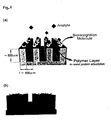
- a micro-structured soft sensor substrate made of an elastomer such as PDMS is coated with a polymer film that prevents unspecific adsorption but allows for covalent immobilization of the capture agent for the analyte on the top of the microstructure.
- the 2sensor substrate can be completely composed of such a polymer as mentioned above.
- hydrogel forming polymers can be of poly(vinyl pyrrolidone), poly(alkylene glycol), poly(vinyl alcohol), poly(ethylene imine) or poly(vinyl amine) type.
- the sensor substrate is a soft polymer made of e.g. fluororesins, polysiloxanes like PDMS, said polymeric material as mentioned above or a hydrogel forming polymer, the change in surface tension leads to a force that deforms the substrate.
- the induced change in refractive index would also occur but in an isotropic way. The resulting effect would be small.
- the stress cannot isotropically relax.
- the molecular adsorption of the analyte induces a volume effect in the substrate that contributes to the signal and amplifies it.
- This amplification is due to the fact that few molecules at the surface can induce the change of orientation of many molecules in the elevations of the anisotropic substrate.
- This anisotropic answer of the sensor-substrate volume to a change at the surface of the sensor can be detected with polarized light.
- a preferred method of analysis is ellipsometry.
- the anisotropically microstructured elastomeric (soft) sensor substrate is made of PDMS (poly dimethyl siloxane).
- PDMS poly dimethyl siloxane
- the specific binding of biological molecules on anisotropically microstructured PDMS (poly(dimethylsiloxane)) substrates can be detected with high sensitivity using an ellipsometer like detection system. Ellipsometry is an optical technique for the investigation of film thickness on reflective substrates; cf. H. Arwin, Thin Solid Films 1998, 313, 764 . A light beam, incident under an oblige angle onto a surface, will show reflectance and transmittance values that depend on the polarization state of the beam.
- sensing is based on the anisotropic microstructure of the elastomeric substrate.
- the PDMS microstructures are generated according to molding procedures well known from soft lithography. A liquid mixture of PDMS prepolymer and crosslinker solution is poured onto a silicon master that has patterned relief structures. After curing of the material, the PDMS substrate can be peeled off the master structure. Since the masters can be reused indefinitely, this process is convenient and cost efficient.
- the technique can generate patterns and structures with feature size ranging from 0.5 ⁇ m to 500 ⁇ m.
- the anisotropically microstructured elastomeric sensor substrate used has elevated regions in the form of ridges so that the depressions/grooves form channels between the ridges.
- the substrate preferably made of PDMS Interactions between the substrate preferably made of PDMS and biological molecules are crucial for the sensitivity of this biosensor system. In order to control these interactions, nonspecific protein adsorption on such elastomeric substrates, preferably made of PDMS, has to be prevented.
- Poly(ethylene oxide) (PEO) has been used extensively as a coating material to generate surfaces that resist non-specific protein adsorption.
- the polymeric material which is capable of resisting non-specific protein adsorption and thus being coated onto the sensor substrate is selected from an isocyanate functionalized P(EO-stat-PO).
- P(EO- stat -PO) polymers can also be functionalized by (meth)acrylate, oxirane, oxazoline, carboxylic acid, carboxylic ester, carboxylic anhydride, thiol, amine, vinyl ether, vinyl ester, Diels Alder reactive groups, alkoxysilanes, etc.. Concerning such functionalized groups, it is explicitly referred to DE 102 03 937 .
- the coating system i.e.
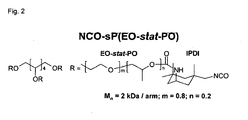
- the respective polymeric material is composed of six armed star shaped molecules with a molecular weight in the range of 1 to 3 kDa, preferably about 2 kDa per arm and a polymer backbone of statistically copolymerized ethylene oxide (EO) and propylene oxide (PO) in a ratio of about 4:1, where the distal ends of the arms are functionalized with reactive isocyanate (NCO) groups (NCO-sP(EO- stat -PO); see Figure 2 .
- EO ethylene oxide
- PO propylene oxide
- NCO-sP(EO- stat -PO) reactive isocyanate
- Those polymers are known in the art; cf. DE 102 03 937 .
- These coatings have been shown to combine prevention of unspecific interaction with high functionality; cf. Gasteier et al., Macromol. Biosci. 2007, 7, 1010-1023 .
- these coatings can be applied to elastomeric PDMS substrates in an easy manner.
- ammonia plasma is used to generate amino functionalized PDMS surfaces being capable of undergoing a covalent urea-bridging with isocyanate functionalities.
- Spin coating of aqueous NCO-sP(EO-stat-PO) solutions onto amino functionalized PDMS substrates provides precise control of the layer thickness via rotation speed and prepolymer concentration and results in homogeneous layers.
- the NCO-sP(EO-stat-PO) layers can be functionalized by the reaction between the isocyanate groups in freshly prepared layers and biorecognition molecules selected from the group consisting of peptides, proteins, antibodies, antibody fragments, lectins, carbohydrates, DNA, oligonucleotides, aptamers, low molecular weight ligands such as biotin, complexing agents and polyionic tags.
- biorecognition molecules capture molecules
- the present invention allows functionalization with a big variety of molecules such as low molecular weight ligands, peptides, oligonucleotides, carbohydrates, and whole proteins such as antibodies or lectins.
- biorecognition molecules are covalently bound to said multifunctionalized polymeric material on the elevated regions of the sensor substrate.
- the present invention also relates to a method of manufacturing said label-free biosensor system, comprising the steps of:
- the biofunctionalized microstructure as shown in Figure 3d can preferably be obtained by an inverse microcontact printing ( ⁇ CP) process.
- ⁇ CP is a technique that uses the relief pattern on the surface of a PDMS stamp to form patterns on substrates by wetting of the PDMS stamp with the molecule of interest and transferring the pattern through contact between the stamp and the substrate.
- a flat surface is wetted with the capture agent for the analyte and a freshly coated microstructured sensor substrate is brought into contact to transfer and covalently bind the molecules only on the elevations of the structure.
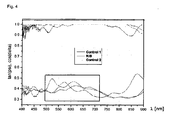
- FIG. 4 shows results of measurements that have been performed on a sensor substrate that was functionalized with biotin as binding ligand after (black line) incubation with streptavidin solution and subsequent rinsing. A remarkable change in the wavelength of the spectrum was observed in comparison to the 2 control samples without biotin on the sensor substrate (green and red line).
- the PDMS sensor substrate was structured with lines of 10 ⁇ m width in a distance of 5 ⁇ m and a height of 2 ⁇ m.
- a detection limit of the sensors according to the present invention can be estimated in the range of a hundred pikomol for ligand-analyte interactions with a dissoziation constant of 10 -9 M which is a typical value for antibody antigen interaction.
- the RIB-biosensor according to the present invention combines several important advantages such as high sensitivity, label free detection, inexpensive sensor-substrates as well as robust and straightforward to use detection hardware.
Landscapes
- Health & Medical Sciences (AREA)
- Immunology (AREA)
- Life Sciences & Earth Sciences (AREA)
- Engineering & Computer Science (AREA)
- Chemical & Material Sciences (AREA)
- Hematology (AREA)
- Urology & Nephrology (AREA)
- Biomedical Technology (AREA)
- Molecular Biology (AREA)
- Microbiology (AREA)
- Analytical Chemistry (AREA)
- Biotechnology (AREA)
- Pathology (AREA)
- Food Science & Technology (AREA)
- Medicinal Chemistry (AREA)
- Physics & Mathematics (AREA)
- Cell Biology (AREA)
- Biochemistry (AREA)
- General Health & Medical Sciences (AREA)
- General Physics & Mathematics (AREA)
- Chemical Kinetics & Catalysis (AREA)
- Investigating Or Analysing Materials By Optical Means (AREA)
- Apparatus Associated With Microorganisms And Enzymes (AREA)
Description
- The present invention relates to a label-free biosensor system, a method for manufacturing said label-free biosensor system, its use for detecting biochemical reactions and/or bindings, enzymatic reactions, nucleic acid hybridizations, protein-protein interactions and protein-ligand interactions, as well as an assay method for detecting and/or quantifying an analyte of interest in a biological sample which comprises detecting the Recognition Induced Birefringence (RIB) generated in the presence as opposed to the absence of said analyte by bringing said sample into contact with said label-free biosensor system.
- Biomolecules on solid surfaces have been investigated extensively to fabricate biosensors for a broad variety of applications. Amongst different strategies, affinity type biosensors are one of the most powerful and popular approach. Such sensors are based on the specific capabilities of a biorecognition element that is immobilized on a solid surface to selectively bind an analyte from a solution. They are versatile because they enable the determination of highly different species by selecting an appropriate biorecognition process, such as antibody-antigen interactions, complementary oligonucleotides interactions, and ligand-biological receptor interactions. One important aspect of such sensors is the minimization of non-specific binding to the sensor surface since such fouling increases the background noise, thus decreasing the signal to noise ratio and thereby the sensitivity. Detection of the signal from an analyte-biorecognition molecule complex is usually based on optical labels and probes of luminescence dye molecules. If the sensor is based on enzyme linked immunosorbent assay (ELISA) detection techniques, antibodies that are covalently linked to an enzyme such as horseradish peroxidase are used for detection. These antibodies either directly target the analyte or act as secondary antibodies to detect antibody-analyte complexes on the sensor surface. For detection of the signal, a substance is added that the enzyme can convert to a detectable signal like luminescence or fluorescence so that the amount of antigen in the sample can be determined.
- Optical detection techniques, however, implicate the use of covalently labeled biomolecules if spatial resolution of the optical signal shall be accomplished. Such constructs are expensive and may restrict the assay due to difficulties in detecting certain biochemical activities. Moreover, the quantitative measurement of luminescence spectra sometimes requires complex and expensive instruments. Thus, alternative detection methods have been developed that exploit changes that either occur in the intrinsic physical property of the biomolecule itself or the interface between immobilized molecule and solid substrate as a result of its interaction with the target analyte. Such "label-free" biosensor assays are fairly straightforward, since an unlabeled biomolecule binds to an unlabeled analyte. Thus, numerous label-free biosensor systems have been developed with detection methods that make use of surface plasmon resonance (SPR), MALDI-TOF MS, electrochemical sensing, reflectometric interference spectroscopy, and quartz-crystal microbalances (QCM). Most of these label-free biosensors, however, require expensive and complicated equipments and are not straightforward to use. Moreover, sensitivity, robustness and the possibility to develop portable system are critical issues.
- Liu et al., Smart Mater. Struct. 16 (2007), pp. 2214-2221, discloses biosensors made of specifically designed transparent chips with nano-optical tags where the biosensors have elevated regions and depressions made of PDMS. Gauglitz et al., Sensors and Actuators B, 11 (1993), pp. 21-27, discloses the use of PDMS thin-films without elevated regions and depressions for label-free detection of molecules adsorbed to the thin-film via biorecognition molecules. Harsányi G., Sensor Review, Volume 20, , discloses the use of PDMS films for the label-free detection of molecules.
- Accordingly, the object underlying the present invention is to provide further "label-free" biosensor assays which do not require expensive and complicated equipments, but still have proper sensitivity and robustness.
- The solution to the above technical problem is achieved by providing the embodiments characterized in the claims.
- In particular, in a first aspect of the present invention there is provided a label-free biosensor system comprising:
- an anisotropically microstructured elastomeric sensor substrate having elevated regions and depressions on at least one side, wherein the distance between the elevated regions is in the range from 0.5 to 100 µm and the height of the elevated regions is in the range from 1 to 500 µm,
- wherein either (a) said sensor substrate is made of an elastomer, preferably a polysiloxane or a fluororesin, and is further coated, at least on the top surface thereof, with a polymeric material selected from poly(ethylene oxide), poly(propylene oxide), poly(glycidol) and copolymers thereof, said polymeric material being bound to the sensor substrate either covalently or through ionic interactions, complexes or hydrogen bridges, or (b) said sensor substrate is composed in its entirety of such a polymeric material selected from poly(ethylene oxide), poly(propylene oxide), poly(glycidol) or copolymers thereof or a hydrogel-forming polymer, and wherein, only on the elevated regions, biorecognition molecules are covalently bound via said polymeric material or directly to said sensor substrate, respectively.
- A further subject matter of the present invention relates to the use of said label-free biosensor system for detecting biochemical reactions and/or bindings, enzymatic reactions, nucleic acid hybridizations, protein-protein interactions and protein-ligand interactions, complex formations and other forms of molecular recognition processes. A still further subject matter of the present invention relates to an assay method for detecting and/or quantifying an analyte of interest in a biological sample which comprises detecting the Recognition Induced Birefringence (RIB) generated in the presence as opposed to the absence of said analyte by bringing said sample into contact with the label-free biosensor system according to the present invention.
- Accordingly, the present invention relates to a label-free biosensor system based on biological recognition as binding method for an analyte of interest and detection of the birefringence that is generated upon analyte binding to an anisotropically micro-structured substrate. This effect can also be called Recognition Induced Birefringence (RIB). To achieve this, a micro-structured soft sensor substrate made of an elastomer such as PDMS is coated with a polymer film that prevents unspecific adsorption but allows for covalent immobilization of the capture agent for the analyte on the top of the microstructure. Alternatively, the 2sensor substrate can be completely composed of such a polymer as mentioned above. It is also possible to use a hydrogel forming polymer for making up said sensor substrate. Such hydrogel forming polymers can be of poly(vinyl pyrrolidone), poly(alkylene glycol), poly(vinyl alcohol), poly(ethylene imine) or poly(vinyl amine) type.
- Upon specific binding of the ligand/analyte, a change in surface tension results leading to a change in refractive index and thus birefringence. It has been found that on anisotropic sensor substrates as described above, this effect is strong and can be measured precisely. Without being bound thereto, these findings might be explained as follows. Since the sensor substrate is a soft polymer made of e.g. fluororesins, polysiloxanes like PDMS, said polymeric material as mentioned above or a hydrogel forming polymer, the change in surface tension leads to a force that deforms the substrate. For an isotropic substrate, the induced change in refractive index would also occur but in an isotropic way. The resulting effect would be small. Due to the anisotropy of the sensor substrate described here, the stress cannot isotropically relax. Thus, the molecular adsorption of the analyte induces a volume effect in the substrate that contributes to the signal and amplifies it. This amplification is due to the fact that few molecules at the surface can induce the change of orientation of many molecules in the elevations of the anisotropic substrate.
- This anisotropic answer of the sensor-substrate volume to a change at the surface of the sensor can be detected with polarized light. A preferred method of analysis is ellipsometry.
- The Figures show:
-
Figure 1 shows a schematic view of an example of the anisotropically microstructured sensor substrate according to the present invention.Figure 1 (a) shows a PDMS sensor substrate coated by said polymer material.Figure 1 (b) shows an example for a sensor substrate that is completely composed of said polymer material. -
Figure 2 shows a preferred material for the polymeric material used in the present invention, namely a specific NCO-sP(EO-stat-PO) system (PDI < 1.2). -
Figure 3 shows an overview on the workflow for manufacturing a sensor substrate with NCO-sP(EO-stat PO) as an example of the present invention. -
Figure 4 shows the spectra of a biotin functionalized sensor substrate according to the present invention after incubation with streptavidin solution (black line). The red and green lines show incubated reference sample without biotin on the sensor as control. - In a preferred embodiment of the present invention, the anisotropically microstructured elastomeric (soft) sensor substrate is made of PDMS (poly dimethyl siloxane). According to the present invention, the specific binding of biological molecules on anisotropically microstructured PDMS (poly(dimethylsiloxane)) substrates can be detected with high sensitivity using an ellipsometer like detection system. Ellipsometry is an optical technique for the investigation of film thickness on reflective substrates; cf. H. Arwin, Thin Solid Films 1998, 313, 764. A light beam, incident under an oblige angle onto a surface, will show reflectance and transmittance values that depend on the polarization state of the beam. This is a consequence of the light beam being an electromagnetic wave, which will interact with the electrons in the surface. The interaction will be different for electrons being moved parallel or perpendicular to the surface and it will be different depending on the binding of the electrons (dielectric or metallic behavior for example). Ellipsometers are instruments that are capable of determining the ratio of the reflectivities parallel (p) and perpendicular (s) to the surface normal. This ratio is called the ellipsometric ratio p, which is a complex number in general. For historical reason it is common to introduce the two angles Ψ and Δ that are correlated to ρ according to equation 1:

- In the present invention, sensing is based on the anisotropic microstructure of the elastomeric substrate. Usually, the PDMS microstructures are generated according to molding procedures well known from soft lithography. A liquid mixture of PDMS prepolymer and crosslinker solution is poured onto a silicon master that has patterned relief structures. After curing of the material, the PDMS substrate can be peeled off the master structure. Since the masters can be reused indefinitely, this process is convenient and cost efficient. The technique can generate patterns and structures with feature size ranging from 0.5 µm to 500 µm. Preferably, the anisotropically microstructured elastomeric sensor substrate used has elevated regions in the form of ridges so that the depressions/grooves form channels between the ridges.
- Interactions between the substrate preferably made of PDMS and biological molecules are crucial for the sensitivity of this biosensor system. In order to control these interactions, nonspecific protein adsorption on such elastomeric substrates, preferably made of PDMS, has to be prevented. Poly(ethylene oxide) (PEO) has been used extensively as a coating material to generate surfaces that resist non-specific protein adsorption. According to a preferred embodiment of the present invention, the polymeric material which is capable of resisting non-specific protein adsorption and thus being coated onto the sensor substrate, is selected from an isocyanate functionalized P(EO-stat-PO). Surely, such P(EO-stat-PO) polymers can also be functionalized by (meth)acrylate, oxirane, oxazoline, carboxylic acid, carboxylic ester, carboxylic anhydride, thiol, amine, vinyl ether, vinyl ester, Diels Alder reactive groups, alkoxysilanes, etc.. Concerning such functionalized groups, it is explicitly referred to
DE 102 03 937 . In a specifically preferred embodiment of the present invention, the coating system, i.e. the respective polymeric material is composed of six armed star shaped molecules with a molecular weight in the range of 1 to 3 kDa, preferably about 2 kDa per arm and a polymer backbone of statistically copolymerized ethylene oxide (EO) and propylene oxide (PO) in a ratio of about 4:1, where the distal ends of the arms are functionalized with reactive isocyanate (NCO) groups (NCO-sP(EO-stat-PO); seeFigure 2 . Those polymers are known in the art; cf.DE 102 03 937 . These coatings have been shown to combine prevention of unspecific interaction with high functionality; cf. Gasteier et al., Macromol. Biosci. 2007, 7, 1010-1023. Furthermore, these coatings can be applied to elastomeric PDMS substrates in an easy manner. However, other star shaped molecules like those disclosed inEP 1 864 777 - Generally, surface modification of PDMS is difficult because the material is inert. In a preferred embodiment of the present invention, ammonia plasma is used to generate amino functionalized PDMS surfaces being capable of undergoing a covalent urea-bridging with isocyanate functionalities. Spin coating of aqueous NCO-sP(EO-stat-PO) solutions onto amino functionalized PDMS substrates provides precise control of the layer thickness via rotation speed and prepolymer concentration and results in homogeneous layers. Furthermore, the NCO-sP(EO-stat-PO) layers can be functionalized by the reaction between the isocyanate groups in freshly prepared layers and biorecognition molecules selected from the group consisting of peptides, proteins, antibodies, antibody fragments, lectins, carbohydrates, DNA, oligonucleotides, aptamers, low molecular weight ligands such as biotin, complexing agents and polyionic tags. Preferably, these biorecognition molecules (capture molecules) have amino or alcohol functionalities. However, the present invention allows functionalization with a big variety of molecules such as low molecular weight ligands, peptides, oligonucleotides, carbohydrates, and whole proteins such as antibodies or lectins.
- In accordance with the present invention, the biorecognition molecules are covalently bound to said multifunctionalized polymeric material on the elevated regions of the sensor substrate.
- The present invention also relates to a method of manufacturing said label-free biosensor system, comprising the steps of:
- (i) providing an anisotropically microstructured sensor substrate having elevated regions and depressions on at least one side, wherein the distance between the elevated regions is in the range from 0.5 to 100 µm and the height of the elevated regions is in the range from 1 to 500 µm,
- (ii) optionally functionalizing said sensor substrate to generate functional groups on the surfaces of said sensor substrate, and coating said thus functionalized sensor substrate with the polymeric material, thereby causing covalent bonding or ionic interactions, complexes or hydrogen bridges between the surface of said sensor substrate and said polymeric material, and
- (iii) functionalizing said sensor substrate provided in step (i) or obtained in step (ii) only on the elevated regions of said sensor substrate with biorecognition molecules via covalent bonding to said polymeric material or to said sensor substrate, respectively.
- Using this approach, the biofunctionalized microstructure as shown in
Figure 3d can preferably be obtained by an inverse microcontact printing (µCP) process. µCP is a technique that uses the relief pattern on the surface of a PDMS stamp to form patterns on substrates by wetting of the PDMS stamp with the molecule of interest and transferring the pattern through contact between the stamp and the substrate. Usually, a flat surface is wetted with the capture agent for the analyte and a freshly coated microstructured sensor substrate is brought into contact to transfer and covalently bind the molecules only on the elevations of the structure. - When such a sensor substrate is immersed into a solution that contains an analyte of interest, specific adsorption of the analyte only takes place on the elevations of the structure.
Figure 4 shows results of measurements that have been performed on a sensor substrate that was functionalized with biotin as binding ligand after (black line) incubation with streptavidin solution and subsequent rinsing. A remarkable change in the wavelength of the spectrum was observed in comparison to the 2 control samples without biotin on the sensor substrate (green and red line). The PDMS sensor substrate was structured with lines of 10 µm width in a distance of 5 µm and a height of 2 µm. - If a molecule interacts with the sensor surface there are several possibilities how this is "seen" by the ellipsometer. Conventionally, the increase of the layer thickness can directly be measured. This will however result in a very tiny effect in contradiction with the comparably large effect being seen in measurements like those exemplified in
Figure 4 . An explanation for the large change in wavelength is a change of the stress induced birefringence of the "stripe structure". Upon binding of the analyte, the surface tension changes on the elevations of the structured sensor while it remains unaltered in the grooves. Due to the anisotropy of the substrate, the stress cannot relax isotropically. Because of the material being a polymer where the surface effect can couple to the polymer chains this induces the change of orientation of many molecules in the elevations of the anisotropic substrate what can lead to comparably large effects. This effect can be called Recognition Induced Birefringence (RIB). However, another explanation is still possible. If an elongated structure with a different dielectric constant is immersed into another substance the elongated structure shows a phenomenon known as form birefringence. This can be utilized in polarization microscopy to show structures that are much smaller than the wavelength of light, for example microtubuli in cells. - Since differences in wavelength can be measured easily with high precision, binding of the ligand/analyte can be detected with high sensitivity. Based on respective measurements and with the estimation that one ligand molecule is present per 4 nm2 at the elevations of the microstructure, a detection limit of the sensors according to the present invention can be estimated in the range of a hundred pikomol for ligand-analyte interactions with a dissoziation constant of 10-9 M which is a typical value for antibody antigen interaction.
- Hence, the RIB-biosensor according to the present invention combines several important advantages such as high sensitivity, label free detection, inexpensive sensor-substrates as well as robust and straightforward to use detection hardware.
Claims (15)
- Label-free biosensor system comprising:an anisotropically microstructured elastomeric sensor substrate having elevated regions and depressions on at least one side, wherein the distance between the elevated regions is in the range from 0.5 to 100 µm and the height of the elevated regions is in the range from 1 to 500 µm,wherein either (a) said sensor substrate is made of an elastomer, preferably a polysiloxane or a fluororesin, and is further coated, at least on the top surface thereof, with a polymeric material selected from poly(ethylene oxide),poly(propylene oxide), poly(glycidol) and copolymers thereof, said polymeric material being bound to the sensor substrate either covalently or through ionic interactions, complexes or hydrogen bridges, or (b) said sensor substrate is composed in its entirety of such a polymeric material selected from poly(ethylene oxide), poly(propylene oxide), poly(glycidol) or copolymers thereof or a hydrogel-forming polymer, andwherein, only on the elevated regions, biorecognition molecules are covalently bound via said polymeric material or directly to said sensor substrate, respectively.
- Label-free biosensor system according to claim 1, wherein the anisotropically microstructured elastomeric sensor substrate is made of PDMS (polydimethyl siloxane), preferably amino functionalized PDMS.
- Label-free biosensor system according to claim 1, wherein the anisotropically microstructured elastomeric sensor substrate in its entirety is made of P(EO-stat-PO) (random poly(ethylene oxide/propylene oxide).
- Label-free biosensor system according to claim 1 or 2, wherein the polymeric material for coating the anisotropically microstructured elastomeric sensor substrate is a P(EO-stat-PO), particularly a star shaped P(EO-stat-PO).
- Label-free biosensor system according to claim 4, wherein the polymeric material is made of six armed star shaped molecules with a molecular weight in the range of 1 to 3 kDa per arm and a polymer backbone of statistically copolymerized ethylene oxide (EO) and propylene oxide (PO) in a ratio 4:1, where the distal ends of the arms are functionalized with reactive isocyanate (NCO) groups.
- Label-free biosensor system according to anyone of claims 1 to 4, wherein the biorecognition molecules are selected from the group consisting of peptides, proteins, antibodies, antibody fragments, lectins, carbohydrates, DNA, oligonucleotides, aptamers, low molecular weight ligands, complexing agents and polyionic tags, covalently bound to said multifunctionalized polymeric material on the elevated regions of the sensor substrate.
- Label-free biosensor system according to anyone of claims 1 to 6, wherein the elevated regions are in the form of ridges so that the depressions form channels between the ridges.
- A method of manufacturing a label-free biosensor system according to anyone of claims 1 to 7, comprising the steps of:(i) providing an anisotropically microstructured sensor substrate having elevated regions and depressions on at least one side, wherein the distance between the elevated regions is in the range from 0.5 to 100 µm and the height of the elevated regions is in the range from 1 to 500 µm,(ii) optionally functionalizing said sensor substrate to generate functional groups on the surfaces of said sensor substrate, and coating the thus functionalized sensor substrate with the polymeric material, thereby causing covalent bonding or ionic interactions, complexes or hydrogen bridges between the surface of said sensor substrate and said polymeric material, and(iii) functionalizing said sensor substrate provided in step (i) or obtained in step (ii) only on the elevated regions of said sensor substrate with biorecognition molecules via covalent bonding to said polymeric material or to said sensor substrate, respectively.
- The method according to claim 8, wherein in step (i) the anisotropically microstructured elastomeric sensor substrate is made of PDMS and produced by way of soft lithography technique.
- The method according to claim 8 or 9, wherein in step (ii) ammonia plasma is used to generate amino functionalized surfaces, preferably amino functionalized PDMS surfaces.
- The method according to anyone of claims 8 to 10, wherein in step (ii) the multifunctionalized polymeric material is made of six armed star shaped molecules with a molecular weight in the range of 1 to 3 kDa per arm and a polymer backbone of statistically copolymerized ethylene oxide (EO) and propylene oxide (PO) in a ratio 4:1, where the distal ends of the arms are functionalized with reactive isocyanate (NCO) groups.
- The method according to anyone of claims 8 to 11, wherein the biorecognition molecules are -NH2 or -OH functionalized molecules.
- The method according to anyone of claims 8 to 12, wherein the biorecognition molecules are applied on the elevated regions of the sensor substrate by inverse microcontact printing (µCP).
- Use of the label-free biosensor system according to anyone of claims 1 to 7 for detecting biochemical reactions and/or bindings, enzymatic reactions, nucleic acid hybridizations, protein-protein interactions, protein-ligand interactions and complex formation.
- An assay method for detecting and/or quantifying an analyte of interest in a biological sample which comprises detecting the Recognition Induced Birefringence (RIB) generated in the presence as opposed to the absence of said analyte by bringing said sample into contact with the label-free biosensor system according to anyone of claims 1 to 7.
Priority Applications (2)
| Application Number | Priority Date | Filing Date | Title |
|---|---|---|---|
| EP08022585A EP2204650B1 (en) | 2008-12-31 | 2008-12-31 | Novel biosensor system based on recognition induced birefringence (RIB) |
| US12/645,005 US8465968B2 (en) | 2008-12-31 | 2009-12-22 | Biosensor system based on recognition induced birefringence (RIB) |
Applications Claiming Priority (1)
| Application Number | Priority Date | Filing Date | Title |
|---|---|---|---|
| EP08022585A EP2204650B1 (en) | 2008-12-31 | 2008-12-31 | Novel biosensor system based on recognition induced birefringence (RIB) |
Publications (2)
| Publication Number | Publication Date |
|---|---|
| EP2204650A1 EP2204650A1 (en) | 2010-07-07 |
| EP2204650B1 true EP2204650B1 (en) | 2012-06-27 |
Family
ID=40436404
Family Applications (1)
| Application Number | Title | Priority Date | Filing Date |
|---|---|---|---|
| EP08022585A Not-in-force EP2204650B1 (en) | 2008-12-31 | 2008-12-31 | Novel biosensor system based on recognition induced birefringence (RIB) |
Country Status (2)
| Country | Link |
|---|---|
| US (1) | US8465968B2 (en) |
| EP (1) | EP2204650B1 (en) |
Families Citing this family (11)
| Publication number | Priority date | Publication date | Assignee | Title |
|---|---|---|---|---|
| US20050118727A1 (en) * | 2003-12-01 | 2005-06-02 | Carsten Schelp | Conjugates and their use in detection methods |
| US8663563B2 (en) * | 2010-12-03 | 2014-03-04 | Purdue Research Foundation | Reflective diffractometric hydrogel sensor for biological and chemical detection |
| US10556398B2 (en) | 2011-10-14 | 2020-02-11 | Digital Sensing Limited | Arrays and methods of manufacture |
| JP6210009B2 (en) * | 2013-09-30 | 2017-10-11 | 株式会社Jvcケンウッド | Sample analysis substrate and substrate analyzer |
| WO2017170236A1 (en) | 2016-03-28 | 2017-10-05 | Tdk株式会社 | Biosensor and biochip |
| CN109073597A (en) | 2016-03-28 | 2018-12-21 | Tdk株式会社 | chemical sensor |
| WO2017170230A1 (en) * | 2016-03-28 | 2017-10-05 | Tdk株式会社 | Biosensor and biochip |
| CN107941712B (en) * | 2017-11-27 | 2021-03-19 | 陕西科技大学 | A method for detecting cecropin B based on liquid crystal biosensor |
| CN108763187A (en) * | 2018-06-07 | 2018-11-06 | 中国化学赛鼎宁波工程有限公司 | A Material Statistical Method Based on PDMS Software |
| CN110715969B (en) * | 2019-10-18 | 2023-03-10 | 广东省半导体产业技术研究院 | Biosensor and manufacturing method thereof |
| US12474270B2 (en) * | 2020-09-22 | 2025-11-18 | Wisconsin Alumni Research Foundation | Biological sensing and communication using optogenetics and electronics |
Family Cites Families (5)
| Publication number | Priority date | Publication date | Assignee | Title |
|---|---|---|---|---|
| US6180239B1 (en) * | 1993-10-04 | 2001-01-30 | President And Fellows Of Harvard College | Microcontact printing on surfaces and derivative articles |
| DE60041255D1 (en) * | 1999-04-28 | 2009-02-12 | Eidgenoess Tech Hochschule | POLYIONIC COATINGS FOR ANALYTICAL AND SENSOR DEVICES |
| DE10203937A1 (en) | 2002-02-01 | 2003-08-14 | Sustech Gmbh & Co Kg | Stellate pre-polymers containing reactive functional groups on the free ends useful for the production of ultra-thin coatings forming hydrogels and showing non-specific protein absorption and for antifouling coatings |
| SE0400783D0 (en) * | 2004-03-24 | 2004-03-24 | Peter Aasberg | Pattern method for biosensor applications |
| EP1864777B1 (en) | 2006-06-08 | 2009-09-23 | DWI an der RWTH Aachen e.V. | Structuring hydrogels |
-
2008
- 2008-12-31 EP EP08022585A patent/EP2204650B1/en not_active Not-in-force
-
2009
- 2009-12-22 US US12/645,005 patent/US8465968B2/en not_active Expired - Fee Related
Non-Patent Citations (1)
| Title |
|---|
| ZHIAN LAI ET AL: "Label-free biosensor by protein grating coupler on planar optical waveguides", OPTICS LETTERS, OSA, OPTICAL SOCIETY OF AMERICA, WASHINGTON, DC, US, vol. 33, no. 15, 1 August 2008 (2008-08-01), pages 1735 - 1737, XP001515697, ISSN: 0146-9592, DOI: 10.1364/OL.33.001735 * |
Also Published As
| Publication number | Publication date |
|---|---|
| US20100167263A1 (en) | 2010-07-01 |
| EP2204650A1 (en) | 2010-07-07 |
| US8465968B2 (en) | 2013-06-18 |
Similar Documents
| Publication | Publication Date | Title |
|---|---|---|
| US8465968B2 (en) | Biosensor system based on recognition induced birefringence (RIB) | |
| Vaisocherová et al. | Functionalizable low-fouling coatings for label-free biosensing in complex biological media: advances and applications | |
| US10100163B2 (en) | Substrate independent copolymers for biofunctionalization | |
| CA2487947A1 (en) | Polyelectrolyte complex (e.g.zwitterionic polythiophenes) with a receptor (e.g. polynucleotide, antibody etc.) for biosensor applications | |
| EP1817582A2 (en) | Polymer-coated substrates for binding biomolecules and methods of making and using thereof | |
| US20080268546A1 (en) | Detection of dna hybridization on surfaces | |
| EP0493484A1 (en) | METHOD AND DEVICE FOR DETECTING AN ANALYT. | |
| EP0524301B1 (en) | Ellipsometric immunoassay system and method including a thin film detection device | |
| Saftics et al. | Investigation of thin polymer layers for biosensor applications | |
| EP0962759A1 (en) | Method and device for identification of a substance through surface interactions | |
| EP1960545B1 (en) | Biochip self-calibration process | |
| TWI316603B (en) | Method for immunoassays based on infrared reflection absorption spectroscopy | |
| TWI855793B (en) | Biosensor chip and related method | |
| EP0546222B1 (en) | Highly sensitive optical immunoassay using enzyme-labeled reagents | |
| Pushkarev et al. | Fouling-proof real-time optosensors for polyvalency-based characterization of circulating antibodies | |
| Boonsriwong et al. | Thin Film Plastic Antibody-Based Microplate Assay for Human Serum Albumin Determination. Polymers 2021, 13, 1763 | |
| HK1001889B (en) | Ellipsometric immunoassay system and method including a thin film detection device | |
| Dickert et al. | Label-Free Bioanalyte Detection from Nanometer to Micrometer Dimensions—Molecular Imprinting and QCMs†. | |
| HK1000771B (en) | Highly sensitive optical immunoassay using enzyme-labeled reagents | |
| Gobi et al. | Development of Polyethyleneglycol Monolayer-based SPR Immunosensor for Detection of Low-molecular-weight Fragrants | |
| Sun et al. | Label-free optical detection of small-molecule compound microarrays immobilized on solid support using macromolecular scaffolds and subsequent protein binding reactions |
Legal Events
| Date | Code | Title | Description |
|---|---|---|---|
| PUAI | Public reference made under article 153(3) epc to a published international application that has entered the european phase |
Free format text: ORIGINAL CODE: 0009012 |
|
| AK | Designated contracting states |
Kind code of ref document: A1 Designated state(s): AT BE BG CH CY CZ DE DK EE ES FI FR GB GR HR HU IE IS IT LI LT LU LV MC MT NL NO PL PT RO SE SI SK TR |
|
| AX | Request for extension of the european patent |
Extension state: AL BA MK RS |
|
| 17P | Request for examination filed |
Effective date: 20101223 |
|
| 17Q | First examination report despatched |
Effective date: 20110118 |
|
| AKX | Designation fees paid |
Designated state(s): AT BE BG CH CY CZ DE DK EE ES FI FR GB GR HR HU IE IS IT LI LT LU LV MC MT NL NO PL PT RO SE SI SK TR |
|
| RAP1 | Party data changed (applicant data changed or rights of an application transferred) |
Owner name: DWI AN DER RWTH AACHEN E.V. |
|
| GRAP | Despatch of communication of intention to grant a patent |
Free format text: ORIGINAL CODE: EPIDOSNIGR1 |
|
| GRAS | Grant fee paid |
Free format text: ORIGINAL CODE: EPIDOSNIGR3 |
|
| GRAA | (expected) grant |
Free format text: ORIGINAL CODE: 0009210 |
|
| AK | Designated contracting states |
Kind code of ref document: B1 Designated state(s): AT BE BG CH CY CZ DE DK EE ES FI FR GB GR HR HU IE IS IT LI LT LU LV MC MT NL NO PL PT RO SE SI SK TR |
|
| REG | Reference to a national code |
Ref country code: GB Ref legal event code: FG4D |
|
| REG | Reference to a national code |
Ref country code: CH Ref legal event code: EP Ref country code: CH Ref legal event code: NV Representative=s name: KATZAROV S.A. |
|
| REG | Reference to a national code |
Ref country code: AT Ref legal event code: REF Ref document number: 564492 Country of ref document: AT Kind code of ref document: T Effective date: 20120715 |
|
| REG | Reference to a national code |
Ref country code: IE Ref legal event code: FG4D |
|
| REG | Reference to a national code |
Ref country code: DE Ref legal event code: R096 Ref document number: 602008016657 Country of ref document: DE Effective date: 20120830 |
|
| REG | Reference to a national code |
Ref country code: NL Ref legal event code: T3 |
|
| PG25 | Lapsed in a contracting state [announced via postgrant information from national office to epo] |
Ref country code: SE Free format text: LAPSE BECAUSE OF FAILURE TO SUBMIT A TRANSLATION OF THE DESCRIPTION OR TO PAY THE FEE WITHIN THE PRESCRIBED TIME-LIMIT Effective date: 20120627 Ref country code: FI Free format text: LAPSE BECAUSE OF FAILURE TO SUBMIT A TRANSLATION OF THE DESCRIPTION OR TO PAY THE FEE WITHIN THE PRESCRIBED TIME-LIMIT Effective date: 20120627 Ref country code: LT Free format text: LAPSE BECAUSE OF FAILURE TO SUBMIT A TRANSLATION OF THE DESCRIPTION OR TO PAY THE FEE WITHIN THE PRESCRIBED TIME-LIMIT Effective date: 20120627 Ref country code: NO Free format text: LAPSE BECAUSE OF FAILURE TO SUBMIT A TRANSLATION OF THE DESCRIPTION OR TO PAY THE FEE WITHIN THE PRESCRIBED TIME-LIMIT Effective date: 20120927 |
|
| REG | Reference to a national code |
Ref country code: AT Ref legal event code: MK05 Ref document number: 564492 Country of ref document: AT Kind code of ref document: T Effective date: 20120627 |
|
| REG | Reference to a national code |
Ref country code: LT Ref legal event code: MG4D Effective date: 20120627 |
|
| PG25 | Lapsed in a contracting state [announced via postgrant information from national office to epo] |
Ref country code: SI Free format text: LAPSE BECAUSE OF FAILURE TO SUBMIT A TRANSLATION OF THE DESCRIPTION OR TO PAY THE FEE WITHIN THE PRESCRIBED TIME-LIMIT Effective date: 20120627 Ref country code: HR Free format text: LAPSE BECAUSE OF FAILURE TO SUBMIT A TRANSLATION OF THE DESCRIPTION OR TO PAY THE FEE WITHIN THE PRESCRIBED TIME-LIMIT Effective date: 20120627 Ref country code: GR Free format text: LAPSE BECAUSE OF FAILURE TO SUBMIT A TRANSLATION OF THE DESCRIPTION OR TO PAY THE FEE WITHIN THE PRESCRIBED TIME-LIMIT Effective date: 20120928 Ref country code: LV Free format text: LAPSE BECAUSE OF FAILURE TO SUBMIT A TRANSLATION OF THE DESCRIPTION OR TO PAY THE FEE WITHIN THE PRESCRIBED TIME-LIMIT Effective date: 20120627 |
|
| PG25 | Lapsed in a contracting state [announced via postgrant information from national office to epo] |
Ref country code: RO Free format text: LAPSE BECAUSE OF FAILURE TO SUBMIT A TRANSLATION OF THE DESCRIPTION OR TO PAY THE FEE WITHIN THE PRESCRIBED TIME-LIMIT Effective date: 20120627 Ref country code: BE Free format text: LAPSE BECAUSE OF FAILURE TO SUBMIT A TRANSLATION OF THE DESCRIPTION OR TO PAY THE FEE WITHIN THE PRESCRIBED TIME-LIMIT Effective date: 20120627 Ref country code: CY Free format text: LAPSE BECAUSE OF FAILURE TO SUBMIT A TRANSLATION OF THE DESCRIPTION OR TO PAY THE FEE WITHIN THE PRESCRIBED TIME-LIMIT Effective date: 20120627 Ref country code: SK Free format text: LAPSE BECAUSE OF FAILURE TO SUBMIT A TRANSLATION OF THE DESCRIPTION OR TO PAY THE FEE WITHIN THE PRESCRIBED TIME-LIMIT Effective date: 20120627 Ref country code: AT Free format text: LAPSE BECAUSE OF FAILURE TO SUBMIT A TRANSLATION OF THE DESCRIPTION OR TO PAY THE FEE WITHIN THE PRESCRIBED TIME-LIMIT Effective date: 20120627 Ref country code: IS Free format text: LAPSE BECAUSE OF FAILURE TO SUBMIT A TRANSLATION OF THE DESCRIPTION OR TO PAY THE FEE WITHIN THE PRESCRIBED TIME-LIMIT Effective date: 20121027 Ref country code: EE Free format text: LAPSE BECAUSE OF FAILURE TO SUBMIT A TRANSLATION OF THE DESCRIPTION OR TO PAY THE FEE WITHIN THE PRESCRIBED TIME-LIMIT Effective date: 20120627 Ref country code: CZ Free format text: LAPSE BECAUSE OF FAILURE TO SUBMIT A TRANSLATION OF THE DESCRIPTION OR TO PAY THE FEE WITHIN THE PRESCRIBED TIME-LIMIT Effective date: 20120627 |
|
| PG25 | Lapsed in a contracting state [announced via postgrant information from national office to epo] |
Ref country code: IT Free format text: LAPSE BECAUSE OF FAILURE TO SUBMIT A TRANSLATION OF THE DESCRIPTION OR TO PAY THE FEE WITHIN THE PRESCRIBED TIME-LIMIT Effective date: 20120627 Ref country code: PT Free format text: LAPSE BECAUSE OF FAILURE TO SUBMIT A TRANSLATION OF THE DESCRIPTION OR TO PAY THE FEE WITHIN THE PRESCRIBED TIME-LIMIT Effective date: 20121029 Ref country code: PL Free format text: LAPSE BECAUSE OF FAILURE TO SUBMIT A TRANSLATION OF THE DESCRIPTION OR TO PAY THE FEE WITHIN THE PRESCRIBED TIME-LIMIT Effective date: 20120627 |
|
| PG25 | Lapsed in a contracting state [announced via postgrant information from national office to epo] |
Ref country code: DK Free format text: LAPSE BECAUSE OF FAILURE TO SUBMIT A TRANSLATION OF THE DESCRIPTION OR TO PAY THE FEE WITHIN THE PRESCRIBED TIME-LIMIT Effective date: 20120627 Ref country code: ES Free format text: LAPSE BECAUSE OF FAILURE TO SUBMIT A TRANSLATION OF THE DESCRIPTION OR TO PAY THE FEE WITHIN THE PRESCRIBED TIME-LIMIT Effective date: 20121008 |
|
| PLBE | No opposition filed within time limit |
Free format text: ORIGINAL CODE: 0009261 |
|
| STAA | Information on the status of an ep patent application or granted ep patent |
Free format text: STATUS: NO OPPOSITION FILED WITHIN TIME LIMIT |
|
| 26N | No opposition filed |
Effective date: 20130328 |
|
| REG | Reference to a national code |
Ref country code: DE Ref legal event code: R097 Ref document number: 602008016657 Country of ref document: DE Effective date: 20130328 |
|
| PG25 | Lapsed in a contracting state [announced via postgrant information from national office to epo] |
Ref country code: MC Free format text: LAPSE BECAUSE OF NON-PAYMENT OF DUE FEES Effective date: 20121231 Ref country code: BG Free format text: LAPSE BECAUSE OF FAILURE TO SUBMIT A TRANSLATION OF THE DESCRIPTION OR TO PAY THE FEE WITHIN THE PRESCRIBED TIME-LIMIT Effective date: 20120927 |
|
| REG | Reference to a national code |
Ref country code: IE Ref legal event code: MM4A |
|
| PG25 | Lapsed in a contracting state [announced via postgrant information from national office to epo] |
Ref country code: IE Free format text: LAPSE BECAUSE OF NON-PAYMENT OF DUE FEES Effective date: 20121231 |
|
| PG25 | Lapsed in a contracting state [announced via postgrant information from national office to epo] |
Ref country code: MT Free format text: LAPSE BECAUSE OF FAILURE TO SUBMIT A TRANSLATION OF THE DESCRIPTION OR TO PAY THE FEE WITHIN THE PRESCRIBED TIME-LIMIT Effective date: 20120627 |
|
| PGFP | Annual fee paid to national office [announced via postgrant information from national office to epo] |
Ref country code: NL Payment date: 20131216 Year of fee payment: 6 |
|
| PG25 | Lapsed in a contracting state [announced via postgrant information from national office to epo] |
Ref country code: TR Free format text: LAPSE BECAUSE OF FAILURE TO SUBMIT A TRANSLATION OF THE DESCRIPTION OR TO PAY THE FEE WITHIN THE PRESCRIBED TIME-LIMIT Effective date: 20120627 |
|
| PGFP | Annual fee paid to national office [announced via postgrant information from national office to epo] |
Ref country code: CH Payment date: 20140312 Year of fee payment: 6 |
|
| PG25 | Lapsed in a contracting state [announced via postgrant information from national office to epo] |
Ref country code: LU Free format text: LAPSE BECAUSE OF NON-PAYMENT OF DUE FEES Effective date: 20121231 |
|
| PG25 | Lapsed in a contracting state [announced via postgrant information from national office to epo] |
Ref country code: HU Free format text: LAPSE BECAUSE OF FAILURE TO SUBMIT A TRANSLATION OF THE DESCRIPTION OR TO PAY THE FEE WITHIN THE PRESCRIBED TIME-LIMIT Effective date: 20081231 |
|
| REG | Reference to a national code |
Ref country code: NL Ref legal event code: V1 Effective date: 20150701 |
|
| REG | Reference to a national code |
Ref country code: NL Ref legal event code: V1 Effective date: 20150701 |
|
| REG | Reference to a national code |
Ref country code: CH Ref legal event code: PL |
|
| PG25 | Lapsed in a contracting state [announced via postgrant information from national office to epo] |
Ref country code: NL Free format text: LAPSE BECAUSE OF NON-PAYMENT OF DUE FEES Effective date: 20150701 |
|
| PG25 | Lapsed in a contracting state [announced via postgrant information from national office to epo] |
Ref country code: LI Free format text: LAPSE BECAUSE OF NON-PAYMENT OF DUE FEES Effective date: 20141231 Ref country code: CH Free format text: LAPSE BECAUSE OF NON-PAYMENT OF DUE FEES Effective date: 20141231 |
|
| REG | Reference to a national code |
Ref country code: FR Ref legal event code: PLFP Year of fee payment: 9 |
|
| REG | Reference to a national code |
Ref country code: FR Ref legal event code: PLFP Year of fee payment: 10 |
|
| PGFP | Annual fee paid to national office [announced via postgrant information from national office to epo] |
Ref country code: FR Payment date: 20171115 Year of fee payment: 10 |
|
| PGFP | Annual fee paid to national office [announced via postgrant information from national office to epo] |
Ref country code: GB Payment date: 20171024 Year of fee payment: 10 |
|
| PGFP | Annual fee paid to national office [announced via postgrant information from national office to epo] |
Ref country code: DE Payment date: 20171220 Year of fee payment: 10 |
|
| REG | Reference to a national code |
Ref country code: DE Ref legal event code: R119 Ref document number: 602008016657 Country of ref document: DE |
|
| GBPC | Gb: european patent ceased through non-payment of renewal fee |
Effective date: 20181231 |
|
| PG25 | Lapsed in a contracting state [announced via postgrant information from national office to epo] |
Ref country code: FR Free format text: LAPSE BECAUSE OF NON-PAYMENT OF DUE FEES Effective date: 20181231 Ref country code: DE Free format text: LAPSE BECAUSE OF NON-PAYMENT OF DUE FEES Effective date: 20190702 |
|
| PG25 | Lapsed in a contracting state [announced via postgrant information from national office to epo] |
Ref country code: GB Free format text: LAPSE BECAUSE OF NON-PAYMENT OF DUE FEES Effective date: 20181231 |