EP2204569A1 - Piquage d'un conduit d'introduction de gaz d'échappement recycles sur un conduit d'admission d'air - Google Patents
Piquage d'un conduit d'introduction de gaz d'échappement recycles sur un conduit d'admission d'air Download PDFInfo
- Publication number
- EP2204569A1 EP2204569A1 EP09178868A EP09178868A EP2204569A1 EP 2204569 A1 EP2204569 A1 EP 2204569A1 EP 09178868 A EP09178868 A EP 09178868A EP 09178868 A EP09178868 A EP 09178868A EP 2204569 A1 EP2204569 A1 EP 2204569A1
- Authority
- EP
- European Patent Office
- Prior art keywords
- intake duct
- duct
- exhaust gas
- air intake
- recycled exhaust
- Prior art date
- Legal status (The legal status is an assumption and is not a legal conclusion. Google has not performed a legal analysis and makes no representation as to the accuracy of the status listed.)
- Withdrawn
Links
- 238000010079 rubber tapping Methods 0.000 title claims description 5
- 238000007789 sealing Methods 0.000 claims abstract description 5
- 238000002485 combustion reaction Methods 0.000 claims description 13
- 238000011144 upstream manufacturing Methods 0.000 claims description 6
- 238000003466 welding Methods 0.000 claims description 3
- 239000007789 gas Substances 0.000 description 56
- 239000003570 air Substances 0.000 description 32
- 239000007788 liquid Substances 0.000 description 6
- MWUXSHHQAYIFBG-UHFFFAOYSA-N nitrogen oxide Inorganic materials O=[N] MWUXSHHQAYIFBG-UHFFFAOYSA-N 0.000 description 5
- 239000003921 oil Substances 0.000 description 5
- IJGRMHOSHXDMSA-UHFFFAOYSA-N Atomic nitrogen Chemical compound N#N IJGRMHOSHXDMSA-UHFFFAOYSA-N 0.000 description 4
- 239000007791 liquid phase Substances 0.000 description 4
- XLYOFNOQVPJJNP-UHFFFAOYSA-N water Substances O XLYOFNOQVPJJNP-UHFFFAOYSA-N 0.000 description 4
- 239000003054 catalyst Substances 0.000 description 3
- 238000004064 recycling Methods 0.000 description 3
- 229910001868 water Inorganic materials 0.000 description 3
- CURLTUGMZLYLDI-UHFFFAOYSA-N Carbon dioxide Chemical compound O=C=O CURLTUGMZLYLDI-UHFFFAOYSA-N 0.000 description 2
- 230000000694 effects Effects 0.000 description 2
- 239000003546 flue gas Substances 0.000 description 2
- 230000005484 gravity Effects 0.000 description 2
- 229910052757 nitrogen Inorganic materials 0.000 description 2
- 238000011282 treatment Methods 0.000 description 2
- 208000031968 Cadaver Diseases 0.000 description 1
- 239000004215 Carbon black (E152) Substances 0.000 description 1
- 230000002378 acidificating effect Effects 0.000 description 1
- 229910002092 carbon dioxide Inorganic materials 0.000 description 1
- 239000001569 carbon dioxide Substances 0.000 description 1
- 239000000567 combustion gas Substances 0.000 description 1
- 239000003344 environmental pollutant Substances 0.000 description 1
- 239000000446 fuel Substances 0.000 description 1
- 229930195733 hydrocarbon Natural products 0.000 description 1
- 150000002430 hydrocarbons Chemical class 0.000 description 1
- 238000002513 implantation Methods 0.000 description 1
- 239000010687 lubricating oil Substances 0.000 description 1
- 238000000034 method Methods 0.000 description 1
- 239000000203 mixture Substances 0.000 description 1
- 231100000719 pollutant Toxicity 0.000 description 1
- 230000003134 recirculating effect Effects 0.000 description 1
- 238000011084 recovery Methods 0.000 description 1
- 230000001105 regulatory effect Effects 0.000 description 1
- 238000004513 sizing Methods 0.000 description 1
Images
Classifications
-
- F—MECHANICAL ENGINEERING; LIGHTING; HEATING; WEAPONS; BLASTING
- F02—COMBUSTION ENGINES; HOT-GAS OR COMBUSTION-PRODUCT ENGINE PLANTS
- F02M—SUPPLYING COMBUSTION ENGINES IN GENERAL WITH COMBUSTIBLE MIXTURES OR CONSTITUENTS THEREOF
- F02M35/00—Combustion-air cleaners, air intakes, intake silencers, or induction systems specially adapted for, or arranged on, internal-combustion engines
- F02M35/10—Air intakes; Induction systems
- F02M35/10209—Fluid connections to the air intake system; their arrangement of pipes, valves or the like
- F02M35/10222—Exhaust gas recirculation [EGR]; Positive crankcase ventilation [PCV]; Additional air admission, lubricant or fuel vapour admission
-
- F—MECHANICAL ENGINEERING; LIGHTING; HEATING; WEAPONS; BLASTING
- F02—COMBUSTION ENGINES; HOT-GAS OR COMBUSTION-PRODUCT ENGINE PLANTS
- F02M—SUPPLYING COMBUSTION ENGINES IN GENERAL WITH COMBUSTIBLE MIXTURES OR CONSTITUENTS THEREOF
- F02M26/00—Engine-pertinent apparatus for adding exhaust gases to combustion-air, main fuel or fuel-air mixture, e.g. by exhaust gas recirculation [EGR] systems
- F02M26/13—Arrangement or layout of EGR passages, e.g. in relation to specific engine parts or for incorporation of accessories
- F02M26/17—Arrangement or layout of EGR passages, e.g. in relation to specific engine parts or for incorporation of accessories in relation to the intake system
Definitions
- the invention relates to the architecture of circulation of gases in a combustion engine, and more particularly to the circuits for recirculating flue gases and de-oiling gases recovered in the oil sump.
- the combustion chamber is delimited on the housing side by the piston and the segments which seal between the piston and the wall of the cylinder mounted in the housing.
- this seal is never perfect, and the very fact of the design of such an engine, a leak of a portion of the combustion gases through the segments is inevitable.
- These gases flow therefore in the bottom of the housing, then generally go up to the cylinder head by chimneys, hence the name of "crankcase gas” which is given to them, or gas "blow-by" according to the English terminology -saxone equivalent.
- crankcase gases are composed of flue gases (mainly water, carbon dioxide and nitrogen), unburned gases (air, fuel and nitrogen), and oil.
- blow-by gases are deoiled by a decanter, before being burned.
- the blow-by gases can still have a liquid phase, in the form of water droplets or oil.
- blow-by circuit and an EGR circuit can lead, in particular to respond to implantation constraints, to introduce the blow-by gases upstream.
- the point of introduction of the exhaust gas may be necessary or desirable that the introduction of the EGR exhaust gases be at the bottom of the intake duct.
- the introduction of the gases of the EGR circuit is then carried out via a connection (or tapping) at "T".
- blow-by gases can carry a liquid phase, which, by falling into the EGR gas introduction tapping, can flow into the pipe and descend by gravity into the circuit of the EGR and walk to the exhaust system.
- the descent into the exhaust circuit of this liquid phase may, in particular because of its composition (oil and water, may also be loaded with acidic elements in the EGR duct) damage components present in the EGR circuit or in the exhaust system (catalysts, filters, etc.).
- the solution to this problem consists of a particular connection between the intake duct of the engine and the gas inlet duct of the EGR circuit.
- the invention relates to a device comprising a stitching of an exhaust gas introduction pipe recycled from a combustion engine on a substantially horizontal air intake duct of said combustion engine, the duct air inlet having a means for introducing crankcase gas upstream of said stitching, wherein the air intake duct has a bottom opening to which is connected the exhaust gas introduction duct recycled, and in that said orifice has on its periphery a collar projecting inside the air intake duct.
- the condensates (liquid elements) introduced to the intake by the crankcase gases (blow-by gas) are prevented by the collar from falling into the conduit for introducing the recycled exhaust gas.
- the recycled exhaust gas introduction conduit is inserted into the orifice to form said collar. This is the simplest solution to form said flange.
- the flange protrudes at any point around the orifice and with respect to the wall of the air intake duct, with a height representing from 1 to 10% of the diameter of said intake duct. air.
- the flange protruding over the entire periphery the condensates can not easily fall at any point of the periphery of the introduction port of the recycled exhaust gas, while the height of the collar remaining modest vis- With respect to the diameter of the intake duct at this point, the pressure losses generated by the collar also remain modest.
- the flange protrudes at any point around the orifice and relative to the wall of the air intake duct, with a height of between 1 and 10 mm.
- a height guarantees the functionality of the flange, while limiting the loss of load caused.
- This sizing is also generally compatible with an automotive application of the device.
- the recycled exhaust gas introduction duct is attached to the air intake duct by welding. Welding makes it possible to guarantee mechanical fastening and to seal the device.
- the recycled exhaust gas introduction duct is fixed to the air inlet duct by force-fitting. This is a compatible single binding mode of the invention.
- At least one sealing means is provided between the recycled exhaust gas introduction duct and the air intake duct.
- a sealing means ensures.
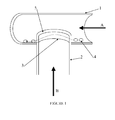
- the figure 1 single figure, represents a stitching involved in a device according to a variant of the invention.
- An air intake duct 1 can supply air to a combustion engine, not shown. The air passes through the duct in the direction of admission A.
- a stitching is performed on the air intake duct 1 and allows the introduction of recycled exhaust gas into said air intake duct 1, via a gas introduction duct 1. 2.
- the recycled gases, or EGR gases, enter the air intake duct 1 in direction B.
- an orifice 3 is formed in the lower part of the air intake duct 1.
- crankcase gases or blow-by gas gases are introduced into the air intake duct 1 by an introduction means not shown.
- the crankcase gases may have a liquid phase, or contain water vapor that condenses in the intake duct, which may contain fresh air.
- Droplets 4 or a liquid film can thus transit, in the air intake duct 1, in the admission direction A, under the effect of the flow of air in the duct.
- this liquid can damage or impair the proper functioning of the elements.
- the orifice 3 is provided, over its entire periphery and inside the intake duct.
- the droplets 4 or the liquid film
- exhaust 2 recycled by the flange 5 they bypass, under the effect of the air flow in the air intake duct 1.
- the droplets then continue their transit through the air intake duct 1.
- the flange 5 is directly formed by the end of the recycled exhaust gas introduction duct 2, projecting into the intake duct 1 through the orifice 3.
- the recycled exhaust gas introduction duct 2 is welded to the inlet duct 1.
- Other variants are however possible, in particular by force fitting supplemented by a sealing means, or by bringing into play a T-connection device reported to form the stitching.
- the flange 5, in the invention as shown here, is present on the entire periphery of the orifice 3, in order to prevent the drop of liquid elements in the recycled exhaust gas introduction duct. 2, even when the engine is stopped, and therefore in the absence of intake air flow.
- the flange 5 is dimensioned such that it does not generate excessive pressure drop in the intake duct 1.
- the height of the flange must be sufficient, at any point around the periphery of the orifice 3 to ensure its effectiveness.
- the inventor has found that a flange projecting from a minimum height of 1 to 10% at any point around the periphery of the orifice 3 and with respect to the wall of the air intake duct 1 generally responded to these constraints.
- such dimensioning can lead to a height of 1 to 10 mm in automotive applications, compatible height of the function of the flange without generating significant loss of load.
- the invention thus offers great flexibility in the choice in the architecture of an air loop of a combustion engine. It solves in particular the problem of the introduction of the inlet crankcase gases upstream of a nozzle for the introduction of recycled exhaust gas at the bottom of a substantially horizontal intake duct.
- This type of configuration which can be used on any application thanks to the invention, is particularly conceivable on an air loop architecture involving a low-pressure exhaust gas recycling system.
Landscapes
- Engineering & Computer Science (AREA)
- Chemical & Material Sciences (AREA)
- Combustion & Propulsion (AREA)
- Mechanical Engineering (AREA)
- General Engineering & Computer Science (AREA)
- Exhaust-Gas Circulating Devices (AREA)
- Lubrication Details And Ventilation Of Internal Combustion Engines (AREA)
Abstract
Description
- L'invention porte sur l'architecture de circulation des gaz dans un moteur à combustion, et plus particulièrement sur les circuits de recirculation des gaz brûlés et de déshuilage des gaz récupérés dans le carter d'huile.
- Dans un moteur à combustion interne, la chambre de combustion est délimitée du côté carter par le piston et les segments qui assurent l'étanchéité entre le piston et la paroi du cylindre monté dans le carter. Néanmoins, cette étanchéité n'est jamais parfaite, et du fait même de la conception d'un tel moteur, une fuite d'une partie des gaz de combustion à travers les segments est inévitable. Ces gaz s'écoulent donc dans le bas du carter, puis remontent généralement vers la culasse par des cheminées, d'où le nom de « gaz de carter » qui leur est donné, ou gaz de « blow-by » selon la terminologie anglo-saxone équivalente.
- Les gaz de blow-by peuvent avoir diverses origines :
- Une fuite aux segments depuis la chambre de combustion vers les volumes sous piston, et notamment vers le carter d'huile de lubrification.
- Une fuite aux paliers du ou des turbocompresseurs provenant des corps de turbine et de compresseur vers le carter moteur par le retour d'huile.
- Une fuite par les joints de queue de soupape provenant des tubulures d'admission et d'échappement vers la culasse.
- Une fuite des gaz de pompe à vide provenant du circuit de freinage vers la culasse.
- De fait, les gaz de carter sont composés de gaz de combustion, (essentiellement de l'eau, du dioxyde de carbone et du diazote), de gaz imbrûlés (air, carburant et diazote), et d'huile.
- Ces gaz créés dans le moteur doivent être évacués pour éviter une montée en pression du moteur pour éviter les risques de fuite (rejets dans l'atmosphère de polluants hydrocarbures), pour maintenir le bas carter en dépression notamment pour des raisons réglementaires et pour éviter un incendie moteur. Ces gaz sont donc évacués via des circuits d'aspiration les amenant à l'admission du moteur pour être introduits et consommés dans les chambres de combustion.
- Les gaz de blow-by sont déshuilés par un décanteur, avant d'être brulés. Cependant, malgré les traitements apportés, les gaz de blow-by peuvent malgré tout comporter une phase liquide, sous la forme de gouttelettes d'eau ou d'huile.
- Par ailleurs, il est connu d'employer sur les moteur à combustion, et notamment les moteurs Diesel, des moyens de recyclage d'une part des gaz d'échappement, c'est-à-dire de prélèvement de gaz brûlés à l'échappement du moteur et d'introduction de ces gaz prélevés à l'admission. Ce procédé de recyclage, connue sous sa dénomination anglo-saxonne d'EGR (Exhaust Gaz Recirculation), permet notamment de réduire significativement les émissions d'oxydes d'azote (NOx) sur certaines plages de fonctionnement du moteur.
- Dans le cadre d'un moteur suralimenté, il est possible de prélever les gaz d'échappement recyclés après la turbine du turbocompresseur et éventuellement après un certain nombre de moyens de traitement des gaz d'échappement comme un ou plusieurs catalyseurs, filtre à particules, etc. Selon cette architecture les gaz d'échappement prélevés sont réinjectés en amont du compresseur. Cette disposition, fréquemment appelée EGR basse pression ou « EGR BP » permet une meilleur récupération d'énergie par le turbocompresseur, et permet la réintroduction de gaz d'échappement naturellement moins chauds, et participant à un meilleur remplissage des cylindres du moteur.
- Cependant, la coexistence d'un circuit de blow-by et d'un circuit EGR, et notamment d'un circuit EGR BP peut conduire, notamment pour répondre à des contraintes d'implantation, à introduire les gaz de blow-by en amont du point d'introduction des gaz d'échappement. Par ailleurs, il peut être nécessaire ou souhaitable que l'introduction des gaz d'échappement de l'EGR se fasse en partie basse du conduit d'admission. L'introduction des gaz du circuit EGR est alors effectuée via un raccordement (ou piquage) en « T ».
- Cependant, comme précédemment évoqué, les gaz de blow-by peuvent transporter une phase liquide, qui, en tombant dans le piquage d'introduction des gaz de l'EGR, peut ruisseler dans le conduit et descendre par gravité dans le circuit de l'EGR et cheminer jusqu'au circuit d'échappement.
- La descente dans le circuit d'échappement de cette phase liquide peut, notamment du fait de sa composition (huile et eau, pouvant en outre s'être chargé d'éléments acides dans le conduit EGR) endommager des composants présents dans le circuit EGR ou dans le circuit d'échappement (catalyseurs, filtres, etc.).
- Dans la présente invention, la solution à ce problème consiste en un piquage particulier entre le conduit d'admission du moteur et le conduit d'arrivée des gaz du circuit EGR.
- Plus précisément, l'invention porte sur un dispositif comportant un piquage d'un conduit d'introduction de gaz d'échappement recyclés d'un moteur à combustion sur un conduit sensiblement horizontal d'admission d'air dudit moteur à combustion, le conduit d'admission d'air présentant un moyen d'introduction de gaz de carter en amont dudit piquage, dans lequel le conduit d'admission d'air présente un orifice en partie basse auquel est raccordé le conduit d'introduction de gaz d'échappement recyclés, et en ce que ledit orifice présente sur son pourtour une collerette faisant saillie à l'intérieur du conduit d'admission d'air. Ainsi, les condensats (éléments liquides) introduits à l'admission par les gaz de carter (gaz de blow-by) sont-ils empêchés par la collerette de tomber dans le conduit d'introduction des gaz d'échappement recyclés.
- De préférence, le conduit d'introduction de gaz d'échappement recyclés est inséré dans l'orifice afin de former ladite collerette. C'est la solution la plus simple pour former ladite collerette.
- De préférence, la collerette fait saillie en tout point du pourtour de l'orifice et par rapport à la paroi du conduit d'admission d'air, d'une hauteur représentant de 1 à 10% du diamètre dudit conduit d'admission d'air. Ainsi, la collerette faisant saillie sur l'ensemble du pourtour, les condensats ne peuvent facilement tomber en aucun point de la périphérie de l'orifice d'introduction des gaz d'échappement recyclés, tandis que la hauteur de la collerette restant modeste vis-à-vis du diamètre du conduit d'admission en ce point, les pertes de charges générées par la collerette restent également modestes.
- De préférence, la collerette fait saillie en tout point du pourtour de l'orifice et par rapport à la paroi du conduit d'admission d'air, d'une hauteur comprise entre 1 et 10 mm. Une telle hauteur garanti la fonctionnalité de la collerette, tout en limitant la perte de charge occasionnée. Ce dimensionnement est en outre généralement compatible d'une application automobile du dispositif.
- De préférence, le conduit d'introduction de gaz d'échappement recyclés est fixé au conduit d'admission d'air par soudage. Le soudage permet de garantir une fixation mécanique et d'assurer l'étanchéité du dispositif.
- Dans une variante de l'invention, le conduit d'introduction de gaz d'échappement recyclés est fixé au conduit d'admission d'air par emmanchement en force. C'est un mode de liaison simple compatible de l'invention.
- De préférence, on dispose au moins un moyen d'étanchéité entre le conduit d'introduction de gaz d'échappement recyclés et le conduit d'admission d'air. Dans le cadre d'un assemblage par emmanchement, un moyen d'étanchéité garantit.
- L'invention est décrite plus en détail ci-après et en référence à la figure unique présentant schématiquement le système dans son mode de réalisation préférentiel.
- La
figure 1 , figure unique, représente un piquage entrant en jeu dans un dispositif selon une variante de l'invention. - Un conduit d'admission d'air 1 permet d'alimenter en air un moteur à combustion, non représenté. L'air transite dans le conduit selon la direction d'admission A.
- Selon l'invention, un piquage est réalisé sur le conduit d'admission d'air 1 et permet l'introduction de gaz d'échappement recyclés dans ledit conduit d'admission d'air 1, par un conduit d'introduction de gaz d'échappement recyclés 2. Les gaz recyclés, ou gaz EGR, pénètrent dans le conduit d'admission d'air 1 selon la direction B.
- Pour la réalisation du piquage selon l'invention, un orifice 3 est ménagé en partie basse du conduit d'admission d'air 1.
- En amont du piquage du conduit d'introduction de gaz d'échappement recyclés 2 sur le conduit d'admission d'air 1, des gaz de carter ou gaz de gaz de blow-by sont introduits dans le conduit d'admission d'air 1 par un moyen d'introduction non représenté. Les gaz de carter peuvent présenter une phase liquide, ou contenir de la vapeur d'eau qui se condense dans le conduit d'admission, pouvant contenir de l'air frais.
- Des gouttelettes 4 ou un film liquide peuvent ainsi transiter, dans le conduit d'admission d'air 1, dans la direction d'admission A, sous l'effet du flux d'air dans le conduit. En tombant ou en ruisselant dans le conduit d'introduction de gaz d'échappement recyclés 2, ce liquide peut endommager ou nuire au bon fonctionnement des éléments présents dans le conduit d'introduction de gaz d'échappement recyclés 2, notamment d'éventuels éléments de dépollution non représentés, pouvant être des catalyseurs, filtres à particules, ou d'éventuels échangeurs thermiques.
- Afin d'éviter que le liquide ne puisse ruisseler par gravité dans le conduit d'introduction de gaz d'échappement recyclés 2, l'orifice 3 est doté, sur l'ensemble de son pourtour et à l'intérieur du conduit d'admission d'air 1 d'une collerette 5. Ainsi, lors de leur transit dans le conduit d'admission d'air 1, les gouttelettes 4 (ou le film liquide) sont empêchées de tomber dans le conduit d'introduction de gaz d'échappement recyclés 2 par la collerette 5, qu'elles contournent, sous l'effet du flux d'air dans le conduit d'admission d'air 1. Les gouttelettes poursuivent ensuite leur transit dans le conduit d'admission d'air 1.
- Dans la variante préférentielle de l'invention, ici représentée, la collerette 5 est directement formée par l'extrémité du conduit d'introduction de gaz d'échappement recyclés 2, faisant saillie dans le conduit d'admission 1 par l'orifice 3. Préférentiellement, le conduit d'introduction de gaz d'échappement recyclés 2 est soudé au conduit d'admission 1. D'autres variantes sont cependant envisageables, notamment par emmanchement en force complété par un moyen d'étanchéité, ou encore en mettant en jeu un dispositif de liaison en T rapporté afin de former le piquage.
- La collerette 5, dans l'invention telle qu'ici représentée, est présente sur l'ensemble du pourtour de l'orifice 3, afin d'éviter la chute d'éléments liquides dans le conduit d'introduction de gaz d'échappement recyclés 2, même à l'arrêt du moteur, et donc en l'absence de flux d'air d'admission.
- En outre la collerette 5 est dimensionnée de telle sorte qu'elle n'engendre pas une perte de charge trop importante dans le conduit d'admission 1. Ainsi ne doit-elle pas présenter une hauteur trop importante, vis-à-vis du diamètre du conduit d'admission 1 considéré à l'endroit du piquage, et du débit d'air à passer par le conduit d'admission 1. Cependant, la hauteur de la collerette doit être suffisante, en tout point du pourtour de l'orifice 3 pour assurer son efficacité. L'inventeur a constaté qu'une collerette faisant saillie d'une hauteur minimale de 1 à 10% en tout point du pourtour de l'orifice 3 et par rapport à la paroi du conduit d'admission d'air 1 répondait généralement à ces contraintes. Par ailleurs, un tel dimensionnement peut conduire à une hauteur de 1 à 10 mm dans les applications automobiles, hauteur compatible de la fonction de la collerette sans générer de perte de charger importante.
- L'invention offre ainsi une grande flexibilité dans le choix dans l'architecture d'une boucle d'air d'un moteur à combustion. Elle résout notamment le problème de l'introduction des gaz de carter à l'admission en amont d'un piquage pour l'introduction de gaz d'échappement recyclés en partie basse d'un conduit d'admission sensiblement horizontal. Ce type de configuration, qu'il est possible d'utiliser sur toute application grâce à l'invention, est notamment envisageable sur une architecture de boucle d'air mettant en jeu un système de recyclage des gaz d'échappement à basse pression.
Claims (7)
- Dispositif comportant un piquage d'un conduit d'introduction de gaz d'échappement recyclés (2) d'un moteur à combustion sur un conduit sensiblement horizontal d'admission d'air (1) dudit moteur à combustion, le conduit d'admission d'air (1) présentant un moyen d'introduction de gaz de carter en amont dudit piquage, caractérisé en ce que le conduit d'admission d'air (1) présente un orifice (3) en partie basse auquel est raccordé le conduit d'introduction de gaz d'échappement recyclés (2), et en ce que ledit orifice (3) présente sur son pourtour une collerette (5) faisant saillie à l'intérieur du conduit d'admission d'air (1).
- Dispositif selon la revendication 1, caractérisé en ce que le conduit d'introduction de gaz d'échappement recyclés (2) est inséré dans l'orifice (3) afin de former ladite collerette (5).
- Dispositif selon la revendication 1 ou la revendication 2, caractérisé en ce que la collerette (5) fait saillie en tout point du pourtour de l'orifice (3) et par rapport à la paroi du conduit d'admission d'air (1), d'une hauteur représentant de 1 à 10% du diamètre dudit conduit d'admission d'air (1).
- Dispositif selon la revendication 3, caractérisé en ce que la collerette (5) fait saillie en tout point du pourtour de l'orifice (3) et par rapport à la paroi du conduit d'admission d'air (1), d'une hauteur comprise entre 1 et 10 mm.
- Dispositif selon l'une quelconque des revendications précédentes, caractérisé en ce que le conduit d'introduction de gaz d'échappement recyclés (2) est fixé au conduit d'admission d'air (1) par soudage.
- Dispositif selon l'une quelconque des revendications précédentes, caractérisé en ce que le conduit d'introduction de gaz d'échappement recyclés (2) est fixé au conduit d'admission d'air (1) par emmanchement en force.
- Dispositif selon la revendication 6, caractérisé par au moins un moyen d'étanchéité entre le conduit d'introduction de gaz d'échappement recyclés (2) et le conduit d'admission d'air (1).
Applications Claiming Priority (1)
| Application Number | Priority Date | Filing Date | Title |
|---|---|---|---|
| FR0950030A FR2940820B1 (fr) | 2009-01-06 | 2009-01-06 | Piquage d'un conduit d'introduction de gaz d'echappement recycle sur un conduit d'admission d'air |
Publications (1)
| Publication Number | Publication Date |
|---|---|
| EP2204569A1 true EP2204569A1 (fr) | 2010-07-07 |
Family
ID=40972872
Family Applications (1)
| Application Number | Title | Priority Date | Filing Date |
|---|---|---|---|
| EP09178868A Withdrawn EP2204569A1 (fr) | 2009-01-06 | 2009-12-11 | Piquage d'un conduit d'introduction de gaz d'échappement recycles sur un conduit d'admission d'air |
Country Status (2)
| Country | Link |
|---|---|
| EP (1) | EP2204569A1 (fr) |
| FR (1) | FR2940820B1 (fr) |
Citations (6)
| Publication number | Priority date | Publication date | Assignee | Title |
|---|---|---|---|---|
| JPS60209659A (ja) * | 1984-04-03 | 1985-10-22 | Mazda Motor Corp | 過給機付エンジン |
| DE19740459A1 (de) * | 1997-09-15 | 1999-03-25 | Bosch Gmbh Robert | Zumischventil, insbesondere Abgasrückführventil einer Brennkraftmaschine |
| JP2000008967A (ja) * | 1998-06-17 | 2000-01-11 | Nissan Motor Co Ltd | エンジンの排気還流装置 |
| US6173701B1 (en) * | 1996-09-18 | 2001-01-16 | Nissan Motor Co., Ltd. | Exhaust gas recirculation system of internal combustion engine |
| DE20023818U1 (de) * | 2000-08-29 | 2006-06-14 | Robert Bosch Gmbh | Mischeinheit für Gasströme an einer Verbrennungskraftmaschine |
| FR2918416A1 (fr) * | 2007-07-02 | 2009-01-09 | Coutier Moulage Gen Ind | Dispositif de recirculation des gaz d'echappement pour moteur a combustion interne |
-
2009
- 2009-01-06 FR FR0950030A patent/FR2940820B1/fr not_active Expired - Fee Related
- 2009-12-11 EP EP09178868A patent/EP2204569A1/fr not_active Withdrawn
Patent Citations (6)
| Publication number | Priority date | Publication date | Assignee | Title |
|---|---|---|---|---|
| JPS60209659A (ja) * | 1984-04-03 | 1985-10-22 | Mazda Motor Corp | 過給機付エンジン |
| US6173701B1 (en) * | 1996-09-18 | 2001-01-16 | Nissan Motor Co., Ltd. | Exhaust gas recirculation system of internal combustion engine |
| DE19740459A1 (de) * | 1997-09-15 | 1999-03-25 | Bosch Gmbh Robert | Zumischventil, insbesondere Abgasrückführventil einer Brennkraftmaschine |
| JP2000008967A (ja) * | 1998-06-17 | 2000-01-11 | Nissan Motor Co Ltd | エンジンの排気還流装置 |
| DE20023818U1 (de) * | 2000-08-29 | 2006-06-14 | Robert Bosch Gmbh | Mischeinheit für Gasströme an einer Verbrennungskraftmaschine |
| FR2918416A1 (fr) * | 2007-07-02 | 2009-01-09 | Coutier Moulage Gen Ind | Dispositif de recirculation des gaz d'echappement pour moteur a combustion interne |
Also Published As
| Publication number | Publication date |
|---|---|
| FR2940820B1 (fr) | 2011-02-25 |
| FR2940820A1 (fr) | 2010-07-09 |
Similar Documents
| Publication | Publication Date | Title |
|---|---|---|
| FR2730011A1 (fr) | Moteur a combustion interne a plusieurs cylindres a turbocompresseur avec reinjection des gaz d'echappement et procede pour la mise en oeuvre d'un tel moteur a combustion interne | |
| CN107201940B (zh) | 排气泄漏管理 | |
| FR2957980A1 (fr) | Circuit d'admission d'un moteur a combustion interne | |
| FR2922962A1 (fr) | Dispositif de recuperation et d'evacuation de produits de condensation d'un flux d'air d'admission | |
| CN204082313U (zh) | 一种用于发动机的涡轮增压器废气门和排气管理装置 | |
| FR2891863A1 (fr) | Procede pour eliminer le carburant contenu dans de l'huile de lubrification d'un moteur a combustion interne et moteur utilisant un tel procede | |
| EP2159404A1 (fr) | Boucle de recirculation de gaz d'echappement | |
| FR2922961A1 (fr) | Refroidisseur d'air de suralimentation d'un moteur de vehicule automobile | |
| FR2928683A1 (fr) | Dispositif de dilution de gaz de carter dans un moteur de vehicule automobile | |
| EP2204569A1 (fr) | Piquage d'un conduit d'introduction de gaz d'échappement recycles sur un conduit d'admission d'air | |
| FR2935434A1 (fr) | Boucle de recirculation de gaz d'echappement. | |
| US10578236B2 (en) | Hose and system for hose clamp registration | |
| FR2935435A1 (fr) | Boucle de recirculation de gaz d'echappement. | |
| EP4423386A1 (fr) | Pompe à haute pression pour moteur à combustion interne de véhicule automobile | |
| FR2922960A1 (fr) | Systeme de reinjection de gaz de carter et echangeur de chaleur mis en oeuvre dans ledit systeme | |
| FR2914952A1 (fr) | Dispositif et procede pour adapter un taux de gaz brules de recirculation dans un moteur | |
| FR2954956A1 (fr) | Moteur comprenant une culasse et une ligne d'alimentation en air | |
| EP2000636B1 (fr) | Raccord d'admission d'air pour un moteur diesel bi-turbo et moteur diesel comportant un tel raccord | |
| FR2931896A1 (fr) | Agencement d'un systeme arrete flamme dans un moteur de vehicule automobile | |
| FR2954957A1 (fr) | Moteur avec une ligne d'air comportant une boucle de re-circulation de gaz d'echappement | |
| FR3069277A1 (fr) | Moteur thermique comprenant un circuit interne de limitation de pression des gaz de carter | |
| EP1635047A2 (fr) | Système de réduction de la quantité de gazole dans l'huile de lubrification d'un moteur | |
| FR3146952A1 (fr) | Installation de moteur à combustion interne utilisant de l’hydrogène en tant que carburant avec une conduite de balayage du carter | |
| FR2935436A1 (fr) | Boucle de recirculation de gaz d'echappement. | |
| FR2979379A1 (fr) | Procede de regeneration d'un filtre a particules de moteur a combustion interne |
Legal Events
| Date | Code | Title | Description |
|---|---|---|---|
| PUAI | Public reference made under article 153(3) epc to a published international application that has entered the european phase |
Free format text: ORIGINAL CODE: 0009012 |
|
| AK | Designated contracting states |
Kind code of ref document: A1 Designated state(s): AT BE BG CH CY CZ DE DK EE ES FI FR GB GR HR HU IE IS IT LI LT LU LV MC MK MT NL NO PL PT RO SE SI SK SM TR |
|
| AX | Request for extension of the european patent |
Extension state: AL BA RS |
|
| 17P | Request for examination filed |
Effective date: 20101213 |
|
| 17Q | First examination report despatched |
Effective date: 20110120 |
|
| RAP1 | Party data changed (applicant data changed or rights of an application transferred) |
Owner name: PSA AUTOMOBILES SA |
|
| STAA | Information on the status of an ep patent application or granted ep patent |
Free format text: STATUS: THE APPLICATION IS DEEMED TO BE WITHDRAWN |
|
| 18D | Application deemed to be withdrawn |
Effective date: 20180329 |