EP2204087B1 - Regulators of cell- or organ-differentiation and their application to method of regulating morphogenesis - Google Patents
Regulators of cell- or organ-differentiation and their application to method of regulating morphogenesis Download PDFInfo
- Publication number
- EP2204087B1 EP2204087B1 EP10002403.3A EP10002403A EP2204087B1 EP 2204087 B1 EP2204087 B1 EP 2204087B1 EP 10002403 A EP10002403 A EP 10002403A EP 2204087 B1 EP2204087 B1 EP 2204087B1
- Authority
- EP
- European Patent Office
- Prior art keywords
- differentiation
- cells
- treatment
- regulator
- glutathione
- Prior art date
- Legal status (The legal status is an assumption and is not a legal conclusion. Google has not performed a legal analysis and makes no representation as to the accuracy of the status listed.)
- Expired - Lifetime
Links
- 230000001105 regulatory effect Effects 0.000 title claims description 32
- 238000000034 method Methods 0.000 title claims description 19
- 230000019552 anatomical structure morphogenesis Effects 0.000 title description 8
- RWSXRVCMGQZWBV-WDSKDSINSA-N glutathione Chemical compound OC(=O)[C@@H](N)CCC(=O)N[C@@H](CS)C(=O)NCC(O)=O RWSXRVCMGQZWBV-WDSKDSINSA-N 0.000 claims description 76
- 230000015572 biosynthetic process Effects 0.000 claims description 43
- 108010024636 Glutathione Proteins 0.000 claims description 33
- KJQFBVYMGADDTQ-CVSPRKDYSA-N L-buthionine-(S,R)-sulfoximine Chemical compound CCCCS(=N)(=O)CC[C@H](N)C(O)=O KJQFBVYMGADDTQ-CVSPRKDYSA-N 0.000 claims description 30
- 230000004069 differentiation Effects 0.000 claims description 27
- 210000000056 organ Anatomy 0.000 claims description 21
- 230000024245 cell differentiation Effects 0.000 claims description 15
- 230000012010 growth Effects 0.000 claims description 4
- 238000011282 treatment Methods 0.000 description 57
- MHAJPDPJQMAIIY-UHFFFAOYSA-N Hydrogen peroxide Chemical compound OO MHAJPDPJQMAIIY-UHFFFAOYSA-N 0.000 description 56
- 241000196324 Embryophyta Species 0.000 description 39
- 210000004027 cell Anatomy 0.000 description 38
- 229960003180 glutathione Drugs 0.000 description 35
- 230000017260 vegetative to reproductive phase transition of meristem Effects 0.000 description 26
- 239000000126 substance Substances 0.000 description 24
- PXIPVTKHYLBLMZ-UHFFFAOYSA-N Sodium azide Chemical compound [Na+].[N-]=[N+]=[N-] PXIPVTKHYLBLMZ-UHFFFAOYSA-N 0.000 description 18
- 238000011161 development Methods 0.000 description 18
- 230000018109 developmental process Effects 0.000 description 18
- 238000005213 imbibition Methods 0.000 description 18
- 230000000694 effects Effects 0.000 description 16
- 239000002609 medium Substances 0.000 description 16
- 230000007704 transition Effects 0.000 description 15
- 230000035784 germination Effects 0.000 description 14
- XLYOFNOQVPJJNP-UHFFFAOYSA-N water Substances O XLYOFNOQVPJJNP-UHFFFAOYSA-N 0.000 description 13
- 230000033228 biological regulation Effects 0.000 description 12
- 239000000243 solution Substances 0.000 description 12
- 238000002474 experimental method Methods 0.000 description 11
- -1 acetone etc. Chemical class 0.000 description 10
- 206010020649 Hyperkeratosis Diseases 0.000 description 9
- NNFCIKHAZHQZJG-UHFFFAOYSA-N potassium cyanide Chemical compound [K+].N#[C-] NNFCIKHAZHQZJG-UHFFFAOYSA-N 0.000 description 9
- 210000001519 tissue Anatomy 0.000 description 9
- 239000003112 inhibitor Substances 0.000 description 8
- 238000003786 synthesis reaction Methods 0.000 description 8
- LYCAIKOWRPUZTN-UHFFFAOYSA-N Ethylene glycol Chemical compound OCCO LYCAIKOWRPUZTN-UHFFFAOYSA-N 0.000 description 7
- 102000019197 Superoxide Dismutase Human genes 0.000 description 7
- 108010012715 Superoxide dismutase Proteins 0.000 description 7
- 230000009025 developmental regulation Effects 0.000 description 7
- 238000007254 oxidation reaction Methods 0.000 description 7
- 102000016938 Catalase Human genes 0.000 description 6
- 108010053835 Catalase Proteins 0.000 description 6
- 239000004480 active ingredient Substances 0.000 description 6
- 239000007864 aqueous solution Substances 0.000 description 6
- 108090000623 proteins and genes Proteins 0.000 description 6
- 239000007787 solid Substances 0.000 description 6
- 241000219195 Arabidopsis thaliana Species 0.000 description 5
- 108010053070 Glutathione Disulfide Proteins 0.000 description 5
- 241001465754 Metazoa Species 0.000 description 5
- 239000000654 additive Substances 0.000 description 5
- 239000003795 chemical substances by application Substances 0.000 description 5
- 230000002068 genetic effect Effects 0.000 description 5
- YPZRWBKMTBYPTK-BJDJZHNGSA-N glutathione disulfide Chemical compound OC(=O)[C@@H](N)CCC(=O)N[C@H](C(=O)NCC(O)=O)CSSC[C@@H](C(=O)NCC(O)=O)NC(=O)CC[C@H](N)C(O)=O YPZRWBKMTBYPTK-BJDJZHNGSA-N 0.000 description 5
- 230000000977 initiatory effect Effects 0.000 description 5
- 238000002360 preparation method Methods 0.000 description 5
- 230000008569 process Effects 0.000 description 5
- NWBJYWHLCVSVIJ-UHFFFAOYSA-N N-benzyladenine Chemical compound N=1C=NC=2NC=NC=2C=1NCC1=CC=CC=C1 NWBJYWHLCVSVIJ-UHFFFAOYSA-N 0.000 description 4
- 241000013557 Plantaginaceae Species 0.000 description 4
- 240000003307 Zinnia violacea Species 0.000 description 4
- 239000004033 plastic Substances 0.000 description 4
- 235000018102 proteins Nutrition 0.000 description 4
- 102000004169 proteins and genes Human genes 0.000 description 4
- 230000035945 sensitivity Effects 0.000 description 4
- PRPINYUDVPFIRX-UHFFFAOYSA-N 1-naphthaleneacetic acid Chemical compound C1=CC=C2C(CC(=O)O)=CC=CC2=C1 PRPINYUDVPFIRX-UHFFFAOYSA-N 0.000 description 3
- CSCPPACGZOOCGX-UHFFFAOYSA-N Acetone Chemical compound CC(C)=O CSCPPACGZOOCGX-UHFFFAOYSA-N 0.000 description 3
- WEVYAHXRMPXWCK-UHFFFAOYSA-N Acetonitrile Chemical compound CC#N WEVYAHXRMPXWCK-UHFFFAOYSA-N 0.000 description 3
- 229920001817 Agar Polymers 0.000 description 3
- LFQSCWFLJHTTHZ-UHFFFAOYSA-N Ethanol Chemical compound CCO LFQSCWFLJHTTHZ-UHFFFAOYSA-N 0.000 description 3
- ZMXDDKWLCZADIW-UHFFFAOYSA-N N,N-Dimethylformamide Chemical compound CN(C)C=O ZMXDDKWLCZADIW-UHFFFAOYSA-N 0.000 description 3
- 229920003171 Poly (ethylene oxide) Polymers 0.000 description 3
- 241000209140 Triticum Species 0.000 description 3
- 235000021307 Triticum Nutrition 0.000 description 3
- XJLXINKUBYWONI-DQQFMEOOSA-N [[(2r,3r,4r,5r)-5-(6-aminopurin-9-yl)-3-hydroxy-4-phosphonooxyoxolan-2-yl]methoxy-hydroxyphosphoryl] [(2s,3r,4s,5s)-5-(3-carbamoylpyridin-1-ium-1-yl)-3,4-dihydroxyoxolan-2-yl]methyl phosphate Chemical compound NC(=O)C1=CC=C[N+]([C@@H]2[C@H]([C@@H](O)[C@H](COP([O-])(=O)OP(O)(=O)OC[C@@H]3[C@H]([C@@H](OP(O)(O)=O)[C@@H](O3)N3C4=NC=NC(N)=C4N=C3)O)O2)O)=C1 XJLXINKUBYWONI-DQQFMEOOSA-N 0.000 description 3
- 230000000996 additive effect Effects 0.000 description 3
- 239000008272 agar Substances 0.000 description 3
- 230000001276 controlling effect Effects 0.000 description 3
- 239000000839 emulsion Substances 0.000 description 3
- 210000003495 flagella Anatomy 0.000 description 3
- WGCNASOHLSPBMP-UHFFFAOYSA-N hydroxyacetaldehyde Natural products OCC=O WGCNASOHLSPBMP-UHFFFAOYSA-N 0.000 description 3
- 210000000473 mesophyll cell Anatomy 0.000 description 3
- 230000000877 morphologic effect Effects 0.000 description 3
- YPZRWBKMTBYPTK-UHFFFAOYSA-N oxidized gamma-L-glutamyl-L-cysteinylglycine Natural products OC(=O)C(N)CCC(=O)NC(C(=O)NCC(O)=O)CSSCC(C(=O)NCC(O)=O)NC(=O)CCC(N)C(O)=O YPZRWBKMTBYPTK-UHFFFAOYSA-N 0.000 description 3
- 239000000546 pharmaceutical excipient Substances 0.000 description 3
- 238000012545 processing Methods 0.000 description 3
- 230000035882 stress Effects 0.000 description 3
- 238000012360 testing method Methods 0.000 description 3
- 239000010455 vermiculite Substances 0.000 description 3
- 229910052902 vermiculite Inorganic materials 0.000 description 3
- 235000019354 vermiculite Nutrition 0.000 description 3
- 241000219317 Amaranthaceae Species 0.000 description 2
- 241000208327 Apocynaceae Species 0.000 description 2
- 241000238421 Arthropoda Species 0.000 description 2
- VTYYLEPIZMXCLO-UHFFFAOYSA-L Calcium carbonate Chemical compound [Ca+2].[O-]C([O-])=O VTYYLEPIZMXCLO-UHFFFAOYSA-L 0.000 description 2
- 241000142975 Cornaceae Species 0.000 description 2
- 240000003421 Dianthus chinensis Species 0.000 description 2
- IAZDPXIOMUYVGZ-UHFFFAOYSA-N Dimethylsulphoxide Chemical compound CS(C)=O IAZDPXIOMUYVGZ-UHFFFAOYSA-N 0.000 description 2
- 241000258955 Echinodermata Species 0.000 description 2
- 102000004190 Enzymes Human genes 0.000 description 2
- 108090000790 Enzymes Proteins 0.000 description 2
- 241000208421 Ericaceae Species 0.000 description 2
- 241000511009 Eustoma exaltatum subsp. russellianum Species 0.000 description 2
- 241001113566 Hydrocharitaceae Species 0.000 description 2
- 241000207783 Ipomoea Species 0.000 description 2
- 241000209499 Lemna Species 0.000 description 2
- 241000209510 Liliopsida Species 0.000 description 2
- 241000219991 Lythraceae Species 0.000 description 2
- 241000218922 Magnoliophyta Species 0.000 description 2
- 241000219071 Malvaceae Species 0.000 description 2
- UFWIBTONFRDIAS-UHFFFAOYSA-N Naphthalene Chemical compound C1=CC=CC2=CC=CC=C21 UFWIBTONFRDIAS-UHFFFAOYSA-N 0.000 description 2
- PVNIIMVLHYAWGP-UHFFFAOYSA-N Niacin Chemical compound OC(=O)C1=CC=CN=C1 PVNIIMVLHYAWGP-UHFFFAOYSA-N 0.000 description 2
- DFPAKSUCGFBDDF-UHFFFAOYSA-N Nicotinamide Chemical compound NC(=O)C1=CC=CN=C1 DFPAKSUCGFBDDF-UHFFFAOYSA-N 0.000 description 2
- 240000007594 Oryza sativa Species 0.000 description 2
- 235000007164 Oryza sativa Nutrition 0.000 description 2
- 241000287219 Serinus canaria Species 0.000 description 2
- 241000219289 Silene Species 0.000 description 2
- VYPSYNLAJGMNEJ-UHFFFAOYSA-N Silicium dioxide Chemical compound O=[Si]=O VYPSYNLAJGMNEJ-UHFFFAOYSA-N 0.000 description 2
- 241000209501 Spirodela Species 0.000 description 2
- WYURNTSHIVDZCO-UHFFFAOYSA-N Tetrahydrofuran Chemical compound C1CCOC1 WYURNTSHIVDZCO-UHFFFAOYSA-N 0.000 description 2
- 241000233945 Typhaceae Species 0.000 description 2
- HIMXGTXNXJYFGB-UHFFFAOYSA-N alloxan Chemical compound O=C1NC(=O)C(=O)C(=O)N1 HIMXGTXNXJYFGB-UHFFFAOYSA-N 0.000 description 2
- 230000004075 alteration Effects 0.000 description 2
- WPYMKLBDIGXBTP-UHFFFAOYSA-N benzoic acid Chemical compound OC(=O)C1=CC=CC=C1 WPYMKLBDIGXBTP-UHFFFAOYSA-N 0.000 description 2
- 230000003111 delayed effect Effects 0.000 description 2
- 210000001787 dendrite Anatomy 0.000 description 2
- 230000003467 diminishing effect Effects 0.000 description 2
- 239000002552 dosage form Substances 0.000 description 2
- 230000004720 fertilization Effects 0.000 description 2
- 230000006870 function Effects 0.000 description 2
- 230000006698 induction Effects 0.000 description 2
- 230000002401 inhibitory effect Effects 0.000 description 2
- 230000002503 metabolic effect Effects 0.000 description 2
- SXTAYKAGBXMACB-UHFFFAOYSA-N methionine sulfoximine Chemical compound CS(=N)(=O)CCC(N)C(O)=O SXTAYKAGBXMACB-UHFFFAOYSA-N 0.000 description 2
- 239000006870 ms-medium Substances 0.000 description 2
- 210000003463 organelle Anatomy 0.000 description 2
- 230000008186 parthenogenesis Effects 0.000 description 2
- 239000000843 powder Substances 0.000 description 2
- 230000001737 promoting effect Effects 0.000 description 2
- KIDHWZJUCRJVML-UHFFFAOYSA-N putrescine Chemical compound NCCCCN KIDHWZJUCRJVML-UHFFFAOYSA-N 0.000 description 2
- 239000002689 soil Substances 0.000 description 2
- 241000894007 species Species 0.000 description 2
- ATHGHQPFGPMSJY-UHFFFAOYSA-N spermidine Chemical compound NCCCCNCCCN ATHGHQPFGPMSJY-UHFFFAOYSA-N 0.000 description 2
- PFNFFQXMRSDOHW-UHFFFAOYSA-N spermine Chemical compound NCCCNCCCCNCCCN PFNFFQXMRSDOHW-UHFFFAOYSA-N 0.000 description 2
- 239000011550 stock solution Substances 0.000 description 2
- ZQRPGFWGRMBUQW-QLAMLYEZSA-N (2s)-2-amino-5-[[(2r)-3-[[(2r)-2-[[(4s)-4-amino-4-carboxybutanoyl]amino]-3-(carboxymethylamino)-3-oxopropyl]disulfanyl]-1-(carboxymethylamino)-1-oxopropan-2-yl]amino]-5-oxopentanoic acid;(2s)-2-amino-5-[[(2r)-1-(carboxymethylamino)-1-oxo-3-sulfanylpropan- Chemical compound OC(=O)[C@@H](N)CCC(=O)N[C@@H](CS)C(=O)NCC(O)=O.OC(=O)[C@@H](N)CCC(=O)N[C@H](C(=O)NCC(O)=O)CSSC[C@@H](C(=O)NCC(O)=O)NC(=O)CC[C@H](N)C(O)=O ZQRPGFWGRMBUQW-QLAMLYEZSA-N 0.000 description 1
- RYHBNJHYFVUHQT-UHFFFAOYSA-N 1,4-Dioxane Chemical compound C1COCCO1 RYHBNJHYFVUHQT-UHFFFAOYSA-N 0.000 description 1
- PLGUJERSDBWRHQ-YUMQZZPRSA-N 2-[[[(1s)-1-carboxy-4-[[(2r)-1-(carboxymethylamino)-1-oxo-3-sulfanylpropan-2-yl]amino]-4-oxobutyl]amino]methyl]propanedioic acid Chemical compound OC(=O)CNC(=O)[C@H](CS)NC(=O)CC[C@@H](C(O)=O)NCC(C(O)=O)C(O)=O PLGUJERSDBWRHQ-YUMQZZPRSA-N 0.000 description 1
- 244000215068 Acacia senegal Species 0.000 description 1
- 241000207965 Acanthaceae Species 0.000 description 1
- 241001143500 Aceraceae Species 0.000 description 1
- QTBSBXVTEAMEQO-UHFFFAOYSA-M Acetate Chemical compound CC([O-])=O QTBSBXVTEAMEQO-UHFFFAOYSA-M 0.000 description 1
- 241000219066 Actinidiaceae Species 0.000 description 1
- 241000208834 Adoxaceae Species 0.000 description 1
- 235000001674 Agaricus brunnescens Nutrition 0.000 description 1
- 241000219479 Aizoaceae Species 0.000 description 1
- 241000209514 Alismataceae Species 0.000 description 1
- 239000005995 Aluminium silicate Substances 0.000 description 1
- 241000234270 Amaryllidaceae Species 0.000 description 1
- 241000269328 Amphibia Species 0.000 description 1
- 241000208223 Anacardiaceae Species 0.000 description 1
- 241000243818 Annelida Species 0.000 description 1
- 241000208173 Apiaceae Species 0.000 description 1
- 241000209034 Aquifoliaceae Species 0.000 description 1
- 241000219194 Arabidopsis Species 0.000 description 1
- 241000209524 Araceae Species 0.000 description 1
- 241000208340 Araliaceae Species 0.000 description 1
- 241000233788 Arecaceae Species 0.000 description 1
- 241000534456 Arenaria <Aves> Species 0.000 description 1
- 241000758795 Aristolochiaceae Species 0.000 description 1
- 241000235349 Ascomycota Species 0.000 description 1
- 108060006004 Ascorbate peroxidase Proteins 0.000 description 1
- 241000208838 Asteraceae Species 0.000 description 1
- 241000894006 Bacteria Species 0.000 description 1
- 241001116412 Balanophoraceae Species 0.000 description 1
- 241001116272 Balsaminaceae Species 0.000 description 1
- 241000221198 Basidiomycota Species 0.000 description 1
- 241000218999 Begoniaceae Species 0.000 description 1
- 239000005711 Benzoic acid Substances 0.000 description 1
- 241000133570 Berberidaceae Species 0.000 description 1
- 241000219495 Betulaceae Species 0.000 description 1
- 241001090347 Bignoniaceae Species 0.000 description 1
- 241001072256 Boraginaceae Species 0.000 description 1
- 241000219193 Brassicaceae Species 0.000 description 1
- 241000195940 Bryophyta Species 0.000 description 1
- 241000231281 Burmannia Species 0.000 description 1
- 241000208195 Buxaceae Species 0.000 description 1
- 241000219357 Cactaceae Species 0.000 description 1
- 241000218346 Calycanthaceae Species 0.000 description 1
- 241000217444 Calystegia Species 0.000 description 1
- 241000177363 Calystegia hederacea Species 0.000 description 1
- 241001585001 Calystegia pubescens Species 0.000 description 1
- 241000208671 Campanulaceae Species 0.000 description 1
- 241000234586 Cannaceae Species 0.000 description 1
- 241000873224 Capparaceae Species 0.000 description 1
- 241000208828 Caprifoliaceae Species 0.000 description 1
- 241000219321 Caryophyllaceae Species 0.000 description 1
- 241000219500 Casuarinaceae Species 0.000 description 1
- 241001517197 Cattleya Species 0.000 description 1
- 241000208365 Celastraceae Species 0.000 description 1
- 241000219294 Cerastium Species 0.000 description 1
- 241001453446 Ceratophyllaceae Species 0.000 description 1
- 241000758346 Clethraceae Species 0.000 description 1
- 241000546193 Clusiaceae Species 0.000 description 1
- ACTIUHUUMQJHFO-UHFFFAOYSA-N Coenzym Q10 Natural products COC1=C(OC)C(=O)C(CC=C(C)CCC=C(C)CCC=C(C)CCC=C(C)CCC=C(C)CCC=C(C)CCC=C(C)CCC=C(C)CCC=C(C)CCC=C(C)C)=C(C)C1=O ACTIUHUUMQJHFO-UHFFFAOYSA-N 0.000 description 1
- 241000233833 Commelinaceae Species 0.000 description 1
- 241000207782 Convolvulaceae Species 0.000 description 1
- 241000218168 Coriariaceae Species 0.000 description 1
- 241000220284 Crassulaceae Species 0.000 description 1
- 241000700108 Ctenophora <comb jellyfish phylum> Species 0.000 description 1
- 241000207901 Cuscuta Species 0.000 description 1
- 244000013539 Cuscuta australis Species 0.000 description 1
- 241001609679 Cuscuta japonica Species 0.000 description 1
- 241000732800 Cymbidium Species 0.000 description 1
- 241000234646 Cyperaceae Species 0.000 description 1
- 102100030497 Cytochrome c Human genes 0.000 description 1
- 108010075031 Cytochromes c Proteins 0.000 description 1
- 241001523681 Dendrobium Species 0.000 description 1
- 241000758335 Diapensiaceae Species 0.000 description 1
- 241000123586 Dipsacaceae Species 0.000 description 1
- 241000208711 Droseraceae Species 0.000 description 1
- 241000255581 Drosophila <fruit fly, genus> Species 0.000 description 1
- 241000792913 Ebenaceae Species 0.000 description 1
- 241001112083 Elaeocarpaceae Species 0.000 description 1
- 241000563967 Elatinaceae Species 0.000 description 1
- 241001113556 Elodea Species 0.000 description 1
- 241001112007 Eriocaulaceae Species 0.000 description 1
- 241000221017 Euphorbiaceae Species 0.000 description 1
- 241000220485 Fabaceae Species 0.000 description 1
- 241000219428 Fagaceae Species 0.000 description 1
- 239000004606 Fillers/Extenders Substances 0.000 description 1
- 241000233866 Fungi Species 0.000 description 1
- 108010010803 Gelatin Proteins 0.000 description 1
- 241001071804 Gentianaceae Species 0.000 description 1
- 241000208150 Geraniaceae Species 0.000 description 1
- 241001112537 Gesneriaceae Species 0.000 description 1
- 108010063907 Glutathione Reductase Proteins 0.000 description 1
- 108090000038 Glutathione dehydrogenase (ascorbate) Proteins 0.000 description 1
- 102000006587 Glutathione peroxidase Human genes 0.000 description 1
- 108700016172 Glutathione peroxidases Proteins 0.000 description 1
- 102100036442 Glutathione reductase, mitochondrial Human genes 0.000 description 1
- 244000068988 Glycine max Species 0.000 description 1
- 235000010469 Glycine max Nutrition 0.000 description 1
- 229920000084 Gum arabic Polymers 0.000 description 1
- 241001106479 Haloragaceae Species 0.000 description 1
- 241000142952 Hamamelidaceae Species 0.000 description 1
- 241001143502 Hippocastanaceae Species 0.000 description 1
- 235000021506 Ipomoea Nutrition 0.000 description 1
- 244000017020 Ipomoea batatas Species 0.000 description 1
- 235000002678 Ipomoea batatas Nutrition 0.000 description 1
- 240000007218 Ipomoea hederacea Species 0.000 description 1
- 244000053278 Ipomoea pes caprae Species 0.000 description 1
- 241001113425 Iridaceae Species 0.000 description 1
- 241000758791 Juglandaceae Species 0.000 description 1
- 241000731961 Juncaceae Species 0.000 description 1
- HKBNQXMLSMKLJV-BQBZGAKWSA-N L-gamma-glutamyl-L-cysteinyl-beta-alanine Chemical compound OC(=O)[C@@H](N)CCC(=O)N[C@@H](CS)C(=O)NCCC(O)=O HKBNQXMLSMKLJV-BQBZGAKWSA-N 0.000 description 1
- HXEACLLIILLPRG-YFKPBYRVSA-N L-pipecolic acid Chemical compound [O-]C(=O)[C@@H]1CCCC[NH2+]1 HXEACLLIILLPRG-YFKPBYRVSA-N 0.000 description 1
- 241000207923 Lamiaceae Species 0.000 description 1
- 241000218195 Lauraceae Species 0.000 description 1
- 240000000263 Lemna trisulca Species 0.000 description 1
- 241000207990 Lentibulariaceae Species 0.000 description 1
- 241000234280 Liliaceae Species 0.000 description 1
- 241000208202 Linaceae Species 0.000 description 1
- 241001113846 Loganiaceae Species 0.000 description 1
- 241000221040 Loranthaceae Species 0.000 description 1
- 241000083473 Lychnis Species 0.000 description 1
- 241000218377 Magnoliaceae Species 0.000 description 1
- 241001534872 Melastomataceae Species 0.000 description 1
- 241000158728 Meliaceae Species 0.000 description 1
- 241000218164 Menispermaceae Species 0.000 description 1
- 241001419180 Minuartia Species 0.000 description 1
- 241000427250 Moehringia Species 0.000 description 1
- 241000237852 Mollusca Species 0.000 description 1
- 241000218231 Moraceae Species 0.000 description 1
- 241000234615 Musaceae Species 0.000 description 1
- 241001115514 Myricaceae Species 0.000 description 1
- 241000758344 Myrsinaceae Species 0.000 description 1
- 241000208719 Nepenthaceae Species 0.000 description 1
- 208000028389 Nerve injury Diseases 0.000 description 1
- 241000219469 Nyctaginaceae Species 0.000 description 1
- 241000209477 Nymphaeaceae Species 0.000 description 1
- CTQNGGLPUBDAKN-UHFFFAOYSA-N O-Xylene Chemical compound CC1=CC=CC=C1C CTQNGGLPUBDAKN-UHFFFAOYSA-N 0.000 description 1
- 241000221014 Olacaceae Species 0.000 description 1
- 241000207834 Oleaceae Species 0.000 description 1
- 241000190074 Oncidium Species 0.000 description 1
- 241000233855 Orchidaceae Species 0.000 description 1
- 241000308150 Orobanchaceae Species 0.000 description 1
- 241000208165 Oxalidaceae Species 0.000 description 1
- 244000151639 Panicum mucronatum Species 0.000 description 1
- 241000218180 Papaveraceae Species 0.000 description 1
- 241000519406 Paphiopedilum Species 0.000 description 1
- 241000218995 Passifloraceae Species 0.000 description 1
- 241000207960 Pedaliaceae Species 0.000 description 1
- 241000060362 Pennantiaceae Species 0.000 description 1
- 241001505935 Phalaenopsis Species 0.000 description 1
- 241000131786 Phrymaceae Species 0.000 description 1
- 241000219505 Phytolaccaceae Species 0.000 description 1
- 241000758706 Piperaceae Species 0.000 description 1
- 241001092092 Pittosporaceae Species 0.000 description 1
- FKUYMLZIRPABFK-UHFFFAOYSA-N Plastoquinone 9 Natural products CC(C)=CCCC(C)=CCCC(C)=CCCC(C)=CCCC(C)=CCCC(C)=CCCC(C)=CCCC(C)=CCCC(C)=CCC1=CC(=O)C(C)=C(C)C1=O FKUYMLZIRPABFK-UHFFFAOYSA-N 0.000 description 1
- 241000209464 Platanaceae Species 0.000 description 1
- 241000242594 Platyhelminthes Species 0.000 description 1
- 241000209454 Plumbaginaceae Species 0.000 description 1
- 241000209504 Poaceae Species 0.000 description 1
- 241000500034 Podostemaceae Species 0.000 description 1
- 241001105552 Polemoniaceae Species 0.000 description 1
- 241000208977 Polygalaceae Species 0.000 description 1
- 241000219050 Polygonaceae Species 0.000 description 1
- 241000757039 Pontederiaceae Species 0.000 description 1
- 241000243142 Porifera Species 0.000 description 1
- 241000219304 Portulacaceae Species 0.000 description 1
- 241000208476 Primulaceae Species 0.000 description 1
- 241000208465 Proteaceae Species 0.000 description 1
- 241001038563 Pseudostellaria Species 0.000 description 1
- 239000005700 Putrescine Substances 0.000 description 1
- 241001128129 Rafflesiaceae Species 0.000 description 1
- 241000218201 Ranunculaceae Species 0.000 description 1
- 241000219100 Rhamnaceae Species 0.000 description 1
- 241000120622 Rhizophoraceae Species 0.000 description 1
- 235000004789 Rosa xanthina Nutrition 0.000 description 1
- 241000220222 Rosaceae Species 0.000 description 1
- 241001107098 Rubiaceae Species 0.000 description 1
- 241001093501 Rutaceae Species 0.000 description 1
- 241001083952 Sabiaceae Species 0.000 description 1
- 240000004808 Saccharomyces cerevisiae Species 0.000 description 1
- 241000583586 Sagina Species 0.000 description 1
- 241000218998 Salicaceae Species 0.000 description 1
- 241000221035 Santalaceae Species 0.000 description 1
- 241001093760 Sapindaceae Species 0.000 description 1
- 241000220151 Saxifragaceae Species 0.000 description 1
- 241001122838 Scheuchzeriaceae Species 0.000 description 1
- 241000207844 Scrophulariaceae Species 0.000 description 1
- 241000208292 Solanaceae Species 0.000 description 1
- 241000611829 Soldanella Species 0.000 description 1
- 241000960310 Spergula Species 0.000 description 1
- 241000029451 Spergularia Species 0.000 description 1
- 241001671220 Stachyuraceae Species 0.000 description 1
- 241001671215 Staphyleaceae Species 0.000 description 1
- 229920002472 Starch Polymers 0.000 description 1
- 240000006694 Stellaria media Species 0.000 description 1
- 241000244978 Stemonaceae Species 0.000 description 1
- 241001060310 Styracaceae Species 0.000 description 1
- OUUQCZGPVNCOIJ-UHFFFAOYSA-M Superoxide Chemical compound [O-][O] OUUQCZGPVNCOIJ-UHFFFAOYSA-M 0.000 description 1
- 241001060368 Symplocaceae Species 0.000 description 1
- 241000893011 Tamaricaceae Species 0.000 description 1
- 241001122767 Theaceae Species 0.000 description 1
- 241001534930 Thymelaeaceae Species 0.000 description 1
- 244000098338 Triticum aestivum Species 0.000 description 1
- 241000617412 Triuridaceae Species 0.000 description 1
- 241000209471 Trochodendraceae Species 0.000 description 1
- 241000218220 Ulmaceae Species 0.000 description 1
- 241000218215 Urticaceae Species 0.000 description 1
- 241001516476 Vanda Species 0.000 description 1
- 241001073567 Verbenaceae Species 0.000 description 1
- 241000251539 Vertebrata <Metazoa> Species 0.000 description 1
- 241001106476 Violaceae Species 0.000 description 1
- 241000219094 Vitaceae Species 0.000 description 1
- 208000027418 Wounds and injury Diseases 0.000 description 1
- 241001506766 Xanthium Species 0.000 description 1
- 241000234299 Zingiberaceae Species 0.000 description 1
- 241000159213 Zygophyllaceae Species 0.000 description 1
- 230000006578 abscission Effects 0.000 description 1
- 239000000205 acacia gum Substances 0.000 description 1
- 235000010489 acacia gum Nutrition 0.000 description 1
- 230000001133 acceleration Effects 0.000 description 1
- 150000001298 alcohols Chemical class 0.000 description 1
- 235000012211 aluminium silicate Nutrition 0.000 description 1
- 239000003945 anionic surfactant Substances 0.000 description 1
- 239000003963 antioxidant agent Substances 0.000 description 1
- 230000003078 antioxidant effect Effects 0.000 description 1
- 150000004945 aromatic hydrocarbons Chemical class 0.000 description 1
- QVGXLLKOCUKJST-UHFFFAOYSA-N atomic oxygen Chemical compound [O] QVGXLLKOCUKJST-UHFFFAOYSA-N 0.000 description 1
- 244000052616 bacterial pathogen Species 0.000 description 1
- 235000010233 benzoic acid Nutrition 0.000 description 1
- 229960004365 benzoic acid Drugs 0.000 description 1
- 239000011230 binding agent Substances 0.000 description 1
- 210000000601 blood cell Anatomy 0.000 description 1
- 229910000019 calcium carbonate Inorganic materials 0.000 description 1
- 235000010216 calcium carbonate Nutrition 0.000 description 1
- AXCZMVOFGPJBDE-UHFFFAOYSA-L calcium dihydroxide Chemical compound [OH-].[OH-].[Ca+2] AXCZMVOFGPJBDE-UHFFFAOYSA-L 0.000 description 1
- 239000000920 calcium hydroxide Substances 0.000 description 1
- 235000011116 calcium hydroxide Nutrition 0.000 description 1
- 229910052918 calcium silicate Inorganic materials 0.000 description 1
- OSGAYBCDTDRGGQ-UHFFFAOYSA-L calcium sulfate Chemical compound [Ca+2].[O-]S([O-])(=O)=O OSGAYBCDTDRGGQ-UHFFFAOYSA-L 0.000 description 1
- 239000005018 casein Substances 0.000 description 1
- BECPQYXYKAMYBN-UHFFFAOYSA-N casein, tech. Chemical compound NCCCCC(C(O)=O)N=C(O)C(CC(O)=O)N=C(O)C(CCC(O)=N)N=C(O)C(CC(C)C)N=C(O)C(CCC(O)=O)N=C(O)C(CC(O)=O)N=C(O)C(CCC(O)=O)N=C(O)C(C(C)O)N=C(O)C(CCC(O)=N)N=C(O)C(CCC(O)=N)N=C(O)C(CCC(O)=N)N=C(O)C(CCC(O)=O)N=C(O)C(CCC(O)=O)N=C(O)C(COP(O)(O)=O)N=C(O)C(CCC(O)=N)N=C(O)C(N)CC1=CC=CC=C1 BECPQYXYKAMYBN-UHFFFAOYSA-N 0.000 description 1
- 235000021240 caseins Nutrition 0.000 description 1
- 239000003093 cationic surfactant Substances 0.000 description 1
- 230000034303 cell budding Effects 0.000 description 1
- 210000002421 cell wall Anatomy 0.000 description 1
- 230000001413 cellular effect Effects 0.000 description 1
- 239000001913 cellulose Substances 0.000 description 1
- 229920002678 cellulose Polymers 0.000 description 1
- 230000008859 change Effects 0.000 description 1
- 238000006243 chemical reaction Methods 0.000 description 1
- 239000004927 clay Substances 0.000 description 1
- 229910052570 clay Inorganic materials 0.000 description 1
- ACTIUHUUMQJHFO-UPTCCGCDSA-N coenzyme Q10 Chemical compound COC1=C(OC)C(=O)C(C\C=C(/C)CC\C=C(/C)CC\C=C(/C)CC\C=C(/C)CC\C=C(/C)CC\C=C(/C)CC\C=C(/C)CC\C=C(/C)CC\C=C(/C)CCC=C(C)C)=C(C)C1=O ACTIUHUUMQJHFO-UPTCCGCDSA-N 0.000 description 1
- 235000017471 coenzyme Q10 Nutrition 0.000 description 1
- 230000005757 colony formation Effects 0.000 description 1
- 150000001875 compounds Chemical class 0.000 description 1
- 230000006378 damage Effects 0.000 description 1
- 230000007423 decrease Effects 0.000 description 1
- 230000003247 decreasing effect Effects 0.000 description 1
- 230000035613 defoliation Effects 0.000 description 1
- 230000001934 delay Effects 0.000 description 1
- ZBCBWPMODOFKDW-UHFFFAOYSA-N diethanolamine Chemical class OCCNCCO ZBCBWPMODOFKDW-UHFFFAOYSA-N 0.000 description 1
- 230000005059 dormancy Effects 0.000 description 1
- 239000003814 drug Substances 0.000 description 1
- 239000003937 drug carrier Substances 0.000 description 1
- 230000027721 electron transport chain Effects 0.000 description 1
- 230000013020 embryo development Effects 0.000 description 1
- 210000001339 epidermal cell Anatomy 0.000 description 1
- 210000002615 epidermis Anatomy 0.000 description 1
- 150000002170 ethers Chemical class 0.000 description 1
- 241001233957 eudicotyledons Species 0.000 description 1
- 235000013312 flour Nutrition 0.000 description 1
- 238000009472 formulation Methods 0.000 description 1
- HKBNQXMLSMKLJV-UHFFFAOYSA-N gamma-L-glutamyl-L-cysteinyl-beta-alanine Natural products OC(=O)C(N)CCC(=O)NC(CS)C(=O)NCCC(O)=O HKBNQXMLSMKLJV-UHFFFAOYSA-N 0.000 description 1
- 239000008273 gelatin Substances 0.000 description 1
- 229920000159 gelatin Polymers 0.000 description 1
- 235000019322 gelatine Nutrition 0.000 description 1
- 235000011852 gelatine desserts Nutrition 0.000 description 1
- 108700020537 homoglutathione Proteins 0.000 description 1
- 239000005556 hormone Substances 0.000 description 1
- 229940088597 hormone Drugs 0.000 description 1
- 238000005286 illumination Methods 0.000 description 1
- 239000000411 inducer Substances 0.000 description 1
- 208000015181 infectious disease Diseases 0.000 description 1
- 239000004615 ingredient Substances 0.000 description 1
- 230000005764 inhibitory process Effects 0.000 description 1
- 208000014674 injury Diseases 0.000 description 1
- 229910052500 inorganic mineral Inorganic materials 0.000 description 1
- NLYAJNPCOHFWQQ-UHFFFAOYSA-N kaolin Chemical compound O.O.O=[Al]O[Si](=O)O[Si](=O)O[Al]=O NLYAJNPCOHFWQQ-UHFFFAOYSA-N 0.000 description 1
- 150000002576 ketones Chemical class 0.000 description 1
- HXEACLLIILLPRG-RXMQYKEDSA-N l-pipecolic acid Natural products OC(=O)[C@H]1CCCCN1 HXEACLLIILLPRG-RXMQYKEDSA-N 0.000 description 1
- 239000007788 liquid Substances 0.000 description 1
- 244000005700 microbiome Species 0.000 description 1
- 239000011707 mineral Substances 0.000 description 1
- 235000010755 mineral Nutrition 0.000 description 1
- 210000003470 mitochondria Anatomy 0.000 description 1
- 238000002156 mixing Methods 0.000 description 1
- 239000000203 mixture Substances 0.000 description 1
- 238000000465 moulding Methods 0.000 description 1
- 230000035772 mutation Effects 0.000 description 1
- 229950006238 nadide Drugs 0.000 description 1
- 210000005036 nerve Anatomy 0.000 description 1
- 230000008764 nerve damage Effects 0.000 description 1
- 210000002569 neuron Anatomy 0.000 description 1
- 235000005152 nicotinamide Nutrition 0.000 description 1
- 239000011570 nicotinamide Substances 0.000 description 1
- 229930027945 nicotinamide-adenine dinucleotide Natural products 0.000 description 1
- SNICXCGAKADSCV-UHFFFAOYSA-N nicotine Chemical compound CN1CCCC1C1=CC=CN=C1 SNICXCGAKADSCV-UHFFFAOYSA-N 0.000 description 1
- 235000001968 nicotinic acid Nutrition 0.000 description 1
- 239000011664 nicotinic acid Substances 0.000 description 1
- 229960003512 nicotinic acid Drugs 0.000 description 1
- 239000002736 nonionic surfactant Substances 0.000 description 1
- 238000010899 nucleation Methods 0.000 description 1
- 230000034004 oogenesis Effects 0.000 description 1
- 230000036542 oxidative stress Effects 0.000 description 1
- 239000001301 oxygen Substances 0.000 description 1
- 229910052760 oxygen Inorganic materials 0.000 description 1
- FIKAKWIAUPDISJ-UHFFFAOYSA-L paraquat dichloride Chemical compound [Cl-].[Cl-].C1=C[N+](C)=CC=C1C1=CC=[N+](C)C=C1 FIKAKWIAUPDISJ-UHFFFAOYSA-L 0.000 description 1
- 230000037361 pathway Effects 0.000 description 1
- 239000005648 plant growth regulator Substances 0.000 description 1
- 239000003375 plant hormone Substances 0.000 description 1
- 210000002706 plastid Anatomy 0.000 description 1
- FKUYMLZIRPABFK-IQSNHBBHSA-N plastoquinone-9 Chemical compound CC(C)=CCC\C(C)=C\CC\C(C)=C\CC\C(C)=C\CC\C(C)=C\CC\C(C)=C\CC\C(C)=C\CC\C(C)=C\CC\C(C)=C\CC1=CC(=O)C(C)=C(C)C1=O FKUYMLZIRPABFK-IQSNHBBHSA-N 0.000 description 1
- 230000007198 pollen germination Effects 0.000 description 1
- 229920000768 polyamine Polymers 0.000 description 1
- 238000004321 preservation Methods 0.000 description 1
- 230000002265 prevention Effects 0.000 description 1
- 238000011084 recovery Methods 0.000 description 1
- 230000006697 redox regulation Effects 0.000 description 1
- NPCOQXAVBJJZBQ-UHFFFAOYSA-N reduced coenzyme Q9 Natural products COC1=C(O)C(C)=C(CC=C(C)CCC=C(C)CCC=C(C)CCC=C(C)CCC=C(C)CCC=C(C)CCC=C(C)CCC=C(C)CCC=C(C)C)C(O)=C1OC NPCOQXAVBJJZBQ-UHFFFAOYSA-N 0.000 description 1
- 230000009467 reduction Effects 0.000 description 1
- 230000008929 regeneration Effects 0.000 description 1
- 238000011069 regeneration method Methods 0.000 description 1
- 230000025078 regulation of biosynthetic process Effects 0.000 description 1
- 238000011160 research Methods 0.000 description 1
- 230000000241 respiratory effect Effects 0.000 description 1
- 230000004044 response Effects 0.000 description 1
- 150000003839 salts Chemical class 0.000 description 1
- 239000000741 silica gel Substances 0.000 description 1
- 229910002027 silica gel Inorganic materials 0.000 description 1
- 210000003491 skin Anatomy 0.000 description 1
- 229940063673 spermidine Drugs 0.000 description 1
- 229940063675 spermine Drugs 0.000 description 1
- 239000008107 starch Substances 0.000 description 1
- 235000019698 starch Nutrition 0.000 description 1
- 239000007858 starting material Substances 0.000 description 1
- 150000005846 sugar alcohols Polymers 0.000 description 1
- 239000013589 supplement Substances 0.000 description 1
- 239000000454 talc Substances 0.000 description 1
- 229910052623 talc Inorganic materials 0.000 description 1
- YLQBMQCUIZJEEH-UHFFFAOYSA-N tetrahydrofuran Natural products C=1C=COC=1 YLQBMQCUIZJEEH-UHFFFAOYSA-N 0.000 description 1
- ZFXYFBGIUFBOJW-UHFFFAOYSA-N theophylline Chemical compound O=C1N(C)C(=O)N(C)C2=C1NC=N2 ZFXYFBGIUFBOJW-UHFFFAOYSA-N 0.000 description 1
- 229960000278 theophylline Drugs 0.000 description 1
- 230000008719 thickening Effects 0.000 description 1
- 239000002562 thickening agent Substances 0.000 description 1
- 238000002834 transmittance Methods 0.000 description 1
- 229940035936 ubiquinone Drugs 0.000 description 1
- 241001446247 uncultured actinomycete Species 0.000 description 1
- 239000008096 xylene Substances 0.000 description 1
Images




Classifications
-
- A—HUMAN NECESSITIES
- A01—AGRICULTURE; FORESTRY; ANIMAL HUSBANDRY; HUNTING; TRAPPING; FISHING
- A01H—NEW PLANTS OR NON-TRANSGENIC PROCESSES FOR OBTAINING THEM; PLANT REPRODUCTION BY TISSUE CULTURE TECHNIQUES
- A01H3/00—Processes for modifying phenotypes, e.g. symbiosis with bacteria
- A01H3/04—Processes for modifying phenotypes, e.g. symbiosis with bacteria by treatment with chemicals
-
- A—HUMAN NECESSITIES
- A01—AGRICULTURE; FORESTRY; ANIMAL HUSBANDRY; HUNTING; TRAPPING; FISHING
- A01H—NEW PLANTS OR NON-TRANSGENIC PROCESSES FOR OBTAINING THEM; PLANT REPRODUCTION BY TISSUE CULTURE TECHNIQUES
- A01H4/00—Plant reproduction by tissue culture techniques ; Tissue culture techniques therefor
Definitions
- the present invention is related to a method of regulating or controlling the differentiation of cells or organs, more specifically, to a method of regulating the differentiation of cells or organs using a substance capable of regulating the reduction-oxidation state of cells, and an agent for regulating the differentiation of cells or organs comprising such a substance.
- All of individual organisms are built up via the differentiation and development (morphogenesis) of cells and/or organs.
- morphogenesis For example, in a multicellular organism, cells are assembled to form tissues and/or organs, which are then intricately combined to form individuals. Cells must differentiate and be organized in a manner specific to respective tissue or organ so that each tissue or organ can exert their peculiar functions.
- a regulator such as hormone that cells receive in the process of the differentiation and development of cells and organs.
- concentration gradient of a regulator in the morphogenesis stage such as germination governs the organ differentiation in Amphibia such as newt.
- the related genes have been sought by isolating a variant having mutation in the regulation system.
- a regulator referred to as a plant hormone regulates or controls development of a plant.
- a specific regulator(s) participates in developments of individual organism.
- Nitsan J Nature (1960) 187 81-82 reports the effect of glutathione and alloxan on the photoperiodic response of Xanthium.
- WO02/33105 reports the reduction in plant oxidative stress by increased glutathione content.
- Ogawa et al Plant and Cell Physiol. 42 Suppl 2001 S78 reports the involvement of glutathione in flowering A.thaliana.
- Yanagida et al Plant and Cell Physiol. 42 Suppl 2001 S78 report that vernalization induced bolting involves glutathione redox regulation in Eustoma grandiflorum.
- One of objects of the present disclosure is to provide a means for regulating the differentiation of cells and organs.
- Another object of the present disclosure is to establish a means of controlling the flowering time of plants, the redifferentiation from callus, and the like, using an agent for regulation (regulator).
- redox redaction-oxidation
- the present invention provides a method of regulating the differentiation of cells or organs, of a plant as set out in claim 1.
- the phrase "differentiation of cells or organs” has, the meanings widely known in the filed of biology, which generally means a process where cells or organs are structurally and functionally specialized.
- specific examples of "differentiation of cells of organs” include floral formation, morphogenesis at the time of germination, defoliation including the abscission layer formation, winter bud formation, dormancy breakage, pollen germination, embryogenesis including fertilization process, redifferentiation from callus, tracheary element formation, root hair formation, trichome formation, and the like.
- examples include nerve cell differentiation or dendrite formation thereof, formation of epidermal cell or tissue, gamete formation, ovum development including fertilization, blood cell differentiation, germinative cell formation, and the like.
- examples include sporophyte formation or perforating hyphae formation;
- examples include ontogeneses, flagellum formation or differentiation of a cell organelle;
- specific examples include colony formation, flagellum formation or spore formation.
- the present disclosure is not limited to these examples.
- the present disclosure also includes differentiation and development of cell organelles such as plastid, mitochondrion and so on are.
- development refers to the process where an individual is formed from organism-constituting units (e . g., molecules and cells), in other words, the morphogenesis at the molecular and cellular levels.
- organism-constituting units e . g., molecules and cells
- biological individuals which are the subjects (objects) of "regulation of differentiation of cells or tissues", “regulation of development” and so on, include all the multi- and uni-cellular organisms involving development (formation from units for organism configuration). That is, the subjects of the present disclosure are Plantae including flowering plant, lichens and bryophyte, and Animalia including echinoderm, arthropod, mammalian and so on. The present disclosure also includes uni-cellular organisms as far as the shape is concerned.
- the phrase "the reduction-oxidation (redox) state of cells” means a condition estimated on the basis of the following indices: tendency to generate active oxygens; the absolute amount of glutathione; the ratio of reduced glutathione to oxidized glutathione (GSH/GSSG); the absolute amount of reduced form of nicotinamide-adenine dinucleotide phosphate (NAD(P)H); the ratio of NADPH/NADP + ; the ratio of oxidized form/reduced form of cytochrome c; the ratio of reduction-oxidation of components in electron transport chains, such as plastoquinone and ubiquinone.
- reduction-oxidation (redox) state regulator of cells refers to a substance which has an activity to change the above-mentioned value and includes, for example, a substance affecting the synthesis or amount of glutathione a substance promoting or inhibiting the generation of active oxygens and a substance promoting or inhibiting the conversion of a compound into either of oxidized- or reduced form.
- the "redox-state, regulator of cells” used in the present disclosure may be any substance(s) having the above-mentioned activity.
- specific examples include, but not limited to, active oxygen species such as hydrogen peroxide and superoxide anion radical; antioxidant enzymes such as superoxide dismutase, catalase', ascorbate peroxidase, dehydroascorbate reductase, monoascorbate reductase, glutathione reductase and glutathione peroxidase; glutathione synthesis inhibitors such as buthionine sulfoximine and methionine sulfoximine; glutathione derivatives such as reduced glutathione, oxidized glutathione, homoglutathione, carboxypropylgiutathione and dicarboxyethylglutathione; respiratory inhibitors such as paraquat, KCN and NaN 3 ; polyamines such as putrescine, spermine and sper
- the agent of the present disclosure for regulating the differentiation of cells or tissues (hereinafter, it may be referred to as a "differentiation regulator”) consists of at least one redox-state regulator or comprises a redox-state regulator(s) and a suitable carrier(s) or an excipient(s).
- a preparation can be obtained according to a known method by mixing a redox-state regulator with pharmaceutically acceptable carrier, pharmaceutical additives, and the like.
- the preparation can be formulated in any form, including solution, emulsion and solid, depending on the subject or method of application.
- the rate and state of development can be easily controlled by combining two or more species of redox-state regulators as active ingredients.
- Such ingredients to be combined may be selected, for example, from substances which function in the same metabolic system but exert opposite effect.
- the flowering time of a plant is regulated by combined use of glutathione and glutathione inhibitor BSO. Any combinations of substances acting on different metabolic system are also available.
- the present differentiation regulator includes two or more species of redox-state regulators
- active ingredients may be present in one preparation, or be formulated separately so that they can be used simultaneously or sequentially.
- the present disclosure also provides a method for regulating development of an organism, which comprises applying the above-mentioried differentiation regulator to an organism having an altered sensitivity to the regulator, and the resultant organism.
- organism having an altered sensitivity refers to an organism of which sensitivity to a specific substance has been changed, such as the mutant fca having an altered sensitivity to BSO compared to the wild-type plant Ler. Such individuals, can be naturally occurring or made artificially.
- the present differentiation regulator is applicable to every organism sensitize to a regulator of redox state of cells, which is an active ingredient. In the case of plants, the regulator has effect on both of the dicots and monocots of angiosperm.
- a redox-state regulator of cells When the present differentiation regulator comprising as an active ingredient a redox-state regulator of cells is applied to a plant as the subject, and when it is intended to, for example, regulate artificially flowering, regeneration of individual from callus or tracheary element differentiation, germination etc., such objective would be achieved through the regulation of redox state of cells, especially the generation level of active oxygens, the synthesis and redox ratio of glutathione, and the like. Additionally, it is thought that the morphogenesis of a plant, such as root hair formation or trichome formation can be regulated by the above-mentioned substance capable of regulating the redox state of cells.
- the optimal condition for regulating development is not fixed, and varies depending on kinds and/or morphological features and the like of plants, and also on the intended purpose.
- Typical examples of plants to which the present differentiation regulator applicable include the followings.
- Convolvulaceae such as Pharbitis (Pharbitis nil Choisy), Calystegia (Calystegia japonica Choisy, Calystegia hederacea and Calysteegia soldanella Rohm. et Schult.), Ipomoea (Ipomoea pes-caprae and Ipomoea batatas Lam. var. edulis Maikno) and Cuscuta ( Cuscuta japonica Chois.
- Convolvulaceae such as Pharbitis (Pharbitis nil Choisy), Calystegia (Calystegia japonica Choisy, Calystegia hederacea and Calysteegia soldanella Rohm. et Schult.), Ipomoea (Ipomoea pes-caprae and Ipomoea batatas Lam.
- Caryophyllaceae such as Dianthus (Dianthus caryophillus L.), Stellaria, Minuartia, Cerastium, Sagina, Arenaria, Moehringia, Pseudostellaria, Hankenya, Spergula, Spergularia, Silene, Lychnis, Melandryum and Cucubalus Casuarinaceae, Saururacea, Piperaceae, Choranthaceae, Sailicaceae, Myricaceae, Juglandaceae, Betulaceae, Fagaceae, Ulmaceae, Moraceae, Urticaceae, Podostemaceae, Proteaceae, Olacaceae, Santalaceae, Loranthaceae, Aristolochiaceae, Rafflesiaceae, Balanophoraceae, Polygonaceae, Chenopodiaceae, Amaranthaceae, Nyctaginaceae
- Typical examples of monocotyledoneae plants include the followings. Lermaceae such as Spirodela ( Spirodela poxyrhiza Schleid), and Lemna ( Lemna , paucicostata and Lemna trisulca ), Orchidaceae such as Cattleya, Cymbidium, Dendrobium, Phalaenopsis, Vanda, Paphiopedilum and Oncidium, Typhaceae, Sparganiaceae, Potainogetonaceae, Najadaceae, Scheuchzeriaceae, Alismataceae, Hydrocharitaceae, Triuridaceae, Gramineae, Cyperaceae, Palmae, Araceae, Eriocaulaceae, Commelinaceae, Pontederiaceae, Juncaceae, Stemonaceae, Liliaceae, Amaryllidaceae, Dioscoreacea, Iridaceae, Musaceae
- the reduction-oxidation (redox) state of a certain organism is affected by a substance common to a broad range of animals and plants.
- glutathione which is an important factor determihirig the "redox state” is ubiquitous in organisms, and the glutathione, synthesis pathway and the proteins controlled by glutathione share high homology among organisms.
- the enzymes related to active oxygens have high homology among organisms. Therefore, the redox-state regulator of the present disclosure is useful in the regulation of development of organisms such as animals as well as plants.
- Such a regulator can be used in, but not limited to, the induction of parthenogenesis or differentiation of cells or tissues such as nerve or epidermis, restoration of differentiated tissues such as dendrites, differentiation of cells such as immunocompetent cells, formation of a zygote or a sporogenesis, formation of flagellum, and the like.
- organisms of animal kingdom include Vertebrata, Echinodermata, Protochordata, Coelenterata, Mollusca, Arthropoda, Annelida, Porifera, Platyhelminthes and so on.
- the organisms include fungi ( e.g ., basidiomycete and ascomycete) which perform sporophyte formation, and microorganisms such as procaryote ( e . g ., actinomycete) which perform sporogenesis, and yeast when the present disclosure is aimed at budding and zygote, but are not limited to the above examples.
- Examples of application of the present regulator include a medicine used for repairing skin from burn injury or for recovery from nerve damage; control of mushroom cultivation; equalization of quality of Pisces by parthenogenesis; preservation of the freshness of flowers etc.; prevention of infection through the inhibition of appressorium formation of pathogenic bacterium etc.
- the present disclosure is not limited to the above.
- the present differentiation regulators are used for a variety of organism individuals, organs, tissues or cells by an appropriate method depending on the dosage form.
- the regulator when the regulator is a solution or emulsion and the organism potential to differentiate cells and organs is a plant, the regulator can be dispersed, dropped or painted on not only the growth point, but also a portion such as stem, leaf etc. or whole entity of the plant.
- the regulator When the regulator is a solid or powder, it can be absorbed from soil via the root. If the organism potential to differentiate cells and organs is a waterweed such as floating grass, the regulator can be used as an additive to the bottom bed so as to be absorbed by roots. Further, the regulator in the solid form can be dissolved into water gradually.
- the present disclosure can be applied by any methods and is not restricted to the above use.
- example of the career(s) generally includes solid careers, such as minerals (talc, clay, vermiculite, diatomite, kaolin, calcium carbonate, calcium hydrate, terra alba, silica gel etc.), flour, starch, and the like.
- examples of the career(s) generally includes liquid careers, such as water, aromatic hydrocarbons such as xylene etc ., alcohols such as ethanol, ethylene glycol etc ., ketones such as acetone etc ., ethers such as dioxane, tetrahydrofuran etc., dimethylformamide, dimethyl sulfoxide, acetonitrile, and the like.
- the present differentiation regulator may include an appropriate additive (coadjuvant).
- additives include anionic surfactant such as alkyl sulfate esters, alkylsulfonate salts, alkylarylsulfonate salts, dialkylsulfosuccinate salts and the like, cationic surfactant such as higher aliphatic amine salts and the like, nonionic surfactant such as polyoxyethylene glycol alkyl ether, polyoxyethylene glycol acyl ester, polyoxyethylene glycol polyalcohol acyl ester, cellulose and so on, thickener such as gelatin, casein, gum arabic and so on, extender, binder, and the like.
- a plant growth regulator such as benzoic acid, nicotinic acid, nicotinic-acid amide, pipecolic acid, and so on can be incorporated into the formulations within the limits of not diminishing the intended effect of the present disclosure.
- Treatment with a differentiation regulator can be performed by applying an appropriate concentration of a redox-state regulator of cells before the initiation of and/or during an ordinary cultivation of a seed or a callus of a plant of interest.
- a regulator would be more effective when it is conducted concurrently with treatment adapted to the nature of the subject plant (e . g ,, long-day, short-day, and the like).
- treatment is known to those skilled in the art.
- a relative long-day plant such as Eustoma grandiflorum, as described in the aftermentioned Examples, it would be advantageous to use the present differentiation regulator under lightening at higher level of illumination intensity.
- the present disclosure encompasses the use of a differentiation regulator in any plant growing methods usually employed in the art.
- the differentiation regulator may consist of an active ingredient i.e ., redox-state regulator; however, it is preferably formulated in a suitable dosage form applicable to individual plants, such as solutions, solids, powders, emulsions and bottom bed additives.
- redox-state regulator a suitable dosage form applicable to individual plants, such as solutions, solids, powders, emulsions and bottom bed additives.
- Such preparations can be prepared according to a known method by admixing an agent for regulating the redox state of cells as an active ingredient with carrier components, pharmaceutical additives, and so on, which are known to be pharmaceutically acceptable in the art, within the limits of not diminishing the effect for regulating flowering time.
- L-buthionine sulfoximine which is a glutathione synthesis inhibitor, and glutathione were used in combination.
- BSO was dissolved in water at a final concentration of 10 -1 M and used as a stock solution. Then, the treatment solutions at 10 -3 -10 -7 M were prepared from the stock solution ( Figs.1-3 ). Two to three plants were placed per a pot (about 40 x 50 mm) and the treatment solution was added dropwise around the shoot apex at 5 ml/day per a pot. The treatment was performed on day 0 (the initiation date of treatment), 1, 3, 5 and 7, which set of treatments was regarded as one processing.
- Glutathione treatment was performed after dissolving glutathione into the BSO solution at a concentration of 10 -4 M.
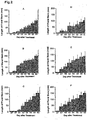
- Figs.1-3 The results are shown in Figs.1-3 .
- the 23 cont and 4 cont are the results obtained without or with cold treatment, respectively (control experiments). Cold treatment was performed at 4°C concurrently with a chemical treatment.
- BSO concentrations used for treatment were as follows: A, 0 M; B, 10 -7 M; C, 10 -6 M; D, 10 -5 M; E, 10 -4 M; and F, 10 -3 M. The values are expressed as mean ⁇ standard error.
- Arabidopsis thaliana late-flowering mutant fca was grown in a manner similar to that described in Examples 1 at 23°C under the day length condition of 16-h light/8-h dark cycle at 100 ⁇ E/m 2 /s light intensity and used in the experiments .
- a redox-state regulator of cells hydrogen peroxide
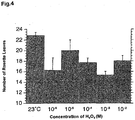
- Fig.4 As a redox-state regulator of cells, hydrogen peroxide, was used at the concentrations indicated in Fig.4 .
- An aqueous solution of hydrogen peroxide was prepared immediately before use. Two to three plants were placed per a pot (about 40x50 mm). On 17 days after imbibition and thereafter, the treatment solution was added dropwise around the shoot apex at 5 ml/day per a pot. The treatments were performed on day 0 (the initiation date of treatment), 1, 3, 5 and 7, which set of treatments was regarded as one processing. The time of floral transition was compared using the rosette leaf number as an index. The result are shown in Fig.4 . In the figure, the 23 cont is the result of water treatment (control experiment). The values are expressed as mean ⁇ standard error.
- Arabidopsis thaliana late-flowering mutant fca was grown in a manner similar to that described in Example 1 at 23°C under a day length condition of 16-h light/8-h dark cycle at 100 ⁇ E/m 2 light intensity and used in the experiments.
- KCN or NaN 3 As a redox-state regulator of cells, KCN or NaN 3 was used. KCN or sodium azide was prepared immediately before use and used at concentrations described in Figs.6 or 7 , respectively. Two to three plants were placed per a pot (about 40 x 50 mm) and treatment solution was added dropwise around the shoot apex at 5 ml/day per a pot. KCN or NaN 3 treatment was started 17 days after imbibition. The treatments were performed on day 0 (the initiation date of treatment), 1, 3, 5 and 7, which set of treatments was regarded as one processing. The time of floral transition was compared using the rosette leaf number as an index. The experimental results with KCN or NaN 3 are shown in Fig.6 and Fig.7 , respectively. In the figures, 23 cont is the result of water treatment (control experiment). The values are expressed as mean ⁇ standard error.
- Fig. 8 shows that the cells were elongated in the plants treated with hydrogen peroxide.
- Nicotina tabacum L. leaves grown aseptically was callused in a callus-inducible medium (an essential medium consisting of 1% agar and Murashige and Skoog medium (MS medium) supplied with 0.1 mg/L benzyladenine (BA) and 1 ml/L naphthaleneacetic acid (NAA)).
- a callus-inducible medium an essential medium consisting of 1% agar and Murashige and Skoog medium (MS medium) supplied with 0.1 mg/L benzyladenine (BA) and 1 ml/L naphthaleneacetic acid (NAA)
- BA benzyladenine
- NAA naphthaleneacetic acid
- Soft papers were laid in plastic dishes (100 ⁇ 15 mm) and seeded with Glycine max (cv: Tanbaguro). To the dish was added 15 ml of an aqueous solution of hydrogen peroxide (10 -3 M) for imbibition. Seeds were germinated at 23°C and the root hair formation was observed at 1 week after imbibition under a microscope. The root hair formation was recognized in the dish treated with water and not in the dish treated with hydrogen peroxide solution.
- Zinnia elegans L. (cv: Canary Bird) was seeded and grown for 14 days, when mesophyll cells were isolated from the 3.5-4-.5 cm primary leaves and suspended into a D medium containing naphtalene acetate (0.1 mg/l) and benzylaminopurine (1 mg/l) at 2.5-4.0x10 6 /ml.
- This culture solution (2 ml each) was dispersed into test tubes and subjected to rotary culture at 25°C in the dark.
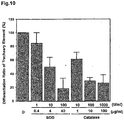
- Superoxide dismutase or catalase was added to the test tube at the concentrations indicated in Fig.10 at the start of culture. After 72-hour-culture, samples were obtained.
- Those cells with stripe due to the secondary cell wall thickening were identified as cells differentiated to tracheary elements.
- the proportion of tracheary element cells to the total cells was defined as differentiation rate.
- the result is shown in Fig.10 .
- the vertical axis shows the tracheary element differentiation ratio (TE differentiation)(%).
- the concentration of SOD or catalase added at the start of culture is shown below the column in the activity (U/ml, upper line) and protein mass (ug protein/ml, lower line). The values are expressed as mean ⁇ standard error.
- TE means tracheary element and "D" means D medium.
- the present disclosure enables to regulate the differentiation of a cell or an organ regardless of the category of organism.
Landscapes
- Life Sciences & Earth Sciences (AREA)
- Developmental Biology & Embryology (AREA)
- Environmental Sciences (AREA)
- Botany (AREA)
- General Chemical & Material Sciences (AREA)
- Chemical Kinetics & Catalysis (AREA)
- Chemical & Material Sciences (AREA)
- Engineering & Computer Science (AREA)
- Biotechnology (AREA)
- Cell Biology (AREA)
- Breeding Of Plants And Reproduction By Means Of Culturing (AREA)
- Agricultural Chemicals And Associated Chemicals (AREA)
- Medicines Containing Material From Animals Or Micro-Organisms (AREA)
Description
- The present invention is related to a method of regulating or controlling the differentiation of cells or organs, more specifically, to a method of regulating the differentiation of cells or organs using a substance capable of regulating the reduction-oxidation state of cells, and an agent for regulating the differentiation of cells or organs comprising such a substance.
- All of individual organisms are built up via the differentiation and development (morphogenesis) of cells and/or organs. For example, in a multicellular organism, cells are assembled to form tissues and/or organs, which are then intricately combined to form individuals. Cells must differentiate and be organized in a manner specific to respective tissue or organ so that each tissue or organ can exert their peculiar functions.
- It is thought that cells operate their genetic programs under the control of a regulator such as hormone that cells receive in the process of the differentiation and development of cells and organs. It is known that the concentration gradient of a regulator in the morphogenesis stage such as germination governs the organ differentiation in Amphibia such as newt. Also, in Drosophila, the related genes have been sought by isolating a variant having mutation in the regulation system. In plants, it is known that a regulator referred to as a plant hormone regulates or controls development of a plant. As described above, a specific regulator(s) participates in developments of individual organism.
- Recently, the homology of genes functioning in a genetic program related to development among all has become attract a good deal of attention.
- Also, it is known that all of organisms are greatly affected by certain kinds of stresses (for examples, light, temperature, chemicals, etc.) imposed during the development and/or morphogenesis process.
- From the high homology predicted in genetic programs related to development and also the community of factors causing stress (light, temperature, chemicals, etc.) among organisms, it is suggested that there exist a common substance among organisms which is involved in the genetic transmittance system leading to the said genetic program. However, it has not been reported that such a substance was isolated or identified yet.
- It has been thought that a substance capable of controlling the differentiation of cells and organs of all or wide range of organisms would greatly contribute to development of research and industry.
- Nitsan J Nature (1960) 187 81-82 reports the effect of glutathione and alloxan on the photoperiodic response of Xanthium.
WO02/33105 - One of objects of the present disclosure is to provide a means for regulating the differentiation of cells and organs.
- Another object of the present disclosure is to establish a means of controlling the flowering time of plants, the redifferentiation from callus, and the like, using an agent for regulation (regulator).
- The present investors have found that, among stress-related factors which affect development and/or morphogenesis, a substance regulating the redaction-oxidation (hereinafter, referred to as "redox") state of cells and existing commonly among organisms can affect the differentiation and development of cells and organs, and achieved the present invention.
- The present invention provides a method of regulating the differentiation of cells or organs, of a plant as set out in
claim 1. -
-
Fig.1 provides graphs showing the regulating effect of a glutathione inhibitor, L-buthionine sulfoximine (BSO), on the flowering time of Arabidopsis thaliana late-flowering mutant fca (hereafter referred to as "fca") or wild-type plant Ler (hereafter referred to as "Ler"). The regulatory effect was evaluated on the basis of the number of rosette leaves.
BSO treatment was started 12 days after imbibition of seeds (Fig.lA, fca and Fig .18, Ler). As to fca, BSO treatment was also started on day 17 (Fig. 1C ). In the graphs, 23 cont and 4 cont are the results obtained without or with cold treatment, respectively (control experiments). The values are expressed as mean ± standard error. -
Fig.2 provides graphs showing the regulating effect of BSO on the elongation rate of fca floral stem. BSO treatment was started 17 days after germination and the effect on the elongation (growth) of floral stem was examined. BSO concentration used for treatment was as follows: A, 0 M; B, 10-7 M; C, 10-6M; D, 10-5 M; E, 10-4 M; and F, 10-3 M. The values are expressed as mean ± standard error. -
Fig.3 provides graphs showing the effect of glutathione (GSH) on flowering (the transition to flowering) time-regulating effect of BSO.
BSO treatment was started 12 days after germination. Glutathione was given concurrently with BSO treatment. In this figure, 23 cont and 4 cont have the same meanings as inFig.1 . A and B show the results for Ler and for fca, respectively. -
Fig.4 is a graph showing the regulating effect of hydrogen peroxide on the flowering time of late-flowering mutant fca. Hydrogen peroxide treatment was started 17 days after imbibition of seed. The column "23°C" shows the result of water treatment (control experiment). The values are expressed as mean ± standard error. -
Fig.5 is a graph showing the regulating effect of hydrogen peroxide on the elongation rate of fca floral stem. Hydrogen peroxide treatment was started 17 days after germination and the effect on the elongation of floral stem was examined. The concentration of hydrogen peroxide used in the treatment is shown on the top of the figure. The values are expressed as mean ± standard error. -
Fig.6 is a graph showing the regulating effect of potassium cyanide (KCN) on the flowering time of a late-flowering mutant fca. KCN treatment was started 17 days after imbibition of seed. The column "23°C" shows the result of water treatment (control experiment). The values are expressed as mean ± standard error. -
Fig.7 is a graph showing the regulating effect of sodium azide (NaN3) on the flowering time of a late-flowering mutant fca. Sodium azide treatment was started 17 days after imbibition of seed. The column "23 cont" shows the result of water treatment (control experiment). The values are expressed as mean ± standard error. -
Fig.8 is a graph showing the regulating effect of hydrogen peroxide on the morphological alteration of Triticum aestivum L. (Regulation of Development (1)). The figure shows the result at 144 hours (6 days) after imbibition. The length of coleoptile treated with each concentration of hydrogen peroxide is depicted. The values are expressed as mean ± standard error. -
Fig.9 provides photographs showing the regulating effect of hydrogen peroxide on the morphological alteration of Zinnia elegans (Regulation of Development (2)). The concentration of hydrogen peroxide used in the treatment (unit: mM) is shown at the right downside of each panel. The figures show plants at 48 hours after imbibition. As the concentration of hydrogen peroxide used in the treatment increased, the cotyledon opening occurred rather than root elongation during the germination. From the figure showing the germination where treatment was conducted with 60 mM hydrogen peroxide, it can be observed that the cotyledon opening happened earlier and cotyledons come out from the pericarp before roots come out. -
Fig.10 is a graph showing the results of examination of regulatory effect on the tracheary element differentiation of mesophyll cells cultured in the presence of superoxide dismutase or catalase in the medium. The mesophyll cells were isolated from the 3.5-cm to 4.5-cm-long primary leaves of Zinnia elegans (c.v. Canary Bird), which had been grown for 14 days after seeding, and then cultured in the presence of superoxide dismutase (SOD) or catalase in a test tube and subjected to the examination. The concentrations of SOD and catalase added at the start of cultivation is shown at the bottom of column in the activity and protein amount. In the figure, TE stands for the tracheary element. The values are expressed as mean ± standard error. - As used herein, the phrase "differentiation of cells or organs" has, the meanings widely known in the filed of biology, which generally means a process where cells or organs are structurally and functionally specialized. In regard to plants, specific examples of "differentiation of cells of organs" include floral formation, morphogenesis at the time of germination, defoliation including the abscission layer formation, winter bud formation, dormancy breakage, pollen germination, embryogenesis including fertilization process, redifferentiation from callus, tracheary element formation, root hair formation, trichome formation, and the like. In regard to animals, specific examples include nerve cell differentiation or dendrite formation thereof, formation of epidermal cell or tissue, gamete formation, ovum development including fertilization, blood cell differentiation, germinative cell formation, and the like. As for Mycota, examples include sporophyte formation or perforating hyphae formation; as for Protista, examples include ontogeneses, flagellum formation or differentiation of a cell organelle; as for bacteria, specific examples include colony formation, flagellum formation or spore formation. However, the present disclosure is not limited to these examples.
- The present disclosure also includes differentiation and development of cell organelles such as plastid, mitochondrion and so on are.
- With reference to the present disclosure the term "development" refers to the process where an individual is formed from organism-constituting units (e.g., molecules and cells), in other words, the morphogenesis at the molecular and cellular levels.
- Accordingly, biological individuals, which are the subjects (objects) of "regulation of differentiation of cells or tissues", "regulation of development" and so on, include all the multi- and uni-cellular organisms involving development (formation from units for organism configuration). That is, the subjects of the present disclosure are Plantae including flowering plant, lichens and bryophyte, and Animalia including echinoderm, arthropod, mammalian and so on. The present disclosure also includes uni-cellular organisms as far as the shape is concerned.
- Throughout the specification, the phrase "the reduction-oxidation (redox) state of cells" means a condition estimated on the basis of the following indices: tendency to generate active oxygens; the absolute amount of glutathione; the ratio of reduced glutathione to oxidized glutathione (GSH/GSSG); the absolute amount of reduced form of nicotinamide-adenine dinucleotide phosphate (NAD(P)H); the ratio of NADPH/NADP+; the ratio of oxidized form/reduced form of cytochrome c; the ratio of reduction-oxidation of components in electron transport chains, such as plastoquinone and ubiquinone.
- Substances regulating the reduction-oxidation state in organism are known in the art, and therefore the present disclosure is not limited, to the above.
- The phrase, "reduction-oxidation (redox) state regulator of cells" refers to a substance which has an activity to change the above-mentioned value and includes, for example, a substance affecting the synthesis or amount of glutathione a substance promoting or inhibiting the generation of active oxygens and a substance promoting or inhibiting the conversion of a compound into either of oxidized- or reduced form.
- The "redox-state, regulator of cells" used in the present disclosure may be any substance(s) having the above-mentioned activity. Specific examples include, but not limited to, active oxygen species such as hydrogen peroxide and superoxide anion radical; antioxidant enzymes such as superoxide dismutase, catalase', ascorbate peroxidase, dehydroascorbate reductase, monoascorbate reductase, glutathione reductase and glutathione peroxidase; glutathione synthesis inhibitors such as buthionine sulfoximine and methionine sulfoximine; glutathione derivatives such as reduced glutathione, oxidized glutathione, homoglutathione, carboxypropylgiutathione and dicarboxyethylglutathione; respiratory inhibitors such as paraquat, KCN and NaN3; polyamines such as putrescine, spermine and spermidine; and a starting material or an inducer which gives rise to the above-mentioned substances in a cell.
- The agent of the present disclosure for regulating the differentiation of cells or tissues (hereinafter, it may be referred to as a "differentiation regulator") consists of at least one redox-state regulator or comprises a redox-state regulator(s) and a suitable carrier(s) or an excipient(s). Such a preparation can be obtained according to a known method by mixing a redox-state regulator with pharmaceutically acceptable carrier, pharmaceutical additives, and the like. The preparation can be formulated in any form, including solution, emulsion and solid, depending on the subject or method of application.
- In some cases, the rate and state of development can be easily controlled by combining two or more species of redox-state regulators as active ingredients. Such ingredients to be combined may be selected, for example, from substances which function in the same metabolic system but exert opposite effect. In the working Examples below, the flowering time of a plant is regulated by combined use of glutathione and glutathione inhibitor BSO. Any combinations of substances acting on different metabolic system are also available.
- When the present differentiation regulator includes two or more species of redox-state regulators, active ingredients may be present in one preparation, or be formulated separately so that they can be used simultaneously or sequentially.
- The present disclosure also provides a method for regulating development of an organism, which comprises applying the above-mentioried differentiation regulator to an organism having an altered sensitivity to the regulator, and the resultant organism. As used herein, the term "organism having an altered sensitivity" refers to an organism of which sensitivity to a specific substance has been changed, such as the mutant fca having an altered sensitivity to BSO compared to the wild-type plant Ler. Such individuals, can be naturally occurring or made artificially.
- The present differentiation regulator is applicable to every organism sensitize to a regulator of redox state of cells, which is an active ingredient. In the case of plants, the regulator has effect on both of the dicots and monocots of angiosperm.
- When the present differentiation regulator comprising as an active ingredient a redox-state regulator of cells is applied to a plant as the subject, and when it is intended to, for example, regulate artificially flowering, regeneration of individual from callus or tracheary element differentiation, germination etc., such objective would be achieved through the regulation of redox state of cells, especially the generation level of active oxygens, the synthesis and redox ratio of glutathione, and the like. Additionally, it is thought that the morphogenesis of a plant, such as root hair formation or trichome formation can be regulated by the above-mentioned substance capable of regulating the redox state of cells.
- Thus, according to the present method, it is possible to regulate a broad range of development of plants. The optimal condition for regulating development is not fixed, and varies depending on kinds and/or morphological features and the like of plants, and also on the intended purpose.
- Typical examples of plants to which the present differentiation regulator applicable include the followings. Convolvulaceae such as Pharbitis (Pharbitis nil Choisy), Calystegia (Calystegia japonica Choisy, Calystegia hederacea and Calysteegia soldanella Rohm. et Schult.), Ipomoea (Ipomoea pes-caprae and Ipomoea batatas Lam. var. edulis Maikno) and Cuscuta (Cuscuta japonica Chois. and Cuscuta australis) Caryophyllaceae such as Dianthus (Dianthus caryophillus L.), Stellaria, Minuartia, Cerastium, Sagina, Arenaria, Moehringia, Pseudostellaria, Hankenya, Spergula, Spergularia, Silene, Lychnis, Melandryum and Cucubalus Casuarinaceae, Saururacea, Piperaceae, Choranthaceae, Sailicaceae, Myricaceae, Juglandaceae, Betulaceae, Fagaceae, Ulmaceae, Moraceae, Urticaceae, Podostemaceae, Proteaceae, Olacaceae, Santalaceae, Loranthaceae, Aristolochiaceae, Rafflesiaceae, Balanophoraceae, Polygonaceae, Chenopodiaceae, Amaranthaceae, Nyctaginaceae, Cynocrmbaceae, Phytolaccaceae, Aizoaceae, Portulacaceae, Magnoliaceae, Trochodendraceae, Cercidphyllaceae, Nymphaeaceae, Ceratophyllaceae, Ranunculaceae, Lardizabalaeae, Berberidaceae, Menispermaceae, Calycanthaceae, Lauraceae, Papaveraceae, Capparidaceae, Cruciferae, Droseraceae, Nepenthaceae, Crassulaceae, Saxifragaceae, Pittosporaceae, Hamamelidaceae, Platanaceae, Rosaceae, Leguminosae, Oxalidaceae, Geraniaceae, Linaceae, Zygophyllaceae, Rutaceae, Cimaroubaceae, Meliaceae, Polygalaceae, Euphorbiaceae, Callitrichaceae, Buxaceae, Empetraceae, Coriariaceae, Anacardiaceae, Aquifoliaceae, Celastraceae, Staphyleaceae, Icacinaceae, Aceraceae, Hippocastanaceae, Sapindaceae, Sabiaceae, Balsaminaceae, Rhamnaceae, Vitaceae, Elaeocarpaceae, Tiliaceae, Malvaceae, Stearculiaceae, Actinidiaceae, Theaceae, Guttiferae, Elatinaceae, Tamaricaceae, Violaceae, Flacourtiaceae, Stachyuraceae, Passifloraceae, Begoniaceae, Cactaceae, Thymelaeaceae, Elaegnaceae, Lythraceae, Punicaceae, Rhizophoraceae, Alangiaceae, Melastomataceae, Hydrocaryaceae, Oenotheraceae, Haloragaceae, Hippuridaceae, Araliaceae, Umbelliferae, Cornaceae, Diapensiaceae, Clethraceae, Pyrolaceae, Uricaceae, Myrsinaceae, Primulaceae, Plumbaginaceae, Ebenaceae, Symplocaceae, Styracaceae, Oleaceae, Loganiaceae, Gentianaceae, Apocynaceae, Asclepiadaceae, Polemoniaceae, Boraginaceae, Verbenaceae, Labiatae, Solanaceae, Scrophulariaceae, Bignoniaceae, Pedaliaceae, Orobanchaceae, Gesneriaceae, Lentibulariaceae, Acanthaceae, Myoporaceae, Phrymaceae, Plantaginaceae, Rubiaceae, Caprifoliaceae, Adoxaceae, Valerianaeeae, Dipsacaceae, Gucurbitaceae, Campanulaceae, Compositae and so on.
- Typical examples of monocotyledoneae plants include the followings. Lermaceae such as Spirodela (Spirodela poxyrhiza Schleid), and Lemna (Lemna, paucicostata and Lemna trisulca), Orchidaceae such as Cattleya, Cymbidium, Dendrobium, Phalaenopsis, Vanda, Paphiopedilum and Oncidium, Typhaceae, Sparganiaceae, Potainogetonaceae, Najadaceae, Scheuchzeriaceae, Alismataceae, Hydrocharitaceae, Triuridaceae, Gramineae, Cyperaceae, Palmae, Araceae, Eriocaulaceae, Commelinaceae, Pontederiaceae, Juncaceae, Stemonaceae, Liliaceae, Amaryllidaceae, Dioscoreacea, Iridaceae, Musaceae, Zingiberaceae, Cannaceae and Burmannia.
- As described above, in the present disclosure, "the reduction-oxidation (redox) state" of a certain organism is affected by a substance common to a broad range of animals and plants. For examples, glutathione, which is an important factor determihirig the "redox state" is ubiquitous in organisms, and the glutathione, synthesis pathway and the proteins controlled by glutathione share high homology among organisms. Furthermore, the enzymes related to active oxygens have high homology among organisms. Therefore, the redox-state regulator of the present disclosure is useful in the regulation of development of organisms such as animals as well as plants.
- Such a regulator can be used in, but not limited to, the induction of parthenogenesis or differentiation of cells or tissues such as nerve or epidermis, restoration of differentiated tissues such as dendrites, differentiation of cells such as immunocompetent cells, formation of a zygote or a sporogenesis, formation of flagellum, and the like.
- Examples of organisms of animal kingdom include Vertebrata, Echinodermata, Protochordata, Coelenterata, Mollusca, Arthropoda, Annelida, Porifera, Platyhelminthes and so on. Furthermore, the organisms include fungi (e.g., basidiomycete and ascomycete) which perform sporophyte formation, and microorganisms such as procaryote (e.g., actinomycete) which perform sporogenesis, and yeast when the present disclosure is aimed at budding and zygote, but are not limited to the above examples.
- Examples of application of the present regulator include a medicine used for repairing skin from burn injury or for recovery from nerve damage; control of mushroom cultivation; equalization of quality of Pisces by parthenogenesis; preservation of the freshness of flowers etc.; prevention of infection through the inhibition of appressorium formation of pathogenic bacterium etc. The present disclosure is not limited to the above.
- The present differentiation regulators are used for a variety of organism individuals, organs, tissues or cells by an appropriate method depending on the dosage form. For example, when the regulator is a solution or emulsion and the organism potential to differentiate cells and organs is a plant, the regulator can be dispersed, dropped or painted on not only the growth point, but also a portion such as stem, leaf etc. or whole entity of the plant. When the regulator is a solid or powder, it can be absorbed from soil via the root. If the organism potential to differentiate cells and organs is a waterweed such as floating grass, the regulator can be used as an additive to the bottom bed so as to be absorbed by roots. Further, the regulator in the solid form can be dissolved into water gradually. The present disclosure can be applied by any methods and is not restricted to the above use.
- When the differentiation regulator is an additive to the bottom bed or a solid preparation, example of the career(s) generally includes solid careers, such as minerals (talc, clay, vermiculite, diatomite, kaolin, calcium carbonate, calcium hydrate, terra alba, silica gel etc.), flour, starch, and the like. When the regulator is a solution, examples of the career(s) generally includes liquid careers, such as water, aromatic hydrocarbons such as xylene etc., alcohols such as ethanol, ethylene glycol etc., ketones such as acetone etc., ethers such as dioxane, tetrahydrofuran etc., dimethylformamide, dimethyl sulfoxide, acetonitrile, and the like.
- Furthermore, the present differentiation regulator may include an appropriate additive (coadjuvant). Examples of additives include anionic surfactant such as alkyl sulfate esters, alkylsulfonate salts, alkylarylsulfonate salts, dialkylsulfosuccinate salts and the like, cationic surfactant such as higher aliphatic amine salts and the like, nonionic surfactant such as polyoxyethylene glycol alkyl ether, polyoxyethylene glycol acyl ester, polyoxyethylene glycol polyalcohol acyl ester, cellulose and so on, thickener such as gelatin, casein, gum arabic and so on, extender, binder, and the like.
- If necessary, a plant growth regulator such as benzoic acid, nicotinic acid, nicotinic-acid amide, pipecolic acid, and so on can be incorporated into the formulations within the limits of not diminishing the intended effect of the present disclosure.
- Although the present disclosure is exemplified mainly with regard to regulation/control of flowering time, a person skilled in the art will understand that the regulation of development can be effected in other biological systems according to the teachings in the present specification.
- Treatment with a differentiation regulator can be performed by applying an appropriate concentration of a redox-state regulator of cells before the initiation of and/or during an ordinary cultivation of a seed or a callus of a plant of interest. Usually, the application of a regulator would be more effective when it is conducted concurrently with treatment adapted to the nature of the subject plant (e.g,, long-day, short-day, and the like). Such treatment is known to those skilled in the art. For example, in the case of a relative long-day plant such as Eustoma grandiflorum, as described in the aftermentioned Examples, it would be advantageous to use the present differentiation regulator under lightening at higher level of illumination intensity.
- Therefore, the present disclosure encompasses the use of a differentiation regulator in any plant growing methods usually employed in the art.
- The differentiation regulator may consist of an active ingredient i.e., redox-state regulator; however, it is preferably formulated in a suitable dosage form applicable to individual plants, such as solutions, solids, powders, emulsions and bottom bed additives. Such preparations can be prepared according to a known method by admixing an agent for regulating the redox state of cells as an active ingredient with carrier components, pharmaceutical additives, and so on, which are known to be pharmaceutically acceptable in the art, within the limits of not diminishing the effect for regulating flowering time.
- Example 1: Regulation of Flowering Time (1) Arabidopsis thaliana late-flowering mutant fca
- (Accession No. N167) obtained from Arabidopsis Stock Center publicly established at the University of Nottingham (U.K.) and wild type plant Ler (Accession No. NW20) were grown at 23°C under a day length condition of 16-h light/8-h dark cycle at 100 µE/m2 light intensity and used in the experiments. As a medium, soil consisting of 2 Vermiculite (Asahi Kogyo), 2 Kureha molding for raising seedlings (KUREHA chemical industry Co., Ltd.) and 1 Vermiculite (Asahi Kogyo), which are stacked in layer as the lower, middle and the upper layers, respectively, was used.
- As a redox-state regulator of cells, L-buthionine sulfoximine (BSO), which is a glutathione synthesis inhibitor, and glutathione were used in combination.
- BSO was dissolved in water at a final concentration of 10-1M and used as a stock solution. Then, the treatment solutions at 10-3-10-7M were prepared from the stock solution (
Figs.1-3 ). Two to three plants were placed per a pot (about 40 x 50 mm) and the treatment solution was added dropwise around the shoot apex at 5 ml/day per a pot. The treatment was performed on day 0 (the initiation date of treatment), 1, 3, 5 and 7, which set of treatments was regarded as one processing. - Glutathione treatment was performed after dissolving glutathione into the BSO solution at a concentration of 10-4 M.
- The effect of treatment was estimated based on the number of rosette leaves and the elongation rate of floral stem. The results are shown in
Figs.1-3 . In these figures, the 23 cont and 4 cont are the results obtained without or with cold treatment, respectively (control experiments). Cold treatment was performed at 4°C concurrently with a chemical treatment. InFig.2 , BSO concentrations used for treatment were as follows: A, 0 M; B, 10-7M; C, 10-6M; D, 10-5 M; E, 10-4 M; and F, 10-3 M. The values are expressed as mean ± standard error. - (1) The fca plants, on 17 days after imbibition, were treated with the glutathione synthesis, inhibitor BSO. The result at 1 week afterward is shown in
Fig.1C . It is shown that, after 1 week from treatment, flower bud was recognized with naked eye and the rosette leaf number decreased compared with the water treated control group. The elongation rate of floral stem was also monitored for several months after treatment (Fig.2 ). As shown inFig.2 , the elongation rate of floral stem in the treated group is faster than that of control group, indicating that flowering was accelerated. The result showing a decrease in the rosette leaf number indicates that BSO treatment accelerated not only the growth rate after the transition to flowering but also the determination of the transition to flowering itself. - (2) The fca plants, on 12 days after imbibition, were treated with the glutathione synthesis inhibitor BSO. The result of 1 week later is shown in Fig.lA. Contrary to (1) above, Fig.lA shows that the treatment delayed the flowering time of fca. On the other hand, when the wild type Ler was subjected to the same experiment, treatment started 12 days after imbibition significantly accelerated the transition to flowering (
Fig.1B ). When Ler was grown in an agar medium containing BSO just after germination, the bolting was delayed, similarly to the case where fca was treated with a differentiation regulator at earlier stage, initiating on 12 days after imbibition. - (3) BSO treatment and glutathione (GSH) treatment was concurrently performed. BSO solution (concentration: 10-4 M) to which glutathione was added was used in the same manner as described above.
- The plants treated at the time when BSO treatment delays the transition to flowering showed acceleration of the transition to flowering as GSH concentration increased first; however, showed delay of the transition to flowering at 1 mM (
Fig.3B ). On the other hand, the plants treated at the time when BSO treatment accelerates the transition to flowering showed the delay of the transition to flowering as GSH concentration increased (Fig.3A ). - These results indicate that glutathione, glutathione synthesis inhibitor or a combination thereof can control the flowering time and further the elongation rate of floral stem. Additionally, these results revealed that it is necessary to adjust the time (stage) of treatment depending on cultivar.
- Arabidopsis thaliana late-flowering mutant fca was grown in a manner similar to that described in Examples 1 at 23°C under the day length condition of 16-h light/8-h dark cycle at 100 µE/m2/s light intensity and used in the experiments .
- As a redox-state regulator of cells, hydrogen peroxide, was used at the concentrations indicated in
Fig.4 . An aqueous solution of hydrogen peroxide was prepared immediately before use. Two to three plants were placed per a pot (about 40x50 mm). On 17 days after imbibition and thereafter, the treatment solution was added dropwise around the shoot apex at 5 ml/day per a pot. The treatments were performed on day 0 (the initiation date of treatment), 1, 3, 5 and 7, which set of treatments was regarded as one processing. The time of floral transition was compared using the rosette leaf number as an index. The result are shown inFig.4 . In the figure, the 23 cont is the result of water treatment (control experiment). The values are expressed as mean ± standard error. - The time of floral transition based on the rosette leaf number was accelerated in the treated plants at every concentrations compared with the control plants treated with water (
Fig.4 ). Also, the elongation rate of floral stem was accelerated at the optimum concentration (10-5M) (Fig.5 ). InFig.5 , the transverse axis shows the day after the completion of the agent treatment. - The above results indicate that active oxygens itself and substances which generate active oxygens have the effect of regulating floral transition time and accelerating the elongation rate of floral stem.
- Arabidopsis thaliana late-flowering mutant fca was grown in a manner similar to that described in Example 1 at 23°C under a day length condition of 16-h light/8-h dark cycle at 100 µE/m2 light intensity and used in the experiments.
- As a redox-state regulator of cells, KCN or NaN3 was used. KCN or sodium azide was prepared immediately before use and used at concentrations described in
Figs.6 or7 , respectively. Two to three plants were placed per a pot (about 40 x 50 mm) and treatment solution was added dropwise around the shoot apex at 5 ml/day per a pot. KCN or NaN3 treatment was started 17 days after imbibition. The treatments were performed on day 0 (the initiation date of treatment), 1, 3, 5 and 7, which set of treatments was regarded as one processing. The time of floral transition was compared using the rosette leaf number as an index. The experimental results with KCN or NaN3 are shown inFig.6 andFig.7 , respectively. In the figures, 23 cont is the result of water treatment (control experiment). The values are expressed as mean ± standard error. - The time of floral transition based on the rosette leaf number was accelerated in the treated group compared with the control group, which was treated with water, at the optimal concentration (KCN: 10-3; NaN3: 10-1).
- The above results indicate that substances which generate active oxygens have the regulating effect on the floral transition time.
- soft papers were laid in plastic dishes (100x15 mm), and seeded with Triticum aesivum L. (cv. Shirasagi) or Oryza sativa L. (cv. Nipponbare) (15 seeds/dish). To the dish was added an aqueous solution of hydrogen peroxide up to 15 ml, and allowed to germinate (light condition, 50 µE/m2, 16-h light/8-h dark cycle; temperature, Triticum aesivum L.: 18°C, Oryza sativa L.: 27°C). Aqueous solutions each containing hydrogen peroxide at the concentrations indicated in
Fig.8 were prepared immediately before use then applied to the seeds. The length of coleoptile of Triticum aesivum L. treated with hydrogen peroxide at each concentration was measured at 144 hours (6 days) after imbibition.. The results are shown inFig.8 . In the figure, the values are expressed as mean ± standard error. -
Fig. 8 shows that the cells were elongated in the plants treated with hydrogen peroxide. - The above results indicate that hydrogen peroxide has the regulatory effect on development involving the cell elongation during the germination period.
- Soft papers were laid in plastic dishes (100x15 mm) and seeded with Zinnia elegans L. (cv. Scarlet Frame) (15 seeds/dish). To the dish was added a solution of hydrogen peroxide, up to 15 ml, and allowed to germinate (light condition, 50 µE/m2, 16-h light/8-h dark cycle; temperature 27°C). Aqueous solutions each containing hydrogen peroxide at the concentrations indicated in
Fig.9 were prepared immediately before use and applied to the seeds. Observation was performed on 2 days after imbibition (seefig. 9 ). In the figure, the concentration of hydrogen peroxide (unit: mM) used in treatment is shown at the right downside of each panel. From the figure showing the germination in the dish treated with 60 mM hydrogen peroxide, it can be seen that cotyledons-opening occurred earlier and that cotyledons came out from the pericarp before root did. Thus, as the concentration of hydrogen peroxide increased, the treated seeds tend to germinate from cotyledon than from root, and the time of cotyledon opening becomes earlier in the treated group compared to the non-treated group. - The above results indicate that hydrogen peroxide has an accelerating effect on the cotyledon opining.
- The regulatory effect of glutathione on the formation of adventitious buds from callus was examined.
- Nicotina tabacum L. leaves grown aseptically was callused in a callus-inducible medium (an essential medium consisting of 1% agar and Murashige and Skoog medium (MS medium) supplied with 0.1 mg/L benzyladenine (BA) and 1 ml/L naphthaleneacetic acid (NAA)). The resultant callus was transferred to an adventitious formation medium (an essential medium consisting of 1% agar and Murashige and Skoog medium (MS medium) supplied with 1 mg/L BA and 0.1 ml/L NAA). To the adventitious-formation medium, 0.1 mM BSO, 1mM GSH or 1mM GSSG (oxidized glutathione) was added as a redox-state regulator. The same medium lacking in supplements was prepared and used as a control medium. These calli were cultured in the adventitious formation medium or control medium for 3 weeks after induction and the number of adventitious buds was counted. The results are shown in Table 1.
Table 1: Regulation of the formation of adventitious bud with glutathione Redox-state regulator GSH GSSG BSO None (control) Adventitious buds/callus 2-3 2-3 30 or more 4-8 - The above results show that it is possible to control the formation of adventitious buds by artificially changing the amounts and/or redox ratio of glutathione.
- Soft papers were laid in plastic dishes (100 x 15 mm) and seeded with Arabidopsis thaliana wild, type plant Ler. To the dish was added 15 ml of an aqueous solution of hydrogen peroxide (10-3M) for imbibition. Germination was allowed to arise at 23°C and the root hair formation was observed 1 week after imbibition under a microscope. The root hair formation was recognized in the dish treated with water and not in the dish treated with hydrogen peroxide solution.
- Soft papers were laid in plastic dishes (100×15 mm) and seeded with Glycine max (cv: Tanbaguro). To the dish was added 15 ml of an aqueous solution of hydrogen peroxide (10-3M) for imbibition. Seeds were germinated at 23°C and the root hair formation was observed at 1 week after imbibition under a microscope. The root hair formation was recognized in the dish treated with water and not in the dish treated with hydrogen peroxide solution.
- Zinnia elegans L. (cv: Canary Bird) was seeded and grown for 14 days, when mesophyll cells were isolated from the 3.5-4-.5 cm primary leaves and suspended into a D medium containing naphtalene acetate (0.1 mg/l) and benzylaminopurine (1 mg/l) at 2.5-4.0x10⁶/ml. This culture solution (2 ml each) was dispersed into test tubes and subjected to rotary culture at 25°C in the dark. Superoxide dismutase or catalase was added to the test tube at the concentrations indicated in
Fig.10 at the start of culture. After 72-hour-culture, samples were obtained. Those cells with stripe due to the secondary cell wall thickening were identified as cells differentiated to tracheary elements. The proportion of tracheary element cells to the total cells was defined as differentiation rate. The result is shown inFig.10 . InFig.10 , the vertical axis shows the tracheary element differentiation ratio (TE differentiation)(%). The concentration of SOD or catalase added at the start of culture is shown below the column in the activity (U/ml, upper line) and protein mass (ug protein/ml, lower line). The values are expressed as mean ± standard error. In the figure, TE means tracheary element and "D" means D medium. - The present disclosure enables to regulate the differentiation of a cell or an organ regardless of the category of organism.
Claims (2)
- A method of regulating differentiation of cells or organs of a plant comprising:administering a combination of reduced glutathione and buthionine sulfoximine to the plant,wherein said differentiation is floral formation.
- The method according to claim 1 , wherein reduced glutathione is applied to a seed, growth point, stem, leaf, root, plant body or whole entity of the plant.
Priority Applications (1)
| Application Number | Priority Date | Filing Date | Title |
|---|---|---|---|
| EP10180526A EP2263447A1 (en) | 2000-04-25 | 2001-04-24 | Regulators of cell- or organ-differentiation and their application to method of regulating morphogenesis |
Applications Claiming Priority (2)
| Application Number | Priority Date | Filing Date | Title |
|---|---|---|---|
| JP2000123761 | 2000-04-25 | ||
| EP01922034A EP1277404B1 (en) | 2000-04-25 | 2001-04-24 | Cell- or organ-differentiation controllers and method of controlling morphogenesis by using the same |
Related Parent Applications (2)
| Application Number | Title | Priority Date | Filing Date |
|---|---|---|---|
| EP01922034A Division EP1277404B1 (en) | 2000-04-25 | 2001-04-24 | Cell- or organ-differentiation controllers and method of controlling morphogenesis by using the same |
| EP01922034.2 Division | 2001-04-24 |
Related Child Applications (2)
| Application Number | Title | Priority Date | Filing Date |
|---|---|---|---|
| EP10180526A Division-Into EP2263447A1 (en) | 2000-04-25 | 2001-04-24 | Regulators of cell- or organ-differentiation and their application to method of regulating morphogenesis |
| EP10180526.5 Division-Into | 2010-09-28 |
Publications (3)
| Publication Number | Publication Date |
|---|---|
| EP2204087A2 EP2204087A2 (en) | 2010-07-07 |
| EP2204087A3 EP2204087A3 (en) | 2010-11-17 |
| EP2204087B1 true EP2204087B1 (en) | 2017-03-01 |
Family
ID=18633999
Family Applications (5)
| Application Number | Title | Priority Date | Filing Date |
|---|---|---|---|
| EP10180963A Withdrawn EP2263457A1 (en) | 2000-04-25 | 2001-04-24 | Cell-or organ-differentiation controllers and method of controlling morphogenesis by using the same |
| EP01922034A Expired - Lifetime EP1277404B1 (en) | 2000-04-25 | 2001-04-24 | Cell- or organ-differentiation controllers and method of controlling morphogenesis by using the same |
| EP10002403.3A Expired - Lifetime EP2204087B1 (en) | 2000-04-25 | 2001-04-24 | Regulators of cell- or organ-differentiation and their application to method of regulating morphogenesis |
| EP09009268A Withdrawn EP2145533A3 (en) | 2000-04-25 | 2001-04-24 | Cell-or organ-differentiation controllers and method of controlling morphogenesis by using the same |
| EP10180526A Withdrawn EP2263447A1 (en) | 2000-04-25 | 2001-04-24 | Regulators of cell- or organ-differentiation and their application to method of regulating morphogenesis |
Family Applications Before (2)
| Application Number | Title | Priority Date | Filing Date |
|---|---|---|---|
| EP10180963A Withdrawn EP2263457A1 (en) | 2000-04-25 | 2001-04-24 | Cell-or organ-differentiation controllers and method of controlling morphogenesis by using the same |
| EP01922034A Expired - Lifetime EP1277404B1 (en) | 2000-04-25 | 2001-04-24 | Cell- or organ-differentiation controllers and method of controlling morphogenesis by using the same |
Family Applications After (2)
| Application Number | Title | Priority Date | Filing Date |
|---|---|---|---|
| EP09009268A Withdrawn EP2145533A3 (en) | 2000-04-25 | 2001-04-24 | Cell-or organ-differentiation controllers and method of controlling morphogenesis by using the same |
| EP10180526A Withdrawn EP2263447A1 (en) | 2000-04-25 | 2001-04-24 | Regulators of cell- or organ-differentiation and their application to method of regulating morphogenesis |
Country Status (5)
| Country | Link |
|---|---|
| US (2) | US7479267B2 (en) |
| EP (5) | EP2263457A1 (en) |
| JP (1) | JP4074092B2 (en) |
| AU (1) | AU4884501A (en) |
| WO (1) | WO2001080638A1 (en) |
Families Citing this family (14)
| Publication number | Priority date | Publication date | Assignee | Title |
|---|---|---|---|---|
| WO2007125531A2 (en) * | 2006-04-27 | 2007-11-08 | Yissum Research Development Company Of The Hebrew University Of Jerusalem | Transgenic plants exhibiting increased tolerance to stress and methods of generating same |
| RU2415573C2 (en) * | 2006-12-11 | 2011-04-10 | Джапэн Сайенс Энд Текнолоджи Эйдженси | Regulator of plants growth and its application |
| CA2675696C (en) * | 2007-01-16 | 2014-05-13 | Japan Science And Technology Agency | Plant having increased yield of seeds |
| US7879369B2 (en) | 2007-09-18 | 2011-02-01 | Selvamedica, Llc | Combretum laurifolium Mart. extract and methods of extracting and using such extract |
| WO2009063806A1 (en) * | 2007-11-13 | 2009-05-22 | Japan Science And Technology Agency | Composition for production of plant body having improved sugar content, and use thereof |
| BR112012013907A2 (en) | 2009-12-10 | 2015-09-15 | Jujo Paper Co Ltd | method for producing clonal seedlings |
| CN103068966B (en) | 2010-08-31 | 2015-10-14 | 国立研究开发法人科学技术振兴机构 | Algae with improved productivity of photosynthesis product, and utilization thereof |
| CN103987249B (en) | 2011-12-12 | 2015-10-21 | 冈山县 | Compounds for increasing the amino acid content of plants and their use |
| US20140121100A1 (en) * | 2012-10-31 | 2014-05-01 | Novozymes Bioag A/S | Compositions and methods for enhancing plant growth |
| CN105432664A (en) * | 2015-12-04 | 2016-03-30 | 宁夏大荣化工冶金有限公司 | Method for increasing yield of garlic by means of modified calcium cyanamide |
| CN109258463B (en) * | 2018-09-18 | 2022-08-02 | 广西壮族自治区林业科学研究院 | A kind of vegetative propagation method of P. apricot |
| TWI723344B (en) * | 2019-02-20 | 2021-04-01 | 安益藥業股份有限公司 | Uses of picrotoxane-type sesquiterpenes for preparing pharmaceutical composition with eye care effect |
| EP4140305A4 (en) | 2020-12-18 | 2024-08-14 | University of Hyogo | Liquid for promoting seed germination and method for promoting seed germination using same |
| CN115644059B (en) * | 2022-10-08 | 2023-07-11 | 贵州省植物园(贵州省园林科学研究所、贵州省植物研究所) | Tissue culture and rapid propagation method for borage |
Family Cites Families (14)
| Publication number | Priority date | Publication date | Assignee | Title |
|---|---|---|---|---|
| US4361436A (en) * | 1977-09-16 | 1982-11-30 | Gaf Corporation | Composition for plant growth regulation |
| WO1979000838A1 (en) * | 1978-03-28 | 1979-10-18 | Michael James Sampson | New plant technique |
| JPS59106407A (en) | 1982-12-10 | 1984-06-20 | Nippon Peroxide Co Ltd | Plant growth regulator and its stabilization |
| US6030950A (en) * | 1987-07-09 | 2000-02-29 | Ohlenschlaeger; Gerhard | Pharmaceutical therapeutic use of glutathione derivative |
| US5538878A (en) * | 1988-08-08 | 1996-07-23 | Calgene, Inc. | Superoxide dismutase expression in plants |
| FR2648675B1 (en) * | 1989-06-27 | 1994-05-27 | Agronomique Inst Nat Rech | COMPOSITIONS SUITABLE FOR INFLUENCING THE DEVELOPMENT AND FLOWERING OF PLANTS, METHOD OF TREATING PLANTS THEREWITH, AND MODIFIED PLANTS OBTAINED |
| JP3013444B2 (en) | 1990-12-18 | 2000-02-28 | エヌオーケー株式会社 | Plant callus cell differentiation agent and regeneration method using the same |
| JP2789879B2 (en) | 1991-08-28 | 1998-08-27 | エヌオーケー株式会社 | Method for producing plant callus cell differentiation agent |
| WO1994025052A1 (en) * | 1993-05-03 | 1994-11-10 | Cornell Research Foundation, Inc. | Use of glutathione diesters |
| FR2710234B1 (en) | 1993-09-22 | 1995-12-15 | Lvmh Rech | Method for promoting the differentiation of plant cells and plant obtained by this method. |
| JP2000038308A (en) | 1998-07-23 | 2000-02-08 | Shiseido Co Ltd | Rooting promoter |
| HUP0201109A2 (en) * | 1998-07-27 | 2002-07-29 | Makhteshim Chemical Works Ltd. | Environmentally compatible processes compositions and materials treated thereby |
| AU774441B2 (en) * | 1998-12-18 | 2004-06-24 | Monsanto Technology Llc | Method for the regeneration of cotton |
| GB0025312D0 (en) * | 2000-10-16 | 2000-11-29 | Plant Bioscience Ltd | Methods and means for modification of plant characteristics |
-
2001
- 2001-04-24 WO PCT/JP2001/003491 patent/WO2001080638A1/en not_active Ceased
- 2001-04-24 EP EP10180963A patent/EP2263457A1/en not_active Withdrawn
- 2001-04-24 EP EP01922034A patent/EP1277404B1/en not_active Expired - Lifetime
- 2001-04-24 AU AU48845/01A patent/AU4884501A/en not_active Abandoned
- 2001-04-24 EP EP10002403.3A patent/EP2204087B1/en not_active Expired - Lifetime
- 2001-04-24 US US10/258,234 patent/US7479267B2/en not_active Expired - Lifetime
- 2001-04-24 JP JP2001577748A patent/JP4074092B2/en not_active Expired - Lifetime
- 2001-04-24 EP EP09009268A patent/EP2145533A3/en not_active Withdrawn
- 2001-04-24 EP EP10180526A patent/EP2263447A1/en not_active Withdrawn
-
2008
- 2008-12-10 US US12/314,433 patent/US20090099023A1/en not_active Abandoned
Non-Patent Citations (1)
| Title |
|---|
| None * |
Also Published As
| Publication number | Publication date |
|---|---|
| JP4074092B2 (en) | 2008-04-09 |
| US7479267B2 (en) | 2009-01-20 |
| AU4884501A (en) | 2001-11-07 |
| EP1277404A1 (en) | 2003-01-22 |
| EP2263457A1 (en) | 2010-12-22 |
| EP2204087A3 (en) | 2010-11-17 |
| EP2145533A2 (en) | 2010-01-20 |
| US20090099023A1 (en) | 2009-04-16 |
| EP2204087A2 (en) | 2010-07-07 |
| US20030110527A1 (en) | 2003-06-12 |
| EP1277404B1 (en) | 2012-06-13 |
| EP2145533A3 (en) | 2010-11-17 |
| EP1277404A4 (en) | 2005-06-15 |
| EP2263447A1 (en) | 2010-12-22 |
| WO2001080638A1 (en) | 2001-11-01 |
Similar Documents
| Publication | Publication Date | Title |
|---|---|---|
| US20090099023A1 (en) | Regulators of cell- or organ-differentiation and their application to method of regulating morphogenesis | |
| US9532519B2 (en) | Plant growth regulator and use thereof | |
| EP2727997A1 (en) | Plant cell differentiation promoter | |
| KR101703180B1 (en) | Compound for increasing amino acid content in plant, and use thereof | |
| US8524978B2 (en) | Composition for production of plant body having improved sugar content, and use thereof | |
| DE60009311T2 (en) | POTENTIATOR FOR PLANTS | |
| JPWO2001080638A1 (en) | Cell or organ differentiation regulator and method for regulating morphogenesis using the same | |
| US20180310565A1 (en) | Composition comprising allantoin and method of applying allantoin to a plant | |
| JP4817397B2 (en) | Cell or organ differentiation regulator and method of regulating morphogenesis using the same | |
| EP2478767A1 (en) | Plant growth regulator | |
| EP3409116A1 (en) | Agent for enhancing high-temperature resistance in plant, method for enhancing high-temperature resistance, agent for suppressing whitening, and dreb2a gene expression promoter |
Legal Events
| Date | Code | Title | Description |
|---|---|---|---|
| PUAI | Public reference made under article 153(3) epc to a published international application that has entered the european phase |
Free format text: ORIGINAL CODE: 0009012 |
|
| 17P | Request for examination filed |
Effective date: 20100326 |
|
| AC | Divisional application: reference to earlier application |
Ref document number: 1277404 Country of ref document: EP Kind code of ref document: P |
|
| AK | Designated contracting states |
Kind code of ref document: A2 Designated state(s): AT BE CH CY DE DK ES FI FR GB GR IE IT LI LU MC NL PT SE TR |
|
| PUAL | Search report despatched |
Free format text: ORIGINAL CODE: 0009013 |
|
| AK | Designated contracting states |
Kind code of ref document: A3 Designated state(s): AT BE CH CY DE DK ES FI FR GB GR IE IT LI LU MC NL PT SE TR |
|
| 17Q | First examination report despatched |
Effective date: 20110720 |
|
| GRAP | Despatch of communication of intention to grant a patent |
Free format text: ORIGINAL CODE: EPIDOSNIGR1 |
|
| INTG | Intention to grant announced |
Effective date: 20160920 |
|
| GRAS | Grant fee paid |
Free format text: ORIGINAL CODE: EPIDOSNIGR3 |
|
| GRAA | (expected) grant |
Free format text: ORIGINAL CODE: 0009210 |
|
| AC | Divisional application: reference to earlier application |
Ref document number: 1277404 Country of ref document: EP Kind code of ref document: P |
|
| AK | Designated contracting states |
Kind code of ref document: B1 Designated state(s): AT BE CH CY DE DK ES FI FR GB GR IE IT LI LU MC NL PT SE TR |
|
| REG | Reference to a national code |
Ref country code: GB Ref legal event code: FG4D |
|
| REG | Reference to a national code |
Ref country code: CH Ref legal event code: EP Ref country code: AT Ref legal event code: REF Ref document number: 870203 Country of ref document: AT Kind code of ref document: T Effective date: 20170315 |
|
| REG | Reference to a national code |
Ref country code: IE Ref legal event code: FG4D |
|
| REG | Reference to a national code |
Ref country code: NL Ref legal event code: FP |
|
| REG | Reference to a national code |
Ref country code: DE Ref legal event code: R096 Ref document number: 60150342 Country of ref document: DE |
|
| REG | Reference to a national code |
Ref country code: AT Ref legal event code: MK05 Ref document number: 870203 Country of ref document: AT Kind code of ref document: T Effective date: 20170301 |
|
| PG25 | Lapsed in a contracting state [announced via postgrant information from national office to epo] |
Ref country code: GR Free format text: LAPSE BECAUSE OF FAILURE TO SUBMIT A TRANSLATION OF THE DESCRIPTION OR TO PAY THE FEE WITHIN THE PRESCRIBED TIME-LIMIT Effective date: 20170602 Ref country code: FI Free format text: LAPSE BECAUSE OF FAILURE TO SUBMIT A TRANSLATION OF THE DESCRIPTION OR TO PAY THE FEE WITHIN THE PRESCRIBED TIME-LIMIT Effective date: 20170301 |
|
| PG25 | Lapsed in a contracting state [announced via postgrant information from national office to epo] |
Ref country code: AT Free format text: LAPSE BECAUSE OF FAILURE TO SUBMIT A TRANSLATION OF THE DESCRIPTION OR TO PAY THE FEE WITHIN THE PRESCRIBED TIME-LIMIT Effective date: 20170301 Ref country code: SE Free format text: LAPSE BECAUSE OF FAILURE TO SUBMIT A TRANSLATION OF THE DESCRIPTION OR TO PAY THE FEE WITHIN THE PRESCRIBED TIME-LIMIT Effective date: 20170301 Ref country code: ES Free format text: LAPSE BECAUSE OF FAILURE TO SUBMIT A TRANSLATION OF THE DESCRIPTION OR TO PAY THE FEE WITHIN THE PRESCRIBED TIME-LIMIT Effective date: 20170301 |
|
| PG25 | Lapsed in a contracting state [announced via postgrant information from national office to epo] |
Ref country code: IT Free format text: LAPSE BECAUSE OF FAILURE TO SUBMIT A TRANSLATION OF THE DESCRIPTION OR TO PAY THE FEE WITHIN THE PRESCRIBED TIME-LIMIT Effective date: 20170301 |
|
| REG | Reference to a national code |
Ref country code: DE Ref legal event code: R119 Ref document number: 60150342 Country of ref document: DE |
|
| PG25 | Lapsed in a contracting state [announced via postgrant information from national office to epo] |
Ref country code: PT Free format text: LAPSE BECAUSE OF FAILURE TO SUBMIT A TRANSLATION OF THE DESCRIPTION OR TO PAY THE FEE WITHIN THE PRESCRIBED TIME-LIMIT Effective date: 20170703 |
|
| REG | Reference to a national code |
Ref country code: CH Ref legal event code: PL |
|
| PLBE | No opposition filed within time limit |
Free format text: ORIGINAL CODE: 0009261 |
|
| STAA | Information on the status of an ep patent application or granted ep patent |
Free format text: STATUS: NO OPPOSITION FILED WITHIN TIME LIMIT |
|
| REG | Reference to a national code |
Ref country code: IE Ref legal event code: MM4A |
|
| REG | Reference to a national code |
Ref country code: FR Ref legal event code: ST Effective date: 20171229 |
|
| PG25 | Lapsed in a contracting state [announced via postgrant information from national office to epo] |
Ref country code: FR Free format text: LAPSE BECAUSE OF NON-PAYMENT OF DUE FEES Effective date: 20170502 Ref country code: DE Free format text: LAPSE BECAUSE OF NON-PAYMENT OF DUE FEES Effective date: 20171103 Ref country code: MC Free format text: LAPSE BECAUSE OF FAILURE TO SUBMIT A TRANSLATION OF THE DESCRIPTION OR TO PAY THE FEE WITHIN THE PRESCRIBED TIME-LIMIT Effective date: 20170301 Ref country code: DK Free format text: LAPSE BECAUSE OF FAILURE TO SUBMIT A TRANSLATION OF THE DESCRIPTION OR TO PAY THE FEE WITHIN THE PRESCRIBED TIME-LIMIT Effective date: 20170301 |
|
| 26N | No opposition filed |
Effective date: 20171204 |
|
| GBPC | Gb: european patent ceased through non-payment of renewal fee |
Effective date: 20170601 |
|
| PG25 | Lapsed in a contracting state [announced via postgrant information from national office to epo] |
Ref country code: CH Free format text: LAPSE BECAUSE OF NON-PAYMENT OF DUE FEES Effective date: 20170430 Ref country code: LI Free format text: LAPSE BECAUSE OF NON-PAYMENT OF DUE FEES Effective date: 20170430 Ref country code: LU Free format text: LAPSE BECAUSE OF NON-PAYMENT OF DUE FEES Effective date: 20170424 |
|
| REG | Reference to a national code |
Ref country code: BE Ref legal event code: MM Effective date: 20170430 |
|
| PG25 | Lapsed in a contracting state [announced via postgrant information from national office to epo] |
Ref country code: GB Free format text: LAPSE BECAUSE OF NON-PAYMENT OF DUE FEES Effective date: 20170601 Ref country code: IE Free format text: LAPSE BECAUSE OF NON-PAYMENT OF DUE FEES Effective date: 20170424 |
|
| PG25 | Lapsed in a contracting state [announced via postgrant information from national office to epo] |
Ref country code: BE Free format text: LAPSE BECAUSE OF NON-PAYMENT OF DUE FEES Effective date: 20170430 |
|
| PG25 | Lapsed in a contracting state [announced via postgrant information from national office to epo] |
Ref country code: CY Free format text: LAPSE BECAUSE OF NON-PAYMENT OF DUE FEES Effective date: 20170301 |
|
| PG25 | Lapsed in a contracting state [announced via postgrant information from national office to epo] |
Ref country code: TR Free format text: LAPSE BECAUSE OF FAILURE TO SUBMIT A TRANSLATION OF THE DESCRIPTION OR TO PAY THE FEE WITHIN THE PRESCRIBED TIME-LIMIT Effective date: 20170301 |
|
| PGFP | Annual fee paid to national office [announced via postgrant information from national office to epo] |
Ref country code: NL Payment date: 20200426 Year of fee payment: 20 |
|
| REG | Reference to a national code |
Ref country code: NL Ref legal event code: MK Effective date: 20210423 |