EP2203390B1 - Process for the reduction of the concentration of salts in an aqueous stream containing them - Google Patents
Process for the reduction of the concentration of salts in an aqueous stream containing them Download PDFInfo
- Publication number
- EP2203390B1 EP2203390B1 EP08838811A EP08838811A EP2203390B1 EP 2203390 B1 EP2203390 B1 EP 2203390B1 EP 08838811 A EP08838811 A EP 08838811A EP 08838811 A EP08838811 A EP 08838811A EP 2203390 B1 EP2203390 B1 EP 2203390B1
- Authority
- EP
- European Patent Office
- Prior art keywords
- process according
- ice
- aqueous stream
- temperature ranging
- effected
- Prior art date
- Legal status (The legal status is an assumption and is not a legal conclusion. Google has not performed a legal analysis and makes no representation as to the accuracy of the status listed.)
- Not-in-force
Links
- 238000000034 method Methods 0.000 title claims abstract description 25
- 150000003839 salts Chemical class 0.000 title claims abstract description 16
- 239000012530 fluid Substances 0.000 claims abstract description 41
- 238000005406 washing Methods 0.000 claims abstract description 28
- 230000008014 freezing Effects 0.000 claims abstract description 19
- 238000007710 freezing Methods 0.000 claims abstract description 19
- 238000000926 separation method Methods 0.000 claims abstract description 17
- HPALAKNZSZLMCH-UHFFFAOYSA-M sodium;chloride;hydrate Chemical compound O.[Na+].[Cl-] HPALAKNZSZLMCH-UHFFFAOYSA-M 0.000 claims abstract description 17
- 239000012267 brine Substances 0.000 claims abstract description 15
- 239000000725 suspension Substances 0.000 claims abstract description 13
- 238000002425 crystallisation Methods 0.000 claims abstract description 11
- 230000008025 crystallization Effects 0.000 claims abstract description 11
- 238000002844 melting Methods 0.000 claims abstract description 11
- 230000008018 melting Effects 0.000 claims abstract description 11
- 238000004519 manufacturing process Methods 0.000 claims abstract description 8
- 239000013535 sea water Substances 0.000 claims description 10
- 238000001816 cooling Methods 0.000 claims description 7
- 239000007788 liquid Substances 0.000 claims description 6
- 239000013078 crystal Substances 0.000 claims description 5
- FAPWRFPIFSIZLT-UHFFFAOYSA-M Sodium chloride Chemical compound [Na+].[Cl-] FAPWRFPIFSIZLT-UHFFFAOYSA-M 0.000 claims description 4
- 239000011780 sodium chloride Substances 0.000 claims description 3
- 239000003344 environmental pollutant Substances 0.000 claims description 2
- 239000002440 industrial waste Substances 0.000 claims description 2
- 231100000719 pollutant Toxicity 0.000 claims description 2
- XLYOFNOQVPJJNP-UHFFFAOYSA-N water Substances O XLYOFNOQVPJJNP-UHFFFAOYSA-N 0.000 description 17
- 239000003949 liquefied natural gas Substances 0.000 description 11
- 238000010612 desalination reaction Methods 0.000 description 10
- 239000002826 coolant Substances 0.000 description 8
- 239000000243 solution Substances 0.000 description 5
- IJGRMHOSHXDMSA-UHFFFAOYSA-N Atomic nitrogen Chemical compound N#N IJGRMHOSHXDMSA-UHFFFAOYSA-N 0.000 description 2
- CURLTUGMZLYLDI-UHFFFAOYSA-N Carbon dioxide Chemical compound O=C=O CURLTUGMZLYLDI-UHFFFAOYSA-N 0.000 description 2
- MYMOFIZGZYHOMD-UHFFFAOYSA-N Dioxygen Chemical compound O=O MYMOFIZGZYHOMD-UHFFFAOYSA-N 0.000 description 2
- ATUOYWHBWRKTHZ-UHFFFAOYSA-N Propane Chemical compound CCC ATUOYWHBWRKTHZ-UHFFFAOYSA-N 0.000 description 2
- 230000003115 biocidal effect Effects 0.000 description 2
- 239000003139 biocide Substances 0.000 description 2
- 230000015572 biosynthetic process Effects 0.000 description 2
- 239000003795 chemical substances by application Substances 0.000 description 2
- 239000000706 filtrate Substances 0.000 description 2
- 238000001914 filtration Methods 0.000 description 2
- 239000003915 liquefied petroleum gas Substances 0.000 description 2
- 238000002203 pretreatment Methods 0.000 description 2
- 238000004062 sedimentation Methods 0.000 description 2
- 239000002002 slurry Substances 0.000 description 2
- UFHFLCQGNIYNRP-UHFFFAOYSA-N Hydrogen Chemical compound [H][H] UFHFLCQGNIYNRP-UHFFFAOYSA-N 0.000 description 1
- 238000007792 addition Methods 0.000 description 1
- 239000007864 aqueous solution Substances 0.000 description 1
- 229910002092 carbon dioxide Inorganic materials 0.000 description 1
- 239000001569 carbon dioxide Substances 0.000 description 1
- 150000004677 hydrates Chemical class 0.000 description 1
- 239000001257 hydrogen Substances 0.000 description 1
- 229910052739 hydrogen Inorganic materials 0.000 description 1
- 238000012423 maintenance Methods 0.000 description 1
- 238000010309 melting process Methods 0.000 description 1
- 229910052757 nitrogen Inorganic materials 0.000 description 1
- 239000001294 propane Substances 0.000 description 1
- 238000000746 purification Methods 0.000 description 1
- 239000002699 waste material Substances 0.000 description 1
Images
Classifications
-
- C—CHEMISTRY; METALLURGY
- C02—TREATMENT OF WATER, WASTE WATER, SEWAGE, OR SLUDGE
- C02F—TREATMENT OF WATER, WASTE WATER, SEWAGE, OR SLUDGE
- C02F1/00—Treatment of water, waste water, or sewage
- C02F1/22—Treatment of water, waste water, or sewage by freezing
-
- C—CHEMISTRY; METALLURGY
- C02—TREATMENT OF WATER, WASTE WATER, SEWAGE, OR SLUDGE
- C02F—TREATMENT OF WATER, WASTE WATER, SEWAGE, OR SLUDGE
- C02F2103/00—Nature of the water, waste water, sewage or sludge to be treated
- C02F2103/08—Seawater, e.g. for desalination
-
- C—CHEMISTRY; METALLURGY
- C02—TREATMENT OF WATER, WASTE WATER, SEWAGE, OR SLUDGE
- C02F—TREATMENT OF WATER, WASTE WATER, SEWAGE, OR SLUDGE
- C02F2301/00—General aspects of water treatment
- C02F2301/08—Multistage treatments, e.g. repetition of the same process step under different conditions
-
- Y—GENERAL TAGGING OF NEW TECHNOLOGICAL DEVELOPMENTS; GENERAL TAGGING OF CROSS-SECTIONAL TECHNOLOGIES SPANNING OVER SEVERAL SECTIONS OF THE IPC; TECHNICAL SUBJECTS COVERED BY FORMER USPC CROSS-REFERENCE ART COLLECTIONS [XRACs] AND DIGESTS
- Y02—TECHNOLOGIES OR APPLICATIONS FOR MITIGATION OR ADAPTATION AGAINST CLIMATE CHANGE
- Y02A—TECHNOLOGIES FOR ADAPTATION TO CLIMATE CHANGE
- Y02A20/00—Water conservation; Efficient water supply; Efficient water use
- Y02A20/124—Water desalination
Definitions
- the present invention describes a process for the reduction of the concentration of salts in an aqueous stream containing them which can be applied in particular for the desalination of seawater.
- the desalination process by direct freezing consists in a crystallization by means of direct freezing, a separation and washing phase of the ice, melting of the ice, separation of the coolant residues from the water produced.
- the coolant is injected directly into the stream containing salts to be frozen.
- the desalination process by indirect freezing consists in the partial freezing in successive steps of the water to be desalinated on an exchange surface, draining of the residual brine, melting of the ice produced and sending to a new step for a further purification step until the desired purity is reached.
- This type of crystallization has the advantage of not having direct contact between coolant fluid and the brine to be frozen, overcoming all the critical aspects of the known art for desalination by direct freezing, associated with direct contact between water and coolant.
- the freezing takes place in a single step in continuous, eliminating problems of thermal efficiency caused by desalination by indirect contact present in the known art.
- the process, object of the present invention, for the reduction of the concentration of salts in an aqueous stream containing them comprises the following steps:
- the cold fluid having a temperature equal to or less than -2°C is preferably a fluid which absorbs heat passing from liquid to gaseous state or a fluid which absorbs heat in supercritical conditions.
- the cold fluid is preferably selected from LNG (liquefied natural gas), LPG (liquefied petroleum gas), LH 2 (liquid hydrogen), LN 2 (liquid nitrogen), LO 2 (liquid oxygen), LCO 2 (liquid carbon dioxide), even more preferably LNG.
- the aqueous stream containing salts can be preferably seawater or industrial waste containing saline pollutants.
- the stage of crystallization in suspension can be preferably obtained by means of two apparatuses, a crystallizer and a heat exchanger.
- the aqueous stream containing salts is fed to the crystallizer in which a suspension of ice crystals and concentrated brine already formed, called "slurry", is contained.
- a stream of slurry is continuously recirculated between the crystallizer and the heat exchanger where it is subcooled in order to cause the partial freezing of the aqueous stream fed to the crystallizer.
- the preferred solution for the crystallizer is a crystallizer in suspension, preferably of the "Draft Tube Baffle" type or with forced circulation, with external cooling; other types of crystallizers with indirect cooling can also be used, such as for example, a crystallizer in suspension with a scraped surface exchanger.
- the aqueous stream to be frozen has, inside the exchanger selected, velocities preferably higher than or equal to 1 m/s.
- velocities preferably higher than or equal to 1 m/s.
- a higher velocity than the floating velocity of the ice crystals is preferably selected.
- the residence time in the crystallizer is dimensioned so as to obtain ice crystals which are sufficiently large for the subsequent separation and washing phases; the average dimension of the ice crystals is preferably greater than 0.2 mm.
- the separation of the ice formed can be preferably effected by rotating vacuum filters or by centrifuge.
- the subsequent washing is preferably effected in two steps, of which the first is effected directly either on the filter or on the centrifuge, the second is effected for example by means of an elutriation column.
- the melting step of the ice can be effected by means of an exchanger with a source having a temperature higher than 0°C.
- the melting unit is preferably similar to the crystallizer but with a lower residence time as the dynamics of the melting process is more rapid than the growth dynamics.
- the dimensions of the melting system depend a lot on the temperature of the heat source to be used.
- the aqueous stream Before being sent to the ice production step, the aqueous stream can be preferably subjected to precooling.
- the precooling of the aqueous stream is preferably effected using the aqueous stream at a reduced concentration of salts obtained and/or the concentrated brine produced in the ice separation.
- a fluid is used as cold fluid at a temperature lower than -50°C, such as for example LNG, it is preferable to also use one or more intermediate fluids which allow to reduce temperature difference.
- the stream to be treated (IN) is taken and preferably sent to a series of pretreatments ((FIL): Filtration and Sedimentation; (AS): Addition of Anti-scaling agents; (Bio): Addition of Biocide) which contribute to the good maintenance of the plant.
- FIL Filtration and Sedimentation
- AS Addition of Anti-scaling agents
- Bio Addition of Biocide
- PR suitable exchanger
- the precooled seawater is sent to a crystallizer in suspension (CR) with external cooling (SC) where it is partially frozen exploiting the frigories contained in the cold fluid (FF), preferably LNG, which is to be vaporized.
- CR crystallizer in suspension
- SC external cooling
- FF cold fluid
- the stream of ice and brine (SS) leaving the crystallizer is sent to the separation and first washing phase (SL1) and subsequently to the second washing phase (L2).
- the separation and first washing are effected at the same time in a single apparatus, for example in vacuum filters with washing of the filtrate or in centrifuges with internal washing.
- the ice (ICE) leaving the first washing is fluidized again in a specific tank (TS),by the addition of an aqueous stream (CS) taken from the second washing, and sent to the second washing (L2), effected for example in an elutriation column, to reach the desired concentration of salts.
- the stream of ice and desalinated water (SD) leaving the washing phases is sent to a melting unit (FUS), where the ice is melted by means of heat exchange (SF) with an available heat source (for example water).
- FUS melting unit
- SF heat exchange
- the streams of desalinated water produced (DIS) and brine leaving the separation (SAL) are, as already described above, used for the precooling of the pretreated stream or the stream to be treated.
- Figure 2 schematizes the particular case of the freezing of the aqueous stream effected with the use of two intermediate fluids in addition to the cold fluid.
- the precooled seawater is sent to a crystallizer in suspension (CR) with external cooling (SC) where it is partially frozen exploiting the frigories contained in the second intermediate fluid (12), which exchanges heat in a specific exchanger (SI2) with the first intermediate fluid (I1), which in turn exchanges heat in a second exchanger (SI1) with the cold fluid (FF), preferably LNG, which is to be vaporized.
- CR crystallizer in suspension
- SC external cooling
- a flow-rate of 7040 ton/h of seawater is taken and sent to a series of pretreatments (Filtration and Sedimentation, Addition of Anti-scaling agent, Addition of Biocide).
- the seawater, taken at about 15°C, is sent to a precooling unit where it exchanges heat with the streams of desalinated water (1860 ton/h) and waste brine (5180 ton/h) leaving the plant.
- the seawater precooled to approximately 0°C is sent to a crystallizer where it is partially frozen exploiting the frigories contained in the stream of LNG (1050 ton/h) at - 160°C which is to be vaporized.
- the temperature inside the crystallizer is -3°C.
- the solution selected for the crystallization is a crystallizer in suspension with external cooling (of the "Draft tube Baffle” type or with forced circulation).
- two intermediate fluids were also used, with relative exchange circuits, of which the first intermediate fluid (propane) exchanges in a closed circuit on one side with LNG, passing from -10°C to -50°C, on the other side with the second intermediate fluid, passing from -50°C to -10°C.
- the second intermediate fluid (aqueous solution at 20% of NaCl) exchanges in a circuit on one side with the first intermediate fluid, thus being cooled from -5°C to -12°C, on the other side with the crystallizer, thus being heated from -12°C to -5°C absorbing heat from the suspension of ice and brine which circulates between the crystallizer and the heat exchanger.
- a stream of ice and brine is taken at the outlet of the crystallizer to be sent to the separation and first washing phases.
- the separation and first washing are effected at the same time in a single apparatus (vacuum filters with washing of the filtrate).
- the ice leaving the first washing is fluidized again in a tank, by the addition of an aqueous stream (5000 ton/h) taken from the second washing, and sent to the second washing, carried out in an elutriation column, to reach the desired salts concentration.
- the stream of ice and desalinated water leaving the washing phases is sent to a melting unit where the ice is melted by heat exchange with water at a temperature higher than 10°C.
- the streams of desalinated water produced and brine leaving the separation are sent to the precooling of the seawater.
Landscapes
- Life Sciences & Earth Sciences (AREA)
- Hydrology & Water Resources (AREA)
- Engineering & Computer Science (AREA)
- Environmental & Geological Engineering (AREA)
- Water Supply & Treatment (AREA)
- Chemical & Material Sciences (AREA)
- Organic Chemistry (AREA)
- Physical Water Treatments (AREA)
- Inorganic Compounds Of Heavy Metals (AREA)
- Water Treatment By Electricity Or Magnetism (AREA)
- Electrodes For Compound Or Non-Metal Manufacture (AREA)
Abstract
Description
- The present invention describes a process for the reduction of the concentration of salts in an aqueous stream containing them which can be applied in particular for the desalination of seawater.
- There are two solutions in the known art for the desalination of water:
- desalination by direct freezing;
- desalination by indirect freezing on surfaces.
- The desalination process by direct freezing consists in a crystallization by means of direct freezing, a separation and washing phase of the ice, melting of the ice, separation of the coolant residues from the water produced. In crystallization by direct freezing, the coolant is injected directly into the stream containing salts to be frozen.
- The desalination process by indirect freezing consists in the partial freezing in successive steps of the water to be desalinated on an exchange surface, draining of the residual brine, melting of the ice produced and sending to a new step for a further purification step until the desired purity is reached.
- Both solutions have various drawbacks.
- Desalination by direct freezing has the following critical technical aspects:
- danger of the formation of hydrates due to the direct contact between water and coolant which drastically reduces the process performances;
- the washing phase is extremely critical due to the presence of the coolant which can contaminate the water produced;
- the single separation and washing apparatus is extremely expensive due to the high washing efficiency that this phase must have to eliminate the coolant from the water produced;
- in spite of the efficiency of the washing phase, a final stripping of the water produced is necessary to ensure that the residual traces of coolant are lower than the limits allowed.
- Desalination by indirect freezing, however, has the following critical technical aspects:
- low thermal efficiency due to the fact of having to freeze and melt the water several times to obtain the required purity;
- each single step has a batch functioning for which the exchange surfaces are continuously cooled and heated with consequent thermal fatigue problems.
- It has now been found that by effecting the production of ice by means of continuous crystallization in suspension with external cooling, the critical aspects of the solutions of the known art are overcome.
- This type of crystallization has the advantage of not having direct contact between coolant fluid and the brine to be frozen, overcoming all the critical aspects of the known art for desalination by direct freezing, associated with direct contact between water and coolant.
- In the process proposed, moreover, the formation of ice essentially takes place in the liquid bulk and not on the exchange surface, as occurs, on the contrary, in the processes of the known art, thus eliminating the critical issue caused by batch functioning.
- Furthermore, in the process proposed, the freezing takes place in a single step in continuous, eliminating problems of thermal efficiency caused by desalination by indirect contact present in the known art.
- The process, object of the present invention, for the reduction of the concentration of salts in an aqueous stream containing them comprises the following steps:
- production of ice by continuous crystallization in suspension obtained by the partial freezing of said aqueous stream, effected by means of indirect heat exchange with a cold fluid having a temperature lower than or equal to -2°C;
- separation between the ice produced and the concentrated brine obtained by partial freezing and subsequent washing of the ice in one or more steps;
- melting of the separated and washed ice to obtain an aqueous stream with a reduced concentration of salts.
- The cold fluid having a temperature equal to or less than -2°C is preferably a fluid which absorbs heat passing from liquid to gaseous state or a fluid which absorbs heat in supercritical conditions. In particular, the cold fluid is preferably selected from LNG (liquefied natural gas), LPG (liquefied petroleum gas), LH2 (liquid hydrogen), LN2 (liquid nitrogen), LO2 (liquid oxygen), LCO2 (liquid carbon dioxide), even more preferably LNG.
- The aqueous stream containing salts can be preferably seawater or industrial waste containing saline pollutants.
- The stage of crystallization in suspension can be preferably obtained by means of two apparatuses, a crystallizer and a heat exchanger.
- In the stage of crystallization thus configured, the aqueous stream containing salts is fed to the crystallizer in which a suspension of ice crystals and concentrated brine already formed, called "slurry", is contained. A stream of slurry is continuously recirculated between the crystallizer and the heat exchanger where it is subcooled in order to cause the partial freezing of the aqueous stream fed to the crystallizer.
- The preferred solution for the crystallizer is a crystallizer in suspension, preferably of the "Draft Tube Baffle" type or with forced circulation, with external cooling; other types of crystallizers with indirect cooling can also be used, such as for example, a crystallizer in suspension with a scraped surface exchanger.
- The aqueous stream to be frozen has, inside the exchanger selected, velocities preferably higher than or equal to 1 m/s. In the crystallizer, on the other hand, a higher velocity than the floating velocity of the ice crystals is preferably selected.
- The residence time in the crystallizer is dimensioned so as to obtain ice crystals which are sufficiently large for the subsequent separation and washing phases; the average dimension of the ice crystals is preferably greater than 0.2 mm.
- The separation of the ice formed can be preferably effected by rotating vacuum filters or by centrifuge.
- The subsequent washing is preferably effected in two steps, of which the first is effected directly either on the filter or on the centrifuge, the second is effected for example by means of an elutriation column.
- The melting step of the ice can be effected by means of an exchanger with a source having a temperature higher than 0°C.
- In particular, the melting unit is preferably similar to the crystallizer but with a lower residence time as the dynamics of the melting process is more rapid than the growth dynamics.
- The dimensions of the melting system depend a lot on the temperature of the heat source to be used.
- Before being sent to the ice production step, the aqueous stream can be preferably subjected to precooling.
- In this case, the precooling of the aqueous stream is preferably effected using the aqueous stream at a reduced concentration of salts obtained and/or the concentrated brine produced in the ice separation.
- If a fluid is used as cold fluid at a temperature lower than -50°C, such as for example LNG, it is preferable to also use one or more intermediate fluids which allow to reduce temperature difference.
- In particular, if LNG is used, there are preferably two intermediate fluids with relative exchange circuits, of which:
- the first intermediate fluid exchanges in a closed circuit on one side with LNG, having an inlet temperature ranging from -15°C to -5°C and the outlet temperature ranging from ranging from -30°C to -60°C. The LNG, which is at an inlet temperature ranging from -162°C to -130°C is heated and/or vaporized to a temperature ranging from -60°C to 10°C.
- the first intermediate fluid exchanges on the other side with the second intermediate fluid, having an inlet temperature ranging from -30°C to -60°C and an outlet temperature ranging from -15°C and -5°C.
- the second intermediate fluid exchanges in a closed circuit on one side with the first intermediate fluid, having an inlet temperature ranging from -2°C to -10°C and an outlet temperature ranging from -17°C and -9°C.
- the second intermediate fluid exchanges on the other side with the crystallizer for the production of ice, having an inlet temperature ranging from -17°C to -9°C and an outlet temperature ranging from -2°C and -10°C.
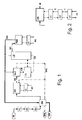
- An embodiment of the present invention is now provided, applied to seawater with the help of
figure 1 which, however, should not be considered as limiting the scope of the invention itself. - The stream to be treated (IN) is taken and preferably sent to a series of pretreatments ((FIL): Filtration and Sedimentation; (AS): Addition of Anti-scaling agents; (Bio): Addition of Biocide) which contribute to the good maintenance of the plant. The pretreated stream is then precooled in a suitable exchanger (PR) recovering frigories from the desalinated water (DIS) and brine (SAL) streams leaving the plant.
- The precooled seawater is sent to a crystallizer in suspension (CR) with external cooling (SC) where it is partially frozen exploiting the frigories contained in the cold fluid (FF), preferably LNG, which is to be vaporized.
- The stream of ice and brine (SS) leaving the crystallizer is sent to the separation and first washing phase (SL1) and subsequently to the second washing phase (L2). The separation and first washing are effected at the same time in a single apparatus, for example in vacuum filters with washing of the filtrate or in centrifuges with internal washing. The ice (ICE) leaving the first washing is fluidized again in a specific tank (TS),by the addition of an aqueous stream (CS) taken from the second washing, and sent to the second washing (L2), effected for example in an elutriation column, to reach the desired concentration of salts.
- The stream of ice and desalinated water (SD) leaving the washing phases is sent to a melting unit (FUS), where the ice is melted by means of heat exchange (SF) with an available heat source (for example water).
- The streams of desalinated water produced (DIS) and brine leaving the separation (SAL) are, as already described above, used for the precooling of the pretreated stream or the stream to be treated.
-
Figure 2 schematizes the particular case of the freezing of the aqueous stream effected with the use of two intermediate fluids in addition to the cold fluid. The precooled seawater is sent to a crystallizer in suspension (CR) with external cooling (SC) where it is partially frozen exploiting the frigories contained in the second intermediate fluid (12), which exchanges heat in a specific exchanger (SI2) with the first intermediate fluid (I1), which in turn exchanges heat in a second exchanger (SI1) with the cold fluid (FF), preferably LNG, which is to be vaporized. - An embodiment example of the present invention is provided effected according to the schemes of
figures 1 and 2 described above. - A flow-rate of 7040 ton/h of seawater is taken and sent to a series of pretreatments (Filtration and Sedimentation, Addition of Anti-scaling agent, Addition of Biocide). The seawater, taken at about 15°C, is sent to a precooling unit where it exchanges heat with the streams of desalinated water (1860 ton/h) and waste brine (5180 ton/h) leaving the plant.
- The seawater precooled to approximately 0°C is sent to a crystallizer where it is partially frozen exploiting the frigories contained in the stream of LNG (1050 ton/h) at - 160°C which is to be vaporized. The temperature inside the crystallizer is -3°C. The solution selected for the crystallization is a crystallizer in suspension with external cooling (of the "Draft tube Baffle" type or with forced circulation).
- In particular, two intermediate fluids were also used, with relative exchange circuits, of which the first intermediate fluid (propane) exchanges in a closed circuit on one side with LNG, passing from -10°C to -50°C, on the other side with the second intermediate fluid, passing from -50°C to -10°C. The second intermediate fluid (aqueous solution at 20% of NaCl) exchanges in a circuit on one side with the first intermediate fluid, thus being cooled from -5°C to -12°C, on the other side with the crystallizer, thus being heated from -12°C to -5°C absorbing heat from the suspension of ice and brine which circulates between the crystallizer and the heat exchanger.
- A stream of ice and brine is taken at the outlet of the crystallizer to be sent to the separation and first washing phases. The separation and first washing are effected at the same time in a single apparatus (vacuum filters with washing of the filtrate). The ice leaving the first washing is fluidized again in a tank, by the addition of an aqueous stream (5000 ton/h) taken from the second washing, and sent to the second washing, carried out in an elutriation column, to reach the desired salts concentration.
- The stream of ice and desalinated water leaving the washing phases is sent to a melting unit where the ice is melted by heat exchange with water at a temperature higher than 10°C. The streams of desalinated water produced and brine leaving the separation are sent to the precooling of the seawater.
Claims (17)
- A process for the reduction of the concentration of salts in an aqueous stream containing them comprising the following steps:• production of ice by continuous crystallization in suspension obtained by the partial freezing of said aqueous stream, effected by means of indirect heat exchange with a cold fluid having a temperature lower than or equal to -2°C;• separation between the ice produced and the concentrated brine obtained by partial freezing and subsequent washing of the ice in one or more steps;• melting of the separated and washed ice to obtain an aqueous stream with a reduced concentration of salts.
- The process according to claim 1, wherein the cold fluid having a temperature equal to or lower than -2°C absorbs heat passing from the liquid state to the gaseous state.
- The process according to claim 1, wherein the cold fluid having a temperature equal to or lower than -2°C absorbs heat in supercritical conditions.
- The process according to claim 2 or 3, wherein the cold fluid is selected from LGN, LPG, LH2, LN2, LO2, LCO2.
- The process according to claim 4, wherein the cold fluid is LNG.
- The process according to claim 1, wherein the aqueous stream containing salts is seawater or an industrial waste containing saline pollutants.
- The process according to claim 1, wherein the continuous crystallization step in suspension is effected by means of two apparatuses, a crystallizer and a heat exchanger in which the aqueous stream is circulated for cooling.
- The process according to claim 7, wherein the crystallizer is of the "Draft Tube Baffle" type or with forced circulation.
- The process according to claim 7 or 8, wherein the aqueous stream to be frozen has velocities inside the exchanger greater than or equal to 1 m/s and inside the crystallizer velocities greater than ice crystals floating velocity.
- The process according to claim 1, wherein the separation step is effected by means of rotating vacuum filters or by centrifuge.
- The process according to claim 1, wherein the washing is effected in two steps.
- The process according to claims 10 and 11, wherein the first washing step is effected directly or on the filter or in the centrifuge, the second step by means of an elutriation column.
- The process according to claim 1, wherein the ice melting step is effected by means of an exchanger with a source having a temperature higher than 0°C.
- The process according to claim 1, wherein, before being sent to the ice production step, the aqueous stream is subjected to precooling.
- The process according to claim 14, wherein the precooling of the aqueous stream is effected by heat exchange with the aqueous stream at a reduced concentration of salts obtained and/or the concentrated brine obtained in the ice separation.
- The process according to claim 5, wherein one or more intermediate fluids are used, in addition to LNG, which allow to reduce the temperature difference.
- The process according to claim 16, wherein there are two intermediate fluids, with relative exchange circuits, of which:• the first intermediate fluid exchanges in a closed circuit on one side with LNG, having an inlet temperature ranging from -15°C to -5°C and the outlet temperature ranging from ranging from -30°C to -60°C. The LNG, which is at an inlet temperature ranging from - 162°C to -130°C is heated and/or vaporized to a temperature ranging from -60°C to 10°C.• the first intermediate fluid exchanges on the other side with the second intermediate fluid, having an inlet temperature ranging from -30°C to -60°C and an outlet temperature ranging from -15°C and -5°C.• the second intermediate fluid exchanges in a closed circuit on one side with the first intermediate fluid, having an inlet temperature ranging from -2°C to -10°C and an outlet temperature ranging from -17°C and -9°C.• the second intermediate fluid exchanges on the other side with the crystallizer for the production of ice, having an inlet temperature ranging from -17°C to -9°C and an outlet temperature ranging from -2°C and -10°C.
Applications Claiming Priority (2)
| Application Number | Priority Date | Filing Date | Title |
|---|---|---|---|
| IT002021A ITMI20072021A1 (en) | 2007-10-18 | 2007-10-18 | PROCEDURE FOR REDUCING CONCENTRATION OF SALTS IN AN AQUEOUS CURRENT THAT CONTAINS THEM |
| PCT/EP2008/008852 WO2009049907A2 (en) | 2007-10-18 | 2008-10-14 | Process for the reduction of the concentration of salts in an aqueous stream containing them |
Publications (2)
| Publication Number | Publication Date |
|---|---|
| EP2203390A2 EP2203390A2 (en) | 2010-07-07 |
| EP2203390B1 true EP2203390B1 (en) | 2011-04-27 |
Family
ID=40313846
Family Applications (1)
| Application Number | Title | Priority Date | Filing Date |
|---|---|---|---|
| EP08838811A Not-in-force EP2203390B1 (en) | 2007-10-18 | 2008-10-14 | Process for the reduction of the concentration of salts in an aqueous stream containing them |
Country Status (6)
| Country | Link |
|---|---|
| EP (1) | EP2203390B1 (en) |
| AT (1) | ATE507189T1 (en) |
| DE (1) | DE602008006589D1 (en) |
| ES (1) | ES2365652T3 (en) |
| IT (1) | ITMI20072021A1 (en) |
| WO (1) | WO2009049907A2 (en) |
Cited By (2)
| Publication number | Priority date | Publication date | Assignee | Title |
|---|---|---|---|---|
| WO2018089988A1 (en) * | 2016-11-14 | 2018-05-17 | William Mitchell | Systems and methods for separating soluble solutions |
| US10246345B2 (en) | 2015-12-30 | 2019-04-02 | General Electric Company | Water desalination system and method for fast cooling saline water using turbines |
Families Citing this family (5)
| Publication number | Priority date | Publication date | Assignee | Title |
|---|---|---|---|---|
| CN102351266B (en) * | 2011-07-20 | 2013-04-17 | 阎长春 | Seawater desalination plant |
| CN102432081B (en) * | 2011-11-09 | 2013-04-03 | 中国矿业大学 | Humidity difference driven evaporative freezing sea water desalination method, and device for the same |
| CN108862448B (en) * | 2018-07-18 | 2019-12-27 | 浙江干氏制冷设备有限公司 | Seawater desalination system |
| CN110563067A (en) * | 2019-09-23 | 2019-12-13 | 深圳市瑞升华科技股份有限公司 | Energy-saving ammonium chloride wastewater freezing concentration crystallization system and process thereof |
| CN113813638B (en) * | 2021-11-02 | 2022-10-11 | 江西思远再生资源有限公司 | Method for separating water and calcium chloride by eutectic freezing crystallization |
Family Cites Families (2)
| Publication number | Priority date | Publication date | Assignee | Title |
|---|---|---|---|---|
| US3675436A (en) * | 1970-02-25 | 1972-07-11 | Struthers Scient And Intern Co | Desalination process |
| FR2187702B1 (en) * | 1972-06-13 | 1976-11-12 | Nuovo Pignone Spa |
-
2007
- 2007-10-18 IT IT002021A patent/ITMI20072021A1/en unknown
-
2008
- 2008-10-14 DE DE602008006589T patent/DE602008006589D1/en active Active
- 2008-10-14 EP EP08838811A patent/EP2203390B1/en not_active Not-in-force
- 2008-10-14 ES ES08838811T patent/ES2365652T3/en active Active
- 2008-10-14 WO PCT/EP2008/008852 patent/WO2009049907A2/en not_active Ceased
- 2008-10-14 AT AT08838811T patent/ATE507189T1/en not_active IP Right Cessation
Cited By (4)
| Publication number | Priority date | Publication date | Assignee | Title |
|---|---|---|---|---|
| US10246345B2 (en) | 2015-12-30 | 2019-04-02 | General Electric Company | Water desalination system and method for fast cooling saline water using turbines |
| WO2018089988A1 (en) * | 2016-11-14 | 2018-05-17 | William Mitchell | Systems and methods for separating soluble solutions |
| US11358878B2 (en) | 2016-11-14 | 2022-06-14 | William H. Mitchell, JR. | Systems and methods for separating soluble solutions |
| US12286363B2 (en) | 2016-11-14 | 2025-04-29 | William H. Mitchell, JR. | Systems and methods for separating soluble solutions |
Also Published As
| Publication number | Publication date |
|---|---|
| ATE507189T1 (en) | 2011-05-15 |
| ES2365652T3 (en) | 2011-10-07 |
| WO2009049907A2 (en) | 2009-04-23 |
| EP2203390A2 (en) | 2010-07-07 |
| DE602008006589D1 (en) | 2011-06-09 |
| WO2009049907A3 (en) | 2009-06-25 |
| ITMI20072021A1 (en) | 2009-04-19 |
Similar Documents
| Publication | Publication Date | Title |
|---|---|---|
| CA2731309C (en) | Production of sodium chloride with eutectic crystallization | |
| CN106830465B (en) | Salt separation and purification recovery method of salt-containing wastewater | |
| EP2203390A2 (en) | Process for the reduction of the concentration of salts in an aqueous stream containing them | |
| US5167838A (en) | Three phase separation process | |
| US8696916B2 (en) | Process and apparatus for water purification | |
| CA2741935C (en) | Sodium chloride production process with mother liquor recycle | |
| US6159382A (en) | Waste acid recovery | |
| CN111072205A (en) | Process and system for zero discharge recovery of sodium sulfate from high-salt high-COD wastewater | |
| US4279130A (en) | Recovery of 1,3-butadiene by fractional crystallization from four-carbon mixtures | |
| CN109574334B (en) | Method for carrying out deep concentration and solid-liquid separation on strong brine | |
| Mountadar et al. | Desalination of spent ion-exchange resin regeneration solutions by suspension freeze crystallization | |
| US4654064A (en) | Primary refrigerant eutectic freezing process [PREUF Process] | |
| Lewis et al. | Novel materials and crystallizer design for freeze concentration | |
| US3017752A (en) | Desalting sea water | |
| EP2136894A1 (en) | Treatment of molybdate containing waste streams | |
| KR20010042375A (en) | Waste acid recovery | |
| US3220203A (en) | Simultaneous heat and mass transfer process | |
| Padhiyar et al. | Recovery of acetic acid from effluent via freeze crystallization | |
| US3243968A (en) | Fractional crystallization | |
| Rahman et al. | The Freezing–Melting Process in Liquid Food Concentration | |
| US20260103404A1 (en) | Freeze desalination method via injection of dry ice field | |
| Kasabe et al. | APPLICATION OF EUTECTIC FREEZE CRYSTALLIZATION FOR WASTEWATER TREATMENT: A REVIEW. | |
| EP1876147A1 (en) | Desalination process | |
| Lewis et al. | Scientific African |
Legal Events
| Date | Code | Title | Description |
|---|---|---|---|
| PUAI | Public reference made under article 153(3) epc to a published international application that has entered the european phase |
Free format text: ORIGINAL CODE: 0009012 |
|
| 17P | Request for examination filed |
Effective date: 20100413 |
|
| AK | Designated contracting states |
Kind code of ref document: A2 Designated state(s): AT BE BG CH CY CZ DE DK EE ES FI FR GB GR HR HU IE IS IT LI LT LU LV MC MT NL NO PL PT RO SE SI SK TR |
|
| AX | Request for extension of the european patent |
Extension state: AL BA MK RS |
|
| GRAP | Despatch of communication of intention to grant a patent |
Free format text: ORIGINAL CODE: EPIDOSNIGR1 |
|
| GRAS | Grant fee paid |
Free format text: ORIGINAL CODE: EPIDOSNIGR3 |
|
| GRAA | (expected) grant |
Free format text: ORIGINAL CODE: 0009210 |
|
| AK | Designated contracting states |
Kind code of ref document: B1 Designated state(s): AT BE BG CH CY CZ DE DK EE ES FI FR GB GR HR HU IE IS IT LI LT LU LV MC MT NL NO PL PT RO SE SI SK TR |
|
| REG | Reference to a national code |
Ref country code: GB Ref legal event code: FG4D |
|
| REG | Reference to a national code |
Ref country code: CH Ref legal event code: EP |
|
| REG | Reference to a national code |
Ref country code: IE Ref legal event code: FG4D |
|
| REF | Corresponds to: |
Ref document number: 602008006589 Country of ref document: DE Date of ref document: 20110609 Kind code of ref document: P |
|
| REG | Reference to a national code |
Ref country code: DE Ref legal event code: R096 Ref document number: 602008006589 Country of ref document: DE Effective date: 20110609 |
|
| REG | Reference to a national code |
Ref country code: NL Ref legal event code: VDEP Effective date: 20110427 |
|
| LTIE | Lt: invalidation of european patent or patent extension |
Effective date: 20110427 |
|
| REG | Reference to a national code |
Ref country code: ES Ref legal event code: FG2A Ref document number: 2365652 Country of ref document: ES Kind code of ref document: T3 Effective date: 20111007 |
|
| PG25 | Lapsed in a contracting state [announced via postgrant information from national office to epo] |
Ref country code: PT Free format text: LAPSE BECAUSE OF FAILURE TO SUBMIT A TRANSLATION OF THE DESCRIPTION OR TO PAY THE FEE WITHIN THE PRESCRIBED TIME-LIMIT Effective date: 20110829 Ref country code: NO Free format text: LAPSE BECAUSE OF FAILURE TO SUBMIT A TRANSLATION OF THE DESCRIPTION OR TO PAY THE FEE WITHIN THE PRESCRIBED TIME-LIMIT Effective date: 20110727 Ref country code: HR Free format text: LAPSE BECAUSE OF FAILURE TO SUBMIT A TRANSLATION OF THE DESCRIPTION OR TO PAY THE FEE WITHIN THE PRESCRIBED TIME-LIMIT Effective date: 20110427 Ref country code: SE Free format text: LAPSE BECAUSE OF FAILURE TO SUBMIT A TRANSLATION OF THE DESCRIPTION OR TO PAY THE FEE WITHIN THE PRESCRIBED TIME-LIMIT Effective date: 20110427 Ref country code: LT Free format text: LAPSE BECAUSE OF FAILURE TO SUBMIT A TRANSLATION OF THE DESCRIPTION OR TO PAY THE FEE WITHIN THE PRESCRIBED TIME-LIMIT Effective date: 20110427 |
|
| PG25 | Lapsed in a contracting state [announced via postgrant information from national office to epo] |
Ref country code: CY Free format text: LAPSE BECAUSE OF FAILURE TO SUBMIT A TRANSLATION OF THE DESCRIPTION OR TO PAY THE FEE WITHIN THE PRESCRIBED TIME-LIMIT Effective date: 20110427 Ref country code: IS Free format text: LAPSE BECAUSE OF FAILURE TO SUBMIT A TRANSLATION OF THE DESCRIPTION OR TO PAY THE FEE WITHIN THE PRESCRIBED TIME-LIMIT Effective date: 20110827 Ref country code: FI Free format text: LAPSE BECAUSE OF FAILURE TO SUBMIT A TRANSLATION OF THE DESCRIPTION OR TO PAY THE FEE WITHIN THE PRESCRIBED TIME-LIMIT Effective date: 20110427 Ref country code: SI Free format text: LAPSE BECAUSE OF FAILURE TO SUBMIT A TRANSLATION OF THE DESCRIPTION OR TO PAY THE FEE WITHIN THE PRESCRIBED TIME-LIMIT Effective date: 20110427 Ref country code: AT Free format text: LAPSE BECAUSE OF FAILURE TO SUBMIT A TRANSLATION OF THE DESCRIPTION OR TO PAY THE FEE WITHIN THE PRESCRIBED TIME-LIMIT Effective date: 20110427 Ref country code: BE Free format text: LAPSE BECAUSE OF FAILURE TO SUBMIT A TRANSLATION OF THE DESCRIPTION OR TO PAY THE FEE WITHIN THE PRESCRIBED TIME-LIMIT Effective date: 20110427 Ref country code: LV Free format text: LAPSE BECAUSE OF FAILURE TO SUBMIT A TRANSLATION OF THE DESCRIPTION OR TO PAY THE FEE WITHIN THE PRESCRIBED TIME-LIMIT Effective date: 20110427 Ref country code: GR Free format text: LAPSE BECAUSE OF FAILURE TO SUBMIT A TRANSLATION OF THE DESCRIPTION OR TO PAY THE FEE WITHIN THE PRESCRIBED TIME-LIMIT Effective date: 20110728 |
|
| PG25 | Lapsed in a contracting state [announced via postgrant information from national office to epo] |
Ref country code: NL Free format text: LAPSE BECAUSE OF FAILURE TO SUBMIT A TRANSLATION OF THE DESCRIPTION OR TO PAY THE FEE WITHIN THE PRESCRIBED TIME-LIMIT Effective date: 20110427 |
|
| PG25 | Lapsed in a contracting state [announced via postgrant information from national office to epo] |
Ref country code: EE Free format text: LAPSE BECAUSE OF FAILURE TO SUBMIT A TRANSLATION OF THE DESCRIPTION OR TO PAY THE FEE WITHIN THE PRESCRIBED TIME-LIMIT Effective date: 20110427 Ref country code: CZ Free format text: LAPSE BECAUSE OF FAILURE TO SUBMIT A TRANSLATION OF THE DESCRIPTION OR TO PAY THE FEE WITHIN THE PRESCRIBED TIME-LIMIT Effective date: 20110427 |
|
| PG25 | Lapsed in a contracting state [announced via postgrant information from national office to epo] |
Ref country code: SK Free format text: LAPSE BECAUSE OF FAILURE TO SUBMIT A TRANSLATION OF THE DESCRIPTION OR TO PAY THE FEE WITHIN THE PRESCRIBED TIME-LIMIT Effective date: 20110427 Ref country code: DK Free format text: LAPSE BECAUSE OF FAILURE TO SUBMIT A TRANSLATION OF THE DESCRIPTION OR TO PAY THE FEE WITHIN THE PRESCRIBED TIME-LIMIT Effective date: 20110427 Ref country code: PL Free format text: LAPSE BECAUSE OF FAILURE TO SUBMIT A TRANSLATION OF THE DESCRIPTION OR TO PAY THE FEE WITHIN THE PRESCRIBED TIME-LIMIT Effective date: 20110427 Ref country code: RO Free format text: LAPSE BECAUSE OF FAILURE TO SUBMIT A TRANSLATION OF THE DESCRIPTION OR TO PAY THE FEE WITHIN THE PRESCRIBED TIME-LIMIT Effective date: 20110427 |
|
| PLBE | No opposition filed within time limit |
Free format text: ORIGINAL CODE: 0009261 |
|
| STAA | Information on the status of an ep patent application or granted ep patent |
Free format text: STATUS: NO OPPOSITION FILED WITHIN TIME LIMIT |
|
| 26N | No opposition filed |
Effective date: 20120130 |
|
| REG | Reference to a national code |
Ref country code: DE Ref legal event code: R097 Ref document number: 602008006589 Country of ref document: DE Effective date: 20120130 |
|
| PG25 | Lapsed in a contracting state [announced via postgrant information from national office to epo] |
Ref country code: MC Free format text: LAPSE BECAUSE OF NON-PAYMENT OF DUE FEES Effective date: 20111031 |
|
| PG25 | Lapsed in a contracting state [announced via postgrant information from national office to epo] |
Ref country code: DE Free format text: LAPSE BECAUSE OF NON-PAYMENT OF DUE FEES Effective date: 20120501 |
|
| REG | Reference to a national code |
Ref country code: IE Ref legal event code: MM4A |
|
| REG | Reference to a national code |
Ref country code: DE Ref legal event code: R119 Ref document number: 602008006589 Country of ref document: DE Effective date: 20120501 |
|
| PG25 | Lapsed in a contracting state [announced via postgrant information from national office to epo] |
Ref country code: IE Free format text: LAPSE BECAUSE OF NON-PAYMENT OF DUE FEES Effective date: 20111014 |
|
| PG25 | Lapsed in a contracting state [announced via postgrant information from national office to epo] |
Ref country code: MT Free format text: LAPSE BECAUSE OF FAILURE TO SUBMIT A TRANSLATION OF THE DESCRIPTION OR TO PAY THE FEE WITHIN THE PRESCRIBED TIME-LIMIT Effective date: 20110427 |
|
| PG25 | Lapsed in a contracting state [announced via postgrant information from national office to epo] |
Ref country code: LU Free format text: LAPSE BECAUSE OF NON-PAYMENT OF DUE FEES Effective date: 20111014 |
|
| REG | Reference to a national code |
Ref country code: CH Ref legal event code: PL |
|
| GBPC | Gb: european patent ceased through non-payment of renewal fee |
Effective date: 20121014 |
|
| PG25 | Lapsed in a contracting state [announced via postgrant information from national office to epo] |
Ref country code: BG Free format text: LAPSE BECAUSE OF FAILURE TO SUBMIT A TRANSLATION OF THE DESCRIPTION OR TO PAY THE FEE WITHIN THE PRESCRIBED TIME-LIMIT Effective date: 20110727 |
|
| PG25 | Lapsed in a contracting state [announced via postgrant information from national office to epo] |
Ref country code: LI Free format text: LAPSE BECAUSE OF NON-PAYMENT OF DUE FEES Effective date: 20121031 Ref country code: GB Free format text: LAPSE BECAUSE OF NON-PAYMENT OF DUE FEES Effective date: 20121014 Ref country code: CH Free format text: LAPSE BECAUSE OF NON-PAYMENT OF DUE FEES Effective date: 20121031 |
|
| PG25 | Lapsed in a contracting state [announced via postgrant information from national office to epo] |
Ref country code: TR Free format text: LAPSE BECAUSE OF FAILURE TO SUBMIT A TRANSLATION OF THE DESCRIPTION OR TO PAY THE FEE WITHIN THE PRESCRIBED TIME-LIMIT Effective date: 20110427 |
|
| PG25 | Lapsed in a contracting state [announced via postgrant information from national office to epo] |
Ref country code: HU Free format text: LAPSE BECAUSE OF FAILURE TO SUBMIT A TRANSLATION OF THE DESCRIPTION OR TO PAY THE FEE WITHIN THE PRESCRIBED TIME-LIMIT Effective date: 20110427 |
|
| PGFP | Annual fee paid to national office [announced via postgrant information from national office to epo] |
Ref country code: FR Payment date: 20131017 Year of fee payment: 6 |
|
| PGFP | Annual fee paid to national office [announced via postgrant information from national office to epo] |
Ref country code: ES Payment date: 20131028 Year of fee payment: 6 Ref country code: IT Payment date: 20131023 Year of fee payment: 6 |
|
| REG | Reference to a national code |
Ref country code: FR Ref legal event code: ST Effective date: 20150630 |
|
| PG25 | Lapsed in a contracting state [announced via postgrant information from national office to epo] |
Ref country code: IT Free format text: LAPSE BECAUSE OF NON-PAYMENT OF DUE FEES Effective date: 20141014 Ref country code: FR Free format text: LAPSE BECAUSE OF NON-PAYMENT OF DUE FEES Effective date: 20141031 |
|
| REG | Reference to a national code |
Ref country code: ES Ref legal event code: FD2A Effective date: 20151126 |
|
| PG25 | Lapsed in a contracting state [announced via postgrant information from national office to epo] |
Ref country code: ES Free format text: LAPSE BECAUSE OF NON-PAYMENT OF DUE FEES Effective date: 20141015 |