EP2202248A1 - Method for producing hyperbranched polymer - Google Patents
Method for producing hyperbranched polymer Download PDFInfo
- Publication number
- EP2202248A1 EP2202248A1 EP08830386A EP08830386A EP2202248A1 EP 2202248 A1 EP2202248 A1 EP 2202248A1 EP 08830386 A EP08830386 A EP 08830386A EP 08830386 A EP08830386 A EP 08830386A EP 2202248 A1 EP2202248 A1 EP 2202248A1
- Authority
- EP
- European Patent Office
- Prior art keywords
- group
- formula
- hyperbranched polymer
- molecular weight
- polymerization
- Prior art date
- Legal status (The legal status is an assumption and is not a legal conclusion. Google has not performed a legal analysis and makes no representation as to the accuracy of the status listed.)
- Granted
Links
Images

Classifications
-
- C—CHEMISTRY; METALLURGY
- C08—ORGANIC MACROMOLECULAR COMPOUNDS; THEIR PREPARATION OR CHEMICAL WORKING-UP; COMPOSITIONS BASED THEREON
- C08F—MACROMOLECULAR COMPOUNDS OBTAINED BY REACTIONS ONLY INVOLVING CARBON-TO-CARBON UNSATURATED BONDS
- C08F2/00—Processes of polymerisation
- C08F2/38—Polymerisation using regulators, e.g. chain terminating agents, e.g. telomerisation
-
- C—CHEMISTRY; METALLURGY
- C08—ORGANIC MACROMOLECULAR COMPOUNDS; THEIR PREPARATION OR CHEMICAL WORKING-UP; COMPOSITIONS BASED THEREON
- C08F—MACROMOLECULAR COMPOUNDS OBTAINED BY REACTIONS ONLY INVOLVING CARBON-TO-CARBON UNSATURATED BONDS
- C08F12/00—Homopolymers and copolymers of compounds having one or more unsaturated aliphatic radicals, each having only one carbon-to-carbon double bond, and at least one being terminated by an aromatic carbocyclic ring
- C08F12/02—Monomers containing only one unsaturated aliphatic radical
- C08F12/04—Monomers containing only one unsaturated aliphatic radical containing one ring
- C08F12/14—Monomers containing only one unsaturated aliphatic radical containing one ring substituted by hetero atoms or groups containing heteroatoms
- C08F12/26—Nitrogen
-
- C—CHEMISTRY; METALLURGY
- C08—ORGANIC MACROMOLECULAR COMPOUNDS; THEIR PREPARATION OR CHEMICAL WORKING-UP; COMPOSITIONS BASED THEREON
- C08F—MACROMOLECULAR COMPOUNDS OBTAINED BY REACTIONS ONLY INVOLVING CARBON-TO-CARBON UNSATURATED BONDS
- C08F12/00—Homopolymers and copolymers of compounds having one or more unsaturated aliphatic radicals, each having only one carbon-to-carbon double bond, and at least one being terminated by an aromatic carbocyclic ring
- C08F12/02—Monomers containing only one unsaturated aliphatic radical
- C08F12/04—Monomers containing only one unsaturated aliphatic radical containing one ring
- C08F12/14—Monomers containing only one unsaturated aliphatic radical containing one ring substituted by hetero atoms or groups containing heteroatoms
- C08F12/30—Sulfur
-
- C—CHEMISTRY; METALLURGY
- C08—ORGANIC MACROMOLECULAR COMPOUNDS; THEIR PREPARATION OR CHEMICAL WORKING-UP; COMPOSITIONS BASED THEREON
- C08G—MACROMOLECULAR COMPOUNDS OBTAINED OTHERWISE THAN BY REACTIONS ONLY INVOLVING UNSATURATED CARBON-TO-CARBON BONDS
- C08G83/00—Macromolecular compounds not provided for in groups C08G2/00 - C08G81/00
- C08G83/002—Dendritic macromolecules
- C08G83/005—Hyperbranched macromolecules
-
- C—CHEMISTRY; METALLURGY
- C08—ORGANIC MACROMOLECULAR COMPOUNDS; THEIR PREPARATION OR CHEMICAL WORKING-UP; COMPOSITIONS BASED THEREON
- C08F—MACROMOLECULAR COMPOUNDS OBTAINED BY REACTIONS ONLY INVOLVING CARBON-TO-CARBON UNSATURATED BONDS
- C08F220/00—Copolymers of compounds having one or more unsaturated aliphatic radicals, each having only one carbon-to-carbon double bond, and only one being terminated by only one carboxyl radical or a salt, anhydride ester, amide, imide or nitrile thereof
- C08F220/02—Monocarboxylic acids having less than ten carbon atoms; Derivatives thereof
- C08F220/10—Esters
- C08F220/38—Esters containing sulfur
- C08F220/387—Esters containing sulfur and containing nitrogen and oxygen
-
- C—CHEMISTRY; METALLURGY
- C08—ORGANIC MACROMOLECULAR COMPOUNDS; THEIR PREPARATION OR CHEMICAL WORKING-UP; COMPOSITIONS BASED THEREON
- C08F—MACROMOLECULAR COMPOUNDS OBTAINED BY REACTIONS ONLY INVOLVING CARBON-TO-CARBON UNSATURATED BONDS
- C08F2438/00—Living radical polymerisation
- C08F2438/03—Use of a di- or tri-thiocarbonylthio compound, e.g. di- or tri-thioester, di- or tri-thiocarbamate, or a xanthate as chain transfer agent, e.g . Reversible Addition Fragmentation chain Transfer [RAFT] or Macromolecular Design via Interchange of Xanthates [MADIX]
Definitions
- the present invention relates to a method for producing a hyperbranched polymer, and particularly, relates to a method for producing a hyperbranched polymer in which a dithiocarbamate compound containing a polymerizable unsaturated bond group such as a styryl group and/or an acryl group is polymerized by heating.
- the present invention relates to a method for polymerizing a dithiocarbamate compound containing a polymerizable unsaturated bond group such as a styryl group and/or an acryl group by heating and a product obtained thereby.
- Hyperbranched polymers are classified as dendritic polymers together with dendrimers. While related-art polymers generally have a string form, these dendritic polymers have a highly branched structure. Accordingly, expectations lie in practical application utilizing various characteristics in a respect of having a specific structure, a respect of having a nanometer size, a respect of being capable of forming surfaces retaining many functional groups, a respect of being capable of having a low viscosity compared with linear polymers, a respect of exhibiting a behavior like fine particles with little entanglement of molecules, and a respect of being capable of becoming amorphous to control their solubility in a solvent. Hyperbranched polymers contain a mixture of linear and completely branched repeating units.
- idealized dendrimers do not have any linear repeating units, but only contain completely branched repeating units.
- An advantage of the hyperbranched polymer over the dendrimer is in its simplicity for synthesis which is advantageous particularly in industrial production.
- the dendrimer is synthesized by repeating protection and deprotection, the hyperbranched polymer is synthesized by a one-step polymerization of a so-called AB X type monomer having in one molecule thereof, three or more substituents of two types.
- the method by photopolymerization of a compound having a dithiocarbamate group with a photopolymerization initiating ability and having a styryl group and/or an acryl group has been known.
- Non-Patent Documents 1, 2 and 3 a method for synthesizing a hyperbranched polymer having a dithiocarbamate group by a photopolymerization of a styrene compound having a dithiocarbamate group
- a method for synthesizing a hyperbranched polymer having a dithiocarbamate group by a photopolymerization of an acryl compound having a dithiocarbamate group see Non-Patent Documents 4, 5 and 6
- a method for synthesizing a hyperbranched polymer having a dithiocarbamate group at a terminal of a molecule in which acid anhydrides are introduced in the main chain thereof by a photopolymerization of a styrene compound having a dithiocarbamate group and maleic anhydride that are coexisting has been known.
- the photopolymerization also has a problem in which it is difficult to produce a hyperbranched polymer having the same molecular weight and the same degree of branching because the condition setting of the photoreaction is difficult when scaling up the reaction.
- the method for producing a hyperbranched polymer by photopolymerization is difficult to perform in industry. Therefore, an excellent industrial production method has been desired.
- a linear polymer is obtained because the polymerization proceeds at a position of double bond of a styryl group and/or an acryl group.
- Non-Patent Document 8 discloses an example of heating 4-vinylbenzyl N,N-diethyldithiocarbamate at 30°C in the absence of AIBN. However, almost no reaction proceeds in this example (yield 0.8%).
- a hyperbranched polymer is obtained by polymerizing a compound containing a dithiocarbamate group and a polymerizable unsaturated bond group such as a styryl group and/or an acryl group by heating.
- a hyperbranched polymer is obtained in high yield by heating a compound containing a dithiocarbamate group and a polymerizable unsaturated bond group such as a styryl group and/or an acryl group in a molecule thereof, and have accomplished the present invention.
- a hyperbranched polymer having a molecular weight (an absolute molecular weight) and a degree of branching both equal to those of a hyperbranched polymer obtained by a related-art photopolymerization is obtained by adding a disulfide compound, and have accomplished the present invention.
- the present invention provides:
- a light source (a high-pressure mercury lamp) that is essential in the photopolymerization is not required because the hyperbranched polymer can stably be obtained in high yield by heating a compound containing a dithiocarbamate group and a polymerizable unsaturated bond group such as a styryl group and/or an acryl group. Therefore the method is economically advantageous.
- a conversion ratio of the polymerization can be increased up to about 90% and an obtained yield is about two times that of the photopolymerization, because a gelation product that is the problem in photopolymerization is not generated.
- the process can be simplified, because removal of the gelation product is also not required.
- a production efficiency in the method for producing the hyperbranched polymer according to the present invention can be increased in about four times, because a polymerization rate of the method is about two times of that of the photopolymerization.
- the method for producing the hyperbranched polymer according to the present invention is suitable for mass production, because unlike the photopolymerization, similar hyperbranched polymers can be produced even when production is scaled up.
- the method for producing the hyperbranched polymer according to the present invention that has characteristics as described above is a quite useful method as a practical industrial manufacturing process.
- the hyperbranched polymer is also stably obtained in high yield in a similar way when the disulfide compound of Formula (8) is added as an additive.
- the disulfide compound is added, a molecular weight and a degree of branching of the hyperbranched polymer can be controlled, and the molecular weight and the degree of branching can be similar to those of a hyperbranched polymer obtained by photopolymerization.
- the disulfide compound has an effect to reduce a molecular weight of a polymer generated.
- the disulfide compound also has an effect to increase the degree of branching of the hyperbranched polymer. Therefore, the hyperbranched polymer having a wide-ranging average molecular weight, from a low average molecular weight to a high average molecular weight, and a wide-ranging degree of branching can be produced by employing these production methods.
- the method for producing a hyperbranched polymer according to the present invention is a method for producing a hyperbranched polymer by polymerizing a compound containing a dithiocarbamate group and a polymerizable unsaturated bond group such as a styryl group and/or an acryl group in a molecule thereof by heating.
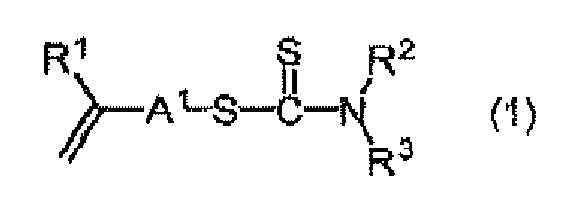
- the compound containing a dithiocarbamate group and a polymerizable unsaturated bond group such as a styryl group and/or an acryl group in a molecule thereof is not particularly limited. However, the dithiocarbamate compound of Formula (1) is preferably used.
- R 1 is a hydrogen atom or a methyl group
- R 2 and R 3 arc individually a C 1-5 alkyl group, a C 1-5 hydroxyalkyl group or a C 7-12 arylalkyl group.
- R 2 and R 3 may be bonded to each other to form a ring together with a nitrogen atom.
- the C 1-5 alkyl groups include a methyl group, an ethyl group, an isopropyl group, a t-butyl group, a cyclopentyl group and a normal pentyl group.
- Examples of the C 1-5 hydroxyalkyl groups include a hydroxymethyl group, a hydroxyethyl group and a hydroxypropyl group.
- Examples of the C 7-12 arylalkyl groups include a benzyl group and a phenethyl group.
- Examples of the ring formed from R 2 and R 3 that are bonded to each other together with a nitrogen atom include a 4- to 8-membered ring.
- a ring containing 4 to 6 methylene groups is included as the ring
- a ring containing an oxygen atom or a sulfur atom and 4 to 6 methylene groups is included as the ring.
- ring formed from R 2 and R 3 that are bonded to each other together with a nitrogen atom include a piperidine ring, a pyrrolidine ring, a morpholine ring, a thiomorpholine ring and a homopiperidine ring.
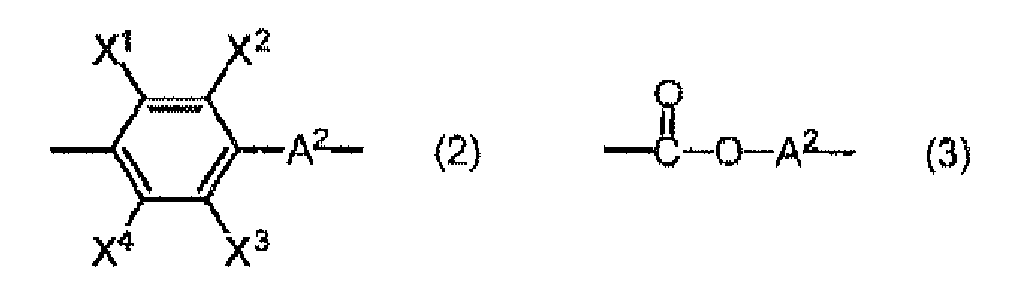
- a 1 is a structure of Formula (2) and/or Formula (3).
- a 2 is a linear, branched or cyclic C 1-30 alkylene group that may contain an ether bond or an ester bond
- X 1 , X 2 , X 3 and X 4 are individually a hydrogen atom, a C 1-20 alkyl group, a C 1-20 alkoxy group, a halogen atom, a nitro group, a hydroxyl group, an ammo group, a carboxyl group or a cyano group.
- alkylene group A 2 examples include a linear alkylene such as methylene, ethylene, normal propylene, normal butylene and normal hexylene, and a branched alkylene such as isopropylene, isobutylene and 2-mcthylpropylene.
- examples of the cyclic alkylene include a C 3-30 alicyclic aliphatic group of a monocyclic, polycyclic or crosslinked cyclic structure.
- Specific examples of the cyclic alkylene include groups of a monocyclo, bicyclo, tricyclo, tetracyclo or pentacyclo structure having 4 or more carbon atoms.
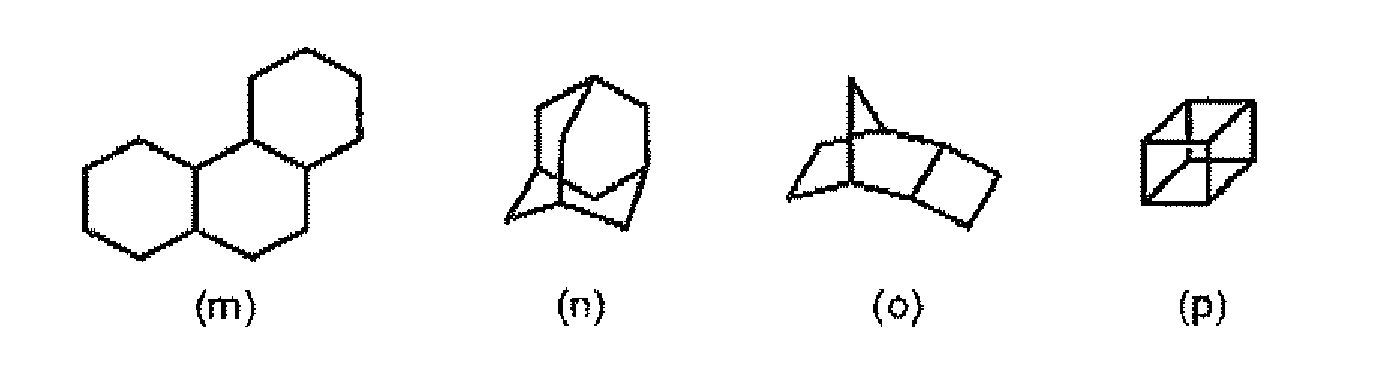
- structural examples (a) to (s) of the alicyclic part in the alicyclic aliphatic group are shown as follows.
- examples of the C 1-20 alkyl group of X 1 , X 2 , X 3 and X 4 include a methyl group, an ethyl group, an isopropyl group, a cyclohexyl group and a normal pentyl group.
- examples of the C 1-20 alkoxy group include a methoxy group, an ethoxy group, an isopropoxy group, a cyclohexyloxy group and a normal pentyloxy group.
- examples of the halogen atom include a fluorine atom, a chlorine atom, a bromine atom and an iodine atom.
- X 1 , X 2 , X 3 and X 4 include a hydrogen atom and a C 1-20 alkyl group.
- a structure of Formula (6) or Formula (7) is preferable for A 1 of Formula (I).
- m is an integer of 2 to 10 and 2 or 3 is preferable for m.
- the compound of Formula (1) can easily be obtained by a nucleophilic substitution reaction of a compound of Formula (9) with a compound of Formula (10).
- R 1 and A 1 arc the same as defined above and Y is a leaving group.
- the leaving group include a fluorine atom, a chlorine atom, a bromine atom, an iodine atom, a mesyl group and a tosyl group.
- R 2 and R 3 are the same as defined above, and examples of M include lithium, sodium and potassium.
- the nucleophilic substitution reaction is preferably performed in an organic solvent that can dissolve both of the two types of compounds.
- the compound of Formula (1) can be obtained in a high purity by liquid separation treatment using a water/nonaqueous organic solvent or by recrystallization treatment.
- the compound of Formula (1) can be produced by referring the methods described in WO 2006/093050 Pamphlet; Macromol. Rapid Commun. 21, 665-668 (2000 ); or Polymer International 51, 424-428 (2002 ).
- Specific examples of the compound of Formula (1) include N,N-diethyidithiocarbamylmethylstyrene and N,N-diethyldithiocarbamylethyl methacrylate.
- the hyperbranched polymer of Formula (4) obtained by the production method according to the present invention takes a structure in which a repeating unit structure of Formula (12) is linked to a structure of Formula (11) at an initiation site having a vinyl group.
- the hyperbranched polymer of Formula (4) contains at least one structure of Formula (5): (where R 1 and A 1 are the same as defined above), In the hyperbranched polymer of formula (4), its terminal is basically a dithiocarbamate group.
- the hypcrbranched polymer of Formula (4) has the cases that the repeating unit structure thereof is single or in combination of two or more. Both cases may be encompassed in the present invention.
- the hyperbranched polymer is a copolymer
- a sequence manner of the copolymer may be any of a random copolymer, an alternating copolymer, a block copolymer and a graft copolymer.
- the disulfide compound of Formula (8) may be used as an additive.
- R 4 and R 5 are individually a C 1-5 alkyl group, a C 1-5 hydroxyalkyl group or a C 7-12 arylalkyl group.
- R 4 and R 5 may be bonded to each other to form a ring together with a nitrogen atom.
- the C 1-5 alkyl groups include a methyl group, an ethyl group, an isopropyl group, a t-butyl group, a cyclopentyl group and a normal pentyl group.
- Examples of the C 1-5 hydroxyalkyl groups include a hydroxymethyl group, a hydroxyethyl group and a hydroxypropyl group.
- Examples of the C 7-12 arylalkyl groups include a benzyl group and a phenethyl group.
- Examples of the ring formed from R 4 and R 5 that are bonded to each other together with a nitrogen atom include a 4- to 8-membered ring.
- a ring containing 4 to 6 methylene groups is included as the ring.
- a ring containing an oxygen atom or a sulfur atom and 4 to 6 methylene groups is included as the ring.
- ring formed from R 4 and R 5 that are bonded to each other together with a nitrogen atom
- a piperidine ring a piperidine ring, a pyrrolidine ring, a morpholine ring, a thiomorpholine ring and a homopiperidine ring.
- Specific examples of the compound of Formula (8) include tetramethylthiuram disulfide, tetraethylthiuram disulfide, tetrabutylthiuram disulfide and dipentamethylenethiuram disulfide.
- the hyperbranched polymer of Formula (4) has a weight average molecular weight Mw, measured by gel permeation chromatography in a converted molecular weight as polystyrene (relative molecular weight), of 500 to 5,000,000, or 1,000 to 1,000,000, or 2,000 to 500,000, or 3,000 to 100,000,
- the degree of distribution that is a ratio of Mw (weight average molecular weight)/Mn (number average molecular weight) of the hyperbranched polymer is 1.0 to 7.0, or 1.1 to 6.0, or 1.2 to 5.0.
- the method for producing the hyperbranched polymer according to the present invention can be performed by a heretofore known polymerization form such as a bulk polymerization, a solution polymerization, a suspension polymerization and an emulsion polymerization.
- a heretofore known polymerization form such as a bulk polymerization, a solution polymerization, a suspension polymerization and an emulsion polymerization.
- the solution polymerization is preferable.
- hyperbranched polymers having a different molecular weight (a relative molecular weight and an absolute molecular weight) and a different degree of branching are obtained depending on the reaction conditions.
- a degree of branching absolute molecular weight Mw/relative molecular weight Mn, and a solution viscosity are used as an index of a degree of branching.
- a hyperbranched polymer generally has a lower solution viscosity than a linear polymer with the same molecular weight. Therefore, the solution viscosity is also measured and compared in the present specification as the index of the degree of branching. In other words, in the same absolute molecular weight Mw, it is determined that the higher the value of the degree of branching and the lower the solution viscosity, the more the branching exists.
- reaction conditions in the solution polymerization are described in the case of adding the disulfide compound of Formula (8) and in the case of not adding, separately.
- a solvent used in related-art in organic synthesis can be used as the solvent as long as the solvent does not have an adverse effect on the reaction.
- a solvent is not particularly limited as long as the solvent can dissolve the compound of Formula (1).
- Specific examples of the solvent include aprotic polar organic solvents (N,N-dimethylformamide, dimethyl sulfoxide, dimethylacetamide, tetramethylurea, sulfolane, N-methylpyrrolidone, N,N-dimethylimidazolidinone and the like), ethers (diisopropyl ether, t-butyl methyl ether, tetrahydrofuran, 1,4-dioxane and the like), aliphatic hydrocarbons (hexane, cyclohexane, octane, decane, decalin, petroleum ether and the like), aromatic hydrocarbons (benzene, chlorobenzene, o-dichlorobenzene,
- aromatic hydrocarbons aromatic hydrocarbons, aprotic polar organic solvents, ketones and alkoxy alkanes are preferable, in consideration of solubility of substrates being raw materials and additives, safety, cost, and easiness of isolation and purification.
- the solvent include xylene, o-dichlorobenzene, cyclohexanone and diglyme.
- the reaction temperature is usually 50 to 250°C, preferably 80 to 200°C, and more preferably 100 to 150°C.
- the concentration of the compound of Formula (1) is optional.
- the concentration is 1 to 99% by mass, or 10 to 95% by mass, or 30 to 90% by mass.
- the polymerization time is, for example, 0.1 to 100 hours, or 0.5 to 30 hours, or I to 15 hours. Usually, a conversion ratio of the compound of Formula (1) increases over the course of the polymerization time.
- the polymerization can usually be performed under an atmosphere of an inert gas such as nitrogen and argon, under normal pressure or increased pressure.
- an inert gas such as nitrogen and argon
- the absolute molecular weight Mw of the obtained hyperbranched polymer is, for example, 25,000 to 200,000 or 30,000 to 150,000.
- the obtained hyperbranched polymer can be separated from the solvent out of the reaction solution by distilling-off the solvent or by solid-liquid separation. Also, by adding the reaction solution to a poor solvent, the hyperbranched polymer can be precipitated to be recovered as a powder.
- solvents Similar solvents used in the case of not adding the disulfide compound can be used as solvents.
- aromatic hydrocarbons, aprotic polar organic solvents, ketones and alkoxy alkanes are preferable, in consideration of solubility of substrates being raw materials and additives, safety, cost, and easiness of isolation and purification.
- Specific examples of the solvent include xylene, cyclohexanone and N-methylpyrrolidone (hereinafter called NMP).
- the amount of the added disulfide compound of Formula (8) based on a mass of the dithiocarbamate compound of Formula (1) is optional.
- the amount is 0.1 to 20% by mass, or 1 to 10% by mass.
- the amount is preferably 1 to 3% by mass, in consideration of the molecular weight (a relative molecular weight and an absolute molecular weight), the degree of branching and the solution viscosity of the hyperbranched polymer obtained.
- the reaction temperature is usually 50 to 250°C, and preferably 80 to 200°C.
- the temperature is more preferably 100 to 150°C, in consideration of the molecular weight (a relative molecular weight and an absolute molecular weight), the degree of branching and the solution viscosity of the hyperbranched polymer obtained,
- the concentration of the compound of Formula (1) is optional.
- the concentration is 1 to 99% by mass, or 10 to 95% by mass, or 30 to 90% by mass.
- the polymerization time is, for example, 0.1 to 100 hours, or 0.5 to 30 hours, or 1 to 15 hours. Usually, a conversion ratio of the compound of Formula (1) increases over the course of the polymerization time.
- the polymerization can usually be performed under an atmosphere of an inert gas such as nitrogen and argon, under normal pressure or increased pressure.
- an inert gas such as nitrogen and argon
- the absolute molecular weight Mw of the obtained hyperbranched polymer is, for example, 3,000 to 50,000 when the amount of the disulfide compound of Formula (8) to be added based on a mass of the dithiocarbamate compound of Formula (1) is 1 to 10% by mass.
- the present invention also provides a method for polymerizing a dithiocarbamate compound containing a polymerizable unsaturated bond group such as a styryl group and/or an acryl group in the absence of a radical initiator by heating.
- the compound containing a dithiocarbamate group and a polymerizable unsaturated bond group such as a styryl group and/or an acryl group in the molecule is not particularly limited.
- the dithiocarbamate compound of Formula (1) is preferably used.
- the disulfide compound of Formula (8) may be added in the polymerization method according to the present invention. Reaction conditions of the polymerization method according to the present invention are the same as the reaction conditions of the production method of the hyperbranched polymer.
- the obtained reaction crude powder was redissolved in toluene and the resultant liquid was separated in toluene/water. Thereafter, in a refrigerator having a temperature of -20°C, an objective was recrystallized from the toluene phase. The recrystallized substance was filtered and vacuum-dried to produce 206 g (yield; 97%) of an objective white powder. The purity (area percentage) was 100% has measured by liquid chromatography. Melting point: 56°C.
- Example 1 Case of not adding a disulfide compound (tetraethylthiuram disulfide (manufactured by Kanto Chemical Co., Inc.); hereinafter called DCDC ).
- a disulfide compound tetraethylthiuram disulfide (manufactured by Kanto Chemical Co., Inc.); hereinafter called DCDC ).
- the conversion ratio at this moment was 64% (The reaction was terminated at a conversion ratio of about 50 to 60% as a rough target so as to enable this conversion ratio be compared with a conversion ratio of the photopolymerization. (Comparative Example 1) described below).
- the reaction solution was subjected to reprecipitation purification using 300 g of methanol, and then filtered under reduced pressure to produce a white solid.
- the obtained solid was redissolved with 20 g of xylene and subjected to reprecipitation purification using 600 g of methanol and then filtered under reduced pressure and vacuum-dried to produce 3.6 g of an objective white powder (HPS).
- the weight average molecular weight Mw that is a relative molecular weight measured by gel permeation chromatography (hereinafter called GPC) in a converted molecular weight as polystyrene was 40,000 and the degree of distribution Mw/Mn was 2.4.
- GPC gel permeation chromatography
- the weight average molecular weight Mw was 78,000.
- the degree of branching was 1.95 in this measurement.
- Viscosity was measured as follows. A homogeneous solution of 0.6 g of HPS and 0.9 g of toluene (a toluene solution of 40% by mass) was prepared and a viscosity was measured. The viscosity was 96 mPa ⁇ s at a measuring temperature of 20°C.
- HPSs were obtained in a similar manner to Examples 1 except that the polymerization temperature of 140°C was changed to the temperatures shown in Table 1.
- Table 1 Polymerization temperature Example Temperature Polymerization time Conversion ratio Molecular weight (Mw) Degree of branching Viscosity (°C) (hr) (%) Relative Absolute (mPa ⁇ s) 2 60 25 44 180,000 340,000 1.89 787 3 80 25 48 16,000 29,000 1.81 39 4 100 7 50 57,000 100,000 1.75 164 5 120 5 60 52,000 100,000 1.92 118 1 140 3 64 40,000 78,000 1.95 96
- HPSs were obtained in a similar manner to Example 1 except that the polymerization solvent of xylene was changed to the solvents shown in Table 2.
- Table 2 polymerization solvent
- the reaction solution was subjected to reprecipitation purification using 300 g of methanol and then filtered under reduced pressure to produce a white solid.
- the obtained solid was redissolved with 20 g of xylene and subjected to reprecipitation purification using 600 g of methanol and then filtered under reduced pressure and vacuum-dried to produce an objective white powder (HPS).
- Table 3 Polymerization concentration Example Concentration Polymerization time Conversion ratio Molecular weight (Mw) Degree of branching Viscosity (% by mass) (hr) (%) Relative Absolute (mPa ⁇ s) 9 30 7 57 25,000 46,000 1.84 67 10 40 4 54 29,000 54,000 1.86 68 11 50 4 62 34,000 66,000 1.94 77 1 60 3 64 40,000 78,000 1.95 96 12 70 2 67 45,000 90,000 2.00 168 13 80 1 57 50,000 95,000 1.90 101 14 90 1 70 68,000 150,000 2.21 132
- the reaction solution was subjected to reprecipitation purification using 300 g of methanol and then filtered under reduced pressure to produce a white solid.
- the obtained solid was redissolved with 20 g of xylene and subjected to reprecipitation purification using 600 g of methanol, and then filtered under educed pressure and vacuum-dried to produce 3.6 of an objective white powder.
- the weight average molecular weight Mw that is a relative molecular weight measured by GPC in a converted molecular weight as polystyrene was 21,000, and the degree of distribution Mw/Mn was 2.4. When an absolute molecular weight was measured, the weight average molecular weight Mw was 42,000. The degree of branching was 2.00 in this measurement.
- Viscosity was measured as follows. A homogeneous solution of 0.6 g of HPS and 0.9 g of toluene (a toluene solution of 40% by mass) was prepared and a viscosity was measured. The viscosity was 46 mPa ⁇ s at a measuring temperature of 20°C.
- HPSs were obtained in a similar manner to Example 15 except that the amount of added DCDC was changed to the amounts shown in Table 4.
- Table 4 Amount of added DCDC Example Amount of added DCDC Polymerization time Conversion ratio Molecular weight (Mw) Degree of branching Viscosity (% by mass) (hr) (%) Relative Absolute (mPa ⁇ s) 1 0 3 64 40,000 78,000 1.95 96 16 0.1 3 62 35,000 69,000 1.97 79 17 0.5 3 69 30,000 60,000 2.00 58 15 1 3 64 21,000 42,000 2.00 46 18 2 3 62 15,000 29,000 1.93 42 19 3 3 74 13,000 24,000 1.85 38 20 10 3 73 3,900 6,400 1.64 10
- HPSs were obtained in a similar manner to Example 15 except that the polymerization solvent of xylene was changed to the solvents shown in Table 6.
- Table 6 polymerization solvent Example Solvent Polymerization time Conversion ratio Molecular weight (Mw) Degree of branching Viscosity (hr) (%) Relative Absolute (mPa ⁇ s) 15 Xylene 3 64 21,000 42,000 2.00 46 23 Cyclohexanone 3 60 27,000 47,000 1.74 51 24 NMP 3 72 33,000 69,000 2.09 62
- HPSs were obtained in a similar manner to Example 15 except that the polymerization temperature of 140°C was changed to the temperatures shown in Table 7.
- Table 7 Polymerization temperature Example Temperature Polymerization time Conversion ratio Molecular weight (Mw) Degree of branching Viscosity (°C) (hr) (%) Relative Absolute (mPa ⁇ s) 25 60 25 26 34,000 64,000 1.88 60 26 80 25 23 24,000 41,000 1.71 48 27 100 3 59 20,000 37,000 1.85 44 28 120 3 60 20,000 37,000 1.85 43 15 140 3 64 21,000 42,000 2.00 46
- Example 29 Determination of mass balance in quantity synthesis
- the conversion ratio at this moment was 90%.
- the reaction solution was subjected to reprecipitation purification using 29.8 kg of methanol and then faltered under reduced pressure to produce a white solid.
- the obtained solid was redissolved with 4.5 kg of cyclohexanone and subjected to reprecipitation purification using 25 kg of methanol and then filtered under reduced pressure and vacuum-dried to produce 476 g of an objective white powder (HPS).
- HPS objective white powder
- the obtained yield was 80%.
- the weight average molecular weight Mw that is a relative molecular weight measured by GPC in a converted molecular weight as polystyrene was 20,000 and the degree of distribution Mw/Mn was 2.4.
- Viscosity was measured as follows. A homogenous solution of 0.6 g of HPS and 0.9 g of toluene (a toluene solution of 40% by mass) was prepared and a viscosity was measured. The viscosity was 44 mPa ⁇ s at a measuring temperature of 20°C.
- reaction crude powder was redissolved in 1,2-dichloroethane and the resultant liquid was separated in 1,2-dichloroethane /water. Thereafter. 1,2-dichloroethane was distilled off from the 1,2-dichloroethane phase to produce 171 g (yield; 97%) of an objective yellow liquid. The purity (area percentage) was 96% as measured by liquid chromatography.
- EMA-DC N,N-diethyldithiocarbamylethyl methacrylate
- NMP N,N-diethyldithiocarbamylethyl methacrylate
- the reaction solution was subjected to reprecipitation purification using 100 g of methanol, and then filtered under reduced pressure to produce a white solid.
- the obtained solid was redissolved with 5 g of NMP and subjected to reprecipitation purification using 100 g of methanol and then filtered under reduced pressure and vacuum-dried to produce 0.6 of an objective white powder (HPEMA).
- HPEMA objective white powder
- the weight average molecular weight Mw that is a relative molecular weight measured by GPC in a converted molecular weight as polystyrene was 68,000, and the degree of distribution Mw/Mn was 2.6. When an absolute molecular weight was measured, the weight average molecular weight Mw was 110,000. The degree of branching was 1.62 in this measurement.
- Viscosity was measured as follows, A homogeneous solution of 0.6 g of HPEMA and 0.9 g of toluene (a toluene solution of 40% by mass) was prepared and a viscosity was measured. The viscosity was 1,113 mPa ⁇ s at a measuring temperature of 20°C.
- the conversion ratio at this moment was 50%
- the reaction solution was subjected to reprecipitation purification using 600 g of methanol and then filtered under reduced pressure to produce a white solid.
- the obtained solid was redissolved with 55 g of NMP and subjected to reprecipitation purification using 600 g of methanol, and then filtered under reduced pressure and vacuum-dried to produce 3 g of an objective white powder (HPEMA).
- HPEMA objective white powder
- the weight average molecular weight Mw that is a relative molecular weight measured by GPC in a converted molecular weight as polystyrene was 42,000, and the degree of distribution Mw/Mn was 2.5. When an absolute molecular weight was measured, the weight average molecular weight Mw was 65,000.
- Viscosity was measured as follows. A homogeneous solution of 0.6 g of HEMA and 0.9 g of toluene (a toluene solution of 40% by mass) was prepared and a viscosity was measured. The viscosity was 538 mPa ⁇ s at a measuring temperature of 20°C.
- the solution was diluted with 20 g of xylene, and then the insoluble substance was filtered using a filter paper (No, 5B Kiriyama filter paper).
- the reaction solution was subjected to reprecipitation purification using 300 g of methanol, and then filtered under reduced pressure to produce a white solid.
- the obtained solid was redissolved with 20 g of xylene and subjected to reprecipitation purification using 600 g of ethanol, and then filtered under reduced pressure and vacuum-dried to obtain 2.4 g of an objective HPS. Obtained yield was 40%.
- the weight average molecular weight Mw that is a relative molecular weight measured by GPC in a converted molecular weight as polystyrene was 15,000 and the degree of distribution Mw/Mn was 4.0.
- the results of the element analysis were carboy: 64.6%, hydrogen: 7.4%, nitrogen: 5.0% and sulfur. 25.3%.
- thermogravimetric analysis it was found that the temperature at which the weight of the polymer reduced by 5% was 248°C. When an absolute molecular weight was measured, the weight average molecular weight Mw was 31,000. The degree of branching was 2.07 in this measurement, Viscosity was measured as fellows.
- a homogeneous solution of 0.6 g of HPS and 0,9 g of toluene (a toluene solution of 40% by mass) was prepared and a viscosity was measured.
- the viscosity was 32 mpa ⁇ s at a measuring temperature of 20°C.
- HPSs were obtained in a similar manner to Comparative Example 1 except that the distance from the high-pressure mercury lamp was set to the distances shown in Table 8.
- Table 8 Distance from high-pressure mercury lamp Comparative Example Distance Polymerization time Conversion ratio Molecular weight (Mw) Degree of branching Viscosity (cm) (hr) (%) Relative Absolute (mPa ⁇ s) 1 5 7 55 15,000 31,000 2.07 32 2 10 7 51 34,000 69,000 2.03 60 3 0 9 50 61,000 120,000 1.97 137
- the reaction solution was subjected to reprecipitation purification using 80 kg of methanol, and then filtered under reduced pressure to produce a white solid.
- the obtained solid was redissolved with 1.6 kg of toluene and subjected to reprecipitation purification using 40 kg of methanol, and then filtered under reduced pressure and vacuum-dried to produce 318 g of an objective HPS. Obtained yield was 40%.
- the weight average molecular weight Mw that is a relative molecular weight measured by GPC in a converted molecular weight as polystyrene was 20,000, and the degree of distribution Mw/Mn was 3.51. When an absolute molecular weight was measured, the weight average molecular weight Mw was 32,000.
- Viscosity was measured as fallows.
- toluene was distilled off to produce a white crude crystal.
- the white crude crystal was recrystallized using 180 g of toluene to produce 48 g (yield; 75%) of an objective white crystal (EDC2).
- the purity (area percentage) was 99% as measured by liquid chromatography.
- the obtained white solid was dissolved using 20 g of toluene and subjected to reprecipitation purification using 600 g of methanol, and then filtered under reduced pressure and vacuum-dried to produce 3.2 g of objective LPS. Obtained yield was 91%.
- the weight average molecular weight Mw that is a relative molecular weight measured by OPC in a converted molecular weight as polystyrene was 35,000 and the degree of distribution Mw/Mn was 2.2. When an absolute molecular weight was measured, the weight average molecular weight Mw was 42,000. The degree of branching was 1.20 in this measurement. Viscosity was measured as follows.
- the viscosity was 95 mPa ⁇ s at a measuring temperature of 20°C.
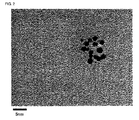
- the hyperbranched polymer synthesized in Example 1 and Comparative Example 1 was dissolved in THF (manufactured by Kanto Chemical Co., Inc.) in a concentration of 0.01% by weight. The obtained solution was dropped on a carbon mesh grid and dried to prepare a sample for TEM observation. As a result of TEM (manufactured by Hitachi, Ltd.; H-8000) observation, every hyperbranched polymer that was a spherical particle having a particle diameter of about 1 to 2 nm was observed. TEM images of the hyperbranched polymers synthesized in Example 1 and Comparative Example 1 are shown in FIG. 1 and FIG. 2 , respectively. It is determined that these hyperbranched polymers have almost equal shapes and particle diameters.
Landscapes
- Chemical & Material Sciences (AREA)
- Health & Medical Sciences (AREA)
- Chemical Kinetics & Catalysis (AREA)
- Medicinal Chemistry (AREA)
- Polymers & Plastics (AREA)
- Organic Chemistry (AREA)
- Addition Polymer Or Copolymer, Post-Treatments, Or Chemical Modifications (AREA)
- Polymerisation Methods In General (AREA)
Abstract
Description
- The present invention relates to a method for producing a hyperbranched polymer, and particularly, relates to a method for producing a hyperbranched polymer in which a dithiocarbamate compound containing a polymerizable unsaturated bond group such as a styryl group and/or an acryl group is polymerized by heating.
In addition, the present invention relates to a method for polymerizing a dithiocarbamate compound containing a polymerizable unsaturated bond group such as a styryl group and/or an acryl group by heating and a product obtained thereby. - Hyperbranched polymers are classified as dendritic polymers together with dendrimers. While related-art polymers generally have a string form, these dendritic polymers have a highly branched structure. Accordingly, expectations lie in practical application utilizing various characteristics in a respect of having a specific structure, a respect of having a nanometer size, a respect of being capable of forming surfaces retaining many functional groups, a respect of being capable of having a low viscosity compared with linear polymers, a respect of exhibiting a behavior like fine particles with little entanglement of molecules, and a respect of being capable of becoming amorphous to control their solubility in a solvent.
Hyperbranched polymers contain a mixture of linear and completely branched repeating units. On the contrary, idealized dendrimers do not have any linear repeating units, but only contain completely branched repeating units.
An advantage of the hyperbranched polymer over the dendrimer is in its simplicity for synthesis which is advantageous particularly in industrial production. Generally, while the dendrimer is synthesized by repeating protection and deprotection, the hyperbranched polymer is synthesized by a one-step polymerization of a so-called ABX type monomer having in one molecule thereof, three or more substituents of two types. - As a method for producing the hyperbranched polymer, the method by photopolymerization of a compound having a dithiocarbamate group with a photopolymerization initiating ability and having a styryl group and/or an acryl group has been known.
For example, a method for synthesizing a hyperbranched polymer by a photopolymerization of a styrene compound having a dithiocarbamate group (see Non-Patent Documents 1, 2 and 3), a method for synthesizing a hyperbranched polymer having a dithiocarbamate group by a photopolymerization of an acryl compound having a dithiocarbamate group (see Non-Patent Documents 4, 5 and 6) and a method for synthesizing a hyperbranched polymer having a dithiocarbamate group at a terminal of a molecule in which acid anhydrides are introduced in the main chain thereof by a photopolymerization of a styrene compound having a dithiocarbamate group and maleic anhydride that are coexisting (see Non-Patent Document 7) has been known. - In such a method for producing a hyperbranched polymer by a photopolymerization, expensive and special reaction facilities are required because a light source such as a high-pressure mercury lamp is used.
In addition, a problem of generating a large amount of a gelation product nearby a high-pressure mercury lamp occurs in such a photopolymerization. Therefore, only about 40% of the hyperbranched polymer can be obtained because the polymerization can be performed at a conversion ratio of only about 50% and purification by reprecipitation is repeated due to the large amount of remaining monomers. In addition, a cumbersome operation of removing a gelation product is also required.
Moreover, the photopolymerization also has a problem in which it is difficult to produce a hyperbranched polymer having the same molecular weight and the same degree of branching because the condition setting of the photoreaction is difficult when scaling up the reaction.
As described above, the method for producing a hyperbranched polymer by photopolymerization is difficult to perform in industry. Therefore, an excellent industrial production method has been desired. - Meanwhile, a method for polymerizing monomers having a styryl group and/or an acryl group by heating in the presence of a radical initiator such as a compound having a dithiocarbamate group and azobisisobutyronitrile (AIBN) has been known (see Patent Documents 1, 2, 3 and 4).
- In this method, a linear polymer is obtained because the polymerization proceeds at a position of double bond of a styryl group and/or an acryl group.
- In addition, an example of polymerization of 4-vinylbenzyl N,'N-diethyldithiocarbamate that is a compound in which a dithiocarbamate group and a styryl group coexist in a molecule thereof by heating in the presence of AIBN, similar to the method as described above, has been known (see Non-Patent Document 8).
In this method, a linear polymer is obtained because the polymerization proceeds at a position of double bond of a styryl group.
In addition, Non-Patent Document 8 discloses an example of heating 4-vinylbenzyl N,N-diethyldithiocarbamate at 30°C in the absence of AIBN. However, almost no reaction proceeds in this example (yield 0.8%). - As described above, there is no example of report in which a hyperbranched polymer is obtained by polymerizing a compound containing a dithiocarbamate group and a polymerizable unsaturated bond group such as a styryl group and/or an acryl group by heating.
- Non-Patent Document 1
Koji Ishizu, Akihide Mori, Macromol. Rapid Commun. 21, 665-668 (2000) - Non-Patent Document 2
Koji Ishizu, Akihide Mori, Polymer International 50, 906-910 (2001) - Non-Patent Document 3
Koji Ishizu, Yoshihiro Ohta, Susumu Kawauchi, Macromolecules Vol. 35, No, 9,3781-3784 (2002) - Non-Patent Document 4
Koji Ishizu, Takeshi Shibuya, Akihide Mori, Polymer International 51, 424-428(2002) - Non-Patent Document 5
Koji Ishizu, Takeshi Shibuya, Susumu Kawauchi, Macromolecules Vol. 36, No. 10, 3505-3510 (2002) - Non-Patent Document 6
Koji Ishizu, Takeshi Shibuya, Jaebum Park, Satoshi Uchida, Polymer International 53, 259-265 (2004) - Non-Patent Document 7
Koji Ishizu, Akihide Mori, Takeshi Shibuya, Polymer Vol. 42, 7911-7914 (2001) - Non-Patent Document 8
Takayuki Otsu, Keiji Yamashita, Kazuichi Tsuda, Macromolecules Vol. 19, No, 2, 287-290 (1986) - Patent Document 1
Japanese Translation ofPCT International Application No. 2002-508409 - Patent Document 2
Japanese Translation ofPCT International Application No. 2002-500251 - Patent Document 3
Japanese Translation ofPCT International Application No. 2004-509181 - Patent Document 4
Japanese Patent Application Publication No.JP-A-5-188658 - In order to solve the problems described above, it is an object of the present invention to provide a method for producing a hyperbranched polymer that has excellent economical efficiency and operationality and can stably be produced in high yield.
- As a result of an intensive investigation for achieving the above-described objects, the inventors of the present invention have discovered that a hyperbranched polymer is obtained in high yield by heating a compound containing a dithiocarbamate group and a polymerizable unsaturated bond group such as a styryl group and/or an acryl group in a molecule thereof, and have accomplished the present invention.
In addition, the inventors of the present invention have discovered that a hyperbranched polymer having a molecular weight (an absolute molecular weight) and a degree of branching both equal to those of a hyperbranched polymer obtained by a related-art photopolymerization is obtained by adding a disulfide compound, and have accomplished the present invention. - Specifically, the present invention provides:
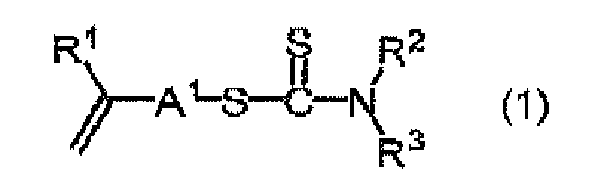
- 1. a method for producing a hyperbranched polymer characterized by comprising polymerizing a dithiocarbamate compound of Formula (1):

- 2. the method for producing the hyperbranched polymer according to 1. above, characterized in that the hyperbranched polymer is Formula (4):

- 3. the method for producing the hyperbranched polymer according to 1, or 2, above, characterized in that A1 is Formula (6):

- 4. the method for producing the hyperbranched polymer according to 1. or 2. above, characterized in that A1 is Formula (7):

- 5. the method for producing the hyperbranched polymer according to any one of 1, to 4. above, characterized by further comprising adding a disulfide compound of formula (8):

- 6. the method for producing the hyperbranched polymer according to 5. above, characterized in that an amount of the disulfide compound of Formula (8) to be added is 1 to 3% by mass based on a mass of the dithiocarbamate compound of Formula (1);
- 7. a method of polymerization, characterized by comprising polymerizing the dithiocarbamate compound of Formula (1) by heating at 50 to 250°C in the absence of a radical initiator;
- 8. the method of polymerization according to 7. above, characterized by further comprising adding the disulfide compound of Formula (8);
- 9. the method of polymerization according to 8. above, characterized in that an amount of the disulfide compound to be added is 1 to 3% by mass based on a mass of the dithiocarbamate compound of Formula (1); and
- 10. a product obtained by the method of polymerization according to any one of 7, to 9. above.
- According to the method for producing the hyperbranched polymer according to the present invention, a light source (a high-pressure mercury lamp) that is essential in the photopolymerization is not required because the hyperbranched polymer can stably be obtained in high yield by heating a compound containing a dithiocarbamate group and a polymerizable unsaturated bond group such as a styryl group and/or an acryl group. Therefore the method is economically advantageous.
In addition, a conversion ratio of the polymerization can be increased up to about 90% and an obtained yield is about two times that of the photopolymerization, because a gelation product that is the problem in photopolymerization is not generated. The process can be simplified, because removal of the gelation product is also not required.
Considering that the obtained yield is about two times of that of the photopolymerization, a production efficiency in the method for producing the hyperbranched polymer according to the present invention can be increased in about four times, because a polymerization rate of the method is about two times of that of the photopolymerization.
In addition, the method for producing the hyperbranched polymer according to the present invention is suitable for mass production, because unlike the photopolymerization, similar hyperbranched polymers can be produced even when production is scaled up.
The method for producing the hyperbranched polymer according to the present invention that has characteristics as described above is a quite useful method as a practical industrial manufacturing process. - In addition, according to the method for producing the hyperbranched polymer according to the present invention, the hyperbranched polymer is also stably obtained in high yield in a similar way when the disulfide compound of Formula (8) is added as an additive.
When the disulfide compound is added, a molecular weight and a degree of branching of the hyperbranched polymer can be controlled, and the molecular weight and the degree of branching can be similar to those of a hyperbranched polymer obtained by photopolymerization.
Generally, it has been known that the disulfide compound has an effect to reduce a molecular weight of a polymer generated. Moreover, in the method for producing the hyperbranched polymer according to the present invention, the disulfide compound also has an effect to increase the degree of branching of the hyperbranched polymer.
Therefore, the hyperbranched polymer having a wide-ranging average molecular weight, from a low average molecular weight to a high average molecular weight, and a wide-ranging degree of branching can be produced by employing these production methods. - The present invention is described below in further detail.
The method for producing a hyperbranched polymer according to the present invention is a method for producing a hyperbranched polymer by polymerizing a compound containing a dithiocarbamate group and a polymerizable unsaturated bond group such as a styryl group and/or an acryl group in a molecule thereof by heating.
The compound containing a dithiocarbamate group and a polymerizable unsaturated bond group such as a styryl group and/or an acryl group in a molecule thereof is not particularly limited. However, the dithiocarbamate compound of Formula (1) is preferably used. - In Formula (1), R1 is a hydrogen atom or a methyl group, and R2 and R3 arc individually a C1-5 alkyl group, a C1-5 hydroxyalkyl group or a C7-12 arylalkyl group. In addition, R2 and R3 may be bonded to each other to form a ring together with a nitrogen atom.
Examples of the C1-5 alkyl groups include a methyl group, an ethyl group, an isopropyl group, a t-butyl group, a cyclopentyl group and a normal pentyl group. Examples of the C1-5 hydroxyalkyl groups include a hydroxymethyl group, a hydroxyethyl group and a hydroxypropyl group. Examples of the C7-12 arylalkyl groups include a benzyl group and a phenethyl group.
Examples of the ring formed from R2 and R3 that are bonded to each other together with a nitrogen atom include a 4- to 8-membered ring. In addition, a ring containing 4 to 6 methylene groups is included as the ring, Moreover, a ring containing an oxygen atom or a sulfur atom and 4 to 6 methylene groups is included as the ring. Specific examples of the ring formed from R2 and R3 that are bonded to each other together with a nitrogen atom include a piperidine ring, a pyrrolidine ring, a morpholine ring, a thiomorpholine ring and a homopiperidine ring. - In addition, in Formula (1), A1 is a structure of Formula (2) and/or Formula (3).
In Formula (2) and Formula (3), A2 is a linear, branched or cyclic C1-30 alkylene group that may contain an ether bond or an ester bond, and X1, X2, X3 and X4 are individually a hydrogen atom, a C1-20 alkyl group, a C1-20 alkoxy group, a halogen atom, a nitro group, a hydroxyl group, an ammo group, a carboxyl group or a cyano group.
Specific examples of the alkylene group A2 include a linear alkylene such as methylene, ethylene, normal propylene, normal butylene and normal hexylene, and a branched alkylene such as isopropylene, isobutylene and 2-mcthylpropylene. In addition, examples of the cyclic alkylene include a C3-30 alicyclic aliphatic group of a monocyclic, polycyclic or crosslinked cyclic structure. Specific examples of the cyclic alkylene include groups of a monocyclo, bicyclo, tricyclo, tetracyclo or pentacyclo structure having 4 or more carbon atoms. For example, structural examples (a) to (s) of the alicyclic part in the alicyclic aliphatic group are shown as follows. -



- In addition, examples of the C1-20 alkyl group of X1, X2, X3 and X4 include a methyl group, an ethyl group, an isopropyl group, a cyclohexyl group and a normal pentyl group. Examples of the C1-20 alkoxy group include a methoxy group, an ethoxy group, an isopropoxy group, a cyclohexyloxy group and a normal pentyloxy group. Examples of the halogen atom include a fluorine atom, a chlorine atom, a bromine atom and an iodine atom. Preferable examples of X1, X2, X3 and X4 include a hydrogen atom and a C1-20 alkyl group.
In addition, a structure of Formula (6) or Formula (7) is preferable for A1 of Formula (I). In Formula (7), m is an integer of 2 to 10 and 2 or 3 is preferable for m. - The compound of Formula (1) can easily be obtained by a nucleophilic substitution reaction of a compound of Formula (9) with a compound of Formula (10).

Usually, the nucleophilic substitution reaction is preferably performed in an organic solvent that can dissolve both of the two types of compounds. After the completion of the reaction, the compound of Formula (1) can be obtained in a high purity by liquid separation treatment using a water/nonaqueous organic solvent or by recrystallization treatment.
The compound of Formula (1) can be produced by referring the methods described inWO 2006/093050 Pamphlet; Macromol. Rapid Commun. 21, 665-668 (2000); or Polymer International 51, 424-428 (2002).
Specific examples of the compound of Formula (1) include N,N-diethyidithiocarbamylmethylstyrene and N,N-diethyldithiocarbamylethyl methacrylate. - The hyperbranched polymer of Formula (4) obtained by the production method according to the present invention takes a structure in which a repeating unit structure of Formula (12) is linked to a structure of Formula (11) at an initiation site having a vinyl group.
-

The structures in which the repeating units of Formula (12) are linked by themselves include the case of a branched structure of Formula (5) and the case of a linear structure of Formula (13). Both of the structures are encompassed in the present invention. In other words, the hyperbranched polymer of Formula (4) contains at least one structure of Formula (5):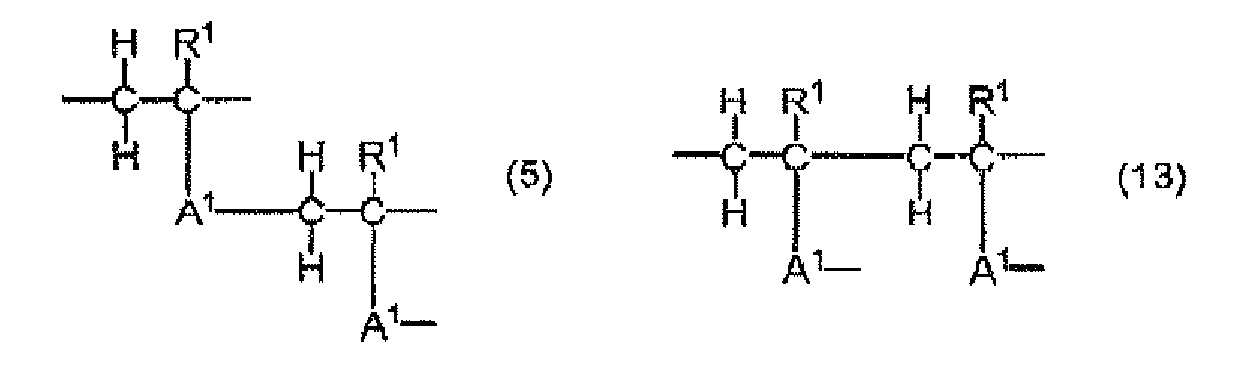
In the hyperbranched polymer of formula (4), its terminal is basically a dithiocarbamate group. - It is considered that the hypcrbranched polymer of Formula (4) has the cases that the repeating unit structure thereof is single or in combination of two or more. Both cases may be encompassed in the present invention. In addition, for example, when the repeating unit structure has two structures, in other words, the hyperbranched polymer is a copolymer, a sequence manner of the copolymer may be any of a random copolymer, an alternating copolymer, a block copolymer and a graft copolymer.
- In addition, in the method for producing the hyperbranched polymer according to the present invention, the disulfide compound of Formula (8) may be used as an additive.
In Formula (8), R4 and R5 are individually a C1-5 alkyl group, a C1-5 hydroxyalkyl group or a C7-12 arylalkyl group. In addition, R4 and R5 may be bonded to each other to form a ring together with a nitrogen atom.
Examples of the C1-5 alkyl groups include a methyl group, an ethyl group, an isopropyl group, a t-butyl group, a cyclopentyl group and a normal pentyl group. Examples of the C1-5 hydroxyalkyl groups include a hydroxymethyl group, a hydroxyethyl group and a hydroxypropyl group. Examples of the C7-12 arylalkyl groups include a benzyl group and a phenethyl group.
Examples of the ring formed from R4 and R5 that are bonded to each other together with a nitrogen atom include a 4- to 8-membered ring. In addition, a ring containing 4 to 6 methylene groups is included as the ring. Moreover, a ring containing an oxygen atom or a sulfur atom and 4 to 6 methylene groups is included as the ring. Specific examples of the ring formed from R4 and R5 that are bonded to each other together with a nitrogen atom include a piperidine ring, a pyrrolidine ring, a morpholine ring, a thiomorpholine ring and a homopiperidine ring. - Specific examples of the compound of Formula (8) include tetramethylthiuram disulfide, tetraethylthiuram disulfide, tetrabutylthiuram disulfide and dipentamethylenethiuram disulfide.
- The hyperbranched polymer of Formula (4) has a weight average molecular weight Mw, measured by gel permeation chromatography in a converted molecular weight as polystyrene (relative molecular weight), of 500 to 5,000,000, or 1,000 to 1,000,000, or 2,000 to 500,000, or 3,000 to 100,000, The degree of distribution that is a ratio of Mw (weight average molecular weight)/Mn (number average molecular weight) of the hyperbranched polymer is 1.0 to 7.0, or 1.1 to 6.0, or 1.2 to 5.0.
- Reaction conditions of the production method of the hyperbranched polymer according to the present invention is described.
The method for producing the hyperbranched polymer according to the present invention can be performed by a heretofore known polymerization form such as a bulk polymerization, a solution polymerization, a suspension polymerization and an emulsion polymerization. Among these, the solution polymerization is preferable. - In the method for producing the hyperbranched polymer according to the present invention, hyperbranched polymers having a different molecular weight (a relative molecular weight and an absolute molecular weight) and a different degree of branching are obtained depending on the reaction conditions.
Here, in the present specification, a degree of branching = absolute molecular weight Mw/relative molecular weight Mn, and a solution viscosity are used as an index of a degree of branching.
A ratio of absolute molecular weight and relative molecular weight is used as the degree of branching (degree of branching = absolute molecular weight Mw/relative molecular weight Mw), and is defined in the present specification as an index of the degree of branching based on the description of "Many hyperbranched polymers are slowly eluted compared with the polystyrene having an equal molecular weight in gel permeation chromatography analysis. This indicates that hyperbranched polymers have more compact shape than linear polymers in a solution" in "BUNKIPORIMA NO NANOTEKUNOROJI - JISEDAI KOUBUNNSI ZAIRYOU NO SENNRYAKU SEKKEI (Nanotechnology of Branched Polymer - Design Strategy of Next Generation Polymer Material) page 130, edited by Kouji Ishizu and published by Industrial Publishing & Consulting, Inc.".
Here, it is defined that the absolute molecular weight Mw is a weight average molecular weight obtained by GPC-MALS measurement and the relative molecular weight is a weight average molecular weight obtained by gel permeation chromatography (a converted molecular weight as polystyrene) in the present specification.
In addition, it is described in the document (page 96) that a hyperbranched polymer generally has a lower solution viscosity than a linear polymer with the same molecular weight. Therefore, the solution viscosity is also measured and compared in the present specification as the index of the degree of branching.
In other words, in the same absolute molecular weight Mw, it is determined that the higher the value of the degree of branching and the lower the solution viscosity, the more the branching exists. - Hereinafter, reaction conditions in the solution polymerization are described in the case of adding the disulfide compound of Formula (8) and in the case of not adding, separately.
- Various solvents used in related-art in organic synthesis can be used as the solvent as long as the solvent does not have an adverse effect on the reaction. Such a solvent is not particularly limited as long as the solvent can dissolve the compound of Formula (1).
Specific examples of the solvent include aprotic polar organic solvents (N,N-dimethylformamide, dimethyl sulfoxide, dimethylacetamide, tetramethylurea, sulfolane, N-methylpyrrolidone, N,N-dimethylimidazolidinone and the like), ethers (diisopropyl ether, t-butyl methyl ether, tetrahydrofuran, 1,4-dioxane and the like), aliphatic hydrocarbons (hexane, cyclohexane, octane, decane, decalin, petroleum ether and the like), aromatic hydrocarbons (benzene, chlorobenzene, o-dichlorobenzene, nitrobenzene, toluene, xylene, mesilylene, tetralin and the like), halogenated hydrocarbons (chloroform, dichloromethane, 1,2-dichloroethane, carbon tetrachloride and the like), ketones (acetone, methyl ethyl ketone, methyl butyl ketone, methyl isobutyl ketone, cyclohexanone and the like), alkoxy alkanes (dimethoxyethane, diethoxyethane, diglyme and the like). These solvents may be used individually or in combination of two or more types thereof. - Among these solvents, aromatic hydrocarbons, aprotic polar organic solvents, ketones and alkoxy alkanes are preferable, in consideration of solubility of substrates being raw materials and additives, safety, cost, and easiness of isolation and purification.
Specific examples of the solvent include xylene, o-dichlorobenzene, cyclohexanone and diglyme. - The reaction temperature is usually 50 to 250°C, preferably 80 to 200°C, and more preferably 100 to 150°C.
- The concentration of the compound of Formula (1) is optional. For example, the concentration is 1 to 99% by mass, or 10 to 95% by mass, or 30 to 90% by mass.
- The polymerization time is, for example, 0.1 to 100 hours, or 0.5 to 30 hours, or I to 15 hours. Usually, a conversion ratio of the compound of Formula (1) increases over the course of the polymerization time.
- Here, the polymerization can usually be performed under an atmosphere of an inert gas such as nitrogen and argon, under normal pressure or increased pressure.
- The absolute molecular weight Mw of the obtained hyperbranched polymer is, for example, 25,000 to 200,000 or 30,000 to 150,000.
- The obtained hyperbranched polymer can be separated from the solvent out of the reaction solution by distilling-off the solvent or by solid-liquid separation. Also, by adding the reaction solution to a poor solvent, the hyperbranched polymer can be precipitated to be recovered as a powder.
- Similar solvents used in the case of not adding the disulfide compound can be used as solvents.
Among these solvents, aromatic hydrocarbons, aprotic polar organic solvents, ketones and alkoxy alkanes are preferable, in consideration of solubility of substrates being raw materials and additives, safety, cost, and easiness of isolation and purification.
Specific examples of the solvent include xylene, cyclohexanone and N-methylpyrrolidone (hereinafter called NMP). - The amount of the added disulfide compound of Formula (8) based on a mass of the dithiocarbamate compound of Formula (1) is optional. For example, the amount is 0.1 to 20% by mass, or 1 to 10% by mass.
The amount is preferably 1 to 3% by mass, in consideration of the molecular weight (a relative molecular weight and an absolute molecular weight), the degree of branching and the solution viscosity of the hyperbranched polymer obtained. - The reaction temperature is usually 50 to 250°C, and preferably 80 to 200°C. The temperature is more preferably 100 to 150°C, in consideration of the molecular weight (a relative molecular weight and an absolute molecular weight), the degree of branching and the solution viscosity of the hyperbranched polymer obtained,
- The concentration of the compound of Formula (1) is optional. For example, the concentration is 1 to 99% by mass, or 10 to 95% by mass, or 30 to 90% by mass.
- The polymerization time is, for example, 0.1 to 100 hours, or 0.5 to 30 hours, or 1 to 15 hours. Usually, a conversion ratio of the compound of Formula (1) increases over the course of the polymerization time.
- Here, the polymerization can usually be performed under an atmosphere of an inert gas such as nitrogen and argon, under normal pressure or increased pressure.
- The absolute molecular weight Mw of the obtained hyperbranched polymer is, for example, 3,000 to 50,000 when the amount of the disulfide compound of Formula (8) to be added based on a mass of the dithiocarbamate compound of Formula (1) is 1 to 10% by mass.
- Operations similar to the case of not adding the disulfide compound can be performed for separation from the solvent and recovery of the hyperbranched polymer.
- In addition, the present invention also provides a method for polymerizing a dithiocarbamate compound containing a polymerizable unsaturated bond group such as a styryl group and/or an acryl group in the absence of a radical initiator by heating.
The compound containing a dithiocarbamate group and a polymerizable unsaturated bond group such as a styryl group and/or an acryl group in the molecule is not particularly limited. However, the dithiocarbamate compound of Formula (1) is preferably used.
In addition, the disulfide compound of Formula (8) may be added in the polymerization method according to the present invention.
Reaction conditions of the polymerization method according to the present invention are the same as the reaction conditions of the production method of the hyperbranched polymer. - Hereinafter, the present invention is described more specifically referring to examples. However, the present invention is not limited to these examples at all.
- In the following examples, for measurement of physical properties of a sample, the following apparatuses were used.
-
- Apparatus: manufactured by Agilent; 1100 Series
- Column: Inertsil ODS-2
- Column temperature: 40°C
- Solvent: Acetonitrile/water = 60/40 (volume ratio)
- Detector: UV-254nm, RI
-
- Apparatus: manufactured by Tosoh Corporation; HLC-8220GPC
- Column: Shodex KF-804L+KF-803L
- Column temperature: 40°C
- Solvent: Tetrahydrofuran
- Detector: UV-254nm, RI
-
- Apparatus: Wyatt DAWN HELEOS
- Measurement Temp.: 40°C
-
- Apparatus: manufactured by TOKI SANGYO CO., LTD.; VISCOMETER TV-22 TV-L
-
- Apparatus: manufactured by JEOL DATUM LTD.; JNM-LA400
- Solvent: CDCl3
- Internal Standard: Tetramethylsilane
-
- Apparatus: manufactured by PerkinElmer Co., Ltd.; PE2400II
- Combustion tube temp.: 975°C
-
- Apparatus: manufactured by Thermo Finnigan Corp.; Flash EA1112
- Combustion tube tamp.: 1000°C
-
- Apparatus: manufactured by Seiko Instruments & Electronics Ltd.; TG/DTA320
- Temperature elevation rate: 10°C/min
- Air supply: 300 ml/min
- In a 2-L reaction flask, 120 g of chloromethylstyrene (manufactured by Seimi Chemical Co., Ltd.; trade name: CMS-14), 181 g of sodium N,N-diethyldithiocarbamate trihydrate (manufactured by Kanto Chemical Co., Inc.) and 1400 g of acetone were charged, and the reaction mixture was reacted at a temperature of 40°C for 1 hour with stirring. After the completion of the reaction, deposited sodium chloride was filtered to be removed, and then acetone was distilled off from the reaction solution using an evaporator to produce a reaction crude powder. The obtained reaction crude powder was redissolved in toluene and the resultant liquid was separated in toluene/water. Thereafter, in a refrigerator having a temperature of -20°C, an objective was recrystallized from the toluene phase. The recrystallized substance was filtered and vacuum-dried to produce 206 g (yield; 97%) of an objective white powder. The purity (area percentage) was 100% has measured by liquid chromatography. Melting point: 56°C.
- In a 100-mL reaction flask, 6 g of N,N-diethyldithiocarbamylmethylstyrene (hereinafter called S-DC) and 4 g of xylene were charged and the mixture was completely dissolved with stirring. Nitrogen purge was performed with stirring, and the reaction flask was placed into an oil bath. The flask was heated until the temperature of the inside of the flask reached to 140°C. After 3 hours (the measurement was started at the time when the temperature of the inside of the flask reached to 140±5°C), the reaction flask, was taken out from the oil bath. After cooling to the room temperature, 20 g of xylene was charged. The conversion ratio at this moment was 64% (The reaction was terminated at a conversion ratio of about 50 to 60% as a rough target so as to enable this conversion ratio be compared with a conversion ratio of the photopolymerization. (Comparative Example 1) described below). The reaction solution was subjected to reprecipitation purification using 300 g of methanol, and then filtered under reduced pressure to produce a white solid. The obtained solid was redissolved with 20 g of xylene and subjected to reprecipitation purification using 600 g of methanol and then filtered under reduced pressure and vacuum-dried to produce 3.6 g of an objective white powder (HPS). The weight average molecular weight Mw that is a relative molecular weight measured by gel permeation chromatography (hereinafter called GPC) in a converted molecular weight as polystyrene was 40,000 and the degree of distribution Mw/Mn was 2.4. When an absolute molecular weight was measured, the weight average molecular weight Mw was 78,000.
The degree of branching was 1.95 in this measurement.
Viscosity was measured as follows. A homogeneous solution of 0.6 g of HPS and 0.9 g of toluene (a toluene solution of 40% by mass) was prepared and a viscosity was measured. The viscosity was 96 mPa·s at a measuring temperature of 20°C. - HPSs were obtained in a similar manner to Examples 1 except that the polymerization temperature of 140°C was changed to the temperatures shown in Table 1.
Table 1: Polymerization temperature Example Temperature Polymerization time Conversion ratio Molecular weight (Mw) Degree of branching Viscosity (°C) (hr) (%) Relative Absolute (mPa·s) 2 60 25 44 180,000 340,000 1.89 787 3 80 25 48 16,000 29,000 1.81 39 4 100 7 50 57,000 100,000 1.75 164 5 120 5 60 52,000 100,000 1.92 118 1 140 3 64 40,000 78,000 1.95 96 - HPSs were obtained in a similar manner to Example 1 except that the polymerization solvent of xylene was changed to the solvents shown in Table 2.
Table 2: polymerization solvent Example Solvent Polymerization time
(hr)Conversion ratio
(%)Molecular weight (Mw) Degree of branching Viscosity
(mPa·s)Relative Absolute 1 Xylene 3 64 40,000 78,000 1.95 96 6 Cyclohexanone 3 67 44,000 83,000 1.89 59 7 Diglyme 1.5 58 35,000 63,000 1.80 63 8 ODB 2 72 45,000 88,000 1.96 72 ODB: o-Dichlorobenzene - In a 100-mL reaction flask, S-DC and xylene were charged and stirred so that the total weight thereof was 10 g and the concentration of S-DC was shown in Table 3. Nitrogen purge was performed with stirring, and the reaction flask was placed into an oil bath. The flask was heated until the temperature of the inside of the flask reached to 140°C, and the time when the temperature of the inside of the flask reached to 140±5°C was regarded as the starting point of the polymerization. When the conversion ratio became about 50 to 60% as a rough target, the reaction flask was taken out from the oil bath. After cooling to the room temperature, 20 g of xylene was charged. The reaction solution was subjected to reprecipitation purification using 300 g of methanol and then filtered under reduced pressure to produce a white solid. The obtained solid was redissolved with 20 g of xylene and subjected to reprecipitation purification using 600 g of methanol and then filtered under reduced pressure and vacuum-dried to produce an objective white powder (HPS).
Table 3: Polymerization concentration Example Concentration Polymerization time Conversion ratio Molecular weight (Mw) Degree of branching Viscosity (% by mass) (hr) (%) Relative Absolute (mPa·s) 9 30 7 57 25,000 46,000 1.84 67 10 40 4 54 29,000 54,000 1.86 68 11 50 4 62 34,000 66,000 1.94 77 1 60 3 64 40,000 78,000 1.95 96 12 70 2 67 45,000 90,000 2.00 168 13 80 1 57 50,000 95,000 1.90 101 14 90 1 70 68,000 150,000 2.21 132 - In a 100-mL reaction flask, 6 g of S-DC, 4 g of xylene and 0.06 g of DCDC (1% by mass based on the mass of S-DC) were charged, and the mixture was completely dissolved with stirring. Nitrogen purge was performed with stirring, and the reaction flask was placed into an oil bath. The flask was heated until the temperature of the inside of the flask reached to 140°C, and the time when the temperature of the inside of the flask reached to 140±5°C was regarded as the starting point of the polymerization. When the conversion ratio became about 50 to 60% as a rough target, the reaction flask was taken out from the oil bath. After cooling to the room temperature, 20 g of xylene was charged. The reaction solution was subjected to reprecipitation purification using 300 g of methanol and then filtered under reduced pressure to produce a white solid. The obtained solid was redissolved with 20 g of xylene and subjected to reprecipitation purification using 600 g of methanol, and then filtered under educed pressure and vacuum-dried to produce 3.6 of an objective white powder. The weight average molecular weight Mw that is a relative molecular weight measured by GPC in a converted molecular weight as polystyrene was 21,000, and the degree of distribution Mw/Mn was 2.4. When an absolute molecular weight was measured, the weight average molecular weight Mw was 42,000.
The degree of branching was 2.00 in this measurement.
Viscosity was measured as follows. A homogeneous solution of 0.6 g of HPS and 0.9 g of toluene (a toluene solution of 40% by mass) was prepared and a viscosity was measured. The viscosity was 46 mPa·s at a measuring temperature of 20°C. - HPSs were obtained in a similar manner to Example 15 except that the amount of added DCDC was changed to the amounts shown in Table 4.
Table 4: Amount of added DCDC Example Amount of added DCDC Polymerization time Conversion ratio Molecular weight (Mw) Degree of branching Viscosity (% by mass) (hr) (%) Relative Absolute (mPa·s) 1 0 3 64 40,000 78,000 1.95 96 16 0.1 3 62 35,000 69,000 1.97 79 17 0.5 3 69 30,000 60,000 2.00 58 15 1 3 64 21,000 42,000 2.00 46 18 2 3 62 15,000 29,000 1.93 42 19 3 3 74 13,000 24,000 1.85 38 20 10 3 73 3,900 6,400 1.64 10 - In a 100-mL reaction flask, S-DC and xylene were charged so that the total weight thereof was 10 g and the concentration of S-DC was shown in Table S, and further DCDC was charged so that the concentration of DCDC of 1% by mass based on the mass of S-DC, and the mixture was stirred, Nitrogen purge was performed with stirring, and the reaction flask was placed into an oil bath. The flask was heated until the temperature of the inside of the flask reached to 140°C, and the time when the temperature of the inside of the flask reached to 140±5°C was regarded as the starting point of the polymerization. When the conversion ratio became about 50 to 60% as a rough target, the reaction flask was taken out from the oil bath. After cooling to the room temperature, 20 g of xylene was charged. The reaction solution was subjected to reprecipitation purification using 300 g of methanol and then filtered under reduced pressure to produce a white solid. The obtained solid was redissolved with 20 g of xylene and subjected to reprecipitation purification using 600 g of methanol, and then filtered under reduced pressure and vacuum-dried to produce an objective white powder (HPS).
Table 5: Polymerization concentration Example Concentration Polymerization time Conversion ratio Molecular weight (Mw) Degree of branching Viscosity (% by mass) (hr) (%) Relative Absolute (mPa·s) 21 50 3 56 24,000 44,000 1,83 47 15 60 3 64 21,000 42,000 2,00 46 22 70 1 57 21,000 39,000 1,86 50 - HPSs were obtained in a similar manner to Example 15 except that the polymerization solvent of xylene was changed to the solvents shown in Table 6.
Table 6: polymerization solvent Example Solvent Polymerization time Conversion ratio Molecular weight (Mw) Degree of branching Viscosity (hr) (%) Relative Absolute (mPa·s) 15 Xylene 3 64 21,000 42,000 2.00 46 23 Cyclohexanone 3 60 27,000 47,000 1.74 51 24 NMP 3 72 33,000 69,000 2.09 62 - HPSs were obtained in a similar manner to Example 15 except that the polymerization temperature of 140°C was changed to the temperatures shown in Table 7.
Table 7: Polymerization temperature Example Temperature Polymerization time Conversion ratio Molecular weight (Mw) Degree of branching Viscosity (°C) (hr) (%) Relative Absolute (mPa·s) 25 60 25 26 34,000 64,000 1.88 60 26 80 25 23 24,000 41,000 1.71 48 27 100 3 59 20,000 37,000 1.85 44 28 120 3 60 20,000 37,000 1.85 43 15 140 3 64 21,000 42,000 2.00 46 - In a 5,000-mL reaction flask, 595 g of S-DC, 255 g of xylene and 11.9 g of DCDC (2% by mass based on the mass of S-DC) were charged, and the mixture was completely dissolved with stirring. Nitrogen purge was performed with shirring, and the reaction flask was placed into an oil bath, The flask was heated until the temperature of the inside of the flask reached to 120°C, and the time when the temperature of the inside of the flask reached to 120±5°C was regarded as the starting point of the polymerization. After 12 hours, the reaction flask was taken out from the oil bath. After cooling to the room temperature, 5.1 kg of cyclohexanone was charged. The conversion ratio at this moment was 90%. The reaction solution was subjected to reprecipitation purification using 29.8 kg of methanol and then faltered under reduced pressure to produce a white solid. The obtained solid was redissolved with 4.5 kg of cyclohexanone and subjected to reprecipitation purification using 25 kg of methanol and then filtered under reduced pressure and vacuum-dried to produce 476 g of an objective white powder (HPS). The obtained yield was 80%. The weight average molecular weight Mw that is a relative molecular weight measured by GPC in a converted molecular weight as polystyrene was 20,000 and the degree of distribution Mw/Mn was 2.4. When an absolute molecular weight was measured, the weight average molecular weight Mw was 39,000.
The degree of branching was 1.95 in this measurement.
Viscosity was measured as follows. A homogenous solution of 0.6 g of HPS and 0.9 g of toluene (a toluene solution of 40% by mass) was prepared and a viscosity was measured. The viscosity was 44 mPa·s at a measuring temperature of 20°C. - In a 2-L reaction flask, 100 g of chloroethyl methacrylate (manufactured by Lancaster Ltd.), 178 g of sodium N,N-diethyldithiocarbamate trihydrate (manufactured by Kanto Chemical Co., Inc.) and 1,100 g of acetone were charged, and the resultant mixture was reacted at a temperature of 40°C for 14 hours with stirring. After the completion of the reaction, deposited sodium chloride was filtered to be removed, and then acetone was distilled off from the reaction solution using an evaporator to produce a reaction crude powder. The obtained reaction crude powder was redissolved in 1,2-dichloroethane and the resultant liquid was separated in 1,2-dichloroethane /water. Thereafter. 1,2-dichloroethane was distilled off from the 1,2-dichloroethane phase to produce 171 g (yield; 97%) of an objective yellow liquid. The purity (area percentage) was 96% as measured by liquid chromatography.
- In a 100-mL reaction flask, 2 g of N,N-diethyldithiocarbamylethyl methacrylate (hereinafter called EMA-DC) and 3 g of NMP were charged and completely dissolved with stirring. Nitrogen purge was performed with stirring, and the reaction flask was placed into an oil bath. The flask was heated until the temperature of the inside of the flask reached to 100°C, and the time when the temperature of the inside of the flask reached to 100±5°C was regarded as the starting point of the polymerization. After 5 hours, the reaction flask was taken out from the oil bath. After cooling to the room temperature, 5 g of NMP was charged. The conversion ratio at this moment was 66%. The reaction solution was subjected to reprecipitation purification using 100 g of methanol, and then filtered under reduced pressure to produce a white solid. The obtained solid was redissolved with 5 g of NMP and subjected to reprecipitation purification using 100 g of methanol and then filtered under reduced pressure and vacuum-dried to produce 0.6 of an objective white powder (HPEMA). The weight average molecular weight Mw that is a relative molecular weight measured by GPC in a converted molecular weight as polystyrene was 68,000, and the degree of distribution Mw/Mn was 2.6. When an absolute molecular weight was measured, the weight average molecular weight Mw was 110,000.
The degree of branching was 1.62 in this measurement.
Viscosity was measured as follows, A homogeneous solution of 0.6 g of HPEMA and 0.9 g of toluene (a toluene solution of 40% by mass) was prepared and a viscosity was measured. The viscosity was 1,113 mPa·s at a measuring temperature of 20°C. - In a 100-mL reaction flask, 6 g of EMA-DC, 9 g of NMP and 0.06 g of DCDC (1% by mass based on the mass of EMA-DC) were charged and completely dissolved with stirring. Nitrogen purge was performed with stirring, and the reaction flask was placed into an oil bath. The flask was heated until the temperature of the inside of the flask reached to 100°C, and the time when the temperature of the inside of the flask reached to 100±5°C was regarded as the starting point of the polymerization. After 16 hours, the reaction flask was taken out from the oil bath. After cooling to the room temperature, 45 g of NMP was charged. The conversion ratio at this moment was 50% The reaction solution was subjected to reprecipitation purification using 600 g of methanol and then filtered under reduced pressure to produce a white solid. The obtained solid was redissolved with 55 g of NMP and subjected to reprecipitation purification using 600 g of methanol, and then filtered under reduced pressure and vacuum-dried to produce 3 g of an objective white powder (HPEMA). The weight average molecular weight Mw that is a relative molecular weight measured by GPC in a converted molecular weight as polystyrene was 42,000, and the degree of distribution Mw/Mn was 2.5. When an absolute molecular weight was measured, the weight average molecular weight Mw was 65,000.
The degree of branching was 1.55 in this measurement.
Viscosity was measured as follows. A homogeneous solution of 0.6 g of HEMA and 0.9 g of toluene (a toluene solution of 40% by mass) was prepared and a viscosity was measured. The viscosity was 538 mPa·s at a measuring temperature of 20°C. - In a 50-my reaction flask, 6 g of S-DC and 4 g of xylene were charged, followed by purging the inside of the reaction system with nitrogen. The solution was placed at a position of 5 cm away from a high-pressure mercury lamp of 100 W (manufactured by Sen Lights Corporation; HL-100), and a photopolymerization reaction by external irradiation was preformed at the room temperature for 7 hours with shirring. The conversion ratio at this moment was 55% (the reaction was terminated at a conversion ratio of about 50 to 60% as a rough target so as to enable this conversion ratio be compared with a conversion ratio of Examples). At this time, a substance insoluble in xylene (a gelation product) was generated in the flask. Thus, the solution was diluted with 20 g of xylene, and then the insoluble substance was filtered using a filter paper (No, 5B Kiriyama filter paper). The reaction solution was subjected to reprecipitation purification using 300 g of methanol, and then filtered under reduced pressure to produce a white solid. The obtained solid was redissolved with 20 g of xylene and subjected to reprecipitation purification using 600 g of ethanol, and then filtered under reduced pressure and vacuum-dried to obtain 2.4 g of an objective HPS. Obtained yield was 40%.
The weight average molecular weight Mw that is a relative molecular weight measured by GPC in a converted molecular weight as polystyrene was 15,000 and the degree of distribution Mw/Mn was 4.0. The results of the element analysis were carboy: 64.6%, hydrogen: 7.4%, nitrogen: 5.0% and sulfur. 25.3%. By a thermogravimetric analysis, it was found that the temperature at which the weight of the polymer reduced by 5% was 248°C.
When an absolute molecular weight was measured, the weight average molecular weight Mw was 31,000.
The degree of branching was 2.07 in this measurement,
Viscosity was measured as fellows. A homogeneous solution of 0.6 g of HPS and 0,9 g of toluene (a toluene solution of 40% by mass) was prepared and a viscosity was measured. The viscosity was 32 mpa·s at a measuring temperature of 20°C. - HPSs were obtained in a similar manner to Comparative Example 1 except that the distance from the high-pressure mercury lamp was set to the distances shown in Table 8.
Table 8: Distance from high-pressure mercury lamp Comparative Example Distance Polymerization time Conversion ratio Molecular weight (Mw) Degree of branching Viscosity (cm) (hr) (%) Relative Absolute (mPa·s) 1 5 7 55 15,000 31,000 2.07 32 2 10 7 51 34,000 69,000 2.03 60 3 0 9 50 61,000 120,000 1.97 137 - In a 1,500-mL reaction flask, 800 g of S-DC and 533 g of toluene were charged and the resultant mixture was stirred to prepare a light yellow transparent solution, followed by purging the inside of the reaction system with nitrogen. From the center of the solution, a high-pressure mercury lamp of 400 W (manufactured by Sen Lights Corporation HL-400B) was lighted to perform a photopolymerization reaction by internal irradiation at the room temperature for 7 hours with stirring. At this time, a substance insoluble in toluene (a gelation product) was generated in the flask. Thus, the solution was diluted with 2.7 kg of toluene, and then the insoluble substance was filtered using a filter paper (No. 5B Kiriyama filter paper). The reaction solution was subjected to reprecipitation purification using 80 kg of methanol, and then filtered under reduced pressure to produce a white solid. The obtained solid was redissolved with 1.6 kg of toluene and subjected to reprecipitation purification using 40 kg of methanol, and then filtered under reduced pressure and vacuum-dried to produce 318 g of an objective HPS. Obtained yield was 40%.
The weight average molecular weight Mw that is a relative molecular weight measured by GPC in a converted molecular weight as polystyrene was 20,000, and the degree of distribution Mw/Mn was 3.51. When an absolute molecular weight was measured, the weight average molecular weight Mw was 32,000.
The degree of branching was 1.60 in this measurement.
Viscosity was measured as fallows. A homogeneous solution of 0.6 g of HPS and 0.9 g of toluene (a toluene solution of 40% by mass) was prepared and a viscosity was measured. The viscosity was 37 mPa·s at a measuring temperature of 20°C. - In a 1,000-mL reaction flask, 1,2-dichloroethane, 109 g of sodium N,N-diethyldithiocarbamate trihydrate (manufactured by Kanto Chemical Co., Inc.) and 400 g of acetone were charged, and the reaction mixture was reacted at a temperature of 40°C for 18 hours with stirring. After the completion of the reaction, deposited sodium chloride was filtered to be removed, and then acetone was distilled off from the reaction solution using an evaporator to thereby obtain a reaction crude powder. The obtained reaction crude powder was redissolved in toluene and the resultant liquid was separated in toluene/water. Thereafter, toluene was distilled off to produce a white crude crystal. The white crude crystal was recrystallized using 180 g of toluene to produce 48 g (yield; 75%) of an objective white crystal (EDC2). The purity (area percentage) was 99% as measured by liquid chromatography.
- In a 100-mL reaction flask, 20 g of chloromethylstytene (manufactured by Scimi Chemical Co., Ltd.; trade name: CMS-14), 20 g of toluene and 0.24 g of EDC2 were charged, followed by purging the inside of the reaction system with nitrogen. The solution was placed at a position of 5 cm away from a high-pressure mercury lamp of 100 W (manufactured by Sen Lights Corporation; HL-100), and a photopolymerization reaction by external irradiation was preformed at the room temperature for 5 hours with stirring. The conversion ratio at this moment was 20%. After dilution by adding 60 g of toluene, the reaction solution was subjected to reprecipitation purification using 1,000 g of methanol, and then filtered under reduced pressure to produce a white stolid, The obtained solid was redissolved with 10 g of xylene and subjected to reprecipitation purification using 1,000 g of methanol, and then filtered under reduced pressure and vacuum-dried to produce 2.8 g of objective LPS-Cl. Obtained yield was 14%.
- In a 100-mL reaction flask, 2.0 g of LPS-Cl synthesized in Comparative Example 6,4.0 g of sodium N,N-diethyldithiocarbamate trihydrate (manufactured by Kanto Chemical Co., Inc.) and 48 g of NMP were charged, and the reaction mixture was reacted at a temperature of 40°C for 18 hours with stirring. After the completion of the reaction, NMP was distilled off from the reaction solution to produce a reaction crude powder. The obtained reaction crude powder was redissolved in 20 g of toluene, and the resultant liquid was separated in toluene/water. Thereafter, toluene was distilled off to produce a white solid. The obtained white solid was dissolved using 20 g of toluene and subjected to reprecipitation purification using 600 g of methanol, and then filtered under reduced pressure and vacuum-dried to produce 3.2 g of objective LPS. Obtained yield was 91%.
The weight average molecular weight Mw that is a relative molecular weight measured by OPC in a converted molecular weight as polystyrene was 35,000 and the degree of distribution Mw/Mn was 2.2.
When an absolute molecular weight was measured, the weight average molecular weight Mw was 42,000.
The degree of branching was 1.20 in this measurement.
Viscosity was measured as follows. A homogeneous solution of 0.6 g of LPS and 0.9 g of toluene (a toluene solution of 40% by mass) was prepared and a viscosity was measured. The viscosity was 95 mPa·s at a measuring temperature of 20°C. - Results of Comparative Example 7 and Example 15 are shown in Table 9.
Table 9 Molecular weight (Mw) Degree of Branching Viscosity (mPa·s) Relative Absolute Comparative Example 7 35,000 42,000 1.20 95 Example 15 21,000 42,000 2.00 46 - The hyperbranched polymer synthesized in Example 1 and Comparative Example 1 was dissolved in THF (manufactured by Kanto Chemical Co., Inc.) in a concentration of 0.01% by weight. The obtained solution was dropped on a carbon mesh grid and dried to prepare a sample for TEM observation. As a result of TEM (manufactured by Hitachi, Ltd.; H-8000) observation, every hyperbranched polymer that was a spherical particle having a particle diameter of about 1 to 2 nm was observed. TEM images of the hyperbranched polymers synthesized in Example 1 and Comparative Example 1 are shown in
FIG. 1 andFIG. 2 , respectively. It is determined that these hyperbranched polymers have almost equal shapes and particle diameters. -
- [
FIG. 1 ] FTG. 1 is a TEM image of the hyperbranched polymer synthesized in Example 1. - [
FIG. 2] FIG. 2 is a TEM image of the hyperbranched polymer synthesized in Comparative Example 1.
Claims (10)
- A method for producing a hyperbranched polymer characterized by comprising polymerizing a dithiocarbamate compound of Formula (1):
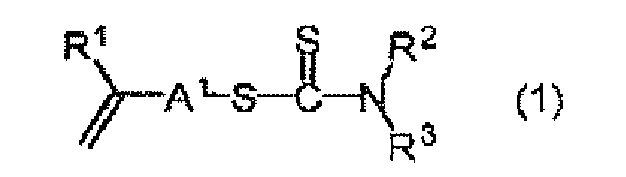

- The method for producing the hyperbranched polymer according to claim 1, characterized in that the hyperbranched polymer is Formula (4):

- The method for producing the hyperbranched polymer according to claim 1 or 2, characterized in that A1 is Formula (6):

- The method for producing the hyperbranched polymer according to claim 1 or 2, characterized in that A1 is Formula (7):

- The method for producing the hyperbranched polymer according to any one of claims 1 to 4, characterized by further comprising adding a disulfide compound of Formula (8):

- The method for producing the hyperbranched polymer according to claim 5, characterized in that an amount of the disulfide compound of Formula (8) to be added is 1 to 3% by mass based on a mass of the dithiocarbamate compound of Formula (1) according to claim 1.
- A method of polymerization, characterized by comprising polymerizing the dithiocarbamate compound of Formula (1) according to claim 1 by heating at 50 to 250°C in the absence of a radical initiator.
- The method of polymerization according to claim 7, characterized by further comprising adding the disulfide compound of Formula (8) according to claim 5.
- The method of polymerization according to claim 8, characterized in that an amount of the disulfide compound to be added is 1 to 3% by mass based on a mass of the dithiocarbamate compound of Formula (1) according to claim 1.
- A product obtained by the method of polymerization according to any one of claims 7 to 9.
Applications Claiming Priority (3)
| Application Number | Priority Date | Filing Date | Title |
|---|---|---|---|
| JP2007237306 | 2007-09-12 | ||
| JP2007327417 | 2007-12-19 | ||
| PCT/JP2008/066436 WO2009035042A1 (en) | 2007-09-12 | 2008-09-11 | Method for producing hyperbranched polymer |
Publications (3)
| Publication Number | Publication Date |
|---|---|
| EP2202248A1 true EP2202248A1 (en) | 2010-06-30 |
| EP2202248A4 EP2202248A4 (en) | 2010-11-03 |
| EP2202248B1 EP2202248B1 (en) | 2018-05-23 |
Family
ID=40452049
Family Applications (1)
| Application Number | Title | Priority Date | Filing Date |
|---|---|---|---|
| EP08830386.2A Active EP2202248B1 (en) | 2007-09-12 | 2008-09-11 | Method for producing hyperbranched polymer |
Country Status (6)
| Country | Link |
|---|---|
| US (1) | US8362190B2 (en) |
| EP (1) | EP2202248B1 (en) |
| JP (1) | JP5408435B2 (en) |
| CN (1) | CN101802027B (en) |
| TW (1) | TWI469994B (en) |
| WO (1) | WO2009035042A1 (en) |
Families Citing this family (4)
| Publication number | Priority date | Publication date | Assignee | Title |
|---|---|---|---|---|
| WO2010101254A1 (en) * | 2009-03-06 | 2010-09-10 | 日産化学工業株式会社 | Hyperbranched polymer production method |
| JP5534244B2 (en) * | 2009-03-06 | 2014-06-25 | 日産化学工業株式会社 | Method for producing hyperbranched polymer |
| SG186878A1 (en) | 2010-07-02 | 2013-02-28 | Tokuyama Corp | Photocurable composition for imprint and method for formation of pattern using the composition |
| JP5872540B2 (en) * | 2011-03-10 | 2016-03-01 | 国立大学法人九州大学 | Method for producing chlorinated hyperbranched polymer |
Family Cites Families (10)
| Publication number | Priority date | Publication date | Assignee | Title |
|---|---|---|---|---|
| JP3363478B2 (en) | 1991-08-15 | 2003-01-08 | 三菱製紙株式会社 | Liquid developer for electrostatic photography |
| ES2277678T3 (en) | 1997-12-18 | 2007-07-16 | E.I. Du Pont De Nemours And Company | POLYMERIZATION PROCESS WITH LIVING CHARACTERISTICS AND POLYMERS OBTAINED BY THIS PROCESS. |
| US6812291B1 (en) | 1997-12-31 | 2004-11-02 | Rhodia Chimie | Method for block polymer synthesis by controlled radical polymerization from dithiocarbamate compounds |
| FR2814168B1 (en) | 2000-09-18 | 2006-11-17 | Rhodia Chimie Sa | PROCESS FOR THE SYNTHESIS OF BLOCK POLYMERS BY CONTROLLED RADICAL POLYMERIZATION IN THE PRESENCE OF A DISULFIDE COMPOUND |
| US6737486B2 (en) * | 2002-07-16 | 2004-05-18 | Eastman Kodak Company | Polymerization process |
| DE602006021154D1 (en) * | 2005-03-03 | 2011-05-19 | Nissan Chemical Ind Ltd | HYBRID BRANCHED POLYMER AND METHOD OF MANUFACTURING THEREOF |
| JP5367268B2 (en) | 2005-10-25 | 2013-12-11 | 日産化学工業株式会社 | Polymer structure with modified surface and / or interface, and method for producing the same |
| EP2036929A4 (en) * | 2006-06-19 | 2010-01-20 | Tokyo Inst Tech | HYPERRAMIFIED POLYMER AND PROCESS FOR PRODUCING THE SAME |
| CN102167756B (en) * | 2006-09-01 | 2012-12-26 | 日产化学工业株式会社 | Hyperbranched polymer and method for producing the same |
| EP2065408B1 (en) * | 2006-09-07 | 2012-07-04 | Nissan Chemical Industries, Ltd. | Hyperbranched polymer and process for production thereof |
-
2008
- 2008-09-11 EP EP08830386.2A patent/EP2202248B1/en active Active
- 2008-09-11 JP JP2009532219A patent/JP5408435B2/en active Active
- 2008-09-11 CN CN2008801069806A patent/CN101802027B/en active Active
- 2008-09-11 US US12/677,703 patent/US8362190B2/en active Active
- 2008-09-11 WO PCT/JP2008/066436 patent/WO2009035042A1/en not_active Ceased
- 2008-09-12 TW TW97135171A patent/TWI469994B/en active
Also Published As
| Publication number | Publication date |
|---|---|
| EP2202248A4 (en) | 2010-11-03 |
| TW200932763A (en) | 2009-08-01 |
| JPWO2009035042A1 (en) | 2010-12-24 |
| US20100311933A1 (en) | 2010-12-09 |
| US8362190B2 (en) | 2013-01-29 |
| CN101802027B (en) | 2012-09-19 |
| WO2009035042A1 (en) | 2009-03-19 |
| EP2202248B1 (en) | 2018-05-23 |
| CN101802027A (en) | 2010-08-11 |
| JP5408435B2 (en) | 2014-02-05 |
| TWI469994B (en) | 2015-01-21 |
Similar Documents
| Publication | Publication Date | Title |
|---|---|---|
| US8338554B2 (en) | Hyperbranched polymer and method for producing the same | |
| EP1854814B1 (en) | Hyper-branched polymer and process for production of the same | |
| Ferreira et al. | Optimizing the generation of narrow polydispersity ‘arm-first’star polymers made using RAFT polymerization | |
| JP5268644B2 (en) | Hyperbranched polymer and method for producing the same | |
| JPWO2007148578A1 (en) | Hyperbranched polymer and method for producing the same | |
| TW202208471A (en) | Polyolefin-polystyrene-based multiblock copolymer and method for preparing the same | |
| EP2202248B1 (en) | Method for producing hyperbranched polymer | |
| Haldar et al. | POSS tethered hybrid “inimer” derived hyperbranched and star-shaped polymers via SCVP-RAFT technique | |
| Li et al. | Synthesis and characterization of brush-like multigraft copolymers PnBA-g-PMMA by a combination of emulsion AGET ATRP and emulsion polymerization | |
| Li et al. | Controlled synthesis of graft polymer through the coupling reaction between the appending β-keto ester and the terminal amine | |
| JP5630957B2 (en) | Hyperbranched polymer and method for producing the same | |
| WO2020006721A1 (en) | High-grafting density cyclic comb shaped polymer and preparation method therefor | |
| US8883912B2 (en) | Synthesis of arborescent polymers via controlled inimer-type reversible addition-fragmentation chain transfer (RAFT) polymerization | |
| Fleet et al. | Synthesis of novel glycopolymer brushes via a combination of RAFT-mediated polymerisation and ATRP | |
| CN111491966A (en) | Block copolymerization of ethylene by cobalt-mediated free radical polymerization | |
| Kotal et al. | Free radical polymerization of alkyl methacrylates with N, N-dimethylanilinium p-toluenesulfonate at above ambient temperature: a quasi-living system | |
| JP2025100010A (en) | Method for producing block copolymer | |
| JPWO2006109560A1 (en) | Optically active copolymer, process for producing the same, and packing material for chromatography using the copolymer |
Legal Events
| Date | Code | Title | Description |
|---|---|---|---|
| PUAI | Public reference made under article 153(3) epc to a published international application that has entered the european phase |
Free format text: ORIGINAL CODE: 0009012 |
|
| 17P | Request for examination filed |
Effective date: 20100409 |
|
| AK | Designated contracting states |
Kind code of ref document: A1 Designated state(s): AT BE BG CH CY CZ DE DK EE ES FI FR GB GR HR HU IE IS IT LI LT LU LV MC MT NL NO PL PT RO SE SI SK TR |
|
| AX | Request for extension of the european patent |
Extension state: AL BA MK RS |
|
| A4 | Supplementary search report drawn up and despatched |
Effective date: 20101004 |
|
| RIC1 | Information provided on ipc code assigned before grant |
Ipc: C08F 2/38 20060101ALI20100928BHEP Ipc: C08F 20/38 20060101ALI20100928BHEP Ipc: C08F 12/30 20060101AFI20090401BHEP |
|
| DAX | Request for extension of the european patent (deleted) | ||
| 17Q | First examination report despatched |
Effective date: 20130807 |
|
| REG | Reference to a national code |
Ref country code: DE Ref legal event code: R079 Ref document number: 602008055369 Country of ref document: DE Free format text: PREVIOUS MAIN CLASS: C08F0012300000 Ipc: C08F0012260000 |
|
| RIC1 | Information provided on ipc code assigned before grant |
Ipc: C08F 20/38 20060101ALI20171130BHEP Ipc: C08G 83/00 20060101ALI20171130BHEP Ipc: C08F 12/26 20060101AFI20171130BHEP Ipc: C08F 12/30 20060101ALI20171130BHEP Ipc: C08F 220/38 20060101ALI20171130BHEP Ipc: C08F 2/38 20060101ALI20171130BHEP |
|
| GRAP | Despatch of communication of intention to grant a patent |
Free format text: ORIGINAL CODE: EPIDOSNIGR1 |
|
| INTG | Intention to grant announced |
Effective date: 20180209 |
|
| GRAS | Grant fee paid |
Free format text: ORIGINAL CODE: EPIDOSNIGR3 |
|
| GRAA | (expected) grant |
Free format text: ORIGINAL CODE: 0009210 |
|
| AK | Designated contracting states |
Kind code of ref document: B1 Designated state(s): AT BE BG CH CY CZ DE DK EE ES FI FR GB GR HR HU IE IS IT LI LT LU LV MC MT NL NO PL PT RO SE SI SK TR |
|
| REG | Reference to a national code |
Ref country code: GB Ref legal event code: FG4D |
|
| REG | Reference to a national code |
Ref country code: CH Ref legal event code: EP |
|
| REG | Reference to a national code |
Ref country code: IE Ref legal event code: FG4D |
|
| REG | Reference to a national code |
Ref country code: DE Ref legal event code: R096 Ref document number: 602008055369 Country of ref document: DE |
|
| REG | Reference to a national code |
Ref country code: AT Ref legal event code: REF Ref document number: 1001442 Country of ref document: AT Kind code of ref document: T Effective date: 20180615 |
|
| REG | Reference to a national code |
Ref country code: NL Ref legal event code: FP |
|
| RAP2 | Party data changed (patent owner data changed or rights of a patent transferred) |
Owner name: NISSAN CHEMICAL CORPORATION |
|
| REG | Reference to a national code |
Ref country code: LT Ref legal event code: MG4D |
|
| PG25 | Lapsed in a contracting state [announced via postgrant information from national office to epo] |
Ref country code: SE Free format text: LAPSE BECAUSE OF FAILURE TO SUBMIT A TRANSLATION OF THE DESCRIPTION OR TO PAY THE FEE WITHIN THE PRESCRIBED TIME-LIMIT Effective date: 20180523 Ref country code: FI Free format text: LAPSE BECAUSE OF FAILURE TO SUBMIT A TRANSLATION OF THE DESCRIPTION OR TO PAY THE FEE WITHIN THE PRESCRIBED TIME-LIMIT Effective date: 20180523 Ref country code: BG Free format text: LAPSE BECAUSE OF FAILURE TO SUBMIT A TRANSLATION OF THE DESCRIPTION OR TO PAY THE FEE WITHIN THE PRESCRIBED TIME-LIMIT Effective date: 20180823 Ref country code: LT Free format text: LAPSE BECAUSE OF FAILURE TO SUBMIT A TRANSLATION OF THE DESCRIPTION OR TO PAY THE FEE WITHIN THE PRESCRIBED TIME-LIMIT Effective date: 20180523 Ref country code: NO Free format text: LAPSE BECAUSE OF FAILURE TO SUBMIT A TRANSLATION OF THE DESCRIPTION OR TO PAY THE FEE WITHIN THE PRESCRIBED TIME-LIMIT Effective date: 20180823 Ref country code: ES Free format text: LAPSE BECAUSE OF FAILURE TO SUBMIT A TRANSLATION OF THE DESCRIPTION OR TO PAY THE FEE WITHIN THE PRESCRIBED TIME-LIMIT Effective date: 20180523 |
|
| PG25 | Lapsed in a contracting state [announced via postgrant information from national office to epo] |
Ref country code: LV Free format text: LAPSE BECAUSE OF FAILURE TO SUBMIT A TRANSLATION OF THE DESCRIPTION OR TO PAY THE FEE WITHIN THE PRESCRIBED TIME-LIMIT Effective date: 20180523 Ref country code: HR Free format text: LAPSE BECAUSE OF FAILURE TO SUBMIT A TRANSLATION OF THE DESCRIPTION OR TO PAY THE FEE WITHIN THE PRESCRIBED TIME-LIMIT Effective date: 20180523 Ref country code: GR Free format text: LAPSE BECAUSE OF FAILURE TO SUBMIT A TRANSLATION OF THE DESCRIPTION OR TO PAY THE FEE WITHIN THE PRESCRIBED TIME-LIMIT Effective date: 20180824 |
|
| REG | Reference to a national code |
Ref country code: AT Ref legal event code: MK05 Ref document number: 1001442 Country of ref document: AT Kind code of ref document: T Effective date: 20180523 |
|
| PG25 | Lapsed in a contracting state [announced via postgrant information from national office to epo] |
Ref country code: DK Free format text: LAPSE BECAUSE OF FAILURE TO SUBMIT A TRANSLATION OF THE DESCRIPTION OR TO PAY THE FEE WITHIN THE PRESCRIBED TIME-LIMIT Effective date: 20180523 Ref country code: AT Free format text: LAPSE BECAUSE OF FAILURE TO SUBMIT A TRANSLATION OF THE DESCRIPTION OR TO PAY THE FEE WITHIN THE PRESCRIBED TIME-LIMIT Effective date: 20180523 Ref country code: EE Free format text: LAPSE BECAUSE OF FAILURE TO SUBMIT A TRANSLATION OF THE DESCRIPTION OR TO PAY THE FEE WITHIN THE PRESCRIBED TIME-LIMIT Effective date: 20180523 Ref country code: PL Free format text: LAPSE BECAUSE OF FAILURE TO SUBMIT A TRANSLATION OF THE DESCRIPTION OR TO PAY THE FEE WITHIN THE PRESCRIBED TIME-LIMIT Effective date: 20180523 Ref country code: SK Free format text: LAPSE BECAUSE OF FAILURE TO SUBMIT A TRANSLATION OF THE DESCRIPTION OR TO PAY THE FEE WITHIN THE PRESCRIBED TIME-LIMIT Effective date: 20180523 Ref country code: RO Free format text: LAPSE BECAUSE OF FAILURE TO SUBMIT A TRANSLATION OF THE DESCRIPTION OR TO PAY THE FEE WITHIN THE PRESCRIBED TIME-LIMIT Effective date: 20180523 Ref country code: CZ Free format text: LAPSE BECAUSE OF FAILURE TO SUBMIT A TRANSLATION OF THE DESCRIPTION OR TO PAY THE FEE WITHIN THE PRESCRIBED TIME-LIMIT Effective date: 20180523 |
|
| REG | Reference to a national code |
Ref country code: DE Ref legal event code: R097 Ref document number: 602008055369 Country of ref document: DE |
|
| PLBE | No opposition filed within time limit |
Free format text: ORIGINAL CODE: 0009261 |
|
| STAA | Information on the status of an ep patent application or granted ep patent |
Free format text: STATUS: NO OPPOSITION FILED WITHIN TIME LIMIT |
|
| PG25 | Lapsed in a contracting state [announced via postgrant information from national office to epo] |
Ref country code: MC Free format text: LAPSE BECAUSE OF FAILURE TO SUBMIT A TRANSLATION OF THE DESCRIPTION OR TO PAY THE FEE WITHIN THE PRESCRIBED TIME-LIMIT Effective date: 20180523 |
|
| REG | Reference to a national code |
Ref country code: CH Ref legal event code: PL |
|
| 26N | No opposition filed |
Effective date: 20190226 |
|
| PG25 | Lapsed in a contracting state [announced via postgrant information from national office to epo] |
Ref country code: SI Free format text: LAPSE BECAUSE OF FAILURE TO SUBMIT A TRANSLATION OF THE DESCRIPTION OR TO PAY THE FEE WITHIN THE PRESCRIBED TIME-LIMIT Effective date: 20180523 |
|
| REG | Reference to a national code |
Ref country code: BE Ref legal event code: MM Effective date: 20180930 |
|
| REG | Reference to a national code |
Ref country code: IE Ref legal event code: MM4A |
|
| PG25 | Lapsed in a contracting state [announced via postgrant information from national office to epo] |
Ref country code: LU Free format text: LAPSE BECAUSE OF NON-PAYMENT OF DUE FEES Effective date: 20180911 |
|
| PG25 | Lapsed in a contracting state [announced via postgrant information from national office to epo] |
Ref country code: IE Free format text: LAPSE BECAUSE OF NON-PAYMENT OF DUE FEES Effective date: 20180911 |
|
| PG25 | Lapsed in a contracting state [announced via postgrant information from national office to epo] |
Ref country code: CH Free format text: LAPSE BECAUSE OF NON-PAYMENT OF DUE FEES Effective date: 20180930 Ref country code: FR Free format text: LAPSE BECAUSE OF NON-PAYMENT OF DUE FEES Effective date: 20180930 Ref country code: BE Free format text: LAPSE BECAUSE OF NON-PAYMENT OF DUE FEES Effective date: 20180930 Ref country code: LI Free format text: LAPSE BECAUSE OF NON-PAYMENT OF DUE FEES Effective date: 20180930 |
|
| PG25 | Lapsed in a contracting state [announced via postgrant information from national office to epo] |
Ref country code: MT Free format text: LAPSE BECAUSE OF NON-PAYMENT OF DUE FEES Effective date: 20180911 |
|
| PG25 | Lapsed in a contracting state [announced via postgrant information from national office to epo] |
Ref country code: TR Free format text: LAPSE BECAUSE OF FAILURE TO SUBMIT A TRANSLATION OF THE DESCRIPTION OR TO PAY THE FEE WITHIN THE PRESCRIBED TIME-LIMIT Effective date: 20180523 |
|
| PG25 | Lapsed in a contracting state [announced via postgrant information from national office to epo] |
Ref country code: PT Free format text: LAPSE BECAUSE OF FAILURE TO SUBMIT A TRANSLATION OF THE DESCRIPTION OR TO PAY THE FEE WITHIN THE PRESCRIBED TIME-LIMIT Effective date: 20180523 Ref country code: HU Free format text: LAPSE BECAUSE OF FAILURE TO SUBMIT A TRANSLATION OF THE DESCRIPTION OR TO PAY THE FEE WITHIN THE PRESCRIBED TIME-LIMIT; INVALID AB INITIO Effective date: 20080911 |
|
| PG25 | Lapsed in a contracting state [announced via postgrant information from national office to epo] |
Ref country code: CY Free format text: LAPSE BECAUSE OF FAILURE TO SUBMIT A TRANSLATION OF THE DESCRIPTION OR TO PAY THE FEE WITHIN THE PRESCRIBED TIME-LIMIT Effective date: 20180523 |
|
| PG25 | Lapsed in a contracting state [announced via postgrant information from national office to epo] |
Ref country code: IS Free format text: LAPSE BECAUSE OF FAILURE TO SUBMIT A TRANSLATION OF THE DESCRIPTION OR TO PAY THE FEE WITHIN THE PRESCRIBED TIME-LIMIT Effective date: 20180923 |
|
| P01 | Opt-out of the competence of the unified patent court (upc) registered |
Effective date: 20230522 |
|
| PGFP | Annual fee paid to national office [announced via postgrant information from national office to epo] |
Ref country code: NL Payment date: 20250814 Year of fee payment: 18 |
|
| PGFP | Annual fee paid to national office [announced via postgrant information from national office to epo] |
Ref country code: DE Payment date: 20250730 Year of fee payment: 18 |
|
| PGFP | Annual fee paid to national office [announced via postgrant information from national office to epo] |
Ref country code: IT Payment date: 20250825 Year of fee payment: 18 |
|
| PGFP | Annual fee paid to national office [announced via postgrant information from national office to epo] |
Ref country code: GB Payment date: 20250731 Year of fee payment: 18 |