EP2199324A2 - Interior panel component for use with a vehicle and method for making - Google Patents
Interior panel component for use with a vehicle and method for making Download PDFInfo
- Publication number
- EP2199324A2 EP2199324A2 EP09175766A EP09175766A EP2199324A2 EP 2199324 A2 EP2199324 A2 EP 2199324A2 EP 09175766 A EP09175766 A EP 09175766A EP 09175766 A EP09175766 A EP 09175766A EP 2199324 A2 EP2199324 A2 EP 2199324A2
- Authority
- EP
- European Patent Office
- Prior art keywords
- component
- foam
- resilient layer
- skin
- soy
- Prior art date
- Legal status (The legal status is an assumption and is not a legal conclusion. Google has not performed a legal analysis and makes no representation as to the accuracy of the status listed.)
- Withdrawn
Links
Images

Classifications
-
- C—CHEMISTRY; METALLURGY
- C08—ORGANIC MACROMOLECULAR COMPOUNDS; THEIR PREPARATION OR CHEMICAL WORKING-UP; COMPOSITIONS BASED THEREON
- C08J—WORKING-UP; GENERAL PROCESSES OF COMPOUNDING; AFTER-TREATMENT NOT COVERED BY SUBCLASSES C08B, C08C, C08F, C08G or C08H
- C08J9/00—Working-up of macromolecular substances to porous or cellular articles or materials; After-treatment thereof
-
- B—PERFORMING OPERATIONS; TRANSPORTING
- B29—WORKING OF PLASTICS; WORKING OF SUBSTANCES IN A PLASTIC STATE IN GENERAL
- B29C—SHAPING OR JOINING OF PLASTICS; SHAPING OF MATERIAL IN A PLASTIC STATE, NOT OTHERWISE PROVIDED FOR; AFTER-TREATMENT OF THE SHAPED PRODUCTS, e.g. REPAIRING
- B29C44/00—Shaping by internal pressure generated in the material, e.g. swelling or foaming ; Producing porous or cellular expanded plastics articles
- B29C44/02—Shaping by internal pressure generated in the material, e.g. swelling or foaming ; Producing porous or cellular expanded plastics articles for articles of definite length, i.e. discrete articles
- B29C44/08—Shaping by internal pressure generated in the material, e.g. swelling or foaming ; Producing porous or cellular expanded plastics articles for articles of definite length, i.e. discrete articles using several expanding or moulding steps
-
- B—PERFORMING OPERATIONS; TRANSPORTING
- B29—WORKING OF PLASTICS; WORKING OF SUBSTANCES IN A PLASTIC STATE IN GENERAL
- B29C—SHAPING OR JOINING OF PLASTICS; SHAPING OF MATERIAL IN A PLASTIC STATE, NOT OTHERWISE PROVIDED FOR; AFTER-TREATMENT OF THE SHAPED PRODUCTS, e.g. REPAIRING
- B29C44/00—Shaping by internal pressure generated in the material, e.g. swelling or foaming ; Producing porous or cellular expanded plastics articles
- B29C44/02—Shaping by internal pressure generated in the material, e.g. swelling or foaming ; Producing porous or cellular expanded plastics articles for articles of definite length, i.e. discrete articles
- B29C44/12—Incorporating or moulding on preformed parts, e.g. inserts or reinforcements
- B29C44/1228—Joining preformed parts by the expanding material
- B29C44/1233—Joining preformed parts by the expanding material the preformed parts being supported during expanding
-
- C—CHEMISTRY; METALLURGY
- C08—ORGANIC MACROMOLECULAR COMPOUNDS; THEIR PREPARATION OR CHEMICAL WORKING-UP; COMPOSITIONS BASED THEREON
- C08G—MACROMOLECULAR COMPOUNDS OBTAINED OTHERWISE THAN BY REACTIONS ONLY INVOLVING UNSATURATED CARBON-TO-CARBON BONDS
- C08G18/00—Polymeric products of isocyanates or isothiocyanates
- C08G18/06—Polymeric products of isocyanates or isothiocyanates with compounds having active hydrogen
- C08G18/28—Polymeric products of isocyanates or isothiocyanates with compounds having active hydrogen characterised by the compounds used containing active hydrogen
- C08G18/30—Low-molecular-weight compounds
- C08G18/36—Hydroxylated esters of higher fatty acids
-
- C—CHEMISTRY; METALLURGY
- C08—ORGANIC MACROMOLECULAR COMPOUNDS; THEIR PREPARATION OR CHEMICAL WORKING-UP; COMPOSITIONS BASED THEREON
- C08G—MACROMOLECULAR COMPOUNDS OBTAINED OTHERWISE THAN BY REACTIONS ONLY INVOLVING UNSATURATED CARBON-TO-CARBON BONDS
- C08G18/00—Polymeric products of isocyanates or isothiocyanates
- C08G18/06—Polymeric products of isocyanates or isothiocyanates with compounds having active hydrogen
- C08G18/28—Polymeric products of isocyanates or isothiocyanates with compounds having active hydrogen characterised by the compounds used containing active hydrogen
- C08G18/40—High-molecular-weight compounds
- C08G18/4009—Two or more macromolecular compounds not provided for in one single group of groups C08G18/42 - C08G18/64
- C08G18/4072—Mixtures of compounds of group C08G18/63 with other macromolecular compounds
-
- C—CHEMISTRY; METALLURGY
- C08—ORGANIC MACROMOLECULAR COMPOUNDS; THEIR PREPARATION OR CHEMICAL WORKING-UP; COMPOSITIONS BASED THEREON
- C08G—MACROMOLECULAR COMPOUNDS OBTAINED OTHERWISE THAN BY REACTIONS ONLY INVOLVING UNSATURATED CARBON-TO-CARBON BONDS
- C08G18/00—Polymeric products of isocyanates or isothiocyanates
- C08G18/06—Polymeric products of isocyanates or isothiocyanates with compounds having active hydrogen
- C08G18/28—Polymeric products of isocyanates or isothiocyanates with compounds having active hydrogen characterised by the compounds used containing active hydrogen
- C08G18/40—High-molecular-weight compounds
- C08G18/48—Polyethers
- C08G18/4833—Polyethers containing oxyethylene units
- C08G18/4837—Polyethers containing oxyethylene units and other oxyalkylene units
- C08G18/4841—Polyethers containing oxyethylene units and other oxyalkylene units containing oxyethylene end groups
-
- C—CHEMISTRY; METALLURGY
- C08—ORGANIC MACROMOLECULAR COMPOUNDS; THEIR PREPARATION OR CHEMICAL WORKING-UP; COMPOSITIONS BASED THEREON
- C08G—MACROMOLECULAR COMPOUNDS OBTAINED OTHERWISE THAN BY REACTIONS ONLY INVOLVING UNSATURATED CARBON-TO-CARBON BONDS
- C08G18/00—Polymeric products of isocyanates or isothiocyanates
- C08G18/06—Polymeric products of isocyanates or isothiocyanates with compounds having active hydrogen
- C08G18/28—Polymeric products of isocyanates or isothiocyanates with compounds having active hydrogen characterised by the compounds used containing active hydrogen
- C08G18/40—High-molecular-weight compounds
- C08G18/63—Block or graft polymers obtained by polymerising compounds having carbon-to-carbon double bonds on to polymers
- C08G18/632—Block or graft polymers obtained by polymerising compounds having carbon-to-carbon double bonds on to polymers onto polyethers
-
- C—CHEMISTRY; METALLURGY
- C08—ORGANIC MACROMOLECULAR COMPOUNDS; THEIR PREPARATION OR CHEMICAL WORKING-UP; COMPOSITIONS BASED THEREON
- C08G—MACROMOLECULAR COMPOUNDS OBTAINED OTHERWISE THAN BY REACTIONS ONLY INVOLVING UNSATURATED CARBON-TO-CARBON BONDS
- C08G18/00—Polymeric products of isocyanates or isothiocyanates
- C08G18/06—Polymeric products of isocyanates or isothiocyanates with compounds having active hydrogen
- C08G18/28—Polymeric products of isocyanates or isothiocyanates with compounds having active hydrogen characterised by the compounds used containing active hydrogen
- C08G18/65—Low-molecular-weight compounds having active hydrogen with high-molecular-weight compounds having active hydrogen
- C08G18/66—Compounds of groups C08G18/42, C08G18/48, or C08G18/52
- C08G18/6666—Compounds of group C08G18/48 or C08G18/52
- C08G18/6696—Compounds of group C08G18/48 or C08G18/52 with compounds of group C08G18/36 or hydroxylated esters of higher fatty acids of C08G18/38
-
- B—PERFORMING OPERATIONS; TRANSPORTING
- B29—WORKING OF PLASTICS; WORKING OF SUBSTANCES IN A PLASTIC STATE IN GENERAL
- B29K—INDEXING SCHEME ASSOCIATED WITH SUBCLASSES B29B, B29C OR B29D, RELATING TO MOULDING MATERIALS OR TO MATERIALS FOR MOULDS, REINFORCEMENTS, FILLERS OR PREFORMED PARTS, e.g. INSERTS
- B29K2075/00—Use of PU, i.e. polyureas or polyurethanes or derivatives thereof, as moulding material
-
- B—PERFORMING OPERATIONS; TRANSPORTING
- B29—WORKING OF PLASTICS; WORKING OF SUBSTANCES IN A PLASTIC STATE IN GENERAL
- B29L—INDEXING SCHEME ASSOCIATED WITH SUBCLASS B29C, RELATING TO PARTICULAR ARTICLES
- B29L2031/00—Other particular articles
- B29L2031/30—Vehicles, e.g. ships or aircraft, or body parts thereof
- B29L2031/3005—Body finishings
-
- B—PERFORMING OPERATIONS; TRANSPORTING
- B60—VEHICLES IN GENERAL
- B60R—VEHICLES, VEHICLE FITTINGS, OR VEHICLE PARTS, NOT OTHERWISE PROVIDED FOR
- B60R13/00—Elements for body-finishing, identifying, or decorating; Arrangements or adaptations for advertising purposes
- B60R13/02—Internal Trim mouldings ; Internal Ledges; Wall liners for passenger compartments; Roof liners
-
- C—CHEMISTRY; METALLURGY
- C08—ORGANIC MACROMOLECULAR COMPOUNDS; THEIR PREPARATION OR CHEMICAL WORKING-UP; COMPOSITIONS BASED THEREON
- C08G—MACROMOLECULAR COMPOUNDS OBTAINED OTHERWISE THAN BY REACTIONS ONLY INVOLVING UNSATURATED CARBON-TO-CARBON BONDS
- C08G2101/00—Manufacture of cellular products
-
- C—CHEMISTRY; METALLURGY
- C08—ORGANIC MACROMOLECULAR COMPOUNDS; THEIR PREPARATION OR CHEMICAL WORKING-UP; COMPOSITIONS BASED THEREON
- C08G—MACROMOLECULAR COMPOUNDS OBTAINED OTHERWISE THAN BY REACTIONS ONLY INVOLVING UNSATURATED CARBON-TO-CARBON BONDS
- C08G2110/00—Foam properties
- C08G2110/0008—Foam properties flexible
-
- C—CHEMISTRY; METALLURGY
- C08—ORGANIC MACROMOLECULAR COMPOUNDS; THEIR PREPARATION OR CHEMICAL WORKING-UP; COMPOSITIONS BASED THEREON
- C08G—MACROMOLECULAR COMPOUNDS OBTAINED OTHERWISE THAN BY REACTIONS ONLY INVOLVING UNSATURATED CARBON-TO-CARBON BONDS
- C08G2110/00—Foam properties
- C08G2110/0041—Foam properties having specified density
- C08G2110/0058—≥50 and <150kg/m3
-
- C—CHEMISTRY; METALLURGY
- C08—ORGANIC MACROMOLECULAR COMPOUNDS; THEIR PREPARATION OR CHEMICAL WORKING-UP; COMPOSITIONS BASED THEREON
- C08G—MACROMOLECULAR COMPOUNDS OBTAINED OTHERWISE THAN BY REACTIONS ONLY INVOLVING UNSATURATED CARBON-TO-CARBON BONDS
- C08G2110/00—Foam properties
- C08G2110/0083—Foam properties prepared using water as the sole blowing agent
-
- C—CHEMISTRY; METALLURGY
- C08—ORGANIC MACROMOLECULAR COMPOUNDS; THEIR PREPARATION OR CHEMICAL WORKING-UP; COMPOSITIONS BASED THEREON
- C08J—WORKING-UP; GENERAL PROCESSES OF COMPOUNDING; AFTER-TREATMENT NOT COVERED BY SUBCLASSES C08B, C08C, C08F, C08G or C08H
- C08J2375/00—Characterised by the use of polyureas or polyurethanes; Derivatives of such polymers
- C08J2375/04—Polyurethanes
-
- Y—GENERAL TAGGING OF NEW TECHNOLOGICAL DEVELOPMENTS; GENERAL TAGGING OF CROSS-SECTIONAL TECHNOLOGIES SPANNING OVER SEVERAL SECTIONS OF THE IPC; TECHNICAL SUBJECTS COVERED BY FORMER USPC CROSS-REFERENCE ART COLLECTIONS [XRACs] AND DIGESTS
- Y10—TECHNICAL SUBJECTS COVERED BY FORMER USPC
- Y10T—TECHNICAL SUBJECTS COVERED BY FORMER US CLASSIFICATION
- Y10T428/00—Stock material or miscellaneous articles
- Y10T428/249921—Web or sheet containing structurally defined element or component
- Y10T428/249953—Composite having voids in a component [e.g., porous, cellular, etc.]
- Y10T428/249987—With nonvoid component of specified composition
- Y10T428/249991—Synthetic resin or natural rubbers
-
- Y—GENERAL TAGGING OF NEW TECHNOLOGICAL DEVELOPMENTS; GENERAL TAGGING OF CROSS-SECTIONAL TECHNOLOGIES SPANNING OVER SEVERAL SECTIONS OF THE IPC; TECHNICAL SUBJECTS COVERED BY FORMER USPC CROSS-REFERENCE ART COLLECTIONS [XRACs] AND DIGESTS
- Y10—TECHNICAL SUBJECTS COVERED BY FORMER USPC
- Y10T—TECHNICAL SUBJECTS COVERED BY FORMER US CLASSIFICATION
- Y10T428/00—Stock material or miscellaneous articles
- Y10T428/31504—Composite [nonstructural laminate]
- Y10T428/31551—Of polyamidoester [polyurethane, polyisocyanate, polycarbamate, etc.]
-
- Y—GENERAL TAGGING OF NEW TECHNOLOGICAL DEVELOPMENTS; GENERAL TAGGING OF CROSS-SECTIONAL TECHNOLOGIES SPANNING OVER SEVERAL SECTIONS OF THE IPC; TECHNICAL SUBJECTS COVERED BY FORMER USPC CROSS-REFERENCE ART COLLECTIONS [XRACs] AND DIGESTS
- Y10—TECHNICAL SUBJECTS COVERED BY FORMER USPC
- Y10T—TECHNICAL SUBJECTS COVERED BY FORMER US CLASSIFICATION
- Y10T428/00—Stock material or miscellaneous articles
- Y10T428/31504—Composite [nonstructural laminate]
- Y10T428/31551—Of polyamidoester [polyurethane, polyisocyanate, polycarbamate, etc.]
- Y10T428/31554—Next to second layer of polyamidoester
-
- Y—GENERAL TAGGING OF NEW TECHNOLOGICAL DEVELOPMENTS; GENERAL TAGGING OF CROSS-SECTIONAL TECHNOLOGIES SPANNING OVER SEVERAL SECTIONS OF THE IPC; TECHNICAL SUBJECTS COVERED BY FORMER USPC CROSS-REFERENCE ART COLLECTIONS [XRACs] AND DIGESTS
- Y10—TECHNICAL SUBJECTS COVERED BY FORMER USPC
- Y10T—TECHNICAL SUBJECTS COVERED BY FORMER US CLASSIFICATION
- Y10T428/00—Stock material or miscellaneous articles
- Y10T428/31504—Composite [nonstructural laminate]
- Y10T428/31551—Of polyamidoester [polyurethane, polyisocyanate, polycarbamate, etc.]
- Y10T428/31573—Next to addition polymer of ethylenically unsaturated monomer
- Y10T428/31587—Hydrocarbon polymer [polyethylene, polybutadiene, etc.]
Definitions
- the invention relates to an interior panel component for use with a vehicle and method for making the component.
- interior panel assemblies made of many components. Examples of these types of interior panel components include, but are not necessarily limited to, interior door panels, instrument panels, consoles, and other interior trim parts.
- the components employed in these panels typically comprise a relatively hard, rigid substrate, a cover skin or layer, and a soft padding disposed between at least part of the substrate and the skin.
- the soft padding is typically a resilient material, such as a foam.
- foam When foam is used, the component is made by placing the skin/cover layer in the mold in a spaced apart arrangement, and then introducing the foam into the mold. The foam, upon curing, secures the cover skin to the substrate.
- Polyurethane foams have been extensively used in the automotive industry for applications.
- the production of polyurethane foams is well known in the art.
- Polyurethane foams are formed when isocyanate (NCO) groups react with hydroxyl (OH) groups.
- NCO isocyanate
- OH hydroxyl
- the most common method of polyurethane foam production is via the reaction of polyol and isocyanate which forms the backbone urethane groups.
- a polyol commonly used in the polyurethane foam reactions is typically derived from petrochemicals, such as glycerin and ethylene oxide.
- Petrochemical-based polyols' drawbacks include the long-term economic stability and limited reserves of fossil fuels and oils from which they are derived.
- Soy-based polyols have been developed as an alternative to petrochemical-based polyols. The soy-based polyols are considered a good alternative to petrochemical-based polyols for the production of polyurethane since the soy-based material can offer cost advantages as well as alleviate the environmental concerns associated with petrochemical-based polyols.
- soy-based polyurethane foams have made inroads into various polyurethane markets, the soy-based polyurethane foam has not gained acceptance in the automotive industry, and in particular in the manufacture of interior panels and components, because the soy-based polyols produce open cell polyurethane foam structures with insufficient load bearing capability and other physical properties needed to meet the requirements for many interior panel assemblies.
- the present invention provides interior panel components according to claims 1 and 11 and a method according to claim 14.
- an interior panel component for use with a motor vehicle.
- the component includes a skin, and a resilient layer secured to the skin.
- the resilient layer is made from a polymeric methylene diphenyl diisocyanate (MDI), a pure MDI, which is substantially 4-4' MDI isomer, and a polyol.
- the polyol comprises less than 50 parts per hundred parts of resin (pphr) of a soy-based polyol.
- the resilient layer is secured to a substrate.
- an interior panel component for use with a motor vehicle includes a composite layer adjacent to a substrate. The composite layer has a skin layer and a resilient layer.
- the resilient layer which is secured to the skin layer, includes a heterochain polymer foam which, before reaction, includes a soy-based polyol.
- the foam has a compression load deflection ranging between 11% and 28% when measured using ASTM D3574.
- the resilient layer further comprises a petrochemical-based polyol having a molecular weight greater than the soy-based polyol.
- the petrochemical-based polyol has a number-averaged molecular weight greater than 2,000.
- a ratio by weight of polymeric MDI to pure MDI ranges between 0.4 and 4.
- the component has an effective amount of petrochemical-based polyol and the soy-based polyol wherein the mean elongation of the resilient layer is greater than 60% when measured using ASTM D412 DIE-C method.
- the mean elongation of the resilient layer is in the range of 60% to 85% when measured using ASTM D412 DIE C method.
- the compression set of the component, as received is less than 25% when measured using ASTM D3574.
- the component measures a compression force deflection of less than 50% after aging.
- the resilient layer does not substantially shrink within one hour after molding when measured using ASTM 3 D2126.
- the skin comprises a thermoplastic polyurethane.
- the substrate comprises a thermoplastic polyolefin.
- the resilient layer is secured to the skin and the substrate when the resilient layer is foamed-in-place.
- the resilient layer has a thickness in the range of 0.5 to 10 mm.
- the heterochain polymer foam comprises polyurethane foam.
- the composite layer has a compression set after humidity aging of less than 50% when tested and humidity aged using ASTM D3574.
- the method for making an interior panel component for use with a motor vehicle is disclosed.
- the component is made by applying a skin layer to an upper half of a mold tool and a substrate to the lower half of the mold tool.
- the upper half and lower half form a cavity.
- a polymeric MDI, a pure MDI, a soy-based polyol, and a petrochemical-based polyol are dispensed into the cavity to form a foam.
- the foam is cured in the cavity.
- the mold halves are opened to release the interior panel component.
- the foam layer has a density in the range of 74 to 84.4 kg/cm 3 .
- the resilient layer has thickness in the range of 0.5 to 10 mm.
- the interior panel component comprises at least one of a dashboard component, an instrument panel component, or 3 a console component.
- an exemplary interior panel assembly 10 for use with a vehicle is shown according to the principles of the present invention.
- the panel assembly 10 is illustrated as an instrument panel component 12, a dashboard component 14, and a console component 16.
- the instrument panel 12, dashboard 14, and console 16 contribute to the aesthetic appearance of the automotive interior and provide comfort and convenience to a vehicle occupant.
- the interior panel assembly 10 is illustrated and described herein in an exemplary embodiment and comprises the instrument panel 12, dashboard 14, and console 16, it will be appreciated that the interior panel assembly 10 of the present may alternatively comprise a door trim panel, an armrest, a door handle, or any other interior panel component without departing from the spirit and scope of the present invention.
- FIG. 2 a cross-sectional view of a typical instrument panel component 12 is illustrated along a cross-sectional line 2-2 in Figure 1 .
- the instrument panel 12 comprises a substrate 20 and, a composite 22 secured to the substrate 20.
- the instrument panel 12 has a resilient layer 24 such as a foam, that is disposed between at least a portion of substrate 20 and portions of a skin 26.
- the substrate 20 and the composite 22, including the resilient layer 24 and the skin 26, can be made of any suitable material known to those of ordinary skill in the art.
- suitable examples of materials for making the substrate 20 include, but are not necessarily limited to, polypropylene, polyethylene, acrylonitrile-butadiene-styrene (ABS), thermoplastic elastomer (TPE), polycarbonate (PC), PCIABS blend, styrene maleic anhydride (SMA), and thermoplastic olefin (TPO).
- the substrate 20 can be made by a suitable process known to those of ordinary skill in the art, such as injection molding or compression molding.
- the skin 26 and/or the resilient layer 24 can be made of any suitable material and by a suitable process known to those of ordinary skill in the art.
- materials that can be used to form the skin 26 and/or the resilient layer 24 include, but are not limited necessarily to a condensation polymer, a heterochain polymer, TPO, polyimide, polyvinyl chloride (PVC), urethane, polyurethane, thermoplastic polyurethane, and TPE.
- the skin 26 may be formed by spraying, injection molding, casting, vacuum forming, or other methods known to those of ordinary skill in the art.
- the resilient layer is formed from any suitable material that is known to those of ordinary skill in the art, such as foam made from a foamable material including condensation polymerization reaction formed heterochain polymers, such as polyurethane foam.
- An optional coating 28 may be applied to skin 26.
- the interior panel assembly 10 is formed by a suitable process, such as a foam-in-place or a spray application process. Any suitable foam-in-place process for use with condensation polymerization reaction derived heterochain polymers may can be used.
- a particularly advantageous foam-in-place process includes making a resilient polyurethane using a process as illustrated schematically in Figure 3 .
- a polyol source 40 is supplied by a soy-based polyol source 42 and a petrochemicalbased polyol source 44. It is understood that there may be more than one of each of the soy-based polyol source 42 and the petrochemical-based polyol source 44 for formulating chemically or physically distinct polyol materials in those respective categories.
- An isocyanate source 46 includes a pure MDI source 48 and a polymeric MDI source 50.
- the ratio by weight of polymeric MDI to pure MDI ranges between 0.4 and 4, more preferably 0.5 and 2, and even more preferably 0.75 to 1.5.
- An optional blowing agent source 52 and the polyol source 40 and isocyanate source 46 supply a dispenser 54 from which the skin 26 ( Figure 2 ), such as a thermoplastic skin layer, may be applied to a mold 58.
- the dispenser may also apply the resilient layer 24 ( Figure 2 ) such as a foamed polyurethane layer, which is applied to a portion of skin 26.
- additional optional layers and/or additives such as an ultraviolet light protective layer, a colorant or an aesthetic layer may be applied as needed to either the skin 26 or the resilient layer 24.
- the optional layers may be applied to the mold 58 in processing steps that precede and/or occur following the application of the skin 26, such as in-mold coating without violating the spirit or scope of this invention.
- the molding may occur using cold-cured foam or processing above room-temperature-cured foam in a heated mold.
- Shrinkage of the foam for the interior panel component needs to be minimized.
- the skin 26 may exhibit unacceptable sink marks or other non-level surfaces.
- Slight shrinkage of less than a 2% decrease in dimension in any direction within an hour after molding as measured using ASTM D1622 test method is advantageous. Even more advantageous is having very little shrinkage of a less than 1% decrease in dimension. No shrinkage is most desirable.
- the dimensional shrinkage should be less than 5%, more preferably less than 2%, and even more preferably less than 1%.
- Shrinkage may be controlled, in part, by stoichiometric ratio of isocyanate functional groups to polyol functional groups. Typically, an index is reported as 100 times the ratio of isocyanate to polyol functional groups. In forming foam for interior panel components, having the index in the range of 85-115 is advantageous and 95-110 is more advantageous.
- the interior panel assembly ( Figure 1 ) is formed in certain embodiments by a foam-in-place process, as schematically illustrated in Figure 4 .
- a molding tool 80 includes an upper mold half 82 and a lower mold half 84. At least one of the mold halves 82 and 84 is capable of axial movement relative to the other mold half. This allows the insertion of the substrate 20 and the skin 26 into the molding tool 80. In a typical process, the skin 26 is placed upon the lower mold half 84, while the substrate 20 is placed in the molding tool 80, often on the upper mold half 82, and spaced apart from the skin 16.
- the mold halves 82 and 84 are spaced apart prior to molding, the substrate 20 and the skin 26 are typically placed on their respective halves 82 and 84 by clips, hooks, vacuum techniques, or by other means known to those of ordinary skill in the art. After substrate 20 and skin 26 are in place, the mold halves 82 and 84 are closed relative to each other.
- the molding tool 80 is positioned to allow a dispenser 54 ( Figure 3 ) to dispense a foaming material 86 into a cavity 88 defined by the area disposed between substrate 20 and skin 26.
- the substrate 20 may be provided with an opening 90 to allow dispensing of the foaming material 86 into the cavity 88 when the mold halves 82 and 84 are adjacent and abutting each other, i.e., when the molding tool 80 is closed.
- the substrate 20 has a general thickness between 0.5 and 5 mm. In another embodiment, 1.0 to 3.5 mm and yet another embodiment 2 to 3 mm.
- the resilient layer 24 ( Figure 1 ) generally contours to the substrate 20.
- the resilient layer 24 helps to provide a soft feel to the interior panel assembly 10.
- the density of the resilient layer 24 is in the range of 4.6 lbs/ft 3 (74 kg/m 3 ) to 7 lbs/ft 3 (84.4 kg/m 3 ). In other embodiments, the density of the resilient layer 24 can range from 75 kg/m 3 to 81 kg/m 3 .
- the resilient layer 24 further has a compression load deflection ranging between 11 % and 28% when measured using ASTM D3574. It is understood that ranges for physical properties in Tables 1-12 may be individually and independently selected or calculated from the data of Tables 1-12.
- the skin 26 may be bonded in situ to resilient layer 24.
- the adhesion between layers of material is very desirable to maintain a durable and aesthetic panel.
- the adhesion between skin 26 and resilient layer 24 fails desirably if the foam fails cohesively, i.e., tearing the foam, not the interface between the resilient layer 24 and the skin 26.
- the method for testing the adhesion is ASTM D 1623 when using a tensile tester such as an Instron.
- the resilient layer 24 adhesion to the skin 26 can be tested by hand pulling apart the two portions.
- the skin 26 is configured to provide a covering over and generally contouring to the resilient layer 24.
- the skin 26 is formed by spraying a powdered polymeric material.
- the polymeric material may, but is not limited to, be a PVC, thermoplastic polyurethane (TPU), TPO, TPE or any combination thereof.
- the skin 26 may have any suitable thickness and density.
- the skin 26 may have a thickness in the range of 0.4 to 2 mm and a density in the range of 85 to 120 kg/m 3 .
- the skin 26 has a thickness in the range of 0.5 to 1.2 mm and a density in the range of 95 to 110 kg/m.
- the resilient layer 24 may have a thickness in the range of 0.5 mn - 10 mm, more advantageously 0.75 - 5 mm, and even more advantageously 1 - 3 mm.
- the skin 26 may also be configured to provide a sufficiently durable and attractive surface such that an exterior coating is not needed.
- the vehicle's interior panel assembly 10 may be manufactured by spraying an optional mold release agent followed by the skin 26 onto the molding tool 80 using a suitable spray device, such as a robotic high volume, low pressure (HVLP) sprayer having a pressure in the range of 1 to 40 psi (6.9 MPa to 275 MPa).
- a suitable spray device such as a robotic high volume, low pressure (HVLP) sprayer having a pressure in the range of 1 to 40 psi (6.9 MPa to 275 MPa).
- HVLP high volume, low pressure
- the molding tool 80 is in communication with temperature controls to enable the tool to be selectively heated and/or cooled to any suitable desired temperature. Any suitable temperature control system can be used to heat the mold surface.
- the molding tool 80 can be made of any suitable material.
- the molding tool 80 has a conductive exterior surface layer to help responsiveness of the molding tool 80 to temperature control.
- a suitable example of the material that is conductive includes, but is not necessarily limited to, copper.
- bio-based oils may be used in the practice of the present invention, particularly vegetable oil, through which air has been passed to remove impurities, to functionalize the oil with hydroxyl groups, and to thicken the oil.
- suitable bio-based oils that can be converted to polyol for use in the present invention after being blown include: vegetable or seed oils such as grape seed oil, cannola oil, peanut oil, cottonseed, sunflower oil, olive oil, rape seed oil, coconut oil, palm oil, linseed oil, and/or castor oil. Oils derived from animal or fish fats may also be used.
- soy-based polyol that has particular advantages is NOP-19A commercially available from Dow Chemical (Midland, MI).
- a blend of soy-based polyol and petrochemical-based polyol can be used as the isocyanate-reactive component in the condensation reaction.
- other vegetable and animal fat oils that have been made into polyol may also be used with a mixture of soy-based polyol and petrochemical-based polyol.
- the soy-based polyol may comprise less than 50 pphr, and more advantageously 10-40 pphr, and most preferably 16-30 pphr.
- a petrochemical-based polyol in some embodiments may range from more than 50 pphr, between 60-90 pphr, or more advantageously 70-84 pphr.
- the molecular weight of the soy-based polyol is generally less than that of the petrochemical polyol.
- a typical number-averaged molecular weight of the soy-based polyol may range from less than 2000, more advantageously 300-1900, and even more advantageously 500-1000.
- the molecular weight may be generally monodisperse but it is understood that it could be a polydisperse polymer.
- the petrochemical polyol may have a number-averaged molecular weight greater than 500, more advantageously greater than 2000, and even more advantageously over 5000.
- the isocyanate may include polymeric MDI that may be a polymethylene, polyphenyl isocyanate that contains MDI, and includes a mixture of 2, 4' - and 4, 4' - MDI isomers. Different grades of polymeric MDI may have different ratios of these two isomers. In addition, in polymeric MDI there are three-functional, four-functional, and higher oligomers, each of which has multiples of isomers. Pure MDI includes primarily 4, 4' - MDI isomer, but commercial products normally contain 1 to 2% by weight of the 2, 4' isomer, but may include 2-4' isomer in the range of less than 20% by weight, less than 10% by weight, or less than 5% by weight.
- a non-limiting example of the pure MDI is HB6562 supplied by Dow Chemical.
- a non-limiting example of polymeric MDI is PAPI95 supplied by Dow Chemical.
- the typical functionality for polymeric MDI ranges between 2 and 3, more preferably 2.2 to 2.8, and most preferably 2.3 to 2.5.
- the viscosity ranges from 60 to 80 centipoise at 25°C when tested with a Brookfield viscometer.
- An acidity, as percent HCl ranges from 0.010 to 0.20 when determined using Dow Chemical method 109-00761.
- Typical additives may optionally include catalysts, surfactants, and chain-extenders.
- catalyst is a delayed reaction catalyst such as triethylamine-N-oxide (TEAO).
- TEAO triethylamine-N-oxide
- a typical surfactant may include B4113 supplied by Taegostab, which is a product line of the Goldschmidt Chemical Corporation, Division of Degussa (Hopewell, VA), or Dabco, 33-LV, which is a mixture of 33% triethylaminediamine and 67% dipropylene glycol, available from Air Products.
- An example of an additive for scavaging acid in the foam is a N, N-dimethyl ethylamine (DMEA) which is provided by Huntsman International.
- DMEA N, N-dimethyl ethylamine
- a series of polyurethane foams using 0-50 pphr of a soy-based polyol are formulated with polymeric MDI. Formulations are given in Tables 1-5.
- the polyols are a blend of three polyols: soy-based polyol NOP-19A and petrochemical-based polyols 4701, an ethylene oxide capped tri-functional oxy propylene polyether from Dow Chemical (Midland, MI), and 493 5, a tri-functional styrene acrylonitrile copolymer polyol having about 35% solids and an equivalent weight of 2435, available from Dow Chemical (Midland, MI) as their VoranolTM series.
- Polyol 4935 has a molecular weight range about 4000, and is greater than the molecular weight range of 4701 and NOP-19A. The molecular weight of polyol 4701 exceeds that of polyol NOP-19A.
- Foams made with polymeric MDI and with between 5% and 20% of the foam's weight (10-40 pphr) of soy-based polyol have advantageous physical properties. Using the same formulation components at 25% of the foam's weight (50 pphr) of soy-based polyol, the elongation of the resulting foam, is on the average, less than desired.
- a foam with the same components as Example 1 is prepared using 43 pphr of the soy-based polyol as well as 43 pphr of the higher molecular weight petrochemical-based polyol 4935 and 14 pphr of petrochemical-based polyol 4701.
- the formulation has 25% of the foam weight of soy-based polyol and 25% of the foam weight of petrochemical-based polyol 4935 in the foam.
- the formulation is available in Table 7.
- the results for this formulation show that in order to use 25% or more soy-based polyol (43 or more pphr) and achieve advantageous properties, a petrochemical-based polyol, such as polyol 4935 having relatively high number averaged molecular weight is used. The result is an increase in the elongation to desirable levels when measured using ASTM D412-DIE-C.
- a composite layer such as composite 22 of Figure 2
- a thermoplastic polyurethane skin having a thermoplastic polyurethane skin and a resilient layer of polyurethane foam having 10% by weight of the foam (20 pphr) foam soy-based polyol is tested for physical properties.
- the formulation is provided in Table 8.
- the composite layer's physical properties are given in Table 9. Using only polymeric MDI, the compression set, as received, does not have sufficiently advantageous properties.
- polymeric MDI at 60 pphr, and pure MDI at 40 pphr is formed into a composite layer as in Example 3.
- Table 10 The formulation is given in Table 10 and the results are shown in Table 11.
- Table 1 Formula A-1 Material Parts (pphr) Eq. Wt. Total Eq.
Landscapes
- Chemical & Material Sciences (AREA)
- Health & Medical Sciences (AREA)
- Chemical Kinetics & Catalysis (AREA)
- Medicinal Chemistry (AREA)
- Polymers & Plastics (AREA)
- Organic Chemistry (AREA)
- Engineering & Computer Science (AREA)
- Materials Engineering (AREA)
- Laminated Bodies (AREA)
- Vehicle Interior And Exterior Ornaments, Soundproofing, And Insulation (AREA)
Abstract
Description
- The invention relates to an interior panel component for use with a vehicle and method for making the component.
- Motor vehicle interiors have interior panel assemblies made of many components. Examples of these types of interior panel components include, but are not necessarily limited to, interior door panels, instrument panels, consoles, and other interior trim parts.
- The components employed in these panels typically comprise a relatively hard, rigid substrate, a cover skin or layer, and a soft padding disposed between at least part of the substrate and the skin. The soft padding is typically a resilient material, such as a foam. When foam is used, the component is made by placing the skin/cover layer in the mold in a spaced apart arrangement, and then introducing the foam into the mold. The foam, upon curing, secures the cover skin to the substrate.
- Flexible, polyurethane foams have been extensively used in the automotive industry for applications. The production of polyurethane foams is well known in the art. Polyurethane foams are formed when isocyanate (NCO) groups react with hydroxyl (OH) groups. The most common method of polyurethane foam production is via the reaction of polyol and isocyanate which forms the backbone urethane groups.
- A polyol commonly used in the polyurethane foam reactions is typically derived from petrochemicals, such as glycerin and ethylene oxide. Petrochemical-based polyols' drawbacks include the long-term economic stability and limited reserves of fossil fuels and oils from which they are derived. Soy-based polyols have been developed as an alternative to petrochemical-based polyols. The soy-based polyols are considered a good alternative to petrochemical-based polyols for the production of polyurethane since the soy-based material can offer cost advantages as well as alleviate the environmental concerns associated with petrochemical-based polyols.
- While soy-based polyurethane foams have made inroads into various polyurethane markets, the soy-based polyurethane foam has not gained acceptance in the automotive industry, and in particular in the manufacture of interior panels and components, because the soy-based polyols produce open cell polyurethane foam structures with insufficient load bearing capability and other physical properties needed to meet the requirements for many interior panel assemblies.
- Accordingly, it is desirable and there is a need to provide a soy-based polyurethane foam that can meet the stringent specification requirements for use in the automotive industry when making interior panel components.
- The present invention provides interior panel components according to claims 1 and 11 and a method according to
claim 14. - One aspect of the present invention relates to an interior panel component for use with a motor vehicle. In certain embodiments, the component includes a skin, and a resilient layer secured to the skin. The resilient layer is made from a polymeric methylene diphenyl diisocyanate (MDI), a pure MDI, which is substantially 4-4' MDI isomer, and a polyol. The polyol comprises less than 50 parts per hundred parts of resin (pphr) of a soy-based polyol. The resilient layer is secured to a substrate.
In another embodiment, an interior panel component for use with a motor vehicle includes a composite layer adjacent to a substrate. The composite layer has a skin layer and a resilient layer. The resilient layer, which is secured to the skin layer, includes a heterochain polymer foam which, before reaction, includes a soy-based polyol. The foam has a compression load deflection ranging between 11% and 28% when measured using ASTM D3574.
In an embodiment of the invention, the resilient layer further comprises a petrochemical-based polyol having a molecular weight greater than the soy-based polyol. - Preferably, the petrochemical-based polyol has a number-averaged molecular weight greater than 2,000.
Preferably, a ratio by weight of polymeric MDI to pure MDI ranges between 0.4 and 4.
Preferably, the component has an effective amount of petrochemical-based polyol and the soy-based polyol wherein the mean elongation of the resilient layer is greater than 60% when measured using ASTM D412 DIE-C method.
Preferably, the mean elongation of the resilient layer is in the range of 60% to 85% when measured using ASTM D412 DIE C method.
Preferably, the compression set of the component, as received, is less than 25% when measured using ASTM D3574.
Preferably, the component measures a compression force deflection of less than 50% after aging.
Preferably, the resilient layer does not substantially shrink within one hour after molding when measured using ASTM 3 D2126.
Preferably, the skin comprises a thermoplastic polyurethane.
Preferably, the substrate comprises a thermoplastic polyolefin.
Preferably, the resilient layer is secured to the skin and the substrate when the resilient layer is foamed-in-place.
Preferably, the resilient layer has a thickness in the range of 0.5 to 10 mm.
Preferably, the heterochain polymer foam comprises polyurethane foam.
Preferably, the composite layer has a compression set after humidity aging of less than 50% when tested and humidity aged using ASTM D3574. - In another embodiment, the method for making an interior panel component for use with a motor vehicle is disclosed. The component is made by applying a skin layer to an upper half of a mold tool and a substrate to the lower half of the mold tool. The upper half and lower half form a cavity. A polymeric MDI, a pure MDI, a soy-based polyol, and a petrochemical-based polyol are dispensed into the cavity to form a foam. The foam is cured in the cavity. The mold halves are opened to release the interior panel component.
In an embodiment of the method of this invention, the foam layer has a density in the range of 74 to 84.4 kg/cm3.
Preferably, the resilient layer has thickness in the range of 0.5 to 10 mm.
Preferably, the interior panel component comprises at least one of a dashboard component, an instrument panel component, or 3 a console component. - According to the present invention, all of the embodiments cited above can be implemented individually or in any combination thereof.
- The invention will now be described in greater detail in the following way of example only and with reference to the attached drawings, in which:
-
FIGURE 1 is a perspective view of an interior component comprising a substrate, a resilient layer, and a skin manufactured in accordance with the present invention; -
FIGURE 2 is a schematic cross-sectional view along section 2-2 ofFigure 1 illustrating the manufactured interior panel component according to at least one embodiment of the present invention; -
FIGURE 3 is a schematic view of a process for making the interior panel component according to at least one embodiment of the present invention; and -
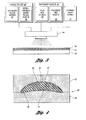
FIGURE 4 is a schematic view of a foam-in-place process for making the interior panel component according to at least one embodiment of the present invention. - As required, detailed embodiments of the present invention are disclosed herein. However, it is understood that the disclosed embodiments are merely exemplary of the invention that may be embodied in various and alternative forms. The figures are not necessarily to scale, some features may be exaggerated or minimized to show details of particular components. Therefore, specific details disclosed herein are not to be interpreted as limiting, merely as a representative basis for teaching one skilled in the art to variously employ the present invention.
- Except where expressly indicated, all numerical quantities in the description and claims, indicated amounts of material or conditions of reaction and/or use are to be understood as modified by the word "about" in describing the broadest scope of the present invention. Practice within the numerical limits stated should be desired and independently embodied. The description of the group or class of materials as suitable for the purpose in connection with the present invention implies that the mixtures of any two or more of the members of the group or classes are suitable. The description of constituents in chemical terms refers to the constituents at the time of addition to any combination specified in the description and does not necessarily preclude chemical interaction among constituents of the mixture once mixed. The first definition of an acronym or other abbreviation applies to all subsequent uses herein of the same abbreviation and applies mutatis mutandis to normal grammatical variations of the initially defined abbreviation. Unless expressly stated to the contrary, measurement of a property is determined by the same techniques previously or later referenced for the same property. Also, unless expressly stated to the contrary, percentage, "parts of," and ratio values are by weight, and the term "polymer" includes "oligomer," "co-polymer," "terpolymer," and the like.
- It is also to be understood that the invention is not limited to specific embodiments and methods described below, as specific composite components and/or conditions to make, of course, vary. Furthermore, the terminology used herein is used only for the purpose of describing particular embodiments of the present invention and is not intended to be limiting in any way.
- It must also be noted that, as used in the specification and the pending claims, the singular form "a," "an," and "the," comprise plural reference unless the context clearly indicates otherwise. For example, the reference to a component in the singular is intended to comprise a plurality of components.
- Throughout this application, where publications are referenced, the disclosure of these publications in their entirety are hereby incorporated by reference into this application to more fully describe the state-of-art to which the invention pertains.
- Referring to the figures, and to
Figure 1 in particular, an exemplaryinterior panel assembly 10 for use with a vehicle is shown according to the principles of the present invention. In this embodiment, thepanel assembly 10 is illustrated as aninstrument panel component 12, adashboard component 14, and aconsole component 16. Theinstrument panel 12,dashboard 14, andconsole 16 contribute to the aesthetic appearance of the automotive interior and provide comfort and convenience to a vehicle occupant. While theinterior panel assembly 10 is illustrated and described herein in an exemplary embodiment and comprises theinstrument panel 12,dashboard 14, andconsole 16, it will be appreciated that theinterior panel assembly 10 of the present may alternatively comprise a door trim panel, an armrest, a door handle, or any other interior panel component without departing from the spirit and scope of the present invention. - Referring now to
Figure 2 , a cross-sectional view of a typicalinstrument panel component 12 is illustrated along a cross-sectional line 2-2 inFigure 1 . Theinstrument panel 12 comprises asubstrate 20 and, a composite 22 secured to thesubstrate 20. Theinstrument panel 12 has aresilient layer 24 such as a foam, that is disposed between at least a portion ofsubstrate 20 and portions of askin 26. - The
substrate 20 and the composite 22, including theresilient layer 24 and theskin 26, can be made of any suitable material known to those of ordinary skill in the art. Suitable examples of materials for making thesubstrate 20 include, but are not necessarily limited to, polypropylene, polyethylene, acrylonitrile-butadiene-styrene (ABS), thermoplastic elastomer (TPE), polycarbonate (PC), PCIABS blend, styrene maleic anhydride (SMA), and thermoplastic olefin (TPO). Thesubstrate 20 can be made by a suitable process known to those of ordinary skill in the art, such as injection molding or compression molding. - The
skin 26 and/or theresilient layer 24 can be made of any suitable material and by a suitable process known to those of ordinary skill in the art. Examples of materials that can be used to form theskin 26 and/or theresilient layer 24 include, but are not limited necessarily to a condensation polymer, a heterochain polymer, TPO, polyimide, polyvinyl chloride (PVC), urethane, polyurethane, thermoplastic polyurethane, and TPE. Theskin 26 may be formed by spraying, injection molding, casting, vacuum forming, or other methods known to those of ordinary skill in the art. The resilient layer is formed from any suitable material that is known to those of ordinary skill in the art, such as foam made from a foamable material including condensation polymerization reaction formed heterochain polymers, such as polyurethane foam. Anoptional coating 28 may be applied toskin 26. - The
interior panel assembly 10 is formed by a suitable process, such as a foam-in-place or a spray application process. Any suitable foam-in-place process for use with condensation polymerization reaction derived heterochain polymers may can be used. A particularly advantageous foam-in-place process includes making a resilient polyurethane using a process as illustrated schematically inFigure 3 . Apolyol source 40 is supplied by a soy-basedpolyol source 42 and apetrochemicalbased polyol source 44. It is understood that there may be more than one of each of the soy-basedpolyol source 42 and the petrochemical-basedpolyol source 44 for formulating chemically or physically distinct polyol materials in those respective categories. Anisocyanate source 46 includes apure MDI source 48 and apolymeric MDI source 50. The ratio by weight of polymeric MDI to pure MDI ranges between 0.4 and 4, more preferably 0.5 and 2, and even more preferably 0.75 to 1.5. An optionalblowing agent source 52 and thepolyol source 40 andisocyanate source 46 supply adispenser 54 from which the skin 26 (Figure 2 ), such as a thermoplastic skin layer, may be applied to amold 58. The dispenser may also apply the resilient layer 24 (Figure 2 ) such as a foamed polyurethane layer, which is applied to a portion ofskin 26. It is understood that additional optional layers and/or additives, such as an ultraviolet light protective layer, a colorant or an aesthetic layer may be applied as needed to either theskin 26 or theresilient layer 24. The optional layers may be applied to themold 58 in processing steps that precede and/or occur following the application of theskin 26, such as in-mold coating without violating the spirit or scope of this invention. The molding may occur using cold-cured foam or processing above room-temperature-cured foam in a heated mold. - Shrinkage of the foam for the interior panel component needs to be minimized. When the foam shrinks, the
skin 26 may exhibit unacceptable sink marks or other non-level surfaces. Slight shrinkage of less than a 2% decrease in dimension in any direction within an hour after molding as measured using ASTM D1622 test method is advantageous. Even more advantageous is having very little shrinkage of a less than 1% decrease in dimension. No shrinkage is most desirable. - Long-term shrinkage after aging under specif environmental conditions of ASTM D2126 for temperature extremes and humidity can also be measured using AST D1622. In interior panel components, the dimensional shrinkage should be less than 5%, more preferably less than 2%, and even more preferably less than 1%.
- Shrinkage may be controlled, in part, by stoichiometric ratio of isocyanate functional groups to polyol functional groups. Typically, an index is reported as 100 times the ratio of isocyanate to polyol functional groups. In forming foam for interior panel components, having the index in the range of 85-115 is advantageous and 95-110 is more advantageous.
- The interior panel assembly (
Figure 1 ) is formed in certain embodiments by a foam-in-place process, as schematically illustrated inFigure 4 . Amolding tool 80 includes anupper mold half 82 and alower mold half 84. At least one of the mold halves 82 and 84 is capable of axial movement relative to the other mold half. This allows the insertion of thesubstrate 20 and theskin 26 into themolding tool 80. In a typical process, theskin 26 is placed upon thelower mold half 84, while thesubstrate 20 is placed in themolding tool 80, often on theupper mold half 82, and spaced apart from theskin 16. The mold halves 82 and 84 are spaced apart prior to molding, thesubstrate 20 and theskin 26 are typically placed on theirrespective halves substrate 20 andskin 26 are in place, the mold halves 82 and 84 are closed relative to each other. - The
molding tool 80 is positioned to allow a dispenser 54 (Figure 3 ) to dispense a foamingmaterial 86 into acavity 88 defined by the area disposed betweensubstrate 20 andskin 26. In certain embodiments thesubstrate 20 may be provided with anopening 90 to allow dispensing of the foamingmaterial 86 into thecavity 88 when the mold halves 82 and 84 are adjacent and abutting each other, i.e., when themolding tool 80 is closed. - In at least one embodiment, the
substrate 20 has a general thickness between 0.5 and 5 mm. In another embodiment, 1.0 to 3.5 mm and yet another embodiment 2 to 3 mm. - The resilient layer 24 (
Figure 1 ) generally contours to thesubstrate 20. Theresilient layer 24 helps to provide a soft feel to theinterior panel assembly 10. In at least one embodiment, the density of theresilient layer 24 is in the range of 4.6 lbs/ft3 (74 kg/m3) to 7 lbs/ft3 (84.4 kg/m3). In other embodiments, the density of theresilient layer 24 can range from 75 kg/m3 to 81 kg/m3. - The
resilient layer 24 further has a compression load deflection ranging between 11 % and 28% when measured using ASTM D3574. It is understood that ranges for physical properties in Tables 1-12 may be individually and independently selected or calculated from the data of Tables 1-12. - The
skin 26 may be bonded in situ toresilient layer 24. In making interior panel components, the adhesion between layers of material is very desirable to maintain a durable and aesthetic panel. The adhesion betweenskin 26 andresilient layer 24 fails desirably if the foam fails cohesively, i.e., tearing the foam, not the interface between theresilient layer 24 and theskin 26. The method for testing the adhesion is ASTM D 1623 when using a tensile tester such as an Instron. Optionally, theresilient layer 24 adhesion to theskin 26 can be tested by hand pulling apart the two portions. - Moreover, the
skin 26 is configured to provide a covering over and generally contouring to theresilient layer 24. In at least one embodiment, theskin 26 is formed by spraying a powdered polymeric material. The polymeric material may, but is not limited to, be a PVC, thermoplastic polyurethane (TPU), TPO, TPE or any combination thereof. Theskin 26 may have any suitable thickness and density. For example, theskin 26 may have a thickness in the range of 0.4 to 2 mm and a density in the range of 85 to 120 kg/m3. In at least one embodiment, theskin 26 has a thickness in the range of 0.5 to 1.2 mm and a density in the range of 95 to 110 kg/m. Theresilient layer 24 may have a thickness in the range of 0.5 mn - 10 mm, more advantageously 0.75 - 5 mm, and even more advantageously 1 - 3 mm. Theskin 26 may also be configured to provide a sufficiently durable and attractive surface such that an exterior coating is not needed. - In another embodiment, the vehicle's
interior panel assembly 10 may be manufactured by spraying an optional mold release agent followed by theskin 26 onto themolding tool 80 using a suitable spray device, such as a robotic high volume, low pressure (HVLP) sprayer having a pressure in the range of 1 to 40 psi (6.9 MPa to 275 MPa). Themolding tool 80 is in communication with temperature controls to enable the tool to be selectively heated and/or cooled to any suitable desired temperature. Any suitable temperature control system can be used to heat the mold surface. - The
molding tool 80 can be made of any suitable material. In at least one embodiment, themolding tool 80 has a conductive exterior surface layer to help responsiveness of themolding tool 80 to temperature control. A suitable example of the material that is conductive includes, but is not necessarily limited to, copper. - While soy-based polyols have been described in this application, it should be understood that any suitable bio-based oil may be used in the practice of the present invention, particularly vegetable oil, through which air has been passed to remove impurities, to functionalize the oil with hydroxyl groups, and to thicken the oil. In addition to soy-oil, examples of suitable bio-based oils that can be converted to polyol for use in the present invention after being blown include: vegetable or seed oils such as grape seed oil, cannola oil, peanut oil, cottonseed, sunflower oil, olive oil, rape seed oil, coconut oil, palm oil, linseed oil, and/or castor oil. Oils derived from animal or fish fats may also be used.
- An example of a soy-based polyol that has particular advantages is NOP-19A commercially available from Dow Chemical (Midland, MI). In at least one embodiment, a blend of soy-based polyol and petrochemical-based polyol can be used as the isocyanate-reactive component in the condensation reaction. It is understood that other vegetable and animal fat oils that have been made into polyol may also be used with a mixture of soy-based polyol and petrochemical-based polyol. In these embodiments the soy-based polyol may comprise less than 50 pphr, and more advantageously 10-40 pphr, and most preferably 16-30 pphr. A petrochemical-based polyol in some embodiments may range from more than 50 pphr, between 60-90 pphr, or more advantageously 70-84 pphr.
- The molecular weight of the soy-based polyol is generally less than that of the petrochemical polyol. A typical number-averaged molecular weight of the soy-based polyol may range from less than 2000, more advantageously 300-1900, and even more advantageously 500-1000. The molecular weight may be generally monodisperse but it is understood that it could be a polydisperse polymer. The petrochemical polyol may have a number-averaged molecular weight greater than 500, more advantageously greater than 2000, and even more advantageously over 5000.
- The isocyanate may include polymeric MDI that may be a polymethylene, polyphenyl isocyanate that contains MDI, and includes a mixture of 2, 4' - and 4, 4' - MDI isomers. Different grades of polymeric MDI may have different ratios of these two isomers. In addition, in polymeric MDI there are three-functional, four-functional, and higher oligomers, each of which has multiples of isomers. Pure MDI includes primarily 4, 4' - MDI isomer, but commercial products normally contain 1 to 2% by weight of the 2, 4' isomer, but may include 2-4' isomer in the range of less than 20% by weight, less than 10% by weight, or less than 5% by weight. A non-limiting example of the pure MDI is HB6562 supplied by Dow Chemical. A non-limiting example of polymeric MDI is PAPI95 supplied by Dow Chemical. The typical functionality for polymeric MDI ranges between 2 and 3, more preferably 2.2 to 2.8, and most preferably 2.3 to 2.5. The viscosity ranges from 60 to 80 centipoise at 25°C when tested with a Brookfield viscometer. An acidity, as percent HCl, ranges from 0.010 to 0.20 when determined using Dow Chemical method 109-00761.
- Other additives may be added to either the
isocyanate source 46 or thepolyol source 40. Typical additives may optionally include catalysts, surfactants, and chain-extenders. An example of catalyst is a delayed reaction catalyst such as triethylamine-N-oxide (TEAO). A typical surfactant may include B4113 supplied by Taegostab, which is a product line of the Goldschmidt Chemical Corporation, Division of Degussa (Hopewell, VA), or Dabco, 33-LV, which is a mixture of 33% triethylaminediamine and 67% dipropylene glycol, available from Air Products. An example of an additive for scavaging acid in the foam is a N, N-dimethyl ethylamine (DMEA) which is provided by Huntsman International. - A series of polyurethane foams using 0-50 pphr of a soy-based polyol are formulated with polymeric MDI. Formulations are given in Tables 1-5. The polyols are a blend of three polyols: soy-based polyol NOP-19A and petrochemical-based polyols 4701, an ethylene oxide capped tri-functional oxy propylene polyether from Dow Chemical (Midland, MI), and 493 5, a tri-functional styrene acrylonitrile copolymer polyol having about 35% solids and an equivalent weight of 2435, available from Dow Chemical (Midland, MI) as their Voranol™ series. Polyol 4935 has a molecular weight range about 4000, and is greater than the molecular weight range of 4701 and NOP-19A. The molecular weight of polyol 4701 exceeds that of polyol NOP-19A.
- Physical properties for the foams of Example 1 are given in Table 6.
- Foams made with polymeric MDI and with between 5% and 20% of the foam's weight (10-40 pphr) of soy-based polyol have advantageous physical properties. Using the same formulation components at 25% of the foam's weight (50 pphr) of soy-based polyol, the elongation of the resulting foam, is on the average, less than desired.
- A foam with the same components as Example 1 is prepared using 43 pphr of the soy-based polyol as well as 43 pphr of the higher molecular weight petrochemical-based
polyol 4935 and 14 pphr of petrochemical-based polyol 4701. The formulation has 25% of the foam weight of soy-based polyol and 25% of the foam weight of petrochemical-based polyol 4935 in the foam. The formulation is available in Table 7. The results for this formulation show that in order to use 25% or more soy-based polyol (43 or more pphr) and achieve advantageous properties, a petrochemical-based polyol, such as polyol 4935 having relatively high number averaged molecular weight is used. The result is an increase in the elongation to desirable levels when measured using ASTM D412-DIE-C. - Forming a composite layer, such as
composite 22 ofFigure 2 , having a thermoplastic polyurethane skin and a resilient layer of polyurethane foam having 10% by weight of the foam (20 pphr) foam soy-based polyol is tested for physical properties. The formulation is provided in Table 8. The composite layer's physical properties are given in Table 9. Using only polymeric MDI, the compression set, as received, does not have sufficiently advantageous properties. - A formulation having 20% by weight of the foam from soy-based polyol (40 pphr) and the same quantity of high molecular weight petrochemical-based 4935 polyol as in Example 3, polymeric MDI at 60 pphr, and pure MDI at 40 pphr is formed into a composite layer as in Example 3. Using the blend of polymeric MDI and pure MDI results in a remarkably improved initial compression set for the composite layer. The formulation is given in Table 10 and the results are shown in Table 11.
Table 1 Formula A-1 Material Parts (pphr) Eq. Wt. Total Eq. Base NOP-19A 0 904.80 0.0000 4701 0 1650.00 0.0000 4935 35 2390.00 0.0146 TEAO 2 49.70 0.0404 V-800 2 70.10 0.0285 B-4113 0.35 1750.00 0.0002 33-LV 0.4 102.50 0.0039 ET 0.05 2337.00 0.0002 DMEA 0.3 87.90 0.0034 H2O 2.3 9.00 0.2555 SUM 42.4 0.3467 PAPI 95 45.4582 131.1 0.3467 Mix Ratio 0.933 Table 2 Formula A-1 Material Parts (pphr) Eq. Wt. Total Eq. A-1-1 NOP- 19A 10 904.80 0.0111 5.0% Soy 4701 55 1650.00 0.0333 4935 35 2390.00 0.0146 TEAO 2 49.70 0.0404 V-800 2 70.10 0.0285 B-4113 0.35 1750.00 0.0002 33-LV 0.4 102.50 0.0039 ET 0.05 2337.00 0.0002 DMEA 0.3 87.90 0.0034 H2O 2.3 9.00 0.2555 SUM 107.4 0.3911 PAPI 95 51.273 131.1 0.3911 Mix Ratio 2.095 Time to Top of Cup 31 - 32 sec. Gel Time 41 - 45 sec. End of Rise 56 - 68 sec Density 4.90-5.03 lbs/ft3 Foam looks good and no shrinkage Table 3 Formula A-1 Material Parts (pphr) Eq. Wt. Total Eq. A-1-2 NOP- 19A 20 904.80 0.0221 10% Soy 4701 45 1650.00 0.0273 4935 35 2390.00 0.0146 TEAO 2 49.70 0.0404 V-800 2 70.10 0.0285 B-4113 4.35 1750.00 0.0002 33-lav 0.4 102.50 0.0039 ET 0.05 2337.00 0.0002 DMEA 0.3 87.90 0.0034 H2O 2.3 9.00 0.2555 SUM 107.4 0.3961 PAPI 95 51.932 131.1 0.3961 Mix Ratio 2.068 Time to Top of Cup 31 Gel Time 40 - 41 End of Rise 54 - 58 Density 4.69-4.87 lbs/ft3 No foam shrinkage noted but hard at 100 Index, much softer at 90 Index Table 4 Formula A-1 Material Parts (pphr) Eq. Wt. Total Eq. A-1-3 NOP- 19A 40 904.80 0.0442 20% Soy 4701 25 1650.00 0.0152 17.5% 4935 4935 35 2390.00 0.0146 TEAO 2 49.70 0.0404 V-800 2 70.10 0.0285 B-4113 0.3 1750.00 0.0002 33-LV 0.4 102.50 0.0039 ET 0.05 2337.00 0.0002 DMEA 0.3 87.90 0.0034 H2O 2.3 9.00 0.2555 SUM 107.4 0.4061 PAPI 95 53.240 131.1 0.4061 Mix Ratio 2.017 Time to Top of Cup 31-32 Gel Time 40-41 End-of-Rise 55-56 Density 4.95-4.96 lbs/ft3 Very little foam shrinkage, sensitive to shear collapse, 100 Index Table 5 Formula A-1 Material Parts (pphr) Eq. Wt. Total Eq. A-1-4 NOP- 19A 50 904.80 0.0553 25% Soy 4701 15 1650.00 0.0091 17.5% 4935 4935 35 2390.00 0.0146 TEAO 2 49.70 0.0404 V-800 2 70.10 0.0285 B-4113 0.35 1750.00 0.0002 33-LV 0.4 102.50 0.0039 ET 0.05 2337.00 0.0002 DMEA 0.3 87.90 0.0034 H2O 2.3 9.00 0.2555 SUM 107.4 0.4111 PAPI 95 53.895 131.1 0.4111 Mix Ratio 1.993 Time to Top of Cup 30 - 31 sec. Gel Time 36 - 38 sec. End-of-Rise 53 - 54 sec. Density 4.90 - 4.95 lbs/ft3 Foam softer Slight foam shrinkage, 100 Index Table 6 5% (10 pphr) NOP Soy Polyol A1-1 Criterion Mean Range Standard Deviation Pass/Fail Tensile As Received ASTM D3574 11.9 lbf/in2 Min. 37.1 33.9 - 40.6 P Elongation ASTM D412-DIE-C 60% Min. 64 60 - 70 P Tear ASTM D3574 0.74 lbf/in Min. 1.69 1.53 - 1.89 P Compression Sets As Recvd ASTM D3574 40% Max. 20.4 19.9 - 21.1 P Compression Sets Humid Aged ASTM D3574 50% Max. 18.0 16.7 - 19.4 P Flammability (Foam Only) ASTM D1692 4.0 in./min. Max. 1.49 in./min. 1.34 - 1.63 P Compression Load Deflection 0.5 x 2 in. at 25% Compression ASTM D3574 18.44% 11.46 - 24.52 5.12 10% (20 pphr) NOP Soy Polyol A1-2 Tensile As Received ASTM D3574 11.9 lbf/in2 Min. 35.7 32.8 - 38.6 P Elongation ASTM D412-DIE-C 60% Min. 62 55 - 70 P Tear ASTM D3574 0.74 Ibf/in Min. 1.81 1.59 - 2.20 P Compression Sets As Recvd ASTM D3574 40% Max. 24.6 21.4 - 26.6 P Compression Sets Humid Aged ASTM D3574 50% Max. 22.2 20.1 - 24.3 P Flammability (Foam Only) ASTM D1692 4.0 in./min. Max. 1.18 1.14 - 1.25 P Compression Load Deflection 0.5 x 2 in. at 25% Compression ASTM D3574 21.27% 14.63 - 26.10 5.25 20% (40 pphr) NOP Soy Polyol Al-3 Tensile As Received ASTM D3574 11.9 lbf/in2 Min. 36.7 33.4 - 42.0 P Elongation ASTM D412-DIE-C 60% Min. 60 50 - 70 P Tear ASTM D3574 0.74 lbf/in Min. 1.90 1.8 -1.96 P Compression Sets As Recvd ASTM D3574 40% Max. 34.0 32.2 - 36.1 P Compression Sets Humid Aged ASTM D3574 50% Max. 28.0 25.8 - 29.3 P Flammability (Foam Only) ASTM D1692 4.0 in./min. Max. 0.86 0.84 - 0.89 P Compression Load Deflection 0.5 x 2 in. at 25% Compression ASTM D3574 23.48% 18.05-27.93 4.07 25% (50 pphr) NOP Soy Polyol A1-4 Tensile As Received ASTM D3574 11.9 lbf/in2 Min. 42.0 39.4-48.9 P Elongation ASTM D412-DIE-C 60% Min. 53 50 - 60 F Tear ASTM D3574 0.74 lbf/in Min. 1.81 1.71 - 1.89 P Compression Sets As Recvd ASTM D3574 40% Max. 32.7 32.0 - 33.6 P Compression Sets Humid Aged ASTM D3574 50% Max. 34.3 32.8 - 35.5 P Flammability (Foam Only) ASTMD1692 4.0 in./min. Max. 0.80 0.77 - 0.82 P Compression Load Deflection 0.5 x 2 in. at 25% Compression ASTM D3574 22.03% 18.17 - 28.42 4.23 Table 7 Formula A-1 Material Parts Eq. Wt. Total Eq. A-1-5 NOP-19A 43 904.80 0.0553 25% Soy 4701 15 1650.00 0.4091 25% 4935 4935 50 2390.00 0.0209 TEAO 2 49.70 0.0404 V-800 2 70.10 0.0285 B-4113 0.35 1750.00 0.0002 33-LV 0.4 102.50 0.0039 ET 0.05 2337.00 0.0002 DMEA 0.3 87.90 0.0034 H2O 2.3 9.00 0.2555 SUM 122.4 0.4174 PAPI 95 54.718 131.1 0.4174 Mix Ratio 2.237 Time to Top of Cup 43 - 44 sec. Gel Time 50 - 51 sec. End-of-Rise 58 - 60 sec. Density 5.27 lbs/ft3 84.4 kg/m3 Good foam no shrinkage at 25% 4935 Foam is softer, but okay, 100 Index Table 8 B-1 Experimental Material Parts Eq. Wt. Total Eq. BASE Foam Formulation NOP- 19A 20 904.80 0.0221 B-1-1 4701 50 1650.00 0.0303 4935 30 2390.00 0.0126 10 % Soy TEAO 1.5 49.70 0.0302 V-800 1 70.10 0.0143 V-4053 5 1800.00 0.0028 Lexorex 3.5 880.00 0.0040 B-4113 0.25 1750.00 0.0001 33-LV 0.6 102.50 0.0059 ET 0.07 2337.00 0.0000 DMEA 0.43 87.90 0.0049 DR-2205 0.5 1650.00 0.0003 H2O 2.3 9.00 0.2556 SUM 115.15 0.3829 PAPI 95 50.203 131.1 0.3829 Mix Ratio 2.29 Time to Top of Cup 30 - 32 sec. End-of-Rise 57 - 58 sec. Gel Time 36 - 38 sec. Density 4.56-4,73 lbs/in3 Table 9 10 % Soy Polyol B-1 with TPU Skin Criterion Mean Range Std. Deviation Pass/Fail Tensile As Recvd ASTM D3574 11.9 lbf/in2 Min. 34.2 32.1-36.6 P Elongation ASTM D412 DIE-C 60 % Min. 69 65-70 P Tear ASTM D3574 0.74 lbf/in Min. 1.50 1.41-1.58 P Compression Set Recvd ASTM D3574 40 % Max 33.9 32.8-34.8 P Compression Set Humid Aged ASTM D3574 50 % Max 17.4 16.7-18.8 P Compression Load Deflection 0.5x2 in 25% Compression 17.8 14.5-22.0 2.5 P Adhesion Cohesive Failure 1 lbf/in 0.42-1.9 0.51 P Compression Force Deflection 50 % Max 16.5 P Compression Sets as Recvd 25 % Max 34.5 32.5-35.3 F Compression Sets Humid Aged 50 % Max 21.1 19.4-23.0 P Table 10 B-2 Experimental Material Parts Eq. Wt. Total Eq. BASE Foam Formulation NOP- 19A 40 904.80 0.0442 B-2-2 4701 30 1650.00 0.0182 4935 30 2390.00 0.0126 20% Soy TEAO 1.5 49.70 0.0302 V-800 0 70.10 0.0000 60 PAPI 95 V-4053 4 1800.00 0.0022 40 HB6562 Lexorex 3.5 880.00 0.0040 B-4113 0.25 1750.00 0.0001 33-LV 0.6 102.50 0.0059 ET 0.07 2337.00 0.0000 DMEA 0.43 87.90 0.0049 DR-2205 0.5 1650.00 0.0003 H2O 2.3 9.00 0.2556 SUM 113.15 0.3781 60 PAPI 95 55.316 146.3 0.3781 40 HB6562 Mix Ratio 2.046 Time to Top of Cup 32-33 Gel Time 42-43 End-of-Rise 70 Density 4.62 lbs/ft3 Shrinkage at 100 index Slight shrinkage at 108 index, much better Table 11 20 % Soy Polyol B-2 with TPU Skin Criterion Mean Range Std. Deviation Pass/ Fail Tensile As Recvd ASTM D3574 11.9 lbf/in2 Min. 30.9 29.4-32.8 P Elongation ASTM D412 DIE-C 60 % Min. 61 45-70 P Tear ASTM D3574 0.74 lbf/in 1.42 1.33-1.53 P Compression Sets As Recvd ASTM D3574 40%Max 22.5 21.5-23.4 P Compression Sets Humid Aged ASTM D3574 50 % Max 21.5 21.1-22.0 P Flammability (Foam Only) ASTM D1692 4.0 in./min. Max. 2.09 1.86-2.09 P Compression Load Deflection 0.5 x 2 in. 25 % Compression ASTM D3574 19.0% 10.97-24.03 4.78 Adhesion Cohesive Failure 0.84 lbf/in 0.42-1.6 0.47 Compression Force Deflection 50 % Max 13.3 P Compression Sets As Recvd 25 % Max 23.9 22.6-24.9 P Compression Sets Humid Aged 50 % Max 19.4 18.5-19.7 P - While embodiments of the invention have been illustrated and described, it is not intended that these embodiments illustrate and describe all possible forms of the invention. Rather, the words used in the specification are words of description rather than limitation, and it is understood that various changes may be made without departing from the spirit and scope of the invention.
Claims (15)
- An interior panel component for use with a motor vehicle, the component comprising:a skin;a resilient layer secured to the skin, the resilient layer comprising before reaction, a polymeric MDI, a pure MDI consisting essentially of 4-4' MDI isomer, and a polyol, the polyol comprising less than 50 parts per hundred parts of resin (pphr) of a soy-based polyol; anda substrate.
- The component of claim 1, the resilient layer further comprising a petrochemical-based polyol having a molecular weight greater than the soy-based polyol.
- The component of claim 2, wherein the petrochemical-based polyol has a number-averaged molecular weight greater than 2,000.
- The component of claim 2 or 3, having an effective amount of petrochemical-based polyol and the soy-based polyol wherein the mean elongation of the resilient layer is greater than 60% when measured using ASTM D412 DIE-C method.
- The component of one of the preceding claims, wherein a ratio by weight of polymeric MDI to pure MDI ranges between 0.4 and 4.
- An interior panel component for use with a motor vehicle, the component comprising:a composite layer comprising a skin layer and a resilient layer, wherein the resilient layer is secured to the skin layer, the resilient layer comprising a heterochain polymer foam which, before reaction, comprises a soy-based polyol, the resilient layer having a compression load deflection ranging between 11 and 28% when measured using ASTM D3574; anda substrate.
- The component of claim 13, wherein the heterochain polymer foam comprises polyurethane foam.
- The component of one of the preceding claims, wherein the mean elongation of the resilient layer is in the range of 60% to 85% when measured using ASTM D412 DIE-C method.
- The component of one of the preceding claims, wherein the compression set of the component, as received, is less than 25% when measured using ASTM D3574.
- The component of one of the preceding claims, wherein the skin comprises a thermoplastic polyurethane.
- The component of one of the preceding claims, wherein the substrate comprises a thermoplastic polyolefin.
- The component of one of the preceding claims, wherein the resilient layer is secured to the skin and the substrate when the resilient layer is foamed-in-place,
- The component of claim 13, wherein the resilient layer has a thickness in the range of 0.5 to 10 mm.
- A method for making an interior panel component for use with a motor vehicle, the method comprising:applying a skin layer to an upper mold half of a mold tool;applying a substrate to a lower mold half of the mold tool, the upper half and lower half defining a cavity;closing the mold halves relative to each other;dispensing foam into the cavity, the foam comprising a polymeric MDI, a pure MDI, a soy-based polyol, and a petrochemical-based polyol;curing the foam in the cavity; andopening the mold halves to release the interior panel component.
- The method of claim 17, wherein the foam layer has a density in the range of 74 to 84.4 kg/cm3.
Applications Claiming Priority (1)
| Application Number | Priority Date | Filing Date | Title |
|---|---|---|---|
| US12/336,916 US20100151227A1 (en) | 2008-12-17 | 2008-12-17 | Interior panel component for use with a vehicle and method for making |
Publications (2)
| Publication Number | Publication Date |
|---|---|
| EP2199324A2 true EP2199324A2 (en) | 2010-06-23 |
| EP2199324A3 EP2199324A3 (en) | 2012-08-01 |
Family
ID=42041542
Family Applications (1)
| Application Number | Title | Priority Date | Filing Date |
|---|---|---|---|
| EP20090175766 Withdrawn EP2199324A3 (en) | 2008-12-17 | 2009-11-12 | Interior panel component for use with a vehicle and method for making |
Country Status (5)
| Country | Link |
|---|---|
| US (1) | US20100151227A1 (en) |
| EP (1) | EP2199324A3 (en) |
| JP (1) | JP2010143221A (en) |
| CA (1) | CA2684773A1 (en) |
| MX (1) | MX2009013844A (en) |
Families Citing this family (8)
| Publication number | Priority date | Publication date | Assignee | Title |
|---|---|---|---|---|
| DE102010005308A1 (en) | 2010-01-21 | 2011-07-28 | Dürr Systems GmbH, 74321 | Test system for testing control programs for a robot system |
| JP5700804B2 (en) * | 2011-02-24 | 2015-04-15 | 富士重工業株式会社 | Interior components and instrument panels |
| US20150197046A1 (en) * | 2014-01-16 | 2015-07-16 | Ford Global Technologies, Llc | Vehicle interior part and method of making the same |
| US10189964B2 (en) | 2015-06-08 | 2019-01-29 | Covestro Llc | Methods for preparing open-celled polyurethane foams, systems for use therein, and open-celled polyurethane foams produced thereby |
| CN205930619U (en) * | 2016-07-29 | 2017-02-08 | 上海延锋金桥汽车饰件系统有限公司 | A air bag door cover plate for car |
| CN106476719A (en) * | 2016-11-03 | 2017-03-08 | 江苏昊晟塑业科技有限公司 | Automotive trim panel damping of shocks pad |
| IT201700029818A1 (en) * | 2017-03-17 | 2018-09-17 | Uniteam Italia S R L | Molding method of a component, for example for vehicle interiors, typically a dashboard and / or internal panels, and relative component |
| US20180304599A1 (en) * | 2017-04-21 | 2018-10-25 | Faurecia Interior Systems, Inc. | Vehicle interior panel with backing layer |
Family Cites Families (31)
| Publication number | Priority date | Publication date | Assignee | Title |
|---|---|---|---|---|
| DE4001249A1 (en) * | 1990-01-18 | 1991-07-25 | Bayer Ag | Cold formable open cell rigid polyurethane foam prodn. - from specified poly:ol component and crude MDI, used for car canopy |
| DE4038783A1 (en) * | 1990-12-05 | 1992-06-11 | Basf Ag | POLYVINYL CHLORIDE-POLYURETHANEUM FUEL COMPOSITES, METHOD FOR THE PRODUCTION THEREOF AND USES OF LIQUID, URETHANO GROUP-CONTAINING POLYISOCYANATE MIXTURES USEFUL IN THE PREPARATION AND PRODUCTION OF THE POLYURETHANE FOAM |
| US5928772A (en) * | 1996-06-13 | 1999-07-27 | Dainippon Ink And Chemicals, Inc. | Panel material and method of manufacturing the same |
| US5698609A (en) * | 1996-11-14 | 1997-12-16 | Imperial Chemical Industries Plc | Energy absorbing polyurethane foams |
| US5885662A (en) * | 1997-01-31 | 1999-03-23 | Atoma International, Inc. | Decorative automotive interior trim articles with integral light stable polyurethane elastomer covering and process for making the same |
| DE19928617A1 (en) * | 1998-06-22 | 1999-12-23 | Honda Motor Co Ltd | Thermoplastic foil skin, useful especially for the production of interior parts for cars, e.g. instrument panels |
| JP3777588B2 (en) * | 1999-06-22 | 2006-05-24 | 日本ポリウレタン工業株式会社 | Flexible polyurethane slab foam and method for producing the same |
| WO2002100916A1 (en) * | 2001-05-24 | 2002-12-19 | Mitsui Takeda Chemicals, Inc. | Process for producing flexible polyurethane foams and apparatus for producing flexible polyurethane foams |
| WO2003035705A1 (en) * | 2001-10-23 | 2003-05-01 | Asahi Kasei Kabushiki Kaisha | Hydrogenated copolymer |
| WO2004099227A2 (en) * | 2003-04-30 | 2004-11-18 | Michigan State University | Polyol fatty acid polyesters process and polyurethanes therefrom |
| US6991841B2 (en) * | 2003-05-06 | 2006-01-31 | Lear Corporation | Foam in place composite one-piece hard/soft panel |
| CN101039975A (en) * | 2004-01-08 | 2007-09-19 | 荷兰聚合物研究所基金会 | Polyurethanes, polyurethaneureas and polyureas and use thereof |
| US20050282921A1 (en) * | 2004-06-18 | 2005-12-22 | Ford Global Technologies, Llc | Automotive grade, flexible polyurethane foam and method for making the same |
| US20060029789A1 (en) * | 2004-08-05 | 2006-02-09 | Lear Corporation | Interior vehicle trim panel having dual density spray elastomer and method for making the same |
| US20060091575A1 (en) * | 2004-11-03 | 2006-05-04 | Lear Corporation | Method and system for making interior vehicle trim panel having sprayed skin |
| US20060097544A1 (en) * | 2004-11-09 | 2006-05-11 | Cowelchuk Glenn A | Automotive interior trim assembly and method |
| US20060116713A1 (en) * | 2004-11-26 | 2006-06-01 | Ivan Sepetka | Aneurysm treatment devices and methods |
| US20080107889A1 (en) * | 2005-03-17 | 2008-05-08 | Johnson Controls Technology Company | Vehicle Component and Method for Making a Vehicle Component |
| BRPI0610831B1 (en) * | 2005-04-25 | 2018-04-10 | Cargill, Incorporated | Polyurethane Foams Understanding Oligomeric Polyols and Methods of Manufacturing Polyurethane Molded Foam Article and SLABSTOCK Polyurethane Foam Article |
| JP2008539098A (en) * | 2005-04-29 | 2008-11-13 | ウッドブリッジ・フォーム・コーポレイション | Foam laminated product and manufacturing method thereof |
| US20070066786A1 (en) * | 2005-09-22 | 2007-03-22 | The Hanson Group, Llc | Methods of preparing and using polyurea elastomers |
| US20070105970A1 (en) * | 2005-11-10 | 2007-05-10 | Kenneth Warnshuis | Energy absorbing flexible foam |
| US20070123597A1 (en) * | 2005-11-29 | 2007-05-31 | Ford Global Technologies, Llc | Encapsulated flexible polyurethane foam and method for making polyol to form foam |
| US7585030B2 (en) * | 2006-07-20 | 2009-09-08 | Galbreath Ashford A | Environmentally friendly layered seating assembly |
| RU2447991C2 (en) * | 2006-10-30 | 2012-04-20 | Джонсон Контролз Текнолоджи Компани | Non-petroleum foamed polyurethane products having improved technical characteristics and production methods thereof |
| JP2008274051A (en) * | 2007-04-26 | 2008-11-13 | Nippon Polyurethane Ind Co Ltd | Polyisocyanate composition for flexible polyurethane foam and method for producing flexible polyurethane foam using the composition |
| JP5628024B2 (en) * | 2007-05-15 | 2014-11-19 | ダウ グローバル テクノロジーズ エルエルシー | High elastic foam |
| US20100204353A1 (en) * | 2007-09-07 | 2010-08-12 | Dow Global Technologies Inc. | Use of natural oil based compounds of low functionality to enhance foams |
| EP2250206B1 (en) * | 2008-01-04 | 2012-10-31 | Johnson Controls Technology Company | Trim component with increased renewable materials |
| CN101679587B (en) * | 2008-02-01 | 2014-03-12 | 陶氏环球技术有限责任公司 | Natural oil based copolymer polyols and polyurethane products made therefrom |
| CN101959943B (en) * | 2008-02-08 | 2013-10-16 | 陶氏环球技术有限责任公司 | Improved flexible foams |
-
2008
- 2008-12-17 US US12/336,916 patent/US20100151227A1/en not_active Abandoned
-
2009
- 2009-11-06 CA CA 2684773 patent/CA2684773A1/en not_active Abandoned
- 2009-11-12 EP EP20090175766 patent/EP2199324A3/en not_active Withdrawn
- 2009-12-14 JP JP2009283186A patent/JP2010143221A/en active Pending
- 2009-12-16 MX MX2009013844A patent/MX2009013844A/en unknown
Also Published As
| Publication number | Publication date |
|---|---|
| EP2199324A3 (en) | 2012-08-01 |
| MX2009013844A (en) | 2010-08-25 |
| CA2684773A1 (en) | 2010-06-17 |
| US20100151227A1 (en) | 2010-06-17 |
| JP2010143221A (en) | 2010-07-01 |
Similar Documents
| Publication | Publication Date | Title |
|---|---|---|
| EP2199324A2 (en) | Interior panel component for use with a vehicle and method for making | |
| DE60203903T2 (en) | METHOD FOR MANUFACTURING MULTILAYER FOAM MATERIALS, AND OBJECTS PRODUCED THEREFROM | |
| US8071208B2 (en) | Integral skin molded article and method of preparing integral skin molded article and laminate having skin | |
| US8057727B2 (en) | Vehicle interior article of skin-integrated laminate, method for manufacturing non-foaming polyurethane resin and method for manufacturing skin-integrated laminate using the same | |
| KR20060009381A (en) | Method for the production of expanding thermoplastic elastomers | |
| EP2867268B1 (en) | Method for making skinned polyurethane foam composites | |
| JP2008138196A (en) | Plastic composite material member and manufacturing method thereof | |
| CA3131813A1 (en) | Soft particle foam consisting of thermoplastic polyurethane | |
| CA3055444C (en) | Elastomeric composite polyurethane skins | |
| US8129015B2 (en) | Modified moldable urethane with tunable haptics | |
| EP3990515B1 (en) | Method for making foamed parts | |
| US20060222775A1 (en) | System, method and composition for forming composite sprayed polyurethane skins having a low density expanded polyurethane layer | |
| WO2001032392A9 (en) | Process for manufacturing multilayered foam articles, and thus produced articles | |
| CN106317853A (en) | Polyurethane elastomer composition, polyurethane elastomer preparation method and vehicle interior part skin | |
| KR20130124994A (en) | Round-shaped fine powder for powder slush molding and manufacturing method thereof | |
| US20240084085A1 (en) | Preparation for a molded body | |
| GB2419323A (en) | Low density spray polyurethane for automobile interior applications | |
| JP4690164B2 (en) | Manufacturing method of automotive interior panel | |
| US20060030630A1 (en) | System, method and composition for forming composite sprayed polyurethane skins having an expanded polyurethane layer | |
| US20190112412A1 (en) | Urethane foam system for molded articles | |
| EP1008431B1 (en) | Moulded dashboards containing polyisocyanate-polyaddition products | |
| HK1117859A (en) | Method of producing a polyurethane foam molded article |
Legal Events
| Date | Code | Title | Description |
|---|---|---|---|
| PUAI | Public reference made under article 153(3) epc to a published international application that has entered the european phase |
Free format text: ORIGINAL CODE: 0009012 |
|
| AK | Designated contracting states |
Kind code of ref document: A2 Designated state(s): AT BE BG CH CY CZ DE DK EE ES FI FR GB GR HR HU IE IS IT LI LT LU LV MC MK MT NL NO PL PT RO SE SI SK SM TR |
|
| AX | Request for extension of the european patent |
Extension state: AL BA RS |
|
| PUAL | Search report despatched |
Free format text: ORIGINAL CODE: 0009013 |
|
| AK | Designated contracting states |
Kind code of ref document: A3 Designated state(s): AT BE BG CH CY CZ DE DK EE ES FI FR GB GR HR HU IE IS IT LI LT LU LV MC MK MT NL NO PL PT RO SE SI SK SM TR |
|
| AX | Request for extension of the european patent |
Extension state: AL BA RS |
|
| RIC1 | Information provided on ipc code assigned before grant |
Ipc: C08L 75/04 20060101ALN20120627BHEP Ipc: B60R 13/02 20060101ALI20120627BHEP Ipc: B29C 44/12 20060101ALI20120627BHEP Ipc: B32B 27/08 20060101ALI20120627BHEP Ipc: C08G 18/76 20060101ALI20120627BHEP Ipc: C08J 9/00 20060101AFI20120627BHEP |
|
| STAA | Information on the status of an ep patent application or granted ep patent |
Free format text: STATUS: THE APPLICATION IS DEEMED TO BE WITHDRAWN |
|
| 18D | Application deemed to be withdrawn |
Effective date: 20130202 |