EP2199258A1 - A process for producing optionally doped elemental boron - Google Patents
A process for producing optionally doped elemental boron Download PDFInfo
- Publication number
- EP2199258A1 EP2199258A1 EP09180091A EP09180091A EP2199258A1 EP 2199258 A1 EP2199258 A1 EP 2199258A1 EP 09180091 A EP09180091 A EP 09180091A EP 09180091 A EP09180091 A EP 09180091A EP 2199258 A1 EP2199258 A1 EP 2199258A1
- Authority
- EP
- European Patent Office
- Prior art keywords
- boron
- precursor
- doping
- production
- solution
- Prior art date
- Legal status (The legal status is an assumption and is not a legal conclusion. Google has not performed a legal analysis and makes no representation as to the accuracy of the status listed.)
- Granted
Links
- 229910052796 boron Inorganic materials 0.000 title claims abstract description 92
- ZOXJGFHDIHLPTG-UHFFFAOYSA-N Boron Chemical compound [B] ZOXJGFHDIHLPTG-UHFFFAOYSA-N 0.000 title claims abstract description 91
- 238000000034 method Methods 0.000 title claims abstract description 54
- 230000008569 process Effects 0.000 title description 8
- 238000004519 manufacturing process Methods 0.000 claims abstract description 23
- 239000002243 precursor Substances 0.000 claims abstract description 23
- 238000004108 freeze drying Methods 0.000 claims abstract description 18
- 230000009467 reduction Effects 0.000 claims abstract description 11
- 230000008014 freezing Effects 0.000 claims abstract description 8
- 238000007710 freezing Methods 0.000 claims abstract description 8
- 239000002019 doping agent Substances 0.000 claims description 26
- 150000001875 compounds Chemical class 0.000 claims description 25
- GWEVSGVZZGPLCZ-UHFFFAOYSA-N Titan oxide Chemical compound O=[Ti]=O GWEVSGVZZGPLCZ-UHFFFAOYSA-N 0.000 claims description 17
- 239000002904 solvent Substances 0.000 claims description 17
- 239000007788 liquid Substances 0.000 claims description 16
- 239000002245 particle Substances 0.000 claims description 16
- PZKRHHZKOQZHIO-UHFFFAOYSA-N [B].[B].[Mg] Chemical compound [B].[B].[Mg] PZKRHHZKOQZHIO-UHFFFAOYSA-N 0.000 claims description 14
- -1 metalloid carbides Chemical class 0.000 claims description 8
- 239000003638 chemical reducing agent Substances 0.000 claims description 7
- 229910052749 magnesium Inorganic materials 0.000 claims description 6
- 239000011777 magnesium Substances 0.000 claims description 6
- FYYHWMGAXLPEAU-UHFFFAOYSA-N Magnesium Chemical compound [Mg] FYYHWMGAXLPEAU-UHFFFAOYSA-N 0.000 claims description 5
- 238000007669 thermal treatment Methods 0.000 claims description 4
- 229910052751 metal Inorganic materials 0.000 claims description 3
- 239000002184 metal Substances 0.000 claims description 3
- 238000000859 sublimation Methods 0.000 claims description 3
- 230000008022 sublimation Effects 0.000 claims description 3
- QYEXBYZXHDUPRC-UHFFFAOYSA-N B#[Ti]#B Chemical compound B#[Ti]#B QYEXBYZXHDUPRC-UHFFFAOYSA-N 0.000 claims description 2
- 229910033181 TiB2 Inorganic materials 0.000 claims description 2
- 230000002776 aggregation Effects 0.000 claims description 2
- 235000014633 carbohydrates Nutrition 0.000 claims description 2
- 238000001704 evaporation Methods 0.000 claims description 2
- 230000008020 evaporation Effects 0.000 claims description 2
- 238000004220 aggregation Methods 0.000 claims 1
- 238000000889 atomisation Methods 0.000 claims 1
- 150000001720 carbohydrates Chemical class 0.000 claims 1
- 229910044991 metal oxide Inorganic materials 0.000 claims 1
- 150000004706 metal oxides Chemical class 0.000 claims 1
- 229910052752 metalloid Inorganic materials 0.000 claims 1
- 229910052755 nonmetal Inorganic materials 0.000 claims 1
- 150000002843 nonmetals Chemical class 0.000 claims 1
- 238000001556 precipitation Methods 0.000 claims 1
- 239000006185 dispersion Substances 0.000 abstract description 10
- 239000011159 matrix material Substances 0.000 abstract description 7
- 239000000126 substance Substances 0.000 abstract description 7
- 238000004090 dissolution Methods 0.000 abstract description 5
- 239000011858 nanopowder Substances 0.000 abstract description 2
- JKWMSGQKBLHBQQ-UHFFFAOYSA-N diboron trioxide Chemical compound O=BOB=O JKWMSGQKBLHBQQ-UHFFFAOYSA-N 0.000 description 20
- 229910052810 boron oxide Inorganic materials 0.000 description 17
- 239000000243 solution Substances 0.000 description 16
- 238000006243 chemical reaction Methods 0.000 description 13
- 239000000047 product Substances 0.000 description 12
- IJGRMHOSHXDMSA-UHFFFAOYSA-N Atomic nitrogen Chemical compound N#N IJGRMHOSHXDMSA-UHFFFAOYSA-N 0.000 description 10
- XLYOFNOQVPJJNP-UHFFFAOYSA-N water Substances O XLYOFNOQVPJJNP-UHFFFAOYSA-N 0.000 description 10
- 230000015572 biosynthetic process Effects 0.000 description 9
- 239000012071 phase Substances 0.000 description 7
- 238000006722 reduction reaction Methods 0.000 description 7
- 239000004408 titanium dioxide Substances 0.000 description 7
- KGBXLFKZBHKPEV-UHFFFAOYSA-N boric acid Chemical compound OB(O)O KGBXLFKZBHKPEV-UHFFFAOYSA-N 0.000 description 6
- 238000003786 synthesis reaction Methods 0.000 description 6
- OKTJSMMVPCPJKN-UHFFFAOYSA-N Carbon Chemical compound [C] OKTJSMMVPCPJKN-UHFFFAOYSA-N 0.000 description 5
- 238000009835 boiling Methods 0.000 description 5
- 239000004327 boric acid Substances 0.000 description 5
- 238000009826 distribution Methods 0.000 description 5
- 238000005755 formation reaction Methods 0.000 description 5
- 238000002173 high-resolution transmission electron microscopy Methods 0.000 description 5
- 229910052757 nitrogen Inorganic materials 0.000 description 5
- 239000000843 powder Substances 0.000 description 5
- 239000002887 superconductor Substances 0.000 description 5
- 150000001639 boron compounds Chemical class 0.000 description 4
- 229910052799 carbon Inorganic materials 0.000 description 4
- 230000008018 melting Effects 0.000 description 4
- 238000002844 melting Methods 0.000 description 4
- 239000002105 nanoparticle Substances 0.000 description 4
- HBMJWWWQQXIZIP-UHFFFAOYSA-N silicon carbide Chemical compound [Si+]#[C-] HBMJWWWQQXIZIP-UHFFFAOYSA-N 0.000 description 4
- 239000007787 solid Substances 0.000 description 4
- PZNSFCLAULLKQX-UHFFFAOYSA-N Boron nitride Chemical compound N#B PZNSFCLAULLKQX-UHFFFAOYSA-N 0.000 description 3
- 229920002472 Starch Polymers 0.000 description 3
- 239000003082 abrasive agent Substances 0.000 description 3
- 239000003054 catalyst Substances 0.000 description 3
- 238000012512 characterization method Methods 0.000 description 3
- 239000013078 crystal Substances 0.000 description 3
- 239000010419 fine particle Substances 0.000 description 3
- 238000003780 insertion Methods 0.000 description 3
- 230000037431 insertion Effects 0.000 description 3
- VNWKTOKETHGBQD-UHFFFAOYSA-N methane Chemical compound C VNWKTOKETHGBQD-UHFFFAOYSA-N 0.000 description 3
- 238000001878 scanning electron micrograph Methods 0.000 description 3
- 238000004626 scanning electron microscopy Methods 0.000 description 3
- 229910010271 silicon carbide Inorganic materials 0.000 description 3
- 239000007790 solid phase Substances 0.000 description 3
- 235000019698 starch Nutrition 0.000 description 3
- 239000008107 starch Substances 0.000 description 3
- 239000010409 thin film Substances 0.000 description 3
- 238000012546 transfer Methods 0.000 description 3
- 229910015844 BCl3 Inorganic materials 0.000 description 2
- 229910052582 BN Inorganic materials 0.000 description 2
- UFHFLCQGNIYNRP-UHFFFAOYSA-N Hydrogen Chemical compound [H][H] UFHFLCQGNIYNRP-UHFFFAOYSA-N 0.000 description 2
- NBIIXXVUZAFLBC-UHFFFAOYSA-N Phosphoric acid Chemical compound OP(O)(O)=O NBIIXXVUZAFLBC-UHFFFAOYSA-N 0.000 description 2
- VYPSYNLAJGMNEJ-UHFFFAOYSA-N Silicium dioxide Chemical compound O=[Si]=O VYPSYNLAJGMNEJ-UHFFFAOYSA-N 0.000 description 2
- 238000002441 X-ray diffraction Methods 0.000 description 2
- 239000006096 absorbing agent Substances 0.000 description 2
- 229910045601 alloy Inorganic materials 0.000 description 2
- 239000000956 alloy Substances 0.000 description 2
- INAHAJYZKVIDIZ-UHFFFAOYSA-N boron carbide Chemical compound B12B3B4C32B41 INAHAJYZKVIDIZ-UHFFFAOYSA-N 0.000 description 2
- YZYDPPZYDIRSJT-UHFFFAOYSA-K boron phosphate Chemical compound [B+3].[O-]P([O-])([O-])=O YZYDPPZYDIRSJT-UHFFFAOYSA-K 0.000 description 2
- 229910000149 boron phosphate Inorganic materials 0.000 description 2
- 239000003795 chemical substances by application Substances 0.000 description 2
- 238000005229 chemical vapour deposition Methods 0.000 description 2
- 238000001246 colloidal dispersion Methods 0.000 description 2
- 239000002131 composite material Substances 0.000 description 2
- 238000001816 cooling Methods 0.000 description 2
- 238000002425 crystallisation Methods 0.000 description 2
- 230000008025 crystallization Effects 0.000 description 2
- 238000001493 electron microscopy Methods 0.000 description 2
- 230000002708 enhancing effect Effects 0.000 description 2
- 239000012467 final product Substances 0.000 description 2
- 239000000446 fuel Substances 0.000 description 2
- 239000007789 gas Substances 0.000 description 2
- 239000011521 glass Substances 0.000 description 2
- 238000010438 heat treatment Methods 0.000 description 2
- 239000001257 hydrogen Substances 0.000 description 2
- 229910052739 hydrogen Inorganic materials 0.000 description 2
- 239000006193 liquid solution Substances 0.000 description 2
- 239000011859 microparticle Substances 0.000 description 2
- 239000000203 mixture Substances 0.000 description 2
- 238000002360 preparation method Methods 0.000 description 2
- 238000005204 segregation Methods 0.000 description 2
- 239000004065 semiconductor Substances 0.000 description 2
- FAQYAMRNWDIXMY-UHFFFAOYSA-N trichloroborane Chemical compound ClB(Cl)Cl FAQYAMRNWDIXMY-UHFFFAOYSA-N 0.000 description 2
- 229910052580 B4C Inorganic materials 0.000 description 1
- 229920000049 Carbon (fiber) Polymers 0.000 description 1
- RWSOTUBLDIXVET-UHFFFAOYSA-N Dihydrogen sulfide Chemical compound S RWSOTUBLDIXVET-UHFFFAOYSA-N 0.000 description 1
- 235000015842 Hesperis Nutrition 0.000 description 1
- 235000012633 Iberis amara Nutrition 0.000 description 1
- 229910000831 Steel Inorganic materials 0.000 description 1
- MBVYBPVFXFHAMJ-UHFFFAOYSA-N [Cl].[Cl].[Cl].[B] Chemical compound [Cl].[Cl].[Cl].[B] MBVYBPVFXFHAMJ-UHFFFAOYSA-N 0.000 description 1
- 239000002253 acid Substances 0.000 description 1
- 230000009471 action Effects 0.000 description 1
- 238000005054 agglomeration Methods 0.000 description 1
- 238000013019 agitation Methods 0.000 description 1
- 229910000147 aluminium phosphate Inorganic materials 0.000 description 1
- 238000005915 ammonolysis reaction Methods 0.000 description 1
- 238000004458 analytical method Methods 0.000 description 1
- 230000004888 barrier function Effects 0.000 description 1
- 230000005540 biological transmission Effects 0.000 description 1
- 150000001722 carbon compounds Chemical class 0.000 description 1
- 239000004917 carbon fiber Substances 0.000 description 1
- 239000002041 carbon nanotube Substances 0.000 description 1
- 229910021393 carbon nanotube Inorganic materials 0.000 description 1
- 230000008859 change Effects 0.000 description 1
- 238000001311 chemical methods and process Methods 0.000 description 1
- 239000007795 chemical reaction product Substances 0.000 description 1
- 239000003153 chemical reaction reagent Substances 0.000 description 1
- 238000000576 coating method Methods 0.000 description 1
- 239000013065 commercial product Substances 0.000 description 1
- 238000004891 communication Methods 0.000 description 1
- 238000009833 condensation Methods 0.000 description 1
- 230000005494 condensation Effects 0.000 description 1
- 238000004320 controlled atmosphere Methods 0.000 description 1
- 230000002596 correlated effect Effects 0.000 description 1
- 238000005520 cutting process Methods 0.000 description 1
- 230000007547 defect Effects 0.000 description 1
- 239000008367 deionised water Substances 0.000 description 1
- 239000000645 desinfectant Substances 0.000 description 1
- 229910003460 diamond Inorganic materials 0.000 description 1
- 239000010432 diamond Substances 0.000 description 1
- ZOCHARZZJNPSEU-UHFFFAOYSA-N diboron Chemical compound B#B ZOCHARZZJNPSEU-UHFFFAOYSA-N 0.000 description 1
- 239000012153 distilled water Substances 0.000 description 1
- 238000005516 engineering process Methods 0.000 description 1
- 230000005183 environmental health Effects 0.000 description 1
- 239000003344 environmental pollutant Substances 0.000 description 1
- 239000002360 explosive Substances 0.000 description 1
- 239000000835 fiber Substances 0.000 description 1
- 238000000227 grinding Methods 0.000 description 1
- 150000004820 halides Chemical class 0.000 description 1
- 231100001261 hazardous Toxicity 0.000 description 1
- 239000007970 homogeneous dispersion Substances 0.000 description 1
- 230000000887 hydrating effect Effects 0.000 description 1
- 238000009776 industrial production Methods 0.000 description 1
- 229910052500 inorganic mineral Inorganic materials 0.000 description 1
- 238000009830 intercalation Methods 0.000 description 1
- 230000002687 intercalation Effects 0.000 description 1
- 229910001009 interstitial alloy Inorganic materials 0.000 description 1
- 238000011835 investigation Methods 0.000 description 1
- 239000000314 lubricant Substances 0.000 description 1
- 239000000395 magnesium oxide Substances 0.000 description 1
- CPLXHLVBOLITMK-UHFFFAOYSA-N magnesium oxide Inorganic materials [Mg]=O CPLXHLVBOLITMK-UHFFFAOYSA-N 0.000 description 1
- AXZKOIWUVFPNLO-UHFFFAOYSA-N magnesium;oxygen(2-) Chemical compound [O-2].[Mg+2] AXZKOIWUVFPNLO-UHFFFAOYSA-N 0.000 description 1
- 238000012423 maintenance Methods 0.000 description 1
- 239000000463 material Substances 0.000 description 1
- 238000005551 mechanical alloying Methods 0.000 description 1
- 239000011707 mineral Substances 0.000 description 1
- 238000002156 mixing Methods 0.000 description 1
- 230000000877 morphologic effect Effects 0.000 description 1
- 239000000615 nonconductor Substances 0.000 description 1
- 230000003647 oxidation Effects 0.000 description 1
- 238000007254 oxidation reaction Methods 0.000 description 1
- 231100000719 pollutant Toxicity 0.000 description 1
- 230000002035 prolonged effect Effects 0.000 description 1
- 239000003380 propellant Substances 0.000 description 1
- 230000001681 protective effect Effects 0.000 description 1
- 230000005855 radiation Effects 0.000 description 1
- 230000035484 reaction time Effects 0.000 description 1
- 238000011946 reduction process Methods 0.000 description 1
- 239000011819 refractory material Substances 0.000 description 1
- 150000003839 salts Chemical class 0.000 description 1
- 238000003746 solid phase reaction Methods 0.000 description 1
- 239000006104 solid solution Substances 0.000 description 1
- 238000010671 solid-state reaction Methods 0.000 description 1
- 230000007928 solubilization Effects 0.000 description 1
- 238000005063 solubilization Methods 0.000 description 1
- 238000007614 solvation Methods 0.000 description 1
- 239000007921 spray Substances 0.000 description 1
- 238000009718 spray deposition Methods 0.000 description 1
- 239000010959 steel Substances 0.000 description 1
- 238000003860 storage Methods 0.000 description 1
- 238000005482 strain hardening Methods 0.000 description 1
- 238000006467 substitution reaction Methods 0.000 description 1
- 229910002066 substitutional alloy Inorganic materials 0.000 description 1
- 238000000352 supercritical drying Methods 0.000 description 1
- 238000005979 thermal decomposition reaction Methods 0.000 description 1
- 231100000331 toxic Toxicity 0.000 description 1
- 230000002588 toxic effect Effects 0.000 description 1
- 238000009834 vaporization Methods 0.000 description 1
- 230000008016 vaporization Effects 0.000 description 1
Images



Classifications
-
- C—CHEMISTRY; METALLURGY
- C01—INORGANIC CHEMISTRY
- C01B—NON-METALLIC ELEMENTS; COMPOUNDS THEREOF; METALLOIDS OR COMPOUNDS THEREOF NOT COVERED BY SUBCLASS C01C
- C01B35/00—Boron; Compounds thereof
- C01B35/02—Boron; Borides
-
- C—CHEMISTRY; METALLURGY
- C01—INORGANIC CHEMISTRY
- C01B—NON-METALLIC ELEMENTS; COMPOUNDS THEREOF; METALLOIDS OR COMPOUNDS THEREOF NOT COVERED BY SUBCLASS C01C
- C01B35/00—Boron; Compounds thereof
- C01B35/02—Boron; Borides
- C01B35/023—Boron
-
- C—CHEMISTRY; METALLURGY
- C01—INORGANIC CHEMISTRY
- C01B—NON-METALLIC ELEMENTS; COMPOUNDS THEREOF; METALLOIDS OR COMPOUNDS THEREOF NOT COVERED BY SUBCLASS C01C
- C01B35/00—Boron; Compounds thereof
- C01B35/02—Boron; Borides
- C01B35/04—Metal borides
-
- C—CHEMISTRY; METALLURGY
- C04—CEMENTS; CONCRETE; ARTIFICIAL STONE; CERAMICS; REFRACTORIES
- C04B—LIME, MAGNESIA; SLAG; CEMENTS; COMPOSITIONS THEREOF, e.g. MORTARS, CONCRETE OR LIKE BUILDING MATERIALS; ARTIFICIAL STONE; CERAMICS; REFRACTORIES; TREATMENT OF NATURAL STONE
- C04B35/00—Shaped ceramic products characterised by their composition; Ceramics compositions; Processing powders of inorganic compounds preparatory to the manufacturing of ceramic products
- C04B35/515—Shaped ceramic products characterised by their composition; Ceramics compositions; Processing powders of inorganic compounds preparatory to the manufacturing of ceramic products based on non-oxide ceramics
- C04B35/58—Shaped ceramic products characterised by their composition; Ceramics compositions; Processing powders of inorganic compounds preparatory to the manufacturing of ceramic products based on non-oxide ceramics based on borides, nitrides, i.e. nitrides, oxynitrides, carbonitrides or oxycarbonitrides or silicides
- C04B35/5805—Shaped ceramic products characterised by their composition; Ceramics compositions; Processing powders of inorganic compounds preparatory to the manufacturing of ceramic products based on non-oxide ceramics based on borides, nitrides, i.e. nitrides, oxynitrides, carbonitrides or oxycarbonitrides or silicides based on borides
- C04B35/58057—Shaped ceramic products characterised by their composition; Ceramics compositions; Processing powders of inorganic compounds preparatory to the manufacturing of ceramic products based on non-oxide ceramics based on borides, nitrides, i.e. nitrides, oxynitrides, carbonitrides or oxycarbonitrides or silicides based on borides based on magnesium boride, e.g. MgB2
-
- C—CHEMISTRY; METALLURGY
- C04—CEMENTS; CONCRETE; ARTIFICIAL STONE; CERAMICS; REFRACTORIES
- C04B—LIME, MAGNESIA; SLAG; CEMENTS; COMPOSITIONS THEREOF, e.g. MORTARS, CONCRETE OR LIKE BUILDING MATERIALS; ARTIFICIAL STONE; CERAMICS; REFRACTORIES; TREATMENT OF NATURAL STONE
- C04B2235/00—Aspects relating to ceramic starting mixtures or sintered ceramic products
- C04B2235/02—Composition of constituents of the starting material or of secondary phases of the final product
- C04B2235/30—Constituents and secondary phases not being of a fibrous nature
- C04B2235/32—Metal oxides, mixed metal oxides, or oxide-forming salts thereof, e.g. carbonates, nitrates, (oxy)hydroxides, chlorides
- C04B2235/3231—Refractory metal oxides, their mixed metal oxides, or oxide-forming salts thereof
- C04B2235/3232—Titanium oxides or titanates, e.g. rutile or anatase
-
- C—CHEMISTRY; METALLURGY
- C04—CEMENTS; CONCRETE; ARTIFICIAL STONE; CERAMICS; REFRACTORIES
- C04B—LIME, MAGNESIA; SLAG; CEMENTS; COMPOSITIONS THEREOF, e.g. MORTARS, CONCRETE OR LIKE BUILDING MATERIALS; ARTIFICIAL STONE; CERAMICS; REFRACTORIES; TREATMENT OF NATURAL STONE
- C04B2235/00—Aspects relating to ceramic starting mixtures or sintered ceramic products
- C04B2235/02—Composition of constituents of the starting material or of secondary phases of the final product
- C04B2235/30—Constituents and secondary phases not being of a fibrous nature
- C04B2235/38—Non-oxide ceramic constituents or additives
- C04B2235/3804—Borides
- C04B2235/3813—Refractory metal borides
-
- C—CHEMISTRY; METALLURGY
- C04—CEMENTS; CONCRETE; ARTIFICIAL STONE; CERAMICS; REFRACTORIES
- C04B—LIME, MAGNESIA; SLAG; CEMENTS; COMPOSITIONS THEREOF, e.g. MORTARS, CONCRETE OR LIKE BUILDING MATERIALS; ARTIFICIAL STONE; CERAMICS; REFRACTORIES; TREATMENT OF NATURAL STONE
- C04B2235/00—Aspects relating to ceramic starting mixtures or sintered ceramic products
- C04B2235/02—Composition of constituents of the starting material or of secondary phases of the final product
- C04B2235/30—Constituents and secondary phases not being of a fibrous nature
- C04B2235/38—Non-oxide ceramic constituents or additives
- C04B2235/3817—Carbides
- C04B2235/3821—Boron carbides
-
- C—CHEMISTRY; METALLURGY
- C04—CEMENTS; CONCRETE; ARTIFICIAL STONE; CERAMICS; REFRACTORIES
- C04B—LIME, MAGNESIA; SLAG; CEMENTS; COMPOSITIONS THEREOF, e.g. MORTARS, CONCRETE OR LIKE BUILDING MATERIALS; ARTIFICIAL STONE; CERAMICS; REFRACTORIES; TREATMENT OF NATURAL STONE
- C04B2235/00—Aspects relating to ceramic starting mixtures or sintered ceramic products
- C04B2235/02—Composition of constituents of the starting material or of secondary phases of the final product
- C04B2235/30—Constituents and secondary phases not being of a fibrous nature
- C04B2235/38—Non-oxide ceramic constituents or additives
- C04B2235/3817—Carbides
- C04B2235/3826—Silicon carbides
Definitions
- the present invention regards a method for the production of elementary amorphous boron, particularly suitable for the production of doped boron.
- boron is predominantly obtained by magnesio-thermic reaction, treating a reducing metal with an oxidized boron compound, alternatively by thermal decomposition of diboranes or boron halides with hydrogen.
- the first reaction causes an amorphous boron having a purity level less than 98% and the second method provides a crystalline boron with a high degree of purity.
- boron amorphous and crystalline boron, with variable purity and grain sizes, generally not less than micrometric scale.
- the boron commercially available is an element having several industrial applications, among which can be mentioned uses at elementary state in semiconductors, in glasses, as fluxing agent in steel and special alloys production. Boron compounds are used as abrasives, neutron absorbers, refractory materials, airbag triggers, propellant for rockets, bleaches, catalysers, disinfectants. Particularly important is the use of boron as superconductor in the magnesium diboride (MgB 2 ) compound.
- MgB 2 magnesium diboride
- MgB 2 phase was carried out at various conditions, all characterized by the reaction between magnesium in solid, liquid or vapour phase, and boron powders. Anyhow, the formation reaction of the MgB 2 phase is caused by the magnesium intercalation in the B planes, due to the big difference of the melting point between the two elementary precursors. Moreover, it is known that the superconducting properties are strongly correlated to the (crystal) lattice order of the phase, at short and at medium range distance. Particularly, an optimal disorder at short range causes higher value of the critical field/current (Hc), while an optimal disorder at medium range influences positively the superconductor critical current, enhancing the pinning force.
- Hc critical field/current
- a first object of the invention is to provide a method for realising optimal defects at short and medium range into the crystal lattice, maintaining them unchanged (or freezing) after the phase formation.
- a further object of the invention is to provide a method for the production of elementary boron with improved properties, particularly in order to use it for the production of magnesium diboride having improved superconducting properties, in the region of high magnetic fields (5-10T). It is evident that the boron obtained through the invention can be used in all applications where boron is involved in a solid state reaction (or partially), such in case of the MgB 2 , hence when precursors having a high difference in melting point are involved.
- the method according to the invention leads to the production of particles of amorphous boron, preferably of nanometric size.
- US 2006/0165577 describes a method for the production of boron oxide, or its derivatives, with a high surface area, through a solubilization process of boron oxide or boric acid in water and (subsequent) lyophilisation or supercritical drying.
- said method is aimed to the production of boron oxide to be used as means for hydrogen storage, employed as fuel.
- Another object of the invention is to provide a method suitable for the industrial production of doped boron.
- Doped boron is, in fact, not commercially available and it is necessary a preparation in laboratory. Doped boron is not an attractive target for industries producing it, considering the wide range of possible dopants and the complexity of the doping techniques.
- the boron synthesis, as well as its direct and indirect doping process, according to its elementary state or to its compound form, can be done by gaseous process (starting from its gaseous compounds). This is accomplished by using appropriate mixtures of gases, including a gaseous reducing agent (e.g. H 2 ), containing the doping element (e.g. methane CH 4 , also a reducing agent) and oxidised boron (e.g. boron trichlorine BCl 3 ); this way/technique appears cheaper than the magnesio-thermic reaction, since it is necessary to extract the boron from its mineral precursors, then to oxidised it for obtaining the gaseous compound which should subsequently be reduced again.
- a gaseous reducing agent e.g. H 2
- the doping element e.g. methane CH 4
- oxidised boron e.g. boron trichlorine BCl 3
- Another object of the invention is therefore to provide a method for the insertion of foreign (dopant) elements on the boron crystal sites and/or the controlled dispersion of molecules, or of particles with various grain size, in the boron matrix, being assured in any case the chemical homogeneity of the final product, performing a proper handling of reagents and of obtained products.
- the first step of the method according to the invention is the solubilisation of a boron precursor, in an (own) oxidized state, in a solvent suitable for its solubilisation.
- a boron precursor in an (own) oxidized state, in a solvent suitable for its solubilisation.
- boric acid or boron oxide is used as oxidised precursor, but the method is not to be understood limited to these compounds.
- the B 2 S 3 in water could be converted into boron oxide eliminating the hydrogen sulphide, as well as salts more or less complex than boric acid.
- the simplest solvent to be used is water, particularly the demineralised or deionised water, such as the Millipore® water.
- the boron oxide hydrating after being dissolved in water, forms boric acid and for solvation action, the molecules will be homogeneously dispersed within the solution.
- the dissolution operation can be advantageously carried out at a temperature close to the boiling point of the solvent. Furthermore, it is preferable that the amount of precursor used is below the solubility limit, to avoid crystallization phenomena, especially during the transferring step/process of the solution into the cryogenic liquid, described below.
- the solution will be cryogenically frozen, for obtaining very fine particles.
- This operation is implemented by inserting the solution into a cryogenic liquid, preferably to obtain a dispersion of the solution in the cryogenic liquid.
- said operation is carried out by vaporization within the cryogenic liquid, using for instance a spray gun, which picks up the solution from the (dissolution) beaker - that keeps the boiling temperature - and transfers it rapidly into the vessel containing the cryogenic liquid; the direct contact between the vaporized solution and the (cryogen) liquid forms a freeze of very fine particles that reflect the (homogeneous) composition of the liquid solution and do not allow the phenomena of grain growth and/or segregation in the solid phase.
- a spray gun which picks up the solution from the (dissolution) beaker - that keeps the boiling temperature - and transfers it rapidly into the vessel containing the cryogenic liquid; the direct contact between the vaporized solution and the (cryogen) liquid forms a freeze of very fine particles that reflect the (homogeneous) composition of the liquid solution and do not allow the phenomena of grain growth and/or segregation in the solid phase.
- the liquid nitrogen is an excellent candidate for the cryogenic freezing function, but it is understood that other cryogenic liquids may be used.
- the amount of cryogenic liquid should not run out/be depleted until the whole solution, kept at boiling point, has not been completely transferred; very good results are obtained keeping the cryogenic liquid under agitation; both precautions are aimed to prevent the formation of agglomeration (phenomena).
- the freezing step is aimed to create a very fine particles of the homogeneous solid phase, in order to maximize the surface area of the particles and to facilitate the sublimation of the solvent. Also, if the particles of the frozen phase under lyophilisation have fine size, the nanoparticles at the end of the lyophilisation will be fine and porous.
- the cryogenic liquid should be left to evaporate; hence it will be possible the transferring of the solid mass from the container inside the lyophilisation chamber and proceed with the lyophilisation step.
- a cooling chamber able to condense the vapour of the solubilisation solvent, sublimed by the solid solution.
- the solid phase is placed in a suitable container in communication with the cooling/condensation chamber and both volumes are under a dynamic vacuum, preferably equal to 10 -3 mbar, for instance by means of a rotary pump.
- the lyophilisation operation can be supported by a suitable heating source, as usually occurs in the common industrial lyophilisation.
- the lyophilisation step is known per se and does not require any further explanations.
- the standard industrial equipment commercially available; the lyophilisation (technique) is based on the sublimation principle, i.e. the direct transfer of the solid state into a vapour state.
- the lyophilisation is carried out keeping the pressure under 4.58 Torr (mmHg) (pressure of the triple point of water), heating to accelerate the process.
- the direct transfer solid-vapour state guarantees the maintenance of the chemical homogeneity created in the liquid solution, excluding the possibility of the boron oxide crystallization with subsequent uncontrolled growing of its grains and eventually causing the segregation of the doping substances eventually inserted in the starting solution.
- the dopant element or compound is added in the solvent used (for this purpose) during the solubilisation step of the oxided precursor of boron.
- Dopants soluble in such solvent can be used, or insoluble dopants or also a combination of soluble dopants and insoluble dopants.
- soluble dopant will include all the compounds soluble in the employed solvent which, after the reduction state/reaction, produce/yield boron doped with one or more of the elements forming the (same) compound.
- soluble dopants include, in general, all the soluble organic and inorganic molecules containing the soluble elements able to dope the boron.
- An example is Carbon.
- insoluble dopants may be reported/cited by way of an example the Titanium dioxide (TiO 2 ), the Silicon carbide (SiC), the polymehtilsilanes, and/or more generally the use of any water (H 2 O) insoluble, inorganic molecule, which may represent a particle inclusion with a defined size, concentration and order within the boron oxide.
- TiO 2 Titanium dioxide
- SiC Silicon carbide
- H 2 O water
- insoluble dopant in order to produce a dispersion of particles inside the boron, a colloidal dispersion of the selected doping element or compound in the solution of the boron precursor (B 2 O 3 or H 3 BO 3 ) is produced.
- concentration of the dopant is not critical and can be appropriately chosen according to the needs. Typically, concentrations of the doping compound or element in solution which yield a doped boron having, reported to boron, a molar or atomic percentage of 0.1% - 10% of the doping compound or element are used.
- doped boron used for the production of Magnesium diboride
- the insertion of a dopant does not change the following steps of cryogenic freezing and lyophilisation.
- the obtained product is chemically reduced for forming elementary boron, optionally doped.
- the reduction is preferably carried out at temperatures sufficiently low, under inert atmosphere or reducing flow, using Magnesium as reducing agent.
- the magnesium oxide, formed as consequence of the B 2 O 3 reduction, should be eliminated and for this purpose a series of washes in acid environment, as describe in literature, followed by thermal treatment can be performed.
- the reduction phase can be implemented with any reducing agent, known for this purpose.
- nanostructured boron is intended in general a boron having a particle size below 1 ⁇ m; however, said definition does not exclude the presence of a small amount of particles larger than 1 ⁇ m, i.e. less than 5% in mass.
- the obtained powders show a particle size distribution with section less than 200 nm, preferably less than 150 nm.
- the nanostructured boron, doped and undoped, such as the precursor (B 2 O 3 ), obtained by the method according to the invention, can be used as such, e.g. for boron fibres mechanically enhanced and airbag (technology) or for producing boron compounds, such as the magnesium diboride superconductor, but also for the direct production of precursors of many other products, including particularly:
- the reaction of a stoichiometric ratio between Mg and B is preferred.
- Such conditions are optimal, for instance, for the production of 10 g of powder, employing a Lindberg furnace model 51442-R (4880 Watt), driven by a Lindberg electronic unit model 58114-PB.
- cryogenically frozen mass in the form of fine powder, is introduced in suitable containers for executing the lyophilisation.
- the carbon solubilisation under starch form is used to obtain at atomic level a dispersion of the same element in the final boron; alternatively, using insoluble micro- or nanoparticles, a colloidal dispersion (of such particles) is formed, which, at the end of the process/reaction, lead to a dispersion of micro- or nanoparticles within the boron matrix. Otherwise, if the production of pure boron oxide is desirable the addition of (any) dopant must be avoided.
- the B 2 O 3 nanopowders can be mixed with Magnesium for reducing the boron oxide, obtaining the elementary boron, amorphous and doped, and performing the procedures/operations described in literature to develop the metall-thermic reaction.
- an inappropriate thermal treatment such as high temperature and/or prolonged reaction time, oxidising atmospheres, can degrade the product of the cryogenic freezing and lyophilisation steps.
- Fig. 1 the pattern of the boron obtained by the method according to the invention is shown and compared with amorphous boron available from one of the largest European boron producers.
- the intensity of the commercial boron is higher compared to an equal mass, (and) considering also the presence of less defined peaks of the boron according to the invention, the conclusion is that the latter shows an higher amorphous degree than the commercial one, as verified by the HRTEM analysis.
- the absence of extraneous peaks points out a good purity degree of the product, at least comparable to that of commercial product.
- the morphological characterization through the electron microscopy SEM ( Fig. 2a ) and the determination of particle size distribution by electron microscopy investigation have confirmed the nanometric structure and specifically a grain size section generally less than 200 nm.
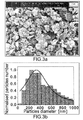
- the comparison of morphology and particle size distribution of a commercial boron ( figs. 3a and 3b ) clear up the uniformity and the fineness of the powders obtained by the conceived method.
- the SEM images of figs. 5a and 5b relate to boron according to the invention, obtained by the insertion of Titanium dioxide particles in the dissolution step. A homogeneous dispersion of Titanium dioxide and the nanometric nature of TiO 2 are shown.
Landscapes
- Chemical & Material Sciences (AREA)
- Organic Chemistry (AREA)
- Inorganic Chemistry (AREA)
- Engineering & Computer Science (AREA)
- Ceramic Engineering (AREA)
- Manufacturing & Machinery (AREA)
- Materials Engineering (AREA)
- Structural Engineering (AREA)
- Carbon And Carbon Compounds (AREA)
- Pharmaceuticals Containing Other Organic And Inorganic Compounds (AREA)
- Catalysts (AREA)
Abstract
Description
- The present invention regards a method for the production of elementary amorphous boron, particularly suitable for the production of doped boron.
- Industrially, boron is predominantly obtained by magnesio-thermic reaction, treating a reducing metal with an oxidized boron compound, alternatively by thermal decomposition of diboranes or boron halides with hydrogen. The first reaction causes an amorphous boron having a purity level less than 98% and the second method provides a crystalline boron with a high degree of purity.
- It is commercially available both amorphous and crystalline boron, with variable purity and grain sizes, generally not less than micrometric scale. The boron commercially available is an element having several industrial applications, among which can be mentioned uses at elementary state in semiconductors, in glasses, as fluxing agent in steel and special alloys production. Boron compounds are used as abrasives, neutron absorbers, refractory materials, airbag triggers, propellant for rockets, bleaches, catalysers, disinfectants. Particularly important is the use of boron as superconductor in the magnesium diboride (MgB2) compound.
- Considering the important applications of magnesium diboride as superconductor, the identification of production methods for the optimisation of its superconducting properties is particularly interesting.
- The synthesis of MgB2 phase was carried out at various conditions, all characterized by the reaction between magnesium in solid, liquid or vapour phase, and boron powders. Anyhow, the formation reaction of the MgB2 phase is caused by the magnesium intercalation in the B planes, due to the big difference of the melting point between the two elementary precursors. Moreover, it is known that the superconducting properties are strongly correlated to the (crystal) lattice order of the phase, at short and at medium range distance. Particularly, an optimal disorder at short range causes higher value of the critical field/current (Hc), while an optimal disorder at medium range influences positively the superconductor critical current, enhancing the pinning force. In traditional superconductors, these two different disorders are obtained through metallurgic processes and through cold working, for instance by formation of substitutional or interstitial alloys. This is relatively easy to realise, since metal precursors and metallic end-products are involved; nevertheless it is evident/clear the problem of repeating these methodologies in the case of MgB2, for the above mentioned reasons.
- A first object of the invention is to provide a method for realising optimal defects at short and medium range into the crystal lattice, maintaining them unchanged (or freezing) after the phase formation. A further object of the invention is to provide a method for the production of elementary boron with improved properties, particularly in order to use it for the production of magnesium diboride having improved superconducting properties, in the region of high magnetic fields (5-10T). It is evident that the boron obtained through the invention can be used in all applications where boron is involved in a solid state reaction (or partially), such in case of the MgB2, hence when precursors having a high difference in melting point are involved.
- The method according to the invention leads to the production of particles of amorphous boron, preferably of nanometric size.
US 2006/0165577 describes a method for the production of boron oxide, or its derivatives, with a high surface area, through a solubilization process of boron oxide or boric acid in water and (subsequent) lyophilisation or supercritical drying. However said method is aimed to the production of boron oxide to be used as means for hydrogen storage, employed as fuel. - Another object of the invention is to provide a method suitable for the industrial production of doped boron.
- Doped boron is, in fact, not commercially available and it is necessary a preparation in laboratory. Doped boron is not an attractive target for industries producing it, considering the wide range of possible dopants and the complexity of the doping techniques.
- The doping technique of boron through the "mechanical alloying" is unlikely, because its grinding is difficult to realize, since the element is practically second only to the diamond in the Mohs's scale (hardness 9.3). The chemical nature of boron and of dopant elements (Carbon C, Silicon carbide SiC and more in general elements and compounds with high melting point) does not allow the direct dispersion; in fact, must be considered their poor metallic behaviour and their high melting point (over 2076 °C).
- The indirect chemical technique, that considers the dispersion of an element or a compound during the magnesio-thermic synthesis (reaction), simply starting from the mechanical (pre-)mixing of the dopant with the boron precursors, seems unfeasible, since the chemical homogeneity is not sufficiently ensured and the formation of undesired secondary products is difficult to exclude.
- As is clear from the literature, the boron synthesis, as well as its direct and indirect doping process, according to its elementary state or to its compound form, can be done by gaseous process (starting from its gaseous compounds). This is accomplished by using appropriate mixtures of gases, including a gaseous reducing agent (e.g. H2), containing the doping element (e.g. methane CH4, also a reducing agent) and oxidised boron (e.g. boron trichlorine BCl3); this way/technique appears cheaper than the magnesio-thermic reaction, since it is necessary to extract the boron from its mineral precursors, then to oxidised it for obtaining the gaseous compound which should subsequently be reduced again. Also, safety and environmental health conditions should be taken into account, since the operations includes managing hazardous gases (toxic and explosive) and potentially pollutants such as diborane (B2H6) and halide like BCl3, BF3 etc.. For these reasons, it is often preferred to insert the doping element into the final boron compound, rather than inserting it within the precursor; this way/technique, although immediate, however does not ensure optimal results from the (chemical) homogeneity point of view.
- Another object of the invention is therefore to provide a method for the insertion of foreign (dopant) elements on the boron crystal sites and/or the controlled dispersion of molecules, or of particles with various grain size, in the boron matrix, being assured in any case the chemical homogeneity of the final product, performing a proper handling of reagents and of obtained products.
- In view of the above mentioned purposes, it is object of the invention a method having the characteristics defined in the claims which follow.
- Further characteristics and advantages of the method according to the invention will become clear from the detailed description which follows.
- In the appended drawings:
-
Fig. 1 is a diffractogram (radiation source: Cu K κα1, λ = 1.5418 Å) showing an X-ray analysis of the boron obtained by the method according to the invention (dotted curve) compared with boron commercially available (solid curve); -
Fig. 2a is a SEM (scanning electron microscopy) picture, magnification 30.000X, of boron powder obtained by the method according to the invention; -
Fig. 2b is a chart showing the grain size distribution of boron inFig. 2a ; -
Fig. 3a is a SEM image, at magnification of 30.000X, of commercial boron; -
Fig. 3b shows the grain size distribution of commercial boron infig. 3a ; -
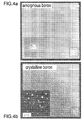
Fig. 4a is a HRTEM (high resolution transmission electron microscopy) image of boron according to the invention; -
Fig. 4b is a HRTEM picture of commercial boron; -
Fig. 5a is a SEM image, at 1000X magnification, showing the dispersion of titanium dioxide TiO2 (light particles) in the B2O3 matrix as a result of the method according to the invention; and -
Fig. 5b shows a detail, magnification 66000X, of the TiO2 nanoparticles (dispersion) within in the B2O3 agglomerate inFig. 5a . - The first step of the method according to the invention is the solubilisation of a boron precursor, in an (own) oxidized state, in a solvent suitable for its solubilisation. Typically boric acid or boron oxide is used as oxidised precursor, but the method is not to be understood limited to these compounds. For instance the B2S3 in water could be converted into boron oxide eliminating the hydrogen sulphide, as well as salts more or less complex than boric acid.
- The simplest solvent to be used is water, particularly the demineralised or deionised water, such as the Millipore® water. The boron oxide, hydrating after being dissolved in water, forms boric acid and for solvation action, the molecules will be homogeneously dispersed within the solution.
- In order to minimize the volume of solvent (to be used), which in the latter steps of the method should be removed, the dissolution operation can be advantageously carried out at a temperature close to the boiling point of the solvent. Furthermore, it is preferable that the amount of precursor used is below the solubility limit, to avoid crystallization phenomena, especially during the transferring step/process of the solution into the cryogenic liquid, described below.
- Once the complete solubilisation is obtained, the solution will be cryogenically frozen, for obtaining very fine particles. This operation is implemented by inserting the solution into a cryogenic liquid, preferably to obtain a dispersion of the solution in the cryogenic liquid.
- Preferably, said operation is carried out by vaporization within the cryogenic liquid, using for instance a spray gun, which picks up the solution from the (dissolution) beaker - that keeps the boiling temperature - and transfers it rapidly into the vessel containing the cryogenic liquid; the direct contact between the vaporized solution and the (cryogen) liquid forms a freeze of very fine particles that reflect the (homogeneous) composition of the liquid solution and do not allow the phenomena of grain growth and/or segregation in the solid phase.
- For an inexpensiveness reason, the liquid nitrogen is an excellent candidate for the cryogenic freezing function, but it is understood that other cryogenic liquids may be used. The amount of cryogenic liquid should not run out/be depleted until the whole solution, kept at boiling point, has not been completely transferred; very good results are obtained keeping the cryogenic liquid under agitation; both precautions are aimed to prevent the formation of agglomeration (phenomena).
- The freezing step is aimed to create a very fine particles of the homogeneous solid phase, in order to maximize the surface area of the particles and to facilitate the sublimation of the solvent. Also, if the particles of the frozen phase under lyophilisation have fine size, the nanoparticles at the end of the lyophilisation will be fine and porous.
- After the freezing, the cryogenic liquid should be left to evaporate; hence it will be possible the transferring of the solid mass from the container inside the lyophilisation chamber and proceed with the lyophilisation step. Typically such method is done at a temperature of -50 °C or below, using a cooling chamber able to condense the vapour of the solubilisation solvent, sublimed by the solid solution. The solid phase is placed in a suitable container in communication with the cooling/condensation chamber and both volumes are under a dynamic vacuum, preferably equal to 10-3 mbar, for instance by means of a rotary pump.
- The lyophilisation operation can be supported by a suitable heating source, as usually occurs in the common industrial lyophilisation. The lyophilisation step is known per se and does not require any further explanations. For this purpose can be employed the standard industrial equipment commercially available; the lyophilisation (technique) is based on the sublimation principle, i.e. the direct transfer of the solid state into a vapour state. Where the solvent is water, the lyophilisation is carried out keeping the pressure under 4.58 Torr (mmHg) (pressure of the triple point of water), heating to accelerate the process.
- The direct transfer solid-vapour state guarantees the maintenance of the chemical homogeneity created in the liquid solution, excluding the possibility of the boron oxide crystallization with subsequent uncontrolled growing of its grains and eventually causing the segregation of the doping substances eventually inserted in the starting solution.
- In the embodiment of the method according to the invention that leads to the production of doped boron, the dopant element or compound is added in the solvent used (for this purpose) during the solubilisation step of the oxided precursor of boron. Dopants soluble in such solvent can be used, or insoluble dopants or also a combination of soluble dopants and insoluble dopants.
- The term of soluble dopant will include all the compounds soluble in the employed solvent which, after the reduction state/reaction, produce/yield boron doped with one or more of the elements forming the (same) compound. For instance, to produce the carbon-doped boron carbohydrates, such as starch, sugar and the like, are advantageously used as soluble dopants. Other soluble dopants include, in general, all the soluble organic and inorganic molecules containing the soluble elements able to dope the boron. An example is Carbon.
- As insoluble dopants, may be reported/cited by way of an example the Titanium dioxide (TiO2), the Silicon carbide (SiC), the polymehtilsilanes, and/or more generally the use of any water (H2O) insoluble, inorganic molecule, which may represent a particle inclusion with a defined size, concentration and order within the boron oxide. In case of insoluble dopant, in order to produce a dispersion of particles inside the boron, a colloidal dispersion of the selected doping element or compound in the solution of the boron precursor (B2O3 or H3BO3) is produced.
- The concentration of the dopant is not critical and can be appropriately chosen according to the needs. Typically, concentrations of the doping compound or element in solution which yield a doped boron having, reported to boron, a molar or atomic percentage of 0.1% - 10% of the doping compound or element are used.
- In case of doped boron used for the production of Magnesium diboride, it is particularly advantageous for the previously highlighted/mentioned purposes to insert in the boron matrix dopants, such as Carbon, SiC, B4C, TiB2, TiO2, polymehtilsilanes.
- The insertion of a dopant does not change the following steps of cryogenic freezing and lyophilisation.
- After the lyophilization step, the obtained product is chemically reduced for forming elementary boron, optionally doped. The reduction is preferably carried out at temperatures sufficiently low, under inert atmosphere or reducing flow, using Magnesium as reducing agent. The magnesium oxide, formed as consequence of the B2O3 reduction, should be eliminated and for this purpose a series of washes in acid environment, as describe in literature, followed by thermal treatment can be performed.
- However, it is understood that the reduction phase can be implemented with any reducing agent, known for this purpose.
- Therefore, the method according to the invention can form four possible products:
- 1) when a solution containing only the soluble boron precursor has been used, after the lyophilisation step is obtained as final product B2O3, highly fine and porous from which, after the chemical reduction stage, is obtained a nanostructured and amorphous boron, typically with a purity between 95% and 98%; the amorphous nature and the nanometric size of boron particles thus obtained is advantageous, since it allows to minimize time and temperature of the reaction which involves the same boron;
- 2) if a solution including a soluble element or compound as dopant, such as a soluble carbon compound, has been used, a nanostructured boron with some of its reticular sites occupied by the doping element, is obtained in consequence of the reduction; the substitution degree will depend on the concentration of the inserted dopant; such obtained doped and nanostructured boron is particularly useful for improving the upper critical field (Hc2) in the MgB2 production;
- 3) if the doping element or compound used is insoluble, the matrix of nanostructured boron that obtained after the reduction step will contain the doping element or its compounds dispersed in form of nanoagglomerate; the product thus obtained is, for instance, particularly advantageous for varying the mechanical properties of boron fibres in composite materials;
- 4) lastly, if dopants, soluble and insoluble in the dissolution solvent of the boron precursor, have been simultaneously used, the obtained product is a nanostructured boron showing the simultaneous presence of doping elements on some substituted reticular sites and a nanoagglomerates dispersed within the boron matrix; the product thus obtained is, for instance, particularly useful in the production of magnesium diboride, for improving its transport properties, enhancing at the same time the Hc2 value and the pinning force.
- With term of nanostructured boron, as employed in this description, is intended in general a boron having a particle size below 1 µm; however, said definition does not exclude the presence of a small amount of particles larger than 1 µm, i.e. less than 5% in mass. Typically, the obtained powders show a particle size distribution with section less than 200 nm, preferably less than 150 nm.
- The nanostructured boron, doped and undoped, such as the precursor (B2O3), obtained by the method according to the invention, can be used as such, e.g. for boron fibres mechanically enhanced and airbag (technology) or for producing boron compounds, such as the magnesium diboride superconductor, but also for the direct production of precursors of many other products, including particularly:
- Boron nitride (BN) in hexagonal form (h-BN, α-BN, g-BN), which is obtained by ammonolysis or nitridization of the boron trioxide, hence polymorphic forms arising from: cubic boron nitride (c-BN, β-BN, z-BN), polycrystalline boron nitride (Pc-BN), amorphous (a-BN), the white carbon fibre structure similar to carbon nanotubes; these compounds are used for various applications, including lubricants, electrical insulators, catalysts for fuel cells (h-BN), abrasives, heat sinks (c-BN), thin films, surface hardening agent for alloys (Pc-BN), composite materials (white carbon fiber), semiconductor devices (a-BN);
- Boron phosphate (BPO4); it has an enormous industrial value both as catalyst in organic synthesis and in the glass industry for giving special features. It is synthesized starting from solutions of phosphoric acid and boric acid dehydrated at low temperatures (lyophilisation), which is then crystallized by thermal treatment at 1000 °C;
- Boron carbide (B4C); it is used for the production of cutting tools, of thin films coatings for improving the resistance to wear and tear and to scratch, in greater thicknesses is employed for ballistic plates, protective barriers for vehicles, bullet-proof vest, abrasives, neutron absorbers for nuclear reactors.
- All these mentioned compounds have a key role in chemical reactions and are interesting materials for industry; for all these (synthesis) reactions are thus important having boron precursors nanostruttured and possibly doped. Since these compounds are often used as catalysts, they must be as fine as possible for showing a high (reactive) surface area, similarly if used in form of precursor compounds for the production of thin films by plasma spray deposition (PSD) and chemical vapour deposition (CVD) techniques.
- In the synthesis of MgB2, using the doped or undoped boron, obtained according to the invention, the reaction of a stoichiometric ratio between Mg and B is preferred. Preferably, the reaction is carried out at the temperature of 760 °C (ramp rate = 7°C/min) for one hour under controlled atmosphere, to prevent the oxidation of the product. Such conditions are optimal, for instance, for the production of 10 g of powder, employing a Lindberg furnace model 51442-R (4880 Watt), driven by a Lindberg electronic unit model 58114-PB.
- 138 g of boron oxide (B2O3) are dissolved in 1.2 litres of distilled water, heated till the boiling point, (then) 0.1458 g of soluble starch are added, this produces, when the reduction process is over, a nominally doped boron at 0.5 atomic %. Then, maintaining the boiling temperature, the solution is sprayed in about 5 litres of liquid nitrogen (N2L). The necessary amount of nitrogen depends on the time required for transferring the solution, therefore it is convenient to use a (nitrogen) surplus and then waiting the (complete) nitrogen evaporation.
- The cryogenically frozen mass, in the form of fine powder, is introduced in suitable containers for executing the lyophilisation.
- In this case, the carbon solubilisation under starch form is used to obtain at atomic level a dispersion of the same element in the final boron; alternatively, using insoluble micro- or nanoparticles, a colloidal dispersion (of such particles) is formed, which, at the end of the process/reaction, lead to a dispersion of micro- or nanoparticles within the boron matrix. Otherwise, if the production of pure boron oxide is desirable the addition of (any) dopant must be avoided.
- Then, the B2O3 nanopowders can be mixed with Magnesium for reducing the boron oxide, obtaining the elementary boron, amorphous and doped, and performing the procedures/operations described in literature to develop the metall-thermic reaction. Should be noted that an inappropriate thermal treatment, such as high temperature and/or prolonged reaction time, oxidising atmospheres, can degrade the product of the cryogenic freezing and lyophilisation steps.
- The characterization of the product obtained by the method according to the invention has been made through X-ray diffractometry.
Fig. 1 the pattern of the boron obtained by the method according to the invention is shown and compared with amorphous boron available from one of the largest European boron producers. As can be seen, the intensity of the commercial boron is higher compared to an equal mass, (and) considering also the presence of less defined peaks of the boron according to the invention, the conclusion is that the latter shows an higher amorphous degree than the commercial one, as verified by the HRTEM analysis. The absence of extraneous peaks points out a good purity degree of the product, at least comparable to that of commercial product. - The morphological characterization through the electron microscopy SEM (
Fig. 2a ) and the determination of particle size distribution by electron microscopy investigation have confirmed the nanometric structure and specifically a grain size section generally less than 200 nm. The comparison of morphology and particle size distribution of a commercial boron (figs. 3a and 3b ) clear up the uniformity and the fineness of the powders obtained by the conceived method. - For the characterization purposes, a sample of the same boron has been observed by a high resolution transmission electron microscope (HRTEM) and compared with the commercial boron; thus has been highlighted its real amorphous nature, while the commercial boron, used by way of comparison, shows a polycrystalline nature; that can be observed through the lattice fringes of the diffraction figure in the inset of
figs. 4a and 4b . - The SEM images of
figs. 5a and 5b relate to boron according to the invention, obtained by the insertion of Titanium dioxide particles in the dissolution step. A homogeneous dispersion of Titanium dioxide and the nanometric nature of TiO2 are shown.
Claims (11)
- Method for the production of elementary Boron, optionally doped, characterised in that it includes the steps of:a) dissolving an oxidised Boron precursor compound in a solvent able to dissolve it;b) freezing the solution into a cryogenic liquid and evaporation of the cryogenic liquid to transform said solution in a finely divided particulate form, avoiding the solute precipitation;c) sublimation of the dissolving solvent by lyophilisation to limit the solute aggregation;d) reduction with a reducing agent, to obtain elementary amorphous Boron in particle form.
- Method according to claim 1, for the production of elementary doped Boron comprising the operation of adding one or more elements or doping compounds in the step a) wherein said boron precursor is solubilised.
- Method according to claim 2, in which the doping agent is soluble in the dissolving solvent of said precursor.
- Method according to claim 3, in which said soluble doping agent is selected from the group consisting of organic molecules, soluble in the dissolving solvent, able to furnish doping atoms on Boron sites, such as carbohydrates.
- Method according to claim 3, in which said doping agent is a compound soluble in the dissolving solvent of said precursor that, owing to the reduction step d) and/or owing to thermal treatments subsequent to said reduction step, is able to generate the replacement, in some Boron reticular sites, of an element forming said compound.
- Method according to claim 2, in which said doping agent is insoluble in the dissolving solvent of said Boron precursor.
- Method according to claim 6, in which said doping agent is selected from the group consisting of metal oxides, such as TiO2, metal diboride, such as TiB2 type, metalloid carbides or non-metals such as SiC, B4C and polymetilsilanes.
- Method according to claim 7, in which said compounds are uniformly dispersed in a sol-gel type solution.
- Method according to any of the previous claims, characterised in that said step b) is performed by nebulisation or atomisation of said solution into the cryogenic liquid.
- Method according to any of previous claims, characterised in that said reduction step d) is performed using Magnesium as a reducing agent.
- Use of elementary Boron, optionally doped, as obtainable through the method according to any of the previous claims 1 to 10, for the production of Magnesium diboride.
Applications Claiming Priority (1)
| Application Number | Priority Date | Filing Date | Title |
|---|---|---|---|
| ITTO2008A000962A IT1392558B1 (en) | 2008-12-22 | 2008-12-22 | PROCEDURE FOR THE PRODUCTION OF ELEMENTARY BORON, OPTIONALLY DRUGGED |
Publications (2)
| Publication Number | Publication Date |
|---|---|
| EP2199258A1 true EP2199258A1 (en) | 2010-06-23 |
| EP2199258B1 EP2199258B1 (en) | 2017-05-31 |
Family
ID=41278224
Family Applications (1)
| Application Number | Title | Priority Date | Filing Date |
|---|---|---|---|
| EP09180091.2A Not-in-force EP2199258B1 (en) | 2008-12-22 | 2009-12-21 | A process for producing optionally doped elemental boron |
Country Status (2)
| Country | Link |
|---|---|
| EP (1) | EP2199258B1 (en) |
| IT (1) | IT1392558B1 (en) |
Cited By (6)
| Publication number | Priority date | Publication date | Assignee | Title |
|---|---|---|---|---|
| WO2016207558A1 (en) * | 2015-06-25 | 2016-12-29 | Universite Pierre Et Marie Curie (Paris 6) | Nanostructured amorphous boron material |
| FR3098091A1 (en) * | 2019-07-05 | 2021-01-08 | Genialis | PROCESS FOR DEHYDRATION OF LIQUID, SEMI-LIQUID OR PASTE PRODUCTS INCLUDING A PRESSURE CRYOGENY STAGE AND A LYOPHILIZATION STAGE |
| CN114751752A (en) * | 2022-05-27 | 2022-07-15 | 中国科学院合肥物质科学研究院 | High-purity TiB2Ceramic nanosheet and preparation method thereof |
| JP7673336B1 (en) * | 2023-11-17 | 2025-05-08 | 東ソー株式会社 | Boron powder, manufacturing method of magnesium diboride, and magnesium diboride bulk body |
| WO2025094529A1 (en) * | 2023-10-30 | 2025-05-08 | サンアロイ工業株式会社 | Hydrogen storage fuel and method for producing same |
| WO2025105464A1 (en) * | 2023-11-17 | 2025-05-22 | 東ソー株式会社 | Boron powder, method for producing magnesium diboride, and magnesium diboride bulk |
Citations (4)
| Publication number | Priority date | Publication date | Assignee | Title |
|---|---|---|---|---|
| US3551533A (en) * | 1967-04-10 | 1970-12-29 | Bell Telephone Labor Inc | Method of forming particulate material |
| WO2003049849A2 (en) * | 2001-12-10 | 2003-06-19 | Hte Aktiengesellschaft The High Throughput Experimentation Company | Production and shaping of shaped bodies by means of low-temperature cooling and drying processes |
| WO2003106373A1 (en) * | 2002-06-18 | 2003-12-24 | University Of Wollongong | Superconducting material and method of synthesis |
| US20040031387A1 (en) * | 2002-08-19 | 2004-02-19 | Nanomix, Inc. | Boron-oxide and related compounds for hydrogen storage |
-
2008
- 2008-12-22 IT ITTO2008A000962A patent/IT1392558B1/en active
-
2009
- 2009-12-21 EP EP09180091.2A patent/EP2199258B1/en not_active Not-in-force
Patent Citations (4)
| Publication number | Priority date | Publication date | Assignee | Title |
|---|---|---|---|---|
| US3551533A (en) * | 1967-04-10 | 1970-12-29 | Bell Telephone Labor Inc | Method of forming particulate material |
| WO2003049849A2 (en) * | 2001-12-10 | 2003-06-19 | Hte Aktiengesellschaft The High Throughput Experimentation Company | Production and shaping of shaped bodies by means of low-temperature cooling and drying processes |
| WO2003106373A1 (en) * | 2002-06-18 | 2003-12-24 | University Of Wollongong | Superconducting material and method of synthesis |
| US20040031387A1 (en) * | 2002-08-19 | 2004-02-19 | Nanomix, Inc. | Boron-oxide and related compounds for hydrogen storage |
Non-Patent Citations (2)
| Title |
|---|
| MATSUDA M ET AL: "Synthesis of Ba2RCu4O8 (R=Y, Sm) superconductors at oxygen pressure of 1 atm by spray-frozen/freeze-drying method", JOURNAL OF THE AMERICAN CERAMIC SOCIETY USA, vol. 76, no. 6, June 1993 (1993-06-01), pages 1618 - 1620, XP002555899, ISSN: 0002-7820 * |
| MCGRATH P J ET AL: "Theoretical process development for freeze-drying spray-frozen aerosols", JOURNAL OF THE AMERICAN CERAMIC SOCIETY USA, vol. 75, no. 5, May 1992 (1992-05-01), pages 1223 - 1228, XP002555821, ISSN: 0002-7820 * |
Cited By (9)
| Publication number | Priority date | Publication date | Assignee | Title |
|---|---|---|---|---|
| WO2016207558A1 (en) * | 2015-06-25 | 2016-12-29 | Universite Pierre Et Marie Curie (Paris 6) | Nanostructured amorphous boron material |
| FR3037944A1 (en) * | 2015-06-25 | 2016-12-30 | Univ Paris 6 Pierre Et Marie Curie | MATERIAL NANOSTRUCTURE BORE AMORPHOUS |
| US10730035B2 (en) | 2015-06-25 | 2020-08-04 | Centre National De La Recherche Scientifique | Nanostructured amorphous boron material |
| FR3098091A1 (en) * | 2019-07-05 | 2021-01-08 | Genialis | PROCESS FOR DEHYDRATION OF LIQUID, SEMI-LIQUID OR PASTE PRODUCTS INCLUDING A PRESSURE CRYOGENY STAGE AND A LYOPHILIZATION STAGE |
| WO2021005298A1 (en) * | 2019-07-05 | 2021-01-14 | Genialis | Method for dehydrating liquid, semi-liquid or pastelike products, including a pressure cryogenic step and a lyophilization step |
| CN114751752A (en) * | 2022-05-27 | 2022-07-15 | 中国科学院合肥物质科学研究院 | High-purity TiB2Ceramic nanosheet and preparation method thereof |
| WO2025094529A1 (en) * | 2023-10-30 | 2025-05-08 | サンアロイ工業株式会社 | Hydrogen storage fuel and method for producing same |
| JP7673336B1 (en) * | 2023-11-17 | 2025-05-08 | 東ソー株式会社 | Boron powder, manufacturing method of magnesium diboride, and magnesium diboride bulk body |
| WO2025105464A1 (en) * | 2023-11-17 | 2025-05-22 | 東ソー株式会社 | Boron powder, method for producing magnesium diboride, and magnesium diboride bulk |
Also Published As
| Publication number | Publication date |
|---|---|
| ITTO20080962A1 (en) | 2010-06-23 |
| EP2199258B1 (en) | 2017-05-31 |
| IT1392558B1 (en) | 2012-03-09 |
Similar Documents
| Publication | Publication Date | Title |
|---|---|---|
| Lim et al. | Fundamentals of MXene synthesis | |
| Wang et al. | Nucleation and growth of Si nanowires from silicon oxide | |
| EP2199258B1 (en) | A process for producing optionally doped elemental boron | |
| Han et al. | Synthesis of the superfine high-entropy zirconate nanopowders by polymerized complex method | |
| Lee et al. | Growth of zinc oxide nanowires by thermal evaporation on vicinal Si (1 0 0) substrate | |
| Hao et al. | Synthesis of cubic boron nitride at low-temperature and low-pressure conditions | |
| Ragulya | Consolidation of ceramic nanopowders | |
| Kumaresan et al. | Thermal plasma arc discharge method for high-yield production of hexagonal AlN nanoparticles: synthesis and characterization | |
| USRE41575E1 (en) | Crystalline turbostratic boron nitride powder and method for producing same | |
| Seifolazadeh et al. | Synthesis and characterization of nanoboron powders prepared with mechanochemical reaction between B2O3 and Mg powders | |
| Gomathi et al. | Nanostructures of the binary nitrides, BN, TiN, and NbN, prepared by the urea-route | |
| Xiang et al. | Synthesis and microstructure of tantalum carbide and carbon composite by liquid precursor route | |
| Besisa et al. | Low temperature synthesis of nano-crystalline h-boron nitride from boric acid/urea precursors | |
| Wu et al. | Combustion synthesis of hexagonal boron nitride nanoplates with high aspect ratio | |
| Lee et al. | Hollow nanoparticles of β-iron oxide synthesized by chemical vapor condensation | |
| Tian et al. | Interfacial structure of epitaxial MgB 2 thin films grown on (0001) sapphire | |
| Jamil et al. | Morphologically controlled synthesis, characterization, and applications of molybdenum oxide (MoO3) nanoparticles | |
| Abdurakhmonov et al. | Green synthesis of high-purity hexagonal boron nitride nanoparticles | |
| Yasno et al. | Short time reaction synthesis of nano-hexagonal boron nitride | |
| Wu et al. | Crystallization of NaNbO 3 microcubes by a solution-phase ion exchange route | |
| Jaison et al. | Sol–Gel synthesis and characterization of magnesium peroxide nanoparticles | |
| Zaitsev et al. | Mechanical activation assisted self-propagating high-temperature synthesis of HfB2–HfC composites | |
| Ye et al. | Catalyzed synthesis of rhombohedral boron nitride in sodium chloride molten salt | |
| Wang et al. | Synthesis of nanoscale zirconium carbide powders via a two-step process | |
| Mukasyan | Combustion synthesis of boron nitride ceramics: fundamentals and applications |
Legal Events
| Date | Code | Title | Description |
|---|---|---|---|
| PUAI | Public reference made under article 153(3) epc to a published international application that has entered the european phase |
Free format text: ORIGINAL CODE: 0009012 |
|
| AK | Designated contracting states |
Kind code of ref document: A1 Designated state(s): AT BE BG CH CY CZ DE DK EE ES FI FR GB GR HR HU IE IS IT LI LT LU LV MC MK MT NL NO PL PT RO SE SI SK SM TR |
|
| AX | Request for extension of the european patent |
Extension state: AL BA RS |
|
| 17P | Request for examination filed |
Effective date: 20101222 |
|
| 17Q | First examination report despatched |
Effective date: 20140211 |
|
| GRAP | Despatch of communication of intention to grant a patent |
Free format text: ORIGINAL CODE: EPIDOSNIGR1 |
|
| RIC1 | Information provided on ipc code assigned before grant |
Ipc: C01B 35/02 20060101AFI20160930BHEP Ipc: C01B 35/04 20060101ALI20160930BHEP Ipc: C04B 35/58 20060101ALI20160930BHEP |
|
| INTG | Intention to grant announced |
Effective date: 20161109 |
|
| GRAJ | Information related to disapproval of communication of intention to grant by the applicant or resumption of examination proceedings by the epo deleted |
Free format text: ORIGINAL CODE: EPIDOSDIGR1 |
|
| GRAL | Information related to payment of fee for publishing/printing deleted |
Free format text: ORIGINAL CODE: EPIDOSDIGR3 |
|
| GRAS | Grant fee paid |
Free format text: ORIGINAL CODE: EPIDOSNIGR3 |
|
| GRAR | Information related to intention to grant a patent recorded |
Free format text: ORIGINAL CODE: EPIDOSNIGR71 |
|
| INTC | Intention to grant announced (deleted) | ||
| RAP1 | Party data changed (applicant data changed or rights of an application transferred) |
Owner name: CONSIGLIO NAZIONALE DELLE RICERCHE Owner name: SIRI, ANTONIO SERGIO |
|
| GRAA | (expected) grant |
Free format text: ORIGINAL CODE: 0009210 |
|
| AK | Designated contracting states |
Kind code of ref document: B1 Designated state(s): AT BE BG CH CY CZ DE DK EE ES FI FR GB GR HR HU IE IS IT LI LT LU LV MC MK MT NL NO PL PT RO SE SI SK SM TR |
|
| INTG | Intention to grant announced |
Effective date: 20170424 |
|
| REG | Reference to a national code |
Ref country code: GB Ref legal event code: FG4D Ref country code: CH Ref legal event code: EP |
|
| REG | Reference to a national code |
Ref country code: AT Ref legal event code: REF Ref document number: 897275 Country of ref document: AT Kind code of ref document: T Effective date: 20170615 |
|
| REG | Reference to a national code |
Ref country code: IE Ref legal event code: FG4D |
|
| REG | Reference to a national code |
Ref country code: DE Ref legal event code: R096 Ref document number: 602009046327 Country of ref document: DE |
|
| REG | Reference to a national code |
Ref country code: NL Ref legal event code: FP |
|
| REG | Reference to a national code |
Ref country code: LT Ref legal event code: MG4D |
|
| REG | Reference to a national code |
Ref country code: AT Ref legal event code: MK05 Ref document number: 897275 Country of ref document: AT Kind code of ref document: T Effective date: 20170531 |
|
| PG25 | Lapsed in a contracting state [announced via postgrant information from national office to epo] |
Ref country code: HR Free format text: LAPSE BECAUSE OF FAILURE TO SUBMIT A TRANSLATION OF THE DESCRIPTION OR TO PAY THE FEE WITHIN THE PRESCRIBED TIME-LIMIT Effective date: 20170531 Ref country code: LT Free format text: LAPSE BECAUSE OF FAILURE TO SUBMIT A TRANSLATION OF THE DESCRIPTION OR TO PAY THE FEE WITHIN THE PRESCRIBED TIME-LIMIT Effective date: 20170531 Ref country code: NO Free format text: LAPSE BECAUSE OF FAILURE TO SUBMIT A TRANSLATION OF THE DESCRIPTION OR TO PAY THE FEE WITHIN THE PRESCRIBED TIME-LIMIT Effective date: 20170831 Ref country code: AT Free format text: LAPSE BECAUSE OF FAILURE TO SUBMIT A TRANSLATION OF THE DESCRIPTION OR TO PAY THE FEE WITHIN THE PRESCRIBED TIME-LIMIT Effective date: 20170531 Ref country code: FI Free format text: LAPSE BECAUSE OF FAILURE TO SUBMIT A TRANSLATION OF THE DESCRIPTION OR TO PAY THE FEE WITHIN THE PRESCRIBED TIME-LIMIT Effective date: 20170531 Ref country code: ES Free format text: LAPSE BECAUSE OF FAILURE TO SUBMIT A TRANSLATION OF THE DESCRIPTION OR TO PAY THE FEE WITHIN THE PRESCRIBED TIME-LIMIT Effective date: 20170531 Ref country code: GR Free format text: LAPSE BECAUSE OF FAILURE TO SUBMIT A TRANSLATION OF THE DESCRIPTION OR TO PAY THE FEE WITHIN THE PRESCRIBED TIME-LIMIT Effective date: 20170901 |
|
| PG25 | Lapsed in a contracting state [announced via postgrant information from national office to epo] |
Ref country code: SE Free format text: LAPSE BECAUSE OF FAILURE TO SUBMIT A TRANSLATION OF THE DESCRIPTION OR TO PAY THE FEE WITHIN THE PRESCRIBED TIME-LIMIT Effective date: 20170531 Ref country code: IS Free format text: LAPSE BECAUSE OF FAILURE TO SUBMIT A TRANSLATION OF THE DESCRIPTION OR TO PAY THE FEE WITHIN THE PRESCRIBED TIME-LIMIT Effective date: 20170930 Ref country code: BG Free format text: LAPSE BECAUSE OF FAILURE TO SUBMIT A TRANSLATION OF THE DESCRIPTION OR TO PAY THE FEE WITHIN THE PRESCRIBED TIME-LIMIT Effective date: 20170831 Ref country code: LV Free format text: LAPSE BECAUSE OF FAILURE TO SUBMIT A TRANSLATION OF THE DESCRIPTION OR TO PAY THE FEE WITHIN THE PRESCRIBED TIME-LIMIT Effective date: 20170531 |
|
| REG | Reference to a national code |
Ref country code: FR Ref legal event code: PLFP Year of fee payment: 9 |
|
| PG25 | Lapsed in a contracting state [announced via postgrant information from national office to epo] |
Ref country code: EE Free format text: LAPSE BECAUSE OF FAILURE TO SUBMIT A TRANSLATION OF THE DESCRIPTION OR TO PAY THE FEE WITHIN THE PRESCRIBED TIME-LIMIT Effective date: 20170531 Ref country code: CZ Free format text: LAPSE BECAUSE OF FAILURE TO SUBMIT A TRANSLATION OF THE DESCRIPTION OR TO PAY THE FEE WITHIN THE PRESCRIBED TIME-LIMIT Effective date: 20170531 Ref country code: DK Free format text: LAPSE BECAUSE OF FAILURE TO SUBMIT A TRANSLATION OF THE DESCRIPTION OR TO PAY THE FEE WITHIN THE PRESCRIBED TIME-LIMIT Effective date: 20170531 Ref country code: SK Free format text: LAPSE BECAUSE OF FAILURE TO SUBMIT A TRANSLATION OF THE DESCRIPTION OR TO PAY THE FEE WITHIN THE PRESCRIBED TIME-LIMIT Effective date: 20170531 Ref country code: RO Free format text: LAPSE BECAUSE OF FAILURE TO SUBMIT A TRANSLATION OF THE DESCRIPTION OR TO PAY THE FEE WITHIN THE PRESCRIBED TIME-LIMIT Effective date: 20170531 |
|
| PG25 | Lapsed in a contracting state [announced via postgrant information from national office to epo] |
Ref country code: SM Free format text: LAPSE BECAUSE OF FAILURE TO SUBMIT A TRANSLATION OF THE DESCRIPTION OR TO PAY THE FEE WITHIN THE PRESCRIBED TIME-LIMIT Effective date: 20170531 Ref country code: PL Free format text: LAPSE BECAUSE OF FAILURE TO SUBMIT A TRANSLATION OF THE DESCRIPTION OR TO PAY THE FEE WITHIN THE PRESCRIBED TIME-LIMIT Effective date: 20170531 Ref country code: IT Free format text: LAPSE BECAUSE OF FAILURE TO SUBMIT A TRANSLATION OF THE DESCRIPTION OR TO PAY THE FEE WITHIN THE PRESCRIBED TIME-LIMIT Effective date: 20170531 |
|
| REG | Reference to a national code |
Ref country code: DE Ref legal event code: R097 Ref document number: 602009046327 Country of ref document: DE |
|
| PLBE | No opposition filed within time limit |
Free format text: ORIGINAL CODE: 0009261 |
|
| STAA | Information on the status of an ep patent application or granted ep patent |
Free format text: STATUS: NO OPPOSITION FILED WITHIN TIME LIMIT |
|
| 26N | No opposition filed |
Effective date: 20180301 |
|
| PG25 | Lapsed in a contracting state [announced via postgrant information from national office to epo] |
Ref country code: SI Free format text: LAPSE BECAUSE OF FAILURE TO SUBMIT A TRANSLATION OF THE DESCRIPTION OR TO PAY THE FEE WITHIN THE PRESCRIBED TIME-LIMIT Effective date: 20170531 |
|
| REG | Reference to a national code |
Ref country code: IE Ref legal event code: MM4A |
|
| PG25 | Lapsed in a contracting state [announced via postgrant information from national office to epo] |
Ref country code: MT Free format text: LAPSE BECAUSE OF NON-PAYMENT OF DUE FEES Effective date: 20171221 Ref country code: LU Free format text: LAPSE BECAUSE OF NON-PAYMENT OF DUE FEES Effective date: 20171221 |
|
| REG | Reference to a national code |
Ref country code: BE Ref legal event code: MM Effective date: 20171231 |
|
| PG25 | Lapsed in a contracting state [announced via postgrant information from national office to epo] |
Ref country code: IE Free format text: LAPSE BECAUSE OF NON-PAYMENT OF DUE FEES Effective date: 20171221 |
|
| PG25 | Lapsed in a contracting state [announced via postgrant information from national office to epo] |
Ref country code: BE Free format text: LAPSE BECAUSE OF NON-PAYMENT OF DUE FEES Effective date: 20171231 |
|
| PGFP | Annual fee paid to national office [announced via postgrant information from national office to epo] |
Ref country code: FR Payment date: 20181231 Year of fee payment: 15 |
|
| PG25 | Lapsed in a contracting state [announced via postgrant information from national office to epo] |
Ref country code: MC Free format text: LAPSE BECAUSE OF FAILURE TO SUBMIT A TRANSLATION OF THE DESCRIPTION OR TO PAY THE FEE WITHIN THE PRESCRIBED TIME-LIMIT Effective date: 20170531 Ref country code: HU Free format text: LAPSE BECAUSE OF FAILURE TO SUBMIT A TRANSLATION OF THE DESCRIPTION OR TO PAY THE FEE WITHIN THE PRESCRIBED TIME-LIMIT; INVALID AB INITIO Effective date: 20091221 |
|
| PG25 | Lapsed in a contracting state [announced via postgrant information from national office to epo] |
Ref country code: CY Free format text: LAPSE BECAUSE OF NON-PAYMENT OF DUE FEES Effective date: 20170531 |
|
| PG25 | Lapsed in a contracting state [announced via postgrant information from national office to epo] |
Ref country code: MK Free format text: LAPSE BECAUSE OF FAILURE TO SUBMIT A TRANSLATION OF THE DESCRIPTION OR TO PAY THE FEE WITHIN THE PRESCRIBED TIME-LIMIT Effective date: 20170531 |
|
| PGFP | Annual fee paid to national office [announced via postgrant information from national office to epo] |
Ref country code: NL Payment date: 20191223 Year of fee payment: 11 |
|
| PG25 | Lapsed in a contracting state [announced via postgrant information from national office to epo] |
Ref country code: TR Free format text: LAPSE BECAUSE OF FAILURE TO SUBMIT A TRANSLATION OF THE DESCRIPTION OR TO PAY THE FEE WITHIN THE PRESCRIBED TIME-LIMIT Effective date: 20170531 |
|
| PGFP | Annual fee paid to national office [announced via postgrant information from national office to epo] |
Ref country code: CH Payment date: 20191219 Year of fee payment: 11 |
|
| PGFP | Annual fee paid to national office [announced via postgrant information from national office to epo] |
Ref country code: DE Payment date: 20191230 Year of fee payment: 11 |
|
| PG25 | Lapsed in a contracting state [announced via postgrant information from national office to epo] |
Ref country code: PT Free format text: LAPSE BECAUSE OF FAILURE TO SUBMIT A TRANSLATION OF THE DESCRIPTION OR TO PAY THE FEE WITHIN THE PRESCRIBED TIME-LIMIT Effective date: 20170531 |
|
| GBPC | Gb: european patent ceased through non-payment of renewal fee |
Effective date: 20191221 |
|
| PG25 | Lapsed in a contracting state [announced via postgrant information from national office to epo] |
Ref country code: GB Free format text: LAPSE BECAUSE OF NON-PAYMENT OF DUE FEES Effective date: 20191221 |
|
| REG | Reference to a national code |
Ref country code: DE Ref legal event code: R119 Ref document number: 602009046327 Country of ref document: DE |
|
| REG | Reference to a national code |
Ref country code: CH Ref legal event code: PL |
|
| REG | Reference to a national code |
Ref country code: NL Ref legal event code: MM Effective date: 20210101 |
|
| PG25 | Lapsed in a contracting state [announced via postgrant information from national office to epo] |
Ref country code: NL Free format text: LAPSE BECAUSE OF NON-PAYMENT OF DUE FEES Effective date: 20210101 |
|
| PG25 | Lapsed in a contracting state [announced via postgrant information from national office to epo] |
Ref country code: FR Free format text: LAPSE BECAUSE OF NON-PAYMENT OF DUE FEES Effective date: 20201231 |
|
| PG25 | Lapsed in a contracting state [announced via postgrant information from national office to epo] |
Ref country code: LI Free format text: LAPSE BECAUSE OF NON-PAYMENT OF DUE FEES Effective date: 20201231 Ref country code: CH Free format text: LAPSE BECAUSE OF NON-PAYMENT OF DUE FEES Effective date: 20201231 Ref country code: DE Free format text: LAPSE BECAUSE OF NON-PAYMENT OF DUE FEES Effective date: 20210701 |