EP2199151A1 - Securing loads on vehicles - Google Patents
Securing loads on vehicles Download PDFInfo
- Publication number
- EP2199151A1 EP2199151A1 EP09252848A EP09252848A EP2199151A1 EP 2199151 A1 EP2199151 A1 EP 2199151A1 EP 09252848 A EP09252848 A EP 09252848A EP 09252848 A EP09252848 A EP 09252848A EP 2199151 A1 EP2199151 A1 EP 2199151A1
- Authority
- EP
- European Patent Office
- Prior art keywords
- vehicle
- load
- tether
- holding
- tension
- Prior art date
- Legal status (The legal status is an assumption and is not a legal conclusion. Google has not performed a legal analysis and makes no representation as to the accuracy of the status listed.)
- Withdrawn
Links
- 239000000523 sample Substances 0.000 claims abstract description 17
- 230000011664 signaling Effects 0.000 claims description 14
- 238000000034 method Methods 0.000 claims description 9
- 230000005540 biological transmission Effects 0.000 claims description 8
- 238000012544 monitoring process Methods 0.000 claims description 6
- 238000004891 communication Methods 0.000 claims description 5
- 230000000007 visual effect Effects 0.000 claims description 4
- 238000005286 illumination Methods 0.000 claims description 3
- 239000003086 colorant Substances 0.000 claims description 2
- 230000000694 effects Effects 0.000 claims 1
- 230000009471 action Effects 0.000 description 2
- 238000010276 construction Methods 0.000 description 2
- 230000008569 process Effects 0.000 description 2
- 229910000831 Steel Inorganic materials 0.000 description 1
- 230000004913 activation Effects 0.000 description 1
- 230000002411 adverse Effects 0.000 description 1
- 230000008901 benefit Effects 0.000 description 1
- 230000015556 catabolic process Effects 0.000 description 1
- 230000002939 deleterious effect Effects 0.000 description 1
- 239000000428 dust Substances 0.000 description 1
- 239000004973 liquid crystal related substance Substances 0.000 description 1
- 239000002184 metal Substances 0.000 description 1
- 239000000203 mixture Substances 0.000 description 1
- 238000012986 modification Methods 0.000 description 1
- 230000004048 modification Effects 0.000 description 1
- 230000001105 regulatory effect Effects 0.000 description 1
- 230000004044 response Effects 0.000 description 1
- 239000010959 steel Substances 0.000 description 1
- 239000004575 stone Substances 0.000 description 1
Images

Classifications
-
- B—PERFORMING OPERATIONS; TRANSPORTING
- B60—VEHICLES IN GENERAL
- B60P—VEHICLES ADAPTED FOR LOAD TRANSPORTATION OR TO TRANSPORT, TO CARRY, OR TO COMPRISE SPECIAL LOADS OR OBJECTS
- B60P7/00—Securing or covering of load on vehicles
- B60P7/06—Securing of load
- B60P7/08—Securing to the vehicle floor or sides
- B60P7/0823—Straps; Tighteners
-
- B—PERFORMING OPERATIONS; TRANSPORTING
- B60—VEHICLES IN GENERAL
- B60P—VEHICLES ADAPTED FOR LOAD TRANSPORTATION OR TO TRANSPORT, TO CARRY, OR TO COMPRISE SPECIAL LOADS OR OBJECTS
- B60P7/00—Securing or covering of load on vehicles
- B60P7/06—Securing of load
- B60P7/08—Securing to the vehicle floor or sides
- B60P7/0823—Straps; Tighteners
- B60P7/0861—Measuring or identifying the tension in the securing element
Definitions
- This invention is to do with securing loads on vehicles.
- the invention is particularly but not exclusively applicable to delivery of construction equipment or other plant to site by truck.
- means of tackle comprising a plurality of straps or chains connected to a load platform or other part of the truck and tensioned over the load.
- the tackle may not be tensioned to the correct level when the truck is being loaded, before it moves off. Regulations generally require straps and other tethers to carry tags showing breaking strength and safe working load, but even where these figures are known operators may not have a ready means of adjusting the tension accordingly; and if one tether of a plurality is incorrectly adjusted it may adversely affect others.
- a tether may break or otherwise become loose while the truck is in transit with its load, and heretofore in-transit failures of this kind have not been readily noticed by the driver, or indeed by other road users, to provide an opportunity for corrective action.
- apparatus for holding a load on a vehicle, which apparatus comprises a tether arranged to be secured to the vehicle and applied to the load, tensioning means operable to tension the secured tether into holding engagement with the load, a sensor for monitoring tension in the tether and a signalling device operatively associated with the sensor, characterised in that the signalling device produces a warning signal when the tension is below a threshold value, wherein said warning signal ceases when the tension reaches the threshold value during operation of the tensioning means and is produced again if the tension subsequently falls below the threshold value.
- the warning signal is preferably visual, and the signalling means may comprise a lamp illumination of which provides the warning signal.
- the warning signal is preferably visible beyond the vehicle.
- the signal can be seen by others, such as other road-users, police or regulatory authorities, during transit; and if they see a warning light on the vehicle they will be able to keep clear and/or report the problem.
- the warning signal may also be accompanied by an audible alarm.
- the warning signal may be relayed to a telephone, possibly accompanied by information about the vehicle, eg information identifying the vehicle and its location.
- this end holding apparatus embodying the invention may comprise a plurality of sensors for respectively monitoring a plurality of said tethers, each sensor having an associated signalling device arranged to produce a warning signal if tension in its respective tether is below a threshold value.
- the apparatus may comprise a monitor, possibly located in a cab of the vehicle, configured and arranged to respond to the or each warning signal.
- the monitor may be configured and arranged to display the replicas of warning signals from a plurality of signalling devices in mutually distinguishable fashion (eg with associated numbers) so that the driver can identify a problem with a particular tether when a warning signal appears.
- the signals from the various tethers may be individually encoded for transmission to the monitor.
- the or each warning signal may be transmitted to the monitor by wireless transmission, in which case the wireless transmission is preferably variable to avoid interference with other transmissions in the vicinity of the vehicle.
- the or each sensor may be embodied in a housing formed to guide a tether into engagement with the sensor, and the housing may be formed for releasable attachment to the tether.
- the sensor may comprise a probe spring-biased outward of the housing and engageable with the tether, tension in said tether urging the probe back towards the housing against the spring-bias.
- the housing may be configured and arranged for engagement with a tether in the form of a strap.
- the sensor and the signalling device may be electrically powered from a rechargeable battery, which battery may be rechargeable from a power supply of the vehicle or may comprise a solar cell.
- the threshold value of the or each sensor is preferably adjustable.
- the apparatus may comprise a calibration unit operable to calibrate the threshold value for the or each sensor.
- the invention extends to a vehicle including the holding apparatus.
- the vehicle may be a land vehicle, such as a truck, in which case the warning signals may be displayed in a cab of the vehicle to alert the driver.
- the vehicle may otherwise be a marine vessel, the tackle being used to secure cargo thereof.
- the invention comprises a method of holding a load on a vehicle by means of a tether secured to the vehicle, which method comprises applying the tether to the load and tensioning the tether to hold the load on the vehicle, characterised in that the tension in the tether is monitored while the tether is being tensioned and continuously thereafter during movement of the vehicle.
- a warning signal is produced during tensioning of the tether when the tension therein is below a threshold value, the warning signal ceases when tension in the tether reaches the threshold value during said tensioning and the warning signal is produced again if the tension in the tether falls below the threshold value during movement of the vehicle.
- the warning signal is preferably a visual signal arranged to be visible beyond the vehicle.
- FIG. 1 this shows a load 10 carried on the bed 12 of a flat-bed truck indicated at 14.
- the load 10 as shown in Figure 1 is a simple cuboid, but in practice the load may have any of a wide range of shapes and sizes- it may for instance comprise a block of stone or a machine tool or earth-moving equipment. Further, the vehicle used to transport the load may be something other than the flat-bed truck illustrated in Figure 1 .
- the load needs to be held securely on the vehicle. This is done by means of tethers - typically straps but possibly chains or of other form - secured to the vehicle and tensioned across the load.
- the load 10 is held on the truck 14 by two transverse straps 16 and 18 and a longitudinal strap 20, all these straps being hooked on to or otherwise secured to upstands 22 on the bed 12 of the truck 14.
- Each of the straps 16, 18 and 20 strap is tensioned across the load 10 by means of a ratchet device, which may be of conventional form, that for the longitudinal strap 20 being shown schematically at 24 in Figure 1 .
- the transverse straps 16 and 18 are similarly tensioned by respective ratchet devices, but these are not visible in Figure 1 , being on the distal side of the load 10).
- each sensing device 26 includes a signal lamp 28 which is lit when tension in the strap is below a threshold value predetermined to be appropriate for holding the load 10 and which ceases to be lit when the tension in the strap excedds the threshold value.
- the ratchet operator simply operates the ratchet 24 until the signal lamp 28 of the sensing device 26 on the strap 20 goes out, knowing that the tension in that strap is then adequate to hold the load.
- each of the sensing devices 26 is arranged to be visible from the rear and/or the side of the truck 14, so that if any strap becomes loose during transportation of the load 10 its signal lamp 28 will light up to give a warning to persons in the vicinity such as other road users or police or other authorities.
- each sensing device 26 incorporates a radio transmitter which transmits by way of an antenna 30 ( Figure 2 ) a signal representing the status of its signal lamp 28 to a monitor 32 ( Figure 3 ) located in the cab of the truck 14 to provide an ongoing status display to the driver.
- the monitor 32 receives, by way of a receive antenna 34, the radio signals transmitted from the sensing devices 26 and, if and when tension in a particular strap falls below its threshold value, causes a corresponding one of an array of in-cab liquid crystal display (LCD) lamps to light up to alert the driver of the truck 14 and advise him (eg by the number displayed) which strap has low tension.
- the monitor 32 is powered from the power supply of the truck 14, by way of a push-button on-off switch 38.
- the monitor 32 has five LCD lamps 36 and is thus configured and arranged to interwork with up to five sensing devices 26. It should be understood, however, that the system may have fewer than five channels (for instance, the load 10 of Figure 1 is adequately held with only three straps); or it may have more channels (subject to the desirability of avoiding information overload for the driver of the truck 14).
- the radio signals for each channel are individually encoded (by well known means which need not be described here) for transmission to the monitor 32, whereby an appropriate individual lamp 36 will light up when tension in a particular strap falls below its threshold value.
- the driver of the truck 14 will then be able to identify, from the illuminated lamp, which strap needs attention.
- the lamps 36 may be marked to correspond to respective sensing devices 26, eg by numbers or distinctive colours.
- the wireless transmission is variable (again by well known means not necessary to describe here) so as to avoid interference with other transmissions in the vicinity of the truck 14.
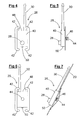
- the sensing device 26 comprises a housing 40 formed with wings 42 which provide a guideway for the tethering strap 20 ( Figure 7 ).
- the wings 42 are separated laterally by a distance slightly greater than the width of the strap 20, which when not under tension can be bent to fit between the wings 42 and guided into contact with a probe 44 extending rearwardly of the housing 40, as shown in Figure 7 .
- the probe 44 is urged rearwardly outward of the housing 40 by a spring 46 which is compressed when the strap 20 is tensioned, as shown in Figure 7 .
- a spring 46 which is compressed when the strap 20 is tensioned, as shown in Figure 7 .
- the housing 40 Within the housing 40 is electrical circuitry. It is not deemed necessary to describe this circuitry in detail here other than to say that it includes a rechargeable battery and is activated by means of a switch 48. When the circuitry is activated it causes the signal lamp 28 to light up, powered from the battery, until tension in the strap 20 is such as to move the 44 inward to a point - corresponding to a predetermined tension - where the lamp 28 is disconnected, and goes out to signal that the threshold value for the tension has been reached. If, subsequently, the tension in the strap 20 falls below the threshold value, the probe 44 moves out under the action of the spring 46, and the lamp 28 lights up again to provide a warning.
- the electrical circuitry of the sensing device 26 also includes a radio transmitter responsive to movement of the probe 44 to send radio signals representing the tension in the strap 20 and thereby the status of the lamp 28, and as described above in relation to Figures 1 to 3 these radio signals are received by the monitor 32.
- the battery of the sensing device 26 is rechargeable from a power supply of the truck 14 and to this end a charging cradle (not shown) may be provided whereby the battery is recharged by way of terminals 50.
- a charging cradle (not shown) may be provided whereby the battery is recharged by way of terminals 50.
- the battery may be a solar cell.
- the sensing device 26 can be adjusted eg by screw-thread adjustment (not detailed in the drawings) of the probe 44 or the spring 46. Further, the sensing device 26 is checked at regular intervals and can be recalibrated as necessary by means of such adjustment.
- the signal lamp 28 may be red and be complemented by a green lamp arranged to indicate when tension in a tether is at or above the threshold value.
- a vehicle operator tensions the tether until the signal changes from red to green.
- the signal should stay green, but loss of tension will generate a red signal.
- the contrast between red and green, and the common knowledge that green means safe and red means danger, may provide an enhanced warning.
- the warning signal provided by the signal lamp(s) may be supplemented or possibly replaced by an audible alarm. Further, the warning signal may relayed to a telephone (possibly the driver's mobile telephone or a telephone at a vehicle control centre) to help in dealing with attempted theft of a vehicle load, in which case the relayed warning signal may accompanied by information about the vehicle, eg information identifying the vehicle and its location.
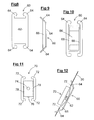
- a security shield 60 comprises a hard steel plate 62 formed at its ends with wings 64 which provide a guideway for a tethering strap 20 ( Figure 12 ).
- the wings 64 are separated laterally by a distance slightly greater than the width of the strap 20, which when not under tension can be bent to fit between the wings 64.
- the security shield 60 also comprises a metal box 66 formed between the wings 64 and providing a laterally separated pair of lengthwise channels 68.
- Figure 11 shows a sensing device 70 with wings 72 for attaching it to a tethering strap 20 and a spring-loaded probe 74 for engaging the strap 20.
- the sensing device 70 is equipped with electronic circuitry including a radio transmitter and it functions in the same way as the sensing device 26 previously described herein, illuminating a signal lamp (not visible in Figure 11 ) if tension in a tether to which it is attached falls below a threshold level.
- the sensing device 70 is configured and arranged somewhat differently from the sensing device 26, in five respects as follows. First, the sensing device 70 has an enclosed antenna, for improved security.
- the sensing device 70 has a radio receiver as well as a radio receiver (ie a transceiver) and is arranged for two-way communication with an in-cab monitor such as the monitor 32: if there is a breakdown in communication for a preset period such as 10s the sensing device is activated to issue a warning signal, whereby a would-be thief is unable to incapacitate the sensing device 70 by shrouding it against radio communication.
- the sensing device 70 does not require a switch like the switch 48 of the sensing device 26: instead, its electronic circuitry is arranged to detect when the charging terminals 76 engage its charger and switch off the sensing device 70 automatically.
- the charger is not shown, but it may be located in-cab and be provided with cradles for a plurality of sensing devices, and those skilled in the art will be readily able to construct such a charger).
- the sensing device 70 is arranged to bleep, after a period of time, if it is neither attached to a tethering strap nor in its charger, to remind vehicle operatives of its presence and help them locate it if mislaid.
- the sensing device 70 is formed with two lengthwise ribs 78, one each side of the probe 74, and is otherwise configured and arranged to cooperate with the security shield 60 as will now be described.
- the sensing device 70 is shorter than the security device 60.
- the security shield is attached to the strap 20 on the opposite side from the sensing device 26, with its wings 64 flanking the wings 72 of the sensing device 70 and with its box 66 facing the strap.
- the security shield 60 is drawn tight against the sensing device 70 so that the box 66 securely encloses the probe 74.
- the ribs 78 on the sensing device 70 are configured and arranged to fit into the channels 68 of the box 66, and it is then impossible for a would-be thief to gain access to the probe 74 as long as the strap is tensioned. (If the strap is cut or otherwise loses tension, of course, the sensing device 70 issues a warning signal).
Landscapes
- Engineering & Computer Science (AREA)
- Transportation (AREA)
- Mechanical Engineering (AREA)
- Emergency Alarm Devices (AREA)
Abstract
A sensing device 26 is attached to a tensioned strap 20 holding a load on a vehicle. A probe 44 engages the strap 20 and causes a signal lamp 28 to light up if the tension in the strap 20 is below a predetermined threshold value. The sensing device 26 helps the vehicle operator to set the tension correctly before a journey and also provides a visible warning if a strap becomes loose during the journey. The warning is visible beyond the vehicle, to alert other road users to a possible hazard.
Description
- This invention is to do with securing loads on vehicles.
- The invention is particularly but not exclusively applicable to delivery of construction equipment or other plant to site by truck. In such usage it is clearly essential that the load be secured to the truck, and this is conventionally done by means of tackle comprising a plurality of straps or chains connected to a load platform or other part of the truck and tensioned over the load. Unfortunately such securing arrangements fail from time to time, and accidents occur, most dangerously when a load falls from a truck moving at speed along a road.
- There are two main reasons for failures of the securing arrangements. First, the tackle may not be tensioned to the correct level when the truck is being loaded, before it moves off. Regulations generally require straps and other tethers to carry tags showing breaking strength and safe working load, but even where these figures are known operators may not have a ready means of adjusting the tension accordingly; and if one tether of a plurality is incorrectly adjusted it may adversely affect others. Second, a tether may break or otherwise become loose while the truck is in transit with its load, and heretofore in-transit failures of this kind have not been readily noticed by the driver, or indeed by other road users, to provide an opportunity for corrective action.
- United States Patent
US 5 295 664 (Kämper), which concerns a winch controlled in response to a tension sensor to keep lashing straps taut during transport, refers to previously known tension measuring aids integrated in the tensioned strap to indicate tension to the operator during the tensioning process, but notes that 'a drop of tension occurring during transport, for instance due to settling of the load, generally remains unnoticed by the operator.' - It is an object of the present invention to enable tension in the tackle to be monitored.
- Thus according to a first aspect of the invention there is provided apparatus for holding a load on a vehicle, which apparatus comprises a tether arranged to be secured to the vehicle and applied to the load, tensioning means operable to tension the secured tether into holding engagement with the load, a sensor for monitoring tension in the tether and a signalling device operatively associated with the sensor, characterised in that the signalling device produces a warning signal when the tension is below a threshold value, wherein said warning signal ceases when the tension reaches the threshold value during operation of the tensioning means and is produced again if the tension subsequently falls below the threshold value.
- The warning signal is preferably visual, and the signalling means may comprise a lamp illumination of which provides the warning signal.
- Further, the warning signal is preferably visible beyond the vehicle. By this means the signal can be seen by others, such as other road-users, police or regulatory authorities, during transit; and if they see a warning light on the vehicle they will be able to keep clear and/or report the problem.
- To help users of the vehicle, the warning signal may also be accompanied by an audible alarm.
- The warning signal may be relayed to a telephone, possibly accompanied by information about the vehicle, eg information identifying the vehicle and its location.
- Many loads require a plurality of tethers to be applied to hold the load safely, and to this end holding apparatus embodying the invention may comprise a plurality of sensors for respectively monitoring a plurality of said tethers, each sensor having an associated signalling device arranged to produce a warning signal if tension in its respective tether is below a threshold value.
- The apparatus may comprise a monitor, possibly located in a cab of the vehicle, configured and arranged to respond to the or each warning signal. The monitor may be configured and arranged to display the replicas of warning signals from a plurality of signalling devices in mutually distinguishable fashion (eg with associated numbers) so that the driver can identify a problem with a particular tether when a warning signal appears. To facilitate this, the signals from the various tethers may be individually encoded for transmission to the monitor.
- The or each warning signal may be transmitted to the monitor by wireless transmission, in which case the wireless transmission is preferably variable to avoid interference with other transmissions in the vicinity of the vehicle.
- The or each sensor may be embodied in a housing formed to guide a tether into engagement with the sensor, and the housing may be formed for releasable attachment to the tether. The sensor may comprise a probe spring-biased outward of the housing and engageable with the tether, tension in said tether urging the probe back towards the housing against the spring-bias. The housing may be configured and arranged for engagement with a tether in the form of a strap.
- The sensor and the signalling device may be electrically powered from a rechargeable battery, which battery may be rechargeable from a power supply of the vehicle or may comprise a solar cell.
- To cater for loads of differing size and weight, the threshold value of the or each sensor is preferably adjustable.
- The apparatus may comprise a calibration unit operable to calibrate the threshold value for the or each sensor.
- The invention extends to a vehicle including the holding apparatus. The vehicle may be a land vehicle, such as a truck, in which case the warning signals may be displayed in a cab of the vehicle to alert the driver. The vehicle may otherwise be a marine vessel, the tackle being used to secure cargo thereof.
- In a further aspect the invention comprises a method of holding a load on a vehicle by means of a tether secured to the vehicle, which method comprises applying the tether to the load and tensioning the tether to hold the load on the vehicle, characterised in that the tension in the tether is monitored while the tether is being tensioned and continuously thereafter during movement of the vehicle.
- Preferably in use of this method a warning signal is produced during tensioning of the tether when the tension therein is below a threshold value, the warning signal ceases when tension in the tether reaches the threshold value during said tensioning and the warning signal is produced again if the tension in the tether falls below the threshold value during movement of the vehicle.
- The warning signal is preferably a visual signal arranged to be visible beyond the vehicle.
- Other features of the invention will be apparent from the following description, which is made by way of example only and with reference to the accompanying schematic drawings in which -
-
Figure 1 is a side view of a flat-bed truck carrying a load held thereon in accordance with the invention; -
Figure 2 illustrates, to an enlarged scale, tethers holding the load on the truck ofFigure 1 , with sensors monitoring tension in the tethers; -
Figure 3 illustrates a monitor for displaying tension as sensed by the sensors ofFigure 2 ; -
Figures 4 to 6 illustrate a sensing device responsive to tension in a tether, being respectively a front elevation, a side elevation and a rear elevation; -
Figure 7 shows the sensing device ofFigures 4 to 6 applied to a tether. -
Figures 8 to 10 illustrate a security shield for a sensing device according to the invention, respectively in front elevation, side elevation and rear elevation; -
Figure 11 shows in rear elevation a sensing device according to the invention adapted to cooperate with the security shield ofFigures 8 to 10 ; and -
Figure 12 shows the sensing device ofFigure 11 and the security shield ofFigures 8 to 10 cooperatively applied to a tether. - Referring first to
Figure 1 , this shows aload 10 carried on thebed 12 of a flat-bed truck indicated at 14. For simplicity of illustration, theload 10 as shown inFigure 1 is a simple cuboid, but in practice the load may have any of a wide range of shapes and sizes- it may for instance comprise a block of stone or a machine tool or earth-moving equipment. Further, the vehicle used to transport the load may be something other than the flat-bed truck illustrated inFigure 1 . - The one common feature amongst this variety is that the load needs to be held securely on the vehicle. This is done by means of tethers - typically straps but possibly chains or of other form - secured to the vehicle and tensioned across the load. Thus, referring to
Figure 1 , theload 10 is held on thetruck 14 by twotransverse straps longitudinal strap 20, all these straps being hooked on to or otherwise secured to upstands 22 on thebed 12 of thetruck 14. Each of thestraps load 10 by means of a ratchet device, which may be of conventional form, that for thelongitudinal strap 20 being shown schematically at 24 inFigure 1 . (Thetransverse straps Figure 1 , being on the distal side of the load 10). - Conventionally the operation of ratchet devices to tension holding straps has heretofore involved a somewhat uncertain mixture of skill and guesswork on the part of the operator. A benefit of the present invention is that this uncertainty is removed by providing, on each strap, a
sensing device 26. As will be described in more detail hereinafter, eachsensing device 26 includes asignal lamp 28 which is lit when tension in the strap is below a threshold value predetermined to be appropriate for holding theload 10 and which ceases to be lit when the tension in the strap excedds the threshold value. Thus, by means of the invention, the ratchet operator simply operates theratchet 24 until thesignal lamp 28 of thesensing device 26 on thestrap 20 goes out, knowing that the tension in that strap is then adequate to hold the load. - The operator performs this ratcheting operation on all the straps, in each case continuing until the respective signal lamps go out. Those skilled in the art will appreciate that tensioning one strap of a plurality may possibly cause some small movement of the load which could result in some relaxation of tension in another strap. If, however, any such relaxation is such that the tension in a particular strap falls below its threshold value, the
signal lamp 28 of thesensing device 26 on that strap will light up again, alerting the operator to make an adjustment. This is continued as necessary until all the signal lamps are extinguished. - As well as assisting the vehicle operator during the strap tensioning process, the invention also provides a means of monitoring the holding straps while the vehicle is travelling, in two ways, as follows. First, as will be apparent from
Figure 1 , each of thesensing devices 26 is arranged to be visible from the rear and/or the side of thetruck 14, so that if any strap becomes loose during transportation of theload 10 itssignal lamp 28 will light up to give a warning to persons in the vicinity such as other road users or police or other authorities. Second, eachsensing device 26 incorporates a radio transmitter which transmits by way of an antenna 30 (Figure 2 ) a signal representing the status of itssignal lamp 28 to a monitor 32 (Figure 3 ) located in the cab of thetruck 14 to provide an ongoing status display to the driver. - The
monitor 32 receives, by way of areceive antenna 34, the radio signals transmitted from thesensing devices 26 and, if and when tension in a particular strap falls below its threshold value, causes a corresponding one of an array of in-cab liquid crystal display (LCD) lamps to light up to alert the driver of thetruck 14 and advise him (eg by the number displayed) which strap has low tension. Themonitor 32 is powered from the power supply of thetruck 14, by way of a push-button on-offswitch 38. - As illustrated in
Figure 3 themonitor 32 has five LCD lamps 36 and is thus configured and arranged to interwork with up to fivesensing devices 26. It should be understood, however, that the system may have fewer than five channels (for instance, theload 10 ofFigure 1 is adequately held with only three straps); or it may have more channels (subject to the desirability of avoiding information overload for the driver of the truck 14). - The radio signals for each channel are individually encoded (by well known means which need not be described here) for transmission to the
monitor 32, whereby an appropriate individual lamp 36 will light up when tension in a particular strap falls below its threshold value. The driver of thetruck 14 will then be able to identify, from the illuminated lamp, which strap needs attention. To assist in this the lamps 36 may be marked to correspond torespective sensing devices 26, eg by numbers or distinctive colours. In addition, the wireless transmission is variable (again by well known means not necessary to describe here) so as to avoid interference with other transmissions in the vicinity of thetruck 14. - Referring now to
Figures 4 to 7 , these show thesensing device 26 in more detail. Thesensing device 26 comprises ahousing 40 formed withwings 42 which provide a guideway for the tethering strap 20 (Figure 7 ). Thewings 42 are separated laterally by a distance slightly greater than the width of thestrap 20, which when not under tension can be bent to fit between thewings 42 and guided into contact with aprobe 44 extending rearwardly of thehousing 40, as shown inFigure 7 . When thestrap 20 is tensioned its engagement within thewings 42 keeps thesensing device 26 attached to thestrap 20, and thesensing device 26 can be readily released from thestrap 20 when the tension therein is removed. - The
probe 44 is urged rearwardly outward of thehousing 40 by aspring 46 which is compressed when thestrap 20 is tensioned, as shown inFigure 7 . Thus the tensioned strap presses theprobe 44 inwards and its movement against the bias of thespring 46 will depend upon the tension in thestrap 20. - Within the
housing 40 is electrical circuitry. It is not deemed necessary to describe this circuitry in detail here other than to say that it includes a rechargeable battery and is activated by means of aswitch 48. When the circuitry is activated it causes thesignal lamp 28 to light up, powered from the battery, until tension in thestrap 20 is such as to move the 44 inward to a point - corresponding to a predetermined tension - where thelamp 28 is disconnected, and goes out to signal that the threshold value for the tension has been reached. If, subsequently, the tension in thestrap 20 falls below the threshold value, theprobe 44 moves out under the action of thespring 46, and thelamp 28 lights up again to provide a warning. - The electrical circuitry of the
sensing device 26 also includes a radio transmitter responsive to movement of theprobe 44 to send radio signals representing the tension in thestrap 20 and thereby the status of thelamp 28, and as described above in relation toFigures 1 to 3 these radio signals are received by themonitor 32. - The battery of the
sensing device 26 is rechargeable from a power supply of thetruck 14 and to this end a charging cradle (not shown) may be provided whereby the battery is recharged by way ofterminals 50. Alternatively the battery may be a solar cell. - Different loads will call for different tensions in the holding straps (and it may also be noted that regulations generally require the straps to be checked for safe working load and to be marked accordingly). To accommodate such variations, the
sensing device 26 can be adjusted eg by screw-thread adjustment (not detailed in the drawings) of theprobe 44 or thespring 46. Further, thesensing device 26 is checked at regular intervals and can be recalibrated as necessary by means of such adjustment. - The apparatus and methods described as so far described may be modified in various ways without departing from the scope of the invention. For instance, the
signal lamp 28 may be red and be complemented by a green lamp arranged to indicate when tension in a tether is at or above the threshold value. By this means, before a journey, a vehicle operator tensions the tether until the signal changes from red to green. During the journey the signal should stay green, but loss of tension will generate a red signal. The contrast between red and green, and the common knowledge that green means safe and red means danger, may provide an enhanced warning. - The warning signal provided by the signal lamp(s) may be supplemented or possibly replaced by an audible alarm. Further, the warning signal may relayed to a telephone (possibly the driver's mobile telephone or a telephone at a vehicle control centre) to help in dealing with attempted theft of a vehicle load, in which case the relayed warning signal may accompanied by information about the vehicle, eg information identifying the vehicle and its location.
- Those knowledgeable in construction will be well aware that equipment is commonly a target for thieves, especially when of high value like much heavy plant. Referring back to
Figure 7 it will be noted that the way in which thesensing device 26 is attached to thestrap 20 could allow a would-be thief to jam theprobe 44 in an inward position and then cut thestrap 20 without activation of thesensing device 26 to issue a warning signal. The arrangement ofFigures 8 to 12 is designed to guard against this. - The arrangement of
Figures 8 to 12 includes asecurity shield 60 comprises ahard steel plate 62 formed at its ends withwings 64 which provide a guideway for a tethering strap 20 (Figure 12 ). Thewings 64 are separated laterally by a distance slightly greater than the width of thestrap 20, which when not under tension can be bent to fit between thewings 64. Thesecurity shield 60 also comprises ametal box 66 formed between thewings 64 and providing a laterally separated pair oflengthwise channels 68. -
Figure 11 shows asensing device 70 withwings 72 for attaching it to atethering strap 20 and a spring-loadedprobe 74 for engaging thestrap 20. Although not detailed inFigure 11 , thesensing device 70 is equipped with electronic circuitry including a radio transmitter and it functions in the same way as thesensing device 26 previously described herein, illuminating a signal lamp (not visible inFigure 11 ) if tension in a tether to which it is attached falls below a threshold level. However thesensing device 70 is configured and arranged somewhat differently from thesensing device 26, in five respects as follows. First, thesensing device 70 has an enclosed antenna, for improved security. Second, thesensing device 70 has a radio receiver as well as a radio receiver (ie a transceiver) and is arranged for two-way communication with an in-cab monitor such as the monitor 32: if there is a breakdown in communication for a preset period such as 10s the sensing device is activated to issue a warning signal, whereby a would-be thief is unable to incapacitate thesensing device 70 by shrouding it against radio communication. Third, thesensing device 70 does not require a switch like theswitch 48 of the sensing device 26: instead, its electronic circuitry is arranged to detect when the chargingterminals 76 engage its charger and switch off thesensing device 70 automatically. (The charger is not shown, but it may be located in-cab and be provided with cradles for a plurality of sensing devices, and those skilled in the art will be readily able to construct such a charger). Fourth, and associated with this last feature, thesensing device 70 is arranged to bleep, after a period of time, if it is neither attached to a tethering strap nor in its charger, to remind vehicle operatives of its presence and help them locate it if mislaid. Finally, thesensing device 70 is formed with two lengthwiseribs 78, one each side of theprobe 74, and is otherwise configured and arranged to cooperate with thesecurity shield 60 as will now be described. - In overall length the
sensing device 70 is shorter than thesecurity device 60. In use as shown inFigure 12 the security shield is attached to thestrap 20 on the opposite side from thesensing device 26, with itswings 64 flanking thewings 72 of thesensing device 70 and with itsbox 66 facing the strap. Thus, when thestrap 20 is tensioned, thesecurity shield 60 is drawn tight against thesensing device 70 so that thebox 66 securely encloses theprobe 74. Theribs 78 on thesensing device 70 are configured and arranged to fit into thechannels 68 of thebox 66, and it is then impossible for a would-be thief to gain access to theprobe 74 as long as the strap is tensioned. (If the strap is cut or otherwise loses tension, of course, thesensing device 70 issues a warning signal). - The improved security of the arrangement of
Figures 8 to 12 makes it especially suitable for the carriage of high value loads, which may include boats and yachts as well as plant and other equipment. - Whilst the invention has been described with reference to the carriage of a load by truck, it will be understood that the invention is not so limited. Thus the invention may otherwise be used, for instance, to secure cargo for transportation by sea. The invention is also not limited to use with holding straps as described, and it may be adapted for use with chains or other tethering means. Also, to protect the sensing device against possibly deleterious intrusion of dust or damp, O-rings or similar elastic seals may be provided around the stem of the spring-loaded probe.
- Other possible modifications will be apparent to those skilled in the art.
Claims (20)
- Apparatus for holding a load (10) on a vehicle (14), which apparatus comprises a tether (20) arranged to be secured to the vehicle (14) and applied to the load (10), tensioning means (24) operable to tension the secured tether (20) into holding engagement with the load (10), a sensor (26) for monitoring tension in the tether (20) and a signalling device (28) operatively associated with the sensor (26), characterised in that the signalling device (28) produces a warning signal when the tension is below a threshold value, wherein said warning signal ceases when the tension reaches the threshold value during operation of the tensioning means (24) and is produced again if the tension subsequently falls below the threshold value.
- Apparatus for holding a load (10) on a vehicle (14) as claimed in claim 1 characterised in that the warning signal is visual.
- Apparatus for holding a load (10) on a vehicle (14) as claimed in claim 2 characterised in that the warning signal comprises two lamps of mutually different colours, illumination of one said lamp indicating that tension in the tether is below the threshold value and illumination of the other indicating that tension in the tether is at or above the threshold value.
- Apparatus for holding a load (10) on a vehicle (14) as claimed in claim 2 or claim 3 characterised in that said apparatus is so configured and arranged that the warning signal is visible beyond the vehicle (14).
- Apparatus for holding a load (10) on a vehicle (14) as claimed in any preceding claim characterised in that the warning signal includes an audible alarm.
- Apparatus for holding a load (10) on a vehicle (14) as claimed in any preceding claim characterised in that the warning signal is relayed to a telephone together with information identifying the vehicle (14) and its location.
- Apparatus for holding a load (10) on a vehicle (14) as claimed in any preceding claim characterised in that said apparatus comprises a plurality of said sensors (26) for respectively monitoring a plurality of said tethers (16,18,20), each sensor (26) having an associated signalling device (28) arranged to produce a warning signal if tension in its respective tether (16,18,20) is below a threshold value.
- Apparatus for holding a load (10) on a vehicle (14) as claimed in any preceding claim characterised in that said apparatus comprises a monitor (32) responsive to the or each warning signal.
- Apparatus for holding a load (10) on a vehicle (14) as claimed in claim 8 characterised in that the monitor (32) includes a display device configured and arranged to display the replicas (36) of warning signals from a plurality of signalling devices (28) in mutually distinguishable fashion so that a tether (16,18,20) in which tension is below its threshold value can be identified from the display.
- Apparatus for holding a load (10) on a vehicle (14) as claimed in claim 9 characterised in that the warning signals are individually encoded for transmission to the monitor (32).
- Apparatus for holding a load (10) on a vehicle (14) as claimed in claim 11 characterised in that there is two-way communication between the monitor (32) and the or each signalling device (26) and wherein a warning signal is generated if either the monitor (32) or a signalling device (26) fails to receive said communication over a preset period.
- Apparatus for holding a load (10) on a vehicle (14) as claimed in any preceding claim characterised in that the or each sensor (26) is embodied in a housing (40) formed for releasable attachment to a said tether (20).
- Apparatus for holding a load (10) on a vehicle (14) as claimed in claim 12 characterised in that the sensor (26) comprises a probe (44) spring-biased outward of the housing (40) and engageable with the tether (20), tension in said tether (20) urging the probe (44) back towards the housing (40) against the spring-bias.
- Apparatus for holding a load (10) on a vehicle (14) as claimed in claim 1 characterised in that the sensor (26) and the signalling device (28) are electrically powered from a battery rechargeable from a charger connected to a power supply of the vehicle and having a cradle engageable with the housing (40) to effect charging connection with the battery and wherein said apparatus includes means whereby the signalling device (28) is automatically switched off when the housing (40) is engaged with the cradle and automatically switched on when the housing (40) is removed from the cradle.
- Apparatus for holding a load (10) on a vehicle (14) as claimed in claim 14 characterised in that said apparatus comprises a bleeper automatically activated if the housing (40) is neither in a said cradle nor attached to a said tether (20) for a period of time.
- Apparatus for holding a load (10) on a vehicle (14) as claimed in any of claims 12 to 15 characterised in that said apparatus comprises a security shield (60) cooperative with said sensor (70) to shield the sensor (70).
- Apparatus for holding a load (10) on a vehicle (4) as claimed claim 16 characterised in that the security shield (60) is formed for releasable attachment to the tether (20) on the opposite side from said sensor (70), tensioning of the tether (20) drawing the sensor (70) and the security shield (60) together.
- Apparatus for holding a load (10) on a vehicle (14) as claimed in claim 17 wherein the sensor (60) and the security shield (70) are respectively formed with ribs (78) and channels (68) which fit together to enclose the sensor (70) when drawn together with the security shield (60).
- A method of holding a load (10) on a vehicle (14) by means of a tether (20) secured to the vehicle (14), which method comprises applying the tether (20) to the load (10) and tensioning the tether (20) to hold the load (10) on the vehicle (14), characterised in that the tension in the tether (20) is monitored while the tether (20) is being tensioned and continuously thereafter during movement of the vehicle (14), the warning signal being automatically (a) produced during tensioning of the tether (20) when the tension therein is below a threshold value, (b) ceased when tension in the tether (20) reaches the threshold value during said tensioning and (c) produced again if the tension in the tether (20) falls below the threshold value during movement of the vehicle (14).
- A method of holding a load (10) on a vehicle (14) as claimed in claim 19 characterised in that the warning signal is a visual signal arranged to be visible beyond the vehicle (14).
Applications Claiming Priority (1)
| Application Number | Priority Date | Filing Date | Title |
|---|---|---|---|
| GB0823299A GB2466463A (en) | 2008-12-22 | 2008-12-22 | Low strap tension warning device for securing loads on vehicles |
Publications (1)
| Publication Number | Publication Date |
|---|---|
| EP2199151A1 true EP2199151A1 (en) | 2010-06-23 |
Family
ID=40343988
Family Applications (1)
| Application Number | Title | Priority Date | Filing Date |
|---|---|---|---|
| EP09252848A Withdrawn EP2199151A1 (en) | 2008-12-22 | 2009-12-21 | Securing loads on vehicles |
Country Status (3)
| Country | Link |
|---|---|
| US (1) | US8506220B2 (en) |
| EP (1) | EP2199151A1 (en) |
| GB (1) | GB2466463A (en) |
Cited By (5)
| Publication number | Priority date | Publication date | Assignee | Title |
|---|---|---|---|---|
| WO2012033447A1 (en) | 2010-09-09 | 2012-03-15 | Stimp Innovation Ab | Device for controlling or measuring the tensile force in straps, ropes or other fastening device |
| EP3018003A1 (en) * | 2014-11-06 | 2016-05-11 | Driss Abandarat | Device for tensioning a belt comprising a means for detecting said tension |
| DE102015000101B4 (en) * | 2015-01-14 | 2019-05-09 | Braun Gmbh | Extension element for a tensioning ratchet with an extension body |
| WO2020001703A1 (en) * | 2018-06-28 | 2020-01-02 | Bpw Bergische Achsen Kg | Method for monitoring transport securing means which operate by means of tensioning elements, preferably tensioning straps |
| DE102018132046A1 (en) | 2018-12-13 | 2020-06-18 | Ernst Eisele | Voltage monitoring device |
Families Citing this family (25)
| Publication number | Priority date | Publication date | Assignee | Title |
|---|---|---|---|---|
| US20130162420A1 (en) * | 2010-04-09 | 2013-06-27 | James Marshall Stoddard | Combination Tie Strap Tensioning Assembly with Tension Monitor |
| IL214338A0 (en) * | 2011-07-28 | 2011-09-27 | Yaron Mantel | Vehicle mat system and method |
| GB2506581A (en) * | 2012-08-23 | 2014-04-09 | Karl Rae Jarvis | Tension detecting alarm device for warning when a fastener has become loose, broken or cut |
| US20140352084A1 (en) * | 2013-06-04 | 2014-12-04 | The D.S. Brown Company, Inc. | Cover for a strap buckle |
| US9422064B2 (en) * | 2014-01-08 | 2016-08-23 | Honeywell International Inc. | Rotorcraft tie-down detector system |
| US10328840B2 (en) * | 2014-02-28 | 2019-06-25 | Time Bandit, Llc | Cargo strap tensioning and monitoring system |
| WO2016075663A1 (en) * | 2014-11-14 | 2016-05-19 | Stellenbosch University | Cargo securing apparatus |
| CH710460A1 (en) | 2014-12-11 | 2016-06-15 | Spanset Inter Ag | Apparatus and method for documentation of the tension in a strap. |
| CH710461A1 (en) * | 2014-12-11 | 2016-06-15 | Spanset Inter Ag | Apparatus and method for measuring the tensile stress in a tension belt. |
| WO2016157679A1 (en) * | 2015-03-31 | 2016-10-06 | バンドー化学株式会社 | Tension verification tool for lashing |
| US10328841B2 (en) * | 2015-07-31 | 2019-06-25 | GM Global Technology Operations LLC | Automated wireless securement-monitoring and feedback system |
| US10814773B1 (en) | 2016-10-18 | 2020-10-27 | Michael D. Rainone | Automated, wireless, cargo restraint tension control and monitoring system |
| US10625658B2 (en) * | 2017-06-28 | 2020-04-21 | Process4, Inc. | Security sensor |
| DE102017010707A1 (en) * | 2017-11-20 | 2019-05-23 | Spanset Inter Ag | Method for transport goods monitoring |
| US11364885B2 (en) * | 2018-01-18 | 2022-06-21 | Vieletech Inc. | Smart trailer controller |
| US11420695B2 (en) | 2018-01-31 | 2022-08-23 | Vieletech Inc. | Semi-autonomous trailer hauler |
| US11208027B1 (en) | 2019-01-28 | 2021-12-28 | Michael D. Rainone | Automated, wireless, cargo restraint tension control and monitoring system |
| EP3825183B1 (en) * | 2019-11-22 | 2022-08-03 | Ningbo Geely Automobile Research & Development Co. Ltd. | Arrangement and method for securing a load in a vehicle |
| US11465550B1 (en) * | 2020-07-15 | 2022-10-11 | Rick Dooley | Systems and methods for visually determining security of tie-down cargo straps |
| US12077091B2 (en) | 2020-10-08 | 2024-09-03 | J.J. Keller & Associates, Inc. | Method and apparatus for setting, monitoring, usage tracking and/or lifecycle management of cargo restraints |
| CA3098709C (en) | 2020-11-10 | 2024-10-08 | Intelligent Secure Strap Inc. | Strap tension detector |
| US20220242302A1 (en) * | 2021-02-04 | 2022-08-04 | Jason Goetz | Cargo Tie-Down Monitoring Device |
| US20220355135A1 (en) * | 2021-05-08 | 2022-11-10 | Alexander Andrew, Inc. Dba Falltech | Temporary cable horizontal lifeline kits, systems and methods |
| CN116262552B (en) * | 2023-03-10 | 2025-12-16 | 浙江双友物流器械股份有限公司 | Intelligent adjustment method based on cargo binding detection |
| US20240344908A1 (en) * | 2023-04-11 | 2024-10-17 | Strongholds Tech LLC | Method and apparatus for sensing a load |
Citations (7)
| Publication number | Priority date | Publication date | Assignee | Title |
|---|---|---|---|---|
| GB1416223A (en) * | 1973-02-05 | 1975-12-03 | Pioneer Coveralls Inc | Load-binder arrangement |
| US5295664A (en) | 1989-07-03 | 1994-03-22 | Spanset Inter Ag | Motor-driven tensioning and winding device for lashing straps including an integrated control of the lashing tension |
| CA2377296A1 (en) * | 2002-03-14 | 2003-08-19 | Maurice Tardif | Tensiometer equipped with an alarm for belts or other restraint systems that maintains a load on or in a trailer |
| WO2005110810A1 (en) * | 2004-05-17 | 2005-11-24 | Traction Technologies Inc. | Self-tensioning tie down system |
| US7112023B1 (en) * | 2005-07-18 | 2006-09-26 | Maurice Tardif | Load tension alert device |
| US20060277726A1 (en) * | 2005-06-14 | 2006-12-14 | Chih-Ching Hsieh | Belt tightening device with display for displaying tension |
| DE102007016875A1 (en) * | 2006-06-30 | 2008-01-03 | Ching-Fong Hsieh | Tension indicating rope fastening device has rope fastening unit, for fastening rope, has rotary connection, and tension indicating unit has two strain gauges, which are arranged at two opposite sides of rotary connection |
Family Cites Families (5)
| Publication number | Priority date | Publication date | Assignee | Title |
|---|---|---|---|---|
| US4027130A (en) * | 1975-07-17 | 1977-05-31 | I.C.S. Ignition Control Systems Ltd. | Cable activated switch |
| SE406169B (en) * | 1977-03-21 | 1979-01-29 | Sunesson Dodsboet Efter Karl G | MOUNTING DEVICE AT A LOAD VEHICLE OR TIMBER NEST TO ATTACH THE END TO A TENSION AT THE ONE LONG SIDE OF THE FLAKE OR TIMBER NECK |
| US7069118B2 (en) * | 2003-09-30 | 2006-06-27 | International Business Machines Corporation | Apparatus, system, and method for exchanging vehicle identification data |
| FR2866290B1 (en) * | 2004-02-18 | 2006-05-19 | Serge Vincent Lopez | DEVICE FOR SECURING THE LOADING OF LOADS TRANSPORTED ON ALL MEANS OF TRANSPORT |
| SE0500578L (en) * | 2005-03-14 | 2006-09-05 | Lindual Ab | Device for lashing |
-
2008
- 2008-12-22 GB GB0823299A patent/GB2466463A/en not_active Withdrawn
-
2009
- 2009-12-21 US US12/642,980 patent/US8506220B2/en not_active Expired - Fee Related
- 2009-12-21 EP EP09252848A patent/EP2199151A1/en not_active Withdrawn
Patent Citations (7)
| Publication number | Priority date | Publication date | Assignee | Title |
|---|---|---|---|---|
| GB1416223A (en) * | 1973-02-05 | 1975-12-03 | Pioneer Coveralls Inc | Load-binder arrangement |
| US5295664A (en) | 1989-07-03 | 1994-03-22 | Spanset Inter Ag | Motor-driven tensioning and winding device for lashing straps including an integrated control of the lashing tension |
| CA2377296A1 (en) * | 2002-03-14 | 2003-08-19 | Maurice Tardif | Tensiometer equipped with an alarm for belts or other restraint systems that maintains a load on or in a trailer |
| WO2005110810A1 (en) * | 2004-05-17 | 2005-11-24 | Traction Technologies Inc. | Self-tensioning tie down system |
| US20060277726A1 (en) * | 2005-06-14 | 2006-12-14 | Chih-Ching Hsieh | Belt tightening device with display for displaying tension |
| US7112023B1 (en) * | 2005-07-18 | 2006-09-26 | Maurice Tardif | Load tension alert device |
| DE102007016875A1 (en) * | 2006-06-30 | 2008-01-03 | Ching-Fong Hsieh | Tension indicating rope fastening device has rope fastening unit, for fastening rope, has rotary connection, and tension indicating unit has two strain gauges, which are arranged at two opposite sides of rotary connection |
Cited By (6)
| Publication number | Priority date | Publication date | Assignee | Title |
|---|---|---|---|---|
| WO2012033447A1 (en) | 2010-09-09 | 2012-03-15 | Stimp Innovation Ab | Device for controlling or measuring the tensile force in straps, ropes or other fastening device |
| EP3018003A1 (en) * | 2014-11-06 | 2016-05-11 | Driss Abandarat | Device for tensioning a belt comprising a means for detecting said tension |
| FR3028226A1 (en) * | 2014-11-06 | 2016-05-13 | Driss Abandarat | DEVICE FOR TENSIONING A STRAP INCLUDING A MEANS FOR DETECTING SAID VOLTAGE |
| DE102015000101B4 (en) * | 2015-01-14 | 2019-05-09 | Braun Gmbh | Extension element for a tensioning ratchet with an extension body |
| WO2020001703A1 (en) * | 2018-06-28 | 2020-01-02 | Bpw Bergische Achsen Kg | Method for monitoring transport securing means which operate by means of tensioning elements, preferably tensioning straps |
| DE102018132046A1 (en) | 2018-12-13 | 2020-06-18 | Ernst Eisele | Voltage monitoring device |
Also Published As
| Publication number | Publication date |
|---|---|
| US8506220B2 (en) | 2013-08-13 |
| GB2466463A (en) | 2010-06-23 |
| US20100158629A1 (en) | 2010-06-24 |
| GB0823299D0 (en) | 2009-01-28 |
Similar Documents
| Publication | Publication Date | Title |
|---|---|---|
| US8506220B2 (en) | Securing loads on vehicles | |
| US20220242302A1 (en) | Cargo Tie-Down Monitoring Device | |
| ES2838807T3 (en) | Cargo securing device | |
| US10328840B2 (en) | Cargo strap tensioning and monitoring system | |
| EP2257444B1 (en) | Sensor unit and method for monitoring the state of fasteners | |
| ES2273113T3 (en) | SYSTEM FOR MONITORING THE TENSION OF THE BAND OF A TAPE, ESPECIALLY A TAPE OF TAPE. | |
| US7112023B1 (en) | Load tension alert device | |
| US20190084524A1 (en) | Child safety in a vehicle alert system and method | |
| US11993199B2 (en) | Wireless transmitting strap tension monitoring device | |
| AU2020357635B2 (en) | Monitoring apparatus for a motor vehicle, warning device for a vehicle, warning system and method for operating a monitoring apparatus | |
| ES2989412T3 (en) | Procedure for monitoring transport fastening means that operate by means of traction elements and preferably tensioning belts | |
| CA2755904A1 (en) | Weighing apparatus and method for weighing vehicles | |
| US8872641B2 (en) | Premises-based wireless alert system for automotive tall cargo | |
| CA2550629A1 (en) | Monitoring apparatus for electronic key and displaying apparatus for positional information on electronic key | |
| US20110018724A1 (en) | Sensor for detecting water level for watercraft trailer | |
| FR2866290A1 (en) | DEVICE FOR SECURING THE LOADING OF LOADS TRANSPORTED ON ALL MEANS OF TRANSPORT | |
| US11618376B2 (en) | Methods, apparatuses, and systems for monitoring state of a transportation system | |
| US8480094B2 (en) | Hose or cable release alert system | |
| US12077091B2 (en) | Method and apparatus for setting, monitoring, usage tracking and/or lifecycle management of cargo restraints | |
| US9387803B2 (en) | Vehicle back-up assist system | |
| US20250087079A1 (en) | Truck trailer dock watching device and method | |
| US7528707B1 (en) | Spare tire pressure monitoring system | |
| AU665668B2 (en) | Safety arrangement for use with tipping bodies, and the like | |
| US12276561B2 (en) | Tension measuring assembly | |
| KR200195456Y1 (en) | Detection device for connection of train |
Legal Events
| Date | Code | Title | Description |
|---|---|---|---|
| PUAI | Public reference made under article 153(3) epc to a published international application that has entered the european phase |
Free format text: ORIGINAL CODE: 0009012 |
|
| AK | Designated contracting states |
Kind code of ref document: A1 Designated state(s): AT BE BG CH CY CZ DE DK EE ES FI FR GB GR HR HU IE IS IT LI LT LU LV MC MK MT NL NO PL PT RO SE SI SK SM TR |
|
| AX | Request for extension of the european patent |
Extension state: AL BA RS |
|
| 17P | Request for examination filed |
Effective date: 20110325 |
|
| 17Q | First examination report despatched |
Effective date: 20120208 |
|
| STAA | Information on the status of an ep patent application or granted ep patent |
Free format text: STATUS: THE APPLICATION IS DEEMED TO BE WITHDRAWN |
|
| 18D | Application deemed to be withdrawn |
Effective date: 20160129 |