EP2199109A2 - Tire tread strip and methods of preparation - Google Patents
Tire tread strip and methods of preparation Download PDFInfo
- Publication number
- EP2199109A2 EP2199109A2 EP09178303A EP09178303A EP2199109A2 EP 2199109 A2 EP2199109 A2 EP 2199109A2 EP 09178303 A EP09178303 A EP 09178303A EP 09178303 A EP09178303 A EP 09178303A EP 2199109 A2 EP2199109 A2 EP 2199109A2
- Authority
- EP
- European Patent Office
- Prior art keywords
- tread strip
- tire tread
- rubber tire
- rubber
- strip
- Prior art date
- Legal status (The legal status is an assumption and is not a legal conclusion. Google has not performed a legal analysis and makes no representation as to the accuracy of the status listed.)
- Granted
Links
- 238000000034 method Methods 0.000 title claims abstract description 22
- 238000002360 preparation method Methods 0.000 title description 6
- 229920001971 elastomer Polymers 0.000 claims abstract description 225
- 239000005060 rubber Substances 0.000 claims abstract description 223
- 239000002131 composite material Substances 0.000 claims description 33
- 239000002184 metal Substances 0.000 claims description 33
- -1 imino(1-oxohexamethylene) Chemical class 0.000 claims description 15
- 229920002292 Nylon 6 Polymers 0.000 claims description 14
- 241000826860 Trapezium Species 0.000 claims description 10
- 239000006082 mold release agent Substances 0.000 claims description 10
- 229920002302 Nylon 6,6 Polymers 0.000 claims description 8
- 239000011248 coating agent Substances 0.000 claims description 8
- 238000000576 coating method Methods 0.000 claims description 8
- 238000002844 melting Methods 0.000 claims description 7
- 230000008018 melting Effects 0.000 claims description 7
- 239000000126 substance Substances 0.000 claims description 4
- OFOBLEOULBTSOW-UHFFFAOYSA-N Malonic acid Chemical compound OC(=O)CC(O)=O OFOBLEOULBTSOW-UHFFFAOYSA-N 0.000 claims description 2
- WYTGDNHDOZPMIW-RCBQFDQVSA-N alstonine Natural products C1=CC2=C3C=CC=CC3=NC2=C2N1C[C@H]1[C@H](C)OC=C(C(=O)OC)[C@H]1C2 WYTGDNHDOZPMIW-RCBQFDQVSA-N 0.000 claims description 2
- 125000004432 carbon atom Chemical group C* 0.000 claims description 2
- 150000004985 diamines Chemical class 0.000 claims description 2
- 150000003951 lactams Chemical class 0.000 claims description 2
- 230000001681 protective effect Effects 0.000 description 39
- 238000012360 testing method Methods 0.000 description 28
- 239000003795 chemical substances by application Substances 0.000 description 11
- 239000004744 fabric Substances 0.000 description 8
- IVSZLXZYQVIEFR-UHFFFAOYSA-N m-xylene Chemical group CC1=CC=CC(C)=C1 IVSZLXZYQVIEFR-UHFFFAOYSA-N 0.000 description 8
- 239000000155 melt Substances 0.000 description 7
- 239000000203 mixture Substances 0.000 description 6
- 229920005989 resin Polymers 0.000 description 6
- 239000011347 resin Substances 0.000 description 6
- 229920001296 polysiloxane Polymers 0.000 description 5
- 244000043261 Hevea brasiliensis Species 0.000 description 4
- 239000004568 cement Substances 0.000 description 4
- 150000003949 imides Chemical class 0.000 description 4
- 229920003052 natural elastomer Polymers 0.000 description 4
- 229920001194 natural rubber Polymers 0.000 description 4
- 239000000853 adhesive Substances 0.000 description 3
- 230000001070 adhesive effect Effects 0.000 description 3
- 229920003193 cis-1,4-polybutadiene polymer Polymers 0.000 description 3
- SLGWESQGEUXWJQ-UHFFFAOYSA-N formaldehyde;phenol Chemical compound O=C.OC1=CC=CC=C1 SLGWESQGEUXWJQ-UHFFFAOYSA-N 0.000 description 3
- 229920001568 phenolic resin Polymers 0.000 description 3
- 239000004698 Polyethylene Substances 0.000 description 2
- 229920003211 cis-1,4-polyisoprene Polymers 0.000 description 2
- 238000011109 contamination Methods 0.000 description 2
- 150000001993 dienes Chemical class 0.000 description 2
- 239000000806 elastomer Substances 0.000 description 2
- JBKVHLHDHHXQEQ-UHFFFAOYSA-N epsilon-caprolactam Chemical compound O=C1CCCCCN1 JBKVHLHDHHXQEQ-UHFFFAOYSA-N 0.000 description 2
- 238000000465 moulding Methods 0.000 description 2
- 239000002985 plastic film Substances 0.000 description 2
- 229920006255 plastic film Polymers 0.000 description 2
- 229920000573 polyethylene Polymers 0.000 description 2
- 229920001169 thermoplastic Polymers 0.000 description 2
- 239000004416 thermosoftening plastic Substances 0.000 description 2
- IPJGAEWUPXWFPL-UHFFFAOYSA-N 1-[3-(2,5-dioxopyrrol-1-yl)phenyl]pyrrole-2,5-dione Chemical compound O=C1C=CC(=O)N1C1=CC=CC(N2C(C=CC2=O)=O)=C1 IPJGAEWUPXWFPL-UHFFFAOYSA-N 0.000 description 1
- XQUPVDVFXZDTLT-UHFFFAOYSA-N 1-[4-[[4-(2,5-dioxopyrrol-1-yl)phenyl]methyl]phenyl]pyrrole-2,5-dione Chemical compound O=C1C=CC(=O)N1C(C=C1)=CC=C1CC1=CC=C(N2C(C=CC2=O)=O)C=C1 XQUPVDVFXZDTLT-UHFFFAOYSA-N 0.000 description 1
- 239000004677 Nylon Substances 0.000 description 1
- 230000001464 adherent effect Effects 0.000 description 1
- 229910052799 carbon Inorganic materials 0.000 description 1
- 230000001419 dependent effect Effects 0.000 description 1
- 230000002708 enhancing effect Effects 0.000 description 1
- 238000011156 evaluation Methods 0.000 description 1
- 238000004519 manufacturing process Methods 0.000 description 1
- 229920001778 nylon Polymers 0.000 description 1
- 229920006284 nylon film Polymers 0.000 description 1
- 230000003647 oxidation Effects 0.000 description 1
- 238000007254 oxidation reaction Methods 0.000 description 1
- 238000007142 ring opening reaction Methods 0.000 description 1
- 238000003860 storage Methods 0.000 description 1
- 238000010301 surface-oxidation reaction Methods 0.000 description 1
Images

Classifications
-
- B—PERFORMING OPERATIONS; TRANSPORTING
- B29—WORKING OF PLASTICS; WORKING OF SUBSTANCES IN A PLASTIC STATE IN GENERAL
- B29D—PRODUCING PARTICULAR ARTICLES FROM PLASTICS OR FROM SUBSTANCES IN A PLASTIC STATE
- B29D30/00—Producing pneumatic or solid tyres or parts thereof
- B29D30/06—Pneumatic tyres or parts thereof (e.g. produced by casting, moulding, compression moulding, injection moulding, centrifugal casting)
- B29D30/52—Unvulcanised treads, e.g. on used tyres; Retreading
- B29D30/54—Retreading
- B29D30/56—Retreading with prevulcanised tread
-
- B—PERFORMING OPERATIONS; TRANSPORTING
- B60—VEHICLES IN GENERAL
- B60C—VEHICLE TYRES; TYRE INFLATION; TYRE CHANGING; CONNECTING VALVES TO INFLATABLE ELASTIC BODIES IN GENERAL; DEVICES OR ARRANGEMENTS RELATED TO TYRES
- B60C11/00—Tyre tread bands; Tread patterns; Anti-skid inserts
- B60C11/02—Replaceable treads
Definitions
- This invention relates to a cured rubber tire tread strip and methods of its preparation and use in the retreading of tires.
- Retreaded tires may be prepared by applying a pre-cured rubber tread (e.g. rubber tread strip which has been cured) to a circumferential uncured rubber layer, usually referred to as a "cushion layer", which overlays a buffed tire rubber carcass from which the original rubber tread has been removed by abrading it away, to form an assembly thereof and the assembly cured at an elevated temperature to form a cured retreaded rubber tire.
- a pre-cured rubber tread e.g. rubber tread strip which has been cured
- a circumferential uncured rubber layer usually referred to as a "cushion layer”
- the uncured cushion rubber layer may be applied to the buffed tire carcass where the cushion layer which has a surface with suitable building tack for which a need of applying a tack enhancing cement to the pre-cured rubber tread can be eliminated.
- Cushion rubber layers with building tack are described in US-A-5,503,940 , US-A- 6,186,202 and US-A- 2005/0211351 .
- a cured rubber tread strip is provided with a plurality of lockable cavities (open cavities) in its bottom surface and which has a protective, polymeric film releasibly (removably) adhered to its bottom surface including the walls of its lockable cavities.
- a retreaded tire is provided with a rubber tread having a plurality of lockable cavities wherein said tread is mechano-chemically bonded to a rubber tire carcass by its lockable cavities.
- Such cured rubber tread strip (which might sometimes be referred to as being a pre-cured rubber tread strip) which contains a plurality of lockable cavities molded into a bottom surface thereof may be prepared by:
- the uncured rubber tread strip may be molded and pre-cured in a suitable mold together with the removable polymeric film which becomes molded onto (removably adhered to) a surface of the tread rubber (tread rubber strip) during its molding and curing operation.
- the removable film may then be removed from the pre-cured tread rubber strip to provide a "clean" rubber surface for the pre-cured rubber tread.
- the "clean" rubber surface is provided without the necessity of buffing the rubber surface of the tread strip.
- This is seen herein as being a particular advantage in a sense that mechanically administered buffing, of abrading, submits the cured rubber surface to additional heat history and promotes surface oxidation of the buffed rubber surface.
- the lockable cavities for the tire tread strip are not limited to a particular shape and configuration.
- the individual lockable cavities in the tread strip may have a circular, oval, rectangular, longitudinal, serpentine, trapezium, or sinusoidal cross-sectional shape.
- the individual lockable cavities in the tread strip may be individually dispersed, transversally oriented or longitudinally oriented insofar as the surface of the tread strip is concerned.
- a typical thermoplastic film such as for example a polyethylene film
- ASTM D98 melting point significantly below 150°C and would therefore normally melt at typical rubber cure temperatures such as for example 150°C (for example, in a range of from 145°C to 180°C).
- a suitable film for such purpose is viewed herein as being significantly dimensionally stable so that it can be removed from the surface of the pre-cured rubber tread surface after the uncured tread strip to which it has been applied has been molded and cured in a suitable mold at an elevated temperature (e.g. at least 145°C and in a range of, for example, from 145°C to 180°C).
- an elevated temperature e.g. at least 145°C and in a range of, for example, from 145°C to 180°C.
- a film comprising nylon 6,6 or nylon 6 may be used in the sense of applying it to a surface of said uncured tread rubber strip to form a removable film bonded (physically adhered) to the bottom surface of the cured tread rubber strip.
- the invention relates to a cured rubber tire tread strip according to claim 1, methods for preparing such a strip according to claim 8 or 9, and the use of these methods for retreading a tire.
- the lockable cavities in the cured or uncured tread rubber strip are lockable in a sense of being capable of interlocking (e.g. mechano-chemically interlocking) with a rubber cushion layer positioned on a tire cured rubber carcass wherein portions of said rubber cushion layer are caused to protrude into said lockable cavities following which the rubber cushion layer is cured to physically and chemically lock (e.g. secure) said tread rubber strip to said rubber cushion layer and thereby form a tire assembly comprised of a tire carcass and tread strip with said cushion layer therebetween.
- interlocking e.g. mechano-chemically interlocking
- portions of said rubber cushion layer are caused to protrude into said lockable cavities following which the rubber cushion layer is cured to physically and chemically lock (e.g. secure) said tread rubber strip to said rubber cushion layer and thereby form a tire assembly comprised of a tire carcass and tread strip with said cushion layer therebetween.
- a retreaded tire which comprises a circumferential cured rubber tread layer having a surface which:
- a pre-cured tread for a retreaded tire is prepared by a process which comprises;
- a cured rubber tread strip is prepared by a process which comprises;
- said polymeric film is not melted onto the tread rubber surface during said molding and curing of the tread rubber strip (because said polymeric film has a melt point significantly higher than the cure temperature for the tread rubber strip) and is thereby removable from the cured rubber tread.
- the protective polymeric film may be removed from the surface of the cured rubber tread strip to yield a cured rubber tread strip having a clean unbuffed rubber surface free from mold release agent coating.
- a cured rubber tread strip may be provided having a clean, unbuffed surface free of mold release agent coating, particularly being prepared by said method.
- said protective polymeric film is applied to the surface of said uncured rubber tread strip.
- a process of preparing a retreaded tire comprises:
- said pre-cured rubber tread layer for said retreaded tire may be prepared by:
- said polymeric film may be, for example, a nylon film.
- nylon based polymeric films are, for example:
- said circumferential cushion rubber layer composition comprises, for example, a layer of an elastomeric rubber composition comprising at least one conjugated diene-based elastomer, for example, cis 1,4-polyisoprene rubber (usually natural rubber) and, optionally cis 1,4-polybutadiene rubber, which contains a bis-imide compound and tackifier resin ( US-A- 5,503,940 ).
- a conjugated diene-based elastomer for example, cis 1,4-polyisoprene rubber (usually natural rubber) and, optionally cis 1,4-polybutadiene rubber, which contains a bis-imide compound and tackifier resin ( US-A- 5,503,940 ).
- said bis-imide compound may comprise an N,N'm-xylene biscitraconic imide as Perkalink 900TM, N,N'-m-phenylene bismaleimide, 1,1'(methylenedi-4,1-phenylene) bis maleimide, or combinations thereof (preferably comprising said N,N'm-xylene biscitraconic imide), the tackifier as a phenol-formaldehyde tackifier resin.
- a significant aspect of the invention is considered herein as both providing a process of providing an improved pre-cured rubber tread with its plurality of lockable cavities, in the production of a cured rubber tread strip retreading a rubber tire with a cured rubber tread strip having a clean, unbuffed surface without a cement coating.
- a further significant aspect of the invention is considered herein as both providing an improved tire retreading process and a resultant retread tire.
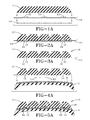
- Figures 1 through 5 and Figures 1A through 5A are provided to depict cross sections of a tread and cushion layer-containing tire to illustrate a tire tread with a plurality of lockable cavities and associated retreaded tire.
- an uncured tread rubber strip 1 is depicted with a heat deformable polymeric film 2 applied to its bottom surface to form a composite of the rubber strip 1 and polymeric film 2.
- a rigid metal plate 3 is also shown with a plurality of protrusions 6 of a trapezium cross-section extending from its upper surface and facing the aforesaid film 2 layer of the composite.
- the polymeric film 2 comprises a protective polymeric film of nylon 6 (melt point in a range of from 200°C to 220°C, ASTM D789) or nylon 6,6 (melt point in a range of from 250°C to 260°C, ASTM D789).
- a release agent coating of a polysiloxane is applied to the surfaces of tread strip 1 and protective film 2.
- the composite of uncured tread rubber strip 1 with its applied protective polymeric film 2 and metal plate 3 are pressed together in a suitable mold to cause the protrusions 6 of the trapezium design (short parallel side affixed to the metal plate) to press into and form a plurality of lockable cavities 7 of a trapezium configuration in the composite.
- the tread rubber strip 1 is then cured within the mold at an elevated temperature of about 180°C to form a cured tread strip 1C containing the protective polymeric film strip 2 and lockable cavities 7 in its bottom surface.
- the metal plate 3 is removed to leave the composite 9 composed of the cured tread 1C with its protective, removable polymeric film strip 2 on its bottom surface and the plurality of lockable cavities 7 of trapezium configurations in its bottom surface.
- the protective polymeric film strip 2 is peeled away from the bottom surface of the cured rubber tread strip 1C leaving the lockable cavities 7 exposed in its bottom surface. Further, a tire casing 5 is provided with its tread having been buffed off and an uncured cushion rubber layer 4 applied to its buffed surface.
- the cured rubber tread 1C is pressed onto the uncured rubber cushion 4 and the resulting assembly placed in an envelope and the enveloped assembly placed in a heated chamber (autoclave).
- the elevated temperature of the chamber and pressure exerted by the envelope causes portions 8 of the uncured rubber cushion 4 to extend into the lockable cavities 7 of the cured tread 1C, to form a retreaded tire 10 by curing the rubber cushion layer 4 to form a cured rubber cushion layer 4C and to thereby both bond the rubber cushion layer 4 to the tire carcass 5 and to create a mechano-chemical interlocking of the trapezium configured lockable cavities of the cured tire tread 1C and cured rubber cushion layer 4C.
- FIG 1A through FIG 5A are identical to the drawings.
- FIG 1A an uncured tread rubber strip 1 is depicted.
- a protective heat deformable polymeric film 11 having a plurality of protrusions 12 thereon its depicted rigid flat surfaced metal plate 13 is also shown.
- the polymeric film 11 I comprises a protective polymeric film of nylon 6 (melt point in a range of from 200°C to 220°C, ASTM D789) or nylon 6,6 (melt point in a range of from 250°C to 260°C, ASTM D789).
- a release agent coating of a polysiloxane is applied to the surfaces of the tread strip 1 and the protective film 11.
- the uncured tread rubber strip 1 the protective polymeric strip 11 is provided and fitted to the metal strip 13 to form a composite or plate thereof.
- the composite is placed in a suitable mold to cause the protrusions 12 to press into and form a plurality of lockable cavities 14 in the rubber tread strip while curing the rubber strip within the mold at an elevated temperature of about 180°C to form a cured tread strip 1C containing the protective polymeric film strip 11 and associated lockable cavities 14 in its bottom surface.
- the metal plate 13 is removed to leave a composite 16 composed of the cured tread 1C with its protective, removable polymeric film strip 11 on its bottom surface and the plurality of lockable cavities 14 in its bottom surface.
- the protective polymeric film strip 11 is peeled away from the bottom surface of the cured rubber tread strip 1C leaving the lockable cavities 14 exposed in its bottom surface. Further, a tire casing 5 is provided with its tread having been buffed off and an uncured cushion rubber layer 4 applied to its buffed surface.
- the cured rubber tread 1C is pressed onto the uncured rubber cushion 4 and the resulting assembly placed in an envelope and the enveloped assembly placed in a heated chamber (autoclave).
- the elevated temperature of the chamber and pressure exerted by the envelope causes portions 15 of the uncured rubber cushion 4 to extend into the lockable cavities 14 of the cured tread 1C, to form a retreaded tire 17 by curing the rubber cushion layer 4 to thereby both bond the now cured rubber cushion layer 4C to the tire carcass 5 and to create a mechano-chemical interlocking of lockable cavities 14 of the cured tire tread 1C and cured rubber cushion layer 4C.
- a rubber composition which comprises an elastomeric rubber composition comprising at least one conjugated diene-based elastomer, for example, cis 1,4-polyisoprene natural rubber and, optionally cis 1,4-polybutadiene rubber, which contains a bis-imide compound and tackifier resin ( US-A- 5,503,940 ).
- Said bis-imide compound comprises N,N'm-xylene biscitraconic imide, together with a tackifier as a phenol-formaldehyde tackifier resin.
- Test Samples Pre-cured tread rubber samples were prepared to evaluate their adhesion to a tread cushion rubber composition.
- uncured rubber samples in a shape of 6 inches by 6 inches with a thickness of 0.095 inch (about 15.2 x 15.2 x 0.24 cm) was die-cut from a milled 0.24 cm thick natural rubber based rubber strip.
- the rubber sample was in one sense, although smaller, similar to the uncured tread strip 1 depicted in FIG 1 .
- One side of the rubber sample was reinforced with a 0.033 inch (0.08 cm) thick treated fabric to add dimensional stability to the rubber sample.
- the protrusions had a trapezium shaped cross section similar to the protrusions depicted in FIG 1 of the Drawings.
- the depth of the trapezium shaped protrusion was 0.075 inch (0.2 cm) and the two sides were 0.372 inch (0.1 cm) and 0.5 inch (1.3cm) where the 0.375 inch (0.1 cm) side was affixed to the smooth surface of the metal plate.
- the plate was aligned in such a way that the metal strips were perpendicular to the cords of the fabric on the other side of the Test Sample.
- An uncured rubber sample in a shape of 6 inches by 6 inches with a thickness of about 0.095 inch (15.2 x 15.2 x 0.24 cm) was die-cut from a milled 0.24 cm thick rubber strip.
- the rubber sample was in one sense similar to the uncured cushion rubber strip 4 depicted in FIG 4 and comprise a 40 phr natural rubber and 60 phr cis 1,4-polybutadiene rubber based rubber composition containing an N,N'm-xylene biscitraconic imide, together with a tackifier resin (e.g. phenol-formaldehyde tackifier resin).
- a tackifier resin e.g. phenol-formaldehyde tackifier resin
Landscapes
- Engineering & Computer Science (AREA)
- Mechanical Engineering (AREA)
- Tires In General (AREA)
- Tyre Moulding (AREA)
- Heating, Cooling, Or Curing Plastics Or The Like In General (AREA)
Abstract
Description
- This invention relates to a cured rubber tire tread strip and methods of its preparation and use in the retreading of tires.
- Retreaded tires may be prepared by applying a pre-cured rubber tread (e.g. rubber tread strip which has been cured) to a circumferential uncured rubber layer, usually referred to as a "cushion layer", which overlays a buffed tire rubber carcass from which the original rubber tread has been removed by abrading it away, to form an assembly thereof and the assembly cured at an elevated temperature to form a cured retreaded rubber tire.
- The uncured cushion rubber layer may be applied to the buffed tire carcass where the cushion layer which has a surface with suitable building tack for which a need of applying a tack enhancing cement to the pre-cured rubber tread can be eliminated. Cushion rubber layers with building tack are described in
US-A-5,503,940 ,US-A- 6,186,202 andUS-A- 2005/0211351 . - For this invention, a cured rubber tread strip is provided with a plurality of lockable cavities (open cavities) in its bottom surface and which has a protective, polymeric film releasibly (removably) adhered to its bottom surface including the walls of its lockable cavities.
- For this invention, a retreaded tire is provided with a rubber tread having a plurality of lockable cavities wherein said tread is mechano-chemically bonded to a rubber tire carcass by its lockable cavities.
- Such cured rubber tread strip (which might sometimes be referred to as being a pre-cured rubber tread strip) which contains a plurality of lockable cavities molded into a bottom surface thereof may be prepared by:
- (A) applying a releasable film (a flat film which optionally has a textured surface) to a surface of an uncured rubber tread strip to form a composite thereof;
- (B) applying a mold release agent to the surfaces of said uncured tread rubber strip composite including at least a portion of the surface of said protective polymeric film on said rubber strip;
- (C) applying the release agent coated uncured tread rubber strip composite to a metal plate where said metal plate has:
- (1) a pluralilty of protrusions thereon to form an assembly thereof, or
- (2) a roughened surface to form an assembly thereof;
- (D) positioning said assembly in a suitable mold and applying an elevated temperature and pressure to:
- (1) cause said protrusions of said metal plate to extend into and form lockable cavities in the surface of rubber tread strip, or
- (2) cause said roughened surface to impart a roughened surface on the surface of said rubber tread strip;
- In such manner, the uncured rubber tread strip may be molded and pre-cured in a suitable mold together with the removable polymeric film which becomes molded onto (removably adhered to) a surface of the tread rubber (tread rubber strip) during its molding and curing operation.
- The removable film may then be removed from the pre-cured tread rubber strip to provide a "clean" rubber surface for the pre-cured rubber tread.
- In this manner, the "clean" rubber surface is provided without the necessity of buffing the rubber surface of the tread strip. This is seen herein as being a particular advantage in a sense that mechanically administered buffing, of abrading, submits the cured rubber surface to additional heat history and promotes surface oxidation of the buffed rubber surface.
- This overall procedure is entirely different from a past practice of buffing the tread strip surface, applying cement to the buffed surface and post-applying a protective plastic film (usually polyethylene film) to prevent contamination of the cemented surface. By the practice of this invention, surface contamination and atmospheric oxidation of the cured tread can be prevented, or retarded, during storage of the pre-cured rubber tread without a requirement of post application of a cement and protective plastic film.
- The lockable cavities for the tire tread strip are not limited to a particular shape and configuration.
- The individual lockable cavities in the tread strip may have a circular, oval, rectangular, longitudinal, serpentine, trapezium, or sinusoidal cross-sectional shape.
- For example, the individual lockable cavities in the tread strip may be individually dispersed, transversally oriented or longitudinally oriented insofar as the surface of the tread strip is concerned.
- Historically, a significant problem envisioned in simply applying a protective polymeric film for such purpose to the surface of the uncured rubber tread strip is that a typical thermoplastic film, such as for example a polyethylene film, is viewed herein as being unsatisfactory in a sense that such thermoplastic film does not have sufficient dimensional stability and resistance to tear for removal from the surface of the tread rubber strip after it is removed from the mold and, further, that it typically has a melting point (ASTM D98) significantly below 150°C and would therefore normally melt at typical rubber cure temperatures such as for example 150°C (for example, in a range of from 145°C to 180°C).
- Therefore, a suitable film for such purpose is viewed herein as being significantly dimensionally stable so that it can be removed from the surface of the pre-cured rubber tread surface after the uncured tread strip to which it has been applied has been molded and cured in a suitable mold at an elevated temperature (e.g. at least 145°C and in a range of, for example, from 145°C to 180°C).
- In practice, it has been found that a
film comprising nylon nylon 6 may be used in the sense of applying it to a surface of said uncured tread rubber strip to form a removable film bonded (physically adhered) to the bottom surface of the cured tread rubber strip. - The invention relates to a cured rubber tire tread strip according to claim 1, methods for preparing such a strip according to
claim 8 or 9, and the use of these methods for retreading a tire. - Dependent claims refer to preferred embodiments of the invention.
- In accordance a preferred embodiment of the invention a cured rubber tire tread strip is provided having a bottom surface with at least one of:
- (A) a plurality of lockable cavities, or
- (B) an embossed pattern to provide a roughened surface, and
- The lockable cavities in the cured or uncured tread rubber strip are lockable in a sense of being capable of interlocking (e.g. mechano-chemically interlocking) with a rubber cushion layer positioned on a tire cured rubber carcass wherein portions of said rubber cushion layer are caused to protrude into said lockable cavities following which the rubber cushion layer is cured to physically and chemically lock (e.g. secure) said tread rubber strip to said rubber cushion layer and thereby form a tire assembly comprised of a tire carcass and tread strip with said cushion layer therebetween.
- Significant aspects of this invention are at least threefold, namely providing of said lockable cavities in said rubber tread strip, or providing said roughened surfaced rubber tread strip, providing said adherent, bonded, releasable polymeric film to protect the surface of said rubber strip, and removal of said polymeric film from the cured rubber tread strip to thereby provide a clean rubber surface of the cured tread rubber strip and particularly the walls of said lockable cavities to make the surface and lockable cavities of the tread rubber strip available for interlocking with a cushion rubber layer for a tire.
- In a further preferred embodiment of this invention, a retreaded tire is provided which comprises a circumferential cured rubber tread layer having a surface which:
- (A) contains cavities which are mechano-chemically interlocked with a cushion rubber layer of a tire rubber carcass, and/or
- (B) contains an unbuffed embossed pattern which provides a roughened surface which is adhered to a cushion rubber layer of a tire rubber carcass.
- In a further preferred embodiment of this invention, a pre-cured tread for a retreaded tire is prepared by a process which comprises;
- (A) applying a protective removable polymeric film to an uncured rubber tread strip to form a composite thereof, wherein said polymeric film has a melt point, ASTM D789, higher or significantly higher than the cure temperature for said tread rubber strip (desirably a melt point of at least 190°C);
- (B) applying a mold release agent (e.g. a polysiloxane based release agent) to the surfaces of said uncured tread rubber strip composite including at least a portion of the surface of said protective polymeric film on said rubber strip;
- (C) applying the release agent coated uncured tread rubber strip composite to a metal plate where said metal plate has:
- (1) a plurality of protrusions thereon to form an assembly thereof, or
- (2) a roughened surface to form an assembly thereof;
- (D) positioning said assembly in a suitable mold and applying an elevated temperature and pressure to:
- (1) cause said protrusions of said metal plate to extend into and form lockable cavities in the surface of rubber tread strip, or
- (2) cause said roughened surface to impart a roughened surface on the surface of said rubber tread strip;
- Alternatively, a cured rubber tread strip is prepared by a process which comprises;
- (A) applying a protective removable polymeric film to an uncured rubber tread strip to form a composite thereof, wherein said polymeric film has a melt point, ASTM D789, higher or significantly higher than the cure temperature for said tread rubber strip (desirably a melt point of at least 190°C), wherein said protective polymeric film has:
- (1) a plurality of protrusions thereon, or
- (2) an embossed pattern to thereby provide a roughened surface thereon;
- (B) applying a mold release agent (e.g. a polysiloxane based release agent) to the surfaces of said uncured tread rubber strip composite including at least a portion of the surface of said protective polymeric film on said rubber strip;
- (C) applying the release agent coated uncured tread rubber strip composite to a flat surfaced metal plate;
- (D) positioning said assembly in a suitable mold and applying an elevated temperature and pressure to:
- (1) cause said protrusions of said protective polymeric film to extend into and form lockable cavities in the surface of the rubber tread strip, or
- (2) cause said roughened surface of said protective polymeric to impart a correspondingly roughened surface to the surface of the rubber tread strip;
- In practice, said polymeric film is not melted onto the tread rubber surface during said molding and curing of the tread rubber strip (because said polymeric film has a melt point significantly higher than the cure temperature for the tread rubber strip) and is thereby removable from the cured rubber tread.
- In further practice of this invention, the protective polymeric film may be removed from the surface of the cured rubber tread strip to yield a cured rubber tread strip having a clean unbuffed rubber surface free from mold release agent coating.
- In additional practice of this invention, a cured rubber tread strip may be provided having a clean, unbuffed surface free of mold release agent coating, particularly being prepared by said method.
- As hereinbefore mentioned, said protective polymeric film is applied to the surface of said uncured rubber tread strip.
- In a further preferred embodiment of this invention, a process of preparing a retreaded tire comprises:
- (A) applying a clean, (uncemented), unbuffed surface of a pre-cured rubber tire tread layer to a circumferential uncured adhesive rubber layer, without an adhesive coating therebetween, wherein said circumferential uncured adhesive rubber layer overlays a cured rubber tire carcass to form an assembly thereof, and
- (B) curing said assembly an elevated temperature and pressure to form a cured retreaded rubber tire;
wherein said pre-cured rubber tire tread layer is prepared by:- (1) applying a polymeric film to one surface of an uncured rubber tread strip to form a composite thereof;
- (2) applying a release agent coating to the surfaces of said composite, including at least a portion of said polymeric film;
- (3) applying the release agent coated uncured tread rubber strip composite to a metal plate where said metal plate has:
- (a) a pluralilty of protrusions thereon to form an assembly thereof, or
- (b) a roughened surface to form an assembly thereof;
- (4) positioning said assembly in a suitable mold and applying an elevated temperature and pressure to:
- (a) cause said protrusions of said metal plate to extend into and form lockable cavities in the surface of rubber tread strip, or
- (b) cause said roughened surface to impart a roughened surface on the surface of said rubber tread strip;
- (5) removing said polymeric film from said pre-cured rubber tread to
- Alternatively, said pre-cured rubber tread layer for said retreaded tire may be prepared by:
- (A) applying a protective removable polymeric film to an uncured rubber tread strip to form a composite thereof, wherein said polymeric film has a melt point, ASTM D789, significantly higher than the cure temperature for said tread rubber strip (desirably a melt point of at least 190°C), wherein said protective polymeric film has:
- (1) a plurality of protrusions thereon, or
- (2) an embossed pattern to thereby provide a roughened surface thereon;
- (B) applying a mold release agent (e.g. a polysiloxane based release agent) to the surfaces of said uncured tread rubber strip composite including at least a portion of the surface of said protective polymeric film on said rubber strip;
- (C) applying the release agent coated uncured tread rubber strip composite to a flat surfaced metal plate;
- (D) positioning said assembly in a suitable mold and applying an elevated temperature and pressure to:
- (1) cause said protrusions of said protective polymeric film to extend into and form lockable cavities in the surface of the rubber tread strip, or
- (2) cause said roughened surface of said protective polymeric to impart a correspondingly roughened surface to the surface of the rubber tread strip;
- In practice, said polymeric film may be, for example, a nylon film.
- Representative of nylon based polymeric films are, for example:
- (A) films of ring opening polymerized lactams having from 6 to 12 carbon atoms (e.g. caprolactam) such as, for example,
nylon 6 as a poly(imino(1-oxohexamethylene)) (polyamide-6) typically having a melting point in a range in a range of from 200°C to 220°C (ASTM D789), from the Honeywell Company, and - (B) films of a polycondensate of a diamine and dicarboxylic acid such as, for example,
nylon - In one embodiment, said circumferential cushion rubber layer composition comprises, for example, a layer of an elastomeric rubber composition comprising at least one conjugated diene-based elastomer, for example, cis 1,4-polyisoprene rubber (usually natural rubber) and, optionally cis 1,4-polybutadiene rubber, which contains a bis-imide compound and tackifier resin (
US-A- 5,503,940 ). For example, said bis-imide compound may comprise an N,N'm-xylene biscitraconic imide as Perkalink 900™, N,N'-m-phenylene bismaleimide, 1,1'(methylenedi-4,1-phenylene) bis maleimide, or combinations thereof (preferably comprising said N,N'm-xylene biscitraconic imide), the tackifier as a phenol-formaldehyde tackifier resin. - A significant aspect of the invention is considered herein as both providing a process of providing an improved pre-cured rubber tread with its plurality of lockable cavities, in the production of a cured rubber tread strip retreading a rubber tire with a cured rubber tread strip having a clean, unbuffed surface without a cement coating.
- A further significant aspect of the invention is considered herein as both providing an improved tire retreading process and a resultant retread tire.
- This is considered herein as being significant in a sense of providing a more secure mechano-chemical bonding of the lockable cavity-containing rubber tread to the tire carcass with the intermediate cushion layer.
- Drawings are provided for a further understanding of the invention. In the Drawings,
Figures 1 through 5 andFigures 1A through 5A are provided to depict cross sections of a tread and cushion layer-containing tire to illustrate a tire tread with a plurality of lockable cavities and associated retreaded tire. - In
FIG 1 , an uncured tread rubber strip 1 is depicted with a heat deformable polymeric film 2 applied to its bottom surface to form a composite of the rubber strip 1 and polymeric film 2. Arigid metal plate 3 is also shown with a plurality ofprotrusions 6 of a trapezium cross-section extending from its upper surface and facing the aforesaid film 2 layer of the composite. The polymeric film 2 comprises a protective polymeric film of nylon 6 (melt point in a range of from 200°C to 220°C, ASTM D789) ornylon 6,6 (melt point in a range of from 250°C to 260°C, ASTM D789). Preferably, a release agent coating of a polysiloxane is applied to the surfaces of tread strip 1 and protective film 2. - In
FIG 2 , the composite of uncured tread rubber strip 1 with its applied protective polymeric film 2 andmetal plate 3 are pressed together in a suitable mold to cause theprotrusions 6 of the trapezium design (short parallel side affixed to the metal plate) to press into and form a plurality of lockable cavities 7 of a trapezium configuration in the composite. The tread rubber strip 1 is then cured within the mold at an elevated temperature of about 180°C to form a curedtread strip 1C containing the protective polymeric film strip 2 and lockable cavities 7 in its bottom surface. - In
FIG 3 , themetal plate 3 is removed to leave the composite 9 composed of the curedtread 1C with its protective, removable polymeric film strip 2 on its bottom surface and the plurality of lockable cavities 7 of trapezium configurations in its bottom surface. - In
FIG 4 , the protective polymeric film strip 2 is peeled away from the bottom surface of the curedrubber tread strip 1C leaving the lockable cavities 7 exposed in its bottom surface. Further, atire casing 5 is provided with its tread having been buffed off and an uncured cushion rubber layer 4 applied to its buffed surface. - In
FIG 5 , the curedrubber tread 1C is pressed onto the uncured rubber cushion 4 and the resulting assembly placed in an envelope and the enveloped assembly placed in a heated chamber (autoclave). The elevated temperature of the chamber and pressure exerted by the envelope causesportions 8 of the uncured rubber cushion 4 to extend into the lockable cavities 7 of the curedtread 1C, to form a retreadedtire 10 by curing the rubber cushion layer 4 to form a curedrubber cushion layer 4C and to thereby both bond the rubber cushion layer 4 to thetire carcass 5 and to create a mechano-chemical interlocking of the trapezium configured lockable cavities of the curedtire tread 1C and curedrubber cushion layer 4C. - In
FIG 1A , an uncured tread rubber strip 1 is depicted. A protective heatdeformable polymeric film 11 having a plurality ofprotrusions 12 thereon its depicted rigid flat surfacedmetal plate 13 is also shown. The polymeric film 11 I comprises a protective polymeric film of nylon 6 (melt point in a range of from 200°C to 220°C, ASTM D789) ornylon 6,6 (melt point in a range of from 250°C to 260°C, ASTM D789). Preferably, a release agent coating of a polysiloxane is applied to the surfaces of the tread strip 1 and theprotective film 11. - In
FIG 2A , the uncured tread rubber strip 1 theprotective polymeric strip 11 is provided and fitted to themetal strip 13 to form a composite or plate thereof. The composite is placed in a suitable mold to cause theprotrusions 12 to press into and form a plurality oflockable cavities 14 in the rubber tread strip while curing the rubber strip within the mold at an elevated temperature of about 180°C to form a curedtread strip 1C containing the protectivepolymeric film strip 11 and associatedlockable cavities 14 in its bottom surface. - In
FIG 3A , themetal plate 13 is removed to leave a composite 16 composed of the curedtread 1C with its protective, removablepolymeric film strip 11 on its bottom surface and the plurality oflockable cavities 14 in its bottom surface. - In
FIG 4A , the protectivepolymeric film strip 11 is peeled away from the bottom surface of the curedrubber tread strip 1C leaving thelockable cavities 14 exposed in its bottom surface. Further, atire casing 5 is provided with its tread having been buffed off and an uncured cushion rubber layer 4 applied to its buffed surface. - In
FIG 5A , the curedrubber tread 1C is pressed onto the uncured rubber cushion 4 and the resulting assembly placed in an envelope and the enveloped assembly placed in a heated chamber (autoclave). The elevated temperature of the chamber and pressure exerted by the envelope causesportions 15 of the uncured rubber cushion 4 to extend into thelockable cavities 14 of the curedtread 1C, to form a retreadedtire 17 by curing the rubber cushion layer 4 to thereby both bond the now curedrubber cushion layer 4C to thetire carcass 5 and to create a mechano-chemical interlocking oflockable cavities 14 of the curedtire tread 1C and curedrubber cushion layer 4C. - For the cushion rubber layer 4, a rubber composition is provided which comprises an elastomeric rubber composition comprising at least one conjugated diene-based elastomer, for example, cis 1,4-polyisoprene natural rubber and, optionally cis 1,4-polybutadiene rubber, which contains a bis-imide compound and tackifier resin (
US-A- 5,503,940 ). Said bis-imide compound comprises N,N'm-xylene biscitraconic imide, together with a tackifier as a phenol-formaldehyde tackifier resin. - The following example is provided to further illustrate the invention. The parts and percentages, if referenced, are by weight unless otherwise indicated.
- Pre-cured tread rubber samples (Test Samples) were prepared to evaluate their adhesion to a tread cushion rubber composition.
- For the adhesion evaluation, uncured rubber samples in a shape of 6 inches by 6 inches with a thickness of 0.095 inch (about 15.2 x 15.2 x 0.24 cm) was die-cut from a milled 0.24 cm thick natural rubber based rubber strip. The rubber sample was in one sense, although smaller, similar to the uncured tread strip 1 depicted in
FIG 1 . One side of the rubber sample was reinforced with a 0.033 inch (0.08 cm) thick treated fabric to add dimensional stability to the rubber sample. - An undrawn nylon-6 film was applied to the non-fabric side of an uncured rubber Test Sample. The nylon-6 film side of the Test Sample was pressed against a smooth surface of a metal plate and the Test Sample cured (8 minutes at 182°C and pressure of 0.7 MPa) to form a smooth surfaced pre-cured Test Sample.
- An undrawn nylon-6 film was applied to the non-fabric side of an uncured rubber Test Sample. The nylon-6 film side of the Test Sample was pressed against a rough, textured surface of a metal plate and the Test Sample cured (8 minutes at 182°C and pressure of 0.7 MPa) to form a smooth surfaced pre-cured Test Sample.
- An undrawn nylon-6 film was applied to the non-fabric side of an uncured rubber Test Sample. The nylon-6 film side of the Test Sample was pressed against a metal plate with a surface containing a metal strip as a protrusion of a trapezium configuration affixed to and extending outward from the plate to form a plurality of lockable cavities in the Test Sample surface - and the Test Sample cured (8 minutes at 182°C and pressure of 0.7 MPa) to form a pre-cured Test Sample containing a plurality of lockable cavities in its surface. The protrusions in the metal plate were prepared by affixing two 6 inch (15.2 cm) long metal strips to a smooth metal plate. The protrusions had a trapezium shaped cross section similar to the protrusions depicted in
FIG 1 of the Drawings. The depth of the trapezium shaped protrusion was 0.075 inch (0.2 cm) and the two sides were 0.372 inch (0.1 cm) and 0.5 inch (1.3cm) where the 0.375 inch (0.1 cm) side was affixed to the smooth surface of the metal plate. The plate was aligned in such a way that the metal strips were perpendicular to the cords of the fabric on the other side of the Test Sample. - An uncured rubber sample in a shape of 6 inches by 6 inches with a thickness of about 0.095 inch (15.2 x 15.2 x 0.24 cm) was die-cut from a milled 0.24 cm thick rubber strip. The rubber sample was in one sense similar to the uncured cushion rubber strip 4 depicted in
FIG 4 and comprise a 40 phr natural rubber and 60 phr cis 1,4-polybutadiene rubber based rubber composition containing an N,N'm-xylene biscitraconic imide, together with a tackifier resin (e.g. phenol-formaldehyde tackifier resin). One side of the rubber sample was reinforced with a fabric to add dimensional stability to the rubber sample. - After removal of the nylon-6 protective removable film, the resulting clean surfaces of the
Test Sample Pieces 1, 2 and 3, respectively, were individually pressed against a Cushion Rubber Sample Piece 4 with the fabric cords being aligned in the same direction and then cured at 8 minutes at 182°C and pressure of 0.7 MPa. Strips of 2.54 cm width were died-out along the cord direction of the fabric and each Test piece was 2.54 cm wide by 15.24 cm long. The Test pieces were pulled using an Instron instrument and adhesions, force to pull them apart, (steady state average peak load in N/cm) were measured at room temperature (23°C) and at 95°C at a cross head speed of 50.8 cm/min. The results are shown in Table 1.Table 1 Adhesion for Smooth, Rough and Lockable Cavity Surfaced Test Samples Property Smooth Rough Cavity Adhesion at Room Temperature (N/cm) 109 191 281 Adhesion at 95°C (N/cm) 37 56 110 - It can be seen from Table 1 that an increase in room temperature adhesion of about 75 percent and of about 158 percent was obtained by the change in the surface of the cured rubber strip from being smooth to being rough to containing the lockable cavity.
- It can further be seen from Table 1 that an increase in 95°C adhesion of about 51 percent and of about 197 percent was obtained by the change in the surface of the cured rubber strip being smooth to being rough to containing the lockable cavity.
- These are considered herein to be very significant increases in the representative adhesions.
Claims (15)
- A cured rubber tire tread strip, the strip (1C) comprising a bottom surface comprising at least one of:(A) a plurality of lockable cavities (7, 14), and/or(B) an embossed pattern.
- The cured rubber tire tread strip of claim 1 wherein the embossed pattern provides a rough surface.
- The cured rubber tire tread strip of at least one of the previous claims having a polymeric film (2, 11) removably adhered to the bottom surface and/or to the surface of the lockable cavities (7, 14) or the surface of the embossed pattern.
- The cured rubber tire tread strip of claim 3 wherein the polymeric film (2, 11), upon its removal from the cured rubber tire tread strip (1C) and associated walls of the lockable cavities (7, 14) or the embossed pattern, provides a clean rubber bottom surface of the cured rubber tire tread strip (1C), including the walls of the lockable cavities (7, 14) or the embossed pattern, to thereby make the bottom surface and the lockable cavities (7, 14) or the embossed pattern of the cured rubber tire tread strip (1C) available for mechano-chemical interlocking with an uncured rubber cushion layer (4) of a tire.
- The cured rubber tire tread strip of at least one of the previous claims wherein the lockable cavities (7, 14) have a cross sectional shape comprising any of a circular, oval, rectangular, longitudinal, serpentine, trapezium and sinusoidal cross-sectional shape.
- The cured rubber tire tread strip of at least one of the previous claims wherein the lockable cavities (7, 14) are individually dispersed, transversally oriented or longitudinally oriented insofar as the bottom surface is concerned.
- The cured rubber tread strip of at least one of the previous claims wherein the polymeric film (2, 11) comprises at least one of:(i) nylon 6 as a poly((imino(1-oxohexamethylene)) (polyamide-6);(ii) nylon 6,6 as a poly(iminohexamethyleneiminoadipoyl) (polyamide-6,6);(iii) open ring polymerized lactams having from 6 to 12 carbon atoms having a melting point in a range of from 200°C to 220°C (ASTM D789);(iv) a polycondensate of a diamine and dicarboxylic acid as a poly(iminohexamethyleneiminoadipoyl) (polyamide-6,6) having a melting point in a range of from 250°C to 260°C (ASTM D789);and/or wherein the polymeric film (2, 11) has a melting point (ASTM D789) higher or significantly higher than the cure temperature applied for curing the uncured rubber tire tread strip (1).
- A method of preparing a cured rubber tire tread strip, the method comprising:(A) applying a removable polymeric film (2) to a bottom surface of an uncured rubber tire tread strip (1) to form a composite (9) thereof;(B) providing a metal plate (3) comprising a plurality of protrusions (6) thereon and/or comprising a roughened surface;(C) forming an assembly of the composite (9) and the metal plate (3);(D) positioning the assembly in a mold and applying an elevated temperature and pressure to:and to cure the lockable cavity-containing or roughened surface-containing, uncured rubber tire tread strip (1) to form a cured rubber tire tread strip (1C) comprising a plurality of lockable cavities (7) or a roughened surface on its bottom surface and the removable polymeric film (2) molded on the bottom surface of the cured rubber tire tread strip (1 C) including the walls of its lockable cavities (7) or the roughened surface.(1) cause the protrusions (6) of the metal plate (3) to extend into and form lockable cavities (7) in the bottom surface of the uncured rubber tire tread strip (1), and/or(2) cause the roughened surface to impart a roughened surface on the surface of the uncured rubber tire tread strip (1);
- A method of preparing a cured rubber tire tread strip, the method comprising:(A) applying a removable polymeric film (11) to a bottom surface of an uncured rubber tire tread strip (1) to form a composite (16) thereof, wherein the removable polymeric film (11) has:(1) a plurality of protrusions (12) thereon, and/or(2) an embossed pattern to thereby provide a roughened surface thereon;(B) providing a flat surfaced metal plate (13);(C) forming an assembly of the composite (16) and the metal plate (13);(D) positioning the assembly in a mold and applying an elevated temperature and pressure to:and to cure the lockable cavity-containing or roughened surface-containing, uncured rubber tire tread strip (1) to form a cured rubber tire tread strip (1C) comprising a plurality of lockable cavities (14) or a roughened surface on its bottom surface and the removable polymeric film (11) molded on the bottom surface of the cured rubber tire tread strip (1C) including the walls of its lockable cavities (14) or the roughened surface.(1) cause the protrusions (12) of the removable polymeric film (11) to extend into and form lockable cavities (14) in the bottom surface of the uncured rubber tire tread strip (1), and/or(2) cause the roughened surface of the removable polymeric film (11) to impart a roughened surface on the surface of the uncured rubber tire tread strip (1);
- The method of claim 8 or 9, further comprising applying a mold release agent to a surface of the composite (9, 16) including at least a portion of the surface of the polymeric film (2, 11), and forming the assembly of the composite (9, 16) and the metal plate (3, 13) with the surface of the composite (9, 16) having the mold release agent thereon.
- The method of claim 8, 9 or 10 wherein the polymeric film (2, 11) has a melting point (ASTM D789) higher or significantly higher than the cure temperature applied for curing the uncured rubber tire tread strip (1).
- The method of claim 8, 9, 10 or 11 further comprising removing the removable polymeric film (2, 11) from the cured rubber tire tread strip (1 C), including the walls of the lockable cavities (7, 14) to yield a cured rubber tire tread strip, and associated walls of the lockable cavities (7, 14), having a clean surface which is in particular free from a mold release agent or a mold release agent coating.
- The method of claim 12 further comprising providing a tire carcass (5) with an uncured rubber cushion layer (4) on its surface and pressing the cured rubber tire tread strip (1 C) with the clean surface on the uncured rubber cushion layer (4).
- A cured rubber tire tread strip (1C) prepared by the method of any of the previous claims 8 to 13.
- Use of the method of at least one of the claims 8 to 13 for retreading a tire.
Applications Claiming Priority (1)
| Application Number | Priority Date | Filing Date | Title |
|---|---|---|---|
| US12/337,699 US20100154946A1 (en) | 2008-12-18 | 2008-12-18 | Tire tread strip and method of preparation |
Publications (3)
| Publication Number | Publication Date |
|---|---|
| EP2199109A2 true EP2199109A2 (en) | 2010-06-23 |
| EP2199109A3 EP2199109A3 (en) | 2010-09-08 |
| EP2199109B1 EP2199109B1 (en) | 2013-05-22 |
Family
ID=42046297
Family Applications (1)
| Application Number | Title | Priority Date | Filing Date |
|---|---|---|---|
| EP09178303.5A Not-in-force EP2199109B1 (en) | 2008-12-18 | 2009-12-08 | Tire tread strip and methods of preparation |
Country Status (2)
| Country | Link |
|---|---|
| US (2) | US20100154946A1 (en) |
| EP (1) | EP2199109B1 (en) |
Cited By (2)
| Publication number | Priority date | Publication date | Assignee | Title |
|---|---|---|---|---|
| CN105492194A (en) * | 2013-08-30 | 2016-04-13 | 米其林集团总公司 | Removable connector for pre-cured tread and methods |
| EP2658731A4 (en) * | 2010-12-29 | 2016-10-26 | Michelin Rech Tech | METHODS OF RETRIEVING A TIRE |
Families Citing this family (5)
| Publication number | Priority date | Publication date | Assignee | Title |
|---|---|---|---|---|
| EP2748016A4 (en) * | 2011-09-30 | 2015-12-23 | Michelin Rech Tech | METHODS AND APPARATUS FOR VULCANIZING RECHAPED TIRES |
| US20130204655A1 (en) * | 2012-02-07 | 2013-08-08 | Scott Damon | System and method for customizing and manufacturing tires near point-of-sale |
| WO2014011383A1 (en) * | 2012-07-09 | 2014-01-16 | Bridgestone Americas Tire Operations, Llc | Envelope and method for retreading tires |
| WO2014145894A1 (en) * | 2013-03-15 | 2014-09-18 | Compagnie Generale Des Etablissements | Groove bottom design to allow undertread reduction |
| CN105492193B (en) | 2013-08-30 | 2018-04-13 | 米其林集团总公司 | Retreaded tire tread with improved submerged voids |
Citations (7)
| Publication number | Priority date | Publication date | Assignee | Title |
|---|---|---|---|---|
| DE1228525B (en) | 1958-03-06 | 1966-11-10 | Lemfoerder Kunststoff G M B H | Motor vehicle tires |
| GB1510186A (en) | 1974-09-24 | 1978-05-10 | Republic Rubber Ind Ltd | Retreading of tyres |
| JPH06286419A (en) | 1993-02-04 | 1994-10-11 | Taitaro Fujii | Tire |
| US5503940A (en) | 1994-10-24 | 1996-04-02 | The Goodyear Tire & Rubber Company | Elastomeric laminates containing a solventless elastomeric adhesive composition |
| JPH0970903A (en) | 1995-06-26 | 1997-03-18 | Yokohama Rubber Co Ltd:The | Precure tread for regenerated tire and manufacture thereof |
| US6186202B1 (en) | 1996-02-20 | 2001-02-13 | The Goodyear Tire & Rubber Company | Silica reinforced solventless elastomeric adhesive compositions |
| US20050211351A1 (en) | 2004-03-24 | 2005-09-29 | Majumdar Ramendra N | Tire with detectable carcass cushion layer and use thereof to facilitate tire carcass retreading |
Family Cites Families (4)
| Publication number | Priority date | Publication date | Assignee | Title |
|---|---|---|---|---|
| US3970131A (en) * | 1972-09-09 | 1976-07-20 | Vakuum Vulk Holdings Ltd. | Tread for the recapping of tires and method of making the same |
| US7153381B2 (en) * | 1999-07-30 | 2006-12-26 | The Goodyear Tire & Rubber Company | Cured applique or label with protective film on arcuate sidewall or tread of pneumatic tire |
| US9545767B2 (en) * | 2005-01-24 | 2017-01-17 | Computype, Inc. | Permanent marking of molded rubber products |
| US20090159165A1 (en) * | 2007-12-20 | 2009-06-25 | Herberger Sr James Robert | Tire tread composite and retreaded rubber tire |
-
2008
- 2008-12-18 US US12/337,699 patent/US20100154946A1/en not_active Abandoned
-
2009
- 2009-12-08 EP EP09178303.5A patent/EP2199109B1/en not_active Not-in-force
-
2012
- 2012-04-02 US US13/437,421 patent/US20120186725A1/en not_active Abandoned
Patent Citations (7)
| Publication number | Priority date | Publication date | Assignee | Title |
|---|---|---|---|---|
| DE1228525B (en) | 1958-03-06 | 1966-11-10 | Lemfoerder Kunststoff G M B H | Motor vehicle tires |
| GB1510186A (en) | 1974-09-24 | 1978-05-10 | Republic Rubber Ind Ltd | Retreading of tyres |
| JPH06286419A (en) | 1993-02-04 | 1994-10-11 | Taitaro Fujii | Tire |
| US5503940A (en) | 1994-10-24 | 1996-04-02 | The Goodyear Tire & Rubber Company | Elastomeric laminates containing a solventless elastomeric adhesive composition |
| JPH0970903A (en) | 1995-06-26 | 1997-03-18 | Yokohama Rubber Co Ltd:The | Precure tread for regenerated tire and manufacture thereof |
| US6186202B1 (en) | 1996-02-20 | 2001-02-13 | The Goodyear Tire & Rubber Company | Silica reinforced solventless elastomeric adhesive compositions |
| US20050211351A1 (en) | 2004-03-24 | 2005-09-29 | Majumdar Ramendra N | Tire with detectable carcass cushion layer and use thereof to facilitate tire carcass retreading |
Cited By (3)
| Publication number | Priority date | Publication date | Assignee | Title |
|---|---|---|---|---|
| EP2658731A4 (en) * | 2010-12-29 | 2016-10-26 | Michelin Rech Tech | METHODS OF RETRIEVING A TIRE |
| CN105492194A (en) * | 2013-08-30 | 2016-04-13 | 米其林集团总公司 | Removable connector for pre-cured tread and methods |
| CN105492194B (en) * | 2013-08-30 | 2017-06-06 | 米其林集团总公司 | For the removable connector and method of precuring tyre surface |
Also Published As
| Publication number | Publication date |
|---|---|
| US20120186725A1 (en) | 2012-07-26 |
| EP2199109B1 (en) | 2013-05-22 |
| US20100154946A1 (en) | 2010-06-24 |
| EP2199109A3 (en) | 2010-09-08 |
Similar Documents
| Publication | Publication Date | Title |
|---|---|---|
| EP2199110B1 (en) | Retreaded tire and methods of preparation | |
| EP2199109B1 (en) | Tire tread strip and methods of preparation | |
| CN101462468B (en) | Tire thread composite and retreaded rubber tire | |
| US20040115299A1 (en) | Seal-less reusable vacuum bag | |
| JP3240208B2 (en) | Pneumatic tire and method for providing pneumatic tire | |
| JP5329649B2 (en) | Turbine blade half manufacturing method, turbine blade half, turbine blade manufacturing method, and turbine blade | |
| US11135824B2 (en) | Multi-stage debulk and compaction of thick composite repair laminates | |
| EP1579985B1 (en) | Method of retreading a tire having a detectable carcass cushion layer | |
| US6598634B1 (en) | Cured tire including encapsulated high modulus composite | |
| JPH1193141A (en) | Fender and its manufacture | |
| KR940009006B1 (en) | Belt construction and method of making the same | |
| CN103228430B (en) | Airtyred manufacture method | |
| US4671837A (en) | Process for forming composite molds to be used in the manufacture of composite parts | |
| US5645674A (en) | Methods for achieving improved bond strength between unvulcanized and vulcanized rubbers | |
| JPH10329259A (en) | Insert molding and molding method | |
| US4247513A (en) | Method of making laminated sole | |
| JP2010509097A (en) | Automatic release device for flat rubber red | |
| EP0928241A1 (en) | Improvements in or relating to pressure transmitters for use in the production of composite components | |
| JP2001138408A (en) | Splicing method for extrudable retreaded tire | |
| EP4335631B1 (en) | Composite structure assembly and non-pneumatic tire production | |
| JP2627833B2 (en) | Method for producing rubber / rubber adhesive composite | |
| CN110654165A (en) | Antiskid rubber wheel and production process thereof | |
| JPH09239855A (en) | Manufacture of composite laminate | |
| CA2118786A1 (en) | Methods for achieving improved bond strength between unvulcanized and vulcanized rubbers | |
| JPH03120033A (en) | Regenerating method for radial tire |
Legal Events
| Date | Code | Title | Description |
|---|---|---|---|
| PUAI | Public reference made under article 153(3) epc to a published international application that has entered the european phase |
Free format text: ORIGINAL CODE: 0009012 |
|
| AK | Designated contracting states |
Kind code of ref document: A2 Designated state(s): AT BE BG CH CY CZ DE DK EE ES FI FR GB GR HR HU IE IS IT LI LT LU LV MC MK MT NL NO PL PT RO SE SI SK SM TR |
|
| AX | Request for extension of the european patent |
Extension state: AL BA RS |
|
| PUAL | Search report despatched |
Free format text: ORIGINAL CODE: 0009013 |
|
| AK | Designated contracting states |
Kind code of ref document: A3 Designated state(s): AT BE BG CH CY CZ DE DK EE ES FI FR GB GR HR HU IE IS IT LI LT LU LV MC MK MT NL NO PL PT RO SE SI SK SM TR |
|
| AX | Request for extension of the european patent |
Extension state: AL BA RS |
|
| RIC1 | Information provided on ipc code assigned before grant |
Ipc: B29D 30/56 20060101ALI20100730BHEP Ipc: B60C 11/02 20060101AFI20100401BHEP |
|
| 17P | Request for examination filed |
Effective date: 20110308 |
|
| GRAP | Despatch of communication of intention to grant a patent |
Free format text: ORIGINAL CODE: EPIDOSNIGR1 |
|
| GRAS | Grant fee paid |
Free format text: ORIGINAL CODE: EPIDOSNIGR3 |
|
| GRAA | (expected) grant |
Free format text: ORIGINAL CODE: 0009210 |
|
| AK | Designated contracting states |
Kind code of ref document: B1 Designated state(s): AT BE BG CH CY CZ DE DK EE ES FI FR GB GR HR HU IE IS IT LI LT LU LV MC MK MT NL NO PL PT RO SE SI SK SM TR |
|
| REG | Reference to a national code |
Ref country code: GB Ref legal event code: FG4D |
|
| REG | Reference to a national code |
Ref country code: CH Ref legal event code: EP |
|
| REG | Reference to a national code |
Ref country code: AT Ref legal event code: REF Ref document number: 613006 Country of ref document: AT Kind code of ref document: T Effective date: 20130615 |
|
| REG | Reference to a national code |
Ref country code: IE Ref legal event code: FG4D |
|
| REG | Reference to a national code |
Ref country code: DE Ref legal event code: R096 Ref document number: 602009015847 Country of ref document: DE Effective date: 20130718 |
|
| REG | Reference to a national code |
Ref country code: AT Ref legal event code: MK05 Ref document number: 613006 Country of ref document: AT Kind code of ref document: T Effective date: 20130522 |
|
| REG | Reference to a national code |
Ref country code: LT Ref legal event code: MG4D |
|
| PG25 | Lapsed in a contracting state [announced via postgrant information from national office to epo] |
Ref country code: IS Free format text: LAPSE BECAUSE OF FAILURE TO SUBMIT A TRANSLATION OF THE DESCRIPTION OR TO PAY THE FEE WITHIN THE PRESCRIBED TIME-LIMIT Effective date: 20130922 Ref country code: LT Free format text: LAPSE BECAUSE OF FAILURE TO SUBMIT A TRANSLATION OF THE DESCRIPTION OR TO PAY THE FEE WITHIN THE PRESCRIBED TIME-LIMIT Effective date: 20130522 Ref country code: NO Free format text: LAPSE BECAUSE OF FAILURE TO SUBMIT A TRANSLATION OF THE DESCRIPTION OR TO PAY THE FEE WITHIN THE PRESCRIBED TIME-LIMIT Effective date: 20130822 Ref country code: GR Free format text: LAPSE BECAUSE OF FAILURE TO SUBMIT A TRANSLATION OF THE DESCRIPTION OR TO PAY THE FEE WITHIN THE PRESCRIBED TIME-LIMIT Effective date: 20130823 Ref country code: SE Free format text: LAPSE BECAUSE OF FAILURE TO SUBMIT A TRANSLATION OF THE DESCRIPTION OR TO PAY THE FEE WITHIN THE PRESCRIBED TIME-LIMIT Effective date: 20130522 Ref country code: ES Free format text: LAPSE BECAUSE OF FAILURE TO SUBMIT A TRANSLATION OF THE DESCRIPTION OR TO PAY THE FEE WITHIN THE PRESCRIBED TIME-LIMIT Effective date: 20130902 Ref country code: FI Free format text: LAPSE BECAUSE OF FAILURE TO SUBMIT A TRANSLATION OF THE DESCRIPTION OR TO PAY THE FEE WITHIN THE PRESCRIBED TIME-LIMIT Effective date: 20130522 Ref country code: PT Free format text: LAPSE BECAUSE OF FAILURE TO SUBMIT A TRANSLATION OF THE DESCRIPTION OR TO PAY THE FEE WITHIN THE PRESCRIBED TIME-LIMIT Effective date: 20130923 Ref country code: AT Free format text: LAPSE BECAUSE OF FAILURE TO SUBMIT A TRANSLATION OF THE DESCRIPTION OR TO PAY THE FEE WITHIN THE PRESCRIBED TIME-LIMIT Effective date: 20130522 Ref country code: SI Free format text: LAPSE BECAUSE OF FAILURE TO SUBMIT A TRANSLATION OF THE DESCRIPTION OR TO PAY THE FEE WITHIN THE PRESCRIBED TIME-LIMIT Effective date: 20130522 |
|
| REG | Reference to a national code |
Ref country code: NL Ref legal event code: VDEP Effective date: 20130522 |
|
| PG25 | Lapsed in a contracting state [announced via postgrant information from national office to epo] |
Ref country code: PL Free format text: LAPSE BECAUSE OF FAILURE TO SUBMIT A TRANSLATION OF THE DESCRIPTION OR TO PAY THE FEE WITHIN THE PRESCRIBED TIME-LIMIT Effective date: 20130522 Ref country code: HR Free format text: LAPSE BECAUSE OF FAILURE TO SUBMIT A TRANSLATION OF THE DESCRIPTION OR TO PAY THE FEE WITHIN THE PRESCRIBED TIME-LIMIT Effective date: 20130522 Ref country code: BG Free format text: LAPSE BECAUSE OF FAILURE TO SUBMIT A TRANSLATION OF THE DESCRIPTION OR TO PAY THE FEE WITHIN THE PRESCRIBED TIME-LIMIT Effective date: 20130822 |
|
| PG25 | Lapsed in a contracting state [announced via postgrant information from national office to epo] |
Ref country code: LV Free format text: LAPSE BECAUSE OF FAILURE TO SUBMIT A TRANSLATION OF THE DESCRIPTION OR TO PAY THE FEE WITHIN THE PRESCRIBED TIME-LIMIT Effective date: 20130522 |
|
| PG25 | Lapsed in a contracting state [announced via postgrant information from national office to epo] |
Ref country code: SK Free format text: LAPSE BECAUSE OF FAILURE TO SUBMIT A TRANSLATION OF THE DESCRIPTION OR TO PAY THE FEE WITHIN THE PRESCRIBED TIME-LIMIT Effective date: 20130522 Ref country code: BE Free format text: LAPSE BECAUSE OF FAILURE TO SUBMIT A TRANSLATION OF THE DESCRIPTION OR TO PAY THE FEE WITHIN THE PRESCRIBED TIME-LIMIT Effective date: 20130522 Ref country code: CZ Free format text: LAPSE BECAUSE OF FAILURE TO SUBMIT A TRANSLATION OF THE DESCRIPTION OR TO PAY THE FEE WITHIN THE PRESCRIBED TIME-LIMIT Effective date: 20130522 Ref country code: DK Free format text: LAPSE BECAUSE OF FAILURE TO SUBMIT A TRANSLATION OF THE DESCRIPTION OR TO PAY THE FEE WITHIN THE PRESCRIBED TIME-LIMIT Effective date: 20130522 Ref country code: EE Free format text: LAPSE BECAUSE OF FAILURE TO SUBMIT A TRANSLATION OF THE DESCRIPTION OR TO PAY THE FEE WITHIN THE PRESCRIBED TIME-LIMIT Effective date: 20130522 |
|
| PG25 | Lapsed in a contracting state [announced via postgrant information from national office to epo] |
Ref country code: NL Free format text: LAPSE BECAUSE OF FAILURE TO SUBMIT A TRANSLATION OF THE DESCRIPTION OR TO PAY THE FEE WITHIN THE PRESCRIBED TIME-LIMIT Effective date: 20130522 Ref country code: RO Free format text: LAPSE BECAUSE OF FAILURE TO SUBMIT A TRANSLATION OF THE DESCRIPTION OR TO PAY THE FEE WITHIN THE PRESCRIBED TIME-LIMIT Effective date: 20130522 |
|
| PLBE | No opposition filed within time limit |
Free format text: ORIGINAL CODE: 0009261 |
|
| STAA | Information on the status of an ep patent application or granted ep patent |
Free format text: STATUS: NO OPPOSITION FILED WITHIN TIME LIMIT |
|
| 26N | No opposition filed |
Effective date: 20140225 |
|
| REG | Reference to a national code |
Ref country code: DE Ref legal event code: R097 Ref document number: 602009015847 Country of ref document: DE Effective date: 20140225 |
|
| REG | Reference to a national code |
Ref country code: CH Ref legal event code: PL |
|
| GBPC | Gb: european patent ceased through non-payment of renewal fee |
Effective date: 20131208 |
|
| PG25 | Lapsed in a contracting state [announced via postgrant information from national office to epo] |
Ref country code: LU Free format text: LAPSE BECAUSE OF FAILURE TO SUBMIT A TRANSLATION OF THE DESCRIPTION OR TO PAY THE FEE WITHIN THE PRESCRIBED TIME-LIMIT Effective date: 20131208 Ref country code: MC Free format text: LAPSE BECAUSE OF FAILURE TO SUBMIT A TRANSLATION OF THE DESCRIPTION OR TO PAY THE FEE WITHIN THE PRESCRIBED TIME-LIMIT Effective date: 20130522 |
|
| REG | Reference to a national code |
Ref country code: IE Ref legal event code: MM4A |
|
| PG25 | Lapsed in a contracting state [announced via postgrant information from national office to epo] |
Ref country code: CH Free format text: LAPSE BECAUSE OF NON-PAYMENT OF DUE FEES Effective date: 20131231 Ref country code: IE Free format text: LAPSE BECAUSE OF NON-PAYMENT OF DUE FEES Effective date: 20131208 Ref country code: LI Free format text: LAPSE BECAUSE OF NON-PAYMENT OF DUE FEES Effective date: 20131231 |
|
| PG25 | Lapsed in a contracting state [announced via postgrant information from national office to epo] |
Ref country code: GB Free format text: LAPSE BECAUSE OF NON-PAYMENT OF DUE FEES Effective date: 20131208 |
|
| PG25 | Lapsed in a contracting state [announced via postgrant information from national office to epo] |
Ref country code: SM Free format text: LAPSE BECAUSE OF FAILURE TO SUBMIT A TRANSLATION OF THE DESCRIPTION OR TO PAY THE FEE WITHIN THE PRESCRIBED TIME-LIMIT Effective date: 20130522 |
|
| PG25 | Lapsed in a contracting state [announced via postgrant information from national office to epo] |
Ref country code: TR Free format text: LAPSE BECAUSE OF FAILURE TO SUBMIT A TRANSLATION OF THE DESCRIPTION OR TO PAY THE FEE WITHIN THE PRESCRIBED TIME-LIMIT Effective date: 20130522 Ref country code: CY Free format text: LAPSE BECAUSE OF FAILURE TO SUBMIT A TRANSLATION OF THE DESCRIPTION OR TO PAY THE FEE WITHIN THE PRESCRIBED TIME-LIMIT Effective date: 20130522 |
|
| PG25 | Lapsed in a contracting state [announced via postgrant information from national office to epo] |
Ref country code: HU Free format text: LAPSE BECAUSE OF FAILURE TO SUBMIT A TRANSLATION OF THE DESCRIPTION OR TO PAY THE FEE WITHIN THE PRESCRIBED TIME-LIMIT; INVALID AB INITIO Effective date: 20091208 Ref country code: MK Free format text: LAPSE BECAUSE OF FAILURE TO SUBMIT A TRANSLATION OF THE DESCRIPTION OR TO PAY THE FEE WITHIN THE PRESCRIBED TIME-LIMIT Effective date: 20130522 |
|
| PG25 | Lapsed in a contracting state [announced via postgrant information from national office to epo] |
Ref country code: MT Free format text: LAPSE BECAUSE OF FAILURE TO SUBMIT A TRANSLATION OF THE DESCRIPTION OR TO PAY THE FEE WITHIN THE PRESCRIBED TIME-LIMIT Effective date: 20130522 |
|
| REG | Reference to a national code |
Ref country code: FR Ref legal event code: PLFP Year of fee payment: 7 |
|
| REG | Reference to a national code |
Ref country code: FR Ref legal event code: PLFP Year of fee payment: 8 |
|
| REG | Reference to a national code |
Ref country code: FR Ref legal event code: PLFP Year of fee payment: 9 |
|
| PGFP | Annual fee paid to national office [announced via postgrant information from national office to epo] |
Ref country code: FR Payment date: 20171120 Year of fee payment: 9 |
|
| PGFP | Annual fee paid to national office [announced via postgrant information from national office to epo] |
Ref country code: IT Payment date: 20171219 Year of fee payment: 9 |
|
| PGFP | Annual fee paid to national office [announced via postgrant information from national office to epo] |
Ref country code: DE Payment date: 20171221 Year of fee payment: 9 |
|
| REG | Reference to a national code |
Ref country code: DE Ref legal event code: R119 Ref document number: 602009015847 Country of ref document: DE |
|
| PG25 | Lapsed in a contracting state [announced via postgrant information from national office to epo] |
Ref country code: DE Free format text: LAPSE BECAUSE OF NON-PAYMENT OF DUE FEES Effective date: 20190702 Ref country code: IT Free format text: LAPSE BECAUSE OF NON-PAYMENT OF DUE FEES Effective date: 20181208 Ref country code: FR Free format text: LAPSE BECAUSE OF NON-PAYMENT OF DUE FEES Effective date: 20181231 |