EP2199051A1 - Process for molding amorphous perfluororesin and optical element - Google Patents
Process for molding amorphous perfluororesin and optical element Download PDFInfo
- Publication number
- EP2199051A1 EP2199051A1 EP08830175A EP08830175A EP2199051A1 EP 2199051 A1 EP2199051 A1 EP 2199051A1 EP 08830175 A EP08830175 A EP 08830175A EP 08830175 A EP08830175 A EP 08830175A EP 2199051 A1 EP2199051 A1 EP 2199051A1
- Authority
- EP
- European Patent Office
- Prior art keywords
- fluorine
- perfluoro resin
- amorphous perfluoro
- mold
- molding
- Prior art date
- Legal status (The legal status is an assumption and is not a legal conclusion. Google has not performed a legal analysis and makes no representation as to the accuracy of the status listed.)
- Granted
Links
- 0 CC(C)(C1CC1)C(***1)C1C(C)(C)C=C Chemical compound CC(C)(C1CC1)C(***1)C1C(C)(C)C=C 0.000 description 1
Images





Classifications
-
- B—PERFORMING OPERATIONS; TRANSPORTING
- B29—WORKING OF PLASTICS; WORKING OF SUBSTANCES IN A PLASTIC STATE IN GENERAL
- B29D—PRODUCING PARTICULAR ARTICLES FROM PLASTICS OR FROM SUBSTANCES IN A PLASTIC STATE
- B29D11/00—Producing optical elements, e.g. lenses or prisms
-
- B—PERFORMING OPERATIONS; TRANSPORTING
- B29—WORKING OF PLASTICS; WORKING OF SUBSTANCES IN A PLASTIC STATE IN GENERAL
- B29C—SHAPING OR JOINING OF PLASTICS; SHAPING OF MATERIAL IN A PLASTIC STATE, NOT OTHERWISE PROVIDED FOR; AFTER-TREATMENT OF THE SHAPED PRODUCTS, e.g. REPAIRING
- B29C43/00—Compression moulding, i.e. applying external pressure to flow the moulding material; Apparatus therefor
- B29C43/02—Compression moulding, i.e. applying external pressure to flow the moulding material; Apparatus therefor of articles of definite length, i.e. discrete articles
- B29C43/021—Compression moulding, i.e. applying external pressure to flow the moulding material; Apparatus therefor of articles of definite length, i.e. discrete articles characterised by the shape of the surface
-
- B—PERFORMING OPERATIONS; TRANSPORTING
- B29—WORKING OF PLASTICS; WORKING OF SUBSTANCES IN A PLASTIC STATE IN GENERAL
- B29C—SHAPING OR JOINING OF PLASTICS; SHAPING OF MATERIAL IN A PLASTIC STATE, NOT OTHERWISE PROVIDED FOR; AFTER-TREATMENT OF THE SHAPED PRODUCTS, e.g. REPAIRING
- B29C43/00—Compression moulding, i.e. applying external pressure to flow the moulding material; Apparatus therefor
- B29C43/003—Compression moulding, i.e. applying external pressure to flow the moulding material; Apparatus therefor characterised by the choice of material
-
- B—PERFORMING OPERATIONS; TRANSPORTING
- B29—WORKING OF PLASTICS; WORKING OF SUBSTANCES IN A PLASTIC STATE IN GENERAL
- B29C—SHAPING OR JOINING OF PLASTICS; SHAPING OF MATERIAL IN A PLASTIC STATE, NOT OTHERWISE PROVIDED FOR; AFTER-TREATMENT OF THE SHAPED PRODUCTS, e.g. REPAIRING
- B29C43/00—Compression moulding, i.e. applying external pressure to flow the moulding material; Apparatus therefor
- B29C43/32—Component parts, details or accessories; Auxiliary operations
- B29C43/52—Heating or cooling
-
- B—PERFORMING OPERATIONS; TRANSPORTING
- B29—WORKING OF PLASTICS; WORKING OF SUBSTANCES IN A PLASTIC STATE IN GENERAL
- B29K—INDEXING SCHEME ASSOCIATED WITH SUBCLASSES B29B, B29C OR B29D, RELATING TO MOULDING MATERIALS OR TO MATERIALS FOR MOULDS, REINFORCEMENTS, FILLERS OR PREFORMED PARTS, e.g. INSERTS
- B29K2105/00—Condition, form or state of moulded material or of the material to be shaped
- B29K2105/0002—Condition, form or state of moulded material or of the material to be shaped monomers or prepolymers
-
- B—PERFORMING OPERATIONS; TRANSPORTING
- B29—WORKING OF PLASTICS; WORKING OF SUBSTANCES IN A PLASTIC STATE IN GENERAL
- B29L—INDEXING SCHEME ASSOCIATED WITH SUBCLASS B29C, RELATING TO PARTICULAR ARTICLES
- B29L2011/00—Optical elements, e.g. lenses, prisms
- B29L2011/0016—Lenses
-
- B—PERFORMING OPERATIONS; TRANSPORTING
- B29—WORKING OF PLASTICS; WORKING OF SUBSTANCES IN A PLASTIC STATE IN GENERAL
- B29L—INDEXING SCHEME ASSOCIATED WITH SUBCLASS B29C, RELATING TO PARTICULAR ARTICLES
- B29L2011/00—Optical elements, e.g. lenses, prisms
- B29L2011/0016—Lenses
- B29L2011/005—Fresnel lenses
Definitions
- the present invention relate to a method of molding a fluororesin and optic devices, and more particularly, to a method of precisely molding an amorphous perfluoro resin with an accuracy of submicron or less and optic devices molded of the resin.
- quartz and acrylic resins have been used as precision optic devices having ultraviolet transparency.
- quartz and magnesium fluoride have been used as a material for a neutron beam focusing device.
- quartz is expensive, lower in workability than resins, and is not suitable for precision processing.
- the acrylic resin enables injection molding of complicated shapes by thermoplastic molding, is used generally as an optic material, but contains hydrogen with a large neutron scattering cross-section, and is not suitable for a material for a neutron beam focusing device.
- magnesium fluoride is also very hard to perform high-precision processing.
- Fluororesins typified by polytetrafluoroethylene (PTFE) are excellent in heat resistance, chemical resistance, water repellency, weatherability resistance, electrical insulating properties, etc. and used in various fields such as semiconductors, batteries and excellent weather resistant coatings due to their properties.
- the amorphous perfluoro resin is provided with aforementioned properties specific to fluororesins, while being amorphous, and therefore, has a feature of being transparent in a wide wavelength range of ultraviolet, visible and near-infrared regions. Further, as compared with the acrylic resin, the amorphous perfluoro resin is excellent in optical transparency in a wide wavelength range of from the ultraviolet region to infrared region, corrosion resistance, water repellency, oil repellency, etc.
- FIG. 12 shows the ultraviolet/visible light transmittance of an amorphous perfluoro resin (ASAHI GLASS Co. , LTD. "CYTOP" (Trademark)).
- ASAHI GLASS Co. , LTD. "CYTOP" Trademark
- the solid line a indicates the amorphous perfluoro resin
- the dashed lines b indicate an acrylic resin (PMMA: Polymethyl methacrylate).
- the fluororesin is hard to mold, and it is not possible to perform precision molding on the fluororesin.
- an amorphous perfluoro resin is originally a fluororesin for thin-film coating for antireflection, water proof, water repellency, etc. and is supplied while being dissolved in a specific fluorine-containing solvent.
- the amorphous perfluoro resin solution is applied on a substrate, heated and dried, and the thin film is formed.
- a mold is used as a substrate, since the formed thin film is not removed from the mold easily, it is not possible to fabricate a molded component as a single item.
- the amorphous perfluoro resin can be molded precisely, it is possible to manufacture high-performance optic devices with ultraviolet transparency, particularly, neutron beam focusing device with high efficiency.
- an obj ect of the invention to provide a method of precisely molding an amorphous perfluoro resin with an accuracy of submicron or less and optic devices molded of the resin.
- the present invention provides a method of molding an amorphous perfluoro resin characterized by having the steps of (a) dissolving an amorphous perfluoro resin in a solvent, (b) pouring a solution of the amorphous perfluoro resin in a first mold, (c) heating a vessel with the solution placed therein, thereby volatilizing the solvent, and forming the amorphous perf luoro resin in the shape of a plate, and (d) pouring the amorphous perfluoro resin formed in the shape of a plate in a second mold, and pressurizing from one surface side to the other surface side of the second mold while heating, where the amorphous perfluoro resin is molded into a desired shape.
- the solvent in the step (a) is an aprotic fluorine-containing solvent
- the first mold in the step (b) is made of a material where a surface in contact with the solution is excellent in smoothness.
- the first mold in the step (b) is glass where a surface in contact with the solution is mirror-finished.
- the second mold in the step (d) is a mold with a desired shape.
- the second mold in the step (d) is comprised of mirror-finished glass on one surface side and a mold with a desired shape on the other surface side.
- a heating temperature of the solution in the step (c) ranges from 50°C to 300°C.
- a heating temperature of the mold in the step (d) ranges from 50°C to 300°C, and an applied pressure is adjusted corresponding to the heating temperature.
- the optic device is a micro lens, Fresnel lens, grating lens, micro prism or grating
- the invention provides a neutron optic device that refracts or reflects a neutron and thereby controls its traveling direction. Then, the invention further provides a neutron lens, neutron focusing apparatus, neutron speed discrimination apparatus, neutron bender or neutron chopper comprised of the neutron optic device.
- precision optic devices made of an amorphous perfluoro resin that have not existed previously.
- precision optic devices such as, for example, a micro lens, Fresnel lens, grating lens, micro prism, grating, etc.
- precision optic devices are considered particularly being applied as an optical apparatus lens, prism, etc. in the ultraviolet region.
- the amorphous perfluoro resin does not change polarization of the transmitted light, and therefore, can be used in a polarization optics system.
- the optic device of the invention is made of a fluororesin, and can be reduced in weight as compared with the conventional product. Still furthermore, according to the invention, since it is possible to perform fine molding, products can be made smaller in size.
- an amorphous perfluoro resin is an amorphous perfluoro resin dissolvable in a solvent
- preferable examples thereof are fluorine-containing polymers (hereinafter, referred to as fluorine-containing cyclic polymers) having a fluorine-containing aliphatic cyclic structure in a main chain dissolvable in a fluorine-containing solvent.
- the fluorine-containing polymer having a fluorine-containing aliphatic cyclic structure in a main chain means that one or more carbon atoms constituting the fluorine-containing aliphatic ring are carbon atoms constituting the main chain of the fluorine-containing cyclic polymer.
- carbon atoms constituting the fluorine-containing aliphatic cyclic structure carbon atoms constituting the main chain are derived from polymerizable double bonds of monomers constituting the fluorine-containing cyclic polymer.
- the fluorine-containing cyclic polymer is a fluorine-containing polymer obtained by polymerizing cyclic monomers described later, two carbon atoms constituting the double bond are carbon atoms constituting the main chain. Further, in the case of the fluorine-containing cyclic polymer obtained by cyclo-polymerizing monomers having two polymerizable double bonds, among four carbon atoms constituting two polymerizable double bonds, at least two carbon atoms are carbon atoms constituting the main chain.
- the fluorine-containing aliphatic cyclic structure may be a cyclic structure that a ring is comprised of only carbon atoms, or may be a heterocyclic structure containing hetero atoms such as oxygen atoms and nitrogen atoms as well as carbon atoms.
- Preferable as the fluorine-containing aliphatic ring are fluorine-containing aliphatic rings having one or two ethereal oxygen atoms in the ring.
- the number of atoms constituting the ring of the fluorine-containing aliphatic cyclic structure preferably ranges from 4 to 7.
- the fluorine-containing aliphatic cyclic structure is preferably a four-to-seven membered ring.
- fluorine-containing cyclic polymer Preferable as the fluorine-containing cyclic polymer are fluorine-containing cyclic polymers (I') and fluorine-containing cyclic polymers (II') as described below.
- Fluorine-containing cyclic polymer(II') Polymers having units formed by cyclopolymerization of diene fluorine-containing monomers.
- the "cyclic fluorine-containing monomer” is a monomer having a polymerizable double bond between carbon atoms constituting the fluorine-containing aliphatic ring or a monomer having a polymerizable double bond between a carbon atom constituting the fluorine-containing aliphatic ring and a carbon atom that is not contained in the fluorine-containing aliphatic ring.
- Preferable as the cyclic fluorine-containing monomer is a compound (1) or compound (II).
- X 11 , X 12 , X 13 , X 14 , Y 11 and Y 12 are a fluorine atom, perfluoroalkyl group, or perfluoroalkoxy group independently of one another.
- the carbon number preferably ranges from 1 to 7, and more preferably, from 1 to 4.
- the perfluoroalkyl group is preferably linear or branched, and more preferably, linear.
- examples thereof are a trifluoromethyl group, pentafluoroethyl group and heptafluoropropyl group, and a trifluoromethyl group is particularly preferable.
- examples thereof are that an oxygen atom (-O-) is bound to the perfluoroalkoxy group.
- a fluorine atom is preferable as X 11 .
- X 12 is preferably a fluorine atom, trifluoromethylgroup, or perfluoroalkoxy group with the carbon number ranging from 1 to 4, and more preferably, a fluorine atom or trifluoromethoxy group.
- X 13 and X 14 are preferably a fluorine atom or perfluoroalkyl group with the carbon number ranging from 1 to 4, and more preferably, a fluorine atom or trifluoromethyl group, independently of each other.
- Y 11 and Y 12 are preferably a fluorine atom, perfluoroalkyl group with the carbon number ranging from 1 to 4, perfluoroalkoxy group with the carbon number ranging from 1 to 4, and more preferably, a fluorine atom or trifluoromethyl group, independently of each other.
- X 13 and X 14 may be bound mutually to form the fluorine-containing aliphatic ring together with carbon atoms of bound X 13 and X 14 .
- the fluorine-containing aliphatic ring is preferably a four-to-six membered ring.
- the fluorine-containing aliphatic ring is preferably a saturated aliphatic ring.
- the fluorine-containing aliphatic ring may have an ethereal oxygen atom (-O-) in the ring. In this case, the number of ethereal oxygen atoms in the fluorine-containing aliphatic ring is preferably 1 or 2.
- Y 11 and Y 12 may be bound mutually to form the fluorine-containing aliphatic ring together with carbon atoms of bound Y 11 and Y 12 .
- the fluorine-containing aliphatic ring is preferably a four-to-six membered ring.
- the fluorine-containing aliphatic ring is preferably a saturated aliphatic ring.
- the fluorine-containing aliphatic ring may have an ethereal oxygen atom (-O-) in the ring. In this case, the number of ethereal oxygen atoms in the fluorine-containing aliphatic ring is preferably 1 or 2.
- Preferable specific examples of compound (1) include compounds (1-1) to (1-5).
- Preferable specific examples of compound (2) include compounds (2-1) to (2-2).
- the fluorine-containing cyclic polymer (I') may be a homopolymer of the above-mentioned cyclic fluorine-containing monomer, or a copolymer of the cyclic fluorine-containing monomer and another monomer except such a monomer.
- a rate of units based on the cyclic fluorine-containing monomer relative to the total of all the repetitive units constituting the fluorine-containing cyclic polymer (I') is preferably 20 mole% or more, more preferably 40 mole% or more, and can be 100 mole%.
- the another monomer is not limited particularly, as long as the monomer can be copolymerized with the cyclic fluorine-containing monomer. More specifically, examples thereof are a diene fluorine-containing monomer, tetrafluoroethylene, chlorotrifluoroethylene, perfluoro (methyl vinyl ether), perfluoro (ethyl vinyl ether), and perfluoro (propyl vinyl ether).
- the "diene fluorine-containing monomer” is a monomer having two polymerizable double bonds and fluorine atoms.
- the polymerizable double bond is not limited particularly, and is preferably a vinyl group, allyl group, acryloyl group and methacryloyl group.
- compound (3) is preferable.
- Q may have an ethereal oxygen atom, and is a perfluoro alkylene group with the carbon number ranging from 1 to 3 such that a part of fluorine atoms can be replaced with halogen atoms except the fluorine atom.
- halogen atom examples are a chlorine atom and bromine atom.
- the ethereal oxygen atoms in the perfluoro alkylene group may exist at one terminal of the group, at both terminals of the group, or between carbon atoms of the group. From the viewpoint of cyclopolymerization, the oxygen atoms preferably exist at one terminal.
- examples thereof are repetition units of following formulas (3-1) to (3-4).
- the fluorine-containing cyclic polymer (II') may be comprised of only units formed by cyclopolymerization of the above-mentioned diene fluorine-containing monomer, or may be a copolymer having the units and other units except the units.
- a rate of units formed by cyclopolymerization of the diene fluorine-containing monomer relative to the total of all the repetitive units constituting the fluorine-containing cyclic polymer (II') is preferably 50 mole% or more, more preferably 80 mole% or more, and most preferably 100 mole%.
- the other monomer is not limited particularly, as long as the monomer can be copolymerized with the diene fluorine-containing monomer. More specifically, examples thereof are cyclic fluorine-containingmonomers such as compound (1) and compound (2) as described previously, tetrafluoroethylene, chlorotrifluoroethylene, perfluoro(methyl vinyl ether), perfluoro(ethyl vinyl ether), and perfluoro(propyl vinyl ether).
- cyclic fluorine-containingmonomers such as compound (1) and compound (2) as described previously, tetrafluoroethylene, chlorotrifluoroethylene, perfluoro(methyl vinyl ether), perfluoro(ethyl vinyl ether), and perfluoro(propyl vinyl ether).
- the average molecular weight of the fluorine-containing cyclic polymer ranges preferably from 3, 000 to 1, 000, 000, and more preferably, from 10,000 to 300,000.
- a cyclopolymerization method, homopolymerization method, and copolymerization method of the above-mentioned monomers for example, it is possible to apply conventional publicly known methods disclosed in Japanese Laid-Open Patent Publication No. H04-189880 , etc.
- Commercially available products of the fluorine-containing cyclic polymer include CYTOP (produced by ASAHI GLASS Co., Ltd.), etc.
- a solvent to dissolve the above-mentioned amorphous perfluoro resin is preferably a fluorine-containing solvent, and more preferably, an aprotic fluorine-containing solvent.
- the molecular weight of the fluorine-containing solvent being excessively high results in not only increases in the viscosity of the fluorine-containing polymer solution, but also decreases in the solubility of the fluorine-containing polymer, and therefore, the molecular weight of the fluorine-containing solvent is preferably 1000 or less.
- the fluorine content of the fluorine-containing solvent is preferably in the range of 60 percent to 80 percent by weight.
- Examples of the preferable fluorine-containing solvent include following solvents.
- Examples of the aprotic fluorine-containing solvent are polyfluoro aromatic compound, polyfluoro trialkyl amine, polyfluoro alkane, polyfluoro cyclic ether and hydro fluoro ether (HFE). These aprotic fluorine-containing solvents may be used alone, or in combination of two or more kinds.
- polyfluoro aromatic compound examples include perfluorobenzene, pentafluorobenzene, 1,3-bis(trifluoromethyl)benzene and 1,4-bis(trifluoromethyl)benzene.
- polyfluoro trialkyl amine examples include perfluoro tributyl amine and perfluoro tripropyl amine.
- polyfluoro cyclic ether examples include perfluoro(2-butyl tetrahydrofuran).
- polyfluoro alkane examples include perfluoro hexane, perfluoro octane, perfluoro decane, perfluoro dodecane, perfluoro(2,7-dimethyloctane), 1,1,2-trichloro-1,2,2-trifluoroethane, 1,1,1-trichloro-2,2,2-trifluoroethane, 1,3-dichloro-1,1,2,2,3-pentafluoropropane, 1,1,1,3-tetrachloro-2,2,3,3-tetrafluoropropane, 1,1,3,4-tetrachloro-1,2,2,3,4,4-hexafluorobutane, perfluoro(1,2-dimethylhexane), perfluoro(1,3-dimethylhexane), perfluoro cyclohexane, perfluoro(1,3,5-trimethylcyclohexane), 2H,3H-perfluor
- the hydro fluoro ether is preferably an HFE represented by general formula R 1 -O-R 2 (R 1 is a linear or branched polyfluoro alkyl group with the carbon number ranging from 5 to 12 that may have an ether bond, and R 2 is a linear or branched alkyl group with the carbon number ranging from 1 to 5.)
- R 1 is a linear or branched polyfluoro alkyl group with the carbon number ranging from 5 to 12 that may have an ether bond
- R 2 is a linear or branched alkyl group with the carbon number ranging from 1 to 5.
- the carbon number of R 1 preferably ranges from 6 to 10, and more preferably, from 6 to 7 and from 9 to 10.
- the polyfluoro alkyl group is a group where two or more hydrogen atoms of the alkyl group are replaced with fluorine atoms, and includes perfluoro alkyl groups where all the hydrogen atoms of the alkyl group are replaced with fluorine atoms, and groups where two or more hydrogen atoms of the alkyl group are replaced with fluorine atoms while one or more hydrogen atoms of the alkyl group are replaced with halogen atoms except the fluorine atom.
- the halogen atom except the fluorine atom is preferably a chlorine atom.
- the polyfluoro alkyl group is preferably a group where 60% or more of the number of hydrogen atoms of a corresponding alkyl group are replaced with fluorine atoms, and more preferably, a group where 80% or more of such a number are replaced with fluorine atoms.
- the polyfluoro alkyl group is further preferably a perfluoro alkyl group.
- R 1 having an ether bond since the solubility is inhibited when the number of ether bonds is too high, the number of ether bonds in the R 1 preferably ranges from 1 to 3, and more preferably, 1 or 2.
- the carbon number of R 2 is 6 or more, the solubility of the polymer containing the fluorine-containing cyclic structure is extremely inhibited.
- Preferable examples of R 2 are a methyl group or ethyl group.
- HFE examples include F(CH 2 ) 5 OCH 3 , F(CH 2 ) 6 OCH 3 , F(CH 2 ) 7 OCH 3 , F(CH 2 ) 8 OCH 3 , F(CH 2 ) 9 OCH 3 , F(CH 2 ) 10 OCH 3 , H(CH 2 ) 6 OCH 3 , (CF 3 ) 2 CF(OCH 3 )CFCF 2 CF 3 , F(CF 2 ) 3 OCF(CF 3 )CF 2 OCH 3 , F(CF 2 ) 3 OCF(CF 3 )CF 2 OCF(CF 3 )CF 2 OCH 3 , F(CF 2 ) 8 OCH 2 CH 2 CH 3 , (CF 3 ) 2 CFCF 2 CF 2 OCH 3 , and F(CF 2 ) 2 O(CF 2 ) 4 OCH 2 CH 3 .
- (CF 3 ) 2 CF(OCH 3 )CFCF 2 CF 3 is particularly suitable.
- fluorine-containing solvents except the above-mentioned solvents are fluorine-containing polyethers of low molecular weights, etc.
- FIG. 1 is a flowchart showing each step of a method of molding an amorphous perfluoro resin according to Embodiment 1 of the invention
- FIG. 2 is an explanatory view of a step of forming the amorphous perfluoro resin in the shape of a plate according to Embodiment 1 of the invention
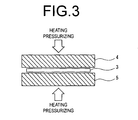
- FIG. 3 is an explanatory view of a step of pressurizing and molding the amorphous perfluoro resin.
- an amorphous perfluoro resin is dissolved in a perfluoro solvent (step S1).
- a vessel 2 made of a material such as glass with good releasability against the amorphous perfluoro resin
- the amorphous perfluoro solution 1 prepared in step S1 is poured into the vessel 2 (step S2).
- the perfluoro solvent is volatilized by heating the vessel 2 with the amorphous perfluoro solution 1 placed therein to 50° to 300°C, a plate-shaped amorphous perfluoro resin 3 is obtained as shown in FIG. 2(b) (step S3).
- step S4 by pinching the plate-shaped amorphous perfluoro resin 3 from both sides using molds 4 and 5 and heating and pressurizing the resin 3, an intended precision optic device or the like is molded (step S4).
- the heating temperature ranges from 50° to 300°C, and the applied pressure is adjusted according to the heating temperature.
- the optic device manufactured by the molding method of the invention is excellent in ultraviolet transparency, corrosion resistance, water repellency, oil repellency and the like, and can be made an inexpensive light-weight small-size optic device.
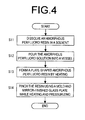
- FIG. 4 is a flowchart showing each step of a method of molding an amorphous perfluoro resin according to Embodiment 2 of the invention
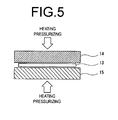
- FIG. 5 is an explanatory view of a step of pressurizing and molding the amorphous perfluoro resin.
- an amorphous perfluoro resin is dissolved in a perfluoro solvent (step S11).
- prepared is a vessel made of a material such as glass with good releasability against the amorphous perfluoro resin, and the amorphous perfluoro solution prepared in step S11 is poured into the vessel (step S12) (see FIG. 2 ).
- the perfluoro solvent is volatilized by heating the vessel with the amorphous perfluoro solution placed therein to 50° to 300°C, a plate-shaped amorphous perfluoro resin is obtained (step S13) (see FIG. 2 ).
- step S14 by pinching the plate-shaped amorphous perfluoro resin 13 using a mirror-finished glass plate 14 and mold 15 and heating and pressurizing the resin 13, an intended precision optic device or the like is molded (step S14) .
- the heating temperature ranges from 50° to 300°C, and the applied pressure is adjusted according to the heating temperature.
- precision optic devices made of a fluororesin that have not existed previously.
- precision optic devices such as, for example, a micro lens, Fresnel lens, grating lens, micro prism, grating, etc.
- optical transparency from ultraviolet to infrared region and further excellent in corrosion resistance, water repellency, oil repellency and the like.
- amorphous perfluoro resin used in the invention is amorphous, does not change polarization of the transmitted light, and therefore, can be used in a polarization optics system.
- amorphous perfluoro resin used in the invention Optical characteristics and electric characteristics of the amorphous perfluoro resin used in the invention are as describedbelow.
- CYTOP Trademark
- CYTOP Trademark
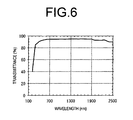
- FIG. 6 is a graph showing the near-infrared light transmittance of CYTOP (Trademark)
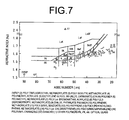
- FIG. 7 is a graph showing refractive indices and Abbe numbers of CYTOP (Trademark) and typical organic polymers
- FIG. 8 is a table showing photoelasticity of CYTOP (Trademark) and other samples.
- FIG. 9 is a table showing electric characteristics of CYTOP (Trademark), other fluororesins, and acrylic resin
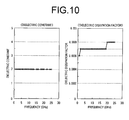
- FIG. 10 contains graphs showing microwave dielectric properties of CYTOP (Trademark)
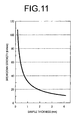
- FIG. 11 is a graph showing a dielectric breakdown property of CYTOP (Trademark).
- the invention it is possible to mold optic devices exploiting these characteristics. More specifically, the invention is applicable to optical apparatuses as described below.
- Each of optical disks (Blue-ray Disk, HDD and DVD) with high recording densities currently in practical use applies light (blue light) with a wavelength of 405 nm.
- light blue light
- a fine lens for ultraviolet-ray manufactured by the invention since light (ultraviolet light) with a wavelength of about 200 nm can be used, it is possible to improve the recording density by about four times.
- the optic device of the invention is made of a fluororesin, and can be reduced in weight as compared with the conventional product. Still furthermore, according to the invention, since it is possible to perform fine molding, products can be made smaller in size.
- the invention relates to a method of molding a fluororesin and optic devices, and more particularly, to a method of precisely molding an amorphous perfluoro resin with an accuracy of submicron or less and optic devices molded of the resin, and has industrial applicability.
Landscapes
- Engineering & Computer Science (AREA)
- Mechanical Engineering (AREA)
- Health & Medical Sciences (AREA)
- Manufacturing & Machinery (AREA)
- Ophthalmology & Optometry (AREA)
- Addition Polymer Or Copolymer, Post-Treatments, Or Chemical Modifications (AREA)
- Casting Or Compression Moulding Of Plastics Or The Like (AREA)
Abstract
Description
- The present invention relate to a method of molding a fluororesin and optic devices, and more particularly, to a method of precisely molding an amorphous perfluoro resin with an accuracy of submicron or less and optic devices molded of the resin.
- Conventionally, synthetic quartz and acrylic resins have been used as precision optic devices having ultraviolet transparency. Particularly, quartz and magnesium fluoride have been used as a material for a neutron beam focusing device.
- However, quartz is expensive, lower in workability than resins, and is not suitable for precision processing. The acrylic resin enables injection molding of complicated shapes by thermoplastic molding, is used generally as an optic material, but contains hydrogen with a large neutron scattering cross-section, and is not suitable for a material for a neutron beam focusing device. Further, magnesium fluoride is also very hard to perform high-precision processing.
- Meanwhile, as a material with excellent ultraviolet transparency, attention is directed toward an amorphous perfluoro resin that is one of fluororesins.
- Fluororesins typified by polytetrafluoroethylene (PTFE) are excellent in heat resistance, chemical resistance, water repellency, weatherability resistance, electrical insulating properties, etc. and used in various fields such as semiconductors, batteries and excellent weather resistant coatings due to their properties. Among the resins, the amorphous perfluoro resin is provided with aforementioned properties specific to fluororesins, while being amorphous, and therefore, has a feature of being transparent in a wide wavelength range of ultraviolet, visible and near-infrared regions. Further, as compared with the acrylic resin, the amorphous perfluoro resin is excellent in optical transparency in a wide wavelength range of from the ultraviolet region to infrared region, corrosion resistance, water repellency, oil repellency, etc.
-
FIG. 12 shows the ultraviolet/visible light transmittance of an amorphous perfluoro resin (ASAHI GLASS Co. , LTD. "CYTOP" (Trademark)). In this figure, the solid line a indicates the amorphous perfluoro resin, and the dashed lines b indicate an acrylic resin (PMMA: Polymethyl methacrylate). - From the figure, it can be understood that the ultraviolet transparency of the amorphous perfluoro resin is greatly excellent as compared with the acrylic resin.
- However, generally, the fluororesin is hard to mold, and it is not possible to perform precision molding on the fluororesin. Particularly, an amorphous perfluoro resin is originally a fluororesin for thin-film coating for antireflection, water proof, water repellency, etc. and is supplied while being dissolved in a specific fluorine-containing solvent. Usually, the amorphous perfluoro resin solution is applied on a substrate, heated and dried, and the thin film is formed. However, when a mold is used as a substrate, since the formed thin film is not removed from the mold easily, it is not possible to fabricate a molded component as a single item.
- When the amorphous perfluoro resin can be molded precisely, it is possible to manufacture high-performance optic devices with ultraviolet transparency, particularly, neutron beam focusing device with high efficiency.
- In view of the above-mentioned conventional problem, it is an obj ect of the invention to provide a method of precisely molding an amorphous perfluoro resin with an accuracy of submicron or less and optic devices molded of the resin.
- Therefore, the present invention provides a method of molding an amorphous perfluoro resin characterized by having the steps of (a) dissolving an amorphous perfluoro resin in a solvent, (b) pouring a solution of the amorphous perfluoro resin in a first mold, (c) heating a vessel with the solution placed therein, thereby volatilizing the solvent, and forming the amorphous perf luoro resin in the shape of a plate, and (d) pouring the amorphous perfluoro resin formed in the shape of a plate in a second mold, and pressurizing from one surface side to the other surface side of the second mold while heating, where the amorphous perfluoro resin is molded into a desired shape.
- Herein, the solvent in the step (a) is an aprotic fluorine-containing solvent, and the first mold in the step (b) is made of a material where a surface in contact with the solution is excellent in smoothness. Then, the first mold in the step (b) is glass where a surface in contact with the solution is mirror-finished.
- Further, the second mold in the step (d) is a mold with a desired shape. The second mold in the step (d) is comprised of mirror-finished glass on one surface side and a mold with a desired shape on the other surface side. Then, a heating temperature of the solution in the step (c) ranges from 50°C to 300°C. Further, a heating temperature of the mold in the step (d) ranges from 50°C to 300°C, and an applied pressure is adjusted corresponding to the heating temperature.
- Herein, the optic device is a micro lens, Fresnel lens, grating lens, micro prism or grating, and the invention provides a neutron optic device that refracts or reflects a neutron and thereby controls its traveling direction. Then, the invention further provides a neutron lens, neutron focusing apparatus, neutron speed discrimination apparatus, neutron bender or neutron chopper comprised of the neutron optic device.
- According to the invention, it is possible tomanufacture precision optic devices made of an amorphous perfluoro resin that have not existed previously. Particularly, it is possible to fabricate precision optic devices (such as, for example, a micro lens, Fresnel lens, grating lens, micro prism, grating, etc.) with optical transparency from ultraviolet to infrared region and also excellence in corrosion resistance, water repellency, oil repellency and the like.
These precision optic devices are considered particularly being applied as an optical apparatus lens, prism, etc. in the ultraviolet region. Further, the amorphous perfluoro resin does not change polarization of the transmitted light, and therefore, can be used in a polarization optics system. - Moreover, by fabricating a thin-film Fresnel lens by the method of the invention, it is possible to manufacture a neutron beam focusing device with high efficiency not heretofore attained.
Further, by using the invention, it is possible to mass produce the precision optic devices as described above with ease, and it is thereby possible to provide the devices at low prices. Furthermore, the optic device of the invention is made of a fluororesin, and can be reduced in weight as compared with the conventional product. Still furthermore, according to the invention, since it is possible to perform fine molding, products can be made smaller in size. -
-
FIG. 1 is a flowchart showing each step of a method of molding an amorphous perfluoro resin according toEmbodiment 1 of the invention; -
FIG. 2 is an explanatory view of a step of forming the amorphous perfluoro resin in the shape of a plate according toEmbodiment 1 of the invention; -
FIG. 3 is an explanatory view of a step of pressurizing and molding the amorphous perfluoro resin according toEmbodiment 1 of the invention; -
FIG. 4 is a flowchart showing each step of a method of molding an amorphous perfluoro resin according toEmbodiment 2 of the invention; -
FIG. 5 is an explanatory view of a step of pressurizing and molding the amorphous perfluoro resin according toEmbodiment 2 of the invention; -
FIG. 6 is a graph showing the near-infrared light transmittance of CYTOP (Trademark); -
FIG. 7 is a graph showing refractive indices and Abbe numbers of CYTOP (Trademark) and typical organic polymers; -
FIG. 8 is a table showing photoelasticity of CYTOP (Trademark) and other samples; -
FIG. 9 is a table showing electric characteristics of CYTOP (Trademark), other fluororesins, and acrylic resin; -
FIG. 10 contains graphs showing microwave dielectric properties of CYTOP (Trademark); -
FIG. 11 is a graph showing a dielectric breakdown property of CYTOP (Trademark); and -
FIG. 12 is a graph showing the ultraviolet/visible light transmittance of an amorphous perfluoro resin. -
- 1 Amorphous perfluoro solution
- 2 Vessel
- 3, 13 Plate-shaped amorphous perfluoro resin
- 4, 5, 15 Mold
- In the invention, an amorphous perfluoro resin is an amorphous perfluoro resin dissolvable in a solvent, and preferable examples thereof are fluorine-containing polymers (hereinafter, referred to as fluorine-containing cyclic polymers) having a fluorine-containing aliphatic cyclic structure in a main chain dissolvable in a fluorine-containing solvent.
- In this description, the fluorine-containing polymer having a fluorine-containing aliphatic cyclic structure in a main chain means that one or more carbon atoms constituting the fluorine-containing aliphatic ring are carbon atoms constituting the main chain of the fluorine-containing cyclic polymer. Among carbon atoms constituting the fluorine-containing aliphatic cyclic structure, carbon atoms constituting the main chain are derived from polymerizable double bonds of monomers constituting the fluorine-containing cyclic polymer.
For example, when the fluorine-containing cyclic polymer is a fluorine-containing polymer obtained by polymerizing cyclic monomers described later, two carbon atoms constituting the double bond are carbon atoms constituting the main chain.
Further, in the case of the fluorine-containing cyclic polymer obtained by cyclo-polymerizing monomers having two polymerizable double bonds, among four carbon atoms constituting two polymerizable double bonds, at least two carbon atoms are carbon atoms constituting the main chain. - The fluorine-containing aliphatic cyclic structure may be a cyclic structure that a ring is comprised of only carbon atoms, or may be a heterocyclic structure containing hetero atoms such as oxygen atoms and nitrogen atoms as well as carbon atoms. Preferable as the fluorine-containing aliphatic ring are fluorine-containing aliphatic rings having one or two ethereal oxygen atoms in the ring.
The number of atoms constituting the ring of the fluorine-containing aliphatic cyclic structure preferably ranges from 4 to 7. In other words, the fluorine-containing aliphatic cyclic structure is preferably a four-to-seven membered ring. - Preferable as the fluorine-containing cyclic polymer are fluorine-containing cyclic polymers (I') and fluorine-containing cyclic polymers (II') as described below. Fluorine-containing cyclic polymers (I'): Polymers having units based on a cyclic fluorine-containing monomer: Fluorine-containing cyclic polymer(II'): Polymers having units formed by cyclopolymerization of diene fluorine-containing monomers.
- The "cyclic fluorine-containing monomer" is a monomer having a polymerizable double bond between carbon atoms constituting the fluorine-containing aliphatic ring or a monomer having a polymerizable double bond between a carbon atom constituting the fluorine-containing aliphatic ring and a carbon atom that is not contained in the fluorine-containing aliphatic ring.
Preferable as the cyclic fluorine-containing monomer is a compound (1) or compound (II). -
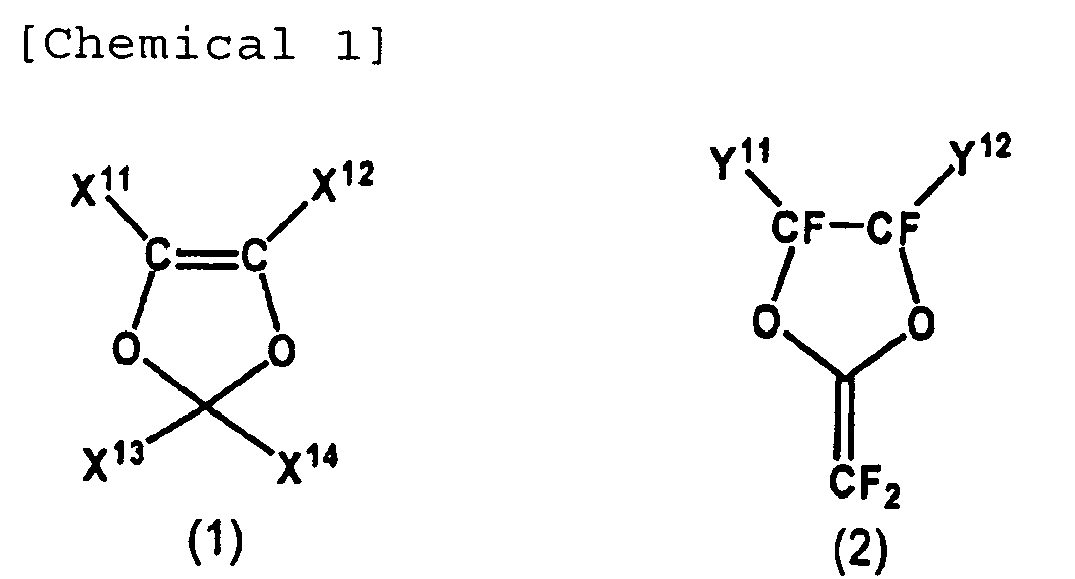
- In the formula, X11, X12, X13, X14, Y11 and Y12 are a fluorine atom, perfluoroalkyl group, or perfluoroalkoxy group independently of one another.
As the perfluoroalkyl group in X11, X12, X13, X14 , Y11 and Y12, the carbon number preferably ranges from 1 to 7, and more preferably, from 1 to 4. The perfluoroalkyl group is preferably linear or branched, and more preferably, linear. More specifically, examples thereof are a trifluoromethyl group, pentafluoroethyl group and heptafluoropropyl group, and a trifluoromethyl group is particularly preferable.
As the perfluoroalkoxy group in X11, X12, X13, X14, Y11 and Y12, examples thereof are that an oxygen atom (-O-) is bound to the perfluoroalkoxy group. - A fluorine atom is preferable as X11.
- X12 is preferably a fluorine atom, trifluoromethylgroup, or perfluoroalkoxy group with the carbon number ranging from 1 to 4, and more preferably, a fluorine atom or trifluoromethoxy group.
X13 and X14 are preferably a fluorine atom or perfluoroalkyl group with the carbon number ranging from 1 to 4, and more preferably, a fluorine atom or trifluoromethyl group, independently of each other.
Y11 and Y12 are preferably a fluorine atom, perfluoroalkyl group with the carbon number ranging from 1 to 4, perfluoroalkoxy group with the carbon number ranging from 1 to 4, and more preferably, a fluorine atom or trifluoromethyl group, independently of each other. - In compound (1), X13 and X14 may be bound mutually to form the fluorine-containing aliphatic ring together with carbon atoms of bound X13 and X14.
The fluorine-containing aliphatic ring is preferably a four-to-six membered ring.
The fluorine-containing aliphatic ring is preferably a saturated aliphatic ring.
The fluorine-containing aliphatic ring may have an ethereal oxygen atom (-O-) in the ring. In this case, the number of ethereal oxygen atoms in the fluorine-containing aliphatic ring is preferably 1 or 2. - In compound (2), Y11 and Y12 may be bound mutually to form the fluorine-containing aliphatic ring together with carbon atoms of bound Y11 and Y12.
The fluorine-containing aliphatic ring is preferably a four-to-six membered ring.
The fluorine-containing aliphatic ring is preferably a saturated aliphatic ring.
The fluorine-containing aliphatic ring may have an ethereal oxygen atom (-O-) in the ring. In this case, the number of ethereal oxygen atoms in the fluorine-containing aliphatic ring is preferably 1 or 2.
Preferable specific examples of compound (1) include compounds (1-1) to (1-5).
Preferable specific examples of compound (2) include compounds (2-1) to (2-2). -

-

- The fluorine-containing cyclic polymer (I') may be a homopolymer of the above-mentioned cyclic fluorine-containing monomer, or a copolymer of the cyclic fluorine-containing monomer and another monomer except such a monomer.
In addition, in the fluorine-containing cyclic polymer (I'), a rate of units based on the cyclic fluorine-containing monomer relative to the total of all the repetitive units constituting the fluorine-containing cyclic polymer (I') is preferably 20 mole% or more, more preferably 40 mole% or more, and can be 100 mole%.
The another monomer is not limited particularly, as long as the monomer can be copolymerized with the cyclic fluorine-containing monomer. More specifically, examples thereof are a diene fluorine-containing monomer, tetrafluoroethylene, chlorotrifluoroethylene, perfluoro (methyl vinyl ether), perfluoro (ethyl vinyl ether), and perfluoro (propyl vinyl ether). - The "diene fluorine-containing monomer" is a monomer having two polymerizable double bonds and fluorine atoms. The polymerizable double bond is not limited particularly, and is preferably a vinyl group, allyl group, acryloyl group and methacryloyl group.
As the diene fluorine-containing monomer, compound (3) is preferable.
CF2=CF-Q-CF=CF2 (3)
In the formula, Q may have an ethereal oxygen atom, and is a perfluoro alkylene group with the carbon number ranging from 1 to 3 such that a part of fluorine atoms can be replaced with halogen atoms except the fluorine atom. Examples of the halogen atom except the fluorine atom are a chlorine atom and bromine atom.
When Q is a perfluoro alkylene group having ethereal oxygen atoms, the ethereal oxygen atoms in the perfluoro alkylene group may exist at one terminal of the group, at both terminals of the group, or between carbon atoms of the group. From the viewpoint of cyclopolymerization, the oxygen atoms preferably exist at one terminal.
As a unit formed by cyclopolymerization of compound (3), examples thereof are repetition units of following formulas (3-1) to (3-4). -

- Specific examples of compound (3) include following compounds:
CF2=CFOCF2CF=CF2
CF2=CFOCF(CF3)CF=CF2
CF2=CFOCF2CF2CF=CF2
CF2=CFOCF2CF(CF3)CF=CF2
CF2=CFOCF(CF3)CF2CF=CF2
CF2=CFOCFClCF2CF=CF2
CF2=CFOCCl2CF2CF=CF2
CF2=CFOCF2COCF=CF2
CF2=CFOC(CF3)2OCF=CF2
CF2=CFOCF2CF(OCF3)CF=CF2
CF2=CFCF2CF=CF2
CF2=CFCF2CF2CF=CF2
CF2=CFCF2OCF2CF=CF2
- The fluorine-containing cyclic polymer (II') may be comprised of only units formed by cyclopolymerization of the above-mentioned diene fluorine-containing monomer, or may be a copolymer having the units and other units except the units.
In addition, in the fluorine-containing cyclic polymer (II'), a rate of units formed by cyclopolymerization of the diene fluorine-containing monomer relative to the total of all the repetitive units constituting the fluorine-containing cyclic polymer (II') is preferably 50 mole% or more, more preferably 80 mole% or more, and most preferably 100 mole%.
The other monomer is not limited particularly, as long as the monomer can be copolymerized with the diene fluorine-containing monomer. More specifically, examples thereof are cyclic fluorine-containingmonomers such as compound (1) and compound (2) as described previously, tetrafluoroethylene, chlorotrifluoroethylene, perfluoro(methyl vinyl ether), perfluoro(ethyl vinyl ether), and perfluoro(propyl vinyl ether). - The average molecular weight of the fluorine-containing cyclic polymer ranges preferably from 3, 000 to 1, 000, 000, and more preferably, from 10,000 to 300,000.
In addition, as a cyclopolymerization method, homopolymerization method, and copolymerization method of the above-mentioned monomers, for example, it is possible to apply conventional publicly known methods disclosed in Japanese Laid-Open Patent Publication No.H04-189880
Commercially available products of the fluorine-containing cyclic polymer include CYTOP (produced by ASAHI GLASS Co., Ltd.), etc. - In the invention, a solvent to dissolve the above-mentioned amorphous perfluoro resin is preferably a fluorine-containing solvent, and more preferably, an aprotic fluorine-containing solvent.
The molecular weight of the fluorine-containing solvent being excessively high results in not only increases in the viscosity of the fluorine-containing polymer solution, but also decreases in the solubility of the fluorine-containing polymer, and therefore, the molecular weight of the fluorine-containing solvent is preferably 1000 or less. Further, to increase the solubility of the fluorine-containing polymer, the fluorine content of the fluorine-containing solvent is preferably in the range of 60 percent to 80 percent by weight. Examples of the preferable fluorine-containing solvent include following solvents.
Examples of the aprotic fluorine-containing solvent are polyfluoro aromatic compound, polyfluoro trialkyl amine, polyfluoro alkane, polyfluoro cyclic ether and hydro fluoro ether (HFE). These aprotic fluorine-containing solvents may be used alone, or in combination of two or more kinds. - Examples of the polyfluoro aromatic compound include perfluorobenzene, pentafluorobenzene, 1,3-bis(trifluoromethyl)benzene and 1,4-bis(trifluoromethyl)benzene.
Examples of the polyfluoro trialkyl amine are perfluoro tributyl amine and perfluoro tripropyl amine.
Examples of the polyfluoro cyclic ether include perfluoro(2-butyl tetrahydrofuran). - Examples of the polyfluoro alkane are perfluoro hexane, perfluoro octane, perfluoro decane, perfluoro dodecane, perfluoro(2,7-dimethyloctane),
1,1,2-trichloro-1,2,2-trifluoroethane,
1,1,1-trichloro-2,2,2-trifluoroethane,
1,3-dichloro-1,1,2,2,3-pentafluoropropane,
1,1,1,3-tetrachloro-2,2,3,3-tetrafluoropropane,
1,1,3,4-tetrachloro-1,2,2,3,4,4-hexafluorobutane, perfluoro(1,2-dimethylhexane),
perfluoro(1,3-dimethylhexane), perfluoro cyclohexane, perfluoro(1,3,5-trimethylcyclohexane),
2H,3H-perfluoropentane, 1H-perfluorohexane,
1H-perflurooctane, 1H-perfluorodecane,
1H,1H,1H,2H,2H-perfluorohexane,
1H,1H,1H,2H,2H-perfluorooctane,
1H,1H,1H,2H,2H-perfluorodecane
3H,4H-perfluoro-2-methylpentane,
2H,3H-perfluoro-2-methylpentane, 1H-1,1-dichloro perfluoropropane and 1H-1,3-dichloro perfluoropropane. - The hydro fluoro ether (HFE) is preferably an HFE represented by general formula R1-O-R2 (R1 is a linear or branched polyfluoro alkyl group with the carbon number ranging from 5 to 12 that may have an ether bond, and R2 is a linear or branched alkyl group with the carbon number ranging from 1 to 5.)
When the carbon number of R1 is 4 or less, it is hard to dissolve the fluorine-containing polymer, and since the R1 with the carbon number being 13 or more is hard to commercially get, the carbon number of R1 is selected from the range of 5 to 12. The carbon number of R1 preferably ranges from 6 to 10, and more preferably, from 6 to 7 and from 9 to 10.
The polyfluoro alkyl group is a group where two or more hydrogen atoms of the alkyl group are replaced with fluorine atoms, and includes perfluoro alkyl groups where all the hydrogen atoms of the alkyl group are replaced with fluorine atoms, and groups where two or more hydrogen atoms of the alkyl group are replaced with fluorine atoms while one or more hydrogen atoms of the alkyl group are replaced with halogen atoms except the fluorine atom. The halogen atom except the fluorine atom is preferably a chlorine atom. - The polyfluoro alkyl group is preferably a group where 60% or more of the number of hydrogen atoms of a corresponding alkyl group are replaced with fluorine atoms, and more preferably, a group where 80% or more of such a number are replaced with fluorine atoms. The polyfluoro alkyl group is further preferably a perfluoro alkyl group.
In the case of R1 having an ether bond, since the solubility is inhibited when the number of ether bonds is too high, the number of ether bonds in the R1 preferably ranges from 1 to 3, and more preferably, 1 or 2. When the carbon number of R2 is 6 or more, the solubility of the polymer containing the fluorine-containing cyclic structure is extremely inhibited. Preferable examples of R2 are a methyl group or ethyl group. - Examples of the HFE are F(CH2)5OCH3, F(CH2)6OCH3, F(CH2)7OCH3, F(CH2)8OCH3, F(CH2)9OCH3, F(CH2)10OCH3, H(CH2)6OCH3, (CF3)2CF(OCH3)CFCF2CF3, F(CF2)3OCF(CF3)CF2OCH3, F(CF2)3OCF(CF3)CF2OCF(CF3)CF2OCH3, F(CF2)8OCH2CH2CH3, (CF3)2CFCF2CF2OCH3, and F(CF2)2O(CF2)4OCH2CH3.
As the HFE, (CF3)2CF(OCH3)CFCF2CF3 is particularly suitable.
Among the fluorine-containing solvents except the above-mentioned solvents are fluorine-containing polyethers of low molecular weights, etc. - Embodiments of the invention will specifically be described below with reference to drawings.
- As
Embodiment 1, specific steps will be described below to precisely mold an amorphous perfluoro resin. -
FIG. 1 is a flowchart showing each step of a method of molding an amorphous perfluoro resin according toEmbodiment 1 of the invention,FIG. 2 is an explanatory view of a step of forming the amorphous perfluoro resin in the shape of a plate according toEmbodiment 1 of the invention, andFIG. 3 is an explanatory view of a step of pressurizing and molding the amorphous perfluoro resin. - First, an amorphous perfluoro resin is dissolved in a perfluoro solvent (step S1).
Next, as shown inFIG. 2(a) , prepared is avessel 2 made of a material such as glass with good releasability against the amorphous perfluoro resin, and the amorphousperfluoro solution 1 prepared in step S1 is poured into the vessel 2 (step S2).
Then, when the perfluoro solvent is volatilized by heating thevessel 2 with the amorphousperfluoro solution 1 placed therein to 50° to 300°C, a plate-shaped amorphousperfluoro resin 3 is obtained as shown inFIG. 2(b) (step S3).
Next, as shown inFIG. 3 , by pinching the plate-shaped amorphousperfluoro resin 3 from bothsides using molds resin 3, an intended precision optic device or the like is molded (step S4). At this point, the heating temperature ranges from 50° to 300°C, and the applied pressure is adjusted according to the heating temperature. - Thus, by forming an amorphous perfluoro resin in the shape of a thin film or plate and then heating and molding the resin while pressurizing, poor releasability from a mold is overcome which is the conventional problem, and it is possible to easily manufacture precise molded components such as a micro lens, etc. Then, the optic device manufactured by the molding method of the invention is excellent in ultraviolet transparency, corrosion resistance, water repellency, oil repellency and the like, and can be made an inexpensive light-weight small-size optic device.
- As
Embodiment 2, other specific steps will be described below to precisely mold an amorphous perfluoro resin. -
FIG. 4 is a flowchart showing each step of a method of molding an amorphous perfluoro resin according toEmbodiment 2 of the invention, andFIG. 5 is an explanatory view of a step of pressurizing and molding the amorphous perfluoro resin. - First, an amorphous perfluoro resin is dissolved in a perfluoro solvent (step S11). Next, prepared is a vessel made of a material such as glass with good releasability against the amorphous perfluoro resin, and the amorphous perfluoro solution prepared in step S11 is poured into the vessel (step S12) (see
FIG. 2 ).
Then, when the perfluoro solvent is volatilized by heating the vessel with the amorphous perfluoro solution placed therein to 50° to 300°C, a plate-shaped amorphous perfluoro resin is obtained (step S13) (seeFIG. 2 ).
Next, as shown inFIG. 5 , by pinching the plate-shaped amorphousperfluoro resin 13 using a mirror-finishedglass plate 14 andmold 15 and heating and pressurizing theresin 13, an intended precision optic device or the like is molded (step S14) . At this point, the heating temperature ranges from 50° to 300°C, and the applied pressure is adjusted according to the heating temperature. - By the aforementioned method, it is possible to manufacture precision optic devices made of a fluororesin that have not existed previously. Particularly, it is possible to easily fabricate precision optic devices (such as, for example, a micro lens, Fresnel lens, grating lens, micro prism, grating, etc.) with optical transparency from ultraviolet to infrared region and further excellent in corrosion resistance, water repellency, oil repellency and the like.
- These precision optic devices are considered particularly being applied as an optical apparatus lens, prism, etc. in the ultraviolet region. Further, the amorphous perfluoro resin used in the invention is amorphous, does not change polarization of the transmitted light, and therefore, can be used in a polarization optics system.
- Moreover, by fabricating a thin-film Fresnel lens by the method of the invention, it is possible to manufacture a neutron beam focusing device with high efficiency not heretofore attained.
- Optical characteristics and electric characteristics of the amorphous perfluoro resin used in the invention are as describedbelow. In addition, herein, CYTOP (Trademark) is used as an example of the amorphous perfluoro resin.
-
FIG. 6 is a graph showing the near-infrared light transmittance of CYTOP (Trademark),FIG. 7 is a graph showing refractive indices and Abbe numbers of CYTOP (Trademark) and typical organic polymers, andFIG. 8 is a table showing photoelasticity of CYTOP (Trademark) and other samples. - Further,
FIG. 9 is a table showing electric characteristics of CYTOP (Trademark), other fluororesins, and acrylic resin,FIG. 10 contains graphs showing microwave dielectric properties of CYTOP (Trademark), andFIG. 11 is a graph showing a dielectric breakdown property of CYTOP (Trademark). - In the invention, it is possible to mold optic devices exploiting these characteristics. More specifically, the invention is applicable to optical apparatuses as described below.
- Each of optical disks (Blue-ray Disk, HDD and DVD) with high recording densities currently in practical use applies light (blue light) with a wavelength of 405 nm. By using a fine lens for ultraviolet-ray manufactured by the invention, since light (ultraviolet light) with a wavelength of about 200 nm can be used, it is possible to improve the recording density by about four times.
- According to the invention, it is possible to take pictures in a wide wavelength range of from the infrared region to ultraviolet region.
- According to the invention, it is possible to observe celestial phenomena, etc. that cannot be observed in the visible region.
- According to the invention, it is possible to observe minute objects, phenomena, etc. that cannot be observed in the visible region.
- According to the invention, it is possible to conduct spectral observations in a wide wavelength range of from the ultraviolet region to infrared region.
- By using the invention in a projection optics system of an ultraviolet light source, it is possible to actualize ultraviolet illumination, generation of ultraviolet-ray beams, and the like.
- Further, by using the invention, it is possible to mass produce the precision optic devices as described above with ease, and it is thereby possible to provide the devices at low prices. Furthermore, the optic device of the invention is made of a fluororesin, and can be reduced in weight as compared with the conventional product. Still furthermore, according to the invention, since it is possible to perform fine molding, products can be made smaller in size.
- In the foregoing, Embodiments of the invention are described, but the invention is not limited to the aforementioned Embodiments, and is capable of being modified in various manners based on the subject matter of the invention, and the modifications is not excluded from the scope of the invention.
- The invention relates to a method of molding a fluororesin and optic devices, and more particularly, to a method of precisely molding an amorphous perfluoro resin with an accuracy of submicron or less and optic devices molded of the resin, and has industrial applicability.
Claims (12)
- A method of molding an amorphous perfluoro resin, comprising the steps of:(a) dissolving an amorphous perfluoro resin in a solvent;(b) pouring a solution of the amorphous perfluoro resin in a first mold;(c) heating a vessel with the solution placed therein, thereby volatilizing the solvent, and forming the amorphous perfluoro resin in the shape of a plate; and(d) pouring the amorphous perfluoro resin formed in the shape of a plate in a second mold, and pressurizing from one surface side to the other surface side of the second mold while heating,wherein the amorphous perfluoro resin is molded into a desired shape.
- The method of molding an amorphous perfluoro resin according to claim 1, wherein the solvent in the step (a) is an aprotic fluorine-containing solvent.
- The method of molding an amorphous perfluoro resin according to claim 1 or 2, wherein the first mold in the step (b) is made of a material where a surface in contact with the solution is excellent in smoothness.
- The method of molding an amorphous perfluoro resin according to any one of claims 1 to 3, wherein the first mold in the step (b) is glass where a surface in contact with the solution is mirror-finished.
- The method of molding an amorphous perfluoro resin according to any one of claims 1 to 4, wherein the second mold in the step (d) is a mold with a desired shape.
- The method of molding an amorphous perfluoro resin according to any one of claims 1 to 5, wherein the second mold in the step (d) is comprised of mirror-finished glass on one surface side and a mold with a desired shape on the other surface side.
- The method of molding an amorphous perfluoro resin according to any one of claims 1 to 6, wherein a heating temperature of the solution in the step (c) ranges from 50°C to 300°C.
- The method of molding an amorphous perfluoro resin according to claim 5 or 6, wherein a heating temperature of the mold in the step (d) ranges from 50°C to 300°C, and an applied pressure is adjusted corresponding to the heating temperature.
- An optic device molded by using the method of molding an amorphous perfluoro resin according to any one of claims 1 to 8.
- The optic device according to claim 9, wherein the optic device is a micro lens, Fresnel lens, grating lens, micro prism or grating.
- A neutron optic device,
wherein the neutron optic device is comprised of the optic device according to claim 10, refracts or reflects a neutron, and thereby controls a traveling direction of the neutron. - A neutron lens, a neutron focusing apparatus, a neutron speed discrimination apparatus, a neutron bender or a neutron chopper that is comprised of the neutron optic device according to claim 11.
Applications Claiming Priority (2)
| Application Number | Priority Date | Filing Date | Title |
|---|---|---|---|
| JP2007233890 | 2007-09-10 | ||
| PCT/JP2008/066189 WO2009034952A1 (en) | 2007-09-10 | 2008-09-08 | Process for molding amorphous perfluororesin and optical element |
Publications (3)
| Publication Number | Publication Date |
|---|---|
| EP2199051A1 true EP2199051A1 (en) | 2010-06-23 |
| EP2199051A4 EP2199051A4 (en) | 2016-06-22 |
| EP2199051B1 EP2199051B1 (en) | 2017-11-22 |
Family
ID=40451959
Family Applications (1)
| Application Number | Title | Priority Date | Filing Date |
|---|---|---|---|
| EP08830175.9A Not-in-force EP2199051B1 (en) | 2007-09-10 | 2008-09-08 | Method of molding amorphous perfluoro resin and optic devices |
Country Status (4)
| Country | Link |
|---|---|
| US (1) | US20100200740A1 (en) |
| EP (1) | EP2199051B1 (en) |
| JP (1) | JP5103675B2 (en) |
| WO (1) | WO2009034952A1 (en) |
Families Citing this family (6)
| Publication number | Priority date | Publication date | Assignee | Title |
|---|---|---|---|---|
| US10151685B2 (en) | 2012-04-16 | 2018-12-11 | Sensor Electronic Technology, Inc. | Ultraviolet-based gas sensor |
| US9625372B2 (en) * | 2012-04-16 | 2017-04-18 | Sensor Electronic Technology, Inc. | Ultraviolet-based ozone sensor |
| JP5990055B2 (en) * | 2012-07-25 | 2016-09-07 | キヤノン株式会社 | Imaging apparatus and control method thereof |
| KR102408619B1 (en) | 2015-02-16 | 2022-06-14 | 쑤저우 레킨 세미컨덕터 컴퍼니 리미티드 | Light emitting device package and method for fabricating the same, and light source unit |
| CN114641529B (en) * | 2019-11-01 | 2024-05-24 | 大金工业株式会社 | Method for producing fluorinated polymer and composition thereof |
| JP7117807B1 (en) | 2022-02-28 | 2022-08-15 | 有限会社飯田製作所 | Molded article manufacturing method, lens manufacturing method, and lens |
Family Cites Families (11)
| Publication number | Priority date | Publication date | Assignee | Title |
|---|---|---|---|---|
| US4277299A (en) * | 1977-09-23 | 1981-07-07 | Ppg Industries, Inc. | Release molds for laminating bilayer safety glass |
| JP2526641B2 (en) * | 1987-08-14 | 1996-08-21 | 旭硝子株式会社 | Novel fluorinated cyclic polymer |
| JP3005040B2 (en) | 1990-11-22 | 2000-01-31 | 旭硝子株式会社 | Resin composition for coating |
| JP3004090B2 (en) * | 1991-07-03 | 2000-01-31 | 旭硝子株式会社 | Fluoropolymer and method for producing the same |
| US5498657A (en) * | 1993-08-27 | 1996-03-12 | Asahi Glass Company Ltd. | Fluorine-containing polymer composition |
| US5919878A (en) * | 1996-09-13 | 1999-07-06 | E. I. Du Pont De Nemours And Company | Amorphous fluoropolymer containing perfluoro(ethyl vinyl ether) |
| JP2000001511A (en) * | 1998-04-17 | 2000-01-07 | Asahi Glass Co Ltd | Method for producing fluoropolymer |
| US6649715B1 (en) * | 2000-06-27 | 2003-11-18 | Clemson University | Fluoropolymers and methods of applying fluoropolymers in molding processes |
| WO2003047833A1 (en) * | 2001-12-04 | 2003-06-12 | Riken | Method and device for manufacturing large curved double-sided fresnel lens |
| JP2005220161A (en) * | 2004-02-03 | 2005-08-18 | Three M Innovative Properties Co | Perfluoroelastomer composition for vulcanization and method for producing perfluoroelastomer molded product |
| EP1724291A4 (en) * | 2004-03-08 | 2008-06-18 | Asahi Glass Co Ltd | VULCANIZABLE COMPOSITION AND METHOD FOR MANUFACTURING FLUOR VULCANIS CHEMICAL |
-
2008
- 2008-09-08 US US12/733,501 patent/US20100200740A1/en not_active Abandoned
- 2008-09-08 JP JP2009532176A patent/JP5103675B2/en active Active
- 2008-09-08 EP EP08830175.9A patent/EP2199051B1/en not_active Not-in-force
- 2008-09-08 WO PCT/JP2008/066189 patent/WO2009034952A1/en not_active Ceased
Non-Patent Citations (1)
| Title |
|---|
| See references of WO2009034952A1 * |
Also Published As
| Publication number | Publication date |
|---|---|
| JP5103675B2 (en) | 2012-12-19 |
| EP2199051B1 (en) | 2017-11-22 |
| WO2009034952A1 (en) | 2009-03-19 |
| US20100200740A1 (en) | 2010-08-12 |
| JPWO2009034952A1 (en) | 2010-12-24 |
| EP2199051A4 (en) | 2016-06-22 |
Similar Documents
| Publication | Publication Date | Title |
|---|---|---|
| EP2199051B1 (en) | Method of molding amorphous perfluoro resin and optic devices | |
| Hasan et al. | Large aperture tunable-focus liquid lens using shape memory alloy spring | |
| Zhang et al. | High-performance fluidic adaptive lenses | |
| JP2013181140A (en) | Optical resin composition, cured matter, optical part, sealant for semiconductor light-emitting device, optical lens, optical adhesive, optical sealing agent and optical waveguide | |
| US20220259454A1 (en) | Film and substrate having surface covered with same | |
| US10196467B2 (en) | Fluorinated polymer, method for its production, and cured product of the fluorinated polymer | |
| WO2005040238A1 (en) | Fluorine-containing curing resin composition and optical member obtained by curing same | |
| JP6743279B2 (en) | Curable composition, cured product, optical member and lens | |
| Xu et al. | Variable-focus liquid lens based on electrically responsive fluid | |
| WO2020067421A1 (en) | Fluororesin, fluororesin particles, and methods for producing these | |
| KR20120118208A (en) | Uv curable fluorinated copolymer with improved adhesion property and a composition containing same, and their films containing same | |
| JP2024086844A (en) | Fluorine resin and its manufacturing method | |
| US20150284324A1 (en) | Sulphur containing high refractive index monomer | |
| Xu et al. | Polyvinyl chloride gels microlens array with a well-controlled curvature obtained by solvent evaporation under DC electric fields | |
| JP7753035B2 (en) | Optical element, method for manufacturing optical element, resin composition, optical device, and imaging device | |
| JP2012051863A (en) | New fluorine-containing compound, method for producing polymer of the fluorine-containing compound, and optical element, functional thin film and resist membrane comprising the polymer of the fluorine-containing compound | |
| Okamoto et al. | Amorphous perfluoropolymers | |
| US20220239809A1 (en) | Polymerizable composition, optical element and method for producing the same, optical device, and image capturing apparatus | |
| JP7688564B2 (en) | Fluorine-containing composition and method for producing same | |
| JP2021088661A (en) | Method for producing optical resin composition, and optical resin composition | |
| JPH065321B2 (en) | Optical lens | |
| TW201510038A (en) | Fluorine-containing aromatic compound, method for producing same, curable material, cured product thereof, and optical member | |
| US20250084191A1 (en) | Fluorine resin refining method, method for producing refined fluorine resin, fluorine resin, optical material, electronic material and plastic optical fiber | |
| Kim et al. | A fabrication method of opened structures for uniform liquid dosing in liquid lenticular systems | |
| JP2024167694A (en) | Lens for ultraviolet light emitting device containing fluorine-containing polymer, resin composition containing fluorine-containing polymer, and method for producing said resin composition |
Legal Events
| Date | Code | Title | Description |
|---|---|---|---|
| PUAI | Public reference made under article 153(3) epc to a published international application that has entered the european phase |
Free format text: ORIGINAL CODE: 0009012 |
|
| 17P | Request for examination filed |
Effective date: 20100304 |
|
| AK | Designated contracting states |
Kind code of ref document: A1 Designated state(s): AT BE BG CH CY CZ DE DK EE ES FI FR GB GR HR HU IE IS IT LI LT LU LV MC MT NL NO PL PT RO SE SI SK TR |
|
| AX | Request for extension of the european patent |
Extension state: AL BA MK RS |
|
| DAX | Request for extension of the european patent (deleted) | ||
| RAP1 | Party data changed (applicant data changed or rights of an application transferred) |
Owner name: INTER-UNIVERSITY RESEARCH INSTITUTE CORPORATION HI Owner name: ASAHI GLASS COMPANY, LIMITED Owner name: JAPAN ATOMIC ENERGY AGENCY |
|
| RA4 | Supplementary search report drawn up and despatched (corrected) |
Effective date: 20160524 |
|
| RIC1 | Information provided on ipc code assigned before grant |
Ipc: B29D 11/00 20060101ALI20160518BHEP Ipc: B29C 43/02 20060101ALI20160518BHEP Ipc: B29L 11/00 20060101ALI20160518BHEP Ipc: C08F 14/18 20060101ALI20160518BHEP Ipc: B29C 43/34 20060101AFI20160518BHEP Ipc: G02B 1/04 20060101ALI20160518BHEP Ipc: B29C 33/38 20060101ALI20160518BHEP Ipc: B29K 27/12 20060101ALI20160518BHEP |
|
| GRAP | Despatch of communication of intention to grant a patent |
Free format text: ORIGINAL CODE: EPIDOSNIGR1 |
|
| STAA | Information on the status of an ep patent application or granted ep patent |
Free format text: STATUS: GRANT OF PATENT IS INTENDED |
|
| INTG | Intention to grant announced |
Effective date: 20170623 |
|
| GRAS | Grant fee paid |
Free format text: ORIGINAL CODE: EPIDOSNIGR3 |
|
| GRAA | (expected) grant |
Free format text: ORIGINAL CODE: 0009210 |
|
| STAA | Information on the status of an ep patent application or granted ep patent |
Free format text: STATUS: THE PATENT HAS BEEN GRANTED |
|
| AK | Designated contracting states |
Kind code of ref document: B1 Designated state(s): AT BE BG CH CY CZ DE DK EE ES FI FR GB GR HR HU IE IS IT LI LT LU LV MC MT NL NO PL PT RO SE SI SK TR |
|
| REG | Reference to a national code |
Ref country code: GB Ref legal event code: FG4D |
|
| REG | Reference to a national code |
Ref country code: CH Ref legal event code: EP |
|
| REG | Reference to a national code |
Ref country code: IE Ref legal event code: FG4D |
|
| REG | Reference to a national code |
Ref country code: AT Ref legal event code: REF Ref document number: 947989 Country of ref document: AT Kind code of ref document: T Effective date: 20171215 |
|
| REG | Reference to a national code |
Ref country code: DE Ref legal event code: R096 Ref document number: 602008053087 Country of ref document: DE |
|
| REG | Reference to a national code |
Ref country code: NL Ref legal event code: MP Effective date: 20171122 |
|
| REG | Reference to a national code |
Ref country code: LT Ref legal event code: MG4D |
|
| REG | Reference to a national code |
Ref country code: AT Ref legal event code: MK05 Ref document number: 947989 Country of ref document: AT Kind code of ref document: T Effective date: 20171122 |
|
| PG25 | Lapsed in a contracting state [announced via postgrant information from national office to epo] |
Ref country code: FI Free format text: LAPSE BECAUSE OF FAILURE TO SUBMIT A TRANSLATION OF THE DESCRIPTION OR TO PAY THE FEE WITHIN THE PRESCRIBED TIME-LIMIT Effective date: 20171122 Ref country code: ES Free format text: LAPSE BECAUSE OF FAILURE TO SUBMIT A TRANSLATION OF THE DESCRIPTION OR TO PAY THE FEE WITHIN THE PRESCRIBED TIME-LIMIT Effective date: 20171122 Ref country code: NL Free format text: LAPSE BECAUSE OF FAILURE TO SUBMIT A TRANSLATION OF THE DESCRIPTION OR TO PAY THE FEE WITHIN THE PRESCRIBED TIME-LIMIT Effective date: 20171122 Ref country code: LT Free format text: LAPSE BECAUSE OF FAILURE TO SUBMIT A TRANSLATION OF THE DESCRIPTION OR TO PAY THE FEE WITHIN THE PRESCRIBED TIME-LIMIT Effective date: 20171122 Ref country code: SE Free format text: LAPSE BECAUSE OF FAILURE TO SUBMIT A TRANSLATION OF THE DESCRIPTION OR TO PAY THE FEE WITHIN THE PRESCRIBED TIME-LIMIT Effective date: 20171122 Ref country code: NO Free format text: LAPSE BECAUSE OF FAILURE TO SUBMIT A TRANSLATION OF THE DESCRIPTION OR TO PAY THE FEE WITHIN THE PRESCRIBED TIME-LIMIT Effective date: 20180222 |
|
| PG25 | Lapsed in a contracting state [announced via postgrant information from national office to epo] |
Ref country code: GR Free format text: LAPSE BECAUSE OF FAILURE TO SUBMIT A TRANSLATION OF THE DESCRIPTION OR TO PAY THE FEE WITHIN THE PRESCRIBED TIME-LIMIT Effective date: 20180223 Ref country code: HR Free format text: LAPSE BECAUSE OF FAILURE TO SUBMIT A TRANSLATION OF THE DESCRIPTION OR TO PAY THE FEE WITHIN THE PRESCRIBED TIME-LIMIT Effective date: 20171122 Ref country code: LV Free format text: LAPSE BECAUSE OF FAILURE TO SUBMIT A TRANSLATION OF THE DESCRIPTION OR TO PAY THE FEE WITHIN THE PRESCRIBED TIME-LIMIT Effective date: 20171122 Ref country code: BG Free format text: LAPSE BECAUSE OF FAILURE TO SUBMIT A TRANSLATION OF THE DESCRIPTION OR TO PAY THE FEE WITHIN THE PRESCRIBED TIME-LIMIT Effective date: 20180222 Ref country code: AT Free format text: LAPSE BECAUSE OF FAILURE TO SUBMIT A TRANSLATION OF THE DESCRIPTION OR TO PAY THE FEE WITHIN THE PRESCRIBED TIME-LIMIT Effective date: 20171122 |
|
| PG25 | Lapsed in a contracting state [announced via postgrant information from national office to epo] |
Ref country code: DK Free format text: LAPSE BECAUSE OF FAILURE TO SUBMIT A TRANSLATION OF THE DESCRIPTION OR TO PAY THE FEE WITHIN THE PRESCRIBED TIME-LIMIT Effective date: 20171122 Ref country code: EE Free format text: LAPSE BECAUSE OF FAILURE TO SUBMIT A TRANSLATION OF THE DESCRIPTION OR TO PAY THE FEE WITHIN THE PRESCRIBED TIME-LIMIT Effective date: 20171122 Ref country code: CY Free format text: LAPSE BECAUSE OF FAILURE TO SUBMIT A TRANSLATION OF THE DESCRIPTION OR TO PAY THE FEE WITHIN THE PRESCRIBED TIME-LIMIT Effective date: 20171122 Ref country code: CZ Free format text: LAPSE BECAUSE OF FAILURE TO SUBMIT A TRANSLATION OF THE DESCRIPTION OR TO PAY THE FEE WITHIN THE PRESCRIBED TIME-LIMIT Effective date: 20171122 Ref country code: SK Free format text: LAPSE BECAUSE OF FAILURE TO SUBMIT A TRANSLATION OF THE DESCRIPTION OR TO PAY THE FEE WITHIN THE PRESCRIBED TIME-LIMIT Effective date: 20171122 |
|
| REG | Reference to a national code |
Ref country code: DE Ref legal event code: R082 Ref document number: 602008053087 Country of ref document: DE Representative=s name: WUESTHOFF & WUESTHOFF, PATENTANWAELTE PARTG MB, DE Ref country code: DE Ref legal event code: R081 Ref document number: 602008053087 Country of ref document: DE Owner name: INTER-UNIVERSITY RESEARCH INSTITUTE CORPORATIO, JP Free format text: FORMER OWNERS: ASAHI GLASS CO., LTD., TOKIO/TOKYO, JP; INTER-UNIVERSITY RESEARCH INSTITUTE CORPORATION HIGH ENERGY ACCELERATOR RESEARCH ORGANIZATION, TSUKUBA-SHI, IBARAKI, JP; JAPAN ATOMIC ENERGY AGENCY, IBARAKI, JP Ref country code: DE Ref legal event code: R081 Ref document number: 602008053087 Country of ref document: DE Owner name: AGC INC., JP Free format text: FORMER OWNERS: ASAHI GLASS CO., LTD., TOKIO/TOKYO, JP; INTER-UNIVERSITY RESEARCH INSTITUTE CORPORATION HIGH ENERGY ACCELERATOR RESEARCH ORGANIZATION, TSUKUBA-SHI, IBARAKI, JP; JAPAN ATOMIC ENERGY AGENCY, IBARAKI, JP Ref country code: DE Ref legal event code: R081 Ref document number: 602008053087 Country of ref document: DE Owner name: JAPAN ATOMIC ENERGY AGENCY, JP Free format text: FORMER OWNERS: ASAHI GLASS CO., LTD., TOKIO/TOKYO, JP; INTER-UNIVERSITY RESEARCH INSTITUTE CORPORATION HIGH ENERGY ACCELERATOR RESEARCH ORGANIZATION, TSUKUBA-SHI, IBARAKI, JP; JAPAN ATOMIC ENERGY AGENCY, IBARAKI, JP |
|
| REG | Reference to a national code |
Ref country code: DE Ref legal event code: R097 Ref document number: 602008053087 Country of ref document: DE |
|
| PG25 | Lapsed in a contracting state [announced via postgrant information from national office to epo] |
Ref country code: PL Free format text: LAPSE BECAUSE OF FAILURE TO SUBMIT A TRANSLATION OF THE DESCRIPTION OR TO PAY THE FEE WITHIN THE PRESCRIBED TIME-LIMIT Effective date: 20171122 Ref country code: RO Free format text: LAPSE BECAUSE OF FAILURE TO SUBMIT A TRANSLATION OF THE DESCRIPTION OR TO PAY THE FEE WITHIN THE PRESCRIBED TIME-LIMIT Effective date: 20171122 |
|
| PLBE | No opposition filed within time limit |
Free format text: ORIGINAL CODE: 0009261 |
|
| STAA | Information on the status of an ep patent application or granted ep patent |
Free format text: STATUS: NO OPPOSITION FILED WITHIN TIME LIMIT |
|
| 26N | No opposition filed |
Effective date: 20180823 |
|
| PGFP | Annual fee paid to national office [announced via postgrant information from national office to epo] |
Ref country code: IT Payment date: 20180921 Year of fee payment: 11 |
|
| PG25 | Lapsed in a contracting state [announced via postgrant information from national office to epo] |
Ref country code: SI Free format text: LAPSE BECAUSE OF FAILURE TO SUBMIT A TRANSLATION OF THE DESCRIPTION OR TO PAY THE FEE WITHIN THE PRESCRIBED TIME-LIMIT Effective date: 20171122 |
|
| PG25 | Lapsed in a contracting state [announced via postgrant information from national office to epo] |
Ref country code: MC Free format text: LAPSE BECAUSE OF FAILURE TO SUBMIT A TRANSLATION OF THE DESCRIPTION OR TO PAY THE FEE WITHIN THE PRESCRIBED TIME-LIMIT Effective date: 20171122 |
|
| REG | Reference to a national code |
Ref country code: CH Ref legal event code: PL |
|
| GBPC | Gb: european patent ceased through non-payment of renewal fee |
Effective date: 20180908 |
|
| REG | Reference to a national code |
Ref country code: BE Ref legal event code: MM Effective date: 20180930 |
|
| REG | Reference to a national code |
Ref country code: IE Ref legal event code: MM4A |
|
| PG25 | Lapsed in a contracting state [announced via postgrant information from national office to epo] |
Ref country code: LU Free format text: LAPSE BECAUSE OF NON-PAYMENT OF DUE FEES Effective date: 20180908 |
|
| PG25 | Lapsed in a contracting state [announced via postgrant information from national office to epo] |
Ref country code: IE Free format text: LAPSE BECAUSE OF NON-PAYMENT OF DUE FEES Effective date: 20180908 |
|
| PG25 | Lapsed in a contracting state [announced via postgrant information from national office to epo] |
Ref country code: FR Free format text: LAPSE BECAUSE OF NON-PAYMENT OF DUE FEES Effective date: 20180930 Ref country code: BE Free format text: LAPSE BECAUSE OF NON-PAYMENT OF DUE FEES Effective date: 20180930 Ref country code: LI Free format text: LAPSE BECAUSE OF NON-PAYMENT OF DUE FEES Effective date: 20180930 Ref country code: CH Free format text: LAPSE BECAUSE OF NON-PAYMENT OF DUE FEES Effective date: 20180930 |
|
| PG25 | Lapsed in a contracting state [announced via postgrant information from national office to epo] |
Ref country code: GB Free format text: LAPSE BECAUSE OF NON-PAYMENT OF DUE FEES Effective date: 20180908 |
|
| PG25 | Lapsed in a contracting state [announced via postgrant information from national office to epo] |
Ref country code: MT Free format text: LAPSE BECAUSE OF NON-PAYMENT OF DUE FEES Effective date: 20180908 |
|
| PG25 | Lapsed in a contracting state [announced via postgrant information from national office to epo] |
Ref country code: TR Free format text: LAPSE BECAUSE OF FAILURE TO SUBMIT A TRANSLATION OF THE DESCRIPTION OR TO PAY THE FEE WITHIN THE PRESCRIBED TIME-LIMIT Effective date: 20171122 |
|
| PG25 | Lapsed in a contracting state [announced via postgrant information from national office to epo] |
Ref country code: PT Free format text: LAPSE BECAUSE OF FAILURE TO SUBMIT A TRANSLATION OF THE DESCRIPTION OR TO PAY THE FEE WITHIN THE PRESCRIBED TIME-LIMIT Effective date: 20171122 Ref country code: HU Free format text: LAPSE BECAUSE OF FAILURE TO SUBMIT A TRANSLATION OF THE DESCRIPTION OR TO PAY THE FEE WITHIN THE PRESCRIBED TIME-LIMIT; INVALID AB INITIO Effective date: 20080908 |
|
| PG25 | Lapsed in a contracting state [announced via postgrant information from national office to epo] |
Ref country code: IS Free format text: LAPSE BECAUSE OF FAILURE TO SUBMIT A TRANSLATION OF THE DESCRIPTION OR TO PAY THE FEE WITHIN THE PRESCRIBED TIME-LIMIT Effective date: 20180322 |
|
| PG25 | Lapsed in a contracting state [announced via postgrant information from national office to epo] |
Ref country code: IT Free format text: LAPSE BECAUSE OF NON-PAYMENT OF DUE FEES Effective date: 20190908 |
|
| PGFP | Annual fee paid to national office [announced via postgrant information from national office to epo] |
Ref country code: DE Payment date: 20220630 Year of fee payment: 15 |
|
| REG | Reference to a national code |
Ref country code: DE Ref legal event code: R119 Ref document number: 602008053087 Country of ref document: DE |
|
| PG25 | Lapsed in a contracting state [announced via postgrant information from national office to epo] |
Ref country code: DE Free format text: LAPSE BECAUSE OF NON-PAYMENT OF DUE FEES Effective date: 20240403 |