EP2196557A1 - Precursors for depositing group 4 metal-containing films - Google Patents
Precursors for depositing group 4 metal-containing films Download PDFInfo
- Publication number
- EP2196557A1 EP2196557A1 EP09178772A EP09178772A EP2196557A1 EP 2196557 A1 EP2196557 A1 EP 2196557A1 EP 09178772 A EP09178772 A EP 09178772A EP 09178772 A EP09178772 A EP 09178772A EP 2196557 A1 EP2196557 A1 EP 2196557A1
- Authority
- EP
- European Patent Office
- Prior art keywords
- group
- metal
- bis
- alkyl
- titanium
- Prior art date
- Legal status (The legal status is an assumption and is not a legal conclusion. Google has not performed a legal analysis and makes no representation as to the accuracy of the status listed.)
- Granted
Links
Images




Classifications
-
- H—ELECTRICITY
- H10—SEMICONDUCTOR DEVICES; ELECTRIC SOLID-STATE DEVICES NOT OTHERWISE PROVIDED FOR
- H10P—GENERIC PROCESSES OR APPARATUS FOR THE MANUFACTURE OR TREATMENT OF DEVICES COVERED BY CLASS H10
- H10P14/00—Formation of materials, e.g. in the shape of layers or pillars
- H10P14/20—Formation of materials, e.g. in the shape of layers or pillars of semiconductor materials
- H10P14/24—Formation of materials, e.g. in the shape of layers or pillars of semiconductor materials using chemical vapour deposition [CVD]
-
- C—CHEMISTRY; METALLURGY
- C23—COATING METALLIC MATERIAL; COATING MATERIAL WITH METALLIC MATERIAL; CHEMICAL SURFACE TREATMENT; DIFFUSION TREATMENT OF METALLIC MATERIAL; COATING BY VACUUM EVAPORATION, BY SPUTTERING, BY ION IMPLANTATION OR BY CHEMICAL VAPOUR DEPOSITION, IN GENERAL; INHIBITING CORROSION OF METALLIC MATERIAL OR INCRUSTATION IN GENERAL
- C23C—COATING METALLIC MATERIAL; COATING MATERIAL WITH METALLIC MATERIAL; SURFACE TREATMENT OF METALLIC MATERIAL BY DIFFUSION INTO THE SURFACE, BY CHEMICAL CONVERSION OR SUBSTITUTION; COATING BY VACUUM EVAPORATION, BY SPUTTERING, BY ION IMPLANTATION OR BY CHEMICAL VAPOUR DEPOSITION, IN GENERAL
- C23C16/00—Chemical coating by decomposition of gaseous compounds, without leaving reaction products of surface material in the coating, i.e. chemical vapour deposition [CVD] processes
- C23C16/44—Chemical coating by decomposition of gaseous compounds, without leaving reaction products of surface material in the coating, i.e. chemical vapour deposition [CVD] processes characterised by the method of coating
- C23C16/455—Chemical coating by decomposition of gaseous compounds, without leaving reaction products of surface material in the coating, i.e. chemical vapour deposition [CVD] processes characterised by the method of coating characterised by the method used for introducing gases into reaction chamber or for modifying gas flows in reaction chamber
-
- C—CHEMISTRY; METALLURGY
- C07—ORGANIC CHEMISTRY
- C07F—ACYCLIC, CARBOCYCLIC OR HETEROCYCLIC COMPOUNDS CONTAINING ELEMENTS OTHER THAN CARBON, HYDROGEN, HALOGEN, OXYGEN, NITROGEN, SULFUR, SELENIUM OR TELLURIUM
- C07F7/00—Compounds containing elements of Groups 4 or 14 of the Periodic Table
- C07F7/003—Compounds containing elements of Groups 4 or 14 of the Periodic Table without C-Metal linkages
-
- C—CHEMISTRY; METALLURGY
- C23—COATING METALLIC MATERIAL; COATING MATERIAL WITH METALLIC MATERIAL; CHEMICAL SURFACE TREATMENT; DIFFUSION TREATMENT OF METALLIC MATERIAL; COATING BY VACUUM EVAPORATION, BY SPUTTERING, BY ION IMPLANTATION OR BY CHEMICAL VAPOUR DEPOSITION, IN GENERAL; INHIBITING CORROSION OF METALLIC MATERIAL OR INCRUSTATION IN GENERAL
- C23C—COATING METALLIC MATERIAL; COATING MATERIAL WITH METALLIC MATERIAL; SURFACE TREATMENT OF METALLIC MATERIAL BY DIFFUSION INTO THE SURFACE, BY CHEMICAL CONVERSION OR SUBSTITUTION; COATING BY VACUUM EVAPORATION, BY SPUTTERING, BY ION IMPLANTATION OR BY CHEMICAL VAPOUR DEPOSITION, IN GENERAL
- C23C14/00—Coating by vacuum evaporation, by sputtering or by ion implantation of the coating forming material
- C23C14/06—Coating by vacuum evaporation, by sputtering or by ion implantation of the coating forming material characterised by the coating material
- C23C14/14—Metallic material, boron or silicon
-
- C—CHEMISTRY; METALLURGY
- C23—COATING METALLIC MATERIAL; COATING MATERIAL WITH METALLIC MATERIAL; CHEMICAL SURFACE TREATMENT; DIFFUSION TREATMENT OF METALLIC MATERIAL; COATING BY VACUUM EVAPORATION, BY SPUTTERING, BY ION IMPLANTATION OR BY CHEMICAL VAPOUR DEPOSITION, IN GENERAL; INHIBITING CORROSION OF METALLIC MATERIAL OR INCRUSTATION IN GENERAL
- C23C—COATING METALLIC MATERIAL; COATING MATERIAL WITH METALLIC MATERIAL; SURFACE TREATMENT OF METALLIC MATERIAL BY DIFFUSION INTO THE SURFACE, BY CHEMICAL CONVERSION OR SUBSTITUTION; COATING BY VACUUM EVAPORATION, BY SPUTTERING, BY ION IMPLANTATION OR BY CHEMICAL VAPOUR DEPOSITION, IN GENERAL
- C23C16/00—Chemical coating by decomposition of gaseous compounds, without leaving reaction products of surface material in the coating, i.e. chemical vapour deposition [CVD] processes
- C23C16/06—Chemical coating by decomposition of gaseous compounds, without leaving reaction products of surface material in the coating, i.e. chemical vapour deposition [CVD] processes characterised by the deposition of metallic material
- C23C16/18—Chemical coating by decomposition of gaseous compounds, without leaving reaction products of surface material in the coating, i.e. chemical vapour deposition [CVD] processes characterised by the deposition of metallic material from metallo-organic compounds
-
- C—CHEMISTRY; METALLURGY
- C23—COATING METALLIC MATERIAL; COATING MATERIAL WITH METALLIC MATERIAL; CHEMICAL SURFACE TREATMENT; DIFFUSION TREATMENT OF METALLIC MATERIAL; COATING BY VACUUM EVAPORATION, BY SPUTTERING, BY ION IMPLANTATION OR BY CHEMICAL VAPOUR DEPOSITION, IN GENERAL; INHIBITING CORROSION OF METALLIC MATERIAL OR INCRUSTATION IN GENERAL
- C23C—COATING METALLIC MATERIAL; COATING MATERIAL WITH METALLIC MATERIAL; SURFACE TREATMENT OF METALLIC MATERIAL BY DIFFUSION INTO THE SURFACE, BY CHEMICAL CONVERSION OR SUBSTITUTION; COATING BY VACUUM EVAPORATION, BY SPUTTERING, BY ION IMPLANTATION OR BY CHEMICAL VAPOUR DEPOSITION, IN GENERAL
- C23C16/00—Chemical coating by decomposition of gaseous compounds, without leaving reaction products of surface material in the coating, i.e. chemical vapour deposition [CVD] processes
- C23C16/22—Chemical coating by decomposition of gaseous compounds, without leaving reaction products of surface material in the coating, i.e. chemical vapour deposition [CVD] processes characterised by the deposition of inorganic material, other than metallic material
- C23C16/30—Deposition of compounds, mixtures or solid solutions, e.g. borides, carbides, nitrides
- C23C16/40—Oxides
-
- C—CHEMISTRY; METALLURGY
- C23—COATING METALLIC MATERIAL; COATING MATERIAL WITH METALLIC MATERIAL; CHEMICAL SURFACE TREATMENT; DIFFUSION TREATMENT OF METALLIC MATERIAL; COATING BY VACUUM EVAPORATION, BY SPUTTERING, BY ION IMPLANTATION OR BY CHEMICAL VAPOUR DEPOSITION, IN GENERAL; INHIBITING CORROSION OF METALLIC MATERIAL OR INCRUSTATION IN GENERAL
- C23C—COATING METALLIC MATERIAL; COATING MATERIAL WITH METALLIC MATERIAL; SURFACE TREATMENT OF METALLIC MATERIAL BY DIFFUSION INTO THE SURFACE, BY CHEMICAL CONVERSION OR SUBSTITUTION; COATING BY VACUUM EVAPORATION, BY SPUTTERING, BY ION IMPLANTATION OR BY CHEMICAL VAPOUR DEPOSITION, IN GENERAL
- C23C16/00—Chemical coating by decomposition of gaseous compounds, without leaving reaction products of surface material in the coating, i.e. chemical vapour deposition [CVD] processes
- C23C16/44—Chemical coating by decomposition of gaseous compounds, without leaving reaction products of surface material in the coating, i.e. chemical vapour deposition [CVD] processes characterised by the method of coating
- C23C16/455—Chemical coating by decomposition of gaseous compounds, without leaving reaction products of surface material in the coating, i.e. chemical vapour deposition [CVD] processes characterised by the method of coating characterised by the method used for introducing gases into reaction chamber or for modifying gas flows in reaction chamber
- C23C16/45523—Pulsed gas flow or change of composition over time
- C23C16/45525—Atomic layer deposition [ALD]
- C23C16/45553—Atomic layer deposition [ALD] characterized by the use of precursors specially adapted for ALD
Definitions
- the described method may form a metal-containing film, such as, but not limited to, stoichiometric or non-stoichiometric strontium titanate and barium strontium titanate films using deposition processes such as, but not limited to, atomic layer deposition (ALD) or cyclic chemical vapor deposition (CCVD) that may be used, for example, as a gate dielectric or capacitor dielectric film in a semiconductor device.
- ALD atomic layer deposition
- CCVD cyclic chemical vapor deposition
- MOS metal oxide semiconductor
- IC integrated circuit
- field effect semiconductor devices produce an output signal that is proportional to the width of the channel, such that scaling reduces their output.
- This effect has generally been compensated for by decreasing the thickness of gate dielectric, thus bringing the gate in closer proximity to the channel and enhancing the field effect which thereby increasing the drive current. Therefore, it has become increasingly important to provide extremely thin reliable and low-defect gate dielectrics for improving device performance.
- a thermal silicon oxide, SiO 2 has been mainly used as a gate dielectric because it is stable with the underlying silicon substrate and its fabrication process is relatively simple.
- the silicon oxide gate dielectric has a relatively low dielectric constant (k), 3.9, further scaling down of silicon oxide gate dielectric thickness has become more and more difficult, especially due to gate-to-channel leakage current through the thin silicon oxide gate dielectric.
- EOT equivalent oxide thickness
- Group 4-containing precursors may also be used by themselves or combined with other metal-containing precursors, such as, for example, Pb(Zr,Ti)O 3 or (Ba,Si)(Zr,Ti)O 3 , to make high dielectric constant and/or ferroelectric oxide thin films.
- the dielectric constant of metal oxide materials can be made that is higher than that of the silicon oxide (e.g., a dielectric constrant for Al 2 O 3 ranging from 9-11; dielectric constant for HfO 2 ranging from 15-26; dielectric constant for ZrO 2 ranging from 14-25; dielectric constant from TiO 2 ranging from 50-80; and dielectric constant for SrTiO 3 or approximately 200), a thicker metal oxide layer having an EOT less than 2A can be deposited.
- a dielectric constrant for Al 2 O 3 ranging from 9-11; dielectric constant for HfO 2 ranging from 15-26; dielectric constant for ZrO 2 ranging from 14-25; dielectric constant from TiO 2 ranging from 50-80; and dielectric constant for SrTiO 3 or approximately 200
- Group 4 precursors such as, for example, titanium-containing, zirconium-containing, and hafnium-containing precursors and combinations thereof, to be able to deposit metal-containing films such as, but not limited to, oxide, nitride, silicate or combinations thereof on substrates such as metal nitride or silicon.
- high-k metal oxide materials presents several problems when using traditional substrate materials such as silicon.
- the silicon can react with the high-k metal oxide or be oxidized during deposition of the high-k metal oxide or subsequent thermal processes, thereby forming an interface layer of silicon oxide. This increases the equivalent oxide thickness, thereby degrading device performance. Further, an interface trap density between the high-k metal oxide layer and the silicon substrate is increased. Thus, the channel mobility of the carriers is reduced. This reduces the on/off current ratio of the MOS transistor, thereby degrading its switching characteristics.
- the high-k metal oxide layer such as a hafnium oxide (HfO 2 ) layer or a zirconium oxide (ZrO 2 ) layer has a relatively low crystallization temperature and is thermally unstable.
- the metal oxide layer can be easily crystallized during a subsequent thermal annealing process for activating the impurities injected into source/drain regions. This can form grain boundaries in the metal oxide layer through which current can pass.
- the leakage current characteristics may deteriorate.
- the crystallization of the high-k metal oxide layer undesirably affects a subsequent alignment process due to irregular reflection of the light on an alignment key having the rough surface.
- the Group 4 precursor be thermally stable at a temperature of 250°C or greater.
- Group 4-containing metal films are typically deposited using a vapor deposition (e.g., chemical vapor deposition and/or atomic layer deposition) process. It is desirable that these precursors are thermally stable during vapor delivery in order to avoid premature decomposition of the precursor before it reaches the vapor deposition chamber during processing. Premature decomposition of the precursor not only results in undesirable accumulation of side products that will clog fluid flow conduits of the deposition apparatus, but also may causes undesirable variations in composition of the deposited gate/capacitor dielectric, high dielectric constant and/or ferroelectric metal oxide thin film.
- the Group 4 precursors avoid undesirable side reactions with other source reagents, e.g., reagents containing silicon, oxide, nitride, or other metals, such as, but not limited to, Pb and/or Ti. Because some of the Group 4 precursors are solid, it is desirable that these precursors maintain their chemical identity over time when dissolved or suspended in organic solvents. Any change in chemical identity of Group 4 precursor in the solvent medium is deleterious because it may impair the ability of the vapor deposition process to achieve repeatable delivery and film growth.
- other source reagents e.g., reagents containing silicon, oxide, nitride, or other metals, such as, but not limited to, Pb and/or Ti. Because some of the Group 4 precursors are solid, it is desirable that these precursors maintain their chemical identity over time when dissolved or suspended in organic solvents. Any change in chemical identity of Group 4 precursor in the solvent medium is deleterious because it may impair the ability of the vapor deposition process to achieve repeatable delivery and
- the Group 4 precursors in the prior art are mostly solid and have relatively low vapor pressure (e.g., ⁇ 67 Pa (0.5 torr) or below).
- these precursors are typically not thermally stable at temperatures greater than 100°C, which may cause delivery or process issues during semiconductor manufacturing which can include, but are not limited to, clogging of the delivery lines between the source container and reactor and unwanted particle deposition on the wafers.
- Group 4 precursors preferably liquid Group 4 precursors, which exhibit at least one of the following properties: lower molecular weight (e.g., 500 m.u. or below), lower melting point (e.g., 100°C or below), and higher vapor pressure (e.g., ⁇ 67 Pa (0.5 torr) or greater).
- lower molecular weight e.g., 500 m.u. or below
- lower melting point e.g., 100°C or below
- higher vapor pressure e.g., ⁇ 67 Pa (0.5 torr) or greater.
- Group 4 metal-containing precursors and deposition processes for fabricating conformal metal containing films on substrates such as silicon, metal nitride and other metal layers using these organometallic precursors. Also described herein are methods for making Group 4 metal-containing precursors and methods for depositing films using the Group 4 metal-containing precursors.
- a method for forming a metal-containing film on at least one surface of a substrate that comprises:
- composition for forming a metal-containing film comprising:
- composition comprising:
- Group 4 complexes that are suitable, for example, as precursors in chemical vapor deposition or other deposition processes.
- the complexes and compositions are useful for fabricating metal containing films on substrates such as silicon, metal nitride, metal oxide, metal oxynitride, metal silicate, and other metal containing layers via chemical vapor deposition (CVD) processes such as, but not limited to, atomic layer deposition (ALD) processes.
- CVD chemical vapor deposition
- ALD atomic layer deposition
- the Group 4 metal containing precursors can also be used as dopants for other metal-containing films to introduce metal atoms such Ti, Hf, Zr, and combinations thereof into a material or film.
- the term "chemical vapor depositon processes” refers to any process wherein a substrate is exposed to one or more volatile precursors, which react and/or decompose on the substrate surface to produce the desired deposition.
- the deposited metal films have applications ranging from computer chips, optical device, magnetic information storage, to metallic catalyst coated on a supporting material. Also disclosed herein are methods for preparing these complexes as well as their use in deposition processes, particularly CVD or ALD deposition processes.
- M is a metal chosen from Ti, Zr, and Hf;
- R and R 1 are each independently selected from an alkyl group comprising from 1 to 10 carbon atoms;
- R 2 is an alkyl group comprising from 1 to 10 carbon atoms and
- R 3 is chosen from hydrogen or an alkyl group comprising from 1 to 3 carbon atoms, or R 2 and R 3 together form a C 2 to C 6 , preferably C 3 to C 5 , more preferably C 4 , alkylene group;
- R 4 is an alkyl group comprising from 1 to 6 carbon atoms.
- R and R 1 comprise a bulky alkyl group comprising from 3 to 5 carbon atoms;
- R 2 comprises a bulky alkyl group comprising from 4 to 6 carbon atoms;
- R 3 comprises hydrogen; and
- R 4 comprises a methyl group.
- R and R 1 can be either an isopropyl or a tert-butyl bulky alkyl group.
- alkyl as used herein includes linear, branched, or cyclic alkyl groups, comprising from 1 to 10 carbon atoms, from 1 to 6 carbon atoms, from 1 to 3 carbon atoms, from 3 to 5 carbon atoms, from 4 to 6 carbons atoms, or variations of the foregoing ranges.
- exemplary alkyl groups include, but are not limited to, methyl, ethyl, n-propyl, isopropyl, n-butyl, isobutyl, sec-butyl, tert-butyl, tert-amyl, n-pentyl, n-hexyl, cyclopentyl, and cyclohexyl.
- alkyl applies also to alkyl moieties contained in other groups such as haloalkyl, alkylaryl, or arylalkyl.
- bulky as used herein describes alkyl groups that are more sterically hindered compared to linear alkyl groups having the same number of carbon atoms and may include, for example, branched alkyl groups, cyclic alkyl groups, or alkyl groups having one or more side chains and/or substituents.
- aryl as used herein comprises 6 to 12 member carbon rings having aromatic character. Exemplary aryl groups include phenyl and napthyl groups.
- alkyl-substituted aryl applies to aryl moieties that are substituted with alkyl.
- exemplary alkyl-substituted aryl groups include tolyl and xylyl groups.
- halo and halogen include fluorine, chlorine, bromine, or iodine.
- some of the groups discussed herein may be substituted with one or more other elements such as, for example, a halogen atom or other heteroatoms such as O, N, Si, or S.
- At least one of R 2 and R 4 in the ⁇ -diketonate ligand of Formula I are different alkyl groups or is assymetrical.
- assymetrical ⁇ -diketonate ligands include, but are not limited to, 2,2-dimethylhexane-3,5-dione ("dmhd”), 6-methyl-2,4-hetanedione (“mhd”) and 6-methoxy-5,5-dimethylhexane-2,4-dione ("methd”).
- At least one of the R 2 and R 4 in the ⁇ -diketonate ligand are the same alkyl groups or is symmetrical.
- symmetrical ⁇ -diketonate ligands include, but are not limited to, 2,4-pentanedione ("acac”), 2,2,6,6-tetramethyl-3,5-heptanedionato ("thd”), 2,2,7-trimethyl-3,5-octanedionato ("tod”) and 1,3-diphenylpropane-1,3-dione ("dbm").
- the Group 4 metal-containing precursor is a liquid which exhibits at least one of the following properties: lower molecular weight (e.g., 500 m.u. or below), lower melting point (e.g., 100°C or below), and higher vapor pressure (e.g., ⁇ 67 Pa (0.5 torr) or greater).
- Exemplary melting point temperatures for the precursors disclosed herein include ranges having any one or more of the following endpoints: 100, 95, 90, 85, 80, 75, 70, 65, 60, 55, 50, 45, 40, 35, and/or 30°C. Examples of particular melting point ranges include, but are not limited to, 100°C or less, 75°C or less, or 60°C or less.
- the composition comprises a plurality (e.g., two or more Group 4 metal-containing precursors).
- at least one of the plurality of the Group 4 metal-containing precursors comprises a Group 4 metal-containing precursor having the formula I described herein.
- the composition comprises the Group 4 metal-containing precursor wherein at least one of the Group 4 metal-containing precursor is selected from the group consisting of bis(ethoxy)bis(2,2,6,6-tetramethyl-3,5-heptanedionato)titanium; (ethoxy)(isoproxy)bis(2,2,6,6-tetramethyl-3,5-heptanedionato)titanium; bis(iso-propoxy)bis(2,2,6,6-tetramethyl-3,5-heptanedionato)titanium;(ethoxy)(t-butoxy)bis(2,2,6,6-tetramethyl-3,5-heptanedionato)titanium; bis(t-butoxy)bis(2,2,6,6-tetramethyl-3,5-heptanedionato)titanium; bis(iso-propoxy)bis(2,2-dimethyl-3,5-hexanedionato)titanium, (iso-
- Also described herein is a method for making a Group 4 metal-containing oxide film, metal-containing nitride film, metal-containing oxynitride film, metal-containing silicate film, multi-component metal oxide film, and any combination or laminate thereof, which may be used, for example, in fabricating semiconductor devices.
- the method disclosed herein provides a Group 4 metal or multi-component metal oxide film that has a dielectric constant substantially higher than that of either conventional thermal silicon oxide, silicon nitride, or zirconium/hafnium oxide dielectric.
- the method disclosed herein deposits the Group 4 metal containing films using atomic layer deposition (ALD) or chemical vapor deposition (CVD) processes.
- suitable deposition processes for the method disclosed herein include, but are not limited to, cyclic CVD (CCVD), MOCVD (Metal Organic CVD), thermal chemical vapor deposition, plasma enhanced chemical vapor deposition (PECVD), high density chemical vapor deposition (PECVD), photon assisted chemical vapor deposition (PACVD), plasma-photon assisted chemical vapor deposition (PPECVD), cryogenic chemical vapor deposition, chemical assisted vapor deposition, hot-filament chemical vapor deposition, CVD of a liquid polymer precursor, deposition from supercritical fluids, and low energy CVD (LECVD).
- CCVD cyclic CVD
- MOCVD Metal Organic CVD
- PECVD plasma enhanced chemical vapor deposition
- PECVD high density chemical vapor deposition
- PCVD photon assisted chemical vapor deposition
- PECVD plasma-photo
- the metal containing films are deposited via plasma enhanced ALD (PEALD) or plasma enhanced cyclic CVD (PECCVD) process.
- the deposition temperature may be relatively lower, or may range from 200°C to 400°C, and may allow for a wider process window to control the specifications of film properties required in end-use applications.
- Exemplary deposition temperatures for the PEALD or PECCVD deposition include ranges having any one or more of the following endpoints: 200, 225, 250, 275, 300, 325, 350, 375, and/or 400°C.
- a group 4 metal silicate or metal silicon oxynitride film is formed onto at least one surface of a substrate using a Group 4 metal-containing precursor having Formula I, a silicon-containing precursor, an oxygen source, and optionally a nitrogen source.
- a Group 4 metal-containing precursor having Formula I typically react in either liquid form or gas phase thereby preventing film formation
- the method disclosed herein avoids pre-reaction of the metal containing and silicon-containing precursors by using ALD or CCVD methods that separate the precursors prior to and/or during the introduction to the reactor.
- deposition techniques such as an ALD or CCVD processes are used to deposit the metal-containing film.
- an ALD process is used to deposit the metal-containing film.
- the film is deposited by exposing the substrate surface alternatively to the metal amide or the silicon-containing precursors. Film growth proceeds by self-limiting control of surface reaction, the pulse length of each precursor, and the deposition temperature. However, once the surface of the substrate is saturated, the film growth ceases.
- the metal-containing film may be deposited using a CCVD process. In this embodiment, the CCVD process may be performed using a higher temperature range than the ALD window, or from 350°C to 600°C thereby preventing, for example, precursor decomposition.
- Exemplary deposition temperatures for the CCVD deposition include ranges having any one or more of the following endpoints (provided in degrees Celsius): 200, 225, 250, 275, 300, 325, 350, 375, 400, 425, 450, 475, 500, 525, 550, 575, and/or 600°C.
- the method disclosed herein forms the multi-component metal oxide films using metal ketoiminate precursors and an oxygen source.
- the method disclosed herein forms the metal-containing films using at least one metal precursor such as the Group 4 metal-containing precursors having formula I described herein, optionally at least one silicon-containing precursor, optionally an oxygen source, optionally an additional metal-containing or other metal-containing precursor precursor, optionally a reducing agent, and optionally a nitrogen source.
- the precursors and sources used herein may be sometimes described as "gaseous", it is understood that the precursors can be either liquid or solid which are transported with or without an inert gas into the reactor via direct vaporization, bubbling or sublimation. In some case, the vaporized precursors can pass through a plasma generator.
- metal-containing precursors can be used in addition to the Group 4 metal-containing precursors described herein.
- Metals commonly used in semiconductor fabrication include that can be used as the metal component for the metal amide includes: titanium, tantalum, tungsten, hafnium, zirconium, cerium, zinc, thorium, bismuth, lanthanum, strontium, barium, lead, and combinations thereof.
- Examples of other metal-containing precursors that may be used with the method disclosed herein include, but are not limited to, tetrakis(dimethylamino)zirconium (TDMAZ), tetrakis(diethylamino)zirconium (TDEAZ), tetrakis(ethylmethylamino)zirconium (TEMAZ), tetrakis(dimethylamino)hafnium (TDMAH), tetrakis(diethylamino)hafnium (TDEAH), and tetrakis(ethylmethylamino)hafnium (TEMAH), tetrakis(dimethylamino)titanium (TDMAT), tetrakis(diethylamino)titanium (TDEAT), tetrakis(ethylmethylamino)titanium (TEMAT), tert-butylimino tri(diethylamino)tant
- the metal-containing precursors that can used in addition to the Group 4 metal precursors described herein to provide a metal-containing film, are polydentate ⁇ -ketoiminates which are found, for example, in Applicants' co-pending applications U.S. Publ. No. 2007/0248754A1 , US Publ. No. 2009/0136677 , and U.S. Publ. No. 2009/0136685 , all of which are incorporated herein by reference in their entirety.
- the polydentate ⁇ -ketoiminates may incorporate an alkoxy group in the imino group.
- the polydentate ⁇ -ketoiminates are selected from the group represented by the following Structures A and B.
- Structure A is defined as: wherein M is a Group 2 metal such as, for example, magnesium, calcium, strontium, and barium. Preferably, M is strontium or barium.
- the organo groups (i.e., the R groups) employed in the complexes of the present invention may include a variety of organo groups and they may be linear or branched.
- R 1 is selected from the group consisting of: a C 1 to C 10 alkyl, a C 1 to C 10 alkoxyalkyl, a C 1 to C 10 alkoxy, a C 1 to C 10 fluoroalkyl, a C 1 to C 10 cycloaliphatic, and a C 6 to C 10 aryl.
- alkoxyalkyl refers to an ether-like moiety that includes a C-O-C fragment. Examples include -CH 2 CH 2 -O-CH 2 CH 2 -O-CH 3 and -CH 2 CH 2 -O-CH 2 -O-CH 3 .
- R 1 is a bulky alkyl group containing 4 to 6 carbon atoms such as, for example, a tert -butyl group, a sec -butyl, and a tert -pentyl group. The most preferred R 1 group is tert -butyl or tert -pentyl.
- R 2 is selected from the group consisting of: hydrogen, a C 1 to C 10 alkyl, a C 1 to C 10 alkoxyalkyl, a C 1 to C 10 alkoxy, a C 3 to C 10 cycloaliphatic, and a C 6 to C 10 aryl. More preferably, R 2 is hydrogen, or a C 1 to C 2 alkyl.
- R 3 is selected from the group consisting of: a C 1 to C 10 alkyl, a C 1 to C 10 alkoxyalkyl, a C 1 to C 10 alkoxy, a C 3 to C 10 cycloaliphatic, and a C 6 to C 10 aryl.
- R 3 is a C 1 to C 2 alkyl.
- R 4 is a C 1 to C 6 linear or branched alkylene and, more preferably, R 4 contains a branched alkylene bridge containing 3 or 4 carbon atoms and having at least one chiral center carbon atom.
- R 5 is selected from the group consisting of: a C 1 to C 10 alkyl, a C 1 to C 10 fluoroalkyl, a C 3 to C 10 cycloaliphatic, and a C 6 to C 10 aryl. More preferably, R 5 is a C 1 to C 2 alkyl.
- M is a metal group having a valence of from 2 to 5
- R 1 is selected from the group consisting of C 1 to C 10 alkyl, C 1 to C 10 alkoxyalkyl, C 1 to C 10 fluoroalkyl, C 3 to C 10 cycloaliphatic and C 5 to C 10 , preferably C 6 to C 10 , aryl
- R 2 is selected from the group consisting of hydrogen, alkyl, alkoxy, cycloaliphatic, and aryl
- R 3 is selected from the group consisting of alkyl, alkoxyalkyl, fluoroalkyl, cycloaliphatic, and aryl
- R 4 is a C 3-10 linear or branched alkyl bridge, preferably R 4 is having at least one chiral carbon atom
- R 5-6 are individually selected from the group consisting of alkyl, fluoroalkyl, cycloaliphatic, aryl, and
- the deposition process further involves the introduction of at least one silicon-containing precursor.
- suitable silicon-containing precursors include a monoalkylaminosilane precursor, a hydrazinosilane precursor, or combinations thereof.
- the silicon-containing precursor comprises a monoalkylaminosilane precursor having at least one N-H fragment and at least one Si-H fragment.
- Suitable monoalkylaminosilane precursors containing both the N-H fragment and the Si-H fragment include, for example, bis(tert-butylamino)silane (BTBAS), tris(tert-butylamino)silane, bis(iso-propylamino)silane, tris(iso-propylamino)silane, and mixtures thereof.
- BBAS bis(tert-butylamino)silane
- tris(tert-butylamino)silane bis(iso-propylamino)silane
- tris(iso-propylamino)silane tris(iso-propylamino)silane
- the monoalkylaminosilane precursor has the formula (R 5 NH) n SiR 6 m H 4-(n+m) wherein R 5 and R 6 are the same or different and independently selected from the group consisting of alkyl, vinyl allyl, phenyl, cyclic alkyl, fluoroalkyl, and silylalkyl and wherein n is a number ranging from 1 to 3, m is a number ranging from 0 to 2, and the sum of "n + m" is a number that is less than or equal to 3.
- the silicon-containing precursor comprises a hydrazinosilane having the formula (R 7 2 N-NH) x SiR 8 y H 4-(x+y) wherein R 7 and R 8 are same or different and independently selected from the group consisting of alkyl, vinyl, allyl, phenyl, cyclic alkyl, fluoroalkyl, silylalkyls and wherein x is a number ranging from 1 to 2, y is a number ranging from 0 to 2, and the sum of "x + y" is a number that is less than or equal to 3.
- hydrazinosilane precursors include, but are not limited to, bis(1,1-dimethylhydrazino)-silane, tris(1,1-dimethylhydrazino)silane, bis(1,1-dimethylhydrazino)ethylsilane, bis(1,1-dimethylhydrazino)isopropylsilane, bis(1,1-dimethylhydrazino)vinylsilane, and mixtures thereof.
- the silicon-containing precursor may be introduced into the reactor at a predetermined molar volume, or from about 0.1 to about 1000 micromoles.
- the silicon-containing precursor may be introduced into the reactor for a predetermined time period, or from about 0.001 to about 500 seconds.
- the silicon-containing precursors react with the metal hydroxyl groups formed by the reaction of the metal amide with the oxygen source and become chemically adsorbed onto the surface of the substrate which results in the formation of a silicon oxide or a silicon oxynitride via metal-oxygen-silicon and metal-oxygen-nitrogen-silicon linkages, thus providing the metal silicate or the metal silicon oxynitride film.
- the one or more Group 4-metal containing precursor(s) or other precursors may be introduced into the reactor at a predetermined molar volume, or from about 0.1 to about 1000 micromoles. In this or other embodiments, the precursor(s) may be introduced into the reactor for a predetermined time period, or from about 0.001 to about 500 seconds.
- some of the films deposited using the methods described herein may be formed in the presence of oxygen.
- An oxygen source may be introduced into the reactor in the form of at least one oxygen source and/or may be present incidentally in the other precursors used in the deposition process.
- Suitable oxygen source gases may include, for example, water (H 2 O) (e.g., deionized water, purifier water, and/or distilled water), oxygen (O 2 ), oxygen plasma, ozone (O 3 ), NO, N 2 O, carbon monoxide (CO), carbon dioxide (CO 2 ) and combinations thereof.
- the oxygen source comprises an oxygen source gas that is introduced into the reactor at a flow rate ranging from about 1 to about 2000 square cubic centimeters (sccm) or from about 1 to about 1000 sccm.
- the oxygen source can be introduced for a time that ranges from about 0.1 to about 100 seconds.
- the oxygen source comprises water having a temperature of 10°C or greater.
- the precursor pulse can have a pulse duration that is greater than 0.01 seconds
- the oxidant pulse duration can have a pulse duration that is greater than 0.01 seconds
- the water pulse duration can have a pulse duration that is greater than 0.01 seconds.
- the purge duration between the pulses that can be as low as 0 seconds.
- the deposition methods disclosed herein may involve one or more purge gases.
- the purge gas which is used to purge away unconsumed reactants and/or reaction byproducts, is an inert gas that does not react with the precursors and may preferably be selected from the group consisting of Ar, N 2 , He, H 2 and mixture thereof.
- a purge gas such as Ar is supplied into the reactor at a flow rate ranging from about 10 to about 2000 sccm for about 0.1 to 1000 seconds, thereby purging the unreacted material and any byproduct that remain in the reactor.
- an additional gas such as a nitrogen source gas may be introduced into the reactor.
- nitrogen source gases may include, for example, NO, NO 2 , ammonia, ammonia plasma, hydrazine, monoalkylhydrazine, dialkylhydrazine, and combinations thereof.
- the temperature of the reactor or a deposition chamber may range from ambient temperature (e.g., 25°C) to about 700°C.
- Exemplary reactor temperatures for the ALD or CVD deposition include ranges having any one or more of the following endpoints: 25, 50, 75, 100, 125, 150, 175, 200, 225, 250, 275, 300, 325, 350, 375, 400, 425, 450, 475, 500, 525, 550, 575, 600, 625, 650, 675, and/or 700°C.
- Examples of particular reactor temperature ranges include but are not limited to, 25°C to 375°C, or from 75°C to 700°C, or from 325°C to 675°C.
- the pressure may range from ⁇ 13 Pa (about 0.1 Torr) to ⁇ 13 kPa (about 100 Torr) or from ⁇ 13 Pa (about 0.1 Torr) to ⁇ 667 Pa (about 5 Torr).
- the dielectric film is deposited using a thermal CVD process at a pressure ranging from ⁇ 13 Pa (100 mTorr) to ⁇ 80 Pa (600 mTorr).
- the dielectric film is deposited using an ALD process at a temperature range of ⁇ 133 Pa (1 Torr) or less.
- the temperature of the substrate in the reactor or a deposition chamber may range from ambient temperature (e.g., 25°C) to about 700°C.
- Exemplary substrate temperatures for the ALD or CVD deposition include ranges having any one or more of the following endpoints: 25, 50, 75, 100, 125, 150, 175, 200, 225, 250, 275, 300, 325, 350, 375, 400, 425, 450, 475, 500, 525, 550, 575, 600, 625, 650, 675, and/or 700°C.
- substrate temperature ranges include but are not limited to, 25°C to 375°C, or from 75°C to 700 °C, or from 325°C to 675°C.
- the substrate temperature may be the same as or in the same temperature range as the reactor temperature during the deposition. In other embodiments, the substrate temperature differs from the reactor temperature during the deposition.
- the respective step of supplying the precursors, the oxygen source, and/or other precursors or source gases may be performed by changing the time for supplying them to change the stoichiometric composition of the resulting metal silicate, metal silicon oxynitride film, or other metal-containing film.
- Energy is applied to the at least one of the precursor, oxygen source gas, reducing agent, or combination thereof to induce reaction and to form the metal-containing film on the substrate.
- energy can be provided by, but not limited to, thermal, plasma, pulsed plasma, helicon plasma, high density plasma, inductively coupled plasma, X-ray, e-beam, photon, and remote plasma methods.
- a secondary RF frequency source can be used to modify the plasma characteristics at the substrate surface.
- the plasma-generated process may comprise a direct plasma-generated process in which plasma is directly generated in the reactor, or alternatively a remote plasma-generated process in which plasma is generated outside of the reactor and supplied into the reactor.
- the Group 4 metal-containing film is formed using a vapor deposition method that comprises the steps of: a. introducing a Group 4 metal-containing precursor in a vapor state into a deposition chamber and chemisorbing the metal-containing precursor onto a substrate which is heated; b. purging away the unreacted Group 4 metal-containing precursor; c. introducing an oxygen source onto the heated substrate to react with the sorbed Group 4 metal-containing precursor; and d. purging away the unreacted oxygen source.
- the above steps define one cycle for the method described herein; and the cycle can be repeated until the desired thickness of a metal-containing film is obtained.
- the steps of the methods described herein may be performed in a variety of orders, may be performed sequentially or concurrently (e.g., during at least a portion of another step), and any combination thereof.
- the respective step of supplying the precursors and the oxygen source gases may be performed by varying the duration of the time for supplying them to change the stoichiometric composition of the resulting metal oxide film.
- a strontium-containing precursor, a barium-containing precursor or both precursors can be alternately introduced in step a into the reactor chamber.
- the Group 4 metal-containing precursor and/or other metal containing precursors may be delivered to the deposition chamber such as a CVD or ALD reactor or reaction chamber in a variety of ways.
- a liquid delivery system may be utilized.
- a combined liquid delivery and flash vaporization process unit may be employed, such as, for example, the turbo vaporizer manufactured by MSP Corporation of Shoreview, Mn, to enable low volatility materials to be volumetrically delivered, leading to reproducible transport and deposition without thermal decomposition of the precursor.
- the precursors described herein may be delivered in neat liquid form, or alternatively, may be employed in solvent formulations or compositions comprising same.
- the precursor formulations may include solvent component(s) of suitable character as may be desirable and advantageous in a given end use application to form a film on a substrate.
- the solvent may be added to adjust the viscosity of the precursor composition, aid in the liquid delivery vaporization and/or transport of the specific metal precursor that is contained therein, solubilize the precursor(s) for use in a deposition process, or combinations thereof.
- a direct liquid delivery method can be employed by dissolving the Group 4 metal-containing precursor described herein in a suitable solvent or a solvent mixture to provide a precursor composition wherein the precursor composition exhibits a viscosity of 50 centipoise (cP) or less at 25 °C.
- the precursor compositions comprises a solvent or mixture of solvents which include but are not limited to aliphatic hydrocarbons (e.g., C 6 -C 12 aliphatic hydrocarbons such as hexane, heptane, octane, and/or pentane), aromatic hydrocarbons (e.g., C 6 -C 18 aromatic hydrocarbons such as benzene, toluene, and/or mesitylene), ethers (e.g., dialkyl ethers comprising C 1 -C 6 alkyl moieties, C 4 -C 8 cyclic ethers; C 12 -C 60 crown O 4 -O 20 ethers wherein the prefixed C i range is the number i of carbon atoms in the ether compound and the suffixed O i range is the number i of oxygen atoms in the ether compound), esters, nitriles, alcohols (e.g., C 2 -C 12 alkan
- solvents include glyme solvents having from 1 to 6 oxygen atoms.
- the solvent in the Group 4 metal precursor composition comprises an organic amide having the formula R 9 C(O)NR 10 R 11 wherein R 9 and R 10 are each independently an alkyl group having from 1-10 carbon atoms and in certain embodiments can be connected to form with C(O)N a 4 to 6 membered ring, and R 11 is selected from an alkyl having from 1 to 4 carbon atoms and a cycloalkyl group.
- amides having the formula R 9 CONR 10 R 11 include N-methyl- or N-ethyl- or N-cyclohexyl-2-pyrrolidinones, N,N -Diethylacetamide, and N,N -Diethylformamide.
- the precursor composition comprises a liquid-based Group 4 metal-containing precursor having a viscosity or 50 centipoise (cP) or less, or 45 cP or less, or 40 cP or less, of 35 cP or less, or 30 cP or less, or 25 cP or less, or 20 cP or less, or 15 cP or less, or a viscosity of 10 cP or less when measured at 25°C.
- cP centipoise
- precursor composition comprises a liquid-based Group 4 metal-containing precursor having a viscosity of 50 cP or less at 25°C; at least one Group 4 metal-containing precursor described herein but having a viscosity of 100 cP or greater at 25°C; at least one solvent having a viscosity 5 cP or less at 25°C; and optionally an additional metal-containing precursor other than a Group 4 metal-containing precursor.
- the total concentration of Group 4 metal-containing precursor is 50 % by weight or greater, 55% by weight or greater, 60% by weight or greater, 65% by weight or greater, 70% by weight or greater, or 75% by weight or greater.
- Examples of at least one solvent for the precursor composition includes one or more of the solvents described herein such as, but not limited to, aliphatic hydrocarbons, aromatic hydrocarbons, linear or cyclic ethers, esters, nitriles, alcohols, amines, polyamines, organic amides, and combinations thereof.
- the precursor composition comprises an aliphatic hydrocarbons such as octane.
- a cyclic deposition process such as CCVD, ALD, or PEALD may be employed, wherein a Group 4 metal-containing precursor or its solution and an oxygen source such as, for example, ozone, oxygen plasma or water plasma are employed.
- the gas lines connecting from the precursor canisters to the deposition chamber are heated to one or more temperatures ranging from about 110°C to about 200°C depending upon the process requirements, and the container of the Group 4 metal-containing precursor is kept at one or more temperatures ranging from about 100°C to about 190°C for bubbling whereas the solution comprising the Group 4 metal-containing precursor is injected into a vaporizer kept at one or more temperatures ranging from about 150°C to about 200°C for direct liquid injection.
- a flow of 100 to 1000 sccm of argon gas may be employed as a carrier gas to help deliver the vapor of the Group 4 metal-containing precursor to the deposition chamber during the precursor pulsing.
- the deposition chamber process pressure is ⁇ 133 Pa (about 1Torr).
- the substrate such as silicon oxide or metal nitride are heated on a heater stage in a deposition chamber that is exposed to the Group 4 metal-containing precursor initially to allow the complex to chemically adsorb onto the surface of the substrate.
- An inert gas such as argon gas purges away unadsorbed excess complex from the process chamber.
- an oxygen source is introduced into deposition chamber to react with the absorbed surface followed by another inert gas purge to remove reaction by-products from the chamber.
- the process cycle can be repeated to achieve the desired film thickness.
- the method described herein is a cyclic deposition process for the formation of ternary metal oxide films wherein a plurality of precursors are sequentially introduced into a deposition chamber, vaporized and deposited on a substrate under conditions for forming a said ternary metal oxide film.
- the resultant metal oxide films can be exposed to a post-deposition treatment such as, but not limited to, a plasma treatment, chemical treatment, ultraviolet light exposure, electron beam exposure, and/or other treatments to affect one or more properties of the film.
- a post-deposition treatment such as, but not limited to, a plasma treatment, chemical treatment, ultraviolet light exposure, electron beam exposure, and/or other treatments to affect one or more properties of the film.
- the film is exposed to a post-deposition treatment to densify it.
- the method described herein may be used to deposit a metal-containing film onto at least a portion of a substrate.
- suitable substrates include but are not limited to, silicon, SiO 2 , Si 3 N 4 , OSG, FSG, silicon carbide, hydrogenated silicon carbide, silicon nitride, hydrogenated silicon nitride, silicon carbonitride, hydrogenated silicon carbonitride, boronitride, antireflective coatings, photoresists, organic polymers, porous organic and inorganic materials, metals such as copper and aluminum, and conducting metal layers such as but not limited to TiN, Ti(C)N, TaN, Ta(C)N, Ta, W, or WN.
- the films are compatible with a variety of subsequent processing steps such as, for example, chemical mechanical planarization (CMP) and anisotropic etching processes.
- suitable substrates include but are not limited to, semiconductor materials such as strontium titanate, barium strontium titanate, yttrium oxide doped with titanium, lanthanum oxide doped with titanium, and other lanthanide oxides doped with titanium
- the deposited dielectric films have applications which include but are not limited to computer chips, optical devices, magnetic information storages, coatings on a supporting material or substrate, microelectromechanical systems (MEMS), nanoelectromechanical systems, thin film transistor (TFT), and liquid crystal displays (LCD).
- MEMS microelectromechanical systems
- TFT thin film transistor
- LCD liquid crystal displays
- the G.C.M.S. Spectra for the examples were performed on a Hewlett Packard 5890 Series 11 G.C. and 5972 series mass selective detector with a HP-5MS.
- the NMR analyses for the examples were obtained on a Bruker AMX 500 spectrometer operating at 500 MHz. Chemical shifts were set from C 6 D 6 at 7.16 ppm in 1 H.
- the melting point measurements of certain compounds was obtained via differential scanning calorimetry (DSC) or thermal gravimetric analysis using Netzsch STA 449C under inert atmosphere with 100 standard cubic centimeters (sccm) dynamic flow of nitrogen and a ramp rate of 10°C/min.
- Ti-1 1 H-NMR (500 MHz, C 6 D 6 ) ⁇ (ppm): 5.57 (CH, dmhd), 1.73 (CH 3 , dmhd), 1.49 (OC(CH 3 ) 3 ), 1.08 (C(CH 3 ) 3 , dmhd).
- Ti-1 1 H-NMR (500 MHz, C 6 D 6 ) ⁇ (ppm): 5.57 (CH, dmhd), 1.73 (CH 3 , dmhd), 1.49 (OC(CH 3 ) 3 ), 1.08 (C(CH 3 ) 3 , dmhd).
- Ti-1 1 H-NMR (500 MHz, C 6 D 6 ) ⁇ (ppm): 5.57 (CH, dmhd), 1.73 (CH 3 , dmhd), 1.49 (OC(CH 3 ) 3 ), 1.08 (C(CH 3 ) 3 , dmhd).
- Ti-1 1 H-NMR (500 MHz
- Example 23 Composition comprising: bis(iso-propoxy)bis(2,2-dimethyl-3,5-hexanedionato)titanium, (iso-proxy)(n-butoxy)bis(2,2-dimethyl-3,5-hexanedionato)titanium, and bis(n-butoxy)bis(2,2-dimethyl-3,5-hexanedionato)titanium
- R 2 t-butyl;
- R 3 H;
- R 4 t-butyl;
- R 2 t-butyl;
- R 3 H;
- R 4 t-butyl
- NMR suggested it is a mixture containing a 1.4:1.2 ratio of iso-propoxy versus n-butoxy groups.
- 1 H-NMR 500 MHz, C 6 D 6 ) ⁇ (ppm): 5.58 (s, CH), 5.05 (sp, OC H (CH 3 ) 2 ), 4.70 (b, OC H 2 CH 2 CH 2 CH 3 ), 1.85-1.72 (three s, C H 3 ), 1.68 (m, OCH 2 C H 2 CH 2 CH 3 ), 1.53 (m, OCH 2 CH 2 C H 2 CH 3 ), 1.41-1.30 (m, OCH(C H 3 ) 2 ), 1.26, 1.06 (two s, C(C H 3 ) 3 ), 0.93 (t, OCH 2 CH 2 CH 2 C H 3 ).
- TGA analysis of the precursor composition indicated it has similar vaporization characteristics of the commercially available precursor bis(iso-propoxy)bis(2,2-dimethyl-3,5-hexanedionato)tit
- Example 24 Viscosity of bis(tert-butoxy)bis(2,2-dimethyl-3,5-hexanedionato)titanium (referred to herein as "Ti-1"), bis(iso-propoxy)bis(2,2-dimethyl-3,5-hexanedionato)titanium (referred to herein as "Ti-2”) and precursor compositions comprising Ti-1 or Ti-2 and octane
- Viscosity of neat liquid samples (100 weight % ("wt. %")) of Ti-1, Ti-2 and precursor compositons comprising various wt. % of Ti-1 and Ti-2 and octane at 25°C was measured using an AR-G2 rheometer (TA Instruments, New Castle, DE) and results of the measurements are provided in Table 1. Temperature was controlled at desired temperature using a Peltier heating element. A 60 mm diameter parallel plate geometry was used. After sample loading, 600 seconds was allowed for thermal equilibration before shear rate sweep measurement. Viscosities were measured at shear rates ranging from 1 to 200 s -1 . All samples were Newtonian liquids. The viscosities are reported in the Table 1.
- Viscosity of solutions containing 75 wt % solutions of Ti-A was significantly less than 10 cP, and viscosity of 85 wt % solution of the Ti-2 in octane was 10.6 cP.
- Table 1 Viscosity of neat Ti-1, Ti-2 and their solutions in octane Viscosity of Precursor Solution in cP at 25°C Viscosity of Precursor Solution in cP at 25°C Concentration of Precursor (Weight %) Ti-1 Ti-2 50 1.43 1.63 75 4.94 NA 85 NA 10.61 100 641 173
- Example 25 Atomic layer deposition of titanium oxide films via bubbling
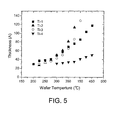
- Atomic layer depositions of TiO 2 films using titanium precursors described herein and a comparative titanium precursor and ozone as oxygen source were performed and the results are provided in Figure 5 .
- the substrates were bare silicon wafer cleaned with 1% HF solution, rinsed with deionized water and dried under nitrogen.
- the deposition temperature ranged from approximately 200 to 450 °C.
- the deposition chamber pressure was around 1.5 Torr.
- Containers containing the following titanium precursors bis(tert-butoxy)bis(2,2-dimethyl-3,5-hexanedionato)titanium (referred to on Figure 5 as Ti-1), bis(iso-propoxy)bis(2,2-dimethyl-3,5-hexanedionato)titanium (referred to on Figure 5 as Ti-2), bis(iso-butoxy)bis(2,2-dimethyl-3,5-hexanedionato)titanium (referred to on Figure 5 as Ti-3) and commercial available solid precursor bis(iso-propoxy)bis(2,2,6,6-tetramethyl-3,5-heptanedionato) (SAFC Hitech, product code TI-2-2) (referred to on Figure 5 as Ti-4) were maintained at 100 to 130°C, depending upon the precursor.
- Ti-1 bis(tert-butoxy)bis(2,2-dimethyl-3,5-hexanedionato)titanium
- Ti-2 bis(iso-propoxy)bis(
- one cycle of ALD or CCVD of TiO 2 was comprised of the following 4 steps:
- TiO 2 films are obtained, showing a deposition temperature dependence of the resulting TiO 2 film.
- the typical ALD conditions are: Ti precursor pulse time was 3 seconds, the Ar purge time after Ti precursor pulse was 8 seconds, the ozone pulse time was 5 seconds, and the Ar purge time after ozone pulse was 10 seconds. The cycle is repeated 100 times.
- the results are depicted in Figure 5 in which the ALD process window was up to - 300 °C.
- Example 26 Atomic layer deposition of titanium oxide films via Direct Liquid Injection or Bubbling
- the present example illustrates that the ALD deposition results are substantially equivalent when delivering the same precursor in two different ways (e.g., bubbling and direct liquid injection system).
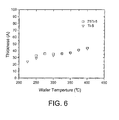
- Atomic layer depositions of TiO 2 films using the titanium precursor bis(ethoxy)bis(2,2,6,6-dimethyl-3,5-heptanedionato)titanium using two different vapor delivery methods are presented in Figure 6 .
- the ALD deposition results of the precursor bis(ethoxy)bis(2,2,6,6-dimethyl-3,5-heptanedionato)titanium described in Example 25 are presented on Figure 6 as "Ti-5".
- the DLI deposition results wherein the precursor composition comprises 75 weight percent bis(ethoxy)bis(2,2,6,6-dimethyl-3,5-heptanedionato)titanium and 25 weight percent octane are identified on Figure 6 as "75Ti-5".
- the dip tube side of the canister containing 75% wt of Ti-5 is connected to an injector valve in the DLI system and - 30 psig of nitrogen is connected to the other side of the canister to push the liquid.
- the Ti solution was pushed through an liquid flow controller (LFC) with a flow rate of 75mg/min into the vaporizer set at 140°C via an injection valve. This injection valve was always open.
- LFC liquid flow controller
- the Ti solution was vaporized in the vaporizer and the resulting Ti containing vapor was either delivered into the reactor chamber during the Ti pulse or diverted into exhaust during other pulses.
- the deposition temperature range is 200 - 400 °C.
- the deposition chamber pressure ranges around 200 Pa (1.5 Torr), depending upon the gas flow rates. DLI requires an additional step to inject liquid whereas bubbling 4 steps.
- One cycle of ALD wherein the precursor is delivered via DLI comprised the following 5 steps.
- This example describes an ALD or CCVD deposition of strontium titanate using a titanium complex illustrated in examples described above as titanium precursor bis(tert-butoxy)bis(2,2-dimethyl-3,5-hexanedionato)titanium (referred to herein as Ti-1) (delivered neat via bubbling), a strontium precursor (bis(2,2-dimethyl-5-(1-dimethylamino-2-propylimino)-3-hexanonato-N,O,N')strontium) dissolved in solvent [(0.1M in 10% wt THF in dedocane), and ozone as oxygen source.
- the deposition temperature was approximately 300°C.
- the deposition chamber pressure was approximately 200 Pa (1.5 Torr).
- the strontium titanate film can be formed with combination of TiO 2 and SrO subcycles. Strontium delivered via DLI.
- One subcycle of ALD or CCVD of TiO 2 comprised the following 4 steps.
- One subcycle of ALD or CCVD of SrO comprised the following 4 steps.
Landscapes
- Chemical & Material Sciences (AREA)
- Organic Chemistry (AREA)
- Chemical Kinetics & Catalysis (AREA)
- Engineering & Computer Science (AREA)
- Materials Engineering (AREA)
- Mechanical Engineering (AREA)
- Metallurgy (AREA)
- General Chemical & Material Sciences (AREA)
- Inorganic Chemistry (AREA)
- Chemical Vapour Deposition (AREA)
- Formation Of Insulating Films (AREA)
- Electrodes Of Semiconductors (AREA)
Abstract

Description
- Disclosed herein are precursors and compositions thereof for depositing
Group 4 metal-containing films. Also disclosed herein are methods for making the precursors along with methods for depositingGroup 4 metal-containing films. With regard to the later, the described method may form a metal-containing film, such as, but not limited to, stoichiometric or non-stoichiometric strontium titanate and barium strontium titanate films using deposition processes such as, but not limited to, atomic layer deposition (ALD) or cyclic chemical vapor deposition (CCVD) that may be used, for example, as a gate dielectric or capacitor dielectric film in a semiconductor device. - With each generation of metal oxide semiconductor (MOS) integrated circuit (IC), the device dimensions have been continuously scaled down to provide for high-density and high-performance such as high speed and low power consumption requirements. Unfortunately, field effect semiconductor devices produce an output signal that is proportional to the width of the channel, such that scaling reduces their output. This effect has generally been compensated for by decreasing the thickness of gate dielectric, thus bringing the gate in closer proximity to the channel and enhancing the field effect which thereby increasing the drive current. Therefore, it has become increasingly important to provide extremely thin reliable and low-defect gate dielectrics for improving device performance.
- For decades, a thermal silicon oxide, SiO2 has been mainly used as a gate dielectric because it is stable with the underlying silicon substrate and its fabrication process is relatively simple. However, because the silicon oxide gate dielectric has a relatively low dielectric constant (k), 3.9, further scaling down of silicon oxide gate dielectric thickness has become more and more difficult, especially due to gate-to-channel leakage current through the thin silicon oxide gate dielectric.
- This leads to consideration of alternative dielectric materials that can be formed in a thicker layer than silicon oxide but still produce the same or better device performance. This performance can be expressed as "equivalent oxide thickness (EOT)". Although the alternative dielectric material layer may be thicker than a comparative silicon oxide layer, it has the equivalent effect of a much thinner layer of silicon oxide layer.
- To this end, high-k metal oxide materials have been proposed as the alternative dielectric materials for gate or capacitor dielectrics. Group 4-containing precursors may also be used by themselves or combined with other metal-containing precursors, such as, for example, Pb(Zr,Ti)O3 or (Ba,Si)(Zr,Ti)O3, to make high dielectric constant and/or ferroelectric oxide thin films. Because the dielectric constant of metal oxide materials can be made that is higher than that of the silicon oxide (e.g., a dielectric constrant for Al2O3 ranging from 9-11; dielectric constant for HfO2 ranging from 15-26; dielectric constant for ZrO2 ranging from 14-25; dielectric constant from TiO2 ranging from 50-80; and dielectric constant for SrTiO3 or approximately 200), a thicker metal oxide layer having an EOT less than 2A can be deposited. As a result, the semiconductor industry requires
Group 4 precursors, such as, for example, titanium-containing, zirconium-containing, and hafnium-containing precursors and combinations thereof, to be able to deposit metal-containing films such as, but not limited to, oxide, nitride, silicate or combinations thereof on substrates such as metal nitride or silicon. - Unfortunately, the use of high-k metal oxide materials presents several problems when using traditional substrate materials such as silicon. The silicon can react with the high-k metal oxide or be oxidized during deposition of the high-k metal oxide or subsequent thermal processes, thereby forming an interface layer of silicon oxide. This increases the equivalent oxide thickness, thereby degrading device performance. Further, an interface trap density between the high-k metal oxide layer and the silicon substrate is increased. Thus, the channel mobility of the carriers is reduced. This reduces the on/off current ratio of the MOS transistor, thereby degrading its switching characteristics. Also, the high-k metal oxide layer such as a hafnium oxide (HfO2) layer or a zirconium oxide (ZrO2) layer has a relatively low crystallization temperature and is thermally unstable. Thus, the metal oxide layer can be easily crystallized during a subsequent thermal annealing process for activating the impurities injected into source/drain regions. This can form grain boundaries in the metal oxide layer through which current can pass. As the surface roughness of the metal oxide layer increases, the leakage current characteristics may deteriorate. Further, the crystallization of the high-k metal oxide layer undesirably affects a subsequent alignment process due to irregular reflection of the light on an alignment key having the rough surface.
- In addition to minimizing side reactions with the substrate that the
Group 4 precursor is deposited upon, it is also desirable that theGroup 4 precursor be thermally stable at a temperature of 250°C or greater. Group 4-containing metal films are typically deposited using a vapor deposition (e.g., chemical vapor deposition and/or atomic layer deposition) process. It is desirable that these precursors are thermally stable during vapor delivery in order to avoid premature decomposition of the precursor before it reaches the vapor deposition chamber during processing. Premature decomposition of the precursor not only results in undesirable accumulation of side products that will clog fluid flow conduits of the deposition apparatus, but also may causes undesirable variations in composition of the deposited gate/capacitor dielectric, high dielectric constant and/or ferroelectric metal oxide thin film. Further, it is desirable that theGroup 4 precursors avoid undesirable side reactions with other source reagents, e.g., reagents containing silicon, oxide, nitride, or other metals, such as, but not limited to, Pb and/or Ti. Because some of theGroup 4 precursors are solid, it is desirable that these precursors maintain their chemical identity over time when dissolved or suspended in organic solvents. Any change in chemical identity ofGroup 4 precursor in the solvent medium is deleterious because it may impair the ability of the vapor deposition process to achieve repeatable delivery and film growth. - As previously discussed, the
Group 4 precursors in the prior art are mostly solid and have relatively low vapor pressure (e.g., ∼67 Pa (0.5 torr) or below). Of thefew Group 4 precursors that are in liquid form that are reported in the prior art, these precursors are typically not thermally stable at temperatures greater than 100°C, which may cause delivery or process issues during semiconductor manufacturing which can include, but are not limited to, clogging of the delivery lines between the source container and reactor and unwanted particle deposition on the wafers. - Accordingly, there is a need to develop
Group 4 precursors, preferablyliquid Group 4 precursors, which exhibit at least one of the following properties: lower molecular weight (e.g., 500 m.u. or below), lower melting point (e.g., 100°C or below), and higher vapor pressure (e.g., ∼67 Pa (0.5 torr) or greater). - Described herein are
Group 4 metal-containing precursors and deposition processes for fabricating conformal metal containing films on substrates such as silicon, metal nitride and other metal layers using these organometallic precursors. Also described herein are methods for makingGroup 4 metal-containing precursors and methods for depositing films using theGroup 4 metal-containing precursors. - According to a first aspect of the present invention, there is provided a method for forming a metal-containing film on at least one surface of a substrate that comprises:
- forming via vapor deposition the metal-containing film on the surface from a composition comprising a
Group 4 metal-containing precursor having the following formula I:
- In a second aspect of the present invention, there is provided a composition for forming a metal-containing film comprising:
- at least 50 percent by weight or greater of at least one
Group 4 metal-containing precursor having the following formula I:
- In a third aspect of the present invention, there is provided a composition comprising:
- a plurality of
Group 4 metal-containing precursors wherein at least one of theGroup 4 metal-containing precursors is a precursor selected from the group consisting of bis(ethoxy)bis(2,2,6,6-tetramethyl-3,5-heptanedionato)titanium; (ethoxy)(isoproxy)bis(2,2,6,6-tetramethyl-3,5-heptanedionato)titanium; bis(iso-propoxy)bis(2,2,6,6-tetramethyl-3,5-heptanedionato)titanium;(ethoxy)(t-butoxy)bis(2,2,6,6-tetramethyl-3,5-heptanedionato)titanium; bis(t-butoxy)bis(2,2,6,6-tetramethyl-3,5-heptanedionato)titanium; bis(iso-propoxy)bis(2,2-dimethyl-3,5-hexanedionato)titanium, (iso-proxy)(n-butoxy)bis(2,2-dimethyl-3,5-hexanedionato)titanium, bis(n-butoxy)bis(2,2-dimethyl-3,5-hexanedionato)titanium, and combinations thereof. In one particular embodiment, the composition comprises: bis(ethoxy)bis(2,2,6,6-tetramethyl-3,5-heptanedionato)titanium; (ethoxy)(isoproxy)bis(2,2,6,6-tetramethyl-3,5-heptanedionato)titanium; and bis(iso-propoxy)bis(2,2,6,6-tetramethyl-3,5-heptanedionato)titanium. - Preferred embodiments of the present invention will now be described with reference to the figures in which:
-
Figure 1 provides the thermogravometric analysis (TGA) comparison for the evaporation of threeGroup 4 metal-containing precursors: bis(tert-butoxy)bis(2,2-dimethyl-3,5-hexanedionato)titanium (a liquid precursor described in Example 2, represented by the solid line), bis(iso-propoxy)bis(2,2-dimethyl-3,5-hexanedionato)titanium (a liquid precursor described in Example 1, represented by the dotted line), and a commercially available solid precursor bis(iso-propoxy)bis(2,2,6,6-tetramethyl-3,5-heptanedionato)titanium (provided by SAFC Hitech of Haverhill, MA and represented by the dashed line).Figure 1 shows that the first two precursors, or theGroup 4 liquid-based metal-containing precursors described herein, are more volatile than the commerically available solid precursor. -
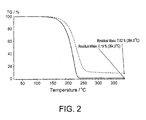
Figure 2 provides the TGA comparison for the evaporation of bis(tert-butoxy)bis(2,2-dimethyl-3,5-hexanedionato)titanium (a liquid precursor described in Example 2, represented by the solid line) and bis(tert-butoxy)bis(6-methyl-2,4-heptanedionato)titanium (a liquid precursor described in Example 5, represented by the dashed line).Figure 2 shows that theGroup 4 metal-containing precursor described herein or bis(tert-butoxy)bis(2,2-dimethyl-3,5-hexanedionato)titanium is more stable and volatile than the precursor bis(tert-butoxy)bis(6-methyl-2,4-heptanedionato)titanium even through both precursors have the same molecular weight and are liquid at room temperature. This may indicate that the bulkier t-butyl R2 group in bis(tert-butoxy)bis(2,2-dimethyl-3,5-hexanedionato)titanium -when compared to the iso-butyl R2 group in bis(tert-butoxy)bis(6-methyl-2,4-heptanedionato)titanium- may prevent intermolecular interactions in the liquid phase, thereby significantly increasing the stability of bis(tert-butoxy)bis(2,2-dimethyl-3,5-hexanedionato)titanium. -
Figure 3 provides the TGA comparison for the evaporation of bis(tert-butoxy)bis(2,2-dimethyl-3,5-hexanedionato)zirconium (a liquid precursor described in Example 3 and represented by the solid line) and bis(tert-butoxy)bis(2,2-dimethyl-3,5-hexanedionato)hafnium (a liquid precursor described in Example 4 and represented by the dashed line), which indicates that both precursors are volatile and can be used as precursor for CVD or ALD processes to deposit ZrO2 or HfO2, respectively. -
Figure 4 provides the differential scanning calorimetry (DSC) measurment of bis(tert-butoxy)bis(2,2-dimethyl-3,5-hexanedionato)titanium of Example 2 and referred to as Ti-1, suggesting that Ti-1 is thermally stable in the liquid phase up to a temperature of at least 290°C. -
Figure 5 is a graph of thickness versus temperature for the atomic layer deposition (ALD) of TiO2 using liquid precursors including bis(tert-butoxy)bis(2,2-dimethyl-3,5-hexanedionato)titanium (of Example 2 and referred to onFigure 5 as "Ti-1 "), bis(iso-propoxy)bis(2,2-dimethyl-3,5-hexanedionato)titanium (of Example 1 and referred to onFigure 5 as "Ti-2"), bis(iso-butoxy)bis(2,2-dimethyl-3,5-hexanedionato)titanium (of Example 10 and referred to onFigure 5 as "Ti-3") and a commercially available solid precursor bis(iso-propoxy)bis(2,2,6,6-tetramethyl-3,5-heptanedionato))titanium (provided by SAFC Hitech of Haverhill, MA, represented by the dashed line and referred to onFigure 5 as "Ti-4"), suggesting that the liquid precursors are more reactive and may provide a relatively higher deposition rate. -
Figure 6 is a graph of thickness versus temperature for the atomic layer deposition (ALD) of TiO2 using the precursor bis(ethoxy)bis(2,2,6,6-dimethyl-3,5-heptanedionato)titanium which is delivered using two different vapor delivery methods: bubbling delivered neat (referred to onFigure 6 as "Ti-5") and direct liquid injection or DLI (referred to onFigure 6 as "75Ti-5") (delivered in a 75 weight % solution with octane). The data demonstrated both delivery methods provide similar ALD results. -
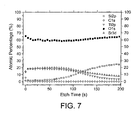
Figure 7 is an X-ray Photoelectron Spectroscopy (XPS) analysis of strontium titanate films, deposited using the Ti-containing precursor bis(tert-butoxy)bis(2,2-dimethyl-3,5-hexanedionato)titanium (of Example 2 and referred to herein as Ti-1) indicating that there is no carbon contamination and a stoichiometric STO film can be formed. -
Figure 8 is the TGA comparison for the evaporation of the low melting point composition that comprises threeGroup 4 precursors described herein and described in Example 21 versus a commercially available solid precursor bis(iso-propoxy)bis(2,2,6,6-tetramethyl-3,5-heptanedionato))titanium (provided by SAFC Hitech of Haverhill, MA), suggesting that the low melting point composition has similar vaporization characteristics to the high melting point solid. - Disclosed herein are
Group 4 complexes that are suitable, for example, as precursors in chemical vapor deposition or other deposition processes. The complexes and compositions are useful for fabricating metal containing films on substrates such as silicon, metal nitride, metal oxide, metal oxynitride, metal silicate, and other metal containing layers via chemical vapor deposition (CVD) processes such as, but not limited to, atomic layer deposition (ALD) processes. TheGroup 4 metal containing precursors can also be used as dopants for other metal-containing films to introduce metal atoms such Ti, Hf, Zr, and combinations thereof into a material or film. As used herein, the term "chemical vapor depositon processes" refers to any process wherein a substrate is exposed to one or more volatile precursors, which react and/or decompose on the substrate surface to produce the desired deposition. The deposited metal films have applications ranging from computer chips, optical device, magnetic information storage, to metallic catalyst coated on a supporting material. Also disclosed herein are methods for preparing these complexes as well as their use in deposition processes, particularly CVD or ALD deposition processes. - The family of
Group 4 precursors are represented by the following formula I:
- In formula I above, M is a metal chosen from Ti, Zr, and Hf; R and R1 are each independently selected from an alkyl group comprising from 1 to 10 carbon atoms; R2 is an alkyl group comprising from 1 to 10 carbon atoms and R3 is chosen from hydrogen or an alkyl group comprising from 1 to 3 carbon atoms, or R2 and R3 together form a C2 to C6, preferably C3 to C5, more preferably C4, alkylene group; R4 is an alkyl group comprising from 1 to 6 carbon atoms.
- In one particular embodiment, R and R1 comprise a bulky alkyl group comprising from 3 to 5 carbon atoms; R2 comprises a bulky alkyl group comprising from 4 to 6 carbon atoms; R3 comprises hydrogen; and R4 comprises a methyl group. In the latter embodiment of Formula I, R and R1 can be either an isopropyl or a tert-butyl bulky alkyl group.
- The term "alkyl" as used herein includes linear, branched, or cyclic alkyl groups, comprising from 1 to 10 carbon atoms, from 1 to 6 carbon atoms, from 1 to 3 carbon atoms, from 3 to 5 carbon atoms, from 4 to 6 carbons atoms, or variations of the foregoing ranges. Exemplary alkyl groups include, but are not limited to, methyl, ethyl, n-propyl, isopropyl, n-butyl, isobutyl, sec-butyl, tert-butyl, tert-amyl, n-pentyl, n-hexyl, cyclopentyl, and cyclohexyl. The term "alkyl" applies also to alkyl moieties contained in other groups such as haloalkyl, alkylaryl, or arylalkyl. The term "bulky" as used herein describes alkyl groups that are more sterically hindered compared to linear alkyl groups having the same number of carbon atoms and may include, for example, branched alkyl groups, cyclic alkyl groups, or alkyl groups having one or more side chains and/or substituents. The term "aryl" as used herein comprises 6 to 12 member carbon rings having aromatic character. Exemplary aryl groups include phenyl and napthyl groups. The term "alkyl-substituted aryl" applies to aryl moieties that are substituted with alkyl. Exemplary alkyl-substituted aryl groups include tolyl and xylyl groups. The term "halo" and "halogen" include fluorine, chlorine, bromine, or iodine. In certain embodiments, some of the groups discussed herein may be substituted with one or more other elements such as, for example, a halogen atom or other heteroatoms such as O, N, Si, or S.
- In certain embodiments, at least one of R2 and R4 in the β-diketonate ligand of Formula I are different alkyl groups or is assymetrical. Examples of assymetrical β-diketonate ligands include, but are not limited to, 2,2-dimethylhexane-3,5-dione ("dmhd"), 6-methyl-2,4-hetanedione ("mhd") and 6-methoxy-5,5-dimethylhexane-2,4-dione ("methd").
- In other embodiments, at least one of the R2 and R4 in the β-diketonate ligand are the same alkyl groups or is symmetrical. Examples of symmetrical β-diketonate ligands include, but are not limited to, 2,4-pentanedione ("acac"), 2,2,6,6-tetramethyl-3,5-heptanedionato ("thd"), 2,2,7-trimethyl-3,5-octanedionato ("tod") and 1,3-diphenylpropane-1,3-dione ("dbm").
- In one particular embodiment, the
Group 4 metal-containing precursor is a liquid which exhibits at least one of the following properties: lower molecular weight (e.g., 500 m.u. or below), lower melting point (e.g., 100°C or below), and higher vapor pressure (e.g., ∼67 Pa (0.5 torr) or greater). Exemplary melting point temperatures for the precursors disclosed herein include ranges having any one or more of the following endpoints: 100, 95, 90, 85, 80, 75, 70, 65, 60, 55, 50, 45, 40, 35, and/or 30°C. Examples of particular melting point ranges include, but are not limited to, 100°C or less, 75°C or less, or 60°C or less. - In certain embodiments of the composition described herein, the composition comprises a plurality (e.g., two or
more Group 4 metal-containing precursors). In this or other embodiments, at least one of the plurality of theGroup 4 metal-containing precursors comprises aGroup 4 metal-containing precursor having the formula I described herein. In one particular embodiment, the composition comprises theGroup 4 metal-containing precursor wherein at least one of theGroup 4 metal-containing precursor is selected from the group consisting of bis(ethoxy)bis(2,2,6,6-tetramethyl-3,5-heptanedionato)titanium; (ethoxy)(isoproxy)bis(2,2,6,6-tetramethyl-3,5-heptanedionato)titanium; bis(iso-propoxy)bis(2,2,6,6-tetramethyl-3,5-heptanedionato)titanium;(ethoxy)(t-butoxy)bis(2,2,6,6-tetramethyl-3,5-heptanedionato)titanium; bis(t-butoxy)bis(2,2,6,6-tetramethyl-3,5-heptanedionato)titanium; bis(iso-propoxy)bis(2,2-dimethyl-3,5-hexanedionato)titanium, (iso-proxy)(n-butoxy)bis(2,2-dimethyl-3,5-hexanedionato)titanium, bis(n-butoxy)bis(2,2-dimethyl-3,5-hexanedionato)titanium, and combinations thereof. - Also described herein is a method for making a
Group 4 metal-containing oxide film, metal-containing nitride film, metal-containing oxynitride film, metal-containing silicate film, multi-component metal oxide film, and any combination or laminate thereof, which may be used, for example, in fabricating semiconductor devices. In one embodiment, the method disclosed herein provides aGroup 4 metal or multi-component metal oxide film that has a dielectric constant substantially higher than that of either conventional thermal silicon oxide, silicon nitride, or zirconium/hafnium oxide dielectric. - The method disclosed herein deposits the
Group 4 metal containing films using atomic layer deposition (ALD) or chemical vapor deposition (CVD) processes. Examples of suitable deposition processes for the method disclosed herein include, but are not limited to, cyclic CVD (CCVD), MOCVD (Metal Organic CVD), thermal chemical vapor deposition, plasma enhanced chemical vapor deposition (PECVD), high density chemical vapor deposition (PECVD), photon assisted chemical vapor deposition (PACVD), plasma-photon assisted chemical vapor deposition (PPECVD), cryogenic chemical vapor deposition, chemical assisted vapor deposition, hot-filament chemical vapor deposition, CVD of a liquid polymer precursor, deposition from supercritical fluids, and low energy CVD (LECVD). In certain embodiments, the metal containing films are deposited via plasma enhanced ALD (PEALD) or plasma enhanced cyclic CVD (PECCVD) process. In these embodiments, the deposition temperature may be relatively lower, or may range from 200°C to 400°C, and may allow for a wider process window to control the specifications of film properties required in end-use applications. Exemplary deposition temperatures for the PEALD or PECCVD deposition include ranges having any one or more of the following endpoints: 200, 225, 250, 275, 300, 325, 350, 375, and/or 400°C. - In one embodiment of the method disclosed herein, a
group 4 metal silicate or metal silicon oxynitride film is formed onto at least one surface of a substrate using aGroup 4 metal-containing precursor having Formula I, a silicon-containing precursor, an oxygen source, and optionally a nitrogen source. Although metal-containing and silicon-containing precursors typically react in either liquid form or gas phase thereby preventing film formation, the method disclosed herein avoids pre-reaction of the metal containing and silicon-containing precursors by using ALD or CCVD methods that separate the precursors prior to and/or during the introduction to the reactor. In this connection, deposition techniques such as an ALD or CCVD processes are used to deposit the metal-containing film. For example, in certain embodiments, an ALD process is used to deposit the metal-containing film. In a typical ALD process, the film is deposited by exposing the substrate surface alternatively to the metal amide or the silicon-containing precursors. Film growth proceeds by self-limiting control of surface reaction, the pulse length of each precursor, and the deposition temperature. However, once the surface of the substrate is saturated, the film growth ceases. In yet another embodiment, the metal-containing film may be deposited using a CCVD process. In this embodiment, the CCVD process may be performed using a higher temperature range than the ALD window, or from 350°C to 600°C thereby preventing, for example, precursor decomposition. Exemplary deposition temperatures for the CCVD deposition include ranges having any one or more of the following endpoints (provided in degrees Celsius): 200, 225, 250, 275, 300, 325, 350, 375, 400, 425, 450, 475, 500, 525, 550, 575, and/or 600°C. - In certain embodiments, the method disclosed herein forms the multi-component metal oxide films using metal ketoiminate precursors and an oxygen source.
- As mentioned previously, the method disclosed herein forms the metal-containing films using at least one metal precursor such as the
Group 4 metal-containing precursors having formula I described herein, optionally at least one silicon-containing precursor, optionally an oxygen source, optionally an additional metal-containing or other metal-containing precursor precursor, optionally a reducing agent, and optionally a nitrogen source. Although the precursors and sources used herein may be sometimes described as "gaseous", it is understood that the precursors can be either liquid or solid which are transported with or without an inert gas into the reactor via direct vaporization, bubbling or sublimation. In some case, the vaporized precursors can pass through a plasma generator. - In certain embodiments, other metal-containing precursors can be used in addition to the
Group 4 metal-containing precursors described herein. Metals commonly used in semiconductor fabrication include that can be used as the metal component for the metal amide includes: titanium, tantalum, tungsten, hafnium, zirconium, cerium, zinc, thorium, bismuth, lanthanum, strontium, barium, lead, and combinations thereof. Examples of other metal-containing precursors that may be used with the method disclosed herein include, but are not limited to, tetrakis(dimethylamino)zirconium (TDMAZ), tetrakis(diethylamino)zirconium (TDEAZ), tetrakis(ethylmethylamino)zirconium (TEMAZ), tetrakis(dimethylamino)hafnium (TDMAH), tetrakis(diethylamino)hafnium (TDEAH), and tetrakis(ethylmethylamino)hafnium (TEMAH), tetrakis(dimethylamino)titanium (TDMAT), tetrakis(diethylamino)titanium (TDEAT), tetrakis(ethylmethylamino)titanium (TEMAT), tert-butylimino tri(diethylamino)tantalum (TBTDET), tert-butylimino tri(dimethylamino)tantalum (TBTDMT), tert-butylimino tri(ethylmethylamino)tantalum (TBTEMT), ethylimino tri(diethylamino)tantalum (EITDET), ethylimino tri(dimethylamino)tantalum (EITDMT), ethylimino tri(ethylmethylamino)tantalum (EITEMT), tert-amylimino tri(dimethylamino)tantalum (TAIMAT), tert-amylimino tri(diethylamino)tantalum, pentakis(dimethylamino)tantalum, tert-amylimino tri(ethylmethylamino)tantalum, bis(tert-butylimino)bis(dimethylamino)tungsten (BTBMW), bis(tert-butylimino)bis(diethylamino)tungsten, bis(tert-butylimino)bis(ethylmethylamino)tungsten, bis(2,2,6,6-tetramethyl-3,5-heptanedionato)strontium, bis(2,2,6,6-tetramethyl-3,5-heptanedionato)barium, M)(RmC5-m-nHn)2 wherein M=Sr or Ba, n is a integer from 1 to 4, n+m=5, and combinations thereof. - In one embodiment, the metal-containing precursors, that can used in addition to the
Group 4 metal precursors described herein to provide a metal-containing film, are polydentate β-ketoiminates which are found, for example, in Applicants' co-pending applicationsU.S. Publ. No. 2007/0248754A1 ,US Publ. No. 2009/0136677 , andU.S. Publ. No. 2009/0136685 , all of which are incorporated herein by reference in their entirety. In certain embodiments, the polydentate β-ketoiminates may incorporate an alkoxy group in the imino group. The polydentate β-ketoiminates are selected from the group represented by the following Structures A and B. - Structure A is defined as:

Group 2 metal such as, for example, magnesium, calcium, strontium, and barium. Preferably, M is strontium or barium. The organo groups (i.e., the R groups) employed in the complexes of the present invention may include a variety of organo groups and they may be linear or branched. In preferred embodiments, R1 is selected from the group consisting of: a C1 to C10 alkyl, a C1 to C10 alkoxyalkyl, a C1 to C10 alkoxy, a C1 to C10 fluoroalkyl, a C1 to C10 cycloaliphatic, and a C6 to C10 aryl. As used herein, the group "alkoxyalkyl" refers to an ether-like moiety that includes a C-O-C fragment. Examples include -CH2CH2-O-CH2CH2-O-CH3 and -CH2CH2-O-CH2-O-CH3. Preferably, R1 is a bulky alkyl group containing 4 to 6 carbon atoms such as, for example, a tert-butyl group, a sec-butyl, and a tert-pentyl group. The most preferred R1 group is tert-butyl or tert-pentyl. Preferably, R2 is selected from the group consisting of: hydrogen, a C1 to C10 alkyl, a C1 to C10 alkoxyalkyl, a C1 to C10 alkoxy, a C3 to C10 cycloaliphatic, and a C6 to C10 aryl. More preferably, R2 is hydrogen, or a C1 to C2 alkyl. Preferably, R3 is selected from the group consisting of: a C1 to C10 alkyl, a C1 to C10 alkoxyalkyl, a C1 to C10 alkoxy, a C3 to C10 cycloaliphatic, and a C6 to C10 aryl. More preferably, R3 is a C1 to C2 alkyl. Preferably, R4 is a C1 to C6 linear or branched alkylene and, more preferably, R4 contains a branched alkylene bridge containing 3 or 4 carbon atoms and having at least one chiral center carbon atom. Preferably, R5 is selected from the group consisting of: a C1 to C10 alkyl, a C1 to C10 fluoroalkyl, a C3 to C10 cycloaliphatic, and a C6 to C10 aryl. More preferably, R5 is a C1 to C2 alkyl. - Specific examples of these metal containing complexes are represented by the following structure B:

- In embodiments wherein the metal film deposited is a metal silicate, the deposition process further involves the introduction of at least one silicon-containing precursor. Examples of suitable silicon-containing precursors include a monoalkylaminosilane precursor, a hydrazinosilane precursor, or combinations thereof. In certain embodiments, the silicon-containing precursor comprises a monoalkylaminosilane precursor having at least one N-H fragment and at least one Si-H fragment. Suitable monoalkylaminosilane precursors containing both the N-H fragment and the Si-H fragment include, for example, bis(tert-butylamino)silane (BTBAS), tris(tert-butylamino)silane, bis(iso-propylamino)silane, tris(iso-propylamino)silane, and mixtures thereof. In one embodiment, the monoalkylaminosilane precursor has the formula (R5NH)nSiR6 mH4-(n+m) wherein R5 and R6 are the same or different and independently selected from the group consisting of alkyl, vinyl allyl, phenyl, cyclic alkyl, fluoroalkyl, and silylalkyl and wherein n is a number ranging from 1 to 3, m is a number ranging from 0 to 2, and the sum of "n + m" is a number that is less than or equal to 3. In another embodiment, the silicon-containing precursor comprises a hydrazinosilane having the formula (R7 2N-NH)xSiR8 yH4-(x+y) wherein R7 and R8 are same or different and independently selected from the group consisting of alkyl, vinyl, allyl, phenyl, cyclic alkyl, fluoroalkyl, silylalkyls and wherein x is a number ranging from 1 to 2, y is a number ranging from 0 to 2, and the sum of "x + y" is a number that is less than or equal to 3. Examples of suitable hydrazinosilane precursors include, but are not limited to, bis(1,1-dimethylhydrazino)-silane, tris(1,1-dimethylhydrazino)silane, bis(1,1-dimethylhydrazino)ethylsilane, bis(1,1-dimethylhydrazino)isopropylsilane, bis(1,1-dimethylhydrazino)vinylsilane, and mixtures thereof. Depending upon the deposition method, in certain embodiments, the silicon-containing precursor may be introduced into the reactor at a predetermined molar volume, or from about 0.1 to about 1000 micromoles. In this or other embodiments, the silicon-containing precursor may be introduced into the reactor for a predetermined time period, or from about 0.001 to about 500 seconds. The silicon-containing precursors react with the metal hydroxyl groups formed by the reaction of the metal amide with the oxygen source and become chemically adsorbed onto the surface of the substrate which results in the formation of a silicon oxide or a silicon oxynitride via metal-oxygen-silicon and metal-oxygen-nitrogen-silicon linkages, thus providing the metal silicate or the metal silicon oxynitride film.
- Depending upon the deposition method, in certain embodiments, the one or more Group 4-metal containing precursor(s) or other precursors may be introduced into the reactor at a predetermined molar volume, or from about 0.1 to about 1000 micromoles. In this or other embodiments, the precursor(s) may be introduced into the reactor for a predetermined time period, or from about 0.001 to about 500 seconds.
- As previously mentioned, some of the films deposited using the methods described herein (e.g., metal silicate or the metal silicon oxynitride films) may be formed in the presence of oxygen. An oxygen source may be introduced into the reactor in the form of at least one oxygen source and/or may be present incidentally in the other precursors used in the deposition process. Suitable oxygen source gases may include, for example, water (H2O) (e.g., deionized water, purifier water, and/or distilled water), oxygen (O2), oxygen plasma, ozone (O3), NO, N2O, carbon monoxide (CO), carbon dioxide (CO2) and combinations thereof. In certain embodiments, the oxygen source comprises an oxygen source gas that is introduced into the reactor at a flow rate ranging from about 1 to about 2000 square cubic centimeters (sccm) or from about 1 to about 1000 sccm. The oxygen source can be introduced for a time that ranges from about 0.1 to about 100 seconds. In one particular embodiment, the oxygen source comprises water having a temperature of 10°C or greater. In this or other embodiments wherein the film is deposited by an ALD process, the precursor pulse can have a pulse duration that is greater than 0.01 seconds, and the oxidant pulse duration can have a pulse duration that is greater than 0.01 seconds, while the water pulse duration can have a pulse duration that is greater than 0.01 seconds. In yet another embodiment, the purge duration between the pulses that can be as low as 0 seconds.
- The deposition methods disclosed herein may involve one or more purge gases.
The purge gas, which is used to purge away unconsumed reactants and/or reaction byproducts, is an inert gas that does not react with the precursors and may preferably be selected from the group consisting of Ar, N2, He, H2 and mixture thereof. In certain embodiments, a purge gas such as Ar is supplied into the reactor at a flow rate ranging from about 10 to about 2000 sccm for about 0.1 to 1000 seconds, thereby purging the unreacted material and any byproduct that remain in the reactor. - In certain embodiments, such as, for example, for those embodiments where a metal silicon oxynitride film is deposited, an additional gas such as a nitrogen source gas may be introduced into the reactor. Examples of nitrogen source gases may include, for example, NO, NO2, ammonia, ammonia plasma, hydrazine, monoalkylhydrazine, dialkylhydrazine, and combinations thereof.
- In certain embodiments of the method described herein, the temperature of the reactor or a deposition chamber may range from ambient temperature (e.g., 25°C) to about 700°C. Exemplary reactor temperatures for the ALD or CVD deposition include ranges having any one or more of the following endpoints: 25, 50, 75, 100, 125, 150, 175, 200, 225, 250, 275, 300, 325, 350, 375, 400, 425, 450, 475, 500, 525, 550, 575, 600, 625, 650, 675, and/or 700°C. Examples of particular reactor temperature ranges include but are not limited to, 25°C to 375°C, or from 75°C to 700°C, or from 325°C to 675°C. In this or other embodiments, the pressure may range from ∼13 Pa (about 0.1 Torr) to ∼13 kPa (about 100 Torr) or from ∼13 Pa (about 0.1 Torr) to ∼667 Pa (about 5 Torr). In one particular embodiment, the dielectric film is deposited using a thermal CVD process at a pressure ranging from ∼13 Pa (100 mTorr) to ∼80 Pa (600 mTorr). In another particular embodiment, the dielectric film is deposited using an ALD process at a temperature range of ∼133 Pa (1 Torr) or less.
- In certain embodiments of the method described herein, the temperature of the substrate in the reactor or a deposition chamber, may range from ambient temperature (e.g., 25°C) to about 700°C. Exemplary substrate temperatures for the ALD or CVD deposition include ranges having any one or more of the following endpoints: 25, 50, 75, 100, 125, 150, 175, 200, 225, 250, 275, 300, 325, 350, 375, 400, 425, 450, 475, 500, 525, 550, 575, 600, 625, 650, 675, and/or 700°C. Examples of particular substrate temperature ranges include but are not limited to, 25°C to 375°C, or from 75°C to 700 °C, or from 325°C to 675°C. In certain embodiments, the substrate temperature may be the same as or in the same temperature range as the reactor temperature during the deposition. In other embodiments, the substrate temperature differs from the reactor temperature during the deposition.
- The respective step of supplying the precursors, the oxygen source, and/or other precursors or source gases may be performed by changing the time for supplying them to change the stoichiometric composition of the resulting metal silicate, metal silicon oxynitride film, or other metal-containing film.
- Energy is applied to the at least one of the precursor, oxygen source gas, reducing agent, or combination thereof to induce reaction and to form the metal-containing film on the substrate. Such energy can be provided by, but not limited to, thermal, plasma, pulsed plasma, helicon plasma, high density plasma, inductively coupled plasma, X-ray, e-beam, photon, and remote plasma methods. In certain embodiments, a secondary RF frequency source can be used to modify the plasma characteristics at the substrate surface. In embodiments wherein the deposition involves plasma, the plasma-generated process may comprise a direct plasma-generated process in which plasma is directly generated in the reactor, or alternatively a remote plasma-generated process in which plasma is generated outside of the reactor and supplied into the reactor.
- In yet another embodiment of the method disclosed herein, the
Group 4 metal-containing film is formed using a vapor deposition method that comprises the steps of:
a. introducing aGroup 4 metal-containing precursor in a vapor state into a deposition chamber and chemisorbing the metal-containing precursor onto a substrate which is heated; b. purging away theunreacted Group 4 metal-containing precursor; c. introducing an oxygen source onto the heated substrate to react with thesorbed Group 4 metal-containing precursor; and d. purging away the unreacted oxygen source. The above steps define one cycle for the method described herein; and the cycle can be repeated until the desired thickness of a metal-containing film is obtained. In this or other embodiments, it is understood that the steps of the methods described herein may be performed in a variety of orders, may be performed sequentially or concurrently (e.g., during at least a portion of another step), and any combination thereof. The respective step of supplying the precursors and the oxygen source gases may be performed by varying the duration of the time for supplying them to change the stoichiometric composition of the resulting metal oxide film. For multi-component metal oxide films such as a strontium and barium containing film, a strontium-containing precursor, a barium-containing precursor or both precursors can be alternately introduced in step a into the reactor chamber. - The
Group 4 metal-containing precursor and/or other metal containing precursors may be delivered to the deposition chamber such as a CVD or ALD reactor or reaction chamber in a variety of ways. In one embodiment, a liquid delivery system may be utilized. In an alternative embodiment, a combined liquid delivery and flash vaporization process unit may be employed, such as, for example, the turbo vaporizer manufactured by MSP Corporation of Shoreview, Mn, to enable low volatility materials to be volumetrically delivered, leading to reproducible transport and deposition without thermal decomposition of the precursor. - In liquid delivery formulations, the precursors described herein may be delivered in neat liquid form, or alternatively, may be employed in solvent formulations or compositions comprising same. Thus, in certain embodiments the precursor formulations may include solvent component(s) of suitable character as may be desirable and advantageous in a given end use application to form a film on a substrate. For example, the solvent may be added to adjust the viscosity of the precursor composition, aid in the liquid delivery vaporization and/or transport of the specific metal precursor that is contained therein, solubilize the precursor(s) for use in a deposition process, or combinations thereof. In one particular embodiment, a direct liquid delivery method can be employed by dissolving the
Group 4 metal-containing precursor described herein in a suitable solvent or a solvent mixture to provide a precursor composition wherein the precursor composition exhibits a viscosity of 50 centipoise (cP) or less at 25 °C. - In certain embodiments, the precursor compositions comprises a solvent or mixture of solvents which include but are not limited to aliphatic hydrocarbons (e.g., C6-C12 aliphatic hydrocarbons such as hexane, heptane, octane, and/or pentane), aromatic hydrocarbons (e.g., C6-C18 aromatic hydrocarbons such as benzene, toluene, and/or mesitylene), ethers (e.g., dialkyl ethers comprising C1-C6 alkyl moieties, C4-C8 cyclic ethers; C12-C60 crown O4-O20 ethers wherein the prefixed Ci range is the number i of carbon atoms in the ether compound and the suffixed Oi range is the number i of oxygen atoms in the ether compound), esters, nitriles, alcohols (e.g., C2-C12 alkanols), amines (e.g., triethylamine and/or tert-butylamine), polyamines, amides, imines and carbodiimides (e.g., N,N'-diisopropylcarbodiimide), ketones, aldehydes, amidines, guanadines, and/or isoureas. Further examples of solvents include glyme solvents having from 1 to 6 oxygen atoms. In one particular embodiment, the solvent in the
Group 4 metal precursor composition comprises an organic amide having the formula R9C(O)NR10R11 wherein R9 and R10 are each independently an alkyl group having from 1-10 carbon atoms and in certain embodiments can be connected to form with C(O)N a 4 to 6 membered ring, and R11 is selected from an alkyl having from 1 to 4 carbon atoms and a cycloalkyl group. Particular examples of amides having the formula R9CONR10R11 include N-methyl- or N-ethyl- or N-cyclohexyl-2-pyrrolidinones, N,N-Diethylacetamide, and N,N-Diethylformamide. - In one particular embodiment, the precursor composition comprises a liquid-based
Group 4 metal-containing precursor having a viscosity or 50 centipoise (cP) or less, or 45 cP or less, or 40 cP or less, of 35 cP or less, or 30 cP or less, or 25 cP or less, or 20 cP or less, or 15 cP or less, or a viscosity of 10 cP or less when measured at 25°C. In this or other embodiments, precursor composition comprises a liquid-basedGroup 4 metal-containing precursor having a viscosity of 50 cP or less at 25°C; at least oneGroup 4 metal-containing precursor described herein but having a viscosity of 100 cP or greater at 25°C; at least one solvent having aviscosity 5 cP or less at 25°C; and optionally an additional metal-containing precursor other than aGroup 4 metal-containing precursor. In this embodiment, the total concentration ofGroup 4 metal-containing precursor is 50 % by weight or greater, 55% by weight or greater, 60% by weight or greater, 65% by weight or greater, 70% by weight or greater, or 75% by weight or greater. Examples of at least one solvent for the precursor composition includes one or more of the solvents described herein such as, but not limited to, aliphatic hydrocarbons, aromatic hydrocarbons, linear or cyclic ethers, esters, nitriles, alcohols, amines, polyamines, organic amides, and combinations thereof. In one particular embodiment, the precursor composition comprises an aliphatic hydrocarbons such as octane. - In one embodiment of the method described herein, a cyclic deposition process such as CCVD, ALD, or PEALD may be employed, wherein a
Group 4 metal-containing precursor or its solution and an oxygen source such as, for example, ozone, oxygen plasma or water plasma are employed. The gas lines connecting from the precursor canisters to the deposition chamber are heated to one or more temperatures ranging from about 110°C to about 200°C depending upon the process requirements, and the container of theGroup 4 metal-containing precursor is kept at one or more temperatures ranging from about 100°C to about 190°C for bubbling whereas the solution comprising theGroup 4 metal-containing precursor is injected into a vaporizer kept at one or more temperatures ranging from about 150°C to about 200°C for direct liquid injection. A flow of 100 to 1000 sccm of argon gas may be employed as a carrier gas to help deliver the vapor of theGroup 4 metal-containing precursor to the deposition chamber during the precursor pulsing. The deposition chamber process pressure is ∼133 Pa (about 1Torr). In a typical ALD or CCVD process, the substrate such as silicon oxide or metal nitride are heated on a heater stage in a deposition chamber that is exposed to theGroup 4 metal-containing precursor initially to allow the complex to chemically adsorb onto the surface of the substrate. An inert gas such as argon gas purges away unadsorbed excess complex from the process chamber. After sufficient Ar purging, an oxygen source is introduced into deposition chamber to react with the absorbed surface followed by another inert gas purge to remove reaction by-products from the chamber. The process cycle can be repeated to achieve the desired film thickness. - In another embodiment, the method described herein is a cyclic deposition process for the formation of ternary metal oxide films wherein a plurality of precursors are sequentially introduced into a deposition chamber, vaporized and deposited on a substrate under conditions for forming a said ternary metal oxide film.
- In another embodiment, the resultant metal oxide films can be exposed to a post-deposition treatment such as, but not limited to, a plasma treatment, chemical treatment, ultraviolet light exposure, electron beam exposure, and/or other treatments to affect one or more properties of the film. In one particular embodiment, the film is exposed to a post-deposition treatment to densify it.
- As mentioned previously, the method described herein may be used to deposit a metal-containing film onto at least a portion of a substrate. Examples of suitable substrates include but are not limited to, silicon, SiO2, Si3N4, OSG, FSG, silicon carbide, hydrogenated silicon carbide, silicon nitride, hydrogenated silicon nitride, silicon carbonitride, hydrogenated silicon carbonitride, boronitride, antireflective coatings, photoresists, organic polymers, porous organic and inorganic materials, metals such as copper and aluminum, and conducting metal layers such as but not limited to TiN, Ti(C)N, TaN, Ta(C)N, Ta, W, or WN. The films are compatible with a variety of subsequent processing steps such as, for example, chemical mechanical planarization (CMP) and anisotropic etching processes. Examples of suitable substrates include but are not limited to, semiconductor materials such as strontium titanate, barium strontium titanate, yttrium oxide doped with titanium, lanthanum oxide doped with titanium, and other lanthanide oxides doped with titanium
- The deposited dielectric films have applications which include but are not limited to computer chips, optical devices, magnetic information storages, coatings on a supporting material or substrate, microelectromechanical systems (MEMS), nanoelectromechanical systems, thin film transistor (TFT), and liquid crystal displays (LCD).
- Aspects of the invention include:
- #1 A method for forming a metal-containing film on at least a surface of the substrate comprising:
- forming via vapor deposition the metal-containing film on the surface from a
composition comprising Group 4 metal-containing precursor having the following formula I:
wherein the vapor deposition is at least one selected from cyclic chemical vapor deposition, plasma enhanced chemical vapor deposition, or atomic layer deposition.
- forming via vapor deposition the metal-containing film on the surface from a
- #2 The method of #1 wherein M comprises Ti.
- #3 The method of #1 or #2 wherein R2 comprises a tert-butyl group, R4 comprises a methyl group, and R3 comprises hydrogen.
- #4 The method of #3 wherein R and R1 each comprise a tert-butyl group.
- #5 The method of #3 wherein R and R1 each comprise an ethyl group.
- #6 The method of #3 wherein R and R1 each comprise an iso-propyl group.
- #7 The method of #1 or #2 wherein R2 comprises an iso-butyl group, R4 comprises a methyl group, and R3 comprises hydrogen.
- #8 The method of #7 wherein R and R1 each comprise a tert-butyl group.
- #9 The method of #7 wherein R and R1 each comprise an ethyl group.
- #10 The method of #7 wherein R and R1 each comprise an iso-propyl group.
- #11 The method of any of #1 to #11 wherein the metal-containing precursor has a melting point of 60°C or below.
- #12 A composition for forming a metal-containing film comprising:
- at least 50 percent by weight or greater of at least one
Group 4 metal-containing precursor having the following formula I
at least one solvent selected from the group consisting of: an aliphatic hydrocarbon, an aromatic hydrocarbon, an ether, an ester, a nitrite, an amine, an organic amide, an alcohol, an imine, a carbodiimide, a ketone, an aldehyde, an amidine, a guandadine, an isourea, a glyme solvent having from 1 to 6 oxygen atoms and mixtures thereof wherein the viscosity of the composition at a temperature of 25°C is 50 centipoise or less.
- at least 50 percent by weight or greater of at least one
- #13 The composition of #12 wherein the at least one solvent is selected from the group consisting of: the ether selected from the group consisting of glyme solvents having from 1 to 6 oxygen atoms; the alcohol comprising C2-C12 alkanols, the ether selected from the group consisting of dialkyl ethers comprising C1-C6 alkyl moieties, C4-C8 cyclic ethers; C12-C60 crown O4-O20 ethers wherein the prefixed Ci range is the number i of carbon atoms in the ether compound and the suffixed Oi range is the number i of oxygen atoms in the ether compound; the hydrocarbons comprising C6-C12 aliphatic hydrocarbons; the hydrocarbons comprising C6-C18 aromatic hydrocarbons; an organic amide of the form RCONR'R" wherein R and R' are alkyl groups comprising from 1 to 10 carbon atoms and can be can be connected to form a cyclic group (CH2)n, wherein n is from 4 to 6, and R" is selected from an alkyl group comprising from 1 to 4 carbon atoms and an cycloalkyl group.
- #14 The composition of #12 or #13 wherein the at least one solvent comprises at least one selected from the group consisting of octane, dodecane, toluene, and mesitylene.
- #15 The composition of any of #12 to #14 wherein the viscosity is 25 cP or less at 25°C.
- #16 The composition of any of #12 to #15 wherein the viscosity is 10 cP or less at 25°C.
- #17 A composition comprising:
- a plurality of
Group 4 metal-containing precursors wherein at least one of theGroup 4 metal-containing precursors is a precursor having the following formula I:

wherein the at least one of theGroup 4 metal-containing precursor having formula I is selected from the group consisting of bis(ethoxy)bis(2,2,6,6-tetramethyl-3,5-heptanedionato)titanium; (ethoxy)(isoproxy)bis(2,2,6,6-tetramethyl-3,5-heptanedionato)titanium; bis(iso-propoxy)bis(2,2,6,6-tetramethyl-3,5-heptanedionato)titanium;(ethoxy)(t-butoxy)bis(2,2,6,6-tetramethyl-3,5-heptanedionato)titanium; bis(t-butoxy)bis(2,2,6,6-tetramethyl-3,5-heptanedionato)titanium; bis(iso-propoxy)bis(2,2-dimethyl-3,5-hexanedionato)titanium, (iso-proxy)(n-butoxy)bis(2,2-dimethyl-3,5-hexanedionato)titanium, bis(n-butoxy)bis(2,2-dimethyl-3,5-hexanedionato)titanium, and combinations thereof.
- a plurality of
- #18. The composition of #17 wherein the composition comprises: bis(iso-propoxy)bis(2,2-dimethyl-3,5-hexanedionato)titanium, (iso-proxy)(n-butoxy)bis(2,2-dimethyl-3,5-hexanedionato)titanium, and bis(n-butoxy)bis(2,2-dimethyl-3,5-hexanedionato)titanium.
- #19 The composition of #17 wherein the composition comprises: bis(ethoxy)bis(2,2,6,6-tetramethyl-3,5-heptanedionato)titanium, (ethoxy)(isoproxy)bis(2,2,6,6-tetramethyl-3,5-heptanedionato)titanium, and bis(iso-propoxy)bis(2,2,6,6-tetramethyl-3,5-heptanedionato)titanium.
- #20. A method for forming a metal-containing film on at least one surface of a substrate, the method comprising:
- providing the at least one surface of the substrate in a deposition chamber; and
- forming the metal-containing film on the at least one surface by a deposition process chosen from a cyclic chemical vapor deposition process and an atomic layer deposition process from an at least one
Group 4 metal-containing precursor having the following formula I: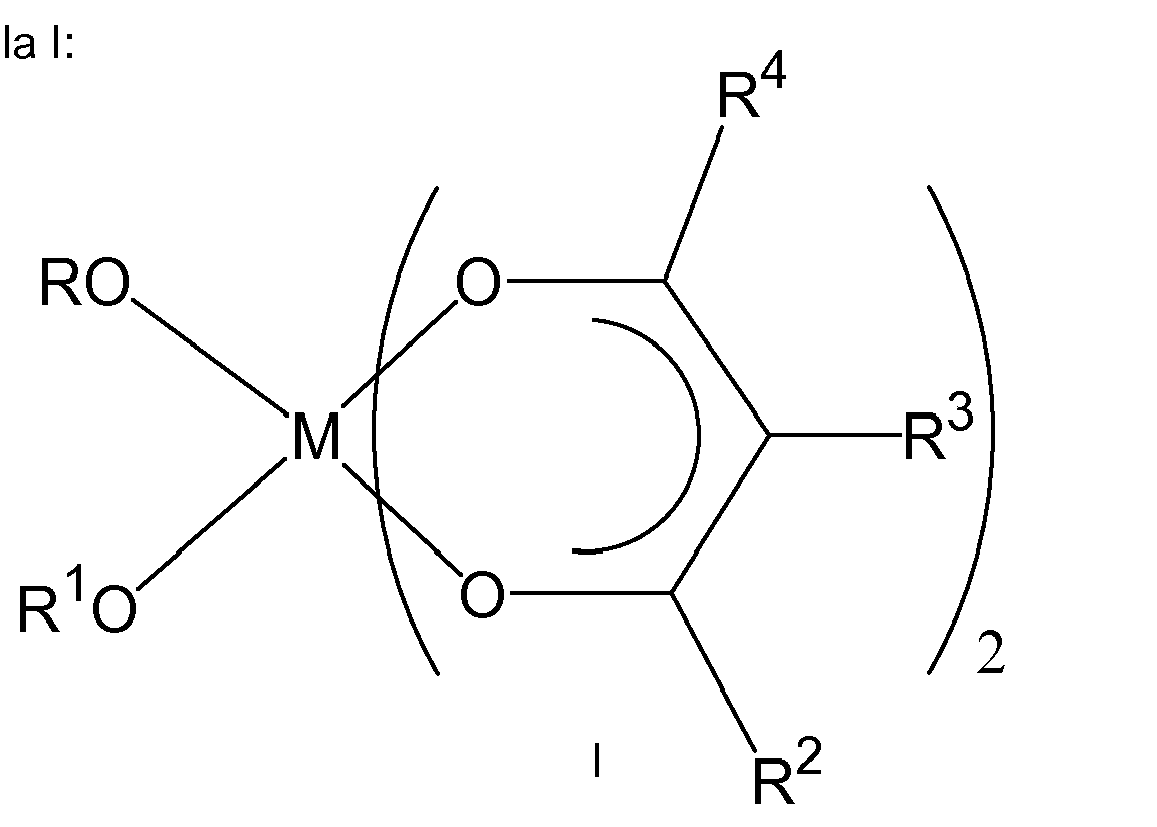
- #21 The method of #20 wherein the forming step further comprises introducing into the deposition chamber an oxygen source selected from the group consisting of water, O2, H2O2, ozone, oxygen plasma, and mixtures thereof.
- #22 The method of #20 or #21 wherein the forming step further comprises introducing into the deposition chamber an additional metal-containing precursor selected from the group consisting of tetrakis(dimethylamino)zirconium (TDMAZ), tetrakis(diethylamino)zirconium (TDEAZ), tetrakis(ethylmethylamino)zirconium (TEMAZ), tetrakis(dimethylamino)hafnium (TDMAH), tetrakis(diethylamino)hafnium (TDEAH), and tetrakis(ethylmethylamino)hafnium (TEMAH), tetrakis(dimethylamino)titanium (TDMAT), tetrakis(diethylamino)titanium (TDEAT), tetrakis(ethylmethylamino)titanium (TEMAT), tert-butylimino tri(diethylamino)tantalum (TBTDET), tert-butylimino tri(dimethylamino)tantalum (TBTDMT), tert-butylimino tri(ethylmethylamino)tantalum (TBTEMT), ethylimino tri(diethylamino)tantalum (EITDET), ethylimino tri(dimethylamino)tantalum (EITDMT), ethylimino tri(ethylmethylamino)tantalum (EITEMT), tert-amylimino tri(dimethylamino)tantalum (TAIMAT), tert-amylimino tri(diethylamino)tantalum, pentakis(dimethylamino)tantalum, tert-amylimino tri(ethylmethylamino)tantalum, bis(tert-butylimino)bis(dimethylamino)tungsten (BTBMW), bis(tert-butylimino)bis(diethylamino)tungsten, bis(tert-butylimino)bis(ethylmethylamino)tungsten, bis(2,2,6,6-tetramethyl-3,5-heptanedionato)strontium, bis(2,2,6,6-tetramethyl-3,5-heptanedionato)barium, M(RmC5-m-nHn)2 wherein M=Sr or Ba, n is a integer from 1 to 4, n+m=5, and combinations thereof.
- #23 The method of any of #20 to #22 wherein the forming step further comprises introducing into the deposition chamber a silicon-containing precursor selected from the group consisting of bis(tert-butylamino)silane (BTBAS), di-iso-propylaminosilane (DIPAS), tris(dimethylamino)silane (TRDMAS), and bis(diethylamino)silane (BDEAS).
- #24. The method of any of #20 to #23 wherein the forming step further comprises introducing into the deposition chamber a polydentate β-ketoiminate selected from the group consisting of:

- M is a
group 2 metal selected from the group consisting of: magnesium, calcium, strontium, and barium; - R1 is selected from the group consisting of: a C1 to C10 alkyl, a C1 to C10 alkoxyalkyl, a C1 to C10 alkoxy, a C1 to C10 fluoroalkyl, a C3 to C10 cycloaliphatic, and a C6 to C10 aryl;
- R2 is selected from the group consisting of: hydrogen, a C1 to C10 alkyl, a C1 to C10 alkoxyalkyl, a C1 to C10 alkoxy, a C3 to C10 cycloaliphatic, and a C6 to C10 aryl;
- R3 is selected from the group consisting of: a C1 to C10 alkyl, a C1 to C10 alkoxyalkyl, a C1 to C10 alkoxy, a C3 to C10 cycloaliphatic, and a C6 to C10 aryl;
- R4 is a C1 to C6 linear or branched alkyl bridge; and
- R5 is selected from the group consisting of: a C1 to C10 alkyl, a C1 to C10 fluoroalkyl, a C3 to C10 cycloaliphatic, and a C6 to C10 aryl,
and
- M is a metal group having a valence of from 2 to 5;
- R1 is selected from the group consisting of alkyl, fluoroalkyl, cycloaliphatic, and aryl, having from 1 to 10 carbon atoms;
- R2 is selected from the group consisting of hydrogen, alkyl, alkoxy, cycloaliphatic, and aryl;
- R3 is selected from the group consisting of alkyl, fluoroalkyl, cycloaliphatic, and aryl;
- R4 is a linear or branched alkyl bridge;
- R5-6 are individually selected from the group consisting of alkyl, fluoroalkyl, cycloaliphatic, aryl, and heterocyclic containing either oxygen, or nitrogen atoms; and
- n is an integer equal to the valence of the metal M.
- M is a
- #25. A method for forming a metal-containing film on a substrate, the method comprising the steps of:
- a. introducing a
Group 4 metal-containing precursor having the following formula I into a deposition chamber and then chemisorbing theGroup 4 metal onto at least a portion of the substrate which is heated;
- b. purging away the
unreacted Group 4 metal-containing precursor; - c. introducing a oxidizing agent comprising at least one selected from group consisting of water, oxygen, oxygen plasma, ozone, and water plasma;
- d. introducing a polydentate β-ketoiminate selected from the group consisting of:
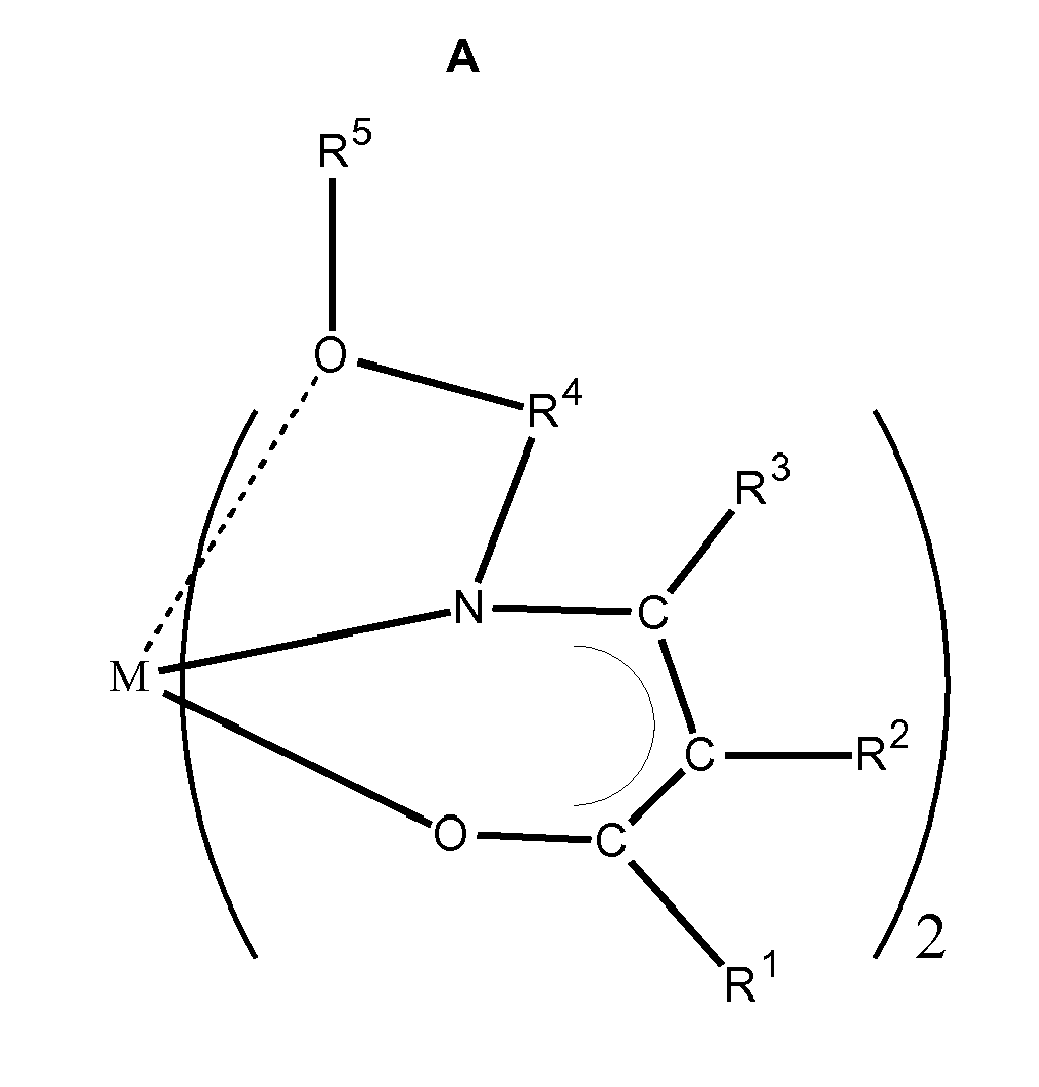
- M is a
group 2 metal selected from the group consisting of: magnesium, calcium, strontium, and barium; - R1 is selected from the group consisting of: a C1 to C10 alkyl, a C1 to C10 alkoxyalkyl, a C1 to C10 alkoxy, a C1 to C10 fluoroalkyl, a C3 to C10 cycloaliphatic, and a C6 to C10 aryl;
- R2 is selected from the group consisting of: hydrogen, a C1 to C10 alkyl, a C1 to C10 alkoxyalkyl, a C1 to C10 alkoxy, a C3 to C10 cycloaliphatic, and a C6 to C10 aryl;
- R3 is selected from the group consisting of: a C1 to C10 alkyl, a C1 to C10 alkoxyalkyl, a C1 to C10 alkoxy, a C3 to C10 cycloaliphatic, and a C6 to C10 aryl;
- R4 is a C1 to C6 linear or branched alkyl bridge; and
- R5 is selected from the group consisting of: a C1 to C10 alkyl, a C1 to C10 fluoroalkyl, a C3 to C10 cycloaliphatic, and a C6 to C10 aryl, and;

- M is a metal group having a valence of from 2 to 5;
- R1 is selected from the group consisting of alkyl, fluoroalkyl, cycloaliphatic, and aryl, having from 1 to 10 carbon atoms;
- R2 is selected from the group consisting of hydrogen, alkyl, alkoxy, cycloaliphatic, and aryl;
- R3 is selected from the group consisting of alkyl, fluoroalkyl, cycloaliphatic, and aryl;
- R4 is a linear or branched alkyl bridge;
- R5-6 are individually selected from the group consisting of alkyl, fluoroalkyl, cycloaliphatic, aryl, and heterocyclic containing either oxygen, or nitrogen atoms; and n is an integer equal to the valence of the metal M;
- M is a
- e. purging away the unreacted polydentate β-ketoiminate gas; and
- f. introducing a oxidizing agent selected from group consisting of water, oxygen, oxygen plasma, ozone, and water plasma,
wherein steps a through f are repeated to deposit the metal-containing film.
- a. introducing a
- #26. The method of #25 wherein the metal-containing film comprises strontium titanate.
- #27. The method of #25 or #26 wherein the metal-containing film comprises barium strontium titanate.
- #28. The method of any of #25 to #27 wherein the substrate is heated to a temperature ranging from about 200°C to 500°C.
- #29 The method of any of #25 to #28 wherein at least one of the precursor selected from the
Group 4 precursor having the formula I, the polydentate β-ketoiminate, or both is dissolved in at least one solvent selected from the group consisting of: an aliphatic hydrocarbon, an aromatic hydrocarbon, an ether, an ester, a nitrite, an amine, an organic amide, an alcohol, an imine, a carbodiimide, a ketone, an aldehyde, an amidine, a guandadine, an isourea, a glyme solvent having from 1 to 6 oxygen atoms and mixtures thereof. - #30 A method for forming a metal-containing film on a substrate comprising:
- introducing a
Group 4 metal-containing precursor represented by formula I:
- introducing at least one oxidizing agent into the deposition chamber, wherein the at least one oxidizing agent reacts with the
Group 4 metal-containing precursor to provide the metal-containing film on the substrate.
- introducing a
- The following examples illustrate the method for preparing a
Group 4 metal-containing precursor and depositing a film using the Group 4-metal-containing precursor described herein and are not intended to limit it in any way. - In the following examples, the G.C.M.S. Spectra for the examples were performed on a Hewlett Packard 5890 Series 11 G.C. and 5972 series mass selective detector with a HP-5MS. The NMR analyses for the examples were obtained on a
Bruker AMX 500 spectrometer operating at 500 MHz. Chemical shifts were set from C6D6 at 7.16 ppm in 1H. The melting point measurements of certain compounds was obtained via differential scanning calorimetry (DSC) or thermal gravimetric analysis using Netzsch STA 449C under inert atmosphere with 100 standard cubic centimeters (sccm) dynamic flow of nitrogen and a ramp rate of 10°C/min. - To a solution of 1.00g (3.52mmol) Ti(IV)isopropoxide in 20mL tetrahydrofuran (THF) was added 1.00g (7.04mmol) 2,2-dimethyl-3,5-hexanedione (dmhd) in 5mL THF to provide a reaction mixture. The resulting clear solution was heated to reflux for 16 hours. Removal of all volatiles from the reaction mixture generated a viscous brown oil weighing 1.50g. The yield was 95%. 1H-NMR confirms no uncoordinated 2,2-dimethyl-3,5-hexanedione (dmhd) and shows the desired ratio of iPrO to dmhd coordinated to Ti being two iPrO's to two dmhd ligands. Elemental analysis: calculated for Ti(Me3CCOCHCOMe)2(OCHMe2)2: C, 58.93; H, 8.99. Found: C, 56.17; H, 7.98. 1H-NMR (500 MHz, C6D6) δ(ppm): 5.58 (CH), 5.04 (CH), 1.72 (CH3), 1.40 [(CH3)2], 1.06 [C(CH3)3].
- To a solution of 1.10g (3.23mmol) Ti(IV)t-Butoxide in 20mL THF was added 0.92g (6.47mmol) 2,2-dimethyl-3,5-hexanedione in 5mL THF to provide a reaction mixture. The resulting yellow solution was refluxed for one hour. A viscous yellow-brown oil weighing 1.53g was obtained after removal of all volatiles from the reaction mixture under vacuum. The yield was 99%. Elemental analysis: calculated for Ti(Me3CCOCHCOMe)2(OCMe3)2: C, 60.50; H, 9.31. Found: C, 59.83; H, 8.78. 1H-NMR (500 MHz, C6D6) δ(ppm): 5.57 (CH, dmhd), 1.73 (CH3, dmhd), 1.49 (OC(CH3)3), 1.08 (C(CH3)3, dmhd). The DSC measurement of this Ti precursor -referred to as "Ti-1" in
Figure 4 - shows that it is thermally stable in the liquid phase up to at least 290°C. - To a solution of 1.00g (2.61 mmol) Zr(IV)t-butoxide in 20mL THF at room temperature was added 0.74g (5.21 mmol) 2,2-dimethyl-3,5-hexanedione in 5mL THF to provide a reaction mixture. The resulting reaction mixture was refluxed for one hour after which all volatiles were removed under vacuum yielding a viscous yellow oil weighing 1.31g with a yield of 96%. Elemental analysis calculated for Zr(Me3CCOCHCOMe)2(OCMe3)2: C, 55.45; H, 8.53. Found: C, 52.26; H, 7.28. 1H-NMR (500 MHz, C6D6) δ(ppm): 5.61 (CH, dmhd), 1.74 (CH3, dmhd), 1.49 (OC(CH3)3), 1.14 (C(CH3)3, dmhd).
- To a solution of 1.00g (2.12mmol) Hf(IV)t-butoxide in 20mL THF at room temperature was added 0.60g (4.25mmol) 2,2-dimethyl-3,5-hexanedione in 5mL THF to provide a reaction mixture. The resulting reaction mixture was refluxed for one hour after which all volatiles were evaporated under vacuum yielding a clear viscous oil weighing 1.26g. The yield was 98%. Elemental analysis: calculated for Hf(Me3CCOCHCOMe)2(OCMe3)2: C, 47.48; H, 7.30. Found: C, 46.22; H, 6.60. 1H-NMR (500 MHz, C6D6) δ(ppm): 5.58 (CH, dmhd), 1.73 (CH3, dmhd), 1.51 (OC(CH3)3), 1.13 (C(CH3)3, dmhd).
- To a clear solution of 1.00g (2.94mmol) titanium (IV) t-butoxide in 20mL THF was added 0.84g (5.88mmol) 6-methyl-2,4-heptanedione (mhd) in 5mL THF to provide a reaction mixture. The resulting yellow reaction mixture was refluxed for one hour after which all volatiles was evaporated under vacuum yielding 1.33g of dark green viscous oil. The yield was 95%. Elemental analysis: calculated for Ti(Me2CHCH2COCHCOMe)2(OCMe3)2: C, 60.50; H, 9.31. Found: C, 56.80; N, H, 8.01. 1H-NMR (500 MHz, C6D6) δ(ppm): 5.34 (CH, mhd), 2.27-1.92 (CH2, ), 1.80-1.71 (CH3, mhd), 1.54-1.52 (OC(CH3)3), 1.02 (CH(CH3)2, mhd), 0.88 ((CH3)2, mhd).
- To a white suspension of 1.00g (5.81 mmol) titanium (IV) methoxide in 25mL THF was added 1.65g (11.62mmol) 2,2-dimethyl-3,5-hexanedione in 5mL THF to provide a reaction mixture. The resulting reaction mixture -which was a white slurry- was refluxed for one hour to produce a clear solution. Removal of all volatiles provided 2.23g of a beige solid with a yield of 98%. DSC indicated it has a melting point of 65°C. Elemental analysis: calculated for Ti(Me3CCOCHCOMe)2(OMe)2: C, 55.11; N, 0.00; H, 8.22. Found: C, 54.50; N, 0.18; H, 7.54. 1H-NMR (500 MHz, C6D6) δ(ppm): 5.59 (s, 1H), 4.43-4.39 (b, 3H), 1.81, 1.71 (two s, 3H), 1.22, 1.04 (two s, 9H).
- To a clear solution of 1.00g (4.38mmol) titanium (IV) ethoxide in 20mL THF was added 1.25g (8.77mmol) 2,2-dimethyl-3,5-hexanedione in 5mL THF to provide a reaction mixture. The reaction mixture -which was initially a clear solution- was heated to reflux for one hour after which THF was evaporated under vacuum to provide 1.81 g of a peach-brown colored oil. The yield was 98%. Elemental analysis: calculated for Ti(Me3CCOCHCOMe)2(OEt)2: C, 57.14; H, 8.63. Found: C, 55.37; H, 7.71. 1H-NMR (500 MHz, C6D6) δ(ppm): 5.60 (s, 1H), 4.70 (b, 2H), 1.85, 1.73 (two s, 3H), 1.32 (b, 3H), 1.25, 1.04 (two s, 9H).
- To a clear solution of 1.00g (3.52mmol) titanium (IV) isopropoxide in 20mL THF was added 1.00g (7.04mmol) 6-methyl-2,4-heptanedione in 5mL THF to provide a reaction mixture. The reaction mixture -which was initially clear- turned deep yellow to amber as the reaction progressed. All volatiles were evaporated from the reaction mixture under vacuum after refluxing for one hour which produced 1.55g of dark amber viscous oil with a yield of 98%.
- To a clear solution of 6.34g (22.30mmol) of Titanium (IV) n-propoxide in 50mL of hexanes at room temperature (e.g., approximately 25°C) was added 6.34g (44.60mmol) of 2,2-dimethyl-3,5-hexanedione in 25mL of hexanes drop-wise. The reaction mixture was refluxed for 16 hours after which the volatiles were pumped off under vacuum. An oil was formed from the reaction mixture which was subjected to vacuum distillation heating at 160°C under ∼17 Pa (125mTorr) vacuum to provide about 9.40g of a yellow-green oil The yield was 94%. 1H-NMR (500 MHz, C6D6) δ(ppm): 5.59 (s, CH), 4.63 (b, OCH2 CH2CH3), 1.82, 1.72 (two s, CH3 ), 1.72 (m, OCH2CH2 CH3), 1.25, 1.06 (two s, C(CH3 )3), 1.02 (t, OCH2CH2CH3 ).
- To a solution of 7.14g (20.99mmol) of Ti (IV) isobutoxide in 50mL THF at room temperature was added 5.97g (41.98mmol) of 2,2-dimethyl-3,5-hexanedione in 25mL THF drop wise. The reaction mixture was refluxed for 16 hours after which THF was pumped off under vacuum. An opaque peach colored oil was isolated which weighed 9.94g. The crude oil was subjected to vacuum distillation by heating at 175°C under ∼27 Pa (200mTorr) vacuum. Approximately 8.53g of a viscous yellow oil was collected. The yield was 85%. 1H-NMR (500 MHz, C 6 D6) δ(ppm): 5.59 (CH), 4.50 [OCH2CH(CH3 )2 ], 2.00 [OCH2CH(CH3 )2], 1.85-1 .72 (three s) (CH 3), 1.26, 1.07 (two s) [(CH3 )3], 1.04 [OCH2CH(CH3 )2].
- To a solution of 6.75g (19.82mmol) of Ti (IV) tert-butoxide in 65mL of THF was added 6.19g (39.64mmol) of 2,2-dimethyl-3,5-heptanedione in 10mL of THF drop wise at room temperature to provide a reaction mixture. The reaction mixture was refluxed for 16 hours after which THF was pumped off under vacuum. A pale yellow solid was isolated which weighed 9.98g. DSC indicated it has a melting point of 113°C. The yield was 99.8%. 1H-NMR (500 MHz, C6D6) δ(ppm): 5.61-5.58 (four s) (CH), 2.17, 2.04 (two m) (CH2 CH3), 1.50 [OC(CH3 )3], 1.28, 1.10, 1.09 (three s) [(CH3 )3], 1.17, 0.96 (two m) (CH2CH3 ).
- To a solution of 5.97g (20.99mmol) of Ti (IV) isopropoxide in 65mL of THF was added 6.56g (41.98mmol) of 2,2-dimethyl-3,5-heptanedione in 10mL of THF drop wise at room temperature. The reaction mixture was refluxed for 16 hours after which THF was pumped off under vacuum. A viscous amber oil was isolated which weighed 9.95g. The yield was 99.5%. 1H-NMR (500 MHz, C6D6) δ(ppm): 5.61 (CH), 5.02 [OCH(CH3)2], 2.17, 2.02 (two m) (CH2 CH3), 1.44-1.32 [OCH(CH3 )2], 1.26, 1.07 (two s) [(CH3 )3], 1.16 (m), 0.94 (t) (CH2CH3 ).
- To a solution of 5.09g (20.30mmol) of Ti (IV) ethoxide in 65mL of THF was added 6.97g (44.60mmol) of 2,2-dimethyl-3,5-heptanedione in 10mL of THF drop wise at room temperature. The reaction mixture was refluxed for 16 hours after which THF was pumped off under vacuum. An off white solid was isolated which weighed 9.83g. The yield was 98.3%. DSC indicated it has a melting point of 46°C. 1H-NMR (500 MHz, C6D6) δ(ppm): 5.62 (CH), 4.69 (OCH2 CH3), 2.14, 2.02 (two b) (CH2 CH3), 1.32 (OCH2CH3 ), 1.24, 1.06 (two s) [(CH3 )3], 1.12, 0.94 (two b) (CH2CH3 ).
- To a tan-yellow solution of 6.39g (18.78mmol) of Ti (IV) tert-butoxide in 65mL of THF, was added 6.39g (37.55mmol) of 2,2,6-trimethyl-3,5-heptanedione in 10mL of THF drop wise at room temperature to provide a reaction mixture. The reaction mixture was heated to reflux for 16 hours after which THF was pumped off under vacuum. An off white solid was isolated which weighed 9.75g. The yield was 97.5%. DSC indicated it has a melting point of 196°C. 1H-NMR (500 MHz, C6D6) δ(ppm): 5.63, 5.61 (two s) (CH), 2.39, 2.26 (two m) [CH(CH3)2], 1.49 [OC(CH3 )3], 1.28, 1.10 [(CH3 )3], 1.22 (d), 1.06 (dd), 0.98 (dd) [CH(CH3 )2].
- To a solution of 5.63g (19.82mmol) of Ti (IV) isopropoxide in 65mL of THF was added 6.75g (39.64mmol) of 2,2,6-trimethyl-3,5-heptanedione in 10mL of THF drop wise at room temperature to provide a reaction mixture. Reaction mixture was refluxed for 16 hours after which the volatiles was pumped off under vacuum. A yellow-beige solid was isolated which weighed approximately 10g. The yield was 100%. DSC indicated it has a melting point of 138°C. 1H-NMR (500 MHz, C6D6) δ(ppm): 5.65, 5.64 (two s) (CH), 4.98 [OCH(CH3)2], 2.38, 2.25 (two m) [CH(CH3)2], 1.39, 1.31 [OCH(CH3 )2], 1.27, 1.08 (two s) [(CH3 )3], 1.21, 1.04, 0.96 (three d) [CH(CH3 )2].
- To a solution of 4.79g (20.99mmol) of Ti (IV) ethoxide in 65mL of THF was added 7.15g (41.98mmol) of 2,2,6-trimethyl-3,5-heptanedione in 10mL of THF drop wise at room temperature to provide a reaction mixture. The reaction mixture was heated to reflux for 16 hours after which the volatiles were pumped off under vacuum. A waxy burgundy solid was isolated which weighed 9.93g. The yield was 99.3%. DSC indicated it had a melting point of 51°C. 1H-NMR (500 MHz, C6D6) δ(ppm): 5.66 (CH), 4.67 (OCH2 CH3), 2.38, 2.24 (two m) [CH(CH3)2], 1.31 (OCH2CH3 ), 1.25, 1.07 (two s) [(CH3 )3], 1.19 (d), 1.03 (b), 0.91 (b) [CH(CH3 )2].
- To a solution of 7.21 g (21.17mmol) of Ti (IV) tert-butoxide in 50mL THF at room temperature was added 5.93g (42.33mmol) of 2-acetylcyclohexanone in 25mL THF drop wise to provide a reaction mixture. The reaction mixture was refluxed for four hours after which the volatiles were pumped off under vacuum. A burgundy brown waxy solid was obtained that was dissolved in hot hexanes for purification. Approximately 7.89g of a light beige solid was isolated after the solution was kept at -40°C. The yield was 79%. DSC indicated it has a melting point of 84°C. 1H-NMR (500 MHz, C6D6) δ(ppm): 2.24-2.04 (three m) (CH2 ), 1.84-1.77 (three s) (CH3 ), 1.56 [OC(CH3 )3], 1.35 (CH2 ).
- To a clear solution of 6.73g (23.68mmol) of Ti (IV) isopropoxide in 50mL of THF was added 6.07g (47.35mmol) of 3-Ethyl-2,4-pentanedione in 25mL THF drop wise at room temperature to provide a reaction mixture. The reaction mixture was refluxed for 16 hours after which the volatiles were pumped off under vacuum. Approximately 9.39g of an orange amber oil was isolated. Attempts at purification via vacuum distillation resulted in decomposition of the product at temperatures in excess of 150°C. The yield was 20% after purification.
- To a solution of 6.07g (17.84mmol) of Ti (IV) iso-butoxide in 50mL THF at room temperature was added 6.57g (35.67mmol) of 2,2,6,6-tetramethyl-3,5-heptanedione in 25mL THF drop wise to provide a reaction mixture. The reaction mixture was refluxed for 16 hours after which the volatiles were pumped off under vacuum. A white solid weighing 9.88g was isolated. DSC of this white solid indicated it has a melting point of 154°C.
- To a slightly yellow solution of 4.52g (19.82mmol) Ti (IV) ethoxide in 65mL of THF was added 7.31g (39.64mmol) 2,2,6,6-tertamethyl-3,5-heptanedione in 10mL of THF drop wise at room temperature. The reaction was heated to reflux for 16 hours after which all volatiles were pumped off under vacuum. 10 g of light green solid was isolated with a yield of 100%. TGA indicted it has a melting point of 40°C. 1H-NMR (500 MHz, C6D6) δ(ppm): 5.88 (CH), 4.64 (OCH2 ), 1.29 (OCH2CH3 ), 1.25, 1.07 (two s) [(CH3 )3].
- To a clear solution of 5.00g (21.92mmol) titanium (IV) ethoxide containing 20% titanium (IV) iso-propoxide in 75mL THF was added 8.08g (43.83mmol) 2,2,6,6-tetramethyl-3,5-heptanedione in 25mL THF to provide a reaction mixture. The resulting reaction mixture which was a clear solution was heated to reflux for 16 hours after which the volatiles were evaporated under vacuum to provide 10.93g of a pale yellow oil. The crude material was subjected to vacuum distillation heating at 160°C under ∼20 Pa (150mTorr) vacuum. A slushy pink solid was transferred which weighed 7.85g. The yield was 71%. DSC of the solid indicated it has a melting point of 33°C. NMR suggested the solid consists of a mixture of Ti(OEt)2(TMHD)2 (58%wt) Ti(OEt)(OPri)(TMHD)2 (34%wt) and Ti(OPri)2(TMHD)2 (8%wt). By comparison, the melting point of pure commercial available Ti(OPri)2(TMHD)2 (see SAFC Hitech, product code Tl-2-2) is >170°C. TGA indicated the mixture has similar vaporization characteristics of the pure Ti(OPri)2(TMHD)2.
- To a clear solution of 5.34g (18.78mmol) of Titanium (IV) n-propoxide in 40mL of hexanes at room temperature was added 6.92g (37.55mmol) of 2,2,6,6-tetramethyl-3,5-heptanedione in 10mL of hexanes drop-wise to provide a reaction mixture. The reaction mixture was refluxed for 16 hours after which the volatiles were pumped off under vacuum. A white solid was isolated that was subjected to vacuum distillation heating at 180°C under ∼17 Pa (125mTorr) vacuum. Approximately 9.53g of a waxy pink solid was transferred. The yield was 95%. DSC of the solid indicated it has a melting point of 93°C. 1H-NMR (500 MHz, C6D6) δ(ppm): 5.89 (s, CH), 4.60 (t, OCH2 CH2CH3), 1.69 (m, OCH2CH2 CH3), 1.27, 1.08 (two s, C(CH3 )3), 1.01 (t, OCH2CH2CH3 ).
- To a clear solution of 5.71 g (18.29mmol of titanium (IV) n-butoxy isopropoxide complexes containing a 2:1 ratio of iso-propoxy versus n-butoxy in 50mL of hexanes at room temperature was added 5.20g (36.59mmol) of 2,2-dimethyl-3,5-hexanedione in 25mL of hexanes. The reaction mixture was refluxed for 16 hours and then all volatiles were pumped off under vacuum. 8.21g a yellow-green oil was isolated via vacuum distillation at 150°C under ∼27 Pa (200mTorr) vacuum. The yield was 82%. NMR suggested it is a mixture containing a 1.4:1.2 ratio of iso-propoxy versus n-butoxy groups. 1H-NMR (500 MHz, C6D6) δ(ppm): 5.58 (s, CH), 5.05 (sp, OCH(CH3)2), 4.70 (b, OCH2 CH2CH2CH3), 1.85-1.72 (three s, CH3 ), 1.68 (m, OCH2CH2 CH2CH3), 1.53 (m, OCH2CH2CH2 CH3), 1.41-1.30 (m, OCH(CH3 )2), 1.26, 1.06 (two s, C(CH3 )3), 0.93 (t, OCH2CH2CH2CH3 ). TGA analysis of the precursor composition indicated it has similar vaporization characteristics of the commercially available precursor bis(iso-propoxy)bis(2,2-dimethyl-3,5-hexanedionato)titanium (see
Figure 8 ). - Viscosity of neat liquid samples (100 weight % ("wt. %")) of Ti-1, Ti-2 and precursor compositons comprising various wt. % of Ti-1 and Ti-2 and octane at 25°C was measured using an AR-G2 rheometer (TA Instruments, New Castle, DE) and results of the measurements are provided in Table 1. Temperature was controlled at desired temperature using a Peltier heating element. A 60 mm diameter parallel plate geometry was used. After sample loading, 600 seconds was allowed for thermal equilibration before shear rate sweep measurement. Viscosities were measured at shear rates ranging from 1 to 200 s-1. All samples were Newtonian liquids. The viscosities are reported in the Table 1. Surprisingly, viscosity of solutions containing 75 wt % solutions of Ti-A was significantly less than 10 cP, and viscosity of 85 wt % solution of the Ti-2 in octane was 10.6 cP.
Table 1. Viscosity of neat Ti-1, Ti-2 and their solutions in octane Viscosity of Precursor Solution in cP at 25°C Viscosity of Precursor Solution in cP at 25°C Concentration of Precursor (Weight %) Ti-1 Ti-2 50 1.43 1.63 75 4.94 NA 85 NA 10.61 100 641 173 - Atomic layer depositions of TiO2 films using titanium precursors described herein and a comparative titanium precursor and ozone as oxygen source were performed and the results are provided in
Figure 5 . The substrates were bare silicon wafer cleaned with 1% HF solution, rinsed with deionized water and dried under nitrogen. AsFigure 5 shows, the deposition temperature ranged from approximately 200 to 450 °C. The deposition chamber pressure was around 1.5 Torr. Containers containing the following titanium precursors: bis(tert-butoxy)bis(2,2-dimethyl-3,5-hexanedionato)titanium (referred to onFigure 5 as Ti-1), bis(iso-propoxy)bis(2,2-dimethyl-3,5-hexanedionato)titanium (referred to onFigure 5 as Ti-2), bis(iso-butoxy)bis(2,2-dimethyl-3,5-hexanedionato)titanium (referred to onFigure 5 as Ti-3) and commercial available solid precursor bis(iso-propoxy)bis(2,2,6,6-tetramethyl-3,5-heptanedionato) (SAFC Hitech, product code TI-2-2) (referred to onFigure 5 as Ti-4) were maintained at 100 to 130°C, depending upon the precursor. - In the present example, one cycle of ALD or CCVD of TiO2 was comprised of the following 4 steps:
- 1. Introduce the titanium precursor (Ti-1 through Ti-4) via bubbling with argon (Ar) as the carrier gas;
- 2. Ar purge to remove away any unsorbed titanium precursor with Ar;
- 3. Introduce ozone into the deposition chamber; and
- 4. Ar purge to remove away any unreacted ozone with Ar.
- In this example, TiO2 films are obtained, showing a deposition temperature dependence of the resulting TiO2 film. The typical ALD conditions are: Ti precursor pulse time was 3 seconds, the Ar purge time after Ti precursor pulse was 8 seconds, the ozone pulse time was 5 seconds, and the Ar purge time after ozone pulse was 10 seconds. The cycle is repeated 100 times. The results are depicted in
Figure 5 in which the ALD process window was up to - 300 °C. - The present example illustrates that the ALD deposition results are substantially equivalent when delivering the same precursor in two different ways (e.g., bubbling and direct liquid injection system). Atomic layer depositions of TiO2 films using the titanium precursor bis(ethoxy)bis(2,2,6,6-dimethyl-3,5-heptanedionato)titanium using two different vapor delivery methods are presented in
Figure 6 . The ALD deposition results of the precursor bis(ethoxy)bis(2,2,6,6-dimethyl-3,5-heptanedionato)titanium described in Example 25 are presented onFigure 6 as "Ti-5". - The DLI deposition results wherein the precursor composition comprises 75 weight percent bis(ethoxy)bis(2,2,6,6-dimethyl-3,5-heptanedionato)titanium and 25 weight percent octane are identified on
Figure 6 as "75Ti-5". The dip tube side of the canister containing 75% wt of Ti-5 is connected to an injector valve in the DLI system and - 30 psig of nitrogen is connected to the other side of the canister to push the liquid. The Ti solution was pushed through an liquid flow controller (LFC) with a flow rate of 75mg/min into the vaporizer set at 140°C via an injection valve. This injection valve was always open. The Ti solution was vaporized in the vaporizer and the resulting Ti containing vapor was either delivered into the reactor chamber during the Ti pulse or diverted into exhaust during other pulses. The deposition temperature range is 200 - 400 °C. The deposition chamber pressure ranges around 200 Pa (1.5 Torr), depending upon the gas flow rates. DLI requires an additional step to inject liquid whereas bubbling 4 steps. - One cycle of ALD wherein the precursor is delivered via DLI comprised the following 5 steps.
- 1. Injection of the titanium precursor composition; opening an injection valve for a few milliseconds will provide titanium precursor containing vapor in the vaporizor;
- 2. Titanium pulse; Introducing tianium precursor vapor to the deposition chamber; and titanium precursor is chemically sorbed on the heated substrate;
- 3. Ar purge; Purging away any unsorbed titanium precursor with Ar;
- 4. O3 pulse; Introducing O3 into the deposition and,
- 5. Ar purge; Purging away any unreacted O3 with Ar.
In this example, TiO2 films are obtained, showing a deposition temperature dependence of the resulting TiO2 film. The typical ALD conditions are: the injection rate of the sultion was 75mg/min, Ti precursor pulse time was 4 seconds, the Ar purge time after Ti precursor pulse was 8 seconds, the ozone pulse time was 5 seconds, and the Ar purge time after ozone pulse was 10 seconds. The cycle is repeated 100 times. The results are depicted inFigure 6 in which the ALD process window was up to - 300 °C. - This example describes an ALD or CCVD deposition of strontium titanate using a titanium complex illustrated in examples described above as titanium precursor bis(tert-butoxy)bis(2,2-dimethyl-3,5-hexanedionato)titanium (referred to herein as Ti-1) (delivered neat via bubbling), a strontium precursor (bis(2,2-dimethyl-5-(1-dimethylamino-2-propylimino)-3-hexanonato-N,O,N')strontium) dissolved in solvent [(0.1M in 10% wt THF in dedocane), and ozone as oxygen source. The deposition temperature was approximately 300°C. The deposition chamber pressure was approximately 200 Pa (1.5 Torr). The strontium titanate film can be formed with combination of TiO2 and SrO subcycles. Strontium delivered via DLI.
- One subcycle of ALD or CCVD of TiO2 comprised the following 4 steps.
- 1. Introduce the titanium precursor via bubbling with Ar as carrier gas (Ti precursor pulse);
- 2. Ar purge to remove away any unsorbed titanium precursor with Ar (Ar purge);
- 3. Introduce ozone into the deposition chamber (O3 pulse), and;
- 4. Ar purge to remove away any unreacted ozone with Ar (Ar purge).
- One subcycle of ALD or CCVD of SrO comprised the following 4 steps.
- 1. Introduce the Strontium precursor via vaporizer with Ar as carrier gas (Sr precursor pulse);
- 2. Ar purge to remove away any unsorbed strontium precursor with Ar (Sr purge);
- 3. Introduce ozone into the deposition chamber (O3 pulse), and;
- 4. Ar purge to remove away any unreacted ozone with Ar (Ar purge).
In present example, a stoichiometric STO film can be formed with 5 subcycles of TiO2 + 5 subcycles of SrO which is repeated by 40 cycles. Each step times of one TiO2 subcycle are 3 seconds (Ti precursor pulse), 5 seconds (Ar purge), 5 seconds (O3 pulse) and 5 seconds (Ar purge). Each step times of SrO subcycle are 5 seconds (Sr precursor pulse), 5 seconds (Ar purge), 5 seconds (O3 pulse) and 5 seconds (Ar purge). The resulting film was analyzed by XPS as depicted inFigure 7 , showing a stoichiometric STO film can be formed.
wherein the vapor deposition is at least one selected from chemical vapor deposition, low pressure vapor deposition, plasma enhanced chemical vapor deposition, or atomic layer deposition. In this or other embodiments of the method, R and R1 of Formula I can be either an isopropyl or a tert-butyl bulky alkyl group.
at least one solvent selected from the group consisting of: an aliphatic hydrocarbon, an aromatic hydrocarbon, an ether, an ester, a nitrile, an amine, an organic amide, an alcohol, an imine, a carbodiimide, a ketone, an aldehyde, an amidine, a guandadine, an isourea, a glyme solvent having from 1 to 6 oxygen atoms, and mixtures thereof,
wherein the viscosity of the composition at a temperature of 25°C is 50 centipoise or less.
Claims (15)
- A method for forming a metal-containing film on at least one surface of a substrate comprising:forming via vapor deposition the metal-containing film on the surface from a composition comprising a Group 4 metal-containing precursor having the following formula I:wherein M is a metal chosen from Ti, Zr and Hf; R and R1 are each independently selected from an alkyl group comprising from 1 to 10 carbon atoms; R2 is an alkyl group comprising from 1 to 10 carbon atoms and R3 is chosen from hydrogen or an alkyl group comprising from 1 to 3 carbon atoms, or R2 and R3 together form a C2 to C6 alkylene group; R4 is an alkyl group comprising from 1 to 6 carbon atoms and wherein R2 and R4 are different alkyl groups; and

wherein the vapor deposition is at least one selected from cyclic chemical vapor deposition, plasma enhanced chemical vapor deposition, or atomic layer deposition. - A method as claimed in Claim 1 wherein M is Ti.
- A method as claimed in Claim 1 or Claim 2 wherein R2 is a tert-butyl group, R4 is a methyl group, and R3 is hydrogen.
- A method as claimed in Claim 1 or Claim 2 wherein R2 is an iso-butyl group, R4 is a methyl group, and R3 is hydrogen.
- A method as claimed in any of the preceding claims wherein R and R1 each is a tert-butyl group.
- A method as claimed in any of Claims 1 to 4 wherein R and R1 each is an ethyl group.
- A method as claimed in any of Claims 1 to 4 wherein R and R1 each is an isopropyl group.
- A method as claimed in any of the preceding claims wherein the metal-containing precursor has a melting point of 60°C or below.
- A method as claimed in any preceding claims wherein the substrate is provided in a deposition chamber; and the vapor deposition is chosen from a cyclic chemical vapor deposition process and an atomic layer deposition process
- A method as claimed in any of the preceding claims wherein the substrate is provided in a deposition chamber and is heated, said method further comprising:purging way the unreacted Group 4 metal-containing precursor;introducing a oxidizing agent comprising at least one selected from group consisting of water, oxygen, oxygen plasma, ozone, and water plasma;introducing a polydentate β-ketoiminate selected from the group consisting of:wherein
 M is a group 2 metal selected from the group consisting of: magnesium, calcium, strontium, and barium;R1 is selected from the group consisting of: a C1 to C10 alkyl, a C1 to C10 alkoxyalkyl, a C1 to C10 alkoxy, a C1 to C10 fluoroalkyl, a C3 to C10 cycloaliphatic, and a C6 to C10 aryl;R2 is selected from the group consisting of: hydrogen, a C1 to C10 alkyl, a C1 to C10 alkoxyalkyl, a C1 to C10 alkoxy, a C3 to C10 cycloaliphatic, and a C6 to C10 aryl;R3 is selected from the group consisting of: a C1 to C10 alkyl, a C1 to C10 alkoxyalkyl, a C1 to C10 alkoxy, a C3 to C10 cycloaliphatic, and a C6 to C10 aryl;R4 is a C1 to C6 linear or branched alkyl bridge; andR5 is selected from the group consisting of: a C1 to C10 alkyl, a C1 to C10 fluoroalkyl, a C3 to C10 cycloaliphatic, and a C6 to C10 aryl, and;
 M is a metal group having a valence of from 2 to 5;R1 is selected from the group consisting of C1 to C10 alkyl, C1 to C10 alkoxyalkyl, C1 to C10 fluoroalkyl, C3 to C10 cycloaliphatic and C5 to C10 aryl;R2 is selected from the group consisting of hydrogen, alkyl, alkoxy, cycloaliphatic, and aryl;R3 is selected from the group consisting of alkyl, fluoroalkyl, cycloaliphatic, and aryl;R4 is a linear or branched alkyl bridge;R5-6 are individually selected from the group consisting of alkyl, fluoroalkyl, cycloaliphatic, aryl, and heterocyclic containing either oxygen, or nitrogen atoms; andn is an integer equal to the valence of the metal M;purging away the unreacted polydentate β-ketoiminate gas; andintroducing a oxidizing agent selected from group consisting of water, oxygen, oxygen plasma, ozone, and water plasma,
wherein the steps are repeated to deposit the metal-containing film. - A method as claimed in any of Claim 1 to 9 wherein the substrate is provided in a deposition chamber, said method further comprising introducing at least one oxidizing agent into the deposition chamber wherein the at least one oxidizing agent reacts with the Group 4 metal-containing precursor to provide the metal-containing film on the substrate.
- A composition for forming a metal-containing film comprising:at least 50 percent by weight or greater of at least one Group 4 metal-containing precursor having the following formula I:wherein M is a metal chosen from Ti, Zr, and Hf; R and R1 are each independently selected from an alkyl group comprising from 1 to 10 carbon atoms; R2 is an alkyl group comprising from 1 to 10 carbon atoms and R3 is chosen from hydrogen or an alkyl group comprising from 1 to 3 carbon atoms, or R2 and R3 together form a C2 to C6 alkylene group; R4 is an alkyl group comprising from 1 to 6 carbon atoms and wherein R2 and R4 are different alkyl groups; and

at least one solvent selected from the group consisting of: an aliphatic hydrocarbon, an aromatic hydrocarbon, an ether, an ester, a nitrite, an amine, an organic amide, an alcohol, an imine, a carbodiimide, a ketone, an aldehyde, an amidine, a guandadine, an isourea, a glyme solvent having from 1 to 6 oxygen atoms, and mixtures thereof,
wherein the viscosity of the composition at a temperature of 25°C is 50 centipoise (cP) or less. - A composition as claimed in Claim 12 wherein the at least one solvent is selected from the group consisting of: glyme solvents having from 1 to 6 oxygen atoms; C2-C12 alkanols; dialkyl ethers comprising C1-C6 alkyl moieties; C4-C8 cyclic ethers; C12-C60 crown O4-O20 ethers wherein the prefixed Ci range is the number i of carbon atoms in the ether compound and the suffixed Oi range is the number i of oxygen atoms in the ether compound; C6-C12 aliphatic hydrocarbons; C6-C18 aromatic hydrocarbons; an organic amide of the form RC(O)NR'R" wherein R and R' are alkyl groups comprising from 1 to 10 carbon atoms and can be can be connected to form with C(O)N a 4 to 6 membered ring, and R" is selected from an alkyl group comprising from 1 to 4 carbon atoms and an cycloalkyl group.
- A composition as claimed in Claim 12 or Claim 13 wherein the at least one solvent comprises at least one selected from the group consisting of octane, dodecane, toluene, and mesitylene.
- A composition comprising a plurality of Group 4 metal-containing precursors
wherein at least one of the Group 4 metal-containing precursors is a precursor selected from the group consisting of bis(ethoxy)bis(2,2,6,6-tetramethyl-3,5-heptanedionato)titanium; (ethoxy)(isoproxy)bis(2,2,6,6-tetramethyl-3,5-heptanedionato)titanium; bis(iso-propoxy)bis(2,2,6,6-tetramethyl-3,5-heptanedionato)titanium;(ethoxy)(t-butoxy)bis(2,2,6,6-tetramethyl-3,5-heptanedionato)titanium; bis(t-butoxy)bis(2,2,6,6-tetramethyl-3,5-heptanedionato)titanium; bis(iso-propoxy)bis(2,2-dimethyl-3,5-hexanedionato)titanium, (iso-proxy)(n-butoxy)bis(2,2-dimethyl-3,5-hexanedionato)titanium, bis(n-butoxy)bis(2,2-dimethyl-3,5-hexanedionato)titanium, and combinations thereof.
Applications Claiming Priority (2)
| Application Number | Priority Date | Filing Date | Title |
|---|---|---|---|
| US12133608P | 2008-12-10 | 2008-12-10 | |
| US12/629,416 US8471049B2 (en) | 2008-12-10 | 2009-12-02 | Precursors for depositing group 4 metal-containing films |
Publications (2)
| Publication Number | Publication Date |
|---|---|
| EP2196557A1 true EP2196557A1 (en) | 2010-06-16 |
| EP2196557B1 EP2196557B1 (en) | 2011-08-24 |
Family
ID=41664861
Family Applications (1)
| Application Number | Title | Priority Date | Filing Date |
|---|---|---|---|
| EP09178772A Not-in-force EP2196557B1 (en) | 2008-12-10 | 2009-12-10 | Precursors for depositing group 4 metal-containing films |
Country Status (6)
| Country | Link |
|---|---|
| US (1) | US8471049B2 (en) |
| EP (1) | EP2196557B1 (en) |
| JP (2) | JP5330213B2 (en) |
| KR (1) | KR101124722B1 (en) |
| AT (1) | ATE521728T1 (en) |
| TW (1) | TWI418647B (en) |
Cited By (1)
| Publication number | Priority date | Publication date | Assignee | Title |
|---|---|---|---|---|
| PL425014A1 (en) * | 2018-03-26 | 2019-10-07 | Politechnika Łódzka | Method for producing carbon coating doped with titanium and oxygen |
Families Citing this family (19)
| Publication number | Priority date | Publication date | Assignee | Title |
|---|---|---|---|---|
| JP5248025B2 (en) * | 2007-03-01 | 2013-07-31 | 東京エレクトロン株式会社 | Method for forming SrTiO3 film and computer-readable storage medium |
| US8507704B2 (en) * | 2009-09-08 | 2013-08-13 | Air Products And Chemicals, Inc. | Liquid composition containing aminoether for deposition of metal-containing films |
| US8952188B2 (en) | 2009-10-23 | 2015-02-10 | Air Products And Chemicals, Inc. | Group 4 metal precursors for metal-containing films |
| AU2011308202B2 (en) * | 2010-09-28 | 2015-04-09 | Samsung Electronics Co., Ltd. | Adaptive filtering method and apparatus |
| US20130011579A1 (en) * | 2010-11-30 | 2013-01-10 | Air Products And Chemicals, Inc. | Metal-Enolate Precursors For Depositing Metal-Containing Films |
| KR20120064966A (en) | 2010-12-10 | 2012-06-20 | 에스케이하이닉스 주식회사 | Method for fabricating semiconductor device |
| US8728955B2 (en) | 2012-02-14 | 2014-05-20 | Novellus Systems, Inc. | Method of plasma activated deposition of a conformal film on a substrate surface |
| KR20160125947A (en) * | 2013-12-18 | 2016-11-01 | 야마가타 유니버시티 | Method and apparatus for forming oxide thin film |
| EP3173507A1 (en) * | 2015-11-25 | 2017-05-31 | Umicore AG & Co. KG | Method for the organometallic gas phase deposition under use of solutions of indiumalkyl compounds in hydrocarbons |
| JP2020513476A (en) * | 2016-11-23 | 2020-05-14 | インテグリス・インコーポレーテッド | Haloalkynyl dicobalt hexacarbonyl precursor for chemical vapor deposition of cobalt. |
| WO2018199642A1 (en) | 2017-04-27 | 2018-11-01 | (주)디엔에프 | Metal triamine compound, method for preparing same, and composition containing same for depositing metal-containing thin film |
| KR102033540B1 (en) | 2017-04-27 | 2019-10-17 | (주)디엔에프 | Metal triamine compound, its preparation method and composition for depositing a metal-containing thin film comprising the same |
| US10319588B2 (en) * | 2017-10-10 | 2019-06-11 | Asm Ip Holding B.V. | Method for depositing a metal chalcogenide on a substrate by cyclical deposition |
| WO2020050974A1 (en) * | 2018-09-03 | 2020-03-12 | Applied Materials, Inc. | Direct liquid injection system for thin film deposition |
| KR102283752B1 (en) | 2018-12-20 | 2021-07-30 | 한국화학연구원 | Novel group iv transition metal compounds and preparation method thereof |
| KR102618630B1 (en) | 2019-10-10 | 2023-12-26 | 삼성에스디아이 주식회사 | Composition for depositing thin film, manufacturing method for thin film using the composition, thin film manufactured from the composition, and semiconductor device including the thin film |
| KR102438983B1 (en) | 2020-09-22 | 2022-09-01 | (주)이지켐 | New Group 4 organometallic precursor compound with excellent thermal stability, manufacturing method thereof, and thin film formation method using the same. |
| JP2024507177A (en) * | 2021-02-15 | 2024-02-16 | メルク パテント ゲゼルシャフト ミット ベシュレンクテル ハフツング | Group 6 Amidinate Paddle Wheel Compounds for Depositing Metal-Containing Thin Films |
| JP6980324B1 (en) * | 2021-03-08 | 2021-12-15 | 株式会社クリエイティブコーティングス | Method for manufacturing barium titanate film |
Citations (2)
| Publication number | Priority date | Publication date | Assignee | Title |
|---|---|---|---|---|
| EP1849789A1 (en) * | 2006-04-25 | 2007-10-31 | Air Products and Chemicals, Inc. | Metal complexes of polydentate beta-ketoiminates |
| EP1983073A1 (en) * | 2007-04-16 | 2008-10-22 | Air Products and Chemicals, Inc. | Metal precursor solutions for chemical vapor deposition |
Family Cites Families (26)
| Publication number | Priority date | Publication date | Assignee | Title |
|---|---|---|---|---|
| HU199679B (en) | 1983-02-09 | 1990-03-28 | Byk Gulden Lomberg Chem Fab | Process for producing new complex compounds and antineoplastic compositions containing them |
| KR100418164B1 (en) | 1995-07-31 | 2004-03-19 | 미쓰비시 마테리알 가부시키가이샤 | High-Purity Ti complexes, Methods for Producing the same and BST Film-Forming Liquid compositions |
| JP2822946B2 (en) | 1995-07-31 | 1998-11-11 | 三菱マテリアル株式会社 | High purity Ti complex, method for producing the same, and liquid composition for forming BST film |
| JP3883235B2 (en) | 1996-10-08 | 2007-02-21 | 株式会社Adeka | CVD materials made of metal complex compounds |
| GB9709639D0 (en) | 1997-05-14 | 1997-07-02 | Inorgtech Ltd | Chemical vapour deposition precursors |
| JPH1192937A (en) | 1997-09-17 | 1999-04-06 | Masaru Okada | Synthesizing method of plzt thin film |
| US6355097B2 (en) | 1998-02-09 | 2002-03-12 | Mitsubishi Materials Corporation | Organic titanium compound suitable for MOCVD |
| JP2000100802A (en) | 1998-09-17 | 2000-04-07 | Hitachi Ltd | Method for manufacturing semiconductor device |
| US6623656B2 (en) * | 1999-10-07 | 2003-09-23 | Advanced Technology Materials, Inc. | Source reagent composition for CVD formation of Zr/Hf doped gate dielectric and high dielectric constant metal oxide thin films and method of using same |
| US7094284B2 (en) | 1999-10-07 | 2006-08-22 | Advanced Technology Materials, Inc. | Source reagent compositions for CVD formation of high dielectric constant and ferroelectric metal oxide thin films and method of using same |
| KR20010084675A (en) | 2000-02-28 | 2001-09-06 | 윤종용 | A method for formation of semiconductor capacitors with diffusion barriers |
| JP2002275121A (en) | 2000-04-21 | 2002-09-25 | Mitsubishi Materials Corp | Organic zirconium compound, organic solution containing the compound, and zirconium-containing thin film prepared using the same |
| WO2001099166A1 (en) | 2000-06-08 | 2001-12-27 | Genitech Inc. | Thin film forming method |
| AU2001285235A1 (en) | 2000-08-28 | 2002-03-13 | Advanced Technology Materials, Inc. | Source reagent compositions and method for forming metal films on a substrate bychemical vapor deposition |
| KR20030000423A (en) * | 2001-06-25 | 2003-01-06 | 삼성전자 주식회사 | Atomic Layer Deposition Using Group IV Metal Precursor |
| JP3971598B2 (en) | 2001-11-01 | 2007-09-05 | 富士通株式会社 | Ferroelectric capacitor and semiconductor device |
| JP2003155566A (en) | 2001-11-15 | 2003-05-30 | Asahi Denka Kogyo Kk | Method for producing thin film and raw material for chemical vapor deposition |
| JP4211300B2 (en) * | 2002-06-27 | 2009-01-21 | 三菱マテリアル株式会社 | ORGANIC TITANIUM COMPOUND, SOLUTION MATERIAL CONTAINING THE SAME, AND TITANIUM-CONTAINING DIELECTRIC THIN FILM PRODUCED THEREFROM |
| US6562990B1 (en) | 2002-07-03 | 2003-05-13 | E. I. Du Pont De Nemours And Company | Titanium chelates and processes therefor |
| JP4120321B2 (en) | 2002-07-29 | 2008-07-16 | 株式会社高純度化学研究所 | Titanium complex for chemical vapor deposition and method for producing PZT thin film using the same |
| JP2004296522A (en) | 2003-03-25 | 2004-10-21 | Fujitsu Ltd | Thin film formation method |
| US7416994B2 (en) | 2005-06-28 | 2008-08-26 | Micron Technology, Inc. | Atomic layer deposition systems and methods including metal beta-diketiminate compounds |
| KR100660550B1 (en) | 2005-09-15 | 2006-12-22 | 삼성전자주식회사 | Ferroelectric Film and Ferroelectric Capacitor Formation Method |
| JP2007081410A (en) | 2005-09-15 | 2007-03-29 | Samsung Electronics Co Ltd | Ferroelectric film, ferroelectric capacitor forming method, and ferroelectric capacitor |
| US7691984B2 (en) | 2007-11-27 | 2010-04-06 | Air Products And Chemicals, Inc. | Metal complexes of tridentate β-ketoiminates |
| US20100119726A1 (en) | 2008-11-07 | 2010-05-13 | Air Products And Chemicals, Inc. | Group 2 Metal Precursors For Deposition Of Group 2 Metal Oxide Films |
-
2009
- 2009-12-02 US US12/629,416 patent/US8471049B2/en active Active
- 2009-12-09 TW TW098141993A patent/TWI418647B/en not_active IP Right Cessation
- 2009-12-10 AT AT09178772T patent/ATE521728T1/en not_active IP Right Cessation
- 2009-12-10 JP JP2009280376A patent/JP5330213B2/en not_active Expired - Fee Related
- 2009-12-10 KR KR1020090122674A patent/KR101124722B1/en not_active Expired - Fee Related
- 2009-12-10 EP EP09178772A patent/EP2196557B1/en not_active Not-in-force
-
2013
- 2013-05-29 JP JP2013112557A patent/JP5711300B2/en not_active Expired - Fee Related
Patent Citations (2)
| Publication number | Priority date | Publication date | Assignee | Title |
|---|---|---|---|---|
| EP1849789A1 (en) * | 2006-04-25 | 2007-10-31 | Air Products and Chemicals, Inc. | Metal complexes of polydentate beta-ketoiminates |
| EP1983073A1 (en) * | 2007-04-16 | 2008-10-22 | Air Products and Chemicals, Inc. | Metal precursor solutions for chemical vapor deposition |
Non-Patent Citations (3)
| Title |
|---|
| BAUNEMANN A ET AL: "Precursor chemistry for TiO2: Titanium complexes with a mixed nitrogen/oxygen ligand sphere", DALTON TRANSACTIONS, no. 28, 27 April 2006 (2006-04-27), ROYAL SOCIETY OF CHEMISTRY [GB], pages 3485 - 3490, XP002569163 * |
| GORDON G ET AL: "New Liquid Precursors for Chemical Vapor Deposition", MRS 1997 FALL PROCEEDINGS - SYMPOSIUM W - CHEMICAL ASPECTS OF ELECTRONIC CERAMICS PROCESSING, vol. 495, 1997, Materials Research Society, Warrendale, PA [US], pages 63 - 68, XP002569164 * |
| JONES ET AL: "Molecular design of improved precursors for the MOCVD of oxides used in microelectronics", SURFACE AND COATINGS TECHNOLOGY, vol. 201, no. 22-23, 3 May 2007 (2007-05-03), ELSEVIER, AMSTERDAM [NL], pages 9046 - 9054, XP022191932, ISSN: 0257-8972 * |
Cited By (1)
| Publication number | Priority date | Publication date | Assignee | Title |
|---|---|---|---|---|
| PL425014A1 (en) * | 2018-03-26 | 2019-10-07 | Politechnika Łódzka | Method for producing carbon coating doped with titanium and oxygen |
Also Published As
| Publication number | Publication date |
|---|---|
| JP5711300B2 (en) | 2015-04-30 |
| TWI418647B (en) | 2013-12-11 |
| JP2010177661A (en) | 2010-08-12 |
| JP2013219376A (en) | 2013-10-24 |
| JP5330213B2 (en) | 2013-10-30 |
| US8471049B2 (en) | 2013-06-25 |
| ATE521728T1 (en) | 2011-09-15 |
| KR101124722B1 (en) | 2012-04-23 |
| TW201026878A (en) | 2010-07-16 |
| KR20100067069A (en) | 2010-06-18 |
| EP2196557B1 (en) | 2011-08-24 |
| US20100143607A1 (en) | 2010-06-10 |
Similar Documents
| Publication | Publication Date | Title |
|---|---|---|
| EP2196557B1 (en) | Precursors for depositing group 4 metal-containing films | |
| US8952188B2 (en) | Group 4 metal precursors for metal-containing films | |
| US8962875B2 (en) | Metal-enolate precursors for depositing metal-containing films | |
| US9045509B2 (en) | Hafnium- and zirconium-containing precursors and methods of using the same | |
| EP2540861A1 (en) | Method of forming high-k dielectric films based on novel zirconium, and hafnium precursors and their use for semiconductor manufacturing | |
| JP5373945B2 (en) | Method for depositing Group 4 metal-containing film | |
| US20130030191A1 (en) | Group IV Metal Complexes For Metal-Containing Film Deposition | |
| EP4249631A1 (en) | Method for manufacturing thin film |
Legal Events
| Date | Code | Title | Description |
|---|---|---|---|
| PUAI | Public reference made under article 153(3) epc to a published international application that has entered the european phase |
Free format text: ORIGINAL CODE: 0009012 |
|
| AK | Designated contracting states |
Kind code of ref document: A1 Designated state(s): AT BE BG CH CY CZ DE DK EE ES FI FR GB GR HR HU IE IS IT LI LT LU LV MC MK MT NL NO PL PT RO SE SI SK SM TR |
|
| 17P | Request for examination filed |
Effective date: 20100826 |
|
| 17Q | First examination report despatched |
Effective date: 20100920 |
|
| GRAP | Despatch of communication of intention to grant a patent |
Free format text: ORIGINAL CODE: EPIDOSNIGR1 |
|
| RIC1 | Information provided on ipc code assigned before grant |
Ipc: C07F 3/00 20060101ALI20110210BHEP Ipc: C23C 16/18 20060101AFI20110210BHEP Ipc: C23C 16/40 20060101ALI20110210BHEP Ipc: C07F 7/00 20060101ALI20110210BHEP Ipc: C23C 16/455 20060101ALI20110210BHEP |
|
| GRAS | Grant fee paid |
Free format text: ORIGINAL CODE: EPIDOSNIGR3 |
|
| GRAA | (expected) grant |
Free format text: ORIGINAL CODE: 0009210 |
|
| AK | Designated contracting states |
Kind code of ref document: B1 Designated state(s): AT BE BG CH CY CZ DE DK EE ES FI FR GB GR HR HU IE IS IT LI LT LU LV MC MK MT NL NO PL PT RO SE SI SK SM TR |
|
| REG | Reference to a national code |
Ref country code: GB Ref legal event code: FG4D |
|
| REG | Reference to a national code |
Ref country code: CH Ref legal event code: EP |
|
| REG | Reference to a national code |
Ref country code: IE Ref legal event code: FG4D |
|
| REG | Reference to a national code |
Ref country code: DE Ref legal event code: R096 Ref document number: 602009002264 Country of ref document: DE Effective date: 20111117 |
|
| REG | Reference to a national code |
Ref country code: NL Ref legal event code: VDEP Effective date: 20110824 |
|
| LTIE | Lt: invalidation of european patent or patent extension |
Effective date: 20110824 |
|
| PG25 | Lapsed in a contracting state [announced via postgrant information from national office to epo] |
Ref country code: PT Free format text: LAPSE BECAUSE OF FAILURE TO SUBMIT A TRANSLATION OF THE DESCRIPTION OR TO PAY THE FEE WITHIN THE PRESCRIBED TIME-LIMIT Effective date: 20111226 Ref country code: IS Free format text: LAPSE BECAUSE OF FAILURE TO SUBMIT A TRANSLATION OF THE DESCRIPTION OR TO PAY THE FEE WITHIN THE PRESCRIBED TIME-LIMIT Effective date: 20111224 Ref country code: HR Free format text: LAPSE BECAUSE OF FAILURE TO SUBMIT A TRANSLATION OF THE DESCRIPTION OR TO PAY THE FEE WITHIN THE PRESCRIBED TIME-LIMIT Effective date: 20110824 Ref country code: LT Free format text: LAPSE BECAUSE OF FAILURE TO SUBMIT A TRANSLATION OF THE DESCRIPTION OR TO PAY THE FEE WITHIN THE PRESCRIBED TIME-LIMIT Effective date: 20110824 Ref country code: NL Free format text: LAPSE BECAUSE OF FAILURE TO SUBMIT A TRANSLATION OF THE DESCRIPTION OR TO PAY THE FEE WITHIN THE PRESCRIBED TIME-LIMIT Effective date: 20110824 Ref country code: NO Free format text: LAPSE BECAUSE OF FAILURE TO SUBMIT A TRANSLATION OF THE DESCRIPTION OR TO PAY THE FEE WITHIN THE PRESCRIBED TIME-LIMIT Effective date: 20111124 Ref country code: SE Free format text: LAPSE BECAUSE OF FAILURE TO SUBMIT A TRANSLATION OF THE DESCRIPTION OR TO PAY THE FEE WITHIN THE PRESCRIBED TIME-LIMIT Effective date: 20110824 Ref country code: FI Free format text: LAPSE BECAUSE OF FAILURE TO SUBMIT A TRANSLATION OF THE DESCRIPTION OR TO PAY THE FEE WITHIN THE PRESCRIBED TIME-LIMIT Effective date: 20110824 |
|
| REG | Reference to a national code |
Ref country code: AT Ref legal event code: MK05 Ref document number: 521728 Country of ref document: AT Kind code of ref document: T Effective date: 20110824 |
|
| PG25 | Lapsed in a contracting state [announced via postgrant information from national office to epo] |
Ref country code: LV Free format text: LAPSE BECAUSE OF FAILURE TO SUBMIT A TRANSLATION OF THE DESCRIPTION OR TO PAY THE FEE WITHIN THE PRESCRIBED TIME-LIMIT Effective date: 20110824 Ref country code: CY Free format text: LAPSE BECAUSE OF FAILURE TO SUBMIT A TRANSLATION OF THE DESCRIPTION OR TO PAY THE FEE WITHIN THE PRESCRIBED TIME-LIMIT Effective date: 20110824 Ref country code: PL Free format text: LAPSE BECAUSE OF FAILURE TO SUBMIT A TRANSLATION OF THE DESCRIPTION OR TO PAY THE FEE WITHIN THE PRESCRIBED TIME-LIMIT Effective date: 20110824 Ref country code: GR Free format text: LAPSE BECAUSE OF FAILURE TO SUBMIT A TRANSLATION OF THE DESCRIPTION OR TO PAY THE FEE WITHIN THE PRESCRIBED TIME-LIMIT Effective date: 20111125 Ref country code: AT Free format text: LAPSE BECAUSE OF FAILURE TO SUBMIT A TRANSLATION OF THE DESCRIPTION OR TO PAY THE FEE WITHIN THE PRESCRIBED TIME-LIMIT Effective date: 20110824 Ref country code: SI Free format text: LAPSE BECAUSE OF FAILURE TO SUBMIT A TRANSLATION OF THE DESCRIPTION OR TO PAY THE FEE WITHIN THE PRESCRIBED TIME-LIMIT Effective date: 20110824 |
|
| PG25 | Lapsed in a contracting state [announced via postgrant information from national office to epo] |
Ref country code: BE Free format text: LAPSE BECAUSE OF FAILURE TO SUBMIT A TRANSLATION OF THE DESCRIPTION OR TO PAY THE FEE WITHIN THE PRESCRIBED TIME-LIMIT Effective date: 20110824 |
|
| PG25 | Lapsed in a contracting state [announced via postgrant information from national office to epo] |
Ref country code: CZ Free format text: LAPSE BECAUSE OF FAILURE TO SUBMIT A TRANSLATION OF THE DESCRIPTION OR TO PAY THE FEE WITHIN THE PRESCRIBED TIME-LIMIT Effective date: 20110824 Ref country code: SK Free format text: LAPSE BECAUSE OF FAILURE TO SUBMIT A TRANSLATION OF THE DESCRIPTION OR TO PAY THE FEE WITHIN THE PRESCRIBED TIME-LIMIT Effective date: 20110824 |
|
| PG25 | Lapsed in a contracting state [announced via postgrant information from national office to epo] |
Ref country code: RO Free format text: LAPSE BECAUSE OF FAILURE TO SUBMIT A TRANSLATION OF THE DESCRIPTION OR TO PAY THE FEE WITHIN THE PRESCRIBED TIME-LIMIT Effective date: 20110824 Ref country code: EE Free format text: LAPSE BECAUSE OF FAILURE TO SUBMIT A TRANSLATION OF THE DESCRIPTION OR TO PAY THE FEE WITHIN THE PRESCRIBED TIME-LIMIT Effective date: 20110824 Ref country code: IT Free format text: LAPSE BECAUSE OF FAILURE TO SUBMIT A TRANSLATION OF THE DESCRIPTION OR TO PAY THE FEE WITHIN THE PRESCRIBED TIME-LIMIT Effective date: 20110824 |
|
| PG25 | Lapsed in a contracting state [announced via postgrant information from national office to epo] |
Ref country code: DK Free format text: LAPSE BECAUSE OF FAILURE TO SUBMIT A TRANSLATION OF THE DESCRIPTION OR TO PAY THE FEE WITHIN THE PRESCRIBED TIME-LIMIT Effective date: 20110824 |
|
| PLBE | No opposition filed within time limit |
Free format text: ORIGINAL CODE: 0009261 |
|
| STAA | Information on the status of an ep patent application or granted ep patent |
Free format text: STATUS: NO OPPOSITION FILED WITHIN TIME LIMIT |
|
| PG25 | Lapsed in a contracting state [announced via postgrant information from national office to epo] |
Ref country code: MC Free format text: LAPSE BECAUSE OF NON-PAYMENT OF DUE FEES Effective date: 20111231 |
|
| 26N | No opposition filed |
Effective date: 20120525 |
|
| REG | Reference to a national code |
Ref country code: FR Ref legal event code: ST Effective date: 20120831 |
|
| REG | Reference to a national code |
Ref country code: DE Ref legal event code: R097 Ref document number: 602009002264 Country of ref document: DE Effective date: 20120525 |
|
| REG | Reference to a national code |
Ref country code: IE Ref legal event code: MM4A |
|
| PG25 | Lapsed in a contracting state [announced via postgrant information from national office to epo] |
Ref country code: IE Free format text: LAPSE BECAUSE OF NON-PAYMENT OF DUE FEES Effective date: 20111210 |
|
| PG25 | Lapsed in a contracting state [announced via postgrant information from national office to epo] |
Ref country code: MT Free format text: LAPSE BECAUSE OF FAILURE TO SUBMIT A TRANSLATION OF THE DESCRIPTION OR TO PAY THE FEE WITHIN THE PRESCRIBED TIME-LIMIT Effective date: 20110824 Ref country code: MK Free format text: LAPSE BECAUSE OF FAILURE TO SUBMIT A TRANSLATION OF THE DESCRIPTION OR TO PAY THE FEE WITHIN THE PRESCRIBED TIME-LIMIT Effective date: 20110824 |
|
| PG25 | Lapsed in a contracting state [announced via postgrant information from national office to epo] |
Ref country code: FR Free format text: LAPSE BECAUSE OF NON-PAYMENT OF DUE FEES Effective date: 20120102 Ref country code: ES Free format text: LAPSE BECAUSE OF FAILURE TO SUBMIT A TRANSLATION OF THE DESCRIPTION OR TO PAY THE FEE WITHIN THE PRESCRIBED TIME-LIMIT Effective date: 20111205 Ref country code: SM Free format text: LAPSE BECAUSE OF FAILURE TO SUBMIT A TRANSLATION OF THE DESCRIPTION OR TO PAY THE FEE WITHIN THE PRESCRIBED TIME-LIMIT Effective date: 20110824 |
|
| PG25 | Lapsed in a contracting state [announced via postgrant information from national office to epo] |
Ref country code: LU Free format text: LAPSE BECAUSE OF NON-PAYMENT OF DUE FEES Effective date: 20111210 |
|
| PG25 | Lapsed in a contracting state [announced via postgrant information from national office to epo] |
Ref country code: BG Free format text: LAPSE BECAUSE OF FAILURE TO SUBMIT A TRANSLATION OF THE DESCRIPTION OR TO PAY THE FEE WITHIN THE PRESCRIBED TIME-LIMIT Effective date: 20111124 |
|
| PG25 | Lapsed in a contracting state [announced via postgrant information from national office to epo] |
Ref country code: TR Free format text: LAPSE BECAUSE OF FAILURE TO SUBMIT A TRANSLATION OF THE DESCRIPTION OR TO PAY THE FEE WITHIN THE PRESCRIBED TIME-LIMIT Effective date: 20110824 |
|
| PG25 | Lapsed in a contracting state [announced via postgrant information from national office to epo] |
Ref country code: HU Free format text: LAPSE BECAUSE OF FAILURE TO SUBMIT A TRANSLATION OF THE DESCRIPTION OR TO PAY THE FEE WITHIN THE PRESCRIBED TIME-LIMIT Effective date: 20110824 |
|
| REG | Reference to a national code |
Ref country code: CH Ref legal event code: PL |
|
| GBPC | Gb: european patent ceased through non-payment of renewal fee |
Effective date: 20131210 |
|
| PG25 | Lapsed in a contracting state [announced via postgrant information from national office to epo] |
Ref country code: CH Free format text: LAPSE BECAUSE OF NON-PAYMENT OF DUE FEES Effective date: 20131231 Ref country code: LI Free format text: LAPSE BECAUSE OF NON-PAYMENT OF DUE FEES Effective date: 20131231 |
|
| PG25 | Lapsed in a contracting state [announced via postgrant information from national office to epo] |
Ref country code: GB Free format text: LAPSE BECAUSE OF NON-PAYMENT OF DUE FEES Effective date: 20131210 |
|
| PGFP | Annual fee paid to national office [announced via postgrant information from national office to epo] |
Ref country code: DE Payment date: 20191126 Year of fee payment: 11 |
|
| REG | Reference to a national code |
Ref country code: DE Ref legal event code: R119 Ref document number: 602009002264 Country of ref document: DE |
|
| PG25 | Lapsed in a contracting state [announced via postgrant information from national office to epo] |
Ref country code: DE Free format text: LAPSE BECAUSE OF NON-PAYMENT OF DUE FEES Effective date: 20210701 |