EP2196486A1 - Process to prepare di- and multiblock copolymers - Google Patents
Process to prepare di- and multiblock copolymers Download PDFInfo
- Publication number
- EP2196486A1 EP2196486A1 EP08291193A EP08291193A EP2196486A1 EP 2196486 A1 EP2196486 A1 EP 2196486A1 EP 08291193 A EP08291193 A EP 08291193A EP 08291193 A EP08291193 A EP 08291193A EP 2196486 A1 EP2196486 A1 EP 2196486A1
- Authority
- EP
- European Patent Office
- Prior art keywords
- ptmc
- otf
- iii
- group
- sime
- Prior art date
- Legal status (The legal status is an assumption and is not a legal conclusion. Google has not performed a legal analysis and makes no representation as to the accuracy of the status listed.)
- Withdrawn
Links
- 238000000034 method Methods 0.000 title claims description 20
- 229920006030 multiblock copolymer Polymers 0.000 title description 2
- 239000003054 catalyst Substances 0.000 claims abstract description 31
- 239000004417 polycarbonate Substances 0.000 claims abstract description 26
- 229920000515 polycarbonate Polymers 0.000 claims abstract description 25
- 238000007151 ring opening polymerisation reaction Methods 0.000 claims abstract description 24
- 229920000728 polyester Polymers 0.000 claims abstract description 10
- 238000004519 manufacturing process Methods 0.000 claims abstract description 5
- 239000000178 monomer Substances 0.000 claims description 18
- -1 cyclic ester Chemical class 0.000 claims description 17
- 238000012546 transfer Methods 0.000 claims description 15
- 239000003795 chemical substances by application Substances 0.000 claims description 14
- 239000003999 initiator Substances 0.000 claims description 12
- 229910052751 metal Inorganic materials 0.000 claims description 10
- 150000005676 cyclic carbonates Chemical class 0.000 claims description 9
- 239000002184 metal Substances 0.000 claims description 9
- 150000007530 organic bases Chemical class 0.000 claims description 8
- 229920000642 polymer Polymers 0.000 claims description 8
- LFQSCWFLJHTTHZ-UHFFFAOYSA-N Ethanol Chemical compound CCO LFQSCWFLJHTTHZ-UHFFFAOYSA-N 0.000 claims description 7
- 125000004432 carbon atom Chemical group C* 0.000 claims description 7
- GKTNLYAAZKKMTQ-UHFFFAOYSA-N n-[bis(dimethylamino)phosphinimyl]-n-methylmethanamine Chemical compound CN(C)P(=N)(N(C)C)N(C)C GKTNLYAAZKKMTQ-UHFFFAOYSA-N 0.000 claims description 7
- 150000003839 salts Chemical class 0.000 claims description 7
- 229920001400 block copolymer Polymers 0.000 claims description 6
- 150000001875 compounds Chemical class 0.000 claims description 6
- JJTUDXZGHPGLLC-UHFFFAOYSA-N lactide Chemical compound CC1OC(=O)C(C)OC1=O JJTUDXZGHPGLLC-UHFFFAOYSA-N 0.000 claims description 6
- ZXMGHDIOOHOAAE-UHFFFAOYSA-N 1,1,1-trifluoro-n-(trifluoromethylsulfonyl)methanesulfonamide Chemical compound FC(F)(F)S(=O)(=O)NS(=O)(=O)C(F)(F)F ZXMGHDIOOHOAAE-UHFFFAOYSA-N 0.000 claims description 5
- 125000000217 alkyl group Chemical group 0.000 claims description 5
- 150000004696 coordination complex Chemical class 0.000 claims description 5
- 125000002887 hydroxy group Chemical group [H]O* 0.000 claims description 5
- BVKZGUZCCUSVTD-UHFFFAOYSA-L Carbonate Chemical compound [O-]C([O-])=O BVKZGUZCCUSVTD-UHFFFAOYSA-L 0.000 claims description 4
- ZRALSGWEFCBTJO-UHFFFAOYSA-N Guanidine Chemical compound NC(N)=N ZRALSGWEFCBTJO-UHFFFAOYSA-N 0.000 claims description 4
- 230000002378 acidificating effect Effects 0.000 claims description 4
- 229910052782 aluminium Inorganic materials 0.000 claims description 4
- XSXHWVKGUXMUQE-UHFFFAOYSA-N osmium dioxide Inorganic materials O=[Os]=O XSXHWVKGUXMUQE-UHFFFAOYSA-N 0.000 claims description 4
- 229910052725 zinc Inorganic materials 0.000 claims description 4
- CUJRVFIICFDLGR-UHFFFAOYSA-N acetylacetonate Chemical compound CC(=O)[CH-]C(C)=O CUJRVFIICFDLGR-UHFFFAOYSA-N 0.000 claims description 3
- 150000005690 diesters Chemical class 0.000 claims description 3
- HQWPLXHWEZZGKY-UHFFFAOYSA-N diethylzinc Chemical compound CC[Zn]CC HQWPLXHWEZZGKY-UHFFFAOYSA-N 0.000 claims description 3
- 125000001183 hydrocarbyl group Chemical group 0.000 claims description 3
- 150000002596 lactones Chemical class 0.000 claims description 3
- 229910052747 lanthanoid Inorganic materials 0.000 claims description 3
- 150000002602 lanthanoids Chemical class 0.000 claims description 3
- MENOBBYDZHOWLE-UHFFFAOYSA-N morpholine-2,3-dione Chemical compound O=C1NCCOC1=O MENOBBYDZHOWLE-UHFFFAOYSA-N 0.000 claims description 3
- RKDVKSZUMVYZHH-UHFFFAOYSA-N 1,4-dioxane-2,5-dione Chemical compound O=C1COC(=O)CO1 RKDVKSZUMVYZHH-UHFFFAOYSA-N 0.000 claims description 2
- CWYNVVGOOAEACU-UHFFFAOYSA-N Fe2+ Chemical compound [Fe+2] CWYNVVGOOAEACU-UHFFFAOYSA-N 0.000 claims description 2
- VTLYFUHAOXGGBS-UHFFFAOYSA-N Fe3+ Chemical compound [Fe+3] VTLYFUHAOXGGBS-UHFFFAOYSA-N 0.000 claims description 2
- CHJJGSNFBQVOTG-UHFFFAOYSA-N N-methyl-guanidine Natural products CNC(N)=N CHJJGSNFBQVOTG-UHFFFAOYSA-N 0.000 claims description 2
- PTFCDOFLOPIGGS-UHFFFAOYSA-N Zinc dication Chemical compound [Zn+2] PTFCDOFLOPIGGS-UHFFFAOYSA-N 0.000 claims description 2
- 229910007607 Zn(BF4)2 Inorganic materials 0.000 claims description 2
- 150000004703 alkoxides Chemical group 0.000 claims description 2
- SMZOGRDCAXLAAR-UHFFFAOYSA-N aluminium isopropoxide Chemical compound [Al+3].CC(C)[O-].CC(C)[O-].CC(C)[O-] SMZOGRDCAXLAAR-UHFFFAOYSA-N 0.000 claims description 2
- 125000003368 amide group Chemical group 0.000 claims description 2
- 150000001412 amines Chemical class 0.000 claims description 2
- 125000003118 aryl group Chemical group 0.000 claims description 2
- GSCLMSFRWBPUSK-UHFFFAOYSA-N beta-Butyrolactone Chemical compound CC1CC(=O)O1 GSCLMSFRWBPUSK-UHFFFAOYSA-N 0.000 claims description 2
- NYENCOMLZDQKNH-UHFFFAOYSA-K bis(trifluoromethylsulfonyloxy)bismuthanyl trifluoromethanesulfonate Chemical compound [Bi+3].[O-]S(=O)(=O)C(F)(F)F.[O-]S(=O)(=O)C(F)(F)F.[O-]S(=O)(=O)C(F)(F)F NYENCOMLZDQKNH-UHFFFAOYSA-K 0.000 claims description 2
- SWSQBOPZIKWTGO-UHFFFAOYSA-N dimethylaminoamidine Natural products CN(C)C(N)=N SWSQBOPZIKWTGO-UHFFFAOYSA-N 0.000 claims description 2
- 125000000524 functional group Chemical group 0.000 claims description 2
- 229910052736 halogen Inorganic materials 0.000 claims description 2
- 150000002367 halogens Chemical class 0.000 claims description 2
- 125000005842 heteroatom Chemical group 0.000 claims description 2
- 229910052739 hydrogen Inorganic materials 0.000 claims description 2
- 239000001257 hydrogen Substances 0.000 claims description 2
- 125000004435 hydrogen atom Chemical class [H]* 0.000 claims description 2
- LZKLAOYSENRNKR-LNTINUHCSA-N iron;(z)-4-oxoniumylidenepent-2-en-2-olate Chemical compound [Fe].C\C(O)=C\C(C)=O.C\C(O)=C\C(C)=O.C\C(O)=C\C(C)=O LZKLAOYSENRNKR-LNTINUHCSA-N 0.000 claims description 2
- 239000003446 ligand Substances 0.000 claims description 2
- 230000000737 periodic effect Effects 0.000 claims description 2
- DOSGOCSVHPUUIA-UHFFFAOYSA-N samarium(3+) Chemical compound [Sm+3] DOSGOCSVHPUUIA-UHFFFAOYSA-N 0.000 claims description 2
- 229910052706 scandium Inorganic materials 0.000 claims description 2
- 125000000547 substituted alkyl group Chemical group 0.000 claims description 2
- PAPBSGBWRJIAAV-UHFFFAOYSA-N ε-Caprolactone Chemical compound O=C1CCCCCO1 PAPBSGBWRJIAAV-UHFFFAOYSA-N 0.000 claims description 2
- UMGDCJDMYOKAJW-UHFFFAOYSA-N thiourea Chemical compound NC(N)=S UMGDCJDMYOKAJW-UHFFFAOYSA-N 0.000 claims 2
- XSQUKJJJFZCRTK-UHFFFAOYSA-N Urea Natural products NC(N)=O XSQUKJJJFZCRTK-UHFFFAOYSA-N 0.000 claims 1
- 125000003253 isopropoxy group Chemical group [H]C([H])([H])C([H])(O*)C([H])([H])[H] 0.000 claims 1
- 231100000252 nontoxic Toxicity 0.000 abstract 1
- 230000003000 nontoxic effect Effects 0.000 abstract 1
- 238000006243 chemical reaction Methods 0.000 description 23
- 239000011701 zinc Substances 0.000 description 23
- JJTUDXZGHPGLLC-IMJSIDKUSA-N 4511-42-6 Chemical compound C[C@@H]1OC(=O)[C@H](C)OC1=O JJTUDXZGHPGLLC-IMJSIDKUSA-N 0.000 description 18
- 238000005160 1H NMR spectroscopy Methods 0.000 description 13
- PSHKMPUSSFXUIA-UHFFFAOYSA-N n,n-dimethylpyridin-2-amine Chemical compound CN(C)C1=CC=CC=N1 PSHKMPUSSFXUIA-UHFFFAOYSA-N 0.000 description 10
- 229920000747 poly(lactic acid) Polymers 0.000 description 10
- YXFVVABEGXRONW-UHFFFAOYSA-N Toluene Chemical compound CC1=CC=CC=C1 YXFVVABEGXRONW-UHFFFAOYSA-N 0.000 description 9
- HEDRZPFGACZZDS-MICDWDOJSA-N Trichloro(2H)methane Chemical compound [2H]C(Cl)(Cl)Cl HEDRZPFGACZZDS-MICDWDOJSA-N 0.000 description 8
- 229940065514 poly(lactide) Drugs 0.000 description 7
- PEDCQBHIVMGVHV-UHFFFAOYSA-N Glycerine Chemical compound OCC(O)CO PEDCQBHIVMGVHV-UHFFFAOYSA-N 0.000 description 6
- 229920001577 copolymer Polymers 0.000 description 5
- 238000012937 correction Methods 0.000 description 5
- 238000002955 isolation Methods 0.000 description 5
- 229920002521 macromolecule Polymers 0.000 description 5
- 238000002360 preparation method Methods 0.000 description 5
- 229920001519 homopolymer Polymers 0.000 description 4
- 238000001228 spectrum Methods 0.000 description 4
- 229920000428 triblock copolymer Polymers 0.000 description 4
- 238000005481 NMR spectroscopy Methods 0.000 description 3
- ATJFFYVFTNAWJD-UHFFFAOYSA-N Tin Chemical compound [Sn] ATJFFYVFTNAWJD-UHFFFAOYSA-N 0.000 description 3
- 229920000166 polytrimethylene carbonate Polymers 0.000 description 3
- 229920000331 Polyhydroxybutyrate Polymers 0.000 description 2
- HCHKCACWOHOZIP-UHFFFAOYSA-N Zinc Chemical compound [Zn] HCHKCACWOHOZIP-UHFFFAOYSA-N 0.000 description 2
- 239000012620 biological material Substances 0.000 description 2
- FKOASGGZYSYPBI-UHFFFAOYSA-K bis(trifluoromethylsulfonyloxy)alumanyl trifluoromethanesulfonate Chemical compound [Al+3].[O-]S(=O)(=O)C(F)(F)F.[O-]S(=O)(=O)C(F)(F)F.[O-]S(=O)(=O)C(F)(F)F FKOASGGZYSYPBI-UHFFFAOYSA-K 0.000 description 2
- WERYXYBDKMZEQL-UHFFFAOYSA-N butane-1,4-diol Chemical compound OCCCCO WERYXYBDKMZEQL-UHFFFAOYSA-N 0.000 description 2
- 229910052799 carbon Inorganic materials 0.000 description 2
- 230000003197 catalytic effect Effects 0.000 description 2
- 125000004122 cyclic group Chemical group 0.000 description 2
- 150000002009 diols Chemical class 0.000 description 2
- 238000011835 investigation Methods 0.000 description 2
- 125000001449 isopropyl group Chemical group [H]C([H])([H])C([H])(*)C([H])([H])[H] 0.000 description 2
- 239000012038 nucleophile Substances 0.000 description 2
- 150000002894 organic compounds Chemical class 0.000 description 2
- 230000000704 physical effect Effects 0.000 description 2
- 238000000425 proton nuclear magnetic resonance spectrum Methods 0.000 description 2
- 229920002725 thermoplastic elastomer Polymers 0.000 description 2
- DNIAPMSPPWPWGF-VKHMYHEASA-N (+)-propylene glycol Chemical compound C[C@H](O)CO DNIAPMSPPWPWGF-VKHMYHEASA-N 0.000 description 1
- YPFDHNVEDLHUCE-UHFFFAOYSA-N 1,3-propanediol Substances OCCCO YPFDHNVEDLHUCE-UHFFFAOYSA-N 0.000 description 1
- 238000004009 13C{1H}-NMR spectroscopy Methods 0.000 description 1
- COKREYXJRHTKSH-UHFFFAOYSA-N 2,2-dibutyl-1,3,2-dioxastannepane Chemical compound CCCC[Sn]1(CCCC)OCCCCO1 COKREYXJRHTKSH-UHFFFAOYSA-N 0.000 description 1
- OBETXYAYXDNJHR-UHFFFAOYSA-N 2-Ethylhexanoic acid Chemical compound CCCCC(CC)C(O)=O OBETXYAYXDNJHR-UHFFFAOYSA-N 0.000 description 1
- RBMHUYBJIYNRLY-UHFFFAOYSA-N 2-[(1-carboxy-1-hydroxyethyl)-hydroxyphosphoryl]-2-hydroxypropanoic acid Chemical compound OC(=O)C(O)(C)P(O)(=O)C(C)(O)C(O)=O RBMHUYBJIYNRLY-UHFFFAOYSA-N 0.000 description 1
- WVDDGKGOMKODPV-UHFFFAOYSA-N Benzyl alcohol Chemical compound OCC1=CC=CC=C1 WVDDGKGOMKODPV-UHFFFAOYSA-N 0.000 description 1
- 239000002028 Biomass Substances 0.000 description 1
- 0 C*C(ONOC(C)C)=O Chemical compound C*C(ONOC(C)C)=O 0.000 description 1
- 101100207005 Caenorhabditis elegans tmc-2 gene Proteins 0.000 description 1
- 229920000858 Cyclodextrin Polymers 0.000 description 1
- 239000004386 Erythritol Substances 0.000 description 1
- UNXHWFMMPAWVPI-UHFFFAOYSA-N Erythritol Natural products OCC(O)C(O)CO UNXHWFMMPAWVPI-UHFFFAOYSA-N 0.000 description 1
- 241000282326 Felis catus Species 0.000 description 1
- KFZMGEQAYNKOFK-UHFFFAOYSA-N Isopropanol Chemical compound CC(C)O KFZMGEQAYNKOFK-UHFFFAOYSA-N 0.000 description 1
- JVTAAEKCZFNVCJ-REOHCLBHSA-N L-lactic acid Chemical compound C[C@H](O)C(O)=O JVTAAEKCZFNVCJ-REOHCLBHSA-N 0.000 description 1
- XSTXAVWGXDQKEL-UHFFFAOYSA-N Trichloroethylene Chemical compound ClC=C(Cl)Cl XSTXAVWGXDQKEL-UHFFFAOYSA-N 0.000 description 1
- BWVAOONFBYYRHY-UHFFFAOYSA-N [4-(hydroxymethyl)phenyl]methanol Chemical compound OCC1=CC=C(CO)C=C1 BWVAOONFBYYRHY-UHFFFAOYSA-N 0.000 description 1
- 125000005595 acetylacetonate group Chemical group 0.000 description 1
- 150000001298 alcohols Chemical class 0.000 description 1
- 238000006136 alcoholysis reaction Methods 0.000 description 1
- 239000004411 aluminium Substances 0.000 description 1
- XAGFODPZIPBFFR-UHFFFAOYSA-N aluminium Chemical compound [Al] XAGFODPZIPBFFR-UHFFFAOYSA-N 0.000 description 1
- 125000001797 benzyl group Chemical group [H]C1=C([H])C([H])=C(C([H])=C1[H])C([H])([H])* 0.000 description 1
- 125000001743 benzylic group Chemical group 0.000 description 1
- 230000015572 biosynthetic process Effects 0.000 description 1
- SHZIWNPUGXLXDT-UHFFFAOYSA-N caproic acid ethyl ester Natural products CCCCCC(=O)OCC SHZIWNPUGXLXDT-UHFFFAOYSA-N 0.000 description 1
- 238000001460 carbon-13 nuclear magnetic resonance spectrum Methods 0.000 description 1
- 125000005587 carbonate group Chemical group 0.000 description 1
- 150000004649 carbonic acid derivatives Chemical class 0.000 description 1
- 150000007942 carboxylates Chemical class 0.000 description 1
- 239000012018 catalyst precursor Substances 0.000 description 1
- 229920000359 diblock copolymer Polymers 0.000 description 1
- 230000000694 effects Effects 0.000 description 1
- UNXHWFMMPAWVPI-ZXZARUISSA-N erythritol Chemical compound OC[C@H](O)[C@H](O)CO UNXHWFMMPAWVPI-ZXZARUISSA-N 0.000 description 1
- 229940009714 erythritol Drugs 0.000 description 1
- 235000019414 erythritol Nutrition 0.000 description 1
- 125000000623 heterocyclic group Chemical group 0.000 description 1
- XXMIOPMDWAUFGU-UHFFFAOYSA-N hexane-1,6-diol Chemical compound OCCCCCCO XXMIOPMDWAUFGU-UHFFFAOYSA-N 0.000 description 1
- 230000000977 initiatory effect Effects 0.000 description 1
- 238000003780 insertion Methods 0.000 description 1
- 230000037431 insertion Effects 0.000 description 1
- 150000002739 metals Chemical class 0.000 description 1
- VOEYXMAFNDNNED-UHFFFAOYSA-N metolcarb Chemical compound CNC(=O)OC1=CC=CC(C)=C1 VOEYXMAFNDNNED-UHFFFAOYSA-N 0.000 description 1
- 239000003607 modifier Substances 0.000 description 1
- DBGFNLVRAFYZBI-UHFFFAOYSA-N n-methylpyridin-3-amine Chemical compound CNC1=CC=CN=C1 DBGFNLVRAFYZBI-UHFFFAOYSA-N 0.000 description 1
- 125000005474 octanoate group Chemical group 0.000 description 1
- 125000002524 organometallic group Chemical group 0.000 description 1
- 230000037361 pathway Effects 0.000 description 1
- 238000005191 phase separation Methods 0.000 description 1
- 229920001434 poly(D-lactide) Polymers 0.000 description 1
- 229920001432 poly(L-lactide) Polymers 0.000 description 1
- 229920000070 poly-3-hydroxybutyrate Polymers 0.000 description 1
- 229920001610 polycaprolactone Polymers 0.000 description 1
- 229920001223 polyethylene glycol Polymers 0.000 description 1
- 239000002861 polymer material Substances 0.000 description 1
- 229920005862 polyol Polymers 0.000 description 1
- 239000012041 precatalyst Substances 0.000 description 1
- 230000001902 propagating effect Effects 0.000 description 1
- 238000007142 ring opening reaction Methods 0.000 description 1
- HFHDHCJBZVLPGP-UHFFFAOYSA-N schardinger α-dextrin Chemical compound O1C(C(C2O)O)C(CO)OC2OC(C(C2O)O)C(CO)OC2OC(C(C2O)O)C(CO)OC2OC(C(O)C2O)C(CO)OC2OC(C(C2O)O)C(CO)OC2OC2C(O)C(O)C1OC2CO HFHDHCJBZVLPGP-UHFFFAOYSA-N 0.000 description 1
- 241000894007 species Species 0.000 description 1
- 238000003786 synthesis reaction Methods 0.000 description 1
- 239000012974 tin catalyst Substances 0.000 description 1
- 231100000331 toxic Toxicity 0.000 description 1
- 230000002588 toxic effect Effects 0.000 description 1
- 230000001131 transforming effect Effects 0.000 description 1
- ZIBGPFATKBEMQZ-UHFFFAOYSA-N triethylene glycol Chemical compound OCCOCCOCCO ZIBGPFATKBEMQZ-UHFFFAOYSA-N 0.000 description 1
- 125000002827 triflate group Chemical group FC(S(=O)(=O)O*)(F)F 0.000 description 1
- 150000008648 triflates Chemical class 0.000 description 1
- XLYOFNOQVPJJNP-UHFFFAOYSA-N water Substances O XLYOFNOQVPJJNP-UHFFFAOYSA-N 0.000 description 1
Images


Classifications
-
- C—CHEMISTRY; METALLURGY
- C08—ORGANIC MACROMOLECULAR COMPOUNDS; THEIR PREPARATION OR CHEMICAL WORKING-UP; COMPOSITIONS BASED THEREON
- C08G—MACROMOLECULAR COMPOUNDS OBTAINED OTHERWISE THAN BY REACTIONS ONLY INVOLVING UNSATURATED CARBON-TO-CARBON BONDS
- C08G64/00—Macromolecular compounds obtained by reactions forming a carbonic ester link in the main chain of the macromolecule
- C08G64/18—Block or graft polymers
-
- C—CHEMISTRY; METALLURGY
- C08—ORGANIC MACROMOLECULAR COMPOUNDS; THEIR PREPARATION OR CHEMICAL WORKING-UP; COMPOSITIONS BASED THEREON
- C08G—MACROMOLECULAR COMPOUNDS OBTAINED OTHERWISE THAN BY REACTIONS ONLY INVOLVING UNSATURATED CARBON-TO-CARBON BONDS
- C08G63/00—Macromolecular compounds obtained by reactions forming a carboxylic ester link in the main chain of the macromolecule
- C08G63/64—Polyesters containing both carboxylic ester groups and carbonate groups
Definitions
- the present invention relates to the field of di-, tri- and multi-block polyesters/polycarbonates copolymers based on the use of hydroxyl-end capped polycarbonates as transfer agents and macro-initiators.
- block copolymers which allow, upon adjusting the size and nature of each block, tuning of the physical properties to obtain very specific physical properties, for instance phase separation of blocks.
- diblock and triblock polycarbonate-polyesters that combine a soft poly(trimethylene carbonate) block (PTMC) and hard, crystallisable poly(L- or D-lactide) blocks (PLLA, PDLA), thus forming so-called thermoplastic elastomers, are biodegradable and biocompatible and thus find applications as biomaterials.
- macrodiols HO-X-OH have also been used as initiators/transfer agents to prepare linear telechelic dihydroxy HO-PTMC-X-PTMC-OH polymers, by ROP of TMC in the presence of tin catalysts, as described for instance with poly(ethylene glycol) (HO-PEG-OH) in Ying Zhang and Ren-Xi Zhuo, Biomaterials 2005, 26, 2089-2094 , or with dihydroxy end-capped poly(caprolactone) (HO-PCL-OH) as described in Yong Tang Jia, Hak Yong Kim, Jian Gong, Duok Rae Lee and Bin Ding, Polymer Intern.
- tin catalysts as described for instance with poly(ethylene glycol) (HO-PEG-OH) in Ying Zhang and Ren-Xi Zhuo, Biomaterials 2005, 26, 2089-2094 , or with dihydroxy end-capped poly(caprolactone) (HO-PCL-OH) as described in Yong Tang Jia, Ha
- PLA-PTMC-PLA triblock copolymers based on TMC and lactide as biodegradable thermoplastic elastomers have been prepared starting from linear telechelic dihydroxy HO-PTMC-OH polymers, lactide (either L-, D- or D,L-LA) and SnOct 2 as the catalyst, as reported in Zheng Zhang, Dirk W. Grijpma and Jan Feijen, Macromol. Chem. Phys., 2004, 205, 867-875 . It is represented in scheme 2.
- the present invention discloses a process for preparing di-, tri, or multi-block polyester/polycarbonate (PC) copolymers by ring-opening polymerisation in the presence of a catalyst system comprising a compound selected from a Lewis acidic metal salt or a metal complex or a metal-free organic base, said process further comprising either a linear monohydroxy HO-PC-OR, or a linear telechelic dihydroxy HO-PC-OH, or a star polyhydroxy R-(PC-OH) n end-capped polycarbonate acting both as transfer agent and as co-initiator via hydroxyl group(s), wherein PC is a polycarbonate chain obtained by ring-opening polymerisation of a cyclic ester or carbonate monomer.
- a catalyst system comprising a compound selected from a Lewis acidic metal salt or a metal complex or a metal-free organic base, said process further comprising either a linear monohydroxy HO-PC-OR, or a linear telechelic dihydroxy HO-
- the present invention discloses a process for preparing di-, tri, or multi-block polyester/polycarbonate polymers by ring-opening polymerisation that comprises the steps of:
- the macro-polyol plays two roles:
- the metal complexes acting as catalyst systems can be selected from single-site catalyst components based upon a bulky ⁇ -diiminate ligands (BDI) as described by Coates et al. ( B.M. Chamberlain, M. Cheng, D.R. Moore, T.M. Ovitt, E.B. Lobkovsky, and G.W. Coates, in J. Am. Chem.
- BDI bulky ⁇ -diiminate ligands
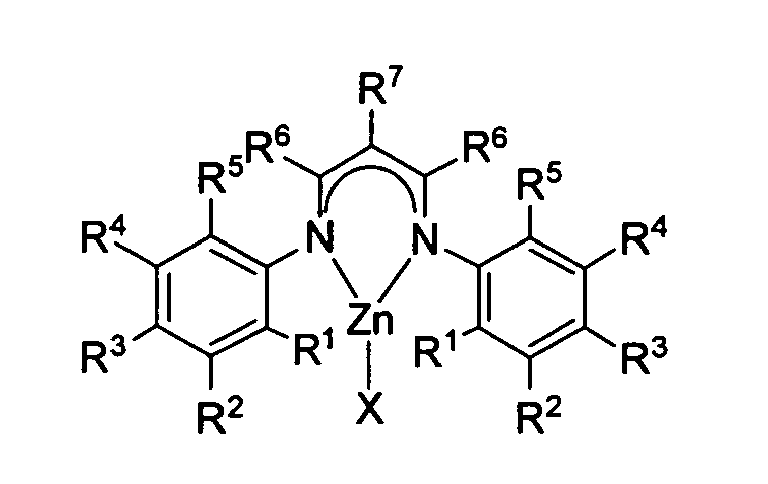
- R 1 , R 2 , R 3 , R 4 , R 5 , R 6 and R 7 are each independently selected from hydrogen, unsubstituted or substituted hydrocarbyl, or inert functional group and wherein two or more of said groups can be linked together to form one or more rings, wherein X is an hydrocarbyl radical having from 1 to 12 carbon atoms, an alkoxide group OR*, an amido group NR** 2 or a borohydride group (BH 4 ).
- the metallic salt can be selected from metallic complexes of formula M(OSO 2 CF 3 ) n , hereafter referred to as triflates or OTf or M(N(OSO 2 CF 3 ) 2 ) n , hereafter referred to as triflimidates or NTf 2 or M(RC(O)CR 2 C(O)R) n , hereafter referred to as acetylacetonates or acac or (R"CO 2 ) n M, hereafter referred to as carboxylates, wherein M is a metal Group 2, 3, including the lanthanide series, hereafter referred as Ln, 4, 12, 13, 14 or 15 of the periodic Table, wherein each R is selected independently from a linear or branched hydrocarbyl radical having from 1 to 12 carbon atoms, substituted or not by for instance an halogen or heteroatom, wherein each R" is selected independently from a perfluorinated alkyl or aryl residue having from 1 to 12 carbon atoms
- M is Mg(II), Ca(II), Sc(III), Ln(III),Y(III), Sm(III), Yb(III), Ti(IV), Zr(IV), Fe(II), Fe(III), Zn(II), AI(III) Sn(IV) or Bi(III). More preferably, it is Al, Zn or Sc, Al being the most efficient metal.
- each R is selected independently from alkyl group such as CH 3 or a substituted alkyl group such as CF 3 , More preferably, they are all the same and they are CR 3 or CF 3 .
- R" is (C 6 F 5 ) or (CF 3 ), or CF 3 (CF 2 ) m wherein m is an integer from 1 to 6.
- These catalysts act by an activated monomer pathway, in the combination with an external nucleophile, typically the PC-(OH) n compound.
- the non-metallic organic compounds can be selected, as non limitative examples, from dimeric phosphazene bases as disclosed for example in Zhang et al. ( Zhang L., Nederberg F., Messman J.M., Pratt R.C., Hedrick J.L., and Wade C.G., in J. Am. Chem. Soc., 2007, 129, 12610-12611 ) or phosphazene bases as disclosed for example in Zhang et al.
- the alcohol can be represented by formula R'OH wherein R' is an hydrocarbyl, linear or branched, having from 1 to 20 carbon atoms.
- R' is a secondary alkyl residue or benzylic group, more preferably it is isopropyl ( i Pr) or benzyl (Bn).
- It can also be a poly-ol derived from biomass such as glycerol or any other sugar based alcohol (erythritol, cyclodextrine)...All alcohols can be used individually or in combination.
- Hydroxy-end-capped polycarbonates can be prepared by ring-opening polymerisation (ROP) of a cyclic carbonate monomer in the presence of a catalyst and an alcohol that acts as an initiator and as a transfer agent.
- ROP ring-opening polymerisation
- all polycarbonates produced via this technique are thus capped at one end by a hydroxy group and at the other macromolecule terminus by a carbonate moiety.
- HO-PTMC-OR homopolymers have been prepared in high yield by ROP of carbonate TMC, using as catalyst either (BDI)Zn[N(SiMe 3 ) 2 ], Al(OTf) 3 or dimethylaminopyridine (DMAP), in the presence of an alcohol (R'OH) selected typically from BnOH or i PrOH, wherein PTMC is the polyTMC.
- R'OH an alcohol selected typically from BnOH or i PrOH, wherein PTMC is the polyTMC.
- the homopolymers have controlled molecular weights and narrow polydispersity. The reaction is presented schematically in scheme 3.
- Such hydroxy-end-capped HO-PTMC-OR' homopolymers can be subsequently used as macro-initiators and transfer agents, to prepare with high efficiency a variety of diblock copolymers.
- the reactions are performed in the presence of a catalyst selected for example from (BDI)Zn(N(SiMe 3 ) 2 ] or AI(OTf) 3 or an organic base such as DMAP and they allow the ROP of cyclic polar monomers such as TMC, TMC(OMe) 2 , rac -BBL or lactides (LA) or any heterocyclic monomer among lactones, diesters, carbonates, morpholinediones. Some of these are represented in scheme 4, as non-limitative examples.
- These reactions are carried out at a temperature ranging between room temperature (about 25 °C) and 150 °C, preferably between 50 and 150 °C, more preferably between 80 and 100 °C.
- the temperature depends upon the nature of catalyst system and on the monomer. For example, aluminium-based systems are more tolerant but less active than zinc-based systems and thus demand a higher temperature than zinc-based systems. For example lactides are less reactive than TMC and thus also demand a higher temperature than TMC.
- the controlled ROP of various cyclic monomers has been carried out using the (BDI)Zn[N(SiMe 3 ) 2 ]/HO-PTMC-OBn catalyst system.
- the polymerisation conditions and results are displayed in Table 1.
- the 1 H and 13 C NMR spectra are displayed respectively in Figures 1 and 2 Table 1.
- M TMC 102.09 g.mol -1
- M TMC(OMe)2 162 g.mol -1
- M BBL 86 g.mol -1
- M LLA 144 g.mol -1 c
- HO-PTMC-OBn has been synthesized, precipitated and stocked before being used in the multi-block polymerisation.
- a diol was used in the ROP of a cyclic carbonate as initiator/transfer agent.
- the resulting polycarbonate contained two hydroxy chain-ends.
- (BDI)Zn[N(SiMe 3 ) 2 ], Al(OTf) 3 or an organic base such as DMAP or a phosphazene were used as catalyst component and 1,3-propanediol or 1,4-benzenedimethanol as transfer agent/initiator.
- the ROP process is described in scheme 6.
- the telechelic HO-PTMC-OH homopolymers prepared in scheme 6 were used subsequently as transfer agent/initiator for the preparation of ABA-type tri-block copolymers. This process was used in the preparation of HO-PLLA-PTMC-PLLA-OH triblock copolymers.
- the reactions have been conducted in highly concentrated toluene solutions and are represented in scheme 7.
- the results obtained using (BDI)Zn[N(SiMe 3 ) 2 ] as catalyst with purified LLA, and using aluminum triflate or DMAP or phosphazene as catalysts with technical grade LLA are summarised in Tables 4 and 5.
- Example 24 was carried out by sequential reaction without preliminary isolation of HO-PTMC-OH Table 5.
- Examples 26 and 27 were conducted as sequential reaction without preliminary isolation of HO-PTMC-OH.
- Example 28 was conducted at a temperature of 100 °C
- ABA-type triblock copolymers of HO-PTMC(OMe) 2 -PTMC-PTMC(OMe) 2 -OH were prepared by ROP of TMC(OMe) 2 with (BDI)Zn[N(SiMe 3 ) 2 ]/HO-PTMC-OH catalyst system as represented in scheme 8. The reactions were carried out at a temperature of 60 °C with purified TMC(OMe) 2 . The results are summarised in Table 6. Table 6. ex M n (g.mol -1 ) ( M w / M n ) HO-PTMC-OH [BBL] 0 /[Zn] 0 / [HO-PTMC-OH] 0 Time (min) Conv.
- HO-PHB-PTMC-PHB-OH ABA-type triblock copolymers were prepared by ROP of rac -BBL with (BDI)Zn[N(SiMe 3 ) 2 ]/HO-PTMC-OH catalyst system as represented in scheme 9. The reactions were carried out at a temperature of 60 °C with purified rac -BBL. The results are summarised in Table 7. Table 7. ex M n (g.mol -1 ) ( M w / M n ) HO-PTMC-OH [BBL] 0 /[Zn] 0/ [HO-PTMC-OH] 0 Time (min) Conv.
- Example 31 was carried out by sequential reaction without preliminary isolation of HO-PTMC-OH.
Landscapes
- Chemical & Material Sciences (AREA)
- Health & Medical Sciences (AREA)
- Chemical Kinetics & Catalysis (AREA)
- Medicinal Chemistry (AREA)
- Polymers & Plastics (AREA)
- Organic Chemistry (AREA)
- Polyesters Or Polycarbonates (AREA)
Abstract
The present invention discloses a process for preparing di-, tri, or multi-block polyester/polycarbonate (co)polymers by ring-opening polymerisation in the presence of a non-toxic catalyst system in combination with either a linear monohydroxy HO-PC-OR, or a linear telechelic dihydroxy HO-PC-OH, or a star polyhydroxy R-(PC-OH)n end-capped polycarbonate.
Description
- The present invention relates to the field of di-, tri- and multi-block polyesters/polycarbonates copolymers based on the use of hydroxyl-end capped polycarbonates as transfer agents and macro-initiators.
- There is an obvious need for polymer materials based on renewable resources and efficient processes for preparing them. Of particular interest are block copolymers which allow, upon adjusting the size and nature of each block, tuning of the physical properties to obtain very specific physical properties, for instance phase separation of blocks. As an example, diblock and triblock polycarbonate-polyesters that combine a soft poly(trimethylene carbonate) block (PTMC) and hard, crystallisable poly(L- or D-lactide) blocks (PLLA, PDLA), thus forming so-called thermoplastic elastomers, are biodegradable and biocompatible and thus find applications as biomaterials.
- The synthesis of linear or star polycarbonates hydroxy-capped at each arm terminus is briefly documented in literature in the case of poly(trimethylene carbonate). The preparation of linear telechelic dihydroxy HO-PTMC-OH and 3-arms star trihydroxy R-(PTMC-OH)3 polymers has been achieved by the ring-opening polymerization (ROP) of TMC in the presence of tin-based catalysts such as SnOct2 (Oct = octanoate, 2-ethylhexanoate), and a diol or a triol respectively, such as 1,4-butanediol as described for instance in Fredrik Nederberg, Joens Hilborn and Tim Bowden, Macromolecules 2006, 39, 3907-3913, or triethyleneglycol as reported in Jan Lukaszczyk, Piotr Jelonek and Barbara Trzebicka, Pol. Polimery 2008, 53, 433-439, or 1,6-hexanediol or glycerol as reported in Zheng Zhang, Dirk W. Grijpma and Jan Feijen, Macromol. Chem. Phys., 2004, 205, 867-875, and in Patricia Y. W. Dankers, Zheng Zhang, Eva Wisse, Dirk W. Grijpma, Rint P. Sijbesma, Jan Feijen and E. W. Meijer Macromolecules, 2006, 39, 8763-8771 (Scheme 1). These reactions typically proceed at a temperature higher than 100 °C for a couple of hours. They are schematically represented in
scheme 1.
- In some cases, macrodiols HO-X-OH have also been used as initiators/transfer agents to prepare linear telechelic dihydroxy HO-PTMC-X-PTMC-OH polymers, by ROP of TMC in the presence of tin catalysts, as described for instance with poly(ethylene glycol) (HO-PEG-OH) in Ying Zhang and Ren-Xi Zhuo, Biomaterials 2005, 26, 2089-2094, or with dihydroxy end-capped poly(caprolactone) (HO-PCL-OH) as described in Yong Tang Jia, Hak Yong Kim, Jian Gong, Duok Rae Lee and Bin Ding, Polymer Intern. 2004, 53, 312-319, or to prepare Y-shaped X-(PTMC-OH)2 copolymers as reported with the ROP of TMC from poly(ethylene glycol)-CH-(CH2OH)2 and ZnEt2 in Huai-Hong Zhang, Zi-Qun Huang, Bai-Wang Sun, Jia-Xiu Guo, Jian-Li Wang, Yao-Qiang Chen, J. Polym. Sci. 2008, 46, 8131-8140.
- It has been reported that those linear telechelic dihydroxy HO-PTMC-OH and 3-arms star trihydroxy R-(PTMC-OH)3 polymers can act as macroinitiators for the preparation of multiblock polycarbonate-polyester copolymers. Thus, PLA-PTMC-PLA triblock copolymers based on TMC and lactide as biodegradable thermoplastic elastomers have been prepared starting from linear telechelic dihydroxy HO-PTMC-OH polymers, lactide (either L-, D- or D,L-LA) and SnOct2 as the catalyst, as reported in Zheng Zhang, Dirk W. Grijpma and Jan Feijen, Macromol. Chem. Phys., 2004, 205, 867-875. It is represented in
scheme 2.
- The preparation of triblock PHB-PTMC-PHB copolymers (PHB = poly(3-hydroxybutyrate)) has been reported in Hans R. Kricheldorf and Andrea Stricker, Macromol. Chem. Phys., 1999, 200, 1726-1733. The method used involved the sequential addition of TMC and then BBL (BBL = rac-beta-butyrolactone) onto the tin-based di-
initiator 2,2-dibutyl-2-stanna-1,3-dioxepane (DSDOP). In this process, a stoechiometric amount of tin vs macromolecules is used to prepare the ABA-type block copolymer, and there was no use of macrodiols as transfer agents. - It is an aim of the present invention to provide di-, tri-, or multi-block polyester/polycarbonate copolymers.
- It is also an aim of the present invention to prepare fully biodegradable di-, tri-, or multi-block linear, branched or star-shaped polyester/polycarbonate copolymers.
- It is a further aim of the present invention to tailor di-, tri-, or multi-block copolymers with desired properties.
- Any one of these aims is, at least partially, fulfilled by the present invention.
- Accordingly, the present invention discloses a process for preparing di-, tri, or multi-block polyester/polycarbonate (PC) copolymers by ring-opening polymerisation in the presence of a catalyst system comprising a compound selected from a Lewis acidic metal salt or a metal complex or a metal-free organic base, said process further comprising either a linear monohydroxy HO-PC-OR, or a linear telechelic dihydroxy HO-PC-OH, or a star polyhydroxy R-(PC-OH) n end-capped polycarbonate acting both as transfer agent and as co-initiator via hydroxyl group(s), wherein PC is a polycarbonate chain obtained by ring-opening polymerisation of a cyclic ester or carbonate monomer.
- The present invention discloses a process for preparing di-, tri, or multi-block polyester/polycarbonate polymers by ring-opening polymerisation that comprises the steps of:
- a) providing catalyst system based on a compound selected from a Lewis acidic metal salt or a metal complex or a metal-free organic base;
- b) providing either a linear monohydroxy HO-PC-OR, or a linear telechelic dihydroxy HO-PC-OH, or a star polyhydroxy R-(PC-OH)n end-capped polycarbonate acting both as co-initiator and as transfer agent via hydroxyl group(s), wherein PC is a polycarbonate chain obtained by ring-opening polymerisation of a cyclic carbonate monomer;
- c) providing a cyclic ester/carbonate monomer selected, for instance, from 6- or 7-membered cyclic carbonate such as for example,

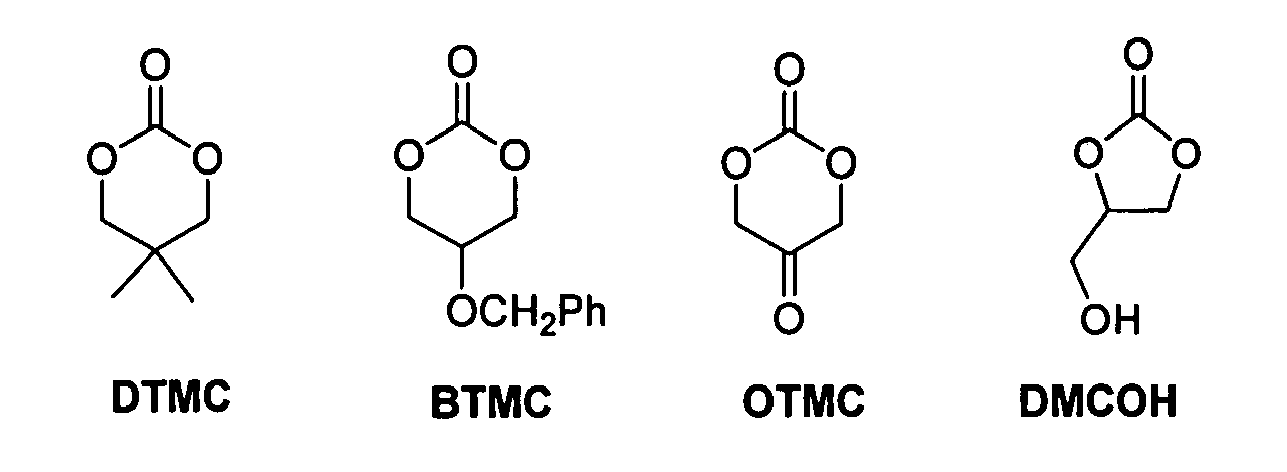
- d) maintaining under polymerisation conditions at a temperature of from room temperature to 150 °C;
- e) retrieving a di- tri- or multi-block copolymer.
- The macro-polyol plays two roles:
- according to the type of catalyst used, it acts either as an external nucleophile for initiating polymerisation via ring-opening of a monomer activated for example with Al or organic base catalysts, or for transforming the pre-catalyst, for example a metal-amido complex, that has little or no activity, into an active metal-alkoxide species, via an alcoholysis process;
- it also acts as a transfer agent, by generating multiple polymer chains. Excess alcohol acts as transfer agent, transferring propagating polycarbonate chains from the active metal center to dormant hydroxy-end capped polycarbonate chains. Accordingly, it is observed that the number average molecular weight increases when the monomer/alcohol ratio increases. The latter chain transfer process can be represented schematically as follows:


- The metal complexes acting as catalyst systems can be selected from single-site catalyst components based upon a bulky β-diiminate ligands (BDI) as described by Coates et al. (B.M. Chamberlain, M. Cheng, D.R. Moore, T.M. Ovitt, E.B. Lobkovsky, and G.W. Coates, in J. Am. Chem. Soc., 2001, 123, 3229) and represented by general formula:

- Among the preferred catalytic compounds of that category, one can further cite [BDI]Zn(N(SiMe3)2), {(BDI]Zn(OiPr),)2, Zn(N(SiMe3)2), ZnEt2, Ln(N(SiMe3)2)3 (Ln = group III metals, including the lanthanide series), "Ln(OiPr)3", Al(OiPr)3, Mg[N(SiMe3)2]2, Ca[N(SiMe3)2]2(THF)2, (BDI)Fe[N(SiMe3)2], Fe[N(SiMe3)2]2, and Fe[N(SiMe3)2]3.
- They act by a coordination/insertion mechanism.
- The metallic salt can be selected from metallic complexes of formula M(OSO2CF3)n, hereafter referred to as triflates or OTf or M(N(OSO2CF3)2)n, hereafter referred to as triflimidates or NTf2 or M(RC(O)CR2C(O)R)n, hereafter referred to as acetylacetonates or acac or (R"CO2)nM, hereafter referred to as carboxylates, wherein M is a
metal Group 2, 3, including the lanthanide series, hereafter referred as Ln, 4, 12, 13, 14 or 15 of the periodic Table, wherein each R is selected independently from a linear or branched hydrocarbyl radical having from 1 to 12 carbon atoms, substituted or not by for instance an halogen or heteroatom, wherein each R" is selected independently from a perfluorinated alkyl or aryl residue having from 1 to 12 carbon atoms, and wherein n is the valence of M. - Preferably, M is Mg(II), Ca(II), Sc(III), Ln(III),Y(III), Sm(III), Yb(III), Ti(IV), Zr(IV), Fe(II), Fe(III), Zn(II), AI(III) Sn(IV) or Bi(III). More preferably, it is Al, Zn or Sc, Al being the most efficient metal.
- Preferably each R is selected independently from alkyl group such as CH3 or a substituted alkyl group such as CF3, More preferably, they are all the same and they are CR3 or CF3.
- Preferably, R" is (C6F5) or (CF3), or CF3(CF2)m wherein m is an integer from 1 to 6.
- Among the preferred catalytic compounds according to the present invention, one can cite Al(OTf)3, Al(NTf2)3, Mg(OTf)2, Ca(OTf)2, Zn(OTf)2, Sc(OTf)3, Bi(OTf)3, Fe(acac)3, Al(OCOCF3)3, Zn(OCOCF3)2, Zn(BF4)2, Zn(acac)2.
- These catalysts act by an activated monomer pathway, in the combination with an external nucleophile, typically the PC-(OH)n compound.
- The non-metallic organic compounds can be selected, as non limitative examples, from dimeric phosphazene bases as disclosed for example in Zhang et al. (Zhang L., Nederberg F., Messman J.M., Pratt R.C., Hedrick J.L., and Wade C.G., in J. Am. Chem. Soc., 2007, 129, 12610-12611) or phosphazene bases as disclosed for example in Zhang et al. (Zhang L., Nederberg F., Pratt R.C., Waymouth R.M., Hedrick J.L., and Wade C.G., in Macromolecules 2007, 40, 4154-4158) or organic compounds such as amines or guanidine as described for example in Nederberg et al. (Nederberg F., Lohmeijer G.B., Leibfarth F., Pratt R.C., Choi J., Dove A.P., Waymouth R.M., Heidrich J.L., in Biomacromolecules, 8, 153, 2007) or in Mindemark et al. (Mindemark J., Hilborn J., Bowden T., in Macromolecules, 40, 3515, 2007).
- It must be noted that none of the catalyst systems used in the present invention are toxic.
- The alcohol can be represented by formula R'OH wherein R' is an hydrocarbyl, linear or branched, having from 1 to 20 carbon atoms. Preferably R' is a secondary alkyl residue or benzylic group, more preferably it is isopropyl (iPr) or benzyl (Bn). It can also be a poly-ol derived from biomass such as glycerol or any other sugar based alcohol (erythritol, cyclodextrine)...All alcohols can be used individually or in combination.
- Hydroxy-end-capped polycarbonates can be prepared by ring-opening polymerisation (ROP) of a cyclic carbonate monomer in the presence of a catalyst and an alcohol that acts as an initiator and as a transfer agent. When using a mono-alcohol R'OH, all polycarbonates produced via this technique are thus capped at one end by a hydroxy group and at the other macromolecule terminus by a carbonate moiety. For instance, HO-PTMC-OR homopolymers have been prepared in high yield by ROP of carbonate TMC, using as catalyst either (BDI)Zn[N(SiMe3)2], Al(OTf)3 or dimethylaminopyridine (DMAP), in the presence of an alcohol (R'OH) selected typically from BnOH or iPrOH, wherein PTMC is the polyTMC. The homopolymers have controlled molecular weights and narrow polydispersity. The reaction is presented schematically in scheme 3.

- Such hydroxy-end-capped HO-PTMC-OR' homopolymers can be subsequently used as macro-initiators and transfer agents, to prepare with high efficiency a variety of diblock copolymers. The reactions are performed in the presence of a catalyst selected for example from (BDI)Zn(N(SiMe3)2] or AI(OTf)3 or an organic base such as DMAP and they allow the ROP of cyclic polar monomers such as TMC, TMC(OMe)2, rac-BBL or lactides (LA) or any heterocyclic monomer among lactones, diesters, carbonates, morpholinediones. Some of these are represented in scheme 4, as non-limitative examples.
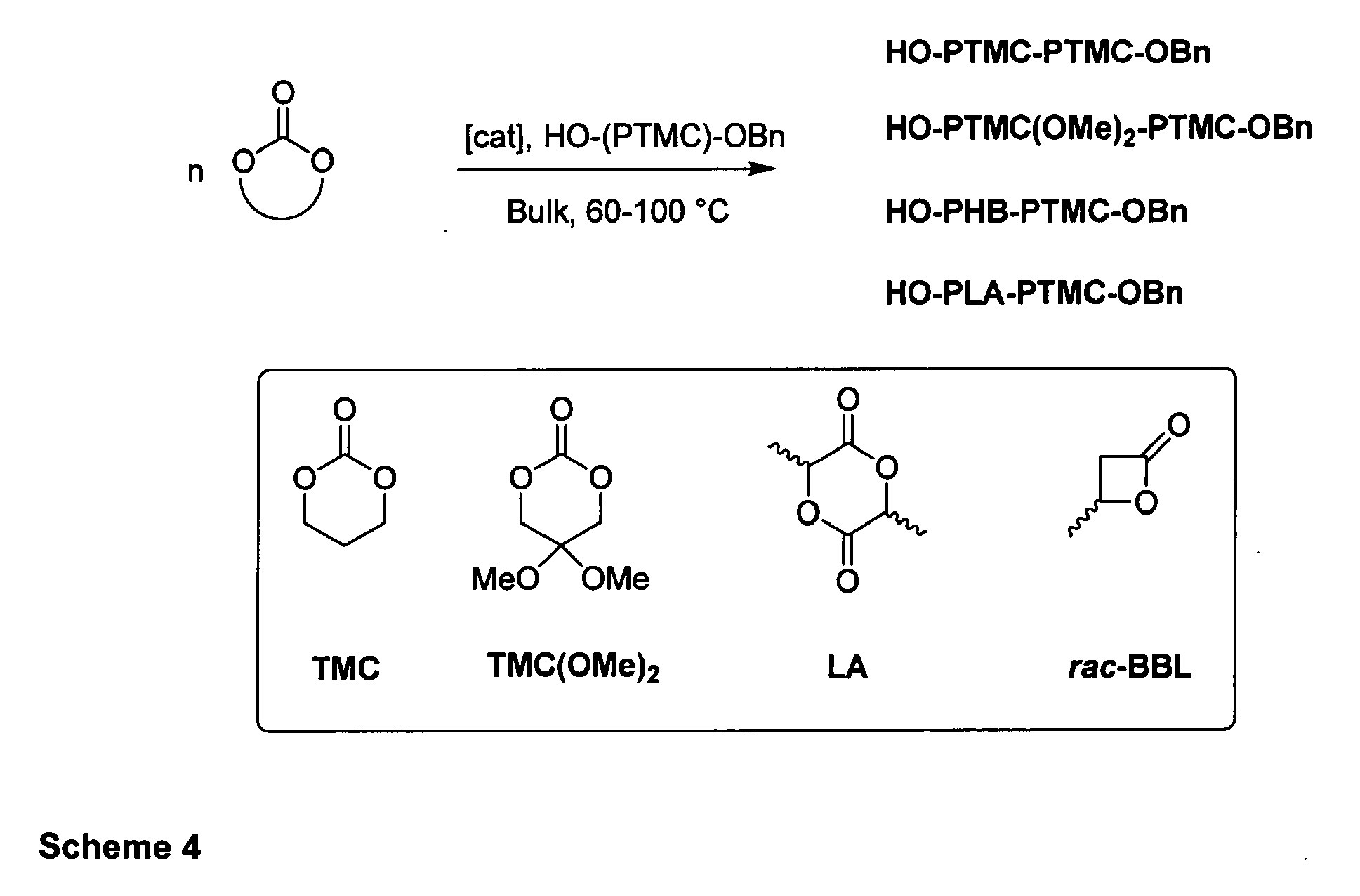
- These reactions are carried out at a temperature ranging between room temperature (about 25 °C) and 150 °C, preferably between 50 and 150 °C, more preferably between 80 and 100 °C. The temperature depends upon the nature of catalyst system and on the monomer. For example, aluminium-based systems are more tolerant but less active than zinc-based systems and thus demand a higher temperature than zinc-based systems. For example lactides are less reactive than TMC and thus also demand a higher temperature than TMC.
-
-
Figure 1 represents the 1H NMR (CDCl3, 200 MHz) spectrum of a diblock PHB-PTMC-OBn copolymer. -
Figure 2 represents the 13 C{1H} NMR (CDCl3, 50 MHz) spectrum of a diblock PHB-PTMC-OBn copolymer. -
Figure 3 represents the 1H NMR (CDCl3, 200 MHz) spectrum of a diblock PLA-PTMC-OBn copolymer. -
Figure 4 represents the 1H NMR (CDCl3, 200 MHz) spectrum of a triblock PLA-PTMC-PLA copolymer. - The controlled ROP of various cyclic monomers has been carried out using the (BDI)Zn[N(SiMe3)2]/HO-PTMC-OBn catalyst system. The polymerisation conditions and results are displayed in Table 1. The 1H and 13C NMR spectra are displayed respectively in
Figures 1 and2 Table 1. ex Monomer M n (g.mol-1) (M w/M n) HO-PTMC-OBn [monomer]0/[Zn]0 /[HO-PTMC-OBn]0 Temp (°C) Time (min) Conv. (%)a M n theo b (g.mol-1)M n NMB (g.mol-1)M n SEC c (g.mol-1)M w /M n c1 TMC 2 200 (1.35) 100/1/5 60 30 100 4240 4 950 4 520* 1.35 2 TMC(OMe)2 2 360 (1.30) 200/1/10 90 160 87 5 180 5 540 4 800 1.36 3 rac- BBL 2 360 (1.30) 200/1/5 60 60 82 5 180 4 420 6 320 1.19 4 LLA 2 360 (1.30) 200/1/10 100 20 100 5240 4270 5 500* 1.17 a Determined by 1H NMR
b M n,theo = [Monomer]0/[HO-PTMC-OBn] x M[Monomer] X conversion + M(HO-PTMcOBn). with MTMC =102.09 g.mol-1, M TMC(OMe)2 =162 g.mol-1, MBBL = 86 g.mol-1, and MLLA =144 g.mol-1
c Determined by SEC vs PS standards; *M n values corrected for hydrodynamic volume differences (correction coefficient 0.73 for PTMC and 0.58 for PLA). - Due to the potential interest of the final copolymers, notably as modifiers of poly(lactide) (PLA) and/or as compatibilisers, special attention has been paid to the ROP of L-lactide (LLA) with such catalyst systems. A first series of investigations was carried out by using (BDI)Zn[N(SiMe3)2]/HO-PTMC-OBn catalyst system. All reactions were carried out at a temperature of 100 °C, in a 4M solution of toluene, using rigorously purified LLA. It is represented in Scheme 5 and the results are reported in Table 2. The 1H NMR is represented in
Figure 3 .
Table 2. ex M n (g.mol-1) (M w/M n) HO-PTMC-OBn [LLA]0/[Zn]0/[HO-PTMC-OBn]0 Time (h) Conv.a (%) M n theo b (g.mol-1)M n SEC c (g.mol-1)M wlM nc5 2 360 (1.30) 200/1/10 0.3 100 5240 5 500d 1.17 6 2 360 (1.30) 1 500/1/10 4 100 23 960 18 850 1.17 7 2 360 (1.30) 2 500/1/10 4 100 38 360 43 050 1.24 8 15 300 (1.64) 1 500/1/5 9 90 54 180 32 600 1.21 9 10200 (1.52) 1 500/1/5 2 100 53 400 51 100 1.86 10 28 760 (1.70) 2 000/1/10 3 40 40 280 46 850 1.43 11 33 780 (1.55) 1 000/1/5 14 78 56 250 33 500 1.51 12 2650 (1.49) 1 000/1/5 2.5 100 55 300 58 620 1.64 a Determined by 1H NMR
b Mntneo = [LLA]0/[HO-PTMC-OBn] x 144 x conversion + M(HO-PTMC-OBn)
c Determined by SEC vs PS standards; Mn values corrected for hydrodynamic volume
differences (correction coefficient 0.73 for PTMC and 0.58 for PLA).
d M n determined by 1H NMR = 4 270 g.mol-1 - It must be noted that in examples 5, 6, 7, 8, 10 and 11, macromer HO-PTMC-OBn has been synthesised, precipitated and stocked before being used in the multi-block polymerisation. Consequently it has potentially absorbed water and has thus been potentially deteriorated, thereby explaining the poorer correlation between the theoretical and experimental values of number average molecular weight Mn. Examples 9 and 12, on the contrary were carried out by sequential reaction without preliminary isolation of HO-PTMC-OBn
- Different, more robust and/or cheaper catalyst systems involving, instead of an organometallic catalyst precursor, a Lewis acidic metal salt or an organic base were also investigated. Aluminum triflate, DMAP and a phosphazene in combination with HO-PTMC-OBn were selected for those investigations in the ROP of technical-grade LLA. The reactions were carried out at a temperature of 130 °C, in a 4M solution of toluene, with purified LLA. The results are summarized in Table 3.
Table 3. ex [catalyst] M n (g.mol-1) (M w/M n) [HO-PTMGOBn] [LLA]0/ [catalyst]0/ [HO-PTMC-OBn]0 Time (min) Conv. (%)a M n theo b (g.mol-1)M n SEC c (g.mol-1)M w/M nd13 Al(OTf)3 15 300 (1.64) 1 500/1/5 840 72 46 400 22 400 1.35 14 Al(OTf)3 10100 (1.57) 1 500/1/5 4200 93 49 560 43 850 1.61 15 Al(OTf)3 33 780 (1.55) 1 000/1/5 1 440 70 55 940 26 800 1.47 16 DMAP 2 360 (1.30) 200/1/5 240 71 6450 4 300d 1.13 17 DMAP 15 300 (1.64) 1 500/1/5 1 440 30 28 260 19 350 1.40 18 DMAP Ca. 15 000 1 500/1/5 600 90 51280 26 900 1.32 19 Phosphaz 15 300 (1.64) 1 500/1/5 XXXX XXXX XXXX XXXX XXXX 20e Phosphaz 9800 (1.23) 1 500/1/5 1320 90 47 880 36 150 1.32 a Determined by 1H NMR
b Mn,tneo = [LLA]0/[HO-PTMC-OBn] x 144 x conversion + M(HO-PTMC-OBn)
c Determined by SEC vs PS standards; ; M n values corrected for hydrodynamic volume differences (correction coefficient 0.73 for PTMC and 0.58 for PLA).
d M n determined by 1H NMR = 3 410 g.mol-1
e Example 20 was conducted at a temperature of 100°C. - In examples 13, 15, 16, 17 and 19, macromer HO-PTMC-OBn has been synthesized, precipitated and stocked before being used in the multi-block polymerisation. In examples 14, 18 and 20, on the contrary polymerisation was carried out by sequential reaction without preliminary isolation of HO-PTMC-OBn.
- A diol was used in the ROP of a cyclic carbonate as initiator/transfer agent. The resulting polycarbonate contained two hydroxy chain-ends. (BDI)Zn[N(SiMe3)2], Al(OTf)3 or an organic base such as DMAP or a phosphazene were used as catalyst component and 1,3-propanediol or 1,4-benzenedimethanol as transfer agent/initiator. The ROP process is described in
scheme 6.
- The telechelic HO-PTMC-OH homopolymers prepared in
scheme 6 were used subsequently as transfer agent/initiator for the preparation of ABA-type tri-block copolymers. This process was used in the preparation of HO-PLLA-PTMC-PLLA-OH triblock copolymers. The reactions have been conducted in highly concentrated toluene solutions and are represented in scheme 7. The results obtained using (BDI)Zn[N(SiMe3)2] as catalyst with purified LLA, and using aluminum triflate or DMAP or phosphazene as catalysts with technical grade LLA are summarised in Tables 4 and 5. For examples 21 to 24, displayed in Table 4, the reactions were carried out with (BDI)Zn[N(SiMe3)2] as catalyst at a temperature of 100 °C. For examples 25 to 28, displayed in Table 5, the reactions were carried out at a temperature of 130 °C and the catalyst system is indicated in the Table.Figure 4 represents the 1H NMR spectrum of PLA-PTMC-PLA copolymer.
Table 4. ex Mn (g.mol-1) (Mw/Mn) HO-PTMC-OH [LLA]0/ [Zn]0 /[HO-PTMC-OH]0 Time (min) Conv. (%)a M n theo b (g.mol-1)M n NMR a (g.mol-1)M n SEC c (g.mol-1)M w/M nc21 3 700 (1) (1.30) 200/1/5 180 100 9 460 8 730 9 300 1.19 22 4 600 (2) (1.62) 200/1/5 210 100 10 360 6670 7200 1.21 23 13 200 (1) (1.69) 1 500/1/5 840 100 56 400 nd 32 350 1.20 24 12300 (1) (1.58) 1 500/1/5 180 95 53 350 nd 45 960 1.54 a Determined by 1H NMR
b Mn,tneo = [LLA]0/[HO-PTMC-OH]0 x 144 x conversion + M(HO-PTMC-OH).
c Determined by SEC vs PS standards; M n values corrected for hydrodynamic volume differences (correction coefficient 0.73 for PTMC and 0.58 for PLA). - Example 24 was carried out by sequential reaction without preliminary isolation of HO-PTMC-OH
Table 5. ex [catalyst] M n (g.mol-1) (M w/M n) HO-PTMC-OH [LLA]0/[cat]0/ [HO-PTMC-OH]0 Time (min) Conv. (%)a M n theo b (g.mol-1)M n SEC c (g.mol-1)M w /M n c25 Al(OTf)3 10 000 (1.45) 1 500/1/5 1 440 100 53 200 15 200 1.28 26 Al(OTf)3 Ca. 15 000 1 500/1/5 1 440 90 48 880 40 550 1.48 27 DMAP 10 000 (1.45) 1 500/1/5 1440 87 47 580 30 400 1.44 28 Phosphaz 12 400 (1.44) 1 500/1/5 1320 60 38 320 22 600 1.17 a Determined by 1H NMR
b Mn,theo = [LLA]0/[HO-PTMC-OH] x 144 x conversion + M(HO-PTMC-OH)
c Determined by SEC vs PS standards; M n values corrected for hydrodynamic volume differences (correction coefficient 0.73 for PTMC and 0.58 for PLA). - Examples 26 and 27 were conducted as sequential reaction without preliminary isolation of HO-PTMC-OH.
- Example 28 was conducted at a temperature of 100 °C
- Similarly, ABA-type triblock copolymers of HO-PTMC(OMe)2-PTMC-PTMC(OMe)2-OH were prepared by ROP of TMC(OMe)2 with (BDI)Zn[N(SiMe3)2]/HO-PTMC-OH catalyst system as represented in scheme 8. The reactions were carried out at a temperature of 60 °C with purified TMC(OMe)2. The results are summarised in Table 6.

Table 6. ex M n (g.mol-1) (M w/M n) HO-PTMC-OH [BBL]0/[Zn]0/ [HO-PTMC-OH]0 Time (min) Conv. (%)a M n theo b (g.mol-1)M n NMR a (g.mol-1)M n SEC c (g.mol-1)M w/M n d29 6 060 (1.21) 200/1/5 360 100 12 540 nd 12210 1.38 a Determined by 1H NMR
b Mn,tneo = [TMC(OMe)2]0/[HO-PTMC-OH] x 162 x conversion + M(HO-PTMGOH)
c Determined by SEC vs PS standards; Mn values uncorrected - Finally, HO-PHB-PTMC-PHB-OH ABA-type triblock copolymers were prepared by ROP of rac-BBL with (BDI)Zn[N(SiMe3)2]/HO-PTMC-OH catalyst system as represented in
scheme 9. The reactions were carried out at a temperature of 60 °C with purified rac-BBL. The results are summarised in Table 7.
Table 7. ex M n (g.mol-1) (M w/M n) HO-PTMC-OH [BBL]0/[Zn]0/ [HO-PTMC-OH]0 Time (min) Conv. (%)a M n theo b (g.mol-1)M n NMR a (g.mol-1)M n SEC c (g.mol-1)M w/M nd30 1 780 (1.18) 200/1/5 360 77 4 429 4 536 4 500 1.12 31 15060 (1.31) 1 500/1/5 840 95 39 570 nd 31 400 1.37 a Determined by 1H NMR
b Mn,theo = [LLA]0/[HO-PTMC-OH] x 86 x conversion + M(HO-PTMC-OH)
c Determined by SEC vs PS standards; M n values uncorrected - Example 31 was carried out by sequential reaction without preliminary isolation of HO-PTMC-OH.
Claims (11)
- A process for preparing di-, tri, or multi-block polyester/polycarbonate polymers by ring-opening polymerisation that comprises the steps of:a) providing a catalyst system comprising a compound selected from a Lewis acidic metal salt or a metal complex or a metal-free organic base;b) providing either a linear monohydroxy HO-PC-OR, or a linear telechelic dihydroxy HO-PC-OH, or a star polyhydroxy R-(PC-OH) n end-capped polycarbonate acting both as co-initiator and as transfer agent via hydroxyl group(s), wherein PC is a polycarbonate chain obtained by ring-opening polymerisation of a cyclic carbonate monomer;c) providing a cyclic ester/carbonate monomer selected, for instance, from 6- or 7-membered cyclic carbonate such as TMC or TMC(OMe)2, lactide, glycolide, rac-beta-butyrolactone or epsilon-caprolactone (CL), or any other lactone, diester, cyclic carbonate, or a morpholinedione.d) maintaining under polymerisation conditions at a temperature of from room temperature to 150 °C;e) retrieving a di- tri- or multi-block copolymer.
- The process of claim 1 wherein the metallic salt is selected M(OSO2CF3)m, M(N(OSO2CF3)2)n, or NTf2 or M(RC(O)CR2C(O)R)n, or (R"CO2)nM, wherein M is a metal Group 2, 3, including the lanthanide series, hereafter referred as Ln, 4, 12, 13, 14 or 15 of the periodic Table, wherein each R is selected independently from a linear or branched hydrocarbyl radical having from 1 to 12 carbon atoms, substituted or not by an halogen or heteroatom, wherein each R" is selected independently from a perfluorinated alkyl or aryl residue having from 1 to 12 carbon atoms, and wherein n is the valence of M.
- The process of claim 2 wherein M is Mg(II), Ca(II), Sc(III), Y(III), Sm(III), Yb(III), Zr(IV), Fe(II), Fe(III), Zn(II), AI(III) Sn(IV) or Bi(III), preferably, Al, Zn or Sc, more preferably Al.
- The process of claim 2 or claim 3 wherein each R is selected independently from alkyl group such as CH3 or a substituted alkyl group such as CR3 or CF3,
- The process of any one of claims 2 to 4 wherein R" is (C6F5) or (CF3), or CF3(CF2)m wherein m is an integer from 1 to 6.
- The process of any one of claims 2 to 5 wherein the metallic salt is selected from Al(OTf)3, Al(NTf2)3, Mg(OTf)2, Ca(OTf)2, Zn(OTf)2, Sc(OTf)3, , Ln(OTf)3, Ln(NTf2)3, Bi(OTf)3, Fe(acac)3, Al(OCOCF3)3, Zn(OCOCF3)2, Zn(BF4)2, Zn(acac)2
- The process of claim 1 wherein the metal complex is selected from bulky β-diiminate ligands (BDI) represented by general formula
- The process of claim 7 wherein the metal complex is selected from [BDI]Zn(N(SiMe3)2), {[BDI]Zn(OiPr),}2, Zn(N(SiMe3)2), ZnEt2, Y(N(SiMe3)2), "Y(OiPr)3", or Al(OiPr)3.
- The process of claim 1 wherein the metal-free organic base is selected from dimeric phosphazene base, phosphazene bases, amine, guanidine, thiourea or any combination of these.
- The process of any one of the preceding claims wherein hydroxy-end-capped polycarbonates can be prepared by ring-opening polymerisation (ROP) of a cyclic carbonate monomer in the presence of a catalyst and an alcohol that acts as an initiator and a transfer agent.
- Di-, tri- or multiblock polyesters/polycarbonates (co)polymers obtained by the process of any one of claims 1 to 11.
Priority Applications (6)
| Application Number | Priority Date | Filing Date | Title |
|---|---|---|---|
| EP08291193A EP2196486A1 (en) | 2008-12-12 | 2008-12-12 | Process to prepare di- and multiblock copolymers |
| PCT/EP2009/066029 WO2010066597A2 (en) | 2008-12-12 | 2009-11-30 | Process to prepare di- and multiblock copolymers. |
| ES09775136T ES2571681T3 (en) | 2008-12-12 | 2009-11-30 | Procedure for preparing di- and multiblock copolymers |
| EP09775136.6A EP2358785B1 (en) | 2008-12-12 | 2009-11-30 | Process to prepare di- and multiblock copolymers. |
| US13/133,686 US20120136124A1 (en) | 2008-12-12 | 2009-11-30 | Process to prepare di- and multiblock copolymers |
| CN200980149771.4A CN102245673B (en) | 2008-12-12 | 2009-11-30 | Prepare the method for diblock and segmented copolymer |
Applications Claiming Priority (1)
| Application Number | Priority Date | Filing Date | Title |
|---|---|---|---|
| EP08291193A EP2196486A1 (en) | 2008-12-12 | 2008-12-12 | Process to prepare di- and multiblock copolymers |
Publications (1)
| Publication Number | Publication Date |
|---|---|
| EP2196486A1 true EP2196486A1 (en) | 2010-06-16 |
Family
ID=40566287
Family Applications (2)
| Application Number | Title | Priority Date | Filing Date |
|---|---|---|---|
| EP08291193A Withdrawn EP2196486A1 (en) | 2008-12-12 | 2008-12-12 | Process to prepare di- and multiblock copolymers |
| EP09775136.6A Not-in-force EP2358785B1 (en) | 2008-12-12 | 2009-11-30 | Process to prepare di- and multiblock copolymers. |
Family Applications After (1)
| Application Number | Title | Priority Date | Filing Date |
|---|---|---|---|
| EP09775136.6A Not-in-force EP2358785B1 (en) | 2008-12-12 | 2009-11-30 | Process to prepare di- and multiblock copolymers. |
Country Status (5)
| Country | Link |
|---|---|
| US (1) | US20120136124A1 (en) |
| EP (2) | EP2196486A1 (en) |
| CN (1) | CN102245673B (en) |
| ES (1) | ES2571681T3 (en) |
| WO (1) | WO2010066597A2 (en) |
Cited By (3)
| Publication number | Priority date | Publication date | Assignee | Title |
|---|---|---|---|---|
| WO2012007254A1 (en) * | 2010-07-15 | 2012-01-19 | Total Petrochemicals Research Feluy | Isocyanate-free method for preparing poly(carbonate-urethane) or poly(ester-urethane) |
| WO2012038240A1 (en) * | 2010-09-21 | 2012-03-29 | Total Petrochemicals Research Feluy | One-step, one-pot process for preparing multiblock and gradient copolymer |
| CN104262932A (en) * | 2014-10-22 | 2015-01-07 | 上海中镭新材料科技有限公司 | PC (Poly Carbonate)/PLA (Poly Lactic Acid) alloy with low viscosity, high toughness and bio-degradation characteristic and preparation method thereof |
Families Citing this family (15)
| Publication number | Priority date | Publication date | Assignee | Title |
|---|---|---|---|---|
| BR112013008679A2 (en) * | 2010-10-13 | 2016-06-21 | Total Res & Technology Feluy | polycarbonates as nucleating agents for polylactide |
| WO2012156237A1 (en) | 2011-05-19 | 2012-11-22 | Total Research & Technology Feluy | Use of multifunctonal initiator to prepare diblock copolymers comprising a monovinylaromatic polymer block. |
| WO2013030324A1 (en) * | 2011-09-02 | 2013-03-07 | Total Research & Technology Feluy | Catalyst systems based on phenolate complexes for immortal ring-opening polymerisation of cyclic esters and carbonates |
| GB201115565D0 (en) * | 2011-09-08 | 2011-10-26 | Imp Innovations Ltd | Method of synthesising polycarbonates in the presence of a bimetallic catalyst and a chain transfer agent |
| KR101437876B1 (en) * | 2011-12-21 | 2014-09-04 | 제일모직주식회사 | Catalyst compositoin for preparing aromatic carbonate compound, and method for preparing aromatic carbonate compound by using the same |
| WO2013128175A1 (en) | 2012-02-27 | 2013-09-06 | The University Court Of The University Of Edinburgh | Aluminum salen and salan catalysts for ring-opening polymerisation of cyclic esters |
| GB201308978D0 (en) * | 2013-05-17 | 2013-07-03 | Imp Innovations Ltd | Method for producing polymers and block copolymers |
| CN103397477B (en) * | 2013-07-30 | 2015-10-28 | 东华大学 | The preparation method of a kind of PLA-trimethylene carbonate nano-fiber film |
| JP7258883B2 (en) * | 2017-08-11 | 2023-04-17 | ビジョン イーズ,エルピー | Optical adhesive and optical laminate and optical lens formed therefrom |
| CN108395510B (en) * | 2018-02-06 | 2020-01-31 | 浙江大学 | Catalytic system and application thereof in preparation of carbon dioxide-based polycarbonate block copolymer |
| CN108546329B (en) * | 2018-04-20 | 2020-07-10 | 南京工业大学 | Preparation method of polyester polyol |
| CN108530615A (en) * | 2018-04-20 | 2018-09-14 | 南京工业大学 | Preparation method of modified polyester polyol |
| EP3628698B1 (en) * | 2018-09-26 | 2024-11-20 | Covidien LP | Biodegradable triblock copolymers and implantable medical devices made therefrom |
| CN115651174B (en) * | 2022-11-14 | 2023-03-10 | 富海(东营)新材料科技有限公司 | Method for synthesizing biodegradable PBAT-PLA copolyester by organic guanidine catalysis |
| CN117362619A (en) * | 2023-11-02 | 2024-01-09 | 合肥安利聚氨酯新材料有限公司 | Preparation method of bio-based polycarbonate polyurethane resin |
Citations (6)
| Publication number | Priority date | Publication date | Assignee | Title |
|---|---|---|---|---|
| WO1991016368A1 (en) * | 1990-04-21 | 1991-10-31 | Dsm N.V. | Process and catalyst for the polymerization of cyclic esters |
| EP0670340A2 (en) * | 1994-03-04 | 1995-09-06 | Daicel Chemical Industries, Ltd. | A monodispersed polymer or copolymer and a preparation process thereof |
| WO1999002536A1 (en) * | 1997-07-08 | 1999-01-21 | Societe De Conseils De Recherches Et D'applications Scientifiques (S.C.R.A.S.) | Metal complexes with a tridentate ligand as polymerisation catalysts |
| WO2000068293A1 (en) * | 1999-05-07 | 2000-11-16 | Centre National De La Recherche Scientifique | Method for obtaining oxacarbonyl polymers, functionalisation, resulting polymers and functionalising agent |
| WO2001064771A2 (en) * | 2000-02-29 | 2001-09-07 | Shell Internationale Research Maatschappij B.V. | Improved method for production of poly(trimethylene carbonate) |
| WO2007148136A2 (en) * | 2006-06-22 | 2007-12-27 | The University Of Nottingham | Novel catalysts for the polymerisation of carbonyl- containing or cyclic monomers |
Family Cites Families (4)
| Publication number | Priority date | Publication date | Assignee | Title |
|---|---|---|---|---|
| DE3362618D1 (en) * | 1982-10-07 | 1986-04-24 | Ciba Geigy Ag | Phenols and their preparation |
| EP1370508A2 (en) * | 2001-03-12 | 2003-12-17 | The Queen's University of Belfast | Process catalysed by fluoroalkysulfonated compounds, preferably bis-triflimide compounds |
| JP3972100B2 (en) * | 2003-08-01 | 2007-09-05 | 独立行政法人産業技術総合研究所 | Method for producing polyester using aluminum metal compound catalyst |
| JP4654601B2 (en) * | 2004-05-14 | 2011-03-23 | 富士ゼロックス株式会社 | Resin particles and production method thereof, electrostatic charge developing toner and production method thereof, electrostatic charge image developer, and image forming method. |
-
2008
- 2008-12-12 EP EP08291193A patent/EP2196486A1/en not_active Withdrawn
-
2009
- 2009-11-30 EP EP09775136.6A patent/EP2358785B1/en not_active Not-in-force
- 2009-11-30 WO PCT/EP2009/066029 patent/WO2010066597A2/en not_active Ceased
- 2009-11-30 US US13/133,686 patent/US20120136124A1/en not_active Abandoned
- 2009-11-30 ES ES09775136T patent/ES2571681T3/en active Active
- 2009-11-30 CN CN200980149771.4A patent/CN102245673B/en not_active Expired - Fee Related
Patent Citations (6)
| Publication number | Priority date | Publication date | Assignee | Title |
|---|---|---|---|---|
| WO1991016368A1 (en) * | 1990-04-21 | 1991-10-31 | Dsm N.V. | Process and catalyst for the polymerization of cyclic esters |
| EP0670340A2 (en) * | 1994-03-04 | 1995-09-06 | Daicel Chemical Industries, Ltd. | A monodispersed polymer or copolymer and a preparation process thereof |
| WO1999002536A1 (en) * | 1997-07-08 | 1999-01-21 | Societe De Conseils De Recherches Et D'applications Scientifiques (S.C.R.A.S.) | Metal complexes with a tridentate ligand as polymerisation catalysts |
| WO2000068293A1 (en) * | 1999-05-07 | 2000-11-16 | Centre National De La Recherche Scientifique | Method for obtaining oxacarbonyl polymers, functionalisation, resulting polymers and functionalising agent |
| WO2001064771A2 (en) * | 2000-02-29 | 2001-09-07 | Shell Internationale Research Maatschappij B.V. | Improved method for production of poly(trimethylene carbonate) |
| WO2007148136A2 (en) * | 2006-06-22 | 2007-12-27 | The University Of Nottingham | Novel catalysts for the polymerisation of carbonyl- containing or cyclic monomers |
Non-Patent Citations (19)
| Title |
|---|
| B.M. CHAMBERLAIN ET AL., J. AM. CHEM. SOC., vol. 123, 2001, pages 3229 |
| BOWDEN T ET AL: "End-group catalyzed Ring-Opening Polymerization of Trimethylene Carbonate", MACROMOLECULES, vol. 40, no. 10, 18 April 2007 (2007-04-18), pages 3515 - 3517, XP002541167 * |
| COATES G W ET AL: "Polymerization of Lactide with Zinc and Magnesium beta-Diiminate Complexes: Stereocontrol and Mechanism", J.AM.CHEM.SOC, vol. 123, 16 March 2001 (2001-03-16), pages 3229 - 3238, XP002541165 * |
| FEIJEN J ET AL: "TRIBLOCK COPOLYMERS BASED ON 1,3-TRIMETHYLENE CARBONATE AND LACTIDE AS BIODEGRADABLE THERMOPLASTIC ELASTOMERS", MACROMOL. CHEM. PHYS., vol. 205, 2004, pages 867 - 875, XP002525776 * |
| FREDRIK NEDERBERG; JOENS HILBORN; TIM BOWDEN, MACROMOLECULES, vol. 39, 2006, pages 3907 - 3913 |
| HANS R. KRICHELDORF; ANDREA STRICKER, MACROMOL. CHEM. PHYS., vol. 200, 1999, pages 1726 - 1733 |
| HUAI-HONG. ZHANG ET AL., J. POLYM. SCI., vol. 46, 2008, pages 8131 - 8140 |
| JAN LUKASZCZYK; PIOTR JELONEK; BARBARA TRZEBICKA, PO/. POLIMERY, vol. 53, 2008, pages 433 - 439 |
| KRICHELDORF H R ET AL: "A-B-A TRIBLOCK COPOLYESTERS AND RANDOM COPOLYESTERS OF TRIMETHYLENE CARBONATE AND VARIOUS LACTONES VIA MACROCYCLIC POLYMERIZATION", MACROMOL. CHEM. PHYS., vol. 200, 1999, pages 1726 - 1733, XP002525777 * |
| MINDEMARK J.; HILBOM J.; BOWDEN T., MACROMOLECULES, vol. 40, 2007, pages 3515 |
| NEDERBERG F. ET AL., BIOMACROMOLECULES, vol. 8, 2007, pages 153 |
| PATRICIA Y. W. DANKERS ET AL., MACROMOLECULES, vol. 39, 2006, pages 8763 - 8771 |
| WADE C G ET AL: "Phosphazene Bases: A New Category of Organocatalysts for the Living Ring-Opening Polymerization of Cyclic Esters", MACROMOLECULES, vol. 40, 19 May 2007 (2007-05-19), pages 4154 - 4158, XP002541166 * |
| YING ZHANG; REN-XI ZHUO, BIOMATERIALS, vol. 26, 2005, pages 2089 - 2094 |
| YONG TANG JIA ET AL., POLYMER INTERN., vol. 53, 2004, pages 312 - 319 |
| ZHANG L. ET AL., J. AM. CHEM. SOC., vol. 129, 2007, pages 12610 - 12611 |
| ZHANG L. ET AL., MACROMOLECULES, vol. 40, 2007, pages 4154 - 4158 |
| ZHENG ZHANG; DIRK W. GRIJPMA; JAN FEIJEN, MACROMOL. CHEM. PHYS., vol. 205, 2004, pages 867 - 875 |
| ZHENG ZHANG; DIRK W. GRIJPMA; JAN FEIJEN, MACROMOT. CHEM. PHYS., vol. 205, 2004, pages 867 - 875 |
Cited By (11)
| Publication number | Priority date | Publication date | Assignee | Title |
|---|---|---|---|---|
| WO2012007254A1 (en) * | 2010-07-15 | 2012-01-19 | Total Petrochemicals Research Feluy | Isocyanate-free method for preparing poly(carbonate-urethane) or poly(ester-urethane) |
| CN103003329A (en) * | 2010-07-15 | 2013-03-27 | 道达尔研究技术弗吕公司 | Isocyanate-free method for preparing poly(carbonate-urethane) or poly(ester-urethane) |
| CN103003329B (en) * | 2010-07-15 | 2014-08-06 | 道达尔研究技术弗吕公司 | Isocyanate-free method for preparing poly(carbonate-urethane) or poly(ester-urethane) |
| EA022577B1 (en) * | 2010-07-15 | 2016-01-29 | Тотал Ресерч Энд Текнолоджи Фелюи | Isocyanate-free method for preparing poly(carbonate-urethane) or poly(ester-urethane) |
| WO2012038240A1 (en) * | 2010-09-21 | 2012-03-29 | Total Petrochemicals Research Feluy | One-step, one-pot process for preparing multiblock and gradient copolymer |
| CN103380164A (en) * | 2010-09-21 | 2013-10-30 | 道达尔研究技术弗吕公司 | One-step, one-pot process for preparing multiblock and gradient copolymer |
| US20140148558A1 (en) * | 2010-09-21 | 2014-05-29 | Centre National De La Recherche Scientifique(Cnrs) | One-step, one-pot process for preparing multiblock and gradient copolymer |
| CN103380164B (en) * | 2010-09-21 | 2015-06-10 | 道达尔研究技术弗吕公司 | One-step, one-pot process for preparing multiblock and gradient copolymer |
| US9493606B2 (en) * | 2010-09-21 | 2016-11-15 | Total Research & Technology Feluy | One-step, one-pot process for preparing multiblock and gradient copolymer |
| CN104262932A (en) * | 2014-10-22 | 2015-01-07 | 上海中镭新材料科技有限公司 | PC (Poly Carbonate)/PLA (Poly Lactic Acid) alloy with low viscosity, high toughness and bio-degradation characteristic and preparation method thereof |
| CN104262932B (en) * | 2014-10-22 | 2016-01-13 | 上海中镭新材料科技有限公司 | The biodegradable PC/PLA Alloy And Preparation Method of low viscosity high tenacity tool |
Also Published As
| Publication number | Publication date |
|---|---|
| EP2358785B1 (en) | 2016-02-17 |
| ES2571681T3 (en) | 2016-05-26 |
| WO2010066597A2 (en) | 2010-06-17 |
| WO2010066597A3 (en) | 2010-10-14 |
| EP2358785A2 (en) | 2011-08-24 |
| CN102245673B (en) | 2016-01-20 |
| US20120136124A1 (en) | 2012-05-31 |
| CN102245673A (en) | 2011-11-16 |
Similar Documents
| Publication | Publication Date | Title |
|---|---|---|
| EP2358785B1 (en) | Process to prepare di- and multiblock copolymers. | |
| US9493606B2 (en) | One-step, one-pot process for preparing multiblock and gradient copolymer | |
| Kricheldorf et al. | Bismuth (III) n-hexanoate and tin (II) 2-ethylhexanoate initiated copolymerizations of ε-caprolactone and l-lactide | |
| US6646100B2 (en) | Aliphatic polycarbonate homo-and co-polymers produced by DMC catalysis and the process for their production | |
| Kowalski et al. | Mechanism of cyclic ester polymerization initiated with Tin (II) Octoate. 2. Macromolecules fitted with Tin (II) alkoxide species observed directly in MALDI− TOF Spectra | |
| EP2640766B1 (en) | Process for preparing a polyester | |
| EP2289971A1 (en) | Ring opening polymerisation of cyclic carbonates with organic catalyst systems | |
| US20130274422A1 (en) | Polycarbonates as nucleating agents for polylactides | |
| Kricheldorf et al. | Di-, tri-and tetrafunctional poly (ε-caprolactone) s by Bi (OAc) 3-catalyzed ring-opening polymerizations of ε-caprolactone | |
| CN103003329A (en) | Isocyanate-free method for preparing poly(carbonate-urethane) or poly(ester-urethane) | |
| JP6120856B2 (en) | Catalyst systems based on phenolate complexes for the immortal ring-opening polymerization of cyclic esters and carbonates | |
| Tian et al. | Synthesis of N-methyl-o-phenylenediamine-bridged bis (phenolato) lanthanide alkoxides and their catalytic performance for the (co) polymerization of rac-butyrolactone and L-lactide | |
| CN101735434A (en) | Poly(alkene carbonate) diol-polybutylene succinate copolymer and preparation method thereof | |
| CN101815741A (en) | Method for making copolymers of lactide and a 1:4-3:6 dianhydrohexitol | |
| US20090118459A1 (en) | Branched biodegradable polymers, a macromonomer, processes for the preparation of same, and their use | |
| JP3044235B2 (en) | High molecular weight aliphatic polyester carbonate and method for producing the same | |
| CN102241814A (en) | Poly(alkene carbonate)diol-poly(butylene succinate) copolymer and preparation method thereof | |
| KR20080018657A (en) | Method for producing lactide for synthesizing polymer poly-l-lactic acid | |
| CN115124703B (en) | Polyglycolic acid/aliphatic polycarbonate random copolymer and its preparation method | |
| CN115232315B (en) | Polyglycolic acid/aliphatic polycarbonate multiblock copolymer and preparation method thereof | |
| HK1070666B (en) | Aliphatic polycarbonate homopolymers and copolymers produced by double metal cyanide catalysis |
Legal Events
| Date | Code | Title | Description |
|---|---|---|---|
| PUAI | Public reference made under article 153(3) epc to a published international application that has entered the european phase |
Free format text: ORIGINAL CODE: 0009012 |
|
| AK | Designated contracting states |
Kind code of ref document: A1 Designated state(s): AT BE BG CH CY CZ DE DK EE ES FI FR GB GR HR HU IE IS IT LI LT LU LV MC MT NL NO PL PT RO SE SI SK TR |
|
| AX | Request for extension of the european patent |
Extension state: AL BA MK RS |
|
| AKY | No designation fees paid | ||
| REG | Reference to a national code |
Ref country code: DE Ref legal event code: 8566 |
|
| STAA | Information on the status of an ep patent application or granted ep patent |
Free format text: STATUS: THE APPLICATION IS DEEMED TO BE WITHDRAWN |
|
| 18D | Application deemed to be withdrawn |
Effective date: 20101217 |