EP2196097A1 - Hydrolysed protein-polysaccharide complexes - Google Patents
Hydrolysed protein-polysaccharide complexes Download PDFInfo
- Publication number
- EP2196097A1 EP2196097A1 EP08170653A EP08170653A EP2196097A1 EP 2196097 A1 EP2196097 A1 EP 2196097A1 EP 08170653 A EP08170653 A EP 08170653A EP 08170653 A EP08170653 A EP 08170653A EP 2196097 A1 EP2196097 A1 EP 2196097A1
- Authority
- EP
- European Patent Office
- Prior art keywords
- protein
- polysaccharide
- complex
- hydrolysis
- hydrolysed
- Prior art date
- Legal status (The legal status is an assumption and is not a legal conclusion. Google has not performed a legal analysis and makes no representation as to the accuracy of the status listed.)
- Granted
Links
- 229920001282 polysaccharide Polymers 0.000 title claims abstract description 92
- 239000005017 polysaccharide Substances 0.000 title claims abstract description 92
- 102000004169 proteins and genes Human genes 0.000 claims abstract description 62
- 108090000623 proteins and genes Proteins 0.000 claims abstract description 62
- 230000007062 hydrolysis Effects 0.000 claims abstract description 36
- 238000006460 hydrolysis reaction Methods 0.000 claims abstract description 36
- 238000000034 method Methods 0.000 claims abstract description 19
- 235000013305 food Nutrition 0.000 claims abstract description 10
- 230000009918 complex formation Effects 0.000 claims abstract description 9
- 239000002537 cosmetic Substances 0.000 claims abstract description 7
- 239000000825 pharmaceutical preparation Substances 0.000 claims abstract description 6
- 229940127557 pharmaceutical product Drugs 0.000 claims abstract description 6
- 238000004519 manufacturing process Methods 0.000 claims abstract description 5
- 235000018102 proteins Nutrition 0.000 claims description 61
- 150000004804 polysaccharides Chemical class 0.000 claims description 45
- 102000004190 Enzymes Human genes 0.000 claims description 34
- 108090000790 Enzymes Proteins 0.000 claims description 34
- 229940088598 enzyme Drugs 0.000 claims description 34
- 239000004365 Protease Substances 0.000 claims description 19
- 108010046377 Whey Proteins Proteins 0.000 claims description 14
- 235000021119 whey protein Nutrition 0.000 claims description 14
- 229920001661 Chitosan Polymers 0.000 claims description 13
- 101710118538 Protease Proteins 0.000 claims description 12
- 229920000084 Gum arabic Polymers 0.000 claims description 11
- 102000007544 Whey Proteins Human genes 0.000 claims description 11
- 235000010489 acacia gum Nutrition 0.000 claims description 11
- 239000000205 acacia gum Substances 0.000 claims description 11
- 239000003995 emulsifying agent Substances 0.000 claims description 10
- 239000000839 emulsion Substances 0.000 claims description 10
- 241000283690 Bos taurus Species 0.000 claims description 9
- 239000001828 Gelatine Substances 0.000 claims description 9
- 108010011756 Milk Proteins Proteins 0.000 claims description 9
- 229920000159 gelatin Polymers 0.000 claims description 9
- 235000019322 gelatine Nutrition 0.000 claims description 9
- 239000000203 mixture Substances 0.000 claims description 9
- 239000003381 stabilizer Substances 0.000 claims description 9
- 108010004032 Bromelains Proteins 0.000 claims description 8
- 230000002538 fungal effect Effects 0.000 claims description 8
- 240000006439 Aspergillus oryzae Species 0.000 claims description 7
- 235000002247 Aspergillus oryzae Nutrition 0.000 claims description 7
- 235000019835 bromelain Nutrition 0.000 claims description 7
- 238000002156 mixing Methods 0.000 claims description 7
- 241000251468 Actinopterygii Species 0.000 claims description 6
- 241000228212 Aspergillus Species 0.000 claims description 6
- 241000131386 Aspergillus sojae Species 0.000 claims description 6
- 235000009467 Carica papaya Nutrition 0.000 claims description 6
- 102000014171 Milk Proteins Human genes 0.000 claims description 6
- 229920000617 arabinoxylan Polymers 0.000 claims description 6
- 150000004783 arabinoxylans Chemical class 0.000 claims description 6
- 235000011850 desserts Nutrition 0.000 claims description 6
- 235000019688 fish Nutrition 0.000 claims description 6
- 239000006260 foam Substances 0.000 claims description 6
- 238000010438 heat treatment Methods 0.000 claims description 6
- 235000013336 milk Nutrition 0.000 claims description 6
- 239000008267 milk Substances 0.000 claims description 6
- 210000004080 milk Anatomy 0.000 claims description 6
- 235000021239 milk protein Nutrition 0.000 claims description 6
- 210000000496 pancreas Anatomy 0.000 claims description 6
- 210000002784 stomach Anatomy 0.000 claims description 6
- 240000006432 Carica papaya Species 0.000 claims description 5
- 230000015572 biosynthetic process Effects 0.000 claims description 5
- 244000063299 Bacillus subtilis Species 0.000 claims description 4
- 235000014469 Bacillus subtilis Nutrition 0.000 claims description 4
- 241000195940 Bryophyta Species 0.000 claims description 4
- 241000235545 Rhizopus niveus Species 0.000 claims description 4
- 239000006071 cream Substances 0.000 claims description 4
- 239000000499 gel Substances 0.000 claims description 4
- 239000000416 hydrocolloid Substances 0.000 claims description 4
- 235000011929 mousse Nutrition 0.000 claims description 4
- FHVDTGUDJYJELY-UHFFFAOYSA-N 6-{[2-carboxy-4,5-dihydroxy-6-(phosphanyloxy)oxan-3-yl]oxy}-4,5-dihydroxy-3-phosphanyloxane-2-carboxylic acid Chemical compound O1C(C(O)=O)C(P)C(O)C(O)C1OC1C(C(O)=O)OC(OP)C(O)C1O FHVDTGUDJYJELY-UHFFFAOYSA-N 0.000 claims description 3
- 229920001817 Agar Polymers 0.000 claims description 3
- 244000099147 Ananas comosus Species 0.000 claims description 3
- 235000007119 Ananas comosus Nutrition 0.000 claims description 3
- 229920000189 Arabinogalactan Polymers 0.000 claims description 3
- 241000193830 Bacillus <bacterium> Species 0.000 claims description 3
- 241000894006 Bacteria Species 0.000 claims description 3
- 229920002134 Carboxymethyl cellulose Polymers 0.000 claims description 3
- 108090000317 Chymotrypsin Proteins 0.000 claims description 3
- 108010000912 Egg Proteins Proteins 0.000 claims description 3
- 102000018389 Exopeptidases Human genes 0.000 claims description 3
- 108010091443 Exopeptidases Proteins 0.000 claims description 3
- 108090000270 Ficain Proteins 0.000 claims description 3
- 241000218218 Ficus <angiosperm> Species 0.000 claims description 3
- 108010028690 Fish Proteins Proteins 0.000 claims description 3
- 235000010469 Glycine max Nutrition 0.000 claims description 3
- 108010070551 Meat Proteins Proteins 0.000 claims description 3
- 108090000526 Papain Proteins 0.000 claims description 3
- 108090000284 Pepsin A Proteins 0.000 claims description 3
- 102000057297 Pepsin A Human genes 0.000 claims description 3
- 108010064851 Plant Proteins Proteins 0.000 claims description 3
- HDSBZMRLPLPFLQ-UHFFFAOYSA-N Propylene glycol alginate Chemical compound OC1C(O)C(OC)OC(C(O)=O)C1OC1C(O)C(O)C(C)C(C(=O)OCC(C)O)O1 HDSBZMRLPLPFLQ-UHFFFAOYSA-N 0.000 claims description 3
- 235000007238 Secale cereale Nutrition 0.000 claims description 3
- 108010073771 Soybean Proteins Proteins 0.000 claims description 3
- 241000209140 Triticum Species 0.000 claims description 3
- 235000021307 Triticum Nutrition 0.000 claims description 3
- 108090000631 Trypsin Proteins 0.000 claims description 3
- 102000004142 Trypsin Human genes 0.000 claims description 3
- 239000008272 agar Substances 0.000 claims description 3
- 229940023476 agar Drugs 0.000 claims description 3
- 229940072056 alginate Drugs 0.000 claims description 3
- 235000010443 alginic acid Nutrition 0.000 claims description 3
- 229920000615 alginic acid Polymers 0.000 claims description 3
- 108010027597 alpha-chymotrypsin Proteins 0.000 claims description 3
- 235000019312 arabinogalactan Nutrition 0.000 claims description 3
- 239000002775 capsule Substances 0.000 claims description 3
- 239000001768 carboxy methyl cellulose Substances 0.000 claims description 3
- 235000010948 carboxy methyl cellulose Nutrition 0.000 claims description 3
- 239000008112 carboxymethyl-cellulose Substances 0.000 claims description 3
- 229940105329 carboxymethylcellulose Drugs 0.000 claims description 3
- 229920001525 carrageenan Polymers 0.000 claims description 3
- 235000010418 carrageenan Nutrition 0.000 claims description 3
- 239000005018 casein Substances 0.000 claims description 3
- BECPQYXYKAMYBN-UHFFFAOYSA-N casein, tech. Chemical compound NCCCCC(C(O)=O)N=C(O)C(CC(O)=O)N=C(O)C(CCC(O)=N)N=C(O)C(CC(C)C)N=C(O)C(CCC(O)=O)N=C(O)C(CC(O)=O)N=C(O)C(CCC(O)=O)N=C(O)C(C(C)O)N=C(O)C(CCC(O)=N)N=C(O)C(CCC(O)=N)N=C(O)C(CCC(O)=N)N=C(O)C(CCC(O)=O)N=C(O)C(CCC(O)=O)N=C(O)C(COP(O)(O)=O)N=C(O)C(CCC(O)=N)N=C(O)C(N)CC1=CC=CC=C1 BECPQYXYKAMYBN-UHFFFAOYSA-N 0.000 claims description 3
- 235000021240 caseins Nutrition 0.000 claims description 3
- 229940045110 chitosan Drugs 0.000 claims description 3
- 229960002376 chymotrypsin Drugs 0.000 claims description 3
- 235000013365 dairy product Nutrition 0.000 claims description 3
- 235000013601 eggs Nutrition 0.000 claims description 3
- 235000019836 ficin Nutrition 0.000 claims description 3
- POTUGHMKJGOKRI-UHFFFAOYSA-N ficin Chemical compound FI=CI=N POTUGHMKJGOKRI-UHFFFAOYSA-N 0.000 claims description 3
- 210000001156 gastric mucosa Anatomy 0.000 claims description 3
- 235000013372 meat Nutrition 0.000 claims description 3
- 230000000813 microbial effect Effects 0.000 claims description 3
- 210000004877 mucosa Anatomy 0.000 claims description 3
- 235000016709 nutrition Nutrition 0.000 claims description 3
- 230000035764 nutrition Effects 0.000 claims description 3
- 235000019834 papain Nutrition 0.000 claims description 3
- 229940055729 papain Drugs 0.000 claims description 3
- 235000010987 pectin Nutrition 0.000 claims description 3
- 239000001814 pectin Substances 0.000 claims description 3
- 229920001277 pectin Polymers 0.000 claims description 3
- 229940111202 pepsin Drugs 0.000 claims description 3
- 235000021118 plant-derived protein Nutrition 0.000 claims description 3
- 235000015277 pork Nutrition 0.000 claims description 3
- 235000010409 propane-1,2-diol alginate Nutrition 0.000 claims description 3
- 239000000770 propane-1,2-diol alginate Substances 0.000 claims description 3
- 239000002453 shampoo Substances 0.000 claims description 3
- 235000020357 syrup Nutrition 0.000 claims description 3
- 239000006188 syrup Substances 0.000 claims description 3
- 239000003826 tablet Substances 0.000 claims description 3
- 239000012588 trypsin Substances 0.000 claims description 3
- 229960001322 trypsin Drugs 0.000 claims description 3
- 229920001285 xanthan gum Polymers 0.000 claims description 3
- 239000000230 xanthan gum Substances 0.000 claims description 3
- 235000010493 xanthan gum Nutrition 0.000 claims description 3
- 229940082509 xanthan gum Drugs 0.000 claims description 3
- 230000003301 hydrolyzing effect Effects 0.000 claims description 2
- 239000003112 inhibitor Substances 0.000 claims description 2
- 238000000108 ultra-filtration Methods 0.000 claims description 2
- 241000219173 Carica Species 0.000 claims 1
- 229940052810 complex b Drugs 0.000 claims 1
- 238000001035 drying Methods 0.000 claims 1
- 230000001804 emulsifying effect Effects 0.000 abstract description 7
- 230000003019 stabilising effect Effects 0.000 abstract description 5
- 150000004676 glycans Chemical class 0.000 abstract 1
- 239000000047 product Substances 0.000 description 16
- 239000000243 solution Substances 0.000 description 12
- QTBSBXVTEAMEQO-UHFFFAOYSA-N Acetic acid Chemical compound CC(O)=O QTBSBXVTEAMEQO-UHFFFAOYSA-N 0.000 description 6
- 108091005804 Peptidases Proteins 0.000 description 6
- 102100037486 Reverse transcriptase/ribonuclease H Human genes 0.000 description 6
- 230000003993 interaction Effects 0.000 description 6
- 235000019419 proteases Nutrition 0.000 description 6
- 108091005508 Acid proteases Proteins 0.000 description 5
- -1 cationic polysaccharide Chemical class 0.000 description 5
- 238000010668 complexation reaction Methods 0.000 description 5
- 239000005905 Hydrolysed protein Substances 0.000 description 4
- 239000000843 powder Substances 0.000 description 4
- 108090000765 processed proteins & peptides Proteins 0.000 description 4
- WEVYAHXRMPXWCK-UHFFFAOYSA-N Acetonitrile Chemical compound CC#N WEVYAHXRMPXWCK-UHFFFAOYSA-N 0.000 description 3
- KWYUFKZDYYNOTN-UHFFFAOYSA-M Potassium hydroxide Chemical compound [OH-].[K+] KWYUFKZDYYNOTN-UHFFFAOYSA-M 0.000 description 3
- HEMHJVSKTPXQMS-UHFFFAOYSA-M Sodium hydroxide Chemical compound [OH-].[Na+] HEMHJVSKTPXQMS-UHFFFAOYSA-M 0.000 description 3
- 239000005862 Whey Substances 0.000 description 3
- KRKNYBCHXYNGOX-UHFFFAOYSA-N citric acid Chemical compound OC(=O)CC(O)(C(O)=O)CC(O)=O KRKNYBCHXYNGOX-UHFFFAOYSA-N 0.000 description 3
- 235000008504 concentrate Nutrition 0.000 description 3
- 239000012141 concentrate Substances 0.000 description 3
- 239000006185 dispersion Substances 0.000 description 3
- 230000000694 effects Effects 0.000 description 3
- 239000004615 ingredient Substances 0.000 description 3
- 238000005259 measurement Methods 0.000 description 3
- ZWLUXSQADUDCSB-UHFFFAOYSA-N phthalaldehyde Chemical compound O=CC1=CC=CC=C1C=O ZWLUXSQADUDCSB-UHFFFAOYSA-N 0.000 description 3
- 238000004007 reversed phase HPLC Methods 0.000 description 3
- 241000220479 Acacia Species 0.000 description 2
- VEXZGXHMUGYJMC-UHFFFAOYSA-N Hydrochloric acid Chemical compound Cl VEXZGXHMUGYJMC-UHFFFAOYSA-N 0.000 description 2
- 235000010643 Leucaena leucocephala Nutrition 0.000 description 2
- NBIIXXVUZAFLBC-UHFFFAOYSA-N Phosphoric acid Chemical compound OP(O)(O)=O NBIIXXVUZAFLBC-UHFFFAOYSA-N 0.000 description 2
- PXIPVTKHYLBLMZ-UHFFFAOYSA-N Sodium azide Chemical compound [Na+].[N-]=[N+]=[N-] PXIPVTKHYLBLMZ-UHFFFAOYSA-N 0.000 description 2
- 108010056079 Subtilisins Proteins 0.000 description 2
- 102000005158 Subtilisins Human genes 0.000 description 2
- 125000000129 anionic group Chemical group 0.000 description 2
- 239000008367 deionised water Substances 0.000 description 2
- 238000004945 emulsification Methods 0.000 description 2
- 108010007119 flavourzyme Proteins 0.000 description 2
- 235000015243 ice cream Nutrition 0.000 description 2
- 230000002779 inactivation Effects 0.000 description 2
- 230000001939 inductive effect Effects 0.000 description 2
- 235000010746 mayonnaise Nutrition 0.000 description 2
- BDAGIHXWWSANSR-UHFFFAOYSA-N methanoic acid Natural products OC=O BDAGIHXWWSANSR-UHFFFAOYSA-N 0.000 description 2
- 108010009355 microbial metalloproteinases Proteins 0.000 description 2
- 238000002360 preparation method Methods 0.000 description 2
- 102000004196 processed proteins & peptides Human genes 0.000 description 2
- 230000007065 protein hydrolysis Effects 0.000 description 2
- 239000012465 retentate Substances 0.000 description 2
- 235000014438 salad dressings Nutrition 0.000 description 2
- 235000015067 sauces Nutrition 0.000 description 2
- 238000003860 storage Methods 0.000 description 2
- OSWFIVFLDKOXQC-UHFFFAOYSA-N 4-(3-methoxyphenyl)aniline Chemical compound COC1=CC=CC(C=2C=CC(N)=CC=2)=C1 OSWFIVFLDKOXQC-UHFFFAOYSA-N 0.000 description 1
- 244000020551 Helianthus annuus Species 0.000 description 1
- 235000003222 Helianthus annuus Nutrition 0.000 description 1
- 235000019486 Sunflower oil Nutrition 0.000 description 1
- 239000002253 acid Substances 0.000 description 1
- 229920001284 acidic polysaccharide Polymers 0.000 description 1
- 150000004805 acidic polysaccharides Chemical class 0.000 description 1
- 230000002378 acidificating effect Effects 0.000 description 1
- 150000007513 acids Chemical class 0.000 description 1
- 229910000147 aluminium phosphate Inorganic materials 0.000 description 1
- 238000004458 analytical method Methods 0.000 description 1
- 229920001586 anionic polysaccharide Polymers 0.000 description 1
- 150000004836 anionic polysaccharides Chemical class 0.000 description 1
- 239000007864 aqueous solution Substances 0.000 description 1
- 238000000149 argon plasma sintering Methods 0.000 description 1
- 239000002585 base Substances 0.000 description 1
- 238000012512 characterization method Methods 0.000 description 1
- 235000019219 chocolate Nutrition 0.000 description 1
- 235000012869 dehydrated soup Nutrition 0.000 description 1
- 230000001419 dependent effect Effects 0.000 description 1
- 238000011026 diafiltration Methods 0.000 description 1
- 235000014505 dips Nutrition 0.000 description 1
- 239000012153 distilled water Substances 0.000 description 1
- 230000009881 electrostatic interaction Effects 0.000 description 1
- 235000013341 fat substitute Nutrition 0.000 description 1
- 239000003778 fat substitute Substances 0.000 description 1
- 238000005187 foaming Methods 0.000 description 1
- 235000019253 formic acid Nutrition 0.000 description 1
- 238000004108 freeze drying Methods 0.000 description 1
- 102000034238 globular proteins Human genes 0.000 description 1
- 108091005896 globular proteins Proteins 0.000 description 1
- 239000000413 hydrolysate Substances 0.000 description 1
- 230000002209 hydrophobic effect Effects 0.000 description 1
- 239000008268 mayonnaise Substances 0.000 description 1
- 239000003921 oil Substances 0.000 description 1
- 235000019198 oils Nutrition 0.000 description 1
- 238000010979 pH adjustment Methods 0.000 description 1
- 238000005191 phase separation Methods 0.000 description 1
- 238000001556 precipitation Methods 0.000 description 1
- 239000003755 preservative agent Substances 0.000 description 1
- 230000002335 preservative effect Effects 0.000 description 1
- 235000014347 soups Nutrition 0.000 description 1
- 238000001694 spray drying Methods 0.000 description 1
- 238000003756 stirring Methods 0.000 description 1
- 239000002600 sunflower oil Substances 0.000 description 1
- 239000004094 surface-active agent Substances 0.000 description 1
- 238000001291 vacuum drying Methods 0.000 description 1
- XLYOFNOQVPJJNP-UHFFFAOYSA-N water Chemical compound O XLYOFNOQVPJJNP-UHFFFAOYSA-N 0.000 description 1
Images


Classifications
-
- A—HUMAN NECESSITIES
- A23—FOODS OR FOODSTUFFS; TREATMENT THEREOF, NOT COVERED BY OTHER CLASSES
- A23J—PROTEIN COMPOSITIONS FOR FOODSTUFFS; WORKING-UP PROTEINS FOR FOODSTUFFS; PHOSPHATIDE COMPOSITIONS FOR FOODSTUFFS
- A23J3/00—Working-up of proteins for foodstuffs
- A23J3/30—Working-up of proteins for foodstuffs by hydrolysis
- A23J3/32—Working-up of proteins for foodstuffs by hydrolysis using chemical agents
- A23J3/34—Working-up of proteins for foodstuffs by hydrolysis using chemical agents using enzymes
- A23J3/341—Working-up of proteins for foodstuffs by hydrolysis using chemical agents using enzymes of animal proteins
- A23J3/343—Working-up of proteins for foodstuffs by hydrolysis using chemical agents using enzymes of animal proteins of dairy proteins
-
- A—HUMAN NECESSITIES
- A23—FOODS OR FOODSTUFFS; TREATMENT THEREOF, NOT COVERED BY OTHER CLASSES
- A23L—FOODS, FOODSTUFFS OR NON-ALCOHOLIC BEVERAGES, NOT OTHERWISE PROVIDED FOR; PREPARATION OR TREATMENT THEREOF
- A23L29/00—Foods or foodstuffs containing additives; Preparation or treatment thereof
- A23L29/10—Foods or foodstuffs containing additives; Preparation or treatment thereof containing emulsifiers
-
- A—HUMAN NECESSITIES
- A23—FOODS OR FOODSTUFFS; TREATMENT THEREOF, NOT COVERED BY OTHER CLASSES
- A23L—FOODS, FOODSTUFFS OR NON-ALCOHOLIC BEVERAGES, NOT OTHERWISE PROVIDED FOR; PREPARATION OR TREATMENT THEREOF
- A23L29/00—Foods or foodstuffs containing additives; Preparation or treatment thereof
- A23L29/20—Foods or foodstuffs containing additives; Preparation or treatment thereof containing gelling or thickening agents
-
- A—HUMAN NECESSITIES
- A23—FOODS OR FOODSTUFFS; TREATMENT THEREOF, NOT COVERED BY OTHER CLASSES
- A23L—FOODS, FOODSTUFFS OR NON-ALCOHOLIC BEVERAGES, NOT OTHERWISE PROVIDED FOR; PREPARATION OR TREATMENT THEREOF
- A23L33/00—Modifying nutritive qualities of foods; Dietetic products; Preparation or treatment thereof
- A23L33/10—Modifying nutritive qualities of foods; Dietetic products; Preparation or treatment thereof using additives
- A23L33/17—Amino acids, peptides or proteins
- A23L33/18—Peptides; Protein hydrolysates
-
- A—HUMAN NECESSITIES
- A61—MEDICAL OR VETERINARY SCIENCE; HYGIENE
- A61K—PREPARATIONS FOR MEDICAL, DENTAL OR TOILETRY PURPOSES
- A61K9/00—Medicinal preparations characterised by special physical form
- A61K9/10—Dispersions; Emulsions
- A61K9/107—Emulsions ; Emulsion preconcentrates; Micelles
Definitions
- the present invention relates to hydrolysed protein-polysaccharide complexes, and more specifically to those obtained by complex formation between a protein and a polysaccharide followed by hydrolysis.
- the resulting complexes have good emulsifying and stabilising properties and can be used in food, cosmetic or pharmaceutical products.
- the invention further relates to the method of manufacture of such complexes.
- Protein-polysaccharide complexes are well known in the art for their ability to stabilise emulsions and foams.
- US 3,944,680 describes the use of these complexes as a favoured alternative to globular protein alone in storage stable whippable emulsions.
- microfragmented ionic polysaccharide/protein complex dispersion as fat substitute in food products such as ice cream, salad dressings, dips, spreads and sauces is described in EP 340 035 .
- emulsifier having high emulsifying capacity is described in WO 2004/078334 .
- the emulsifier is produced by complex formation between an acidic polysaccharide and a protein or hydrolysed protein under heat at a pH of 2 to 5.
- W02004/028281 discloses the use of an electrostatically bound protein-polysaccharide complex as a surfactant and a stabiliser in any type of emulsions or foams.
- the invention relates to a hydrolysed protein-polysaccharide complex obtained and/or obtainable by hydrolysis of a protein-polysaccharide complex by an enzyme.
- a complex according to any of claims 1 to 5 as an emulsifier and/or stabiliser in food products, preferably selected from desserts, frozen desserts, dairy products, petfood, culinary products, clinical nutrition products; cosmetic products preferably selected from creams, foams, mousses, gels, shampoos, emulsions; or pharmaceutical products preferably selected from tablets, capsules, syrups, also forms part of the invention.
- the invention also concerns a method for the manufacture of a hydrolysed protein-polysaccharide complex comprising the steps of:
- hydrolysed protein-polysaccharide complex describes a complex between a protein and a polysaccharide which, after complex formation between the intact protein and the polysaccharide has been subjected to hydrolysis.
- complex any form of association between the protein and the polysaccharide. Such association may involve hydrophobic interactions, van der Waal interactions, electrostatic interactions, hydrogen-bonding, covalent interactions or dipole-dipole induced interactions.
- the complexes of the invention are preferably electrostatically bound complexes.
- the protein preferably has an overall net charge opposite to the overall net charge of the polysaccharide.
- electrostatic complexes formed by means of protein charge patches i.e. in conditions where the protein and the polysaccharide have similar net charge, are also covered by this application.
- hydrolysis refers to the hydrolysis of the protein, once bound to the polysaccharide.
- the hydrolysis is preferably carried out using an enzyme.
- the enzyme is selected such that it can act on the protein in the protein-polysaccharide complex.
- Such enzyme may be selected from endoprotease such as pepsin, trypsin, chymotrypsin, ⁇ -chymotrypsin, bromelain, papain, ficin, endoprotease from porcine pancreas, bovine pancreas, porcine stomach mucosa, porcine gastric mucosa, porcine stomach linings, Bacillus subtilis, Bacillus spp., Aspergillus oryzae, Aspergillus sojae, Aspergillus spp., Rhizopus niveus, Carica papaya, Ananas comosus, Bromeliceae family, Ficus species, exoprotease from Aspergillus oryzae, Aspergillus sojae, Aspergillus spp., Carica papaya
- Enzymes that may be used in the present invention are commercially available from Novozymes for example under the name of Alcalase®, Neutrase®, Protamex®, Flavourzyme®.
- the degree of hydrolysis of the protein in the protein-polysaccharide complex with an enzyme has been shown to be less than the degree of hydrolysis with the same enzyme when the protein is free (cf. Fig. 3 ). This result is expected as the access to the cleaving site on the protein is somewhat hindered by the presence of the polysaccharide.
- the lower degree of hydrolysis achieved in the protein-polysaccharide complexes has no effect on the performance of the complexes as stabilising agents. Indeed, it has been found that a degree of hydrolysis of 1 to 50%, preferably 2 to 25%, more preferably 3.5 to 20% is suitable in order to achieve the advantageous effects of the invention.
- the protein of the protein-polysaccharide complex prior to hydrolysis is preferably selected from one or more of milk, soy, egg, meat, fish or plant protein.
- it is a milk protein such as whey protein or casein, more preferably a bovine milk protein. Even more preferably, it is a bovine whey protein.
- the polysaccharide used in the present invention may be any polysaccharide capable of intermolecular association with a protein. Thus, it is preferably an anionic or cationic polysaccharide.
- Polysaccharide of the invention may be selected from gums, hydrocolloids, microbial or fungal exo-polysaccharides.
- acacia gum Preferably it is selected from one or more of acacia gum, pectins, carrageenans, mammalian gelatine such as pork gelatine, fish gelatine, arabinogalactans, rye arabinoxylans, wheat arabinoxylans, alginate, propylene glycol alginate, carboxymethylcellulose, chitosan, xanthan gum, agar, exo-polysaccharides from lactic bacteria. Most preferably the polysaccharide is selected from acacia gum and/or chitosan.
- the degree of hydrolysis of the protein may vary between 1 to 50%. Preferably, it is 2 to 25%, more preferably it is 3.5 to 20%.
- the peptide profile resulting from protein hydrolysis within the complex may be determined upon de-complexation of the protein fraction from the polysaccharide.
- de-complexation is meant disassociation of the protein-polysaccharide complex. De-complexation can be achieved by pH change and polysaccharide precipitation in acetonitrile, for example.
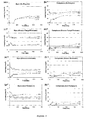
- the protein profiles may be analysed, for example by C18 RP-HPLC. This is a method known in the art for peptide profile characterisation. It was found that the protein profiles were different from those of the protein hydrolysed with the same enzyme but in the absence of complex formation with a polysaccharide. This is illustrated in Figure 1 (A, B and C) which shows that the hydrolysis of the protein with three different enzymes did not occur at the same sites in the proteins associated to a polysaccharide in the form of a complex compared to the proteins which have not been previously associated with a polysaccharide.
- the complexes of the invention provide increased emulsifying stability over time compared to non-hydrolysed complexes, non-hydrolysed protein alone, or hydrolysed protein.
- Figure 2 shows the best creaming stability over time for complexes which have been hydrolysed by fungal protease, bromelain or acid protease.
- the hydrolysed protein-polysaccharide complexes obtained by hydrolysis of the complex with acid protease showed particularly good results in terms of creaming stability.
- the fungal protease and the bromelain were obtained commercially from Enzyme Development Corporation.
- endoproteases from Aspergillus oryzae and endoproteases from the Bromeliceae respectively.
- the acid protease II was commercially available from Amano and comprises endoproteases from Rhizopus niveus.
- the complexes of the invention can therefore be used as emulsifiers and/or stabilisers in food, cosmetic or pharmaceutical products.
- Food products comprising the complexes of the invention are preferably selected from desserts, frozen desserts, dairy products, petfood, culinary products, clinical nutrition products etc.
- they may include sauces, soups, mayonnaises, salad dressings, creams, ice cream, chocolate, mousses, milk, etc.
- the complexes of the invention may be used in cosmetic products such as creams, foams, mousses, gels, shampoos, emulsions, etc.
- the pharmaceutical products to which the complexes of the invention may be added include tablets, capsules, syrups, etc.
- the complexes are preferably present in the product in an amount of 0.01 to 10 wt%, preferably 0.1 - 5 wt%, most preferably 0.1 - 0.5 wt% of said product. It has indeed been found that the emulsifying and stabilising properties are optimal at low concentrations.
- the products of the invention thus provide the advantage that they are highly effective emulsifiers and/or stabilisers.
- the invention further relates to a method of manufacture of these hydrolysed protein-polysaccharide complexes.
- the first step in the method includes the mixing of a solution of protein and polysaccharide such as to induce formation of a complex.
- the protein used in the method of the present invention preferably has not been subjected to any hydrolysis step prior to mixing with the polysaccharide.
- the protein may be selected from one or more of milk, soy, egg, meat, fish or plant protein.
- it is a milk protein such as whey protein or casein, more preferably a bovine milk protein. Even more preferably, it is a bovine whey protein.
- the polysaccharide used in the present invention may be any polysaccharide capable of intermolecular association with a protein. Thus, it is preferably an anionic or cationic polysaccharide.
- Polysaccahride of the invention may be selected from gums, hydrocolloids, microbial or fungal exo-polysaccharides.
- acacia gum Preferably it is selected from one or more of acacia gum, pectins, carrageenans, mammalian gelatine such as pork gelatine, fish gelatine, arabinogalactans, rye arabinoxylans, wheat arabinoxylans, alginate, propylene glycol alginate, carboxymethylcellulose, chitosan, xanthan gum, agar, exo-polysaccharides from lactic bacteria. Most preferably the polysaccharide is selected from acacia gum and/or chitosan.
- the conditions for inducing formation of a complex vary depending on the source of protein and of polysaccharide used.
- the protein and the polysaccharide may be mixed in a protein:polysaccharide weight ratio of 20:1 to 1:20.
- the protein and the polysaccharide are mixed in a protein:polysaccharide weight ratio of 5:1 to 1:5, more preferably 2:1 to 1:2.
- the protein and the polysaccharide are mixed in a protein:polysaccharide weight ratio of 2:1.
- the amount of polysaccharide in the solution is preferably 0.1 to 10%, more preferably 0.4 to 5%.
- the pH of the solution may be adjusted such as to induce electrostatic association of the protein with the polysaccharide.
- the pH of a solution containing the protein and the polysaccharide may vary from 3.0 to 8.0, preferably from 3.0 to 7.0. In a preferred embodiment, the pH may vary from 3.0 to 5.0. In another embodiment, the pH may vary from 6.0 to 7.0.
- the pH is between 3.0 and 5.0, more preferably about 4.2.
- whey proteins are mixed with a cationic polysaccharide such as chitosan, it is preferred that the pH is between 6.0 and 7.0, more preferably about 6.5.
- the pH adjustment may be made by using conventional acids such as hydrochloric acid, phosphoric acid, citric acid, acetic acid, formic acid or bases such as sodium hydroxide, potassium hydroxide.
- the solution is mixed for the amount of time required to induce complex formation between the protein and the polysaccharide.
- the time may vary from 1 second to 30 minutes.
- Complex formation may be instantaneous. Complex formation can be evidenced by methods known to the skilled person such as turbidity measurements, light scattering measurements or conductivity measurements.
- the intact protein-polysaccharide complexes are then hydrolysed, for example with an enzyme.
- the enzyme is selected such that it can act on the protein in the protein-polysaccharide complex.
- Such enzyme may be selected from endoprotease such as pepsin, trypsin, chymotrypsin, ⁇ -chymotrypsin, bromelain, papain, ficin, endoprotease from porcine pancreas, from bovine pancreas, porcine stomach mucosa, porcine gastric mucosa, porcine stomach linings, Bacillus subtilis, Bacillus spp., Aspergillus oryzae, Aspergillus sojae, Aspergillus spp., Rhizopus niveus, Carica papaya, Ananas comosus, Bromeliceae family, Ficus species, exoprotease from Aspergillus oryzae, Aspergillus sojae, Aspergillus spp., Carica papaya.
- the enzyme is an endoprotease.
- Enzymes that may be used in the present invention are commercially available from Novozymes for example under the name of Alcalase®, Neutrase®, Protamex®, Flavourzyme®.
- the protein to enzyme ratio in the solution is 1:5 to 1:1000, preferably 1:10 to 1:100, more preferably 1:50.
- the hydrolysis may be carried out at a temperature ranging from 30 to 70°C.
- the optimal temperature depends on the choice of enzyme.
- the temperature at which the hydrolysis is carried out is between 40 and 50°C.
- the hydrolysis may be carried out for 10 minutes to 3 hours, preferably for about 2 hours.
- the protein-polysaccharide complex is preferably hydrolysed to a hydrolysis degree of 1 to 50%, more preferably 2 to 25%, even more preferably 3.5 to 20%.
- the degree of hydrolysis is determined by the OPA (o-phthaldialdehyde) method which is known to a person of skill in the art for following protein hydrolysis.
- the resulting hydrolysed protein-polysaccharide complex has the advantage of being highly efficient as an emulsifier and/or stabiliser in compositions to which it is added. Furthermore, it comprises only natural ingredients such that it is more appealing than traditional emulsifiers which consist of chemically modified or synthesised products. Also, the complexes of the invention are versatile in terms of the products they may be included into. For instance, by tuning the choice of protein and polysaccharide, they function as emulsifiers and/or stabilisers over a wide pH range. For instance, they can be used in acidic products having a pH of about 4.5 such as mayonnaise as well as in products having a pH over 6.5 such as milk.
- Enzyme inactivation may be done by heat treatment, pressure treatment or addition of an inhibitor specific to the enzyme.
- it is carried out by heat treatment of the solution comprising the hydrolysed protein-polysaccharide complex and the enzymes.
- the heat treatment is preferably carried out at a temperature of 80 to 100°C for 5-30 minutes.
- the solution after hydrolysis, and optionally after enzyme inactivation may be subjected to ultrafiltration. This has the advantage of separating the complexes of the invention from the free peptides generated by the hydrolysis step.
- the solution is then dried by any method known in the art such as spray-drying, freeze-drying or vacuum-drying.
- the complexes of the invention can therefore be in the form of a solution, a gel, or a dried powder.
- the hydrolysed protein-polysaccharide complexes may be dried in the presence of further ingredients.
- the dried hydrolysed protein-polysaccharide complex may be mixed with other dried ingredients.
- the resulting products can be for instance a milk powder or dehydrated soup powder comprising the complexes of the invention.
- Example 1 preparation of a hydrolysed acacia gum-whey protein complex
- Whey protein isolate (WPI - BiPro from Davisco Foods International) is mixed with acacia gum (Instant gum from Colloides Naturels International) at a protein to polysaccharide weight ratio of 2:1, a total WPI concentration of 2wt% (protein basis) and the pH was adjusted to 4.2.
- Enzeco® Bromelain enzyme concentrate was then added to the solution in a ratio of protein to enzyme of 1:50. After 2 hours, the hydrolysis degree was 3.7% and the hydrolysed complex was heat treated (90°C, 15 minutes) to inactivate the enzyme and ultrafiltered to remove the unbound peptides generated by the protease. The resulting hydrolysed protein-polysaccharide complex was freeze dried to give a powder.
- Example 2 preparation of a hydrolysed chitosan-whey protein complex
- chitosan and whey proteins were used as the polysaccharide and protein respectively.
- Chitosan 252 (de-acetlyation degree > 90%, Mahtani Chitosan PVT Ltd) was obtained from France Chitine.
- Whey protein isolate was obtained from Davisco Foods International under the tradename of BiPro®.
- aqueous dispersion of chitosan at 50°C was adjusted to pH 5.9 prior to mixing with the protein.
- the protein in an aqueous solution was then added to the chitosan dispersion and the pH was adjusted to 6.5 with acetic acid.
- the whey protein concentration in the mixture was 0.9 wt%.
- the chitosan concentration in the mixture was 0.45 wt%.
- a fungal protease from Bacillus subtilis (Corolase 7089) was added at a concentration of 0.018 wt%. The mixture was kept at 50°C under stirring for 2 hours to obtain a hydrolysis degree of 12%.
- the mixture was then ultrafiltered at 50°C using a Prep/Scale Spiral Wound TFF 1 Module PZHK with MWCO of 100kDa (0.09 m 2 ) .
- Inlet pressure was set to 0.75 bar (speed 6 of the pump).
- the mixture was first concentrated 2X, then diafiltration was started by adding 1 diavolume (800 mL) of deionised water.
- the hydrolysed acacia gum-whey protein complex obtained in example 1 was tested for emulsifying capacity at three different concentrations (0.1, 0.5 and 1 wt%).
- Emulsions were prepared using Sunflower oil (Merit Selection brand). 10g of oil were added to 90g of deionised water. Then 0.1, 0.5 and 1wt% of hydrolysed complex obtained in example 1 and reconstituted in distilled water were added. Finally, 0.02wt% NaN 3 was added as a preservative. The mixture was pre-homogenised with an Ultra-Turrax (Janke-Kunkel, GmBH) for 30 seconds prior to emulsification.
- Ultra-Turrax Jete-Kunkel, GmBH
- Emulsification was carried out using an Emulsiflex-C5 homogeniser (Avestin Co., Canada) in two passes, namely ⁇ 400 bar (6000psi) and ⁇ 80 bar (1100 psi) at room temperature (23°C).
Landscapes
- Life Sciences & Earth Sciences (AREA)
- Chemical & Material Sciences (AREA)
- Health & Medical Sciences (AREA)
- Polymers & Plastics (AREA)
- Engineering & Computer Science (AREA)
- Food Science & Technology (AREA)
- Nutrition Science (AREA)
- Molecular Biology (AREA)
- Mycology (AREA)
- Chemical Kinetics & Catalysis (AREA)
- Zoology (AREA)
- Dispersion Chemistry (AREA)
- General Chemical & Material Sciences (AREA)
- Proteomics, Peptides & Aminoacids (AREA)
- Biochemistry (AREA)
- Cosmetics (AREA)
- General Preparation And Processing Of Foods (AREA)
- Emulsifying, Dispersing, Foam-Producing Or Wetting Agents (AREA)
- Medicinal Preparation (AREA)
- Jellies, Jams, And Syrups (AREA)
- Peptides Or Proteins (AREA)
- Preparation Of Compounds By Using Micro-Organisms (AREA)
Abstract
Description
- The present invention relates to hydrolysed protein-polysaccharide complexes, and more specifically to those obtained by complex formation between a protein and a polysaccharide followed by hydrolysis. The resulting complexes have good emulsifying and stabilising properties and can be used in food, cosmetic or pharmaceutical products. The invention further relates to the method of manufacture of such complexes.
- Protein-polysaccharide complexes are well known in the art for their ability to stabilise emulsions and foams. For instance,
US 3,944,680 describes the use of these complexes as a favoured alternative to globular protein alone in storage stable whippable emulsions. -
US 6,197,319 relates to the use of these complexes in cosmetic compositions as a means to avoid unstable products which can be obtained when proteins or polysaccharides are used individually. - The use of a microfragmented ionic polysaccharide/protein complex dispersion as fat substitute in food products such as ice cream, salad dressings, dips, spreads and sauces is described in
EP 340 035 - An emulsifier having high emulsifying capacity is described in
WO 2004/078334 . The emulsifier is produced by complex formation between an acidic polysaccharide and a protein or hydrolysed protein under heat at a pH of 2 to 5. - Further, Pilosof, A.M.R. et al. in Food Hydrocolloids, 19, 2005, 361-369 discuss the effects of hydrolysed sunflower protein on the interaction with polysaccharide in foams. Limited hydrolysis of the protein is seen to enhance its foaming properties and also affect the protein-polysaccharide interactions.
-
W02004/028281 discloses the use of an electrostatically bound protein-polysaccharide complex as a surfactant and a stabiliser in any type of emulsions or foams. - It is therefore an object of the invention to further improve the emulsifying and stabilising properties of protein-polysaccharide complexes.
- This object is solved by means of the independent claims. The dependent claims further develop the central idea of the invention.
- Thus, in a first aspect, the invention relates to a hydrolysed protein-polysaccharide complex obtained and/or obtainable by hydrolysis of a protein-polysaccharide complex by an enzyme.
- The use of a complex according to any of
claims 1 to 5 as an emulsifier and/or stabiliser in food products, preferably selected from desserts, frozen desserts, dairy products, petfood, culinary products, clinical nutrition products; cosmetic products preferably selected from creams, foams, mousses, gels, shampoos, emulsions; or pharmaceutical products preferably selected from tablets, capsules, syrups, also forms part of the invention. Finally, the invention also concerns a method for the manufacture of a hydrolysed protein-polysaccharide complex comprising the steps of: - a. Mixing a solution of protein with a polysaccharide such as to induce the formation of a complex
- b. Hydrolysing the formed complex with an enzyme, preferably to a degree of hydrolysis of the protein in the hydrolysed protein-polysaccharide complex of 1 to 50%, more preferably 2 to 25%, even more preferably 3.5 to 20%,
- The invention is further illustrated by means of the accompanying figures, wherein
-
Fig. 1 shows RP-HPLC profiles obtained on C18 column for WPI (BiPRO)/acacia gum hydrolyzed complexes or WPI hydrolysate at pH 4.2 by: A) Enzeco fungal protease concentrate; B) Acid Protease II; C) Enzeco Bromelain concentrate. In all samples, enzymes were heat inactivated prior to RP-HPLC analysis and de-complexation. -
Fig. 2 illustrates the height of the creamed layer (%) measured over time for emulsions prepared with (◊ ) 0.1 wt%; (Δ) 0.5 wt% or (□) 1.0 wt% WPI or WPI/Acacia gum complexes with (a, b) No enzyme; or hydrolysed with (c, d) Enzeco Fungal Protease; (e, f) Enzeco Bromelain; and (g, h) Acid Protease II. -
Fig. 3 is a table summarising the DH values obtained for WPI and WPI/Acacia gum complex hydrolysis (for 2 hours) at pH 4.2 measured by OPA method. - The invention relates to hydrolysed protein-polysaccharide complexes. In the context of the present invention, the term "hydrolysed protein-polysaccharide complex" describes a complex between a protein and a polysaccharide which, after complex formation between the intact protein and the polysaccharide has been subjected to hydrolysis.
- By the term "complex" is meant any form of association between the protein and the polysaccharide. Such association may involve hydrophobic interactions, van der Waal interactions, electrostatic interactions, hydrogen-bonding, covalent interactions or dipole-dipole induced interactions.
- The complexes of the invention are preferably electrostatically bound complexes. Thus, the protein preferably has an overall net charge opposite to the overall net charge of the polysaccharide. However, electrostatic complexes formed by means of protein charge patches, i.e. in conditions where the protein and the polysaccharide have similar net charge, are also covered by this application.
- In the context of the present invention, the term "hydrolysis" refers to the hydrolysis of the protein, once bound to the polysaccharide.
- The hydrolysis is preferably carried out using an enzyme. The enzyme is selected such that it can act on the protein in the protein-polysaccharide complex. Such enzyme may be selected from endoprotease such as pepsin, trypsin, chymotrypsin, α-chymotrypsin, bromelain, papain, ficin, endoprotease from porcine pancreas, bovine pancreas, porcine stomach mucosa, porcine gastric mucosa, porcine stomach linings, Bacillus subtilis, Bacillus spp., Aspergillus oryzae, Aspergillus sojae, Aspergillus spp., Rhizopus niveus, Carica papaya, Ananas comosus, Bromeliceae family, Ficus species, exoprotease from Aspergillus oryzae, Aspergillus sojae, Aspergillus spp., Carica papaya. Preferably, the enzyme is an endoprotease.
- Enzymes that may be used in the present invention are commercially available from Novozymes for example under the name of Alcalase®, Neutrase®, Protamex®, Flavourzyme®.
- The degree of hydrolysis of the protein in the protein-polysaccharide complex with an enzyme has been shown to be less than the degree of hydrolysis with the same enzyme when the protein is free (cf.
Fig. 3 ). This result is expected as the access to the cleaving site on the protein is somewhat hindered by the presence of the polysaccharide. However, the lower degree of hydrolysis achieved in the protein-polysaccharide complexes has no effect on the performance of the complexes as stabilising agents. Indeed, it has been found that a degree of hydrolysis of 1 to 50%, preferably 2 to 25%, more preferably 3.5 to 20% is suitable in order to achieve the advantageous effects of the invention. - The protein of the protein-polysaccharide complex prior to hydrolysis is preferably selected from one or more of milk, soy, egg, meat, fish or plant protein. Preferably, it is a milk protein such as whey protein or casein, more preferably a bovine milk protein. Even more preferably, it is a bovine whey protein.
- The polysaccharide used in the present invention may be any polysaccharide capable of intermolecular association with a protein. Thus, it is preferably an anionic or cationic polysaccharide. Polysaccharide of the invention may be selected from gums, hydrocolloids, microbial or fungal exo-polysaccharides. Preferably it is selected from one or more of acacia gum, pectins, carrageenans, mammalian gelatine such as pork gelatine, fish gelatine, arabinogalactans, rye arabinoxylans, wheat arabinoxylans, alginate, propylene glycol alginate, carboxymethylcellulose, chitosan, xanthan gum, agar, exo-polysaccharides from lactic bacteria. Most preferably the polysaccharide is selected from acacia gum and/or chitosan.
- In the complexes of the invention, the degree of hydrolysis of the protein may vary between 1 to 50%. Preferably, it is 2 to 25%, more preferably it is 3.5 to 20%.
- The peptide profile resulting from protein hydrolysis within the complex may be determined upon de-complexation of the protein fraction from the polysaccharide. By "de-complexation" is meant disassociation of the protein-polysaccharide complex. De-complexation can be achieved by pH change and polysaccharide precipitation in acetonitrile, for example.
- Upon de-complexation, the protein profiles may be analysed, for example by C18 RP-HPLC. This is a method known in the art for peptide profile characterisation. It was found that the protein profiles were different from those of the protein hydrolysed with the same enzyme but in the absence of complex formation with a polysaccharide. This is illustrated in
Figure 1 (A, B and C) which shows that the hydrolysis of the protein with three different enzymes did not occur at the same sites in the proteins associated to a polysaccharide in the form of a complex compared to the proteins which have not been previously associated with a polysaccharide. - Therefore, it can be seen that the complexes obtained by hydrolysis of a protein-polysaccharide complex compared to the complexes formed from association of hydrolysed protein with a polysaccharide differ in structure.
- In addition, it was shown that the complexes of the invention provide increased emulsifying stability over time compared to non-hydrolysed complexes, non-hydrolysed protein alone, or hydrolysed protein. This is illustrated in
Figure 2 which shows the best creaming stability over time for complexes which have been hydrolysed by fungal protease, bromelain or acid protease. The hydrolysed protein-polysaccharide complexes obtained by hydrolysis of the complex with acid protease showed particularly good results in terms of creaming stability. In the examples shown inFigure 2 the fungal protease and the bromelain were obtained commercially from Enzyme Development Corporation. They comprise endoproteases from Aspergillus oryzae and endoproteases from the Bromeliceae respectively. The acid protease II was commercially available from Amano and comprises endoproteases from Rhizopus niveus. - The complexes of the invention can therefore be used as emulsifiers and/or stabilisers in food, cosmetic or pharmaceutical products.
- Food products comprising the complexes of the invention are preferably selected from desserts, frozen desserts, dairy products, petfood, culinary products, clinical nutrition products etc. In particular, they may include sauces, soups, mayonnaises, salad dressings, creams, ice cream, chocolate, mousses, milk, etc.
- The complexes of the invention may be used in cosmetic products such as creams, foams, mousses, gels, shampoos, emulsions, etc.
- The pharmaceutical products to which the complexes of the invention may be added include tablets, capsules, syrups, etc.
- When used as emulsifier and/or stabiliser, the complexes are preferably present in the product in an amount of 0.01 to 10 wt%, preferably 0.1 - 5 wt%, most preferably 0.1 - 0.5 wt% of said product. It has indeed been found that the emulsifying and stabilising properties are optimal at low concentrations. The products of the invention thus provide the advantage that they are highly effective emulsifiers and/or stabilisers.
- The invention further relates to a method of manufacture of these hydrolysed protein-polysaccharide complexes.
- The first step in the method includes the mixing of a solution of protein and polysaccharide such as to induce formation of a complex.
- The protein used in the method of the present invention preferably has not been subjected to any hydrolysis step prior to mixing with the polysaccharide.
- The protein may be selected from one or more of milk, soy, egg, meat, fish or plant protein. Preferably, it is a milk protein such as whey protein or casein, more preferably a bovine milk protein. Even more preferably, it is a bovine whey protein.
- The polysaccharide used in the present invention may be any polysaccharide capable of intermolecular association with a protein. Thus, it is preferably an anionic or cationic polysaccharide. Polysaccahride of the invention may be selected from gums, hydrocolloids, microbial or fungal exo-polysaccharides. Preferably it is selected from one or more of acacia gum, pectins, carrageenans, mammalian gelatine such as pork gelatine, fish gelatine, arabinogalactans, rye arabinoxylans, wheat arabinoxylans, alginate, propylene glycol alginate, carboxymethylcellulose, chitosan, xanthan gum, agar, exo-polysaccharides from lactic bacteria. Most preferably the polysaccharide is selected from acacia gum and/or chitosan.
- The conditions for inducing formation of a complex, in particular for inducing formation of an electrostatically bound complex vary depending on the source of protein and of polysaccharide used.
- The protein and the polysaccharide may be mixed in a protein:polysaccharide weight ratio of 20:1 to 1:20. Preferably, the protein and the polysaccharide are mixed in a protein:polysaccharide weight ratio of 5:1 to 1:5, more preferably 2:1 to 1:2. Most preferably, the protein and the polysaccharide are mixed in a protein:polysaccharide weight ratio of 2:1.
- The amount of polysaccharide in the solution is preferably 0.1 to 10%, more preferably 0.4 to 5%.
- In the present invention, it has been found that the pH of the solution may be adjusted such as to induce electrostatic association of the protein with the polysaccharide. The pH of a solution containing the protein and the polysaccharide may vary from 3.0 to 8.0, preferably from 3.0 to 7.0. In a preferred embodiment, the pH may vary from 3.0 to 5.0. In another embodiment, the pH may vary from 6.0 to 7.0.
- For instance, when whey proteins are mixed with an anionic polysaccharide such as acacia gum, it is preferred that the pH is between 3.0 and 5.0, more preferably about 4.2. When whey proteins are mixed with a cationic polysaccharide such as chitosan, it is preferred that the pH is between 6.0 and 7.0, more preferably about 6.5.
- The pH adjustment may be made by using conventional acids such as hydrochloric acid, phosphoric acid, citric acid, acetic acid, formic acid or bases such as sodium hydroxide, potassium hydroxide.
- The solution is mixed for the amount of time required to induce complex formation between the protein and the polysaccharide. The time may vary from 1 second to 30 minutes. Complex formation may be instantaneous. Complex formation can be evidenced by methods known to the skilled person such as turbidity measurements, light scattering measurements or conductivity measurements.
- The intact protein-polysaccharide complexes are then hydrolysed, for example with an enzyme.
- The enzyme is selected such that it can act on the protein in the protein-polysaccharide complex. Such enzyme may be selected from endoprotease such as pepsin, trypsin, chymotrypsin, α-chymotrypsin, bromelain, papain, ficin, endoprotease from porcine pancreas, from bovine pancreas, porcine stomach mucosa, porcine gastric mucosa, porcine stomach linings, Bacillus subtilis, Bacillus spp., Aspergillus oryzae, Aspergillus sojae, Aspergillus spp., Rhizopus niveus, Carica papaya, Ananas comosus, Bromeliceae family, Ficus species, exoprotease from Aspergillus oryzae, Aspergillus sojae, Aspergillus spp., Carica papaya. Preferably, the enzyme is an endoprotease.
- Enzymes that may be used in the present invention are commercially available from Novozymes for example under the name of Alcalase®, Neutrase®, Protamex®, Flavourzyme®. The protein to enzyme ratio in the solution is 1:5 to 1:1000, preferably 1:10 to 1:100, more preferably 1:50.
- The hydrolysis may be carried out at a temperature ranging from 30 to 70°C. The optimal temperature depends on the choice of enzyme. Preferably, the temperature at which the hydrolysis is carried out is between 40 and 50°C.
- The hydrolysis may be carried out for 10 minutes to 3 hours, preferably for about 2 hours.
- The protein-polysaccharide complex is preferably hydrolysed to a hydrolysis degree of 1 to 50%, more preferably 2 to 25%, even more preferably 3.5 to 20%. The degree of hydrolysis is determined by the OPA (o-phthaldialdehyde) method which is known to a person of skill in the art for following protein hydrolysis.
- The resulting hydrolysed protein-polysaccharide complex has the advantage of being highly efficient as an emulsifier and/or stabiliser in compositions to which it is added. Furthermore, it comprises only natural ingredients such that it is more appealing than traditional emulsifiers which consist of chemically modified or synthesised products. Also, the complexes of the invention are versatile in terms of the products they may be included into. For instance, by tuning the choice of protein and polysaccharide, they function as emulsifiers and/or stabilisers over a wide pH range. For instance, they can be used in acidic products having a pH of about 4.5 such as mayonnaise as well as in products having a pH over 6.5 such as milk.
- After hydrolysis, it may be advantageous to inactivate the enzyme. Enzyme inactivation may be done by heat treatment, pressure treatment or addition of an inhibitor specific to the enzyme. Preferably, it is carried out by heat treatment of the solution comprising the hydrolysed protein-polysaccharide complex and the enzymes. The heat treatment is preferably carried out at a temperature of 80 to 100°C for 5-30 minutes.
- Additionally, the solution after hydrolysis, and optionally after enzyme inactivation, may be subjected to ultrafiltration. This has the advantage of separating the complexes of the invention from the free peptides generated by the hydrolysis step.
- In a preferred embodiment, the solution is then dried by any method known in the art such as spray-drying, freeze-drying or vacuum-drying.
- The complexes of the invention can therefore be in the form of a solution, a gel, or a dried powder.
- In a further embodiment, the hydrolysed protein-polysaccharide complexes may be dried in the presence of further ingredients. Alternatively, the dried hydrolysed protein-polysaccharide complex may be mixed with other dried ingredients.
- The resulting products can be for instance a milk powder or dehydrated soup powder comprising the complexes of the invention.
- The present invention is further illustrated by means of the following non-limiting examples.
- Whey protein isolate (WPI - BiPro from Davisco Foods International) is mixed with acacia gum (Instant gum from Colloides Naturels International) at a protein to polysaccharide weight ratio of 2:1, a total WPI concentration of 2wt% (protein basis) and the pH was adjusted to 4.2. Enzeco® Bromelain enzyme concentrate was then added to the solution in a ratio of protein to enzyme of 1:50. After 2 hours, the hydrolysis degree was 3.7% and the hydrolysed complex was heat treated (90°C, 15 minutes) to inactivate the enzyme and ultrafiltered to remove the unbound peptides generated by the protease. The resulting hydrolysed protein-polysaccharide complex was freeze dried to give a powder.
- In the present example, chitosan and whey proteins were used as the polysaccharide and protein respectively.
- Chitosan 252 (de-acetlyation degree > 90%, Mahtani Chitosan PVT Ltd) was obtained from France Chitine. Whey protein isolate was obtained from Davisco Foods International under the tradename of BiPro®.
- An aqueous dispersion of chitosan at 50°C was adjusted to pH 5.9 prior to mixing with the protein. The protein (in an aqueous solution) was then added to the chitosan dispersion and the pH was adjusted to 6.5 with acetic acid.
- The whey protein concentration in the mixture was 0.9 wt%. The chitosan concentration in the mixture was 0.45 wt%. After 20 minutes of mixing, a fungal protease from Bacillus subtilis (Corolase 7089) was added at a concentration of 0.018 wt%. The mixture was kept at 50°C under stirring for 2 hours to obtain a hydrolysis degree of 12%.
- The mixture was then ultrafiltered at 50°C using a Prep/Scale
Spiral Wound TFF 1 Module PZHK with MWCO of 100kDa (0.09 m2) . Inlet pressure was set to 0.75 bar (speed 6 of the pump). - The mixture was first concentrated 2X, then diafiltration was started by adding 1 diavolume (800 mL) of deionised water.
- To denature the enzyme in the retentate a heat treatment of 90°C for 15 minutes was applied. The retentate was then freeze-dried to give a product according to the invention.
- The hydrolysed acacia gum-whey protein complex obtained in example 1 was tested for emulsifying capacity at three different concentrations (0.1, 0.5 and 1 wt%).
- Emulsions were prepared using Sunflower oil (Merit Selection brand). 10g of oil were added to 90g of deionised water. Then 0.1, 0.5 and 1wt% of hydrolysed complex obtained in example 1 and reconstituted in distilled water were added. Finally, 0.02wt% NaN3 was added as a preservative. The mixture was pre-homogenised with an Ultra-Turrax (Janke-Kunkel, GmBH) for 30 seconds prior to emulsification.
- Emulsification was carried out using an Emulsiflex-C5 homogeniser (Avestin Co., Canada) in two passes, namely ~400 bar (6000psi) and ~80 bar (1100 psi) at room temperature (23°C).
- The results are shown in
Figure 2 . It can be seen that the creaming stability, i.e. the resistance of the emulsions to undergo phase separation, of the complexes of the invention (figure 2d, f, h ) was better over 28 days of storage compared to non-hydrolysed whey protein alone (figure 2a ), compared to non-hydrolysed complexes (figure 2b ) or compared to hydrolysed whey protein alone (figure 2c, e, g ). - Furthermore, the results show that a concentration of the hydrolysed complexes of the invention as low as 0.1wt% is particularly effective at stabilising the emulsion.
Claims (15)
- Hydrolysed protein-polysaccharide complex obtainable by hydrolysis of a protein-polysaccharide complex by an enzyme.
- Complex according to claim 1, wherein the protein-polysaccharide complex is an electrostatically bound complex.
- Complex according to claim 1 or 2, wherein the protein is selected from one or more of milk, soy, egg, meat, fish or plant protein, preferably a milk protein such as whey protein or casein, more preferably a bovine milk protein, even more preferably a bovine whey protein.
- Complex according to any of the preceding claims, wherein the polysaccharide is selected from one or more of gums, hydrocolloids, microbial or fungal exo-polysaccharides, preferably selected from one or more of acacia gum, pectins, carrageenans, mammalian gelatine such as pork gelatine, fish gelatine, arabinogalactans, rye arabinoxylans, wheat arabinoxylans, alginate, propylene glycol alginate, carboxymethylcellulose, chitosan, xanthan gum, agar, exo-polysaccharides from lactic bacteria, most preferably selected from acacia gum and/or chitosan.
- Complex according to any of the preceding claims, wherein the degree of hydrolysis of the protein in the hydrolysed protein-polysaccharide complex is 1 to 50%, preferably 2 to 25%, more preferably 3.5 to 20%.
- Use of a complex according to any of claims 1 to 5 as an emulsifier and/or stabiliser in food products, preferably selected from desserts, frozen desserts, dairy products, petfood, culinary products, clinical nutrition products; cosmetic products preferably selected from creams, foams, mousses, gels, shampoos, emulsions; or pharmaceutical products preferably selected from tablets, capsules, syrups.
- Use according to claim 6, in an amount of 0.01 to 10 wt%, preferably 0.1 to 5 wt%, more preferably 0.1 to 0.5 wt% of said product.
- Method for the manufacture of a hydrolysed protein-polysaccharide complex comprising the steps of:a. Mixing a solution of protein and polysaccharide such as to induce the formation of a complexb. Hydrolysing the formed complex with an enzyme, preferably to a degree of hydrolysis of the protein in the hydrolysed protein-polysaccharide complex of 1 to 50%, more preferably 2 to 25%, even more preferably 3.5 to 20%,to obtain said hydrolysed protein-polysaccharide complex.
- Method according to claim 8, wherein the mixing is carried out at a pH such as to induce electrostatic complex formation between the protein and the polysaccharide.
- Method according to claim 8 or 9, where the pH of the solution is 3.0 to 8.0, preferably 3.0 to 7.0, more preferably 3.0 to 5.0 or 6.0 to 7.0.
- Method according to claim 8 to 10, wherein the weight ratio of protein to polysaccharide is 20:1 to 1:20, preferably 5:1 to 1:5, more preferably 2:1 to 1:2, most preferably 2:1.
- Method according to any of claims 8 to 11, wherein the enzyme is selected from endoprotease such as pepsin, trypsin, chymotrypsin, α-chymotrypsin, bromelain, papain, ficin, endoprotease from porcine pancreas, from bovine pancreas, porcine stomach mucosa, porcine gastric mucosa, porcine stomach linings, Bacillus subtilis, Bacillus spp., Aspergillus oryzae, Aspergillus sojae, Aspergillus spp., Rhizopus niveus, Cari ca papaya, Ananas comosus, Bromeliceae family, Ficus species, exoprotease from Aspergillus oryzae, Aspergillus sojae, Aspergillus spp., Carica papaya, preferably an endoprotease.
- Method according to any of claims 8 to 12, wherein the enzyme is inactivated after the hydrolysis step, preferably by heat treatment, pressure treatment or addition of an inhibitor specific to the enzyme, more preferably by heat treatment carried out at a temperature of 80-100°C for 5-30 minutes.
- Method according to any of claims 8 to 13, wherein the hydrolysis step is followed by ultrafiltration of the obtained mix.
- Method according to any of claims 8 to 14, wherein the hydrolysis step is followed by a drying step.
Priority Applications (15)
| Application Number | Priority Date | Filing Date | Title |
|---|---|---|---|
| ES08170653.3T ES2488098T3 (en) | 2008-12-04 | 2008-12-04 | Hydrolyzed protein-polysaccharide complexes |
| DK08170653.3T DK2196097T3 (en) | 2008-12-04 | 2008-12-04 | Hydrolyzed protein-polysaccharide complexes |
| PL08170653T PL2196097T3 (en) | 2008-12-04 | 2008-12-04 | Hydrolysed protein-polysaccharide complexes |
| EP08170653.3A EP2196097B1 (en) | 2008-12-04 | 2008-12-04 | Hydrolysed protein-polysaccharide complexes |
| MYPI2011001385A MY158625A (en) | 2008-12-04 | 2009-11-30 | Hydrolysed protein-polysaccharide complexes |
| RU2011127103/10A RU2011127103A (en) | 2008-12-04 | 2009-11-30 | HYDROLYZED PROTEIN-POLYSACCHARIDE COMPLEXES |
| PCT/EP2009/066038 WO2010063669A1 (en) | 2008-12-04 | 2009-11-30 | Hydrolysed protein-polysaccharide complexes |
| CN200980147598.4A CN102227170B (en) | 2008-12-04 | 2009-11-30 | Hydrolysed protein-polysaccharide complexes |
| NZ591979A NZ591979A (en) | 2008-12-04 | 2009-11-30 | Hydrolysed protein-polysaccharide complexes |
| BRPI0922290-1A BRPI0922290A2 (en) | 2008-12-04 | 2009-11-30 | Hydrolyzed protein-polysaccharide complexes. |
| CA2743101A CA2743101A1 (en) | 2008-12-04 | 2009-11-30 | Hydrolysed protein-polysaccharide complexes |
| AU2009324245A AU2009324245B2 (en) | 2008-12-04 | 2009-11-30 | Hydrolysed protein-polysaccharide complexes |
| UAA201108400A UA108467C2 (en) | 2008-12-04 | 2009-11-30 | Hydrolysed protein-polysaccharide complexes |
| US13/129,501 US8728556B2 (en) | 2008-12-04 | 2009-11-30 | Hydrolysed protein-polysaccharide complexes |
| IL211972A IL211972A0 (en) | 2008-12-04 | 2011-03-28 | Hydrolysed protein-polysaccharide complexes |
Applications Claiming Priority (1)
| Application Number | Priority Date | Filing Date | Title |
|---|---|---|---|
| EP08170653.3A EP2196097B1 (en) | 2008-12-04 | 2008-12-04 | Hydrolysed protein-polysaccharide complexes |
Publications (2)
| Publication Number | Publication Date |
|---|---|
| EP2196097A1 true EP2196097A1 (en) | 2010-06-16 |
| EP2196097B1 EP2196097B1 (en) | 2014-06-18 |
Family
ID=40551473
Family Applications (1)
| Application Number | Title | Priority Date | Filing Date |
|---|---|---|---|
| EP08170653.3A Active EP2196097B1 (en) | 2008-12-04 | 2008-12-04 | Hydrolysed protein-polysaccharide complexes |
Country Status (15)
| Country | Link |
|---|---|
| US (1) | US8728556B2 (en) |
| EP (1) | EP2196097B1 (en) |
| CN (1) | CN102227170B (en) |
| AU (1) | AU2009324245B2 (en) |
| BR (1) | BRPI0922290A2 (en) |
| CA (1) | CA2743101A1 (en) |
| DK (1) | DK2196097T3 (en) |
| ES (1) | ES2488098T3 (en) |
| IL (1) | IL211972A0 (en) |
| MY (1) | MY158625A (en) |
| NZ (1) | NZ591979A (en) |
| PL (1) | PL2196097T3 (en) |
| RU (1) | RU2011127103A (en) |
| UA (1) | UA108467C2 (en) |
| WO (1) | WO2010063669A1 (en) |
Families Citing this family (18)
| Publication number | Priority date | Publication date | Assignee | Title |
|---|---|---|---|---|
| CN102513025B (en) * | 2011-12-21 | 2013-08-07 | 江南大学 | Phosvitin-sugar polymer emulsifier and preparation method thereof |
| RU2528068C1 (en) * | 2013-04-04 | 2014-09-10 | Государственное научное учреждение Всероссийский научно-исследовательский институт молочной промышленности Российской академии сельскохозяйственных наук (ГНУ ВНИМИ Россельхозакадемии) | Method of production of enzymatic whey proteins |
| RU2536967C1 (en) * | 2013-11-05 | 2014-12-27 | Общество с ограниченной ответственностью "Зеленые линии" | Method for manufacture of food product with foaming properties |
| KR102704127B1 (en) | 2015-07-28 | 2024-09-05 | 마리 케이 인코포레이티드 | Topical skin formulations |
| CN105725170A (en) * | 2016-02-22 | 2016-07-06 | 中国农业大学 | Sugarbeet-pectin and protein compound emulsifier and preparing method thereof |
| US20200305445A1 (en) * | 2017-10-26 | 2020-10-01 | Basf Se | Protein hydrolysates as emulsifier for baked goods |
| CN111163859B (en) * | 2017-11-02 | 2022-10-28 | 三荣源有限公司 | Process for producing water-soluble or water-dispersible fine particles, use of the particles, and method of use of the particles |
| CN108029847A (en) * | 2017-12-26 | 2018-05-15 | 北京工商大学 | A kind of soybean protein isolate based on salt ion-carragheen mixed gel and preparation method thereof |
| AU2019227840B2 (en) * | 2018-02-27 | 2022-12-15 | Trisco ICAP Pty Ltd | An ingredient |
| CN109082397A (en) * | 2018-09-26 | 2018-12-25 | 黄拥亮 | The cultural method of feeding lactobacillus |
| CN109717463B (en) * | 2019-02-28 | 2022-04-05 | 浙江大学 | Soy protein isolate-citrus pectin electrostatic complex emulsifier and ultrasonic preparation method thereof |
| US20220232838A1 (en) * | 2019-04-15 | 2022-07-28 | Basf Se | Whipping agent for baked goods |
| US11312754B2 (en) | 2019-05-31 | 2022-04-26 | Access Business Group International Llc | Sunflower seed protein-derived peptides |
| AU2020335027A1 (en) * | 2019-08-23 | 2022-04-14 | Trisco ICAP Pty Ltd | A modified gum |
| PL3937983T3 (en) | 2019-12-17 | 2025-08-11 | 9286-3620 Québec Inc. | Oral delivery systems based on in situ forming protein/polysaccharide coacervates |
| CN111631385A (en) * | 2020-06-17 | 2020-09-08 | 武汉轻工大学 | A kind of loaded curcumin Pickering emulsion and preparation method thereof |
| CN112293746B (en) * | 2020-11-13 | 2023-09-12 | 新疆农业科学院农业机械化研究所 | Walnut protein polysaccharide compound oil gel |
| CN115991794B (en) * | 2021-11-30 | 2024-05-14 | 内蒙古伊利实业集团股份有限公司 | An extraction medium for extracting polysaccharides and its application |
Citations (6)
| Publication number | Priority date | Publication date | Assignee | Title |
|---|---|---|---|---|
| US3944680A (en) | 1973-05-08 | 1976-03-16 | Lever Brothers Company | Preparation of whippable emulsions |
| EP0340035A2 (en) | 1988-04-29 | 1989-11-02 | Kraft, Incorporated | Microfragmented ionic polysaccharide/protein complex dispersions |
| US6197319B1 (en) | 1998-10-21 | 2001-03-06 | Revlon Consumer Products Corporation | Cosmetic compositions containing polysaccharide/protein complexes |
| GB2370751A (en) * | 2000-11-15 | 2002-07-10 | Kraft Foods Holdings Inc | Hydrolysed soy protein in salad dressing |
| WO2004028281A1 (en) | 2002-09-27 | 2004-04-08 | Nestec S.A., A Swiss Body Corporate Of Avenue Nestle 55 | Interface stabilisation of a product with 2 or more phases with a protein-polysaccharide complex |
| WO2004078334A1 (en) | 2003-03-04 | 2004-09-16 | Fuji Oil Company, Limited | Emulsifier contianing polysaccharide-protein complex as the active ingredient, process for producing the same and emulsified composition |
Family Cites Families (2)
| Publication number | Priority date | Publication date | Assignee | Title |
|---|---|---|---|---|
| US5342643A (en) * | 1991-10-16 | 1994-08-30 | Pepsico Inc. | Protein/alkylene glycol alginate complex as an emulsifier and stabilizer |
| TW589383B (en) * | 1998-04-30 | 2004-06-01 | Ajinomoto Kk | Method for producing hydrolyzed protein |
-
2008
- 2008-12-04 DK DK08170653.3T patent/DK2196097T3/en active
- 2008-12-04 EP EP08170653.3A patent/EP2196097B1/en active Active
- 2008-12-04 PL PL08170653T patent/PL2196097T3/en unknown
- 2008-12-04 ES ES08170653.3T patent/ES2488098T3/en active Active
-
2009
- 2009-11-30 AU AU2009324245A patent/AU2009324245B2/en not_active Ceased
- 2009-11-30 WO PCT/EP2009/066038 patent/WO2010063669A1/en not_active Ceased
- 2009-11-30 UA UAA201108400A patent/UA108467C2/en unknown
- 2009-11-30 MY MYPI2011001385A patent/MY158625A/en unknown
- 2009-11-30 US US13/129,501 patent/US8728556B2/en not_active Expired - Fee Related
- 2009-11-30 RU RU2011127103/10A patent/RU2011127103A/en not_active Application Discontinuation
- 2009-11-30 CN CN200980147598.4A patent/CN102227170B/en not_active Expired - Fee Related
- 2009-11-30 NZ NZ591979A patent/NZ591979A/en not_active IP Right Cessation
- 2009-11-30 BR BRPI0922290-1A patent/BRPI0922290A2/en not_active IP Right Cessation
- 2009-11-30 CA CA2743101A patent/CA2743101A1/en not_active Abandoned
-
2011
- 2011-03-28 IL IL211972A patent/IL211972A0/en unknown
Patent Citations (6)
| Publication number | Priority date | Publication date | Assignee | Title |
|---|---|---|---|---|
| US3944680A (en) | 1973-05-08 | 1976-03-16 | Lever Brothers Company | Preparation of whippable emulsions |
| EP0340035A2 (en) | 1988-04-29 | 1989-11-02 | Kraft, Incorporated | Microfragmented ionic polysaccharide/protein complex dispersions |
| US6197319B1 (en) | 1998-10-21 | 2001-03-06 | Revlon Consumer Products Corporation | Cosmetic compositions containing polysaccharide/protein complexes |
| GB2370751A (en) * | 2000-11-15 | 2002-07-10 | Kraft Foods Holdings Inc | Hydrolysed soy protein in salad dressing |
| WO2004028281A1 (en) | 2002-09-27 | 2004-04-08 | Nestec S.A., A Swiss Body Corporate Of Avenue Nestle 55 | Interface stabilisation of a product with 2 or more phases with a protein-polysaccharide complex |
| WO2004078334A1 (en) | 2003-03-04 | 2004-09-16 | Fuji Oil Company, Limited | Emulsifier contianing polysaccharide-protein complex as the active ingredient, process for producing the same and emulsified composition |
Non-Patent Citations (4)
| Title |
|---|
| BENICHOU A ET AL: "Double emulsions stabilized with hybrids of natural polymers for entrapment and slow release of active matters", ADVANCES IN COLLOID AND INTERFACE SCIENCE, ELSEVIER, vol. 108-109, 1 January 2004 (2004-01-01), pages 29 - 41, XP002451830, ISSN: 0001-8686 * |
| CONNOLLY S ET AL: "Effect of a proteinase on the macromolecular distribution of Acacia senegal gum", CARBOHYDRATE POLYMERS, APPLIED SCIENCE PUBLISHERS, LTD. BARKING, GB, vol. 8, no. 1, 1 January 1988 (1988-01-01), pages 23 - 32, XP024147369, ISSN: 0144-8617, [retrieved on 19880101] * |
| PILOSOF, A.M.R. ET AL., FOOD HYDROCOLLOIDS, vol. 19, 2005, pages 361 - 369 |
| SAMANT S K ET AL: "PROTEIN-POLYSACCHARIDE INTERACTIONS: A NEW APPROACH IN FOOD FORMULATIONS", APPLIED MICROBIOLOGY AND BIOTECHNOLOGY, SPRINGER VERLAG, BERLIN, DE, vol. 28, no. 6, 1 August 1993 (1993-08-01), pages 547 - 562, XP008014427, ISSN: 0175-7598 * |
Also Published As
| Publication number | Publication date |
|---|---|
| US8728556B2 (en) | 2014-05-20 |
| CA2743101A1 (en) | 2010-06-10 |
| AU2009324245B2 (en) | 2014-11-20 |
| NZ591979A (en) | 2013-01-25 |
| MY158625A (en) | 2016-10-31 |
| CN102227170A (en) | 2011-10-26 |
| RU2011127103A (en) | 2013-01-10 |
| EP2196097B1 (en) | 2014-06-18 |
| IL211972A0 (en) | 2011-06-30 |
| PL2196097T3 (en) | 2014-12-31 |
| CN102227170B (en) | 2014-12-10 |
| ES2488098T3 (en) | 2014-08-26 |
| US20110236554A1 (en) | 2011-09-29 |
| BRPI0922290A2 (en) | 2015-08-11 |
| WO2010063669A1 (en) | 2010-06-10 |
| DK2196097T3 (en) | 2014-07-07 |
| AU2009324245A1 (en) | 2010-06-10 |
| UA108467C2 (en) | 2015-05-12 |
Similar Documents
| Publication | Publication Date | Title |
|---|---|---|
| EP2196097B1 (en) | Hydrolysed protein-polysaccharide complexes | |
| Liu et al. | Review on the release mechanism and debittering technology of bitter peptides from protein hydrolysates | |
| Mirzapour-Kouhdasht et al. | Strategies for oral delivery of bioactive peptides with focus on debittering and masking | |
| Aryee et al. | Impact of processing on the chemistry and functionality of food proteins | |
| Kristinsson et al. | Fish protein hydrolysates: production, biochemical, and functional properties | |
| Neklyudov et al. | Properties and uses of protein hydrolysates | |
| Wang et al. | Improvement on functional properties of wheat gluten by enzymatic hydrolysis and ultrafiltration | |
| Vioque et al. | Partially hydrolyzed rapeseed protein isolates with improved functional properties | |
| Nielsen | Functionality of protein hydrolysates | |
| dos Santos et al. | Evaluation of functional properties in protein hydrolysates from bluewing searobin (Prionotus punctatus) obtained with different microbial enzymes | |
| RU2185075C2 (en) | Method of producing potable hydrolysate (versions) | |
| Sanmartin et al. | Recent advances in the recovery and improvement of functional proteins from fish processing by‐products: use of protein Glycation as an alternative method | |
| HUP0003674A2 (en) | Functional protein concentrates and isolates | |
| Sotoudeh et al. | Production of bioactive peptides with antioxidant and antihypertensive activities from wheat gluten using Withania coagulans | |
| Kempka et al. | Functional properties of soy protein isolate of crude and enzymatically hydrolysed at different times. | |
| Trinh et al. | Enzymatic hydrolysis of cricket (Gryllodes sigillatus) protein: Influence of Alcalase and Neutrase enzyme on functional properties of recovered protein | |
| Iltchenco et al. | Profiles of enzymatic hydrolysis of different collagens and derivatives over time | |
| JP2001046851A (en) | Emulsifier composition and acidic oil-in-water emulsion using the same | |
| JPH0362382B2 (en) | ||
| Elmalimadi | Functional and biological properties of enzymatically modified wheat gluten | |
| CA1325133C (en) | Method for preparation of tastable matters consisting mainly of low molecular weight peptides | |
| CN111903957A (en) | Application of plant protein zymolyte as polypeptide surfactant | |
| Kilara et al. | Enzyme‐modified dairy ingredients | |
| Julmanlik et al. | Physicochemical Characteristics of Freeze Dried Egg White Protein Hydrolyzed by Neutrase | |
| Hân | Physicochemical properties of isolated peptides from Hwangtae (yellowish dried pollack) protein hydrolysate |
Legal Events
| Date | Code | Title | Description |
|---|---|---|---|
| PUAI | Public reference made under article 153(3) epc to a published international application that has entered the european phase |
Free format text: ORIGINAL CODE: 0009012 |
|
| AK | Designated contracting states |
Kind code of ref document: A1 Designated state(s): AT BE BG CH CY CZ DE DK EE ES FI FR GB GR HR HU IE IS IT LI LT LU LV MC MT NL NO PL PT RO SE SI SK TR |
|
| AX | Request for extension of the european patent |
Extension state: AL BA MK RS |
|
| 17P | Request for examination filed |
Effective date: 20101216 |
|
| AKX | Designation fees paid |
Designated state(s): AT BE BG CH CY CZ DE DK EE ES FI FR GB GR HR HU IE IS IT LI LT LU LV MC MT NL NO PL PT RO SE SI SK TR |
|
| AXX | Extension fees paid |
Extension state: AL Payment date: 20101216 Extension state: BA Payment date: 20101216 Extension state: MK Payment date: 20101216 Extension state: RS Payment date: 20101216 |
|
| RIN1 | Information on inventor provided before grant (corrected) |
Inventor name: TURGEON, SYLVIE Inventor name: SCHMITT, CHRISTOPHE JOSEPH ETIENNE Inventor name: LANEUVILLE BALLESTER, SANDRA Inventor name: GAUTHIER, SYLVIE |
|
| RIN1 | Information on inventor provided before grant (corrected) |
Inventor name: TURGEON, SYLVIE Inventor name: LANEUVILLE BALLESTER, SANDRA Inventor name: SCHMITT, CHRISTOPHE JOSEPH ETIENNE Inventor name: GAUTHIER, SYLVIE |
|
| 17Q | First examination report despatched |
Effective date: 20130108 |
|
| GRAP | Despatch of communication of intention to grant a patent |
Free format text: ORIGINAL CODE: EPIDOSNIGR1 |
|
| INTG | Intention to grant announced |
Effective date: 20140108 |
|
| GRAS | Grant fee paid |
Free format text: ORIGINAL CODE: EPIDOSNIGR3 |
|
| GRAA | (expected) grant |
Free format text: ORIGINAL CODE: 0009210 |
|
| AK | Designated contracting states |
Kind code of ref document: B1 Designated state(s): AT BE BG CH CY CZ DE DK EE ES FI FR GB GR HR HU IE IS IT LI LT LU LV MC MT NL NO PL PT RO SE SI SK TR |
|
| AX | Request for extension of the european patent |
Extension state: AL BA MK RS |
|
| REG | Reference to a national code |
Ref country code: GB Ref legal event code: FG4D |
|
| RIN1 | Information on inventor provided before grant (corrected) |
Inventor name: LANEUVILLE BALLESTER, SANDRA Inventor name: TURGEON, SYLVIE Inventor name: SCHMITT, CHRISTOPHE JOSEPH ETIENNE Inventor name: GAUTHIER, SYLVIE |
|
| REG | Reference to a national code |
Ref country code: CH Ref legal event code: EP |
|
| REG | Reference to a national code |
Ref country code: DK Ref legal event code: T3 Effective date: 20140701 |
|
| REG | Reference to a national code |
Ref country code: AT Ref legal event code: REF Ref document number: 672809 Country of ref document: AT Kind code of ref document: T Effective date: 20140715 |
|
| REG | Reference to a national code |
Ref country code: IE Ref legal event code: FG4D |
|
| REG | Reference to a national code |
Ref country code: DE Ref legal event code: R096 Ref document number: 602008032806 Country of ref document: DE Effective date: 20140731 |
|
| REG | Reference to a national code |
Ref country code: ES Ref legal event code: FG2A Ref document number: 2488098 Country of ref document: ES Kind code of ref document: T3 Effective date: 20140826 |
|
| REG | Reference to a national code |
Ref country code: NL Ref legal event code: T3 |
|
| REG | Reference to a national code |
Ref country code: SE Ref legal event code: TRGR |
|
| PG25 | Lapsed in a contracting state [announced via postgrant information from national office to epo] |
Ref country code: FI Free format text: LAPSE BECAUSE OF FAILURE TO SUBMIT A TRANSLATION OF THE DESCRIPTION OR TO PAY THE FEE WITHIN THE PRESCRIBED TIME-LIMIT Effective date: 20140618 Ref country code: NO Free format text: LAPSE BECAUSE OF FAILURE TO SUBMIT A TRANSLATION OF THE DESCRIPTION OR TO PAY THE FEE WITHIN THE PRESCRIBED TIME-LIMIT Effective date: 20140918 Ref country code: GR Free format text: LAPSE BECAUSE OF FAILURE TO SUBMIT A TRANSLATION OF THE DESCRIPTION OR TO PAY THE FEE WITHIN THE PRESCRIBED TIME-LIMIT Effective date: 20140919 Ref country code: CY Free format text: LAPSE BECAUSE OF FAILURE TO SUBMIT A TRANSLATION OF THE DESCRIPTION OR TO PAY THE FEE WITHIN THE PRESCRIBED TIME-LIMIT Effective date: 20140618 Ref country code: LT Free format text: LAPSE BECAUSE OF FAILURE TO SUBMIT A TRANSLATION OF THE DESCRIPTION OR TO PAY THE FEE WITHIN THE PRESCRIBED TIME-LIMIT Effective date: 20140618 |
|
| REG | Reference to a national code |
Ref country code: LT Ref legal event code: MG4D |
|
| PG25 | Lapsed in a contracting state [announced via postgrant information from national office to epo] |
Ref country code: HR Free format text: LAPSE BECAUSE OF FAILURE TO SUBMIT A TRANSLATION OF THE DESCRIPTION OR TO PAY THE FEE WITHIN THE PRESCRIBED TIME-LIMIT Effective date: 20140618 Ref country code: LV Free format text: LAPSE BECAUSE OF FAILURE TO SUBMIT A TRANSLATION OF THE DESCRIPTION OR TO PAY THE FEE WITHIN THE PRESCRIBED TIME-LIMIT Effective date: 20140618 |
|
| PGFP | Annual fee paid to national office [announced via postgrant information from national office to epo] |
Ref country code: DK Payment date: 20141211 Year of fee payment: 7 |
|
| REG | Reference to a national code |
Ref country code: PL Ref legal event code: T3 |
|
| PG25 | Lapsed in a contracting state [announced via postgrant information from national office to epo] |
Ref country code: RO Free format text: LAPSE BECAUSE OF FAILURE TO SUBMIT A TRANSLATION OF THE DESCRIPTION OR TO PAY THE FEE WITHIN THE PRESCRIBED TIME-LIMIT Effective date: 20140618 Ref country code: SK Free format text: LAPSE BECAUSE OF FAILURE TO SUBMIT A TRANSLATION OF THE DESCRIPTION OR TO PAY THE FEE WITHIN THE PRESCRIBED TIME-LIMIT Effective date: 20140618 Ref country code: PT Free format text: LAPSE BECAUSE OF FAILURE TO SUBMIT A TRANSLATION OF THE DESCRIPTION OR TO PAY THE FEE WITHIN THE PRESCRIBED TIME-LIMIT Effective date: 20141020 Ref country code: EE Free format text: LAPSE BECAUSE OF FAILURE TO SUBMIT A TRANSLATION OF THE DESCRIPTION OR TO PAY THE FEE WITHIN THE PRESCRIBED TIME-LIMIT Effective date: 20140618 Ref country code: CZ Free format text: LAPSE BECAUSE OF FAILURE TO SUBMIT A TRANSLATION OF THE DESCRIPTION OR TO PAY THE FEE WITHIN THE PRESCRIBED TIME-LIMIT Effective date: 20140618 |
|
| PGFP | Annual fee paid to national office [announced via postgrant information from national office to epo] |
Ref country code: SE Payment date: 20141211 Year of fee payment: 7 Ref country code: ES Payment date: 20141111 Year of fee payment: 7 Ref country code: CH Payment date: 20141212 Year of fee payment: 7 Ref country code: DE Payment date: 20141125 Year of fee payment: 7 Ref country code: GB Payment date: 20141203 Year of fee payment: 7 |
|
| PG25 | Lapsed in a contracting state [announced via postgrant information from national office to epo] |
Ref country code: IS Free format text: LAPSE BECAUSE OF FAILURE TO SUBMIT A TRANSLATION OF THE DESCRIPTION OR TO PAY THE FEE WITHIN THE PRESCRIBED TIME-LIMIT Effective date: 20141018 |
|
| PGFP | Annual fee paid to national office [announced via postgrant information from national office to epo] |
Ref country code: FR Payment date: 20141208 Year of fee payment: 7 Ref country code: NL Payment date: 20141210 Year of fee payment: 7 Ref country code: PL Payment date: 20141016 Year of fee payment: 7 Ref country code: AT Payment date: 20141125 Year of fee payment: 7 |
|
| REG | Reference to a national code |
Ref country code: DE Ref legal event code: R097 Ref document number: 602008032806 Country of ref document: DE |
|
| PGFP | Annual fee paid to national office [announced via postgrant information from national office to epo] |
Ref country code: IT Payment date: 20141204 Year of fee payment: 7 |
|
| PLBE | No opposition filed within time limit |
Free format text: ORIGINAL CODE: 0009261 |
|
| STAA | Information on the status of an ep patent application or granted ep patent |
Free format text: STATUS: NO OPPOSITION FILED WITHIN TIME LIMIT |
|
| 26N | No opposition filed |
Effective date: 20150319 |
|
| PGFP | Annual fee paid to national office [announced via postgrant information from national office to epo] |
Ref country code: BE Payment date: 20141211 Year of fee payment: 7 |
|
| PG25 | Lapsed in a contracting state [announced via postgrant information from national office to epo] |
Ref country code: SI Free format text: LAPSE BECAUSE OF FAILURE TO SUBMIT A TRANSLATION OF THE DESCRIPTION OR TO PAY THE FEE WITHIN THE PRESCRIBED TIME-LIMIT Effective date: 20140618 Ref country code: LU Free format text: LAPSE BECAUSE OF FAILURE TO SUBMIT A TRANSLATION OF THE DESCRIPTION OR TO PAY THE FEE WITHIN THE PRESCRIBED TIME-LIMIT Effective date: 20141204 |
|
| REG | Reference to a national code |
Ref country code: IE Ref legal event code: MM4A |
|
| PG25 | Lapsed in a contracting state [announced via postgrant information from national office to epo] |
Ref country code: IE Free format text: LAPSE BECAUSE OF NON-PAYMENT OF DUE FEES Effective date: 20141204 |
|
| PG25 | Lapsed in a contracting state [announced via postgrant information from national office to epo] |
Ref country code: BE Free format text: LAPSE BECAUSE OF NON-PAYMENT OF DUE FEES Effective date: 20151231 Ref country code: MC Free format text: LAPSE BECAUSE OF FAILURE TO SUBMIT A TRANSLATION OF THE DESCRIPTION OR TO PAY THE FEE WITHIN THE PRESCRIBED TIME-LIMIT Effective date: 20140618 Ref country code: BG Free format text: LAPSE BECAUSE OF FAILURE TO SUBMIT A TRANSLATION OF THE DESCRIPTION OR TO PAY THE FEE WITHIN THE PRESCRIBED TIME-LIMIT Effective date: 20140618 |
|
| REG | Reference to a national code |
Ref country code: DE Ref legal event code: R119 Ref document number: 602008032806 Country of ref document: DE |
|
| REG | Reference to a national code |
Ref country code: DK Ref legal event code: EBP Effective date: 20151231 |
|
| PG25 | Lapsed in a contracting state [announced via postgrant information from national office to epo] |
Ref country code: HU Free format text: LAPSE BECAUSE OF FAILURE TO SUBMIT A TRANSLATION OF THE DESCRIPTION OR TO PAY THE FEE WITHIN THE PRESCRIBED TIME-LIMIT; INVALID AB INITIO Effective date: 20081204 Ref country code: MT Free format text: LAPSE BECAUSE OF FAILURE TO SUBMIT A TRANSLATION OF THE DESCRIPTION OR TO PAY THE FEE WITHIN THE PRESCRIBED TIME-LIMIT Effective date: 20140618 Ref country code: TR Free format text: LAPSE BECAUSE OF FAILURE TO SUBMIT A TRANSLATION OF THE DESCRIPTION OR TO PAY THE FEE WITHIN THE PRESCRIBED TIME-LIMIT Effective date: 20140618 |
|
| REG | Reference to a national code |
Ref country code: CH Ref legal event code: PL |
|
| REG | Reference to a national code |
Ref country code: SE Ref legal event code: EUG |
|
| REG | Reference to a national code |
Ref country code: AT Ref legal event code: MM01 Ref document number: 672809 Country of ref document: AT Kind code of ref document: T Effective date: 20151204 |
|
| GBPC | Gb: european patent ceased through non-payment of renewal fee |
Effective date: 20151204 |
|
| PG25 | Lapsed in a contracting state [announced via postgrant information from national office to epo] |
Ref country code: SE Free format text: LAPSE BECAUSE OF NON-PAYMENT OF DUE FEES Effective date: 20151205 |
|
| REG | Reference to a national code |
Ref country code: NL Ref legal event code: MM Effective date: 20160101 |
|
| REG | Reference to a national code |
Ref country code: FR Ref legal event code: ST Effective date: 20160831 |
|
| PG25 | Lapsed in a contracting state [announced via postgrant information from national office to epo] |
Ref country code: CH Free format text: LAPSE BECAUSE OF NON-PAYMENT OF DUE FEES Effective date: 20151231 Ref country code: DE Free format text: LAPSE BECAUSE OF NON-PAYMENT OF DUE FEES Effective date: 20160701 Ref country code: NL Free format text: LAPSE BECAUSE OF NON-PAYMENT OF DUE FEES Effective date: 20160101 Ref country code: LI Free format text: LAPSE BECAUSE OF NON-PAYMENT OF DUE FEES Effective date: 20151231 Ref country code: GB Free format text: LAPSE BECAUSE OF NON-PAYMENT OF DUE FEES Effective date: 20151204 |
|
| PG25 | Lapsed in a contracting state [announced via postgrant information from national office to epo] |
Ref country code: AT Free format text: LAPSE BECAUSE OF NON-PAYMENT OF DUE FEES Effective date: 20151204 Ref country code: FR Free format text: LAPSE BECAUSE OF NON-PAYMENT OF DUE FEES Effective date: 20151231 |
|
| PG25 | Lapsed in a contracting state [announced via postgrant information from national office to epo] |
Ref country code: IT Free format text: LAPSE BECAUSE OF NON-PAYMENT OF DUE FEES Effective date: 20151204 |
|
| REG | Reference to a national code |
Ref country code: ES Ref legal event code: FD2A Effective date: 20170127 |
|
| PG25 | Lapsed in a contracting state [announced via postgrant information from national office to epo] |
Ref country code: DK Free format text: LAPSE BECAUSE OF NON-PAYMENT OF DUE FEES Effective date: 20151231 |
|
| PG25 | Lapsed in a contracting state [announced via postgrant information from national office to epo] |
Ref country code: ES Free format text: LAPSE BECAUSE OF NON-PAYMENT OF DUE FEES Effective date: 20151205 |
|
| PG25 | Lapsed in a contracting state [announced via postgrant information from national office to epo] |
Ref country code: PL Free format text: LAPSE BECAUSE OF NON-PAYMENT OF DUE FEES Effective date: 20151204 |