EP2193645B1 - Communication technique able to synchronise the received stream with that sent to another device - Google Patents
Communication technique able to synchronise the received stream with that sent to another device Download PDFInfo
- Publication number
- EP2193645B1 EP2193645B1 EP08804625.5A EP08804625A EP2193645B1 EP 2193645 B1 EP2193645 B1 EP 2193645B1 EP 08804625 A EP08804625 A EP 08804625A EP 2193645 B1 EP2193645 B1 EP 2193645B1
- Authority
- EP
- European Patent Office
- Prior art keywords
- stream
- multimedia content
- audio
- rendering
- video
- Prior art date
- Legal status (The legal status is an assumption and is not a legal conclusion. Google has not performed a legal analysis and makes no representation as to the accuracy of the status listed.)
- Active
Links
Images

Classifications
-
- H—ELECTRICITY
- H04—ELECTRIC COMMUNICATION TECHNIQUE
- H04L—TRANSMISSION OF DIGITAL INFORMATION, e.g. TELEGRAPHIC COMMUNICATION
- H04L65/00—Network arrangements, protocols or services for supporting real-time applications in data packet communication
- H04L65/60—Network streaming of media packets
- H04L65/61—Network streaming of media packets for supporting one-way streaming services, e.g. Internet radio
- H04L65/611—Network streaming of media packets for supporting one-way streaming services, e.g. Internet radio for multicast or broadcast
-
- H—ELECTRICITY
- H04—ELECTRIC COMMUNICATION TECHNIQUE
- H04L—TRANSMISSION OF DIGITAL INFORMATION, e.g. TELEGRAPHIC COMMUNICATION
- H04L65/00—Network arrangements, protocols or services for supporting real-time applications in data packet communication
- H04L65/60—Network streaming of media packets
- H04L65/75—Media network packet handling
- H04L65/764—Media network packet handling at the destination
Definitions
- the present invention relates generally to digital television and in particular to a method for synchronizing multiple streams at multiple receivers.
- the receiver is usually a standard TV device, connected to the receiving device, called a Set-Top Box or STB.
- the receiver device is a mobile terminal such as a mobile phone or a Personal Digital Assistant.
- a MPEG-2 stream In a MPEG-2 stream, several components, e.g. audio, video, are synchronized between each other in order to be rendered at the proper time. This is called inter-component synchronization.
- a common example is the lip synchronization, noted lip-sync, which provides the audio at the exact same time as the lips of the person move on the corresponding video.
- Such synchronization is typically achieved thanks to specific time stamps.
- the Presentation Time Stamp, or PTS ensures such synchronization.
- the PTS of the audio sample indicates its presentation time, in reference to the internal clock (which is set thanks to the PCR also contained in the MPEG-2 stream); in the same way, the PTS of the video sample indicates its presentation time, also in reference to the same internal clock.
- a first audio-video stream may be sent through the broadband network to the STB, and a second audio-video stream identical to the first audio-video stream may be sent through the mobile network to a mobile terminal.
- Such multimedia components which are rendered on different devices, cannot be synchronized with the inter-component synchronization mechanism because the devices don't know each other component PTS. So an end user cannot use at the same time the mobile terminal to listen to the audio corresponding to the first video displayed through the STB.
- Another example is a device receiving a first audio-video stream from a first delivery network, and a second audio-video stream from a second delivery network, both streams having different timestamps. In this case, there is no means for the receiving device to synchronize components from those both streams.
- EP1694033 from France Telecom discloses a WAP terminal in a system that provides visual content synchronization with an audio content.
- the visual content is a page of the type XML or SALT (Speech Application Language Tags).
- the present invention attempts to remedy at least some of the concerns connected with synchronizing two streams received by one or more devices from several different distribution networks.
- the present invention concerns a device comprising communicating means for receiving in push mode a first multimedia content, the first multimedia content being a first component of a stream comprising a second component, the first multimedia content comprising a presentation time stamp adapted to indicate the rendering time of the first multimedia content, tuning means for shifting the presentation time stamp value, the shifting being intended to synchronize the rendering to the rendering of a second multimedia content of the stream rendered at a second device and outputting means for rendering the first multimedia content according to the presentation time stamp.
- the device enables synchronization of the stream it receives with a stream displayed at another device synchronization is performed through tuning means.
- This is a user interface that permits a user to synchronize the stream based on the rendering of a second stream.
- the stream is received in a push mode, wherein the transmission of information originates from a server.
- the information is broadcasted to the receiver.
- An audio stream rendered on a first device is synchronized to a video stream rendered on a second device.
- a first audio-video stream is received through a broadband network at a STB.
- a second audio stream corresponding to the first video stream is received through the mobile network at a mobile terminal. This second audio stream is for example an audio language different from the first audio.
- the presentation time stamp is appended to the packets of the first components of the stream. It is adapted to indicate the rendering time of the first multimedia content.
- the receiver extracts the presentation time stamp and renders the first multimedia content at the value of the presentation time stamp.
- this permits a service provider to provide a video on a screen and multiple audios, corresponding to multiple language of the video, on an audio receiver.
- the device is any kind of device that comprises communicating means for receiving a stream, the stream being an audio, a video or any interactive content.
- the device may be, but is not limited to, a Set-Top Box, a cellular device, a DVB-H receiver, a Wi-Fi station.
- the shifting moves forward or moves down the presentation time stamp value.
- the stream is an MPEG-2 stream
- the first multimedia content is an audio component of the MPEG-2 stream.
- the stream is an MPEG-2 stream
- the first multimedia content is a video component of the MPEG-2 stream.
- the rendering speed is based on an internal clock and in that said tuning means modifies the clock speed.
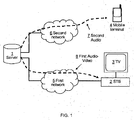
- Figure 1 is a block diagram of a system compliant with the embodiment.
- a second audio stream 7 is transmitted through a second network 6 to a mobile terminal 4.
- the second audio stream corresponds to the first video stream. It allows a user to watch the first video stream on the TV 3 and to listen to the corresponding second audio stream with another audio language on the mobile terminal.
- the first and the second streams are broadcasted to respectively the STB and the mobile terminal. They are sent in a push mode.
- the second audio stream is distributed through a DVB-H network, and the mobile terminal is a DVB-H receiver.
- the STB may be located in a public hot spot, which comprises displays for presenting the video.
- a public hot spot which comprises displays for presenting the video.
- the end user listens on the mobile terminal to an audio corresponding to the video displayed.
- Different users in the hot spot watch the same video, listening to different audio streams under different languages corresponding to that video.
- the second audio stream might be distributed through any network that can transport an audio stream to a mobile terminal, such as a cellular network, a Wi-Fi network.
- a mobile terminal such as a cellular network, a Wi-Fi network.
- the mobile terminal might be a device such as a cellular terminal, a Wi-Fi receiver, a DVB-T terminal.
- the STB and the mobile terminal receive streams coming from the same Video server.
- the streams hold components of the same TV program. Those two devices do not exchange any message, and they cannot know how the other renders the same TV program. Of course they could also receive the streams from different servers.
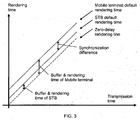
- the rendering of the streams on the TV and on the mobile terminal are not necessarily synchronized. Rendering delay is dependant on various parameters such as the transmission networks, or the local buffers in each of the receiving devices as illustrated on figure 3 .
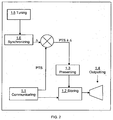
- a mobile terminal is represented in figure 2 . It comprises a communicating module 1.1 for receiving the audio stream.
- the receiving module extracts the Presentation Time Stamp, or PTS, from the stream.
- the mobile terminal comprises a tuning module 1.5.
- the tuning module is a cursor that comprises two positions. A first position is adapted to move forward the rendering time. A second position is adapted to move down the rendering time. If the end user wants to play the second audio stream sooner, it sets the cursor towards the second position to reach the suitable delay. If he wants to play the audio stream later, he sets the cursor towards the first position.
- the tuning module may be any kind of user interface that comprises two such positions for providing the delaying function.
- the synchronizing module 1.6 is adapted to modify the value of the PTS. From the input received from the tuning module, the synchronizing module reduces or increases the value of the PTS by a value ⁇ . This permits to play the stream sooner or later than the time indicated in the PTS extracted from the stream.
- the modified PTS is sent to the presenting module 1.3.
- the stream is decoded by a decoding module not represented in the figure, and sent to the storing module 1.2.
- the presenting module indicates to the storing module 1.2 when to play the stream, in accordance with the PTS value. Then the stream is played at the outputting module 1.4.
- the mobile terminal also comprises processing means, not represented.
- the outputting module may also be adapted to send the stream to another device that plays renders the stream. As indicated in figure 4 , the rendering time of the second stream is then modified; after moving down the delay is increased and after moving forward the delay is reduced.
- tuning module may be locked. When locked the tuning module can not be set to the first or the second position.
- the STB may also comprise a tuning module and a synchronizing module. This allows modifying the rendering time of the first audio-video stream. This makes sense when the tuning module of the mobile terminal does not allow enough delaying of the rendering time of the second audio. This may happen because the transmission and the buffering time are different between the STB and the mobile terminal, and the mobile terminal does not receive the second audio early enough. The mobile terminal cannot move forward the audio enough to synchronize to the first video.
- the tuning module of the STB allows then to move down the rendering of the audio-video stream to give the mobile terminal more time to receive the audio streams.
- the STB according to the embodiment is represented in figure 2 .
- the outputting module 1.4 sends the stream to a TV that renders the steam.
- the synchronizing module is also adapted to modify the value of the internal clock of the device. It increases or decreases the value of the running speed of the clock.
- the receiving device plays the stream based on the internal clock. This permits to accelerate or slow down the rendering of the stream. This permits to tune the rendering speed to the same rendering speed as the other device. The increase or decrease is performed pace by pace.
- the clock modification is launched as follow.
- the synchronizing module detects that the tuning module has been successively activated several time to adapt the rendering. Further to modifying the PTS value, the synchronizing module also modifies the clock speed. If the PTS value is increased, the clock speed is also increased. If the PTS value is decreased, the clock value is also decreased.
- the synchronizing module detects that several PTS modifications are not sufficient, and then launches a clock speed modification. After several iterations the clock speed is matched to the clock speed of the other device.
- the clock speed at the receiver is compliant to the MPEG-2 standards. It is set to 27MHz.
- the pace is 100Hz.
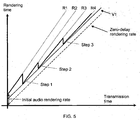
- the audio rendering rate R1 is higher than the video rendering rate V1.
- the synchronizing module reduces the clock speed by one pace, here by 100Hz, and then reduces the audio rendering rate R2, step 1. This adaptation may require the modification of the clock speed by a plurality of paces, step 2, step 3. And the audio rendering rate takes several values R3, R4 before it matches the video rate.
- the embodiments deal with synchronization of an audio stream with a video stream. More generally the tuning module of the embodiment is also applicable to synchronization of any stream type to any other stream to which it is not synchronized. The embodiments are also applicable to rendering of content stored in each device, where two devices store the same audio-video content and play this content. It is also applicable to a combination of devices receiving steaming content and devices playing stored content.
Landscapes
- Engineering & Computer Science (AREA)
- Multimedia (AREA)
- Computer Networks & Wireless Communication (AREA)
- Signal Processing (AREA)
- Two-Way Televisions, Distribution Of Moving Picture Or The Like (AREA)
- Circuits Of Receivers In General (AREA)
Description
- The present invention relates generally to digital television and in particular to a method for synchronizing multiple streams at multiple receivers.
- This section is intended to introduce the reader to various aspects of art, which may be related to various aspects of the present invention that are described and/or claimed below. This discussion is believed to be helpful in providing the reader with background information to facilitate a better understanding of the various aspects of the present invention. Accordingly, it should be understood that these statements are to be read in this light, and not as admissions of prior art.
- Multiple ways, such as broadband TV and mobile TV, coexist today to bring multimedia steams to the end-user. With broadband TV, the receiver is usually a standard TV device, connected to the receiving device, called a Set-Top Box or STB. With mobile TV, the receiver device is a mobile terminal such as a mobile phone or a Personal Digital Assistant.
- In a MPEG-2 stream, several components, e.g. audio, video, are synchronized between each other in order to be rendered at the proper time. This is called inter-component synchronization. A common example is the lip synchronization, noted lip-sync, which provides the audio at the exact same time as the lips of the person move on the corresponding video. Such synchronization is typically achieved thanks to specific time stamps. In MPEG-2 streams, the Presentation Time Stamp, or PTS, ensures such synchronization. The PTS of the audio sample indicates its presentation time, in reference to the internal clock (which is set thanks to the PCR also contained in the MPEG-2 stream); in the same way, the PTS of the video sample indicates its presentation time, also in reference to the same internal clock.
- The convergence of all ways to distribute multimedia content to the end-user enlarges the possibilities to mix delivery mechanisms. For example, a first audio-video stream may be sent through the broadband network to the STB, and a second audio-video stream identical to the first audio-video stream may be sent through the mobile network to a mobile terminal. Such multimedia components, which are rendered on different devices, cannot be synchronized with the inter-component synchronization mechanism because the devices don't know each other component PTS. So an end user cannot use at the same time the mobile terminal to listen to the audio corresponding to the first video displayed through the STB. Even if the same encoder is at the origin of both streams sharing the same PTS and PCR, the rendering time may not be the same at receiving devices. This is mainly due to the buffers used by the receiving and decoding units within the devices that may not be the same, and then provide different delays.
- Another example is a device receiving a first audio-video stream from a first delivery network, and a second audio-video stream from a second delivery network, both streams having different timestamps. In this case, there is no means for the receiving device to synchronize components from those both streams.
-
EP1694033 from France Telecom discloses a WAP terminal in a system that provides visual content synchronization with an audio content. The visual content is a page of the type XML or SALT (Speech Application Language Tags). - Mary Mikhail et al: "an online system for synchronizing processing of video and audio signals" ELECTRICAL AND COMPUTER ENGINEERING, CANADIAN CONFERENCE ON IEEEPI May 2006, deals with audio video synchronization in a single device using a time-stamping technique, Time-stamping being a method of obtaining the actual time at certain points in a process.
- The present invention attempts to remedy at least some of the concerns connected with synchronizing two streams received by one or more devices from several different distribution networks.
- To this end the present invention concerns a device comprising communicating means for receiving in push mode a first multimedia content, the first multimedia content being a first component of a stream comprising a second component, the first multimedia content comprising a presentation time stamp adapted to indicate the rendering time of the first multimedia content, tuning means for shifting the presentation time stamp value, the shifting being intended to synchronize the rendering to the rendering of a second multimedia content of the stream rendered at a second device and outputting means for rendering the first multimedia content according to the presentation time stamp.
- Surprisingly the device enables synchronization of the stream it receives with a stream displayed at another device synchronization is performed through tuning means. This is a user interface that permits a user to synchronize the stream based on the rendering of a second stream.
- The stream is received in a push mode, wherein the transmission of information originates from a server. The information is broadcasted to the receiver.
- An audio stream rendered on a first device is synchronized to a video stream rendered on a second device. A first audio-video stream is received through a broadband network at a STB. A second audio stream corresponding to the first video stream is received through the mobile network at a mobile terminal. This second audio stream is for example an audio language different from the first audio.
- The presentation time stamp is appended to the packets of the first components of the stream. It is adapted to indicate the rendering time of the first multimedia content. The receiver extracts the presentation time stamp and renders the first multimedia content at the value of the presentation time stamp.
- Advantageously this permits a service provider to provide a video on a screen and multiple audios, corresponding to multiple language of the video, on an audio receiver.
- The device is any kind of device that comprises communicating means for receiving a stream, the stream being an audio, a video or any interactive content. The device may be, but is not limited to, a Set-Top Box, a cellular device, a DVB-H receiver, a Wi-Fi station.
- According to an embodiment the shifting moves forward or moves down the presentation time stamp value.
- According to an embodiment the stream is an MPEG-2 stream, the first multimedia content is an audio component of the MPEG-2 stream..
- According to another embodiment the stream is an MPEG-2 stream, the first multimedia content is a video component of the MPEG-2 stream.
- According to another embodiment the rendering speed is based on an internal clock and in that said tuning means modifies the clock speed.
- Certain aspects commensurate in scope with the disclosed embodiments are set forth below. It should be understood that these aspects are presented merely to provide the reader with a brief summary of certain forms the invention might take and that these aspects are not intended to limit the scope of the invention. Indeed, the invention may encompass a variety of aspects that may not be set forth below.
- The invention will be better understood and illustrated by means of the following embodiment and execution examples, in no way limitative, with reference to the appended figures on which:
-
Figure 1 is a block diagram of a system compliant with the embodiment; -
Figure 2 is a block diagram of an object compliant with the embodiment; -
Figure 3 is a diagram indicating the difference of the rendering time; -
Figure 4 is a diagram indicating the modification of the rendering time; and -
Figure 5 is a diagram indicating the modification of the clock. - In
Figure 2 , the represented blocks are purely functional entities, which do not necessarily correspond to physically separate entities. Namely, they could be developed in the form of software, or be implemented in one or several integrated circuits. -
Figure 1 is a block diagram of a system compliant with the embodiment. - A first audio-
video stream 6, such as a MPEG-2 Transport Stream, is transmitted by theVideo server 1 on thefirst network 5, which is a broadband network. It is received by theSTB 2. The first audio-video stream is displayed on thetelevision 3. - A second audio stream 7 is transmitted through a
second network 6 to amobile terminal 4. The second audio stream corresponds to the first video stream. It allows a user to watch the first video stream on theTV 3 and to listen to the corresponding second audio stream with another audio language on the mobile terminal. - The first and the second streams are broadcasted to respectively the STB and the mobile terminal. They are sent in a push mode.
- According to the embodiment, the second audio stream is distributed through a DVB-H network, and the mobile terminal is a DVB-H receiver.
- The STB may be located in a public hot spot, which comprises displays for presenting the video. When in the public hot spot, the end user listens on the mobile terminal to an audio corresponding to the video displayed. Different users in the hot spot watch the same video, listening to different audio streams under different languages corresponding to that video.
- Of course the second audio stream might be distributed through any network that can transport an audio stream to a mobile terminal, such as a cellular network, a Wi-Fi network. And the mobile terminal might be a device such as a cellular terminal, a Wi-Fi receiver, a DVB-T terminal.
- The STB and the mobile terminal receive streams coming from the same Video server. The streams hold components of the same TV program. Those two devices do not exchange any message, and they cannot know how the other renders the same TV program. Of course they could also receive the streams from different servers.
- The rendering of the streams on the TV and on the mobile terminal are not necessarily synchronized. Rendering delay is dependant on various parameters such as the transmission networks, or the local buffers in each of the receiving devices as illustrated on
figure 3 . - A mobile terminal according to the embodiment is represented in
figure 2 . It comprises a communicating module 1.1 for receiving the audio stream. The receiving module extracts the Presentation Time Stamp, or PTS, from the stream. The mobile terminal comprises a tuning module 1.5. According to the embodiment, the tuning module is a cursor that comprises two positions. A first position is adapted to move forward the rendering time. A second position is adapted to move down the rendering time. If the end user wants to play the second audio stream sooner, it sets the cursor towards the second position to reach the suitable delay. If he wants to play the audio stream later, he sets the cursor towards the first position. Of course the tuning module may be any kind of user interface that comprises two such positions for providing the delaying function. The synchronizing module 1.6 is adapted to modify the value of the PTS. From the input received from the tuning module, the synchronizing module reduces or increases the value of the PTS by a value Δ. This permits to play the stream sooner or later than the time indicated in the PTS extracted from the stream. The modified PTS is sent to the presenting module 1.3. The stream is decoded by a decoding module not represented in the figure, and sent to the storing module 1.2. The presenting module indicates to the storing module 1.2 when to play the stream, in accordance with the PTS value. Then the stream is played at the outputting module 1.4. The mobile terminal also comprises processing means, not represented. The outputting module may also be adapted to send the stream to another device that plays renders the stream. As indicated infigure 4 , the rendering time of the second stream is then modified; after moving down the delay is increased and after moving forward the delay is reduced. - Of course the tuning module may be locked. When locked the tuning module can not be set to the first or the second position.
- According to the embodiment, the STB may also comprise a tuning module and a synchronizing module. This allows modifying the rendering time of the first audio-video stream. This makes sense when the tuning module of the mobile terminal does not allow enough delaying of the rendering time of the second audio. This may happen because the transmission and the buffering time are different between the STB and the mobile terminal, and the mobile terminal does not receive the second audio early enough. The mobile terminal cannot move forward the audio enough to synchronize to the first video. The tuning module of the STB allows then to move down the rendering of the audio-video stream to give the mobile terminal more time to receive the audio streams. The STB according to the embodiment is represented in
figure 2 . The outputting module 1.4 sends the stream to a TV that renders the steam. - Alternatively, the synchronizing module is also adapted to modify the value of the internal clock of the device. It increases or decreases the value of the running speed of the clock. The receiving device plays the stream based on the internal clock. This permits to accelerate or slow down the rendering of the stream. This permits to tune the rendering speed to the same rendering speed as the other device. The increase or decrease is performed pace by pace.
- The clock modification is launched as follow. The synchronizing module detects that the tuning module has been successively activated several time to adapt the rendering. Further to modifying the PTS value, the synchronizing module also modifies the clock speed. If the PTS value is increased, the clock speed is also increased. If the PTS value is decreased, the clock value is also decreased.
- When the clock of the device is not running at the same speed as the clock of the other device, the PTS modification is not sufficient. The synchronizing module detects that several PTS modifications are not sufficient, and then launches a clock speed modification. After several iterations the clock speed is matched to the clock speed of the other device.
- According to the embodiment, the clock speed at the receiver is compliant to the MPEG-2 standards. It is set to 27MHz. According to the embodiment, the pace is 100Hz. Of course in various embodiments, the clock speed and the pace could have different values. As indicated on
figure 5 , the audio rendering rate R1 is higher than the video rendering rate V1. The synchronizing module reduces the clock speed by one pace, here by 100Hz, and then reduces the audio rendering rate R2,step 1. This adaptation may require the modification of the clock speed by a plurality of paces,step 2,step 3. And the audio rendering rate takes several values R3, R4 before it matches the video rate. - The embodiments deal with synchronization of an audio stream with a video stream. More generally the tuning module of the embodiment is also applicable to synchronization of any stream type to any other stream to which it is not synchronized. The embodiments are also applicable to rendering of content stored in each device, where two devices store the same audio-video content and play this content. It is also applicable to a combination of devices receiving steaming content and devices playing stored content.
- References disclosed in the description, the claims and the drawings may be provided independently or in any appropriate combination. Features may, where appropriate, be implemented in hardware, software, or a combination of the two.
- Reference herein to "one embodiment" or "an embodiment" means that a particular feature, structure, or characteristic described in connection with the embodiment can be included in at least one implementation of the invention. The appearances of the phrase "in one embodiment" in various places in the specification are not necessarily all referring to the same embodiment, nor are separate or alternative embodiments necessarily mutually exclusive of other embodiments.
- Reference numerals appearing in the claims are by way of illustration only and shall have no limiting effect on the scope of the claims.
Claims (6)
- Device (4) comprising:- communicating means (1.1) for receiving a first streamed multimedia content, said first multimedia content comprising a presentation time stamp adapted to indicate the rendering time of said first multimédia content;- tuning means (1.5) for shifting the presentation time stamp value, said shifting being intended to synchronize said rendering time to the rendering time of a second streamed multimedia content rendered at a second device; and- outputting means (1.4) for rendering said first multimedia content according to said shifted presentation time stamp value.
- Device according to claim 1, characterized in that said shifting moves forward or moves down the presentation time stamp value.
- Device according to claim 1, characterized in that the first multimedia content and the second-multimedia content are comprised in an MPEG-2 stream, and the first multimedia content is an audio component of the MPEG-2 stream.
- Device according to claim 1, characterized in that the first multimedia content and the second multimedia content are comprised in an MPEG-2 stream, and the first multimedia content is a video component of the MPEG-2 stream.
- Device according to any one of the preceding claims, characterized in that said rendering speed is based on an internal clock and in that said tuning means modifies the clock speed.
- A system comprising a set-top box and the device according to any one of the preceding claims, said set-top box comprising communicating means for receiving said second streamed multimedia content.
Priority Applications (1)
| Application Number | Priority Date | Filing Date | Title |
|---|---|---|---|
| EP08804625.5A EP2193645B1 (en) | 2007-09-28 | 2008-09-23 | Communication technique able to synchronise the received stream with that sent to another device |
Applications Claiming Priority (3)
| Application Number | Priority Date | Filing Date | Title |
|---|---|---|---|
| EP07301409A EP2043323A1 (en) | 2007-09-28 | 2007-09-28 | Communication device able to synchronise the received stream with that sent to another device |
| EP08804625.5A EP2193645B1 (en) | 2007-09-28 | 2008-09-23 | Communication technique able to synchronise the received stream with that sent to another device |
| PCT/EP2008/062712 WO2009040356A1 (en) | 2007-09-28 | 2008-09-23 | Communication technique able to synchronise the received stream with that sent to another device |
Publications (2)
| Publication Number | Publication Date |
|---|---|
| EP2193645A1 EP2193645A1 (en) | 2010-06-09 |
| EP2193645B1 true EP2193645B1 (en) | 2016-11-30 |
Family
ID=39172074
Family Applications (2)
| Application Number | Title | Priority Date | Filing Date |
|---|---|---|---|
| EP07301409A Withdrawn EP2043323A1 (en) | 2007-09-28 | 2007-09-28 | Communication device able to synchronise the received stream with that sent to another device |
| EP08804625.5A Active EP2193645B1 (en) | 2007-09-28 | 2008-09-23 | Communication technique able to synchronise the received stream with that sent to another device |
Family Applications Before (1)
| Application Number | Title | Priority Date | Filing Date |
|---|---|---|---|
| EP07301409A Withdrawn EP2043323A1 (en) | 2007-09-28 | 2007-09-28 | Communication device able to synchronise the received stream with that sent to another device |
Country Status (6)
| Country | Link |
|---|---|
| US (1) | US20110191816A1 (en) |
| EP (2) | EP2043323A1 (en) |
| JP (1) | JP5679815B2 (en) |
| KR (1) | KR101484607B1 (en) |
| CN (1) | CN101809965B (en) |
| WO (1) | WO2009040356A1 (en) |
Families Citing this family (17)
| Publication number | Priority date | Publication date | Assignee | Title |
|---|---|---|---|---|
| US7805373B1 (en) * | 2007-07-31 | 2010-09-28 | Qurio Holdings, Inc. | Synchronizing multiple playback device timing utilizing DRM encoding |
| US8060904B1 (en) | 2008-02-25 | 2011-11-15 | Qurio Holdings, Inc. | Dynamic load based ad insertion |
| EP2257040A1 (en) | 2009-05-29 | 2010-12-01 | Thomson Licensing | Method and apparatus for distributing a multimedia content |
| US10187509B2 (en) * | 2010-09-14 | 2019-01-22 | At&T Intellectual Property I, L.P. | Enhanced video sharing |
| EP2619989A1 (en) | 2010-09-22 | 2013-07-31 | Thomson Licensing | Methods for processing multimedia flows and corresponding devices |
| US20130110900A1 (en) * | 2011-10-28 | 2013-05-02 | Comcast Cable Communications, Llc | System and method for controlling and consuming content |
| CN103428556B (en) | 2012-05-17 | 2016-11-23 | 华为技术有限公司 | Method and system for multi-screen interaction |
| EP2704449A1 (en) | 2012-08-30 | 2014-03-05 | Thomson Licensing | Rendering time control |
| CN103297824A (en) * | 2013-05-29 | 2013-09-11 | 华为技术有限公司 | Video processing method, dongle, control terminal and system |
| WO2015052908A1 (en) * | 2013-10-11 | 2015-04-16 | パナソニック インテレクチュアル プロパティ コーポレーション オブ アメリカ | Transmission method, reception method, transmission device, and reception device |
| US9210204B2 (en) * | 2013-10-31 | 2015-12-08 | At&T Intellectual Property I, Lp | Synchronizing media presentation at multiple devices |
| KR102179321B1 (en) | 2014-01-31 | 2020-11-18 | 인터디지털 씨이 페이튼트 홀딩스 | Method and apparatus for synchronizing playbacks at two electronic devices |
| CN103905881B (en) * | 2014-03-13 | 2018-07-31 | 北京奇艺世纪科技有限公司 | The method, apparatus and equipment that a kind of video data and audio data are played simultaneously |
| CN103905879B (en) * | 2014-03-13 | 2018-07-06 | 北京奇艺世纪科技有限公司 | The method, apparatus and equipment that a kind of video data and audio data are played simultaneously |
| KR102126257B1 (en) * | 2015-02-13 | 2020-06-24 | 에스케이텔레콤 주식회사 | Method for providing of multi-view streaming service, and apparatus therefor |
| SE541208C2 (en) * | 2016-07-04 | 2019-04-30 | Znipe Esports AB | Methods and nodes for synchronized streaming of a first and a second data stream |
| US11025858B2 (en) * | 2019-08-08 | 2021-06-01 | Netflix, Inc. | Frame rate conversion |
Family Cites Families (20)
| Publication number | Priority date | Publication date | Assignee | Title |
|---|---|---|---|---|
| US6630963B1 (en) * | 2001-01-23 | 2003-10-07 | Digeo, Inc. | Synchronizing a video program from a television broadcast with a secondary audio program |
| US20030066094A1 (en) * | 2001-09-29 | 2003-04-03 | Koninklijke Philips Electronics N.V. | Robust method for recovering a program time base in MPEG-2 transport streams and achieving audio/video sychronization |
| US7676142B1 (en) * | 2002-06-07 | 2010-03-09 | Corel Inc. | Systems and methods for multimedia time stretching |
| EP1629672B1 (en) * | 2003-06-05 | 2015-11-11 | NDS Limited | System for transmitting information from a streamed program to external devices and media |
| US7421656B2 (en) * | 2004-01-05 | 2008-09-02 | Microsoft Corporation | Systems and methods for interacting with a user interface of a media player |
| EP1553784A1 (en) * | 2004-01-06 | 2005-07-13 | Deutsche Thomson-Brandt Gmbh | Method and apparatus for performing synchronised audio and video presentation |
| US20070110074A1 (en) * | 2004-06-04 | 2007-05-17 | Bob Bradley | System and Method for Synchronizing Media Presentation at Multiple Recipients |
| JPWO2006064689A1 (en) * | 2004-12-16 | 2008-06-12 | 松下電器産業株式会社 | Wireless communication system |
| JP2006186454A (en) * | 2004-12-27 | 2006-07-13 | Hitachi Ltd | Broadcast receiver, portable broadcast receiver |
| FR2882211A1 (en) * | 2005-02-16 | 2006-08-18 | France Telecom | METHOD FOR SYNCHRONIZING VOICE SERVICE AND VISUAL PRESENTATION |
| US20070047590A1 (en) * | 2005-08-26 | 2007-03-01 | Nokia Corporation | Method for signaling a device to perform no synchronization or include a synchronization delay on multimedia stream |
| JP2007074037A (en) * | 2005-09-02 | 2007-03-22 | Sony Corp | Information reproducing apparatus, information reproducing method, and computer program |
| JP4375313B2 (en) | 2005-09-16 | 2009-12-02 | セイコーエプソン株式会社 | Image / audio output system, image / audio data output apparatus, audio processing program, and recording medium |
| US7643513B2 (en) * | 2005-11-30 | 2010-01-05 | Broadcom Corporation | Method and system for audio and video transport |
| JP2007201983A (en) | 2006-01-30 | 2007-08-09 | Renesas Technology Corp | Broadcast station synchronization method, and control apparatus |
| AU2007219142A1 (en) * | 2006-02-21 | 2007-08-30 | Markport Limited | Audio and video communication |
| US9591376B2 (en) * | 2006-09-06 | 2017-03-07 | Broadcom Corporation | Method and system for synchronizing signals in a communication system |
| US7953118B2 (en) * | 2006-12-08 | 2011-05-31 | Microsoft Corporation | Synchronizing media streams across multiple devices |
| US8272008B2 (en) * | 2007-02-28 | 2012-09-18 | At&T Intellectual Property I, L.P. | Methods, systems, and products for retrieving audio signals |
| US7724780B2 (en) * | 2007-04-19 | 2010-05-25 | Cisco Technology, Ink. | Synchronization of one or more source RTP streams at multiple receiver destinations |
-
2007
- 2007-09-28 EP EP07301409A patent/EP2043323A1/en not_active Withdrawn
-
2008
- 2008-09-23 CN CN2008801083150A patent/CN101809965B/en active Active
- 2008-09-23 JP JP2010526270A patent/JP5679815B2/en active Active
- 2008-09-23 KR KR1020107006542A patent/KR101484607B1/en active Active
- 2008-09-23 EP EP08804625.5A patent/EP2193645B1/en active Active
- 2008-09-23 WO PCT/EP2008/062712 patent/WO2009040356A1/en not_active Ceased
- 2008-09-23 US US12/733,876 patent/US20110191816A1/en not_active Abandoned
Non-Patent Citations (1)
| Title |
|---|
| None * |
Also Published As
| Publication number | Publication date |
|---|---|
| CN101809965B (en) | 2013-12-18 |
| JP5679815B2 (en) | 2015-03-04 |
| WO2009040356A1 (en) | 2009-04-02 |
| KR101484607B1 (en) | 2015-01-20 |
| EP2043323A1 (en) | 2009-04-01 |
| CN101809965A (en) | 2010-08-18 |
| US20110191816A1 (en) | 2011-08-04 |
| JP2010541354A (en) | 2010-12-24 |
| KR20100058599A (en) | 2010-06-03 |
| EP2193645A1 (en) | 2010-06-09 |
Similar Documents
| Publication | Publication Date | Title |
|---|---|---|
| EP2043323A1 (en) | Communication device able to synchronise the received stream with that sent to another device | |
| US9414111B2 (en) | Caption data delivery apparatus and methods | |
| US11516518B2 (en) | Live streaming with live video production and commentary | |
| JP6317872B2 (en) | Decoder for synchronizing the rendering of content received over different networks and method therefor | |
| EP2706754B1 (en) | Synchronizing program presentation | |
| EP3047652B1 (en) | Correlating timeline information between media streams | |
| EP3113498A1 (en) | Synchronized rendering of split multimedia content on network clients | |
| US10887646B2 (en) | Live streaming with multiple remote commentators | |
| Boronat et al. | HbbTV-compliant platform for hybrid media delivery and synchronization on single-and multi-device scenarios | |
| Van Deventer et al. | Standards for multi-stream and multi-device media synchronization | |
| CN107197394B (en) | audio switching method in video playing | |
| EP2891323B1 (en) | Rendering time control | |
| CN108494792A (en) | A kind of flash player plays the converting system and its working method of hls video flowings | |
| EP2814256B1 (en) | Method and apparatus for modifying a stream of digital content | |
| Concolato et al. | Synchronized delivery of multimedia content over uncoordinated broadcast broadband networks | |
| CN102413335A (en) | A device and method for manually adjusting program audio-video synchronization | |
| EP2479984A1 (en) | Device and method for synchronizing content received from different sources | |
| Matsumura et al. | Personalization of broadcast programs using synchronized internet content | |
| Segundo et al. | Second screen event flow synchronization | |
| Yuste et al. | Effective synchronisation of hybrid broadcast and broadband TV | |
| CN101917589A (en) | Media data block descrambling method and device | |
| Borch et al. | Timing-small step for developers, giant leap for the media industry | |
| Leroux et al. | Efficient management of synchronised interactive services through the design of MCDP middleware | |
| Ramaley | Live Streaming at Scale: Is Your Video on Cue? | |
| HK1173291A (en) | Decoder and method at the decoder for synchronizing the rendering of contents received through different networks |
Legal Events
| Date | Code | Title | Description |
|---|---|---|---|
| PUAI | Public reference made under article 153(3) epc to a published international application that has entered the european phase |
Free format text: ORIGINAL CODE: 0009012 |
|
| 17P | Request for examination filed |
Effective date: 20100315 |
|
| AK | Designated contracting states |
Kind code of ref document: A1 Designated state(s): AT BE BG CH CY CZ DE DK EE ES FI FR GB GR HR HU IE IS IT LI LT LU LV MC MT NL NO PL PT RO SE SI SK TR |
|
| AX | Request for extension of the european patent |
Extension state: AL BA MK RS |
|
| 17Q | First examination report despatched |
Effective date: 20100916 |
|
| DAX | Request for extension of the european patent (deleted) | ||
| GRAP | Despatch of communication of intention to grant a patent |
Free format text: ORIGINAL CODE: EPIDOSNIGR1 |
|
| INTG | Intention to grant announced |
Effective date: 20160309 |
|
| GRAS | Grant fee paid |
Free format text: ORIGINAL CODE: EPIDOSNIGR3 |
|
| GRAJ | Information related to disapproval of communication of intention to grant by the applicant or resumption of examination proceedings by the epo deleted |
Free format text: ORIGINAL CODE: EPIDOSDIGR1 |
|
| GRAL | Information related to payment of fee for publishing/printing deleted |
Free format text: ORIGINAL CODE: EPIDOSDIGR3 |
|
| GRAP | Despatch of communication of intention to grant a patent |
Free format text: ORIGINAL CODE: EPIDOSNIGR1 |
|
| INTC | Intention to grant announced (deleted) | ||
| INTG | Intention to grant announced |
Effective date: 20160729 |
|
| GRAA | (expected) grant |
Free format text: ORIGINAL CODE: 0009210 |
|
| AK | Designated contracting states |
Kind code of ref document: B1 Designated state(s): AT BE BG CH CY CZ DE DK EE ES FI FR GB GR HR HU IE IS IT LI LT LU LV MC MT NL NO PL PT RO SE SI SK TR |
|
| REG | Reference to a national code |
Ref country code: CH Ref legal event code: EP Ref country code: GB Ref legal event code: FG4D |
|
| REG | Reference to a national code |
Ref country code: AT Ref legal event code: REF Ref document number: 850739 Country of ref document: AT Kind code of ref document: T Effective date: 20161215 |
|
| REG | Reference to a national code |
Ref country code: DE Ref legal event code: R084 Ref document number: 602008047673 Country of ref document: DE |
|
| REG | Reference to a national code |
Ref country code: IE Ref legal event code: FG4D |
|
| REG | Reference to a national code |
Ref country code: DE Ref legal event code: R096 Ref document number: 602008047673 Country of ref document: DE |
|
| REG | Reference to a national code |
Ref country code: GB Ref legal event code: 746 Effective date: 20170103 |
|
| REG | Reference to a national code |
Ref country code: NL Ref legal event code: FP |
|
| PG25 | Lapsed in a contracting state [announced via postgrant information from national office to epo] |
Ref country code: LV Free format text: LAPSE BECAUSE OF FAILURE TO SUBMIT A TRANSLATION OF THE DESCRIPTION OR TO PAY THE FEE WITHIN THE PRESCRIBED TIME-LIMIT Effective date: 20161130 |
|
| REG | Reference to a national code |
Ref country code: LT Ref legal event code: MG4D |
|
| REG | Reference to a national code |
Ref country code: AT Ref legal event code: MK05 Ref document number: 850739 Country of ref document: AT Kind code of ref document: T Effective date: 20161130 |
|
| PG25 | Lapsed in a contracting state [announced via postgrant information from national office to epo] |
Ref country code: GR Free format text: LAPSE BECAUSE OF FAILURE TO SUBMIT A TRANSLATION OF THE DESCRIPTION OR TO PAY THE FEE WITHIN THE PRESCRIBED TIME-LIMIT Effective date: 20170301 Ref country code: SE Free format text: LAPSE BECAUSE OF FAILURE TO SUBMIT A TRANSLATION OF THE DESCRIPTION OR TO PAY THE FEE WITHIN THE PRESCRIBED TIME-LIMIT Effective date: 20161130 Ref country code: NO Free format text: LAPSE BECAUSE OF FAILURE TO SUBMIT A TRANSLATION OF THE DESCRIPTION OR TO PAY THE FEE WITHIN THE PRESCRIBED TIME-LIMIT Effective date: 20170228 Ref country code: LT Free format text: LAPSE BECAUSE OF FAILURE TO SUBMIT A TRANSLATION OF THE DESCRIPTION OR TO PAY THE FEE WITHIN THE PRESCRIBED TIME-LIMIT Effective date: 20161130 |
|
| PG25 | Lapsed in a contracting state [announced via postgrant information from national office to epo] |
Ref country code: FI Free format text: LAPSE BECAUSE OF FAILURE TO SUBMIT A TRANSLATION OF THE DESCRIPTION OR TO PAY THE FEE WITHIN THE PRESCRIBED TIME-LIMIT Effective date: 20161130 Ref country code: ES Free format text: LAPSE BECAUSE OF FAILURE TO SUBMIT A TRANSLATION OF THE DESCRIPTION OR TO PAY THE FEE WITHIN THE PRESCRIBED TIME-LIMIT Effective date: 20161130 Ref country code: PT Free format text: LAPSE BECAUSE OF FAILURE TO SUBMIT A TRANSLATION OF THE DESCRIPTION OR TO PAY THE FEE WITHIN THE PRESCRIBED TIME-LIMIT Effective date: 20170330 Ref country code: HR Free format text: LAPSE BECAUSE OF FAILURE TO SUBMIT A TRANSLATION OF THE DESCRIPTION OR TO PAY THE FEE WITHIN THE PRESCRIBED TIME-LIMIT Effective date: 20161130 Ref country code: AT Free format text: LAPSE BECAUSE OF FAILURE TO SUBMIT A TRANSLATION OF THE DESCRIPTION OR TO PAY THE FEE WITHIN THE PRESCRIBED TIME-LIMIT Effective date: 20161130 Ref country code: PL Free format text: LAPSE BECAUSE OF FAILURE TO SUBMIT A TRANSLATION OF THE DESCRIPTION OR TO PAY THE FEE WITHIN THE PRESCRIBED TIME-LIMIT Effective date: 20161130 |
|
| PG25 | Lapsed in a contracting state [announced via postgrant information from national office to epo] |
Ref country code: EE Free format text: LAPSE BECAUSE OF FAILURE TO SUBMIT A TRANSLATION OF THE DESCRIPTION OR TO PAY THE FEE WITHIN THE PRESCRIBED TIME-LIMIT Effective date: 20161130 Ref country code: CZ Free format text: LAPSE BECAUSE OF FAILURE TO SUBMIT A TRANSLATION OF THE DESCRIPTION OR TO PAY THE FEE WITHIN THE PRESCRIBED TIME-LIMIT Effective date: 20161130 Ref country code: DK Free format text: LAPSE BECAUSE OF FAILURE TO SUBMIT A TRANSLATION OF THE DESCRIPTION OR TO PAY THE FEE WITHIN THE PRESCRIBED TIME-LIMIT Effective date: 20161130 Ref country code: SK Free format text: LAPSE BECAUSE OF FAILURE TO SUBMIT A TRANSLATION OF THE DESCRIPTION OR TO PAY THE FEE WITHIN THE PRESCRIBED TIME-LIMIT Effective date: 20161130 Ref country code: RO Free format text: LAPSE BECAUSE OF FAILURE TO SUBMIT A TRANSLATION OF THE DESCRIPTION OR TO PAY THE FEE WITHIN THE PRESCRIBED TIME-LIMIT Effective date: 20161130 |
|
| PG25 | Lapsed in a contracting state [announced via postgrant information from national office to epo] |
Ref country code: BE Free format text: LAPSE BECAUSE OF FAILURE TO SUBMIT A TRANSLATION OF THE DESCRIPTION OR TO PAY THE FEE WITHIN THE PRESCRIBED TIME-LIMIT Effective date: 20161130 Ref country code: BG Free format text: LAPSE BECAUSE OF FAILURE TO SUBMIT A TRANSLATION OF THE DESCRIPTION OR TO PAY THE FEE WITHIN THE PRESCRIBED TIME-LIMIT Effective date: 20170228 |
|
| REG | Reference to a national code |
Ref country code: DE Ref legal event code: R097 Ref document number: 602008047673 Country of ref document: DE |
|
| REG | Reference to a national code |
Ref country code: FR Ref legal event code: PLFP Year of fee payment: 10 |
|
| PLBE | No opposition filed within time limit |
Free format text: ORIGINAL CODE: 0009261 |
|
| STAA | Information on the status of an ep patent application or granted ep patent |
Free format text: STATUS: NO OPPOSITION FILED WITHIN TIME LIMIT |
|
| 26N | No opposition filed |
Effective date: 20170831 |
|
| PG25 | Lapsed in a contracting state [announced via postgrant information from national office to epo] |
Ref country code: SI Free format text: LAPSE BECAUSE OF FAILURE TO SUBMIT A TRANSLATION OF THE DESCRIPTION OR TO PAY THE FEE WITHIN THE PRESCRIBED TIME-LIMIT Effective date: 20161130 |
|
| REG | Reference to a national code |
Ref country code: CH Ref legal event code: PL |
|
| PG25 | Lapsed in a contracting state [announced via postgrant information from national office to epo] |
Ref country code: MC Free format text: LAPSE BECAUSE OF FAILURE TO SUBMIT A TRANSLATION OF THE DESCRIPTION OR TO PAY THE FEE WITHIN THE PRESCRIBED TIME-LIMIT Effective date: 20161130 |
|
| REG | Reference to a national code |
Ref country code: IE Ref legal event code: MM4A |
|
| PG25 | Lapsed in a contracting state [announced via postgrant information from national office to epo] |
Ref country code: LU Free format text: LAPSE BECAUSE OF NON-PAYMENT OF DUE FEES Effective date: 20170923 |
|
| PG25 | Lapsed in a contracting state [announced via postgrant information from national office to epo] |
Ref country code: IE Free format text: LAPSE BECAUSE OF NON-PAYMENT OF DUE FEES Effective date: 20170923 Ref country code: CH Free format text: LAPSE BECAUSE OF NON-PAYMENT OF DUE FEES Effective date: 20170930 Ref country code: LI Free format text: LAPSE BECAUSE OF NON-PAYMENT OF DUE FEES Effective date: 20170930 |
|
| REG | Reference to a national code |
Ref country code: FR Ref legal event code: PLFP Year of fee payment: 11 |
|
| PG25 | Lapsed in a contracting state [announced via postgrant information from national office to epo] |
Ref country code: MT Free format text: LAPSE BECAUSE OF NON-PAYMENT OF DUE FEES Effective date: 20170923 |
|
| REG | Reference to a national code |
Ref country code: FR Ref legal event code: TP Owner name: THOMSON LICENSING DTV, FR Effective date: 20180830 |
|
| REG | Reference to a national code |
Ref country code: GB Ref legal event code: 732E Free format text: REGISTERED BETWEEN 20180927 AND 20181005 |
|
| REG | Reference to a national code |
Ref country code: DE Ref legal event code: R082 Ref document number: 602008047673 Country of ref document: DE Representative=s name: DEHNS, DE Ref country code: DE Ref legal event code: R081 Ref document number: 602008047673 Country of ref document: DE Owner name: INTERDIGITAL MADISON PATENT HOLDINGS, FR Free format text: FORMER OWNER: THOMSON LICENSING, ISSY-LES-MOULINEAUX, FR Ref country code: DE Ref legal event code: R082 Ref document number: 602008047673 Country of ref document: DE Representative=s name: DEHNS PATENT AND TRADEMARK ATTORNEYS, DE |
|
| REG | Reference to a national code |
Ref country code: NL Ref legal event code: PD Owner name: INTERDIGITAL MADISON PATENT HOLDINGS; FR Free format text: DETAILS ASSIGNMENT: CHANGE OF OWNER(S), ASSIGNMENT; FORMER OWNER NAME: THOMSON LICENSING Effective date: 20190222 |
|
| PG25 | Lapsed in a contracting state [announced via postgrant information from national office to epo] |
Ref country code: HU Free format text: LAPSE BECAUSE OF FAILURE TO SUBMIT A TRANSLATION OF THE DESCRIPTION OR TO PAY THE FEE WITHIN THE PRESCRIBED TIME-LIMIT; INVALID AB INITIO Effective date: 20080923 |
|
| PG25 | Lapsed in a contracting state [announced via postgrant information from national office to epo] |
Ref country code: CY Free format text: LAPSE BECAUSE OF NON-PAYMENT OF DUE FEES Effective date: 20161130 |
|
| PG25 | Lapsed in a contracting state [announced via postgrant information from national office to epo] |
Ref country code: TR Free format text: LAPSE BECAUSE OF FAILURE TO SUBMIT A TRANSLATION OF THE DESCRIPTION OR TO PAY THE FEE WITHIN THE PRESCRIBED TIME-LIMIT Effective date: 20161130 |
|
| PG25 | Lapsed in a contracting state [announced via postgrant information from national office to epo] |
Ref country code: IS Free format text: LAPSE BECAUSE OF FAILURE TO SUBMIT A TRANSLATION OF THE DESCRIPTION OR TO PAY THE FEE WITHIN THE PRESCRIBED TIME-LIMIT Effective date: 20170330 |
|
| REG | Reference to a national code |
Ref country code: DE Ref legal event code: R079 Ref document number: 602008047673 Country of ref document: DE Free format text: PREVIOUS MAIN CLASS: H04L0029060000 Ipc: H04L0065000000 |
|
| P01 | Opt-out of the competence of the unified patent court (upc) registered |
Effective date: 20230514 |
|
| PGFP | Annual fee paid to national office [announced via postgrant information from national office to epo] |
Ref country code: DE Payment date: 20250926 Year of fee payment: 18 |
|
| PGFP | Annual fee paid to national office [announced via postgrant information from national office to epo] |
Ref country code: NL Payment date: 20250925 Year of fee payment: 18 Ref country code: IT Payment date: 20250922 Year of fee payment: 18 |
|
| PGFP | Annual fee paid to national office [announced via postgrant information from national office to epo] |
Ref country code: GB Payment date: 20250923 Year of fee payment: 18 |
|
| PGFP | Annual fee paid to national office [announced via postgrant information from national office to epo] |
Ref country code: FR Payment date: 20250925 Year of fee payment: 18 |