EP2192144A1 - Perfluoroether-Polyorganosiloxane block copolymer and a surface treatment composition comprising the same - Google Patents
Perfluoroether-Polyorganosiloxane block copolymer and a surface treatment composition comprising the same Download PDFInfo
- Publication number
- EP2192144A1 EP2192144A1 EP08170346A EP08170346A EP2192144A1 EP 2192144 A1 EP2192144 A1 EP 2192144A1 EP 08170346 A EP08170346 A EP 08170346A EP 08170346 A EP08170346 A EP 08170346A EP 2192144 A1 EP2192144 A1 EP 2192144A1
- Authority
- EP
- European Patent Office
- Prior art keywords
- group
- integer
- perfluoropolyether
- block copolymer
- represented
- Prior art date
- Legal status (The legal status is an assumption and is not a legal conclusion. Google has not performed a legal analysis and makes no representation as to the accuracy of the status listed.)
- Granted
Links
Images


Classifications
-
- C—CHEMISTRY; METALLURGY
- C08—ORGANIC MACROMOLECULAR COMPOUNDS; THEIR PREPARATION OR CHEMICAL WORKING-UP; COMPOSITIONS BASED THEREON
- C08G—MACROMOLECULAR COMPOUNDS OBTAINED OTHERWISE THAN BY REACTIONS ONLY INVOLVING UNSATURATED CARBON-TO-CARBON BONDS
- C08G77/00—Macromolecular compounds obtained by reactions forming a linkage containing silicon with or without sulfur, nitrogen, oxygen or carbon in the main chain of the macromolecule
- C08G77/42—Block-or graft-polymers containing polysiloxane sequences
- C08G77/46—Block-or graft-polymers containing polysiloxane sequences containing polyether sequences
-
- C—CHEMISTRY; METALLURGY
- C08—ORGANIC MACROMOLECULAR COMPOUNDS; THEIR PREPARATION OR CHEMICAL WORKING-UP; COMPOSITIONS BASED THEREON
- C08G—MACROMOLECULAR COMPOUNDS OBTAINED OTHERWISE THAN BY REACTIONS ONLY INVOLVING UNSATURATED CARBON-TO-CARBON BONDS
- C08G65/00—Macromolecular compounds obtained by reactions forming an ether link in the main chain of the macromolecule
- C08G65/002—Macromolecular compounds obtained by reactions forming an ether link in the main chain of the macromolecule from unsaturated compounds
- C08G65/005—Macromolecular compounds obtained by reactions forming an ether link in the main chain of the macromolecule from unsaturated compounds containing halogens
- C08G65/007—Macromolecular compounds obtained by reactions forming an ether link in the main chain of the macromolecule from unsaturated compounds containing halogens containing fluorine
-
- C—CHEMISTRY; METALLURGY
- C08—ORGANIC MACROMOLECULAR COMPOUNDS; THEIR PREPARATION OR CHEMICAL WORKING-UP; COMPOSITIONS BASED THEREON
- C08G—MACROMOLECULAR COMPOUNDS OBTAINED OTHERWISE THAN BY REACTIONS ONLY INVOLVING UNSATURATED CARBON-TO-CARBON BONDS
- C08G65/00—Macromolecular compounds obtained by reactions forming an ether link in the main chain of the macromolecule
- C08G65/02—Macromolecular compounds obtained by reactions forming an ether link in the main chain of the macromolecule from cyclic ethers by opening of the heterocyclic ring
- C08G65/32—Polymers modified by chemical after-treatment
- C08G65/329—Polymers modified by chemical after-treatment with organic compounds
- C08G65/333—Polymers modified by chemical after-treatment with organic compounds containing nitrogen
- C08G65/33348—Polymers modified by chemical after-treatment with organic compounds containing nitrogen containing isocyanate group
- C08G65/33351—Polymers modified by chemical after-treatment with organic compounds containing nitrogen containing isocyanate group acyclic
-
- C—CHEMISTRY; METALLURGY
- C08—ORGANIC MACROMOLECULAR COMPOUNDS; THEIR PREPARATION OR CHEMICAL WORKING-UP; COMPOSITIONS BASED THEREON
- C08G—MACROMOLECULAR COMPOUNDS OBTAINED OTHERWISE THAN BY REACTIONS ONLY INVOLVING UNSATURATED CARBON-TO-CARBON BONDS
- C08G65/00—Macromolecular compounds obtained by reactions forming an ether link in the main chain of the macromolecule
- C08G65/02—Macromolecular compounds obtained by reactions forming an ether link in the main chain of the macromolecule from cyclic ethers by opening of the heterocyclic ring
- C08G65/32—Polymers modified by chemical after-treatment
- C08G65/329—Polymers modified by chemical after-treatment with organic compounds
- C08G65/336—Polymers modified by chemical after-treatment with organic compounds containing silicon
-
- C—CHEMISTRY; METALLURGY
- C08—ORGANIC MACROMOLECULAR COMPOUNDS; THEIR PREPARATION OR CHEMICAL WORKING-UP; COMPOSITIONS BASED THEREON
- C08L—COMPOSITIONS OF MACROMOLECULAR COMPOUNDS
- C08L2205/00—Polymer mixtures characterised by other features
- C08L2205/05—Polymer mixtures characterised by other features containing polymer components which can react with one another
Definitions
- the present invention relates to a polymer having a perfluoropolyether block and a surface treatment composition comprising the same which is used for forming a water- and oil-repellent coating.
- the polymer has polyorganosiloxane moieties having a hydrolyzable group at both ends of the polymer chain, and at least one polyorganosiloxane moiety located at a site other than the ends.
- the polymer is easy to apply, adheres well to a substrate, and can be cured rapidly.
- Compounds containing perfluoropolyether moieties generally have very small surface free energy to have water and oil repellency, chemical resistance, lubricity, releasing property, and antifouling property. Making use of these properties, they are widely used as, for example, treatment agents to make paper or fiber water- and oil- repellent, and foul-resistant, lubricants for magnetic storage media, oil repellent agents for precision apparatuses, releasing agents, cosmetics, and protective films.
- an organic compound can be bonded to a surface of glass or cloth via a silane coupling agent.
- the silane coupling agent has an organic functional group and a reactive silyl group, usually an alkoxy silyl group.
- the alkoxy silyl groups are autocondensed in the presence of moisture to form a siloxane coating film.
- the alkoxy silyl group chemically bonds to glass or metal surface to form a durable film.
- the silane coupling agents are thus widely used as coating agents for various substrates.
- Japanese Patent application Laid-Open No. 11-29585 and No. 2000-143991 describe an antireflective coating comprising an antifouling layer composed of the following perfluoropolyether-modified aminosilane having an alkoxy silyl group wherein X 3 is a hydrolyzable group, R 5 is a lower alkyl group, R 6 is a hydrogen atom or a lower alkyl group, Q 2 is a group of the formula, CH 2 CH 2 CH 2 or CH 2 CH 2 NHCH 2 CH 2 CH 2 , e is an integer of from 6 to 50, f is 2 or 3, each of c and d is an integer of from 1 to 3.
- Drawbacks of the antireflective coating are the long time required for curing and insufficient adhesion strength to a substrate.
- Japanese Patent application Laid-Open No. 2003-238577 discloses a silane coupling agent having a perfluoropolyether moiety having two or three hydrolyzable groups at both ends wherein Rf is a divalent linear perfluoropolyether moiety, R is an alkyl group having 1 to 4 carbon atoms or a phenyl group, X is a hydrolyzable group, p is an integer of 0 to 2, q is an integer of 1 to 5, and a is 2 or 3.
- the silane coupling agent forms a cured coating which strongly adheres to a substrate and is antifouling, easy to clean, and abrasion resistant because of surface slickness.
- the coating therefrom has poor transparency.
- Japanese Patent application Laid-Open No. 2007-197425 describes a perfluoropolyether organopolysiloxane which has relatively large organopolysiloxane moiety at an end or both ends and gives an abrasion resistant cured coating.
- the aforesaid surface treatment agents have polar moiety such as silane moiety and tend to agglomerate, causing fish-eyes or opacity or cloudiness in coating. They would adversely affect optical properties of antireflective coatings or transparent substrates. When these agents are used as release agents for a finely patterned metal mold or imprinting mold, they may not be able to reproduce the fine pattern.
- the present inventors have developed a copolymer having an organosiloxane block in a polymer main chain (Japanese Patent Application No. 2007-215233 ) .
- a coating obtained from the copolymer is excellent in surface slickness and transparency.
- An object of the present invention is thus to make improvements in these properties.
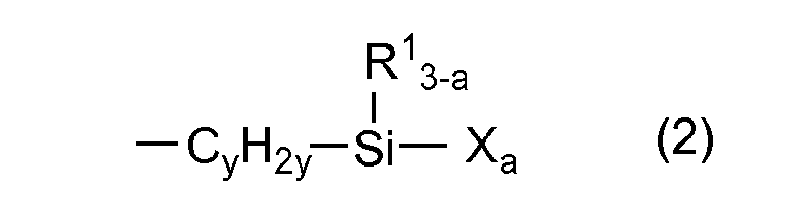
- the present invention is a perfluoropolyether-polyorganosiloxane block copolymer represented by the following formula (1), the block copolymer having a number average molecular weight, reduced to polystyrene, of from 2,000 to 20,000, W2-Q-Rf-Q-(W1-Q-Rf-Q) g -W2 (1) wherein Rf is a perfluoropolyether block, W1 is a polyorganosiloxane block having at least one group represented by the following formula (2) wherein X is a hydrolyzable group, R 1 is a C 1-4 alkyl group or a phenyl group, y is an integer of from 1 to 5, and a is 2 or 3, Q is a C 2-12 divalent connecting group which may contain an oxygen atom and/or nitrogen atom, W2 is an organosiloxane residue having a group represented by the aforesaid formula (2), and g is an integer of from 1 to 11.
- the copolymer of the present invention has a hydrolyzable group not only at ends but also at a site other than ends. It hardly agglomerates and forms a highly transparent cured coating. It can be cured at room temperature or at an elevated temperature faster than the conventional copolymer to form a coating having higher adhesion strength, water- and oil repellency, surface slickness, releasing property and abrasion resistance.
- the copolymer of the present invention is an alternate copolymer of a perfluoropolyether block(Rf) and a polyorganosiloxane block (W1) as represented by the following formula (1).
- W2-Q-Rf-Q-(W1-Q-Rf-Q) g -W2 (1)
- the copolymer adheres strongly to a substrate.
- g is an integer of from 1 to 11, preferably 1 to 3.
- Preferred copolymers are the one represented by the following formula (1-1) with g being 1, and W2-Q-Rf-Q-W1-Q-Rf-Q-W2 (1-1) the one represented by the following formula (1-2) with g being 2 W2-Q-Rf-Q-W1-Q-Rf-Q-W1-Q-Rf-Q-W2 (1-2).
- the copolymer has a number average molecular weight determined by GPC using polystyrene standards of from 2,000 to 20,000, preferably from 3,000 to 15,000, more preferably from 4,000 to 10,000.
- a copolymer having a molecular weight smaller than the aforesaid lower limit may fail to form a cured coating having satisfactory water- and oil-repellency and releasing property, and the one having a molecular weight larger than the aforesaid upper limit may fail to form a cured coating having satisfactory adhesion strength.
- the silicon content of a molecule of the copolymer ranges from 1 to 30 wt% of the molecular weight.
- a copolymer with a silicon content smaller than the aforesaid lower limit may not have good solubility and may be difficult to handle in surface treating process.
- a copolymer with silicon content larger than the aforesaid upper limit tends to form a cured coating having insufficient water- and oil-repellency.
- Silicon content can be determined by NMR spectroscopy, X-ray fluorescence spectroscopy or X-ray photoelectron spectroscopy.
- Each of the polyorganosiloxane block (W1) and terminal organosiloxane residue(W2) has a group represented by the following formula (2)
- X is a hydrolyzable group which may be different from each other.
- the hydrolyzable group include alkoxy groups having 1 to 10 carbon atoms such as methoxy, ethoxy, propoxy and butoxy groups; oxyalkoxy groups having 2 to 10 carbon atoms such as methoxymethoxy and methoxyethoxy groups; acyloxy groups having 1 to 10 carbon atoms such as an acetoxy group; alkenyloxy groups having 2 to 10 carbon atoms such as an isopropenoxy group; halogen atoms such as chlorine, bromine, and iodine atoms.
- alkoxy groups having 1 to 10 carbon atoms particularly methoxy, ethoxy, iropropenoxy groups and chlorine atom are preferred.
- R 1 is an alkyl group having 1 to 4 carbon atoms or a phenyl group, among which a methyl group is preferred.
- a is 2 or 3, preferably 3, because of higher reactivity and stronger adhesion to a substrate, and y is an integer of from 1 to 5, preferably from 2 to 4.
- the polyorganosiloxane block (W1) and polyorganosiloxane residues (W2) may have different hydrolyzable groups of the formula (2) from each other.
- Examples of the polyorganosiloxane block (W1) having at least one group of the formula (2) include those represented by the following general formulas (A) and (B). Si n R 2 2n-k (C y H 2y SiR 1 3-a X a ) k O n-1 (A) Si m R 2 2m-2-k (C y H 2y SiR 1 3-a X a ) k O m (B)
- R 2 may be the same or different from each other and is a hydrogen atom or a monovalent hydrocarbon group, among which alkyl groups, particularly methyl group is preferred;
- R 1 , y, and a are as defined above for the formula (2);
- n is an integer of from 4 to 42, preferably from 4 to 12;
- m is an integer of from 3 to 5, and
- k is an integer of from 1 to 5.
- the organosiloxane residue (W2) has one group of the formula (2) and is located at molecular ends.
- W2 is a group represented by the following general formula (C) Si z R 3 2z (C y H 2y SiR 1 3-a X a )O z-1 (C) wherein R 3 is a hydrogen atom or a monovalent hydrocarbon group, preferably a methyl group, z is an integer of from 1 to 12, preferably from 2 to 5, and R 1 , y, and a are as defined above for the formula (2) .
- W2 has the group of the formula (2) preferably at an end, and is preferably represented by the following formula (10).
- the perfluoropolyether block (Rf) comprises a plurality of a repeating unit represented by the following general formula. -C j F 2j O- wherein j is an integer of 1 or larger, preferably from 1 to 6, more preferably from 1 to 4.
- the repeating unit, -C j F 2j O- may be linear or branched and examples thereof are as shown below.
- the perfluoropolyether block may comprise two or more of these repeating units.
- Rf is selected from the groups represented by the following formulas (3), (4) and (5), wherein Y is F or CF 3 , which may be different from each other, and r is an integer of from 2 to 6, d is an integer of from 1 to 3, each of m and n is an integer of from 0 to 200 with m+n ranging from 2 to 200, s is an integer of from 0 to 6, and the repeating units such as (C r F 2r O) may be bonded randomly; - C d F 2d (CF 2 CF 2 CF 2 O) l C d F 2d - (4) wherein l is an integer of from 1 to 200, and d is an integer of from 1 to 3; wherein Y is F or CF 3 , d is an integer of from 1 to 3, each of m and n is an integer of from 0 to 200 with m+n ranging from 2 to 200, and the
- a total number of the aforesaid repeating units ranges from 1 to 60, most preferably from 10 to 50.
- the present copolymer can be prepared by the following method.
- a compound represented by the following formula having an unsaturated group wherein R 1 , X, a and y are as defined above and z equals 2y-1, and an organohydrogenpolysiloxane having at least three SiH bonds to derive W1 are subjected to an addition reaction in the presence of an addition reaction catalyst such as a platinum catalyst to prepare an organohydrogenpolysiloxane W1' having a hydrolyzable group.
- the aforesaid compound and an organohydrogenpolysiloxane having at least two SiH bonds to derive W2 are subjected to an addition reaction to prepare an organohydrogenpolysiloxane W2' having a hydrolyzable group.
- the organohydrogenpolysiloxane W1' which has remaining SiH bonds, and a compound represented by the formula, Q'RfQ' are subjected to an addition reaction in the presence of a platinum catalyst, 2(Q'RfQ') + HW1'H ⁇ Q'RfQW1QRfQ' wherein Rf is as defined above, and Q' is a group having an unsaturated group as shown below.
- -CH 2 OCH 2 CH CH 2
- the surface treatment composition may comprise a catalyst for hydrolysis and condensation reactions.
- the catalyst include organic tin compounds such as dibutyltin dimethoxide and dibutyltin dilaurate; organic titanium compounds such as tetra-n-butyl titanate; organic acids such as acetic acid and methanesulfonic acid; inorganic acids such as hydrochloric acid and sulfuric acid, among which acetic acid, tetra-n-butyl titanate, and dibutyltin dilaurate are preferred.
- a content of the catalyst may be a catalytic amount, which typically ranges from 0.01 to 5 parts by weight, particularly from 0.1 to 1 part by weight per 100 parts by weight of the organopolysiloxane and/or partial condensate of hydrolyzate thereof.
- the surface treatment composition may also comprise a solvent.
- the solvent include fluorine-modified aliphatic hydrocarbon solvents such as perfluoroheptane and perfluoroctane; fluorine-modified aromatic hydrocarbon solvents such as m-xylenehexafluoride and bezotrifluoride; fluorine-modified ether solvents such as methyl perfluorobutyl ether, ethyl perfluorobutyl ether, and perfluoro(2-butyltetrahydrofuran); fluorine-modified alkylamine solvents such as perfluorotributylamine, and perfluorotripentylamine; hydrocarbon solvents such as petroleum benzene, mineral spirits, toluene, and xylene; ketone solvents such as acetone, methylethylketone, and methylisobutylketone.
- fluorinated solvents are preferred such as m-xylenehexafluoride, perfluoro(2-butyltetrahydrofuran), perfluorotributylamine and ethyl perfluorobutyl ether because of higher dissolving capability and substrate wettability.
- a mixture of two or more of the aforesaid solvents may be used.
- the present fluorine-containing organopolysiloxane and/or partial condensation products of hydrolyzates thereof is dissolved homogeneously.
- the organopolysiloxane and/or partial condensate of hydrolyzates thereof is diluted with the solvent to a concentration of from 0.01 to 50 wt%, particularly from 0.05 to 20 wt%.
- the surface treatment composition may be applied to a substrate by any known methods such as brushing, dipping, spraying and vapor deposition.
- Applied composition is processed at a temperature selected depending on the application method.
- the composition is processed at a temperature preferably of from room temperature to 120 °C, more preferably in a humidified environment to promote curing reaction.
- a cured coating layer of the composition typically has a thickness of from 0.1 nm to 5 ⁇ m, particularly from 1 to 100 nm.
- the present surface treatment composition may be applied to paper, cloth, metal and metal oxide, glass, plastic, or ceramics to provide water and oil repellency, releasing property, and foul resistance.
- the present surface treatment composition can be used for various applications, for example, fingerprint- or sebum-proof coating of optical parts such as spectacle lenses, and antireflection filter; water repellent or antifouling coating of sanitary products such as bathtubs and wash-basins; antifouling coating of window glasses of automobiles, trains, airplanes, and headlamp covers; water repellent or antifouling coating of exterior wall materials; oil-repellent coating of kitchen architectural material; fingerprint-proof coating of compact disks or DVD. It may be used also as a coating additive, a resin improver, a dispersion or flow improver for inorganic filler, and a lubricity improver for tape or film.
- optical parts such as spectacle lenses, and antireflection filter
- water repellent or antifouling coating of sanitary products such as bathtubs and wash-basins
- antifouling coating of window glasses of automobiles, trains, airplanes, and headlamp covers water repellent or antifouling coating of exterior wall materials
- HM-VMS adduct tetramethyldisiloxane
- VMS vinyltrimethoxysilane
- HM-VMS adduct was prepared by the following method.
- HM tetramethyldisiloxane
- VMS vinyltrimethoxysilane
- 20g i.e., 1.1 X 10 -6 mole as Pt
- Copolymer 1 showed 1 H-NMR spectrum as shown in Fig. 1 with the following chemical shifts from TMS.
- 1 H-NMR spectra ( ⁇ , ppm) 0 ⁇ 0.2 ppm ⁇ SiCH 2 CH 2 Si ⁇ 0.5 ⁇ 0.8 ppm 1.0 ⁇ 1.2 ppm -CH 2 CH 2 Si ⁇ 1.6 ⁇ 1.8 ppm -SiOCH 3 3.5 ⁇ 3.7 ppm -CH 2 OCH 2 - 3.5 ⁇ 3.7 ppm 3.7 ⁇ 3.9 ppm
- Copolymer 1 was found to have the following structure: W2-Q-Rf-Q-W1-Q-Rf-Q-W2 Q: -CH 2 -O-C 3 H 6 - wherein Rf is bonded to CH 2 group of Q.
- Copolymer 1 had a number average molecular weight, determined by GPC using polystyrene standards, of 9,000.
- Example 2 The procedures used in Example 1 were repeated except that a perfluoroether with p/q being 0. 9, and p+q being 23 on average was used in place of the perfluoropolyether of the formula (I) .
- Copolymer 2 showed 1 H-NMR spectrum as shown in Fig. 2 with the following chemical shifts from TMS.
- 1 H-NMR spectra ( ⁇ , ppm) 0 ⁇ 0.3 ppm ⁇ SiCH 2 CH 2 Si ⁇ 0.5 ⁇ 0.8 ppm 1.1 ⁇ 1.2 ppm -CH 2 CH 2 Si ⁇ 1.6 ⁇ 1.9 ppm -SiOCH 3 3.5 ⁇ 3.8 ppm -CH 2 OCH 2 - 3.6 ⁇ 3.8 ppm 3.7 ⁇ 3.9 ppm
- Copolymer 2 was found to have the following structure: W2-Q-Rf-Q-W1-Q-Rf-Q-W2 Q: -CH 2 -O-C 3 H 6 - wherein Rf is bonded to CH 2 group of Q.
- Copolymer 2 had a number average molecular weight, determined by GPC using polystyrene standards, of 5,000.
- a cured coating was prepared by dipping a slide glass in each of the surface treatment compositions for 10 seconds and then pulling up the slide glass at a pulling rate of 150 mm/min followed by leaving the slide glass in an environment of a relative humidity of 40% for 10 minutes for evaluating curability and for 24 hours for other evaluation.
- a 19 mm-wide polyester tape Nitto No.31B, ex Nitto Denko Co., was bonded on which a load of 20g/cm 2 was placed and aged for 24 hours at 25 °C. Then, a force(N) required to peel the tape at an angle of 180-degree was measured with a tensile tester at a pulling rate of 300 mm/min.
- Test environment 25 °C, relative humidity of 40%
- Scrubbing material The coating layers were scrubbed with a tip of the tester which was covered by eight sheets of nonwoven cloth (1.5 cm x 1.5 cm) laid top on another and fixed by a rubber band. Load: 2 kg Number of scrubbing: 10,000 times
- a cured coating was visually observed.
- Table 1 “A” indicates that the coating was colorless and transparent; “B” indicates that cloudiness was detected depending on an incident angle of light; and “C” indicates that the coating was apparently cloudy.
- the perfluoropolyether-polyorganosiloxane copolymer of the present invention is very useful as a surface treatment agent to form a coating which adheres strongly to a substrate and is excellent in transparency, water- and oil-repellency, releasing property, and abrasion resistance.
Landscapes
- Chemical & Material Sciences (AREA)
- Health & Medical Sciences (AREA)
- Chemical Kinetics & Catalysis (AREA)
- Medicinal Chemistry (AREA)
- Polymers & Plastics (AREA)
- Organic Chemistry (AREA)
- General Chemical & Material Sciences (AREA)
- Paints Or Removers (AREA)
- Silicon Polymers (AREA)
Abstract
W2-Q-Rf-Q-(W1-Q-Rf-Q)g-W2 (1)
wherein Rf is a perfluoropolyether block, W1 is a polyorganosiloxane block having at least one group represented by the following formula (2)
Q is a C2-12 divalent connecting group which may contain an oxygen atom and/or nitrogen atom,
W2 is an organosiloxane residue having a group represented by the aforesaid formula (2), and g is an integer of from 1 to 11.
Description
- The present invention relates to a polymer having a perfluoropolyether block and a surface treatment composition comprising the same which is used for forming a water- and oil-repellent coating. The polymer has polyorganosiloxane moieties having a hydrolyzable group at both ends of the polymer chain, and at least one polyorganosiloxane moiety located at a site other than the ends. The polymer is easy to apply, adheres well to a substrate, and can be cured rapidly.
- Compounds containing perfluoropolyether moieties generally have very small surface free energy to have water and oil repellency, chemical resistance, lubricity, releasing property, and antifouling property. Making use of these properties, they are widely used as, for example, treatment agents to make paper or fiber water- and oil- repellent, and foul-resistant, lubricants for magnetic storage media, oil repellent agents for precision apparatuses, releasing agents, cosmetics, and protective films.
- These properties, on the other hand, mean that such a fluorine-containing compound does not bond to other materials. Even if it can be applied to a substrate, it hardly forms a coating bonded strongly to the substrate.
- Meanwhile, it is well known that an organic compound can be bonded to a surface of glass or cloth via a silane coupling agent. The silane coupling agent has an organic functional group and a reactive silyl group, usually an alkoxy silyl group. The alkoxy silyl groups are autocondensed in the presence of moisture to form a siloxane coating film. At the same time, the alkoxy silyl group chemically bonds to glass or metal surface to form a durable film. The silane coupling agents are thus widely used as coating agents for various substrates.
- Japanese Patent application Laid-Open No.
11-29585 2000-143991 
- Drawbacks of the antireflective coating are the long time required for curing and insufficient adhesion strength to a substrate.
- Japanese Patent application Laid-Open No.
2003-238577 
- It is described that the silane coupling agent forms a cured coating which strongly adheres to a substrate and is antifouling, easy to clean, and abrasion resistant because of surface slickness. However, the coating therefrom has poor transparency.
- Japanese Patent application Laid-Open No.
2007-197425 - The aforesaid surface treatment agents have polar moiety such as silane moiety and tend to agglomerate, causing fish-eyes or opacity or cloudiness in coating. They would adversely affect optical properties of antireflective coatings or transparent substrates. When these agents are used as release agents for a finely patterned metal mold or imprinting mold, they may not be able to reproduce the fine pattern.
- To improve the aforesaid surface treatment agents' solubility in a solvent and the surface slickness of coatings thereof, the present inventors have developed a copolymer having an organosiloxane block in a polymer main chain (Japanese Patent Application No.
2007-215233 - After extensive studies, it was found that a polar group located only at ends is a cause of increased agglomeration and decreased curability.
- The present invention is a perfluoropolyether-polyorganosiloxane block copolymer represented by the following formula (1), the block copolymer having a number average molecular weight, reduced to polystyrene, of from 2,000 to 20,000,
W2-Q-Rf-Q-(W1-Q-Rf-Q)g-W2 (1)
wherein Rf is a perfluoropolyether block, W1 is a polyorganosiloxane block having at least one group represented by the following formula (2)
Q is a C2-12 divalent connecting group which may contain an oxygen atom and/or nitrogen atom,
W2 is an organosiloxane residue having a group represented by the aforesaid formula (2), and
g is an integer of from 1 to 11. - The copolymer of the present invention has a hydrolyzable group not only at ends but also at a site other than ends. It hardly agglomerates and forms a highly transparent cured coating. It can be cured at room temperature or at an elevated temperature faster than the conventional copolymer to form a coating having higher adhesion strength, water- and oil repellency, surface slickness, releasing property and abrasion resistance.
-
-
Fig.1 is a 1H-NMR spectrum of Copolymer 1 prepared in Example 1; and -
Fig.2 is a 1H-NMR spectrum of Copolymer 2 prepared in Example 2. - The copolymer of the present invention is an alternate copolymer of a perfluoropolyether block(Rf) and a polyorganosiloxane block (W1) as represented by the following formula (1).
W2-Q-Rf-Q-(W1-Q-Rf-Q)g-W2 (1)
- Since the polyorganosiloxane block (W1) as well as the polyorganosiloxane residue (W2) has a hydrolyzable group, the copolymer adheres strongly to a substrate.
- In the formula (1), g is an integer of from 1 to 11, preferably 1 to 3. Preferred copolymers are the one represented by the following formula (1-1) with g being 1, and
W2-Q-Rf-Q-W1-Q-Rf-Q-W2 (1-1)
the one represented by the following formula (1-2) with g being 2
W2-Q-Rf-Q-W1-Q-Rf-Q-W1-Q-Rf-Q-W2 (1-2).
- The copolymer has a number average molecular weight determined by GPC using polystyrene standards of from 2,000 to 20,000, preferably from 3,000 to 15,000, more preferably from 4,000 to 10,000. A copolymer having a molecular weight smaller than the aforesaid lower limit may fail to form a cured coating having satisfactory water- and oil-repellency and releasing property, and the one having a molecular weight larger than the aforesaid upper limit may fail to form a cured coating having satisfactory adhesion strength.
- Preferably, the silicon content of a molecule of the copolymer ranges from 1 to 30 wt% of the molecular weight. A copolymer with a silicon content smaller than the aforesaid lower limit may not have good solubility and may be difficult to handle in surface treating process. On the other hand, a copolymer with silicon content larger than the aforesaid upper limit tends to form a cured coating having insufficient water- and oil-repellency. Silicon content can be determined by NMR spectroscopy, X-ray fluorescence spectroscopy or X-ray photoelectron spectroscopy.
- Each of the polyorganosiloxane block (W1) and terminal organosiloxane residue(W2) has a group represented by the following formula (2)

- In the formula (2), X is a hydrolyzable group which may be different from each other. Examples of the hydrolyzable group include alkoxy groups having 1 to 10 carbon atoms such as methoxy, ethoxy, propoxy and butoxy groups; oxyalkoxy groups having 2 to 10 carbon atoms such as methoxymethoxy and methoxyethoxy groups; acyloxy groups having 1 to 10 carbon atoms such as an acetoxy group; alkenyloxy groups having 2 to 10 carbon atoms such as an isopropenoxy group; halogen atoms such as chlorine, bromine, and iodine atoms. Among these, alkoxy groups having 1 to 10 carbon atoms, particularly methoxy, ethoxy, iropropenoxy groups and chlorine atom are preferred.R1 is an alkyl group having 1 to 4 carbon atoms or a phenyl group, among which a methyl group is preferred. In the formula (2), a is 2 or 3, preferably 3, because of higher reactivity and stronger adhesion to a substrate, and y is an integer of from 1 to 5, preferably from 2 to 4.
- There are at least three, preferably at least four, and at most 24, preferably at most 12, hydrolyzable groups of the formula (2) per molecule of the copolymer. The polyorganosiloxane block (W1) and polyorganosiloxane residues (W2) may have different hydrolyzable groups of the formula (2) from each other.
- Examples of the polyorganosiloxane block (W1) having at least one group of the formula (2) include those represented by the following general formulas (A) and (B).
SinR2 2n-k(CyH2ySiR1 3-aXa)kOn-1 (A)
SimR2 2m-2-k(CyH2ySiR1 3-aXa)kOm (B)
- In the above formulas, R2 may be the same or different from each other and is a hydrogen atom or a monovalent hydrocarbon group, among which alkyl groups, particularly methyl group is preferred; R1, y, and a are as defined above for the formula (2); n is an integer of from 4 to 42, preferably from 4 to 12; m is an integer of from 3 to 5, and k is an integer of from 1 to 5.
- Examples of the groups represented by the formula (A) and those represented by the formula (B) include the block of the following formula (7) with R1 being a methoxy group, R2 being a methyl group, n=1, and k=1,


- The organosiloxane residue (W2) has one group of the formula (2) and is located at molecular ends. An example of W2 is a group represented by the following general formula (C)
SizR3 2z(CyH2ySiR1 3-aXa)Oz-1 (C)
wherein R3 is a hydrogen atom or a monovalent hydrocarbon group, preferably a methyl group, z is an integer of from 1 to 12, preferably from 2 to 5, and R1, y, and a are as defined above for the formula (2) . - W2 has the group of the formula (2) preferably at an end, and is preferably represented by the following formula (10).

- The perfluoropolyether block (Rf) comprises a plurality of a repeating unit represented by the following general formula.
-CjF2jO-
wherein j is an integer of 1 or larger, preferably from 1 to 6, more preferably from 1 to 4. - The repeating unit, -CjF2jO-, may be linear or branched and examples thereof are as shown below.
-CF2O-
-CF2CF2O-
-CF2CF2CF2O-
-CF(CF3)CF2O-
-CF2CF2CF2CF2O-
-CF2CF2CF2CF2CF2CF2O-
-C(CF3)2O- - The perfluoropolyether block may comprise two or more of these repeating units. Preferably, Rf is selected from the groups represented by the following formulas (3), (4) and (5),

- CdF2d(CF2CF2CF2O)lCdF2d- (4)
wherein l is an integer of from 1 to 200, and d is an integer of from 1 to 3;
- More preferably, a total number of the aforesaid repeating units ranges from 1 to 60, most preferably from 10 to 50. Particularly, the repeating unit represented by the following formula (6), which corresponds to the formula (5) with d = 1 and Y being F, is preferred because of small coefficient of dynamic friction and slickness in wiping of a coating therefrom.
-CF2(OC2F4)m(OCF2)nOCF2- (6)
wherein m is an integer of from 0 to 50, n is an integer of from 1 to 50, with m+n ranging from 2 to 60. - In the formula (1), Q is a C2-12 divalent group, which connects an organosiloxane block and the perfluoroether block and may contain an oxygen atom and/or nitrogen atom such as in an amide, ether, or ester group. Examples of Q are as shown below.
-CH2OCH2CH2CH2-, -CF2OCH2CH2CH2- -(CH2)n- n=2∼4.


- Among these, the following group, -CH2OCH2CH2CH2-, is preferred because of ease to prepare.
- The present copolymer can be prepared by the following method.
- In the first step, a compound represented by the following formula having an unsaturated group,

- In a similar manner, the aforesaid compound and an organohydrogenpolysiloxane having at least two SiH bonds to derive W2 are subjected to an addition reaction to prepare an organohydrogenpolysiloxane W2' having a hydrolyzable group.
- In the second step, the organohydrogenpolysiloxane W1' which has remaining SiH bonds, and a compound represented by the formula, Q'RfQ' are subjected to an addition reaction in the presence of a platinum catalyst,
2(Q'RfQ') + HW1'H → Q'RfQW1QRfQ'
wherein Rf is as defined above, and Q' is a group having an unsaturated group as shown below.
-CH2OCH2CH=CH2, -CF2OCH2CH=CH2 -CH2n-1 n=2∼4


- Then, the SiH group of W2' is added to the unsaturated group at the end of RfQ' to prepare a copolymer represented by the following formula (1-1)
W2-Q-Rf-Q-W1-Q-Rf-Q-W2 (1-1).
- In addition to the copolymer, the surface treatment composition may comprise a catalyst for hydrolysis and condensation reactions. Examples of the catalyst include organic tin compounds such as dibutyltin dimethoxide and dibutyltin dilaurate; organic titanium compounds such as tetra-n-butyl titanate; organic acids such as acetic acid and methanesulfonic acid; inorganic acids such as hydrochloric acid and sulfuric acid, among which acetic acid, tetra-n-butyl titanate, and dibutyltin dilaurate are preferred. A content of the catalyst may be a catalytic amount, which typically ranges from 0.01 to 5 parts by weight, particularly from 0.1 to 1 part by weight per 100 parts by weight of the organopolysiloxane and/or partial condensate of hydrolyzate thereof.
- The surface treatment composition may also comprise a solvent. Examples of the solvent include fluorine-modified aliphatic hydrocarbon solvents such as perfluoroheptane and perfluoroctane; fluorine-modified aromatic hydrocarbon solvents such as m-xylenehexafluoride and bezotrifluoride; fluorine-modified ether solvents such as methyl perfluorobutyl ether, ethyl perfluorobutyl ether, and perfluoro(2-butyltetrahydrofuran); fluorine-modified alkylamine solvents such as perfluorotributylamine, and perfluorotripentylamine; hydrocarbon solvents such as petroleum benzene, mineral spirits, toluene, and xylene; ketone solvents such as acetone, methylethylketone, and methylisobutylketone. Among these, fluorinated solvents are preferred such as m-xylenehexafluoride, perfluoro(2-butyltetrahydrofuran), perfluorotributylamine and ethyl perfluorobutyl ether because of higher dissolving capability and substrate wettability.
- A mixture of two or more of the aforesaid solvents may be used. Preferably, the present fluorine-containing organopolysiloxane and/or partial condensation products of hydrolyzates thereof is dissolved homogeneously. The organopolysiloxane and/or partial condensate of hydrolyzates thereof is diluted with the solvent to a concentration of from 0.01 to 50 wt%, particularly from 0.05 to 20 wt%.
- The surface treatment composition may be applied to a substrate by any known methods such as brushing, dipping, spraying and vapor deposition. Applied composition is processed at a temperature selected depending on the application method. When applied by brushing or dipping, the composition is processed at a temperature preferably of from room temperature to 120 °C, more preferably in a humidified environment to promote curing reaction. A cured coating layer of the composition typically has a thickness of from 0.1 nm to 5 µm, particularly from 1 to 100 nm.
- The present surface treatment composition may be applied to paper, cloth, metal and metal oxide, glass, plastic, or ceramics to provide water and oil repellency, releasing property, and foul resistance.
- The present surface treatment composition can be used for various applications, for example, fingerprint- or sebum-proof coating of optical parts such as spectacle lenses, and antireflection filter; water repellent or antifouling coating of sanitary products such as bathtubs and wash-basins; antifouling coating of window glasses of automobiles, trains, airplanes, and headlamp covers; water repellent or antifouling coating of exterior wall materials; oil-repellent coating of kitchen architectural material; fingerprint-proof coating of compact disks or DVD. It may be used also as a coating additive, a resin improver, a dispersion or flow improver for inorganic filler, and a lubricity improver for tape or film.
- The present invention is explained with reference to the following examples, but is not limited thereto.
- In a reactor, 200 g of perfluoropolyether compound represented by the following formula (I) having α-unsaturated bonds at both ends,
CH2=CH-CH2-O-CH2-Rf-CH2-O-CH2-CH=CH2 (I)
Rf: -CF2(OC2F4)p(OCF2)qOCF2-
wherein p/q is 0.9 and p+q is about 45 on average, hereinafter represents p+q=45,
10.2 g of a siloxane compound represented by the following formula (II) having SiH bonds at both ends, and
- 400 g of m-xylene fluoride were placed and mixed by stirring at a temperature of 90 °C. To the mixture obtained, 0.0442 g, i.e., 1.1 X 10⁻⁷ mole as Pt, of a solution of a complex of chloroplatinic acid with a vinylsiloxane in toluene was added dropwise and then heated at a temperature of 90 °C for 4 hours. Subsequently, 16.7 g of a 1:1 adduct of tetramethyldisiloxane (HM) and vinyltrimethoxysilane(VMS), hereinafter referred to as HM-VMS adduct, was added dropwise and then heated at a temperature of 90 °C for 2 hours. By removing the solvent and unreacted HM-VMS adduct by vacuum distillation, 210.7 g of slightly cloudy liquid product, herein after referred to as "copolymer 1", was obtained.
- The HM-VMS adduct was prepared by the following method. In a reactor, 400 g of tetramethyldisiloxane (HM) of the following formula (III),

- Copolymer 1 showed 1H-NMR spectrum as shown in
Fig. 1 with the following chemical shifts from TMS.1H-NMR spectra (δ, ppm) 
0 ∼ 0.2 ppm ≡SiCH2CH2Si≡ 0.5 ∼ 0.8 ppm 
1.0 ∼ 1.2 ppm -CH2CH2Si≡ 1.6 ∼ 1.8 ppm -SiOCH3 3.5 ∼ 3.7 ppm -CH2OCH2- 3.5 ∼ 3.7 ppm 3.7 ∼ 3.9 ppm - From the above data, Copolymer 1 was found to have the following structure:
W2-Q-Rf-Q-W1-Q-Rf-Q-W2

Q: -CH2-O-C3H6-
wherein Rf is bonded to CH2 group of Q. Copolymer 1 had a number average molecular weight, determined by GPC using polystyrene standards, of 9,000. - The procedures used in Example 1 were repeated except that a perfluoroether with p/q being 0. 9, and p+q being 23 on average was used in place of the perfluoropolyether of the formula (I) . A liquid product, hereinafter referred to as "Copolymer 2" was obtained.
- Copolymer 2 showed 1H-NMR spectrum as shown in
Fig. 2 with the following chemical shifts from TMS.1H-NMR spectra (δ, ppm) 
0 ∼ 0.3 ppm ≡SiCH2CH2Si≡ 0.5 ∼ 0.8 ppm 
1.1 ∼ 1.2 ppm -CH2CH2Si≡ 1.6 ∼ 1.9 ppm -SiOCH3 3.5 ∼ 3.8 ppm -CH2OCH2- 3.6 ∼ 3.8 ppm 3.7 ∼ 3.9 ppm - From the above data, Copolymer 2 was found to have the following structure:
W2-Q-Rf-Q-W1-Q-Rf-Q-W2

Q: -CH2-O-C3H6-
wherein Rf is bonded to CH2 group of Q. Copolymer 2 had a number average molecular weight, determined by GPC using polystyrene standards, of 5,000. - The following compounds were used as comparative or referential compounds and evaluated in the same manner as used for evaluating Copolymers 1 and 2.


- Surface treatment compositions 1 and 2 were prepared by dissolving each of the Copolymer 1 and 2 in a concentration of 0.3 wt% in ethyl perfluorobutyl ether(HFE-7200, ex Sumitomo 3M Co.).
- A cured coating was prepared by dipping a slide glass in each of the surface treatment compositions for 10 seconds and then pulling up the slide glass at a pulling rate of 150 mm/min followed by leaving the slide glass in an environment of a relative humidity of 40% for 10 minutes for evaluating curability and for 24 hours for other evaluation.
- Methods of evaluation are as follows.
- Using a contact angle meter, Model A3, ex Kyowa InterFACE Science Co.,Ltd., a water contact angle and an oleic acid receding contact angle of a cured coating were measured by sliding method. A water contact angle was measured also after rubbing in the abrasion resistance test.
- On a surface of a cured coating, a 19 mm-wide polyester tape, Nitto No.31B, ex Nitto Denko Co., was bonded on which a load of 20g/cm2 was placed and aged for 24 hours at 25 °C. Then, a force(N) required to peel the tape at an angle of 180-degree was measured with a tensile tester at a pulling rate of 300 mm/min.
- Using a rubbing tester, ex Shinto Scientific Co.,Ltd., a cured coating was rubbed under the following conditions and a water contact angle was measured:
- Scrubbing material: The coating layers were scrubbed with a tip of the tester which was covered by eight sheets of nonwoven cloth (1.5 cm x 1.5 cm) laid top on another and fixed by a rubber band.
Load: 2 kg
Number of scrubbing: 10,000 times - A water contact angle of a cured coating obtained by leaving the slide glass coated with a surface treatment composition in an environment of a relative humidity of 40% for 10 minutes.
- A cured coating was visually observed. In Table 1, "A" indicates that the coating was colorless and transparent; "B" indicates that cloudiness was detected depending on an incident angle of light; and "C" indicates that the coating was apparently cloudy.
- The results are as shown in Table 1 in which "Comp." stands for "Comparative" and "Ref." stands for "Referential."
Table 1 Water- and Oil-Repellency Releasing property, N Abrasion resistance, deg Curability, deg Transparency Water contact angle, deg Oleic acid receding contact angle, deg Example 1 106 65 0.07 106 100 A Example 2 103 63 0.1 103 93 A Comp. Example 1 108 68 0.09 92 85 B Comp. Example 2 107 66 0.13 105 87 B Comp. Example 3 105 65 0.15 98 80 C Comp. Example 4 114 73 0.14 74 85 A Ref. Example 1 107 67 0.04 104 65 A - As shown in Table 1, all the coatings prepared by curing surface treatment compositions for 24 hours showed a water-contact angle of at least 100 degrees, and an oleic acid receding contact angle of at least 60 degrees. However, in the coatings prepared by curing only 10 minutes, only those of Examples 1 and 2 showed water- and oil-repellency of nearly the same level as those observed after 24-hour curing. The surface treatment compositions of Comparative Examples and Referential Example were slower in curing than those of the Examples. The coatings of Examples 1 and 2 were resistant to rubbing, sustaining water contact angle, but those of Comparative Examples 1, 3 and 4 showed a prominent decrease, indicating poorer abrasion resistance than the Examples. Further, the coating of Examples 1 and 2 were transparent, whereas the compounds of Comparative Examples 1-3 agglomerated in the surface treatment compositions, resulting in opacity in the coatings.
- The perfluoropolyether-polyorganosiloxane copolymer of the present invention is very useful as a surface treatment agent to form a coating which adheres strongly to a substrate and is excellent in transparency, water- and oil-repellency, releasing property, and abrasion resistance.
Claims (9)
- A perfluoropolyether-polyorganosiloxane block copolymer represented by the following formula (1), the block copolymer having a number average molecular weight, reduced to polystyrene, of from 2, 000 to 20,000,
W2-Q-Rf-Q-(W1-Q-Rf-Q)g-W2 (1)
wherein Rf is a perfluoropolyether block, W1 is a polyorganosiloxane block having at least one group represented by the following formula (2)
Q is a C2-12 divalent connecting group which may contain an oxygen atom and/or nitrogen atom,
W2 is an organosiloxane residue having a group represented by the aforesaid formula (2), and
g is an integer of from 1 to 11. - The perfluoropolyether-polyorganosiloxane block copolymer according to claim 1, wherein X is an alkoxy group having 1 to 10 carbon atoms.
- The perfluoropolyether-polyorganosiloxane block copolymer according to claim 1 or 2, wherein X is a methoxy group and the polyorganosiloxane block (W1) is represented by the following formula (7) :

- The perfluoropolyether-polyorganosiloxane block copolymer according to any one of claims 1 to 3, wherein g is 1 or 2.
- The perfluoropolyether-polyorganosiloxane block copolymer according to any one of claims 1 to 4, wherein the perfluoropolyether block (Rf) is selected from the groups represented by the following general formula (3), (4), or (5),

- CdF2d(CF2CF2CF2O)lCdF2d- (4)
wherein 1 is an integer of from 1 to 200 and d is an integer of from 1 to 3; and
- The perfluoropolyether-polyorganosiloxane block copolymer according to claim 5, wherein the perfluoropolyether block (Rf) is represented by the following formula (6)
-CF2(OC2F4)m(OCF2)nOCF2- (6)
wherein m is an integer of from 0 to 50, n is an integer of from 1 to 50 with m+n raging from 2 to 60. - The perfluoropolyether-polyorganosiloxane block copolymer according to any one of claims 2 to 6, wherein X is a methoxy group and the organosiloxane residue (W2) is represented by the following formula (10),

- The perfluoropolyether-polyorganosiloxane block copolymer according to any one of claims 1 to 7, wherein Q is a C2-12 group having at least one selected from the group consisting of amide, ether and ester bonds.
- A surface treatment composition comprising the perfluoropolyether-polyorganosiloxane block copolymer according to any one of claims 1 to 8 and/or a partial condensate of hydrolyzates thereof.
Priority Applications (1)
| Application Number | Priority Date | Filing Date | Title |
|---|---|---|---|
| EP20080170346 EP2192144B1 (en) | 2008-12-01 | 2008-12-01 | Perfluoroether-Polyorganosiloxane block copolymer and a surface treatment composition comprising the same |
Applications Claiming Priority (1)
| Application Number | Priority Date | Filing Date | Title |
|---|---|---|---|
| EP20080170346 EP2192144B1 (en) | 2008-12-01 | 2008-12-01 | Perfluoroether-Polyorganosiloxane block copolymer and a surface treatment composition comprising the same |
Publications (2)
| Publication Number | Publication Date |
|---|---|
| EP2192144A1 true EP2192144A1 (en) | 2010-06-02 |
| EP2192144B1 EP2192144B1 (en) | 2011-06-01 |
Family
ID=40602408
Family Applications (1)
| Application Number | Title | Priority Date | Filing Date |
|---|---|---|---|
| EP20080170346 Ceased EP2192144B1 (en) | 2008-12-01 | 2008-12-01 | Perfluoroether-Polyorganosiloxane block copolymer and a surface treatment composition comprising the same |
Country Status (1)
| Country | Link |
|---|---|
| EP (1) | EP2192144B1 (en) |
Cited By (4)
| Publication number | Priority date | Publication date | Assignee | Title |
|---|---|---|---|---|
| US10470513B2 (en) | 2016-03-01 | 2019-11-12 | Mips Ab | Helmet |
| US10492557B2 (en) | 2016-03-01 | 2019-12-03 | Mips Ab | Helmet |
| US20230192961A1 (en) * | 2020-06-11 | 2023-06-22 | Shin-Etsu Chemical Co., Ltd. | Perfluoropolyether block-containing organohydrogenpolysiloxane, and method for producing same |
| CN116515097A (en) * | 2023-07-03 | 2023-08-01 | 甘肃华隆芯材料科技有限公司 | Fluorinated polyether siloxane compound and preparation method and application thereof |
Citations (6)
| Publication number | Priority date | Publication date | Assignee | Title |
|---|---|---|---|---|
| JPH1129585A (en) | 1997-07-04 | 1999-02-02 | Shin Etsu Chem Co Ltd | Perfluoropolyether-modified aminosilane and surface treatment agent |
| JP2000143991A (en) | 1998-11-06 | 2000-05-26 | Shin Etsu Chem Co Ltd | Coating agent composition and article having its coating film |
| JP2003238577A (en) | 2001-10-05 | 2003-08-27 | Shin Etsu Chem Co Ltd | Perfluoropolyether-modified silane and surface treatment agent, and antireflection filter |
| JP2007197425A (en) | 2005-12-26 | 2007-08-09 | Shin Etsu Chem Co Ltd | Fluorine-containing organopolysiloxane, surface treatment agent containing the same, and article surface-treated with the surface treatment agent |
| JP2007215233A (en) | 2007-04-17 | 2007-08-23 | Nokia Corp | System and method for handling a specific type of session in a communication network |
| EP1897899A1 (en) * | 2006-09-08 | 2008-03-12 | Shinetsu Chemical Co., Ltd. | Perfluoroployether-organopolysiloxane copolymer and a surface treatment composition comprising the same |
-
2008
- 2008-12-01 EP EP20080170346 patent/EP2192144B1/en not_active Ceased
Patent Citations (6)
| Publication number | Priority date | Publication date | Assignee | Title |
|---|---|---|---|---|
| JPH1129585A (en) | 1997-07-04 | 1999-02-02 | Shin Etsu Chem Co Ltd | Perfluoropolyether-modified aminosilane and surface treatment agent |
| JP2000143991A (en) | 1998-11-06 | 2000-05-26 | Shin Etsu Chem Co Ltd | Coating agent composition and article having its coating film |
| JP2003238577A (en) | 2001-10-05 | 2003-08-27 | Shin Etsu Chem Co Ltd | Perfluoropolyether-modified silane and surface treatment agent, and antireflection filter |
| JP2007197425A (en) | 2005-12-26 | 2007-08-09 | Shin Etsu Chem Co Ltd | Fluorine-containing organopolysiloxane, surface treatment agent containing the same, and article surface-treated with the surface treatment agent |
| EP1897899A1 (en) * | 2006-09-08 | 2008-03-12 | Shinetsu Chemical Co., Ltd. | Perfluoroployether-organopolysiloxane copolymer and a surface treatment composition comprising the same |
| JP2007215233A (en) | 2007-04-17 | 2007-08-23 | Nokia Corp | System and method for handling a specific type of session in a communication network |
Cited By (6)
| Publication number | Priority date | Publication date | Assignee | Title |
|---|---|---|---|---|
| US10470513B2 (en) | 2016-03-01 | 2019-11-12 | Mips Ab | Helmet |
| US10492557B2 (en) | 2016-03-01 | 2019-12-03 | Mips Ab | Helmet |
| US20230192961A1 (en) * | 2020-06-11 | 2023-06-22 | Shin-Etsu Chemical Co., Ltd. | Perfluoropolyether block-containing organohydrogenpolysiloxane, and method for producing same |
| US12570802B2 (en) * | 2020-06-11 | 2026-03-10 | Shin-Etsu Chemical Co., Ltd. | Perfluoropolyether block-containing organohydrogenpolysiloxane, and method for producing same |
| CN116515097A (en) * | 2023-07-03 | 2023-08-01 | 甘肃华隆芯材料科技有限公司 | Fluorinated polyether siloxane compound and preparation method and application thereof |
| CN116515097B (en) * | 2023-07-03 | 2023-09-15 | 甘肃华隆芯材料科技有限公司 | Fluorinated polyether siloxane compound and preparation method and application thereof |
Also Published As
| Publication number | Publication date |
|---|---|
| EP2192144B1 (en) | 2011-06-01 |
Similar Documents
| Publication | Publication Date | Title |
|---|---|---|
| US7829649B2 (en) | Perfluoropolyether-polyorganosiloxane block copolymer and a surface treatment agent comprising the same | |
| EP1897899B1 (en) | Perfluoroployether-organopolysiloxane copolymer and a surface treatment composition comprising the same | |
| EP1801144B1 (en) | Fluorine-containing organopolysiloxane, a surface treatment composition comprising the same and an article treated with the composition | |
| US7601428B2 (en) | Fluorine-containing organopolysiloxane, a surface treatment composition comprising the same and an article treated with the composition | |
| EP2154176B1 (en) | Perfluoroether moiety-containing polymer and a surface treating agent comprising the same | |
| US8900711B2 (en) | Fluorooxyalkylene group-containing polymer composition, a surface treatment agent comprising the same and an article treated with the agent | |
| KR101861383B1 (en) | Polymer composition containing fluoroxyalkylene group, surface treatment agent comprising said composition, and article and optical article treated with said surface treatment agent | |
| JP5814209B2 (en) | Coating agent composition, surface treatment agent containing the composition, and article surface-treated with the surface treatment agent | |
| EP2514725A1 (en) | Fluorooxyalkylene group-containing polymer composition, a surface treatment agent comprising the same and an article treated with the agent | |
| JP7806802B2 (en) | Fluoropolyether group-containing polymer, surface treatment agent and article | |
| JP3622830B2 (en) | COATING COMPOSITION AND ARTICLE HAVING THE COATING FILM | |
| WO2023199768A1 (en) | Fluoropolyether group-containing polymer, surface treatment agent, and article | |
| EP2192144B1 (en) | Perfluoroether-Polyorganosiloxane block copolymer and a surface treatment composition comprising the same | |
| EP4545586A1 (en) | Fluoropolyether group-containing polymer, surface treatment agent, and article | |
| TW202424046A (en) | Fluorine-containing compositions, surface treatment agents and articles | |
| TW202523735A (en) | Fluorinated ether compositions, surface treatment agents and articles | |
| TW202440827A (en) | Fluorinated polyether-based polymers, surface treatment agents and articles |
Legal Events
| Date | Code | Title | Description |
|---|---|---|---|
| PUAI | Public reference made under article 153(3) epc to a published international application that has entered the european phase |
Free format text: ORIGINAL CODE: 0009012 |
|
| 17P | Request for examination filed |
Effective date: 20100225 |
|
| AK | Designated contracting states |
Kind code of ref document: A1 Designated state(s): AT BE BG CH CY CZ DE DK EE ES FI FR GB GR HR HU IE IS IT LI LT LU LV MC MT NL NO PL PT RO SE SI SK TR |
|
| AX | Request for extension of the european patent |
Extension state: AL BA MK RS |
|
| GRAP | Despatch of communication of intention to grant a patent |
Free format text: ORIGINAL CODE: EPIDOSNIGR1 |
|
| GRAS | Grant fee paid |
Free format text: ORIGINAL CODE: EPIDOSNIGR3 |
|
| AKX | Designation fees paid |
Designated state(s): DE FR |
|
| GRAA | (expected) grant |
Free format text: ORIGINAL CODE: 0009210 |
|
| AK | Designated contracting states |
Kind code of ref document: B1 Designated state(s): DE FR |
|
| REG | Reference to a national code |
Ref country code: DE Ref legal event code: R096 Ref document number: 602008007346 Country of ref document: DE Effective date: 20110714 |
|
| PLBE | No opposition filed within time limit |
Free format text: ORIGINAL CODE: 0009261 |
|
| STAA | Information on the status of an ep patent application or granted ep patent |
Free format text: STATUS: NO OPPOSITION FILED WITHIN TIME LIMIT |
|
| 26N | No opposition filed |
Effective date: 20120302 |
|
| REG | Reference to a national code |
Ref country code: DE Ref legal event code: R097 Ref document number: 602008007346 Country of ref document: DE Effective date: 20120302 |
|
| REG | Reference to a national code |
Ref country code: FR Ref legal event code: PLFP Year of fee payment: 8 |
|
| REG | Reference to a national code |
Ref country code: FR Ref legal event code: PLFP Year of fee payment: 9 |
|
| REG | Reference to a national code |
Ref country code: FR Ref legal event code: PLFP Year of fee payment: 10 |
|
| PGFP | Annual fee paid to national office [announced via postgrant information from national office to epo] |
Ref country code: FR Payment date: 20221110 Year of fee payment: 15 Ref country code: DE Payment date: 20221102 Year of fee payment: 15 |
|
| REG | Reference to a national code |
Ref country code: DE Ref legal event code: R119 Ref document number: 602008007346 Country of ref document: DE |
|
| PG25 | Lapsed in a contracting state [announced via postgrant information from national office to epo] |
Ref country code: DE Free format text: LAPSE BECAUSE OF NON-PAYMENT OF DUE FEES Effective date: 20240702 |
|
| PG25 | Lapsed in a contracting state [announced via postgrant information from national office to epo] |
Ref country code: FR Free format text: LAPSE BECAUSE OF NON-PAYMENT OF DUE FEES Effective date: 20231231 |
|
| PG25 | Lapsed in a contracting state [announced via postgrant information from national office to epo] |
Ref country code: FR Free format text: LAPSE BECAUSE OF NON-PAYMENT OF DUE FEES Effective date: 20231231 Ref country code: DE Free format text: LAPSE BECAUSE OF NON-PAYMENT OF DUE FEES Effective date: 20240702 |