EP2191734A1 - Acidic beverage containing aspartame - Google Patents
Acidic beverage containing aspartame Download PDFInfo
- Publication number
- EP2191734A1 EP2191734A1 EP08830442A EP08830442A EP2191734A1 EP 2191734 A1 EP2191734 A1 EP 2191734A1 EP 08830442 A EP08830442 A EP 08830442A EP 08830442 A EP08830442 A EP 08830442A EP 2191734 A1 EP2191734 A1 EP 2191734A1
- Authority
- EP
- European Patent Office
- Prior art keywords
- polymerized
- aspartame
- catechin
- polyphenol
- beverages
- Prior art date
- Legal status (The legal status is an assumption and is not a legal conclusion. Google has not performed a legal analysis and makes no representation as to the accuracy of the status listed.)
- Granted
Links
Images

Classifications
-
- A—HUMAN NECESSITIES
- A23—FOODS OR FOODSTUFFS; TREATMENT THEREOF, NOT COVERED BY OTHER CLASSES
- A23L—FOODS, FOODSTUFFS OR NON-ALCOHOLIC BEVERAGES, NOT OTHERWISE PROVIDED FOR; PREPARATION OR TREATMENT THEREOF
- A23L2/00—Non-alcoholic beverages; Dry compositions or concentrates therefor; Preparation or treatment thereof
- A23L2/52—Adding ingredients
- A23L2/60—Sweeteners
-
- A—HUMAN NECESSITIES
- A23—FOODS OR FOODSTUFFS; TREATMENT THEREOF, NOT COVERED BY OTHER CLASSES
- A23L—FOODS, FOODSTUFFS OR NON-ALCOHOLIC BEVERAGES, NOT OTHERWISE PROVIDED FOR; PREPARATION OR TREATMENT THEREOF
- A23L2/00—Non-alcoholic beverages; Dry compositions or concentrates therefor; Preparation or treatment thereof
- A23L2/38—Other non-alcoholic beverages
-
- A—HUMAN NECESSITIES
- A23—FOODS OR FOODSTUFFS; TREATMENT THEREOF, NOT COVERED BY OTHER CLASSES
- A23L—FOODS, FOODSTUFFS OR NON-ALCOHOLIC BEVERAGES, NOT OTHERWISE PROVIDED FOR; PREPARATION OR TREATMENT THEREOF
- A23L27/00—Spices; Flavouring agents or condiments; Artificial sweetening agents; Table salts; Dietetic salt substitutes; Preparation or treatment thereof
- A23L27/30—Artificial sweetening agents
- A23L27/31—Artificial sweetening agents containing amino acids, nucleotides, peptides or derivatives
- A23L27/32—Artificial sweetening agents containing amino acids, nucleotides, peptides or derivatives containing dipeptides or derivatives
-
- A—HUMAN NECESSITIES
- A23—FOODS OR FOODSTUFFS; TREATMENT THEREOF, NOT COVERED BY OTHER CLASSES
- A23L—FOODS, FOODSTUFFS OR NON-ALCOHOLIC BEVERAGES, NOT OTHERWISE PROVIDED FOR; PREPARATION OR TREATMENT THEREOF
- A23L33/00—Modifying nutritive qualities of foods; Dietetic products; Preparation or treatment thereof
- A23L33/10—Modifying nutritive qualities of foods; Dietetic products; Preparation or treatment thereof using additives
- A23L33/105—Plant extracts, their artificial duplicates or their derivatives
Definitions
- the present invention relates to aspartame-containing acidic beverages. More specifically, the present invention relates to acidic beverages designed to prevent a storage-induced reduction in the sweetness of aspartame, which comprise a polymerized polyphenol (particularly a polymerized catechin), as well as a method for preventing a storage-induced reduction in the sweetness of aspartame in aspartame-containing acidic beverages by using a polymerized polyphenol (particularly a polymerized catechin).
- High-intensity sweeteners whose sweetness is stronger than that of sugar are used in a wide range of products such as diet foods and so on (including beverages). Particularly in the field of beverages that are consumed in high quantities, high-intensity sweeteners are used in low-calorie beverages (e.g., reduced calorie or non-calorie beverages) and in various beverages based on the sugar-free concept.
- low-calorie beverages e.g., reduced calorie or non-calorie beverages
- aspartame is excellent in safety and quality of sweetness, and its use is effective in enhancing flavor and in reducing the bitterness and/or acridness of co-existing substances. For these reasons, aspartame is used widely and extensively. However, aspartame has a problem in that it is hydrolyzed under acidic conditions to cause a reduction in its sweetness, and no solution has been found for this problem.
- Patent Document 1 describes that aspartame is combined with other sweeteners at levels below the threshold of sweetness to thereby compensate for a hydrolysis-induced reduction in the sweetness of aspartame, and further to provide a masking effect on the astringent taste of aspartame.
- Patent Document 1 Japanese Patent Public Disclosure No. H10-262600
- the present invention aims to provide a method for preventing a reduction in the sweetness of aspartame caused by its hydrolysis under acidic conditions, and to provide acidic beverages designed to prevent a storage-induced reduction in the sweetness of aspartame.
- the present invention relates to aspartame-containing acidic beverages, which comprise a polymerized polyphenol at a concentration sufficient to prevent a storage-induced reduction in the sweetness of aspartame. More particularly, the present invention relates to acidic beverages containing 0.04% by weight or more of aspartame, which comprise a polymerized polyphenol at a concentration sufficient to prevent a storage-induced reduction in the sweetness of aspartame.
- One embodiment of the present invention is directed to aspartame-containing acidic beverages, which comprise a polymerized polyphenol at a concentration sufficient to prevent a storage-induced reduction in the sweetness of aspartame, wherein the polymerized polyphenol is a polymerized catechin.
- the present invention also relates to aspartame-containing packaged or low-calorie acidic beverages, which comprise a polymerized polyphenol at a concentration sufficient to prevent a storage-induced reduction in the sweetness of aspartame.
- the present invention further relates to a method for preventing a storage-induced reduction in the sweetness of aspartame in aspartame-containing acidic beverages, which comprises using a polymerized polyphenol.
- One embodiment of the present invention is directed to a method for preventing a storage-induced reduction in the sweetness of aspartame in aspartame-containing acidic beverages, which comprises using a polymerized polyphenol, wherein the polymerized polyphenol is a polymerized catechin.
- a polymerized polyphenol (particularly a polymerized catechin, which is a tea-derived polymerized polyphenol) can prevent a storage-induced reduction in the sweetness of aspartame.
- Figure 1 shows the results analyzed by HPLC.
- Aspartame has a compound name of " ⁇ -L-aspartyl-L-phenylalanine methyl ester” and is represented by the following formula (I).
- Aspartame has a taste quality similar to that of fructose or the like, and has a 200-fold higher sweetness than sugar although it is slightly less mellow than sugar. As in the case of sugar, aspartame has a calorie value of about 4 kcal/g, but is not responsible for dental caries because no acid is generated in the presence of dental plaque in the mouth. Moreover, aspartame is low in bitter and astringent tastes and is approved as a safe food additive in the US, Japan and many other countries. This aspartame is marketed under the trade name "Pal Sweet" by Ajinomoto Co., Inc., Japan.
- the amount of aspartame incorporated into the beverages of the present invention is not limited in any way. However, at an aspartame content of 0.04% by weight (aspartame-based sweetness level: 8) or more, a significant effect can be confirmed in preventing a storage-induced reduction in the sweetness of beverages stored for long period of time, i.e., packaged beverages distributed in the form filled into containers.
- Polyphenol is a kind of plant-derived substance (phytochemical) and is a generic name for compounds having two or more phenolic hydroxyl groups per molecule. Polyphenols are divided into two major classes: unpolymerized polyphenols having a molecular weight of 1,000 or less; and polymerized polyphenols in which two or more unpolymerized polyphenol molecules are attached one after another. Namely, polymerized polyphenols used in the present invention are each composed of two or more unpolymerized polyphenol molecules. Polymerized polyphenol is also generally referred to as tannin.
- unpolymerized polyphenols include flavonoids (which include compounds whose skeletal structure is flavone, flavonol, flavanone, flavanolol, isoflavone, anthocyanin, flavanol, chalcone, or aurone), chlorogenic acid, gallic acid, ellagic acid, etc.
- polymerized polyphenols are compounds in which two or more unpolymerized polyphenol molecules are attached one after another, and are divided into two major subclasses: condensed polyphenols polymerized via carbon-carbon bonds; and hydrolyzable polyphenols polymerized via ester linkages.
- Typical examples include proanthocyanidins for condensed polyphenols, and gallotannin and ellagitannin for hydrolyzable polyphenols.
- any polymerized polyphenol may be used in the present invention as long as it is a polymerized polyphenol as defined above.
- examples include various commercially available polymerized polyphenols, e.g., pine bark polymerized polyphenol (flavangenol ® ; Toyo Shinyaku Co., Ltd., Japan), grape seed polyphenol (Kikkoman Corporation, Japan) and cacao polyphenol (Meiji Seika Kaisha Ltd., Japan), as well as tea-derived polymerized polyphenols (herein also referred to as "polymerized catechins”) such as oolong tea polymerized polyphenol as disclosed in WO2005/077384 and black tea polymerized polyphenol obtainable by being prepared in the same manner.
- polymerized catechins such as oolong tea polymerized polyphenol as disclosed in WO2005/077384 and black tea polymerized polyphenol obtainable by being prepared in the same manner.
- tea-derived polymerized polyphenols also referred to as “polymerized catechins” are particularly preferred for use.
- the use of polymerized catechins not only provides significant aftertaste-improving effects (e.g., prevention of residual sweetness and reduction of offensive and/or bitter taste peculiar to high-intensity sweeteners), but also imparts full body (rich flavor) to low-calorie (including non-calorie) beverages, thus allowing an improvement in the taste of beverages.
- High-intensity sweeteners are used as diet sweeteners and also used for many other purposes (e.g., limitation of calorie intake in obesity cases, suppression of increased blood glucose levels in diabetes or other diseases), and hence they have features as "low-calorie sweeteners.”
- these high-intensity sweeteners may have a problem in that they lack rich flavor (also referred to as full body or deep taste) in some cases.
- the present invention is also useful in overcoming the lack of rich flavor in low-calorie (including non-calorie) beverages comprising such high-intensity sweeteners.
- Polymerized catechin is a component identified by HPLC analysis under the conditions shown below, i.e., a component at a peak having the same elution time (reference elution time: 24 minutes) as theaflavin (a product of Kurita Research Center) (see Figure 1 ).
- the amount of polymerized catechin can be determined from a calibration curve prepared by using OHBF-B as a standard substance.
- OHBF-B used as a standard substance may be synthesized according to the method described in Chem. Pharm. Bull 37(12), 3255-3563 (1989 ) or the method described in Example 3 of Japanese Patent Public Disclosure No. 2005-336117 (preferably purified to 98% or more purity), or alternatively, may be isolated from tea leaves, by way of example.
- polymerized catechin examples include those having a structure in which several molecules of unpolymerized catechin (i.e., (+)-catechin, (-)-epicatechin, (+)-gallocatechin, (-)-epigallocatechin, (-)-catechin gallate, (-)-epicatechin gallate, (-)-gallocatechin gallate, (-)-epigallocatechin gallate) are linked by the action of tea-derived enzymes, enzymes, light, etc.
- specific examples include polymerized polyphenols commonly referred to as thearubigin and so on, i.e., an epigallocatechin gallate dimer of formula (1):
- R 3 , R 4 and R 5 each independently represent H or a galloyl group
- unpolymerized catechin refers to an unpolymerized monomer of catechin (i.e., (+)-catechin, (-)-epicatechin, (+)-gallocatechin, (-)-epigallocatechin, (-)-catechin gallate, (-)-epicatechin gallate, (-)-gallocatechin gallate, (-)-epigallacatechin gallate).
- the polymerized catechins of the present invention can be obtained from tea leaves by solvent extraction.
- Tea leaves used as a source material may be of one or more types selected from green tea (non-fermented tea), oolong tea (semi-fermented tea) and black tea (fermented tea). Among them, tea leaves of semi-fermented tea or fermented tea rich in polymerized catechins are preferred for use.
- an extraction solvent water or boiling water, methanol, ethanol, isopropanol, ethyl acetate and so on are used alone or in admixture thereof. Such a solvent extract of tea leaves may be used directly or may be concentrated or purified before use.
- a solvent extract of tea leaves which is enriched for polymerized catechins by selectively removing monomeric catechins.
- monomeric catechins and caffeine have bitter and astringent tastes, and hence are more likely to impair the taste of foods or beverages per se when incorporated at higher contents.
- a solvent extract treated to selectively remove monomeric catechins and/or caffeine from the above tea leaf extract.
- examples of such a solvent extract treated to selectively remove monomeric catechins and/or caffeine include those containing polymerized catechins at a concentration 4-fold or higher than that of unpolymerized catechins, as found in WO2005/077384 .
- Polymerized polyphenols used in the present invention may be either in liquid form or powdered by spray drying or freeze pulverization.
- Polymerized polyphenols are preferably added at a weight ratio of 0.1 to 1.0, more preferably at a weight ratio of 0.1 to 0.5, relative to the weight of aspartame added.
- the acidic beverages of the present invention are intended to mean beverages having a pH of 2 to 5 (preferably a pH of 2.5 to 4.5), but are not limited thereto as long as aspartame in the beverages will be hydrolyzed during storage.
- the acidic beverages may be of any type, including carbonated beverages, fruit juice-containing beverages, vegetable beverages, nutritional beverages, etc.
- the present invention is intended to prevent a storage-induced reduction in the sweetness of aspartame by addition of polymerized polyphenols (particularly polymerized catechins).
- the content of polymerized polyphenols in the beverages of the present invention may be selected as appropriate, depending on the amount of aspartame to be incorporated into the beverages, the type of polymerized polyphenols to be used, etc. It is generally 0.010% to 0.100% by weight (calculated as polymerized polyphenol) relative to the total beverage weight. If the polymerized polyphenol concentration is less than 0.010% by weight, a sufficient effect cannot be obtained in preventing a storage-induced reduction in the sweetness of aspartame.
- the beverages of the present invention comprising polymerized polyphenols (particularly polymerized catechins) not only prevent a reduction in sweetness, but also compensate for the lack of rich flavor in aspartame-containing low-calorie beverages.
- the beverages of the present invention are preferred for use as low-calorie beverages.
- beverages whose calorie level should be lowered include carbonated beverages (e.g., cola drinks, soda drinks), sports drinks, fruit drinks, milk-based beverages, tea-based beverages, etc.
- the present invention can be targeted at carbonated beverages, which cause a problem of obesity when drunk in large quantities.
- acidic beverages of the present invention may optionally be supplemented with fruit juices, sweeteners, acidulants, flavorings, other additives, etc.
- the acidic beverages of the present invention can prevent changes in flavor during storage, as described above, and hence are preferred for use as beverages distributed in the form filled into containers, i.e., packaged beverages.
- a heat disinfection (or sterilization) step is required, and it is expected that hydrolysis of aspartame will be facilitated during this step.
- the acidic beverages of the present invention are also effective in preventing a heat-induced reduction in the sweetness of aspartame during such a heat sterilization step.
- containers used for these packaged beverages are in any form that can be provided as beverages, including paper cartons, plastic bottles, cans, bottles, etc.
- extract A a polymerized catechin-containing concentrated oolong tea extract having a Brix value of 11 (hereinafter referred to as extract A) in a yield of about 900 kg.
- the concentrations of polymerized catechin, unpolymerized catechin, and caffeine in the extract A thus obtained were measured by HPLC under the conditions shown below. As a result, polymerized catechin was 12000 ppm, unpolymerized catechin was 800 ppm, and caffeine was 20 ppm, on a weight basis.
- Pal Sweet Diet ® (Ajinomoto Co., Inc., Japan) was used as aspartame, while the extract A obtained in Preparation Example 1 (oolong tea polymerized polyphenol), the extract B obtained in Preparation Example 2 (black tea polymerized polyphenol), grape seed polymerized polyphenol (Kikkoman Corporation, Japan) or pine bark polymerized polyphenol (Toyo Shinyaku Co., Ltd., Japan) was used as a polymerized polyphenol.
- the extract A was added at 100, 200, 300 or 500 ppm (calculated as polymerized catechin) on a weight basis
- the extract B was added at 300 ppm (calculated as polymerized catechin) on a weight basis
- the grape seed polymerized polyphenol was added at 300 ppm on a weight basis
- the pine bark polymerized polyphenol was added at 300 ppm on a weight basis.
- the samples thus prepared were each adjusted to pH 3.5 with phosphoric acid. After heat sterilization (95°C, 30 seconds), these samples were filled into plastic bottles in 350 mL volumes and stored at 4°C or 45°C.
- Carbonated beverages were prepared according to the recipe shown in Table 2. After heat sterilization (95°C, 30 seconds), the beverages were saturated with carbonic acid, filled into plastic bottles in 350 mL volumes and stored at 45°C for one month. After storage, a sensory test was made by 5 panelists. In the sensory test, relative evaluation was performed on a five-point scale to calculate a mean value for each sample, assuming that the sweetness score before storage was 5. As a result, test sample 1 (free from oolong tea polymerized polyphenol) had a score of 2.8, whereas test sample 2 (containing oolong tea polymerized polyphenol) had a score of 4.1, indicating that upon addition of oolong tea polymerized polyphenol, the sweetness was prevented from disappearing.
- Test sample 1 Test sample 2 Sodium benzoate 0.2 0.2 g Sodium citrate 0.5 0.5 g Citric acid (anhydride) 0.55 0.55 g Aspartame 0.4 0.4 g Acesulfame potassium 0.1 0.1 g Flavoring 4 4 g Oolong tea polymerized polyphenols 0 260 ppm Phosphoric acid q.s. q.s. Carbonic acid q.s. q.s. Total weight 1000 1000 g *Phosphoric acid was added to give a final pH of 3.5. *Carbonic acid was added at a gas pressure of 3.7 kgf/cm 2 .
Landscapes
- Life Sciences & Earth Sciences (AREA)
- Polymers & Plastics (AREA)
- Nutrition Science (AREA)
- Chemical & Material Sciences (AREA)
- Engineering & Computer Science (AREA)
- Food Science & Technology (AREA)
- Health & Medical Sciences (AREA)
- Proteomics, Peptides & Aminoacids (AREA)
- Botany (AREA)
- Mycology (AREA)
- Non-Alcoholic Beverages (AREA)
- Tea And Coffee (AREA)
- Seasonings (AREA)
- Peptides Or Proteins (AREA)
Abstract
Description
- The present invention relates to aspartame-containing acidic beverages. More specifically, the present invention relates to acidic beverages designed to prevent a storage-induced reduction in the sweetness of aspartame, which comprise a polymerized polyphenol (particularly a polymerized catechin), as well as a method for preventing a storage-induced reduction in the sweetness of aspartame in aspartame-containing acidic beverages by using a polymerized polyphenol (particularly a polymerized catechin).
- High-intensity sweeteners whose sweetness is stronger than that of sugar are used in a wide range of products such as diet foods and so on (including beverages). Particularly in the field of beverages that are consumed in high quantities, high-intensity sweeteners are used in low-calorie beverages (e.g., reduced calorie or non-calorie beverages) and in various beverages based on the sugar-free concept.
- Among high-intensity sweeteners, aspartame is excellent in safety and quality of sweetness, and its use is effective in enhancing flavor and in reducing the bitterness and/or acridness of co-existing substances. For these reasons, aspartame is used widely and extensively. However, aspartame has a problem in that it is hydrolyzed under acidic conditions to cause a reduction in its sweetness, and no solution has been found for this problem.
- Patent Document 1 describes that aspartame is combined with other sweeteners at levels below the threshold of sweetness to thereby compensate for a hydrolysis-induced reduction in the sweetness of aspartame, and further to provide a masking effect on the astringent taste of aspartame.
Patent Document 1: Japanese Patent Public Disclosure No.H10-262600 - The present invention aims to provide a method for preventing a reduction in the sweetness of aspartame caused by its hydrolysis under acidic conditions, and to provide acidic beverages designed to prevent a storage-induced reduction in the sweetness of aspartame.
- As a result of extensive and intensive efforts made to solve the problems stated above, the inventors of the present invention have found that upon addition to aspartame-containing acidic beverages, a polymerized polyphenol (particularly a polymerized catechin, which is a tea-derived polymerized polyphenol) can prevent a storage-induced reduction in the sweetness of aspartame. This finding led to the completion of the present invention.
- Namely, the present invention relates to aspartame-containing acidic beverages, which comprise a polymerized polyphenol at a concentration sufficient to prevent a storage-induced reduction in the sweetness of aspartame. More particularly, the present invention relates to acidic beverages containing 0.04% by weight or more of aspartame, which comprise a polymerized polyphenol at a concentration sufficient to prevent a storage-induced reduction in the sweetness of aspartame.
- One embodiment of the present invention is directed to aspartame-containing acidic beverages, which comprise a polymerized polyphenol at a concentration sufficient to prevent a storage-induced reduction in the sweetness of aspartame, wherein the polymerized polyphenol is a polymerized catechin.
- The present invention also relates to aspartame-containing packaged or low-calorie acidic beverages, which comprise a polymerized polyphenol at a concentration sufficient to prevent a storage-induced reduction in the sweetness of aspartame.
- The present invention further relates to a method for preventing a storage-induced reduction in the sweetness of aspartame in aspartame-containing acidic beverages, which comprises using a polymerized polyphenol.
- One embodiment of the present invention is directed to a method for preventing a storage-induced reduction in the sweetness of aspartame in aspartame-containing acidic beverages, which comprises using a polymerized polyphenol, wherein the polymerized polyphenol is a polymerized catechin.
- Upon addition to aspartame-containing acidic beverages, a polymerized polyphenol (particularly a polymerized catechin, which is a tea-derived polymerized polyphenol) can prevent a storage-induced reduction in the sweetness of aspartame.
-
Figure 1 shows the results analyzed by HPLC. - Aspartame has a compound name of "α-L-aspartyl-L-phenylalanine methyl ester" and is represented by the following formula (I).
-

- Aspartame has a taste quality similar to that of fructose or the like, and has a 200-fold higher sweetness than sugar although it is slightly less mellow than sugar. As in the case of sugar, aspartame has a calorie value of about 4 kcal/g, but is not responsible for dental caries because no acid is generated in the presence of dental plaque in the mouth. Moreover, aspartame is low in bitter and astringent tastes and is approved as a safe food additive in the US, Japan and many other countries. This aspartame is marketed under the trade name "Pal Sweet" by Ajinomoto Co., Inc., Japan.
- The amount of aspartame incorporated into the beverages of the present invention is not limited in any way. However, at an aspartame content of 0.04% by weight (aspartame-based sweetness level: 8) or more, a significant effect can be confirmed in preventing a storage-induced reduction in the sweetness of beverages stored for long period of time, i.e., packaged beverages distributed in the form filled into containers.
- Polyphenol is a kind of plant-derived substance (phytochemical) and is a generic name for compounds having two or more phenolic hydroxyl groups per molecule. Polyphenols are divided into two major classes: unpolymerized polyphenols having a molecular weight of 1,000 or less; and polymerized polyphenols in which two or more unpolymerized polyphenol molecules are attached one after another. Namely, polymerized polyphenols used in the present invention are each composed of two or more unpolymerized polyphenol molecules. Polymerized polyphenol is also generally referred to as tannin. Typical examples of unpolymerized polyphenols include flavonoids (which include compounds whose skeletal structure is flavone, flavonol, flavanone, flavanolol, isoflavone, anthocyanin, flavanol, chalcone, or aurone), chlorogenic acid, gallic acid, ellagic acid, etc. On the other hand, polymerized polyphenols are compounds in which two or more unpolymerized polyphenol molecules are attached one after another, and are divided into two major subclasses: condensed polyphenols polymerized via carbon-carbon bonds; and hydrolyzable polyphenols polymerized via ester linkages. Typical examples include proanthocyanidins for condensed polyphenols, and gallotannin and ellagitannin for hydrolyzable polyphenols.
- Any polymerized polyphenol may be used in the present invention as long as it is a polymerized polyphenol as defined above. Examples include various commercially available polymerized polyphenols, e.g., pine bark polymerized polyphenol (flavangenol®; Toyo Shinyaku Co., Ltd., Japan), grape seed polyphenol (Kikkoman Corporation, Japan) and cacao polyphenol (Meiji Seika Kaisha Ltd., Japan), as well as tea-derived polymerized polyphenols (herein also referred to as "polymerized catechins") such as oolong tea polymerized polyphenol as disclosed in
WO2005/077384 and black tea polymerized polyphenol obtainable by being prepared in the same manner. - Among the above polymerized polyphenols, tea-derived polymerized polyphenols (also referred to as "polymerized catechins") are particularly preferred for use. The use of polymerized catechins not only provides significant aftertaste-improving effects (e.g., prevention of residual sweetness and reduction of offensive and/or bitter taste peculiar to high-intensity sweeteners), but also imparts full body (rich flavor) to low-calorie (including non-calorie) beverages, thus allowing an improvement in the taste of beverages. High-intensity sweeteners are used as diet sweeteners and also used for many other purposes (e.g., limitation of calorie intake in obesity cases, suppression of increased blood glucose levels in diabetes or other diseases), and hence they have features as "low-calorie sweeteners." However, these high-intensity sweeteners may have a problem in that they lack rich flavor (also referred to as full body or deep taste) in some cases. The present invention is also useful in overcoming the lack of rich flavor in low-calorie (including non-calorie) beverages comprising such high-intensity sweeteners.
- Polymerized catechin is a component identified by HPLC analysis under the conditions shown below, i.e., a component at a peak having the same elution time (reference elution time: 24 minutes) as theaflavin (a product of Kurita Research Center) (see
Figure 1 ). - Column: TSK-gel ODS-80TsQA (4.6 mmφ x 150 mm, Tosoh Corporation, Japan)
- Mobile phase: A: water:acetonitrile:trifluoroacetic acid = 900:100:0.5
B: water:acetonitrile:trifluoroacetic acid = 200:800:0.5 - Flow rate: 1.0 ml/min
- Column temperature: 40°C
- Gradient conditions: 0% B until 5 minutes after initiation of the analysis,
8% B between 5 minutes and 11 minutes,
10% B between 11 minutes and 21 minutes,
100% B between 21 minutes and 22 minutes,
maintained at 100% between 22 minutes and 30 minutes,
0% between 30 minutes and 31 minutes - Detection: A280 nm (time point for data collection: 30 minutes), quantified by peak area
- Injection volume: 10 µL
- Standard substance: oolong homobisflavan B (abbreviated as: OHBF-B)
- The amount of polymerized catechin can be determined from a calibration curve prepared by using OHBF-B as a standard substance. OHBF-B used as a standard substance may be synthesized according to the method described in Chem. Pharm. Bull 37(12), 3255-3563 (1989) or the method described in Example 3 of Japanese Patent Public Disclosure No. 2005-336117 (preferably purified to 98% or more purity), or alternatively, may be isolated from tea leaves, by way of example.
- Examples of such polymerized catechin include those having a structure in which several molecules of unpolymerized catechin (i.e., (+)-catechin, (-)-epicatechin, (+)-gallocatechin, (-)-epigallocatechin, (-)-catechin gallate, (-)-epicatechin gallate, (-)-gallocatechin gallate, (-)-epigallocatechin gallate) are linked by the action of tea-derived enzymes, enzymes, light, etc. Specific examples include polymerized polyphenols commonly referred to as thearubigin and so on, i.e., an epigallocatechin gallate dimer of formula (1):
-

- an epigallocatechin gallate trimer of formula (2):
-

- an epigallocatechin dimer of formula (3):
-
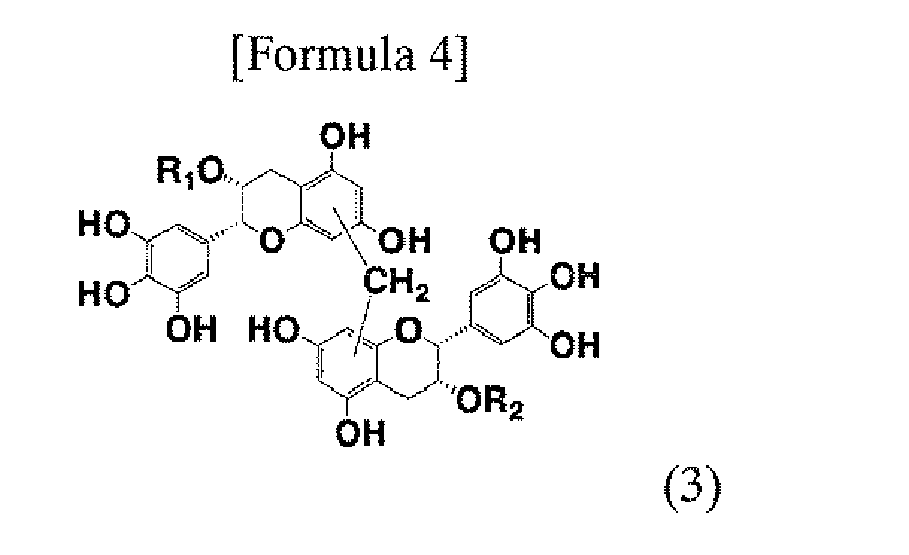
- (wherein R1 and R2 each independently represent H or a galloyl group), an epigallocatechin trimer of formula (4):
-

- (wherein R3, R4 and R5 each independently represent H or a galloyl group), and oolong theanine-3'-O-gallate of formula (5):
-

- It should be noted that unpolymerized catechin refers to an unpolymerized monomer of catechin (i.e., (+)-catechin, (-)-epicatechin, (+)-gallocatechin, (-)-epigallocatechin, (-)-catechin gallate, (-)-epicatechin gallate, (-)-gallocatechin gallate, (-)-epigallacatechin gallate).
- The polymerized catechins of the present invention can be obtained from tea leaves by solvent extraction. Tea leaves used as a source material may be of one or more types selected from green tea (non-fermented tea), oolong tea (semi-fermented tea) and black tea (fermented tea). Among them, tea leaves of semi-fermented tea or fermented tea rich in polymerized catechins are preferred for use. As an extraction solvent, water or boiling water, methanol, ethanol, isopropanol, ethyl acetate and so on are used alone or in admixture thereof. Such a solvent extract of tea leaves may be used directly or may be concentrated or purified before use.
- Since the use of polymerized polyphenols (particularly polymerized catechins) provides a significant effect in preventing a storage-induced reduction in the sweetness of aspartame, preferred for use is a solvent extract of tea leaves which is enriched for polymerized catechins by selectively removing monomeric catechins. In general, monomeric catechins and caffeine have bitter and astringent tastes, and hence are more likely to impair the taste of foods or beverages per se when incorporated at higher contents. Thus, it is preferable to use a solvent extract treated to selectively remove monomeric catechins and/or caffeine from the above tea leaf extract. Examples of such a solvent extract treated to selectively remove monomeric catechins and/or caffeine include those containing polymerized catechins at a concentration 4-fold or higher than that of unpolymerized catechins, as found in
WO2005/077384 . - Polymerized polyphenols used in the present invention may be either in liquid form or powdered by spray drying or freeze pulverization.
- Polymerized polyphenols are preferably added at a weight ratio of 0.1 to 1.0, more preferably at a weight ratio of 0.1 to 0.5, relative to the weight of aspartame added.
- The acidic beverages of the present invention are intended to mean beverages having a pH of 2 to 5 (preferably a pH of 2.5 to 4.5), but are not limited thereto as long as aspartame in the beverages will be hydrolyzed during storage. The acidic beverages may be of any type, including carbonated beverages, fruit juice-containing beverages, vegetable beverages, nutritional beverages, etc.
- The present invention is intended to prevent a storage-induced reduction in the sweetness of aspartame by addition of polymerized polyphenols (particularly polymerized catechins). The content of polymerized polyphenols in the beverages of the present invention may be selected as appropriate, depending on the amount of aspartame to be incorporated into the beverages, the type of polymerized polyphenols to be used, etc. It is generally 0.010% to 0.100% by weight (calculated as polymerized polyphenol) relative to the total beverage weight. If the polymerized polyphenol concentration is less than 0.010% by weight, a sufficient effect cannot be obtained in preventing a storage-induced reduction in the sweetness of aspartame. On the other hand, at a concentration exceeding 0.100% by weight, no further effect can be expected and hence there is no economic advantage. Moreover, some types of polymerized polyphenols would reduce the maximum sweetness level of the sweetener, e.g., due to the astringent taste originating from the polymerized polyphenols.
- Furthermore, the beverages of the present invention comprising polymerized polyphenols (particularly polymerized catechins) not only prevent a reduction in sweetness, but also compensate for the lack of rich flavor in aspartame-containing low-calorie beverages. Thus, the beverages of the present invention are preferred for use as low-calorie beverages. Examples of beverages whose calorie level should be lowered include carbonated beverages (e.g., cola drinks, soda drinks), sports drinks, fruit drinks, milk-based beverages, tea-based beverages, etc. In particular, the present invention can be targeted at carbonated beverages, which cause a problem of obesity when drunk in large quantities.
- These acidic beverages of the present invention may optionally be supplemented with fruit juices, sweeteners, acidulants, flavorings, other additives, etc.
- The acidic beverages of the present invention can prevent changes in flavor during storage, as described above, and hence are preferred for use as beverages distributed in the form filled into containers, i.e., packaged beverages. In the case of packaged beverages, a heat disinfection (or sterilization) step is required, and it is expected that hydrolysis of aspartame will be facilitated during this step. The acidic beverages of the present invention are also effective in preventing a heat-induced reduction in the sweetness of aspartame during such a heat sterilization step. It should be noted that containers used for these packaged beverages are in any form that can be provided as beverages, including paper cartons, plastic bottles, cans, bottles, etc.
- The present invention will be further described in more detail by way of the following examples, which are not intended to limit the present invention.
- Using a sodium bicarbonate solution (7800 kg) containing 0.15% by weight of sodium bicarbonate in hot water (95°C), 600 kg of oolong tea leaves were extracted to give an oolong tea extract in a yield of about 7000 kg. While the solution temperature was maintained at 60-65°C, this extract was passed through 400 kg of granular activated charcoal (GW-H32/60, Kuraray Co., Ltd., Japan) to remove unpolymerized catechin and caffeine. This solution (activated charcoal-treated solution) was concentrated under reduced pressure to give a polymerized catechin-containing concentrated oolong tea extract having a Brix value of 11 (hereinafter referred to as extract A) in a yield of about 900 kg. The concentrations of polymerized catechin, unpolymerized catechin, and caffeine in the extract A thus obtained were measured by HPLC under the conditions shown below. As a result, polymerized catechin was 12000 ppm, unpolymerized catechin was 800 ppm, and caffeine was 20 ppm, on a weight basis.
- HPLC conditions:
- Column: TSK-gel ODS-80TsQA (4.6 mmφ x 150 mm, Tosoh Corporation, Japan)
- Mobile phase: A: water:acetonitrile:trifluoroacetic acid = 900:100:0.5
B: water:acetonitrile:trifluoroacetic acid = 200:800:0.5 - Flow rate: 1.0 ml/min
- Column temperature: 40°C
- Gradient conditions: 0% B until 5 minutes after initiation of the analysis,
8% B between 5 minutes and 11 minutes,
10% B between 11 minutes and 21 minutes,
100% B between 21 minutes and 22 minutes,
maintained at 100% between 22 minutes and 30 minutes,
0% between 30 minutes and 31 minutes - Detection: A280 nm
- Standard substance: oolong homobisflavan B (OHBF-B)
- Retention time of polymerized catechin: A peak at about 25 minutes matches with the peak of theaflavin.
- To 100 g of black tea leaves, 2000 g of boiling water (90°C or higher) was added and maintained for 1 hour (90°C or higher) to give a black tea extract. This extract was cooled and then centrifuged (6000 rpm, 5 minutes) to remove insoluble materials, followed by the same activated charcoal treatment as used in Preparation Example 1 to give a polymerized catechin-containing black tea extract having a Brix value of 2. The resulting extract was further concentrated under reduced pressure to prepare a polymerized catechin-containing concentrated black tea extract (extract B). The same HPLC analysis as used in Preparation Example 1 was repeated, indicating that polymerized catechin was 2000 ppm, unpolymerized catechin was 200 ppm, and caffeine was 5 ppm, on a weight basis.
- Pal Sweet Diet® (Ajinomoto Co., Inc., Japan) was used as aspartame, while the extract A obtained in Preparation Example 1 (oolong tea polymerized polyphenol), the extract B obtained in Preparation Example 2 (black tea polymerized polyphenol), grape seed polymerized polyphenol (Kikkoman Corporation, Japan) or pine bark polymerized polyphenol (Toyo Shinyaku Co., Ltd., Japan) was used as a polymerized polyphenol.
- To a 0.1% aqueous aspartame solution, the extract A was added at 100, 200, 300 or 500 ppm (calculated as polymerized catechin) on a weight basis, the extract B was added at 300 ppm (calculated as polymerized catechin) on a weight basis, the grape seed polymerized polyphenol was added at 300 ppm on a weight basis, or the pine bark polymerized polyphenol was added at 300 ppm on a weight basis. The samples thus prepared were each adjusted to pH 3.5 with phosphoric acid. After heat sterilization (95°C, 30 seconds), these samples were filled into plastic bottles in 350 mL volumes and stored at 4°C or 45°C. After one month, a sensory test was made by 4 panelists to evaluate the sweetness of these samples. In this experiment, storage at 45°C for one month corresponds to storage for 10 months. In the sensory test, the intensity of sweetness was evaluated on a five-point scale to calculate a mean value for each sample (Table 1), assuming that the 0.1% aqueous aspartame solution (pH 3.5) (free from polymerized polyphenol) had a sweetness score of 5, while the 0.1% aqueous aspartame solution (pH 3.5) (free from polymerized polyphenol) stored at 45°C for one month (control) had a sweetness score of 1. The results indicated that upon addition of polymerized polyphenol, particularly oolong tea polymerized polyphenol or black tea polymerized polyphenol, the sweetness of aspartame was prevented from disappearing. It should be noted that all of the polymerized polyphenol-containing aqueous aspartame solutions stored at 4°C had a sweetness score of 5, regardless of the type of polymerized polyphenol.
-
[Table 1] Sweetness levels (sensory scores) after storage at 45°C for one month Control OTPP Black tea polymerized polyphenol Grape seed polymerized polyphenol Pine bark polymerized polyphenol Concentration (ppm) 0 100 200 300 500 300 300 300 Sensory score (1-5) 1.00 2.50 3.00 2.63 2.50 2.13 1.50 1.25 - Carbonated beverages were prepared according to the recipe shown in Table 2. After heat sterilization (95°C, 30 seconds), the beverages were saturated with carbonic acid, filled into plastic bottles in 350 mL volumes and stored at 45°C for one month. After storage, a sensory test was made by 5 panelists. In the sensory test, relative evaluation was performed on a five-point scale to calculate a mean value for each sample, assuming that the sweetness score before storage was 5. As a result, test sample 1 (free from oolong tea polymerized polyphenol) had a score of 2.8, whereas test sample 2 (containing oolong tea polymerized polyphenol) had a score of 4.1, indicating that upon addition of oolong tea polymerized polyphenol, the sweetness was prevented from disappearing.
-
[Table 2] Test sample 1 Test sample 2 Sodium benzoate 0.2 0.2 g Sodium citrate 0.5 0.5 g Citric acid (anhydride) 0.55 0.55 g Aspartame 0.4 0.4 g Acesulfame potassium 0.1 0.1 g Flavoring 4 4 g Oolong tea polymerized polyphenols 0 260 ppm Phosphoric acid q.s. q.s. Carbonic acid q.s. q.s. Total weight 1000 1000 g *Phosphoric acid was added to give a final pH of 3.5.
*Carbonic acid was added at a gas pressure of 3.7 kgf/cm2.
Claims (16)
- An aspartame-containing acidic beverage, which comprises a polymerized polyphenol at a concentration sufficient to prevent a storage-induced reduction in the sweetness of aspartame.
- The beverage according to claim 1, wherein the concentration of aspartame is 0,04% by weight or more.
- The beverage according to claim 1 or 2, wherein the acidic beverage has a pH of 2 to 5.
- The beverage according to any one of claims 1 to 3, wherein the concentration of the polymerized polyphenol is 0.010% by weight to 0.100% by weight.
- The beverage according to any one of claims 1 to 4, wherein the polymerized polyphenol is a polymerized catechin.
- The beverage according to claim 5, which further comprises an unpolymerized catechin, wherein the polymerized catechin is contained at a higher concentration than the unpolymerized catechin.
- The beverage according to claim 6, wherein the polymerized catechin is contained at a concentration 4-fold or higher than that of the unpolymerized catechin.
- The beverage according to any one of claims 4 to 7, wherein the polymerized catechin is derived from a semi-fermented tea or a fermented tea.
- The beverage according to any one of claims 1 to 8, which is in the form of a packaged beverage.
- The beverage according to any one of claims 1 to 9, which is a low-calorie beverage.
- A method for preventing a storage-induced reduction in the sweetness of aspartame in aspartame-containing acidic beverages, which comprises using a polymerized polyphenol.
- The method according to claim 11, wherein the polymerized polyphenol is used at a concentration of 0.010% by weight to 0.100% by weight.
- The method according to claim 11 or 12, wherein the polymerized polyphenol is a polymerized catechin.
- The method according to claim 13, wherein a mixture of polymerized and unpolymerized catechins is used, which contains the polymerized catechin at a higher concentration than the unpolymerized catechin.
- The method according to claim 14, wherein the mixture contains the polymerized catechin at a concentration 4-fold or higher than that of the unpolymerized catechin.
- The method according to any one of claims 13 to 15, wherein the polymerized catechin is derived from a semi-fermented tea or a fermented tea.
Applications Claiming Priority (2)
| Application Number | Priority Date | Filing Date | Title |
|---|---|---|---|
| JP2007235961A JP5117148B2 (en) | 2007-09-11 | 2007-09-11 | Acidic beverages containing aspartame |
| PCT/JP2008/066447 WO2009035048A1 (en) | 2007-09-11 | 2008-09-11 | Acidic beverage containing aspartame |
Publications (3)
| Publication Number | Publication Date |
|---|---|
| EP2191734A1 true EP2191734A1 (en) | 2010-06-02 |
| EP2191734A4 EP2191734A4 (en) | 2011-01-05 |
| EP2191734B1 EP2191734B1 (en) | 2012-02-15 |
Family
ID=40452055
Family Applications (1)
| Application Number | Title | Priority Date | Filing Date |
|---|---|---|---|
| EP08830442A Not-in-force EP2191734B1 (en) | 2007-09-11 | 2008-09-11 | Aspartame-containing acidic beverages |
Country Status (10)
| Country | Link |
|---|---|
| US (1) | US20100297305A1 (en) |
| EP (1) | EP2191734B1 (en) |
| JP (1) | JP5117148B2 (en) |
| CN (1) | CN101848655B (en) |
| AT (1) | ATE545342T1 (en) |
| AU (1) | AU2008298188B2 (en) |
| ES (1) | ES2379850T3 (en) |
| NZ (1) | NZ584155A (en) |
| TW (1) | TWI418309B (en) |
| WO (1) | WO2009035048A1 (en) |
Families Citing this family (6)
| Publication number | Priority date | Publication date | Assignee | Title |
|---|---|---|---|---|
| JP5676078B2 (en) * | 2008-12-26 | 2015-02-25 | サントリー食品インターナショナル株式会社 | Flavor enhancer and flavor composition |
| US8293299B2 (en) | 2009-09-11 | 2012-10-23 | Kraft Foods Global Brands Llc | Containers and methods for dispensing multiple doses of a concentrated liquid, and shelf stable Concentrated liquids |
| JP4958983B2 (en) * | 2010-01-29 | 2012-06-20 | 株式会社 伊藤園 | Containerized tea beverage |
| ES2787498T3 (en) * | 2011-08-25 | 2020-10-16 | Tersano Inc | Water treatment to prolong ozone half-life |
| US11013248B2 (en) | 2012-05-25 | 2021-05-25 | Kraft Foods Group Brands Llc | Shelf stable, concentrated, liquid flavorings and methods of preparing beverages with the concentrated liquid flavorings |
| JP6257863B1 (en) * | 2016-03-31 | 2018-01-10 | サントリーホールディングス株式会社 | Stevia-containing beverage |
Family Cites Families (16)
| Publication number | Priority date | Publication date | Assignee | Title |
|---|---|---|---|---|
| CA1206370A (en) * | 1982-08-17 | 1986-06-24 | Ajinomoto Co., Inc. | Stabilized aspartame compositions |
| US4906480A (en) * | 1988-04-07 | 1990-03-06 | Forsyth Dental Infirmary For Children | Sweetness and flavor enhanced compositions and method of preparing such compositions |
| JPH03183453A (en) * | 1989-09-08 | 1991-08-09 | Maremitsu Izumitani | Degustation improver containing tannin as principal ingredient, quality of taste-improving method and food having quality of taste improved by tannin |
| US5731025A (en) * | 1996-09-11 | 1998-03-24 | Mitchell; David C. | Method and composition for inhibiting decomposition of aspartame |
| US5902628A (en) * | 1996-11-14 | 1999-05-11 | Pepsico., Inc. | Beverage with reduction of lingering sweet aftertaste of sucralose |
| JPH10229847A (en) * | 1997-02-18 | 1998-09-02 | Sanei Gen F F I Inc | How to mask sour |
| JPH10262600A (en) | 1997-03-26 | 1998-10-06 | Sanei Gen F F I Inc | Astringent masking method |
| US6723369B2 (en) * | 1999-05-27 | 2004-04-20 | James M. Burgess | Carbonated beverage for strengthening acid resistancy of teeth |
| EP1364587B1 (en) * | 2001-02-27 | 2008-09-03 | San-Ei Gen F.F.I., Inc. | Carbonated drinks |
| JP3403400B1 (en) * | 2001-09-28 | 2003-05-06 | 花王株式会社 | Packaged beverage |
| WO2003093121A1 (en) * | 2002-04-30 | 2003-11-13 | Daiwa Can Company | Opening curled part of metal container and method of forming the opening curled part |
| WO2005077384A1 (en) | 2004-02-17 | 2005-08-25 | Suntory Limited | Lipase activity inhibitor containing high-molecular weight polyphenol fraction, tea extract and process for producing the same |
| JP4668553B2 (en) | 2004-05-27 | 2011-04-13 | サントリーホールディングス株式会社 | Epigallocatechin dimer and trimer having lipase inhibitory activity and / or antioxidant activity |
| US7829132B2 (en) * | 2004-11-03 | 2010-11-09 | Unilever Bestfoods, North America Division Of Conopco, Inc. | Consumable tea composition with antioxidants |
| EP2491801B1 (en) * | 2005-12-30 | 2016-04-27 | PepsiCo, Inc. | Shelf-stable beverage composition |
| DE602006003213D1 (en) * | 2006-07-24 | 2008-11-27 | Unilever Nv | Improved drink |
-
2007
- 2007-09-11 JP JP2007235961A patent/JP5117148B2/en not_active Expired - Fee Related
-
2008
- 2008-09-11 WO PCT/JP2008/066447 patent/WO2009035048A1/en not_active Ceased
- 2008-09-11 TW TW097134975A patent/TWI418309B/en not_active IP Right Cessation
- 2008-09-11 CN CN2008801149054A patent/CN101848655B/en not_active Expired - Fee Related
- 2008-09-11 ES ES08830442T patent/ES2379850T3/en active Active
- 2008-09-11 NZ NZ584155A patent/NZ584155A/en not_active IP Right Cessation
- 2008-09-11 AU AU2008298188A patent/AU2008298188B2/en not_active Ceased
- 2008-09-11 AT AT08830442T patent/ATE545342T1/en active
- 2008-09-11 US US12/677,408 patent/US20100297305A1/en not_active Abandoned
- 2008-09-11 EP EP08830442A patent/EP2191734B1/en not_active Not-in-force
Also Published As
| Publication number | Publication date |
|---|---|
| US20100297305A1 (en) | 2010-11-25 |
| JP5117148B2 (en) | 2013-01-09 |
| ES2379850T3 (en) | 2012-05-04 |
| ATE545342T1 (en) | 2012-03-15 |
| WO2009035048A1 (en) | 2009-03-19 |
| NZ584155A (en) | 2012-06-29 |
| CN101848655A (en) | 2010-09-29 |
| TW200926999A (en) | 2009-07-01 |
| EP2191734B1 (en) | 2012-02-15 |
| AU2008298188A1 (en) | 2009-03-19 |
| JP2009065874A (en) | 2009-04-02 |
| AU2008298188B2 (en) | 2013-02-07 |
| TWI418309B (en) | 2013-12-11 |
| EP2191734A4 (en) | 2011-01-05 |
| CN101848655B (en) | 2012-09-19 |
Similar Documents
| Publication | Publication Date | Title |
|---|---|---|
| JP5351032B2 (en) | Food and drink with improved sweetener taste | |
| AU2009331076B2 (en) | Flavor enhancing agent and flavoring composition | |
| JP5175167B2 (en) | Carbonated beverage containing high-intensity sweetener | |
| AU2019284101B2 (en) | Stevia-containing beverage | |
| EP2191734B1 (en) | Aspartame-containing acidic beverages | |
| US20200296986A1 (en) | Beverage containing tea polymerized polyphenol and rebd and/or rebm | |
| JP5523303B2 (en) | Stabilizing composition containing high-intensity sweetener | |
| JP2009065877A (en) | Containerized beverage with polymerized catechin | |
| JP2009065872A (en) | Polymerized catechin-containing drink |
Legal Events
| Date | Code | Title | Description |
|---|---|---|---|
| PUAI | Public reference made under article 153(3) epc to a published international application that has entered the european phase |
Free format text: ORIGINAL CODE: 0009012 |
|
| 17P | Request for examination filed |
Effective date: 20100319 |
|
| AK | Designated contracting states |
Kind code of ref document: A1 Designated state(s): AT BE BG CH CY CZ DE DK EE ES FI FR GB GR HR HU IE IS IT LI LT LU LV MC MT NL NO PL PT RO SE SI SK TR |
|
| AX | Request for extension of the european patent |
Extension state: AL BA MK RS |
|
| DAX | Request for extension of the european patent (deleted) | ||
| A4 | Supplementary search report drawn up and despatched |
Effective date: 20101206 |
|
| GRAP | Despatch of communication of intention to grant a patent |
Free format text: ORIGINAL CODE: EPIDOSNIGR1 |
|
| RIC1 | Information provided on ipc code assigned before grant |
Ipc: A23L 2/60 20060101AFI20110728BHEP |
|
| RTI1 | Title (correction) |
Free format text: ASPARTAME-CONTAINING ACIDIC BEVERAGES |
|
| GRAS | Grant fee paid |
Free format text: ORIGINAL CODE: EPIDOSNIGR3 |
|
| GRAA | (expected) grant |
Free format text: ORIGINAL CODE: 0009210 |
|
| AK | Designated contracting states |
Kind code of ref document: B1 Designated state(s): AT BE BG CH CY CZ DE DK EE ES FI FR GB GR HR HU IE IS IT LI LT LU LV MC MT NL NO PL PT RO SE SI SK TR |
|
| REG | Reference to a national code |
Ref country code: CH Ref legal event code: EP Ref country code: GB Ref legal event code: FG4D |
|
| REG | Reference to a national code |
Ref country code: IE Ref legal event code: FG4D |
|
| REG | Reference to a national code |
Ref country code: AT Ref legal event code: REF Ref document number: 545342 Country of ref document: AT Kind code of ref document: T Effective date: 20120315 |
|
| RIN2 | Information on inventor provided after grant (corrected) |
Inventor name: NONAKA, YUJI Inventor name: TAKEMOTO, SUSUMU |
|
| RIN2 | Information on inventor provided after grant (corrected) |
Inventor name: NONAKA, YUJI Inventor name: TAKEMOTO, SUSUMU |
|
| REG | Reference to a national code |
Ref country code: DE Ref legal event code: R096 Ref document number: 602008013481 Country of ref document: DE Effective date: 20120412 |
|
| REG | Reference to a national code |
Ref country code: ES Ref legal event code: FG2A Ref document number: 2379850 Country of ref document: ES Kind code of ref document: T3 Effective date: 20120504 |
|
| REG | Reference to a national code |
Ref country code: NL Ref legal event code: VDEP Effective date: 20120215 |
|
| LTIE | Lt: invalidation of european patent or patent extension |
Effective date: 20120215 |
|
| PG25 | Lapsed in a contracting state [announced via postgrant information from national office to epo] |
Ref country code: IS Free format text: LAPSE BECAUSE OF FAILURE TO SUBMIT A TRANSLATION OF THE DESCRIPTION OR TO PAY THE FEE WITHIN THE PRESCRIBED TIME-LIMIT Effective date: 20120615 Ref country code: LT Free format text: LAPSE BECAUSE OF FAILURE TO SUBMIT A TRANSLATION OF THE DESCRIPTION OR TO PAY THE FEE WITHIN THE PRESCRIBED TIME-LIMIT Effective date: 20120215 Ref country code: NO Free format text: LAPSE BECAUSE OF FAILURE TO SUBMIT A TRANSLATION OF THE DESCRIPTION OR TO PAY THE FEE WITHIN THE PRESCRIBED TIME-LIMIT Effective date: 20120515 Ref country code: NL Free format text: LAPSE BECAUSE OF FAILURE TO SUBMIT A TRANSLATION OF THE DESCRIPTION OR TO PAY THE FEE WITHIN THE PRESCRIBED TIME-LIMIT Effective date: 20120215 Ref country code: HR Free format text: LAPSE BECAUSE OF FAILURE TO SUBMIT A TRANSLATION OF THE DESCRIPTION OR TO PAY THE FEE WITHIN THE PRESCRIBED TIME-LIMIT Effective date: 20120215 |
|
| PG25 | Lapsed in a contracting state [announced via postgrant information from national office to epo] |
Ref country code: GR Free format text: LAPSE BECAUSE OF FAILURE TO SUBMIT A TRANSLATION OF THE DESCRIPTION OR TO PAY THE FEE WITHIN THE PRESCRIBED TIME-LIMIT Effective date: 20120516 Ref country code: PT Free format text: LAPSE BECAUSE OF FAILURE TO SUBMIT A TRANSLATION OF THE DESCRIPTION OR TO PAY THE FEE WITHIN THE PRESCRIBED TIME-LIMIT Effective date: 20120615 Ref country code: PL Free format text: LAPSE BECAUSE OF FAILURE TO SUBMIT A TRANSLATION OF THE DESCRIPTION OR TO PAY THE FEE WITHIN THE PRESCRIBED TIME-LIMIT Effective date: 20120215 Ref country code: BE Free format text: LAPSE BECAUSE OF FAILURE TO SUBMIT A TRANSLATION OF THE DESCRIPTION OR TO PAY THE FEE WITHIN THE PRESCRIBED TIME-LIMIT Effective date: 20120215 Ref country code: LV Free format text: LAPSE BECAUSE OF FAILURE TO SUBMIT A TRANSLATION OF THE DESCRIPTION OR TO PAY THE FEE WITHIN THE PRESCRIBED TIME-LIMIT Effective date: 20120215 Ref country code: FI Free format text: LAPSE BECAUSE OF FAILURE TO SUBMIT A TRANSLATION OF THE DESCRIPTION OR TO PAY THE FEE WITHIN THE PRESCRIBED TIME-LIMIT Effective date: 20120215 |
|
| REG | Reference to a national code |
Ref country code: AT Ref legal event code: MK05 Ref document number: 545342 Country of ref document: AT Kind code of ref document: T Effective date: 20120215 |
|
| PG25 | Lapsed in a contracting state [announced via postgrant information from national office to epo] |
Ref country code: CY Free format text: LAPSE BECAUSE OF FAILURE TO SUBMIT A TRANSLATION OF THE DESCRIPTION OR TO PAY THE FEE WITHIN THE PRESCRIBED TIME-LIMIT Effective date: 20120215 |
|
| PG25 | Lapsed in a contracting state [announced via postgrant information from national office to epo] |
Ref country code: RO Free format text: LAPSE BECAUSE OF FAILURE TO SUBMIT A TRANSLATION OF THE DESCRIPTION OR TO PAY THE FEE WITHIN THE PRESCRIBED TIME-LIMIT Effective date: 20120215 Ref country code: CZ Free format text: LAPSE BECAUSE OF FAILURE TO SUBMIT A TRANSLATION OF THE DESCRIPTION OR TO PAY THE FEE WITHIN THE PRESCRIBED TIME-LIMIT Effective date: 20120215 Ref country code: EE Free format text: LAPSE BECAUSE OF FAILURE TO SUBMIT A TRANSLATION OF THE DESCRIPTION OR TO PAY THE FEE WITHIN THE PRESCRIBED TIME-LIMIT Effective date: 20120215 Ref country code: SI Free format text: LAPSE BECAUSE OF FAILURE TO SUBMIT A TRANSLATION OF THE DESCRIPTION OR TO PAY THE FEE WITHIN THE PRESCRIBED TIME-LIMIT Effective date: 20120215 Ref country code: SE Free format text: LAPSE BECAUSE OF FAILURE TO SUBMIT A TRANSLATION OF THE DESCRIPTION OR TO PAY THE FEE WITHIN THE PRESCRIBED TIME-LIMIT Effective date: 20120215 Ref country code: DK Free format text: LAPSE BECAUSE OF FAILURE TO SUBMIT A TRANSLATION OF THE DESCRIPTION OR TO PAY THE FEE WITHIN THE PRESCRIBED TIME-LIMIT Effective date: 20120215 |
|
| PG25 | Lapsed in a contracting state [announced via postgrant information from national office to epo] |
Ref country code: SK Free format text: LAPSE BECAUSE OF FAILURE TO SUBMIT A TRANSLATION OF THE DESCRIPTION OR TO PAY THE FEE WITHIN THE PRESCRIBED TIME-LIMIT Effective date: 20120215 |
|
| PLBE | No opposition filed within time limit |
Free format text: ORIGINAL CODE: 0009261 |
|
| STAA | Information on the status of an ep patent application or granted ep patent |
Free format text: STATUS: NO OPPOSITION FILED WITHIN TIME LIMIT |
|
| 26N | No opposition filed |
Effective date: 20121116 |
|
| PG25 | Lapsed in a contracting state [announced via postgrant information from national office to epo] |
Ref country code: AT Free format text: LAPSE BECAUSE OF FAILURE TO SUBMIT A TRANSLATION OF THE DESCRIPTION OR TO PAY THE FEE WITHIN THE PRESCRIBED TIME-LIMIT Effective date: 20120215 |
|
| REG | Reference to a national code |
Ref country code: DE Ref legal event code: R097 Ref document number: 602008013481 Country of ref document: DE Effective date: 20121116 |
|
| PG25 | Lapsed in a contracting state [announced via postgrant information from national office to epo] |
Ref country code: MC Free format text: LAPSE BECAUSE OF NON-PAYMENT OF DUE FEES Effective date: 20120930 |
|
| REG | Reference to a national code |
Ref country code: CH Ref legal event code: PL |
|
| REG | Reference to a national code |
Ref country code: IE Ref legal event code: MM4A |
|
| PG25 | Lapsed in a contracting state [announced via postgrant information from national office to epo] |
Ref country code: CH Free format text: LAPSE BECAUSE OF NON-PAYMENT OF DUE FEES Effective date: 20120930 Ref country code: IE Free format text: LAPSE BECAUSE OF NON-PAYMENT OF DUE FEES Effective date: 20120911 Ref country code: BG Free format text: LAPSE BECAUSE OF FAILURE TO SUBMIT A TRANSLATION OF THE DESCRIPTION OR TO PAY THE FEE WITHIN THE PRESCRIBED TIME-LIMIT Effective date: 20120515 Ref country code: LI Free format text: LAPSE BECAUSE OF NON-PAYMENT OF DUE FEES Effective date: 20120930 |
|
| PG25 | Lapsed in a contracting state [announced via postgrant information from national office to epo] |
Ref country code: MT Free format text: LAPSE BECAUSE OF FAILURE TO SUBMIT A TRANSLATION OF THE DESCRIPTION OR TO PAY THE FEE WITHIN THE PRESCRIBED TIME-LIMIT Effective date: 20120215 |
|
| REG | Reference to a national code |
Ref country code: DE Ref legal event code: R082 Ref document number: 602008013481 Country of ref document: DE Representative=s name: VOSSIUS & PARTNER, DE |
|
| REG | Reference to a national code |
Ref country code: ES Ref legal event code: PC2A Owner name: SUNTORY BEVERAGE & FOOD LIMITED Effective date: 20140113 Ref country code: FR Ref legal event code: TP Owner name: SUNTORY BEVERAGE & FOOD LIMITED, JP Effective date: 20131217 |
|
| REG | Reference to a national code |
Ref country code: GB Ref legal event code: 732E Free format text: REGISTERED BETWEEN 20140102 AND 20140108 |
|
| REG | Reference to a national code |
Ref country code: DE Ref legal event code: R081 Ref document number: 602008013481 Country of ref document: DE Owner name: SUNTORY BEVERAGE & FOOD LIMITED, JP Free format text: FORMER OWNER: SUNTORY HOLDINGS LTD., OSAKA, JP Effective date: 20131217 Ref country code: DE Ref legal event code: R082 Ref document number: 602008013481 Country of ref document: DE Representative=s name: VOSSIUS & PARTNER, DE Effective date: 20131217 Ref country code: DE Ref legal event code: R082 Ref document number: 602008013481 Country of ref document: DE Representative=s name: VOSSIUS & PARTNER PATENTANWAELTE RECHTSANWAELT, DE Effective date: 20131217 Ref country code: DE Ref legal event code: R081 Ref document number: 602008013481 Country of ref document: DE Owner name: SUNTORY HOLDINGS LIMITED, JP Free format text: FORMER OWNER: SUNTORY HOLDINGS LTD., OSAKA, JP Effective date: 20131217 |
|
| PG25 | Lapsed in a contracting state [announced via postgrant information from national office to epo] |
Ref country code: TR Free format text: LAPSE BECAUSE OF FAILURE TO SUBMIT A TRANSLATION OF THE DESCRIPTION OR TO PAY THE FEE WITHIN THE PRESCRIBED TIME-LIMIT Effective date: 20120215 |
|
| PG25 | Lapsed in a contracting state [announced via postgrant information from national office to epo] |
Ref country code: LU Free format text: LAPSE BECAUSE OF NON-PAYMENT OF DUE FEES Effective date: 20120911 |
|
| PG25 | Lapsed in a contracting state [announced via postgrant information from national office to epo] |
Ref country code: HU Free format text: LAPSE BECAUSE OF FAILURE TO SUBMIT A TRANSLATION OF THE DESCRIPTION OR TO PAY THE FEE WITHIN THE PRESCRIBED TIME-LIMIT Effective date: 20080911 |
|
| REG | Reference to a national code |
Ref country code: FR Ref legal event code: PLFP Year of fee payment: 9 |
|
| REG | Reference to a national code |
Ref country code: FR Ref legal event code: PLFP Year of fee payment: 10 |
|
| REG | Reference to a national code |
Ref country code: DE Ref legal event code: R081 Ref document number: 602008013481 Country of ref document: DE Owner name: SUNTORY HOLDINGS LIMITED, JP Free format text: FORMER OWNER: SUNTORY BEVERAGE FOOD LIMITED, TOKYO, JP Ref country code: DE Ref legal event code: R082 Ref document number: 602008013481 Country of ref document: DE Representative=s name: VOSSIUS & PARTNER PATENTANWAELTE RECHTSANWAELT, DE Ref country code: DE Ref legal event code: R081 Ref document number: 602008013481 Country of ref document: DE Owner name: SUNTORY HOLDINGS LIMITED, JP Free format text: FORMER OWNER: SUNTORY BEVERAGE & FOOD LIMITED, TOKYO, JP |
|
| REG | Reference to a national code |
Ref country code: GB Ref legal event code: 732E Free format text: REGISTERED BETWEEN 20180517 AND 20180523 |
|
| REG | Reference to a national code |
Ref country code: ES Ref legal event code: PC2A Effective date: 20180622 Ref country code: ES Ref legal event code: PC2A Owner name: SUNTORY HOLDINGS LIMITED Effective date: 20180622 |
|
| REG | Reference to a national code |
Ref country code: FR Ref legal event code: PLFP Year of fee payment: 11 |
|
| REG | Reference to a national code |
Ref country code: FR Ref legal event code: TP Owner name: SUNTORY HOLDINGS LIMITED, JP Effective date: 20180907 |
|
| PGFP | Annual fee paid to national office [announced via postgrant information from national office to epo] |
Ref country code: IT Payment date: 20180918 Year of fee payment: 8 Ref country code: DE Payment date: 20180828 Year of fee payment: 11 |
|
| REG | Reference to a national code |
Ref country code: DE Ref legal event code: R119 Ref document number: 602008013481 Country of ref document: DE |
|
| PG25 | Lapsed in a contracting state [announced via postgrant information from national office to epo] |
Ref country code: DE Free format text: LAPSE BECAUSE OF NON-PAYMENT OF DUE FEES Effective date: 20200401 |
|
| PG25 | Lapsed in a contracting state [announced via postgrant information from national office to epo] |
Ref country code: IT Free format text: LAPSE BECAUSE OF NON-PAYMENT OF DUE FEES Effective date: 20190911 |
|
| PGFP | Annual fee paid to national office [announced via postgrant information from national office to epo] |
Ref country code: GB Payment date: 20220728 Year of fee payment: 15 |
|
| PGFP | Annual fee paid to national office [announced via postgrant information from national office to epo] |
Ref country code: FR Payment date: 20220808 Year of fee payment: 15 |
|
| PGFP | Annual fee paid to national office [announced via postgrant information from national office to epo] |
Ref country code: ES Payment date: 20221004 Year of fee payment: 15 |
|
| GBPC | Gb: european patent ceased through non-payment of renewal fee |
Effective date: 20230911 |
|
| PG25 | Lapsed in a contracting state [announced via postgrant information from national office to epo] |
Ref country code: GB Free format text: LAPSE BECAUSE OF NON-PAYMENT OF DUE FEES Effective date: 20230911 |
|
| PG25 | Lapsed in a contracting state [announced via postgrant information from national office to epo] |
Ref country code: GB Free format text: LAPSE BECAUSE OF NON-PAYMENT OF DUE FEES Effective date: 20230911 Ref country code: FR Free format text: LAPSE BECAUSE OF NON-PAYMENT OF DUE FEES Effective date: 20230930 |
|
| REG | Reference to a national code |
Ref country code: ES Ref legal event code: FD2A Effective date: 20241028 |
|
| PG25 | Lapsed in a contracting state [announced via postgrant information from national office to epo] |
Ref country code: ES Free format text: LAPSE BECAUSE OF NON-PAYMENT OF DUE FEES Effective date: 20230912 |
|
| PG25 | Lapsed in a contracting state [announced via postgrant information from national office to epo] |
Ref country code: ES Free format text: LAPSE BECAUSE OF NON-PAYMENT OF DUE FEES Effective date: 20230912 |