EP2190829B1 - Amidine, thiourea and guanidine derivatives of 2-aminobenzothiazoles and aminobenzothiazines for their use as pharmacological agents for the treatment of neurodegenerative pathologies - Google Patents
Amidine, thiourea and guanidine derivatives of 2-aminobenzothiazoles and aminobenzothiazines for their use as pharmacological agents for the treatment of neurodegenerative pathologies Download PDFInfo
- Publication number
- EP2190829B1 EP2190829B1 EP08804562.0A EP08804562A EP2190829B1 EP 2190829 B1 EP2190829 B1 EP 2190829B1 EP 08804562 A EP08804562 A EP 08804562A EP 2190829 B1 EP2190829 B1 EP 2190829B1
- Authority
- EP
- European Patent Office
- Prior art keywords
- trifluoromethoxy
- benzothiazin
- benzothiazol
- thiourea
- acetamidine
- Prior art date
- Legal status (The legal status is an assumption and is not a legal conclusion. Google has not performed a legal analysis and makes no representation as to the accuracy of the status listed.)
- Not-in-force
Links
- 238000011282 treatment Methods 0.000 title claims description 26
- 230000007170 pathology Effects 0.000 title claims description 19
- 230000000626 neurodegenerative effect Effects 0.000 title claims description 17
- UMGDCJDMYOKAJW-UHFFFAOYSA-N thiourea Chemical compound NC(N)=S UMGDCJDMYOKAJW-UHFFFAOYSA-N 0.000 title description 12
- 150000002357 guanidines Chemical class 0.000 title description 8
- 229940083094 guanine derivative acting on arteriolar smooth muscle Drugs 0.000 title description 8
- XSQUKJJJFZCRTK-UHFFFAOYSA-N Urea Natural products NC(N)=O XSQUKJJJFZCRTK-UHFFFAOYSA-N 0.000 title description 6
- 150000001409 amidines Chemical class 0.000 title description 6
- 239000002831 pharmacologic agent Substances 0.000 title description 2
- LMSXJSHJKDFJII-UHFFFAOYSA-N 2h-1,2-benzothiazin-3-amine Chemical class C1=CC=C2SNC(N)=CC2=C1 LMSXJSHJKDFJII-UHFFFAOYSA-N 0.000 title 1
- -1 N'-[6-(trifluoromethoxy)benzothiazol-2-yl]acetamidine N'- [6-(trifluoromethoxy)benzothiazol-2-yl] acetamidine hydrochloride Chemical compound 0.000 claims description 29
- 150000001875 compounds Chemical class 0.000 claims description 27
- 201000006474 Brain Ischemia Diseases 0.000 claims description 8
- 206010008120 Cerebral ischaemia Diseases 0.000 claims description 8
- 206010008118 cerebral infarction Diseases 0.000 claims description 8
- 208000024827 Alzheimer disease Diseases 0.000 claims description 7
- 206010002026 amyotrophic lateral sclerosis Diseases 0.000 claims description 7
- 208000018737 Parkinson disease Diseases 0.000 claims description 6
- 208000014674 injury Diseases 0.000 claims description 6
- 201000006417 multiple sclerosis Diseases 0.000 claims description 6
- 230000008733 trauma Effects 0.000 claims description 6
- FAPWRFPIFSIZLT-UHFFFAOYSA-M Sodium chloride Chemical compound [Na+].[Cl-] FAPWRFPIFSIZLT-UHFFFAOYSA-M 0.000 claims description 5
- 239000004480 active ingredient Substances 0.000 claims description 5
- 239000003814 drug Substances 0.000 claims description 5
- 239000000839 emulsion Substances 0.000 claims description 4
- 239000008194 pharmaceutical composition Substances 0.000 claims description 4
- WQZGKKKJIJFFOK-GASJEMHNSA-N Glucose Natural products OC[C@H]1OC(O)[C@H](O)[C@@H](O)[C@@H]1O WQZGKKKJIJFFOK-GASJEMHNSA-N 0.000 claims description 3
- 125000004190 benzothiazol-2-yl group Chemical group [H]C1=C([H])C([H])=C2N=C(*)SC2=C1[H] 0.000 claims description 3
- 229940079593 drug Drugs 0.000 claims description 3
- 239000011780 sodium chloride Substances 0.000 claims description 3
- 239000008365 aqueous carrier Substances 0.000 claims description 2
- 235000003599 food sweetener Nutrition 0.000 claims description 2
- 239000003765 sweetening agent Substances 0.000 claims description 2
- 230000001225 therapeutic effect Effects 0.000 claims 3
- 239000000306 component Substances 0.000 claims 2
- 239000004615 ingredient Substances 0.000 claims 2
- ZLZDXUBQWFIPGG-UHFFFAOYSA-N 2-(2H-1,4-benzothiazin-3-yl)guanidine 1-(4H-1,4-benzothiazin-3-ylidene)-2-methylguanidine Chemical compound CNC(=N)NC=1CSC2=C(N1)C=CC=C2.S2CC(=NC1=C2C=CC=C1)NC(=N)N ZLZDXUBQWFIPGG-UHFFFAOYSA-N 0.000 claims 1
- OQLZINXFSUDMHM-UHFFFAOYSA-N Acetamidine Chemical compound CC(N)=N OQLZINXFSUDMHM-UHFFFAOYSA-N 0.000 claims 1
- 238000010521 absorption reaction Methods 0.000 claims 1
- WQZGKKKJIJFFOK-VFUOTHLCSA-N beta-D-glucose Chemical compound OC[C@H]1O[C@@H](O)[C@H](O)[C@@H](O)[C@@H]1O WQZGKKKJIJFFOK-VFUOTHLCSA-N 0.000 claims 1
- 239000011230 binding agent Substances 0.000 claims 1
- 239000000969 carrier Substances 0.000 claims 1
- 238000013270 controlled release Methods 0.000 claims 1
- 239000008121 dextrose Substances 0.000 claims 1
- WCQOBLXWLRDEQA-UHFFFAOYSA-N ethanimidamide;hydrochloride Chemical compound Cl.CC(N)=N WCQOBLXWLRDEQA-UHFFFAOYSA-N 0.000 claims 1
- 230000002496 gastric effect Effects 0.000 claims 1
- 239000008203 oral pharmaceutical composition Substances 0.000 claims 1
- 239000005426 pharmaceutical component Substances 0.000 claims 1
- HEDRZPFGACZZDS-MICDWDOJSA-N Trichloro(2H)methane Chemical compound [2H]C(Cl)(Cl)Cl HEDRZPFGACZZDS-MICDWDOJSA-N 0.000 description 62
- RTZKZFJDLAIYFH-UHFFFAOYSA-N Diethyl ether Chemical compound CCOCC RTZKZFJDLAIYFH-UHFFFAOYSA-N 0.000 description 44
- 238000005160 1H NMR spectroscopy Methods 0.000 description 39
- 239000000047 product Substances 0.000 description 38
- YMWUJEATGCHHMB-UHFFFAOYSA-N Dichloromethane Chemical compound ClCCl YMWUJEATGCHHMB-UHFFFAOYSA-N 0.000 description 30
- VYPSYNLAJGMNEJ-UHFFFAOYSA-N Silicium dioxide Chemical compound O=[Si]=O VYPSYNLAJGMNEJ-UHFFFAOYSA-N 0.000 description 26
- XEKOWRVHYACXOJ-UHFFFAOYSA-N Ethyl acetate Chemical compound CCOC(C)=O XEKOWRVHYACXOJ-UHFFFAOYSA-N 0.000 description 23
- 239000007787 solid Substances 0.000 description 23
- VLKZOEOYAKHREP-UHFFFAOYSA-N n-Hexane Chemical compound CCCCCC VLKZOEOYAKHREP-UHFFFAOYSA-N 0.000 description 19
- IAZDPXIOMUYVGZ-UHFFFAOYSA-N Dimethylsulphoxide Chemical compound CS(C)=O IAZDPXIOMUYVGZ-UHFFFAOYSA-N 0.000 description 18
- OKKJLVBELUTLKV-UHFFFAOYSA-N Methanol Chemical compound OC OKKJLVBELUTLKV-UHFFFAOYSA-N 0.000 description 18
- HEMHJVSKTPXQMS-UHFFFAOYSA-M Sodium hydroxide Chemical compound [OH-].[Na+] HEMHJVSKTPXQMS-UHFFFAOYSA-M 0.000 description 18
- ZMANZCXQSJIPKH-UHFFFAOYSA-N Triethylamine Chemical compound CCN(CC)CC ZMANZCXQSJIPKH-UHFFFAOYSA-N 0.000 description 16
- XLYOFNOQVPJJNP-UHFFFAOYSA-N water Chemical compound O XLYOFNOQVPJJNP-UHFFFAOYSA-N 0.000 description 16
- WHUUTDBJXJRKMK-VKHMYHEASA-N L-glutamic acid Chemical compound OC(=O)[C@@H](N)CCC(O)=O WHUUTDBJXJRKMK-VKHMYHEASA-N 0.000 description 15
- 239000007832 Na2SO4 Substances 0.000 description 15
- PMZURENOXWZQFD-UHFFFAOYSA-L Sodium Sulfate Chemical compound [Na+].[Na+].[O-]S([O-])(=O)=O PMZURENOXWZQFD-UHFFFAOYSA-L 0.000 description 15
- YXFVVABEGXRONW-UHFFFAOYSA-N Toluene Chemical compound CC1=CC=CC=C1 YXFVVABEGXRONW-UHFFFAOYSA-N 0.000 description 15
- 229910052938 sodium sulfate Inorganic materials 0.000 description 15
- 239000000243 solution Substances 0.000 description 15
- HEDRZPFGACZZDS-UHFFFAOYSA-N Chloroform Chemical compound ClC(Cl)Cl HEDRZPFGACZZDS-UHFFFAOYSA-N 0.000 description 14
- FTALBRSUTCGOEG-UHFFFAOYSA-N Riluzole Chemical compound C1=C(OC(F)(F)F)C=C2SC(N)=NC2=C1 FTALBRSUTCGOEG-UHFFFAOYSA-N 0.000 description 14
- 239000000203 mixture Substances 0.000 description 14
- 239000003208 petroleum Substances 0.000 description 14
- 230000000694 effects Effects 0.000 description 13
- 239000003921 oil Substances 0.000 description 13
- 235000019198 oils Nutrition 0.000 description 13
- 239000011541 reaction mixture Substances 0.000 description 13
- VEXZGXHMUGYJMC-UHFFFAOYSA-N Hydrochloric acid Chemical compound Cl VEXZGXHMUGYJMC-UHFFFAOYSA-N 0.000 description 12
- 229930195712 glutamate Natural products 0.000 description 12
- 229940049906 glutamate Drugs 0.000 description 12
- 230000009467 reduction Effects 0.000 description 12
- 239000000377 silicon dioxide Substances 0.000 description 12
- DLFVBJFMPXGRIB-UHFFFAOYSA-N Acetamide Chemical compound CC(N)=O DLFVBJFMPXGRIB-UHFFFAOYSA-N 0.000 description 10
- LFQSCWFLJHTTHZ-UHFFFAOYSA-N Ethanol Chemical compound CCO LFQSCWFLJHTTHZ-UHFFFAOYSA-N 0.000 description 10
- 102000003855 L-lactate dehydrogenase Human genes 0.000 description 10
- 108700023483 L-lactate dehydrogenases Proteins 0.000 description 10
- 238000004587 chromatography analysis Methods 0.000 description 10
- 150000003585 thioureas Chemical class 0.000 description 9
- 230000000324 neuroprotective effect Effects 0.000 description 8
- 238000002360 preparation method Methods 0.000 description 8
- 238000001953 recrystallisation Methods 0.000 description 8
- SJUVZYXLPHNABW-UHFFFAOYSA-N 1-ethyl-3-[6-(trifluoromethoxy)-1,3-benzothiazol-2-yl]thiourea Chemical compound C1=C(OC(F)(F)F)C=C2SC(NC(=S)NCC)=NC2=C1 SJUVZYXLPHNABW-UHFFFAOYSA-N 0.000 description 6
- DGAQECJNVWCQMB-PUAWFVPOSA-M Ilexoside XXIX Chemical compound C[C@@H]1CC[C@@]2(CC[C@@]3(C(=CC[C@H]4[C@]3(CC[C@@H]5[C@@]4(CC[C@@H](C5(C)C)OS(=O)(=O)[O-])C)C)[C@@H]2[C@]1(C)O)C)C(=O)O[C@H]6[C@@H]([C@H]([C@@H]([C@H](O6)CO)O)O)O.[Na+] DGAQECJNVWCQMB-PUAWFVPOSA-M 0.000 description 6
- MUBZPKHOEPUJKR-UHFFFAOYSA-N Oxalic acid Chemical compound OC(=O)C(O)=O MUBZPKHOEPUJKR-UHFFFAOYSA-N 0.000 description 6
- 239000013078 crystal Substances 0.000 description 6
- 230000001419 dependent effect Effects 0.000 description 6
- HBNYJWAFDZLWRS-UHFFFAOYSA-N ethyl isothiocyanate Chemical compound CCN=C=S HBNYJWAFDZLWRS-UHFFFAOYSA-N 0.000 description 6
- 239000000284 extract Substances 0.000 description 6
- 208000028867 ischemia Diseases 0.000 description 6
- 239000012074 organic phase Substances 0.000 description 6
- 239000003195 sodium channel blocking agent Substances 0.000 description 6
- 239000002904 solvent Substances 0.000 description 6
- 238000003756 stirring Methods 0.000 description 6
- 125000000876 trifluoromethoxy group Chemical group FC(F)(F)O* 0.000 description 6
- 125000002023 trifluoromethyl group Chemical group FC(F)(F)* 0.000 description 6
- SBZQHWWTOVFQFD-UHFFFAOYSA-N 2h-1,4-benzothiazin-3-amine Chemical compound C1=CC=C2SCC(N)=NC2=C1 SBZQHWWTOVFQFD-UHFFFAOYSA-N 0.000 description 5
- JGHCMUYKPDCLIZ-UHFFFAOYSA-N 6-(trifluoromethoxy)-4h-3,1-benzothiazin-2-amine Chemical compound C1=C(OC(F)(F)F)C=C2CSC(N)=NC2=C1 JGHCMUYKPDCLIZ-UHFFFAOYSA-N 0.000 description 5
- NAJBYJNQWKCBGO-UHFFFAOYSA-N 7-(trifluoromethoxy)-2h-1,4-benzothiazin-3-amine Chemical compound C1=C(OC(F)(F)F)C=C2SCC(N)=NC2=C1 NAJBYJNQWKCBGO-UHFFFAOYSA-N 0.000 description 5
- 108091006146 Channels Proteins 0.000 description 5
- 238000006243 chemical reaction Methods 0.000 description 5
- 125000000623 heterocyclic group Chemical group 0.000 description 5
- 239000012071 phase Substances 0.000 description 5
- 229910052708 sodium Inorganic materials 0.000 description 5
- KKASGUHLXWAKEZ-UHFFFAOYSA-N 1-isothiocyanatopropane Chemical compound CCCN=C=S KKASGUHLXWAKEZ-UHFFFAOYSA-N 0.000 description 4
- UHGULLIUJBCTEF-UHFFFAOYSA-N 2-aminobenzothiazole Chemical class C1=CC=C2SC(N)=NC2=C1 UHGULLIUJBCTEF-UHFFFAOYSA-N 0.000 description 4
- DGQROKAFVBDQBL-UHFFFAOYSA-N 2-propyl-1-[6-(trifluoromethoxy)-1,3-benzothiazol-2-yl]guanidine Chemical compound C1=C(OC(F)(F)F)C=C2SC(NC(=N)NCCC)=NC2=C1 DGQROKAFVBDQBL-UHFFFAOYSA-N 0.000 description 4
- FGKBJMGTDSEDBJ-UHFFFAOYSA-N 4h-3,1-benzothiazin-2-amine Chemical compound C1=CC=C2CSC(N)=NC2=C1 FGKBJMGTDSEDBJ-UHFFFAOYSA-N 0.000 description 4
- IJGRMHOSHXDMSA-UHFFFAOYSA-N Atomic nitrogen Chemical compound N#N IJGRMHOSHXDMSA-UHFFFAOYSA-N 0.000 description 4
- IAZDPXIOMUYVGZ-WFGJKAKNSA-N Dimethyl sulfoxide Chemical compound [2H]C([2H])([2H])S(=O)C([2H])([2H])[2H] IAZDPXIOMUYVGZ-WFGJKAKNSA-N 0.000 description 4
- DHMQDGOQFOQNFH-UHFFFAOYSA-N Glycine Chemical compound NCC(O)=O DHMQDGOQFOQNFH-UHFFFAOYSA-N 0.000 description 4
- KFZMGEQAYNKOFK-UHFFFAOYSA-N Isopropanol Chemical compound CC(C)O KFZMGEQAYNKOFK-UHFFFAOYSA-N 0.000 description 4
- 102000004868 N-Methyl-D-Aspartate Receptors Human genes 0.000 description 4
- 108090001041 N-Methyl-D-Aspartate Receptors Proteins 0.000 description 4
- UIIMBOGNXHQVGW-UHFFFAOYSA-M Sodium bicarbonate Chemical compound [Na+].OC([O-])=O UIIMBOGNXHQVGW-UHFFFAOYSA-M 0.000 description 4
- 239000005557 antagonist Substances 0.000 description 4
- 238000009472 formulation Methods 0.000 description 4
- 230000000848 glutamatergic effect Effects 0.000 description 4
- 239000005457 ice water Substances 0.000 description 4
- RBNYIUXLAYASSY-UHFFFAOYSA-N n'-[6-(trifluoromethoxy)-1,3-benzothiazol-2-yl]ethanimidamide Chemical compound C1=C(OC(F)(F)F)C=C2SC(N=C(N)C)=NC2=C1 RBNYIUXLAYASSY-UHFFFAOYSA-N 0.000 description 4
- IFTIBNDWGNYRLS-UHFFFAOYSA-N n,n-dipropylacetamide Chemical compound CCCN(C(C)=O)CCC IFTIBNDWGNYRLS-UHFFFAOYSA-N 0.000 description 4
- 230000004770 neurodegeneration Effects 0.000 description 4
- 238000006213 oxygenation reaction Methods 0.000 description 4
- XHXFXVLFKHQFAL-UHFFFAOYSA-N phosphoryl trichloride Chemical compound ClP(Cl)(Cl)=O XHXFXVLFKHQFAL-UHFFFAOYSA-N 0.000 description 4
- 239000002244 precipitate Substances 0.000 description 4
- 238000010992 reflux Methods 0.000 description 4
- 150000003839 salts Chemical class 0.000 description 4
- 239000011734 sodium Substances 0.000 description 4
- 229940125794 sodium channel blocker Drugs 0.000 description 4
- MGRVRXRGTBOSHW-UHFFFAOYSA-N (aminomethyl)phosphonic acid Chemical compound NCP(O)(O)=O MGRVRXRGTBOSHW-UHFFFAOYSA-N 0.000 description 3
- NGMQIYOZBWMPCY-UHFFFAOYSA-N 1-propyl-3-[6-(trifluoromethoxy)-1,3-benzothiazol-2-yl]thiourea Chemical compound C1=C(OC(F)(F)F)C=C2SC(NC(=S)NCCC)=NC2=C1 NGMQIYOZBWMPCY-UHFFFAOYSA-N 0.000 description 3
- HNEOELYEOGQXIC-UHFFFAOYSA-N 2-[3-cyano-6-methyl-4-(trifluoromethyl)pyridin-2-yl]sulfanylacetamide Chemical compound CC1=CC(C(F)(F)F)=C(C#N)C(SCC(N)=O)=N1 HNEOELYEOGQXIC-UHFFFAOYSA-N 0.000 description 3
- CSCPPACGZOOCGX-UHFFFAOYSA-N Acetone Chemical compound CC(C)=O CSCPPACGZOOCGX-UHFFFAOYSA-N 0.000 description 3
- WEVYAHXRMPXWCK-UHFFFAOYSA-N Acetonitrile Chemical compound CC#N WEVYAHXRMPXWCK-UHFFFAOYSA-N 0.000 description 3
- 101000950981 Bacillus subtilis (strain 168) Catabolic NAD-specific glutamate dehydrogenase RocG Proteins 0.000 description 3
- 102000016901 Glutamate dehydrogenase Human genes 0.000 description 3
- 229940086575 Glutamate release inhibitor Drugs 0.000 description 3
- WHUUTDBJXJRKMK-UHFFFAOYSA-N Glutamic acid Natural products OC(=O)C(N)CCC(O)=O WHUUTDBJXJRKMK-UHFFFAOYSA-N 0.000 description 3
- HOKKHZGPKSLGJE-GSVOUGTGSA-N N-Methyl-D-aspartic acid Chemical compound CN[C@@H](C(O)=O)CC(O)=O HOKKHZGPKSLGJE-GSVOUGTGSA-N 0.000 description 3
- DNIAPMSPPWPWGF-UHFFFAOYSA-N Propylene glycol Chemical compound CC(O)CO DNIAPMSPPWPWGF-UHFFFAOYSA-N 0.000 description 3
- 108010052164 Sodium Channels Proteins 0.000 description 3
- 102000018674 Sodium Channels Human genes 0.000 description 3
- XLIJUKVKOIMPKW-BTVCFUMJSA-N [O].OC[C@@H](O)[C@@H](O)[C@H](O)[C@@H](O)C=O Chemical compound [O].OC[C@@H](O)[C@@H](O)[C@H](O)[C@@H](O)C=O XLIJUKVKOIMPKW-BTVCFUMJSA-N 0.000 description 3
- 238000010171 animal model Methods 0.000 description 3
- 230000015572 biosynthetic process Effects 0.000 description 3
- 239000002270 dispersing agent Substances 0.000 description 3
- 206010015037 epilepsy Diseases 0.000 description 3
- 238000011156 evaluation Methods 0.000 description 3
- 238000002474 experimental method Methods 0.000 description 3
- 239000003112 inhibitor Substances 0.000 description 3
- ISGULPKXCMSKTQ-UHFFFAOYSA-N n'-(4h-3,1-benzothiazin-2-yl)-n,n-dimethylethanimidamide Chemical compound C1=CC=C2CSC(N=C(C)N(C)C)=NC2=C1 ISGULPKXCMSKTQ-UHFFFAOYSA-N 0.000 description 3
- UQCPRIALMHEKRY-UHFFFAOYSA-N n-(2h-1,4-benzothiazin-3-yl)-n'-methylethanimidamide Chemical compound C1=CC=C2SCC(N=C(C)NC)=NC2=C1 UQCPRIALMHEKRY-UHFFFAOYSA-N 0.000 description 3
- BUDMVIBWINXSPW-UHFFFAOYSA-N n-(4h-3,1-benzothiazin-2-yl)-n'-methylethanimidamide Chemical compound C1=CC=C2CSC(N=C(C)NC)=NC2=C1 BUDMVIBWINXSPW-UHFFFAOYSA-N 0.000 description 3
- 150000003891 oxalate salts Chemical class 0.000 description 3
- 229960004181 riluzole Drugs 0.000 description 3
- 229910001415 sodium ion Inorganic materials 0.000 description 3
- 239000012453 solvate Substances 0.000 description 3
- 238000003786 synthesis reaction Methods 0.000 description 3
- GMFQNJDODNMJRQ-UHFFFAOYSA-N 1-(4-fluorophenyl)-3-[6-(trifluoromethoxy)-1,3-benzothiazol-2-yl]thiourea Chemical compound C1=CC(F)=CC=C1NC(=S)NC1=NC2=CC=C(OC(F)(F)F)C=C2S1 GMFQNJDODNMJRQ-UHFFFAOYSA-N 0.000 description 2
- NPDMLJGGBCSDTK-UHFFFAOYSA-N 1-(4h-3,1-benzothiazin-2-yl)-2-methylguanidine Chemical compound C1=CC=C2CSC(NC(=N)NC)=NC2=C1 NPDMLJGGBCSDTK-UHFFFAOYSA-N 0.000 description 2
- VWHZARVJPLJZMO-UHFFFAOYSA-N 1-(4h-3,1-benzothiazin-2-yl)-3-propylthiourea Chemical compound C1=CC=C2CSC(NC(=S)NCCC)=NC2=C1 VWHZARVJPLJZMO-UHFFFAOYSA-N 0.000 description 2
- KXKOKJBZDYTOSI-UHFFFAOYSA-N 1-butyl-3-[6-(trifluoromethoxy)-1,3-benzothiazol-2-yl]thiourea Chemical compound C1=C(OC(F)(F)F)C=C2SC(NC(=S)NCCCC)=NC2=C1 KXKOKJBZDYTOSI-UHFFFAOYSA-N 0.000 description 2
- TWAUWTYPVOMNST-UHFFFAOYSA-N 1-ethyl-3-[6-(trifluoromethoxy)-4h-3,1-benzothiazin-2-yl]thiourea Chemical compound C1=C(OC(F)(F)F)C=C2CSC(NC(=S)NCC)=NC2=C1 TWAUWTYPVOMNST-UHFFFAOYSA-N 0.000 description 2
- OZYFODLMDAJZHE-UHFFFAOYSA-N 1-ethyl-3-[7-(trifluoromethoxy)-2h-1,4-benzothiazin-3-yl]thiourea Chemical compound C1=C(OC(F)(F)F)C=C2SCC(NC(=S)NCC)=NC2=C1 OZYFODLMDAJZHE-UHFFFAOYSA-N 0.000 description 2
- ZEFQXHAIKHWNJW-UHFFFAOYSA-N 1-phenyl-3-[6-(trifluoromethoxy)-1,3-benzothiazol-2-yl]thiourea Chemical compound S1C2=CC(OC(F)(F)F)=CC=C2N=C1NC(=S)NC1=CC=CC=C1 ZEFQXHAIKHWNJW-UHFFFAOYSA-N 0.000 description 2
- QKLCEPHQQTYNAE-UHFFFAOYSA-N 1-propan-2-yl-3-[6-(trifluoromethoxy)-1,3-benzothiazol-2-yl]thiourea Chemical compound C1=C(OC(F)(F)F)C=C2SC(NC(=S)NC(C)C)=NC2=C1 QKLCEPHQQTYNAE-UHFFFAOYSA-N 0.000 description 2
- RZNNJHFVCSQTRP-UHFFFAOYSA-N 1-propyl-3-[6-(trifluoromethoxy)-4h-3,1-benzothiazin-2-yl]thiourea Chemical compound C1=C(OC(F)(F)F)C=C2CSC(NC(=S)NCCC)=NC2=C1 RZNNJHFVCSQTRP-UHFFFAOYSA-N 0.000 description 2
- XATZTDMFRUZHKU-UHFFFAOYSA-N 2,2-dimethyl-n-[4-(trifluoromethoxy)phenyl]propanamide Chemical compound CC(C)(C)C(=O)NC1=CC=C(OC(F)(F)F)C=C1 XATZTDMFRUZHKU-UHFFFAOYSA-N 0.000 description 2
- CYDLRFBQTCQOHZ-UHFFFAOYSA-N 2-[2-amino-5-(trifluoromethoxy)phenyl]sulfanylacetonitrile Chemical compound NC1=CC=C(OC(F)(F)F)C=C1SCC#N CYDLRFBQTCQOHZ-UHFFFAOYSA-N 0.000 description 2
- NZRZGHQLGBBFEV-UHFFFAOYSA-N 2-ethyl-1-[6-(trifluoromethoxy)-1,3-benzothiazol-2-yl]guanidine Chemical compound C1=C(OC(F)(F)F)C=C2SC(NC(=N)NCC)=NC2=C1 NZRZGHQLGBBFEV-UHFFFAOYSA-N 0.000 description 2
- VHBFEIBMZHEWSX-UHFFFAOYSA-N 2-isothiocyanatopropane Chemical compound CC(C)N=C=S VHBFEIBMZHEWSX-UHFFFAOYSA-N 0.000 description 2
- XUJFOSLZQITUOI-UHFFFAOYSA-N 4-(trifluoromethoxy)aniline Chemical compound NC1=CC=C(OC(F)(F)F)C=C1 XUJFOSLZQITUOI-UHFFFAOYSA-N 0.000 description 2
- VHUUQVKOLVNVRT-UHFFFAOYSA-N Ammonium hydroxide Chemical compound [NH4+].[OH-] VHUUQVKOLVNVRT-UHFFFAOYSA-N 0.000 description 2
- CIWBSHSKHKDKBQ-JLAZNSOCSA-N Ascorbic acid Chemical compound OC[C@H](O)[C@H]1OC(=O)C(O)=C1O CIWBSHSKHKDKBQ-JLAZNSOCSA-N 0.000 description 2
- 108090000312 Calcium Channels Proteins 0.000 description 2
- 102000003922 Calcium Channels Human genes 0.000 description 2
- 229940127291 Calcium channel antagonist Drugs 0.000 description 2
- RENMDAKOXSCIGH-UHFFFAOYSA-N Chloroacetonitrile Chemical compound ClCC#N RENMDAKOXSCIGH-UHFFFAOYSA-N 0.000 description 2
- 206010012289 Dementia Diseases 0.000 description 2
- 239000004471 Glycine Substances 0.000 description 2
- 208000023105 Huntington disease Diseases 0.000 description 2
- TWRXJAOTZQYOKJ-UHFFFAOYSA-L Magnesium chloride Chemical compound [Mg+2].[Cl-].[Cl-] TWRXJAOTZQYOKJ-UHFFFAOYSA-L 0.000 description 2
- FXHOOIRPVKKKFG-UHFFFAOYSA-N N,N-Dimethylacetamide Chemical compound CN(C)C(C)=O FXHOOIRPVKKKFG-UHFFFAOYSA-N 0.000 description 2
- SORKXGRVSKGWPH-UHFFFAOYSA-N N-[2-(hydroxymethyl)-4-(trifluoromethoxy)phenyl]-2,2-dimethylpropanamide Chemical compound CC(C)(C)C(=O)NC1=CC=C(OC(F)(F)F)C=C1CO SORKXGRVSKGWPH-UHFFFAOYSA-N 0.000 description 2
- NZVDAUZYTXVSNJ-UHFFFAOYSA-N N-[2-formyl-4-(trifluoromethoxy)phenyl]-2,2-dimethylpropanamide Chemical compound CC(C)(C)C(=O)NC1=CC=C(OC(F)(F)F)C=C1C=O NZVDAUZYTXVSNJ-UHFFFAOYSA-N 0.000 description 2
- BAWFJGJZGIEFAR-NNYOXOHSSA-O NAD(+) Chemical compound NC(=O)C1=CC=C[N+]([C@H]2[C@@H]([C@H](O)[C@@H](COP(O)(=O)OP(O)(=O)OC[C@@H]3[C@H]([C@@H](O)[C@@H](O3)N3C4=NC=NC(N)=C4N=C3)O)O2)O)=C1 BAWFJGJZGIEFAR-NNYOXOHSSA-O 0.000 description 2
- 229910019213 POCl3 Inorganic materials 0.000 description 2
- OFBQJSOFQDEBGM-UHFFFAOYSA-N Pentane Chemical compound CCCCC OFBQJSOFQDEBGM-UHFFFAOYSA-N 0.000 description 2
- FKNQFGJONOIPTF-UHFFFAOYSA-N Sodium cation Chemical compound [Na+] FKNQFGJONOIPTF-UHFFFAOYSA-N 0.000 description 2
- 208000036142 Viral infection Diseases 0.000 description 2
- 230000000895 acaricidal effect Effects 0.000 description 2
- 239000000642 acaricide Substances 0.000 description 2
- 230000003110 anti-inflammatory effect Effects 0.000 description 2
- 230000002141 anti-parasite Effects 0.000 description 2
- 230000002365 anti-tubercular Effects 0.000 description 2
- 238000013459 approach Methods 0.000 description 2
- 239000007864 aqueous solution Substances 0.000 description 2
- 210000004556 brain Anatomy 0.000 description 2
- 239000000480 calcium channel blocker Substances 0.000 description 2
- 239000002775 capsule Substances 0.000 description 2
- 239000003795 chemical substances by application Substances 0.000 description 2
- 239000013068 control sample Substances 0.000 description 2
- 230000001054 cortical effect Effects 0.000 description 2
- 239000012043 crude product Substances 0.000 description 2
- 239000008103 glucose Substances 0.000 description 2
- 235000013922 glutamic acid Nutrition 0.000 description 2
- 239000004220 glutamic acid Substances 0.000 description 2
- SHFJWMWCIHQNCP-UHFFFAOYSA-M hydron;tetrabutylazanium;sulfate Chemical compound OS([O-])(=O)=O.CCCC[N+](CCCC)(CCCC)CCCC SHFJWMWCIHQNCP-UHFFFAOYSA-M 0.000 description 2
- 238000000338 in vitro Methods 0.000 description 2
- 239000011261 inert gas Substances 0.000 description 2
- 230000002401 inhibitory effect Effects 0.000 description 2
- 239000002917 insecticide Substances 0.000 description 2
- VYFOAVADNIHPTR-UHFFFAOYSA-N isatoic anhydride Chemical compound NC1=CC=CC=C1CO VYFOAVADNIHPTR-UHFFFAOYSA-N 0.000 description 2
- 239000000314 lubricant Substances 0.000 description 2
- HQKMJHAJHXVSDF-UHFFFAOYSA-L magnesium stearate Chemical compound [Mg+2].CCCCCCCCCCCCCCCCCC([O-])=O.CCCCCCCCCCCCCCCCCC([O-])=O HQKMJHAJHXVSDF-UHFFFAOYSA-L 0.000 description 2
- 238000000034 method Methods 0.000 description 2
- VZNBRPLBTOYTPE-UHFFFAOYSA-N n'-(2h-1,4-benzothiazin-3-yl)-n,n-diethylethanimidamide Chemical compound C1=CC=C2SCC(N=C(C)N(CC)CC)=NC2=C1 VZNBRPLBTOYTPE-UHFFFAOYSA-N 0.000 description 2
- SBPVCODJGTXCKL-UHFFFAOYSA-N n'-(2h-1,4-benzothiazin-3-yl)-n,n-dimethylethanimidamide Chemical compound C1=CC=C2SCC(N=C(C)N(C)C)=NC2=C1 SBPVCODJGTXCKL-UHFFFAOYSA-N 0.000 description 2
- GAZQGXCZVAYWKM-UHFFFAOYSA-N n'-(2h-1,4-benzothiazin-3-yl)-n,n-dipropylethanimidamide Chemical compound C1=CC=C2SCC(N=C(C)N(CCC)CCC)=NC2=C1 GAZQGXCZVAYWKM-UHFFFAOYSA-N 0.000 description 2
- DLSKJTFFANXUBU-UHFFFAOYSA-N n'-(4h-3,1-benzothiazin-2-yl)-n,n-diethylethanimidamide Chemical compound C1=CC=C2CSC(N=C(C)N(CC)CC)=NC2=C1 DLSKJTFFANXUBU-UHFFFAOYSA-N 0.000 description 2
- OVWYZXLDXJMBKM-UHFFFAOYSA-N n'-(4h-3,1-benzothiazin-2-yl)-n,n-dipropylethanimidamide Chemical compound C1=CC=C2CSC(N=C(C)N(CCC)CCC)=NC2=C1 OVWYZXLDXJMBKM-UHFFFAOYSA-N 0.000 description 2
- YPESESURDBZMHZ-UHFFFAOYSA-N n'-[6-(trifluoromethoxy)-1,3-benzothiazol-2-yl]ethanimidamide;hydrochloride Chemical compound Cl.C1=C(OC(F)(F)F)C=C2SC(N=C(N)C)=NC2=C1 YPESESURDBZMHZ-UHFFFAOYSA-N 0.000 description 2
- XTIBSWFWFFRJMV-UHFFFAOYSA-N n'-methyl-n-[6-(trifluoromethoxy)-1,3-benzothiazol-2-yl]ethanimidamide Chemical compound C1=C(OC(F)(F)F)C=C2SC(N=C(C)NC)=NC2=C1 XTIBSWFWFFRJMV-UHFFFAOYSA-N 0.000 description 2
- GOUZIYOKRGRRBG-UHFFFAOYSA-N n'-methyl-n-[6-(trifluoromethoxy)-1,3-benzothiazol-2-yl]ethanimidamide;hydrochloride Chemical compound Cl.C1=C(OC(F)(F)F)C=C2SC(N=C(C)NC)=NC2=C1 GOUZIYOKRGRRBG-UHFFFAOYSA-N 0.000 description 2
- VESFEAJNPDPTIM-UHFFFAOYSA-N n,n-diethyl-n'-[6-(trifluoromethoxy)-4h-3,1-benzothiazin-2-yl]ethanimidamide Chemical compound C1=C(OC(F)(F)F)C=C2CSC(N=C(C)N(CC)CC)=NC2=C1 VESFEAJNPDPTIM-UHFFFAOYSA-N 0.000 description 2
- AJFDBNQQDYLMJN-UHFFFAOYSA-N n,n-diethylacetamide Chemical compound CCN(CC)C(C)=O AJFDBNQQDYLMJN-UHFFFAOYSA-N 0.000 description 2
- GLJYPYSPTPQGDA-UHFFFAOYSA-N n,n-dimethyl-n'-[6-(trifluoromethoxy)-1,3-benzothiazol-2-yl]ethanimidamide;hydrochloride Chemical compound Cl.C1=C(OC(F)(F)F)C=C2SC(N=C(C)N(C)C)=NC2=C1 GLJYPYSPTPQGDA-UHFFFAOYSA-N 0.000 description 2
- LMXFQBJXYLEKJG-UHFFFAOYSA-N n,n-dipropyl-n'-[6-(trifluoromethoxy)-4h-3,1-benzothiazin-2-yl]ethanimidamide Chemical compound C1=C(OC(F)(F)F)C=C2CSC(N=C(C)N(CCC)CCC)=NC2=C1 LMXFQBJXYLEKJG-UHFFFAOYSA-N 0.000 description 2
- NHGLPXZUCCYBED-UHFFFAOYSA-N n-(4h-3,1-benzothiazin-2-yl)-n'-ethylethanimidamide Chemical compound C1=CC=C2CSC(N=C(C)NCC)=NC2=C1 NHGLPXZUCCYBED-UHFFFAOYSA-N 0.000 description 2
- 230000001537 neural effect Effects 0.000 description 2
- 230000003961 neuronal insult Effects 0.000 description 2
- 229930027945 nicotinamide-adenine dinucleotide Natural products 0.000 description 2
- BOPGDPNILDQYTO-NNYOXOHSSA-N nicotinamide-adenine dinucleotide Chemical compound C1=CCC(C(=O)N)=CN1[C@H]1[C@H](O)[C@H](O)[C@@H](COP(O)(=O)OP(O)(=O)OC[C@@H]2[C@H]([C@@H](O)[C@@H](O2)N2C3=NC=NC(N)=C3N=C2)O)O1 BOPGDPNILDQYTO-NNYOXOHSSA-N 0.000 description 2
- 229910052757 nitrogen Inorganic materials 0.000 description 2
- 238000007911 parenteral administration Methods 0.000 description 2
- QKFJKGMPGYROCL-UHFFFAOYSA-N phenyl isothiocyanate Chemical compound S=C=NC1=CC=CC=C1 QKFJKGMPGYROCL-UHFFFAOYSA-N 0.000 description 2
- 238000011160 research Methods 0.000 description 2
- 229920006395 saturated elastomer Polymers 0.000 description 2
- 239000012047 saturated solution Substances 0.000 description 2
- 239000000741 silica gel Substances 0.000 description 2
- 229910002027 silica gel Inorganic materials 0.000 description 2
- 229910000030 sodium bicarbonate Inorganic materials 0.000 description 2
- 239000000126 substance Substances 0.000 description 2
- 125000001424 substituent group Chemical group 0.000 description 2
- 239000000725 suspension Substances 0.000 description 2
- 230000008961 swelling Effects 0.000 description 2
- 239000006188 syrup Substances 0.000 description 2
- 235000020357 syrup Nutrition 0.000 description 2
- 210000001519 tissue Anatomy 0.000 description 2
- 230000009385 viral infection Effects 0.000 description 2
- LNAZSHAWQACDHT-XIYTZBAFSA-N (2r,3r,4s,5r,6s)-4,5-dimethoxy-2-(methoxymethyl)-3-[(2s,3r,4s,5r,6r)-3,4,5-trimethoxy-6-(methoxymethyl)oxan-2-yl]oxy-6-[(2r,3r,4s,5r,6r)-4,5,6-trimethoxy-2-(methoxymethyl)oxan-3-yl]oxyoxane Chemical compound CO[C@@H]1[C@@H](OC)[C@H](OC)[C@@H](COC)O[C@H]1O[C@H]1[C@H](OC)[C@@H](OC)[C@H](O[C@H]2[C@@H]([C@@H](OC)[C@H](OC)O[C@@H]2COC)OC)O[C@@H]1COC LNAZSHAWQACDHT-XIYTZBAFSA-N 0.000 description 1
- DNBNJGKBLAEYOZ-UHFFFAOYSA-N (7-chloro-2h-1,4-benzothiazin-3-yl)thiourea Chemical compound C1=C(Cl)C=C2SCC(NC(=S)N)=NC2=C1 DNBNJGKBLAEYOZ-UHFFFAOYSA-N 0.000 description 1
- ZORQXIQZAOLNGE-UHFFFAOYSA-N 1,1-difluorocyclohexane Chemical compound FC1(F)CCCCC1 ZORQXIQZAOLNGE-UHFFFAOYSA-N 0.000 description 1
- RYHBNJHYFVUHQT-UHFFFAOYSA-N 1,4-Dioxane Chemical compound C1COCCO1 RYHBNJHYFVUHQT-UHFFFAOYSA-N 0.000 description 1
- RDTDQRPPZLNBBI-UHFFFAOYSA-N 1-(2-methylpropyl)-3-[6-(trifluoromethoxy)-1,3-benzothiazol-2-yl]thiourea Chemical compound C1=C(OC(F)(F)F)C=C2SC(NC(=S)NCC(C)C)=NC2=C1 RDTDQRPPZLNBBI-UHFFFAOYSA-N 0.000 description 1
- DHUFVPQWHKMUEY-UHFFFAOYSA-N 1-(2h-1,4-benzothiazin-3-yl)-2-methylguanidine Chemical compound C1=CC=C2SCC(NC(=N)NC)=NC2=C1 DHUFVPQWHKMUEY-UHFFFAOYSA-N 0.000 description 1
- WZKPSZVAJJILHB-UHFFFAOYSA-N 1-(2h-1,4-benzothiazin-3-yl)-3-ethylthiourea Chemical compound C1=CC=C2SCC(NC(=S)NCC)=NC2=C1 WZKPSZVAJJILHB-UHFFFAOYSA-N 0.000 description 1
- YDIRYMGYSSWPCU-UHFFFAOYSA-N 1-(2h-1,4-benzothiazin-3-yl)-3-propylthiourea Chemical compound C1=CC=C2SCC(NC(=S)NCCC)=NC2=C1 YDIRYMGYSSWPCU-UHFFFAOYSA-N 0.000 description 1
- HOVKRVTXPXHREA-UHFFFAOYSA-N 1-(3-chloro-4-fluorophenyl)-3-(6-methylsulfonyl-1,3-benzothiazol-2-yl)thiourea Chemical compound S1C2=CC(S(=O)(=O)C)=CC=C2N=C1NC(=S)NC1=CC=C(F)C(Cl)=C1 HOVKRVTXPXHREA-UHFFFAOYSA-N 0.000 description 1
- GGUSQTSTQSHJAH-UHFFFAOYSA-N 1-(4-chlorophenyl)-2-[4-(4-fluorobenzyl)piperidin-1-yl]ethanol Chemical compound C=1C=C(Cl)C=CC=1C(O)CN(CC1)CCC1CC1=CC=C(F)C=C1 GGUSQTSTQSHJAH-UHFFFAOYSA-N 0.000 description 1
- GMKPIAQPIKJIEU-UHFFFAOYSA-N 1-(4h-3,1-benzothiazin-2-yl)-3-(3-chlorophenyl)thiourea Chemical compound ClC1=CC=CC(NC(=S)NC=2SCC3=CC=CC=C3N=2)=C1 GMKPIAQPIKJIEU-UHFFFAOYSA-N 0.000 description 1
- MQNGXXHSUNFBGV-UHFFFAOYSA-N 1-(4h-3,1-benzothiazin-2-yl)-3-(4-bromophenyl)thiourea Chemical compound C1=CC(Br)=CC=C1NC(=S)NC1=NC2=CC=CC=C2CS1 MQNGXXHSUNFBGV-UHFFFAOYSA-N 0.000 description 1
- YKMTYWHERGAHOL-UHFFFAOYSA-N 1-(4h-3,1-benzothiazin-2-yl)-3-(4-chlorophenyl)thiourea Chemical compound C1=CC(Cl)=CC=C1NC(=S)NC1=NC2=CC=CC=C2CS1 YKMTYWHERGAHOL-UHFFFAOYSA-N 0.000 description 1
- KFGSSCQGFURRQZ-UHFFFAOYSA-N 1-(4h-3,1-benzothiazin-2-yl)-3-(4-methylphenyl)thiourea Chemical compound C1=CC(C)=CC=C1NC(=S)NC1=NC2=CC=CC=C2CS1 KFGSSCQGFURRQZ-UHFFFAOYSA-N 0.000 description 1
- DJOGOEFRTZMVIR-UHFFFAOYSA-N 1-(4h-3,1-benzothiazin-2-yl)-3-ethylthiourea Chemical compound C1=CC=C2CSC(NC(=S)NCC)=NC2=C1 DJOGOEFRTZMVIR-UHFFFAOYSA-N 0.000 description 1
- PJANASZNZBDQSA-UHFFFAOYSA-N 1-[(4-fluorophenyl)methyl]-3-[6-(trifluoromethoxy)-1,3-benzothiazol-2-yl]thiourea Chemical compound C1=CC(F)=CC=C1CNC(=S)NC1=NC2=CC=C(OC(F)(F)F)C=C2S1 PJANASZNZBDQSA-UHFFFAOYSA-N 0.000 description 1
- CZQZBYQUPYBVLX-UHFFFAOYSA-N 1-benzyl-3-[6-(trifluoromethoxy)-1,3-benzothiazol-2-yl]thiourea Chemical compound S1C2=CC(OC(F)(F)F)=CC=C2N=C1NC(=S)NCC1=CC=CC=C1 CZQZBYQUPYBVLX-UHFFFAOYSA-N 0.000 description 1
- NFIUJHJMCQQYDL-UHFFFAOYSA-N 1-fluoro-4-isothiocyanatobenzene Chemical compound FC1=CC=C(N=C=S)C=C1 NFIUJHJMCQQYDL-UHFFFAOYSA-N 0.000 description 1
- IOBDSHDDQNYJEO-UHFFFAOYSA-N 1-methyl-3-(6-methylsulfonyl-1,3-benzothiazol-2-yl)thiourea Chemical compound C1=C(S(C)(=O)=O)C=C2SC(NC(=S)NC)=NC2=C1 IOBDSHDDQNYJEO-UHFFFAOYSA-N 0.000 description 1
- KEEHVBADLWDEHV-UHFFFAOYSA-N 1-methyl-3-[6-(trifluoromethoxy)-1,3-benzothiazol-2-yl]thiourea Chemical compound C1=C(OC(F)(F)F)C=C2SC(NC(=S)NC)=NC2=C1 KEEHVBADLWDEHV-UHFFFAOYSA-N 0.000 description 1
- VXYXXCNZEXBJPP-UHFFFAOYSA-N 1-methyl-3-[6-(trifluoromethyl)-1,3-benzothiazol-2-yl]thiourea Chemical compound C1=C(C(F)(F)F)C=C2SC(NC(=S)NC)=NC2=C1 VXYXXCNZEXBJPP-UHFFFAOYSA-N 0.000 description 1
- IIZPXYDJLKNOIY-JXPKJXOSSA-N 1-palmitoyl-2-arachidonoyl-sn-glycero-3-phosphocholine Chemical compound CCCCCCCCCCCCCCCC(=O)OC[C@H](COP([O-])(=O)OCC[N+](C)(C)C)OC(=O)CCC\C=C/C\C=C/C\C=C/C\C=C/CCCCC IIZPXYDJLKNOIY-JXPKJXOSSA-N 0.000 description 1
- ZPKUFBSXUVCJSQ-UHFFFAOYSA-N 1-propyl-3-[7-(trifluoromethoxy)-2h-1,4-benzothiazin-3-yl]thiourea Chemical compound C1=C(OC(F)(F)F)C=C2SCC(NC(=S)NCCC)=NC2=C1 ZPKUFBSXUVCJSQ-UHFFFAOYSA-N 0.000 description 1
- JVSFQJZRHXAUGT-UHFFFAOYSA-N 2,2-dimethylpropanoyl chloride Chemical compound CC(C)(C)C(Cl)=O JVSFQJZRHXAUGT-UHFFFAOYSA-N 0.000 description 1
- ALHGRWGEAIYMON-UHFFFAOYSA-N 2-(2h-1,4-benzothiazin-3-yl)guanidine Chemical compound C1=CC=C2SCC(NC(=N)N)=NC2=C1 ALHGRWGEAIYMON-UHFFFAOYSA-N 0.000 description 1
- TTXFQNYKRLDNQQ-UHFFFAOYSA-N 2-(4h-3,1-benzothiazin-2-yl)guanidine Chemical compound C1=CC=C2CSC(NC(=N)N)=NC2=C1 TTXFQNYKRLDNQQ-UHFFFAOYSA-N 0.000 description 1
- PYFCCVXSCSDFKU-UHFFFAOYSA-N 2-amino-3H-1,3-benzothiazole-2-carboximidamide Chemical class C1=CC=C2SC(C(=N)N)(N)NC2=C1 PYFCCVXSCSDFKU-UHFFFAOYSA-N 0.000 description 1
- YSGASDXSLKIKOD-UHFFFAOYSA-N 2-amino-N-(1,2-diphenylpropan-2-yl)acetamide Chemical compound C=1C=CC=CC=1C(C)(NC(=O)CN)CC1=CC=CC=C1 YSGASDXSLKIKOD-UHFFFAOYSA-N 0.000 description 1
- VRVRGVPWCUEOGV-UHFFFAOYSA-N 2-aminothiophenol Chemical compound NC1=CC=CC=C1S VRVRGVPWCUEOGV-UHFFFAOYSA-N 0.000 description 1
- UPXRTVAIJMUAQR-UHFFFAOYSA-N 4-(9h-fluoren-9-ylmethoxycarbonylamino)-1-[(2-methylpropan-2-yl)oxycarbonyl]pyrrolidine-2-carboxylic acid Chemical compound C1C(C(O)=O)N(C(=O)OC(C)(C)C)CC1NC(=O)OCC1C2=CC=CC=C2C2=CC=CC=C21 UPXRTVAIJMUAQR-UHFFFAOYSA-N 0.000 description 1
- UYNVMODNBIQBMV-UHFFFAOYSA-N 4-[1-hydroxy-2-[4-(phenylmethyl)-1-piperidinyl]propyl]phenol Chemical compound C1CC(CC=2C=CC=CC=2)CCN1C(C)C(O)C1=CC=C(O)C=C1 UYNVMODNBIQBMV-UHFFFAOYSA-N 0.000 description 1
- TYJOQICPGZGYDT-UHFFFAOYSA-N 4-methylsulfonylbenzenesulfonyl chloride Chemical compound CS(=O)(=O)C1=CC=C(S(Cl)(=O)=O)C=C1 TYJOQICPGZGYDT-UHFFFAOYSA-N 0.000 description 1
- QEAOELIJQRYJJS-UHFFFAOYSA-N 6-(trifluoromethoxy)-1,3-benzothiazol-2-amine;hydrochloride Chemical compound Cl.C1=C(OC(F)(F)F)C=C2SC(N)=NC2=C1 QEAOELIJQRYJJS-UHFFFAOYSA-N 0.000 description 1
- GUBGYTABKSRVRQ-XLOQQCSPSA-N Alpha-Lactose Chemical compound O[C@@H]1[C@@H](O)[C@@H](O)[C@@H](CO)O[C@H]1O[C@@H]1[C@@H](CO)O[C@H](O)[C@H](O)[C@H]1O GUBGYTABKSRVRQ-XLOQQCSPSA-N 0.000 description 1
- 206010002091 Anaesthesia Diseases 0.000 description 1
- HDKPSPGCZVMQRR-UHFFFAOYSA-N CC(C)NC(Nc([s]c1c2)nc1c(C)cc2OC(F)(F)F)=S Chemical compound CC(C)NC(Nc([s]c1c2)nc1c(C)cc2OC(F)(F)F)=S HDKPSPGCZVMQRR-UHFFFAOYSA-N 0.000 description 1
- OYPRJOBELJOOCE-UHFFFAOYSA-N Calcium Chemical compound [Ca] OYPRJOBELJOOCE-UHFFFAOYSA-N 0.000 description 1
- UXVMQQNJUSDDNG-UHFFFAOYSA-L Calcium chloride Chemical compound [Cl-].[Cl-].[Ca+2] UXVMQQNJUSDDNG-UHFFFAOYSA-L 0.000 description 1
- 238000001061 Dunnett's test Methods 0.000 description 1
- 206010021143 Hypoxia Diseases 0.000 description 1
- JVTAAEKCZFNVCJ-UHFFFAOYSA-M Lactate Chemical compound CC(O)C([O-])=O JVTAAEKCZFNVCJ-UHFFFAOYSA-M 0.000 description 1
- GUBGYTABKSRVRQ-QKKXKWKRSA-N Lactose Natural products OC[C@H]1O[C@@H](O[C@H]2[C@H](O)[C@@H](O)C(O)O[C@@H]2CO)[C@H](O)[C@@H](O)[C@H]1O GUBGYTABKSRVRQ-QKKXKWKRSA-N 0.000 description 1
- 241001465754 Metazoa Species 0.000 description 1
- AFVFQIVMOAPDHO-UHFFFAOYSA-N Methanesulfonic acid Chemical compound CS(O)(=O)=O AFVFQIVMOAPDHO-UHFFFAOYSA-N 0.000 description 1
- 235000019502 Orange oil Nutrition 0.000 description 1
- 102000001708 Protein Isoforms Human genes 0.000 description 1
- 108010029485 Protein Isoforms Proteins 0.000 description 1
- 241000700159 Rattus Species 0.000 description 1
- LPMRCCNDNGONCD-RITPCOANSA-N Selfotel Chemical compound OC(=O)[C@@H]1C[C@H](CP(O)(O)=O)CCN1 LPMRCCNDNGONCD-RITPCOANSA-N 0.000 description 1
- PDOCBJADCWMDGL-UHFFFAOYSA-N Sipatrigine Chemical compound C1CN(C)CCN1C1=NC=C(C=2C(=C(Cl)C=C(Cl)C=2)Cl)C(N)=N1 PDOCBJADCWMDGL-UHFFFAOYSA-N 0.000 description 1
- 229930006000 Sucrose Natural products 0.000 description 1
- 208000030886 Traumatic Brain injury Diseases 0.000 description 1
- 238000002835 absorbance Methods 0.000 description 1
- DPXJVFZANSGRMM-UHFFFAOYSA-N acetic acid;2,3,4,5,6-pentahydroxyhexanal;sodium Chemical compound [Na].CC(O)=O.OCC(O)C(O)C(O)C(O)C=O DPXJVFZANSGRMM-UHFFFAOYSA-N 0.000 description 1
- 239000003929 acidic solution Substances 0.000 description 1
- 230000009471 action Effects 0.000 description 1
- 239000000556 agonist Substances 0.000 description 1
- 239000003619 algicide Substances 0.000 description 1
- 230000003281 allosteric effect Effects 0.000 description 1
- 150000001412 amines Chemical class 0.000 description 1
- SOIFLUNRINLCBN-UHFFFAOYSA-N ammonium thiocyanate Chemical compound [NH4+].[S-]C#N SOIFLUNRINLCBN-UHFFFAOYSA-N 0.000 description 1
- 238000001949 anaesthesia Methods 0.000 description 1
- 230000037005 anaesthesia Effects 0.000 description 1
- 238000000540 analysis of variance Methods 0.000 description 1
- 230000000844 anti-bacterial effect Effects 0.000 description 1
- 230000000845 anti-microbial effect Effects 0.000 description 1
- 239000001961 anticonvulsive agent Substances 0.000 description 1
- 229960005070 ascorbic acid Drugs 0.000 description 1
- 235000010323 ascorbic acid Nutrition 0.000 description 1
- 239000011668 ascorbic acid Substances 0.000 description 1
- QVGXLLKOCUKJST-UHFFFAOYSA-N atomic oxygen Chemical compound [O] QVGXLLKOCUKJST-UHFFFAOYSA-N 0.000 description 1
- 239000003637 basic solution Substances 0.000 description 1
- PXXJHWLDUBFPOL-UHFFFAOYSA-N benzamidine Chemical class NC(=N)C1=CC=CC=C1 PXXJHWLDUBFPOL-UHFFFAOYSA-N 0.000 description 1
- HAVZTGSQJIEKPI-UHFFFAOYSA-N benzothiadiazine Chemical compound C1=CC=C2C=NNSC2=C1 HAVZTGSQJIEKPI-UHFFFAOYSA-N 0.000 description 1
- KTLFENNEPHBKJD-UHFFFAOYSA-K benzyl(trimethyl)azanium;tribromide Chemical compound [Br-].[Br-].[Br-].C[N+](C)(C)CC1=CC=CC=C1.C[N+](C)(C)CC1=CC=CC=C1.C[N+](C)(C)CC1=CC=CC=C1 KTLFENNEPHBKJD-UHFFFAOYSA-K 0.000 description 1
- 230000033228 biological regulation Effects 0.000 description 1
- 230000000903 blocking effect Effects 0.000 description 1
- LIMQQADUEULBSO-UHFFFAOYSA-N butyl isothiocyanate Chemical compound CCCCN=C=S LIMQQADUEULBSO-UHFFFAOYSA-N 0.000 description 1
- 239000011575 calcium Substances 0.000 description 1
- 229910052791 calcium Inorganic materials 0.000 description 1
- 239000001110 calcium chloride Substances 0.000 description 1
- 229910001628 calcium chloride Inorganic materials 0.000 description 1
- 239000001768 carboxy methyl cellulose Substances 0.000 description 1
- 230000010001 cellular homeostasis Effects 0.000 description 1
- 210000003169 central nervous system Anatomy 0.000 description 1
- 210000001175 cerebrospinal fluid Anatomy 0.000 description 1
- 239000003086 colorant Substances 0.000 description 1
- 230000002860 competitive effect Effects 0.000 description 1
- ILVITZMPXQQPBD-OFAXGOBFSA-N crobenetine Chemical compound O([C@H](CN1[C@@H]2CC3=CC=CC=C3[C@@H](C2(C)C)CC1)C)CC1=CC=CC=C1 ILVITZMPXQQPBD-OFAXGOBFSA-N 0.000 description 1
- 229950005056 crobenetine Drugs 0.000 description 1
- 238000002425 crystallisation Methods 0.000 description 1
- 238000007405 data analysis Methods 0.000 description 1
- 229950005455 eliprodil Drugs 0.000 description 1
- 230000005284 excitation Effects 0.000 description 1
- 230000002964 excitative effect Effects 0.000 description 1
- 230000002461 excitatory amino acid Effects 0.000 description 1
- 239000003257 excitatory amino acid Substances 0.000 description 1
- 238000011049 filling Methods 0.000 description 1
- 229950005000 gavestinel Drugs 0.000 description 1
- 239000008187 granular material Substances 0.000 description 1
- 238000005469 granulation Methods 0.000 description 1
- 230000003179 granulation Effects 0.000 description 1
- 230000037417 hyperactivation Effects 0.000 description 1
- 230000007954 hypoxia Effects 0.000 description 1
- 229960003998 ifenprodil Drugs 0.000 description 1
- 238000010874 in vitro model Methods 0.000 description 1
- 238000002347 injection Methods 0.000 description 1
- 239000007924 injection Substances 0.000 description 1
- 230000003993 interaction Effects 0.000 description 1
- 239000000543 intermediate Substances 0.000 description 1
- INQOMBQAUSQDDS-UHFFFAOYSA-N iodomethane Chemical compound IC INQOMBQAUSQDDS-UHFFFAOYSA-N 0.000 description 1
- 230000001057 ionotropic effect Effects 0.000 description 1
- 150000002540 isothiocyanates Chemical class 0.000 description 1
- 229960004184 ketamine hydrochloride Drugs 0.000 description 1
- 229940043355 kinase inhibitor Drugs 0.000 description 1
- 239000008101 lactose Substances 0.000 description 1
- PYZRQGJRPPTADH-UHFFFAOYSA-N lamotrigine Chemical compound NC1=NC(N)=NN=C1C1=CC=CC(Cl)=C1Cl PYZRQGJRPPTADH-UHFFFAOYSA-N 0.000 description 1
- 229960001848 lamotrigine Drugs 0.000 description 1
- YADSGOSSYOOKMP-UHFFFAOYSA-N lead dioxide Inorganic materials O=[Pb]=O YADSGOSSYOOKMP-UHFFFAOYSA-N 0.000 description 1
- 239000000787 lecithin Substances 0.000 description 1
- 235000010445 lecithin Nutrition 0.000 description 1
- 229940067606 lecithin Drugs 0.000 description 1
- UBJFKNSINUCEAL-UHFFFAOYSA-N lithium;2-methylpropane Chemical compound [Li+].C[C-](C)C UBJFKNSINUCEAL-UHFFFAOYSA-N 0.000 description 1
- ZLNQQNXFFQJAID-UHFFFAOYSA-L magnesium carbonate Chemical compound [Mg+2].[O-]C([O-])=O ZLNQQNXFFQJAID-UHFFFAOYSA-L 0.000 description 1
- 239000001095 magnesium carbonate Substances 0.000 description 1
- 229910000021 magnesium carbonate Inorganic materials 0.000 description 1
- 229910001629 magnesium chloride Inorganic materials 0.000 description 1
- 235000019359 magnesium stearate Nutrition 0.000 description 1
- 230000007246 mechanism Effects 0.000 description 1
- 229920000609 methyl cellulose Polymers 0.000 description 1
- 239000001923 methylcellulose Substances 0.000 description 1
- VZXMZMJSGLFKQI-ABVWVHJUSA-N midafotel Chemical compound OC(=O)[C@H]1CN(C\C=C\P(O)(O)=O)CCN1 VZXMZMJSGLFKQI-ABVWVHJUSA-N 0.000 description 1
- 229950004300 midafotel Drugs 0.000 description 1
- 238000002156 mixing Methods 0.000 description 1
- 239000003703 n methyl dextro aspartic acid receptor blocking agent Substances 0.000 description 1
- HIQCSCACAAZVHE-UHFFFAOYSA-N n'-(6-methylsulfonyl-1,3-benzothiazol-2-yl)ethanimidamide Chemical compound C1=C(S(C)(=O)=O)C=C2SC(N=C(N)C)=NC2=C1 HIQCSCACAAZVHE-UHFFFAOYSA-N 0.000 description 1
- XAPNHSKTQHSELU-UHFFFAOYSA-N n'-[6-(trifluoromethyl)-1,3-benzothiazol-2-yl]ethanimidamide Chemical compound C1=C(C(F)(F)F)C=C2SC(N=C(N)C)=NC2=C1 XAPNHSKTQHSELU-UHFFFAOYSA-N 0.000 description 1
- XLNMGZRPSKBHRX-UHFFFAOYSA-N n,n-diethyl-n'-[7-(trifluoromethoxy)-2h-1,4-benzothiazin-3-yl]ethanimidamide Chemical compound C1=C(OC(F)(F)F)C=C2SCC(N=C(C)N(CC)CC)=NC2=C1 XLNMGZRPSKBHRX-UHFFFAOYSA-N 0.000 description 1
- LUEWSOMFUXBUJW-UHFFFAOYSA-N n,n-diethyl-n'-[7-(trifluoromethoxy)-4h-3,1-benzothiazin-2-yl]ethanimidamide Chemical compound FC(F)(F)OC1=CC=C2CSC(N=C(C)N(CC)CC)=NC2=C1 LUEWSOMFUXBUJW-UHFFFAOYSA-N 0.000 description 1
- AZADFRPQINVYNP-UHFFFAOYSA-N n,n-dipropyl-n'-[7-(trifluoromethoxy)-2h-1,4-benzothiazin-3-yl]ethanimidamide Chemical compound C1=C(OC(F)(F)F)C=C2SCC(N=C(C)N(CCC)CCC)=NC2=C1 AZADFRPQINVYNP-UHFFFAOYSA-N 0.000 description 1
- SUOXXDVSPIKYAG-UHFFFAOYSA-N n,n-dipropyl-n'-[7-(trifluoromethoxy)-4h-3,1-benzothiazin-2-yl]ethanimidamide Chemical compound FC(F)(F)OC1=CC=C2CSC(N=C(C)N(CCC)CCC)=NC2=C1 SUOXXDVSPIKYAG-UHFFFAOYSA-N 0.000 description 1
- XWEWOIJVPOIMGR-UHFFFAOYSA-N n-(2h-1,4-benzothiazin-3-yl)-n'-benzylethanimidamide Chemical compound N=1C2=CC=CC=C2SCC=1N=C(C)NCC1=CC=CC=C1 XWEWOIJVPOIMGR-UHFFFAOYSA-N 0.000 description 1
- SNDWDNPYWMPGLY-UHFFFAOYSA-N n-(2h-1,4-benzothiazin-3-yl)-n'-ethylethanimidamide Chemical compound C1=CC=C2SCC(N=C(C)NCC)=NC2=C1 SNDWDNPYWMPGLY-UHFFFAOYSA-N 0.000 description 1
- SPZOUCPQKWTUAI-UHFFFAOYSA-N n-(4h-3,1-benzothiazin-2-yl)-n'-benzylethanimidamide Chemical compound N=1C2=CC=CC=C2CSC=1N=C(C)NCC1=CC=CC=C1 SPZOUCPQKWTUAI-UHFFFAOYSA-N 0.000 description 1
- JNQMXGKSKNISOJ-UHFFFAOYSA-N n-[2-[4-[(5,5-dioxo-2,3,3a,4-tetrahydro-1h-pyrrolo[2,1-c][1,2,4]benzothiadiazin-7-yl)oxy]phenyl]ethyl]methanesulfonamide Chemical compound C1=CC(CCNS(=O)(=O)C)=CC=C1OC1=CC=C(N2C(CCC2)NS2(=O)=O)C2=C1 JNQMXGKSKNISOJ-UHFFFAOYSA-N 0.000 description 1
- 208000015122 neurodegenerative disease Diseases 0.000 description 1
- 230000016273 neuron death Effects 0.000 description 1
- 230000001067 neuroprotector Effects 0.000 description 1
- 150000002825 nitriles Chemical class 0.000 description 1
- 239000010502 orange oil Substances 0.000 description 1
- 235000006408 oxalic acid Nutrition 0.000 description 1
- 230000003647 oxidation Effects 0.000 description 1
- 238000007254 oxidation reaction Methods 0.000 description 1
- 239000001301 oxygen Substances 0.000 description 1
- 229910052760 oxygen Inorganic materials 0.000 description 1
- 230000035515 penetration Effects 0.000 description 1
- 239000000825 pharmaceutical preparation Substances 0.000 description 1
- 230000000144 pharmacologic effect Effects 0.000 description 1
- 238000009522 phase III clinical trial Methods 0.000 description 1
- 229940117953 phenylisothiocyanate Drugs 0.000 description 1
- 239000003757 phosphotransferase inhibitor Substances 0.000 description 1
- 239000006187 pill Substances 0.000 description 1
- 238000001556 precipitation Methods 0.000 description 1
- 230000003518 presynaptic effect Effects 0.000 description 1
- 230000002265 prevention Effects 0.000 description 1
- 229960004063 propylene glycol Drugs 0.000 description 1
- 235000013772 propylene glycol Nutrition 0.000 description 1
- 102000005962 receptors Human genes 0.000 description 1
- 108020003175 receptors Proteins 0.000 description 1
- 239000003507 refrigerant Substances 0.000 description 1
- 229950000659 remacemide Drugs 0.000 description 1
- 230000010410 reperfusion Effects 0.000 description 1
- 239000000523 sample Substances 0.000 description 1
- 229950009825 selfotel Drugs 0.000 description 1
- 229950008911 sipatrigine Drugs 0.000 description 1
- 239000012279 sodium borohydride Substances 0.000 description 1
- 229910000033 sodium borohydride Inorganic materials 0.000 description 1
- 235000019812 sodium carboxymethyl cellulose Nutrition 0.000 description 1
- 229920001027 sodium carboxymethylcellulose Polymers 0.000 description 1
- AJPJDKMHJJGVTQ-UHFFFAOYSA-M sodium dihydrogen phosphate Chemical compound [Na+].OP(O)([O-])=O AJPJDKMHJJGVTQ-UHFFFAOYSA-M 0.000 description 1
- 229910000162 sodium phosphate Inorganic materials 0.000 description 1
- GRSDSTMFQHAESM-UHDJGPCESA-M sodium;3-[(e)-3-anilino-3-oxoprop-1-enyl]-4,6-dichloro-1h-indole-2-carboxylate Chemical compound [Na+].[O-]C(=O)C=1NC2=CC(Cl)=CC(Cl)=C2C=1\C=C\C(=O)NC1=CC=CC=C1 GRSDSTMFQHAESM-UHDJGPCESA-M 0.000 description 1
- 239000001593 sorbitan monooleate Substances 0.000 description 1
- 235000011069 sorbitan monooleate Nutrition 0.000 description 1
- 229940035049 sorbitan monooleate Drugs 0.000 description 1
- 238000013222 sprague-dawley male rat Methods 0.000 description 1
- 230000003019 stabilising effect Effects 0.000 description 1
- 239000003381 stabilizer Substances 0.000 description 1
- 238000007619 statistical method Methods 0.000 description 1
- 239000005720 sucrose Substances 0.000 description 1
- 125000000185 sucrose group Chemical group 0.000 description 1
- 239000003826 tablet Substances 0.000 description 1
- 239000000454 talc Substances 0.000 description 1
- 229910052623 talc Inorganic materials 0.000 description 1
- 238000012360 testing method Methods 0.000 description 1
- 230000001988 toxicity Effects 0.000 description 1
- 231100000419 toxicity Toxicity 0.000 description 1
- 230000009529 traumatic brain injury Effects 0.000 description 1
- GERHYQHSGHDHBC-UHFFFAOYSA-N triazolo[5,1-b][1,3]benzothiazole Chemical class C1=CC=C2N3N=NC=C3SC2=C1 GERHYQHSGHDHBC-UHFFFAOYSA-N 0.000 description 1
- 229960004175 xylazine hydrochloride Drugs 0.000 description 1
Classifications
-
- C—CHEMISTRY; METALLURGY
- C07—ORGANIC CHEMISTRY
- C07D—HETEROCYCLIC COMPOUNDS
- C07D277/00—Heterocyclic compounds containing 1,3-thiazole or hydrogenated 1,3-thiazole rings
- C07D277/60—Heterocyclic compounds containing 1,3-thiazole or hydrogenated 1,3-thiazole rings condensed with carbocyclic rings or ring systems
- C07D277/62—Benzothiazoles
- C07D277/68—Benzothiazoles with hetero atoms or with carbon atoms having three bonds to hetero atoms with at the most one bond to halogen, e.g. ester or nitrile radicals, directly attached in position 2
- C07D277/82—Nitrogen atoms
-
- A—HUMAN NECESSITIES
- A61—MEDICAL OR VETERINARY SCIENCE; HYGIENE
- A61P—SPECIFIC THERAPEUTIC ACTIVITY OF CHEMICAL COMPOUNDS OR MEDICINAL PREPARATIONS
- A61P25/00—Drugs for disorders of the nervous system
-
- C—CHEMISTRY; METALLURGY
- C07—ORGANIC CHEMISTRY
- C07D—HETEROCYCLIC COMPOUNDS
- C07D279/00—Heterocyclic compounds containing six-membered rings having one nitrogen atom and one sulfur atom as the only ring hetero atoms
- C07D279/10—1,4-Thiazines; Hydrogenated 1,4-thiazines
- C07D279/14—1,4-Thiazines; Hydrogenated 1,4-thiazines condensed with carbocyclic rings or ring systems
- C07D279/16—1,4-Thiazines; Hydrogenated 1,4-thiazines condensed with carbocyclic rings or ring systems condensed with one six-membered ring
Definitions
- the present invention relates to novel amidine, thiourea and guanidine derivatives of 2-aminobenzothiazole, 2-amino-3,1-4 H -benzothiazine and 3-amino-1,4-3 H -benzothiazine, the relevant pharmaceutically acceptable salts and solvates thereof and the use of said products and corresponding pharmaceutical formulations for the treatment of neurodegenerative pathologies.
- NMDA glutamate site antagonists such as Selfotel and Midafotel
- NMDA receptor modulators Ifenprodil and Eliprodil, and the latter has also been shown to be ineffective in the treatment of multiple sclerosis.
- the NMDA antagonist Remacemide has been suspended after being shown to be ineffective in the treatment of epilepsy, Parkinson's disease and Huntington's disease.
- Neuronal voltage-dependent sodium channels are present in a wide variety of isoforms, mostly resulting from the combination of an alpha subunit with at least 3 different beta subunits.
- the alpha subunits exist as numerous splicing variants, thus giving rise to several potential oligomers; consequently, it is very complex not only to produce inhibitors selective for an individual type of channel, but also to characterise the activity profile of an inhibitor on different channels.
- sodium channel conduction inhibitors had been used in the treatment of epilepsy, and more recently it has been highlighted how, when appropriately processed, such agents can be potential drugs, effective for the treatment of neurodegenerative pathologies ( Drug News Perspect., 2001, 14 (9), 568-76 ).
- Lamotrigine a sodium channel blocker and glutamate release inhibitor marketed in 1990 for the treatment of epilepsy has more recently been shown to be effective in the treatment of multiple sclerosis and has demonstrated neuroprotective effects in other neurodegenerative pathologies including ischemia.
- Another sodium channel blocker and glutamate release inhibitor, Riluzole was launched in 1996 for the treatment of amyotrophic lateral sclerosis. Although the results obtained with Riluzole in this pathology are modest, various other clinical studies relating to efficacy in the treatment of Parkinson's disease and Huntington's disease are ongoing.
- More recently developed blockers with various levels of specificity towards voltage-dependent sodium and calcium channels, are undergoing study and have shown promising results as neuroprotectors ( Mol. Pharmacol. 2006, 69 (1), 278-87 ).
- One recently developed sodium (brain type II) and calcium (N-type) channel blocker and glutamate release inhibitor, Sipatrigine has shown optimal neuroprotective properties in various models, and is currently in phase II of a clinical trial for the treatment of cerebral ischemia.
- Phase III clinical trials on the treatment of Parkinson's disease are ongoing for the sodium and calcium channel blocker Sifanimide mesylate, while another two more recently discovered sodium channel blockers, Crobenetine and BW-534-U87, are in phase II trials for the treatment of cerebral ischemia.
- channel blockers act in this case by stabilising/modulating the sodium-dependent release of excitatory aminoacids (Glu, Asp) at the pre-synaptic level.
- Another role potentially played by said channel blockers is that of contributing towards cellular homeostasis and consequently inhibiting the "swelling" that inevitably precedes neuronal death.
- both NMDA receptor blockers such as those of the sodium channels, are capable of preventing the neuronal "swelling" induced by hypoxia/reperfusion ( Neuroscience, 2001, 103, 4,971-83 ).
- the present invention relates to compounds as defined in the appended claims, and their use for the treatment of neurodegenerative pathologies such as cerebral ischemia, neurodegeneration induced by cranial trauma, Alzheimer's disease, Parkinson's disease, Multiple Sclerosis, Amyotrophic Lateral Sclerosis, the neurodegenerative phenomena resulting from trauma or viral infection.
- neurodegenerative pathologies such as cerebral ischemia, neurodegeneration induced by cranial trauma, Alzheimer's disease, Parkinson's disease, Multiple Sclerosis, Amyotrophic Lateral Sclerosis, the neurodegenerative phenomena resulting from trauma or viral infection.
- 2-aminobenzothiazole amidines are compounds that have been known for some time, the antitubercular activity of alkyl- and aryl- amidines of 2-amminobenzotiazole derivatives has been known since 1962 ( Misra Vinay S, J. Indian Chem. Soc., 1962, 39, 3,208-2010 ), more recently, antiparasitic activity has been reported for analogous amidine derivatives ( Philippe Raymond Loiseau, Il Farmaco, 1990, 45, 9, 953-63 ) and their use as insecticides and acaricides has been claimed in EP 223141 (1987) and in PCT WO 9118882 (1991) .
- thiourea derivatives of 2-aminobenzothiazole, substituted with trifluoromethoxy (-OCF 3 ), trifluoromethyl (-CF 3 ), methanesulphonyl (-SO 2 CH 3 ) groups at position 6 or 7 in the heterocyclic nucleus have not been described to date, with the exception of N-(3-chloro-4-fluorophenyl)-N'-[6-(methylsulphonyl)-2-benzothiazolyl]-Thiourea, RN: 941424-83-5, reported by CHEMCATS among the members of a library of commercial compounds.
- N -4 H -3,1-benzothiazin-2-yl-N'-(4-methylphenyl)-thiourea N-4H-3,1-benzothiazin-2-yl-N'-(4-bromophenyl)-thiourea, RN:78959-49-6, N-4 H -3,1-benzothiazin-2-yl-N'-(4-chlorophenyl)-thiourea, RN: 78959-48-5, N-4 H -3,1-benzothiazin-2-yl-N'-(3-chlorophenyl)-thiourea, RN: 78959-47-4.
- Acetamide (0.47 mmol) is added to a solution of POCl 3 (0.85 mmol) in toluene (20 ml). chilled to 5-0°C, and the reaction mixture allowed to return to room temperature and then stirred for a further 30 minutes. 6-(trifluoromethoxy)-2-aminobenzothiazole (0.42 mmol), dissolved in toluene, is then added dropwise. On completion of addition, the reaction mixture is heated and refluxed for 6 hours, then cooled and poured into ice-water and basified using 1 N NaOH. The reaction mixture is extracted with CHCl 3 , and washed with H 2 O until neutrality, then dried over Na 2 SO 4 , and concentrated.
- the crude product is purified by chromatography through silica, eluting with petroleum ether/AcOEt (1:1), and a solid obtained that is recrystallised from hexane/ethyl ether to give 2-amino-6-(trifluoromethoxy)-benzothiazole as pale yellow flakes, with a yield of 80%.
- the neuroprotective activity of the products described in this invention have been assessed using an in vitro model of ischemia (oxygen-glucose deprivation/re-oxygenation, as detailed below), measuring the effect on glutamic acid release during re-oxygenation and the lactate dehydrogenase (LDH) activity released during said phase.
- Said in vitro ischemia model is generally accepted as a comprehensive model for the study and selection of products with neuroprotective activity.
- aCSF artificial Cerebro Spinal Fluid, composition expressed in mM: 120 NaCl, 2.5 KCl, 1.3 MgCl 2 , 1.0 NaH 2 PO 4 , 1.5 CaCl 2 , 26 NaHCO 3 , 11 glucose, saturated with 95% O 2 -5% CO 2 , with a final pH of 7.4, osmolarity 285-290 mOsmol).
- the cortex is removed and sectioned into slices 400 ⁇ m thick.
- the slices are then maintained in oxygenated aCSF supplemented with 400 ⁇ M ascorbic acid for 1 hour at room temperature.
- Neuronal damage is assessed quantitatively by measuring the glutamate and lactate dehydrogenase (LDH) released into the aCSF during the period of re-oxygenation.
- glutamate is measured fluorimetrically (excitation at 366 nm; emission at 450 nm) using the conversion of NAD + to NADH catalysed by glutamate dehydrogenase (Eilers et al. , 1999) while LDH activity is determined spectrophotometrically by measuring the reduction in absorbance at 340 nm via the oxidation of NADH to NAD + (Gay et al. , 1968).
- the products of the invention have been remarkably effective in said model, in particular, the activity of said products is exemplified by the compounds reported below, with active results within the ranges indicated and dose-related responses within the 0.01-10 ⁇ M concentration range:
- “remarkable reduction” is meant a reduction in glutamic acid release and/or LDH activity to a value comprised of between 10% and 50% of that of the control sample.
- a known voltage-dependent sodium channel blocker, Riluzole within the same concentration interval used for the compounds of the invention, has shown a reduction in glutamate release and LDH activity to values comprised of between 40% and 70% of the control sample.
- the compounds of the invention may be used as they are, or as the pharmaceutically acceptable salts or solvates thereof, for the preparation of speciality pharmaceuticals for oral or parenteral administration for the treatment of the neurodegenerative pathologies forming the subject of the present invention.
- the compound of the invention will be administered in the treatment of the pathologies indicated, in quantities preferably comprised of between approx. 0.1 and approx. 20 mg/kg, this being the optimal quantity, with the number of daily administrations determined by the nature and severity of the pathology treated.
- the present invention also includes pharmaceutical preparations containing a pharmacologically active quantity of a compound of the invention, of the corresponding pharmaceutically acceptable salt and/or solvate, in combination with appropriate dispersants, lubricants and/or solvents.
- the compounds of the invention may be prepared in various oral pharmaceutical forms, such as: capsules, tablets, pills, granules.
- Appropriate dispersants and lubricants for said formulations include, but are not limited to: magnesium carbonate, magnesium stearate, talc, lactose, methylcellulose, sodium carboxymethylcellulose.
- the techniques used for the preparation of said formulations include mixing of the active ingredient with the dispersants, granulation and tabletting or capsule filling.
- Emulsions include: emulsions, syrups and aqueous solutions.
- Emulsions may be prepared using appropriate agents such as lecithin, propylene glycol or sorbitan monooleate.
- Syrups and solutions may be prepared by suspending or dissolving the active ingredient in water with the addition of appropriate colorants and/or sweeteners, with or without appropriate stabilisers.
- the compounds of the invention may be formulated for parenteral administration in the form of ampoules or pre-filled syringes.
- the active ingredient may be dissolved in an aqueous carrier or be in the form of an oily emulsion.
Landscapes
- Chemical & Material Sciences (AREA)
- Organic Chemistry (AREA)
- Health & Medical Sciences (AREA)
- Engineering & Computer Science (AREA)
- Bioinformatics & Cheminformatics (AREA)
- Biomedical Technology (AREA)
- Neurology (AREA)
- Neurosurgery (AREA)
- Chemical Kinetics & Catalysis (AREA)
- General Chemical & Material Sciences (AREA)
- Medicinal Chemistry (AREA)
- Nuclear Medicine, Radiotherapy & Molecular Imaging (AREA)
- Pharmacology & Pharmacy (AREA)
- Life Sciences & Earth Sciences (AREA)
- Animal Behavior & Ethology (AREA)
- General Health & Medical Sciences (AREA)
- Public Health (AREA)
- Veterinary Medicine (AREA)
- Pharmaceuticals Containing Other Organic And Inorganic Compounds (AREA)
Description
- The present invention relates to novel amidine, thiourea and guanidine derivatives of 2-aminobenzothiazole, 2-amino-3,1-4H-benzothiazine and 3-amino-1,4-3H-benzothiazine, the relevant pharmaceutically acceptable salts and solvates thereof and the use of said products and corresponding pharmaceutical formulations for the treatment of neurodegenerative pathologies.
- Even though studies using animal models conducted during the 1990s demonstrated that, for a wide range of products, blocking ionotropic glutamatergic receptors could lead to pharmacologically significant effects in the treatment of neurodegenerative pathologies, ranging from cerebral ischemia, neurodegeneration induced by cranial trauma (traumatic brain injury - TBI), to the treatment of Alzheimer's Disease (AD), and even the treatment of Multiple Sclerosis (SM) and Amyotrophic Lateral Sclerosis (ALS), subsequent clinical testing, especially conducted in the field of ischemia, TBI and dementia did not yield positive results, except for memantin in the case of dementia. Despite this, many structurally diverse products and with diverse purposes (NMDA, NMDA/Gly-site, AMPA) have been tested clinically (Curr. Opin. Pharmacol. 2006, 6,1, 53-60; Neurobiol Dis., 2003, 12(1), 82-8). In phase III studies, NMDA glutamate site antagonists, such as Selfotel and Midafotel, have not demonstrated any efficacy in the treatment of ischemia; the same also applies to the allosteric NMDA receptor modulators Ifenprodil and Eliprodil, and the latter has also been shown to be ineffective in the treatment of multiple sclerosis. The NMDA antagonist Remacemide has been suspended after being shown to be ineffective in the treatment of epilepsy, Parkinson's disease and Huntington's disease. The NMDA receptor glycine site antagonist that has reached the most advanced stage of clinical research (phase III for the treatment of cerebral ischemia), Gavestinel, has been withdrawn due to lack of efficacy. Even though there is no doubt that the glutamatergic system, and its hyperactivation in particular, has a significant role in the neurodegenerative phenomena underlying the aforementioned pathologies, the lack of clinical success obtained by this approach has been attributed to numerous causes, such as excessive toxicity due to the NMDA receptor competitive antagonists, the poor penetration of the glycine site antagonists into the central nervous system, and the lack of suitable strength in other cases.
- Furthermore, a benzothiadiazine AMPA agonist, the compound N-(2-(4-((5,5-dioxido-2,3,3a,4-tetrahydro-1 H-pyrrolo(2,1-c)(1,2,4)benzothiadiazin-7-yl)oxy)phenyl)ethyl)methanesulfonamide, was described to be effective in electrophysiological experiments, in the potentiation of excitatory effects of AMPA (
EP 1669072 A ).This result could be of potential interest for the treatment of Alzheimer's dementia and other neurodegenerative diseases. - One obvious result is that despite the considerable efforts of the scientific community, pharmacological agents capable of effectively counteracting neurodegenerative pathologies such as those induced by cerebral ischemia or cranial trauma (TBI), Alzheimer's disease, multiple sclerosis and amyotrophic lateral sclerosis are still lacking, maintaining interest into research in this field, and particularly the exploration of alternative strategies to direct action on the glutamatergic system, at a high level.
- Neuronal voltage-dependent sodium channels are present in a wide variety of isoforms, mostly resulting from the combination of an alpha subunit with at least 3 different beta subunits. In turn, the alpha subunits exist as numerous splicing variants, thus giving rise to several potential oligomers; consequently, it is very complex not only to produce inhibitors selective for an individual type of channel, but also to characterise the activity profile of an inhibitor on different channels. In the past, sodium channel conduction inhibitors had been used in the treatment of epilepsy, and more recently it has been highlighted how, when appropriately processed, such agents can be potential drugs, effective for the treatment of neurodegenerative pathologies (Drug News Perspect., 2001, 14 (9), 568-76). For example, Lamotrigine, a sodium channel blocker and glutamate release inhibitor marketed in 1990 for the treatment of epilepsy has more recently been shown to be effective in the treatment of multiple sclerosis and has demonstrated neuroprotective effects in other neurodegenerative pathologies including ischemia. Another sodium channel blocker and glutamate release inhibitor, Riluzole, initially studied as an anticonvulsive agent, has been launched in 1996 for the treatment of amyotrophic lateral sclerosis. Although the results obtained with Riluzole in this pathology are modest, various other clinical studies relating to efficacy in the treatment of Parkinson's disease and Huntington's disease are ongoing. More recently developed blockers, with various levels of specificity towards voltage-dependent sodium and calcium channels, are undergoing study and have shown promising results as neuroprotectors (Mol. Pharmacol. 2006, 69 (1), 278-87). One recently developed sodium (brain type II) and calcium (N-type) channel blocker and glutamate release inhibitor, Sipatrigine, has shown optimal neuroprotective properties in various models, and is currently in phase II of a clinical trial for the treatment of cerebral ischemia. Phase III clinical trials on the treatment of Parkinson's disease are ongoing for the sodium and calcium channel blocker Sifanimide mesylate, while another two more recently discovered sodium channel blockers, Crobenetine and BW-534-U87, are in phase II trials for the treatment of cerebral ischemia. It is believed that such channel blockers act in this case by stabilising/modulating the sodium-dependent release of excitatory aminoacids (Glu, Asp) at the pre-synaptic level. Another role potentially played by said channel blockers is that of contributing towards cellular homeostasis and consequently inhibiting the "swelling" that inevitably precedes neuronal death. In this case, it is known that both NMDA receptor blockers, such as those of the sodium channels, are capable of preventing the neuronal "swelling" induced by hypoxia/reperfusion (Neuroscience, 2001, 103, 4,971-83). Considered the extension of the inhibitory properties towards the neurodegenerative phenomena shown in numerous animal models by voltage-dependent sodium and calcium channel blockers, it is possible to also believe that other mechanisms, as yet unclear, besides those mentioned above, may play a role in the prevention of neurodegeneration. Hence, the search for novel molecules with neuroprotective activity through interaction with voltage-dependent sodium and calcium ion channels might offer interesting alternatives to the glutamatergic approach.
- The present invention relates to compounds as defined in the appended claims, and their use for the treatment of neurodegenerative pathologies such as cerebral ischemia, neurodegeneration induced by cranial trauma, Alzheimer's disease, Parkinson's disease, Multiple Sclerosis, Amyotrophic Lateral Sclerosis, the neurodegenerative phenomena resulting from trauma or viral infection.
- The compounds of the invention (I) are reported below (see also Table 1 below):
- N'-[6-(trifluoromethoxy)benzothiazol-2-yl]acetamidine
- N'-[6-(trifluoromethoxy)benzothiazol-2-yl]acetamidine hydrochloride
- N-methyl-N'-[6-(trifluoromethoxy)benzothiazol-2-yl]acetamidine
- N-methyl-N'-[6-(trifluoromethoxy)benzothiazol-2-yl]acetamidine hydrochloride
- N,N-dimethyl-N'-[6-(trifluoromethoxy)benzothiazol-2-yl]acetamidine
- N,N-dimethyl-N'-[6-(trifluoromethoxy)benzothiazol-2-yl]acetamidine hydrochloride
- N,N-diethyl-N'-[6-(trifluoromethoxy)benzothiazol-2-yl]acetamidine
- N,N-dipropyl-N'-[6-(trifluoromethoxy)benzothiazol-2-yl]acetamidine
- N'-[6-(trifluoromethyl)benzothiazol-2-yl]acetamidine
- N'-[6-(methanesulphonyl)benzothiazol-2-yl]acetamidine
- 1-Methyl-3-[6-(trifluoromethoxy)benzothiazol-2-yl]thiourea
- 1-Ethyl-3-[6-(trifluoromethoxy)benzothiazol-2-yl]thiourea
- 1-Propyl-3-[6-(trifluoromethoxy)benzothiazol-2-yl]thiourea
- 1-Isopropyl-3-[6-(trifluoromethoxy)benzothiazol-2-yl]thiourea
- 1-Butyl-3-[6-(trifluoromethoxy)benzothiazol-2-yl]thiourea
- 1-Isobutyl-3-[6-(trifluoromethoxy)benzothiazol-2-yl]thiourea
- 1-Phenyl-3-[6-(trifluoromethoxy)benzothiazol-2-yl]thiourea
- 1-(4-fluorophenyl)-3-[6-(trifluoromethoxy)benzothiazol-2-yl]thiourea
- 1-Benzyl-3-[6-(trifluoromethoxy)benzothiazol-2-yl]thiourea
- 1-(4-fluorobenzyl)-3-[6-(trifluoromethoxy)benzothiazol-2-yl]thiourea
- 1-Methyl-3-[6-(trifluoromethyl)benzothiazol-2-yl]thiourea
- 1-Methyl-3-[6-(methanesulphonyl)benzothiazol-2-yl]thiourea
- 1-Ethyl-3-[6-(trifluoromethoxy)benzothiazol-2-yl] guanidine
- 1-propyl-3-[6-(trifluoromethoxy)benzothiazol-2-yl]guanidine
- N'-(4H-3,1-benzothiazin-2-yl)-N-methylacetamidine
- N'-(4H-3,1-benzothiazin-2-yl)-N,N-dimethylacetamidine
- N'-(4H-3,1-benzothiazin-2-yl)-N-ethylacetamidine
- N'-(4H-3,1-benzothiazin-2-yl)-N-benzylacetamidine
- N,N-diethyl-N'-[6-trifluoromethoxy-(4H-3,1-benzothiazin-2-yl)]-acetamidine
- N,N-diethyl-N'-[7-trifluoromethoxy-(4H-3,1-benzothiazin-2-yl)]-acetamidine
- N'-(4H-3,1-benzothiazin-2-yl)-N,N-dipropylacetamidine
- N,N-dipropyl-N'-[6-trifluoromethoxy-(4H-3,1-benzothiazin-2-yl)]-acetamidine
- N,N-dipropyl-N'-[7-trifluoromethoxy-(4H-3,1-benzothiazin-2-yl)]-acetamidine
- N'-(2H-1.4-benzothiazin-3-yl)-N-methylacetamidine
- N'-(2H-1,4-benzothiazin-3-yl)-N,N-dimethylacetamidine
- N'-(2H-1.4-benzothiazin-3-yl)-N-ethylacetamidine
- N'-(2H-1.4-benzothiazin-3-yl)-N-benzylacetamidine
- N'-(2H-1,4-benzothiazin-3-yl)-N,N-diethylacetamidine
- N'-(2H-1,4-benzothiazin-3-yl)-N,N-dipropylacetamidine
- 1-(4H-3,-benzothiazin-2-yl)-3-ethylthiourea
- 1-(4H-3,1-benzothiazin-2-yl)-3-propylthiourea
- 1-Ethyl-3-[6-(trifluoromethoxy)-4H-3,1-benzothiazin-2-yl]thiourea
- 1-Propyl-3-[6-(trifluoromethoxy)-4H-3,1-benzothiazin-2-yl]thiourea
- 1-(2H-1,4-benzothiazin-3-yl)-3-ethylthiourea
- 1-(2H-1,4-benzothiazin-3-yl)-3-propylthiourea
- 1-Ethyl-3-[7-(trifluoromethoxy)-2H-1.4-benzothiazin-3-yl]thiourea
- (4H-3,1-benzothiazin-2-yl)-guanidine
- 1-Methyl-3-(4H-3,1-benzothiazin-2-yl)-guanidine
- (2H-1.4-benzothiazin-3-yl)-guanidine
- 1-Methyl-3-(2H-1.4-benzothiazin-3-yl)-guanidine
- 2-aminobenzothiazole amidines are compounds that have been known for some time, the antitubercular activity of alkyl- and aryl- amidines of 2-amminobenzotiazole derivatives has been known since 1962 (Misra Vinay S, J. Indian Chem. Soc., 1962, 39, 3,208-2010), more recently, antiparasitic activity has been reported for analogous amidine derivatives (Philippe Raymond Loiseau, Il Farmaco, 1990, 45, 9, 953-63) and their use as insecticides and acaricides has been claimed in
EP 223141 (1987) PCT WO 9118882 (1991) EP 223141 (1987) - The use of thiourea derivatives of 2-aminobenzothiazole as kinase inhibitors for oncology treatments has recently been reported in
WO 2001057008 , just as analogous derivatives have been described as having anti-inflammatory activity (JP 01003172 - Antibacterial activity has been described for guanidine derivatives of 2-aminobenzothiazoles (P.N. Bhargava et al., J. Medicinal Chemistry, 1969, 12, 558-9). The synthesis of guanidine derivatives of 2-aminobenzothiazoles, starting from the corresponding thioureas and amines in the presence of PbO2, has been reported (P.N. Bhargava et al., Current Science, 1974, 43, 2, 33-6).
- However, the neuroprotective activity and the use of guanidine derivatives of 2-aminobenzothiazole in neurodegenerative pathologies such as those mentioned above, has not been described to date. Furthermore, guanidine derivatives of 2-aminobenzothiazole, substituted with trifluoromethoxy (-OCF3), trifluoromethyl (-CF3), methanesulphonyl (-SO2CH3) groups at position 6 or 7 in the heterocyclic nucleus have not been described to date.
- Amidine and guanidine derivatives of 2-amino-4H-1,3-benzothiazine have not been previously reported independently of the substituents present on the heterocyclic nucleus. Certain thiourea derivatives of 3-amino-4H-1,3-benzothiazine have been ascribed antiparasitic activity, as reported (P.N. Bhargava et al., Indian J. of Chemistry Section B: Organic Chemistry including Medicinal Chemistry, 1981, 20B, 6, 471-3) and specifically, the following are known: N-4H-3,1-benzothiazin-2-yl-N'-(4-methylphenyl)-thiourea, RN:78959-50-9, N-4H-3,1-benzothiazin-2-yl-N'-(4-bromophenyl)-thiourea, RN:78959-49-6, N-4H-3,1-benzothiazin-2-yl-N'-(4-chlorophenyl)-thiourea, RN: 78959-48-5, N-4H-3,1-benzothiazin-2-yl-N'-(3-chlorophenyl)-thiourea, RN: 78959-47-4.
- Amidine and guanidine derivatives of 3-amino-2H-1.4-benzothiazine have not been previously reported independently of the substituents present on the heterocyclic nucleus. Thiourea derivatives of 3-amino-2H-1,4-benzothiazine have not previously been reported, with the exception of 1-[(2H-1,4-benzothiazin-3-yl)-3-phenyl]thiourea, RN: 101102-25-5 the synthesis of which is reported (Riolo Carla Bertoglio, Annali di Chimica, 1955, 45, 1174-7) and (7-chloro-2H-1,4-benzothiazin-3-yl)thiourea reported to have anti-inflammatory activity (P.N. Bhargava et al., Indian J. of Chemistry Section B: Organic Chemistry including Medicinal Chemistry, 1981, 20B, 6,471-3).
- Acetamide (0.47 mmol) is added to a solution of POCl3 (0.85 mmol) in toluene (20 ml). chilled to 5-0°C, and the reaction mixture allowed to return to room temperature and then stirred for a further 30 minutes. 6-(trifluoromethoxy)-2-aminobenzothiazole (0.42 mmol), dissolved in toluene, is then added dropwise. On completion of addition, the reaction mixture is heated and refluxed for 6 hours, then cooled and poured into ice-water and basified using 1 N NaOH. The reaction mixture is extracted with CHCl3, and washed with H2O until neutrality, then dried over Na2SO4, and concentrated. The crude product thus obtained is chromatographed through silica, eluting with petroleum ether/AcOEt (4:6). The product is obtained as a yellow oil, with yield: 67%. 1H-NMR (CDCl3) δ ppm: 2.35 (s, 3H), 5.62 (br s, 2H), 7.20 (m, 2H), 7.48 (d, 1H, J= 8.9). MS-ESI: m/z 276 (M+H+).
- To N'-[6-(trifluoromethoxy)benzothiazol-2-yl]acetamidine dissolved in methanol is added an HCl/ethyl ether saturated solution, dropwise with stirring, at 0°C. Ethyl ether is added to the acidic solution until it becomes lightly turbid, and the hydrochloride left to precipitate with gentle stirring, then filtered and washed with ethyl ether. White flakes, m.p. 202-206°C.
- Obtained as described in example 1, with a reflux time of 7 hours. Yellow solid (yield: 21%). 1H-NMR (CDCl3) δ ppm: 2.21 (s, 3H), 3.11 (d, 3H, J = 5.1), 7.18 (d, 1H, J = 8.3), 7.58 (m, 2H), 10.68 (br s, 1H). MS-ESI: m/z 290 (M+H+).
- Obtained from methanol, as described in example 2, as pale yellow flakes, m.p. 202°C.
- Obtained as described in example 1, with a reflux time of 1 hour. Pale yellow solid (34% yield). 1H-NMR (CDCl3) δ ppm: 2.25 (s, 3H), 3.06 (s, 6H), 7.14 (d, 1H, J = 8.7), 7.48 (s, 1H), 7.61 (d, 1H, J = 8.8). MS-ESI: m/z 304 (M+H+).
- Obtained from methanol, as described in example 2, as pale orange flakes, m.p. 219-222°C.
- Obtained as described in example 1, with a reflux time of 3 hours. Pale yellow oil (58% yield). 1H-NMR (CDCl3): 1.21 (t, J = 7.1, 6H), 2.31 (s, 3H), 3.49 (br s, 4H), 7.15 (d, J = 8.8, 1H), 7.49 (s, 1H), 7.63 (d, J= 8.8, 1H). MS(ESI): m/z 332 (M+H+).
- Obtained as described in example 1, with a reflux time of 3 hours. Yellow oil (52% yield). 1H-NMR (CDCl3): 0.92 (t, J= 7.2, 6H ), 1.66 (m, 4H), 2.30 (s, 3H), 3.36 (br d, 4H), 7.15 (d, J = 9.0, 1H), 7.49 (s, 1H), 7.63 (d, J = 8.9, 1H). MS(ESI): m/z 360 (M+H+).
- To a solution of 6-(trifluoromethoxy)-2-aminobenzothiazole (2.7 mmol) in toluene (20 ml) is added triethylamine (0.43 mmol) and ethylisothiocyanate (3.78 mmol). The resulting reaction mixture is heated and refluxed for 30 hours. The reaction mixture is cooled then evaporated and the residue diluted with CH2Cl2. The residue is washed with H2O, dried over Na2SO4 then concentrated. The residue is chromatographed through silica gel, eluting with petroleum ether/AcOEt (65:35). Concentration of the appropriate fractions gives a solid that is then recrystallised from AcOEt/Et2O, to give the desired product as pale yellow needles, m.p. 199-200°C (36% yield). 1H-NMR (DMSO) δ ppm: 1.17 (t, 3H, J = 7.20), 3.55 (m, 2H), 7.37 (d, 1H, J = 8.4), 7.70 (d, 1H, J = 8.7), 8.02 (s, 1H), 9.54 (br s 2H). MS-ESI: m/z 320 (M-H+).
- Obtained as yellow crystals, m.p. 226-228°C, 40% yield, as described in example 9, starting from 6-(trifluoromethoxy)-2-aminobenzothiazole and n-propylisothiocyanate, refluxed for 25 hours. 1H-NMR (DMSO) δ ppm: 0.90 (t, 3H, J = 7.3), 1.57 (m, 2H), 3.48 (m, 2H), 7.35 (d, 1H, J = 8.5), 7.79 (d, 1H, J = 44.6), 8.01 (s, 1H), 9.62 (br s, 1H), 11.82 (br s, 1H). MS-ESI: m/z 334 (M-H+).
- Obtained as white crystals, m.p. 242°C, 23% yield, as described in example 9, starting from 6-(trifluoromethoxy)-2-aminobenzothiazole and iso-propylisothiocyanate, refluxed for 54 hours. 1H-NMR (DMSO) δ ppm: 1.21 (d, 6H, J = 6.0), 4.33 (m, 1H), 7.33 (d, 1H, J = 8.6), 7.69 (d, 1H, J = 8.5), 7.99 (s, 1H), 9.36 (br s, 1H), 11.70 (br s, 1H). MS-ESI: m/z 334 (M-H+).
- Obtained as white crystals, m.p. 211 °C, 27% yield, as described in example 9, starting from 6-(trifluoromethoxy)-2-aminobenzothiazole and n-butylisothiocyanate, refluxed for 52 hours. 1H-NMR (DMSO) δ ppm: 0.88 (t, 3H, J = 7.2), 1.33 (m, 2H), 0.92(m, 2H), 3.50 (m, 2H), 7.33 (d, 1H, J = 8.5), 7.66 (d, 1H, J = 8.5), 7.98 (s, 1H), 9.53 (br s, 1H), 11.80 (br s, 1H). MS-ESI: m/z 348 (M-H+).
- Obtained as white crystals, m.p. 234 °C, 22% yield, as described in example 9, starting from 6-(trifluoromethoxy)-2-aminobenzothiazole and phenylisothiocyanate, refluxed for 30 hours. 1H-NMR (DMSO) δ ppm: 7.15 (m, 1H), 7.33 (m, 3H), 7.63 (m, 3H), 7.98 (s, 1H), 10.76 (br s, 2H). MS-ESI: m/z 368 (M-H+).
- Obtained as pale yellow crystals, m.p. 207 °C, 20% yield, as described in example 9, starting from 6-(trifluoromethoxy)-2-aminobenzothiazole and 4-fluorophenylisothiocyanate, refluxed for 42 hours. 1H-NMR (DMSO) δ ppm: 7.14 (m, 2H), 7.40 (m, 1H), 7.62 (m, 3H), 7.97 (s, 1H), 10.72 (br s, 2H). MS-ESI: m/z 386 (M-H+).
- To a solution of 1-Ethyl-3-[6-(trifluoromethoxy)benzothiazol-2-yl]thiourea (example 9) (0.76 mmol) in acetone (40 ml) is added methyl iodide (0.84 mmol), at room temperature and under an atmosphere of nitrogen. On completion of the reaction, the mixture is evaporated under reduced pressure, and the residue dissolved in methanol. The solution is cooled in ice and saturated with gaseous NH3, then allowed to return to room temperature and stirred overnight. The solution is then concentrated, diluted with CH2Cl2, washed with H2O, anhydrated over Na2SO4 and then concentrated. The residue is purified by chromatography through silica, eluting with hexane/Et2O (65:35). The product obtained by combining the appropriate fractions is recrystallised from hexane/Et2O to give the desired product as white crystals, m.p. 127-129°C, 20% yield. 1H-NMR (CDCl3) δ ppm: 1.27 (m, 3H), 3.28 (m, 2H), 6.28 (br s, 3H), 7.11 (d, 1H, J = 8.9), 7.24 (s, 1H), 7.47 (d, 1H, J = 8.8). MS-ESI: m/z 304 (M+H+).
- Obtained as described in example 15 by starting from 1-Propyl-3-[6-(trifluoromethoxy)benzothiazol-2-yl]thiourea, Example 10, with a yield of 22%, as white needles, m.p. 110-111°C. 1H-NMR (CDCl3) δ ppm: 1.03 (t, 3H, J = 7.4), 1.70 (m, 2H), 3.19 (q, 2H, J = 6.2), 6.22 (br s, 3H), 7.11 (d, 1H, J = 7.2), 7.24 (s, 1H), 7.46 (d, 1H, J = 8.8). MS-ESI: m/z 319 (M+H+).
- To a mixture of 4-trifluoromethoxyaniline (2.07 mmol) and ammonium thiocyanate (2 mmol) in acetonitrile, is added benzyltrimethylammonium tribromide, at room temperature. The reaction is left to proceed while stirring at room temperature for 24 hours; it is then neutralised with NaHCO3 and extracted with CH2Cl2. The combined organic extracts are washed with H2O, dried over Na2SO4, filtered and then evaporated under vacuum. The crude product is purified by chromatography through silica, eluting with petroleum ether/AcOEt (1:1), and a solid obtained that is recrystallised from hexane/ethyl ether to give 2-amino-6-(trifluoromethoxy)-benzothiazole as pale yellow flakes, with a yield of 80%.
- To a solution of 2-amino-6-(trifluoromethoxy)-benzothiazole in methanol (10 ml) is added 37% HCl (1 ml) dropwise, and the precipitate recrystallised from methanol to give quantitative yield of the hydrochloride, as white needles, m.p.: 214-216°C.
- 2-aminobenzylalcohol (2.0 g, 16 mmol) in conc. HCl (10 ml) is heated at 100°C for 15 minutes in a sealed vial, the resulting precipitate is filtered, washed with diethyl ether to give a white solid which is dissolved in isopropanol (20 ml) and treated with thiourea. The resulting reaction mixture is refluxed for 20 hours then concentrated, and the residue taken up with H2O and basified with 2 N NaOH. The basic solution thus obtained is extracted with CH2Cl2. The organic extracts are combined, washed with H2O, dried over Na2SO4 and then concentrated. The residue is purified by chromatography through silica, eluting with petroleum ether/AcOEt (1:1), and then recrystallised from EtOH to give the desired product as a pale yellow solid, m.p. 132-135°C, with a yield of 64%. 1H-NMR (CDCl3): 3.90 (s, 2H), 5.09 (br s, 2H), 7.00-7.12 (m, 3H) 7.20-7.28 (m, 1H). 165 (M+H+). The compound is more stable as the oxalate salt, m.p. 178-182°C, prepared by precipitation with oxalic acid.
- Concentrated HCl (4 ml) is added slowly to a solution of N-[2-hydroxymethyl-4-(trifluoromethoxy)phenyl]-pivaloylamide (0.35 g, 1.2 mmol) in dioxane (3 ml) and the resulting reaction mixture heated at 80°C for 4 hours, then diluted with isopropanol (20 ml), and thiourea (0.14 g, 1.8 mmol) added and the mixture refluxed for 20 hours. The solvent is then evaporated under vacuum and the residue diluted with H2O, basified with 2 N NaOH, and extracted with CH2Cl2. The combined organic extracts are dried over Na2SO4 and concentrated under vacuum. The residue is purified by chromatography through silica, eluting with AcOEt/petroleum ether (1:1). The product is obtained as a yellow solid, with a yield of 84%. Recrystallisation from EtOH gives a solid with m.p. 115-118°C. 1H-NMR (CDCl3): 3.87 (s, 2H), 5.16 (br s, 2H), 6.97-7.11 (m, 3H). MS(ESI): m/z 249 (M+H+).
- To a solution of N-[2-Formyl-4-(trifluoromethoxy)phenyl]-pivaloylamide (1.2 g, 4.1 mmol) in absolute EtOH (20 ml), chilled to 0°C, is added, in batches and with stirring, NaBH4 (0.19 g, 4.9 mmol). The reaction mixture is stirred for 15 minutes at 0°C and then at room temperature for a further 30 minutes, then concentrated, and the residue diluted with H2O and extracted with CHCl3. The combined organic extracts are dried over Na2SO4 and concentrated to give the product as a colourless solid (1.2 g, 90% yield). Crystallisation from hexane gives a solid with m.p. 71-73°C. 1H-NMR (CDCl3): 1.30 (s, 9H), 2.24 (t, J = 5.9, 1H), 4.68 (d, J = 5.9, 2H), 7.03 (m, 1H), 7.16 (m, 1H), 8.15 (d, J = 8.9, 1H), 8.86 (br s, 1H). MS(ESI): m/z 315 (M+Na+).
- A solution of t-butyl lithium in pentane (1.7 M) (8.1 ml, 13.9 mmol) is added dropwise to N-[4-(trifluoromethoxy)phenyl]-pivaloylamide (1.5 g, 5.7 mmol) in THF (50 m) at -75°C. After one hour, DMF (0.44 ml, 5.7 mmol) is added with stirring, without the temperature exceeding -75°C, and the reaction mixture then stirred at -75°C for a further 45 minutes. The refrigerant is removed and the mixture allowed to reach room temperature then stirred for a further 20 minutes at room temperature, then poured into ice-water. The organic phase is washed with 4 N HCl and then with a saturated solution of NaCl, dried over Na2SO4 and then concentrated. The residue is purified by chromatography through silica, eluting with CH2Cl2/petroleum ether (1:1). The product is obtained as a colourless oil, with a yield of 72%.
- 1H-NMR (CDCl3): 1.34 (s, 9H), 7.43-7.50 (m, 2H), 8.86 (d, J = 9.0, 1H), 9.90 (s, 1H), 11.30 (br s, 1H), MS(ESI): m/z 290 (M+H+).
- To a solution of 4-(trifluoromethoxy)-aniline (1.0 g, 5.6 mmol) and triethylamine (0.71 ml, 5.1 mmol) in CH2Cl2 (15 ml), chilled to 0°C, is added dropwise pivaloyl chloride (0.73 ml, 5.9 mmol), and the reaction mixture then stirred at room temperature for 18 hours. The mixture is then poured into ice-water and extracted with CH2Cl2. The combined organic extracts are dried over Na2SO4 then concentrated, and the solid obtained is recrystallised from hexane to give the product as colourless needles, m.p. 104-107°C. 1H-NMR (CDCl3): 1.30 (s, 9H), 7.15 (d, J= 8.8, 2H), 7.33 (br s, 1H), 7.53 (d, J= 9.2, 2H). MS(ESI): m/z 262 (M+H+).
- To a mixture of POCl3 (4.9 mmol) in toluene (20 ml), chilled to 0°C, is added acetamide (2.7 mmol), while stirring under an atmosphere of inert gas, and the mixture is then stirred at room temperature for 30 minutes and 2-amino-4H-3,1-benzothiazine (2.4 mmol) added. The reaction mixture is heated and refluxed for 3 hours, cooled and poured into ice-water, then basified with 2 N NaOH and extracted with CHCl3. The organic phase is washed with H2O, dried over Na2SO4 and concentrated to give a residue which is purified through silica gel, eluting with AcOEt. Concentration of the appropriate fractions gives a yellow solid, with a yield of 40%. 1H-NMR (CDCl3): 2.16 (s, 3H), 3.04 (s, 3H), 3.94 (s, 2H), 7.00-7.08 (m, 3H), 7.17-7.024 (m, 1H), 11.90 (br s, 1H). MS(ESI): m/z 220 (M+H+). The product is then converted into the corresponding oxalate salt, m.p. 110-113°C dec.
- Similar to that described for example 17, the product is obtained with a yield of 63%, using N,N-dimethylacetamide in place of acetamide. 1H-NMR (CDCl3): 2.20 (s, 3H), 3.06 (s, 6H), 3.99 (s, 2H), 7.06-7.12 (m, 2H), 7.16-7.27 (m, 2H). MS(ESI): m/z 234 (M+H+). The corresponding oxalate has an m.p. of 154-157°C dec.
- Similar to that described for example 17, the product is obtained with a yield of 38%, using N,N-diethylacetamide in place of acetamide, and eluting with petroleum ether/AcOEt (1:1). Yellow oil, 1H-NMR (CDCl3): 1.18 (t, J = 7.2, 6H), 2.19 (s, 3H), 3.42 (br s, 4H), 3.97 (s, 2H), 7.01-7.07 (m, 2H), 7.14-7.27 (m, 2H). MS(ESI): m/z 262 (M+H+).
- Similar to that described for example 17, the product is obtained with a yield of 54%, using N,N-dipropylacetamide in place of acetamide, and eluting with petroleum ether/AcOEt (1:1). Yellow oil, 1H-NMR (CDCl3): 0.91 (t, J= 7.4, 6H), 1.61 (m, 4H), 2.19 (s, 3H), 3.29 (br s, 4H), 3.98 (s, 2H), 7.06-7.08 (m, 2H), 7.16-7.25 (m, 2H). MS(ESI): m/z 290 (M+H+).
- Similar to that described in example 17, the product is obtained with a yield of 28% using 3-amino-2H-1,4-benzothiazine in place of 2-amino-4H-3,1-benzothiazine, and eluting with AcOEt/TEA (9:1). Yellow solid 1H-NMR (CDCl3): 2.16 (s, 3H), 3.05 (s, 3H), 3.29 (s, 2H), 6.92-7.27 (m, 4H), 12.50 (br s, 1H). MS(ESI): m/z 220 (M+H+). Oxalate m.p. 164-166°C dec.
- Similar to that described in example 17, the product is obtained with a yield of 26% using 3-amino-2H-1,4-benzothiazine and N,N-dimethylacetamide, eluting with AcOEt/triethylamine (95:5). Colourless oil, 1H-NMR (CDCl3): 2.24 (s, 3H), 3.05 (s, 6H), 3.19 (s, 2H), 6.90-6.97 (m, 1H), 7.07-7.27 (m, 3H). MS(ESI): m/z 234 (M+H+). Oxalate m.p. 120-122°C dec.
- Similar to that described in example 17, the product is obtained with a yield of 16% using 3-amino-2H-1,4-benzothiazine and N,N-diethylacetamide. Colourless oil, 1H-NMR (CDCl3): 1.18 (t, J = 7.9, 6H), 2.26 (s, 3H), 3.18 (s, 2H), 3.44 (br s, 4H), 6.89-6.97 (m, 1H), 7.10-7.27 (m, 3H). MS(ESI): m/z 262 (M+H+).
- Similar to that described in example 17, the product is obtained with a yield of 9% using 3-amino-2H-1,4-benzothiazine and N,N-dipropylacetamide. Dark oil, 1H-NMR (CDCl3): 0.91 (t, J = 7.4, 6H), 1.63 (m, 4H), 2.26 (s, 3H), 3.23-3.29 (m, 6H), 6.89-6.97 (m, 1H), 7.07-7.27 (m, 3H). MS(ESI): m/z 290 (M+H+).
- Similar to that described for example 17, the product is obtained with a yield of 65%, using 2-amino-6-trifluoromethoxy-4H-3,1-benzothiazine, and eluting with petroleum ether/AcOEt (1:1). Yellow oil (65% yield). 1H-NMR (CDCl3): 1.24 (t, J = 7.3, 6H), 2.19 (s, 3H), 3.39 (br s, 4H), 3.95 (s, 2H), 6.95 (s, 1H), 7.04-7.18 (m, 2H). MS(ESI): m/z 346 (M+H+).
- Similar to that described for example 17, the product is obtained with a yield of 58%, using 2-amino-6-trifluoromethoxy-4H-3,1-benzothiazine and N,N-dipropylacetamide, and eluting with petroleum ether/AcOEt (65:35). Yellow oil, 1H-NMR (CDCl3): 0.89 (t, J = 7.3, 6H), 1.61 (m, 4H), 2.13 (s, 3H), 3.30 (br d, 4H), 3.93 (s, 2H), 6.93 (m, 1H), 7.04 (d, J = 9.6, 1H), 7.15 (d, J = 8.7, 1H). MS(ESI): m/z 374 (M+H+).
- Similar to that described in example 17, the product is obtained with a yield of 34% using 3-amino-7-trifluoromethoxy-2H-1,4-benzothiazine. Yellow oil, 1H-NMR (CDCl3): 1.19 (t, J= 7.1, 6H), 2.27 (s, 3H), 3.18 (s, 2H), 3.25-3.47 (m, 4H), 6.96 (m, 1H) 7.11-7.20 (m, 2H). MS(ESI): m/z 346 (M+H+).
- A mixture of 2-aminothiophenol (1.6 ml, 15mmol) in 25% NaOH (10 ml) and chloroacetonitrile (0.95 ml, 15 mmol) in CH2Cl2 (20 ml) is stirred at room temperature for 20 hours, in the presence of tetrabutylammonium hydrogensulphate (0.51 g, 1.5 mmol). The organic phase is then separated, washed with H2O, dried over Na2SO4 and concentrated. The residue is taken up with 5% HCl/EtOH (20 ml) and the resulting solution refluxed for 2 hours. The solvent is evaporated under vacuum and the resulting solid taken up in H2O then washed with CHCl3, basified with NH4OH and the precipitate obtained extracted with CHCl3. The organic phase is dried over Na2SO4 and concentrated. The residue is purified by chromatography through silica, eluting with AcOEt/Triethylamine (8:2). The product is obtained as a yellowish solid, with a yield of 32%. Recrystallisation from ethyl acetate gives the product with an m.p. of 168-172°C, 1H-NMR (CDCl3): 3.18 (s, 2H), 4.38 (br s, 2H), 6.89-7.25 (m, 4H). MS(ESI): m/z 165 (M+H+). MS(ESI): m/z 165 (M+H+). The product is more stable as the oxalate salt, white solid m.p. 182-184°C.
- A solution of 2-[2-amino-5-(trifluoromethoxy)phenylthio]-acetonitrile (0.70 g, 2.82 mmol) in 5% EtOH/HCl (20 ml) is refluxed for 2 hours. The solvent is then evaporated under vacuum and the residue diluted with H2O. The resulting aqueous solution is washed with CHCl3, basified with conc. NH4OH and the precipitate extracted with CHCl3. The combined organic extracts are dried over Na2SO4 and concentrated to give the product as a pale yellow solid (0.45 g, 64% yield, m.p. 94-96°C). 1H-NMR (CDCl3): 3.14 (s, 2H), 5.04 (br s, 2H), 6.92-7.10 (m, 3H). MS(ESI): m/z 249 (M+H+).
- A suspension of 2-amino-6-trifluoromethoxybenzothiazole (1.8 g, 7.7 mmol) in 10 N NaOH (30 ml) is refluxed, under a current of nitrogen, for 2 hours, after which time the suspension becomes a clear solution, and to which chloroacetonitrile (0.48 ml, 7.7 mmol) in CH2Cl2 (50 ml) and tetrabutylammonium hydrogensulphate (0.26 g, 0.77 mmol) are added. The resulting reaction mixture is stirred for 18 hours at room temperature, then the organic phase is separated, washed with water and dried over Na2SO4. The solvent is evaporated and the residue chromatographed through silica, eluting with petroleum ether/AcOEt (1:1) to give the product as a dark oil (1.1 g, 58% yield). 1H-NMR (CDCl3): 3.45 (s, 2H), 4.44 (br s, 2H), 6.74 (d, J = 8.8, 1H), 7.10 (m, 1H), 7.39 (m, 1H). MS(ESI): m/z 249 (M+H+).
- Similar to that described for example 17, the product is obtained with a yield of 62%, using 3-amino-7-trifluoromethoxy-2H-1.4-benzothiazine and N,N-dipropylacetamide, and eluting with petroleum ether/AcOEt. Orange oil, 1H-NMR (CDCl3): 0.91 (t, J = 7.3, 6H), 1.63 (m, 4H), 2.25 (s, 3H), 3.17-3.48 (m, 6H), 6.95 (d, J = 8.9, 1H), 7.11-7.20 (m, 2H). MS(ESI): m/z 374 (M+H+).
- Ethylisothiocyanate (0.84 mmol) is added dropwise to a solution of 2-amino-4H-3,1-benzothiazine (0.60 mmol) in toluene (20 ml) and TEA (0.10 mmol) in an inert gas atmosphere. The reaction mixture is refluxed for 5 hours then cooled and the solvent evaporated. The residue obtained is taken up with CH2Cl2. The organic phase is washed with H2O, dried over Na2SO4 and concentrated, and the residue purified by resuspension in ethyl ether, then filtered and dried. The product is obtained with a yield of 33%. Recrystallisation from AcOEt gives a yellow solid, m.p. 191-196°C. 1H-NMR (DMSO-d6): 1.19 (br s, 3H), 3.54 (br s, 2H), 4.02 (br s, 2H), 7.02-7.7.21 (m, 4H), 10.75 (br s, 1H), 11.91 (br s, 1H). MS(ESI): m/z 274 (M+Na+).
- Prepared with a yield of 40%, similar to example 29 using n-propylisothiocyanate in place of ethylisothiocyanate. Recrystallisation from AcOEt gives a yellow solid with m.p. 180-184°C. 1H-NMR (DMSO-d6): 0.95 (m, 3H), 1.64 (m, 2H), 3.53 (m, 2H), 4.02 (s, 2H), 7.05-7.27 (m, 4H), 10.78 (s, 1H), 11.99 (br s, 1H) MS(ESI): m/z 266 (M+H+).
- Prepared with a yield of 54%, similar to example 29 starting from 2-amino-6-trifluoromethoxy-4H-3,1-benzothiazine. The product is purified by chromatography through silica, eluting with CH2Cl2/petroleum ether (8:2), and recrystallisation from AcOEt gives a solid with m.p. 169-172°C. 1H-NMR (CDCl3): 1.34 (t, J = 7.2, 3H), 3.72 (m, 2H), 3.96 (s, 2H), 7.01-7.18 (m, 3H), 7.99 (br s, 1H), 11.53 (br s, 1H). MS(ESI): m/z 336 (M+H+).
- Prepared with a yield of 47%, similar to example 29 starting from 2-amino-6-trifluoromethoxy-4H-3,1-benzothiazine and propylisothiocyanate. The product is purified by chromatography through silica, eluting with CH2Cl2/petroleum ether (8:2), and recrystallisation from n-hexane gives a white solid with m.p. 148-151°C. 1H-NMR (CDCl3): 1.06 (t, J = 7.4, 3H), 1.76 (m, 2H), 3.67 (q, J= 6.3, 2H), 3.96 (s, 2H), 7.01-7.18 (m, 3H), 7.99 (s., 1H), 11.57 (br s, 1H). MS(ESI): m/z 350 (M+H+).
- Similar to example 29, prepared with a yield of 67%, starting from 3-amino-7-trifluoromethoxy-2H-1.4-benzothiazine. The product is purified by chromatography through silica, eluting with CH2Cl2, and recrystallisation from AcOEt gives a white solid with m.p. 199-201°C. 1H-NMR (CDCl3): 1.33 (t, J = 7.3, 3H), 3.29 (s, 2H), 3.74 (m, 2H), 7.01-7.14 (m, 3H), 8.77 (br s, 1H), 11.93 (br s, 1H). MS(ESI): m/z 336 (M+H+).
- Similar to example 29, prepared with a yield of 71%, starting from 3-amino-7-trifluoromethoxy-2H-1.4-benzothiazine and propylisothiocyanate. The product is purified by chromatography through silica, eluting with CH2Cl2, and recrystallisation from n-hexane gives a white solid with m.p. 180-182°C. 1H-NMR (CDCl3): 1.05 (t, J = 7.4, 3H), 1.75 (m, 2H), 3.27 (s, 2H), 3.67 (q, J = 6.3, 2H), 7.01-7.13 (m, 3H), 8.57 (br s, 1H), 11.97 (br s, 1H). MS(ESI): m/z 350 (M+H+).
- The neuroprotective activity of the products described in this invention have been assessed using an in vitro model of ischemia (oxygen-glucose deprivation/re-oxygenation, as detailed below), measuring the effect on glutamic acid release during re-oxygenation and the lactate dehydrogenase (LDH) activity released during said phase. Said in vitro ischemia model is generally accepted as a comprehensive model for the study and selection of products with neuroprotective activity.
- All experiments have been conducted in compliance with EEC regulations (86/609/CEE) regarding the use of laboratory animals.
- Male Sprague-Dawley rats (350-450 g; Charles River Italia, Calco, Italy) have been sacrificed following anaesthesia (i.p. injection of 30 mg/kg ketamine hydrochloride and 8 mg/kg xylazine hydrochloride). The brain is rapidly removed and placed in aCSF (artificial Cerebro Spinal Fluid, composition expressed in mM: 120 NaCl, 2.5 KCl, 1.3 MgCl2, 1.0 NaH2PO4, 1.5 CaCl2, 26 NaHCO3, 11 glucose, saturated with 95% O2 -5% CO2, with a final pH of 7.4, osmolarity 285-290 mOsmol). The cortex is removed and sectioned into slices 400 µm thick.
- The slices are then maintained in oxygenated aCSF supplemented with 400 µM ascorbic acid for 1 hour at room temperature.
- Cortical slices (≈4-5, total weight 33.6±2.6 mg, n= 10) are incubated at 37°C, in 2 ml aCSF under a flow of 95% O2/5% CO2 for a period of 30 minutes. Oxygen-glucose deprivation is then implemented for 30 minutes by incubating in aCSF where the glucose has been substituted by sucrose and the oxygen mix air flow replaced with 95% N2/5% CO2. After the period of oxygen-glucose deprivation, the slices are placed in oxygenated aCSF for 90 minutes (re-oxygenation). In the treated samples, the compound of formula 1 is dissolved in aCSF at the concentrations described.
- Neuronal damage is assessed quantitatively by measuring the glutamate and lactate dehydrogenase (LDH) released into the aCSF during the period of re-oxygenation. In particular, glutamate is measured fluorimetrically (excitation at 366 nm; emission at 450 nm) using the conversion of NAD+ to NADH catalysed by glutamate dehydrogenase (Eilers et al., 1999) while LDH activity is determined spectrophotometrically by measuring the reduction in absorbance at 340 nm via the oxidation of NADH to NAD+ (Gay et al., 1968).
- All experiments have been conducted using slices obtained from at least 4 different rats. Data is reported as the S.E.M. and "n" is defined as the sample number. Data for glutamate and LDH activity is expressed as nmol/mg tissue and U/mg tissue, respectively. One unit (U) of LDH activity is defined as the correspondent yielding one micromole of lactate in one minute. Statistical analyses have been conducted using ANOVA followed by post-hoc Dunnett tests (GraphPad INSTAT v3.00, GraphPad Software, San Diego, CA, USA).
- The products of the invention have been remarkably effective in said model, in particular, the activity of said products is exemplified by the compounds reported below, with active results within the ranges indicated and dose-related responses within the 0.01-10 µM concentration range:
- Example 5: N,N-dimethyl-N'-[6-(trifluoromethoxy)benzothiazol-2-yl-]acetamidine, at concentrations of 0.1-1 µM, remarkable reduction in glutamate release.
- Example 9: 1-Ethyl-3-[6-(trifluoromethoxy)benzothiazol-2-yl]thiourea, at concentrations of 0.1-1 µM, remarkable reduction in LDH activity.
- Example 12: 1-Butyl-3-[6-(trifluoromethoxy)benzothiazol-2-yl]thiourea, at concentrations of 0.1-1 µM, remarkable reduction in glutamate release.
- Example 16: 1-Propyl-3-[6-(trifluoromethoxy)benzothiazol-2-yl]guanidine, at concentrations of 0.1-10 µM, remarkable reduction in glutamate release.
- Example 17: N'-(4H-3,1-benzothiazin-2-yl)-N-methylacetamidine, at concentrations of 0.1-1 µM, remarkable reduction in glutamate release.
- Example 18: N'-(4H-3,1-benzothiazin-2-yl)-N,N-dimethylacetamidine, at concentrations of 0.1-1 µM, remarkable reduction in glutamate release.
- Example 19: N'-(4H-3,1-benzothiazin-2-yl)-N,N-diethylacetamidine, at concentrations of 0.1-1 µM, remarkable reduction in glutamate release.
- Example 21: N'-(2H-1.4-benzothiazin-3-yl)-N-methylacetamidine, at concentrations of 0.1-1 µM, remarkable reduction in glutamate release.
- Wherein, "remarkable reduction" is meant a reduction in glutamic acid release and/or LDH activity to a value comprised of between 10% and 50% of that of the control sample.
- In the same experimental paradigm used for the evaluation of the compounds of the invention, a known voltage-dependent sodium channel blocker, Riluzole, within the same concentration interval used for the compounds of the invention, has shown a reduction in glutamate release and LDH activity to values comprised of between 40% and 70% of the control sample.
- The compounds of the invention may be used as they are, or as the pharmaceutically acceptable salts or solvates thereof, for the preparation of speciality pharmaceuticals for oral or parenteral administration for the treatment of the neurodegenerative pathologies forming the subject of the present invention. For all the formulations discussed herein, the compound of the invention will be administered in the treatment of the pathologies indicated, in quantities preferably comprised of between approx. 0.1 and approx. 20 mg/kg, this being the optimal quantity, with the number of daily administrations determined by the nature and severity of the pathology treated.
- The present invention also includes pharmaceutical preparations containing a pharmacologically active quantity of a compound of the invention, of the corresponding pharmaceutically acceptable salt and/or solvate, in combination with appropriate dispersants, lubricants and/or solvents. The compounds of the invention may be prepared in various oral pharmaceutical forms, such as: capsules, tablets, pills, granules. Appropriate dispersants and lubricants for said formulations include, but are not limited to: magnesium carbonate, magnesium stearate, talc, lactose, methylcellulose, sodium carboxymethylcellulose. The techniques used for the preparation of said formulations include mixing of the active ingredient with the dispersants, granulation and tabletting or capsule filling.
- Other oral formulations include: emulsions, syrups and aqueous solutions. Emulsions may be prepared using appropriate agents such as lecithin, propylene glycol or sorbitan monooleate. Syrups and solutions may be prepared by suspending or dissolving the active ingredient in water with the addition of appropriate colorants and/or sweeteners, with or without appropriate stabilisers.
- The compounds of the invention may be formulated for parenteral administration in the form of ampoules or pre-filled syringes. The active ingredient may be dissolved in an aqueous carrier or be in the form of an oily emulsion.
| Structure | Empirical formula | Molecular weight | Preparation of example No. |
 | C10H8F3N3OS | 275.25 | 1 |
 | C10H8F3N3OS HCl | 312.75 | 2 |
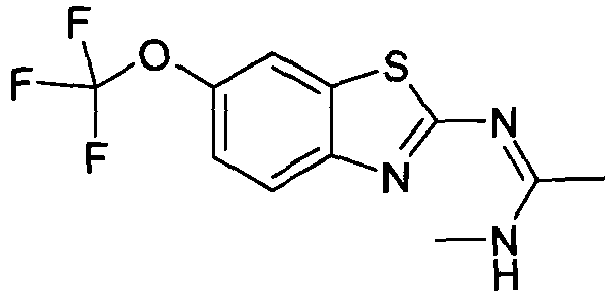 | C11H10F3N3OS | 289.28 | 3 |
 | C11H10F3N3OS. HCl | 325.5 | 4 |
 | C12H12F3N3OS | 303.31 | 5 |
 | C10H8F3N3OS .HCl | 339.84 | 6 |
 | C14H16F3N3OS | 331.36 | 7 |
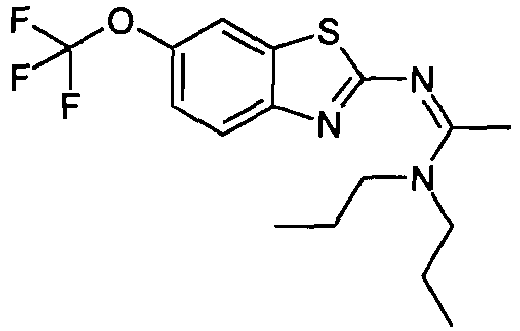 | C16H20F3N3OS | 359.42 | 8 |
 | C11H10F3N3OS2 | 321.35 | 9 |
 | C12H12F3N3OS2 | 335.37 | 10 |
 | C12H12F3N3OS2 | 335.37 | 11 |
 | C13H14F3N3OS2 | 349.40 | 12 |
 | C13H14F3N3OS2 | 349.40 | - |
 | C15H10F3N3OS2 | 369.39 | 13 |
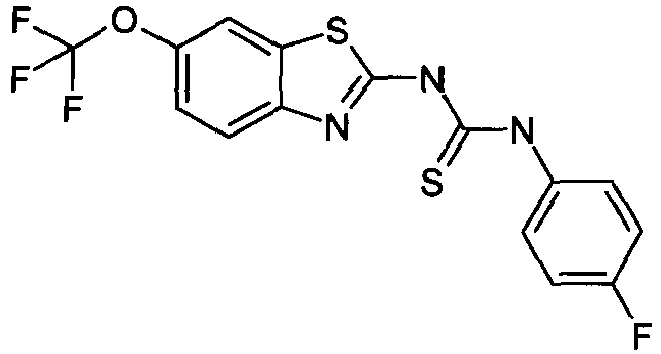 | C15H9F4N3OS2 | 387.38 | 14 |
 | C16H12F3N3OS2 | 383.42 | - |
 | C16H11F4N3OS2 | 401.41 | - |
 | C11H11F3N4OS | 304.30 | 15 |
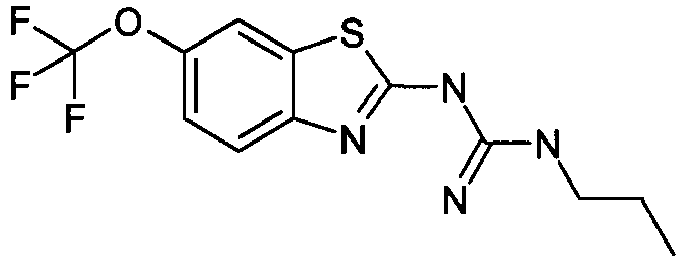 | C12H13F3N4OS | 318.32 | 16 |
 | C11H13N3S | 219.31 | 17 |
 | C12H15N3S | 233.34 | 18 |
 | C14H19N3S | 261.39 | - |
 | C17H17N3S | 295.41 | - |
 | C14H19N3S | 261.39 | 19 |
 | C16H23N3S | 289.45 | 20 |
 | C11H13N3S | 219.31 | 21 |
 | C12H15N3S | 233.34 | 22 |
 | C14H19N3S | 261.39 | 23 |
 | C16H23N3S | 289.45 | 24 |
 | C12H15N3S | 233.34 | - |
 | C17H17N3S | 295.41 | - |
 | C15H18F3N3OS | 345.39 | 25 |
 | C17H22F3N3OS | 373.44 | 26 |
 | C15H18F3N3OS | 345.39 | 27 |
 | C17H22F3N3OS | 373.44 | 28 |
 | C11H13N3S2 | 251.37 | 29 |
 | C12H15N3S2 | 265.40 | 30 |
 | C12H12F3N3OS2 | 335.37 | 31 |
 | C13H14F3N3OS2 | 349.40 | 32 |
 | C12H12F3N3OS2 | 335.37 | 33 |
 | C13H14F3N3OS2 | 349.40 | 34 |
 | C9H10N4S | 206.27 | - |
 | C10H12N4S | 220.30 | - |
 | C9H10N4S | 206.27 | - |
 | C10H12N4S | 220.30 | - |
Claims (7)
- A compound selected from the group consisting of:N'-[6-(trifluoromethoxy)benzothiazol-2-yl]acetamidineN'- [6-(trifluoromethoxy)benzothiazol-2-yl] acetamidine hydrochlorideN-methyl-N'-[6-(trifiuoromethoxy)benzothiazol-2-yl]acetamidineN-methyl-N'-[6-(tiifluoromethoxy)benzothiazol-2-yl]acetamidine hydrochlorideN,N-dimethyl-N'-[6-(trifluoromethoxy)benzothiazol-2-yl] acetamidineN,N-dimethyl-N'-[6-(trifluoromethoxy)benzothiazol-2-yl]acetamidine hydrochlorideN,N-diethyl-N'-[6-(trifluoromethoxy)benzothiazol-2-yl]acetamidineN,N-dipropyl-N'-[6-(trifluoromethoxy)benzothiazol-2-yl]acetamidineN'- [6-(trifluoromethyl)benzothiazol-2-yl] acetamidineN'-[6-(methanesulphonyl)benzothiazol-2-yl]acetamidine1 -Methyl-3 - [6-(trifluoromethoxy)benzothiazol-2-yl]thiourea1 -Ethyl-3 -[6-(trifluoromethoxy)benzothiazol-2-yl]thiourea1 -Propyl-3 -[6-(trifluoromethoxy)benzothiazol-2-yl]thiourea1-Isopropyl-3-[6-(trifluoromethoxy)benzothiazol-2-yl]thiourea1-Butyl-3-[6-(trifluoromethoxy)benzothiazol-2-yl] thiourea1-Isobutyl-3-[6-(trifluoromethoxy)benzothiazol-2-yl]thiourea1 -Phenyl-3 -[6-(trifluoromethoxy)benzothiazol-2-yl]thiourea1-(4-fluorophenyl)-3-[6-(trifluoromethoxy)benzothiazol-2-yl]thiourea1-Benzyl-3-[6-(trifluoromethoxy)benzothiazol-2-yl]thiourea1-(4-fluorobenzyl)-3-[6-(trifluoromethoxy)benzothiazol-2-yl]thiourea1-Methyl-3-[6-(trifluoromethyl)benzothiazol-2-yl]thiourea1-Methyl-3-[6-(methanesulphonyl)benzothiazol-2-yl]thiourea1 -Ethyl -3 - [6-(trifluoromethoxy)benzothiazol-2-yl] guanidine1 -Propyl-3 -[6-(trifluoromethoxy)benzothiazol-2-yl]guanidineN'-(4H-3,1-benzothiazin-2-yl)-N-methylacetamidineN'-(4H-3,1-benzothiazin-2-yl)-N,N-dimethylacetamidineN'-(4H-3,1-benzothiazin-2-yl)-N-ethylacetamidineN'-(4H-3,1-benzothiazin-2-yl)-N-benzylacetamidineN,N-diethyl-N'-[6-trifluoromethoxy-(4H-3,1-benzothiazin-2-yl)]-acetamidineN,N-diethyl-N'-[7-trifluoromethoxy-(4H-3,1-benzothiazin-2-yl)]-acetamidineN'-(4H-3,1-benzothiazin-2-yl)-N,N-dipropylacetamidineN,N-dipropyl-N'-[6-trifluoromethoxy-(4H-3,1-benzothiazin-2-yl)]-acetamidineN,N-dipropyl-N'-[7-trifluoromethoxy-(4H-3,1-benzothiazin-2-yl)]-acetamidineN'-(2H-1.4-benzothiazin-3-yl)-N-methylacetamidineN'-(2H-1,4-benzothiazin-3-yl)-N,N-dimethylacetamidineN'-(2H-1.4-benzothiazin-3-yl)-N-ethylacetamidineN'-(2H-1.4-benzothiazin-3-yl)-N-benzylacetamidineN'-(2H-1,4-benzothiazin-3-yl)-N,N-diethylacetamidineN'-(2H-1,4-benzothiazin-3-yl)-N,N-dipropylacetamidine1-(4H-3,1-benzothiazin-2-yl)-3-ethylthiourea1-(4H-3,1-benzothiazin-2-yl)-3-propylthiourea1-Ethyl-3-[6-(trifluoromethoxy)-4H-3,1-benzothiazin-2-yl]thiourea1-Propyl-3-[6-(trifluoromethoxy)-4H-3,1-benzothiazin-2-yl]thiourea1-(2H-1,4-benzothiazin-3-yl)-3-ethylthiourea1-(2H-1,4-benzothiazin-3-yl)-3-propylthiourea1-Ethyl-3-[7-(trifluoromethoxy)-2H-1.4-benzothiazin-3-yl]thiourea(4H-3,1-benzothiazin-2-yl)-guanidine1-Methyl-3-(4H-3,1-benzothiazin-2-yl)-guanidine(2H-1.4-benzothiazin-3-yl)-guanidine1 -Methyl-3 -(2H- 1.4-benzothiazin-3-yl)-guanidine
- A compound according to claim 1 for use as a medicament.
- A compound according to claim 1 for use in the therapeutical treatment of neurodegenerative pathologies or trauma-induced neurodegenerative pathologies.
- A compound according to claim 1 for use in the therapeutical treatment of the pathologies of cerebral ischemia.
- A compound according to claim 1 for use in the therapeutical treatment of a pathology selected from the group consisting of Alzheimer's disease, Parkinson's disease, Multiple Sclerosis and Amyotrophic Lateral Sclerosis.
- An oral pharmaceutical formulation including at least one of the compounds according to claim 1 as active ingredient, and at least one component selected from: carriers, binders, sweeteners and disaggregants commonly used in pharmaceutical formulations, or components that may aid absorption or allow controlled release of the drug as a function of time and/or gastrointestinal pH, as additional ingredients.
- A parenteral pharmaceutical formulation including at least one of the compounds according to claim 1 as active ingredient, and at least one component selected from aqueous carriers, particularly saline or dextrose solutions, or oily emulsions, as additional ingredients.
Applications Claiming Priority (2)
| Application Number | Priority Date | Filing Date | Title |
|---|---|---|---|
| IT000665A ITTO20070665A1 (en) | 2007-09-24 | 2007-09-24 | AMIDINE, TIOUREIC AND GUANIDINE DERIVATIVES OF 2-AMMINOBENZOTIAZOLI AND AMMINOBENZOTIAZINE, NEW PHARMACOLOGICAL AGENTS FOR THE TREATMENT OF NEURODEGENERATIVE PATHOLOGIES. |
| PCT/EP2008/062636 WO2009040331A2 (en) | 2007-09-24 | 2008-09-22 | Amidine, thiourea and guanidine derivatives of 2-aminobenzothiazoles and aminobenzothiazines for their use as pharmacological agents for the treatment of neurodegenerative pathologies |
Publications (2)
| Publication Number | Publication Date |
|---|---|
| EP2190829A2 EP2190829A2 (en) | 2010-06-02 |
| EP2190829B1 true EP2190829B1 (en) | 2016-08-17 |
Family
ID=40316609
Family Applications (1)
| Application Number | Title | Priority Date | Filing Date |
|---|---|---|---|
| EP08804562.0A Not-in-force EP2190829B1 (en) | 2007-09-24 | 2008-09-22 | Amidine, thiourea and guanidine derivatives of 2-aminobenzothiazoles and aminobenzothiazines for their use as pharmacological agents for the treatment of neurodegenerative pathologies |
Country Status (5)
| Country | Link |
|---|---|
| US (1) | US8420634B2 (en) |
| EP (1) | EP2190829B1 (en) |
| CA (1) | CA2700584C (en) |
| IT (1) | ITTO20070665A1 (en) |
| WO (1) | WO2009040331A2 (en) |
Families Citing this family (14)
| Publication number | Priority date | Publication date | Assignee | Title |
|---|---|---|---|---|
| AR077277A1 (en) * | 2009-07-09 | 2011-08-17 | Lilly Co Eli | BICYCLE COMPOUNDS (1,3) TIAZIN-2-AMINA PHARMACEUTICAL FORMULATION THAT INCLUDES IT AND ITS USE FOR THE MANUFACTURE OF A USEFUL MEDICINAL PRODUCT FOR THE TREATMENT OF ALZHEIMER'S DISEASE |
| EP2284161A1 (en) * | 2009-07-21 | 2011-02-16 | Edmond Pharma S.R.L. | Process for the preparation of riluzole |
| WO2016039750A1 (en) | 2014-09-11 | 2016-03-17 | Halliburton Energy Services, Inc. | Cyanamide-based carbon dioxide and/or hydrogen sulfide scavengers and methods of use in subterranean operations |
| KR102279993B1 (en) | 2015-09-23 | 2021-07-21 | 엑스더블유파마 리미티드 | Precursors of gamma-hydroxybutyric acid and compositions and uses thereof |
| BR112019020464A2 (en) | 2017-03-30 | 2020-04-28 | Xw Laboratories Inc. | compounds derived from bicyclic heteroaryl, pharmaceutical composition comprising said compounds, transdermal patch comprising said composition and therapeutic use of the compounds and composition |
| EP3856719B1 (en) | 2018-09-30 | 2023-06-07 | XWPharma Ltd. | Compounds as neuronal histamine receptor-3 antagonists and uses thereof |
| TW202547822A (en) | 2019-12-20 | 2025-12-16 | 香港商凱瑞康寧有限公司 | Methods of synthesizing 4-valyloxybutyric acid |
| EP4167971A1 (en) | 2020-06-18 | 2023-04-26 | XWPharma Ltd. | Controlled release granulations of water-soluble active pharmaceutical ingredients |
| EP4167966A1 (en) | 2020-06-18 | 2023-04-26 | XWPharma Ltd. | Pharmaceutical granulations of water-soluble active pharmaceutical ingredients |
| WO2022020621A1 (en) | 2020-07-24 | 2022-01-27 | XWPharma Ltd. | Pharmaceutical compositions and pharmacokinetics of a gamma-hydroxybutyric acid derivative |
| CN114249672B (en) * | 2020-09-25 | 2024-04-19 | 鲁南制药集团股份有限公司 | Riluzole intermediate compound |
| CN119970650A (en) | 2020-10-05 | 2025-05-13 | 凯瑞康宁生物工程有限公司 | Modified release compositions of gamma-hydroxybutyric acid derivatives |
| EP4308086B1 (en) | 2021-03-19 | 2025-10-15 | XWPharma Ltd. | Pharmacokinetics of combined release formulations of a gamma-hydroxybutyric acid derivative |
| CN121378238B (en) * | 2025-12-23 | 2026-03-31 | 蚌埠医科大学 | An arylalkylazole derivative, its preparation method and application |
Family Cites Families (2)
| Publication number | Priority date | Publication date | Assignee | Title |
|---|---|---|---|---|
| JPS643172A (en) | 1987-06-24 | 1989-01-06 | Fujisawa Pharmaceut Co Ltd | Cycloheptimidazole derivative |
| FR2879201B1 (en) * | 2004-12-10 | 2007-02-16 | Servier Lab | NOVEL BENZOTHIAZINE AND BENZOTHIADIAZINE DERIVATIVES, PROCESS FOR PREPARING THEM AND PHARMACEUTICAL COMPOSITIONS CONTAINING SAME |
-
2007
- 2007-09-24 IT IT000665A patent/ITTO20070665A1/en unknown
-
2008
- 2008-09-22 EP EP08804562.0A patent/EP2190829B1/en not_active Not-in-force
- 2008-09-22 CA CA2700584A patent/CA2700584C/en not_active Expired - Fee Related
- 2008-09-22 WO PCT/EP2008/062636 patent/WO2009040331A2/en not_active Ceased
- 2008-09-22 US US12/679,620 patent/US8420634B2/en not_active Expired - Fee Related
Non-Patent Citations (1)
| Title |
|---|
| None * |
Also Published As
| Publication number | Publication date |
|---|---|
| US20100197670A1 (en) | 2010-08-05 |
| WO2009040331A2 (en) | 2009-04-02 |
| CA2700584C (en) | 2013-04-02 |
| WO2009040331A3 (en) | 2009-06-04 |
| US8420634B2 (en) | 2013-04-16 |
| EP2190829A2 (en) | 2010-06-02 |
| CA2700584A1 (en) | 2009-04-02 |
| ITTO20070665A1 (en) | 2009-03-25 |
Similar Documents
| Publication | Publication Date | Title |
|---|---|---|
| US8420634B2 (en) | Amidine, thiourea and guanidine derivatives of 2-aminobenzothiazoles and aminobenzothiazines for their use as pharmacological agents for the treatment of neurodegenerative pathologies | |
| US20240067600A1 (en) | SMALL MOLECULE INHIBITORS OF THE MITOCHONDRIAL PERMEABILITY TRANSITION PORE (mtPTP) | |
| ES2565229T3 (en) | 2-amino-4- (pyridin-2-yl) -5,6-dihydro-4H-1,3-oxazine derivatives and their use as inhibitors of BACE-1 and / or BACE-2 | |
| AU2011249859B2 (en) | Methods and compositions for inhibition of the transitional endoplasmic reticulum ATPase | |
| CH620925A5 (en) | ||
| FR2823209A1 (en) | NEW THIOHYDANTOINS AND THEIR USE IN THERAPEUTICS | |
| WO1994014780A1 (en) | Pyrimidine, pyridine, pteridinone and indazole derivatives as enzyme inhibitors | |
| SK48593A3 (en) | Process for preparing piperazinyl-heterocyclic compounds | |
| EP3348550B1 (en) | Substituted benzothiazoles and therapeutic uses thereof for the treatment of human diseases | |
| Mali et al. | Synthesis of some antifungal and anti-tubercular 1, 2, 4-triazole analogues | |
| CA3149989A1 (en) | Methods of treating epilepsy using the same | |
| EP2744787B1 (en) | Quinazolinone analogs and use of quinazolinone analogs for treating or preventing certain viral infections | |
| CN107848992B (en) | Method for chemically synthesizing substituted 10H-phenothiazine-3, 7-diamine compound | |
| EP1149106B1 (en) | 4,5-azolo-oxindoles | |
| US20030040524A1 (en) | Pyrimidine compounds and methods for making and using the same | |
| EP4169905A1 (en) | Novel fused heterocyclic carbonohydrazonoyl dicyanide compound and use thereof | |
| HUT58693A (en) | Process for preparation of substances having pharmaceutical effectivity | |
| KR102457316B1 (en) | Novel type 5 phosphodiesterase inhibitors and uses thereof | |
| KR20010109526A (en) | Preventive or therapeutic drugs for various eosinophilia-related diseases containing chymase inhibitors as the active ingredient | |
| DeStevens et al. | Heterocyclic Disulphonamides and their diuretic Properties | |
| EP3178810A1 (en) | Condensed heterocyclic compound | |
| US6117867A (en) | Substituted 6-R-1,3,4-thiadiazine-2-amines, the use thereof as anaesthetizing, cardiovascular and hypometabolic agents, and a pharmaceutical composition containing them | |
| RU2157808C2 (en) | Substituted 6r-1,3,4-thiadiazine-2-amines and pharmaceutical composition thereof | |
| El-Sayed et al. | synthesis and antimicrobial evaluation of some new pyrazolo [1, 5-a] pyrimidine and pyrazolo [1, 5-a] quinazoline derivatives bearing sulfathiazole nucleus | |
| WO2007047432A1 (en) | Sulfonamide derivatives as modulators of ppar |
Legal Events
| Date | Code | Title | Description |
|---|---|---|---|
| PUAI | Public reference made under article 153(3) epc to a published international application that has entered the european phase |
Free format text: ORIGINAL CODE: 0009012 |
|
| 17P | Request for examination filed |
Effective date: 20100319 |
|
| AK | Designated contracting states |
Kind code of ref document: A2 Designated state(s): AT BE BG CH CY CZ DE DK EE ES FI FR GB GR HR HU IE IS IT LI LT LU LV MC MT NL NO PL PT RO SE SI SK TR |
|
| AX | Request for extension of the european patent |
Extension state: AL BA MK RS |
|
| DAX | Request for extension of the european patent (deleted) | ||
| 17Q | First examination report despatched |
Effective date: 20131205 |
|
| RAP1 | Party data changed (applicant data changed or rights of an application transferred) |
Owner name: ROTTAPHARM BIOTECH S.R.L. |
|
| GRAP | Despatch of communication of intention to grant a patent |
Free format text: ORIGINAL CODE: EPIDOSNIGR1 |
|
| INTG | Intention to grant announced |
Effective date: 20160208 |
|
| GRAS | Grant fee paid |
Free format text: ORIGINAL CODE: EPIDOSNIGR3 |
|
| GRAR | Information related to intention to grant a patent recorded |
Free format text: ORIGINAL CODE: EPIDOSNIGR71 |
|
| GRAA | (expected) grant |
Free format text: ORIGINAL CODE: 0009210 |
|
| RIN1 | Information on inventor provided before grant (corrected) |
Inventor name: VOMERO, SALVATORE Inventor name: CAPPELLI, ANDREA Inventor name: ANZINI, MAURIZIO Inventor name: MAKOVEC, FRANCESCO Inventor name: CASELLI, GIANFRANCO Inventor name: GIORDANI, ANTONIO Inventor name: ROVATI, LUCIO CLAUDIO |
|
| RAP1 | Party data changed (applicant data changed or rights of an application transferred) |
Owner name: ROTTAPHARM BIOTECH S.R.L. |
|
| AK | Designated contracting states |
Kind code of ref document: B1 Designated state(s): AT BE BG CH CY CZ DE DK EE ES FI FR GB GR HR HU IE IS IT LI LT LU LV MC MT NL NO PL PT RO SE SI SK TR |
|
| INTG | Intention to grant announced |
Effective date: 20160711 |
|
| REG | Reference to a national code |
Ref country code: GB Ref legal event code: FG4D |
|
| REG | Reference to a national code |
Ref country code: CH Ref legal event code: EP |
|
| REG | Reference to a national code |
Ref country code: IE Ref legal event code: FG4D |
|
| REG | Reference to a national code |
Ref country code: AT Ref legal event code: REF Ref document number: 820935 Country of ref document: AT Kind code of ref document: T Effective date: 20160915 Ref country code: CH Ref legal event code: NV Representative=s name: JACOBACCI AND PARTNERS SA, CH |
|
| REG | Reference to a national code |
Ref country code: DE Ref legal event code: R096 Ref document number: 602008045760 Country of ref document: DE |
|
| REG | Reference to a national code |
Ref country code: NL Ref legal event code: MP Effective date: 20160817 |
|
| REG | Reference to a national code |
Ref country code: LT Ref legal event code: MG4D |
|
| REG | Reference to a national code |
Ref country code: AT Ref legal event code: MK05 Ref document number: 820935 Country of ref document: AT Kind code of ref document: T Effective date: 20160817 |
|
| PG25 | Lapsed in a contracting state [announced via postgrant information from national office to epo] |
Ref country code: NO Free format text: LAPSE BECAUSE OF FAILURE TO SUBMIT A TRANSLATION OF THE DESCRIPTION OR TO PAY THE FEE WITHIN THE PRESCRIBED TIME-LIMIT Effective date: 20161117 Ref country code: FI Free format text: LAPSE BECAUSE OF FAILURE TO SUBMIT A TRANSLATION OF THE DESCRIPTION OR TO PAY THE FEE WITHIN THE PRESCRIBED TIME-LIMIT Effective date: 20160817 Ref country code: HR Free format text: LAPSE BECAUSE OF FAILURE TO SUBMIT A TRANSLATION OF THE DESCRIPTION OR TO PAY THE FEE WITHIN THE PRESCRIBED TIME-LIMIT Effective date: 20160817 Ref country code: LT Free format text: LAPSE BECAUSE OF FAILURE TO SUBMIT A TRANSLATION OF THE DESCRIPTION OR TO PAY THE FEE WITHIN THE PRESCRIBED TIME-LIMIT Effective date: 20160817 Ref country code: IT Free format text: LAPSE BECAUSE OF FAILURE TO SUBMIT A TRANSLATION OF THE DESCRIPTION OR TO PAY THE FEE WITHIN THE PRESCRIBED TIME-LIMIT Effective date: 20160817 Ref country code: NL Free format text: LAPSE BECAUSE OF FAILURE TO SUBMIT A TRANSLATION OF THE DESCRIPTION OR TO PAY THE FEE WITHIN THE PRESCRIBED TIME-LIMIT Effective date: 20160817 |
|
| PG25 | Lapsed in a contracting state [announced via postgrant information from national office to epo] |
Ref country code: LV Free format text: LAPSE BECAUSE OF FAILURE TO SUBMIT A TRANSLATION OF THE DESCRIPTION OR TO PAY THE FEE WITHIN THE PRESCRIBED TIME-LIMIT Effective date: 20160817 Ref country code: AT Free format text: LAPSE BECAUSE OF FAILURE TO SUBMIT A TRANSLATION OF THE DESCRIPTION OR TO PAY THE FEE WITHIN THE PRESCRIBED TIME-LIMIT Effective date: 20160817 Ref country code: ES Free format text: LAPSE BECAUSE OF FAILURE TO SUBMIT A TRANSLATION OF THE DESCRIPTION OR TO PAY THE FEE WITHIN THE PRESCRIBED TIME-LIMIT Effective date: 20160817 Ref country code: GR Free format text: LAPSE BECAUSE OF FAILURE TO SUBMIT A TRANSLATION OF THE DESCRIPTION OR TO PAY THE FEE WITHIN THE PRESCRIBED TIME-LIMIT Effective date: 20161118 Ref country code: PL Free format text: LAPSE BECAUSE OF FAILURE TO SUBMIT A TRANSLATION OF THE DESCRIPTION OR TO PAY THE FEE WITHIN THE PRESCRIBED TIME-LIMIT Effective date: 20160817 Ref country code: SE Free format text: LAPSE BECAUSE OF FAILURE TO SUBMIT A TRANSLATION OF THE DESCRIPTION OR TO PAY THE FEE WITHIN THE PRESCRIBED TIME-LIMIT Effective date: 20160817 Ref country code: PT Free format text: LAPSE BECAUSE OF FAILURE TO SUBMIT A TRANSLATION OF THE DESCRIPTION OR TO PAY THE FEE WITHIN THE PRESCRIBED TIME-LIMIT Effective date: 20161219 Ref country code: BE Free format text: LAPSE BECAUSE OF NON-PAYMENT OF DUE FEES Effective date: 20160930 |
|
| REG | Reference to a national code |
Ref country code: DE Ref legal event code: R119 Ref document number: 602008045760 Country of ref document: DE |
|
| PG25 | Lapsed in a contracting state [announced via postgrant information from national office to epo] |
Ref country code: RO Free format text: LAPSE BECAUSE OF FAILURE TO SUBMIT A TRANSLATION OF THE DESCRIPTION OR TO PAY THE FEE WITHIN THE PRESCRIBED TIME-LIMIT Effective date: 20160817 Ref country code: EE Free format text: LAPSE BECAUSE OF FAILURE TO SUBMIT A TRANSLATION OF THE DESCRIPTION OR TO PAY THE FEE WITHIN THE PRESCRIBED TIME-LIMIT Effective date: 20160817 |
|
| REG | Reference to a national code |
Ref country code: CH Ref legal event code: PL |
|
| PG25 | Lapsed in a contracting state [announced via postgrant information from national office to epo] |
Ref country code: BG Free format text: LAPSE BECAUSE OF FAILURE TO SUBMIT A TRANSLATION OF THE DESCRIPTION OR TO PAY THE FEE WITHIN THE PRESCRIBED TIME-LIMIT Effective date: 20161117 Ref country code: CZ Free format text: LAPSE BECAUSE OF FAILURE TO SUBMIT A TRANSLATION OF THE DESCRIPTION OR TO PAY THE FEE WITHIN THE PRESCRIBED TIME-LIMIT Effective date: 20160817 Ref country code: SK Free format text: LAPSE BECAUSE OF FAILURE TO SUBMIT A TRANSLATION OF THE DESCRIPTION OR TO PAY THE FEE WITHIN THE PRESCRIBED TIME-LIMIT Effective date: 20160817 Ref country code: DK Free format text: LAPSE BECAUSE OF FAILURE TO SUBMIT A TRANSLATION OF THE DESCRIPTION OR TO PAY THE FEE WITHIN THE PRESCRIBED TIME-LIMIT Effective date: 20160817 Ref country code: BE Free format text: LAPSE BECAUSE OF FAILURE TO SUBMIT A TRANSLATION OF THE DESCRIPTION OR TO PAY THE FEE WITHIN THE PRESCRIBED TIME-LIMIT Effective date: 20160817 |
|
| PLBE | No opposition filed within time limit |
Free format text: ORIGINAL CODE: 0009261 |
|
| STAA | Information on the status of an ep patent application or granted ep patent |
Free format text: STATUS: NO OPPOSITION FILED WITHIN TIME LIMIT |
|
| REG | Reference to a national code |
Ref country code: IE Ref legal event code: MM4A |
|
| PG25 | Lapsed in a contracting state [announced via postgrant information from national office to epo] |
Ref country code: MC Free format text: LAPSE BECAUSE OF FAILURE TO SUBMIT A TRANSLATION OF THE DESCRIPTION OR TO PAY THE FEE WITHIN THE PRESCRIBED TIME-LIMIT Effective date: 20160817 |
|
| REG | Reference to a national code |
Ref country code: FR Ref legal event code: ST Effective date: 20170531 |
|
| 26N | No opposition filed |
Effective date: 20170518 |
|
| GBPC | Gb: european patent ceased through non-payment of renewal fee |
Effective date: 20161117 |
|
| PG25 | Lapsed in a contracting state [announced via postgrant information from national office to epo] |
Ref country code: IE Free format text: LAPSE BECAUSE OF NON-PAYMENT OF DUE FEES Effective date: 20160922 Ref country code: CH Free format text: LAPSE BECAUSE OF NON-PAYMENT OF DUE FEES Effective date: 20160930 Ref country code: LI Free format text: LAPSE BECAUSE OF NON-PAYMENT OF DUE FEES Effective date: 20160930 Ref country code: FR Free format text: LAPSE BECAUSE OF NON-PAYMENT OF DUE FEES Effective date: 20161017 Ref country code: DE Free format text: LAPSE BECAUSE OF NON-PAYMENT OF DUE FEES Effective date: 20170401 |
|
| PG25 | Lapsed in a contracting state [announced via postgrant information from national office to epo] |
Ref country code: SI Free format text: LAPSE BECAUSE OF FAILURE TO SUBMIT A TRANSLATION OF THE DESCRIPTION OR TO PAY THE FEE WITHIN THE PRESCRIBED TIME-LIMIT Effective date: 20160817 Ref country code: LU Free format text: LAPSE BECAUSE OF NON-PAYMENT OF DUE FEES Effective date: 20160922 |
|
| PG25 | Lapsed in a contracting state [announced via postgrant information from national office to epo] |
Ref country code: GB Free format text: LAPSE BECAUSE OF NON-PAYMENT OF DUE FEES Effective date: 20161117 |
|
| PG25 | Lapsed in a contracting state [announced via postgrant information from national office to epo] |
Ref country code: HU Free format text: LAPSE BECAUSE OF FAILURE TO SUBMIT A TRANSLATION OF THE DESCRIPTION OR TO PAY THE FEE WITHIN THE PRESCRIBED TIME-LIMIT; INVALID AB INITIO Effective date: 20080922 Ref country code: CY Free format text: LAPSE BECAUSE OF FAILURE TO SUBMIT A TRANSLATION OF THE DESCRIPTION OR TO PAY THE FEE WITHIN THE PRESCRIBED TIME-LIMIT Effective date: 20160817 |
|
| PG25 | Lapsed in a contracting state [announced via postgrant information from national office to epo] |
Ref country code: IS Free format text: LAPSE BECAUSE OF FAILURE TO SUBMIT A TRANSLATION OF THE DESCRIPTION OR TO PAY THE FEE WITHIN THE PRESCRIBED TIME-LIMIT Effective date: 20160817 Ref country code: MT Free format text: LAPSE BECAUSE OF NON-PAYMENT OF DUE FEES Effective date: 20160930 Ref country code: TR Free format text: LAPSE BECAUSE OF FAILURE TO SUBMIT A TRANSLATION OF THE DESCRIPTION OR TO PAY THE FEE WITHIN THE PRESCRIBED TIME-LIMIT Effective date: 20160817 |