EP2186782A1 - Methods for the purification of radiolabelled products using a solid-support scavanger - Google Patents
Methods for the purification of radiolabelled products using a solid-support scavanger Download PDFInfo
- Publication number
- EP2186782A1 EP2186782A1 EP10154091A EP10154091A EP2186782A1 EP 2186782 A1 EP2186782 A1 EP 2186782A1 EP 10154091 A EP10154091 A EP 10154091A EP 10154091 A EP10154091 A EP 10154091A EP 2186782 A1 EP2186782 A1 EP 2186782A1
- Authority
- EP
- European Patent Office
- Prior art keywords
- formula
- iii
- radiolabelled
- compound
- radiolabelled product
- Prior art date
- Legal status (The legal status is an assumption and is not a legal conclusion. Google has not performed a legal analysis and makes no representation as to the accuracy of the status listed.)
- Granted
Links
- 238000000034 method Methods 0.000 title claims abstract description 28
- 238000000746 purification Methods 0.000 title abstract description 19
- 239000002516 radical scavenger Substances 0.000 claims abstract description 30
- 150000001875 compounds Chemical class 0.000 claims description 76
- 239000002243 precursor Substances 0.000 claims description 25
- 239000000203 mixture Substances 0.000 claims description 17
- 125000000524 functional group Chemical group 0.000 claims description 16
- 238000000163 radioactive labelling Methods 0.000 claims description 11
- 239000003795 chemical substances by application Substances 0.000 claims description 10
- 150000002576 ketones Chemical group 0.000 claims description 10
- 238000000926 separation method Methods 0.000 claims description 10
- OAKJQQAXSVQMHS-UHFFFAOYSA-N Hydrazine Chemical compound NN OAKJQQAXSVQMHS-UHFFFAOYSA-N 0.000 claims description 9
- 150000001299 aldehydes Chemical class 0.000 claims description 9
- IOJUPLGTWVMSFF-UHFFFAOYSA-N benzothiazole Chemical compound C1=CC=C2SC=NC2=C1 IOJUPLGTWVMSFF-UHFFFAOYSA-N 0.000 claims description 8
- 239000007787 solid Substances 0.000 claims description 8
- 239000001257 hydrogen Substances 0.000 claims description 5
- 229910052739 hydrogen Inorganic materials 0.000 claims description 5
- 108090000765 processed proteins & peptides Proteins 0.000 claims description 5
- VYFYYTLLBUKUHU-UHFFFAOYSA-N dopamine Chemical compound NCCC1=CC=C(O)C(O)=C1 VYFYYTLLBUKUHU-UHFFFAOYSA-N 0.000 claims description 4
- UXCAQJAQSWSNPQ-XLPZGREQSA-N Alovudine Chemical compound O=C1NC(=O)C(C)=CN1[C@@H]1O[C@H](CO)[C@@H](F)C1 UXCAQJAQSWSNPQ-XLPZGREQSA-N 0.000 claims description 3
- IYMAXBFPHPZYIK-BQBZGAKWSA-N Arg-Gly-Asp Chemical compound NC(N)=NCCC[C@H](N)C(=O)NCC(=O)N[C@@H](CC(O)=O)C(O)=O IYMAXBFPHPZYIK-BQBZGAKWSA-N 0.000 claims description 3
- ZAAIDSUTINZDTL-UHFFFAOYSA-N O-(N-aminoanilino)hydroxylamine Chemical class NON(N)C1=CC=CC=C1 ZAAIDSUTINZDTL-UHFFFAOYSA-N 0.000 claims description 3
- 125000005179 haloacetyl group Chemical group 0.000 claims description 3
- BRWIZMBXBAOCCF-UHFFFAOYSA-N hydrazinecarbothioamide Chemical compound NNC(N)=S BRWIZMBXBAOCCF-UHFFFAOYSA-N 0.000 claims description 3
- DUIOPKIIICUYRZ-UHFFFAOYSA-N semicarbazide Chemical compound NNC(N)=O DUIOPKIIICUYRZ-UHFFFAOYSA-N 0.000 claims description 3
- SKQGYVVSNIKYTF-MQZRJZDTSA-N (1R,5R)-1-(18F)fluoranyl-8-methyl-8-azabicyclo[3.2.1]octane Chemical compound [18F][C@]12CCC[C@H](CC1)N2C SKQGYVVSNIKYTF-MQZRJZDTSA-N 0.000 claims description 2
- LSSQMISUDUUZCC-DWSYCVKZSA-N (2,5-dioxopyrrolidin-1-yl) 4-fluoranylbenzoate Chemical compound C1=CC([18F])=CC=C1C(=O)ON1C(=O)CCC1=O LSSQMISUDUUZCC-DWSYCVKZSA-N 0.000 claims description 2
- CWJVOJLSSAJVAZ-ULMHTEDTSA-N (2S)-2-(fluoranylamino)-3-(4-hydroxyphenyl)propanoic acid Chemical compound [18F]N[C@@H](CC1=CC=C(C=C1)O)C(=O)O CWJVOJLSSAJVAZ-ULMHTEDTSA-N 0.000 claims description 2
- XILNRORTJVDYRH-GQNWDAJUSA-N (2s,3s)-n-[[2-methoxy-5-[5-(trifluoromethyl)tetrazol-1-yl]phenyl]methyl]-2-phenylpiperidin-3-amine Chemical compound C1([C@@H]2NCCC[C@@H]2NCC2=CC(=CC=C2O[11CH3])N2C(=NN=N2)C(F)(F)F)=CC=CC=C1 XILNRORTJVDYRH-GQNWDAJUSA-N 0.000 claims description 2
- DEQANNDTNATYII-OULOTJBUSA-N (4r,7s,10s,13r,16s,19r)-10-(4-aminobutyl)-19-[[(2r)-2-amino-3-phenylpropanoyl]amino]-16-benzyl-n-[(2r,3r)-1,3-dihydroxybutan-2-yl]-7-[(1r)-1-hydroxyethyl]-13-(1h-indol-3-ylmethyl)-6,9,12,15,18-pentaoxo-1,2-dithia-5,8,11,14,17-pentazacycloicosane-4-carboxa Chemical compound C([C@@H](N)C(=O)N[C@H]1CSSC[C@H](NC(=O)[C@H]([C@@H](C)O)NC(=O)[C@H](CCCCN)NC(=O)[C@@H](CC=2C3=CC=CC=C3NC=2)NC(=O)[C@H](CC=2C=CC=CC=2)NC1=O)C(=O)N[C@H](CO)[C@H](O)C)C1=CC=CC=C1 DEQANNDTNATYII-OULOTJBUSA-N 0.000 claims description 2
- GOTMKOSCLKVOGG-RHHLBCDKSA-N (5r)-8-chloro-3-methyl-5-phenyl-1,2,4,5-tetrahydro-3-benzazepin-7-ol Chemical compound C1([C@@H]2C3=CC(O)=C(Cl)C=C3CCN(C2)[11CH3])=CC=CC=C1 GOTMKOSCLKVOGG-RHHLBCDKSA-N 0.000 claims description 2
- RUSANBIFMAXXSJ-XNJXNPSASA-N (5s)-5-(1-benzofuran-7-yl)-8-chloro-3-methyl-1,2,4,5-tetrahydro-3-benzazepin-7-ol Chemical compound C1N([11CH3])CCC2=CC(Cl)=C(O)C=C2[C@H]1C1=CC=CC2=C1OC=C2 RUSANBIFMAXXSJ-XNJXNPSASA-N 0.000 claims description 2
- DMJWENQHWZZWDF-PKOBYXMFSA-N (6aS,13bR)-11-chloro-7-methyl-5,6,6a,8,9,13b-hexahydronaphtho[1,2-a][3]benzazepin-12-ol Chemical compound CN1CCC2=CC(Cl)=C(O)C=C2[C@H]2C3=CC=CC=C3CC[C@H]12 DMJWENQHWZZWDF-PKOBYXMFSA-N 0.000 claims description 2
- HXTGXYRHXAGCFP-AVUPQLEMSA-N (r)-[2,3-di(methoxy)phenyl]-[1-[2-(4-fluorophenyl)ethyl]piperidin-4-yl]methanol Chemical compound COC1=C(O[11CH3])C=CC=C1[C@H](O)C1CCN(CCC=2C=CC(F)=CC=2)CC1 HXTGXYRHXAGCFP-AVUPQLEMSA-N 0.000 claims description 2
- YGQGSFYHTVQQPZ-COJKEBBMSA-N 1-fluoranyl-4-(2-nitroimidazol-1-yl)butane-2,3-diol Chemical compound [18F]CC(O)C(O)CN1C=CN=C1[N+]([O-])=O YGQGSFYHTVQQPZ-COJKEBBMSA-N 0.000 claims description 2
- AOYNUTHNTBLRMT-SLPGGIOYSA-N 2-deoxy-2-fluoro-aldehydo-D-glucose Chemical compound OC[C@@H](O)[C@@H](O)[C@H](O)[C@@H](F)C=O AOYNUTHNTBLRMT-SLPGGIOYSA-N 0.000 claims description 2
- WAOQONBSWFLFPE-TXWZUYSVSA-N 3,5-dichloro-n-[[(2s)-1-ethylpyrrolidin-2-yl]methyl]-2-hydroxy-6-methoxybenzamide Chemical compound CCN1CCC[C@H]1CNC(=O)C1=C(O)C(Cl)=CC(Cl)=C1O[11CH3] WAOQONBSWFLFPE-TXWZUYSVSA-N 0.000 claims description 2
- QAECXZXKVURFMR-LBPRGKRZSA-N 5-bromo-n-[[(2s)-1-ethylpyrrolidin-2-yl]methyl]-2,3-dimethoxybenzamide Chemical compound CCN1CCC[C@H]1CNC(=O)C1=CC(Br)=CC(OC)=C1OC QAECXZXKVURFMR-LBPRGKRZSA-N 0.000 claims description 2
- GHASVSINZRGABV-SFIIULIVSA-N 5-fluoranyl-1h-pyrimidine-2,4-dione Chemical compound [18F]C1=CNC(=O)NC1=O GHASVSINZRGABV-SFIIULIVSA-N 0.000 claims description 2
- LDCYZAJDBXYCGN-VIFPVBQESA-N 5-hydroxy-L-tryptophan Chemical compound C1=C(O)C=C2C(C[C@H](N)C(O)=O)=CNC2=C1 LDCYZAJDBXYCGN-VIFPVBQESA-N 0.000 claims description 2
- 229940000681 5-hydroxytryptophan Drugs 0.000 claims description 2
- XRECTZIEBJDKEO-SFIIULIVSA-N 6-amino-5-fluoranyl-1h-pyrimidin-2-one Chemical compound NC=1NC(=O)N=CC=1[18F] XRECTZIEBJDKEO-SFIIULIVSA-N 0.000 claims description 2
- PAXWQORCRCBOCU-LURJTMIESA-N 6-fluoro-L-dopa Chemical compound OC(=O)[C@@H](N)CC1=CC(O)=C(O)C=C1F PAXWQORCRCBOCU-LURJTMIESA-N 0.000 claims description 2
- AEULVFLPCJOBCE-BJUDXGSMSA-N 63k7wdr6rx Chemical compound C1=CC(O[11CH3])=CC=C1CCCN1C(N=C(N)N2C3=NC(=N2)C=2OC=CC=2)=C3C=N1 AEULVFLPCJOBCE-BJUDXGSMSA-N 0.000 claims description 2
- DGGKXQQCVPAUEA-UHFFFAOYSA-N 8-azabicyclo[3.2.1]octane Chemical compound C1CCC2CCC1N2 DGGKXQQCVPAUEA-UHFFFAOYSA-N 0.000 claims description 2
- 108010064733 Angiotensins Proteins 0.000 claims description 2
- 102000015427 Angiotensins Human genes 0.000 claims description 2
- 108010051479 Bombesin Proteins 0.000 claims description 2
- 102000013585 Bombesin Human genes 0.000 claims description 2
- 108010075254 C-Peptide Proteins 0.000 claims description 2
- 102000002045 Endothelin Human genes 0.000 claims description 2
- 108050009340 Endothelin Proteins 0.000 claims description 2
- WTDRDQBEARUVNC-LURJTMIESA-N L-DOPA Chemical compound OC(=O)[C@@H](N)CC1=CC=C(O)C(O)=C1 WTDRDQBEARUVNC-LURJTMIESA-N 0.000 claims description 2
- WTDRDQBEARUVNC-UHFFFAOYSA-N L-Dopa Natural products OC(=O)C(N)CC1=CC=C(O)C(O)=C1 WTDRDQBEARUVNC-UHFFFAOYSA-N 0.000 claims description 2
- 101800001751 Melanocyte-stimulating hormone alpha Proteins 0.000 claims description 2
- 102000050267 Neurotensin Human genes 0.000 claims description 2
- 101800001814 Neurotensin Proteins 0.000 claims description 2
- 108010016076 Octreotide Proteins 0.000 claims description 2
- 102100027467 Pro-opiomelanocortin Human genes 0.000 claims description 2
- NINIDFKCEFEMDL-UHFFFAOYSA-N Sulfur Chemical group [S] NINIDFKCEFEMDL-UHFFFAOYSA-N 0.000 claims description 2
- 108010003205 Vasoactive Intestinal Peptide Proteins 0.000 claims description 2
- 102000055135 Vasoactive Intestinal Peptide Human genes 0.000 claims description 2
- 150000001413 amino acids Chemical class 0.000 claims description 2
- QVGXLLKOCUKJST-UHFFFAOYSA-N atomic oxygen Chemical group [O] QVGXLLKOCUKJST-UHFFFAOYSA-N 0.000 claims description 2
- DNDCVAGJPBKION-DOPDSADYSA-N bombesin Chemical compound C([C@@H](C(=O)N[C@@H](CC(C)C)C(=O)N[C@@H](CCSC)C(N)=O)NC(=O)CNC(=O)[C@@H](NC(=O)[C@H](C)NC(=O)[C@H](CC=1NC2=CC=CC=C2C=1)NC(=O)[C@H](CCC(N)=O)NC(=O)[C@H](CC(N)=O)NC(=O)CNC(=O)[C@H](CC(C)C)NC(=O)[C@H](CCCNC(N)=N)NC(=O)[C@H](CCC(N)=O)NC(=O)[C@H]1NC(=O)CC1)C(C)C)C1=CN=CN1 DNDCVAGJPBKION-DOPDSADYSA-N 0.000 claims description 2
- PRQROPMIIGLWRP-BZSNNMDCSA-N chemotactic peptide Chemical class CSCC[C@H](NC=O)C(=O)N[C@@H](CC(C)C)C(=O)N[C@H](C(O)=O)CC1=CC=CC=C1 PRQROPMIIGLWRP-BZSNNMDCSA-N 0.000 claims description 2
- PSLWZOIUBRXAQW-UHFFFAOYSA-M dimethyl(dioctadecyl)azanium;bromide Chemical compound [Br-].CCCCCCCCCCCCCCCCCC[N+](C)(C)CCCCCCCCCCCCCCCCCC PSLWZOIUBRXAQW-UHFFFAOYSA-M 0.000 claims description 2
- 229960003638 dopamine Drugs 0.000 claims description 2
- ZUBDGKVDJUIMQQ-UBFCDGJISA-N endothelin-1 Chemical compound C([C@@H](C(=O)N[C@@H](CC(C)C)C(=O)N[C@@H](CC(O)=O)C(=O)N[C@@H]([C@@H](C)CC)C(=O)N[C@@H]([C@@H](C)CC)C(=O)N[C@@H](CC=1C2=CC=CC=C2NC=1)C(O)=O)NC(=O)[C@H]1NC(=O)[C@H](CC=2C=CC=CC=2)NC(=O)[C@@H](CC=2C=CC(O)=CC=2)NC(=O)[C@H](C(C)C)NC(=O)[C@H]2CSSC[C@@H](C(N[C@H](CO)C(=O)N[C@@H](CO)C(=O)N[C@H](CC(C)C)C(=O)N[C@@H](CCSC)C(=O)N[C@H](CC(O)=O)C(=O)N[C@@H](CCCCN)C(=O)N[C@@H](CCC(O)=O)C(=O)N2)=O)NC(=O)[C@@H](CO)NC(=O)[C@H](N)CSSC1)C1=CNC=N1 ZUBDGKVDJUIMQQ-UBFCDGJISA-N 0.000 claims description 2
- 229940027541 fluciclovine f-18 Drugs 0.000 claims description 2
- OFBIFZUFASYYRE-UHFFFAOYSA-N flumazenil Chemical compound C1N(C)C(=O)C2=CC(F)=CC=C2N2C=NC(C(=O)OCC)=C21 OFBIFZUFASYYRE-UHFFFAOYSA-N 0.000 claims description 2
- 125000004435 hydrogen atom Chemical group [H]* 0.000 claims description 2
- VBUWHHLIZKOSMS-RIWXPGAOSA-N invicorp Chemical compound C([C@@H](C(=O)N[C@@H](CC(C)C)C(=O)N[C@@H](CC(N)=O)C(=O)N[C@@H](CO)C(=O)N[C@@H]([C@@H](C)CC)C(=O)N[C@@H](CC(C)C)C(=O)N[C@@H](CC(N)=O)C(O)=O)NC(=O)[C@H](CCCCN)NC(=O)[C@H](CCCCN)NC(=O)[C@@H](NC(=O)[C@H](C)NC(=O)[C@H](CCSC)NC(=O)[C@H](CCC(N)=O)NC(=O)[C@H](CCCCN)NC(=O)[C@H](CCCNC(N)=N)NC(=O)[C@H](CC(C)C)NC(=O)[C@H](CCCNC(N)=N)NC(=O)[C@@H](NC(=O)[C@H](CC=1C=CC(O)=CC=1)NC(=O)[C@H](CC(N)=O)NC(=O)[C@H](CC(O)=O)NC(=O)[C@@H](NC(=O)[C@H](CC=1C=CC=CC=1)NC(=O)[C@@H](NC(=O)[C@H](C)NC(=O)[C@H](CC(O)=O)NC(=O)[C@H](CO)NC(=O)[C@@H](N)CC=1NC=NC=1)C(C)C)[C@@H](C)O)[C@@H](C)O)C(C)C)C1=CC=C(O)C=C1 VBUWHHLIZKOSMS-RIWXPGAOSA-N 0.000 claims description 2
- XMBWDFGMSWQBCA-RNFDNDRNSA-M iodine-131(1-) Chemical compound [131I-] XMBWDFGMSWQBCA-RNFDNDRNSA-M 0.000 claims description 2
- YDSDEBIZUNNPOB-JVVVGQRLSA-N methyl 1-(2-phenylethyl)-4-(n-propanoylanilino)piperidine-4-carboxylate Chemical compound C1CN(CCC=2C=CC=CC=2)CCC1(C(=O)O[11CH3])N(C(=O)CC)C1=CC=CC=C1 YDSDEBIZUNNPOB-JVVVGQRLSA-N 0.000 claims description 2
- HLEIWUQTVWLQIB-IFCGXCJZSA-N methyl 1-[(1s)-1-phenylethyl]imidazole-4-carboxylate Chemical compound C1([C@H](C)N2C=C(N=C2)C(=O)O[11CH3])=CC=CC=C1 HLEIWUQTVWLQIB-IFCGXCJZSA-N 0.000 claims description 2
- SBPRIAGPYFYCRT-FNNGWQQSSA-N n-[2-[4-(2-methoxyphenyl)piperazin-1-yl]ethyl]-n-pyridin-2-ylcyclohexanecarboxamide Chemical compound COC1=CC=CC=C1N1CCN(CCN(C=2N=CC=CC=2)[11C](=O)C2CCCCC2)CC1 SBPRIAGPYFYCRT-FNNGWQQSSA-N 0.000 claims description 2
- RAVIZVQZGXBOQO-KTXUZGJCSA-N n-butan-2-yl-1-(2-chlorophenyl)-n-methylisoquinoline-3-carboxamide Chemical compound N=1C(C(=O)N([11CH3])C(C)CC)=CC2=CC=CC=C2C=1C1=CC=CC=C1Cl RAVIZVQZGXBOQO-KTXUZGJCSA-N 0.000 claims description 2
- PCJGZPGTCUMMOT-ISULXFBGSA-N neurotensin Chemical compound C([C@@H](C(=O)N[C@@H]([C@@H](C)CC)C(=O)N[C@@H](CC(C)C)C(O)=O)NC(=O)[C@H]1N(CCC1)C(=O)[C@H](CCCN=C(N)N)NC(=O)[C@H](CCCN=C(N)N)NC(=O)[C@H]1N(CCC1)C(=O)[C@H](CCCCN)NC(=O)[C@H](CC(N)=O)NC(=O)[C@H](CCC(O)=O)NC(=O)[C@H](CC=1C=CC(O)=CC=1)NC(=O)[C@H](CC(C)C)NC(=O)[C@H]1NC(=O)CC1)C1=CC=C(O)C=C1 PCJGZPGTCUMMOT-ISULXFBGSA-N 0.000 claims description 2
- 229960002700 octreotide Drugs 0.000 claims description 2
- LDCYZAJDBXYCGN-UHFFFAOYSA-N oxitriptan Natural products C1=C(O)C=C2C(CC(N)C(O)=O)=CNC2=C1 LDCYZAJDBXYCGN-UHFFFAOYSA-N 0.000 claims description 2
- 229910052760 oxygen Inorganic materials 0.000 claims description 2
- 239000001301 oxygen Substances 0.000 claims description 2
- SONNWYBIRXJNDC-VIFPVBQESA-N phenylephrine Chemical compound CNC[C@H](O)C1=CC=CC(O)=C1 SONNWYBIRXJNDC-VIFPVBQESA-N 0.000 claims description 2
- 229960001802 phenylephrine Drugs 0.000 claims description 2
- 150000003222 pyridines Chemical class 0.000 claims description 2
- MMKZDDDDODERSJ-JJXSEGSLSA-N rti-32 Chemical compound C1([C@H]2C[C@@H]3CC[C@@H](N3C)[C@H]2C(=O)OC)=CC=C(C)C=C1 MMKZDDDDODERSJ-JJXSEGSLSA-N 0.000 claims description 2
- NHXLMOGPVYXJNR-ATOGVRKGSA-N somatostatin Chemical class C([C@H]1C(=O)N[C@H](C(N[C@@H](CO)C(=O)N[C@@H](CSSC[C@@H](C(=O)N[C@@H](CCCCN)C(=O)N[C@@H](CC(N)=O)C(=O)N[C@@H](CC=2C=CC=CC=2)C(=O)N[C@@H](CC=2C=CC=CC=2)C(=O)N[C@@H](CC=2C3=CC=CC=C3NC=2)C(=O)N[C@@H](CCCCN)C(=O)N[C@H](C(=O)N1)[C@@H](C)O)NC(=O)CNC(=O)[C@H](C)N)C(O)=O)=O)[C@H](O)C)C1=CC=CC=C1 NHXLMOGPVYXJNR-ATOGVRKGSA-N 0.000 claims description 2
- 229940075620 somatostatin analogue Drugs 0.000 claims description 2
- XLRPYZSEQKXZAA-OCAPTIKFSA-N tropane Chemical compound C1CC[C@H]2CC[C@@H]1N2C XLRPYZSEQKXZAA-OCAPTIKFSA-N 0.000 claims description 2
- 229930004006 tropane Natural products 0.000 claims description 2
- WHNFPRLDDSXQCL-UAZQEYIDSA-N α-msh Chemical compound C([C@@H](C(=O)N[C@@H](CO)C(=O)N[C@@H](CCSC)C(=O)N[C@@H](CCC(O)=O)C(=O)N[C@@H](CC=1NC=NC=1)C(=O)N[C@@H](CC=1C=CC=CC=1)C(=O)N[C@@H](CCCNC(N)=N)C(=O)N[C@@H](CC=1C2=CC=CC=C2NC=1)C(=O)NCC(=O)N[C@@H](CCCCN)C(=O)N1[C@@H](CCC1)C(=O)N[C@@H](C(C)C)C(N)=O)NC(=O)[C@H](CO)NC(C)=O)C1=CC=C(O)C=C1 WHNFPRLDDSXQCL-UAZQEYIDSA-N 0.000 claims description 2
- OIJXLIIMXHRJJH-OOYGVOESSA-N [11c]diprenorphine Chemical compound N1([C@@H]2CC=3C4=C(C(=CC=3)O)O[C@H]3[C@@]5(O[11CH3])CC[C@@]2([C@@]43CC1)C[C@@H]5C(C)(O)C)CC1CC1 OIJXLIIMXHRJJH-OOYGVOESSA-N 0.000 claims 1
- XWEWSCUVTBLEBS-PKLMIRHRSA-N acetic acid;(5s)-8-chloro-5-(2,3-dihydro-1-benzofuran-7-yl)-3-methyl-1,2,4,5-tetrahydro-3-benzazepin-7-ol Chemical compound CC(O)=O.C1N(C)CCC2=CC(Cl)=C(O)C=C2[C@H]1C1=CC=CC2=C1OCC2 XWEWSCUVTBLEBS-PKLMIRHRSA-N 0.000 claims 1
- 229910052717 sulfur Chemical group 0.000 claims 1
- 239000011593 sulfur Chemical group 0.000 claims 1
- 239000000047 product Substances 0.000 description 28
- ZMXDDKWLCZADIW-UHFFFAOYSA-N N,N-Dimethylformamide Chemical compound CN(C)C=O ZMXDDKWLCZADIW-UHFFFAOYSA-N 0.000 description 27
- WEVYAHXRMPXWCK-UHFFFAOYSA-N Acetonitrile Chemical compound CC#N WEVYAHXRMPXWCK-UHFFFAOYSA-N 0.000 description 18
- 239000012071 phase Substances 0.000 description 16
- HEDRZPFGACZZDS-UHFFFAOYSA-N Chloroform Chemical compound ClC(Cl)Cl HEDRZPFGACZZDS-UHFFFAOYSA-N 0.000 description 12
- 239000002904 solvent Substances 0.000 description 11
- 239000000243 solution Substances 0.000 description 9
- -1 [11C]-diprenorphlne Chemical compound 0.000 description 8
- 229920000642 polymer Polymers 0.000 description 8
- YMWUJEATGCHHMB-UHFFFAOYSA-N Dichloromethane Chemical compound ClCCl YMWUJEATGCHHMB-UHFFFAOYSA-N 0.000 description 7
- 125000003118 aryl group Chemical group 0.000 description 7
- 239000012948 isocyanate Substances 0.000 description 7
- 150000002513 isocyanates Chemical class 0.000 description 7
- 125000005647 linker group Chemical group 0.000 description 7
- 238000002414 normal-phase solid-phase extraction Methods 0.000 description 7
- 239000011541 reaction mixture Substances 0.000 description 7
- 229920005989 resin Polymers 0.000 description 7
- 239000011347 resin Substances 0.000 description 7
- 238000007152 ring opening metathesis polymerisation reaction Methods 0.000 description 7
- IAZDPXIOMUYVGZ-UHFFFAOYSA-N Dimethylsulphoxide Chemical compound CS(C)=O IAZDPXIOMUYVGZ-UHFFFAOYSA-N 0.000 description 6
- CTQNGGLPUBDAKN-UHFFFAOYSA-N O-Xylene Chemical compound CC1=CC=CC=C1C CTQNGGLPUBDAKN-UHFFFAOYSA-N 0.000 description 6
- 229960001760 dimethyl sulfoxide Drugs 0.000 description 6
- XLYOFNOQVPJJNP-UHFFFAOYSA-N water Substances O XLYOFNOQVPJJNP-UHFFFAOYSA-N 0.000 description 6
- 239000008096 xylene Substances 0.000 description 6
- 125000000217 alkyl group Chemical group 0.000 description 5
- 125000004169 (C1-C6) alkyl group Chemical group 0.000 description 4
- 230000003750 conditioning effect Effects 0.000 description 4
- 238000000605 extraction Methods 0.000 description 4
- 239000012442 inert solvent Substances 0.000 description 4
- 150000003573 thiols Chemical class 0.000 description 4
- LFQSCWFLJHTTHZ-UHFFFAOYSA-N Ethanol Chemical compound CCO LFQSCWFLJHTTHZ-UHFFFAOYSA-N 0.000 description 3
- 239000002202 Polyethylene glycol Substances 0.000 description 3
- XSQUKJJJFZCRTK-UHFFFAOYSA-N Urea Chemical compound NC(N)=O XSQUKJJJFZCRTK-UHFFFAOYSA-N 0.000 description 3
- 125000002344 aminooxy group Chemical group [H]N([H])O[*] 0.000 description 3
- 239000012062 aqueous buffer Substances 0.000 description 3
- 239000006227 byproduct Substances 0.000 description 3
- 230000001143 conditioned effect Effects 0.000 description 3
- 229940079593 drug Drugs 0.000 description 3
- 239000003814 drug Substances 0.000 description 3
- 125000005843 halogen group Chemical group 0.000 description 3
- 238000004128 high performance liquid chromatography Methods 0.000 description 3
- 125000002496 methyl group Chemical group [H]C([H])([H])* 0.000 description 3
- 125000001997 phenyl group Chemical group [H]C1=C([H])C([H])=C(*)C([H])=C1[H] 0.000 description 3
- 229920001223 polyethylene glycol Polymers 0.000 description 3
- 238000002600 positron emission tomography Methods 0.000 description 3
- 125000002924 primary amino group Chemical group [H]N([H])* 0.000 description 3
- 239000007790 solid phase Substances 0.000 description 3
- 238000003786 synthesis reaction Methods 0.000 description 3
- YLQBMQCUIZJEEH-UHFFFAOYSA-N Furan Chemical compound C=1C=COC=1 YLQBMQCUIZJEEH-UHFFFAOYSA-N 0.000 description 2
- TXOFSCODFRHERQ-UHFFFAOYSA-N N,N-Dimethylphenethylamine Chemical compound CN(C)CCC1=CC=CC=C1 TXOFSCODFRHERQ-UHFFFAOYSA-N 0.000 description 2
- 229910000831 Steel Inorganic materials 0.000 description 2
- YXFVVABEGXRONW-UHFFFAOYSA-N Toluene Chemical group CC1=CC=CC=C1 YXFVVABEGXRONW-UHFFFAOYSA-N 0.000 description 2
- 125000002877 alkyl aryl group Chemical group 0.000 description 2
- 230000015572 biosynthetic process Effects 0.000 description 2
- 238000006243 chemical reaction Methods 0.000 description 2
- 239000003153 chemical reaction reagent Substances 0.000 description 2
- 230000008030 elimination Effects 0.000 description 2
- 238000003379 elimination reaction Methods 0.000 description 2
- 125000001153 fluoro group Chemical group F* 0.000 description 2
- 150000002431 hydrogen Chemical class 0.000 description 2
- 150000002540 isothiocyanates Chemical class 0.000 description 2
- 238000011068 loading method Methods 0.000 description 2
- QLZOIHZTFCJAEH-UHFFFAOYSA-N n-[2-(methylamino)ethyl]-2-pyridin-4-ylquinoline-8-carboxamide Chemical compound N1=C2C(C(=O)NCCNC)=CC=CC2=CC=C1C1=CC=NC=C1 QLZOIHZTFCJAEH-UHFFFAOYSA-N 0.000 description 2
- XSXHWVKGUXMUQE-UHFFFAOYSA-N osmium dioxide Inorganic materials O=[Os]=O XSXHWVKGUXMUQE-UHFFFAOYSA-N 0.000 description 2
- 230000002285 radioactive effect Effects 0.000 description 2
- 238000012552 review Methods 0.000 description 2
- 239000010959 steel Substances 0.000 description 2
- 239000000126 substance Substances 0.000 description 2
- UMGDCJDMYOKAJW-UHFFFAOYSA-N thiourea Chemical compound NC(N)=S UMGDCJDMYOKAJW-UHFFFAOYSA-N 0.000 description 2
- 125000002023 trifluoromethyl group Chemical group FC(F)(F)* 0.000 description 2
- XZMLMTGOWVWIRV-DUGSHLAESA-N (2s)-6-amino-2-[[(2s)-2-[[(2s)-2-[[(2s)-2-[[(2s)-2-[[(2s)-2-formamidohexanoyl]amino]-4-methylpentanoyl]amino]-3-phenylpropanoyl]amino]hexanoyl]amino]-3-(4-hydroxyphenyl)propanoyl]amino]hexanoic acid Chemical compound C([C@H](NC(=O)[C@H](CC(C)C)NC(=O)[C@@H](NC=O)CCCC)C(=O)N[C@@H](CCCC)C(=O)N[C@@H](CC=1C=CC(O)=CC=1)C(=O)N[C@@H](CCCCN)C(O)=O)C1=CC=CC=C1 XZMLMTGOWVWIRV-DUGSHLAESA-N 0.000 description 1
- SKMVRXPBCSTNKE-MRXNPFEDSA-N (5s)-8-chloro-5-(2,3-dihydro-1-benzofuran-7-yl)-3-methyl-1,2,4,5-tetrahydro-3-benzazepin-7-ol Chemical compound C1N(C)CCC2=CC(Cl)=C(O)C=C2[C@H]1C1=CC=CC2=C1OCC2 SKMVRXPBCSTNKE-MRXNPFEDSA-N 0.000 description 1
- 125000002733 (C1-C6) fluoroalkyl group Chemical group 0.000 description 1
- 125000000171 (C1-C6) haloalkyl group Chemical group 0.000 description 1
- RNAMYOYQYRYFQY-UHFFFAOYSA-N 2-(4,4-difluoropiperidin-1-yl)-6-methoxy-n-(1-propan-2-ylpiperidin-4-yl)-7-(3-pyrrolidin-1-ylpropoxy)quinazolin-4-amine Chemical compound N1=C(N2CCC(F)(F)CC2)N=C2C=C(OCCCN3CCCC3)C(OC)=CC2=C1NC1CCN(C(C)C)CC1 RNAMYOYQYRYFQY-UHFFFAOYSA-N 0.000 description 1
- UVWLEPXXYOYDGR-BJUDXGSMSA-N 3-amino-4-[2-[[di(methyl)amino]methyl]phenyl]sulfanylbenzonitrile Chemical compound CN([11CH3])CC1=CC=CC=C1SC1=CC=C(C#N)C=C1N UVWLEPXXYOYDGR-BJUDXGSMSA-N 0.000 description 1
- 108010055358 F-chemotactic peptide Proteins 0.000 description 1
- PXGOKWXKJXAPGV-UHFFFAOYSA-N Fluorine Chemical compound FF PXGOKWXKJXAPGV-UHFFFAOYSA-N 0.000 description 1
- UFHFLCQGNIYNRP-UHFFFAOYSA-N Hydrogen Chemical compound [H][H] UFHFLCQGNIYNRP-UHFFFAOYSA-N 0.000 description 1
- AFVFQIVMOAPDHO-UHFFFAOYSA-M Methanesulfonate Chemical compound CS([O-])(=O)=O AFVFQIVMOAPDHO-UHFFFAOYSA-M 0.000 description 1
- 239000004743 Polypropylene Substances 0.000 description 1
- 239000004793 Polystyrene Substances 0.000 description 1
- 229920002536 Scavenger resin Polymers 0.000 description 1
- 229920002684 Sepharose Polymers 0.000 description 1
- XUIMIQQOPSSXEZ-UHFFFAOYSA-N Silicon Chemical compound [Si] XUIMIQQOPSSXEZ-UHFFFAOYSA-N 0.000 description 1
- 239000005864 Sulphur Chemical group 0.000 description 1
- ZCXUVYAZINUVJD-GLCXRVCCSA-N [18F]fluorodeoxyglucose Chemical compound OC[C@H]1OC(O)[C@H]([18F])[C@@H](O)[C@@H]1O ZCXUVYAZINUVJD-GLCXRVCCSA-N 0.000 description 1
- 239000008186 active pharmaceutical agent Substances 0.000 description 1
- 230000029936 alkylation Effects 0.000 description 1
- 238000005804 alkylation reaction Methods 0.000 description 1
- PNEYBMLMFCGWSK-UHFFFAOYSA-N aluminium oxide Inorganic materials [O-2].[O-2].[O-2].[Al+3].[Al+3] PNEYBMLMFCGWSK-UHFFFAOYSA-N 0.000 description 1
- 150000001408 amides Chemical class 0.000 description 1
- 150000001412 amines Chemical class 0.000 description 1
- 239000011324 bead Substances 0.000 description 1
- 125000001797 benzyl group Chemical group [H]C1=C([H])C([H])=C(C([H])=C1[H])C([H])([H])* 0.000 description 1
- 125000001246 bromo group Chemical group Br* 0.000 description 1
- 239000004202 carbamide Substances 0.000 description 1
- WBLIXGSTEMXDSM-UHFFFAOYSA-N chloromethane Chemical compound Cl[CH2] WBLIXGSTEMXDSM-UHFFFAOYSA-N 0.000 description 1
- 239000012501 chromatography medium Substances 0.000 description 1
- 239000011248 coating agent Substances 0.000 description 1
- 238000000576 coating method Methods 0.000 description 1
- 230000001010 compromised effect Effects 0.000 description 1
- 238000009833 condensation Methods 0.000 description 1
- 230000005494 condensation Effects 0.000 description 1
- 230000001186 cumulative effect Effects 0.000 description 1
- 230000003247 decreasing effect Effects 0.000 description 1
- 230000001419 dependent effect Effects 0.000 description 1
- 229940088679 drug related substance Drugs 0.000 description 1
- 238000005516 engineering process Methods 0.000 description 1
- 238000001914 filtration Methods 0.000 description 1
- 239000012530 fluid Substances 0.000 description 1
- 238000003682 fluorination reaction Methods 0.000 description 1
- 229910052731 fluorine Inorganic materials 0.000 description 1
- 239000011737 fluorine Substances 0.000 description 1
- 239000012634 fragment Substances 0.000 description 1
- 239000011521 glass Substances 0.000 description 1
- 125000005842 heteroatom Chemical group 0.000 description 1
- 229940042795 hydrazides for tuberculosis treatment Drugs 0.000 description 1
- 150000002429 hydrazines Chemical class 0.000 description 1
- 125000001183 hydrocarbyl group Chemical group 0.000 description 1
- 125000002887 hydroxy group Chemical group [H]O* 0.000 description 1
- 238000003384 imaging method Methods 0.000 description 1
- 238000011065 in-situ storage Methods 0.000 description 1
- 125000002346 iodo group Chemical group I* 0.000 description 1
- 239000003456 ion exchange resin Substances 0.000 description 1
- 229920003303 ion-exchange polymer Polymers 0.000 description 1
- 238000004519 manufacturing process Methods 0.000 description 1
- 239000002184 metal Substances 0.000 description 1
- 125000004170 methylsulfonyl group Chemical group [H]C([H])([H])S(*)(=O)=O 0.000 description 1
- 238000002156 mixing Methods 0.000 description 1
- 108091005601 modified peptides Proteins 0.000 description 1
- 239000000178 monomer Substances 0.000 description 1
- DILRJUIACXKSQE-UHFFFAOYSA-N n',n'-dimethylethane-1,2-diamine Chemical compound CN(C)CCN DILRJUIACXKSQE-UHFFFAOYSA-N 0.000 description 1
- CVJJKNLEWZRKFT-UHFFFAOYSA-N n-[2-(dimethylamino)ethyl]-2-pyridin-4-ylquinoline-8-carboxamide Chemical compound N1=C2C(C(=O)NCCN(C)C)=CC=CC2=CC=C1C1=CC=NC=C1 CVJJKNLEWZRKFT-UHFFFAOYSA-N 0.000 description 1
- 125000001736 nosyl group Chemical group S(=O)(=O)(C1=CC=C([N+](=O)[O-])C=C1)* 0.000 description 1
- 230000000269 nucleophilic effect Effects 0.000 description 1
- 125000000962 organic group Chemical group 0.000 description 1
- 239000002245 particle Substances 0.000 description 1
- 230000037361 pathway Effects 0.000 description 1
- 239000004033 plastic Substances 0.000 description 1
- 229920003023 plastic Polymers 0.000 description 1
- 229920002401 polyacrylamide Polymers 0.000 description 1
- 229920001155 polypropylene Polymers 0.000 description 1
- 229920002223 polystyrene Polymers 0.000 description 1
- 229920005990 polystyrene resin Polymers 0.000 description 1
- 238000011027 product recovery Methods 0.000 description 1
- 239000000700 radioactive tracer Substances 0.000 description 1
- 238000001959 radiotherapy Methods 0.000 description 1
- 230000009257 reactivity Effects 0.000 description 1
- 230000002000 scavenging effect Effects 0.000 description 1
- 150000003335 secondary amines Chemical class 0.000 description 1
- 238000007086 side reaction Methods 0.000 description 1
- 239000010703 silicon Substances 0.000 description 1
- 229910052710 silicon Inorganic materials 0.000 description 1
- 238000002603 single-photon emission computed tomography Methods 0.000 description 1
- 239000002002 slurry Substances 0.000 description 1
- 239000012086 standard solution Substances 0.000 description 1
- 125000000565 sulfonamide group Chemical group 0.000 description 1
- 125000005931 tert-butyloxycarbonyl group Chemical group [H]C([H])([H])C(OC(*)=O)(C([H])([H])[H])C([H])([H])[H] 0.000 description 1
- 150000003512 tertiary amines Chemical class 0.000 description 1
- 125000002088 tosyl group Chemical group [H]C1=C([H])C(=C([H])C([H])=C1C([H])([H])[H])S(*)(=O)=O 0.000 description 1
- ITMCEJHCFYSIIV-UHFFFAOYSA-M triflate Chemical compound [O-]S(=O)(=O)C(F)(F)F ITMCEJHCFYSIIV-UHFFFAOYSA-M 0.000 description 1
- GETQZCLCWQTVFV-UHFFFAOYSA-N trimethylamine Chemical group CN(C)C GETQZCLCWQTVFV-UHFFFAOYSA-N 0.000 description 1
- 125000002221 trityl group Chemical group [H]C1=C([H])C([H])=C([H])C([H])=C1C([*])(C1=C(C(=C(C(=C1[H])[H])[H])[H])[H])C1=C([H])C([H])=C([H])C([H])=C1[H] 0.000 description 1
Classifications
-
- C—CHEMISTRY; METALLURGY
- C07—ORGANIC CHEMISTRY
- C07B—GENERAL METHODS OF ORGANIC CHEMISTRY; APPARATUS THEREFOR
- C07B59/00—Introduction of isotopes of elements into organic compounds ; Labelled organic compounds per se
-
- C—CHEMISTRY; METALLURGY
- C07—ORGANIC CHEMISTRY
- C07B—GENERAL METHODS OF ORGANIC CHEMISTRY; APPARATUS THEREFOR
- C07B63/00—Purification; Separation; Stabilisation; Use of additives
-
- C—CHEMISTRY; METALLURGY
- C07—ORGANIC CHEMISTRY
- C07B—GENERAL METHODS OF ORGANIC CHEMISTRY; APPARATUS THEREFOR
- C07B2200/00—Indexing scheme relating to specific properties of organic compounds
- C07B2200/11—Compounds covalently bound to a solid support
Definitions
- the present invention relates to novel processes for the purification of radiolabelled tracers, in particular for purification of 18 F- and 11 C-labelled compounds which may be suitable for use as Positron Emission Tomography (PET) radiotracers or for radio-iodinated compounds which may be suitable for use in PET or SPECT imaging or in radiotherapy.
- PET Positron Emission Tomography
- Radio-iodinated compounds which may be suitable for use in PET or SPECT imaging or in radiotherapy.
- Automated radiosynthesis apparatus, and disposable or removable cassettes therefor, adapted to perform the purification processes are also claimed.
- Radiosynthesis of compounds of clinical interest often employs non-radioactive organic precursors in amounts which are in large excess relative to the amount of radiolabelling agent used. Excess precursors must be removed from the reaction mixture before the radiolabelled compound can be used clinically, this is conventionally done by a chromatographic procedure such as high performance liquid chromatography (HPLC). Given the limited half-life of most clinically useful radioisotopes, it is desirable to complete the radiosynthesis and purification as rapidly as possible. For example, 18 F has a half-life of 110 minutes and 18 F-labelled tracers for PET are therefore synthesised and purified within one hour of clinical use. Therefore, there exists a need for purification techniques which are rapid and efficient.
- HPLC high performance liquid chromatography
- the present invention provides processes for separating radiolabelled compounds from their precursors rapidly and chemoselectively.
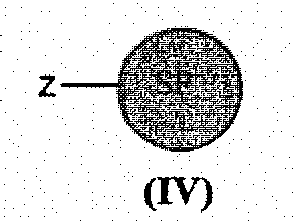
- a process for purifying a radiolabelled product which comprises use of a solid-support bound scavenger group of formula (IV): wherein Z is a scavenger group and SP is a solid support.
- the radiolabelled product of formula (III) contains an 18 F-label and is, for example 2-fluoro-2-deoxy-D-glucose ([ 18 F-FDG), 6-fluoro-L-DOPA ([ 18 F]-FDOPA), 3'-deoxy-3'-fluorothymidine ([ 18 F]-FLT), [ 18 F]fluorotyrosine, 5-[ 18 F]fluorouracil, 5-[ 18 F]fluorocytosine, 2-(1,1-dicyanopropen-2-yl)-6-(2-fluoroethyl)-methylamino)-naphthalene ([ 18 F]-FDDNP), 2-, 5-, and 6-fluoro (2(S)-azetinylmethoxy)pyridines, N-succinimidyl-4-[ 18 F]fluorobenzoate ([ 18 F]-SFB), an 18 F-labelled amino acid such as [ 18 F]-1-amino-3-fluoro
- the radiolabelled product of formula (III) contains a 11 C-labeland is, for example, [ 11 C]raclopride, [ 11 C-carboxyl]L-DOPA, [ 11 C-carboxyl]5-hydroxytryptophan, [ 11 C]-WAY-100635, [ 11 C]-deprenyl, [ 11 C]phenylephrine, [ 11 C]FLB457, [ 11 C]SCH23390, [ 11 C]SCH39166, [ 11 C]-NNC112, [ 11 C]NNC756, [ 11 C]MDL100907, [ 11 C]DSAB, [ 11 C]PK11195, [ 11 C]GR205171, [ 11 C]RTI-32, [ 11 C]CIT, [ 11 C]CFT, [ 11 C]flumazenil, [ 11 C]-diprenorphlne, [ 11 C]-metomidate, [ 11 C]SCH442416, [ 11 C]carfentanil, or a 11 C-labelled
- the radiolabelled product of formula (III) contains a radioiodine label such as 131 I, 123 I, 124 I, 122 I or 125 I, and is for example, 2-beta-carbomethoxy-3-beta-(4-iodophenyl)-8-(3-fluoropropyl)-nortropane or a protected derivative thereof.
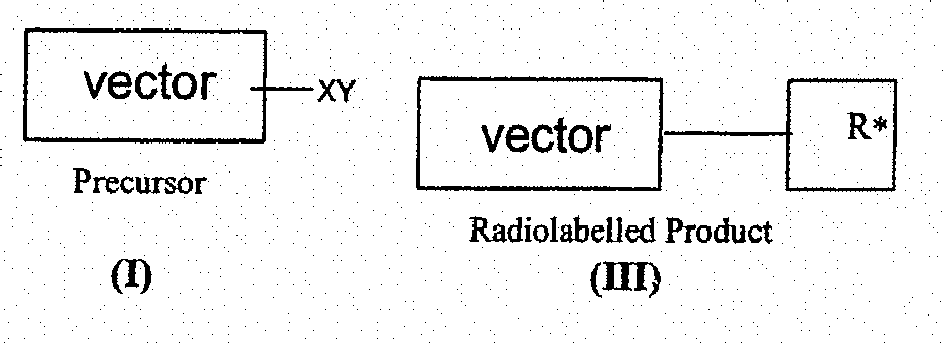
- the radiolabelled product of formula (III) comprises a vector portion being a molecular fragment having with an affinity for a given biological target (such as a modified drug pharmacaphore or peptide) and a radioisotope or radiolabelled portion represented by R*:
- the precursor of formula (I) comprises the same vector portion as the radiolabelled product of formula (III) but bears a functional group -XY as described below.
- radiosyntheses involve radioalkylation such as [ 11 C]alkylation, or radiohalogenation such as [ 18 F]fluorination on [ 18 F]fluoroalkylation, of precursors of formula (I).
- Treatment of the precursor with a radioisotope or radiolabelling agent of formula (II) gives rise to a mixture containing the desired radiolabelled product of formula (III) and excess unreacted precursor of formula (I).
- the precursor of formula (I) therefore contains a functional group-XY which is capable of reacting with the radioisotope or radiolabelling agent of formula (II) shown in scheme I.
- the functional group -XY is suitably a leaving group such as a sulphonate ester preferably the mesyl, tosyl, nosyl or is a trimethylammonium salt or is a functional group which can react site-specifically with a moiety on the radiolabelling agent of formula (II) to form a stable covalent bond and is preferably selected from the groups aldehydes, ketones, aminooxy, hydrazides, hydrazines, alpha-haloacetyl and thiol.
- a leaving group such as a sulphonate ester preferably the mesyl, tosyl, nosyl or is a trimethylammonium salt
- the scavenger group Z is suitably an isocyanate, isothiocyanate, thiol, hydrazine, hydrazide, aminooxy, 1,3-dipole, aldehyde or ketone, such as those described in the more specific aspects of the invention below.
- the solid support represented by SP may be any suitable solid-phase support which is insoluble in any solvents to be used in the process but to which the Linker and/or scavenger group Z can be covalently bound.
- suitable Solid Support include polymers such as polystyrene (which may be block grafted, for example with polyethylene glycol), polyacrylamide, ring-opening metathesis polymerisation (ROMP) polymer, or polypropylene or glass or silicon coated with such a polymer.
- the solid support may also be sepharose based modified with suitable functional groups or derived from other known polymeric chromatographic media including ion exchange resins or C18 reverse-phase media.
- the solid support may be in the form of small discrete particles such as beads or pins, or as a coating on the inner surface of a cartridge or on a microfabricated vessel.
- the "Linker” may be any suitable organic group which serves to space the scavenger group Z sufficiency from the solid support structure so as to maximise reactivity.
- the Linker comprises zero to four aryl groups (suitably phenyl) and/ or a C 1-6 alkyl or C 1-6 haloalkyl (suitably C 1-6 fluoroalkyl), and optionally one to four additional functional groups such as an amide or sulphonamide groups.
- the linker is a polyethylene glycol containing moiety.
- Compounds of formula (IV) may be prepared by methods known to the person skilled in the art (for a review of such methods, see Stabile-Harris and Ciampoli; Laboratory Automation in the Chemical Industries, 111-32 (2002 )) or are available commercially, for example from Novabiochem (Merck Biosciences Ltd, Nottingham, UK) or from Argonaut (Mid Glamorgan, UK)
- the purification may be performed by mixing the solid-support bound scavenger group of formula (IV) with a solution-phase mixture comprising a radiolabelled product of formula (III) in a container and then separating the resulting solid-phase by filtration.
- the solid-support bound scavenger group of formula (IV) may be contained in a vessel through which the solution-phase mixture comprising a radiolabelled product of formula (III) is passed.
- the solution-phase mixture comprising a radiolabelled product of formula (III) may be passed through the solid-support bound scavenger group of formula (IV) as a continuous flow, for example at a flow rate of from 0.1ml/min to 100ml/min, or in batches, so as to permit sufficient residence time on the solid-phase for the purification to occur.
- the solid-support bound scavenger group of formula (IV) may be held in any suitable vessel such as a plastic or metal column, cartridge, or syringe barrel.
- the purification is conveniently performed at ambient temperature, but use of non-extreme elevated temperature (for example up to 120°C, but preferably up to around 80°C) can increase efficiency of the extraction. If the temperature is too high, stability of the solid-support bound scavenger group of formula (IV) and/or radiolabelled product of formula (III) may be compromised:
- a process for purifying a radiolabelled product which comprises use of a solid-support bound isocyanate or isothiocyanate scavenger group. This process comprises the steps of:
- the purification process using a compound of formula (IVa) may be performed at a non-extreme temperature such as 10 to 120°C, suitably at ambient temperature to 80°C and using an inert solvent such as xylene, N,N-dimethylformamide (DMF) or chloroform.
- a non-extreme temperature such as 10 to 120°C, suitably at ambient temperature to 80°C and using an inert solvent such as xylene, N,N-dimethylformamide (DMF) or chloroform.
- the compound of formula (IIIa) is suitably a 11 C-labelled tertiary amine such as [ 11 C-CH 3 ]-2-Pyridin-4-yl-quinoline-8-carboxylic acid (2-dimethylamino-ethyl)-amide, [N- 11 C-methyl]dimethylphenethylamine, or [ 11 C]DASB, and the precursor of formula (Ia) is the corresponding secondary amine such as 2-pyridin-4-yl-quinoline-8-carboxylic acid (2-methylamino-ethyl)-amide.
- a 11 C-labelled tertiary amine such as [ 11 C-CH 3 ]-2-Pyridin-4-yl-quinoline-8-carboxylic acid (2-dimethylamino-ethyl)-amide, [N- 11 C-methyl]dimethylphenethylamine, or [ 11 C]DASB
- the precursor of formula (Ia) is the corresponding secondary amine
- a process for purifying a radiolabelled product which comprises use of a solid-support bound thiol scavenger group. This process comprises the steps of:
- the purification process using a compound of formula (IVb) may be performed at a non-extreme temperature such as 10 to 120°C, suitably at ambient temperature to 80°C and using an inert solvent such as xylene, N,N-dimethylformamide (DMF) , DMSO, acetonitrile or chloroform.
- a non-extreme temperature such as 10 to 120°C, suitably at ambient temperature to 80°C and using an inert solvent such as xylene, N,N-dimethylformamide (DMF) , DMSO, acetonitrile or chloroform.
- the solvent is an aqueous buffer or a mixture of acetonitrile and water or alcohol and water.
- a process for purifying a radiolabelled product which comprises use of a solid-support bound amino scavenger group. This process comprises the steps of:
- the compounds of formula (IVc) and (Ic) react to form the corresponding compound of formula (Vc): wherein A is hydrogen, C 1-6 alkyl or aryl (such as phenyl) and B is-CO-NH-, -NH-, - O-, -NHCONH-, or -NHCSNH-.
- compounds of the formula (IIc) have the formula NH 2 -W-Linker-F where W is as described previously and F is preferably 18 F and the compound of formula (IIIc) is suitably a 18 F-labelled compound such as a peptide or drug substance and the precursor of formula (Ic) is the corresponding aldehyde or ketone.
- the purification process using a compound of formula (IVc) may be performed at a non-extreme temperature such as 10 two 120°C, suitably at ambient temperature to 80°C and using an inert solvent such as xylene, N,N-dimethylformamide (DMF), DMSO, acetonitrile, or chloroform.
- a non-extreme temperature such as 10 two 120°C, suitably at ambient temperature to 80°C and using an inert solvent such as xylene, N,N-dimethylformamide (DMF), DMSO, acetonitrile, or chloroform.
- the solvent is an aqueous buffer or a mixture of acetonitrile: water or alcohol and water.
- the functional group -X c Y c in the compound of formula (Ic) is -OSO 2 R 3 wherein R 3 is C 1-15 alkyl or C 1-10 alkylaryl and R3 is optionally substituted by halo (preferably fluoro), for example R 3 is methyl, para-toluene, trifluoromethyl; and the purification is effected using a compound of formula (IVci) : where W is selected from C 1-15 alkyl or C 7-15 aryl, -NH-, -NH-CO- or-O- and the linker is as described previously such that compounds of formula (Ic) and (IVci) form a covalent bond to each other.
- a process for purifying a radiolabelled product which comprises use of a solid-support bound aldehyde or ketone scavenger group. This process comprises the steps of:
- the purification process using a compound of formula (IVd) may be performed at a non-extreme temperature such as 10 to 120°C, suitably at ambient temperature to 80°C and using an inert solvent such as xylene, N,N-dimethylformamide (DMF), DMSO, acetonitrile or chloroform.
- a non-extreme temperature such as 10 to 120°C, suitably at ambient temperature to 80°C and using an inert solvent such as xylene, N,N-dimethylformamide (DMF), DMSO, acetonitrile or chloroform.
- the solvent is an aqueous buffer or a mixture of acetonitrile and water or alcohol and water.
- the compound of formula (IIId) is suitably a 18 F-labelled compound such as a peptide or drug and the precursor of formula (Id) is suitably a modified peptide or drug carrying an aminooxy (NH 2 -O-), hydrazide or hydrazine moiety.
- One particular compound of formula (IVd) which may be useful in this aspect of the invention, having a high loading of ketone scavenging group may be based on a ring-opening metathesis polymerisation (ROMP) polymer backbone.
- ROMP ring-opening metathesis polymerisation
- One of the main advantages of ROMP polymers is that in principle every monomer unit carries a functional group and should give much higher loading than some other polymers.
- ROMP is known for the production of functionalised polymers for organic synthesis ( Barrett et al Chemical Reviews 2002 102 pp 3301-24 ).
- Suitable ROMP based polymers of formula (IVd) may be prepared by condensation of commercially available ketone alkene with furan followed by polymerisation, as shown in scheme 2:
- a process for purifying a radiolabelled product which comprises use of a solid-support bound dipolar scavenger group. This process comprises the steps of
- This aspect of the invention has particular relevance to synthesis of 3'-deoxy-3'-fluorothymidine ([ 18 F]-FLT) (IIIe) wherein a common by-product (VIIe) is formed by elimination of [ 18 F]HF from the sugar ring as shown in scheme 2: wherein each PG is hydrogen or a hydroxyl protecting group (suitably tert-butoxycarbonyl, benzyl, triphenylmethyl, or dimethoxytriphenylmethyl), and -X e ,Y e is a suitable leaving group such as an alkyl- or aryl-sulphonate ester (for example trifluoromethane sulphonate, methane sulphonate, ortoluene- para- sulphonate) or halo (such as iodo or bromo).
- each PG is hydrogen or a hydroxyl protecting group (suitably tert-butoxycarbonyl, benzyl, triphenylmethyl,
- a scavenger resin such as a compound of formula (IV) may also be used to react covalently with any unreacted radiolabelling agent of formula (II) as shown in scheme 4 to give compounds of formula (VI).
- This purification process may be used instead of, or in addition to, processes described herein for removal of excess precursor.
- Radiotracers such as [ 18 F]FDG are now often prepared on an automated radiosynthesis apparatus using nucleophilic radiofluorination chemistry with 18 F - , based on the reagent KryptofixTM 2.2.2.
- apparatus commonly comprises a cassette, often disposable, in which the radiochemistry is performed, which is fitted to the apparatus in order to perform a radiosynthesis.
- the cassette normally includes fluid pathways, a reaction vessel, and ports for receiving reagent vials as well as any solid-phase extraction cartridges (typically C 18 or alumina) used in post-radiosynthetic clean up steps.
- the methods of the present invention may offer particular advantages in the field of automated radiosynthesis.
- an automated radiosynthesis apparatus comprising a vessel, such as a cartridge, containing a solid-support bound scavenger group of formula (IV), (IVa), (IVb), (IVc), (IVd), (IVe), or (IVf).
- the vessel such as a cartridge, containing a solid-support bound scavenger group of formula (IV) may be housed in a disposable or removable cassette designed for use with the automated radiosynthesis apparatus. Therefore, the invention further provides a cassette for an automated radiosynthesis apparatus comprising a vessel, such as a cartridge, containing a solid-support bound scavenger group of formula (IV), (IVa), (IVb), (IVc), (IVd), (IVe), or (IVf).
- Example 1 Use of an isocyanate resin for purification of a 11 C-tracer
- isocyanate resin was conditioned, using the same solvent as that from which precursor was to be extracted. Extraction efficiency was determined using HPLC For studies using non-radioactive standard solutions, xylene was used as a control such that adjustments could be made for non-specific extraction and solvent loss.
- Example 1(a) In situ resin conditioning and solid phase extraction (SPE) at elevated temperatures
- a cartridge (internal volume 0.067 ml) made of 3.2 mm (1/8") o.d. steel tubing and circular frits was charged with 25 mg of dry isocyanate functionalised polystyrene resin (Novabiochem). Solvent ca 5 ml (dichloromethane (DCM), N,N-dimethylformamide (DMF) or dimethylsulphoxide (DMSO)) was then passed through the cartridge and excess solvent removed with compressed air. For studies at elevated temperature a two-piece heater block, thermocouple and band heater were fitted around the cartridge and the entire assembly left ca 10 min to thermally equilibrate.
- DCM dichloromethane
- DMF N,N-dimethylformamide
- DMSO dimethylsulphoxide
Landscapes
- Organic Chemistry (AREA)
- Chemical & Material Sciences (AREA)
- Organic Low-Molecular-Weight Compounds And Preparation Thereof (AREA)
- Medicines Containing Antibodies Or Antigens For Use As Internal Diagnostic Agents (AREA)
- Steroid Compounds (AREA)
- Plural Heterocyclic Compounds (AREA)
- Control And Other Processes For Unpacking Of Materials (AREA)
- Solid-Sorbent Or Filter-Aiding Compositions (AREA)
- Packages (AREA)
- Other Investigation Or Analysis Of Materials By Electrical Means (AREA)
- Detergent Compositions (AREA)
- Compounds Of Unknown Constitution (AREA)
- Cleaning Or Drying Semiconductors (AREA)
- Cleaning In General (AREA)
Abstract
Description
- The present invention relates to novel processes for the purification of radiolabelled tracers, in particular for purification of 18F- and 11C-labelled compounds which may be suitable for use as Positron Emission Tomography (PET) radiotracers or for radio-iodinated compounds which may be suitable for use in PET or SPECT imaging or in radiotherapy. Automated radiosynthesis apparatus, and disposable or removable cassettes therefor, adapted to perform the purification processes are also claimed.
- Radiosynthesis of compounds of clinical interest often employs non-radioactive organic precursors in amounts which are in large excess relative to the amount of radiolabelling agent used. Excess precursors must be removed from the reaction mixture before the radiolabelled compound can be used clinically, this is conventionally done by a chromatographic procedure such as high performance liquid chromatography (HPLC). Given the limited half-life of most clinically useful radioisotopes, it is desirable to complete the radiosynthesis and purification as rapidly as possible. For example, 18F has a half-life of 110 minutes and 18F-labelled tracers for PET are therefore synthesised and purified within one hour of clinical use. Therefore, there exists a need for purification techniques which are rapid and efficient.
- The present invention provides processes for separating radiolabelled compounds from their precursors rapidly and chemoselectively.
- According to a general aspect of the invention, there is provided a process for purifying a radiolabelled product which comprises use of a solid-support bound scavenger group of formula (IV):

- In a further aspect of the invention, there is provided a process comprising the steps of:
- (a) contacting a solution-phase mixture of a radiolabelled product of formula (III), and excess precursor of formula (I):


such that the compounds of formulae (IV) and (I) may form a covalent bond to each other; - (b) separation of purified radiolabelled product of formula (III) in the solution phase.
- Suitably, the radiolabelled product of formula (III) contains an 18F-label and is, for example 2-fluoro-2-deoxy-D-glucose ([18F-FDG), 6-fluoro-L-DOPA ([18F]-FDOPA), 3'-deoxy-3'-fluorothymidine ([18F]-FLT), [18F]fluorotyrosine, 5-[18F]fluorouracil, 5-[18F]fluorocytosine, 2-(1,1-dicyanopropen-2-yl)-6-(2-fluoroethyl)-methylamino)-naphthalene ([18F]-FDDNP), 2-, 5-, and 6-fluoro (2(S)-azetinylmethoxy)pyridines, N-succinimidyl-4-[18F]fluorobenzoate ([18F]-SFB), an 18F-labelled amino acid such as [18F]-1-amino-3-fluorocyclobutane-1-carboxylic acid ([18F]-FACBC), an [18F]-labelled benzothiazole such as those described in international patent application
WO 02/16333 WO 01/77415 WO 03/006491 - Alternatively, the radiolabelled product of formula (III) contains a 11C-labeland is, for example, [11C]raclopride, [11C-carboxyl]L-DOPA, [11C-carboxyl]5-hydroxytryptophan, [11C]-WAY-100635, [11C]-deprenyl, [11C]phenylephrine, [11C]FLB457, [11C]SCH23390, [11C]SCH39166, [11C]-NNC112, [11C]NNC756, [11C]MDL100907, [11C]DSAB, [11C]PK11195, [11C]GR205171, [11C]RTI-32, [11C]CIT, [11C]CFT, [11C]flumazenil, [11C]-diprenorphlne, [11C]-metomidate, [11C]SCH442416, [11C]carfentanil, or a 11C-labelled benzothiazole such as those described in international patent application
WO 02/16333 - Alternatively, the radiolabelled product of formula (III) contains a radioiodine label such as 131I, 123I, 124I, 122I or 125I, and is for example, 2-beta-carbomethoxy-3-beta-(4-iodophenyl)-8-(3-fluoropropyl)-nortropane or a protected derivative thereof.
- The radiolabelled product of formula (III) comprises a vector portion being a molecular fragment having with an affinity for a given biological target (such as a modified drug pharmacaphore or peptide) and a radioisotope or radiolabelled portion represented by R*:
- The precursor of formula (I) comprises the same vector portion as the radiolabelled product of formula (III) but bears a functional group -XY as described below.
- Many radiosyntheses involve radioalkylation such as [11C]alkylation, or radiohalogenation such as [18F]fluorination on [18F]fluoroalkylation, of precursors of formula (I). Treatment of the precursor with a radioisotope or radiolabelling agent of formula (II) gives rise to a mixture containing the desired radiolabelled product of formula (III) and excess unreacted precursor of formula (I). The precursor of formula (I) therefore contains a functional group-XY which is capable of reacting with the radioisotope or radiolabelling agent of formula (II) shown in scheme I. The functional group -XY is suitably a leaving group such as a sulphonate ester preferably the mesyl, tosyl, nosyl or is a trimethylammonium salt or is a functional group which can react site-specifically with a moiety on the radiolabelling agent of formula (II) to form a stable covalent bond and is preferably selected from the groups aldehydes, ketones, aminooxy, hydrazides, hydrazines, alpha-haloacetyl and thiol.
- In the compound of formula (IV), the scavenger group Z is suitably an isocyanate, isothiocyanate, thiol, hydrazine, hydrazide, aminooxy, 1,3-dipole, aldehyde or ketone, such as those described in the more specific aspects of the invention below.


- In the compounds of formulae (IV) and in the following more specific aspects of the invention, the solid support represented by SP, may be any suitable solid-phase support which is insoluble in any solvents to be used in the process but to which the Linker and/or scavenger group Z can be covalently bound. Examples of suitable Solid Support include polymers such as polystyrene (which may be block grafted, for example with polyethylene glycol), polyacrylamide, ring-opening metathesis polymerisation (ROMP) polymer, or polypropylene or glass or silicon coated with such a polymer. The solid support may also be sepharose based modified with suitable functional groups or derived from other known polymeric chromatographic media including ion exchange resins or C18 reverse-phase media. The solid support may be in the form of small discrete particles such as beads or pins, or as a coating on the inner surface of a cartridge or on a microfabricated vessel.
- In the compounds of formulae (IV) and in the following more specific aspects of the invention, the "Linker" may be any suitable organic group which serves to space the scavenger group Z sufficiency from the solid support structure so as to maximise reactivity. Suitably, the Linker comprises zero to four aryl groups (suitably phenyl) and/ or a C1-6 alkyl or C1-6 haloalkyl (suitably C1-6 fluoroalkyl), and optionally one to four additional functional groups such as an amide or sulphonamide groups. In a preferred embodiment the linker is a polyethylene glycol containing moiety.
- Compounds of formula (IV) may be prepared by methods known to the person skilled in the art (for a review of such methods, see Stabile-Harris and Ciampoli; Laboratory Automation in the Chemical Industries, 111-32 (2002)) or are available commercially, for example from Novabiochem (Merck Biosciences Ltd, Nottingham, UK) or from Argonaut (Mid Glamorgan, UK)
- The purification may be performed by mixing the solid-support bound scavenger group of formula (IV) with a solution-phase mixture comprising a radiolabelled product of formula (III) in a container and then separating the resulting solid-phase by filtration. Alternatively, and particularly suitably when the solid-support bound scavenger group of formula (IV) is used within an automated synthesis apparatus, the solid-support bound scavenger group of formula (IV) may be contained in a vessel through which the solution-phase mixture comprising a radiolabelled product of formula (III) is passed. The solution-phase mixture comprising a radiolabelled product of formula (III) may be passed through the solid-support bound scavenger group of formula (IV) as a continuous flow, for example at a flow rate of from 0.1ml/min to 100ml/min, or in batches, so as to permit sufficient residence time on the solid-phase for the purification to occur. As would be understood by the person skilled in the art, the solid-support bound scavenger group of formula (IV) may be held in any suitable vessel such as a plastic or metal column, cartridge, or syringe barrel. The purification is conveniently performed at ambient temperature, but use of non-extreme elevated temperature (for example up to 120°C, but preferably up to around 80°C) can increase efficiency of the extraction. If the temperature is too high, stability of the solid-support bound scavenger group of formula (IV) and/or radiolabelled product of formula (III) may be compromised:
- In a further aspect of the invention, there is provided a process for purifying a radiolabelled product which comprises use of a solid-support bound isocyanate or isothiocyanate scavenger group. This process comprises the steps of:
- (a) contacting a solution-phase mixture of a radiolabelled product of formula (IIIa) and excess precursor of formula (Ia):

with a compound of formula (IVa):
such that the compounds of formulae (IVa) and (Ia) may form a covalent bond to each other; and - (b) separation of purified radiolabelled product of formula (IIIa) in the solution phase.
- The compounds of formula (IVa) and (Ia) react to form the corresponding urea or thiourea of formula (Va):

- The purification process using a compound of formula (IVa) may be performed at a non-extreme temperature such as 10 to 120°C, suitably at ambient temperature to 80°C and using an inert solvent such as xylene, N,N-dimethylformamide (DMF) or chloroform.
- In this aspect of the invention, the compound of formula (IIIa) is suitably a 11C-labelled tertiary amine such as [11C-CH3]-2-Pyridin-4-yl-quinoline-8-carboxylic acid (2-dimethylamino-ethyl)-amide, [N-11C-methyl]dimethylphenethylamine, or [11C]DASB, and the precursor of formula (Ia) is the corresponding secondary amine such as 2-pyridin-4-yl-quinoline-8-carboxylic acid (2-methylamino-ethyl)-amide.
- In a further aspect of the invention, there is provided a process for purifying a radiolabelled product which comprises use of a solid-support bound thiol scavenger group. This process comprises the steps of:
- (a) contacting a solution-phase mixture of a radiolabelled product of formula (IIIb) and excess precursor of formula (Ib):

- (i) the functional group -XbYb in the compound of formula (Ib) is -OSO2R3 wherein R3 is C1-15 alkyl or C1-10 alkylaryl and R3 is optionally substituted by halo (preferably fluoro), for example R3 is methyl, para-toluene, trifluoromethyl, and R*b in the compound of formula (IIIb) is a radiohalogen such as radiofluoro (for example 18F) or radioiodo (such as 123I, 124I, or 125I) or radiobromo (such as 76Br); or
- (ii) the functional group -XbYb in the compound of formula (Ib) is -C(O)CH2Cl and R*b in the compound of formula (IIIb) is -S-Lb-nF wherein Lb is a C1-30 hydrocarbyl linker group optionally including 1 to 10 heteroatoms;and
nF is a radioisotope of fluorine such as 18F;
with a compound of formula (IVb):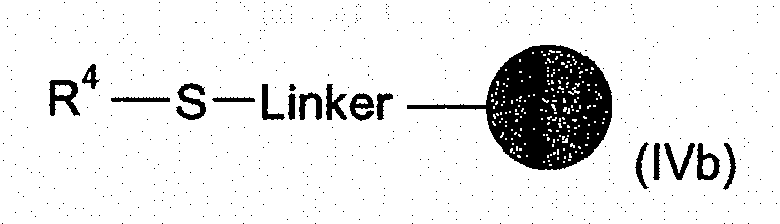
such that the compounds of formulae (IVb) and (Ib) may form a covalent bond to each other,
- (b) separation of purified radiolabelled product of formula (IIIb) in the solution phase.
- The compounds of formula (IVb) and (Ib) react to form the corresponding compound of formula (Vbi or Vbii):


- The purification process using a compound of formula (IVb) may be performed at a non-extreme temperature such as 10 to 120°C, suitably at ambient temperature to 80°C and using an inert solvent such as xylene, N,N-dimethylformamide (DMF) , DMSO, acetonitrile or chloroform. Preferably the solvent is an aqueous buffer or a mixture of acetonitrile and water or alcohol and water.
- In a further aspect of the invention, there is provided a process for purifying a radiolabelled product which comprises use of a solid-support bound amino scavenger group. This process comprises the steps of:
- (a) contacting a solution-phase mixture of a radiolabelled product of formula (IIIc) and excess precursor of formula (Ic):


such that the compounds of formulae (IVc) and (Ic) may form a covalent bond to each other, and - (b) separation of purified radiolabelled product of formula (IIIc) in the solution phase.
- The compounds of formula (IVc) and (Ic) react to form the corresponding compound of formula (Vc):

- In this aspect of the invention, compounds of the formula (IIc) have the formula NH2-W-Linker-F where W is as described previously and F is preferably 18F and the compound of formula (IIIc) is suitably a 18F-labelled compound such as a peptide or drug substance and the precursor of formula (Ic) is the corresponding aldehyde or ketone.
- The purification process using a compound of formula (IVc) may be performed at a non-extreme temperature such as 10 two 120°C, suitably at ambient temperature to 80°C and using an inert solvent such as xylene, N,N-dimethylformamide (DMF), DMSO, acetonitrile, or chloroform. Preferably the solvent is an aqueous buffer or a mixture of acetonitrile: water or alcohol and water.
- In a further embodiment of this aspect of the invention, the functional group -XcYc in the compound of formula (Ic) is -OSO2R3 wherein R3 is C1-15 alkyl or C1-10 alkylaryl and R3 is optionally substituted by halo (preferably fluoro), for example R3 is methyl, para-toluene, trifluoromethyl; and the purification is effected using a compound of formula (IVci) :

- The compounds of formula (IVci) and (Ic) react to form the corresponding compound of formula (Vci):

- In a further aspect of the invention, there is provided a process for purifying a radiolabelled product which comprises use of a solid-support bound aldehyde or ketone scavenger group. This process comprises the steps of:
- (a) contacting a solution-phase mixture of a radiolabelled product of formula (IIId) and excess precursor of formula (Id):

with a compound of formula (IVd):
such that the compounds of formulae (IVd) and (Id) may form a covalent bond to each other; and - (b) separation of purified radiolabelled product of formula (IIId) in the solution phase.
- The compounds of formula (Id) and (IVd) react to give compounds of formula (Vd):

- The purification process using a compound of formula (IVd) may be performed at a non-extreme temperature such as 10 to 120°C, suitably at ambient temperature to 80°C and using an inert solvent such as xylene, N,N-dimethylformamide (DMF), DMSO, acetonitrile or chloroform. Preferably the solvent is an aqueous buffer or a mixture of acetonitrile and water or alcohol and water.
- In this aspect of the invention, the compound of formula (IIId) is suitably a 18F-labelled compound such as a peptide or drug and the precursor of formula (Id) is suitably a modified peptide or drug carrying an aminooxy (NH2-O-), hydrazide or hydrazine moiety.
- One particular compound of formula (IVd) which may be useful in this aspect of the invention, having a high loading of ketone scavenging group may be based on a ring-opening metathesis polymerisation (ROMP) polymer backbone. One of the main advantages of ROMP polymers is that in principle every monomer unit carries a functional group and should give much higher loading than some other polymers. ROMP is known for the production of functionalised polymers for organic synthesis (Barrett et al Chemical Reviews 2002 102 pp 3301-24). Suitable ROMP based polymers of formula (IVd) may be prepared by condensation of commercially available ketone alkene with furan followed by polymerisation, as shown in scheme 2:

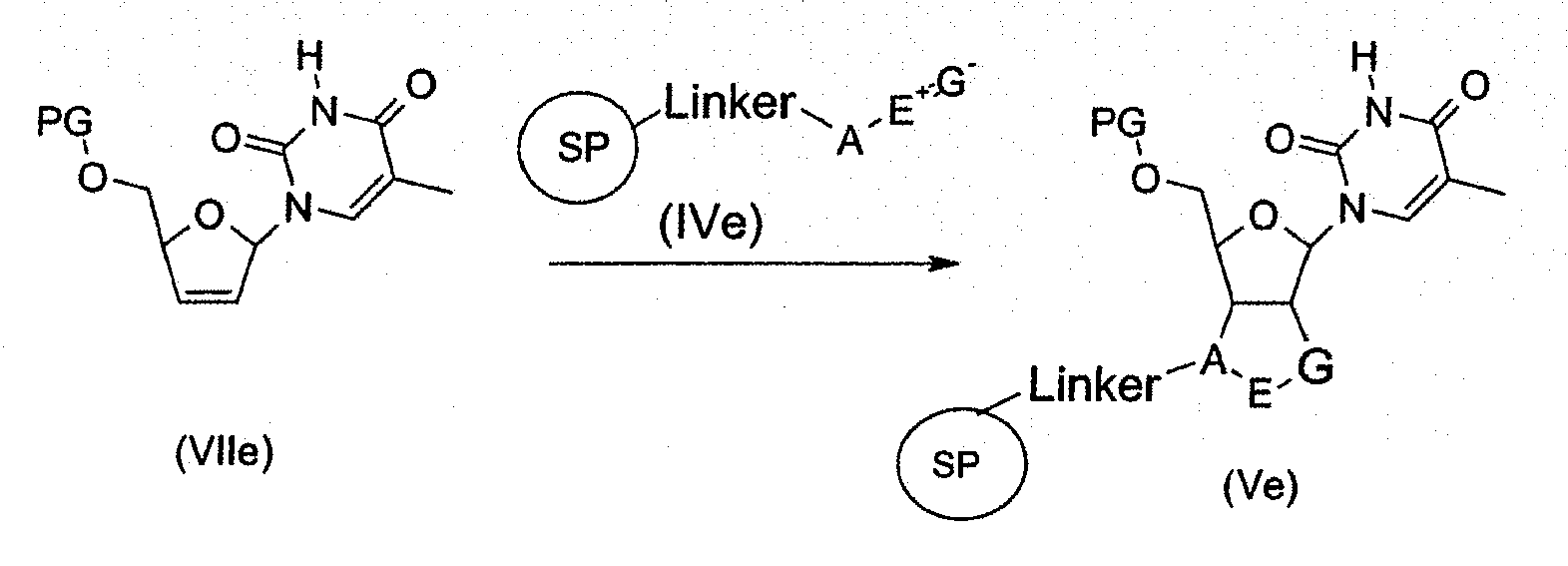
- In a further aspect of the invention, there is provided a process for purifying a radiolabelled product which comprises use of a solid-support bound dipolar scavenger group. This process comprises the steps of
- (a) contacting a solution-phase mixture of a radiolabelled product of formula (IIIe) and a by-product (VIIe):

with a compound of formula (IVe):
such that the compounds of formula (IVe) and (Vile) may form a covalent bond to eachother; and - (b) separation of purified radiolabelled product of formula (IIIe) in the solution phase.
- This aspect of the invention has particular relevance to synthesis of 3'-deoxy-3'-fluorothymidine ([18F]-FLT) (IIIe) wherein a common by-product (VIIe) is formed by elimination of [18F]HF from the sugar ring as shown in scheme 2:

Purification using a compound of formula (IVe):

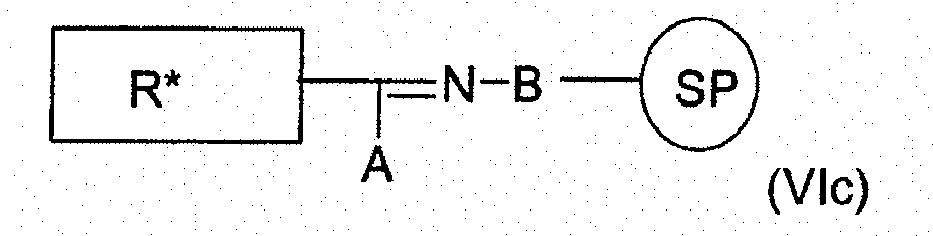
- In a further aspect of the invention, a scavenger resin such as a compound of formula (IV) may also be used to react covalently with any unreacted radiolabelling agent of formula (II) as shown in scheme 4 to give compounds of formula (VI). This purification process may be used instead of, or in addition to, processes described herein for removal of excess precursor.

- Thus, for example:
- (i) A solid-support bound aldehyde or ketone scavenger group, such as a compound of formula (IVd) may facilitate removal of unreacted amino functionalised radiolabelling agent, such as a compound of formula (IIc) from a reaction mixture resulting in a compound of formula (VId):

- (ii) A solid-support bound amino scavenger group, such as a compound of formula (IVc) may facilitate removal of unreacted radiolabelling agent having an aldehyde or ketone functionality resulting in a compound of formula (VIc).
- (iii) A solid-support bound haloacetyl scavenger group, such as compound of formula (IVf)


- Radiotracers, such as [18F]FDG are now often prepared on an automated radiosynthesis apparatus using nucleophilic radiofluorination chemistry with 18F-, based on the reagent Kryptofix™ 2.2.2. There are several examples of such apparatus commercially available, including Tracerlab MX (Coincidence Technologies SA) and Tracerlab FX (Nuclear Interface GmbH). Such apparatus commonly comprises a cassette, often disposable, in which the radiochemistry is performed, which is fitted to the apparatus in order to perform a radiosynthesis. The cassette normally includes fluid pathways, a reaction vessel, and ports for receiving reagent vials as well as any solid-phase extraction cartridges (typically C18 or alumina) used in post-radiosynthetic clean up steps. The methods of the present invention may offer particular advantages in the field of automated radiosynthesis.
- According to a further aspect of the invention, there is provided an automated radiosynthesis apparatus comprising a vessel, such as a cartridge, containing a solid-support bound scavenger group of formula (IV), (IVa), (IVb), (IVc), (IVd), (IVe), or (IVf).
- The vessel, such as a cartridge, containing a solid-support bound scavenger group of formula (IV) may be housed in a disposable or removable cassette designed for use with the automated radiosynthesis apparatus. Therefore, the invention further provides a cassette for an automated radiosynthesis apparatus comprising a vessel, such as a cartridge, containing a solid-support bound scavenger group of formula (IV), (IVa), (IVb), (IVc), (IVd), (IVe), or (IVf).
- The invention will now be illustrated by way of the following non-limiting examples.
-

- In both cases isocyanate resin was conditioned, using the same solvent as that from which precursor was to be extracted. Extraction efficiency was determined using HPLC For studies using non-radioactive standard solutions, xylene was used as a control such that adjustments could be made for non-specific extraction and solvent loss.
- A cartridge (internal volume 0.067 ml) made of 3.2 mm (1/8") o.d. steel tubing and circular frits was charged with 25 mg of dry isocyanate functionalised polystyrene resin (Novabiochem). Solvent ca 5 ml (dichloromethane (DCM), N,N-dimethylformamide (DMF) or dimethylsulphoxide (DMSO)) was then passed through the cartridge and excess solvent removed with compressed air. For studies at elevated temperature a two-piece heater block, thermocouple and band heater were fitted around the cartridge and the entire assembly left ca 10 min to thermally equilibrate. 500 µl of solution containing precursor 2-Pyridin-4-yl-quinoline-8-carboxylic acid (2-methylamino-ethyl)-amide (A) 0.5 mg and Xylene 1.3 mg were then passed through the cartridge using a syringe drive. Using this method, SPE efficiency was dependent on the solvent used, with extraction efficiency decreasing in the order DCM (67%), DMF (36%), and DMSO (<5%) at room temperature.
- For external conditioning 300 mg of isocyanate resin (Novabiochem) was suspended in excess solvent ca 9 ml for ca 5 min. The conditioned resin slurry was then loaded onto a 0.8 ml volume cartridge made of 6 mm (2/8") steel tubing. Excess solvent was removed with compressed air. Precursor solutions 300 µl or reaction mixture from automated preps 300 µl were passed through the cartridge using a syringe drive. A 1ml syringe gave flow rates of 0.4 ml min-1, equating to a contact time ca 2 min.
- Following [11C]radiolabelling, 300µl of the resulting reaction mixture (A+B) was drawn up from the reaction vial and dispensed (using a syringe drive) at a flow of 444µl min-1 through one of the conditioned isocyanate resin cartridges detailed in Examples 1(a) and 1(b). The cartridge was then flushed with 500µl of chloroform and the combined solutions analysed by HPLC. The cartridge was then flushed with a further 3 aliquots of 500µl chloroform. Cumulative product recovery after SPE using the external conditioning method of Example 1(b) was 90% with precursor levels at circa 4% of the levels found in the non-purified reaction mixture.
Claims (6)
- A process comprising the steps of:(a) contacting a solution-phase mixture of or radiolabelled product of formula (III) and excess precursor of formula (I):


such that the compounds of formulae (IV) and (I) may form a covalent bond to each other;(b) separation of purified radiolabelled product of formula (III) in the solution phase;or a protected derivative of any thereof.
wherein the radiolabelled product of formula (III) contains an 18F-label and is chosen from:2-fluoro-2-deoxy-D-glucose ([18F]-FDG);6-fluoro-L-DOPA ([18F]-FDOPA);3'-deoxy-3'-fluorothymidine ([18F]-FLT), [18F]fluorotyrosine;5-[18F]fluorouracil;5-[18F]fluorocytosine;2-(1,1-dicyanopropen-2-yl)-6-(2-fluoroethyl)-methylaminol-naphthalene ([18F]-FDDNP);2-, 5-, and 6-fluoro (2(S)-azetinylmethoxy)pyridines;N-succinimidyl-4-[18F]fluorobenzoate ([18F]-SFB);an 18F-labelled amino acid such as [18F]-1-amino-3-fluorocyclobutane-1-carboxylic acid ([18F]-FACBC);an [18F]-labelled benzothiazole;an [18F]fluorotropane such as 2β-carbomethoxy-3β-(4-[18F]fluorophenyl)tropane ([18F]CFT) or N-[18F]fluoropropyl-2β-carbomethoxy-3β-(4-iodophenyl)nortropane ([18F]FP-CIT);[18F]FETNIM;[18F]dopamine;an 18F-labelled peptide for example somatostatin analogues, such as octreotide, bombesin, vasoactive intestinal peptide, chemotactic peptide analogues, α-melanocyte stimulating hormone, neurotensin, Arg-Gly-Asp peptide and its analogues, human pro-insulin connecting peptide,endothelin, angiotensin and formyl-norleucyl-leucyl-phenylalanyl-norleucyl-tyrosyl-lysinedescry; - A process comprising the steps of:(a) contacting a solution-phase mixture of a radiolabelled product of formula (III) and excess precursor of formula (I):

such that the compounds of formulae (IV) and (I) may form a covalent bond to each other;(b) separation of purified radiolabelled product of formula (III) in the solution phase;or a protected derivative of any thereof.
wherein the radiolabelled product of formula (III) contains a 11C-label and is chosen from:[11C]raclopride;[11C-carboxyl]L-DOPA, [11C-carboxyl]5-hydroxytryptophan;[11C]-WAY-100635;[11C]-deprenyl;[11C]phenylephrine;[11C]FLB457;[11C]SCH23390:[11C]SCH39166;[11C]-NNC112;[11C]NNC756;[11C]MDL100907;[11C]DSAB;[11C]PK11195;[11C]GR205171;[11C]RTI-32;[11C]CIT;[11C]CFT;[11C]flumazenil:[11C]-diprenorphine ;[11C]-metomidate;[11C]SCH442416;[11C]carfentanil;a 11C-labelled benzothiazole; - A process comprising the steps of:(a) contacting a solution-phase mixture of a radiolabelled product of formula (III) and excess precursor of formula (I):


such that the compounds of formulae (IV) and (I) may form a covalent bond to each other;(b) separation of purified radiolabelled product of formula (III) in the solution phase;wherein the radiolabelled product of formula (III) contains a radioiodine label such as 131P, 123I, 124I, 122I or 125I, and is 2-beta-carbomethoxy-3-beta-(4-iodophenyl)-8-(3-fluoropropyl)-nortropane or a protected derivative thereof. - A process comprising the steps of:(a) contacting a mixture of radiolabelled product (III), excess precursor (I) and radioisotope or radiolabelling agent (II):

such that the compounds of formulae (II) and (IV) and the compounds of formula (I) and (IV) may form a covalent bond to each other;(b) separation of purified radiolabelled product (III). - An automated radiosynthesis apparatus comprising a vessel, such as a cartridge, containing a solid-support bound scavenger group of one of the following formulae:(a)
 (b)
(b) (c)
(c) (d)
(d) (e)
(e) (f)
(f) (g)where Zf is Cl-CH2-CO- or another haloacetyl containing moiety.
- An automated radiosynthesis apparatus according to claim 5 wherein said vessel is housed in a disposable or removable cassette designed for use with the automated radiosynthesis apparatus.
Priority Applications (1)
| Application Number | Priority Date | Filing Date | Title |
|---|---|---|---|
| PL10154091T PL2186782T3 (en) | 2004-05-11 | 2005-05-11 | Methods for the purification of radiolabelled products using a solid-support scavanger |
Applications Claiming Priority (2)
| Application Number | Priority Date | Filing Date | Title |
|---|---|---|---|
| GBGB0410448.5A GB0410448D0 (en) | 2004-05-11 | 2004-05-11 | Purification methods |
| EP05747239A EP1797022B1 (en) | 2004-05-11 | 2005-05-11 | Methods for the purification of radiolabelled products using a solid-support scavênger |
Related Parent Applications (1)
| Application Number | Title | Priority Date | Filing Date |
|---|---|---|---|
| EP05747239.1 Division | 2005-05-11 |
Publications (2)
| Publication Number | Publication Date |
|---|---|
| EP2186782A1 true EP2186782A1 (en) | 2010-05-19 |
| EP2186782B1 EP2186782B1 (en) | 2013-04-17 |
Family
ID=32526795
Family Applications (2)
| Application Number | Title | Priority Date | Filing Date |
|---|---|---|---|
| EP10154091.2A Expired - Lifetime EP2186782B1 (en) | 2004-05-11 | 2005-05-11 | Methods for the purification of radiolabelled products using a solid-support scavanger |
| EP05747239A Expired - Lifetime EP1797022B1 (en) | 2004-05-11 | 2005-05-11 | Methods for the purification of radiolabelled products using a solid-support scavênger |
Family Applications After (1)
| Application Number | Title | Priority Date | Filing Date |
|---|---|---|---|
| EP05747239A Expired - Lifetime EP1797022B1 (en) | 2004-05-11 | 2005-05-11 | Methods for the purification of radiolabelled products using a solid-support scavênger |
Country Status (14)
| Country | Link |
|---|---|
| US (2) | US8221720B2 (en) |
| EP (2) | EP2186782B1 (en) |
| JP (2) | JP2008500283A (en) |
| CN (2) | CN102516003A (en) |
| AT (1) | ATE458709T1 (en) |
| CY (1) | CY1110047T1 (en) |
| DE (1) | DE602005019593D1 (en) |
| DK (2) | DK2186782T3 (en) |
| ES (2) | ES2418144T3 (en) |
| GB (1) | GB0410448D0 (en) |
| PL (2) | PL2186782T3 (en) |
| PT (2) | PT2186782E (en) |
| SI (1) | SI1797022T1 (en) |
| WO (1) | WO2005107819A2 (en) |
Families Citing this family (7)
| Publication number | Priority date | Publication date | Assignee | Title |
|---|---|---|---|---|
| GB0520529D0 (en) | 2005-10-10 | 2005-11-16 | Ge Healthcare Ltd | Automated radiolabelling method |
| EP2110367A1 (en) | 2008-04-14 | 2009-10-21 | Bayer Schering Pharma Aktiengesellschaft | Purification strategy for direct nucleophilic procedures |
| CN102471176A (en) | 2009-07-11 | 2012-05-23 | 拜耳医药股份有限公司 | Non-polar and polar leaving groups |
| US20140097078A1 (en) * | 2011-06-09 | 2014-04-10 | Ge Healthcare Limited | Distillation device and method |
| US8927732B2 (en) | 2012-03-30 | 2015-01-06 | General Electric Company | Biotin stannane for HPLC-free radioiodination |
| WO2016087653A1 (en) | 2014-12-04 | 2016-06-09 | Ge Healthcare Limited | Method of removing acetaldehyde from radioactive pharmaceuticals |
| KR101863998B1 (en) * | 2015-12-24 | 2018-06-04 | (의료)길의료재단 | A method for preparation of radiopharmaceutical using naphthalene-based organic base as a catalyst |
Citations (4)
| Publication number | Priority date | Publication date | Assignee | Title |
|---|---|---|---|---|
| WO1999018053A1 (en) * | 1997-10-02 | 1999-04-15 | The University Of Western Ontario | Preparation of radiolabelled haloaromatics via polymer-bound intermediates |
| EP1001267A2 (en) * | 1998-11-10 | 2000-05-17 | Nisshinbo Industries, Inc. | Carrier for immobilizing biologically active substance |
| US6159695A (en) * | 1997-10-16 | 2000-12-12 | Mcgovern; Mark | High surface density covalent immobilization of oligonucleotide monolayers |
| WO2002016333A2 (en) | 2000-08-24 | 2002-02-28 | University Of Pittsburgh | Thioflavin derivatives and their use in diagnosis and theraphy of alzheimer's disease |
Family Cites Families (9)
| Publication number | Priority date | Publication date | Assignee | Title |
|---|---|---|---|---|
| US5290925A (en) * | 1990-12-20 | 1994-03-01 | Abbott Laboratories | Methods, kits, and reactive supports for 3' labeling of oligonucleotides |
| US5622826A (en) * | 1994-12-22 | 1997-04-22 | Houston Advanced Research Center | Method for immobilization of molecules on platinum solid support surfaces |
| AU737428B2 (en) | 1996-05-03 | 2001-08-16 | Warner-Lambert Company | Rapid purification by polymer supported quench |
| WO2001016372A1 (en) * | 1999-08-27 | 2001-03-08 | Matrix Technologies Corporation | Methods of immobilizing ligands on solid supports and apparatus and methods of use therefor |
| EP1265684A4 (en) * | 1999-09-13 | 2003-04-16 | Biotage Inc | Purification device and purification method |
| GB0015245D0 (en) | 2000-06-22 | 2000-08-16 | Avecia Ltd | Composition and process |
| GB0115929D0 (en) * | 2001-06-29 | 2001-08-22 | Nycomed Amersham Plc | Solid-phase electrophilic fluorination |
| GB0222426D0 (en) * | 2002-09-27 | 2002-11-06 | Imaging Res Solutions Ltd | Chemical process |
| GB0229688D0 (en) * | 2002-12-20 | 2003-01-29 | Imaging Res Solutions Ltd | Solid-phase preparation of [18F] Fluorohaloalkanes |
-
2004
- 2004-05-11 GB GBGB0410448.5A patent/GB0410448D0/en not_active Ceased
-
2005
- 2005-05-11 CN CN2011103423521A patent/CN102516003A/en active Pending
- 2005-05-11 ES ES10154091T patent/ES2418144T3/en not_active Expired - Lifetime
- 2005-05-11 JP JP2007512335A patent/JP2008500283A/en active Pending
- 2005-05-11 EP EP10154091.2A patent/EP2186782B1/en not_active Expired - Lifetime
- 2005-05-11 AT AT05747239T patent/ATE458709T1/en active
- 2005-05-11 DE DE602005019593T patent/DE602005019593D1/en not_active Expired - Lifetime
- 2005-05-11 US US10/560,508 patent/US8221720B2/en not_active Expired - Fee Related
- 2005-05-11 ES ES05747239T patent/ES2341348T3/en not_active Expired - Lifetime
- 2005-05-11 PT PT101540912T patent/PT2186782E/en unknown
- 2005-05-11 WO PCT/GB2005/001796 patent/WO2005107819A2/en not_active Ceased
- 2005-05-11 EP EP05747239A patent/EP1797022B1/en not_active Expired - Lifetime
- 2005-05-11 PT PT05747239T patent/PT1797022E/en unknown
- 2005-05-11 DK DK10154091.2T patent/DK2186782T3/en active
- 2005-05-11 PL PL10154091T patent/PL2186782T3/en unknown
- 2005-05-11 PL PL05747239T patent/PL1797022T3/en unknown
- 2005-05-11 DK DK05747239.1T patent/DK1797022T3/en active
- 2005-05-11 CN CN2005800234569A patent/CN101133005B/en not_active Expired - Fee Related
- 2005-05-11 SI SI200530997T patent/SI1797022T1/en unknown
-
2010
- 2010-05-17 CY CY20101100434T patent/CY1110047T1/en unknown
-
2012
- 2012-04-27 JP JP2012101966A patent/JP2012167109A/en active Pending
- 2012-07-12 US US13/547,176 patent/US20120275973A1/en not_active Abandoned
Patent Citations (4)
| Publication number | Priority date | Publication date | Assignee | Title |
|---|---|---|---|---|
| WO1999018053A1 (en) * | 1997-10-02 | 1999-04-15 | The University Of Western Ontario | Preparation of radiolabelled haloaromatics via polymer-bound intermediates |
| US6159695A (en) * | 1997-10-16 | 2000-12-12 | Mcgovern; Mark | High surface density covalent immobilization of oligonucleotide monolayers |
| EP1001267A2 (en) * | 1998-11-10 | 2000-05-17 | Nisshinbo Industries, Inc. | Carrier for immobilizing biologically active substance |
| WO2002016333A2 (en) | 2000-08-24 | 2002-02-28 | University Of Pittsburgh | Thioflavin derivatives and their use in diagnosis and theraphy of alzheimer's disease |
Also Published As
| Publication number | Publication date |
|---|---|
| JP2012167109A (en) | 2012-09-06 |
| EP2186782B1 (en) | 2013-04-17 |
| ATE458709T1 (en) | 2010-03-15 |
| WO2005107819A3 (en) | 2007-03-29 |
| US8221720B2 (en) | 2012-07-17 |
| DE602005019593D1 (en) | 2010-04-08 |
| GB0410448D0 (en) | 2004-06-16 |
| DK1797022T3 (en) | 2010-06-07 |
| EP1797022A2 (en) | 2007-06-20 |
| PL1797022T3 (en) | 2010-08-31 |
| US20070148647A1 (en) | 2007-06-28 |
| ES2341348T3 (en) | 2010-06-18 |
| US20120275973A1 (en) | 2012-11-01 |
| CY1110047T1 (en) | 2015-01-14 |
| WO2005107819A2 (en) | 2005-11-17 |
| PT1797022E (en) | 2010-05-24 |
| PL2186782T3 (en) | 2014-01-31 |
| CN101133005A (en) | 2008-02-27 |
| CN102516003A (en) | 2012-06-27 |
| PT2186782E (en) | 2013-07-15 |
| EP1797022B1 (en) | 2010-02-24 |
| DK2186782T3 (en) | 2013-07-15 |
| CN101133005B (en) | 2012-11-14 |
| JP2008500283A (en) | 2008-01-10 |
| SI1797022T1 (en) | 2010-08-31 |
| ES2418144T3 (en) | 2013-08-12 |
Similar Documents
| Publication | Publication Date | Title |
|---|---|---|
| US20120275973A1 (en) | Purification methods | |
| US9169284B2 (en) | Use of microfabricated devices | |
| US7935852B2 (en) | Fluoridation method | |
| US20110112293A1 (en) | Purification Strategy for Direct Nucleophilic Procedures | |
| Haveman et al. | State of the art procedures towards reactive [18F] fluoride in PET tracer synthesis | |
| JP5705547B2 (en) | Method and apparatus for adjusting fluoride ion solution | |
| US20100228060A1 (en) | Perfluoro-aryliodonium salts in nucleophilic aromatic 18f-fluorination | |
| HK1172605A (en) | Methods for the purification of radiolabeled products using a solid-support scavanger | |
| WO2011076778A1 (en) | Radioiodinated tropane derivatives | |
| Karimi et al. | The Role of Recent Development of 18F Radiochemistry in Drug Development | |
| HK1155716A (en) | Purification strategy for direct nucleophilic procedures | |
| AU2013204412A1 (en) | Fluoride processing method | |
| EP2632495A2 (en) | Stabilisation of radiopharmaceutical precursors |
Legal Events
| Date | Code | Title | Description |
|---|---|---|---|
| PUAI | Public reference made under article 153(3) epc to a published international application that has entered the european phase |
Free format text: ORIGINAL CODE: 0009012 |
|
| 17P | Request for examination filed |
Effective date: 20100219 |
|
| AC | Divisional application: reference to earlier application |
Ref document number: 1797022 Country of ref document: EP Kind code of ref document: P |
|
| AK | Designated contracting states |
Kind code of ref document: A1 Designated state(s): AT BE BG CH CY CZ DE DK EE ES FI FR GB GR HU IE IS IT LI LT LU MC NL PL PT RO SE SI SK TR |
|
| AX | Request for extension of the european patent |
Extension state: HR LV MK YU |
|
| RIN1 | Information on inventor provided before grant (corrected) |
Inventor name: CUTHBERTSON, ALAN Inventor name: JEFFERY, NICHOLAS TOBY Inventor name: ARSTAD, ERIK Inventor name: GIBSON, ALEXANDER MARK Inventor name: SOLBAKKEN, MAGNE Inventor name: WYNN, DUNCAN Inventor name: LUTHRA, SAJINDER KAUR Inventor name: BRADY, FRANK |
|
| 17Q | First examination report despatched |
Effective date: 20110214 |
|
| GRAP | Despatch of communication of intention to grant a patent |
Free format text: ORIGINAL CODE: EPIDOSNIGR1 |
|
| GRAS | Grant fee paid |
Free format text: ORIGINAL CODE: EPIDOSNIGR3 |
|
| GRAA | (expected) grant |
Free format text: ORIGINAL CODE: 0009210 |
|
| AC | Divisional application: reference to earlier application |
Ref document number: 1797022 Country of ref document: EP Kind code of ref document: P |
|
| AK | Designated contracting states |
Kind code of ref document: B1 Designated state(s): AT BE BG CH CY CZ DE DK EE ES FI FR GB GR HU IE IS IT LI LT LU MC NL PL PT RO SE SI SK TR |
|
| REG | Reference to a national code |
Ref country code: GB Ref legal event code: FG4D |
|
| REG | Reference to a national code |
Ref country code: CH Ref legal event code: EP |
|
| REG | Reference to a national code |
Ref country code: IE Ref legal event code: FG4D |
|
| REG | Reference to a national code |
Ref country code: AT Ref legal event code: REF Ref document number: 607196 Country of ref document: AT Kind code of ref document: T Effective date: 20130515 |
|
| REG | Reference to a national code |
Ref country code: DE Ref legal event code: R096 Ref document number: 602005039193 Country of ref document: DE Effective date: 20130613 |
|
| REG | Reference to a national code |
Ref country code: CH Ref legal event code: NV Representative=s name: ISLER AND PEDRAZZINI AG, CH |
|
| REG | Reference to a national code |
Ref country code: PT Ref legal event code: SC4A Free format text: AVAILABILITY OF NATIONAL TRANSLATION Effective date: 20130704 Ref country code: DK Ref legal event code: T3 |
|
| REG | Reference to a national code |
Ref country code: SE Ref legal event code: TRGR |
|
| REG | Reference to a national code |
Ref country code: ES Ref legal event code: FG2A Ref document number: 2418144 Country of ref document: ES Kind code of ref document: T3 Effective date: 20130812 |
|
| REG | Reference to a national code |
Ref country code: NL Ref legal event code: T3 |
|
| REG | Reference to a national code |
Ref country code: LT Ref legal event code: MG4D |
|
| PG25 | Lapsed in a contracting state [announced via postgrant information from national office to epo] |
Ref country code: LT Free format text: LAPSE BECAUSE OF FAILURE TO SUBMIT A TRANSLATION OF THE DESCRIPTION OR TO PAY THE FEE WITHIN THE PRESCRIBED TIME-LIMIT Effective date: 20130417 Ref country code: IS Free format text: LAPSE BECAUSE OF FAILURE TO SUBMIT A TRANSLATION OF THE DESCRIPTION OR TO PAY THE FEE WITHIN THE PRESCRIBED TIME-LIMIT Effective date: 20130817 Ref country code: SI Free format text: LAPSE BECAUSE OF FAILURE TO SUBMIT A TRANSLATION OF THE DESCRIPTION OR TO PAY THE FEE WITHIN THE PRESCRIBED TIME-LIMIT Effective date: 20130417 Ref country code: GR Free format text: LAPSE BECAUSE OF FAILURE TO SUBMIT A TRANSLATION OF THE DESCRIPTION OR TO PAY THE FEE WITHIN THE PRESCRIBED TIME-LIMIT Effective date: 20130718 |
|
| PGFP | Annual fee paid to national office [announced via postgrant information from national office to epo] |
Ref country code: PT Payment date: 20130717 Year of fee payment: 9 Ref country code: CH Payment date: 20130729 Year of fee payment: 9 Ref country code: FI Payment date: 20130729 Year of fee payment: 9 Ref country code: SE Payment date: 20130729 Year of fee payment: 9 Ref country code: BE Payment date: 20130729 Year of fee payment: 9 Ref country code: IE Payment date: 20130725 Year of fee payment: 9 Ref country code: DK Payment date: 20130725 Year of fee payment: 9 Ref country code: NL Payment date: 20130726 Year of fee payment: 9 |
|
| PG25 | Lapsed in a contracting state [announced via postgrant information from national office to epo] |
Ref country code: CY Free format text: LAPSE BECAUSE OF FAILURE TO SUBMIT A TRANSLATION OF THE DESCRIPTION OR TO PAY THE FEE WITHIN THE PRESCRIBED TIME-LIMIT Effective date: 20130417 Ref country code: BG Free format text: LAPSE BECAUSE OF FAILURE TO SUBMIT A TRANSLATION OF THE DESCRIPTION OR TO PAY THE FEE WITHIN THE PRESCRIBED TIME-LIMIT Effective date: 20130717 |
|
| PGFP | Annual fee paid to national office [announced via postgrant information from national office to epo] |
Ref country code: TR Payment date: 20130712 Year of fee payment: 9 |
|
| PG25 | Lapsed in a contracting state [announced via postgrant information from national office to epo] |
Ref country code: MC Free format text: LAPSE BECAUSE OF FAILURE TO SUBMIT A TRANSLATION OF THE DESCRIPTION OR TO PAY THE FEE WITHIN THE PRESCRIBED TIME-LIMIT Effective date: 20130417 Ref country code: SK Free format text: LAPSE BECAUSE OF FAILURE TO SUBMIT A TRANSLATION OF THE DESCRIPTION OR TO PAY THE FEE WITHIN THE PRESCRIBED TIME-LIMIT Effective date: 20130417 Ref country code: EE Free format text: LAPSE BECAUSE OF FAILURE TO SUBMIT A TRANSLATION OF THE DESCRIPTION OR TO PAY THE FEE WITHIN THE PRESCRIBED TIME-LIMIT Effective date: 20130417 |
|
| PGFP | Annual fee paid to national office [announced via postgrant information from national office to epo] |
Ref country code: CZ Payment date: 20130703 Year of fee payment: 9 |
|
| REG | Reference to a national code |
Ref country code: PL Ref legal event code: T3 |
|
| PLBE | No opposition filed within time limit |
Free format text: ORIGINAL CODE: 0009261 |
|
| STAA | Information on the status of an ep patent application or granted ep patent |
Free format text: STATUS: NO OPPOSITION FILED WITHIN TIME LIMIT |
|
| PG25 | Lapsed in a contracting state [announced via postgrant information from national office to epo] |
Ref country code: RO Free format text: LAPSE BECAUSE OF FAILURE TO SUBMIT A TRANSLATION OF THE DESCRIPTION OR TO PAY THE FEE WITHIN THE PRESCRIBED TIME-LIMIT Effective date: 20130417 |
|
| PGFP | Annual fee paid to national office [announced via postgrant information from national office to epo] |
Ref country code: HU Payment date: 20130711 Year of fee payment: 9 Ref country code: PL Payment date: 20130703 Year of fee payment: 9 |
|
| 26N | No opposition filed |
Effective date: 20140120 |
|
| REG | Reference to a national code |
Ref country code: HU Ref legal event code: AG4A Ref document number: E018709 Country of ref document: HU |
|
| REG | Reference to a national code |
Ref country code: DE Ref legal event code: R097 Ref document number: 602005039193 Country of ref document: DE Effective date: 20140120 |
|
| PGFP | Annual fee paid to national office [announced via postgrant information from national office to epo] |
Ref country code: GB Payment date: 20140527 Year of fee payment: 10 |
|
| PGFP | Annual fee paid to national office [announced via postgrant information from national office to epo] |
Ref country code: ES Payment date: 20140526 Year of fee payment: 10 Ref country code: IT Payment date: 20140522 Year of fee payment: 10 Ref country code: DE Payment date: 20140529 Year of fee payment: 10 Ref country code: FR Payment date: 20140519 Year of fee payment: 10 |
|
| REG | Reference to a national code |
Ref country code: NL Ref legal event code: V1 Effective date: 20141201 |
|
| REG | Reference to a national code |
Ref country code: CH Ref legal event code: PL |
|
| REG | Reference to a national code |
Ref country code: DK Ref legal event code: EBP Effective date: 20140531 |
|
| REG | Reference to a national code |
Ref country code: AT Ref legal event code: MM01 Ref document number: 607196 Country of ref document: AT Kind code of ref document: T Effective date: 20140511 |
|
| PG25 | Lapsed in a contracting state [announced via postgrant information from national office to epo] |
Ref country code: FI Free format text: LAPSE BECAUSE OF NON-PAYMENT OF DUE FEES Effective date: 20140511 Ref country code: CH Free format text: LAPSE BECAUSE OF NON-PAYMENT OF DUE FEES Effective date: 20140531 Ref country code: SE Free format text: LAPSE BECAUSE OF NON-PAYMENT OF DUE FEES Effective date: 20140512 Ref country code: LI Free format text: LAPSE BECAUSE OF NON-PAYMENT OF DUE FEES Effective date: 20140531 Ref country code: CZ Free format text: LAPSE BECAUSE OF NON-PAYMENT OF DUE FEES Effective date: 20140511 |
|
| REG | Reference to a national code |
Ref country code: PT Ref legal event code: MM4A Free format text: LAPSE DUE TO NON-PAYMENT OF FEES Effective date: 20150211 |
|
| REG | Reference to a national code |
Ref country code: SE Ref legal event code: EUG |
|
| REG | Reference to a national code |
Ref country code: IE Ref legal event code: MM4A |
|
| PG25 | Lapsed in a contracting state [announced via postgrant information from national office to epo] |
Ref country code: AT Free format text: LAPSE BECAUSE OF NON-PAYMENT OF DUE FEES Effective date: 20140511 Ref country code: HU Free format text: LAPSE BECAUSE OF NON-PAYMENT OF DUE FEES Effective date: 20140512 Ref country code: NL Free format text: LAPSE BECAUSE OF NON-PAYMENT OF DUE FEES Effective date: 20141201 |
|
| PG25 | Lapsed in a contracting state [announced via postgrant information from national office to epo] |
Ref country code: IE Free format text: LAPSE BECAUSE OF NON-PAYMENT OF DUE FEES Effective date: 20140511 Ref country code: PT Free format text: LAPSE BECAUSE OF NON-PAYMENT OF DUE FEES Effective date: 20150211 Ref country code: DK Free format text: LAPSE BECAUSE OF NON-PAYMENT OF DUE FEES Effective date: 20140531 |
|
| PG25 | Lapsed in a contracting state [announced via postgrant information from national office to epo] |
Ref country code: LU Free format text: LAPSE BECAUSE OF NON-PAYMENT OF DUE FEES Effective date: 20130511 |
|
| PG25 | Lapsed in a contracting state [announced via postgrant information from national office to epo] |
Ref country code: PL Free format text: LAPSE BECAUSE OF NON-PAYMENT OF DUE FEES Effective date: 20140511 |
|
| REG | Reference to a national code |
Ref country code: PL Ref legal event code: LAPE |
|
| REG | Reference to a national code |
Ref country code: DE Ref legal event code: R119 Ref document number: 602005039193 Country of ref document: DE |
|
| GBPC | Gb: european patent ceased through non-payment of renewal fee |
Effective date: 20150511 |
|
| PG25 | Lapsed in a contracting state [announced via postgrant information from national office to epo] |
Ref country code: IT Free format text: LAPSE BECAUSE OF NON-PAYMENT OF DUE FEES Effective date: 20150511 |
|
| REG | Reference to a national code |
Ref country code: FR Ref legal event code: ST Effective date: 20160129 |
|
| PG25 | Lapsed in a contracting state [announced via postgrant information from national office to epo] |
Ref country code: DE Free format text: LAPSE BECAUSE OF NON-PAYMENT OF DUE FEES Effective date: 20151201 Ref country code: GB Free format text: LAPSE BECAUSE OF NON-PAYMENT OF DUE FEES Effective date: 20150511 |
|
| PG25 | Lapsed in a contracting state [announced via postgrant information from national office to epo] |
Ref country code: FR Free format text: LAPSE BECAUSE OF NON-PAYMENT OF DUE FEES Effective date: 20150601 |
|
| REG | Reference to a national code |
Ref country code: ES Ref legal event code: FD2A Effective date: 20160628 |
|
| PG25 | Lapsed in a contracting state [announced via postgrant information from national office to epo] |
Ref country code: ES Free format text: LAPSE BECAUSE OF NON-PAYMENT OF DUE FEES Effective date: 20150512 |
|
| PG25 | Lapsed in a contracting state [announced via postgrant information from national office to epo] |
Ref country code: BE Free format text: LAPSE BECAUSE OF NON-PAYMENT OF DUE FEES Effective date: 20140531 |
|
| PG25 | Lapsed in a contracting state [announced via postgrant information from national office to epo] |
Ref country code: TR Free format text: LAPSE BECAUSE OF NON-PAYMENT OF DUE FEES Effective date: 20140511 |