EP2182033A1 - Low energy coatings - Google Patents
Low energy coatings Download PDFInfo
- Publication number
- EP2182033A1 EP2182033A1 EP08018858A EP08018858A EP2182033A1 EP 2182033 A1 EP2182033 A1 EP 2182033A1 EP 08018858 A EP08018858 A EP 08018858A EP 08018858 A EP08018858 A EP 08018858A EP 2182033 A1 EP2182033 A1 EP 2182033A1
- Authority
- EP
- European Patent Office
- Prior art keywords
- coating composition
- composition according
- particles
- previous
- tio
- Prior art date
- Legal status (The legal status is an assumption and is not a legal conclusion. Google has not performed a legal analysis and makes no representation as to the accuracy of the status listed.)
- Granted
Links
Images
Classifications
-
- C—CHEMISTRY; METALLURGY
- C09—DYES; PAINTS; POLISHES; NATURAL RESINS; ADHESIVES; COMPOSITIONS NOT OTHERWISE PROVIDED FOR; APPLICATIONS OF MATERIALS NOT OTHERWISE PROVIDED FOR
- C09D—COATING COMPOSITIONS, e.g. PAINTS, VARNISHES OR LACQUERS; FILLING PASTES; CHEMICAL PAINT OR INK REMOVERS; INKS; CORRECTING FLUIDS; WOODSTAINS; PASTES OR SOLIDS FOR COLOURING OR PRINTING; USE OF MATERIALS THEREFOR
- C09D5/00—Coating compositions, e.g. paints, varnishes or lacquers, characterised by their physical nature or the effects produced; Filling pastes
- C09D5/02—Emulsion paints including aerosols
- C09D5/024—Emulsion paints including aerosols characterised by the additives
- C09D5/028—Pigments; Filters
-
- C—CHEMISTRY; METALLURGY
- C09—DYES; PAINTS; POLISHES; NATURAL RESINS; ADHESIVES; COMPOSITIONS NOT OTHERWISE PROVIDED FOR; APPLICATIONS OF MATERIALS NOT OTHERWISE PROVIDED FOR
- C09D—COATING COMPOSITIONS, e.g. PAINTS, VARNISHES OR LACQUERS; FILLING PASTES; CHEMICAL PAINT OR INK REMOVERS; INKS; CORRECTING FLUIDS; WOODSTAINS; PASTES OR SOLIDS FOR COLOURING OR PRINTING; USE OF MATERIALS THEREFOR
- C09D7/00—Features of coating compositions, not provided for in group C09D5/00; Processes for incorporating ingredients in coating compositions
- C09D7/40—Additives
- C09D7/42—Gloss-reducing agents
-
- C—CHEMISTRY; METALLURGY
- C09—DYES; PAINTS; POLISHES; NATURAL RESINS; ADHESIVES; COMPOSITIONS NOT OTHERWISE PROVIDED FOR; APPLICATIONS OF MATERIALS NOT OTHERWISE PROVIDED FOR
- C09D—COATING COMPOSITIONS, e.g. PAINTS, VARNISHES OR LACQUERS; FILLING PASTES; CHEMICAL PAINT OR INK REMOVERS; INKS; CORRECTING FLUIDS; WOODSTAINS; PASTES OR SOLIDS FOR COLOURING OR PRINTING; USE OF MATERIALS THEREFOR
- C09D7/00—Features of coating compositions, not provided for in group C09D5/00; Processes for incorporating ingredients in coating compositions
- C09D7/40—Additives
- C09D7/60—Additives non-macromolecular
- C09D7/61—Additives non-macromolecular inorganic
-
- C—CHEMISTRY; METALLURGY
- C09—DYES; PAINTS; POLISHES; NATURAL RESINS; ADHESIVES; COMPOSITIONS NOT OTHERWISE PROVIDED FOR; APPLICATIONS OF MATERIALS NOT OTHERWISE PROVIDED FOR
- C09D—COATING COMPOSITIONS, e.g. PAINTS, VARNISHES OR LACQUERS; FILLING PASTES; CHEMICAL PAINT OR INK REMOVERS; INKS; CORRECTING FLUIDS; WOODSTAINS; PASTES OR SOLIDS FOR COLOURING OR PRINTING; USE OF MATERIALS THEREFOR
- C09D7/00—Features of coating compositions, not provided for in group C09D5/00; Processes for incorporating ingredients in coating compositions
- C09D7/40—Additives
- C09D7/65—Additives macromolecular
-
- C—CHEMISTRY; METALLURGY
- C09—DYES; PAINTS; POLISHES; NATURAL RESINS; ADHESIVES; COMPOSITIONS NOT OTHERWISE PROVIDED FOR; APPLICATIONS OF MATERIALS NOT OTHERWISE PROVIDED FOR
- C09D—COATING COMPOSITIONS, e.g. PAINTS, VARNISHES OR LACQUERS; FILLING PASTES; CHEMICAL PAINT OR INK REMOVERS; INKS; CORRECTING FLUIDS; WOODSTAINS; PASTES OR SOLIDS FOR COLOURING OR PRINTING; USE OF MATERIALS THEREFOR
- C09D7/00—Features of coating compositions, not provided for in group C09D5/00; Processes for incorporating ingredients in coating compositions
- C09D7/40—Additives
- C09D7/66—Additives characterised by particle size
- C09D7/69—Particle size larger than 1000 nm
-
- C—CHEMISTRY; METALLURGY
- C09—DYES; PAINTS; POLISHES; NATURAL RESINS; ADHESIVES; COMPOSITIONS NOT OTHERWISE PROVIDED FOR; APPLICATIONS OF MATERIALS NOT OTHERWISE PROVIDED FOR
- C09D—COATING COMPOSITIONS, e.g. PAINTS, VARNISHES OR LACQUERS; FILLING PASTES; CHEMICAL PAINT OR INK REMOVERS; INKS; CORRECTING FLUIDS; WOODSTAINS; PASTES OR SOLIDS FOR COLOURING OR PRINTING; USE OF MATERIALS THEREFOR
- C09D7/00—Features of coating compositions, not provided for in group C09D5/00; Processes for incorporating ingredients in coating compositions
- C09D7/40—Additives
- C09D7/70—Additives characterised by shape, e.g. fibres, flakes or microspheres
-
- C—CHEMISTRY; METALLURGY
- C08—ORGANIC MACROMOLECULAR COMPOUNDS; THEIR PREPARATION OR CHEMICAL WORKING-UP; COMPOSITIONS BASED THEREON
- C08K—Use of inorganic or non-macromolecular organic substances as compounding ingredients
- C08K3/00—Use of inorganic substances as compounding ingredients
- C08K3/18—Oxygen-containing compounds, e.g. metal carbonyls
- C08K3/20—Oxides; Hydroxides
- C08K3/22—Oxides; Hydroxides of metals
-
- C—CHEMISTRY; METALLURGY
- C08—ORGANIC MACROMOLECULAR COMPOUNDS; THEIR PREPARATION OR CHEMICAL WORKING-UP; COMPOSITIONS BASED THEREON
- C08L—COMPOSITIONS OF MACROMOLECULAR COMPOUNDS
- C08L2205/00—Polymer mixtures characterised by other features
- C08L2205/14—Polymer mixtures characterised by other features containing polymeric additives characterised by shape
- C08L2205/18—Spheres
- C08L2205/20—Hollow spheres
Definitions
- This invention relates to reduced energy content pigmented coating compositions, especially pigmented paints of low sheen, also known as matt paints.
- pigmented paints of low sheen also known as matt paints.
- paints of pigment volume content from 75 to 90% and having sheen of less than 15% when measured at 85°.
- Light coloured pigmented paints usually contain high levels of titanium dioxide, TiO 2 . This is because such pastel shades are predominantly white with a small amount of non-white colour added. Titanium dioxide is the best source of whiteness due to its high refractive index relative to typical binders used in paints. Unfortunately, TiO 2 requires large amounts of energy to extract it from the ground and then purify. In fact, in known high pigment volume content (PVC) paints of pastel/light colour, for example matt whites and matt light shades as hereinbelow described, the high TiO 2 content used in order to achieve the desired colour and opacity is the main contributor to the total energy content of the paint.
- PVC pigment volume content
- energy content we mean the energy required to extract, refine and manufacture the ingredients comprising the paint; and the energy required to manufacture the paint itself.
- United States Patent US 4,277,385 discloses paint compositions having PVC between 75 and 85% and further teaches that to avoid cracking in high PVC paint films, the formulation should be free of non-opacifying inorganic pigments (another name for extenders) essentially replacing them with non-film forming solid polymer particles.
- European Patent application EP 0113435 describes an aqueous paint having reduced TiO 2 content at PVC from 20 to 80%.
- pigmented vesiculated polymer beads themselves contain TiO 2 and thus add considerably to the TiO 2 content. This does little, if anything, to reduce the total energy content of the paint.
- Pigmented vesiculated polymer beads are polymer particles containing both and TiO 2 microvoids.
- an aqueous pigmented coating composition comprising film-forming particulate polymer binder and non-film forming particulate material in amounts providing a pigment volume content of from 75 to 90% wherein the non-film forming material, calculated on the total volume solids, comprises
- the pigment volume content is from 77 to 85%, more preferably from 78 to 82, even more preferably from 79 to 81 and most preferably it is 80%
- the binder preferably comprises an aqueous dispersion of polymer particles, often referred to as latex. More preferably, such dispersions are made using emulsion polymerisation.
- polymer' in this specification is used to cover homopolymers and copolymers comprising two or more monomer variants.
- the polymer comprising the particulate binder is derived from styrene and/or its derivatives, and the esters of acrylic acid and/or methacrylic acid, referred to hereonin as acrylic monomers.
- acrylic monomers are often referred to as styrene/acrylics.
- the relative amounts of styrene, and/or its derivatives, and acrylic is from 2:1 to 0.5:1, more preferably from1.5:1 to 0.8:1, even more preferably and 1.2:1 and 0.8:1 and most preferably it is 1:1 calculated on a weight basis.
- Acrylic monomers include methyl (meth)acrylate, ethyl (meth)acrylate, propyl (meth)acrylate and butyl (meth)acrylate.
- Derivatives of styrene include ⁇ -methyl styrene and vinyl toluene.
- From 2 to 10% of acid functional monomers are advantageously copolymerised into the polymer comprising the particles.
- Suitable examples of such monomers include acrylic and methacrylic acid. More preferably the amount is from 4 to 8% and even more preferably it is from 5 to 7% by weight.
- the incorporation of the acid enables dispersions comprising smaller particles to be produced, for example, having a mean particle size of no more than 0.3 ⁇ m. Such particles sized polymers are preferred as they are better binders than larger sized particles.
- the glass transition temperature, Tg, of the polymer binder can be controlled by the choice of monomers and the relative amounts copolymerised. Preferably, it is from -20 to 50°C, more preferably from -15 to 30°C, even more preferably from -10 to 20°C, yet more preferably from 0 to 15°C and most preferably from 0 to 10°C.
- Tg polymers are used, more coalescing and/or plasticizing solvents are required to enable a coherent coating film to form at normal room temperature of approximately 20 to 25°C.
- Lower Tg polymers are preferred as these can film form effectively with reduced levels of solvents thereby keeping both the volatile organic content of the paint and the energy content of the paint to a minimum.
- the polymer binder in the present invention is derived from styrene, butyl acrylate and acrylic acid in a weight ratio of 47:47:6.
- the polymer binder contains no other polymer binder other than a styrene/acrylic.
- the number average mean particle size of the polymer particles is from 0.05 to 0.30 ⁇ m, more preferably from 0.07 to 0.15 ⁇ m and most preferably from 0.08 to 0.14 ⁇ m.
- the number refers to the diameter of the particles.
- the smaller particle size is preferred as it results in improved scrub resistance, which is particularly important at the high PVC of the present invention.
- the binder level of the coating is from 10 to 20% calculated on volume solids.
- aqueous is meant that at least 50% of the continuous phase is water, preferably from 75 to 100%, more preferably from 85 to 100%, even more preferably from 95 to 100% and most preferably it is 100%. Any balance is preferably water compatible organic solvent or mixture of solvents.
- the TiO 2 is in the Rutile form as Anatase is a less efficient scatterer and thus more of it is required to achieve the same degree of whiteness.
- the TiO 2 comprises from 3 to 8, more preferably from 4 to 8, even more preferably from 5 to 8, yet more preferably from 5 to 7 and most preferably from 6 to 7% of the composition.
- the non-film forming hollow sphere polymeric particles comprise from 5 to 20%, more preferably from 5 to 15%, even more preferably from 5 to 10%, still more preferably from 5 to 8% and most preferably from 5 to 7% calculated on the total volume solids of the coating composition.
- the average particle size of the non-film forming hollow sphere polymeric particles is less than 1 ⁇ m, more preferably from 0.01 to 1 ⁇ m, even more preferably from 0.1 to 0.6 ⁇ m, still more preferably from 0.2 to 0.5 ⁇ m and most preferably from 0.35 to 0.4 ⁇ m.
- a diameter of about 0.4 ⁇ m is optimum for opacifying power.
- Suitable examples of such hollow sphere polymeric particles include Ropaque TM range of particles, especially Ropaque TM Ultra E as this provides the best balance of opacifying power and scrub resistance.
- non-opacifying extender particles inorganic particles that have a refractive index close to that of the polymer binder. Since the opacifying strength of a particulate material is partly a consequence of the difference in refractive index of the material and the medium in which it is dispersed, such extenders are regarded essentially as non-opacifiers, see page 35 to 37, Paint and Surface Coatings - theory and practice edited by R.Lambourne and published by John Wiley and Sons
- the calcium carbonate comprises from 10 to 20%, more preferably from 12 to 18% and most preferably from 14 to 18% of the total volume solids.
- the calcium carbonate is in the form of particles which are preferably cigar shaped-that is, they are rod shaped being thicker in the middle region and tapering at the ends.
- the mean particle size is from 0.2-0.3 ⁇ m.
- Suitable forms of calcium carbonate include calcite, preferably precipitated calcite. Socal P3 is an example of suitable precipitated calcium carbonate, in the form of calcite.
- the talc comprises from 5 to 15, more preferably from 10 to 15% of the total volume solids otherwise the finish is poor producing a non-smooth surface and care must be taken during painting to minimise the poor appearance. Additionally, the finish becomes susceptible to defects such as craters, pinholes etc
- Adding talc above 20% produces viscosity which is too high to allow easy application using conventional application techniques-such as rollers or brushes-and allow the paint to flow to produce an acceptably smooth finish.
- the preferred viscosity characteristics of the coating are defined by the high shear viscosity at 10000s -1 , and the medium shear viscosity, measured at 250 s -1 .
- the high shear viscosity is less than 0.3 Pa.s, more preferably from 0.02 to 0.3 Pa.s, yet more preferably from 0.1 to 0.3 Pa.s. This allows for easy application without excessive 'drag' on the brush or roller.
- the medium shear viscosity is advantageously from 0.3 to 1.5 Pa.s. Below 0.3 Pa.s the liquid coating will tend to sag whilst a medium shear viscosity greater than 1.5 Pa.s will not flow adequately leaving a rather rough and uneven appearance to the coating when dry. More preferably, the medium shear viscosity is from 0.5 to 1.5 Pa.s, yet more preferably it is from 0.75 to 1.25 Pa.s and most preferably it is from 0.55 to 1.2 Pa.s.
- the mineral known as dolomite is composed substantially of calcium magnesium carbonate, CaMg(CO 3 ) 2 .
- This is a convenient and cost effective source of calcium magnesium carbonate and is preferred for use in the present invention. It is available in powder form of differing mean particle sizes.
- the dolomite powder used in the present invention is a mixture of differing mean particle sizes, more preferably of two different sizes. This ensures that the TiO 2 particles are sufficiently spaced apart that scattering, and therefore opacity, is efficient. Even more preferably the mean particle size of the coarser dolomite is from 15 to 35 ⁇ m and of the finer one, from 2 to 10 ⁇ m. Yet more preferably, the dolomite is in powder form consisting of a mixture of a first powder, having a mean particle size of from 22 to 28 ⁇ m, and a second powder, having a mean particle size of from 3 to 6 ⁇ m. The relative amounts of the two powders are preferably in the ratio of 25:75 to 75:25 by weight.
- the dried coating composition comprises from 15 to 35, more preferably from 20 to 35 and most preferably from 20 to 30% of CaMg(CO 3 ) 2 calculated on the total volume solids.
- the mean particle sizes quoted for the extenders are measured as d50% by weight, meaning that 50% of the particles by weight have a diameter greater than the quoted number and 50% have a diameter smaller than the number.
- the coating composition is free of non-film forming solid polymer particles because they increase the energy content of the coating without providing any benefits.
- the composition is free of calcined clay, especially flash calcined clay, which although is a good scatterer producing good opacity, nevertheless consumes large amounts of energy to produce.
- the benefits of the invention are advantageously achieved in coloured coating compositions requiring high levels of TiO 2 .
- Such colours are the greys and lightly coloured coatings, often referred to as pastel or light colours, and of course, the whites.
- CIE Commission Internationale de l'Eclairage
- any reference to coating colour in this specification is to the colour of the coating when dry, unless otherwise stated.
- Hue is a measure of how close the colour is to red, yellow, green and blue. It is depicted by hue angle ranging from 0 to 360° where the angle defines the position of the hue in colour space, where red, yellow, green and blue are at angles of 0, 90, 180 and 270° respectively. Angles between these 'cardinal points' indicate intermediate colours eg a hue angle of 45° is a reddish yellow (orange) colour.
- Chroma is a measure of colour intensity, ie the extent to which it is either a pastel/light colour or a strong colour or something in between. Chroma can take values from 0 to 100 with the higher numbers indicating stronger colours. Colours having a chroma value of 0 are 'neutral' greys lying on an axis from black to white.
- the light reflectance value is a measure of the perceived lightness of the colour, ranging from 0 to 100, with 0 representing black and 100 white.
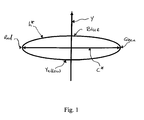
- Figure 1 shows a simplified representation of the Y, C*, h* system. It shows a slice of colour space at about the mid point of the light reflectance value, Y, range.
- the Y axis runs from 0 to 100. Red, yellow, green and blue are shown in their appropriate positions on the hue, circle.
- the C* axis runs from zero at the origin to 100 at the perimeter.
- further slices of hue are associated representing lighter and darker colours.
- the colours are less intense, and thus chroma is inevitably low. For this reason, colour space is often depicted as a sphere, although in truth it is more an irregular cylinder in shape.
- the grey or light coloured compositions which benefit most from the present invention can be identified as those colours, including whites, satisfying the following criteria; C * ⁇ C critical Y > mC * + 35 where m and C critical take the values in Table 1 below.
- the table enables the calculation of C* and Y for any given hue and thus the whites, grey or pastel/light shades are explicitly identified.
- Coatings having chroma, C* less than about 5 and a Y value more than 95 are perceived by the human eye as white.
- C*, Y and h* of any colour may be calculated from the spectral reflectance curve of the colour, measured using a spectrophotometer in accordance with the manufacturers instructions.
- a suitable spectrophotometer is the Datacolor Spectraflash SF 600.
- the dried coating compositions of the invention satisfy equations 1 and 2. More preferably, the dried coating compositions have a chroma less than 5 and a Y value greater than 85.
- the gloss value of the dried coating is less than 15% when measured at 85°, more preferably from 5 to 12 and most preferably from 8 to 12%.
- the coating composition may also contain other ingredients that are standard for coatings such as waxes, rheological modifiers, dispersants, anti-foams, tackifiers, plasticisers, crosslinking agents, flow aids, biocides and clays.
- a method of coating an article or structure having a surface with a composition according to the present invention including the steps of applying at least one liquid layer of the coating by brush, roller, pad or spray and allowing or causing the layer to dry and/or harden.
- Tioxide TM TR92 is a Rutile form of TiO 2 (density of 4.05g/cm 3 ) available from Huntsman Tioxide Europe Ltd, Hartlepool, Cleveland, United Kingdom.
- Microdol TM H200 and H600 are both dolomites (density of 2.85g/cm 3 ) and are available from Omya.
- Socal TM P3 is precipitated calcium carbonate (density of 2.70g/cm 3 ) and is available from Solvay, Rheinberg, Germany. China Clay Supreme (density 2.60g/cm 3 ) is available from Imerys.
- Ropaque TM Ultra E is a 30% non-vol dispersion of hollow polymeric spherical particles (density of 0.591g/cm 3 ) and is available from Rohm and Haas, Philadelphia, USA.
- Steabright TM is a talc (density of 2.78g/cm 3 ) available from Rio Tinto PLC, London, United Kingdom
- Axilat TM DS910 is a styrene-acrylic latex available (50wt% non-vol; density of non-vol is 1.08g/cm 3 ) from Hexion Specialty Chemicals BVBA, Kallo, Belgium.
- Mowlith LDM 1871 is a non-plasticised ethylene vinyl acetate (53wt% non-vol; density of non-vol is 1.08g/cm 3 ) available from Celenese.
- Synthomer DP 5316 is a styrene/acrylic polymer (50wt% non-vol; density of non-vol is 1.08g/cm 3 ) (available from Synthomer Ltd, Harlow, Essex, UK CM20 2BH.
- Texanol TM is an ester alcohol coalescent available from Eastman Chemical Company, Tennessee, USA.
- Orotan TM 731 A is a pigment dispersing agent (25wt% non-vol; density of non-vol is 1 g/cm 3) available from Rohm & Haas Philadelphia, USA.
- Disponil TM A1580 is a surfactant (80wt% non-vol; density of non-vol is 1.00 g/cm 3 ) and is available from Cognis GmbH & Co. KG. PO Box 130164, Germany.
- Dispelair TM CF 823 is a defoamer (60wt% non-vol; density of non-vol is 1.00g/cm -3 ) and is available from Blackburn Chemicals Ltd, Whitebirk Industrial Estate, Blackburn, United Kingdom.
- Blanose TM 7M 31C SCS 9554 (density 1.59g/cm 3 ) is available from Hercules GmbH, Dusseldorf, Germany. Rocima TM V 189 is available from Philadelphia, USA. Aquaflow TM NHS 300 (23wt% non-vol; density of non-vol is 1.00g/cm 3 ) is available from Hercules GmbH, Dusseldorf, Germany. China Clay Supreme (density is 2.60g/cm 3 ) is available from Imerys.
- Opacity was measured in accordance with BS 3900-D4. At least 90% is considered acceptable.
- the measured opacity is not linear in its relationship to how the eye perceives opacity. Thus, small differences in measured opacity are seen by the eye as much larger differences. Thus the number of coats required to achieve visual opacity is also quoted.
- the paint of the example is drawn down at various wet coating thicknesses, over plasterboard previously coated with a matt paint, such as Dulux Trade Supermatt.
- the paint of the example on drying is inspected for cracking and a note is made of the maximum wet film thickness below which cracking is not observed.
- a film thickness of at least 800 ⁇ m is considered acceptable.
- the high shear viscosity is measured at 25°C using an ICI Cone and Plate viscometer (available from Research Equipment London Ltd, London, TW2 5NX) operating at 10,000s -1 .
- the medium shear viscosity is measured at 25°C using a Rotothinner viscometer (available from Sheen Instruments Ltd, guitarist-upon-Thames, Surrey, UK) fitted with a standard disc rotor operating at about 250 s -1 .
- the paint made using the ingredients and amounts listed in Table 1 was made according to the following 51 laboratory scale method. Up to 5kg of millbase can be made in the dispersion vessel.
- Example 2 was made according to the method used in Example 1 but using a different binder, Synthomer DP5316.
- Example 3 was made according to the method used in Example 1 but using an ethylene vinyl acetate copolymer binder, Mowlith LDM1871.
- a vinyl acrylic binder was used in this example.
- the a monomer composition was vinyl acetate-butyl acrylate copolymer, 85:15 by weight, average particle size ca 0.3 ⁇ m) was used Liquid paint Dry paint wt% vol vol % 1.
- Comparative Example C contains the same ingredients as Example 1 except that Microdol H600 is omitted and the level of Microdol H200 is reduced.
- Comparative Example D contains the same ingredients as Example 1 except that the calcium carbonate (Socal P3) is replaced by increased levels of Dolomite H200 and Dolomite H600.
- Comparative Example E contains the same ingredients as Example 1 except that the talc is omitted and replaced with Dolomite H200 and Dolomite H600 and reduced calcium carbonate.
Landscapes
- Chemical & Material Sciences (AREA)
- Engineering & Computer Science (AREA)
- Life Sciences & Earth Sciences (AREA)
- Materials Engineering (AREA)
- Wood Science & Technology (AREA)
- Organic Chemistry (AREA)
- Dispersion Chemistry (AREA)
- Inorganic Chemistry (AREA)
- Nanotechnology (AREA)
- Paints Or Removers (AREA)
- Vessels And Coating Films For Discharge Lamps (AREA)
- Luminescent Compositions (AREA)
Abstract
film-forming particulate polymeric binder and non-film forming particulate material in amounts providing a PVC of from 75 to 90%
wherein the non-film forming material calculated on the total volume solids comprises
a) opacifying pigment particles comprising
i) from 2 to 8% TiO2
ii) from 5 to 15% hollow polymeric spherical particles and
b) non-opacifying extender particles comprising
i) from 10 to 40% calcium magnesium carbonate
ii) from 10 to 25% calcium carbonate
iii) from 5 to 20 % talc
and wherein the composition is free of pigmented vesiculated polymer beads.
Description
- This invention relates to reduced energy content pigmented coating compositions, especially pigmented paints of low sheen, also known as matt paints. In particular it relates to paints of pigment volume content from 75 to 90% and having sheen of less than 15% when measured at 85°.
- Light coloured pigmented paints usually contain high levels of titanium dioxide, TiO2. This is because such pastel shades are predominantly white with a small amount of non-white colour added. Titanium dioxide is the best source of whiteness due to its high refractive index relative to typical binders used in paints. Unfortunately, TiO2 requires large amounts of energy to extract it from the ground and then purify. In fact, in known high pigment volume content (PVC) paints of pastel/light colour, for example matt whites and matt light shades as hereinbelow described, the high TiO2 content used in order to achieve the desired colour and opacity is the main contributor to the total energy content of the paint.
- By energy content, we mean the energy required to extract, refine and manufacture the ingredients comprising the paint; and the energy required to manufacture the paint itself.
- Since most energy is generated by burning fossil fuel, high energy content usually results in high carbon dioxide emissions - hence the use of the alternative measure 'embedded CO2' to indicate the energy content.
- The adverse effect of such emissions on the global environment, especially climate change, is generally accepted by most serious commentators. Thus there is a need to reduce the energy consumed in producing such paints.
- One approach to this is to reduce the TiO2 content of the paint. However, this simply reduces the opacity of the dried coating and, whilst each coat of dried paint may well have reduced energy content, additional coats will be required in order to achieve opacity. Consequently, any benefit is lost or at least, significantly diminished. Other approaches replace some or all of the TiO2 with extender pigments such as chalk. Whilst such extenders require less energy than TiO2 to extract and refine, the lower refractive index of such extenders is very close to the binders used in paint. As such, they do not scatter light as well as TiO2 and in order to compensate for the TiO2 more needs to be added to the paint to achieve the correct colour and opacity. However, this raises the PVC further, eventually to the extent that air is trapped in the dried paint film. Whilst this increases the opacity, it also usually results in poorer scrub resistance. If the PVC is increased still further by adding yet more extender, or indeed any other non-film forming inorganic material, macroscopic cracks appear as the film dries, resulting in unacceptable appearance.
- One possible way out of this dilemma is to use calcined clay as this has good opacity and is less detrimental to the scrub resistance. However, this requires the clay to be heated to 1000°C thereby consuming large amounts of energy. Clearly, this does not result in significant energy savings and is thus not a preferred option.
- United States Patent
US 4,277,385 discloses paint compositions having PVC between 75 and 85% and further teaches that to avoid cracking in high PVC paint films, the formulation should be free of non-opacifying inorganic pigments (another name for extenders) essentially replacing them with non-film forming solid polymer particles. However, no attempt is made to minimise the TiO2 content in these formulations and, thus the problem of high energy content and high CO2 emissions are not addressed. European Patent applicationEP 0113435 describes an aqueous paint having reduced TiO2 content at PVC from 20 to 80%. It teaches to use mixtures comprising pigmented vesiculated polymer beads and larger opaque polymer particles having microvoids, but no pigments, to replace TiO2 whilst maintaining burnish/scrub resistance. However, as pointed out in that application, pigmented vesiculated polymer beads themselves contain TiO2 and thus add considerably to the TiO2 content. This does little, if anything, to reduce the total energy content of the paint. Pigmented vesiculated polymer beads are polymer particles containing both and TiO2 microvoids. - Thus, there is a need for improved paint compositions having reduced TiO2 content and thus low energy content whilst also having good opacity without mudcracking.
- Accordingly, there is provided an aqueous pigmented coating composition comprising film-forming particulate polymer binder and non-film forming particulate material in amounts providing a pigment volume content of from 75 to 90%
wherein the non-film forming material, calculated on the total volume solids, comprises - a) opacifying pigment particles comprising
- i) from 2 to 8% rutile titanium dioxide and
- ii) from 5 to 15% hollow sphere polymeric particles and
- b) non-opacifying extender particles comprising
- i) from 10 to 40% calcium magnesium carbonate
- ii) from 10 to 25% calcium carbonate
- iii) from 5 to 20 % talc
- Preferably the pigment volume content is from 77 to 85%, more preferably from 78 to 82, even more preferably from 79 to 81 and most preferably it is 80%
- The binder preferably comprises an aqueous dispersion of polymer particles, often referred to as latex. More preferably, such dispersions are made using emulsion polymerisation.
- For simplicity, the word 'polymer' in this specification is used to cover homopolymers and copolymers comprising two or more monomer variants.
- Preferably, the polymer comprising the particulate binder is derived from styrene and/or its derivatives, and the esters of acrylic acid and/or methacrylic acid, referred to hereonin as acrylic monomers. Such polymers are often referred to as styrene/acrylics. Preferably, the relative amounts of styrene, and/or its derivatives, and acrylic is from 2:1 to 0.5:1, more preferably from1.5:1 to 0.8:1, even more preferably and 1.2:1 and 0.8:1 and most preferably it is 1:1 calculated on a weight basis.
- Acrylic monomers include methyl (meth)acrylate, ethyl (meth)acrylate, propyl (meth)acrylate and butyl (meth)acrylate. Derivatives of styrene include α-methyl styrene and vinyl toluene.
- From 2 to 10% of acid functional monomers are advantageously copolymerised into the polymer comprising the particles. Suitable examples of such monomers include acrylic and methacrylic acid. More preferably the amount is from 4 to 8% and even more preferably it is from 5 to 7% by weight. The incorporation of the acid enables dispersions comprising smaller particles to be produced, for example, having a mean particle size of no more than 0.3 µm. Such particles sized polymers are preferred as they are better binders than larger sized particles.
- The glass transition temperature, Tg, of the polymer binder can be controlled by the choice of monomers and the relative amounts copolymerised. Preferably, it is from -20 to 50°C, more preferably from -15 to 30°C, even more preferably from -10 to 20°C, yet more preferably from 0 to 15°C and most preferably from 0 to 10°C. When higher Tg polymers are used, more coalescing and/or plasticizing solvents are required to enable a coherent coating film to form at normal room temperature of approximately 20 to 25°C. Lower Tg polymers are preferred as these can film form effectively with reduced levels of solvents thereby keeping both the volatile organic content of the paint and the energy content of the paint to a minimum.
- Preferably, the polymer binder in the present invention is derived from styrene, butyl acrylate and acrylic acid in a weight ratio of 47:47:6.
- Preferably, the polymer binder contains no other polymer binder other than a styrene/acrylic.
- Preferably the number average mean particle size of the polymer particles is from 0.05 to 0.30 µm, more preferably from 0.07 to 0.15 µm and most preferably from 0.08 to 0.14 µm. The number refers to the diameter of the particles. The smaller particle size is preferred as it results in improved scrub resistance, which is particularly important at the high PVC of the present invention.
- Preferably the binder level of the coating is from 10 to 20% calculated on volume solids.
- By aqueous is meant that at least 50% of the continuous phase is water, preferably from 75 to 100%, more preferably from 85 to 100%, even more preferably from 95 to 100% and most preferably it is 100%. Any balance is preferably water compatible organic solvent or mixture of solvents.
- Preferably the TiO2 is in the Rutile form as Anatase is a less efficient scatterer and thus more of it is required to achieve the same degree of whiteness.
Preferably the TiO2 comprises from 3 to 8, more preferably from 4 to 8, even more preferably from 5 to 8, yet more preferably from 5 to 7 and most preferably from 6 to 7% of the composition. - Preferably, the non-film forming hollow sphere polymeric particles comprise from 5 to 20%, more preferably from 5 to 15%, even more preferably from 5 to 10%, still more preferably from 5 to 8% and most preferably from 5 to 7% calculated on the total volume solids of the coating composition.
- Advantageously, the average particle size of the non-film forming hollow sphere polymeric particles is less than 1µm, more preferably from 0.01 to 1µm, even more preferably from 0.1 to 0.6µm, still more preferably from 0.2 to 0.5µm and most preferably from 0.35 to 0.4µm. For such particles a diameter of about 0.4µm is optimum for opacifying power. Suitable examples of such hollow sphere polymeric particles include Ropaque™ range of particles, especially Ropaque™ Ultra E as this provides the best balance of opacifying power and scrub resistance.
- By non-opacifying extender particles is meant inorganic particles that have a refractive index close to that of the polymer binder. Since the opacifying strength of a particulate material is partly a consequence of the difference in refractive index of the material and the medium in which it is dispersed, such extenders are regarded essentially as non-opacifiers, see page 35 to 37, Paint and Surface Coatings - theory and practice edited by R.Lambourne and published by John Wiley and Sons
- Preferably the calcium carbonate comprises from 10 to 20%, more preferably from 12 to 18% and most preferably from 14 to 18% of the total volume solids. The calcium carbonate is in the form of particles which are preferably cigar shaped-that is, they are rod shaped being thicker in the middle region and tapering at the ends. Preferably, the mean particle size is from 0.2-0.3µm. Suitable forms of calcium carbonate include calcite, preferably precipitated calcite. Socal P3 is an example of suitable precipitated calcium carbonate, in the form of calcite.
- Preferably the talc comprises from 5 to 15, more preferably from 10 to 15% of the total volume solids otherwise the finish is poor producing a non-smooth surface and care must be taken during painting to minimise the poor appearance. Additionally, the finish becomes susceptible to defects such as craters, pinholes etc
- Adding talc above 20% produces viscosity which is too high to allow easy application using conventional application techniques-such as rollers or brushes-and allow the paint to flow to produce an acceptably smooth finish.
- The preferred viscosity characteristics of the coating, measured at 25°C, are defined by the high shear viscosity at 10000s-1, and the medium shear viscosity, measured at 250 s-1. Preferably the high shear viscosity is less than 0.3 Pa.s, more preferably from 0.02 to 0.3 Pa.s, yet more preferably from 0.1 to 0.3 Pa.s. This allows for easy application without excessive 'drag' on the brush or roller. The medium shear viscosity is advantageously from 0.3 to 1.5 Pa.s. Below 0.3 Pa.s the liquid coating will tend to sag whilst a medium shear viscosity greater than 1.5 Pa.s will not flow adequately leaving a rather rough and uneven appearance to the coating when dry. More preferably, the medium shear viscosity is from 0.5 to 1.5 Pa.s, yet more preferably it is from 0.75 to 1.25 Pa.s and most preferably it is from 0.55 to 1.2 Pa.s.
- The mineral known as dolomite is composed substantially of calcium magnesium carbonate, CaMg(CO3)2. This is a convenient and cost effective source of calcium magnesium carbonate and is preferred for use in the present invention. It is available in powder form of differing mean particle sizes.
- Preferably, the dolomite powder used in the present invention is a mixture of differing mean particle sizes, more preferably of two different sizes. This ensures that the TiO2 particles are sufficiently spaced apart that scattering, and therefore opacity, is efficient. Even more preferably the mean particle size of the coarser dolomite is from 15 to 35µm and of the finer one, from 2 to 10µm. Yet more preferably, the dolomite is in powder form consisting of a mixture of a first powder, having a mean particle size of from 22 to 28µm, and a second powder, having a mean particle size of from 3 to 6µm. The relative amounts of the two powders are preferably in the ratio of 25:75 to 75:25 by weight.
- Preferably, the dried coating composition comprises from 15 to 35, more preferably from 20 to 35 and most preferably from 20 to 30% of CaMg(CO3)2 calculated on the total volume solids.
- The mean particle sizes quoted for the extenders are measured as d50% by weight, meaning that 50% of the particles by weight have a diameter greater than the quoted number and 50% have a diameter smaller than the number.
- Preferably the coating composition is free of non-film forming solid polymer particles because they increase the energy content of the coating without providing any benefits. Preferably the composition is free of calcined clay, especially flash calcined clay, which although is a good scatterer producing good opacity, nevertheless consumes large amounts of energy to produce.
- The benefits of the invention are advantageously achieved in coloured coating compositions requiring high levels of TiO2. Such colours are the greys and lightly coloured coatings, often referred to as pastel or light colours, and of course, the whites.
- These, and all colours, can be defined using the well known Y, C*, h* system. In the system, any colour can be represented by
- i. its hue, depicted by h*
- ii. its chroma, C*,
- iii. its light reflectance value, Y
- These terms are defined scientifically by the Commission Internationale de l'Eclairage (CIE) [see 'International Lighting Vocabulary', 4th Edition, published IEC/CIE 017.4-1987. ISBN 978 3 900734 07 7].
- For the avoidance of any doubt, any reference to coating colour in this specification is to the colour of the coating when dry, unless otherwise stated.
- Hue is a measure of how close the colour is to red, yellow, green and blue. It is depicted by hue angle ranging from 0 to 360° where the angle defines the position of the hue in colour space, where red, yellow, green and blue are at angles of 0, 90, 180 and 270° respectively. Angles between these 'cardinal points' indicate intermediate colours eg a hue angle of 45° is a reddish yellow (orange) colour.
- Chroma is a measure of colour intensity, ie the extent to which it is either a pastel/light colour or a strong colour or something in between. Chroma can take values from 0 to 100 with the higher numbers indicating stronger colours. Colours having a chroma value of 0 are 'neutral' greys lying on an axis from black to white.
- The light reflectance value is a measure of the perceived lightness of the colour, ranging from 0 to 100, with 0 representing black and 100 white.
-
Figure 1 shows a simplified representation of the Y, C*, h* system. It shows a slice of colour space at about the mid point of the light reflectance value, Y, range. The Y axis runs from 0 to 100. Red, yellow, green and blue are shown in their appropriate positions on the hue, circle. The C* axis runs from zero at the origin to 100 at the perimeter. At each value of Y, further slices of hue are associated representing lighter and darker colours. At both the dark and the light end of the Y scale, the colours are less intense, and thus chroma is inevitably low. For this reason, colour space is often depicted as a sphere, although in truth it is more an irregular cylinder in shape. - Using the CIE notation, the grey or light coloured compositions which benefit most from the present invention, can be identified as those colours, including whites, satisfying the following criteria;


where m and Ccritical take the values in Table 1 below.Table 1 Hue angle
h*m Ccritical 0 0.098 39.063 10 0.063 42.739 20 0.231 40.130 30 0.399 37.522 40 0.498 37.444 50 0.579 38.000 60 0.655 39.500 70 0.732 41.000 80 0.793 45.286 90 0.854 49.571 100 0.803 47.136 110 0.740 43.955 120 0.663 41.727 130 0.580 39.909 140 0.498 38.565 150 0.416 37.696 160 0.346 37.381 170 0.318 39.586 180 0.283 40.850 190 0.190 39.350 200 0.101 38.000 210 0.060 38.000 220 0.021 38.333 230 -0.007 40.000 240 -0.041 40.314 250 -0.083 38.600 260 -0.125 36.886 270 -0.167 35.171 280 -0.152 34.640 290 -0.131 34.240 300 -0.079 34.000 310 0.016 34.000 320 0.112 34.000 330 0.207 34.000 340 0.235 34.471 350 0.161 35.647 360 0.098 39.063 - Above the Ccitical value the colour intensity is too high to be perceived as a pastel colour.
- The values of m and Ccritical at intermediate hue angles can be calculated by linear interpolation.
- The table enables the calculation of C* and Y for any given hue and thus the whites, grey or pastel/light shades are explicitly identified.
- Coatings having chroma, C* less than about 5 and a Y value more than 95 are perceived by the human eye as white.
- The values of C*, Y and h* of any colour may be calculated from the spectral reflectance curve of the colour, measured using a spectrophotometer in accordance with the manufacturers instructions. A suitable spectrophotometer is the Datacolor Spectraflash SF 600.
- Preferably, the dried coating compositions of the invention satisfy equations 1 and 2. More preferably, the dried coating compositions have a chroma less than 5 and a Y value greater than 85.
- Preferably, the gloss value of the dried coating is less than 15% when measured at 85°, more preferably from 5 to 12 and most preferably from 8 to 12%.
- The coating composition may also contain other ingredients that are standard for coatings such as waxes, rheological modifiers, dispersants, anti-foams, tackifiers, plasticisers, crosslinking agents, flow aids, biocides and clays.
- In another aspect of the invention there is provided a method of coating an article or structure having a surface with a composition according to the present invention including the steps of applying at least one liquid layer of the coating by brush, roller, pad or spray and allowing or causing the layer to dry and/or harden.
- In a further of the invention there is provided an article or structure having a surface coated with a composition according to the present invention.
- The following ingredients were used in preparing the examples.
Tioxide™ TR92 is a Rutile form of TiO2 (density of 4.05g/cm3) available from Huntsman Tioxide Europe Ltd, Hartlepool, Cleveland, United Kingdom.
Microdol™ H200 and H600 are both dolomites (density of 2.85g/cm3) and are available from Omya. Omya House, Derby, United Kingdom
Socal™ P3 is precipitated calcium carbonate (density of 2.70g/cm3) and is available from Solvay, Rheinberg, Germany.
China Clay Supreme (density 2.60g/cm3) is available from Imerys.
Ropaque™ Ultra E is a 30% non-vol dispersion of hollow polymeric spherical particles (density of 0.591g/cm3) and is available from Rohm and Haas, Philadelphia, USA.
Steabright™ is a talc (density of 2.78g/cm3) available from Rio Tinto PLC, London, United Kingdom
Axilat™ DS910 is a styrene-acrylic latex available (50wt% non-vol; density of non-vol is 1.08g/cm3) from Hexion Specialty Chemicals BVBA, Kallo, Belgium.
Mowlith LDM 1871 is a non-plasticised ethylene vinyl acetate (53wt% non-vol; density of non-vol is 1.08g/cm3) available from Celenese.
Synthomer DP 5316 is a styrene/acrylic polymer (50wt% non-vol; density of non-vol is 1.08g/cm3) (available from Synthomer Ltd, Harlow, Essex, UK CM20 2BH.
Texanol™ is an ester alcohol coalescent available from Eastman Chemical Company, Tennessee, USA.
Orotan™ 731 A is a pigment dispersing agent (25wt% non-vol; density of non-vol is 1 g/cm3) available from Rohm & Haas Philadelphia, USA.
Disponil™ A1580 is a surfactant (80wt% non-vol; density of non-vol is 1.00 g/cm3) and is available from Cognis Deutschland GmbH & Co. KG. PO Box 130164, Germany.
Dispelair™ CF 823 is a defoamer (60wt% non-vol; density of non-vol is 1.00g/cm-3) and is available from Blackburn Chemicals Ltd, Whitebirk Industrial Estate, Blackburn, United Kingdom.
Blanose™ 7M 31C SCS 9554 (density 1.59g/cm3) is available from Hercules GmbH, Dusseldorf, Germany.
Rocima™ V 189 is available from Philadelphia, USA.
Aquaflow™ NHS 300 (23wt% non-vol; density of non-vol is 1.00g/cm3) is available from Hercules GmbH, Dusseldorf, Germany.
China Clay Supreme (density is 2.60g/cm3) is available from Imerys. - The following tests were used to evaluate the examples
- Opacity was measured in accordance with BS 3900-D4.
At least 90% is considered acceptable.
The measured opacity is not linear in its relationship to how the eye perceives opacity. Thus, small differences in measured opacity are seen by the eye as much larger differences. Thus the number of coats required to achieve visual opacity is also quoted. - Gloss was measured in accordance with BS EN ISO 2813, BS 3900-D5.
- Scrub resistance was measured in accordance with BS EN ISO 11998
Less than 6mg/cm2 removal is acceptable. - The paint of the example is drawn down at various wet coating thicknesses, over plasterboard previously coated with a matt paint, such as Dulux Trade Supermatt. The paint of the example on drying is inspected for cracking and a note is made of the maximum wet film thickness below which cracking is not observed.
A film thickness of at least 800µm is considered acceptable. - The high shear viscosity is measured at 25°C using an ICI Cone and Plate viscometer (available from Research Equipment London Ltd, London, TW2 5NX) operating at 10,000s-1.
- The medium shear viscosity is measured at 25°C using a Rotothinner viscometer (available from Sheen Instruments Ltd, Kingston-upon-Thames, Surrey, UK) fitted with a standard disc rotor operating at about 250 s-1.
- The invention will now be illustrated by the following examples.
- The paint made using the ingredients and amounts listed in Table 1 was made according to the following 51 laboratory scale method. Up to 5kg of millbase can be made in the dispersion vessel.
- Using a 5 litre metal dispersion vessel, load the Water (1), Texanol, Orotan, Disponil, Dispelair and Rocima V189. Place vessel under High Speed Disperser fitted with a saw tooth blade. Stir at slow speed so that no splashing is observed. Add Microdol H200 and H600, Socal P3, China Clay Supreme, Steabright and Tioxide TR92, run for 2 minutes at slow speed then add Blanose thickener. Over 5minutes slowly increase the speed as the paint thickens. Unit should be running at approximately 2500 r.p.m. (depending on volume), but without splashing. Stir for a further 30minutes. Stop unit half way through to ensure no pigment has stuck to sides/base of vessel by hand stirring. Turn unit back on to high speed, after 30 minutes reduce to slow speed. Check the state of dispersion of the millbase for bits by brushing out on a card. If acceptable amount of bits, add Water (2) and run for a further 2minutes and then switch off the stirrer.
- Load binder into a suitably sized vessel and place under a stirrer fitted with a paddle blade.
Load Ammonia, Dispelair, the Millbase prepared above, Ropaque, Water (3) and Aquaflow. Adjust the stirrer speed as the volume in the vessel increases, being careful to avoid splashing. - Stir for a further run 15 minutes at low speed (approx 500 r.p.m)
Liquid paint Dry paint wt% vol vol % 1.Water (1) 31.500 0.000 0.000 2.Texanol NX 795 0.500 0.000 0.000 3.Orotan 731 A 1.000 0.250 1.047 4.Disporul A1580 0.500 0.400 1.676 5.Dispelair CF823 0.130 0.078 0.327 6.Microdol H600 8.500 2.982 12.494 7.Socal P3 12.500 4.630 19.394 8.China Clay Supreme 5.500 2.115 8.862 9.Steabright 8.500 3.058 12.808 10.Microdol H 200 8.500 2.982 12.494 11.Tioxide TR92 6.500 1.605 6.723 12.Blanose
7M 31C SCS 95540.500 0.314 1.317 13.Rocima V189 0.240 0.000 0.000 14.Water (2) 2.000 0.000 0.000 15.Axilat DS 910 6.500 3.009 12.606 16.Ammonia 910 0.007 0.000 0.000 17.Dispelair CF823 0.120 0.072 0.302 18.Ropaque Ultra E 4.000 2.030 8.506 19. Water (3) 1.503 0.000 0.000 20.Aquaflow
NHS 3001.500 0.345 1.445 PVC (total) 81.37% PVC (TiO2) 6.7% - The paint was applied to a substrate as described in the test procedures above and evaluated for the following properties.
Opacity 93.6% Visual opacity required 2 coats Scrub resistance 2.12mg at 200 cycles Mudcrack 900µm - Example 2 was made according to the method used in Example 1 but using a different binder, Synthomer DP5316.
Liquid paint Dry paint wt% vol vol % 1.Water (1) 30.000 0.000 0.000 2.Texanol NX 795 2.000 0.000 0.000 3.Orotan 731 A 1.000 0.250 1.047 4.Disponil A1580 0.500 0.400 1.676 5.Dispelair CF823 0.130 0.078 0.327 6.Microdol H600 8.500 2.982 12.494 7.Socal P3 12.500 4.630 19.394 8.China Clay Supreme 5.500 2.115 8.862 9.Steabright 8.500 3.058 12.808 10.Microdol H 200 8.500 2.982 12.494 11.Tioxide TR92 6.500 1.605 6.723 12.Blanose
7M 31C SCS 95540.500 0.314 1.317 13.Rocima V189 0.240 0.000 0.000 14. Water (2) 2.000 0.000 0.000 15.Synthomer
DP 53166.500 3.009 12.606 16.Ammonia 910 0.007 0.000 0.000 17.Dispelair CF823 0.120 0.072 0.302 18.Ropaque Ultra E 4.000 2.030 8.506 19.Water (3) 1.503 0.000 0.000 20.Aquaflow
NHS 3001.500 0.345 1.445 PVC (total) 81.3% PVC (TiO2) 6.7% Opacity 93.7% Visual opacity required 2 coats Scrub resistance 2.45 mg at 200 cycles Mudcrack 850µm - Example 3 was made according to the method used in Example 1 but using an ethylene vinyl acetate copolymer binder, Mowlith LDM1871..
Liquid paint Dry paint wt% vol vol % 1.Water (1) 15.800 0.000 0.000 2.Optigel CK 0.150 0.056 0.234 3.Dispex N40 0.200 0.080 0.337 4.Disponil A1580 0.500 0.400 1.684 5.Dispelair CF823 0.130 0.078 0.328 6.Microdol H600 8.500 2.982 12.553 7.Socal P3 12.500 4.630 19.485 8.China Clay Supreme 5.500 2.115 8.903 9.Steabright 8.500 3.058 12.869 10.Microdol H 200 8.500 2.982 12.553 11.Tioxide RTC90 5.500 1.358 5.716 12.Natrosol 250MR 0.550 0.346 1.456 13.Rocima V189 0.240 0.000 0.000 14.Water (2) 18.100 0.000 0.000 15.Mowlith
LDM18717.076 3.472 14.614 16.Ammonia 910 0.021 0.000 0.000 17.Dispelair CF823 0.120 0.072 0.303 18.Ropaque Ultra E 4.000 2.030 8.546 19.Water (3) 3.613 0.000 0.000 20.Acrysol
RM 20201.500 0.100 0.421 PVC (total) 80.6% PVC (TiO2) 5.7% - All the Comparative Examples were made using the same method as described in Example 1, differing only in the ingredients and/or levels used as indicated in the tables.
- A vinyl acrylic binder was used in this example. The a monomer composition was vinyl acetate-butyl acrylate copolymer, 85:15 by weight, average particle size ca 0.3 µm) was used
Liquid paint Dry paint wt% vol vol % 1. Water (1) 30.000 0.000 0.000 2.Texanol NX 795 2.000 0.000 0.000 3.Orotan 731 A 1.000 0.250 1.047 4.Disponil A1580 0.500 0.400 1.676 5.Dispelair CF823 0.130 0.078 0.327 6.Microdol H600 8.500 2.982 12.494 7.Socal P3 12.500 4.630 19.394 8.China Clay Supreme 5.500 2.115 8.862 9.Steabright 8.500 3.058 12.808 10.Microdol H 200 8.500 2.982 12.494 11.Tioxide TR92 6.500 1.605 6.723 12.Blanose
7M 31C SCS 95540.500 0.314 1.317 13.Rocima V189 0.240 0.000 0.000 14. Water (2) 2.000 0.000 0.000 15.Vinyl acrylic binder 6.500 3.009 12.606 16.Ammonia 910 0.007 0.000 0.000 17.Dispelair CF823 0.120 0.072 0.302 18.Ropaque Ultra E 4.000 2.030 8.506 19.Water (3) 1.503 0.000 0.000 20.Aquaflow
NHS 3001.500 0.345 1.445 PVC (total) 81.3% PVC (TiO2) 6.7% Opacity 92.9% Visual opacity required 2 coats Scrub resistance 8.7 mg at 200 cycles Mudcrack 700µm - Ropaque was omitted in this example.
Liquid paint Dry paint wt% vol vol % 1,Water (1) 30.000 0.000 0.000 2.Texanol NX 795 2.000 0.000 0.000 3.Orotan 731 A 1.000 0.250 1.145 4.Disponil A1580 0.500 0.400 1.831 5.Dispelair CF823 0.130 0.078 0.357 6.Microdol H600 8.500 2.982 13.655 7.Socal P3 12.500 4.630 21.197 8.China Clay Supreme 5.500 2.115 9.685 9.Steabright 8.500 3.058 13.999 10.Microdol H 200 8.500 2.982 13.655 11.TioxideTR92 6.500 1.605 7.348 12.Blanose
7M 31C SCS 95540.500 0.314 1.440 13.Rocima V189 0.240 0.000 0.000 14.Water (2) 6.000 0.000 0.000 15.Axilat DS910 6.500 3.009 13.778 16.Ammoma 910 0.007 0.000 0.000 17.Dispelair CF823 0.120 0.072 0.330 18.Ropaque Ultra E 0.000 0.000 0.000 19.Water (3) 1.503 0.000 0.000 20.Aquaflow
NHS 3001.500 0.300 1.158 PVC (total) 79.5% PVC (TiO2) 7.3% Opacity 89.0% Visual opacity required 3 coats Scrub resistance 2.4 mg at 200 cycles Mudcrack 900µm - Comparative Example C contains the same ingredients as Example 1 except that Microdol H600 is omitted and the level of Microdol H200 is reduced.
Liquid paint Dry paint Wt% vol vol % 1.Water (1) 30.000 0.000 0.000 2.Texanol NX 795 2.000 0.000 0.000 3.Orotan 731 A 1.000 0.250 1.039 4.Disponil A1580 0.500 0.400 1.662 5.Dispelair CF823 0.130 0.078 0.324 6. Microdol H600 0.000 0.000 0.000 7.Socal P3 21.000 7.778 32.316 8.China Clay Supreme 5.500 2.115 8.789 9.Steabright 12.000 4.317 17.935 10.Microdol H 200 5.000 1.754 7.289 11.Tioxide TR92 6.500 1.605 6.668 12.Blanose
7M 31C SCS 95540.500 0.314 1.307 13.Rocima V189 0.240 0.000 0.000 14.Water (2) 2.000 0.000 0.000 15.Axilat DS 910 6.500 3.009 12.503 16.Ammonia 910 0.007 0.000 0.000 17.Dispelair CF823 0.120 0.072 0.299 18.Ropaque Ultra E 4.000 2.030 8.436 19. Water (3) 1.503 0.000 0.000 20.Aquaflow
NHS 3001.500 0.345 1.433 PVC (total) 81.4% PVC (TiO2) 6.7% Opacity 91.6% Visual opacity required 2 coats Scrub resistance 6.71 mg at 200 cycles Mudcrack 300µm - Comparative Example D contains the same ingredients as Example 1 except that the calcium carbonate (Socal P3) is replaced by increased levels of Dolomite H200 and Dolomite H600.
Liquid paint Dry paint wt% vol vol % 1.Water (1) 30.000 0.000 0.000 2.Texanol NX 795 2.000 0.000 0.000 3.Orotan 731 A 1.000 0.250 1.058 4.Disponil A1580 0.500 0.400 1.693 5.Dispelair CF823 0.130 0.078 0.330 6.Microdol H600 14.000 4.912 20.790 7.Socal P3 0.000 0.000 0.000 8.China Clay Supreme 5.500 2.115 8.953 9.Steabright 8.500 3.058 12.940 10.Microdol H 200 15.500 5.439 23.018 11.Tioxide TR92 6.500 1.605 6.793 12.Blanose
7M 31C SCS 95540.500 0.314 1.331 13.Rocima V189 0.240 0.000 0.000 14. Water (2) 2.000 0.000 0.000 15.Axilat DS 910 6.500 3.009 12.736 16.Ammonia 910 0.007 0.000 0.000 17.Dispelair CF823 0.120 0.072 0.305 18.Ropaque Ultra E 4.000 2.030 8.593 19.Water (3) 1.503 0.000 0.000 20.Aquaflow
NHS 3001.500 0.345 1.460 PVC (total) 81.1% PVC (TiO2) 6.8% - The paint was applied to a substrate as described in the test procedures above and evaluated for the following properties.
Opacity 89.0 % Visual opacity required 3 coats Scrub resistance 2.42 mg at 200 cycles Mudcrack 1050 µm - Comparative Example E contains the same ingredients as Example 1 except that the talc is omitted and replaced with Dolomite H200 and Dolomite H600 and reduced calcium carbonate.
Liquid paint Dry paint wt% vol vol % 1. Water (1) 30.000 0.000 0.000 2.Texanol NX 795 2.000 0.000 0.000 3.Orotan 731 A 1.000 0.250 1.054 4.Disponil A1580 0.500 0.400 1.686 5Dispelair CF823 0.130 0.078 0.329 6.Microdol H600 14.000 4.912 20.711 7.Socal P3 8.500 3.148 13.273 8.China Clay Supreme 5.500 2.115 8.919 9.Steabright 0.000 0.000 0.000 10.Microdol H 200 15.500 5.439 22.930 11.Tioxide TR92 6.500 1.605 6.767 12.Blanose
7M 31C SCS 95540.500 0.314 1.326 13.Rocima V189 0.240 0.000 0.000 14. Water (2) 2.000 0.000 0.000 15.Axilat DS 910 6.500 3.009 12.687 16.Ammonia 910 0.007 0.000 0.000 17.Dispelair CF823 0.120 0.072 0.304 18.Ropaque Ultra E 4.000 2.030 8.561 19.Water (3) 1.503 0.000 0.000 20.Aquaflow
NHS 3001.500 0.345 1.455 PVC (total) 81.2% PVC (TiO2) 6.8% - The paint was applied to a substrate as described in the test procedures above and evaluated for the following properties.
Opacity 92.6% Visual opacity required 2 coats Scrub resistance 7.89 mg at 200 cycles Mudcrack 700 µm
Claims (14)
- An aqueous pigmented coating composition comprisingfilm-forming particulate polymeric binder and non-film forming particulate material in amounts providing a pigment volume content of from 75 to 90%wherein the non-film forming material calculated on the total volume solids comprisesa) opacifying pigment particles comprisingi) from 2 to 8% TiO2ii) from 5 to 15% hollow polymeric spherical particles andb) non-opacifying extender particles comprisingi) from 10 to 40% calcium magnesium carbonateii) from 10 to 25% calcium carbonateiii) from 5 to 20 % talcand wherein the composition is free of pigmented vesiculated polymer beads.
- A coating composition according to claim 1 which is free of non-film forming solid polymer particles.
- A coating composition according to claim 1 or claim 2 which is free of calcined clay.
- A coating composition according to any one of the previous claims wherein the film forming polymer comprises a styrene-acrylic polymer.
- A coating composition according to claim 4 wherein the ratio of styrene to acrylic monomers in the polymer is from 2:1 to 0.5:1 calculated on % weight basis.
- A coating composition according to any one of the previous claims wherein the opacifying particles consist of from 2 to 8% TiO2 and from 5 to 15% hollow polymeric spherical particles.
- A coating composition according to any one of the previous claims wherein the calcium magnesium carbonate comprises a mixture of a first powder and a second powder, the first having mean particles size of 2 to 10µm and the second having a mean particle size of from 15 to 35 µm.
- A coating composition according to claim 7 wherein the ratio of the two powders is from 27:75 to 75:25 by weight.
- A coating composition according to any one of the previous claims wherein the sheen level is less than 15% measured at 85° using a glossmeter.
- A coating composition according to any one of the previous claims and having a colour when dry satisfying the criteria of

and
when calculated using m and Ccritical according to the table belowHue angle h* m Ccritical 0 0.098 39.063 10 0.063 42.739 20 0.231 40.130 30 0.399 37.522 40 0.498 37.444 50 0.579 38.000 60 0.655 39.500 70 0.732 41.000 80 0.793 45.286 90 0.854 49.571 100 0.803 47.136 110 0.740 43.955 120 0.663 41.727 130 0.580 39.909 140 0.498 38.565 150 0.416 37.696 160 0.346 37.381 170 0.318 39.586 180 0.283 40.850 190 0.190 39.350 200 0.101 38.000 210 0.060 38.000 220 0.021 38.333 230 -0.007 40.000 240 -0.041 40.314 250 -0.083 38.600 260 -0.125 36.886 270 -0.167 35.171 280 -0.152 34.640 290 -0.131 34.240 300 -0.079 34.000 310 0.016 34.000 320 0.112 34.000 330 0.207 34.000 340 0.235 34.471 350 0.161 35.647 360 0.098 39.063 - A coating composition according to claim 10 having a C* value of less than 5 and a Y value greater that 85.
- A coating composition according to any one of the previous claims and further comprising ingredients selected from the group consisting of antifoams, defoamers, biocides, coalescing solvents, plasticizers, flow aids, rheological modifiers, dispersants and clays.
- A method of coating an article or structure having a surface with a composition as defined in any one of the preceding claims including the steps of applying at least one liquid layer of the coating by brush, roller, pad or spray; allowing or causing the layer to dry and/or harden.
- An article or structure having a surface coated with a composition as defined in any one of claims 1 to 12.
Priority Applications (5)
| Application Number | Priority Date | Filing Date | Title |
|---|---|---|---|
| ES08018858T ES2367063T3 (en) | 2008-10-29 | 2008-10-29 | LOW ENERGY COATINGS. |
| AT08018858T ATE510889T1 (en) | 2008-10-29 | 2008-10-29 | LOW ENERGY COATINGS |
| PL08018858T PL2182033T3 (en) | 2008-10-29 | 2008-10-29 | Low energy coatings |
| EP08018858A EP2182033B1 (en) | 2008-10-29 | 2008-10-29 | Low energy coatings |
| DK08018858.4T DK2182033T3 (en) | 2008-10-29 | 2008-10-29 | Fluorescent coating |
Applications Claiming Priority (1)
| Application Number | Priority Date | Filing Date | Title |
|---|---|---|---|
| EP08018858A EP2182033B1 (en) | 2008-10-29 | 2008-10-29 | Low energy coatings |
Publications (2)
| Publication Number | Publication Date |
|---|---|
| EP2182033A1 true EP2182033A1 (en) | 2010-05-05 |
| EP2182033B1 EP2182033B1 (en) | 2011-05-25 |
Family
ID=40289346
Family Applications (1)
| Application Number | Title | Priority Date | Filing Date |
|---|---|---|---|
| EP08018858A Active EP2182033B1 (en) | 2008-10-29 | 2008-10-29 | Low energy coatings |
Country Status (5)
| Country | Link |
|---|---|
| EP (1) | EP2182033B1 (en) |
| AT (1) | ATE510889T1 (en) |
| DK (1) | DK2182033T3 (en) |
| ES (1) | ES2367063T3 (en) |
| PL (1) | PL2182033T3 (en) |
Cited By (8)
| Publication number | Priority date | Publication date | Assignee | Title |
|---|---|---|---|---|
| EP2452986A1 (en) * | 2010-11-16 | 2012-05-16 | Rohm and Haas Company | Infrared reflective coating compositions |
| WO2012150360A3 (en) * | 2011-12-02 | 2013-03-07 | Akzo Nobel Coatings International B.V. | Waterborne antifouling coating composition |
| WO2013060657A1 (en) * | 2011-10-26 | 2013-05-02 | Akzo Nobel Coatings International B.V. | Improved solvent-free low energy coatings |
| WO2014074696A1 (en) * | 2012-11-09 | 2014-05-15 | Hercules Incorporated | Ready-mix joint compounds using non-uniformly substituted carboxymethylcellulose |
| US9155549B2 (en) | 2012-09-28 | 2015-10-13 | Dow Global Technologies Llc | Hydrophobically modified alkali soluble emulsion composition with polymeric beads |
| CN113025128A (en) * | 2021-04-02 | 2021-06-25 | 江苏旌翔建材科技有限公司 | Reflective heat-insulating coating and preparation method thereof |
| EP4230704A1 (en) * | 2022-02-18 | 2023-08-23 | Jotun A/S | Composition |
| US20240400843A1 (en) * | 2023-06-02 | 2024-12-05 | Swimc Llc | Scuff and mar resistant coating compositions |
Citations (4)
| Publication number | Priority date | Publication date | Assignee | Title |
|---|---|---|---|---|
| US4277385A (en) | 1979-02-09 | 1981-07-07 | Scm Corporation | High PVC latex paint |
| EP0113435A2 (en) | 1982-12-09 | 1984-07-18 | The Sherwin-Williams Company | Opacification of paint |
| EP1371691A1 (en) * | 2002-06-12 | 2003-12-17 | Rohm And Haas Company | Prepaints and methods of preparing paints from the prepaints |
| WO2005083016A1 (en) * | 2004-02-06 | 2005-09-09 | Imerys Kaolin, Inc. | Post-addition of white minerals for modifications of optical film properties |
-
2008
- 2008-10-29 EP EP08018858A patent/EP2182033B1/en active Active
- 2008-10-29 DK DK08018858.4T patent/DK2182033T3/en active
- 2008-10-29 AT AT08018858T patent/ATE510889T1/en not_active IP Right Cessation
- 2008-10-29 PL PL08018858T patent/PL2182033T3/en unknown
- 2008-10-29 ES ES08018858T patent/ES2367063T3/en active Active
Patent Citations (4)
| Publication number | Priority date | Publication date | Assignee | Title |
|---|---|---|---|---|
| US4277385A (en) | 1979-02-09 | 1981-07-07 | Scm Corporation | High PVC latex paint |
| EP0113435A2 (en) | 1982-12-09 | 1984-07-18 | The Sherwin-Williams Company | Opacification of paint |
| EP1371691A1 (en) * | 2002-06-12 | 2003-12-17 | Rohm And Haas Company | Prepaints and methods of preparing paints from the prepaints |
| WO2005083016A1 (en) * | 2004-02-06 | 2005-09-09 | Imerys Kaolin, Inc. | Post-addition of white minerals for modifications of optical film properties |
Non-Patent Citations (2)
| Title |
|---|
| "International Lighting Vocabulary", 1987 |
| "Paint and Surface Coatings - theory and practice", JOHN WILEY AND SONS, pages: 35 - 37 |
Cited By (18)
| Publication number | Priority date | Publication date | Assignee | Title |
|---|---|---|---|---|
| EP2452986A1 (en) * | 2010-11-16 | 2012-05-16 | Rohm and Haas Company | Infrared reflective coating compositions |
| CN102464932A (en) * | 2010-11-16 | 2012-05-23 | 罗门哈斯公司 | Infrared reflective coating composition |
| RU2617630C2 (en) * | 2011-10-26 | 2017-04-25 | Акцо Нобель Коатингс Интернэшнл Б.В. | Improved energy-efficient solvent-free coating compositions |
| WO2013060657A1 (en) * | 2011-10-26 | 2013-05-02 | Akzo Nobel Coatings International B.V. | Improved solvent-free low energy coatings |
| CN103906814B (en) * | 2011-10-26 | 2016-07-13 | 阿克佐诺贝尔国际涂料股份有限公司 | The solvent-free mental retardation coating improved |
| CN103906814A (en) * | 2011-10-26 | 2014-07-02 | 阿克佐诺贝尔国际涂料股份有限公司 | Improved solvent-free and low-energy coatings |
| EP2771417B1 (en) | 2011-10-26 | 2016-07-13 | Akzo Nobel Coatings International B.V. | Improved solvent-free low energy coatings |
| AU2012327264B2 (en) * | 2011-10-26 | 2016-03-17 | Akzo Nobel Coatings International B.V. | Improved solvent-free low energy coatings |
| US9290669B2 (en) | 2011-12-02 | 2016-03-22 | Akzo Nobel Coatings International B.V. | Waterborne antifouling coating composition |
| AU2012251537B2 (en) * | 2011-12-02 | 2016-08-18 | Akzo Nobel Coatings International B.V. | Waterborne antifouling coating composition |
| WO2012150360A3 (en) * | 2011-12-02 | 2013-03-07 | Akzo Nobel Coatings International B.V. | Waterborne antifouling coating composition |
| US9155549B2 (en) | 2012-09-28 | 2015-10-13 | Dow Global Technologies Llc | Hydrophobically modified alkali soluble emulsion composition with polymeric beads |
| WO2014074696A1 (en) * | 2012-11-09 | 2014-05-15 | Hercules Incorporated | Ready-mix joint compounds using non-uniformly substituted carboxymethylcellulose |
| CN113025128A (en) * | 2021-04-02 | 2021-06-25 | 江苏旌翔建材科技有限公司 | Reflective heat-insulating coating and preparation method thereof |
| EP4230704A1 (en) * | 2022-02-18 | 2023-08-23 | Jotun A/S | Composition |
| WO2023156420A1 (en) * | 2022-02-18 | 2023-08-24 | Jotun A/S | Composition |
| US20240400843A1 (en) * | 2023-06-02 | 2024-12-05 | Swimc Llc | Scuff and mar resistant coating compositions |
| US12359074B2 (en) * | 2023-06-02 | 2025-07-15 | Swimc Llc | Scuff and mar resistant coating compositions |
Also Published As
| Publication number | Publication date |
|---|---|
| ES2367063T3 (en) | 2011-10-28 |
| ATE510889T1 (en) | 2011-06-15 |
| DK2182033T3 (en) | 2011-09-19 |
| PL2182033T3 (en) | 2011-10-31 |
| EP2182033B1 (en) | 2011-05-25 |
Similar Documents
| Publication | Publication Date | Title |
|---|---|---|
| EP2563867B1 (en) | Improved low titanium dioxide coatings | |
| EP2386609B1 (en) | Improved low titanium dioxide coatings | |
| EP2182033B1 (en) | Low energy coatings | |
| DE60300404T2 (en) | Primer and method for the production of paints from primers | |
| CN103906814B (en) | The solvent-free mental retardation coating improved | |
| TW201326332A (en) | Improved solvent-free low energy coatings |
Legal Events
| Date | Code | Title | Description |
|---|---|---|---|
| PUAI | Public reference made under article 153(3) epc to a published international application that has entered the european phase |
Free format text: ORIGINAL CODE: 0009012 |
|
| AK | Designated contracting states |
Kind code of ref document: A1 Designated state(s): AT BE BG CH CY CZ DE DK EE ES FI FR GB GR HR HU IE IS IT LI LT LU LV MC MT NL NO PL PT RO SE SI SK TR |
|
| AX | Request for extension of the european patent |
Extension state: AL BA MK RS |
|
| 17P | Request for examination filed |
Effective date: 20100524 |
|
| GRAP | Despatch of communication of intention to grant a patent |
Free format text: ORIGINAL CODE: EPIDOSNIGR1 |
|
| RIC1 | Information provided on ipc code assigned before grant |
Ipc: C09D 125/04 20060101ALI20101105BHEP Ipc: C09D 7/00 20060101ALI20101105BHEP Ipc: C09D 5/00 20060101AFI20101105BHEP Ipc: C09D 5/03 20060101ALI20101105BHEP Ipc: C09D 7/12 20060101ALI20101105BHEP Ipc: C09D 133/00 20060101ALI20101105BHEP |
|
| AKX | Designation fees paid |
Designated state(s): AT BE BG CH CY CZ DE DK EE ES FI FR GB GR HR HU IE IS IT LI LT LU LV MC MT NL NO PL PT RO SE SI SK TR |
|
| GRAS | Grant fee paid |
Free format text: ORIGINAL CODE: EPIDOSNIGR3 |
|
| GRAA | (expected) grant |
Free format text: ORIGINAL CODE: 0009210 |
|
| AK | Designated contracting states |
Kind code of ref document: B1 Designated state(s): AT BE BG CH CY CZ DE DK EE ES FI FR GB GR HR HU IE IS IT LI LT LU LV MC MT NL NO PL PT RO SE SI SK TR |
|
| REG | Reference to a national code |
Ref country code: GB Ref legal event code: FG4D |
|
| REG | Reference to a national code |
Ref country code: CH Ref legal event code: EP |
|
| REG | Reference to a national code |
Ref country code: IE Ref legal event code: FG4D |
|
| REG | Reference to a national code |
Ref country code: DE Ref legal event code: R096 Ref document number: 602008007242 Country of ref document: DE Effective date: 20110707 |
|
| REG | Reference to a national code |
Ref country code: CH Ref legal event code: NV Representative=s name: RITSCHER & PARTNER AG |
|
| REG | Reference to a national code |
Ref country code: SE Ref legal event code: TRGR |
|
| REG | Reference to a national code |
Ref country code: NL Ref legal event code: T3 |
|
| REG | Reference to a national code |
Ref country code: DK Ref legal event code: T3 |
|
| REG | Reference to a national code |
Ref country code: GR Ref legal event code: EP Ref document number: 20110401988 Country of ref document: GR Effective date: 20110916 |
|
| REG | Reference to a national code |
Ref country code: ES Ref legal event code: FG2A Ref document number: 2367063 Country of ref document: ES Kind code of ref document: T3 Effective date: 20111028 |
|
| PG25 | Lapsed in a contracting state [announced via postgrant information from national office to epo] |
Ref country code: LT Free format text: LAPSE BECAUSE OF FAILURE TO SUBMIT A TRANSLATION OF THE DESCRIPTION OR TO PAY THE FEE WITHIN THE PRESCRIBED TIME-LIMIT Effective date: 20110525 Ref country code: PT Free format text: LAPSE BECAUSE OF FAILURE TO SUBMIT A TRANSLATION OF THE DESCRIPTION OR TO PAY THE FEE WITHIN THE PRESCRIBED TIME-LIMIT Effective date: 20110926 Ref country code: NO Free format text: LAPSE BECAUSE OF FAILURE TO SUBMIT A TRANSLATION OF THE DESCRIPTION OR TO PAY THE FEE WITHIN THE PRESCRIBED TIME-LIMIT Effective date: 20110825 Ref country code: HR Free format text: LAPSE BECAUSE OF FAILURE TO SUBMIT A TRANSLATION OF THE DESCRIPTION OR TO PAY THE FEE WITHIN THE PRESCRIBED TIME-LIMIT Effective date: 20110525 |
|
| REG | Reference to a national code |
Ref country code: PL Ref legal event code: T3 |
|
| PG25 | Lapsed in a contracting state [announced via postgrant information from national office to epo] |
Ref country code: CY Free format text: LAPSE BECAUSE OF FAILURE TO SUBMIT A TRANSLATION OF THE DESCRIPTION OR TO PAY THE FEE WITHIN THE PRESCRIBED TIME-LIMIT Effective date: 20110525 Ref country code: AT Free format text: LAPSE BECAUSE OF FAILURE TO SUBMIT A TRANSLATION OF THE DESCRIPTION OR TO PAY THE FEE WITHIN THE PRESCRIBED TIME-LIMIT Effective date: 20110525 Ref country code: SI Free format text: LAPSE BECAUSE OF FAILURE TO SUBMIT A TRANSLATION OF THE DESCRIPTION OR TO PAY THE FEE WITHIN THE PRESCRIBED TIME-LIMIT Effective date: 20110525 Ref country code: IS Free format text: LAPSE BECAUSE OF FAILURE TO SUBMIT A TRANSLATION OF THE DESCRIPTION OR TO PAY THE FEE WITHIN THE PRESCRIBED TIME-LIMIT Effective date: 20110925 Ref country code: LV Free format text: LAPSE BECAUSE OF FAILURE TO SUBMIT A TRANSLATION OF THE DESCRIPTION OR TO PAY THE FEE WITHIN THE PRESCRIBED TIME-LIMIT Effective date: 20110525 Ref country code: FI Free format text: LAPSE BECAUSE OF FAILURE TO SUBMIT A TRANSLATION OF THE DESCRIPTION OR TO PAY THE FEE WITHIN THE PRESCRIBED TIME-LIMIT Effective date: 20110525 |
|
| PG25 | Lapsed in a contracting state [announced via postgrant information from national office to epo] |
Ref country code: CZ Free format text: LAPSE BECAUSE OF FAILURE TO SUBMIT A TRANSLATION OF THE DESCRIPTION OR TO PAY THE FEE WITHIN THE PRESCRIBED TIME-LIMIT Effective date: 20110525 Ref country code: EE Free format text: LAPSE BECAUSE OF FAILURE TO SUBMIT A TRANSLATION OF THE DESCRIPTION OR TO PAY THE FEE WITHIN THE PRESCRIBED TIME-LIMIT Effective date: 20110525 |
|
| PG25 | Lapsed in a contracting state [announced via postgrant information from national office to epo] |
Ref country code: RO Free format text: LAPSE BECAUSE OF FAILURE TO SUBMIT A TRANSLATION OF THE DESCRIPTION OR TO PAY THE FEE WITHIN THE PRESCRIBED TIME-LIMIT Effective date: 20110525 Ref country code: SK Free format text: LAPSE BECAUSE OF FAILURE TO SUBMIT A TRANSLATION OF THE DESCRIPTION OR TO PAY THE FEE WITHIN THE PRESCRIBED TIME-LIMIT Effective date: 20110525 |
|
| PLBE | No opposition filed within time limit |
Free format text: ORIGINAL CODE: 0009261 |
|
| STAA | Information on the status of an ep patent application or granted ep patent |
Free format text: STATUS: NO OPPOSITION FILED WITHIN TIME LIMIT |
|
| 26N | No opposition filed |
Effective date: 20120228 |
|
| PG25 | Lapsed in a contracting state [announced via postgrant information from national office to epo] |
Ref country code: MC Free format text: LAPSE BECAUSE OF NON-PAYMENT OF DUE FEES Effective date: 20111031 |
|
| REG | Reference to a national code |
Ref country code: DE Ref legal event code: R097 Ref document number: 602008007242 Country of ref document: DE Effective date: 20120228 |
|
| PG25 | Lapsed in a contracting state [announced via postgrant information from national office to epo] |
Ref country code: MT Free format text: LAPSE BECAUSE OF FAILURE TO SUBMIT A TRANSLATION OF THE DESCRIPTION OR TO PAY THE FEE WITHIN THE PRESCRIBED TIME-LIMIT Effective date: 20110525 |
|
| PG25 | Lapsed in a contracting state [announced via postgrant information from national office to epo] |
Ref country code: LU Free format text: LAPSE BECAUSE OF NON-PAYMENT OF DUE FEES Effective date: 20111029 |
|
| PG25 | Lapsed in a contracting state [announced via postgrant information from national office to epo] |
Ref country code: BG Free format text: LAPSE BECAUSE OF FAILURE TO SUBMIT A TRANSLATION OF THE DESCRIPTION OR TO PAY THE FEE WITHIN THE PRESCRIBED TIME-LIMIT Effective date: 20110825 |
|
| PG25 | Lapsed in a contracting state [announced via postgrant information from national office to epo] |
Ref country code: HU Free format text: LAPSE BECAUSE OF FAILURE TO SUBMIT A TRANSLATION OF THE DESCRIPTION OR TO PAY THE FEE WITHIN THE PRESCRIBED TIME-LIMIT Effective date: 20110525 |
|
| REG | Reference to a national code |
Ref country code: CH Ref legal event code: PFA Owner name: AKZO NOBEL COATINGS INTERNATIONAL B.V., NL Free format text: FORMER OWNER: AKZO NOBEL COATINGS INTERNATIONAL B.V., NL |
|
| PGFP | Annual fee paid to national office [announced via postgrant information from national office to epo] |
Ref country code: CH Payment date: 20141027 Year of fee payment: 7 |
|
| PGFP | Annual fee paid to national office [announced via postgrant information from national office to epo] |
Ref country code: IT Payment date: 20141023 Year of fee payment: 7 |
|
| REG | Reference to a national code |
Ref country code: FR Ref legal event code: PLFP Year of fee payment: 8 |
|
| REG | Reference to a national code |
Ref country code: CH Ref legal event code: PL |
|
| PG25 | Lapsed in a contracting state [announced via postgrant information from national office to epo] |
Ref country code: CH Free format text: LAPSE BECAUSE OF NON-PAYMENT OF DUE FEES Effective date: 20151031 Ref country code: LI Free format text: LAPSE BECAUSE OF NON-PAYMENT OF DUE FEES Effective date: 20151031 Ref country code: IT Free format text: LAPSE BECAUSE OF NON-PAYMENT OF DUE FEES Effective date: 20151029 |
|
| REG | Reference to a national code |
Ref country code: FR Ref legal event code: PLFP Year of fee payment: 9 |
|
| REG | Reference to a national code |
Ref country code: FR Ref legal event code: PLFP Year of fee payment: 10 |
|
| PGFP | Annual fee paid to national office [announced via postgrant information from national office to epo] |
Ref country code: DK Payment date: 20171025 Year of fee payment: 10 |
|
| PGFP | Annual fee paid to national office [announced via postgrant information from national office to epo] |
Ref country code: IE Payment date: 20171031 Year of fee payment: 10 Ref country code: GR Payment date: 20171027 Year of fee payment: 10 Ref country code: ES Payment date: 20171102 Year of fee payment: 10 |
|
| REG | Reference to a national code |
Ref country code: FR Ref legal event code: PLFP Year of fee payment: 11 |
|
| REG | Reference to a national code |
Ref country code: DK Ref legal event code: EBP Effective date: 20181031 |
|
| REG | Reference to a national code |
Ref country code: IE Ref legal event code: MM4A |
|
| PG25 | Lapsed in a contracting state [announced via postgrant information from national office to epo] |
Ref country code: GR Free format text: LAPSE BECAUSE OF NON-PAYMENT OF DUE FEES Effective date: 20190506 |
|
| PG25 | Lapsed in a contracting state [announced via postgrant information from national office to epo] |
Ref country code: DK Free format text: LAPSE BECAUSE OF NON-PAYMENT OF DUE FEES Effective date: 20181031 Ref country code: IE Free format text: LAPSE BECAUSE OF NON-PAYMENT OF DUE FEES Effective date: 20181029 |
|
| REG | Reference to a national code |
Ref country code: ES Ref legal event code: FD2A Effective date: 20191204 |
|
| PG25 | Lapsed in a contracting state [announced via postgrant information from national office to epo] |
Ref country code: ES Free format text: LAPSE BECAUSE OF NON-PAYMENT OF DUE FEES Effective date: 20181030 |
|
| PGFP | Annual fee paid to national office [announced via postgrant information from national office to epo] |
Ref country code: NL Payment date: 20251024 Year of fee payment: 18 |
|
| PGFP | Annual fee paid to national office [announced via postgrant information from national office to epo] |
Ref country code: DE Payment date: 20251028 Year of fee payment: 18 |
|
| PGFP | Annual fee paid to national office [announced via postgrant information from national office to epo] |
Ref country code: GB Payment date: 20251023 Year of fee payment: 18 |
|
| PGFP | Annual fee paid to national office [announced via postgrant information from national office to epo] |
Ref country code: FR Payment date: 20251027 Year of fee payment: 18 |
|
| PGFP | Annual fee paid to national office [announced via postgrant information from national office to epo] |
Ref country code: TR Payment date: 20251009 Year of fee payment: 18 Ref country code: BE Payment date: 20251024 Year of fee payment: 18 |
|
| PGFP | Annual fee paid to national office [announced via postgrant information from national office to epo] |
Ref country code: SE Payment date: 20251024 Year of fee payment: 18 |
|
| PGFP | Annual fee paid to national office [announced via postgrant information from national office to epo] |
Ref country code: PL Payment date: 20251007 Year of fee payment: 18 |