EP2181987A1 - Heterocyclic compound and use thereof - Google Patents
Heterocyclic compound and use thereof Download PDFInfo
- Publication number
- EP2181987A1 EP2181987A1 EP08827923A EP08827923A EP2181987A1 EP 2181987 A1 EP2181987 A1 EP 2181987A1 EP 08827923 A EP08827923 A EP 08827923A EP 08827923 A EP08827923 A EP 08827923A EP 2181987 A1 EP2181987 A1 EP 2181987A1
- Authority
- EP
- European Patent Office
- Prior art keywords
- compound
- atom
- group via
- substituent
- optionally
- Prior art date
- Legal status (The legal status is an assumption and is not a legal conclusion. Google has not performed a legal analysis and makes no representation as to the accuracy of the status listed.)
- Granted
Links
- 150000002391 heterocyclic compounds Chemical class 0.000 title abstract description 3
- 150000001875 compounds Chemical class 0.000 claims abstract description 505
- 150000003839 salts Chemical class 0.000 claims abstract description 77
- 230000002401 inhibitory effect Effects 0.000 claims abstract description 17
- 125000001424 substituent group Chemical group 0.000 claims description 359
- 125000004435 hydrogen atom Chemical group [H]* 0.000 claims description 126
- 239000003814 drug Substances 0.000 claims description 101
- 229940079593 drug Drugs 0.000 claims description 79
- 125000005843 halogen group Chemical group 0.000 claims description 78
- 229910052799 carbon Inorganic materials 0.000 claims description 72
- 238000000034 method Methods 0.000 claims description 68
- 125000004169 (C1-C6) alkyl group Chemical group 0.000 claims description 48
- 239000003112 inhibitor Substances 0.000 claims description 46
- 229910052757 nitrogen Inorganic materials 0.000 claims description 46
- 125000004433 nitrogen atom Chemical group N* 0.000 claims description 46
- 229910052717 sulfur Inorganic materials 0.000 claims description 46
- 125000004434 sulfur atom Chemical group 0.000 claims description 46
- 125000004430 oxygen atom Chemical group O* 0.000 claims description 44
- 125000001997 phenyl group Chemical group [H]C1=C([H])C([H])=C(*)C([H])=C1[H] 0.000 claims description 39
- 206010028980 Neoplasm Diseases 0.000 claims description 35
- 201000011510 cancer Diseases 0.000 claims description 35
- 125000000041 C6-C10 aryl group Chemical group 0.000 claims description 32
- 238000004519 manufacturing process Methods 0.000 claims description 32
- 125000006552 (C3-C8) cycloalkyl group Chemical group 0.000 claims description 29
- 125000000623 heterocyclic group Chemical group 0.000 claims description 29
- 125000004432 carbon atom Chemical group C* 0.000 claims description 25
- 125000002252 acyl group Chemical group 0.000 claims description 18
- 229940002612 prodrug Drugs 0.000 claims description 18
- 239000000651 prodrug Substances 0.000 claims description 18
- 238000011282 treatment Methods 0.000 claims description 16
- 229940126585 therapeutic drug Drugs 0.000 claims description 10
- 238000011321 prophylaxis Methods 0.000 claims description 9
- 241000124008 Mammalia Species 0.000 claims description 7
- 125000002029 aromatic hydrocarbon group Chemical group 0.000 claims description 6
- 125000004122 cyclic group Chemical group 0.000 claims description 6
- OOKJFDBJEAJXHF-UHFFFAOYSA-N 3-(1-cyanocyclopropyl)-n-[3-[[2-[[2-(4-methylpiperazin-1-yl)acetyl]amino]-1,3-benzothiazol-6-yl]oxy]phenyl]benzamide Chemical compound C1CN(C)CCN1CC(=O)NC(SC1=C2)=NC1=CC=C2OC1=CC=CC(NC(=O)C=2C=C(C=CC=2)C2(CC2)C#N)=C1 OOKJFDBJEAJXHF-UHFFFAOYSA-N 0.000 claims description 5
- JLENBMPQLPGHFW-UHFFFAOYSA-N 3-(2-cyanopropan-2-yl)-n-[3-[[2-(cyclopropanecarbonylamino)-1,3-benzothiazol-6-yl]oxy]phenyl]benzamide Chemical compound N#CC(C)(C)C1=CC=CC(C(=O)NC=2C=C(OC=3C=C4SC(NC(=O)C5CC5)=NC4=CC=3)C=CC=2)=C1 JLENBMPQLPGHFW-UHFFFAOYSA-N 0.000 claims description 5
- RDVGTKUXEIVNGH-UHFFFAOYSA-N n-[3-[(2-acetamido-1,3-benzothiazol-6-yl)oxy]-4-fluorophenyl]-2-chloro-3-(2-cyanopropan-2-yl)benzamide Chemical compound C1=C2SC(NC(=O)C)=NC2=CC=C1OC(C(=CC=1)F)=CC=1NC(=O)C1=CC=CC(C(C)(C)C#N)=C1Cl RDVGTKUXEIVNGH-UHFFFAOYSA-N 0.000 claims description 5
- MOTRDJGFTARLAV-UHFFFAOYSA-N n-[3-[(2-acetamido-1,3-benzothiazol-6-yl)oxy]phenyl]-2-chloro-3-(2-cyanopropan-2-yl)benzamide Chemical compound C1=C2SC(NC(=O)C)=NC2=CC=C1OC(C=1)=CC=CC=1NC(=O)C1=CC=CC(C(C)(C)C#N)=C1Cl MOTRDJGFTARLAV-UHFFFAOYSA-N 0.000 claims description 5
- 229940043274 prophylactic drug Drugs 0.000 claims description 2
- 230000000069 prophylactic effect Effects 0.000 claims description 2
- 125000001183 hydrocarbyl group Chemical group 0.000 claims 4
- -1 isopropylcarbonyl Chemical group 0.000 description 437
- 238000006243 chemical reaction Methods 0.000 description 106
- 239000003795 chemical substances by application Substances 0.000 description 89
- WEVYAHXRMPXWCK-UHFFFAOYSA-N Acetonitrile Chemical compound CC#N WEVYAHXRMPXWCK-UHFFFAOYSA-N 0.000 description 87
- CSCPPACGZOOCGX-UHFFFAOYSA-N Acetone Chemical compound CC(C)=O CSCPPACGZOOCGX-UHFFFAOYSA-N 0.000 description 84
- XEKOWRVHYACXOJ-UHFFFAOYSA-N Ethyl acetate Chemical compound CCOC(C)=O XEKOWRVHYACXOJ-UHFFFAOYSA-N 0.000 description 84
- ZMXDDKWLCZADIW-UHFFFAOYSA-N N,N-Dimethylformamide Chemical compound CN(C)C=O ZMXDDKWLCZADIW-UHFFFAOYSA-N 0.000 description 81
- 235000002639 sodium chloride Nutrition 0.000 description 81
- 238000002360 preparation method Methods 0.000 description 79
- 239000002904 solvent Substances 0.000 description 77
- 239000007858 starting material Substances 0.000 description 73
- IAZDPXIOMUYVGZ-UHFFFAOYSA-N Dimethylsulphoxide Chemical compound CS(C)=O IAZDPXIOMUYVGZ-UHFFFAOYSA-N 0.000 description 54
- 150000001721 carbon Chemical group 0.000 description 53
- QTBSBXVTEAMEQO-UHFFFAOYSA-N Acetic acid Chemical compound CC(O)=O QTBSBXVTEAMEQO-UHFFFAOYSA-N 0.000 description 51
- 235000019441 ethanol Nutrition 0.000 description 44
- XLYOFNOQVPJJNP-UHFFFAOYSA-N water Substances O XLYOFNOQVPJJNP-UHFFFAOYSA-N 0.000 description 42
- 125000004093 cyano group Chemical group *C#N 0.000 description 39
- 125000002496 methyl group Chemical group [H]C([H])([H])* 0.000 description 39
- 150000001298 alcohols Chemical class 0.000 description 33
- KRKNYBCHXYNGOX-UHFFFAOYSA-N citric acid Chemical compound OC(=O)CC(O)(C(O)=O)CC(O)=O KRKNYBCHXYNGOX-UHFFFAOYSA-N 0.000 description 33
- KDLHZDBZIXYQEI-UHFFFAOYSA-N Palladium Chemical compound [Pd] KDLHZDBZIXYQEI-UHFFFAOYSA-N 0.000 description 32
- 150000004945 aromatic hydrocarbons Chemical group 0.000 description 32
- 239000010408 film Substances 0.000 description 32
- 238000002347 injection Methods 0.000 description 30
- 239000007924 injection Substances 0.000 description 30
- 150000008282 halocarbons Chemical class 0.000 description 29
- 150000002170 ethers Chemical class 0.000 description 28
- LFQSCWFLJHTTHZ-UHFFFAOYSA-N Ethanol Chemical compound CCO LFQSCWFLJHTTHZ-UHFFFAOYSA-N 0.000 description 27
- FXHOOIRPVKKKFG-UHFFFAOYSA-N N,N-Dimethylacetamide Chemical compound CN(C)C(C)=O FXHOOIRPVKKKFG-UHFFFAOYSA-N 0.000 description 27
- SECXISVLQFMRJM-UHFFFAOYSA-N N-Methylpyrrolidone Chemical compound CN1CCCC1=O SECXISVLQFMRJM-UHFFFAOYSA-N 0.000 description 27
- 238000001816 cooling Methods 0.000 description 27
- 238000010438 heat treatment Methods 0.000 description 27
- 239000012046 mixed solvent Substances 0.000 description 27
- 230000035484 reaction time Effects 0.000 description 27
- 125000006615 aromatic heterocyclic group Chemical group 0.000 description 25
- 239000000546 pharmaceutical excipient Substances 0.000 description 25
- 239000000126 substance Substances 0.000 description 25
- 230000000694 effects Effects 0.000 description 24
- 125000001449 isopropyl group Chemical group [H]C([H])([H])C([H])(*)C([H])([H])[H] 0.000 description 24
- 239000000243 solution Substances 0.000 description 24
- VEXZGXHMUGYJMC-UHFFFAOYSA-N Hydrochloric acid Chemical compound Cl VEXZGXHMUGYJMC-UHFFFAOYSA-N 0.000 description 23
- 125000001495 ethyl group Chemical group [H]C([H])([H])C([H])([H])* 0.000 description 23
- 239000002253 acid Substances 0.000 description 21
- 125000002950 monocyclic group Chemical group 0.000 description 21
- 229920000642 polymer Polymers 0.000 description 21
- 125000001436 propyl group Chemical group [H]C([*])([H])C([H])([H])C([H])([H])[H] 0.000 description 21
- 239000002585 base Substances 0.000 description 20
- DNIAPMSPPWPWGF-UHFFFAOYSA-N Propylene glycol Chemical compound CC(O)CO DNIAPMSPPWPWGF-UHFFFAOYSA-N 0.000 description 18
- 229910052783 alkali metal Inorganic materials 0.000 description 18
- ATDGTVJJHBUTRL-UHFFFAOYSA-N cyanogen bromide Chemical compound BrC#N ATDGTVJJHBUTRL-UHFFFAOYSA-N 0.000 description 18
- FKGQRXQOODICAT-UHFFFAOYSA-N di(imidazol-1-yl)methanimine Chemical compound C1=CN=CN1C(=N)N1C=CN=C1 FKGQRXQOODICAT-UHFFFAOYSA-N 0.000 description 18
- 239000000203 mixture Substances 0.000 description 18
- 125000000999 tert-butyl group Chemical group [H]C([H])([H])C(*)(C([H])([H])[H])C([H])([H])[H] 0.000 description 18
- KKVYYGGCHJGEFJ-UHFFFAOYSA-N 1-n-(4-chlorophenyl)-6-methyl-5-n-[3-(7h-purin-6-yl)pyridin-2-yl]isoquinoline-1,5-diamine Chemical compound N=1C=CC2=C(NC=3C(=CC=CN=3)C=3C=4N=CNC=4N=CN=3)C(C)=CC=C2C=1NC1=CC=C(Cl)C=C1 KKVYYGGCHJGEFJ-UHFFFAOYSA-N 0.000 description 17
- 101100381978 Mus musculus Braf gene Proteins 0.000 description 17
- 125000000484 butyl group Chemical group [H]C([*])([H])C([H])([H])C([H])([H])C([H])([H])[H] 0.000 description 17
- 238000000576 coating method Methods 0.000 description 17
- 125000000524 functional group Chemical group 0.000 description 17
- 125000000959 isobutyl group Chemical group [H]C([H])([H])C([H])(C([H])([H])[H])C([H])([H])* 0.000 description 17
- 238000006722 reduction reaction Methods 0.000 description 17
- PEDCQBHIVMGVHV-UHFFFAOYSA-N Glycerine Chemical compound OCC(O)CO PEDCQBHIVMGVHV-UHFFFAOYSA-N 0.000 description 16
- QAOWNCQODCNURD-UHFFFAOYSA-N Sulfuric acid Chemical compound OS(O)(=O)=O QAOWNCQODCNURD-UHFFFAOYSA-N 0.000 description 16
- 239000003054 catalyst Substances 0.000 description 16
- 239000003405 delayed action preparation Substances 0.000 description 16
- 229910052763 palladium Inorganic materials 0.000 description 16
- 125000002924 primary amino group Chemical group [H]N([H])* 0.000 description 16
- 125000001559 cyclopropyl group Chemical group [H]C1([H])C([H])([H])C1([H])* 0.000 description 15
- 239000012729 immediate-release (IR) formulation Substances 0.000 description 15
- 239000000314 lubricant Substances 0.000 description 15
- HQKMJHAJHXVSDF-UHFFFAOYSA-L magnesium stearate Chemical compound [Mg+2].CCCCCCCCCCCCCCCCCC([O-])=O.CCCCCCCCCCCCCCCCCC([O-])=O HQKMJHAJHXVSDF-UHFFFAOYSA-L 0.000 description 14
- YLQBMQCUIZJEEH-UHFFFAOYSA-N Furan Chemical compound C=1C=COC=1 YLQBMQCUIZJEEH-UHFFFAOYSA-N 0.000 description 13
- 239000002202 Polyethylene glycol Substances 0.000 description 13
- 229910052784 alkaline earth metal Inorganic materials 0.000 description 13
- 150000003863 ammonium salts Chemical class 0.000 description 13
- 125000003178 carboxy group Chemical group [H]OC(*)=O 0.000 description 13
- 229910052731 fluorine Inorganic materials 0.000 description 13
- 229920001223 polyethylene glycol Polymers 0.000 description 13
- 239000003381 stabilizer Substances 0.000 description 13
- WVDDGKGOMKODPV-UHFFFAOYSA-N Benzyl alcohol Chemical compound OCC1=CC=CC=C1 WVDDGKGOMKODPV-UHFFFAOYSA-N 0.000 description 12
- XZMCDFZZKTWFGF-UHFFFAOYSA-N Cyanamide Chemical compound NC#N XZMCDFZZKTWFGF-UHFFFAOYSA-N 0.000 description 12
- FBPFZTCFMRRESA-KVTDHHQDSA-N D-Mannitol Chemical compound OC[C@@H](O)[C@@H](O)[C@H](O)[C@H](O)CO FBPFZTCFMRRESA-KVTDHHQDSA-N 0.000 description 12
- 102000018233 Fibroblast Growth Factor Human genes 0.000 description 12
- 108050007372 Fibroblast Growth Factor Proteins 0.000 description 12
- VZCYOOQTPOCHFL-OWOJBTEDSA-N Fumaric acid Chemical compound OC(=O)\C=C\C(O)=O VZCYOOQTPOCHFL-OWOJBTEDSA-N 0.000 description 12
- OKKJLVBELUTLKV-UHFFFAOYSA-N Methanol Chemical compound OC OKKJLVBELUTLKV-UHFFFAOYSA-N 0.000 description 12
- NBIIXXVUZAFLBC-UHFFFAOYSA-N Phosphoric acid Chemical compound OP(O)(O)=O NBIIXXVUZAFLBC-UHFFFAOYSA-N 0.000 description 12
- JUJWROOIHBZHMG-UHFFFAOYSA-N Pyridine Chemical compound C1=CC=NC=C1 JUJWROOIHBZHMG-UHFFFAOYSA-N 0.000 description 12
- RWRDLPDLKQPQOW-UHFFFAOYSA-N Pyrrolidine Chemical compound C1CCNC1 RWRDLPDLKQPQOW-UHFFFAOYSA-N 0.000 description 12
- 229920002472 Starch Polymers 0.000 description 12
- 239000000654 additive Substances 0.000 description 12
- 125000004429 atom Chemical group 0.000 description 12
- 125000000753 cycloalkyl group Chemical group 0.000 description 12
- 229940126864 fibroblast growth factor Drugs 0.000 description 12
- 150000002430 hydrocarbons Chemical group 0.000 description 12
- RAXXELZNTBOGNW-UHFFFAOYSA-N imidazole Natural products C1=CNC=N1 RAXXELZNTBOGNW-UHFFFAOYSA-N 0.000 description 12
- 239000008107 starch Substances 0.000 description 12
- 235000019698 starch Nutrition 0.000 description 12
- VZCYOOQTPOCHFL-UHFFFAOYSA-N trans-butenedioic acid Natural products OC(=O)C=CC(O)=O VZCYOOQTPOCHFL-UHFFFAOYSA-N 0.000 description 12
- 229920002153 Hydroxypropyl cellulose Polymers 0.000 description 11
- 238000005917 acylation reaction Methods 0.000 description 11
- 150000001340 alkali metals Chemical class 0.000 description 11
- 150000001342 alkaline earth metals Chemical class 0.000 description 11
- 238000007112 amidation reaction Methods 0.000 description 11
- 125000003118 aryl group Chemical group 0.000 description 11
- 235000015165 citric acid Nutrition 0.000 description 11
- 235000010977 hydroxypropyl cellulose Nutrition 0.000 description 11
- 239000001863 hydroxypropyl cellulose Substances 0.000 description 11
- 230000035772 mutation Effects 0.000 description 11
- 229920000036 polyvinylpyrrolidone Polymers 0.000 description 11
- 239000001267 polyvinylpyrrolidone Substances 0.000 description 11
- 235000013855 polyvinylpyrrolidone Nutrition 0.000 description 11
- 238000001356 surgical procedure Methods 0.000 description 11
- CIWBSHSKHKDKBQ-JLAZNSOCSA-N Ascorbic acid Chemical compound OC[C@H](O)[C@H]1OC(=O)C(O)=C1O CIWBSHSKHKDKBQ-JLAZNSOCSA-N 0.000 description 10
- WKBOTKDWSSQWDR-UHFFFAOYSA-N Bromine atom Chemical group [Br] WKBOTKDWSSQWDR-UHFFFAOYSA-N 0.000 description 10
- 102000009465 Growth Factor Receptors Human genes 0.000 description 10
- 108010009202 Growth Factor Receptors Proteins 0.000 description 10
- FAPWRFPIFSIZLT-UHFFFAOYSA-M Sodium chloride Chemical compound [Na+].[Cl-] FAPWRFPIFSIZLT-UHFFFAOYSA-M 0.000 description 10
- 229930006000 Sucrose Natural products 0.000 description 10
- CZMRCDWAGMRECN-UGDNZRGBSA-N Sucrose Chemical compound O[C@H]1[C@H](O)[C@@H](CO)O[C@@]1(CO)O[C@@H]1[C@H](O)[C@@H](O)[C@H](O)[C@@H](CO)O1 CZMRCDWAGMRECN-UGDNZRGBSA-N 0.000 description 10
- WYURNTSHIVDZCO-UHFFFAOYSA-N Tetrahydrofuran Chemical compound C1CCOC1 WYURNTSHIVDZCO-UHFFFAOYSA-N 0.000 description 10
- 239000011230 binding agent Substances 0.000 description 10
- 230000010261 cell growth Effects 0.000 description 10
- 229920002678 cellulose Polymers 0.000 description 10
- 239000011248 coating agent Substances 0.000 description 10
- 125000000392 cycloalkenyl group Chemical group 0.000 description 10
- 230000032050 esterification Effects 0.000 description 10
- 238000005886 esterification reaction Methods 0.000 description 10
- 125000001153 fluoro group Chemical group F* 0.000 description 10
- 235000003599 food sweetener Nutrition 0.000 description 10
- 235000010979 hydroxypropyl methyl cellulose Nutrition 0.000 description 10
- 229920003088 hydroxypropyl methyl cellulose Polymers 0.000 description 10
- 239000001866 hydroxypropyl methyl cellulose Substances 0.000 description 10
- UFVKGYZPFZQRLF-UHFFFAOYSA-N hydroxypropyl methyl cellulose Chemical compound OC1C(O)C(OC)OC(CO)C1OC1C(O)C(O)C(OC2C(C(O)C(OC3C(C(O)C(O)C(CO)O3)O)C(CO)O2)O)C(CO)O1 UFVKGYZPFZQRLF-UHFFFAOYSA-N 0.000 description 10
- 235000010355 mannitol Nutrition 0.000 description 10
- 239000003755 preservative agent Substances 0.000 description 10
- 229960004793 sucrose Drugs 0.000 description 10
- 239000003765 sweetening agent Substances 0.000 description 10
- 125000006636 (C3-C8) cycloalkylcarbonyl group Chemical group 0.000 description 9
- ZWEHNKRNPOVVGH-UHFFFAOYSA-N 2-Butanone Chemical compound CCC(C)=O ZWEHNKRNPOVVGH-UHFFFAOYSA-N 0.000 description 9
- WQZGKKKJIJFFOK-GASJEMHNSA-N Glucose Natural products OC[C@H]1OC(O)[C@H](O)[C@@H](O)[C@@H]1O WQZGKKKJIJFFOK-GASJEMHNSA-N 0.000 description 9
- 229920000084 Gum arabic Polymers 0.000 description 9
- HEMHJVSKTPXQMS-UHFFFAOYSA-M Sodium hydroxide Chemical compound [OH-].[Na+] HEMHJVSKTPXQMS-UHFFFAOYSA-M 0.000 description 9
- 239000000205 acacia gum Substances 0.000 description 9
- 230000004913 activation Effects 0.000 description 9
- 125000003545 alkoxy group Chemical group 0.000 description 9
- 125000004453 alkoxycarbonyl group Chemical group 0.000 description 9
- WQZGKKKJIJFFOK-VFUOTHLCSA-N beta-D-glucose Chemical compound OC[C@H]1O[C@@H](O)[C@H](O)[C@@H](O)[C@@H]1O WQZGKKKJIJFFOK-VFUOTHLCSA-N 0.000 description 9
- GDTBXPJZTBHREO-UHFFFAOYSA-N bromine Substances BrBr GDTBXPJZTBHREO-UHFFFAOYSA-N 0.000 description 9
- 229910052794 bromium Inorganic materials 0.000 description 9
- 150000001732 carboxylic acid derivatives Chemical class 0.000 description 9
- 235000010980 cellulose Nutrition 0.000 description 9
- 239000001913 cellulose Substances 0.000 description 9
- 229960001031 glucose Drugs 0.000 description 9
- 235000011187 glycerol Nutrition 0.000 description 9
- 229960005150 glycerol Drugs 0.000 description 9
- 239000008187 granular material Substances 0.000 description 9
- 238000002156 mixing Methods 0.000 description 9
- 125000000449 nitro group Chemical group [O-][N+](*)=O 0.000 description 9
- 239000007787 solid Substances 0.000 description 9
- 239000005720 sucrose Substances 0.000 description 9
- 239000004094 surface-active agent Substances 0.000 description 9
- 239000003826 tablet Substances 0.000 description 9
- GUBGYTABKSRVRQ-XLOQQCSPSA-N Alpha-Lactose Chemical compound O[C@@H]1[C@@H](O)[C@@H](O)[C@@H](CO)O[C@H]1O[C@@H]1[C@@H](CO)O[C@H](O)[C@H](O)[C@H]1O GUBGYTABKSRVRQ-XLOQQCSPSA-N 0.000 description 8
- VTYYLEPIZMXCLO-UHFFFAOYSA-L Calcium carbonate Chemical compound [Ca+2].[O-]C([O-])=O VTYYLEPIZMXCLO-UHFFFAOYSA-L 0.000 description 8
- FEWJPZIEWOKRBE-JCYAYHJZSA-N Dextrotartaric acid Chemical compound OC(=O)[C@H](O)[C@@H](O)C(O)=O FEWJPZIEWOKRBE-JCYAYHJZSA-N 0.000 description 8
- KFZMGEQAYNKOFK-UHFFFAOYSA-N Isopropanol Chemical compound CC(C)O KFZMGEQAYNKOFK-UHFFFAOYSA-N 0.000 description 8
- GUBGYTABKSRVRQ-QKKXKWKRSA-N Lactose Natural products OC[C@H]1O[C@@H](O[C@H]2[C@H](O)[C@@H](O)C(O)O[C@@H]2CO)[C@H](O)[C@@H](O)[C@H]1O GUBGYTABKSRVRQ-QKKXKWKRSA-N 0.000 description 8
- 229930195725 Mannitol Natural products 0.000 description 8
- NQRYJNQNLNOLGT-UHFFFAOYSA-N Piperidine Chemical compound C1CCNCC1 NQRYJNQNLNOLGT-UHFFFAOYSA-N 0.000 description 8
- KAESVJOAVNADME-UHFFFAOYSA-N Pyrrole Chemical compound C=1C=CNC=1 KAESVJOAVNADME-UHFFFAOYSA-N 0.000 description 8
- 229920002125 Sokalan® Polymers 0.000 description 8
- FEWJPZIEWOKRBE-UHFFFAOYSA-N Tartaric acid Natural products [H+].[H+].[O-]C(=O)C(O)C(O)C([O-])=O FEWJPZIEWOKRBE-UHFFFAOYSA-N 0.000 description 8
- YTPLMLYBLZKORZ-UHFFFAOYSA-N Thiophene Chemical compound C=1C=CSC=1 YTPLMLYBLZKORZ-UHFFFAOYSA-N 0.000 description 8
- 235000010489 acacia gum Nutrition 0.000 description 8
- 230000002378 acidificating effect Effects 0.000 description 8
- WPYMKLBDIGXBTP-UHFFFAOYSA-N benzoic acid Chemical compound OC(=O)C1=CC=CC=C1 WPYMKLBDIGXBTP-UHFFFAOYSA-N 0.000 description 8
- 239000003086 colorant Substances 0.000 description 8
- 238000010511 deprotection reaction Methods 0.000 description 8
- 239000002552 dosage form Substances 0.000 description 8
- 239000008103 glucose Substances 0.000 description 8
- NOESYZHRGYRDHS-UHFFFAOYSA-N insulin Chemical compound N1C(=O)C(NC(=O)C(CCC(N)=O)NC(=O)C(CCC(O)=O)NC(=O)C(C(C)C)NC(=O)C(NC(=O)CN)C(C)CC)CSSCC(C(NC(CO)C(=O)NC(CC(C)C)C(=O)NC(CC=2C=CC(O)=CC=2)C(=O)NC(CCC(N)=O)C(=O)NC(CC(C)C)C(=O)NC(CCC(O)=O)C(=O)NC(CC(N)=O)C(=O)NC(CC=2C=CC(O)=CC=2)C(=O)NC(CSSCC(NC(=O)C(C(C)C)NC(=O)C(CC(C)C)NC(=O)C(CC=2C=CC(O)=CC=2)NC(=O)C(CC(C)C)NC(=O)C(C)NC(=O)C(CCC(O)=O)NC(=O)C(C(C)C)NC(=O)C(CC(C)C)NC(=O)C(CC=2NC=NC=2)NC(=O)C(CO)NC(=O)CNC2=O)C(=O)NCC(=O)NC(CCC(O)=O)C(=O)NC(CCCNC(N)=N)C(=O)NCC(=O)NC(CC=3C=CC=CC=3)C(=O)NC(CC=3C=CC=CC=3)C(=O)NC(CC=3C=CC(O)=CC=3)C(=O)NC(C(C)O)C(=O)N3C(CCC3)C(=O)NC(CCCCN)C(=O)NC(C)C(O)=O)C(=O)NC(CC(N)=O)C(O)=O)=O)NC(=O)C(C(C)CC)NC(=O)C(CO)NC(=O)C(C(C)O)NC(=O)C1CSSCC2NC(=O)C(CC(C)C)NC(=O)C(NC(=O)C(CCC(N)=O)NC(=O)C(CC(N)=O)NC(=O)C(NC(=O)C(N)CC=1C=CC=CC=1)C(C)C)CC1=CN=CN1 NOESYZHRGYRDHS-UHFFFAOYSA-N 0.000 description 8
- 239000008101 lactose Substances 0.000 description 8
- 239000007788 liquid Substances 0.000 description 8
- 239000000594 mannitol Substances 0.000 description 8
- 239000000825 pharmaceutical preparation Substances 0.000 description 8
- 230000002335 preservative effect Effects 0.000 description 8
- 125000006239 protecting group Chemical group 0.000 description 8
- 239000003223 protective agent Substances 0.000 description 8
- 229920006395 saturated elastomer Polymers 0.000 description 8
- 239000011734 sodium Substances 0.000 description 8
- 229910052708 sodium Inorganic materials 0.000 description 8
- 229940083542 sodium Drugs 0.000 description 8
- 239000011975 tartaric acid Substances 0.000 description 8
- 235000002906 tartaric acid Nutrition 0.000 description 8
- 244000215068 Acacia senegal Species 0.000 description 7
- 125000000882 C2-C6 alkenyl group Chemical group 0.000 description 7
- 125000003601 C2-C6 alkynyl group Chemical group 0.000 description 7
- 229920002134 Carboxymethyl cellulose Polymers 0.000 description 7
- 108010010803 Gelatin Proteins 0.000 description 7
- SIKJAQJRHWYJAI-UHFFFAOYSA-N Indole Chemical class C1=CC=C2NC=CC2=C1 SIKJAQJRHWYJAI-UHFFFAOYSA-N 0.000 description 7
- 125000005129 aryl carbonyl group Chemical group 0.000 description 7
- 125000006367 bivalent amino carbonyl group Chemical group [H]N([*:1])C([*:2])=O 0.000 description 7
- 239000001768 carboxy methyl cellulose Substances 0.000 description 7
- 235000010948 carboxy methyl cellulose Nutrition 0.000 description 7
- 238000005859 coupling reaction Methods 0.000 description 7
- 235000014113 dietary fatty acids Nutrition 0.000 description 7
- 229930195729 fatty acid Natural products 0.000 description 7
- 239000000194 fatty acid Substances 0.000 description 7
- 229920000159 gelatin Polymers 0.000 description 7
- 235000019322 gelatine Nutrition 0.000 description 7
- 235000011852 gelatine desserts Nutrition 0.000 description 7
- 239000003102 growth factor Substances 0.000 description 7
- 125000005842 heteroatom Chemical group 0.000 description 7
- 125000002887 hydroxy group Chemical group [H]O* 0.000 description 7
- 235000019359 magnesium stearate Nutrition 0.000 description 7
- 229910052751 metal Inorganic materials 0.000 description 7
- 239000002184 metal Substances 0.000 description 7
- 239000002245 particle Substances 0.000 description 7
- 235000010482 polyoxyethylene sorbitan monooleate Nutrition 0.000 description 7
- 229920000053 polysorbate 80 Polymers 0.000 description 7
- 102000016914 ras Proteins Human genes 0.000 description 7
- 108010014186 ras Proteins Proteins 0.000 description 7
- 238000006268 reductive amination reaction Methods 0.000 description 7
- 239000000454 talc Substances 0.000 description 7
- 229910052623 talc Inorganic materials 0.000 description 7
- 235000012222 talc Nutrition 0.000 description 7
- FCEHBMOGCRZNNI-UHFFFAOYSA-N 1-benzothiophene Chemical compound C1=CC=C2SC=CC2=C1 FCEHBMOGCRZNNI-UHFFFAOYSA-N 0.000 description 6
- RGSFGYAAUTVSQA-UHFFFAOYSA-N Cyclopentane Chemical compound C1CCCC1 RGSFGYAAUTVSQA-UHFFFAOYSA-N 0.000 description 6
- YMWUJEATGCHHMB-UHFFFAOYSA-N Dichloromethane Chemical compound ClCCl YMWUJEATGCHHMB-UHFFFAOYSA-N 0.000 description 6
- DGAQECJNVWCQMB-PUAWFVPOSA-M Ilexoside XXIX Chemical compound C[C@@H]1CC[C@@]2(CC[C@@]3(C(=CC[C@H]4[C@]3(CC[C@@H]5[C@@]4(CC[C@@H](C5(C)C)OS(=O)(=O)[O-])C)C)[C@@H]2[C@]1(C)O)C)C(=O)O[C@H]6[C@@H]([C@H]([C@@H]([C@H](O6)CO)O)O)O.[Na+] DGAQECJNVWCQMB-PUAWFVPOSA-M 0.000 description 6
- XEEYBQQBJWHFJM-UHFFFAOYSA-N Iron Chemical compound [Fe] XEEYBQQBJWHFJM-UHFFFAOYSA-N 0.000 description 6
- MUBZPKHOEPUJKR-UHFFFAOYSA-N Oxalic acid Chemical compound OC(=O)C(O)=O MUBZPKHOEPUJKR-UHFFFAOYSA-N 0.000 description 6
- OFOBLEOULBTSOW-UHFFFAOYSA-N Propanedioic acid Natural products OC(=O)CC(O)=O OFOBLEOULBTSOW-UHFFFAOYSA-N 0.000 description 6
- KDYFGRWQOYBRFD-UHFFFAOYSA-N Succinic acid Natural products OC(=O)CCC(O)=O KDYFGRWQOYBRFD-UHFFFAOYSA-N 0.000 description 6
- ZMANZCXQSJIPKH-UHFFFAOYSA-N Triethylamine Chemical compound CCN(CC)CC ZMANZCXQSJIPKH-UHFFFAOYSA-N 0.000 description 6
- 125000005090 alkenylcarbonyl group Chemical group 0.000 description 6
- 125000005092 alkenyloxycarbonyl group Chemical group 0.000 description 6
- 125000005087 alkynylcarbonyl group Chemical group 0.000 description 6
- 125000005225 alkynyloxycarbonyl group Chemical group 0.000 description 6
- 229910000147 aluminium phosphate Inorganic materials 0.000 description 6
- SOIFLUNRINLCBN-UHFFFAOYSA-N ammonium thiocyanate Chemical compound [NH4+].[S-]C#N SOIFLUNRINLCBN-UHFFFAOYSA-N 0.000 description 6
- 125000005161 aryl oxy carbonyl group Chemical group 0.000 description 6
- 230000037396 body weight Effects 0.000 description 6
- KDYFGRWQOYBRFD-NUQCWPJISA-N butanedioic acid Chemical compound O[14C](=O)CC[14C](O)=O KDYFGRWQOYBRFD-NUQCWPJISA-N 0.000 description 6
- 239000002775 capsule Substances 0.000 description 6
- 239000008112 carboxymethyl-cellulose Substances 0.000 description 6
- 229940105329 carboxymethylcellulose Drugs 0.000 description 6
- 229910052801 chlorine Inorganic materials 0.000 description 6
- 229920001577 copolymer Polymers 0.000 description 6
- 125000005170 cycloalkyloxycarbonyl group Chemical group 0.000 description 6
- 201000010099 disease Diseases 0.000 description 6
- 208000037265 diseases, disorders, signs and symptoms Diseases 0.000 description 6
- 239000001530 fumaric acid Substances 0.000 description 6
- 239000008273 gelatin Substances 0.000 description 6
- 229940014259 gelatin Drugs 0.000 description 6
- DMEGYFMYUHOHGS-UHFFFAOYSA-N heptamethylene Natural products C1CCCCCC1 DMEGYFMYUHOHGS-UHFFFAOYSA-N 0.000 description 6
- VZCYOOQTPOCHFL-UPHRSURJSA-N maleic acid Chemical compound OC(=O)\C=C/C(O)=O VZCYOOQTPOCHFL-UPHRSURJSA-N 0.000 description 6
- 239000011976 maleic acid Substances 0.000 description 6
- 239000011159 matrix material Substances 0.000 description 6
- 125000002971 oxazolyl group Chemical group 0.000 description 6
- ZNNZYHKDIALBAK-UHFFFAOYSA-M potassium thiocyanate Chemical compound [K+].[S-]C#N ZNNZYHKDIALBAK-UHFFFAOYSA-M 0.000 description 6
- 229940116357 potassium thiocyanate Drugs 0.000 description 6
- 239000000843 powder Substances 0.000 description 6
- UMJSCPRVCHMLSP-UHFFFAOYSA-N pyridine Natural products COC1=CC=CN=C1 UMJSCPRVCHMLSP-UHFFFAOYSA-N 0.000 description 6
- 102000005962 receptors Human genes 0.000 description 6
- 108020003175 receptors Proteins 0.000 description 6
- RMAQACBXLXPBSY-UHFFFAOYSA-N silicic acid Chemical compound O[Si](O)(O)O RMAQACBXLXPBSY-UHFFFAOYSA-N 0.000 description 6
- 235000012239 silicon dioxide Nutrition 0.000 description 6
- VGTPCRGMBIAPIM-UHFFFAOYSA-M sodium thiocyanate Chemical compound [Na+].[S-]C#N VGTPCRGMBIAPIM-UHFFFAOYSA-M 0.000 description 6
- 239000000758 substrate Substances 0.000 description 6
- 125000004916 (C1-C6) alkylcarbonyl group Chemical group 0.000 description 5
- HYZJCKYKOHLVJF-UHFFFAOYSA-N 1H-benzimidazole Chemical class C1=CC=C2NC=NC2=C1 HYZJCKYKOHLVJF-UHFFFAOYSA-N 0.000 description 5
- FERIUCNNQQJTOY-UHFFFAOYSA-N Butyric acid Chemical compound CCCC(O)=O FERIUCNNQQJTOY-UHFFFAOYSA-N 0.000 description 5
- 239000004375 Dextrin Substances 0.000 description 5
- 229920001353 Dextrin Polymers 0.000 description 5
- 102000004190 Enzymes Human genes 0.000 description 5
- 108090000790 Enzymes Proteins 0.000 description 5
- 102100031968 Ephrin type-B receptor 2 Human genes 0.000 description 5
- 108090000723 Insulin-Like Growth Factor I Proteins 0.000 description 5
- UQSXHKLRYXJYBZ-UHFFFAOYSA-N Iron oxide Chemical compound [Fe]=O UQSXHKLRYXJYBZ-UHFFFAOYSA-N 0.000 description 5
- 108091000080 Phosphotransferase Proteins 0.000 description 5
- 102100033479 RAF proto-oncogene serine/threonine-protein kinase Human genes 0.000 description 5
- 102000013275 Somatomedins Human genes 0.000 description 5
- 108091008605 VEGF receptors Proteins 0.000 description 5
- 125000000217 alkyl group Chemical group 0.000 description 5
- 229940024606 amino acid Drugs 0.000 description 5
- 235000001014 amino acid Nutrition 0.000 description 5
- 150000001413 amino acids Chemical class 0.000 description 5
- 235000010323 ascorbic acid Nutrition 0.000 description 5
- 239000011668 ascorbic acid Substances 0.000 description 5
- 229960005070 ascorbic acid Drugs 0.000 description 5
- 235000019425 dextrin Nutrition 0.000 description 5
- ZSWFCLXCOIISFI-UHFFFAOYSA-N endo-cyclopentadiene Natural products C1C=CC=C1 ZSWFCLXCOIISFI-UHFFFAOYSA-N 0.000 description 5
- 229940088598 enzyme Drugs 0.000 description 5
- 239000012052 hydrophilic carrier Substances 0.000 description 5
- 201000001441 melanoma Diseases 0.000 description 5
- 239000003960 organic solvent Substances 0.000 description 5
- 229940127557 pharmaceutical product Drugs 0.000 description 5
- 102000020233 phosphotransferase Human genes 0.000 description 5
- 125000004193 piperazinyl group Chemical group 0.000 description 5
- 239000000244 polyoxyethylene sorbitan monooleate Substances 0.000 description 5
- 229940068968 polysorbate 80 Drugs 0.000 description 5
- 239000000047 product Substances 0.000 description 5
- 239000011780 sodium chloride Substances 0.000 description 5
- 238000005507 spraying Methods 0.000 description 5
- 239000000725 suspension Substances 0.000 description 5
- BCMCBBGGLRIHSE-UHFFFAOYSA-N 1,3-benzoxazole Chemical class C1=CC=C2OC=NC2=C1 BCMCBBGGLRIHSE-UHFFFAOYSA-N 0.000 description 4
- IXPNQXFRVYWDDI-UHFFFAOYSA-N 1-methyl-2,4-dioxo-1,3-diazinane-5-carboximidamide Chemical compound CN1CC(C(N)=N)C(=O)NC1=O IXPNQXFRVYWDDI-UHFFFAOYSA-N 0.000 description 4
- JECYNCQXXKQDJN-UHFFFAOYSA-N 2-(2-methylhexan-2-yloxymethyl)oxirane Chemical compound CCCCC(C)(C)OCC1CO1 JECYNCQXXKQDJN-UHFFFAOYSA-N 0.000 description 4
- NIXOWILDQLNWCW-UHFFFAOYSA-N 2-Propenoic acid Natural products OC(=O)C=C NIXOWILDQLNWCW-UHFFFAOYSA-N 0.000 description 4
- DPJCXCZTLWNFOH-UHFFFAOYSA-N 2-nitroaniline Chemical class NC1=CC=CC=C1[N+]([O-])=O DPJCXCZTLWNFOH-UHFFFAOYSA-N 0.000 description 4
- ZCYVEMRRCGMTRW-UHFFFAOYSA-N 7553-56-2 Chemical group [I] ZCYVEMRRCGMTRW-UHFFFAOYSA-N 0.000 description 4
- 101150019464 ARAF gene Proteins 0.000 description 4
- HEDRZPFGACZZDS-UHFFFAOYSA-N Chloroform Chemical compound ClC(Cl)Cl HEDRZPFGACZZDS-UHFFFAOYSA-N 0.000 description 4
- 206010009944 Colon cancer Diseases 0.000 description 4
- 229920002261 Corn starch Polymers 0.000 description 4
- FBPFZTCFMRRESA-FSIIMWSLSA-N D-Glucitol Natural products OC[C@H](O)[C@H](O)[C@@H](O)[C@H](O)CO FBPFZTCFMRRESA-FSIIMWSLSA-N 0.000 description 4
- FBPFZTCFMRRESA-JGWLITMVSA-N D-glucitol Chemical compound OC[C@H](O)[C@@H](O)[C@H](O)[C@H](O)CO FBPFZTCFMRRESA-JGWLITMVSA-N 0.000 description 4
- MQJKPEGWNLWLTK-UHFFFAOYSA-N Dapsone Chemical compound C1=CC(N)=CC=C1S(=O)(=O)C1=CC=C(N)C=C1 MQJKPEGWNLWLTK-UHFFFAOYSA-N 0.000 description 4
- 102400001368 Epidermal growth factor Human genes 0.000 description 4
- 101800003838 Epidermal growth factor Proteins 0.000 description 4
- 102000003951 Erythropoietin Human genes 0.000 description 4
- 108090000394 Erythropoietin Proteins 0.000 description 4
- LYCAIKOWRPUZTN-UHFFFAOYSA-N Ethylene glycol Chemical compound OCCO LYCAIKOWRPUZTN-UHFFFAOYSA-N 0.000 description 4
- DHMQDGOQFOQNFH-UHFFFAOYSA-N Glycine Chemical compound NCC(O)=O DHMQDGOQFOQNFH-UHFFFAOYSA-N 0.000 description 4
- AEMRFAOFKBGASW-UHFFFAOYSA-N Glycolic acid Chemical compound OCC(O)=O AEMRFAOFKBGASW-UHFFFAOYSA-N 0.000 description 4
- 102000004877 Insulin Human genes 0.000 description 4
- 108090001061 Insulin Proteins 0.000 description 4
- 206010058467 Lung neoplasm malignant Diseases 0.000 description 4
- 206010027476 Metastases Diseases 0.000 description 4
- AFVFQIVMOAPDHO-UHFFFAOYSA-N Methanesulfonic acid Chemical compound CS(O)(=O)=O AFVFQIVMOAPDHO-UHFFFAOYSA-N 0.000 description 4
- YNAVUWVOSKDBBP-UHFFFAOYSA-N Morpholine Chemical compound C1COCCN1 YNAVUWVOSKDBBP-UHFFFAOYSA-N 0.000 description 4
- ZCQWOFVYLHDMMC-UHFFFAOYSA-N Oxazole Chemical compound C1=COC=N1 ZCQWOFVYLHDMMC-UHFFFAOYSA-N 0.000 description 4
- GLUUGHFHXGJENI-UHFFFAOYSA-N Piperazine Chemical compound C1CNCCN1 GLUUGHFHXGJENI-UHFFFAOYSA-N 0.000 description 4
- 229920000148 Polycarbophil calcium Polymers 0.000 description 4
- WCUXLLCKKVVCTQ-UHFFFAOYSA-M Potassium chloride Chemical compound [Cl-].[K+] WCUXLLCKKVVCTQ-UHFFFAOYSA-M 0.000 description 4
- 108010029869 Proto-Oncogene Proteins c-raf Proteins 0.000 description 4
- KYQCOXFCLRTKLS-UHFFFAOYSA-N Pyrazine Chemical compound C1=CN=CC=N1 KYQCOXFCLRTKLS-UHFFFAOYSA-N 0.000 description 4
- WTKZEGDFNFYCGP-UHFFFAOYSA-N Pyrazole Chemical compound C=1C=NNC=1 WTKZEGDFNFYCGP-UHFFFAOYSA-N 0.000 description 4
- VYPSYNLAJGMNEJ-UHFFFAOYSA-N Silicium dioxide Chemical compound O=[Si]=O VYPSYNLAJGMNEJ-UHFFFAOYSA-N 0.000 description 4
- CDBYLPFSWZWCQE-UHFFFAOYSA-L Sodium Carbonate Chemical compound [Na+].[Na+].[O-]C([O-])=O CDBYLPFSWZWCQE-UHFFFAOYSA-L 0.000 description 4
- UIIMBOGNXHQVGW-UHFFFAOYSA-M Sodium bicarbonate Chemical compound [Na+].OC([O-])=O UIIMBOGNXHQVGW-UHFFFAOYSA-M 0.000 description 4
- FZWLAAWBMGSTSO-UHFFFAOYSA-N Thiazole Chemical compound C1=CSC=N1 FZWLAAWBMGSTSO-UHFFFAOYSA-N 0.000 description 4
- 208000024770 Thyroid neoplasm Diseases 0.000 description 4
- GWEVSGVZZGPLCZ-UHFFFAOYSA-N Titan oxide Chemical compound O=[Ti]=O GWEVSGVZZGPLCZ-UHFFFAOYSA-N 0.000 description 4
- 108010073929 Vascular Endothelial Growth Factor A Proteins 0.000 description 4
- 102000005789 Vascular Endothelial Growth Factors Human genes 0.000 description 4
- 108010019530 Vascular Endothelial Growth Factors Proteins 0.000 description 4
- 235000010443 alginic acid Nutrition 0.000 description 4
- 229920000615 alginic acid Polymers 0.000 description 4
- 239000002246 antineoplastic agent Substances 0.000 description 4
- HONIICLYMWZJFZ-UHFFFAOYSA-N azetidine Chemical compound C1CNC1 HONIICLYMWZJFZ-UHFFFAOYSA-N 0.000 description 4
- 235000019445 benzyl alcohol Nutrition 0.000 description 4
- WHGYBXFWUBPSRW-FOUAGVGXSA-N beta-cyclodextrin Chemical compound OC[C@H]([C@H]([C@@H]([C@H]1O)O)O[C@H]2O[C@@H]([C@@H](O[C@H]3O[C@H](CO)[C@H]([C@@H]([C@H]3O)O)O[C@H]3O[C@H](CO)[C@H]([C@@H]([C@H]3O)O)O[C@H]3O[C@H](CO)[C@H]([C@@H]([C@H]3O)O)O[C@H]3O[C@H](CO)[C@H]([C@@H]([C@H]3O)O)O3)[C@H](O)[C@H]2O)CO)O[C@@H]1O[C@H]1[C@H](O)[C@@H](O)[C@@H]3O[C@@H]1CO WHGYBXFWUBPSRW-FOUAGVGXSA-N 0.000 description 4
- 239000000872 buffer Substances 0.000 description 4
- 229910000019 calcium carbonate Inorganic materials 0.000 description 4
- 235000010216 calcium carbonate Nutrition 0.000 description 4
- 230000005907 cancer growth Effects 0.000 description 4
- 239000008120 corn starch Substances 0.000 description 4
- 229940099112 cornstarch Drugs 0.000 description 4
- 239000013078 crystal Substances 0.000 description 4
- 150000001924 cycloalkanes Chemical class 0.000 description 4
- 150000001925 cycloalkenes Chemical class 0.000 description 4
- MGNZXYYWBUKAII-UHFFFAOYSA-N cyclohexa-1,3-diene Chemical compound C1CC=CC=C1 MGNZXYYWBUKAII-UHFFFAOYSA-N 0.000 description 4
- HGCIXCUEYOPUTN-UHFFFAOYSA-N cyclohexene Chemical compound C1CCC=CC1 HGCIXCUEYOPUTN-UHFFFAOYSA-N 0.000 description 4
- LPIQUOYDBNQMRZ-UHFFFAOYSA-N cyclopentene Chemical compound C1CC=CC1 LPIQUOYDBNQMRZ-UHFFFAOYSA-N 0.000 description 4
- 125000006255 cyclopropyl carbonyl group Chemical group [H]C1([H])C([H])([H])C1([H])C(*)=O 0.000 description 4
- 230000001419 dependent effect Effects 0.000 description 4
- 239000007884 disintegrant Substances 0.000 description 4
- 229940116977 epidermal growth factor Drugs 0.000 description 4
- 229940105423 erythropoietin Drugs 0.000 description 4
- 239000010419 fine particle Substances 0.000 description 4
- 239000000796 flavoring agent Substances 0.000 description 4
- 125000006517 heterocyclyl carbonyl group Chemical group 0.000 description 4
- 229940125396 insulin Drugs 0.000 description 4
- 229910052740 iodine Inorganic materials 0.000 description 4
- ZLTPDFXIESTBQG-UHFFFAOYSA-N isothiazole Chemical compound C=1C=NSC=1 ZLTPDFXIESTBQG-UHFFFAOYSA-N 0.000 description 4
- CTAPFRYPJLPFDF-UHFFFAOYSA-N isoxazole Chemical compound C=1C=NOC=1 CTAPFRYPJLPFDF-UHFFFAOYSA-N 0.000 description 4
- 201000007270 liver cancer Diseases 0.000 description 4
- 201000005202 lung cancer Diseases 0.000 description 4
- 208000020816 lung neoplasm Diseases 0.000 description 4
- 230000009401 metastasis Effects 0.000 description 4
- 229920000609 methyl cellulose Polymers 0.000 description 4
- 235000010981 methylcellulose Nutrition 0.000 description 4
- 239000001923 methylcellulose Substances 0.000 description 4
- 229960002900 methylcellulose Drugs 0.000 description 4
- 238000000465 moulding Methods 0.000 description 4
- 150000007524 organic acids Chemical class 0.000 description 4
- 150000007530 organic bases Chemical class 0.000 description 4
- AHHWIHXENZJRFG-UHFFFAOYSA-N oxetane Chemical compound C1COC1 AHHWIHXENZJRFG-UHFFFAOYSA-N 0.000 description 4
- 230000037361 pathway Effects 0.000 description 4
- 230000026731 phosphorylation Effects 0.000 description 4
- 238000006366 phosphorylation reaction Methods 0.000 description 4
- XNGIFLGASWRNHJ-UHFFFAOYSA-N phthalic acid Chemical compound OC(=O)C1=CC=CC=C1C(O)=O XNGIFLGASWRNHJ-UHFFFAOYSA-N 0.000 description 4
- 229940023488 pill Drugs 0.000 description 4
- 239000006187 pill Substances 0.000 description 4
- 229920001282 polysaccharide Polymers 0.000 description 4
- 239000005017 polysaccharide Substances 0.000 description 4
- 150000004804 polysaccharides Chemical class 0.000 description 4
- OXCMYAYHXIHQOA-UHFFFAOYSA-N potassium;[2-butyl-5-chloro-3-[[4-[2-(1,2,4-triaza-3-azanidacyclopenta-1,4-dien-5-yl)phenyl]phenyl]methyl]imidazol-4-yl]methanol Chemical compound [K+].CCCCC1=NC(Cl)=C(CO)N1CC1=CC=C(C=2C(=CC=CC=2)C2=N[N-]N=N2)C=C1 OXCMYAYHXIHQOA-UHFFFAOYSA-N 0.000 description 4
- 229960001860 salicylate Drugs 0.000 description 4
- YGSDEFSMJLZEOE-UHFFFAOYSA-M salicylate Chemical compound OC1=CC=CC=C1C([O-])=O YGSDEFSMJLZEOE-UHFFFAOYSA-M 0.000 description 4
- 235000010413 sodium alginate Nutrition 0.000 description 4
- 239000000661 sodium alginate Substances 0.000 description 4
- 229940005550 sodium alginate Drugs 0.000 description 4
- 229960002920 sorbitol Drugs 0.000 description 4
- 239000000829 suppository Substances 0.000 description 4
- RAOIDOHSFRTOEL-UHFFFAOYSA-N tetrahydrothiophene Chemical compound C1CCSC1 RAOIDOHSFRTOEL-UHFFFAOYSA-N 0.000 description 4
- 229930192474 thiophene Natural products 0.000 description 4
- 201000002510 thyroid cancer Diseases 0.000 description 4
- JOXIMZWYDAKGHI-UHFFFAOYSA-N toluene-4-sulfonic acid Chemical compound CC1=CC=C(S(O)(=O)=O)C=C1 JOXIMZWYDAKGHI-UHFFFAOYSA-N 0.000 description 4
- 150000003852 triazoles Chemical class 0.000 description 4
- VBEQCZHXXJYVRD-GACYYNSASA-N uroanthelone Chemical compound C([C@@H](C(=O)N[C@H](C(=O)N[C@@H](CS)C(=O)N[C@@H](CC(N)=O)C(=O)N[C@@H](CS)C(=O)N[C@H](C(=O)N[C@@H]([C@@H](C)CC)C(=O)NCC(=O)N[C@@H](CC=1C=CC(O)=CC=1)C(=O)N[C@@H](CO)C(=O)NCC(=O)N[C@@H](CC(O)=O)C(=O)N[C@@H](CCCNC(N)=N)C(=O)N[C@@H](CS)C(=O)N[C@@H](CCC(N)=O)C(=O)N[C@@H]([C@@H](C)O)C(=O)N[C@@H](CCCNC(N)=N)C(=O)N[C@@H](CC(O)=O)C(=O)N[C@@H](CC(C)C)C(=O)N[C@@H](CCCNC(N)=N)C(=O)N[C@@H](CC=1C2=CC=CC=C2NC=1)C(=O)N[C@@H](CC=1C2=CC=CC=C2NC=1)C(=O)N[C@@H](CCC(O)=O)C(=O)N[C@@H](CC(C)C)C(=O)N[C@@H](CCCNC(N)=N)C(O)=O)C(C)C)[C@@H](C)O)NC(=O)[C@H](CO)NC(=O)[C@H](CC(O)=O)NC(=O)[C@H](CC(C)C)NC(=O)[C@H](CO)NC(=O)[C@H](CCC(O)=O)NC(=O)[C@@H](NC(=O)[C@H](CC=1NC=NC=1)NC(=O)[C@H](CCSC)NC(=O)[C@H](CS)NC(=O)[C@@H](NC(=O)CNC(=O)CNC(=O)[C@H](CC(N)=O)NC(=O)[C@H](CC(C)C)NC(=O)[C@H](CS)NC(=O)[C@H](CC=1C=CC(O)=CC=1)NC(=O)CNC(=O)[C@H](CC(O)=O)NC(=O)[C@H](CC=1C=CC(O)=CC=1)NC(=O)[C@H](CO)NC(=O)[C@H](CO)NC(=O)[C@H]1N(CCC1)C(=O)[C@H](CS)NC(=O)CNC(=O)[C@H]1N(CCC1)C(=O)[C@H](CC=1C=CC(O)=CC=1)NC(=O)[C@H](CO)NC(=O)[C@@H](N)CC(N)=O)C(C)C)[C@@H](C)CC)C1=CC=C(O)C=C1 VBEQCZHXXJYVRD-GACYYNSASA-N 0.000 description 4
- 125000004178 (C1-C4) alkyl group Chemical group 0.000 description 3
- LQIAZOCLNBBZQK-UHFFFAOYSA-N 1-(1,2-Diphosphanylethyl)pyrrolidin-2-one Chemical compound PCC(P)N1CCCC1=O LQIAZOCLNBBZQK-UHFFFAOYSA-N 0.000 description 3
- 125000001637 1-naphthyl group Chemical group [H]C1=C([H])C([H])=C2C(*)=C([H])C([H])=C([H])C2=C1[H] 0.000 description 3
- BAXOFTOLAUCFNW-UHFFFAOYSA-N 1H-indazole Chemical compound C1=CC=C2C=NNC2=C1 BAXOFTOLAUCFNW-UHFFFAOYSA-N 0.000 description 3
- OISVCGZHLKNMSJ-UHFFFAOYSA-N 2,6-dimethylpyridine Chemical compound CC1=CC=CC(C)=N1 OISVCGZHLKNMSJ-UHFFFAOYSA-N 0.000 description 3
- CDAWCLOXVUBKRW-UHFFFAOYSA-N 2-aminophenol Chemical class NC1=CC=CC=C1O CDAWCLOXVUBKRW-UHFFFAOYSA-N 0.000 description 3
- 125000001622 2-naphthyl group Chemical group [H]C1=C([H])C([H])=C2C([H])=C(*)C([H])=C([H])C2=C1[H] 0.000 description 3
- 241000416162 Astragalus gummifer Species 0.000 description 3
- UHOVQNZJYSORNB-UHFFFAOYSA-N Benzene Chemical compound C1=CC=CC=C1 UHOVQNZJYSORNB-UHFFFAOYSA-N 0.000 description 3
- 102100023995 Beta-nerve growth factor Human genes 0.000 description 3
- 206010006187 Breast cancer Diseases 0.000 description 3
- 208000026310 Breast neoplasm Diseases 0.000 description 3
- ZAMOUSCENKQFHK-UHFFFAOYSA-N Chlorine atom Chemical compound [Cl] ZAMOUSCENKQFHK-UHFFFAOYSA-N 0.000 description 3
- 102000007644 Colony-Stimulating Factors Human genes 0.000 description 3
- 108010071942 Colony-Stimulating Factors Proteins 0.000 description 3
- 208000001333 Colorectal Neoplasms Diseases 0.000 description 3
- 238000006969 Curtius rearrangement reaction Methods 0.000 description 3
- 229920000858 Cyclodextrin Polymers 0.000 description 3
- RTZKZFJDLAIYFH-UHFFFAOYSA-N Diethyl ether Chemical compound CCOCC RTZKZFJDLAIYFH-UHFFFAOYSA-N 0.000 description 3
- 239000001856 Ethyl cellulose Substances 0.000 description 3
- ZZSNKZQZMQGXPY-UHFFFAOYSA-N Ethyl cellulose Chemical compound CCOCC1OC(OC)C(OCC)C(OCC)C1OC1C(O)C(O)C(OC)C(CO)O1 ZZSNKZQZMQGXPY-UHFFFAOYSA-N 0.000 description 3
- 102000003972 Fibroblast growth factor 7 Human genes 0.000 description 3
- 108090000385 Fibroblast growth factor 7 Proteins 0.000 description 3
- PXGOKWXKJXAPGV-UHFFFAOYSA-N Fluorine Chemical compound FF PXGOKWXKJXAPGV-UHFFFAOYSA-N 0.000 description 3
- 102000003745 Hepatocyte Growth Factor Human genes 0.000 description 3
- 108090000100 Hepatocyte Growth Factor Proteins 0.000 description 3
- 241000282414 Homo sapiens Species 0.000 description 3
- 208000008839 Kidney Neoplasms Diseases 0.000 description 3
- XUJNEKJLAYXESH-REOHCLBHSA-N L-Cysteine Chemical compound SC[C@H](N)C(O)=O XUJNEKJLAYXESH-REOHCLBHSA-N 0.000 description 3
- WHUUTDBJXJRKMK-VKHMYHEASA-N L-glutamic acid Chemical compound OC(=O)[C@@H](N)CCC(O)=O WHUUTDBJXJRKMK-VKHMYHEASA-N 0.000 description 3
- 239000005551 L01XE03 - Erlotinib Substances 0.000 description 3
- LRHPLDYGYMQRHN-UHFFFAOYSA-N N-Butanol Chemical compound CCCCO LRHPLDYGYMQRHN-UHFFFAOYSA-N 0.000 description 3
- MBBZMMPHUWSWHV-BDVNFPICSA-N N-methylglucamine Chemical compound CNC[C@H](O)[C@@H](O)[C@H](O)[C@H](O)CO MBBZMMPHUWSWHV-BDVNFPICSA-N 0.000 description 3
- 108010025020 Nerve Growth Factor Proteins 0.000 description 3
- 108090000556 Neuregulin-1 Proteins 0.000 description 3
- 102400000058 Neuregulin-1 Human genes 0.000 description 3
- 206010033128 Ovarian cancer Diseases 0.000 description 3
- 206010061535 Ovarian neoplasm Diseases 0.000 description 3
- 206010061902 Pancreatic neoplasm Diseases 0.000 description 3
- 108010038512 Platelet-Derived Growth Factor Proteins 0.000 description 3
- 102000010780 Platelet-Derived Growth Factor Human genes 0.000 description 3
- 229920003171 Poly (ethylene oxide) Polymers 0.000 description 3
- 239000004372 Polyvinyl alcohol Substances 0.000 description 3
- KWYUFKZDYYNOTN-UHFFFAOYSA-M Potassium hydroxide Chemical compound [OH-].[K+] KWYUFKZDYYNOTN-UHFFFAOYSA-M 0.000 description 3
- 206010060862 Prostate cancer Diseases 0.000 description 3
- 208000000236 Prostatic Neoplasms Diseases 0.000 description 3
- 206010038389 Renal cancer Diseases 0.000 description 3
- YXFVVABEGXRONW-UHFFFAOYSA-N Toluene Chemical compound CC1=CC=CC=C1 YXFVVABEGXRONW-UHFFFAOYSA-N 0.000 description 3
- 229920001615 Tragacanth Polymers 0.000 description 3
- 102000004887 Transforming Growth Factor beta Human genes 0.000 description 3
- 108090001012 Transforming Growth Factor beta Proteins 0.000 description 3
- 102000009484 Vascular Endothelial Growth Factor Receptors Human genes 0.000 description 3
- 102100033177 Vascular endothelial growth factor receptor 2 Human genes 0.000 description 3
- 150000007513 acids Chemical class 0.000 description 3
- 230000009471 action Effects 0.000 description 3
- 239000003463 adsorbent Substances 0.000 description 3
- 125000004414 alkyl thio group Chemical group 0.000 description 3
- 239000003963 antioxidant agent Substances 0.000 description 3
- 235000006708 antioxidants Nutrition 0.000 description 3
- 125000002393 azetidinyl group Chemical group 0.000 description 3
- RFRXIWQYSOIBDI-UHFFFAOYSA-N benzarone Chemical compound CCC=1OC2=CC=CC=C2C=1C(=O)C1=CC=C(O)C=C1 RFRXIWQYSOIBDI-UHFFFAOYSA-N 0.000 description 3
- 125000003785 benzimidazolyl group Chemical group N1=C(NC2=C1C=CC=C2)* 0.000 description 3
- 125000004618 benzofuryl group Chemical group O1C(=CC2=C1C=CC=C2)* 0.000 description 3
- IOJUPLGTWVMSFF-UHFFFAOYSA-N benzothiazole Chemical class C1=CC=C2SC=NC2=C1 IOJUPLGTWVMSFF-UHFFFAOYSA-N 0.000 description 3
- 125000004196 benzothienyl group Chemical group S1C(=CC2=C1C=CC=C2)* 0.000 description 3
- 125000004541 benzoxazolyl group Chemical group O1C(=NC2=C1C=CC=C2)* 0.000 description 3
- 125000001797 benzyl group Chemical group [H]C1=C([H])C([H])=C(C([H])=C1[H])C([H])([H])* 0.000 description 3
- 239000001506 calcium phosphate Substances 0.000 description 3
- CJZGTCYPCWQAJB-UHFFFAOYSA-L calcium stearate Chemical compound [Ca+2].CCCCCCCCCCCCCCCCCC([O-])=O.CCCCCCCCCCCCCCCCCC([O-])=O CJZGTCYPCWQAJB-UHFFFAOYSA-L 0.000 description 3
- 235000013539 calcium stearate Nutrition 0.000 description 3
- 239000008116 calcium stearate Substances 0.000 description 3
- 125000003917 carbamoyl group Chemical group [H]N([H])C(*)=O 0.000 description 3
- 125000006297 carbonyl amino group Chemical group [H]N([*:2])C([*:1])=O 0.000 description 3
- 239000004359 castor oil Substances 0.000 description 3
- 235000019438 castor oil Nutrition 0.000 description 3
- 230000004663 cell proliferation Effects 0.000 description 3
- 239000000460 chlorine Substances 0.000 description 3
- 125000001309 chloro group Chemical group Cl* 0.000 description 3
- 238000002425 crystallisation Methods 0.000 description 3
- 125000001995 cyclobutyl group Chemical group [H]C1([H])C([H])([H])C([H])(*)C1([H])[H] 0.000 description 3
- 125000000582 cycloheptyl group Chemical group [H]C1([H])C([H])([H])C([H])([H])C([H])([H])C([H])(*)C([H])([H])C1([H])[H] 0.000 description 3
- 125000000113 cyclohexyl group Chemical group [H]C1([H])C([H])([H])C([H])([H])C([H])(*)C([H])([H])C1([H])[H] 0.000 description 3
- 125000000640 cyclooctyl group Chemical group [H]C1([H])C([H])([H])C([H])([H])C([H])([H])C([H])(*)C([H])([H])C([H])([H])C1([H])[H] 0.000 description 3
- 125000001511 cyclopentyl group Chemical group [H]C1([H])C([H])([H])C([H])([H])C([H])(*)C1([H])[H] 0.000 description 3
- 238000013461 design Methods 0.000 description 3
- 239000003995 emulsifying agent Substances 0.000 description 3
- 239000000839 emulsion Substances 0.000 description 3
- AAKJLRGGTJKAMG-UHFFFAOYSA-N erlotinib Chemical compound C=12C=C(OCCOC)C(OCCOC)=CC2=NC=NC=1NC1=CC=CC(C#C)=C1 AAKJLRGGTJKAMG-UHFFFAOYSA-N 0.000 description 3
- 235000019325 ethyl cellulose Nutrition 0.000 description 3
- 229920001249 ethyl cellulose Polymers 0.000 description 3
- 239000011737 fluorine Substances 0.000 description 3
- 235000013355 food flavoring agent Nutrition 0.000 description 3
- 125000002541 furyl group Chemical group 0.000 description 3
- XGALLCVXEZPNRQ-UHFFFAOYSA-N gefitinib Chemical compound C=12C=C(OCCCN3CCOCC3)C(OC)=CC2=NC=NC=1NC1=CC=C(F)C(Cl)=C1 XGALLCVXEZPNRQ-UHFFFAOYSA-N 0.000 description 3
- ZEMPKEQAKRGZGQ-XOQCFJPHSA-N glycerol triricinoleate Natural products CCCCCC[C@@H](O)CC=CCCCCCCCC(=O)OC[C@@H](COC(=O)CCCCCCCC=CC[C@@H](O)CCCCCC)OC(=O)CCCCCCCC=CC[C@H](O)CCCCCC ZEMPKEQAKRGZGQ-XOQCFJPHSA-N 0.000 description 3
- 238000005469 granulation Methods 0.000 description 3
- 230000003179 granulation Effects 0.000 description 3
- 239000003966 growth inhibitor Substances 0.000 description 3
- 229920003063 hydroxymethyl cellulose Polymers 0.000 description 3
- 229940031574 hydroxymethyl cellulose Drugs 0.000 description 3
- 125000002883 imidazolyl group Chemical group 0.000 description 3
- PZOUSPYUWWUPPK-UHFFFAOYSA-N indole Natural products CC1=CC=CC2=C1C=CN2 PZOUSPYUWWUPPK-UHFFFAOYSA-N 0.000 description 3
- RKJUIXBNRJVNHR-UHFFFAOYSA-N indolenine Natural products C1=CC=C2CC=NC2=C1 RKJUIXBNRJVNHR-UHFFFAOYSA-N 0.000 description 3
- 125000001041 indolyl group Chemical group 0.000 description 3
- 239000004615 ingredient Substances 0.000 description 3
- 230000005764 inhibitory process Effects 0.000 description 3
- 230000003993 interaction Effects 0.000 description 3
- 239000011630 iodine Substances 0.000 description 3
- 235000013980 iron oxide Nutrition 0.000 description 3
- 125000001786 isothiazolyl group Chemical group 0.000 description 3
- 125000000842 isoxazolyl group Chemical group 0.000 description 3
- 201000010982 kidney cancer Diseases 0.000 description 3
- 208000014018 liver neoplasm Diseases 0.000 description 3
- 229940031703 low substituted hydroxypropyl cellulose Drugs 0.000 description 3
- 208000015486 malignant pancreatic neoplasm Diseases 0.000 description 3
- 125000000956 methoxy group Chemical group [H]C([H])([H])O* 0.000 description 3
- 239000003094 microcapsule Substances 0.000 description 3
- 150000007522 mineralic acids Chemical class 0.000 description 3
- 210000000214 mouth Anatomy 0.000 description 3
- 229940053128 nerve growth factor Drugs 0.000 description 3
- 150000004987 o-phenylenediamines Chemical class 0.000 description 3
- 230000003287 optical effect Effects 0.000 description 3
- 125000003566 oxetanyl group Chemical group 0.000 description 3
- 125000000466 oxiranyl group Chemical group 0.000 description 3
- 201000002528 pancreatic cancer Diseases 0.000 description 3
- 208000008443 pancreatic carcinoma Diseases 0.000 description 3
- 125000003386 piperidinyl group Chemical group 0.000 description 3
- 229950005134 polycarbophil Drugs 0.000 description 3
- 229920002451 polyvinyl alcohol Polymers 0.000 description 3
- 235000019422 polyvinyl alcohol Nutrition 0.000 description 3
- 125000003226 pyrazolyl group Chemical group 0.000 description 3
- 125000004076 pyridyl group Chemical group 0.000 description 3
- 125000000719 pyrrolidinyl group Chemical group 0.000 description 3
- 125000000168 pyrrolyl group Chemical group 0.000 description 3
- 230000002829 reductive effect Effects 0.000 description 3
- 150000004492 retinoid derivatives Chemical class 0.000 description 3
- 239000008159 sesame oil Substances 0.000 description 3
- 235000011803 sesame oil Nutrition 0.000 description 3
- 230000019491 signal transduction Effects 0.000 description 3
- 239000000600 sorbitol Substances 0.000 description 3
- 235000010356 sorbitol Nutrition 0.000 description 3
- 230000001954 sterilising effect Effects 0.000 description 3
- 238000004659 sterilization and disinfection Methods 0.000 description 3
- 239000000375 suspending agent Substances 0.000 description 3
- 238000013268 sustained release Methods 0.000 description 3
- 239000012730 sustained-release form Substances 0.000 description 3
- 230000008961 swelling Effects 0.000 description 3
- 208000024891 symptom Diseases 0.000 description 3
- 125000003718 tetrahydrofuranyl group Chemical group 0.000 description 3
- ZRKFYGHZFMAOKI-QMGMOQQFSA-N tgfbeta Chemical compound C([C@H](NC(=O)[C@H](C(C)C)NC(=O)CNC(=O)[C@H](CCC(O)=O)NC(=O)[C@H](CCCNC(N)=N)NC(=O)[C@H](CC(N)=O)NC(=O)[C@H](CC(C)C)NC(=O)[C@H]([C@@H](C)O)NC(=O)[C@H](CCC(O)=O)NC(=O)[C@H]([C@@H](C)O)NC(=O)[C@H](CC(C)C)NC(=O)CNC(=O)[C@H](C)NC(=O)[C@H](CO)NC(=O)[C@H](CCC(N)=O)NC(=O)[C@@H](NC(=O)[C@H](C)NC(=O)[C@H](C)NC(=O)[C@@H](NC(=O)[C@H](CC(C)C)NC(=O)[C@@H](N)CCSC)C(C)C)[C@@H](C)CC)C(=O)N[C@@H]([C@@H](C)O)C(=O)N[C@@H](C(C)C)C(=O)N[C@@H](CC=1C=CC=CC=1)C(=O)N[C@@H](C)C(=O)N1[C@@H](CCC1)C(=O)N[C@@H]([C@@H](C)O)C(=O)N[C@@H](CC(N)=O)C(=O)N[C@@H](CCC(O)=O)C(=O)N[C@@H](C)C(=O)N[C@@H](CC=1C=CC=CC=1)C(=O)N[C@@H](CCCNC(N)=N)C(=O)N[C@@H](C)C(=O)N[C@@H](CC(C)C)C(=O)N1[C@@H](CCC1)C(=O)N1[C@@H](CCC1)C(=O)N[C@@H](CCCNC(N)=N)C(=O)N[C@@H](CCC(O)=O)C(=O)N[C@@H](CCCNC(N)=N)C(=O)N[C@@H](CO)C(=O)N[C@@H](CCCNC(N)=N)C(=O)N[C@@H](CC(C)C)C(=O)N[C@@H](CC(C)C)C(O)=O)C1=CC=C(O)C=C1 ZRKFYGHZFMAOKI-QMGMOQQFSA-N 0.000 description 3
- 125000000335 thiazolyl group Chemical group 0.000 description 3
- 125000001544 thienyl group Chemical group 0.000 description 3
- 125000002053 thietanyl group Chemical group 0.000 description 3
- 125000001166 thiolanyl group Chemical group 0.000 description 3
- 125000003944 tolyl group Chemical group 0.000 description 3
- 239000001993 wax Substances 0.000 description 3
- MZJCFRKLOXHQIL-CCAGOZQPSA-N (1Z,3Z)-cyclodeca-1,3-diene Chemical compound C1CCC\C=C/C=C\CC1 MZJCFRKLOXHQIL-CCAGOZQPSA-N 0.000 description 2
- HVSYSQGJZITGQV-CCAGOZQPSA-N (1Z,3Z)-cyclonona-1,3-diene Chemical compound C1CC\C=C/C=C\CC1 HVSYSQGJZITGQV-CCAGOZQPSA-N 0.000 description 2
- RRKODOZNUZCUBN-CCAGOZQPSA-N (1z,3z)-cycloocta-1,3-diene Chemical compound C1CC\C=C/C=C\C1 RRKODOZNUZCUBN-CCAGOZQPSA-N 0.000 description 2
- WTSKMKRYHATLLL-UHFFFAOYSA-N (6-benzoyloxy-3-cyanopyridin-2-yl) 3-[3-(ethoxymethyl)-5-fluoro-2,6-dioxopyrimidine-1-carbonyl]benzoate Chemical compound O=C1N(COCC)C=C(F)C(=O)N1C(=O)C1=CC=CC(C(=O)OC=2C(=CC=C(OC(=O)C=3C=CC=CC=3)N=2)C#N)=C1 WTSKMKRYHATLLL-UHFFFAOYSA-N 0.000 description 2
- FDKXTQMXEQVLRF-ZHACJKMWSA-N (E)-dacarbazine Chemical compound CN(C)\N=N\c1[nH]cnc1C(N)=O FDKXTQMXEQVLRF-ZHACJKMWSA-N 0.000 description 2
- 125000001359 1,2,3-triazol-4-yl group Chemical group [H]N1N=NC([*])=C1[H] 0.000 description 2
- 125000004505 1,2,4-oxadiazol-5-yl group Chemical group O1N=CN=C1* 0.000 description 2
- 125000003626 1,2,4-triazol-1-yl group Chemical group [*]N1N=C([H])N=C1[H] 0.000 description 2
- 125000001305 1,2,4-triazol-3-yl group Chemical group [H]N1N=C([*])N=C1[H] 0.000 description 2
- 125000004509 1,3,4-oxadiazol-2-yl group Chemical group O1C(=NN=C1)* 0.000 description 2
- 125000004521 1,3,4-thiadiazol-2-yl group Chemical group S1C(=NN=C1)* 0.000 description 2
- 125000004317 1,3,5-triazin-2-yl group Chemical group [H]C1=NC(*)=NC([H])=N1 0.000 description 2
- GWYPDXLJACEENP-UHFFFAOYSA-N 1,3-cycloheptadiene Chemical compound C1CC=CC=CC1 GWYPDXLJACEENP-UHFFFAOYSA-N 0.000 description 2
- 125000004214 1-pyrrolidinyl group Chemical group [H]C1([H])N(*)C([H])([H])C([H])([H])C1([H])[H] 0.000 description 2
- SMZOUWXMTYCWNB-UHFFFAOYSA-N 2-(2-methoxy-5-methylphenyl)ethanamine Chemical compound COC1=CC=C(C)C=C1CCN SMZOUWXMTYCWNB-UHFFFAOYSA-N 0.000 description 2
- HZAXFHJVJLSVMW-UHFFFAOYSA-N 2-Aminoethan-1-ol Chemical compound NCCO HZAXFHJVJLSVMW-UHFFFAOYSA-N 0.000 description 2
- 125000004174 2-benzimidazolyl group Chemical group [H]N1C(*)=NC2=C([H])C([H])=C([H])C([H])=C12 0.000 description 2
- UXGVMFHEKMGWMA-UHFFFAOYSA-N 2-benzofuran Chemical compound C1=CC=CC2=COC=C21 UXGVMFHEKMGWMA-UHFFFAOYSA-N 0.000 description 2
- LYTMVABTDYMBQK-UHFFFAOYSA-N 2-benzothiophene Chemical compound C1=CC=CC2=CSC=C21 LYTMVABTDYMBQK-UHFFFAOYSA-N 0.000 description 2
- 125000002941 2-furyl group Chemical group O1C([*])=C([H])C([H])=C1[H] 0.000 description 2
- 125000004105 2-pyridyl group Chemical group N1=C([*])C([H])=C([H])C([H])=C1[H] 0.000 description 2
- 125000004485 2-pyrrolidinyl group Chemical group [H]N1C([H])([H])C([H])([H])C([H])([H])C1([H])* 0.000 description 2
- 125000000389 2-pyrrolyl group Chemical group [H]N1C([*])=C([H])C([H])=C1[H] 0.000 description 2
- 125000000175 2-thienyl group Chemical group S1C([*])=C([H])C([H])=C1[H] 0.000 description 2
- VHMICKWLTGFITH-UHFFFAOYSA-N 2H-isoindole Chemical compound C1=CC=CC2=CNC=C21 VHMICKWLTGFITH-UHFFFAOYSA-N 0.000 description 2
- MIDXCONKKJTLDX-UHFFFAOYSA-N 3,5-dimethylcyclopentane-1,2-dione Chemical compound CC1CC(C)C(=O)C1=O MIDXCONKKJTLDX-UHFFFAOYSA-N 0.000 description 2
- WADSJYLPJPTMLN-UHFFFAOYSA-N 3-(cycloundecen-1-yl)-1,2-diazacycloundec-2-ene Chemical compound C1CCCCCCCCC=C1C1=NNCCCCCCCC1 WADSJYLPJPTMLN-UHFFFAOYSA-N 0.000 description 2
- HXHAJRMTJXHJJZ-UHFFFAOYSA-N 3-[(4-bromo-2,6-difluorophenyl)methoxy]-5-(4-pyrrolidin-1-ylbutylcarbamoylamino)-1,2-thiazole-4-carboxamide Chemical compound S1N=C(OCC=2C(=CC(Br)=CC=2F)F)C(C(=O)N)=C1NC(=O)NCCCCN1CCCC1 HXHAJRMTJXHJJZ-UHFFFAOYSA-N 0.000 description 2
- BMYNFMYTOJXKLE-UHFFFAOYSA-N 3-azaniumyl-2-hydroxypropanoate Chemical compound NCC(O)C(O)=O BMYNFMYTOJXKLE-UHFFFAOYSA-N 0.000 description 2
- 125000003682 3-furyl group Chemical group O1C([H])=C([*])C([H])=C1[H] 0.000 description 2
- 125000003349 3-pyridyl group Chemical group N1=C([H])C([*])=C([H])C([H])=C1[H] 0.000 description 2
- 125000004575 3-pyrrolidinyl group Chemical group [H]N1C([H])([H])C([H])([H])C([H])(*)C1([H])[H] 0.000 description 2
- 125000001397 3-pyrrolyl group Chemical group [H]N1C([H])=C([*])C([H])=C1[H] 0.000 description 2
- 125000001541 3-thienyl group Chemical group S1C([H])=C([*])C([H])=C1[H] 0.000 description 2
- XXJWYDDUDKYVKI-UHFFFAOYSA-N 4-[(4-fluoro-2-methyl-1H-indol-5-yl)oxy]-6-methoxy-7-[3-(1-pyrrolidinyl)propoxy]quinazoline Chemical compound COC1=CC2=C(OC=3C(=C4C=C(C)NC4=CC=3)F)N=CN=C2C=C1OCCCN1CCCC1 XXJWYDDUDKYVKI-UHFFFAOYSA-N 0.000 description 2
- HHFBDROWDBDFBR-UHFFFAOYSA-N 4-[[9-chloro-7-(2,6-difluorophenyl)-5H-pyrimido[5,4-d][2]benzazepin-2-yl]amino]benzoic acid Chemical compound C1=CC(C(=O)O)=CC=C1NC1=NC=C(CN=C(C=2C3=CC=C(Cl)C=2)C=2C(=CC=CC=2F)F)C3=N1 HHFBDROWDBDFBR-UHFFFAOYSA-N 0.000 description 2
- 125000000339 4-pyridyl group Chemical group N1=C([H])C([H])=C([*])C([H])=C1[H] 0.000 description 2
- 125000004487 4-tetrahydropyranyl group Chemical group [H]C1([H])OC([H])([H])C([H])([H])C([H])(*)C1([H])[H] 0.000 description 2
- KDDQRKBRJSGMQE-UHFFFAOYSA-N 4-thiazolyl Chemical group [C]1=CSC=N1 KDDQRKBRJSGMQE-UHFFFAOYSA-N 0.000 description 2
- 125000004539 5-benzimidazolyl group Chemical group N1=CNC2=C1C=CC(=C2)* 0.000 description 2
- CWDWFSXUQODZGW-UHFFFAOYSA-N 5-thiazolyl Chemical group [C]1=CN=CS1 CWDWFSXUQODZGW-UHFFFAOYSA-N 0.000 description 2
- 229920002126 Acrylic acid copolymer Polymers 0.000 description 2
- 229910002012 Aerosil® Inorganic materials 0.000 description 2
- 102000009840 Angiopoietins Human genes 0.000 description 2
- 108010009906 Angiopoietins Proteins 0.000 description 2
- 206010003571 Astrocytoma Diseases 0.000 description 2
- MLDQJTXFUGDVEO-UHFFFAOYSA-N BAY-43-9006 Chemical compound C1=NC(C(=O)NC)=CC(OC=2C=CC(NC(=O)NC=3C=C(C(Cl)=CC=3)C(F)(F)F)=CC=2)=C1 MLDQJTXFUGDVEO-UHFFFAOYSA-N 0.000 description 2
- KXDAEFPNCMNJSK-UHFFFAOYSA-N Benzamide Chemical compound NC(=O)C1=CC=CC=C1 KXDAEFPNCMNJSK-UHFFFAOYSA-N 0.000 description 2
- 239000005711 Benzoic acid Substances 0.000 description 2
- 208000003174 Brain Neoplasms Diseases 0.000 description 2
- OYPRJOBELJOOCE-UHFFFAOYSA-N Calcium Chemical compound [Ca] OYPRJOBELJOOCE-UHFFFAOYSA-N 0.000 description 2
- 201000009030 Carcinoma Diseases 0.000 description 2
- PMPVIKIVABFJJI-UHFFFAOYSA-N Cyclobutane Chemical compound C1CCC1 PMPVIKIVABFJJI-UHFFFAOYSA-N 0.000 description 2
- XDTMQSROBMDMFD-UHFFFAOYSA-N Cyclohexane Chemical compound C1CCCCC1 XDTMQSROBMDMFD-UHFFFAOYSA-N 0.000 description 2
- LVZWSLJZHVFIQJ-UHFFFAOYSA-N Cyclopropane Chemical compound C1CC1 LVZWSLJZHVFIQJ-UHFFFAOYSA-N 0.000 description 2
- 101100481408 Danio rerio tie2 gene Proteins 0.000 description 2
- 102000001301 EGF receptor Human genes 0.000 description 2
- 108060006698 EGF receptor Proteins 0.000 description 2
- 241000196324 Embryophyta Species 0.000 description 2
- 239000001116 FEMA 4028 Substances 0.000 description 2
- GHASVSINZRGABV-UHFFFAOYSA-N Fluorouracil Chemical compound FC1=CNC(=O)NC1=O GHASVSINZRGABV-UHFFFAOYSA-N 0.000 description 2
- 239000005715 Fructose Substances 0.000 description 2
- 229930091371 Fructose Natural products 0.000 description 2
- RFSUNEUAIZKAJO-ARQDHWQXSA-N Fructose Chemical compound OC[C@H]1O[C@](O)(CO)[C@@H](O)[C@@H]1O RFSUNEUAIZKAJO-ARQDHWQXSA-N 0.000 description 2
- 239000004471 Glycine Substances 0.000 description 2
- 101001012157 Homo sapiens Receptor tyrosine-protein kinase erbB-2 Proteins 0.000 description 2
- 206010071119 Hormone-dependent prostate cancer Diseases 0.000 description 2
- 206010020772 Hypertension Diseases 0.000 description 2
- 102000003746 Insulin Receptor Human genes 0.000 description 2
- 108010001127 Insulin Receptor Proteins 0.000 description 2
- 102100020873 Interleukin-2 Human genes 0.000 description 2
- 108010002350 Interleukin-2 Proteins 0.000 description 2
- CKLJMWTZIZZHCS-REOHCLBHSA-N L-aspartic acid Chemical compound OC(=O)[C@@H](N)CC(O)=O CKLJMWTZIZZHCS-REOHCLBHSA-N 0.000 description 2
- ROHFNLRQFUQHCH-YFKPBYRVSA-N L-leucine Chemical compound CC(C)C[C@H](N)C(O)=O ROHFNLRQFUQHCH-YFKPBYRVSA-N 0.000 description 2
- COLNVLDHVKWLRT-QMMMGPOBSA-N L-phenylalanine Chemical compound OC(=O)[C@@H](N)CC1=CC=CC=C1 COLNVLDHVKWLRT-QMMMGPOBSA-N 0.000 description 2
- 239000005411 L01XE02 - Gefitinib Substances 0.000 description 2
- 239000005511 L01XE05 - Sorafenib Substances 0.000 description 2
- FYYHWMGAXLPEAU-UHFFFAOYSA-N Magnesium Chemical compound [Mg] FYYHWMGAXLPEAU-UHFFFAOYSA-N 0.000 description 2
- CERQOIWHTDAKMF-UHFFFAOYSA-M Methacrylate Chemical compound CC(=C)C([O-])=O CERQOIWHTDAKMF-UHFFFAOYSA-M 0.000 description 2
- CERQOIWHTDAKMF-UHFFFAOYSA-N Methacrylic acid Chemical compound CC(=C)C(O)=O CERQOIWHTDAKMF-UHFFFAOYSA-N 0.000 description 2
- VVQNEPGJFQJSBK-UHFFFAOYSA-N Methyl methacrylate Chemical compound COC(=O)C(C)=C VVQNEPGJFQJSBK-UHFFFAOYSA-N 0.000 description 2
- 229920000168 Microcrystalline cellulose Polymers 0.000 description 2
- 101100481410 Mus musculus Tek gene Proteins 0.000 description 2
- NWIBSHFKIJFRCO-WUDYKRTCSA-N Mytomycin Chemical compound C1N2C(C(C(C)=C(N)C3=O)=O)=C3[C@@H](COC(N)=O)[C@@]2(OC)[C@@H]2[C@H]1N2 NWIBSHFKIJFRCO-WUDYKRTCSA-N 0.000 description 2
- GRYLNZFGIOXLOG-UHFFFAOYSA-N Nitric acid Chemical compound O[N+]([O-])=O GRYLNZFGIOXLOG-UHFFFAOYSA-N 0.000 description 2
- 108091008606 PDGF receptors Proteins 0.000 description 2
- 208000002193 Pain Diseases 0.000 description 2
- PCNDJXKNXGMECE-UHFFFAOYSA-N Phenazine Natural products C1=CC=CC2=NC3=CC=CC=C3N=C21 PCNDJXKNXGMECE-UHFFFAOYSA-N 0.000 description 2
- ISWSIDIOOBJBQZ-UHFFFAOYSA-N Phenol Chemical compound OC1=CC=CC=C1 ISWSIDIOOBJBQZ-UHFFFAOYSA-N 0.000 description 2
- 102000011653 Platelet-Derived Growth Factor Receptors Human genes 0.000 description 2
- ZLMJMSJWJFRBEC-UHFFFAOYSA-N Potassium Chemical compound [K] ZLMJMSJWJFRBEC-UHFFFAOYSA-N 0.000 description 2
- 102000001708 Protein Isoforms Human genes 0.000 description 2
- 108010029485 Protein Isoforms Proteins 0.000 description 2
- 239000004373 Pullulan Substances 0.000 description 2
- 229920001218 Pullulan Polymers 0.000 description 2
- CZPWVGJYEJSRLH-UHFFFAOYSA-N Pyrimidine Chemical compound C1=CN=CN=C1 CZPWVGJYEJSRLH-UHFFFAOYSA-N 0.000 description 2
- SMWDFEZZVXVKRB-UHFFFAOYSA-N Quinoline Chemical compound N1=CC=CC2=CC=CC=C21 SMWDFEZZVXVKRB-UHFFFAOYSA-N 0.000 description 2
- 102100030086 Receptor tyrosine-protein kinase erbB-2 Human genes 0.000 description 2
- WQDUMFSSJAZKTM-UHFFFAOYSA-N Sodium methoxide Chemical compound [Na+].[O-]C WQDUMFSSJAZKTM-UHFFFAOYSA-N 0.000 description 2
- 208000005718 Stomach Neoplasms Diseases 0.000 description 2
- DKGAVHZHDRPRBM-UHFFFAOYSA-N Tert-Butanol Chemical compound CC(C)(C)O DKGAVHZHDRPRBM-UHFFFAOYSA-N 0.000 description 2
- DHXVGJBLRPWPCS-UHFFFAOYSA-N Tetrahydropyran Chemical compound C1CCOCC1 DHXVGJBLRPWPCS-UHFFFAOYSA-N 0.000 description 2
- 102000006747 Transforming Growth Factor alpha Human genes 0.000 description 2
- 101800004564 Transforming growth factor alpha Proteins 0.000 description 2
- DTQVDTLACAAQTR-UHFFFAOYSA-N Trifluoroacetic acid Chemical compound OC(=O)C(F)(F)F DTQVDTLACAAQTR-UHFFFAOYSA-N 0.000 description 2
- XSQUKJJJFZCRTK-UHFFFAOYSA-N Urea Chemical compound NC(N)=O XSQUKJJJFZCRTK-UHFFFAOYSA-N 0.000 description 2
- 208000007097 Urinary Bladder Neoplasms Diseases 0.000 description 2
- 238000010521 absorption reaction Methods 0.000 description 2
- DPXJVFZANSGRMM-UHFFFAOYSA-N acetic acid;2,3,4,5,6-pentahydroxyhexanal;sodium Chemical compound [Na].CC(O)=O.OCC(O)C(O)C(O)C(O)C=O DPXJVFZANSGRMM-UHFFFAOYSA-N 0.000 description 2
- 125000002777 acetyl group Chemical group [H]C([H])([H])C(*)=O 0.000 description 2
- RJURFGZVJUQBHK-UHFFFAOYSA-N actinomycin D Natural products CC1OC(=O)C(C(C)C)N(C)C(=O)CN(C)C(=O)C2CCCN2C(=O)C(C(C)C)NC(=O)C1NC(=O)C1=C(N)C(=O)C(C)=C2OC(C(C)=CC=C3C(=O)NC4C(=O)NC(C(N5CCCC5C(=O)N(C)CC(=O)N(C)C(C(C)C)C(=O)OC4C)=O)C(C)C)=C3N=C21 RJURFGZVJUQBHK-UHFFFAOYSA-N 0.000 description 2
- 230000010933 acylation Effects 0.000 description 2
- 230000000996 additive effect Effects 0.000 description 2
- 229940072056 alginate Drugs 0.000 description 2
- 125000004457 alkyl amino carbonyl group Chemical group 0.000 description 2
- 125000004670 alkyl amino thio carbonyl group Chemical group 0.000 description 2
- 229940100198 alkylating agent Drugs 0.000 description 2
- 239000002168 alkylating agent Substances 0.000 description 2
- 230000029936 alkylation Effects 0.000 description 2
- 238000005804 alkylation reaction Methods 0.000 description 2
- 229950010949 ambamustine Drugs 0.000 description 2
- 229920003144 amino alkyl methacrylate copolymer Polymers 0.000 description 2
- 239000003242 anti bacterial agent Substances 0.000 description 2
- 230000001093 anti-cancer Effects 0.000 description 2
- 230000000340 anti-metabolite Effects 0.000 description 2
- 230000000259 anti-tumor effect Effects 0.000 description 2
- 229940088710 antibiotic agent Drugs 0.000 description 2
- 229940100197 antimetabolite Drugs 0.000 description 2
- 239000002256 antimetabolite Substances 0.000 description 2
- 230000003078 antioxidant effect Effects 0.000 description 2
- 239000002216 antistatic agent Substances 0.000 description 2
- 230000006907 apoptotic process Effects 0.000 description 2
- 239000007864 aqueous solution Substances 0.000 description 2
- 229960005261 aspartic acid Drugs 0.000 description 2
- 239000012752 auxiliary agent Substances 0.000 description 2
- ZSIQJIWKELUFRJ-UHFFFAOYSA-N azepane Chemical compound C1CCCNCC1 ZSIQJIWKELUFRJ-UHFFFAOYSA-N 0.000 description 2
- 125000003725 azepanyl group Chemical group 0.000 description 2
- SRSXLGNVWSONIS-UHFFFAOYSA-N benzenesulfonic acid Chemical compound OS(=O)(=O)C1=CC=CC=C1 SRSXLGNVWSONIS-UHFFFAOYSA-N 0.000 description 2
- 229940092714 benzenesulfonic acid Drugs 0.000 description 2
- 125000004603 benzisoxazolyl group Chemical group O1N=C(C2=C1C=CC=C2)* 0.000 description 2
- 235000010233 benzoic acid Nutrition 0.000 description 2
- 125000001164 benzothiazolyl group Chemical group S1C(=NC2=C1C=CC=C2)* 0.000 description 2
- 125000003354 benzotriazolyl group Chemical group N1N=NC2=C1C=CC=C2* 0.000 description 2
- 125000003236 benzoyl group Chemical group [H]C1=C([H])C([H])=C(C([H])=C1[H])C(*)=O 0.000 description 2
- SESFRYSPDFLNCH-UHFFFAOYSA-N benzyl benzoate Chemical compound C=1C=CC=CC=1C(=O)OCC1=CC=CC=C1 SESFRYSPDFLNCH-UHFFFAOYSA-N 0.000 description 2
- 235000011175 beta-cyclodextrine Nutrition 0.000 description 2
- 229960004853 betadex Drugs 0.000 description 2
- 229960000397 bevacizumab Drugs 0.000 description 2
- 230000015572 biosynthetic process Effects 0.000 description 2
- 125000004744 butyloxycarbonyl group Chemical group 0.000 description 2
- 239000011575 calcium Substances 0.000 description 2
- 229910052791 calcium Inorganic materials 0.000 description 2
- KVUAALJSMIVURS-ZEDZUCNESA-L calcium folinate Chemical compound [Ca+2].C1NC=2NC(N)=NC(=O)C=2N(C=O)C1CNC1=CC=C(C(=O)N[C@@H](CCC([O-])=O)C([O-])=O)C=C1 KVUAALJSMIVURS-ZEDZUCNESA-L 0.000 description 2
- 235000008207 calcium folinate Nutrition 0.000 description 2
- 239000011687 calcium folinate Substances 0.000 description 2
- 229910000389 calcium phosphate Inorganic materials 0.000 description 2
- 235000011010 calcium phosphates Nutrition 0.000 description 2
- 159000000007 calcium salts Chemical class 0.000 description 2
- OSGAYBCDTDRGGQ-UHFFFAOYSA-L calcium sulfate Chemical compound [Ca+2].[O-]S([O-])(=O)=O OSGAYBCDTDRGGQ-UHFFFAOYSA-L 0.000 description 2
- 235000013736 caramel Nutrition 0.000 description 2
- 150000001720 carbohydrates Chemical class 0.000 description 2
- 229960001631 carbomer Drugs 0.000 description 2
- 125000004181 carboxyalkyl group Chemical group 0.000 description 2
- 229940084030 carboxymethylcellulose calcium Drugs 0.000 description 2
- 239000000969 carrier Substances 0.000 description 2
- 210000004027 cell Anatomy 0.000 description 2
- 239000008119 colloidal silica Substances 0.000 description 2
- 239000002385 cottonseed oil Substances 0.000 description 2
- 235000012343 cottonseed oil Nutrition 0.000 description 2
- 229960000913 crospovidone Drugs 0.000 description 2
- 230000008025 crystallization Effects 0.000 description 2
- 125000001485 cycloalkadienyl group Chemical group 0.000 description 2
- 125000006254 cycloalkyl carbonyl group Chemical group 0.000 description 2
- HWEQKSVYKBUIIK-UHFFFAOYSA-N cyclobuta-1,3-diene Chemical compound C1=CC=C1 HWEQKSVYKBUIIK-UHFFFAOYSA-N 0.000 description 2
- CFBGXYDUODCMNS-UHFFFAOYSA-N cyclobutene Chemical compound C1CC=C1 CFBGXYDUODCMNS-UHFFFAOYSA-N 0.000 description 2
- 125000001047 cyclobutenyl group Chemical group C1(=CCC1)* 0.000 description 2
- 125000006637 cyclobutyl carbonyl group Chemical group 0.000 description 2
- ZXIJMRYMVAMXQP-UHFFFAOYSA-N cycloheptene Chemical compound C1CCC=CCC1 ZXIJMRYMVAMXQP-UHFFFAOYSA-N 0.000 description 2
- 125000001162 cycloheptenyl group Chemical group C1(=CCCCCC1)* 0.000 description 2
- 125000000596 cyclohexenyl group Chemical group C1(=CCCCC1)* 0.000 description 2
- 125000006639 cyclohexyl carbonyl group Chemical group 0.000 description 2
- PAFZNILMFXTMIY-UHFFFAOYSA-N cyclohexylamine Chemical compound NC1CCCCC1 PAFZNILMFXTMIY-UHFFFAOYSA-N 0.000 description 2
- WJTCGQSWYFHTAC-UHFFFAOYSA-N cyclooctane Chemical compound C1CCCCCCC1 WJTCGQSWYFHTAC-UHFFFAOYSA-N 0.000 description 2
- 239000004914 cyclooctane Substances 0.000 description 2
- URYYVOIYTNXXBN-UPHRSURJSA-N cyclooctene Chemical compound C1CCC\C=C/CC1 URYYVOIYTNXXBN-UPHRSURJSA-N 0.000 description 2
- 239000004913 cyclooctene Substances 0.000 description 2
- 125000000522 cyclooctenyl group Chemical group C1(=CCCCCCC1)* 0.000 description 2
- 125000002433 cyclopentenyl group Chemical group C1(=CCCC1)* 0.000 description 2
- 125000006638 cyclopentyl carbonyl group Chemical group 0.000 description 2
- OOXWYYGXTJLWHA-UHFFFAOYSA-N cyclopropene Chemical compound C1C=C1 OOXWYYGXTJLWHA-UHFFFAOYSA-N 0.000 description 2
- 125000000298 cyclopropenyl group Chemical group [H]C1=C([H])C1([H])* 0.000 description 2
- 229940127089 cytotoxic agent Drugs 0.000 description 2
- 238000011161 development Methods 0.000 description 2
- 125000000597 dioxinyl group Chemical group 0.000 description 2
- 239000002270 dispersing agent Substances 0.000 description 2
- 239000008298 dragée Substances 0.000 description 2
- 229950005450 emitefur Drugs 0.000 description 2
- 230000008472 epithelial growth Effects 0.000 description 2
- 229960001433 erlotinib Drugs 0.000 description 2
- HQPMKSGTIOYHJT-UHFFFAOYSA-N ethane-1,2-diol;propane-1,2-diol Chemical compound OCCO.CC(O)CO HQPMKSGTIOYHJT-UHFFFAOYSA-N 0.000 description 2
- 125000003754 ethoxycarbonyl group Chemical group C(=O)(OCC)* 0.000 description 2
- XPGDODOEEWLHOI-GSDHBNRESA-N ethyl (2s)-2-[[(2s)-2-[[(2s)-2-amino-3-(4-fluorophenyl)propanoyl]amino]-3-[3-[bis(2-chloroethyl)amino]phenyl]propanoyl]amino]-4-methylsulfanylbutanoate Chemical compound C([C@@H](C(=O)N[C@@H](CCSC)C(=O)OCC)NC(=O)[C@@H](N)CC=1C=CC(F)=CC=1)C1=CC=CC(N(CCCl)CCCl)=C1 XPGDODOEEWLHOI-GSDHBNRESA-N 0.000 description 2
- 125000004672 ethylcarbonyl group Chemical group [H]C([H])([H])C([H])([H])C(*)=O 0.000 description 2
- 238000001125 extrusion Methods 0.000 description 2
- 239000007941 film coated tablet Substances 0.000 description 2
- 229960002949 fluorouracil Drugs 0.000 description 2
- 235000013305 food Nutrition 0.000 description 2
- 125000002485 formyl group Chemical group [H]C(*)=O 0.000 description 2
- 235000011087 fumaric acid Nutrition 0.000 description 2
- 210000004211 gastric acid Anatomy 0.000 description 2
- 206010017758 gastric cancer Diseases 0.000 description 2
- 239000000499 gel Substances 0.000 description 2
- 229960002989 glutamic acid Drugs 0.000 description 2
- 125000005456 glyceride group Chemical group 0.000 description 2
- 201000005787 hematologic cancer Diseases 0.000 description 2
- 208000024200 hematopoietic and lymphoid system neoplasm Diseases 0.000 description 2
- BXWNKGSJHAJOGX-UHFFFAOYSA-N hexadecan-1-ol Chemical compound CCCCCCCCCCCCCCCCO BXWNKGSJHAJOGX-UHFFFAOYSA-N 0.000 description 2
- GNOIPBMMFNIUFM-UHFFFAOYSA-N hexamethylphosphoric triamide Chemical compound CN(C)P(=O)(N(C)C)N(C)C GNOIPBMMFNIUFM-UHFFFAOYSA-N 0.000 description 2
- 230000003054 hormonal effect Effects 0.000 description 2
- 230000007062 hydrolysis Effects 0.000 description 2
- 238000006460 hydrolysis reaction Methods 0.000 description 2
- 125000002768 hydroxyalkyl group Chemical group 0.000 description 2
- 125000005945 imidazopyridyl group Chemical group 0.000 description 2
- 239000002955 immunomodulating agent Substances 0.000 description 2
- PQNFLJBBNBOBRQ-UHFFFAOYSA-N indane Chemical compound C1=CC=C2CCCC2=C1 PQNFLJBBNBOBRQ-UHFFFAOYSA-N 0.000 description 2
- 125000003453 indazolyl group Chemical group N1N=C(C2=C1C=CC=C2)* 0.000 description 2
- 125000000814 indol-3-yl group Chemical group [H]C1=C([H])C([H])=C2N([H])C([H])=C([*])C2=C1[H] 0.000 description 2
- 125000004531 indol-5-yl group Chemical group [H]N1C([H])=C([H])C2=C([H])C(*)=C([H])C([H])=C12 0.000 description 2
- 238000001802 infusion Methods 0.000 description 2
- 230000031146 intracellular signal transduction Effects 0.000 description 2
- 238000010253 intravenous injection Methods 0.000 description 2
- 125000005929 isobutyloxycarbonyl group Chemical group [H]C([H])([H])C([H])(C([H])([H])[H])C([H])([H])OC(*)=O 0.000 description 2
- 125000003253 isopropoxy group Chemical group [H]C([H])([H])C([H])(O*)C([H])([H])[H] 0.000 description 2
- 125000005928 isopropyloxycarbonyl group Chemical group [H]C([H])([H])C([H])(OC(*)=O)C([H])([H])[H] 0.000 description 2
- 125000005956 isoquinolyl group Chemical group 0.000 description 2
- 238000004898 kneading Methods 0.000 description 2
- XZEUAXYWNKYKPL-WDYNHAJCSA-N levormeloxifene Chemical compound C1([C@H]2[C@@H](C3=CC=C(C=C3OC2(C)C)OC)C=2C=CC(OCCN3CCCC3)=CC=2)=CC=CC=C1 XZEUAXYWNKYKPL-WDYNHAJCSA-N 0.000 description 2
- 231100000053 low toxicity Toxicity 0.000 description 2
- 229960003511 macrogol Drugs 0.000 description 2
- 229910052749 magnesium Inorganic materials 0.000 description 2
- 239000011777 magnesium Substances 0.000 description 2
- 159000000003 magnesium salts Chemical class 0.000 description 2
- 239000000463 material Substances 0.000 description 2
- 229960003194 meglumine Drugs 0.000 description 2
- 210000004379 membrane Anatomy 0.000 description 2
- 239000012528 membrane Substances 0.000 description 2
- 230000004060 metabolic process Effects 0.000 description 2
- 229940098779 methanesulfonic acid Drugs 0.000 description 2
- BDAGIHXWWSANSR-UHFFFAOYSA-N methanoic acid Natural products OC=O BDAGIHXWWSANSR-UHFFFAOYSA-N 0.000 description 2
- 125000001160 methoxycarbonyl group Chemical group [H]C([H])([H])OC(*)=O 0.000 description 2
- LXCFILQKKLGQFO-UHFFFAOYSA-N methylparaben Chemical compound COC(=O)C1=CC=C(O)C=C1 LXCFILQKKLGQFO-UHFFFAOYSA-N 0.000 description 2
- 229940016286 microcrystalline cellulose Drugs 0.000 description 2
- 235000019813 microcrystalline cellulose Nutrition 0.000 description 2
- 239000008108 microcrystalline cellulose Substances 0.000 description 2
- BQJCRHHNABKAKU-KBQPJGBKSA-N morphine Chemical compound O([C@H]1[C@H](C=C[C@H]23)O)C4=C5[C@@]12CCN(C)[C@@H]3CC5=CC=C4O BQJCRHHNABKAKU-KBQPJGBKSA-N 0.000 description 2
- 125000004312 morpholin-2-yl group Chemical group [H]N1C([H])([H])C([H])([H])OC([H])(*)C1([H])[H] 0.000 description 2
- 125000004572 morpholin-3-yl group Chemical group N1C(COCC1)* 0.000 description 2
- 125000004573 morpholin-4-yl group Chemical group N1(CCOCC1)* 0.000 description 2
- 125000002757 morpholinyl group Chemical group 0.000 description 2
- RAHBGWKEPAQNFF-UHFFFAOYSA-N motesanib Chemical compound C=1C=C2C(C)(C)CNC2=CC=1NC(=O)C1=CC=CN=C1NCC1=CC=NC=C1 RAHBGWKEPAQNFF-UHFFFAOYSA-N 0.000 description 2
- 210000004877 mucosa Anatomy 0.000 description 2
- 229910017604 nitric acid Inorganic materials 0.000 description 2
- 238000013546 non-drug therapy Methods 0.000 description 2
- 208000002154 non-small cell lung carcinoma Diseases 0.000 description 2
- 239000002736 nonionic surfactant Substances 0.000 description 2
- GLDOVTGHNKAZLK-UHFFFAOYSA-N octadecan-1-ol Chemical compound CCCCCCCCCCCCCCCCCCO GLDOVTGHNKAZLK-UHFFFAOYSA-N 0.000 description 2
- WCPAKWJPBJAGKN-UHFFFAOYSA-N oxadiazole Chemical compound C1=CON=N1 WCPAKWJPBJAGKN-UHFFFAOYSA-N 0.000 description 2
- 125000001715 oxadiazolyl group Chemical group 0.000 description 2
- 235000006408 oxalic acid Nutrition 0.000 description 2
- AQNQGBUEVCAVML-UHFFFAOYSA-N oxazepane Chemical compound C1CCNOCC1 AQNQGBUEVCAVML-UHFFFAOYSA-N 0.000 description 2
- 125000005961 oxazepanyl group Chemical group 0.000 description 2
- UHHKSVZZTYJVEG-UHFFFAOYSA-N oxepane Chemical compound C1CCCOCC1 UHHKSVZZTYJVEG-UHFFFAOYSA-N 0.000 description 2
- 125000003551 oxepanyl group Chemical group 0.000 description 2
- 150000002940 palladium Chemical class 0.000 description 2
- 238000007911 parenteral administration Methods 0.000 description 2
- PNJWIWWMYCMZRO-UHFFFAOYSA-N pent‐4‐en‐2‐one Natural products CC(=O)CC=C PNJWIWWMYCMZRO-UHFFFAOYSA-N 0.000 description 2
- 230000004962 physiological condition Effects 0.000 description 2
- 125000000587 piperidin-1-yl group Chemical group [H]C1([H])N(*)C([H])([H])C([H])([H])C([H])([H])C1([H])[H] 0.000 description 2
- 125000004483 piperidin-3-yl group Chemical group N1CC(CCC1)* 0.000 description 2
- 125000004482 piperidin-4-yl group Chemical group N1CCC(CC1)* 0.000 description 2
- 239000004014 plasticizer Substances 0.000 description 2
- 229920001993 poloxamer 188 Polymers 0.000 description 2
- 239000004584 polyacrylic acid Substances 0.000 description 2
- 108010001062 polysaccharide-K Proteins 0.000 description 2
- 235000013809 polyvinylpolypyrrolidone Nutrition 0.000 description 2
- 229920000523 polyvinylpolypyrrolidone Polymers 0.000 description 2
- 229910052700 potassium Inorganic materials 0.000 description 2
- 239000011591 potassium Substances 0.000 description 2
- 229960003975 potassium Drugs 0.000 description 2
- XAEFZNCEHLXOMS-UHFFFAOYSA-M potassium benzoate Chemical compound [K+].[O-]C(=O)C1=CC=CC=C1 XAEFZNCEHLXOMS-UHFFFAOYSA-M 0.000 description 2
- BWHMMNNQKKPAPP-UHFFFAOYSA-L potassium carbonate Chemical compound [K+].[K+].[O-]C([O-])=O BWHMMNNQKKPAPP-UHFFFAOYSA-L 0.000 description 2
- 239000001103 potassium chloride Substances 0.000 description 2
- 235000011164 potassium chloride Nutrition 0.000 description 2
- 230000008569 process Effects 0.000 description 2
- 125000004673 propylcarbonyl group Chemical group 0.000 description 2
- 125000004742 propyloxycarbonyl group Chemical group 0.000 description 2
- QELSKZZBTMNZEB-UHFFFAOYSA-N propylparaben Chemical compound CCCOC(=O)C1=CC=C(O)C=C1 QELSKZZBTMNZEB-UHFFFAOYSA-N 0.000 description 2
- 235000019423 pullulan Nutrition 0.000 description 2
- 125000004307 pyrazin-2-yl group Chemical group [H]C1=C([H])N=C(*)C([H])=N1 0.000 description 2
- 125000003373 pyrazinyl group Chemical group 0.000 description 2
- 125000002206 pyridazin-3-yl group Chemical group [H]C1=C([H])C([H])=C(*)N=N1 0.000 description 2
- 125000004940 pyridazin-4-yl group Chemical group N1=NC=C(C=C1)* 0.000 description 2
- PBMFSQRYOILNGV-UHFFFAOYSA-N pyridazine Chemical compound C1=CC=NN=C1 PBMFSQRYOILNGV-UHFFFAOYSA-N 0.000 description 2
- 125000002098 pyridazinyl group Chemical group 0.000 description 2
- AOJFQRQNPXYVLM-UHFFFAOYSA-N pyridin-1-ium;chloride Chemical compound [Cl-].C1=CC=[NH+]C=C1 AOJFQRQNPXYVLM-UHFFFAOYSA-N 0.000 description 2
- 125000000246 pyrimidin-2-yl group Chemical group [H]C1=NC(*)=NC([H])=C1[H] 0.000 description 2
- 125000004527 pyrimidin-4-yl group Chemical group N1=CN=C(C=C1)* 0.000 description 2
- 125000004528 pyrimidin-5-yl group Chemical group N1=CN=CC(=C1)* 0.000 description 2
- 125000004943 pyrimidin-6-yl group Chemical group N1=CN=CC=C1* 0.000 description 2
- 125000000714 pyrimidinyl group Chemical group 0.000 description 2
- 125000002294 quinazolinyl group Chemical group N1=C(N=CC2=CC=CC=C12)* 0.000 description 2
- 125000005493 quinolyl group Chemical group 0.000 description 2
- XSCHRSMBECNVNS-UHFFFAOYSA-N quinoxaline Chemical compound N1=CC=NC2=CC=CC=C21 XSCHRSMBECNVNS-UHFFFAOYSA-N 0.000 description 2
- 125000001567 quinoxalinyl group Chemical group N1=C(C=NC2=CC=CC=C12)* 0.000 description 2
- 102000027426 receptor tyrosine kinases Human genes 0.000 description 2
- 108091008598 receptor tyrosine kinases Proteins 0.000 description 2
- 238000001953 recrystallisation Methods 0.000 description 2
- VLQLUZFVFXYXQE-USRGLUTNSA-M rigosertib sodium Chemical compound [Na+].COC1=CC(OC)=CC(OC)=C1\C=C\S(=O)(=O)CC1=CC=C(OC)C(NCC([O-])=O)=C1 VLQLUZFVFXYXQE-USRGLUTNSA-M 0.000 description 2
- CYOHGALHFOKKQC-UHFFFAOYSA-N selumetinib Chemical compound OCCONC(=O)C=1C=C2N(C)C=NC2=C(F)C=1NC1=CC=C(Br)C=C1Cl CYOHGALHFOKKQC-UHFFFAOYSA-N 0.000 description 2
- 235000017557 sodium bicarbonate Nutrition 0.000 description 2
- 229910000030 sodium bicarbonate Inorganic materials 0.000 description 2
- 229910000029 sodium carbonate Inorganic materials 0.000 description 2
- 235000017550 sodium carbonate Nutrition 0.000 description 2
- HRZFUMHJMZEROT-UHFFFAOYSA-L sodium disulfite Chemical compound [Na+].[Na+].[O-]S(=O)S([O-])(=O)=O HRZFUMHJMZEROT-UHFFFAOYSA-L 0.000 description 2
- 235000010262 sodium metabisulphite Nutrition 0.000 description 2
- 159000000000 sodium salts Chemical class 0.000 description 2
- GEHJYWRUCIMESM-UHFFFAOYSA-L sodium sulfite Chemical compound [Na+].[Na+].[O-]S([O-])=O GEHJYWRUCIMESM-UHFFFAOYSA-L 0.000 description 2
- 239000007901 soft capsule Substances 0.000 description 2
- 238000007711 solidification Methods 0.000 description 2
- 230000008023 solidification Effects 0.000 description 2
- 239000012453 solvate Substances 0.000 description 2
- 238000000638 solvent extraction Methods 0.000 description 2
- 229960003787 sorafenib Drugs 0.000 description 2
- 239000003549 soybean oil Substances 0.000 description 2
- 235000012424 soybean oil Nutrition 0.000 description 2
- 230000000638 stimulation Effects 0.000 description 2
- 201000011549 stomach cancer Diseases 0.000 description 2
- 239000007940 sugar coated tablet Substances 0.000 description 2
- 230000001629 suppression Effects 0.000 description 2
- 230000004083 survival effect Effects 0.000 description 2
- 239000006188 syrup Substances 0.000 description 2
- 235000020357 syrup Nutrition 0.000 description 2
- 239000006068 taste-masking agent Substances 0.000 description 2
- 125000005931 tert-butyloxycarbonyl group Chemical group [H]C([H])([H])C(OC(*)=O)(C([H])([H])[H])C([H])([H])[H] 0.000 description 2
- VZGDMQKNWNREIO-UHFFFAOYSA-N tetrachloromethane Chemical compound ClC(Cl)(Cl)Cl VZGDMQKNWNREIO-UHFFFAOYSA-N 0.000 description 2
- 125000001412 tetrahydropyranyl group Chemical group 0.000 description 2
- 125000004299 tetrazol-5-yl group Chemical group [H]N1N=NC(*)=N1 0.000 description 2
- 150000003536 tetrazoles Chemical class 0.000 description 2
- 125000003831 tetrazolyl group Chemical group 0.000 description 2
- 229940124597 therapeutic agent Drugs 0.000 description 2
- VLLMWSRANPNYQX-UHFFFAOYSA-N thiadiazole Chemical compound C1=CSN=N1.C1=CSN=N1 VLLMWSRANPNYQX-UHFFFAOYSA-N 0.000 description 2
- 125000001113 thiadiazolyl group Chemical group 0.000 description 2
- 125000005458 thianyl group Chemical group 0.000 description 2
- PGAZQSBUJDVGIX-UHFFFAOYSA-N thiazepane Chemical compound C1CCNSCC1 PGAZQSBUJDVGIX-UHFFFAOYSA-N 0.000 description 2
- 239000002562 thickening agent Substances 0.000 description 2
- JWCVYQRPINPYQJ-UHFFFAOYSA-N thiepane Chemical compound C1CCCSCC1 JWCVYQRPINPYQJ-UHFFFAOYSA-N 0.000 description 2
- 125000001583 thiepanyl group Chemical group 0.000 description 2
- 150000003573 thiols Chemical class 0.000 description 2
- BRNULMACUQOKMR-UHFFFAOYSA-N thiomorpholine Chemical compound C1CSCCN1 BRNULMACUQOKMR-UHFFFAOYSA-N 0.000 description 2
- 125000004568 thiomorpholinyl group Chemical group 0.000 description 2
- OGIDPMRJRNCKJF-UHFFFAOYSA-N titanium oxide Inorganic materials [Ti]=O OGIDPMRJRNCKJF-UHFFFAOYSA-N 0.000 description 2
- 235000010487 tragacanth Nutrition 0.000 description 2
- 239000000196 tragacanth Substances 0.000 description 2
- 229940116362 tragacanth Drugs 0.000 description 2
- 229960000575 trastuzumab Drugs 0.000 description 2
- 125000004306 triazinyl group Chemical group 0.000 description 2
- 125000001425 triazolyl group Chemical group 0.000 description 2
- QORWJWZARLRLPR-UHFFFAOYSA-H tricalcium bis(phosphate) Chemical compound [Ca+2].[Ca+2].[Ca+2].[O-]P([O-])([O-])=O.[O-]P([O-])([O-])=O QORWJWZARLRLPR-UHFFFAOYSA-H 0.000 description 2
- GETQZCLCWQTVFV-UHFFFAOYSA-N trimethylamine Chemical compound CN(C)C GETQZCLCWQTVFV-UHFFFAOYSA-N 0.000 description 2
- 230000004614 tumor growth Effects 0.000 description 2
- 208000029729 tumor suppressor gene on chromosome 11 Diseases 0.000 description 2
- 201000005112 urinary bladder cancer Diseases 0.000 description 2
- 235000015112 vegetable and seed oil Nutrition 0.000 description 2
- 239000008158 vegetable oil Substances 0.000 description 2
- 229920002554 vinyl polymer Polymers 0.000 description 2
- 239000000080 wetting agent Substances 0.000 description 2
- HDTRYLNUVZCQOY-UHFFFAOYSA-N α-D-glucopyranosyl-α-D-glucopyranoside Natural products OC1C(O)C(O)C(CO)OC1OC1C(O)C(O)C(O)C(CO)O1 HDTRYLNUVZCQOY-UHFFFAOYSA-N 0.000 description 1
- ILFPCMXTASDZKM-YFKPBYRVSA-N (1s)-2-methylidene-3-oxocyclopentane-1-carboxylic acid Chemical compound OC(=O)[C@H]1CCC(=O)C1=C ILFPCMXTASDZKM-YFKPBYRVSA-N 0.000 description 1
- JNYAEWCLZODPBN-JGWLITMVSA-N (2r,3r,4s)-2-[(1r)-1,2-dihydroxyethyl]oxolane-3,4-diol Chemical compound OC[C@@H](O)[C@H]1OC[C@H](O)[C@H]1O JNYAEWCLZODPBN-JGWLITMVSA-N 0.000 description 1
- DYIOSHGVFJTOAR-JGWLITMVSA-N (2r,3r,4s,5r)-6-sulfanylhexane-1,2,3,4,5-pentol Chemical compound OC[C@@H](O)[C@@H](O)[C@H](O)[C@@H](O)CS DYIOSHGVFJTOAR-JGWLITMVSA-N 0.000 description 1
- WDQLRUYAYXDIFW-RWKIJVEZSA-N (2r,3r,4s,5r,6r)-4-[(2s,3r,4s,5r,6r)-3,5-dihydroxy-4-[(2r,3r,4s,5s,6r)-3,4,5-trihydroxy-6-(hydroxymethyl)oxan-2-yl]oxy-6-[[(2r,3r,4s,5s,6r)-3,4,5-trihydroxy-6-(hydroxymethyl)oxan-2-yl]oxymethyl]oxan-2-yl]oxy-6-(hydroxymethyl)oxane-2,3,5-triol Chemical compound O[C@@H]1[C@@H](CO)O[C@@H](O)[C@H](O)[C@H]1O[C@H]1[C@H](O)[C@@H](O[C@H]2[C@@H]([C@@H](O)[C@H](O)[C@@H](CO)O2)O)[C@H](O)[C@@H](CO[C@H]2[C@@H]([C@@H](O)[C@H](O)[C@@H](CO)O2)O)O1 WDQLRUYAYXDIFW-RWKIJVEZSA-N 0.000 description 1
- LNAZSHAWQACDHT-XIYTZBAFSA-N (2r,3r,4s,5r,6s)-4,5-dimethoxy-2-(methoxymethyl)-3-[(2s,3r,4s,5r,6r)-3,4,5-trimethoxy-6-(methoxymethyl)oxan-2-yl]oxy-6-[(2r,3r,4s,5r,6r)-4,5,6-trimethoxy-2-(methoxymethyl)oxan-3-yl]oxyoxane Chemical compound CO[C@@H]1[C@@H](OC)[C@H](OC)[C@@H](COC)O[C@H]1O[C@H]1[C@H](OC)[C@@H](OC)[C@H](O[C@H]2[C@@H]([C@@H](OC)[C@H](OC)O[C@@H]2COC)OC)O[C@@H]1COC LNAZSHAWQACDHT-XIYTZBAFSA-N 0.000 description 1
- NAALWFYYHHJEFQ-ZASNTINBSA-N (2s,5r,6r)-6-[[(2r)-2-[[6-[4-[bis(2-hydroxyethyl)sulfamoyl]phenyl]-2-oxo-1h-pyridine-3-carbonyl]amino]-2-(4-hydroxyphenyl)acetyl]amino]-3,3-dimethyl-7-oxo-4-thia-1-azabicyclo[3.2.0]heptane-2-carboxylic acid Chemical compound N([C@@H](C(=O)N[C@H]1[C@H]2SC([C@@H](N2C1=O)C(O)=O)(C)C)C=1C=CC(O)=CC=1)C(=O)C(C(N1)=O)=CC=C1C1=CC=C(S(=O)(=O)N(CCO)CCO)C=C1 NAALWFYYHHJEFQ-ZASNTINBSA-N 0.000 description 1
- SVSFIELZISOJDT-XRZFDKQNSA-N (6r,7r)-7-[[2-(2-amino-1,3-thiazol-4-yl)acetyl]amino]-3-[[1-[2-(dimethylamino)ethyl]tetrazol-5-yl]sulfanylmethyl]-8-oxo-5-thia-1-azabicyclo[4.2.0]oct-2-ene-2-carboxylic acid;hydrochloride Chemical compound Cl.CN(C)CCN1N=NN=C1SCC1=C(C(O)=O)N2C(=O)[C@@H](NC(=O)CC=3N=C(N)SC=3)[C@H]2SC1 SVSFIELZISOJDT-XRZFDKQNSA-N 0.000 description 1
- MWWSFMDVAYGXBV-FGBSZODSSA-N (7s,9s)-7-[(2r,4s,5r,6s)-4-amino-5-hydroxy-6-methyloxan-2-yl]oxy-6,9,11-trihydroxy-9-(2-hydroxyacetyl)-4-methoxy-8,10-dihydro-7h-tetracene-5,12-dione;hydron;chloride Chemical compound Cl.O([C@H]1C[C@@](O)(CC=2C(O)=C3C(=O)C=4C=CC=C(C=4C(=O)C3=C(O)C=21)OC)C(=O)CO)[C@H]1C[C@H](N)[C@@H](O)[C@H](C)O1 MWWSFMDVAYGXBV-FGBSZODSSA-N 0.000 description 1
- ZPHYPKKFSHAVOE-YZIXBPQXSA-N (7s,9s)-7-[(2r,4s,5s,6s)-4-amino-6-methyl-5-[(2r)-oxan-2-yl]oxyoxan-2-yl]oxy-6,9,11-trihydroxy-9-(2-hydroxyacetyl)-4-methoxy-8,10-dihydro-7h-tetracene-5,12-dione;hydrochloride Chemical compound Cl.O([C@H]1[C@@H](N)C[C@@H](O[C@H]1C)O[C@H]1C[C@@](O)(CC=2C(O)=C3C(=O)C=4C=CC=C(C=4C(=O)C3=C(O)C=21)OC)C(=O)CO)[C@@H]1CCCCO1 ZPHYPKKFSHAVOE-YZIXBPQXSA-N 0.000 description 1
- FPVKHBSQESCIEP-UHFFFAOYSA-N (8S)-3-(2-deoxy-beta-D-erythro-pentofuranosyl)-3,6,7,8-tetrahydroimidazo[4,5-d][1,3]diazepin-8-ol Natural products C1C(O)C(CO)OC1N1C(NC=NCC2O)=C2N=C1 FPVKHBSQESCIEP-UHFFFAOYSA-N 0.000 description 1
- 125000004738 (C1-C6) alkyl sulfinyl group Chemical group 0.000 description 1
- 125000004750 (C1-C6) alkylaminosulfonyl group Chemical group 0.000 description 1
- 125000004739 (C1-C6) alkylsulfonyl group Chemical group 0.000 description 1
- 125000006625 (C3-C8) cycloalkyloxy group Chemical group 0.000 description 1
- BJEPYKJPYRNKOW-REOHCLBHSA-N (S)-malic acid Chemical compound OC(=O)[C@@H](O)CC(O)=O BJEPYKJPYRNKOW-REOHCLBHSA-N 0.000 description 1
- 125000001607 1,2,3-triazol-1-yl group Chemical group [*]N1N=NC([H])=C1[H] 0.000 description 1
- WSLDOOZREJYCGB-UHFFFAOYSA-N 1,2-Dichloroethane Chemical compound ClCCCl WSLDOOZREJYCGB-UHFFFAOYSA-N 0.000 description 1
- KTZQTRPPVKQPFO-UHFFFAOYSA-N 1,2-benzoxazole Chemical compound C1=CC=C2C=NOC2=C1 KTZQTRPPVKQPFO-UHFFFAOYSA-N 0.000 description 1
- NWUYHJFMYQTDRP-UHFFFAOYSA-N 1,2-bis(ethenyl)benzene;1-ethenyl-2-ethylbenzene;styrene Chemical compound C=CC1=CC=CC=C1.CCC1=CC=CC=C1C=C.C=CC1=CC=CC=C1C=C NWUYHJFMYQTDRP-UHFFFAOYSA-N 0.000 description 1
- FONKWHRXTPJODV-DNQXCXABSA-N 1,3-bis[2-[(8s)-8-(chloromethyl)-4-hydroxy-1-methyl-7,8-dihydro-3h-pyrrolo[3,2-e]indole-6-carbonyl]-1h-indol-5-yl]urea Chemical compound C1([C@H](CCl)CN2C(=O)C=3NC4=CC=C(C=C4C=3)NC(=O)NC=3C=C4C=C(NC4=CC=3)C(=O)N3C4=CC(O)=C5NC=C(C5=C4[C@H](CCl)C3)C)=C2C=C(O)C2=C1C(C)=CN2 FONKWHRXTPJODV-DNQXCXABSA-N 0.000 description 1
- RYHBNJHYFVUHQT-UHFFFAOYSA-N 1,4-Dioxane Chemical compound C1COCCO1 RYHBNJHYFVUHQT-UHFFFAOYSA-N 0.000 description 1
- IUOVOJHLRFQQNS-UHFFFAOYSA-N 1-(2-chloroethyl)-3-(2-methylsulfonylethyl)-1-nitrosourea Chemical compound CS(=O)(=O)CCNC(=O)N(N=O)CCCl IUOVOJHLRFQQNS-UHFFFAOYSA-N 0.000 description 1
- KJQMDQDQXJDXJR-UHFFFAOYSA-N 1-(4-pentoxyphenyl)ethanone Chemical compound CCCCCOC1=CC=C(C(C)=O)C=C1 KJQMDQDQXJDXJR-UHFFFAOYSA-N 0.000 description 1
- 102100025573 1-alkyl-2-acetylglycerophosphocholine esterase Human genes 0.000 description 1
- 125000004173 1-benzimidazolyl group Chemical group [H]C1=NC2=C([H])C([H])=C([H])C([H])=C2N1* 0.000 description 1
- 125000001088 1-naphthoyl group Chemical group C1(=CC=CC2=CC=CC=C12)C(=O)* 0.000 description 1
- 125000001462 1-pyrrolyl group Chemical group [*]N1C([H])=C([H])C([H])=C1[H] 0.000 description 1
- XEZNGIUYQVAUSS-UHFFFAOYSA-N 18-crown-6 Chemical compound C1COCCOCCOCCOCCOCCO1 XEZNGIUYQVAUSS-UHFFFAOYSA-N 0.000 description 1
- 125000005955 1H-indazolyl group Chemical group 0.000 description 1
- ZKAMEFMDQNTDFK-UHFFFAOYSA-N 1h-imidazo[4,5-b]pyrazine Chemical compound C1=CN=C2NC=NC2=N1 ZKAMEFMDQNTDFK-UHFFFAOYSA-N 0.000 description 1
- AMFYRKOUWBAGHV-UHFFFAOYSA-N 1h-pyrazolo[4,3-b]pyridine Chemical compound C1=CN=C2C=NNC2=C1 AMFYRKOUWBAGHV-UHFFFAOYSA-N 0.000 description 1
- UEJJHQNACJXSKW-UHFFFAOYSA-N 2-(2,6-dioxopiperidin-3-yl)-1H-isoindole-1,3(2H)-dione Chemical compound O=C1C2=CC=CC=C2C(=O)N1C1CCC(=O)NC1=O UEJJHQNACJXSKW-UHFFFAOYSA-N 0.000 description 1
- ZZIZZTHXZRDOFM-UHFFFAOYSA-N 2-(2-ethoxyphenoxy)ethyl-[1-(4-methoxy-3-sulfamoylphenyl)propan-2-yl]azanium;chloride Chemical compound Cl.CCOC1=CC=CC=C1OCCNC(C)CC1=CC=C(OC)C(S(N)(=O)=O)=C1 ZZIZZTHXZRDOFM-UHFFFAOYSA-N 0.000 description 1
- IUVCFHHAEHNCFT-INIZCTEOSA-N 2-[(1s)-1-[4-amino-3-(3-fluoro-4-propan-2-yloxyphenyl)pyrazolo[3,4-d]pyrimidin-1-yl]ethyl]-6-fluoro-3-(3-fluorophenyl)chromen-4-one Chemical compound C1=C(F)C(OC(C)C)=CC=C1C(C1=C(N)N=CN=C11)=NN1[C@@H](C)C1=C(C=2C=C(F)C=CC=2)C(=O)C2=CC(F)=CC=C2O1 IUVCFHHAEHNCFT-INIZCTEOSA-N 0.000 description 1
- QCXJFISCRQIYID-IAEPZHFASA-N 2-amino-1-n-[(3s,6s,7r,10s,16s)-3-[(2s)-butan-2-yl]-7,11,14-trimethyl-2,5,9,12,15-pentaoxo-10-propan-2-yl-8-oxa-1,4,11,14-tetrazabicyclo[14.3.0]nonadecan-6-yl]-4,6-dimethyl-3-oxo-9-n-[(3s,6s,7r,10s,16s)-7,11,14-trimethyl-2,5,9,12,15-pentaoxo-3,10-di(propa Chemical compound C[C@H]1OC(=O)[C@H](C(C)C)N(C)C(=O)CN(C)C(=O)[C@@H]2CCCN2C(=O)[C@H](C(C)C)NC(=O)[C@H]1NC(=O)C1=C(N=C2C(C(=O)N[C@@H]3C(=O)N[C@H](C(N4CCC[C@H]4C(=O)N(C)CC(=O)N(C)[C@@H](C(C)C)C(=O)O[C@@H]3C)=O)[C@@H](C)CC)=C(N)C(=O)C(C)=C2O2)C2=C(C)C=C1 QCXJFISCRQIYID-IAEPZHFASA-N 0.000 description 1
- GTEZSHJBMRWRIG-UHFFFAOYSA-N 2-amino-3-[4-(naphthalene-2-carbonyloxy)phenyl]propanoic acid Chemical group C1=CC(CC(N)C(O)=O)=CC=C1OC(=O)C1=CC=C(C=CC=C2)C2=C1 GTEZSHJBMRWRIG-UHFFFAOYSA-N 0.000 description 1
- SFPNZPQIIAJXGL-UHFFFAOYSA-N 2-ethoxyethyl 2-methylprop-2-enoate Chemical compound CCOCCOC(=O)C(C)=C SFPNZPQIIAJXGL-UHFFFAOYSA-N 0.000 description 1
- XWKFPIODWVPXLX-UHFFFAOYSA-N 2-methyl-5-methylpyridine Natural products CC1=CC=C(C)N=C1 XWKFPIODWVPXLX-UHFFFAOYSA-N 0.000 description 1
- BSKHPKMHTQYZBB-UHFFFAOYSA-N 2-methylpyridine Chemical compound CC1=CC=CC=N1 BSKHPKMHTQYZBB-UHFFFAOYSA-N 0.000 description 1
- 125000001216 2-naphthoyl group Chemical group C1=C(C=CC2=CC=CC=C12)C(=O)* 0.000 description 1
- IQUPABOKLQSFBK-UHFFFAOYSA-N 2-nitrophenol Chemical class OC1=CC=CC=C1[N+]([O-])=O IQUPABOKLQSFBK-UHFFFAOYSA-N 0.000 description 1
- YDOVONJADQWNPE-UHFFFAOYSA-N 3-(1-cyanocyclopropyl)-n-[3-[[2-(cyclopropanecarbonylamino)-1,3-benzothiazol-6-yl]oxy]phenyl]benzamide Chemical compound C1CC1C(=O)NC(SC1=C2)=NC1=CC=C2OC(C=1)=CC=CC=1NC(=O)C(C=1)=CC=CC=1C1(C#N)CC1 YDOVONJADQWNPE-UHFFFAOYSA-N 0.000 description 1
- AXRCEOKUDYDWLF-UHFFFAOYSA-N 3-(1-methyl-3-indolyl)-4-[1-[1-(2-pyridinylmethyl)-4-piperidinyl]-3-indolyl]pyrrole-2,5-dione Chemical compound C12=CC=CC=C2N(C)C=C1C(C(NC1=O)=O)=C1C(C1=CC=CC=C11)=CN1C(CC1)CCN1CC1=CC=CC=N1 AXRCEOKUDYDWLF-UHFFFAOYSA-N 0.000 description 1
- WUIABRMSWOKTOF-OYALTWQYSA-N 3-[[2-[2-[2-[[(2s,3r)-2-[[(2s,3s,4r)-4-[[(2s,3r)-2-[[6-amino-2-[(1s)-3-amino-1-[[(2s)-2,3-diamino-3-oxopropyl]amino]-3-oxopropyl]-5-methylpyrimidine-4-carbonyl]amino]-3-[(2r,3s,4s,5s,6s)-3-[(2r,3s,4s,5r,6r)-4-carbamoyloxy-3,5-dihydroxy-6-(hydroxymethyl)ox Chemical compound OS([O-])(=O)=O.N([C@H](C(=O)N[C@H](C)[C@@H](O)[C@H](C)C(=O)N[C@@H]([C@H](O)C)C(=O)NCCC=1SC=C(N=1)C=1SC=C(N=1)C(=O)NCCC[S+](C)C)[C@@H](O[C@H]1[C@H]([C@@H](O)[C@H](O)[C@H](CO)O1)O[C@@H]1[C@H]([C@@H](OC(N)=O)[C@H](O)[C@@H](CO)O1)O)C=1NC=NC=1)C(=O)C1=NC([C@H](CC(N)=O)NC[C@H](N)C(N)=O)=NC(N)=C1C WUIABRMSWOKTOF-OYALTWQYSA-N 0.000 description 1
- JXEICPOBKSQAIU-UHFFFAOYSA-N 3-bromo-1-[12-(3-bromopropanoyl)-3,12-diaza-6,9-diazoniadispiro[5.2.5^{9}.2^{6}]hexadecan-3-yl]propan-1-one Chemical compound C1CN(C(=O)CCBr)CC[N+]21CC[N+]1(CCN(CC1)C(=O)CCBr)CC2 JXEICPOBKSQAIU-UHFFFAOYSA-N 0.000 description 1
- OSWFIVFLDKOXQC-UHFFFAOYSA-N 4-(3-methoxyphenyl)aniline Chemical compound COC1=CC=CC(C=2C=CC(N)=CC=2)=C1 OSWFIVFLDKOXQC-UHFFFAOYSA-N 0.000 description 1
- CLPFFLWZZBQMAO-UHFFFAOYSA-N 4-(5,6,7,8-tetrahydroimidazo[1,5-a]pyridin-5-yl)benzonitrile Chemical compound C1=CC(C#N)=CC=C1C1N2C=NC=C2CCC1 CLPFFLWZZBQMAO-UHFFFAOYSA-N 0.000 description 1
- ZHSKUOZOLHMKEA-UHFFFAOYSA-N 4-[5-[bis(2-chloroethyl)amino]-1-methylbenzimidazol-2-yl]butanoic acid;hydron;chloride Chemical compound Cl.ClCCN(CCCl)C1=CC=C2N(C)C(CCCC(O)=O)=NC2=C1 ZHSKUOZOLHMKEA-UHFFFAOYSA-N 0.000 description 1
- TVZGACDUOSZQKY-LBPRGKRZSA-N 4-aminofolic acid Chemical compound C1=NC2=NC(N)=NC(N)=C2N=C1CNC1=CC=C(C(=O)N[C@@H](CCC(O)=O)C(O)=O)C=C1 TVZGACDUOSZQKY-LBPRGKRZSA-N 0.000 description 1
- GAMYYCRTACQSBR-UHFFFAOYSA-N 4-azabenzimidazole Chemical compound C1=CC=C2NC=NC2=N1 GAMYYCRTACQSBR-UHFFFAOYSA-N 0.000 description 1
- 125000004217 4-methoxybenzyl group Chemical group [H]C1=C([H])C(=C([H])C([H])=C1OC([H])([H])[H])C([H])([H])* 0.000 description 1
- NMUSYJAQQFHJEW-UHFFFAOYSA-N 5-Azacytidine Natural products O=C1N=C(N)N=CN1C1C(O)C(O)C(CO)O1 NMUSYJAQQFHJEW-UHFFFAOYSA-N 0.000 description 1
- 239000002677 5-alpha reductase inhibitor Substances 0.000 description 1
- XAUDJQYHKZQPEU-KVQBGUIXSA-N 5-aza-2'-deoxycytidine Chemical compound O=C1N=C(N)N=CN1[C@@H]1O[C@H](CO)[C@@H](O)C1 XAUDJQYHKZQPEU-KVQBGUIXSA-N 0.000 description 1
- NMUSYJAQQFHJEW-KVTDHHQDSA-N 5-azacytidine Chemical compound O=C1N=C(N)N=CN1[C@H]1[C@H](O)[C@H](O)[C@@H](CO)O1 NMUSYJAQQFHJEW-KVTDHHQDSA-N 0.000 description 1
- RXQZLSRIOOYKLF-UHFFFAOYSA-N 5H-pyrazolo[4,3-d]triazine Chemical compound N1=NN=C2C=NNC2=C1 RXQZLSRIOOYKLF-UHFFFAOYSA-N 0.000 description 1
- HFTVJMFWJUFBNO-UHFFFAOYSA-N 5h-pyrrolo[2,3-b]pyrazine Chemical compound C1=CN=C2NC=CC2=N1 HFTVJMFWJUFBNO-UHFFFAOYSA-N 0.000 description 1
- RDHOEMPRFDWIHL-UHFFFAOYSA-N 5h-thieno[3,2-c]pyrazole Chemical compound N1=NC2=CCSC2=C1 RDHOEMPRFDWIHL-UHFFFAOYSA-N 0.000 description 1
- VJXSSYDSOJBUAV-UHFFFAOYSA-N 6-(2,5-dimethoxy-benzyl)-5-methyl-pyrido[2,3-d]pyrimidine-2,4-diamine Chemical compound COC1=CC=C(OC)C(CC=2C(=C3C(N)=NC(N)=NC3=NC=2)C)=C1 VJXSSYDSOJBUAV-UHFFFAOYSA-N 0.000 description 1
- WYWHKKSPHMUBEB-UHFFFAOYSA-N 6-Mercaptoguanine Natural products N1C(N)=NC(=S)C2=C1N=CN2 WYWHKKSPHMUBEB-UHFFFAOYSA-N 0.000 description 1
- KAEVHZSIYLATMK-UHFFFAOYSA-N 6-n-[bis(aziridin-1-yl)phosphoryl]-2-n,2-n,7-trimethylpurine-2,6-diamine Chemical compound C=12N(C)C=NC2=NC(N(C)C)=NC=1NP(=O)(N1CC1)N1CC1 KAEVHZSIYLATMK-UHFFFAOYSA-N 0.000 description 1
- NKGPJODWTZCHGF-KQYNXXCUSA-N 6-thioinosinic acid Chemical compound O[C@@H]1[C@H](O)[C@@H](CO)O[C@H]1N1C2=NC=NC(S)=C2N=C1 NKGPJODWTZCHGF-KQYNXXCUSA-N 0.000 description 1
- FHVDTGUDJYJELY-UHFFFAOYSA-N 6-{[2-carboxy-4,5-dihydroxy-6-(phosphanyloxy)oxan-3-yl]oxy}-4,5-dihydroxy-3-phosphanyloxane-2-carboxylic acid Chemical compound O1C(C(O)=O)C(P)C(O)C(O)C1OC1C(C(O)=O)OC(OP)C(O)C1O FHVDTGUDJYJELY-UHFFFAOYSA-N 0.000 description 1
- KABRXLINDSPGDF-UHFFFAOYSA-N 7-bromoisoquinoline Chemical compound C1=CN=CC2=CC(Br)=CC=C21 KABRXLINDSPGDF-UHFFFAOYSA-N 0.000 description 1
- NKGPJODWTZCHGF-UHFFFAOYSA-N 9-[3,4-dihydroxy-5-(hydroxymethyl)oxolan-2-yl]-3h-purine-6-thione Chemical compound OC1C(O)C(CO)OC1N1C(NC=NC2=S)=C2N=C1 NKGPJODWTZCHGF-UHFFFAOYSA-N 0.000 description 1
- GJCOSYZMQJWQCA-UHFFFAOYSA-N 9H-xanthene Chemical compound C1=CC=C2CC3=CC=CC=C3OC2=C1 GJCOSYZMQJWQCA-UHFFFAOYSA-N 0.000 description 1
- OONFNUWBHFSNBT-HXUWFJFHSA-N AEE788 Chemical compound C1CN(CC)CCN1CC1=CC=C(C=2NC3=NC=NC(N[C@H](C)C=4C=CC=CC=4)=C3C=2)C=C1 OONFNUWBHFSNBT-HXUWFJFHSA-N 0.000 description 1
- QYZOGCMHVIGURT-UHFFFAOYSA-N AZD-1152 Chemical compound N=1C=NC2=CC(OCCCN(CCO)CC)=CC=C2C=1NC(=NN1)C=C1CC(=O)NC1=CC=CC(F)=C1 QYZOGCMHVIGURT-UHFFFAOYSA-N 0.000 description 1
- WBZFUFAFFUEMEI-UHFFFAOYSA-M Acesulfame k Chemical compound [K+].CC1=CC(=O)[N-]S(=O)(=O)O1 WBZFUFAFFUEMEI-UHFFFAOYSA-M 0.000 description 1
- 229920001817 Agar Polymers 0.000 description 1
- 229940126638 Akt inhibitor Drugs 0.000 description 1
- ATXHVCQZZJYMCF-XUDSTZEESA-N Allylestrenol Chemical compound C1CC[C@@H]2[C@H]3CC[C@](C)([C@](CC4)(O)CC=C)[C@@H]4[C@@H]3CCC2=C1 ATXHVCQZZJYMCF-XUDSTZEESA-N 0.000 description 1
- 201000004384 Alopecia Diseases 0.000 description 1
- 229940127512 Androgen Synthesis Inhibitors Drugs 0.000 description 1
- 229940123200 Angiopoietin inhibitor Drugs 0.000 description 1
- 102400000345 Angiotensin-2 Human genes 0.000 description 1
- 101800000733 Angiotensin-2 Proteins 0.000 description 1
- 239000004475 Arginine Substances 0.000 description 1
- BFYIZQONLCFLEV-DAELLWKTSA-N Aromasine Chemical compound O=C1C=C[C@]2(C)[C@H]3CC[C@](C)(C(CC4)=O)[C@@H]4[C@@H]3CC(=C)C2=C1 BFYIZQONLCFLEV-DAELLWKTSA-N 0.000 description 1
- 108010024976 Asparaginase Proteins 0.000 description 1
- 108010011485 Aspartame Proteins 0.000 description 1
- 201000001320 Atherosclerosis Diseases 0.000 description 1
- VGGGPCQERPFHOB-MCIONIFRSA-N Bestatin Chemical compound CC(C)C[C@H](C(O)=O)NC(=O)[C@@H](O)[C@H](N)CC1=CC=CC=C1 VGGGPCQERPFHOB-MCIONIFRSA-N 0.000 description 1
- 206010004593 Bile duct cancer Diseases 0.000 description 1
- 108010006654 Bleomycin Proteins 0.000 description 1
- 241000283690 Bos taurus Species 0.000 description 1
- 241000167854 Bourreria succulenta Species 0.000 description 1
- 108010037003 Buserelin Proteins 0.000 description 1
- COVZYZSDYWQREU-UHFFFAOYSA-N Busulfan Chemical compound CS(=O)(=O)OCCCCOS(C)(=O)=O COVZYZSDYWQREU-UHFFFAOYSA-N 0.000 description 1
- FERIUCNNQQJTOY-UHFFFAOYSA-M Butyrate Chemical compound CCCC([O-])=O FERIUCNNQQJTOY-UHFFFAOYSA-M 0.000 description 1
- 229940124204 C-kit inhibitor Drugs 0.000 description 1
- 125000003320 C2-C6 alkenyloxy group Chemical group 0.000 description 1
- 239000005461 Canertinib Substances 0.000 description 1
- GAGWJHPBXLXJQN-UORFTKCHSA-N Capecitabine Chemical compound C1=C(F)C(NC(=O)OCCCCC)=NC(=O)N1[C@H]1[C@H](O)[C@H](O)[C@@H](C)O1 GAGWJHPBXLXJQN-UORFTKCHSA-N 0.000 description 1
- GAGWJHPBXLXJQN-UHFFFAOYSA-N Capecitabine Natural products C1=C(F)C(NC(=O)OCCCCC)=NC(=O)N1C1C(O)C(O)C(C)O1 GAGWJHPBXLXJQN-UHFFFAOYSA-N 0.000 description 1
- SHHKQEUPHAENFK-UHFFFAOYSA-N Carboquone Chemical compound O=C1C(C)=C(N2CC2)C(=O)C(C(COC(N)=O)OC)=C1N1CC1 SHHKQEUPHAENFK-UHFFFAOYSA-N 0.000 description 1
- 206010007269 Carcinogenicity Diseases 0.000 description 1
- 206010048610 Cardiotoxicity Diseases 0.000 description 1
- AOCCBINRVIKJHY-UHFFFAOYSA-N Carmofur Chemical compound CCCCCCNC(=O)N1C=C(F)C(=O)NC1=O AOCCBINRVIKJHY-UHFFFAOYSA-N 0.000 description 1
- DLGOEMSEDOSKAD-UHFFFAOYSA-N Carmustine Chemical compound ClCCNC(=O)N(N=O)CCCl DLGOEMSEDOSKAD-UHFFFAOYSA-N 0.000 description 1
- 229920000623 Cellulose acetate phthalate Polymers 0.000 description 1
- DQEFEBPAPFSJLV-UHFFFAOYSA-N Cellulose propionate Chemical compound CCC(=O)OCC1OC(OC(=O)CC)C(OC(=O)CC)C(OC(=O)CC)C1OC1C(OC(=O)CC)C(OC(=O)CC)C(OC(=O)CC)C(COC(=O)CC)O1 DQEFEBPAPFSJLV-UHFFFAOYSA-N 0.000 description 1
- 241000282693 Cercopithecidae Species 0.000 description 1
- JWBOIMRXGHLCPP-UHFFFAOYSA-N Chloditan Chemical compound C=1C=CC=C(Cl)C=1C(C(Cl)Cl)C1=CC=C(Cl)C=C1 JWBOIMRXGHLCPP-UHFFFAOYSA-N 0.000 description 1
- QMBJSIBWORFWQT-DFXBJWIESA-N Chlormadinone acetate Chemical compound C1=C(Cl)C2=CC(=O)CC[C@]2(C)[C@@H]2[C@@H]1[C@@H]1CC[C@@](C(C)=O)(OC(=O)C)[C@@]1(C)CC2 QMBJSIBWORFWQT-DFXBJWIESA-N 0.000 description 1
- 241000251730 Chondrichthyes Species 0.000 description 1
- RURLVUZRUFHCJO-UHFFFAOYSA-N Chromomycin A3 Natural products COC(C1Cc2cc3cc(OC4CC(OC(=O)C)C(OC5CC(O)C(OC)C(C)O5)C(C)O4)c(C)c(O)c3c(O)c2C(=O)C1OC6CC(OC7CC(C)(O)C(OC(=O)C)C(C)O7)C(O)C(C)O6)C(=O)C(O)C(C)O RURLVUZRUFHCJO-UHFFFAOYSA-N 0.000 description 1
- 208000006545 Chronic Obstructive Pulmonary Disease Diseases 0.000 description 1
- 235000005979 Citrus limon Nutrition 0.000 description 1
- 244000131522 Citrus pyriformis Species 0.000 description 1
- 240000000560 Citrus x paradisi Species 0.000 description 1
- PTOAARAWEBMLNO-KVQBGUIXSA-N Cladribine Chemical compound C1=NC=2C(N)=NC(Cl)=NC=2N1[C@H]1C[C@H](O)[C@@H](CO)O1 PTOAARAWEBMLNO-KVQBGUIXSA-N 0.000 description 1
- 101000904177 Clupea pallasii Gonadoliberin-1 Proteins 0.000 description 1
- 108020004705 Codon Proteins 0.000 description 1
- 208000035473 Communicable disease Diseases 0.000 description 1
- 241000186216 Corynebacterium Species 0.000 description 1
- 241000699800 Cricetinae Species 0.000 description 1
- CMSMOCZEIVJLDB-UHFFFAOYSA-N Cyclophosphamide Chemical compound ClCCN(CCCl)P1(=O)NCCCO1 CMSMOCZEIVJLDB-UHFFFAOYSA-N 0.000 description 1
- UHDGCWIWMRVCDJ-CCXZUQQUSA-N Cytarabine Chemical compound O=C1N=C(N)C=CN1[C@H]1[C@@H](O)[C@H](O)[C@@H](CO)O1 UHDGCWIWMRVCDJ-CCXZUQQUSA-N 0.000 description 1
- CKLJMWTZIZZHCS-UHFFFAOYSA-N D-OH-Asp Natural products OC(=O)C(N)CC(O)=O CKLJMWTZIZZHCS-UHFFFAOYSA-N 0.000 description 1
- QNAYBMKLOCPYGJ-UHFFFAOYSA-N D-alpha-Ala Natural products CC([NH3+])C([O-])=O QNAYBMKLOCPYGJ-UHFFFAOYSA-N 0.000 description 1
- 229940123780 DNA topoisomerase I inhibitor Drugs 0.000 description 1
- 229940124087 DNA topoisomerase II inhibitor Drugs 0.000 description 1
- 108010092160 Dactinomycin Proteins 0.000 description 1
- ZBNZXTGUTAYRHI-UHFFFAOYSA-N Dasatinib Chemical compound C=1C(N2CCN(CCO)CC2)=NC(C)=NC=1NC(S1)=NC=C1C(=O)NC1=C(C)C=CC=C1Cl ZBNZXTGUTAYRHI-UHFFFAOYSA-N 0.000 description 1
- YZCKVEUIGOORGS-OUBTZVSYSA-N Deuterium Chemical compound [2H] YZCKVEUIGOORGS-OUBTZVSYSA-N 0.000 description 1
- 229920002307 Dextran Polymers 0.000 description 1
- 206010012689 Diabetic retinopathy Diseases 0.000 description 1
- 206010012735 Diarrhoea Diseases 0.000 description 1
- 235000019739 Dicalciumphosphate Nutrition 0.000 description 1
- XBPCUCUWBYBCDP-UHFFFAOYSA-N Dicyclohexylamine Chemical compound C1CCCCC1NC1CCCCC1 XBPCUCUWBYBCDP-UHFFFAOYSA-N 0.000 description 1
- 108010082495 Dietary Plant Proteins Proteins 0.000 description 1
- 208000021994 Diffuse astrocytoma Diseases 0.000 description 1
- MWWSFMDVAYGXBV-RUELKSSGSA-N Doxorubicin hydrochloride Chemical compound Cl.O([C@H]1C[C@@](O)(CC=2C(O)=C3C(=O)C=4C=CC=C(C=4C(=O)C3=C(O)C=21)OC)C(=O)CO)[C@H]1C[C@H](N)[C@H](O)[C@H](C)O1 MWWSFMDVAYGXBV-RUELKSSGSA-N 0.000 description 1
- ZQZFYGIXNQKOAV-OCEACIFDSA-N Droloxifene Chemical compound C=1C=CC=CC=1C(/CC)=C(C=1C=C(O)C=CC=1)\C1=CC=C(OCCN(C)C)C=C1 ZQZFYGIXNQKOAV-OCEACIFDSA-N 0.000 description 1
- 101001053785 Drosophila melanogaster Dual specificity mitogen-activated protein kinase kinase dSOR1 Proteins 0.000 description 1
- 102100031480 Dual specificity mitogen-activated protein kinase kinase 1 Human genes 0.000 description 1
- 101710146526 Dual specificity mitogen-activated protein kinase kinase 1 Proteins 0.000 description 1
- 239000012824 ERK inhibitor Substances 0.000 description 1
- 201000009273 Endometriosis Diseases 0.000 description 1
- SAMRUMKYXPVKPA-VFKOLLTISA-N Enocitabine Chemical compound O=C1N=C(NC(=O)CCCCCCCCCCCCCCCCCCCCC)C=CN1[C@H]1[C@@H](O)[C@H](O)[C@@H](CO)O1 SAMRUMKYXPVKPA-VFKOLLTISA-N 0.000 description 1
- OBMLHUPNRURLOK-XGRAFVIBSA-N Epitiostanol Chemical compound C1[C@@H]2S[C@@H]2C[C@]2(C)[C@H]3CC[C@](C)([C@H](CC4)O)[C@@H]4[C@@H]3CC[C@H]21 OBMLHUPNRURLOK-XGRAFVIBSA-N 0.000 description 1
- VAPSMQAHNAZRKC-PQWRYPMOSA-N Epristeride Chemical compound C1C=C2C=C(C(O)=O)CC[C@]2(C)[C@@H]2[C@@H]1[C@@H]1CC[C@H](C(=O)NC(C)(C)C)[C@@]1(C)CC2 VAPSMQAHNAZRKC-PQWRYPMOSA-N 0.000 description 1
- JIGUQPWFLRLWPJ-UHFFFAOYSA-N Ethyl acrylate Chemical compound CCOC(=O)C=C JIGUQPWFLRLWPJ-UHFFFAOYSA-N 0.000 description 1
- HKVAMNSJSFKALM-GKUWKFKPSA-N Everolimus Chemical compound C1C[C@@H](OCCO)[C@H](OC)C[C@@H]1C[C@@H](C)[C@H]1OC(=O)[C@@H]2CCCCN2C(=O)C(=O)[C@](O)(O2)[C@H](C)CC[C@H]2C[C@H](OC)/C(C)=C/C=C/C=C/[C@@H](C)C[C@@H](C)C(=O)[C@H](OC)[C@H](O)/C(C)=C/[C@@H](C)C(=O)C1 HKVAMNSJSFKALM-GKUWKFKPSA-N 0.000 description 1
- 208000017259 Extragonadal germ cell tumor Diseases 0.000 description 1
- 241000282326 Felis catus Species 0.000 description 1
- 108090001047 Fibroblast growth factor 10 Proteins 0.000 description 1
- 102100028412 Fibroblast growth factor 10 Human genes 0.000 description 1
- 206010051066 Gastrointestinal stromal tumour Diseases 0.000 description 1
- BJJXHLWLUDYTGC-ANULTFPQSA-N Gestrinone Chemical compound C1CC(=O)C=C2CC[C@@H]([C@H]3[C@@](CC)([C@](CC3)(O)C#C)C=C3)C3=C21 BJJXHLWLUDYTGC-ANULTFPQSA-N 0.000 description 1
- WHUUTDBJXJRKMK-UHFFFAOYSA-N Glutamic acid Natural products OC(=O)C(N)CCC(O)=O WHUUTDBJXJRKMK-UHFFFAOYSA-N 0.000 description 1
- 244000068988 Glycine max Species 0.000 description 1
- 235000010469 Glycine max Nutrition 0.000 description 1
- 241000202807 Glycyrrhiza Species 0.000 description 1
- 240000004670 Glycyrrhiza echinata Species 0.000 description 1
- 235000001453 Glycyrrhiza echinata Nutrition 0.000 description 1
- 235000006200 Glycyrrhiza glabra Nutrition 0.000 description 1
- 235000017382 Glycyrrhiza lepidota Nutrition 0.000 description 1
- 239000000579 Gonadotropin-Releasing Hormone Substances 0.000 description 1
- 108010069236 Goserelin Proteins 0.000 description 1
- 102000004269 Granulocyte Colony-Stimulating Factor Human genes 0.000 description 1
- 108010017080 Granulocyte Colony-Stimulating Factor Proteins 0.000 description 1
- 229920002907 Guar gum Polymers 0.000 description 1
- 229940125497 HER2 kinase inhibitor Drugs 0.000 description 1
- 208000008051 Hereditary Nonpolyposis Colorectal Neoplasms Diseases 0.000 description 1
- 208000017095 Hereditary nonpolyposis colon cancer Diseases 0.000 description 1
- 101000932478 Homo sapiens Receptor-type tyrosine-protein kinase FLT3 Proteins 0.000 description 1
- 101001059454 Homo sapiens Serine/threonine-protein kinase MARK2 Proteins 0.000 description 1
- 101000851007 Homo sapiens Vascular endothelial growth factor receptor 2 Proteins 0.000 description 1
- 108091006905 Human Serum Albumin Proteins 0.000 description 1
- 102000008100 Human Serum Albumin Human genes 0.000 description 1
- PMMYEEVYMWASQN-DMTCNVIQSA-N Hydroxyproline Chemical compound O[C@H]1CN[C@H](C(O)=O)C1 PMMYEEVYMWASQN-DMTCNVIQSA-N 0.000 description 1
- VSNHCAURESNICA-UHFFFAOYSA-N Hydroxyurea Chemical compound NC(=O)NO VSNHCAURESNICA-UHFFFAOYSA-N 0.000 description 1
- XQFRJNBWHJMXHO-RRKCRQDMSA-N IDUR Chemical compound C1[C@H](O)[C@@H](CO)O[C@H]1N1C(=O)NC(=O)C(I)=C1 XQFRJNBWHJMXHO-RRKCRQDMSA-N 0.000 description 1
- 102000038455 IGF Type 1 Receptor Human genes 0.000 description 1
- 108010031794 IGF Type 1 Receptor Proteins 0.000 description 1
- 102000038460 IGF Type 2 Receptor Human genes 0.000 description 1
- 108010031792 IGF Type 2 Receptor Proteins 0.000 description 1
- XDXDZDZNSLXDNA-TZNDIEGXSA-N Idarubicin Chemical compound C1[C@H](N)[C@H](O)[C@H](C)O[C@H]1O[C@@H]1C2=C(O)C(C(=O)C3=CC=CC=C3C3=O)=C3C(O)=C2C[C@@](O)(C(C)=O)C1 XDXDZDZNSLXDNA-TZNDIEGXSA-N 0.000 description 1
- CZGUSIXMZVURDU-JZXHSEFVSA-N Ile(5)-angiotensin II Chemical compound C([C@@H](C(=O)N[C@@H]([C@@H](C)CC)C(=O)N[C@@H](CC=1NC=NC=1)C(=O)N1[C@@H](CCC1)C(=O)N[C@@H](CC=1C=CC=CC=1)C([O-])=O)NC(=O)[C@@H](NC(=O)[C@H](CCCNC(N)=[NH2+])NC(=O)[C@@H]([NH3+])CC([O-])=O)C(C)C)C1=CC=C(O)C=C1 CZGUSIXMZVURDU-JZXHSEFVSA-N 0.000 description 1
- XQGSVNHIIVBMPX-UHFFFAOYSA-N Improsulfan tosylate Chemical compound CC1=CC=C(S([O-])(=O)=O)C=C1.CS(=O)(=O)OCCC[NH2+]CCCOS(C)(=O)=O XQGSVNHIIVBMPX-UHFFFAOYSA-N 0.000 description 1
- 206010061218 Inflammation Diseases 0.000 description 1
- 208000005726 Inflammatory Breast Neoplasms Diseases 0.000 description 1
- 206010021980 Inflammatory carcinoma of the breast Diseases 0.000 description 1
- 102000048143 Insulin-Like Growth Factor II Human genes 0.000 description 1
- 108090001117 Insulin-Like Growth Factor II Proteins 0.000 description 1
- 102000014150 Interferons Human genes 0.000 description 1
- 108010050904 Interferons Proteins 0.000 description 1
- 102000015696 Interleukins Human genes 0.000 description 1
- 108010063738 Interleukins Proteins 0.000 description 1
- 208000007766 Kaposi sarcoma Diseases 0.000 description 1
- 229920003085 Kollidon® CL Polymers 0.000 description 1
- QNAYBMKLOCPYGJ-UWTATZPHSA-N L-Alanine Natural products C[C@@H](N)C(O)=O QNAYBMKLOCPYGJ-UWTATZPHSA-N 0.000 description 1
- CKLJMWTZIZZHCS-UWTATZPHSA-N L-Aspartic acid Natural products OC(=O)[C@H](N)CC(O)=O CKLJMWTZIZZHCS-UWTATZPHSA-N 0.000 description 1
- AHLPHDHHMVZTML-BYPYZUCNSA-N L-Ornithine Chemical compound NCCC[C@H](N)C(O)=O AHLPHDHHMVZTML-BYPYZUCNSA-N 0.000 description 1
- QNAYBMKLOCPYGJ-REOHCLBHSA-N L-alanine Chemical compound C[C@H](N)C(O)=O QNAYBMKLOCPYGJ-REOHCLBHSA-N 0.000 description 1
- ODKSFYDXXFIFQN-BYPYZUCNSA-P L-argininium(2+) Chemical compound NC(=[NH2+])NCCC[C@H]([NH3+])C(O)=O ODKSFYDXXFIFQN-BYPYZUCNSA-P 0.000 description 1
- 235000000072 L-ascorbyl-6-palmitate Nutrition 0.000 description 1
- 239000004201 L-cysteine Substances 0.000 description 1
- 235000013878 L-cysteine Nutrition 0.000 description 1
- AGPKZVBTJJNPAG-WHFBIAKZSA-N L-isoleucine Chemical compound CC[C@H](C)[C@H](N)C(O)=O AGPKZVBTJJNPAG-WHFBIAKZSA-N 0.000 description 1
- 229930182844 L-isoleucine Natural products 0.000 description 1
- 239000004395 L-leucine Substances 0.000 description 1
- 235000019454 L-leucine Nutrition 0.000 description 1
- KDXKERNSBIXSRK-YFKPBYRVSA-N L-lysine Chemical compound NCCCC[C@H](N)C(O)=O KDXKERNSBIXSRK-YFKPBYRVSA-N 0.000 description 1
- FBOZXECLQNJBKD-ZDUSSCGKSA-N L-methotrexate Chemical compound C=1N=C2N=C(N)N=C(N)C2=NC=1CN(C)C1=CC=C(C(=O)N[C@@H](CCC(O)=O)C(O)=O)C=C1 FBOZXECLQNJBKD-ZDUSSCGKSA-N 0.000 description 1
- 239000005517 L01XE01 - Imatinib Substances 0.000 description 1
- 239000002147 L01XE04 - Sunitinib Substances 0.000 description 1
- 239000002067 L01XE06 - Dasatinib Substances 0.000 description 1
- 239000002136 L01XE07 - Lapatinib Substances 0.000 description 1
- 239000005536 L01XE08 - Nilotinib Substances 0.000 description 1
- 239000003798 L01XE11 - Pazopanib Substances 0.000 description 1
- 239000002118 L01XE12 - Vandetanib Substances 0.000 description 1
- UIARLYUEJFELEN-LROUJFHJSA-N LSM-1231 Chemical compound C12=C3N4C5=CC=CC=C5C3=C3C(=O)NCC3=C2C2=CC=CC=C2N1[C@]1(C)[C@](CO)(O)C[C@H]4O1 UIARLYUEJFELEN-LROUJFHJSA-N 0.000 description 1
- XNRVGTHNYCNCFF-UHFFFAOYSA-N Lapatinib ditosylate monohydrate Chemical compound O.CC1=CC=C(S(O)(=O)=O)C=C1.CC1=CC=C(S(O)(=O)=O)C=C1.O1C(CNCCS(=O)(=O)C)=CC=C1C1=CC=C(N=CN=C2NC=3C=C(Cl)C(OCC=4C=C(F)C=CC=4)=CC=3)C2=C1 XNRVGTHNYCNCFF-UHFFFAOYSA-N 0.000 description 1
- 229920001491 Lentinan Polymers 0.000 description 1
- 108010000817 Leuprolide Proteins 0.000 description 1
- HLFSDGLLUJUHTE-SNVBAGLBSA-N Levamisole Chemical compound C1([C@H]2CN3CCSC3=N2)=CC=CC=C1 HLFSDGLLUJUHTE-SNVBAGLBSA-N 0.000 description 1
- WHXSMMKQMYFTQS-UHFFFAOYSA-N Lithium Chemical compound [Li] WHXSMMKQMYFTQS-UHFFFAOYSA-N 0.000 description 1
- GQYIWUVLTXOXAJ-UHFFFAOYSA-N Lomustine Chemical compound ClCCN(N=O)C(=O)NC1CCCCC1 GQYIWUVLTXOXAJ-UHFFFAOYSA-N 0.000 description 1
- 102000004083 Lymphotoxin-alpha Human genes 0.000 description 1
- 108090000542 Lymphotoxin-alpha Proteins 0.000 description 1
- 201000005027 Lynch syndrome Diseases 0.000 description 1
- KDXKERNSBIXSRK-UHFFFAOYSA-N Lysine Natural products NCCCCC(N)C(O)=O KDXKERNSBIXSRK-UHFFFAOYSA-N 0.000 description 1
- 239000004472 Lysine Substances 0.000 description 1
- 229940124647 MEK inhibitor Drugs 0.000 description 1
- 102000007651 Macrophage Colony-Stimulating Factor Human genes 0.000 description 1
- 108010046938 Macrophage Colony-Stimulating Factor Proteins 0.000 description 1
- 208000030070 Malignant epithelial tumor of ovary Diseases 0.000 description 1
- 208000002720 Malnutrition Diseases 0.000 description 1
- 208000009018 Medullary thyroid cancer Diseases 0.000 description 1
- 235000006679 Mentha X verticillata Nutrition 0.000 description 1
- 235000002899 Mentha suaveolens Nutrition 0.000 description 1
- 235000001636 Mentha x rotundifolia Nutrition 0.000 description 1
- IVDYZAAPOLNZKG-KWHRADDSSA-N Mepitiostane Chemical compound O([C@@H]1[C@]2(CC[C@@H]3[C@@]4(C)C[C@H]5S[C@H]5C[C@@H]4CC[C@H]3[C@@H]2CC1)C)C1(OC)CCCC1 IVDYZAAPOLNZKG-KWHRADDSSA-N 0.000 description 1
- 206010027406 Mesothelioma Diseases 0.000 description 1
- VFKZTMPDYBFSTM-KVTDHHQDSA-N Mitobronitol Chemical compound BrC[C@@H](O)[C@@H](O)[C@H](O)[C@H](O)CBr VFKZTMPDYBFSTM-KVTDHHQDSA-N 0.000 description 1
- 229920000881 Modified starch Polymers 0.000 description 1
- 208000034578 Multiple myelomas Diseases 0.000 description 1
- 206010048723 Multiple-drug resistance Diseases 0.000 description 1
- 241000699666 Mus <mouse, genus> Species 0.000 description 1
- JGFZNNIVVJXRND-UHFFFAOYSA-N N,N-Diisopropylethylamine (DIPEA) Chemical compound CCN(C(C)C)C(C)C JGFZNNIVVJXRND-UHFFFAOYSA-N 0.000 description 1
- GCIKSSRWRFVXBI-UHFFFAOYSA-N N-[4-[[4-(4-methyl-1-piperazinyl)-6-[(5-methyl-1H-pyrazol-3-yl)amino]-2-pyrimidinyl]thio]phenyl]cyclopropanecarboxamide Chemical compound C1CN(C)CCN1C1=CC(NC2=NNC(C)=C2)=NC(SC=2C=CC(NC(=O)C3CC3)=CC=2)=N1 GCIKSSRWRFVXBI-UHFFFAOYSA-N 0.000 description 1
- ZDZOTLJHXYCWBA-VCVYQWHSSA-N N-debenzoyl-N-(tert-butoxycarbonyl)-10-deacetyltaxol Chemical compound O([C@H]1[C@H]2[C@@](C([C@H](O)C3=C(C)[C@@H](OC(=O)[C@H](O)[C@@H](NC(=O)OC(C)(C)C)C=4C=CC=CC=4)C[C@]1(O)C3(C)C)=O)(C)[C@@H](O)C[C@H]1OC[C@]12OC(=O)C)C(=O)C1=CC=CC=C1 ZDZOTLJHXYCWBA-VCVYQWHSSA-N 0.000 description 1
- 206010028813 Nausea Diseases 0.000 description 1
- 101710204212 Neocarzinostatin Proteins 0.000 description 1
- CTQNGGLPUBDAKN-UHFFFAOYSA-N O-Xylene Chemical compound CC1=CC=CC=C1C CTQNGGLPUBDAKN-UHFFFAOYSA-N 0.000 description 1
- AHLPHDHHMVZTML-UHFFFAOYSA-N Orn-delta-NH2 Natural products NCCCC(N)C(O)=O AHLPHDHHMVZTML-UHFFFAOYSA-N 0.000 description 1
- UTJLXEIPEHZYQJ-UHFFFAOYSA-N Ornithine Natural products OC(=O)C(C)CCCN UTJLXEIPEHZYQJ-UHFFFAOYSA-N 0.000 description 1
- 241000283973 Oryctolagus cuniculus Species 0.000 description 1
- 208000007571 Ovarian Epithelial Carcinoma Diseases 0.000 description 1
- 206010061328 Ovarian epithelial cancer Diseases 0.000 description 1
- 206010033268 Ovarian low malignant potential tumour Diseases 0.000 description 1
- 229930012538 Paclitaxel Natural products 0.000 description 1
- 208000008900 Pancreatic Ductal Carcinoma Diseases 0.000 description 1
- 241001494479 Pecora Species 0.000 description 1
- 108010057150 Peplomycin Proteins 0.000 description 1
- 241000009328 Perro Species 0.000 description 1
- 201000007286 Pilocytic astrocytoma Diseases 0.000 description 1
- 244000090599 Plantago psyllium Species 0.000 description 1
- 235000010451 Plantago psyllium Nutrition 0.000 description 1
- 206010035226 Plasma cell myeloma Diseases 0.000 description 1
- 229920002845 Poly(methacrylic acid) Polymers 0.000 description 1
- 229920002701 Polyoxyl 40 Stearate Polymers 0.000 description 1
- 229920001214 Polysorbate 60 Polymers 0.000 description 1
- HFVNWDWLWUCIHC-GUPDPFMOSA-N Prednimustine Chemical compound O=C([C@@]1(O)CC[C@H]2[C@H]3[C@@H]([C@]4(C=CC(=O)C=C4CC3)C)[C@@H](O)C[C@@]21C)COC(=O)CCCC1=CC=C(N(CCCl)CCCl)C=C1 HFVNWDWLWUCIHC-GUPDPFMOSA-N 0.000 description 1
- HCBIBCJNVBAKAB-UHFFFAOYSA-N Procaine hydrochloride Chemical compound Cl.CCN(CC)CCOC(=O)C1=CC=C(N)C=C1 HCBIBCJNVBAKAB-UHFFFAOYSA-N 0.000 description 1
- 102000001253 Protein Kinase Human genes 0.000 description 1
- 102000003923 Protein Kinase C Human genes 0.000 description 1
- 108090000315 Protein Kinase C Proteins 0.000 description 1
- 201000004681 Psoriasis Diseases 0.000 description 1
- 206010037660 Pyrexia Diseases 0.000 description 1
- 101710141955 RAF proto-oncogene serine/threonine-protein kinase Proteins 0.000 description 1
- 101150040459 RAS gene Proteins 0.000 description 1
- 101150062264 Raf gene Proteins 0.000 description 1
- AHHFEZNOXOZZQA-ZEBDFXRSSA-N Ranimustine Chemical compound CO[C@H]1O[C@H](CNC(=O)N(CCCl)N=O)[C@@H](O)[C@H](O)[C@H]1O AHHFEZNOXOZZQA-ZEBDFXRSSA-N 0.000 description 1
- 241000700159 Rattus Species 0.000 description 1
- 101710100969 Receptor tyrosine-protein kinase erbB-3 Proteins 0.000 description 1
- 102100029986 Receptor tyrosine-protein kinase erbB-3 Human genes 0.000 description 1
- 102100029981 Receptor tyrosine-protein kinase erbB-4 Human genes 0.000 description 1
- 101710100963 Receptor tyrosine-protein kinase erbB-4 Proteins 0.000 description 1
- 102100020718 Receptor-type tyrosine-protein kinase FLT3 Human genes 0.000 description 1
- 208000006265 Renal cell carcinoma Diseases 0.000 description 1
- 206010074268 Reproductive toxicity Diseases 0.000 description 1
- 101150077555 Ret gene Proteins 0.000 description 1
- 240000007651 Rubus glaucus Species 0.000 description 1
- 235000011034 Rubus glaucus Nutrition 0.000 description 1
- 235000009122 Rubus idaeus Nutrition 0.000 description 1
- 206010039491 Sarcoma Diseases 0.000 description 1
- MTCFGRXMJLQNBG-UHFFFAOYSA-N Serine Natural products OCC(N)C(O)=O MTCFGRXMJLQNBG-UHFFFAOYSA-N 0.000 description 1
- 102100028904 Serine/threonine-protein kinase MARK2 Human genes 0.000 description 1
- 229920000519 Sizofiran Polymers 0.000 description 1
- 206010041067 Small cell lung cancer Diseases 0.000 description 1
- OCOKWVBYZHBHLU-UHFFFAOYSA-N Sobuzoxane Chemical compound C1C(=O)N(COC(=O)OCC(C)C)C(=O)CN1CCN1CC(=O)N(COC(=O)OCC(C)C)C(=O)C1 OCOKWVBYZHBHLU-UHFFFAOYSA-N 0.000 description 1
- KEAYESYHFKHZAL-UHFFFAOYSA-N Sodium Chemical compound [Na] KEAYESYHFKHZAL-UHFFFAOYSA-N 0.000 description 1
- UIIMBOGNXHQVGW-DEQYMQKBSA-M Sodium bicarbonate-14C Chemical compound [Na+].O[14C]([O-])=O UIIMBOGNXHQVGW-DEQYMQKBSA-M 0.000 description 1
- DBMJMQXJHONAFJ-UHFFFAOYSA-M Sodium laurylsulphate Chemical compound [Na+].CCCCCCCCCCCCOS([O-])(=O)=O DBMJMQXJHONAFJ-UHFFFAOYSA-M 0.000 description 1
- 101000857870 Squalus acanthias Gonadoliberin Proteins 0.000 description 1
- 229940122924 Src inhibitor Drugs 0.000 description 1
- 235000021355 Stearic acid Nutrition 0.000 description 1
- 239000005463 Tandutinib Substances 0.000 description 1
- BPEGJWRSRHCHSN-UHFFFAOYSA-N Temozolomide Chemical compound O=C1N(C)N=NC2=C(C(N)=O)N=CN21 BPEGJWRSRHCHSN-UHFFFAOYSA-N 0.000 description 1
- CBPNZQVSJQDFBE-FUXHJELOSA-N Temsirolimus Chemical compound C1C[C@@H](OC(=O)C(C)(CO)CO)[C@H](OC)C[C@@H]1C[C@@H](C)[C@H]1OC(=O)[C@@H]2CCCCN2C(=O)C(=O)[C@](O)(O2)[C@H](C)CC[C@H]2C[C@H](OC)/C(C)=C/C=C/C=C/[C@@H](C)C[C@@H](C)C(=O)[C@H](OC)[C@H](O)/C(C)=C/[C@@H](C)C(=O)C1 CBPNZQVSJQDFBE-FUXHJELOSA-N 0.000 description 1
- 244000299461 Theobroma cacao Species 0.000 description 1
- 235000005764 Theobroma cacao ssp. cacao Nutrition 0.000 description 1
- 235000005767 Theobroma cacao ssp. sphaerocarpum Nutrition 0.000 description 1
- FOCVUCIESVLUNU-UHFFFAOYSA-N Thiotepa Chemical compound C1CN1P(N1CC1)(=S)N1CC1 FOCVUCIESVLUNU-UHFFFAOYSA-N 0.000 description 1
- 239000000365 Topoisomerase I Inhibitor Substances 0.000 description 1
- 239000000317 Topoisomerase II Inhibitor Substances 0.000 description 1
- IWEQQRMGNVVKQW-OQKDUQJOSA-N Toremifene citrate Chemical compound OC(=O)CC(O)(C(O)=O)CC(O)=O.C1=CC(OCCN(C)C)=CC=C1C(\C=1C=CC=CC=1)=C(\CCCl)C1=CC=CC=C1 IWEQQRMGNVVKQW-OQKDUQJOSA-N 0.000 description 1
- HDTRYLNUVZCQOY-WSWWMNSNSA-N Trehalose Natural products O[C@@H]1[C@@H](O)[C@@H](O)[C@@H](CO)O[C@@H]1O[C@@H]1[C@H](O)[C@@H](O)[C@@H](O)[C@@H](CO)O1 HDTRYLNUVZCQOY-WSWWMNSNSA-N 0.000 description 1
- YCPOZVAOBBQLRI-WDSKDSINSA-N Treosulfan Chemical compound CS(=O)(=O)OC[C@H](O)[C@@H](O)COS(C)(=O)=O YCPOZVAOBBQLRI-WDSKDSINSA-N 0.000 description 1
- GSEJCLTVZPLZKY-UHFFFAOYSA-N Triethanolamine Chemical compound OCCN(CCO)CCO GSEJCLTVZPLZKY-UHFFFAOYSA-N 0.000 description 1
- DOOTYTYQINUNNV-UHFFFAOYSA-N Triethyl citrate Chemical compound CCOC(=O)CC(O)(C(=O)OCC)CC(=O)OCC DOOTYTYQINUNNV-UHFFFAOYSA-N 0.000 description 1
- UMILHIMHKXVDGH-UHFFFAOYSA-N Triethylene glycol diglycidyl ether Chemical compound C1OC1COCCOCCOCCOCC1CO1 UMILHIMHKXVDGH-UHFFFAOYSA-N 0.000 description 1
- 239000005703 Trimethylamine hydrochloride Substances 0.000 description 1
- 235000021307 Triticum Nutrition 0.000 description 1
- 244000098338 Triticum aestivum Species 0.000 description 1
- 102000001742 Tumor Suppressor Proteins Human genes 0.000 description 1
- 108010040002 Tumor Suppressor Proteins Proteins 0.000 description 1
- 208000002495 Uterine Neoplasms Diseases 0.000 description 1
- 235000009499 Vanilla fragrans Nutrition 0.000 description 1
- 244000263375 Vanilla tahitensis Species 0.000 description 1
- 235000012036 Vanilla tahitensis Nutrition 0.000 description 1
- JXLYSJRDGCGARV-WWYNWVTFSA-N Vinblastine Natural products O=C(O[C@H]1[C@](O)(C(=O)OC)[C@@H]2N(C)c3c(cc(c(OC)c3)[C@]3(C(=O)OC)c4[nH]c5c(c4CCN4C[C@](O)(CC)C[C@H](C3)C4)cccc5)[C@@]32[C@H]2[C@@]1(CC)C=CCN2CC3)C JXLYSJRDGCGARV-WWYNWVTFSA-N 0.000 description 1
- 229930003316 Vitamin D Natural products 0.000 description 1
- QYSXJUFSXHHAJI-XFEUOLMDSA-N Vitamin D3 Natural products C1(/[C@@H]2CC[C@@H]([C@]2(CCC1)C)[C@H](C)CCCC(C)C)=C/C=C1\C[C@@H](O)CCC1=C QYSXJUFSXHHAJI-XFEUOLMDSA-N 0.000 description 1
- 235000009754 Vitis X bourquina Nutrition 0.000 description 1
- 235000012333 Vitis X labruscana Nutrition 0.000 description 1
- 240000006365 Vitis vinifera Species 0.000 description 1
- 235000014787 Vitis vinifera Nutrition 0.000 description 1
- 206010047700 Vomiting Diseases 0.000 description 1
- TVXBFESIOXBWNM-UHFFFAOYSA-N Xylitol Natural products OCCC(O)C(O)C(O)CCO TVXBFESIOXBWNM-UHFFFAOYSA-N 0.000 description 1
- YKTSYUJCYHOUJP-UHFFFAOYSA-N [O--].[Al+3].[Al+3].[O-][Si]([O-])([O-])[O-] Chemical compound [O--].[Al+3].[Al+3].[O-][Si]([O-])([O-])[O-] YKTSYUJCYHOUJP-UHFFFAOYSA-N 0.000 description 1
- GZOSMCIZMLWJML-VJLLXTKPSA-N abiraterone Chemical compound C([C@H]1[C@H]2[C@@H]([C@]3(CC[C@H](O)CC3=CC2)C)CC[C@@]11C)C=C1C1=CC=CN=C1 GZOSMCIZMLWJML-VJLLXTKPSA-N 0.000 description 1
- 229960000853 abiraterone Drugs 0.000 description 1
- 229950002684 aceglatone Drugs 0.000 description 1
- ZOZKYEHVNDEUCO-XUTVFYLZSA-N aceglatone Chemical compound O1C(=O)[C@H](OC(C)=O)[C@@H]2OC(=O)[C@@H](OC(=O)C)[C@@H]21 ZOZKYEHVNDEUCO-XUTVFYLZSA-N 0.000 description 1
- 239000000619 acesulfame-K Substances 0.000 description 1
- IYKJEILNJZQJPU-UHFFFAOYSA-N acetic acid;butanedioic acid Chemical compound CC(O)=O.OC(=O)CCC(O)=O IYKJEILNJZQJPU-UHFFFAOYSA-N 0.000 description 1
- 230000021736 acetylation Effects 0.000 description 1
- 238000006640 acetylation reaction Methods 0.000 description 1
- USZYSDMBJDPRIF-SVEJIMAYSA-N aclacinomycin A Chemical compound O([C@H]1[C@@H](O)C[C@@H](O[C@H]1C)O[C@H]1[C@H](C[C@@H](O[C@H]1C)O[C@H]1C[C@]([C@@H](C2=CC=3C(=O)C4=CC=CC(O)=C4C(=O)C=3C(O)=C21)C(=O)OC)(O)CC)N(C)C)[C@H]1CCC(=O)[C@H](C)O1 USZYSDMBJDPRIF-SVEJIMAYSA-N 0.000 description 1
- 229960004176 aclarubicin Drugs 0.000 description 1
- RJURFGZVJUQBHK-IIXSONLDSA-N actinomycin D Chemical compound C[C@H]1OC(=O)[C@H](C(C)C)N(C)C(=O)CN(C)C(=O)[C@@H]2CCCN2C(=O)[C@@H](C(C)C)NC(=O)[C@H]1NC(=O)C1=C(N)C(=O)C(C)=C2OC(C(C)=CC=C3C(=O)N[C@@H]4C(=O)N[C@@H](C(N5CCC[C@H]5C(=O)N(C)CC(=O)N(C)[C@@H](C(C)C)C(=O)O[C@@H]4C)=O)C(C)C)=C3N=C21 RJURFGZVJUQBHK-IIXSONLDSA-N 0.000 description 1
- 239000004480 active ingredient Substances 0.000 description 1
- 230000007059 acute toxicity Effects 0.000 description 1
- 231100000403 acute toxicity Toxicity 0.000 description 1
- 239000000853 adhesive Substances 0.000 description 1
- 230000001070 adhesive effect Effects 0.000 description 1
- 229950004955 adozelesin Drugs 0.000 description 1
- BYRVKDUQDLJUBX-JJCDCTGGSA-N adozelesin Chemical compound C1=CC=C2OC(C(=O)NC=3C=C4C=C(NC4=CC=3)C(=O)N3C[C@H]4C[C@]44C5=C(C(C=C43)=O)NC=C5C)=CC2=C1 BYRVKDUQDLJUBX-JJCDCTGGSA-N 0.000 description 1
- 239000008272 agar Substances 0.000 description 1
- 235000010419 agar Nutrition 0.000 description 1
- 239000000556 agonist Substances 0.000 description 1
- 229960003767 alanine Drugs 0.000 description 1
- 150000004781 alginic acids Chemical class 0.000 description 1
- 125000003342 alkenyl group Chemical group 0.000 description 1
- 125000005136 alkenylsulfinyl group Chemical group 0.000 description 1
- 125000005137 alkenylsulfonyl group Chemical group 0.000 description 1
- 125000004448 alkyl carbonyl group Chemical group 0.000 description 1
- 125000000304 alkynyl group Chemical group 0.000 description 1
- 125000005133 alkynyloxy group Chemical group 0.000 description 1
- 125000005134 alkynylsulfinyl group Chemical group 0.000 description 1
- 125000005139 alkynylsulfonyl group Chemical group 0.000 description 1
- 229960002692 allylestrenol Drugs 0.000 description 1
- 239000002160 alpha blocker Substances 0.000 description 1
- HDTRYLNUVZCQOY-LIZSDCNHSA-N alpha,alpha-trehalose Chemical compound O[C@@H]1[C@@H](O)[C@H](O)[C@@H](CO)O[C@@H]1O[C@@H]1[C@H](O)[C@@H](O)[C@H](O)[C@@H](CO)O1 HDTRYLNUVZCQOY-LIZSDCNHSA-N 0.000 description 1
- WQZGKKKJIJFFOK-PHYPRBDBSA-N alpha-D-galactose Chemical compound OC[C@H]1O[C@H](O)[C@H](O)[C@@H](O)[C@H]1O WQZGKKKJIJFFOK-PHYPRBDBSA-N 0.000 description 1
- AEMOLEFTQBMNLQ-BKBMJHBISA-N alpha-D-galacturonic acid Chemical class O[C@H]1O[C@H](C(O)=O)[C@H](O)[C@H](O)[C@H]1O AEMOLEFTQBMNLQ-BKBMJHBISA-N 0.000 description 1
- HSFWRNGVRCDJHI-UHFFFAOYSA-N alpha-acetylene Natural products C#C HSFWRNGVRCDJHI-UHFFFAOYSA-N 0.000 description 1
- 229940124308 alpha-adrenoreceptor antagonist Drugs 0.000 description 1
- BJEPYKJPYRNKOW-UHFFFAOYSA-N alpha-hydroxysuccinic acid Natural products OC(=O)C(O)CC(O)=O BJEPYKJPYRNKOW-UHFFFAOYSA-N 0.000 description 1
- 229960000473 altretamine Drugs 0.000 description 1
- AZDRQVAHHNSJOQ-UHFFFAOYSA-N alumane Chemical class [AlH3] AZDRQVAHHNSJOQ-UHFFFAOYSA-N 0.000 description 1
- 230000009435 amidation Effects 0.000 description 1
- 125000003277 amino group Chemical group 0.000 description 1
- 229960003437 aminoglutethimide Drugs 0.000 description 1
- ROBVIMPUHSLWNV-UHFFFAOYSA-N aminoglutethimide Chemical compound C=1C=C(N)C=CC=1C1(CC)CCC(=O)NC1=O ROBVIMPUHSLWNV-UHFFFAOYSA-N 0.000 description 1
- 229960003896 aminopterin Drugs 0.000 description 1
- 239000003708 ampul Substances 0.000 description 1
- 206010002224 anaplastic astrocytoma Diseases 0.000 description 1
- 229960002932 anastrozole Drugs 0.000 description 1
- YBBLVLTVTVSKRW-UHFFFAOYSA-N anastrozole Chemical compound N#CC(C)(C)C1=CC(C(C)(C#N)C)=CC(CN2N=CN=C2)=C1 YBBLVLTVTVSKRW-UHFFFAOYSA-N 0.000 description 1
- KZOWNALBTMILAP-JBMRGDGGSA-N ancitabine hydrochloride Chemical compound Cl.N=C1C=CN2[C@@H]3O[C@H](CO)[C@@H](O)[C@@H]3OC2=N1 KZOWNALBTMILAP-JBMRGDGGSA-N 0.000 description 1
- 239000004037 angiogenesis inhibitor Substances 0.000 description 1
- 229940121369 angiogenesis inhibitor Drugs 0.000 description 1
- 229950006323 angiotensin ii Drugs 0.000 description 1
- 235000021120 animal protein Nutrition 0.000 description 1
- 239000003945 anionic surfactant Substances 0.000 description 1
- 208000022531 anorexia Diseases 0.000 description 1
- 230000002280 anti-androgenic effect Effects 0.000 description 1
- 230000000844 anti-bacterial effect Effects 0.000 description 1
- 229940046836 anti-estrogen Drugs 0.000 description 1
- 230000001833 anti-estrogenic effect Effects 0.000 description 1
- 239000000051 antiandrogen Substances 0.000 description 1
- 229940030495 antiandrogen sex hormone and modulator of the genital system Drugs 0.000 description 1
- VMWNQDUVQKEIOC-CYBMUJFWSA-N apomorphine Chemical compound C([C@H]1N(C)CC2)C3=CC=C(O)C(O)=C3C3=C1C2=CC=C3 VMWNQDUVQKEIOC-CYBMUJFWSA-N 0.000 description 1
- 229960004046 apomorphine Drugs 0.000 description 1
- ODKSFYDXXFIFQN-UHFFFAOYSA-N arginine Natural products OC(=O)C(N)CCCNC(N)=N ODKSFYDXXFIFQN-UHFFFAOYSA-N 0.000 description 1
- 239000003886 aromatase inhibitor Substances 0.000 description 1
- 229940046844 aromatase inhibitors Drugs 0.000 description 1
- 125000005163 aryl sulfanyl group Chemical group 0.000 description 1
- 125000005135 aryl sulfinyl group Chemical group 0.000 description 1
- 125000004391 aryl sulfonyl group Chemical group 0.000 description 1
- 125000004104 aryloxy group Chemical group 0.000 description 1
- 239000000605 aspartame Substances 0.000 description 1
- 235000010357 aspartame Nutrition 0.000 description 1
- IAOZJIPTCAWIRG-QWRGUYRKSA-N aspartame Chemical compound OC(=O)C[C@H](N)C(=O)N[C@H](C(=O)OC)CC1=CC=CC=C1 IAOZJIPTCAWIRG-QWRGUYRKSA-N 0.000 description 1
- 229960003438 aspartame Drugs 0.000 description 1
- 235000003704 aspartic acid Nutrition 0.000 description 1
- 208000006673 asthma Diseases 0.000 description 1
- 239000005441 aurora Substances 0.000 description 1
- 229940120638 avastin Drugs 0.000 description 1
- 229960003005 axitinib Drugs 0.000 description 1
- RITAVMQDGBJQJZ-FMIVXFBMSA-N axitinib Chemical compound CNC(=O)C1=CC=CC=C1SC1=CC=C(C(\C=C\C=2N=CC=CC=2)=NN2)C2=C1 RITAVMQDGBJQJZ-FMIVXFBMSA-N 0.000 description 1
- 229960002756 azacitidine Drugs 0.000 description 1
- KLNFSAOEKUDMFA-UHFFFAOYSA-N azanide;2-hydroxyacetic acid;platinum(2+) Chemical compound [NH2-].[NH2-].[Pt+2].OCC(O)=O KLNFSAOEKUDMFA-UHFFFAOYSA-N 0.000 description 1
- VSRXQHXAPYXROS-UHFFFAOYSA-N azanide;cyclobutane-1,1-dicarboxylic acid;platinum(2+) Chemical compound [NH2-].[NH2-].[Pt+2].OC(=O)C1(C(O)=O)CCC1 VSRXQHXAPYXROS-UHFFFAOYSA-N 0.000 description 1
- 229960000190 bacillus calmette–guérin vaccine Drugs 0.000 description 1
- 159000000009 barium salts Chemical class 0.000 description 1
- 229960002707 bendamustine Drugs 0.000 description 1
- YTKUWDBFDASYHO-UHFFFAOYSA-N bendamustine Chemical compound ClCCN(CCCl)C1=CC=C2N(C)C(CCCC(O)=O)=NC2=C1 YTKUWDBFDASYHO-UHFFFAOYSA-N 0.000 description 1
- 239000000440 bentonite Substances 0.000 description 1
- 229910000278 bentonite Inorganic materials 0.000 description 1
- 235000012216 bentonite Nutrition 0.000 description 1
- SVPXDRXYRYOSEX-UHFFFAOYSA-N bentoquatam Chemical compound O.O=[Si]=O.O=[Al]O[Al]=O SVPXDRXYRYOSEX-UHFFFAOYSA-N 0.000 description 1
- 229960000686 benzalkonium chloride Drugs 0.000 description 1
- 125000000043 benzamido group Chemical group [H]N([*])C(=O)C1=C([H])C([H])=C([H])C([H])=C1[H] 0.000 description 1
- JUHORIMYRDESRB-UHFFFAOYSA-N benzathine Chemical compound C=1C=CC=CC=1CNCCNCC1=CC=CC=C1 JUHORIMYRDESRB-UHFFFAOYSA-N 0.000 description 1
- 229960004365 benzoic acid Drugs 0.000 description 1
- CUBCNYWQJHBXIY-UHFFFAOYSA-N benzoic acid;2-hydroxybenzoic acid Chemical class OC(=O)C1=CC=CC=C1.OC(=O)C1=CC=CC=C1O CUBCNYWQJHBXIY-UHFFFAOYSA-N 0.000 description 1
- QRUDEWIWKLJBPS-UHFFFAOYSA-N benzotriazole Chemical compound C1=CC=C2N[N][N]C2=C1 QRUDEWIWKLJBPS-UHFFFAOYSA-N 0.000 description 1
- 239000012964 benzotriazole Substances 0.000 description 1
- MMIMIFULGMZVPO-UHFFFAOYSA-N benzyl 3-bromo-2,6-dinitro-5-phenylmethoxybenzoate Chemical compound [O-][N+](=O)C1=C(C(=O)OCC=2C=CC=CC=2)C([N+](=O)[O-])=C(Br)C=C1OCC1=CC=CC=C1 MMIMIFULGMZVPO-UHFFFAOYSA-N 0.000 description 1
- 229960004217 benzyl alcohol Drugs 0.000 description 1
- 229960002903 benzyl benzoate Drugs 0.000 description 1
- CADWTSSKOVRVJC-UHFFFAOYSA-N benzyl(dimethyl)azanium;chloride Chemical compound [Cl-].C[NH+](C)CC1=CC=CC=C1 CADWTSSKOVRVJC-UHFFFAOYSA-N 0.000 description 1
- 125000000649 benzylidene group Chemical group [H]C(=[*])C1=C([H])C([H])=C([H])C([H])=C1[H] 0.000 description 1
- OQFSQFPPLPISGP-UHFFFAOYSA-N beta-carboxyaspartic acid Natural products OC(=O)C(N)C(C(O)=O)C(O)=O OQFSQFPPLPISGP-UHFFFAOYSA-N 0.000 description 1
- 229960002537 betamethasone Drugs 0.000 description 1
- UREBDLICKHMUKA-DVTGEIKXSA-N betamethasone Chemical compound C1CC2=CC(=O)C=C[C@]2(C)[C@]2(F)[C@@H]1[C@@H]1C[C@H](C)[C@@](C(=O)CO)(O)[C@@]1(C)C[C@@H]2O UREBDLICKHMUKA-DVTGEIKXSA-N 0.000 description 1
- XQVVPGYIWAGRNI-JOCHJYFZSA-N bi-2536 Chemical compound N1([C@@H](C(N(C)C2=CN=C(NC=3C(=CC(=CC=3)C(=O)NC3CCN(C)CC3)OC)N=C21)=O)CC)C1CCCC1 XQVVPGYIWAGRNI-JOCHJYFZSA-N 0.000 description 1
- 239000000227 bioadhesive Substances 0.000 description 1
- 230000003115 biocidal effect Effects 0.000 description 1
- 229950006844 bizelesin Drugs 0.000 description 1
- OYVAGSVQBOHSSS-UAPAGMARSA-O bleomycin A2 Chemical compound N([C@H](C(=O)N[C@H](C)[C@@H](O)[C@H](C)C(=O)N[C@@H]([C@H](O)C)C(=O)NCCC=1SC=C(N=1)C=1SC=C(N=1)C(=O)NCCC[S+](C)C)[C@@H](O[C@H]1[C@H]([C@@H](O)[C@H](O)[C@H](CO)O1)O[C@@H]1[C@H]([C@@H](OC(N)=O)[C@H](O)[C@@H](CO)O1)O)C=1N=CNC=1)C(=O)C1=NC([C@H](CC(N)=O)NC[C@H](N)C(N)=O)=NC(N)=C1C OYVAGSVQBOHSSS-UAPAGMARSA-O 0.000 description 1
- 229960004395 bleomycin sulfate Drugs 0.000 description 1
- 238000005885 boration reaction Methods 0.000 description 1
- 208000012172 borderline epithelial tumor of ovary Diseases 0.000 description 1
- 229960001467 bortezomib Drugs 0.000 description 1
- GXJABQQUPOEUTA-RDJZCZTQSA-N bortezomib Chemical compound C([C@@H](C(=O)N[C@@H](CC(C)C)B(O)O)NC(=O)C=1N=CC=NC=1)C1=CC=CC=C1 GXJABQQUPOEUTA-RDJZCZTQSA-N 0.000 description 1
- 229940046011 buccal tablet Drugs 0.000 description 1
- 239000006189 buccal tablet Substances 0.000 description 1
- CUWODFFVMXJOKD-UVLQAERKSA-N buserelin Chemical compound CCNC(=O)[C@@H]1CCCN1C(=O)[C@H](CCCN=C(N)N)NC(=O)[C@H](CC(C)C)NC(=O)[C@@H](COC(C)(C)C)NC(=O)[C@@H](NC(=O)[C@H](CO)NC(=O)[C@H](CC=1C2=CC=CC=C2NC=1)NC(=O)[C@H](CC=1NC=NC=1)NC(=O)[C@H]1NC(=O)CC1)CC1=CC=C(O)C=C1 CUWODFFVMXJOKD-UVLQAERKSA-N 0.000 description 1
- 229960002719 buserelin Drugs 0.000 description 1
- 229960002092 busulfan Drugs 0.000 description 1
- 125000004369 butenyl group Chemical group C(=CCC)* 0.000 description 1
- 235000014121 butter Nutrition 0.000 description 1
- 125000006251 butylcarbonyl group Chemical group 0.000 description 1
- 125000000480 butynyl group Chemical group [*]C#CC([H])([H])C([H])([H])[H] 0.000 description 1
- 235000001046 cacaotero Nutrition 0.000 description 1
- 108700002839 cactinomycin Proteins 0.000 description 1
- 229910052792 caesium Inorganic materials 0.000 description 1
- TVFDJXOCXUVLDH-UHFFFAOYSA-N caesium atom Chemical compound [Cs] TVFDJXOCXUVLDH-UHFFFAOYSA-N 0.000 description 1
- FJDQFPXHSGXQBY-UHFFFAOYSA-L caesium carbonate Chemical compound [Cs+].[Cs+].[O-]C([O-])=O FJDQFPXHSGXQBY-UHFFFAOYSA-L 0.000 description 1
- 229910000024 caesium carbonate Inorganic materials 0.000 description 1
- 229940095498 calcium polycarbophil Drugs 0.000 description 1
- 235000011132 calcium sulphate Nutrition 0.000 description 1
- KVUAALJSMIVURS-QNTKWALQSA-L calcium;(2s)-2-[[4-[[(6s)-2-amino-5-formyl-4-oxo-1,6,7,8-tetrahydropteridin-6-yl]methylamino]benzoyl]amino]pentanedioate Chemical compound [Ca+2].C([C@@H]1N(C=O)C=2C(=O)N=C(NC=2NC1)N)NC1=CC=C(C(=O)N[C@@H](CCC([O-])=O)C([O-])=O)C=C1 KVUAALJSMIVURS-QNTKWALQSA-L 0.000 description 1
- 229950002826 canertinib Drugs 0.000 description 1
- OMZCMEYTWSXEPZ-UHFFFAOYSA-N canertinib Chemical compound C1=C(Cl)C(F)=CC=C1NC1=NC=NC2=CC(OCCCN3CCOCC3)=C(NC(=O)C=C)C=C12 OMZCMEYTWSXEPZ-UHFFFAOYSA-N 0.000 description 1
- 229960004117 capecitabine Drugs 0.000 description 1
- 239000004202 carbamide Substances 0.000 description 1
- 235000013877 carbamide Nutrition 0.000 description 1
- 229960004562 carboplatin Drugs 0.000 description 1
- 229960002115 carboquone Drugs 0.000 description 1
- 229920003123 carboxymethyl cellulose sodium Polymers 0.000 description 1
- 125000002057 carboxymethyl group Chemical group [H]OC(=O)C([H])([H])[*] 0.000 description 1
- 229940063834 carboxymethylcellulose sodium Drugs 0.000 description 1
- 230000007670 carcinogenicity Effects 0.000 description 1
- 231100000260 carcinogenicity Toxicity 0.000 description 1
- 231100000259 cardiotoxicity Toxicity 0.000 description 1
- 229960003261 carmofur Drugs 0.000 description 1
- 229960005243 carmustine Drugs 0.000 description 1
- 239000004203 carnauba wax Substances 0.000 description 1
- 235000013869 carnauba wax Nutrition 0.000 description 1
- 229920001525 carrageenan Polymers 0.000 description 1
- 108010047060 carzinophilin Proteins 0.000 description 1
- 238000005266 casting Methods 0.000 description 1
- 238000009903 catalytic hydrogenation reaction Methods 0.000 description 1
- 229960002412 cediranib Drugs 0.000 description 1
- 230000030833 cell death Effects 0.000 description 1
- 230000003915 cell function Effects 0.000 description 1
- 230000001413 cellular effect Effects 0.000 description 1
- 229920002301 cellulose acetate Polymers 0.000 description 1
- 229940081734 cellulose acetate phthalate Drugs 0.000 description 1
- 229920003086 cellulose ether Polymers 0.000 description 1
- 229920006218 cellulose propionate Polymers 0.000 description 1
- 229960005395 cetuximab Drugs 0.000 description 1
- 229960000541 cetyl alcohol Drugs 0.000 description 1
- CEZCCHQBSQPRMU-UHFFFAOYSA-L chembl174821 Chemical compound [Na+].[Na+].COC1=CC(S([O-])(=O)=O)=C(C)C=C1N=NC1=C(O)C=CC2=CC(S([O-])(=O)=O)=CC=C12 CEZCCHQBSQPRMU-UHFFFAOYSA-L 0.000 description 1
- 238000002512 chemotherapy Methods 0.000 description 1
- 235000019693 cherries Nutrition 0.000 description 1
- 229960001616 chlormadinone acetate Drugs 0.000 description 1
- BFPSDSIWYFKGBC-UHFFFAOYSA-N chlorotrianisene Chemical compound C1=CC(OC)=CC=C1C(Cl)=C(C=1C=CC(OC)=CC=1)C1=CC=C(OC)C=C1 BFPSDSIWYFKGBC-UHFFFAOYSA-N 0.000 description 1
- 229960002559 chlorotrianisene Drugs 0.000 description 1
- 238000004587 chromatography analysis Methods 0.000 description 1
- ZYVSOIYQKUDENJ-WKSBCEQHSA-N chromomycin A3 Chemical compound O([C@@H]1C[C@@H](O[C@H](C)[C@@H]1OC(C)=O)OC=1C=C2C=C3C[C@H]([C@@H](C(=O)C3=C(O)C2=C(O)C=1C)O[C@@H]1O[C@H](C)[C@@H](O)[C@H](O[C@@H]2O[C@H](C)[C@@H](O)[C@H](O[C@@H]3O[C@@H](C)[C@H](OC(C)=O)[C@@](C)(O)C3)C2)C1)[C@H](OC)C(=O)[C@@H](O)[C@@H](C)O)[C@@H]1C[C@@H](O)[C@@H](OC)[C@@H](C)O1 ZYVSOIYQKUDENJ-WKSBCEQHSA-N 0.000 description 1
- 230000007665 chronic toxicity Effects 0.000 description 1
- 231100000160 chronic toxicity Toxicity 0.000 description 1
- 229960004316 cisplatin Drugs 0.000 description 1
- DQLATGHUWYMOKM-UHFFFAOYSA-L cisplatin Chemical compound N[Pt](N)(Cl)Cl DQLATGHUWYMOKM-UHFFFAOYSA-L 0.000 description 1
- 229960002436 cladribine Drugs 0.000 description 1
- AGOYDEPGAOXOCK-KCBOHYOISA-N clarithromycin Chemical compound O([C@@H]1[C@@H](C)C(=O)O[C@@H]([C@@]([C@H](O)[C@@H](C)C(=O)[C@H](C)C[C@](C)([C@H](O[C@H]2[C@@H]([C@H](C[C@@H](C)O2)N(C)C)O)[C@H]1C)OC)(C)O)CC)[C@H]1C[C@@](C)(OC)[C@@H](O)[C@H](C)O1 AGOYDEPGAOXOCK-KCBOHYOISA-N 0.000 description 1
- 229960002626 clarithromycin Drugs 0.000 description 1
- 208000029742 colonic neoplasm Diseases 0.000 description 1
- 238000004040 coloring Methods 0.000 description 1
- 238000004440 column chromatography Methods 0.000 description 1
- 238000013329 compounding Methods 0.000 description 1
- 238000007796 conventional method Methods 0.000 description 1
- 235000005687 corn oil Nutrition 0.000 description 1
- 239000002285 corn oil Substances 0.000 description 1
- 229940111134 coxibs Drugs 0.000 description 1
- 238000000315 cryotherapy Methods 0.000 description 1
- 208000035250 cutaneous malignant susceptibility to 1 melanoma Diseases 0.000 description 1
- 239000002875 cyclin dependent kinase inhibitor Substances 0.000 description 1
- 229940043378 cyclin-dependent kinase inhibitor Drugs 0.000 description 1
- 125000004465 cycloalkenyloxy group Chemical group 0.000 description 1
- 125000005171 cycloalkylsulfanyl group Chemical group 0.000 description 1
- 125000005149 cycloalkylsulfinyl group Chemical group 0.000 description 1
- 125000005144 cycloalkylsulfonyl group Chemical group 0.000 description 1
- 125000006640 cycloheptyl carbonyl group Chemical group 0.000 description 1
- 125000003678 cyclohexadienyl group Chemical group C1(=CC=CCC1)* 0.000 description 1
- 125000006641 cyclooctyl carbonyl group Chemical group 0.000 description 1
- 239000003255 cyclooxygenase 2 inhibitor Substances 0.000 description 1
- 125000000058 cyclopentadienyl group Chemical group C1(=CC=CC1)* 0.000 description 1
- 229960004397 cyclophosphamide Drugs 0.000 description 1
- UWFYSQMTEOIJJG-FDTZYFLXSA-N cyproterone acetate Chemical compound C1=C(Cl)C2=CC(=O)[C@@H]3C[C@@H]3[C@]2(C)[C@@H]2[C@@H]1[C@@H]1CC[C@@](C(C)=O)(OC(=O)C)[C@@]1(C)CC2 UWFYSQMTEOIJJG-FDTZYFLXSA-N 0.000 description 1
- 229960000978 cyproterone acetate Drugs 0.000 description 1
- XUJNEKJLAYXESH-UHFFFAOYSA-N cysteine Natural products SCC(N)C(O)=O XUJNEKJLAYXESH-UHFFFAOYSA-N 0.000 description 1
- 235000018417 cysteine Nutrition 0.000 description 1
- 229960000684 cytarabine Drugs 0.000 description 1
- 229950006614 cytarabine ocfosfate Drugs 0.000 description 1
- 229960003901 dacarbazine Drugs 0.000 description 1
- 229960000640 dactinomycin Drugs 0.000 description 1
- 229960000766 danazol Drugs 0.000 description 1
- POZRVZJJTULAOH-LHZXLZLDSA-N danazol Chemical compound C1[C@]2(C)[C@H]3CC[C@](C)([C@](CC4)(O)C#C)[C@@H]4[C@@H]3CCC2=CC2=C1C=NO2 POZRVZJJTULAOH-LHZXLZLDSA-N 0.000 description 1
- 229960002448 dasatinib Drugs 0.000 description 1
- 229960003109 daunorubicin hydrochloride Drugs 0.000 description 1
- 229960003603 decitabine Drugs 0.000 description 1
- 206010061428 decreased appetite Diseases 0.000 description 1
- 231100001020 decreased hemoglobin concentration Toxicity 0.000 description 1
- CFCUWKMKBJTWLW-UHFFFAOYSA-N deoliosyl-3C-alpha-L-digitoxosyl-MTM Natural products CC=1C(O)=C2C(O)=C3C(=O)C(OC4OC(C)C(O)C(OC5OC(C)C(O)C(OC6OC(C)C(O)C(C)(O)C6)C5)C4)C(C(OC)C(=O)C(O)C(C)O)CC3=CC2=CC=1OC(OC(C)C1O)CC1OC1CC(O)C(O)C(C)O1 CFCUWKMKBJTWLW-UHFFFAOYSA-N 0.000 description 1
- 229910052805 deuterium Inorganic materials 0.000 description 1
- 229960003957 dexamethasone Drugs 0.000 description 1
- UREBDLICKHMUKA-CXSFZGCWSA-N dexamethasone Chemical compound C1CC2=CC(=O)C=C[C@]2(C)[C@]2(F)[C@@H]1[C@@H]1C[C@@H](C)[C@@](C(=O)CO)(O)[C@@]1(C)C[C@@H]2O UREBDLICKHMUKA-CXSFZGCWSA-N 0.000 description 1
- 239000008121 dextrose Substances 0.000 description 1
- NEFBYIFKOOEVPA-UHFFFAOYSA-K dicalcium phosphate Chemical compound [Ca+2].[Ca+2].[O-]P([O-])([O-])=O NEFBYIFKOOEVPA-UHFFFAOYSA-K 0.000 description 1
- 229910000390 dicalcium phosphate Inorganic materials 0.000 description 1
- 229940038472 dicalcium phosphate Drugs 0.000 description 1
- 235000013681 dietary sucrose Nutrition 0.000 description 1
- ZBCBWPMODOFKDW-UHFFFAOYSA-N diethanolamine Chemical compound OCCNCCO ZBCBWPMODOFKDW-UHFFFAOYSA-N 0.000 description 1
- NLORYLAYLIXTID-ISLYRVAYSA-N diethylstilbestrol diphosphate Chemical compound C=1C=C(OP(O)(O)=O)C=CC=1C(/CC)=C(\CC)C1=CC=C(OP(O)(O)=O)C=C1 NLORYLAYLIXTID-ISLYRVAYSA-N 0.000 description 1
- 230000004069 differentiation Effects 0.000 description 1
- 125000006263 dimethyl aminosulfonyl group Chemical group [H]C([H])([H])N(C([H])([H])[H])S(*)(=O)=O 0.000 description 1
- 125000006222 dimethylaminomethyl group Chemical group [H]C([H])([H])N(C([H])([H])[H])C([H])([H])* 0.000 description 1
- FPAFDBFIGPHWGO-UHFFFAOYSA-N dioxosilane;oxomagnesium;hydrate Chemical compound O.[Mg]=O.[Mg]=O.[Mg]=O.O=[Si]=O.O=[Si]=O.O=[Si]=O.O=[Si]=O FPAFDBFIGPHWGO-UHFFFAOYSA-N 0.000 description 1
- 238000009826 distribution Methods 0.000 description 1
- 229960003668 docetaxel Drugs 0.000 description 1
- 229950005454 doxifluridine Drugs 0.000 description 1
- ZWAOHEXOSAUJHY-ZIYNGMLESA-N doxifluridine Chemical compound O[C@@H]1[C@H](O)[C@@H](C)O[C@H]1N1C(=O)NC(=O)C(F)=C1 ZWAOHEXOSAUJHY-ZIYNGMLESA-N 0.000 description 1
- 229960002918 doxorubicin hydrochloride Drugs 0.000 description 1
- 229950004203 droloxifene Drugs 0.000 description 1
- 239000000975 dye Substances 0.000 description 1
- 229920001971 elastomer Polymers 0.000 description 1
- 230000001804 emulsifying effect Effects 0.000 description 1
- 210000002889 endothelial cell Anatomy 0.000 description 1
- 238000005516 engineering process Methods 0.000 description 1
- 230000002708 enhancing effect Effects 0.000 description 1
- 229950011487 enocitabine Drugs 0.000 description 1
- 229950002189 enzastaurin Drugs 0.000 description 1
- 229960003265 epirubicin hydrochloride Drugs 0.000 description 1
- 229950002973 epitiostanol Drugs 0.000 description 1
- 229950009537 epristeride Drugs 0.000 description 1
- 150000002148 esters Chemical class 0.000 description 1
- ADFOJJHRTBFFOF-RBRWEJTLSA-N estramustine phosphate Chemical compound ClCCN(CCCl)C(=O)OC1=CC=C2[C@H]3CC[C@](C)([C@H](CC4)OP(O)(O)=O)[C@@H]4[C@@H]3CCC2=C1 ADFOJJHRTBFFOF-RBRWEJTLSA-N 0.000 description 1
- 229960004750 estramustine phosphate Drugs 0.000 description 1
- 239000000328 estrogen antagonist Substances 0.000 description 1
- 229950001118 ethinylestradiol sulfonate Drugs 0.000 description 1
- KPEUDULLQDHKAZ-VROINQGHSA-N ethinylestradiol sulfonate Chemical compound C1C[C@]2(C)[C@@](C#C)(O)CC[C@H]2[C@@H]2CCC3=CC(OS(=O)(=O)C(C)C)=CC=C3[C@H]21 KPEUDULLQDHKAZ-VROINQGHSA-N 0.000 description 1
- GOZRRIWDZQPGMN-UHFFFAOYSA-N ethyl 2-[5-(7h-purin-6-ylsulfanyl)pentanoylamino]acetate Chemical compound CCOC(=O)CNC(=O)CCCCSC1=NC=NC2=C1NC=N2 GOZRRIWDZQPGMN-UHFFFAOYSA-N 0.000 description 1
- 125000004494 ethyl ester group Chemical group 0.000 description 1
- OZECFIJVSAYAPH-UHFFFAOYSA-N ethyl-di(propan-2-yl)azanium;chloride Chemical compound Cl.CCN(C(C)C)C(C)C OZECFIJVSAYAPH-UHFFFAOYSA-N 0.000 description 1
- 125000006260 ethylaminocarbonyl group Chemical group [H]N(C(*)=O)C([H])([H])C([H])([H])[H] 0.000 description 1
- 125000006125 ethylsulfonyl group Chemical group 0.000 description 1
- 125000004705 ethylthio group Chemical group C(C)S* 0.000 description 1
- 125000002534 ethynyl group Chemical group [H]C#C* 0.000 description 1
- 125000005290 ethynyloxy group Chemical group C(#C)O* 0.000 description 1
- 229960005237 etoglucid Drugs 0.000 description 1
- VJJPUSNTGOMMGY-MRVIYFEKSA-N etoposide Chemical compound COC1=C(O)C(OC)=CC([C@@H]2C3=CC=4OCOC=4C=C3[C@@H](O[C@H]3[C@@H]([C@@H](O)[C@@H]4O[C@H](C)OC[C@H]4O3)O)[C@@H]3[C@@H]2C(OC3)=O)=C1 VJJPUSNTGOMMGY-MRVIYFEKSA-N 0.000 description 1
- 229960005420 etoposide Drugs 0.000 description 1
- LIQODXNTTZAGID-OCBXBXKTSA-N etoposide phosphate Chemical compound COC1=C(OP(O)(O)=O)C(OC)=CC([C@@H]2C3=CC=4OCOC=4C=C3[C@@H](O[C@H]3[C@@H]([C@@H](O)[C@@H]4O[C@H](C)OC[C@H]4O3)O)[C@@H]3[C@@H]2C(OC3)=O)=C1 LIQODXNTTZAGID-OCBXBXKTSA-N 0.000 description 1
- 229960000752 etoposide phosphate Drugs 0.000 description 1
- 238000001704 evaporation Methods 0.000 description 1
- 229960005167 everolimus Drugs 0.000 description 1
- 230000029142 excretion Effects 0.000 description 1
- 229960000255 exemestane Drugs 0.000 description 1
- 230000001747 exhibiting effect Effects 0.000 description 1
- 239000000284 extract Substances 0.000 description 1
- 201000008819 extrahepatic bile duct carcinoma Diseases 0.000 description 1
- 229950011548 fadrozole Drugs 0.000 description 1
- 208000020603 familial colorectal cancer Diseases 0.000 description 1
- 150000004665 fatty acids Chemical class 0.000 description 1
- 201000001169 fibrillary astrocytoma Diseases 0.000 description 1
- DBEPLOCGEIEOCV-WSBQPABSSA-N finasteride Chemical compound N([C@@H]1CC2)C(=O)C=C[C@]1(C)[C@@H]1[C@@H]2[C@@H]2CC[C@H](C(=O)NC(C)(C)C)[C@@]2(C)CC1 DBEPLOCGEIEOCV-WSBQPABSSA-N 0.000 description 1
- 229960004039 finasteride Drugs 0.000 description 1
- 235000019634 flavors Nutrition 0.000 description 1
- 229960000390 fludarabine Drugs 0.000 description 1
- GIUYCYHIANZCFB-FJFJXFQQSA-N fludarabine phosphate Chemical compound C1=NC=2C(N)=NC(F)=NC=2N1[C@@H]1O[C@H](COP(O)(O)=O)[C@@H](O)[C@@H]1O GIUYCYHIANZCFB-FJFJXFQQSA-N 0.000 description 1
- RMBPEFMHABBEKP-UHFFFAOYSA-N fluorene Chemical compound C1=CC=C2C3=C[CH]C=CC3=CC2=C1 RMBPEFMHABBEKP-UHFFFAOYSA-N 0.000 description 1
- 125000003983 fluorenyl group Chemical group C1(=CC=CC=2C3=CC=CC=C3CC12)* 0.000 description 1
- 229960002074 flutamide Drugs 0.000 description 1
- MKXKFYHWDHIYRV-UHFFFAOYSA-N flutamide Chemical compound CC(C)C(=O)NC1=CC=C([N+]([O-])=O)C(C(F)(F)F)=C1 MKXKFYHWDHIYRV-UHFFFAOYSA-N 0.000 description 1
- 229960004421 formestane Drugs 0.000 description 1
- OSVMTWJCGUFAOD-KZQROQTASA-N formestane Chemical compound O=C1CC[C@]2(C)[C@H]3CC[C@](C)(C(CC4)=O)[C@@H]4[C@@H]3CCC2=C1O OSVMTWJCGUFAOD-KZQROQTASA-N 0.000 description 1
- 235000019253 formic acid Nutrition 0.000 description 1
- 229960000297 fosfestrol Drugs 0.000 description 1
- YAKWPXVTIGTRJH-UHFFFAOYSA-N fotemustine Chemical compound CCOP(=O)(OCC)C(C)NC(=O)N(CCCl)N=O YAKWPXVTIGTRJH-UHFFFAOYSA-N 0.000 description 1
- 229960004783 fotemustine Drugs 0.000 description 1
- 238000005194 fractionation Methods 0.000 description 1
- 229960002737 fructose Drugs 0.000 description 1
- 229930182830 galactose Natural products 0.000 description 1
- 201000011243 gastrointestinal stromal tumor Diseases 0.000 description 1
- 229960002584 gefitinib Drugs 0.000 description 1
- 229960005277 gemcitabine Drugs 0.000 description 1
- SDUQYLNIPVEERB-QPPQHZFASA-N gemcitabine Chemical compound O=C1N=C(N)C=CN1[C@H]1C(F)(F)[C@H](O)[C@@H](CO)O1 SDUQYLNIPVEERB-QPPQHZFASA-N 0.000 description 1
- 238000001415 gene therapy Methods 0.000 description 1
- 230000007674 genetic toxicity Effects 0.000 description 1
- 231100000025 genetic toxicology Toxicity 0.000 description 1
- 229960004761 gestrinone Drugs 0.000 description 1
- 235000001727 glucose Nutrition 0.000 description 1
- 235000013922 glutamic acid Nutrition 0.000 description 1
- 239000004220 glutamic acid Substances 0.000 description 1
- 229960002449 glycine Drugs 0.000 description 1
- 150000002334 glycols Chemical class 0.000 description 1
- XLXSAKCOAKORKW-AQJXLSMYSA-N gonadorelin Chemical compound C([C@@H](C(=O)NCC(=O)N[C@@H](CC(C)C)C(=O)N[C@@H](CCCNC(N)=N)C(=O)N1[C@@H](CCC1)C(=O)NCC(N)=O)NC(=O)[C@H](CO)NC(=O)[C@H](CC=1C2=CC=CC=C2NC=1)NC(=O)[C@H](CC=1N=CNC=1)NC(=O)[C@H]1NC(=O)CC1)C1=CC=C(O)C=C1 XLXSAKCOAKORKW-AQJXLSMYSA-N 0.000 description 1
- 229960003690 goserelin acetate Drugs 0.000 description 1
- 235000021552 granulated sugar Nutrition 0.000 description 1
- 230000012010 growth Effects 0.000 description 1
- 235000010417 guar gum Nutrition 0.000 description 1
- 239000000665 guar gum Substances 0.000 description 1
- 229960002154 guar gum Drugs 0.000 description 1
- 208000024963 hair loss Diseases 0.000 description 1
- 230000003676 hair loss Effects 0.000 description 1
- 229940022353 herceptin Drugs 0.000 description 1
- UUVWYPNAQBNQJQ-UHFFFAOYSA-N hexamethylmelamine Chemical compound CN(C)C1=NC(N(C)C)=NC(N(C)C)=N1 UUVWYPNAQBNQJQ-UHFFFAOYSA-N 0.000 description 1
- 125000006038 hexenyl group Chemical group 0.000 description 1
- 125000004051 hexyl group Chemical group [H]C([H])([H])C([H])([H])C([H])([H])C([H])([H])C([H])([H])C([H])([H])* 0.000 description 1
- 125000004871 hexylcarbonyl group Chemical group C(CCCCC)C(=O)* 0.000 description 1
- 125000005935 hexyloxycarbonyl group Chemical group 0.000 description 1
- 125000005980 hexynyl group Chemical group 0.000 description 1
- 229940088597 hormone Drugs 0.000 description 1
- 239000005556 hormone Substances 0.000 description 1
- PSXRWZBTVAZNSF-UHFFFAOYSA-N hydron;quinoline;chloride Chemical compound Cl.N1=CC=CC2=CC=CC=C21 PSXRWZBTVAZNSF-UHFFFAOYSA-N 0.000 description 1
- WGCNASOHLSPBMP-UHFFFAOYSA-N hydroxyacetaldehyde Natural products OCC=O WGCNASOHLSPBMP-UHFFFAOYSA-N 0.000 description 1
- 229960001330 hydroxycarbamide Drugs 0.000 description 1
- 229920003132 hydroxypropyl methylcellulose phthalate Polymers 0.000 description 1
- 229940031704 hydroxypropyl methylcellulose phthalate Drugs 0.000 description 1
- 229940071676 hydroxypropylcellulose Drugs 0.000 description 1
- 230000001631 hypertensive effect Effects 0.000 description 1
- 229960001176 idarubicin hydrochloride Drugs 0.000 description 1
- 229960004716 idoxuridine Drugs 0.000 description 1
- HOMGKSMUEGBAAB-UHFFFAOYSA-N ifosfamide Chemical compound ClCCNP1(=O)OCCCN1CCCl HOMGKSMUEGBAAB-UHFFFAOYSA-N 0.000 description 1
- 229960001101 ifosfamide Drugs 0.000 description 1
- KTUFNOKKBVMGRW-UHFFFAOYSA-N imatinib Chemical compound C1CN(C)CCN1CC1=CC=C(C(=O)NC=2C=C(NC=3N=C(C=CN=3)C=3C=NC=CC=3)C(C)=CC=2)C=C1 KTUFNOKKBVMGRW-UHFFFAOYSA-N 0.000 description 1
- 229960002411 imatinib Drugs 0.000 description 1
- 150000002460 imidazoles Chemical class 0.000 description 1
- 229950008097 improsulfan Drugs 0.000 description 1
- 230000006872 improvement Effects 0.000 description 1
- 238000001727 in vivo Methods 0.000 description 1
- 238000011065 in-situ storage Methods 0.000 description 1
- 125000004129 indan-1-yl group Chemical group [H]C1=C([H])C([H])=C2C(=C1[H])C([H])([H])C([H])([H])C2([H])* 0.000 description 1
- 125000003392 indanyl group Chemical group C1(CCC2=CC=CC=C12)* 0.000 description 1
- 125000000593 indol-1-yl group Chemical group [H]C1=C([H])C([H])=C2N([*])C([H])=C([H])C2=C1[H] 0.000 description 1
- 239000000411 inducer Substances 0.000 description 1
- 201000004653 inflammatory breast carcinoma Diseases 0.000 description 1
- 230000004054 inflammatory process Effects 0.000 description 1
- 150000007529 inorganic bases Chemical class 0.000 description 1
- 229910017053 inorganic salt Inorganic materials 0.000 description 1
- 229940047124 interferons Drugs 0.000 description 1
- 108010045851 interleukin 2 inhibitor Proteins 0.000 description 1
- 229940047122 interleukins Drugs 0.000 description 1
- 229940079865 intestinal antiinfectives imidazole derivative Drugs 0.000 description 1
- 238000007918 intramuscular administration Methods 0.000 description 1
- 238000010255 intramuscular injection Methods 0.000 description 1
- 239000007927 intramuscular injection Substances 0.000 description 1
- 230000002601 intratumoral effect Effects 0.000 description 1
- 238000001990 intravenous administration Methods 0.000 description 1
- 230000009545 invasion Effects 0.000 description 1
- 206010073095 invasive ductal breast carcinoma Diseases 0.000 description 1
- 201000010985 invasive ductal carcinoma Diseases 0.000 description 1
- 229960004903 invert sugar Drugs 0.000 description 1
- LTINPJMVDKPJJI-UHFFFAOYSA-N iodinated glycerol Chemical compound CC(I)C1OCC(CO)O1 LTINPJMVDKPJJI-UHFFFAOYSA-N 0.000 description 1
- 239000003456 ion exchange resin Substances 0.000 description 1
- 229920003303 ion-exchange polymer Polymers 0.000 description 1
- 229940084651 iressa Drugs 0.000 description 1
- 229960004768 irinotecan Drugs 0.000 description 1
- UWKQSNNFCGGAFS-XIFFEERXSA-N irinotecan Chemical compound C1=C2C(CC)=C3CN(C(C4=C([C@@](C(=O)OC4)(O)CC)C=4)=O)C=4C3=NC2=CC=C1OC(=O)N(CC1)CCC1N1CCCCC1 UWKQSNNFCGGAFS-XIFFEERXSA-N 0.000 description 1
- VBMVTYDPPZVILR-UHFFFAOYSA-N iron(2+);oxygen(2-) Chemical class [O-2].[Fe+2] VBMVTYDPPZVILR-UHFFFAOYSA-N 0.000 description 1
- 125000006328 iso-butylcarbonyl group Chemical group [H]C([H])([H])C([H])(C(*)=O)C([H])([H])[H] 0.000 description 1
- 125000005990 isobenzothienyl group Chemical group 0.000 description 1
- 125000000904 isoindolyl group Chemical group C=1(NC=C2C=CC=CC12)* 0.000 description 1
- 229960000310 isoleucine Drugs 0.000 description 1
- IYRMNDOLPONSCJ-UHFFFAOYSA-N isoquinolin-2-ium;chloride Chemical compound Cl.C1=NC=CC2=CC=CC=C21 IYRMNDOLPONSCJ-UHFFFAOYSA-N 0.000 description 1
- 239000000644 isotonic solution Substances 0.000 description 1
- 229960001375 lactose Drugs 0.000 description 1
- 229960004891 lapatinib Drugs 0.000 description 1
- 210000002429 large intestine Anatomy 0.000 description 1
- 229940115286 lentinan Drugs 0.000 description 1
- 230000003902 lesion Effects 0.000 description 1
- 229950001845 lestaurtinib Drugs 0.000 description 1
- 229960003136 leucine Drugs 0.000 description 1
- 229960002293 leucovorin calcium Drugs 0.000 description 1
- 201000002364 leukopenia Diseases 0.000 description 1
- GFIJNRVAKGFPGQ-LIJARHBVSA-N leuprolide Chemical compound CCNC(=O)[C@@H]1CCCN1C(=O)[C@H](CCCNC(N)=N)NC(=O)[C@H](CC(C)C)NC(=O)[C@@H](CC(C)C)NC(=O)[C@@H](NC(=O)[C@H](CO)NC(=O)[C@H](CC=1C2=CC=CC=C2NC=1)NC(=O)[C@H](CC=1N=CNC=1)NC(=O)[C@H]1NC(=O)CC1)CC1=CC=C(O)C=C1 GFIJNRVAKGFPGQ-LIJARHBVSA-N 0.000 description 1
- 229960004338 leuprorelin Drugs 0.000 description 1
- 229960001614 levamisole Drugs 0.000 description 1
- 229950002728 levormeloxifene Drugs 0.000 description 1
- UGFHIPBXIWJXNA-UHFFFAOYSA-N liarozole Chemical compound ClC1=CC=CC(C(C=2C=C3NC=NC3=CC=2)N2C=NC=C2)=C1 UGFHIPBXIWJXNA-UHFFFAOYSA-N 0.000 description 1
- 229950007056 liarozole Drugs 0.000 description 1
- 229940010454 licorice Drugs 0.000 description 1
- 239000003446 ligand Substances 0.000 description 1
- 229910052744 lithium Inorganic materials 0.000 description 1
- 208000019423 liver disease Diseases 0.000 description 1
- 229960002247 lomustine Drugs 0.000 description 1
- 229940124302 mTOR inhibitor Drugs 0.000 description 1
- 239000003120 macrolide antibiotic agent Substances 0.000 description 1
- ZLNQQNXFFQJAID-UHFFFAOYSA-L magnesium carbonate Chemical compound [Mg+2].[O-]C([O-])=O ZLNQQNXFFQJAID-UHFFFAOYSA-L 0.000 description 1
- 239000001095 magnesium carbonate Substances 0.000 description 1
- 229910000021 magnesium carbonate Inorganic materials 0.000 description 1
- 235000014380 magnesium carbonate Nutrition 0.000 description 1
- 239000001630 malic acid Substances 0.000 description 1
- 235000011090 malic acid Nutrition 0.000 description 1
- 208000006178 malignant mesothelioma Diseases 0.000 description 1
- 230000001071 malnutrition Effects 0.000 description 1
- 235000000824 malnutrition Nutrition 0.000 description 1
- 239000003628 mammalian target of rapamycin inhibitor Substances 0.000 description 1
- 230000000873 masking effect Effects 0.000 description 1
- 229950008001 matuzumab Drugs 0.000 description 1
- 229960004961 mechlorethamine Drugs 0.000 description 1
- HAWPXGHAZFHHAD-UHFFFAOYSA-N mechlorethamine Chemical class ClCCN(C)CCCl HAWPXGHAZFHHAD-UHFFFAOYSA-N 0.000 description 1
- QZIQJVCYUQZDIR-UHFFFAOYSA-N mechlorethamine hydrochloride Chemical compound Cl.ClCCN(C)CCCl QZIQJVCYUQZDIR-UHFFFAOYSA-N 0.000 description 1
- 150000004667 medium chain fatty acids Chemical class 0.000 description 1
- PSGAAPLEWMOORI-PEINSRQWSA-N medroxyprogesterone acetate Chemical compound C([C@@]12C)CC(=O)C=C1[C@@H](C)C[C@@H]1[C@@H]2CC[C@]2(C)[C@@](OC(C)=O)(C(C)=O)CC[C@H]21 PSGAAPLEWMOORI-PEINSRQWSA-N 0.000 description 1
- 229960002985 medroxyprogesterone acetate Drugs 0.000 description 1
- 208000023356 medullary thyroid gland carcinoma Diseases 0.000 description 1
- RQZAXGRLVPAYTJ-GQFGMJRRSA-N megestrol acetate Chemical compound C1=C(C)C2=CC(=O)CC[C@]2(C)[C@@H]2[C@@H]1[C@@H]1CC[C@@](C(C)=O)(OC(=O)C)[C@@]1(C)CC2 RQZAXGRLVPAYTJ-GQFGMJRRSA-N 0.000 description 1
- 229960004296 megestrol acetate Drugs 0.000 description 1
- SGDBTWWWUNNDEQ-LBPRGKRZSA-N melphalan Chemical compound OC(=O)[C@@H](N)CC1=CC=C(N(CCCl)CCCl)C=C1 SGDBTWWWUNNDEQ-LBPRGKRZSA-N 0.000 description 1
- 229960001924 melphalan Drugs 0.000 description 1
- 239000000155 melt Substances 0.000 description 1
- 229960000667 mepartricin Drugs 0.000 description 1
- 229950009246 mepitiostane Drugs 0.000 description 1
- GLVAUDGFNGKCSF-UHFFFAOYSA-N mercaptopurine Chemical compound S=C1NC=NC2=C1NC=N2 GLVAUDGFNGKCSF-UHFFFAOYSA-N 0.000 description 1
- 229960001428 mercaptopurine Drugs 0.000 description 1
- HEBKCHPVOIAQTA-UHFFFAOYSA-N meso ribitol Natural products OCC(O)C(O)C(O)CO HEBKCHPVOIAQTA-UHFFFAOYSA-N 0.000 description 1
- 230000001394 metastastic effect Effects 0.000 description 1
- 206010061289 metastatic neoplasm Diseases 0.000 description 1
- 229920003145 methacrylic acid copolymer Polymers 0.000 description 1
- 229960000485 methotrexate Drugs 0.000 description 1
- 238000006063 methoxycarbonylation reaction Methods 0.000 description 1
- ALPPGSBMHVCELA-WHUUVLPESA-N methyl (19E,21E,23E,25E,27E,29E,31E)-33-[(2R,3S,4S,5S,6R)-4-amino-3,5-dihydroxy-6-methyloxan-2-yl]oxy-17-[7-(4-aminophenyl)-5-hydroxy-7-oxoheptan-2-yl]-1,3,5,7,9,13,37-heptahydroxy-18-methyl-11,15-dioxo-16,39-dioxabicyclo[33.3.1]nonatriaconta-19,21,23,25,27,29,31-heptaene-36-carboxylate methyl (19E,21E,23E,25E,27E,29E,31E)-33-[(2R,3S,4S,5S,6R)-4-amino-3,5-dihydroxy-6-methyloxan-2-yl]oxy-1,3,5,7,9,13,37-heptahydroxy-17-[5-hydroxy-7-[4-(methylamino)phenyl]-7-oxoheptan-2-yl]-18-methyl-11,15-dioxo-16,39-dioxabicyclo[33.3.1]nonatriaconta-19,21,23,25,27,29,31-heptaene-36-carboxylate Chemical compound CC1\C=C\C=C\C=C\C=C\C=C\C=C\C=C\C(O[C@H]2[C@H]([C@@H](N)[C@H](O)[C@@H](C)O2)O)CC(O2)C(C(=O)OC)C(O)CC2(O)CC(O)CC(O)CC(O)CC(O)CC(=O)CC(O)CC(=O)OC1C(C)CCC(O)CC(=O)C1=CC=C(N)C=C1.C1=CC(NC)=CC=C1C(=O)CC(O)CCC(C)C1C(C)/C=C/C=C/C=C/C=C/C=C/C=C/C=C/C(O[C@H]2[C@H]([C@@H](N)[C@H](O)[C@@H](C)O2)O)CC(O2)C(C(=O)OC)C(O)CC2(O)CC(O)CC(O)CC(O)CC(O)CC(=O)CC(O)CC(=O)O1 ALPPGSBMHVCELA-WHUUVLPESA-N 0.000 description 1
- XSNUGLQVCGENEM-UHFFFAOYSA-N methyl 3-(cyanomethyl)benzoate Chemical compound COC(=O)C1=CC=CC(CC#N)=C1 XSNUGLQVCGENEM-UHFFFAOYSA-N 0.000 description 1
- KMFJVYMFCAIRAN-UHFFFAOYSA-N methyl 3-bromobenzoate Chemical compound COC(=O)C1=CC=CC(Br)=C1 KMFJVYMFCAIRAN-UHFFFAOYSA-N 0.000 description 1
- 125000006261 methyl amino sulfonyl group Chemical group [H]N(C([H])([H])[H])S(*)(=O)=O 0.000 description 1
- 239000004292 methyl p-hydroxybenzoate Substances 0.000 description 1
- 235000010270 methyl p-hydroxybenzoate Nutrition 0.000 description 1
- 125000004458 methylaminocarbonyl group Chemical group [H]N(C(*)=O)C([H])([H])[H] 0.000 description 1
- 229960002216 methylparaben Drugs 0.000 description 1
- 125000002816 methylsulfanyl group Chemical group [H]C([H])([H])S[*] 0.000 description 1
- 125000006216 methylsulfinyl group Chemical group [H]C([H])([H])S(*)=O 0.000 description 1
- 125000004170 methylsulfonyl group Chemical group [H]C([H])([H])S(*)(=O)=O 0.000 description 1
- 190000032366 miboplatin Chemical compound 0.000 description 1
- 229950002777 miboplatin Drugs 0.000 description 1
- CFCUWKMKBJTWLW-BKHRDMLASA-N mithramycin Chemical compound O([C@@H]1C[C@@H](O[C@H](C)[C@H]1O)OC=1C=C2C=C3C[C@H]([C@@H](C(=O)C3=C(O)C2=C(O)C=1C)O[C@@H]1O[C@H](C)[C@@H](O)[C@H](O[C@@H]2O[C@H](C)[C@H](O)[C@H](O[C@@H]3O[C@H](C)[C@@H](O)[C@@](C)(O)C3)C2)C1)[C@H](OC)C(=O)[C@@H](O)[C@@H](C)O)[C@H]1C[C@@H](O)[C@H](O)[C@@H](C)O1 CFCUWKMKBJTWLW-BKHRDMLASA-N 0.000 description 1
- 230000000116 mitigating effect Effects 0.000 description 1
- 229960005485 mitobronitol Drugs 0.000 description 1
- 229960003539 mitoguazone Drugs 0.000 description 1
- MXWHMTNPTTVWDM-NXOFHUPFSA-N mitoguazone Chemical compound NC(N)=N\N=C(/C)\C=N\N=C(N)N MXWHMTNPTTVWDM-NXOFHUPFSA-N 0.000 description 1
- 229960004857 mitomycin Drugs 0.000 description 1
- 229960000350 mitotane Drugs 0.000 description 1
- ZAHQPTJLOCWVPG-UHFFFAOYSA-N mitoxantrone dihydrochloride Chemical compound Cl.Cl.O=C1C2=C(O)C=CC(O)=C2C(=O)C2=C1C(NCCNCCO)=CC=C2NCCNCCO ZAHQPTJLOCWVPG-UHFFFAOYSA-N 0.000 description 1
- 229960004169 mitoxantrone hydrochloride Drugs 0.000 description 1
- 229960005181 morphine Drugs 0.000 description 1
- 230000004899 motility Effects 0.000 description 1
- 210000002200 mouth mucosa Anatomy 0.000 description 1
- 201000010879 mucinous adenocarcinoma Diseases 0.000 description 1
- 210000004400 mucous membrane Anatomy 0.000 description 1
- PSHKMPUSSFXUIA-UHFFFAOYSA-N n,n-dimethylpyridin-2-amine Chemical compound CN(C)C1=CC=CC=N1 PSHKMPUSSFXUIA-UHFFFAOYSA-N 0.000 description 1
- VLKZOEOYAKHREP-UHFFFAOYSA-N n-Hexane Chemical compound CCCCCC VLKZOEOYAKHREP-UHFFFAOYSA-N 0.000 description 1
- NKFHKYQGZDAKMX-PPRKPIOESA-N n-[(e)-1-[(2s,4s)-4-[(2r,4s,5s,6s)-4-amino-5-hydroxy-6-methyloxan-2-yl]oxy-2,5,12-trihydroxy-7-methoxy-6,11-dioxo-3,4-dihydro-1h-tetracen-2-yl]ethylideneamino]benzamide;hydrochloride Chemical compound Cl.O([C@H]1C[C@@](O)(CC=2C(O)=C3C(=O)C=4C=CC=C(C=4C(=O)C3=C(O)C=21)OC)C(\C)=N\NC(=O)C=1C=CC=CC=1)[C@H]1C[C@H](N)[C@H](O)[C@H](C)O1 NKFHKYQGZDAKMX-PPRKPIOESA-N 0.000 description 1
- BLCLNMBMMGCOAS-UHFFFAOYSA-N n-[1-[[1-[[1-[[1-[[1-[[1-[[1-[2-[(carbamoylamino)carbamoyl]pyrrolidin-1-yl]-5-(diaminomethylideneamino)-1-oxopentan-2-yl]amino]-4-methyl-1-oxopentan-2-yl]amino]-3-[(2-methylpropan-2-yl)oxy]-1-oxopropan-2-yl]amino]-3-(4-hydroxyphenyl)-1-oxopropan-2-yl]amin Chemical compound C1CCC(C(=O)NNC(N)=O)N1C(=O)C(CCCN=C(N)N)NC(=O)C(CC(C)C)NC(=O)C(COC(C)(C)C)NC(=O)C(NC(=O)C(CO)NC(=O)C(CC=1C2=CC=CC=C2NC=1)NC(=O)C(CC=1NC=NC=1)NC(=O)C1NC(=O)CC1)CC1=CC=C(O)C=C1 BLCLNMBMMGCOAS-UHFFFAOYSA-N 0.000 description 1
- GOQYKNQRPGWPLP-UHFFFAOYSA-N n-heptadecyl alcohol Natural products CCCCCCCCCCCCCCCCCO GOQYKNQRPGWPLP-UHFFFAOYSA-N 0.000 description 1
- 125000001624 naphthyl group Chemical group 0.000 description 1
- 229920001206 natural gum Polymers 0.000 description 1
- 230000008693 nausea Effects 0.000 description 1
- 229950007221 nedaplatin Drugs 0.000 description 1
- 229960000801 nelarabine Drugs 0.000 description 1
- IXOXBSCIXZEQEQ-UHTZMRCNSA-N nelarabine Chemical compound C1=NC=2C(OC)=NC(N)=NC=2N1[C@@H]1O[C@H](CO)[C@@H](O)[C@@H]1O IXOXBSCIXZEQEQ-UHTZMRCNSA-N 0.000 description 1
- QZGIWPZCWHMVQL-UIYAJPBUSA-N neocarzinostatin chromophore Chemical compound O1[C@H](C)[C@H](O)[C@H](O)[C@@H](NC)[C@H]1O[C@@H]1C/2=C/C#C[C@H]3O[C@@]3([C@@H]3OC(=O)OC3)C#CC\2=C[C@H]1OC(=O)C1=C(O)C=CC2=C(C)C=C(OC)C=C12 QZGIWPZCWHMVQL-UIYAJPBUSA-N 0.000 description 1
- 201000008383 nephritis Diseases 0.000 description 1
- 230000007935 neutral effect Effects 0.000 description 1
- HHZIURLSWUIHRB-UHFFFAOYSA-N nilotinib Chemical compound C1=NC(C)=CN1C1=CC(NC(=O)C=2C=C(NC=3N=C(C=CN=3)C=3C=NC=CC=3)C(C)=CC=2)=CC(C(F)(F)F)=C1 HHZIURLSWUIHRB-UHFFFAOYSA-N 0.000 description 1
- 229960001346 nilotinib Drugs 0.000 description 1
- 229960002653 nilutamide Drugs 0.000 description 1
- XWXYUMMDTVBTOU-UHFFFAOYSA-N nilutamide Chemical compound O=C1C(C)(C)NC(=O)N1C1=CC=C([N+]([O-])=O)C(C(F)(F)F)=C1 XWXYUMMDTVBTOU-UHFFFAOYSA-N 0.000 description 1
- 229950010203 nimotuzumab Drugs 0.000 description 1
- 229960001420 nimustine Drugs 0.000 description 1
- 208000015380 nutritional deficiency disease Diseases 0.000 description 1
- NIHNNTQXNPWCJQ-UHFFFAOYSA-N o-biphenylenemethane Natural products C1=CC=C2CC3=CC=CC=C3C2=C1 NIHNNTQXNPWCJQ-UHFFFAOYSA-N 0.000 description 1
- QIQXTHQIDYTFRH-UHFFFAOYSA-N octadecanoic acid Chemical compound CCCCCCCCCCCCCCCCCC(O)=O QIQXTHQIDYTFRH-UHFFFAOYSA-N 0.000 description 1
- OQCDKBAXFALNLD-UHFFFAOYSA-N octadecanoic acid Natural products CCCCCCCC(C)CCCCCCCCC(O)=O OQCDKBAXFALNLD-UHFFFAOYSA-N 0.000 description 1
- 239000003921 oil Substances 0.000 description 1
- 235000019198 oils Nutrition 0.000 description 1
- 239000004006 olive oil Substances 0.000 description 1
- 235000008390 olive oil Nutrition 0.000 description 1
- 210000000056 organ Anatomy 0.000 description 1
- 229960003327 ormeloxifene Drugs 0.000 description 1
- 229960003104 ornithine Drugs 0.000 description 1
- 201000008482 osteoarthritis Diseases 0.000 description 1
- 208000021284 ovarian germ cell tumor Diseases 0.000 description 1
- DWAFYCQODLXJNR-BNTLRKBRSA-L oxaliplatin Chemical compound O1C(=O)C(=O)O[Pt]11N[C@@H]2CCCC[C@H]2N1 DWAFYCQODLXJNR-BNTLRKBRSA-L 0.000 description 1
- 229960001756 oxaliplatin Drugs 0.000 description 1
- 230000003647 oxidation Effects 0.000 description 1
- 238000007254 oxidation reaction Methods 0.000 description 1
- 239000003002 pH adjusting agent Substances 0.000 description 1
- 229960001592 paclitaxel Drugs 0.000 description 1
- 150000002942 palmitic acid derivatives Chemical class 0.000 description 1
- 230000026792 palmitoylation Effects 0.000 description 1
- WRUUGTRCQOWXEG-UHFFFAOYSA-N pamidronate Chemical compound NCCC(O)(P(O)(O)=O)P(O)(O)=O WRUUGTRCQOWXEG-UHFFFAOYSA-N 0.000 description 1
- 229940046231 pamidronate Drugs 0.000 description 1
- 201000008129 pancreatic ductal adenocarcinoma Diseases 0.000 description 1
- 229960001972 panitumumab Drugs 0.000 description 1
- 208000004019 papillary adenocarcinoma Diseases 0.000 description 1
- 239000012188 paraffin wax Substances 0.000 description 1
- 229960000639 pazopanib Drugs 0.000 description 1
- CUIHSIWYWATEQL-UHFFFAOYSA-N pazopanib Chemical compound C1=CC2=C(C)N(C)N=C2C=C1N(C)C(N=1)=CC=NC=1NC1=CC=C(C)C(S(N)(=O)=O)=C1 CUIHSIWYWATEQL-UHFFFAOYSA-N 0.000 description 1
- 235000010987 pectin Nutrition 0.000 description 1
- 229920001277 pectin Polymers 0.000 description 1
- QOFFJEBXNKRSPX-ZDUSSCGKSA-N pemetrexed Chemical compound C1=N[C]2NC(N)=NC(=O)C2=C1CCC1=CC=C(C(=O)N[C@@H](CCC(O)=O)C(O)=O)C=C1 QOFFJEBXNKRSPX-ZDUSSCGKSA-N 0.000 description 1
- 229960005079 pemetrexed Drugs 0.000 description 1
- 125000002255 pentenyl group Chemical group C(=CCCC)* 0.000 description 1
- 229960002340 pentostatin Drugs 0.000 description 1
- FPVKHBSQESCIEP-JQCXWYLXSA-N pentostatin Chemical compound C1[C@H](O)[C@@H](CO)O[C@H]1N1C(N=CNC[C@H]2O)=C2N=C1 FPVKHBSQESCIEP-JQCXWYLXSA-N 0.000 description 1
- 125000001147 pentyl group Chemical group C(CCCC)* 0.000 description 1
- 125000004675 pentylcarbonyl group Chemical group C(CCCC)C(=O)* 0.000 description 1
- 125000001148 pentyloxycarbonyl group Chemical group 0.000 description 1
- 125000005981 pentynyl group Chemical group 0.000 description 1
- 229950003180 peplomycin Drugs 0.000 description 1
- QIMGFXOHTOXMQP-GFAGFCTOSA-N peplomycin Chemical compound N([C@H](C(=O)N[C@H](C)[C@@H](O)[C@H](C)C(=O)N[C@@H]([C@H](O)C)C(=O)NCCC=1SC=C(N=1)C=1SC=C(N=1)C(=O)NCCCN[C@@H](C)C=1C=CC=CC=1)[C@@H](O[C@H]1[C@H]([C@@H](O)[C@H](O)[C@H](CO)O1)O[C@@H]1[C@H]([C@@H](OC(N)=O)[C@H](O)[C@@H](CO)O1)O)C=1NC=NC=1)C(=O)C1=NC([C@H](CC(N)=O)NC[C@H](N)C(N)=O)=NC(N)=C1C QIMGFXOHTOXMQP-GFAGFCTOSA-N 0.000 description 1
- 229940021222 peritoneal dialysis isotonic solution Drugs 0.000 description 1
- 229960002087 pertuzumab Drugs 0.000 description 1
- 239000008194 pharmaceutical composition Substances 0.000 description 1
- 125000006678 phenoxycarbonyl group Chemical group 0.000 description 1
- WVDDGKGOMKODPV-ZQBYOMGUSA-N phenyl(114C)methanol Chemical compound O[14CH2]C1=CC=CC=C1 WVDDGKGOMKODPV-ZQBYOMGUSA-N 0.000 description 1
- 229960005190 phenylalanine Drugs 0.000 description 1
- 125000003356 phenylsulfanyl group Chemical group [*]SC1=C([H])C([H])=C([H])C([H])=C1[H] 0.000 description 1
- 125000003170 phenylsulfonyl group Chemical group C1(=CC=CC=C1)S(=O)(=O)* 0.000 description 1
- 239000008363 phosphate buffer Substances 0.000 description 1
- 230000000865 phosphorylative effect Effects 0.000 description 1
- 125000005633 phthalidyl group Chemical group 0.000 description 1
- 239000002504 physiological saline solution Substances 0.000 description 1
- 239000000049 pigment Substances 0.000 description 1
- 201000007315 pineal gland astrocytoma Diseases 0.000 description 1
- NJBFOOCLYDNZJN-UHFFFAOYSA-N pipobroman Chemical compound BrCCC(=O)N1CCN(C(=O)CCBr)CC1 NJBFOOCLYDNZJN-UHFFFAOYSA-N 0.000 description 1
- 229960000952 pipobroman Drugs 0.000 description 1
- 229950001030 piritrexim Drugs 0.000 description 1
- 229960003171 plicamycin Drugs 0.000 description 1
- 229920003229 poly(methyl methacrylate) Polymers 0.000 description 1
- 229940093429 polyethylene glycol 6000 Drugs 0.000 description 1
- 229920000223 polyglycerol Polymers 0.000 description 1
- 229920000193 polymethacrylate Polymers 0.000 description 1
- 239000004926 polymethyl methacrylate Substances 0.000 description 1
- 229940099429 polyoxyl 40 stearate Drugs 0.000 description 1
- 229940034049 polysaccharide-k Drugs 0.000 description 1
- 229920002689 polyvinyl acetate Polymers 0.000 description 1
- 239000011118 polyvinyl acetate Substances 0.000 description 1
- 229920001290 polyvinyl ester Polymers 0.000 description 1
- 238000010837 poor prognosis Methods 0.000 description 1
- 239000011736 potassium bicarbonate Substances 0.000 description 1
- 235000015497 potassium bicarbonate Nutrition 0.000 description 1
- 229910000028 potassium bicarbonate Inorganic materials 0.000 description 1
- 229910000027 potassium carbonate Inorganic materials 0.000 description 1
- 235000011181 potassium carbonates Nutrition 0.000 description 1
- NNFCIKHAZHQZJG-UHFFFAOYSA-N potassium cyanide Chemical compound [K+].N#[C-] NNFCIKHAZHQZJG-UHFFFAOYSA-N 0.000 description 1
- TYJJADVDDVDEDZ-UHFFFAOYSA-M potassium hydrogencarbonate Chemical compound [K+].OC([O-])=O TYJJADVDDVDEDZ-UHFFFAOYSA-M 0.000 description 1
- 229940086066 potassium hydrogencarbonate Drugs 0.000 description 1
- LPNYRYFBWFDTMA-UHFFFAOYSA-N potassium tert-butoxide Chemical compound [K+].CC(C)(C)[O-] LPNYRYFBWFDTMA-UHFFFAOYSA-N 0.000 description 1
- 229960004694 prednimustine Drugs 0.000 description 1
- 229960005205 prednisolone Drugs 0.000 description 1
- OIGNJSKKLXVSLS-VWUMJDOOSA-N prednisolone Chemical compound O=C1C=C[C@]2(C)[C@H]3[C@@H](O)C[C@](C)([C@@](CC4)(O)C(=O)CO)[C@@H]4[C@@H]3CCC2=C1 OIGNJSKKLXVSLS-VWUMJDOOSA-N 0.000 description 1
- 230000002265 prevention Effects 0.000 description 1
- 229960001309 procaine hydrochloride Drugs 0.000 description 1
- 229960001586 procarbazine hydrochloride Drugs 0.000 description 1
- 102000004196 processed proteins & peptides Human genes 0.000 description 1
- 108090000765 processed proteins & peptides Proteins 0.000 description 1
- XYWJNTOURDMTPI-UHFFFAOYSA-N procodazole Chemical compound C1=CC=C2NC(CCC(=O)O)=NC2=C1 XYWJNTOURDMTPI-UHFFFAOYSA-N 0.000 description 1
- 229950000989 procodazole Drugs 0.000 description 1
- 125000004368 propenyl group Chemical group C(=CC)* 0.000 description 1
- 239000004405 propyl p-hydroxybenzoate Substances 0.000 description 1
- 235000010232 propyl p-hydroxybenzoate Nutrition 0.000 description 1
- 229960003415 propylparaben Drugs 0.000 description 1
- 125000002568 propynyl group Chemical group [*]C#CC([H])([H])[H] 0.000 description 1
- 108060006633 protein kinase Proteins 0.000 description 1
- 239000003197 protein kinase B inhibitor Substances 0.000 description 1
- 235000018102 proteins Nutrition 0.000 description 1
- 102000004169 proteins and genes Human genes 0.000 description 1
- 108090000623 proteins and genes Proteins 0.000 description 1
- 229950007401 pumitepa Drugs 0.000 description 1
- HYHBKLWDTGTBME-UHFFFAOYSA-N pyrazin-1-ium;chloride Chemical compound Cl.C1=CN=CC=N1 HYHBKLWDTGTBME-UHFFFAOYSA-N 0.000 description 1
- BBFCIBZLAVOLCF-UHFFFAOYSA-N pyridin-1-ium;bromide Chemical compound Br.C1=CC=NC=C1 BBFCIBZLAVOLCF-UHFFFAOYSA-N 0.000 description 1
- ZDYVRSLAEXCVBX-UHFFFAOYSA-N pyridinium p-toluenesulfonate Chemical compound C1=CC=[NH+]C=C1.CC1=CC=C(S([O-])(=O)=O)C=C1 ZDYVRSLAEXCVBX-UHFFFAOYSA-N 0.000 description 1
- 125000005400 pyridylcarbonyl group Chemical group N1=C(C=CC=C1)C(=O)* 0.000 description 1
- IDXKTTNFXPPXJY-UHFFFAOYSA-N pyrimidin-1-ium;chloride Chemical compound Cl.C1=CN=CN=C1 IDXKTTNFXPPXJY-UHFFFAOYSA-N 0.000 description 1
- JWVCLYRUEFBMGU-UHFFFAOYSA-N quinazoline Chemical compound N1=CN=CC2=CC=CC=C21 JWVCLYRUEFBMGU-UHFFFAOYSA-N 0.000 description 1
- 238000001959 radiotherapy Methods 0.000 description 1
- 108010077182 raf Kinases Proteins 0.000 description 1
- 102000009929 raf Kinases Human genes 0.000 description 1
- 229960004622 raloxifene Drugs 0.000 description 1
- GZUITABIAKMVPG-UHFFFAOYSA-N raloxifene Chemical compound C1=CC(O)=CC=C1C1=C(C(=O)C=2C=CC(OCCN3CCCCC3)=CC=2)C2=CC=C(O)C=C2S1 GZUITABIAKMVPG-UHFFFAOYSA-N 0.000 description 1
- 229960002185 ranimustine Drugs 0.000 description 1
- 108700042226 ras Genes Proteins 0.000 description 1
- 239000011541 reaction mixture Substances 0.000 description 1
- 210000000664 rectum Anatomy 0.000 description 1
- 230000009467 reduction Effects 0.000 description 1
- 230000003578 releasing effect Effects 0.000 description 1
- 208000030859 renal pelvis/ureter urothelial carcinoma Diseases 0.000 description 1
- 231100000372 reproductive toxicity Toxicity 0.000 description 1
- 230000007696 reproductive toxicity Effects 0.000 description 1
- 230000002441 reversible effect Effects 0.000 description 1
- 206010039073 rheumatoid arthritis Diseases 0.000 description 1
- 239000002151 riboflavin Substances 0.000 description 1
- 235000019192 riboflavin Nutrition 0.000 description 1
- 150000003287 riboflavins Chemical class 0.000 description 1
- 238000005096 rolling process Methods 0.000 description 1
- ILFPCMXTASDZKM-UHFFFAOYSA-N sarkomycin Natural products OC(=O)C1CCC(=O)C1=C ILFPCMXTASDZKM-UHFFFAOYSA-N 0.000 description 1
- HFHDHCJBZVLPGP-UHFFFAOYSA-N schardinger α-dextrin Chemical compound O1C(C(C2O)O)C(CO)OC2OC(C(C2O)O)C(CO)OC2OC(C(C2O)O)C(CO)OC2OC(C(O)C2O)C(CO)OC2OC(C(C2O)O)C(CO)OC2OC2C(O)C(O)C1OC2CO HFHDHCJBZVLPGP-UHFFFAOYSA-N 0.000 description 1
- 125000002914 sec-butyl group Chemical group [H]C([H])([H])C([H])([H])C([H])(*)C([H])([H])[H] 0.000 description 1
- 125000005930 sec-butyloxycarbonyl group Chemical group [H]C([H])([H])C([H])([H])C([H])(OC(*)=O)C([H])([H])[H] 0.000 description 1
- 230000035945 sensitivity Effects 0.000 description 1
- 238000000926 separation method Methods 0.000 description 1
- 238000010898 silica gel chromatography Methods 0.000 description 1
- 235000020374 simple syrup Nutrition 0.000 description 1
- 229950001403 sizofiran Drugs 0.000 description 1
- 208000000587 small cell lung carcinoma Diseases 0.000 description 1
- 210000000813 small intestine Anatomy 0.000 description 1
- 229950010372 sobuzoxane Drugs 0.000 description 1
- 239000007974 sodium acetate buffer Substances 0.000 description 1
- ODZPKZBBUMBTMG-UHFFFAOYSA-N sodium amide Chemical compound [NH2-].[Na+] ODZPKZBBUMBTMG-UHFFFAOYSA-N 0.000 description 1
- 235000019812 sodium carboxymethyl cellulose Nutrition 0.000 description 1
- 229920001027 sodium carboxymethylcellulose Polymers 0.000 description 1
- QDRKDTQENPPHOJ-UHFFFAOYSA-N sodium ethoxide Chemical compound [Na+].CC[O-] QDRKDTQENPPHOJ-UHFFFAOYSA-N 0.000 description 1
- 239000012312 sodium hydride Substances 0.000 description 1
- 229910000104 sodium hydride Inorganic materials 0.000 description 1
- 235000019333 sodium laurylsulphate Nutrition 0.000 description 1
- 239000001488 sodium phosphate Substances 0.000 description 1
- 229910000162 sodium phosphate Inorganic materials 0.000 description 1
- 235000010265 sodium sulphite Nutrition 0.000 description 1
- NSFFYSQTVOCNLX-JKIHJDPOSA-M sodium;[(2r,3s,4s,5r)-5-(4-amino-2-oxopyrimidin-1-yl)-3,4-dihydroxyoxolan-2-yl]methyl octadecyl phosphate;hydrate Chemical compound O.[Na+].O[C@H]1[C@H](O)[C@@H](COP([O-])(=O)OCCCCCCCCCCCCCCCCCC)O[C@H]1N1C(=O)N=C(N)C=C1 NSFFYSQTVOCNLX-JKIHJDPOSA-M 0.000 description 1
- 239000008279 sol Substances 0.000 description 1
- 229940100515 sorbitan Drugs 0.000 description 1
- 230000000087 stabilizing effect Effects 0.000 description 1
- 229940032147 starch Drugs 0.000 description 1
- 239000008117 stearic acid Substances 0.000 description 1
- 210000002784 stomach Anatomy 0.000 description 1
- 229960001052 streptozocin Drugs 0.000 description 1
- ZSJLQEPLLKMAKR-GKHCUFPYSA-N streptozocin Chemical compound O=NN(C)C(=O)N[C@H]1[C@@H](O)O[C@H](CO)[C@@H](O)[C@@H]1O ZSJLQEPLLKMAKR-GKHCUFPYSA-N 0.000 description 1
- 239000006190 sub-lingual tablet Substances 0.000 description 1
- 238000007920 subcutaneous administration Methods 0.000 description 1
- 238000010254 subcutaneous injection Methods 0.000 description 1
- 239000007929 subcutaneous injection Substances 0.000 description 1
- 229940098466 sublingual tablet Drugs 0.000 description 1
- 230000035322 succinylation Effects 0.000 description 1
- 238000010613 succinylation reaction Methods 0.000 description 1
- 235000000346 sugar Nutrition 0.000 description 1
- 150000005846 sugar alcohols Polymers 0.000 description 1
- QAOWNCQODCNURD-UHFFFAOYSA-L sulfate group Chemical group S(=O)(=O)([O-])[O-] QAOWNCQODCNURD-UHFFFAOYSA-L 0.000 description 1
- 229960001796 sunitinib Drugs 0.000 description 1
- WINHZLLDWRZWRT-ATVHPVEESA-N sunitinib Chemical compound CCN(CC)CCNC(=O)C1=C(C)NC(\C=C/2C3=CC(F)=CC=C3NC\2=O)=C1C WINHZLLDWRZWRT-ATVHPVEESA-N 0.000 description 1
- 238000009120 supportive therapy Methods 0.000 description 1
- 230000002459 sustained effect Effects 0.000 description 1
- 230000002195 synergetic effect Effects 0.000 description 1
- 238000003786 synthesis reaction Methods 0.000 description 1
- 229920001059 synthetic polymer Polymers 0.000 description 1
- 125000006253 t-butylcarbonyl group Chemical group [H]C([H])([H])C(C(*)=O)(C([H])([H])[H])C([H])([H])[H] 0.000 description 1
- 229940095374 tabloid Drugs 0.000 description 1
- FQZYTYWMLGAPFJ-OQKDUQJOSA-N tamoxifen citrate Chemical compound [H+].[H+].[H+].[O-]C(=O)CC(O)(CC([O-])=O)C([O-])=O.C=1C=CC=CC=1C(/CC)=C(C=1C=CC(OCCN(C)C)=CC=1)/C1=CC=CC=C1 FQZYTYWMLGAPFJ-OQKDUQJOSA-N 0.000 description 1
- 229960003454 tamoxifen citrate Drugs 0.000 description 1
- 229960003198 tamsulosin hydrochloride Drugs 0.000 description 1
- UXXQOJXBIDBUAC-UHFFFAOYSA-N tandutinib Chemical compound COC1=CC2=C(N3CCN(CC3)C(=O)NC=3C=CC(OC(C)C)=CC=3)N=CN=C2C=C1OCCCN1CCCCC1 UXXQOJXBIDBUAC-UHFFFAOYSA-N 0.000 description 1
- 229950009893 tandutinib Drugs 0.000 description 1
- 229940120982 tarceva Drugs 0.000 description 1
- RCINICONZNJXQF-MZXODVADSA-N taxol Chemical compound O([C@@H]1[C@@]2(C[C@@H](C(C)=C(C2(C)C)[C@H](C([C@]2(C)[C@@H](O)C[C@H]3OC[C@]3([C@H]21)OC(C)=O)=O)OC(=O)C)OC(=O)[C@H](O)[C@@H](NC(=O)C=1C=CC=CC=1)C=1C=CC=CC=1)O)C(=O)C1=CC=CC=C1 RCINICONZNJXQF-MZXODVADSA-N 0.000 description 1
- 229960001674 tegafur Drugs 0.000 description 1
- WFWLQNSHRPWKFK-ZCFIWIBFSA-N tegafur Chemical compound O=C1NC(=O)C(F)=CN1[C@@H]1OCCC1 WFWLQNSHRPWKFK-ZCFIWIBFSA-N 0.000 description 1
- 229960004964 temozolomide Drugs 0.000 description 1
- 229960000235 temsirolimus Drugs 0.000 description 1
- QFJCIRLUMZQUOT-UHFFFAOYSA-N temsirolimus Natural products C1CC(O)C(OC)CC1CC(C)C1OC(=O)C2CCCCN2C(=O)C(=O)C(O)(O2)C(C)CCC2CC(OC)C(C)=CC=CC=CC(C)CC(C)C(=O)C(OC)C(O)C(C)=CC(C)C(=O)C1 QFJCIRLUMZQUOT-UHFFFAOYSA-N 0.000 description 1
- NRUKOCRGYNPUPR-QBPJDGROSA-N teniposide Chemical compound COC1=C(O)C(OC)=CC([C@@H]2C3=CC=4OCOC=4C=C3[C@@H](O[C@H]3[C@@H]([C@@H](O)[C@@H]4O[C@@H](OC[C@H]4O3)C=3SC=CC=3)O)[C@@H]3[C@@H]2C(OC3)=O)=C1 NRUKOCRGYNPUPR-QBPJDGROSA-N 0.000 description 1
- 229960001278 teniposide Drugs 0.000 description 1
- 230000006209 tert-butylation Effects 0.000 description 1
- 238000012360 testing method Methods 0.000 description 1
- 125000001712 tetrahydronaphthyl group Chemical group C1(CCCC2=CC=CC=C12)* 0.000 description 1
- CXWXQJXEFPUFDZ-UHFFFAOYSA-N tetralin Chemical compound C1=CC=C2CCCCC2=C1 CXWXQJXEFPUFDZ-UHFFFAOYSA-N 0.000 description 1
- 125000004523 tetrazol-1-yl group Chemical group N1(N=NN=C1)* 0.000 description 1
- 229960003433 thalidomide Drugs 0.000 description 1
- 239000000892 thaumatin Substances 0.000 description 1
- 235000010436 thaumatin Nutrition 0.000 description 1
- 238000000015 thermotherapy Methods 0.000 description 1
- 125000005297 thienyloxy group Chemical group S1C(=CC=C1)O* 0.000 description 1
- 229960001196 thiotepa Drugs 0.000 description 1
- 206010043554 thrombocytopenia Diseases 0.000 description 1
- 210000001519 tissue Anatomy 0.000 description 1
- 239000004408 titanium dioxide Substances 0.000 description 1
- UCFGDBYHRUNTLO-QHCPKHFHSA-N topotecan Chemical compound C1=C(O)C(CN(C)C)=C2C=C(CN3C4=CC5=C(C3=O)COC(=O)[C@]5(O)CC)C4=NC2=C1 UCFGDBYHRUNTLO-QHCPKHFHSA-N 0.000 description 1
- 229960000303 topotecan Drugs 0.000 description 1
- 229960004167 toremifene citrate Drugs 0.000 description 1
- 231100000331 toxic Toxicity 0.000 description 1
- 230000002588 toxic effect Effects 0.000 description 1
- 239000003053 toxin Substances 0.000 description 1
- 231100000765 toxin Toxicity 0.000 description 1
- FGMPLJWBKKVCDB-UHFFFAOYSA-N trans-L-hydroxy-proline Natural products ON1CCCC1C(O)=O FGMPLJWBKKVCDB-UHFFFAOYSA-N 0.000 description 1
- 238000012546 transfer Methods 0.000 description 1
- 230000009466 transformation Effects 0.000 description 1
- ODLHGICHYURWBS-LKONHMLTSA-N trappsol cyclo Chemical compound CC(O)COC[C@H]([C@H]([C@@H]([C@H]1O)O)O[C@H]2O[C@@H]([C@@H](O[C@H]3O[C@H](COCC(C)O)[C@H]([C@@H]([C@H]3O)O)O[C@H]3O[C@H](COCC(C)O)[C@H]([C@@H]([C@H]3O)O)O[C@H]3O[C@H](COCC(C)O)[C@H]([C@@H]([C@H]3O)O)O[C@H]3O[C@H](COCC(C)O)[C@H]([C@@H]([C@H]3O)O)O3)[C@H](O)[C@H]2O)COCC(O)C)O[C@@H]1O[C@H]1[C@H](O)[C@@H](O)[C@@H]3O[C@@H]1COCC(C)O ODLHGICHYURWBS-LKONHMLTSA-N 0.000 description 1
- 229960003181 treosulfan Drugs 0.000 description 1
- IUCJMVBFZDHPDX-UHFFFAOYSA-N tretamine Chemical compound C1CN1C1=NC(N2CC2)=NC(N2CC2)=N1 IUCJMVBFZDHPDX-UHFFFAOYSA-N 0.000 description 1
- 229950001353 tretamine Drugs 0.000 description 1
- 229960005294 triamcinolone Drugs 0.000 description 1
- GFNANZIMVAIWHM-OBYCQNJPSA-N triamcinolone Chemical compound O=C1C=C[C@]2(C)[C@@]3(F)[C@@H](O)C[C@](C)([C@@]([C@H](O)C4)(O)C(=O)CO)[C@@H]4[C@@H]3CCC2=C1 GFNANZIMVAIWHM-OBYCQNJPSA-N 0.000 description 1
- FDRPZJWMPZUHBN-UHFFFAOYSA-N triazin-2-ium;chloride Chemical compound Cl.C1=CN=NN=C1 FDRPZJWMPZUHBN-UHFFFAOYSA-N 0.000 description 1
- 239000001069 triethyl citrate Substances 0.000 description 1
- VMYFZRTXGLUXMZ-UHFFFAOYSA-N triethyl citrate Natural products CCOC(=O)C(O)(C(=O)OCC)C(=O)OCC VMYFZRTXGLUXMZ-UHFFFAOYSA-N 0.000 description 1
- 235000013769 triethyl citrate Nutrition 0.000 description 1
- ILWRPSCZWQJDMK-UHFFFAOYSA-N triethylazanium;chloride Chemical compound Cl.CCN(CC)CC ILWRPSCZWQJDMK-UHFFFAOYSA-N 0.000 description 1
- SZYJELPVAFJOGJ-UHFFFAOYSA-N trimethylamine hydrochloride Chemical compound Cl.CN(C)C SZYJELPVAFJOGJ-UHFFFAOYSA-N 0.000 description 1
- RYFMWSXOAZQYPI-UHFFFAOYSA-K trisodium phosphate Chemical compound [Na+].[Na+].[Na+].[O-]P([O-])([O-])=O RYFMWSXOAZQYPI-UHFFFAOYSA-K 0.000 description 1
- 125000002221 trityl group Chemical group [H]C1=C([H])C([H])=C([H])C([H])=C1C([*])(C1=C(C(=C(C(=C1[H])[H])[H])[H])[H])C1=C([H])C([H])=C([H])C([H])=C1[H] 0.000 description 1
- UMKFEPPTGMDVMI-UHFFFAOYSA-N trofosfamide Chemical compound ClCCN(CCCl)P1(=O)OCCCN1CCCl UMKFEPPTGMDVMI-UHFFFAOYSA-N 0.000 description 1
- 229960000875 trofosfamide Drugs 0.000 description 1
- 229950009811 ubenimex Drugs 0.000 description 1
- 238000011144 upstream manufacturing Methods 0.000 description 1
- 206010046766 uterine cancer Diseases 0.000 description 1
- 229960000241 vandetanib Drugs 0.000 description 1
- UHTHHESEBZOYNR-UHFFFAOYSA-N vandetanib Chemical compound COC1=CC(C(/N=CN2)=N/C=3C(=CC(Br)=CC=3)F)=C2C=C1OCC1CCN(C)CC1 UHTHHESEBZOYNR-UHFFFAOYSA-N 0.000 description 1
- 210000003556 vascular endothelial cell Anatomy 0.000 description 1
- 229940124676 vascular endothelial growth factor receptor Drugs 0.000 description 1
- 239000002525 vasculotropin inhibitor Substances 0.000 description 1
- 229950000578 vatalanib Drugs 0.000 description 1
- YCOYDOIWSSHVCK-UHFFFAOYSA-N vatalanib Chemical compound C1=CC(Cl)=CC=C1NC(C1=CC=CC=C11)=NN=C1CC1=CC=NC=C1 YCOYDOIWSSHVCK-UHFFFAOYSA-N 0.000 description 1
- KDQAABAKXDWYSZ-PNYVAJAMSA-N vinblastine sulfate Chemical compound OS(O)(=O)=O.C([C@H](C[C@]1(C(=O)OC)C=2C(=CC3=C([C@]45[C@H]([C@@]([C@H](OC(C)=O)[C@]6(CC)C=CCN([C@H]56)CC4)(O)C(=O)OC)N3C)C=2)OC)C[C@@](C2)(O)CC)N2CCC2=C1NC1=CC=CC=C21 KDQAABAKXDWYSZ-PNYVAJAMSA-N 0.000 description 1
- 229960004982 vinblastine sulfate Drugs 0.000 description 1
- AQTQHPDCURKLKT-JKDPCDLQSA-N vincristine sulfate Chemical compound OS(O)(=O)=O.C([C@@H](C[C@]1(C(=O)OC)C=2C(=CC3=C([C@]45[C@H]([C@@]([C@H](OC(C)=O)[C@]6(CC)C=CCN([C@H]56)CC4)(O)C(=O)OC)N3C=O)C=2)OC)C[C@@](C2)(O)CC)N2CCC2=C1NC1=CC=CC=C21 AQTQHPDCURKLKT-JKDPCDLQSA-N 0.000 description 1
- 229960002110 vincristine sulfate Drugs 0.000 description 1
- 229960005212 vindesine sulfate Drugs 0.000 description 1
- GBABOYUKABKIAF-GHYRFKGUSA-N vinorelbine Chemical compound C1N(CC=2C3=CC=CC=C3NC=22)CC(CC)=C[C@H]1C[C@]2(C(=O)OC)C1=CC([C@]23[C@H]([C@]([C@H](OC(C)=O)[C@]4(CC)C=CCN([C@H]34)CC2)(O)C(=O)OC)N2C)=C2C=C1OC GBABOYUKABKIAF-GHYRFKGUSA-N 0.000 description 1
- 229960002066 vinorelbine Drugs 0.000 description 1
- 125000000391 vinyl group Chemical group [H]C([*])=C([H])[H] 0.000 description 1
- 235000013343 vitamin Nutrition 0.000 description 1
- 239000011782 vitamin Substances 0.000 description 1
- 229940088594 vitamin Drugs 0.000 description 1
- 229930003231 vitamin Natural products 0.000 description 1
- 235000019166 vitamin D Nutrition 0.000 description 1
- 239000011710 vitamin D Substances 0.000 description 1
- 150000003710 vitamin D derivatives Chemical class 0.000 description 1
- 229940046008 vitamin d Drugs 0.000 description 1
- 150000003722 vitamin derivatives Chemical class 0.000 description 1
- 230000008673 vomiting Effects 0.000 description 1
- 229960001771 vorozole Drugs 0.000 description 1
- XLMPPFTZALNBFS-INIZCTEOSA-N vorozole Chemical compound C1([C@@H](C2=CC=C3N=NN(C3=C2)C)N2N=CN=C2)=CC=C(Cl)C=C1 XLMPPFTZALNBFS-INIZCTEOSA-N 0.000 description 1
- 229920001285 xanthan gum Polymers 0.000 description 1
- 239000008096 xylene Substances 0.000 description 1
- 235000010447 xylitol Nutrition 0.000 description 1
- 239000000811 xylitol Substances 0.000 description 1
- 229960002675 xylitol Drugs 0.000 description 1
- HEBKCHPVOIAQTA-SCDXWVJYSA-N xylitol Chemical compound OC[C@H](O)[C@@H](O)[C@H](O)CO HEBKCHPVOIAQTA-SCDXWVJYSA-N 0.000 description 1
- 229950009268 zinostatin Drugs 0.000 description 1
- FYQZGCBXYVWXSP-STTFAQHVSA-N zinostatin stimalamer Chemical compound O1[C@H](C)[C@H](O)[C@H](O)[C@@H](NC)[C@H]1OC1C/2=C/C#C[C@H]3O[C@@]3([C@H]3OC(=O)OC3)C#CC\2=C[C@H]1OC(=O)C1=C(C)C=CC2=C(C)C=C(OC)C=C12 FYQZGCBXYVWXSP-STTFAQHVSA-N 0.000 description 1
- 229950009233 zinostatin stimalamer Drugs 0.000 description 1
- XRASPMIURGNCCH-UHFFFAOYSA-N zoledronic acid Chemical compound OP(=O)(O)C(P(O)(O)=O)(O)CN1C=CN=C1 XRASPMIURGNCCH-UHFFFAOYSA-N 0.000 description 1
- 229960004276 zoledronic acid Drugs 0.000 description 1
- 150000003952 β-lactams Chemical class 0.000 description 1
Classifications
-
- C—CHEMISTRY; METALLURGY
- C07—ORGANIC CHEMISTRY
- C07D—HETEROCYCLIC COMPOUNDS
- C07D235/00—Heterocyclic compounds containing 1,3-diazole or hydrogenated 1,3-diazole rings, condensed with other rings
- C07D235/02—Heterocyclic compounds containing 1,3-diazole or hydrogenated 1,3-diazole rings, condensed with other rings condensed with carbocyclic rings or ring systems
- C07D235/04—Benzimidazoles; Hydrogenated benzimidazoles
- C07D235/24—Benzimidazoles; Hydrogenated benzimidazoles with hetero atoms or with carbon atoms having three bonds to hetero atoms with at the most one bond to halogen, e.g. ester or nitrile radicals, directly attached in position 2
- C07D235/30—Nitrogen atoms not forming part of a nitro radical
-
- A—HUMAN NECESSITIES
- A61—MEDICAL OR VETERINARY SCIENCE; HYGIENE
- A61P—SPECIFIC THERAPEUTIC ACTIVITY OF CHEMICAL COMPOUNDS OR MEDICINAL PREPARATIONS
- A61P35/00—Antineoplastic agents
-
- A—HUMAN NECESSITIES
- A61—MEDICAL OR VETERINARY SCIENCE; HYGIENE
- A61P—SPECIFIC THERAPEUTIC ACTIVITY OF CHEMICAL COMPOUNDS OR MEDICINAL PREPARATIONS
- A61P43/00—Drugs for specific purposes, not provided for in groups A61P1/00-A61P41/00
-
- C—CHEMISTRY; METALLURGY
- C07—ORGANIC CHEMISTRY
- C07D—HETEROCYCLIC COMPOUNDS
- C07D263/00—Heterocyclic compounds containing 1,3-oxazole or hydrogenated 1,3-oxazole rings
- C07D263/52—Heterocyclic compounds containing 1,3-oxazole or hydrogenated 1,3-oxazole rings condensed with carbocyclic rings or ring systems
- C07D263/54—Benzoxazoles; Hydrogenated benzoxazoles
- C07D263/58—Benzoxazoles; Hydrogenated benzoxazoles with hetero atoms or with carbon atoms having three bonds to hetero atoms with at the most one bond to halogen, e.g. ester or nitrile radicals, directly attached in position 2
-
- C—CHEMISTRY; METALLURGY
- C07—ORGANIC CHEMISTRY
- C07D—HETEROCYCLIC COMPOUNDS
- C07D277/00—Heterocyclic compounds containing 1,3-thiazole or hydrogenated 1,3-thiazole rings
- C07D277/60—Heterocyclic compounds containing 1,3-thiazole or hydrogenated 1,3-thiazole rings condensed with carbocyclic rings or ring systems
- C07D277/62—Benzothiazoles
- C07D277/68—Benzothiazoles with hetero atoms or with carbon atoms having three bonds to hetero atoms with at the most one bond to halogen, e.g. ester or nitrile radicals, directly attached in position 2
- C07D277/82—Nitrogen atoms
-
- C—CHEMISTRY; METALLURGY
- C07—ORGANIC CHEMISTRY
- C07D—HETEROCYCLIC COMPOUNDS
- C07D417/00—Heterocyclic compounds containing two or more hetero rings, at least one ring having nitrogen and sulfur atoms as the only ring hetero atoms, not provided for by group C07D415/00
- C07D417/02—Heterocyclic compounds containing two or more hetero rings, at least one ring having nitrogen and sulfur atoms as the only ring hetero atoms, not provided for by group C07D415/00 containing two hetero rings
- C07D417/12—Heterocyclic compounds containing two or more hetero rings, at least one ring having nitrogen and sulfur atoms as the only ring hetero atoms, not provided for by group C07D415/00 containing two hetero rings linked by a chain containing hetero atoms as chain links
Definitions
- the present invention relates to a heterocyclic compound and use thereof. More particularly, the present invention relates to a benzothiazole derivative, a benzooxazole derivative and a benzoimidazole derivative having strong Raf inhibitory activity and useful for the prophylaxis or treatment and the like of cancer, and use thereof.
- RTK receptor tyrosine kinases
- Ras/Raf/MEK/ERK pathway is well known, which is deeply involved in the control of various cell functions such as cell proliferation, cellular motility, transformation, apoptosis (cell death) resistance and the like.
- EGFR epithelial growth factor receptor
- Iressa epithelial growth factor receptor
- erlotinib trade name: Tarceva
- HER2 human epithelial growth factor receptor type 2
- Herceptin human epithelial growth factor receptor type 2
- inhibitory antibody bevacizumab (trade name: Avastin) against vascular endothelial growth factor (VEGF) inhibits activation of VEGFR in the intratumoral neovascular endothelial cells and shows an antitumor action.
- VEGF vascular endothelial growth factor
- These medicaments suppress signal transduction system at the downstream when showing a tumor growth inhibitory action in cancer to be the target cells and vascular endothelial cells, through inhibition of receptor enzyme activity and inhibition of receptor activation.
- the Ras/Raf/MEK/ERK pathway is well known to cause highly frequent mutations in cancer.
- Ras gene is reported to undergo an activation type mutation at codon 12, 13 or 61 of various carcinomass, for example, about 90% of the total of pancreatic cancer, about 35% of non-small cell lung cancer, about 30% of liver cancer and the like, and there are many reports on the correlation between Ras mutation and developing malignant tumor.
- activation mutation in kinase domain of B-Raf in cancer has been reported. It is known that B-Raf mutation, particularly V600E, occurs in various carcinomass, for example, about 60% of the total of malignant melanoma, about 30% of thyroid cancer, about 15% of colon cancer and the like.
- B-Raf (V600E) kinase has about 13-fold MEK phosphorylation activity as compared to wild-type B-Raf kinase, and the activity of B-Raf is deeply involved in the growth of cancer having a mutation in B-Raf.
- inhibitions of the upstream growth factor receptor activity and Ras cannot suppress signal transduction system downstream of Raf kinase, which is constantly activated.
- suppression of the downstream signal Raf/MEK/ERK signal transduction system
- a tumor growth suppressive activity cannot be expected, either.
- Raf kinase is the most downstream molecule to be activated by mutation.
- a compound inhibiting Raf activity is considered to be effective as a therapeutic drug for any cancer caused by mutation of growth factor receptor or excessive activation by ligand stimulation, or cancer caused by activation type mutation of Ras.
- Raf is a serine/threonine kinase, and is known to include three isoforms of A-Raf, B-Raf and c-Raf (or Raf-1).
- Raf is activated by Ras and phosphorylates the downstream molecule MEK.
- the activated MEK further phosphorylates ERK to transmit the signal further downstream.
- B-Raf kinase shows an extreme strong activity of phosphorylating MEK in the basal state, which is about 15- to 20-fold that of A-Raf, c-Raf kinase activity.
- c-Raf requires phosphorylation of the 338th serine in the activation loop to obtain the maximum activity (same for A-Raf).
- B-Raf is known to be easily activated as compared to A-Raf and c-Raf, since the corresponding sequence is always phosphorylated.
- a compound that inhibits B-Raf kinase activity and mutant B-Raf kinase is considered to suppress cell proliferation particularly in cancer with poor prognosis. Accordingly, the compound becomes an effective therapeutic drug even for cancer for which a growth factor receptor enzyme activity inhibitor is ineffective.
- sorafenib-related derivatives e.g., patent references 1 - 3, non-patent reference 1
- benzylidene derivatives e.g., patent reference 4
- imidazole derivatives e.g., patent references 5 - 8
- pyridylfuran derivatives e.g., patent references 9 - 12
- benzazole derivatives e.g., patent references 13 - 15
- patent document 16 describes a compound usable as a therapeutic drug for cancer
- patent document 17 describes a compound usable as a therapeutic drug for cancer
- patent document 18 describes a compound usable as a therapeutic drug for cancer
- patent document 19 describes a compound usable as a therapeutic drug for cancer
- patent document 20 describes a compound usable as a therapeutic drug for cancer.
- patent document 21 and non-patent documents 2 - 21 also describe structurally similar compounds.
- an object of the present invention is to provide a compound having low toxicity and sufficiently satisfactory as a pharmaceutical product.
- the present inventors have conducted intensive studies in an attempt to solve the above-mentioned problems and found that a compound represented by the following formula and a salt thereof have a superior Raf inhibitory activity, which resulted in the completion of the present invention. Accordingly, the present invention provides the following.
- the compound of the present invention or a salt thereof or a prodrug thereof has a strong Raf inhibitory action (particularly, B-Raf inhibitory action), it can provide a clinically useful agent for the prophylaxis or treatment of cancer, a cancer growth inhibitor and a cancer metastasis suppressive agent.
- C 1-6 alkyl-carbonyl of the above-mentioned “C 1-6 alkyl-carbonyl optionally having substituent(s)” is, for example, acetyl, ethylcarbonyl, propylcarbonyl, isopropylcarbonyl, butylcarbonyl, isobutylcarbonyl, sec-butylcarbonyl, tert-butylcarbonyl, pentylcarbonyl, hexylcarbonyl and the like.
- substituent of the above-mentioned “C 1-6 alkyl-carbonyl optionally having substituent(s)” include a substituent selected from substituent group A.
- substituent group A a substituent group consisting of
- C 2-6 alkenyl-carbonyl of the above-mentioned “C 2-6 alkenyl-carbonyl optionally having substituent(s)” is, for example, ethenylcarbonyl, propenylcarbonyl, butenylcarbonyl, pentenylcarbonyl, hexenylcarbonyl and the like.
- substituents include a substituent selected from substituent group A. While the number of substituents is not particularly limited as long as it is a substitutable number, it is preferably 1 to 5, more preferably 1 to 3. When plural substituents are present, they may be the same or different.
- C 2-6 alkynyl-carbonyl of the above-mentioned “C 2-6 alkynyl-carbonyl optionally having substituent(s)” is, for example, ethynylcarbonyl, propynylcarbonyl, butynylcarbonyl, pentynylcarbonyl, hexynylcarbonyl and the like.
- substituents include a substituent selected from substituent group A. While the number of substituents is not particularly limited as long as it is a substitutable number, it is preferably 1 to 5, more preferably 1 to 3. When plural substituents are present, they may be the same or different.
- C 3-8 cycloalkyl-carbonyl of the above-mentioned “C 3-8 cycloalkyl-carbonyl optionally having substituent(s)” is, for example, cyclopropylcarbonyl, cyclobutylcarbonyl, cyclopentylcarbonyl, cyclohexylcarbonyl, cycloheptylcarbonyl, cyclooctylcarbonyl and the like.
- Examples of the "substituent" of the above-mentioned “C 3-8 cycloalkyl-carbonyl optionally having substituent(s)” include (1) C 1-6 alkyl (e.g., methyl, ethyl, propyl, isopropyl, butyl, isobutyl, tert-butyl etc.) optionally having 1 to 3 substituents selected from a halogen atom and cyano, and (2) a substituent selected from substituent group A (excluding oxo). While the number of the substituents is not particularly limited as long as it is a substitutable number, the number is preferably 1 to 5, more preferably 1 to 3. When plural substituents are present, respective substituents may be the same or different.
- C 1-6 alkyl e.g., methyl, ethyl, propyl, isopropyl, butyl, isobutyl, tert-butyl etc.
- substituent group A excluding o
- C 3-8 cycloalkenyl-carbonyl of the above-mentioned "C 3-8 cycloalkenyl-carbonyl optionally having substituent(s)" is, for example, cyclopropenylcarbonyl, cyclobutenylcarbonyl, cyclopentenylcarbonyl, cyclohexenylcarbonyl, cycloheptenylcarbonyl, cyclooctenylcarbonyl and the like.
- Examples of the "substituent" of the above-mentioned “C 3-8 cycloalkenyl-carbonyl optionally having substituent(s)” include (1) C 1-6 alkyl (e.g., methyl, ethyl, propyl, isopropyl, butyl, isobutyl, tert-butyl etc.) optionally having 1 to 3 substituents selected from a halogen atom and cyano, and (2) a substituent selected from substituent group A (excluding oxo). While the number of the substituents is not particularly limited as long as it is a substitutable number, the number is preferably 1 to 5, more preferably 1 to 3. When plural substituents are present, respective substituents may be the same or different.
- C 1-6 alkyl e.g., methyl, ethyl, propyl, isopropyl, butyl, isobutyl, tert-butyl etc.
- substituent group A excluding
- C 6-10 aryl-carbonyl of the above-mentioned “C 6-10 aryl-carbonyl optionally having substituent(s)” is, for example, benzoyl, 1-naphthoyl, 2-naphthoyl and the like.
- Examples of the "substituent" of the above-mentioned “C 6-10 aryl-carbonyl optionally having substituent(s)” include (1) C 1-6 alkyl (e.g., methyl, ethyl, propyl, isopropyl, butyl, isobutyl, tert-butyl etc.) optionally having 1 to 3 substituents selected from a halogen atom and cyano, and (2) a substituent selected from substituent group A (excluding oxo). While the number of the substituents is not particularly limited as long as it is a substitutable number, the number is preferably 1 to 5, more preferably 1 to 3. When plural substituents are present, respective substituents may be the same or different.
- C 1-6 alkyl e.g., methyl, ethyl, propyl, isopropyl, butyl, isobutyl, tert-butyl etc.
- substituent group A excluding oxo
- heterocycle of the above-mentioned “heterocyclyl-carbonyl optionally having substituent(s)” is, for example, (1) 5- or 6-membered monocyclic aromatic heterocycle (e.g., furan, thiophene, pyrrole, oxazole, isoxazole, thiazole, isothiazole, imidazole, pyridine, pyrazole etc.), (2) 8- to 12-membered condensed aromatic heterocycle (e.g., benzofuran, isobenzofuran, benzothiophene, isobenzothiophene, indole, isoindole, 1H-indazole, benzimidazole, benzoxazole etc.), (3) 3- to 8-membered (preferably 5- or 6-membered) non-aromatic heterocycle (e.g., oxirane, azetidine, oxetane, pyrrolidine, tetrahydro
- Examples of the "substituent" of the above-mentioned “heterocyclyl-carbonyl optionally having substituent(s)” include (1) C 1-6 alkyl (e.g., methyl, ethyl, propyl, isopropyl, butyl, isobutyl, tert-butyl etc.) optionally having 1 to 3 substituents selected from a halogen atom and cyano, and (2) a substituent selected from substituent group A (excluding oxo). While the number of substituents is not particularly limited as long as it is a substitutable number, it is preferably 1 to 5, more preferably 1 to 3. When plural substituents are present, they may be the same or different.
- C 1-6 alkyl e.g., methyl, ethyl, propyl, isopropyl, butyl, isobutyl, tert-butyl etc.
- substituent group A excluding oxo
- C 1-6 alkyloxy-carbonyl of the above-mentioned “C 1-6 alkyloxy-carbonyl optionally having substituent(s)” is, for example, methoxycarbonyl, ethoxycarbonyl, propoxycarbonyl, isopropoxycarbonyl, butoxycarbonyl, isobutoxycarbonyl, sec-butoxycarbonyl, tert-butoxycarbonyl, pentyloxycarbonyl, hexyloxycarbonyl and the like.
- substituents of the above-mentioned “C 1-6 alkyloxy-carbonyl optionally having substituent(s)” include substituents selected from substituent group A. While the number of the substituents is not particularly limited as long as it is a substitutable number, the number is preferably 1 to 5, more preferably 1 to 3. When plural substituents are present, respective substituents may be the same or different.
- C 2-6 alkenyloxy-carbonyl of the above-mentioned “C 2-6 alkenyloxy-carbonyl optionally having substituent(s)” is, for example, ethenyloxycarbonyl, propenyloxycarbonyl, butenyloxycarbonyl, pentenyloxycarbonyl, hexenyloxycarbonyl and the like.
- substituents selected from substituent group A. While the number of the substituents is not particularly limited as long as it is a substitutable number, the number is preferably 1 to 5, more preferably 1 to 3. When plural substituents are present, respective substituents may be the same or different.
- C 2-6 alkynyloxy-carbonyl of the above-mentioned “C 2-6 alkynyloxy-carbonyl optionally having substituent(s)” is, for example, ethynyloxycarbonyl, propynyloxycarbonyl, butynyloxycarbonyl, pentynyloxycarbonyl, hexynyloxycarbonyl and the like.
- substituents include substituents selected from substituent group A. While the number of the substituents is not particularly limited as long as it is a substitutable number, the number is preferably 1 to 5, more preferably 1 to 3. When plural substituents are present, respective substituents may be the same or different.
- C 3-8 cycloalkyloxy-carbonyl of the above-mentioned "C 3-8 cycloalkyloxy-carbonyl optionally having substituent(s)" is, for example, cyclopropyloxycarbonyl, cyclobutyloxycarbonyl, cyclopentyloxycarbonyl, cyclohexyloxycarbonyl, cycloheptyloxycarbonyl, cyclooctyloxycarbonyl and the like.
- Examples of the "substituent" of the above-mentioned “C 3-8 cycloalkyloxy-carbonyl optionally having substituent(s)” include (1) C 1-6 alkyl (e.g., methyl, ethyl, propyl, isopropyl, butyl, isobutyl, tert-butyl etc.) optionally having 1 to 3 substituents selected from a halogen atom and cyano, and (2) a substituent selected from substituent group A (excluding oxo). While the number of the substituents is not particularly limited as long as it is a substitutable number, the number is preferably 1 to 5, more preferably 1 to 3. When plural substituents are present, respective substituents may be the same or different.
- C 1-6 alkyl e.g., methyl, ethyl, propyl, isopropyl, butyl, isobutyl, tert-butyl etc.
- substituent group A excluding
- C 3-8 cycloalkenyloxy-carbonyl of the above-mentioned "C 3-8 cycloalkenyloxy-carbonyl optionally having substituent(s)" is, for example, cyclopropenyloxycarbonyl, cyclobutenyloxycarbonyl, cyclopentenyloxycarbonyl, cyclohexenyloxycarbonyl, cycloheptenyloxycarbonyl, cyclooctenyloxycarbonyl and the like.
- Examples of the "substituent" of the above-mentioned “C 3-8 cycloalkenyloxy-carbonyl optionally having substituent(s)” include (1) C 1-6 alkyl (e.g., methyl, ethyl, propyl, isopropyl, butyl, isobutyl, tert-butyl etc.) optionally having 1 to 3 substituents selected from a halogen atom and cyano, and (2) a substituent selected from substituent group A (excluding oxo). While the number of the substituents is not particularly limited as long as it is a substitutable number, the number is preferably 1 to 5, more preferably 1 to 3. When plural substituents are present, respective substituents may be the same or different.
- C 1-6 alkyl e.g., methyl, ethyl, propyl, isopropyl, butyl, isobutyl, tert-butyl etc.
- substituent group A excluding
- C 3-8 cycloalkynyloxy-carbonyl of the above-mentioned "C 3-8 cycloalkynyloxy-carbonyl optionally having substituent(s)" is, for example, cyclopropynyloxycarbonyl, cyclobutynyloxycarbonyl, cyclopentynyloxycarbonyl, cyclohexynyloxycarbonyl, cycloheptynyloxycarbonyl, cyclooctynyloxycarbonyl and the like.
- Examples of the "substituent" of the above-mentioned “C 3-8 cycloalkynyloxy-carbonyl optionally having substituent(s)” include (1) C 1-6 alkyl (e.g., methyl, ethyl, propyl, isopropyl, butyl, isobutyl, tert-butyl etc.) optionally having 1 to 3 substituents selected from a halogen atom and cyano, and (2) a substituent selected from substituent group A (excluding oxo). While the number of the substituents is not particularly limited as long as it is a substitutable number, the number is preferably 1 to 5, more preferably 1 to 3. When plural substituents are present, respective substituents may be the same or different.
- C 1-6 alkyl e.g., methyl, ethyl, propyl, isopropyl, butyl, isobutyl, tert-butyl etc.
- substituent group A
- C 6-10 aryloxy-carbonyl of the above-mentioned “C 6-10 aryloxy-carbonyl optionally having substituent(s)” is, for example, phenoxycarbonyl, 1-naphthyloxycarbonyl, 2-naphthyloxycarbonyl and the like.
- Examples of the "substituent" of the above-mentioned “C 6-10 aryloxy-carbonyl optionally having substituent(s)” include (1) C 1-6 alkyl (e.g., methyl, ethyl, propyl, isopropyl, butyl, isobutyl, tert-butyl etc.) optionally having 1 to 3 substituents selected from a halogen atom and cyano, and (2) a substituent selected from substituent group A (excluding oxo). While the number of the substituents is not particularly limited as long as it is a substitutable number, the number is preferably 1 to 5, more preferably 1 to 3. When plural substituents are present, respective substituents may be the same or different.
- C 1-6 alkyl e.g., methyl, ethyl, propyl, isopropyl, butyl, isobutyl, tert-butyl etc.
- substituent group A excluding oxo
- heterocycle of the above-mentioned “heterocyclyl-oxy-carbonyl optionally having substituent(s)” is, for example, (1) 5- or 6-membered monocyclic aromatic heterocycle (e.g., furan, thiophene, pyrrole, oxazole, isoxazole, thiazole, isothiazole, imidazole, pyridine, pyrazole etc.), (2) 8- to 12-membered condensed aromatic heterocycle (e.g., benzofuran, isobenzofuran, benzothiophene, isobenzothiophene, indole, isoindole, 1H-indazole, benzimidazole, benzoxazole etc.), (3) 3- to 8-membered (preferably 5- or 6-membered) non-aromatic heterocycle (e.g., oxirane, azetidine, oxetane, pyrrolidine, tetra
- Examples of the "substituent" of the above-mentioned “heterocyclyl-oxy-carbonyl optionally having substituent(s)” include (1) C 1-6 alkyl (e.g., methyl, ethyl, propyl, isopropyl, butyl, isobutyl, tert-butyl etc.) optionally having 1 to 3 substituents selected from a halogen atom and cyano, and (2) a substituent selected from substituent group A (excluding oxo). While the number of the substituents is not particularly limited as long as it is a substitutable number, the number is preferably 1 to 5, more preferably 1 to 3. When plural substituents are present, respective substituents may be the same or different.
- C 1-6 alkyl e.g., methyl, ethyl, propyl, isopropyl, butyl, isobutyl, tert-butyl etc.
- substituent group A excluding ox
- carbamoyl optionally having substituent(s) is carbamoyl optionally having 1 or 2 of the below-mentioned “hydrocarbon group optionally having substituent(s)".
- examples of the "cyclic group” of the "cyclic group optionally having substituent(s)” include an aromatic hydrocarbon group, an aromatic heterocyclic group (e.g., monocyclic aromatic heterocyclic group, condensed aromatic heterocyclic group), a nonaromatic cyclic hydrocarbon group, a nonaromatic heterocyclic group, a fused ring group thereof and the like.
- aromatic hydrocarbon group include C 6-10 aryl and the like. Specifically, phenyl, 1-naphthyl, 2-naphthyl and the like can be mentioned.
- Examples of the monocyclic aromatic heterocyclic group include a 5- to 7-membered monocyclic aromatic heterocyclic group containing, as ring-constituting atom(s) besides carbon atoms, 1 to 4 hetero atoms selected from an oxygen atom, a sulfur atom (optionally oxidized) and a nitrogen atom, and the like.
- Examples of the monocyclic aromatic heterocyclic group include furyl (e.g., 2-furyl, 3-furyl), thienyl (e.g., 2-thienyl, 3-thienyl), pyridyl (e.g., 2-pyridyl, 3-pyridyl, 4-pyridyl), pyrimidinyl (e.g., 2-pyrimidinyl, 4-pyrimidinyl, 5-pyrimidinyl, 6-pyrimidinyl), pyridazinyl (e.g., 3-pyridazinyl, 4-pyridazinyl), pyrazinyl (e.g., 2-pyrazinyl), pyrrolyl (e.g., 1-pyrrolyl, 2-pyrrolyl, 3-pyrrolyl), imidazolyl (e.g., 1-imidazolyl, 2-imidazolyl, 4-imidazolyl, 5-imidazolyl), pyrazolyl (e.g
- Examples of the "condensed aromatic heterocyclic group” include a group wherein a 5- to 7-membered monocyclic aromatic heterocyclic group containing, as ring-constituting atom(s) besides carbon atoms, 1 to 4 hetero atoms selected from an oxygen atom, a sulfur atom (optionally oxidized) and a nitrogen atom, and the like is condensed with C 6-10 aryl and the like; a group wherein the above-mentioned 5- to 7-membered monocyclic aromatic heterocyclic groups are condensed and the like.
- Examples of the condensed aromatic heterocyclic group include quinolyl (e.g., 2-quinolyl, 3-quinolyl, 4-quinolyl), isoquinolyl (e.g., 1-isoquinolyl, 3-isoquinolyl, 4-isoquinolyl), quinazolyl (e.g., 2-quinazolyl, 4-quinazolyl), quinoxalyl (e.g., 2-quinoxalyl), benzofuryl (e.g., 2-benzofuryl, 3-benzofuryl), benzothienyl (e.g., 2-benzothienyl, 3-benzothienyl), benzoxazolyl (e.g., 2-benzoxazolyl), benzothiazolyl (e.g., 2-benzothiazolyl, 5-benzothiazolyl, 6-benzothiazolyl), benzimidazolyl (e.g., benzimidazol-1-yl, benzimidazol-2-yl,
- nonaromatic cyclic hydrocarbon group examples include cycloalkyl, cycloalkenyl, cycloalkadienyl and the like, each of which may be condensed with a benzene ring.
- nonaromatic cyclic hydrocarbon group examples include C 3-8 cycloalkyl (e.g., cyclopropyl, cyclobutyl, cyclopentyl, cyclohexyl, cycloheptyl, cyclooctyl), C 3-8 cycloalkenyl (e.g., cyclopropenyl, cyclobutenyl, cyclopentenyl, cyclohexenyl, cycloheptenyl, cyclooctenyl), C 4-10 cycloalkadienyl (e.g., cyclobutadienyl, cyclopentadienyl, cyclohexadienyl, cyclohept
- nonaromatic heterocyclic group examples include a 3- to 8-membered (preferably 5- or 6-membered) saturated or unsaturated (preferably saturated) nonaromatic heterocyclic group and the like.
- nonaromatic heterocyclic group examples include oxiranyl (e.g., 2-oxiranyl), azetidinyl (e.g., 2-azetidinyl), oxetanyl (e.g., 2-oxetanyl), thietanyl (e.g., 2-thietanyl), pyrrolidinyl (e.g., 1-pyrrolidinyl, 2-pyrrolidinyl, 3-pyrrolidinyl), tetrahydrofuryl (e.g., 2-tetrahydrofuryl, 3-tetrahydrofuryl), thiolanyl (e.g., 2-thiolanyl), piperidinyl (e.g., 1-piperidinyl, 2-piperidinyl,
- examples of the "substituent" of the "cyclic group optionally having substituent(s)” include (1) C 1-6 alkyl (e.g., methyl, ethyl, propyl, isopropyl, butyl, isobutyl, tert-butyl etc.) optionally having 1 to 3 substituents selected from a halogen atom and cyano, and (2) a substituent selected from substituent group A (excluding oxo). While the number of substituents is not particularly limited as long as it is a substitutable number, it is preferably 1 to 5, more preferably 1 to 3. When plural substituents are present, they may be the same or different.
- C 1-6 alkyl e.g., methyl, ethyl, propyl, isopropyl, butyl, isobutyl, tert-butyl etc.
- substituent group A excluding oxo
- halogen atom is a fluorine atom, a chlorine atom, a bromine atom or an iodine atom.
- C 1-6 alkyl of the above-mentioned “C 1-6 alkyl optionally having substituent(s)” is, for example, methyl, ethyl, propyl, isopropyl, butyl, isobutyl, sec-butyl, tert-butyl, pentyl, hexyl and the like.
- substituents include a substituent selected from substituent group A (excluding oxo). While the number of substituents is not particularly limited as long as it is a substitutable number, it is preferably 1 to 5, more preferably 1 to 3. When plural substituents are present, they may be the same or different.
- C 2-6 alkenyl of the above-mentioned “C 2-6 alkenyl optionally having substituent(s)” is, for example, ethenyl, propenyl, butenyl, pentenyl, hexenyl and the like.
- substituents include a substituent selected from substituent group A (excluding oxo). While the number of substituents is not particularly limited as long as it is a substitutable number, it is preferably 1 to 5, more preferably 1 to 3. When plural substituents are present, they may be the same or different.
- C 2-6 alkynyl of the above-mentioned “C 2-6 alkynyl optionally having substituent(s)” is, for example, ethynyl, propynyl, butynyl, pentynyl, hexynyl and the like.
- substituents include a substituent selected from substituent group A (excluding oxo). While the number of substituents is not particularly limited as long as it is a substitutable number, it is preferably 1 to 5, more preferably 1 to 3. When plural substituents are present, they may be the same or different.
- C 3-8 cycloalkyl of the above-mentioned “C 3-8 cycloalkyl optionally having substituent(s)" is, for example, cyclopropyl, cyclobutyl, cyclopentyl, cyclohexyl, cycloheptyl, cyclooctyl and the like.
- Examples of the "substituent" of the above-mentioned “C 3-8 cycloalkyl optionally having substituent(s)” include (1) C 1-6 alkyl (e.g., methyl, ethyl, propyl, isopropyl, butyl, isobutyl, tert-butyl etc.) optionally having 1 to 3 substituents selected from a halogen atom and cyano, and (2) a substituent selected from substituent group A (excluding oxo). While the number of substituents is not particularly limited as long as it is a substitutable number, it is preferably 1 to 5, more preferably 1 to 3. When plural substituents are present, they may be the same or different.
- C 1-6 alkyl e.g., methyl, ethyl, propyl, isopropyl, butyl, isobutyl, tert-butyl etc.
- substituent group A excluding oxo
- C 3-8 cycloalkenyl of the above-mentioned “C 3-8 cycloalkenyl optionally having substituent(s)” is, for example, cyclopropenyl, cyclobutenyl, cyclopentenyl, cyclohexenyl, cycloheptenyl, cyclooctenyl and the like.
- Examples of the "substituent" of the above-mentioned “C 3-8 cycloalkenyl optionally having substituent(s)” include (1) C 1-6 alkyl (e.g., methyl, ethyl, propyl, isopropyl, butyl, isobutyl, tert-butyl etc.) optionally having 1 to 3 substituents selected from a halogen atom and cyano, and (2) a substituent selected from substituent group A (excluding oxo). While the number of substituents is not particularly limited as long as it is a substitutable number, it is preferably 1 to 5, more preferably 1 to 3. When plural substituents are present, they may be the same or different.
- C 1-6 alkyl e.g., methyl, ethyl, propyl, isopropyl, butyl, isobutyl, tert-butyl etc.
- substituent group A excluding oxo
- C 6-10 aryl of the above-mentioned “C 6-10 aryl optionally having substituent(s)" is, for example, phenyl, 1-naphthyl, 2-naphthyl and the like.
- Examples of the "substituent" of the above-mentioned "C 6-10 aryl optionally having substituent(s)” include (1) C 1-6 alkyl (e.g., methyl, ethyl, propyl, isopropyl, butyl, isobutyl, tert-butyl etc.) optionally having 1 to 3 substituents selected from a halogen atom and cyano, and (2) a substituent selected from substituent group A (excluding oxo). While the number of substituents is not particularly limited as long as it is a substitutable number, it is preferably 1 to 5, more preferably 1 to 3. When plural substituents are present, they may be the same or different.
- C 1-6 alkyl e.g., methyl, ethyl, propyl, isopropyl, butyl, isobutyl, tert-butyl etc.
- substituent group A excluding oxo
- heterocyclic group optionally having substituent(s) (having a bond on the carbon atom) examples include an aromatic heterocyclic group (e.g., monocyclic aromatic heterocyclic group, condensed aromatic heterocyclic group), a nonaromatic heterocyclic group and the like.
- Examples of the monocyclic aromatic heterocyclic group include a 5- to 7-membered monocyclic aromatic heterocyclic group containing, as ring-constituting atom(s) besides carbon atoms, 1 to 4 hetero atoms selected from an oxygen atom, a sulfur atom (optionally oxidized) and a nitrogen atom, and the like.
- Examples of the monocyclic aromatic heterocyclic group include furyl (e.g., 2-furyl, 3-furyl), thienyl (e.g., 2-thienyl, 3-thienyl), pyridyl (e.g., 2-pyridyl, 3-pyridyl, 4-pyridyl), pyrimidinyl (e.g., 2-pyrimidinyl, 4-pyrimidinyl, 5-pyrimidinyl, 6-pyrimidinyl), pyridazinyl (e.g., 3-pyridazinyl, 4-pyridazinyl), pyrazinyl (e.g., 2-pyrazinyl), pyrrolyl (e.g., 2-pyrrolyl, 3-pyrrolyl), imidazolyl (e.g., 2-imidazolyl, 4-imidazolyl, 5-imidazolyl), pyrazolyl (e.g., 3-pyrazolyl, 4-pyrazolyl
- condensed aromatic heterocyclic group examples include a group wherein a 5- to 7-membered monocyclic aromatic heterocyclic group containing, as ring-constituting atom(s) besides carbon atoms, 1 to 4 hetero atoms selected from an oxygen atom, a sulfur atom (optionally oxidized) and a nitrogen atom, and the like is condensed with C 6-10 aryl and the like; a group wherein the above-mentioned 5- to 7-membered monocyclic aromatic heterocyclic groups are condensed and the like.
- Examples of the condensed aromatic heterocyclic group include quinolyl (e.g., 2-quinolyl, 3-quinolyl, 4-quinolyl), isoquinolyl (e.g., 1-isoquinolyl, 3-isoquinolyl, 4-isoquinolyl), quinazolyl (e.g., 2-quinazolyl, 4-quinazolyl), quinoxalyl (e.g., 2-quinoxalyl), benzofuryl (e.g., 2-benzofuryl, 3-benzofuryl), benzothienyl (e.g., 2-benzothienyl, 3-benzothienyl), benzoxazolyl (e.g., 2-benzoxazolyl), benzothiazolyl (e.g., 2-benzothiazolyl, 5-benzothiazolyl, 6-benzothiazolyl), benzimidazolyl (e.g., benzimidazol-2-yl, benzimidazol-5-yl),
- nonaromatic heterocyclic group examples include 3-to 8-membered (preferably 5- or 6-membered) saturated or unsaturated (preferably saturated) nonaromatic heterocyclic group and the like.
- specific examples of the nonaromatic heterocyclic group include oxiranyl (e.g., 2-oxiranyl), azetidinyl (e.g., 2-azetidinyl), oxetanyl (e.g., 2-oxetanyl), thietanyl (e.g., 2-thietanyl), pyrrolidinyl (e.g., 1-pyrrolidinyl, 2-pyrrolidinyl, 3-pyrrolidinyl), tetrahydrofuryl (e.g., 2-tetrahydrofuryl, 3-tetrahydrofuryl), thiolanyl (e.g., 2-thiolanyl), piperidinyl (e.g., 1-piperidinyl, 2-piperidinyl
- Examples of the "substituent" of the above-mentioned “heterocyclic group optionally having substituent(s) (having a bond on the carbon atom)" include (1) C 1-6 alkyl (e.g., methyl, ethyl, propyl, isopropyl, butyl, isobutyl, tert-butyl etc.) optionally having 1 to 3 substituents selected from a halogen atom and cyano, and (2) a substituent selected from substituent group A (excluding oxo). While the number of the substituents is not particularly limited as long as it is a substitutable number, the number is preferably 1 to 5, more preferably 1 to 3. When plural substituents are present, respective substituents may be the same or different.
- C 1-6 alkyl e.g., methyl, ethyl, propyl, isopropyl, butyl, isobutyl, tert-butyl etc.
- the "group via a nitrogen atom” is, for example, (1) nitro, or (2) amino optionally having 1 or 2 of the above-mentioned "group via a carbon atom”.
- the "group via an oxygen atom” is, for example, hydroxy optionally having one of the above-mentioned "group via a carbon atom”.
- group via a sulfur atom is, for example, thiol optionally having one of the above-mentioned “group via a carbon atom” or “group via a nitrogen atom", wherein said group may be oxidized.
- the "hydrocarbon group optionally having substituent(s)" is C 1-6 alkyl optionally having substituent(s), C 2-6 alkenyl optionally having substituent(s), C 2-6 alkynyl optionally having substituent(s), C 3-8 cycloalkyl optionally having substituent(s), C 3-8 cycloalkenyl optionally having substituent(s), C 6-10 aryl optionally having substituent(s) and acyl
- the "aromatic hydrocarbon group optionally having substituent(s)” is C 6-10 aryl optionally having substituent(s) and examples of the "C 6-10 aryl optionally having substituent(s)” include those similar to the "C 6-10 aryl optionally having substituent(s)" explained for the above-mentioned "group via a carbon atom”.
- examples of the "heterocyclic group optionally having substituent(s)” for R 3b or R 4c include those similar to the “heterocyclic group optionally having substituent(s) (having a bond on the carbon atom)" explained for the above-mentioned "group via a carbon atom", wherein the position of the bond is not limited to a carbon atom.
- the "monocycle optionally further having substituent(s)" for ring A a is a monocycle optionally having substituent(s) other than those shown in the formula.
- Examples of the "monocycle” include (1) a benzene ring, (2) a monocyclic aromatic heterocycle, (3) a monocyclic nonaromatic cyclic hydrocarbon ring, and (4) a monocyclic non-aromatic heterocycle.
- Examples of the "monocyclic aromatic heterocycle” include a 5- to 7-membered monocyclic aromatic heterocycle containing, as ring-constituting atom(s) besides carbon atoms, 1 to 4 hetero atoms selected from an oxygen atom, a sulfur atom (optionally oxidized) and a nitrogen atom, and the like.
- furan, thiophene, pyridine, pyrimidine, pyridazine, pyrazine, pyrrole, imidazole, pyrazole, thiazole, isothiazole, oxazole, isoxazole, oxadiazole, thiadiazole, triazole, tetrazole, triazole and the like can be mentioned.
- Examples of the "monocyclic nonaromatic cyclic hydrocarbon ring” include cycloalkane, cycloalkene, cycloalkadiene and the like.
- C 3-8 cycloalkane e.g., cyclopropane, cyclobutane, cyclopentane, cyclohexane, cycloheptane, cyclooctane
- C 3-8 cycloalkene e.g., cyclopropene, cyclobutene, cyclopentene, cyclohexene, cycloheptene, cyclooctene
- C 4-10 cycloalkadiene e.g., cyclobutadiene, cyclopentadiene, cyclohexadiene, cycloheptadiene, cyclooctadiene, cyclononadiene, cyclodecadiene
- cycloalkane
- Examples of the "monocyclic non-aromatic heterocycle” include 3- to 8-membered (preferably 5- or 6-membered) saturated or unsaturated (preferably saturated) non-aromatic heterocycle and the like.
- Specific examples of the "monocyclic non-aromatic heterocycle” include oxirane, azetidine, oxetane, pyrrolidine, tetrahydrofuran, thiolane, piperidine, tetrahydropyran, morpholine, thiomorpholine, piperazine, azepane, oxepane, thiepane, oxazepane, thiazepane and the like.
- Examples of the "substituent" of the "monocycle optionally further having substituent(s)" for ring A a include (1) C 1-6 alkyl (e.g., methyl, ethyl, propyl, isopropyl, butyl, isobutyl, tert-butyl etc.) optionally having 1 to 3 substituents selected from a halogen atom and cyano, and (2) a substituent selected from substituent group A (excluding oxo). While the number of the substituents is not particularly limited as long as it is a substitutable number, the number is preferably 1 to 5, more preferably 1 to 3. When plural substituents are present, respective substituents may be the same or different.
- C 1-6 alkyl e.g., methyl, ethyl, propyl, isopropyl, butyl, isobutyl, tert-butyl etc.
- substituent group A excluding oxo
- the "ring optionally further having substituent(s)" for ring A b or ring A c is a ring optionally having substituent(s) other than those shown in the formulas.
- the "ring” include (1) an aromatic hydrocarbon ring, (2) monocyclic aromatic heterocycle, (3) condensed aromatic heterocycle, (4) a nonaromatic cyclic hydrocarbon ring, (5) non-aromatic heterocycle, (6) a fused ring thereof and the like.
- aromatic hydrocarbon ring examples include a benzene ring, a naphthalene ring and the like.
- Examples of the "monocyclic aromatic heterocycle” include 5- to 7-membered monocyclic aromatic heterocycle containing, as a ring-constituting atom besides carbon atom, 1 to 4 hetero atoms selected from an oxygen atom, a sulfur atom (said sulfur atom is optionally oxidized) and a nitrogen atom, and the like.
- furan, thiophene, pyridine, pyrimidine, pyridazine, pyrazine, pyrrole, imidazole, pyrazole, thiazole, isothiazole, oxazole, isoxazole, oxadiazole, thiadiazole, triazole, tetrazole, triazole and the like can be mentioned.
- fused aromatic heterocycle examples include a condensed aromatic heterocycle wherein 5- to 7-membered monocyclic aromatic heterocycle containing, as a ring-constituting atom besides carbon atom, 1 to 4 hetero atoms selected from an oxygen atom, a sulfur atom (said sulfur atom is optionally oxidized) and a nitrogen atom, and the like and an aromatic hydrocarbon ring and the like are fused; condensed aromatic heterocycle wherein the above-mentioned 5- to 7-membered monocyclic aromatic heterocycles are fused and the like.
- quinoline quinazoline, quinoxaline, benzofuran, benzothiophene, benzoxazole, benzothiazole, benzimidazole, indole, indazole, pyrrolopyrazine, imidazopyridine, imidazopyrazine, benzisoxazole, benzotriazole, pyrazolopyridine, pyrazolothiophene, pyrazolotriazine and the like can be specifically mentioned.
- nonaromatic cyclic hydrocarbon ring examples include cycloalkane, cycloalkene, cycloalkadiene and the like, each of which may be fused with a benzene ring.
- C 3-8 cycloalkane e.g., cyclopropane, cyclobutane, cyclopentane, cyclohexane, cycloheptane, cyclooctane
- C 3-8 cycloalkene e.g., cyclopropene, cyclobutene, cyclopentene, cyclohexene, cycloheptene, cyclooctene
- C 4-10 cycloalkadiene e.g., cyclobutadiene, cyclopentadiene, cyclohexadiene, cycloheptadiene, cyclooctadiene
- non-aromatic heterocycle examples include 3- to 8-membered (preferably 5- or 6-membered) saturated or unsaturated (preferably saturated) non-aromatic heterocycle and the like.
- non-aromatic heterocycle oxirane, azetidine, oxetane, pyrrolidine, tetrahydrofuran, thiolane, piperidine, tetrahydropyran, morpholine, thiomorpholine, piperazine, azepane, oxepane, thiepane, oxazepane, thiazepane and the like can be specifically mentioned.
- Examples of the "substituent" of the "ring optionally further having substituent(s)" for ring A b or ring A c include (1) C 1-6 alkyl (e.g., methyl, ethyl, propyl, isopropyl, butyl, isobutyl, tert-butyl etc.) optionally having 1 to 3 substituents selected from a halogen atom and cyano, and (2) a substituent selected from substituent group A (excluding oxo). While the number of the substituents is not particularly limited as long as it is a substitutable number, the number is preferably 1 to 5, more preferably 1 to 3. When plural substituents are present, respective substituents may be the same or different.
- C 1-6 alkyl e.g., methyl, ethyl, propyl, isopropyl, butyl, isobutyl, tert-butyl etc.
- substituent group A excluding oxo
- R 1a is a group via a carbon atom.
- R 1a is preferably
- R 2a is a hydrogen atom, a halogen atom, a group via a carbon atom, a group via a nitrogen atom, a group via an oxygen atom or a group via a sulfur atom.
- R 2a is preferably a hydrogen atom.
- R 3a is an aromatic hydrocarbon group optionally having substituent(s).
- R 3a is preferably aryl (e.g., C 6-10 aryl) optionally having substituent(s). It is particularly preferably C 6-10 aryl (particularly, phenyl) optionally having 1 or 2 substituents selected from
- R 4a is a hydrogen atom, a halogen atom, a group via a carbon atom, a group via a nitrogen atom, a group via an oxygen atom or a group via a sulfur atom.
- R 4a is preferably a hydrogen atom or a halogen atom (e.g., fluorine atom).
- R 5a is a hydrogen atom, a halogen atom, a group via a carbon atom, a group via a nitrogen atom, a group via an oxygen atom or a group via a sulfur atom.
- R 5a is preferably a hydrogen atom.
- X a is -CO-, -CR 6 aR 7a - (R 6a and R 7a are the same or different and each is a hydrogen atom, a group via a carbon atom, a group via a nitrogen atom, a group via an oxygen atom or a group via a sulfur atom), -NR 8a - (R 8a is a hydrogen atom or a group via a carbon atom), -O-, -S-, -S(O)- or -S(O) 2 -.
- X a is preferably -O-.
- Y a is -NH-, -NHCO-, -CONH- or -NHCONH-. Y a is preferably -NHCO- or -CONH-.
- ring A a is monocycle optionally further having substituent(s).
- ring A a is preferably a benzene ring optionally further having substituent(s).
- a benzene ring optionally having one substituent selected from
- compound (I) the compounds described in Examples A1 - A31 and the like are preferable.
- compound (I) the compounds described in Examples A32 - A49 and the like are also preferable.
- compound (I) or a salt thereof include the following.
- R 1b is acyl or a cyclic group optionally having substituent(s).
- acyl is preferable, and cycloalkyl-carbonyl (e.g., C 3-8 cycloalkyl-carbonyl) optionally having substituent(s) is more preferable.
- C 3-8 cycloalkyl-carbonyl is preferable.
- R 2b is a hydrogen atom, a halogen atom, a group via a carbon atom, a group via a nitrogen atom, a group via an oxygen atom or a group via a sulfur atom.
- R 2b is preferably a hydrogen atom.
- R 3b is a hydrocarbon group optionally having substituent(s) or a heterocyclic group optionally having substituent(s).
- a hydrocarbon group optionally having substituent(s) is preferable, and aryl (e.g., C 6-10 aryl) optionally having substituent(s) is more preferable.
- C 6-10 aryl (particularly, phenyl) optionally having one substituent selected from (1) C 3-8 cycloalkyl (particularly, cyclopropyl) optionally having cyano and (2) C 1-6 alkyl (e.g., methyl, isopropyl) optionally having 1 to 3 substituents selected from a halogen atom and cyano is preferable.
- R 4b is a hydrogen atom, a halogen atom, a group via a carbon atom, a group via a nitrogen atom, a group via an oxygen atom or a group via a sulfur atom.
- Preferred as R 4b is a hydrogen atom.
- R 5b is a hydrogen atom, a halogen atom, a group via a carbon atom, a group via a nitrogen atom, a group via an oxygen atom or a group via a sulfur atom.
- Preferred as R 5b is a hydrogen atom.
- X b is -CO-, -CR 6b R 7b - [wherein R 6b and R 7b are the same or different and each is a hydrogen atom, a group via a carbon atom, a group via a nitrogen atom, a group via an oxygen atom or a group via a sulfur atom], -NR 8b - [wherein R 8b is a hydrogen atom or a group via a carbon atom], -O-, -S-, -S(O)- or -S(O) 2 -.
- Preferred as X b is -O-.
- Y b is -NH-, -NHCO-, -CONH- or -NHCONH-. Preferred as Y b is -NHCO- or -CONH-.
- Ring A b is a ring optionally further having substituent(s).
- a benzene ring optionally further having substituent(s) is preferable, and a benzene ring free of further substituent is particularly preferable.
- compound (II) or a salt thereof include the following.
- the position of the substituent R 2c is not limited as long as it is on a nitrogen atom constituting a benzoimidazole ring.
- R 1c is a group via a carbon atom.
- cycloalkyl e.g., C 3-8 cycloalkyl
- substituent(s) is preferable.
- C 3-8 cycloalkyl particularly, cyclopropyl is preferable.
- R 2c is a hydrogen atom, or a group via a carbon atom.
- R 2C a hydrogen atom or C 1-6 alkyl (particularly, methyl) is preferable.
- R 3c is a hydrogen atom, a halogen atom, a group via a carbon atom, a group via a nitrogen atom, a group via an oxygen atom or a group via a sulfur atom.
- Preferred as R 3c is a hydrogen atom.
- R 4c is a hydrocarbon group optionally having substituent(s) or a heterocyclic group optionally having substituent(s).
- a hydrocarbon group optionally having substituent(s) is preferable, and aryl (e.g., C 6-10 aryl) optionally having substituent(s) is more preferable.
- C 6-10 aryl (particularly, phenyl) optionally having one substituent selected from (1) C 3-8 cycloalkyl (particularly, cyclopropyl) optionally having cyano and (2) C 1-6 alkyl (e.g., methyl, isopropyl) optionally having 1 to 3 substituents selected from halogen atom and cyano is preferable.
- R 5c is a hydrogen atom, a halogen atom, a group via a carbon atom, a group via a nitrogen atom, a group via an oxygen atom or a group via a sulfur atom.
- Preferred as R 5c is a hydrogen atom.
- R 6c is a hydrogen atom, a halogen atom, a group via a carbon atom, a group via a nitrogen atom, a group via an oxygen atom or a group via a sulfur atom.
- R 6c is preferably a hydrogen atom.
- X c is -CO-, -CR 7c R 8c - (R 7c and R 8c are the same or different and each is a hydrogen atom, a group via a carbon atom, a group via a nitrogen atom, a group via an oxygen atom or a group via a sulfur atom), -NR 9c - (R 9c is a hydrogen atom or a group via a carbon atom), -O-, -S-, -S(O)- or -S(O) 2 -.
- X c -O- is preferable.
- Y c is -NH-, -NHCO-, -CONH- or -NHCONH-.
- Y c -NHCO- is preferable.
- Ring A c is a ring optionally further having substituent(s).
- a benzene ring optionally further having substituent(s) is preferable, and a benzene ring free of further substituents is particularly preferable.
- compound (III) or a salt thereof include the following.
- Examples of the salt of compound (I), compound (II) and compound (III) include metal salt, ammonium salt, a salt with organic base, a salt with inorganic acid, a salt with organic acid, a salt with basic or acidic amino acid and the like.
- the metal salt include alkali metal salt such as sodium salt, potassium salt and the like; alkaline earth metal salt such as calcium salt, magnesium salt, barium salt and the like; aluminum salt and the like.
- the salt with organic base include a salt with trimethylamine, triethylamine, pyridine, picoline, 2,6-lutidine, ethanolamine, diethanolamine, triethanolamine, cyclohexylamine, dicyclohexylamine, N,N'-dibenzylethylenediamine and the like.
- the salt with inorganic acid include a salt with hydrochloric acid, hydrobromic acid, nitric acid, sulfuric acid, phosphoric acid and the like.
- the salt with organic acid include a salt with formic acid, acetic acid, trifluoroacetic acid, phthalic acid, fumaric acid, oxalic acid, tartaric acid, maleic acid, citric acid, succinic acid, malic acid, methanesulfonic acid, benzenesulfonic acid, p-toluenesulfonic acid and the like.
- Preferable examples of the salt with basic amino acid include a salt with arginine, lysine, ornithine and the like, and preferable examples of the salt with acidic amino acid include a salt with aspartic acid, glutamic acid and the like. Of these, a pharmaceutically acceptable salt is preferable.
- an inorganic salt such as alkali metal salt (e.g., sodium salt, potassium salt etc.), alkaline earth metal salt (e.g., calcium salt, magnesium salt etc.) and the like, ammonium salt etc.
- a compound has a basic functional group
- a salt with inorganic acid such as hydrochloric acid, hydrobromic acid, nitric acid, sulfuric acid, phosphoric acid and the like
- organic acid such as acetic acid, phthalic acid, fumaric acid, oxalic acid, tartaric acid, maleic acid, citric acid, succinic acid, methanesulfonic acid, benzenesulfonic acid, p-toluenesulfonic acid and the like
- halogenated hydrocarbons aromatic hydrocarbons, alcohols and ethanol as solvents are, for example, the following solvents.
- pyridine hydrochloride pyridine hydrobromide, pyridine p-toluenesulfonate, quinoline hydrochloride, isoquinoline hydrochloride, pyrimidine hydrochloride, pyrazine hydrochloride, triazine hydrochloride, trimethylamine hydrochloride, triethylamine hydrochloride, N-ethyldiisopropylamine hydrochloride and the like are used as ammonium salts.
- an inorganic base, an organic base and the like are used as a base.
- sodium hydroxide, potassium hydroxide, sodium carbonate, potassium carbonate, cesium carbonate, sodium hydrogen carbonate, potassium hydrogen carbonate, triethylamine, N-ethyldiisopropylamine, pyridine, N,N-dimethylaminopyridine, sodium methoxide, sodium ethoxide, potassium t-butoxide, sodium hydride, sodium amide, diazabicycloundecene (DBU) and the like are used.
- a starting compound and a production intermediate may be salts. As such salt, those similar to the salts of the aforementioned compound of the present invention can be mentioned.
- Compound (I) of the present invention can be obtained, for example, according to the following conversion reaction of (I-A) into (I), or a method analogous thereto, and the like.
- the reaction scheme is shown below. Each symbol in the compounds in the scheme is as defined above, and compound (I-A) encompasses compound (I).
- Q a is any functional group convertable to Y a -R 3a , or may be Y a -R 3a by itself, and other symbols are as defined above.
- Compound (I) can be obtained by converting Q a in compound (I-A) as necessary to a suitable functional group.
- (I-A) can be obtained by the following Method A, Method B or Method C, or a method analogous thereto and the like.
- W a is SR 9a , SCN or a hydrogen atom
- R 9a is a hydrogen atom or a protecting group
- L 1a is a leaving group
- G is a hydrogen atom or a metal atom and other symbols are as defined above.
- the starting compound (I-A) of this production method can be produced, for example, by subjecting a compound represented by the formula:
- the starting compound (I-B) can be produced, for example, from a compound represented by the formula:
- the solvent for the above-mentioned reaction include halogenated hydrocarbons, aromatic hydrocarbons, alcohols, ethers, acetone, acetonitrile, ethyl acetate, N,N-dimethylformamide, N,N-dimethylacetamide, 1-methyl-2-pyrrolidone, dimethyl sulfoxide, hexamethylphosphramide, water or a mixed solvent thereof and the like.
- reaction time is generally about 1 - 30 hr, preferably about 1 - 20 hr, more preferably about 1 - 10 hr.
- hydrochloric acid As the acid in this reaction, hydrochloric acid, acetic acid, sulfuric acid and the like are used.
- solvent for the above-mentioned reaction include halogenated hydrocarbons, aromatic hydrocarbons, alcohols, ethers, acetone, acetonitrile, ethyl acetate, N,N-dimethylformamide, N,N-dimethylacetamide, 1-methyl-2-pyrrolidone, dimethyl sulfoxide, hexamethylphosphramide, water, acetic acid or a mixed solvent thereof and the like.
- reaction time is generally about 1 - 30 hr, preferably about 1 - 20 hr, more preferably about 1 - 10 hr.
- halogenated hydrocarbons for example, halogenated hydrocarbons, aromatic hydrocarbons, alcohols, ethers, acetone, acetonitrile, ethyl acetate, N,N-dimethylformamide, N,N-dimethylacetamide, 1-methyl-2-pyrrolidone, dimethyl sulfoxide, hexamethylphosphoramide, water, acetic acid or a mixed solvent thereof and the like can be used.
- the aforementioned reaction can be performed under cooling (about -78 to 20°C, preferably about -10 to 10°C), at room temperature or under heating (about 40 to 200°C, preferably about 40 to 160°C), and the reaction time is generally about 1 to 30 hr, preferably about 1 to 20 hr, more preferably about 1 to 10 hr.
- the starting compound (I-C) can be produced, for example, by subjecting a compound represented by the formula:
- Examples of the solvent for the above-mentioned reaction include halogenated hydrocarbons, aromatic hydrocarbons, alcohols, ethers, acetone, acetonitrile, ethyl acetate, N,N-dimethylformamide, N,N-dimethylacetamide, 1-methyl-2-pyrrolidone, dimethyl sulfoxide, hexamethylphosphramide, water, acetic acid or a mixed solvent thereof and the like are used.
- the aforementioned reaction can be performed under cooling (about -78°C 20°C, preferably about -10°C 10°C), at room temperature or under heating (about 40°C - 200°C, preferably about 40°C - 160°C), and the reaction time is generally about 1 - 30 hr, preferably about 1 - 20 hr, more preferably about 1 - 10 hr.
- the starting compound (I-D) can be produced, for example, by reacting a compound represented by the formula:
- a halogen atom such as fluorine, chlorine, bromine, iodine and the like, a group represented by the formula -S(O) k R 10a wherein k is 0, 1 or 2 and R 10a is C 1-4 alkyl (e.g., methyl, ethyl, propyl), benzyl, C 6-10 aryl (e.g., phenyl, tolyl), or a group represented by the formula -OR 10a wherein R 10a is as defined above is used.
- the reaction is preferably performed using 1 - 5 equivalents, preferably 1 - 2 equivalents, of compound (I-E) or a salt thereof relative to compound (I-F) in a solvent.
- 1 to 10 equivalents, preferably 1 to 2 equivalents, of a base or ammonium salt may be used relative to compound (I-F).
- 0.05 - 10 equivalents, preferably 0.05 - 2 equivalents, of a palladium complex may be used relative to compound (I-F).
- halogenated hydrocarbons for example, halogenated hydrocarbons, aromatic hydrocarbons, alcohols, ethers, acetone, acetonitrile, ethyl acetate, N,N-dimethylformamide, N,N-dimethylacetamide, 1-methyl-2-pyrrolidone, dimethyl sulfoxide, hexamethylphosphoramide, water or a mixed solvent thereof and the like can be used.
- the aforementioned reaction can be performed under cooling (about -78 to 20°C, preferably about -10 to 10°C), at room temperature or under heating (about 40 to 200°C, preferably about 40 to 160°C), and the reaction time is generally about 1 to 30 hr, preferably about 1 to 20 hr, more preferably about 1 to 10 hr.
- the reaction may be performed under microwave irradiation.
- the starting compound (I-E) and compound (I-F) may be commercially available or can be produced from the corresponding starting compound by a means known per se.
- W a is SR 9a
- SCN is a hydrogen atom
- R 9a is a hydrogen atom or a protecting group
- Z a is any functional group convertable to X a -G or X a -G by itself
- L 2a is a leaving group
- G is a hydrogen atom or a metal atom and other symbols are as defined above.
- the starting compound (I-A) of this production method can also be produced, for example, by reacting a compound represented by the formula:
- compound (I-G) as a leaving group represented by L 2a , those similar to the aforementioned leaving group represented by L 1a can be mentioned.
- G is mainly a hydrogen atom but may also be alkali metal or alkaline earth metal.
- the reaction is preferably performed using 1 - 5 equivalents, preferably 1 - 2 equivalents, of compound (I-H) or a salt thereof relative to compound (I-G) in a solvent.
- 1 to 10 equivalents, preferably 1 to 2 equivalents, of a base or ammonium salt may be used relative to compound (I-G).
- 0.05 - 10 equivalents, preferably 0.05 - 2 equivalents, of a palladium complex may be used relative to compound (I-G).
- the solvent for the aforementioned reaction include halogenated hydrocarbons, aromatic hydrocarbons, alcohols, ethers, acetone, acetonitrile, ethyl acetate, N,N-dimethylformamide, N,N-dimethylacetamide, 1-methyl-2-pyrrolidone, dimethyl sulfoxide, hexamethylphosphramide, water or a mixed solvent thereof and the like.
- the aforementioned reaction can be performed under cooling (about -78°C - 20°C, preferably about -10°C - 10°C), at room temperature or under heating (about 40°C - 200°C, preferably about 40°C - 160°C), and the reaction time is generally about 1 - 30 hr, preferably about 1 - 20 hr, more preferably about 1 - 10 hr.
- the reaction may be performed under microwave irradiation.
- the starting compound (I-G) may be commercially available, or can be produced from the corresponding starting compound by a means known per se.
- the starting compound (I-H) can be produced, for example, by converting Z a in a compound represented by the formula:
- the starting compound (I-I) can be produced, for example, by subjecting a compound represented by the formula:
- the starting compound (I-J) can be produced, for example, from a compound represented by the formula:
- the solvent for the above-mentioned reaction include halogenated hydrocarbons, aromatic hydrocarbons, alcohols, ethers, acetone, acetonitrile, ethyl acetate, N,N-dimethylformamide, N,N-dimethylacetamide, 1-methyl-2-pyrrolidone, dimethyl sulfoxide, hexamethylphosphramide, water or a mixed solvent thereof and the like.
- reaction time is generally about 1 - 30 hr, preferably about 1 - 20 hr, more preferably about 1 - 10 hr.
- hydrochloric acid As the acid in this reaction, hydrochloric acid, acetic acid, sulfuric acid and the like are used.
- solvent for the above-mentioned reaction include halogenated hydrocarbons, aromatic hydrocarbons, alcohols, ethers, acetone, acetonitrile, ethyl acetate, N,N-dimethylformamide, N,N-dimethylacetamide, 1-methyl-2-pyrrolidone, dimethyl sulfoxide, hexamethylphosphramide, water, acetic acid or a mixed solvent thereof and the like.
- reaction time is generally about 1 - 30 hr, preferably about 1 - 20 hr, more preferably about 1 - 10 hr.
- Examples of the solvent for the above-mentioned reaction include halogenated hydrocarbons, aromatic hydrocarbons, alcohols, ethers, acetone, acetonitrile, ethyl acetate, N,N-dimethylformamide, N,N-dimethylacetamide, 1-methyl-2-pyrrolidone, dimethyl sulfoxide, hexamethylphosphramide, water, acetic acid or a mixed solvent thereof and the like.
- the aforementioned reaction can be performed under cooling (about -78°C - 20°C, preferably about -10°C - 10°C), at room temperature or under heating (about 40°C - 200°C, preferably about 40°C - 160°C), and the reaction time is generally about 1 - 30 hr, preferably about 1 - 20 hr, more preferably about 1 - 10 hr.
- the starting compound (I-K) may be commercially available, or can be produced by converting nitro to amino by subjecting a compound represented by the formula:
- acid in this reaction hydrochloric acid, acetic acid, sulfuric acid and the like are used.
- Examples of the solvent for the above-mentioned reaction include halogenated hydrocarbons, aromatic hydrocarbons, alcohols, ethers, acetone, acetonitrile, ethyl acetate, N,N-dimethylformamide, N,N-dimethylacetamide, 1-methyl-2-pyrrolidone, dimethyl sulfoxide, hexamethylphosphramide, water, acetic acid or a mixed solvent thereof and the like.
- the aforementioned reaction can be performed under cooling (about -78°C - 20°C, preferably about -10°C - 10°C), at room temperature or under heating (about 40°C - 200°C, preferably about 40°C - 160°C), and the reaction time is generally about 1 - 30 hr, preferably about 1 - 20 hr, more preferably about 1 - 10 hr.
- the starting compound (I-L) may be commercially available, or can be produced from the corresponding starting compound by a means known per se.
- W a is SR 9a , SCN or a hydrogen atom
- R 9a is a hydrogen atom or a protecting group
- L 3a is a leaving group
- G is a hydrogen atom or a metal atom and other symbols are as defined above.
- the starting compound (I-A) can also be produced, for example, by reacting a compound represented by the formula:
- G is mainly a hydrogen atom but may also be alkali metal or alkaline earth metal.
- L 3a a leaving group represented by L 3a
- the reaction is preferably performed using 1 - 5 equivalents, preferably 1 - 2 equivalents, of compound (I-M) or a salt thereof relative to compound (I-N) in a solvent.
- 1 to 10 equivalents, preferably 1 to 2 equivalents, of a base or ammonium salt may be used relative to compound (I-N).
- 0.05 - 10 equivalents, preferably 0.05 - 2 equivalents, of a palladium complex may be used relative to compound (I-N).
- the solvent for the aforementioned reaction include halogenated hydrocarbons, aromatic hydrocarbons, alcohols, ethers, acetone, acetonitrile, ethyl acetate, N,N-dimethylformamide, N,N-dimethylacetamide, 1-methyl-2-pyrrolidone, dimethyl sulfoxide, hexamethylphosphramide, water or a mixed solvent thereof and the like.
- the aforementioned reaction can be performed under cooling (about -78°C - 20°C, preferably about -10°C - 10°C), at room temperature or under heating (about 40°C - 200°C, preferably about 40°C - 160°C), and the reaction time is generally about 1 - 30 hr, preferably about 1 - 20 hr, more preferably about 1 - 10 hr.
- the reaction may be performed under microwave irradiation.
- the starting compound (I-M) may be commercially available, or can be produced from the corresponding starting compound by a means known per se.
- the starting compound (I-N) can be produced, for example, by subjecting a compound represented by the formula:
- R 1a carboxylic acid represented by R 1a -COOH
- R 1a is as defined above
- the starting compound (I-O) can be produced, for example, from a compound represented by the formula:
- the solvent for the above-mentioned reaction include halogenated hydrocarbons, aromatic hydrocarbons, alcohols, ethers, acetone, acetonitrile, ethyl acetate, N,N-dimethylformamide, N,N-dimethylacetamide, 1-methyl-2-pyrrolidone, dimethyl sulfoxide, hexamethylphosphramide, water or a mixed solvent thereof and the like.
- reaction time is generally about 1 - 30 hr, preferably about 1 - 20 hr, more preferably about 1 - 10 hr.
- hydrochloric acid As the acid in this reaction, hydrochloric acid, acetic acid, sulfuric acid and the like are used.
- solvent for the above-mentioned reaction include halogenated hydrocarbons, aromatic hydrocarbons, alcohols, ethers, acetone, acetonitrile, ethyl acetate, N,N-dimethylformamide, N,N-dimethylacetamide, 1-methyl-2-pyrrolidone, dimethyl sulfoxide, hexamethylphosphramide, water, acetic acid or a mixed solvent thereof and the like.
- reaction time is generally about 1 - 30 hr, preferably about 1 - 20 hr, more preferably about 1 - 10 hr.
- Examples of the solvent for the above-mentioned reaction include halogenated hydrocarbons, aromatic hydrocarbons, alcohols, ethers, acetone, acetonitrile, ethyl acetate, N,N-dimethylformamide, N,N-dimethylacetamide, 1-methyl-2-pyrrolidone, dimethyl sulfoxide, hexamethylphosphramide, water, acetic acid or a mixed solvent thereof and the like.
- the aforementioned reaction can be performed under cooling (about -78°C - 20°C, preferably about -10°C - 10°C), at room temperature or under heating (about 40°C - 200°C, preferably about 40°C - 160°C), and the reaction time is generally about 1 - 30 hr, preferably about 1 - 20 hr, more preferably about 1 - 10 hr.
- the starting compound (I-P) can be produced by converting nitro to amino by subjecting a compound represented by the formula:
- an acid in this reaction hydrochloric acid, acetic acid, sulfuric acid and the like are used.
- Examples of the solvent for the above-mentioned reaction include halogenated hydrocarbons, aromatic hydrocarbons, alcohols, ethers, acetone, acetonitrile, ethyl acetate, N,N-dimethylformamide, N,N-dimethylacetamide, 1-methyl-2-pyrrolidone, dimethyl sulfoxide, hexamethylphosphramide, water, acetic acid or a mixed solvent thereof and the like.
- the aforementioned reaction can be performed under cooling (about -78°C - 20°C, preferably about -10°C - 10°C), at room temperature or under heating (about 40°C - 200°C, preferably about 40°C - 160°C), and the reaction time is generally about 1 - 30 hr, preferably about 1 - 20 hr, more preferably about 1 - 10 hr.
- the starting compound (I-Q) of Method C may be commercially available, or can be produced from the corresponding starting compound by a means known per se.
- compound (II) of the present invention can be obtained, for example, according to the following conversion reaction of compound (II-A) into compound (II), or a method analogous thereto, and the like.
- the reaction scheme is shown below. Each symbol in the compounds in the scheme is as defined above, and compound (II-A) encompasses compound (II).
- Q b is any functional group convertable to Y b -R 3b , or may be Y b -R 3b by itself, and other symbols are as defined above.
- Compound (II) can be obtained by converting Q b in compound (II-A) as necessary to a suitable functional group.
- Compound (II-A) can be obtained by the following Method A, Method B or Method C, or a method analogous thereto and the like.
- R 9b is a hydrogen atom or a protecting group
- G is a hydrogen atom or a metal atom
- L 1b is a leaving group
- the starting compound (II-A) (R 1b is acyl) of this production method can be produced, for example, by subjecting a compound represented by the formula:
- the starting compound (II-B) can be produced, for example, by reacting a 2-aminophenol derivative represented by the formula:
- each symbol is as defined above, with cyanogen bromide, cyanamide or 1,1-di-1H-imidazol-1-ylmethanimine.
- the reaction is preferably performed using 1 - 10 equivalents, preferably 1 - 5 equivalents, of cyanogen bromide, cyanamide or 1,1-di-1H-imidazol-1-ylmethanimine relative to compound (II-C) in a solvent.
- 0 to 10 equivalents, preferably 0 to 2 equivalents, of a base may be used relative to compound (II-C).
- Examples of the solvent for the above-mentioned reaction include halogenated hydrocarbons, aromatic hydrocarbons, alcohols, ethers, acetone, acetonitrile, ethyl acetate, N,N-dimethylformamide, N,N-dimethylacetamide, 1-methyl-2-pyrrolidone, dimethyl sulfoxide, hexamethylphosphramide, water or a mixed solvent thereof and the like are used.
- the aforementioned reaction can be performed under cooling (about -78°C - 20°C, preferably about -10°C - 10°C), at room temperature or under heating (about 40°C - 200°C, preferably about 40°C - 160°C), and the reaction time is generally about 1 - 30 hr, preferably about 1 - 20 hr, more preferably about 1 - 10 hr.
- the starting compound (II-C) can be produced, for example, by converting a 2-nitrophenol derivative represented by the formula:
- the starting compound (II-D) can be produced, for example, by reacting a compound represented by the formula:
- a halogen atom such as fluorine, chlorine, bromine, iodine and the like, a group represented by the formula -S(O) k R 10b wherein k is 0, 1 or 2, R 10b is C 1-4 alkyl (e.g., methyl, ethyl, propyl), benzyl, C 6-10 aryl (e.g., phenyl, tolyl)] or a group represented by the formula -OR 10b wherein R 10b is as defined above is used.
- the reaction is preferably performed using 1 - 5 equivalents, preferably 1 - 2 equivalents, of compound (II-E) or a salt thereof relative to compound (II-F) in a solvent.
- 1 to 10 equivalents, preferably 1 to 2 equivalents, of a base or ammonium salt may be used relative to compound (II-F).
- 0.05 - 10 equivalents, preferably 0.05 - 2 equivalents, of a palladium complex may be used relative to compound (II-F).
- Examples of the solvent for the aforementioned reaction include halogenated hydrocarbons, aromatic hydrocarbons, alcohols, ethers, acetone, acetonitrile, ethyl acetate, N,N-dimethylformamide, N,N-dimethylacetamide, 1-methyl-2-pyrrolidone, dimethyl sulfoxide, hexamethylphosphramide, water or a mixed solvent thereof and the like.
- the aforementioned reaction can be performed under cooling (about -78°C - 20°C, preferably about -10°C - 10°C), at room temperature or under heating (about 40°C - 200°C, preferably about 40°C - 160°C), and the reaction time is generally about 1 - 30 hr, preferably about 1 - 20 hr, more preferably about 1 - 10 hr.
- the reaction may be performed under microwave irradiation.
- the starting compound (II-E) may be commercially available, or can be produced from the corresponding starting compound by a means known per se.
- the starting compound (II-F) can be produced, for example, by introducing a protecting group R 9b into a compound represented by the formula:
- the starting compound (II-G) may be commercially available, or can be produced from the corresponding starting compound by a means known per se.
- Z b is any functional group convertable to X b -G or may be X b -G by itself, L 2b is a leaving group, and other symbols are as defined above.
- the starting compound (II-A) of this production method can also be produced, for example, by reacting a compound represented by the formula:
- compound (II-H) as a leaving group represented by L 2b , one similar to the aforementioned leaving group represented by L 1b is used.
- the reaction is preferably performed using 1 - 5 equivalents, preferably 1 - 2 equivalents, of compound (II-I) or a salt thereof relative to compound (II-H) in a solvent.
- 1 to 10 equivalents, preferably 1 to 2 equivalents, of a base or ammonium salt may be used relative to compound (II-H).
- 0.05 - 10 equivalents, preferably 0.05 - 2 equivalents, of a palladium complex may be used relative to compound (II-H).
- the solvent for the aforementioned reaction include halogenated hydrocarbons, aromatic hydrocarbons, alcohols, ethers, acetone, acetonitrile, ethyl acetate, N,N-dimethylformamide, N,N-dimethylacetamide, 1-methyl-2-pyrrolidone, dimethyl sulfoxide, hexamethylphosphramide, water or a mixed solvent thereof and the like.
- the aforementioned reaction can be performed under cooling (about -78°C - 20°C, preferably about -10°C - 10°C), at room temperature or under heating (about 40°C - 200°C, preferably about 40°C - 160°C), and the reaction time is generally about 1 - 30 hr, preferably about 1 - 20 hr, more preferably about 1 - 10 hr.
- the reaction may be performed under microwave irradiation.
- the starting compound (II-H) may be commercially available, or can be produced from the corresponding starting compound by a means known per se.
- the starting compound (II-I) can be produced, for example, by converting Z b in a compound represented by the formula:
- the starting compound (II-J) (R 1b is acyl) can be produced, for example, by subjecting a compound represented by the formula:
- the starting compound (II-K) can be produced, for example, by reacting a 2-aminophenol derivative represented by the formula:
- each symbol is as defined above, with cyanogen bromide, cyanamide or 1,1-di-1H-imidazol-1-ylmethanimine.
- the reaction is preferably performed using 1 - 10 equivalents, preferably 1 - 5 equivalents, of cyanogen bromide, cyanamide or 1,1-di-1H-imidazol-1-ylmethanimine relative to compound (II-L) in a solvent.
- 0 to 10 equivalents, preferably 0 to 2 equivalents, of a base may be used relative to compound (II-L).
- Examples of the solvent for the above-mentioned reaction include halogenated hydrocarbons, aromatic hydrocarbons, alcohols, ethers, acetone, acetonitrile, ethyl acetate, N,N-dimethylformamide, N,N-dimethylacetamide, 1-methyl-2-pyrrolidone, dimethyl sulfoxide, hexamethylphosphramide, water or a mixed solvent thereof and the like are used.
- the aforementioned reaction can be performed under cooling (about -78°C - 20°C, preferably about -10°C - 10°C), at room temperature or under heating (about 40°C - 200°C, preferably about 40°C - 160°C), and the reaction time is generally about 1 - 30 hr, preferably about 1 - 20 hr, more preferably about 1 - 10 hr.
- the starting compound (II-L) may be commercially available, or can be produced from the corresponding starting compound by a means known per se.
- L 3b is a leaving group, and other symbols are as defined above.
- the starting compound (II-A) can also be produced, for example, by reacting a compound represented by the formula:
- compound (II-N) as a leaving group represented by L 3b , one similar to the aforementioned leaving group represented by L 1b is used.
- the reaction is preferably performed using 1 - 5 equivalents, preferably 1 - 2 equivalents, of compound (II-M) or a salt thereof relative to compound (II-N) in a solvent.
- 0.05 - 10 equivalents, preferably 0.05 - 2 equivalents, of a palladium complex may be used relative to compound (II-N).
- Examples of the solvent for the aforementioned reaction include halogenated hydrocarbons, aromatic hydrocarbons, alcohols, ethers, acetone, acetonitrile, ethyl acetate, N,N-dimethylformamide, N,N-dimethylacetamide, 1-methyl-2-pyrrolidone, dimethyl sulfoxide, hexamethylphosphramide, water or a mixed solvent thereof and the like are used.
- the aforementioned reaction can be performed under cooling (about -78°C - 20°C, preferably about -10°C - 10°C), at room temperature or under heating (about 40°C - 200°C, preferably about 40°C - 160°C), and the reaction time is generally about 1 - 30 hr, preferably about 1 - 20 hr, more preferably about 1 - 10 hr.
- the reaction may be performed under microwave irradiation.
- the starting compound (II-M) may be commercially available, or can be produced from the corresponding starting compound by a means known per se.
- the starting compound (II-N) (R 1b is acyl) can be produced, for example, by subjecting a compound represented by the formula:
- compound (II-O) as a leaving group represented by L 3b , one similar to the aforementioned leaving group represented by L 1b is used.
- the starting compound (II-O) can be produced, for example, by reacting a 2-aminophenol derivative represented by the formula:
- each symbol is as defined above, with cyanogen bromide, cyanamide or 1,1-di-1H-imidazol-1-ylmethanimine.
- compound (II-P) as a leaving group represented by L 3b , one similar to the aforementioned leaving group represented by L 1b is used.
- the reaction is preferably performed using 1 - 10 equivalents, preferably 1 - 5 equivalents, of cyanogen bromide, cyanamide or 1,1-di-1H-imidazol-1-ylmethanimine relative to compound (II-P) in a solvent.
- 0 to 10 equivalents, preferably 0 to 2 equivalents, of a base may be used relative to compound (II-P).
- Examples of the solvent for the above-mentioned reaction include halogenated hydrocarbons, aromatic hydrocarbons, alcohols, ethers, acetone, acetonitrile, ethyl acetate, N,N-dimethylformamide, N,N-dimethylacetamide, 1-methyl-2-pyrrolidone, dimethyl sulfoxide, hexamethylphosphramide, water or a mixed solvent thereof and the like are used.
- the aforementioned reaction can be performed under cooling (about -78°C - 20°C, preferably about -10°C - 10°C), at room temperature or under heating (about 40°C - 200°C, preferably about 40°C - 160°C), and the reaction time is generally about 1 - 30 hr, preferably about 1 - 20 hr, more preferably about 1 - 10 hr.
- the starting compound (II-P) may be commercially available, or can be produced from the corresponding starting compound by a means known per se.
- Compound (III) of the present invention can be obtained, for example, by a conversion reaction of compound (III-A) to compound (III) shown below or a method analogous thereto and the like.
- a schematic reaction formulas are shown in the following, wherein each symbol of compound in the schematic showing is as defined above, and compound (III-A) encompasses compound (III).
- Q c is any functional group convertable to Y c -R 4c , or may be Y c -R 4c by itself, and other symbols are as defined above.
- Compound (III) can be obtained by converting Q c in compound (III-A) to a suitable functional group.
- Compound (III-A) of the above formula can be obtained by the following Method A, Method B or Method C, or a method analogous thereto and the like.
- L 1c and L 2c are leaving groups
- G is a hydrogen atom or a metal atom, and other symbols are as defined above.
- the starting compound (III-A) of this production method can be produced, for example, by subjecting a compound represented by the formula:
- the starting compound (III-B) can be produced, for example, by reacting a o-phenylenediamine derivative represented by the formula:
- each symbol is as defined above, with cyanogen bromide, cyanamide or 1,1-di-1H-imidazol-1-ylmethanimine.
- the reaction is preferably performed using 1 - 10 equivalents, preferably 1 - 5 equivalents, of cyanogen bromide, cyanamide or 1,1-di-1H-imidazol-1-ylmethanimine relative to compound (III-C) in a solvent.
- 0 to 10 equivalents, preferably 0 to 2 equivalents, of a base may be used relative to compound (III-C).
- solvent for the above-mentioned reaction examples include halogenated hydrocarbons, aromatic hydrocarbons, alcohols, ethers, acetone, acetonitrile, ethyl acetate, N,N-dimethylformamide, N,N-dimethylacetamide, 1-methyl-2-pyrrolidone, dimethyl sulfoxide, hexamethylphosphramide, water or a mixed solvent thereof and the like.
- the aforementioned reaction can be performed under cooling (about -78°C - 20°C, preferably about -10°C - 10°C), at room temperature or under heating (about 40°C - 200°C, preferably about 40°C - 160°C), and the reaction time is generally about 1 - 30 hr, preferably about 1 - 20 hr, more preferably about 1 - 10 hr.
- the starting compound (III-C) can be produced, for example, by converting nitro to amino by subjecting a 2-nitroaniline derivative represented by the formula:
- the starting compound (III-D) can be produced, for example, by reacting a compound represented by the formula:
- a halogen atom such as fluorine, chlorine, bromine, iodine and the like, a group represented by the formula -S(O) k R 11c wherein k is 0, 1 or 2 and R 11c is C 1-4 alkyl (e.g., methyl, ethyl, propyl), benzyl, C 6-10 aryl (e.g., phenyl, tolyl), or a group represented by the formula -OR 11c wherein R 11c is as defined above is used.
- the reaction is preferably performed using 1 - 5 equivalents, preferably 1 - 2 equivalents, of compound (III-E) or a salt thereof relative to compound (III-F) in a solvent.
- about 0 to 10 equivalents, preferably 0 to 2 equivalents, of a base or ammonium salt may be used relative to compound (III-F).
- 0.05 - 10 equivalents, preferably 0.05 - 2 equivalents, of a palladium complex may be used relative to compound (III-F).
- Examples of the solvent for the aforementioned reaction include halogenated hydrocarbons, aromatic hydrocarbons, alcohols, ethers, acetone, acetonitrile, ethyl acetate, N,N-dimethylformamide, N,N-dimethylacetamide, 1-methyl-2-pyrrolidone, dimethyl sulfoxide, hexamethylphosphramide, water or a mixed solvent thereof and the like.
- the aforementioned reaction can be performed under cooling (about -78°C - 20°C, preferably about -10°C - 10°C), at room temperature or under heating (about 40°C - 200°C, preferably about 40°C - 160°C), and the reaction time is generally about 1 - 30 hr, preferably about 1 - 20 hr, more preferably about 1 - 10 hr.
- the reaction may be performed under microwave irradiation.
- the starting compound (III-E) may be commercially available, or can be produced from the corresponding starting compound by a means known per se.
- the starting compound (III-F) used may be commercially available or can be produced, for example, by reacting a compound represented by the formula:
- each symbol is as defined above, with an amino compound represented by R 2c NH 2 (R 2c is as defined above) under known general reaction conditions.
- R 2c is as defined above
- compound (III-G) as a leaving group represented by L 1c , one similar to the aforementioned leaving group represented by L 2c is used.
- Starting compound (III-G) may be commercially available or can be produced from the corresponding starting compound according to a method known per se.
- Z c is any functional group convertable to X c -G, or may be X c -G by itself, L 4c is a leaving group, and other symbols are as defined above.
- the starting compound (III-A) can also be produced, for example, a compound represented by the formula:
- each symbol is as defined above.
- compound (III-H) as a leaving group represented by L 4c , one similar to the aforementioned leaving group represented by L 2c is used.
- the reaction is preferably performed using 1 - 5 equivalents, preferably 1 - 2 equivalents, of compound (III-I) or a salt thereof relative to compound (III-H) in a solvent.
- 0.05 - 10 equivalents, preferably 0.05 - 2 equivalents, of a palladium complex may be used relative to compound (III-H).
- the solvent for the aforementioned reaction include halogenated hydrocarbons, aromatic hydrocarbons, alcohols, ethers, acetone, acetonitrile, ethyl acetate, N,N-dimethylformamide, N,N-dimethylacetamide, 1-methyl-2-pyrrolidone, dimethyl sulfoxide, hexamethylphosphramide, water or a mixed solvent thereof and the like.
- the aforementioned reaction can be performed under cooling (about -78°C - 20°C, preferably about -10°C - 10°C), at room temperature or under heating (about 40°C - 200°C, preferably about 40°C - 160°C), and the reaction time is generally about 1 - 30 hr, preferably about 1 - 20 hr, more preferably about 1 - 10 hr.
- the reaction may be performed under microwave irradiation.
- the starting compound (III-H) may be commercially available, or can be produced from the corresponding starting compound by a means known per se.
- the starting compound (III-I) of Method B can be produced, for example, by converting Z c in a compound represented by the formula:
- the starting compound (III-J) can be produced, for example, by subjecting a compound represented by the formula:
- the starting compound (III-K) of Method B can be produced, for example, by reacting a o-phenylenediamine derivative represented by the formula:
- each symbol is as defined above, with cyanogen bromide, cyanamide or 1,1-di-1H-imidazol-1-ylmethanimine.
- the reaction is preferably performed using 1 - 10 equivalents, preferably 1 - 5 equivalents, of cyanogen bromide, cyanamide or 1,1-di-1H-imidazol-1-ylmethanimine relative to compound (III-L) in a solvent.
- 0 to 10 equivalents, preferably 0 to 2 equivalents, of a base may be used relative to compound (III-L).
- solvent for the above-mentioned reaction examples include halogenated hydrocarbons, aromatic hydrocarbons, alcohols, ethers, acetone, acetonitrile, ethyl acetate, N,N-dimethylformamide, N,N-dimethylacetamide, 1-methyl-2-pyrrolidone, dimethyl sulfoxide, hexamethylphosphramide, water or a mixed solvent thereof and the like.
- the aforementioned reaction can be performed under cooling (about -78°C - 20°C, preferably about -10°C - 10°C), at room temperature or under heating (about 40°C - 200°C, preferably about 40°C - 160°C), and the reaction time is generally about 1 - 30 hr, preferably about 1 - 20 hr, more preferably about 1 - 10 hr.
- the starting compound (III-L) of Method B may be commercially available, or can be produced by converting nitro to amino by subjecting a o-nitroaniline derivative represented by the formula:
- the starting compound (III-M) may be commercially available, or can be produced by reacting a compound represented by the formula:
- L 3c is a leaving group, and other symbols are as defined above, with an amino compound represented by R 2c NH 2 (R 2c is as defined above) under known general reaction conditions.
- R 2c is as defined above
- compound (III-N) as a leaving group represented by L 3c , one similar to the aforementioned leaving group represented by L 2c , is used.
- the starting compound (III-N) may be commercially available, or can be produced from the corresponding starting compound by a means known per se.
- the starting compound (III-A) can also be produced, for example, by reacting a compound represented by the formula:
- G is mainly a hydrogen atom but may also be alkali metal or alkaline earth metal.
- the reaction is preferably performed using 1 - 5 equivalents, preferably 1 - 2 equivalents, of compound (III-O) or a salt thereof relative to compound (III-P) in a solvent.
- about 1 to 10 equivalents, preferably 1 to 2 equivalents, of a base or ammonium salt may be used relative to compound (III-P).
- 0.05 - 10 equivalents, preferably 0.05 - 2 equivalents, of a palladium complex may be used relative to compound (III-P).
- the solvent for the aforementioned reaction include halogenated hydrocarbons, aromatic hydrocarbons, alcohols, ethers, acetone, acetonitrile, ethyl acetate, N,N-dimethylformamide, N,N-dimethylacetamide, 1-methyl-2-pyrrolidone, dimethyl sulfoxide, hexamethylphosphramide, water or a mixed solvent thereof and the like.
- the aforementioned reaction can be performed under cooling (about -78°C - 20°C, preferably about -10°C - 10°C), at room temperature or under heating (about 40°C - 200°C, preferably about 40°C - 160°C), and the reaction time is generally about 1 - 30 hr, preferably about 1 - 20 hr, more preferably about 1 - 10 hr.
- the reaction may be performed under microwave irradiation.
- the starting compound (III-O) may be commercially available, or can be produced from the corresponding starting compound by a means known per se.
- the starting compound (III-P) can be produced, for example, by subjecting a compound represented by the formula:
- the starting compound (III-Q) can be produced, for example, by reacting a o-phenylenediamine derivative represented by the formula:
- each symbol is as defined above with cyanogen bromide, cyanamide or 1,1-di-1H-imidazol-1-ylmethanimine.
- the reaction is preferably performed using 1 - 10 equivalents, preferably 1 - 5 equivalents, of cyanogen bromide, cyanamide or 1,1-di-1H-imidazol-1-ylmethanimine relative to compound (III-R) in a solvent.
- 0 to 10 equivalents, preferably 0 to 2 equivalents, of a base may be used relative to compound (III-R).
- solvent for the above-mentioned reaction examples include halogenated hydrocarbons, aromatic hydrocarbons, alcohols, ethers, acetone, acetonitrile, ethyl acetate, N,N-dimethylformamide, N,N-dimethylacetamide, 1-methyl-2-pyrrolidone, dimethyl sulfoxide, hexamethylphosphramide, water or a mixed solvent thereof and the like.
- the aforementioned reaction can be performed under cooling (about -78°C - 20°C, preferably about -10°C - 10°C), at room temperature or under heating (about 40°C - 200°C, preferably about 40°C - 160°C), and the reaction time is generally about 1 - 30 hr, preferably about 1 - 20 hr, more preferably about 1 - 10 hr.
- the starting compound (III-R) may be commercially available, or can be produced by converting nitro to amino by subjecting o-nitroaniline derivative represented by the aforementioned formula:
- the compound of the present invention can be isolated and purified by a means known per se, such as phase transfer, concentration, solvent extraction, fractionation, liquid conversion, crystallization, recrystallization, chromatography and the like.
- a means known per se such as phase transfer, concentration, solvent extraction, fractionation, liquid conversion, crystallization, recrystallization, chromatography and the like.
- the compound of the present invention can be converted to a desired salt by a method known per se or a method analogous thereto.
- the compound when the compound is obtained as a salt, it can be converted to a free form or other desired salt by a method known per se or a method analogous thereto.
- the compound of the present invention may be used as a prodrug.
- a prodrug of the compound of the present invention means a compound converted to the compound of the present invention by a reaction due to an enzyme, a gastric acid, etc. under the physiological condition in the living body, that is, a compound converted to the compound of the present invention by oxidation, reduction, hydrolysis, etc. due to an enzyme, a compound converted to the compound of the present invention by hydrolysis etc. due to gastric acid, and the like.
- a prodrug of the compound of the present invention may be a compound obtained by subjecting an amino in the compound of the present invention to an acylation, alkylation or phosphorylation (e.g., a compound obtained by subjecting an amino in the compound of the present invention to eicosanoylation, alanylation, pentylaminocarbonylation, (5-methyl-2-oxo-1,3-dioxolen-4-yl)methoxycarbonylation, tetrahydrofuranylation, pyrrolidylmethylation, pivaloyloxymethylation, tert-butylation); a compound obtained by subjecting hydroxyl in the compound of the present invention to acylation, alkylation, phosphorylation or boration (e.g., a compound obtained by subjecting hydroxyl in the compound of the present invention to acetylation, palmitoylation, propanoylation, pivaloylation, succinylation, fumarylation, alanylation or dimethyla
- a prodrug of the compound of the present invention may also be a compound converted into the compound of the present invention under physiological conditions, such as those described in IYAKUHIN no KAIHATSU (Development of Pharmaceuticals), Vol. 7, Design of Molecules, p.163-198, Published by HIROKAWA SHOTEN (1990 ).
- any isomer and a mixture thereof are encompassed in the compound of the present invention.
- an optical isomer an optical isomer separated from a racemate is also encompassed in the compound of the present invention.
- Such isomers can be obtained as independent products by a synthesis means or a separation means (concentration, solvent extraction, column chromatography, recrystallization and the like) known per se.
- the compound of the present invention may be a crystal, and both a single crystal and crystal mixtures are encompassed in the compound of the present invention. Crystals can be produced by crystallization according to crystallization methods known per se.
- the compound of the present invention may be a solvate (e.g., hydrate etc.) or a non-solvate, both of which are encompassed in the compound of the present invention.
- a compound labeled with an isotope e.g., 3 H, 14 C, 35 S, 125 I etc.
- a deuterium conversion form wherein 1 H is converted to 2 H(D) is also encompassed in the compound of the present invention.
- the compound of the present invention or a salt thereof, or a prodrug thereof (in the specification, sometimes to be abbreviated as the compound of the present invention) has an Raf, particularly B-Raf, inhibitory activity, and can provide a clinically useful agent for the prophylaxis or treatment of cancer, and a cancer growth inhibitor, a cancer metastasis suppressive agent. In addition, it can be used for the prophylaxis or treatment of B-Raf dependent diseases in mammals.
- the compound of the present invention also has an inhibitory activity on a vascular endothelial growth factor receptor (VEGFR; particularly, VEGFR2).
- VEGFR vascular endothelial growth factor receptor
- the compound of the present invention shows a strong inhibitory activity particularly on Raf, especially, selectivity for B-Raf. Since the compound of the present invention is also superior in the efficacy, pharmacokinetics (absorption, distribution, metabolism, excretion etc.), solubility (water-solubility etc.), interaction with other pharmaceutical products, safety (acute toxicity, chronic toxicity, genetic toxicity, reproductive toxicity, cardiotoxicity, carcinogenicity etc.) and stability (chemical stability, stability to enzyme etc.), it is useful as a medicament.
- the compound of the present invention is useful as Raf (specifically B-Raf) inhibitor for mammal (e.g., mouse, rat, hamster, rabbit, cat, dog, bovine, sheep, monkey, human, etc.).
- the compound of the present invention is used as a medicament such as an agent for the prophylaxis or treatment of Raf-related diseases, for example, cancer [e.g., colorectal cancer (e.g., familial colorectal cancer, hereditary nonpolyposis colorectal cancer, gastrointestinal stromal tumor, etc.), lung cancer (e.g., non-small cell lung cancer, small cell lung cancer, malignant mesothelioma, etc.), mesothelioma, pancreatic cancer (e.g., pancreatic duct cancer, etc.), gastric cancer (e.g., papillary adenocarcinoma, mucinous adenocarcinoma, adenosquamous cancer, etc.
- the compound of the present invention is effective for patients with melanoma, thyroid cancer, lung cancer, colorectal cancer, ovary cancer, prostate cancer or kidney cancer.
- the compound of the present invention can be administered orally or parenterally as it is or in a mixture with a pharmacologically acceptable carrier.
- the dosage form of the compound of the present invention for oral administration is, for example, tablet (including sugar-coated tablet, film-coated tablet, sublingual tablet, buccal tablet, mouth cavity quick-integrating tablet), pill, granule, powder, capsule (including soft capsule, microcapsule), oral preparation such as syrup, emulsion, suspension, films (e.g., mouth cavity mucous membrane adhesion film) and the like
- the dosage form for parenteral administration is, for example, injection, injecting agent, instillation, suppository and the like.
- a sustained release preparation by combining the compound with a suitable base (e.g., polymer of butyric acid, polymer of glycolic acid, copolymer of butyric acid-glycolic acid, a mixture of a polymer of butyric acid and a polymer of glycolic acid, polyglycerol fatty acid ester etc.).
- a suitable base e.g., polymer of butyric acid, polymer of glycolic acid, copolymer of butyric acid-glycolic acid, a mixture of a polymer of butyric acid and a polymer of glycolic acid, polyglycerol fatty acid ester etc.
- a known production method e.g., the method described in the Japanese Pharmacopoeia
- suitable amounts of additives such as excipient, binder, disintegrant, lubricant, sweetening agent, surfactant, suspending agent, emulsifier and the like, generally used in the pharmaceutical field, are appropriately added as necessary for production.
- the compound of the present invention When the compound of the present invention is prepared into a tablet, for example, it can be produced by adding an excipient, a binder, a disintegrant, a lubricant and the like, and when a pill or a granule is to be prepared, it can be produced by adding an excipient, a binder, a disintegrant and the like.
- a powder or a capsule When a powder or a capsule is to be prepared, it can be produced by adding an excipient and the like, when a syrup is to be prepared, it can be produced by adding a sweetener and the like, and when an emulsion or a suspension is to be prepared, it can be produced by adding a suspending agent, a surfactant, an emulsifier and the like.
- excipient examples include lactose, sucrose, glucose, starch, sucrose, microcrystalline cellulose, powdered glycyrrhiza, mannitol, sodium hydrogen carbonate, calcium phosphate, calcium sulfate and the like.
- binder examples include 5 - 10 wt% starch liquid paste, 10 - 20 wt% gum arabic solution or gelatin solution, 1 - 5 wt% tragacanth solution, carboxymethyl cellulose solution, sodium alginate solution, glycerin and the like.
- disintegrant examples include starch, calcium carbonate and the like.
- the lubricant examples include magnesium stearate, stearic acid, calcium stearate, purified talc and the like.
- sweetener examples include glucose, fructose, invert sugar, sorbitol, xylitol, glycerin, simple syrup and the like.
- surfactant examples include sodium lauryl sulfate, polysorbate 80, sorbitan monofatty acid ester, polyoxyl 40 stearate and the like.
- suspending agent examples include gum arabic, sodium alginate, sodium carboxymethyl cellulose, methyl cellulose, bentonite and the like.
- emulsifier examples include gum arabic, tragacanth, gelatin, polysorbate 80 and the like.
- a suitable amount of a colorant, a preservative, an aromatic, a corrigent, a stabilizer, a thickening agent and the like typically used in the field of preparation can be added on demand.
- intravenous injection as well as subcutaneous injection, intracutaneous injection, intramuscular injection, instillation and the like are mentioned, and as the sustained release preparation, an iontophoresis transdermal agent and the like are mentioned.
- Such injections are prepared by methods known per se, or by dissolving, suspending or emulsifying the compound of the present invention in a sterilized aqueous or oily liquid.
- aqueous liquid for injection physiological saline, isotonic solutions containing glucose or other auxiliary drugs (e.g., D-sorbitol, D-mannitol, sodium chloride and the like) and the like can be mentioned, and they can be used in combination with suitable solubilizing agents, such as alcohols (e.g., ethanol), polyalcohols (e.g., propylene glycol, polyethylene glycol), nonionic surfactants (e.g., polysorbate 80, HCO-50) and the like.
- alcohols e.g., ethanol
- polyalcohols e.g., propylene glycol, polyethylene glycol
- nonionic surfactants e.g., polysorbate 80, HCO-50
- sesame oil, soybean oil and the like can be mentioned, which may be used in combination with solubilizing agents such as benzyl benzoate, benzyl alcohol and the like.
- buffers e.g., phosphate buffer, sodium acetate buffer
- soothing agents e.g., benzalkonium chloride, procaine hydrochloride and the like
- stabilizers e.g., human serum albumin, polyethylene glycol and the like
- preservatives e.g., benzyl alcohol, phenol and the like
- a prepared injection is generally filled in an ampoule.
- the content of the compound of the present invention in the medicament of the present invention varies depending on the form of the pharmaceutical preparation, it is generally about 0.01 to 100 wt%, preferably about 2 to 85 wt%, more preferably about 5 to 70 wt%, relative to the entire preparation.
- the content of the additive in the medicament of the present invention varies depending on the form of the pharmaceutical preparation, it is generally about 1 to 99.9 wt%, preferably about 10 to 90 wt%, relative to the entire preparation.
- the compound of the present invention is stable and low toxic, and can be used safely. While the daily dose varies depending on the condition and body weight of patients, the kind of compound, administration route and the like, in the case of, for example, oral administration to patients for the treatment of cancer, the daily dose to an adult (body weight about 60 kg) is about 1 to 1000 mg, preferably about 3 to 300 mg, more preferably about 10 to 200 mg, as an active ingredient (the compound of the present invention), which can be given in a single administration or administered in 2 or 3 portions a day.
- the compound of the present invention When the compound of the present invention is administered parenterally, it is generally administered in the form of a liquid (e.g., injection). While the dose varies depending on the subject of administration, target organ, symptom, administration method and the like, it is, for example, about 0.01 mg to about 100 mg, preferably about 0.01 to about 50 mg, more preferably about 0.01 to about 20 mg, in the form of an injection, relative to 1 kg body weight, which is preferably given by intravenous injection.
- a liquid e.g., injection
- the dose varies depending on the subject of administration, target organ, symptom, administration method and the like, it is, for example, about 0.01 mg to about 100 mg, preferably about 0.01 to about 50 mg, more preferably about 0.01 to about 20 mg, in the form of an injection, relative to 1 kg body weight, which is preferably given by intravenous injection.
- the compound of the present invention can be used concurrently with other drugs.
- the compound of the present invention can be used together with medicaments such as hormonal therapeutic agents, chemotherapeutic agents, immunotherapeutic agents, medicaments inhibiting the action of cell growth factors or cell growth factor receptors and the like.
- medicaments such as hormonal therapeutic agents, chemotherapeutic agents, immunotherapeutic agents, medicaments inhibiting the action of cell growth factors or cell growth factor receptors and the like.
- the drugs that can be used in combination with the compound of the present invention are abbreviated as concomitant drugs.
- hormones examples include fosfestrol, diethylstylbestrol, chlorotrianisene, medroxyprogesterone acetate, megestrol acetate, chlormadinone acetate, cyproterone acetate, danazol, allylestrenol, gestrinone, mepartricin, raloxifene, ormeloxifene, levormeloxifene, anti-estrogens (e.g., tamoxifen citrate, toremifene citrate, and the like), pill preparations, mepitiostane, testrolactone, aminoglutethimide, LH-RH agonists (e.g., goserelin acetate, buserelin, leuprorelin, and the like), droloxifene, epitiostanol, ethinylestradiol sulfonate, aromatase inhibitors (e.
- chemotherapeutic agents examples include alkylating agents, antimetabolites, anticancer antibiotics, plant-derived anticancer agents, and the like.
- alkylating agents include nitrogen mustard, nitrogen mustard-N-oxide hydrochloride, chlorambutyl, cyclophosphamide, ifosfamide, thiotepa, carboquone, improsulfan tosylate, busulfan, nimustine hydrochloride, mitobronitol, melphalan, dacarbazine, ranimustine, sodium estramustine phosphate, triethylenemelamine, carmustine, lomustine, streptozocin, pipobroman, etoglucid, carboplatin, cisplatin, miboplatin, nedaplatin, oxaliplatin, altretamine, ambamustine, dibrospidium hydrochloride, fotemustine, prednimustine, pumitepa, ribomustin, temozolomide, treosulphan, trophosphamide, zinostatin stimalamer,
- antimetabolites examples include mercaptopurine, 6-mercaptopurine riboside, thioinosine, methotrexate, pemetrexed, enocitabine, cytarabine, cytarabine ocfosfate, ancitabine hydrochloride, 5-FU drugs (e.g., fluorouracil, tegafur, UFT, doxifluridine, carmofur, gallocitabine, emitefur, capecitabine, and the like), aminopterine, nelzarabine, leucovorin calcium, tabloid, butocine, calcium folinate, levofolinate calcium, cladribine, emitefur, fludarabine, gemcitabine, hydroxycarbamide, pentostatin, piritrexim, idoxuridine, mitoguazone, thiazophrine, ambamustine, bendamustine, DDS preparations thereof, and the like.
- 5-FU drugs e
- anticancer antibiotics examples include actinomycin-D, actinomycin-C, mitomycin-C, chromomycin-A3, bleomycin hydrochloride, bleomycin sulfate, peplomycin sulfate, daunorubicin hydrochloride, doxorubicin hydrochloride, aclarubicin hydrochloride, pirarubicin hydrochloride, epirubicin hydrochloride, neocarzinostatin, mithramycin, sarcomycin, carzinophilin, mitotane, zorubicin hydrochloride, mitoxantrone hydrochloride, idarubicin hydrochloride, DDS preparations thereof, and the like.
- plant-derived anticancer agents examples include etoposide, etoposide phosphate, vinblastine sulfate, vincristine sulfate, vindesine sulfate, teniposide, paclitaxel, docetaxel, vinorelbine, DDS preparations thereof, and the like.
- immunotherapeutic agents examples include picibanil, krestin, sizofiran, lentinan, ubenimex, interferons, interleukins, macrophage colony-stimulating factor, granulocyte colony-stimulating factor, erythropoietin, lymphotoxin, BCG vaccine, Corynebacterium parvum, levamisole, polysaccharide K, procodazole, anti-CTLA4 antibody, and the like.
- Example of the "cell growth factors” in the “medicaments inhibiting the action of cell growth factors or cell growth factor receptors” include any substances that promote cell proliferation, which are normally peptides having not more than 20,000 molecular weight that are capable of exhibiting their activity at low concentrations by binding to a receptor, including (1) EGF (epidermal growth factor) or substances possessing substantially the same activity as EGF [e.g., TGF ⁇ , and the like], (2) insulin or substances possessing substantially the same activity as insulin [e.g., insulin, IGF (insulin-like growth factor)-1, IGF-2, and the like], (3) FGF (fibroblast growth factor) or substances possessing substantially the same activity as FGF [e.g., acidic FGF, basic FGF, KGF (keratinocyte growth factor), FGF-10, and the like], and (4) other cell growth factors [e.g., CSF (colony stimulating factor), EPO (erythropoietin), IL-2 (interleukin-2), NGF (nerve growth factor
- cell growth factor receptors include any receptors capable of binding to the aforementioned cell growth factors, including EGF receptor, heregulin receptor (HER3, etc.), insulin receptor, IGF receptor-1, IGF receptor-2, FGF receptor-1 or FGF receptor-2, VEGF receptor, angiopoietin receptor (Tie2 etc.), PDGF receptor, and the like.
- EGF inhibitor, TGF ⁇ inhibitor, heregulin inhibitor, insulin inhibitor, IGF inhibitor, FGF inhibitor, KGF inhibitor, CSF inhibitor, EPO inhibitor, IL-2 inhibitor, NGF inhibitor, PDGF inhibitor, TGF ⁇ inhibitor, HGF inhibitor, VEGF inhibitor, angiopoietin inhibitor, EGF receptor inhibitor, HER2 inhibitor, HER4 inhibitor, insulin receptor, IGF-1 receptor inhibitor, IGF-2 receptor inhibitor, FGF receptor-1 inhibitor, FGF receptor-2 inhibitor, FGF receptor-3 inhibitor, FGF receptor-4 inhibitor, VEGF receptor inhibitor, Tie-2 inhibitor, PDGF receptor inhibitor, Abl inhibitor, Raf inhibitor, FLT3 inhibitor, c-Kit inhibitor, Src inhibitor, PKC inhibitor, Trk inhibitor, Ret inhibitor, mTOR inhibitor, Aurora inhibitor, PLK inhibitor, MEK(MEK1/2) inhibitor, MET inhibitor, CDK inhibitor, Akt inhibitor, ERK inhibitor and the like are used.
- anti-VEGF antibody Bevacizumab etc.
- anti-HER2 antibody Trastuzumab, Pertuzumab etc.
- anti-EGFR antibody Cetuximab, Panitumumab, Matuzumab, Nimotuzumab etc.
- anti-VEGFR antibody Imatinib, Erlotinib, Gefitinib, Sorafenib, Sunitinib, Dasatinib, Lapatinib, Vatalanib, 4-(4-fluoro-2-methyl-1H-indol-5-yloxy)-6-methoxy-7-[3-(1-pyrrolidinyl)propoxy]quinazoline (AZD-2171), Lestaurtinib, Pazopanib, Canertinib, Tandutinib, 3-(4-bromo-2,6-difluorobenzyloxy)-5-[3-[4-(1-pyrrolidiny
- the compound of the present invention and a concomitant drug used in combination are referred to as the "combination agent of the present invention".
- the administration time of the compound of the present invention and the concomitant drug is not restricted, and the compound of the present invention and the concomitant drug can be administered to an administration subject simultaneously, or may be administered at different times.
- the dosage of the concomitant drug may be determined according to the dose clinically set, and can be appropriately selected depending on the administration subject, administration route, disease, combination and the like.
- Examples of the administration mode of the combined use of the compound of the present invention and the concomitant drug include the following methods: (1) The compound of the present invention and the concomitant drug are simultaneously produced to give a single preparation, which is then administered. (2) The compound of the present invention and the concomitant drug are separately produced to give two kinds of preparations which are administered simultaneously by the same administration route. (3) The compound of the present invention and the concomitant drug are separately produced to give two kinds of preparations which are administered by the same administration route at different times. (4) The compound of the present invention and the concomitant drug are separately produced to give two kinds of preparations which are administered simultaneously by different administration routes.
- the compound of the present invention and the concomitant drug are separately produced to give two kinds of preparations which are administered by different administration routes at different times (e.g., the compound of the present invention and the concomitant drug are administered in this order, or in the reverse order).
- the dose of the concomitant drug is appropriately determined in accordance with its clinical dose, and the ratio of the compound of the present invention and the concomitant drug is appropriately determined depending on the administration subject, administration route, target disease, symptom, combination, and the like.
- the concomitant drug is used in 0.01 to 100 (parts by weight), relative to 1 part by weight of the compound of the present invention.
- the combination agent of the present invention has low toxicity and, for example, the compound of the present invention and/or the above-mentioned concomitant drug can be mixed, according to a method known per se, with a pharmacologically acceptable carrier to give pharmaceutical compositions, such as tablets (including sugar-coated tablet, film-coated tablet), powders, granules, capsules (including soft capsule), solutions, injections, suppositories, sustained release agents and the like, which can be safely administered orally or parenterally (e.g., local, rectum, venous, and the like).
- An injection can be administered by intravenous, intramuscular, subcutaneous or intra-tissue administration, or directly to the lesion.
- a pharmacologically acceptable carrier which may be used for preparing the combination agent of the present invention
- those similar to the aforementioned pharmacologically acceptable carriers, that can be used for the production of the medicament of the present invention can be mentioned.
- the aforementioned additives that can be used for the production of the medicament of the present invention such as preservatives, antioxidants, colorants, sweetening agents, adsorbents, wetting agents and the like can also be appropriately used in appropriate amounts.
- the compounding ratio of the compound of the present invention to the concomitant drug in the combination agent of the present invention can be appropriately set depending on the administration subject, administration route, diseases and the like.
- the content of the compound of the present invention in the combination agent of the present invention varies depending on the dosage form, and is usually from about 0.01 to 100% by weight, preferably from about 0.1 to 50% by weight, further preferably from about 0.5 to 20% by weight, based on the entire preparation.
- the content of the concomitant drug in the combination agent of the present invention varies depending on the dosage form, and is usually from about 0.01 to 90% by weight, preferably from about 0.1 to 50% by weight, further preferably from about 0.5 to 20% by weight, based on the entire preparation.
- the content of additives in the combination agent of the present invention varies depending on the dosage form, and is usually from about 1 to 99.99% by weight, preferably from about 10 to 90% by weight, based on the entire preparation.
- the compound of the present invention and the concomitant drug are separately prepared, the same content may be adopted.
- the compound of the present invention and the concomitant drug can be made into an aqueous injection together with a dispersing agent (e.g., Tween 80 (manufactured by Atlas Powder, US), HCO 60 (manufactured by Nikko Chemicals), polyethylene glycol, carboxymethylcellulose, sodium alginate, hydroxypropylmethylcellulose, dextrin and the like), a stabilizer (e.g., ascorbic acid, sodium pyrosulfite, and the like), a surfactant (e.g., Polysorbate 80, macrogol and the like), a solubilizer (e.g., glycerin, ethanol and the like), a buffer (e.g., phosphoric acid and alkali metal salt thereof, citric acid and alkali metal salt thereof, and the like), an isotonizing agent (e.g., sodium chloride, potassium chloride), sodium bicarbonate, sodium bicarbonate, sodium bicarbonate, sodium bicarbonate, sodium chloride
- glycerin, meglumine and the like a solubilizing agent (e.g., propylene glycol, sucrose and the like), a soothing agent (e.g., glucose, benzyl alcohol and the like), and the like, or can be dissolved, suspended or emulsified in a vegetable oil such as olive oil, sesame oil, cotton seed oil, corn oil and the like or a solubilizing agent such as propylene glycol and the like and prepared into an oily injection, whereby an injection is afforded.
- a solubilizing agent e.g., propylene glycol, sucrose and the like
- a soothing agent e.g., glucose, benzyl alcohol and the like
- a solubilizing agent such as propylene glycol and the like
- an excipient e.g., lactose, sucrose, starch and the like
- a disintegrating agent e.g., starch, calcium carbonate and the like
- a binder e.g., starch, gum arabic, carboxymethylcellulose, polyvinylpyrrolidone, hydroxypropylcellulose and the like
- a lubricant e.g., talc, magnesium stearate, polyethylene glycol 6000 and the like
- the mixture can be compression-molded, according to a method known per se then if desirable, the molded product can be coated by a method known per se for the purpose of masking of taste, enteric property or durability, to give a preparation for oral administration.
- the coating agent for example, hydroxypropylmethylcellulose, ethylcellulose, hydroxymethylcellulose, hydroxypropylcellulose, polyoxyethylene glycol, Tween 80, Pluronic F68, cellulose acetate phthalate, hydroxypropylmethylcellulose phthalate, hydroxymethylcellulose acetate succinate, Eudoragit (methacrylic acid ⁇ acrylic acid copolymer, manufactured by Rohm, DE), pigment (e.g., iron oxide red, titanium dioxide, etc.) and the like can be used.
- the preparation for oral administration may be any of an immediate-release preparation and a sustained release preparation.
- the compound of the present invention and the concomitant drug can be made into an oily or aqueous solid, semisolid or liquid suppository according to a method known per se, by mixing them with an oily substrate, aqueous substrate or aqueous gel substrate.
- oily substrate for example, glycerides of higher fatty acid [e.g., cacao butter, Witepsols (manufactured by Dynamit Nobel, Germany), etc.], glycerides of medium chain fatty acid [e.g., Miglyols (manufactured by Dynamit Nobel, Germany), etc.], or vegetable oils (e.g., sesame oil, soybean oil, cotton seed oil and the like), and the like are mentioned.
- aqueous substrate for example, polyethylene glycol, propylene glycol and the like are mentioned
- aqueous gel substrate for example, natural gums, cellulose derivatives, vinyl polymers, acrylic acid polymers and the like are mentioned.
- sustained release microcapsules As the above-mentioned sustained release preparation, sustained release microcapsules and the like are mentioned.
- the sustained release microcapsule can be produced by a method known per se, for example, a method shown in the following [2].
- the compound of the present invention is preferably molded into a preparation for oral administration such as a solid preparation (e.g., powder, granule, tablet, capsule) and the like, or molded into a preparation for rectal administration such as a suppository and the like. Particularly, a preparation for oral administration is preferable.
- a preparation for oral administration is preferable.
- the concomitant drug can be made into the above-mentioned drug form depending on the kind of the drug.
- injection and preparation thereof An injection prepared by dissolving the compound of the present invention or the concomitant drug into water is preferable. This injection may be allowed to contain a benzoate and/or salicylate. The injection is obtained by dissolving the compound of the present invention or the concomitant drug, and if desirable, a benzoate and/or salicylate, into water.
- salts of benzoic acid and salicylic acid for example, salts of alkali metals such as sodium, potassium and the like, salts of alkaline earth metals such as calcium, magnesium and the like, ammonium salts, meglumine salts, salts with organic bases such as tromethamol and the like, etc. are listed.
- the concentration of the compound of the present invention or the concomitant drug in an injection is from 0.5 to 50 w/v%, preferably from about 3 to 20 w/v%.
- concentration of a benzoate or/and salicylate is from 0.5 to 50 w/v%, preferably from about 3 to 20 w/v%.
- additives usually used in an injection for example, a stabilizer (e.g., ascorbic acid, sodium pyrosulfite and the like), a surfactant (e.g., Polysorbate 80, macrogol and the like), a solubilizer (e.g., glycerin, ethanol and the like), a buffer (e.g., phosphoric acid and alkali metal salt thereof, citric acid and alkali metal salt thereof, and the like), an isotonizing agent (e.g., sodium chloride, potassium chloride and the like), a dispersing agent (e.g., hydroxypropylmethylcellulose, dextrin), a pH regulator (e.g., hydrochloric acid, sodium hydroxide and the like), a preservative (e.g., ethyl paraoxybenzoate, benzoic acid and the like), a dissolving agent (e.g., conc.
- a stabilizer e.g., ascorbic acid,
- glycerin, meglumine and the like can be appropriately blended.
- a solubilizing agent e.g., propylene glycol, sucrose and the like
- a soothing agent e.g., glucose, benzyl alcohol and the like
- additives are generally blended in a proportion usually used in an injection.
- pH of an injection is controlled from pH 2 to 12, preferably from pH 2.5 to 8.0 by addition of a pH regulator.
- An injection is obtained by dissolving the compound of the present invention or the concomitant drug and if desirable, a benzoate and/or a salicylate, and if necessary, the above-mentioned additives into water. These may be dissolved in any order, and can be appropriately dissolved in the same manner as in a conventional method of producing an injection.
- An aqueous solution for injection may be advantageously heated, alternatively, for example, filter sterilization, high pressure heat sterilization and the like can be conducted in the same manner as for a usual injection, to provide an injection. It may be advantageous that an aqueous solution for injection is subjected to high pressure heat sterilization at 100 to 121°C for 5 to 30 min. Further, a preparation endowed with an antibacterial property of a solution may also be produced so that it can be used as a preparation which is divided and administered multiple-times.
- a sustained release preparation is preferable which is obtained, if desirable, by coating a nucleus containing the compound of the present invention or the concomitant drug with a film agent such as a water-insoluble substance, swellable polymer and the like.
- a sustained release preparation for oral administration of once administration per day type is preferable.
- cellulose ethers such as ethylcellulose, butylcellulose and the like
- cellulose esters such as cellulose acetate, cellulose propionate and the like
- polyvinyl esters such as polyvinyl acetate, polyvinyl butyrate and the like
- acrylic acid/methacrylic acid copolymers methyl methacrylate copolymers, ethoxyethyl methacrylate/cinnamoethyl methacrylate/aminoalkyl methacrylate copolymers
- polymers having an acidic dissociating group and showing pH dependent swell are preferable, and polymers having an acidic dissociating group, which manifest small swelling in acidic regions such as in stomach and large swelling in neutral regions such as in small intestine and large intestine, are preferable.
- cross-linkable polyacrylic acid polymers such as, for example, Carbomer 934P, 940, 941, 974P, 980, 1342 and the like, polycarbophil, calcium polycarbophil (all are manufactured by BF Goodrich), Hiviswako 103, 104, 105, 304 (all are manufactured by Wako Pure Chemical Industries, Ltd.), and the like, are listed.
- the film agent used in a sustained release preparation may further contain a hydrophilic substance.
- a hydrophilic substance for example, polysaccharides which may contain a sulfate group such as pullulan, dextrin, alkali metal alginate and the like, polysaccharides having a hydroxyalkyl or carboxyalkyl such as hydroxypropylcellulose, hydroxypropylmethylcellulose, carboxymethylcellulose sodium and the like, methylcellulose, polyvinylpyrrolidone, polyvinyl alcohol, polyethylene glycol and the like can be mentioned.
- the content of a water-insoluble substance in the film agent of a sustained release preparation is from about 30 to about 90% (w/w), preferably from about 35 to about 80% (w/w), further preferably from about 40 to about 75% (w/w), the content of a swellable polymer is from about 3 to about 30% (w/w), preferably from about 3 to about 15% (w/w).
- the film agent may further contain a hydrophilic substance, and in which case, the content of a hydrophilic substance in the film agent is about 50% (w/w) or less, preferably about 5 to about 40% (w/w), further preferably from about 5 to about 35% (w/w).
- This % (w/w) indicates % by weight based on a film agent composition which is obtained by removing a solvent (e.g., water, lower alcohols such as methanol, ethanol and the like) from a film agent solution.
- a solvent e.g., water, lower alcohols such as methanol, ethanol
- the sustained release preparation is produced by preparing a nucleus containing a drugs as exemplified below, then, coating the resulted nucleus with a film agent solution prepared by heat-solving a water-insoluble substance, swellable polymer and the like or by dissolving or dispersing it in a solvent.
- nucleus containing a drug to be coated with a film agent is not particularly restricted, and preferably, the nucleus is formed into particles such as a granule or fine particle.
- the total particle size thereof is preferably from about 150 to about 2000 ⁇ m, further preferably, from about 500 to about 1400 ⁇ m. Preparation of the nucleus can be effected by a usual production method.
- a suitable excipient, binding agent, disintegrating agent, lubricant, stabilizer and the like are mixed with a drug, and the mixture is subjected to a wet extrusion granulating method, fluidized bed granulating method or the like, to prepare a nucleus.
- the content of drugs in a nucleus is from about 0.5 to about 95% (w/w), preferably from about 5.0 to about 80% (w/w), further preferably from about 30 to about 70% (w/w).
- the excipient contained in the nucleus for example, saccharides such as sucrose, lactose, mannitol, glucose and the like, starch, crystalline cellulose, calcium phosphate, corn starch and the like are used. Among them, crystalline cellulose, corn starch are preferable.
- binding agent for example, polyvinyl alcohol, hydroxypropylcellulose, polyethylene glycol, polyvinyl pyrrolidone, Pluronic F68, gum Arabic, gelatin, starch and the like are used.
- disintegrating agent for example, carboxymethylcellulose calcium (ECG505), croscarmelose sodium (Ac-Di-Sol), crosslinked polyvinylpyrrolidone (Crospovidone), low substituted hydroxypropylcellulose (L-HPC) and the like are used. Among them, hydroxypropylcellulose, polyvinylpyrrolidone, lower substituted hydroxypropylcellulose are preferable.
- talc magnesium stearate and inorganic salts thereof are used, and as the lubricant, polyethylene glycol and the like are used.
- the stabilizer acids such as tartaric acid, citric acid, succinic acid, fumaric acid, maleic acid and the like, are used.
- a nucleus can also be prepared by, in addition to the above-mentioned productions method, for example, a rolling granulation method in which a drug or a mixture of a drug with an excipient, lubricant and the like is added portionwise onto an inert carrier particle which is the core of the nucleus while spraying a binder dissolved in a suitable solvent such as water, lower alcohol (e.g., methanol, ethanol and the like) and the like, a pan coating method, a fluidized bed coating method or a melt granulating method.
- a suitable solvent such as water, lower alcohol (e.g., methanol, ethanol and the like) and the like
- a pan coating method for example, those made of sucrose, lactose, starch, crystalline cellulose or waxes can be used, and the total particle size thereof is preferably from about 100 ⁇ m to about 1500 ⁇ m.
- the surface of the nucleus may be coated with a protective agent.
- a protective agent for example, the above-mentioned hydrophilic substances, water-insoluble substances and the like are used.
- the protective agent preferably polyethylene glycol, and polysaccharides having a hydroxyalkyl or carboxyalkyl are used, more preferably, hydroxypropylmethylcellulose and hydroxypropylcellulose are used.
- the protective agent may contain, as stabilizer, acids such as tartaric acid, citric acid, succinic acid, fumaric acid, maleic acid and the like, and lubricants such as talc and the like.
- the coating amount is from about 1 to about 15% (w/w), preferably from about 1 to about 10% (w/w), further preferably from about 2 to about 8% (w/w), based on the nucleus.
- the protective agent can be coated by a usual coating method, and specifically, the protective agent can be coated by spray-coating the nucleus, for example, by a fluidized bed coating method, pan coating method and the like.
- a nucleus obtained in the above-mentioned step I is coated with a film agent solution obtained by heat-solving the above-mentioned water-insoluble substance and pH-dependent swellable polymer, and a hydrophilic substance, or by dissolving or dispersing them in a solvent, to give a sustained release preparation.
- a film agent solution obtained by heat-solving the above-mentioned water-insoluble substance and pH-dependent swellable polymer, and a hydrophilic substance, or by dissolving or dispersing them in a solvent, to give a sustained release preparation.
- a spray coating method and the like are listed.
- the composition ratio of a water-insoluble substance, swellable polymer or hydrophilic substance in a film agent solution is appropriately selected so that the contents of these components in a coated film are the above-mentioned contents, respectively.
- the coating amount of a film agent is from about 1 to about 90% (w/w), preferably from about 5 to about 50% (w/w), further preferably from about 5 to about 35% (w/w), based on a nucleus (not including coating amount of protective agent).
- water or an organic solvent can be used alone or in admixture thereof.
- the mixing ratio of water to an organic solvent can be varied in the range from 1 to 100%, and preferably from 1 to about 30%.
- the organic solvent is not particularly restricted providing it dissolves a water-insoluble substance, and for example, lower alcohols such as methyl alcohol, ethyl alcohol, isopropyl alcohol, n-butyl alcohol and the like, lower alkanone such as acetone and the like, acetonitrile, chloroform, methylene chloride and the like are used.
- lower alcohols are preferable, and ethyl alcohol and isopropyl alcohol are particularly preferable.
- Water, and a mixture of water with an organic solvent are preferably used as a solvent for a film agent.
- an acid such as tartaric acid, citric acid, succinic acid, fumaric acid, maleic acid and the like may also be added into a film agent solution for stabilizing the film agent solution.
- An operation of coating by spray coating can be effected by a usual coating method, and specifically, it can be effected by spray-coating a film agent solution onto a nucleus by a fluidized bed coating method, pan coating method and the like.
- talc, titanium oxide, magnesium stearate, calcium stearate, light anhydrous silicic acid and the like may also be added as a lubricant, and glycerin fatty acid ester, hydrogenated castor oil, triethyl citrate, cetyl alcohol, stearyl alcohol and the like may also be added as a plasticizer.
- an antistatic agent such as talc and the like may be mixed.
- the immediate-release preparation may be liquid (solution, suspension, emulsion and the like) or solid (particle, pill, tablet and the like).
- oral administration agents and parenteral administration agents such as an injection and the like are used, and oral administration agents are preferable.
- the immediate-release preparation usually, may contain, in addition to an active component drug, also carriers, additives and excipients conventionally used in the pharmaceutical field (hereinafter, sometimes abbreviated as excipient).
- excipient conventionally used in the pharmaceutical field
- the excipient used is not particularly restricted providing it is an excipient ordinarily used as a preparation excipient.
- excipient for an oral solid preparation lactose, starch, corn starch, crystalline cellulose (Avicel PH101, manufactured by Asahi Kasei Corporation, and the like), powder sugar, granulated sugar, mannitol, light anhydrous silicic acid, magnesium carbonate, calcium carbonate, L-cysteine and the like are listed, and preferably, corn starch and mannitol and the like are listed.
- excipients can be used alone or in combination of two or more.
- the content of the excipient is, for example, from about 4.5 to about 99.4 w/w%, preferably from about 20 to about 98.5 w/w%, further preferably from about 30 to about 97 w/w%, based on the total amount of the immediate-release preparation.
- the content of a drug in the immediate-release preparation can be appropriately selected in the range from about 0.5 to about 95w/w%, preferably from about 1 to about 60w/w% based on the total amount of the immediate-release preparation.
- the immediate-release preparation When the immediate-release preparation is an oral solid preparation, it usually contains, in addition to the above-mentioned components, also a disintegrating agent.
- a disintegrating agent for example, carboxymethylcellulose calcium (ECG-505, manufactured by Gotoku Yakuhin), croscarmelose sodium (e.g., Actisol, manufactured by Asahi Kasei Corporation), crospovidone (e.g., Kollidon CL, manufactured by BASF), low substituted hydroxypropylcellulose (Shin-Etsu Chemical Co., Ltd.), carboxymethylstarch (Matsutani Kagaku K.K.), carboxymethylstarch sodium (Exprotab, manufactured by Kimura Sangyo), partially pregelatinized starch (PCS, manufactured by Asahi Kasei Corporation), and the like are used, and for example, those which disintegrate a granule by absorbing water in contact with water, causing swelling, or making a channel between an effective ingredient constituting the nucleus and an excip
- disintegrating agents can be used alone or in combination of two or more.
- the amount of the disintegrating agent used is appropriately selected depending on the kind and blending amount of a drug used, design of releasing property, and the like, and for example, from about 0.05 to about 30 w/w%, preferably from about 0.5 to about 15 w/w%, based on the total amount of the immediate-release preparation.
- the immediate-release preparation is an oral solid preparation
- it may further contain, in addition to the above-mentioned composition, if desired, additives conventional in solid preparations.
- additives conventional in solid preparations.
- a binder e.g., sucrose, gelatin, gum Arabic powder, methylcellulose, hydroxypropylcellulose, hydroxypropylmethylcellulose, carboxymethylcellulose, polyvinylpyrrolidone, pullulan, dextrin and the like
- a lubricant e.g., polyethylene glycol, magnesium stearate, talc, light anhydrous silicic acid (e.g., Aerosil (Nippon Aerosil)
- a surfactant e.g., anionic surfactants such as sodium alkylsulfate and the like, nonionic surfactants such as polyoxyethylene fatty acid ester and polyoxyethylene sorbitan fatty acid ester, polyoxyethylene castor oil derivatives and the like
- a colorant e.
- hydroxypropylcellulose polyethylene glycol and polyvinylpyrrolidone and the like are preferably used.
- the immediate-release preparation can be prepared by, based on a usual technology of producing preparations, mixing the above-mentioned components, and if necessary, further kneading the mixture, and molding it.
- the above-mentioned mixing is conducted by generally used methods, for example, mixing, kneading and the like.
- a immediate-release preparation when a immediate-release preparation is formed, for example, into a particle, it can be prepared, according to the same means as in the above-mentioned method for preparing a nucleus of a sustained release preparation, by mixing the components using a vertical granulator, universal kneader (manufactured by Hata Tekkosho), fluidized bed granulator FD-5S (manufactured by Powrex Corporation), and the like, and then, granulating the mixture by a wet extrusion granulation method, fluidized bed granulation method and the like.
- immediate-release preparation and sustained release preparation may be themselves made into products or made into products appropriately together with preparation excipients and the like, separately, by an ordinary method, then, may be administered simultaneously or may be administered in combination at any administration interval, or they may be themselves made into one preparation for oral administration (e.g., granule, fine particle, tablet, capsule and the like) or made into one preparation for oral administration appropriately together with preparation excipients and the like. It may also be permissible that they are made into granules or fine particles, and filled in the same capsule to be used as a preparation for oral administration.
- Sublingual, buccal or intraoral quick disintegrating agents may be a solid preparation such as tablet and the like, or may be an oral mucosa membrane patch (film).
- a preparation containing the compound of the present invention or the concomitant drug and an excipient is preferable. It may contain also auxiliary agents such as a lubricant, isotonizing agent, hydrophilic carrier, water-dispersible polymer, stabilizer and the like.
- ⁇ -cyclodextrin or ⁇ -cyclodextrin derivatives e.g., hydroxypropyl- ⁇ -cyclodextrin and the like
- the like may also be contained.
- lactose sucrose, D-mannitol, starch, crystalline cellulose, light anhydrous silicic acid and the like are listed.
- lubricant magnesium stearate, calcium stearate, talc, colloidal silica and the like are listed, and particularly, magnesium stearate and colloidal silica are preferable.
- isotonizing agent sodium chloride, glucose, fructose, mannitol, sorbitol, lactose, saccharose, glycerin, urea and the like are listed, and particularly, mannitol is preferable.
- hydrophilic carrier swellable hydrophilic carriers such as crystalline cellulose, ethylcellulose, crosslinkable polyvinylpyrrolidone, light anhydrous silicic acid, silicic acid, dicalcium phosphate, calcium carbonate and the like are listed, and particularly, crystalline cellulose (e.g., microcrystalline cellulose and the like) is preferable.
- gums e.g., gum tragacanth, acacia gum, cyamoposis gum
- alginates e.g., sodium alginate
- cellulose derivatives e.g., methylcellulose, carboxymethylcellulose, hydroxymethylcellulose, hydroxypropylcellulose, hydroxypropylmethylcellulose
- gelatin water-soluble starch
- polyacrylic acids e.g., Carbomer
- polymethacylic acid polyvinyl alcohol, polyethylene glycol, polyvinylpyrrolidone, polycarbophil, ascorbic acid, palmitates and the like
- hydroxypropylmethylcellulose, polyacrylic acid, alginate, gelatin, carboxymethylcellulose, polyvinylpyrrolidone, polyethylene glycol and the like are preferable.
- hydroxypropylmethylcellulose is preferable.
- the stabilizer cysteine, thiosorbitol, tartaric acid, citric acid, sodium carbonate, ascorbic acid, glycine, sodium sulfite and the like are listed, and particularly, citric acid and ascorbic acid are preferable.
- the sublingual, buccal or intraoral quick disintegrating agent can be produced by mixing the compound of the present invention or the concomitant drug and an excipient by a method known per se. Further, if desired, the above-mentioned auxiliary agents such as a lubricant, isotonizing agent, hydrophilic carrier, water-dispersible polymer, stabilizer, colorant, sweetening agent, preservative and the like may be mixed.
- the sublingual, buccal or intraoral quick disintegrating agent is obtained by mixing the above-mentioned components simultaneously or at a time interval, then subjecting the mixture to tablet-making molding under pressure. For obtaining suitable hardness, it may also be permissible that the materials are moistened by using a solvent such as water, alcohol and the like if desired before and after the tablet making process, and after the molding, the materials are dried, to obtain a product.
- the compound of the present invention or the concomitant drug and the above-mentioned water-dispersible polymer preferably, hydroxypropylcellulose, hydroxypropylmethylcellulose
- excipient and the like are dissolved in a solvent such as water and the like, and the resulted solution is cast to give a film.
- additives such as a plasticizer, stabilizer, antioxidant, preservative, colorant, buffer, sweetening agent and the like may also be added.
- glycols such as polyethylene glycol, propylene glycol and the like may be contained, or for enhancing adhesion of the film to an intraoral mucosa membrane lining, a bio-adhesive polymer (e.g., polycarbophil, carbopol) may also be contained.
- a solution is poured on the non-adhesive surface, spread to uniform thickness (preferably, about 10 to 1000 micron) by an application tool such as a doctor blade and the like, then, the solution is dried to form a film. It may be advantageous that thus formed film is dried at room temperature or under heat, and cut into a desired area.
- a preferable intraorally quick-integrating agent is a solid quick-diffusable administration agent comprised of a network structure consisting of the compound of the present invention or a concomitant drug, and a water-soluble or water-diffusible carrier inactive to the compound of the present invention or the concomitant drug.
- the network structure can be obtained by evaporating a solvent from a composition comprised of a solution of the compound of the present invention or a concomitant drug in a suitable solvent.
- composition of an intraoral quick disintegrating agent contains a matrix forming agent and a secondary component, in addition to the compound of the present invention or the concomitant drug.
- the matrix forming agent examples include gelatins, dextrins, animal proteins or vegetable proteins such as soybean, wheat and psyllium seed protein and the like; rubber substances such as gum Arabic, guar gum, agar, xanthan and the like; polysaccharides; alginic acids; carboxymethylcelluloses; carageenans; dextrans; pectines; synthetic polymers such as polyvinylpyrrolidone and the like; substances derived from a gelatin-gum Arabic complex, and the like.
- saccharides such as mannitol, dextrose, lactose, galactose, trehalose and the like; cyclic saccharides such as cyclodextrin and the like; inorganic salts such as sodium phosphate, sodium chloride and aluminum silicate and the like; amino acids having 2 to 12 carbon atoms such as glycine, L-alanine, L-aspartic acid, L-glutamic acid, L-hydroxyproline, L-isoleucine, L-leucine, L-phenylalanine and the like, are contained.
- One or more of the matrix forming agents can be introduced in a solution or suspension before solidification.
- Such as matrix forming agent may be present in addition to a surfactant, or may be present while a surfactant being excluded.
- the matrix forming agents aid to maintain the compound of the present invention or the concomitant drug in the solution or suspension in diffused condition, in addition to formation of the matrix.
- the composition may contain secondary components such as a preservative, antioxidant, surfactant, thickening agent, colorant, pH controlling agent, flavoring agent, sweetening agent, food taste masking agent and the like.
- a preservative antioxidant, surfactant, thickening agent, colorant, pH controlling agent, flavoring agent, sweetening agent, food taste masking agent and the like.
- suitable colorant there are listed red, black and yellow iron oxides, and FD & C dyes such as FD & C Blue 2, FD & C Red 40 and the like manufactured by Ellis and Everard.
- suitable flavoring agent include mint, raspberry, licorice, orange, lemon, grapefruit, caramel, vanilla, cherry, grape flavor and combinations thereof.
- the suitable pH controlling agent include citric acid, tartaric acid, phosphoric acid, hydrochloric acid and maleic acid.
- suitable sweetening agent examples include aspartame, acesulfame K and thaumatin and the like.
- suitable food taste masking agent examples include sodium bicarbonate, ion exchange resin, cyclodextrin-inclusion compounds, adsorbent substances and microcapsulated apomorphine.
- the preparation contains the compound of the present invention or the concomitant drug in an amount usually from about 0.1 to about 50% by weight, preferably from about 0.1 to about 30% by weight, and preferable are preparations (such as the above-mentioned sublingual agent, buccal and the like) which can dissolve 90% or more of the compound of the present invention or the concomitant drug (into water) within the time range of about 1 to about 60 min, preferably of about 1 to about 15 min, more preferably of about 2 to about 5 min, and intraoral quick disintegrating preparations which are disintegrated within the range of 1 to 60 sec, preferably of 1 to 30 sec, further preferably of 1 to 10 sec, after placed in an oral cavity.
- preparations such as the above-mentioned sublingual agent, buccal and the like
- preparations such as the above-mentioned sublingual agent, buccal and the like
- intraoral quick disintegrating preparations which are disintegrated within the range of 1 to 60 sec, preferably of 1 to 30 sec, further preferably of 1 to 10
- the content of the above-mentioned excipient in the whole preparation is from about 10 to about 99% by weight, preferably from about 30 to about 90% by weight.
- the content of ⁇ -cyclodextrin or ⁇ -cyclodextrin derivative in the whole preparation is from 0 to about 30% by weight.
- the content of the lubricant in the whole preparation is from about 0.01 to about 10% by weight, preferably from about 1 to about 5% by weight.
- the content of the isotonizing agent in the whole preparation is from about 0.1 to about 90% by weight, preferably, from about 10 to about 70% by weight.
- the content of the hydrophilic carrier in the whole preparation is from about 0.1 to about 50% by weight, preferably, from about 10 to about 30% by weight.
- the content of the water-dispersible polymer in the whole preparation is from about 0.1 to about 30% by weight, preferably, from about 10 to about 25% by weight.
- the content of the stabilizer in the whole preparation is from about 0.1 to about 10% by weight, preferably, from about 1 to 5% by weight.
- the above-mentioned preparation may further contain additives such as a colorant, sweetening agent, preservative and the like, if necessary.
- the dosage of a combination agent of the present invention differs depending on the kind of a compound of the present invention, age, body weight, condition, drug form, administration method, administration period and the like, and for example, for one cancer patient (adult, body weight: about 60 kg), the combination agent is administered intravenously, at a dose of about 0.01 to about 1000 mg/kg/day, preferably about 0.01 to about 100 mg/kg/day, more preferably about 0.1 to about 100 mg/kg/day, particularly about 0.1 to about 50 mg/kg/day, especially about 1.5 to about 30 mg/kg/day, in terms of the compound of the present invention or the concomitant drug, respectively, once or several times in division a day.
- the dose as described above varies depending on various conditions, amounts smaller than the above-mentioned dosage may sometimes be sufficient, further, amounts over that range sometimes have to be administered.
- the amount of the concomitant drug can be set at any value unless side effects are problematical.
- the daily dosage in terms of the concomitant drug differs depending on the severity of the symptom, age, sex, body weight, sensitivity difference of the administration subject, administration period, interval, and nature, pharmacy, kind of the pharmaceutical preparation, kind of effective ingredient, and the like, and not particularly restricted, and the amount of a drug is, in the case of oral administration for example, usually from about 0.001 to 2000 mg, preferably from about 0.01 to 500 mg, further preferably from about 0.1 to 100 mg, per 1 kg of a mammal, which is usually administered once to 4-times in division a day.
- the compound of the present invention may be administered after administration of the concomitant drug or the concomitant drug may be administered after administration of the compound of the present invention, though they may be administered simultaneously.
- the interval differs depending on the effective ingredient to be administered, drug form and administration method, and for example, when the concomitant drug is administered first, a method in which the compound of the present invention is administered within time range of from 1 min to 3 days, preferably from 10 min to 1 day, more preferably from 15 min to 1 hr after administration of the concomitant drug is exemplified.
- the concomitant drug is administered within time range of from 1 min to 1 day, preferably from 10 min to 6 hrs, more preferably from 15 min to 1 hr after administration of the compound of the present invention is exemplified.
- the concomitant drug which has been molded into an oral administration preparation is administered orally at a daily dose of about 0.001 to 200 mg/kg, and about 15 min later, the compound of the present invention which has been molded into an oral administration preparation is administered orally at a daily dose of about 0.005 to 100 mg/kg.
- the compound of the present invention or the combination agent of the present invention can be used concurrently with a non-drug therapy.
- the compound of the present invention or the combination agent of the present invention can be combined with a non-drug therapy such as (1) surgery, (2) hypertensive chemotherapy using angiotensin II etc., (3) gene therapy, (4) thermotherapy, (5) cryotherapy, (6) laser cauterization, (7) radiotherapy, and the like.
- a treatment with the compound of the present invention or the combination agent of the present invention with a supportive therapy [(i) administration of antibiotic (e.g., ⁇ -lactam type such as pansporin and the like, macrolide type such as clarithromycin and the like etc.) for the complication with various infectious diseases, (ii) administration of high-calorie transfusion, amino acid preparation or general vitamin preparation for the improvement of malnutrition, (iii) administration of morphine for pain mitigation, (iv) administration of a medicament for ameliorating side effects such as nausea, vomiting, anorexia, diarrhea, leucopenia, thrombocytopenia, decreased hemoglobin concentration, hair loss, hepatopathy, renopathy, DIC, fever and the like and (v) administration of a medicament for suppressing multiple drug resistance of cancer and the like].
- antibiotic e.g., ⁇ -lactam type such as pansporin and the like, macrolide type such as clarithromycin and the like etc.
- administration of high-calorie transfusion amino
- the compound of the present invention or the combination agent of the present invention is administered orally (including sustained-release preparations), intravenously (including boluses, infusions and clathrates), subcutaneously and intramuscularly (including boluses, infusions and sustained-release preparations), transdermally, intratumorally or proximally before or after the above-described treatment is conducted.
- sustained-release preparations including sustained-release preparations
- intravenously including boluses, infusions and clathrates
- subcutaneously and intramuscularly including boluses, infusions and sustained-release preparations
- the surgery, etc. can be administrated 1-time about 30 min to 24 hrs before the surgery, etc., or in 1 to 3 cycles about 3 months to 6 months before the surgery, etc.
- the surgery, etc. can be conducted easily because, for example, a cancer tissue would be reduced by administering the compound of the present invention or the combination agent of the present invention before the surgery, and the like.
- the compound of the present invention or the combination agent of the present invention after the surgery, etc. for example, it can be administrated repeatedly per a few weeks to 3 months, about 30 min to 24 hrs after the surgery, and the like. In this way, it enhances the effect of the surgery, etc. by administering the compound of the present invention or the combination agent of the present invention after the surgery, and the like.
- 6-Methoxy-1,3-benzothiazole-2-amine (10.4 g, 57.8 mmol) was dissolved in 25% hydrogen bromide acetic acid solution (80 mL), water (40 mL) was added and the mixture was heated under reflux for 16 hr.
- sodium iodide (10.4 g, 69.4 mmol) and the mixture was heated under reflux for 12 hr.
- Sodium iodide (15.2 g, 101 mmol) was added and the mixture was heated under reflux for 16 hr.
- the reaction mixture was cooled to room temperature, and added to 8N aqueous sodium hydroxide solution (350 mL) stirred vigorously.
- the reaction mixture was neutralized with 6N hydrochloric acid and stood at 0°C.
- the resulting dark-gray crystals were collected by filtration and the mother liquid was preserved.
- the obtained crystals were dissolved in methanol (35 mL) and ethyl acetate (350 mL) and dried over anhydrous magnesium sulfate.
- the insoluble material was filtered off and the filtrate was concentrated to give the title compound (6.90 g, 72%) as a gray solid.
- the mother liquid preserved earlier was extracted with ethyl acetate (250 mL ⁇ 2), the collected organic layer was dried over anhydrous magnesium sulfate.
- the reaction mixture was concentrated under reduced pressure, and the residue was dissolved in dilute hydrochloric acid (300 mL, pH 2.0), and extracted with ethyl acetate (250 mL). The organic layer was washed with saturated aqueous sodium hydrogencarbonate solution (150 mL). The earlier aqueous layer was extracted with ethyl acetate (150 mL), and the organic layer was washed with saturated aqueous sodium hydrogencarbonate solution (100 mL). The collected organic layer was dried over anhydrous magnesium sulfate, the insoluble material was filtered off, and the filtrate was concentrated under reduced pressure to give the title compound (3.67 g, 76%) as a pale-gray solid.
- the filtrate was concentrated to about 50 mL, and the residue was diluted with ethyl acetate (250 mL), washed with 1N aqueous sodium hydroxide solution (100 mL ⁇ 2) and saturated brine (100 mL), successively, and dried over anhydrous magnesium sulfate.
- the insoluble material was filtered off, and the filtrate was concentrated to give the title compound (833 mg) as a pale-yellow solid.
- the obtained residue was diluted with ethyl acetate (400 mL), washed with 5% aqueous ammonium chloride solution (200 mL), water (200 mL ⁇ 2), 5% aqueous sodium hydrogencarbonate solution (200 mL) and saturated brine (200 mL), successively, and dried over anhydrous sodium sulfate.
- the insoluble material was filtered off, and the filtrate was concentrated under reduced pressure to give the title compound (7.0 g, 84%) as a pale-yellow amorphous substance.
- the obtained compound was used in the next reaction without a further purification.
- the resulting yellow insoluble material was filtered off and washed with acetic acid. The filtrate and the washing were combined and concentrated under reduced pressure. The obtained residue was suspended in ethyl acetate (400 mL), washed with 5% aqueous sodium hydrogencarbonate solution (200 mL ⁇ 2) and saturated brine (200 mL), successively, and dried over anhydrous sodium sulfate. The insoluble material was filtered off, and the filtrate was concentrated under reduced pressure.
- the reaction mixture was diluted with ethyl acetate (100 mL), washed with 5% aqueous sodium hydrogencarbonate solution (100 mL) and saturated brine (100 mL), successively, and dried over anhydrous sodium sulfate.
- the insoluble material was filtered off, and the filtrate was concentrated under reduced pressure.
- the residue was triturated with ethyl acetate/diisopropyl ether to give the title compound (140 mg, 40%) as a colorless solid.
- 1,3-oxazole-4-carbonyl chloride synthesized in the same manner as in the above from 1,3-oxazole-4-carboxylic acid (30 mg, 0.265 mmol), oxalyl chloride (27 ⁇ L, 0.316 mmol), N,N-dimethylformamide (1 drop) and tetrahydrofuran (1 mL) in N,N-dimethylacetamide (1 mL), and the mixture was further stirred at room temperature for 3 hr. The reaction mixture was concentrated under reduced pressure, diluted with 5% aqueous sodium hydrogencarbonate solution (200 mL), and extracted with ethyl acetate (300 mL).
- reaction mixture was diluted with ethyl acetate (100 mL), washed with 5% aqueous sodium hydrogencarbonate solution (100 mL) and saturated brine (100 mL), successively, and dried over anhydrous sodium sulfate.
- the insoluble material was filtered off, and the filtrate was concentrated under reduced pressure to give N-[5-( ⁇ 2-[(chloroacetyl)amino]-1,3-benzothiazol-6-yl ⁇ oxy)-2-methylphenyl]-3-(1-cyanocyclopropyl)benzamide as a colorless solid.
- N-[5-( ⁇ 2-[(Chloroacetyl)amino]-1,3-benzothiazol-6-yl ⁇ oxy)-2-methylphenyl]-3-(1-cyanocyclopropyl)benzamide synthesized above was dissolved in tetrahydrofuran (5.0 mL), triethylamine (188 ⁇ L, 1.36 mmol) and 1-methylpiperazine (152 ⁇ L, 1.36 mmol) were added, and the mixture was stirred at 60°C for 8 hr.
- the reaction mixture was cooled to room temperature, diluted with ethyl acetate (100 mL), washed with water (100 mL) and saturated brine (100 mL), successively, and dried over anhydrous sodium sulfate.
- the insoluble material was filtered off, and the filtrate was concentrated under reduced pressure.
- the obtained residue was triturated with ethyl acetate/hexane to give the title compound (141 mg, 36%) as a colorless solid.
- the obtained residue was diluted with ethyl acetate (200 mL), washed with 5% aqueous sodium hydrogencarbonate solution (100 mL) and saturated brine (100 mL) successively, and dried over anhydrous sodium sulfate.
- the insoluble material was filtered off, and the filtrate was concentrated under reduced pressure to give the title compound (3.41 g, 97%) as a yellow amorphous substance.
- the obtained compound was used in the next reaction without a further purification.
- the obtained residue was diluted with ethyl acetate (300 mL), washed with 5% aqueous ammonium chloride solution (200 mL), water (200 mL), 5% aqueous sodium hydrogencarbonate solution (200 mL) and saturated brine (200 mL), successively, and dried over anhydrous sodium sulfate.
- the insoluble material was filtered off, and the filtrate was concentrated under reduced pressure.
- Potassium thiocyanate (4.80 g, 49.2 mmol) was suspended in acetic acid (80 mL) and the mixture was stirred at room temperature for 10 min. To the obtained solution was added a solution of N-[5-(4-aminophenoxy)-2-methylphenyl]-3-(1-cyano-1-methylethyl)benzamide (5.00 g, 12.3 mmol) in acetic acid (80 mL), and the mixture was further stirred at room temperature for 20 min.
- 1,3-Oxazole-4-carbonyl chloride synthesized above was suspended in pyridine (4.0 mL) at 0°C, N- ⁇ 5-[(2-amino-1,3-benzothiazol-6-yl)oxy]-2-methylphenyl ⁇ -3-(1-cyano-1-methylethyl)benzamide (200 mg, 0.452 mmol) produced in Example A7(vi) was added, and the mixture was stirred at room temperature for 12 hr. The reaction mixture was concentrated under reduced pressure, and the residue was suspended in methanol (4.0 mL). 1N Aqueous sodium hydroxide solution (4.0 mL) was added, and the mixture was stirred at room temperature for 30 min.
- reaction mixture was diluted with ethyl acetate (100 mL), washed with 5% aqueous sodium hydrogencarbonate solution (100 mL), water (100 mL) and saturated brine (100 mL), successively, and dried over anhydrous sodium sulfate.
- the insoluble material was filtered off, and the filtrate was concentrated under reduced pressure.
- N-[5-( ⁇ 2-[(Chloroacetyl)amino]-1,3-benzothiazol-6-yl ⁇ oxy)-2-methylphenyl]-3-(1-cyano-1-methylethyl)benzamide synthesized above was dissolved in tetrahydrofuran (8.0 mL), triethylamine (155 ⁇ L, 1.13 mmol) and 1-methylpiperazine (100 ⁇ L, 0.902 mmol) were added, and the mixture was stirred at 60°C for 8 hr.
- the reaction mixture was cooled to room temperature, diluted with ethyl acetate (100 mL), washed with water (50 mL ⁇ 2) and saturated brine (50 mL), successively, and dried over anhydrous sodium sulfate.
- the insoluble material was filtered off, and the filtrate was concentrated under reduced pressure.
- the residue was triturated with ethyl acetate/hexane to give the title compound (106 mg, 40%) as a colorless solid.
- the organic layer was dried over anhydrous magnesium sulfate, and decolorized with activated carbon.
- the insoluble material was filtered off through a pad filled with two layers of silica gel and celite.
- the solvent was evaporated under reduced pressure, and the obtained solid was washed with ethyl acetate-hexane mixture to give the title compound (13.03 g, 96%) as a white powder.
- the obtained residue was diluted with ethyl acetate (200 mL), washed with water (200 mL) and saturated brine (200 mL), successively, and dried over anhydrous sodium sulfate.
- the insoluble material was filtered off, and the filtrate was concentrated under reduced pressure.
- the obtained residue was diluted with ethyl acetate (300 mL), washed with 5% aqueous sodium hydrogencarbonate solution (300 mL), water (200 mLx2) and saturated brine (200 mL), successively, and dried over anhydrous sodium sulfate.
- the insoluble material was filtered off, and the filtrate was concentrated under reduced pressure.
- the resulting yellow insoluble material was filtrated, and washed with acetic acid. The filtrate and washing were combined and concentrated under reduced pressure. The obtained residue was suspended in ethyl acetate (300 mL), washed with 5% aqueous sodium hydrogencarbonate solution (200 mL ⁇ 2), water (200 mL) and saturated brine (200 mL), successively, and dried over anhydrous sodium sulfate. The insoluble material was filtered off, and the filtrate was concentrated under reduced pressure to give the title compound (0.32 g, 57%) as a yellow amorphous substance. The obtained compound was used in the next reaction without a further purification.
- the collected organic layer was dried over anhydrous magnesium sulfate, and decolorized with activated carbon.
- the insoluble material was filtered off through a pad filled with two layers of silica gel and celite, and the filtrate was concentrated.
- the obtained yellow syrup-like substance was recrystallized from ethyl acetate and hexane to give the title compound (21.8 g, 95%) as yellow crystals.
- the reaction mixture was concentrated under reduced pressure, and the residue was suspended in ethyl acetate (300 mL), and washed successively with water (150 mL), dilute hydrochloric acid (100 mL), saturated aqueous sodium hydrogencarbonate solution (100 mL) and saturated brine (100 mL), successively.
- the organic layer was dried over anhydrous magnesium sulfate, the insoluble material was filtered off, and the filtrate was concentrated under reduced pressure.
- Example A12(i) 3-(4-nitrophenoxy)aniline (3.21 g, 13.9 mmol) produced in Example A12(i), 3-(1-cyanocyclopropyl)benzoic acid (2.70 g, 14.4 mmol) produced in Example A1(iii), pyridine (100 mL), 1-ethyl-3-(3-dimethylaminopropyl)carbodiimide hydrochloride (3.20 g, 16.7 mmol) and N,N-dimethylpyridine-4-amine (122 mg, 997 ⁇ mol) as starting materials, and in the same manner as in Example A12(ii), the title compound (5.1 g, 91%) was obtained as a yellow amorphous substance.
- the residue was diluted with ethyl acetate (50 mL), washed with water (50 mL), 0.1N hydrochloric acid (50 mL), and saturated aqueous sodium hydrogencarbonate solution (50 mL) and dried over anhydrous magnesium sulfate.
- the insoluble material was filtered off, and the filtrate was concentrated under reduced pressure.
- the residue was diluted with ethyl acetate (100 mL), washed with saturated aqueous ammonium chloride solution (80 mL ⁇ 2) and saturated aqueous sodium hydrogencarbonate solution (50 mL), successively, and dried over anhydrous magnesium sulfate.
- the insoluble material was filtered off, and the filtrate was concentrated under reduced pressure.
- the aqueous layer was separated, and extracted with ethyl acetate (150 mL ⁇ 2).
- the collected organic layer was washed with saturated brine (100 mL), dried over anhydrous magnesium sulfate, and decolorized with activated carbon.
- the insoluble material was filtered off through a pad filled with two layers of silica gel and celite, and the filtrate was concentrated.
- the obtained brown solid was recrystallized from ethyl acetate, tetrahydrofuran and diisopropyl ether to give the title compound (14.2 g, 93%) as brownish red crystals.
- the reaction mixture was stirred at room temperature for 18 hr, poured into water and the mixture was extracted with ethyl acetate. The organic layer was dried over anhydrous magnesium sulfate, and the solvent was evaporated under reduced pressure. The residue was dissolved in methanol (5 mL)/tetrahydrofuran (5 mL), 8N aqueous sodium hydroxide solution (1 mL) was added under ice-cooling, and the mixture was stirred at room temperature for 18 hr. The reaction mixture was poured into water and the mixture was extracted with ethyl acetate. The organic layer was dried over anhydrous magnesium sulfate, and the solvent was evaporated under reduced pressure.
- reaction mixture was poured into water and the mixture was extracted with ethyl acetate.
- the organic layer was dried over anhydrous magnesium sulfate, and the solvent was evaporated under reduced pressure.
- the organic layer was dried over anhydrous magnesium sulfate, and the solvent was evaporated under reduced pressure.
- the residue was dissolved in methanol (5 mL)/tetrahydrofuran (5 mL), 8N aqueous sodium hydroxide solution (1 mL) was added under ice-cooling, and the mixture was stirred at room temperature for 30 min.
- the reaction mixture was poured into water and the mixture was extracted with ethyl acetate.
- the organic layer was dried over anhydrous magnesium sulfate, and the solvent was evaporated under reduced pressure.
- the organic layer was dried over anhydrous magnesium sulfate, and decolorized with activated carbon.
- the insoluble material was passed through a pad filled with two layers of silica gel and celite for filtration.
- the solvent was evaporated under reduced pressure, and the obtained solid was washed with ethyl acetate-hexane mixture to give the title compound (6.75 g, 94%) as a white powder.
- the resulting yellow solid was filtered off, and the filtrate was concentrated under reduced pressure.
- the residue was dissolved in ethyl acetate (200 mL), and basified with 8N aqueous sodium hydroxide solution.
- the aqueous layer was separated, and the organic layer was washed with saturated aqueous sodium hydrogencarbonate solution (200 mL) and saturated brine (50 mL), and dried over anhydrous magnesium sulfate.
- the insoluble material was filtered off, and the filtrate was concentrated under reduced pressure to give the title compound (10.3 g, 66%) as a yellow amorphous substance.
- the obtained compound was used in the next reaction without a further purification.
Landscapes
- Organic Chemistry (AREA)
- Chemical & Material Sciences (AREA)
- Health & Medical Sciences (AREA)
- Nuclear Medicine, Radiotherapy & Molecular Imaging (AREA)
- Life Sciences & Earth Sciences (AREA)
- Chemical Kinetics & Catalysis (AREA)
- General Chemical & Material Sciences (AREA)
- Medicinal Chemistry (AREA)
- Veterinary Medicine (AREA)
- Pharmacology & Pharmacy (AREA)
- Public Health (AREA)
- Animal Behavior & Ethology (AREA)
- General Health & Medical Sciences (AREA)
- Bioinformatics & Cheminformatics (AREA)
- Engineering & Computer Science (AREA)
- Pharmaceuticals Containing Other Organic And Inorganic Compounds (AREA)
- Thiazole And Isothizaole Compounds (AREA)
- Heterocyclic Carbon Compounds Containing A Hetero Ring Having Nitrogen And Oxygen As The Only Ring Hetero Atoms (AREA)
- Plural Heterocyclic Compounds (AREA)
Abstract
Description
- The present invention relates to a heterocyclic compound and use thereof. More particularly, the present invention relates to a benzothiazole derivative, a benzooxazole derivative and a benzoimidazole derivative having strong Raf inhibitory activity and useful for the prophylaxis or treatment and the like of cancer, and use thereof.
- Many activities of cancer cells such as growth, metastasis, invasion and the like are caused via intracellular signal transduction from RTK: receptor tyrosine kinases (EGFR, HER2 etc.), which is activated by stimulation by growth factors and mutation, and the activation signal thereof is transmitted downstream via RAS protein. As the intracellular signal transduction pathway via Ras, Ras/Raf/MEK/ERK pathway is best known, which is deeply involved in the control of various cell functions such as cell proliferation, cellular motility, transformation, apoptosis (cell death) resistance and the like.
To block the pathway, inhibitors of growth factor receptors, for example, epithelial growth factor receptor (EGFR) inhibitors gefinitib (trade name: Iressa), and erlotinib (trade name: Tarceva), and human epithelial growth factor receptor type 2 (HER2) inhibitory antibody trastuzumab (trade name: Herceptin) are placed on the market in recent years. They have been reported to be effective for the treatment of some cancer types in clinical practices, such as lung cancer, breast cancer and the like. In addition, it has been shown that inhibitory antibody bevacizumab (trade name: Avastin) against vascular endothelial growth factor (VEGF) inhibits activation of VEGFR in the intratumoral neovascular endothelial cells and shows an antitumor action. These medicaments suppress signal transduction system at the downstream when showing a tumor growth inhibitory action in cancer to be the target cells and vascular endothelial cells, through inhibition of receptor enzyme activity and inhibition of receptor activation.
On the other hand, the Ras/Raf/MEK/ERK pathway is well known to cause highly frequent mutations in cancer. Ras gene is reported to undergo an activation type mutation at codon 12, 13 or 61 of various carcinomass, for example, about 90% of the total of pancreatic cancer, about 35% of non-small cell lung cancer, about 30% of liver cancer and the like, and there are many reports on the correlation between Ras mutation and developing malignant tumor.
With regard to Raf gene, activation mutation in kinase domain of B-Raf in cancer has been reported. It is known that B-Raf mutation, particularly V600E, occurs in various carcinomass, for example, about 60% of the total of malignant melanoma, about 30% of thyroid cancer, about 15% of colon cancer and the like. Particularly, B-Raf (V600E) kinase has about 13-fold MEK phosphorylation activity as compared to wild-type B-Raf kinase, and the activity of B-Raf is deeply involved in the growth of cancer having a mutation in B-Raf.
In these cancers, inhibitions of the upstream growth factor receptor activity and Ras cannot suppress signal transduction system downstream of Raf kinase, which is constantly activated. In this case, since suppression of the downstream signal (Raf/MEK/ERK signal transduction system) cannot be expected, a tumor growth suppressive activity cannot be expected, either. For example, melanoma showing highly frequent B-Raf mutation is highly metastatic and the 5 year survival rate is about 6%, for which no promising therapeutic drug exists at present.
In the Ras/Raf/MEK/ERK pathway, Raf kinase is the most downstream molecule to be activated by mutation. A compound inhibiting Raf activity is considered to be effective as a therapeutic drug for any cancer caused by mutation of growth factor receptor or excessive activation by ligand stimulation, or cancer caused by activation type mutation of Ras.
Raf is a serine/threonine kinase, and is known to include three isoforms of A-Raf, B-Raf and c-Raf (or Raf-1). Raf is activated by Ras and phosphorylates the downstream molecule MEK. The activated MEK further phosphorylates ERK to transmit the signal further downstream. Of three isoforms, B-Raf kinase shows an extreme strong activity of phosphorylating MEK in the basal state, which is about 15- to 20-fold that of A-Raf, c-Raf kinase activity. To undergo process of activation, moreover, c-Raf requires phosphorylation of the 338th serine in the activation loop to obtain the maximum activity (same for A-Raf). However, B-Raf is known to be easily activated as compared to A-Raf and c-Raf, since the corresponding sequence is always phosphorylated.
A compound that inhibits B-Raf kinase activity and mutant B-Raf kinase is considered to suppress cell proliferation particularly in cancer with poor prognosis. Accordingly, the compound becomes an effective therapeutic drug even for cancer for which a growth factor receptor enzyme activity inhibitor is ineffective.
As Raf inhibitors, sorafenib-related derivatives (e.g., patent references 1 - 3, non-patent reference 1), benzylidene derivatives (e.g., patent reference 4), imidazole derivatives (e.g., patent references 5 - 8), pyridylfuran derivatives (e.g., patent references 9 - 12), benzazole derivatives (patent references 13 - 15) and the like are known. - As compounds structurally similar to the compounds described in present specification, patent document 16 describes a compound usable as a therapeutic drug for cancer, patent document 17 describes a compound usable as a therapeutic drug for cancer, patent document 18 describes a compound usable as a therapeutic drug for cancer, patent document 19 describes a compound usable as a therapeutic drug for cancer, and patent document 20 describes a compound usable as a therapeutic drug for cancer. In addition, patent document 21 and non-patent documents 2 - 21 also describe structurally similar compounds.
- patent reference 1:
WO 2000/42012 - patent reference 2:
WO 2000/41698 - patent reference 3:
WO 2002/62763 - patent reference 4:
WO 99/10325 - patent reference 5:
WO 2002/94808 - patent reference 6:
WO 2002/24680 - patent reference 7:
WO 2001/66540 - patent reference 8:
WO 2001/66539 - patent reference 9:
WO 2003/22838 - patent reference 10:
WO 2003/22837 - patent reference 11:
WO 2003/22836 - patent reference 12:
WO 2003/22833 - patent reference 13:
WO 2003/082272 - patent reference 14:
WO 2005/032548 - patent reference 15:
WO 2007/030377 - patent reference 16:
WO 2002/044156 - patent reference 17:
WO 2006/076376 - patent reference 18:
WO 2005/112932 - patent reference 19:
WO 2003/082272 - patent reference 20:
WO 2005/032548 - patent reference 21:
US Patent No. 2399026 - non-patent reference 1: Current Pharmaceutical Design, 2000, 8, 2269-2278
- non-patent document 2: High Performance Polymers (1996), 8(2), 307-314
- non-patent document 3: Indian Journal of Chemistry, Section B: Organic Chemistry Including Medicinal Chemistry (1991), 30B(5), 494-8
- non-patent document 4: YAKUGAKU ZASSHI 1958, 78, 482-5
- non-patent document 5:
RN 550299-79-1 - non-patent document 6:
RN 519016-93-4 - non-patent document 7:
RN 519016-90-1 - non-patent document 8:
RN 518992-33-1 - non-patent document 9:
RN 518992-32-0 - non-patent document 10:
RN 518992-31-9 - non-patent document 11:
RN 351520-49-5 - non-patent document 12:
RN 351520-46-2 - non-patent document 13:
RN 332022-96-5 - non-patent document 14:
RN 331424-72-7 - non-patent document 15:
RN 328111-10-0 - non-patent document 16:
RN 327032-52-0 - non-patent document 17:
RN 313238-84-5 - non-patent document 18:
RN 313238-82-3 - non-patent document 19: Indian Journal of Chemistry, Section B: Organic Chemistry Including Medicinal Chemistry (1993), 32B(10), 1035-44
- non-patent document 20: Zeitschrift fuer Naturforschung, C: Journal of Biosciences (1990), 45(11-12), 1210-14
- non-patent document 20: Indian Journal of Chemistry, Section B: Organic Chemistry Including Medicinal Chemistry (1990), 29B(5), 464-70
- A Raf inhibitor superior in the efficacy expression, pharmacokinetics, solubility, interaction with other pharmaceutical products, safety and stability is expected to show a therapeutically superior effect. At present, however, such inhibitor sufficiently satisfactory in the efficacy expression, pharmacokinetics, solubility, interaction with other pharmaceutical products, safety and stability has not been found. Thus, there is a demand for the development of a compound sufficiently satisfactory as a pharmaceutical product. Accordingly, an object of the present invention is to provide a compound having low toxicity and sufficiently satisfactory as a pharmaceutical product.
- The present inventors have conducted intensive studies in an attempt to solve the above-mentioned problems and found that a compound represented by the following formula and a salt thereof have a superior Raf inhibitory activity, which resulted in the completion of the present invention.
Accordingly, the present invention provides the following. - [1] A compound represented by the formula

- R1a is a group via a carbon atom;
- R2a is a hydrogen atom, a halogen atom, a group via a carbon atom, a group via a nitrogen atom, a group via an oxygen atom, or a group via a sulfur atom;
- R3a is an aromatic hydrocarbon group optionally having substituent(s);
- R4a is a hydrogen atom, a halogen atom, a group via a carbon atom, a group via a nitrogen atom, a group via an oxygen atom, or a group via a sulfur atom;
- R5a is a hydrogen atom, a halogen atom, a group via a carbon atom, a group via a nitrogen atom, a group via an oxygen atom, or a group via a sulfur atom;
- Xa is -CO-, -CR6aR7a- [wherein R6a and R7a are the same or different and each is a hydrogen atom, a group via a carbon atom, a group via a nitrogen atom, a group via an oxygen atom, or a group via a sulfur atom], -NR8a- [wherein R8a is a hydrogen atom, or a group via a carbon atom], -O-, -S-, -S(O)- or - S(O)2-;
- Ya is -NH-, -NHCO-, -CONH- or -NHCONH-; and
- ring Aa is a monocycle optionally further having substituent(s) (hereinafter sometimes to be abbreviated as compound (i)) or a salt thereof.
- [2] The compound of the above-mentioned [1], wherein R1a is C1-6 alkyl optionally having substituent(s), C3-8 cycloalkyl optionally having substituent(s), or a heterocyclic group optionally having substituent(s) (having a bond on the carbon atom).
- [3] The compound of the above-mentioned [1], wherein R2a is a hydrogen atom.
- [4] The compound of the above-mentioned [1], wherein R3a is C6-10 aryl optionally having substituent(s).
- [5] The compound of the above-mentioned [1], wherein R4a is a hydrogen atom or a halogen atom.
- [6] The compound of the above-mentioned [1], wherein R5a is a hydrogen atom.
- [7] The compound of the above-mentioned [1], wherein Xa is -O-.
- [8] The compound of the above-mentioned [1], wherein Ya is - NHCO- or -CONH-.
- [9] The compound of the above-mentioned [1], wherein ring Aa is a benzene ring optionally further having substituent(s).
- [10] 3-(1-Cyano-1-methylethyl)-N-[3-({2-[(cyclopropylcarbonyl)amino]-1,3-benzothiazol-6-yl}oxy)phenyl]benzamide (Example A12);
3-(1-cyanocyclopropyl)-N-{3-[(2-{[(4-methylpiperazin-1-yl)acetyl]amino}-1,3-benzothiazol-6-yl)oxy]phenyl}benzamide (Example A16);
N-(3-{[2-(acetylamino)-1,3-benzothiazol-6-yl]oxy}phenyl)-2-chloro-3-(1-cyano-1-methylethyl)benzamide (Example A41); or
N-(3-{[2-(acetylamino)-1,3-benzothiazol-6-yl]oxy}-4-fluorophenyl)-2-chloro-3-(1-cyano-1-methylethyl)benzamide (Example A47);
or a salt thereof, - [11] A compound represented by the formula

- R1b is acyl or a cyclic group optionally having substituent(s);
- R2b is a hydrogen atom, a halogen atom, a group via a carbon atom, a group via a nitrogen atom, a group via an oxygen atom, or a group via a sulfur atom;
- R3b is a hydrocarbon group optionally having substituent(s) or a heterocyclic group optionally having substituent(s);
- R4b is a hydrogen atom, a halogen atom, a group via a carbon atom, a group via a nitrogen atom, a group via an oxygen atom, or a group via a sulfur atom;
- R5b is a hydrogen atom, a halogen atom, a group via a carbon atom, a group via a nitrogen atom, a group via an oxygen atom, or a group via a sulfur atom;
- Xb is -CO-, -CR6bR7b- [wherein R6b and R7b are the same or different and each is a hydrogen atom, a group via a carbon atom, a group via a nitrogen atom, a group via an oxygen atom, or a group via a sulfur atom], -NR8b- [wherein R8b is a hydrogen atom, or a group via a carbon atom], -O-, -S-, -S(O)- or - S(O)2-;
- Yb is -NH-, -NHCO-, -CONH- or -NHCONH-; and
- ring Ab is a ring optionally further having substituent(s), except the following compound

- [12] The compound of the above-mentioned [11], wherein R1b is acyl.
- [13] The compound of the above-mentioned [11], wherein R2b is a hydrogen atom.
- [14] The compound of the above-mentioned [11], wherein R3b is a hydrocarbon group optionally having substituent(s).
- [15] The compound of the above-mentioned [11], wherein R4b is a hydrogen atom.
- [16] The compound of the above-mentioned [11], wherein R5b is a hydrogen atom.
- [17] The compound of the above-mentioned [11], wherein Xb is - O-.
- [18] The compound of the above-mentioned [11], wherein Yb is - NHCO- or -CONH-.
- [19] The compound of the above-mentioned [11], wherein ring Ab is a benzene ring optionally further having substituent(s).
- [20] A compound represented by the formula

- R1c is a group via a carbon atom;
- R2c is a hydrogen atom or a group via a carbon atom;
- R3c is a hydrogen atom, a halogen atom, a group via a carbon atom, a group via a nitrogen atom, a group via an oxygen atom, or a group via a sulfur atom;
- R4c is a hydrocarbon group optionally having substituent(s) or a heterocyclic group optionally having substituent(s);
- R5c is a hydrogen atom, a halogen atom, a group via a carbon atom, a group via a nitrogen atom, a group via an oxygen atom, or a group via a sulfur atom;
- R6c is a hydrogen atom, a halogen atom, a group via a carbon atom, a group via a nitrogen atom, a group via an oxygen atom, or a group via a sulfur atom;
- Xc is -CO-, -CR7cRBc- [wherein R7c and R8c are the same or different and each is a hydrogen atom, a group via a carbon atom, a group via a nitrogen atom, a group via an oxygen atom, or a group via a sulfur atom], -NR9c- [wherein R9c is a hydrogen atom, or a group via a carbon atom], -O-, -S-, -S(O)- or - S(O)2-:
- Yc is -NH-, -NHCO- or -CONH-; and
- ring Ac is a ring optionally further having substituent(s), except the following compound

- [21] The compound of the above-mentioned [20], which is represented by the formula

- [22] The compound of the above-mentioned [20], wherein R1c is C3-8 cycloalkyl optionally having substituent(s).
- [23] The compound of the above-mentioned [20], wherein R2c is a hydrogen atom or C1-6 alkyl.
- [24] The compound of the above-mentioned [20], wherein R3c is a hydrogen atom.
- [25] The compound of the above-mentioned [20], wherein R4c is a hydrocarbon group optionally having substituent(s).
- [26] The compound of the above-mentioned [20], wherein R5c is a hydrogen atom.
- [27] The compound of the above-mentioned [20], wherein R6c is a hydrogen atom.
- [28] The compound of the above-mentioned [20], wherein Xc is - O-.
- [29] The compound of the above-mentioned [20], wherein Yc is - NHCO-.
- [30] The compound of the above-mentioned [20], wherein ring Ac is a benzene ring optionally further having substituent(s).
- [31] A prodrug of the compound of any one of the above-mentioned [1], [11] and [20].
- [32] A medicament comprising the compound of any one of the above-mentioned [1], [11] and [20] or a salt thereof or a prodrug thereof.
- [33] The medicament of the above-mentioned [32], which is a Raf inhibitor.
- [34] The medicament of the above-mentioned [32], which is a prophylactic or therapeutic drug for cancer.
- [35] A method of inhibiting Raf, comprising administering an effective amount of the compound of any one of the above-mentioned [1], [11] and [20] or a salt thereof or a prodrug thereof to a mammal.
- [36] A method of the prophylaxis or treatment of cancer, comprising administering an effective amount of the compound of any one of the above-mentioned [1], [11] and [20] or a salt thereof or a prodrug thereof to a mammal.
- [37] Use of the compound of any one of the above-mentioned [1], [11] and [20] or a salt thereof or a prodrug thereof for the production of a Raf inhibitor.
- [38] Use of the compound of any one of the above-mentioned [1], [11] and [20] or a salt thereof or a prodrug thereof for the production of a drug for the prophylaxis or treatment of cancer.
- Since the compound of the present invention or a salt thereof or a prodrug thereof has a strong Raf inhibitory action (particularly, B-Raf inhibitory action), it can provide a clinically useful agent for the prophylaxis or treatment of cancer, a cancer growth inhibitor and a cancer metastasis suppressive agent.
- The present invention is explained in detail in the following.
In the present specification, the "acyl" is - (1) formyl,
- (2) alkyl-carbonyl (e.g., C1-6 alkyl-carbonyl) optionally having substituent(s),
- (3) alkenyl-carbonyl (e.g., C2-6 alkenyl-carbonyl) optionally having substituent(s),
- (4) alkynyl-carbonyl (e.g., C2-6 alkynyl-carbonyl) optionally having substituent(s),
- (5) cycloalkyl-carbonyl (e.g., C3-8 cycloalkyl-carbonyl) optionally having substituent(s),
- (6) cycloalkenyl-carbonyl (e.g., C3-8 cycloalkenyl-carbonyl) optionally having substituent(s),
- (7) aryl-carbonyl (e.g., C6-10 aryl-carbonyl) optionally having substituent(s),
- (8) heterocyclyl-carbonyl optionally having substituent(s),
- (9) carboxyl,
- (10) alkyloxy-carbonyl (e.g., C1-6 alkyloxy-carbonyl) optionally having substituent(s),
- (11) alkenyloxy-carbonyl (e.g., C2-6 alkenyloxy-carbonyl) optionally having substituent(s),
- (12) alkynyloxy-carbonyl (e.g., C2-6 alkynyloxy-carbonyl) optionally having substituent(s),
- (13) cycloalkyloxy-carbonyl (e.g., C3-8 cycloalkyloxy-carbonyl) optionally having substituent(s),
- (14) cycloalkenyloxy-carbonyl (e.g., C3-8 cycloalkenyloxy-carbonyl) optionally having substituent(s),
- (15) cycloalkynyloxy-carbonyl (e.g., C3-8 cycloalkynyloxy-carbonyl) optionally having substituent(s),
- (16) aryloxy-carbonyl (e.g., C6-10 aryloxy-carbonyl) optionally having substituent(s),
- (17) heterocyclyl-oxy-carbonyl optionally having substituent(s),
- (18) carbamoyl optionally having substituent(s)
- The "C1-6 alkyl-carbonyl" of the above-mentioned "C1-6 alkyl-carbonyl optionally having substituent(s)" is, for example, acetyl, ethylcarbonyl, propylcarbonyl, isopropylcarbonyl, butylcarbonyl, isobutylcarbonyl, sec-butylcarbonyl, tert-butylcarbonyl, pentylcarbonyl, hexylcarbonyl and the like.
Examples of the "substituent" of the above-mentioned "C1-6 alkyl-carbonyl optionally having substituent(s)" include a substituent selected from substituent group A. While the number of substituents is not particularly limited as long as it is a substitutable number, it is preferably 1 to 5, more preferably 1 to 3. When plural substituents are present, they may be the same or different.
Substituent group A: a substituent group consisting of - (1) a halogen atom;
- (2) cyano;
- (3) nitro;
- (4) hydroxy;
- (5) C3-8 cycloalkyl (e.g., cyclopropyl, cyclobutyl, cyclopentyl, cyclohexyl, cycloheptyl, cyclooctyl etc.) optionally having 1 to 3 substituents selected from a halogen atom and cyano;
- (6) C6-10 aryl (e.g., phenyl, 1-naphthyl, 2-naphthyl etc.) optionally having 1 to 3 substituents selected from a halogen atom and cyano;
- (7) C1-6 alkyl-oxy (e.g., methoxy, ethoxy, propoxy, isopropoxy, butoxy, isobutoxy, tert-butoxy etc.) optionally having 1 to 3 substituents selected from a halogen atom and cyano;
- (8) C2-6 alkenyloxy (e.g., ethenyloxy, propenyloxy, butenyloxy, pentenyloxy, hexenyloxy etc.) optionally having 1 to 3 halogen atoms;
- (9) C2-6 alkynyloxy (e.g., ethynyloxy, propynyloxy, butynyloxy, pentynyloxy, hexynyloxy etc.) optionally having 1 to 3 halogen atoms;
- (10) C3-8 cycloalkyl-oxy (e.g., cyclopropyloxy, cyclobutyloxy, cyclopentyloxy, cyclohexyloxy etc.) optionally having 1 to 3 halogen atoms;
- (11) C3-8 cycloalkenyloxy (e.g., cyclopropenyloxy, cyclobutenyloxy, cyclopentenyloxy, cyclohexenyloxy etc.) optionally having 1 to 3 halogen atoms;
- (12) C6-10 aryloxy (e.g., phenyloxy, 1-naphthyloxy, 2-naphthyloxy etc.) optionally having 1 to 3 halogen atoms;
- (13) C3-8 cycloalkyl-C1-6 alkyl-oxy (e.g., cyclopropylmethyloxy, cyclopropylethyloxy, cyclobutylmethyloxy, cyclopentylmethyloxy, cyclohexylmethyloxy, cyclohexylethyloxy etc.) optionally having 1 to 3 halogen atoms;
- (14) C3-8 cycloalkenyl-C1-6 alkyl-oxy (e.g., cyclopentenylmethyloxy, cyclohexenylmethyloxy, cyclohexenylethyloxy, cyclohexenylpropyloxy etc.) optionally having 1 to 3 halogen atoms;
- (15) C6-10 aryl-C1-6 alkyl-oxy (e.g., phenylmethyloxy, phenylethyloxy etc.) optionally having 1 to 3 halogen atoms;
- (16) C1-6 alkyl-aminosulfonyl (e.g., methylaminosulfonyl, ethylaminosulfonyl, propylaminosulfonyl etc.);
- (17) di-C1-6 alkyl-aminosulfonyl (e.g., dimethylaminosulfonyl, diethylaminosulfonyl, dipropylaminosulfonyl etc.);
- (18) C1-6 alkyl-aminocarbonyl (e.g., methylaminocarbonyl, ethylaminocarbonyl, propylaminocarbonyl etc.);
- (19) di-C1-6 alkyl-aminocarbonyl (e.g., dimethylaminocarbonyl, diethylaminocarbonyl, dipropylaminocarbonyl etc.);
- (20) formyl;
- (21) C1-6 alkyl-carbonyl (e.g., acetyl, ethylcarbonyl, propylcarbonyl, isopropylcarbonyl etc.);
- (22) C2-6 alkenyl-carbonyl (e.g., ethenylcarbonyl, propenylcarbonyl, butenylcarbonyl, pentenylcarbonyl, hexenylcarbonyl etc.);
- (23) C2-6 alkynyl-carbonyl (e.g., ethynylcarbonyl, propynylcarbonyl, butynylcarbonyl, pentynylcarbonyl, hexynylcarbonyl etc.);
- (24) C3-8 cycloalkyl-carbonyl (e.g., cyclopropylcarbonyl, cyclobutylcarbonyl, cyclopentylcarbonyl, cyclohexylcarbonyl etc.);
- (25) C3-8 cycloalkenyl-carbonyl (e.g., cyclopropenylcarbonyl, cyclobutenylcarbonyl, cyclopentenylcarbonyl, cyclohexenylcarbonyl etc.);
- (26) C6-10 aryl-carbonyl (e.g., benzoyl, 1-naphthylcarbonyl, 2-naphthylcarbonyl etc.);
- (27) C3-8 cycloalkyl-C1-6 alkyl-carbonyl (e.g., cyclopropylmethylcarbonyl, cyclopropylethylcarbonyl, cyclobutylmethylcarbonyl, cyclopentylmethylcarbonyl, cyclohexylmethylcarbonyl, cyclohexylethylcarbonyl etc.);
- (28) C3-8 cycloalkenyl-C1-6 alkyl-carbonyl (e.g., cyclopentenylmethylcarbonyl, cyclohexenylmethylcarbonyl, cyclohexenylethylcarbonyl, cyclohexenylpropylcarbonyl etc.);
- (29) C6-10 aryl-C1-6 alkyl-carbonyl (e.g., benzylcarbonyl, phenylethylcarbonyl etc.);
- (30) 5- or 6-membered monocyclic aromatic heterocyclyl-carbonyl (e.g., furylcarbonyl, thienylcarbonyl, pyrrolylcarbonyl, oxazolylcarbonyl, isooxazolylcarbonyl, thiazolylcarbonyl, isothiazolylcarbonyl, imidazolylcarbonyl, pyridylcarbonyl, pyrazolylcarbonyl etc.);
- (31) 8- to 12-membered condensed aromatic heterocyclyl-carbonyl (e.g., benzofurylcarbonyl, isobenzofurylcarbonyl, benzothienylcarbonyl, isobenzothienylcarbonyl, indolylcarbonyl, isoindolylcarbonyl, 1H-indazolylcarbonyl, benzimidazolylcarbonyl, benzoxazolylcarbonyl etc.);
- (32) 3- to 8-membered (preferably 5- or 6-membered) non-aromatic heterocyclyl-carbonyl group (e.g., oxiranylcarbonyl, azetidinylcarbonyl, oxetanylcarbonyl, thietanylcarbonyl, pyrrolidinylcarbonyl, tetrahydrofurylcarbonyl, thiolanylcarbonyl, piperidinylcarbonyl etc.);
-
- (33) C1-6 alkylsulfonyl (e.g., methylsulfonyl, ethylsulfonyl etc.);
- (34) C2-6 alkenylsulfonyl (e.g., ethenylsulfonyl, propenylsulfonyl etc.);
- (35) C2-6 alkynylsulfonyl (e.g., ethynylsulfonyl, propynylsulfonyl, butynylsulfonyl, pentynylsulfonyl, hexynylsulfonyl etc.);
- (36) C3-8 cycloalkylsulfonyl (e.g., cyclopropylsulfonyl, cyclobutylsulfonyl etc.);
- (37) C3-8 cycloalkenylsulfonyl (e.g., cyclopropenylsulfonyl, cyclobutenylsulfonyl etc.);
- (38) C6-10 arylsulfonyl (e.g., phenylsulfonyl etc.);
- (39) C3-8 cycloalkyl-C1-6 alkyl-sulfonyl (e.g., cyclopropylmethylsulfonyl etc.);
- (40) C3-8 cycloalkenyl-C1-6 alkyl-sulfonyl (e.g., cyclopentenylmethylsulfonyl etc.);
- (41) C6-10 aryl-C1-6 alkyl-sulfonyl (e.g., benzylsulfonyl etc.);
- (42) 5- or 6-membered monocyclic aromatic heterocyclyl-sulfonyl (e.g., furylsulfonyl, thienylsulfonyl, pyridylsulfonyl etc.);
- (43) 8- to 12-membered condensed aromatic heterocyclyl-sulfonyl (e.g., benzofurylsulfonyl, isobenzofurylsulfonyl etc.);
- (44) 3- to 8-membered (preferably 5- or 6-membered) non-aromatic heterocyclyl-sulfonyl (e.g., oxiranylsulfonyl, azetidinylsulfonyl etc.);
- (45) amino;
- (46) mono-C1-6 alkylamino (e.g., methylamino, ethylamino, propylamino, isopropylamino, butylamino, isobutylamino, tert-butylamino etc.);
- (47) di-C1-6 alkylamino (e.g., dimethylamino, diethylamino, dipropylamino, diisopropylamino, dibutylamino, diisobutylamino, di-tert-butylamino etc.);
- (48) mono(C1-6 alkyl-carbonyl)amino (e.g., acetylamino, ethylcarbonylamino, propylcarbonylamino, tert-butylcarbonylamino etc.) optionally having 1 to 3 halogen atoms;
- (49) mono(C3-8 cycloalkyl-carbonyl)amino (e.g., cyclopropylcarbonylamino, cyclobutylcarbonylamino, cyclopentylcarbonylamino, cyclohexylcarbonylamino etc.);
- (50) mono(C6-10 aryl-carbonyl) amino group (e.g., benzoylamino etc.) optionally having 1 to 3 halogen atoms;
- (51) mono(5- or 6-membered monocyclic aromatic heterocyclyl-carbonyl)amino (e.g., furylcarbonylamino, thienylcarbonylamino, pyrrolylcarbonylamino, oxazolylcarbonylamino, isooxazolylcarbonylamino, thiazolylcarbonylamino, isothiazolylcarbonylamino, imidazolylcarbonylamino, pyridylcarbonylamino, pyrazolylcarbonylamino etc.);
- (52) mono(8- to 12-membered condensed aromatic heterocyclyl-carbonyl)amino (e.g., benzofurylcarbonylamino, isobenzofurylcarbonylamino, benzothienylcarbonylamino, isobenzothienylcarbonylamino etc.);
- (53) mono(3- to 8-membered (preferably 5- or 6-membered) non-aromatic heterocyclyl-carbonyl)amino (e.g., oxiranylcarbonylamino, azetidinylcarbonylamino, oxetanylcarbonylamino etc.);
- (54) thiol;
- (55) C1-6 alkylsulfanyl (e.g., methylsulfanyl, ethylsulfanyl etc.);
- (56) C2-6 alkenylsulfanyl (e.g., ethenylsulfanyl, propenylsulfanyl etc.);
- (57) C2-6 alkynylsulfanyl (e.g., ethynylsulfanyl, propynylsulfanyl, butynylsulfanyl, pentynylsulfanyl, hexynylsulfanyl etc.);
- (58) C3-8 cycloalkylsulfanyl (e.g., cyclopropylsulfanyl, cyclobutylsulfanyl etc.);
- (59) C3-8 cycloalkenylsulfanyl (e.g., cyclopropenylsulfanyl, cyclobutenylsulfanyl etc.);
- (60) C6-10 arylsulfanyl (e.g., phenylsulfanyl etc.);
- (61) C3-8 cycloalkyl-C1-6 alkyl-sulfanyl (e.g., cyclopropylmethylsulfanyl etc.);
- (62) C3-8 cycloalkenyl-C1-6 alkyl-sulfanyl (e.g., cyclopentenylmethylsulfanyl etc.);
-
- (63) a 5- or 6-membered monocyclic aromatic heterocyclic group (e.g., furyl, thienyl, pyrrolyl, oxazolyl, isoxazolyl, thiazolyl, isothiazolyl, imidazolyl, pyridyl, pyrazolyl etc.);
- (64) a 8- to 12-membered condensed aromatic heterocyclic group (e.g., benzofuryl, isobenzofuryl, benzothienyl, isobenzothienyl, indolyl, isoindolyl, 1H-indazolyl, benzimidazolyl, benzoxazolyl etc.);
- (65) a 3- to 8-membered (preferably 5- or 6-membered) nonaromatic heterocyclic group (e.g., oxiranyl, azetidinyl, oxetanyl, thietanyl, pyrrolidinyl, tetrahydrofuryl, thiolanyl, piperidinyl etc.);
- (66) 5- or 6-membered monocyclic aromatic heterocyclyl-oxy (e.g., furyloxy, thienyloxy, pyrrolyloxy, oxazolyloxy, isooxazolyloxy, thiazolyloxy, isothiazolyloxy, imidazolyloxy, pyridyloxy, pyrazolyloxy etc.);
- (67) 8- to 12-membered condensed aromatic heterocyclyl-oxy (e.g., benzofuryloxy, isobenzofuryloxy, benzothienyloxy, isobenzothienyloxy, indolyloxy, isoindolyloxy, 1H-indazolyloxy, benzimidazolyloxy, benzoxazolyloxy etc.);
- (68) 3- to 8-membered (preferably 5- or 6-membered) non-aromatic heterocyclyl-oxy (e.g., oxiranyloxy, azetidinyloxy, oxetanyloxy, thietanyloxy, pyrrolidinyloxy, tetrahydrofuryloxy, thiolanyloxy, piperidinyloxy etc.);
- (69) oxo;
- (70) C1-6 alkylsulfinyl (e.g., methylsulfinyl, ethylsulfinyl etc.);
- (71) C2-6 alkenylsulfinyl (e.g., ethenylsulfinyl, propenylsulfinyl etc.);
- (72) C2-6 alkynylsulfinyl (e.g., ethynylsulfinyl, propynylsulfinyl, butynylsulfinyl, pentynylsulfinyl, hexynylsulfinyl etc.);
- (73) C3-8 cycloalkylsulfinyl (e.g., cyclopropylsulfinyl, cyclobutylsulfinyl etc.);
- (74) C3-8 cycloalkenylsulfinyl (e.g., cyclopropenylsulfinyl, cyclobutenylsulfinyl etc.);
- (75) C6-10 arylsulfinyl (e.g., phenylsulfinyl etc.);
- (76) C3-8 cycloalkyl-C1-6 alkyl-sulfinyl (e.g., cyclopropylmethylsulfinyl etc.);
- (77) C3-8 cycloalkenyl-C1-6 alkyl-sulfinyl (e.g., cyclopentenylmethylsulfinyl etc.);
- (78) C1-6 alkyl-aminothiocarbonyl (e.g., methylaminothiocarbonyl, ethylaminothiocarbonyl, propylaminothiocarbonyl etc.);
- (79) di-C1-6 alkyl-aminothiocarbonyl (e.g., dimethylaminothiocarbonyl, diethylaminothiocarbonyl, dipropylaminothiocarbonyl etc.);
- (80) carboxy;
- (81) C1-6 alkyl-oxy-carbonyl (e.g., methoxycarbonyl, ethoxycarbonyl, propoxycarbonyl, isopropoxycarbonyl, butoxycarbonyl, isobutoxycarbonyl, tert-butoxycarbonyl etc.);
- (82) C2-6 alkenyloxy-carbonyl (e.g., ethenyloxycarbonyl, propenyloxycarbonyl, butenyloxycarbonyl, pentenyloxycarbonyl, hexenyloxycarbonyl etc.);
- (83) C2-6 alkynyloxy-carbonyl (e.g., ethynyloxycarbonyl, propynyloxycarbonyl, butynyloxycarbonyl, pentynyloxycarbonyl, hexynyloxycarbonyl etc.);
- (84) C3-8 cycloalkyl-oxy-carbonyl (e.g., cyclopropyloxycarbonyl, cyclobutyloxycarbonyl, cyclopentyloxycarbonyl, cyclohexyloxycarbonyl etc.);
- (85) C3-8 cycloalkenyloxy-carbonyl (e.g., cyclopropenyloxycarbonyl, cyclobutenyloxycarbonyl, cyclopentenyloxycarbonyl, cyclohexenyloxycarbonyl etc.);
- (86) C6-10 aryloxy-carbonyl (e.g., phenyloxycarbonyl, 1-naphthyloxycarbonyl, 2-naphthyloxycarbonyl etc.);
- (87) C3-8 cycloalkyl-C1-6 alkyl-oxy-carbonyl (e.g., cyclopropylmethyloxycarbonyl, cyclopropylethyloxycarbonyl, cyclobutylmethyloxycarbonyl, cyclopentylmethyloxycarbonyl, cyclohexylmethyloxycarbonyl, cyclohexylethyloxycarbonyl etc.);
- (88) C3-8 cycloalkenyl-C1-6 alkyl-oxy-carbonyl (e.g., cyclopentenylmethyloxycarbonyl, cyclohexenylmethyloxycarbonyl, cyclohexenylethyloxycarbonyl, cyclohexenylpropyloxycarbonyl etc.); and
- (89) C6-10 aryl-C1-6 alkyl-oxy-carbonyl (e.g., phenylmethyloxycarbonyl, phenylethyloxycarbonyl etc.).
- The "C2-6 alkenyl-carbonyl" of the above-mentioned "C2-6 alkenyl-carbonyl optionally having substituent(s)" is, for example, ethenylcarbonyl, propenylcarbonyl, butenylcarbonyl, pentenylcarbonyl, hexenylcarbonyl and the like.
Examples of the "substituent" of the above-mentioned "C2-6 alkenyl-carbonyl optionally having substituent(s)" include a substituent selected from substituent group A. While the number of substituents is not particularly limited as long as it is a substitutable number, it is preferably 1 to 5, more preferably 1 to 3. When plural substituents are present, they may be the same or different. - The "C2-6 alkynyl-carbonyl" of the above-mentioned "C2-6 alkynyl-carbonyl optionally having substituent(s)" is, for example, ethynylcarbonyl, propynylcarbonyl, butynylcarbonyl, pentynylcarbonyl, hexynylcarbonyl and the like.
Examples of the "substituent" of the above-mentioned "C2-6 alkynyl-carbonyl optionally having substituent(s)" include a substituent selected from substituent group A. While the number of substituents is not particularly limited as long as it is a substitutable number, it is preferably 1 to 5, more preferably 1 to 3. When plural substituents are present, they may be the same or different. - The "C3-8 cycloalkyl-carbonyl" of the above-mentioned "C3-8 cycloalkyl-carbonyl optionally having substituent(s)" is, for example, cyclopropylcarbonyl, cyclobutylcarbonyl, cyclopentylcarbonyl, cyclohexylcarbonyl, cycloheptylcarbonyl, cyclooctylcarbonyl and the like.
Examples of the "substituent" of the above-mentioned "C3-8 cycloalkyl-carbonyl optionally having substituent(s)" include (1) C1-6 alkyl (e.g., methyl, ethyl, propyl, isopropyl, butyl, isobutyl, tert-butyl etc.) optionally having 1 to 3 substituents selected from a halogen atom and cyano, and (2) a substituent selected from substituent group A (excluding oxo). While the number of the substituents is not particularly limited as long as it is a substitutable number, the number is preferably 1 to 5, more preferably 1 to 3. When plural substituents are present, respective substituents may be the same or different. - The "C3-8 cycloalkenyl-carbonyl" of the above-mentioned "C3-8 cycloalkenyl-carbonyl optionally having substituent(s)" is, for example, cyclopropenylcarbonyl, cyclobutenylcarbonyl, cyclopentenylcarbonyl, cyclohexenylcarbonyl, cycloheptenylcarbonyl, cyclooctenylcarbonyl and the like.
Examples of the "substituent" of the above-mentioned "C3-8 cycloalkenyl-carbonyl optionally having substituent(s)" include (1) C1-6 alkyl (e.g., methyl, ethyl, propyl, isopropyl, butyl, isobutyl, tert-butyl etc.) optionally having 1 to 3 substituents selected from a halogen atom and cyano, and (2) a substituent selected from substituent group A (excluding oxo). While the number of the substituents is not particularly limited as long as it is a substitutable number, the number is preferably 1 to 5, more preferably 1 to 3. When plural substituents are present, respective substituents may be the same or different. - The "C6-10 aryl-carbonyl" of the above-mentioned "C6-10 aryl-carbonyl optionally having substituent(s)" is, for example, benzoyl, 1-naphthoyl, 2-naphthoyl and the like.
Examples of the "substituent" of the above-mentioned "C6-10 aryl-carbonyl optionally having substituent(s)" include (1) C1-6 alkyl (e.g., methyl, ethyl, propyl, isopropyl, butyl, isobutyl, tert-butyl etc.) optionally having 1 to 3 substituents selected from a halogen atom and cyano, and (2) a substituent selected from substituent group A (excluding oxo). While the number of the substituents is not particularly limited as long as it is a substitutable number, the number is preferably 1 to 5, more preferably 1 to 3. When plural substituents are present, respective substituents may be the same or different. - The "heterocycle" of the above-mentioned "heterocyclyl-carbonyl optionally having substituent(s)" is, for example, (1) 5- or 6-membered monocyclic aromatic heterocycle (e.g., furan, thiophene, pyrrole, oxazole, isoxazole, thiazole, isothiazole, imidazole, pyridine, pyrazole etc.), (2) 8- to 12-membered condensed aromatic heterocycle (e.g., benzofuran, isobenzofuran, benzothiophene, isobenzothiophene, indole, isoindole, 1H-indazole, benzimidazole, benzoxazole etc.), (3) 3- to 8-membered (preferably 5- or 6-membered) non-aromatic heterocycle (e.g., oxirane, azetidine, oxetane, pyrrolidine, tetrahydrofuran, thiolane, piperidine etc.) and the like.
Examples of the "substituent" of the above-mentioned "heterocyclyl-carbonyl optionally having substituent(s)" include (1) C1-6 alkyl (e.g., methyl, ethyl, propyl, isopropyl, butyl, isobutyl, tert-butyl etc.) optionally having 1 to 3 substituents selected from a halogen atom and cyano, and (2) a substituent selected from substituent group A (excluding oxo). While the number of substituents is not particularly limited as long as it is a substitutable number, it is preferably 1 to 5, more preferably 1 to 3. When plural substituents are present, they may be the same or different. - The "C1-6 alkyloxy-carbonyl" of the above-mentioned "C1-6 alkyloxy-carbonyl optionally having substituent(s)" is, for example, methoxycarbonyl, ethoxycarbonyl, propoxycarbonyl, isopropoxycarbonyl, butoxycarbonyl, isobutoxycarbonyl, sec-butoxycarbonyl, tert-butoxycarbonyl, pentyloxycarbonyl, hexyloxycarbonyl and the like.
Examples of the "substituent" of the above-mentioned "C1-6 alkyloxy-carbonyl optionally having substituent(s)" include substituents selected from substituent group A. While the number of the substituents is not particularly limited as long as it is a substitutable number, the number is preferably 1 to 5, more preferably 1 to 3. When plural substituents are present, respective substituents may be the same or different. - The "C2-6 alkenyloxy-carbonyl" of the above-mentioned "C2-6 alkenyloxy-carbonyl optionally having substituent(s)" is, for example, ethenyloxycarbonyl, propenyloxycarbonyl, butenyloxycarbonyl, pentenyloxycarbonyl, hexenyloxycarbonyl and the like.
Examples of the "substituent" of the above-mentioned "C2-6 alkenyloxy-carbonyl optionally having substituent(s)" include substituents selected from substituent group A. While the number of the substituents is not particularly limited as long as it is a substitutable number, the number is preferably 1 to 5, more preferably 1 to 3. When plural substituents are present, respective substituents may be the same or different. - The "C2-6 alkynyloxy-carbonyl" of the above-mentioned "C2-6 alkynyloxy-carbonyl optionally having substituent(s)" is, for example, ethynyloxycarbonyl, propynyloxycarbonyl, butynyloxycarbonyl, pentynyloxycarbonyl, hexynyloxycarbonyl and the like.
Examples of the "substituent" of the above-mentioned "C2-6 alkynyloxy-carbonyl optionally having substituent(s)" include substituents selected from substituent group A. While the number of the substituents is not particularly limited as long as it is a substitutable number, the number is preferably 1 to 5, more preferably 1 to 3. When plural substituents are present, respective substituents may be the same or different. - The "C3-8 cycloalkyloxy-carbonyl" of the above-mentioned "C3-8 cycloalkyloxy-carbonyl optionally having substituent(s)" is, for example, cyclopropyloxycarbonyl, cyclobutyloxycarbonyl, cyclopentyloxycarbonyl, cyclohexyloxycarbonyl, cycloheptyloxycarbonyl, cyclooctyloxycarbonyl and the like.
Examples of the "substituent" of the above-mentioned "C3-8 cycloalkyloxy-carbonyl optionally having substituent(s)" include (1) C1-6 alkyl (e.g., methyl, ethyl, propyl, isopropyl, butyl, isobutyl, tert-butyl etc.) optionally having 1 to 3 substituents selected from a halogen atom and cyano, and (2) a substituent selected from substituent group A (excluding oxo). While the number of the substituents is not particularly limited as long as it is a substitutable number, the number is preferably 1 to 5, more preferably 1 to 3. When plural substituents are present, respective substituents may be the same or different. - The "C3-8 cycloalkenyloxy-carbonyl" of the above-mentioned "C3-8 cycloalkenyloxy-carbonyl optionally having substituent(s)" is, for example, cyclopropenyloxycarbonyl, cyclobutenyloxycarbonyl, cyclopentenyloxycarbonyl, cyclohexenyloxycarbonyl, cycloheptenyloxycarbonyl, cyclooctenyloxycarbonyl and the like.
Examples of the "substituent" of the above-mentioned "C3-8 cycloalkenyloxy-carbonyl optionally having substituent(s)" include (1) C1-6 alkyl (e.g., methyl, ethyl, propyl, isopropyl, butyl, isobutyl, tert-butyl etc.) optionally having 1 to 3 substituents selected from a halogen atom and cyano, and (2) a substituent selected from substituent group A (excluding oxo). While the number of the substituents is not particularly limited as long as it is a substitutable number, the number is preferably 1 to 5, more preferably 1 to 3. When plural substituents are present, respective substituents may be the same or different. - The "C3-8 cycloalkynyloxy-carbonyl" of the above-mentioned "C3-8 cycloalkynyloxy-carbonyl optionally having substituent(s)" is, for example, cyclopropynyloxycarbonyl, cyclobutynyloxycarbonyl, cyclopentynyloxycarbonyl, cyclohexynyloxycarbonyl, cycloheptynyloxycarbonyl, cyclooctynyloxycarbonyl and the like.
Examples of the "substituent" of the above-mentioned "C3-8 cycloalkynyloxy-carbonyl optionally having substituent(s)" include (1) C1-6 alkyl (e.g., methyl, ethyl, propyl, isopropyl, butyl, isobutyl, tert-butyl etc.) optionally having 1 to 3 substituents selected from a halogen atom and cyano, and (2) a substituent selected from substituent group A (excluding oxo). While the number of the substituents is not particularly limited as long as it is a substitutable number, the number is preferably 1 to 5, more preferably 1 to 3. When plural substituents are present, respective substituents may be the same or different. - The "C6-10 aryloxy-carbonyl" of the above-mentioned "C6-10 aryloxy-carbonyl optionally having substituent(s)" is, for example, phenoxycarbonyl, 1-naphthyloxycarbonyl, 2-naphthyloxycarbonyl and the like.
Examples of the "substituent" of the above-mentioned "C6-10 aryloxy-carbonyl optionally having substituent(s)" include (1) C1-6 alkyl (e.g., methyl, ethyl, propyl, isopropyl, butyl, isobutyl, tert-butyl etc.) optionally having 1 to 3 substituents selected from a halogen atom and cyano, and (2) a substituent selected from substituent group A (excluding oxo). While the number of the substituents is not particularly limited as long as it is a substitutable number, the number is preferably 1 to 5, more preferably 1 to 3. When plural substituents are present, respective substituents may be the same or different. - The "heterocycle" of the above-mentioned "heterocyclyl-oxy-carbonyl optionally having substituent(s)"is, for example, (1) 5- or 6-membered monocyclic aromatic heterocycle (e.g., furan, thiophene, pyrrole, oxazole, isoxazole, thiazole, isothiazole, imidazole, pyridine, pyrazole etc.), (2) 8- to 12-membered condensed aromatic heterocycle (e.g., benzofuran, isobenzofuran, benzothiophene, isobenzothiophene, indole, isoindole, 1H-indazole, benzimidazole, benzoxazole etc.), (3) 3- to 8-membered (preferably 5- or 6-membered) non-aromatic heterocycle (e.g., oxirane, azetidine, oxetane, pyrrolidine, tetrahydrofuran, thiolane, piperidine etc.) and the like.
Examples of the "substituent" of the above-mentioned "heterocyclyl-oxy-carbonyl optionally having substituent(s)" include (1) C1-6 alkyl (e.g., methyl, ethyl, propyl, isopropyl, butyl, isobutyl, tert-butyl etc.) optionally having 1 to 3 substituents selected from a halogen atom and cyano, and (2) a substituent selected from substituent group A (excluding oxo). While the number of the substituents is not particularly limited as long as it is a substitutable number, the number is preferably 1 to 5, more preferably 1 to 3. When plural substituents are present, respective substituents may be the same or different. - The above-mentioned "carbamoyl optionally having substituent(s)" is carbamoyl optionally having 1 or 2 of the below-mentioned "hydrocarbon group optionally having substituent(s)".
- In the present specification, examples of the "cyclic group" of the "cyclic group optionally having substituent(s)" include an aromatic hydrocarbon group, an aromatic heterocyclic group (e.g., monocyclic aromatic heterocyclic group, condensed aromatic heterocyclic group), a nonaromatic cyclic hydrocarbon group, a nonaromatic heterocyclic group, a fused ring group thereof and the like.
Examples of the aromatic hydrocarbon group include C6-10 aryl and the like. Specifically, phenyl, 1-naphthyl, 2-naphthyl and the like can be mentioned. - Examples of the monocyclic aromatic heterocyclic group include a 5- to 7-membered monocyclic aromatic heterocyclic group containing, as ring-constituting atom(s) besides carbon atoms, 1 to 4 hetero atoms selected from an oxygen atom, a sulfur atom (optionally oxidized) and a nitrogen atom, and the like.
Examples of the monocyclic aromatic heterocyclic group include furyl (e.g., 2-furyl, 3-furyl), thienyl (e.g., 2-thienyl, 3-thienyl), pyridyl (e.g., 2-pyridyl, 3-pyridyl, 4-pyridyl), pyrimidinyl (e.g., 2-pyrimidinyl, 4-pyrimidinyl, 5-pyrimidinyl, 6-pyrimidinyl), pyridazinyl (e.g., 3-pyridazinyl, 4-pyridazinyl), pyrazinyl (e.g., 2-pyrazinyl), pyrrolyl (e.g., 1-pyrrolyl, 2-pyrrolyl, 3-pyrrolyl), imidazolyl (e.g., 1-imidazolyl, 2-imidazolyl, 4-imidazolyl, 5-imidazolyl), pyrazolyl (e.g., 1-pyrazolyl, 3-pyrazolyl, 4-pyrazolyl), thiazolyl (e.g., 2-thiazolyl, 4-thiazolyl, 5-thiazolyl), isothiazolyl (e.g., 3-isothiazolyl, 4-isothiazolyl, 5-isothiazolyl), oxazolyl (e.g., 2-oxazolyl, 4-oxazolyl, 5-oxazolyl), isoxazolyl (e.g., 3-isoxazolyl, 4-isoxazolyl, 5-isoxazolyl), oxadiazolyl (e.g., 1,2,4-oxadiazol-5-yl, 1,3,4-oxadiazol-2-yl), thiadiazolyl (e.g., 1,3,4-thiadiazol-2-yl), triazolyl (e.g., 1,2,4-triazol-1-yl, 1,2,4-triazol-3-yl, 1,2,3-triazol-1-yl, 1,2,3-triazol-2-yl, 1,2,3-triazol-4-yl), tetrazolyl (e.g., tetrazol-1-yl, tetrazol-5-yl), triazinyl (e.g., 1,3,5-triazin-2-yl) and the like. - Examples of the "condensed aromatic heterocyclic group" include a group wherein a 5- to 7-membered monocyclic aromatic heterocyclic group containing, as ring-constituting atom(s) besides carbon atoms, 1 to 4 hetero atoms selected from an oxygen atom, a sulfur atom (optionally oxidized) and a nitrogen atom, and the like is condensed with C6-10 aryl and the like; a group wherein the above-mentioned 5- to 7-membered monocyclic aromatic heterocyclic groups are condensed and the like.
Examples of the condensed aromatic heterocyclic group include quinolyl (e.g., 2-quinolyl, 3-quinolyl, 4-quinolyl), isoquinolyl (e.g., 1-isoquinolyl, 3-isoquinolyl, 4-isoquinolyl), quinazolyl (e.g., 2-quinazolyl, 4-quinazolyl), quinoxalyl (e.g., 2-quinoxalyl), benzofuryl (e.g., 2-benzofuryl, 3-benzofuryl), benzothienyl (e.g., 2-benzothienyl, 3-benzothienyl), benzoxazolyl (e.g., 2-benzoxazolyl), benzothiazolyl (e.g., 2-benzothiazolyl, 5-benzothiazolyl, 6-benzothiazolyl), benzimidazolyl (e.g., benzimidazol-1-yl, benzimidazol-2-yl, benzimidazol-5-yl), indolyl (e.g., indol-1-yl, indol-3-yl, indol-4-yl, indol-5-yl, indol-6-yl), indazolyl (e.g., 1H-indazol-3-yl), pyrrolopyrazinyl (e.g., 1H-pyrrolo[2,3-b]pyrazin-2-yl, 1H-pyrrolo[2,3-b]pyrazin-6-yl), imidazopyridyl (e.g., 1H-imidazo[4,5-b]pyridin-2-yl, 1H-imidazo[4,5-c]pyridin-2-yl), imidazopyrazinyl (e.g., 1H-imidazo[4,5-b]pyrazin-2-yl), benzisoxazolyl (e.g., 3-benzisoxazolyl), benzotriazolyl (e.g., 1H-1,2,3-benzotriazol-5-yl), pyrazolopyridyl (e.g., 1H-pyrazolo[4,3-c]pyridin-3-yl), pyrazolothienyl (e.g., 2H-pyrazolo[3,4-b]thiophen-2-yl), pyrazolotriazinyl (e.g., pyrazolo[5,1-c][1,2,4]triazin-3-yl) and the like. - Examples of the nonaromatic cyclic hydrocarbon group include cycloalkyl, cycloalkenyl, cycloalkadienyl and the like, each of which may be condensed with a benzene ring.
Examples of the nonaromatic cyclic hydrocarbon group include C3-8 cycloalkyl (e.g., cyclopropyl, cyclobutyl, cyclopentyl, cyclohexyl, cycloheptyl, cyclooctyl), C3-8 cycloalkenyl (e.g., cyclopropenyl, cyclobutenyl, cyclopentenyl, cyclohexenyl, cycloheptenyl, cyclooctenyl), C4-10 cycloalkadienyl (e.g., cyclobutadienyl, cyclopentadienyl, cyclohexadienyl, cycloheptadienyl, cyclooctadienyl, cyclononadienyl, cyclodecadienyl), a fused ring group wherein these groups and a benzene ring are condensed (e.g., indanyl (e.g., 1-indanyl), tetrahydronaphthyl (e.g., 1,2,3,4-tetrahydronaphthalen-1-yl), fluorenyl (e.g., 9-fluorenyl) etc.) and the like. - Examples of the nonaromatic heterocyclic group include a 3- to 8-membered (preferably 5- or 6-membered) saturated or unsaturated (preferably saturated) nonaromatic heterocyclic group and the like.
Examples of the nonaromatic heterocyclic group include oxiranyl (e.g., 2-oxiranyl), azetidinyl (e.g., 2-azetidinyl), oxetanyl (e.g., 2-oxetanyl), thietanyl (e.g., 2-thietanyl), pyrrolidinyl (e.g., 1-pyrrolidinyl, 2-pyrrolidinyl, 3-pyrrolidinyl), tetrahydrofuryl (e.g., 2-tetrahydrofuryl, 3-tetrahydrofuryl), thiolanyl (e.g., 2-thiolanyl), piperidinyl (e.g., 1-piperidinyl, 2-piperidinyl, 3-piperidinyl, 4-piperidinyl), tetrahydropyranyl (e.g., 2-tetrahydropyranyl, 3-tetrahydropyranyl, 4-tetrahydropyranyl), thianyl (e.g., 2-thianyl), morpholinyl (e.g., 2-morpholinyl, 3-morpholinyl, 4-morpholinyl), thiomorpholinyl (e.g., 2-thiomorpholinyl, 3-thiomorpholinyl, 4-thiomorpholinyl), piperazinyl (e.g., 1-piperazinyl, 2-piperazinyl), azepanyl (e.g., 2-azepanyl), oxepanyl (e.g., 2-oxepanyl), thiepanyl (e.g., 2-thiepanyl), oxazepanyl (e.g., 1,4-oxazepan-5-yl), thiazepanyl (e.g., 1,4-thiazepan-5-yl), azocanyl (e.g., 2-azocanyl), oxocanyl (e.g., 2-oxocanyl), thiocanyl (e.g., 2-thiocanyl), oxazocanyl (e.g., 1,4-oxazocan-5-yl), thiazocanyl (e.g., 1,4-thiazocan-5-yl), dioxinyl (e.g., 2-dioxinyl) and the like. - In the present specification, examples of the "substituent" of the "cyclic group optionally having substituent(s)" include (1) C1-6 alkyl (e.g., methyl, ethyl, propyl, isopropyl, butyl, isobutyl, tert-butyl etc.) optionally having 1 to 3 substituents selected from a halogen atom and cyano, and (2) a substituent selected from substituent group A (excluding oxo). While the number of substituents is not particularly limited as long as it is a substitutable number, it is preferably 1 to 5, more preferably 1 to 3. When plural substituents are present, they may be the same or different.
- In the present specification, the "halogen atom" is a fluorine atom, a chlorine atom, a bromine atom or an iodine atom.
- In the present specification, the "group via a carbon atom" is
- (1) cyano,
- (2) alkyl (e.g., C1-6 alkyl) optionally having substituent(s),
- (3) alkenyl (e.g., C2-6 alkenyl) optionally having substituent(s),
- (4) alkynyl (e.g., C2-6 alkynyl) optionally having substituent(s),
- (5) cycloalkyl (e.g., C3-8 cycloalkyl) optionally having substituent(s),
- (6) cycloalkenyl (e.g., C3-8 cycloalkenyl) optionally having substituent(s),
- (7) aryl (e.g., C6-10 aryl) optionally having substituent(s),
- (8)acyl,
- (9) a heterocyclic group optionally having substituent(s) (having a bond on the carbon atom),
- The "C1-6 alkyl" of the above-mentioned "C1-6 alkyl optionally having substituent(s)" is, for example, methyl, ethyl, propyl, isopropyl, butyl, isobutyl, sec-butyl, tert-butyl, pentyl, hexyl and the like.
Examples of the "substituent" of the above-mentioned "C1-6 alkyl optionally having substituent(s)" include a substituent selected from substituent group A (excluding oxo). While the number of substituents is not particularly limited as long as it is a substitutable number, it is preferably 1 to 5, more preferably 1 to 3. When plural substituents are present, they may be the same or different. - The "C2-6 alkenyl" of the above-mentioned "C2-6 alkenyl optionally having substituent(s)" is, for example, ethenyl, propenyl, butenyl, pentenyl, hexenyl and the like.
Examples of the "substituent" of the above-mentioned "C2-6 alkenyl optionally having substituent(s)" include a substituent selected from substituent group A (excluding oxo). While the number of substituents is not particularly limited as long as it is a substitutable number, it is preferably 1 to 5, more preferably 1 to 3. When plural substituents are present, they may be the same or different. - The "C2-6 alkynyl" of the above-mentioned "C2-6 alkynyl optionally having substituent(s)" is, for example, ethynyl, propynyl, butynyl, pentynyl, hexynyl and the like.
Examples of the "substituent" of the above-mentioned "C2-6 alkynyl optionally having substituent(s)" include a substituent selected from substituent group A (excluding oxo). While the number of substituents is not particularly limited as long as it is a substitutable number, it is preferably 1 to 5, more preferably 1 to 3. When plural substituents are present, they may be the same or different. - The "C3-8 cycloalkyl" of the above-mentioned "C3-8 cycloalkyl optionally having substituent(s)" is, for example, cyclopropyl, cyclobutyl, cyclopentyl, cyclohexyl, cycloheptyl, cyclooctyl and the like.
Examples of the "substituent" of the above-mentioned "C3-8 cycloalkyl optionally having substituent(s)" include (1) C1-6 alkyl (e.g., methyl, ethyl, propyl, isopropyl, butyl, isobutyl, tert-butyl etc.) optionally having 1 to 3 substituents selected from a halogen atom and cyano, and (2) a substituent selected from substituent group A (excluding oxo). While the number of substituents is not particularly limited as long as it is a substitutable number, it is preferably 1 to 5, more preferably 1 to 3. When plural substituents are present, they may be the same or different. - The "C3-8 cycloalkenyl" of the above-mentioned "C3-8 cycloalkenyl optionally having substituent(s)" is, for example, cyclopropenyl, cyclobutenyl, cyclopentenyl, cyclohexenyl, cycloheptenyl, cyclooctenyl and the like.
Examples of the "substituent" of the above-mentioned "C3-8 cycloalkenyl optionally having substituent(s)" include (1) C1-6 alkyl (e.g., methyl, ethyl, propyl, isopropyl, butyl, isobutyl, tert-butyl etc.) optionally having 1 to 3 substituents selected from a halogen atom and cyano, and (2) a substituent selected from substituent group A (excluding oxo). While the number of substituents is not particularly limited as long as it is a substitutable number, it is preferably 1 to 5, more preferably 1 to 3. When plural substituents are present, they may be the same or different. - The "C6-10 aryl" of the above-mentioned "C6-10 aryl optionally having substituent(s)" is, for example, phenyl, 1-naphthyl, 2-naphthyl and the like.
Examples of the "substituent" of the above-mentioned "C6-10 aryl optionally having substituent(s)" include (1) C1-6 alkyl (e.g., methyl, ethyl, propyl, isopropyl, butyl, isobutyl, tert-butyl etc.) optionally having 1 to 3 substituents selected from a halogen atom and cyano, and (2) a substituent selected from substituent group A (excluding oxo). While the number of substituents is not particularly limited as long as it is a substitutable number, it is preferably 1 to 5, more preferably 1 to 3. When plural substituents are present, they may be the same or different. - Examples of the above-mentioned "heterocyclic group optionally having substituent(s) (having a bond on the carbon atom)" include an aromatic heterocyclic group (e.g., monocyclic aromatic heterocyclic group, condensed aromatic heterocyclic group), a nonaromatic heterocyclic group and the like.
- Examples of the monocyclic aromatic heterocyclic group include a 5- to 7-membered monocyclic aromatic heterocyclic group containing, as ring-constituting atom(s) besides carbon atoms, 1 to 4 hetero atoms selected from an oxygen atom, a sulfur atom (optionally oxidized) and a nitrogen atom, and the like.
Examples of the monocyclic aromatic heterocyclic group include furyl (e.g., 2-furyl, 3-furyl), thienyl (e.g., 2-thienyl, 3-thienyl), pyridyl (e.g., 2-pyridyl, 3-pyridyl, 4-pyridyl), pyrimidinyl (e.g., 2-pyrimidinyl, 4-pyrimidinyl, 5-pyrimidinyl, 6-pyrimidinyl), pyridazinyl (e.g., 3-pyridazinyl, 4-pyridazinyl), pyrazinyl (e.g., 2-pyrazinyl), pyrrolyl (e.g., 2-pyrrolyl, 3-pyrrolyl), imidazolyl (e.g., 2-imidazolyl, 4-imidazolyl, 5-imidazolyl), pyrazolyl (e.g., 3-pyrazolyl, 4-pyrazolyl), thiazolyl (e.g., 2-thiazolyl, 4-thiazolyl, 5-thiazolyl), isothiazolyl (e.g., 3-isothiazolyl, 4-isothiazolyl, 5-isothiazolyl), oxazolyl (e.g., 2-oxazolyl, 4-oxazolyl, 5-oxazolyl), isoxazolyl (e.g., 3-isoxazolyl, 4-isoxazolyl, 5-isoxazolyl), oxadiazolyl (e.g., 1,2,4-oxadiazol-5-yl, 1,3,4-oxadiazol-2-yl), thiadiazolyl (e.g., 1,3,4-thiadiazol-2-yl), triazolyl (e.g., 1,2,4-triazol-1-yl, 1,2,4-triazol-3-yl, 1,2,3-triazol-4-yl), tetrazolyl (e.g., tetrazol-5-yl), triazinyl (e.g., 1,3,5-triazin-2-yl) and the like. - Examples of the condensed aromatic heterocyclic group include a group wherein a 5- to 7-membered monocyclic aromatic heterocyclic group containing, as ring-constituting atom(s) besides carbon atoms, 1 to 4 hetero atoms selected from an oxygen atom, a sulfur atom (optionally oxidized) and a nitrogen atom, and the like is condensed with C6-10 aryl and the like; a group wherein the above-mentioned 5- to 7-membered monocyclic aromatic heterocyclic groups are condensed and the like.
Examples of the condensed aromatic heterocyclic group include quinolyl (e.g., 2-quinolyl, 3-quinolyl, 4-quinolyl), isoquinolyl (e.g., 1-isoquinolyl, 3-isoquinolyl, 4-isoquinolyl), quinazolyl (e.g., 2-quinazolyl, 4-quinazolyl), quinoxalyl (e.g., 2-quinoxalyl), benzofuryl (e.g., 2-benzofuryl, 3-benzofuryl), benzothienyl (e.g., 2-benzothienyl, 3-benzothienyl), benzoxazolyl (e.g., 2-benzoxazolyl), benzothiazolyl (e.g., 2-benzothiazolyl, 5-benzothiazolyl, 6-benzothiazolyl), benzimidazolyl (e.g., benzimidazol-2-yl, benzimidazol-5-yl), indolyl (e.g., indol-3-yl, indol-4-yl, indol-5-yl, indol-6-yl), indazolyl (e.g., 1H-indazol-3-yl), pyrrolopyrazinyl (e.g., 1H-pyrrolo[2,3-b]pyrazin-2-yl, 1H-pyrrolo[2,3-b]pyrazin-6-yl), imidazopyridyl (e.g., 1H-imidazo[4,5-b]pyridin-2-yl, 1H-imidazo[4,5-c]pyridin-2-yl), imidazopyrazinyl (e.g., 1H-imidazo[4,5-b]pyrazin-2-yl), benzisoxazolyl (e.g., 3-benzisoxazolyl), benzotriazolyl (e.g., 1H-1,2,3-benzotriazol-5-yl), pyrazolopyridyl (e.g., 1H-pyrazolo[4,3-c]pyridin-3-yl), pyrazolothienyl (e.g., 2H-pyrazolo[3,4-b]thiophen-2-yl), pyrazolotriazinyl (e.g., pyrazolo[5,1-c][1,2,4]triazin-3-yl) and the like. - Examples of the nonaromatic heterocyclic group include 3-to 8-membered (preferably 5- or 6-membered) saturated or unsaturated (preferably saturated) nonaromatic heterocyclic group and the like.
Specific examples of the nonaromatic heterocyclic group include oxiranyl (e.g., 2-oxiranyl), azetidinyl (e.g., 2-azetidinyl), oxetanyl (e.g., 2-oxetanyl), thietanyl (e.g., 2-thietanyl), pyrrolidinyl (e.g., 1-pyrrolidinyl, 2-pyrrolidinyl, 3-pyrrolidinyl), tetrahydrofuryl (e.g., 2-tetrahydrofuryl, 3-tetrahydrofuryl), thiolanyl (e.g., 2-thiolanyl), piperidinyl (e.g., 1-piperidinyl, 2-piperidinyl, 3-piperidinyl, 4-piperidinyl), tetrahydropyranyl (e.g., 2-tetrahydropyranyl, 3-tetrahydropyranyl, 4-tetrahydropyranyl), thianyl (e.g., 2-thianyl), morpholinyl (e.g., 2-morpholinyl, 3-morpholinyl, 4-morpholinyl), thiomorpholinyl (e.g., 2-thiomorpholinyl, 3-thiomorpholinyl, 4-thiomorpholinyl), piperazinyl (e.g., 1-piperazinyl, 2-piperazinyl), azepanyl (e.g., 2-azepanyl), oxepanyl (e.g., 2-oxepanyl), thiepanyl (e.g., 2-thiepanyl), oxazepanyl (e.g., 1,4-oxazepan-5-yl), thiazepanyl (e.g., 1,4-thiazepan-5-yl), azocanyl (e.g., 2-azocanyl), oxocanyl (e.g., 2-oxocanyl), thiocanyl (e.g., 2-thiocanyl), oxazocanyl (e.g., 1,4-oxazocan-5-yl), thiazocanyl (e.g., 1,4-thiazocan-5-yl), dioxinyl (e.g., 2-dioxinyl) and the like. - Examples of the "substituent" of the above-mentioned "heterocyclic group optionally having substituent(s) (having a bond on the carbon atom)" include (1) C1-6 alkyl (e.g., methyl, ethyl, propyl, isopropyl, butyl, isobutyl, tert-butyl etc.) optionally having 1 to 3 substituents selected from a halogen atom and cyano, and (2) a substituent selected from substituent group A (excluding oxo). While the number of the substituents is not particularly limited as long as it is a substitutable number, the number is preferably 1 to 5, more preferably 1 to 3. When plural substituents are present, respective substituents may be the same or different.
- In the present specification, the "group via a nitrogen atom" is, for example, (1) nitro, or (2) amino optionally having 1 or 2 of the above-mentioned "group via a carbon atom".
- In the present specification, the "group via an oxygen atom" is, for example, hydroxy optionally having one of the above-mentioned "group via a carbon atom".
- In the present specification, the "group via a sulfur atom" is, for example, thiol optionally having one of the above-mentioned "group via a carbon atom" or "group via a nitrogen atom", wherein said group may be oxidized.
- In the present specification, the "hydrocarbon group optionally having substituent(s)" is C1-6 alkyl optionally having substituent(s), C2-6 alkenyl optionally having substituent(s), C2-6 alkynyl optionally having substituent(s), C3-8 cycloalkyl optionally having substituent(s), C3-8 cycloalkenyl optionally having substituent(s), C6-10 aryl optionally having substituent(s) and acyl, and examples of the "C1-6 alkyl optionally having substituent(s), C2-6 alkenyl optionally having substituent(s), C2-6 alkynyl optionally having substituent(s), C3-8 cycloalkyl optionally having substituent(s), C3-8 cycloalkenyl optionally having substituent(s), C6-10 aryl optionally having substituent(s) and acyl" include those similar to the "C1-6 alkyl optionally having substituent(s), C2-6 alkenyl optionally having substituent(s), C2-6 alkynyl optionally having substituent(s), C3-8 cycloalkyl optionally having substituent(s), C3-8 cycloalkenyl optionally having substituent(s), C6-10 aryl optionally having substituent(s) and acyl", which are explained for the above-mentioned "group via a carbon atom".
- In the present specification, the "aromatic hydrocarbon group optionally having substituent(s)" is C6-10 aryl optionally having substituent(s) and examples of the "C6-10 aryl optionally having substituent(s)" include those similar to the "C6-10 aryl optionally having substituent(s)" explained for the above-mentioned "group via a carbon atom".
- In the present specification, examples of the "heterocyclic group optionally having substituent(s)" for R3b or R4c include those similar to the "heterocyclic group optionally having substituent(s) (having a bond on the carbon atom)" explained for the above-mentioned "group via a carbon atom", wherein the position of the bond is not limited to a carbon atom.
- In the present specification, the "monocycle optionally further having substituent(s)" for ring Aa is a monocycle optionally having substituent(s) other than those shown in the formula.
Examples of the "monocycle" include (1) a benzene ring, (2) a monocyclic aromatic heterocycle, (3) a monocyclic nonaromatic cyclic hydrocarbon ring, and (4) a monocyclic non-aromatic heterocycle. - Examples of the "monocyclic aromatic heterocycle" include a 5- to 7-membered monocyclic aromatic heterocycle containing, as ring-constituting atom(s) besides carbon atoms, 1 to 4 hetero atoms selected from an oxygen atom, a sulfur atom (optionally oxidized) and a nitrogen atom, and the like.
Specifically, furan, thiophene, pyridine, pyrimidine, pyridazine, pyrazine, pyrrole, imidazole, pyrazole, thiazole, isothiazole, oxazole, isoxazole, oxadiazole, thiadiazole, triazole, tetrazole, triazole and the like can be mentioned. - Examples of the "monocyclic nonaromatic cyclic hydrocarbon ring" include cycloalkane, cycloalkene, cycloalkadiene and the like. Specifically, C3-8 cycloalkane (e.g., cyclopropane, cyclobutane, cyclopentane, cyclohexane, cycloheptane, cyclooctane), C3-8 cycloalkene (e.g., cyclopropene, cyclobutene, cyclopentene, cyclohexene, cycloheptene, cyclooctene), C4-10 cycloalkadiene (e.g., cyclobutadiene, cyclopentadiene, cyclohexadiene, cycloheptadiene, cyclooctadiene, cyclononadiene, cyclodecadiene) and the like can be mentioned.
- Examples of the "monocyclic non-aromatic heterocycle" include 3- to 8-membered (preferably 5- or 6-membered) saturated or unsaturated (preferably saturated) non-aromatic heterocycle and the like.
Specific examples of the "monocyclic non-aromatic heterocycle" include oxirane, azetidine, oxetane, pyrrolidine, tetrahydrofuran, thiolane, piperidine, tetrahydropyran, morpholine, thiomorpholine, piperazine, azepane, oxepane, thiepane, oxazepane, thiazepane and the like. - Examples of the "substituent" of the "monocycle optionally further having substituent(s)" for ring Aa include (1) C1-6 alkyl (e.g., methyl, ethyl, propyl, isopropyl, butyl, isobutyl, tert-butyl etc.) optionally having 1 to 3 substituents selected from a halogen atom and cyano, and (2) a substituent selected from substituent group A (excluding oxo). While the number of the substituents is not particularly limited as long as it is a substitutable number, the number is preferably 1 to 5, more preferably 1 to 3. When plural substituents are present, respective substituents may be the same or different.
- In the present specification, the "ring optionally further having substituent(s)" for ring Ab or ring Ac is a ring optionally having substituent(s) other than those shown in the formulas.
Examples of the "ring" include (1) an aromatic hydrocarbon ring, (2) monocyclic aromatic heterocycle, (3) condensed aromatic heterocycle, (4) a nonaromatic cyclic hydrocarbon ring, (5) non-aromatic heterocycle, (6) a fused ring thereof and the like. - Examples of the "aromatic hydrocarbon ring" include a benzene ring, a naphthalene ring and the like.
- Examples of the "monocyclic aromatic heterocycle" include 5- to 7-membered monocyclic aromatic heterocycle containing, as a ring-constituting atom besides carbon atom, 1 to 4 hetero atoms selected from an oxygen atom, a sulfur atom (said sulfur atom is optionally oxidized) and a nitrogen atom, and the like.
Specifically, furan, thiophene, pyridine, pyrimidine, pyridazine, pyrazine, pyrrole, imidazole, pyrazole, thiazole, isothiazole, oxazole, isoxazole, oxadiazole, thiadiazole, triazole, tetrazole, triazole and the like can be mentioned. - Examples of the "fused aromatic heterocycle" include a condensed aromatic heterocycle wherein 5- to 7-membered monocyclic aromatic heterocycle containing, as a ring-constituting atom besides carbon atom, 1 to 4 hetero atoms selected from an oxygen atom, a sulfur atom (said sulfur atom is optionally oxidized) and a nitrogen atom, and the like and an aromatic hydrocarbon ring and the like are fused; condensed aromatic heterocycle wherein the above-mentioned 5- to 7-membered monocyclic aromatic heterocycles are fused and the like.
As the "condensed aromatic heterocycle", quinoline, quinazoline, quinoxaline, benzofuran, benzothiophene, benzoxazole, benzothiazole, benzimidazole, indole, indazole, pyrrolopyrazine, imidazopyridine, imidazopyrazine, benzisoxazole, benzotriazole, pyrazolopyridine, pyrazolothiophene, pyrazolotriazine and the like can be specifically mentioned. - Examples of the "nonaromatic cyclic hydrocarbon ring" include cycloalkane, cycloalkene, cycloalkadiene and the like, each of which may be fused with a benzene ring.
As the "nonaromatic cyclic hydrocarbon ring", C3-8 cycloalkane (e.g., cyclopropane, cyclobutane, cyclopentane, cyclohexane, cycloheptane, cyclooctane), C3-8 cycloalkene (e.g., cyclopropene, cyclobutene, cyclopentene, cyclohexene, cycloheptene, cyclooctene), C4-10 cycloalkadiene (e.g., cyclobutadiene, cyclopentadiene, cyclohexadiene, cycloheptadiene, cyclooctadiene, cyclononadiene, cyclodecadiene), fused ring wherein these rings and a benzene ring are fused (e.g., indane, tetrahydronaphthalene, fluorene etc.) and the like can be specifically mentioned. - Examples of the "non-aromatic heterocycle" include 3- to 8-membered (preferably 5- or 6-membered) saturated or unsaturated (preferably saturated) non-aromatic heterocycle and the like.
As the "non-aromatic heterocycle", oxirane, azetidine, oxetane, pyrrolidine, tetrahydrofuran, thiolane, piperidine, tetrahydropyran, morpholine, thiomorpholine, piperazine, azepane, oxepane, thiepane, oxazepane, thiazepane and the like can be specifically mentioned. - Examples of the "substituent" of the "ring optionally further having substituent(s)" for ring Ab or ring Ac include (1) C1-6 alkyl (e.g., methyl, ethyl, propyl, isopropyl, butyl, isobutyl, tert-butyl etc.) optionally having 1 to 3 substituents selected from a halogen atom and cyano, and (2) a substituent selected from substituent group A (excluding oxo). While the number of the substituents is not particularly limited as long as it is a substitutable number, the number is preferably 1 to 5, more preferably 1 to 3. When plural substituents are present, respective substituents may be the same or different.
- Compound (I) - compound (III) are described in detail in the following.
- R1a is a group via a carbon atom.
R1a is preferably - (1) alkyl (e.g., C1-6 alkyl) optionally having substituent(s),
- (2) cycloalkyl (e.g., C3-8 cycloalkyl) optionally having substituent(s),
- (3) a heterocyclic group optionally having substituent(s) (having a bond on carbon atom)
- (1) C1-6 alkyl (particularly, methyl) optionally having one substituent selected from
- (i) hydroxy, and
- (ii) a 5- or 6-membered nonaromatic heterocyclic group (particularly, piperazinyl) optionally having one C1-6 alkyl (particularly, methyl),
- (2) C3-8 cycloalkyl (particularly, cyclopropyl),
- (3) a 5- or 6-membered monocyclic aromatic heterocyclic group (particularly, oxazolyl)
- R2a is a hydrogen atom, a halogen atom, a group via a carbon atom, a group via a nitrogen atom, a group via an oxygen atom or a group via a sulfur atom.
R2a is preferably a hydrogen atom. - R3a is an aromatic hydrocarbon group optionally having substituent(s).
R3a is preferably aryl (e.g., C6-10 aryl) optionally having substituent(s).
It is particularly preferably C6-10 aryl (particularly, phenyl) optionally having 1 or 2 substituents selected from - (1) C3-8 cycloalkyl (particularly, cyclopropyl) optionally having cyano,
- (2) C1-6 alkyl (e.g., methyl, isopropyl) optionally having 1 to 3 substituents selected from a halogen atom (e.g., fluorine atom) and cyano,
- (3) C1-6 alkyl-oxy (e.g., isopropoxy) optionally having cyano,
- (4) a halogen atom (e.g., chlorine atom), and
- (5) cyano.
- R4a is a hydrogen atom, a halogen atom, a group via a carbon atom, a group via a nitrogen atom, a group via an oxygen atom or a group via a sulfur atom.
R4a is preferably a hydrogen atom or a halogen atom (e.g., fluorine atom). - R5a is a hydrogen atom, a halogen atom, a group via a carbon atom, a group via a nitrogen atom, a group via an oxygen atom or a group via a sulfur atom.
R5a is preferably a hydrogen atom. - Xa is -CO-, -CR6aR7a- (R6a and R7a are the same or different and each is a hydrogen atom, a group via a carbon atom, a group via a nitrogen atom, a group via an oxygen atom or a group via a sulfur atom), -NR8a- (R8a is a hydrogen atom or a group via a carbon atom), -O-, -S-, -S(O)- or -S(O)2-.
Xa is preferably -O-. - Ya is -NH-, -NHCO-, -CONH- or -NHCONH-.
Ya is preferably -NHCO- or -CONH-. - ring Aa is monocycle optionally further having substituent(s). ring Aa is preferably a benzene ring optionally further having substituent(s).
Particularly, a benzene ring optionally having one substituent selected from - (1) C1-6 alkyl (particularly, methyl),
- (2) C1-6 alkyl-oxy (particularly, methoxy), and
- (3) a halogen atom (particularly, fluorine atom)
- As compound (I), the compounds described in Examples A1 - A31 and the like are preferable.
As compound (I), the compounds described in Examples A32 - A49 and the like are also preferable. - Preferable specific examples of compound (I) or a salt thereof include the following.
- Compound (I) wherein
- R1a is
- (1) C1-6 alkyl optionally having substituent(s),
- (2) C3-8 cycloalkyl optionally having substituent(s), or
- (3) a heterocyclic group optionally having substituent(s) (having a bond on carbon atom);
- R2a is a hydrogen atom;
- R3a is C6-10 aryl optionally having substituent(s);
- R4a is a hydrogen atom or a halogen atom (preferably, fluorine atom);
- R5a is a hydrogen atom;
- Xa is -O-;
- Ya is -NHCO- or -CONH-; and
- ring Aa is a benzene ring optionally further having substituent(s);
- or a salt thereof.
- Compound (I) wherein
- R1a is
- (1) C1-6 alkyl (preferably, methyl) optionally having one substituent selected from
- (i) hydroxy, and
- (ii) a 5- or 6-membered nonaromatic heterocyclic group (preferably, piperazinyl) optionally having one C1-6 alkyl (preferably, methyl),
- (2) C3-8 cycloalkyl (preferably, cyclopropyl), or
- (3) a 5- or 6-membered monocyclic aromatic heterocyclic group (preferably, oxazolyl);
- (1) C1-6 alkyl (preferably, methyl) optionally having one substituent selected from
- R2a is a hydrogen atom;
- R3a is C6-10 aryl (preferably, phenyl) optionally having one substituent selected from
- (1) C3-8 cycloalkyl (preferably, cyclopropyl) optionally having cyano, and
- (2) C1-6 alkyl (preferably, methyl, isopropyl) optionally having 1 to 3 substituents selected from a halogen atom (preferably, fluorine atom) and cyano;
- R4a is a hydrogen atom or a halogen atom (preferably, fluorine atom);
- R5a is a hydrogen atom;
- Xa is -O-;
- Ya is -NHCO- or -CONH-; and
- ring Aa is a benzene ring optionally having one substituent selected from
- (1) C1-6 alkyl (preferably, methyl), and
- (2) C1-6 alkyl-oxy (preferably, methoxy);
- Compound (I) wherein
- R1a is
- (1) C1-6 alkyl (preferably, methyl) optionally having one substituent selected from
- (i) hydroxy, and
- (ii) 5- or 6-membered nonaromatic heterocyclic group (preferably, piperazinyl) optionally having one C1-6 alkyl (preferably, methyl),
- (2) C3-8 cycloalkyl (preferably, cyclopropyl), or
- (3) a 5- or 6-membered monocyclic aromatic heterocyclic group (preferably, oxazolyl);
- (1) C1-6 alkyl (preferably, methyl) optionally having one substituent selected from
- R2a is a hydrogen atom;
- R3a is C6-10 aryl (preferably, phenyl) optionally having 1 or 2 substituents selected from
- (1) C3-8 cycloalkyl (preferably, cyclopropyl) optionally having cyano,
- (2) C1-6 alkyl (preferably, methyl, isopropyl) optionally having 1 to 3 substituents selected from a halogen atom (preferably, fluorine atom) and cyano,
- (3) C1-6 alkyl-oxy (preferably, isopropoxy) optionally having cyano,
- (4) a halogen atom (preferably, chlorine atom), and
- (5) cyano;
- R4a is a hydrogen atom or a halogen atom (preferably, fluorine atom);
- R5a is a hydrogen atom;
- Xa is -O-;
- Ya is -NHCO- or -CONH-; and
- ring Aa is a benzene ring optionally having one substituent selected from
- (1) C1-6 alkyl (preferably, methyl),
- (2) C1-6 alkyl-oxy (preferably, methoxy), and
- (3) a halogen atom (preferably, fluorine atom);
- or a salt thereof.
- 3-(1-cyano-1-methylethyl)-N-[3-({2-[(cyclopropylcarbonyl)amino]-1,3-benzothiazol-6-yl}oxy)phenyl]benzamide (Example A12);
3-(1-cyanocyclopropyl)-N-{3-[(2-{[(4-methylpiperazin-1-yl)acetyl]amino}-1,3-benzothiazol-6-yl)oxy]phenyl}benzamide (Example A16);
N-(3-{[2-(acetylamino)-1,3-benzothiazol-6-yl]oxy}phenyl)-2-chloro-3-(1-cyano-1-methylethyl)benzamide (Example A41); or
N-(3-{[2-(acetylamino)-1,3-benzothiazol-6-yl]oxy}-4-fluorophenyl)-2-chloro-3-(1-cyano-1-methylethyl)benzamide (Example A47);
or a salt thereof. - R1b is acyl or a cyclic group optionally having substituent(s).
As R1b, acyl is preferable, and cycloalkyl-carbonyl (e.g., C3-8 cycloalkyl-carbonyl) optionally having substituent(s) is more preferable. Particularly, C3-8 cycloalkyl-carbonyl (particularly, cyclopropylcarbonyl) is preferable. - R2b is a hydrogen atom, a halogen atom, a group via a carbon atom, a group via a nitrogen atom, a group via an oxygen atom or a group via a sulfur atom.
R2b is preferably a hydrogen atom. - R3b is a hydrocarbon group optionally having substituent(s) or a heterocyclic group optionally having substituent(s).
As R3b, a hydrocarbon group optionally having substituent(s) is preferable, and aryl (e.g., C6-10 aryl) optionally having substituent(s) is more preferable. Particularly, C6-10 aryl (particularly, phenyl) optionally having one substituent selected from (1) C3-8 cycloalkyl (particularly, cyclopropyl) optionally having cyano and (2) C1-6 alkyl (e.g., methyl, isopropyl) optionally having 1 to 3 substituents selected from a halogen atom and cyano is preferable. - R4b is a hydrogen atom, a halogen atom, a group via a carbon atom, a group via a nitrogen atom, a group via an oxygen atom or a group via a sulfur atom.
Preferred as R4b is a hydrogen atom. - R5b is a hydrogen atom, a halogen atom, a group via a carbon atom, a group via a nitrogen atom, a group via an oxygen atom or a group via a sulfur atom.
Preferred as R5b is a hydrogen atom. - Xb is -CO-, -CR6bR7b- [wherein R6b and R7b are the same or different and each is a hydrogen atom, a group via a carbon atom, a group via a nitrogen atom, a group via an oxygen atom or a group via a sulfur atom], -NR8b- [wherein R8b is a hydrogen atom or a group via a carbon atom], -O-, -S-, -S(O)- or -S(O)2-.
Preferred as Xb is -O-. - Yb is -NH-, -NHCO-, -CONH- or -NHCONH-.
Preferred as Yb is -NHCO- or -CONH-. - Ring Ab is a ring optionally further having substituent(s). As ring Ab, a benzene ring optionally further having substituent(s) is preferable, and a benzene ring free of further substituent is particularly preferable.
- As compound (II), the compounds described in Examples B1 - B4 and the like are preferable.
- Preferable specific examples of compound (II) or a salt thereof include the following.
- Compound (II) wherein
- R1b is acyl (preferably, C3-8 cycloalkyl-carbonyl optionally having substituent(s));
- R2b is a hydrogen atom;
- R3b is a hydrocarbon group optionally having substituent(s) (preferably, C6-10 aryl optionally having substituent(s));
- R4b is a hydrogen atom;
- R5b is a hydrogen atom;
- Xb is -O-;
- Yb is -NHCO- or -CONH-; and
- ring Ab is a benzene ring optionally further having substituent(s);
- or a salt thereof.
- Compound (II) wherein
- R1b is C3-8 cycloalkyl-carbonyl (preferably, cyclopropylcarbonyl);
- R2b is a hydrogen atom;
- R3b is C6-10 aryl (preferably, phenyl) optionally having one substituent selected from
- (1) C3-8 cycloalkyl (particularly, cyclopropyl) optionally having cyano, and
- (2) C1-6 alkyl (preferably, methyl, isopropyl) optionally having 1 to 3 substituents selected from a halogen atom and cyano;
- R4b is a hydrogen atom;
- R5b is a hydrogen atom;
- Xb is -O-;
- Yb is -NHCO- or -CONH-; and
- ring Ab is a benzene ring;
- or a salt thereof.
- In compound (III), the position of the substituent R2c is not limited as long as it is on a nitrogen atom constituting a benzoimidazole ring. Particularly, a compound having a structure represented by the formula
-

- wherein each substituent is as defined above, is preferable.
- R1c is a group via a carbon atom.
As R1c, cycloalkyl (e.g., C3-8 cycloalkyl) optionally having substituent(s) is preferable. Particularly, C3-8 cycloalkyl (particularly, cyclopropyl) is preferable. - R2c is a hydrogen atom, or a group via a carbon atom.
As R2C, a hydrogen atom or C1-6 alkyl (particularly, methyl) is preferable. - R3c is a hydrogen atom, a halogen atom, a group via a carbon atom, a group via a nitrogen atom, a group via an oxygen atom or a group via a sulfur atom.
Preferred as R3c is a hydrogen atom. - R4c is a hydrocarbon group optionally having substituent(s) or a heterocyclic group optionally having substituent(s).
As R4c, a hydrocarbon group optionally having substituent(s) is preferable, and aryl (e.g., C6-10 aryl) optionally having substituent(s) is more preferable. Particularly, C6-10 aryl (particularly, phenyl) optionally having one substituent selected from (1) C3-8 cycloalkyl (particularly, cyclopropyl) optionally having cyano and (2) C1-6 alkyl (e.g., methyl, isopropyl) optionally having 1 to 3 substituents selected from halogen atom and cyano is preferable. - R5c is a hydrogen atom, a halogen atom, a group via a carbon atom, a group via a nitrogen atom, a group via an oxygen atom or a group via a sulfur atom.
Preferred as R5c is a hydrogen atom. - R6c is a hydrogen atom, a halogen atom, a group via a carbon atom, a group via a nitrogen atom, a group via an oxygen atom or a group via a sulfur atom.
R6c is preferably a hydrogen atom. - Xc is -CO-, -CR7cR8c- (R7c and R8c are the same or different and each is a hydrogen atom, a group via a carbon atom, a group via a nitrogen atom, a group via an oxygen atom or a group via a sulfur atom), -NR9c- (R9c is a hydrogen atom or a group via a carbon atom), -O-, -S-, -S(O)- or -S(O)2-.
As Xc, -O- is preferable. - Yc is -NH-, -NHCO-, -CONH- or -NHCONH-.
As Yc, -NHCO- is preferable. - Ring Ac is a ring optionally further having substituent(s). As ring Ac, a benzene ring optionally further having substituent(s) is preferable, and a benzene ring free of further substituents is particularly preferable.
- Preferable specific examples of compound (III) or a salt thereof include the following.
- Compound (III) wherein
- R1c is C3-8 cycloalkyl optionally having substituent(s);
- R2c is a hydrogen atom or C1-6 alkyl (preferably, methyl);
- R3c is a hydrogen atom;
- R4c is a hydrocarbon group optionally having substituent(s) (preferably, C6-10 aryl optionally having substituent(s));
- R5c is a hydrogen atom;
- R6c is a hydrogen atom;
- Xc is -O-;
- Yc is -NHCO-; and
- ring Ac is a benzene ring optionally further having substituent(s);
- (preferably, compound (III')) or a salt thereof.
- Compound (III) wherein
- R1c is C3-8 cycloalkyl (preferably, cyclopropyl);
- R2c is a hydrogen atom or C1-6 alkyl (preferably, methyl);
- R3c is a hydrogen atom;
- R4c is C6-10 aryl (preferably, phenyl) optionally having one substituent selected from
- (1) C3-8 cycloalkyl (preferably, cyclopropyl) optionally having cyano, and
- (2) C1-6 alkyl (preferably, methyl, isopropyl) optionally having 1 to 3 substituents selected from halogen atom and cyano;
- R5c is a hydrogen atom;
- R6c is a hydrogen atom;
- Xc is -O-;
- Yc is -NHCO-; and
- ring Ac is a benzene ring;
- (preferably, compound (III')) or a salt thereof.
- As compound (III), the compounds described in Examples C1 - C9 and the like are preferable.
- Examples of the salt of compound (I), compound (II) and compound (III) (to be sometimes abbreviated as the compound of the present invention in the specification) include metal salt, ammonium salt, a salt with organic base, a salt with inorganic acid, a salt with organic acid, a salt with basic or acidic amino acid and the like. Preferable examples of the metal salt include alkali metal salt such as sodium salt, potassium salt and the like; alkaline earth metal salt such as calcium salt, magnesium salt, barium salt and the like; aluminum salt and the like. Preferable examples of the salt with organic base include a salt with trimethylamine, triethylamine, pyridine, picoline, 2,6-lutidine, ethanolamine, diethanolamine, triethanolamine, cyclohexylamine, dicyclohexylamine, N,N'-dibenzylethylenediamine and the like. Preferable examples of the salt with inorganic acid include a salt with hydrochloric acid, hydrobromic acid, nitric acid, sulfuric acid, phosphoric acid and the like. Preferable examples of the salt with organic acid include a salt with formic acid, acetic acid, trifluoroacetic acid, phthalic acid, fumaric acid, oxalic acid, tartaric acid, maleic acid, citric acid, succinic acid, malic acid, methanesulfonic acid, benzenesulfonic acid, p-toluenesulfonic acid and the like. Preferable examples of the salt with basic amino acid include a salt with arginine, lysine, ornithine and the like, and preferable examples of the salt with acidic amino acid include a salt with aspartic acid, glutamic acid and the like.
Of these, a pharmaceutically acceptable salt is preferable. For example, when a compound has an acidic functional group, an inorganic salt such as alkali metal salt (e.g., sodium salt, potassium salt etc.), alkaline earth metal salt (e.g., calcium salt, magnesium salt etc.) and the like, ammonium salt etc., and when a compound has a basic functional group, for example, a salt with inorganic acid such as hydrochloric acid, hydrobromic acid, nitric acid, sulfuric acid, phosphoric acid and the like, or a salt with organic acid such as acetic acid, phthalic acid, fumaric acid, oxalic acid, tartaric acid, maleic acid, citric acid, succinic acid, methanesulfonic acid, benzenesulfonic acid, p-toluenesulfonic acid and the like can be mentioned. - The production methods of the compound of the present invention are explained below.
In the present production methods, halogenated hydrocarbons, aromatic hydrocarbons, alcohols and ethanol as solvents are, for example, the following solvents.
halogenated hydrocarbons: - dichloromethane, chloroform, carbon tetrachloride, 1,2-dichloroethane etc.
- benzene, toluene, xylene etc.
- methanol, ethanol, isopropanol, t-butanol etc.
- diethyl ether, tetrahydrofuran, dioxane etc.
- In the present production methods, pyridine hydrochloride, pyridine hydrobromide, pyridine p-toluenesulfonate, quinoline hydrochloride, isoquinoline hydrochloride, pyrimidine hydrochloride, pyrazine hydrochloride, triazine hydrochloride, trimethylamine hydrochloride, triethylamine hydrochloride, N-ethyldiisopropylamine hydrochloride and the like are used as ammonium salts.
In the present production methods, an inorganic base, an organic base and the like are used as a base. Specifically, for example, sodium hydroxide, potassium hydroxide, sodium carbonate, potassium carbonate, cesium carbonate, sodium hydrogen carbonate, potassium hydrogen carbonate, triethylamine, N-ethyldiisopropylamine, pyridine, N,N-dimethylaminopyridine, sodium methoxide, sodium ethoxide, potassium t-butoxide, sodium hydride, sodium amide, diazabicycloundecene (DBU) and the like are used.
In the present production methods, palladium complexes described in, for example, J. Am. Chem. Soc.1994, 116, 5969-5970, J. Am. Chem. Soc. 1994, 116, 7901-7902, Pure Appl. Chem., 71(8), 1417-1423, 1999 and the like, and the like are used as palladium complexes.
In the present production methods, lithium, sodium, potassium, cesium and the like are used as alkali metals.
In the present production methods, magnesium, calcium and the like are used as alkaline earth metals.
In the present production methods, for example, trityl, 4-methoxybenzyl, acetamidomethyl, tert-butyl and the like can be mentioned as mercapto-protecting groups.
In the present production methods, a starting compound and a production intermediate may be salts. As such salt, those similar to the salts of the aforementioned compound of the present invention can be mentioned. - Compound (I) of the present invention can be obtained, for example, according to the following conversion reaction of (I-A) into (I), or a method analogous thereto, and the like. The reaction scheme is shown below. Each symbol in the compounds in the scheme is as defined above, and compound (I-A) encompasses compound (I).
-

- wherein Qa is any functional group convertable to Ya-R3a, or may be Ya-R3a by itself, and other symbols are as defined above.
Compound (I) can be obtained by converting Qa in compound (I-A) as necessary to a suitable functional group.
For example, compound (I-A) [Qa=COOH] can be converted to (I) [Ya=CONH] by a known general amidation reaction, and can be converted to compound (I) [Ya=NHCO], or compound (I) [Ya=NHCONH] by performing a Curtius rearrangement reaction and then a known general functional group conversion reaction, followed by a known general amidation reaction or ureation reaction.
For example, compound (I-A) [Qa=NO2] can be converted to compound (I-A) [Qa=NH2] by a known general reduction reaction, and then to compound (I) [Ya=NHCO], or compound (I) [Ya=NHCONH] by a known general amidation reaction or ureation reaction. In addition, compound (I-A) [Qa=NH2] can be converted to compound (I) [Ya=NH] by a known general reductive amination reaction or a known general coupling reaction using a palladium catalyst and the like. - In the above formula, (I-A) can be obtained by the following Method A, Method B or Method C, or a method analogous thereto and the like.
-

- wherein Wa is SR9a, SCN or a hydrogen atom, R9a is a hydrogen atom or a protecting group, L1a is a leaving group, G is a hydrogen atom or a metal atom and other symbols are as defined above.
- The starting compound (I-A) of this production method can be produced, for example, by subjecting a compound represented by the formula:
-

- wherein each symbol is as defined above, to a known general acylation reaction using carboxylic acid represented by R1a-COOH (R1a is as defined above) or a reactive derivative thereof.
The starting compound (I-B) can be produced, for example, from a compound represented by the formula: -

- wherein each symbol is as defined above. For example, compound (I-C) [Wa=SR9a] is converted to compound (I-C) [Wa=SH] as necessary by a known general deprotection, which is reacted with cyanogen bromide or 1,1-di-1H-imidazol-1-ylmethanimine to give compound (I-B).
The reaction here is preferably performed in a solvent using 1 - 10 equivalents, preferably 1 - 5 equivalents, of cyanogen bromide or 1,1-di-1H-imidazol-1-ylmethanimine relative to compound (I-C) [Wa=SH]. In addition, 0 to 10 equivalents, preferably 0 to 2 equivalents, of a base may be used relative to compound (I-C) [Wa=SH].
Examples of the solvent for the above-mentioned reaction include halogenated hydrocarbons, aromatic hydrocarbons, alcohols, ethers, acetone, acetonitrile, ethyl acetate, N,N-dimethylformamide, N,N-dimethylacetamide, 1-methyl-2-pyrrolidone, dimethyl sulfoxide, hexamethylphosphramide, water or a mixed solvent thereof and the like.
The aforementioned reaction can be performed under cooling (about -78°C - 20°C, preferably about -10°C - 10°C), at room temperature or under heating (about 40°C - 200°C, preferably about 40°C - 160°C), and the reaction time is generally about 1 - 30 hr, preferably about 1 - 20 hr, more preferably about 1 - 10 hr.
For example, compound (I-C) [Wa=SCN] can also be converted to compound (I-B) by reacting compound (I-C) [Wa=SCN] with 1 - 10 equivalents, a solvent amount in some cases, preferably 1 - 5 equivalents of an acid.
As the acid in this reaction, hydrochloric acid, acetic acid, sulfuric acid and the like are used. Examples of the solvent for the above-mentioned reaction include halogenated hydrocarbons, aromatic hydrocarbons, alcohols, ethers, acetone, acetonitrile, ethyl acetate, N,N-dimethylformamide, N,N-dimethylacetamide, 1-methyl-2-pyrrolidone, dimethyl sulfoxide, hexamethylphosphramide, water, acetic acid or a mixed solvent thereof and the like.
The aforementioned reaction can be performed under cooling (about -78°C 20°C, preferably about -10°C to 10°C), at room temperature or under heating (about 40°C - 200°C, preferably about 40°C - 160°C), and the reaction time is generally about 1 - 30 hr, preferably about 1 - 20 hr, more preferably about 1 - 10 hr.
For example, compound (I-C) [Wa=H] can also be converted to compound (I-B) by reacting compound (I-C) [Wa=H] with potassium thiocyanate, sodium thiocyanate or ammonium thiocyanate and bromine. In this reaction, compound (I-C) [Wa=H] is preferably reacted with 1 - 10 equivalents, preferably 1 - 5 equivalents, of potassium thiocyanate, sodium thiocyanate or ammonium thiocyanate and 1 - 5 equivalents, preferably 1 - 2 equivalents, of bromine in a solvent.
As the solvent for the aforementioned reaction, for example, halogenated hydrocarbons, aromatic hydrocarbons, alcohols, ethers, acetone, acetonitrile, ethyl acetate, N,N-dimethylformamide, N,N-dimethylacetamide, 1-methyl-2-pyrrolidone, dimethyl sulfoxide, hexamethylphosphoramide, water, acetic acid or a mixed solvent thereof and the like can be used.
The aforementioned reaction can be performed under cooling (about -78 to 20°C, preferably about -10 to 10°C), at room temperature or under heating (about 40 to 200°C, preferably about 40 to 160°C), and the reaction time is generally about 1 to 30 hr, preferably about 1 to 20 hr, more preferably about 1 to 10 hr. - The starting compound (I-C) can be produced, for example, by subjecting a compound represented by the formula:
-

- wherein each symbol is as defined above, to a known general reduction reaction to convert nitro to amino.
Compound (I-D) [Wa=SCN] can also be directly converted to compound (I-B) by this reduction reaction, without forming compound (I-C) [Wa=SCN].
For example, Compound (I-D) [Wa=SCN] can also be directly converted to compound (I-B) by reacting compound (I-D) [Wa=SCN] with reduced iron in the presence of an acid, without forming compound (I-C) [Wa=SCN].
In this reaction, 1 - 10 equivalents, preferably 1 - 5 equivalents, of reduced iron and 1 - 20 equivalents, a solvent amount in some cases, preferably 1 - 10 equivalents, of an acid are preferably used relative to compound (I-D) [Wa=SCN] in a solvent.
As the acid in this reaction, hydrochloric acid, acetic acid, sulfuric acid and the like are used. Examples of the solvent for the above-mentioned reaction include halogenated hydrocarbons, aromatic hydrocarbons, alcohols, ethers, acetone, acetonitrile, ethyl acetate, N,N-dimethylformamide, N,N-dimethylacetamide, 1-methyl-2-pyrrolidone, dimethyl sulfoxide, hexamethylphosphramide, water, acetic acid or a mixed solvent thereof and the like are used.
The aforementioned reaction can be performed under cooling (about -78°C 20°C, preferably about -10°C 10°C), at room temperature or under heating (about 40°C - 200°C, preferably about 40°C - 160°C), and the reaction time is generally about 1 - 30 hr, preferably about 1 - 20 hr, more preferably about 1 - 10 hr. - The starting compound (I-D) can be produced, for example, by reacting a compound represented by the formula:
-

- wherein each symbol is as defined above, or a salt thereof with a compound represented by the formula:
-

- wherein each symbol is as defined above.
In compound (I-E) wherein Xa is -NR8a- [R8a is as defined above], -O- or -S-, G is mainly a hydrogen atom but may also be alkali metal or alkaline earth metal.
In compound (I-F), as a leaving group represented by L1a, a halogen atom such as fluorine, chlorine, bromine, iodine and the like, a group represented by the formula -S(O)kR10a wherein k is 0, 1 or 2 and R10a is C1-4 alkyl (e.g., methyl, ethyl, propyl), benzyl, C6-10 aryl (e.g., phenyl, tolyl), or a group represented by the formula -OR10a wherein R10a is as defined above is used.
The reaction is preferably performed using 1 - 5 equivalents, preferably 1 - 2 equivalents, of compound (I-E) or a salt thereof relative to compound (I-F) in a solvent. In addition, 1 to 10 equivalents, preferably 1 to 2 equivalents, of a base or ammonium salt may be used relative to compound (I-F).
As a catalyst, 0.05 - 10 equivalents, preferably 0.05 - 2 equivalents, of a palladium complex may be used relative to compound (I-F).
As the solvent for the aforementioned reaction, for example, halogenated hydrocarbons, aromatic hydrocarbons, alcohols, ethers, acetone, acetonitrile, ethyl acetate, N,N-dimethylformamide, N,N-dimethylacetamide, 1-methyl-2-pyrrolidone, dimethyl sulfoxide, hexamethylphosphoramide, water or a mixed solvent thereof and the like can be used.
The aforementioned reaction can be performed under cooling (about -78 to 20°C, preferably about -10 to 10°C), at room temperature or under heating (about 40 to 200°C, preferably about 40 to 160°C), and the reaction time is generally about 1 to 30 hr, preferably about 1 to 20 hr, more preferably about 1 to 10 hr.
In addition, the reaction may be performed under microwave irradiation.
The starting compound (I-E) and compound (I-F) may be commercially available or can be produced from the corresponding starting compound by a means known per se. -

- wherein Wa is SR9a, SCN is a hydrogen atom, R9a is a hydrogen atom or a protecting group, Za is any functional group convertable to Xa-G or Xa-G by itself, L2a, is a leaving group, G is a hydrogen atom or a metal atom and other symbols are as defined above.
- The starting compound (I-A) of this production method can also be produced, for example, by reacting a compound represented by the formula:
-

- wherein each symbol is as defined above, with a compound represented by the formula:
-
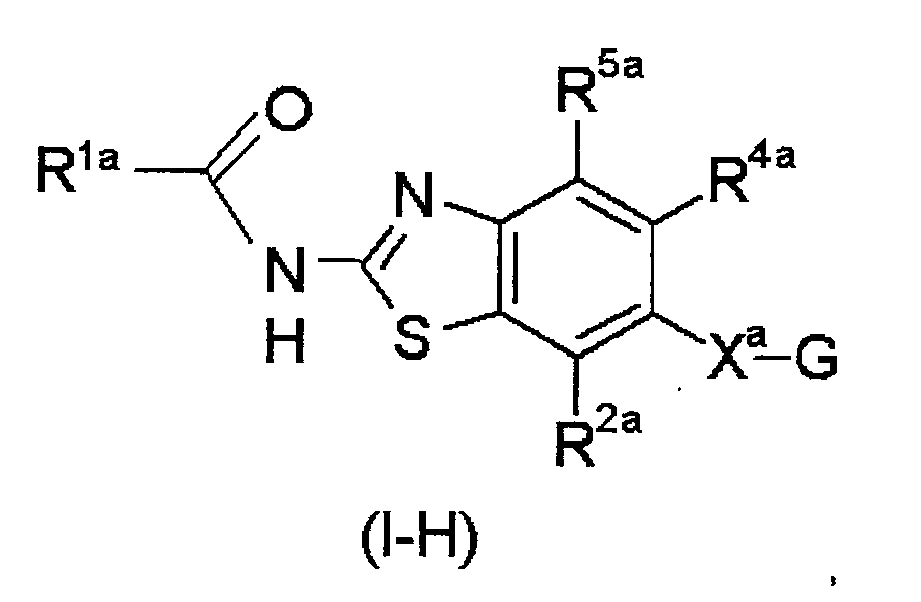
- wherein each symbol is as defined above.
- In compound (I-G), as a leaving group represented by L2a, those similar to the aforementioned leaving group represented by L1a can be mentioned.
In compound (I-H) wherein Xa is -NR8a- [R8a is as defined above], -O- or -S-, G is mainly a hydrogen atom but may also be alkali metal or alkaline earth metal.
The reaction is preferably performed using 1 - 5 equivalents, preferably 1 - 2 equivalents, of compound (I-H) or a salt thereof relative to compound (I-G) in a solvent. In addition, 1 to 10 equivalents, preferably 1 to 2 equivalents, of a base or ammonium salt may be used relative to compound (I-G). As a catalyst, 0.05 - 10 equivalents, preferably 0.05 - 2 equivalents, of a palladium complex may be used relative to compound (I-G).
Examples of the solvent for the aforementioned reaction include halogenated hydrocarbons, aromatic hydrocarbons, alcohols, ethers, acetone, acetonitrile, ethyl acetate, N,N-dimethylformamide, N,N-dimethylacetamide, 1-methyl-2-pyrrolidone, dimethyl sulfoxide, hexamethylphosphramide, water or a mixed solvent thereof and the like. The aforementioned reaction can be performed under cooling (about -78°C - 20°C, preferably about -10°C - 10°C), at room temperature or under heating (about 40°C - 200°C, preferably about 40°C - 160°C), and the reaction time is generally about 1 - 30 hr, preferably about 1 - 20 hr, more preferably about 1 - 10 hr.
In addition, the reaction may be performed under microwave irradiation.
The starting compound (I-G) may be commercially available, or can be produced from the corresponding starting compound by a means known per se. - The starting compound (I-H) can be produced, for example, by converting Za in a compound represented by the formula:
-

- wherein each symbol is as defined above, to a known suitable general functional group as necessary.
For example, compound (I-I) [Za=NO2] can be converted to compound (I-H) [Xa-G=NH-H] by a known general reduction reaction, and then to compound (I-H) [Xa-G=NR8a-H, R8a is as defined above] by a known general reductive amination reaction or a known general coupling reaction using a palladium catalyst and the like. For example, compound (I-I) [Za=SR9a, OR9a; R9a is as defined above] can be converted to compound (I-H) [Xa-G=S-H, O-H] as necessary by a known general deprotection. - The starting compound (I-I) can be produced, for example, by subjecting a compound represented by the formula:
-

- wherein each symbol is as defined above, to a known general acylation reaction using carboxylic acid represented by R1a-COOH (R1a is as defined above) or a reactive derivative thereof.
- The starting compound (I-J) can be produced, for example, from a compound represented by the formula:
-

- wherein each symbol is as defined above. For example, compound (I-K) [Wa=SR9a; R9a is as defined above] is converted to compound (I-K) [Wa=SH] as necessary by a known general deprotection, which is reacted with cyanogen bromide or 1,1-di-1H-imidazol-1-ylmethanimine to give compound (I-J).
In this reaction, compound (I-K) [Wa=SH] is reacted with 1 - 10 equivalents, preferably 1 - 5 equivalents, of cyanogen bromide or 1,1-di-1H-imidazol-1-ylmethanimine in a solvent. In addition, 0 to 10 equivalents, preferably 0 to 2 equivalents, of a base may be used relative to compound (I-K) [Wa=SH].
Examples of the solvent for the above-mentioned reaction include halogenated hydrocarbons, aromatic hydrocarbons, alcohols, ethers, acetone, acetonitrile, ethyl acetate, N,N-dimethylformamide, N,N-dimethylacetamide, 1-methyl-2-pyrrolidone, dimethyl sulfoxide, hexamethylphosphramide, water or a mixed solvent thereof and the like.
The aforementioned reaction can be performed under cooling (about -78°C - 20°C, preferably about -10°C - 10°C), at room temperature or under heating (about 40°C - 200°C, preferably about 40°C - 160°C), and the reaction time is generally about 1 - 30 hr, preferably about 1 - 20 hr, more preferably about 1 - 10 hr.
For example, compound (I-K) [Wa=SCN] can also be converted to compound (I-J) by reacting compound (I-K) [Wa=SCN] with 1 - 10 equivalents, a solvent amount in some cases, preferably 1 - 5 equivalents, of an acid.
As the acid in this reaction, hydrochloric acid, acetic acid, sulfuric acid and the like are used. Examples of the solvent for the above-mentioned reaction include halogenated hydrocarbons, aromatic hydrocarbons, alcohols, ethers, acetone, acetonitrile, ethyl acetate, N,N-dimethylformamide, N,N-dimethylacetamide, 1-methyl-2-pyrrolidone, dimethyl sulfoxide, hexamethylphosphramide, water, acetic acid or a mixed solvent thereof and the like.
The aforementioned reaction can be performed under cooling (about -78°C - 20°C, preferably about -10°C - 10°C), at room temperature or under heating (about 40°C - 200°C, preferably about 40°C - 160°C), and the reaction time is generally about 1 - 30 hr, preferably about 1 - 20 hr, more preferably about 1 - 10 hr. For example, compound (I-K) [Wa=H] can also be converted to compound (I-J) by reacting compound (I-K) [Wa=H] with potassium thiocyanate, sodium thiocyanate or ammonium thiocyanate and bromine. In this reaction, compound (I-K) [Wa=H] is preferably reacted with 1 - 10 equivalents, preferably 1 - 5 equivalents, of potassium thiocyanate, sodium thiocyanate or ammonium thiocyanate, and 1 - 5 equivalents, preferably 1 - 2 equivalents, of bromine in a solvent.
Examples of the solvent for the above-mentioned reaction include halogenated hydrocarbons, aromatic hydrocarbons, alcohols, ethers, acetone, acetonitrile, ethyl acetate, N,N-dimethylformamide, N,N-dimethylacetamide, 1-methyl-2-pyrrolidone, dimethyl sulfoxide, hexamethylphosphramide, water, acetic acid or a mixed solvent thereof and the like.
The aforementioned reaction can be performed under cooling (about -78°C - 20°C, preferably about -10°C - 10°C), at room temperature or under heating (about 40°C - 200°C, preferably about 40°C - 160°C), and the reaction time is generally about 1 - 30 hr, preferably about 1 - 20 hr, more preferably about 1 - 10 hr. - The starting compound (I-K) may be commercially available, or can be produced by converting nitro to amino by subjecting a compound represented by the formula:
-

- wherein each symbol is as defined above, to a known general reduction reaction.
In addition, compound (I-L) [Wa=SCN] can also be converted directly to compound (I-J) by this reduction reaction, without forming compound (I-K) [Wa=SCN].
For example, compound (I-L) [Wa=SCN] can be directly converted to compound (I-J) by reacting compound (I-L) [Wa=SCN] with reduced iron in the presence of an acid, without forming compound (I-K) [Wa=SCN].
In this reaction, compound (I-L) [Wa=SCN] is preferably reacted with 1 - 10 equivalents, preferably 1 - 5 equivalents, of reduced iron, and 1 - 20 equivalents, a solvent amount in some cases, preferably 1 - 10 equivalents, of acid in a solvent.
As the acid in this reaction, hydrochloric acid, acetic acid, sulfuric acid and the like are used. Examples of the solvent for the above-mentioned reaction include halogenated hydrocarbons, aromatic hydrocarbons, alcohols, ethers, acetone, acetonitrile, ethyl acetate, N,N-dimethylformamide, N,N-dimethylacetamide, 1-methyl-2-pyrrolidone, dimethyl sulfoxide, hexamethylphosphramide, water, acetic acid or a mixed solvent thereof and the like.
The aforementioned reaction can be performed under cooling (about -78°C - 20°C, preferably about -10°C - 10°C), at room temperature or under heating (about 40°C - 200°C, preferably about 40°C - 160°C), and the reaction time is generally about 1 - 30 hr, preferably about 1 - 20 hr, more preferably about 1 - 10 hr.
The starting compound (I-L) may be commercially available, or can be produced from the corresponding starting compound by a means known per se. -

- wherein Wa is SR9a, SCN or a hydrogen atom, R9a is a hydrogen atom or a protecting group, L3a is a leaving group, G is a hydrogen atom or a metal atom and other symbols are as defined above.
- The starting compound (I-A) can also be produced, for example, by reacting a compound represented by the formula:
-

- wherein each symbol is as defined above, with a compound represented by the formula:
-

- wherein each symbol is as defined above.
- In compound (I-M) wherein Xa is -NR8a- [R8a is as defined above], -O- or -S-, G is mainly a hydrogen atom but may also be alkali metal or alkaline earth metal.
In compound (I-N), as a leaving group represented by L3a, one similar to the aforementioned leaving group represented by L1a is used.
The reaction is preferably performed using 1 - 5 equivalents, preferably 1 - 2 equivalents, of compound (I-M) or a salt thereof relative to compound (I-N) in a solvent. In addition, 1 to 10 equivalents, preferably 1 to 2 equivalents, of a base or ammonium salt may be used relative to compound (I-N). As a catalyst, 0.05 - 10 equivalents, preferably 0.05 - 2 equivalents, of a palladium complex may be used relative to compound (I-N).
Examples of the solvent for the aforementioned reaction include halogenated hydrocarbons, aromatic hydrocarbons, alcohols, ethers, acetone, acetonitrile, ethyl acetate, N,N-dimethylformamide, N,N-dimethylacetamide, 1-methyl-2-pyrrolidone, dimethyl sulfoxide, hexamethylphosphramide, water or a mixed solvent thereof and the like.
The aforementioned reaction can be performed under cooling (about -78°C - 20°C, preferably about -10°C - 10°C), at room temperature or under heating (about 40°C - 200°C, preferably about 40°C - 160°C), and the reaction time is generally about 1 - 30 hr, preferably about 1 - 20 hr, more preferably about 1 - 10 hr.
In addition, the reaction may be performed under microwave irradiation. - The starting compound (I-M) may be commercially available, or can be produced from the corresponding starting compound by a means known per se.
The starting compound (I-N) can be produced, for example, by subjecting a compound represented by the formula: -

- wherein each symbol is as defined above, to a known general acylation reaction using carboxylic acid represented by R1a-COOH (R1a is as defined above) or a reactive derivative thereof.
The starting compound (I-O) can be produced, for example, from a compound represented by the formula: -

- wherein each symbol is as defined above. For example, compound (I-P) [Wa=SR9a; R9a is as defined above] is converted to compound (I-P) [Wa=SH] as necessary by a known general deprotection, which is reacted with cyanogen bromide or 1,1-di-1H-imidazol-1-ylmethanimine to give compound (I-O).
In this reaction, compound (I-P) [Wa=SH] is preferably reacted with 1 - 10 equivalents, preferably 1 - 5 equivalents, of cyanogen bromide or 1,1-di-1H-imidazol-1-ylmethanimine in a solvent. In addition, 0 to 10 equivalents, preferably 0 to 2 equivalents, of a base may be used relative to compound (I-P) [Wa=SH].
Examples of the solvent for the above-mentioned reaction include halogenated hydrocarbons, aromatic hydrocarbons, alcohols, ethers, acetone, acetonitrile, ethyl acetate, N,N-dimethylformamide, N,N-dimethylacetamide, 1-methyl-2-pyrrolidone, dimethyl sulfoxide, hexamethylphosphramide, water or a mixed solvent thereof and the like.
The aforementioned reaction can be performed under cooling (about -78°C - 20°C, preferably about -10°C - 10°C), at room temperature or under heating (about 40°C - 200°C, preferably about 40°C - 160°C), and the reaction time is generally about 1 - 30 hr, preferably about 1 - 20 hr, more preferably about 1 - 10 hr.
For example, compound (I-P) [Wa=SCN] can also be converted to compound (I-O) by reacting compound (I-P) [Wa=SCN] with 1 - 10 equivalents, a solvent amount in some cases, preferably 1 - 5 equivalents, of an acid.
As the acid in this reaction, hydrochloric acid, acetic acid, sulfuric acid and the like are used. Examples of the solvent for the above-mentioned reaction include halogenated hydrocarbons, aromatic hydrocarbons, alcohols, ethers, acetone, acetonitrile, ethyl acetate, N,N-dimethylformamide, N,N-dimethylacetamide, 1-methyl-2-pyrrolidone, dimethyl sulfoxide, hexamethylphosphramide, water, acetic acid or a mixed solvent thereof and the like.
The aforementioned reaction can be performed under cooling (about -78°C - 20°C, preferably about -10°C - 10°C), at room temperature or under heating (about 40°C - 200°C, preferably about 40°C - 160°C), and the reaction time is generally about 1 - 30 hr, preferably about 1 - 20 hr, more preferably about 1 - 10 hr.
For example, compound (I-P) [Wa=H] can also be converted to compound (I-O) by reacting compound (I-P) [Wa=H] with potassium thiocyanate, sodium thiocyanate or ammonium thiocyanate and bromine.
In this reaction, compound (I-P) [Wa=H] is preferably reacted with 1 - 10 equivalents, preferably 1 - 5 equivalents, of potassium thiocyanate, sodium thiocyanate or ammonium thiocyanate, and 1 - 5 equivalents, preferably 1 - 2 equivalents, of bromine in a solvent.
Examples of the solvent for the above-mentioned reaction include halogenated hydrocarbons, aromatic hydrocarbons, alcohols, ethers, acetone, acetonitrile, ethyl acetate, N,N-dimethylformamide, N,N-dimethylacetamide, 1-methyl-2-pyrrolidone, dimethyl sulfoxide, hexamethylphosphramide, water, acetic acid or a mixed solvent thereof and the like.
The aforementioned reaction can be performed under cooling (about -78°C - 20°C, preferably about -10°C - 10°C), at room temperature or under heating (about 40°C - 200°C, preferably about 40°C - 160°C), and the reaction time is generally about 1 - 30 hr, preferably about 1 - 20 hr, more preferably about 1 - 10 hr. - The starting compound (I-P) can be produced by converting nitro to amino by subjecting a compound represented by the formula:
-

- wherein each symbol is as defined above, to a known general reduction reaction.
In addition, compound (I-Q) [Wa=SCN] can also be directly converted to compound (I-O), without forming compound (I-P) [Wa=SCN] by this reduction reaction.
For example, compound (I-Q) [Wa=SCN] is reacted with reduced iron in the presence of an acid to directly produce compound (I-O), without forming compound (I-P) [Wa=SCN].
In this reaction, compound (I-Q) [Wa=SCN] is reacted with reduced iron (1 - 10 equivalents, preferably 1 - 5 equivalents), and 1 - 20 equivalents, a solvent amount in some cases, preferably 1 - 10 equivalents, of an acid in a solvent.
As the acid in this reaction, hydrochloric acid, acetic acid, sulfuric acid and the like are used. Examples of the solvent for the above-mentioned reaction include halogenated hydrocarbons, aromatic hydrocarbons, alcohols, ethers, acetone, acetonitrile, ethyl acetate, N,N-dimethylformamide, N,N-dimethylacetamide, 1-methyl-2-pyrrolidone, dimethyl sulfoxide, hexamethylphosphramide, water, acetic acid or a mixed solvent thereof and the like.
The aforementioned reaction can be performed under cooling (about -78°C - 20°C, preferably about -10°C - 10°C), at room temperature or under heating (about 40°C - 200°C, preferably about 40°C - 160°C), and the reaction time is generally about 1 - 30 hr, preferably about 1 - 20 hr, more preferably about 1 - 10 hr.
The starting compound (I-Q) of Method C may be commercially available, or can be produced from the corresponding starting compound by a means known per se. - The production methods of compound (II) of the present invention are described in the following.
Compound (II) of the present invention can be obtained, for example, according to the following conversion reaction of compound (II-A) into compound (II), or a method analogous thereto, and the like. The reaction scheme is shown below. Each symbol in the compounds in the scheme is as defined above, and compound (II-A) encompasses compound (II). -

- wherein Qb is any functional group convertable to Yb-R3b, or may be Yb-R3b by itself, and other symbols are as defined above.
Compound (II) can be obtained by converting Qb in compound (II-A) as necessary to a suitable functional group.
For example, compound (II-A) [Qb=COOH] can be converted to compound (II) [Yb=CONH] by a known general amidation reaction, and can be converted to compound (II) [Yb=NHCO], or compound (II) [Yb=NHCONH] by performing a Curtius rearrangement reaction and then a known general functional group conversion reaction, followed by a known general amidation reaction or ureation reaction.
For example, compound (II-A) [Qb=NO2] can be converted to compound (II-A) [Qb=NH2] by a known general reduction reaction, and then to compound (II) [Yb=NHCO], or compound (II) [Yb=NHCONH] by a known general amidation reaction or ureation reaction. In addition, compound (II-A) [Qb=NH2] can be converted to compound (II) [Yb=NH] by a known general reductive amination reaction or a known general coupling reaction using a palladium catalyst and the like.
Compound (II-A) can be obtained by the following Method A, Method B or Method C, or a method analogous thereto and the like. -
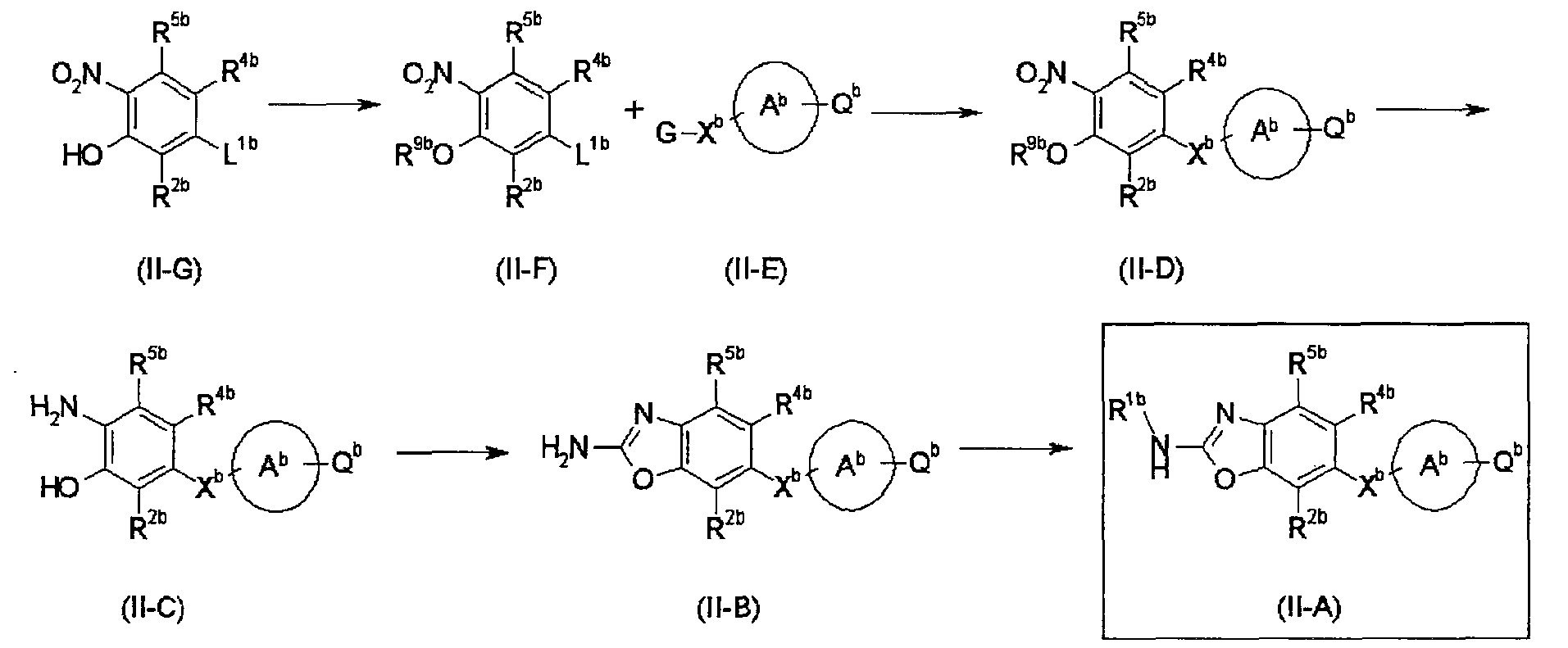
- wherein R9b is a hydrogen atom or a protecting group, G is a hydrogen atom or a metal atom, L1b is a leaving group, and other symbols are as defined above.
- The starting compound (II-A) (R1b is acyl) of this production method can be produced, for example, by subjecting a compound represented by the formula:
-

- wherein each symbol is as defined above, to a known general acylation reaction using carboxylic acid represented by R1b-OH (R1b is acyl) or a reactive derivative thereof.
The starting compound (II-B) can be produced, for example, by reacting a 2-aminophenol derivative represented by the formula: -

- wherein each symbol is as defined above, with cyanogen bromide, cyanamide or 1,1-di-1H-imidazol-1-ylmethanimine.
The reaction is preferably performed using 1 - 10 equivalents, preferably 1 - 5 equivalents, of cyanogen bromide, cyanamide or 1,1-di-1H-imidazol-1-ylmethanimine relative to compound (II-C) in a solvent. In addition, 0 to 10 equivalents, preferably 0 to 2 equivalents, of a base may be used relative to compound (II-C).
Examples of the solvent for the above-mentioned reaction include halogenated hydrocarbons, aromatic hydrocarbons, alcohols, ethers, acetone, acetonitrile, ethyl acetate, N,N-dimethylformamide, N,N-dimethylacetamide, 1-methyl-2-pyrrolidone, dimethyl sulfoxide, hexamethylphosphramide, water or a mixed solvent thereof and the like are used.
The aforementioned reaction can be performed under cooling (about -78°C - 20°C, preferably about -10°C - 10°C), at room temperature or under heating (about 40°C - 200°C, preferably about 40°C - 160°C), and the reaction time is generally about 1 - 30 hr, preferably about 1 - 20 hr, more preferably about 1 - 10 hr. - The starting compound (II-C) can be produced, for example, by converting a 2-nitrophenol derivative represented by the formula:
-
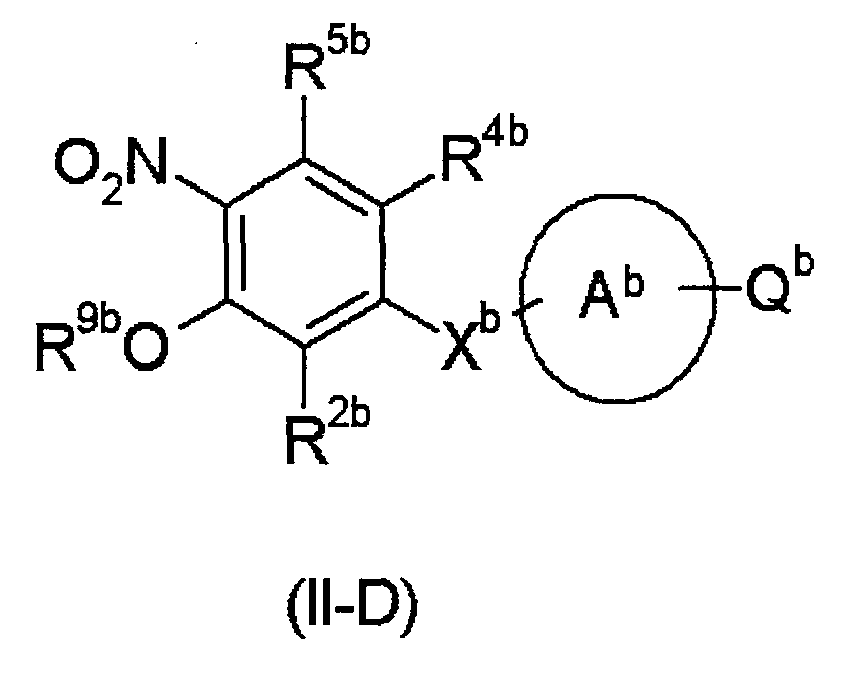
- wherein each symbol is as defined above, to compound (II-D) [R9b=H] as necessary by a known general deprotection, and converting nitro to amino by a known general reduction reaction. Particularly, compound (II-D) [R9b=CH2C6H5] can also be directly converted to compound (II-C) by a known general catalytic hydrogenation reaction.
The starting compound (II-D) can be produced, for example, by reacting a compound represented by the formula: -

- wherein each symbol is as defined above, or a salt thereof with a compound represented by the formula:
-

- wherein each symbol is as defined above.
- In compound (II-E) wherein Xb is -NR8b- [R8b is a hydrogen atom or any alkyl or aryl], -O- or -S-, G is mainly a hydrogen atom but may also be alkali metal or alkaline earth metal.
- In compound (II-F), as a leaving group represented by L1b, a halogen atom such as fluorine, chlorine, bromine, iodine and the like, a group represented by the formula -S(O)kR10b wherein k is 0, 1 or 2, R10b is C1-4 alkyl (e.g., methyl, ethyl, propyl), benzyl, C6-10 aryl (e.g., phenyl, tolyl)] or a group represented by the formula -OR10b wherein R10b is as defined above is used. The reaction is preferably performed using 1 - 5 equivalents, preferably 1 - 2 equivalents, of compound (II-E) or a salt thereof relative to compound (II-F) in a solvent. In addition, 1 to 10 equivalents, preferably 1 to 2 equivalents, of a base or ammonium salt may be used relative to compound (II-F). As a catalyst, 0.05 - 10 equivalents, preferably 0.05 - 2 equivalents, of a palladium complex may be used relative to compound (II-F).
Examples of the solvent for the aforementioned reaction include halogenated hydrocarbons, aromatic hydrocarbons, alcohols, ethers, acetone, acetonitrile, ethyl acetate, N,N-dimethylformamide, N,N-dimethylacetamide, 1-methyl-2-pyrrolidone, dimethyl sulfoxide, hexamethylphosphramide, water or a mixed solvent thereof and the like.
The aforementioned reaction can be performed under cooling (about -78°C - 20°C, preferably about -10°C - 10°C), at room temperature or under heating (about 40°C - 200°C, preferably about 40°C - 160°C), and the reaction time is generally about 1 - 30 hr, preferably about 1 - 20 hr, more preferably about 1 - 10 hr.
In addition, the reaction may be performed under microwave irradiation. - The starting compound (II-E) may be commercially available, or can be produced from the corresponding starting compound by a means known per se.
The starting compound (II-F) can be produced, for example, by introducing a protecting group R9b into a compound represented by the formula: -

- wherein each symbol is as defined above, by a known general reaction.
The starting compound (II-G) may be commercially available, or can be produced from the corresponding starting compound by a means known per se. -

- wherein Zb is any functional group convertable to Xb-G or may be Xb-G by itself, L2b is a leaving group, and other symbols are as defined above.
- The starting compound (II-A) of this production method can also be produced, for example, by reacting a compound represented by the formula:
-

- wherein each symbol is as defined above, with a compound represented by the formula:
-

- wherein each symbol is as defined above.
- In compound (II-H), as a leaving group represented by L2b, one similar to the aforementioned leaving group represented by L1b is used.
In compound (II-I) wherein Xb is -NR8b- [R8b is a hydrogen atom or any alkyl or aryl], -O- or -S-, G is mainly a hydrogen atom but may also be alkali metal or alkaline earth metal.
The reaction is preferably performed using 1 - 5 equivalents, preferably 1 - 2 equivalents, of compound (II-I) or a salt thereof relative to compound (II-H) in a solvent. In addition, 1 to 10 equivalents, preferably 1 to 2 equivalents, of a base or ammonium salt may be used relative to compound (II-H). As a catalyst, 0.05 - 10 equivalents, preferably 0.05 - 2 equivalents, of a palladium complex may be used relative to compound (II-H).
Examples of the solvent for the aforementioned reaction include halogenated hydrocarbons, aromatic hydrocarbons, alcohols, ethers, acetone, acetonitrile, ethyl acetate, N,N-dimethylformamide, N,N-dimethylacetamide, 1-methyl-2-pyrrolidone, dimethyl sulfoxide, hexamethylphosphramide, water or a mixed solvent thereof and the like.
The aforementioned reaction can be performed under cooling (about -78°C - 20°C, preferably about -10°C - 10°C), at room temperature or under heating (about 40°C - 200°C, preferably about 40°C - 160°C), and the reaction time is generally about 1 - 30 hr, preferably about 1 - 20 hr, more preferably about 1 - 10 hr.
In addition, the reaction may be performed under microwave irradiation. - The starting compound (II-H) may be commercially available, or can be produced from the corresponding starting compound by a means known per se.
The starting compound (II-I) can be produced, for example, by converting Zb in a compound represented by the formula: -

- wherein each symbol is as defined above, as necessary to a known general and suitable functional group. For example, compound (II-J) [Zb=NO2] can be converted to compound (II-I) [Xb-G=NH-H] by a known general reduction reaction, and thereafter to compound (II-I) [Xb-G=NR8b-H, R8b is as defined above] by a known general reductive amination reaction or a known general coupling reaction using a palladium catalyst and the like. For example, compound (II-J) [Zb=SR11b, OR11b; R11b is a protecting group] can be converted to compound (II-I) [Xb-G=S-H, O-H] by a known general deprotection.
- The starting compound (II-J) (R1b is acyl) can be produced, for example, by subjecting a compound represented by the formula:
-

- wherein each symbol is as defined above, to a known general acylation reaction using carboxylic acid represented by R1b-OH (R1b is acyl) or a reactive derivative thereof.
- The starting compound (II-K) can be produced, for example, by reacting a 2-aminophenol derivative represented by the formula:
-

- wherein each symbol is as defined above, with cyanogen bromide, cyanamide or 1,1-di-1H-imidazol-1-ylmethanimine.
The reaction is preferably performed using 1 - 10 equivalents, preferably 1 - 5 equivalents, of cyanogen bromide, cyanamide or 1,1-di-1H-imidazol-1-ylmethanimine relative to compound (II-L) in a solvent. In addition, 0 to 10 equivalents, preferably 0 to 2 equivalents, of a base may be used relative to compound (II-L).
Examples of the solvent for the above-mentioned reaction include halogenated hydrocarbons, aromatic hydrocarbons, alcohols, ethers, acetone, acetonitrile, ethyl acetate, N,N-dimethylformamide, N,N-dimethylacetamide, 1-methyl-2-pyrrolidone, dimethyl sulfoxide, hexamethylphosphramide, water or a mixed solvent thereof and the like are used.
The aforementioned reaction can be performed under cooling (about -78°C - 20°C, preferably about -10°C - 10°C), at room temperature or under heating (about 40°C - 200°C, preferably about 40°C - 160°C), and the reaction time is generally about 1 - 30 hr, preferably about 1 - 20 hr, more preferably about 1 - 10 hr.
The starting compound (II-L) may be commercially available, or can be produced from the corresponding starting compound by a means known per se. -

- wherein L3b is a leaving group, and other symbols are as defined above.
- The starting compound (II-A) can also be produced, for example, by reacting a compound represented by the formula:
-

- wherein each symbol is as defined above, with a compound represented by the formula:
-

- wherein each symbol is as defined above.
- In compound (II-M) wherein Xb is -NR8b- [R8b is a hydrogen atom or any alkyl or aryl], -O- or -S-, G is mainly a hydrogen atom but may also be alkali metal or alkaline earth metal.
In compound (II-N), as a leaving group represented by L3b, one similar to the aforementioned leaving group represented by L1b is used.
The reaction is preferably performed using 1 - 5 equivalents, preferably 1 - 2 equivalents, of compound (II-M) or a salt thereof relative to compound (II-N) in a solvent. In addition, about 1 to 10 equivalents, preferably 1 to 2 equivalents, of a base or ammonium salt may be used relative to compound (II-N). As a catalyst, 0.05 - 10 equivalents, preferably 0.05 - 2 equivalents, of a palladium complex may be used relative to compound (II-N).
Examples of the solvent for the aforementioned reaction include halogenated hydrocarbons, aromatic hydrocarbons, alcohols, ethers, acetone, acetonitrile, ethyl acetate, N,N-dimethylformamide, N,N-dimethylacetamide, 1-methyl-2-pyrrolidone, dimethyl sulfoxide, hexamethylphosphramide, water or a mixed solvent thereof and the like are used.
The aforementioned reaction can be performed under cooling (about -78°C - 20°C, preferably about -10°C - 10°C), at room temperature or under heating (about 40°C - 200°C, preferably about 40°C - 160°C), and the reaction time is generally about 1 - 30 hr, preferably about 1 - 20 hr, more preferably about 1 - 10 hr.
In addition, the reaction may be performed under microwave irradiation.
The starting compound (II-M) may be commercially available, or can be produced from the corresponding starting compound by a means known per se. - The starting compound (II-N) (R1b is acyl) can be produced, for example, by subjecting a compound represented by the formula:
-

- wherein each symbol is as defined above, to a known general acylation reaction using carboxylic acid represented by R1b-OH (R1b is acyl) or a reactive derivative thereof.
- In compound (II-O), as a leaving group represented by L3b, one similar to the aforementioned leaving group represented by L1b is used.
The starting compound (II-O) can be produced, for example, by reacting a 2-aminophenol derivative represented by the formula: -

- wherein each symbol is as defined above, with cyanogen bromide, cyanamide or 1,1-di-1H-imidazol-1-ylmethanimine.
In compound (II-P), as a leaving group represented by L3b, one similar to the aforementioned leaving group represented by L1b is used.
The reaction is preferably performed using 1 - 10 equivalents, preferably 1 - 5 equivalents, of cyanogen bromide, cyanamide or 1,1-di-1H-imidazol-1-ylmethanimine relative to compound (II-P) in a solvent. In addition, 0 to 10 equivalents, preferably 0 to 2 equivalents, of a base may be used relative to compound (II-P).
Examples of the solvent for the above-mentioned reaction include halogenated hydrocarbons, aromatic hydrocarbons, alcohols, ethers, acetone, acetonitrile, ethyl acetate, N,N-dimethylformamide, N,N-dimethylacetamide, 1-methyl-2-pyrrolidone, dimethyl sulfoxide, hexamethylphosphramide, water or a mixed solvent thereof and the like are used.
The aforementioned reaction can be performed under cooling (about -78°C - 20°C, preferably about -10°C - 10°C), at room temperature or under heating (about 40°C - 200°C, preferably about 40°C - 160°C), and the reaction time is generally about 1 - 30 hr, preferably about 1 - 20 hr, more preferably about 1 - 10 hr.
The starting compound (II-P) may be commercially available, or can be produced from the corresponding starting compound by a means known per se. - Compound (III) of the present invention can be obtained, for example, by a conversion reaction of compound (III-A) to compound (III) shown below or a method analogous thereto and the like.
A schematic reaction formulas are shown in the following, wherein each symbol of compound in the schematic showing is as defined above, and compound (III-A) encompasses compound (III). -

- wherein Qc is any functional group convertable to Yc-R4c, or may be Yc-R4c by itself, and other symbols are as defined above.
- Compound (III) can be obtained by converting Qc in compound (III-A) to a suitable functional group.
For example, compound (III-A) [Qc=COOH] can be converted to compound (III) [Yc=CONH] by a known general amidation reaction, or to compound (III) [Yc=NHCO] by a Curtius rearrangement reaction and thereafter by a known general functional group conversion reaction and a known general amidation reaction.
For example, compound (III-A) [Qc=NO2] can be converted to compound (III-A) [Qc=NH2] by a known general reduction reaction, and then to compound (III) [Yc=NHCO] by a known general amidation reaction. In addition, compound (III-A) [Qc=NH2] can be converted to compound (III) [Yc=NH] by a known general reductive amination reaction or a known general coupling reaction using a palladium catalyst and the like. For example, compound (III-A) [Qc=NHR10c; R10c is a protecting group] can be converted to compound (III-A) [Qc=NH2] by a known general deprotection, and then to compound (III) [Yc=NHCO] by a known general amidation reaction. In addition, compound (III-A) [Qc=NH2] can be converted to compound (III) [Yc=NH] by a known general reductive amination reaction or a known general coupling reaction using a palladium catalyst and the like. - Compound (III-A) of the above formula can be obtained by the following Method A, Method B or Method C, or a method analogous thereto and the like.
-

- wherein L1c and L2c are leaving groups, G is a hydrogen atom or a metal atom, and other symbols are as defined above.
- The starting compound (III-A) of this production method can be produced, for example, by subjecting a compound represented by the formula:
-

- wherein each symbol is as defined above, to a known general acylation reaction using carboxylic acid represented by R1c-COOH (R1c is as defined above) or a reactive derivative thereof.
- The starting compound (III-B) can be produced, for example, by reacting a o-phenylenediamine derivative represented by the formula:
-

- wherein each symbol is as defined above, with cyanogen bromide, cyanamide or 1,1-di-1H-imidazol-1-ylmethanimine.
The reaction is preferably performed using 1 - 10 equivalents, preferably 1 - 5 equivalents, of cyanogen bromide, cyanamide or 1,1-di-1H-imidazol-1-ylmethanimine relative to compound (III-C) in a solvent. In addition, 0 to 10 equivalents, preferably 0 to 2 equivalents, of a base may be used relative to compound (III-C).
Examples of the solvent for the above-mentioned reaction include halogenated hydrocarbons, aromatic hydrocarbons, alcohols, ethers, acetone, acetonitrile, ethyl acetate, N,N-dimethylformamide, N,N-dimethylacetamide, 1-methyl-2-pyrrolidone, dimethyl sulfoxide, hexamethylphosphramide, water or a mixed solvent thereof and the like.
The aforementioned reaction can be performed under cooling (about -78°C - 20°C, preferably about -10°C - 10°C), at room temperature or under heating (about 40°C - 200°C, preferably about 40°C - 160°C), and the reaction time is generally about 1 - 30 hr, preferably about 1 - 20 hr, more preferably about 1 - 10 hr.
The starting compound (III-C) can be produced, for example, by converting nitro to amino by subjecting a 2-nitroaniline derivative represented by the formula: -
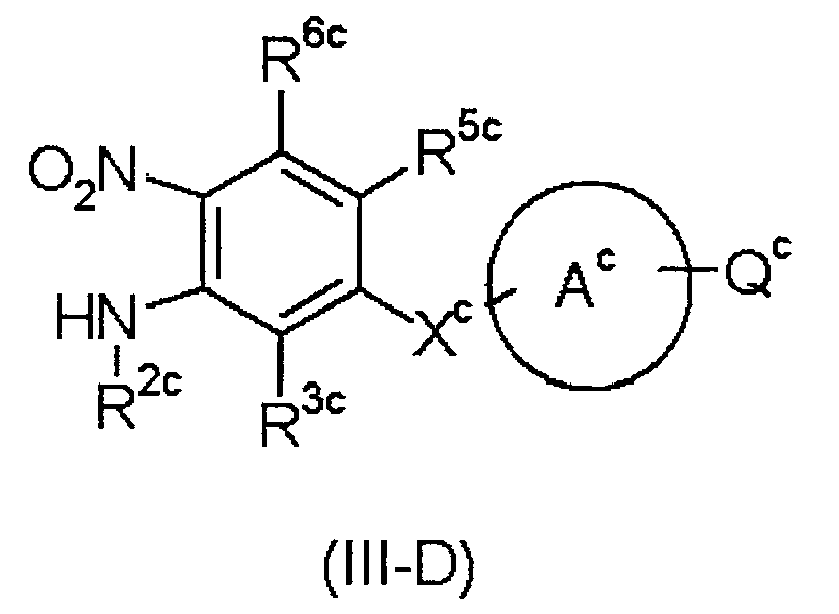
- wherein each symbol is as defined above, to a known general reduction reaction.
- The starting compound (III-D) can be produced, for example, by reacting a compound represented by the formula:
-

- wherein each symbol is as defined above, or a salt thereof with a o-nitroaniline derivative represented by the formula:
-

- wherein each symbol is as defined above.
In compound (III-E) wherein Xc is -NR9c- [R9c is as defined above], -O- or -S-, G is mainly a hydrogen atom but may also be alkali metal or alkaline earth metal.
In compound (III-F), as a leaving group represented by L2c, a halogen atom such as fluorine, chlorine, bromine, iodine and the like, a group represented by the formula -S(O)kR11c wherein k is 0, 1 or 2 and R11c is C1-4 alkyl (e.g., methyl, ethyl, propyl), benzyl, C6-10 aryl (e.g., phenyl, tolyl), or a group represented by the formula -OR11c wherein R11c is as defined above is used.
The reaction is preferably performed using 1 - 5 equivalents, preferably 1 - 2 equivalents, of compound (III-E) or a salt thereof relative to compound (III-F) in a solvent. In addition, about 0 to 10 equivalents, preferably 0 to 2 equivalents, of a base or ammonium salt may be used relative to compound (III-F).
As a catalyst, 0.05 - 10 equivalents, preferably 0.05 - 2 equivalents, of a palladium complex may be used relative to compound (III-F).
Examples of the solvent for the aforementioned reaction include halogenated hydrocarbons, aromatic hydrocarbons, alcohols, ethers, acetone, acetonitrile, ethyl acetate, N,N-dimethylformamide, N,N-dimethylacetamide, 1-methyl-2-pyrrolidone, dimethyl sulfoxide, hexamethylphosphramide, water or a mixed solvent thereof and the like.
The aforementioned reaction can be performed under cooling (about -78°C - 20°C, preferably about -10°C - 10°C), at room temperature or under heating (about 40°C - 200°C, preferably about 40°C - 160°C), and the reaction time is generally about 1 - 30 hr, preferably about 1 - 20 hr, more preferably about 1 - 10 hr.
In addition, the reaction may be performed under microwave irradiation. - The starting compound (III-E) may be commercially available, or can be produced from the corresponding starting compound by a means known per se.
The starting compound (III-F) used may be commercially available or can be produced, for example, by reacting a compound represented by the formula: -

- wherein each symbol is as defined above, with an amino compound represented by R2cNH2 (R2c is as defined above) under known general reaction conditions.
In compound (III-G), as a leaving group represented by L1c, one similar to the aforementioned leaving group represented by L2c is used.
Starting compound (III-G) may be commercially available or can be produced from the corresponding starting compound according to a method known per se. -

- wherein Zc is any functional group convertable to Xc-G, or may be Xc-G by itself, L4c is a leaving group, and other symbols are as defined above.
- The starting compound (III-A) can also be produced, for example, a compound represented by the formula:
-

- wherein each symbol is as defined above, with a compound represented by the formula:
-

- wherein each symbol is as defined above.
In compound (III-H), as a leaving group represented by L4c, one similar to the aforementioned leaving group represented by L2c is used.
In compound (III-I) wherein Xc is -NR9c-[R9c is as defined above], -O- or -S-, G is mainly a hydrogen atom but may also be alkali metal or alkaline earth metal.
The reaction is preferably performed using 1 - 5 equivalents, preferably 1 - 2 equivalents, of compound (III-I) or a salt thereof relative to compound (III-H) in a solvent. In addition, about 1 to 10 equivalents, preferably 1 to 2 equivalents, of a base or ammonium salt may be used relative to compound (III-H). As a catalyst, 0.05 - 10 equivalents, preferably 0.05 - 2 equivalents, of a palladium complex may be used relative to compound (III-H).
Examples of the solvent for the aforementioned reaction include halogenated hydrocarbons, aromatic hydrocarbons, alcohols, ethers, acetone, acetonitrile, ethyl acetate, N,N-dimethylformamide, N,N-dimethylacetamide, 1-methyl-2-pyrrolidone, dimethyl sulfoxide, hexamethylphosphramide, water or a mixed solvent thereof and the like.
The aforementioned reaction can be performed under cooling (about -78°C - 20°C, preferably about -10°C - 10°C), at room temperature or under heating (about 40°C - 200°C, preferably about 40°C - 160°C), and the reaction time is generally about 1 - 30 hr, preferably about 1 - 20 hr, more preferably about 1 - 10 hr.
In addition, the reaction may be performed under microwave irradiation. - The starting compound (III-H) may be commercially available, or can be produced from the corresponding starting compound by a means known per se.
The starting compound (III-I) of Method B can be produced, for example, by converting Zc in a compound represented by the formula: -

- wherein each symbol is as defined above, as necessary to a known general and suitable functional group. For example, compound (III-J) [Zc=NO2] can be converted to compound (III-I) [Xc-G=NH-H] by a known general reduction reaction, and thereafter to compound (III-I) [Xc-G=NR9c-H, R9c is as defined above] by a known general reductive amination reaction or a known general coupling reaction using a palladium catalyst and the like. For example, compound (III-J) [Zc=SR12c, OR12c; R12c is a hydrogen atom or a protecting group] can be converted to compound (III-I) [Xc-G=S-H, O-H] as necessary by a known general deprotection.
- The starting compound (III-J) can be produced, for example, by subjecting a compound represented by the formula:
-

- wherein each symbol is as defined above, to a known general acylation reaction using carboxylic acid represented by R1c-COOH (R1c is as defined above) or a reactive derivative thereof.
- The starting compound (III-K) of Method B can be produced, for example, by reacting a o-phenylenediamine derivative represented by the formula:
-

- wherein each symbol is as defined above, with cyanogen bromide, cyanamide or 1,1-di-1H-imidazol-1-ylmethanimine.
The reaction is preferably performed using 1 - 10 equivalents, preferably 1 - 5 equivalents, of cyanogen bromide, cyanamide or 1,1-di-1H-imidazol-1-ylmethanimine relative to compound (III-L) in a solvent. In addition, 0 to 10 equivalents, preferably 0 to 2 equivalents, of a base may be used relative to compound (III-L).
Examples of the solvent for the above-mentioned reaction include halogenated hydrocarbons, aromatic hydrocarbons, alcohols, ethers, acetone, acetonitrile, ethyl acetate, N,N-dimethylformamide, N,N-dimethylacetamide, 1-methyl-2-pyrrolidone, dimethyl sulfoxide, hexamethylphosphramide, water or a mixed solvent thereof and the like.
The aforementioned reaction can be performed under cooling (about -78°C - 20°C, preferably about -10°C - 10°C), at room temperature or under heating (about 40°C - 200°C, preferably about 40°C - 160°C), and the reaction time is generally about 1 - 30 hr, preferably about 1 - 20 hr, more preferably about 1 - 10 hr.
The starting compound (III-L) of Method B may be commercially available, or can be produced by converting nitro to amino by subjecting a o-nitroaniline derivative represented by the formula: -

- wherein each symbol is as defined above, to a known general reduction reaction.
The starting compound (III-M) may be commercially available, or can be produced by reacting a compound represented by the formula: -

- wherein L3c is a leaving group, and other symbols are as defined above, with an amino compound represented by R2cNH2 (R2c is as defined above) under known general reaction conditions.
In compound (III-N), as a leaving group represented by L3c, one similar to the aforementioned leaving group represented by L2c, is used.
The starting compound (III-N) may be commercially available, or can be produced from the corresponding starting compound by a means known per se. -

- wherein each symbol is as defined above.
- The starting compound (III-A) can also be produced, for example, by reacting a compound represented by the formula:
-

- wherein each symbol is as defined above, with a compound represented by the formula:
-

- wherein each symbol is as defined above.
In compound (III-O) wherein Xc is -NR9c- [R9c is as defined above], -O- or -S-, G is mainly a hydrogen atom but may also be alkali metal or alkaline earth metal.
The reaction is preferably performed using 1 - 5 equivalents, preferably 1 - 2 equivalents, of compound (III-O) or a salt thereof relative to compound (III-P) in a solvent. In addition, about 1 to 10 equivalents, preferably 1 to 2 equivalents, of a base or ammonium salt may be used relative to compound (III-P). As a catalyst, 0.05 - 10 equivalents, preferably 0.05 - 2 equivalents, of a palladium complex may be used relative to compound (III-P).
Examples of the solvent for the aforementioned reaction include halogenated hydrocarbons, aromatic hydrocarbons, alcohols, ethers, acetone, acetonitrile, ethyl acetate, N,N-dimethylformamide, N,N-dimethylacetamide, 1-methyl-2-pyrrolidone, dimethyl sulfoxide, hexamethylphosphramide, water or a mixed solvent thereof and the like.
The aforementioned reaction can be performed under cooling (about -78°C - 20°C, preferably about -10°C - 10°C), at room temperature or under heating (about 40°C - 200°C, preferably about 40°C - 160°C), and the reaction time is generally about 1 - 30 hr, preferably about 1 - 20 hr, more preferably about 1 - 10 hr.
In addition, the reaction may be performed under microwave irradiation. - The starting compound (III-O) may be commercially available, or can be produced from the corresponding starting compound by a means known per se.
The starting compound (III-P) can be produced, for example, by subjecting a compound represented by the formula: -

- wherein each symbol is as defined above, to a known general acylation reaction using carboxylic acid represented by R1c-COOH (R1c is as defined above) or a reactive derivative thereof.
- The starting compound (III-Q) can be produced, for example, by reacting a o-phenylenediamine derivative represented by the formula:
-

- wherein each symbol is as defined above with cyanogen bromide, cyanamide or 1,1-di-1H-imidazol-1-ylmethanimine.
The reaction is preferably performed using 1 - 10 equivalents, preferably 1 - 5 equivalents, of cyanogen bromide, cyanamide or 1,1-di-1H-imidazol-1-ylmethanimine relative to compound (III-R) in a solvent. In addition, 0 to 10 equivalents, preferably 0 to 2 equivalents, of a base may be used relative to compound (III-R).
Examples of the solvent for the above-mentioned reaction include halogenated hydrocarbons, aromatic hydrocarbons, alcohols, ethers, acetone, acetonitrile, ethyl acetate, N,N-dimethylformamide, N,N-dimethylacetamide, 1-methyl-2-pyrrolidone, dimethyl sulfoxide, hexamethylphosphramide, water or a mixed solvent thereof and the like.
The aforementioned reaction can be performed under cooling (about -78°C - 20°C, preferably about -10°C - 10°C), at room temperature or under heating (about 40°C - 200°C, preferably about 40°C - 160°C), and the reaction time is generally about 1 - 30 hr, preferably about 1 - 20 hr, more preferably about 1 - 10 hr.
The starting compound (III-R) may be commercially available, or can be produced by converting nitro to amino by subjecting o-nitroaniline derivative represented by the aforementioned formula: -

- wherein each symbol is as defined above, to a known general reduction reaction.
- The compound of the present invention can be isolated and purified by a means known per se, such as phase transfer, concentration, solvent extraction, fractionation, liquid conversion, crystallization, recrystallization, chromatography and the like. When the compound of the present invention is obtained as a free compound, it can be converted to a desired salt by a method known per se or a method analogous thereto. Conversely, when the compound is obtained as a salt, it can be converted to a free form or other desired salt by a method known per se or a method analogous thereto.
- The compound of the present invention may be used as a prodrug. A prodrug of the compound of the present invention means a compound converted to the compound of the present invention by a reaction due to an enzyme, a gastric acid, etc. under the physiological condition in the living body, that is, a compound converted to the compound of the present invention by oxidation, reduction, hydrolysis, etc. due to an enzyme, a compound converted to the compound of the present invention by hydrolysis etc. due to gastric acid, and the like.
- A prodrug of the compound of the present invention may be a compound obtained by subjecting an amino in the compound of the present invention to an acylation, alkylation or phosphorylation (e.g., a compound obtained by subjecting an amino in the compound of the present invention to eicosanoylation, alanylation, pentylaminocarbonylation, (5-methyl-2-oxo-1,3-dioxolen-4-yl)methoxycarbonylation, tetrahydrofuranylation, pyrrolidylmethylation, pivaloyloxymethylation, tert-butylation); a compound obtained by subjecting hydroxyl in the compound of the present invention to acylation, alkylation, phosphorylation or boration (e.g., a compound obtained by subjecting hydroxyl in the compound of the present invention to acetylation, palmitoylation, propanoylation, pivaloylation, succinylation, fumarylation, alanylation or dimethylaminomethylcarbonylation); a compound obtained by subjecting carboxy in the compound of the present invention to esterification or amidation (e.g., a compound obtained by subjecting carboxy in the compound of the present invention to ethyl esterification, phenyl esterification, carboxymethyl esterification, dimethylaminomethyl esterification, pivaloyloxymethyl esterification, ethoxycarbonyloxyethyl esterification, phthalidyl esterification, (5-methyl-2-oxo-1,3-dioxolen-4-yl)methyl esterification, cyclohexyloxycarbonylethyl esterification or methylamidation) and the like. Any one of these compounds can be produced from the compound of the present invention by a method known per se.
- A prodrug of the compound of the present invention may also be a compound converted into the compound of the present invention under physiological conditions, such as those described in IYAKUHIN no KAIHATSU (Development of Pharmaceuticals), Vol. 7, Design of Molecules, p.163-198, Published by HIROKAWA SHOTEN (1990).
- When the compound of the present invention has an isomer such as optical isomer, stereoisomer, positional isomer, rotational isomer and the like, any isomer and a mixture thereof are encompassed in the compound of the present invention. For example, when the compound of the present invention has an optical isomer, an optical isomer separated from a racemate is also encompassed in the compound of the present invention. Such isomers can be obtained as independent products by a synthesis means or a separation means (concentration, solvent extraction, column chromatography, recrystallization and the like) known per se.
- The compound of the present invention may be a crystal, and both a single crystal and crystal mixtures are encompassed in the compound of the present invention. Crystals can be produced by crystallization according to crystallization methods known per se.
The compound of the present invention may be a solvate (e.g., hydrate etc.) or a non-solvate, both of which are encompassed in the compound of the present invention.
A compound labeled with an isotope (e.g., 3H, 14C, 35S, 125I etc.) is also encompassed in the compound of the present invention.
Furthermore, a deuterium conversion form wherein 1H is converted to 2H(D) is also encompassed in the compound of the present invention. - The compound of the present invention, or a salt thereof, or a prodrug thereof (in the specification, sometimes to be abbreviated as the compound of the present invention) has an Raf, particularly B-Raf, inhibitory activity, and can provide a clinically useful agent for the prophylaxis or treatment of cancer, and a cancer growth inhibitor, a cancer metastasis suppressive agent. In addition, it can be used for the prophylaxis or treatment of B-Raf dependent diseases in mammals.
- The compound of the present invention also has an inhibitory activity on a vascular endothelial growth factor receptor (VEGFR; particularly, VEGFR2).
- The compound of the present invention shows a strong inhibitory activity particularly on Raf, especially, selectivity for B-Raf. Since the compound of the present invention is also superior in the efficacy, pharmacokinetics (absorption, distribution, metabolism, excretion etc.), solubility (water-solubility etc.), interaction with other pharmaceutical products, safety (acute toxicity, chronic toxicity, genetic toxicity, reproductive toxicity, cardiotoxicity, carcinogenicity etc.) and stability (chemical stability, stability to enzyme etc.), it is useful as a medicament.
- Accordingly, the compound of the present invention is useful as Raf (specifically B-Raf) inhibitor for mammal (e.g., mouse, rat, hamster, rabbit, cat, dog, bovine, sheep, monkey, human, etc.). The compound of the present invention is used as a medicament such as an agent for the prophylaxis or treatment of Raf-related diseases, for example, cancer [e.g., colorectal cancer (e.g., familial colorectal cancer, hereditary nonpolyposis colorectal cancer, gastrointestinal stromal tumor, etc.), lung cancer (e.g., non-small cell lung cancer, small cell lung cancer, malignant mesothelioma, etc.), mesothelioma, pancreatic cancer (e.g., pancreatic duct cancer, etc.), gastric cancer (e.g., papillary adenocarcinoma, mucinous adenocarcinoma, adenosquamous cancer, etc.), breast cancer (e.g., invasive ductal carcinoma, ductal cancer in situ, inflammatory breast cancer, etc.), ovary cancer (e.g., ovarian epithelial cancer, extragonadal germ cell tumor, ovarian germ cell tumor, ovarian low malignant potential tumor, etc.), prostate cancer (e.g., hormone-dependent prostate cancer, non-hormone dependent prostate cancer, etc.), liver cancer (e.g., primary liver cancer, extrahepatic bile duct cancer, etc.), thyroid cancer (e.g., medullary thyroid cancer, etc.), kidney cancer (e.g., renal cell carcinoma, renal pelvis and ureter transitional cell cancer, etc.), uterine cancer, brain tumor (e.g., pineal astrocytoma, pilocytic astrocytoma, diffuse astrocytoma, anaplastic astrocytoma, etc.), melanoma, sarcoma, urinary bladder cancer, blood cancer including multiple myeloma etc.], diabetic retinopathy, rheumatoid arthritis, psoriasis, atherosclerosis, Kaposi's sarcoma, COPD, pain, asthma, endometriosis, nephritis, inflammation such as osteoarthritis and the like and hypertension, a cancer growth inhibitor, a cancer metastasis suppressor, an apoptosis promoter and the like. Of these, it is effective, for example, for colorectal cancer, lung cancer, pancreatic cancer, gastric cancer, breast cancer, ovary cancer, prostate cancer, liver cancer, thyroid cancer, kidney cancer, brain tumor, melanoma, urinary bladder cancer and blood cancer. Particularly, the compound of the present invention is effective for patients with melanoma, thyroid cancer, lung cancer, colorectal cancer, ovary cancer, prostate cancer or kidney cancer.
- The compound of the present invention can be administered orally or parenterally as it is or in a mixture with a pharmacologically acceptable carrier.
The dosage form of the compound of the present invention for oral administration is, for example, tablet (including sugar-coated tablet, film-coated tablet, sublingual tablet, buccal tablet, mouth cavity quick-integrating tablet), pill, granule, powder, capsule (including soft capsule, microcapsule), oral preparation such as syrup, emulsion, suspension, films (e.g., mouth cavity mucous membrane adhesion film) and the like, and the dosage form for parenteral administration is, for example, injection, injecting agent, instillation, suppository and the like. In addition, it is effective to make a sustained release preparation by combining the compound with a suitable base (e.g., polymer of butyric acid, polymer of glycolic acid, copolymer of butyric acid-glycolic acid, a mixture of a polymer of butyric acid and a polymer of glycolic acid, polyglycerol fatty acid ester etc.). - As a method for producing the compound of the present invention in the above-mentioned dosage form, a known production method (e.g., the method described in the Japanese Pharmacopoeia) generally used in the pertinent field can be employed. When the above-mentioned dosage form is produced, suitable amounts of additives such as excipient, binder, disintegrant, lubricant, sweetening agent, surfactant, suspending agent, emulsifier and the like, generally used in the pharmaceutical field, are appropriately added as necessary for production.
- When the compound of the present invention is prepared into a tablet, for example, it can be produced by adding an excipient, a binder, a disintegrant, a lubricant and the like, and when a pill or a granule is to be prepared, it can be produced by adding an excipient, a binder, a disintegrant and the like. When a powder or a capsule is to be prepared, it can be produced by adding an excipient and the like, when a syrup is to be prepared, it can be produced by adding a sweetener and the like, and when an emulsion or a suspension is to be prepared, it can be produced by adding a suspending agent, a surfactant, an emulsifier and the like.
- Examples of the excipient include lactose, sucrose, glucose, starch, sucrose, microcrystalline cellulose, powdered glycyrrhiza, mannitol, sodium hydrogen carbonate, calcium phosphate, calcium sulfate and the like.
Examples of the binder include 5 - 10 wt% starch liquid paste, 10 - 20 wt% gum arabic solution or gelatin solution, 1 - 5 wt% tragacanth solution, carboxymethyl cellulose solution, sodium alginate solution, glycerin and the like.
Examples of the disintegrant include starch, calcium carbonate and the like.
Examples of the lubricant include magnesium stearate, stearic acid, calcium stearate, purified talc and the like.
Examples of the sweetener include glucose, fructose, invert sugar, sorbitol, xylitol, glycerin, simple syrup and the like.
Examples of the surfactant include sodium lauryl sulfate, polysorbate 80, sorbitan monofatty acid ester, polyoxyl 40 stearate and the like.
Examples of the suspending agent include gum arabic, sodium alginate, sodium carboxymethyl cellulose, methyl cellulose, bentonite and the like.
Examples of the emulsifier include gum arabic, tragacanth, gelatin, polysorbate 80 and the like. - Furthermore, when the compound of the present invention is produced in the above-mentioned dosage form, a suitable amount of a colorant, a preservative, an aromatic, a corrigent, a stabilizer, a thickening agent and the like typically used in the field of preparation can be added on demand.
- As the injection, intravenous injection as well as subcutaneous injection, intracutaneous injection, intramuscular injection, instillation and the like are mentioned, and as the sustained release preparation, an iontophoresis transdermal agent and the like are mentioned.
- Such injections are prepared by methods known per se, or by dissolving, suspending or emulsifying the compound of the present invention in a sterilized aqueous or oily liquid. As an aqueous liquid for injection, physiological saline, isotonic solutions containing glucose or other auxiliary drugs (e.g., D-sorbitol, D-mannitol, sodium chloride and the like) and the like can be mentioned, and they can be used in combination with suitable solubilizing agents, such as alcohols (e.g., ethanol), polyalcohols (e.g., propylene glycol, polyethylene glycol), nonionic surfactants (e.g., polysorbate 80, HCO-50) and the like. As an oily liquid, sesame oil, soybean oil and the like can be mentioned, which may be used in combination with solubilizing agents such as benzyl benzoate, benzyl alcohol and the like. In addition, buffers (e.g., phosphate buffer, sodium acetate buffer), soothing agents (e.g., benzalkonium chloride, procaine hydrochloride and the like), stabilizers (e.g., human serum albumin, polyethylene glycol and the like), preservatives (e.g., benzyl alcohol, phenol and the like) and the like can be blended. A prepared injection is generally filled in an ampoule.
- While the content of the compound of the present invention in the medicament of the present invention varies depending on the form of the pharmaceutical preparation, it is generally about 0.01 to 100 wt%, preferably about 2 to 85 wt%, more preferably about 5 to 70 wt%, relative to the entire preparation.
- While the content of the additive in the medicament of the present invention varies depending on the form of the pharmaceutical preparation, it is generally about 1 to 99.9 wt%, preferably about 10 to 90 wt%, relative to the entire preparation.
- The compound of the present invention is stable and low toxic, and can be used safely. While the daily dose varies depending on the condition and body weight of patients, the kind of compound, administration route and the like, in the case of, for example, oral administration to patients for the treatment of cancer, the daily dose to an adult (body weight about 60 kg) is about 1 to 1000 mg, preferably about 3 to 300 mg, more preferably about 10 to 200 mg, as an active ingredient (the compound of the present invention), which can be given in a single administration or administered in 2 or 3 portions a day.
- When the compound of the present invention is administered parenterally, it is generally administered in the form of a liquid (e.g., injection). While the dose varies depending on the subject of administration, target organ, symptom, administration method and the like, it is, for example, about 0.01 mg to about 100 mg, preferably about 0.01 to about 50 mg, more preferably about 0.01 to about 20 mg, in the form of an injection, relative to 1 kg body weight, which is preferably given by intravenous injection.
- The compound of the present invention can be used concurrently with other drugs. To be specific, the compound of the present invention can be used together with medicaments such as hormonal therapeutic agents, chemotherapeutic agents, immunotherapeutic agents, medicaments inhibiting the action of cell growth factors or cell growth factor receptors and the like. In the following, the drugs that can be used in combination with the compound of the present invention are abbreviated as concomitant drugs.
- Examples of the "hormonal therapeutic agents" include fosfestrol, diethylstylbestrol, chlorotrianisene, medroxyprogesterone acetate, megestrol acetate, chlormadinone acetate, cyproterone acetate, danazol, allylestrenol, gestrinone, mepartricin, raloxifene, ormeloxifene, levormeloxifene, anti-estrogens (e.g., tamoxifen citrate, toremifene citrate, and the like), pill preparations, mepitiostane, testrolactone, aminoglutethimide, LH-RH agonists (e.g., goserelin acetate, buserelin, leuprorelin, and the like), droloxifene, epitiostanol, ethinylestradiol sulfonate, aromatase inhibitors (e.g., fadrozole hydrochloride, anastrozole, retrozole, exemestane, vorozole, formestane, and the like), anti-androgens (e.g., flutamide, bicartamide, nilutamide, and the like), 5α-reductase inhibitors (e.g., finasteride, epristeride, and the like), aderenal cortex hormone drugs (e.g., dexamethasone, prednisolone, betamethasone, triamcinolone, and the like), androgen synthesis inhibitors (e.g., abiraterone, and the like), retinoid and drugs that retard retinoid metabolism (e.g., liarozole, and the like), and the like.
- Examples of the "chemotherapeutic agents" include alkylating agents, antimetabolites, anticancer antibiotics, plant-derived anticancer agents, and the like.
- Examples of the "alkylating agents" include nitrogen mustard, nitrogen mustard-N-oxide hydrochloride, chlorambutyl, cyclophosphamide, ifosfamide, thiotepa, carboquone, improsulfan tosylate, busulfan, nimustine hydrochloride, mitobronitol, melphalan, dacarbazine, ranimustine, sodium estramustine phosphate, triethylenemelamine, carmustine, lomustine, streptozocin, pipobroman, etoglucid, carboplatin, cisplatin, miboplatin, nedaplatin, oxaliplatin, altretamine, ambamustine, dibrospidium hydrochloride, fotemustine, prednimustine, pumitepa, ribomustin, temozolomide, treosulphan, trophosphamide, zinostatin stimalamer, adozelesin, cystemustine, bizelesin, DDS preparations thereof, and the like.
- Examples of the "antimetabolites" include mercaptopurine, 6-mercaptopurine riboside, thioinosine, methotrexate, pemetrexed, enocitabine, cytarabine, cytarabine ocfosfate, ancitabine hydrochloride, 5-FU drugs (e.g., fluorouracil, tegafur, UFT, doxifluridine, carmofur, gallocitabine, emitefur, capecitabine, and the like), aminopterine, nelzarabine, leucovorin calcium, tabloid, butocine, calcium folinate, levofolinate calcium, cladribine, emitefur, fludarabine, gemcitabine, hydroxycarbamide, pentostatin, piritrexim, idoxuridine, mitoguazone, thiazophrine, ambamustine, bendamustine, DDS preparations thereof, and the like.
- Examples of the "anticancer antibiotics" include actinomycin-D, actinomycin-C, mitomycin-C, chromomycin-A3, bleomycin hydrochloride, bleomycin sulfate, peplomycin sulfate, daunorubicin hydrochloride, doxorubicin hydrochloride, aclarubicin hydrochloride, pirarubicin hydrochloride, epirubicin hydrochloride, neocarzinostatin, mithramycin, sarcomycin, carzinophilin, mitotane, zorubicin hydrochloride, mitoxantrone hydrochloride, idarubicin hydrochloride, DDS preparations thereof, and the like.
- Examples of the "plant-derived anticancer agents" include etoposide, etoposide phosphate, vinblastine sulfate, vincristine sulfate, vindesine sulfate, teniposide, paclitaxel, docetaxel, vinorelbine, DDS preparations thereof, and the like.
- Examples of the "immunotherapeutic agents (BRM)" include picibanil, krestin, sizofiran, lentinan, ubenimex, interferons, interleukins, macrophage colony-stimulating factor, granulocyte colony-stimulating factor, erythropoietin, lymphotoxin, BCG vaccine, Corynebacterium parvum, levamisole, polysaccharide K, procodazole, anti-CTLA4 antibody, and the like.
- Example of the "cell growth factors" in the "medicaments inhibiting the action of cell growth factors or cell growth factor receptors" include any substances that promote cell proliferation, which are normally peptides having not more than 20,000 molecular weight that are capable of exhibiting their activity at low concentrations by binding to a receptor, including (1) EGF (epidermal growth factor) or substances possessing substantially the same activity as EGF [e.g., TGFα, and the like], (2) insulin or substances possessing substantially the same activity as insulin [e.g., insulin, IGF (insulin-like growth factor)-1, IGF-2, and the like], (3) FGF (fibroblast growth factor) or substances possessing substantially the same activity as FGF [e.g., acidic FGF, basic FGF, KGF (keratinocyte growth factor), FGF-10, and the like], and (4) other cell growth factors [e.g., CSF (colony stimulating factor), EPO (erythropoietin), IL-2 (interleukin-2), NGF (nerve growth factor), PDGF (platelet-derived growth factor), TGFβ (transforming growth factor β), HGF (hepatocyte growth factor), VEGF (vascular endothelial growth factor), heregulin, angiopoietin, and the like].
- Examples of the "cell growth factor receptors" include any receptors capable of binding to the aforementioned cell growth factors, including EGF receptor, heregulin receptor (HER3, etc.), insulin receptor, IGF receptor-1, IGF receptor-2, FGF receptor-1 or FGF receptor-2, VEGF receptor, angiopoietin receptor (Tie2 etc.), PDGF receptor, and the like.
- As the "medicaments inhibiting the action of cell growth factors or cell growth factor receptors", EGF inhibitor, TGFα inhibitor, heregulin inhibitor, insulin inhibitor, IGF inhibitor, FGF inhibitor, KGF inhibitor, CSF inhibitor, EPO inhibitor, IL-2 inhibitor, NGF inhibitor, PDGF inhibitor, TGFβ inhibitor, HGF inhibitor, VEGF inhibitor, angiopoietin inhibitor, EGF receptor inhibitor, HER2 inhibitor, HER4 inhibitor, insulin receptor, IGF-1 receptor inhibitor, IGF-2 receptor inhibitor, FGF receptor-1 inhibitor, FGF receptor-2 inhibitor, FGF receptor-3 inhibitor, FGF receptor-4 inhibitor, VEGF receptor inhibitor, Tie-2 inhibitor, PDGF receptor inhibitor, Abl inhibitor, Raf inhibitor, FLT3 inhibitor, c-Kit inhibitor, Src inhibitor, PKC inhibitor, Trk inhibitor, Ret inhibitor, mTOR inhibitor, Aurora inhibitor, PLK inhibitor, MEK(MEK1/2) inhibitor, MET inhibitor, CDK inhibitor, Akt inhibitor, ERK inhibitor and the like are used. More specifically, anti-VEGF antibody (Bevacizumab etc.), anti-HER2 antibody (Trastuzumab, Pertuzumab etc.), anti-EGFR antibody (Cetuximab, Panitumumab, Matuzumab, Nimotuzumab etc.), anti-VEGFR antibody, Imatinib, Erlotinib, Gefitinib, Sorafenib, Sunitinib, Dasatinib, Lapatinib, Vatalanib, 4-(4-fluoro-2-methyl-1H-indol-5-yloxy)-6-methoxy-7-[3-(1-pyrrolidinyl)propoxy]quinazoline (AZD-2171), Lestaurtinib, Pazopanib, Canertinib, Tandutinib, 3-(4-bromo-2,6-difluorobenzyloxy)-5-[3-[4-(1-pyrrolidinyl)butyl]ureido]isothiazole-4-carboxamide (CP-547632), Axitinib, N-(3,3-dimethyl-2,3-dihydro-1H-indol-6-yl)-2-(pyridin-4-ylmethylamino)pyridine-3-carboxamide (AMG-706), Nilotinib, 6-[4-(4-ethylpiperazin-1-ylmethyl)phenyl]-N-[1(R)-phenylethyl]-7H-pyrrolo[2,3-d]pyrimidin-4-amine (AEE-788), Vandetanib, Temsirolimus, Everolimus, Enzastaurin, N-[4-[4-(4-methylpiperazin-1-yl)-6-(3-methyl-1H-pyrazol-5-ylamino)pyrimidin-2-ylsulfanyl]phenyl]cyclopropanecarboxamide (VX-680), phosphoric acid 2-[N-[3-[4-[5-[N-(3-fluorophenyl)carbamoylmethyl]-1H-pyrazol-3-ylamino]quinazolin-7-yloxy]propyl]-N-ethylamino]ethyl ester (AZD-1152), 4-[9-chloro-7-(2,6-difluorophenyl)-5H-pyrimido[5,4-d][2]benzazepin-2-ylamino]benzoic acid (MLN-8054), N-[2-methoxy-5-[(E)-2-(2,4,6-trimethoxyphenyl)vinylsulfonylmethyl]phenyl]glycine sodium salt (ON-1910Na), 4-[8-cyclopentyl-7(R)-ethyl-5-methyl-6-oxo-5,6,7,8-tetrahydropteridin-2-ylamino]-3-methoxy-N-(1-methylpiperidin-4-yl)benzamide (BI-2536), 5-(4-bromo-2-chlorophenylamino)-4-fluoro-1-methyl-1H-benzimidazole-6-carbohydroxamic acid 2-hydroxyethyl ester (AZD-6244), N-[2(R),3-dihydroxypropoxy]-3,4-difluoro-2-(2-fluoro-4-iodophenylamino)benzamide (PD-0325901) and the like are used.
- In addition to the aforementioned drugs, L-asparaginase, aceglatone, procarbazine hydrochloride, protoporphyrin-cobalt complex salt, mercuric hematoporphyrin-sodium, topoisomerase I inhibitors (e.g., irinotecan, topotecan, and the like), topoisomerase II inhibitors (e.g., sobuzoxane, and the like), differentiation inducers (e.g., retinoid, vitamin D, and the like), other angiogenesis inhibitors (e.g., humagillin, shark extract, COX-2 inhibitor, and the like), α-blockers (e.g., tamsulosin hydrochloride, and the like), bisphosphonic acids (pamidronate, zoledronate, and the like), thalidomide, 5 azacytidine, decitabine, bortezomib, antitumor antibody such as anti-CD20 antibody and the like, toxin labeled antibody and the like can also be used.
- By combining the compound of the present invention and a concomitant drug, a superior effect such as
- (1) the dose can be reduced as compared to single administration of the compound of the present invention or a concomitant drug,
- (2) the drug to be combined with the compound of the present invention can be selected according to the condition of patients (mild case, severe case and the like),
- (3) the period of treatment can be set longer,
- (4) a sustained treatment effect can be designed,
- (5) a synergistic effect can be afforded by a combined use of the compound of the present invention and a concomitant drug, and the like, can be achieved.
- In the present specification, the compound of the present invention and a concomitant drug used in combination are referred to as the "combination agent of the present invention".
For use of the combination agent of the present invention, the administration time of the compound of the present invention and the concomitant drug is not restricted, and the compound of the present invention and the concomitant drug can be administered to an administration subject simultaneously, or may be administered at different times. The dosage of the concomitant drug may be determined according to the dose clinically set, and can be appropriately selected depending on the administration subject, administration route, disease, combination and the like. - Examples of the administration mode of the combined use of the compound of the present invention and the concomitant drug include the following methods: (1) The compound of the present invention and the concomitant drug are simultaneously produced to give a single preparation, which is then administered. (2) The compound of the present invention and the concomitant drug are separately produced to give two kinds of preparations which are administered simultaneously by the same administration route. (3) The compound of the present invention and the concomitant drug are separately produced to give two kinds of preparations which are administered by the same administration route at different times. (4) The compound of the present invention and the concomitant drug are separately produced to give two kinds of preparations which are administered simultaneously by different administration routes. (5) The compound of the present invention and the concomitant drug are separately produced to give two kinds of preparations which are administered by different administration routes at different times (e.g., the compound of the present invention and the concomitant drug are administered in this order, or in the reverse order). The dose of the concomitant drug is appropriately determined in accordance with its clinical dose, and the ratio of the compound of the present invention and the concomitant drug is appropriately determined depending on the administration subject, administration route, target disease, symptom, combination, and the like. For example, when the administration subject is human, the concomitant drug is used in 0.01 to 100 (parts by weight), relative to 1 part by weight of the compound of the present invention.
- The combination agent of the present invention has low toxicity and, for example, the compound of the present invention and/or the above-mentioned concomitant drug can be mixed, according to a method known per se, with a pharmacologically acceptable carrier to give pharmaceutical compositions, such as tablets (including sugar-coated tablet, film-coated tablet), powders, granules, capsules (including soft capsule), solutions, injections, suppositories, sustained release agents and the like, which can be safely administered orally or parenterally (e.g., local, rectum, venous, and the like). An injection can be administered by intravenous, intramuscular, subcutaneous or intra-tissue administration, or directly to the lesion.
- As a pharmacologically acceptable carrier which may be used for preparing the combination agent of the present invention, those similar to the aforementioned pharmacologically acceptable carriers, that can be used for the production of the medicament of the present invention, can be mentioned. Where necessary, the aforementioned additives that can be used for the production of the medicament of the present invention, such as preservatives, antioxidants, colorants, sweetening agents, adsorbents, wetting agents and the like can also be appropriately used in appropriate amounts.
- The compounding ratio of the compound of the present invention to the concomitant drug in the combination agent of the present invention can be appropriately set depending on the administration subject, administration route, diseases and the like.
For example, the content of the compound of the present invention in the combination agent of the present invention varies depending on the dosage form, and is usually from about 0.01 to 100% by weight, preferably from about 0.1 to 50% by weight, further preferably from about 0.5 to 20% by weight, based on the entire preparation.
The content of the concomitant drug in the combination agent of the present invention varies depending on the dosage form, and is usually from about 0.01 to 90% by weight, preferably from about 0.1 to 50% by weight, further preferably from about 0.5 to 20% by weight, based on the entire preparation.
The content of additives in the combination agent of the present invention varies depending on the dosage form, and is usually from about 1 to 99.99% by weight, preferably from about 10 to 90% by weight, based on the entire preparation.
When the compound of the present invention and the concomitant drug are separately prepared, the same content may be adopted. - These preparations can be produced by a method known per se, which is generally employed in the preparation process.
For example, the compound of the present invention and the concomitant drug can be made into an aqueous injection together with a dispersing agent (e.g., Tween 80 (manufactured by Atlas Powder, US), HCO 60 (manufactured by Nikko Chemicals), polyethylene glycol, carboxymethylcellulose, sodium alginate, hydroxypropylmethylcellulose, dextrin and the like), a stabilizer (e.g., ascorbic acid, sodium pyrosulfite, and the like), a surfactant (e.g., Polysorbate 80, macrogol and the like), a solubilizer (e.g., glycerin, ethanol and the like), a buffer (e.g., phosphoric acid and alkali metal salt thereof, citric acid and alkali metal salt thereof, and the like), an isotonizing agent (e.g., sodium chloride, potassium chloride, mannitol, sorbitol, glucose and the like), a pH adjuster (e.g., hydrochloric acid, sodium hydroxide and the like), a preservative (e.g., ethyl paraoxybenzoate, benzoic acid, methylparaben, propylparaben, benzyl alcohol and the like), a dissolving agent (e.g., conc. glycerin, meglumine and the like), a solubilizing agent (e.g., propylene glycol, sucrose and the like), a soothing agent (e.g., glucose, benzyl alcohol and the like), and the like, or can be dissolved, suspended or emulsified in a vegetable oil such as olive oil, sesame oil, cotton seed oil, corn oil and the like or a solubilizing agent such as propylene glycol and the like and prepared into an oily injection, whereby an injection is afforded. - In addition, an excipient (e.g., lactose, sucrose, starch and the like), a disintegrating agent (e.g., starch, calcium carbonate and the like), a binder (e.g., starch, gum arabic, carboxymethylcellulose, polyvinylpyrrolidone, hydroxypropylcellulose and the like), a lubricant (e.g., talc, magnesium stearate, polyethylene glycol 6000 and the like) and the like may be added to the compound of the present invention or the concomitant drug, and the mixture can be compression-molded, according to a method known per se then if desirable, the molded product can be coated by a method known per se for the purpose of masking of taste, enteric property or durability, to give a preparation for oral administration. As the coating agent, for example, hydroxypropylmethylcellulose, ethylcellulose, hydroxymethylcellulose, hydroxypropylcellulose, polyoxyethylene glycol, Tween 80, Pluronic F68, cellulose acetate phthalate, hydroxypropylmethylcellulose phthalate, hydroxymethylcellulose acetate succinate, Eudoragit (methacrylic acid·acrylic acid copolymer, manufactured by Rohm, DE), pigment (e.g., iron oxide red, titanium dioxide, etc.) and the like can be used. The preparation for oral administration may be any of an immediate-release preparation and a sustained release preparation.
- Moreover, the compound of the present invention and the concomitant drug can be made into an oily or aqueous solid, semisolid or liquid suppository according to a method known per se, by mixing them with an oily substrate, aqueous substrate or aqueous gel substrate. As the above-mentioned oily substrate, for example, glycerides of higher fatty acid [e.g., cacao butter, Witepsols (manufactured by Dynamit Nobel, Germany), etc.], glycerides of medium chain fatty acid [e.g., Miglyols (manufactured by Dynamit Nobel, Germany), etc.], or vegetable oils (e.g., sesame oil, soybean oil, cotton seed oil and the like), and the like are mentioned. Furthermore, as the aqueous substrate, for example, polyethylene glycol, propylene glycol and the like are mentioned, and as the aqueous gel substrate, for example, natural gums, cellulose derivatives, vinyl polymers, acrylic acid polymers and the like are mentioned.
- As the above-mentioned sustained release preparation, sustained release microcapsules and the like are mentioned. The sustained release microcapsule can be produced by a method known per se, for example, a method shown in the following [2].
- The compound of the present invention is preferably molded into a preparation for oral administration such as a solid preparation (e.g., powder, granule, tablet, capsule) and the like, or molded into a preparation for rectal administration such as a suppository and the like. Particularly, a preparation for oral administration is preferable.
The concomitant drug can be made into the above-mentioned drug form depending on the kind of the drug. - [1] An injection of the compound of the present invention or the concomitant drug, and preparation thereof, [2] a sustained release preparation or immediate-release preparation of the compound of the present invention or the concomitant drug, and preparation thereof, [3] a sublingual, buccal or intraoral quick integrating agent of the compound of the present invention or the concomitant drug, and preparation thereof, will be described below specifically.
- [1] Injection and preparation thereof
An injection prepared by dissolving the compound of the present invention or the concomitant drug into water is preferable. This injection may be allowed to contain a benzoate and/or salicylate.
The injection is obtained by dissolving the compound of the present invention or the concomitant drug, and if desirable, a benzoate and/or salicylate, into water. - As the above-mentioned salts of benzoic acid and salicylic acid, for example, salts of alkali metals such as sodium, potassium and the like, salts of alkaline earth metals such as calcium, magnesium and the like, ammonium salts, meglumine salts, salts with organic bases such as tromethamol and the like, etc. are listed.
- The concentration of the compound of the present invention or the concomitant drug in an injection is from 0.5 to 50 w/v%, preferably from about 3 to 20 w/v%. The concentration of a benzoate or/and salicylate is from 0.5 to 50 w/v%, preferably from about 3 to 20 w/v%.
- Into the injection of the present invention, additives usually used in an injection, for example, a stabilizer (e.g., ascorbic acid, sodium pyrosulfite and the like), a surfactant (e.g., Polysorbate 80, macrogol and the like), a solubilizer (e.g., glycerin, ethanol and the like), a buffer (e.g., phosphoric acid and alkali metal salt thereof, citric acid and alkali metal salt thereof, and the like), an isotonizing agent (e.g., sodium chloride, potassium chloride and the like), a dispersing agent (e.g., hydroxypropylmethylcellulose, dextrin), a pH regulator (e.g., hydrochloric acid, sodium hydroxide and the like), a preservative (e.g., ethyl paraoxybenzoate, benzoic acid and the like), a dissolving agent (e.g., conc. glycerin, meglumine and the like), a solubilizing agent (e.g., propylene glycol, sucrose and the like), a soothing agent (e.g., glucose, benzyl alcohol and the like), and the like, can be appropriately blended. These additives are generally blended in a proportion usually used in an injection.
- It is advantageous that pH of an injection is controlled from pH 2 to 12, preferably from pH 2.5 to 8.0 by addition of a pH regulator.
An injection is obtained by dissolving the compound of the present invention or the concomitant drug and if desirable, a benzoate and/or a salicylate, and if necessary, the above-mentioned additives into water. These may be dissolved in any order, and can be appropriately dissolved in the same manner as in a conventional method of producing an injection. - An aqueous solution for injection may be advantageously heated, alternatively, for example, filter sterilization, high pressure heat sterilization and the like can be conducted in the same manner as for a usual injection, to provide an injection.
It may be advantageous that an aqueous solution for injection is subjected to high pressure heat sterilization at 100 to 121°C for 5 to 30 min.
Further, a preparation endowed with an antibacterial property of a solution may also be produced so that it can be used as a preparation which is divided and administered multiple-times. - A sustained release preparation is preferable which is obtained, if desirable, by coating a nucleus containing the compound of the present invention or the concomitant drug with a film agent such as a water-insoluble substance, swellable polymer and the like. For example, a sustained release preparation for oral administration of once administration per day type is preferable.
- As the water-insoluble substance used in a film agent, there are listed, for example, cellulose ethers such as ethylcellulose, butylcellulose and the like, cellulose esters such as cellulose acetate, cellulose propionate and the like, polyvinyl esters such as polyvinyl acetate, polyvinyl butyrate and the like, acrylic acid/methacrylic acid copolymers, methyl methacrylate copolymers, ethoxyethyl methacrylate/cinnamoethyl methacrylate/aminoalkyl methacrylate copolymers, polyacrylic acid, polymethacrylic acid, methacrylic acid alkylamide copolymers, poly(methyl methacrylate), polymethacrylate, polymethacrylamide, aminoalkyl methacrylate copolymers, poly(methacrylic anhydride), glycidyl methacrylate copolymer, particularly, acrylic acid-based polymers such as Eudoragit (Rohm Pharma) such as Eudoragit RS-100, RL-100, RS-30D, RL-30D, RL-PO, RS-PO (ethyl acrylate/methyl methacrylate/trimethylchloride methacrylate/ethyl ammonium copolymer), Eudoragit NE-30D (methyl methacrylate/ethyl acrylate copolymer), and the like, hydrogenated oils such as hydrogenated castor oil (e.g., Lubri wax (Freund Corporation) and the like), waxes such as carnauba wax, fatty acid glycerin ester, paraffin and the like, polyglycerin fatty acid esters, and the like.
- As the swellable polymer, polymers having an acidic dissociating group and showing pH dependent swell are preferable, and polymers having an acidic dissociating group, which manifest small swelling in acidic regions such as in stomach and large swelling in neutral regions such as in small intestine and large intestine, are preferable.
As such a polymer having an acidic dissociating group and showing pH dependent swell, cross-linkable polyacrylic acid polymers such as, for example, Carbomer 934P, 940, 941, 974P, 980, 1342 and the like, polycarbophil, calcium polycarbophil (all are manufactured by BF Goodrich), Hiviswako 103, 104, 105, 304 (all are manufactured by Wako Pure Chemical Industries, Ltd.), and the like, are listed. - The film agent used in a sustained release preparation may further contain a hydrophilic substance.
As the hydrophilic substance, for example, polysaccharides which may contain a sulfate group such as pullulan, dextrin, alkali metal alginate and the like, polysaccharides having a hydroxyalkyl or carboxyalkyl such as hydroxypropylcellulose, hydroxypropylmethylcellulose, carboxymethylcellulose sodium and the like, methylcellulose, polyvinylpyrrolidone, polyvinyl alcohol, polyethylene glycol and the like can be mentioned. - The content of a water-insoluble substance in the film agent of a sustained release preparation is from about 30 to about 90% (w/w), preferably from about 35 to about 80% (w/w), further preferably from about 40 to about 75% (w/w), the content of a swellable polymer is from about 3 to about 30% (w/w), preferably from about 3 to about 15% (w/w). The film agent may further contain a hydrophilic substance, and in which case, the content of a hydrophilic substance in the film agent is about 50% (w/w) or less, preferably about 5 to about 40% (w/w), further preferably from about 5 to about 35% (w/w). This % (w/w) indicates % by weight based on a film agent composition which is obtained by removing a solvent (e.g., water, lower alcohols such as methanol, ethanol and the like) from a film agent solution.
- The sustained release preparation is produced by preparing a nucleus containing a drugs as exemplified below, then, coating the resulted nucleus with a film agent solution prepared by heat-solving a water-insoluble substance, swellable polymer and the like or by dissolving or dispersing it in a solvent.
- The form of nucleus containing a drug to be coated with a film agent (hereinafter, sometimes simply referred to as nucleus) is not particularly restricted, and preferably, the nucleus is formed into particles such as a granule or fine particle.
When the nucleus is composed of granules or fine particles, the total particle size thereof is preferably from about 150 to about 2000 µm, further preferably, from about 500 to about 1400 µm.
Preparation of the nucleus can be effected by a usual production method. For example, a suitable excipient, binding agent, disintegrating agent, lubricant, stabilizer and the like are mixed with a drug, and the mixture is subjected to a wet extrusion granulating method, fluidized bed granulating method or the like, to prepare a nucleus.
The content of drugs in a nucleus is from about 0.5 to about 95% (w/w), preferably from about 5.0 to about 80% (w/w), further preferably from about 30 to about 70% (w/w). - As the excipient contained in the nucleus, for example, saccharides such as sucrose, lactose, mannitol, glucose and the like, starch, crystalline cellulose, calcium phosphate, corn starch and the like are used. Among them, crystalline cellulose, corn starch are preferable.
- As the binding agent, for example, polyvinyl alcohol, hydroxypropylcellulose, polyethylene glycol, polyvinyl pyrrolidone, Pluronic F68, gum Arabic, gelatin, starch and the like are used. As the disintegrating agent, for example, carboxymethylcellulose calcium (ECG505), croscarmelose sodium (Ac-Di-Sol), crosslinked polyvinylpyrrolidone (Crospovidone), low substituted hydroxypropylcellulose (L-HPC) and the like are used. Among them, hydroxypropylcellulose, polyvinylpyrrolidone, lower substituted hydroxypropylcellulose are preferable. As the lubricant and solidification inhibitor, for example, talc, magnesium stearate and inorganic salts thereof are used, and as the lubricant, polyethylene glycol and the like are used. As the stabilizer, acids such as tartaric acid, citric acid, succinic acid, fumaric acid, maleic acid and the like, are used.
- A nucleus can also be prepared by, in addition to the above-mentioned productions method, for example, a rolling granulation method in which a drug or a mixture of a drug with an excipient, lubricant and the like is added portionwise onto an inert carrier particle which is the core of the nucleus while spraying a binder dissolved in a suitable solvent such as water, lower alcohol (e.g., methanol, ethanol and the like) and the like, a pan coating method, a fluidized bed coating method or a melt granulating method. As the inert carrier particle, for example, those made of sucrose, lactose, starch, crystalline cellulose or waxes can be used, and the total particle size thereof is preferably from about 100 µm to about 1500 µm.
- For separating a drug contained in a nucleus and a film agent, the surface of the nucleus may be coated with a protective agent. As the protective agent, for example, the above-mentioned hydrophilic substances, water-insoluble substances and the like are used. As the protective agent, preferably polyethylene glycol, and polysaccharides having a hydroxyalkyl or carboxyalkyl are used, more preferably, hydroxypropylmethylcellulose and hydroxypropylcellulose are used. The protective agent may contain, as stabilizer, acids such as tartaric acid, citric acid, succinic acid, fumaric acid, maleic acid and the like, and lubricants such as talc and the like. When the protective agent is used, the coating amount is from about 1 to about 15% (w/w), preferably from about 1 to about 10% (w/w), further preferably from about 2 to about 8% (w/w), based on the nucleus.
- The protective agent can be coated by a usual coating method, and specifically, the protective agent can be coated by spray-coating the nucleus, for example, by a fluidized bed coating method, pan coating method and the like.
- A nucleus obtained in the above-mentioned step I is coated with a film agent solution obtained by heat-solving the above-mentioned water-insoluble substance and pH-dependent swellable polymer, and a hydrophilic substance, or by dissolving or dispersing them in a solvent, to give a sustained release preparation.
As the method for coating a nucleus with a film agent solution, for example, a spray coating method and the like are listed.
The composition ratio of a water-insoluble substance, swellable polymer or hydrophilic substance in a film agent solution is appropriately selected so that the contents of these components in a coated film are the above-mentioned contents, respectively.
The coating amount of a film agent is from about 1 to about 90% (w/w), preferably from about 5 to about 50% (w/w), further preferably from about 5 to about 35% (w/w), based on a nucleus (not including coating amount of protective agent). - As the solvent in a film agent solution, water or an organic solvent can be used alone or in admixture thereof. In the case of use in admixture, the mixing ratio of water to an organic solvent (water/organic solvent: by weight) can be varied in the range from 1 to 100%, and preferably from 1 to about 30%. The organic solvent is not particularly restricted providing it dissolves a water-insoluble substance, and for example, lower alcohols such as methyl alcohol, ethyl alcohol, isopropyl alcohol, n-butyl alcohol and the like, lower alkanone such as acetone and the like, acetonitrile, chloroform, methylene chloride and the like are used. Among them, lower alcohols are preferable, and ethyl alcohol and isopropyl alcohol are particularly preferable. Water, and a mixture of water with an organic solvent are preferably used as a solvent for a film agent. In this case, if necessary, an acid such as tartaric acid, citric acid, succinic acid, fumaric acid, maleic acid and the like may also be added into a film agent solution for stabilizing the film agent solution.
- An operation of coating by spray coating can be effected by a usual coating method, and specifically, it can be effected by spray-coating a film agent solution onto a nucleus by a fluidized bed coating method, pan coating method and the like. In this case, if necessary, talc, titanium oxide, magnesium stearate, calcium stearate, light anhydrous silicic acid and the like may also be added as a lubricant, and glycerin fatty acid ester, hydrogenated castor oil, triethyl citrate, cetyl alcohol, stearyl alcohol and the like may also be added as a plasticizer.
- After coating with a film agent, if necessary, an antistatic agent such as talc and the like may be mixed.
The immediate-release preparation may be liquid (solution, suspension, emulsion and the like) or solid (particle, pill, tablet and the like). As the immediate-release preparation, oral administration agents and parenteral administration agents such as an injection and the like are used, and oral administration agents are preferable. - The immediate-release preparation, usually, may contain, in addition to an active component drug, also carriers, additives and excipients conventionally used in the pharmaceutical field (hereinafter, sometimes abbreviated as excipient). The excipient used is not particularly restricted providing it is an excipient ordinarily used as a preparation excipient. For example, as the excipient for an oral solid preparation, lactose, starch, corn starch, crystalline cellulose (Avicel PH101, manufactured by Asahi Kasei Corporation, and the like), powder sugar, granulated sugar, mannitol, light anhydrous silicic acid, magnesium carbonate, calcium carbonate, L-cysteine and the like are listed, and preferably, corn starch and mannitol and the like are listed. These excipients can be used alone or in combination of two or more. The content of the excipient is, for example, from about 4.5 to about 99.4 w/w%, preferably from about 20 to about 98.5 w/w%, further preferably from about 30 to about 97 w/w%, based on the total amount of the immediate-release preparation.
- The content of a drug in the immediate-release preparation can be appropriately selected in the range from about 0.5 to about 95w/w%, preferably from about 1 to about 60w/w% based on the total amount of the immediate-release preparation.
- When the immediate-release preparation is an oral solid preparation, it usually contains, in addition to the above-mentioned components, also a disintegrating agent. As this disintegrating agent, for example, carboxymethylcellulose calcium (ECG-505, manufactured by Gotoku Yakuhin), croscarmelose sodium (e.g., Actisol, manufactured by Asahi Kasei Corporation), crospovidone (e.g., Kollidon CL, manufactured by BASF), low substituted hydroxypropylcellulose (Shin-Etsu Chemical Co., Ltd.), carboxymethylstarch (Matsutani Kagaku K.K.), carboxymethylstarch sodium (Exprotab, manufactured by Kimura Sangyo), partially pregelatinized starch (PCS, manufactured by Asahi Kasei Corporation), and the like are used, and for example, those which disintegrate a granule by absorbing water in contact with water, causing swelling, or making a channel between an effective ingredient constituting the nucleus and an excipient, can be used. These disintegrating agents can be used alone or in combination of two or more. The amount of the disintegrating agent used is appropriately selected depending on the kind and blending amount of a drug used, design of releasing property, and the like, and for example, from about 0.05 to about 30 w/w%, preferably from about 0.5 to about 15 w/w%, based on the total amount of the immediate-release preparation.
- When the immediate-release preparation is an oral solid preparation, it may further contain, in addition to the above-mentioned composition, if desired, additives conventional in solid preparations. As such an additive, there are used, for example, a binder (e.g., sucrose, gelatin, gum Arabic powder, methylcellulose, hydroxypropylcellulose, hydroxypropylmethylcellulose, carboxymethylcellulose, polyvinylpyrrolidone, pullulan, dextrin and the like), a lubricant (e.g., polyethylene glycol, magnesium stearate, talc, light anhydrous silicic acid (e.g., Aerosil (Nippon Aerosil)), a surfactant (e.g., anionic surfactants such as sodium alkylsulfate and the like, nonionic surfactants such as polyoxyethylene fatty acid ester and polyoxyethylene sorbitan fatty acid ester, polyoxyethylene castor oil derivatives and the like), a colorant (e.g., tar coloring matter, caramel, iron oxide red, titanium oxide, riboflavins), if necessary, an appetizing agent (e.g., sweetening agent, flavoring agent and the like), an adsorbent, preservative, wetting agent, antistatic agent, and the like. Further, as the stabilizer, an organic acid such as tartaric acid, citric acid, succinic acid, fumaric acid and the like may also be added.
- As the above-mentioned binder, hydroxypropylcellulose, polyethylene glycol and polyvinylpyrrolidone and the like are preferably used.
- The immediate-release preparation can be prepared by, based on a usual technology of producing preparations, mixing the above-mentioned components, and if necessary, further kneading the mixture, and molding it. The above-mentioned mixing is conducted by generally used methods, for example, mixing, kneading and the like. Specifically, when a immediate-release preparation is formed, for example, into a particle, it can be prepared, according to the same means as in the above-mentioned method for preparing a nucleus of a sustained release preparation, by mixing the components using a vertical granulator, universal kneader (manufactured by Hata Tekkosho), fluidized bed granulator FD-5S (manufactured by Powrex Corporation), and the like, and then, granulating the mixture by a wet extrusion granulation method, fluidized bed granulation method and the like.
- Thus obtained immediate-release preparation and sustained release preparation may be themselves made into products or made into products appropriately together with preparation excipients and the like, separately, by an ordinary method, then, may be administered simultaneously or may be administered in combination at any administration interval, or they may be themselves made into one preparation for oral administration (e.g., granule, fine particle, tablet, capsule and the like) or made into one preparation for oral administration appropriately together with preparation excipients and the like. It may also be permissible that they are made into granules or fine particles, and filled in the same capsule to be used as a preparation for oral administration.
- Sublingual, buccal or intraoral quick disintegrating agents may be a solid preparation such as tablet and the like, or may be an oral mucosa membrane patch (film).
As the sublingual, buccal or intraoral quick disintegrating agent, a preparation containing the compound of the present invention or the concomitant drug and an excipient is preferable. It may contain also auxiliary agents such as a lubricant, isotonizing agent, hydrophilic carrier, water-dispersible polymer, stabilizer and the like. Further, for easy absorption and increased in vivo use efficiency, β-cyclodextrin or β-cyclodextrin derivatives (e.g., hydroxypropyl-β-cyclodextrin and the like) and the like may also be contained. - As the above-mentioned excipient, lactose, sucrose, D-mannitol, starch, crystalline cellulose, light anhydrous silicic acid and the like are listed. As the lubricant, magnesium stearate, calcium stearate, talc, colloidal silica and the like are listed, and particularly, magnesium stearate and colloidal silica are preferable. As the isotonizing agent, sodium chloride, glucose, fructose, mannitol, sorbitol, lactose, saccharose, glycerin, urea and the like are listed, and particularly, mannitol is preferable. As the hydrophilic carrier, swellable hydrophilic carriers such as crystalline cellulose, ethylcellulose, crosslinkable polyvinylpyrrolidone, light anhydrous silicic acid, silicic acid, dicalcium phosphate, calcium carbonate and the like are listed, and particularly, crystalline cellulose (e.g., microcrystalline cellulose and the like) is preferable. As the water-dispersible polymer, gums (e.g., gum tragacanth, acacia gum, cyamoposis gum), alginates (e.g., sodium alginate), cellulose derivatives (e.g., methylcellulose, carboxymethylcellulose, hydroxymethylcellulose, hydroxypropylcellulose, hydroxypropylmethylcellulose), gelatin, water-soluble starch, polyacrylic acids (e.g., Carbomer), polymethacylic acid, polyvinyl alcohol, polyethylene glycol, polyvinylpyrrolidone, polycarbophil, ascorbic acid, palmitates and the like are listed, and hydroxypropylmethylcellulose, polyacrylic acid, alginate, gelatin, carboxymethylcellulose, polyvinylpyrrolidone, polyethylene glycol and the like are preferable. Particularly, hydroxypropylmethylcellulose is preferable. As the stabilizer, cysteine, thiosorbitol, tartaric acid, citric acid, sodium carbonate, ascorbic acid, glycine, sodium sulfite and the like are listed, and particularly, citric acid and ascorbic acid are preferable.
- The sublingual, buccal or intraoral quick disintegrating agent can be produced by mixing the compound of the present invention or the concomitant drug and an excipient by a method known per se. Further, if desired, the above-mentioned auxiliary agents such as a lubricant, isotonizing agent, hydrophilic carrier, water-dispersible polymer, stabilizer, colorant, sweetening agent, preservative and the like may be mixed. The sublingual, buccal or intraoral quick disintegrating agent is obtained by mixing the above-mentioned components simultaneously or at a time interval, then subjecting the mixture to tablet-making molding under pressure. For obtaining suitable hardness, it may also be permissible that the materials are moistened by using a solvent such as water, alcohol and the like if desired before and after the tablet making process, and after the molding, the materials are dried, to obtain a product.
- In the case of molding into a mucosa membrane patch (film), the compound of the present invention or the concomitant drug and the above-mentioned water-dispersible polymer (preferably, hydroxypropylcellulose, hydroxypropylmethylcellulose), excipient and the like are dissolved in a solvent such as water and the like, and the resulted solution is cast to give a film. Further, additives such as a plasticizer, stabilizer, antioxidant, preservative, colorant, buffer, sweetening agent and the like may also be added. For imparting suitable elasticity to the film, glycols such as polyethylene glycol, propylene glycol and the like may be contained, or for enhancing adhesion of the film to an intraoral mucosa membrane lining, a bio-adhesive polymer (e.g., polycarbophil, carbopol) may also be contained. In the casting, a solution is poured on the non-adhesive surface, spread to uniform thickness (preferably, about 10 to 1000 micron) by an application tool such as a doctor blade and the like, then, the solution is dried to form a film. It may be advantageous that thus formed film is dried at room temperature or under heat, and cut into a desired area.
- A preferable intraorally quick-integrating agent is a solid quick-diffusable administration agent comprised of a network structure consisting of the compound of the present invention or a concomitant drug, and a water-soluble or water-diffusible carrier inactive to the compound of the present invention or the concomitant drug. The network structure can be obtained by evaporating a solvent from a composition comprised of a solution of the compound of the present invention or a concomitant drug in a suitable solvent.
- It is preferable that the composition of an intraoral quick disintegrating agent contains a matrix forming agent and a secondary component, in addition to the compound of the present invention or the concomitant drug.
- Examples of the matrix forming agent include gelatins, dextrins, animal proteins or vegetable proteins such as soybean, wheat and psyllium seed protein and the like; rubber substances such as gum Arabic, guar gum, agar, xanthan and the like; polysaccharides; alginic acids; carboxymethylcelluloses; carageenans; dextrans; pectines; synthetic polymers such as polyvinylpyrrolidone and the like; substances derived from a gelatin-gum Arabic complex, and the like. Further, saccharides such as mannitol, dextrose, lactose, galactose, trehalose and the like; cyclic saccharides such as cyclodextrin and the like; inorganic salts such as sodium phosphate, sodium chloride and aluminum silicate and the like; amino acids having 2 to 12 carbon atoms such as glycine, L-alanine, L-aspartic acid, L-glutamic acid, L-hydroxyproline, L-isoleucine, L-leucine, L-phenylalanine and the like, are contained.
- One or more of the matrix forming agents can be introduced in a solution or suspension before solidification. Such as matrix forming agent may be present in addition to a surfactant, or may be present while a surfactant being excluded. The matrix forming agents aid to maintain the compound of the present invention or the concomitant drug in the solution or suspension in diffused condition, in addition to formation of the matrix.
- The composition may contain secondary components such as a preservative, antioxidant, surfactant, thickening agent, colorant, pH controlling agent, flavoring agent, sweetening agent, food taste masking agent and the like. As the suitable colorant, there are listed red, black and yellow iron oxides, and FD & C dyes such as FD & C Blue 2, FD & C Red 40 and the like manufactured by Ellis and Everard. Examples of the suitable flavoring agent include mint, raspberry, licorice, orange, lemon, grapefruit, caramel, vanilla, cherry, grape flavor and combinations thereof. Examples of the suitable pH controlling agent include citric acid, tartaric acid, phosphoric acid, hydrochloric acid and maleic acid. Examples of the suitable sweetening agent include aspartame, acesulfame K and thaumatin and the like. Examples of the suitable food taste masking agent include sodium bicarbonate, ion exchange resin, cyclodextrin-inclusion compounds, adsorbent substances and microcapsulated apomorphine.
- The preparation contains the compound of the present invention or the concomitant drug in an amount usually from about 0.1 to about 50% by weight, preferably from about 0.1 to about 30% by weight, and preferable are preparations (such as the above-mentioned sublingual agent, buccal and the like) which can dissolve 90% or more of the compound of the present invention or the concomitant drug (into water) within the time range of about 1 to about 60 min, preferably of about 1 to about 15 min, more preferably of about 2 to about 5 min, and intraoral quick disintegrating preparations which are disintegrated within the range of 1 to 60 sec, preferably of 1 to 30 sec, further preferably of 1 to 10 sec, after placed in an oral cavity.
- The content of the above-mentioned excipient in the whole preparation is from about 10 to about 99% by weight, preferably from about 30 to about 90% by weight. The content of β-cyclodextrin or β-cyclodextrin derivative in the whole preparation is from 0 to about 30% by weight. The content of the lubricant in the whole preparation is from about 0.01 to about 10% by weight, preferably from about 1 to about 5% by weight. The content of the isotonizing agent in the whole preparation is from about 0.1 to about 90% by weight, preferably, from about 10 to about 70% by weight. The content of the hydrophilic carrier in the whole preparation is from about 0.1 to about 50% by weight, preferably, from about 10 to about 30% by weight. The content of the water-dispersible polymer in the whole preparation is from about 0.1 to about 30% by weight, preferably, from about 10 to about 25% by weight. The content of the stabilizer in the whole preparation is from about 0.1 to about 10% by weight, preferably, from about 1 to 5% by weight. The above-mentioned preparation may further contain additives such as a colorant, sweetening agent, preservative and the like, if necessary.
- The dosage of a combination agent of the present invention differs depending on the kind of a compound of the present invention, age, body weight, condition, drug form, administration method, administration period and the like, and for example, for one cancer patient (adult, body weight: about 60 kg), the combination agent is administered intravenously, at a dose of about 0.01 to about 1000 mg/kg/day, preferably about 0.01 to about 100 mg/kg/day, more preferably about 0.1 to about 100 mg/kg/day, particularly about 0.1 to about 50 mg/kg/day, especially about 1.5 to about 30 mg/kg/day, in terms of the compound of the present invention or the concomitant drug, respectively, once or several times in division a day. Of course, since the dose as described above varies depending on various conditions, amounts smaller than the above-mentioned dosage may sometimes be sufficient, further, amounts over that range sometimes have to be administered.
- The amount of the concomitant drug can be set at any value unless side effects are problematical. The daily dosage in terms of the concomitant drug differs depending on the severity of the symptom, age, sex, body weight, sensitivity difference of the administration subject, administration period, interval, and nature, pharmacy, kind of the pharmaceutical preparation, kind of effective ingredient, and the like, and not particularly restricted, and the amount of a drug is, in the case of oral administration for example, usually from about 0.001 to 2000 mg, preferably from about 0.01 to 500 mg, further preferably from about 0.1 to 100 mg, per 1 kg of a mammal, which is usually administered once to 4-times in division a day.
- In administration of a combination agent of the present invention, the compound of the present invention may be administered after administration of the concomitant drug or the concomitant drug may be administered after administration of the compound of the present invention, though they may be administered simultaneously. When administered at a time interval, the interval differs depending on the effective ingredient to be administered, drug form and administration method, and for example, when the concomitant drug is administered first, a method in which the compound of the present invention is administered within time range of from 1 min to 3 days, preferably from 10 min to 1 day, more preferably from 15 min to 1 hr after administration of the concomitant drug is exemplified. When the compound of the present invention is administered first, a method in which the concomitant drug is administered within time range of from 1 min to 1 day, preferably from 10 min to 6 hrs, more preferably from 15 min to 1 hr after administration of the compound of the present invention is exemplified.
- In a preferable administration method, for example, the concomitant drug which has been molded into an oral administration preparation is administered orally at a daily dose of about 0.001 to 200 mg/kg, and about 15 min later, the compound of the present invention which has been molded into an oral administration preparation is administered orally at a daily dose of about 0.005 to 100 mg/kg.
- Furthermore, the compound of the present invention or the combination agent of the present invention can be used concurrently with a non-drug therapy. To be precise, the compound of the present invention or the combination agent of the present invention can be combined with a non-drug therapy such as (1) surgery, (2) hypertensive chemotherapy using angiotensin II etc., (3) gene therapy, (4) thermotherapy, (5) cryotherapy, (6) laser cauterization, (7) radiotherapy, and the like.
- For example, by using the compound of the present invention or the combination agent of the present invention before or after an surgery and the like, or before or after a combined treatment of two or three kinds thereof, effects such as prevention of emergence of resistance, prolongation of Disease-Free Survival, suppression of cancer metastasis or recurrence, prolongation of life and the like can be afforded.
- In addition, it is possible to combine a treatment with the compound of the present invention or the combination agent of the present invention with a supportive therapy [(i) administration of antibiotic (e.g., β-lactam type such as pansporin and the like, macrolide type such as clarithromycin and the like etc.) for the complication with various infectious diseases, (ii) administration of high-calorie transfusion, amino acid preparation or general vitamin preparation for the improvement of malnutrition, (iii) administration of morphine for pain mitigation, (iv) administration of a medicament for ameliorating side effects such as nausea, vomiting, anorexia, diarrhea, leucopenia, thrombocytopenia, decreased hemoglobin concentration, hair loss, hepatopathy, renopathy, DIC, fever and the like and (v) administration of a medicament for suppressing multiple drug resistance of cancer and the like].
- Preferably, the compound of the present invention or the combination agent of the present invention is administered orally (including sustained-release preparations), intravenously (including boluses, infusions and clathrates), subcutaneously and intramuscularly (including boluses, infusions and sustained-release preparations), transdermally, intratumorally or proximally before or after the above-described treatment is conducted.
- As a period for administering the compound of the present invention or the combination agent of the present invention before the surgery, etc., for example, it can be administrated 1-time about 30 min to 24 hrs before the surgery, etc., or in 1 to 3 cycles about 3 months to 6 months before the surgery, etc. In this way, the surgery, etc. can be conducted easily because, for example, a cancer tissue would be reduced by administering the compound of the present invention or the combination agent of the present invention before the surgery, and the like.
- As a period for administering the compound of the present invention or the combination agent of the present invention after the surgery, etc., for example, it can be administrated repeatedly per a few weeks to 3 months, about 30 min to 24 hrs after the surgery, and the like. In this way, it enhances the effect of the surgery, etc. by administering the compound of the present invention or the combination agent of the present invention after the surgery, and the like.
- The present invention is explained in more detail in the following by referring to Examples, Preparation Examples, Experimental Examples and Test Examples, which are not to be construed as limitative.
-
-

- To a solution of methyl 3-bromobenzoate (10.0 g, 44 mmol) in acetonitrile (100 mL) were added potassium cyanide (5.7 g, 87 mmol) and 18-crown-6 (1.0 g), and the mixture was stirred at room temperature for 3 days. The reaction mixture was filtered, and the solvent was evaporated under reduced pressure. The residue was purified by silica gel column chromatography (ethyl acetate/hexane=5/95→30/70), and the fraction containing the object product was concentrated under reduced pressure to give the title compound (7.0 g, 91%) as a colorless oil.
1H-NMR (DMSO-d6, 300 MHz) δ 3.88 (3H, s), 4.17 (2H, s), 7.57 (1H, t, J = 7.6 Hz), 7.61 - 7.69 (1H, m), 7.88 - 7.95 (1H, m), 7.97 (1H, br s). - To a solution of methyl 3-(cyanomethyl)benzoate (1.5 g, 8.6 mmol) in dimethyl sulfoxide (30 mL) was added sodium hydride (60% in oil, 1.0 g, 26 mmol) while cooling to not more than 25°C without causing solidification. The reaction mixture was stirred at room temperature for 30 min, 1,2-dibromoethane (2.4 g, 12.8 mmol) was added, and the mixture was further stirred at room temperature for 10 hr. The reaction mixture was diluted with water (100 mL), and extracted with ethyl acetate (300 mL). The organic layer was washed with saturated brine (100 mL) and dried over anhydrous sodium sulfate, and the insoluble material was filtered off. The solvent was evaporated under reduced pressure, and the residue was purified by silica gel column chromatography (ethyl acetate/hexane=5/95→50/50), and the fraction containing the object product was concentrated under reduced pressure to give the title compound (1.3 g, 76%) as a colorless oil.
1H-NMR (CDCl3, 300 MHz) δ 1.38 - 1.56 (2H, m), 1.74 - 1.82 (2H, m), 3.93 (3H, s), 7.40°C - 7.49 (1H, m), 7.55 - 7.62 (1H, m), 7.88 (1H, t, J = 1.5 Hz), 7.96 (1H, dt, J = 7.8, 1.5 Hz). - To a solution of methyl 3-(1-cyanocyclopropyl)benzoate (1.3 g, 6.4 mmol) in tetrahydrofuran (12 mL) were added lithium hydroxide·monohydrate (0.44 g, 11 mmol), methanol (4.0 mL) and water (6.0 mL), and the mixture was stirred at room temperature for 14 hr. The solvent was evaporated under reduced pressure, and the residue was diluted with water (5.0 mL). The mixture was adjusted to pH 5 by slowly adding 1N hydrochloric acid. The resulting white precipitate was collected by filtration, washed with water, and dried to give the title compound (0.73 g, 61%) as a white powder.
1H-NMR (DMSO-d6, 300 MHz) δ 1.50 - 1.62 (2 H, m), 1.76 - 1.86 (2 H, m), 7.41 - 7.59 (2 H, m), 7.82 - 7.97 (2 H, m), 13.19 (1 H, br s). - 6-Methoxy-1,3-benzothiazole-2-amine (10.4 g, 57.8 mmol) was dissolved in 25% hydrogen bromide acetic acid solution (80 mL), water (40 mL) was added and the mixture was heated under reflux for 16 hr. To the reaction mixture was added sodium iodide (10.4 g, 69.4 mmol) and the mixture was heated under reflux for 12 hr. Sodium iodide (15.2 g, 101 mmol) was added and the mixture was heated under reflux for 16 hr. The reaction mixture was cooled to room temperature, and added to 8N aqueous sodium hydroxide solution (350 mL) stirred vigorously. The reaction mixture was neutralized with 6N hydrochloric acid and stood at 0°C. The resulting dark-gray crystals were collected by filtration and the mother liquid was preserved. The obtained crystals were dissolved in methanol (35 mL) and ethyl acetate (350 mL) and dried over anhydrous magnesium sulfate. The insoluble material was filtered off and the filtrate was concentrated to give the title compound (6.90 g, 72%) as a gray solid.
The mother liquid preserved earlier was extracted with ethyl acetate (250 mL×2), the collected organic layer was dried over anhydrous magnesium sulfate. The insoluble material was filtered off, and the filtrate was concentrated to give the title compound (3.4 g, 35%) as a secondary harvest.
1H-NMR (DMSO-d6, 300 MHz) δ 6.65 (1H, dd, J = 2.7, 8.7 Hz), 7.02 (1H, d, J = 2.7 Hz), 7.07 (2H, br s), 7.13 (1H, d, J = 8.7 Hz), 9.08 (1H, br s). - To a solution of 2-amino-1,3-benzothiazol-6-ol (3.43 g, 20.6 mmol) in pyridine (50 mL) were added cyclopropanecarbonyl chloride (4 mL, 44.1 mmol) and N,N-dimethylpyridine-4-amine (220 mg, 1.80 mmol), and the mixture was stirred at room temperature for 1.5 hr. To the reaction mixture was added lithium hydroxide monohydrate (2.06 g, 49.1 mmol) in water (50 mL) and the mixture was stirred at the same temperature for 1 hr. 5N Aqueous sodium hydroxide solution (50 mL) was added, and the mixture was stirred at room temperature for 2 days. The reaction mixture was concentrated under reduced pressure, and the residue was dissolved in dilute hydrochloric acid (300 mL, pH 2.0), and extracted with ethyl acetate (250 mL). The organic layer was washed with saturated aqueous sodium hydrogencarbonate solution (150 mL). The earlier aqueous layer was extracted with ethyl acetate (150 mL), and the organic layer was washed with saturated aqueous sodium hydrogencarbonate solution (100 mL). The collected organic layer was dried over anhydrous magnesium sulfate, the insoluble material was filtered off, and the filtrate was concentrated under reduced pressure to give the title compound (3.67 g, 76%) as a pale-gray solid.
1H-NMR (DMSO-d6, 300 MHz) δ 0.91-0.94 (4H, m), 1.91-1.99 (1H, m), 6.87 (1H, dd, J = 2.4, 8.7 Hz), 7.25 (1H, d, J = 2.4 Hz), 7.52 (1H, d, J = 8.7 Hz), 9.49 (1H, br s), 12.39 (1H, br s). - To a suspension of N-(6-hydroxy-1,3-benzothiazol-2-yl)cyclopropanecarboxamide (1.53 g, 6.53 mmol) and potassium carbonate (3.72 g, 26.9 mmol) in N,N-dimethylformamide (50 mL) were added 1-fluoro-3-nitrobenzene (1.08 g, 7.65 mmol) and 18-crown-6 (1.07 g, 4.05 mmol), and the mixture was stirred at 150°C for 14 hr. The reaction mixture was cooled to room temperature, and added to a mixed solvent (1:1, 300 mL) of ethyl acetate and hexane. The mixture was washed with water (200 mL) and saturated brine (200 mL), successively, and dried over anhydrous magnesium sulfate. The insoluble material was collected by filtration, and the residue was subjected to silica gel column chromatography using ethyl acetate and hexane (1:1) as an eluent to give the title compound (840 mg, 36%) as a pale-yellow solid.
1H-NMR (DMSO-d6, 300 MHz) δ 0.95-1.01 (4H, m), 1.97-2.09 (1H, m), 7.02 (1H, dd, J = 2.4, 8.4 Hz), 7.50 (1H, ddd, J = 0.9, 2.4, 8.4 Hz), 7.65-7.71 (2H, m), 7.79-7.83 (2H, m), 7.98 (1H, ddd, J = 0.9, 2.4, 8.4 Hz), 12.65 (1H, br s). - To a solution of N-[6-(3-nitrophenoxy)-1,3-benzothiazol-2-yl]cyclopropanecarboxamide (840 mg, 2.36 mmol) in ethanol (100 mL) was added iron powder (11.9 g, 212 mmol) with heating under reflux. The obtained suspension was vigorously stirred, and 6N hydrochloric acid (50 mL) was slowly added dropwise. The reaction mixture was refluxed for 2 hr with vigorous stirring, and excess iron powder was filtered off through celite. The filtrate was concentrated to about 50 mL, and the residue was diluted with ethyl acetate (250 mL), washed with 1N aqueous sodium hydroxide solution (100 mL×2) and saturated brine (100 mL), successively, and dried over anhydrous magnesium sulfate. The insoluble material was filtered off, and the filtrate was concentrated to give the title compound (833 mg) as a pale-yellow solid.
1H-NMR (DMSO-d6, 300 MHz) 5 0.93-1.19 (4H, m), 2.00-2.09 (1H, m), 5.18 (2H, br s), 6.12-6.16 (2H, m), 6.30 (1H, ddd, J=0.9, 2.4, 8.1 Hz), 6.98 (1H, t, J = 8.1 Hz), 7.09 (1H, dd, J = 2.4, 8.1 Hz), 7.60 (1H, d, J = 2.4 Hz), 7.70 (1H, d, J = 8.1 Hz), 12.55 (1H, br s). - To a suspension of 3-(1-cyanocyclopropyl)benzoic acid (156.5 mg, 0.836 mmol) in toluene (5 mL) was added thionyl chloride (0.2 mL, 2.74 mmol) and the mixture was heated under reflux for 2 hr. The reaction mixture was allowed to cool to room temperature and concentrated under reduced pressure. The obtained residue was used as 3-(1-cyanocyclopropyl)benzoyl chloride. 3-(1-Cyanocyclopropyl)benzoyl chloride prepared above was dissolved in pyridine (5 mL), N-[6-(3-aminophenoxy)-1,3-benzothiazol-2-yl]cyclopropanecarboxamide (114.8 mg, 352.8 µmol) and N,N-dimethylpyridine-4-amine (23.9 mg, 195.6 µmol) were added, and the mixture was stirred at room temperature for 16 hr. The reaction mixture was concentrated under reduced pressure, diluted with dilute hydrochloric acid (50 mL), and extracted with ethyl acetate (100 mL). The organic layer was washed with saturated aqueous sodium hydrogencarbonate solution (50 mL) and dried over anhydrous magnesium sulfate. The insoluble material was filtered off, and the filtrate was concentrated under reduced pressure. The residue was purified by silica gel column chromatography (ethyl acetate/hexane=2/98 →80/20) to give the title compound (117 mg, 67%) as a pale-brown amorphous substance.
1H-NMR (DMSO-d6, 300 MHz) δ 0.95-0.97 (4H, m), 1.58-1.62 (2H, m), 1.78-1.82 (2H, m), 1.99-2.03 (1H, m), 6.80 (1H, dd, J = 1.8, 8.1 Hz), 7.17 (1H, dd, J = 2.4, 8.1 Hz), 7.37 (1H, t, J = 8.1 Hz), 7.48-7.58 (4H, m), 7.72-7.86 (4H, m), 10.33 (1H, br s), 12.62 (1H, br s). -
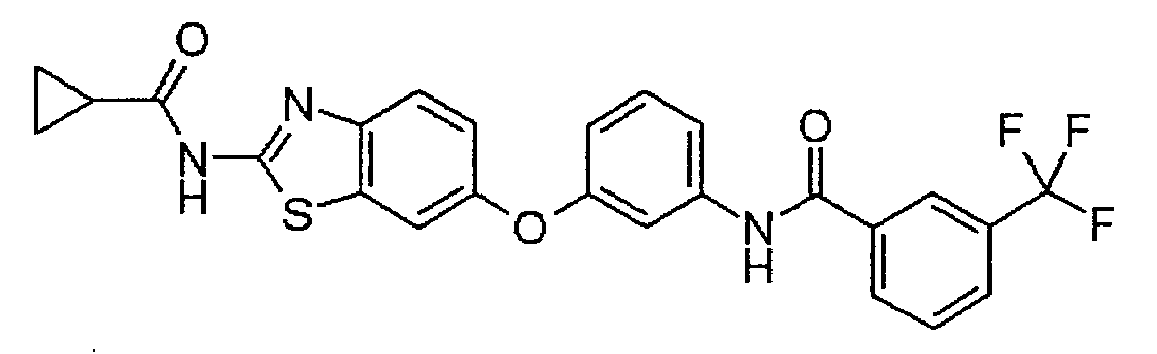
- Using 3-(trifluoromethyl)benzoic acid (182 mg, 959 µmol), thionyl chloride (0.4 mL, 5.48 mmol), toluene (5 mL), N-[6-(3-aminophenoxy)-1,3-benzothiazol-2-yl]cyclopropanecarboxamide (129 mg, 395 µmol) produced in Example A1 (vii), pyridine (5 mL), and N,N-dimethylpyridine-4-amine (21.3 mg, 176.0 µmol) as starting materials, and in the same manner as in Example A1(viii), the title compound (150 mg, 76%) was obtained as a colorless amorphous substance.
1H-NMR (DMSO-d6, 300 MHz) δ 0.90-1.10 (4H, m), 1.95-2.05 (1H, m), 6.82 (1H, d, J=7.8Hz), 7.18 (1H, d, J=8.4Hz), 7.38 (1H, d, J = 8.1 Hz), 7.48 (1H, s), 7.59 (1H, d, J = 8.1 Hz), 7.73-7.78 (3H, m), 7.95 (1H, d, J = 7.2 Hz), 8.21-8.24 (2H, m), 10.49 (1H, br s), 12.62 (1H, br s). -

- To a solution of 3-(1-cyanocyclopropyl)benzoic acid (10.0 g, 53.4 mmol) produced in Example A1 (iii) in tetrahydrofuran (130 mL) were added oxalyl chloride (5.47 mL, 64.1 mmol) and N,N-dimethylformamide (2 drops), and the mixture was stirred at room temperature for 3 hr. The reaction mixture was concentrated under reduced pressure to give 3-(1-cyanocyclopropyl)benzoyl chloride as a colorless oil.
To a two-layer solution of 3-amino-4-methylphenol (5.92 g, 48.0 mmol) in tetrahydrofuran (40 mL)/1N aqueous sodium hydrogencarbonate solution (54 mL) was added a solution of 3-(1-cyanocyclopropyl)benzoyl chloride synthesized above in tetrahydrofuran (20 mL), and the mixture was stirred at room temperature for 2 hr. Since the reaction mixture showed pH 4-5, sodium hydrogencarbonate (900 mg, 10.7 mmol) was added to adjust the pH to 8 - 9, and the reaction mixture was further stirred at room temperature for 1 hr. The aqueous layer was separated, and extracted with ethyl acetate (150 mL). The combined organic layer was washed with saturated brine (150 mL), and dried over anhydrous sodium sulfate. The insoluble material was filtered off, and the filtrate was concentrated under reduced pressure. To the obtained suspension was added ethyl acetate (25 mL)/hexane (50 mL), and the mixture was stirred at room temperature for 20 min. The precipitate was collected by filtration, repeatedly washed with diisopropyl ether/hexane (1:1) and air-dried to give the title compound (12.2 g, 87%) as a pale-yellow powder.
1H-NMR (DMSO-d6, 300 MHz) δ 1.56 - 1.67 (2H, m), 1.76 - 1.89 (2H, m), 2.10 (3H, s), 6.59 (1H, dd, J = 2.4, 8.1 Hz), 6.80 (1H, d, J = 2.4 Hz), 7.04 4 (1H, d, J = 8.1 Hz), 7.45 - 7.64 (2H, m), 7.80 - 8.00 (2H, m), 9.26 (1H, s), 9.81 (1H, br s). - To a solution of 1-fluoro-4-nitrobenzene (3.19 g, 22.5 mmol) and 3-(1-cyanocyclopropyl)-N-(5-hydroxy-2-methylphenyl)benzamide (6.00 g, 20.5 mmol) in N,N-dimethylformamide (50 mL) was added potassium carbonate (4.25 g, 30.8 mmol) and the mixture was stirred at 80°C for 6 hr. The reaction mixture was cooled to room temperature, and concentrated under reduced pressure. The obtained residue was diluted with ethyl acetate (300 mL), washed with water (200 mL) and saturated brine (200 mL), successively, and dried over anhydrous sodium sulfate. The insoluble material was filtered off, and the filtrate was concentrated under reduced pressure. The obtained residue was purified by silica gel column chromatography (hexane/ethyl acetate=80/20→40/60), and the obtained solution was concentrated under reduced pressure to give the title compound (9.08 g, quantitatively) as a yellow oil.
1H-NMR (DMSO-d6, 300 MHz) δ 1.53 - 1.68 (2H, m), 1.77 - 1.87 (2H, m), 2.28 (3H, s), 7.04 (1H, dd, J=2.4, 8. Hz), 7.10 - 7.19 (2H, m), 7.27 (1H, d, J = 2.4 Hz), 7.40 (1H, d, J = 8.4 Hz), 7.50 - 7.61 (2H, m), 7.81 - 7.95 (2H, m), 8.23 - 8.32 (2H, m), 10.02 (1H, s). - A suspension of 3-(1-cyanocyclopropyl)-N-[2-methyl-5-(4-nitrophenoxy)phenyl]benzamide (3.19 g, 22.5 mmol), calcium chloride (5.55 g, 50 mmol) and reduced iron (14.5 g, 260 mmol) in ethanol (540 mL)/water (60 mL) was stirred with heating at 80°C for 12 hr. The reaction mixture was cooled to room temperature, passed through a pad filled with celite to separate insoluble material, and the insoluble material was washed with ethanol. The filtrate and the washing were combined and concentrated under reduced pressure. The obtained residue was diluted with ethyl acetate (400 mL), washed with 5% aqueous ammonium chloride solution (200 mL), water (200 mL×2), 5% aqueous sodium hydrogencarbonate solution (200 mL) and saturated brine (200 mL), successively, and dried over anhydrous sodium sulfate. The insoluble material was filtered off, and the filtrate was concentrated under reduced pressure to give the title compound (7.0 g, 84%) as a pale-yellow amorphous substance. The obtained compound was used in the next reaction without a further purification.
1H-NMR (DMSO-d6, 300 MHz) δ 1.56 - 1.65 (2H, m), 1.75 - 1.86 (2H, m), 2.16 (3H, s), 4.96 (2H, s), 6.49 - 6.64 (2H, m), 6.68 - 6.81 (3H, m), 6.86 (1H, d, J = 2.4 Hz), 7.19 (1H, d, J= 8.4 Hz), 7.44 - 7.62 (2H, m), 7.77- 7.95 (2H, m), 9.90 (1H, s). - Potassium thiocyanate (7.00 g, 72 mmol) was suspended in acetic acid (120 mL) and the mixture was stirred at room temperature for 10 min. To the obtained solution was added a solution of N-[5-(4-aminophenoxy)-2-methylphenyl]-3-(1-cyanocyclopropyl)benzamide (6.90 g, 18 mmol) in acetic acid (120 mL), and the mixture was further stirred at room temperature for 30 min. To the obtained solution was added dropwise slowly a solution of bromine (3.60 g, 22.5 mmol) in acetic acid (80 mL) and, after the completion of the dropwise addition, the mixture was further stirred at room temperature for 12 hr. The resulting yellow insoluble material was filtered off and washed with acetic acid. The filtrate and the washing were combined and concentrated under reduced pressure. The obtained residue was suspended in ethyl acetate (400 mL), washed with 5% aqueous sodium hydrogencarbonate solution (200 mL×2) and saturated brine (200 mL), successively, and dried over anhydrous sodium sulfate. The insoluble material was filtered off, and the filtrate was concentrated under reduced pressure. The obtained residue was purified by basic silica gel column chromatography (hexane/ethyl acetate=50/50→0/100), and the obtained solution was concentrated under reduced pressure to give the title compound (6.27 g, 79%) as a pale-yellow amorphous substance.
1H-NMR (DMSO-d6, 300 MHz) δ 1.50 - 1.72 (2H, m), 1.77 - 1.91 (2H, m), 2.19 (3H, s), 6.82 (1H, dd, J = 2.4, 8.4 Hz), 6.89-7.01 (2H, m), 7.25 (1H, d, J = 8.4 Hz), 7.33 (1H, d, J = 8.7 Hz), 7.37 - 7.47 (3H, m), 7.47 - 7.62 (2H, m), 7.69 - 7.94 (2H, m), 9.93 (1H, s). - To a solution of N-{5-[(2-amino-1,3-benzothiazol-6-yl)oxy]-2-methylphenyl}-3-(1-cyanocyclopropyl)benzamide (300 mg, 0.681 mmol) in N,N-dimethylacetamide (3.0 mL) was added cyclopropanecarbonyl chloride (65 µL, 0.715 mmol), and the mixture was stirred at room temperature for 10 hr. To the reaction mixture was added cyclopropanecarbonyl chloride (30 µL, 0.33 mmol), and the mixture was further stirred at room temperature for 3 hr. The reaction mixture was diluted with ethyl acetate (100 mL), washed with 5% aqueous sodium hydrogencarbonate solution (100 mL) and saturated brine (100 mL), successively, and dried over anhydrous sodium sulfate. The insoluble material was filtered off, and the filtrate was concentrated under reduced pressure. The obtained residue was purified by silica gel column chromatography (hexane/ethyl acetate=70/30→0/100), and the obtained solution was concentrated under reduced pressure. The residue was triturated with ethyl acetate/diisopropyl ether to give the title compound (140 mg, 40%) as a colorless solid.
1H-NMR (DMSO-d6, 300 MHz) δ 0.89 - 1.00 (4H, m), 1.54 - 1.63 (2H, m), 1.76 - 1.85 (2H, m), 1.92 - 2.06 (1H, m), 2.21 (3H, s), 6.88 (1H, dd, J=8.4, 2.4 Hz), 7.04 (1H, d, J=2.4Hz), 7.13 (1H, dd, J = 8.7, 2.4 Hz), 7.29 (1H, d, J = 8.4 Hz), 7.46 - 7.61 (2H, m), 7.66 (1H, d, J = 2.4 Hz), 7.73 (1H, d, J = 8.7 Hz), 7.83 (1H, s), 7.87 (1H, dt, J = 6.6, 1.8 Hz), 9.94 (1H, s), 12. 61 (1H, s). -

- To a solution of 1,3-oxazole-4-carboxylic acid (81 mg, 0.715 mmol) in tetrahydrofuran (1 mL) were added oxalyl chloride (70 µL, 0.817 mmol) and N,N-dimethylformamide (1 drop), and the mixture was stirred at room temperature for 1 hr. The reaction mixture was concentrated under reduced pressure to give 1,3-oxazole-4-carbonyl chloride as a yellow oily substance.
To a solution of 1,3-oxazole-4-carbonyl chloride synthesized above in N,N-dimethylacetamide (3 mL) was added N-{5-[(2-amino-1,3-benzothiazol-6-yl)oxy]-2-methylphenyl}-3-(1-cyanocyclopropyl)benzamide (300 mg, 0.681 mmol) produced in Example A3(iv), and the mixture was stirred at room temperature for 1 hr. To the reaction mixture was added a solution of 1,3-oxazole-4-carbonyl chloride synthesized in the same manner as in the above from 1,3-oxazole-4-carboxylic acid (30 mg, 0.265 mmol), oxalyl chloride (27 µL, 0.316 mmol), N,N-dimethylformamide (1 drop) and tetrahydrofuran (1 mL) in N,N-dimethylacetamide (1 mL), and the mixture was further stirred at room temperature for 3 hr. The reaction mixture was concentrated under reduced pressure, diluted with 5% aqueous sodium hydrogencarbonate solution (200 mL), and extracted with ethyl acetate (300 mL). The organic layer was washed with saturated brine (100 mL), and dried over anhydrous sodium sulfate. The insoluble material was filtered off, and the filtrate was concentrated under reduced pressure. The obtained residue was purified by silica gel column chromatography (hexane/ethyl acetate=50/50→0/100), and triturated with ethyl acetate/hexane to give the title compound (3.84 g, 75%) as a colorless solid.
1H-NMR (DMSO-d6, 300 MHz) δ 1.50 - 1.65 (2H, m), 1.75 - 1.88 (2H, m), 2.22 (3H, s), 6.90 (1H, dd, J = 2.4, 8.4 Hz), 7.06 (1H, d, J = 2.4 Hz), 7.18 (1H, dd, J = 2.4, 8.7 Hz), 7.30 (1H, d, J = 8.4 Hz), 7. 48 - 7. 62 (2H, m), 7.74 (1H, d, J = 2.4 Hz), 7.76 - 7.85 (2H, m), 7.85 - 7.92 (1H, m), 8.65 (1H, s), 9.04 (1H, s), 9.95 (1H, s), 12.63 (1H, s). -

- To a solution of N-15-[(2-amino-1,3-benzothiazol-6-yl)oxy]-2-methylphenyl}-3-(1-cyanocyclopropyl)benzamide (300 mg, 0.681 mmol) produced in Example A3(iv) in N,N-dimethylacetamide (3.0 mL) was added bromoacetic bromide (62 µL, 0.715 mmol), and the mixture was stirred at room temperature for 1 hr. To the reaction mixture was added bromoacetic bromide (20 µL, 0.229 mmol), and the mixture was further stirred at room temperature for 2 hr. The reaction mixture was diluted with ethyl acetate (100 mL), washed with 5% aqueous sodium hydrogencarbonate solution (100 mL) and saturated brine (100 mL), successively, and dried over anhydrous sodium sulfate. The insoluble material was filtered off, and the filtrate was concentrated under reduced pressure to give N-[5-({2-[(chloroacetyl)amino]-1,3-benzothiazol-6-yl}oxy)-2-methylphenyl]-3-(1-cyanocyclopropyl)benzamide as a colorless solid.
N-[5-({2-[(Chloroacetyl)amino]-1,3-benzothiazol-6-yl}oxy)-2-methylphenyl]-3-(1-cyanocyclopropyl)benzamide synthesized above was dissolved in tetrahydrofuran (5.0 mL), triethylamine (188 µL, 1.36 mmol) and 1-methylpiperazine (152 µL, 1.36 mmol) were added, and the mixture was stirred at 60°C for 8 hr. The reaction mixture was cooled to room temperature, diluted with ethyl acetate (100 mL), washed with water (100 mL) and saturated brine (100 mL), successively, and dried over anhydrous sodium sulfate. The insoluble material was filtered off, and the filtrate was concentrated under reduced pressure. The obtained residue was purified by basic silica gel column chromatography (hexane/ethyl acetate=50/50→0/100), and the obtained solution was concentrated under reduced pressure. The obtained residue was triturated with ethyl acetate/hexane to give the title compound (141 mg, 36%) as a colorless solid.
1H-NMR (DMSO-d6, 300 MHz) δ 1.54 - 1.65 (2H, m), 1.74 - 1.84 (2H, m), 2.16 (3H, s), 2.21 (3H, s), 2.34 (4H, br s), 2.45 - 2.59 (6 H, m), 6.88 (1H, dd, J = 2.4, 8.4 Hz), 7.04 (1H, d, J = 2.4 Hz), 7.13 (1H, dd, J = 2.4, 8.7 Hz), 7.28 (1H, d, J = 8.4 Hz), 7.48 - 7.60 (2H, m), 7.68 (1H, d, J = 2.4 Hz), 7.73 (1H, d, J = 8.7 Hz), 7.82 (1H, s), 7.84 - 7.91 (1H, m), 9.94 (1H, s), 12.03 (1H, br s). -

- To a solution of N-15-[(2-amino-1,3-benzothiazol-6-yl)oxy]-2-methylphenyl}-3-(1-cyanocyclopropyl)benzamide (300 mg, 0.681 mmol) produced in Example A3(iv) in tetrahydrofuran (8.0 mL) were added a solution of 2-chloro-2-oxoethyl acetate (77 µL, 0.715 mmol) in tetrahydrofuran (2.0 mL) and triethylamine (141 µL, 1.02 mmol), and the mixture was stirred at room temperature for 30 min. To the reaction mixture were added 2-chloro-2-oxoethyl acetate (154 µL, 1.43 mmol) and triethylamine (290 µL, 2.10 mmol), and the mixture was further stirred at room temperature for 1.5 hr. To the reaction mixture was added 1N aqueous sodium hydroxide solution (10 mL), and the mixture was stirred at room temperature for 30 min and neutralized with 1N hydrochloric acid. The obtained mixture was extracted with ethyl acetate (100 mLx2). The combined organic layer was washed with saturated brine (100 mL), and dried over anhydrous sodium sulfate. The insoluble material was filtered off, and the filtrate was concentrated under reduced pressure. The obtained residue was purified by basic silica gel column chromatography (ethyl acetate/methanol=100/0 →90/10), and the obtained solution was concentrated under reduced pressure. The residue was triturated with ethyl acetate/diisopropyl ether to give the title compound (220 mg, 65%) as a colorless solid.
1H-NMR (DMSO-d6, 300 MHz) δ 1.54 - 1.64 (2H, m), 1.76 - 1.84 (2H, m), 2.22 (3H, s), 4.19 (2H, s), 5.54 (1H, br s), 6.89 (1H, dd, J = 2.4, 8.4 Hz), 7.04 4 (1H, d, J = 2.4 Hz), 7.14 (1H, dd, J = 2.4, 8.7 Hz), 7.29 (1H, d, J = 8.4 Hz), 7.47 - 7.61 (2H, m), 7.70 (1H, d, J = 2.4 Hz), 7.75 (1H, d, J = 8.7 Hz), 7.83 (1H, s), 7.85 - 7.92 (1H, m), 9.94 (1H, s), 12.02 (1H, br s). -

- To a solution of methyl 3-(cyanomethyl)benzoate (7.0 g, 40 mmol) produced in Example A1(i) in dimethyl sulfoxide (80 mL) was added sodium hydride (60% in oil, 4.8 g, 120 mmol) while cooling to not more than 25°C without causing solidification. The reaction mixture was stirred at room temperature for 20 min, methyl iodide (7.5 mL, 120 mmol) was added, and the mixture was further stirred at room temperature for 16 hr. The reaction mixture was diluted with water (400 mL) and extracted with ethyl acetate (800 mL). The organic layer was washed with water (400 mL) and saturated brine (400 mL), successively, dried over anhydrous sodium sulfate, and the insoluble material was filtered off. The solvent was evaporated under reduced pressure, and the residue was purified by silica gel column chromatography (ethyl acetate/hexane=5/95→50/50), and the fraction containing the object product was concentrated under reduced pressure to give the title compound (6.4 g, 79%) as a colorless oil.
1H-NMR (DMSO-d6, 300 MHz) δ 1.72 (6H, s), 3.89 (3H, s), 7.61 (1H, t, J = 7.8 Hz), 7.82-7.85 (1H, ddd, J = 1.2, 2.1, 7.8 Hz), 7.95 (1H, dt, J = 7.8, 1.2 Hz), 8.08 (1H, t, J = 1.5 Hz). - To a solution of methyl 3-(1-cyano-1-methylethyl)benzoate (2.8 g, 14 mmol) in tetrahydrofuran (30 mL) were added lithium hydroxide monohydrate (0.98 g, 24 mmol), methanol (10 mL) and water (10 mL), and the mixture was stirred at room temperature for 18 hr. The solvent was evaporated under reduced pressure, and the residue was diluted with water (15 mL). The mixture was adjusted to pH 3 by slowly adding 1N hydrochloric acid. The resulting white precipitate was collected by filtration, washed with water, and dried to give the title compound (2.5 g, 98%) as a white powder.
1H-NMR (DMSO-d6, 300 MHz) δ 1.72 (6H, s), 7.57 (1H, t, J = 7.8 Hz), 7.78 (1H, ddd, J = 1.2, 2.1, 7.8 Hz), 7.92 (1H, dt, J = 7.8, 1.5 Hz), 8.08 (1H, t, J = 1.5 Hz), 13.19 (1H, s). - To a solution of 3-(1-cyano-1-methylethyl)benzoic acid (5.00 g, 26.4 mmol) in tetrahydrofuran (50 mL) were added oxalyl chloride (2.70 mL, 31.7 mmol) and N,N-dimethylformamide (2 drops), and the mixture was stirred at room temperature for 1 hr. The reaction mixture was concentrated under reduced pressure to give 3-(1-cyano-1-methylethyl)benzoyl chloride as a pale-yellow oily substance.
To a two-layer solution of 3-amino-4-methylphenol (3.25 g, 26.4 mmol) in tetrahydrofuran (20 mL)/1N aqueous sodium hydrogencarbonate solution (39 mL) was added a solution of 3-(1-cyano-1-methylethyl)benzoyl chloride synthesized above in tetrahydrofuran (20 mL), and the mixture was stirred at room temperature for 3 hr. The aqueous layer was separated, and extracted with ethyl acetate (100 mL). The combined organic layer was washed with 5% aqueous sodium hydrogencarbonate solution (50 mL) and saturated brine (50 mL), successively, and dried over anhydrous sodium sulfate. The insoluble material was filtered off, and the filtrate was concentrated under reduced pressure. The obtained residue was recrystallized from ethyl acetate (45 mL)/hexane (45 mL) to give the title compound (5.95 g, 77%) as a colorless powder.
1H-NMR (DMSO-d6, 300 MHz) δ 1.75 (6H, s), 2.11 (3H, s), 6.59 (1H, dd, J = 2.4, 8.1 Hz), 6.81 (1H, d, J = 2.4 Hz), 7.04 (1H, d, J = 8.1 Hz), 7.59 (1H, t, J = 7.8 Hz), 7.65 - 7.85 (1H, m), 7.94 (1H, d, J = 7.8 Hz), 8.07 (1H, s), 9.27 (1H, s), 9.84 (1H, s). - To a solution of 1-fluoro-4-nitrobenzene (1.26 g, 8.92 mmol) and 3-(1-cyano-1-methylethyl)-N-(5-hydroxy-2-methylphenyl)benzamide (2.50 g, 8.5 mmol) in N,N-dimethylformamide (20 mL) was added potassium carbonate (1.85 g, 13.3 mmol) and the mixture was stirred at 60°C for 4 hr, and further at 70°C for 12 hr. The reaction mixture was cooled to room temperature, the insoluble material was filtered off, and the filtrate was concentrated under reduced pressure. The obtained residue was diluted with ethyl acetate (200 mL), washed with 5% aqueous sodium hydrogencarbonate solution (100 mL) and saturated brine (100 mL) successively, and dried over anhydrous sodium sulfate. The insoluble material was filtered off, and the filtrate was concentrated under reduced pressure to give the title compound (3.41 g, 97%) as a yellow amorphous substance. The obtained compound was used in the next reaction without a further purification.
1H-NMR (DMSO-d6, 300 MHz) δ 1.74 (6H, s), 2.29 (3H, s), 7.05 (1H, dd, J = 2.4, 8.4 Hz), 7.10 - 7.19 (2H, m), 7.28 (1H, d, J = 2.4 Hz), 7.41 (1H, d, J = 8.4 Hz), 7.60 (1H, t, J = 7.8 Hz), 7.72 - 7.80 (1H, m), 7.93 - 7.99 (1H, m), 8.07 (1H, s), 8.23 - 8.31 (2H, m), 10.05 (1H, s). - A suspension of 3-(1-cyano-1-methylethyl)-N-[2-methyl-5-(4-nitrophenoxy)phenyl]benzamide (3.50 g, 8.0 mmol), calcium chloride (2.36 g, 21.2 mmol) and reduced iron (4.75 g, 85 mmol) in ethanol (180 mL)/water (20 mL) was stirred with heating at 80°C for 10 hr. The reaction mixture was cooled to room temperature, passed through a pad filled with celite to separate insoluble material, and the insoluble material was washed with ethanol. The filtrate and the washing were combined and concentrated under reduced pressure. The obtained residue was diluted with ethyl acetate (300 mL), washed with 5% aqueous ammonium chloride solution (200 mL), water (200 mL), 5% aqueous sodium hydrogencarbonate solution (200 mL) and saturated brine (200 mL), successively, and dried over anhydrous sodium sulfate. The insoluble material was filtered off, and the filtrate was concentrated under reduced pressure. The obtained residue was purified by silica gel column chromatography (hexane/ethyl acetate=60/40→0/100), and the obtained solution was concentrated under reduced pressure to give the title compound (2.89 g, 94%) as a colorless amorphous substance.
1H-NMR (DMSO-d6, 300 MHz) δ 1.74 (6H, s), 2.17 (3H, s), 4.97 (2H, s), 6.51 - 6.64 (2H, m), 6.68 - 6.83 (3H, m), 6.88 (1H, d, J = 2.4 Hz), 7.20 (1H, d, J = 8.4 Hz), 7.58 (1H, t, J = 7.8 Hz), 7.69 - 7.78 (1H, m), 7.93 (1H, d, J = 7.8 Hz), 8.05 (1H, s), 9.93 (1H, s). - Potassium thiocyanate (4.80 g, 49.2 mmol) was suspended in acetic acid (80 mL) and the mixture was stirred at room temperature for 10 min. To the obtained solution was added a solution of N-[5-(4-aminophenoxy)-2-methylphenyl]-3-(1-cyano-1-methylethyl)benzamide (5.00 g, 12.3 mmol) in acetic acid (80 mL), and the mixture was further stirred at room temperature for 20 min. To the obtained solution was added dropwise slowly a solution of bromine (2.46 g, 15.4 mmol) in acetic acid (50 mL) and, after the completion of the dropwise addition, the mixture was stirred at room temperature for 6 hr. The resulting yellow insoluble material was filtered off, and washed with acetic acid. The filtrate and the washing were combined and concentrated under reduced pressure. The obtained residue was suspended in ethyl acetate (300 mL), washed with 5% aqueous sodium hydrogencarbonate solution (300 mL) and saturated brine (300 mL), successively, and dried over anhydrous sodium sulfate. Activated carbon was added, and the mixture was stood for a while. The insoluble material was filtered off, and the filtrate was concentrated under reduced pressure to give the title compound (3.57 g, 66%) as a pale-yellow amorphous substance.
1H-NMR (DMSO-d6, 300 MHz) δ 1.73 (6H, s), 2.20 (3H, s), 6.83 (1H, dd, J = 2.4, 8.4 Hz), 6.92 (1H, dd, J = 2.4, 8.7 Hz), 6.98 (1H, d, J = 2.4 Hz), 7.25 (1H, d, J = 8.4 Hz), 7.33 (1H, d, J = 8.7 Hz), 7.38 - 7.47 (3H, m), 7.58 (1H, t, J = 7.8 Hz), 7.70 - 7.78 (1H, m), 7.93 (1H, d, J = 7.8 Hz), 8.04 (1H, s), 9.95 (1H, s). - To a solution of N-{5-[(2-amino-1,3-benzothiazol-6-yl)oxy]-2-methylphenyl}-3-(1-cyano-1-methylethyl)benzamide (200 mg, 0.452 mmol) in pyridine (4.0 mL) was added cyclopropanecarbonyl chloride (90 µL, 0.994 mmol), and the mixture was stirred at room temperature for 2 hr. The reaction mixture was concentrated under reduced pressure, and the residue was dissolved in methanol (2.0 mL)/tetrahydrofuran (2.0 mL)/water (2.0 mL). 1N Aqueous sodium hydroxide solution (2.0 mL) was added, and the mixture was stirred at room temperature for 1 hr. The reaction mixture was neutralized with 1N hydrochloric acid, diluted with ethyl acetate (100 mL), washed with water (50 mL) and saturated brine (50 mL), successively, and dried over anhydrous sodium sulfate. The insoluble material was filtered off, and the filtrate was concentrated under reduced pressure. The obtained residue was purified by silica gel column chromatography (hexane/ethyl acetate=70/30→0/100), and the obtained solution was concentrated under reduced pressure. The residue was triturated with ethyl acetate/diisopropyl ether to give the title compound (129 mg, 56%) as a colorless amorphous substance.
1H-NMR (DMSO-d6, 300 MHz) δ 0.89 - 1.00 (4H, m), 1.73 (6 H, s), 1.93 - 2.06 (1H, m), 2.22 (3H, s), 6.89 (1H, dd, J = 2.4, 8.4 Hz), 7.05 (1H, d, J = 2.4 Hz), 7.14 (1H, dd, J = 2.4, 8.7 Hz), 7.29 (1H, d, J = 8.4 Hz), 7.58 (1H, t, J = 7.8 Hz), 7.67 (1H, d, J = 2.4 Hz), 7.71 - 7.78 (2H, m), 7.92 (1H, d, J = 7.8 Hz), 8.04 (1H, s), 9.97 (1H, s), 12.62 (1H, s). -

- To a solution of 1,3-oxazole-4-carboxylic acid (112 mg, 0.994 mmol) in tetrahydrofuran (4.0 mL) were added oxalyl chloride (127 µL, 1.49 mmol) and N,N-dimethylformamide (1 drop), and the mixture was stirred at room temperature for 1 hr. The reaction mixture was concentrated under reduced pressure to give 1,3-oxazole-4-carbonyl chloride as a yellow oily substance.
1,3-Oxazole-4-carbonyl chloride synthesized above was suspended in pyridine (4.0 mL) at 0°C, N-{5-[(2-amino-1,3-benzothiazol-6-yl)oxy]-2-methylphenyl}-3-(1-cyano-1-methylethyl)benzamide (200 mg, 0.452 mmol) produced in Example A7(vi) was added, and the mixture was stirred at room temperature for 12 hr. The reaction mixture was concentrated under reduced pressure, and the residue was suspended in methanol (4.0 mL). 1N Aqueous sodium hydroxide solution (4.0 mL) was added, and the mixture was stirred at room temperature for 30 min. To the reaction mixture was added 1N hydrochloric acid (10 mL), and the mixture was extracted with ethyl acetate (100 mL). The organic layer was washed with 5% aqueous sodium hydrogencarbonate solution (50 mL) and saturated brine (50 mL), successively, and dried over anhydrous sodium sulfate. The insoluble material was filtered off, and the filtrate was concentrated under reduced pressure. The obtained residue was purified by basic silica gel column chromatography (hexane/ethyl acetate=70/30→0/100), and the obtained solution was concentrated under reduced pressure. The residue was triturated with ethyl acetate/diisopropyl ether to give the title compound (70 mg, 29%) as a colorless solid.
1H-NMR (DMSO-d6, 300 MHz) δ 1.73 (6H, s), 2.23 (3H, s), 6.90 (1H, dd, J = 8.4, 2.4 Hz), 7.07 (1H, d, J = 2.4 Hz), 7.18 (1H, dd, J = 2.4, 8.7 Hz), 7.30 (1H, d, J = 8.4 Hz), 7.58 (1H, t, J = 7.8 Hz), 7.67 - 7.85 (3H, m), 7.93 (1H, d, J = 7.8 Hz), 8.05 (1H, s), 8.65 (1H, s), 9.04 (1H, s), 9.98 (1H, s), 12.65 (1H, br s). -

- To a solution of N-{5-[(2-amino-1,3-benzothiazol-6-yl)oxy]-2-methylphenyl}-3-(1-cyano-1-methylethyl)benzamide (200 mg, 0.452 mmol) produced in Example A7(vi) in N,N-dimethylformamide (2.0 mL) was added chloroacetic acid chloride (79 µL, 0.995 mmol), and the mixture was stirred at room temperature for 4 hr. The reaction mixture was diluted with ethyl acetate (100 mL), washed with 5% aqueous sodium hydrogencarbonate solution (100 mL), water (100 mL) and saturated brine (100 mL), successively, and dried over anhydrous sodium sulfate. The insoluble material was filtered off, and the filtrate was concentrated under reduced pressure. The obtained residue was purified by silica gel column chromatography (hexane/ethyl acetate=50/50→0/100), and the obtained solution was concentrated under reduced pressure to give N-[5-({2-[(chloroacetyl)amino]-1,3-benzothiazol-6-yl}oxy)-2-methylphenyl]-3-(1-cyano-1-methylethyl)benzamide as a colorless solid.
N-[5-({2-[(Chloroacetyl)amino]-1,3-benzothiazol-6-yl}oxy)-2-methylphenyl]-3-(1-cyano-1-methylethyl)benzamide synthesized above was dissolved in tetrahydrofuran (8.0 mL), triethylamine (155 µL, 1.13 mmol) and 1-methylpiperazine (100 µL, 0.902 mmol) were added, and the mixture was stirred at 60°C for 8 hr. The reaction mixture was cooled to room temperature, diluted with ethyl acetate (100 mL), washed with water (50 mL×2) and saturated brine (50 mL), successively, and dried over anhydrous sodium sulfate. The insoluble material was filtered off, and the filtrate was concentrated under reduced pressure. The residue was purified by basic silica gel column chromatography (hexane/ethyl acetate=50/50→0/100), and the obtained solution was concentrated under reduced pressure. The residue was triturated with ethyl acetate/hexane to give the title compound (106 mg, 40%) as a colorless solid.
1H-NMR (DMSO-d6, 300 MHz) δ 1.73 (6H, s), 2.16 (3H, s), 2.23 (3H, s), 2.35 (4H, br s), 2.42 - 2.61 (6H, m), 6.89 (1H, dd, J = 2.4, 8.4 Hz), 7.06 (1H, d, J = 2.4 Hz), 7.15 (1H, dd, J = 2.4, 8.7 Hz), 7.29 (1H, d, J = 8.4 Hz), 7.58 (1H, t, J = 7.8 Hz), 7.66 - 7.79 (3H, m), 7.93 (1H, d, J = 7.8 Hz), 8.04 (1H, s), 9.97 (1H, s), 12.04 (1H, s). -

- To a solution of N-{5-[(2-amino-1,3-benzothiazol-6-yl)oxy]-2-methylphenyl}-3-(1-cyano-1-methylethyl)benzamide (200 mg, 0.452 mmol) produced in Example A7(vi) in pyridine (4.0 mL) was added 2-chloro-2-oxoethyl acetate (107 µL, 0.994 mmol), and the mixture was stirred at room temperature for 10 hr. The reaction mixture was concentrated under reduced pressure, and the residue was dissolved in methanol (4.0 mL). 1N Aqueous sodium hydroxide solution (4.0 mL) was added, and the mixture was stirred at room temperature for 1 hr. The reaction mixture was neutralized with 1N hydrochloric acid, and extracted with ethyl acetate (100 mL). The organic layer was washed with water (50 mL) and saturated brine (50 mL), successively, and dried over anhydrous sodium sulfate. The insoluble material was filtered off, and the filtrate was concentrated under reduced pressure. The obtained residue was purified by basic silica gel column chromatography (ethyl acetate/methanol=100/0→80/20), and the obtained solution was concentrated under reduced pressure. The residue was triturated with ethyl acetate/diisopropyl ether to give the title compound (120 mg, 53%) as a colorless solid.
1H-NMR (DMSO-d6, 300 MHz) δ 1.73 (6H, s), 2.22 (3H, s), 4.18 (2H, br s), 5.54 (1H, br s), 6.89 (1H, dd, J = 2.4, 8.4 Hz), 7.05 (1H, s), 7.14 (1H, dd, J = 2.4, 8.7 Hz), 7.29 (1H, d, J = 8.4 Hz), 7.49 - 7.64 (1H, m), 7.67 - 7.79 (3H, m), 7.93 (1H, d, J = 7.8 Hz), 8.04 (1H, s), 9.97 (1H, s), 12.03 (1H, br s). -

- To a solution of 3-(1-cyano-1-methylethyl)benzoic acid (10 g, 52.8 mmol) produced in Example A7(ii) in tetrahydrofuran (100 mL) were added N,N-dimethylformamide (4 drops) and oxalyl chloride (6.28 mL, 72.0 mmol), and the mixture was stirred at room temperature for 1.5 hr. The solvent was evaporated under reduced pressure to give a residue. To a solution of 3-aminophenol (5.24 g, 48.0 mmol) in tetrahydrofuran (40 mL) was added a suspension of sodium hydrogencarbonate (6.05 g, 72.0 mmol) in water (60 mL), and the mixture was stirred vigorously at room temperature. To this mixture was added dropwise a solution of the residue obtained above in tetrahydrofuran (60 mL) under ice-cooling, and the mixture was stirred at room temperature for 5 hr. The aqueous layer of the reaction mixture was separated, and the organic layer was diluted with ethyl acetate and washed with saturated brine. The organic layer was dried over anhydrous magnesium sulfate, and decolorized with activated carbon. The insoluble material was filtered off through a pad filled with two layers of silica gel and celite. The solvent was evaporated under reduced pressure, and the obtained solid was washed with ethyl acetate-hexane mixture to give the title compound (13.03 g, 96%) as a white powder.
1H-NMR (DMSO-d6, 300 MHz) δ 1.75 (6H, s), 6.49 - 6.55 (1H, m), 7.08 - 7.18 (2H, m), 7.30 - 7.34 (1H, m), 7.59 (1H, t, J = 7.8 Hz), 7.72 - 7.77 (1H, m), 7.88 - 7.93 (1H, m), 8.01 (1H, t, J = 1.7 Hz), 9.43 (1H, s), 10.18 (1H, s). - To a solution of 1,2-difluoro-4-nitrobenzene (1.19 g, 7.49 mmol) and 3-(1-cyano-1-methylethyl)-N-(5-hydroxy-2-methylphenyl)benzamide (2.0 g, 7.13 mmol) in N,N-dimethylformamide (15 mL) was added potassium carbonate (1.47 g, 10.7 mmol), and the mixture was stirred at 80°C for 18 hr. The reaction mixture was cooled to room temperature, and concentrated under reduced pressure. The obtained residue was diluted with ethyl acetate (200 mL), washed with water (200 mL) and saturated brine (200 mL), successively, and dried over anhydrous sodium sulfate. The insoluble material was filtered off, and the filtrate was concentrated under reduced pressure. The obtained residue was purified by silica gel column chromatography (hexane/ethyl acetate=95/5→70/30), and the obtained solution was concentrated under reduced pressure to give the title compound (2.09 g, 70%) as a yellow oil.
1H-NMR (DMSO-d6, 300 MHz) δ 1.75 (6H, s), 6.97 (1H, dd, J = 2.1, 7.8 Hz), 7.18 - 7.32 (1H, m), 7.48 (1H, t, J = 8.1 Hz), 7.60 (1H, t, J = 7.8 Hz), 7.64 - 7.73 (2H, m), 7.73 - 7.80 (1H, m), 7.87 - 7.96 (1H, m), 8.02 (1H, t, J = 1.8 Hz), 8.09 - 8.19 (1H, m), 8.37 (1H, dd, J = 2.7, 10.8 Hz), 10.49 (1H, s). - A suspension of 3-(1-cyano-1-methylethyl)-N-[3-(2-fluoro-4-nitrophenoxy)phenyl]benzamide (2.03 g, 4.83 mmol), calcium chloride (1.41 g, 12.1 mmol) and reduced iron (2.97 g, 53.1 mmol) in ethanol (300 mL)/water (30 mL) was stirred with heating at 80°C for 12 hr. The reaction mixture was cooled to room temperature, and passed through a pad filled with celite to separate insoluble material, and the insoluble materials were washed with ethanol. The filtrate and washing were combined and concentrated under reduced pressure. The obtained residue was diluted with ethyl acetate (300 mL), washed with 5% aqueous sodium hydrogencarbonate solution (300 mL), water (200 mLx2) and saturated brine (200 mL), successively, and dried over anhydrous sodium sulfate. The insoluble material was filtered off, and the filtrate was concentrated under reduced pressure. The obtained residue was purified by silica gel column chromatography (hexane/ethyl acetate=70/30→0/100), and the obtained solution was concentrated under reduced pressure to give the title compound (1.94 g, quantitatively) as a yellow amorphous substance.
1H-NMR (DMSO-d6, 300 MHz) δ 1.74 (6H, s), 5.34 (2H, s), 6.35 - 6.44 (1H, m), 6.49 (1H, dd, J = 2.4, 13.2 Hz), 6. 61 - 6.73 (1H, m), 6.80 - 7.03 (1H, m), 7.28 (1H, t, J = 8.1 Hz), 7.36 (1H, t, J = 2.1 Hz), 7.41 - 7.50 (1H, m), 7.57 (1H, t, J = 7.8 Hz), 7.67 - 7.79 (1H, m), 7.83 - 7.94 (1H, m), 7.99 (1H, t, J = 1.8 Hz), 10.31 (1H, s). - Potassium thiocyanate (500 mg, 5.12 mmol) was suspended in acetic acid (10 mL) and the mixture was stirred at room temperature for 10 min. To the obtained solution was added a solution of N-[3-(4-amino-2-fluorophenoxy)phenyl]-3-(1-cyano-1-methylethyl)benzamide (500 mg, 1.28 mmol) in acetic acid (10 mL), and the mixture was further stirred at room temperature for 15 min. To the obtained solution was added dropwise slowly a solution of bromine (0.225 g, 1.41 mmol) in acetic acid (7.0 mL) and, after the completion of the dropwise addition, the mixture was stirred at room temperature for 14 hr. The resulting yellow insoluble material was filtrated, and washed with acetic acid. The filtrate and washing were combined and concentrated under reduced pressure. The obtained residue was suspended in ethyl acetate (300 mL), washed with 5% aqueous sodium hydrogencarbonate solution (200 mL×2), water (200 mL) and saturated brine (200 mL), successively, and dried over anhydrous sodium sulfate. The insoluble material was filtered off, and the filtrate was concentrated under reduced pressure to give the title compound (0.32 g, 57%) as a yellow amorphous substance. The obtained compound was used in the next reaction without a further purification.
1H-NMR (DMSO-d6, 300 MHz) δ 1.73 (6H, s), 6.74 (1H, dd, J = 2.0, 7.8 Hz), 7.25 - 7.37 (2H, m), 7.40 (1H, t, J = 2.0 Hz), 7.49 - 7.55 (1H, m), 7.57 (1H, t, J = 7.8 Hz), 7.61 - 7.69 (3H, m), 7.70 - 7.78 (1H, m), 7.85 - 7.92 (1H, m), 7.98 (1H, t, J = 1.6 Hz), 10.32 (1H, s). - To a solution of N-{3-[(2-amino-5-fluoro-1,3-benzothiazol-6-yl)oxy]phenyl}-3-(1-cyano-1-methylethyl)benzamide (200 mg, 0.448 mmol) in pyridine (4.0 mL) was added cyclopropanecarbonyl chloride (61 µL, 0.672 mmol), and the mixture was stirred at room temperature for 4 hr. The reaction mixture was diluted with ethyl acetate (100 mL), washed with 5% aqueous sodium hydrogencarbonate solution (100 mL) and saturated brine (100 mL), successively, and dried over anhydrous sodium sulfate. The insoluble material was filtered off, and the filtrate was concentrated under reduced pressure. The obtained residue was purified by silica gel column chromatography (hexane/ethyl acetate=60/40→0/100), and the obtained solution was concentrated under reduced pressure. The residue was triturated with ethyl acetate/diisopropyl ether/hexane to give the title compound (118 mg, 51%) as a colorless solid.
1H-NMR (DMSO-d6, 300 MHz) δ 0.87 - 1.01 (4H, m), 1.73 (6H, s), 1.91 - 2.06 (1H, m), 6.78 (1H, dd, J = 2.1, 7.8 Hz), 7.35 (1H, t, J = 7.8 Hz), 7.45 (1H, t, J = 2.1 Hz), 7.51 - 7.62 (2H, m), 7.69 - 7.76 (1H, m), 7.79 (1H, d, J = 11.4 Hz), 7.84 - 7.91 (1H, m), 7.91 - 8.04 (2H, m), 10.34 (1H, s), 12.74 (1H, s). -

- To a solution of 1-fluoro-4-nitrobenzene (14.1 g, 100 mmol) and 3-aminophenol (11.2 g, 102 mmol) in N,N-dimethylformamide (150 mL) was added potassium carbonate (26.5 g, 191 mmol) and the mixture was stirred at 80°C for 8 hr. The reaction mixture was cooled to room temperature, diluted with ethyl acetate-hexane (1:1, 250 mL) and washed with water (250 mLx2) and saturated brine (100 mL), successively. The collected aqueous layer was extracted with ethyl acetate-hexane (1:1, 250 mL). The collected organic layer was dried over anhydrous magnesium sulfate, and decolorized with activated carbon. The insoluble material was filtered off through a pad filled with two layers of silica gel and celite, and the filtrate was concentrated. The obtained yellow syrup-like substance was recrystallized from ethyl acetate and hexane to give the title compound (21.8 g, 95%) as yellow crystals.
1H-NMR (DMSO-d6, 300 MHz) δ5.39 (2H, br s), 6.26 (1H, ddd, J = 0.9, 2.4, 7.8 Hz), 6.31 (1H, t, J = 2.1 Hz), 6.48 (1H, ddd, J = 0.9, 2.1, 8.1 Hz), 7.07-7.14 (3H, m), 8.24 (2H, dt, J = 7.2, 3.6 Hz). - To a solution of 3-(4-nitrophenoxy)aniline (4.69 g, 20.4 mmol) and 3-(1-cyano-1-methylethyl)benzoic acid (3.98 g, 21.0 mmol) produced in Example A7(ii) in pyridine (100 mL) were added 1-ethyl-3-(3-dimethylaminopropyl)carbodiimide hydrochloride (4.69 g, 24.5 mmol) and N,N-dimethylpyridine-4-amine (151 mg, 1.24 mmol), and the mixture was stirred at room temperature for 4 hr. To the reaction mixture was added methanol (50 mL) and the mixture was further stirred at the same temperature for 30 min. The solvent was evaporated under reduced pressure. The residue was diluted with ethyl acetate (200 mL), washed with dilute hydrochloric acid (150 mLx2) and saturated aqueous sodium hydrogencarbonate solution (150 mL), successively, and dried over anhydrous magnesium sulfate. The insoluble material was filtered off, and the filtrate was concentrated under reduced pressure to give the title compound (8.10 g, 99%) as a yellow amorphous substance. The obtained compound was used in the next reaction without a further purification.
1H-NMR (DMSO-d6, 300 MHz) δ1.75 (6H, s), 6.97 (1H, dd, J = 1.8, 8.4 Hz), 7.20 (2H, dt, J = 10.5, 3.3 Hz), 7.49 (1H, t, J = 7.8 Hz), 7.60 (1H, t, J = 7.2 Hz), 7.67-7.71 (2H, m), 7.76 (1H, d, J = 8.7 Hz), 7.93 (1H, d, J = 7.8 Hz), 8.02 (1H, t, J = 1.5 Hz), 8.29 (2H, dt, J = 10.5, 3.3 Hz), 10.49 (1H, br s). - To a solution of 3-(1-cyano-1-methylethyl)-N-[3-(4-nitrophenoxy)phenyl]benzamide (8.10 g, 20.2 mmol) in tetrahydrofuran (50 mL) and methanol (50 mL) was added 10% palladium-carbon (555 mg), and the mixture was stirred under a hydrogen atmosphere (2.5 atm) at room temperature for 14 hr. The insoluble material was filtered off, and the filtrate was concentrated under reduced pressure to give the title compound (7.34 g, 98%) as a pale-gray amorphous substance. The obtained compound was used in the next reaction without a further purification.
1H-NMR (DMSO-d6, 300 MHz) δ 1.74 (6H, s), 5.00 (2H, br s), 6. 58-6. 67 (3H, m), 6.77-6.81 (2H, m), 7.27 (1H, t, J = 8.1 Hz), 7.37 (1H, t, J = 2.1 Hz), 7.43-7.46 (1H, m), 7.58 (1H, t, J = 7.8 Hz), 7.74 (1H, ddd, J = 0.9, 2.1, 7.8 Hz), 7.90 (1H, dt, J = 8.1, 1.2 Hz), 7.99 (1H, t, J = 1.5 Hz), 10.30 (1H, br s). - To a solution of potassium thiocyanate (8.09 g, 83.2 mmol) in acetic acid (150 mL) was added a solution of N-[3-(4-aminophenoxy)phenyl]-3-(1-cyano-1-methylethyl)benzamide (7.34 g, 19.8 mmol) in acetic acid (150 mL), and the mixture was stirred at room temperature for 15 min. To the obtained solution was added dropwise a solution of bromine (4.0 g, 25.0 mmol) in acetic acid (100 mL) at room temperature over 30 min or longer and, after the completion of the dropwise addition, the mixture was stirred at room temperature for 4 hr. The resulting yellow solid was filtered off, and the filtrate was concentrated under reduced pressure. The residue was dissolved in tetrahydrofuran (100 mL) and ethyl acetate (200 mL), and basified with 2N aqueous sodium hydroxide solution. The aqueous layer was separated and the organic layer was washed with saturated aqueous ammonium chloride solution (200 mL), and dried over anhydrous magnesium sulfate. The insoluble material was filtered off, and the filtrate was concentrated under reduced pressure to give the title compound (7.4 g, 87%) as a yellow amorphous substance. The obtained compound was used in the next reaction without a further purification. 1H-NMR (DMSO-d6, 300 MHz) δ 1.73 (6H, s), 6.73-6.76 (1H, m), 6.96 (1H, dd, J = 2.7, 8.7 Hz), 7.31-7.36 (2H, m), 7.42-7.60 (6H, m), 7.72-7.75 (1H, m), 7.89 (1H, d, J = 8.1 Hz), 7.98 (1H, t, J = 1.8 Hz), 10.33 (1H, br s).
- To a solution of N-{3-[(2-amino-1,3-benzothiazol-6-yl)oxy]phenyl}-3-(1-cyano-1-methylethyl)benzamide (5.13 g, 12.0 mmol) in pyridine (50 mL) were added cyclopropanecarbonyl chloride (2.5 mL, 27.6 mmol) and N,N-dimethylpyridine-4-amine (89.3 mg, 731 µmol), and the mixture was stirred at room temperature for 6 hr. The reaction mixture was diluted with methanol (50 mL), 2N aqueous sodium hydroxide solution (10 mL) was added, and the mixture was stirred at room temperature for 3 hr. The reaction mixture was concentrated under reduced pressure, and the residue was suspended in ethyl acetate (300 mL), and washed successively with water (150 mL), dilute hydrochloric acid (100 mL), saturated aqueous sodium hydrogencarbonate solution (100 mL) and saturated brine (100 mL), successively. The organic layer was dried over anhydrous magnesium sulfate, the insoluble material was filtered off, and the filtrate was concentrated under reduced pressure. The residue was purified by silica gel chromatography (hexane/ethyl acetate=95/5→50/50) and recrystallized from ethyl acetate/diisopropyl ether to give the title compound (4.4 g, 88%) as colorless crystals.
1H-NMR (DMSO-d6, 300 MHz) δ 0.94-0.97 (4H, m), 1.73 (6H, s), 1.93-2.01 (1H, m), 6.80 (1H, dd, J = 1.8, 8.1 Hz), 7.17 (1H, dd, J = 2.4, 8.7 Hz), 7.37 (1H, t, J = 8.1 Hz), 7.48 (1H, t, J = 2.1 Hz), 7.55-7.61 (2H, m), 7.72-7.78 (3H, m), 7.89 (1H, d, J = 8.1 Hz), 7.98 (1H, t, J = 1.8 Hz), 10.35 (1H, br s), 12.63 (1H, br s). -
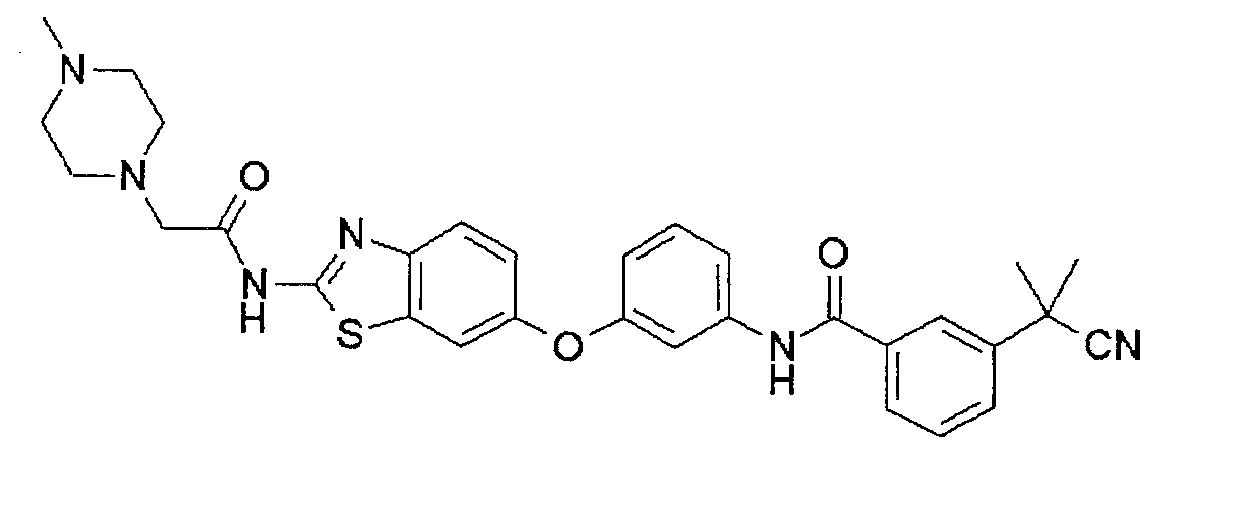
- To a solution of N-{3-[(2-amino-1,3-benzothiazol-6-yl)oxy]phenyl}-3-(1-cyano-1-methylethyl)benzamide (452 mg, 1.05 mmol) produced in Example A12(iv) in pyridine (10 mL) were added (4-methylpiperazin-1-yl)acetic acid dihydrochloride (273 mg, 1.18 mmol), N,N-dimethylpyridine-4-amine (89.1 mg, 729 µmol), triethylamine (10 mL) and 1-ethyl-3-(3-dimethylaminopropyl)carbodiimide hydrochloride (492 mg, 2.57 mmol) at room temperature, and the mixture was stirred for 14 hr. To the reaction mixture were added 1-ethyl-3-(3-dimethylaminopropyl)carbodiimide hydrochloride (483 mg, 2.52 mmol) and N,N-dimethylpyridine-4-amine (292 mg, 2.39 mmol) and the mixture was further stirred for 4 hr. To the reaction mixture was added methanol (10 mL), and the mixture was stirred at room temperature for 30 min, and concentrated under reduced pressure. The residue was diluted with ethyl acetate (100 mL), washed with saturated aqueous ammonium chloride solution (50 mL×2) and saturated aqueous sodium hydrogencarbonate solution (50 mL), successively, and dried over anhydrous magnesium sulfate. The insoluble material was filtered off, and the filtrate was concentrated under reduced pressure. The residue was purified by silica gel column chromatography (hexane/ethyl acetate=80/20→20/80) and triturated with ethyl acetate and diisopropyl ether to give the title compound (171 mg, 29%) as a colorless solid.
1H-NMR (DMSO-d6, 300 MHz) δ 1.73 (6H, s), 2.16 (3H, s), 2.35 (4H, br s), 2.54 (4H, br s), 3.33 (2H, s), 6.80 (1H, dd, J = 1.8, 8.1 Hz), 7.19 (1H, dd, J = 2.4, 8.7 Hz), 7.37 (1H, t, J = 8.1 Hz), 7.50-7.60 (3H, m), 7.73-7.82 (3H, m), 7.90 (1H, d, J = 7.8 Hz), 7.99 (1H, br s), 10.36 (1H, s), 12.04 (1H, br s). -

- To a solution of N-{3-[(2-amino-1,3-benzothiazol-6-yl)oxy]phenyl}-3-(1-cyano-1-methylethyl)benzamide (347 mg, 810 µmol) produced in Example A12(iv) in pyridine (10 mL) were added 2-chloro-2-oxoethyl acetate (254 mg, 1.86 mmol) and N,N-dimethylpyridine-4-amine (58 mg, 475 µmol), and the mixture was stirred at room temperature for 2 hr. To the reaction mixture was added methanol (10 mL) and the mixture was stirred for 30 min. 10% Aqueous ammonia (2 mL) was added, and the mixture was stirred at room temperature for 2 hr. The reaction mixture was concentrated under reduced pressure, and the residue was diluted with tetrahydrofuran (5 mL) and ethyl acetate (30 mL). The diluted solution was washed with water (50 mL), dilute hydrochloric acid (50 mL), saturated aqueous sodium hydrogencarbonate solution (50 mL) and saturated brine (50 mL), successively, and dried over anhydrous magnesium sulfate. The insoluble material was filtered off, and the filtrate was concentrated under reduced pressure. The residue was purified by basic silica gel column chromatography (ethyl acetate/methanol=100/0→80/20), and triturated with ethyl acetate and diisopropyl ether to give the title compound (264 mg, 67%) as a colorless solid.
1H-NMR (DMSO-d6, 300 MHz) δ 1.73 (6H, s), 4.19 (2H, d, J = 4.8 Hz), 5.55 (1H, br s), 6.79-6.82 (1H, m), 7.18 (1H, dd, J = 2.7, 8.7 Hz), 7.37 (1H, t, J = 8.1 Hz), 7.49 (1H, t, J = 2.1 Hz), 7.55-7.60 (2H, m), 7.73-7.79 (3H, m), 7.84-7.90 (1H, m), 7.98 (1H, t, J = 1.8 Hz), 10.36 (1H, br s), 12.04 (1H, br s). -

- Using 3-(4-nitrophenoxy)aniline (3.21 g, 13.9 mmol) produced in Example A12(i), 3-(1-cyanocyclopropyl)benzoic acid (2.70 g, 14.4 mmol) produced in Example A1(iii), pyridine (100 mL), 1-ethyl-3-(3-dimethylaminopropyl)carbodiimide hydrochloride (3.20 g, 16.7 mmol) and N,N-dimethylpyridine-4-amine (122 mg, 997 µmol) as starting materials, and in the same manner as in Example A12(ii), the title compound (5.1 g, 91%) was obtained as a yellow amorphous substance.
1H-NMR (DMSO-d6, 300 MHz) δ1.59-1.64 (2H, m), 1.80-1.84 (2H, m), 7.96 (1H, ddd, J = 0.9, 2.4, 8.1 Hz), 7.20 (2H, dt, J = 7.2, 3.3 Hz), 7.49 (1H, t, J = 8.4 Hz), 7.55-7.57 (2H, m), 7.66-7.71 (2H, m), 7.81-7.82 (1H, m), 7.85-7.89 (1H, m), 8.28 (2H, dt, J = 6.9, 3.6 Hz), 10.48 (1H, br s). - Using 3-(1-cyanocyclopropyl)-N-[3-(4-nitrophenoxy)phenyl]benzamide (5.1 g, 12.7 mmol), tetrahydrofuran (50 mL), methanol (50 mL) and 10% palladium-carbon (455.9 mg) as starting materials, and in the same manner as in Example A12(iii), the title compound (5.25 g) was obtained as a colorless amorphous substance. The obtained compound was used in the next reaction without a further purification.
1H-NMR (DMSO-d6, 300 MHz) δ 1.59-1.63 (2H, m), 1.79-1.83 (2H, m), 5.00 (2H, br s), 6.58-6.66 (3H, m), 6.76-6.80 (2H, m), 7.27 (1H, t, J = 8.1 Hz), 7.35 (1H, t, J = 2.1 Hz), 7.43-7.46 (1H, m), 7.53-7.56 (2H, m), 7.77 (1H, br s), 7.84 (1H, dt, J = 6.6, 2.1 Hz), 10.28 (1H, br s). - Using potassium thiocyanate (5.52 g, 56.8 mmol), acetic acid (380 mL), N-[3-(4-aminophenoxy)phenyl]-3-(1-cyanocyclopropyl)benzamide (5.25 g), and bromine (3.15 g, 19.7 mmol) as starting materials, and in the same manner as in Example A12(iv), the title compound (4.2 g, total of 2 steps 78%) was obtained as a yellow amorphous substance. The obtained compound was used in the next reaction without a further purification.
1H-NMR (DMSO-d6, 300 MHz) δ 1.60 (2H, dd, J = 5.1, 8.1 Hz), 1.80 (2H, dd, J = 5.1, 8.1 Hz), 6.74 (1H, ddd, J = 0.6, 2.4, 8.1 Hz), 6.95 (1H, dd, J = 2.4, 8.4 Hz), 7.30-7.36 (2H, m), 7.41-7.46 (4H, m), 7.51-7.57 (3H, m), 7.77 (1H, br s), 7.84 (1H, dt, J = 6.6, 2.1 Hz), 10.30 (1H, br s). - To a solution of N-{3-[(2-amino-1,3-benzothiazol-6-yl)oxylphenyl}-3-(1-cyanocyclopropyl)benzamide (330 mg, 774 µmol) in pyridine (10 mL) were added 1,3-oxazole-4-carboxylic acid (120 mg, 1.06 mmol), N,N-dimethylpyridine-4-amine (52.3 mg, 428 µmol) and 1-ethyl-3-(3-dimethylaminopropyl)carbodiimide hydrochloride (220 mg, 1.15 mmol), and the mixture was stirred at room temperature for 12 hr. To the reaction mixture were added 1,3-oxazole-4-carboxylic acid (126 mg, 1.11 mmol) and 1-ethyl-3-(3-dimethylaminopropyl)carbodiimide hydrochloride (652 mg,3.40 mmol) and the mixture was further stirred at room temperature for 16 hr. To the reaction mixture were added methanol (10 mL) and 2N aqueous sodium hydroxide solution (5 mL) and the mixture was stirred at the same temperature for 3 hr, and the solvent was evaporated under reduced pressure. The residue was diluted with ethyl acetate (50 mL), washed with water (50 mL), 0.1N hydrochloric acid (50 mL), and saturated aqueous sodium hydrogencarbonate solution (50 mL) and dried over anhydrous magnesium sulfate. The insoluble material was filtered off, and the filtrate was concentrated under reduced pressure. The residue was purified by reversed phase silica gel column chromatography (containing 0.1% trifluoroacetic acid, water/acetonitrile=95/5→5/95) and concentrated. The obtained trifluoroacetate was suspended in ethyl acetate (100 mL) and methanol (10 mL), and washed with saturated aqueous sodium hydrogencarbonate solution (50 mL) and saturated brine (50 mL), successively. The organic layer was dried over anhydrous magnesium sulfate, the insoluble material was filtered off and the filtrate was concentrated under reduced pressure. The residue was recrystallized from ethyl acetate and diisopropyl ether to give the title compound (156 mg, 34%) as colorless crystals.
1H-NMR (DMSO-d6, 300 MHz) δ 1.60 (2H, dd, J = 5.4, 8.4 Hz), 1.80 (2H, dd, J = 5.4, 8.4 Hz), 6.81 (1H, ddd, J = 0.9, 2.7, 8.1 Hz), 7.21 (1H, dd, J = 2.7, 8.7 Hz), 7.38 (1H, t, J = 8.1 Hz), 7.48-7.59 (4H, m), 7.74-7.86 (4H, m), 8.65 (1H, s), 9.03 (1H, s), 10.34 (1H, br s), 12.65 (1H, br s). -

- To a solution of N-{3-[(2-amino-1,3-benzothiazol-6-yl)oxy]phenyl}-3-(1-cyanocyclopropyl)benzamide (436 mg, 1.02 mmol) produced in Example A15(iii) in pyridine (10 mL) were added (4-methylpiperazin-1-yl)acetic acid dihydrochloride (278 mg, 1.20 mmol), N,N-dimethylpyridine-4-amine (79.3 mg, 649 µmol) and 1-ethyl-3-(3-dimethylaminopropyl)carbodiimide hydrochloride (470 mg, 2.45 mmol) at room temperature, and the mixture was stirred at room temperature for 14 hr. To the reaction mixture were added 1-ethyl-3-(3-dimethylaminopropyl)carbodiimide hydrochloride (454 mg, 2.37 mmol), (4-methylpiperazin-1-yl)acetic acid dihydrochloride (281 mg, 1.22 mmol), and triethylamine (10 mL) and the mixture was further stirred for 4 hr. To the reaction mixture was added methanol (10 mL) and the mixture was stirred at room temperature for 30 min and concentrated under reduced pressure. The residue was diluted with ethyl acetate (100 mL), washed with saturated aqueous ammonium chloride solution (80 mL×2) and saturated aqueous sodium hydrogencarbonate solution (50 mL), successively, and dried over anhydrous magnesium sulfate. The insoluble material was filtered off, and the filtrate was concentrated under reduced pressure. The residue was purified by silica gel column chromatography (ethyl acetate/methanol=100/0→90/10) and crystallized from ethyl acetate and hexane to give the title compound (136 mg, 24%) as colorless crystals.
1H-NMR (DMSO-d6, 300 MHz) 5 1.60 (2H, dd, J = 5.4, 8.4 Hz), 1.80 (2H, dd, J = 5.4, 8.4 Hz), 2.15 (3H, s), 2.35 (4H, br s), 2.54 (4H, br s), 3.33 (2H, s), 6.80 (1H, dd, J = 1.8, 11.1 Hz), 7.18 (1H, dd, J = 2.4, 8.7 Hz), 7.37 (1H, t, J = 8.1 Hz), 7.49-7.57 (4H, m), 7.74-7.78 (3H, m), 7.83-7.85 (1H, m), 10.34 (1H, s), 12.05 (1H, br s). -

- Using N-{3-[(2-amino-1,3-benzothiazol-6-yl)oxy]phenyl}-3-(1-cyanocyclopropyl)benzamide (310 mg, 726 µmol) produced in Example A15(iii), pyridine (10 mL), 2-chloro-2-oxoethyl acetate (269 mg, 1.97 mmol) and N,N-dimethylpyridine-4-amine (62.1 mg, 508 µmol) as starting materials, and in the same manner as in Example A14, the title compound (93 mg, 26%) was obtained as colorless crystals. In this Example, the purification operation was performed using silica gel column chromatography (hexane/ethyl acetate=5/95→20/80).
1H-NMR (DMSO-d6, 300 MHz) δ 1.60 (2H, dd, J = 5.4, 8.1 Hz), 1.80 (2H, dd, J = 5.4, 8.1 Hz), 4.20 (2H, s), 6.55 (1H, s), 6.80 (1H, dd, J = 1.8, 8.1 Hz), 7.18 (1H, dd, J = 2.4, 8.7 Hz), 7.37 (1H, t, J = 8.1 Hz), 7.48-7.57 (4H, m), 7.75-7.86 (4H, m), 10.35 (1H, br s), 12.05 (1H, br s). -

- To a suspension of 3-(1-cyanocyclopropyl)benzoic acid (9.40 g, 49.7 mmol) produced in Example A1(iii) in toluene (150 mL) was added thionyl chloride (48.9 g, 411 mmol), and the mixture was heated under reflux for 2 hr. The obtained solution was cooled to room temperature, sodium chloride (1.5 g, 26 mmol) was added and the mixture was further heated under reflux for 1.5 hr. The reaction mixture was cooled to room temperature, the insoluble material was removed and the solvent was evaporated under reduced pressure. The obtained brownish red solid was directly used in the next reaction as 3-(1-cyanocyclopropyl)benzoyl chloride.
To a solution of 5-amino-2-methoxyphenol (7.20 g, 51.7 mmol) in tetrahydrofuran (200 mL) was added water (250 mL) containing sodium hydrogencarbonate (5.00 g, 59.5 mmol) and the mixture was vigorously stirred at room temperature. While vigorously stirring the obtained reaction mixture separated in 2 layers, a solution of 3-(1-cyanocyclopropyl)benzoyl chloride synthesized above in tetrahydrofuran (150 mL) was added slowly at room temperature and the mixture was stirred for 1 hr. Sodium hydrogencarbonate was added to the reaction mixture until the development of carbon dioxide was ceased, and the reaction mixture was further stirred for 12 hr. The aqueous layer was separated, and extracted with ethyl acetate (150 mL×2). The collected organic layer was washed with saturated brine (100 mL), dried over anhydrous magnesium sulfate, and decolorized with activated carbon. The insoluble material was filtered off through a pad filled with two layers of silica gel and celite, and the filtrate was concentrated. The obtained brown solid was recrystallized from ethyl acetate, tetrahydrofuran and diisopropyl ether to give the title compound (14.2 g, 93%) as brownish red crystals.
1H-NMR (DMSO-d6, 300 MHz) δ 1.60-1.64 (2H, m), 1.80-1.84 (2H, m), 3.75 (3H, s), 6.89 (1H, d, J = 9.0 Hz), 7.11 (1H, dd, J = 2.4, 8.7 Hz), 7.30 (1H, d, J = 2.7 Hz), 7.53-7.55 (2H, m), 7.79-7.80 (1H, m), 7.84-7.87 (1H, m), 9.08 (1H, s), 10.06 (1H, br s). - To a suspension of 3-(1-cyanocyclopropyl)-N-(3-hydroxy-4-methoxyphenyl)-benzamide (1.54 mg, 5.00 mmol) and potassium carbonate (0.69 g, 5.00 mmol) in N,N-dimethylformamide (5 mL) was added 1-fluoro-4-nitrobenzene (0.78 g, 5.50 mmol), and the mixture was stirred at 60°C for 18 hr. The reaction mixture was poured into water and the mixture was extracted with ethyl acetate. The organic layer was dried over anhydrous magnesium sulfate, and the solvent was evaporated under reduced pressure. The residue was purified by silica gel column chromatography (eluent:hexane/ethyl acetate=1:1), and triturated with diethyl ether to give the title compound (1.90 g, 89%) as a white solid.
1H-NMR (CDCl3, 300 MHz) δ 1.45 - 1.52 (2H, m), 1.75 - 1.82 (2H, m), 3.82 (3H, s), 6.97 (2H, d, J = 3.6 Hz), 7.03 (1H, d, J = 3.6 Hz), 7.44 - 7.56 (4H, m), 7.72 - 7.76 (2H, m), 7.88 (1H, br s), 8.28 - 8.32 (2H, m). - A solution of 3-(1-cyanocyclopropyl)-N-[4-methoxy-3-(4-nitrophenoxy)phenyl]benzamide (2.10 g, 4.89 mmol), reduced iron (0.56 g, 10.0 mmol) and calcium chloride (1.11 g, 10.0 mmol) in ethanol (40 mL)/water (10 mL) was stirred at 80°C for 18 hr. The reaction mixture was poured into 0.5N aqueous sodium hydroxide solution (400 mL), ethyl acetate (300 mL) was added and the mixture was stirred. The insoluble material was filtered off through celite, and the organic layer was separated and dried over anhydrous magnesium sulfate, and the solvent was evaporated under reduced pressure. The residue was purified by silica gel column chromatography (eluent:hexane/ethyl acetate=1:1), and triturated with diethyl ether to give the title compound (1.74 g, 82%) as a pale-yellow solid.
1H-NMR (CDCl3, 300 MHz) δ 1.45 - 1.52 (2H, m), 1.75 - 1.80 (2H, m), 3.60 (2H, br s), 3.91 (3H, s), 6.67 (2H, d, J = 3.6 Hz), 6.88 (2H, d, J = 3.6 Hz), 6.97 (2H, d, J = 3.6 Hz), 7.48 - 7.80 (6H, m). - To a solution (10 mL) of N-[3-(4-aminophenoxy)-4-methoxyphenyl]-3-(1-cyanocyclopropyl)benzamide (1.74 g, 4.36 mmol) in acetic acid was added potassium thiocyanate (1.46 g, 15.0 mmol), and the mixture was stirred at room temperature for 30 min. To the obtained transparent solution was added dropwise bromine (1.20 g, 7.50 mmol) under ice-cooling, and the reaction mixture was stirred at room temperature for 18 hr. The precipitated yellow powder was filtered off through celite, and the filtrate was concentrated under reduced pressure. To the residue was added 0.1N aqueous sodium hydroxide solution, and the mixture was extracted with ethyl acetate. The organic layer was dried over anhydrous magnesium sulfate, and the solvent was evaporated under reduced pressure. The residue was purified by silica gel column chromatography
(eluent:hexane/ethyl acetate=1:1), and triturated with diethyl ether to give the title compound (1.08 g, 54%) as a yellow solid.
1H-NMR (CDCl3, 300 MHz) δ 1.40°C - 1.55 (2H, m), 1.70 - 1.85 (2H, m), 3.95 (3H, s), 5.25 (2H, br s), 6.99 (2H, d, J = 3.6 Hz), 7.10 - 7.30 (2H, m), 7.36 - 7.52 (4H, m), 7.66 - 7.78 (2H, m), 7.96 (1H, br s). - A solution of N-{3-[(2-amino-1,3-benzothiazol-6-yl)oxy]-4-methoxyphenyl}-3-(1-cyanocyclopropyl)benzamide (91 mg, 0.20 mmol), cyclopropanecarbonyl chloride (105 mg, 1.00 mmol) and N,N-dimethylpyridine-4-amine (122 mg, 1.00 mmol) in pyridine (2 mL) was stirred at room temperature for 18 hr. The reaction mixture was poured into water and the mixture was extracted with ethyl acetate. The organic layer was dried over anhydrous magnesium sulfate, and the solvent was evaporated under reduced pressure. The residue was purified by silica gel chromatography (eluent:hexane/ethyl acetate=1:1), and triturated with diethyl ether to give the title compound (58 mg, 55%) as a pale-yellow solid.
1H-NMR (CDCl3, 300 MHz) δ 0.90 - 1.02 (2H, m), 1.08 - 1.18 (2H, m), 1.48 - 1.58 (2H, m), 1.70 - 1.82 (2H, m), 1.90 - 2.00 (1H, m), 3.87 (3H, s), 7.02 (1H, d, J = 8.7 Hz), 7.12 (1H, dd, J = 2.4, 8.7 Hz), 7.33 - 7.46 (3H, m), 7.57 (1H, d, J = 6.6 Hz), 7.65 (2H, dd, J = 6.0, 8.7 Hz), 7.73 (1H, d, J = 1.5 Hz), 7.85 (1H, d, J = 7.2 Hz), 9.58 (1H, br s), 11.94 (1H, br s). -
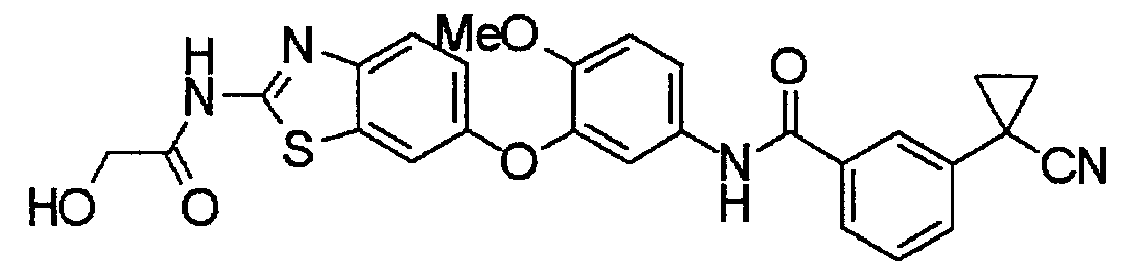
- A solution of N-{3-[(2-amino-1,3-benzothiazol-6-yl)oxyl-4-methoxyphenyl}-3-(1-cyanocyclopropyl)benzamide (91 mg, 0.20 mmol) produced in Example A18(iv) and 2-chloro-2-oxoethyl acetate (137 mg, 1.00 mmol) in N,N-dimethylformamide (2 mL) was stirred at room temperature for 18 hr. The reaction mixture was poured into water and the mixture was extracted with ethyl acetate. The organic layer was dried over anhydrous magnesium sulfate, and the solvent was evaporated under reduced pressure. The residue was dissolved in methanol (5 mL)/tetrahydrofuran (5 mL), 8N aqueous sodium hydroxide solution (1 mL) was added under ice-cooling, and the mixture was stirred at room temperature for 30 min. The reaction mixture was poured into water and the mixture was extracted with ethyl acetate. The organic layer was dried over anhydrous magnesium sulfate, and the solvent was evaporated under reduced pressure. The residue was purified by silica gel chromatography (eluent:hexane/ethyl acetate=1:1), and triturated with acetone to give the title compound (22 mg, 21%) as a pale-yellow solid.
1H-NMR (CDCl3, 300 MHz) δ 1.48 - 1.55 (2H, m), 1.72 - 1.80 (2H, m), 3.87 (3H, s), 4.28 (2H, d, 5.7 Hz), 5.52 (1H, t, J = 5.7 Hz), 7.02 (1H, d, J = 9.0 Hz), 7.15 (1H, dd, J = 2.1, 5.7 Hz), 7.35 - 7.50 (2H, m), 7.55 - 7.80 (4H, m), 7.88 (1H, br s), 7.85 (1H, d, J = 7.8 Hz), 9.57 (1H, br s), 10.54 (1H, br s). -

- A solution of N-{3-[(2-amino-1,3-benzothiazol-6-yl)oxyl-4-methoxyphenyl}-3-(1-cyanocyclopropyl)benzamide (91 mg, 0.20 mmol)) produced in Example A18(iv) and chloroacetyl chloride (113 mg, 1.00 mmol) in N,N-dimethylformamide (5 mL) was stirred at room temperature for 18 hr. The reaction mixture was poured into water and the mixture was extracted with ethyl acetate. The organic layer was dried over anhydrous magnesium sulfate, the solvent was evaporated under reduced pressure, and the residue was purified by silica gel chromatography (eluent:hexane/ethyl acetate=1:1) to give a colorless oil. This was dissolved in N,N-dimethylformamide (2 mL), 1-methylpiperazine (100 mg, 1.00 mmol) was added, and the mixture was stirred at room temperature for 2 hr. The reaction mixture was poured into water and the mixture was extracted with ethyl acetate. The organic layer was dried over anhydrous magnesium sulfate, and the solvent was evaporated under reduced pressure. The residue was purified by basic silica gel chromatography (eluent:ethyl acetate/methanol=10:1), and triturated with diethyl ether to give the title compound (47 mg, 39%) as a white solid.
1H-NMR (CDCl3, 300 MHz) δ 1.45 - 1.50 (2H, m), 1.75 - 1.80 (2H, m), 2.33 (3H, s), 2.40°C - 2.60 (4H, m), 2.60 - 2.80 (4H, m), 3.27 (2H, s), 3.88 (3H, s), 7.03 (1H, d, 8.7 Hz), 7.16 (1H, dd, J = 2.4, 6.0 Hz), 7.35 - 7.57 (5H, m), 7.65 - 7.78 (4H, m), 10.36 (1H, br s). -

- To a solution (20 mL) of 3-(1-cyano-1-methylethyl)benzoic acid (4.92 g, 26.0 mmol) in oxalyl chloride was added N,N-dimethylformamide (0.1 mL), and the mixture was stirred at room temperature for 30 min. Excess reagents were evaporated under reduced pressure, and the obtained residue was dissolved in tetrahydrofuran (20 mL), and 5-amino-2-methoxyphenol (4.17 g, 30.0 mmol) and N-ethyl-N-isopropylpropane-2-amine (6.46 g, 50.0 mmol) were successively added dropwise under ice-cooling. The reaction mixture was stirred at room temperature for 18 hr, poured into water and the mixture was extracted with ethyl acetate. The organic layer was dried over anhydrous magnesium sulfate, and the solvent was evaporated under reduced pressure. The residue was dissolved in methanol (5 mL)/tetrahydrofuran (5 mL), 8N aqueous sodium hydroxide solution (1 mL) was added under ice-cooling, and the mixture was stirred at room temperature for 18 hr. The reaction mixture was poured into water and the mixture was extracted with ethyl acetate. The organic layer was dried over anhydrous magnesium sulfate, and the solvent was evaporated under reduced pressure. The residue was purified by silica gel chromatography (eluent:hexane/ethyl acetate=5:1), and triturated with diethyl ether to give the title compound (4.70 g, 58%) as a pale-yellow solid.
1H-NMR (CDCl3, 300 MHz) δ 1.77 (6H, s), 3.90 (3H, s), 5.71 (1H, s), 6.85 (1H, d, J = 8.7 Hz), 7.15 - 7.22 (2H, m), 7.52 (1H, t, J = 3.6 Hz), 7.68 - 7.78 (3H, m), 7.96 (1H, br s). - Using 3-(1-cyano-1-methylethyl)-N-(3-hydroxy-4-methoxyphenyl)benzamide (1.55 mg, 5.00 mmol), 1-fluoro-4-nitrobenzene (0.78 g, 5.50 mmol) and potassium carbonate (0.69 g, 5.00 mmol), and in the same manner as in Example A18(ii), the title compound (1.80 g, 83%) was obtained as a white powder.
1H-NMR (CDCl3, 300 MHz) δ 1.78 (6H, s), 3.81 (3H, s), 7.00 (2H, d, J = 9.3 Hz), 7.06 (1H, d, J = 8.7 Hz), 7.44 - 7.56 (3H, m), 7.65 - 7.80 (3H, m), 7.96 (1H, d, J = 1.8 Hz), 8.20 (2H, d, J = 9.3 Hz). - To a solution of 3-(1-cyano-1-methylethyl)-N-[4-methoxy-3-(4-nitrophenoxy)phenyl]benzamide (1.80 g, 4.17 mmol) in methanol (5 mL)/tetrahydrofuran (5 mL) was added 10%-palladium carbon (1 g), and the mixture was vigorously stirred under a hydrogen atmosphere at room temperature for 18 hr. The catalyst was filtered off through celite, and the filtrate was concentrated under reduced pressure to give the title compound (1.10 g, 66%) as a colorless amorphous substance.
1H-NMR (CDCl3, 300 MHz) δ 1.75 (6H, s), 3.57 (2H, br s), 3.91 (3H, s), 6.66 (2H, d, J = 8.7 Hz), 6.88 (2H, d, J = 8.7 Hz), 6.97 (2H, d, J = 8.7 Hz), 7.39 (1H, dd, J = 2.4, 8.7 Hz), 7.48 (1H, t, J = 7.8 Hz), 7.60 - 7.75 (3H, m), 7.91 (1H, br s). - Using N-[3-(4-aminophenoxy)-4-methoxyphenyl]-3-(1-cyano-1-methylethyl)benzamide (1.10 g, 2.74 mmol), potassium thiocyanate (0.97 g, 10.0 mmol) and bromine (0.60 g, 3.75 mmol), and in the same manner as in Example A18(iv), the title compound (1.00 g, 80%) was obtained as a yellow powder.
1H-NMR (CDCl3, 300 MHz) δ 1.74 (6H, s), 3.88 (3H, s), 5.16 (2H, br s), 6.98 - 7.03 (2H, m), 7.07 (1H, br s), 7.21 (1H, d, J = 3.6 Hz), 7.43 - 7.49 (3H, m), 7.64 - 7.72 (2H, m), 7.84 (1H, br s), 7.91 (1H, br s). - Using N-{3-[(2-amino-1,3-benzothiazol-6-yl)oxy]-4-methoxyphenyl}-3-(1-cyano-1-methylethyl)benzamide (115 mg, 0.25 mmol), cyclopropanecarbonyl chloride (105 mg, 1.00 mmol), N,N-dimethylpyridine-4-amine (122 mg, 1.00 mmol) and pyridine (2 mL), and in the same manner as in Example A18(v), the title compound (59 mg, 45%) was obtained as a pale-yellow powder.
1H-NMR (CDCl3, 300 MHz) δ 0.95 (2H, m), 1.14 (2H, m), 1.93 (1H, m), 1.67 (6H, s), 3.87 (3H, s), 7.02 (1H, d, J = 9.0 Hz), 7.13 (1H, dd, J = 2.4, 9.0 Hz), 7.35 (2H, m), 7.47 (1H, t, J = 7.8 Hz), 7.62 - 7.68 (3H, m), 7.87 (1H, d, J = 7.8 Hz), 8.00 (1H, s), 9.43 (1H, br s), 11.84 (1H, br s). -
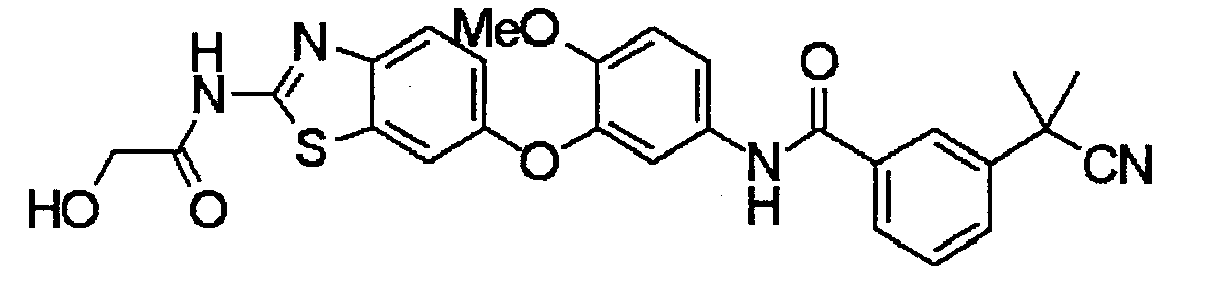
- Using N-{3-[(2-amino-1,3-benzothiazol-6-yl)oxy]-4-methoxyphenyl}-3-(1-cyano-1-methylethyl)benzamide (230 mg, 0.50 mmol) produced in Example A21(iv), 2-chloro-2-oxoethyl acetate (273 mg, 2.00 mmol) and N,N-dimethylformamide (5 mL), and in the same manner as in Example A19, the title compound (126 mg, 49%) was obtained as a pale-yellow powder.
1H-NMR (CDCl3, 300 MHz) δ 1.75 (6H, s), 3.24 (1H, br s), 3.88 (3H, s), 4.41 (2H, s), 7.03 (1H, d, J = 8.7 Hz), 7.16 (1H, dd, J = 2.4, 8.7 Hz), 7.38 (1H, d, J = 2.4 Hz), 7.44 - 7.51 (2H, m), 7.64 - 7.75 (5H, m), 7.92 (1H, br s), 9.88 (1H, br s). -

- Using N-{3-[(2-amino-1,3-benzothiazol-6-yl)oxy]-4-methoxyphenyl}-3-(1-cyano-1-methylethyl)benzamide (230 mg, 0.50 mmol) produced in Example A21(iv), chloroacetyl chloride (225 mg, 2.00 mmol), 1-methylpiperazine (200 mg, 2.00 mmol) and N,N-dimethylformamide, and in the same manner as in Example A20, the title compound (120 mg, 40%) was obtained as a pale-yellow powder.
1H-NMR (CDCl3, 300 MHz) 5 1.75 (6H, s), 2.33 (3H, s), 2.45 - 2.60 (4H, m), 2.60-2.75 (4H, m), 3.28 (2H, s), 3.88 (3H, s), 7.04 (1H, d, J = 9.0 Hz), 7.17 (1H, dd, J = 2.4, 8.7 Hz), 7.27 (1H, s), 7.39 (1H, d, J = 2.4 Hz), 7.43 - 7.52 (2H, m), 7.67 - 7.75 (4H, m), 7.92 (1H, br s), 10.36 (1H, br s). -

- A solution of N-{3-[(2-amino-1,3-benzothiazol-6-yl)oxy]-4-methoxyphenyl}-3-(1-cyano-1-methylethyl)benzamide (230 mg, 0.50 mmol) produced in Example A21(iv), 1,3-oxazole-4-carboxylic acid (113 mg, 1.00 mmol), 1-ethyl-3-(3-dimethylaminopropyl)carbodiimide hydrochloride (192 mg, 1.00 mmol), 1-hydroxybenzotriazole (135 mg, 1.0 mmol) and N-ethyl-N-isopropylpropane-2-amine (260 mg, 2.00 mmol) in N,N-dimethylformamide (5 mL) was stirred at room temperature for 18 hr. The reaction mixture was poured into water and the mixture was extracted with ethyl acetate. The organic layer was dried over anhydrous magnesium sulfate, and the solvent was evaporated under reduced pressure. The residue was purified by silica gel chromatography (eluent:hexane/ethyl acetate=1:1), and triturated with diethyl ether to give the title compound (183 mg, 66%) as a white solid.
1H-NMR (CDCl3, 300 MHz) δ 1.75 (6H, s), 3.88 (3H, s), 7.05 (1H, d, J = 9.0 Hz), 7.19 (1H, dd, J = 2.4, 8.7 Hz), 7.27 (1H, s), 7.41 (1H, d, J = 2.4 Hz), 7.45 - 7.52 (2H, m), 7.66 - 7.78 (4H, m), 7.93 (1H, br s), 7.95 (1H, s), 8.42 (1H, s), 10.07 (1H, br s). -

- To a solution (20 mL) of 3-(acetyloxy)benzoic acid (18.0 g, 100 mmol) in thionyl chloride was added N,N-dimethylformamide (0.1 mL), and the mixture was stirred at room temperature for 1 hr. Excess reagents were evaporated under reduced pressure, and the obtained residue was dissolved in tetrahydrofuran (50 mL), and 4-(trifluoromethyl)aniline (24.2 g, 150 mmol) and N-ethyl-N-isopropylpropane-2-amine (19.4 g, 150 mmol) were successively added dropwise under ice-cooling. The reaction mixture was stirred at room temperature for 1 hr, poured into water and the mixture was extracted with ethyl acetate. The organic layer was dried over anhydrous magnesium sulfate, and the solvent was evaporated under reduced pressure. The residue was purified by silica gel chromatography (eluent:hexane/ethyl acetate=5:1), and triturated with diethyl ether to give the title compound (27.7 g, 86%) as a pale-yellow solid.
1H-NMR (CDCl3, 300 MHz) δ 2.34 (3H, s), 7.30 (1H, dd, J = 2.4, 8.1 Hz), 7.51 (1H, t, J = 8.1 Hz), 7.59 -7.64 (3H, m), 7.70 - 7.78 (3H, m), 7.98 (1H, br s). - To a solution of 3-({[4-(trifluoromethyl)phenyl]amino}carbonyl)phenyl acetate (27.7 g, 85.5 mmol) in methanol (100 mL)/tetrahydrofuran (100 mL) was added 8N aqueous sodium hydroxide solution (20 mL) under ice-cooling, and the mixture was stirred at room temperature for 3 hr and dried under reduced pressure to solidness. The residue was poured into dilute hydrochloric acid (pH=2) and the mixture was extracted with ethyl acetate. The organic layer was dried over anhydrous magnesium sulfate, and the solvent was evaporated under reduced pressure. The residue was triturated with diethyl ether to give the title compound (21.7 g, 90%) as a white solid.
1H-NMR (CDCl3, 300 MHz) δ 7.02 -7.06 (1H, m), 7.25 - 7.44 (3H, m), 7.57 (2H, d, J = 7.8 Hz), 7.92 (2H, d, J = 8.7 Hz), 9.08 (1H, br s) 9.45 (1H, br s). - To a suspension of 3-hydroxy-N-[4-(trifluoromethyl)phenyl]benzamide (5.62 g, 20.0 mmol) and potassium carbonate (2.76 g, 20.0 mmol) in N,N-dimethylformamide (20 mL) was added 1-fluoro-4-nitrobenzene (3.10 g, 22.0 mmol), and the mixture was stirred at 60°C for 18 hr. The reaction mixture was poured into water and the mixture was extracted with ethyl acetate. The organic layer was dried over anhydrous magnesium sulfate, and the solvent was evaporated under reduced pressure. The residue was purified by silica gel column chromatography (eluent:hexane/ethyl acetate=1:1), and triturated with diethyl ether to give the title compound (6.75 g, 84%) as a white solid.
1H-NMR (CDCl3, 300 MHz) δ7.08 (2H, d, J = 7.2 Hz), 7.92 (1H, dd, J = 2.4, 8.7 Hz), 7.58 -7.65 (4H, m), 7.71 - 7.79 (3H, m), 7.95 (1H, br s), 8.23 (2H, d, J = 8.7 Hz). - To a solution of 3-(4-nitrophenoxy)-N-[4-(trifluoromethyl)phenyl]benzamide (6.75 g, 16.8 mmol) in methanol (20 mL)/tetrahydrofuran (10 mL) were added 10%-palladium carbon (2 g) and concentrated hydrochloric acid (1 mL), and the mixture was vigorously stirred under a hydrogen atmosphere at room temperature for 3 hr. The catalyst was filtered off through celite, the filtrate was concentrated under reduced pressure, and the obtained residue was triturated with diethyl ether to give the title compound (5.37 g, 86%) as a white solid.
1H-NMR (CDCl3, 300 MHz) δ3.66 (2H, br s), 6.73 (2H, d, J = 5.7 Hz), 6.91 (2H, d, J = 6.6 Hz), 7.12 - 7.17 (1H, m), 7.39 - 7.52 (3H, m), 7.64 (2H, d, J = 8.7 Hz), 7.77 (2H, d, J = 8.4 Hz), 7.89 (1H, br s). - To a solution (50 mL) of 3-(4-aminophenoxy)-N-[4-(trifluoromethyl)phenyl]benzamide (3.72 g, 10.0 mmol) in acetic acid was added potassium thiocyanate (3.89 g, 40.0 mmol), and the mixture was stirred at room temperature for 30 min. To the obtained transparent solution was added dropwise bromine (2.40 g, 15.0 mmol) under ice-cooling, and the reaction mixture was stirred at room temperature for 18 hr. The precipitated yellow powder was filtered off through celite, and the filtrate was concentrated under reduced pressure. To the residue was added 0.1N aqueous sodium hydroxide solution and the mixture was extracted with ethyl acetate. The organic layer was dried over anhydrous magnesium sulfate, and the solvent was evaporated under reduced pressure. The residue was purified by silica gel column chromatography
(eluent:hexane/ethyl acetate=1:1), and triturated with diethyl ether to give the title compound (2.93 g, 68%) as a yellow solid.
1H-NMR (CDCl3, 300 MHz) δ 5.68 (2H, br s), 6.99 (1H, dd, J = 2.4, 8.7 Hz), 7.12 (1H, dd, J = 0.9, 2.4 Hz), 7.25 (1H, s), 7.41 (1H, t, J = 8.1 Hz), 7.46 (1H, d, J = 4.2 Hz), 7.51 - 7.65 (4H, m), 7.85 (2H, d, J = 8.4 Hz), 9.22 (1H, br s). - A solution of 3-[(2-amino-1,3-benzothiazol-6-yl)oxy]-N-[4-(trifluoromethyl)phenyl]benzamide (215 mg, 0.50 mmol) produced in Example A25(v), cyclopropanecarbonyl chloride (210 mg, 2.00 mmol) and N-ethyl-N-isopropylpropane-2-amine (518 mg, 4.00 mmol) in tetrahydrofuran (10 mL) was stirred at room temperature for 18 hr. The reaction mixture was poured into water and the mixture was extracted with ethyl acetate. The organic layer was dried over anhydrous magnesium sulfate, and the solvent was evaporated under reduced pressure. The residue was purified by silica gel chromatography (eluent:hexane/ethyl acetate=1:1), and triturated with diethyl ether to give the title compound (220 mg, 88%) as a white solid.
1H-NMR (CDCl3, 300 MHz) δ 0.98 (2H, m), 1.18 (2H, m), 1.49 (1H, m), 7.12 (1H, dd, J = 2.4, 8.7 Hz), 7.18 (1H, dd, J = 2.7, 8.4 Hz), 7.42 - 7.48 (2H, m), 7.57 - 7.73 (5H, m), 7.88 (2H, d, J = 8.4 Hz), 9.28 (1H, br s), 11.53 (1H, br s). -

- A solution of 3-[(2-amino-1,3-benzothiazol-6-yl)oxy]-N-[4-(trifluoromethyl)phenyl]benzamide (215 mg, 0.50 mmol) produced in Example A25(v), 2-chloro-2-oxoethyl acetate (273 mg, 2.00 mmol) and N-ethyl-N-isopropylpropane-2-amine (518 mg, 4.00 mmol) in tetrahydrofuran (10 mL) was stirred at room temperature for 18 hr. The reaction mixture was poured into water and the mixture was extracted with ethyl acetate. The organic layer was dried over anhydrous magnesium sulfate, and the solvent was evaporated under reduced pressure. The residue was dissolved in methanol (5 mL)/tetrahydrofuran (5 mL), 8N aqueous sodium hydroxide solution (1 mL) was added under ice-cooling, and the mixture was stirred at room temperature for 30 min. The reaction mixture was poured into water and the mixture was extracted with ethyl acetate. The organic layer was dried over anhydrous magnesium sulfate, and the solvent was evaporated under reduced pressure. The residue was purified by silica gel chromatography (eluent:hexane/ethyl acetate=1:1), and triturated with diethyl ether to give the title compound (140 mg, 57%) as a pale-yellow solid.
1H-NMR (CDCl3, 300 MHz) 5 4.31 (2H, d, J = 5.7 Hz), 5.32 (1H, t, J = 5.7 Hz), 7.14 - 7.24 (2H, m), 7.43 - 7.49 (2H, m), 7.59 (2H, d, J = 8.4 Hz), 7.64 - 7.71 (2H, m), 7.77 (1H, d, J = 9.0 Hz), 7.89 (2H, d, J = 8.4 Hz), 9.30 (1H, br s), 10.41 (1H, br s). -

- A solution of 3-[(2-amino-1,3-benzothiazol-6-yl)oxy]-N-[4-(trifluoromethyl)phenyl]benzamide (215 mg, 0.50 mmol) produced in Example A25(v), chloroacetyl chloride (225 mg, 2.00 mmol) and N-ethyl-N-isopropylpropane-2-amine (518 mg, 4.00 mmol) in N,N-dimethylformamide (10 mL) was stirred at room temperature for 18 hr. The reaction mixture was poured into water and the mixture was extracted with ethyl acetate. The organic layer was dried over anhydrous magnesium sulfate, the solvent was evaporated under reduced pressure, and the residue was purified by silica gel chromatography (eluent:hexane/ethyl acetate=1:1) to give a colorless oil. This was dissolved in N,N-dimethylformamide (5 mL), 1-methylpiperazine (400 mg, 4.00 mmol) was added, and the mixture was stirred at room temperature for 1 hr. The reaction mixture was poured into water and the mixture was extracted with ethyl acetate. The organic layer was dried over anhydrous magnesium sulfate, and the solvent was evaporated under reduced pressure. The residue was purified by basic silica gel chromatography (eluent:ethyl acetate/methanol=10:1), and triturated with diethyl ether to give the title compound (180 mg, 63%) as a white solid.
1H-NMR (CDCl3, 300 MHz) δ 2.34 (3H, s), 2.40-2.60 (4H, m), 2.60-2.75 (4H, m), 3.30 (2H, s), 7.15 - 7.25 (2H, m), 7.46 - 7.52 (3H, m), 7.52 - 7.64 (3H, m), 7.74 - 7.81 (3H, m), 7.87 (1H, br s), 10.41 (1H, br s). -

- A solution of 3-[(2-amino-1,3-benzothiazol-6-yl)oxy]-N-[4-(trifluoromethyl)phenyl]benzamide (215 mg, 0.50 mmol) produced in Example A25(v), 1,3-oxazole-4-carboxylic acid (113 mg, 1.00 mmol), 1-ethyl-3-(3-dimethylaminopropyl)carbodiimide hydrochloride (192 mg, 1.00 mmol), 1-hydroxybenzotriazole (135 mg, 1.00 mmol) and N-ethyl-N-isopropylpropane-2-amine (260 mg, 2.0 mmol) in N,N-dimethylformamide (5 mL) was stirred at room temperature for 18 hr. The reaction mixture was poured into water and the mixture was extracted with ethyl acetate. The organic layer was dried over anhydrous magnesium sulfate, and the solvent was evaporated under reduced pressure. The residue was purified by silica gel chromatography (eluent:hexane/ethyl acetate=1:1), and triturated with diethyl ether to give the title compound (90 mg, 34%) as a white solid.
1H-NMR (CDCl3, 300 MHz) δ 7.16 - 7.22 (2H, m), 7.41 - 7.50 (2H, m), 7.58 (2H, d, J = 8.7 Hz), 7. 69 - 7.76 (2H, m), 7.80 (1H, d, J = 8.7 Hz), 7.93 (2H, d, J = 8.7 Hz), 8.05 (1H, d, J = 0.9 Hz), 8.52 (1H, d, J = 0.9 Hz), 9.74 (1H, br s), 10.61 (1H, br s). -
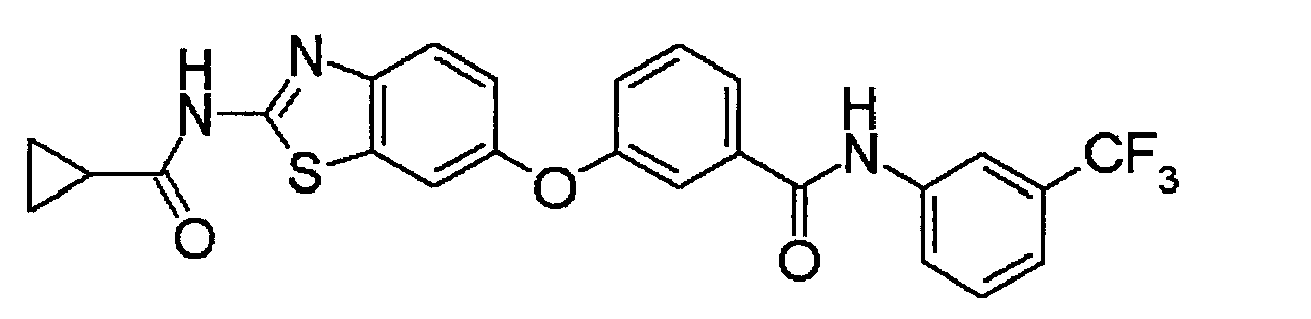
- Using 3-(acetyloxy)benzoic acid (9.01 g, 50.0 mmol), thionyl chloride (10 mL), 3-(trifluoromethyl)aniline (12.1 g, 75.0 mmol) and N-ethyl-N-isopropylpropane-2-amine (12.9 g, 100 mmol), and in the same manner as in Example A25(i), the title compound (16.2 g, quantitatively) was obtained as a colorless oil.
1H-NMR (CDCl3, 300 MHz) δ 2.33 (3H, s), 7.26 -7.31 (2H, m), 7.41 (1H, d, J = 7.8 Hz), 7.45 -7.52 (2H, m), 7.69 - 7.73 (1H, m), 7.85 (1H, d, J = 7.8 Hz), 7.91 (1H, s), 8.03 (1H, br s). - Using 3-({[3-(trifluoromethyl)phenyl]amino}carbonyl)phenyl acetate (16.2 g, 50 mmol) and 8N aqueous sodium hydroxide solution (10 mL), and in the same manner as in Example A25(ii), the title compound (13.9 g, 99%) was obtained as a white powder.
1H-NMR (CDCl3, 300 MHz) δ 7.00 -7.05 (1H, m), 7.25 -7.47 (5H, m), 7.99 (1H, d, J = 8.4 Hz), 8.14 (1H, s), 9.10 (1H, br s), 9.62 (1H, br s). - Using 3-hydroxy-N-[3-(trifluoromethyl)phenyl]benzamide (2.81 g, 10.0 mmol), 1-fluoro-4-nitrobenzene (1.55 g, 11.0 mmol) and potassium carbonate (1.38 g, 10.0 mmol), and in the same manner as in Example A25(iii), the title compound (3.85 g, 96%) was obtained as a pale-yellow oil.
1H-NMR (CDCl3, 300 MHz) 57.03 -7.08 (2H, m), 7.28 -7.32 (1H, m), 7.42 (1H, d, J = 7.8 Hz), 7.50 (1H, t, J = 7.8 Hz), 7.57 (1H, t, J = 7.8 Hz), 7.63 (1H, s), 7.71 - 7.75 (1H, m), 7.85 (1H, d, J = 8.1 Hz), 7.92 (1H, s), 8.01 (1H, br s), 8.19 - 8.25 (2H, m). - Using 3-(4-nitrophenoxy)-N-[3-(trifluoromethyl)phenyl]benzamide (2.81 g, 10.0 mmol) and 10%-palladium carbon (1 g), and in the same manner as in Example A25(iv), the title compound (2.45 g, 69%) was obtained as a brown oil.
1H-NMR (CDCl3, 300 MHz) δ 3.63 (2H, br s), 6.66 -6.72 (2H, m), 6.87 -6.91 (2H, m), 7.10 -7.16 (1H, m), 7.36 - 7.50 (5H, m), 7.82 (1H, d, J = 8.1 Hz), 7.88-8.00 (2H, m). - Using 3-(4-aminophenoxy)-N-[3-(trifluoromethyl)phenyl]benzamide (2.45 g, 6.58 mmol), potassium thiocyanate (1.94 g, 20.0 mmol) and bromine (1.20 g, 7.50 mmol), and in the same manner as in Example A25(v), the title compound (2.24 g, 79%) was obtained as a pale-yellow powder.
1H-NMR (CDCl3, 300 MHz) δ5.15 (2H, br s), 7.05 (1H, dd, J = 2.4, 8.7 Hz), 7.16 -7.21 (1H, m), 7.30 (1H, d, J = 2.4 Hz), 7.39 - 7.57 (6H, m), 7.83 (1H, d, J = 8.1 Hz), 7.88 (1H, br s), 7.92 (1H, br s). - A solution of 3-[(2-amino-1,3-benzothiazol-6-yl)oxy]-N-[3-(trifluoromethyl)phenyl]benzamide (429 mg, 1.00 mmol), cyclopropanecarbonyl chloride (525 mg, 5.0 mmol) and N,N-dimethylpyridine-4-amine (610 mg, 5.00 mmol) in pyridine (5 mL) was stirred at room temperature for 2 hr. The reaction mixture was poured into water and the mixture was extracted with ethyl acetate. The organic layer was dried over anhydrous magnesium sulfate, and the solvent was evaporated under reduced pressure. The residue was purified by silica gel chromatography (eluent:hexane/ethyl acetate=1:1), and triturated with diethyl ether to give the title compound (340 mg, 68%) as a white solid.
1H-NMR (CDCl3, 300 MHz) δ 0.94 (2H, m), 1.15 (2H, m), 1.95 (1H, m), 7.10 -7.20 (2H, m), 7.33 (1H, m), 7.43 - 7.47 (3H, m), 7.69 - 7.76 (3H, m), 8.03 (1H, d, J = 8.1 Hz), 8.12 (1H, s), 9.82 (1H, br s), 11.94 (1H, br s). -

- A solution of 3-[(2-amino-1,3-benzothiazol-6-yl)oxy]-N-[3-(trifluoromethyl)phenyl]benzamide (429 mg, 1.0 mmol) produced in Example A29(v) and 2-chloro-2-oxoethyl acetate (546 mg, 4.0 mmol) in N,N-dimethylformamide (5 mL) was stirred at room temperature for 6 hr. The reaction mixture was poured into water and the mixture was extracted with ethyl acetate. The organic layer was dried over anhydrous magnesium sulfate, and the solvent was evaporated under reduced pressure. The residue was dissolved in methanol (5 mL)/tetrahydrofuran (5 mL), 8N aqueous sodium hydroxide solution (1 mL) was added under ice-cooling, and the mixture was stirred at room temperature for 30 min. The reaction mixture was poured into water and the mixture was extracted with ethyl acetate. The organic layer was dried over anhydrous magnesium sulfate, and the solvent was evaporated under reduced pressure. The residue was purified by silica gel chromatography (eluent:hexane/ethyl acetate=1:1), and triturated with diethyl ether to give the title compound (300 mg, 62%) as a pale-yellow solid.
1H-NMR (CDCl3, 300 MHz) δ 4.31 (2H, d, J = 5.7 Hz), 5.34 (1H, t, J = 5.7 Hz), 7.14 -7.21 (2H, m), 7.36 (1H, d, J = 7.8 Hz), 7.43 -7.49 (3H, m), 7.65 - 7.78 (3H, m), 8.01 (1H, d, J = 8.4 Hz), 8.06 (1H, s), 9.39 (1H, br s), 10.43 (1H, br s). -

- A solution of 3-[(2-amino-1,3-benzothiazol-6-yl)oxy]-N-[3-(trifluoromethyl)phenyl]benzamide (429 mg, 1.0 mmol) produced in Example A29(v) and chloroacetyl chloride (225 mg, 2.0 mmol) in N,N-dimethylformamide (10 mL) was stirred at room temperature for 6 hr. The reaction mixture was poured into water and the mixture was extracted with ethyl acetate. The organic layer was dried over anhydrous magnesium sulfate, the solvent was evaporated under reduced pressure, and the residue was purified by silica gel chromatography (eluent:hexane/ethyl acetate=1:1) to give a colorless oil. This was dissolved in N,N-dimethylformamide (5 mL), 1-methylpiperazine (400 mg, 4.0 mmol) was added, and the mixture was stirred at room temperature for 1 hr. The reaction mixture was poured into water and the mixture was extracted with ethyl acetate. The organic layer was dried over anhydrous magnesium sulfate, and the solvent was evaporated under reduced pressure. The residue was purified by basic silica gel chromatography (eluent:ethyl acetate/methanol=10:1), and triturated with diethyl ether to give the title compound (340 mg, 60%) as a white solid.
1H-NMR (CDCl3, 300 MHz) δ 2.34 (3H, s), 2.42-2.62 (4H, m), 2.62-2.78 (4H, m), 3.30 (2H, s), 7.19 -7.26 (2H, m), 7.39-7.61 (6H, m), 7.77 - 7.88 (3H, m), 7.93 (1H, s), 10.40 (1H, br s). -

- To a solution of 3-(1-cyano-1-methylethyl)benzoic acid (5.00 g, 26.4 mmol) produced in Example A7 (ii) in tetrahydrofuran (50 mL) were added N,N-dimethylformamide (40 µL) and oxalyl chloride (3.20 mL, 36.5 mmol), and the mixture was stirred at room temperature for 1.5 hr. The reaction mixture was concentrated under reduced pressure to give 3-(1-cyano-1-methylethyl)benzoyl chloride.
To a solution of 5-amino-2-methylphenol (3.00 g, 24.3 mmol) in tetrahydrofuran (20 mL) was added a suspension of sodium hydrogencarbonate (3.00 g, 36.5 mmol) in water (30 mL), and the mixture was vigorously stirred at room temperature. To this mixture was added dropwise a solution of 3-(1-cyano-1-methylethyl)benzoyl chloride produced above in tetrahydrofuran (30 mL) under ice-cooling, and the mixture was stirred at room temperature for 5 hr. The aqueous layer was separated from the reaction mixture, and the organic layer was diluted with ethyl acetate and washed with saturated brine. The organic layer was dried over anhydrous magnesium sulfate, and decolorized with activated carbon. The insoluble material was passed through a pad filled with two layers of silica gel and celite for filtration. The solvent was evaporated under reduced pressure, and the obtained solid was washed with ethyl acetate-hexane mixture to give the title compound (6.75 g, 94%) as a white powder.
1H-NMR (DMSO-d6, 300 MHz) δ 1.75 (6H, s), 2.09 (3H, s), 6.97 - 7.06 (2H, m), 7.37 (1H, s), 7.58 (1H, t, J = 7.7 Hz), 7.73 (1H, d, J = 7.7 Hz), 7.90 (1H, d, J = 7.7 Hz), 8.00 (1H, t, J = 1.6 Hz), 9.36 (1H, s), 10.13 (1H, s). - Using 3-(1-cyano-1-methylethyl)-N-(3-hydroxy-4-methylphenyl)benzamide (1.47 g, 5.0 mmol), 1-fluoro-4-nitrobenzene (0.77 g, 5.5 mmol) and potassium carbonate (0.69 g, 5.0 mmol), and in the same manner as in Example A25(iii), the title compound (2.08 g, quantitatively) was obtained as a yellow oil.
1H-NMR (CDCl3, 300 MHz) δ1.86 (6H, s), 2.17 (3H, s), 6.97 (2H, dt, J = 9.3, 2.7 Hz), 7.31 (1H, t, J = 8.4 Hz), 7.36 (1H, dd, J = 2.1, 8.4 Hz), 7.53 (1H, t, J = 7.8 Hz), 7.55 (1H, s), 7.66 - 7.70 (1H, m), 7.77 (1H, td, J= 1.5, 7.5 Hz), 7.60 (1H, t, J = 1.8 Hz), 8.01 (1H, br s), 8.19 (2H, dt, J = 9.3, 2.7 Hz). - Using 3-(1-cyano-1-methylethyl)-N-[4-methyl-3-(4-nitrophenoxy)phenyl]benzamide (2.08 g, 5.0 mmol) and 10%-palladium carbon (0.5 g), and in the same manner as in Example A25(iv), the title compound (1.93 g, quantitative) was obtained as a pink amorphous substance.
1H-NMR (CDCl3, 300 MHz) δ1.73 (6H, s), 2.29 (3H, s), 3.54 (2H, br s), 6.64 (2H, dt, J = 9.0, 2.7 Hz), 6.97 (2H, dt, J = 9.0, 2.7 Hz), 6.98 (1H, d, J = 1.5 Hz), 7.19 (1H, d, J = 8.4 Hz), 7.36 (1H, dd, J = 1.5, 8.1 Hz), 7.46 (1H, t, J = 7.8 Hz), 7.65 - 7.71 (2H, m), 7.81 (1H, br s), 7.91 (1H, t, J = 1.5 Hz). - Using N-[3-(4-aminophenoxy)-4-methylphenyl]-3-(1-cyano-1-methylethyl)benzamide (1.93 g, 5.0 mmol), potassium thiocyanate (1.94 g, 20.0 mmol) and bromine (1.20 g, 7.50 mmol), and in the same manner as in Example A25(v), the title compound (1.00 g, 45%) was obtained as a pale-yellow powder.
1H-NMR (CDCl3, 300 MHz) δ1.74 (6H, s), 2.27 (3H, s), 5.16 (2H, br s), 6.97 -7.05 (2H, m), 7.12 (1H, d, J = 1.8 Hz), 7.17 (1H, d, J = 2.4 Hz), 7.38 (1H, dd, J = 2.1, 9.9 Hz), 7.45 - 7.53 (2H, m), 7. 66 - 7.73 (2H, m), 7.79 (1H, br s), 7.92 (1H, br s). - Using N-{3-[(2-amino-1,3-benzothiazol-6-yl)oxy]-4-methylphenyl}-3-(1-cyano-1-methylethyl)benzamide (0.31 g, 0.70 mmol), cyclopropanecarbonyl chloride (0.42 g, 4.0 mmol) and N,N-dimethylpyridine-4-amine (0.49 g, 4.0 mmol), and in the same manner as in Example A29(vi), the title compound (1.00 g, 45%) was obtained as a pale-yellow powder.
1H-NMR (CDCl3, 300 MHz) δ0.90 - 0.98 (2H, m), 1.10 -1.18 (2H, m), 1.75 (6H, s), 1.83 - 1.94 (1H, m), 2.26 (3H, s), 7.06-7.12 (1H, m), 7.24 (1H, d, J =8.1 Hz), 7.27 - 7.34 (2H, m), 7. 46 (1H, d, J = 7.8 Hz), 7. 49 - 7.55 (1H, m), 7.63 - 7.70 (2H, m), 7.84 (1H, d, J = 7.8 Hz), 7.96 - 8.00 (1H, m), 9.16 (1H, br s), 11.67 (1H, br s). -
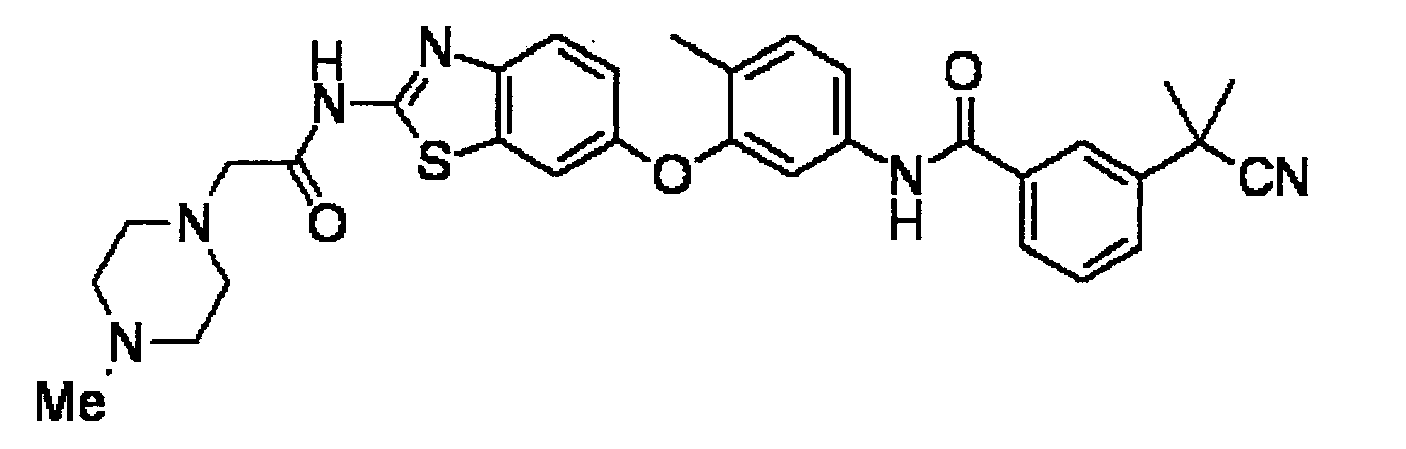
- Using N-{3-[(2-amino-1,3-benzothiazol-6-yl)oxy]-4-methylphenyl}-3-(1-cyano-1-methylethyl)benzamide (0.31 g, 0.70 mmol) produced in Example A32(iv), chloroacetyl chloride (0.45 g, 4.0 mmol), and 1-methylpiperazine (0.40 g, 4.0 mmol), and in the same manner as in Example A31, the title compound (0.34 g, 49%) was obtained as a white powder.
1H-NMR (CDCl3, 300 MHz) δ1.75 (6H, s), 2.27 (3H, s), 2.33 (3H, s), 2.47 - 2.61 (4H, m), 2.61 - 2.75 (4H, m), 3.28 (2H, s), 7.13 (1H, dd, J = 2.4, 8.7 Hz), 7.24 - 7.29 (2H, m), 7.34 (1H, d, J = 2.4 Hz), 7.36 (1H, dd, J = 2.1, 8.4 Hz), 7.48 (1H, t, J = 7.8 Hz), 7.65 - 7.78 (4H, m), 7.92 (1H, br s), 10.37 (1H, br s). -

- Using N-{3-[(2-amino-1,3-benzothiazol-6-yl)oxy]-4-methylphenyl}-3-(1-cyano-1-methylethyl)benzamide (0.31 g, 0.70 mmol) produced in Example A32(iv), 2-chloro-2-oxoethyl acetate (0.55 g, 4.0 mmol), and 8N aqueous sodium hydroxide solution (1 mL), and in the same manner as in Example A30, the title compound (37 mg, 11%) was obtained as a pale-yellow powder.
1H-NMR (CDCl3, 300 MHz) δ1.74 (6H, s), 2.27 (3H, s), 3.40 (1H, br s), 4.40 (2H, s), 7.13 (1H, dd, J = 2.4, 8.7 Hz), 7.24 - 7.29 (2H, m), 7.34 (1H, d, J = 2.7 Hz), 7.36 (1H, dd, J = 2.1, 7.8 Hz), 7.48 (1H, t, J = 7.8 Hz), 7.65 - 7.69 (1H, m), 7.70 - 7.74 (2H, m), 7.83 (1H, br s), 7.91 (1H, br s), 9.98 (1H, br s). -

- Using 5-amino-2-methylphenol (6.00 g, 48.5 mmol), 3-(1-cyanocyclopropyl)benzoic acid (6.00 g, 48.5 mmol) produced in Example A1(iii), oxalyl chloride (6.40 mL, 73.0 mmol), N,N-dimethylformamide (40 µL), tetrahydrofuran (250 mL), sodium hydrogencarbonate (6.20 g, 73.0 mmol) and water (60 mL) as starting materials, and in the same manner as in Example A32(i), the title compound (12.4 g, 87%) was obtained as a white powder. The title compound was washed with a mixed solvent of ethyl acetate and hexane.
1H-NMR (DMSO-d6, 300 MHz) δ 1.58 - 1.65 (2H, m), 1.77 - 1.84 (2H, m), 2.08 (3H, s), 6.96 - 7.05 (2H, m), 7.35 - 7.40 (1H, m), 7.49 - 7.58 (2H, m), 7.77 - 7.81 (1H, m), 7.82 - 7.88 (1H, m), 9.34 (1H, s), 10.10 (1H, s). - Using 3-(1-cyanocyclopropyl)-N-(3-hydroxy-4-methylphenyl)benzamide (1.46 g, 5.0 mmol), 1-fluoro-4-nitrobenzene (0.77 g, 5.5 mmol) and potassium carbonate (0.69 g, 5.0 mmol), and in the same manner as in Example A25(iii), the title compound (2.07 g, quantitatively) was obtained as a yellow oil.
1H-NMR (CDCl3, 300 MHz) δ1.47 (2H, dd, J = 5.1, 7.8 Hz), 1.78 (2H, dd, J = 5.1, 7.8 Hz), 2.17 (3H, s), 6.97 (2H, dt, J = 9.3, 2.7 Hz), 7.31 (1H, t, J = 8.7 Hz), 7.35 (1H, dd, J = 2.1, 8.4 Hz), 7.43 - 7.55 (3H, m), 7.73 (1H, td, J = 1.5, 5.4 Hz), 7.74 (1H, s), 7.98 (1H, br s), 8.20 (2H, dt, J = 9.3, 2.7 Hz). - Using 3-(1-cyanocyclopropyl)-N-[4-methyl-3-(4-nitrophenoxy)phenyl]benzamide (2.07 g, 5.0 mmol) and 10%-palladium carbon (0.5 g), and in the same manner as in Example A25(iv), the title compound (1.92 g, quantitatively) was obtained as a pink amorphous substance.
1H-NMR (CDCl3, 300 MHz) δ1.45 (2H, dd, J = 5.1, 7.8 Hz), 1.76 (2H, dd, J = 5.1, 7.8 Hz), 2.29 (3H, s), 3.59 (2H, br s), 6.66 (2H, dt, J = 8.7, 2.7 Hz), 6.83 (2H, dt, J = 8.7, 2.7 Hz), 6.96 (1H, d, J = 1.8 Hz), 7.19 (1H, d, J = 8.4 Hz), 7.54 (1H, dd, J = 2.1, 8.1 Hz), 7.44 (1H, t, J = 7.8 Hz), 7.54 (1H, td, J = 1.5, 5.1 Hz), 7.65 - 7.74 (3H, m). - Using N-[3-(4-aminophenoxy)-4-methylphenyl]-3-(1-cyanocyclopropyl)benzamide (1.92 g, 5.0 mmol), potassium thiocyanate (1.94 g, 20.0 mmol) and bromine (1.20 g, 7.50 mmol), and in the same manner as in Example A25(v), the title compound (0.44 g, 20%) was obtained as a pale-yellow powder.
1H-NMR (CDCl3, 300 MHz) δ1.50 (2H, dd, J = 5.1, 7.8 Hz), 1.76 (2H, dd, J = 5.1, 7.8 Hz), 2.25 (3H, s), 6.50 (2H, br s), 6.98 - 7.04 (2H, m), 7.21 - 7.25 (2H, m), 7.41 - 7.65 (4H, m), 7.71 - 7.85 (3H, m). - Using N-{3-[(2-amino-1,3-benzothiazol-6-yl)oxy]-4-methylphenyl}-3-(1-cyanocyclopropyl)benzamide (0.11 g, 0.25 mmol), cyclopropanecarbonyl chloride (0.21 g, 2.0 mmol), and N,N-dimethylpyridine-4-amine (0.24 g, 2.0 mmol), and in the same manner as in Example A29(vi), the title compound (42 mg, 33%) was obtained as a pale-yellow powder.
1H-NMR (CDCl3, 300 MHz) δ0.92- 1.00 (2H, m), 1.13 - 1.20 (2H, m), 1.44 - 1.51 (2H, m), 1.71 - 1.78 (2H, m), 1.78 - 1.86 (1H, m), 2.26 (3H, s), 7.06 - 7.13 (1H, m), 7.22 - 7.28 (2H, m), 7.30 - 7.34 (1H, m), 7.40°C - 7.48 (2H, m), 7.53 - 7.58 (1H, m), 7.62 - 7.72 (2H, m), 7.73 - 7.79 (1H, m), 8.56 (1H, br s), 10.95 (1H, br s). -

- Using N-{3-[(2-amino-1,3-benzothiazol-6-yl)oxy]-4-methylphenyl}-3-(1-cyanocyclopropyl)benzamide (0.11 g, 0.25 mmol) produced in Example A35(iv), 2-chloro-2-oxoethyl acetate (0.27 g, 2.0 mmol), and 8N aqueous sodium hydroxide solution (1 mL), and in the same manner as in Example A30, the title compound (17 mg, 14%) was obtained as a pale-yellow powder.
1H-NMR (CDCl3, 300 MHz) δ1.50 (2H, dd, J = 5.1, 7.8 Hz), 1.75 (2H, dd, J = 5.1, 7.8 Hz), 2.26 (3H, s), 4.28 (2H, d, J = 5.7 Hz), 5.45 (1H, t, J = 5.4 Hz), 7.12 (1H, dd, J = 2.4, 9.0 Hz), 7.25 (1H, d, J = 8.4 Hz), 7.32 - 7.36 (2H, m), 7.43 (1H, t, J = 7.8 Hz), 7.54 (1H, dd, J = 2.4, 8.4 Hz), 7.55 - 7. 60 (1H, m), 7.69 - 7.74 (2H, m), 7.81 - 7.88 (1H, m), 9.33 (1H, br s), 10.46 (1H, br s). -

- Using N-{3-[(2-amino-1,3-benzothiazol-6-yl)oxy]-4-methylphenyl}-3-(1-cyanocyclopropyl)benzamide (0.11 g, 0.25 mmol) produced in Example A35(iv), chloroacetyl chloride (0.23 g, 2.0 mmol), and 1-methylpiperazine (0.40 g, 4.0 mmol), and in the same manner as in Example A31, the title compound (24 mg, 17%) was obtained as a white powder.
1H-NMR (CDCl3, 300 MHz) δ1.46 (2H, dd, J = 5.4, 7.8 Hz), 1.77 (2H, dd, J = 5.4, 7.8 Hz), 2.27 (3H, s), 2.34 (3H, s), 2.48 - 2.62 (4H, m), 2.62 - 2.75 (4H, m), 3.28 (2H, s), 7.13 (1H, dd, J = 2.4, 8.7 Hz), 7.24 - 7.29 (2H, m), 7.33 - 7.38 (2H, m), 7.45 (1H, t, J = 7.8 Hz), 7.52 - 7.57 (1H, m), 7.67 - 7.72 (3H, m), 7.75 (1H, d, J = 8.7 Hz), 10.38 (1H, br s). -

- To a solution of N-{3-[(2-amino-l,3-benzothiazol-6-yl)oxy]phenyl}-3-(1-cyanocyclopropyl)benzamide (200 mg, 0.47 mmol) produced in Example A15(iii) in tetrahydrofuran (20 mL) were added acetyl chloride (0.3 mL, 4.22 mmol) and triethylamine (1.0 mL, 7.18 mmol), and the mixture was stirred at room temperature for 10 min. To the reaction mixture were added water (200 mL) and ethyl acetate (200 mL) and the mixture was stirred for 30 min. The organic layer was separated, and dried over anhydrous magnesium sulfate. The insoluble material was filtered off, and the filtrate was concentrated under reduced pressure. The residue was purified by silica gel chromatography (hexane/ethyl acetate=20/80→ 0/100), and triturated with ethyl acetate/hexane to give the title compound (151 mg, 69%) as a colorless solid.
1H-NMR (DMSO-d6, 300 MHz) δ 1.52 - 1.66 (2H, m), 1.73 - 1.86 (2H, m), 2.19 (3H, s), 6.69 - 6.86 (1H, m), 7.16 (1H, dd, J = 2.5, 8.5 Hz), 7.36 (1H, t, J = 8.5 Hz), 7.42 - 7.61 (4H, m), 7.65 - 7.91 (4H, m), 10.33 (1H, s), 12.33 (1H, br s). -

- Using N-{3-[(2-amino-1,3-benzothiazol-6-yl)oxy]phenyl}-3-(1-cyano-1-methylethyl)benzamide (100 mg, 0.23 mmol) produced in Example A12(iv), tetrahydrofuran (20 mL), acetyl chloride (0.12 mL, 1.69 mmol) and triethylamine (1.0 mL, 7.18 mmol) as starting materials, and in the same manner as in Example A38, the title compound (50 mg, 46%) was obtained as a colorless solid.
1H-NMR (DMSO-d6, 300 MHz) δ 1.73 (6H, s), 2.19 (3H, s), 6.72 - 6.85 (1H, m), 7.16 (1H, dd, J = 2.5, 8.5 Hz), 7.37 (1H, t, J = 8.5 Hz), 7.48 (1H, t, J = 2.5 Hz), 7.53 - 7.63 (2H, m), 7.64 - 7.82 (3H, m), 7.85 - 7.93 (1H, br s), 7.98 (1H, t, J = 1.5 Hz), 10.35 (1H, s), 12.33 (1H, br s). -

- A mixture of 2-chloro-3-methylbenzoic acid (25.0 g, 0.146 mol), concentrated sulfuric acid (2 mL) and methanol (160 mL) was stirred at 80°C for 3 hr. The reaction mixture was concentrated, diluted with ethyl acetate and neutralized with 8N aqueous sodium hydroxide solution. The organic layer was separated, washed with saturated brine, dried over anhydrous magnesium sulfate, and passed through a pad filled with basic silica gel for filtration. The solvent was concentrated under reduced pressure to give the title compound (18.0 g, 66%) as a pale-orange oil. The obtained compound was used in the next reaction without a further purification.
1H-NMR (CDCl3, 300 MHz) δ2.42 (3H, s), 3.93 (3H, s), 7.19 (1H, t, J = 7.6 Hz), 7.32 - 7.38 (1H, m), 7.56 (1H, dd, J = 1.2, 7.6 Hz). - To a solution of methyl 2-chloro-3-methylbenzoate (3.60 g, 19.4 mmol) in acetonitrile (60 mL) were added 1-bromopyrrolidine-2,5-dione (11.46 g, 64.3 mmol) and 2,2'-(E)-diazene-1,2-diylbis(2-methylpropanenitrile) (960 mg, 5.84 mmol), and the mixture was stirred at 90°C for 26 hr. The reaction mixture was concentrated, insoluble material was filtered off, and the filtrate was concentrated. The obtained residue was purified by silica gel column chromatography (hexane/ethyl acetate=100/0→95/5) to give the title compound (3.42 g, 66%) as a colorless oil.
1H-NMR (CDCl3, 300 MHz) δ3.94 (3H, s), 4.64 (2H, s), 7.31 (1H, t, J = 7.7 Hz), 7.58 (1H, dd, J = 1.7, 7.7 Hz), 7.71 (1H, dd, J = 1.7, 7.7 Hz). - To a solution of methyl 3-(bromomethyl)-2-chlorobenzoate (748 mg, 2.84 mmol) in N,N-dimethylformamide (7 mL) was added sodium cyanide (412 mg, 8.41 mmol), and the mixture was stirred under a nitrogen stream at 80°C for 1 hr. The reaction mixture was diluted with a mixed solvent of ethyl acetate and hexane (1:1). The solution was washed with water and saturated brine, dried over anhydrous magnesium sulfate, and filtered. The solvent was evaporated under reduced pressure, and the obtained residue was purified by silica gel column chromatography (hexane/ethyl acetate=98/2→80/20) and crystallized from ethyl acetate/hexane to give the title compound (470 mg, 79%) as white crystals.
1H-NMR (CDCl3, 300 MHz) δ3.91 (2H, s), 3.95 (3H, s), 7.39 (1H, t, J = 7.8 Hz), 7.66 - 7.72 (1H, m), 7.76 - 7.81 (1H, m). - Using Methyl 2-chloro-3-(cyanomethyl)benzoate (2.00 g, 9.54 mmol), sodium hydride (60% in oil, 1.14 g, 28.6 mmol), 1,2-dibromoethane (1.18 mL, 14.3 mmol) and dimethyl sulfoxide (20 mL) as starting materials, and in the same manner as in Example A1 (ii), the title compound (787 mg, 35%) was obtained as a colorless oil.
1H-NMR (CDCl3, 300 MHz) δ1.33 - 1.39 (2H, m), 1.76 - 1.83 (2H, m), 3.95 (3H, s), 7.32 (1H, t, J = 7.7 Hz), 7.50 (1H, dd, J = 1.7, 7.7 Hz), 7.74 (1H, dd, J = 1.7, 7.7 Hz). - Using methyl 2-chloro-3-(1-cyanocyclopropyl)benzoate (684 mg, 2.90 mmol), lithium hydroxide·monohydrate (207 mg, 4.93 mmol), tetrahydrofuran (10 mL), methanol (3 mL) and water (3 mL) as starting materials, and in the same manner as in Example A1 (iii), the title compound (457 mg, 71%) was obtained as a white powder.
1H-NMR (CDCl3, 300 MHz) δ1.32 - 1.42 (2H, m), 1.79 - 1.87 (2H, m), 4.47 (1H, br s), 7.37 (1H, t, J = 7.7 Hz), 7.56 (1H, dd, J = 1.7, 7.7 Hz), 7.95 (1H, dd, J = 1.7, 7.7 Hz). - To a solution of 3-(4-nitrophenoxy)aniline (11.3 g, 48.9 mmol) produced in Example A12(i) in tetrahydrofuran (120 mL) was added trifluoroacetic acid anhydride (11.3 g, 53.8 mmol), and the mixture was stirred at room temperature for 1 hr. To the reaction mixture were added water (200 mL) and ethyl acetate (200 mL), and the mixture was stirred for 30 min and extracted with ethyl acetate. The organic layer was dried over anhydrous magnesium sulfate, and the solvent was evaporated under reduced pressure to give the title compound (13.0 g, 81%) as a brown oil.
1H-NMR (DMSO-d6, 300 MHz) δ 7.01 - 7.11 (1H, m), 7.14 - 7.25 (2H, m), 7.49 - 7.57 (2H, m), 7.58 - 7.66 (1H, m), 8.21 - 8.33 (2H, m), 11. 41 (1H, s). - To a solution of 2,2,2-trifluoro-N-[3-(4-nitrophenoxy)phenyl]acetamide (13.0 g, 39.8 mmol) in ethyl acetate (400 mL) was added 10% palladium-carbon (10 g), and the mixture was stirred at room temperature for 3 hr under a hydrogen atmosphere. The insoluble material was filtered off, and the filtrate was concentrated under reduced pressure to give the title compound (11.7 g, 99%) as a pale-gray amorphous substance. The obtained compound was used in the next reaction without a further purification.
1H-NMR (DMSO-d6, 300 MHz) δ 5.02 (2H, s), 6.55 - 6.65 (2H, m), 6.70 - 6.85 (3H, m), 7.18 (1H, t, J = 2.1 Hz), 7.25 - 7.47 (2H, m), 11.21 (1H, br s). - To a solution of potassium thiocyanate (17.5 g, 180.0 mmol) in acetic acid (130 mL) was added a solution of N-[3-(4-aminophenoxy)phenyl]-2,2,2-trifluoroacetamide (13.0 g, 43.9 mmol) in acetic acid (20 mL), and the mixture was stirred at room temperature for 15 min. To the obtained solution was added dropwise a solution of bromine (7.71 g, 48.2 mmol) in acetic acid (30 mL) at room temperature over 30 min or longer and, after the completion of the dropwise addition, the mixture was stirred at room temperature for 13 hr. The resulting yellow solid was filtered off, and the filtrate was concentrated under reduced pressure. The residue was dissolved in ethyl acetate (200 mL), and basified with 8N aqueous sodium hydroxide solution. The aqueous layer was separated, and the organic layer was washed with saturated aqueous sodium hydrogencarbonate solution (200 mL) and saturated brine (50 mL), and dried over anhydrous magnesium sulfate. The insoluble material was filtered off, and the filtrate was concentrated under reduced pressure to give the title compound (10.3 g, 66%) as a yellow amorphous substance. The obtained compound was used in the next reaction without a further purification.
1H-NMR (DMSO-d6, 300 MHz) δ 6.81-6.87 (1H, m), 6.95 (1H, dd, J = 2.5, 8.6 Hz), 7.24 (1H, t, J = 2.5 Hz), 7.33 - 7.41 (2H, m), 7.42-7.51 (4H, m), 11.23 (1H, s). - To a solution of N-13-[(2-amino-1,3-benzothiazol-6-yl)oxy]phenyl}-2,2,2-trifluoroacetamide (10.0 g, 28.3 mmol) and pyridine (3.36 g, 42.5 mmol) in tetrahydrofuran (150 mL) was added acetyl chloride (2.44 g, 31.1 mmol), and the mixture was stirred at room temperature for 4 hr. To the reaction mixture were added water (300 mL) and ethyl acetate (500 mL), and the mixture was stirred for 30 min and extracted with ethyl acetate. The organic layer was dried over anhydrous magnesium sulfate, the solvent was evaporated under reduced pressure, and the residue was triturated with ethyl acetate/diisopropyl ether to give the title compound (10.6 g, 95%) as a pale-yellow solid.
1H-NMR (DMSO-d6, 300 MHz) δ 2.20 (3H, s), 6.86 - 6.91 (1H, m), 7.17 (1H, dd, J = 2.5, 8.7 Hz), 7.30 (1H, t, J = 2.5 Hz), 7.33 - 7.52 (2H, m), 7.73 - 7.79 (2H, m), 11.26 (1H, br s), 12.33 (1H, br s). - To a solution of N-(3-{[2-(acetylamino)-1,3-benzothiazol-6-yl]oxy}phenyl)-2,2,2-trifluoroacetamide (10.0 g, 25.3 mmol) in tetrahydrofuran (50 mL) were added methanol (25 mL), water (25 mL) and lithium hydroxide monohydrate (1.50 g, 35.7 mmol), and the mixture was stirred at room temperature for 1 hr. To the reaction mixture were added water (200 mL) and ethyl acetate (250 mL), and the mixture was extracted with ethyl acetate. The organic layer was dried over anhydrous magnesium sulfate, and the filtrate was concentrated under reduced pressure. The residue was purified by silica gel chromatography (hexane/ethyl acetate=20/80→0/100), and triturated with ethyl acetate/hexane to give the title compound (3.10 g, 41%) as a yellow solid.
1H-NMR (DMSO-d6, 300 MHz) δ 2.19 (3H, s), 5.20 (2H, s), 6.07 - 6.20 (2H, m), 6.25 - 6.38 (1H, m), 6.98 (1H, t, J = 8.0 Hz), 7.09 (1H, dd, J = 2.5, 8.8 Hz), 7.63 (1H, d, J = 2.5 Hz), 7.71 (1H, d, J = 8.8 Hz), 12.29 (1H, br s). - To a solution of 2-chloro-3-(1-cyanocyclopropyl)benzoic acid (237 mg, 1.07 mmol) in tetrahydrofuran (4 mL) were added oxalyl chloride (170 mg, 1.34 mmol) and N,N-dimethylformamide (10 µL), and the mixture was stirred for 1 hr. The reaction mixture was concentrated under reduced pressure, and the obtained residue was dissolved in N,N-dimethylacetamide (4 mL). N-[6-(3-Aminophenoxy)-1,3-benzothiazol-2-yl]acetamide (160 mg, 0.534 mmol) was added and the mixture was stirred at room temperature for 2 hr. To the reaction mixture were added water (100 mL) and ethyl acetate (100 mL). The organic layer was separated, washed with saturated brine (10 mL), and dried over anhydrous magnesium sulfate. The insoluble material was filtered off, and the filtrate was concentrated under reduced pressure. The residue was purified by silica gel column chromatography (hexane/ethyl acetate=80/20→0/100), and triturated with ethyl acetate/diisopropyl ether to give the title compound (215 mg, 80%) as a yellow solid.
1H-NMR (DMSO-d6, 300 MHz) δ 1.39 - 1.47 (2H, m), 1.76 - 1.83 (2H, m), 2.19 (3H, s), 6.74 - 6.82 (1H, m), 7.16 (1H, dd, J = 2.5, 8.8 Hz), 7.29 - 7.42 (2H, m), 7.42 - 7.53 (2H, m), 7.54 - 7.61 (1H, m), 7.64 (1H, dd, J = 1.6, 7.6 Hz), 7.70 - 7.80 (2H, m), 10.61 (1H, s), 12.33 (1H, br s). -

- A solution of methyl 2-chloro-3-(cyanomethyl)benzoate (30.0 g, 143 mmol) produced in Example A40(iii) in dimethyl sulfoxide (300 mL) was cooled to 15°C, 60% sodium hydride (17.3 g, 432 mmol) was added by small portions, and the mixture was stirred at room temperature for 30 min. To this suspension was added dropwise methyl iodide (27 mL, 434 mmol) at 15°C over 15 min, and the mixture was stirred at room temperature for 15 hr. To the reaction mixture was added aqueous ammonium chloride solution (300 mL), and the mixture was extracted with diethyl ether/ethyl acetate mixture (1:1, 3×300 mL). The combined organic layer was washed successively with water (200 mL) and saturated brine (100 mL), successively, and dried over anhydrous magnesium sulfate. The insoluble material was filtered off, and the filtrate was concentrated under reduced pressure. The obtained residue was purified by silica gel column chromatography (hexane/ethyl acetate=95/5→50/50), and the fraction containing the object product was concentrated under reduced pressure to give the title compound (27.1 g, 80%) as a pale-yellow oil.
1H-NMR (CDCl3, 300 MHz) δ 1.90 (6H, s), 3.95 (3H, s), 7.36 (1H, dd, J = 7. 6, 8.1 Hz), 7.56 - 7.67 (2H, m). - To a solution of methyl 2-chloro-3-(1-cyano-1-methylethyl)benzoate (1.67 g, 7.02 mmol) in tetrahydrofuran (24 mL)/methanol (8 mL)/water (8 mL) was added lithium hydroxide·monohydrate (501 mg, 11.9 mmol), and the mixture was stirred at room temperature for 2 hr. The reaction mixture was concentrated under reduced pressure, and 6N hydrochloric acid (2.8 mL) was added dropwise to the residue. The precipitate was collected by filtration, and washed with water to give the title compound (1.43 g, 91%) as a white powder.
1H-NMR (CDCl3, 300 MHz) δ 1.92 (6H, s), 7.41 (1H, t, J = 7.8 Hz), 7.67 (1H, dd, J = 1.6, 7.8 Hz), 7.85 (1H, dd, J = 1.6, 7.8 Hz). - To a solution of 2-chloro-3-(1-cyano-1-methylethyl)benzoic acid (240 mg, 1.07 mmol) in tetrahydrofuran (4 mL) were added oxalyl chloride (170 mg, 1.34 mmol) and N,N-dimethylformamide (10 µL), and the mixture was stirred for 1 hr. The reaction mixture was concentrated under reduced pressure, and the obtained residue was dissolved in N,N-dimethylacetamide (4 mL). N-[6-(3-Aminophenoxy)-1,3-benzothiazol-2-yl]acetamide (160 mg, 0.534 mmol) produced in Example A40(x) was added and the mixture was stirred at room temperature for 2 hr. To the reaction mixture were added water (100 mL) and ethyl acetate (100 mL). The organic layer was separated, washed with saturated brine (10 mL), and dried over anhydrous magnesium sulfate. The insoluble material was filtered off, and the filtrate was concentrated under reduced pressure. The residue was purified by silica gel column chromatography (hexane/ethyl acetate=80/20→0/100), and recrystallized from ethyl acetate/diisopropyl ether to give the title compound (201 mg, 75%) as colorless crystals.
1H-NMR (DMSO-d6, 300 MHz) δ 1.82 (6H, s), 2.17 (3H, s), 6.78 (1H, br s), 7.07 - 7.19 (1H, m), 7.27 - 7.40 (2H, m), 7.43 - 7.59 (3H, m), 7.60 - 7.78 (3H, m), 10.62 (1H, s), 12.34 (1H, s). -

- To a solution of 3-(1-cyano-1-methylethyl)benzoic acid (8.60 g, 45.5 mmol) in toluene (60 mL)/tetrahydrofuran (40 mL) was added dropwise 1.0 M hexane solution (100 mL, 100 mmol) of diisobutylaluminum hydride at -78°C over 1 hr. After the completion of the dropwise addition, the mixture was stirred at -78°C for 1 hr and at 0°C for 1 hr. The reaction mixture was poured into a mixture of ethyl acetate (200 mL) and 3N hydrochloric acid (300 mL), and the organic layer was separated from the aqueous layer. The aqueous layer was extracted with ethyl acetate (2×100 mL). The combined organic layer was washed with saturated brine (50 mL), and dried over anhydrous magnesium sulfate. The insoluble material was filtered off, and the filtrate was concentrated under reduced pressure. The obtained residue was crystallized from ethyl acetate/hexane to give the title compound (6.39 g, 73%) as colorless crystals.
1H-NMR (DMSO-d6, 300 MHz) δ 1.43 (6H, s), 7.53 (1H, dt, J = 0.6, 7.5 Hz), 7.58 (1H, dt, J = 7.5, 1.6 Hz), 7.83 - 7.85 (1H, m), 7.88 (1H, dt, J = 7.5, 1. 6 Hz), 9.54 (1H, s), 13.06 (1H, br s). - To a solution of 3-(1,1-dimethyl-2-oxoethyl)benzoic acid in acetone (60 mL) were added potassium carbonate (3.78 g, 27.3 mmol) and methyl iodide (3.40 mL, 54.6 mmol), and the mixture was stirred at 60°C for 5 hr. The insoluble material was filtered off, and the filtrate was concentrated under reduced pressure. To the obtained residue was added saturated aqueous sodium hydrogencarbonate solution (50 mL), and the mixture was extracted with ethyl acetate (100 mL, 30 mL). The combined organic layer was washed with saturated brine (20 mL), and dried over anhydrous magnesium sulfate. The insoluble material was filtered off, and the filtrate was concentrated under reduced pressure to give methyl 3-(1,1-dimethyl-2-oxoethyl)benzoate as a yellow oil.
To a suspension of p-acetamidobenzenesulfonyl azide (5.25 g, 21.9 mmol) and potassium carbonate (7.55 g, 54.6 mmol) in acetonitrile (100 mL) was added dimethyl(2-oxopropyl)phosphonate (3.00 mL, 21.9 mmol), and the mixture was stirred at room temperature for 2 hr. Thereafter, to the reaction mixture was added a solution of methyl (1,1-dimethyl-2-oxoethyl)benzoate synthesized above in methanol (20 mL), and the mixture was stirred at room temperature for 16 hr. The insoluble material was filtered off, and the filtrate was concentrated under reduced pressure. To the obtained residue was added saturated aqueous sodium hydrogencarbonate solution (70 mL), and the mixture was extracted with ethyl acetate (100 mL). The combined organic layer was washed with saturated brine (20 mL), and dried over anhydrous magnesium sulfate. The insoluble material was filtered off, and the filtrate was concentrated under reduced pressure. The obtained residue was purified by basic silica gel column chromatography (hexane/ethyl acetate=100/0→90/10), and the fraction containing the object product was concentrated under reduced pressure to give the title compound (2.26 g, 61%) as a colorless oil.
1H-NMR (DMSO-d6, 300 MHz) δ 1.56 (6H, s), 3.34 (1H, s), 3.86 (3H, s), 7.51 (1H, dt, J = 0.6, 7.8 Hz), 7.80 - 7.88 (2H, m), 8.17 (1H, dt, J = 0.6, 1.8 Hz). - To a solution of methyl 3-(1,1-dimethylprop-2-yn-1-yl)benzoate (2.26 g, 11.2 mmol)in methanol (15 mL)/tetrahydrofuran (10 mL) was added 2N aqueous sodium hydroxide solution (11.2 mL, 22.4 mmol), and the mixture was stirred at 60°C for 3 hr. The reaction mixture was neutralized with 6N hydrochloric acid (5 mL), 1N hydrochloric acid (50 mL) was added, and the mixture was extracted with ethyl acetate (100 mL, 20 mL). The combined organic layer was washed with saturated brine (10 mL), and dried over anhydrous magnesium sulfate. The insoluble material was filtered off, and the filtrate was concentrated under reduced pressure. The obtained residue was crystallized from ethyl acetate/hexane to give the title compound (1.94 g, 92%) as colorless crystals.
1H-NMR (DMSO-d6, 300 MHz) δ1.56 (6H, s), 3.33 (1H, s), 7.48 (1H, t, J = 7.6 Hz), 7.72 - 7.88 (2H, m), 8.16 (1H, t, J = 1.6 Hz), 13.01 (1H, br s). - Using N-[6-(3-aminophenoxy)-1,3-benzothiazol-2-yl]acetamide (160 mg, 0.534 mmol) produced in Example A40(x), 3-(1,1-dimethylprop-2-yn-1-yl)benzoic acid (201 mg, 1.07 mmol), tetrahydrofuran (4 mL), N,N-dimethylformamide (10 µL), oxalyl chloride (170 mg, 1.34 mmol) and N,N-dimethylformamide (4 mL), and in the same manner as in Example A40(xi), the title compound (56 mg, 22%) was obtained as a colorless solid.
1H-NMR (DMSO-d6, 300 MHz) δ 1.57 (6H, s), 2.19 (3H, s), 3.35 (1H, s), 6.73 - 6.83 (1H, m), 7.16 (1H, dd, J = 2.5, 8.8 Hz), 7.35 (1H, t, J = 8.1 Hz), 7.43 - 7.59 (3H, m), 7.69 - 7.84 (4H, m), 8.03 (1H, t, J = 1.7 Hz), 10.29 (1H, s), 12.33 (1H, br s). -

- To a solution of methyl 3-hydroxybenzoate (5.00 g, 32.9 mmol) in acetone (60 mL) were added bromoacetonitrile (2.63 mL, 39.4 mmol) and potassium carbonate (6.81 g, 49.3 mmol), and the mixture was stirred at 60°C for 4 hr. To the reaction mixture was added saturated aqueous sodium hydrogencarbonate solution (100 mL), and the mixture was extracted with ethyl acetate (100 mL, 30 mL). The combined organic layer was washed with saturated brine (10 mL), and dried over anhydrous magnesium sulfate. The insoluble material was filtered off, and the filtrate was concentrated under reduced pressure. The obtained residue was purified by basic silica gel column chromatography (hexane/ethyl acetate=90/10→80/20), and the fraction containing the object product was concentrated under reduced pressure to give the title compound (5.43 g, 86%) as a colorless oil.
1H-NMR (DMSO-d6, 300 MHz) δ 3.87 (3H, s), 5.27 (2H, s), 7.37 (1H, ddd, J = 7.8, 2.6, 1.3 Hz), 7.54 (1H, t, J = 7.8 Hz), 7.59 (1H, dd, J = 2.6, 1.3 Hz), 7. 68 (1H, dt, J = 7.8, 1.3 Hz). - To a solution of methyl 3-(cyanomethoxy)benzoate (6.00 g, 31.4 mmol) in tetrahydrofuran (200 mL) was added methyl iodide (15.6 mL, 251 mmol), and 1.1 M tetrahydrofuran solution (62.8 mL, 69.0 mmol) of lithium hexamethyl disilazide was added dropwise at -78°C over 1.5 hr. After the completion of the dropwise addition, the mixture was stirred at -78°C for 2 hr. The reaction mixture was poured into a mixture of ethyl acetate (150 mL) and aqueous ammonium chloride solution (150 mL). The organic layer and the aqueous layer were separated, and the aqueous layer was extracted with ethyl acetate (50 mL). The combined organic layer was washed with saturated brine (50 mL), and dried over anhydrous magnesium sulfate. The insoluble material was filtered off, and the filtrate was concentrated under reduced pressure. The obtained residue was purified by silica gel column chromatography (hexane/ethyl acetate=100/0→ 90/10), and the fraction containing the object product was concentrated under reduced pressure to give the title compound (2.07 g, 30%) as a yellow oil.
1H-NMR (DMSO-d6, 300 MHz) δ 1.71 (6H, s), 3.86 (3H, s), 7.46 (1H, ddd, J = 7.8, 2.4, 1.2 Hz), 7.56 (1H, dt, J = 7.8, 0.3 Hz), 7.69 - 7.72 (1H, m), 7.79 (1H, ddd, J = 7.8, 1.5, 1.2 Hz). - To a solution of methyl 3-(1-cyano-1-methylethoxy)benzoate (2.07 g, 9.44 mmol)in methanol (12 mL)/tetrahydrofuran (4 mL) was added 2N aqueous sodium hydroxide solution (9.44 mL, 18.9 mmol), and the mixture was stirred at room temperature for 30 min. The reaction mixture was neutralized with 6N hydrochloric acid (5 mL), 1N hydrochloric acid (50 mL) was added, and the mixture was extracted with ethyl acetate (50 mL, 20 mL). The combined organic layer was washed with saturated brine (10 mL), and dried over anhydrous magnesium sulfate. The insoluble material was filtered off, and the filtrate was concentrated under reduced pressure. The obtained residue was purified by silica gel column chromatography (hexane/ethyl acetate=90/10→50/50), and the fraction containing the object product was concentrated under reduced pressure. The obtained residue was crystallized from ethyl acetate/hexane to give the title compound (1.01 g, 51%) as colorless crystals.
1H-NMR (DMSO-d6, 300 MHz) δ 1.72 (6H, s), 7.42 (1H, ddd, J = 7.9, 2.5, 1.2 Hz), 7.54 (1H, t, J = 7.9 Hz), 7.70 - 7.73 (1H, m), 7.78 (1H, dt, J=7.9, 1.2 Hz), 13.18 (1H, br s). - To a solution of N-[6-(3-aminophenoxy)-1,3-benzothiazol-2-yl]acetamide (160 mg, 0.534 mmol) produced in Example A40(x) and 3-(1-cyano-1-methylethoxy)benzoic acid (219 mg, 1.07 mmol) in pyridine (5 mL) was added O-(7-azabenzotriazol-1-yl)-N,N,N',N'-tetramethyluronium hexafluorophosphate (407 mg, 1.07 mmol) under ice-cooling, and the mixture was stirred at room temperature for 5 hr. The reaction mixture was poured into water (100 mL), and extracted with ethyl acetate (100 mL×2). The ethyl acetate layers were combined and dried over anhydrous sodium sulfate, and the insoluble material was filtered off, and the filtrate was concentrated under reduced pressure. The obtained residue was purified by silica gel column chromatography (hexane/ethyl acetate=100/0→0/100), and crystallized from ethyl acetate to give the title compound (141 mg, 54%) as colorless crystals.
1H-NMR (DMSO-d6, 300 MHz) δ 1.72 (6H, s), 2.18 (3H, s), 6.71 - 6.85 (1H, m), 7.15 (1H, dd, J = 1.9, 8.9 Hz), 7.28 - 7.42 (2H, m), 7.47 (1H, s), 7.50 - 7.60 (2H, m), 7.65 (1H, s), 7.67 - 7.79 (3H, m), 10.31 (1H, s), 12.30 (1H, br s). -

- To a solution of methyl 3-hydroxybenzoate (10.0 g, 65.7 mmol) in acetonitrile (200 mL) were added 3-chloro-3-methylbut-1-yne (20.0 g, 195 mmol) and copper (II) chloride (88 mg, 0.654 mmol) under ice-cooling, and the mixture was stirred for 15 min under ice-cooling. 1,8-Diazabicyclo[5.4.0]undec-7-ene (10 mL, 70.0 mmol) was added under ice-cooling, and the mixture was stirred at room temperature for 2 hr. The reaction mixture was poured into water (300 mL), and the mixture was extracted with ethyl acetate (400 mL×2). The ethyl acetate layers were combined, and dried over anhydrous sodium sulfate. The insoluble material was filtered off, and the filtrate was concentrated under reduced pressure. The obtained residue was purified by silica gel column chromatography (hexane/ethyl acetate=100/0→ 0/100) to give the title compound (4.0 g, 28%) as a colorless oil.
1H-NMR (DMSO-d6, 300 MHz) δ 1.66 (6H, s), 2.60 (1H, s), 3.91 (3H, s), 7.34 - 7.45 (2H, m), 7.73 - 7.88 (2H, m). - To a solution of methyl 3-[(1,1-dimethylprop-2-yn-1-yl)oxy]benzoate (4.0 g, 18.3 mmol) in tetrahydrofuran (10 mL) were added lithium hydroxide·monohydrate (865 mg, 20.6 mmol), methanol (10 mL) and water (5 mL), and the mixture was stirred at room temperature for 12 hr. The reaction mixture was adjusted to pH 3 by slowly adding 1N hydrochloric acid, and extracted with ethyl acetate (100 mL×2). The ethyl acetate layers were combined, and dried over anhydrous sodium sulfate. The insoluble material was filtered off, and the filtrate was concentrated under reduced pressure to give the title compound (3.8 g, 99%) as a colorless oil.
1H-NMR (DMSO-d6, 300 MHz) δ 1.60 (6H, s), 3.71 (1H, s), 7.37 - 7.46 (2H, m), 7.63 - 7.65 (1H, m), 7.75 - 7.76 (1H, m), 12.92 (1H, br s). - To a solution of N-[6-(3-aminophenoxy)-1,3-benzothiazol-2-yl]acetamide (160 mg, 0.534 mmol) produced in Example A40(x), 3-[(1,1-dimethylprop-2-yn-1-yl)oxy]benzoic acid (215 mg, 1.07 mmol) in pyridine (5 mL) was added O-(7-azabenzotriazol-1-yl)-N,N,N',N'-tetramethyluronium hexafluorophosphate (407 mg, 1.07 mmol) under ice-cooling, and the mixture was stirred at room temperature for 1 hr. The reaction mixture was poured into water (100 mL), and the mixture was extracted with ethyl acetate (100 mL). The organic layer was dried over anhydrous sodium sulfate, the insoluble material was filtered off, and the filtrate was concentrated under reduced pressure. The obtained residue was purified by silica gel column chromatography (hexane/ethyl acetate=80/20→0/100), and crystallized from ethyl acetate to give the title compound (181 mg, 70%) as colorless crystals.
1H-NMR (DMSO-d6, 300 MHz) δ 1.61 (6H, s), 2.19 (3H, s), 3.70 (1H, s), 6.77 (1H, dd, J = 2.5, 8.0 Hz), 7.12 - 7.19 (1H, m), 7.31 - 7.47 (3H, m), 7.49 (1H, s), 7.55 - 7.66 (3H, m), 7.71 (1H, d, J = 2.5 Hz), 7.74 (1H, d, J = 8.5 Hz), 10.26 (1H, s), 12.32 (1H, br s). -

- To a solution of methyl 4-chloro-3-(cyanomethyl)benzoate (14.0 g, 67 mmol) in dimethyl sulfoxide (300 mL) was added sodium hydride (60% in oil, 9.6 g, 240 mmol). The reaction mixture was stirred at room temperature for 20 min. After stirring, methyl iodide (15 mL, 240 mmol) was added, and the mixture was further stirred at room temperature for 15 hr. The reaction mixture was diluted with water (500 mL), and extracted with ethyl acetate (800 mL). The organic layer was washed with saturated brine (100 mL) and dried over anhydrous sodium sulfate, and the insoluble material was filtered off. The solvent was evaporated under reduced pressure, and the residue was purified by silica gel column chromatography (hexane/ethyl acetate=95/5→50/50), and the fraction containing the object product was concentrated under reduced pressure to give the title compound (8.40 g, 53%) as a colorless oil. 1H-NMR (DMSO-d6, 300 MHz) δ 1.81 (6H, s), 3.91 (3H, s), 7.64 - 8.01 (2H, m), 8.08 (1H, d, J = 1.9 Hz).
- To a solution of methyl 4-chloro-3-(1-cyano-1-methylethyl)benzoate (8.0 g, 34 mmol) in tetrahydrofuran (30 mL) were added lithium hydroxide·monohydrate (2.13 g, 51 mmol), methanol (100 mL) and water (5 mL), and the mixture was stirred at room temperature for 4 hr. The solvent was evaporated under reduced pressure, and the residue was diluted with water (200 mL). The mixture was adjusted to pH 3 by slowly adding 1N hydrochloric acid. The resulting white precipitate was collected by filtration, washed with water, and dried to give the title compound (7.40 g, 99%) as a white powder.
1H-NMR (DMSO-d6, 300 MHz) δ 1.85 (6H, s), 7.70 (1H, d, J = 8.3 Hz), 7.94 (1H, dd, J = 2.1, 8.3 Hz), 8.07 (1H, d, J = 2.1 Hz), 12.70 (1H, br s). - Using N-[6-(3-aminophenoxy)-1,3-benzothiazol-2-yl]acetamide (160 mg, 0.534 mmol) produced in Example A40(x), 4-chloro-3-(1-cyano-1-methylethyl)benzoic acid (240 mg, 1.07 mmol), tetrahydrofuran (4 mL), N,N-dimethylformamide (10 µL), oxalyl chloride (170 mg, 1.34 mmol) and N,N-dimethylformamide (4 mL), and in the same manner as in Example A40(xi), the title compound (112 mg, 42%) was obtained as a colorless solid.
1H-NMR (DMSO-d6, 300 MHz) δ 1.85 (6H, s), 2.20 (3H, s), 6.69 - 6.86 (1H, m), 7.16 (1H, dd, J = 2.5, 8.8 Hz), 7.37 (1H, t, J = 8.1 Hz), 7.46 (1H, t, J = 2.2 Hz), 7.49 - 7.56 (1H, m), 7.60 7.82 (3H, m), 7.86 - 8.05 (2H, m), 10.41 (1H, s), 12.33 (1H, br s). -

- Using N-[6-(3-aminophenoxy)-1,3-benzothiazol-2-yl]acetamide (160 mg, 0.534 mmol) produced in Example A40(x), 3-cyanobenzoic acid (157 mg, 1.07 mmol), tetrahydrofuran (4 mL), N,N-dimethylformamide (10 µL), oxalyl chloride (170 mg, 1.34 mmol) and N,N-dimethylformamide (4 mL), and in the same manner as in Example A40(xi), the title compound (127 mg, 55%) was obtained as a colorless solid.
1H-NMR (DMSO-d6, 300 MHz) δ 2.20 (3H, s), 6.70 - 6.88 (1H, m), 7.17 (1H, dd, J = 2.6, 8.7 Hz), 7.37 (1H, t, J= 8.0 Hz), 7.46 (1H, t, J = 2.0 Hz), 7.52 - 7.62 (1H, m), 7.66 - 7.83 (3H, m), 8.01 - 8.08 (1H, m), 8.15 - 8.23 (1H, m), 8.35 (1H, t, J = 1.4 Hz), 10.44 (1H, s), 12.34 (1H, s). -

- To a solution of 2-chloro-3-(1-cyano-1-methylethyl)benzoic acid (1.98 g, 8.85 mmol) produced in Example A41(ii) in tetrahydrofuran (40 mL) were added oxalyl chloride (1.41 g, 11.1 mmol) and N,N-dimethylformamide (10 µL), and the mixture was stirred for 1 hr. The reaction mixture was concentrated under reduced pressure, and the obtained residue was dissolved in N,N-dimethylacetamide (40 mL). 4-Fluoro-3-(4-nitrophenoxy)aniline (4.69 g, 20.4 mmol) was added, and the mixture was stirred at room temperature for 14 hr. To the reaction mixture were added water (100 mL), 1N aqueous sodium hydroxide solution (50 mL) and ethyl acetate (200 mL). The organic layer was separated, washed with saturated brine (10 mL), and dried over anhydrous magnesium sulfate. The insoluble material was filtered off, and the filtrate was concentrated under reduced pressure to give 2-chloro-3-(1-cyano-1-methylethyl)-N-[4-fluoro-3-(4-nitrophenoxy)phenyl]benzamide (2.01 g, 99%). The obtained compound was used in the next reaction without a further purification.
To a solution of 2-chloro-3-(1-cyano-1-methylethyl)-N-[4-fluoro-3-(4-nitrophenoxy)phenyl]benzamide (2.00 g, 4.43 mmol) obtained in the above in ethanol (100 mL) were added reduced iron (5.00 g, 89.5 mmol) and 1N hydrochloric acid (5 mL), and the mixture was stirred at 80°C for 3 hr. To the reaction mixture were added 8N aqueous sodium hydroxide solution (5 mL), ethyl acetate (200 mL) and water (150 mL), and the mixture was stirred. The insoluble material was filtered off through celite. The ethyl acetate layer was separated from the filtrate, dried over anhydrous sodium sulfate, and the insoluble material was filtered off. The solvent was evaporated under reduced pressure, and the residue was purified by silica gel column chromatography (hexane/ethyl acetate=80/20→0/100), and the fraction containing the object product was concentrated under reduced pressure to give the title compound (1.76 g, 94%) as a yellow solid.
1H-NMR (DMSO-d6, 300 MHz) δ 1.82 (6H, s), 6.97 (1H, dd, J = 2.5, 8.7 Hz), 7.31 - 7.36 (2H, m), 7.36 - 7.39 (1H, m), 7.43 (2H, s), 7.46 - 7.54 (4H, m), 7.54 - 7.59 (1H, m), 7.63 (1H, dd, J = 2.0, 7.7 Hz), 10.60 (1H, s). - To a solution of potassium thiocyanate (1.65 g, 17.0 mmol) in acetic acid (15 mL) was added a solution of N-[3-(4-aminophenoxy)-4-fluorophenyl]-2-chloro-3-(1-cyano-1-methylethyl)benzamide (1.75 g, 4.13 mmol) in acetic acid (5 mL), and the mixture was stirred at room temperature for 15 min. To the obtained solution was added dropwise a solution of bromine (726 mg, 4.54 mmol) in acetic acid (15 mL) at room temperature over 30 min or longer. After the completion of the dropwise addition, the mixture was stirred at room temperature for 4 hr. The resulting yellow solid was filtered off, and the filtrate was concentrated under reduced pressure. The residue was dissolved in tetrahydrofuran (100 mL) and ethyl acetate (200 mL), and basified with 2N aqueous sodium hydroxide solution. The aqueous layer was separated, and the organic layer was washed with saturated aqueous ammonium chloride solution (200 mL) and dried over anhydrous magnesium sulfate. The insoluble material was filtered off, and the filtrate was concentrated under reduced pressure to give the title compound (854 mg, 43%) as a yellow amorphous substance. The obtained compound was used in the next reaction without a further purification.
1H-NMR (DMSO-d6, 300 MHz) δ 1.82 (6H, s), 5.00 (2H, s), 6.59 (2H, d, J = 8.1 Hz), 6.80 (2H, d, J = 8.1 Hz), 7.21 - 7.34 (2H, m), 7.39 - 7.56 (2H, m), 7.57 - 7.68 (1H, m), 10.56 (1H, s). - To a solution of N-{3-[(2-amino-1,3-benzothiazol-6-yl)oxy]-4-fluorophenyl}-2-chloro-3-(1-cyano-1-methylethyl)benzamide (350 mg, 0.73 mmol) in tetrahydrofuran (20 mL) were added acetyl chloride (63 mg, 0.80 mmol) and pyridine (86 mg, 1.09 mmol), and the mixture was stirred at room temperature for 10 min. To the reaction mixture were added water (100 mL) and ethyl acetate (100 mL). After stirring for 30 min, the mixture was extracted with ethyl acetate. The organic layer was dried over anhydrous magnesium sulfate, the insoluble material was filtered off, and the filtrate was concentrated under reduced pressure. The residue was purified by silica gel chromatography (hexane/ethyl acetate=20/80→0/100), and triturated with ethyl acetate/hexane to give the title compound (105 mg, 28%) as a colorless solid.
1H-NMR (DMSO-d6, 300 MHz) δ 1.82 (6H, s), 2.18 (3H, s), 7.18 (1H, dd, J = 2.5, 8.7 Hz), 7.39 (1H, dd, J = 8.7, 10.8 Hz), 7.45 (1H, dd, J = 2.5, 7.6 Hz), 7.48 - 7.58 (3H, m), 7.64 (1H, dd, J = 2.0, 7.6 Hz), 7.70 - 7.77 (2H, m), 10.64 (1H, s), 12.33 (1H, br s). -

- To a solution of N-{3-[(2-amino-1,3-benzothiazol-6-yl)oxy]-4-fluorophenyl}-2-chloro-3-(1-cyano-1-methylethyl)benzamide (350 mg, 0.73 mmol) produced in Example A47(ii) in tetrahydrofuran (20 mL) were added cyclopropanecarbonyl chloride (114 mg, 1.09 mmol) and pyridine (86 mg, 1.09 mmol), and the mixture was stirred at room temperature for 30 min. Water (100 mL) and ethyl acetate (100 mL) were added to the reaction mixture, and the mixture was stirred for 30 min. The organic layer was separated, and dried over anhydrous magnesium sulfate. The insoluble material was filtered off, and the filtrate was concentrated under reduced pressure. The residue was purified by silica gel chromatography (hexane/ethyl acetate=20/80→0/100), and triturated with ethyl acetate/hexane to give the title compound (162 mg, 40%) as a colorless solid.
1H-NMR (DMSO-d6, 300 MHz) δ 0.92 - 0.98 (4H, m), 1.82 (6H, s), 1.91 - 2.07 (1H, m), 7.18 (1H, dd, J = 2.5, 8.5 Hz), 7.39 (1H, dd, J = 8.5, 10.5 Hz), 7.45 (1H, dd, J = 2.5, 7.5 Hz), 7.50 (1H, d, J = 7.5 Hz), 7.53 (1H, d, J = 2.5 Hz), 7.54 - 7.58 (1H, m), 7.64 (1H, dd, J = 2.5, 7.5 Hz), 7.72 (1H, d, J = 2.5 Hz), 7.74 (1H, d, J = 8.5 Hz), 10.64 (1H, s), 12.62 (1H, br s). -

- To a solution of N-15-[(2-amino-1,3-benzothiazol-6-yl)oxy]-2-methylphenyl}-3-(1-cyano-1-methylethyl)benzamide (200 mg, 0.452 mmol) produced in Example A7(vii) in tetrahydrofuran (2.0 mL) were added pyridine (180 µL, 2.25 mmol) and acetyl chloride (51 µL, 0.723 mmol), and the mixture was stirred at room temperature for 2 hr. The reaction mixture was diluted with ethyl acetate (20 mL), washed with 5% aqueous sodium hydrogencarbonate solution (10 mL) and saturated brine (10 mL), successively, and dried over anhydrous sodium sulfate. The insoluble material was filtered off, and the filtrate was concentrated under reduced pressure. The obtained residue was purified by basic silica gel column chromatography (hexane/ethyl acetate=50/50→0/100), and the obtained solution was concentrated under reduced pressure. The residue was recrystallized from 2-butanone/hexane to give the title compound (138 mg, 63%) as colorless crystals.
1H-NMR (DMSO-d6, 300 MHz) δ1.73 (6H, s), 2.19 (3H, s), 2.22 (3H, s), 6.88 (1H, dd, J = 2.5, 8.4 Hz), 7.05 (1H, d, J = 2.5 Hz), 7.13 (1H, dd, J = 2.5, 8.7 Hz), 7.29 (1H, d, J = 8.5 Hz), 7.58 (1H, t, J = 7.8 Hz), 7. 68 (1H, d, J = 2.5 Hz), 7.70 - 7.80 (2H, m), 7.93 (1H, d, J = 7.9 Hz), 8.04 (1H, s), 9.96 (1H, s), 12.32 (1H, s). - A medicament containing the compound of the present invention as an active ingredient can be produced, for example, according to the following formulation.
-
(1) compound obtained in Example A12 40 mg (2) lactose 70 mg (3) microcrystalline cellulose 9 mg (4) magnesium stearate 1 mg 1 capsule 120 mg (1), (2), (3) and 1/2 of (4) are blended and granulated. The rest of (4) is added thereto and the total amount is sealed in a gelatin capsule. -
(1) compound obtained in Example A12 40 mg (2) lactose 58 mg (3) cornstarch 18 mg (4) microcrystalline cellulose 3.5 mg (5) magnesium stearate 0.5 mg 1 tablet 120 mg (1), (2), (3) and 2/3 of (4), and 1/2 of (5) are blended and granulated. The rest of (4) and (5) is added to the granules and the mixture is compression formed into a tablet. - The compound (50 mg) obtained in Example A12 is dissolved in the Japanese Pharmacopoeia distilled water for injection (50 mL), and the Japanese Pharmacopoeia distilled water for injection is added to the total amount of 100 mL. This solution is filtered under sterile conditions, and then the solution (1 mL) is filled in a vial for injection under sterile conditions, freeze-dried and sealed.
-

- To a solution of 5-fluoro-2-nitrophenol (8.05 g, 51.2 mmol) in acetone (100 mL) were added benzyl bromide (8.90 g, 52.0 mmol), potassium carbonate (11.0 g, 79.3 mmol) and sodium iodide (1.51 g, 10.1 mmol) at room temperature, and the mixture was heated under reflux for 2.5 hr. The reaction mixture was cooled to room temperature, the inorganic salt was filtered off, and the filtrate was concentrated. The residue was dissolved in ethyl acetate (150 mL), and the mixture was washed with water (150 mL×2) and saturated brine (100 mL), successively, and dried over anhydrous magnesium sulfate. The insoluble material was filtered off, and the filtrate was concentrated under reduced pressure to give the title compound (13.2 g) as a brown oil.
1H-NMR (CDCl3, 300 MHz) δ 5.22 (2H, s), 6.73 (1H, ddd, J = 2.4, 7.2, 9.0 Hz), 6.83 (1H, dd, J = 2.4, 10.2 Hz), 7.30-7.50 (5H, m), 7.96 (1H, dd, J = 6.0, 9.0 Hz). - To a solution of 2-(benzyloxy)-4-fluoro-1-nitrobenzene (12.0 g, 48.5 mmol) and methyl 3-hydroxybenzoate (7.52 g, 49.4 mmol) in N,N-dimethylformamide (80 mL) was added potassium carbonate (15.4 g, 112 mmol) at room temperature, and the mixture was stirred at 60°C for 2.5 hr. The reaction mixture was cooled to room temperature, the inorganic salt was collected by filtration, and the inorganic salt was washed with ethyl acetate. The filtrate and the washing were combined, and a mixed solvent (1:1, 200 mL) of ethyl acetate/hexane was added. The mixture was washed with water (200 mL×2) and saturated brine (100 mL), successively, and dried over anhydrous magnesium sulfate. The insoluble material was filtered off, and the filtrate was concentrated under reduced pressure to give the title compound (19.1 g) as a yellow syrup.
1H-NMR (CDCl3, 300 MHz) δ 3.93 (3H, s), 5.16 (2H, s), 6.53 (1H, dd, J = 2.7, 9.3 Hz), 6.55 (1H, d, J = 2.4 Hz), 7.23 (1H, ddd, J = 0.9, 2.4, 9.0 Hz), 7.28-7.42 (5H, m), 7.48 (1H, t, J = 7.8 Hz), 7.69 (1H, dd, J = 1.5, 2.1 Hz), 7.90-7.98 (2H, m). - To a solution of methyl 3-[3-(benzyloxy)-4-nitrophenoxy]benzoate (19.1 g, 50.4 mmol) in ethyl acetate (50 mL) were added methanol (80 mL) and 10% palladium-carbon (2.31 g), and the mixture was vigorously stirred at room temperature for 20 hr under a hydrogen atmosphere. 10% Palladium-carbon was filtered off, and the filtrate was concentrated under reduced pressure to give the title compound (13.1 g) as a brown syrup.
1H-NMR (CDCl3, 300 MHz) δ 3.48 (3H, s), 3.88 (2H, br s), 3.89 (1H, br s), 6.42-6.51 (2H, m), 6.73 (1H, d, J = 8.1 Hz), 7.13 (1H, ddd, 1.2, 2.7, 8.1 Hz), 7.33 (1H, t, J = 8.1 Hz), 7.55 (1H, dd, J = 1.5, 2.1 Hz), 7.68 (1H, dt, J = 7.8, 0.9 Hz). - To a solution of methyl 3-(4-amino-3-hydroxyphenoxy)benzoate (13.1 g, 50.5 mmol) in tetrahydrofuran (200 mL) was added cyanogen bromide (9.76 g, 92.1 mmol), and the mixture was stirred at room temperature for 16 hr. To the reaction mixture was added cyanogen bromide (1.78 g, 16.8 g), and the mixture was further stirred at room temperature for 3 days. The reaction mixture was diluted with ethyl acetate (300 mL), washed with saturated aqueous sodium hydrogencarbonate solution (150 mL×2) and saturated brine (150 mL), successively, and dried over anhydrous magnesium sulfate. The insoluble material was filtered off, and the filtrate was concentrated under reduced pressure to give the title compound (13.6 g, yield (total of 4 steps) 95%) as brown crystals.
1H-NMR (CDCl3, 300 MHz) δ 3.91 (3H, s), 5.07 (2H, br s), 6.94 (1H, dd, J = 2.1, 8.4 Hz), 7.03 (1H, d, J = 2.1 Hz), 7.20 (1H, ddd, J = 1.2, 2.7, 8.4 Hz), 7.35 (1H, d, J = 8.7 Hz), 7.41 (1H, t, J = 7.8 Hz), 7.62 (1H, dd, J = 1.6, 2.4 Hz), 7.77 (1H, dt, J = 7.8, 1.2 Hz). - To a solution (100 mL) of methyl 3-[(2-amino-1,3-benzooxazol-6-yl)oxy]benzoate (6.84 g, 24.1 mmol) in pyridine were added N,N-dimethylpyridine-4-amine (129 mg, 1.05 mmol) and cyclopropanecarbonyl chloride (2.5 mL, 27.5 mmol), and the mixture was stirred at room temperature for 1.5 hr. To the reaction mixture was added cyclopropanecarbonyl chloride (2.5 mL, 27.5 mmol), and the mixture was further stirred at room temperature for 1.5 hr. Cyclopropanecarbonyl chloride (1.5 mL, 16.5 mmol) was further added to the reaction mixture, and the mixture was continuously stirred at room temperature for 2 hr. The reaction mixture was concentrated under reduced pressure, and the residue was suspended in ethyl acetate (200 mL). This suspension was washed with 0.1N hydrochloric acid (150 mL) and saturated aqueous sodium hydrogencarbonate solution (150 mL), successively. The diluted hydrochloric acid layer was extracted with ethyl acetate (100 mLx2), and the combined organic layers were washed with saturated aqueous sodium hydrogencarbonate solution (150 mL) and saturated brine (150 mL), successively, and dried over anhydrous magnesium sulfate. The insoluble material was filtered off, and the filtrate was concentrated to give a brown amorphous substance (8.2 g).
1H-NMR (DMSO-d6, 300 MHz) δ 0.85-0.95 (4H, m), 2.00-2.15 (1H, m), 3.81 (3H, s), 7.05 (1H, dd, J = 2.4, 8.7 Hz), 7.32 (1H, ddd, 0.9, 2.4, 8.1 Hz), 7.43 (1H, t, J = 1.5 Hz), 7.47 (1H, d, J = 2.4 Hz), 7.52 (1H, t, J = 7.8 Hz), 7.60 (1H, d, J = 8.4 Hz), 7.70 (1H, dt, J = 7.8, 0.9 Hz), 11.94 (1H, br s). - To a solution of methyl 3-({2-[(cyclopropylcarbonyl)amino]-1,3-benzooxazol-6-yl}oxy)benzoate (8.2 g) in methanol (300 mL) was added 8N aqueous sodium hydroxide solution (50 mL), and the mixture was stirred at room temperature for 2 days. To the reaction mixture was added 6N hydrochloric acid to adjust the pH to about 6.0, and the reaction mixture was concentrated under reduced pressure to about 100 mL. Ethyl acetate (200 mL) was added to the residue, and the mixture was washed with water (150 mL×2). The collected aqueous layer was extracted with ethyl acetate (100 mLx2), and the combined organic layers were dried over anhydrous magnesium sulfate. The insoluble material was filtered off, and the filtrate was concentrated under reduced pressure to give a brown amorphous substance. The obtained crude product was dissolved in toluene (150 mL) and 2-methylpropan-2-ol (100 mL), and the solvent was evaporated under reduced pressure. An azeotropic operation with toluene and 2-methylpropan-2-ol was further repeated twice to remove water from the crude product. The obtained brown amorphous substance (8.6 g) was used as the title compound in the next operation without a further purification.
1H-NMR (DMSO-d6, 300 MHz) δ 0.87-0.97 (4H, m), 2.05-2.08 (1H, m), 7.06 (1H, dd, J = 2.4, 8.7 Hz), 7.23-7.42 (2H, m), 7.48-7.54 (2H, m), 7.60 (1H, d, J = 8.7 Hz), 7.69 (1H, dt, J = 7.8, 1.2 Hz), 9.73 (1H, br s), 11.93 (1H, br s).
M+H = 339.05 - To a solution of 3-({2-[(cyclopropylcarbonyl)amino]-1,3-benzooxazol-6-yl}oxy)benzoic acid (8.6 g) in tetrahydrofuran (100 mL) and 2-methylpropan-2-ol (50 mL) were added N-ethyl-N-isopropylpropane-2-amine (20 L, 115 mmol) and diphenylphosphoryl azide (22 mL, 102 mmol), and the mixture was heated under reflux for 6 hr. The reaction mixture was cooled to room temperature, and concentrated under reduced pressure. The residue was dissolved in ethyl acetate (250 mL), and the mixture was washed with saturated aqueous sodium hydrogencarbonate solution (100 mL×2) and saturated brine (100 mL), successively, and dried over anhydrous magnesium sulfate. The insoluble material was filtered off, and the filtrate was concentrated under reduced pressure. The residue was purified by silica gel column chromatography (ethyl acetate/hexane=2/98 →80/20) to give the objective tert-butyl [3-({2-[(cyclopropylcarbonyl)amino]-1,3-benzooxazol-6-yl}oxy)phenyl]carbamate as a brown amorphous substance (3.25 g). The obtained compound was used in the next operation without further purification.
tert-Butyl [3-({2-[(cyclopropylcarbonyl)amino]-1,3-benzooxazol-6-yl}oxy)phenyl]carbamate (3.25 g) produced above was dissolved in trifluoroacetic acid (50 mL) at room temperature, and the mixture was heated under reflux for 1.5 hr. The reaction mixture was cooled to room temperature, and trifluoroacetic acid was evaporated under reduced pressure. The residue was diluted with ethyl acetate (150 mL), washed with saturated aqueous sodium hydrogencarbonate solution (100 mLx2) and brine (100 mL), successively, and dried over anhydrous magnesium sulfate. The insoluble material was filtered off, and the filtrate was concentrated under reduced pressure. The residue was purified by silica gel column chromatography (ethyl acetate/hexane=2/98→80/20) to give the title compound (1.1 g, total of 4 steps 14%) as a brown solid.
1H-NMR (CDCl3, 300 MHz) δ 1.01-1.08 (2H, m), 1.22-1.27 (2H, m), 2.10-2.40 (1H, m), 3.73 (2H, br s), 6.34 (1H, t, J = 2.1 Hz), 6.40 (1H, ddd, J = 0.9, 2.4, 8.1 Hz), 6.45 (1H, ddd, J = 0.9, 2.1, 8.1 Hz), 7.03 (1H, dd, J = 2.4, 8.7 Hz), 7.12 (1H, t, J = 8.1 Hz), 7.17 (1H, d, J = 2.1 Hz), 7.49 (1H, br d, J = 9.4 Hz), 9.60 (1H, br s). - To a suspension of 3-(trifluoromethyl)benzoic acid (329 mg, 1.73 mmol) in toluene (5 mL) was added thionyl chloride (1 mL, 13.7 mmol), and the mixture was heated under reflux for 2.5 hr. The obtained colorless solution was cooled to room temperature, and the solvent was evaporated under reduced pressure. The obtained brown oil was used as 3-(trifluoromethyl)benzoyl chloride for the next reaction.
To a solution of N-[6-(3-aminophenoxy)-1,3-benzooxazol-2-yl]cyclopropanecarboxamide (128 mg, 415 µmol) in pyridine (3 mL) were added a solution of 3-(trifluoromethyl)benzoyl chloride prepared above in pyridine (2 mL) and N,N-dimethylpyridine-4-amine (58.9 mg, 482 µmol), and the mixture was stirred at room temperature for 2 hr. The reaction mixture was concentrated under reduced pressure, and the residue was dissolved in methanol (10 mL) and ethyl acetate (100 mL). This solution was washed with 0.1N hydrochloric acid (50 mL) and saturated aqueous sodium hydrogencarbonate solution (50 mL), successively, and dried over anhydrous magnesium sulfate. The insoluble material was filtered off, and the filtrate was concentrated under reduced pressure. The residue was purified by silica gel column chromatography (ethyl acetate/hexane=2/98 →80/20) to give the title compound (101 mg, 50%) as a colorless solid.
1H-NMR (DMSO-d6, 300 MHz) δ 0.90-0.95 (4H, m), 2.00-2.15 (1H, m), 6.80-6.83 (1H, m), 7.05 (1H, dd, J = 2.4, 8.7 Hz), 7.38 (1H, t, J = 8.1 Hz), 7.43-7.49 (2H, m), 7.56-7.60 (2H, m), 7.77 (1H, t, J = 7.8 Hz), 7.96 (1H, d, J = 7.8 Hz), 8.21-8.24 (2H, m), 10.49 (1H, br s), 11.92 (1H, br s). -

- To a solution of methyl 3-bromobenzoate (10.0 g, 44 mmol) in acetonitrile (100 mL) were added potassium cyanide (5.7 g, 87 mmol) and 18-crown-6 (1.0 g), and the mixture was stirred at room temperature for 3 days. The reaction mixture was filtered, and the solvent was evaporated under reduced pressure. The residue was purified by silica gel column chromatography (ethyl acetate/hexane=5/95→30/70), and the fraction containing the object product was concentrated under reduced pressure to give the title compound (7.0 g, 91%) as a colorless oil.
1H-NMR (DMSO-d6, 300 MHz) δ 3.88 (3H, s), 4.17 (2H, s), 7.57 (1H, t, J = 7.6 Hz), 7.61 - 7.69 (1H, m), 7.88 - 7.95 (1H, m), 7.97 (1H, br s). - To a solution of methyl 3-(cyanomethyl)benzoate (1.5 g, 8.6 mmol) in dimethyl sulfoxide (30 mL) was added sodium hydride (60% in oil, 1.0 g, 26 mmol) under cooling to not more than 25°C without causing solidification. The reaction mixture was stirred at room temperature for 30 min. After stirring, 1,2-dibromoethane (2.4 g, 12.8 mmol) was added, and the mixture was further stirred at room temperature for 10 hr. The reaction mixture was diluted with water (100 mL), and extracted with ethyl acetate (300 mL). The organic layer was washed with saturated brine (100 mL) and dried over anhydrous sodium sulfate, and the insoluble material was filtered off. The solvent was evaporated under reduced pressure, the residue was purified by silica gel column chromatography (ethyl acetate/hexane=5/95→50/50), and the fraction containing the object product was concentrated under reduced pressure to give the title compound (1.3 g, 76%) as a colorless oil.
1H-NMR (CDCl3, 300 MHz) δ 1.38 - 1.56 (2H, m), 1.74 - 1.82 (2H, m), 3.93 (3H, s), 7.40°C - 7.49 (1H, m), 7.55 - 7.62 (1H, m), 7.88 (1H, t, J = 1.5 Hz), 7.96 (1H, dt, J = 7.8, 1.5 Hz). - To a solution of methyl 3-(1-cyanocyclopropyl)benzoate (1.3 g, 6.4 mmol) in tetrahydrofuran (12 mL) were added lithium hydroxide·monohydrate (0.44 g, 11 mmol), methanol (4.0 mL) and water (6.0 mL), and the mixture was stirred at room temperature for 14 hr. The solvent was evaporated under reduced pressure, and the residue was diluted with water (5.0 mL). The mixture was adjusted to pH 5 by slowly adding 1N hydrochloric acid. The resulting white precipitate was collected by filtration, washed with water, and dried to give the title compound (0.73 g, 61%) as a white powder.
1H-NMR (DMSO-d6, 300 MHz) δ 1.50 - 1.62 (2 H, m), 1.76 - 1.86 (2 H, m), 7.41 - 7.59 (2 H, m), 7.82 - 7.97 (2 H, m), 13.19 (1 H, br s). - Using 3-(1-cyanocyclopropyl)benzoic acid (224 mg, 1.19 mmol), thionyl chloride (1 mL, 13.7 mmol), toluene (5 mL), N-[6-(3-aminophenoxy)-1,3-benzooxazol-2-yl]cyclopropanecarboxamide (131 mg, 424 µmol) produced in Example B1(vii), pyridine (5 mL), and N,N-dimethylpyridine-4-amine (28.1 mg, 230 µmol) as starting materials, and in the same manner as in Example B1(viii), the title compound (135 mg, 66%) was obtained as a colorless solid.
1H-NMR (DMSO-d6, 300 MHz) δ 0.90-0.95 (4H, m), 1.58-1.62 (2H, m), 1.79-1.83 (2H, m), 2.00-2.10 (1H, m), 6.77-6.81 (1H, m), 7.05 (1H, dd, J = 2.4, 8.4 Hz), 7.36 (1H, t, J = 8.1 Hz), 7.43 (1H, d, J = 2.1 Hz), 7.48 (1H, t, J = 2.1 Hz), 7.53-7.61 (4H, m), 7.78-7.79 (1H, m), 7.84 (1H, dt, J = 6.6, 2.4 Hz), 10.33 (1H, br s), 11.91 (1H, br s). -

- To a solution of methyl 3-(cyanomethyl)benzoate (7.0 g, 40 mmol) produced in Example B2(i) in dimethyl sulfoxide (80 mL) was added sodium hydride (60% in oil, 4.8 g, 120 mmol) under cooling to not more than 25°C without causing solidification. The reaction mixture was stirred at room temperature for 20 min. After stirring, methyl iodide (7.5 mL, 120 mmol) was added, and the mixture was further stirred at room temperature for 16 hr. The reaction mixture was diluted with water (400 mL), and extracted with ethyl acetate (800 mL). The organic layer was washed with water (400 mL) and saturated brine (400 mL), successively, and dried over anhydrous sodium sulfate, and the insoluble material was filtered off. The solvent was evaporated under reduced pressure, the residue was purified by silica gel column chromatography (ethyl acetate/hexane=5/95→50/50), and the fraction containing the object product was concentrated under reduced pressure to give the title compound (6.4 g, 79%) as a colorless oil.
1H-NMR (DMSO-d6, 300 MHz) δ 1.72 (6H, s), 3.89 (3H, s), 7.61 (1H, t, J = 7.8 Hz), 7.82-7.85 (1H, ddd, J = 1.2, 2.1, 7.8 Hz), 7.95 (1H, dt, J = 7.8, 1.2 Hz), 8.08 (1H, t, J = 1.5 Hz). - To a solution of methyl 3-(1-cyano-1-methylethyl)benzoate (2.8 g, 14 mmol) in tetrahydrofuran (30 mL) were added lithium hydroxide·monohydrate (0.98 g, 24 mmol), methanol (10 mL) and water (10 mL), and the mixture was stirred at room temperature for 18 hr. The solvent was evaporated under reduced pressure, and the residue was diluted with water (15 mL). The mixture was adjusted to pH 3 by slowly adding 1N hydrochloric acid. The resulting white precipitate was collected by filtration, washed with water, and dried to give the title compound (2.5 g, 98%) as a white powder.
1H-NMR (DMSO-d6, 300 MHz) δ 1.72 (6H, s), 7.57 (1H, t, J = 7.8 Hz), 7.78 (1H, ddd, J = 1.2, 2.1, 7.8 Hz), 7.92 (1H, dt, J = 7.8, 1.5 Hz), 8.08 (1H, t, J=1.5Hz), 13.19 (1H, s). (iii) Using 3-(1-cyano-1-methylethyl)benzoic acid (222 mg, 1.72 mmol), thionyl chloride (1 mL, 13.7 mmol), toluene (5 mL), N-[6-(3-aminophenoxy)-1,3-benzooxazol-2-yl]cyclopropanecarboxamide (126 mg, 407 µmol) produced in Example B1(vii), pyridine (5 mL), and N,N-dimethylpyridine-4-amine (68.5 mg, 561 µmol) as starting materials, and in the same manner as in Example B1(viii), the title compound (145 mg, 74%) was obtained as a colorless amorphous substance.
1H-NMR (DMSO-d6, 300 MHz) δ 0.90-0.94 (4H, m), 1.74 (6H, s), 2.00-2.10 (1H, m), 6.78-6.81 (1H, m), 7.05 (1H, dd, J = 2.4, 8.4 Hz), 7.37 (1H, t, J = 8.4 Hz), 7.44 (1H, d, J = 2.4 Hz), 7.50 (1H, t, J = 2.1 Hz), 7.55-7.61 (3H, m), 7.73-7.76 (1H, m), 7.90 (1H, d, J = 7.8 Hz), 7.99-8.00 (1H, m), 10.35 (1H, br s), 11.92 (1H, br s). -

- To a solution of 3-({2-[(cyclopropylcarbonyl)amino]-1,3-benzooxazol-6-yl}oxy)benzoic acid (221 mg, 653 µmol) produced in Example B1(vi) in pyridine (5 mL) were added 3-(trifluoromethyl)aniline (298 mg, 1.85 mmol), 1-ethyl-3-(3-dimethylaminopropyl)carbodiimide hydrochloride (328 mg, 1.71 mmol) and N,N-dimethylpyridine-4-amine (21.6 mmol, 177 µmol), and the mixture was stirred at room temperature for 14 hr. The mixture was concentrated under reduced pressure, and the obtained residue was dissolved in methanol (1 mL) and ethyl acetate (50 mL). This solution was washed with 0.1N hydrochloric acid (50 mL), saturated aqueous sodium hydrogencarbonate solution (50 mL) and saturated brine (50 mL), successively, and dried over anhydrous magnesium sulfate. The insoluble material was filtered off, and the filtrate was concentrated. The residue was purified by silica gel column chromatography (ethyl acetate/hexane=2/98→80/20), and triturated with diisopropyl ether to give the title compound (57.3 mg, 18%) as a pale-brown solid.
1H-NMR (DMSO-d6, 300 MHz) δ 0.90-0.93 (4H, m), 2.00-2.15 (1H, m), 7.07 (1H, dd, J = 2.4, 8.4 Hz), 7.24-7.27 (1H, m), 7.45-7.47 (2H, m), 7.52-7.65 (4H, m), 7.76 (1H, d, J = 8.4 Hz), 8.03 (1H, d, J = 8.7 Hz), 8.23 (1H, s), 10.56 (1H, br s), 11.93 (1H, br s). - A medicament containing the compound of the present invention as an active ingredient can be produced, for example, according to the following formulation.
-
(1) compound obtained in Example B1 40 mg (2) lactose 70 mg (3) microcrystalline cellulose 9 mg (4) magnesium stearate 1 mg 1 capsule 120 mg (1), (2), (3) and 1/2 of (4) are blended and granulated. The rest of (4) is added and the total amount is sealed in a gelatin capsule. -
(1) compound obtained in Example B1 40 mg (2) lactose 58 mg (3) cornstarch 18 mg (4) microcrystalline cellulose 3.5 mg (5) magnesium stearate 0.5 mg 1 tablet 120 mg (1), (2), (3), 2/3 of (4) and 1/2 of (5) are blended and granulated. The rest of (4) and (5) is added to the granules and the mixture is compression formed into a tablet. - The compound (50 mg) obtained in Example B1 is dissolved in the Japanese Pharmacopoeia distilled water for injection (50 mL), and the Japanese Pharmacopoeia distilled water for injection is added to the total amount of 100 mL. This solution is filtered under sterile conditions, and then the solution (1 mL) is filled in a vial for injection under sterile conditions, freeze-dried and sealed.
-

- To a solution of 3-aminophenol (25.6 g, 234 mmol) in tetrahydrofuran (300 mL) was added di-tert-butyl dicarbonate (59.8 g, 274 mmol), and the mixture was stirred with heating at 60°C for 14 hr. The reaction mixture was concentrated under reduced pressure, and the residue was recrystallized from diisopropyl ether (75 mL) and hexane (150 mL) to give the title compound (36 g, 73%) as colorless crystals.
1H-NMR (CDCl3, 300 MHz) δ 1.53 (9H, s), 5.79 (1H, br s), 6.53-6.57 (2H, m), 6.75 (1H, ddd, J = 0.6, 1.8, 8.1 Hz), 7.10-7.16 (2H, m). - To a solution of tert-butyl (3-hydroxyphenyl)carbamate (6.89 g, 32.9 mmol) and 5-fluoro-2-nitroaniline (5.09 g, 32.6 mmol) in N,N-dimethylformamide (100 mL) was added potassium carbonate (11.2 g, 80.9 mmol), and the mixture was vigorously stirred at 100°C for 14 hr. The reaction mixture was cooled to room temperature, diluted with ethyl acetate (125 mL) and hexane (125 mL), washed with water (150 mL×2) and saturated brine (100 mL), successively, and dried over anhydrous magnesium sulfate. The insoluble material was filtered off, and the filtrate was concentrated under reduced pressure. The obtained residue was subjected to silica gel column chromatography (ethyl acetate/hexane=2/98→30/70) to give the title compound (7.7 g, 69%) as a yellow solid.
1H-NMR (CDCl3, 300 MHz) δ 1.54 (9H, s), 6.13 (2H, br s), 6.19 (1H, d, J = 2.7 Hz), 6.35 (1H, dd, J = 2.4, 6.3 Hz), 6.57 (1H, br s), 6.74-6.78 (1H, m), 7.11-7.16 (1H, m), 7.28-7.35 (2H, m), 8.12 (1H, d, J = 9. 6 Hz). - tert-Butyl [3-(3-amino-4-nitrophenoxy)phenyl]carbamate (5.51 g, 15.6 mmol) and 10% palladium-carbon (875 mg) were dissolved in tetrahydrofuran (20 mL) and methanol (100 mL), and the mixture was stirred at room temperature for 18 hr under a hydrogen atmosphere (3 atm). Palladium-carbon was filtered off, and the filtrate was concentrated under reduced pressure to give the title compound (5.17 g) as a purple amorphous substance.
1H-NMR (CDCl3, 300 MHz) δ 1.49 (9H, s), 3.24 (2H, br s), 3.49 (2H, br s), 6.37-6.43 (3H, m), 6.61 (1H, ddd, J = 0.9, 2.4, 8.1 Hz), 6.66 (1H, d, J = 8.1Hz), 6.90 (1H, t, J = 2.1 Hz), 7.07-7.11 (1H, m), 7.17 (1H, t, J = 8.1 Hz). - To a solution of tert-butyl [3-(3,4-diaminophenoxy)phenyl]carbamate (3.00 g, 9.51 mmol) in tetrahydrofuran (150 mL) was added cyanogen bromide (2.93 g, 27.7 mmol), and the mixture was stirred at room temperature for 3 days. The reaction mixture was diluted with ethyl acetate (300 mL), washed with saturated aqueous sodium hydrogencarbonate solution (100 mLx2) and saturated brine (100 mL), successively, and dried over anhydrous magnesium sulfate. The insoluble material was filtered off, and the filtrate was concentrated to give the title compound (4.37 g) as a brown solid.
1H-NMR (CDCl3, 300 MHz) δ 1.44 (9H, s), 4.16 (2H, br s), 6.59-6.69 (2H, m), 6.77-6.90 (2H, m), 6.96-6.98 (2H, m), 7.05 (1H, d, J = 8.4 Hz), 7.14 (1H, t, J = 8.1 Hz). - To a solution of tert-butyl {3-[(2-amino-1H-benzimidazol-6-yl)oxy]phenyl}carbamate (1.30 g, 3.82 mmol) in pyridine (50 mL) were added cyclopropanecarbonyl chloride (1 mL, 11.0 mmol) and N,N-dimethylpyridine-4-amine (21.3 mg, 174 µmol), and the mixture was stirred at room temperature for 16 hr. To the reaction mixture were added methanol (30 mL) and 8N aqueous sodium hydroxide solution (3 mL), and the mixture was stirred at the same temperature for 2.5 hr. The reaction mixture was concentrated under reduced pressure, and the residue was dissolved in methanol (5 mL) and ethyl acetate (50 mL). This solution was washed with 0.1N hydrochloric acid (50 mL) and saturated aqueous sodium hydrogencarbonate solution (50 mL), successively, and dried over anhydrous magnesium sulfate. The insoluble material was filtered off, and the filtrate was concentrated under reduced pressure. The residue was recrystallized from ethyl acetate and diisopropyl ether to give the title compound (1.53 g, 98%) as colorless crystals.
1H-NMR (DMSO-d6, 300 MHz) δ 0.90-0.92 (4H, m), 1.42 (9H, s), 1.92-1.99 (1H, m), 6.51-6.55 (1H, m), 6.80 (1H, dd, J = 2.1, 8.4 Hz), 7.02-7.21 (3H, m), 7.36-7.41 (2H, m), 9.36 (1H, br s), 11.83 (1H, br s), 12.01 (1H, br s). - tert-Butyl [3-({2-[(cyclopropylcarbonyl)amino]-1H-benzimidazol-6-yl}oxy)phenyl]carbamate (1.58 g, 3.88 mmol) was suspended in trifluoroacetic acid (50 mL), and the reaction mixture was heated under reflux for 1 hr. The reaction mixture was cooled to room temperature, and concentrated under reduced pressure. The residue was diluted with ethyl acetate (200 mL), and washed with 0.1N hydrochloric acid (100 mL) and saturated aqueous sodium hydrogencarbonate solution (100 mL), successively. The collected aqueous layer was extracted with ethyl acetate (100 mLx2). The collected organic layer was dried over anhydrous magnesium sulfate, the insoluble material was filtered off, and the filtrate was concentrated under reduced pressure. The residue was recrystallized from methanol to give the title compound (1.06 g, 88%) as pale-brown crystals.
1H-NMR (DMSO-d6, 300 MHz) δ 0.90-0.92 (4H, m), 1.91-2.01 (1H, m), 5.13 (2H, br s), 6.07-6.10 (2H, m), 6.22-6.26 (1H, m), 6.79 (1H, dd, J = 2.4, 8.7 Hz), 6.91-7.12 (2H, m), 7.40 (1H, br d, J = 8.4 Hz), 11.81 (1H, br s), 11.99 (1H, br s). - To a solution of N-[6-(3-aminophenoxy)-1H-benzimidazol-2-yl]cyclopropanecarboxamide (159 mg, 516 µmol) and 3-(trifluoromethyl)benzoic acid (191 mg, 1.01 mmol) in pyridine (5 mL) were added 1-ethyl-3-(3-dimethylaminopropyl)carbodiimide hydrochloride (375 mg, 1.96 mmol) and N,N-dimethylpyridine-4-amine (18.5 mg, 151 µmol), and the mixture was stirred at room temperature for 12 hr. Methanol (5 mL) was added to the reaction mixture, and the mixture was further stirred at room temperature for 2 hr and concentrated under reduced pressure. The residue was diluted with methanol (1 mL) and ethyl acetate (30 mL), washed with 0.1N hydrochloric acid (50 mL) and saturated aqueous sodium hydrogencarbonate solution (50 mL), successively, and dried over anhydrous magnesium sulfate. The insoluble material was filtered off, and the filtrate was concentrated. The residue was subjected to silica gel column chromatography (ethyl acetate/hexane=2/98→80/20), and the obtained crude crystals were recrystallized from acetone and diisopropyl ether to give the title compound (135 mg, 54%) as colorless crystals.
1H-NMR (DMSO-d6, 300 MHz) δ 0.91-0.93 (4H, m), 1.96-2.00 (1H, m), 6.74-6.77 (1H, m), 6.86 (1H, dd, J = 2.1, 8.7 Hz), 7.10-7.15 (1H, m), 7.34 (1H, t, J = 8.1 Hz), 7.40-7.45 (2H, m), 7.52-7.55 (1H, m), 7.76 (1H, t, J = 7.8 Hz), 7.95 (1H, d, J = 7.8 Hz), 8.19-8.23 (2H, m), 10.45 (1H, br s), 11.84 (1H, br s), 12.03 (1H, br s). -

- To a solution of methyl 3-bromobenzoate (10.0 g, 44 mmol) in acetonitrile (100 mL) were added potassium cyanide (5.7 g, 87 mmol) and 18-crown-6 (1.0 g), and the mixture was stirred at room temperature for 3 days. The reaction mixture was filtered, and the solvent was evaporated under reduced pressure. The residue was purified by silica gel column chromatography (ethyl acetate/hexane=5/95→30/70), and the fraction containing the object product was concentrated under reduced pressure to give the title compound (7.0 g, 91%) as a colorless oil.
1H-NMR (DMSO-d6, 300 MHz) δ 3.88 (3H, s), 4.17 (2H, s), 7.57 (1H, t, J = 7.6 Hz), 7.61 - 7.69 (1H, m), 7.88 - 7.95 (1H, m), 7.97 (1H, br s). - To a solution of methyl 3-(cyanomethyl)benzoate (7.0 g, 40 mmol) in dimethyl sulfoxide (80 mL) was added sodium hydride (60% in oil, 4.8 g, 120 mmol) under cooling to not more than 25°C without causing solidification. The reaction mixture was stirred at room temperature for 20 min. After stirring, methyl iodide (7.5 mL, 120 mmol) was added, and the mixture was further stirred at room temperature for 16 hr. The reaction mixture was diluted with water (400 mL) and the mixture was extracted with ethyl acetate (800 mL). The organic layer was washed with water (400 mL) and saturated brine (400 mL), successively, and dried over anhydrous sodium sulfate, and the insoluble material was filtered off. The solvent was evaporated under reduced pressure, the residue was purified by silica gel column chromatography (ethyl acetate/hexane=5/95→ 50/50), and the fraction containing the object product was concentrated under reduced pressure to give the title compound (6.4 g, 79%) as a colorless oil.
1H-NMR (DMSO-d6, 300 MHz) δ 1.72 (6H, s), 3.89 (3H, s), 7.61 (1H, t, J = 7.8 Hz), 7.84 (1H, ddd, J = 1.2, 2.1, 7.8 Hz), 7.95 (1H, dt, J = 7.8, 1.2 Hz), 8.08 (1H, t, J = 1.5 Hz). - To a solution of methyl 3-(1-cyano-1-methylethyl)benzoate (2.8 g, 14 mmol) in tetrahydrofuran (30 mL) were added lithium hydroxide-monohydrate (0.98 g, 24 mmol), methanol (10 mL) and water (10 mL), and the mixture was stirred at room temperature for 18 hr. The solvent was evaporated under reduced pressure, and the residue was diluted with water (15 mL). The mixture was adjusted to pH 3 by slowly adding 1N hydrochloric acid. The resulting white precipitate was collected by filtration, washed with water, and dried to give the title compound (2.5 g, 98%) as a white powder.
1H-NMR (DMSO-d6, 300 MHz) δ 1.72 (6H, s), 7.57 (1H, t, J = 7.8 Hz), 7.78 (1H, ddd, J = 1.2, 2.1, 7.8 Hz), 7.92 (1H, dt, J = 7.8, 1.5 Hz), 8.08 (1H, t, J = 1.5 Hz), 13.19 (1H, s). - Using N-[6-(3-aminophenoxy)-1H-benzimidazol-2-yl]cyclopropanecarboxamide (156 mg, 506 µmol) produced in Example C1(vi), 3-(1-cyano-1-methylethyl)benzoic acid (195 mg, 1.03 mmol), pyridine (5 mL), 1-ethyl-3-(3-dimethylaminopropyl)carbodiimide hydrochloride (407 mg, 2.12 mmol) and N,N-dimethylpyridine-4-amine (58.2 mg, 476 µmol) as starting materials, and in the same manner as in Example C1(vii), the title compound (168 mg, 69%) was obtained as colorless crystals.
1H-NMR (DMSO-d6, 300 MHz) δ 0.91-0.93 (4H, m), 1.73 (6H, s), 1.94-2.00 (1H, m), 6.74 (1H, dd, J = 1.8, 7.8 Hz), 8.85 (1H, dd, J = 2.4, 8.4 Hz), 7.05-7.18 (1H, m), 7.32 (1H, t, J = 8.1 Hz), 7.41-7.59 (4H, m), 7.72-7.75 (1H, m), 7.88 (1H, d, J = 7.8 Hz), 7.97-7.98 (1H, m), 10.31 (1H, br s), 11.84 (1H, br s), 12.03 (1H, br s). -

- To a solution of methyl 3-(cyanomethyl)benzoate (1.5 g, 8.6 mmol) produced in Example C2(i) in dimethyl sulfoxide (30 mL) was added sodium hydride (60% in oil, 1.0 g, 26 mmol) under cooling to not more than 25°C without causing solidification. The reaction mixture was stirred at room temperature for 30 min. After stirring, 1,2-dibromoethane (2.4 g, 12.8 mmol) was added, and the mixture was further stirred at room temperature for 10 hr. The reaction mixture was diluted with water (100 mL), and extracted with ethyl acetate (300 mL). The organic layer was washed with saturated brine (100 mL) and dried over anhydrous sodium sulfate, and the insoluble material was filtered off. The solvent was evaporated under reduced pressure, the residue was purified by silica gel column chromatography (ethyl acetate/hexane=5/95→ 50/50), and the fraction containing the object product was concentrated under reduced pressure to give the title compound (1.3 g, 76%) as a colorless oil.
1H-NMR (CDCl3, 300 MHz) δ 1.38 - 1.56 (2H, m), 1.74 - 1.82 (2H, m), 3.93 (3H, s), 7.40°C - 7.49 (1H, m), 7.55 - 7.62 (1H, m), 7.88 (1H, t, J = 1.5 Hz), 7.96 (1H, dt, J = 7.8, 1.5 Hz). - To a solution of methyl 3-(1-cyanocyclopropyl)benzoate (1.3 g, 6.4 mmol) in tetrahydrofuran (12 mL) were added lithium hydroxide·monohydrate (0.44 g, 11 mmol), methanol (4.0 mL) and water (6.0 mL), and the mixture was stirred at room temperature for 14 hr. The solvent was evaporated under reduced pressure, and the residue was diluted with water (5.0 mL). The mixture was adjusted to pH 5 by slowly adding 1N hydrochloric acid. The resulting white precipitate was collected by filtration, washed with water, and dried to give the title compound (0.73 g, 61%) as a white powder.
1H-NMR (DMSO-d6, 300 MHz) δ 1.50 - 1.62 (2 H, m), 1.76 - 1.86 (2 H, m), 7.41 - 7.59 (2 H, m), 7.82 - 7.97 (2 H, m), 13.19 (1 H, br s). - Using N-[6-(3-aminophenoxy)-1H-benzimidazol-2-yl]cyclopropanecarboxamide (159 mg, 515 µmol) produced in Example C1(vi), 3-(1-cyanocyclopropyl)benzoic acid (210 mg, 1.12 mmol), pyridine (5 mL), 1-ethyl-3-(3-dimethylaminopropyl)carbodiimide hydrochloride (307 mg, 1.60 mmol) and N,N-dimethylpyridine-4-amine (58.1 mg, 476 µmol) as starting materials, and in the same manner as in Example C1(vii), the title compound (107 mg, 43%) was obtained as colorless crystals.
1H-NMR (DMSO-d6, 300 MHz) δ 0.91-0.93 (4H, m), 1.57-1.62 (2H, m), 1.78-1.82 (2H, m), 1.95-1.99 (1H, m), 6.73 (1H, dd, J = 2.1, 8.1 Hz), 6.85 (1H, d, J = 8.1 Hz), 7.08-7.57 (7H, m), 7.76 (1H, s), 7.83 (1H, dt, J = 1.8, 6.6 Hz), 10.29 (1H, br s), 11.84 (1H, br d, J = 9.9 Hz), 12.05 (1H, br d, J = 11.7 Hz). -

- 2,4-Difluoro-1-nitrobenzene (25.0 g, 157 mmol) was stirred and thereto was added dropwise 40% aqueous methylamine solution (38.4 g) at 0°C over not less than 15 min. After the completion of the dropwise addition, the mixture was continuously stirred at the same temperature for 1.5 hr. Water (500 mL) was added to the reaction mixture, and the resulting solid was collected by filtration to give the title compound (26.4 g, 99%) as yellow crystals.
1H-NMR (DMSO-d6, 300 MHz) δ 2.94 (3H, d, J = 4.8 Hz), 6.53 (1H, ddd, J = 2.7, 7.8, 10.2 Hz), 6.78 (1H, dd, J = 2.7, 12.3 Hz), 8.17 (1H, dd, J = 6.3, 9.6 Hz), 8.32 (1H, br s). - Using tert-butyl (3-hydroxyphenyl)carbamate (11.0 g, 52.3 mmol) produced in Example C1(i), 5-fluoro-N-methyl-2-nitroaniline (8.58 g, 50.4 mmol), N,N-dimethylformamide (200 mL) and potassium carbonate (28.6 g, 207 mmol) as starting materials, and in the same manner as in Example C1(ii) except that the reaction temperature was set to 80°C, the title compound (21.8 g) was obtained as an orange syrup.
1H-NMR (CDCl3, 300 MHz) δ 1.51 (9H, s), 2.92 (3H, d, J = 5.1 Hz), 6.22 (1H, dd, J = 2.7, 9.6 Hz), 6.29 (1H, d, J = 2.4 Hz), 6.64 (1H, br s), 6.75 (1H, ddd, J = 0.9, 2.4, 8.1 Hz), 7.12 (1H, d, J = 8.4 Hz), 7.27-7.33 (2H, m), 8.14 (1H, d, J = 9.6 Hz), 8.19 (1H, br d, J = 4.8 Hz). - Using tert-butyl {3-[3-(methylamino)-4-nitrophenoxy]phenyl}carbamate (10.9 g, 30.4 mmol), 10% palladium-carbon (1.8 g), tetrahydrofuran (150 mL), ethanol (100 mL) and hydrogen (3 atm) as starting materials, and in the same manner as in Example C1(iii), the title compound (10.1 g) was obtained as a black tar-like substance.
1H-NMR (CDCl3, 300 MHz) 5 1.49 (9H, s), 2.81 (4H, s), 2.88 (1H, s), 2.95 (1H, s), 6.31 (1H, dd, J = 2.7, 8.1 Hz), 6.37 (1H, d, J = 2.4 Hz), 6.47 (1H, br s), 6.60-6.67 (2H, m), 6.89 (1H, t, J = 2.1 Hz), 7.11-7.20 (2H, m). - Using tert-butyl {3-[4-amino-3-(methylamino)phenoxy]phenyl}carbamate (10.1 g, 30.4 mmol) produced in Example C4(iii), tetrahydrofuran (200 mL) and cyanogen bromide (4.33 g, 40.9 mmol) as starting materials, and in the same manner as in Example C1(iv), the title compound (7.46 g, yield (total of 2 steps) 69%) was obtained as a black amorphous substance.
1H-NMR (DMSO-d6, 300 MHz) δ 1.43 (9H, s), 3.33 (2H, br s), 3.46 (3H, s), 6.47-6.50 (2H, m), 6.65 (1H, dd, J = 2.4, 8.4 Hz), 6.92 (1H, d, J = 2.4 Hz), 7.10-7.19 (3H, m), 9.34 (1H, br s). (v) Production of tert-butyl [3-({2-[(cyclopropylcarbonyl)amino]-1-methyl-1H-benzimidazol-6-yl}oxy)phenyl]carbamate
Using tert-butyl {3-[(2-amino-1-methyl-1H-benzimidazol-6-yl)oxy]phenyl}carbamate (2.45 g, 6.91 mmol), pyridine (100 mL), cyclopropanecarbonyl chloride (3.0 mL, 33.1 mmol) and N,N-dimethylpyridine-4-amine (258 mg, 2.11 mmol) as starting materials, and in the same manner as in Example C1(v), the title compound (1.89 g, 65%) was obtained as a pale-brown amorphous substance.
1H-NMR (CDCl3, 300 MHz) δ 0.85-0.90 (2H, m), 1.06-1.11 (2H, m), 1.50 (9H, s), 1.80-1.90 (1H, m), 3.60 (3H, m), 6.56 (1H, br s), 6.64-6.68 (1H, m), 6.90-6.94 (2H, m), 7.08-7.11 (2H, m), 7.20-7.33 (2H, m), 8.63-8.65 (1H, m). - Using tert-butyl [3-({2-[(cyclopropylcarbonyl)amino]-1-methyl-1H-benzimidazol-6-yl}oxy)phenyl]carbamate (1.52 g, 3.60 mmol) and trifluoroacetic acid (50 mL) as starting materials, and in the same manner as in Example C1(vi), the title compound (1.02 g, 88%) was obtained as a pink amorphous substance.
1H-NMR (CDCl3, 300 MHz) δ 0.93-0.98 (2H, m), 1.11-1.13 (2H, m), 1.94-1.99 (1H, m), 3.68 (3H, s), 6.34 (1H, t, J = 2.1 Hz), 6.38-6.41 (1H, m), 6.46-6.49 (1H, m), 6.96 (1H, d, J = 2.1 Hz), 7.03 (1H, dd, J = 2.1, 8.4 Hz), 7.14 (1H, t, J = 8.1 Hz), 7.28-7.37 (1H, m). - To a solution of N-[6-(3-aminophenoxy)-1-methyl-1H-benzimidazol-2-yl]cyclopropanecarboxamide (200 mg, 620 µmol) in pyridine (5 mL) were added 3-(trifluoromethyl)benzoic acid (241 mg, 1.27 mmol), 1-ethyl-3-(3-dimethylaminopropyl)carbodiimide hydrochloride (479 mg, 2.50 mmol) and N,N-dimethylpyridine-4-amine (28.3 mg, 232 µmol), and the mixture was stirred at room temperature for 2 hr. To the reaction mixture were added methanol (2 mL) and 8N aqueous sodium hydroxide solution (2 mL), and the mixture was further stirred at room temperature for 30 min. The reaction mixture was concentrated under reduced pressure, and the residue was dissolved in ethyl acetate (50 mL) and methanol (1 mL). This solution was washed with water (50 mL), 0.1N hydrochloric acid (50 mL) and saturated aqueous sodium hydrogencarbonate solution (50 mL), successively, and dried over anhydrous magnesium sulfate, and the insoluble material was filtered off. The filtrate was concentrated under reduced pressure, and the residue was subjected to silica gel column chromatography (ethyl acetate/hexane=2/98→80/20), and further purified by reversed phase silica gel column chromatography (containing 0.1% trifluoroacetic acid, water/acetonitrile=95/5→0/100). The fraction containing the object product was concentrated, and the residue was dissolved in ethyl acetate (50 mL) and methanol (10 mL). The mixture was washed with saturated aqueous sodium hydrogencarbonate solution (50 mL), and dried over anhydrous magnesium sulfate. The insoluble material was filtered off, and the filtrate was concentrated. The obtained residue was recrystallized from acetone and diisopropyl ether to give the title compound (139 mg, 45%) as colorless crystals.
1H-NMR (DMSO-d6, 300 MHz) δ 0.87-0.90 (4H, m), 1.91-1.96 (1H, m), 3.33 (3H, s), 6.78 (1H, d, J = 8.1 Hz), 6.94 (1H, d, J = 8.1 Hz), 7.26-7.43 (3H, m), 7.56-7.59 (2H, m), 7.76 (1H, t, J = 7.8 Hz), 7.95 (1H, J = 7.8 Hz), 8.20-8.23 (2H, m), 10.45 (1H, br s), 10.87 (1H, br s). -

- Using N-[6-(3-aminophenoxy)-1-methyl-1H-benzimidazol-2-yl]cyclopropanecarboxamide (166 mg, 514.3 µmol) produced in Example C4(vi), 3-(1-cyano-1-methylethyl)benzoic acid (316 mg, 1.67 mmol), pyridine (5 mL), 1-ethyl-3-(3-dimethylaminopropyl)carbodiimide hydrochloride (456 mg, 2.38 mmol) and N,N-dimethylpyridine-4-amine (38.9 mg, 318 µmol) as starting materials, and in the same manner as in Example C4(vii), the title compound (97.3 mg, 38%) was obtained as colorless crystals.
1H-NMR (DMSO-d6, 300 MHz) δ 0.82 - 0.92 (4H, m), 1.73 (6H, s), 1.90 - 2.05 (1H, m), 3.54 (3H, s), 6.76 (1H, dd, J = 1.8, 7.8 Hz), 6.94 (1H, d, J = 8.1 Hz), 7.31 - 7.37 (2H, m), 7.41 - 7.60 (4H, m), 7.72-7.75 (1H, m), 7.90 (1H, d, J = 7.8 Hz), 7.98 - 8.00 (1H, m), 10.35 (1H, br s), 10.89 (1H, br s). -

- Using N-[6-(3-aminophenoxy)-1-methyl-1H-benzimidazol-2-yl]cyclopropanecarboxamide (168 mg, 522 µmol) produced in Example C4(vi), 3-(1-cyanocyclopropyl)benzoic acid (303 mg, 1.62 mmol), pyridine (5 mL), 1-ethyl-3-(3-dimethylaminopropyl)carbodiimide hydrochloride (382 mg, 1.99 mmol) and N,N-dimethylpyridine-4-amine (39.1 mg, 320 µmol) as starting materials, and in the same manner as in Example C4(vii), the title compound (67.4 mg, 26%) was obtained as colorless crystals.
1H-NMR (DMSO-d6, 300 MHz) δ 0.86 - 0.90 (4H, m), 1.57 - 1.62 (2H, m), 1.78 - 1.82 (2H, m), 1.90 - 2.02 (1H, m), 3.53 (3H, s), 6.76 (1H, d, J = 7.8 Hz), 6.94 (1H, d, J = 8.1 Hz), 7.26-7.59 (7H, m), 7.77 (1H, s), 7.82-7.85 (1H, m), 10.29 (1H, br s), 10.87 (1H, br s). - A medicament containing the compound of the present invention as an active ingredient can be produced, for example, according to the following formulation.
-
(1) compound of Example C1 40 mg (2) lactose 70 mg (3) microcrystalline cellulose 9 mg (4) magnesium stearate 1 mg 1 capsule 120 mg (1), (2), (3) and 1/2 of (4) are blended and granulated. The rest of (4) is added and the total amount is sealed in a gelatin capsule. -
(1) compound of Example C1 40 mg (2) lactose 58 mg (3) cornstarch 18 mg (4) microcrystalline cellulose 3.5 mg (5) magnesium stearate 0.5 mg 1 tablet 120 mg (1), (2), (3), 2/3 of (4) and 1/2 of (5) are blended and granulated. The rest of (4) and (5) is added to the granules and the mixture is compression formed into a tablet. - The compound (50 mg) obtained in Example C1 is dissolved in the Japanese Pharmacopoeia distilled water for injection (50 mL), and the Japanese Pharmacopoeia distilled water for injection is added to the total amount of 100 mL. This solution is filtered under sterile conditions. The solution (1 mL) is filled under sterile conditions in a vial for injection, freeze-dried and sealed.
- Human BRAF gene was cloned by PCR using human Testis cDNA library (Clontech) as a template. The primer used for PCR was prepared from base sequence (Genbank Accession No.: NM_004333) information of BRAF gene by adding a base sequence encoding flag peptide and a recognition sequence of the restriction enzyme to area encoding the BRAF kinase domain region, so that the protein contains an N-terminal Flag. The primer base sequence is shown below.
- BRAF-U:
and

- BRAF-L:
5'-AAAAGTCGACTCAGTGGACAGGAAACGCACCATAT-3' (SEQ ID NO:2) - V600E-U:
5'-GGTCTAGCTACAGAGAAATCTCGATGGAG-3' (SEQ ID NO:3)
and - V600E-L:
5'-CTCCATCGAGATTTCTCTGTAGCTAGACC-3' (SEQ ID NO:4) - SF-21 cells were sown at 1×10⁶ cells/mL to Sf-900II SFM medium (1 L, Invitrogen) containing 10% fetal bovine serum (Trace), 50 mg/L Gentamicin (Invitrogen) and 0.1% Pluronic F-68 (Invitrogen), and shaking culture was performed using a 2 L volume Erlenmeyer flask at 27°C, 100 rpm. After culturing for 24 hr, recombinant baculovirus BAC-V600E (13.4 mL) was added to the mixture, and the mixture was further cultured for 3 days. The culture medium was centrifuged at 2,000 rpm for 5 min to give virus-infected cells. The infected cells were washed with a phosphate buffered saline (Invitrogen), centrifuged under the same conditions, and the cells were preserved at -80°C. The cryopreserved cells were thawed in ice, suspended in buffer A (50 mM Tris buffer (30 mL, pH 7.4) containing 20% glycerol, 0.15 M NaCl) supplemented with Complete Protease Inhibitor (Boehringer), and ruptured 3 times with a Polytron homogenizer (Kinematica) at 20,000 rpm for 30 sec. The ruptured medium was clarified by centrifugation at 40,000 rpm for 30 min and filtered with a 0.45 µm filter. The filtrate was passed through a column packed with Anti-FLAG M2 Affinity Gel (4 mL, Sigma) at a flow rate of about 0.5 mL/min. The column was washed with buffer A, and eluted with buffer A containing 100 µg/mL of FLAG peptide. The buffer of this eluate was exchanged using NAP25 column (Amersham Bioscience) equilibrated with buffer A and the fractions were cryopreserved at -80°C.
- A test compound (2.5 µL) dissolved in dimethyl sulfoxide (DMSO) was added to 37.5 µL of a reaction mixture (25 mM HEPES (pH 7.5), 10 mM magnesium acetate, 1 mM dithiothreitol) containing BRAF (V600E) enzyme (30 ng) and recombinant type protein GST-MEK1 (K96R) 250 ng, and the mixture was incubated at room temperature for 10 min. ATP solution (10 µL, 2.5 µM ATP, 0.1 µCi [γ-32P]ATP) was added to the obtained mixture, and the mixture was reacted at room temperature for 20 min. The reaction was quenched by adding 50 µL of ice-cooled 20% trichloroacetic acid (Wako Pure Chemical Industries, Ltd.) to the reaction mixture. The reaction mixture was allowed to stand at 4°C for 30 min, and the acid-precipitable fraction was transferred to GF/C filter plate (Millipore Corporation) using cell harvester (PerkinElmer). The plate was dried at 45°C for 60 min, and 40 µL of MicroScinti 0 (PerkinElmer) was added thereto. The radioactivity was measured using TopCount (PerkinElmer). The kinase inhibitory rate (%) of the test compound was calculated by the following formula:

The count of the solution reacted without addition of the compound was used as a "control", and the count of the solution without the compound and enzyme was used as a "blank".
The obtained results are shown in Table 1. The results show that the compound of the present invention strongly inhibits an activity of BRAF (V600E) kinase. -
Table 1 Example No. (compound No.) Inhibitory rate (%) at 1.0 µM A1 98 A6 99 A12 100 A15 100 A21 98 A25 100 A29 100 B1 100 C1 99 - A cell suspension (500 µL) of human colon cancer cell HT-29 was plated in a 48-well plate (100,000 cells/well), and the cells were cultured overnight at 37°C in the presence of 5% CO2, treated with a test compound (250 µL/well) diluted in 3-fold dilution series and cultured for two more hours. After 2 hr, the culture medium containing the test compound was removed, and the cells were lysed with SDS sample buffer (100 µL /well) and heated at 95°C for 5 min. Thereafter, the cells were applied to SDS-PAGE, and the protein was transferred onto Sequi-Blot™ PVDF Membrane (Bio-Rad) by the Western blot method. The cells were blocked with a block-Ace solution (Snow Brand Milk Products Co., Ltd) dissolved in phosphate buffer to 5% W/V, and reacted overnight with anti-phosphorylated MEK1/2 (Ser217/221) (Cell signaling #9121) diluted 1000-fold with phosphate buffer containing 0.4% block-Ace. The membrane was washed with phosphate buffer containing 0.1% Tween 20 (Wako Pure Chemical Industries, Ltd.), and reacted at room temperature for 1 hr with HRP labeled rabbit IgG polyclonal antibody (Cell signaling #7074) diluted 1000-fold with phosphate buffer containing 0.4% block-Ace. The membrane was washed in the same manner as above, chemical luminescence of a phosphorylated MEK1/2 protein labeled with the antibody, which was caused by ECL-plus Detection Reagent (Amersham bioscience), was detected by Luminescent Image Analyzer LAS-1000 (FUJIFILM Corporation). Taking the luminescence of the control group free of the test compound as 100%, the concentration (IC50 value) of the compound necessary for inhibiting the residual luminescence to 50% of the control group was calculated. The results are shown in Table 2.
-
Table 2 Example No. (compound No.) IC50 (nM) A7 <500 A10 <500 A14 <500 A16 <500 A21 <500 A26 <500 B3 <500 - A cell suspension (100 µL, 3,000 cells/well) of human colon cancer cell HT-29 (purchased from ATCC) was plated in a 96-well plate, and the cells were cultured at 37°C in a 5% carbon dioxide gas incubator. The next day, 2-fold serial dilution of each test compound solution (diluted from maximum concentration 20 µM) (100 µL) was added, and the cells were cultured for 3 days. The culture medium containing the test compound was removed, and the cells were washed with phosphate buffer (PBS). A 50% trichloroacetic acid solution was added to the final concentration of 10%(v/v), and the mixture was stood overnight at 4°C, whereby the cells were fixed to the plate. Then, a dye SRB 0.4%(w/v) solution (dissolved in 1% acetic acid) was added at 50 µl/well, whereby the cell protein was fixed and stained (Skehan et al., Journal Of National Cancer Institute, vol. 82, pp. 1107-1112, 1990). The cells were washed 3 times with 1% acetic acid solution (200 µL /well), and 100 µL of an extract (10 mM Tris buffer) was added to extract the dye. The absorbance at an absorption wavelength 550 nM was measured, and cell amount was measured as a protein amount. Taking the protein amount of the control group free of the test compound solution as 100%, the proportion of the residual protein amount of each treatment group was determined and the concentration of the compound necessary for suppressing the residual cell amount to 50% of the control (IC50 value) was calculated. The results are shown in Table 3.
-
Table 3 Example No. (compound No.) IC50 (nM) A2 <500 A12 <500 A13 <500 A23 <500 A41 <500 A47 <500 A49 <500 - The compounds, a salt thereof and a prodrug thereof of the present invention show superior inhibitory activity on Raf. Therefore, a clinically useful agent for the prophylaxis or treatment of diseases related to Raf (e.g., cancer etc.) can be provided. Moreover, since compounds, a salt thereof and a prodrug thereof of the present invention are also superior in efficacy expression, pharmacokinetics, solubility, interaction with other pharmaceutical products, safety and stability, they are useful as medicaments.
- This application is based on Japanese patent application No.
2007-217633 

Using BAC-TO-BAC Baculovirus Expression System (Invitrogen), virus stock BAC-V600E of recombinant baculovirus was prepared.
Claims (38)
- A compound represented by the formula
 R1a is a group via a carbon atom;R2a is a hydrogen atom, a halogen atom, a group via a carbon atom, a group via a nitrogen atom, a group via an oxygen atom, or a group via a sulfur atom;R3a is an aromatic hydrocarbon group optionally having substituent(s);R4a is a hydrogen atom, a halogen atom, a group via a carbon atom, a group via a nitrogen atom, a group via an oxygen atom, or a group via a sulfur atom;R5a is a hydrogen atom, a halogen atom, a group via a carbon atom, a group via a nitrogen atom, a group via an oxygen atom, or a group via a sulfur atom;Xa is -CO-, -CR6aR7a- [wherein R6a and R7a are the same or different and each is a hydrogen atom, a group via a carbon atom, a group via a nitrogen atom, a group via an oxygen atom, or a group via a sulfur atom], -NR8a- [wherein R8a is a hydrogen atom, or a group via a carbon atom], -O-, -S-, -S(O)- or - S(O)2-;Ya is -NH-, -NHCO-, -CONH- or -NHCONH-; andring Aa is a monocycle optionally further having substituent(s), or a salt thereof.
 - The compound according to claim 1, wherein R1a is C1-6 alkyl optionally having substituent(s), C3-8 cycloalkyl optionally having substituent(s), or a heterocyclic group optionally having substituent(s) (having a bond on the carbon atom).
- The compound according to claim 1, wherein R2a is a hydrogen atom.
- The compound according to claim 1, wherein R3a is C6-10 aryl optionally having substituent(s).
- The compound according to claim 1, wherein R4a is a hydrogen atom or a halogen atom.
- The compound according to claim 1, wherein R5a is a hydrogen atom.
- The compound according to claim 1, wherein Xa is -O-.
- The compound according to claim 1, wherein Ya is -NHCO- or - CONH-.
- The compound according to claim 1, wherein ring Aa is a benzene ring optionally further having substituent(s).
- 3-(1-Cyano-1-methylethyl)-N-[3-({2-[(cyclopropylcarbonyl)amino]-1,3-benzothiazol-6-yl}oxy)phenyl]benzamide;
3-(1-cyanocyclopropyl)-N-{3-[(2-{[(4-methylpiperazin-1-yl)acetyl]amino}-1,3-benzothiazol-6-yl)oxy]phenyl}benzamide;
N-(3-{[2-(acetylamino)-1,3-benzothiazol-6-yl]oxy}phenyl)-2-chloro-3-(1-cyano-1-methylethyl)benzamide; or
N-(3-{[2-(acetylamino)-1,3-benzothiazol-6-yl]oxy}-4-fluorophenyl)-2-chloro-3-(1-cyano-1-methylethyl)benzamide;
or a salt thereof, - A compound represented by the formula
 R1b is acyl or a cyclic group optionally having substituent(s);R2b is a hydrogen atom, a halogen atom, a group via a carbon atom, a group via a nitrogen atom, a group via an oxygen atom, or a group via a sulfur atom;R3b is a hydrocarbon group optionally having substituent(s) or a heterocyclic group optionally having substituent(s);R4b is a hydrogen atom, a halogen atom, a group via a carbon atom, a group via a nitrogen atom, a group via an oxygen atom, or a group via a sulfur atom;R5b is a hydrogen atom, a halogen atom, a group via a carbon atom, a group via a nitrogen atom, a group via an oxygen atom, or a group via a sulfur atom;Xb is -CO-, -CR6bR7b- [wherein R6b and R7b are the same or different and each is a hydrogen atom, a group via a carbon atom, a group via a nitrogen atom, a group via an oxygen atom, or a group via a sulfur atom], -NR8b- [wherein R8b is a hydrogen atom, or a group via a carbon atom], -O-, -S-, -S(O)- or - S(O)2-;Yb is -NH-, -NHCO-, -CONH- or -NHCONH-; andring Ab is a ring optionally further having substituent(s), except the following compound
 or a salt thereof.
 - The compound according to claim 11, wherein R1b is acyl.
- The compound according to claim 11, wherein R2b is a hydrogen atom.
- The compound according to claim 11, wherein R3b is a hydrocarbon group optionally having substituent(s).
- The compound according to claim 11, wherein R4b is a hydrogen atom.
- The compound according to claim 11, wherein R5b is a hydrogen atom.
- The compound according to claim 11, wherein Xb is -O-.
- The compound according to claim 11, wherein Yb is -NHCO- or -CONH-.
- The compound according to claim 11, wherein ring Ab is a benzene ring optionally further having substituent(s).
- A compound represented by the formula
 R1c is a group via a carbon atom;R2c is a hydrogen atom or a group via a carbon atom;R3c is a hydrogen atom, a halogen atom, a group via a carbon atom, a group via a nitrogen atom, a group via an oxygen atom, or a group via a sulfur atom;R4c is a hydrocarbon group optionally having substituent(s) or a heterocyclic group optionally having substituent(s);R5c is a hydrogen atom, a halogen atom, a group via a carbon atom, a group via a nitrogen atom, a group via an oxygen atom, or a group via a sulfur atom;R6c is a hydrogen atom, a halogen atom, a group via a carbon atom, a group via a nitrogen atom, a group via an oxygen atom, or a group via a sulfur atom;Xc is -CO-, -CR7cR8c- [wherein R7c and R8c are the same or different and each is a hydrogen atom, a group via a carbon atom, a group via a nitrogen atom, a group via an oxygen atom, or a group via a sulfur atom], -NR9c- [wherein R9c is a hydrogen atom, or a group via a carbon atom], -O-, -S-, -S(O)- or - S(O)2-;Yc is -NH-, -NHCO- or -CONH-; andring Ac is a ring optionally further having substituent(s), except the following compound
 or a salt thereof.
 - The compound according to claim 20, which is represented by the formula

- The compound according to claim 20, wherein R1c is C3-8 cycloalkyl optionally having substituent(s).
- The compound according to claim 20, wherein R2c is a hydrogen atom or C1-6 alkyl.
- The compound according to claim 20, wherein R3c is a hydrogen atom.
- The compound according to claim 20, wherein R4c is a hydrocarbon group optionally having substituent(s).
- The compound according to claim 20, wherein R5c is a hydrogen atom.
- The compound according to claim 20, wherein R6c is a hydrogen atom.
- The compound according to claim 20, wherein Xc is -O-.
- The compound according to claim 20, wherein Yc is -NHCO-.
- The compound according to claim 20, wherein ring Ac is a benzene ring optionally further having substituent(s).
- A prodrug of the compound according to any one of claims 1, 11 and 20.
- A medicament comprising the compound according to any one of claims 1, 11 and 20 or a salt thereof or a prodrug thereof.
- The medicament according to claim 32, which is a Raf inhibitor.
- The medicament according to claim 32, which is a prophylactic or therapeutic drug for cancer.
- A method of inhibiting Raf, comprising administering an effective amount of the compound according to any one of claims 1, 11 and 20 or a salt thereof or a prodrug thereof to a mammal.
- A method of the prophylaxis or treatment of cancer, comprising administering an effective amount of the compound according to any one of claims 1, 11 and 20 or a salt thereof or a prodrug thereof to a mammal.
- Use of the compound according to any one of claims 1, 11 and 20 or a salt thereof or a prodrug thereof for the production of a Raf inhibitor.
- Use of the compound according to any one of claims 1, 11 and 20 or a salt thereof or a prodrug thereof for the production of a drug for the prophylaxis or treatment of cancer.
Applications Claiming Priority (2)
| Application Number | Priority Date | Filing Date | Title |
|---|---|---|---|
| JP2007217633 | 2007-08-23 | ||
| PCT/JP2008/065011 WO2009025358A1 (en) | 2007-08-23 | 2008-08-22 | Heterocyclic compound and use thereof |
Publications (4)
| Publication Number | Publication Date |
|---|---|
| EP2181987A1 true EP2181987A1 (en) | 2010-05-05 |
| EP2181987A4 EP2181987A4 (en) | 2012-03-07 |
| EP2181987B1 EP2181987B1 (en) | 2014-03-05 |
| EP2181987B9 EP2181987B9 (en) | 2014-09-03 |
Family
ID=40378258
Family Applications (1)
| Application Number | Title | Priority Date | Filing Date |
|---|---|---|---|
| EP08827923.7A Active EP2181987B9 (en) | 2007-08-23 | 2008-08-22 | 2-Carbonylaminobenzothiazoles and their use for the prophylaxis and treatment of cancer |
Country Status (4)
| Country | Link |
|---|---|
| US (1) | US8324395B2 (en) |
| EP (1) | EP2181987B9 (en) |
| JP (1) | JP5270553B2 (en) |
| WO (1) | WO2009025358A1 (en) |
Cited By (2)
| Publication number | Priority date | Publication date | Assignee | Title |
|---|---|---|---|---|
| US8445509B2 (en) | 2008-05-08 | 2013-05-21 | Takeda Pharmaceutical Company Limited | Fused heterocyclic derivatives and use thereof |
| US8697874B2 (en) | 2008-12-01 | 2014-04-15 | Takeda Pharmaceutical Company Limited | Heterocyclic compound and use thereof |
Families Citing this family (18)
| Publication number | Priority date | Publication date | Assignee | Title |
|---|---|---|---|---|
| CL2008001626A1 (en) | 2007-06-05 | 2009-06-05 | Takeda Pharmaceuticals Co | Compounds derived from fused heterocycles, a pharmaceutical agent that comprises them and their use in the prophylaxis and treatment of cancer. |
| JP5270553B2 (en) | 2007-08-23 | 2013-08-21 | 武田薬品工業株式会社 | Heterocyclic compounds and uses thereof |
| JP5350247B2 (en) | 2007-08-29 | 2013-11-27 | 武田薬品工業株式会社 | Heterocyclic compounds and uses thereof |
| EP2265610B1 (en) * | 2008-02-29 | 2012-12-12 | Array Biopharma, Inc. | Pyrazole [3, 4-b]pyridine raf inhibitors |
| EP2265574A1 (en) * | 2008-02-29 | 2010-12-29 | Array Biopharma, Inc. | N- (6-aminopyridin-3-yl) -3- (sulfonamido) benzamide derivatives as b-raf inhibitors for the treatment of cancer |
| WO2009111277A1 (en) * | 2008-02-29 | 2009-09-11 | Array Biopharma Inc. | Imdizo [4. 5-b] pyridine derivatives used as raf inhibitors |
| CN102015707A (en) * | 2008-02-29 | 2011-04-13 | 阵列生物制药公司 | RAF inhibitor compounds and methods of use thereof |
| JO3101B1 (en) | 2008-12-02 | 2017-09-20 | Takeda Pharmaceuticals Co | Benzothiazole derivatives as anticancer agents |
| CN107245056A (en) | 2011-08-26 | 2017-10-13 | 润新生物公司 | Chemical entities, composition and method |
| EP2755657B1 (en) | 2011-09-14 | 2017-11-29 | Neupharma, Inc. | Certain chemical entities, compositions, and methods |
| US9249110B2 (en) | 2011-09-21 | 2016-02-02 | Neupharma, Inc. | Substituted quinoxalines as B-raf kinase inhibitors |
| WO2013049701A1 (en) * | 2011-09-30 | 2013-04-04 | Neupharma, Inc. | Certain chemical entities, compositions, and methods |
| EP2806874B1 (en) | 2012-01-25 | 2017-11-15 | Neupharma, Inc. | Quinoxaline-oxy-phenyl derivatives as kinase inhibitors |
| CN104812389B (en) | 2012-09-24 | 2020-07-17 | 润新生物公司 | Certain chemical entities, compositions and methods |
| US9725421B2 (en) | 2012-11-12 | 2017-08-08 | Neupharma, Inc. | Substituted quinoxalines as B-raf kinase inhibitors |
| CN109053630B (en) * | 2018-08-22 | 2022-04-01 | 中国人民解放军第二军医大学 | Benzothiazole derivative and application thereof |
| CN114805120A (en) * | 2022-05-23 | 2022-07-29 | 江苏瑞达环保科技有限公司 | Synthesis process of m-cyanomethyl benzoate |
| CN115724837B (en) * | 2022-10-26 | 2024-07-23 | 中国人民解放军海军军医大学 | A benzothiazole derivative for inhibiting programmed cell necrosis and its application |
Family Cites Families (57)
| Publication number | Priority date | Publication date | Assignee | Title |
|---|---|---|---|---|
| US2399026A (en) | 1941-02-06 | 1946-04-23 | Chem Ind Basel | Amides of 2-aminoarylenethiazoles |
| US4096264A (en) * | 1975-12-09 | 1978-06-20 | Merck & Co., Inc. | Certain substituted imidazo [1,2-a] pyridines |
| CO4950519A1 (en) | 1997-02-13 | 2000-09-01 | Novartis Ag | PHTHALAZINES, PHARMACEUTICAL PREPARATIONS THAT UNDERSTAND THEM AND THE PROCESS FOR THEIR PREPARATION |
| GB9716557D0 (en) | 1997-08-06 | 1997-10-08 | Glaxo Group Ltd | Benzylidene-1,3-dihydro-indol-2-one derivatives having anti-cancer activity |
| CA2305370C (en) | 1997-09-26 | 2006-11-28 | Zentaris Gmbh | Azabenzimidazole-based compounds for modulating serine/threonine protein kinase function |
| EP1140840B1 (en) | 1999-01-13 | 2006-03-22 | Bayer Pharmaceuticals Corp. | -g(v)-carboxyaryl substituted diphenyl ureas as raf kinase inhibitors |
| CA2359244C (en) | 1999-01-13 | 2013-10-08 | Bayer Healthcare Llc | .omega.-carboxy aryl substituted diphenyl ureas as p38 kinase inhibitors |
| US7928239B2 (en) | 1999-01-13 | 2011-04-19 | Bayer Healthcare Llc | Inhibition of RAF kinase using quinolyl, isoquinolyl or pyridyl ureas |
| GB9900752D0 (en) * | 1999-01-15 | 1999-03-03 | Angiogene Pharm Ltd | Benzimidazole vascular damaging agents |
| CA2361057C (en) * | 1999-01-22 | 2010-04-06 | Kazuo Kubo | Quinoline derivatives and quinazoline derivatives |
| MXPA02000253A (en) * | 1999-07-01 | 2002-06-21 | Ajinomoto Kk | Heterocyclic compounds and medicinal use thereof. |
| CN100376567C (en) | 1999-11-05 | 2008-03-26 | 阿斯特拉曾尼卡有限公司 | Quinazoline derivatives as VEGF inhibitors |
| WO2001057008A1 (en) | 2000-02-07 | 2001-08-09 | Abbott Gesellschaft Mit Beschrankter Haftung & Company Kommanditgesellschaft | 2-benzothiazolyl urea derivatives and their use as protein kinase inhibitors |
| AR034118A1 (en) | 2000-02-15 | 2004-02-04 | Sugen Inc | COMPOUNDS OF 2-INDOLINONES REPLACED WITH PROTEINQUINASE INHIBITING PIRROLS; YOUR PHARMACEUTICAL AND INTERMEDIARY SYNTHESIS COMPOSITIONS |
| GB0005357D0 (en) | 2000-03-06 | 2000-04-26 | Smithkline Beecham Plc | Compounds |
| DE60103136T2 (en) | 2000-03-06 | 2004-10-28 | Smithkline Beecham Plc, Brentford | Imidazole derivatives as Raf kinase inhibitors |
| WO2002024680A1 (en) | 2000-09-21 | 2002-03-28 | Smithkline Beecham P.L.C. | Imidazole derivatives as raf kinase inhibitors |
| EP1415987B1 (en) * | 2000-10-20 | 2007-02-28 | Eisai R&D Management Co., Ltd. | Nitrogenous aromatic ring compounds as anti cancer agents |
| AU2002232439A1 (en) | 2000-11-29 | 2002-06-11 | Glaxo Group Limited | Benzimidazole derivatives useful as tie-2 and/or vegfr-2 inhibitors |
| JP3839267B2 (en) * | 2001-03-08 | 2006-11-01 | 株式会社ルネサステクノロジ | Semiconductor device and communication terminal device using the same |
| GB0112348D0 (en) | 2001-05-19 | 2001-07-11 | Smithkline Beecham Plc | Compounds |
| GB0121488D0 (en) | 2001-09-05 | 2001-10-24 | Smithkline Beecham Plc | Compounds |
| DE60228098D1 (en) | 2001-09-05 | 2008-09-18 | Smithkline Beecham Plc | PYRIDIN-SUBSTITUTED FURANDERIVATES AS RAF-KINASE INHIBITORS |
| EP1432703A1 (en) | 2001-09-05 | 2004-06-30 | Smithkline Beecham Plc | Heterocycle-carboxamide derivatives as raf kinase inhibitors |
| GB0121494D0 (en) | 2001-09-05 | 2001-10-24 | Smithkline Beecham Plc | Compounds |
| US6919155B2 (en) * | 2001-12-27 | 2005-07-19 | Konica Corporation | Organic photoreceptor and image forming method |
| US7338959B2 (en) | 2002-03-01 | 2008-03-04 | Smithkline Beecham Corporation | Diamino-pyrimidines and their use as angiogenesis inhibitors |
| US8299108B2 (en) | 2002-03-29 | 2012-10-30 | Novartis Ag | Substituted benzazoles and methods of their use as inhibitors of raf kinase |
| ATE447404T1 (en) | 2002-03-29 | 2009-11-15 | Novartis Vaccines & Diagnostic | SUBSTITUTED BENZAZOLES AND THEIR USE AS RAF-KINASE INHIBITORS |
| US6845231B2 (en) * | 2003-03-24 | 2005-01-18 | Agilent Technologies, Inc. | Method facilitating inter-mode handoff |
| EP2258365B1 (en) | 2003-03-28 | 2013-05-29 | Novartis Vaccines and Diagnostics, Inc. | Use of organic compounds for immunopotentiation |
| DE10334663A1 (en) * | 2003-07-30 | 2005-03-10 | Merck Patent Gmbh | urea derivatives |
| DE10337942A1 (en) | 2003-08-18 | 2005-03-17 | Merck Patent Gmbh | aminobenzimidazole derivatives |
| JP4755991B2 (en) * | 2003-10-16 | 2011-08-24 | ノバルティス バクシンズ アンド ダイアグノスティックス,インコーポレーテッド | Substituted benzazoles and their use as Raf kinase inhibitors |
| EP1751124A4 (en) | 2004-05-07 | 2010-04-14 | Exelixis Inc | Raf modulators and methods of use |
| GB0420719D0 (en) | 2004-09-17 | 2004-10-20 | Addex Pharmaceuticals Sa | Novel allosteric modulators |
| US20060076376A1 (en) * | 2004-10-12 | 2006-04-13 | Kemery Michael C | Armband light |
| WO2006071035A1 (en) | 2004-12-31 | 2006-07-06 | Lg Life Sciences, Ltd. | Novel ([1,3]thiazolo[5,4-b]pyridin-2-yl)-2-carboxamide derivatives |
| WO2006076376A1 (en) | 2005-01-11 | 2006-07-20 | Medicinova, Inc. | Topical treatment of solid tumors and ocular neovascularization |
| AR057661A1 (en) | 2005-07-11 | 2007-12-12 | Tanabe Seiyaku Co | A DERIVATIVE OF OXIMA AND ITS PREPARATIONS |
| JP2007049266A (en) * | 2005-08-08 | 2007-02-22 | Olympus Corp | Picture imaging apparatus |
| TW200804345A (en) | 2005-08-30 | 2008-01-16 | Novartis Ag | Substituted benzimidazoles and methods of preparation |
| GT200600429A (en) | 2005-09-30 | 2007-04-30 | ORGANIC COMPOUNDS | |
| KR101259100B1 (en) * | 2005-11-04 | 2013-04-26 | 엘지전자 주식회사 | Method of transmitting signals for initial synchronization and of acquiring initial synchronization and mobile terminal therefor in OFDM or OFDMA mobile communications system |
| KR20070052207A (en) | 2005-11-16 | 2007-05-21 | 주식회사 엘지생명과학 | Novel WDR Inhibitors |
| DK2010528T3 (en) | 2006-04-19 | 2018-01-15 | Novartis Ag | 6-O-Substituted Benzoxazole and Benzothiazole Compounds and Methods for Inhibiting CSF-1R Signaling |
| BRPI0714665A2 (en) | 2006-08-04 | 2012-03-13 | Takeda Pharmaceutical Company Limited | COMPOSITE, PRODUCT, PHARMACEUTICAL AGENT, AND METHOD FOR CANCER PROPHYLAXY OR TREATMENT |
| US20100029619A1 (en) | 2006-08-04 | 2010-02-04 | Takeda Pharmaceutical Company Limted | Fused heterocyclic compound |
| KR100824205B1 (en) * | 2006-12-26 | 2008-04-21 | 매그나칩 반도체 유한회사 | DMOS transistor and manufacturing method |
| JP4328820B2 (en) | 2007-01-10 | 2009-09-09 | 田辺三菱製薬株式会社 | Pharmaceutical composition |
| WO2008084873A1 (en) | 2007-01-10 | 2008-07-17 | Mitsubishi Tanabe Pharma Corporation | Oxime derivative |
| CL2008001626A1 (en) | 2007-06-05 | 2009-06-05 | Takeda Pharmaceuticals Co | Compounds derived from fused heterocycles, a pharmaceutical agent that comprises them and their use in the prophylaxis and treatment of cancer. |
| JP5270553B2 (en) | 2007-08-23 | 2013-08-21 | 武田薬品工業株式会社 | Heterocyclic compounds and uses thereof |
| JP5350247B2 (en) | 2007-08-29 | 2013-11-27 | 武田薬品工業株式会社 | Heterocyclic compounds and uses thereof |
| WO2009028655A1 (en) | 2007-08-30 | 2009-03-05 | Takeda Pharmaceutical Company Limited | Heterocyclic compound and use thereof |
| WO2009136663A1 (en) * | 2008-05-08 | 2009-11-12 | Takeda Pharmaceutical Company Limited | Fused heterocyclic derivatives and use thereof |
| JO3101B1 (en) * | 2008-12-02 | 2017-09-20 | Takeda Pharmaceuticals Co | Benzothiazole derivatives as anticancer agents |
-
2008
- 2008-08-22 JP JP2009529075A patent/JP5270553B2/en not_active Expired - Fee Related
- 2008-08-22 US US12/674,801 patent/US8324395B2/en not_active Expired - Fee Related
- 2008-08-22 EP EP08827923.7A patent/EP2181987B9/en active Active
- 2008-08-22 WO PCT/JP2008/065011 patent/WO2009025358A1/en not_active Ceased
Non-Patent Citations (2)
| Title |
|---|
| No further relevant documents disclosed * |
| See also references of WO2009025358A1 * |
Cited By (2)
| Publication number | Priority date | Publication date | Assignee | Title |
|---|---|---|---|---|
| US8445509B2 (en) | 2008-05-08 | 2013-05-21 | Takeda Pharmaceutical Company Limited | Fused heterocyclic derivatives and use thereof |
| US8697874B2 (en) | 2008-12-01 | 2014-04-15 | Takeda Pharmaceutical Company Limited | Heterocyclic compound and use thereof |
Also Published As
| Publication number | Publication date |
|---|---|
| EP2181987A4 (en) | 2012-03-07 |
| EP2181987B1 (en) | 2014-03-05 |
| JP5270553B2 (en) | 2013-08-21 |
| US8324395B2 (en) | 2012-12-04 |
| WO2009025358A1 (en) | 2009-02-26 |
| EP2181987B9 (en) | 2014-09-03 |
| US20110172245A1 (en) | 2011-07-14 |
| JPWO2009025358A1 (en) | 2010-11-25 |
Similar Documents
| Publication | Publication Date | Title |
|---|---|---|
| US8324395B2 (en) | Heterocyclic compound and use thereof | |
| US8344135B2 (en) | Heterocyclic compound and use thereof | |
| DK2358689T5 (en) | Benzothiazole as anticancer agents. | |
| US8273741B2 (en) | Imidazo-pyridazinyl compounds and uses thereof | |
| US8697874B2 (en) | Heterocyclic compound and use thereof | |
| HK1161236B (en) | Benzothiazole derivatives as anticancer agents |
Legal Events
| Date | Code | Title | Description |
|---|---|---|---|
| PUAI | Public reference made under article 153(3) epc to a published international application that has entered the european phase |
Free format text: ORIGINAL CODE: 0009012 |
|
| 17P | Request for examination filed |
Effective date: 20100223 |
|
| AK | Designated contracting states |
Kind code of ref document: A1 Designated state(s): AT BE BG CH CY CZ DE DK EE ES FI FR GB GR HR HU IE IS IT LI LT LU LV MC MT NL NO PL PT RO SE SI SK TR |
|
| AX | Request for extension of the european patent |
Extension state: AL BA MK RS |
|
| DAX | Request for extension of the european patent (deleted) | ||
| A4 | Supplementary search report drawn up and despatched |
Effective date: 20120207 |
|
| RIC1 | Information provided on ipc code assigned before grant |
Ipc: A61P 43/00 20060101ALI20120201BHEP Ipc: A61K 31/423 20060101ALI20120201BHEP Ipc: A61P 35/00 20060101ALI20120201BHEP Ipc: A61K 31/496 20060101ALI20120201BHEP Ipc: C07D 263/58 20060101ALI20120201BHEP Ipc: C07D 417/12 20060101ALI20120201BHEP Ipc: C07D 235/30 20060101AFI20120201BHEP Ipc: C07D 277/82 20060101ALI20120201BHEP Ipc: A61K 31/428 20060101ALI20120201BHEP |
|
| 17Q | First examination report despatched |
Effective date: 20120716 |
|
| GRAP | Despatch of communication of intention to grant a patent |
Free format text: ORIGINAL CODE: EPIDOSNIGR1 |
|
| INTG | Intention to grant announced |
Effective date: 20130912 |
|
| RIN1 | Information on inventor provided before grant (corrected) |
Inventor name: IMADA, TAKASHI Inventor name: HIROSE, MASAAKI Inventor name: OKANIWA, MASANORI |
|
| GRAS | Grant fee paid |
Free format text: ORIGINAL CODE: EPIDOSNIGR3 |
|
| GRAA | (expected) grant |
Free format text: ORIGINAL CODE: 0009210 |
|
| AK | Designated contracting states |
Kind code of ref document: B1 Designated state(s): AT BE BG CH CY CZ DE DK EE ES FI FR GB GR HR HU IE IS IT LI LT LU LV MC MT NL NO PL PT RO SE SI SK TR |
|
| REG | Reference to a national code |
Ref country code: GB Ref legal event code: FG4D |
|
| REG | Reference to a national code |
Ref country code: CH Ref legal event code: EP |
|
| REG | Reference to a national code |
Ref country code: AT Ref legal event code: REF Ref document number: 654786 Country of ref document: AT Kind code of ref document: T Effective date: 20140315 |
|
| REG | Reference to a national code |
Ref country code: IE Ref legal event code: FG4D |
|
| REG | Reference to a national code |
Ref country code: CH Ref legal event code: NV Representative=s name: BOHEST AG, CH |
|
| REG | Reference to a national code |
Ref country code: DE Ref legal event code: R096 Ref document number: 602008030658 Country of ref document: DE Effective date: 20140417 |
|
| REG | Reference to a national code |
Ref country code: AT Ref legal event code: MK05 Ref document number: 654786 Country of ref document: AT Kind code of ref document: T Effective date: 20140305 |
|
| REG | Reference to a national code |
Ref country code: NL Ref legal event code: VDEP Effective date: 20140305 |
|
| PG25 | Lapsed in a contracting state [announced via postgrant information from national office to epo] |
Ref country code: NO Free format text: LAPSE BECAUSE OF FAILURE TO SUBMIT A TRANSLATION OF THE DESCRIPTION OR TO PAY THE FEE WITHIN THE PRESCRIBED TIME-LIMIT Effective date: 20140605 Ref country code: LT Free format text: LAPSE BECAUSE OF FAILURE TO SUBMIT A TRANSLATION OF THE DESCRIPTION OR TO PAY THE FEE WITHIN THE PRESCRIBED TIME-LIMIT Effective date: 20140305 |
|
| REG | Reference to a national code |
Ref country code: CH Ref legal event code: PCAR Free format text: NEW ADDRESS: HOLBEINSTRASSE 36-38, 4051 BASEL (CH) |
|
| REG | Reference to a national code |
Ref country code: LT Ref legal event code: MG4D |
|
| PG25 | Lapsed in a contracting state [announced via postgrant information from national office to epo] |
Ref country code: SE Free format text: LAPSE BECAUSE OF FAILURE TO SUBMIT A TRANSLATION OF THE DESCRIPTION OR TO PAY THE FEE WITHIN THE PRESCRIBED TIME-LIMIT Effective date: 20140305 Ref country code: FI Free format text: LAPSE BECAUSE OF FAILURE TO SUBMIT A TRANSLATION OF THE DESCRIPTION OR TO PAY THE FEE WITHIN THE PRESCRIBED TIME-LIMIT Effective date: 20140305 Ref country code: AT Free format text: LAPSE BECAUSE OF FAILURE TO SUBMIT A TRANSLATION OF THE DESCRIPTION OR TO PAY THE FEE WITHIN THE PRESCRIBED TIME-LIMIT Effective date: 20140305 Ref country code: CY Free format text: LAPSE BECAUSE OF FAILURE TO SUBMIT A TRANSLATION OF THE DESCRIPTION OR TO PAY THE FEE WITHIN THE PRESCRIBED TIME-LIMIT Effective date: 20140305 |
|
| PG25 | Lapsed in a contracting state [announced via postgrant information from national office to epo] |
Ref country code: HR Free format text: LAPSE BECAUSE OF FAILURE TO SUBMIT A TRANSLATION OF THE DESCRIPTION OR TO PAY THE FEE WITHIN THE PRESCRIBED TIME-LIMIT Effective date: 20140305 Ref country code: LV Free format text: LAPSE BECAUSE OF FAILURE TO SUBMIT A TRANSLATION OF THE DESCRIPTION OR TO PAY THE FEE WITHIN THE PRESCRIBED TIME-LIMIT Effective date: 20140305 |
|
| PG25 | Lapsed in a contracting state [announced via postgrant information from national office to epo] |
Ref country code: IS Free format text: LAPSE BECAUSE OF FAILURE TO SUBMIT A TRANSLATION OF THE DESCRIPTION OR TO PAY THE FEE WITHIN THE PRESCRIBED TIME-LIMIT Effective date: 20140705 Ref country code: EE Free format text: LAPSE BECAUSE OF FAILURE TO SUBMIT A TRANSLATION OF THE DESCRIPTION OR TO PAY THE FEE WITHIN THE PRESCRIBED TIME-LIMIT Effective date: 20140305 Ref country code: CZ Free format text: LAPSE BECAUSE OF FAILURE TO SUBMIT A TRANSLATION OF THE DESCRIPTION OR TO PAY THE FEE WITHIN THE PRESCRIBED TIME-LIMIT Effective date: 20140305 Ref country code: NL Free format text: LAPSE BECAUSE OF FAILURE TO SUBMIT A TRANSLATION OF THE DESCRIPTION OR TO PAY THE FEE WITHIN THE PRESCRIBED TIME-LIMIT Effective date: 20140305 Ref country code: RO Free format text: LAPSE BECAUSE OF FAILURE TO SUBMIT A TRANSLATION OF THE DESCRIPTION OR TO PAY THE FEE WITHIN THE PRESCRIBED TIME-LIMIT Effective date: 20140305 Ref country code: BE Free format text: LAPSE BECAUSE OF FAILURE TO SUBMIT A TRANSLATION OF THE DESCRIPTION OR TO PAY THE FEE WITHIN THE PRESCRIBED TIME-LIMIT Effective date: 20140305 Ref country code: BG Free format text: LAPSE BECAUSE OF FAILURE TO SUBMIT A TRANSLATION OF THE DESCRIPTION OR TO PAY THE FEE WITHIN THE PRESCRIBED TIME-LIMIT Effective date: 20140605 |
|
| PG25 | Lapsed in a contracting state [announced via postgrant information from national office to epo] |
Ref country code: SK Free format text: LAPSE BECAUSE OF FAILURE TO SUBMIT A TRANSLATION OF THE DESCRIPTION OR TO PAY THE FEE WITHIN THE PRESCRIBED TIME-LIMIT Effective date: 20140305 Ref country code: ES Free format text: LAPSE BECAUSE OF FAILURE TO SUBMIT A TRANSLATION OF THE DESCRIPTION OR TO PAY THE FEE WITHIN THE PRESCRIBED TIME-LIMIT Effective date: 20140305 Ref country code: PL Free format text: LAPSE BECAUSE OF FAILURE TO SUBMIT A TRANSLATION OF THE DESCRIPTION OR TO PAY THE FEE WITHIN THE PRESCRIBED TIME-LIMIT Effective date: 20140305 |
|
| REG | Reference to a national code |
Ref country code: DE Ref legal event code: R097 Ref document number: 602008030658 Country of ref document: DE |
|
| PG25 | Lapsed in a contracting state [announced via postgrant information from national office to epo] |
Ref country code: PT Free format text: LAPSE BECAUSE OF FAILURE TO SUBMIT A TRANSLATION OF THE DESCRIPTION OR TO PAY THE FEE WITHIN THE PRESCRIBED TIME-LIMIT Effective date: 20140707 |
|
| PLBE | No opposition filed within time limit |
Free format text: ORIGINAL CODE: 0009261 |
|
| STAA | Information on the status of an ep patent application or granted ep patent |
Free format text: STATUS: NO OPPOSITION FILED WITHIN TIME LIMIT |
|
| PG25 | Lapsed in a contracting state [announced via postgrant information from national office to epo] |
Ref country code: DK Free format text: LAPSE BECAUSE OF FAILURE TO SUBMIT A TRANSLATION OF THE DESCRIPTION OR TO PAY THE FEE WITHIN THE PRESCRIBED TIME-LIMIT Effective date: 20140305 |
|
| 26N | No opposition filed |
Effective date: 20141208 |
|
| REG | Reference to a national code |
Ref country code: DE Ref legal event code: R097 Ref document number: 602008030658 Country of ref document: DE Effective date: 20141208 |
|
| PG25 | Lapsed in a contracting state [announced via postgrant information from national office to epo] |
Ref country code: IT Free format text: LAPSE BECAUSE OF FAILURE TO SUBMIT A TRANSLATION OF THE DESCRIPTION OR TO PAY THE FEE WITHIN THE PRESCRIBED TIME-LIMIT Effective date: 20140305 Ref country code: MC Free format text: LAPSE BECAUSE OF FAILURE TO SUBMIT A TRANSLATION OF THE DESCRIPTION OR TO PAY THE FEE WITHIN THE PRESCRIBED TIME-LIMIT Effective date: 20140305 Ref country code: LU Free format text: LAPSE BECAUSE OF FAILURE TO SUBMIT A TRANSLATION OF THE DESCRIPTION OR TO PAY THE FEE WITHIN THE PRESCRIBED TIME-LIMIT Effective date: 20140822 |
|
| PG25 | Lapsed in a contracting state [announced via postgrant information from national office to epo] |
Ref country code: SI Free format text: LAPSE BECAUSE OF FAILURE TO SUBMIT A TRANSLATION OF THE DESCRIPTION OR TO PAY THE FEE WITHIN THE PRESCRIBED TIME-LIMIT Effective date: 20140305 |
|
| PG25 | Lapsed in a contracting state [announced via postgrant information from national office to epo] |
Ref country code: IE Free format text: LAPSE BECAUSE OF NON-PAYMENT OF DUE FEES Effective date: 20140822 |
|
| PG25 | Lapsed in a contracting state [announced via postgrant information from national office to epo] |
Ref country code: GR Free format text: LAPSE BECAUSE OF FAILURE TO SUBMIT A TRANSLATION OF THE DESCRIPTION OR TO PAY THE FEE WITHIN THE PRESCRIBED TIME-LIMIT Effective date: 20140606 Ref country code: MT Free format text: LAPSE BECAUSE OF FAILURE TO SUBMIT A TRANSLATION OF THE DESCRIPTION OR TO PAY THE FEE WITHIN THE PRESCRIBED TIME-LIMIT Effective date: 20140305 |
|
| REG | Reference to a national code |
Ref country code: FR Ref legal event code: PLFP Year of fee payment: 9 |
|
| PG25 | Lapsed in a contracting state [announced via postgrant information from national office to epo] |
Ref country code: HU Free format text: LAPSE BECAUSE OF FAILURE TO SUBMIT A TRANSLATION OF THE DESCRIPTION OR TO PAY THE FEE WITHIN THE PRESCRIBED TIME-LIMIT; INVALID AB INITIO Effective date: 20080822 Ref country code: TR Free format text: LAPSE BECAUSE OF FAILURE TO SUBMIT A TRANSLATION OF THE DESCRIPTION OR TO PAY THE FEE WITHIN THE PRESCRIBED TIME-LIMIT Effective date: 20140305 |
|
| REG | Reference to a national code |
Ref country code: FR Ref legal event code: PLFP Year of fee payment: 10 |
|
| REG | Reference to a national code |
Ref country code: FR Ref legal event code: PLFP Year of fee payment: 11 |
|
| PGFP | Annual fee paid to national office [announced via postgrant information from national office to epo] |
Ref country code: GB Payment date: 20220721 Year of fee payment: 15 Ref country code: DE Payment date: 20220720 Year of fee payment: 15 |
|
| PGFP | Annual fee paid to national office [announced via postgrant information from national office to epo] |
Ref country code: FR Payment date: 20220721 Year of fee payment: 15 |
|
| PGFP | Annual fee paid to national office [announced via postgrant information from national office to epo] |
Ref country code: CH Payment date: 20220901 Year of fee payment: 15 |
|
| REG | Reference to a national code |
Ref country code: DE Ref legal event code: R119 Ref document number: 602008030658 Country of ref document: DE |
|
| REG | Reference to a national code |
Ref country code: CH Ref legal event code: PL |
|
| GBPC | Gb: european patent ceased through non-payment of renewal fee |
Effective date: 20230822 |
|
| PG25 | Lapsed in a contracting state [announced via postgrant information from national office to epo] |
Ref country code: CH Free format text: LAPSE BECAUSE OF NON-PAYMENT OF DUE FEES Effective date: 20230831 |
|
| PG25 | Lapsed in a contracting state [announced via postgrant information from national office to epo] |
Ref country code: GB Free format text: LAPSE BECAUSE OF NON-PAYMENT OF DUE FEES Effective date: 20230822 |
|
| PG25 | Lapsed in a contracting state [announced via postgrant information from national office to epo] |
Ref country code: GB Free format text: LAPSE BECAUSE OF NON-PAYMENT OF DUE FEES Effective date: 20230822 Ref country code: FR Free format text: LAPSE BECAUSE OF NON-PAYMENT OF DUE FEES Effective date: 20230831 Ref country code: DE Free format text: LAPSE BECAUSE OF NON-PAYMENT OF DUE FEES Effective date: 20240301 |