EP2180319A1 - Biological test strip - Google Patents
Biological test strip Download PDFInfo
- Publication number
- EP2180319A1 EP2180319A1 EP09173609A EP09173609A EP2180319A1 EP 2180319 A1 EP2180319 A1 EP 2180319A1 EP 09173609 A EP09173609 A EP 09173609A EP 09173609 A EP09173609 A EP 09173609A EP 2180319 A1 EP2180319 A1 EP 2180319A1
- Authority
- EP
- European Patent Office
- Prior art keywords
- control line
- line
- test
- test strip
- colorization
- Prior art date
- Legal status (The legal status is an assumption and is not a legal conclusion. Google has not performed a legal analysis and makes no representation as to the accuracy of the status listed.)
- Withdrawn
Links
- 238000012360 testing method Methods 0.000 title claims abstract description 229
- 238000006243 chemical reaction Methods 0.000 claims abstract description 83
- 239000007788 liquid Substances 0.000 claims abstract description 71
- 239000000523 sample Substances 0.000 description 110
- 238000001514 detection method Methods 0.000 description 30
- LFQSCWFLJHTTHZ-UHFFFAOYSA-N Ethanol Chemical compound CCO LFQSCWFLJHTTHZ-UHFFFAOYSA-N 0.000 description 12
- 239000003814 drug Substances 0.000 description 6
- 239000000427 antigen Substances 0.000 description 5
- 102000036639 antigens Human genes 0.000 description 5
- 108091007433 antigens Proteins 0.000 description 5
- 229940079593 drug Drugs 0.000 description 4
- 238000013507 mapping Methods 0.000 description 4
- 239000000758 substrate Substances 0.000 description 4
- 206010028980 Neoplasm Diseases 0.000 description 2
- 239000008280 blood Substances 0.000 description 2
- 210000004369 blood Anatomy 0.000 description 2
- 201000011510 cancer Diseases 0.000 description 2
- 229920002678 cellulose Polymers 0.000 description 2
- 239000001913 cellulose Substances 0.000 description 2
- 238000013461 design Methods 0.000 description 2
- 201000010099 disease Diseases 0.000 description 2
- 208000037265 diseases, disorders, signs and symptoms Diseases 0.000 description 2
- 239000012467 final product Substances 0.000 description 2
- 239000000463 material Substances 0.000 description 2
- 230000035935 pregnancy Effects 0.000 description 2
- 210000002700 urine Anatomy 0.000 description 2
- 239000000020 Nitrocellulose Substances 0.000 description 1
- 239000011248 coating agent Substances 0.000 description 1
- 238000000576 coating method Methods 0.000 description 1
- 239000002274 desiccant Substances 0.000 description 1
- 238000002474 experimental method Methods 0.000 description 1
- 238000009434 installation Methods 0.000 description 1
- 238000000034 method Methods 0.000 description 1
- 238000012986 modification Methods 0.000 description 1
- 230000004048 modification Effects 0.000 description 1
- 229920001220 nitrocellulos Polymers 0.000 description 1
- 238000004445 quantitative analysis Methods 0.000 description 1
- 238000011160 research Methods 0.000 description 1
Images
Classifications
-
- G—PHYSICS
- G01—MEASURING; TESTING
- G01N—INVESTIGATING OR ANALYSING MATERIALS BY DETERMINING THEIR CHEMICAL OR PHYSICAL PROPERTIES
- G01N33/00—Investigating or analysing materials by specific methods not covered by groups G01N1/00 - G01N31/00
- G01N33/48—Biological material, e.g. blood, urine; Haemocytometers
- G01N33/50—Chemical analysis of biological material, e.g. blood, urine; Testing involving biospecific ligand binding methods; Immunological testing
- G01N33/53—Immunoassay; Biospecific binding assay; Materials therefor
- G01N33/543—Immunoassay; Biospecific binding assay; Materials therefor with an insoluble carrier for immobilising immunochemicals
- G01N33/54366—Apparatus specially adapted for solid-phase testing
- G01N33/54386—Analytical elements
- G01N33/54387—Immunochromatographic test strips
- G01N33/54388—Immunochromatographic test strips based on lateral flow
Definitions
- the present invention relates to a biological test strip, and more particularly to a biological test strip having at least two control lines for increasing the detection accuracy.
- the biological test strips can be used to detect samples (such as ethanol, medicines, cancer molecules or other related disease molecules) in the urine or blood, while some biological test strips can be used to detection the pregnancy.
- the biological test strip comprises a substrate 10 which is generally a paper strip and provided with a source end 11, a test line 12 (also labeled by "T"), and a control line 13 (also labeled by "C"), wherein the paper strip is designed based on immuno-chromatographic principle.
- the source end 11 is used for dropping a sample liquid thereon. If the sample liquid is dropped, the sample liquid and a sample therein will extend toward the test line 12 and the control line 13.
- the test line 12 is used to react with the sample of the sample liquid to determine if the sample exists in the sample liquid.
- the control line 13 are used to react with the sample liquid to be used as a color comparison reference for determining if the sample liquid has extended and passed through the test line 12 and if the detection operation is finished.
- the test line 12 and the control line 13 are colorless.
- the test line 12 is still colorless, but the control line 13 generates a colorization reaction.
- the test result is defined as a negative reaction which means that the concentration of the sample (such as ethanol or medicines) in the sample liquid is zero or less than a predetermined minimum concentration value.
- Fig. 1C after the sample liquid is dropped for a test, each of the test line 12 and the control line 13 generates a colorization reaction.
- the test result is defined as a positive reaction which means that the concentration of the sample (such as ethanol or medicines) in the sample liquid is greater than a predetermined concentration value.
- a colorization degree of the test line 12 can be compared with that of the control line 13, in order to evaluate the concentration value of the sample in the sample liquid.
- the substrate 10 when the traditionally biological test strip is actually used, the substrate 10 only can provide the single control line 13 for being compared with the color of the test line 12.
- the detection result of the detection analyzer easily includes errors and distortions of concentration values.
- the concentration of the sample in the sample liquid may be only slightly greater than the predetermined minimum concentration value, so that the colorization reaction of the test line 12 may be vary weak.
- the colorization reaction of the test line 1 is actually a positive reaction, but it may be inaccurately determined to be a negative reaction by naked eyes or the detection analyzer.
- the foregoing problems of concentration errors or inaccurate determination may substantially lower the operational convenience and the detection accuracy.
- a traditional method of automatically detecting a test result of a probe zone of a test strip is applied to the field of biological test strip, wherein a scanning object includes a bar code and a plurality of test strips, both of which are arranged on the scanning object in turn.
- Each of the test strips has a colorization pattern of a control line and a plurality of test lines.
- the control line and each of the test lines are corresponding to a probe zone on the test strips.
- mapping tables of setting values versus positions of the test lines of one of the test strips can be obtained.
- Each of the test strips corresponds to one of the mapping tables based on the type of the test strip.
- Each of the setting values of the mapping table corresponds to one test line of the test strip. Calculating a color response of one test line of the test strip based on the image of the test strip, and comparing the color response of the test line with the setting value from the mapping table corresponding thereto. Thereby, determining whether the test line has a positive test result or a negative test result in response to a specific sample in the test liquid detected by the test strip.
- the bar code of the scanning object can be used to simultaneously detect several detection items of a plurality of different test strips.
- each of the test strips still has a single control line for comparing with the color darkness of the test lines on the same test strip.
- the detection result of the detection analyzer still includes errors and distortions of concentration values.
- the concentration of the specific sample in the test liquid used by each of the test strips is only slightly greater than a predetermined minimum concentration value, the colorization reaction of the test lines on each of the test strips may be still weak. At this time, there is still a risk that a weak positive reaction may be inaccurately determined to be a negative reaction by the detection analyzer.
- the foregoing detection method and the design of the scanning object can not substantially improve the detection accuracy.
- a primary object of the present invention is to provide a biological test strip, which has at least two control lines for providing at least two color comparison references with different color darkness, so as to correctly compare with and determine the concentration value of at least one test line, for the purpose of efficiently lowering the concentration error and increasing the concentration detection accuracy.
- a secondary object of the present invention is to provide a biological test strip, which has at least two control lines for defining a predetermined maximum concentration value and a predetermined minimum concentration value, so as to correctly determine if the colorization reaction of at least one test line is a negative reaction, for the purpose of efficiently lowering the inaccurate determination probability and increasing the operational convenience.
- the biological test strip of a preferred embodiment of the present invention comprises a source end, at least one test line and at least two control lines.
- the source end is used for dropping a sample liquid thereon.
- the at least one test line is used to react with at least one sample of the sample liquid to generate a colorization reaction.
- the at least two control lines are used to react with the sample liquid to generate at least two colorization reactions with different color darkness, so as to define a predetermined maximum concentration value and a predetermined minimum concentration value, both of which can be used as color comparison references for the at least one test line.
- the at least one test line is disposed between the source end and at least one of the control lines.
- the at least two control lines comprises a first control line and a second control line
- the first control line can generate a colorization reaction to define the predetermined minimum concentration value
- the second control line can generate a colorization reaction to define the predetermined maximum concentration value
- the source end, the first control line, the at least one test line and the second control line are arranged on the biological test strip in turn.
- the source end, the second control line, the at least one test line and the first control line are arranged on the biological test strip in turn.
- the source end, the at least one test line, the first control line and the second control line are arranged on the biological test strip in turn.
- the source end, the at least one test line, the second control line and the first control line are arranged on the biological test strip in turn.
- the number of the at least one test line is two or more than two.
- the number of the at least two control lines is three or more than three.
- the at least two control lines comprises a first control line, a second control line and a third control line
- the first control line can generate a colorization reaction to define the predetermined minimum concentration value
- the third control line can generate a colorization reaction to define the predetermined maximum concentration value
- the second control line can generate a colorization reaction to define a predetermined intermediate concentration value between the predetermined minimum concentration value and the predetermined maximum concentration value.
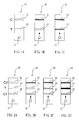
- Figs. 1A, 1B and 1C are schematic and operational views of a traditionally biological test strip
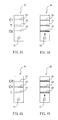
- FIGs. 2A, 2B, 2C and 2D are schematic and operational views of a biological test strip according to a first embodiment of the present invention
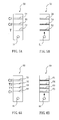
- FIGs. 3A and 3B are schematic and operational views of a biological test strip according to a second preferred embodiment of the present invention.
- FIGs. 4A and 4B are schematic and operational views of a biological test strip according to a third preferred embodiment of the present invention.
- FIGs. 5A and 5B are schematic and operational views of a biological test strip according to a fourth preferred embodiment of the present invention.
- FIGs. 6A and 6B are schematic and operational views of a biological test strip according to a fifth preferred embodiment of the present invention.
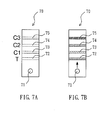
- Figs. 7A and 7B are schematic and operational views of a biological test strip according to a sixth preferred embodiment of the present invention.
- the biological test strip designated by numeral 20 comprises a source end 21, a first control line 22, a test line 23 and a second control line 24, all of which are arranged on the biological test strip 20 in turn.
- the biological test strip 20 can be made of various test substrates which can guide a liquid to extend, wherein the test substrates can be selected from test paper made of natural cellulose, synthetic cellulose paper (such as nitrocellulose) or other equivalent material.
- the biological test strip 20 can be installed with a suitable housing or other elements (such as a drying agent, not-shown) to commonly construct a suitable detection device for being conveniently applied to various detections of samples (including ethanol, medicines, cancer molecules or other related disease molecules in the urine or blood), pregnancy, or other biological researches.
- a housing If a housing is provided, the housing can be labeled with suitable symbols or texts (such as C1, T, C2, and etc.) for conveniently distinguishing the first control line 22, the test line 23 and the second control line 24 from each other.
- suitable symbols or texts such as C1, T, C2, and etc.
- the biological test strip 20 is preferably an elongated paper strip, but the shape is not limited thereto.
- the shape of the biological test strip 20 can be varied according to the shape of a final product.
- the source end 21 is formed on a position adjacent to one end of the biological test strip 20.
- the source end 21 is a zone for dropping a sample liquid thereon.
- the source end 21 is preferably circular or rectangular, but the shape is not limited thereto.
- the shape of the source end 21 can be varied according to the shape of the final product.
- the first control line 22, the test line 23 and the second control line 24 are formed by coating suitable colorization probes on the biological test strip 20 in advance.
- the first control line 22, the test line 23 and the second control line 24 can use identical colorization probes with different probe concentrations or use different types of colorization probes.
- the colorization probes are colorless before a colorization reaction. After a colorization reaction is finished, the colorization probes can show a predetermined color, such as red or black.
- the type and color of the colorization probes can be varied according to the application of the biological test strip 20 without limitation.
- the first control line 22 has a colorization probe which can react with the sample liquid to generate a colorization reaction with a relatively lighter color, so as to define a predetermined minimum concentration value used as a color comparison reference for the test line 23.
- the second control line 24 has a colorization probe which can react with the sample liquid to generate a colorization reaction with a relatively darker color, so as to define a predetermined maximum concentration value used as a color comparison reference for the test line 23.
- the test line 23 has a colorization probe which can react with at least one sample in the sample liquid to generate a colorization reaction.
- the test line 23 is preferably disposed between the source end 21 and the second control line 24.
- the biological test strip 20 is designed based on immuno-chromatographic principle. For example, a region between the source end 21 and the first control line 22 is pre-coated with a specific antigen (or the specific antigen is directly pre-coated on the source end 21). When the sample liquid moves through the region, the antigen will be dissolved into the sample liquid and move with the sample liquid. Thus, the antigen in the sample liquid reacts with a first colorization probe of the first control line 22 and/or the second control line 24 to cause a control colorization reaction.
- the sample liquid further contains a sample defined as an antibody
- the antibody in the sample liquid reacts with a second colorization probe of the test line 23 to cause a test colorization reaction.
- the sample liquid contains no sample, there will be no test colorization reaction between the sample liquid and the test line 23, while only the antigen in the sample liquid reacts with the first control line 22 and the second control line 24 to cause the control colorization reaction.
- the present invention also can be carried out by other equivalent colorization principle without limitation.
- the biological test strip 20 of the first embodiment of the present invention when used to detect if a sample liquid contains a sample (such as ethanol or medicine), the sample liquid is firstly dropped to the source end 21. After this, the sample liquid (and the sample therein) extends toward and passes through the first control line 22, the test line 23 and the second control line 24 in turn. As shown in Fig. 2B , after the sample liquid is dropped for a test, the first control line 22 generates a colorization reaction with a relatively lighter color, the second control line 24 generates a colorization reaction with a relatively darker color, and the test line 23 is still colorless (or has a color weaker than that of the first control line 22).
- a sample such as ethanol or medicine
- the test result will be a negative reaction.
- a detection analyzer (not-shown) is used to execute a quantitative analysis, wherein the detection analyzer uses color comparison references defined by the predetermined minimum concentration value of the first control line 22 and the predetermined maximum concentration value of the second control line 24.
- the color darkness of the test line 23 can be calculated and evaluated by an algorithm (such as an interpolation algorithm), so as to speedily obtain the concentration of the sample in the sample liquid.
- the detection result shows that the concentration of the sample (such as ethanol or medicine) in the sample liquid is zero or less than the predetermined minimum concentration value.
- the detection analyzer similarly uses the color comparison references defined by the predetermined minimum concentration value of the first control line 22 and the predetermined maximum concentration value of the second control line 24, and then calculates the color darkness generated by a colorization reaction of the test line 23 based on the interpolation algorithm. If the color darkness of the test line 23 is sandwiched between that of the first control line 22 and the second control line 24, the test result will be a positive reaction, wherein the concentration of the sample in the sample liquid is greater than the predetermined minimum concentration value but less than the predetermined maximum concentration value.
- the detection analyzer similarly uses the color comparison references defined by the predetermined minimum concentration value of the first control line 22 and the predetermined maximum concentration value of the second control line 24, and then calculates the color darkness generated by a colorization reaction of the test line 23 based on the interpolation algorithm. If the color darkness of the test line 23 is greater than that of the first control line 22 and the second control line 24, the test result will be an overdose positive reaction, wherein the concentration of the sample in the sample liquid is greater than the predetermined maximum concentration value.
- the biological test strip designated by numeral 30 comprises a source end 31, a second control line 32, a test line 33 and a first control line 34, all of which are arranged on the biological test strip 30 in turn, wherein the arrangement order of the second embodiment is different from that of the first embodiment.
- Figs. 3A and 3B are additionally labeled by "C2", “T” and "C1" to represent the second control line 32, the test line 33 and the first control line 34 in turn.
- the first control line 34 has a colorization probe which can react with the sample liquid to generate a colorization reaction with a relatively lighter color, so as to define a predetermined minimum concentration value used as a color comparison reference for the test line 33.
- the second control line 32 has a colorization probe which can react with the sample liquid to generate a colorization reaction with a relatively darker color, so as to define a predetermined maximum concentration value used as a color comparison reference for the test line 33.
- the detection analyzer uses the color comparison references defined by the predetermined minimum concentration value of the first control line 34 and the predetermined maximum concentration value of the second control line 32, and then calculates the color darkness generated by a colorization reaction of the test line 33 based on the interpolation algorithm. If the color darkness of the test line 33 is sandwiched between that of the first control line 34 and the second control line 32, the test result will be a positive reaction, wherein the concentration of the sample in the sample liquid is greater than the predetermined minimum concentration value but less than the predetermined maximum concentration value. Furthermore, in the second embodiment, the principles of a negative reaction or an overdose positive reaction are similar to that of the first embodiment, so that the detailed description thereof will be omitted hereinafter.
- a biological test strip according to a third embodiment of the present invention is illustrated and similar to the first and second embodiments.
- the biological test strip designated by numeral 40 comprises a source end 41, a test line 42, a first control line 43 and a second control line 44, all of which are arranged on the biological test strip 40 in turn, wherein the arrangement order of the third embodiment is different from that of the first and second embodiments.
- Figs. 4A and 4B are additionally labeled by "T", "C1" and "C2" to represent the test line 42, the first control line 43 and the second control line 44 in turn.
- the first control line 43 has a colorization probe which can react with the sample liquid to generate a colorization reaction with a relatively lighter color, so as to define a predetermined minimum concentration value used as a color comparison reference for the test line 42.
- the second control line 44 has a colorization probe which can react with the sample liquid to generate a colorization reaction with a relatively darker color, so as to define a predetermined maximum concentration value used as a color comparison reference for the test line 42.
- the test result will be a positive reaction, wherein the concentration of the sample in the sample liquid is greater than the predetermined minimum concentration value but less than the predetermined maximum concentration value.
- the principles of a negative reaction or an overdose positive reaction are similar to that of the first and second embodiments, so that the detailed description thereof will be omitted hereinafter.
- a biological test strip according to a fourth embodiment of the present invention is illustrated and similar to the first, second and third embodiments.
- the biological test strip designated by numeral 50 comprises a source end 51, a test line 52, a second control line 53 and a first control line 54, all of which are arranged on the biological test strip 50 in turn, wherein the arrangement order of the fourth embodiment is different from that of the first, second and third embodiments.
- Figs. 5A and 5B are additionally labeled by "T", "C2" and "C1" to represent the test line 52, the second control line 53 and the first control line 54 in turn.
- the first control line 54 has a colorization probe which can react with the sample liquid to generate a colorization reaction with a relatively lighter color, so as to define a predetermined minimum concentration value used as a color comparison reference for the test line 52.
- the second control line 53 has a colorization probe which can react with the sample liquid to generate a colorization reaction with a relatively darker color, so as to define a predetermined maximum concentration value used as a color comparison reference for the test line 52.
- test result will be a positive reaction, wherein the concentration of the sample in the sample liquid is greater than the predetermined minimum concentration value but less than the predetermined maximum concentration value.
- concentration of the sample in the sample liquid is greater than the predetermined minimum concentration value but less than the predetermined maximum concentration value.
- the biological test strip designated by numeral 60 comprises a source end 61, a first control line 62, a first test line 63, a second test line 64 and a second control line 65, all of which are arranged on the biological test strip 60 in turn, wherein the number of the test lines 63, 64 can be two or more than two, while the arrangement order of the test lines 63, 64, the first control line 62 and the second control line 65 can be varied according to that of the first, second, third or fourth embodiments. For conveniently distinguishing these lines from each other, Figs.
- the first control line 62 has a colorization probe which can react with the sample liquid to generate a colorization reaction with a relatively lighter color, so as to define a predetermined minimum concentration value used as a color comparison reference for the test lines 63, 64.
- the second control line 65 has a colorization probe which can react with the sample liquid to generate a colorization reaction with a relatively darker color, so as to define a predetermined maximum concentration value used as a color comparison reference for the test lines 63, 64.
- each of the test lines 63, 64 after the sample liquid is dropped for a test, each of the test lines 63, 64 generates a colorization reaction. If the color darkness of the colorization reaction of the test line 63 or 64 is determined to be sandwiched between that of the first control line 62 and the second control line 65, the test result will be a positive reaction, wherein the concentration of the sample in the sample liquid is greater than the predetermined minimum concentration value but less than the predetermined maximum concentration value. Furthermore, in the fifth embodiment, the principles of a negative reaction or an overdose positive reaction are similar to that of the first, second, third and fourth embodiments, so that the detailed description thereof will be omitted hereinafter.
- the biological test strip designated by numeral 70 comprises a source end 71, a test line 72, a first control line 73, a second control line 74 and a third control line 75, all of which are arranged on the biological test strip 70 in turn, wherein the number of the control lines 73, 74, 75 can be three or more than three, while the arrangement order of the test line 72, the first control line 73, the second control line 74 and the third control line 75 can be varied according to that of the first, second, third or fourth embodiments.
- Figs. 7A and 7B are additionally labeled by "T”, "C1", “C2” and “C3" to represent the test line 72, the first control line 73, the second control line 74 and the third control line 75 in turn.
- the first control line 73 has a colorization probe which can react with the sample liquid to generate a colorization reaction with a relatively lighter color, so as to define a predetermined minimum concentration value used as a color comparison reference for the test line 72.
- the third control line 75 has a colorization probe which can react with the sample liquid to generate a colorization reaction with a relatively darker color, so as to define a predetermined maximum concentration value used as a color comparison reference for the test line 72.
- the second control line 74 can generate a colorization reaction to define a predetermined intermediate concentration value between the predetermined minimum concentration value and the predetermined maximum concentration value, wherein the predetermined intermediate concentration value is also used as a color comparison reference for the test line 72.
- the test line 72 After the sample liquid is dropped for a test, the test line 72 generates a colorization reaction. If the color darkness of the colorization reaction of the test line 72 is determined to be sandwiched between that of the first control line 73 and the second control line 74 (or between that of the second control line 74 and the third control line 75), the test result will be a positive reaction, wherein the concentration of the sample in the sample liquid is greater than the predetermined minimum concentration value but less than the predetermined maximum concentration value.
- the concentration of the sample can be detected more definitely.
- the principles of a negative reaction or an overdose positive reaction are similar to that of the first, second, third, fourth and fifth embodiments, so that the detailed description thereof will be omitted hereinafter.
- the biological test strip 20 of the present invention in comparison with the traditionally biological test strip which only has the single control line 13 for comparing with the color darkness of the test line 12 and may cause the concentration errors or inaccurate determination when the detected result is detected by the detection analyzer, the biological test strip 20 of the present invention, as shown in Figs. 2A to 2D , has the at least two control lines 22, 24 for providing at least two color comparison references with different color darkness (i.e. for defining a predetermined maximum concentration value and a predetermined minimum concentration value), so as to correctly compare with the concentration value of the at least one test line 23 and correctly determine if the colorization reaction of the test line 23 is a negative reaction.
- the concentration error and the inaccurate determination probability can be efficiently lowered, while the concentration detection accuracy and the operational convenience can be efficiently increased.
Landscapes
- Health & Medical Sciences (AREA)
- Immunology (AREA)
- Life Sciences & Earth Sciences (AREA)
- Engineering & Computer Science (AREA)
- Molecular Biology (AREA)
- Biomedical Technology (AREA)
- Chemical & Material Sciences (AREA)
- Hematology (AREA)
- Urology & Nephrology (AREA)
- Biotechnology (AREA)
- Biochemistry (AREA)
- Cell Biology (AREA)
- Food Science & Technology (AREA)
- Medicinal Chemistry (AREA)
- Physics & Mathematics (AREA)
- Analytical Chemistry (AREA)
- Microbiology (AREA)
- General Health & Medical Sciences (AREA)
- General Physics & Mathematics (AREA)
- Pathology (AREA)
- Investigating Or Analysing Materials By The Use Of Chemical Reactions (AREA)
- Investigating Or Analysing Biological Materials (AREA)
- Apparatus Associated With Microorganisms And Enzymes (AREA)
Abstract
A biological test strip is disclosed and includes a source end, at least one test line and at least two control lines. The source end is used for dropping a sample liquid thereon. The at least one test line is used to react with at least one sample of the sample liquid to generate a colorization reaction. The at least two control lines, are used to react with the sample liquid to generate at least two colorization reactions with different color darkness, so as to define a predetermined maximum concentration value and a predetermined minimum concentration value, both of which can be used as color comparison references for the at least one test line.
Description
- The present invention relates to a biological test strip, and more particularly to a biological test strip having at least two control lines for increasing the detection accuracy.
- Recently, various biological detection experiments are developed for satisfying needs of hospitals, clinics, researchers, or personal users. For this purpose, manufacturers continuously improve and develop various simple biological test strips which can speedily show the detection result after being used, in order to increase the operational convenience. According to the difference between biological specimens, there are various different design principles of the biological test strips. Furthermore, the biological test strips can be used to detect samples (such as ethanol, medicines, cancer molecules or other related disease molecules) in the urine or blood, while some biological test strips can be used to detection the pregnancy.
- For example, referring now to
Fig. 1A , a traditionally biological test strip is illustrated. As shown, the biological test strip comprises asubstrate 10 which is generally a paper strip and provided with asource end 11, a test line 12 (also labeled by "T"), and a control line 13 (also labeled by "C"), wherein the paper strip is designed based on immuno-chromatographic principle. Thesource end 11 is used for dropping a sample liquid thereon. If the sample liquid is dropped, the sample liquid and a sample therein will extend toward thetest line 12 and thecontrol line 13. Thetest line 12 is used to react with the sample of the sample liquid to determine if the sample exists in the sample liquid. Thecontrol line 13 are used to react with the sample liquid to be used as a color comparison reference for determining if the sample liquid has extended and passed through thetest line 12 and if the detection operation is finished. - Referring to
Fig. 1A , before the sample liquid is dropped, thetest line 12 and thecontrol line 13 are colorless. Referring now toFig. 1B , after the sample liquid is dropped for a test, thetest line 12 is still colorless, but thecontrol line 13 generates a colorization reaction. In this case, the test result is defined as a negative reaction which means that the concentration of the sample (such as ethanol or medicines) in the sample liquid is zero or less than a predetermined minimum concentration value. Alternatively, referring now toFig. 1C , after the sample liquid is dropped for a test, each of thetest line 12 and thecontrol line 13 generates a colorization reaction. In this case, the test result is defined as a positive reaction which means that the concentration of the sample (such as ethanol or medicines) in the sample liquid is greater than a predetermined concentration value. At this time, a colorization degree of thetest line 12 can be compared with that of thecontrol line 13, in order to evaluate the concentration value of the sample in the sample liquid. - However, referring to
Fig. 1C , when the traditionally biological test strip is actually used, thesubstrate 10 only can provide thesingle control line 13 for being compared with the color of thetest line 12. Thus, when a detection analyzer (not-shown) is used to determine the color darkness, the detection result of the detection analyzer easily includes errors and distortions of concentration values. Furthermore, under a certain condition, the concentration of the sample in the sample liquid may be only slightly greater than the predetermined minimum concentration value, so that the colorization reaction of thetest line 12 may be vary weak. At this time, the colorization reaction of the test line 1 is actually a positive reaction, but it may be inaccurately determined to be a negative reaction by naked eyes or the detection analyzer. The foregoing problems of concentration errors or inaccurate determination may substantially lower the operational convenience and the detection accuracy. - Moreover, a traditional method of automatically detecting a test result of a probe zone of a test strip is applied to the field of biological test strip, wherein a scanning object includes a bar code and a plurality of test strips, both of which are arranged on the scanning object in turn. Each of the test strips has a colorization pattern of a control line and a plurality of test lines. The control line and each of the test lines are corresponding to a probe zone on the test strips. After the test strips are reacted with a test liquid, the scanning object are scanned to read the bar code pattern and the images of the test strips. Then, decoding the bar code pattern to obtain the information of types of the test strips, so that a plurality of mapping tables of setting values versus positions of the test lines of one of the test strips can be obtained. Each of the test strips corresponds to one of the mapping tables based on the type of the test strip. Each of the setting values of the mapping table corresponds to one test line of the test strip. Calculating a color response of one test line of the test strip based on the image of the test strip, and comparing the color response of the test line with the setting value from the mapping table corresponding thereto. Thereby, determining whether the test line has a positive test result or a negative test result in response to a specific sample in the test liquid detected by the test strip.
- According the foregoing detection method, the bar code of the scanning object can be used to simultaneously detect several detection items of a plurality of different test strips. However, when the scanning object is actually used, each of the test strips still has a single control line for comparing with the color darkness of the test lines on the same test strip. Thus, when a detection analyzer is used to determine the color darkness, the detection result of the detection analyzer still includes errors and distortions of concentration values. Furthermore, if the concentration of the specific sample in the test liquid used by each of the test strips is only slightly greater than a predetermined minimum concentration value, the colorization reaction of the test lines on each of the test strips may be still weak. At this time, there is still a risk that a weak positive reaction may be inaccurately determined to be a negative reaction by the detection analyzer. As a result, the foregoing detection method and the design of the scanning object can not substantially improve the detection accuracy.
- As a result, it is important for designers and related manufacturers to think how to develop a biological test strip to solve the problems existing in the traditionally biological test strips, as described above.
- A primary object of the present invention is to provide a biological test strip, which has at least two control lines for providing at least two color comparison references with different color darkness, so as to correctly compare with and determine the concentration value of at least one test line, for the purpose of efficiently lowering the concentration error and increasing the concentration detection accuracy.
- A secondary object of the present invention is to provide a biological test strip, which has at least two control lines for defining a predetermined maximum concentration value and a predetermined minimum concentration value, so as to correctly determine if the colorization reaction of at least one test line is a negative reaction, for the purpose of efficiently lowering the inaccurate determination probability and increasing the operational convenience.
- To achieve the above object, the biological test strip of a preferred embodiment of the present invention comprises a source end, at least one test line and at least two control lines. The source end is used for dropping a sample liquid thereon. The at least one test line is used to react with at least one sample of the sample liquid to generate a colorization reaction. The at least two control lines are used to react with the sample liquid to generate at least two colorization reactions with different color darkness, so as to define a predetermined maximum concentration value and a predetermined minimum concentration value, both of which can be used as color comparison references for the at least one test line.
- In one embodiment of the present invention, the at least one test line is disposed between the source end and at least one of the control lines.
- In one embodiment of the present invention, the at least two control lines comprises a first control line and a second control line, the first control line can generate a colorization reaction to define the predetermined minimum concentration value, while the second control line can generate a colorization reaction to define the predetermined maximum concentration value.
- In one embodiment of the present invention, the source end, the first control line, the at least one test line and the second control line are arranged on the biological test strip in turn.
- In one embodiment of the present invention, the source end, the second control line, the at least one test line and the first control line are arranged on the biological test strip in turn.
- In one embodiment of the present invention, the source end, the at least one test line, the first control line and the second control line are arranged on the biological test strip in turn.
- In one embodiment of the present invention, the source end, the at least one test line, the second control line and the first control line are arranged on the biological test strip in turn.
- In one embodiment of the present invention, the number of the at least one test line is two or more than two.
- In one embodiment of the present invention, the number of the at least two control lines is three or more than three.
- In one embodiment of the present invention, the at least two control lines comprises a first control line, a second control line and a third control line, the first control line can generate a colorization reaction to define the predetermined minimum concentration value, the third control line can generate a colorization reaction to define the predetermined maximum concentration value, and the second control line can generate a colorization reaction to define a predetermined intermediate concentration value between the predetermined minimum concentration value and the predetermined maximum concentration value.
- The structure and the technical means adopted by the present invention to achieve the above and other objects can be best understood by referring to the following detailed description of the preferred embodiments and the accompanying drawings, wherein
-
Figs. 1A, 1B and 1C are schematic and operational views of a traditionally biological test strip; -
Figs. 2A, 2B, 2C and 2D are schematic and operational views of a biological test strip according to a first embodiment of the present invention; -
Figs. 3A and 3B are schematic and operational views of a biological test strip according to a second preferred embodiment of the present invention; -
Figs. 4A and 4B are schematic and operational views of a biological test strip according to a third preferred embodiment of the present invention; -
Figs. 5A and 5B are schematic and operational views of a biological test strip according to a fourth preferred embodiment of the present invention; -
Figs. 6A and 6B are schematic and operational views of a biological test strip according to a fifth preferred embodiment of the present invention; and -
Figs. 7A and 7B are schematic and operational views of a biological test strip according to a sixth preferred embodiment of the present invention. - Referring now to
Fig. 2A , a biological test strip according to a first embodiment of the present invention is illustrated. As shown, the biological test strip designated bynumeral 20 comprises asource end 21, afirst control line 22, atest line 23 and asecond control line 24, all of which are arranged on thebiological test strip 20 in turn. In the present invention, thebiological test strip 20 can be made of various test substrates which can guide a liquid to extend, wherein the test substrates can be selected from test paper made of natural cellulose, synthetic cellulose paper (such as nitrocellulose) or other equivalent material. Furthermore, thebiological test strip 20 can be installed with a suitable housing or other elements (such as a drying agent, not-shown) to commonly construct a suitable detection device for being conveniently applied to various detections of samples (including ethanol, medicines, cancer molecules or other related disease molecules in the urine or blood), pregnancy, or other biological researches. If a housing is provided, the housing can be labeled with suitable symbols or texts (such as C1, T, C2, and etc.) for conveniently distinguishing thefirst control line 22, thetest line 23 and thesecond control line 24 from each other. However, as described above, the material, the installation, the application or the label means of thebiological test strip 20 can be varied according to actual needs, without limitation. - Referring back to
Fig. 2A , in the first embodiment of the present invention, thebiological test strip 20 is preferably an elongated paper strip, but the shape is not limited thereto. The shape of thebiological test strip 20 can be varied according to the shape of a final product. Furthermore, the source end 21 is formed on a position adjacent to one end of thebiological test strip 20. The source end 21 is a zone for dropping a sample liquid thereon. The source end 21 is preferably circular or rectangular, but the shape is not limited thereto. The shape of the source end 21 can be varied according to the shape of the final product. - Referring still to
Fig. 2A , in the first embodiment of the present invention, thefirst control line 22, thetest line 23 and thesecond control line 24 are formed by coating suitable colorization probes on thebiological test strip 20 in advance. Meanwhile, thefirst control line 22, thetest line 23 and thesecond control line 24 can use identical colorization probes with different probe concentrations or use different types of colorization probes. Generally, the colorization probes are colorless before a colorization reaction. After a colorization reaction is finished, the colorization probes can show a predetermined color, such as red or black. The type and color of the colorization probes can be varied according to the application of thebiological test strip 20 without limitation. In the first embodiment, thefirst control line 22 has a colorization probe which can react with the sample liquid to generate a colorization reaction with a relatively lighter color, so as to define a predetermined minimum concentration value used as a color comparison reference for thetest line 23. Meanwhile, thesecond control line 24 has a colorization probe which can react with the sample liquid to generate a colorization reaction with a relatively darker color, so as to define a predetermined maximum concentration value used as a color comparison reference for thetest line 23. Furthermore, thetest line 23 has a colorization probe which can react with at least one sample in the sample liquid to generate a colorization reaction. Thetest line 23 is preferably disposed between the source end 21 and thesecond control line 24. As a result, if thesecond control line 24 generates a colorization reaction, it can be ensured that the sample liquid has extended and passed through thetest line 23 for finishing a detection operation. In one embodiment, thebiological test strip 20 is designed based on immuno-chromatographic principle. For example, a region between the source end 21 and thefirst control line 22 is pre-coated with a specific antigen (or the specific antigen is directly pre-coated on the source end 21). When the sample liquid moves through the region, the antigen will be dissolved into the sample liquid and move with the sample liquid. Thus, the antigen in the sample liquid reacts with a first colorization probe of thefirst control line 22 and/or thesecond control line 24 to cause a control colorization reaction. Meanwhile, if the sample liquid further contains a sample defined as an antibody, the antibody in the sample liquid reacts with a second colorization probe of thetest line 23 to cause a test colorization reaction. On the other hand, if the sample liquid contains no sample, there will be no test colorization reaction between the sample liquid and thetest line 23, while only the antigen in the sample liquid reacts with thefirst control line 22 and thesecond control line 24 to cause the control colorization reaction. However, the present invention also can be carried out by other equivalent colorization principle without limitation. - Referring now to
Figs. 2B, 2C and 2D , when thebiological test strip 20 of the first embodiment of the present invention is used to detect if a sample liquid contains a sample (such as ethanol or medicine), the sample liquid is firstly dropped to thesource end 21. After this, the sample liquid (and the sample therein) extends toward and passes through thefirst control line 22, thetest line 23 and thesecond control line 24 in turn. As shown inFig. 2B , after the sample liquid is dropped for a test, thefirst control line 22 generates a colorization reaction with a relatively lighter color, thesecond control line 24 generates a colorization reaction with a relatively darker color, and thetest line 23 is still colorless (or has a color weaker than that of the first control line 22). In this case, the test result will be a negative reaction. According to the present invention, a detection analyzer (not-shown) is used to execute a quantitative analysis, wherein the detection analyzer uses color comparison references defined by the predetermined minimum concentration value of thefirst control line 22 and the predetermined maximum concentration value of thesecond control line 24. Thus, the color darkness of thetest line 23 can be calculated and evaluated by an algorithm (such as an interpolation algorithm), so as to speedily obtain the concentration of the sample in the sample liquid. As shown inFig. 2B , the detection result shows that the concentration of the sample (such as ethanol or medicine) in the sample liquid is zero or less than the predetermined minimum concentration value. - Referring now to
Fig. 2C , after the sample liquid is dropped for a test, the detection analyzer similarly uses the color comparison references defined by the predetermined minimum concentration value of thefirst control line 22 and the predetermined maximum concentration value of thesecond control line 24, and then calculates the color darkness generated by a colorization reaction of thetest line 23 based on the interpolation algorithm. If the color darkness of thetest line 23 is sandwiched between that of thefirst control line 22 and thesecond control line 24, the test result will be a positive reaction, wherein the concentration of the sample in the sample liquid is greater than the predetermined minimum concentration value but less than the predetermined maximum concentration value. - Referring now to
Fig. 2D , after the sample liquid is dropped for a test, the detection analyzer similarly uses the color comparison references defined by the predetermined minimum concentration value of thefirst control line 22 and the predetermined maximum concentration value of thesecond control line 24, and then calculates the color darkness generated by a colorization reaction of thetest line 23 based on the interpolation algorithm. If the color darkness of thetest line 23 is greater than that of thefirst control line 22 and thesecond control line 24, the test result will be an overdose positive reaction, wherein the concentration of the sample in the sample liquid is greater than the predetermined maximum concentration value. - Referring now to
Figs. 3A and 3B , a biological test strip according to a second embodiment of the present invention is illustrated and similar to the first embodiment. As shown, the biological test strip designated bynumeral 30 comprises asource end 31, asecond control line 32, atest line 33 and afirst control line 34, all of which are arranged on thebiological test strip 30 in turn, wherein the arrangement order of the second embodiment is different from that of the first embodiment. For conveniently distinguishing these lines from each other,Figs. 3A and 3B are additionally labeled by "C2", "T" and "C1" to represent thesecond control line 32, thetest line 33 and thefirst control line 34 in turn. In the second embodiment, thefirst control line 34 has a colorization probe which can react with the sample liquid to generate a colorization reaction with a relatively lighter color, so as to define a predetermined minimum concentration value used as a color comparison reference for thetest line 33. Meanwhile, thesecond control line 32 has a colorization probe which can react with the sample liquid to generate a colorization reaction with a relatively darker color, so as to define a predetermined maximum concentration value used as a color comparison reference for thetest line 33. Thus, as shown inFig. 3B , after the sample liquid is dropped for a test, the detection analyzer uses the color comparison references defined by the predetermined minimum concentration value of thefirst control line 34 and the predetermined maximum concentration value of thesecond control line 32, and then calculates the color darkness generated by a colorization reaction of thetest line 33 based on the interpolation algorithm. If the color darkness of thetest line 33 is sandwiched between that of thefirst control line 34 and thesecond control line 32, the test result will be a positive reaction, wherein the concentration of the sample in the sample liquid is greater than the predetermined minimum concentration value but less than the predetermined maximum concentration value. Furthermore, in the second embodiment, the principles of a negative reaction or an overdose positive reaction are similar to that of the first embodiment, so that the detailed description thereof will be omitted hereinafter. - Referring now to
Figs. 4A and 4B , a biological test strip according to a third embodiment of the present invention is illustrated and similar to the first and second embodiments. As shown, the biological test strip designated bynumeral 40 comprises asource end 41, atest line 42, afirst control line 43 and asecond control line 44, all of which are arranged on thebiological test strip 40 in turn, wherein the arrangement order of the third embodiment is different from that of the first and second embodiments. For conveniently distinguishing these lines from each other,Figs. 4A and 4B are additionally labeled by "T", "C1" and "C2" to represent thetest line 42, thefirst control line 43 and thesecond control line 44 in turn. In the third embodiment, thefirst control line 43 has a colorization probe which can react with the sample liquid to generate a colorization reaction with a relatively lighter color, so as to define a predetermined minimum concentration value used as a color comparison reference for thetest line 42. Meanwhile, thesecond control line 44 has a colorization probe which can react with the sample liquid to generate a colorization reaction with a relatively darker color, so as to define a predetermined maximum concentration value used as a color comparison reference for thetest line 42. Thus, as shown inFig. 4B , after the sample liquid is dropped for a test, thetest line 42 generates a colorization reaction. If the color darkness of the colorization reaction of thetest line 42 is determined to be sandwiched between that of thefirst control line 43 and thesecond control line 44, the test result will be a positive reaction, wherein the concentration of the sample in the sample liquid is greater than the predetermined minimum concentration value but less than the predetermined maximum concentration value. Furthermore, in the third embodiment, the principles of a negative reaction or an overdose positive reaction are similar to that of the first and second embodiments, so that the detailed description thereof will be omitted hereinafter. - Referring now to
Figs. 5A and 5B , a biological test strip according to a fourth embodiment of the present invention is illustrated and similar to the first, second and third embodiments. As shown, the biological test strip designated bynumeral 50 comprises asource end 51, atest line 52, asecond control line 53 and afirst control line 54, all of which are arranged on thebiological test strip 50 in turn, wherein the arrangement order of the fourth embodiment is different from that of the first, second and third embodiments. For conveniently distinguishing these lines from each other,Figs. 5A and 5B are additionally labeled by "T", "C2" and "C1" to represent thetest line 52, thesecond control line 53 and thefirst control line 54 in turn. In the fourth embodiment, thefirst control line 54 has a colorization probe which can react with the sample liquid to generate a colorization reaction with a relatively lighter color, so as to define a predetermined minimum concentration value used as a color comparison reference for thetest line 52. Meanwhile, thesecond control line 53 has a colorization probe which can react with the sample liquid to generate a colorization reaction with a relatively darker color, so as to define a predetermined maximum concentration value used as a color comparison reference for thetest line 52. Thus, as shown inFig. 5B , after the sample liquid is dropped for a test, thetest line 52 generates a colorization reaction. If the color darkness of the colorization reaction of thetest line 52 is determined to be sandwiched between that of thefirst control line 54 and thesecond control line 53, the test result will be a positive reaction, wherein the concentration of the sample in the sample liquid is greater than the predetermined minimum concentration value but less than the predetermined maximum concentration value. Furthermore, in the fourth embodiment, the principles of a negative reaction or an overdose positive reaction are similar to that of the first, second and third embodiments, so that the detailed description thereof will be omitted hereinafter. - Referring now to
Figs. 6A and 6B , a biological test strip according to a fifth embodiment of the present invention is illustrated and similar to the first, second, third and fourth embodiments. As shown, the biological test strip designated bynumeral 60 comprises asource end 61, afirst control line 62, afirst test line 63, asecond test line 64 and asecond control line 65, all of which are arranged on thebiological test strip 60 in turn, wherein the number of thetest lines test lines first control line 62 and thesecond control line 65 can be varied according to that of the first, second, third or fourth embodiments. For conveniently distinguishing these lines from each other,Figs. 6A and 6B are additionally labeled by "C1", "T1", "T2" and "C2" to represent thefirst control line 62, thefirst test line 63, thesecond test line 64 and thesecond control line 65 in turn. In the fifth embodiment, thefirst control line 62 has a colorization probe which can react with the sample liquid to generate a colorization reaction with a relatively lighter color, so as to define a predetermined minimum concentration value used as a color comparison reference for thetest lines second control line 65 has a colorization probe which can react with the sample liquid to generate a colorization reaction with a relatively darker color, so as to define a predetermined maximum concentration value used as a color comparison reference for thetest lines Fig. 6B , after the sample liquid is dropped for a test, each of thetest lines test line first control line 62 and thesecond control line 65, the test result will be a positive reaction, wherein the concentration of the sample in the sample liquid is greater than the predetermined minimum concentration value but less than the predetermined maximum concentration value. Furthermore, in the fifth embodiment, the principles of a negative reaction or an overdose positive reaction are similar to that of the first, second, third and fourth embodiments, so that the detailed description thereof will be omitted hereinafter. - Referring now to
Figs. 7A and 7B , a biological test strip according to a sixth embodiment of the present invention is illustrated and similar to the first, second, third, fourth and fifth embodiments. As shown, the biological test strip designated bynumeral 70 comprises asource end 71, atest line 72, afirst control line 73, asecond control line 74 and athird control line 75, all of which are arranged on thebiological test strip 70 in turn, wherein the number of thecontrol lines test line 72, thefirst control line 73, thesecond control line 74 and thethird control line 75 can be varied according to that of the first, second, third or fourth embodiments. For conveniently distinguishing these lines from each other,Figs. 7A and 7B are additionally labeled by "T", "C1", "C2" and "C3" to represent thetest line 72, thefirst control line 73, thesecond control line 74 and thethird control line 75 in turn. In the sixth embodiment, thefirst control line 73 has a colorization probe which can react with the sample liquid to generate a colorization reaction with a relatively lighter color, so as to define a predetermined minimum concentration value used as a color comparison reference for thetest line 72. Meanwhile, thethird control line 75 has a colorization probe which can react with the sample liquid to generate a colorization reaction with a relatively darker color, so as to define a predetermined maximum concentration value used as a color comparison reference for thetest line 72. Thesecond control line 74 can generate a colorization reaction to define a predetermined intermediate concentration value between the predetermined minimum concentration value and the predetermined maximum concentration value, wherein the predetermined intermediate concentration value is also used as a color comparison reference for thetest line 72. Thus, as shown inFig. 7B , after the sample liquid is dropped for a test, thetest line 72 generates a colorization reaction. If the color darkness of the colorization reaction of thetest line 72 is determined to be sandwiched between that of thefirst control line 73 and the second control line 74 (or between that of thesecond control line 74 and the third control line 75), the test result will be a positive reaction, wherein the concentration of the sample in the sample liquid is greater than the predetermined minimum concentration value but less than the predetermined maximum concentration value. As a result, the concentration of the sample can be detected more definitely. Furthermore, in the sixth embodiment, the principles of a negative reaction or an overdose positive reaction are similar to that of the first, second, third, fourth and fifth embodiments, so that the detailed description thereof will be omitted hereinafter. - As described above, in comparison with the traditionally biological test strip which only has the
single control line 13 for comparing with the color darkness of thetest line 12 and may cause the concentration errors or inaccurate determination when the detected result is detected by the detection analyzer, thebiological test strip 20 of the present invention, as shown inFigs. 2A to 2D , has the at least twocontrol lines test line 23 and correctly determine if the colorization reaction of thetest line 23 is a negative reaction. As a result, the concentration error and the inaccurate determination probability can be efficiently lowered, while the concentration detection accuracy and the operational convenience can be efficiently increased. - The present invention has been described with a preferred embodiment thereof and it is understood that many changes and modifications to the described embodiment can be carried out without departing from the scope and the spirit of the invention that is intended to be limited only by the appended claims.
Claims (14)
- A biological test strip, comprising:a source end for dropping a sample liquid thereon;at least one test line for reacting with at least one sample of the sample liquid to generate a colorization reaction; andat least two control lines for reacting with the sample liquid to generate at least two colorization reactions with different color darkness, so as to define a predetermined maximum concentration value and a predetermined minimum concentration value, both of which are used as color comparison references for the at least one test line.
- The biological test strip of claim 1, wherein the at least one test line is disposed between the source end and at least one of the control lines.
- The biological test strip of claim 1, wherein the at least two control lines comprises a first control line and a second control line, the first control line can generate a colorization reaction to define the predetermined minimum concentration value, while the second control line can generate a colorization reaction to define the predetermined maximum concentration value.
- The biological test strip of claim 3, wherein the source end, the first control line, the at least one test line and the second control line are arranged on the biological test strip in turn.
- The biological test strip of claim 4, wherein the number of the at least one test line is two or more than two.
- The biological test strip of claim 3, wherein the source end, the second control line, the at least one test line and the first control line are arranged on the biological test strip in turn.
- The biological test strip of claim 6, wherein the number of the at least one test line is two or more than two.
- The biological test strip of claim 3, wherein the source end, the at least one test line, the first control line and the second control line are arranged on the biological test strip in turn.
- The biological test strip of claim 8, wherein the number of the at least one test line is two or more than two.
- The biological test strip of claim 3, wherein the source end, the at least one test line, the second control line and the first control line are arranged on the biological test strip in turn.
- The biological test strip of claim 10, wherein the number of the at least one test line is two or more than two.
- The biological test strip of claim 1, wherein the number of the at least two control lines is three or more than three.
- The biological test strip of claim 12, wherein the at least two control lines comprises a first control line, a second control line and a third control line, the first control line can generate a colorization reaction to define the predetermined minimum concentration value, the third control line can generate a colorization reaction to define the predetermined maximum concentration value, and the second control line can generate a colorization reaction to define a predetermined intermediate concentration value between the predetermined minimum concentration value and the predetermined maximum concentration value.
- The biological test strip of claim 13, wherein the number of the at least one test line is two or more than two.
Applications Claiming Priority (1)
| Application Number | Priority Date | Filing Date | Title |
|---|---|---|---|
| TW097140337A TW201017165A (en) | 2008-10-21 | 2008-10-21 | Biological test strip |
Publications (1)
| Publication Number | Publication Date |
|---|---|
| EP2180319A1 true EP2180319A1 (en) | 2010-04-28 |
Family
ID=41511047
Family Applications (1)
| Application Number | Title | Priority Date | Filing Date |
|---|---|---|---|
| EP09173609A Withdrawn EP2180319A1 (en) | 2008-10-21 | 2009-10-21 | Biological test strip |
Country Status (3)
| Country | Link |
|---|---|
| EP (1) | EP2180319A1 (en) |
| JP (1) | JP2010101886A (en) |
| TW (1) | TW201017165A (en) |
Cited By (4)
| Publication number | Priority date | Publication date | Assignee | Title |
|---|---|---|---|---|
| CN101839908A (en) * | 2010-05-28 | 2010-09-22 | 李金波 | Quantitative detection device and detection method for biological fluid sample |
| CN105510577A (en) * | 2015-11-27 | 2016-04-20 | 上海艾瑞德生物科技有限公司 | Method for rapidly and quantitatively detecting multiple analytes in blood by adopting multi-point calibration |
| CN108226466A (en) * | 2017-12-01 | 2018-06-29 | 郑乐民 | A kind of immuno-chromatographic test paper strip and immunochromatography detection method |
| EP2923335B1 (en) * | 2012-11-22 | 2020-03-18 | R-Biopharm AG | Test strip and methods and apparatus for reading the same |
Families Citing this family (6)
| Publication number | Priority date | Publication date | Assignee | Title |
|---|---|---|---|---|
| TWI416106B (en) * | 2010-05-03 | 2013-11-21 | Univ Southern Taiwan | Graphic playback pregnancy test device |
| TWI490475B (en) | 2013-06-25 | 2015-07-01 | Nat Univ Tsing Hua | Three dimensional lignocellulosic detection device |
| US9612203B2 (en) | 2013-06-25 | 2017-04-04 | National Tsing Hua University | Detection device and manufacturing method for the same |
| TW201527756A (en) * | 2014-01-10 | 2015-07-16 | Nat Univ Tsing Hua | Method, computer program product, system for providing food safety map |
| CN103969256B (en) * | 2014-04-24 | 2016-06-22 | 华南理工大学 | A kind of device detecting intensity of sulfitation based on color sensor automatic Titration |
| CN114631025A (en) * | 2019-08-29 | 2022-06-14 | 米雷亚·C·阿罗诺维茨 | Quantitative analyte detection in lateral flow immunochemistry |
Citations (1)
| Publication number | Priority date | Publication date | Assignee | Title |
|---|---|---|---|---|
| US20030119203A1 (en) * | 2001-12-24 | 2003-06-26 | Kimberly-Clark Worldwide, Inc. | Lateral flow assay devices and methods for conducting assays |
Family Cites Families (4)
| Publication number | Priority date | Publication date | Assignee | Title |
|---|---|---|---|---|
| JPH0762681B2 (en) * | 1986-10-08 | 1995-07-05 | 大日本印刷株式会社 | Inspection test paper |
| JPH0267263U (en) * | 1988-11-11 | 1990-05-22 | ||
| WO2005031355A1 (en) * | 2003-09-22 | 2005-04-07 | Quidel Corporation | Devices for the detection of multiple analytes in a sample |
| JP4610385B2 (en) * | 2005-03-22 | 2011-01-12 | 小林製薬株式会社 | Menopause stage determination tool |
-
2008
- 2008-10-21 TW TW097140337A patent/TW201017165A/en unknown
-
2009
- 2009-10-19 JP JP2009240221A patent/JP2010101886A/en active Pending
- 2009-10-21 EP EP09173609A patent/EP2180319A1/en not_active Withdrawn
Patent Citations (1)
| Publication number | Priority date | Publication date | Assignee | Title |
|---|---|---|---|---|
| US20030119203A1 (en) * | 2001-12-24 | 2003-06-26 | Kimberly-Clark Worldwide, Inc. | Lateral flow assay devices and methods for conducting assays |
Cited By (4)
| Publication number | Priority date | Publication date | Assignee | Title |
|---|---|---|---|---|
| CN101839908A (en) * | 2010-05-28 | 2010-09-22 | 李金波 | Quantitative detection device and detection method for biological fluid sample |
| EP2923335B1 (en) * | 2012-11-22 | 2020-03-18 | R-Biopharm AG | Test strip and methods and apparatus for reading the same |
| CN105510577A (en) * | 2015-11-27 | 2016-04-20 | 上海艾瑞德生物科技有限公司 | Method for rapidly and quantitatively detecting multiple analytes in blood by adopting multi-point calibration |
| CN108226466A (en) * | 2017-12-01 | 2018-06-29 | 郑乐民 | A kind of immuno-chromatographic test paper strip and immunochromatography detection method |
Also Published As
| Publication number | Publication date |
|---|---|
| JP2010101886A (en) | 2010-05-06 |
| TW201017165A (en) | 2010-05-01 |
Similar Documents
| Publication | Publication Date | Title |
|---|---|---|
| EP2180319A1 (en) | Biological test strip | |
| US20100196200A1 (en) | Biological test strip | |
| Moeder et al. | Quantitative justification of the change from 10% to 30% for human epidermal growth factor receptor 2 scoring in the American Society of Clinical Oncology/College of American Pathologists guidelines: tumor heterogeneity in breast cancer and its implications for tissue microarray–based assessment of outcome | |
| Cummings et al. | Fit-for-purpose biomarker method validation for application in clinical trials of anticancer drugs | |
| Fu | Enabling robust quantitative readout in an equipment-free model of device development | |
| AU2005263229B2 (en) | Method to measure dynamic internal calibration true dose response curves | |
| Bordbar et al. | A non-invasive tool for early detection of acute leukemia in children using a paper-based optoelectronic nose based on an array of metallic nanoparticles | |
| Vogeser et al. | Irregular analytical errors in diagnostic testing–a novel concept | |
| CN105510577A (en) | Method for rapidly and quantitatively detecting multiple analytes in blood by adopting multi-point calibration | |
| EP2956575B1 (en) | Reduction of false positives on reagent test devices | |
| CN108535472B (en) | Detection test strip capable of remarkably improving lateral flow immunochromatography | |
| Grenache | Progress in understanding the use of human chorionic gonadotropin as a tumor marker | |
| EP2181334B1 (en) | Read-out method and apparatus | |
| US20110118141A1 (en) | Disease Specific Diagnostic Aid | |
| Zhang et al. | A dual-mode homogeneous electrochemical-colorimetric biosensing sensor for carcinoembryonic antigen detection based on a microfluidic paper-based analysis device | |
| Narinx et al. | A survey on measurement and reporting of total testosterone, sex hormone-binding globulin and free testosterone in clinical laboratories in Europe | |
| US7925445B2 (en) | Read-write assay system | |
| CN120009532B (en) | Immunochromatography detection method and system for clinical laboratory | |
| WO2017115775A1 (en) | Analysis device, analysis method, and analysis system | |
| US20050168747A1 (en) | Information-encoded tests and method | |
| US20070188736A1 (en) | Obtaining measurement and baseline signals for evaluating assay test strips | |
| US20220299431A1 (en) | Assay membrane test region localization | |
| JP4117253B2 (en) | Automatic analyzer | |
| Rajasekariah et al. | Assessment of assay sensitivity and precision in a malaria antibody ELISA | |
| Flynn et al. | Defining dried blood spot diameter: implications for measurement and specimen rejection rates |
Legal Events
| Date | Code | Title | Description |
|---|---|---|---|
| PUAI | Public reference made under article 153(3) epc to a published international application that has entered the european phase |
Free format text: ORIGINAL CODE: 0009012 |
|
| AK | Designated contracting states |
Kind code of ref document: A1 Designated state(s): AT BE BG CH CY CZ DE DK EE ES FI FR GB GR HR HU IE IS IT LI LT LU LV MC MK MT NL NO PL PT RO SE SI SK SM TR |
|
| 17P | Request for examination filed |
Effective date: 20100910 |
|
| 17Q | First examination report despatched |
Effective date: 20101027 |
|
| STAA | Information on the status of an ep patent application or granted ep patent |
Free format text: STATUS: THE APPLICATION IS DEEMED TO BE WITHDRAWN |
|
| 18D | Application deemed to be withdrawn |
Effective date: 20110308 |